
Typed decisions, on your laptop, in one forward pass.


Typed decisions, on your laptop, in one forward pass.
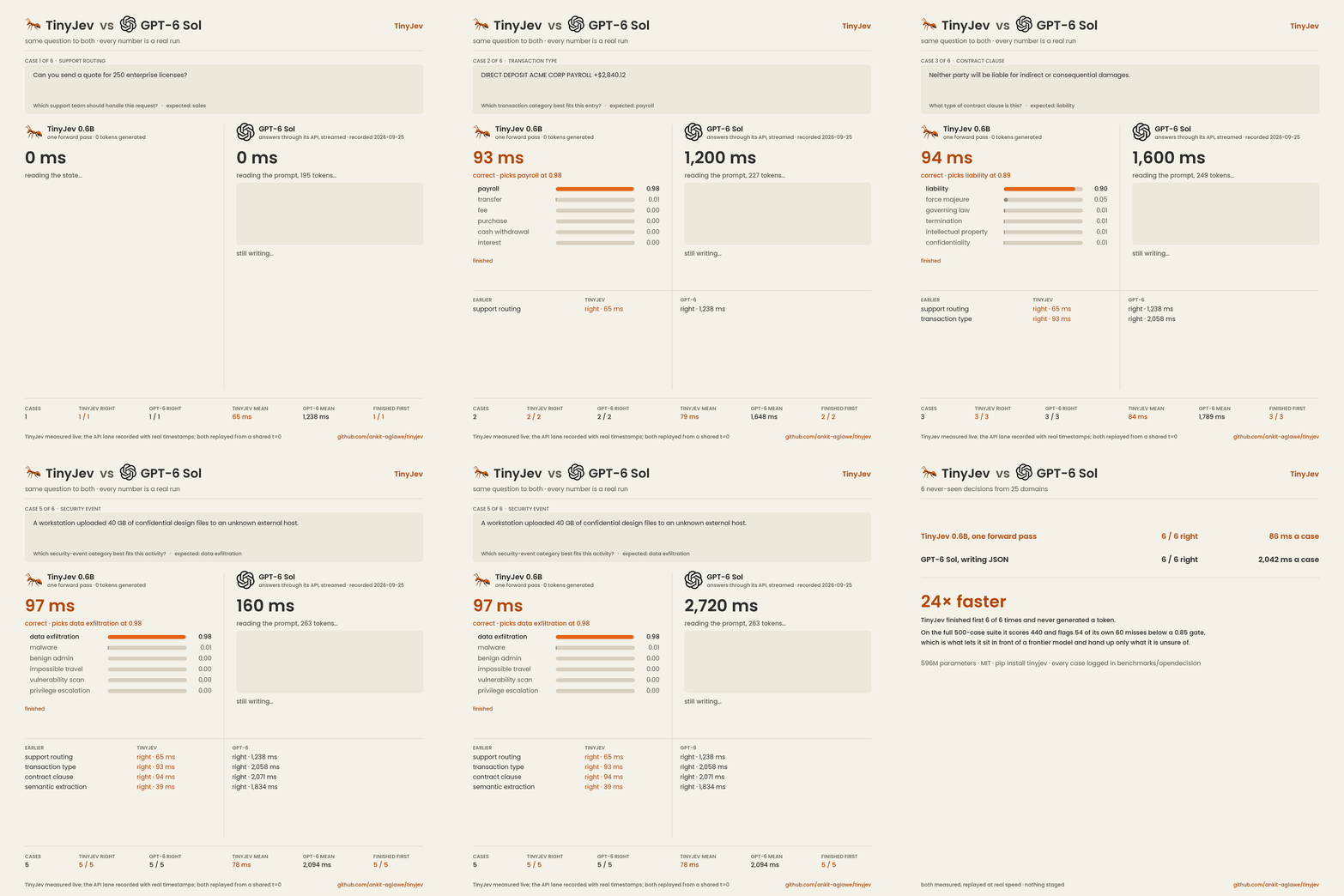
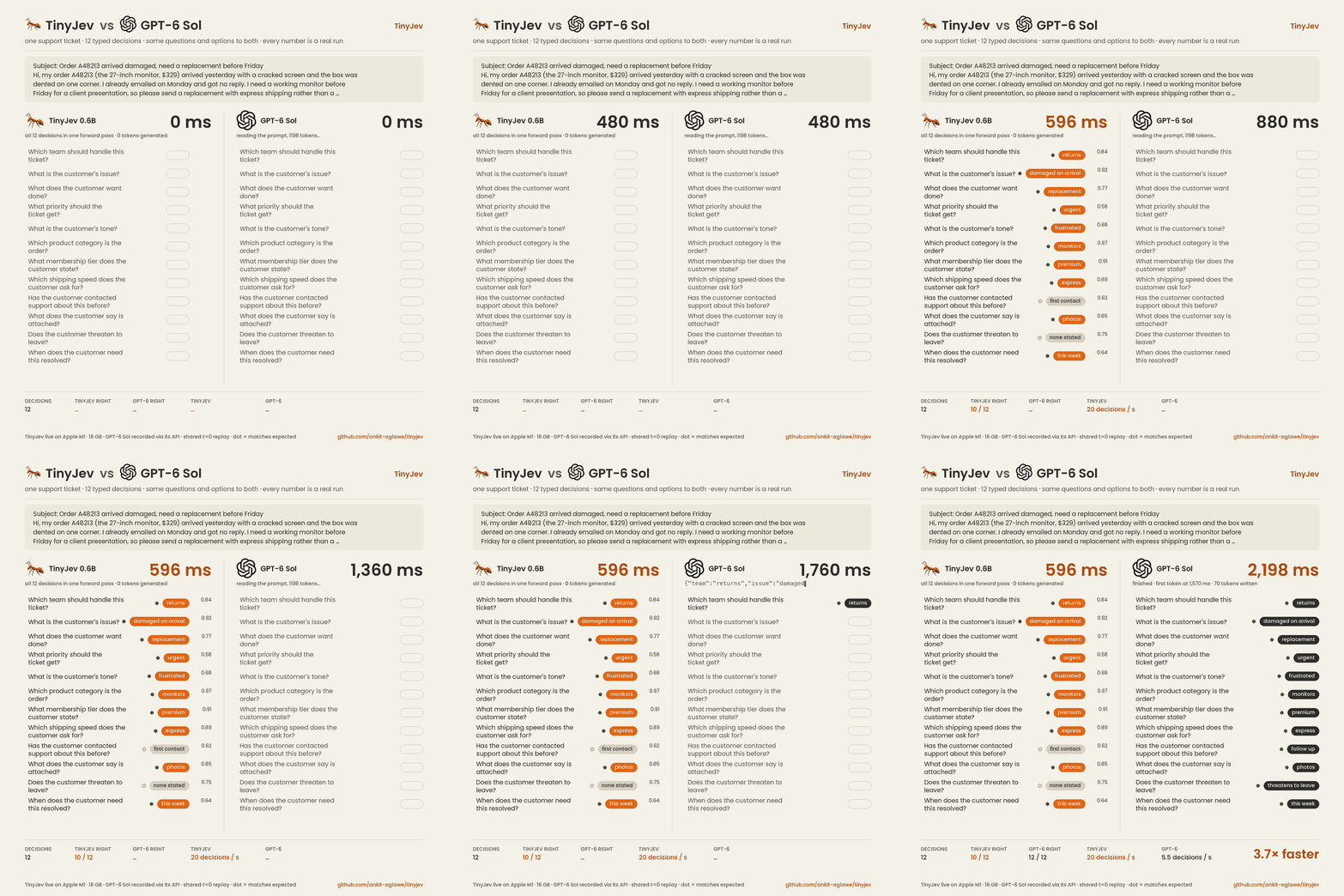
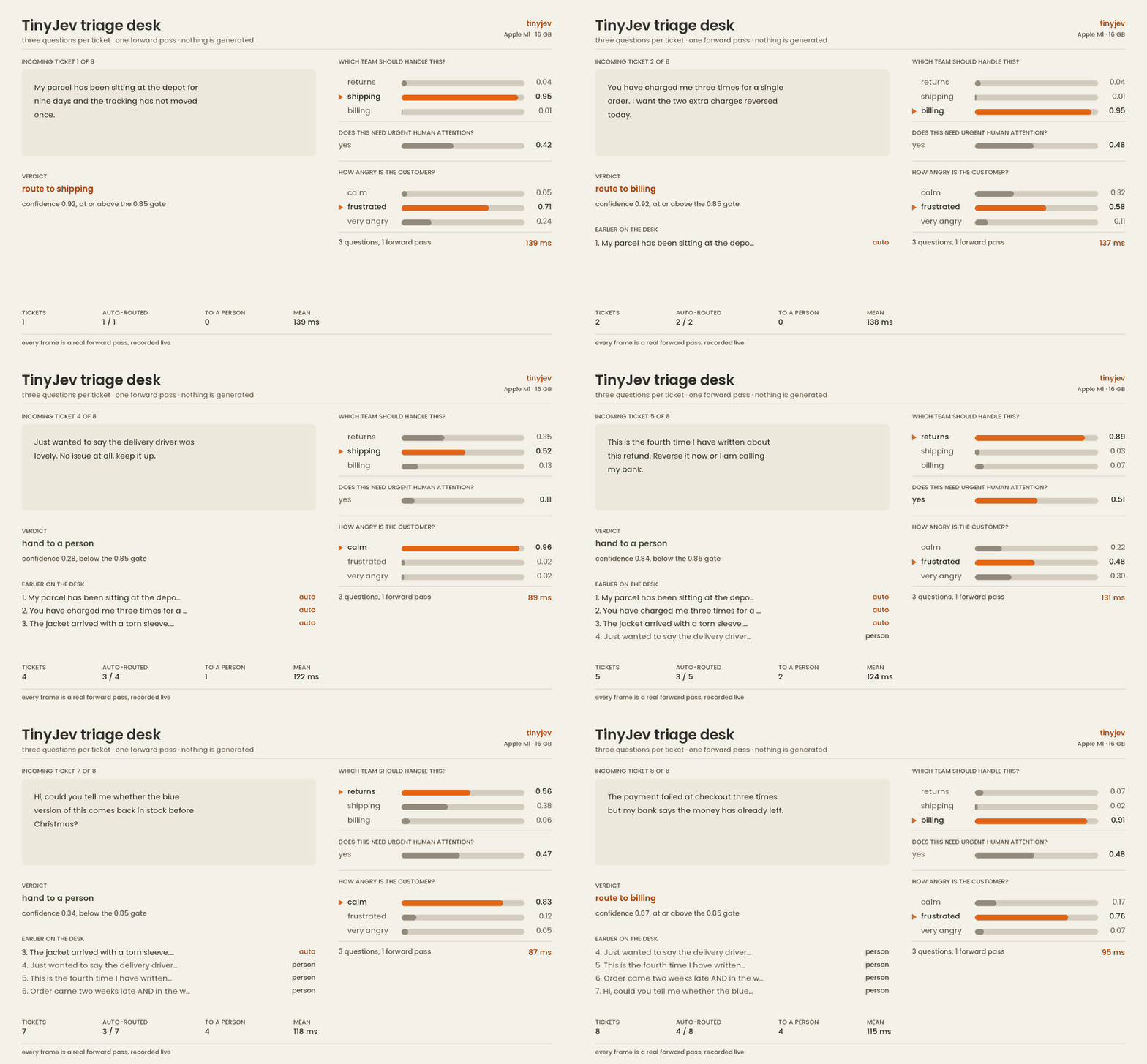
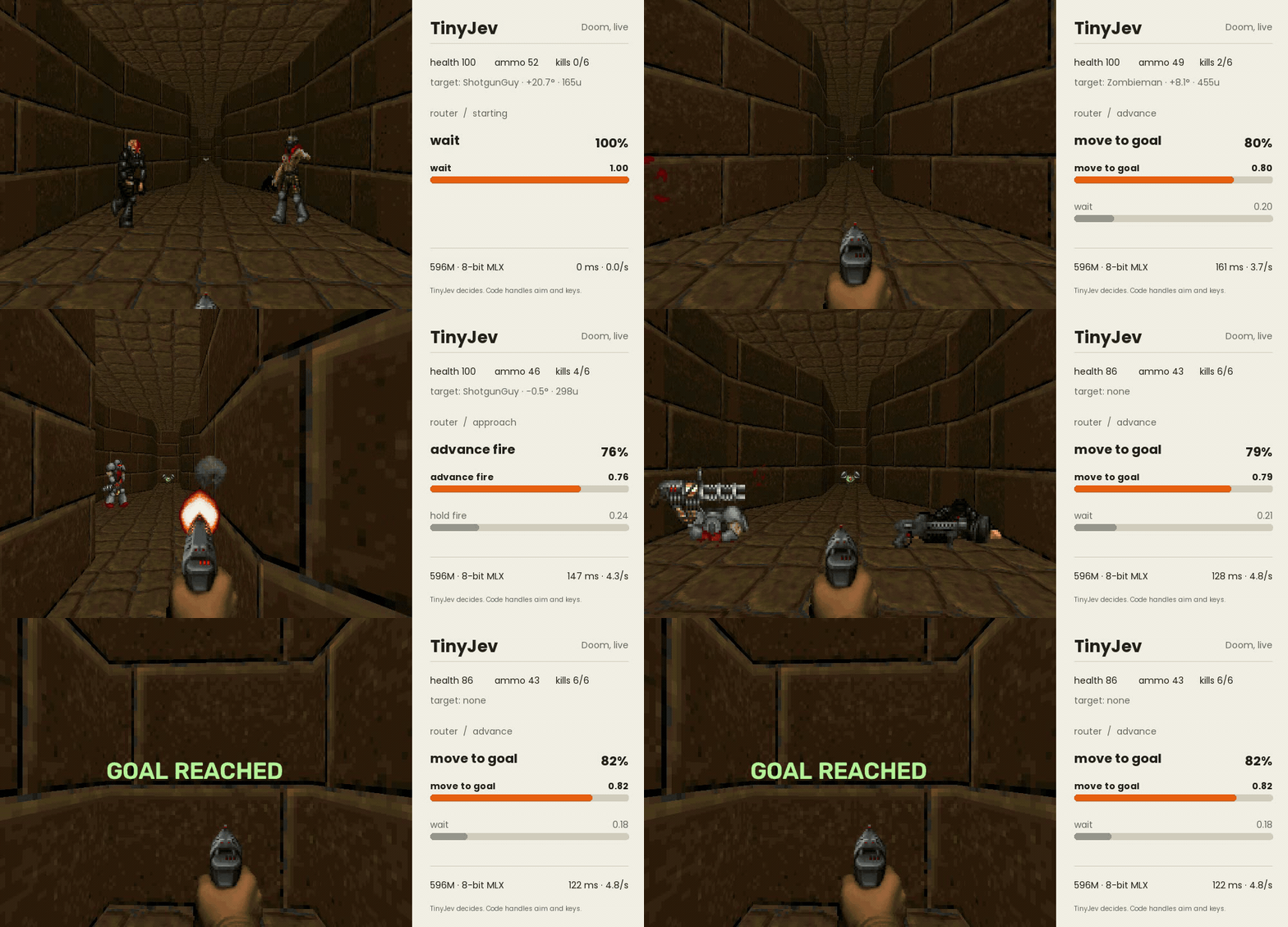
 **TinyJev 0.6B** | 596M, 1.2 GB | 440 (88.0%) | 59% @ 98.0% | 85 | 🤗 [AnkitAI/TinyJev-0.6B](https://huggingface.co/AnkitAI/TinyJev-0.6B) |
| **TinyJev 4B** | 4.0B, 8.0 GB | 474 (94.8%) | 87% @ 99.1% | 628 | 🤗 [AnkitAI/TinyJev-4B](https://huggingface.co/AnkitAI/TinyJev-4B) |
OD-500 is correct answers out of 500. Gate 0.85 is the share of decisions answered on its own at
confidence ≥ 0.85, and how often those were right. Calibration (ECE 0.071 vs 0.022), coverage at 2%
error (63% vs 92%) and transfer-v4 dev (0.625 vs 0.762) are on the benchmark page. Load either with
`tinyjev.load("TinyJev-0.6B")` or `tinyjev.load("TinyJev-4B")`.
Both rows are fp16. Loading with `quantize=8` keeps the same weights in half the memory and changes
almost nothing: the 0.6B scores 440 at 90 ms, the 4B 473 at 845 ms, one answer in 500 different from
fp16. The gate is the number that matters in production; the rest of the queue goes to a person or a
bigger model. On the same 500: Kev-0.8B 463, Claude Opus 5.5 496, the same Qwen3-0.6B weights read
through letter logits with no head 354.
## Measured
On OpenDecision's Original Choice 500, a suite of 25 domains that was not in the training data, with the same 500 inputs for every model:
| Model | Correct / 500 | Handled alone at confidence ≥ 0.85 |
|---|---:|---:|
| Claude Opus 5.5 (cloud, self-reported probabilities) | 496 | 477 at 100.0% |
| Kev-0.6B, the checkpoint this reproduces (raw logits) | 441 | 378 at 98.2% |
| **TinyJev-0.6B** | **440** | **296 at 98.0%** |
| Same Qwen3-0.6B weights, no head, letter logits | 354 | 79 at 97.5% |
330/375 on dev, 110/125 on holdout, 95% CI 0.850–0.908. The shipped temperature (1.464, fitted in-distribution) flattens confidence out of distribution: at raw logits the same gate covers 76% of the queue, matching Kev-0.6B. Reported, not refit. Every case, every probability, the coverage curves and all the baseline rows: [benchmarks/opendecision](https://github.com/ankit-aglawe/tinyjev/tree/main/benchmarks/opendecision).
## Use it
```bash
pip install 'tinyjev[mlx]' # Apple Silicon
pip install 'tinyjev[torch]' # everything else
```
```python
import tinyjev
agent = tinyjev.load("TinyJev-0.6B")
agent.predict({
"state": "Shoes arrived two weeks late and in the wrong size. Also I see two charges on my card.",
"questions": {
"team": {"type": "choice", "instructions": "Which team should handle this?",
"criteria": {"returns": "Exchanges, refunds, wrong or damaged items",
"shipping": "Delivery status, delays, lost packages",
"billing": "Charges, invoices, payment problems"}},
"escalate": {"type": "noul", "instructions": "Does this need urgent human attention?"},
"anger": {"type": "score", "instructions": "How angry is the customer?",
"criteria": ["calm", "frustrated", "very angry"]},
}})
```
On Apple Silicon you can quantize as it loads. Eight bits is free: half the memory, slightly faster,
and it scored identically to full precision on our held-out set.
```python
agent = tinyjev.load("TinyJev-0.6B", quantize=8)
```
Serve it over HTTP, speaking the System One request shape:
```bash
tinyjev serve TinyJev-0.6B # POST /v1/systemone on 127.0.0.1:8077
```
## What is in this repo
`AutoModel.from_pretrained("AnkitAI/TinyJev-0.6B")` loads the backbone on its own, a standard
`Qwen3Model` in fp16. The decision head lives in `head.safetensors`, and `tinyjev` is what turns hidden
states into calibrated answers.
## How it was built, and how it scores
Qwen3-0.6B-Base with a pointer head, LoRA r16 at lr 5e-5 merged back into the base, trained on the
public `jaredpalmer/kev-suites` decision-v7 split. No held-out transfer source was used in training.
A fitted temperature of 1.46 is applied at inference.
| | transfer-v4 dev | transfer-v4 test, read once | ECE on test |
| --- | --- | --- | --- |
| TinyJev-0.6B | 0.625 | 0.663 | 0.082 |
| Same-size public anchor (Kev-0.6B) | 0.620 | 0.642 | 0.128 |
Scored with the upstream harness on its frozen held-out suite. This matches the same-size public anchor
and edges ahead on the locked test with lower calibration error. It is not 4B-class, and it is not
meant to be. Full fine-tuning, distillation from a 4B teacher, and a 149M encoder were all tried and
all lost to the configuration above.
`TinyJev-0.6B` is done and published. Next is a smaller one, around 0.15B.
## Support the Project
If this model is useful in your work, you can support independent research:
