# InstructBlipVideo
## 概述
InstructBLIPVideo 是 Wenliang Dai、Junnan Li、Dongxu Li、Anthony Meng Huat Tiong、Junqi Zhao、Weisheng Wang、Boyang Li、Pascale Fung 和 Steven Hoi 在 [InstructBLIP: Towards General-purpose Vision-Language Models with Instruction Tuning](https://huggingface.co/papers/2305.06500) 中提出的模型的扩展。InstructBLIPVideo 采用与 [InstructBLIP](instructblip) 相同的架构,并使用与 [InstructBLIP](instructblip) 相同的检查点。唯一的区别在于其具备处理视频的能力。
该论文的摘要如下:
*在预训练和指令微调流程的推动下,能够解决多种语言领域任务的通用语言模型应运而生。然而,由于额外的视觉输入引入了更大的任务差异,构建通用视觉-语言模型颇具挑战性。尽管视觉-语言预训练已被广泛研究,但视觉-语言指令微调仍相对较少被探索。在本文中,我们基于预训练的 BLIP-2 模型,对视觉-语言指令微调进行了系统且全面的研究。我们收集了 26 个公开数据集,将其转换为指令微调格式,并将其划分为两个集群,分别用于保留集内的指令微调和保留集外的零样本评估。此外,我们引入了指令感知的视觉特征提取,这是一种关键方法,使模型能够针对给定指令提取具有信息量的特征。所得的 InstructBLIP 模型在所有 13 个保留集外数据集上均达到了最先进的零样本性能,显著优于 BLIP-2 以及规模更大的 Flamingo。当在单个下游任务上进行微调时,我们的模型同样取得了最先进的性能(例如,在 ScienceQA IMG 上达到 90.7% 的准确率)。此外,我们还从定性角度展示了 InstructBLIP 相较于同期多模态模型的优势。*
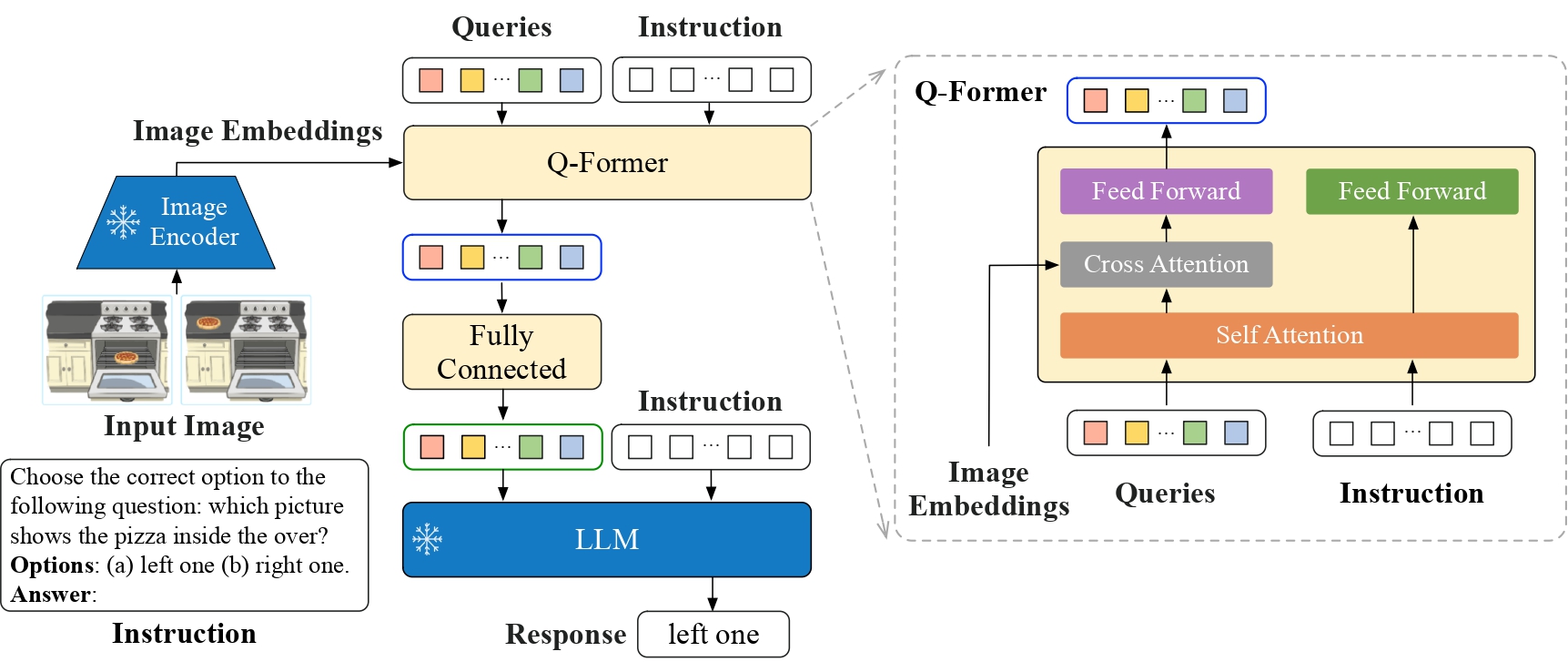 InstructBLIPVideo 架构。摘自原始论文。
该模型由 [RaushanTurganbay](https://huggingface.co/RaushanTurganbay) 贡献。原始代码可在[此处](https://github.com/salesforce/LAVIS/tree/main/projects/instructblip)找到。
## 使用技巧
- 该模型在训练时每个视频采样 4 帧,因此建议采样 4 帧
> [!NOTE]
> 在 v4.46 版本发布后,BLIP 模型将发出警告,提示需要添加 `processor.num_query_tokens = {{num_query_tokens}}` 并扩展模型嵌入层以添加特殊的 `` 标记。如果您拥有该模型检查点,强烈建议为处理器添加这些属性;如果检查点不属于您,则建议提交一个 PR。添加这些属性意味着 BLIP 将为每张图片添加所需数量的查询标记,并根据查询标记的数量在文本中扩展相应数量的 `` 占位符。通常每张图片大约需要 500 个标记,因此请确保文本未被截断,否则在合并嵌入时将会失败。
这些属性可以从模型配置中获取,例如 `model.config.num_query_tokens`,而模型嵌入的扩展可以按照 [此链接](https://gist.github.com/zucchini-nlp/e9f20b054fa322f84ac9311d9ab67042) 进行操作。
## InstructBlipVideoConfig[[transformers.InstructBlipVideoConfig]]
#### transformers.InstructBlipVideoConfig[[transformers.InstructBlipVideoConfig]]
```python
transformers.InstructBlipVideoConfig(transformers_version: str | None = None, architectures: list[str] | None = None, output_hidden_states: bool | None = False, return_dict: bool | None = True, dtype: str | torch.dtype | None = None, chunk_size_feed_forward: int = 0, is_encoder_decoder: bool = False, id2label: dict[int, str] | dict[str, str] | None = None, label2id: dict[str, int] | dict[str, str] | None = None, problem_type: Literal['regression', 'single_label_classification', 'multi_label_classification'] | None = None, vision_config: dict | transformers.configuration_utils.PreTrainedConfig | None = None, qformer_config: dict | transformers.configuration_utils.PreTrainedConfig | None = None, text_config: dict | transformers.configuration_utils.PreTrainedConfig | None = None, num_query_tokens: int = 32, initializer_factor: float = 1.0, initializer_range: float = 0.02, video_token_index: int | None = None)
```
[来源](https://github.com/huggingface/transformers/blob/main/src/transformers/models/instructblipvideo/configuration_instructblipvideo.py#L109)
**参数:**
vision_config (`Union[dict, ~configuration_utils.PreTrainedConfig]`,*可选*):视觉骨干网络的配置对象或字典。
qformer_config (`dict`, *可选*) : 用于初始化 [InstructBlipVideoQFormerConfig](/docs/transformers/main/zh/model_doc/instructblipvideo#transformers.InstructBlipVideoQFormerConfig) 的配置选项字典。
text_config (`Union[dict, ~configuration_utils.PreTrainedConfig]`,*可选*):文本骨干网络的配置对象或字典。
num_query_tokens (`int`,*可选*,默认为 32):通过 Transformer 传递的查询 token 数量。
initializer_factor (`float`, *可选*,默认为 `1.0`):用于初始化所有权重矩阵的系数(应保持为 1,内部用于初始化测试)。
initializer_range (`float`,*可选*,默认值为 `0.02`):用于初始化所有权重矩阵的 truncated_normal_initializer 的标准差。
video_token_index (`int`, *可选*) : 用作输入视频占位符的视频标记索引。
这是用于存储 InstructBlipVideoModel 配置的类。它根据指定的参数实例化 Instructblipvideo 模型,并定义模型架构。使用默认值实例化配置,将得到与 [Salesforce/instructblip-flan-t5-xl](https://huggingface.co/Salesforce/instructblip-flan-t5-xl) 类似的配置。
配置对象继承自 [PreTrainedConfig](/docs/transformers/main/zh/main_classes/configuration#transformers.PreTrainedConfig),可用于控制模型输出。有关更多信息,请参阅 [PreTrainedConfig](/docs/transformers/main/zh/main_classes/configuration#transformers.PreTrainedConfig) 的文档。
示例:
```python
>>> from transformers import (
... InstructBlipVideoVisionConfig,
... InstructBlipVideoQFormerConfig,
... OPTConfig,
... InstructBlipVideoConfig,
... InstructBlipVideoForConditionalGeneration,
... )
>>> # Initializing a InstructBlipVideoConfig with Salesforce/instructblip-flan-t5-xl style configuration
>>> configuration = InstructBlipVideoConfig()
>>> # Initializing a InstructBlipVideoForConditionalGeneration (with random weights) from the Salesforce/instructblip-flan-t5-xl style configuration
>>> model = InstructBlipVideoForConditionalGeneration(configuration)
>>> # Accessing the model configuration
>>> configuration = model.config
>>> # We can also initialize a InstructBlipVideoConfig from a InstructBlipVideoVisionConfig, InstructBlipVideoQFormerConfig and any PreTrainedConfig
>>> # Initializing Instructblipvideo vision, Instructblipvideo Q-Former and language model configurations
>>> vision_config = InstructBlipVideoVisionConfig()
>>> qformer_config = InstructBlipVideoQFormerConfig()
>>> text_config = OPTConfig()
>>> config = InstructBlipVideoConfig(vision_config=vision_config, qformer_config=qformer_config, text_config=text_config)
```
## InstructBlipVideoVisionConfig[[transformers.InstructBlipVideoVisionConfig]]
#### transformers.InstructBlipVideoVisionConfig[[transformers.InstructBlipVideoVisionConfig]]
```python
transformers.InstructBlipVideoVisionConfig(transformers_version: str | None = None, architectures: list[str] | None = None, output_hidden_states: bool | None = False, return_dict: bool | None = True, dtype: str | torch.dtype | None = None, chunk_size_feed_forward: int = 0, is_encoder_decoder: bool = False, id2label: dict[int, str] | dict[str, str] | None = None, label2id: dict[str, int] | dict[str, str] | None = None, problem_type: Literal['regression', 'single_label_classification', 'multi_label_classification'] | None = None, hidden_size: int = 1408, intermediate_size: int = 6144, num_hidden_layers: int = 39, num_attention_heads: int = 16, image_size: int | list[int] | tuple[int, int] = 224, patch_size: int | list[int] | tuple[int, int] = 14, hidden_act: str = 'gelu', layer_norm_eps: float = 1e-06, attention_dropout: float | int = 0.0, initializer_range: float = 1e-10, qkv_bias: bool = True)
```
[来源](https://github.com/huggingface/transformers/blob/main/src/transformers/models/instructblipvideo/configuration_instructblipvideo.py#L32)
**参数:**
hidden_size (`int`,*可选*,默认为 `1408`):隐藏表示的维度。
intermediate_size (`int`,*可选*,默认为 `6144`):MLP 表示的维度。
num_hidden_layers (`int`,*可选*,默认为 `39`):Transformer 解码器中的隐藏层数。
num_attention_heads (`int`,*可选*,默认为 `16`):Transformer 解码器中每个注意力层的注意力头数量。
image_size (`Union[int, list[int], tuple[int, int]]`,*可选*,默认为 `224`):每张图片的尺寸(分辨率)。
patch_size (`Union[int, list[int], tuple[int, int]]`,*可选*,默认为 `14`):每个 patch 的大小(分辨率)。
hidden_act (`str`,*可选*,默认为 `gelu`):解码器中的非线性激活函数(函数或字符串)。例如,`"gelu"`、`"relu"`、`"silu"` 等。
layer_norm_eps (`float`, *可选*, 默认为 `1e-06`) : 层归一化层使用的 epsilon。
attention_dropout (`Union[float, int]`,*可选*,默认值为 `0.0`):注意力概率的 dropout 比率。
initializer_range (`float`, *可选*, 默认为 `1e-10`) : 用于初始化所有权重矩阵的 truncated_normal_initializer 的标准差。
qkv_bias (`bool`,*可选*,默认为 `True`):是否向查询、键和值添加偏置。
这是用于存储 InstructBlipVideoModel 配置的类。它根据指定的参数实例化 Instructblipvideo 模型,并定义模型架构。使用默认值实例化配置,将得到与 [Salesforce/instructblip-flan-t5-xl](https://huggingface.co/Salesforce/instructblip-flan-t5-xl) 类似的配置。
配置对象继承自 [PreTrainedConfig](/docs/transformers/main/zh/main_classes/configuration#transformers.PreTrainedConfig),可用于控制模型输出。有关更多信息,请参阅 [PreTrainedConfig](/docs/transformers/main/zh/main_classes/configuration#transformers.PreTrainedConfig) 的文档。
示例:
```python
>>> from transformers import InstructBlipVideoVisionConfig, InstructBlipVideoVisionModel
>>> # Initializing a InstructBlipVideoVisionConfig with Salesforce/instructblip-flan-t5-xl style configuration
>>> configuration = InstructBlipVideoVisionConfig()
>>> # Initializing a InstructBlipVideoVisionModel (with random weights) from the Salesforce/instructblip-flan-t5-xl style configuration
>>> model = InstructBlipVideoVisionModel(configuration)
>>> # Accessing the model configuration
>>> configuration = model.config
```
## InstructBlipVideoQFormerConfig[[transformers.InstructBlipVideoQFormerConfig]]
#### transformers.InstructBlipVideoQFormerConfig[[transformers.InstructBlipVideoQFormerConfig]]
```python
transformers.InstructBlipVideoQFormerConfig(transformers_version: str | None = None, architectures: list[str] | None = None, output_hidden_states: bool | None = False, return_dict: bool | None = True, dtype: str | torch.dtype | None = None, chunk_size_feed_forward: int = 0, is_encoder_decoder: bool = False, id2label: dict[int, str] | dict[str, str] | None = None, label2id: dict[str, int] | dict[str, str] | None = None, problem_type: Literal['regression', 'single_label_classification', 'multi_label_classification'] | None = None, vocab_size: int = 30522, hidden_size: int = 768, num_hidden_layers: int = 12, num_attention_heads: int = 12, intermediate_size: int = 3072, hidden_act: str = 'gelu', hidden_dropout_prob: float | int = 0.1, attention_probs_dropout_prob: float | int = 0.1, max_position_embeddings: int = 512, initializer_range: float = 0.02, layer_norm_eps: float = 1e-12, pad_token_id: int | None = 0, cross_attention_frequency: int = 2, encoder_hidden_size: int = 1408)
```
[来源](https://github.com/huggingface/transformers/blob/main/src/transformers/models/instructblipvideo/configuration_instructblipvideo.py#L67)
**参数:**
vocab_size (`int`,*可选*,默认值为 `30522`):模型的词汇表大小。定义了 `input_ids` 可以表示的不同 token 数量。
hidden_size (`int`,*可选*,默认为 `768`):隐藏表示的维度。
num_hidden_layers (`int`,*可选*,默认为 `12`):Transformer 解码器中的隐藏层数。
num_attention_heads (`int`,*可选*,默认为 `12`):Transformer 解码器中每个注意力层的注意力头数量。
intermediate_size (`int`,*可选*,默认值为 `3072`):MLP 表示的维度。
hidden_act (`str`,*可选*,默认为 `gelu`):解码器中的非线性激活函数(函数或字符串)。例如,`"gelu"`、`"relu"`、`"silu"` 等。
hidden_dropout_prob (`Union[float, int]`,*可选*,默认值为 `0.1`):嵌入层、编码器和池化器中所有全连接层的 dropout 概率。
attention_probs_dropout_prob (`Union[float, int]`,*可选*,默认值为 `0.1`):注意力概率的 dropout 比率。
max_position_embeddings (`int`,*可选*,默认值为 `512`):该模型可能使用的最大序列长度。
initializer_range (`float`,*可选*,默认值为 `0.02`):用于初始化所有权重矩阵的 truncated_normal_initializer 的标准差。
layer_norm_eps (`float`, *可选*,默认为 `1e-12`):层归一化层所使用的 epsilon。
pad_token_id (`int`,*可选*,默认为 `0`):词表中用于填充的 Token ID。
cross_attention_frequency (`int`,*可选*,默认为 2):在 Transformer 层中添加交叉注意力的频率。
encoder_hidden_size (`int`,*可选*,默认为 1408):交叉注意力中隐藏状态的隐藏层大小。
这是用于存储 InstructBlipVideoModel 配置的类。它根据指定的参数实例化 Instructblipvideo 模型,并定义模型架构。使用默认值实例化配置,将得到与 [Salesforce/instructblip-flan-t5-xl](https://huggingface.co/Salesforce/instructblip-flan-t5-xl) 类似的配置。
配置对象继承自 [PreTrainedConfig](/docs/transformers/main/zh/main_classes/configuration#transformers.PreTrainedConfig),可用于控制模型输出。有关更多信息,请参阅 [PreTrainedConfig](/docs/transformers/main/zh/main_classes/configuration#transformers.PreTrainedConfig) 的文档。
示例:
```python
>>> from transformers import InstructBlipVideoQFormerConfig, InstructBlipVideoQFormerModel
>>> # Initializing a InstructBlipVideo Salesforce/instructblip-flan-t5-xl style configuration
>>> configuration = InstructBlipVideoQFormerConfig()
>>> # Initializing a model (with random weights) from the Salesforce/instructblip-flan-t5-xl style configuration
>>> model = InstructBlipVideoQFormerModel(configuration)
>>> # Accessing the model configuration
>>> configuration = model.config
```
## InstructBlipVideoProcessor[[transformers.InstructBlipVideoProcessor]]
#### transformers.InstructBlipVideoProcessor[[transformers.InstructBlipVideoProcessor]]
```python
transformers.InstructBlipVideoProcessor(video_processor, tokenizer, qformer_tokenizer, num_query_tokens = None, **kwargs)
```
[来源](https://github.com/huggingface/transformers/blob/main/src/transformers/models/instructblipvideo/processing_instructblipvideo.py#L35)
**参数:**
video_processor (`InstructBlipVideoVideoProcessor`):视频处理器是必需的输入。
tokenizer (`GPT2Tokenizer`):分词器是必需的输入。
qformer_tokenizer (`AutoTokenizer`):['PreTrainedTokenizer`'] 的一个实例。Q-Former 分词器是必需的输入。
num_query_tokens (`int`, *可选*) : Qformer 用作查询的 token 数量,应与模型配置中的值相同。
构造一个 InstructBlipVideoProcessor,它将视频处理器、分词器和 qformer 分词器封装为单一处理器。
[InstructBlipVideoProcessor](/docs/transformers/main/zh/model_doc/instructblipvideo#transformers.InstructBlipVideoProcessor) 提供了 [InstructBlipVideoVideoProcessor](/docs/transformers/main/zh/model_doc/instructblipvideo#transformers.InstructBlipVideoVideoProcessor)、[GPT2Tokenizer](/docs/transformers/main/zh/model_doc/gpt2#transformers.GPT2Tokenizer) 和 `{qformer_tokenizer_class}` 的所有功能。有关更多信息,请参阅 [~InstructBlipVideoVideoProcessor](/docs/transformers/main/zh/model_doc/instructblipvideo#transformers.InstructBlipVideoVideoProcessor)、[~GPT2Tokenizer](/docs/transformers/main/zh/model_doc/gpt2#transformers.GPT2Tokenizer) 和 `~{qformer_tokenizer_class}`。
## InstructBlipVideoVideoProcessor[[transformers.InstructBlipVideoVideoProcessor]]
#### transformers.InstructBlipVideoVideoProcessor[[transformers.InstructBlipVideoVideoProcessor]]
```python
transformers.InstructBlipVideoVideoProcessor(**kwargs: *)
```
[来源](https://github.com/huggingface/transformers/blob/main/src/transformers/models/instructblipvideo/video_processing_instructblipvideo.py#L30)
**参数:**
do_convert_rgb (`bool`,*kwargs*,*可选*,默认为 `True`):是否将图像转换为 RGB。
do_resize (`bool`, *kwargs*, *可选*, 默认为 `True`) : 是否调整图像大小。
size (`Annotated[int | list[int] | tuple[int, ...] | dict[str, int] | None, None]`, *kwargs*,默认为 `{'height' : 384, 'width': 384}`):描述输入到模型的最大尺寸。
default_to_square (`bool`,*kwargs*,*可选*,默认为 `True`):当 size 为整数时,是否在调整大小时默认使用正方形图像。
resample (`Annotated[Union[int, PILImageResampling, NoneType], None]`, *kwargs*,默认值为 `3`) : 如果调整图像大小,则使用的重采样滤波器。它可以是枚举 `PILImageResampling` 中的一个值。仅当 `do_resize` 设置为 `True` 时才会生效。
do_rescale (`bool`, *kwargs*, *可选*,默认为 `True`):是否对图像进行重新缩放。
rescale_factor (`float`, *kwargs*, *可选*,默认为 `0.00392156862745098`) : 当 `do_rescale` 设置为 `True` 时,用于对图像进行缩放的缩放因子。
do_normalize (`bool`,*kwargs*,*可选*,默认为 `True`):是否对图像进行归一化。
image_mean (`Union[float, list[float], tuple[float, ...]]`, *kwargs*, *可选*,默认为 `[0.48145466, 0.4578275, 0.40821073]`) : 用于归一化的图像均值。仅当 `do_normalize` 设置为 `True` 时生效。
image_std (`Union[float, list[float], tuple[float, ...]]`, *kwargs*, *可选*,默认为 `[0.26862954, 0.26130258, 0.27577711]`) : 用于归一化的图像标准差。仅当 `do_normalize` 设置为 `True` 时生效。
do_center_crop (`bool`, *kwargs*, *可选*) : 是否对图像进行居中裁剪。
do_pad (`bool`, *kwargs*, *可选*) : 是否对图像进行填充。填充操作会将图像填充至批次中的最大尺寸,或填充至每张图像的固定正方形尺寸。具体的填充策略取决于模型。
crop_size (`Annotated[int | list[int] | tuple[int, ...] | dict[str, int] | None, None]`, *kwargs*) : 应用 `center_crop` 后输出图像的尺寸。
data_format (`Union[str, ~image_utils.ChannelDimension]`,*kwargs*,*可选*):仅支持 `ChannelDimension.FIRST`。为兼容旧版处理器而添加。
input_data_format (`Union[str, ~image_utils.ChannelDimension]`, *kwargs*, *可选*) : 输入图像的通道维度格式。如果未设置,则从输入图像中推断通道维度格式。可以是以下之一: - `"channels_first"` 或 `ChannelDimension.FIRST`:图像为 (num_channels, height, width) 格式。 - `"channels_last"` 或 `ChannelDimension.LAST`:图像为 (height, width, num_channels) 格式。 - `"none"` 或 `ChannelDimension.NONE`:图像为 (height, width) 格式。
device (`Annotated[Union[str, torch.device, NoneType], None]`, *kwargs*):用于处理视频的设备。如果未设置,则从输入视频中推断设备。
do_sample_frames (`bool`, *kwargs*, *可选*,默认为 `False`):是否在处理前从视频中采样帧,还是处理整个视频。
video_metadata (`Annotated[~video_utils.VideoMetadata | dict | list[dict | ~video_utils.VideoMetadata] | list[list[dict | ~video_utils.VideoMetadata]] | None, None]`, *kwargs*) : 视频的元数据,包含总时长、帧率(fps)和总帧数等信息。该元数据将用于从视频中采样帧或计算时间戳。除非您打算在预处理之前手动解码视频,否则请勿传入任何元数据。
fps (`Annotated[int | float | None, None]`, *kwargs*) : 当 `do_sample_frames=True` 时,每秒采样的目标帧数。
num_frames (`Annotated[int | None, None]`, *kwargs*) : 当 `do_sample_frames=True` 时,要采样的最大帧数。
return_metadata (`bool`, *kwargs*, *可选*,默认为 `False`) : 是否返回视频元数据。视频元数据是一个包含视频时长、帧率、解码后端等信息的对象。
return_tensors (`Annotated[str | ~utils.generic.TensorType | None, None]`, *kwargs*) : 如果设置,将返回特定框架的张量。可接受的值为: - `'pt'`:返回 PyTorch `torch.Tensor` 对象。 - `'np'`:返回 NumPy `np.ndarray` 对象。
- ****kwargs** ([VideosKwargs](/docs/transformers/main/zh/main_classes/processors#transformers.VideosKwargs), *optional*) : 每种模态(文本、图像、视频、音频)的额外处理选项。模型特定参数已在上方列出;有关支持参数的完整列表,请参阅 TypedDict 类。
构造一个 InstructBlipVideoVideoProcessor 视频处理器。
#### preprocess[[transformers.InstructBlipVideoVideoProcessor.preprocess]]
```python
preprocess(videos: typing.Union[list['PIL.Image.Image'], numpy.ndarray, ForwardRef('torch.Tensor'), list[numpy.ndarray], list['torch.Tensor'], list[list['PIL.Image.Image']], list[list[numpy.ndarray]], list[list['torch.Tensor']], transformers.video_utils.URL, list[transformers.video_utils.URL], list[list[transformers.video_utils.URL]], transformers.video_utils.Path, list[transformers.video_utils.Path], list[list[transformers.video_utils.Path]]], **kwargs: *)
```
[来源](https://github.com/huggingface/transformers/blob/main/src/transformers/video_processing_utils.py#L98)
**参数:**
videos (`Union[list[PIL.Image.Image], numpy.ndarray, torch.Tensor, list[numpy.ndarray], list[torch.Tensor], list[list[PIL.Image.Image]], list[list[numpy.ndarray]], list[list[torch.Tensor]], ~video_utils.URL, list[~video_utils.URL], list[list[~video_utils.URL]], ~video_utils.Path, list[~video_utils.Path], list[list[~video_utils.Path]]]`) : 待预处理的视频。期望输入单个视频或一批视频,其像素值范围为 0 到 255。如果传入的像素值在 0 到 1 之间,请设置 `do_rescale=False`。
do_convert_rgb (`bool`, *kwargs*, *可选*) : 是否将图像转换为 RGB。
do_resize (`bool`,*kwargs*,*可选*):是否调整图像大小。
size (`Annotated[int | list[int] | tuple[int, ...] | dict[str, int] | None, None]`, *kwargs*):描述模型的最大输入维度。
default_to_square (`bool`, *kwargs*, *可选*) : 当 size 为 int 时,是否在调整大小时默认使用正方形图像。
resample (`Annotated[Union[int, PILImageResampling, NoneType], None]`, *kwargs*) : 如果调整图像大小,则使用的重采样滤波器。它可以是枚举 `PILImageResampling` 中的一个值。仅当 `do_resize` 设置为 `True` 时才会生效。
do_rescale (`bool`, *kwargs*, *可选*) : 是否对图像进行重新缩放。
rescale_factor (`float`, *kwargs*, *可选*) : 当 `do_rescale` 设置为 `True` 时,用于对图像进行缩放的缩放因子。
do_normalize (`bool`, *kwargs*, *可选*) : 是否对图像进行归一化。
image_mean (`Union[float, list[float], tuple[float, ...]]`,*kwargs*,*可选*):用于归一化的图像均值。仅当 `do_normalize` 设置为 `True` 时生效。
image_std (`Union[float, list[float], tuple[float, ...]]`, *kwargs*, *可选*) : 用于归一化的图像标准差。仅当 `do_normalize` 设置为 `True` 时生效。
do_center_crop (`bool`, *kwargs*, *可选*) : 是否对图像进行居中裁剪。
do_pad (`bool`, *kwargs*, *可选*) : 是否对图像进行填充。填充操作会将图像填充至批次中的最大尺寸,或填充至每张图像的固定正方形尺寸。具体的填充策略取决于模型。
crop_size (`Annotated[int | list[int] | tuple[int, ...] | dict[str, int] | None, None]`, *kwargs*) : 应用 `center_crop` 后输出图像的尺寸。
data_format (`Union[str, ~image_utils.ChannelDimension]`,*kwargs*,*可选*):仅支持 `ChannelDimension.FIRST`。为兼容旧版处理器而添加。
input_data_format (`Union[str, ~image_utils.ChannelDimension]`, *kwargs*, *可选*) : 输入图像的通道维度格式。如果未设置,则从输入图像中推断通道维度格式。可以是以下之一: - `"channels_first"` 或 `ChannelDimension.FIRST`:图像为 (num_channels, height, width) 格式。 - `"channels_last"` 或 `ChannelDimension.LAST`:图像为 (height, width, num_channels) 格式。 - `"none"` 或 `ChannelDimension.NONE`:图像为 (height, width) 格式。
device (`Annotated[Union[str, torch.device, NoneType], None]`, *kwargs*):用于处理视频的设备。如果未设置,则从输入视频中推断设备。
do_sample_frames (`bool`, *kwargs*, *可选*) : 是否在处理前从视频中采样帧,还是处理整个视频。
video_metadata (`Annotated[~video_utils.VideoMetadata | dict | list[dict | ~video_utils.VideoMetadata] | list[list[dict | ~video_utils.VideoMetadata]] | None, None]`, *kwargs*) : 视频的元数据,包含总时长、帧率(fps)和总帧数等信息。该元数据将用于从视频中采样帧或计算时间戳。除非您打算在预处理之前手动解码视频,否则请勿传入任何元数据。
fps (`Annotated[int | float | None, None]`, *kwargs*) : 当 `do_sample_frames=True` 时,每秒采样的目标帧数。
num_frames (`Annotated[int | None, None]`, *kwargs*) : 当 `do_sample_frames=True` 时,要采样的最大帧数。
return_metadata (`bool`, *kwargs*, *可选*) : 是否返回视频元数据。视频元数据是一个包含视频时长、帧率、解码后端等信息的对象。
return_tensors (`Annotated[str | ~utils.generic.TensorType | None, None]`, *kwargs*) : 如果设置为 `'pt'`,则返回堆叠的张量,否则返回张量列表。
**返回:** `~image_processing_base.BatchFeature`
- **data** (`dict`) -- 由 __call__ 方法返回的列表/数组/张量字典(例如 'pixel_values')。
- **tensor_type** (`Union[None, str, TensorType]`,*可选*) -- 您可以在此处指定 tensor_type,以便在初始化时将 PyTorch/Numpy 张量中的整数列表进行转换。
## InstructBlipVideoVisionModel[[transformers.InstructBlipVideoVisionModel]]
#### transformers.InstructBlipVideoVisionModel[[transformers.InstructBlipVideoVisionModel]]
```python
transformers.InstructBlipVideoVisionModel(config: InstructBlipVideoVisionConfig)
```
[来源](https://github.com/huggingface/transformers/blob/main/src/transformers/models/instructblipvideo/modeling_instructblipvideo.py#L393)
#### forward[[transformers.InstructBlipVideoVisionModel.forward]]
```python
forward(pixel_values: typing.Optional[torch.Tensor] = None, interpolate_pos_encoding: bool = False, **kwargs: *)
```
[来源](https://github.com/huggingface/transformers/blob/main/src/transformers/models/instructblipvideo/modeling_instructblipvideo.py#L413)
**参数:**
pixel_values (`torch.Tensor`,形状为 `(batch_size, num_channels, image_size, image_size)`,*可选*):与输入图像对应的张量。可以使用 `image_processor_class` 获取像素值。有关详细信息,请参阅 `image_processor_class.__call__`([InstructBlipVideoProcessor](/docs/transformers/main/zh/model_doc/instructblipvideo#transformers.InstructBlipVideoProcessor) 使用 `image_processor_class` 处理图像)。
interpolate_pos_encoding (`bool`,*可选*,默认为 `False`):是否对预训练的位置编码进行插值。
**返回:** [BaseModelOutputWithPooling](/docs/transformers/main/zh/main_classes/output#transformers.modeling_outputs.BaseModelOutputWithPooling) 或 `tuple(torch.Tensor)`
一个 [BaseModelOutputWithPooling](/docs/transformers/main/zh/main_classes/output#transformers.modeling_outputs.BaseModelOutputWithPooling) 或 `torch.Tensor` 元组(如果传入了 `return_dict=False` 或 `config.return_dict=False`),其包含的元素取决于配置([InstructBlipVideoConfig](/docs/transformers/main/zh/model_doc/instructblipvideo#transformers.InstructBlipVideoConfig))和输入。
[InstructBlipVideoVisionModel](/docs/transformers/main/zh/model_doc/instructblipvideo#transformers.InstructBlipVideoVisionModel) 的 forward 方法重写了 `__call__` 特殊方法。
尽管前向传播的实现需要在此函数中定义,但之后应调用 `Module` 实例,而不是直接调用此函数,因为前者会负责执行预处理和后处理步骤,而后者会静默地忽略这些步骤。
- **last_hidden_state**(形状为 `(batch_size, sequence_length, hidden_size)` 的 `torch.Tensor`)-- 模型最后一层输出的隐藏状态序列。
- **pooler_output**(形状为 `(batch_size, hidden_size)` 的 `torch.Tensor`)-- 序列中第一个 token(分类 token)的最后一层隐藏状态,经过用于辅助预训练任务的层进一步处理后的结果。例如,对于 BERT 系列模型,这返回的是分类 token 经过线性层和 tanh 激活函数处理后的结果。线性层的权重是在预训练期间通过下一句预测(分类)目标训练得到的。
- **hidden_states** (`tuple(torch.Tensor)`,*可选*,在传入 `output_hidden_states=True` 或 `config.output_hidden_states=True` 时返回) -- 一个 `torch.Tensor` 元组(如果模型具有嵌入层,则包含嵌入层的输出,以及每一层的输出),形状为 `(batch_size, sequence_length, hidden_size)`。
模型在每一层输出处的隐藏状态,以及可选的初始嵌入输出。
- **attentions** (`tuple(torch.Tensor)`,*可选*,当传入 `output_attentions=True` 或 `config.output_attentions=True` 时返回) -- 一个 `torch.Tensor` 元组(每层一个),形状为 `(batch_size, num_heads, sequence_length, sequence_length)`。
经过注意力 softmax 后的注意力权重,用于在自注意力头中计算加权平均值。
## InstructBlipVideoQFormerModel[[transformers.InstructBlipVideoQFormerModel]]
#### transformers.InstructBlipVideoQFormerModel[[transformers.InstructBlipVideoQFormerModel]]
```python
transformers.InstructBlipVideoQFormerModel(config: InstructBlipVideoQFormerConfig)
```
[来源](https://github.com/huggingface/transformers/blob/main/src/transformers/models/instructblipvideo/modeling_instructblipvideo.py#L708)
用于 InstructBlipVideo 的 Querying Transformer (Q-Former)。由于它还将指令作为输入,因此对 BLIP-2 进行了略微修改。
#### forward[[transformers.InstructBlipVideoQFormerModel.forward]]
```python
forward(input_ids: LongTensor, attention_mask: typing.Optional[torch.Tensor] = None, position_ids: typing.Optional[torch.LongTensor] = None, query_embeds: typing.Optional[torch.Tensor] = None, encoder_hidden_states: typing.Optional[torch.Tensor] = None, encoder_attention_mask: typing.Optional[torch.Tensor] = None, **kwargs: *)
```
[来源](https://github.com/huggingface/transformers/blob/main/src/transformers/models/instructblipvideo/modeling_instructblipvideo.py#L746)
**参数:**
input_ids (`torch.LongTensor`,形状为 `(batch_size, sequence_length)`):输入序列词元在词汇表中的索引。默认情况下,填充部分将被忽略。可以使用 [AutoTokenizer](/docs/transformers/main/zh/model_doc/auto#transformers.AutoTokenizer) 获取索引。有关详细信息,请参阅 [PreTrainedTokenizer.encode()](/docs/transformers/main/zh/internal/tokenization_utils#transformers.PreTrainedTokenizerBase.encode) 和 [PreTrainedTokenizer.__call__()](/docs/transformers/main/zh/internal/tokenization_utils#transformers.PreTrainedTokenizerBase.__call__)。[什么是输入 ID?](../glossary#input-ids)
attention_mask (`torch.Tensor`,形状为 `(batch_size, sequence_length)`,*可选*):用于避免对填充(padding)标记索引执行注意力机制的掩码。掩码值取自 `[0, 1]`: - 1 表示**未掩码**的标记, - 0 表示**已掩码**的标记。 [什么是注意力掩码?](../glossary#attention-mask)
position_ids (`torch.LongTensor`,形状为 `(batch_size, sequence_length)`,*可选*):输入序列中每个 token 在位置嵌入中的位置索引。取值范围为 `[0, config.n_positions - 1]`。[什么是位置 ID?](../glossary#position-ids)
query_embeds (`torch.Tensor`,形状为 `(batch_size, sequence_length, hidden_size)`):用于注意力计算的隐藏状态。如果是交叉注意力,将用作查询(即键和值将使用 encoder_hidden_states)。
encoder_hidden_states (`torch.Tensor`,形状为 `(batch_size, sequence_length, hidden_size)`,*可选*):编码器最后一层输出的隐藏状态序列。如果模型被配置为解码器,则用于交叉注意力。
encoder_attention_mask (`torch.Tensor`,形状为 `(batch_size, sequence_length)`,*可选*):用于避免对编码器输入中填充标记索引执行注意力机制的掩码。如果模型被配置为解码器,此掩码将用于交叉注意力。在 `[0, 1]` 中选择的掩码值: - 对于**未掩码**的标记,值为 1; - 对于**已掩码**的标记,值为 0。
**返回:** [BaseModelOutputWithPoolingAndCrossAttentions](/docs/transformers/main/zh/main_classes/output#transformers.modeling_outputs.BaseModelOutputWithPoolingAndCrossAttentions) 或 `tuple(torch.Tensor)`
一个 [BaseModelOutputWithPoolingAndCrossAttentions](/docs/transformers/main/zh/main_classes/output#transformers.modeling_outputs.BaseModelOutputWithPoolingAndCrossAttentions) 或 `torch.Tensor` 元组(如果传入了 `return_dict=False` 或 `config.return_dict=False`),其包含的元素取决于配置([InstructBlipVideoConfig](/docs/transformers/main/zh/model_doc/instructblipvideo#transformers.InstructBlipVideoConfig))和输入。
[InstructBlipVideoQFormerModel](/docs/transformers/main/zh/model_doc/instructblipvideo#transformers.InstructBlipVideoQFormerModel) 的 forward 方法重写了 `__call__` 特殊方法。
尽管前向传播的实现需要在此函数中定义,但之后应调用 `Module` 实例,而不是直接调用此函数,因为前者会负责执行预处理和后处理步骤,而后者会静默地忽略这些步骤。
- **last_hidden_state**(形状为 `(batch_size, sequence_length, hidden_size)` 的 `torch.Tensor`)-- 模型最后一层输出的隐藏状态序列。
- **pooler_output**(形状为 `(batch_size, hidden_size)` 的 `torch.Tensor`)-- 序列中第一个 token(分类 token)的最后一层隐藏状态,经过用于辅助预训练任务的层进一步处理后的结果。例如,对于 BERT 系列模型,这返回的是分类 token 经过线性层和 tanh 激活函数处理后的结果。线性层的权重是在预训练期间通过下一句预测(分类)目标训练得到的。
- **hidden_states** (`tuple(torch.Tensor)`,*可选*,在传入 `output_hidden_states=True` 或 `config.output_hidden_states=True` 时返回) -- 一个 `torch.Tensor` 元组(如果模型具有嵌入层,则包含嵌入层的输出,以及每一层的输出),形状为 `(batch_size, sequence_length, hidden_size)`。
模型在每一层输出处的隐藏状态,以及可选的初始嵌入输出。
- **attentions** (`tuple(torch.Tensor)`,*可选*,当传入 `output_attentions=True` 或 `config.output_attentions=True` 时返回) -- 一个 `torch.Tensor` 元组(每层一个),形状为 `(batch_size, num_heads, sequence_length, sequence_length)`。
经过注意力 softmax 后的注意力权重,用于在自注意力头中计算加权平均值。
- **cross_attentions** (`tuple(torch.Tensor)`,*可选*,当传入 `output_attentions=True` 且 `config.add_cross_attention=True`,或当 `config.output_attentions=True` 时返回) -- 一个 `torch.Tensor` 元组(每层一个),形状为 `(batch_size, num_heads, sequence_length, sequence_length)`。
解码器交叉注意力层在注意力 softmax 之后的注意力权重,用于在交叉注意力头中计算加权平均值。
- **cache**(`Cache`,*可选*,在传入 `use_cache=True` 或 `config.use_cache=True` 时返回)-- 它是一个 [Cache](/docs/transformers/main/zh/internal/generation_utils#transformers.Cache) 实例。有关更多详细信息,请参阅我们的 [kv cache 指南](https://huggingface.co/docs/transformers/en/kv_cache)。
包含预计算的隐藏状态(自注意力块中的键和值,以及如果 `config.is_encoder_decoder=True` 则还包括交叉注意力块中的键和值),可用于(参见 `cache` 输入)加速顺序解码。
## InstructBlipVideoModel[[transformers.InstructBlipVideoModel]]
#### transformers.InstructBlipVideoModel[[transformers.InstructBlipVideoModel]]
```python
transformers.InstructBlipVideoModel(config: InstructBlipVideoConfig)
```
[来源](https://github.com/huggingface/transformers/blob/main/src/transformers/models/instructblipvideo/modeling_instructblipvideo.py#L849)
**参数:**
config ([InstructBlipVideoConfig](/docs/transformers/main/zh/model_doc/instructblipvideo#transformers.InstructBlipVideoConfig)):模型配置类,包含模型的所有参数。通过配置文件进行初始化时,不会加载与模型关联的权重,仅加载配置。请查看 [from_pretrained()](/docs/transformers/main/zh/main_classes/model#transformers.PreTrainedModel.from_pretrained) 方法以加载模型权重。
InstructBlipVideo 基础模型,由语言模型、qformer 和视觉编码器组成。
该模型继承自 [PreTrainedModel](/docs/transformers/main/zh/main_classes/model#transformers.PreTrainedModel)。请查阅父类文档,了解该库为所有模型实现的通用方法(例如下载或保存、调整输入嵌入大小、剪枝头等)。
该模型也是 PyTorch [torch.nn.Module](https://pytorch.org/docs/stable/nn.html#torch.nn.Module) 的子类。请将其作为常规的 PyTorch Module 使用,有关通用用法和行为的所有事项,请参阅 PyTorch 文档。
#### forward[[transformers.InstructBlipVideoModel.forward]]
```python
forward(pixel_values: Tensor, qformer_input_ids: Tensor, qformer_attention_mask: typing.Optional[torch.LongTensor] = None, input_ids: typing.Optional[torch.Tensor] = None, attention_mask: typing.Optional[torch.LongTensor] = None, decoder_input_ids: typing.Optional[torch.LongTensor] = None, decoder_attention_mask: typing.Optional[torch.LongTensor] = None, inputs_embeds: typing.Optional[torch.Tensor] = None, interpolate_pos_encoding: bool = False, use_cache: bool | None = None, **kwargs: *)
```
[来源](https://github.com/huggingface/transformers/blob/main/src/transformers/models/instructblipvideo/modeling_instructblipvideo.py#L901)
**参数:**
pixel_values (`torch.Tensor`,形状为 `(batch_size, num_channels, image_size, image_size)`):与输入图像对应的张量。可以使用 `image_processor_class` 获取像素值。有关详细信息,请参阅 `image_processor_class.__call__`([InstructBlipVideoProcessor](/docs/transformers/main/zh/model_doc/instructblipvideo#transformers.InstructBlipVideoProcessor) 使用 `image_processor_class` 处理图像)。
qformer_input_ids (`torch.LongTensor`,形状为 `(batch_size, sequence_length)`,*可选*):输入序列词元在 Q-Former 词汇表中的索引。可选择性地提供输入词元作为文本提示,Q-Former 模型将对其进行编码。可使用 [InstructBlipVideoProcessor](/docs/transformers/main/zh/model_doc/instructblipvideo#transformers.InstructBlipVideoProcessor) 获取索引。有关详细信息,请参阅 `InstructBlipVideoProcessor.__call__()`。[什么是输入 ID?](../glossary#input-ids)
qformer_attention_mask (`torch.Tensor`,形状为 `(batch_size, sequence_length)`,*可选*):用于避免对填充(padding)标记索引执行注意力机制的掩码。掩码值取自 `[0, 1]`: - 1 表示**未掩码**的标记, - 0 表示**已掩码**的标记。 [什么是注意力掩码?](../glossary#attention-mask)
input_ids (`torch.Tensor`,形状为 `(batch_size, sequence_length)`,*可选*):输入序列中各个 token 在词汇表中的索引。默认情况下,填充(padding)会被忽略。可以使用 [AutoTokenizer](/docs/transformers/main/zh/model_doc/auto#transformers.AutoTokenizer) 获取这些索引。有关详细信息,请参阅 [PreTrainedTokenizer.encode()](/docs/transformers/main/zh/internal/tokenization_utils#transformers.PreTrainedTokenizerBase.encode) 和 [PreTrainedTokenizer.__call__()](/docs/transformers/main/zh/internal/tokenization_utils#transformers.PreTrainedTokenizerBase.__call__)。[什么是输入 ID?](../glossary#input-ids)
attention_mask (`torch.LongTensor`,形状为 `(batch_size, sequence_length)`,*可选*):用于避免对填充(padding)标记索引执行注意力机制的掩码。掩码值选自 `[0, 1]`: - 对于**未掩码**的标记,值为 1; - 对于**已掩码**的标记,值为 0。 [什么是注意力掩码?](../glossary#attention-mask)
decoder_input_ids (`torch.LongTensor`,形状为 `(batch_size, target_sequence_length)`,*可选*):解码器输入序列中词元在词汇表中的索引。 可以使用 [AutoTokenizer](/docs/transformers/main/zh/model_doc/auto#transformers.AutoTokenizer) 获取索引。 有关详细信息,请参阅 [PreTrainedTokenizer.encode()](/docs/transformers/main/zh/internal/tokenization_utils#transformers.PreTrainedTokenizerBase.encode) 和 [PreTrainedTokenizer.__call__()](/docs/transformers/main/zh/internal/tokenization_utils#transformers.PreTrainedTokenizerBase.__call__)。 [什么是解码器输入 ID?](../glossary#decoder-input-ids)
decoder_attention_mask (`torch.BoolTensor`,形状为 `(batch_size, target_sequence_length)`,*可选*) : 默认行为:生成一个忽略 `decoder_input_ids` 中填充标记的张量。默认情况下也会使用因果掩码。 仅在使用编码器-解码器语言模型(如 T5)时相关。
inputs_embeds (`torch.Tensor`,形状为 `(batch_size, sequence_length, hidden_size)`,*可选*):可选地,你可以选择直接传入嵌入表示,而不是传入 `input_ids`。如果你希望比模型内部的嵌入查找矩阵更精细地控制如何将 `input_ids` 索引转换为对应的向量,这将非常有用。
interpolate_pos_encoding (`bool`,*可选*,默认为 `False`):是否对预训练的位置编码进行插值。
use_cache (`bool`, *可选*) : 如果设置为 `True`,则会返回 `cache` 键值状态,可用于加速解码(参见 `cache`)。
**返回:** `InstructBlipVideoForConditionalGenerationModelOutput` 或 `tuple(torch.Tensor)`
`InstructBlipVideoForConditionalGenerationModelOutput` 或 `torch.Tensor` 元组(如果传入 `return_dict=False` 或 `config.return_dict=False`),其包含的元素取决于配置([InstructBlipVideoConfig](/docs/transformers/main/zh/model_doc/instructblipvideo#transformers.InstructBlipVideoConfig))和输入。
[InstructBlipVideoModel](/docs/transformers/main/zh/model_doc/instructblipvideo#transformers.InstructBlipVideoModel) 的 forward 方法重写了 `__call__` 特殊方法。
尽管前向传播的实现需要在此函数中定义,但之后应调用 `Module` 实例,而不是直接调用此函数,因为前者会负责执行预处理和后处理步骤,而后者会静默地忽略这些步骤。
- **loss** (`torch.Tensor`, *可选*,当提供 `labels` 时返回,形状为 `(1,)` 的 `torch.Tensor`) -- 来自语言模型的语言建模损失。
- **logits**(形状为 `(batch_size, sequence_length, config.vocab_size)` 的 `torch.Tensor`)-- 语言模型的语言建模头部的预测分数。
- **vision_outputs** (`~modeling_outputs.BaseModelOutputWithPooling`,*可选*) -- 视觉编码器的输出。
- **qformer_outputs** (`~modeling_outputs.BaseModelOutputWithPoolingAndCrossAttentions`,*可选*) -- Q-Former(Querying Transformer)的输出。
- **language_model_outputs**(`CausalLMOutputWithPast` 或 `Seq2SeqLMOutput`)-- 语言模型的输出。
## InstructBlipVideoForConditionalGeneration[[transformers.InstructBlipVideoForConditionalGeneration]]
#### transformers.InstructBlipVideoForConditionalGeneration[[transformers.InstructBlipVideoForConditionalGeneration]]
```python
transformers.InstructBlipVideoForConditionalGeneration(config: InstructBlipVideoConfig)
```
[来源](https://github.com/huggingface/transformers/blob/main/src/transformers/models/instructblipvideo/modeling_instructblipvideo.py#L1042)
**参数:**
config ([InstructBlipVideoConfig](/docs/transformers/main/zh/model_doc/instructblipvideo#transformers.InstructBlipVideoConfig)):模型配置类,包含模型的所有参数。通过配置文件进行初始化时,不会加载与模型关联的权重,仅加载配置。请查看 [from_pretrained()](/docs/transformers/main/zh/main_classes/model#transformers.PreTrainedModel.from_pretrained) 方法以加载模型权重。
InstructBlipVideo 模型,用于根据图像和可选的文本提示生成文本。该模型由视觉编码器、查询 Transformer(Q-Former)和语言模型组成。
可以选择向模型传入 `input_ids` 作为文本提示,以便让语言模型继续生成该提示。否则,语言模型将从 [BOS](序列起始)标记开始生成文本。
该模型继承自 [PreTrainedModel](/docs/transformers/main/zh/main_classes/model#transformers.PreTrainedModel)。请查阅父类文档,了解该库为所有模型实现的通用方法(例如下载或保存、调整输入嵌入大小、剪枝头等)。
该模型也是 PyTorch [torch.nn.Module](https://pytorch.org/docs/stable/nn.html#torch.nn.Module) 的子类。请将其作为常规的 PyTorch Module 使用,有关通用用法和行为的所有事项,请参阅 PyTorch 文档。
#### forward[[transformers.InstructBlipVideoForConditionalGeneration.forward]]
```python
forward(pixel_values: Tensor, qformer_input_ids: Tensor, qformer_attention_mask: typing.Optional[torch.LongTensor] = None, input_ids: typing.Optional[torch.Tensor] = None, attention_mask: typing.Optional[torch.LongTensor] = None, decoder_input_ids: typing.Optional[torch.LongTensor] = None, decoder_attention_mask: typing.Optional[torch.LongTensor] = None, inputs_embeds: typing.Optional[torch.Tensor] = None, labels: typing.Optional[torch.LongTensor] = None, interpolate_pos_encoding: bool = False, use_cache: bool | None = None, mm_encoder_outputs: transformers.modeling_outputs.BaseModelOutputWithPooling | None = None, **kwargs: *)
```
[来源](https://github.com/huggingface/transformers/blob/main/src/transformers/models/instructblipvideo/modeling_instructblipvideo.py#L1119)
**参数:**
pixel_values (`torch.Tensor`,形状为 `(batch_size, num_channels, image_size, image_size)`):与输入图像对应的张量。可以使用 `image_processor_class` 获取像素值。有关详细信息,请参阅 `image_processor_class.__call__`([InstructBlipVideoProcessor](/docs/transformers/main/zh/model_doc/instructblipvideo#transformers.InstructBlipVideoProcessor) 使用 `image_processor_class` 处理图像)。
qformer_input_ids (`torch.LongTensor`,形状为 (batch_size, sequence_length)):用作提示并输入到 Q-Former 模块的序列。
qformer_attention_mask (`torch.LongTensor`,形状为 (batch_size, sequence_length),*可选*):用于避免对填充(padding)标记索引执行注意力机制的掩码。
input_ids (`torch.Tensor`,形状为 `(batch_size, sequence_length)`,*可选*):输入序列中各个 token 在词汇表中的索引。默认情况下,填充(padding)会被忽略。可以使用 [AutoTokenizer](/docs/transformers/main/zh/model_doc/auto#transformers.AutoTokenizer) 获取这些索引。有关详细信息,请参阅 [PreTrainedTokenizer.encode()](/docs/transformers/main/zh/internal/tokenization_utils#transformers.PreTrainedTokenizerBase.encode) 和 [PreTrainedTokenizer.__call__()](/docs/transformers/main/zh/internal/tokenization_utils#transformers.PreTrainedTokenizerBase.__call__)。[什么是输入 ID?](../glossary#input-ids)
attention_mask (`torch.LongTensor`,形状为 `(batch_size, sequence_length)`,*可选*):用于避免对填充(padding)标记索引执行注意力机制的掩码。掩码值选自 `[0, 1]`: - 对于**未掩码**的标记,值为 1; - 对于**已掩码**的标记,值为 0。 [什么是注意力掩码?](../glossary#attention-mask)
decoder_input_ids (`torch.LongTensor`,形状为 `(batch_size, target_sequence_length)`,*可选*):解码器输入序列中词元在词汇表中的索引。 可以使用 [AutoTokenizer](/docs/transformers/main/zh/model_doc/auto#transformers.AutoTokenizer) 获取索引。 有关详细信息,请参阅 [PreTrainedTokenizer.encode()](/docs/transformers/main/zh/internal/tokenization_utils#transformers.PreTrainedTokenizerBase.encode) 和 [PreTrainedTokenizer.__call__()](/docs/transformers/main/zh/internal/tokenization_utils#transformers.PreTrainedTokenizerBase.__call__)。 [什么是解码器输入 ID?](../glossary#decoder-input-ids)
decoder_attention_mask (`torch.LongTensor`,形状为 `(batch_size, target_sequence_length)`,*可选*):用于避免对特定 token 索引执行注意力机制的掩码。默认情况下,会使用因果掩码,以确保模型只能查看之前的输入来预测未来。
inputs_embeds (`torch.Tensor`,形状为 `(batch_size, sequence_length, hidden_size)`,*可选*):可选地,你可以选择直接传入嵌入表示,而不是传入 `input_ids`。如果你希望比模型内部的嵌入查找矩阵更精细地控制如何将 `input_ids` 索引转换为对应的向量,这将非常有用。
labels (`torch.LongTensor`,形状为 `(batch_size, sequence_length)`,*可选*):用于计算掩码语言建模损失的标签。索引值应在 `[0, ..., config.vocab_size]` 范围内,或为 -100(参见 `input_ids` 的文档字符串)。索引值设为 `-100` 的 token 将被忽略(即被掩码),损失仅针对标签在 `[0, ..., config.vocab_size]` 范围内的 token 进行计算。
interpolate_pos_encoding (`bool`,*可选*,默认为 `False`):是否对预训练的位置编码进行插值。
use_cache (`bool`, *可选*) : 如果设置为 `True`,则会返回 `cache` 键值状态,可用于加速解码(参见 `cache`)。
mm_encoder_outputs (`~modeling_outputs.BaseModelOutputWithPooling`, *可选*) : 一个字典,其中键为支持的模态,值为该模态的编码输出。每个编码输出是一个元组,由 (`pooler_output`, *可选*: `last_hidden_states`, *可选*: `hidden_states`, *可选*: `attentions`) `pooler_output` 形状为 `(batch_size, sequence_length, hidden_size)`, *可选*) 组成,它是编码器生成的多模态特征序列,已合并到文本嵌入中。
**返回:** `InstructBlipVideoForConditionalGenerationModelOutput` 或 `tuple(torch.Tensor)`
`InstructBlipVideoForConditionalGenerationModelOutput` 或 `torch.Tensor` 元组(如果传入 `return_dict=False` 或 `config.return_dict=False`),其包含的元素取决于配置([InstructBlipVideoConfig](/docs/transformers/main/zh/model_doc/instructblipvideo#transformers.InstructBlipVideoConfig))和输入。
[InstructBlipVideoForConditionalGeneration](/docs/transformers/main/zh/model_doc/instructblipvideo#transformers.InstructBlipVideoForConditionalGeneration) 的 forward 方法重写了 `__call__` 特殊方法。
尽管前向传播的实现需要在此函数中定义,但之后应调用 `Module` 实例,而不是直接调用此函数,因为前者会负责执行预处理和后处理步骤,而后者会静默地忽略这些步骤。
- **loss** (`torch.Tensor`, *可选*,当提供 `labels` 时返回,形状为 `(1,)` 的 `torch.Tensor`) -- 来自语言模型的语言建模损失。
- **logits**(形状为 `(batch_size, sequence_length, config.vocab_size)` 的 `torch.Tensor`)-- 语言模型的语言建模头部的预测分数。
- **vision_outputs** (`~modeling_outputs.BaseModelOutputWithPooling`,*可选*) -- 视觉编码器的输出。
- **qformer_outputs** (`~modeling_outputs.BaseModelOutputWithPoolingAndCrossAttentions`,*可选*) -- Q-Former(Querying Transformer)的输出。
- **language_model_outputs**(`CausalLMOutputWithPast` 或 `Seq2SeqLMOutput`)-- 语言模型的输出。
示例:
```python
>>> from transformers import InstructBlipVideoProcessor, InstructBlipVideoForConditionalGeneration
>>> import torch
>>> from huggingface_hub import hf_hub_download
>>> import av
>>> import numpy as np
>>> def read_video_pyav(container, indices):
... '''
... Decode the video with PyAV decoder.
... Args:
... container (`av.container.input.InputContainer`): PyAV container.
... indices (`list[int]`): List of frame indices to decode.
... Returns:
... result (np.ndarray): np array of decoded frames of shape (num_frames, height, width, 3).
... '''
... frames = []
... container.seek(0)
... start_index = indices[0]
... end_index = indices[-1]
... for i, frame in enumerate(container.decode(video=0)):
... if i > end_index:
... break
... if i >= start_index and i in indices:
... frames.append(frame)
... return np.stack([x.to_ndarray(format="rgb24") for x in frames])
>>> model = InstructBlipVideoForConditionalGeneration.from_pretrained("Salesforce/instructblip-vicuna-7b", device_map="auto")
>>> processor = InstructBlipVideoProcessor.from_pretrained("Salesforce/instructblip-vicuna-7b")
>>> file_path = hf_hub_download(
... repo_id="nielsr/video-demo", filename="eating_spaghetti.mp4", repo_type="dataset"
... )
>>> container = av.open(file_path)
>>> # sample uniformly 4 frames from the video
>>> total_frames = container.streams.video[0].frames
>>> indices = np.arange(0, total_frames, total_frames / 4).astype(int)
>>> clip = read_video_pyav(container, indices)
>>> prompt = "What is happening in the video?"
>>> inputs = processor(text=prompt, images=clip, return_tensors="pt").to(model.device)
>>> outputs = model.generate(
... **inputs,
... do_sample=False,
... num_beams=5,
... max_length=256,
... repetition_penalty=1.5,
... length_penalty=1.0,
... )
>>> generated_text = processor.batch_decode(outputs, skip_special_tokens=True)[0].strip()
>>> print(generated_text)
"A person is eating a bowl of pasta, and they are using a fork to eat it. The person is sitting at a table, and the plate of pasta is on the table in front"
```
#### generate[[transformers.InstructBlipVideoForConditionalGeneration.generate]]
```python
generate(pixel_values: Tensor, qformer_input_ids: typing.Optional[torch.LongTensor] = None, qformer_attention_mask: typing.Optional[torch.LongTensor] = None, input_ids: typing.Optional[torch.LongTensor] = None, attention_mask: typing.Optional[torch.LongTensor] = None, inputs_embeds: typing.Optional[torch.Tensor] = None, interpolate_pos_encoding: bool = False, **generate_kwargs)
```
[来源](https://github.com/huggingface/transformers/blob/main/src/transformers/models/instructblipvideo/modeling_instructblipvideo.py#L1261)
**参数:**
pixel_values (`torch.Tensor`,形状为 (batch_size, num_channels, height, width) 或 : (batch_size, num_frames, num_channels, height, width)):要处理的输入图像或视频。
qformer_input_ids (`torch.LongTensor`,形状为 (batch_size, sequence_length),*可选*) : 用作提示并输入到 Q-Former 模块的序列。
qformer_attention_mask (`torch.LongTensor`,形状为 (batch_size, sequence_length),*可选*):用于避免对填充(padding)标记索引执行注意力机制的掩码。
input_ids (`torch.LongTensor`,形状为 (batch_size, sequence_length),*可选*):用作生成提示的序列。
attention_mask (`torch.LongTensor`,形状为 (batch_size, sequence_length),*可选*):用于避免对填充(padding)标记索引执行注意力机制的掩码。
inputs_embeds (`torch.Tensor`,形状为 `(batch_size, sequence_length, hidden_size)`):输入的嵌入表示。应为浮点数,而非整数 token。
interpolate_pos_encoding (`bool`, *可选*, 默认为 `False`) : 是否对图像嵌入的位置编码进行插值。
**返回:** `captions (list)`
一个长度为 batch_size * num_captions 的字符串列表。
重写 `generate` 函数,以便将模型用作条件生成器。
#### get_video_features[[transformers.InstructBlipVideoForConditionalGeneration.get_video_features]]
```python
get_video_features(pixel_values: Tensor, qformer_input_ids: LongTensor, qformer_attention_mask: typing.Optional[torch.LongTensor] = None, interpolate_pos_encoding: bool | None = False, **kwargs: *)
```
[来源](https://github.com/huggingface/transformers/blob/main/src/transformers/models/instructblipvideo/modeling_instructblipvideo.py#L1331)
**参数:**
pixel_values (`torch.Tensor`,形状为 `(batch_size, num_channels, image_size, image_size)`):与输入图像对应的张量。
qformer_input_ids (`torch.LongTensor`,形状为 (batch_size, sequence_length)):用作提示并输入到 Q-Former 模块的序列。
qformer_attention_mask (`torch.LongTensor`,形状为 (batch_size, sequence_length),*可选*):用于避免对填充(padding)标记索引执行注意力机制的掩码。
interpolate_pos_encoding (`bool`,*可选*,默认为 `False`):是否对预训练的位置编码进行插值。
**返回:** `BaseModelOutputWithVisionQformerOutputs` 或 `tuple(torch.Tensor)`
`BaseModelOutputWithVisionQformerOutputs` 或 `torch.Tensor` 元组(如果传入 `return_dict=False` 或 `config.return_dict=False`),其包含的元素取决于配置([InstructBlipVideoConfig](/docs/transformers/main/zh/model_doc/instructblipvideo#transformers.InstructBlipVideoConfig))和输入。
- **last_hidden_state**(形状为 `(batch_size, sequence_length, hidden_size)` 的 `torch.Tensor`)-- 模型最后一层输出的隐藏状态序列。
- **pooler_output**(形状为 `(batch_size, hidden_size)` 的 `torch.Tensor`)-- 序列中第一个 token(分类 token)的最后一层隐藏状态,经过用于辅助预训练任务的层进一步处理后的结果。例如,对于 BERT 系列模型,这返回的是分类 token 经过线性层和 tanh 激活函数处理后的结果。线性层的权重是在预训练期间通过下一句预测(分类)目标训练得到的。
- **hidden_states** (`tuple(torch.Tensor)`,*可选*,在传入 `output_hidden_states=True` 或 `config.output_hidden_states=True` 时返回) -- 一个 `torch.Tensor` 元组(如果模型具有嵌入层,则包含嵌入层的输出,以及每一层的输出),形状为 `(batch_size, sequence_length, hidden_size)`。
模型在每一层输出处的隐藏状态,以及可选的初始嵌入输出。
- **attentions** (`tuple(torch.Tensor)`,*可选*,当传入 `output_attentions=True` 或 `config.output_attentions=True` 时返回) -- 一个 `torch.Tensor` 元组(每层一个),形状为 `(batch_size, num_heads, sequence_length, sequence_length)`。
经过注意力 softmax 后的注意力权重,用于在自注意力头中计算加权平均值。
- **vision_outputs** (`~modeling_outputs.BaseModelOutputWithPooling`,*可选*) -- 视觉编码器的输出。
- **qformer_outputs** (`~modeling_outputs.BaseModelOutputWithPoolingAndCrossAttentions`,*可选*) -- Q-Former(Querying Transformer)的输出。
示例:
```python
>>> from PIL import Image
>>> from transformers import AutoProcessor, InstructBlipVideoForConditionalGeneration
>>> model = InstructBlipVideoForConditionalGeneration.from_pretrained("Salesforce/instructblip-flan-t5-xl")
>>> processor = AutoProcessor.from_pretrained("Salesforce/instructblip-flan-t5-xl")
>>> messages = [
... {
... "role": "user", "content": [
... {"type": "image", "url": "https://huggingface.co/datasets/huggingface/documentation-images/resolve/main/pipeline-cat-chonk.jpeg"},
... {"type": "text", "text": "Where is the cat standing?"},
... ]
... },
... ]
>>> inputs = processor.apply_chat_template(
... messages,
... tokenize=True,
... return_dict=True,
... return_tensors="pt",
... add_generation_prompt=True
... )
>>> # Generate
>>> generate_ids = model.generate(**inputs)
>>> processor.batch_decode(generate_ids, skip_special_tokens=True)[0]
```