01
Analysis and proposals
Specialist services combine observations and portfolio context. Statistical components and SPINS return structured contributions for the native workflow.
Public release 1.1.25 · Windows
Trading software and portfolio allocation
Windows software connecting each user’s own live broker account to specialist agents, numerical models and controlled execution. Developed from System Labs’ Reasoning Agent programme, the application uses market and account data from the connected provider to bring observations, portfolio state and proposed actions into a shared operating context.
Windows installer · 84,921,344 bytes · Not digitally signed. This Space is a static presentation; personal broker credentials are entered locally in the installed application.
Product interface
Each user installs the Windows application locally and configures their own live broker connection. Personal connection details are entered locally in the installed application, and trading activation requires an explicit user action. No developer account or prefilled credentials are distributed. Market observations, balances, positions and execution responses come from the connected provider, without a distributed synthetic market feed.
The terminal combines instrument selection, a chart workspace, portfolio and execution context, and an agent companion. Its Scalping workspace includes quote freshness, positions, orders and recent activity. An analytical proposal and a confirmed broker outcome remain distinct records. Provider availability and feed continuity retain the qualification limits documented below.

Architecture
The implementation separates analytical contributions, scoped proposals, admission checks, authorised execution and reconciliation. A model result contributes to a decision process; it does not independently confer permission to act. Account identity, observation freshness, exposure and execution state constrain the applicable operating context.
01
Specialist services combine observations and portfolio context. Statistical components and SPINS return structured contributions for the native workflow.
02
Native checks evaluate scope, permissions, current context and available resources before an external action is requested.
03
Broker adapters translate authorised requests. Acknowledgements, application receipts and subsequent state must be reconciled.
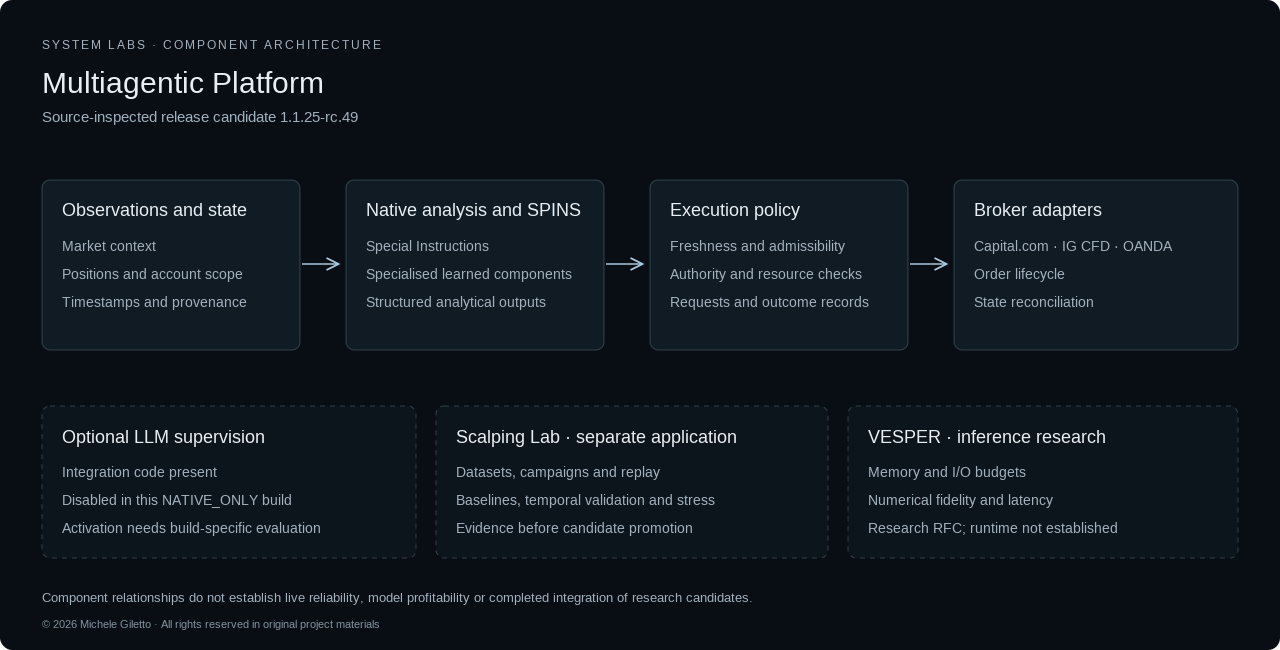
The historically inspected 1.1.25-rc.49 build selects NATIVE_ONLY. Optional local-language and remote-supervisory code is present, but both paths are disabled in that build. An LLM-enabled configuration requires its own identified build, operating contract and evaluation.
Implemented controls include bounded queues, deadlines, cancellation, capacity deferral, artifact validation and deterministic defaults. Static inspection establishes the presence of those paths. Saturated failover timing, end-to-end continuity and recovery consistency still require runtime measurements.
Research components
SPINS formalises bounded user instructions into learned policy contributions. Historical records link the inspected build’s versioned artifacts and model hashes to local PyTorch CPU fits on synthetic policy examples. These examples document policy-imitation training, not a market-data feed delivered to users. The fits do not measure market-profit probability. Final readiness gates and real-market qualification remain separate.
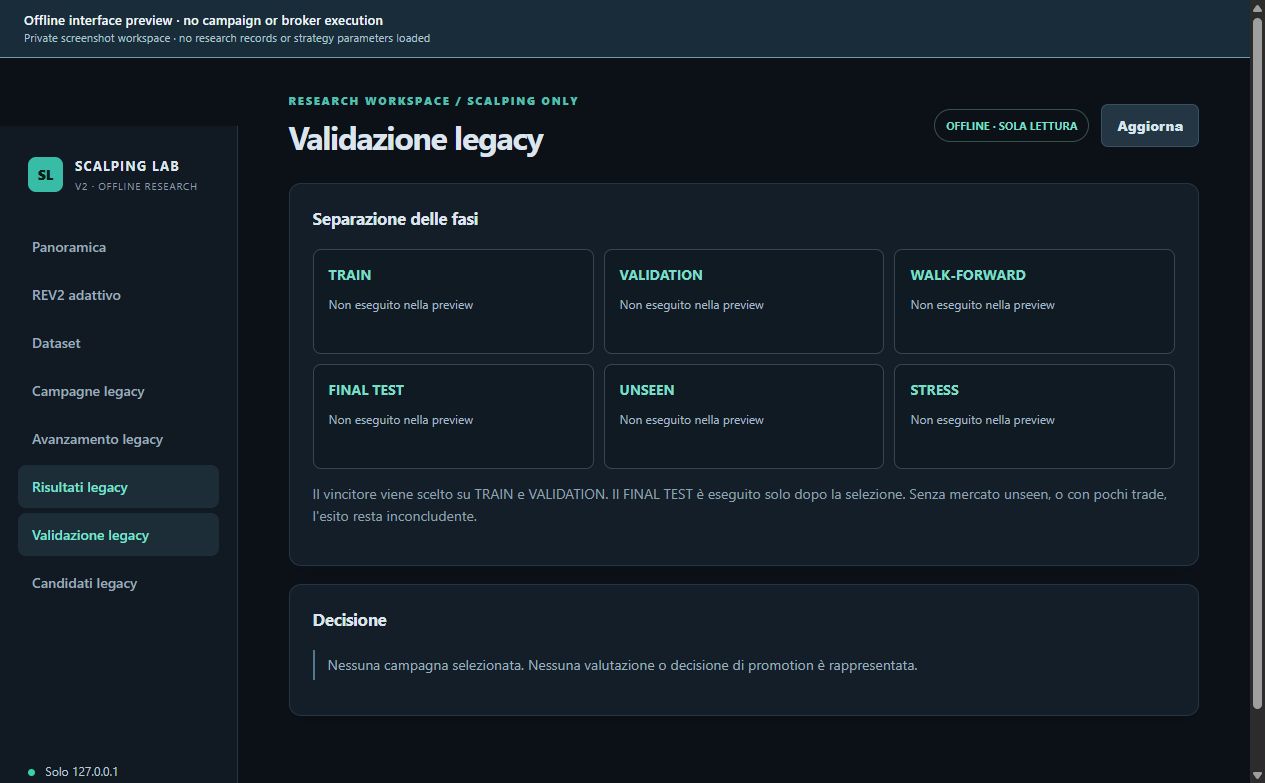
SPINS technical accountA separate application for historical-data quality, controlled campaigns, static-versus-adaptive comparisons, replay, walk-forward, final and unseen-market tests, stress conditions and simulated results. Research promotion and export are gated; export does not automatically install a change in the terminal. Reviewed campaigns include inconclusive and non-baseline-beating outcomes.
Laboratory workflowVESPER examines inference when complete model weights exceed available fast memory. The design addresses resource admission, scheduling causality, data movement and numerical fidelity. Capacity, latency and correctness are distinct outcomes. The RFC does not establish a working full-model runtime, measured speedup or completed platform integration.
VESPER research dossier
Implementation evidence
Public release 1.1.25 passed 64 compiled mock tests and an installation and uninstallation check in an isolated namespace on the test host. These checks address software behaviour and packaging; live-provider qualification, feed continuity, trading performance and graceful shutdown under other conditions require their own operational evidence.
The historical review examined installed package metadata, selected implementation files, training records, software checks and passive operational reports for the identified build. It did not launch the product, repeat training, contact brokers or place trades. Public release is a distribution decision; operational claims retain their measured scope. Isolated mock tests remain separate from the installed application’s personal live-account data path.
| Area | Observed implementation | Evidence boundary |
|---|---|---|
| Native workflow | Agent lifecycle, analytical services, execution consumers and control paths | Inspected build identity: 1.1.25-rc.49. Runtime qualification remains separate. |
| SPINS | Shipped artifacts linked to documented CPU fits | Synthetic policy imitation; no verified GPU campaign linked to the shipped models. Final gates remain. |
| Capital.com | Account, market-data and execution-lifecycle adapter; documented live observations | Latest reviewed passive audit, 16 October 2026: stale quotes and degraded diagnostics. No later verified closure in the reviewed record. |
| IG and OANDA | Provider adapters and internal mock tests | Full live qualification and provider approval are not established. |
| Optional LLM paths | Scoped explanation and structured supervisory integration code | Disabled by NATIVE_ONLY in the inspected build; saturated failover remains unmeasured. |
No model size, predictive accuracy, execution latency or investment return is asserted without the relevant measurement record. Historical simulation, software checks and live operational qualification address different questions.
Public distribution
Install the application locally, configure your own live broker account and explicitly activate trading. Enter broker credentials only in the installed application; this Hugging Face Space does not accept them or execute trades. Follow the installation and first-use guide and the terms accompanying the release.
MultiagenticPlatform-Setup-1.1.25.exe
Size: 84,921,344 bytes · Authenticode: NotSigned (not digitally signed).
SHA-256: 0fbafa46452a4c9bac3a53c395d778ec50c4312f82119cada7078d25ec9e608b
The official release record identifies the installer and verification details. GitHub’s repository ZIP contains the dossier rather than the program. The installer includes compiled/minified code, a PowerShell helper and required SPINS runtime weights under proprietary terms. Distributed files may be inspected; original development sources, training utilities and training datasets are excluded from the public release.
Evaluation and development
Companies and technical partners can request a scoped evaluation, commercial licensing discussion or strategic acquisition discussion. A technical review can begin with a defined use case, an identified build, a test environment and agreed acceptance criteria. Proprietary material can be considered under agreed confidentiality terms.
Voluntary PayPal contributions support the project. A contribution does not grant a software licence, access entitlement, intellectual property or equity interest, promised return or support commitment.
Contribute through PayPal