
MOSS-Live: A Full-Duplex Real-Time Interaction System


NEVER A DULL MOMENT

GitHub · Try it live · API docs
A spoken conversation keeps changing while an assistant is answering. A short “mm-hmm” may mean “keep going.” A pause may mean someone is thinking. A new question may interrupt an explanation, and a tool request may take longer than the next conversational turn. These events all belong to the same interaction.
With MOSS-Live, we bring full-duplex speech, live visual understanding and background task execution into a continuous conversation. Our design centers on two connected decisions: how to keep listening and respond at the right moment, and how to keep the conversation moving while a task is still running.
Launch film
What MOSS-Live supports
- Full-duplex conversation. Listen and speak at the same time, handle genuine interruptions, and distinguish a thinking pause or a brief “mm-hmm” from a request to take the floor.
- Selective attention. Use conversational context to distinguish speech directed at the assistant from background speech and nearby conversations.
- Continuity across turns. Follow corrections and topic changes, retain relevant context, and return to an interrupted explanation.
- Live visual understanding. Bring camera or screen-sharing input into the same conversation, alongside speech and ambient sound.
- Tools without a conversational pause. Dispatch research, reasoning and tool use to the background while the foreground remains available to talk.
- Streaming interpretation and proactive interaction. Support concurrent listening and interpretation, and respond to user-defined conditions such as a correction or reminder.
Coordinating the conversation and the task
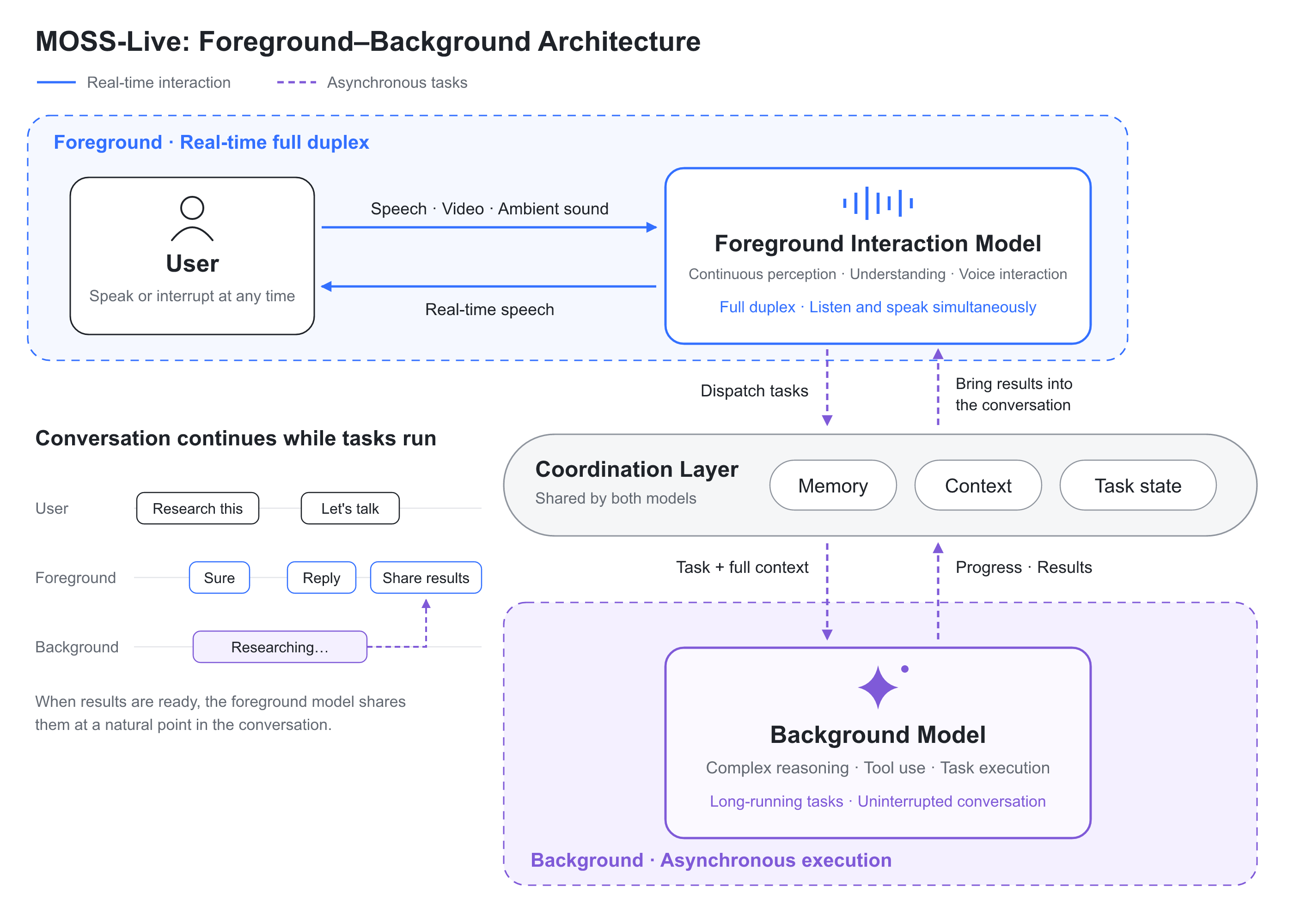
The foreground operates on the timescale of the conversation. It needs to keep listening during its own speech, recognize when a user is addressing it, yield to a genuine interruption, and maintain continuity through brief acknowledgments or a change of topic.
The background operates on the timescale of the task. Looking up a hotel, checking information or carrying out multi-step reasoning can continue while the foreground handles another question. The shared coordination layer connects those two timelines through memory, context and task state. A result becomes part of the conversation when it is useful to introduce it.
For example, a user can ask for hotel information and then ask about parking while that lookup is underway. The assistant can discuss parking, retain the travel constraints, and bring the hotel information back into the discussion when it is ready.
Three conversations in practice
A group meeting
MOSS-Live joins a discussion about planning an event. It looks up weather and major events in Shanghai and Hangzhou while the conversation continues, distinguishes acknowledgments from new questions, and returns to the earlier discussion to summarize decisions and next steps.
Planning a road trip
On a two-day trip to Zhoushan, the user changes the plan from hiking to relaxing by the sea. MOSS-Live checks hotels in the background, handles questions about ferries and parking, and keeps track of the changing itinerary while navigation announcements play nearby.
Exploring Shanghai
An English-speaking visitor explores Shanghai with MOSS-Live. Through the live camera, it identifies the Peace Hotel, discusses its history, and looks up room and dining information when asked. After a detour, it returns to the story about the building’s green roof.
Evaluating the experience
We evaluate three complementary aspects of the experience: full-duplex behavior, tool use and multi-turn tasks, and speech understanding with conversational continuity. The comparison covers FDB v1, v1.5, v2 and v3, Big-Bench Audio, and τ-Voice.
Full-duplex capabilities
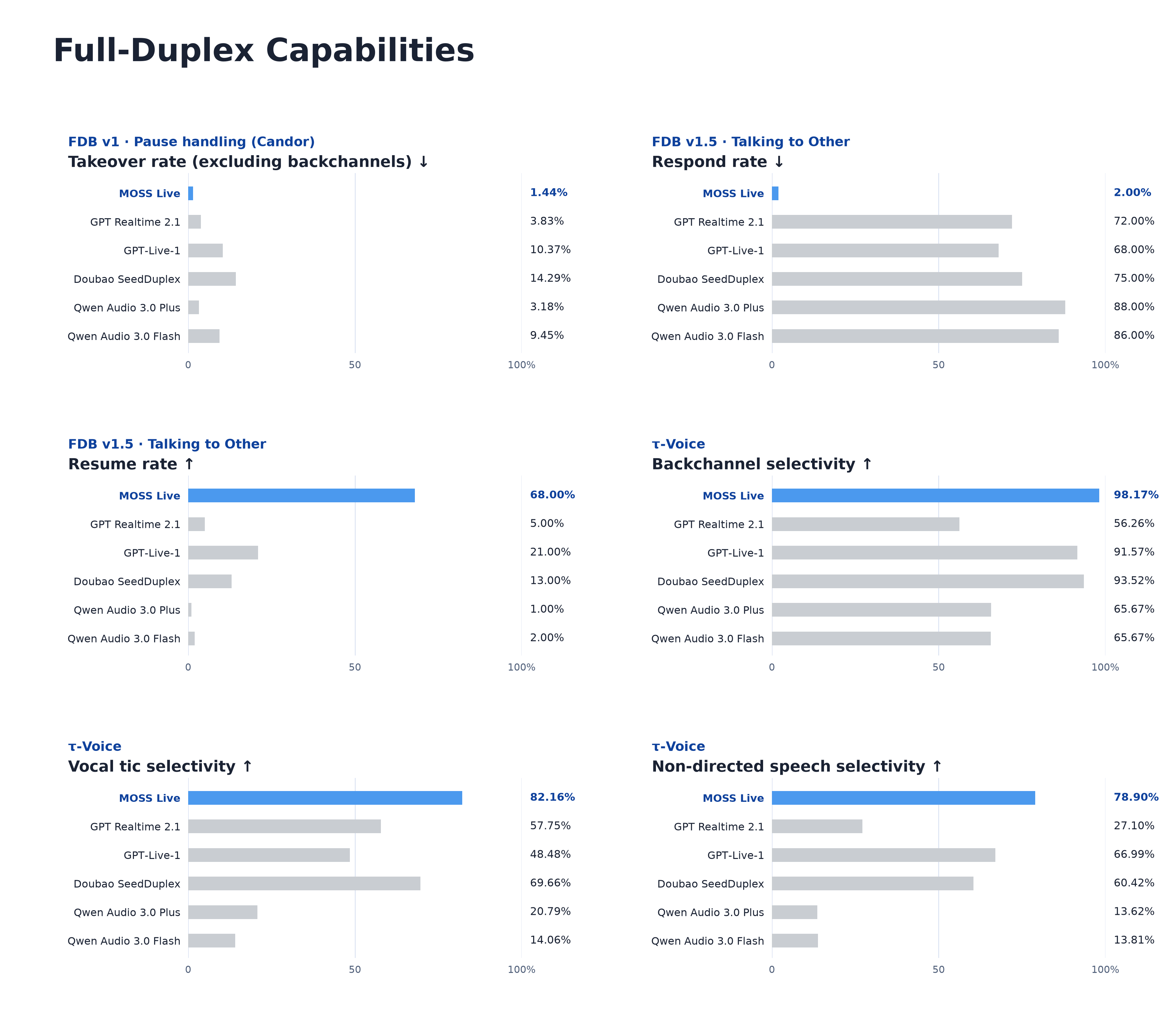
MOSS-Live has the best score among the compared models on all six interaction metrics shown below. These measure different parts of conversational timing: avoiding premature takeovers, responding selectively to unrelated speech, continuing through irrelevant interruptions, and handling backchannels and vocal tics.
Tool use and multi-turn tasks
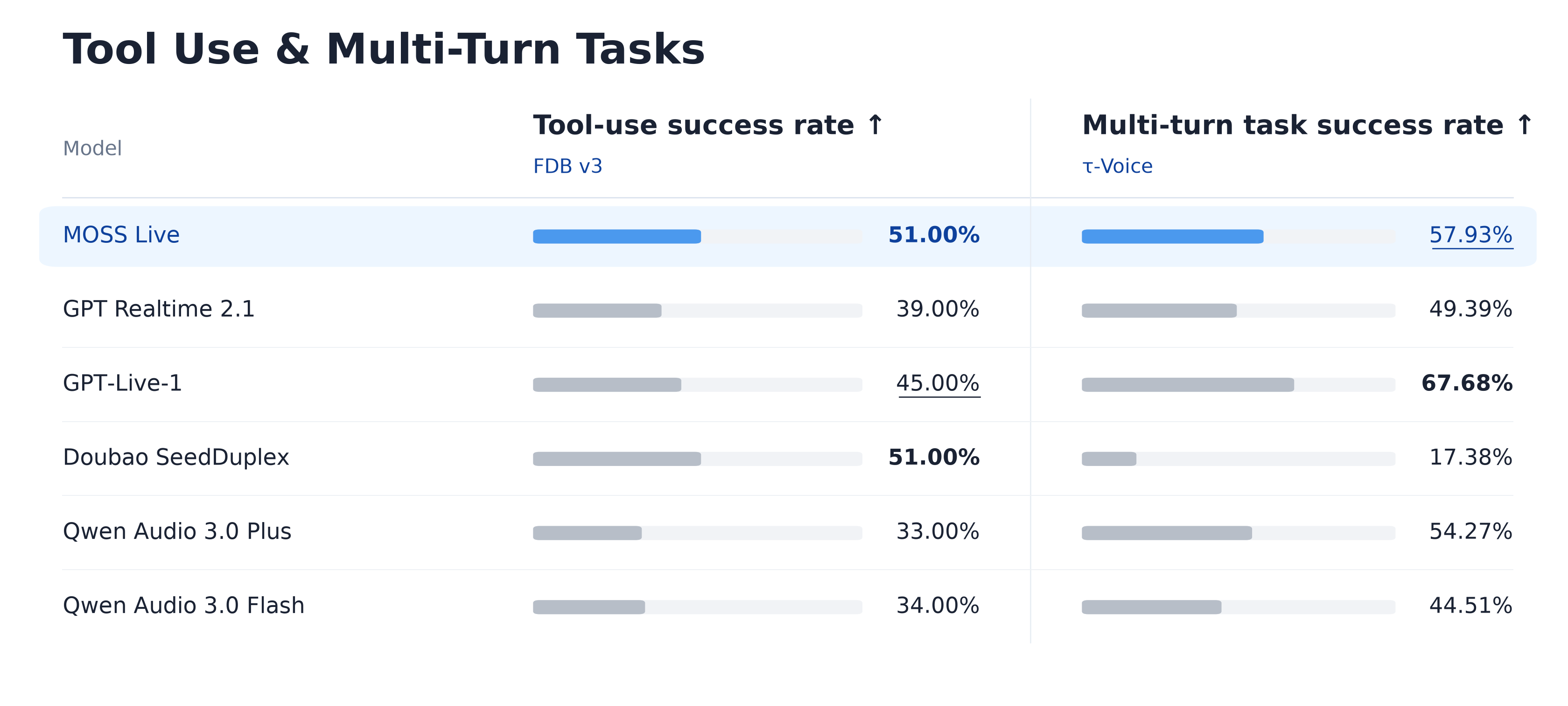
On FDB v3, MOSS-Live achieves 51.00% tool-use success, tied for the best score in this comparison. On τ-Voice, it achieves 57.93% multi-turn task success, the second-highest score.
Speech understanding and multi-turn dialogue
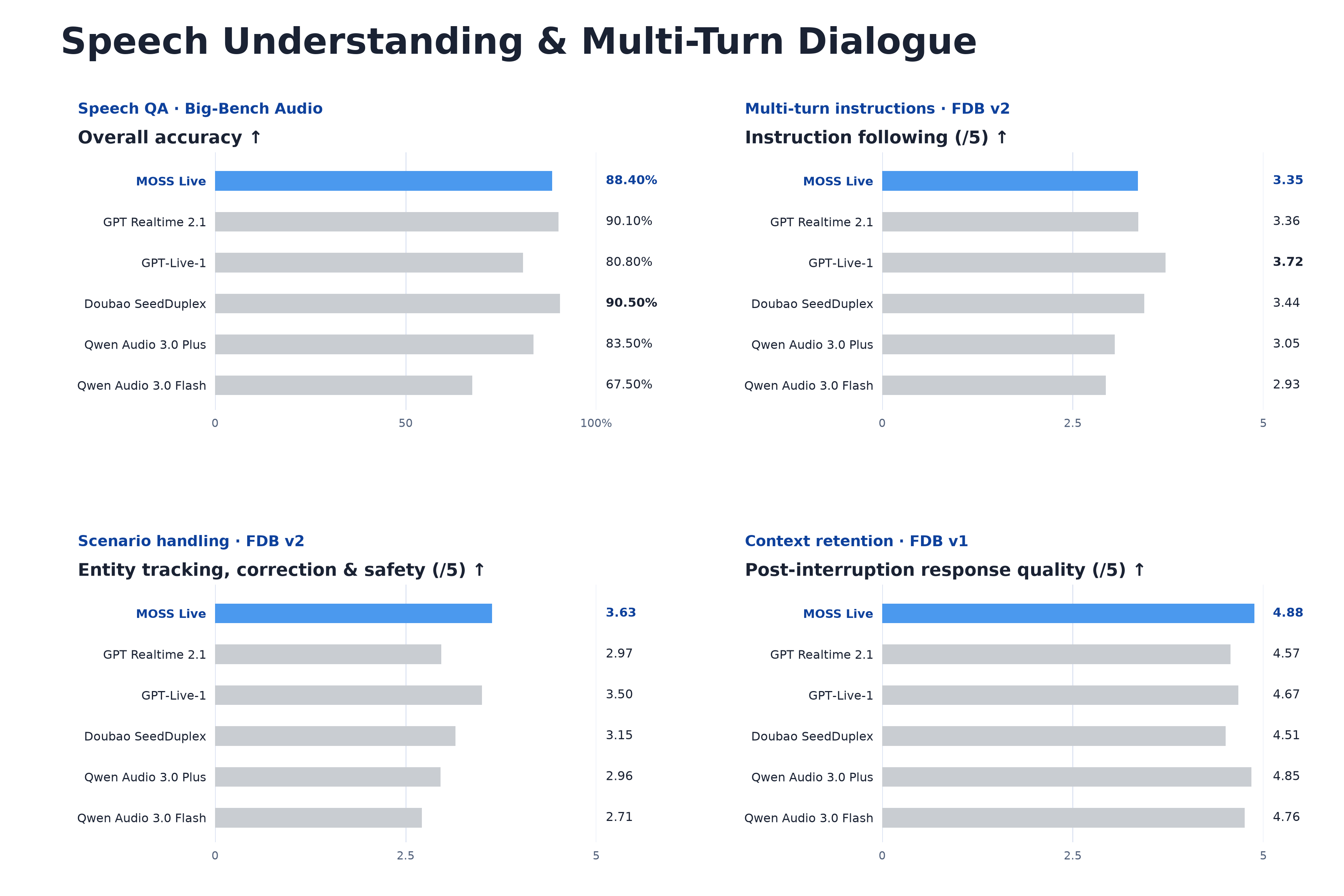
Across Big-Bench Audio and the dialogue evaluations, MOSS-Live combines speech understanding with instruction following, context retention and the ability to handle corrections. Its strengths in this comparison include post-interruption response quality and the FDB v2 composite covering entity tracking, correction and safety. Together, these abilities help a conversation stay coherent as questions, requirements and topics change.
Try MOSS-Live
Try MOSS-Live in the online playground, or integrate it into your application with the realtime API guide.
Plan a trip, change your mind halfway through, or turn on the camera and talk about what you see.
Full benchmark results · 6 benchmarks · 36 metrics
FDB v1
| Metric | MOSS-Live | GPT Realtime 2.1 | GPT‑Live-1 | Doubao SeedDuplex | Qwen Audio 3.0 Plus | Qwen Audio 3.0 Flash |
|---|---|---|---|---|---|---|
| Turn-over rate · synthetic pause handling ↓ | 2.92% | 2.19% | 6.57% | 4.38% | 1.46% | 2.19% |
| Turn-over rate · Candor pause handling ↓ | 10.19% | 2.31% | 36.11% | 12.96% | 3.24% | 8.80% |
| Turn-over rate · backchannel listening ↓ | 0.00% | 1.85% | 3.64% | 7.27% | 1.82% | 1.82% |
| Backchannel frequency ↑ | 0.0234 Hz | 0.0099 Hz | 0.0986 Hz | 0.0107 Hz | 0.0013 Hz | 0.0026 Hz |
| Backchannel timing JSD ↓ | 0.8873 | 0.9624 | 0.7598 | 0.9728 | 0.9914 | 0.9815 |
| Turn-over rate · Candor turn taking ↑ | 84.03% | 100.00% | 98.32% | 99.16% | 99.16% | 100.00% |
| Response latency · Candor turn taking ↓ | 1.14 s | 1.50 s | 0.78 s | 1.86 s | 1.59 s | 1.36 s |
| Turn-over rate · user interruption ↑ | 98.50% | 100.00% | 100.00% | 99.50% | 100.00% | 100.00% |
| Post-interruption response quality ↑ | 4.88 / 5 | 4.57 / 5 | 4.67 / 5 | 4.51 / 5 | 4.85 / 5 | 4.76 / 5 |
| Response latency · user interruption ↓ | 1.38 s | 1.26 s | 1.04 s | 1.73 s | 1.62 s | 1.49 s |
| Takeover rate excluding backchannels · Candor pause handling ↓ | 1.44% | 3.83% | 10.37% | 14.29% | 3.18% | 9.45% |
FDB v1.5
| Metric | MOSS-Live | GPT Realtime 2.1 | GPT‑Live-1 | Doubao SeedDuplex | Qwen Audio 3.0 Plus | Qwen Audio 3.0 Flash |
|---|---|---|---|---|---|---|
| Respond rate · User Interruption ↑ | 84.50% | 82.00% | 89.00% | 83.00% | 97.50% | 97.00% |
| Resume rate · User Interruption ↓ | 2.50% | 11.50% | 7.50% | 12.50% | 0.50% | 1.50% |
| Respond rate · User Backchannel ↓ | 0.00% | 2.04% | 3.06% | 0.00% | 15.31% | 7.14% |
| Resume rate · User Backchannel ↑ | 61.22% | 91.84% | 95.92% | 98.98% | 36.73% | 39.80% |
| Respond rate · Talking to Other ↓ | 2.00% | 72.00% | 68.00% | 75.00% | 88.00% | 86.00% |
| Resume rate · Talking to Other ↑ | 68.00% | 5.00% | 21.00% | 13.00% | 1.00% | 2.00% |
| Respond rate · Background Speech ↓ | 10.00% | 81.00% | 68.00% | 66.00% | 95.00% | 74.00% |
| Resume rate · Background Speech ↑ | 51.00% | 7.00% | 22.00% | 31.00% | 0.00% | 0.00% |
FDB v2
| Metric | MOSS-Live | GPT Realtime 2.1 | GPT‑Live-1 | Doubao SeedDuplex | Qwen Audio 3.0 Plus | Qwen Audio 3.0 Flash |
|---|---|---|---|---|---|---|
| Turn-taking fluency ↑ | 4.52 / 5 | 4.15 / 5 | 4.13 / 5 | 4.04 / 5 | 4.04 / 5 | 3.96 / 5 |
| Multi-turn instruction following ↑ | 3.35 / 5 | 3.36 / 5 | 3.72 / 5 | 3.44 / 5 | 3.05 / 5 | 2.93 / 5 |
| Entity tracking, correction & safety ↑ | 3.63 / 5 | 2.97 / 5 | 3.50 / 5 | 3.15 / 5 | 2.96 / 5 | 2.71 / 5 |
FDB v3
| Metric | MOSS-Live | GPT Realtime 2.1 | GPT‑Live-1 | Doubao SeedDuplex | Qwen Audio 3.0 Plus | Qwen Audio 3.0 Flash |
|---|---|---|---|---|---|---|
| Tool-use success rate ↑ | 51.00% | 39.00% | 45.00% | 51.00% | 33.00% | 34.00% |
| Tool selection F1 ↑ | 95.68% | 91.29% | 80.37% | 96.99% | 78.75% | 87.30% |
| Argument accuracy ↑ | 72.17% | 61.00% | 68.50% | 75.00% | 59.67% | 61.00% |
| Semantic task success rate ↑ | 66.00% | 55.00% | 63.00% | 67.00% | 53.00% | 54.00% |
| Post-tool response quality ↑ | 83.00% | 72.00% | 74.00% | 89.00% | 67.00% | 70.00% |
| Response latency in tool-use scenarios ↓ | 2.36 s | 1.61 s | 3.46 s | 5.11 s | 2.54 s | 2.85 s |
Big-Bench Audio
| Metric | MOSS-Live | GPT Realtime 2.1 | GPT‑Live-1 | Doubao SeedDuplex | Qwen Audio 3.0 Plus | Qwen Audio 3.0 Flash |
|---|---|---|---|---|---|---|
| Overall accuracy ↑ | 88.40% | 90.10% | 80.80% | 90.50% | 83.50% | 67.50% |
τ-Voice
| Metric | MOSS-Live | GPT Realtime 2.1 | GPT‑Live-1 | Doubao SeedDuplex | Qwen Audio 3.0 Plus | Qwen Audio 3.0 Flash |
|---|---|---|---|---|---|---|
| Multi-turn task success rate (pass¹) ↑ | 57.93% | 49.39% | 67.68% | 17.38% | 54.27% | 44.51% |
| Backchannel selectivity ↑ | 98.17% | 56.26% | 91.57% | 93.52% | 65.67% | 65.67% |
| Vocal tic selectivity ↑ | 82.16% | 57.75% | 48.48% | 69.66% | 20.79% | 14.06% |
| Non-directed speech selectivity ↑ | 78.90% | 27.10% | 66.99% | 60.42% | 13.62% | 13.81% |
| Response rate ↑ | 94.49% | 86.28% | 99.02% | 87.79% | 95.00% | 95.24% |
| Yield rate within 2 s ↑ | 52.49% | 76.72% | 26.33% | 46.05% | 93.38% | 96.28% |
| Agent interruption rate ↓ | 9.18% | 26.74% | 10.13% | 7.86% | 23.76% | 20.49% |
Citation
If you use MOSS-Live in your research or projects, please cite:
@misc{openmoss2026mosslive,
  title  = {{MOSS-Live}: A Full-Duplex Real-Time Interaction System},
  author = {{OpenMOSS}},
  year   = {2026},
  url    = {https://github.com/OpenMOSS/MOSS-Live}
}

