
source stringclasses 7
values | problem stringlengths 19 6.18k | generation stringlengths 345 68.1k |
|---|---|---|
olympiads | 1. 182 For 1 to 1000000000, find the sum of the digits of each number; then for the resulting 1 billion numbers, find the sum of the digits of each number, $\cdots$, until obtaining 1 billion single-digit numbers. Question: Among the resulting numbers, are there more 1s or 2s? | <think>
Okay, let me try to figure out this problem. So, the question is: For numbers from 1 to 1,000,000,000 (which is 1 billion), we need to repeatedly sum the digits of each number until we get a single-digit number. Then, among all those resulting single-digit numbers, are there more 1s or 2s?
First, let me make s... |
olympiads | 14. Let $S=\{1,2,3,4, \ldots, 16\}$. In each of the following subsets of $S$,
$$
\{6\},\{1,2,3\},\{5,7,9,10,11,12\},\{1,2,3,4,5,6,7,8,9\}
$$
the sum of all the elements is a multiple of 3 . Find the total number of non-empty subsets $A$ of $S$ such that the sum of all elements in $A$ is a multiple of 3 . | <think>
Okay, so I have this problem where I need to find the total number of non-empty subsets A of the set S = {1, 2, 3, ..., 16} such that the sum of all elements in A is a multiple of 3. The problem gives some examples of subsets that meet this condition, like {6}, {1,2,3}, {5,7,9,10,11,12}, and {1,2,3,4,5,6,7,8,9}... |
olympiads | 34. A bag of fruit contains 10 fruits, with an even number of apples, at most two oranges, a multiple of 3 bananas, and at most one pear. How many types of these bagged fruits are there? | <think>
Okay, so I need to figure out how many different types of fruit bags there are given the constraints. Let me try to break down the problem step by step.
First, the bag contains 10 fruits. The constraints are:
1. Even number of apples.
2. At most two oranges.
3. A multiple of 3 bananas.
4. At most one pear.
I... |
olympiads | Which is the smallest natural number ending in 4, such that moving its last digit to the beginning of the number results in four times the original number? | <think>
Okay, so I need to find the smallest natural number that ends with 4, and when I move its last digit to the beginning, the new number is four times the original number. Let's see... Hmm, this sounds like a problem involving some algebra and modular arithmetic. Let me try to break it down step by step.
First, l... |
olympiads | Example 4 (2004 American Invitational Mathematics Examination) A circle of radius 1 is randomly placed inside a $15 \times 36$ rectangle $ABCD$. Find the probability that this circle does not intersect with the diagonal $AC$. | <think>
Okay, let's try to solve this problem. So, we have a 15x36 rectangle, and we need to place a circle of radius 1 inside it such that the circle doesn't intersect the diagonal AC. We have to find the probability of this happening when the circle is placed randomly.
First, I need to visualize the rectangle. Let'... |
olympiads | Problem 4.7. At the festival of namesakes, 45 Alexanders, 122 Borises, 27 Vasily, and several Gennady arrived. At the beginning of the festival, all of them stood in a row so that no two people with the same name stood next to each other. What is the minimum number of Gennady that could have arrived at the festival? | <think>
Okay, so I need to figure out the minimum number of Gennadys required so that all these people can stand in a row without any two people with the same name being next to each other. The names we have are Alexanders, Borises, Vasilys, and Gennadys. The numbers given are 45 Alexanders, 122 Borises, 27 Vasilys, an... |
olympiads | A square and an equilateral triangle have the property that the area of each is the perimeter of the other. What is the area of the square? | <think>
Okay, let me try to figure out this problem. So, we have a square and an equilateral triangle. The area of each is equal to the perimeter of the other. We need to find the area of the square. Hmm, okay, let's break this down step by step.
First, let's recall some formulas. For a square, the perimeter is calcul... |
olympiads | Problem 11.5. A two-digit number is written on the board. Nезнayka claimed that it is divisible by $3, 4, 5, 9, 10, 15, 18, 30$. Upon hearing this, Znayka saddened Nезнayka by saying that he was wrong exactly 4 times. What number could have been written on the board? List all possible options. | <think>
Okay, let's see here. There's a two-digit number, and Neznayka said it's divisible by 3, 4, 5, 9, 10, 15, 18, 30. But Znayka told him he was wrong exactly four times. So, the number must actually be divisible by four of those eight divisors and not divisible by the other four. Our job is to find all two-digit n... |
olympiads | 6. A circle, the center of which lies on the line $y=b$, intersects the parabola $y=\frac{4}{3} x^{2}$ at least at three points; one of these points is the origin, and two of the remaining points lie on the line $y=\frac{4}{3} x+b$. Find all values of $b$ for which the described configuration is possible. | <think>
Okay, so I have this problem here: A circle with its center on the line y = b intersects the parabola y = (4/3)x² at least at three points. One of these points is the origin, and two of the remaining points lie on the line y = (4/3)x + b. I need to find all possible values of b for this configuration. Hmm, let ... |
olympiads | 2. Let $M$ be the midpoint of side $B C$ of parallelogram $A B C D$ and let $A M$ intersect diagonal $B D$ at point $O$. Determine the area of quadrilateral $O M C D$, if the area of parallelogram $A B C D$ is $P$. | <think>
Okay, so I have this geometry problem here. Let me try to visualize it first. There's a parallelogram ABCD. Let me recall that in a parallelogram, opposite sides are equal and parallel. So, AB is parallel and equal to CD, and AD is parallel and equal to BC. The diagonals of a parallelogram bisect each other, ri... |
olympiads | 1. Find all positive integer triples $(I, M, C)$ (where $I$, $M$, and $C$ are prime numbers and $I \leqslant M \leqslant C$) such that
$$
I \cdot M \cdot C=I+M+C+1007 .
$$ | <think>
Okay, let's see. I need to find all positive integer triples (I, M, C) where I, M, and C are prime numbers, with I ≤ M ≤ C, such that I * M * C = I + M + C + 1007. Hmm, primes, right? So the primes start from 2, 3, 5, 7, 11, 13, and so on. Since they are ordered I ≤ M ≤ C, I should consider primes in ascending ... |
olympiads | 6. Points $F$ and $G$ are chosen on the sides $AB$ and $BC$ of rectangle $ABCD$, respectively. A perpendicular $FK$ is dropped from point $F$ to side $CD$. A perpendicular $GH$ is dropped from point $G$ to side $AD$. The intersection point of $FK$ and $GH$ is denoted as $E$. Find the area of triangle $DFG$, given that ... | <think>
Okay, let me try to figure out this problem. So we have a rectangle ABCD. Let me visualize it first. Let me label the rectangle with points A, B, C, D in order. So AB and CD are the top and bottom sides, and BC and AD are the right and left sides. Then points F and G are on AB and BC respectively. Then from F, ... |
olympiads | Lyla and Isabelle run on a circular track both starting at point $P$. Lyla runs at a constant speed in the clockwise direction. Isabelle also runs in the clockwise direction at a constant speed $25 \%$ faster than Lyla. Lyla starts running first and Isabelle starts running when Lyla has completed one third of one lap. ... | <think>
Okay, let me try to figure out this problem step by step. So, Lyla and Isabelle are both running on a circular track, starting at point P. Lyla goes first, running clockwise at a constant speed. Then Isabelle starts running clockwise too, but she's 25% faster than Lyla. The question is, when Isabelle passes Lyl... |
olympiads | 6. Given 4 spheres with a radius of 1, each pair of which are externally tangent, then the edge length of the circumscribed regular tetrahedron of the geometric body formed by these 4 spheres is | <think>
Okay, so I need to find the edge length of a circumscribed regular tetrahedron around four spheres. Each sphere has a radius of 1, and every pair of spheres is externally tangent. Hmm, let me visualize this. If the spheres are externally tangent, that means the distance between the centers of any two spheres is... |
olympiads | 25. Detective Sherlock Holmes found a password safe, and the password is a three-digit number $A$. Currently, there is a clue: among the four three-digit numbers $123,931,297,419$, each number contains exactly one digit from the three-digit number $A$, and the position of the digit is different from that in $A$, then t... | <think>
Alright, let me try to figure out this problem step by step. So, we have to find a three-digit number A such that each of the four given numbers (123, 931, 297, 419) has exactly one digit that is also in A, but in a different position. That means, for each of these four numbers, one digit matches A but is not i... |
olympiads | $2 \cdot 104$ Let $S=\{1,2, \cdots, 280\}$. Find the smallest natural number $n$, such that every $n$-element subset of $S$ contains 5 pairwise coprime numbers. | <think>
Okay, let's see. The problem is: Given the set S = {1, 2, ..., 280}, we need to find the smallest natural number n such that every n-element subset of S contains 5 pairwise coprime numbers. Hmm. So, we have to ensure that no matter which n numbers you pick from 1 to 280, you'll always have at least five numbers... |
cn_contest | 4. $F$ is the right focus of the ellipse $\frac{x^{2}}{16}+\frac{y^{2}}{12}=1$, and $P$ is a moving point on the ellipse. For the fixed point $A(-2, \sqrt{3}),|P A|+$ $2|P F|$ the minimum value is $\qquad$ . | <think>
Okay, so I need to find the minimum value of |PA| + 2|PF| where F is the right focus of the ellipse x²/16 + y²/12 = 1, and P is a moving point on the ellipse. The fixed point A is (-2, √3). Hmm, let me start by recalling some properties of ellipses that might help here.
First, the standard equation of an ellip... |
olympiads | 3.1. Lisa drew graphs of all functions of the form $y=a x+b$, where $a$ and $b$ take all natural values from 1 to 100. How many of these graphs pass through the point $(3,333)$? | <think>
Okay, let's see. The problem is about Lisa drawing graphs of all linear functions of the form y = ax + b, where both a and b are natural numbers from 1 to 100. We need to find out how many of these graphs pass through the point (3, 333). Hmm, okay.
First, let me recall that a linear function in the form y = ax... |
olympiads | 3. (6 points) Insert two numbers between 2015 and 131 so that the four numbers are arranged in descending order, and the difference between any two adjacent numbers is equal. The sum of the two inserted numbers is
保留源文本的换行和格式,所以翻译结果如下:
3. (6 points) Insert two numbers between 2015 and 131 so that the four numbers are... | <think>
嗯,我现在要解决的问题是在2015和131之间插入两个数,使得这四个数按降序排列,并且相邻两个数的差相等。然后求这两个插入的数的和。好,首先我得理解清楚题目要求。
题目说四个数按降序排列,也就是从大到小排,所以最大的数是2015,接下来是两个要插入的数,最后是131。也就是说这四个数是2015,A,B,131,其中A和B是插入的两个数,并且每相邻两个数之间的差相等。也就是说这是一个等差数列,不过因为是降序排列,公差应该是负数,或者说是递减的。
那这样的话,这四个数构成一个等差数列,首项是2015,末项是131,总共有4个数,所以项数n=4。等差数列的通项公式是a_n = a_1 + (n-1)d,其中d是公差。这... |
olympiads | 56. Person A and Person B start from points $A$ and $B$ respectively at the same time, heading towards each other. They meet for the first time 100 meters away from point $B$. After the meeting, Person A's speed doubles; Person A reaches $B$ and immediately turns back, catching up with Person B when Person B is still 5... | <think>
Okay, let's try to figure out this problem. So, Person A and Person B start from points A and B, heading towards each other. They meet for the first time 100 meters away from point B. Then, after meeting, Person A doubles their speed and reaches B, then turns back and catches up with Person B when Person B is s... |
olympiads | 2. (3 points) Use the Chariot, Horse, and Cannon from Chinese chess to represent 3 different natural numbers. If Chariot $\div$ Horse $=2$, Cannon $\div$ Chariot $=4$, Cannon - Horse $=56$, then Chariot + Horse + Cannon $=$ $\qquad$ | <think>
Alright, let's tackle this problem step by step. So, we have three pieces from Chinese chess: Chariot, Horse, and Cannon, each representing different natural numbers. The problem gives us three equations:
1. Chariot divided by Horse equals 2 (Chariot ÷ Horse = 2)
2. Cannon divided by Chariot equals 4 (Cannon ÷... |
olympiads | 6.242. $\left\{\begin{array}{l}\sqrt{\frac{3 x-2 y}{2 x}}+\sqrt{\frac{2 x}{3 x-2 y}}=2, \\ x^{2}-18=2 y(4 y-9) .\end{array}\right.$ | <think>
Okay, so I have this system of equations to solve. Let me write them down again to make sure I have them right:
1. √[(3x - 2y)/(2x)] + √[(2x)/(3x - 2y)] = 2
2. x² - 18 = 2y(4y - 9)
Hmm, the first equation looks a bit complicated with those square roots and fractions. The second equation is a quadratic in ter... |
olympiads | 10. (6 points) In a cage with chickens and rabbits, there are a total of 250 feet, and the number of rabbits is 53 less than the number of chickens. How many rabbits are there? $\qquad$ | <think>
Okay, let's see. There's a problem about chickens and rabbits in a cage. We need to find out how many rabbits there are. The total number of feet is 250, and the number of rabbits is 53 less than the number of chickens. Hmm, okay, let me think through this step by step.
First, I know that chickens and rabbits ... |
olympiads | 6.133. Without solving the equation $3 x^{2}-5 x-2=0$, find the sum of the cubes of its roots. | <think>
Okay, so I need to find the sum of the cubes of the roots of the quadratic equation \(3x^2 - 5x - 2 = 0\) without actually solving the equation. Hmm, let's think about how to approach this.
First, I remember that for a quadratic equation \(ax^2 + bx + c = 0\), the sum of the roots is \(-b/a\) and the product ... |
olympiads | 4. (8 points) Tongtong and Linlin each have several cards: If Tongtong gives 6 cards to Linlin, Linlin will have 3 times as many as Tongtong; if Linlin gives 2 cards to Tongtong, then Linlin will have 2 times as many as Tongtong. How many cards did Linlin originally have. | <think>
Okay, let's try to solve this problem step by step. So, we have Tongtong and Linlin, each with some cards. There are two conditions here:
1. If Tongtong gives 6 cards to Linlin, then Linlin will have 3 times as many as Tongtong.
2. If Linlin gives 2 cards to Tongtong, then Linlin will have 2 times as many as T... |
olympiads | 13. (15 points) A speedboat departs from dock $A$, travels downstream along the river, passes through dock $B$, and continues downstream to dock $C$. Upon reaching dock $C$, it immediately turns around and heads back to dock $B$, taking a total of 10 hours. If the distance between $A$ and $B$ is 20 kilometers, the spee... | <think>
Okay, let's try to figure out this problem step by step. So, the speedboat goes from dock A to dock B, then to dock C, turns around and comes back to dock B. The total time taken is 10 hours. We need to find the distance between B and C.
First, let's note down all the given information. The distance between A... |
olympiads_ref | Consider the sequence $a_{1}, a_{2}, a_{3}, \ldots$ defined by $a_{1}=9$ and
$$
a_{n+1}=\frac{(n+5) a_{n}+22}{n+3}
$$
for $n \geqslant 1$.
Find all natural numbers $n$ for which $a_{n}$ is a perfect square of an integer. | <think>
Okay, so I need to figure out for which natural numbers \( n \) the term \( a_n \) in this sequence is a perfect square. The sequence is defined by \( a_1 = 9 \) and the recursive formula \( a_{n+1} = \frac{(n+5)a_n + 22}{n + 3} \) for \( n \geq 1 \).
First, let me write down the first few terms manually to s... |
olympiads | 8. A triangle has side lengths 18,24 , and 30 . Find the area of the triangle whose vertices are the incenter, circumcenter, and centroid of the original triangle. | <think>
Okay, so I need to find the area of a triangle formed by the incenter, circumcenter, and centroid of the original triangle with sides 18, 24, and 30. Hmm, let's start by understanding the original triangle.
First, let me check what type of triangle this is. The sides are 18, 24, and 30. Let me see if these sat... |
aops_forum | It is known that $n$ is a positive integer and $n \le 144$. Ten questions of the type “Is $n$ smaller than $a$?” are allowed. Answers are given with a delay: for $i = 1, \ldots , 9$, the $i$-th question is answered only after the $(i + 1)$-th question is asked. The answer to the tenth question is given immediately.
Fin... | <think>
Alright, let's see. So the problem is about figuring out a number n that's a positive integer less than or equal to 144. We can ask up to 10 yes/no questions of the form "Is n smaller than a?" where a is some number we choose each time. The tricky part is that the answers are delayed. Specifically, for the firs... |
olympiads | At what distance from the center should a plane intersect a sphere of radius $R$ so that the volume of the smaller spherical cap is equal to the volume of a cone whose base is the base of the cap and whose apex is at the center of the sphere. | <think>
Okay, so I have this geometry problem here. Let me read it again: I need to find the distance from the center of a sphere where a plane should intersect the sphere such that the volume of the smaller spherical cap formed is equal to the volume of a cone. The cone has its base as the base of the cap and its apex... |
olympiads | 11.3. All cells of a square table $n \times n$ are numbered in some order with numbers from 1 to $n^{2}$. Petya makes moves according to the following rules. On the first move, he places a rook in any cell. On each subsequent move, Petya can either place a new rook in some cell or move a rook from a cell numbered $a$ h... | <think>
Okay, so I need to figure out the minimum number of rooks Petya needs to color all cells in an n x n square table, no matter how the cells are numbered from 1 to n². The rules are a bit tricky. Let me try to break them down.
First, Petya starts by placing a rook anywhere. Then, each subsequent move can either ... |
olympiads | \section*{Exercise 1 - 171211}
Determine all five-digit natural numbers in the decimal positional system that are divisible by 17, 19, and 23, and whose tens digit is 0. | <think>
Okay, let me try to figure out how to solve this problem. So, the question is asking for all five-digit natural numbers that are divisible by 17, 19, and 23, and also have 0 as their tens digit. Hmm, that seems a bit complex, but let's break it down step by step.
First, since the number has to be divisible by ... |
olympiads | ## Task 24/73
A function $f(x)$ has the following properties:
1. For real $x$, $f(x)>0$.
2. For real $x_{i}$, $f\left(x_{1}+x_{2}\right)=2 \cdot f\left(x_{1}\right) f\left(x_{2}\right)$.
3. $f(2)=2$.
Determine the function values $f(1), f(0), f(3)$, and $f(6)$! What function is this? | <think>
Okay, so I need to figure out the values of f(1), f(0), f(3), and f(6) for this function f(x) that satisfies the given properties. Let me start by carefully reading through the problem again to make sure I understand all the conditions.
First, the function f(x) is defined for all real numbers x, and it's alway... |
olympiads | 9-8. All digits in the notation of 6-digit natural numbers $a$ and $b$ are even, and in the notation of any number between them, there is an odd digit. Find the largest possible value of the difference $b-a$.
---
Translation:
9-8. All digits in the notation of 6-digit natural numbers $a$ and $b$ are even, and in the ... | <think>
Okay, so I need to find two 6-digit numbers, a and b, where all the digits in both a and b are even. Also, any number between a and b must have at least one odd digit. The goal is to make the difference b - a as large as possible. Hmm, interesting problem.
First, let's recall that even digits are 0, 2, 4, 6, a... |
amc_aime | Consider the paper triangle whose vertices are $(0,0), (34,0),$ and $(16,24).$ The vertices of its midpoint triangle are the [midpoints](https://artofproblemsolving.com/wiki/index.php/Midpoint) of its sides. A triangular [pyramid](https://artofproblemsolving.com/wiki/index.php/Pyramid) is formed by folding the triang... | <think>
Okay, let's try to figure out the volume of this pyramid formed by folding the triangle along the sides of its midpoint triangle. Hmm, first, I need to visualize the problem. We have a triangle with vertices at (0,0), (34,0), and (16,24). The midpoint triangle is formed by connecting the midpoints of each side.... |
olympiads | # Task 2. (3 points)
In a certain company, the $20 \%$ most useful employees perform $80 \%$ of the work. What is the smallest percentage of work that the $40 \%$ most useful employees can perform?
We will consider an employee more useful if they perform more work. | <think>
Okay, so I need to figure out the smallest percentage of work that the 40% most useful employees can perform, given that the top 20% do 80% of the work. Let me try to break this down step by step.
First, the problem mentions the Pareto principle, which is the 80-20 rule here: 20% of employees do 80% of the wor... |
olympiads | G2.1 If the sequence $1,6+2 a, 10+5 a, \ldots$ forms an A.P., find $a$. | <think>
Okay, let me try to figure out this problem. So, we have a sequence: 1, 6 + 2a, 10 + 5a, ... and it's supposed to form an arithmetic progression (A.P.). We need to find the value of 'a'. Hmm, alright. Let me recall what an arithmetic progression is. In an A.P., the difference between consecutive terms is consta... |
olympiads | 10.5. Five athletes came to training with their balls, and when leaving, each took someone else's. In how many ways is this possible. | <think>
Okay, so I need to figure out how many ways five athletes can each take someone else's ball when leaving training. Hmm, this sounds like a permutation problem where each person doesn't end up with their own item. I think that's called a derangement. Let me remember... derangements are permutations where no elem... |
olympiads | 1. Each half-liar alternates between lying and telling the truth every other day (if they lie today, they will tell the truth tomorrow, and vice versa). Exactly a week ago, one half-liar made two statements: "Yesterday was Wednesday"; "Tomorrow will be Thursday." Today he made two other statements: "Yesterday was Frida... | <think>
Okay, let's try to figure out this problem step by step. So, we have a half-liar who alternates between telling the truth and lying every other day. A week ago (which would be 7 days ago), this person made two statements: "Yesterday was Wednesday" and "Tomorrow will be Thursday." Then, today, the same person ma... |
olympiads | 7. The function $y=2 \cos \left(x+\frac{\pi}{4}\right) \cos \left(x-\frac{\pi}{4}\right)+\sqrt{3} \sin 2 x$ has a maximum value and a minimum positive period. The sum of these two values is | <think>
Okay, so I need to find the maximum value and the minimum positive period of the function \( y = 2 \cos\left(x + \frac{\pi}{4}\right) \cos\left(x - \frac{\pi}{4}\right) + \sqrt{3} \sin 2x \), and then add those two values together. Hmm, let's start by simplifying the function. Maybe using trigonometric identiti... |
olympiads | 6.156. $20\left(\frac{x-2}{x+1}\right)^{2}-5\left(\frac{x+2}{x-1}\right)^{2}+48 \frac{x^{2}-4}{x^{2}-1}=0$. | <think>
Okay, let me try to solve this equation step by step. The problem is:
20\left(\frac{x-2}{x+1}\right)^{2} -5\left(\frac{x+2}{x-1}\right)^{2} +48 \frac{x^{2}-4}{x^{2}-1} = 0
Hmm, this looks a bit complicated with all those fractions and exponents. Let me see if I can simplify it somehow. First, I notice that th... |
olympiads | 4. 228 ** Let $x, y, z \in \mathbf{R}^{+}, x+2 y+3 z=1$, find the minimum value of $\frac{16}{x^{3}}+\frac{81}{8 y^{3}}+\frac{1}{27 z^{3}}$. | <think>
Okay, so I have this problem here where I need to find the minimum value of the expression \(\frac{16}{x^{3}} + \frac{81}{8 y^{3}} + \frac{1}{27 z^{3}}\) given that \(x\), \(y\), and \(z\) are positive real numbers and they satisfy the equation \(x + 2y + 3z = 1\). Hmm, let's see. I remember from my math classe... |
olympiads | Snow White and the Seven Dwarfs collected cones for a campfire. Snow White said that the total number of cones is divisible by two. The first dwarf stated that it is a number divisible by three, the second dwarf said it is a number divisible by four, the third dwarf said it is a number divisible by five, the fourth dwa... | <think>
Okay, so I need to solve this problem where Snow White and the Seven Dwarfs collected cones, and each of them made a statement about the total number of cones being divisible by a certain number. The key points are:
- Total number of cones is less than 350.
- Snow White said it's divisible by 2.
- Each dwarf, ... |
olympiads | Task 12. (16 points)
The budget of the Petrovs consists of the following income items:
- parents' salary after income tax deduction - 56000 rubles;
- grandmother's pension - 14300 rubles;
- son's scholarship - 2500 rubles
Average monthly expenses of the family include:
- utility payments - 9800 rubles;
- food - 210... | <think>
Okay, let's see. The problem is about calculating how much the Petrovs can save monthly for their vacation after setting aside 10% of their remaining budget into a deposit. Alright, step by step.
First, I need to compute their total monthly income. The income sources are parents' salary, grandmother's pension,... |
olympiads | Example 21. The random variable $X$ is distributed according to the normal law. The mathematical expectation and variance of this variable are 7 and 16, respectively. Find the probability that the deviation of the variable $X$ from its mathematical expectation in absolute value does not exceed two. | <think>
Okay, so I need to find the probability that the deviation of X from its mean is at most two. The problem says X is normally distributed with a mean (mathematical expectation) of 7 and a variance of 16. Let me recall what that means.
First, the normal distribution is symmetric around the mean, which is 7 here.... |
olympiads | 75. In quadrilateral $A B C D$, it is given that $\widehat{D A B}=150^{\circ}$, $\widehat{D A C}+\widehat{A B D}=120^{\circ}, \widehat{D B C}-\widehat{A B \bar{D}}=60^{\circ}$. Find $\widehat{B D C}$. | <think>
Okay, let's try to solve this geometry problem. Hmm, quadrilateral ABCD with some given angles. Let me write down the given information first to keep track.
First, angle DAB is 150 degrees. Then, angle DAC plus angle ABD is 120 degrees. Also, angle DBC minus angle ABD is 60 degrees. We need to find angle BDC.
... |
olympiads | Example 6. Calculate the area bounded by the parabola $x=8 y-y^{2}-7$ and the $O y$ axis. | <think>
Okay, so I need to find the area bounded by the parabola given by the equation x = 8y - y² - 7 and the Oy axis, which is the y-axis. Hmm, let me think about how to approach this.
First, I remember that when calculating the area between a curve and an axis, we usually set up an integral. Since the problem ment... |
olympiads | 5. On the coordinate plane, squares are considered, all vertices of which have natural coordinates, and the center is located at the point $(55 ; 40)$. Find the number of such squares. | <think>
Okay, let's see. The problem is about finding the number of squares on a coordinate plane where all the vertices have natural coordinates (which I assume means positive integers), and the center of the square is at (55, 40). Hmm. Alright, let's start by recalling some properties of squares and their centers.
F... |
olympiads | 11. This year, Xiao Jun is 5 years old, and his father is 31 years old. In $\qquad$ years, his father's age will be 3 times Xiao Jun's age. | <think>
Okay, let's see. The problem is about Xiao Jun and his father's ages. Right now, Xiao Jun is 5 years old, and his father is 31. The question is asking in how many years his father's age will be three times Xiao Jun's age. Hmm, so I need to find the number of years, let's call that number 'x', such that after x ... |
olympiads | Task B-3.6. The area of a rectangle is $12 \mathrm{~cm}^{2}$, and if the acute angle between its diagonals is halved, the area is $7.5 \mathrm{~cm}^{2}$. What is the length of the diagonal of the rectangle? | <think>
Okay, let's try to figure out this problem. So we have a rectangle with an area of 12 cm², and when the acute angle between its diagonals is halved, the area becomes 7.5 cm². We need to find the length of the diagonal.
First, let me recall some properties of rectangles. In a rectangle, the diagonals are equal ... |
aops_forum | Each cell of an $100\times 100$ board is divided into two triangles by drawing some diagonal. What is the smallest number of colors in which it is always possible to paint these triangles so that any two triangles having a common side or vertex have different colors? | <think>
Okay, so I need to figure out the smallest number of colors required to paint all the triangles in a 100x100 grid where each cell is divided by a diagonal. The key condition is that any two triangles sharing a common side or vertex must have different colors. Hmm, let's start by breaking down the problem.
Firs... |
olympiads | 4. Air purification devices in the room clean the air. The airflow over time for the first device changes according to the formula $f(t)=2^{t}$, and for the second device, it is $f(t)=2^{t+3}$. In the room, there are four devices of the first type and one of the second type. $S$ how many purification devices with a flo... | <think>
Okay, let's see here. The problem is about air purification devices in a room. There are two types: the first type has an airflow function of f(t) = 2^t, and the second type has f(t) = 2^{t+3}. Currently, there are four of the first type and one of the second type. The question is asking how many purification d... |
olympiads | 7. As shown in the figure, in rectangle $A B C D$, $A B=3, A D=4, E$ is a point on $A B$, and $A E=1$. Now, $\triangle B C E$ is folded along $C E$ so that the projection of point $B$ on plane $A E C D$ falls on $A D$. Then, the volume of the pyramid $B-A E C D$ is $\qquad$ . | <think>
Alright, so I need to find the volume of the pyramid B-AECD after folding triangle BCE along CE such that the projection of point B on the plane AECD falls on AD. Let me try to visualize this first.
The original rectangle ABCD has AB=3 and AD=4. So, AB is the base with length 3, and AD is the height with lengt... |
olympiads | 3 Let $M$ be a set of $n$ points in the plane I, satisfying:
(1) $M$ contains 7 points that are the vertices of a heptagon;
(2) For any 5 points in $M$, these 5 points are the vertices of a convex pentagon, and this pentagon contains at least one point from $M$ inside it.
Find the minimum value of $n$. (Leng Gangsong) | <think>
Okay, let's try to tackle this problem. So, we have a set M of n points in the plane with two conditions. First, there's a subset of 7 points forming a heptagon. Second, any 5 points from M form a convex pentagon, and each such pentagon contains at least one other point from M inside it. We need to find the min... |
olympiads | Part I (6 points each, total 30 points)
1. Xiao Gang goes to buy milk and finds that the milk is on special offer today, with each bag costing 2 yuan and 50 cents, and buy two get one free. Xiao Gang has 30 yuan. What is the maximum number of bags of milk he can buy? $\qquad$ | <think>
Okay, let me try to figure out how many bags of milk Xiao Gang can buy with 30 yuan. Each bag normally costs 2.50 yuan, but there's a special offer: buy two get one free. Hmm, so every time he buys two bags, he gets one free. That means for every three bags, he only pays for two.
First, I need to calculate th... |
olympiads | 7. In the Cartesian coordinate system $x O y$, $P$ is a moving point on the ellipse $\frac{y^{2}}{4}+\frac{x^{2}}{3}=1$, and the coordinates of points $A, B$ are $(1,1),(0,-1)$, respectively. Then the maximum value of $|P A|+|P B|$ is $\qquad$. | <think>
Okay, so I need to find the maximum value of |PA| + |PB| where P is a point on the ellipse y²/4 + x²/3 = 1, and points A and B are (1,1) and (0,-1) respectively. Hmm, let me think about how to approach this.
First, I remember that in problems involving ellipses and distances, sometimes parametrizing the ellips... |
olympiads | 3. Given real numbers $a_{i}(i=1,2, \cdots, 2016)$ satisfy $9 a_{i}>11 a_{i+1}^{2}(i=1,2, \cdots, 2015)$. Find
$$
\begin{aligned}
f= & \left(a_{1}-a_{2}^{2}\right)\left(a_{2}-a_{3}^{2}\right) \cdots\left(a_{2015}-a_{2016}^{2}\right) \cdot \\
& \left(a_{2016}-a_{1}^{2}\right)
\end{aligned}
$$
the maximum value.
(2016, ... | <think>
Okay, so I have this problem where there are 2016 real numbers \( a_i \) (where \( i = 1, 2, \ldots, 2016 \)) that satisfy the inequalities \( 9a_i > 11a_{i+1}^2 \) for each \( i \) from 1 to 2015. I need to find the maximum value of the product \( f = (a_1 - a_2^2)(a_2 - a_3^2) \cdots (a_{2015} - a_{2016}^2)(a... |
olympiads | 1. Find all values of $x$, for each of which one of the three given numbers $\log _{x}\left(x-\frac{13}{6}\right)$, $\log _{x-\frac{13}{6}}(x-3)$, and $\log _{x-3} x$ is equal to the product of the other two. | <think>
Okay, let's see. So, I have this problem where I need to find all values of x such that one of the three logarithmic expressions is equal to the product of the other two. The expressions are:
1. log base x of (x - 13/6)
2. log base (x - 13/6) of (x - 3)
3. log base (x - 3) of x
Hmm. So, the problem says that ... |
olympiads | 3. (17 points) In triangle $A B C \quad A B=4, B C=6$, angle $A B C$ is $30^{\circ}, B D-$ is the bisector of triangle $A B C$. Find the area of triangle $A B D$. | <think>
Okay, so I need to find the area of triangle ABD where BD is the angle bisector of angle ABC in triangle ABC. Given sides AB = 4, BC = 6, and angle ABC is 30 degrees. Hmm, let me think step by step.
First, I remember that an angle bisector in a triangle divides the opposite side into segments proportional to t... |
olympiads | ## A2 ALB
3) If $x^{3}-3 \sqrt{3} x^{2}+9 x-3 \sqrt{3}-64=0$, find the value of $x^{6}-8 x^{5}+13 x^{4}-5 x^{3}+49 x^{2}-137 x+2015$.
| <think>
Alright, let's tackle this problem step by step. So, the given equation is:
\( x^{3} - 3\sqrt{3} x^{2} + 9x - 3\sqrt{3} - 64 = 0 \)
And we need to find the value of:
\( x^{6} - 8x^{5} + 13x^{4} - 5x^{3} + 49x^{2} - 137x + 2015 \)
Hmm, okay. The first thing I notice is that the given equation is a cubic in t... |
olympiads | 2. Let $\left\{a_{n}\right\}_{n \geq 1}$ be an arithmetic sequence and $\left\{g_{n}\right\}_{n \geq 1}$ be a geometric sequence such that the first four terms of $\left\{\bar{a}_{n}+g_{n}\right\}$ are $0,0,1$, and 0 , in that order. What is the 10 th term of $\left\{a_{n}+g_{n}\right\}$ ? | <think>
Okay, so I need to find the 10th term of the sequence {a_n + g_n}, where {a_n} is an arithmetic sequence and {g_n} is a geometric sequence. The first four terms of the combined sequence are 0, 0, 1, and 0. Hmm, let me break this down step by step.
First, let's recall what arithmetic and geometric sequences are... |
olympiads | 1. If the complex numbers $a, b, c$ are distinct, and the points they correspond to are $A, B, C, \omega=-\frac{1}{2}+\frac{\sqrt{3}}{2} \mathrm{i}$, and $a+\omega b+$ $\omega^{2} c=0$, then $\triangle A B C$ is
A. a right triangle
B. an obtuse triangle
C. an equilateral triangle
D. an isosceles right triangle | <think>
Okay, let's tackle this problem step by step. So, we have three distinct complex numbers a, b, c corresponding to points A, B, C on the complex plane. There's also this complex number ω given as -1/2 + (√3/2)i. The equation provided is a + ωb + ω²c = 0. We need to determine the shape of triangle ABC from the gi... |
olympiads_ref | Let $A_{1}, \ldots, A_{2022}$ be the vertices of a regular 2022-gon in the plane. Alice and Bob play a game. Alice secretly chooses a line and colors all points in the plane on one side of the line blue, and all points on the other side of the line red. Points on the line are colored blue, so every point in the plane i... | <think>
Okay, so Alice and Bob are playing this game with a regular 2022-gon. Alice picks a line, colors one side blue and the other red (including the line itself as blue). Bob's goal is to figure out the colors of all the vertices of the polygon by asking about the colors of various points in the plane. Each time he ... |
olympiads | . Consider a set $A$ of positive integers such that the least element of $A$ equals 1001 and the product of all elements of $A$ is a perfect square. What is the least possible value of the greatest element of $A$ ?
Answer: 1040. | <think>
Okay, let's try to figure out this problem. So we need to find a set A of positive integers where the smallest number is 1001, and when we multiply all the elements together, the product is a perfect square. We need to find the smallest possible largest number in such a set A. The answer is supposed to be 1040,... |
olympiads | XXI OM - I - Problem 10
Find the largest natural number $ k $ with the following property: there exist $ k $ different subsets of an $ n $-element set, such that any two of them have a non-empty intersection. | <think>
Okay, so I need to find the largest natural number k such that there exist k different subsets of an n-element set where any two of them have a non-empty intersection. Hmm, let's start by understanding the problem.
First, let's recall that a subset of an n-element set can be represented in different ways. For ... |
olympiads | ## Zadatak B-4.3.
Prvi, peti i jedanaesti član rastućeg aritmetičkog niza istovremeno su tri uzastopna člana geometrijskog niza. Odredite sto dvanaesti član aritmetičkog niza, ako je njegov prvi član jednak 136 .
| <think>
Okay, so I need to solve this problem where the first, fifth, and eleventh terms of an increasing arithmetic sequence are also three consecutive terms of a geometric sequence. Then, I have to find the 112th term of the arithmetic sequence, given that the first term is 136. Hmm, let's break this down step by ste... |
olympiads | 1. Suppose there are two propositions;
甲: $a$ is a real number greater than zero; 乙: $a>b$ and $a^{-1}>b^{-1}$, then
(A) 甲 is a sufficient but not necessary condition for 乙;
(B) 甲 is a necessary but not sufficient condition for 乙;
(C) 甲 is a sufficient and necessary condition for 乙;
(D) 甲 is neither a sufficient condi... | <think>
Okay, let's try to figure out this problem step by step. So we have two propositions: 甲 says that "a is a real number greater than zero," and 乙 says that "a > b and a⁻¹ > b⁻¹." The question is asking about the relationship between these two propositions in terms of necessary and sufficient conditions. The optio... |
olympiads | 11. For every integer $n$, let $S(n)$ be the sum of the digits of $n$ (in base 10). What is the smallest integer $N$ for which $S(S(N)) \geq 10$? | <think>
Okay, so the problem is asking for the smallest integer N where the sum of its digits, S(N), when you take the sum of those digits again, S(S(N)), is greater than or equal to 10. Hmm, that sounds a bit confusing at first, but let me break it down.
First, let's make sure I understand the notation. For any integ... |
olympiads | 99 Set $A=\left\{z \mid z^{18}=1\right\}, B=\left\{w \mid w^{48}=1\right\}$, are both sets of complex unit roots of 1. $C=$ $\{z w \mid z \in A, w \in B\}$ is also a set of complex unit roots of 1, then the set $C$ contains $\qquad$ elements. | <think>
Okay, so I need to figure out how many elements are in set C, which is defined as the set of all products zw where z is in A and w is in B. A and B are both sets of complex roots of unity. Specifically, A is the 18th roots of unity, and B is the 48th roots of unity. The question is asking how many distinct elem... |
olympiads |
N3
Find the integer solutions of the equation
$$
x^{2}=y^{2}\left(x+y^{4}+2 y^{2}\right)
$$
| <think>
Okay, so I need to find all integer solutions (x, y) to the equation x² = y²(x + y⁴ + 2y²). Hmm, let me start by trying to understand the equation better.
First, maybe I should expand the right-hand side and see if I can manipulate the equation into a more workable form. The right side is y² times (x + y⁴ + 2... |
olympiads | 2. A little goat is tied to a stake with a 4.7 m long rope, located on a flat meadow next to an old tree. The trunk of the tree has the shape of a circular cylinder with a radius of 0.5 m, and the shortest distance from the stake to the surface of the tree is $1 \mathrm{m}$.
Can the goat walk around the tree and appro... | <think>
Okay, let's try to figure out this goat and tree problem. So, the goat is tied to a stake with a 4.7-meter rope. The stake is on a flat meadow next to an old tree. The tree trunk is a circular cylinder with a radius of 0.5 meters, and the shortest distance from the stake to the tree's surface is 1 meter. The qu... |
olympiads | Find all integer solutions $(a, b)$ of the equation $3 a^{2} b^{2}+b^{2}=517+30 a^{2}$. | <think>
Okay, so I need to find all integer solutions (a, b) for the equation 3a²b² + b² = 517 + 30a². Hmm, let's see. First, maybe I can rearrange the equation to make it easier to handle. Let me write it out again:
3a²b² + b² = 517 + 30a²
Looking at this, both sides have terms with a². Maybe I can factor out b² on ... |
olympiads | # Task № 5.4
## Condition:
A Dog, a Cat, and a Mouse are running around a circular lake. They started simultaneously in the same direction from the same point and finished simultaneously, all running at constant speeds.
The Dog ran 12 laps, the Cat ran 5 laps, and the Mouse ran 2 laps. How many total overtakes were ... | <think>
Okay, so there's this problem where a Dog, a Cat, and a Mouse are running around a circular lake. They all start at the same point, same time, same direction, and finish at the same time. The Dog does 12 laps, the Cat 5 laps, and the Mouse 2 laps. The question is, how many total overtakes happened from start to... |
olympiads | 1. Calculate: $\frac{202120212019 \cdot 202120212021 \cdot 202120212023}{100010001 \cdot\left(202120212021^{2}-4\right)}$. | <think>
Okay, so I need to calculate this big fraction here: the numerator is the product of three numbers, 202120212019, 202120212021, and 202120212023. The denominator is 100010001 multiplied by (202120212021 squared minus 4). Hmm, that's a mouthful. Let me see if I can break this down.
First, looking at the numbers... |
olympiads | The coordinates of the vertices of a quadrilateral are $A(0 ; 0), B(16 ; 0), C(8 ; 8), D(0,8)$. Write the equation of the line parallel to $AC$ that divides the area of the quadrilateral in half. | <think>
Okay, so I need to find the equation of a line that's parallel to AC and divides the quadrilateral ABCD into two regions of equal area. Let me start by visualizing the quadrilateral. The coordinates are A(0,0), B(16,0), C(8,8), and D(0,8). Hmm, maybe drawing a quick sketch would help.
First, let's plot these ... |
olympiads | 12. Let the set $M=\{1,2, \cdots, 1000\}$, and for any non-empty subset $X$ of $M$, let $\alpha_{X}$ denote the sum of the largest and smallest numbers in $X$. Then, the arithmetic mean of all such $\alpha_{X}$ is $\qquad$ . | <think>
Okay, let's see. The problem is about finding the arithmetic mean of αₓ for all non-empty subsets X of the set M = {1, 2, ..., 1000}. Here, αₓ is defined as the sum of the largest and smallest numbers in the subset X.
First, I need to understand what exactly is being asked. We have to consider all non-empty s... |
olympiads | 4. How many even five-digit numbers are there that are not divisible by 3 and do not contain the digit 9? | <think>
Okay, let me try to figure out how to solve this problem. So, the question is: How many even five-digit numbers are there that are not divisible by 3 and do not contain the digit 9? Hmm, let's break this down step by step.
First, let's recall that a five-digit number ranges from 10000 to 99999. So, we need to ... |
olympiads | 30-42 Let $p, q$ and $r$ be distinct primes, and we do not consider 1 to be a prime. Among the following numbers, the smallest positive perfect cube that contains the factor $n=p q^{2} r^{4}$ is
(A) $p^{8} q^{8} r^{8}$.
(B) $\left(p q^{2} r^{2}\right)^{3}$.
(C) $\left(p^{2} q^{2} r^{2}\right)^{3}$.
(D) $\left(p q r^{2}... | <think>
Okay, so I have this problem here: we need to find the smallest positive perfect cube that contains the factor n = p q² r⁴, where p, q, and r are distinct primes. The options are given from A to E. Let me try to figure this out step by step.
First, let me recall what a perfect cube is. A perfect cube is a numb... |
olympiads | In the diagram, $A, B$ and $C$ form a straight angle. If $\triangle A D B$ is right-angled at $D$ and $\angle D B C=130^{\circ}$, what is the measure of $\angle D A B$ ?
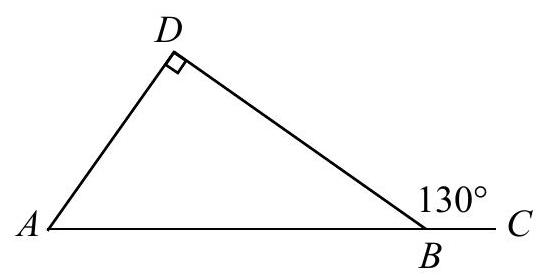 | <think>
Okay, let's see. So the problem is about a diagram where points A, B, and C form a straight angle. Hmm, a straight angle is 180 degrees, so that means points A, B, and C are colinear, right? So like, A---B---C in a straight line. Then there's a triangle ADB that's right-angled at D. So triangle ADB has a right ... |
olympiads | 7. The school organizes 1511 people to go on an outing, renting 42-seat coaches and 25-seat minibuses. If it is required that there is exactly one seat per person and one person per seat, then there are $\qquad$ rental options. | <think>
Okay, so the problem is about renting coaches and minibuses for 1511 people. The coaches have 42 seats each, and the minibuses have 25 seats each. We need to find the number of rental options such that exactly all 1511 seats are filled, with one person per seat. That means we need to find the number of non-nega... |
olympiads | 4. A merchant accidentally mixed candies of the 1st grade (at 3 rubles per pound) and candies of the 2nd grade (at 2 rubles per pound). At what price should this mixture be sold to receive the same amount of money, given that initially the total cost of all candies of the 1st grade was equal to the total cost of all ca... | <think>
Okay, let's try to figure this out. So, the problem is about a merchant who mixed two grades of candies—1st grade at 3 rubles per pound and 2nd grade at 2 rubles per pound. The total cost of all the 1st grade candies was equal to the total cost of all the 2nd grade candies. We need to find the price per pound a... |
olympiads | 2.59. The cone is formed by rotating a right-angled triangle with an area of $S$ around one of its legs. Find the volume of the cone if the length of the circumference described by the point of intersection of the triangle's medians during its rotation is $L$. | <think>
Okay, let's tackle this geometry problem. So, the problem is about a right-angled triangle with area S. When we rotate this triangle around one of its legs, it forms a cone. We need to find the volume of this cone, given that the length of the circumference described by the point where the medians intersect (th... |
olympiads | 6. In $\triangle A B C$, $A>90^{\circ}, B=20^{\circ}$, draw $A D \perp A B$ intersecting $B C$ at $D$. Given $A B=1, C D=4$, let $S$ be the area of $\triangle A B C$, then the sum of the numerator and denominator of $S^{2}$ in its simplest form is $\qquad$ . | <think>
Okay, so I have this geometry problem here. Let me read it again to make sure I understand all the details.
In triangle ABC, angle A is greater than 90 degrees, angle B is 20 degrees. They want me to draw AD perpendicular to AB, intersecting BC at D. Given that AB is 1 unit long, and CD is 4 units. Then S is t... |
olympiads | 6. Little Careless made a mistake while doing an addition problem, mistaking the tens digit 5 of one addend as 2, and the units digit 7 of the other addend as 1, resulting in a sum of 241. The correct sum should be $\qquad$ | <think>
Okay, let's see. So the problem is about Little Careless who made some mistakes while doing an addition problem. The mistakes were: mistaking the tens digit 5 of one addend as 2, and the units digit 7 of the other addend as 1. Because of these errors, the sum he got was 241. Now we need to find the correct sum.... |
olympiads | Exercise 2. Let $S$ be the set of two-digit numbers that do not contain the digit 0. Two numbers in $S$ are called friends if their largest digits are equal, and if the difference between their smallest digits is 1. For example, 68 and 85 are friends, 78 and 88 are friends, but 58 and 75 are not friends.
Determine the... | <think>
Okay, let's try to figure out this problem. So, we have the set S, which consists of all two-digit numbers that don't contain the digit 0. That means each number is from 11 to 99, but excluding any number that has a 0 in either the tens or units place. So numbers like 10, 20, ..., 90 are out, and also numbers l... |
olympiads | ## Problem Statement
Calculate the limit of the numerical sequence:
$\lim _{n \rightarrow \infty} \frac{(n+2)^{4}-(n-2)^{4}}{(n+5)^{2}+(n-5)^{2}}$ | <think>
Okay, so I need to find the limit of this sequence as n approaches infinity. The sequence is given by the fraction [(n + 2)^4 - (n - 2)^4] divided by [(n + 5)^2 + (n - 5)^2]. Hmm, let me start by expanding both the numerator and the denominator to see if I can simplify things.
Starting with the numerator: (n +... |
olympiads | 3. Solve the system of equations $\left\{\begin{array}{l}\frac{1}{x}+\frac{1}{y+z}=1, \\ \frac{1}{y}+\frac{1}{x+z}=\frac{4}{3}, \\ \frac{1}{z}+\frac{1}{x+y}=-\frac{4}{5}\end{array}\right.$. | <think>
Alright, so I need to solve this system of equations. Let me write them down again to make sure I have them right:
1. 1/x + 1/(y + z) = 1
2. 1/y + 1/(x + z) = 4/3
3. 1/z + 1/(x + y) = -4/5
Hmm, okay. Three equations with three variables: x, y, z. The variables are in denominators and in combinations. This loo... |
cn_contest | 4. For the convex pentagon $A B C D E$, the side lengths are sequentially $a_{1}, a_{2}, a_{3}, a_{4}, a_{5}$. It is known that a quadratic trinomial in $x$ satisfies:
When $x=a_{1}$ and $x=a_{2}+a_{3}+a_{4}+a_{5}$, the value of the quadratic trinomial is 5;
When $x=a_{1}+a_{2}$, the value of the quadratic trinomial i... | <think>
Okay, let me try to figure this out step by step. The problem is about a convex pentagon ABCDE with side lengths a1, a2, a3, a4, a5 in order. We have a quadratic trinomial that satisfies certain conditions, and we need to find p - q where p and q are specific values of the quadratic.
First, let me restate the ... |
olympiads | 4. Let $ABCD$ be a parallelogram where $AB > BC$, $[AE$ is the bisector of angle $A$, $[BF$ is the bisector of angle $B$ ($E, F \in (DC)$), $X$ is the midpoint of segment $[AE]$, and $Y$ is the midpoint of segment $[BF]$.
a) Prove that $DXYF$ is a parallelogram.
b) If $5AD = 3AB$ and $XY = 24 \text{ cm}$, find the pe... | <think>
Okay, so I need to solve part a) and b) of this geometry problem. Let me start with part a). The problem says that ABCD is a parallelogram with AB longer than BC. AE is the angle bisector of angle A, and BF is the angle bisector of angle B. Both E and F are on side DC. X is the midpoint of AE, and Y is the midp... |
aops_forum | Find all complex-valued functions $f$ of a complex variable such that $$f(z)+zf(1-z)=1+z$$
for all $z\in \mathbb{C}$. | <think>
Alright, so I need to find all complex-valued functions \( f \) such that for every complex number \( z \), the equation \( f(z) + z f(1 - z) = 1 + z \) holds. Hmm, functional equations can be tricky, especially with complex variables, but maybe I can approach this systematically.
First, let me write down the ... |
olympiads | [ Triangle Inequality
Point $C$ divides the chord $A B$ of a circle with radius 6 into segments $A C=4$ and $C B=5$. Find the minimum distance from point $C$ to the points on the circle.
# | <think>
Okay, so I have this geometry problem here. Let me read it again. It says: Point C divides the chord AB of a circle with radius 6 into segments AC=4 and CB=5. Find the minimum distance from point C to the points on the circle. Hmm, okay. I need to find the shortest distance from point C to any point on the circ... |
olympiads |
G3 The vertices $A$ and $B$ of an equilateral $\triangle A B C$ lie on a circle $k$ of radius 1 , and the vertex $C$ is inside $k$. The point $D \neq B$ lies on $k, A D=A B$ and the line $D C$ intersects $k$ for the second time in point $E$. Find the length of the segment $C E$.
| <think>
Okay, so I have this geometry problem here. Let me read it again and try to visualize it.
We have an equilateral triangle ABC, but only vertices A and B are on a circle k with radius 1. Vertex C is inside the circle. Then there's a point D (not B) on the circle such that AD = AB. The line DC intersects the ci... |
olympiads | 10.1. Propose a word problem that reduces to solving the inequality
$$
\frac{11}{x+1.5}+\frac{8}{x} \geqslant \frac{12}{x+2}+2
$$
Write the problem statement, its solution, and the answer.
Example of the required problem. Points A and B are connected by two roads: one is 19 km long, and the other is 12 km long. At 1... | <think>
Okay, let's try to come up with a word problem that reduces to solving the inequality 11/(x + 1.5) + 8/x ≥ 12/(x + 2) + 2. The example given involves two pedestrians with different speeds and arrival times. Maybe I can create a similar scenario but with different contexts, like two vehicles or workers completin... |
olympiads | 6. (20 points) We will call a word any finite sequence of letters of the Russian alphabet. How many different five-letter words can be formed from the letters of the word САМСА? And from the letters of the word ПАСТА? In your answer, indicate the sum of the found numbers. | <think>
Alright, let me try to solve this problem. So, we need to find how many different five-letter words can be formed from the letters of the words САМСА and ПАСТА, and then sum those two numbers.
First, let me understand the problem correctly. A "word" here is just any finite sequence of letters, doesn't have to... |
olympiads | 1. As shown in the figure, there is a sequence of curves $P_{0}, P_{1}, P_{2}, \cdots$. It is known that the area of the equilateral triangle enclosed by $P_{0}$ is 1. $P_{k+1}$ is obtained by performing the following operation on $P_{k}$: trisect each side of $P_{k}$, construct an equilateral triangle outward using th... | <think>
Okay, so I need to find the general term formula for the sequence {Sₙ} where Sₙ is the area enclosed by the curve Pₙ. The starting point is P₀, which is an equilateral triangle with area 1. Then each subsequent Pₖ+1 is formed by trisecting each side of Pₖ, building an outward equilateral triangle on the middle ... |
olympiads | 1. Niek has 16 square cards that are yellow on one side and red on the other. He lays them out in a $4 \times 4$ square. Some cards may lie with the yellow side up, and some with the red side up. For each color pattern, he calculates the monochromaticity of the pattern as follows. For each pair of cards that share a si... | <think>
Okay, so I need to figure out the three largest monochromaticity numbers for part (a). Let me start by understanding the problem better.
Niek has a 4x4 grid of cards, each yellow on one side and red on the other. The monochromaticity is calculated by checking each pair of adjacent cards (sharing a side). For e... |
olympiads | 9. (16 points) In $\triangle A B C$, $B C=a, C A=b$, $A B=c$. If $b$ is the geometric mean of $a$ and $c$, and $\sin A$ is the arithmetic mean of $\sin (B-A)$ and $\sin C$, find the value of $\cos B$.
---
The translation retains the original text's formatting and structure. | <think>
Okay, so I have this triangle ABC where BC = a, CA = b, AB = c. The problem states that b is the geometric mean of a and c. That means b² = a*c. Got that. Then, it also says that sin A is the arithmetic mean of sin(B - A) and sin C. So arithmetic mean means average, right? So sin A = [sin(B - A) + sin C]/2. I n... |
olympiads | 4. Factorize: $(x+1)(x+2)(x+3)(x+4)+x(x+5)=$ | <think>
Alright, so I have this expression to factorize: (x+1)(x+2)(x+3)(x+4) + x(x+5). Hmm, that looks a bit intimidating at first glance with all those factors multiplied together. Let me try to break it down step by step.
First, I notice that the first part of the expression is a product of four consecutive linear ... |
olympiads | 54. How many five-digit numbers are there in which
a) the digit 5 appears exactly once?
b) the digit 5 appears no more than once?
c) the digit 5 appears at least once? | <think>
Alright, let me try to figure out part a) of this problem. So, the question is asking: How many five-digit numbers are there where the digit 5 appears exactly once? Hmm, okay. Let's break this down step by step.
First, I need to remember that a five-digit number can't start with a zero. So the first digit has ... |
olympiads | 5. If the angle at the vertex of a triangle is $40^{\circ}$, then the bisectors of the other two angles of the triangle intersect at an angle of $80^{\circ}$. | <think>
Okay, so I have this geometry problem here. Let me try to understand it first. The problem says: If the angle at the vertex of a triangle is 40 degrees, then the bisectors of the other two angles of the triangle intersect at an angle of 80 degrees. Hmm, I need to verify if this is true or figure out why it's 80... |
Subsets and Splits
No community queries yet
The top public SQL queries from the community will appear here once available.