
source stringclasses 7
values | problem stringlengths 19 6.18k | generation stringlengths 345 68.1k |
|---|---|---|
amc_aime | For what real values of $K$ does $x = K^2 (x-1)(x-2)$ have real roots?
$\textbf{(A)}\ \text{none}\qquad\textbf{(B)}\ -21\text{ or }K<-2\qquad\textbf{(E)}\ \text{all}$ | <think>
Okay, so I need to figure out for what real values of K the equation x = K² (x - 1)(x - 2) has real roots. The answer choices are given, but I need to work through it step by step.
First, let me make sure I understand the question. The equation is x = K² (x - 1)(x - 2). We need to find all real numbers K such ... |
olympiads | 23. The courses at the magic school are divided into 9 levels, and students start learning from level 1. After completing level 9, they can become magicians. During the learning process, skipping levels is allowed, but each time, they can skip at most one level, and level 1 and level 9 are mandatory. Before the winter ... | <think>
Okay, let me try to figure out this problem. So, the question is about students at a magic school who have to go through 9 levels of courses. They start at level 1 and after completing level 9, they become magicians. The rules are that you can skip levels, but each time you can skip at most one level. Also, bot... |
aops_forum | Denote by $d(n)$ be the biggest prime divisor of $|n|>1$. Find all polynomials with integer coefficients satisfy;
$$P(n+d(n))=n+d(P(n)) $$
for the all $|n|>1$ integers such that $P(n)>1$ and $d(P(n))$ can be defined. | <think>
Okay, let's try to tackle this problem step by step. The problem is asking to find all polynomials with integer coefficients that satisfy the equation:
$$
P(n + d(n)) = n + d(P(n))
$$
for all integers |n| > 1 such that P(n) > 1 and d(P(n)) can be defined. Here, d(n) denotes the largest prime divisor of |n| wh... |
olympiads | 26.16 The curve determined by the polar equation $\rho=\frac{1}{1-\cos \theta+\sin \theta}$ is
(A) a circle.
(B) an ellipse.
(C) a hyperbola.
(D) a parabola.
(Chinese High School Mathematics League, 1982) | <think>
Okay, so I have this polar equation here: ρ = 1 / (1 - cosθ + sinθ). The question is asking what kind of conic section this curve represents. The options are circle, ellipse, hyperbola, or parabola. Hmm, I need to figure out which one it is.
First, I remember that conic sections in polar coordinates usually ha... |
olympiads_ref | Let \( n \) be a positive integer. Find the number of permutations \( a_{1}, a_{2}, \ldots, a_{n} \) of the sequence \( 1, 2, \ldots, n \) satisfying
\[ a_{1} \leqslant 2 a_{2} \leqslant 3 a_{3} \leqslant \ldots \leqslant n a_{n} \]
(United Kingdom) | <think>
Okay, so I have this problem here: given a positive integer n, I need to find the number of permutations of the sequence 1, 2, ..., n such that the permutation a1, a2, ..., an satisfies the condition a1 ≤ 2a2 ≤ 3a3 ≤ ... ≤ nan. Hmm, that seems a bit tricky, but let me try to break it down step by step.
First, ... |
olympiads | [ Chessboards and chess pieces ] [ Examples and counterexamples. Constructions ]
Author: S. Preskova
Under one of the cells of an $8 \times 8$ board, a treasure is buried. Under each of the other cells, there is a sign indicating the minimum number of steps required to reach the treasure from that cell (one step all... | <think>
Okay, so I have this problem about an 8x8 chessboard where a treasure is buried under one cell. All the other cells have signs indicating the minimum number of steps needed to reach the treasure. The question is, what's the minimum number of cells we need to dig up to guarantee we find the treasure, no matter w... |
olympiads | 7. The positional relationship between the graphs of the functions $y=f(x)$ and $y=-f^{-1}(-x)$ is $(\quad)$
(A) Symmetric about $y=x$
(B) Symmetric about $x+y=0$
(C) Symmetric about the origin
(D) Coincident | <think>
Okay, let me try to figure out this problem step by step. So the question is about the positional relationship between the graphs of y = f(x) and y = -f⁻¹(-x). The options are symmetric about y=x, symmetric about x+y=0, symmetric about the origin, or coincident.
First, I need to recall what transformations do... |
olympiads | 1. A rectangular section of road with a length of 800 m and a width of 50 m was paved with asphalt. For every 100 m$^{2}$ of road, 3 tons 800 kg of asphalt were used. How many tons of asphalt were used? | <think>
Okay, let's tackle this problem step by step. First, I need to figure out the total area of the rectangular road section. The problem says the length is 800 meters and the width is 50 meters. So, to find the area, I should multiply the length by the width. Let me write that down:
Area = length × width = 800 m ... |
olympiads | Lian Example 18 (2005 National Training Team Test Question) Find all positive integers $m, n$, such that the inequality
$\left[(m+n)_{\alpha}\right]+[(m+n) \beta] \geqslant[m \alpha]+[m \beta]+[n(\alpha+\beta)]$
holds for any real numbers $\alpha, \beta$. Here $[x]$ denotes the integer part of the real number $x$. | <think>
Okay, so I need to solve this problem where I have to find all positive integers m and n such that a certain inequality holds for any real numbers α and β. The inequality is:
[(m + n)α] + [(m + n)β] ≥ [mα] + [mβ] + [n(α + β)]
And here, [x] denotes the integer part of x, which is also known as the floor functi... |
olympiads | ## Task A-1.2.
Determine all pairs of integers $(m, n)$ such that
$$
n^{2}-6 n=m^{2}+m-10
$$ | <think>
Okay, so I need to find all integer pairs (m, n) that satisfy the equation n² - 6n = m² + m -10. Hmm, let me start by writing the equation down again to make sure I have it right:
n² - 6n = m² + m - 10.
I need to find integers m and n such that this equation holds. Let me think about how to approach this. May... |
olympiads | 2. The plane departed from Perm on September 28 at noon and arrived in Kirov at 11:00 AM (all departure and arrival times mentioned in the problem are local). At 7:00 PM the same day, the plane departed from Kirov to Yakutsk and arrived there at 7:00 AM. Three hours later, it departed from Yakutsk to Perm and returned ... | <think>
Okay, let's try to figure out this problem step by step. So, we have a plane that makes three flights: Perm to Kirov, Kirov to Yakutsk, and Yakutsk back to Perm. We need to calculate the total time the plane spent in the air. The answer is supposed to be 12 hours, but I need to understand how to get there.
Fir... |
olympiads | Mr. Krbec with his cat Kokeš were selling tickets at Kulikov Castle. On Saturday, they sold 210 children's tickets for 25 groschen each and also some adult tickets for 50 groschen each. In total, they earned 5950 groschen that day.
How many adult tickets did they sell?
(M. Krejčová)
Hint. How much did they earn from... | <think>
Okay, let's see. So Mr. Krbec and his cat Kokeš were selling tickets at Kulikov Castle. On Saturday, they sold 210 children's tickets for 25 groschen each, and some adult tickets for 50 groschen each. The total earnings for the day were 5950 groschen. The question is asking how many adult tickets they sold.
Fi... |
olympiads | Task 2. A poultry farm delivered 720 eggs, which were packed in boxes of 6 eggs each. During transportation, 140 eggs were broken. The remaining eggs were packed in boxes of 12 eggs each. How many boxes of eggs were packed. Were there any unbroken eggs left that could not be packed? | <think>
Okay, let's tackle this problem step by step. First, I need to understand what's being asked. The problem is about a poultry farm that delivered 720 eggs, originally packed in boxes of 6 eggs each. During transportation, 140 eggs were broken. Then, the remaining eggs (which are unbroken) are repacked into boxes... |
olympiads | 131. Find $\lim _{x \rightarrow \infty} \frac{2 x^{3}-3 x^{2}+5 x+7}{3 x^{3}+4 x^{2}-x+2}$. | <think>
Okay, so I need to find the limit as x approaches infinity of (2x³ - 3x² + 5x + 7) divided by (3x³ + 4x² - x + 2). Hmm, limits at infinity. Let me remember how to approach these.
I think when dealing with rational functions (polynomial divided by polynomial), the behavior as x approaches infinity depends on t... |
olympiads | Can the circles on a five-pointed star (see figure) be filled with 4 ones, 3 twos, and 3 threes such that the sums of the four numbers on each of the five lines are equal?
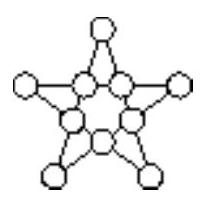
# | <think>
Okay, so I need to figure out if I can place 4 ones, 3 twos, and 3 threes on the circles of a five-pointed star such that the sum of the four numbers on each of the five lines is equal. Let me start by understanding the problem better.
First, the star in question is a five-pointed star, like the ones you draw ... |
olympiads | 【Question 10】The polyhedron shown in the figure is called a regular icosahedron, one of the 5 Platonic solids (regular polyhedra). This polyhedron is formed by 20 faces (equilateral triangles). Now, these 20 faces are to be colored, with the requirement that two faces sharing an edge must be colored differently. Then, ... | <think>
Alright, let's tackle this problem about coloring a regular icosahedron. So, the question is asking for the minimum number of colors needed such that no two adjacent faces (which share an edge) have the same color. The icosahedron has 20 triangular faces, all equilateral triangles. Hmm, okay.
First, I remember... |
olympiads | The steam train travels from Zalakomár, which is 21 km away, to Kanizsa. It covers the distance in 16 minutes, starting with uniform acceleration, then traveling at a constant speed of $90 \frac{\mathrm{km}}{\mathrm{h}}$, and finally decelerating uniformly to a stop. How long does the steam train travel at $90 \frac{\m... | <think>
Alright, let's try to figure out how long the steam train travels at 90 km/h. The problem says the train goes from Zalakomár to Kanizsa, which is 21 km apart, in 16 minutes. The motion is divided into three parts: first accelerating uniformly, then moving at a constant speed of 90 km/h, and finally decelerating... |
olympiads | G7.1 In the figure, $Q R, R P, P Q$ are 3 arcs, centres at $A, B, C$ respectively, touching one another at $R, P, Q$. If $A R=r, R B=6$, $Q C=4, \angle A=90^{\circ}$, find $r$. | <think>
Okay, let's try to tackle this geometry problem step by step. First, let me make sure I understand the problem correctly.
We have three arcs QR, RP, and PQ. Each of these arcs has its center at points A, B, and C respectively. The arcs touch each other at points R, P, and Q. So, QR is an arc with center A, RP... |
cn_contest | 1. The size relationship of the following three numbers $\frac{3}{2}, \log _{16} 82, \log _{27} 124$ is ( ).
(A) $\frac{3}{2}<\log _{16} 82<\log _{27} 124$
(B) $\frac{3}{2}<\log _{27} 124<\log _{16} 82$
(C) $\log _{27} 124<\frac{3}{2}<\log _{16} 82$
(D) $\log _{27} 124<\log _{16} 82<\frac{3}{2}$ | <think>
Okay, so I need to figure out the size relationship between these three numbers: 3/2, log base 16 of 82, and log base 27 of 124. The options are given as (A) through (D), each with a different order. Let me break this down step by step.
First, I remember that logarithms can sometimes be compared by converting ... |
olympiads | Example 9 $\triangle A B C$ is inscribed in a unit circle, the angle bisectors of the three interior angles $A, B, C$ are extended to intersect this circle at points $A_{1}, B_{1}, C_{1}$, respectively. Find the value of $\frac{A A_{1} \cos \frac{A}{2}+B B_{1} \cos \frac{B}{2}+C C_{1} \cos \frac{C}{2}}{\sin A+\sin B+\s... | <think>
Okay, so I need to solve this problem where triangle ABC is inscribed in a unit circle. The angle bisectors of angles A, B, and C are extended to intersect the circle again at points A₁, B₁, C₁ respectively. Then, I need to find the value of the expression:
[AA₁ cos(A/2) + BB₁ cos(B/2) + CC₁ cos(C/2)] divided ... |
olympiads | 3. Compare the numbers $x=2 \cdot 20212021 \cdot 1011 \cdot 202320232023$ and $y=43 \cdot 47 \cdot 20232023 \cdot 202220222022$. | <think>
Alright, so I need to compare two numbers, x and y. Let me write down what they are again to make sure I got them right.
x is equal to 2 multiplied by 20212021 multiplied by 1011 multiplied by 202320232023. And y is 43 multiplied by 47 multiplied by 20232023 multiplied by 202220222022. Hmm. Okay, these numbers... |
olympiads | 16. The electronic digital clock indicates time from 00:00:00 to 23:59:59. Then in one day and night, the number of times the clock shows exactly 4 digits " " is $\qquad$ cases. | <think>
Okay, so the problem is about an electronic digital clock that displays time from 00:00:00 to 23:59:59. We need to find out how many times in a full day (24 hours) the clock shows exactly four digits of a certain kind. Wait, hold on, the problem mentions "exactly 4 digits ' ' "—but there's a space there. Maybe ... |
olympiads | 5. Given the number $5300 \ldots 0035$ (100 zeros). It is required to replace some two zeros with non-zero digits so that after the replacement, the resulting number is divisible by 495. In how many ways can this be done? | <think>
Okay, so I need to figure out how many ways I can replace two zeros in the number 5300...0035 (which has 100 zeros) with non-zero digits so that the resulting number is divisible by 495. Hmm, let's start by understanding the problem step by step.
First, the original number is 5 followed by 3, then 100 zeros, a... |
olympiads | 6. How many five-digit numbers have all different digits, and the sum of the digits in the units and tens place equal to 5? | <think>
Okay, so I need to figure out how many five-digit numbers have all different digits, and the sum of the digits in the units and tens place equals 5. Hmm, let's break this down step by step.
First, let's remember that a five-digit number can't start with 0. So the first digit (let's say it's the ten-thousands ... |
cn_contest | Example 4 Solve the equation
$$
x^{2}-x-1000 \sqrt{1+8000 x}=1000 .
$$ | <think>
Okay, so I need to solve this equation: \( x^{2} - x - 1000 \sqrt{1 + 8000x} = 1000 \). Hmm, that looks a bit intimidating with the square root and the quadratic term. Let me try to figure out how to approach this step by step.
First, maybe I can simplify the equation or isolate the square root term. Let me se... |
olympiads | 10. For positive integer $n$ and real number $x (0 \leqslant x < n)$, define
$$
f(n, x)=(1-\{x\}) \cdot C_{n}^{[x]}+\{x\} \cdot C_{n}^{[x]+1},
$$
where $[x]$ denotes the greatest integer not exceeding the real number $x$, and $\{x\}=x-[x]$. If integers $m, n \geqslant 2$ satisfy
$$
f\left(m, \frac{1}{n}\right)+f\left(... | <think>
Okay, let me try to figure out this problem. So, we have these functions f(n, x) defined for a positive integer n and a real number x between 0 and n (but not including n). The function f(n, x) is given by (1 - {x}) times C_n^{[x]} plus {x} times C_n^{[x]+1}. Here, [x] is the floor function, which is the greate... |
olympiads | 13. Let $A B C$ be an equilateral triangle, and let $D, E, F$ be the midpoints of the sides. How many non-degenerate and non-congruent triangles can be obtained by choosing 3 of the points $A, B, C, D, E, F$? | <think>
Okay, so I need to figure out how many non-degenerate and non-congruent triangles can be formed by choosing three points from the vertices and midpoints of an equilateral triangle. Let me break this down step by step.
First, let's visualize the problem. We have an equilateral triangle ABC, with D, E, F as the ... |
olympiads | 11. A food factory has made 4 different exquisite cards, and each bag of food produced by the factory randomly contains one card. It is stipulated that if one collects all 4 different cards, they can win a prize. Xiao Ming buys 6 bags of this food at once. What is the probability that Xiao Ming will win the prize? $\qq... | <think>
Okay, so I need to figure out the probability that Xiao Ming will collect all 4 different exquisite cards by buying 6 bags of food. Each bag has one card, and there are 4 different types. The problem is similar to the classic "coupon collector's problem," where you want to know the probability of collecting all... |
olympiads | Since 3 and $1 / 3$ are roots of the equation $a x^{2}-6 x+c=0$, we have:
$$
9 a-18+c=0 \Rightarrow 9 a+c=18 \text { and } \frac{a}{9}-2+c=0 \Rightarrow \frac{a}{9}+c=2
$$
Solving the system
$$
\left\{\begin{array}{l}
9 a+c=18 \\
\frac{a}{9}+c=2
\end{array} \quad \text { we obtain } \quad a=c=\frac{9}{5} . \text { T... | <think>
Okay, let me try to figure this out. The problem says that 3 and 1/3 are roots of the quadratic equation ax² - 6x + c = 0. I need to find the values of 'a' and 'c' and then add them together. Hmm, let's start by recalling what it means for a number to be a root of a quadratic equation.
If 3 and 1/3 are roots, ... |
olympiads | 6. Let $a_{n}=1+2+\cdots+n\left(n \in \mathbf{Z}_{+}\right)$,
$$
S_{m}=a_{1}+a_{2}+\cdots+a_{m}(m=1,2, \cdots) \text {. }
$$
Then among $S_{1}, S_{2}, \cdots, S_{2017}$, the numbers that are divisible by 2 but not by 4 are $\qquad$ in number. | <think>
Okay, so I have this problem here. Let me read it again and make sure I understand what's being asked.
We have a sequence defined by a_n = 1 + 2 + ... + n, where n is a positive integer. Then S_m is the sum of the first m terms of this sequence, right? So S_m = a_1 + a_2 + ... + a_m for m = 1, 2, ..., 2017. T... |
olympiads | The act of adding the digits of a number is called addichiffre. For example, when we addichiffre 124, we get $1+2+4=7$.
What do we get when we addichiffre $1998^{1998}$, then addichiffre the result obtained, and so on, three times in a row? | <think>
Okay, so I need to figure out what happens when we take 1998 raised to the power of 1998, then repeatedly add up its digits three times. This process is called addichiffre, right? Let me break it down step by step.
First off, adding the digits of a number is known as the digital sum. So, the first addichiffre ... |
olympiads | ## Task B-1.6.
The sum of the digits of a three-digit number is 17. The digit in the tens place is 9. If the digits in the hundreds and units places are swapped, the new number is 100 more than twice the original number. What is the original number? | <think>
Okay, let's see. I need to find a three-digit number where the sum of its digits is 17. The tens digit is 9. Also, if you swap the hundreds and units digits, the new number is 100 more than twice the original number. Hmm, that sounds a bit complicated, but let's break it down step by step.
First, let me recall... |
olympiads | 15. Given $f(x)=\sin x+2 \cos x+3 \tan x$, where $x$ is in radians. Then the interval ( ) contains the smallest positive real number $x$ such that $f(x)=0$.
(A) $(0,1)$
(B) $(1,2)$
(C) $(2,3)$
(D) $(3,4)$
(E) $(4,5)$ | <think>
Alright, so I need to find the smallest positive real number x where f(x) = sin x + 2 cos x + 3 tan x equals zero. The options given are intervals from (0,1) up to (4,5). Hmm, okay. Let me start by understanding the problem step by step.
First, the function is a combination of sine, cosine, and tangent. Tangen... |
olympiads | 11.1. A unified control test in mathematics was conducted among all eleventh-graders in the school. As a result, 5/8 of the students received fives, 11/20 of the number of excellent students received fours, and the remaining three eleventh-graders did not come to the test due to illness. How many eleventh-graders are t... | <think>
Okay, let me try to figure this problem out. So, there was a math test for all eleventh-graders in the school. Some got fives, some got fours, and three didn't come because they were sick. I need to find the total number of eleventh-graders. Hmm, let's break this down step by step.
First, the problem says that... |
olympiads | The angle at vertex $D$ of trapezoid $A B C D$ with bases $A D$ and $B C$ is $60^{\circ}$. Find the diagonals of the trapezoid, if $A D=$ $10, B C=3$ and $C D=4$.
# | <think>
Okay, so I need to find the diagonals of trapezoid ABCD where AD and BC are the bases. The angle at vertex D is 60 degrees, AD is 10 units long, BC is 3 units, and CD is 4 units. Hmm, trapezoid with bases AD and BC. Let me visualize this first. Let me sketch it out mentally. So AD is the longer base since it's ... |
olympiads | 9. Given the ellipse $\Gamma: \frac{x^{2}}{9}+\frac{y^{2}}{5}=1$, a line passing through the left focus $F(-2,0)$ of the ellipse $\Gamma$ with a slope of $k_{1}\left(k_{1} \notin\{0\right.$, $\infty\})$ intersects the ellipse $\Gamma$ at points $A$ and $B$. Let point $R(1,0)$, and extend $A R$ and $B R$ to intersect th... | <think>
Okay, let's tackle this problem step by step. So, we have an ellipse Γ defined by the equation x²/9 + y²/5 = 1. First, I need to recall some properties of ellipses. The standard form of an ellipse is x²/a² + y²/b² = 1, where a is the semi-major axis and b is the semi-minor axis. In this case, a² = 9 and b² = 5,... |
amc_aime | In [triangle](https://artofproblemsolving.com/wiki/index.php/Triangle) $ABC$ the [medians](https://artofproblemsolving.com/wiki/index.php/Median) $\overline{AD}$ and $\overline{CE}$ have lengths $18$ and $27$, respectively, and $AB=24$. Extend $\overline{CE}$ to intersect the [circumcircle](https://artofproblemsolving.... | <think>
Okay, so I need to solve this geometry problem involving triangle ABC with medians AD and CE of lengths 18 and 27, respectively, and side AB = 24. Then, we extend CE to meet the circumcircle of triangle ABC at point F, and find the area of triangle AFB in the form m√n, then compute m + n. Hmm, okay, let's start... |
olympiads | Two players play on an $8 \times 8$ chessboard. The player who starts the game makes the first move - placing a knight on the board. Then they take turns moving it (according to the usual rules), and it is not allowed to place the knight on a square where it has already been. The player who has no legal moves loses. Wh... | <think>
Okay, so there's this game where two players take turns moving a knight on an 8x8 chessboard. The first player starts by placing the knight anywhere, and then each player moves it like a normal knight in chess, but they can't put it on a square that's already been visited. The person who can't make a move loses... |
olympiads | Problem 12.5. A plane intersects a tetrahedron $A B C D$ and divides the medians of the triangles $D A B, D B C$ and $D C A$ through $D$ in ratios $1: 2,1: 3$ and $1: 4$ from $D$, respectively. Find the ratio of the volumes of the two parts of the tetrahedron cut by the plane.
Oleg Mushkarov | <think>
Okay, let's try to tackle this problem step by step. The problem says that a plane intersects a tetrahedron ABCD, dividing the medians of the triangles DAB, DBC, and DCA through D in ratios 1:2, 1:3, and 1:4 from D, respectively. We need to find the ratio of the volumes of the two parts of the tetrahedron cut b... |
olympiads | 3. Let $x>0$,
and $x^{2}+\frac{1}{x^{2}}=7$, then $x^{5}+\frac{1}{x^{5}}=$ $\qquad$ | <think>
Okay, so I have this problem here where x is greater than 0, and x squared plus 1 over x squared equals 7. I need to find x to the fifth plus 1 over x to the fifth. Hmm, let's see. I remember that sometimes when you have expressions like x + 1/x or x^2 + 1/x^2, you can find higher powers by using recursive rela... |
olympiads | 11. Xiao Ming brought 24 handmade souvenirs to sell at the London Olympics. In the morning, each souvenir was sold for 7 pounds, and the number of souvenirs sold was less than half of the total. In the afternoon, he discounted the price of each souvenir, and the discounted price was still an integer. In the afternoon, ... | <think>
Okay, let's try to figure out how many souvenirs Xiao Ming sold in the morning. Hmm, let's start by breaking down the problem step by step.
First, we know that Xiao Ming brought 24 souvenirs in total. In the morning, he sold each souvenir for 7 pounds, and the number sold was less than half of the total. Sinc... |
olympiads | Example 2 Given $0<a<1$, and satisfies
$$
\begin{array}{l}
{\left[a+\frac{1}{30}\right]+\left[a+\frac{2}{30}\right]+\cdots+\left[a+\frac{29}{30}\right]=18 .} \\
\text { Then }[10 a]=
\end{array}
$$ | <think>
Alright, so I have this problem here. Let me try to parse it first. It says, given that 0 < a < 1, and the sum from [a + 1/30] up to [a + 29/30] equals 18. Then we need to find [10a]. The brackets here probably represent the floor function, right? So [x] is the greatest integer less than or equal to x.
Okay, l... |
olympiads | 11.076. The height of the cone is equal to the diameter of its base. Find the ratio of the area of its base to the lateral surface area. | <think>
Okay, so I need to find the ratio of the base area to the lateral surface area of a cone where the height is equal to the diameter of the base. Hmm, let me start by recalling the formulas for the areas involved.
First, the base of a cone is a circle, right? So the area of the base (let's call it A_base) shoul... |
olympiads | Problem 2. In a square of grid paper containing an integer number of cells, a hole in the shape of a square, also consisting of an integer number of cells, was cut out. How many cells did the large square contain if 209 cells remained after the cutout? | <think>
Okay, let's see. The problem is about a square grid paper where a smaller square hole was cut out, and after cutting out the hole, there are 209 cells remaining. We need to find out how many cells the original large square had.
So, first, let me parse the problem. We have two squares: a larger one and a smalle... |
olympiads | 22. Find all functions $f: \mathbb{R} \rightarrow \mathbb{R}$ that for all real $x$ satisfy the relations
$$
\underbrace{f(f(f \ldots f}_{13}(x) \ldots))=-x, \quad \underbrace{f(f(f \ldots f}_{8}(x) \ldots))=x
$$ | <think>
Okay, so I need to find all functions f from the real numbers to the real numbers that satisfy two conditions: applying f thirteen times gives you -x, and applying f eight times gives you x for all real x. Hmm, that sounds like a functional equation problem with some cyclic behavior involved. Let me think about... |
olympiads | Problem 5. On the side $A D$ of the square $A B C D$, point $K$ is marked, and on the extension of ray $A B$ beyond point $B$ - point $L$. It is known that $\angle L K C=45^{\circ}, A K=1, K D=2$. Find $L B$. | <think>
Okay, so I have this geometry problem here. Let me try to visualize it first. There's a square ABCD, right? Let me recall that in a square, all sides are equal and all angles are 90 degrees. The vertices are labeled in order, so ABCD means that AB, BC, CD, and DA are the sides. The problem mentions point K on s... |
olympiads | $1 \cdot 13$ If a natural number $N$ is appended to the right of every natural number (for example, appending 2 to 35 gives 352), and if the new number is always divisible by $N$, then $N$ is called a magic number. Among the natural numbers less than 130, how many magic numbers are there?
(China Junior High School Math... | <think>
Okay, so I need to figure out how many magic numbers less than 130 there are. The problem says that a natural number N is a magic number if when you append it to the right of any natural number, the resulting number is divisible by N. For example, if N is 2, then appending it to 35 gives 352, which needs to be ... |
olympiads | Problem 5.3. In five of the nine circles in the picture, the numbers 1, 2, 3, 4, 5 are written. Replace the digits $6, 7, 8, 9$ in the remaining circles $A, B, C, D$ so that the sums of the four numbers along each of the three sides of the triangle are the same.
. That's a really big exponent, so calculating it directly is impossible. I remember that to find the last three digits of a number, we need to compute the number modulo 1000. So, essentially, I need to compute 2003^(2002^2001) mod 1000... |
olympiads | N1. Determine all positive integers $M$ for which the sequence $a_{0}, a_{1}, a_{2}, \ldots$, defined by $a_{0}=\frac{2 M+1}{2}$ and $a_{k+1}-a_{k}\left\lfloor a_{k}\right\rfloor$ for $k-0,1,2, \ldots$, contains at least one integer term. | <think>
Okay, so I need to figure out all positive integers M such that the sequence defined by a₀ = (2M + 1)/2 and a_{k+1} = a_k - floor(a_k) has at least one integer term. Hmm, let's break this down step by step.
First, let me make sure I understand the problem correctly. The sequence starts with a₀ being (2M + 1)/2... |
cn_contest | 10. (15 points) Given a sequence of positive numbers $\left\{a_{n}\right\}(n \geqslant 0)$ that satisfies $a_{n}=\frac{a_{n-1}}{m a_{n-2}}(n=2,3, \cdots, m$ is a real parameter $)$. If $a_{2009}=\frac{a_{0}}{a_{1}}$, find the value of $m$. | <think>
Okay, let's see. I have this problem here about a sequence of positive numbers {a_n} where n starts from 0. The recurrence relation is given as a_n = (a_{n-1}) / (m * a_{n-2}) for n = 2, 3, and so on. The parameter m is a real number. The condition given is that a_{2009} = a_0 / a_1, and I need to find the valu... |
olympiads | 3. Among the three lateral faces and the base of a triangular pyramid, the maximum number of right-angled triangles is ( )
(A) 1
(B) 2
(C) 3
(D) 4 | <think>
Alright, so I have this problem about a triangular pyramid, which is like a three-dimensional shape with a triangular base and three triangular faces meeting at a common point, right? The question is asking, among the three lateral faces and the base, what's the maximum number of right-angled triangles we can h... |
olympiads | 17. As shown in the figure, $\triangle \mathrm{AED}$ is a right-angled triangle, with the lengths of the two legs being $\left\{\begin{array}{l}A E=15 \\ D E=20\end{array}\right.$ . A square $\mathrm{ABCD}$ is constructed with $\mathrm{AD}$ as one side, and a parallelogram $\mathrm{ABFE}$ is constructed with $\mathrm{A... | <think>
Okay, so I have this geometry problem here. Let me try to visualize it first. There's a right-angled triangle AED with AE = 15 and DE = 20. That means the right angle is at E, right? Because in a triangle, the legs are the sides forming the right angle. So AED is a right triangle with legs AE = 15 and DE = 20, ... |
olympiads | Raskina I.V.
Once a trader came to the city with umbrellas of three colors. He had half as many blue umbrellas as yellow and red ones, red umbrellas were one-third the number of yellow and blue ones, and there were 45 yellow umbrellas. How many blue and how many red umbrellas did the trader have? | <think>
Okay, let's try to figure out this umbrella problem. So, we have a trader with blue, yellow, and red umbrellas. The problem gives us some relationships between the numbers of each color and tells us there are 45 yellow umbrellas. We need to find how many blue and red umbrellas there are. Hmm, let me start by wr... |
olympiads | Example 5 Simplify $\frac{\sin x+\sin 3 x+\sin 5 x+\cdots+\sin (2 n-1) x}{\cos x+\cos 3 x+\cos 5 x+\cdots+\cos (2 n-1) x}$. | <think>
Alright, so I need to simplify this fraction: the numerator is the sum of sine terms from sin x up to sin(2n-1)x, and the denominator is the sum of cosine terms from cos x up to cos(2n-1)x. Both the numerator and the denominator are summing terms with angles that are odd multiples of x, starting from x and incr... |
olympiads | 6. Determine all integers $n \geq 3$ such that
$$
n!\mid \prod_{\substack{p<q \leq n \\ p, q \text { prime }}}(p+q)
$$
Remark: The expression on the right-hand side denotes the product over all sums of two distinct primes less than or equal to $n$. For $n=6$, this is equal to $(2+3)(2+5)(3+5)$. | <think>
Okay, let me try to figure out this problem. So, we need to determine all integers n ≥ 3 such that n! divides the product of (p + q) where p and q are distinct primes less than or equal to n. Hmm, interesting. Let me start by understanding the problem better with an example, like n = 6 as given in the remark.
... |
aops_forum | Points $N$ and $M$ are on the sides $CD$ and $BC$ of square $ABCD$, respectively. The perimeter of triangle $MCN$ is equal to the double of the length of the square's side. Find $\angle MAN$. | <think>
Okay, let's see. So we have a square ABCD. Let me visualize that. Let's say it's a square with vertices labeled in order: A at the top-left, B at the top-right, C at the bottom-right, and D at the bottom-left. So sides AB, BC, CD, DA are all equal. Now, points N and M are on sides CD and BC respectively. The pe... |
olympiads | 5. (25 points) Six resistors with resistances $R_{1}=1$ Ohm, $R_{2}=2$ Ohm, $R_{3}=3$ Ohm, $R_{4}=4$ Ohm, $R_{5}=5$ Ohm, and $R_{6}=6$ Ohm are connected in series and form a loop. A source of constant voltage is connected to the resulting circuit such that the resistance between its terminals is maximized. The voltage ... | <think>
Okay, so there's this problem with six resistors connected in series forming a loop, and a voltage source is connected such that the resistance between its terminals is maximized. The voltage is 12 V, and we need to find the power dissipated on resistor R3, which is 3 Ohms. Hmm, let's try to visualize this firs... |
olympiads | 4. (10 points) A square is divided into 2016 triangles, with the vertices of no triangle lying on the sides or inside another triangle. The sides of the square are sides of some triangles in the partition. How many points, which are vertices of the triangles, are located inside the square? | <think>
Okay, so I need to figure out how many points inside the square are vertices of the triangles, given that the square is divided into 2016 triangles with the conditions mentioned. Let me try to break this down step by step.
First, the problem says the square is divided into 2016 triangles. The vertices of no tr... |
olympiads | 1. In parallelograms $A B C D$ and $A E F D$, heights $B P=7$ and $F Q=10$ are drawn to the side $A D$. Find the length of the perpendicular from point $C$ to $E F$. If there are multiple possible values, list them in any order separated by a semicolon. | <think>
Okay, let's see. I need to find the length of the perpendicular from point C to EF in these two parallelograms ABCD and AEFD. Both parallelograms share the side AD, and there are heights BP=7 and FQ=10 drawn to AD. Hmm, this might involve some properties of parallelograms and maybe similar triangles or coordina... |
olympiads | ## Problem Statement
Write the equation of the plane passing through point $A$ and perpendicular to vector $\overrightarrow{B C}$.
$A(-7 ; 0 ; 3)$
$B(1 ;-5 ;-4)$
$C(2 ;-3 ; 0)$ | <think>
Okay, so I need to find the equation of a plane that passes through point A and is perpendicular to the vector BC. Let me recall how to do this. Hmm, I think the general equation of a plane is something like ax + by + cz + d = 0, right? And if the plane is perpendicular to a certain vector, then that vector mus... |
olympiads | Calculate, with proof, the last digit of
$$
3^{3^{3^{3^{3}}}}
$$
Remark. Note that this means $3^{\wedge}\left(3^{\wedge}\left(3^{\wedge}\left(3^{\wedge} 3\right)\right)\right)$, not $\left(\left(\left(3^{\wedge} 3\right)^{\wedge} 3\right)^{\wedge} 3\right)^{\wedge} 3$. | <think>
Okay, so I need to find the last digit of this huge number: 3^(3^(3^(3^3))). That's a tower of exponents four levels high. Let me start breaking this down step by step.
First, let me clarify the order of operations here. The expression is right-associative, so it's 3^(3^(3^(3^3))). Let me compute the innermos... |
cn_contest | 3. Find all positive integers $n$ such that the equation
$$
x^{3}+y^{3}+z^{3}=n x^{2} y^{2} z^{2}
$$
has positive integer solutions. | <think>
Okay, so I need to find all positive integers n such that the equation x³ + y³ + z³ = n x² y² z² has positive integer solutions. Hmm, let me start by understanding the problem better. The equation involves three variables x, y, z, all positive integers, and we need to find n for which there exists at least one ... |
olympiads | 13. To steal a precious jewel, a thief must discover the code that allows him to open the safe's door. The information he has managed to gather is as follows:
- the code is a number
- any consecutive subsequence of digits of the code (thus each digit taken individually, as well as each pair of digits, etc., up to the ... | <think>
Okay, so the problem is to find the largest possible code number where every consecutive subsequence of digits is a prime number. That means each individual digit, every pair of consecutive digits, every trio, and so on up to the entire number must all be primes. Let me break this down step by step.
First, let... |
aops_forum | Tom is chasing Jerry on the coordinate plane. Tom starts at $(x, y)$ and Jerry starts at $(0, 0)$. Jerry moves to the right at $1$ unit per second. At each positive integer time $t$, if Tom is within $1$ unit of Jerry, he hops to Jerry’s location and catches him. Otherwise, Tom hops to the midpoint of his and Jerry’s l... | <think>
Alright, so I need to solve part (a) and part (b) of this problem where Tom is chasing Jerry on the coordinate plane. Let me start with part (a): Show that x ≥ 0.
Okay, Tom starts at (x, y) and Jerry starts at (0, 0). Jerry moves to the right at 1 unit per second. At each positive integer time t, if Tom is wit... |
olympiads | 1. There are 10 balls each of red, white, and black. If 12 balls are drawn from them, but it is required that all three colors of balls are included, how many different ways are there to draw the balls? | <think>
Okay, so I have this problem here where there are 10 balls each of red, white, and black colors. I need to find out how many different ways there are to draw 12 balls, but with the requirement that all three colors are included. Hmm, let me think through this step by step.
First, I remember that when dealing w... |
olympiads | ## Task 3 - 070623
After a shooting competition, Elke, Regina, Gerd, and Joachim compared their shooting performances. The following was established:
(1) Joachim scored more rings than Gerd.
(2) Elke and Regina achieved the same total number of rings as Joachim and Gerd together.
(3) Elke and Joachim together score... | <think>
Okay, let's tackle this problem step by step. So, we have four people: Elke, Regina, Gerd, and Joachim. We need to figure out their ranking based on the number of rings they scored, from highest to lowest. The problem gives us three statements, and we need to use those to deduce the order. Let me write them dow... |
olympiads | Let $a$ be a strictly positive integer. Suppose that $4\left(a^{n}+1\right)$ is the cube of an integer for all positive integers $n$. Find $a$.
Soit $a$ un entier strictement positif. On suppose que $4\left(a^{n}+1\right)$ est le cube d'un entier pour tout entier positif $n$. Trouver $a$.
(Note: The second line is ke... | <think>
Okay, let's tackle this problem. So, we need to find a positive integer \( a \) such that \( 4(a^n + 1) \) is a perfect cube for all positive integers \( n \). Hmm, that's interesting. Let me start by understanding what exactly the problem is asking for.
First, since the condition must hold for all positive in... |
olympiads | 3. Find all prime pairs $(p, q)$ such that $\frac{\left(2 p^{2}-1\right)^{q}+1}{p+q}$ and $\frac{\left(2 q^{2}-1\right)^{p}+1}{p+q}$ are both integers. | <think>
Okay, let me try to figure out this problem. So, we need to find all prime pairs (p, q) such that both fractions [(2p² - 1)^q + 1]/(p + q) and [(2q² - 1)^p + 1]/(p + q) are integers. Hmm, primes, so p and q are primes. Let me start by understanding the problem step by step.
First, since p and q are primes, the... |
cn_contest | Example 9 Let $a, b, c$ be positive integers, and the quadratic equation $a x^{2}+b x+c=0$ has two real roots whose absolute values are both less than $\frac{1}{3}$. Find the minimum value of $a+b+c$.
(2005, National High School Mathematics League, Fujian Province Preliminary | <think>
Okay, so I need to find the minimum value of a + b + c where a, b, c are positive integers, and the quadratic equation ax² + bx + c = 0 has two real roots whose absolute values are both less than 1/3. Hmm, let's start by recalling some properties of quadratic equations and their roots.
First, for a quadratic e... |
cn_contest | 13. Given a quadratic equation in $x$
$$
(6-k)(9-k) x^{2}-(117-15 k) x+54=0
$$
both roots of which are integers. Find all real values of $k$ that satisfy the condition. | <think>
Alright, let's try to tackle this problem. So, we have a quadratic equation in x: (6 - k)(9 - k)x² - (117 - 15k)x + 54 = 0. We need to find all real values of k such that both roots of this equation are integers. Hmm, okay. Let's see how to approach this.
First, since the equation is quadratic, let's recall th... |
cn_contest | Example 8 Each point in the plane is colored with one of $n$ colors, and the following conditions are satisfied:
(1) There are infinitely many points of each color, and they do not all lie on the same line;
(2) There is at least one line on which all points are exactly two colors.
Find the minimum value of $n$ such th... | <think>
Okay, so I need to figure out the minimum number of colors n such that if the plane is colored with n colors under the given conditions, there must exist four points of different colors that lie on a circle. Let me break down the problem step by step.
First, let's restate the conditions to make sure I understa... |
olympiads |
N6. Find all ordered triples $(x, y, z)$ of integers satisfying the following system of equations:
$$
\begin{aligned}
x^{2}-y^{2} & =z \\
3 x y+(x-y) z & =z^{2}
\end{aligned}
$$
| <think>
Okay, so I need to solve this system of equations for integer triples (x, y, z). The equations are:
1. \( x^2 - y^2 = z \)
2. \( 3xy + (x - y)z = z^2 \)
Hmm, let's start by analyzing the first equation. Since \( z = x^2 - y^2 \), which factors into \( (x - y)(x + y) \). That might be useful later. Maybe subst... |
olympiads | 5. The car engine operates with a power of $P=60 \kappa B m$. Determine the speed $v_{0}$ at which the car was traveling, if after the engine is turned off, it stops after $s=450$ m. The resistance force to the car's motion is proportional to its speed. The mass of the car is $m=1000$ kg. (15 points) | <think>
Okay, so I need to find the initial speed of the car, v₀, given that it has a power of P = 60 kW (I think κBm might be a typo or misinterpretation, maybe it's supposed to be 60 kilowatts?), and after the engine is turned off, it travels 450 meters before stopping. The resistance force is proportional to the spe... |
olympiads | 5. Ms. Olga Ivanovna, the class teacher of 5B, is staging a "Mathematical Ballet." She wants to arrange the boys and girls so that there are exactly 2 boys 5 meters away from each girl. What is the maximum number of girls that can participate in the ballet, given that 5 boys are participating? | <think>
Okay, let's see. The problem is about arranging boys and girls in a "Mathematical Ballet" such that each girl has exactly 2 boys 5 meters away from her. We need to find the maximum number of girls that can participate if there are 5 boys.
First, let me understand the requirements. Each girl must have two boys... |
olympiads | Task 2. (10 points) A numerical sequence is given:
$x_{0}=\frac{1}{n} ; x_{k}=\frac{1}{n-k}\left(x_{0}+x_{1}+\ldots+x_{k-1}\right) ; k=1,2, \ldots, n-1$.
Find $S_{n}=x_{0}+x_{1}+\ldots+x_{n-1}$, if $n=2021$. | <think>
Okay, let's see. I need to find S_n, which is the sum of the sequence x_0 to x_{n-1} when n is 2021. The sequence is defined recursively. Let me try to understand the problem step by step.
First, the initial term is x_0 = 1/n. Then, for each subsequent term, x_k is defined as [1/(n - k)] times the sum of all p... |
aops_forum | Let $ABCD$ be a square with side length $5$, and let $E$ be the midpoint of $CD$. Let $F$ be the point on $AE$ such that $CF=5$. Compute $AF$. | <think>
Okay, so I need to find the length of AF in this square ABCD where E is the midpoint of CD, and F is a point on AE such that CF is equal to 5. Let me start by visualizing the square and labeling all the points properly.
First, let me draw square ABCD. Let's assume it's positioned with A at the origin (0,0), B ... |
olympiads | 3. Solution. Since $\left(1-\frac{1}{k^{2}}\right)=\left(1-\frac{1}{k}\right)\left(1+\frac{1}{k}\right)=\frac{k-1}{k} \cdot \frac{k+1}{k}$, then
$$
\begin{aligned}
& \left(1-\frac{1}{4}\right)\left(1-\frac{1}{9}\right)\left(1-\frac{1}{16}\right) \cdots\left(1-\frac{1}{2021^{2}}\right)\left(1-\frac{1}{2022^{2}}\right)=... | <think>
Alright, let's see. The problem is to compute the product from k=2 to k=2022 of (1 - 1/k²). Hmm, okay. The solution provided seems to use some kind of telescoping product. Let me try to understand this step by step.
First, the user starts by factoring each term in the product. They mention that (1 - 1/k²) can ... |
olympiads | ## Task 4 - 070614
The factorial of a natural number $n \geq 2$ (written as $n$ !) is the product of all natural numbers from 1 to $n$.
For example, $3!=1 \cdot 2 \cdot 3=6$ and $4!=1 \cdot 2 \cdot 3 \cdot 4=24$.
Determine the digit on which the sum $s=3!+4!+5!+6!+7!+8!+9!+10!$ ends! | <think>
Okay, let's see. I need to find the last digit of the sum s, which is the sum of factorials from 3! up to 10!. Hmm, factorials can get pretty big, but maybe there's a pattern in the last digits that I can use so I don't have to compute all of them.
First, let me recall what factorials are. The factorial of a n... |
olympiads | 2. Find the sum of all four-digit numbers in which only the digits $1,2,3,4,5$ appear, and each digit appears no more than once. (8 points) | <think>
Okay, so I need to find the sum of all four-digit numbers using the digits 1, 2, 3, 4, 5, and each digit can be used at most once. Hmm, let me think about how to approach this.
First, I know that when we're dealing with permutations of digits and summing all possible numbers, each digit appears in each place (... |
olympiads | Example 3 Given $x, y \in\left[-\frac{\pi}{4}, \frac{\pi}{4}\right], a \in \mathbf{R}$, and
$$
\left\{\begin{array}{l}
x^{3}+\sin x-2 a=0, \\
4 y^{3}+\sin y \cdot \cos y+a=0 .
\end{array}\right.
$$
Then $\cos (x+2 y)=$ $\qquad$
(1994, National High School Mathematics Joint Competition) | <think>
Okay, let's see. I need to solve for cos(x + 2y) given these two equations with x and y in the interval [-π/4, π/4], and a is a real number. Hmm, the equations are:
1. x³ + sin x - 2a = 0
2. 4y³ + sin y cos y + a = 0
So, first, maybe I can try to eliminate the parameter 'a' from the equations. Let me see. If ... |
olympiads | 6. Given that $a$ is a real number, and for any $k \in[-1,1]$, when $x \in(0,6]$, $6 \ln x+x^{2}-8 x+a \leqslant k x$ always holds, then the maximum value of $a$ is $\qquad$ . | <think>
Okay, so I need to find the maximum value of 'a' such that for any k between -1 and 1, the inequality 6 ln x + x² - 8x + a ≤ kx holds for all x in (0,6]. Hmm, that sounds a bit complicated, but let's break it down step by step.
First, let me restate the problem in my own words. We have this function f(x) = 6 l... |
olympiads_ref | In the plane, there are two concentric circles with radii $r_{1}=13$ and $r_{2}=8$.
Let $A B$ be a diameter of the larger circle and $B C$ one of its chords, which touches the smaller circle at point $D$.
Calculate the length of the segment $A D$. | <think>
Okay, so I have this problem with two concentric circles. The larger one has a radius of 13, and the smaller one has a radius of 8. The problem says that AB is a diameter of the larger circle, and BC is a chord of the larger circle that touches the smaller circle at point D. I need to find the length of segment... |
olympiads | 8 The function $f(x)=\frac{x-x^{3}}{1+2 x^{2}+x^{4}}$ has a product of its maximum and minimum values of
保留源文本的换行和格式,翻译结果如下:
8 The function $f(x)=\frac{x-x^{3}}{1+2 x^{2}+x^{4}}$ has a product of its maximum and minimum values of | <think>
嗯,我现在要解决这个题目:函数f(x) = (x - x³)/(1 + 2x² + x⁴)的最大值和最小值的乘积是多少。首先,我需要理解题目的要求,然后一步步来求解。
首先,题目说的是求函数的最大值和最小值,然后求它们的乘积。所以我需要先找到这个函数的极值点,也就是它的极大值和极小值的位置,计算出对应的函数值,然后将这两个值相乘得到结果。
好的,首先,我应该回忆一下求函数极值的方法。一般来说,对于一个可导函数,我们可以通过求导,找到导数为零的点,然后判断这些点是否是极大值或极小值。当然,还要注意端点的情况,不过这里函数定义域应该是全体实数,因为分母1 + 2x² + x⁴对于任何实数x都是正的,所以分母不会为零,... |
olympiads | 7. (6 points) Using 64 small cubes, each with a volume of 1 cubic meter, to form a large cube, if the 8 small cubes at the vertices of the large cube are removed, then the surface area of the resulting geometric body is $\qquad$ square meters. | <think>
Okay, so the problem is about using 64 small cubes, each with a volume of 1 cubic meter, to form a large cube. Then, if we remove the 8 small cubes at the vertices of the large cube, we need to find the surface area of the resulting geometric body. Hmm, let me try to visualize this.
First, let me figure out th... |
olympiads | Problem 2. In a two-digit number, each digit was increased by 2 or by 4 (different digits could be increased by different numbers), as a result of which the number increased fourfold. What could the original number have been? Find all possible options and prove that there are no others. | <think>
Okay, let's see. So the problem is about a two-digit number where each digit is increased by either 2 or 4. Different digits can be increased by different amounts, and after this increase, the number becomes four times its original value. We need to find all possible original numbers and prove there are no othe... |
olympiads | Exercise 16. Suzanne multiplies two integers whose difference is 5, and Martin multiplies two integers whose difference is 8. They get the same result, which we denote as $C$. What are the possible values of $C$? | <think>
Okay, let's try to figure out this problem. So Suzanne is multiplying two integers that are 5 apart, and Martin is multiplying two integers that are 8 apart. Both of their products are the same, called C. We need to find all possible values of C.
Hmm, let's start by representing the two situations with variabl... |
olympiads | Task B-2.5. The area of square $A B C D$ is $256 \mathrm{~cm}^{2}$. On side $\overline{A D}$, we select point $E$, and side $\overline{D C}$ is extended beyond vertex $C$ to point $F$ such that angle $\measuredangle F B E$ is a right angle. Calculate the length of the extension $\overline{C F}$, if the area of triangle... | <think>
Okay, let's tackle this geometry problem step by step. First, let me make sure I understand what's being asked here. We have a square ABCD with an area of 256 cm². So, each side of the square should be the square root of 256, which is 16 cm. That part seems straightforward.
Now, the problem mentions point E on... |
olympiads | 17. Let $x=\sin ^{4}\left(\frac{\pi}{8}\right)+\cos ^{4}\left(\frac{\pi}{8}\right)+\sin ^{4}\left(\frac{7 \pi}{8}\right)+\cos ^{4}\left(\frac{7 \pi}{8}\right)$. Find the value of $36 x$. | <think>
Okay, let's see. The problem says to find the value of 36x where x is the sum of sin^4(π/8) + cos^4(π/8) + sin^4(7π/8) + cos^4(7π/8). Hmm, that seems a bit complicated at first glance, but maybe there's a way to simplify it using trigonometric identities. Let me recall some identities that might help here.
Fir... |
olympiads | 9 Let $\alpha \in \mathbf{R}$, then the function
$$
f(x)=\frac{\sin (x+\alpha)+\sin (x-\alpha)-4 \sin x}{\cos (x+\alpha)+\cos (x-\alpha)-4 \cos x}, x \in\left(0, \frac{\pi}{4}\right)
$$
the range of the function is | <think>
Okay, let's see. I need to find the range of the function f(x) given by [sin(x + α) + sin(x - α) - 4 sinx] divided by [cos(x + α) + cos(x - α) - 4 cosx], where x is in the interval (0, π/4). Hmm, α is a real number, so it could be any angle. Alright, let's start by simplifying both the numerator and the denomin... |
olympiads | Example 13 (1998 National High School Mathematics League Question) In $\triangle A B C$, $\angle C=90^{\circ}, \angle B=30^{\circ}, A C=2, M$ is the midpoint of $A B$. $\triangle A C M$ is folded along $C M$, making the distance between $A$ and $B$ equal to $2 \sqrt{2}$. At this point, the volume of the tetrahedron $A-... | <think>
Okay, let's try to solve this problem. It's about a tetrahedron formed by folding a right triangle. Hmm, first, let me parse all the given information.
We have triangle ABC where angle C is 90 degrees, angle B is 30 degrees, and AC is 2 units. M is the midpoint of AB. Then, they fold triangle ACM along CM, and... |
olympiads | 7.3. Yesterday, Sasha cooked soup and put in too little salt, so he had to add more salt. Today, he put in twice as much salt, but still had to add more salt, though only half the amount he added yesterday. By what factor does Sasha need to increase today's portion of salt so that he doesn't have to add more salt tomor... | <think>
Okay, let me try to figure out this salt problem. So Sasha is making soup, right? And both yesterday and today, he didn't put enough salt, so he had to add more. The question is asking by what factor he needs to increase today's portion of salt so that tomorrow he doesn't have to add any more. Hmm.
Let me brea... |
olympiads | 3.1. At a sumo wrestling tournament, 20 sumo-tori (sumo wrestlers) arrived. After weighing, it was found that the average weight of the sumo-tori is 125 kg. What is the maximum possible number of wrestlers who weigh more than 131 kg, given that according to sumo rules, people weighing less than 90 kg cannot participate... | <think>
Okay, so there's this sumo tournament with 20 wrestlers. The average weight is 125 kg. We need to find the maximum number of wrestlers who could weigh more than 131 kg, given that no one can weigh less than 90 kg. Hmm, let's break this down.
First, the average weight is 125 kg for 20 wrestlers. That means the ... |
olympiads | (a) (i) In the diagram, semi-circles are drawn on the sides of right-angled $\triangle X Y Z$, as shown. If the area of the semi-circle with diameter $Y Z$ is $50 \pi$ and the area of the semi-circle with diameter $X Z$ is $288 \pi$, determine the area of the semi-circle with diameter $X Y$.
(i). We have a right-angled triangle XYZ, with semi-circles drawn on each side. The area of the semi-circle on YZ is 50π, and on XZ it's 288π. We need to find the area of the semi-circle on XY.
First, I remember that the area of a semi-circle ... |
olympiads | B1. Find all natural numbers $n$ whose cube is equal to the sum of the squares of three not necessarily distinct divisors of the number $n$. | <think>
Okay, so I have this problem: Find all natural numbers n whose cube is equal to the sum of the squares of three not necessarily distinct divisors of the number n. Hmm, let's see. I need to find all natural numbers n such that n³ = a² + b² + c², where a, b, c are divisors of n. The divisors don't have to be dist... |
olympiads | 3A. The numbers $\alpha_{1}, \alpha_{2}, \ldots, \alpha_{n}$ are consecutive terms of an arithmetic progression, and the numbers $\cos \alpha_{1}, \cos \alpha_{2}, \ldots, \cos \alpha_{n}$ are also consecutive terms of an arithmetic progression. Determine $n$, if $\cos \alpha_{1}=\frac{1}{2}$, and $\cos \alpha_{n}=-\fr... | <think>
Okay, so I need to figure out the value of n where both the angles α₁, α₂, ..., αₙ form an arithmetic progression and their cosines also form an arithmetic progression. Given that cos α₁ = 1/2 and cos αₙ = -1/2. Hmm, let's break this down step by step.
First, since α₁, α₂, ..., αₙ are consecutive terms of an a... |
olympiads | 3. In the rectangular prism $A B C D-A_{1} B_{1} C_{1} D_{1}$, $A B=B C=4, A A_{1}=2, P$ is a point on the plane $A_{1} B C$, and $\overrightarrow{D P} \cdot \overrightarrow{P B}=0$. Then, the area of the plane region enclosed by all points $P$ that satisfy the above conditions is $\qquad$. | <think>
Okay, so I need to solve this problem about a rectangular prism. Let me try to visualize it first. The prism is labeled ABCD-A₁B₁C₁D₁. Given that AB = BC = 4 and AA₁ = 2. Point P is on the plane A₁BC, and the vector DP dotted with vector PB equals zero. We need to find the area of the region formed by all such ... |
olympiads | A store was selling each unit of a toy for $R \$ 13.00$. To sell its entire stock, which was not more than 100 units, the store management decided to lower the price by an integer number of reais, thus obtaining $\mathrm{R} \$ 781.00$ for the entire stock. What was the price reduction, per unit? | <think>
Okay, let me try to figure out this problem step by step. So, the store originally sold each toy for R$13.00. They decided to lower the price by an integer number of reais, and ended up selling their entire stock for R$781.00. We need to find out how much they reduced the price per unit. The stock wasn't more t... |
olympiads_ref | Consider a set $A$ of positive integers such that the least element of $A$ equals 1001 and the product of all elements of $A$ is a perfect square. What is the least possible value of the greatest element of $A$?
Answer: 1040. | <think>
Okay, let's see. I have this problem where I need to find a set A of positive integers. The least element is 1001, and the product of all elements in A has to be a perfect square. The goal is to make the greatest element in A as small as possible. So, I need to figure out the minimal maximum element required fo... |
Subsets and Splits
No community queries yet
The top public SQL queries from the community will appear here once available.