
source stringclasses 7
values | problem stringlengths 19 6.18k | generation stringlengths 345 68.1k |
|---|---|---|
olympiads | 1. On the plane, points $\mathrm{A}(-4,2), \mathrm{B}(-1,3), \mathrm{C}(2,1), \mathrm{D}(0,-3), \mathrm{E}(-4,-2)$ are given. What is the area of figure ABCDE? | <think>
Okay, so I need to find the area of figure ABCDE which is made up of the points A(-4,2), B(-1,3), C(2,1), D(0,-3), and E(-4,-2). Hmm, let me visualize this first. Maybe plotting these points on a coordinate plane would help. Let me see, point A is at (-4,2), which is in the second quadrant. Then B is at (-1,3),... |
olympiads | (Exercise 3 of submission 4 - Combinatorics (2020-2021))
42 students are lined up. Paul gives each student a certain positive number of pebbles. It is assumed that each student has strictly more pebbles than their right neighbor (except for the student all the way to the right of the line). How many pebbles has Paul d... | <think>
Okay, let's see. There are 42 students lined up, and each one has to get a positive number of pebbles. The key condition here is that each student has strictly more pebbles than the one to their right. So the first student (on the left) has the most, and each subsequent student has fewer, with the last one on t... |
olympiads | 8.46 Two players, A and B, take turns placing chess pieces "Bishops" on the squares of a chessboard: A starts and places a white bishop each time, while B places a black bishop each time. Each time, the bishop must be placed on an empty square, either a white or a black square, but it must be ensured that the bishop ca... | <think>
Okay, let's try to figure out this problem. So, we have two players, A and B, taking turns placing bishops on a chessboard. Player A starts with white bishops, and Player B uses black bishops. The rule is that each bishop must be placed on an empty square, and importantly, it cannot be captured by any of the op... |
olympiads | 7. Olga Ivanovna, the class teacher of 5B, is staging a "Mathematical Ballet." She wants to arrange the boys and girls so that exactly 2 boys are 5 meters away from each girl. What is the maximum number of girls that can participate in the ballet if it is known that 5 boys are participating?
Answer: 20 girls. | <think>
Okay, so Olga Ivanovna wants to arrange the boys and girls in such a way that each girl has exactly 2 boys who are 5 meters away from her. There are 5 boys participating, and we need to find the maximum number of girls that can be part of this ballet. The answer is supposed to be 20 girls, but I need to figure ... |
olympiads | Problem 2. The number 509 has a sum of digits of 14, since $5+0+9=14$. Determine the largest three-digit number whose sum of digits is 12 and find the smallest three-digit number whose sum of digits is 21? Determine the difference between these two numbers. | <think>
Okay, let's tackle this problem step by step. The question is asking for two things: the largest three-digit number with a digit sum of 12 and the smallest three-digit number with a digit sum of 21. Then, we need to find the difference between these two numbers. Hmm, let me start with the first part.
First, th... |
olympiads | 16. $2.33 \star \star$ If a positive integer has at least two digits in its decimal representation, and each digit is smaller than the digit to its right, then it is called "ascending". How many such "ascending" positive integers are there? | <think>
Alright, so I need to figure out how many "ascending" positive integers there are. The problem says an ascending number is one where each digit is smaller than the digit to its right, and the number has at least two digits. Hmm, okay. Let me think about how to approach this.
First, let me make sure I understan... |
olympiads | 3. Given that for every pair of real numbers $x, y$, the function $f$ satisfies $f(x)+f(y)=f(x+y)-x y-1$. If $f(1)=1$, then how many integers $n$ satisfy $f(n)=$ $n(n \in \mathbf{Z})$? | <think>
Okay, so I need to solve this functional equation problem. Let me read it again carefully.
The problem says that for every pair of real numbers x and y, the function f satisfies the equation f(x) + f(y) = f(x + y) - xy - 1. Also, we know that f(1) = 1. The question is asking how many integers n satisfy f(n) = ... |
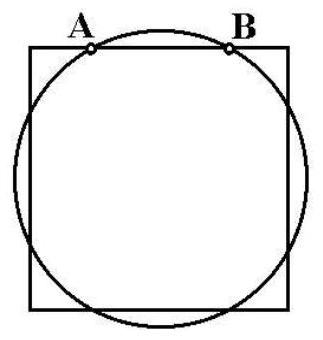
olympiads | 10.190. In a triangle, the lengths of the sides are in the ratio $2: 3: 4$ (Fig. 10.157). A semicircle is inscribed in it with the diameter lying on the largest side. Find the ratio of the area of the semicircle to the area of the triangle. | <think>
Okay, so I need to find the ratio of the area of a semicircle inscribed in a triangle to the area of the triangle. The triangle has sides in the ratio 2:3:4, and the semicircle has its diameter on the largest side. Hmm, let me try to visualize this. The triangle is scalene since all sides are different. The lar... |
olympiads | [ Classical combinatorics (miscellaneous). ] [ Formulas of abbreviated multiplication (miscellaneous).]
Twenty-five coins are distributed into piles as follows. First, they are arbitrarily divided into two groups. Then any of the existing groups is again divided into two groups, and so on until each group consists of... | <think>
Okay, so there's this problem about dividing 25 coins into piles, right? And every time you split a group into two, you record the product of the number of coins in each new group. Then, you sum all those products, and the question is asking what that total sum can be. Hmm, interesting. Let me try to figure thi... |
olympiads | Task 4. (20 points) At a refinery, a tank was filled with crude oil with a sulfur concentration of $2 \%$. Part of this oil was directed to production, and the same amount of oil with a sulfur concentration of $3 \%$ was added to the tank. Then, the same amount of oil as before was directed to production again, and thi... | <think>
Okay, let's try to figure out this problem step by step. Hmm, so we have a tank with crude oil that's 2% sulfur. Then some oil is sent to production, and the same amount is replaced with 3% sulfur oil. Then they do that again, sending the same amount to production and replacing it with 1.5% sulfur oil. After al... |
cn_contest | 6. The sequence $\left\{a_{n}\right\}$ satisfies: $a_{1}=\frac{1}{4}, a_{2}=\frac{1}{5}$, and
$$
a_{1} a_{2}+a_{2} a_{3}+\cdots+a_{n} a_{n+1}=n a_{1} a_{n+1}
$$
for any positive integer $n$. Then the value of $\frac{1}{a_{1}}+\frac{1}{a_{2}}+\cdots+\frac{1}{a_{97}}$ is $(\quad)$.
(A) 5032
(B) 5044
(C) 5048
(D) 5050 | <think>
Okay, let me try to figure out this problem. So, we have a sequence {a_n} where a₁ = 1/4 and a₂ = 1/5. There's also this equation given: the sum from k=1 to n of a_k * a_{k+1} equals n times a₁ times a_{n+1} for any positive integer n. We need to find the sum of 1/a₁ + 1/a₂ + ... + 1/a_{97}. The options are giv... |
inequalities | 3.12 Try to find the sum:
$$S=m!+\frac{(m+1)!}{1!}+\frac{(m+2)!}{2!}+\cdots+\frac{(m+n)!}{n!}$$ | <think>
Okay, let's see. I need to find the sum S = m! + (m+1)!/1! + (m+2)!/2! + ... + (m+n)!/n!. Hmm, that's a sequence where each term is a factorial divided by another factorial. Let me write this out more formally to see the pattern.
So, S = Σₖ₌₀ⁿ [ (m + k)! ] / k!
Wait, starting from k=0, the first term is m!/0... |
olympiads | 4. (15 points) Two heaters are connected sequentially to the same DC power source. The water in the pot boiled after $t_{1}=120$ s from the first heater. The same water, taken at the same initial temperature, boiled after $t_{2}=180 \mathrm{s}$ from the second heater. How long would it take for the water to boil if the... | <think>
Okay, so I need to figure out how long it would take for the water to boil if the two heaters are connected in parallel instead of sequentially. Hmm, let's start by understanding the problem.
First, there are two heaters connected one after another (in series) to a DC power source. When only the first heater i... |
olympiads | 6.227. $\left\{\begin{array}{l}\sqrt[3]{u+v}+\sqrt[3]{v+w}=3 \\ \sqrt[3]{v+w}+\sqrt[3]{w+u}=1 \\ \sqrt[3]{w+u}+\sqrt[3]{u+v}=0\end{array}\right.$ | <think>
Okay, so I've got this system of equations with cube roots. Let me write them down again to make sure I have them right:
1. ∛(u + v) + ∛(v + w) = 3
2. ∛(v + w) + ∛(w + u) = 1
3. ∛(w + u) + ∛(u + v) = 0
Hmm, all three equations involve cube roots of sums of two variables each. Maybe if I let x = ∛(u + v), y = ... |
olympiads | 5. Among the $n$ positive integers from 1 to $n$, those with the most positive divisors are called the "prosperous numbers" among these $n$ positive integers. For example, among the positive integers from 1 to 20, the numbers with the most positive divisors are $12, 18, 20$, so $12, 18, 20$ are all prosperous numbers a... | <think>
Okay, so I need to find the least common multiple (LCM) of all the prosperous numbers from 1 to 100. Prosperous numbers are those that have the highest number of positive divisors in that range. First, I should figure out which numbers between 1 and 100 have the most divisors. Once I have those numbers, I can c... |
olympiads | 2.037. $\frac{1-x^{-2}}{x^{1/2}-x^{-1/2}}-\frac{2}{x^{3/2}}+\frac{x^{-2}-x}{x^{1/2}-x^{-1/2}}$. | <think>
Okay, so I have this algebra problem here: simplify the expression (1 - x^(-2))/(x^(1/2) - x^(-1/2)) - 2/(x^(3/2)) + (x^(-2) - x)/(x^(1/2) - x^(-1/2)). Hmm, that looks a bit complicated, but maybe if I break it down step by step, I can handle it.
First, let me rewrite all the terms so I can see them more clear... |
olympiads | 10.3. Numbers $1,2,3,4,5,6,7$ and 8 are placed at the vertices of a cube, such that the sum of any three numbers belonging to any face is not less than 10. Find the minimum possible sum of four numbers belonging to one face. | <think>
Okay, let's see. So, the problem is about placing numbers 1 through 8 on the vertices of a cube. The condition is that the sum of any three numbers on any face must be at least 10. We need to find the minimum possible sum of four numbers on one face. Hmm, okay.
First, let me visualize a cube. A cube has 8 vert... |
olympiads | Example 5 Find the range of the function $y=\frac{x^{2}-x+3}{x}(x>0)$.
untranslated part:
将上面的文本翻译成英文,请保留源文本的换行和格式,直接输出翻译结果。
translated part:
Example 5 Find the range of the function $y=\frac{x^{2}-x+3}{x}(x>0)$. | <think>
Okay, so I need to find the range of the function y = (x² - x + 3)/x where x is greater than 0. Hmm, let's think about how to approach this.
First, maybe I can simplify the function. Let's split the numerator into separate terms divided by x. That would give me y = x²/x - x/x + 3/x. Simplifying each term, tha... |
olympiads | Let $N$ be a positive integer. Two persons play the following game. The first player writes a list of positive integers not greater than 25 , not necessarily different, such that their sum is at least 200 . The second player wins if he can select some of these numbers so that their sum $S$ satisfies the condition $200-... | <think>
Okay, so I need to figure out the smallest N where the second player can always win this game. Let's start by understanding the problem carefully.
We have two players. The first player picks a list of positive integers, each at most 25, and the sum of these numbers is at least 200. The second player then tries... |
olympiads | Task 11.1. The product of nine consecutive natural numbers is divisible by 1111. What is the smallest possible value that the arithmetic mean of these nine numbers can take? | <think>
Okay, let me try to figure out this problem. So, we have nine consecutive natural numbers, and their product is divisible by 1111. We need to find the smallest possible arithmetic mean of these nine numbers. Hmm, let's break this down step by step.
First, let me recall that the arithmetic mean of nine consecut... |
olympiads | # Task 2. (20 points)
Find the maximum possible value of the ratio of a three-digit number to the sum of its digits.
# | <think>
Okay, so I need to find the maximum possible value of the ratio of a three-digit number to the sum of its digits. Hmm, let's think about this step by step.
First, a three-digit number can be represented as 100a + 10b + c, where a, b, and c are the digits. Here, a can't be zero because it's a three-digit numbe... |
olympiads | 5. If real numbers $x, y$ satisfy $2^{x}+4 x+12=\log _{2}(y-1)^{3}+3 y+12=0$, then $x+y=$ | <think>
Okay, so I need to solve this problem where real numbers x and y satisfy two equations that are both equal to zero. The problem is written as:
2^{x} + 4x + 12 = log_{2}(y - 1)^{3} + 3y + 12 = 0
And we need to find x + y.
First, let me parse this correctly. The way it's written, it seems like both expressions... |
olympiads | 3.134. $\frac{\sin 4 \alpha+\sin 5 \alpha+\sin 6 \alpha}{\cos 4 \alpha+\cos 5 \alpha+\cos 6 \alpha}$. | <think>
Okay, let's see. I need to simplify the expression (sin4α + sin5α + sin6α)/(cos4α + cos5α + cos6α). Hmm, trigonometric identities. I remember that there are sum-to-product formulas for sine and cosine. Maybe I can use those here.
First, let's look at the numerator: sin4α + sin5α + sin6α. Similarly, the denomin... |
olympiads | 1.3. Find the greatest negative root of the equation $\sin \pi x = -\sqrt{2} \sin \frac{\pi x}{2}$. | <think>
Okay, so I need to find the greatest negative root of the equation sin(πx) = -√2 sin(πx/2). Hmm, let's start by understanding what the problem is asking. The equation involves sine functions with arguments that depend on x, and I need to solve for x where this equation holds true. The root here means a solution... |
olympiads | A2. The center of a circle with radius 1 coincides with the intersection of the diagonals of a square.
The circle and the square have the same
area. The circle intersects a side of the squa... | <think>
Okay, let me try to figure this problem out. So, we have a square and a circle with radius 1. The center of the circle is at the intersection of the diagonals of the square, which makes sense because that's the center of the square too. The problem says the circle and the square have the same area. We need to f... |
olympiads | [ $[\quad$ Rule of product $\quad]$
a) Leshа climbs a ladder with 10 steps. In one jump, he can either go up one step or two steps. In how many ways can Leshа climb the ladder?
b) When descending the same ladder, Leshа skips some steps (he can even skip all 10). In how many ways can he descend the ladder?
# | <think>
Okay, let's tackle part a) first. So, Lesha is climbing a ladder with 10 steps. Each time he jumps, he can either go up one step or two steps. We need to find out how many different ways he can climb the ladder. Hmm, this seems familiar. Maybe it's a Fibonacci sequence problem?
Let me think. Suppose we want to... |
olympiads | ## Problem Statement
Calculate the limit of the numerical sequence:
$$
\lim _{n \rightarrow \infty}\left(\sqrt{n(n+2)}-\sqrt{n^{2}-2 n+3}\right)
$$ | <think>
Okay, so I need to find the limit as n approaches infinity of the expression sqrt(n(n+2)) minus sqrt(n² - 2n + 3). Hmm, let's see. Both terms inside the limit are square roots of quadratic expressions in n. When n is getting very large, each square root should behave similarly to just n, but maybe with some adj... |
cn_contest | $\begin{array}{c}\text { 3. Let } a>0, b>0, \text { and } \\ \sqrt{a}(\sqrt{a}+2 \sqrt[3]{b}) \\ =\sqrt[3]{b}(\sqrt[3]{a}+6 \sqrt[3]{b}) . \\ \text { Find the value of } \frac{2 a^{4}+a^{3} b-128 a b^{2}-64 b^{3}+b^{4}}{a^{4}+2 a^{3} b-64 a b^{2}-128 b^{3}+2 b^{4}} .\end{array}$ | <think>
Okay, let's tackle this problem step by step. Hmm, so we have two variables, a and b, both positive. There's an equation involving square roots and cube roots, and then we need to find the value of a complicated fraction. Let me start by writing down the given equation clearly:
√a (√a + 2∛b) = ∛b (∛a + 6∛b)
F... |
olympiads | Task 1. From the relation $x_{n-1}=\frac{x_{n}+x_{n-1}+x_{n-2}}{3}$, we get: $2 x_{n-1}=x_{n-2}+x_{n}$ for all $n \geq 3$. This means that the given sequence is an arithmetic progression. Let the common difference of the progression be $d$. Then $\frac{x_{300}-x_{33}}{x_{333}-x_{3}}=\frac{(300-33) d}{330 d}=\frac{89}{1... | <think>
Okay, let me try to figure out this problem step by step. So, the problem starts with a relation given for a sequence: \( x_{n-1} = \frac{x_n + x_{n-1} + x_{n-2}}{3} \) for all \( n \geq 3 \). Then it simplifies this to \( 2x_{n-1} = x_{n-2} + x_n \), and concludes that the sequence is an arithmetic progression... |
olympiads | 8. Six people, all of different weights, are trying to build a human pyramid: that is, they get into the formation
$$
\begin{array}{c}
\text { A } \\
\text { B C } \\
\text { D E F }
\end{array}
$$
We say that someone not in the bottom row is "supported by" each of the two closest people beneath her or him. How many d... | <think>
Okay, let's see. So, we have six people, each with different weights, trying to form a human pyramid. The structure is given as:
```
A
B C
D E F
```
The rule is that no one can be supported by someone of lower weight. I need to figure out how many different pyramids are possible under this condition. Hmm.
... |
olympiads | 7. Given that box $A$ contains 1 red ball and 5 white balls, and box $B$ contains 3 white balls. Now, 3 balls are randomly taken from box $A$ and placed into box $B$, after which the balls in box $B$ are thoroughly mixed. Then, 3 balls are randomly taken from box $B$ and placed back into box $A$. The probability that t... | <think>
Okay, let's tackle this probability problem step by step. So, we have two boxes, A and B. Box A starts with 1 red ball and 5 white balls, which totals 6 balls. Box B starts with 3 white balls. The process involves moving 3 balls from A to B, then after mixing, moving 3 balls back from B to A. We need to find th... |
olympiads | 3. On the sides $B C$ and $C D$ of the square $A B C D$, points $E$ and $F$ are chosen such that the angle $E A F$ is $45^{\circ}$. The length of the side of the square is 1. Find the perimeter of triangle $C E F$. | <think>
Okay, so I need to find the perimeter of triangle CEF in a square ABCD where points E and F are on sides BC and CD respectively, and angle EAF is 45 degrees. The square has a side length of 1. Hmm, let me start by visualizing the square and labeling the points properly.
First, let me sketch the square ABCD. Le... |
olympiads | 10. (10 points) In the Land of Dwarfs, there are 2011 dwarfs, each of whom wears either a red hat or a blue hat. When a dwarf wears a red hat, they tell the truth; when they wear a blue hat, they can lie; and they can change the color of their hat at any time. One day, every two of them met exactly once, and each said ... | <think>
Okay, let me try to figure out this problem. So, we have 2011 dwarfs, each wearing either a red or blue hat. If they're wearing red, they tell the truth; if blue, they lie. They can change their hat color at any time. On this particular day, every two dwarfs met exactly once, and each said the other was wearing... |
olympiads | Question 168: In the Cartesian coordinate system $x 0 y$, point $P$ is a moving point on the line $y=-x-2$. A tangent line is drawn from point $P$ to the parabola $y=\frac{x^{2}}{2}$, with the points of tangency being $A$ and $B$. Then the minimum value of the area of $\triangle P A B$ is $\qquad$ - | <think>
Okay, so I need to find the minimum area of triangle PAB where P is a moving point on the line y = -x - 2, and A and B are the points of tangency on the parabola y = x²/2 from point P. Hmm, let's start by recalling some concepts.
First, I remember that the equation of a tangent to a parabola can be written in ... |
olympiads | # 9. Solution.
1st method. An elementary outcome in the random experiment is a triplet of positions where the children in green caps stand. Consider the event $A$ "all three green caps are together." This event is favorable in 9 elementary outcomes. The event $B$ "two green caps are together, and the third is separate... | <think>
Okay, so I need to figure out the probability that no two children with green caps are standing next to each other when 9 children (3 with green caps and 6 with red caps) are arranged in a circle. Let me think through this step by step.
First, I remember that when arranging people in a circle, the number of di... |
olympiads | 4. In $\triangle A B C$, the sides opposite to angles $A, B, C$ are denoted as $a, b, c (b \neq 1)$, respectively, and $\frac{C}{A}, \frac{\sin B}{\sin A}$ are both roots of the equation $\log _{\sqrt{b}} x=\log _{b}(4 x-4)$. Then $\triangle A B C$
A. is an isosceles triangle, but not a right triangle
B. is a right tri... | <think>
Okay, let's see. I need to solve this problem about triangle ABC. The sides opposite angles A, B, C are a, b, c respectively, and it's given that b is not equal to 1. Also, the fractions C/A and (sin B)/(sin A) are both roots of the equation log base sqrt(b) of x equals log base b of (4x - 4). Then I have to de... |
olympiads | 8. Let the 20 vertices of a regular 20-sided polygon inscribed in the unit circle in the complex plane correspond to the complex numbers $z_{1}, z_{2}, \cdots, z_{20}$, respectively. Then, how many different points do the complex numbers $z_{1}^{1995}, z_{2}^{1995}, \cdots, z_{20}^{1995}$ correspond to? | <think>
Okay, let's see. I need to figure out how many different points the complex numbers \( z_1^{1995}, z_2^{1995}, \ldots, z_{20}^{1995} \) correspond to. These \( z_i \) are the vertices of a regular 20-sided polygon inscribed in the unit circle. So, each \( z_i \) is a 20th root of unity, right? That means each \... |
olympiads | 11.182. The radius of the base of the cone is $R$, and the lateral surface area is equal to the sum of the areas of the base and the axial section. Determine the volume of the cone. | <think>
Okay, let's see. I need to find the volume of a cone where the radius of the base is R, and the lateral surface area is equal to the sum of the areas of the base and the axial section. Hmm, alright. Let me break this down step by step.
First, I remember that the volume of a cone is given by (1/3)πr²h, where r... |
olympiads | Problem 8.7.1. Given trapezoid $A B C D (B C \| A D)$. Point $H$ on side $A B$ is such that $\angle D H A=$ $90^{\circ}$. It is known that $C H=C D=13$ and $A D=19$. Find the length of segment $B C$.
 Factorize $(a-b)^{2}+4 a b-c^{2}$. | <think>
Okay, so I need to factorize the expression (a - b)² + 4ab - c². Hmm, let me think step by step. First, maybe I should expand the squared term to see if anything simplifies. Let me try expanding (a - b)². That would be a² - 2ab + b², right? So substituting that back into the original expression, it becomes a² -... |
olympiads | 15. As shown in the figure, points $A$ and $A^{\prime}$ are on the $x$-axis and are symmetric with respect to the $y$-axis. A line passing through point $A^{\prime}$ and perpendicular to the $x$-axis intersects the parabola $y^{2}=2 x$ at points $B$ and $C$. Point $D$ is a moving point on segment $A B$, and point $E$ i... | <think>
Okay, let me try to work through this problem step by step. First, I need to understand what's given and what needs to be proven. The problem is about points on a parabola and some line intersections. Let's break it down.
Part (1) says we need to prove that the line DE intersects the parabola at exactly one po... |
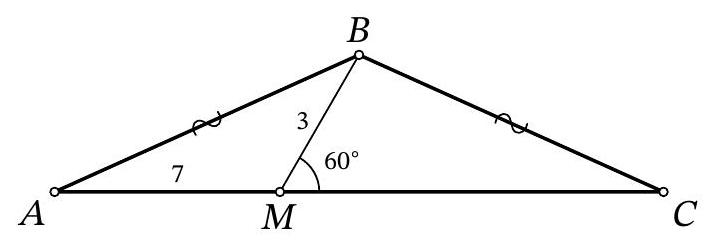
olympiads | Problem 9.5. On the base $AC$ of isosceles triangle $ABC (AB = BC)$, a point $M$ is marked. It is known that $AM = 7, MB = 3, \angle BMC = 60^\circ$. Find the length of segment $AC$.
 | <think>
Okay, so I need to find the length of segment AC in this isosceles triangle ABC where AB equals BC. Wait, hold on, the triangle is isosceles with AB = BC? That would mean the triangle has two equal sides: AB and BC. But in a triangle, if two sides are equal, the base is the third side. So if AB = BC, then the b... |
olympiads | 4. (3 points) Define new operations: $A * B=(A-B) \div 3, A \square B=(A+B) \times 3$, please calculate: (39*12) $\square 3$ = . $\qquad$ | <think>
Okay, let me try to solve this problem step by step. So, the question is asking me to calculate (39*12) □ 3, where * and □ are two new operations defined as follows:
First, the * operation: A * B is equal to (A - B) divided by 3. So, mathematically, that would be (A - B)/3. Got that. Then the □ operation: A □ ... |
olympiads | Example 2 Find the distance between the face diagonals $A_{1} B$ and $B_{1} D_{1}$ in a cube $A B C D-A_{1} B_{1} C_{1} D_{1}$ with edge length 1. | <think>
Alright, so I need to find the distance between the face diagonals A₁B and B₁D₁ in a cube with edge length 1. Hmm, okay. Let me visualize the cube first. Let me recall that in a cube labeled ABCD-A₁B₁C₁D₁, the vertices are such that ABCD is the base square and A₁B₁C₁D₁ is the top square, with edges connecting e... |
olympiads | 13. The rules of a "level-passing game" stipulate: on the $n$-th level, a die must be rolled $n$ times. If the sum of the points obtained from these $n$ rolls is greater than $2^{n}$, it counts as passing the level. Questions:
( I ) What is the maximum number of levels a person can pass in this game?
( II ) What is the... | <think>
Okay, so I need to solve this level-passing game problem. There are two parts: the first part asks for the maximum number of levels a person can pass, and the second part asks for the probability of passing the first three levels consecutively. Let's start with part I.
**Problem I: Maximum number of levels pas... |
olympiads | ## Task Condition
Find the derivative.
$$
y=\frac{x(\cos (\ln x)+\sin (\ln x))}{2}
$$ | <think>
Okay, so I need to find the derivative of y with respect to x, where y is given by (x times (cos(ln x) + sin(ln x))) divided by 2. Let me write that down again to make sure I have it right: y = [x (cos(ln x) + sin(ln x))]/2. Alright, so I need to differentiate this function. Hmm. Let's think about how to approa... |
olympiads | 56. Up the Hill. Willie-Lazybones climbed up the hill at a speed of $1 \frac{1}{2}$ km/h, and descended at a speed of $4 \frac{1}{2}$ km/h, so the entire journey took him exactly 6 hours. How many kilometers is it from the base to the top of the hill? | <think>
Okay, let's see. Willie went up a hill and then came back down. The problem is asking for the distance from the base to the top of the hill. Hmm, so the distance up and down should be the same, right? Because he's going from base to top and then back. So the total journey would be twice the distance we need to ... |
aops_forum | Two positive integers $m$ and $n$ are both less than $500$ and $\text{lcm}(m,n) = (m-n)^2$. What is the maximum possible value of $m+n$? | <think>
Okay, so I have this problem where I need to find two positive integers m and n, both less than 500, such that their least common multiple (LCM) is equal to the square of their difference, which is (m - n)². The goal is to find the maximum possible value of m + n. Alright, let's break this down step by step.
F... |
olympiads_ref | If $\mathrm{P}$ and $\mathrm{Q}$ are two points in the plane, let $\mathrm{m}(\mathrm{PQ})$ be the perpendicular bisector of $\mathrm{PQ} . \mathrm{S}$ is a finite set of $n>1$ points such that: (1) if $P$ and $Q$ belong to $S$, then some point of $m(P Q)$ belongs to S, (2) if PQ, $\mathrm{P}^{\prime} \mathrm{Q}^{\prim... | <think>
Okay, so I need to figure out the possible values of n for the set S with the given conditions. Let me start by restating the problem to make sure I understand it.
We have a finite set S of n > 1 points in the plane. There are two conditions:
1. If P and Q are any two points in S, then some point on the perpe... |
cn_contest | 1. The roots $x_{1}, x_{2}$ of the equation $x^{2}-a x-a=0$ satisfy the relation $x_{1}{ }^{3}+x_{2}{ }^{3}+x_{1}{ }^{3} x_{2}{ }^{3}=75$. Then $1993+5 a^{2}$ $+9 a^{4}=$ $\qquad$ | <think>
Okay, let me see. I need to solve this problem where there's a quadratic equation with roots x₁ and x₂. The equation is x² - a x - a = 0. Then there's this relation: x₁³ + x₂³ + x₁³x₂³ = 75. And I need to find the value of 1993 + 5a² + 9a⁴. Hmm, okay.
First, I remember that for a quadratic equation of the form... |
aops_forum | Let $BCB'C'$ be a rectangle, let $M$ be the midpoint of $B'C'$, and let $A$ be a point on the circumcircle of the rectangle. Let triangle $ABC$ have orthocenter $H$, and let $T$ be the foot of the perpendicular from $H$ to line $AM$. Suppose that $AM=2$, $[ABC]=2020$, and $BC=10$. Then $AT=\frac{m}{n}$, where $m$ and $... | <think>
Okay, let me try to figure out this problem step by step. First, let me parse the given information and see what I need to find. The problem involves a rectangle BCB'C', with M being the midpoint of B'C'. Point A is on the circumcircle of the rectangle. Then, triangle ABC has orthocenter H, and T is the foot of... |
olympiads | 49. The formation for the radio calisthenics competition is a rectangle, with a total of 128 participants. Xiao Ming's position is the 7th from the left, 1st from the front, and 8th from the back. Therefore, Xiao Ming's position is the __th from the right. | <think>
Okay, so I need to figure out Xiao Ming's position from the right in this radio calisthenics competition formation. Let's see. The problem says the formation is a rectangle with 128 participants. Xiao Ming is 7th from the left, 1st from the front, and 8th from the back. I need to find his position from the righ... |
olympiads | Four friends Adam, Mojmír, and twins Petr and Pavel earned a total of 52 smileys in math class, each getting at least 1. The twins together have 33, but the most successful was Mojmír. How many did Adam get?
(M. Volfová) | <think>
Okay, let's see. We have four friends: Adam, Mojmír, Petr, and Pavel. The twins are Petr and Pavel. They earned a total of 52 smileys in math class, and each person got at least 1. The twins together have 33. So Petr and Pavel combined have 33 smileys. That means Adam and Mojmír together have 52 - 33 = 19 smile... |
olympiads | Problem 5. Solve the system of equations
$$
\left\{\begin{array}{l}
x^{2}=(y-z)^{2}-8 \\
y^{2}=(z-x)^{2}-16 \\
z^{2}=(x-y)^{2}+32
\end{array}\right.
$$ | <think>
Okay, let's see. I have this system of equations:
$$
\left\{\begin{array}{l}
x^{2}=(y-z)^{2}-8 \\
y^{2}=(z-x)^{2}-16 \\
z^{2}=(x-y)^{2}+32
\end{array}\right.
$$
Hmm, three equations with three variables. The equations are all quadratic, which might make this a bit tricky. Let me start by expanding each equati... |
olympiads | 1. The students $A, B, C, D$ competed in a race. Each of them predicted the order in which the race would finish. Student $A$: $A B D C$, student $B$: BACD, student $C$: $C B D A$, student $D$: $D C B A$. It turned out that no one correctly predicted the order of all the racers, but only one of them guessed the positio... | <think>
Okay, let's try to figure out the order of the race finishers based on the students' predictions. So, we have four students: A, B, C, D. Each of them predicted a different order. The key points given are that no one predicted the correct order entirely, but exactly one of them guessed the position of just one r... |
olympiads | How many (convex) pentagons are there, each of whose angles is $108^{\circ}$, and among whose sides there are 1, 2, and 3 units long? | <think>
Okay, so I need to figure out how many convex pentagons there are with all angles 108 degrees, and the sides include lengths of 1, 2, and 3 units. Hmm, let's start by recalling some basic properties of convex pentagons with equal angles.
First, in a regular pentagon, all sides and angles are equal, each angle... |
olympiads | 3. [4 points] Solve the equation $\left(\frac{x}{\sqrt{2}}+3 \sqrt{2}\right) \sqrt{x^{3}-4 x+80}=x^{2}+10 x+24$. | <think>
Okay, so I need to solve this equation:
\[\left(\frac{x}{\sqrt{2}} + 3\sqrt{2}\right) \sqrt{x^3 - 4x + 80} = x^2 + 10x + 24\]
Hmm, this looks a bit complicated. Let me take it step by step. First, let me make sure I understand the equation. On the left side, there's a binomial multiplied by a square root, an... |
olympiads | Example 1-23 There are 9 marked pieces, which are to be placed on a $6 \times 9$ chessboard (Figure 1-7) to simulate the various ways 9 people can exit from 6 exits. Try to discuss how many different schemes there are?
The first cell of each row represents the point facing the exit. | <think>
Okay, let's see. I have this problem where there are 9 marked pieces that need to be placed on a 6x9 chessboard. The goal is to simulate the various ways 9 people can exit from 6 exits. I need to figure out how many different schemes there are. Hmm, let me try to break this down.
First, the chessboard is 6 row... |
olympiads | Example 2 Let $S=\{1,2,3,4\}, n$ terms of the sequence: $a_{1}, a_{2}, \cdots, a_{n}$ have the following property, for any non-empty subset $B$ of $S$ (the number of elements in $B$ is denoted as $|B|$), there are adjacent $\mid B$ | terms in the sequence that exactly form the set $B$, find the minimum value of $n$.
(1... | <think>
Okay, so I need to solve this problem where we have a set S = {1,2,3,4}, and we need to find the minimal length n of a sequence a_1, a_2, ..., a_n such that for every non-empty subset B of S, there are |B| adjacent terms in the sequence that exactly form the set B. The example given is from a competition, so I ... |
olympiads | 27 regular dice were glued together to form a $3 \times 3 \times 3$ cube in such a way that on any two adjacent small cubes, the same number of dots is on the touching faces. How many dots are on the surface of the large cube? | <think>
Okay, so I have this problem where 27 regular dice are glued together to form a 3x3x3 cube. The condition is that on any two adjacent small cubes, the same number of dots is on the touching faces. I need to find out how many dots are on the surface of the large cube. Hmm, let me think through this step by step.... |
olympiads | 6. (10 points) Winnie the Pooh and Tigger went to pick apples. Winnie the Pooh climbed up the tree to pick, while Tigger jumped on the ground to pick. For every 7 apples Tigger picked, Winnie the Pooh could only pick 4. Winnie the Pooh picked for 80 minutes, and Tigger picked for 50 minutes before getting tired and sto... | <think>
Okay, so Winnie the Pooh and Tigger went apple picking. Let's see, the problem says that for every 7 apples Tigger picked, Winnie the Pooh could only pick 4. Hmm, so their rates of picking apples are different. Winnie was up in the tree, and Tigger was on the ground.
Winnie picked apples for 80 minutes, and T... |
olympiads | Problem 3. Let $n$ and $k$ be natural numbers greater than 2. We will say that $n$ is attracted by $k$ if the following conditions are met:
1) $n$ is divisible by $k$ and has $k-1$ divisors;
2) the sum of the divisors of $n$ is divisible by $k$, but not by $k+1$.
Determine the smallest three-digit number $n$ attracte... | <think>
Okay, let's try to figure out this problem step by step. So, we need to find the smallest three-digit number n that's "attracted" by 7. The conditions for being attracted by 7 are:
1) n must be divisible by 7 and have 7 - 1 = 6 divisors.
2) The sum of the divisors of n must be divisible by 7 but not by 7 + 1 =... |
olympiads | 1. The head of the fish weighs as much as the tail and half of the body, the body weighs as much as the head and the tail together. The tail weighs 1 kg. How much does the fish weigh? | <think>
Okay, let's see. The problem is about a fish where the head, body, and tail have specific weight relationships. The tail is given as 1 kg, and I need to find the total weight of the fish. Hmm, I think I need to set up some equations based on the information provided.
First, let me parse the problem again to ma... |
olympiads_ref | Some $1 \times 2$ dominoes, each covering two adjacent unit squares, are placed on a board of size $n \times n$ so that no two of them touch (not even at a corner). Given that the total area covered by the dominoes is 2008, find the least possible value of $n$.
Answer: 77 | <think>
Okay, so I need to find the smallest possible n where an n x n board can have some 1x2 dominoes placed such that no two dominoes touch each other, even at a corner, and the total area covered is 2008. Since each domino covers 2 squares, that means there are 2008 / 2 = 1004 dominoes.
First, let me visualize th... |
olympiads | Problem 4. Blagoya participated in a lottery where each ticket is marked with a three-digit number. He bought all the tickets marked with numbers where the product of the tens and units digits is equal to 12, and the sum of these two digits differs from the hundreds digit by 1. How many tickets and with which numbers d... | <think>
Okay, so Blagoya bought all the lottery tickets with three-digit numbers where the product of the tens and units digits is 12, and the sum of those two digits differs from the hundreds digit by 1. I need to figure out how many such tickets there are and list their numbers. Let me break this down step by step.
... |
olympiads | 2. If the equation $m x^{2}-2(m+2) x+m+5=0$ has no real roots with respect to $x$, then the number of real roots of the equation $(m-5) x^{2}-2(m+2) x+m=0$ with respect to $x$ is
(A) 2 ;
(B) 1 ;
(C) 0 ;
(D) uncertain. | <think>
Okay, let's see. I need to solve this problem where there are two quadratic equations, and based on the first one having no real roots, I have to determine the number of real roots of the second equation. The answer choices are A) 2, B) 1, C) 0, or D) uncertain. Hmm, let me start by breaking it down step by ste... |
olympiads | Schön D.…
On the island of knights and liars, a traveler came to visit his acquaintance, a knight, and saw him at a round table with five guests.
- I wonder, how many of you are knights? - he asked.
- Why don't you ask each of us a question and find out yourself, - one of the guests suggested.
- Alright. Tell me each... | <think>
Okay, let's try to solve this puzzle. So, the problem is about knights and liars on an island. Knights always tell the truth, and liars always lie. The traveler encounters a group of six people (the acquaintance plus five guests) sitting around a round table. The traveler asks each of them about their neighbors... |
olympiads | 1.98 If $P=\sqrt{\underbrace{111 \cdots 1}_{2 n \uparrow}-\underbrace{222 \cdots 2}_{n \uparrow}}(n$ is a natural number). Then
(A) $P$ is an irrational number.
(B) $P=\underbrace{111 \cdots 1}_{n \uparrow}$.
(C) $P=\underbrace{222 \cdots 2}_{n \uparrow}$.
(D) $P=\underbrace{333 \cdots 3}_{n \uparrow}$.
(E) $P=\underbr... | <think>
Okay, so I have this problem here where I need to find the value of P, which is the square root of (a number made up of 2n ones minus a number made up of n twos). Then, among the options A to E, I have to choose which one is correct. Let me try to break this down step by step.
First, let's understand the compo... |
olympiads | 2. In a certain month, three Saturdays fell on even dates. What day of the week was the 25th of the month? | <think>
Okay, so I need to figure out what day of the week the 25th was in a month where three Saturdays fell on even dates. Let me break this down step by step.
First, let's understand the problem. A month has weeks, each week has seven days. So dates repeat every 7 days. If there are three Saturdays on even dates, t... |
olympiads | 9. Let $f(x)$ be an odd function defined on $\mathbf{R}$. If for any real number $x$, $f(x+2)=-f(x)$, and when $x \in[0,1]$, $f(x)=2 x$, then $f(10 \sqrt{3})=$ $\qquad$ . | <think>
Okay, let's see. I need to find the value of f(10√3) given that f is an odd function defined on all real numbers. The function satisfies f(x + 2) = -f(x) for any real number x, and when x is in the interval [0, 1], f(x) = 2x. Hmm, okay, let me break this down step by step.
First, since f is an odd function, th... |
olympiads | 3.330. $\sin \alpha-\left(\frac{\cos \left(\alpha+\frac{\pi}{4}\right)}{\cos \alpha-\sin \alpha}\right)^{2}$. | <think>
Okay, so I need to simplify this expression: sin α minus the square of [cos(α + π/4) divided by (cos α minus sin α)]. Hmm, let me start by writing it down again to make sure I have it right.
The expression is sin α - [cos(α + π/4)/(cos α - sin α)]². Alright, step by step. First, maybe I can simplify the numer... |
olympiads | 45 If the conjugate of the complex number $z$ is $\bar{z}$, and $|z|=1$. Also, $A=(-1,0), B(0,-1)$ are fixed points, then the function $f(z)=|(z+1)(\bar{z}-i)|$ takes its maximum value when, in the complex plane, the figure formed by $Z$ and $A, B$ is
A. Isosceles right triangle
B. Equilateral triangle
C. Right triangl... | <think>
Okay, so I need to figure out when the function f(z) = |(z + 1)(\overline{z} - i)| reaches its maximum value, given that |z| = 1. The points A(-1,0) and B(0,-1) are fixed, and we need to determine the figure formed by Z, A, and B when this maximum occurs. The options are various types of triangles: isosceles ri... |
olympiads | XXIII OM - I - Problem 9
How many natural numbers less than $ 10^n $ have a decimal representation whose digits form a non-decreasing sequence? | <think>
Alright, so I need to figure out how many natural numbers less than \(10^n\) have digits that form a non-decreasing sequence. Hmm, let's start by understanding the problem.
First, natural numbers less than \(10^n\) are all the numbers with up to \(n\) digits. For example, if \(n = 3\), we're looking at number... |
olympiads | Among the numbers of the form $36^{k}-5^{l}$ (where $k, l$ are positive integers), which one has the smallest absolute value? | <think>
Okay, so I need to find the smallest absolute value among numbers of the form 36^k - 5^l where k and l are positive integers. Hmm, let's start by understanding the problem. We have two different bases here, 36 and 5, raised to different exponents. The goal is to find the combination of exponents k and l such th... |
olympiads | 5. A product that initially contained $98\%$ water dried out over time and began to contain $97\%$ water. By what factor did it shrink (i.e., reduce its weight)? | <think>
Okay, so I need to figure out by what factor the product shrank when the water content changed from 98% to 97%. Hmm, let's break this down.
First, the problem is about a product losing water over time, which causes it to dry out and shrink. Initially, it's 98% water, and then later it's 97% water. The questio... |
olympiads | 1. (10 points) As shown in the figure, a square pond with a side length of 12 meters is surrounded by grass. There are wooden stakes at points $A$, $B$, $C$, and $D$ on the pond's edge, and $A B=B C=C D=3$ meters. Now, a 4-meter-long rope is used to tie a sheep to one of these wooden stakes. To maximize the area where ... | <think>
Okay, so I need to figure out which stake—A, B, C, or D—will give the maximum grazing area for the sheep when tied with a 4-meter rope. The pond is a square with each side 12 meters long, and the stakes are placed such that AB = BC = CD = 3 meters. That means each side of the square is divided into three segmen... |
olympiads | 3. A natural number greater than 0, if the sum of all its divisors equals twice itself, is called a perfect number or a complete number. For example, the divisors of 6 are $1,2,3,6,1+2+3+6=12$, so 6 is the smallest perfect number. The question of whether there are infinitely many perfect numbers remains one of the chal... | <think>
Okay, so I need to find the sum of all divisors of 8128. The problem mentions that a perfect number is one where the sum of its divisors equals twice itself, and 6 is the smallest example. They want me to compute this sum for 8128. Let me think about how to approach this.
First, I remember that the sum of divi... |
olympiads | 3. The continuation of the height $B H$ of triangle $A B C$ intersects the circumscribed circle around it at point $D$ (points $B$ and $D$ lie on opposite sides of line $A C$). The degree measures of arcs $A D$ and $C D$, not containing point $B$, are $60^{\circ}$ and $90^{\circ}$, respectively. Determine in what ratio... | <think>
Alright, let's try to tackle this geometry problem. Hmm, okay, so we have triangle ABC, and BH is the height. The continuation of BH intersects the circumcircle again at point D. Points B and D are on opposite sides of line AC. The arcs AD and CD, which don't contain point B, are 60 degrees and 90 degrees respe... |
olympiads | ## Zadatak B-1.7.
Dva pravokutna trokuta $P S T$ i $R S T$ imaju zajedničku hipotenuzu $\overline{S T}$. Vrhovi $P$ i $R$ nalaze se s iste strane hipotenuze $\overline{S T}$. Katete $\overline{P T}$ i $\overline{R S}$ sijeku se u točki $Q$. Ako je $|P S|=6 \mathrm{~cm},|P T|=17 \mathrm{~cm}$ i $|R T|=1 \mathrm{~cm}$, ... | <think>
Okay, so I have this geometry problem here. Let me try to visualize it first. There are two right-angled triangles, PST and RST, sharing the hypotenuse ST. The vertices P and R are on the same side of ST. The legs PT and RS intersect at point Q. They give me the lengths PS = 6 cm, PT = 17 cm, and RT = 1 cm. I n... |
olympiads | \section*{Problem 4 - 221024}
Let \(A B C D E F\) be a regular hexagon, with its area denoted as \(F_{1}\). Let \(F_{2}\) be the area of the (equilateral) triangle \(A C E\), and let \(F_{3}\) be the area of the (equilateral) triangle \(M_{1} M_{2} M_{3}\), where \(M_{1}, M_{2}, M_{3}\) are the midpoints of the sides ... | <think>
Okay, so I need to find the ratio of the areas F1, F2, and F3 for a regular hexagon and two equilateral triangles related to it. Let me break this down step by step.
First, let me visualize a regular hexagon ABCDEF. All sides are equal, and all internal angles are 120 degrees. The problem mentions F1 is the a... |
olympiads | 6. A natural number $n$ is called cubish if $n^{3}+13 n-273$ is a cube of a natural number. Find the sum of all cubish numbers. | <think>
Okay, so I need to find all natural numbers n such that n³ + 13n - 273 is a perfect cube. Then, sum all those n's up. Let me start by understanding the problem.
First, a natural number n is called "cubish" if n³ + 13n - 273 is equal to some natural number cubed. Let me denote that cube as m³, where m is a natu... |
olympiads | 2. (8 points) Zombies are coming, and Fire Dragon Grass is responsible for defense:
First-stage Fire Dragon Grass always spits red flames;
Second-stage Fire Dragon Grass spits red flames half the time and blue flames the other half;
Third-stage Fire Dragon Grass always spits blue flames.
If the attack power of the seco... | <think>
Okay, so I need to figure out how many times the attack power of the third-stage Fire Dragon Grass is compared to the first-stage one. Let me read the problem again carefully.
First-stage: always spits red flames.
Second-stage: half the time red flames, half the time blue flames.
Third-stage: always blue flame... |
olympiads | 12.1 $\lim _{x \rightarrow 2} \frac{x^{3}-8}{2 x-4}$. | <think>
Okay, so I need to find the limit as x approaches 2 of (x³ - 8)/(2x - 4). Hmm, let's see. First, if I plug in x = 2 directly, the denominator becomes 2*2 - 4 = 0, and the numerator becomes 2³ - 8 = 8 - 8 = 0. So it's 0/0, which is indeterminate. That means I can't just evaluate it directly; I need to manipulate... |
cn_contest | 14. An extracurricular activity group at a school designed a tree planting plan on graph paper for a certain desert as follows: The $k$-th tree is planted at point $P_{k}\left(x_{k}, y_{k}\right)$, where $x_{1}=1, y_{1}=1$. When $k \geqslant 2$,
$$
\left\{\begin{array}{l}
x_{k}=x_{k-1}+1-5\left[\frac{k-1}{5}\right]+5\l... | <think>
Okay, let's try to figure out where the 2008th tree is planted. The problem gives recursive formulas for x and y coordinates based on the previous ones. Let me start by understanding the given equations.
First, they define the first tree at (1,1). So, P₁(1,1). For k ≥ 2, the coordinates are defined as:
xₖ = x... |
olympiads | 3. In a right triangle $ABC (\angle B=90^{\circ})$, a circle $\Gamma$ with center $I$ is inscribed, touching sides $AB$ and $BC$ at points $K$ and $L$ respectively. A line passing through point $I$ intersects sides $AB$ and $BC$ at points $M$ and $N$ respectively. Find the radius of the circle $\Gamma$ if $MK=225$, $NL... | <think>
Okay, let me try to figure out this geometry problem. So, we have a right triangle ABC with a right angle at B. There's an inscribed circle Γ with center I, which touches AB and BC at points K and L respectively. Then there's a line passing through I that intersects AB at M and BC at N. The given lengths are MK... |
olympiads | 6.34 If it is known that $\lg 8=0.9031$, and $\lg 9=0.9542$, then the logarithm that cannot be uniquely determined without a logarithm table is
(A) $\lg 17$.
(B) $\lg \frac{5}{4}$.
(C) $\lg 15$.
(D) $\lg 600$.
(E) $\lg 4$.
(2nd American High School Mathematics Examination, 1951) | <think>
Okay, so I need to figure out which logarithm can't be uniquely determined using the given values of lg 8 and lg 9. The options are lg 17, lg 5/4, lg 15, lg 600, and lg 4. Hmm. Let's go through each one step by step.
First, I remember that lg usually stands for logarithm base 10. The problem gives me lg 8 = 0.... |
olympiads | 9.6 Calculate the following product, accurate to within 0.00001:
$$
\left(1-\frac{1}{10}\right)\left(1-\frac{1}{10^{2}}\right) \cdots\left(1-\frac{1}{10^{99}}\right) .
$$ | <think>
Okay, so I need to calculate this big product: (1 - 1/10)(1 - 1/10²)...(1 - 1/10⁹⁹), and make sure the answer is accurate to within 0.00001. Hmm, let's see. First, I remember that products like this can sometimes be related to infinite products or known functions, but I'm not sure. Let me start by understanding... |
olympiads | 71.
Let's start with a simple case. A major theft was committed at a warehouse. The criminal (or criminals) transported the stolen goods by car. Suspicion fell on three repeat offenders A, B, and C, who were brought to Scotland Yard for interrogation. The following was established:
1) No one other than A, B, and C w... | <think>
Okay, let's try to figure out problem 71 first. So, there's a theft at a warehouse, and the criminals used a car. The suspects are A, B, and C. The key points are:
1) Only A, B, or C could be involved.
2) C never works without A. So if C is involved, A must be there too.
3) B can't drive a car.
Since they use... |
olympiads | $\underline{\text { Kalinin }}$ D.:
In the room, there are 20 chairs of two colors: blue and red. On each chair sits either a knight or a liar. Knights always tell the truth, and liars always lie. Each of the seated individuals claimed that they were sitting on a blue chair. Then they somehow rearranged themselves, af... | <think>
Okay, let's try to figure out this problem step by step. So, we have 20 chairs, blue and red. Each chair has either a knight or a liar. Knights always tell the truth, liars always lie.
First, each person initially claimed they were sitting on a blue chair. Then they rearranged themselves, and after that, half... |
olympiads | 12. Given the function $f(x)=a+x-b^{x}$ has a zero $x_{0} \in(n, n+1)(n \in \mathbf{Z})$, where the constants $a, b$ satisfy the conditions $2019^{a}=2020,2020^{b}=2019$. Then the value of $n$ is $\qquad$ | <think>
Okay, let's see. I need to find the value of n such that the function f(x) = a + x - b^x has a zero in the interval (n, n+1), where n is an integer. The constants a and b satisfy 2019^a = 2020 and 2020^b = 2019. Hmm, okay. Let me start by understanding what these equations mean for a and b.
First, the equatio... |
olympiads | Problem 10.5. On the side $AB$ of the rectangle $ABCD$, a circle $\omega$ is constructed with $AB$ as its diameter. Let $P$ be the second intersection point of the segment $AC$ and the circle $\omega$. The tangent to $\omega$ at point $P$ intersects the segment $BC$ at point $K$ and passes through point $D$. Find $AD$,... | <think>
Alright, let's try to tackle this geometry problem. Hmm, we have a rectangle ABCD with AB as a side. A circle ω is drawn on AB as the diameter. The segment AC intersects the circle ω again at point P. The tangent to ω at P intersects BC at point K and passes through point D. We need to find the length of AD giv... |
olympiads | We wrote the numbers $1,2,3, \ldots, 20$ on the board. We erase two of them, $a$ and $b$, and write the number $a b+a+b$ in their place. After performing this procedure 19 times, what number can remain on the board? | <think>
Okay, let's try to figure out this problem. So, we have numbers from 1 to 20 written on the board. Each time, we erase two numbers, say a and b, and replace them with ab + a + b. We repeat this process 19 times until only one number remains. The question is asking what number can be left on the board at the end... |
olympiads | 6. Given that a line with slope $k$ is drawn through a focus of the ellipse $x^{2}+2 y^{2}=3$, intersecting the ellipse at points $A$ and $B$. If $AB=2$, then $|k|=$ $\qquad$ . | <think>
Okay, so I need to find the absolute value of the slope k of a line that passes through the focus of the ellipse x² + 2y² = 3, intersects the ellipse at points A and B, and has the distance between A and B equal to 2. Hmm, let's start by recalling some properties of ellipses.
First, the general equation of an ... |
olympiads | \section*{Problem 7}
Find all real \(x, y\) such that \((1+x)\left(1+x^{2}\right)\left(1+x^{4}\right)=1+y^{7},(1+y)\left(1+y^{2}\right)\left(1+y^{4}\right)=1+x^{7}\) ?
Answer \(\quad(\mathrm{x}, \mathrm{y})=(0,0)\) or \((-1,-1)\)
| <think>
Okay, so I need to solve this system of equations:
\[
(1 + x)(1 + x^2)(1 + x^4) = 1 + y^7
\]
\[
(1 + y)(1 + y^2)(1 + y^4) = 1 + x^7
\]
Hmm, interesting. Both equations look similar, just swapping x and y. That symmetry might be useful. Let me first try plugging in some simple values to see if they work.
Sta... |
olympiads | 8,9 [ Area of a triangle (through two sides and the angle between them). ]
In triangle $ABC$, angle $C$ is a right angle, the ratio of the median $CM$ to the bisector $CN$ is $\sqrt{6}$, and the height $CK=2$. Find the areas of triangles $CNK$ and $ABC$.
# | <think>
Okay, let's try to solve this problem step by step. First, let's understand what's given and what needs to be found. We have triangle ABC where angle C is a right angle. So, ABC is a right-angled triangle at C. We are told that the ratio of the median CM to the bisector CN is √6. Also, the height CK is 2. We ne... |
olympiads | A compact aluminum sphere has a diameter of $25 \mathrm{~cm}$. What uniform thickness of paraffin should it be coated with so that it just floats in water? (The specific gravity of aluminum is 2.7, and that of paraffin is 0.24. - Only precise numerical calculations will be accepted.) | <think>
Okay, so I need to figure out the thickness of paraffin coating needed for an aluminum sphere to float in water. The sphere has a diameter of 25 cm. The specific gravity of aluminum is 2.7, and paraffin is 0.24. Hmm, specific gravity is the ratio of the density of the material to the density of water, right? So... |
olympiads | 99. $(1000 \times 1001 \times 1002 \times \cdots \times 2013 \times 2014) \div \underbrace{(7 \times 7 \times \cdots \times 7)}_{m \uparrow 7}$ The calculation result is an integer, the maximum value of $m$ is $\qquad$ . | <think>
Okay, so I need to find the maximum value of m such that when we divide the product of numbers from 1000 to 2014 by 7^m, the result is still an integer. That means I have to figure out how many times 7 is a factor in the numerator (the product from 1000 to 2014).
First, I remember that to find the exponent of... |
aops_forum | Determine the largest integer $n\geq 3$ for which the edges of the complete graph on $n$ vertices
can be assigned pairwise distinct non-negative integers such that the edges of every triangle have numbers which form an arithmetic progression. | <think>
Okay, let's try to tackle this problem. The question is asking for the largest integer n ≥ 3 such that the edges of the complete graph on n vertices can be labeled with pairwise distinct non-negative integers, and in every triangle (which is a set of three edges forming a cycle of three vertices), the numbers f... |
olympiads | Let's determine the real roots of the following equation:
$$
2 x^{4}+4 x^{3}+3 x^{2}+x-1=0
$$ | <think>
Okay, so I need to find the real roots of the equation 2x⁴ + 4x³ + 3x² + x - 1 = 0. Hmm, quartic equations can be tricky. Let me think about how to approach this.
First, maybe I can try factoring. If it factors into quadratics or maybe even a product of a cubic and a linear term, but since it's a quartic, fact... |
Subsets and Splits
No community queries yet
The top public SQL queries from the community will appear here once available.