


Rebuild from andysmith.ai@f5df4d1
Browse files- data/site.jsonl +1 -0
data/site.jsonl
CHANGED
|
@@ -144,3 +144,4 @@
|
|
| 144 |
{"id":"site:2026/Nov/11/credential-brokering","platform":"site","url":"https://andysmith.ai/2026/Nov/11/credential-brokering/","published_at":"2026-11-11T10:32:29.000Z","title":"Credential brokering","text":"One very important issue is how an agent handles secrets.\n\nThe problem is that if an agent has access to secrets, it can “steal” them. It can leak them to an inference or telemetry provider, to an attacker through prompt injection, or even publish them by accident, although I honestly have not seen the last case.\n\nThis does not secure what the agent can do with these secrets. For example, if the agent has an API key for a service, it can do anything there within the permissions of that key. This only solves the problem of the agent having access to the key itself.\n\nThe solution is for the agent not to know the actual secrets. Instead, it works with “placeholders” that contain only the names of the secrets. A separate module substitutes the secrets, and the agent has no access to that module. This is called the credential brokering pattern: https://developer.hashicorp.com/boundary/docs/concepts/credential-management.\n\nI see two main ways to implement this pattern in my backfabric agent platform:\n\n1. For network secrets, mostly when calling an API with a key, I can use a gateway that inserts the key, such as https://github.com/paradigmxyz/iron-proxy)\n2. For cases where the key is needed locally, such as signing, decryption, or even connecting over SSH, I either run a separate sidecar that stores the secrets and only exposes a decryption service. The agent can decrypt text without having access to the key. Or, as a more complex option, I forward a GPG/SSH agent into the pod. In this case, the agent can use the key but cannot export it. Standard tools such as OpenBAO do not support this.","link":null,"media":[],"tags":[]}
|
| 145 |
{"id":"site:2026/Nov/11/openobserve-or-langfuse","platform":"site","url":"https://andysmith.ai/2026/Nov/11/openobserve-or-langfuse/","published_at":"2026-11-11T12:04:11.000Z","title":"OpenObserve or LangFuse","text":"I am looking at OpenObserve (https://github.com/openobserve/openobserve) for agent observability in backfabric.\n\nI am comparing it with LangFuse.\n\nOpenObserve is a more general solution for monitoring a broad range of systems. LangFuse is built for agents, so it includes metrics for cost and token count out of the box. In OpenObserve, I would have to configure them myself.\n\nAt the same time, the open source version of LangFuse looks more limited because it uses an open core model. OpenObserve has more features, although that may not be true when comparing them at https://openobserve.ai/downloads/.\n\nFor now, I think I will keep only OTEL with GenAI (https://github.com/open-telemetry/semantic-conventions-genai) and leave the choice of a specific storage tool to the user.\n\nThe default setup will use LangFuse Cloud, but users will always be able to switch to a local engine, any engine that supports gen_ai_ OTEL.","link":null,"media":[],"tags":[]}
|
| 146 |
{"id":"site:2026/Nov/12/ai-for-team-communication","platform":"site","url":"https://andysmith.ai/2026/Nov/12/ai-for-team-communication/","published_at":"2026-11-12T05:46:06.000Z","title":"AI for Team Communication","text":"We raised the controversial question of whether using AI for team communication is appropriate.\n\nMy view is that communication within a team should be in natural language. Agents can then be brought in to implement what was discussed in natural language, steer the discussion as it unfolds, or develop it further, but not replace it.\n\nMy opponent thinks otherwise. He considers it acceptable to copy an agent's response and send it under his own name.\n\nAs I see it, this is not only disrespectful to the other person. It is roughly in the same category as sending voice messages, based on the principle that \"it is more convenient for me, and I do not care that the recipient has to spend five minutes making sense of my mumbling instead of 30 seconds grasping the point.\" More importantly, it makes the team inefficient.\n\nA team should be built so that people understand each other with very few words. Anyone who has ever spoken with someone who speaks another language knows that using a translator makes communication dramatically worse. It glitches, causes delays, and distorts meaning, sometimes beyond recognition. So if people need a translator to work as a team, their communication is inefficient. This means the team is inefficient and cannot release a competitive product.\n\nThis is not even considering that using agents for communication makes it impossible to determine the epistemic status of a statement. Before, if the author did not know something, they said plainly, \"I don't know.\" If the author had doubts, they wrote, \"I'm not sure about this.\" Now, if the author of a message does not know or is unsure, their agent fills out the message with confident-sounding fantasies. The recipient then has to spend time guessing which parts the author genuinely believes and which parts are fantasies.\n\nOf course, this may all be because my opponent configured his agents poorly, which broke the communication. But I suspect that having an intermediary cannot make the process more efficient, regardless of that intermediary's skill.\n\nI am building my product so that people can communicate with each other in clear language, while agents are used for things that can and should actually be automated. Simple human communication should not be automated.","link":null,"media":[],"tags":[]}
|
|
|
|
|
|
| 144 |
{"id":"site:2026/Nov/11/credential-brokering","platform":"site","url":"https://andysmith.ai/2026/Nov/11/credential-brokering/","published_at":"2026-11-11T10:32:29.000Z","title":"Credential brokering","text":"One very important issue is how an agent handles secrets.\n\nThe problem is that if an agent has access to secrets, it can “steal” them. It can leak them to an inference or telemetry provider, to an attacker through prompt injection, or even publish them by accident, although I honestly have not seen the last case.\n\nThis does not secure what the agent can do with these secrets. For example, if the agent has an API key for a service, it can do anything there within the permissions of that key. This only solves the problem of the agent having access to the key itself.\n\nThe solution is for the agent not to know the actual secrets. Instead, it works with “placeholders” that contain only the names of the secrets. A separate module substitutes the secrets, and the agent has no access to that module. This is called the credential brokering pattern: https://developer.hashicorp.com/boundary/docs/concepts/credential-management.\n\nI see two main ways to implement this pattern in my backfabric agent platform:\n\n1. For network secrets, mostly when calling an API with a key, I can use a gateway that inserts the key, such as https://github.com/paradigmxyz/iron-proxy)\n2. For cases where the key is needed locally, such as signing, decryption, or even connecting over SSH, I either run a separate sidecar that stores the secrets and only exposes a decryption service. The agent can decrypt text without having access to the key. Or, as a more complex option, I forward a GPG/SSH agent into the pod. In this case, the agent can use the key but cannot export it. Standard tools such as OpenBAO do not support this.","link":null,"media":[],"tags":[]}
|
| 145 |
{"id":"site:2026/Nov/11/openobserve-or-langfuse","platform":"site","url":"https://andysmith.ai/2026/Nov/11/openobserve-or-langfuse/","published_at":"2026-11-11T12:04:11.000Z","title":"OpenObserve or LangFuse","text":"I am looking at OpenObserve (https://github.com/openobserve/openobserve) for agent observability in backfabric.\n\nI am comparing it with LangFuse.\n\nOpenObserve is a more general solution for monitoring a broad range of systems. LangFuse is built for agents, so it includes metrics for cost and token count out of the box. In OpenObserve, I would have to configure them myself.\n\nAt the same time, the open source version of LangFuse looks more limited because it uses an open core model. OpenObserve has more features, although that may not be true when comparing them at https://openobserve.ai/downloads/.\n\nFor now, I think I will keep only OTEL with GenAI (https://github.com/open-telemetry/semantic-conventions-genai) and leave the choice of a specific storage tool to the user.\n\nThe default setup will use LangFuse Cloud, but users will always be able to switch to a local engine, any engine that supports gen_ai_ OTEL.","link":null,"media":[],"tags":[]}
|
| 146 |
{"id":"site:2026/Nov/12/ai-for-team-communication","platform":"site","url":"https://andysmith.ai/2026/Nov/12/ai-for-team-communication/","published_at":"2026-11-12T05:46:06.000Z","title":"AI for Team Communication","text":"We raised the controversial question of whether using AI for team communication is appropriate.\n\nMy view is that communication within a team should be in natural language. Agents can then be brought in to implement what was discussed in natural language, steer the discussion as it unfolds, or develop it further, but not replace it.\n\nMy opponent thinks otherwise. He considers it acceptable to copy an agent's response and send it under his own name.\n\nAs I see it, this is not only disrespectful to the other person. It is roughly in the same category as sending voice messages, based on the principle that \"it is more convenient for me, and I do not care that the recipient has to spend five minutes making sense of my mumbling instead of 30 seconds grasping the point.\" More importantly, it makes the team inefficient.\n\nA team should be built so that people understand each other with very few words. Anyone who has ever spoken with someone who speaks another language knows that using a translator makes communication dramatically worse. It glitches, causes delays, and distorts meaning, sometimes beyond recognition. So if people need a translator to work as a team, their communication is inefficient. This means the team is inefficient and cannot release a competitive product.\n\nThis is not even considering that using agents for communication makes it impossible to determine the epistemic status of a statement. Before, if the author did not know something, they said plainly, \"I don't know.\" If the author had doubts, they wrote, \"I'm not sure about this.\" Now, if the author of a message does not know or is unsure, their agent fills out the message with confident-sounding fantasies. The recipient then has to spend time guessing which parts the author genuinely believes and which parts are fantasies.\n\nOf course, this may all be because my opponent configured his agents poorly, which broke the communication. But I suspect that having an intermediary cannot make the process more efficient, regardless of that intermediary's skill.\n\nI am building my product so that people can communicate with each other in clear language, while agents are used for things that can and should actually be automated. Simple human communication should not be automated.","link":null,"media":[],"tags":[]}
|
| 147 |
+
{"id":"site:2026/Nov/12/i-got-a-marketing-email-from-the-future","platform":"site","url":"https://andysmith.ai/2026/Nov/12/i-got-a-marketing-email-from-the-future/","published_at":"2026-11-12T07:17:32.000Z","title":"I Got a Marketing Email From the Future","text":"Yesterday I wrote a post about jonnydecimal.com (<https://andysmith.ai/2026/Nov/11/a-classifier-agent-based-on-the-johnny-decimal-method/>), and today I got an email from their agent offering me a chance to try their product. Somehow, the agent found my post. That is the biggest mystery to me. I thought no one read me, not even agents, given the size of my site. It understood what I wanted, which was not hard since I stated it directly and linked to the product. It found my email, which was also not hard since it is published on the site, and sent me an offer.\n\nThe only thing the agent did not account for was that I am an AI engineer deeply immersed in the field and obsessed with security. So I will build a similar solution myself, using my own compute, my own hardware, and my own architecture, rather than trust a cloud product with my conference tickets, as well as more serious secrets like the address of an eye clinic in Vietnam that someone recommended to me in a local chat. Still, I have no doubt that it is very good for people who just need it to work. I am sure not everyone has Emacs syndrome <https://andysmith.ai/2026/Nov/4/emacs-syndrome/>.\n\nSo, Mr. J., thank you for the offer, but I will pass for now. Your approach to marketing impressed me. If you need any help on the technical side, I am open to discussing it. You now know where to find me.\n\n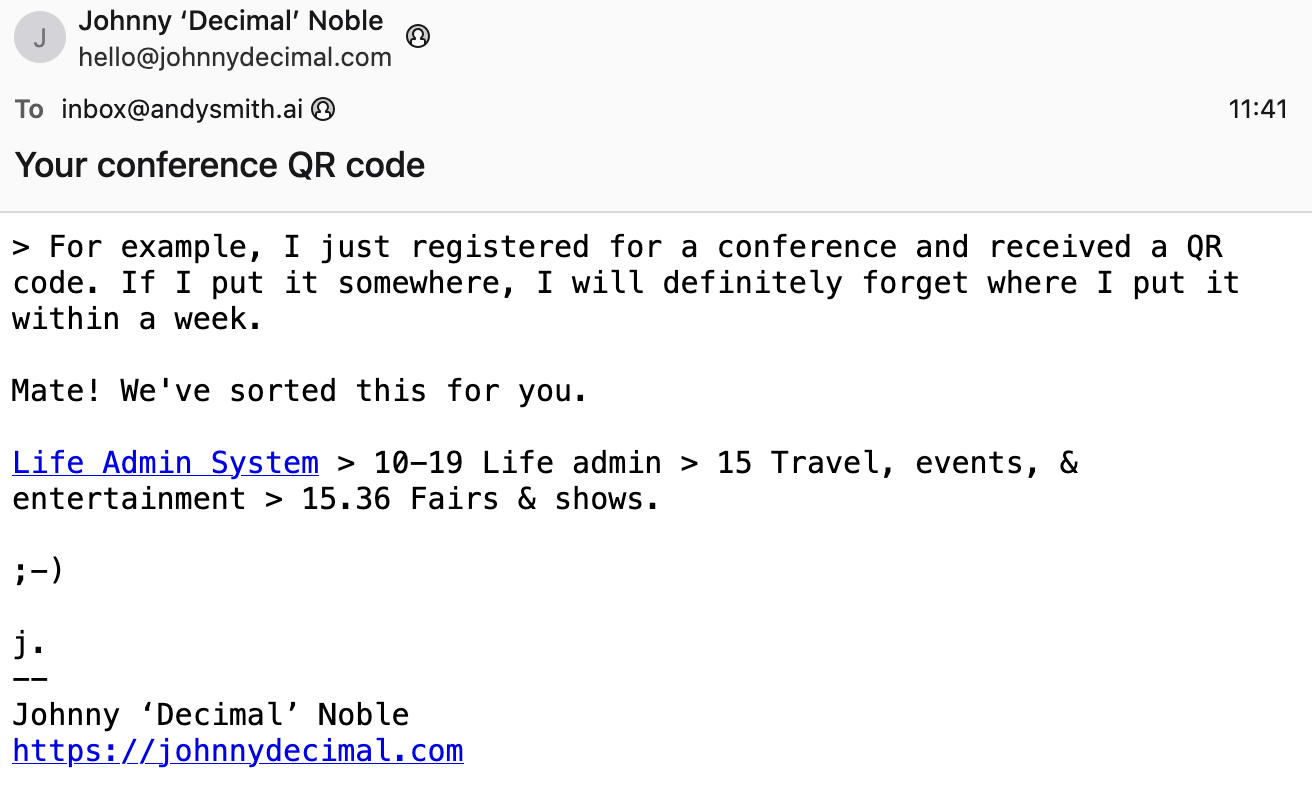","link":null,"media":[{"type":"image","url":"https://files.andysmith.ai/img/d10ee22a6b375ced0139871a3d8518cd614228fd173e7194255f7e112a417539/r81yj94sen00a7q0.png","text":null}],"tags":[]}
|