
problem string | solution string | answer string | problem_type string | question_type string | source string | uuid string | is_reasoning_complete list | generations list | correctness_math_verify list | correctness_llama list | finish_reasons list | correctness_count int64 | messages list |
|---|---|---|---|---|---|---|---|---|---|---|---|---|---|
15.8 (League 2001) $D, E$ are points on side $BC$ of $\triangle ABC$, $F$ is a point on the extension of $BA$, $\angle DAE = \angle CAF$.
(1) Determine the positional relationship between the circumcircle of $\triangle ABD$ and the circumcircle of $\triangle AEC$, and prove your conclusion.
(2) If the circumradius of $... | 15. 8 (1) Draw the tangent $AH$ of $\odot ABD$ such that $\angle DAE = \angle DAH + \angle HAE$, then $\angle CAF = \angle B + \angle C = \angle DAH + \angle C, \therefore \angle HAE = \angle C, AH$ is also the tangent of $\odot AEC$. Therefore, the two circles are tangent at point $A$.
(2) Extend $DA$ to intersect $\o... | \frac{8}{3} | Geometry | math-word-problem | olympiads | aef4f8fe-622b-57ee-a723-48a072408d8f | [
true,
true
] | [
"<think>\nOkay, let's try to solve this problem. It has two parts. First, determining the positional relationship between the circumcircles of triangles ABD and AEC, and then finding the length of BE given some conditions. Let me start with part (1).\n\nSo, we have triangle ABC, with points D and E on side BC. Poin... | [
true,
true
] | null | null | 2 | [
{
"content": "15.8 (League 2001) $D, E$ are points on side $BC$ of $\\triangle ABC$, $F$ is a point on the extension of $BA$, $\\angle DAE = \\angle CAF$.\n(1) Determine the positional relationship between the circumcircle of $\\triangle ABD$ and the circumcircle of $\\triangle AEC$, and prove your conclusion.\... |
## Problem Statement
Find the cosine of the angle between vectors $\overrightarrow{A B}$ and $\overrightarrow{A C}$.
$A(2, -4, 6), B(0, -2, 4), C(6, -8, 10)$ | ## Solution
Let's find $\overrightarrow{A B}$ and $\overrightarrow{A C}$:
$$
\begin{aligned}
& \overrightarrow{A B}=(0-2 ;-2-(-4) ; 4-6)=(-2 ; 2 ;-2) \\
& \overrightarrow{A C}=(6-2 ;-8-(-4) ; 10-6)=(4 ;-4 ; 4)
\end{aligned}
$$
We find the cosine of the angle $\phi$ between the vectors $\overrightarrow{A B}$ and $\ov... | \cos(\overrightarrow{AB,AC})=-1 | Algebra | math-word-problem | olympiads | 1a749dfd-ee44-55dc-af66-8c01ec3459ef | [
true,
true
] | [
"<think>\nOkay, so I need to find the cosine of the angle between vectors AB and AC. The points given are A(2, -4, 6), B(0, -2, 4), and C(6, -8, 10). Hmm, let me recall how to do this. \n\nFirst, I think I need to find the vectors AB and AC. To get vector AB, I subtract the coordinates of point A from point B, righ... | [
true,
true
] | null | null | 2 | [
{
"content": "## Problem Statement\n\nFind the cosine of the angle between vectors $\\overrightarrow{A B}$ and $\\overrightarrow{A C}$.\n\n$A(2, -4, 6), B(0, -2, 4), C(6, -8, 10)$",
"role": "user"
},
{
"content": "<think>Hmm , let me recall how to do this. \n\nFirst, I think I need to find the vecto... |
Example 1 Suppose the lengths of the three sides of a triangle are integers $l$, $m$, and $n$, and $l > m > n$. It is known that
$$
\left\{\frac{3^{l}}{10^{4}}\right\}=\left\{\frac{3^{m}}{10^{4}}\right\}=\left\{\frac{3^{n}}{10^{4}}\right\},
$$
where $\{x\}=x-[x]$, and $[x]$ represents the greatest integer not exceedin... | Solution: Note that, when $a \equiv b(\bmod m)(0 \leqslant b < m)$, we get $500+2 n>1000+n$.
So, $n>500$.
Thus, $n \geqslant 501, m \geqslant 1001, l \geqslant 1501$.
Therefore, $m+n+l \geqslant 3003$, which means the minimum perimeter of the triangle is 3003. | 3003 | Number Theory | math-word-problem | cn_contest | 596b2f5a-d847-56bc-9abe-ab1d89a84c0c | [
true,
true
] | [
"<think>\nOkay, so I need to solve this problem where we have a triangle with integer side lengths l, m, n such that l > m > n. The fractional parts of 3^l / 10^4, 3^m / 10^4, and 3^n / 10^4 are all equal. I have to find the minimum perimeter of such a triangle. Hmm, let me break this down.\n\nFirst, fractional par... | [
true,
true
] | null | null | 2 | [
{
"content": "Example 1 Suppose the lengths of the three sides of a triangle are integers $l$, $m$, and $n$, and $l > m > n$. It is known that\n$$\n\\left\\{\\frac{3^{l}}{10^{4}}\\right\\}=\\left\\{\\frac{3^{m}}{10^{4}}\\right\\}=\\left\\{\\frac{3^{n}}{10^{4}}\\right\\},\n$$\n\nwhere $\\{x\\}=x-[x]$, and $[x]$ ... |
Suppose that a sequence $a_0, a_1, \ldots$ of real numbers is defined by $a_0=1$ and \[a_n=\begin{cases}a_{n-1}a_0+a_{n-3}a_2+\cdots+a_0a_{n-1} & \text{if }n\text{ odd}\\a_{n-1}a_1+a_{n-3}a_3+\cdots+a_1a_{n-1} & \text{if }n\text{ even}\end{cases}\] for $n\geq1$. There is a positive real number $r$ such that \[a_0+a_1r+... | 1. Define the generating functions \( f(x) = \sum_{n=0}^{\infty} a_{2n} x^n \) and \( g(x) = \sum_{n=0}^{\infty} a_{2n+1} x^n \).
2. From the given recurrence relations, we have:
\[
f(x)^2 = g(x)
\]
and
\[
g(x)^2 = \frac{f(x) - 1}{x}
\]
3. We are interested in the generating function \( h(x) = f(x^... | 1923 | Other | math-word-problem | aops_forum | d633636b-80f6-5563-9def-22325a6623fd | [
true,
true
] | [
"<think>\nOkay, let's tackle this problem step by step. The problem is about a sequence defined recursively, and we need to find the radius of convergence \\( r \\) such that the sum of the series \\( a_0 + a_1 r + a_2 r^2 + \\dots \\) equals \\( \\frac{5}{4} \\). Then, express \\( r \\) in the given form and compu... | [
true,
true
] | null | null | 2 | [
{
"content": "Suppose that a sequence $a_0, a_1, \\ldots$ of real numbers is defined by $a_0=1$ and \\[a_n=\\begin{cases}a_{n-1}a_0+a_{n-3}a_2+\\cdots+a_0a_{n-1} & \\text{if }n\\text{ odd}\\\\a_{n-1}a_1+a_{n-3}a_3+\\cdots+a_1a_{n-1} & \\text{if }n\\text{ even}\\end{cases}\\] for $n\\geq1$. There is a positive r... |
How many pairs of integers $(x,y)$ are there such that $2x+5y=xy-1$?
$
\textbf{(A)}\ 1
\qquad\textbf{(B)}\ 3
\qquad\textbf{(C)}\ 4
\qquad\textbf{(D)}\ 6
\qquad\textbf{(E)}\ 12
$ | 1. Start with the given equation:
\[
2x + 5y = xy - 1
\]
2. Rearrange the equation to group all terms on one side:
\[
xy - 2x - 5y = 1
\]
3. Factor by grouping. Notice that we can factor the left-hand side as follows:
\[
xy - 2x - 5y + 10 - 10 = 1 \implies (x-5)(y-2) = 11
\]
4. Now, we nee... | 4 | Algebra | MCQ | aops_forum | e5848ab0-9929-5c33-8874-14808630f838 | [
true,
true
] | [
"<think>\nOkay, let's see. The problem is asking for the number of integer pairs (x, y) that satisfy the equation 2x + 5y = xy - 1. The answer choices are from A to E, with the correct answer likely being one of them. Hmm, I need to figure out how to approach this.\n\nFirst, the equation given is 2x + 5y = xy - 1. ... | [
false,
false
] | [
true,
true
] | null | 2 | [
{
"content": "How many pairs of integers $(x,y)$ are there such that $2x+5y=xy-1$?\n\n$ \n\\textbf{(A)}\\ 1\n\\qquad\\textbf{(B)}\\ 3\n\\qquad\\textbf{(C)}\\ 4\n\\qquad\\textbf{(D)}\\ 6\n\\qquad\\textbf{(E)}\\ 12\n$",
"role": "user"
},
{
"content": "<think>Hmm , I need to figure out how to approach ... |
Example 2 Two vectors $\boldsymbol{a} 、 \boldsymbol{b}$ satisfy $|\boldsymbol{a}-2 \boldsymbol{b}|=1,|2 \boldsymbol{a}+3 \boldsymbol{b}|=\frac{1}{3}$, then the value of $(5 \boldsymbol{a}-3 \boldsymbol{b})(\boldsymbol{a}-9 \boldsymbol{b})$ is ( )
A. 0
B. 10
C. $\frac{80}{9}$
D. $\frac{80}{3}$ | Analyzing: Since $5 \boldsymbol{a}-3 \boldsymbol{b}=3(\boldsymbol{a}-2 \boldsymbol{b})+(2 \boldsymbol{a}+3 \boldsymbol{b}), \boldsymbol{a}-9 \boldsymbol{b}=3(\boldsymbol{a}-2 \boldsymbol{b})-(2 \boldsymbol{a}+3 \boldsymbol{b})$, therefore $(5 \boldsymbol{a}-3 \boldsymbol{b})(\boldsymbol{a}-9 \boldsymbol{b})=[3(\boldsym... | \frac{80}{9} | Algebra | MCQ | olympiads | 58a0dabc-294a-5654-a73a-89e80576d10d | [
true,
true
] | [
"<think>\nOkay, let me try to solve this problem step by step. So, we have two vectors a and b. The given conditions are |a - 2b| = 1 and |2a + 3b| = 1/3. We need to find the value of the dot product (5a - 3b)·(a - 9b). The options are A to D, so I need to compute this expression and see which one it matches.\n\nFi... | [
false,
false
] | [
true,
true
] | null | 2 | [
{
"content": "Example 2 Two vectors $\\boldsymbol{a} 、 \\boldsymbol{b}$ satisfy $|\\boldsymbol{a}-2 \\boldsymbol{b}|=1,|2 \\boldsymbol{a}+3 \\boldsymbol{b}|=\\frac{1}{3}$, then the value of $(5 \\boldsymbol{a}-3 \\boldsymbol{b})(\\boldsymbol{a}-9 \\boldsymbol{b})$ is ( )\nA. 0\nB. 10\nC. $\\frac{80}{9}$\nD. $\\... |
Three, 13. (20 points) Given the function
$$
f(x)=a x^{2}+b x+c(a, b, c \in \mathbf{R}),
$$
when $x \in[-1,1]$, $|f(x)| \leqslant 1$.
(1) Prove: $|b| \leqslant 1$;
(2) If $f(0)=-1, f(1)=1$, find the value of $a$. | $$
\text { Three, 13. (1) Since } f(1)=a+b+c, f(-1)=a-b+
$$
$c$, then $b=\frac{1}{2}(f(1)-f(-1))$.
By the problem, $|f(1)| \leqslant 1,|f(-1)| \leqslant 1$.
Thus, $|b|=\frac{1}{2}|f(1)-f(-1)|$
$$
\leqslant \frac{1}{2}(|f(1)|+|f(-1)|) \leqslant 1 \text {. }
$$
(2) From $f(0)=-1, f(1)=1$, we get $c=-1, b=2$ $\boldsymbol{... | a=2 | Algebra | math-word-problem | cn_contest | 9babcf9e-52e8-5558-aa20-fb00026bb6c8 | [
true,
true
] | [
"<think>\nOkay, so I have this problem here about a quadratic function f(x) = ax² + bx + c. The conditions are that when x is between -1 and 1, the absolute value of f(x) is less than or equal to 1. There are two parts: first, I need to prove that the absolute value of b is less than or equal to 1, and second, if f... | [
true,
true
] | null | null | 2 | [
{
"content": "Three, 13. (20 points) Given the function\n$$\nf(x)=a x^{2}+b x+c(a, b, c \\in \\mathbf{R}),\n$$\n\nwhen $x \\in[-1,1]$, $|f(x)| \\leqslant 1$.\n(1) Prove: $|b| \\leqslant 1$;\n(2) If $f(0)=-1, f(1)=1$, find the value of $a$.",
"role": "user"
},
{
"content": "<think>Hmm , coefficients ... |
Four. (50 points) Let $S=\{1,2, \cdots, 2025\}$. If the sum of the elements of a 51-element subset of $S$ is divisible by 5, then it is called a "good subset" of $S$. Find the number of good subsets of $S$.
| Four, divide all 51-element subsets of set $S$ into five classes $S_{0}, S_{1}, \cdots, S_{4}$, where $S_{i}(i=0,1, \cdots, 4)$ consists of 51-element subsets whose sum of elements is congruent to $i$ modulo 5.
It is easy to see that for any $i, j (0 \leqslant i, j \leqslant 4, i \neq j)$, there is a unique $m (0 \leq... | \frac{1}{5}\mathrm{C}_{2025}^{51} | Combinatorics | math-word-problem | olympiads | 7e50e5b1-8b7f-5ea7-a4aa-7f7d36996635 | [
true,
true
] | [
"<think>\nOkay, so the problem is about finding the number of good subsets in the set S = {1, 2, ..., 2025}, where a good subset is defined as a 51-element subset whose sum is divisible by 5. Hmm, this sounds like a combinatorics problem involving modular arithmetic. Let me try to break it down step by step.\n\nFir... | [
false,
false
] | [
true,
true
] | null | 2 | [
{
"content": "Four. (50 points) Let $S=\\{1,2, \\cdots, 2025\\}$. If the sum of the elements of a 51-element subset of $S$ is divisible by 5, then it is called a \"good subset\" of $S$. Find the number of good subsets of $S$.\n\n",
"role": "user"
},
{
"content": "<think>Hmm , this sounds like a comb... |
384. $\frac{1-\cos ^{2} x}{1-\sin ^{2} x}+\operatorname{tg} x \operatorname{ctg} x$.
384. $\frac{1-\cos ^{2} x}{1-\sin ^{2} x}+\tan x \cot x$. | Solution. Applying the formulas $1-\cos ^{2} \alpha=\sin ^{2} \alpha, 1-\sin ^{2} \alpha=$ $=\cos ^{2} \alpha$ and identities IV and VI, we find
$$
\frac{1-\cos ^{2} x}{1-\sin ^{2} x}+\operatorname{tg} x \operatorname{ctg} x=\frac{\sin ^{2} x}{\cos ^{2} x}+1=\operatorname{tg}^{2} x+1=\frac{1}{\cos ^{2} x}
$$ | \frac{1}{\cos^{2}x} | Algebra | math-word-problem | olympiads | ee40561c-86fe-50bf-988a-427d4776f6e5 | [
true,
true
] | [
"<think>\nOkay, so I have this problem to solve: it's an expression involving trigonometric functions. Let me write it down again to make sure I have it right. The problem is:\n\n$\\frac{1 - \\cos^2 x}{1 - \\sin^2 x} + \\tan x \\cot x$.\n\nHmm, I need to simplify this expression. Let me start by recalling some trig... | [
true,
true
] | null | null | 2 | [
{
"content": "384. $\\frac{1-\\cos ^{2} x}{1-\\sin ^{2} x}+\\operatorname{tg} x \\operatorname{ctg} x$.\n\n384. $\\frac{1-\\cos ^{2} x}{1-\\sin ^{2} x}+\\tan x \\cot x$.",
"role": "user"
},
{
"content": "<think>Hmm , I need to simplify this expression. Let me start by recalling some trigonometric id... |
Four friends equally shared $\frac{3}{4}$ of a pizza, which was left over after a party. What fraction of a whole pizza did each friend get?
(A) $\frac{3}{8}$
(B) $\frac{3}{16}$
(C) $\frac{1}{12}$
(D) $\frac{1}{16}$
(E) $\frac{1}{8}$ | Four friends equally shared $\frac{3}{4}$ of a pizza, which was left over after a party. What fraction of a whole pizza did each friend get?
(A) $\frac{3}{8}$
(B) $\frac{3}{16}$
(C) $\frac{1}{12}$
(D) $\frac{1}{16}$
(E) $\frac{1}{8}$
## Solution
If $\frac{3}{4}$ of a pizza was shared by 4 friends, they would each rec... | \frac{3}{16} | Logic and Puzzles | MCQ | olympiads | 0838aeb9-f23c-5185-9343-639c6f2d575a | [
true,
true
] | [
"<think>\nOkay, so here's this problem: Four friends equally shared 3/4 of a pizza that was left over after a party. I need to find out what fraction of a whole pizza each friend got. The answer choices are A) 3/8, B) 3/16, C) 1/12, D) 1/16, E) 1/8. Hmm, let me think.\n\nFirst, let me visualize the problem. There w... | [
false,
false
] | [
true,
true
] | null | 2 | [
{
"content": "Four friends equally shared $\\frac{3}{4}$ of a pizza, which was left over after a party. What fraction of a whole pizza did each friend get?\n(A) $\\frac{3}{8}$\n(B) $\\frac{3}{16}$\n(C) $\\frac{1}{12}$\n(D) $\\frac{1}{16}$\n(E) $\\frac{1}{8}$",
"role": "user"
},
{
"content": "<think>... |
19.18 The ratio of the interior angles of two regular polygons is $3: 2$. The number of such regular polygons is
(A) 1.
(B) 2.
(C) 3.
(D) 4.
(E) infinitely many.
(13th American High School Mathematics Examination, 1962) | [Solution] Let $N, n$ represent the number of sides of the two regular polygons, respectively. Therefore, the relationship between their angle measurements can be expressed as
$$
\frac{(N-2) 180^{\circ}}{N}=\frac{3}{2} \cdot \frac{(n-2) 180^{\circ}}{n},
$$
then $N=\frac{4 n}{6-n}$.
Since $n, N$ are both positive integ... | 3 | Geometry | MCQ | olympiads | 15f0fd25-fd30-5040-86dd-807b67ceb616 | [
true,
true
] | [
"<think>\nOkay, so the problem is about the ratio of the interior angles of two regular polygons being 3:2, and we need to find how many such pairs of regular polygons exist. The options are from A to E, with E being infinitely many. Let me start by recalling some properties of regular polygons.\n\nFirst, the formu... | [
false,
false
] | [
true,
true
] | null | 2 | [
{
"content": "19.18 The ratio of the interior angles of two regular polygons is $3: 2$. The number of such regular polygons is\n(A) 1.\n(B) 2.\n(C) 3.\n(D) 4.\n(E) infinitely many.\n(13th American High School Mathematics Examination, 1962)",
"role": "user"
},
{
"content": "<think>\nOkay, so the prob... |
Three fair six-sided dice are rolled. What is the probability that the values shown on two of the dice sum to the value shown on the remaining die?
$\textbf{(A)}\ \dfrac16\qquad\textbf{(B)}\ \dfrac{13}{72}\qquad\textbf{(C)}\ \dfrac7{36}\qquad\textbf{(D)}\ \dfrac5{24}\qquad\textbf{(E)}\ \dfrac29$ | First, we note that there are $1, 2, 3, 4,$ and $5$ ways to get sums of $2, 3, 4, 5, 6$ respectively--this is not too hard to see. With any specific sum, there is exactly one way to attain it on the other die. This means that the probability that two specific dice have the same sum as the other is \[\dfrac16 \left( \df... | \frac{5}{24} | Combinatorics | MCQ | amc_aime | 8d2de1b5-f273-5736-9273-4c3d13feeea9 | [
true,
true
] | [
"<think>\nOkay, so I need to find the probability that when rolling three fair six-sided dice, the sum of two of them equals the third one. The answer choices are given, so maybe after working through the problem, I can check which one matches. Let me start by understanding the problem.\n\nFirst, when rolling three... | [
false,
false
] | [
true,
true
] | null | 2 | [
{
"content": "Three fair six-sided dice are rolled. What is the probability that the values shown on two of the dice sum to the value shown on the remaining die?\n$\\textbf{(A)}\\ \\dfrac16\\qquad\\textbf{(B)}\\ \\dfrac{13}{72}\\qquad\\textbf{(C)}\\ \\dfrac7{36}\\qquad\\textbf{(D)}\\ \\dfrac5{24}\\qquad\\textbf... |
3. Throw a die three times, find the probability of getting exactly two ones.
The above text is translated into English, keeping the original text's line breaks and format. | $\begin{array}{l}\text { (Answer: } P=\frac{\mathrm{C}_{3}^{2} \cdot \mathrm{C}_{5}^{1}}{6^{3}}=\frac{5}{72} \text {. } \\ \text { Or } \mathrm{P}=\mathrm{C}_{3}^{2} \cdot\left(\frac{1}{6}\right)^{2} \cdot\left(\frac{5}{6}\right)=\frac{5}{72} \text { ) }\end{array}$ | \frac{5}{72} | Combinatorics | math-word-problem | cn_contest | 2eb407a3-a770-54c9-a8d7-12a7e8ee6812 | [
true,
true
] | [
"<think>\nOkay, so I need to find the probability of getting exactly two ones when throwing a die three times. Hmm, let's think about this step by step.\n\nFirst, when you throw a die, there are six possible outcomes each time: 1, 2, 3, 4, 5, or 6. Since we're doing this three times, the total number of possible ou... | [
true,
true
] | null | null | 2 | [
{
"content": "3. Throw a die three times, find the probability of getting exactly two ones.\n\n\n\nThe above text is translated into English, keeping the original text's line breaks and format.",
"role": "user"
},
{
"content": "<think>Hmm , let's think about this step by step.\n\nNow, we need the nu... |
$6 .(a, b)$ represents the greatest common divisor of the natural numbers $a, b$. Let $(a, b)=1$, then $\left(a^{2}+b^{2}, a^{3}+b^{3}\right)$ is ( ).
(A) 1
(b, 2
(C) only 1 or 2
(D) possibly greater than 2 | 6. (C).
According to the Euclidean algorithm: If $a=b q+r$, then $(a, b)=(b; r)$. Since $a^{3}+b^{3}=\left(a^{2}+b^{2}\right)(a b)-a b(a+b)$, we have $\left(a^{3}+b^{3}, a^{2}+b^{2}\right)=\left(a^{2}+b^{2}, a b\left(a+b\right)\right)$; given $(a, b)=1$. Therefore,
$$
\begin{array}{l}
\left(a^{2}+b^{2}, a b(a+b)\right... | C | Number Theory | MCQ | cn_contest | f2a6ac42-4337-5737-804b-15073f78b2ee | [
true,
true
] | [
"<think>\nOkay, so I have this problem here about greatest common divisors, GCDs. The question says that if (a, b) = 1, meaning that a and b are coprime natural numbers, then what is the GCD of a² + b² and a³ + b³? The options are given as (A) 1, (B) 2, (C) only 1 or 2, and (D) possibly greater than 2. I need to fi... | [
true,
true
] | null | null | 2 | [
{
"content": "$6 .(a, b)$ represents the greatest common divisor of the natural numbers $a, b$. Let $(a, b)=1$, then $\\left(a^{2}+b^{2}, a^{3}+b^{3}\\right)$ is ( ).\n(A) 1\n(b, 2\n(C) only 1 or 2\n(D) possibly greater than 2",
"role": "user"
},
{
"content": "<think>Hmm , so maybe writing it like t... |
3 Task 2. Solve the system of equations
$$
\left\{\begin{array}{l}
|x|+x=|y|+y \\
|x-1|=x+|y|
\end{array}\right.
$$ | Solution. First, let's investigate equation (1):
If $x \geqslant 0$ and $y \geqslant 0$, then $2 x=2 y$, i.e., in this case, the graph of equation (1) is the bisector OA of the first coordinate angle (Fig. 2).
If $x<0$ and $y \geqslant 0$, then $0=2 y$, i.e., in this case, the graph of equation (1) will be the ray $O... | (\frac{1}{3};\frac{1}{3}) | Algebra | math-word-problem | olympiads | 18de74e4-89d0-5828-aa8e-4c5571688d20 | [
true,
true
] | [
"<think>\nOkay, let's see. I need to solve this system of equations with absolute values. The equations are:\n\n1. |x| + x = |y| + y\n2. |x - 1| = x + |y|\n\nHmm, absolute value equations can be tricky because of the cases depending on the sign inside the absolute value. Let me start by analyzing each equation sepa... | [
false,
false
] | [
true,
true
] | null | 2 | [
{
"content": "3 Task 2. Solve the system of equations\n\n$$\n\\left\\{\\begin{array}{l}\n|x|+x=|y|+y \\\\\n|x-1|=x+|y|\n\\end{array}\\right.\n$$",
"role": "user"
},
{
"content": "<think>Hmm , absolute value equations can be tricky because of the cases depending on the sign inside the absolute value.... |
Subject 1. Determine the natural numbers $\overline{a b}$ that satisfy the relation $\sqrt{a+\sqrt{\overline{a b}}}=a$. | ## Subject 1.
| | $\sqrt{a+\sqrt{a b}}=a \Leftrightarrow \sqrt{\overline{a b}}=a^{2}-a$ |
| :--- | :--- | :--- |
| $a^{2}-a$ is a natural number $\Rightarrow \overline{a b}$ is a perfect square | 1p |
| Possible cases are studied and $\overline{a b}=36$ is obtained | 2p | | 36 | Algebra | math-word-problem | olympiads | facbf702-8216-58f3-8409-c4f9c80edd07 | [
true,
true
] | [
"<think>\nOkay, so I need to find all two-digit natural numbers \\(\\overline{a b}\\) such that \\(\\sqrt{a + \\sqrt{\\overline{a b}}} = a\\). Let me try to understand the problem step by step. \n\nFirst, let's parse the notation. The number \\(\\overline{a b}\\) is a two-digit number where \\(a\\) is the tens digi... | [
true,
true
] | null | null | 2 | [
{
"content": "Subject 1. Determine the natural numbers $\\overline{a b}$ that satisfy the relation $\\sqrt{a+\\sqrt{\\overline{a b}}}=a$.",
"role": "user"
},
{
"content": "<think>\nOkay, so I need to find all two-digit natural numbers \\(\\overline{a b}\\) such that \\(\\sqrt{a + \\sqrt{\\overline{a... |
4. The number of positive integer solutions to the system of equations $\left\{\begin{array}{l}x y+y z=63, \\ x z+y z=23\end{array}\right.$ is ).
(A) 1
(B) 2
(C) 3
(D) 4 | 4. April From the second equation, we have $(x+y) z=23$. Since $x+y \geqslant 2$ and 23 is a prime number, it follows that $z=1, x+y=23$. Substituting $z=1, y=23-x$ into the first equation, we get $x^{2}-22 x+40=0$. The two roots of the equation are $x_{1}=2, x_{2}=20$. Solving this, we find that the system of equatio... | B | Algebra | MCQ | cn_contest | 89d8ab12-ab91-5fd9-bb55-8b6297ffe529 | [
true,
true
] | [
"<think>\nOkay, let's see. I need to find the number of positive integer solutions to the system of equations:\n\n\\[\n\\begin{cases}\nxy + yz = 63, \\\\\nxz + yz = 23.\n\\end{cases}\n\\]\n\nHmm, so we have two equations with three variables: x, y, z. But since we need positive integer solutions, maybe there's a wa... | [
true,
true
] | null | null | 2 | [
{
"content": "4. The number of positive integer solutions to the system of equations $\\left\\{\\begin{array}{l}x y+y z=63, \\\\ x z+y z=23\\end{array}\\right.$ is ).\n(A) 1\n(B) 2\n(C) 3\n(D) 4",
"role": "user"
},
{
"content": "<think>Hmm , so we have two equations with three variables: x, y, z. Bu... |
8.317. $\frac{\sin ^{2} t-\tan^{2} t}{\cos ^{2} t-\cot^{2} t}+2 \tan^{3} t+1=0$. | ## Solution.
Domain of definition: $\left\{\begin{array}{l}\cos t \neq 0, \\ \sin t \neq 0, \\ \sin t \neq \pm 1 .\end{array}\right.$
Rewrite the equation as
$\frac{\sin ^{2} t-\frac{\sin ^{2} t}{\cos ^{2} t}}{\cos ^{2} t-\frac{\cos ^{2} t}{\sin ^{2} t}}+2 \operatorname{tg}^{3} t+1=0 \Leftrightarrow$
$\Leftrightarr... | \frac{\pi}{4}(4k-1),k\inZ | Algebra | math-word-problem | olympiads | dea3ad99-919b-5875-91c8-36488b0dccaa | [
true,
true
] | [
"<think>\nOkay, so I need to solve this trigonometric equation: (sin²t - tan²t)/(cos²t - cot²t) + 2 tan³t + 1 = 0. Hmm, let's see. First, maybe I should simplify the fraction part. Let me write down the equation again to make sure I have it right:\n\n[(sin²t - tan²t)/(cos²t - cot²t)] + 2 tan³t + 1 = 0.\n\nAlright. ... | [
false,
false
] | [
true,
true
] | null | 2 | [
{
"content": "8.317. $\\frac{\\sin ^{2} t-\\tan^{2} t}{\\cos ^{2} t-\\cot^{2} t}+2 \\tan^{3} t+1=0$.",
"role": "user"
},
{
"content": "<think>Hmm , let's see. First, maybe I should simplify the fraction part. Let me write down the equation again to make sure I have it right:\n\n[(sin²t - tan²t)/(cos... |
Tokarev S.I.
Find the smallest natural number that can be represented as the sum of 2002 natural addends with the same sum of digits and as the sum of 2003 natural addends with the same sum of digits.
# | Let for a natural number $n$ the following representations hold: $n=a_{1}+\ldots+a_{2002}=b_{1}+\ldots+b_{2003}$.
We will use the fact that each of the numbers $a_{1}, a_{2002}$ gives the same remainder when divided by 9 as the sum of its digits; let this remainder be $r(0 \leq r \leq 8)$, and the corresponding remain... | 10010 | Number Theory | math-word-problem | olympiads | 91ab84ff-d1bb-5c1b-8c36-674233a70e43 | [
true,
true
] | [
"<think>\nOkay, let's try to figure out this problem. So, the task is to find the smallest natural number that can be expressed as the sum of 2002 natural addends, each having the same sum of digits, and also as the sum of 2003 natural addends, again each with the same sum of digits. Hmm, that's a bit tricky, but l... | [
true,
true
] | null | null | 2 | [
{
"content": "Tokarev S.I.\n\nFind the smallest natural number that can be represented as the sum of 2002 natural addends with the same sum of digits and as the sum of 2003 natural addends with the same sum of digits.\n\n#",
"role": "user"
},
{
"content": "<think>Hmm , that's a bit tricky, but let's... |
3. Solve the equation
$$
2(x-6)=\frac{x^{2}}{(1+\sqrt{x+1})^{2}}
$$ | Solution 1. Rewrite the equation as $2(x-6)(1+\sqrt{x+1})^{2}=x^{2}$ and make the substitution $\sqrt{x+1}=y$. Then $x=y^{2}-1$ and $y \geq 0$. After the substitution, we get $2\left(y^{2}-7\right)(y+1)^{2}=$ $\left(y^{2}-1\right)^{2}$. Factor the right side as $(y+1)^{2}(y-1)^{2}$, move it to the left, and factor out ... | 8 | Algebra | math-word-problem | olympiads | f1405af3-e1c5-56d4-8fc5-7f993aad02a5 | [
false,
true
] | [
"<think>\nOkay, so I have to solve the equation 2(x - 6) = x² / (1 + √(x + 1))². Hmm, let me start by understanding what this equation is asking. It looks like a rational equation where the left side is linear and the right side is a quadratic term divided by a squared denominator involving a square root. That squa... | [
false,
true
] | null | null | 1 | [
{
"content": "3. Solve the equation\n\n$$\n2(x-6)=\\frac{x^{2}}{(1+\\sqrt{x+1})^{2}}\n$$",
"role": "user"
},
{
"content": "<think>Hmm , let me start by understanding what the equation is asking. It's an equation with a linear term on the left and a rational expression involving a square root on the ... |
Example 3 Find the largest integer $n$, such that all non-zero solutions of the equation $(z+1)^{n}=z^{n}+1$ lie on the unit circle. | $$
\begin{array}{l}
\text { Solution: Using the binomial theorem, the equation can be transformed into } \\
z\left(C_{n}^{1} z^{n-2}+C_{n}^{2} z^{n-3}+C_{n}^{3} z^{n-4}+\cdots+C_{n}^{n-2} z+\right. \\
\left.C_{n}^{n-1}\right)=0(n>3) .
\end{array}
$$
Let the non-zero solutions of the equation be $z_{i}(i=1,2, \cdots, n... | 7 | Algebra | math-word-problem | cn_contest | 47797c10-27b6-5fbe-ae4b-3467b6be263f | [
false,
true
] | [
"<think>\nOkay, so I need to find the largest integer n such that all non-zero solutions of the equation (z + 1)^n = z^n + 1 lie on the unit circle. Hmm, let me try to unpack this problem step by step.\n\nFirst, I recall that the unit circle in the complex plane consists of all complex numbers z where the absolute ... | [
false,
true
] | null | null | 1 | [
{
"content": "Example 3 Find the largest integer $n$, such that all non-zero solutions of the equation $(z+1)^{n}=z^{n}+1$ lie on the unit circle.",
"role": "user"
},
{
"content": "<think>Hmm , interesting. Let me try to break this down step by step. \n\nLet me rewrite the equation as (z + 1)^n - z^... |
Example 9. Find the integral $\int \sin ^{2} \frac{x}{2} d x$. | Solution. Since
$$
\sin ^{2} \frac{x}{2}=\frac{1}{2}(1-\cos x)
$$
then
$$
\int \sin ^{2} \frac{x}{2} d x=\frac{1}{2} \int(1-\cos x) d x=\frac{1}{2} \int d x-\frac{1}{2} \int \cos x d x=\frac{1}{2} x-\frac{1}{2} \sin x+C
$$
## Problems
Find the indefinite integrals:
1. $\int \frac{x^{4}-3 x^{3}+4 x^{2}+6 x-8}{x^{2... | \frac{1}{2}x-\frac{1}{2}\sinx+C | Calculus | math-word-problem | olympiads | 86100b37-bf3f-5233-9820-1af0f078174c | [
true,
true
] | [
"<think>\nOkay, so I need to find the integral of sin squared of x over 2 dx. Hmm, let's see. I remember integrating sin squared terms before, but I might need to use a trigonometric identity to simplify it first. Wait, right, there's a power-reduction formula that can help with squares of sine or cosine functions.... | [
true,
true
] | null | null | 2 | [
{
"content": "Example 9. Find the integral $\\int \\sin ^{2} \\frac{x}{2} d x$.",
"role": "user"
},
{
"content": "<think>Hmm , let's see. I remember integrating sin squared terms before, but I might need to use a trigonometric identity to simplify it first. Wait , right, there's a power-reduction f... |
Problem 3. On a river, two identical sightseeing boats departed from one pier in opposite directions at 13:00. At the same time, a raft also set off from the pier. After an hour, one of the boats turned around and headed in the opposite direction. At 15:00, the second boat did the same. What is the speed of the current... | Answer: 2.5 km/h.
Solution. Consider the reference frame associated with the river. In this frame, the boats move with equal speeds: initially, they move away from each other in opposite directions for 1 hour, then move in the same direction for another 1 hour (during which the distance between them does not change), ... | 2.5 | Algebra | math-word-problem | olympiads | 5ccb2b8e-2d42-5c0b-9a4f-4e92c83f17cd | [
true,
true
] | [
"<think>\nOkay, so here's this problem about two boats and a raft on a river. Let me try to figure it out step by step. Hmm. Let's start by parsing the problem again.\n\nSo, two identical sightseeing boats depart from a pier at 13:00 in opposite directions. At the same time, a raft starts floating from the pier. Af... | [
true,
true
] | null | null | 2 | [
{
"content": "Problem 3. On a river, two identical sightseeing boats departed from one pier in opposite directions at 13:00. At the same time, a raft also set off from the pier. After an hour, one of the boats turned around and headed in the opposite direction. At 15:00, the second boat did the same. What is th... |
Professor Célia, in a class about sequences, decides to play a guessing game with patterns:
I) First, she chooses a Natural number.
II) Cláudia must say the double of its successor.
III) Marcelo must say the triple of the predecessor of the number said by Cláudia.
IV) Finally, Ademar must say the quadruple of the s... | Solution
a) If Professor Célia chooses 3, Cláudia should say $2 \cdot 4=8$, Marcelo should say 3$\cdot$7 = 21, and Ademar should say $4 \cdot 22=88$.
b) We need to analyze the problem "backwards," using inverse operations. If Ademar said 184, then Marcelo must have said $\frac{184}{4}-1=46-1=45$, and consequently, Cl... | \frac{x-16}{24} | Algebra | math-word-problem | olympiads | 8d7326ea-a8a1-5318-becb-e9e74d01168c | [
true,
true
] | [
"<think>\nOkay, let me try to figure out these problems step by step. So, first, problem a. Professor Célia chooses a natural number, which is 3 in this case. Then Cláudia has to say the double of its successor. Hmm, the successor of 3 is 4, right? So double of 4 would be 8. Then Marcelo has to say the triple of th... | [
true,
true
] | null | [
"stop",
"stop"
] | 2 | [
{
"content": "Professor Célia, in a class about sequences, decides to play a guessing game with patterns:\n\nI) First, she chooses a Natural number.\n\nII) Cláudia must say the double of its successor.\n\nIII) Marcelo must say the triple of the predecessor of the number said by Cláudia.\n\nIV) Finally, Ademar m... |
Example 4. Find the integral $\int \cos ^{2} x \sin x d x$. | Solution. Let $\cos x=u$, then
$$
-\sin x d x=d u, \sin x d x=-d u
$$
Thus,
$$
\begin{gathered}
\int \cos ^{2} x \sin x d x=\int u^{2}(-d u)=-\int u^{2} d u=-\frac{u^{3}}{3}+C= \\
=-\frac{\cos ^{3} x}{3}+C
\end{gathered}
$$
The same result can be obtained directly (see § 4.2):
$$
\begin{gathered}
\int \cos ^{2} x ... | -\frac{\cos^{3}x}{3}+C | Calculus | math-word-problem | olympiads | a833a2ef-3902-542f-b8f5-28992ea284b3 | [
true,
true
] | [
"<think>\nOkay, so I need to find the integral of cos squared x times sin x dx. Hmm, let me think. I've done some integrals before, but this one might need substitution. Let me recall: when you have a product of trigonometric functions, sometimes substitution works. Let's see... cos squared x is (cos x)^2, and then... | [
true,
true
] | null | null | 2 | [
{
"content": "Example 4. Find the integral $\\int \\cos ^{2} x \\sin x d x$.",
"role": "user"
},
{
"content": "<think>Hmm , let me think. I've done some integrals before, but this one might need substitution. Let me recall: when you have a product of trigonometric functions, sometimes substitution w... |
2.12. Calculate the area of the parallelogram constructed on vectors $\vec{a}$ and $\vec{b}$, the lengths of the diagonals of the parallelogram, $\cos (\widehat{\vec{a}, \vec{p}})$ and $r_{\dot{a}} \ddot{b}$, if
$$
\vec{a}=5 \vec{p}+2 \vec{q}, \vec{b}=\vec{p}-3 \vec{q},|\vec{p}|=4 \sqrt{2},|\vec{q}|=6,(\widehat{\vec{p... | S o l u t i o n. The area $S$ of the parallelogram constructed on vectors $\vec{a}$ and $\vec{b}$ is equal to the magnitude of the vector product of these vectors. Using the algebraic properties of the vector product, we have
$$
\begin{aligned}
\vec{a} \times \vec{b}=(5 \vec{p}+2 \vec{q}) & \times(\vec{p}-3 \vec{q})=5... | S=408,|\vec{}+\vec{b}|=30,|\vec{}-\vec{b}|=2\sqrt{593},\cos(\widehat{\vec{},\vec{p}})=\frac{13}{\sqrt{178}},\Pi_{\vec{}}\vec{b}=-\frac{92}{\sqrt{89}} | Algebra | math-word-problem | olympiads | 4001d65e-f29b-5214-8d44-7f9f175009e7 | [
true,
true
] | [
"<think>\nOkay, so I need to find the area of the parallelogram constructed on vectors a and b, the lengths of the diagonals, cos of the angle between vectors a and p, and something written as r_{a} double dot b. Hmm, not sure what that last one is. Maybe it's a typo? Let me check the original problem again. It say... | [
false,
false
] | [
true,
true
] | null | 2 | [
{
"content": "2.12. Calculate the area of the parallelogram constructed on vectors $\\vec{a}$ and $\\vec{b}$, the lengths of the diagonals of the parallelogram, $\\cos (\\widehat{\\vec{a}, \\vec{p}})$ and $r_{\\dot{a}} \\ddot{b}$, if\n\n$$\n\\vec{a}=5 \\vec{p}+2 \\vec{q}, \\vec{b}=\\vec{p}-3 \\vec{q},|\\vec{p}|... |
Juca has fewer than 800 marbles. He likes to separate the marbles into groups with the same number of marbles. He noticed that if he forms groups of 3 marbles each, exactly 2 marbles are left over. If he forms groups of 4 marbles, 3 marbles are left over. If he forms groups of 5 marbles, 4 marbles are left over. Finall... | Solution
(a) Let $B$ be the number of marbles Juca has. Note that the number of marbles left over when forming a group is equal to the remainder of the division of $B$ by the size of the groups. To determine the remainder in the division by 20, one should use the remainders in the division by 4 and by 5, since $20=4 \... | 419 | Number Theory | math-word-problem | olympiads | f0e1fd2b-b671-51fa-b9a5-8ee05f68d7a4 | [
true,
true
] | [
"<think>\nOkay, let's see. So Juca has fewer than 800 marbles, and when he divides them into different group sizes, there are specific remainders each time. For part (a), we need to find out how many marbles would be left over if he forms groups of 20. For part (b), we need to determine the exact number of marbles ... | [
true,
true
] | null | null | 2 | [
{
"content": "Juca has fewer than 800 marbles. He likes to separate the marbles into groups with the same number of marbles. He noticed that if he forms groups of 3 marbles each, exactly 2 marbles are left over. If he forms groups of 4 marbles, 3 marbles are left over. If he forms groups of 5 marbles, 4 marbles... |
How many pairs of parallel edges, such as $\overline{AB}$ and $\overline{GH}$ or $\overline{EH}$ and $\overline{FG}$, does a cube have?
$\text{(A) }6 \quad\text{(B) }12 \quad\text{(C) } 18 \quad\text{(D) } 24 \quad \text{(E) } 36$ | Solution 1
We first count the number of pairs of parallel lines that are in the same direction as $\overline{AB}$. The pairs of parallel lines are $\overline{AB}\text{ and }\overline{EF}$, $\overline{CD}\text{ and }\overline{GH}$, $\overline{AB}\text{ and }\overline{CD}$, $\overline{EF}\text{ and }\overline{GH}$, $\ov... | 18 | Geometry | MCQ | amc_aime | a874ebce-99cb-5084-ac1f-ca33cf55da83 | [
true,
true
] | [
"<think>\nOkay, so I need to figure out how many pairs of parallel edges a cube has. The answer choices are 6, 12, 18, 24, or 36. Hmm, let's start by visualizing a cube. A cube has 12 edges, right? Each edge is the same length, and all the edges meet at right angles. But how do we count the pairs of parallel edges?... | [
false,
false
] | [
true,
true
] | null | 2 | [
{
"content": "How many pairs of parallel edges, such as $\\overline{AB}$ and $\\overline{GH}$ or $\\overline{EH}$ and $\\overline{FG}$, does a cube have?\n\n$\\text{(A) }6 \\quad\\text{(B) }12 \\quad\\text{(C) } 18 \\quad\\text{(D) } 24 \\quad \\text{(E) } 36$",
"role": "user"
},
{
"content": "<thin... |
$14 \cdot 72$ Find all real solutions of the equation $4 x^{2}-40[x]+51=0$.
(Canadian Mathematical Olympiad, 1999) | [Solution] Since $[x] \leqslant x$,
we have $0=4 x^{2}-40[x]+51 \geqslant 4 x^{2}-40 x+51$
$$
=(2 x-3)(2 x-17) \text {. }
$$
Thus, $\frac{3}{2} \leqslant x \leqslant \frac{17}{2}$.
Therefore, $[x]=1,2,3,4,5,6,7,8$.
When $[x]=1$, the equation becomes $4 x^{2}+11=0$ which has no real solutions.
When $[x]=2$, the equatio... | {\frac{\sqrt{29}}{2},\frac{\sqrt{189}}{2},\frac{\sqrt{229}}{2},\frac{\sqrt{269}}{2}} | Algebra | math-word-problem | olympiads | 8be76cfc-3f95-58b5-ad33-bd8b368677ec | [
true,
true
] | [
"<think>\nAlright, so I need to solve the equation \\(4x^2 - 40[x] + 51 = 0\\), where [x] represents the floor function, which is the greatest integer less than or equal to x. Hmm, floor functions can make equations a bit tricky because they introduce piecewise behavior. Let me think about how to approach this.\n\n... | [
true,
true
] | null | null | 2 | [
{
"content": "$14 \\cdot 72$ Find all real solutions of the equation $4 x^{2}-40[x]+51=0$.\n(Canadian Mathematical Olympiad, 1999)",
"role": "user"
},
{
"content": "<think>Hmm , floor functions can make equations a bit tricky because they introduce piecewise behavior. Let me think about how to appro... |
Determine all positive integers $n$ such that $4k^2 +n$ is a prime number for all non-negative integer $k$ smaller than $n$. | 1. **Initial Observation**: We need to determine all positive integers \( n \) such that \( 4k^2 + n \) is a prime number for all non-negative integers \( k \) smaller than \( n \).
2. **Prime Condition for \( n \)**:
- Taking \( k = 0 \), we get \( 4 \cdot 0^2 + n = n \).
- Therefore, \( n \) itself must be ... | n = 3, 7 | Number Theory | math-word-problem | aops_forum | b4cd7831-b4c5-53a7-afb0-68215fd7b4b8 | [
true,
true
] | [
"<think>\nAlright, so I have this problem: Determine all positive integers n such that 4k² + n is a prime number for all non-negative integer k smaller than n. Hmm, okay. Let me try to parse this step by step.\n\nFirst, n is a positive integer. We need to find all such n where for every non-negative integer k (so k... | [
true,
true
] | null | null | 2 | [
{
"content": " Determine all positive integers $n$ such that $4k^2 +n$ is a prime number for all non-negative integer $k$ smaller than $n$.",
"role": "user"
},
{
"content": "<think>Hmm , okay. Let me try to parse this step by step.\n\nFirst, n is a positive integer. We need to find all such n where ... |
9.053. $x^{2} \cdot 3^{x}-3^{x+1} \leq 0$. | Solution.
From the condition $x^{2} \cdot 3^{x}-3 \cdot 3^{x} \leq 0,3^{x}\left(x^{2}-3\right) \leq 0$. Since $3^{x}>0$ for $x \in R$, the obtained inequality is equivalent to the inequality $x^{2}-3 \leq 0$, $x^{2} \leq 3,-\sqrt{3} \leq x \leq \sqrt{3}$.
Answer: $\quad x \in[-\sqrt{3} ; \sqrt{3}]$ | x\in[-\sqrt{3};\sqrt{3}] | Inequalities | math-word-problem | olympiads | c2a4df7d-5c0d-5a9f-8a60-23f491e068c5 | [
true,
true
] | [
"<think>\nOkay, so I need to solve this inequality: \\(x^{2} \\cdot 3^{x} - 3^{x+1} \\leq 0\\). Let me see. Hmm, first, maybe I can factor out something common from both terms. Both terms have \\(3^{x}\\) in them, right? Let me check:\n\nFirst term is \\(x^2 \\cdot 3^x\\) and the second term is \\(3^{x+1}\\). Yeah,... | [
false,
false
] | [
true,
true
] | null | 2 | [
{
"content": "9.053. $x^{2} \\cdot 3^{x}-3^{x+1} \\leq 0$.",
"role": "user"
},
{
"content": "<think>Hmm , first, maybe I can factor out something common from both terms. Both terms have \\(3^{x}\\) in them, right? Let me check:\n\nFirst term is \\(x^2 \\cdot 3^x\\) and the second term is \\(3^{x+1}\... |
$1^{\circ}$. Show that the roots of the equation
$$
x^{2}+(\lambda-2) x-(\lambda+3)=0
$$
are real for any (real) value of $\lambda$.
$2^{\circ}$. Express the sum of the squares of the roots as a function of $\lambda$!
$3^{\circ}$. Determine the value of $\lambda$ so that the sum of the squares of the roots is equal... | $1^{0}$. The discriminant of the equation
$$
(\lambda-2)^{2}+4(\lambda+3)=\lambda^{2}+16
$$
is positive for any real value of $\lambda$, so the roots are real and distinct.
$2^{0}$. The sum of the squares of the roots
$$
x_{1}^{2}+x_{2}^{2}=\left(x_{1}+x_{2}\right)^{2}-2 x_{1} x_{2}=(2-\lambda)^{2}-2(\lambda+3)=\la... | 9 | Algebra | math-word-problem | olympiads | dc8d94a8-6240-5040-b529-3c8c521e1fa3 | [
true,
true
] | [
"<think>\nOkay, let's tackle this problem step by step. There are three parts here, so I need to make sure I handle each one carefully. Let me start with the first one.\n\n**1°. Show that the roots are real for any real value of λ.**\n\nHmm, the equation given is a quadratic in x: \\( x^2 + (\\lambda - 2)x - (\\lam... | [
true,
true
] | null | null | 2 | [
{
"content": "$1^{\\circ}$. Show that the roots of the equation\n\n$$\nx^{2}+(\\lambda-2) x-(\\lambda+3)=0\n$$\n\nare real for any (real) value of $\\lambda$.\n\n$2^{\\circ}$. Express the sum of the squares of the roots as a function of $\\lambda$!\n\n$3^{\\circ}$. Determine the value of $\\lambda$ so that the ... |
8. How many two-digit squares differ by 1 from a multiple of 10 ?
A 1
B 2
C 3
D 4
E 5 | 8. B The two-digit squares are $16,25,36,49,64$ and 81 . Of these, only 49 and 81 differ by 1 from a multiple of 10 . | 2 | Number Theory | MCQ | olympiads | 4c393a1b-f567-51b5-a30f-f1955a8e32de | [
true,
true
] | [
"<think>\nOkay, let's see. The problem is asking how many two-digit squares differ by 1 from a multiple of 10. The options are A through E, with possible answers 1 to 5. Hmm. Alright, let me break this down step by step.\n\nFirst, I need to understand what exactly the question is asking. So, a two-digit square is a... | [
false,
false
] | [
false,
true
] | null | 1 | [
{
"content": "8. How many two-digit squares differ by 1 from a multiple of 10 ?\nA 1\nB 2\nC 3\nD 4\nE 5",
"role": "user"
},
{
"content": "<think>\nAlright, let's tackle this problem step by step. The question is asking: \"How many two-digit squares differ by 1 from a multiple of 10?\" The options a... |
2. [6 points] Solve the equation $\sqrt{x+1}-\sqrt{4-x}+3=2 \sqrt{4+3 x-x^{2}}$. | Answer: $3, \frac{3-2 \sqrt{6}}{2}$.
Solution. Let $\sqrt{x+1}-\sqrt{4-x}=t$. Squaring both sides of this equation, we get $(x+1)-2 \sqrt{(x+1)(4-x)}+(4-x)=t^{2}$, from which $2 \sqrt{4+3 x-x^{2}}=5-t^{2}$. The equation becomes $t+3=5-t^{2}$; hence $t^{2}+t-2=0$, i.e., $t=1$ or $t=-2$. We consider each case separately... | 3 | Algebra | math-word-problem | olympiads | 7ddd22e0-f38b-54c1-85d7-c001df7f969f | [
true,
true
] | [
"<think>\nOkay, let's see. I need to solve this equation: √(x+1) - √(4-x) + 3 = 2√(4 + 3x - x²). Hmm, that looks a bit complicated with the square roots and the quadratic under one of them. Let me start by understanding what the equation is saying and figure out a strategy.\n\nFirst, I should check the domains of t... | [
false,
false
] | [
true,
false
] | null | 1 | [
{
"content": "2. [6 points] Solve the equation $\\sqrt{x+1}-\\sqrt{4-x}+3=2 \\sqrt{4+3 x-x^{2}}$.",
"role": "user"
},
{
"content": "<think>Hmm , that looks a bit complicated with the square roots and the quadratic under one of them. Let me start by understanding what the equation is saying and figur... |
Consider a standard twelve-hour clock whose hour and minute hands move continuously. Let $m$ be an integer, with $1 \leq m \leq 720$. At precisely $m$ minutes after 12:00, the angle made by the hour hand and minute hand is exactly $1^{\circ}$. Determine all possible values of $m$. | The minute hand makes a full revolution of $360^{\circ}$ every 60 minutes, so after $m$ minutes it has swept through $\frac{360}{60} m=6 m$ degrees. The hour hand makes a full revolution every 12 hours (720 minutes), so after $m$ minutes it has swept through $\frac{360}{720} m=m / 2$ degrees. Since both hands started i... | 262, 458 | Geometry | math-word-problem | olympiads_ref | NaN | [
true,
true
] | [
"<think>\nOkay, so I need to figure out all the times between 12:00 and 12:00 plus 720 minutes (which is 12 hours later) where the angle between the hour and minute hands is exactly 1 degree. Hmm, angles on a clock... I remember that the hour and minute hands move at different rates. Let me think.\n\nFirst, let's r... | [
true,
false
] | null | [
"stop",
"stop"
] | 1 | [
{
"content": "Consider a standard twelve-hour clock whose hour and minute hands move continuously. Let $m$ be an integer, with $1 \\leq m \\leq 720$. At precisely $m$ minutes after 12:00, the angle made by the hour hand and minute hand is exactly $1^{\\circ}$. Determine all possible values of $m$.",
"role":... |
A token starts at the point $(0,0)$ of an $xy$-coordinate grid and then makes a sequence of six moves. Each move is 1 unit in a direction parallel to one of the coordinate axes. Each move is selected randomly from the four possible directions and independently of the other moves. The probability the token ends at a poi... | Perform the coordinate transformation $(x, y)\rightarrow (x+y, x-y)$. Then we can see that a movement up, right, left, or down in the old coordinates adds the vectors $\langle 1, -1 \rangle$, $\langle 1, 1 \rangle$, $\langle -1, -1 \rangle$, $\langle -1, 1 \rangle$ respectively. Moreover, the transformation takes the e... | 391 | Combinatorics | math-word-problem | amc_aime | 29078f0a-0724-5411-aae0-bc14dbd801b9 | [
true,
true,
true
] | [
"<think>\nOkay, so I need to find the probability that after six moves, each of one unit in directions parallel to the coordinate axes (so up, down, left, right), the token ends up on the graph of |y| = |x|. That means the absolute values of the x and y coordinates are equal. So the ending point must be somewhere l... | [
false,
true,
true
] | null | [
"stop",
"stop",
"stop"
] | 2 | [
{
"content": "A token starts at the point $(0,0)$ of an $xy$-coordinate grid and then makes a sequence of six moves. Each move is 1 unit in a direction parallel to one of the coordinate axes. Each move is selected randomly from the four possible directions and independently of the other moves. The probability t... |
The formula for converting a Fahrenheit temperature $F$ to the corresponding Celsius temperature $C$ is $C=\frac{5}{9}(F-32)$. An integer Fahrenheit temperature is converted to Celsius and rounded to the nearest integer; the resulting integer Celsius temperature is converted back to Fahrenheit and rounded to the neare... | 1. **Understanding the Conversion Formula:**
The formula for converting a Fahrenheit temperature \( F \) to the corresponding Celsius temperature \( C \) is:
\[
C = \frac{5}{9}(F - 32)
\]
We need to find the integer Fahrenheit temperatures \( T \) such that when converted to Celsius and then back to Fahr... | 539 | Logic and Puzzles | math-word-problem | aops_forum | 6d4386da-aade-5a1c-acc3-9a3d61fc55cf | [
true,
true
] | [
"<think>\nOkay, let's see. The problem is about converting Fahrenheit temperatures to Celsius and then back to Fahrenheit, rounding each time, and figuring out how many temperatures between 32 and 1000 inclusive will remain the same after these conversions. Hmm, interesting. Let me try to break this down step by st... | [
true,
true
] | null | null | 2 | [
{
"content": "The formula for converting a Fahrenheit temperature $F$ to the corresponding Celsius temperature $C$ is $C=\\frac{5}{9}(F-32)$. An integer Fahrenheit temperature is converted to Celsius and rounded to the nearest integer; the resulting integer Celsius temperature is converted back to Fahrenheit a... |
Berrov s.l.
In a convex $n$-gon, several diagonals are drawn. A drawn diagonal is called good if it intersects (at interior points) with exactly one of the other drawn diagonals. Find the maximum possible number of good diagonals. | We will prove by induction on $n$ that the number of good diagonals does not exceed $n-2$ if $n$ is even, and $n-3$ if $n$ is odd. We will consider a segment as a 2-gon without diagonals. The base cases ($n=2,3$) are obvious.
Inductive step. Let $n \geq 4$; denote our polygon by $P=A_{1} A_{1} \ldots A_{n}$. If no two... | n-2forevenn,n-3foroddn | Combinatorics | math-word-problem | olympiads | da3183ee-50ce-58a4-95f3-21e965b293ab | [
true
] | [
"<think>\nOkay, so I have this problem about a convex n-gon where some diagonals are drawn. A diagonal is called \"good\" if it intersects exactly one other drawn diagonal at an interior point. The question is asking for the maximum possible number of good diagonals. Hmm, interesting. Let me try to break this down ... | [
false
] | [
true
] | null | 1 | [
{
"content": "Berrov s.l.\n\nIn a convex $n$-gon, several diagonals are drawn. A drawn diagonal is called good if it intersects (at interior points) with exactly one of the other drawn diagonals. Find the maximum possible number of good diagonals.",
"role": "user"
},
{
"content": "<think>Hmm , inter... |
There are three flies of negligible size that start at the same position on a circular track with circumference 1000 meters. They fly clockwise at speeds of 2, 6, and $k$ meters per second, respectively, where $k$ is some positive integer with $7\le k \le 2013$. Suppose that at some point in time, all three flies meet ... | 1. We need to find the values of \( k \) such that the three flies meet at a location different from their starting point. The flies travel at speeds of 2, 6, and \( k \) meters per second, respectively, on a circular track with a circumference of 1000 meters.
2. Let \( t \) be the time in seconds when the flies meet ... | 501 | Number Theory | math-word-problem | aops_forum | 4c930e72-9213-5b4e-bd29-02a781f76ce7 | [
true,
true,
true,
true
] | [
"<think>\nOkay, let's see. We have three flies starting at the same position on a circular track with circumference 1000 meters. They all fly clockwise at speeds 2, 6, and k meters per second. We need to find how many possible integer values of k between 7 and 2013 inclusive satisfy the condition that all three fli... | [
true,
true,
true,
true
] | null | null | 4 | [
{
"content": "There are three flies of negligible size that start at the same position on a circular track with circumference 1000 meters. They fly clockwise at speeds of 2, 6, and $k$ meters per second, respectively, where $k$ is some positive integer with $7\\le k \\le 2013$. Suppose that at some point in tim... |
5. There is a method of setting a six-digit password: the first 2 digits are the last 2 digits of the birth year, the middle 2 digits are the birth month, and the last 2 digits are the birth date. For example, if born on April 23, 1998, the six-digit password is set as 980423. The number of possible passwords set in th... | \begin{tabular}{c}
5 \\
\hline 36525
\end{tabular} | 36525 | Combinatorics | math-word-problem | olympiads | a9725c2c-0e04-5517-968b-b384e459eb72 | [
true,
true
] | [
"<think>\nOkay, let's see. I need to figure out how many possible six-digit passwords can be created using this method. The password is structured as follows: the first two digits are the last two digits of the birth year, then the next two digits are the birth month, and the last two digits are the birth date. So,... | [
true,
true
] | null | null | 2 | [
{
"content": "5. There is a method of setting a six-digit password: the first 2 digits are the last 2 digits of the birth year, the middle 2 digits are the birth month, and the last 2 digits are the birth date. For example, if born on April 23, 1998, the six-digit password is set as 980423. The number of possib... |
Determine all positive integers $n{}$ which can be expressed as $d_1+d_2+d_3$ where $d_1,d_2,d_3$ are distinct positive divisors of $n{}$. | 1. Let \( d_1, d_2, d_3 \) be distinct positive divisors of \( n \) such that \( d_1 < d_2 < d_3 \). Then, we have:
\[
d_1 + d_2 + d_3 = n
\]
Since \( d_1, d_2, d_3 \) are distinct divisors of \( n \), it follows that \( d_3 < n \).
2. Given \( d_1 < d_2 < d_3 \), we can infer:
\[
d_1 + d_2 + d_3 < 3... | n = 6k | Number Theory | math-word-problem | aops_forum | 4016a56d-68ec-57ae-8939-ff36e21f015f | [
true,
true
] | [
"<think>\nOkay, let's try to figure out this problem. So, we need to find all positive integers n that can be written as the sum of three distinct positive divisors of n. Hmm. Let me start by understanding the problem better.\n\nFirst, the divisors of n are numbers that divide n without leaving a remainder. For exa... | [
false,
false
] | [
true,
true
] | null | 2 | [
{
"content": "Determine all positive integers $n{}$ which can be expressed as $d_1+d_2+d_3$ where $d_1,d_2,d_3$ are distinct positive divisors of $n{}$.",
"role": "user"
},
{
"content": "<think>Hmm . Let me start by understanding the problem better.\n\nOkay, let's try another small number. Let's tak... |
Two jars each contain the same number of marbles, and every marble is either blue or green. In Jar $1$ the ratio of blue to green marbles is $9:1$, and the ratio of blue to green marbles in Jar $2$ is $8:1$. There are $95$ green marbles in all. How many more blue marbles are in Jar $1$ than in Jar $2$?
$\textbf{(A) } 5... | Call the number of marbles in each jar $x$ (because the problem specifies that they each contain the same number). Thus, $\frac{x}{10}$ is the number of green marbles in Jar $1$, and $\frac{x}{9}$ is the number of green marbles in Jar $2$. Since $\frac{x}{9}+\frac{x}{10}=\frac{19x}{90}$, we have $\frac{19x}{90}=95$, so... | \textbf{(A)}5 | Algebra | MCQ | amc_aime | d22851cc-55ab-508f-a511-cb96b336211c | [
true,
true
] | [
"<think>\nOkay, let's try to solve this problem. So, there are two jars with the same number of marbles each. All marbles are either blue or green. \n\nIn Jar 1, the ratio of blue to green marbles is 9:1. That means for every 9 blue marbles, there's 1 green marble. Similarly, Jar 2 has a ratio of 8:1 for blue to gr... | [
false,
false
] | [
true,
true
] | null | 2 | [
{
"content": "Two jars each contain the same number of marbles, and every marble is either blue or green. In Jar $1$ the ratio of blue to green marbles is $9:1$, and the ratio of blue to green marbles in Jar $2$ is $8:1$. There are $95$ green marbles in all. How many more blue marbles are in Jar $1$ than in Jar... |
Draw 63 south lines on the coordinate plane: $y=b, y=\sqrt{3} x+2 b, y=-\sqrt{3} x+2 b$, where $b=-10$, $-9,-8, \cdots, 8,9,10$. These lines divide the plane into several equilateral triangles. The number of equilateral triangles with side length $\frac{2}{\sqrt{3}}$ is $\qquad$ | 12. 660 .
The six outermost lines determine a regular hexagon with a side length of $\frac{20}{\sqrt{3}}$. The three lines passing through the origin $O$ divide this hexagon into six equilateral triangles with a side length of $\frac{20}{\sqrt{3}}$. Since the side length of each large triangle is 10 times that of the ... | 660 | Geometry | math-word-problem | olympiads | 4077eb3f-9098-5e36-bc4d-c1e5cb09a237 | [
true,
true
] | [
"<think>\nOkay, so I need to figure out how many equilateral triangles with side length 2/sqrt(3) are formed by these 63 lines. The lines are given by three equations: y = b, y = sqrt(3)x + 2b, and y = -sqrt(3)x + 2b, where b ranges from -10 to 10 in integers. That makes 21 values for b each for the three different... | [
true,
true
] | null | null | 2 | [
{
"content": "Draw 63 south lines on the coordinate plane: $y=b, y=\\sqrt{3} x+2 b, y=-\\sqrt{3} x+2 b$, where $b=-10$, $-9,-8, \\cdots, 8,9,10$. These lines divide the plane into several equilateral triangles. The number of equilateral triangles with side length $\\frac{2}{\\sqrt{3}}$ is $\\qquad$",
"role"... |
2. $\sin ^{2} 100^{\circ}-\sin 50^{\circ} \sin 70^{\circ}=$ | $$
\begin{array}{l}
\sin ^{2} 100^{\circ}-\sin 50^{\circ} \sin 70^{\circ}=\frac{1}{2}\left(1-\cos 200^{\circ}\right)-\frac{1}{2}\left(\cos 20^{\circ}-\cos 120^{\circ}\right) \\
=\frac{1}{2}\left(1+\cos 20^{\circ}-\cos 20^{\circ}+\cos 120^{\circ}\right)=\frac{1}{4} .
\end{array}
$$ | \frac{1}{4} | Algebra | math-word-problem | olympiads | 68b777a9-3b82-5785-aaf2-bd0f9804bca8 | [
true,
true
] | [
"<think>\nOkay, so I need to solve this trigonometric expression: sin²100° minus sin50° times sin70°. Let me write that down again to make sure I have it right. It's sin squared 100 degrees minus sin50° multiplied by sin70°. Hmm, trigonometric identities can sometimes be tricky, but maybe I can use some formulas to... | [
true,
true
] | null | [
"stop",
"stop"
] | 2 | [
{
"content": "2. $\\sin ^{2} 100^{\\circ}-\\sin 50^{\\circ} \\sin 70^{\\circ}=$",
"role": "user"
},
{
"content": "<think>Hmm , trigonometric identities can sometimes be tricky, but maybe I can use some formulas to simplify this.\n\nFirst, let me recall some trigonometric identities that might help h... |
3. A natural number $n$ is such that $n+2$ is divisible by 3, and $n+3$ is divisible by 4. Which of the following statements are guaranteed to be true, i.e., hold for all $n$ that meet the condition?
a) $n+4$ is divisible by 5;
b) $n+5$ is divisible by 6;
c) $n+6$ is divisible by 7;
d) $n+7$ is divisible by 8. | Answer. Only b).
Solution. First, note that b) works: $n+5=(n+2)+3-$ is divisible by $3, n+5=(n+3)+2-$ is divisible by 2. Since the number is divisible by 2 and by 3, it is also divisible by 6.
Now let's prove that none of the other options work. For this, in each case, we need to provide an example of $n$ that meets... | b) | Number Theory | MCQ | olympiads | 12c80f19-e76c-527c-9bd2-80e9d0ba03ad | [
true,
true
] | [
"<think>\nOkay, so I have this problem here: A natural number n satisfies that n + 2 is divisible by 3, and n + 3 is divisible by 4. Then I need to check which of the statements a) to d) are guaranteed to be true for all such n. The options are about divisibility of n + 4, n + 5, n + 6, and n + 7 by 5, 6, 7, and 8 ... | [
false,
false
] | [
false,
true
] | null | 1 | [
{
"content": "3. A natural number $n$ is such that $n+2$ is divisible by 3, and $n+3$ is divisible by 4. Which of the following statements are guaranteed to be true, i.e., hold for all $n$ that meet the condition?\n\na) $n+4$ is divisible by 5;\n\nb) $n+5$ is divisible by 6;\n\nc) $n+6$ is divisible by 7;\n\nd)... |
$2 \cdot 69$ For a quadratic equation with roots $\alpha, \beta$, they satisfy the relations $\frac{1+\beta}{2+\beta} = -\frac{1}{\alpha}$ and $\frac{\alpha \beta^{2}+121}{1-\alpha^{2} \beta}=1$. Then, this quadratic equation is
(A) $x^{2}+12 x-10=0$ or $x^{2}-10 x+12=0$.
(B) $x^{2}+10 x+12=0$ or $x^{2}-12 x+10=0$.
(C)... | [Solution]From the given equations, we have
$$
\left\{\begin{array}{l}
(\alpha+\beta)+\alpha \beta=-2, \\
\alpha \beta(\alpha+\beta)=-120 .
\end{array}\right.
$$
Solving these, we get $\left\{\begin{array}{l}\alpha+\beta=-12, \\ \alpha \beta=10 ;\end{array}\right.$ or $\left\{\begin{array}{l}\alpha+\beta=10, \\ \alpha... | x^{2}+12x+10=0\text{or}x^{2}-10x-12=0 | Algebra | MCQ | olympiads | a172bc24-017a-5f31-9c6c-c0c6c478b546 | [
true,
true
] | [
"<think>\nAlright, let's tackle this problem step by step. We need to find the quadratic equation with roots α and β, given two conditions:\n\n1. (1 + β)/(2 + β) = -1/α\n2. (αβ² + 121)/(1 - α²β) = 1\n\nAnd the options are given as four pairs of quadratic equations. Our goal is to determine which pair is correct. Le... | [
false,
false
] | [
false,
true
] | null | 1 | [
{
"content": "$2 \\cdot 69$ For a quadratic equation with roots $\\alpha, \\beta$, they satisfy the relations $\\frac{1+\\beta}{2+\\beta} = -\\frac{1}{\\alpha}$ and $\\frac{\\alpha \\beta^{2}+121}{1-\\alpha^{2} \\beta}=1$. Then, this quadratic equation is\n(A) $x^{2}+12 x-10=0$ or $x^{2}-10 x+12=0$.\n(B) $x^{2}... |
53. To the right and to the left. At what time between three and four o'clock is the minute hand the same distance to the left of XII as the hour hand is to the right of XII? | 53. At 3 hours \(41 \frac{7}{13}\) minutes. | 3 | Logic and Puzzles | math-word-problem | olympiads | 0d6b354d-b8c7-5a36-af10-40ecdcae7a2e | [
true,
true
] | [
"<think>\nOkay, so the problem is asking: At what time between three and four o'clock is the minute hand the same distance to the left of XII as the hour hand is to the right of XII? Hmm, that's a bit of a mouthful, but let me try to parse it step by step.\n\nFirst, visualize the clock. Between 3 and 4 o'clock, the... | [
false,
false
] | [
false,
true
] | null | 1 | [
{
"content": "53. To the right and to the left. At what time between three and four o'clock is the minute hand the same distance to the left of XII as the hour hand is to the right of XII?",
"role": "user"
},
{
"content": "<think>Hmm , okay, I need to figure out at what exact time this happens. Let ... |
2. (17 points) Given a rectangle $A B C D$. On two sides of the rectangle, different points are chosen, five points on $A B$ and six on $B C$. How many different triangles exist with vertices at the chosen points? | Answer: 135.
Solution. To form a triangle, one needs to choose two points on one side and one point on another. We have: 5 ways to choose the first point on $AB$, 4 ways - the second, and since the triangle does not change with the permutation of its vertices, we divide $5 \cdot 4$ by 2. Thus, $\frac{5 \cdot 4}{2}=10$... | 135 | Combinatorics | math-word-problem | olympiads | 5cb3896f-7744-5b55-86e2-9ca932c514f1 | [
true,
true
] | [
"<think>\nOkay, so I need to figure out how many different triangles can be formed with vertices from the chosen points on rectangle ABCD. The rectangle has five points on side AB and six points on BC. Let me visualize this first. ABCD is a rectangle, so AB is one side, BC is the adjacent side. The points are on AB... | [
true,
false
] | null | [
"stop",
"stop"
] | 1 | [
{
"content": "2. (17 points) Given a rectangle $A B C D$. On two sides of the rectangle, different points are chosen, five points on $A B$ and six on $B C$. How many different triangles exist with vertices at the chosen points?",
"role": "user"
},
{
"content": "<think>Wait , but all three from one s... |
Find all solutions of the system of equations: $(x+y)^{3}=z,(y+z)^{3}=x,(z+x)^{3}=y$.
# | Subtracting the second equation from the first, we get: $(x-z)\left((x+y)^{2}+(x+y)(y+z)+(y+z)^{2}\right)=-(x-z)$.
Since an expression of the form $a^{2}+a b+b^{2}$ cannot be negative, $x=z$. Similarly, $x=y$.
It remains to solve the equation $(2 x)^{3}=x$.
## Answer
$(0,0,0),\left( \pm \frac{\sqrt{2}}{4}, \pm \fra... | (0,0,0),(\\frac{\sqrt{2}}{4},\\frac{\sqrt{2}}{4},\\frac{\sqrt{2}}{4}) | Algebra | math-word-problem | olympiads | 31aaabd4-88cf-521a-aabd-8e2b90b00c30 | [
true,
true
] | [
"<think>\nOkay, so I need to solve this system of equations: (x + y)^3 = z, (y + z)^3 = x, and (z + x)^3 = y. Hmm, this looks symmetrical but also a bit complex. Let me start by trying to understand the structure here. All three equations are similar, just cyclically permuted. That might mean there are symmetrical ... | [
false,
false
] | [
true,
true
] | null | 2 | [
{
"content": "Find all solutions of the system of equations: $(x+y)^{3}=z,(y+z)^{3}=x,(z+x)^{3}=y$.\n\n#",
"role": "user"
},
{
"content": "<think>Hmm , this looks symmetrical but also a bit complex. Let me start by trying to understand the structure here. All three equations are similar, just cyclic... |
## Problem Statement
Calculate the limit of the function:
$$
\lim _{x \rightarrow 1}\left(\frac{2 x-1}{x}\right)^{\frac{1}{\sqrt[3]{x}-1}}
$$ | ## Solution
$\lim _{x \rightarrow 1}\left(\frac{2 x-1}{x}\right)^{\frac{1}{\sqrt[3]{x}-1}}=\lim _{x \rightarrow 1}\left(e^{\ln \left(\frac{2 x-1}{x}\right)}\right)^{\frac{1}{\sqrt[3]{x}-1}}=$
$=\lim _{x \rightarrow 1} e^{\frac{1}{\sqrt[3]{x}-1} \cdot \ln \left(\frac{2 x-1}{x}\right)}=\exp \left\{\lim _{x \rightarrow ... | e^3 | Calculus | math-word-problem | olympiads | 03015c5e-a031-52fa-bc73-01a96dbe9853 | [
true,
true
] | [
"<think>\nOkay, so I need to calculate the limit of the function ( (2x - 1)/x ) raised to the power of 1 over (cube root of x minus 1) as x approaches 1. Hmm, let me start by understanding what's going on here. \n\nFirst, when x approaches 1, let me check the base and the exponent separately. The base is (2x - 1)/x... | [
true,
true
] | null | null | 2 | [
{
"content": "## Problem Statement\n\nCalculate the limit of the function:\n\n$$\n\\lim _{x \\rightarrow 1}\\left(\\frac{2 x-1}{x}\\right)^{\\frac{1}{\\sqrt[3]{x}-1}}\n$$",
"role": "user"
},
{
"content": "<think>Hmm , let me start by understanding what's going on here. \n\nFirst, when x approaches 1... |
12. (5 points) From the 200 natural numbers from 1 to 200, how many numbers must be selected to ensure that there are at least 2 numbers whose sum is a multiple of 5? | 【Analysis】First, classify the numbers according to their remainders when divided by 5, which are $0,1,2,3,4$. Then, numbers with remainders of 1 and 4 cannot appear together, and numbers with remainders of 2 and 3 cannot appear together. Numbers with a remainder of 0 can only appear once.
【Solution】Solution: According... | 82 | Combinatorics | math-word-problem | olympiads | 58ffebbd-1460-5ce5-8bfb-c97cbefa620e | [
true,
true
] | [
"<think>\nOkay, let's try to figure out how to solve this problem. The question is: From the natural numbers 1 to 200, how many numbers do we need to select to ensure that there are at least two numbers whose sum is a multiple of 5? Hmm, this sounds like a problem that involves the pigeonhole principle. Let me reca... | [
true,
true
] | null | null | 2 | [
{
"content": "12. (5 points) From the 200 natural numbers from 1 to 200, how many numbers must be selected to ensure that there are at least 2 numbers whose sum is a multiple of 5?",
"role": "user"
},
{
"content": "<think>Hmm , this sounds like a problem that involves the pigeonhole principle. Let m... |
Example 27 (2004 National High School Competition Question) In the plane rectangular coordinate system $x O y$, two points $M(-1,2)$ and $N(1,4)$ are given, and point $P$ moves on the $x$-axis. When $\angle M P N$ takes the maximum value, the abscissa of point $P$ is $\qquad$ | Solution: The center of the circle passing through points $M$ and $N$ lies on the perpendicular bisector of segment $M N$, which is the line $y=3-x$. Let the center of the circle be $S$ $(a, 3-a)$, then the equation of circle $S$ is $(x-a)^{2}+(y-3+a)^{2}=2\left(1+a^{2}\right)$.
For a chord of fixed length, the inscri... | 1 | Geometry | math-word-problem | olympiads | b83a414c-5403-5f47-900d-557a9b00ae38 | [
true,
true
] | [
"<think>\nOkay, let me try to figure out this problem. So, we have two points, M(-1, 2) and N(1, 4), and a point P moving along the x-axis. We need to find the abscissa (which is the x-coordinate) of point P when the angle MPN is maximized. Hmm, okay.\n\nFirst, let me visualize this. In the coordinate system, M is ... | [
true,
true
] | null | [
"stop",
"stop"
] | 2 | [
{
"content": "Example 27 (2004 National High School Competition Question) In the plane rectangular coordinate system $x O y$, two points $M(-1,2)$ and $N(1,4)$ are given, and point $P$ moves on the $x$-axis. When $\\angle M P N$ takes the maximum value, the abscissa of point $P$ is $\\qquad$",
"role": "user... |
2. There are 15 balls in the bag that are identical except for their color, with 10 white balls and 5 red balls. The probability of drawing two balls such that exactly one is white and one is red is $\qquad$ . | 2. $\frac{10}{21}$.
The number of ways to draw two balls from the bag is $\mathrm{C}_{15}^{2}=105$, among which the number of ways to draw exactly one white ball and one red ball is $\mathrm{C}_{10}^{1} \mathrm{C}_{5}^{1}=50$. Therefore, the probability of drawing exactly one white ball and one red ball is
$$
\frac{50... | \frac{10}{21} | Combinatorics | math-word-problem | olympiads | a5b201e6-e505-5c0e-8199-2bda1fbe9c6d | [
true,
true
] | [
"<think>\nOkay, let's tackle this probability problem. So, we have a bag with 15 balls total: 10 white and 5 red. We need to find the probability of drawing two balls such that exactly one is white and one is red. Hmm, okay. Let's think step by step.\n\nFirst, probability problems often involve figuring out the num... | [
true,
true
] | null | null | 2 | [
{
"content": "2. There are 15 balls in the bag that are identical except for their color, with 10 white balls and 5 red balls. The probability of drawing two balls such that exactly one is white and one is red is $\\qquad$ .",
"role": "user"
},
{
"content": "<think>Hmm , okay. Let's think step by st... |
Example 5. For what value of $m$ does the equation $\left(m^{2}-1\right) x^{2}$ $-6(3 m-1) x+72=0$ have positive integer solutions? | Solve $\because \Delta=[6(m-3)]^{2}$,
$$
\begin{aligned}
\therefore \quad x & =\frac{6(3 m-1) \pm 6(m-3)}{2\left(m^{2}-1\right)} \\
& =\frac{2[(3 m-1) \pm(m-3)]}{m^{2}-1} .
\end{aligned}
$$
Thus, $x_{1}=\frac{12}{m+1}, \quad x_{2}=\frac{6}{m-1}$.
$\because x_{1}>0, x_{2}>0, m$ is an integer,
$\therefore$ For $x_{1}$, ... | m=2,3 | Algebra | math-word-problem | cn_contest | 8056073e-5eda-5e75-aa62-f3576e54f85c | [
true,
true
] | [
"<think>\nOkay, let's see. I need to find the value of m such that the quadratic equation \\((m^2 - 1)x^2 - 6(3m - 1)x + 72 = 0\\) has positive integer solutions. Hmm, quadratic equations with integer solutions... That usually relates to factoring or using the quadratic formula with discriminant conditions. Let me ... | [
true,
false
] | null | null | 1 | [
{
"content": "Example 5. For what value of $m$ does the equation $\\left(m^{2}-1\\right) x^{2}$ $-6(3 m-1) x+72=0$ have positive integer solutions?",
"role": "user"
},
{
"content": "<think>Hmm , quadratic equations with integer solutions... That usually relates to factoring or using the quadratic fo... |
2. Caitlin went for a long walk every day in October. Only on the 16 days when rain was expected did she take an umbrella. Of the 31 days in October, the rain forecast was correct on exactly 21 days. Fortunately, Caitlin always had her umbrella with her on the days it rained.
How many days did it not rain?
A) 6
B) 10
... | A2. E) 25 We create a table of how many days it rains or does not rain, and how many days rain is predicted and Caitlin thus takes an umbrella or not.
| | | It rains? | |
| :---: | :---: | :---: | :---: |
| | Yes | No | |
| Rain predicted? | Yes | $a$ | $b$ |
| | No | 0 | $c$ |
It never happens that it rains bu... | 25 | Logic and Puzzles | MCQ | olympiads | 4b6bbcf2-c2f8-5f5a-8706-ae161bab3580 | [
true,
true
] | [
"<think>\nOkay, let me try to figure out this problem step by step. So, Caitlin went for a walk every day in October. October has 31 days. She took an umbrella only on the 16 days when rain was expected. The rain forecast was correct on exactly 21 days. And importantly, she always had her umbrella with her on the d... | [
false,
false
] | [
false,
true
] | null | 1 | [
{
"content": "2. Caitlin went for a long walk every day in October. Only on the 16 days when rain was expected did she take an umbrella. Of the 31 days in October, the rain forecast was correct on exactly 21 days. Fortunately, Caitlin always had her umbrella with her on the days it rained.\n\nHow many days did ... |
3. (5 points) 190 is expressed as the sum of 10 consecutive even numbers, the largest of which is
Express the above text in English, keeping the original text's line breaks and format, and output the translation result directly. | 28
【Analysis】According to the problem, let the smallest even number be $2 N$, since they are 10 consecutive even numbers, arranged from smallest to largest, each subsequent number is 2 more than the previous one, and then solve according to the problem.
【Solution】Solution: Let the smallest even number be $2 N$, accord... | 28 | Algebra | math-word-problem | olympiads | d19adb9e-893b-5948-a67a-5f0d189d7e6d | [
true,
true,
true,
true
] | [
"<think>\nOkay, so I need to figure out this math problem where 190 is expressed as the sum of 10 consecutive even numbers, and I have to find the largest one. Let me start by understanding what the question is asking. \n\nFirst, the problem says \"10 consecutive even numbers.\" Consecutive even numbers mean number... | [
false,
false,
false,
true
] | null | null | 1 | [
{
"content": "3. (5 points) 190 is expressed as the sum of 10 consecutive even numbers, the largest of which is\n\nExpress the above text in English, keeping the original text's line breaks and format, and output the translation result directly.",
"role": "user"
},
{
"content": "<think>Wait , that's... |
1. Calculate the value of the numerical expression:
$$
2025+720:(72-9 \cdot 7)-(4 \cdot 6-6) \cdot 5+1
$$ | 1. \(2025+720:(72-9 \cdot 7)-(4 \cdot 6-6) \cdot 5+1=\)
\(=2025+720:(72-63)-(24-6) \cdot 5+1 \quad 2\) BODA
\(=2025+720: 9-18 \cdot 5+1 \quad 1\) BOD
\(=2025+80-90+1 \quad 1\) BOD
\(=2105-90+1 \quad 1\) BOD
\(=2016 \quad 1\) BOD
```
TOTAL 6 POINTS
Note: If the student correctly determined only the value of the expres... | 2016 | Algebra | math-word-problem | olympiads | 074ba482-a5fa-5091-93dc-ddb3fc0a3dc9 | [
true,
true
] | [
"<think>\nOkay, let's see. I need to calculate this numerical expression: 2025 plus 720 divided by (72 minus 9 times 7) minus (4 times 6 minus 6) times 5 plus 1. Hmm, order of operations is key here. Remember, parentheses first, then exponents, but there aren't any exponents here. Then multiplication and division f... | [
true,
true
] | null | null | 2 | [
{
"content": "1. Calculate the value of the numerical expression:\n\n$$\n2025+720:(72-9 \\cdot 7)-(4 \\cdot 6-6) \\cdot 5+1\n$$",
"role": "user"
},
{
"content": "<think>Hmm , order of operations is key here. Remember, parentheses first, then exponents, but there aren't any exponents here. Then multi... |
A circle of radius $1$ rolls around a circle of radius $\sqrt{2}$. Initially, the tangent point is colored red. Afterwards, the red points map from one circle to another by contact. How many red points will be on the bigger circle when the center of the smaller one has made $n$ circuits around the bigger one? | 1. **Understanding the problem**: We have a smaller circle of radius \(1\) rolling around a larger circle of radius \(\sqrt{2}\). We need to determine how many distinct red points will be on the larger circle after the smaller circle has made \(n\) circuits around the larger circle.
2. **Initial setup**: When the smal... | \lfloor n\sqrt{2} \rfloor + 1 | Geometry | math-word-problem | aops_forum | 5b1f2385-377a-590e-8680-794394eef933 | [
true,
true
] | [
"<think>\nOkay, let me try to figure out this problem. So, there's a smaller circle with radius 1 rolling around a bigger circle with radius √2. The question is asking how many red points will be on the bigger circle when the center of the smaller one has made n circuits around the bigger one. The red points are fo... | [
false,
false
] | [
false,
true
] | null | 1 | [
{
"content": "A circle of radius $1$ rolls around a circle of radius $\\sqrt{2}$. Initially, the tangent point is colored red. Afterwards, the red points map from one circle to another by contact. How many red points will be on the bigger circle when the center of the smaller one has made $n$ circuits around th... |
5) Consider a square with a unit side; inscribe a circle inside it and, within this circle, a regular hexagon. What is the length of the side of the hexagon?
(A) $1 / 2$ (B) $\sqrt{3}$
(D) $(4 \sqrt{2}-2) /$
$(\mathbf{C})$
(E) $\pi / 6$
 The answer is $(\mathrm{A})$.
If the side of the square is 1, the radius of the circle inscribed in it is $1 / 2$. Remembering that the side of a hexagon inscribed in a circle has a length equal to the radius, we get the answer. | \frac{1}{2} | Geometry | MCQ | olympiads | e84b913f-1e9b-5435-bbf6-9ee1a20ac1cd | [
true,
true
] | [
"<think>\nOkay, so I need to figure out the length of the side of a regular hexagon that's inscribed in a circle, which itself is inscribed in a square with a unit side. Let me try to visualize this step by step.\n\nFirst, the square has a side length of 1 unit. When you inscribe a circle inside a square, the diame... | [
false,
false
] | [
true,
false
] | null | 1 | [
{
"content": "5) Consider a square with a unit side; inscribe a circle inside it and, within this circle, a regular hexagon. What is the length of the side of the hexagon?\n(A) $1 / 2$ (B) $\\sqrt{3}$\n(D) $(4 \\sqrt{2}-2) /$\n$(\\mathbf{C})$\n(E) $\\pi / 6$\n\n = 0, f(1) = 1. Find inf C ∫ 0 1 | f '(x) - f(x) | dx. | If it were not for the condition f(0) = 0, we could arrange for the infimum to be zero (which is obviously the lowest possible value), by taking f(x) = e x-1 . It is tempting to think that we can adjust this solution (and keep zero inf) by taking f(x) = e x-1 for [ε, 1] and kx for [0, ε]. However, this does not work be... | \frac{1}{e} | Calculus | math-word-problem | olympiads | 6ef143cf-d0d1-5991-81ca-15775f10f0c5 | [
true,
true
] | [
"<think>\nOkay, let's see. The problem is about finding the infimum of the integral from 0 to 1 of the absolute value of f'(x) minus f(x) dx, where f is a continuously differentiable function on [0,1] with f(0) = 0 and f(1) = 1. So, we need to minimize this integral over all such functions. Hmm, interesting. I need... | [
true,
true
] | null | [
"stop",
"stop"
] | 2 | [
{
"content": "41st Putnam 1980 Problem A6 Let R be the reals and C the set of all functions f : [0, 1] → R with a continuous derivative and satisfying f(0) = 0, f(1) = 1. Find inf C ∫ 0 1 | f '(x) - f(x) | dx.",
"role": "user"
},
{
"content": "<think>Hmm , interesting. I need to recall some calculus... |
126. A substance is being weighed without systematic errors. Random errors $X$ in weighing are subject to a normal distribution with a root mean square deviation $\sigma=20$ g. Find the probability that the weighing will be performed with an error not exceeding $10 \mathrm{r}$ in absolute value. | S o l u t i o n. The random variable $X$ - random weighing errors. The expected value of $X$ is $a=0$. The required probability will be found using formula (63) with $\varepsilon=10$:
$$
P(|X-0| \leq 10)=2 \Phi(10 / 20)=2 \Phi(0.5)
$$
From the table of values of the function $\Phi(x)$ (see table 3 in the appendix), w... | 0.383 | Algebra | math-word-problem | olympiads | b998f3c1-7294-582b-8d69-f706cc8d7637 | [
true,
true
] | [
"<think>\nOkay, so I need to find the probability that the weighing error is not more than 10 grams in absolute value. The problem says the random errors X follow a normal distribution with a root mean square deviation σ = 20 grams. Hmm, root mean square deviation—is that the same as standard deviation? I think so.... | [
true,
true
] | null | null | 2 | [
{
"content": "126. A substance is being weighed without systematic errors. Random errors $X$ in weighing are subject to a normal distribution with a root mean square deviation $\\sigma=20$ g. Find the probability that the weighing will be performed with an error not exceeding $10 \\mathrm{r}$ in absolute value.... |
3.17. Calculate
$$
\int_{L}\left(2 x^{2}+3 y^{2} i\right) d z
$$
where $L-$ is the straight line segment connecting the points $z_{1}=1+i, z_{2}=2+3 i$. | Solution. Let's find the equation of the line passing through the points $z_{1}=1+i$ and $z_{2}=2+3 i$. Assume it has the form $\operatorname{Im} z=k \operatorname{Re} z+b$, from which it follows that the system is valid:
$$
\left\{\begin{array} { l }
{ \operatorname { I m } z _ { 1 } = k \operatorname { R e } z _ { ... | \frac{1}{3}(-64+67i) | Calculus | math-word-problem | olympiads | 9df6c989-2d9c-5dad-ba7a-35dabeff1dbe | [
true,
true
] | [
"<think>\nOkay, so I need to calculate this integral ∫ₗ (2x² + 3y² i) dz, where L is the straight line segment from z₁ = 1 + i to z₂ = 2 + 3i. Hmm, complex integrals can be a bit tricky, especially when dealing with line integrals. Let me break this down step by step.\n\nFirst, I remember that when integrating a co... | [
true,
true
] | null | [
"stop",
"stop"
] | 2 | [
{
"content": "3.17. Calculate\n\n$$\n\\int_{L}\\left(2 x^{2}+3 y^{2} i\\right) d z\n$$\n\nwhere $L-$ is the straight line segment connecting the points $z_{1}=1+i, z_{2}=2+3 i$.",
"role": "user"
},
{
"content": "<think>Hmm , complex integrals can be a bit tricky, especially when dealing with line in... |
Lisa considers the number
$$
x=\frac{1}{1^{1}}+\frac{1}{2^{2}}+\cdots+\frac{1}{100^{100}} .
$$
Lisa wants to know what $x$ is when rounded to the nearest integer. Help her determine its value. | The answer is 1 . Indeed, note that
$$
x \leq 1+\frac{1}{2^{2}}+\frac{1}{2^{3}}+\cdots+\frac{1}{2^{100}} .
$$
By the formula for the sum of a geometric series, we see that
$$
x \leq 1+\frac{1}{2}-\frac{1}{2^{101}} \text {. }
$$
Thus $x<3 / 2$, and the closest integer to $x$ is 1 . | 1 | Algebra | math-word-problem | olympiads | 30340c2a-8142-59fb-a485-67aa600791c7 | [
true,
true
] | [
"<think>\nOkay, so Lisa has this number x, which is the sum from n=1 to n=100 of 1/(n^n). She wants to know what x is when rounded to the nearest integer. Hmm, interesting problem. Let me think about how to approach this.\n\nFirst, let me write down the expression again to make sure I have it right:\n\nx = 1/1^1 + ... | [
true,
true
] | null | null | 2 | [
{
"content": "Lisa considers the number\n\n$$\nx=\\frac{1}{1^{1}}+\\frac{1}{2^{2}}+\\cdots+\\frac{1}{100^{100}} .\n$$\n\nLisa wants to know what $x$ is when rounded to the nearest integer. Help her determine its value.",
"role": "user"
},
{
"content": "<think>Hmm , interesting problem. Let me think ... |
4. A horse stands at the corner of a chessboard, a white square. With each jump, the horse can move either two squares horizontally and one vertically or two vertically and one horizontally (like a knight moves). The horse earns two carrots every time it lands on a black square, but it must pay a carrot in rent to rabb... | Solution: $\square$
The horse must alternate white and black squares, and it ends on the same square where it started. Thus it lands on the same number of black squares (b) as white squares $(w)$. Thus, its net earnings will be $2 b-(b+w)=b-w=0$ carrots, regardless of its path. | 0 | Logic and Puzzles | math-word-problem | olympiads | 69592ea2-f7be-5aeb-b4e0-4c32d31de2cb | [
true,
true
] | [
"<think>\nOkay, let's try to figure out this chessboard problem. So, we have a horse (which I think is a knight, right?) starting at the corner of a chessboard, which is a white square. The horse can move like a knight: two squares in one direction and one in the other, or vice versa. Every time it lands on a black... | [
true,
false
] | null | [
"stop",
"stop"
] | 1 | [
{
"content": "4. A horse stands at the corner of a chessboard, a white square. With each jump, the horse can move either two squares horizontally and one vertically or two vertically and one horizontally (like a knight moves). The horse earns two carrots every time it lands on a black square, but it must pay a ... |
Twelve toddlers went out to the yard to play in the sandbox. Each one who brought a bucket also brought a shovel. Nine toddlers forgot their bucket at home, and two forgot their shovel. By how many fewer toddlers brought a bucket than those who brought a shovel but forgot their bucket? | 3 kids brought a bucket, which means. and a spade. 10 kids brought a spade. So, 7 kids brought a spade without a bucket. $7-3=4$.
## Answer
It's 4. | 4 | Logic and Puzzles | math-word-problem | olympiads | e1298da7-1b40-5ba9-a6e4-28eae618858f | [
true,
true
] | [
"<think>\nOkay, let me try to figure out this problem. So, there are twelve toddlers who went out to play in the sandbox. Each one who brought a bucket also brought a shovel. Hmm, that seems important. So if a toddler has a bucket, they definitely have a shovel. But maybe some have a shovel without a bucket? Wait, ... | [
true,
true
] | null | null | 2 | [
{
"content": "Twelve toddlers went out to the yard to play in the sandbox. Each one who brought a bucket also brought a shovel. Nine toddlers forgot their bucket at home, and two forgot their shovel. By how many fewer toddlers brought a bucket than those who brought a shovel but forgot their bucket?",
"role... |
The sum of the squares of three positive numbers is $160$. One of the numbers is equal to the sum of the other two. The difference between the smaller two numbers is $4.$ What is the difference between the cubes of the smaller two numbers?
[i]Author: Ray Li[/i]
[hide="Clarification"]The problem should ask for the pos... | 1. Let the three positive numbers be \(a\), \(b\), and \(c\), with \(a\) being the largest. We are given the following conditions:
\[
a^2 + b^2 + c^2 = 160
\]
\[
a = b + c
\]
\[
b - c = 4
\]
2. Substitute \(a = b + c\) into the first equation:
\[
(b + c)^2 + b^2 + c^2 = 160
\]
Ex... | 320 | Algebra | math-word-problem | aops_forum | 72343f91-323b-52c6-a5fe-e1be0e8882db | [
true,
true
] | [
"<think>\nOkay, so I need to solve this problem where there are three positive numbers. The sum of their squares is 160. One of the numbers is equal to the sum of the other two. The difference between the smaller two numbers is 4. And I need to find the positive difference between the cubes of the smaller two numbe... | [
true,
true
] | null | null | 2 | [
{
"content": "The sum of the squares of three positive numbers is $160$. One of the numbers is equal to the sum of the other two. The difference between the smaller two numbers is $4.$ What is the difference between the cubes of the smaller two numbers?\n\n[i]Author: Ray Li[/i]\n\n[hide=\"Clarification\"]The pr... |
$1 \cdot 74$ Simplify $\sqrt{4+2 \sqrt{3}}+\sqrt{4-2 \sqrt{3}}$ to get
(A) $2 \sqrt{3}$.
(B) $2 \sqrt{2}$.
(C) 2 .
(D) $2 \sqrt{3}-1$.
(China Beijing Junior High School Mathematics Competition, 1993) | [Solution]
$$
\begin{aligned}
\text { Original expression } & =\sqrt{(1+\sqrt{3})^{2}}+\sqrt{(1-\sqrt{3})^{2}} \\
& =(1+\sqrt{3})+(\sqrt{3}-1)=2 \sqrt{3} .
\end{aligned}
$$
Therefore, the correct choice is $(A)$. | 2\sqrt{3} | Algebra | MCQ | olympiads | ebd7b6b4-ceba-50ac-867d-0574edb92846 | [
true,
true
] | [
"<think>\nAlright, so I need to simplify the expression √(4 + 2√3) + √(4 - 2√3). The answer choices are given as (A) 2√3, (B) 2√2, (C) 2, and (D) 2√3 -1. Hmm, okay. Let's think about how to approach this.\n\nFirst, I remember that sometimes expressions with square roots like these can be simplified by expressing th... | [
false,
false
] | [
true,
true
] | null | 2 | [
{
"content": "$1 \\cdot 74$ Simplify $\\sqrt{4+2 \\sqrt{3}}+\\sqrt{4-2 \\sqrt{3}}$ to get\n(A) $2 \\sqrt{3}$.\n(B) $2 \\sqrt{2}$.\n(C) 2 .\n(D) $2 \\sqrt{3}-1$.\n(China Beijing Junior High School Mathematics Competition, 1993)",
"role": "user"
},
{
"content": "<think>Hmm , okay. Let's think about ho... |
A spider and a fly are sitting on a cube. The fly wants to maximize the shortest path to the spider along the surface of the cube. Is it necessarily best for the fly to be at the point opposite to the spider? ("Opposite" means "symmetric with respect to the center of the cube".)
Answer: no. | Suppose that the side of the cube is 1 and the spider sits at the middle of one of the edges. Then the shortest path to the middle of the opposite edge has length 2 . However, if the fly goes to a point on this edge at distance $s$ from the middle, then the length of the shortest path is
$$
\min \left(\sqrt{4+s^{2}}, ... | \frac{0<<(3-\sqrt{7})}{2} | Geometry | math-word-problem | olympiads | 0147b9a1-f37d-59d4-8f1d-06a6053e6615 | [
true,
true
] | [
"<think>\nAlright, let me try to figure out this problem. So, there's a spider and a fly on a cube. The fly wants to maximize the shortest path to the spider along the cube's surface. The question is whether the fly should be at the point opposite to the spider, meaning directly across the cube's center. The answer... | [
false,
false
] | [
false,
true
] | null | 1 | [
{
"content": "A spider and a fly are sitting on a cube. The fly wants to maximize the shortest path to the spider along the surface of the cube. Is it necessarily best for the fly to be at the point opposite to the spider? (\"Opposite\" means \"symmetric with respect to the center of the cube\".)\n\nAnswer: no.... |
Let's find four consecutive natural numbers, where the first is divisible by 11, the second by 7, the third by 5, the fourth by 4, and furthermore, only the four digits that appear in the last place of these numbers are used in the four numbers. | I. solution. The fourth number is even, so the third is odd, thus it ends in 5, so our numbers end in $3,4,5,6$, and according to the requirement, only these four digits can appear in the higher value places as well.
Since the fourth number is divisible by 4 and its unit digit is 6, its tens digit is odd, so it is eit... | 36553,36554,36555,36556 | Number Theory | math-word-problem | olympiads | b310ed8a-0c71-5432-91c7-039937a788de | [
true
] | [
"<think>\nOkay, so I need to find four consecutive natural numbers. Let's denote them as n, n+1, n+2, n+3. The conditions are:\n\n1. The first number (n) is divisible by 11.\n2. The second number (n+1) is divisible by 7.\n3. The third number (n+2) is divisible by 5.\n4. The fourth number (n+3) is divisible by 4.\n5... | [
false
] | [
true
] | null | 1 | [
{
"content": "Let's find four consecutive natural numbers, where the first is divisible by 11, the second by 7, the third by 5, the fourth by 4, and furthermore, only the four digits that appear in the last place of these numbers are used in the four numbers.",
"role": "user"
},
{
"content": "<think... |
19) The radius of the circle on the side is $5 \mathrm{~cm}$; furthermore, points $A, B$ and $C$ divide the circle into three arcs of equal length. Calculate the area delimited by the chords $A C$ and $B C$ and the arc with endpoints $A$ and $B$ containing $D$.
(A) $25\left(\frac{\pi}{3}+\frac{\sqrt{3}}{2}\right) \math... | 19. The answer is $(\mathbf{A})$.
Let $O$ be the center of the circle. The angle $\widehat{A O B}$ is $120^{\circ}$, and therefore the angle $\widehat{A C B}$ is $60^{\circ}$. Moreover, since $A C$ and $A B$ are chords subtending arcs of equal length, they have equal length. We deduce that triangle $A B C$ is equilate... | 25(\frac{\pi}{3}+\frac{\sqrt{3}}{2})\mathrm{}^{2} | Geometry | MCQ | olympiads | a2074e1f-ff45-5713-bfb4-ae6d97824403 | [
true,
true
] | [
"<think>\nOkay, so I need to solve this geometry problem. Let me first try to understand what's given and what's being asked. The problem says: There's a circle with radius 5 cm. Points A, B, and C divide the circle into three arcs of equal length. I need to calculate the area bounded by the chords AC and BC and th... | [
false,
false
] | [
true,
false
] | null | 1 | [
{
"content": "19) The radius of the circle on the side is $5 \\mathrm{~cm}$; furthermore, points $A, B$ and $C$ divide the circle into three arcs of equal length. Calculate the area delimited by the chords $A C$ and $B C$ and the arc with endpoints $A$ and $B$ containing $D$.\n(A) $25\\left(\\frac{\\pi}{3}+\\fr... |
3. $A B C D$ is a square and $X$ is a point on the side $D A$ such that the semicircle with diameter $C X$ touches the side $A B$. Find the ratio $A X: X D$. | Solution
Since we are interested in the ratio of sides, we can assign a side length for convenience as this would not affect the ratio of lengths. Let $C D=2$.
Let $O$ be the centre of the semicircle, let $Y$ be the point of tangency on $A B$ and let $Y O$ meet $C D$ at $Z$.
Note that $O Y=O X=O C$ as they are all ra... | AX:XD=1:3 | Geometry | math-word-problem | olympiads | 0e644828-fb5b-53f5-9eee-7d86eaa3117b | [
true,
true
] | [
"<think>\nOkay, so I need to find the ratio of AX to XD in this square ABCD where there's a semicircle with diameter CX that touches the side AB. Let me try to visualize the problem first. \n\nAlright, ABCD is a square. Let me label the square in my mind with vertices A, B, C, D going clockwise. So, AB is the top s... | [
true,
true
] | null | [
"stop",
"stop"
] | 2 | [
{
"content": "3. $A B C D$ is a square and $X$ is a point on the side $D A$ such that the semicircle with diameter $C X$ touches the side $A B$. Find the ratio $A X: X D$.",
"role": "user"
},
{
"content": "<think>\nOkay, so I need to find the ratio of AX to XD in this square ABCD where there's a sem... |
6. Real numbers $a, b, c$ satisfy $a+b+c=0$, and $a b c>0$, then the value of $a b+b c+c a$ is ( ).
(A) Positive number
(B) Negative number
(C) Zero
(D) A number whose sign cannot be determined
| Answer: (B)
Solution: Since
$$
a+b+c=0, a b c>0,
$$
Therefore, $a, b, c$ are all non-zero,
Thus
$$
\begin{aligned}
a b+b c+c a & =\frac{1}{2}\left[(a+b+c)^{2}-a^{2}-b^{2}-c^{2}\right], \\
& =-\frac{1}{2}\left(a^{2}+b^{2}+c^{2}\right) \\
& 0$ indicates that among $a, b, c$, there must be two negatives and one positive... | B | Algebra | MCQ | olympiads | 78a37eb6-b3d4-502c-8b5d-cce0a84c8aa4 | [
true,
true
] | [
"<think>\nOkay, so I need to figure out the value of \\( ab + bc + ca \\) given that \\( a, b, c \\) are real numbers satisfying \\( a + b + c = 0 \\) and \\( abc > 0 \\). The options are whether it's positive, negative, zero, or undetermined. Let me start by recalling some algebraic identities and see how I can ap... | [
true,
true
] | null | null | 2 | [
{
"content": "6. Real numbers $a, b, c$ satisfy $a+b+c=0$, and $a b c>0$, then the value of $a b+b c+c a$ is ( ).\n(A) Positive number\n(B) Negative number\n(C) Zero\n(D) A number whose sign cannot be determined\n\n",
"role": "user"
},
{
"content": "<think>\nOkay, so I need to figure out the value o... |
9.20. (SFRY, 83). Inside triangle $A B C$, a point $M$ is taken, for which $\angle M B A=30^{\circ}, \angle M A B=10^{\circ}$. Find $\angle A M C$, if $\angle A C B=80^{\circ}$ and $A C=B C$. | 9.20. Let the height $CH$ of triangle $ABC$ intersect the line
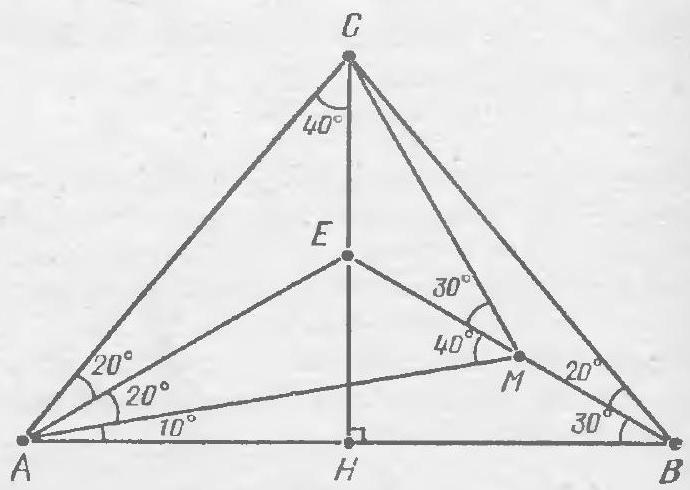
Fig. 16
$BM$ at point $E$ (Fig. 16). Then $AE = BE$ and
\[
\begin{aligned}
& \angle EAM = \angle EAB - \angle MAB = 30^\circ... | 70 | Geometry | math-word-problem | olympiads | 089d9102-438a-5aef-ad60-99fc4af7110b | [
true,
true
] | [
"<think>\nOkay, let's try to figure out this geometry problem. So, we have triangle ABC where AC equals BC, which means it's an isosceles triangle with AB as the base. The angle at C is given as 80 degrees. Then there's a point M inside the triangle such that angle MBA is 30 degrees and angle MAB is 10 degrees. We ... | [
true,
true
] | null | null | 2 | [
{
"content": "9.20. (SFRY, 83). Inside triangle $A B C$, a point $M$ is taken, for which $\\angle M B A=30^{\\circ}, \\angle M A B=10^{\\circ}$. Find $\\angle A M C$, if $\\angle A C B=80^{\\circ}$ and $A C=B C$.",
"role": "user"
},
{
"content": "<think>Hmm , let me visualize this first.\n\nSince AC... |
## Task 1
Find the difference between the numbers 15 and 8. Multiply this difference by the number 4. | $(15-8) \cdot 4=28$ | 28 | Algebra | math-word-problem | olympiads | 102940f7-ddca-59fd-a15a-b6987ca2779e | [
true,
true
] | [
"<think>\nOkay, let me try to figure out this problem step by step. So, the task is to find the difference between the numbers 15 and 8, and then multiply that difference by 4. Hmm, let me break this down.\n\nFirst, I need to find the difference between 15 and 8. Difference in math usually means subtraction, right?... | [
true,
true
] | null | [
"stop",
"stop"
] | 2 | [
{
"content": "## Task 1\n\nFind the difference between the numbers 15 and 8. Multiply this difference by the number 4.",
"role": "user"
},
{
"content": "<think>Hmm , let me break this down.\n\nFirst, I need to find the difference between 15 and 8. Difference in math usually means subtraction, right?... |
Problem 3. We will call a composite natural number $n$ "interesting" if all its natural divisors can be written in ascending order, and each subsequent divisor is divisible by the previous one. Find all "interesting" natural numbers from 20 to 90 (inclusive). | Answer: $25,27,32,49,64,81$.
Solution. "Interesting" can only be numbers of the form $n=p^{k}, k=2,3,4, \ldots$, where $p-$ is a prime number.
Indeed, if we consider the number $n=a \cdot p^{k}$, GCD $(a, p)=1$, then in the sequence of divisors $1, p, \ldots, p^{k}$, the divisor $a$ cannot stand. The situation $\ldot... | 25,27,32,49,64,81 | Number Theory | math-word-problem | olympiads | 375b503d-38ad-5e73-a088-2d0640c8f68a | [
true,
true
] | [
"<think>\nOkay, so I need to find all composite numbers between 20 and 90 inclusive that are \"interesting\". The definition of interesting here is that when you list all their natural divisors in ascending order, each subsequent divisor is divisible by the previous one. Hmm, let me think about how to approach this... | [
false,
true
] | null | [
"stop",
"stop"
] | 1 | [
{
"content": "Problem 3. We will call a composite natural number $n$ \"interesting\" if all its natural divisors can be written in ascending order, and each subsequent divisor is divisible by the previous one. Find all \"interesting\" natural numbers from 20 to 90 (inclusive).",
"role": "user"
},
{
... |
## Task A-3.3. (4 points)
Calculate $144^{\log _{5} 1000}: 10^{6 \log _{5} 12}$. | ## Second Solution.
Let's determine the logarithm (base 5) of the desired number:
$$
\begin{aligned}
\log _{5} \frac{144^{\log _{5} 1000}}{10^{6 \log _{5} 12}} & =\log _{5}\left(144^{\log _{5} 1000}\right)-\log _{5}\left(10^{6 \log _{5} 12}\right) \\
& =\log _{5} 1000 \cdot \log _{5} 144-6 \log _{5} 12 \cdot \log _{5... | 1 | Algebra | math-word-problem | olympiads | 8fcf8134-2937-56a1-acdb-578136dc544b | [
true,
true
] | [
"<think>\nOkay, so I need to calculate this expression: 144 raised to the log base 5 of 1000 divided by 10 raised to 6 times log base 5 of 12. Hmm, let me write that down first to make sure I have it right.\n\nThe problem is: \\( \\frac{144^{\\log_{5} 1000}}{10^{6 \\log_{5} 12}} \\)\n\nAlright, so both the numerato... | [
true,
true
] | null | null | 2 | [
{
"content": "## Task A-3.3. (4 points)\n\nCalculate $144^{\\log _{5} 1000}: 10^{6 \\log _{5} 12}$.",
"role": "user"
},
{
"content": "<think>Hmm , let me write that down first to make sure I have it right.\n\nAlright, so both the numerator and the denominator have exponents involving logarithms with... |
3.50 Two cyclists started simultaneously from the same place in the same direction. A third cyclist started from the same place 10 minutes after them. First, he overtook the first cyclist, and then continued his journey for another 20 minutes before catching up with the second cyclist. From the start to the end of the ... | 3.50 The graphs of the cyclists' movements are shown in Fig. 3.13.
Fig. 3.13
Let's express the distances they have traveled: for the first $A B=\left(\frac{1}{6}+x\right) a$; for the thir... | \frac{1}{4}(+3b+\sqrt{^{2}-10+b^{2}})\mathrm{}/\mathrm{} | Algebra | math-word-problem | olympiads | a0dd1963-f6fa-507a-88f1-4b2c9dc8bbdd | [
true,
true
] | [
"<think>\nOkay, let's try to figure out this problem. So, there are two cyclists who start from the same place at the same time, going in the same direction. The first cyclist has a speed of 'a' km/h, and the second has a speed of 'b' km/h. Then, a third cyclist starts 10 minutes after them. This third cyclist over... | [
false,
false
] | [
true,
false
] | null | 1 | [
{
"content": "3.50 Two cyclists started simultaneously from the same place in the same direction. A third cyclist started from the same place 10 minutes after them. First, he overtook the first cyclist, and then continued his journey for another 20 minutes before catching up with the second cyclist. From the st... |
For positive integers $n,$ let $s(n)$ be the sum of the digits of $n.$ Over all four-digit positive integers $n,$ which value of $n$ maximizes the ratio $\frac{s(n)}{n}$?
[i]Proposed by Michael Tang[/i] | 1. Let \( n \) be a four-digit number, so \( 1000 \leq n \leq 9999 \).
2. Let \( s(n) \) be the sum of the digits of \( n \). We want to maximize the ratio \( \frac{s(n)}{n} \).
3. Consider the effect of increasing \( s(n) \) by 1. This can be done by increasing one of the digits of \( n \) by 1, which increases \( n \... | 1099 | Number Theory | math-word-problem | aops_forum | 8b6eb016-44fb-5c8d-b4d7-fefe35ba694e | [
true,
true
] | [
"<think>\nOkay, so I need to figure out which four-digit number n maximizes the ratio s(n)/n, where s(n) is the sum of the digits of n. Hmm, let's break this down. \n\nFirst, since n is a four-digit number, it ranges from 1000 to 9999. The function s(n) adds up all the digits of n. For example, if n is 1234, then s... | [
true,
true
] | null | null | 2 | [
{
"content": "For positive integers $n,$ let $s(n)$ be the sum of the digits of $n.$ Over all four-digit positive integers $n,$ which value of $n$ maximizes the ratio $\\frac{s(n)}{n}$?\n\n[i]Proposed by Michael Tang[/i]",
"role": "user"
},
{
"content": "<think>Hmm , let's break this down. \n\nI rem... |
10. (7 points) In the repeating decimal 0.2017, if the sum of all digits from the $m$-th digit to the $n$-th digit after the decimal point is 2017, when $m$ takes the minimum value, $n=$ $\qquad$
| 【Solution】Solution: $2+0+1+7=10$,
$$
\begin{array}{l}
2020 \div 10=202, \\
202 \times 4=808,
\end{array}
$$
It can be known that the sum of all digits after the 808th decimal place is 2020.
$$
2020-(2+0+1)=2017 \text{. }
$$
Therefore, the answer to this problem is 808. | 808 | Number Theory | math-word-problem | olympiads | b050c356-5597-5971-8570-427dffcd4bcd | [
true,
true
] | [
"<think>\nOkay, so I need to solve this problem about the repeating decimal 0.2017. The question is asking: In the repeating decimal 0.2017, if the sum of all digits from the m-th digit to the n-th digit after the decimal point is 2017, when m takes the minimum value, what is n?\n\nFirst, let me make sure I underst... | [
true,
true
] | null | null | 2 | [
{
"content": "10. (7 points) In the repeating decimal 0.2017, if the sum of all digits from the $m$-th digit to the $n$-th digit after the decimal point is 2017, when $m$ takes the minimum value, $n=$ $\\qquad$\n\n",
"role": "user"
},
{
"content": "<think>\nOkay, so I need to solve this problem abou... |
86. At some point on a straight line, there is a particle. In the first second, it splits in half, and the halves move in opposite directions to a distance I from the previous position. In the next second, the resulting particles again split in half, and the halves move in opposite directions to a distance 1 from their... | 86. The number and position of particles at moments $t=0$, $1,2,3$ and 4 sec are shown in Fig. 44. We will prove that after
Fig. 44.
$2^{n}-1$ sec there will be $2^{n}$ particles, arranged i... | 4 | Combinatorics | math-word-problem | olympiads | 51121eda-6cba-5103-8433-2ff499c7b3a0 | [
true,
true
] | [
"<think>\nOkay, let's try to figure out this problem step by step. So, we have a particle that starts at some point on a straight line. In the first second, it splits into two halves, which move in opposite directions to a distance of 1 from the original position. Then, in the next second, each of those particles s... | [
true,
true
] | null | null | 2 | [
{
"content": "86. At some point on a straight line, there is a particle. In the first second, it splits in half, and the halves move in opposite directions to a distance I from the previous position. In the next second, the resulting particles again split in half, and the halves move in opposite directions to a... |
1st Putnam 1938 Problem B5 Find the locus of the foot of the perpendicular from the center of a rectangular hyperbola to a tangent. Obtain its equation in polar coordinates and sketch it. Solution | : r 2 = 2k 2 sin 2θ. It is a figure of 8 with its axis along the line y = x and touching the x-axis and y- axis at the origin. Take the hyperbola as xy = k 2 . Then the tangent at (a, k 2 /a) is (y - k 2 /a) = - k 2 /a 2 (x - a). The perpendicular line through the origin is y = a 2 /k 2 x. They intersect at x = 2k 2 /(... | r^2=2k^2\sin2\theta | Geometry | math-word-problem | olympiads | efd0a661-ee33-51e5-9643-fb082e8d0ca6 | [
true
] | [
"<think>\nOkay, so I need to find the locus of the foot of the perpendicular from the center of a rectangular hyperbola to a tangent. Then, I have to find its equation in polar coordinates and sketch it. Hmm, let me start by recalling some basics about hyperbolas, especially rectangular hyperbolas. \n\nFirst, a rec... | [
false
] | [
true
] | null | 1 | [
{
"content": "1st Putnam 1938 Problem B5 Find the locus of the foot of the perpendicular from the center of a rectangular hyperbola to a tangent. Obtain its equation in polar coordinates and sketch it. Solution",
"role": "user"
},
{
"content": "<think>Hmm , let me start by recalling some basics abou... |
Ben is throwing darts at a circular target with diameter 10. Ben never misses the target when he throws a dart, but he is equally likely to hit any point on the target. Ben gets $\lceil 5-x \rceil$ points for having the dart land $x$ units away from the center of the target. What is the expected number of points tha... | 1. **Define the problem and the scoring system:**
- The target is a circle with a diameter of 10 units, hence a radius of 5 units.
- Ben gets $\lceil 5 - x \rceil$ points for hitting a point $x$ units away from the center.
- We need to calculate the expected number of points Ben can earn from a single dart thr... | \frac{11}{5} | Calculus | math-word-problem | aops_forum | 566e4ed3-a22b-52c2-a290-8f0a51acd018 | [
true,
true
] | [
"<think>\nOkay, let's see. Ben is throwing darts at a circular target with a diameter of 10 units. So, the radius is half of that, which is 5 units. That means the maximum distance from the center Ben can hit is 5 units. The problem says Ben never misses, so every throw lands somewhere within that circle. The point... | [
true,
true
] | null | null | 2 | [
{
"content": "Ben is throwing darts at a circular target with diameter 10. Ben never misses the target when he throws a dart, but he is equally likely to hit any point on the target. Ben gets $\\lceil 5-x \\rceil$ points for having the dart land $x$ units away from the center of the target. What is the expec... |
7. Toss a die twice, observe the numbers facing up, the probability that the product of the two numbers is a multiple of 3 is | 7. $\frac{5}{9}$ Detailed Explanation: The product of two numbers being a multiple of 3 includes the following basic events: $(1,3)(2,3)(3,3)(4,3)(5,3)(6,3),(1$,
6) $(2,6)(3,6)(4,6)(5,6)(6,6),(3,1)(3,2)(3,4)(3,5),(6,1)(6,2)(6,4)(6,5)$, a total of 20. Therefore, the probability that the product of two numbers is a multi... | \frac{5}{9} | Combinatorics | math-word-problem | olympiads | 85970e16-1df9-5ce9-820a-4b31b64eee97 | [
true,
true
] | [
"<think>\nOkay, so I need to find the probability that the product of two numbers from tossing a die twice is a multiple of 3. Hmm, let's start by understanding the problem. When you toss a die twice, each die has numbers from 1 to 6. The possible outcomes are all pairs (i,j) where i and j are each between 1 and 6.... | [
true,
true
] | null | null | 2 | [
{
"content": "7. Toss a die twice, observe the numbers facing up, the probability that the product of the two numbers is a multiple of 3 is",
"role": "user"
},
{
"content": "<think>Hmm , let's start by understanding the problem. When you toss a die twice, each die has numbers from 1 to 6. The possib... |
The bases of a trapezoid have lengths 10 and 21, and the legs have lengths $\sqrt{34}$ and $3 \sqrt{5}$. What is the area of the trapezoid? | 1. **Define Variables and Set Up the Problem:**
Let \( h \) be the height of the trapezoid. We draw a perpendicular from the top base to the bottom base, creating a rectangle with height \( h \) and width 10 (the length of the shorter base). This splits the trapezoid into a rectangle and two right triangles.
2. **A... | \frac{93}{2} | Geometry | math-word-problem | aops_forum | be48e5b1-48e0-5db6-984c-85db28df2bed | [
true,
true
] | [
"<think>\nOkay, so I need to find the area of a trapezoid. The problem gives me the lengths of the two bases and the two legs. Let me recall the formula for the area of a trapezoid. If I remember correctly, the area is equal to the average of the two bases multiplied by the height. So, the formula is:\n\n\\[\n\\tex... | [
true,
true
] | null | null | 2 | [
{
"content": "The bases of a trapezoid have lengths 10 and 21, and the legs have lengths $\\sqrt{34}$ and $3 \\sqrt{5}$. What is the area of the trapezoid?",
"role": "user"
},
{
"content": "<think>\nOkay, so I need to find the area of a trapezoid. The problem gives me the lengths of the two bases a... |
4. (10 points) As shown in the figure, the area of circle $O$ is $32, O C \perp A B, \angle A O E=\angle E O D, \angle C O F=\angle F O D$, then the area of sector $E O F$ is | 4
【Analysis】We can use the relationship between the radians to first find the radian of $E O F$, which can be divided into two radians, $E O C$ and $C O F$. Using the known radian relationships, it is not difficult to find the radian of $E O F$, and the area can also be easily calculated.
【Solution】According to the ana... | 4 | Geometry | math-word-problem | olympiads | f96951ea-029b-5038-882d-8ecf226dc90d | [
true,
true
] | [
"<think>\nOkay, let me try to figure out this problem step by step. So, we have circle O with an area of 32. The problem mentions OC is perpendicular to AB, and there are some angle equalities: angle AOE equals angle EOD, and angle COF equals angle FOD. We need to find the area of sector EOF.\n\nFirst, since the ar... | [
true,
true
] | null | [
"stop",
"stop"
] | 2 | [
{
"content": "4. (10 points) As shown in the figure, the area of circle $O$ is $32, O C \\perp A B, \\angle A O E=\\angle E O D, \\angle C O F=\\angle F O D$, then the area of sector $E O F$ is",
"role": "user"
},
{
"content": "<think>Hmm , but maybe I don't need the exact value of r right away. Sin... |
## Task A-4.3.
On the edge of a square, a total of $4 n$ points are marked: all four vertices of the square and an additional $n-1$ points on each side of the square. Determine the number of all (non-degenerate) triangles for which the marked points are vertices. | ## First solution.
From the given $4 n$ points, we can choose three points in $\binom{4 n}{3}$ ways.
However, these three points will be vertices of a triangle only if they do not lie on the same side. (1 point) Let's count how many ways we can choose three points on one side of the square. Since there are $n+1$ poin... | \binom{4n}{3}-4\binom{n+1}{3} | Combinatorics | math-word-problem | olympiads | 903432c0-2d4e-557e-9749-718978af0b82 | [
true,
true
] | [
"<think>\nOkay, let's see. The problem is about counting the number of non-degenerate triangles formed by 4n marked points on a square. Each side of the square has n-1 additional points plus the vertices, making n points per side. So, total points are 4n. The task is to find how many triangles can be formed with th... | [
true,
true
] | null | null | 2 | [
{
"content": "## Task A-4.3.\n\nOn the edge of a square, a total of $4 n$ points are marked: all four vertices of the square and an additional $n-1$ points on each side of the square. Determine the number of all (non-degenerate) triangles for which the marked points are vertices.",
"role": "user"
},
{
... |
14. (15 points) A fruit shop uses three types of fruits to make fruit baskets. Each basket contains 2 Hami melons, 4 dragon fruits, and 10 kiwis. The shop has 10 more dragon fruits than 3 times the number of Hami melons, and the number of kiwis is twice the number of dragon fruits. After using all the Hami melons, ther... | 【Analysis】(1) All the fruit baskets use 2 cantaloupes, 4 dragon fruits, and 8 kiwis. When all the cantaloupes are used up, the number of dragon fruits used is twice that of the cantaloupes. According to the problem, a line segment diagram can help understand:
Cantaloupes $\qquad$
Dragon fruits 1, ,
The remaining 130 c... | 140 | Algebra | math-word-problem | olympiads | bf284ea3-3ffd-5acb-8ed5-008cebdcde29 | [
true,
true
] | [
"<think>\nOkay, let me try to figure out this fruit basket problem. Hmm, so the shop uses three types of fruits: Hami melons, dragon fruits, and kiwis. Each basket has 2 Hami melons, 4 dragon fruits, and 10 kiwis. The problem gives some relationships between the numbers of these fruits and tells us that after using... | [
true,
true
] | null | [
"stop",
"stop"
] | 2 | [
{
"content": "14. (15 points) A fruit shop uses three types of fruits to make fruit baskets. Each basket contains 2 Hami melons, 4 dragon fruits, and 10 kiwis. The shop has 10 more dragon fruits than 3 times the number of Hami melons, and the number of kiwis is twice the number of dragon fruits. After using all... |
Example 4 For all $a, b, c \in \mathbf{R}^{+}$, find the minimum value of $f(a, b, c)=\frac{a}{\sqrt{a^{2}+8 b c}}+\frac{b}{\sqrt{b^{2}+8 a c}}+\frac{c}{\sqrt{c^{2}+8 a b}}$. | Let's make the following substitutions: $x=\frac{a}{\sqrt{a^{2}+8 b c}}, y=\frac{b}{\sqrt{b^{2}+8 a c}}, z=\frac{c}{\sqrt{c^{2}+8 a b}}$,
then $x, y, z \in(0,+\infty) . x^{2}=\frac{a^{2}}{a^{2}+8 b c}$, hence, $\frac{1}{x^{2}}-1=\frac{8 b c}{a^{2}}$.
Similarly, we have $\frac{1}{y^{2}}-1=\frac{8 a c}{b^{2}}, \frac{1}{z... | 1 | Inequalities | math-word-problem | olympiads | c8bec3b2-cfee-55db-a19e-e666d1dd85f0 | [
true,
true
] | [
"<think>\nOkay, so I need to find the minimum value of this function f(a, b, c) where a, b, c are all positive real numbers. The function is given by the sum of three terms: each term is a variable divided by the square root of that variable squared plus eight times the product of the other two variables. Let me wr... | [
true,
true
] | null | null | 2 | [
{
"content": "Example 4 For all $a, b, c \\in \\mathbf{R}^{+}$, find the minimum value of $f(a, b, c)=\\frac{a}{\\sqrt{a^{2}+8 b c}}+\\frac{b}{\\sqrt{b^{2}+8 a c}}+\\frac{c}{\\sqrt{c^{2}+8 a b}}$.",
"role": "user"
},
{
"content": "<think>Hmm , interesting. So each term in the sum has a similar struc... |
Last summer $100$ students attended basketball camp. Of those attending, $52$ were boys and $48$ were girls. Also, $40$ students were from Jonas Middle School and $60$ were from Clay Middle School. Twenty of the girls were from Jonas Middle School. How many of the boys were from Clay Middle School?
$\text{(A)}\ 20 ... | Make a table with the information given.
\[\begin{tabular}{c|ccc} & \text{Jonas} & \text{Clay} & \text{total} \\ \hline \text{boys} & & & 52 \\ \text{girls} & 20 & & 48 \\ \text{total} & 40 & 60 & 100 \end{tabular}\]
Because the first two columns must add up to the third column, and the same with the rows, the rest of... | 32 | Combinatorics | MCQ | amc_aime | dd1d18c2-0c2f-5de0-8445-c109ab7116bb | [
true,
true
] | [
"<think>\nOkay, so I need to figure out how many of the boys at the basketball camp were from Clay Middle School. Let's see. The problem says there were 100 students total. Out of these, 52 were boys and 48 were girls. Then, in terms of schools, 40 students were from Jonas Middle School and 60 were from Clay Middle... | [
false,
false
] | [
true,
false
] | null | 1 | [
{
"content": "Last summer $100$ students attended basketball camp. Of those attending, $52$ were boys and $48$ were girls. Also, $40$ students were from Jonas Middle School and $60$ were from Clay Middle School. Twenty of the girls were from Jonas Middle School. How many of the boys were from Clay Middle Sc... |
(Inspired by IMO 1972 Longlist 1, treated)
Find all integers $x$ such that $x^{4}+x^{3}+x^{2}+x+1$ is a perfect square. | Suppose $x$ is a solution, then $4\left(x^{4}+x^{3}+x^{2}+x+1\right)$ is also a perfect square. Now, $\left(2 x^{2}+x\right)^{2}=4 x^{4}+4 x^{3}+x^{2}, 4\left(x^{4}+x^{3}+x^{2}+x+1\right)>\left(2 x^{2}+x\right)^{2}$ if and only if $3 x^{2}+4 x+4>0$, if and only if $2 x^{2}+(x+2)^{2}>0$, which is always true.
Furthermo... | -1,0,3 | Number Theory | math-word-problem | olympiads | 5524a459-d10d-57e7-b8a3-bbd671f47725 | [
true,
true
] | [
"<think>\nOkay, so I need to find all integers x where the expression x⁴ + x³ + x² + x + 1 is a perfect square. Hmm, let me start by understanding the problem better. The polynomial given is a quartic, which might be tricky, but maybe there's a way to factor it or find some patterns.\n\nFirst, let me recall that x⁴... | [
true,
true
] | null | [
"stop",
"stop"
] | 2 | [
{
"content": "(Inspired by IMO 1972 Longlist 1, treated)\n\nFind all integers $x$ such that $x^{4}+x^{3}+x^{2}+x+1$ is a perfect square.",
"role": "user"
},
{
"content": "<think>Hmm , let me start by understanding the problem better. The polynomial given is a quartic, which might be tricky, but mayb... |
7. After an exam, if some of the high scores are removed in order, the class average will decrease; conversely, if some of the low scores are removed in order, the class average will increase. These two facts can be described mathematically as: if the finite sequence $a_{1}, a_{2}, \cdots, a_{n}$ satisfies $a_{1} \leqs... | 7. $\frac{a_{1}+a_{2}+\cdots+a_{m}}{m} \leqslant \frac{a_{1}+a_{2}+\cdots+a_{n}}{n}(1 \leqslant m<n)$ and $\frac{a_{m+1}+a_{m+2}+\cdots+a_{n}}{n-m} \geqslant$ $\frac{a_{1}+a_{2}+\cdots+a_{n}}{n}(1 \leqslant m<n)$ | \frac{a_{1}+a_{2}+\cdots+a_{}}{}\leqslant\frac{a_{1}+a_{2}+\cdots+a_{n}}{n}(1\leqslant<n) | Algebra | math-word-problem | olympiads | 66f1eadb-f665-5068-9c46-6db4f9d80cbc | [
true,
true
] | [
"<think>\nOkay, let's try to figure out this problem. So, the question is about a class average changing when high scores or low scores are removed. The sequence of scores is ordered from least to greatest, right? So, a1 is the lowest score, up to an, which is the highest. The problem states that if we remove some ... | [
false,
false
] | [
true,
true
] | null | 2 | [
{
"content": "7. After an exam, if some of the high scores are removed in order, the class average will decrease; conversely, if some of the low scores are removed in order, the class average will increase. These two facts can be described mathematically as: if the finite sequence $a_{1}, a_{2}, \\cdots, a_{n}$... |
2. Let $m$ be a given positive integer, then the largest positive integer $n$ such that $m^{2}+n$ divides $n^{2}+m$ is $\qquad$ . | 2. $m^{4}-m^{2}+m$.
From the problem, we know that $\frac{n^{2}+m}{n+m^{2}} \in \mathbf{Z}$.
Since $\frac{n^{2}+m}{n+m^{2}}$
$=\frac{\left(n+m^{2}\right)^{2}-2 m^{2}\left(n+m^{2}\right)+m^{4}+m}{n+m^{2}}$
$=n+m^{2}-2 m^{2}+\frac{m^{4}+m}{n+m^{2}}$,
therefore, $\frac{m^{4}+m}{n+m^{2}}$ is a positive integer.
Thus, $n+m... | m^{4}-m^{2}+m | Number Theory | math-word-problem | cn_contest | eaabd4bc-40aa-5a3d-b133-4c441999ac80 | [
true,
true
] | [
"<think>\nOkay, so the problem is: Given a positive integer m, find the largest positive integer n such that m² + n divides n² + m. Hmm, interesting. I need to find the maximum n for which this divisibility condition holds. Let me think step by step.\n\nFirst, let's parse the problem. We have two variables, m and n... | [
true,
true
] | null | null | 2 | [
{
"content": "2. Let $m$ be a given positive integer, then the largest positive integer $n$ such that $m^{2}+n$ divides $n^{2}+m$ is $\\qquad$ .",
"role": "user"
},
{
"content": "<think>Hmm , interesting. I need to find the maximum n for which this divisibility condition holds. Let me think step by ... |
Problem 4. Five numbers $2,0,1,9,0$ are written in a circle on the board in the given order clockwise (the last zero is written next to the first two). In one move, the sum of each pair of adjacent numbers is written between them. For example, such an arrangement of numbers (on the right) will be after the first move:
... | Answer: $8 \cdot 3^{5}=1944$.
Solution. Let's see how the numbers between the first and second zero (which Polina will count at the end) change. On each move, each "old" number is included as an addend in two "new" numbers. This means that if all the "new" numbers are added together, each "old" number will be summed t... | 1944 | Logic and Puzzles | math-word-problem | olympiads | d5fb2bc7-ca5c-5371-9579-1405ce2dea21 | [
true,
true
] | [
"<think>\nOkay, let's see. So the problem is about five numbers arranged in a circle: 2, 0, 1, 9, 0, in that order clockwise. The process is that in each move, we insert the sum of each pair of adjacent numbers between them. After five such moves, Polina calculates the sum of all numbers from the first zero (origin... | [
true,
false
] | null | null | 1 | [
{
"content": "Problem 4. Five numbers $2,0,1,9,0$ are written in a circle on the board in the given order clockwise (the last zero is written next to the first two). In one move, the sum of each pair of adjacent numbers is written between them. For example, such an arrangement of numbers (on the right) will be ... |
4. In $\triangle A B C$, the sides opposite to angles $A, B, C$ are denoted as $a, b, c (b \neq 1)$, respectively, and $\frac{C}{A}, \frac{\sin B}{\sin A}$ are both roots of the equation $\log _{\sqrt{6}} x=\log _{6}(4 x-4)$. Then $\triangle A B C$
(A) is an isosceles triangle, but not a right triangle;
(B) is a right ... | 4. (B)
From the given equation, we have
$$
\log _{b} x^{2}=\log _{6}(4 x-4),
$$
which implies
$$
x^{2}-4 x+4=0,
$$
The roots obtained are
$$
\text { - } x_{1}=x_{2}=2 \text {. }
$$
Thus, $C=2A$ and $\sin B=2 \sin A$,
Since $A+B+C=180^{\circ}$, we have $3A+B=180^{\circ}$,
Therefore,
$$
\sin B=\sin 3A,
$$
So,
$$
2 \... | B | Algebra | MCQ | olympiads | 37c65791-b0b3-5f87-ae76-3dfdf4a1def3 | [
true,
true
] | [
"<think>\nOkay, so I have this geometry problem here about triangle ABC. The question says that in triangle ABC, the sides opposite angles A, B, C are a, b, c respectively, with b not equal to 1. It also mentions that both C/A (the ratio of angle C to angle A) and sin B / sin A are roots of the equation log base sq... | [
true,
true
] | null | null | 2 | [
{
"content": "4. In $\\triangle A B C$, the sides opposite to angles $A, B, C$ are denoted as $a, b, c (b \\neq 1)$, respectively, and $\\frac{C}{A}, \\frac{\\sin B}{\\sin A}$ are both roots of the equation $\\log _{\\sqrt{6}} x=\\log _{6}(4 x-4)$. Then $\\triangle A B C$\n(A) is an isosceles triangle, but not ... |
2A. 4B. For triangle $ABC$, the following holds: $\overline{AB}=5, \overline{BC}=8, \beta=120^{\circ}$. The line through vertex $A$ that is perpendicular to side $AB$ and the line through vertex $C$ that is perpendicular to $BC$ intersect at point $D$. Calculate the length of segment $CD$. | Solution. From the conditions of the problem, it follows that $\measuredangle A D C=60^{\circ}$. Let the line $C M$ be perpendicular to $A B$, $M \in A B$ and let the line $C N$ be perpendicular to $A D$, $N \in A D$. Then,
$$
\measuredangle N C D=30^{\circ}, \measuredangle C B M=60^{\circ} \text { and } \measuredangl... | 6\sqrt{3} | Geometry | math-word-problem | olympiads | 9801b6f7-fe6a-564b-acb2-f877094964e0 | [
true,
true
] | [
"<think>\nOkay, so I need to solve this geometry problem about triangle ABC. Let me see... The problem says that AB is 5 units long, BC is 8 units, and angle B is 120 degrees. Then there are two lines: one through vertex A that's perpendicular to AB, and another through vertex C that's perpendicular to BC. These tw... | [
true,
true
] | null | null | 2 | [
{
"content": "2A. 4B. For triangle $ABC$, the following holds: $\\overline{AB}=5, \\overline{BC}=8, \\beta=120^{\\circ}$. The line through vertex $A$ that is perpendicular to side $AB$ and the line through vertex $C$ that is perpendicular to $BC$ intersect at point $D$. Calculate the length of segment $CD$.",
... |
Each of the $2N = 2004$ real numbers $x_1, x_2, \ldots , x_{2004}$ equals either $\sqrt 2 -1 $ or $\sqrt 2 +1$. Can the sum $\sum_{k=1}^N x_{2k-1}x_2k$ take the value $2004$? Which integral values can this sum take? | 1. Given \(2N = 2004\), we have \(N = 1002\). Each \(x_i\) is either \(\sqrt{2} - 1\) or \(\sqrt{2} + 1\).
2. Let \(x = \sqrt{2} + 1\). Then, we have:
\[
x + \frac{1}{x} = 2\sqrt{2}
\]
Squaring both sides:
\[
x^2 + 2 + \frac{1}{x^2} = 8 \implies x^2 + \frac{1}{x^2} = 6
\]
3. Since \(x_i \in \{\sq... | \{1002, 1006, 1010, \ldots, 3006\} | Algebra | math-word-problem | aops_forum | 0163dffa-dc03-57fe-9adf-c750e43fee67 | [
true,
true
] | [
"<think>\nOkay, let's see. The problem is about 2004 real numbers, each either √2 -1 or √2 +1. We need to determine if the sum of the products x₁x₂ + x₃x₄ + ... + x_{2003}x_{2004} can equal 2004, and also find all integer values this sum can take.\n\nFirst, let me parse the problem again. There are 2004 numbers, wh... | [
false,
false
] | [
true,
true
] | null | 2 | [
{
"content": "Each of the $2N = 2004$ real numbers $x_1, x_2, \\ldots , x_{2004}$ equals either $\\sqrt 2 -1 $ or $\\sqrt 2 +1$. Can the sum $\\sum_{k=1}^N x_{2k-1}x_2k$ take the value $2004$? Which integral values can this sum take?",
"role": "user"
},
{
"content": "<think>Hmm , okay. Let's think s... |
## Task B-4.2.
On the planet "Anything is Possible," children play a game in which each of them has to choose numbers from the set of odd natural numbers less than 1000 within a certain time. In this game, the sum of no pair of different numbers chosen by any child is 1002. The winner is the one who selects the most s... | Solution.
There are 500 odd numbers less than 1000. We group them into pairs whose sum is 1002:
$$
(3,999),(5,997), \ldots,(497,505),(499,503)
$$
There are 249 such pairs. Both numbers in a pair cannot be chosen. The numbers 1 and 501 do not have a pair, so they can be chosen.
We conclude that a child, or the winne... | 2^{249} | Combinatorics | math-word-problem | olympiads | 0f1ff023-4edf-5a7d-848d-9f7126c2a083 | [
true,
true
] | [
"<think>\nOkay, so I need to solve this problem from the planet \"Anything is Possible.\" Let me read it again carefully.\n\nThe problem says that children choose numbers from the set of odd natural numbers less than 1000. The key rule is that the sum of no pair of different numbers chosen by any child is 1002. The... | [
true,
true
] | null | null | 2 | [
{
"content": "## Task B-4.2.\n\nOn the planet \"Anything is Possible,\" children play a game in which each of them has to choose numbers from the set of odd natural numbers less than 1000 within a certain time. In this game, the sum of no pair of different numbers chosen by any child is 1002. The winner is the ... |
3B. Given a right triangle СВА with legs of length 3 and 4. Squares BCSR and $A B Q P$ are constructed outside the triangle on the smaller leg and the hypotenuse, respectively. Calculate the area of triangle $B R Q$. | Solution. By the Pythagorean theorem, the length of the hypotenuse is 5.
Let $\measuredangle A B C=\beta$ and $\quad \measuredangle Q B R=\theta$ (see diagram). From
$$
\measuredangle A B Q=\measuredangle C B R=90^{\circ},
$$
we have
$$
\beta+\theta=180^{\circ} \text { i.e. } \theta=180^{\circ}-\beta \text {. }
$$
... | 6 | Geometry | math-word-problem | olympiads | 1744fc17-d580-532f-9c05-95a3979906a0 | [
true,
true
] | [
"<think>\nOkay, let me try to figure out this geometry problem step by step. So, we have a right triangle CBA with legs of length 3 and 4. The right angle is at point C, I assume? Wait, the problem says it's a right triangle СВА. Hmm, maybe the notation is different. Let me parse that.\n\nIn triangle CBA, the legs ... | [
false,
true
] | null | null | 1 | [
{
"content": "3B. Given a right triangle СВА with legs of length 3 and 4. Squares BCSR and $A B Q P$ are constructed outside the triangle on the smaller leg and the hypotenuse, respectively. Calculate the area of triangle $B R Q$.",
"role": "user"
},
{
"content": "<think>Hmm , let me visualize this ... |
B2. In the first semester, there were twice as many boys as girls in class $B$, and the number of boys was equal to the number of girls in class $A$. In the second semester, two boys transferred from class $B$ to class $A$, and 6 girls transferred from class $A$ to class $B$. At that time, there were twice as many boys... | B2. Let $\mathrm{z} x$ be the number of boys or girls $\mathrm{v}$ in class $A$, and $\mathrm{z} y$ be the number of girls $\mathrm{v}$ in class $B$ in the 1st semester. Let's write the number of boys and girls in the first and second semesters in a table.
| | class $A$ | | class $B$ | |
| :---: | :---: | :---: | :... | 14girlsinclassA,9girlsinclassB | Algebra | math-word-problem | olympiads | 972aaa5a-2564-56f6-a461-56d0f8895b9b | [
true,
true
] | [
"<think>\nOkay, let's try to tackle this problem step by step. First, I need to understand what the problem is asking. It's about two classes, A and B, with some numbers of boys and girls in the first semester, and then some transfers happening in the second semester, leading to new ratios of boys to girls in both ... | [
false,
false
] | [
false,
true
] | null | 1 | [
{
"content": "B2. In the first semester, there were twice as many boys as girls in class $B$, and the number of boys was equal to the number of girls in class $A$. In the second semester, two boys transferred from class $B$ to class $A$, and 6 girls transferred from class $A$ to class $B$. At that time, there w... |
Let $M = \{(a,b,c)\in R^3 :0 <a,b,c<\frac12$ with $a+b+c=1 \}$ and $f: M\to R$ given as $$f(a,b,c)=4\left(\frac{1}{a}+\frac{1}{b}+\frac{1}{c}\right)-\frac{1}{abc}$$
Find the best (real) bounds $\alpha$ and $\beta$ such that $f(M) = \{f(a,b,c): (a,b,c)\in M\}\subseteq [\alpha,\beta]$ and determine whether any of th... | To find the best bounds $\alpha$ and $\beta$ for the function $f(a,b,c) = 4\left(\frac{1}{a} + \frac{1}{b} + \frac{1}{c}\right) - \frac{1}{abc}$ over the set $M = \{(a,b,c) \in \mathbb{R}^3 : 0 < a, b, c < \frac{1}{2}, a + b + c = 1\}$, we need to analyze the behavior of $f$ on the boundary and within the interior of $... | [8, 9] | Inequalities | math-word-problem | aops_forum | f29a6f12-f0d9-5433-8266-ebff49d19bbb | [
true
] | [
"<think>\nAlright, so I need to find the best real bounds α and β for the function f(a,b,c) = 4(1/a + 1/b + 1/c) - 1/(abc), where a, b, c are real numbers between 0 and 1/2, and they satisfy a + b + c = 1. Then, I have to check if these bounds are actually achievable. Hmm, okay, let's break this down step by step.\... | [
false
] | [
true
] | null | 1 | [
{
"content": "Let $M = \\{(a,b,c)\\in R^3 :0 <a,b,c<\\frac12$ with $a+b+c=1 \\}$ and $f: M\\to R$ given as $$f(a,b,c)=4\\left(\\frac{1}{a}+\\frac{1}{b}+\\frac{1}{c}\\right)-\\frac{1}{abc}$$\nFind the best (real) bounds $\\alpha$ and $\\beta$ such that $f(M) = \\{f(a,b,c): (a,b,c)\\in M\\}\\subseteq [\\alph... |
Subsets and Splits
No community queries yet
The top public SQL queries from the community will appear here once available.