
problem string | solution string | answer string | problem_type string | question_type string | source string | uuid string | is_reasoning_complete list | generations list | correctness_math_verify list | correctness_llama list | finish_reasons list | correctness_count int64 | messages list |
|---|---|---|---|---|---|---|---|---|---|---|---|---|---|
12. If sets $A_{1}$ and $A_{2}$ satisfy $A_{1} \cup A_{2}=A$, then we denote $\left[A_{1}, A_{2}\right]$ as a pair of subset partitions of $A$. It is stipulated that: $\left[A_{1}, A_{2}\right]$ and $\left[A_{2}, A_{1}\right]$ are considered the same pair of subset partitions of $A$. Given the set $A=\{1,2,3\}$. Then, ... | 12. 14.
Divide into three categories.
First category: When at least one of $A_{1}$ and $A_{2}$ is $A$ (let's assume $A_{1}=A$), then $A_{2}$ can be any subset of $A$, for a total of 8 different subset decompositions.
Second category: $A_{1}$ and $A_{2}$ are one-element and two-element subsets, respectively, with the ... | 14 | Combinatorics | math-word-problem | cn_contest | 7060e65d-62fc-5853-a2cf-2b0ad5ac51e1 | [
true,
true
] | [
"<think>\nOkay, so I need to find the number of different pairs of subset partitions of the set A = {1, 2, 3}. The problem says that a pair [A₁, A₂] is a subset partition if A₁ ∪ A₂ = A, and that [A₁, A₂] is the same as [A₂, A₁]. So, order doesn't matter here. \n\nFirst, let me make sure I understand what a subset ... | [
true,
true
] | null | null | 2 | [
{
"content": "12. If sets $A_{1}$ and $A_{2}$ satisfy $A_{1} \\cup A_{2}=A$, then we denote $\\left[A_{1}, A_{2}\\right]$ as a pair of subset partitions of $A$. It is stipulated that: $\\left[A_{1}, A_{2}\\right]$ and $\\left[A_{2}, A_{1}\\right]$ are considered the same pair of subset partitions of $A$. Given ... |
10. From 7:00 to 8:00 in the morning is the peak hour in a city, during which all vehicles travel at half their original speed. Every morning at 6:50, two people, A and B, start from points $A$ and $B$ respectively, heading towards each other, and meet at a point 24 kilometers from $A$. If A starts 20 minutes later, th... | 【Solution】Solution: A starts 20 minutes later, by which time B has already walked 10 minutes at a fast pace and 10 minutes at a slow pace (i.e., 15 minutes at a fast pace), and B starts 20 minutes earlier, which means B has already walked 20 minutes at a fast pace. Therefore, the midpoint should be at the $\frac{3}{4}$... | 42 | Algebra | math-word-problem | olympiads | 22fe929f-9dd3-51ec-b03e-f5d5edacd01e | [
true,
false
] | [
"<think>\nOkay, so I need to solve this problem about two people, A and B, starting from points A and B, heading towards each other. The problem involves different meeting points depending on their start times, and I need to find the distance between A and B. Hmm, let me try to parse all the information step by ste... | [
true,
false
] | null | null | 1 | [
{
"content": "10. From 7:00 to 8:00 in the morning is the peak hour in a city, during which all vehicles travel at half their original speed. Every morning at 6:50, two people, A and B, start from points $A$ and $B$ respectively, heading towards each other, and meet at a point 24 kilometers from $A$. If A start... |
$9 \cdot 42$ Remove 100 digits from the given number $123456789101112 \cdots 9899100$ so that the remaining number is the largest possible. | [Solution] Since among natural numbers with the same number of digits, the number with a larger first digit is larger, we first remove 84 digits that are not 9 before 50, resulting in 9999950515253545556575899100. Then, starting from the 6th digit of the resulting number, we continuously remove 15 digits $5,0,5,1,5,2,5... | 999997859606162\cdots9899100 | Number Theory | math-word-problem | olympiads | a6ccf2a3-dc75-57b9-a9c4-0db7ed76efd5 | [
true
] | [
"<think>\nOkay, so I need to figure out how to remove 100 digits from the long number formed by concatenating all numbers from 1 to 100. The goal is to leave the largest possible number remaining. Hmm, let me start by understanding the problem better.\n\nFirst, let's reconstruct the original number. It starts with ... | [
false
] | [
true
] | null | 1 | [
{
"content": "$9 \\cdot 42$ Remove 100 digits from the given number $123456789101112 \\cdots 9899100$ so that the remaining number is the largest possible.",
"role": "user"
},
{
"content": "<think>Hmm , let me start by understanding the problem better.\n\nFirst, let's reconstruct the original number... |
In the given figure, $A \widehat{O} D$ and $B \widehat{O} Y$ are right angles, and the measure of $D \widehat{O} Y$ is between $40^{\circ}$ and $50^{\circ}$. Additionally, points $C$ and $Y$ are on line $r$, while $D$ and $E$ are on line $s$. The possible value for the measure of $A \widehat{O} C$ is between
(a) $30^{... | The correct answer is (b).
We have $A \widehat{O} C+C \widehat{O} E=90^{\circ}$ and $C \widehat{O} E=D \widehat{O} Y$. Therefore, $A \widehat{O} C=90^{\circ}-D \widehat{O} Y$. Since $D \widehat{O} Y$ is between $40^{\circ}$ and $50^{\circ}$, it follows that $A \widehat{O} C$ is between $90^{\circ}-50^{\circ}=40^{\circ... | 40 | Geometry | MCQ | olympiads | 5b0802ee-2e78-59dd-9f5a-96a0d6ddcc55 | [
true,
true
] | [
"<think>\nOkay, so I need to figure out the possible value for the measure of angle AOC. The given information is that angles AOD and BOY are right angles, which means they are 90 degrees each. Also, the measure of angle DOY is between 40 and 50 degrees. Points C and Y are on line r, and D and E are on line s. \n\n... | [
false,
false
] | [
true,
false
] | null | 1 | [
{
"content": "In the given figure, $A \\widehat{O} D$ and $B \\widehat{O} Y$ are right angles, and the measure of $D \\widehat{O} Y$ is between $40^{\\circ}$ and $50^{\\circ}$. Additionally, points $C$ and $Y$ are on line $r$, while $D$ and $E$ are on line $s$. The possible value for the measure of $A \\widehat... |
In a triangle $ABC$, the median $AD$ (with $D$ on $BC$) and the angle bisector $BE$ (with $E$ on $AC$) are perpedicular to each other. If $AD = 7$ and $BE = 9$, find the integer nearest to the area of triangle $ABC$. | 1. **Identify the given information and setup the problem:**
- In triangle \(ABC\), the median \(AD\) and the angle bisector \(BE\) are perpendicular to each other.
- \(AD = 7\) and \(BE = 9\).
- We need to find the integer nearest to the area of triangle \(ABC\).
2. **Determine the properties of the median a... | 47 | Geometry | math-word-problem | aops_forum | abecdd35-b5ad-56ed-bb92-3949fa9348e5 | [
false,
false,
true,
true
] | [
"<think>\nOkay, so I need to find the area of triangle ABC where the median AD and the angle bisector BE are perpendicular to each other. Given AD is 7 units and BE is 9 units. The answer should be the nearest integer. Alright, let's start by drawing a rough diagram in my mind. Triangle ABC, with D being the midpoi... | [
false,
false,
true,
true
] | null | null | 2 | [
{
"content": "In a triangle $ABC$, the median $AD$ (with $D$ on $BC$) and the angle bisector $BE$ (with $E$ on $AC$) are perpedicular to each other. If $AD = 7$ and $BE = 9$, find the integer nearest to the area of triangle $ABC$.",
"role": "user"
},
{
"content": "<think>Hmm , let's break this down ... |
In triangle $ABC$, $AB=20$ and $AC=11$. The angle bisector of $\angle A$ intersects $BC$ at point $D$, and point $M$ is the midpoint of $AD$. Let $P$ be the point of the intersection of $AC$ and $BM$. The ratio of $CP$ to $PA$ can be expressed in the form $\dfrac{m}{n}$, where $m$ and $n$ are relatively prime positive ... | [asy] pointpen = black; pathpen = linewidth(0.7); pair A = (0,0), C= (11,0), B=IP(CR(A,20),CR(C,18)), D = IP(B--C,CR(B,20/31*abs(B-C))), M = (A+D)/2, P = IP(M--2*M-B, A--C), D2 = IP(D--D+P-B, A--C); D(MP("A",D(A))--MP("B",D(B),N)--MP("C",D(C))--cycle); D(A--MP("D",D(D),NE)--MP("D'",D(D2))); D(B--MP("P",D(P))); D(MP("... | 51 | Geometry | math-word-problem | amc_aime | d5f26114-7b3c-5d72-ae24-934432b7c34e | [
true,
true
] | [
"<think>\nOkay, so I have this geometry problem here. Let me read it again and try to visualize what's going on. \n\nIn triangle ABC, AB is 20 units, and AC is 11 units. The angle bisector of angle A intersects BC at point D. Then, point M is the midpoint of AD. BM intersects AC at point P. I need to find the ratio... | [
true,
true
] | null | null | 2 | [
{
"content": "In triangle $ABC$, $AB=20$ and $AC=11$. The angle bisector of $\\angle A$ intersects $BC$ at point $D$, and point $M$ is the midpoint of $AD$. Let $P$ be the point of the intersection of $AC$ and $BM$. The ratio of $CP$ to $PA$ can be expressed in the form $\\dfrac{m}{n}$, where $m$ and $n$ are re... |
Three, (50 points) Find the smallest real number $\lambda$, such that for any positive integer $n$, we have $(n,[n \sqrt{5}])<\lambda \sqrt{n}$, where $(a, b)$ denotes the greatest common divisor of the positive integers $a$ and $b$, and $[x]$ denotes the greatest integer not exceeding the real number $x$.
将上面的文本翻译成英文... | Three, first prove: for any positive integer $n$, we have
$$
(n,[n \sqrt{5}])\sqrt[4]{20-\varepsilon} \sqrt{n} \text {. }
$$
Notice that, the second type of Pell's equation $x^{2}-5 y^{2}=-1$ has a positive integer solution $(x, y)=(2,1)$. Therefore, this equation has infinitely many positive integer solutions. Take a... | \sqrt[4]{20} | Combinatorics | math-word-problem | olympiads | 6c8ffece-b22c-505d-bcfd-efb4ad895a1e | [
true,
true
] | [
"<think>\n\n</think>\n\nYou will be given a problem. Please reason step by step, and put your final answer within \\boxed{}:\nThree, (50 points) Find the smallest real number $\\lambda$, such that for any positive integer $n$, we have $\\gcd(n,\\lfloor n \\sqrt{5} \\rfloor)<\\lambda \\sqrt{n}$, where $\\gcd(a, b)$ ... | [
false,
false
] | [
true,
false
] | null | 1 | [
{
"content": "Three, (50 points) Find the smallest real number $\\lambda$, such that for any positive integer $n$, we have $(n,[n \\sqrt{5}])<\\lambda \\sqrt{n}$, where $(a, b)$ denotes the greatest common divisor of the positive integers $a$ and $b$, and $[x]$ denotes the greatest integer not exceeding the rea... |
3. In the right trapezoid $A B C D$, it is known that $\angle A=$ $\angle D=90^{\circ}, D E \perp A C$ at point $E, \angle A C D=$ $\angle E B C=30^{\circ}, A D=\sqrt{3}$. Then $B C=$ $\qquad$ | 3. 3 .
As shown in Figure 3, from the given conditions we know
$$
\begin{array}{l}
\angle A D E=\angle C A B \\
=30^{\circ} \\
\Rightarrow \triangle C B E \backsim \triangle C A B \\
\Rightarrow \frac{C B}{C E}=\frac{C A}{C B} \\
\Rightarrow C B^{2}=C E \cdot C A . \\
\text { Also, } C D^{2}=C E \cdot C A, \text { thu... | 3 | Geometry | math-word-problem | olympiads | 089c1c48-b150-543f-abfd-40c54faba6f4 | [
true,
true
] | [
"<think>\nOkay, let's see. I need to find the length of BC in this right trapezoid ABCD. The given information is that angles A and D are 90 degrees, DE is perpendicular to AC at point E, angles ACD and EBC are both 30 degrees, and AD is √3. Hmm, right trapezoid means that two sides are parallel and the other two s... | [
true,
true
] | null | null | 2 | [
{
"content": "3. In the right trapezoid $A B C D$, it is known that $\\angle A=$ $\\angle D=90^{\\circ}, D E \\perp A C$ at point $E, \\angle A C D=$ $\\angle E B C=30^{\\circ}, A D=\\sqrt{3}$. Then $B C=$ $\\qquad$",
"role": "user"
},
{
"content": "<think>Hmm , right trapezoid means that two sides ... |
8. Given the sequence $\left\{a_{n}\right\}$ satisfies $a_{1}=\frac{1}{3}, a_{n+1}=\frac{a_{n}}{2-(2 n+1)(2 n-5) a_{n}}, n=1,2, \cdots$, then $\sum_{i=1}^{2023} a_{i}=$ | $$
\begin{array}{l}
\frac{1}{a_{n+1}}=\frac{2}{a_{n}}-(2 n+1)(2 n-5)=\frac{2}{a_{n}}-4 n^{2}+8 n+5 \\
\Rightarrow \frac{1}{a_{n+1}}-\left[a(n+1)^{2}+b(n+1)+c\right]=2\left[\frac{1}{a_{n}}-\left(a n^{2}+b n+c\right)\right] \\
\Rightarrow \frac{1}{a_{n+1}}-\left[a n^{2}+(2 a+b) n+a+b+c\right]=\frac{2}{a_{n}}-\left(2 a n^... | \frac{2023}{4047} | Algebra | math-word-problem | olympiads | fe12a0f7-26c3-5f79-8723-831933b76d5d | [
true,
true
] | [
"<think>\nOkay, let's see. I need to find the sum of the first 2023 terms of this sequence. The first term is given as a₁ = 1/3, and then there's a recursive formula for aₙ₊₁ in terms of aₙ. The formula is aₙ₊₁ = aₙ divided by [2 - (2n + 1)(2n - 5)aₙ]. Hmm, that denominator looks complicated. Maybe there's a way to... | [
true,
true
] | null | [
"stop",
"stop"
] | 2 | [
{
"content": "8. Given the sequence $\\left\\{a_{n}\\right\\}$ satisfies $a_{1}=\\frac{1}{3}, a_{n+1}=\\frac{a_{n}}{2-(2 n+1)(2 n-5) a_{n}}, n=1,2, \\cdots$, then $\\sum_{i=1}^{2023} a_{i}=$",
"role": "user"
},
{
"content": "<think>Hmm , that denominator looks complicated. Maybe there's a way to sim... |
5. On the plane, there is a set of points $M$, the coordinates $X$ and $y$ of which are related by the equation
$$
\sin (x+2 y)=\sin x+\sin 2 y
$$
A circle of radius $R$, located on the same plane, does not intersect with the set $M$.
What values can the radius of such a circle take | Answer: $R \in\left(0 ; \frac{3-\sqrt{5}}{2} \pi\right)$ | R\in(0;\frac{3-\sqrt{5}}{2}\pi) | Algebra | math-word-problem | olympiads | 3cf77326-d66b-56b4-bbe3-93ce9b1e90d0 | [
true,
true
] | [
"<think>\nOkay, so I have this problem here where there's a set M on the plane defined by the equation sin(x + 2y) = sin x + sin 2y. Then there's a circle with radius R that doesn't intersect M, and I need to find what values R can take. Hmm, let me try to figure this out step by step.\n\nFirst, I need to understan... | [
true,
false
] | null | [
"stop",
"stop"
] | 1 | [
{
"content": "5. On the plane, there is a set of points $M$, the coordinates $X$ and $y$ of which are related by the equation\n\n$$\n\\sin (x+2 y)=\\sin x+\\sin 2 y\n$$\n\nA circle of radius $R$, located on the same plane, does not intersect with the set $M$.\n\nWhat values can the radius of such a circle take"... |
1. Given $0<x<\frac{\pi}{2}, \sin x-\cos x=\frac{\pi}{4}$, if $\tan x+\frac{1}{\tan x}$ can be expressed in the form $\frac{a}{b-\pi^{c}}$, where $a$, $b$, and $c$ are positive integers, then $a+b+c=(\quad)$.
(A) 8
(B) 32
(C) 48
(D) 50 | (1) From the given condition, $(\sin x-\cos x)^{2}=\left(\frac{\pi}{4}\right)^{2}$, therefore $\sin x \cos x=\frac{16-\pi^{2}}{32}$, so
$$
\begin{aligned}
\tan x+\frac{1}{\tan x} & =\frac{\sin x}{\cos x}+\frac{\cos x}{\sin x} \\
& =\frac{1}{\sin x \cos x} \\
& =\frac{32}{16-\pi^{2}} .
\end{aligned}
$$
Thus $a+b+c=32+1... | 50 | Algebra | MCQ | olympiads | 70023e67-b0b6-587c-9670-ca8e7426822b | [
true,
true
] | [
"<think>\nOkay, let's see. The problem is: Given 0 < x < π/2, sin x - cos x = π/4. We need to find tan x + 1/tan x expressed in the form a/(b - π^c), where a, b, and c are positive integers, and then compute a + b + c. The options are given as (A) 8, (B) 32, (C) 48, (D) 50.\n\nFirst, I need to recall some trigonome... | [
false,
false
] | [
true,
true
] | null | 2 | [
{
"content": "1. Given $0<x<\\frac{\\pi}{2}, \\sin x-\\cos x=\\frac{\\pi}{4}$, if $\\tan x+\\frac{1}{\\tan x}$ can be expressed in the form $\\frac{a}{b-\\pi^{c}}$, where $a$, $b$, and $c$ are positive integers, then $a+b+c=(\\quad)$.\n(A) 8\n(B) 32\n(C) 48\n(D) 50",
"role": "user"
},
{
"content": "... |
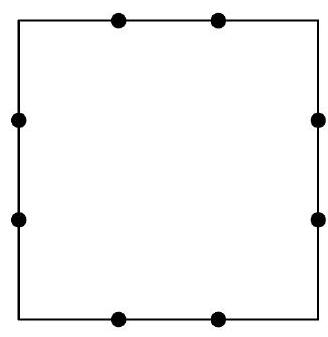
The eight points highlighted in the figure divide the sides of the square into three equal parts. How many right triangles can be drawn with the three vertices at these points?
A) 8
B) 12
C)... | Solution
## ALTERNATIVE D
Let's choose a point among the highlighted points; for example, the first point to the left on the bottom side of the square. Figure 1 shows the three right-angled triangles we can construct with the right angle vertex at this point. Since the same applies to the other highlighted points, we... | 24 | Combinatorics | MCQ | olympiads | d1e68b4f-0c0d-58f4-a81f-6ce7a68d5bb8 | [
true,
true
] | [
"<think>\nOkay, let's see. The problem is about a square where each side is divided into three equal parts by eight points. These points are the ones highlighted in the figure. The question is asking how many right triangles can be formed with three vertices at these points. The answer choices are A through E, with... | [
false,
false
] | [
false,
true
] | null | 1 | [
{
"content": "The eight points highlighted in the figure divide the sides of the square into three equal parts. How many right triangles can be drawn with the three vertices at these points?\n\n$ be a function defined on $\mathbf{R}$. If there exist two distinct real numbers $x_{1}, x_{2} \in \mathbf{R}$, such that $f\left(\frac{x_{1}+x_{2}}{2}\right)=\frac{f\left(x_{1}\right)+f\left(x_{2}\right)}{2}$, then the function $f(x)$ is said to have property $\mathrm{P}$. Among the following functions:
$... | Answer B.
Analysis The characteristic of a function with property P is: there exists a straight line that intersects the function's graph at three points, one of which is the midpoint of the other two. From the graph, we can see that $1, 3, 4$ all have three intersection points, while 2 does not have property $\mathrm{... | B | Algebra | MCQ | olympiads | efee34f1-eeda-520d-92f2-da9a5f38e1d8 | [
true,
true
] | [
"<think>\nOkay, so I have this problem here about functions and something called property P. Let me try to understand what property P is. The problem says that a function f(x) has property P if there exist two distinct real numbers x₁ and x₂ such that the function evaluated at the midpoint of x₁ and x₂ is equal to ... | [
true,
false
] | null | null | 1 | [
{
"content": "6. Let $f(x)$ be a function defined on $\\mathbf{R}$. If there exist two distinct real numbers $x_{1}, x_{2} \\in \\mathbf{R}$, such that $f\\left(\\frac{x_{1}+x_{2}}{2}\\right)=\\frac{f\\left(x_{1}\\right)+f\\left(x_{2}\\right)}{2}$, then the function $f(x)$ is said to have property $\\mathrm{P}$... |
I2.4 If the least common multiple (L.C.M.) of 76 and $d$ is 456 and the highest common factor (H.C.F.) of 76 and $d$ is $c$, determine the value of the positive integer $d$.
If the least common multiples (L.C.M.) of 76 and $d$ is 456 and the highest common factor (H.C.F.) of 76 and $d$ is $c$, determine the value of th... | \[\begin{array}{l}76 \times d=\text { L.C.M. } \times \text { H.C.F. }=456 \times 4 \\ d=24\end{array}\] | 24 | Number Theory | math-word-problem | olympiads | 467c1755-6794-534e-9d0f-dad9af0f56ed | [
true,
true
] | [
"<think>\nOkay, so I need to find the positive integer d such that the least common multiple (LCM) of 76 and d is 456, and the highest common factor (HCF) or greatest common divisor (GCD) of 76 and d is c. Hmm, let's start by recalling some number theory concepts. \n\nI remember that for any two positive integers, ... | [
true,
false
] | null | null | 1 | [
{
"content": "I2.4 If the least common multiple (L.C.M.) of 76 and $d$ is 456 and the highest common factor (H.C.F.) of 76 and $d$ is $c$, determine the value of the positive integer $d$.\nIf the least common multiples (L.C.M.) of 76 and $d$ is 456 and the highest common factor (H.C.F.) of 76 and $d$ is $c$, de... |
1恻9. 筈不等式
$$
3 \sqrt{1-\frac{x^{2}}{4}}<\frac{1}{2} x+2
$$
1 side 9. Inequality
$$
3 \sqrt{1-\frac{x^{2}}{4}}<\frac{1}{2} x+2
$$ | We use the mixed system
$$
y<\frac{1}{2} x+2, y^{2}=9\left(1-\frac{x^{2}}{4}\right).
$$
$y \geqslant 0$ to replace the original inequality. The equation
$y^{2}=9\left(1-\frac{x^{2}}{4}\right)$ represents an ellipse (Figure 4).
The solution sought is the part of the ellipse that lies below the line $y=\frac{1}{2} x+2$,... | -2 \leqslant x < \frac{-2-3 \sqrt{6}}{5}, \frac{-2+3 \sqrt{6}}{5} < x \leqslant 2 | Inequalities | math-word-problem | cn_contest | cf35c739-81bc-5ac5-8e2d-1bbf6111fb78 | [
true,
true
] | [
"<think>\nOkay, so I need to solve this inequality: \\( 3 \\sqrt{1 - \\frac{x^2}{4}} < \\frac{1}{2}x + 2 \\). Hmm, let me start by understanding the domain here. The square root function requires that the expression inside be non-negative. So, \\( 1 - \\frac{x^2}{4} \\geq 0 \\). Let's solve that first.\n\nMultiply ... | [
false,
false
] | [
true,
true
] | null | 2 | [
{
"content": "1恻9. 筈不等式\n$$\n3 \\sqrt{1-\\frac{x^{2}}{4}}<\\frac{1}{2} x+2\n$$\n\n1 side 9. Inequality\n$$\n3 \\sqrt{1-\\frac{x^{2}}{4}}<\\frac{1}{2} x+2\n$$",
"role": "user"
},
{
"content": "<think>Hmm , let me start by understanding the domain here. The square root function requires that the expre... |
G2 In a right trapezoid $A B C D(A B \| C D)$ the angle at vertex $B$ measures $75^{\circ}$. Point $H$ is the foot of the perpendicular from point $A$ to the line $B C$. If $B H=D C$ and $A D+A H=8$, find the area of $A B C D$.
|
Solution: Produce the legs of the trapezoid until they intersect at point $E$. The triangles $A B H$ and $E C D$ are congruent (ASA). The area of $A B C D$ is equal to area of triangle $E A H$ of hypotenuse
$$
A E=A D+D E=A D+A H=8
$$
Let $M$ be the midpoint of $A E$. Then
$$
M E=M A=M H=4
$$
and $\angle A M H=30^... | 8 | Geometry | math-word-problem | olympiads | 1682530a-4696-5aa3-a42c-60368ff7a815 | [
true,
true
] | [
"<think>\nOkay, so I need to find the area of this right trapezoid ABCD where AB is parallel to CD. The angle at vertex B is 75 degrees. There's a point H which is the foot of the perpendicular from A to line BC. Also, BH equals DC, and AD plus AH is 8. Hmm, let me try to visualize this first.\n\nFirst, since it's ... | [
false,
true
] | null | [
"stop",
"stop"
] | 1 | [
{
"content": "\nG2 In a right trapezoid $A B C D(A B \\| C D)$ the angle at vertex $B$ measures $75^{\\circ}$. Point $H$ is the foot of the perpendicular from point $A$ to the line $B C$. If $B H=D C$ and $A D+A H=8$, find the area of $A B C D$.\n",
"role": "user"
},
{
"content": "<think>Wait , but ... |
6. As shown in the figure, a semicircle with radius
1 has its center at $O$ and diameter $A B$. A moving point $C$ is on the entire
circumference. Extend $A C$ to point $D$ such that $\frac{C D}{C B}=k(k>0, k$ is a constant). Then the length of the curve traced by point $D$ is ().
(A) $(1+k) \cdot \pi$
(B) $\pi \cdot ... | 6. (D).
As shown in the figure, let $\angle C A B=\theta\left(0 \leqslant \theta \leqslant \frac{\pi}{2}\right)$, then $\angle C O B=2 \theta, C B=2 \sin \theta, C D=2 k \sin \theta, C$ point's coordinates are $(\cos 2 \theta, \sin 2 \theta)$. Draw $C E / / A B$, then $\angle D C E = \angle C A B = \theta$. Let the co... | D | Geometry | MCQ | cn_contest | 38a22728-2db8-50c8-8069-6058697077a4 | [
true,
true,
true,
true
] | [
"<think>\nOkay, so I need to solve this geometry problem. Let me read it again carefully.\n\nThere's a semicircle with radius 1, center at O, and diameter AB. A point C moves along the entire circumference. We extend AC to a point D such that the ratio CD/CB is equal to k, where k is a positive constant. The questi... | [
true,
true,
true,
true
] | null | null | 4 | [
{
"content": "6. As shown in the figure, a semicircle with radius\n\n1 has its center at $O$ and diameter $A B$. A moving point $C$ is on the entire\ncircumference. Extend $A C$ to point $D$ such that $\\frac{C D}{C B}=k(k>0, k$ is a constant). Then the length of the curve traced by point $D$ is ().\n(A) $(1+k)... |
[color=darkred]Find all differentiable functions $f\colon [0,\infty)\to [0,\infty)$ for which $f(0)=0$ and $f^{\prime}(x^2)=f(x)$ for any $x\in [0,\infty)$ .[/color] | 1. Given the function \( f: [0, \infty) \to [0, \infty) \) with \( f(0) = 0 \) and \( f'(x^2) = f(x) \) for any \( x \in [0, \infty) \), we start by differentiating both sides of the equation \( f'(x^2) = f(x) \) with respect to \( x \).
2. Using the chain rule, we get:
\[
\frac{d}{dx} f'(x^2) = \frac{d}{dx} f(x... | f(x) = 0 | Calculus | math-word-problem | aops_forum | 2469af83-6b76-5edf-b831-92f0811f4cb2 | [
true,
true
] | [
"<think>\nOkay, so I need to find all differentiable functions \\( f: [0, \\infty) \\to [0, \\infty) \\) such that \\( f(0) = 0 \\) and the derivative of \\( f \\) at \\( x^2 \\) is equal to \\( f(x) \\) for any \\( x \\geq 0 \\). Hmm, let me start by understanding what this condition means.\n\nThe problem says tha... | [
true,
true
] | null | null | 2 | [
{
"content": "[color=darkred]Find all differentiable functions $f\\colon [0,\\infty)\\to [0,\\infty)$ for which $f(0)=0$ and $f^{\\prime}(x^2)=f(x)$ for any $x\\in [0,\\infty)$ .[/color]",
"role": "user"
},
{
"content": "<think>Hmm , let me start by understanding what this condition means.\n\nThe pr... |
Which of the following numbers is the largest?
$\text{(A)}\ 0.97 \qquad \text{(B)}\ 0.979 \qquad \text{(C)}\ 0.9709 \qquad \text{(D)}\ 0.907 \qquad \text{(E)}\ 0.9089$ | Using the process of elimination:
Tenths digit:
All tenths digits are equal, at $9$.
Hundreths digit:
$A$, $B$, and $C$ all have the same hundreths digit of $7$, and it is greater than the hundredths of $D$ or $E$ (which is $0$). Eliminate both $D$ and $E$.
Thousandths digit:
$B$ has the largest thousandths digit of ... | \textbf{(B)} | Number Theory | MCQ | amc_aime | aa5d681c-9e37-5efc-90bb-f7563db806b4 | [
true,
true,
true,
true
] | [
"<think>\nOkay, so I need to figure out which of the given numbers is the largest. The options are A) 0.97, B) 0.979, C) 0.9709, D) 0.907, and E) 0.9089. Hmm, let me start by looking at each one carefully.\n\nFirst, I know that when comparing decimals, it's best to start from the leftmost digit and move to the righ... | [
true,
true,
true,
true
] | null | null | 4 | [
{
"content": "Which of the following numbers is the largest?\n$\\text{(A)}\\ 0.97 \\qquad \\text{(B)}\\ 0.979 \\qquad \\text{(C)}\\ 0.9709 \\qquad \\text{(D)}\\ 0.907 \\qquad \\text{(E)}\\ 0.9089$",
"role": "user"
},
{
"content": "<think>Hmm , let me start by looking at each one carefully.\n\nFirst,... |
6. A bicycle tire, if installed on the front wheel, will wear out after the bicycle has traveled $5000 \mathrm{~km}$; if installed on the rear wheel, it will wear out after the bicycle has traveled $3000 \mathrm{~km}$. After traveling a certain distance, the front and rear tires can be swapped. If the front and rear ti... | II. 6.3750.
Let the total wear of each new tire when it is scrapped be $k$. Then the wear per $1 \mathrm{~km}$ for a tire installed on the front wheel is $\frac{k}{5000}$, and the wear per $1 \mathrm{~km}$ for a tire installed on the rear wheel is $\frac{k}{3000}$. Suppose a pair of new tires travels $x \mathrm{~km}$ b... | 3750 | Algebra | math-word-problem | cn_contest | 3d70877b-b4a9-507b-a28c-62be4e824fdf | [
true,
true,
true,
true
] | [
"<think>\nOkay, so I have this problem about bicycle tires wearing out at different rates depending on whether they're on the front or rear wheel. The goal is to figure out how far the bicycle can travel if we swap the tires at some point to make both tires wear out simultaneously. Let me try to break this down ste... | [
true,
true,
true,
true
] | null | null | 4 | [
{
"content": "6. A bicycle tire, if installed on the front wheel, will wear out after the bicycle has traveled $5000 \\mathrm{~km}$; if installed on the rear wheel, it will wear out after the bicycle has traveled $3000 \\mathrm{~km}$. After traveling a certain distance, the front and rear tires can be swapped. ... |
Putnam 1995 Problem A2 For what positive reals α, β does ∫ β ∞ √(√(x + α) - √x) - √(√x - √(x - β) ) dx converge? Solution | : it converges for α = β. Straightforward. Multiplying up shows that given positive k β, take k such that 0 β. Then the integrand is greater than (√(αk) - √β)/(x 1/4 √2). But the integral of x -1/4 diverges (because x 3/4 tends to infinity as x tends to infinity), do the original integral does also. Similarly, if α ... | β | Calculus | math-word-problem | olympiads | e4132812-80fd-5442-bbcd-bcb17f72bb9c | [
true,
true
] | [
"<think>\nOkay, so I need to figure out for which positive real numbers α and β the integral from β to infinity of the difference between two square roots converges. The integrand is √(√(x + α) - √x) minus √(√x - √(x - β)). Hmm, that sounds a bit complicated, but let me break it down step by step.\n\nFirst, let me ... | [
true,
true
] | null | [
"stop",
"stop"
] | 2 | [
{
"content": "Putnam 1995 Problem A2 For what positive reals α, β does ∫ β ∞ √(√(x + α) - √x) - √(√x - √(x - β) ) dx converge? Solution",
"role": "user"
},
{
"content": "<think>Hmm , that sounds a bit complicated, but let me break it down step by step.\n\nFirst, let me write down the integral proper... |
10. (12 points) In the table below, $A, B, C, D, E, F, G, H, M$ each represent a different non-zero digit, where $A+B=14, M \div G=M-F=H-C, D \times F=24, B+E=16$, then $H$ represents $\qquad$ . | 【Solution】Solution: Since the digits represented are non-zero, they can only be the 9 digits from $1-9$. Given $B+E=16=9+7$, $A+B=14=9+5$, so $B=9, A=5, E=7$.
The remaining digits are $1,2,3,4,6,8$, a total of 6 digits.
Since $D \times F=24, M \div G=M-F=H-C$, $F$ can only be one of $3,4,6,8$. Clearly, $F$ cannot be 8... | 4 | Logic and Puzzles | math-word-problem | olympiads | d5579606-4f5c-5d36-8f32-ce470a0f2572 | [
true,
true
] | [
"<think>\nAlright, let me try to figure out this problem step by step. It's a bit complex with all these letters representing different digits and various equations to satisfy. Let's start by listing out all the given information and see how they connect.\n\nFirst, the problem states that A, B, C, D, E, F, G, H, M ... | [
true,
true
] | null | [
"stop",
"stop"
] | 2 | [
{
"content": "10. (12 points) In the table below, $A, B, C, D, E, F, G, H, M$ each represent a different non-zero digit, where $A+B=14, M \\div G=M-F=H-C, D \\times F=24, B+E=16$, then $H$ represents $\\qquad$ .",
"role": "user"
},
{
"content": "<think>\nAlright, let me try to figure out this proble... |
15. 198 people participated in a questionnaire survey, among which 149 people agreed with the first proposal, and 119 people agreed with the second proposal. If exactly 29 people did not agree with either proposal, then ( ) people agreed with both proposals.
(A) 49
(B) 70
(C) 79
(D) 99
(E) 149 | 15. D.
$$
149+119-(198-29)=99
$$ | 99 | Combinatorics | MCQ | olympiads | 575e1401-d501-56e3-8eb6-18ed38c5d07a | [
true,
true
] | [
"<think>\nOkay, let's see. So the problem is about a questionnaire survey with 198 participants. 149 agreed with the first proposal, 119 agreed with the second one, and 29 people didn't agree with either. We need to find how many people agreed with both proposals. The answer choices are given from A to E. Hmm, this... | [
false,
false
] | [
true,
false
] | null | 1 | [
{
"content": "15. 198 people participated in a questionnaire survey, among which 149 people agreed with the first proposal, and 119 people agreed with the second proposal. If exactly 29 people did not agree with either proposal, then ( ) people agreed with both proposals.\n(A) 49\n(B) 70\n(C) 79\n(D) 99\n(E) 14... |
14. In the diagram, $A B=A C$ and $D$ is a point on $A C$ such that $B D=B C$.
Angle $B A C$ is $40^{\circ}$.
What is angle $A B D$ ?
A $15^{\circ}$
B $20^{\circ}$
C $25^{\circ}$
D $30^{\circ}$
E $35^{\circ}$ | 14. D As $A B=A C$, triangle $A B C$ is isosceles. So $\angle A B C=\angle A C B$ $=\frac{1}{2}\left(180^{\circ}-40^{\circ}\right)=70^{\circ}$ as $\angle B A C=40^{\circ}$ and the angle sum of a triangle is $180^{\circ}$. Triangle $B C D$ is also isosceles as $B D=B C$, so $\angle B D C=\angle B C D=70^{\circ}$. Consid... | 30 | Geometry | MCQ | olympiads | eb01141d-1c1f-57ba-b172-b6464da6bccb | [
true,
true
] | [
"<think>\nAlright, let's see. I have this geometry problem here. Let me try to visualize the diagram first. So, triangle ABC where AB equals AC. That means it's an isosceles triangle with AB = AC. The vertex angle at A is given as 40 degrees. Then there's a point D on AC such that BD equals BC. I need to find the m... | [
false,
false
] | [
true,
true
] | null | 2 | [
{
"content": "14. In the diagram, $A B=A C$ and $D$ is a point on $A C$ such that $B D=B C$.\nAngle $B A C$ is $40^{\\circ}$.\nWhat is angle $A B D$ ?\nA $15^{\\circ}$\nB $20^{\\circ}$\nC $25^{\\circ}$\nD $30^{\\circ}$\nE $35^{\\circ}$",
"role": "user"
},
{
"content": "<think>Hmm .\n\nOkay, let's st... |
$(NET 3)$ Let $x_1, x_2, x_3, x_4,$ and $x_5$ be positive integers satisfying
\[x_1 +x_2 +x_3 +x_4 +x_5 = 1000,\]
\[x_1 -x_2 +x_3 -x_4 +x_5 > 0,\]
\[x_1 +x_2 -x_3 +x_4 -x_5 > 0,\]
\[-x_1 +x_2 +x_3 -x_4 +x_5 > 0,\]
\[x_1 -x_2 +x_3 +x_4 -x_5 > 0,\]
\[-x_1 +x_2 -x_3 +x_4 +x_5 > 0\]
$(a)$ Find the maximum of $(x_1 + x_3)^{... | 1. **Rewriting the problem in terms of new variables:**
Let \( x_1 = a \), \( x_2 = b \), \( x_3 = c \), \( x_4 = d \), and \( x_5 = e \). The given conditions become:
\[
a + b + c + d + e = 1000,
\]
\[
a - b + c - d + e > 0,
\]
\[
a + b - c + d - e > 0,
\]
\[
-a + b + c - d + e > 0,... | (a + c)^{b + d} = 499^{499} | Combinatorics | math-word-problem | aops_forum | f4d49213-b237-556c-8b04-0ce74e5a0d98 | [
true,
true
] | [
"<think>\nOkay, so I have this problem where I need to find the maximum of (x1 + x3)^{x2 + x4} given some constraints. There are five variables: x1, x2, x3, x4, x5, all positive integers. They add up to 1000. Then there are five inequalities that they must satisfy. Part (a) asks for the maximum value of that expres... | [
false,
false
] | [
true,
true
] | null | 2 | [
{
"content": "$(NET 3)$ Let $x_1, x_2, x_3, x_4,$ and $x_5$ be positive integers satisfying\n\\[x_1 +x_2 +x_3 +x_4 +x_5 = 1000,\\]\n\\[x_1 -x_2 +x_3 -x_4 +x_5 > 0,\\]\n\\[x_1 +x_2 -x_3 +x_4 -x_5 > 0,\\]\n\\[-x_1 +x_2 +x_3 -x_4 +x_5 > 0,\\]\n\\[x_1 -x_2 +x_3 +x_4 -x_5 > 0,\\]\n\\[-x_1 +x_2 -x_3 +x_4 +x_5 > 0\\]\... |
4. In the acute triangle $\triangle A B C$, the lengths of the three sides $a, b, c$ are all integers, and $a<b<c, a+b+c=20$. Then $\angle A$ $+\angle C=$ $\qquad$ . | 4. $120^{\circ}$.
$$
\because 20=(a+b)+c>c+c=2 c,
$$
there is $c<\frac{20}{3}$.
$$
\therefore \frac{20}{3}>c>0, \text{ then } \triangle A B C \text{ is an acute triangle.}
$$
$$
\begin{array}{l}
\because \cos B=\frac{c^{2}+a^{2}-b^{2}}{2 c a}=\frac{1}{2}, \\
\therefore \angle B=60^{\circ},
\end{array}
$$
then $\angle... | 120^{\circ} | Geometry | math-word-problem | cn_contest | 52d2f2be-453e-5cec-ad32-2b52ca0f1f41 | [
true,
true
] | [
"<think>\nOkay, so I need to find the measure of angle A plus angle C in an acute triangle ABC where the sides a, b, c are integers, a < b < c, and the perimeter is 20. Hmm. Let's break this down step by step.\n\nFirst, let's recall that in any triangle, the sum of the angles is 180 degrees. So angle A + angle B + ... | [
true,
true
] | null | null | 2 | [
{
"content": "4. In the acute triangle $\\triangle A B C$, the lengths of the three sides $a, b, c$ are all integers, and $a<b<c, a+b+c=20$. Then $\\angle A$ $+\\angle C=$ $\\qquad$ .",
"role": "user"
},
{
"content": "<think>Hmm . Let's break this down step by step.\n\nFirst, let's recall that in an... |
5. There are 4 types of square pieces of paper, with side lengths of 8 cm, 6 cm, 4 cm, and 2 cm, respectively. Arrange these pieces in a row according to a pattern (as shown in the figure below), with a total length of 180 cm. The total area of these pieces is $\qquad$ square cm. | $1080$ | 1080 | Geometry | math-word-problem | olympiads | 2562f3cb-1970-576b-9e0d-84d3a5de8cdb | [
true,
true
] | [
"<think>\nOkay, so I need to figure out the total area of these square pieces arranged in a row with a total length of 180 cm. The squares have side lengths of 8 cm, 6 cm, 4 cm, and 2 cm. Hmm, let's start by understanding the problem better.\n\nFirst, the problem mentions arranging these pieces in a row according t... | [
true,
true
] | null | null | 2 | [
{
"content": "5. There are 4 types of square pieces of paper, with side lengths of 8 cm, 6 cm, 4 cm, and 2 cm, respectively. Arrange these pieces in a row according to a pattern (as shown in the figure below), with a total length of 180 cm. The total area of these pieces is $\\qquad$ square cm.",
"role": "u... |
The left most digit of an integer of length 2000 digits is 3. In this integer, any two consecutive digits must be divisible by 17 or 23 . The 2000th digit may be either ' $a$ ' or ' $b$ '. What is the value of $a+b$ ?
(A) 3
(B) 7
(C) 4
(D) 10
(E) 17 | The left most digit of an integer of length 2000 digits is 3 . In this integer, any two consecutive digits must be divisible by 17 or 23 . The 2000th digit may be either ' $a$ ' or ' $b$ '. What is the value of $a+b$ ?
(A) 3
(B) 7
(C) 4
(D) 10
(E) 17
## Solution
We start by noting that the two-digit multiples of 17 a... | 7 | Number Theory | MCQ | olympiads | c10beedd-69af-5555-b42b-e36d463fe2c9 | [
true,
true
] | [
"<think>\nOkay, let's try to figure out this problem. So, we have a 2000-digit integer where the leftmost digit is 3. The rule is that any two consecutive digits must form a number divisible by either 17 or 23. The question is asking for the possible values of the 2000th digit (the last one), which could be 'a' or ... | [
false,
false
] | [
true,
false
] | null | 1 | [
{
"content": "The left most digit of an integer of length 2000 digits is 3. In this integer, any two consecutive digits must be divisible by 17 or 23 . The 2000th digit may be either ' $a$ ' or ' $b$ '. What is the value of $a+b$ ?\n(A) 3\n(B) 7\n(C) 4\n(D) 10\n(E) 17",
"role": "user"
},
{
"content"... |
7.27 In the figure below, $ABCD$ is a square, $M, N$ are the midpoints of $BC$ and $CD$ respectively, then $\sin \theta$ equals
(A) $\frac{\sqrt{5}}{5}$.
(B) $\frac{3}{5}$.
(C) $\frac{\sqrt{10}}{5}$.
(D) $\frac{4}{5}$.
(E) None of the above. | [Solution] Let $\angle B A M=\alpha$, then $\angle D A N=\alpha$. Suppose the side length of the square is 1, then
$$
\begin{array}{c}
A M=\frac{\sqrt{5}}{2} . \\
\therefore \quad \sin \theta=\sin \left(90^{\circ}-2 \alpha\right)=\cos 2 \alpha=\cos ^{2} \alpha-\sin ^{2} \alpha \\
=\frac{A B^{2}-B M^{2}}{A M^{2}}=\frac{... | \frac{3}{5} | Geometry | MCQ | olympiads | 4a266d83-ee7c-57ac-a7ed-e5186a67e942 | [
true,
true
] | [
"<think>\nOkay, let me try to figure out this problem. So we have a square ABCD, and M and N are the midpoints of BC and CD respectively. We need to find sin θ, where θ is probably the angle between lines AM and AN? Hmm, maybe. The figure isn't provided, so I have to visualize it.\n\nFirst, let me sketch the square... | [
false,
false
] | [
true,
true
] | null | 2 | [
{
"content": "7.27 In the figure below, $ABCD$ is a square, $M, N$ are the midpoints of $BC$ and $CD$ respectively, then $\\sin \\theta$ equals\n(A) $\\frac{\\sqrt{5}}{5}$.\n(B) $\\frac{3}{5}$.\n(C) $\\frac{\\sqrt{10}}{5}$.\n(D) $\\frac{4}{5}$.\n(E) None of the above.",
"role": "user"
},
{
"content"... |
5. Let the sequence $\left\{a_{n}\right\}$ satisfy
$$
\begin{array}{l}
\left(2-a_{n+1}\right)\left(4+a_{n}\right)=8(n \geqslant 1), \text { and } a_{1}=2 . \\
\text { Then } \frac{1}{a_{1}}+\frac{1}{a_{2}}+\cdots+\frac{1}{a_{n}}=
\end{array}
$$ | $\begin{array}{l}\text { 5. } 2^{n}-\frac{n}{2}-1 . \\ \text { From }\left(2-a_{n+1}\right)\left(4+a_{n}\right)=8 \\ \Rightarrow 2 a_{n}-4 a_{n+1}=a_{n} a_{n+1} \\ \Rightarrow \frac{2}{a_{n+1}}-\frac{4}{a_{n}}=1 \\ \Rightarrow \frac{2}{a_{n+1}}+1=2\left(\frac{2}{a_{n}}+1\right) . \\ \text { Then } \frac{2}{a_{n}}+1=\le... | 2^{n}-\frac{n}{2}-1 | Algebra | math-word-problem | cn_contest | 6db69853-03ba-5ee6-9d8a-f106cbe9ae61 | [
true,
true
] | [
"<think>\nOkay, so I have this problem here where there's a sequence {a_n} defined by the recurrence relation (2 - a_{n+1})(4 + a_n) = 8 for n ≥ 1, and the first term a_1 is 2. Then I need to find the sum 1/a_1 + 1/a_2 + ... + 1/a_n. Hmm, let me try to figure this out step by step.\n\nFirst, let's understand the re... | [
true,
true
] | null | null | 2 | [
{
"content": "5. Let the sequence $\\left\\{a_{n}\\right\\}$ satisfy\n$$\n\\begin{array}{l}\n\\left(2-a_{n+1}\\right)\\left(4+a_{n}\\right)=8(n \\geqslant 1), \\text { and } a_{1}=2 . \\\\\n\\text { Then } \\frac{1}{a_{1}}+\\frac{1}{a_{2}}+\\cdots+\\frac{1}{a_{n}}=\n\\end{array}\n$$",
"role": "user"
},
... |
Example 4 If $a>0, b>0$, and $H=$ $\min \left\{a, \frac{b}{a^{2}+b^{2}}\right\}$. Try to find $H_{\max }$.
Keep the original text's line breaks and format, and output the translation result directly. | Solution: Since $H$ is the minimum of $a, \frac{b}{a^{2}+b^{2}}$, $H$ is not greater than the geometric mean of $a, \frac{b}{a^{2}+b^{2}}$, i.e.,
$$
H \leqslant \sqrt{\frac{a b}{a^{2}+b^{2}}} \leqslant \sqrt{\frac{a b}{2 a b}}=\sqrt{\frac{1}{2}}=\frac{\sqrt{2}}{2},
$$
Equality holds if and only if $a=b=\frac{\sqrt{2}}... | \frac{\sqrt{2}}{2} | Algebra | math-word-problem | cn_contest | 9cea519a-0411-51c1-ab9d-e29b6c940d9b | [
true,
true
] | [
"<think>\nOkay, let's try to figure out this problem. So, we need to find the maximum value of H, where H is the minimum of two expressions: a and b divided by (a squared plus b squared). Both a and b are positive numbers. Hmm, okay. Let me write that down to clarify.\n\nH = min{ a, b/(a² + b²) }\n\nAnd we need to ... | [
false,
true
] | null | null | 1 | [
{
"content": "Example 4 If $a>0, b>0$, and $H=$ $\\min \\left\\{a, \\frac{b}{a^{2}+b^{2}}\\right\\}$. Try to find $H_{\\max }$.\n\nKeep the original text's line breaks and format, and output the translation result directly.",
"role": "user"
},
{
"content": "<think>Hmm , that's interesting. Let me tr... |
Let $p_n$ be the $n^{\mbox{th}}$ prime counting from the smallest prime $2$ in increasing order. For example, $p_1=2, p_2=3, p_3 =5, \cdots$
(a) For a given $n \ge 10$, let $r$ be the smallest integer satisfying
\[2\le r \le n-2, \quad n-r+1 < p_r\]
and define $N_s=(sp_1p_2\cdots p_{r-1})-1$ for $s=1,2,\ldots, p_r$. ... | ### Part (a)
1. **Define the sequence and the integer \( r \):**
- Let \( p_n \) be the \( n \)-th prime number.
- For a given \( n \ge 10 \), let \( r \) be the smallest integer satisfying:
\[
2 \le r \le n-2, \quad n-r+1 < p_r
\]
2. **Define \( N_s \):**
- Define \( N_s = (sp_1p_2\cdots p_{r... | m \ge 4 | Number Theory | math-word-problem | aops_forum | 9a83235e-78d3-5270-b35b-5b46402a4fb7 | [
true,
false,
true,
true
] | [
"<think>\nOkay, let me try to tackle part (a) first. So the problem is about primes and constructing numbers of the form N_s = (s * p1p2…p_{r-1}) - 1, and showing that for some j between 1 and p_r, N_j isn't divisible by any of the primes p1 to p_n. Hmm. Alright, let's break this down.\n\nFirst, they define r as th... | [
true,
false,
true,
true
] | null | null | 3 | [
{
"content": "Let $p_n$ be the $n^{\\mbox{th}}$ prime counting from the smallest prime $2$ in increasing order. For example, $p_1=2, p_2=3, p_3 =5, \\cdots$\n\n(a) For a given $n \\ge 10$, let $r$ be the smallest integer satisfying \n\\[2\\le r \\le n-2, \\quad n-r+1 < p_r\\]\nand define $N_s=(sp_1p_2\\cdots p_... |
## Task A-1.6.
Let $A B C D$ be a rectangle such that $|A B|:|A D|=2: 3$ and let point $E$ be on side $\overline{A D}$ such that $|A E|=|A B|$. Point $F$ is chosen on ray $A B$ so that triangle $A F E$ and quadrilateral $C D E F$ have equal areas. Determine the ratio $|A B|:|B F|$. | ## First Solution.
From $|A E|=|A B|$ and $|A B|:|A D|=2: 3$, it follows that $|A E|:|E D|=2: 1$. Triangles $A E F$ and $D E F$ have the same heights, so $P(A E F)=2 P(D E F)$. Since
$$
2 P(D E F)=P(A E F)=P(C D E F)=P(D E F)+P(C D F)
$$
it follows that $P(D E F)=P(C D F)$.
$. I am three times younger than my father, so my father is 45 years old $(3 \cdot 15=45)$. The sum of the ages of the three of us brothers is 35 years $(11+9+15=35)$.
The father's age is 10 years older than the sum of... | 5 | Algebra | math-word-problem | olympiads | b74eda54-a2a5-5ff3-984e-0a6c27b592b9 | [
true,
true
] | [
"<think>\nOkay, let's see. So, Ivan is three times younger than his father. That means his father is three times older than Ivan. Then Ivan has two brothers, Vincent and Jakub, who are 11 and 9 years old. The younger brother is Jakub, since 9 is younger than 11. Ivan's age is equal to five times the third of Jakub'... | [
true,
true
] | null | null | 2 | [
{
"content": "I am Ivan and I am three times younger than my father. I have brothers Vincent and Jakub, who are 11 and 9 years old. My age is equal to five times the third of the age of the younger of the brothers. A peculiarity of our family is that we were all born on April 12th, so today we are celebrating o... |
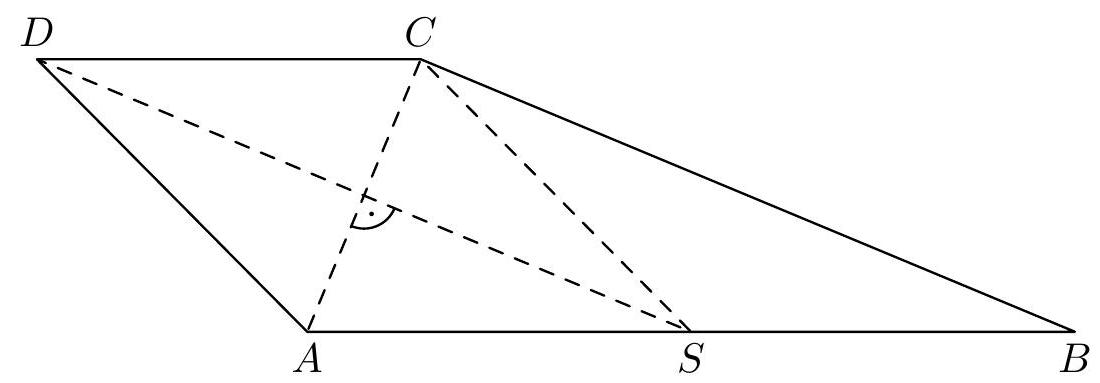
In the trapezoid $A B C D$ with bases $A B$ and $C D$, it is given that $|A D|=|C D|$, $|A B|=2|C D|$, $|B C|=24 \mathrm{~cm}$, and $|A C|=10 \mathrm{~cm}$.
Calculate the area of trapezoid $A B C D$.
(L. Růžičková) | Let $S$ be the midpoint of the base $AB$. From the problem statement, it follows that segments $AS, SB$, and $CD$ are congruent, so quadrilaterals $ASCD$ and $SBCD$ are parallelograms.
Diago... | 180\,(^2) | Geometry | math-word-problem | olympiads | 3a5e4954-0d4e-588a-8e43-5227fead9576 | [
true,
true
] | [
"<think>\nOkay, let's see. I have a trapezoid ABCD with bases AB and CD. It says that AD equals CD, AB is twice CD, BC is 24 cm, and AC is 10 cm. I need to find the area of this trapezoid. Hmm, trapezoid area is usually calculated as the average of the two bases multiplied by the height. So, if I can find the lengt... | [
false,
false
] | [
false,
true
] | null | 1 | [
{
"content": "In the trapezoid $A B C D$ with bases $A B$ and $C D$, it is given that $|A D|=|C D|$, $|A B|=2|C D|$, $|B C|=24 \\mathrm{~cm}$, and $|A C|=10 \\mathrm{~cm}$.\n\nCalculate the area of trapezoid $A B C D$.\n\n(L. Růžičková)",
"role": "user"
},
{
"content": "<think>Hmm , the problem says... |
$A B C D$ is a square with $A B=x+16$ and $B C=3 x$, as shown. The perimeter of $A B C D$ is
(A) 16
(B) 32
(C) 96
(D) 48
(E) 24
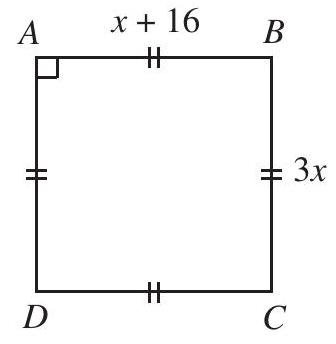
## Part B: Each correct answer is worth 6. | Since $A B C D$ is a square, then $A B=B C$, or
$$
\begin{aligned}
x+16 & =3 x \\
16 & =2 x \\
x & =8
\end{aligned}
$$
Thus the side length of the square is $x+16=3 x=24$, and the perimeter is $4(24)=96$.
ANSWER: (C) | 96 | Geometry | MCQ | olympiads | 8c8d3ad8-9611-521c-a89b-82f117e9f772 | [
true,
true
] | [
"<think>\nOkay, so I have this problem here where ABCD is a square, and they give me two sides: AB is x + 16 and BC is 3x. I need to find the perimeter of the square, and the options are given as 16, 32, 96, 48, or 24. Hmm, let's start by recalling that in a square, all sides are equal. That means AB should be equa... | [
false,
false
] | [
true,
true
] | null | 2 | [
{
"content": "$A B C D$ is a square with $A B=x+16$ and $B C=3 x$, as shown. The perimeter of $A B C D$ is\n(A) 16\n(B) 32\n(C) 96\n(D) 48\n(E) 24\n\n\n\n## Part B: Each correct answe... |
4. Given $P_{1}\left(x_{1}, y_{1}\right), P_{2}\left(x_{2}, y_{2}\right), \cdots$, $P_{n}\left(x_{n}, y_{n}\right), \cdots$, where $x_{1}=1, y_{1}=0, x_{n+1}=$ $x_{n}-y_{n}, y_{n+1}=x_{n}+y_{n}\left(n \in \mathbf{Z}_{+}\right)$. If $a_{n}=$ $\overrightarrow{P_{n} P_{n+1}} \cdot \overrightarrow{P_{n+1} P_{n+2}}$, then t... | 4. 10 .
It is known that $\overrightarrow{O P_{n+1}}$ is obtained by rotating $\overrightarrow{O P_{n}}$ counterclockwise by $\frac{\pi}{4}$ and stretching it to $\sqrt{2}$ times its original length.
$$
\begin{array}{l}
\text { Then }\left|\overrightarrow{P_{n} P_{n+1}}\right|=O P_{n}, \\
\left|\overrightarrow{P_{n+1}... | 10 | Algebra | math-word-problem | olympiads | d8f4a871-17b3-5b95-98eb-78963b89a0de | [
true,
true
] | [
"<think>\nOkay, so I need to solve this problem where we have points P₁, P₂, ..., Pₙ, ... defined by a recursive formula. The coordinates start with P₁ at (1, 0), and each subsequent point is defined by x_{n+1} = xₙ - yₙ and y_{n+1} = xₙ + yₙ. Then, aₙ is the dot product of the vectors PₙPₙ₊₁ and Pₙ₊₁Pₙ₊₂. We need ... | [
true,
true
] | null | [
"stop",
"stop"
] | 2 | [
{
"content": "4. Given $P_{1}\\left(x_{1}, y_{1}\\right), P_{2}\\left(x_{2}, y_{2}\\right), \\cdots$, $P_{n}\\left(x_{n}, y_{n}\\right), \\cdots$, where $x_{1}=1, y_{1}=0, x_{n+1}=$ $x_{n}-y_{n}, y_{n+1}=x_{n}+y_{n}\\left(n \\in \\mathbf{Z}_{+}\\right)$. If $a_{n}=$ $\\overrightarrow{P_{n} P_{n+1}} \\cdot \\ove... |
7. Simplify $\frac{\sqrt{5-\sqrt{24}}}{\sqrt{10}+3-\sqrt{6}-\sqrt{15}}$. (1994, Tianjin Mathematical Competition) | $$
\begin{array}{l}
\frac{\sqrt{5-2 \sqrt{6}}}{\sqrt{3}(\sqrt{3}-\sqrt{2})-\sqrt{5}(\sqrt{3}-\sqrt{2})} \\
=\frac{\sqrt{3}-\sqrt{2}}{(\sqrt{3}-\sqrt{2})(\sqrt{3}-\sqrt{5})} \\
=\frac{1}{\sqrt{3}-\sqrt{5}}=-\frac{1}{2}(\sqrt{3}+\sqrt{5}) .
\end{array}
$$
Solve the original expression:
$$
\begin{array}{l}
\frac{\sqrt{5-... | -\frac{1}{2}(\sqrt{3}+\sqrt{5}) | Algebra | math-word-problem | cn_contest | 1adce8ae-d4b2-5a73-8d0e-60651caf85ca | [
true,
true
] | [
"<think>\nOkay, so I need to simplify this expression: the numerator is the square root of (5 minus the square root of 24), and the denominator is a combination of square roots: sqrt(10) plus 3 minus sqrt(6) minus sqrt(15). Hmm, that seems a bit complicated, but let's take it step by step. \n\nFirst, let me look at... | [
true,
true
] | null | null | 2 | [
{
"content": "7. Simplify $\\frac{\\sqrt{5-\\sqrt{24}}}{\\sqrt{10}+3-\\sqrt{6}-\\sqrt{15}}$. (1994, Tianjin Mathematical Competition)",
"role": "user"
},
{
"content": "<think>Hmm , that seems a bit complicated, but let's take it step by step. \n\nFirst, let me look at the numerator: sqrt(5 - sqrt(24... |
3. Find the smallest value of the expression $\left|36^{m}-5^{n}\right|$, where $m$ and $n$ are natural numbers. | Solution. We consider two cases:
a) $36^{m}>5^{n}$. The last digit of the number $36^{m}-5^{n}$ is 1. Let $36^{m}-5^{n}=1$. Then $5^{n}=\left(6^{m}+1\right)\left(6^{m}-1\right)$, which is not possible, since 5 is not a divisor of $6^{m}+1$.
Let $36^{m}-5^{n}=11$. Obviously, for $m=1, n=2$ the equality is satisfied.
b)... | 11 | Number Theory | math-word-problem | olympiads | 999a4b4b-e9b4-5b9b-bf05-03591b0aa2f7 | [
true,
true
] | [
"<think>\nOkay, so I need to find the smallest value of the expression |36^m - 5^n| where m and n are natural numbers. Hmm, natural numbers are positive integers, right? So m and n can be 1, 2, 3, and so on. \n\nFirst, let me understand the problem. I need to calculate 36 raised to some positive integer power, subt... | [
true,
true
] | null | null | 2 | [
{
"content": "3. Find the smallest value of the expression $\\left|36^{m}-5^{n}\\right|$, where $m$ and $n$ are natural numbers.",
"role": "user"
},
{
"content": "<think>Hmm , natural numbers are positive integers, right? So m and n can be 1, 2, 3, and so on. \n\nFirst, let me understand the problem... |
11. A two-digit number, when 5 is written in front of it, the resulting three-digit number is 12 less than 9 times the original two-digit number. The original two-digit number is ( ). | 【Analysis】If we write 5 in front of this two-digit number and then add 12, the total increase is 512. At this point, the resulting number is exactly 9 times the original number, meaning it has increased by 8 times. Therefore, the original two-digit number is $512 \div 8=64$. | 64 | Algebra | math-word-problem | olympiads | 536ec4ea-c9cd-54a1-a1be-ef513b95761a | [
true,
true
] | [
"<think>\nOkay, let's see here. The problem says: A two-digit number, when 5 is written in front of it, the resulting three-digit number is 12 less than 9 times the original two-digit number. We need to find the original two-digit number. Hmm, let me try to parse this step by step.\n\nFirst, let's denote the origin... | [
true,
true
] | null | null | 2 | [
{
"content": "11. A two-digit number, when 5 is written in front of it, the resulting three-digit number is 12 less than 9 times the original two-digit number. The original two-digit number is ( ).",
"role": "user"
},
{
"content": "<think>Hmm , let me try to parse this step by step.\n\nFirst, let's ... |
3. Given is a rectangle $A B C D$ whose side lengths differ by $4 \mathrm{~cm}$, and its perimeter is 16 $\mathrm{dm}$, with $|A B|>|B C|$. Point $M$ is the midpoint of side $\overline{B C}$ of the rectangle. Point $N$ lies on side $\overline{C D}$ and it is given that $|N C|=3|D N|$. Segments $\overline{A M}$ and $\ov... | 3.
Let $a=|A B|=|C D|$ and $b=|B C|=|A D|$. Then $a=b+4$.
The perimeter of the rectangle is $16 \mathrm{dm}=160 \mathrm{~cm}$, so we have:
$160=2 \cdot a+2 \cdot b$,
$160=2 \cdot(b+4)+2... | 199.5\mathrm{~}^{2} | Geometry | math-word-problem | olympiads | a083be14-d7ea-578e-9b18-da26dd5b6f26 | [
true,
true
] | [
"<think>\nOkay, let's see. I need to figure out whether the area of triangle ABP is greater than the area of quadrilateral PMCN, or vice versa, and by how much. The problem involves a rectangle ABCD with sides differing by 4 cm and a perimeter of 16 dm. First, I need to make sure all units are consistent. The perim... | [
true,
true
] | null | null | 2 | [
{
"content": "3. Given is a rectangle $A B C D$ whose side lengths differ by $4 \\mathrm{~cm}$, and its perimeter is 16 $\\mathrm{dm}$, with $|A B|>|B C|$. Point $M$ is the midpoint of side $\\overline{B C}$ of the rectangle. Point $N$ lies on side $\\overline{C D}$ and it is given that $|N C|=3|D N|$. Segments... |
1. Find the value of
$$
\binom{6}{1} 2^{1}+\binom{6}{2} 2^{2}+\binom{6}{3} 2^{3}+\binom{6}{4} 2^{4}+\binom{6}{5} 2^{5}+\binom{6}{6} 2^{6} .
$$ | Solution:
728
This sum is the binomial expansion of $(1+2)^{6}$, except that it is missing the first term, $\binom{6}{0} 2^{0}=1$. So we get $3^{6}-1=728$. | 728 | Combinatorics | math-word-problem | olympiads | bf7e5e8e-03cf-5362-9f4e-04c88fcafa23 | [
true,
true
] | [
"<think>\nOkay, so I need to find the value of this sum: \n\n$$\n\\binom{6}{1} 2^{1}+\\binom{6}{2} 2^{2}+\\binom{6}{3} 2^{3}+\\binom{6}{4} 2^{4}+\\binom{6}{5} 2^{5}+\\binom{6}{6} 2^{6} .\n$$\n\nHmm, let's see. I remember something about binomial expansions. The binomial theorem states that:\n\n$$\n(a + b)^n = \\sum... | [
true,
true
] | null | null | 2 | [
{
"content": "1. Find the value of\n$$\n\\binom{6}{1} 2^{1}+\\binom{6}{2} 2^{2}+\\binom{6}{3} 2^{3}+\\binom{6}{4} 2^{4}+\\binom{6}{5} 2^{5}+\\binom{6}{6} 2^{6} .\n$$",
"role": "user"
},
{
"content": "<think>Hmm , let's see. I remember something about binomial expansions. The binomial theorem states ... |
10. Arrange 21 students from class 3 (1) with student numbers from 1 to 21 in a circle. Record the difference between the student numbers of all adjacent pairs by subtracting the smaller number from the larger one. What is the maximum possible sum of these 21 recorded differences? $\qquad$ - | ```
[Analysis] The problem requires the sum of "differences" to be maximized. To achieve this, the "difference" must be large, so two adjacent numbers cannot be together. Large numbers and small numbers should alternate;
21, 1, 20, 2, 19, 3, 18, 4, 17, 5, 16, 6, 15, 7, 14, 8, 13, 9, 12, 10, 11
... | 220 | Combinatorics | math-word-problem | olympiads | b5557ed1-0a72-5dd7-a17a-a95a3511529f | [
true,
true
] | [
"<think>\nOkay, so I need to figure out how to arrange 21 students in a circle such that the sum of the differences between adjacent student numbers is maximized. The students are numbered from 1 to 21, and when we subtract the smaller number from the larger one for each adjacent pair, we need the total sum of thes... | [
true,
true
] | null | null | 2 | [
{
"content": "10. Arrange 21 students from class 3 (1) with student numbers from 1 to 21 in a circle. Record the difference between the student numbers of all adjacent pairs by subtracting the smaller number from the larger one. What is the maximum possible sum of these 21 recorded differences? $\\qquad$ -",
... |
Determine the value of $(666666666)^{2}-(333333333)^{2}$. | Using the factorization $x^{2}-y^{2}=(x-y)(x+y)$ with $x=666666666$ and $y=333333333$, we see that $x-y=y$ and $x+y=999999999$, therefore,
$$
\begin{aligned}
666666666^{2}-333333333^{2} & =333333333 \times 999999999 \\
& =333333333 \times(1000000000-1) \\
& =333333333000000000-333333333 \\
& =333333332666666667
\end{a... | 333333332666666667 | Algebra | math-word-problem | olympiads | 903e691c-0d38-5e67-8bba-2146f2703355 | [
true,
true
] | [
"<think>\nOkay, so I have to figure out the value of (666,666,666) squared minus (333,333,333) squared. Hmm, that seems like a big number. Let me think. Maybe there's a way to simplify this instead of trying to calculate each square separately? \n\nWait, I remember there's a formula for the difference of squares. I... | [
true,
true
] | null | null | 2 | [
{
"content": "Determine the value of $(666666666)^{2}-(333333333)^{2}$.",
"role": "user"
},
{
"content": "<think>Hmm , that seems like a big number. Let me think. Maybe there's a way to simplify this instead of trying to calculate each square separately? \n\n Wait , I remember there's a formula for ... |
71. A segment $AB$ of unit length, which is a chord of a sphere with radius 1, is positioned at an angle of $\pi / 3$ to the diameter $CD$ of this sphere. The distance from the end $C$ of the diameter to the nearest end $A$ of the chord $AB$ is $\sqrt{2}$. Determine the length of the segment $BD$. | 71. Draw a line through $C$ parallel to $A B$, and take a point $E$ on it such that $|C E|=|A B|$, making $A B E C$ a parallelogram. If $O$ is the center of the sphere, then since $\widehat{O C E}=\pi / 3$ and $|C E|=1$ (as follows from the condition), $\triangle O C E$ is equilateral. Therefore, point $O$ is equidista... | 1 | Geometry | math-word-problem | olympiads | 176fd957-a921-5bbb-8a49-093137967fc3 | [
true,
true
] | [
"<think>\nOkay, let's try to figure out this geometry problem. So, we have a sphere with radius 1. There's a diameter CD, and a chord AB of unit length (so AB = 1). The chord AB is positioned at an angle of π/3 (which is 60 degrees) to the diameter CD. Also, the distance from point C (one end of the diameter) to th... | [
true,
true
] | null | [
"stop",
"stop"
] | 2 | [
{
"content": "71. A segment $AB$ of unit length, which is a chord of a sphere with radius 1, is positioned at an angle of $\\pi / 3$ to the diameter $CD$ of this sphere. The distance from the end $C$ of the diameter to the nearest end $A$ of the chord $AB$ is $\\sqrt{2}$. Determine the length of the segment $BD... |
Which of the following is the value of $\sqrt{\log_2{6}+\log_3{6}}?$
$\textbf{(A) } 1 \qquad\textbf{(B) } \sqrt{\log_5{6}} \qquad\textbf{(C) } 2 \qquad\textbf{(D) } \sqrt{\log_2{3}}+\sqrt{\log_3{2}} \qquad\textbf{(E) } \sqrt{\log_2{6}}+\sqrt{\log_3{6}}$ | Recall that:
$\log_b{(uv)}=\log_b u + \log_b v.$
$\log_b u\cdot\log_u b=1.$
We use these properties of logarithms to rewrite the original expression:
\begin{align*} \sqrt{\log_2{6}+\log_3{6}}&=\sqrt{(\log_2{2}+\log_2{3})+(\log_3{2}+\log_3{3})} \\ &=\sqrt{2+\log_2{3}+\log_3{2}} \\ &=\sqrt{\left(\sqrt{\log_2{3}}+\sqrt... | \textbf{(D)}\sqrt{\log_2{3}}+\sqrt{\log_3{2}} | Algebra | MCQ | amc_aime | d145c7e5-975f-506f-afe7-11c4962c9f7a | [
true,
true
] | [
"<think>\nOkay, so I need to find the value of the square root of (log base 2 of 6 plus log base 3 of 6). Then, among the options given, I have to pick the correct one. Let's break this down step by step.\n\nFirst, let's recall some logarithm properties. I know that log_b a = (ln a)/(ln b) if I want to convert to n... | [
false,
false
] | [
true,
true
] | null | 2 | [
{
"content": "Which of the following is the value of $\\sqrt{\\log_2{6}+\\log_3{6}}?$\n$\\textbf{(A) } 1 \\qquad\\textbf{(B) } \\sqrt{\\log_5{6}} \\qquad\\textbf{(C) } 2 \\qquad\\textbf{(D) } \\sqrt{\\log_2{3}}+\\sqrt{\\log_3{2}} \\qquad\\textbf{(E) } \\sqrt{\\log_2{6}}+\\sqrt{\\log_3{6}}$",
"role": "user"
... |
(5) The set of integer points on the plane $S=\{(a, b) \mid 1 \leqslant a, b \leqslant 5, a, b \in \mathbf{Z}\}$, $T$ is a set of integer points on the plane, such that for any point $P$ in $S$, there exists a point $Q$ in $T$ different from $P$, such that the line segment $P Q$ has no other integer points except $P$ a... | Answer: The minimum number is 2.
First, prove that $T$ cannot consist of only one point.
Otherwise, suppose $T=\left\{Q\left(x_{0}, y_{0}\right)\right\}$. In $S$, take a point $P\left(x_{1}, y_{1}\right)$ such that $\left(x_{1}\right.$, $\left.y_{1}\right) \neq\left(x_{0}, y_{0}\right)$ and $x_{1}$ has the same parity ... | 2 | Combinatorics | math-word-problem | olympiads | d35008b1-2513-5051-942b-9c719021bf89 | [
true,
false
] | [
"<think>\nOkay, let me try to figure out this problem. So, we have a set S which is all the integer points (a, b) where both a and b are between 1 and 5, inclusive. So that's like a 5x5 grid of points, right? So there are 25 points in total in set S. Then there's another set T, which is a set of integer points on t... | [
true,
false
] | null | null | 1 | [
{
"content": "(5) The set of integer points on the plane $S=\\{(a, b) \\mid 1 \\leqslant a, b \\leqslant 5, a, b \\in \\mathbf{Z}\\}$, $T$ is a set of integer points on the plane, such that for any point $P$ in $S$, there exists a point $Q$ in $T$ different from $P$, such that the line segment $P Q$ has no othe... |
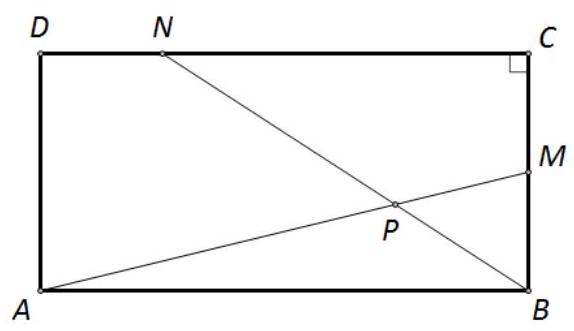
Problem 9.8. On the side $CD$ of trapezoid $ABCD (AD \| BC)$, a point $M$ is marked. A perpendicular $AH$ is dropped from vertex $A$ to segment $BM$. It turns out that $AD = HD$. Find the length of segment $AD$, given that $BC = 16$, $CM = 8$, and $MD = 9$.
. Since $B C \| A D$, triangles $B C M$ and $K D M$ are similar by angles, from which we obtain $D K = B C \cdot \frac{D M}{C M} = 16 \cdot \frac{9}{8} = 18$.
$, a point $M$ is marked. A perpendicular $AH$ is dropped from vertex $A$ to segment $BM$. It turns out that $AD = HD$. Find the length of segment $AD$, given that $BC = 16$, $CM = 8$, and $MD = 9$.\n\n^{2}\left(n \geqslant 1, n \in \mathbf{N}_{+}\right)$, which of the following conclusions is correct? ( ).
A. $a_{n}$ is an arithmetic sequence
B. $a_{n}$ is a geometric sequence
C. $\lg a_{n}$ is an arithmetic sequence
D. $\lg a_{n... | 5. D. Taking the logarithm of both sides of $a_{n+1}=\left(a_{n}\right)^{2}$, we have $\lg a_{n+1}=2 \lg a_{n}$, so $\left\{\lg a_{n}\right\}$ is a geometric sequence. | D | Algebra | MCQ | olympiads | 3eac17c0-eb9c-5dc5-bc2d-a4a17463664f | [
true,
true
] | [
"<think>\nAlright, so I have this problem here about a sequence {a_n} where the first term a₁ is 2, and each subsequent term is defined by a_{n+1} = (a_n)² for n ≥ 1. The question is asking which of the options A through D is correct. The options are about whether the sequence is arithmetic or geometric, or if the ... | [
true,
true
] | null | [
"stop",
"stop"
] | 2 | [
{
"content": "5. Given the sequence $\\left\\{a_{n}\\right\\}$, where $a_{1}=2, a_{n+1}=\\left(a_{n}\\right)^{2}\\left(n \\geqslant 1, n \\in \\mathbf{N}_{+}\\right)$, which of the following conclusions is correct? ( ).\nA. $a_{n}$ is an arithmetic sequence\nB. $a_{n}$ is a geometric sequence\nC. $\\lg a_{n}$ i... |
What is the probability that an integer in the set $\{1,2,3,...,100\}$ is divisible by $2$ and not divisible by $3$?
$\mathrm{(A) \ } \frac{1}{6}\qquad \mathrm{(B) \ } \frac{33}{100}\qquad \mathrm{(C) \ } \frac{17}{50}\qquad \mathrm{(D) \ } \frac{1}{2}\qquad \mathrm{(E) \ } \frac{18}{25}$ | There are $100$ integers in the set.
Since every $2^{\text{nd}}$ integer is divisible by $2$, there are $\lfloor\frac{100}{2}\rfloor=50$ integers divisible by $2$ in the set.
To be divisible by both $2$ and $3$, a number must be divisible by $(2,3)=6$.
Since every $6^{\text{th}}$ integer is divisible by $6$, there ar... | \frac{17}{50} | Number Theory | MCQ | amc_aime | 43baf736-95bc-5893-b4d3-77c84964ea30 | [
true,
true
] | [
"<think>\nAlright, so I need to find the probability that an integer from 1 to 100 is divisible by 2 but not divisible by 3. Hmm, okay. Let me break this down step by step. \n\nFirst, the problem is asking for the probability, which means I need to find the number of integers that satisfy the condition (divisible b... | [
false,
false
] | [
false,
true
] | null | 1 | [
{
"content": "What is the probability that an integer in the set $\\{1,2,3,...,100\\}$ is divisible by $2$ and not divisible by $3$? \n$\\mathrm{(A) \\ } \\frac{1}{6}\\qquad \\mathrm{(B) \\ } \\frac{33}{100}\\qquad \\mathrm{(C) \\ } \\frac{17}{50}\\qquad \\mathrm{(D) \\ } \\frac{1}{2}\\qquad \\mathrm{(E) \\ ... |
In Braydon's cafeteria, the meats available are beef and chicken. The fruits available are apple, pear and banana. Braydon is randomly given a lunch with one meat and one fruit. What is the probability that the lunch will include a banana?
(A) $\frac{1}{3}$
(B) $\frac{2}{3}$
(C) $\frac{1}{2}$
(D) $\frac{1}{5}$
(E) $\fr... | Solution 1
Choosing one meat and one fruit, the possible lunches are beef and apple, beef and pear, beef and banana, chicken and apple, chicken and pear, or chicken and banana.
Of these 6 lunches, 2 of them include a banana.
Thus when randomly given a lunch, the probability that it will include a banana is $\frac{2}... | \frac{1}{3} | Combinatorics | MCQ | olympiads | d4eede1d-aeef-58db-b145-d09f78c5217b | [
true,
true
] | [
"<think>\nOkay, let me try to figure out this probability problem. So, Braydon's cafeteria has two types of meats: beef and chicken. And for fruits, there are three options: apple, pear, and banana. He gets a random lunch with one meat and one fruit. The question is asking for the probability that the lunch include... | [
false,
false
] | [
false,
true
] | null | 1 | [
{
"content": "In Braydon's cafeteria, the meats available are beef and chicken. The fruits available are apple, pear and banana. Braydon is randomly given a lunch with one meat and one fruit. What is the probability that the lunch will include a banana?\n(A) $\\frac{1}{3}$\n(B) $\\frac{2}{3}$\n(C) $\\frac{1}{2}... |
2. One day Uncle Fyodor weighed Sharik and Matroskin. It turned out that Sharik is 6 kg heavier than Matroskin, and Matroskin is three times lighter than Sharik. How much did Matroskin weigh? | Answer: 3 kg.
Solution: Since Matroskin is three times lighter than Sharik, Matroskin is lighter than Sharik by two of his own weights. According to the condition, this is equal to 6 kg, i.e., Matroskin weighs $6: 2=3$ kg. | 3 | Algebra | math-word-problem | olympiads | 2b30352e-e330-54fa-828e-7c9903247195 | [
true,
true
] | [
"<think>\nAlright, let's see. So the problem says that Uncle Fyodor weighed Sharik and Matroskin. It turned out that Sharik is 6 kg heavier than Matroskin, and Matroskin is three times lighter than Sharik. The question is, how much did Matroskin weigh?\n\nHmm, okay, let's break this down. First, let me make sure I ... | [
true,
true
] | null | [
"stop",
"stop"
] | 2 | [
{
"content": "2. One day Uncle Fyodor weighed Sharik and Matroskin. It turned out that Sharik is 6 kg heavier than Matroskin, and Matroskin is three times lighter than Sharik. How much did Matroskin weigh?",
"role": "user"
},
{
"content": "<think>Hmm , okay, let's break this down. First, let me make... |
13.002. How many kilograms of water need to be evaporated from 0.5 t of cellulose mass containing $85 \%$ water to obtain a mass with $75 \%$ water content? | Solution.
In the cellulose mass, there is $0.85 \cdot 500=425$ kg of water. Let $x$ kg of water be evaporated; then we get $425-x=0.75(500-x)$, from which $x=200(\mathrm{kg})$.
Answer: $200 \mathrm{kg}$. | 200\mathrm{} | Algebra | math-word-problem | olympiads | 2851d9ca-b445-51a2-9f28-3dd069c00476 | [
true,
true
] | [
"<think>\nOkay, so I need to figure out how many kilograms of water need to be evaporated from 0.5 tons of cellulose mass that's initially 85% water to get it down to 75% water content. Hmm, let's break this down step by step. \n\nFirst, I should probably convert the units to make sure everything is consistent. The... | [
true,
true
] | null | null | 2 | [
{
"content": "13.002. How many kilograms of water need to be evaporated from 0.5 t of cellulose mass containing $85 \\%$ water to obtain a mass with $75 \\%$ water content?",
"role": "user"
},
{
"content": "<think>Hmm , let's break this down step by step. \n\nSo let's calculate the amount of cellulo... |
The fraction $\frac{2(\sqrt2+\sqrt6)}{3\sqrt{2+\sqrt3}}$ is equal to
$\textbf{(A)}\ \frac{2\sqrt2}{3} \qquad \textbf{(B)}\ 1 \qquad \textbf{(C)}\ \frac{2\sqrt3}3 \qquad \textbf{(D)}\ \frac43 \qquad \textbf{(E)}\ \frac{16}{9}$ | Squaring the expression and taking the positive square root (since numerator and denominator are positive) of the result yields
\[\sqrt{\left(\frac{2(\sqrt2+\sqrt6)}{3\sqrt{2+\sqrt3}}\right)^2}\]
\[\sqrt{\frac{4(2+4\sqrt{3}+6)}{9(2+\sqrt{3})}}\]
\[\sqrt{\frac{4(8+4\sqrt{3})}{9(2+\sqrt{3})}}\]
\[\sqrt{\frac{16}{9}}\]
\[... | \frac{4}{3} | Algebra | MCQ | amc_aime | 404a8180-51aa-556e-ab45-ab51f5734d2e | [
true,
true
] | [
"<think>\nOkay, so I have this fraction here: 2 times (sqrt(2) plus sqrt(6)) divided by (3 times the square root of (2 plus sqrt(3))). The problem says this fraction is equal to one of the options A through E. Let me see how I can simplify this expression. Hmm.\n\nFirst, let me write down the expression to make it ... | [
false,
false
] | [
true,
false
] | null | 1 | [
{
"content": "The fraction $\\frac{2(\\sqrt2+\\sqrt6)}{3\\sqrt{2+\\sqrt3}}$ is equal to \n$\\textbf{(A)}\\ \\frac{2\\sqrt2}{3} \\qquad \\textbf{(B)}\\ 1 \\qquad \\textbf{(C)}\\ \\frac{2\\sqrt3}3 \\qquad \\textbf{(D)}\\ \\frac43 \\qquad \\textbf{(E)}\\ \\frac{16}{9}$",
"role": "user"
},
{
"content": ... |
2. Given that $n$ is a positive integer, such that there exist positive integers $x_{1}$, $x_{2}, \cdots, x_{n}$ satisfying
$$
x_{1} x_{2} \cdots x_{n}\left(x_{1}+x_{2}+\cdots+x_{n}\right)=100 n .
$$
Find the maximum possible value of $n$.
(Lin Jin, problem contributor) | 2. The maximum possible value of $n$ is 9702.
Obviously, from the given equation, we have $\sum_{i=1}^{n} x_{i} \geqslant n$. Therefore, $\prod_{i=1}^{n} x_{i} \leqslant 100$.
Since equality cannot hold, then $\prod_{i=1}^{n} x_{i} \leqslant 99$.
$$
\begin{array}{l}
\text { and } \prod_{i=1}^{n} x_{i}=\prod_{i=1}^{n}\... | 9702 | Number Theory | math-word-problem | cn_contest | 693900f8-c665-5bba-9936-a3d856c8c178 | [
true,
true
] | [
"<think>\nOkay, so I need to find the maximum possible value of n such that there exist positive integers x₁, x₂, ..., xₙ satisfying the equation x₁x₂⋯xₙ(x₁ + x₂ + ⋯ + xₙ) = 100n. Alright, let me try to think through this step by step.\n\nFirst, let me parse the problem. We have n positive integers, multiply them a... | [
true,
false
] | null | null | 1 | [
{
"content": "2. Given that $n$ is a positive integer, such that there exist positive integers $x_{1}$, $x_{2}, \\cdots, x_{n}$ satisfying\n$$\nx_{1} x_{2} \\cdots x_{n}\\left(x_{1}+x_{2}+\\cdots+x_{n}\\right)=100 n .\n$$\n\nFind the maximum possible value of $n$.\n(Lin Jin, problem contributor)",
"role": "... |
7.102. $2 \lg \sqrt{4-x}+\lg (6-x)=1$. | ## Solution.
Domain of definition: $\left\{\begin{array}{l}4-x>0, \\ 6-x>0,\end{array} \quad x<4\right.$.
Rewrite the equation as
$$
\lg (4-x)+\lg (6-x)=1, \quad \lg (4-x)(6-x)=1
$$
from which $(4-x)(6-x)=10, x^{2}+10 x-14=0$. Therefore, $x_{1}=5-\sqrt{11}$, $x_{2}=5+\sqrt{11} ; x_{2}=5+\sqrt{11}$ does not satisfy ... | 5-\sqrt{11} | Algebra | math-word-problem | olympiads | f2199697-a7f6-5e16-a93b-f2171fda3af9 | [
true,
true
] | [
"<think>\nOkay, so I have this equation to solve: \\(2 \\lg \\sqrt{4 - x} + \\lg (6 - x) = 1\\). Hmm, logarithms can be tricky sometimes, but let me try to work through it step by step. \n\nFirst, I need to recall the properties of logarithms. I remember that \\(\\lg a + \\lg b = \\lg(ab)\\) and that \\(n \\cdot \\... | [
true,
true
] | null | null | 2 | [
{
"content": "7.102. $2 \\lg \\sqrt{4-x}+\\lg (6-x)=1$.",
"role": "user"
},
{
"content": "<think>Hmm , logarithms can be tricky sometimes, but let me try to work through it step by step. \n\nFirst, I need to recall the properties of logarithms. I remember that \\(\\lg a + \\lg b = \\lg(ab)\\) and th... |
# Problem № 6 (15 points)
A body is thrown vertically upwards from a balcony. The dependence of the modulus of the body's acceleration on time is shown in the graph. Using this dependence, estimate the initial speed of the body. The acceleration due to gravity $g=10 \mathrm{~m} / \mathrm{s}^{2}$.

At time $t=2 s$, the acceleration equals the acceleration due to gravity. Therefore, at this moment, the ball was at the highest point of its trajectory and its velocity $v=0 m/s$. (4 poi... | 30\mathrm{~}/\mathrm{} | Calculus | math-word-problem | olympiads | 7d1c8407-2901-5541-9400-d080e13bca08 | [
true,
true
] | [
"<think>\nOkay, let's tackle this problem step by step. So, we have a body thrown vertically upwards from a balcony, and there's a graph showing the modulus of the body's acceleration over time. We need to estimate the initial speed using this graph. The given acceleration due to gravity is 10 m/s². The answer is s... | [
false,
false
] | [
true,
true
] | null | 2 | [
{
"content": "# Problem № 6 (15 points)\n\nA body is thrown vertically upwards from a balcony. The dependence of the modulus of the body's acceleration on time is shown in the graph. Using this dependence, estimate the initial speed of the body. The acceleration due to gravity $g=10 \\mathrm{~m} / \\mathrm{s}^{... |
10. (20 points) From a point outside the parabola $y^{2}=2 p x(p>0)$, draw two tangent lines $P A, P B$ to the parabola, with points of tangency at $A, B$ respectively. Let the circumcenter of $\triangle P A B$ be $Q$, and $Q$ does not coincide with the focus $F$ of the parabola. Try to find $\angle P F Q$. | 10. Let $A\left(2 p t_{1}^{2}, 2 p t_{1}\right), B\left(2 p t_{2}^{2}, 2 p t_{2}\right)$. It is easy to know that the line $P A: 2 t_{1} y=x+2 p t_{1}^{2}, P B: 2 t_{2} y=x+2 p t_{2}^{2}$.
Solving these equations simultaneously, we get $P\left(2 p t_{1} t_{2}, p\left(t_{1}+t_{2}\right)\right)$. Further, we can write t... | 90 | Geometry | math-word-problem | olympiads | 5a544afb-0fe6-5b0b-8e99-51dd8504f4f0 | [
true,
true
] | [
"<think>\nOkay, so I have this geometry problem here about a parabola, tangent lines, and a circumcenter. Let me try to parse it step by step. The problem says:\n\n\"From a point outside the parabola \\( y^{2} = 2 p x \\) (where \\( p > 0 \\)), draw two tangent lines \\( PA \\) and \\( PB \\) to the parabola, with ... | [
true,
true
] | null | null | 2 | [
{
"content": "10. (20 points) From a point outside the parabola $y^{2}=2 p x(p>0)$, draw two tangent lines $P A, P B$ to the parabola, with points of tangency at $A, B$ respectively. Let the circumcenter of $\\triangle P A B$ be $Q$, and $Q$ does not coincide with the focus $F$ of the parabola. Try to find $\\a... |
[b]p1.[/b] Solve the system of equations
$$xy = 2x + 3y$$
$$yz = 2y + 3z$$
$$zx =2z+3x$$
[b]p2.[/b] For any integer $k$ greater than $1$ and any positive integer $n$ , prove that $n^k$ is the sum of $n$ consecutive odd integers.
[b]p3.[/b] Determine all pairs of real numbers, $x_1$, $x_2$ with $|x_1|\le 1$ and ... | To find the smallest positive integer having exactly 100 different positive divisors, we need to consider the prime factorization of the number. The number of divisors of a number \( n \) with prime factorization \( n = p_1^{e_1} p_2^{e_2} \cdots p_k^{e_k} \) is given by:
\[
(e_1 + 1)(e_2 + 1) \cdots (e_k + 1)
\]
We ... | 45360 | Other | math-word-problem | aops_forum | 7fd8ee74-968a-5054-8dd7-88439a09d6f5 | [
true
] | [
"<think>\nOkay, let's try to tackle these problems one by one. Starting with problem p1. It's a system of equations:\n\n$$xy = 2x + 3y$$\n$$yz = 2y + 3z$$\n$$zx =2z+3x$$\n\nHmm, so three equations with three variables x, y, z. I need to solve for x, y, z. Let's see. Maybe I can manipulate each equation to express v... | [
false
] | [
true
] | null | 1 | [
{
"content": "[b]p1.[/b] Solve the system of equations \n$$xy = 2x + 3y$$ \n$$yz = 2y + 3z$$ \n$$zx =2z+3x$$\n\n\n[b]p2.[/b] For any integer $k$ greater than $1$ and any positive integer $n$ , prove that $n^k$ is the sum of $n$ consecutive odd integers.\n\n\n[b]p3.[/b] Determine all pairs of real numbers, $x_1$... |
11.5. For which natural numbers $n$ do there exist natural numbers $a$ and $b$ such that $n!=2^{a}+2^{b}$? | Answer: for $n=3$ or $n=4$.
Solution. Consider the remainders of the powers of two when divided by 7: 1, 2, and 4. This means that the sum of two powers of two cannot give a remainder of 0 when divided by 7, so the left side of the equation is not divisible by 7. Therefore, $n!$ is not divisible by 7, which means $n<7... | n=3orn=4 | Number Theory | math-word-problem | olympiads | e1bed981-6a82-5450-8e4a-b78b05a46ec9 | [
true,
true
] | [
"<think>\nOkay, let's try to tackle this problem: For which natural numbers \\( n \\) do there exist natural numbers \\( a \\) and \\( b \\) such that \\( n! = 2^{a} + 2^{b} \\)? Hmm, interesting. So, we need to find all \\( n \\) where the factorial of \\( n \\) can be expressed as the sum of two powers of 2. \n\n... | [
false,
false
] | [
true,
false
] | null | 1 | [
{
"content": "11.5. For which natural numbers $n$ do there exist natural numbers $a$ and $b$ such that $n!=2^{a}+2^{b}$?",
"role": "user"
},
{
"content": "<think>Hmm , interesting. So, we need to find all \\( n \\) where the factorial of \\( n \\) can be expressed as the sum of two powers of 2. \n\n... |
6. Given sets:
$$
\begin{array}{l}
A=\left\{x \mid x^{2}+x-6>0\right\}, \\
B=\left\{x \mid x^{2}-2 a x+3 \leqslant 0\right\} .
\end{array}
$$
If $a>0$, and $A \cap B$ contains exactly two integers, then the range of values for $a$ is $\qquad$ . | 6. $[2.375,2.8)$.
From the problem, we have
$$
A=\{x \mid x \geq 2\} \text {. }
$$
Since $A \cap B$ contains exactly two integers, we have
$$
A \cap B \neq \varnothing \text {. }
$$
Therefore, $B=\left\{x \mid x^{2}-2 a x+3 \leqslant 0\right\}$ has real roots, i.e., $\Delta=4 a^{2}-12>0$
$\Rightarrow a>\sqrt{3}$ or ... | 2.375\leqslant2.8 | Inequalities | math-word-problem | olympiads | 40d20255-c44b-5bda-acae-3ed37c6ec8c2 | [
true,
true
] | [
"<think>\nOkay, so I need to find the range of values for \\( a \\) where \\( a > 0 \\), such that the intersection of sets \\( A \\) and \\( B \\) contains exactly two integers. Let me break down the problem step by step.\n\nFirst, let me understand what sets \\( A \\) and \\( B \\) are.\n\nSet \\( A \\) is define... | [
false,
false
] | [
true,
false
] | null | 1 | [
{
"content": "6. Given sets:\n$$\n\\begin{array}{l}\nA=\\left\\{x \\mid x^{2}+x-6>0\\right\\}, \\\\\nB=\\left\\{x \\mid x^{2}-2 a x+3 \\leqslant 0\\right\\} .\n\\end{array}\n$$\n\nIf $a>0$, and $A \\cap B$ contains exactly two integers, then the range of values for $a$ is $\\qquad$ .",
"role": "user"
},
... |
V OM - I - Task 11
Given are two intersecting lines $ a $ and $ b $. Find the geometric locus of point $ M $ having the property that the distance between the orthogonal projections of point $ M $ on lines $ a $ and $ b $ is constant, equal to a given segment $ d $. | Let $A$ and $B$ denote the projections of point $M$ onto lines $a$ and $b$ intersecting at point $O$, and let $\alpha$ denote the convex angle $AOB$ (Fig. 27). The circle with diameter $OM$ passes through points $A$ and $B$, since angles $OAM$ and $OBM$ are right angles; this circle is thus the circumcircle of triangle... | The\geometric\locus\is\the\circle\with\center\O\\radius\\frac{}{\sin\alpha} | Geometry | math-word-problem | olympiads | 91bcdfd1-bb3c-5dac-9f60-f01d28159329 | [
true,
true
] | [
"<think>\nOkay, let's try to figure out this problem. So, we have two intersecting lines, a and b, and we need to find the geometric locus of point M such that the distance between the orthogonal projections of M onto a and b is a constant d. Hmm, projections... distance... okay, let me start by visualizing this.\n... | [
false,
false
] | [
true,
false
] | null | 1 | [
{
"content": "V OM - I - Task 11\n\nGiven are two intersecting lines $ a $ and $ b $. Find the geometric locus of point $ M $ having the property that the distance between the orthogonal projections of point $ M $ on lines $ a $ and $ b $ is constant, equal to a given segment $ d $.",
"role": "user"
},
... |
The first three terms of a geometric sequence form a geometric sequence with a common ratio of 2, while the common ratios of the three geometric sequences form an arithmetic sequence with a common difference of 1. The sum of the second terms of the three geometric sequences is 24, and the sum of the first three terms o... | The three geometric sequences can be written in the following form:
$$
\begin{gathered}
a, a(q-2), a(q-2)^{2}, \ldots \\
2 a, 2 a(q-1), 2 a(q-1)^{2}, \ldots \\
4 a, 4 a q, 4 a q^{2}, \ldots
\end{gathered}
$$
According to the problem:
$$
7 a q-4 a=24
$$
and
$$
4 a\left(1+q+q^{2}\right)=84
$$
Substituting the value... | 1,2,4\ldots;2,6,18\ldots4,16,64\ldots\\\frac{192}{31},\frac{168}{31},\ldots\frac{384}{31},\frac{48}{31},\ldots;\frac{768}{31},\frac{864}{31}, | Algebra | math-word-problem | olympiads | 5dcb7f58-e6d2-5e26-9c7c-c49fca4fcbda | [
true,
true
] | [
"<think>\nOkay, let me try to figure out this problem step by step. So, the problem says that there are three geometric sequences. The first three terms of each of these geometric sequences form another geometric sequence with a common ratio of 2. Then, the common ratios of these three geometric sequences themselve... | [
false,
false
] | [
true,
false
] | null | 1 | [
{
"content": "The first three terms of a geometric sequence form a geometric sequence with a common ratio of 2, while the common ratios of the three geometric sequences form an arithmetic sequence with a common difference of 1. The sum of the second terms of the three geometric sequences is 24, and the sum of t... |
In triangle $ABC$, side $AB$ has length $10$, and the $A$- and $B$-medians have length $9$ and $12$, respectively. Compute the area of the triangle.
[i]Proposed by Yannick Yao[/i] | 1. **Using Stewart's Theorem to find the length of the median from vertex $C$:**
Stewart's Theorem states that for a triangle $ABC$ with a median $m_a$ from vertex $A$ to side $BC$, the following relation holds:
\[
AB^2 \cdot AC + AC^2 \cdot AB = 2 \cdot AD^2 \cdot BC + BC^2 \cdot AD
\]
where $D$ is the... | 72 | Geometry | math-word-problem | aops_forum | fcb36fdd-06f9-5ba6-93ea-87e8ee792b71 | [
true,
true
] | [
"<think>\nOkay, let's see. I need to find the area of triangle ABC where AB is 10 units long, and the medians from A and B are 9 and 12 units respectively. Hmm, medians... I remember there are formulas related to medians and the sides of a triangle. Maybe the formula that relates the lengths of the medians to the s... | [
true,
true
] | null | null | 2 | [
{
"content": "In triangle $ABC$, side $AB$ has length $10$, and the $A$- and $B$-medians have length $9$ and $12$, respectively. Compute the area of the triangle.\n\n[i]Proposed by Yannick Yao[/i]",
"role": "user"
},
{
"content": "<think>Hmm , medians... I remember there are formulas related to medi... |
Problem 9.7. In triangle $ABC$, the bisector $AL$ is drawn. Points $E$ and $D$ are marked on segments $AB$ and $BL$ respectively such that $DL = LC$, $ED \parallel AC$. Find the length of segment $ED$, given that $AE = 15$, $AC = 12$.

Fig. 5: to the solution of problem 9.7
Solution. On the ray $AL$ beyond point $L$, mark a point $X$ such that $XL = LA$ (Fig. 5). Since in the quadrilateral $ACXD$ the diagonals ... | 3 | Geometry | math-word-problem | olympiads | 9752d276-8566-5e1c-8a5b-fa0cc2818248 | [
true,
true
] | [
"<think>\nOkay, let me try to figure out how to solve this geometry problem. Hmm, so we have triangle ABC with an angle bisector AL. Points E and D are on AB and BL respectively. The conditions given are DL = LC, ED is parallel to AC, AE is 15, and AC is 12. We need to find the length of ED.\n\nFirst, let me visual... | [
true,
true
] | null | [
"stop",
"stop"
] | 2 | [
{
"content": "Problem 9.7. In triangle $ABC$, the bisector $AL$ is drawn. Points $E$ and $D$ are marked on segments $AB$ and $BL$ respectively such that $DL = LC$, $ED \\parallel AC$. Find the length of segment $ED$, given that $AE = 15$, $AC = 12$.\n\n. Then the range of the proportion of dried mushrooms in fresh mushrooms and baked mushrooms is
$$
\begin{array}{l}
0.01=1-0.99 \\
\leqslant \frac{x}{m_{1}} \le... | 70 | Algebra | math-word-problem | cn_contest | ede2cdc1-4b53-524d-a18e-d32eb290feb7 | [
true,
true
] | [
"<think>\nOkay, let's see. The problem is about drying shiitake mushrooms and figuring out the maximum factor by which their weight can be reduced. Hmm. So, fresh ones have 90% to 99% water, and dried ones have 30% to 45% water. We need to find the maximum weight reduction factor. That probably means we need to com... | [
true,
true
] | null | null | 2 | [
{
"content": "2. It is known that fresh shiitake mushrooms contain $90 \\% \\sim 99 \\%$ water, while dried shiitake mushrooms contain $30 \\% \\sim 45 \\%$ water. Then, under the influence of drying, by what maximum factor can the weight of fresh shiitake mushrooms be reduced?",
"role": "user"
},
{
... |
2. Given the hyperbola $C: \frac{x^{2}}{a^{2}}-\frac{y^{2}}{b^{2}}=1(a>0, b>$ $0)$ with the right focus at $F$, a line passing through $F$ with a slope of $\sqrt{3}$ intersects the hyperbola $C$ at points $A$ and $B$. If $\overrightarrow{A F}=4 \overrightarrow{F B}$, then the eccentricity of the hyperbola $C$ is ( ).
(... | (Tip: Let the equation of the hyperbola be
$$
\rho=\frac{e p}{1-e \cos \theta} \text {. }
$$
It is easy to know that $\rho_{1}=|\overrightarrow{A F}|=\frac{e p}{1-e \cos \frac{\pi}{3}}$,
$$
\rho_{2}=|\overrightarrow{F B}|=\frac{e p}{1-e \cos \left(\frac{\pi}{3}+\pi\right)} .
$$
From $\overrightarrow{A F}=4 \overright... | A | Geometry | MCQ | cn_contest | 5cd12e3b-28b7-5e6c-99c7-a9835e9f88ed | [
false,
true,
true,
true
] | [
"<think>\nOkay, so I need to find the eccentricity of the hyperbola C given the conditions. The hyperbola equation is x²/a² - y²/b² = 1. The right focus is F, and a line with slope sqrt(3) passes through F and intersects the hyperbola at points A and B. The vector from A to F is 4 times the vector from F to B, whic... | [
false,
true,
true,
true
] | null | null | 3 | [
{
"content": "2. Given the hyperbola $C: \\frac{x^{2}}{a^{2}}-\\frac{y^{2}}{b^{2}}=1(a>0, b>$ $0)$ with the right focus at $F$, a line passing through $F$ with a slope of $\\sqrt{3}$ intersects the hyperbola $C$ at points $A$ and $B$. If $\\overrightarrow{A F}=4 \\overrightarrow{F B}$, then the eccentricity of ... |
Let the roots of the quadratic equation $x^{2}-p^{2} x+p q=0$ be 1 greater than the roots of the quadratic equation $x^{2}+p x+q=0$. Determine the roots, as well as the values of $p$ and $q$. | I. solution: Denoting the roots of the second equation by $x_{1}, x_{2}$, the roots of the first equation are $x_{1}+1$ and $x_{2}+1$. Thus, based on the relationships between the roots and the coefficients, we can write four equations for the unknowns $x_{1}, x_{2}, p$, and $q$:
$$
x_{1}+x_{2}=-p
$$
$$
\begin{gather... | p_1=-2,q_1=-1 | Algebra | math-word-problem | olympiads | 95a1fbe1-96e9-5c66-ad80-c53b27f3df29 | [
true,
true
] | [
"<think>\nOkay, so I have this problem here where there are two quadratic equations. The first one is x² - p²x + pq = 0, and the second one is x² + px + q = 0. The roots of the first equation are each 1 greater than the roots of the second equation. I need to find the roots of both equations and the values of p and... | [
false,
false
] | [
false,
true
] | null | 1 | [
{
"content": "Let the roots of the quadratic equation $x^{2}-p^{2} x+p q=0$ be 1 greater than the roots of the quadratic equation $x^{2}+p x+q=0$. Determine the roots, as well as the values of $p$ and $q$.",
"role": "user"
},
{
"content": "<think>\nOkay, so I need to solve this problem where there a... |
12. (IMO-31 Shortlist) Find all natural numbers $n$, such that every natural number represented in decimal notation with $n-1$ digits 1 and one digit 7 is a prime number. | 12. A natural number $N$ composed of $n-1$ ones and one 7 can be expressed as
$N=A_{n}+6 \cdot 10^{k}$, where $A_{n}$ is a natural number composed of $n$ ones, and $0 \leqslant k \leqslant n$.
When $3 \mid n$, the sum of the digits of $A_{n}$ is divisible by 3, so
$3 \mid A_{n}$.
Thus, $3 \mid N$.
Since $N>3$, $N$ is n... | 1,2 | Number Theory | math-word-problem | olympiads | 7495aa54-3581-5348-8899-75848e7cc0e0 | [
true,
true
] | [
"<think>\nOkay, so I need to find all natural numbers n where if you write a number with n-1 ones and a single seven, in any position, that number is prime. Hmm, let's break this down.\n\nFirst, let me make sure I understand the problem correctly. For a given natural number n, we consider all numbers that have exac... | [
true,
true
] | null | [
"stop",
"stop"
] | 2 | [
{
"content": "12. (IMO-31 Shortlist) Find all natural numbers $n$, such that every natural number represented in decimal notation with $n-1$ digits 1 and one digit 7 is a prime number.",
"role": "user"
},
{
"content": "<think>Hmm , let's break this down.\n\nSo, the task is to find all n such that ev... |
1. (5 points) Find the value of $n$ for which the following equality holds:
$$
\frac{1}{1+\sqrt{2}}+\frac{1}{\sqrt{2}+\sqrt{3}}+\frac{1}{\sqrt{3}+\sqrt{4}}+\ldots+\frac{1}{\sqrt{n}+\sqrt{n+1}}=2011
$$ | Answer: 4048143
Solution: Notice that $\frac{1}{\sqrt{k}+\sqrt{k+1}}=\sqrt{k+1}-\sqrt{k}$. Then $\frac{1}{1+\sqrt{2}}+\frac{1}{\sqrt{2}+\sqrt{3}}+\frac{1}{\sqrt{3}+\sqrt{4}}+$ $\ldots+\frac{1}{\sqrt{n}+\sqrt{n+1}}=\sqrt{2}-1+\sqrt{3}-\sqrt{2}+\ldots+\sqrt{n+1}-\sqrt{n}=\sqrt{n+1}-1=2011$. From which $n=(2011+1)^{2}-1=... | 4048143 | Algebra | math-word-problem | olympiads | 66a092f8-02d4-5ac5-99d8-0470acbed299 | [
true,
true
] | [
"<think>\nOkay, so I need to find the value of n such that the sum of these fractions equals 2011. The fractions are of the form 1 over (sqrt(k) + sqrt(k+1)) starting from k=1 up to k=n. Hmm, let me think about how to approach this.\n\nFirst, I remember that when you have a denominator with square roots like sqrt(k... | [
true,
true
] | null | null | 2 | [
{
"content": "1. (5 points) Find the value of $n$ for which the following equality holds:\n\n$$\n\\frac{1}{1+\\sqrt{2}}+\\frac{1}{\\sqrt{2}+\\sqrt{3}}+\\frac{1}{\\sqrt{3}+\\sqrt{4}}+\\ldots+\\frac{1}{\\sqrt{n}+\\sqrt{n+1}}=2011\n$$",
"role": "user"
},
{
"content": "<think>Hmm , let me think about ho... |
## Task 3 - 220523
The following information is available about the 650 students of a school:
500 students are members of a sports working group.
400 students are members of another working group.
100 students are not members of any working group.
From this information, it should be determined how many of the 650 ... | Due to $650-100=550$, 550 students are members of at least one working group.
Due to $550-400=150$, of these 550 students, 150 are members of only one sports working group. Among the 500 members of sports working groups, due to $500-150=350$, 350 students are also members of another working group. | 350 | Combinatorics | math-word-problem | olympiads | c70cb25c-03e9-577e-bd73-e26fe556de65 | [
true,
true
] | [
"<think>\nOkay, let's see here. I need to figure out how many students are members of both the sports working group and another working group. The school has 650 students total. \n\nFirst, the problem states that 500 students are in the sports group, 400 are in another group, and 100 aren't in any group. Hmm, so ou... | [
true,
true
] | null | null | 2 | [
{
"content": "## Task 3 - 220523\n\nThe following information is available about the 650 students of a school:\n\n500 students are members of a sports working group.\n\n400 students are members of another working group.\n\n100 students are not members of any working group.\n\nFrom this information, it should be... |
10.191. The center of the circle inscribed in a right trapezoid is at distances of 3 and 9 cm from the ends of its lateral side. Find the sides of the trapezoid. | Solution.
Given $O C=3$ cm, $O D=9$ cm (see Fig. 10.1). Let $N, P, M, E$ be the points of tangency of the circle with the sides of the trapezoid $B C, C D, A D$, $A B$ respectively. By the property of tangents:
1) $O N \perp B C, O P \perp C D, O M \perp A D$.
2) $\angle N C O=\angle P C O, \angle M D O=\angle P D O$... | \frac{9\sqrt{10}}{5},\frac{6\sqrt{10}}{5},3\sqrt{10},\frac{18\sqrt{10}}{5}\mathrm{~} | Geometry | math-word-problem | olympiads | e869ea87-4a4a-53e6-b38f-9bfff3bcd600 | [
true,
true
] | [
"<think>\nOkay, so I have this problem here about a right trapezoid with an inscribed circle. The center of the circle is at distances of 3 cm and 9 cm from the ends of its lateral side. I need to find the sides of the trapezoid. Hmm, right trapezoid... let me recall what that is. A right trapezoid has two adjacent... | [
false,
false
] | [
true,
true
] | null | 2 | [
{
"content": "10.191. The center of the circle inscribed in a right trapezoid is at distances of 3 and 9 cm from the ends of its lateral side. Find the sides of the trapezoid.",
"role": "user"
},
{
"content": "<think>Hmm , right trapezoid... let me recall what that is. A right trapezoid has two adja... |
Alice, Bob, and Conway are playing rock-paper-scissors. Each player plays against each of the other $2$ players and each pair plays until a winner is decided (i.e. in the event of a tie, they play again). What is the probability that each player wins exactly once? | 1. **Identify the possible outcomes for each match:**
- Each match between two players has 2 possible outcomes: one player wins and the other loses. Since there are 3 matches (Alice vs Bob, Bob vs Conway, and Conway vs Alice), the total number of possible outcomes is:
\[
2^3 = 8
\]
2. **Determine the favor... | \frac{1}{4} | Combinatorics | math-word-problem | aops_forum | 57fdc5d8-4711-5a2e-a400-0a5208283f92 | [
true,
true
] | [
"<think>\nOkay, so Alice, Bob, and Conway are playing rock-paper-scissors. Each of them plays against the other two, right? So there are three pairs: Alice vs Bob, Alice vs Conway, and Bob vs Conway. Each pair plays until there's a winner—so if they tie, they just keep playing until one of them wins. The question i... | [
true,
true
] | null | [
"stop",
"stop"
] | 2 | [
{
"content": "Alice, Bob, and Conway are playing rock-paper-scissors. Each player plays against each of the other $2$ players and each pair plays until a winner is decided (i.e. in the event of a tie, they play again). What is the probability that each player wins exactly once?",
"role": "user"
},
{
... |
Consecutive natural numbers are added and subtracted according to the following guide:
$$
1+2-3-4+5+6-7-8+9+10-11-12+\ldots,
$$
that is, two positive and two negative addends always repeat.
Determine the value of such an expression whose last term is 2015.
(L. Hozová) | The sums of pairs of adjacent numbers with opposite signs are either -1 or 1. These values also alternate regularly. In the considered expression, several adjacent numbers thus cancel each other out:
$$
\begin{aligned}
& 1+2-3-4+5+6-7-8+9+10-11-12+13+\ldots \\
= & {[1+(2-3)]+[(-4+5)+(6-7)]+[(-8+9)+(10-11)]+[(-12+13)+\... | 0 | Algebra | math-word-problem | olympiads | 33fced49-7915-5377-9b03-b1a8810c22b2 | [
true,
true
] | [
"<think>\nOkay, so I need to figure out the value of this alternating addition and subtraction sequence where the pattern is two positives followed by two negatives, repeating like that. The last term is 2015. Let me try to understand the pattern here.\n\nLooking at the example given: 1 + 2 - 3 - 4 + 5 + 6 - 7 - 8 ... | [
true,
true
] | null | null | 2 | [
{
"content": "Consecutive natural numbers are added and subtracted according to the following guide:\n\n$$\n1+2-3-4+5+6-7-8+9+10-11-12+\\ldots,\n$$\n\nthat is, two positive and two negative addends always repeat.\n\nDetermine the value of such an expression whose last term is 2015.\n\n(L. Hozová)",
"role": ... |
21. When the value range of $a$ is $(\quad)$, the curve $x^{2}+y^{2}=a^{2}$ and $y=x^{2}-a$ intersect at exactly three points in the coordinate plane.
(A) $a=\frac{1}{4}$
(B) $\frac{1}{4}<a<\frac{1}{2}$
(C) $a>\frac{1}{4}$
(D) $a=\frac{1}{2}$
(E) $a>\frac{1}{2}$ | 21. E.
From the problem, combining the equations of the two curves, we get
$$
\begin{array}{l}
x^{2}+\left(x^{2}-a^{2}\right)=a^{2} \\
\Rightarrow x^{4}-(2 a-1) x^{2}=0 \\
\Rightarrow\left(x^{2}-(2 a-1)\right) x^{2}=0 \\
\Rightarrow x^{2}-(2 a-1)=0 .
\end{array}
$$
Since the curves $x^{2}+y^{2}=a^{2}$ and $y=x^{2}-a$... | >\frac{1}{2} | Algebra | MCQ | olympiads | 35816361-2594-5b9d-91bb-73ac5e73947b | [
true,
true
] | [
"<think>\nOkay, let's see. I need to find the range of values for a such that the circle x² + y² = a² and the parabola y = x² - a intersect at exactly three points. Hmm. Intersection points... so we need to solve these two equations simultaneously. Let me start by substituting y from the parabola into the circle eq... | [
false,
false
] | [
true,
true
] | null | 2 | [
{
"content": "21. When the value range of $a$ is $(\\quad)$, the curve $x^{2}+y^{2}=a^{2}$ and $y=x^{2}-a$ intersect at exactly three points in the coordinate plane.\n(A) $a=\\frac{1}{4}$\n(B) $\\frac{1}{4}<a<\\frac{1}{2}$\n(C) $a>\\frac{1}{4}$\n(D) $a=\\frac{1}{2}$\n(E) $a>\\frac{1}{2}$",
"role": "user"
... |
5.75 Find all values of $a$ such that the polynomial
$$
x^{3}-6 x^{2}+a x+a
$$
has roots $x_{1}, x_{2}, x_{3}$ satisfying
$$
\left(x_{1}-3\right)^{3}+\left(x_{2}-3\right)^{3}+\left(x_{3}-3\right)^{3}=0 .
$$ | [Solution] Make the variable substitution $y=x-3$, then $y_{1}=x_{1}-3, y_{2}=x_{2}-3$ and $y_{3}=x_{3}-3$ are the roots of the polynomial
$$
\begin{aligned}
& (y+3)^{3}-6(y+3)^{2}+a(y+3)+a \\
= & y^{3}+3 y^{2}+(a-9) y+4 a-27
\end{aligned}
$$
By Vieta's formulas, we have
$$
\left\{\begin{array}{l}
y_{1}+y_{2}+y_{3}=-3... | -9 | Algebra | math-word-problem | olympiads | 26b52abb-6bf2-556d-bb2d-98a25fe76e79 | [
true,
true
] | [
"<think>\nOkay, let's see. I need to find all values of \\( a \\) such that the polynomial \\( x^3 - 6x^2 + a x + a \\) has roots \\( x_1, x_2, x_3 \\) satisfying \\( \\left(x_1 - 3\\right)^3 + \\left(x_2 - 3\\right)^3 + \\left(x_3 - 3\\right)^3 = 0 \\). Hmm, alright. Let me break this down step by step.\n\nFirst, ... | [
true,
true
] | null | null | 2 | [
{
"content": "5.75 Find all values of $a$ such that the polynomial\n$$\nx^{3}-6 x^{2}+a x+a\n$$\n\nhas roots $x_{1}, x_{2}, x_{3}$ satisfying\n$$\n\\left(x_{1}-3\\right)^{3}+\\left(x_{2}-3\\right)^{3}+\\left(x_{3}-3\\right)^{3}=0 .\n$$",
"role": "user"
},
{
"content": "<think>Hmm , alright. Let me b... |
6. The game of hockey is popular all over the world. Much in the game depends on the goalkeeper. To hone the skills of goalkeepers and ensure a training process that does not depend on other players, a puck launcher was created. The machine can be set to eject pucks at a specified frequency, speed, and angle.
Let the ... | Solution. Express time from the first equation of the system and substitute into the second
$y(x)=\frac{V_{0} x}{V_{0} \cos \alpha} \sin \alpha-\frac{g\left(\frac{x}{V_{0} \cos \alpha}\right)^{2}}{2}=x \operatorname{tg} \alpha-\frac{g}{2}\left(\frac{x}{V_{0} \cos \alpha}\right)^{2} \Rightarrow$ $y(x)=x \operatorname{t... | 120\leqV_{0}^{2}\leq10+10\cdot\sqrt{145} | Algebra | math-word-problem | olympiads | ff479311-e157-50e6-94ff-0a89a8248330 | [
true
] | [
"<think>\nOkay, so I have this hockey puck launcher problem. Let me try to understand what's being asked here. The setup is that there's a machine shooting pucks towards a goal 12 meters away. The goalkeeper has a trap at point M, and we need to find the range of possible values for the square of the initial speed ... | [
false
] | [
true
] | null | 1 | [
{
"content": "6. The game of hockey is popular all over the world. Much in the game depends on the goalkeeper. To hone the skills of goalkeepers and ensure a training process that does not depend on other players, a puck launcher was created. The machine can be set to eject pucks at a specified frequency, speed... |
Problem 9.5. On the base $AC$ of isosceles triangle $ABC (AB = BC)$, a point $M$ is marked. It is known that $AM = 7, MB = 3, \angle BMC = 60^\circ$. Find the length of segment $AC$.
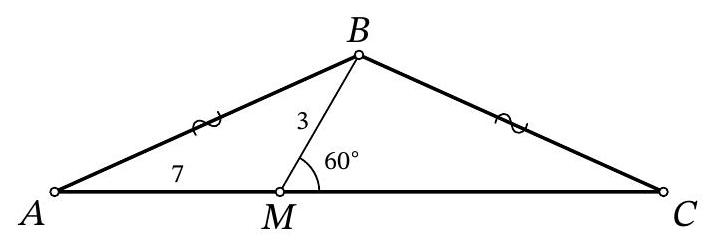 | Answer: 17.
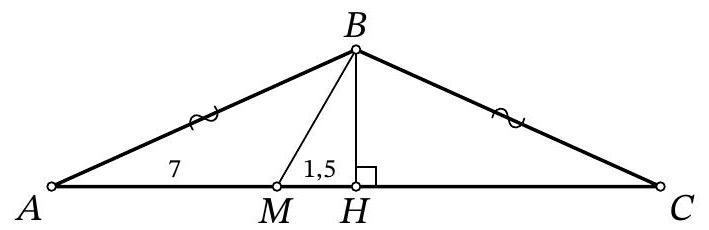
Fig. 3: to the solution of problem 9.5
Solution. In the isosceles triangle \(ABC\), draw the height and median \(BH\) (Fig. 3). Note that in the right triangle \(BHM\), the angl... | 17 | Geometry | math-word-problem | olympiads | 1d5ddbb3-7854-5a77-a7f6-39c15174da7e | [
true,
true
] | [
"<think>\nOkay, so I have this geometry problem here. Let me read it again to make sure I understand. It's an isosceles triangle ABC where AB equals BC. Wait, hold on, that's interesting because usually, in an isosceles triangle, the two equal sides are the legs, and the base is the unequal one. But here, AB equals... | [
true,
true
] | null | null | 2 | [
{
"content": "Problem 9.5. On the base $AC$ of isosceles triangle $ABC (AB = BC)$, a point $M$ is marked. It is known that $AM = 7, MB = 3, \\angle BMC = 60^\\circ$. Find the length of segment $AC$.\n\n=196 ; l^{2}... | 14 | Geometry | math-word-problem | olympiads | afca75ab-b6ca-5a29-bfa3-fa771d2bb036 | [
true,
true
] | [
"<think>\nOkay, so I need to solve this problem where the perimeter of a sector is 28 cm, and its area is 49 cm². The goal is to find the length of the arc of the sector. Hmm, let me recall what a sector is. A sector of a circle is like a \"slice\" of the circle, bounded by two radii and an arc. The perimeter of a ... | [
true,
true
] | null | null | 2 | [
{
"content": "10.335. The perimeter of a sector is 28 cm, and its area is $49 \\mathrm{~cm}^{2}$. Determine the length of the arc of the sector.",
"role": "user"
},
{
"content": "<think>Hmm , let me recall what a sector is. A sector of a circle is like a \"slice\" of the circle, bounded by two radii... |
7. The function $f$ is defined on the set of integers, satisfying
$$
f(n)=\left\{\begin{array}{ll}
n-3, & \text { when } n \geqslant 1000, \\
f(f(n+5)), & \text { when } n<1000 .
\end{array}\right.
$$
Find $f(84)$. | Solve: First, calculate $f(n)$ for $n$ values close to 1000, and observe the pattern when $\mathrm{n}<1000$. Using the recursive definition of $\mathrm{f}$, we can compute:
$$
\begin{array}{l}
\mathrm{f}(999)=\mathrm{f}(\mathrm{f}(1004))=\mathrm{f}(1001)=998, \\
\mathrm{f}(998)=\mathrm{f}(\mathrm{f}(1003))=\mathrm{f}(1... | 997 | Algebra | math-word-problem | cn_contest | 2efbb8bf-7b74-5f9e-8b2a-403cf642e234 | [
true,
true,
true,
true
] | [
"<think>\nOkay, so I need to find f(84) for this function f that's defined on the set of integers. The function has two cases: if n is greater than or equal to 1000, then f(n) is just n minus 3. But if n is less than 1000, then f(n) is defined recursively as f(f(n+5)). Hmm, that sounds a bit tricky. Let me try to u... | [
true,
true,
true,
true
] | null | null | 4 | [
{
"content": "7. The function $f$ is defined on the set of integers, satisfying\n$$\nf(n)=\\left\\{\\begin{array}{ll}\nn-3, & \\text { when } n \\geqslant 1000, \\\\\nf(f(n+5)), & \\text { when } n<1000 .\n\\end{array}\\right.\n$$\n\nFind $f(84)$.",
"role": "user"
},
{
"content": "<think>Hmm , that ... |
## Task A-2.1. (4 points)
Determine the sum of all positive divisors of the number 2010. | ## First solution.
The number 2010 can be factored as $2 \cdot 3 \cdot 5 \cdot 67$, so all positive divisors of 2010 are:
$1,2,3,5,6,10,15,30,67,134,201,335,402,670,1005,2010$.
(3 points)
Their sum is 4896. | 4896 | Number Theory | math-word-problem | olympiads | b7b9d66e-1fb1-5faf-b0fd-5aae81a0cd0c | [
true,
true
] | [
"<think>\nOkay, so I need to find the sum of all positive divisors of 2010. Hmm, divisors... right. The divisors of a number are all the numbers that divide it without leaving a remainder. For example, the divisors of 6 are 1, 2, 3, and 6. The sum would be 1+2+3+6=12. But 2010 is a much bigger number, so listing al... | [
true,
true
] | null | null | 2 | [
{
"content": "## Task A-2.1. (4 points)\n\nDetermine the sum of all positive divisors of the number 2010.",
"role": "user"
},
{
"content": "<think>Hmm , divisors... right. The divisors of a number are all the numbers that divide it without leaving a remainder. For example, the divisors of 6 are 1, 2... |
17. $[\mathbf{1 0}]$ Determine the last two digits of $17^{17}$, written in base 10 . | Answer: $\quad 77$ We are asked to find the remainder when $17^{17}$ is divided by 100 . Write the power as $(7+10)^{17}$ and expand with the binomial theorem:
$$
(7+10)^{17}=7^{17}+17 \cdot 7^{16} \cdot 10+\ldots
$$
We can ignore terms with more than one factor of 10 because these terms are divisible by 100 , so addi... | 77 | Number Theory | math-word-problem | olympiads | 4101f9ca-3478-54cc-9781-3b77bd070008 | [
true,
true
] | [
"<think>\nOkay, so I need to find the last two digits of 17 raised to the 17th power. That means I need to compute 17^17 modulo 100, right? Because the last two digits of any number in base 10 are the remainder when you divide by 100. Hmm, okay, let's think about how to approach this.\n\nI remember that Euler's the... | [
true,
true
] | null | [
"stop",
"stop"
] | 2 | [
{
"content": "17. $[\\mathbf{1 0}]$ Determine the last two digits of $17^{17}$, written in base 10 .",
"role": "user"
},
{
"content": "<think>Hmm , okay, let's think about how to approach this.\n\nI remember that Euler's theorem might be useful here. Euler's theorem states that if two numbers are co... |
[color=darkred]Find all functions $f:\mathbb{R}\to\mathbb{R}$ with the following property: for any open bounded interval $I$, the set $f(I)$ is an open interval having the same length with $I$ .[/color] | **
Removing the restriction \( f(0) = 0 \), the general solution is:
\[
f(x) = \pm x + C
\]
where \( C \) is a constant.
The final answer is \( \boxed{ f(x) = \pm x + C } \). | f(x) = \pm x + C | Other | math-word-problem | aops_forum | f63931ca-6b61-5991-a5f0-8fbfb4927a56 | [
true,
true
] | [
"<think>\nOkay, so I need to find all functions f from the real numbers to the real numbers such that for any open bounded interval I, the image f(I) is an open interval with the same length as I. Hmm, interesting. Let me think step by step.\n\nFirst, let me understand the problem. The function f has to preserve th... | [
false,
false
] | [
false,
true
] | null | 1 | [
{
"content": "[color=darkred]Find all functions $f:\\mathbb{R}\\to\\mathbb{R}$ with the following property: for any open bounded interval $I$, the set $f(I)$ is an open interval having the same length with $I$ .[/color]",
"role": "user"
},
{
"content": "<think>Hmm , okay. Let me start by breaking do... |
7. There is a class of numbers that are multiples of 7 and 5, and when 9 is added to them, they become prime numbers. The smallest number in this class is $\qquad$ . | Parse: $[7,5]=35, 35+9=44(\times), 35 \times 2+9=79, 79$ is a prime number, so the smallest is 70. | 70 | Number Theory | math-word-problem | olympiads | cd16e0c1-89d4-5cb2-99e8-54abc4779bd6 | [
true,
true
] | [
"<think>\nOkay, let me try to figure out this problem. So, we need to find the smallest number that is a multiple of both 7 and 5, meaning it's a multiple of 35, right? Because 7 and 5 are both prime, so their least common multiple is 35. Then, when we add 9 to this number, the result should be a prime number. Hmm,... | [
true,
true
] | null | null | 2 | [
{
"content": "7. There is a class of numbers that are multiples of 7 and 5, and when 9 is added to them, they become prime numbers. The smallest number in this class is $\\qquad$ .",
"role": "user"
},
{
"content": "<think>Hmm , okay. Let's break this down step by step.\n\nFirst, let's confirm what e... |
[ Similar triangles ]
In triangle $ABC$, with sides $a, b$ and $c$ given, a line $MN$ parallel to $AC$ is drawn such that $AM = BN$. Find $MN$.
# | Consider similar triangles.
## Solution
Let $A M=B N=x$ and find $x$ using the similarity of triangles $B M N$ and $B A C:{ }^{c-x /{ }_{c}}={ }^{x / a} \Rightarrow \quad x={ }^{a c} / a+c$. From the same similarity, we find that $M N={ }^{x b} / a=b c / a+c$.
## Answer
$b c / a+c$. | \frac{}{+} | Geometry | math-word-problem | olympiads | 05f032b5-8dcd-5f55-a738-c6278adfeb4a | [
true,
true
] | [
"<think>\nOkay, let's try to tackle this problem. So, we have triangle ABC with sides a, b, and c. A line MN is drawn parallel to AC, and AM equals BN. We need to find the length of MN. Hmm, let's see.\n\nFirst, I need to visualize the triangle. Let me sketch triangle ABC in my mind. Let's label the vertices A, B, ... | [
false,
false
] | [
true,
false
] | null | 1 | [
{
"content": "[ Similar triangles ]\n\nIn triangle $ABC$, with sides $a, b$ and $c$ given, a line $MN$ parallel to $AC$ is drawn such that $AM = BN$. Find $MN$.\n\n#",
"role": "user"
},
{
"content": "<think>Hmm , let's see.\n\nFirst, I need to visualize the triangle. Let me sketch triangle ABC in my... |
9. Given that $\left\{a_{n}\right\}$ is a geometric sequence with the first term 1 and common ratio 2, and $\left\{b_{n}\right\}$ is an arithmetic sequence with the first term 2 and common difference 5, the numbers that appear in both sequences are arranged in ascending order to form the sequence $\left\{x_{n}\right\}$... | $a_{n}=2^{n-1}, b_{n}=5 n-3$, Note that $2^{4} \equiv 1(\bmod 5)$, so $a_{n}=b_{m} \Leftrightarrow n=4 k-2$, thus $x_{n}=a_{4 n-2}=2^{4 n-3}$. Therefore, $x_{100}=a_{398}=2^{397}$. | 2^{397} | Algebra | math-word-problem | olympiads | a29f2d44-139a-5b41-915a-b1dc624afe2e | [
true,
true
] | [
"<think>\nOkay, let's try to solve this problem step by step. So, we have two sequences: a geometric sequence {aₙ} with the first term 1 and common ratio 2, and an arithmetic sequence {bₙ} with the first term 2 and common difference 5. We need to find the numbers that appear in both sequences, arrange them in ascen... | [
true,
false
] | null | null | 1 | [
{
"content": "9. Given that $\\left\\{a_{n}\\right\\}$ is a geometric sequence with the first term 1 and common ratio 2, and $\\left\\{b_{n}\\right\\}$ is an arithmetic sequence with the first term 2 and common difference 5, the numbers that appear in both sequences are arranged in ascending order to form the s... |
In a right-angled triangle, the segment of the perpendicular bisector of the hypotenuse that falls between the lines of the legs is as long as the hypotenuse. What are the angles of the triangle? | Solution. Let the right triangle be $ABC$, where $\angle CAB = 90^\circ$. Let the intersection points of the perpendicular bisector with segment $CA$ and line $AB$ be $D$ and $E$, respectively, as shown in the figure.

G8.1 Find $A$.
G8.2 Find $B$.
G8.3 Find $C$.
G8.4 Find $D$.
\begin{tabular}{rrrrrrr}
& 1 & A & B & C & D & E \\
$\times$ & & & & & & 3 \\
\hline & A & B & C & D & ... | $\mathrm{E}=7$ and the carry digit is 20 .
$3 \mathrm{D}+2 \equiv 7(\bmod 10)$
$\mathrm{D}=5$ and the carry digit is 10
$3 \mathrm{C}+1 \equiv 5(\bmod 10)$
$\mathrm{C}=8$ and the carry digit is 20 .
$3 \mathrm{~B}+2 \equiv 8(\bmod 10)$
$\mathrm{B}=2$ and there is no carry digit.
$3 \mathrm{~A} \equiv 2(\bmod 10)$
$\mat... | A=4,B=2,C=8,D=5 | Logic and Puzzles | math-word-problem | olympiads | 0d0d1451-f6e5-5e0c-bcf9-c88d94ca829d | [
true,
true
] | [
"<think>\nOkay, let me try to figure out this multiplication problem. So, from the problem statement, different letters A, B, C, D, E represent different integers from the set {2,4,5,6,7,8,9}. The multiplication is set up such that when a 6-digit number starting with 1 is multiplied by 3, it results in another 6-di... | [
false,
false
] | [
true,
true
] | null | 2 | [
{
"content": "Group Event 8\nIn the given multiplication, different letters represent different integers whose possible values are $2,4,5,6,7,8$, 9. (Reference: 2000 HI8)\nG8.1 Find $A$.\nG8.2 Find $B$.\nG8.3 Find $C$.\nG8.4 Find $D$.\n\\begin{tabular}{rrrrrrr} \n& 1 & A & B & C & D & E \\\\\n$\\times$ & & & & ... |
Example 7. Find the equation of the plane containing the point $M_{1}(3,1,0)$ and the line $\frac{x-4}{1}=\frac{y}{2}=\frac{z-1}{3}$. | Solution. From the equation of the line, the coordinates of the point $M_{0}(4,0,1)$ on it and the directing vector $\vec{l}=\{1,2,3\}$ are known.
Let $M(x, y, z) \rightarrow$ the current point of the plane (Fig. 4.15). Then the vectors $\overrightarrow{M_{0} M}, \overrightarrow{M_{0} M_{1}}, \vec{l}$ lie in the same ... | 5x+2y-3z-17=0 | Geometry | math-word-problem | olympiads | bc1e40c2-a587-5a11-b6ce-a219b1ccbdb4 | [
true,
true
] | [
"<think>\nOkay, so I need to find the equation of a plane that contains the point M₁(3,1,0) and also contains the line given by (x-4)/1 = y/2 = (z-1)/3. Hmm, let's start by recalling how to find the equation of a plane. I remember that a plane can be defined if we have a point on the plane and a normal vector to th... | [
true,
true
] | null | null | 2 | [
{
"content": "Example 7. Find the equation of the plane containing the point $M_{1}(3,1,0)$ and the line $\\frac{x-4}{1}=\\frac{y}{2}=\\frac{z-1}{3}$.",
"role": "user"
},
{
"content": "<think>Hmm , let's start by recalling how to find the equation of a plane. I remember that a plane can be defined i... |
12.402 In a triangle, two sides $a$ and $b(a>b)$ and the area $S$ are given. Find the angle between the height and the median drawn to the third side. | ## Solution.
$$
\begin{aligned}
& \text { Let in the given } \triangle A B C \quad a=B C, \dot{b}=A B, B D \text { - altitude, } \\
& B M-\text { median of } \triangle A B C . \text { Then } \\
& B D^{2}=A B^{2}-\left(\frac{A C}{2}-D M\right)^{2}=B C^{2}-\left(\frac{A C}{2}+D M\right)^{2} \Rightarrow \\
& \Rightarrow ... | \operatorname{arctg}\frac{^{2}-b^{2}}{4S} | Geometry | math-word-problem | olympiads | d59910ea-60da-5caa-b6e0-ae443973b6ae | [
true,
true
] | [
"<think>\nOkay, so I need to find the angle between the height (altitude) and the median drawn to the third side in a triangle where two sides a and b (with a > b) and the area S are given. Hmm, let me visualize this. Let me sketch a triangle in my mind. Let's label the triangle ABC, where sides a and b are two of ... | [
false,
false
] | [
true,
true
] | null | 2 | [
{
"content": "12.402 In a triangle, two sides $a$ and $b(a>b)$ and the area $S$ are given. Find the angle between the height and the median drawn to the third side.",
"role": "user"
},
{
"content": "<think>Hmm , let me visualize this. Let me sketch a triangle in my mind. Let's label the triangle ABC... |
3. Find all non-zero real numbers $x, y, z$ which satisfy the system of equations:
$$
\begin{aligned}
\left(x^{2}+x y+y^{2}\right)\left(y^{2}+y z+z^{2}\right)\left(z^{2}+z x+x^{2}\right) & =x y z \\
\left(x^{4}+x^{2} y^{2}+y^{4}\right)\left(y^{4}+y^{2} z^{2}+z^{4}\right)\left(z^{4}+z^{2} x^{2}+x^{4}\right) & =x^{3} y... |
Solution: Since $x y z \neq 0$, We can divide the second relation by the first. Observe that
$$
x^{4}+x^{2} y^{2}+y^{4}=\left(x^{2}+x y+y^{2}\right)\left(x^{2}-x y+y^{2}\right)
$$
holds for any $x, y$. Thus we get
$$
\left(x^{2}-x y+y^{2}\right)\left(y^{2}-y z+z^{2}\right)\left(z^{2}-z x+x^{2}\right)=x^{2} y^{2} z^... | \frac{1}{3} | Algebra | math-word-problem | olympiads | 341204e7-56e7-5e74-829f-1b1234380e69 | [
true,
true
] | [
"<think>\nOkay, so I need to solve this system of equations where x, y, z are all non-zero real numbers. The equations are:\n\n1. (x² + xy + y²)(y² + yz + z²)(z² + zx + x²) = xyz\n2. (x⁴ + x²y² + y⁴)(y⁴ + y²z² + z⁴)(z⁴ + z²x² + x⁴) = x³y³z³\n\nHmm, both equations look pretty symmetrical. Maybe there's a case where ... | [
true,
false
] | null | null | 1 | [
{
"content": "\n3. Find all non-zero real numbers $x, y, z$ which satisfy the system of equations:\n\n$$\n\\begin{aligned}\n\\left(x^{2}+x y+y^{2}\\right)\\left(y^{2}+y z+z^{2}\\right)\\left(z^{2}+z x+x^{2}\\right) & =x y z \\\\\n\\left(x^{4}+x^{2} y^{2}+y^{4}\\right)\\left(y^{4}+y^{2} z^{2}+z^{4}\\right)\\left... |
Example 5. Let the sequences $\left\{x_{n}\right\},\left\{y_{n}\right\}$ satisfy $x_{n}+y_{n} i=\left(\frac{\sqrt{3} i-1}{2}\right)^{n}$. Find the sum of the first 1994 terms of the sequence $\left\{x_{n}\right\}$, $S_{1994}$. | $\begin{array}{l}\text { Let } \begin{array}{l} \text { } F:=x_{n}+y_{n} i=\left(\frac{\sqrt{3} i-1}{2}\right)^{n}, F^{\prime} \\ =x_{h}-j_{n} i=\left(\frac{\sqrt{3} i-1}{2}\right)^{n} . \text { Then } F+F^{\prime}=2 x_{n} \\ =\omega^{n}+(\bar{\omega})^{n}\left(\text { where } \omega=\frac{-1+\sqrt{3} i}{2}\right) . \t... | -1 | Algebra | math-word-problem | cn_contest | 43da5885-ef26-5c1e-8cd7-bc1b2c0a46bc | [
true,
true
] | [
"<think>\nAlright, so I need to find the sum of the first 1994 terms of the sequence {xₙ}, where xₙ and yₙ are defined by the equation xₙ + yₙ i = ((√3 i - 1)/2)^n. Hmm, okay. Let me start by understanding the problem step by step.\n\nFirst, the sequences {xₙ} and {yₙ} are given by the complex number ( (√3 i - 1)/2... | [
true,
true
] | null | null | 2 | [
{
"content": "Example 5. Let the sequences $\\left\\{x_{n}\\right\\},\\left\\{y_{n}\\right\\}$ satisfy $x_{n}+y_{n} i=\\left(\\frac{\\sqrt{3} i-1}{2}\\right)^{n}$. Find the sum of the first 1994 terms of the sequence $\\left\\{x_{n}\\right\\}$, $S_{1994}$.",
"role": "user"
},
{
"content": "<think>Hm... |
8. There are 10 cards, each card has two different numbers from $1,2,3,4,5$, and no two cards have the same pair of numbers. These 10 cards are to be placed into five boxes labeled $1,2,3,4,5$, with the rule that a card with numbers $i, j$ can only be placed in box $i$ or box $j$. A placement is called "good" if the nu... | There are 10 types of cards: $12,13,14,15,23,24,25,34,35,45$. Since on average 2 cards are placed in each box, Box 1 can only contain 3 or 4 cards.
If Box 1 contains 3 cards, let's assume they are $12,13,14$, then $15$ can only be placed in Box 5. At this point, the number of cards in the remaining boxes can only be $... | 120 | Combinatorics | math-word-problem | olympiads | 7674a144-2b46-521e-b4de-0c2321a47418 | [
true,
true
] | [
"<think>\nOkay, let me try to figure out this problem. So, we have 10 cards, each with two different numbers from 1 to 5, and each pair is unique. That makes sense because the number of unique pairs from 5 numbers is C(5,2) = 10. So, each card is like an unordered pair, right? Like {1,2}, {1,3}, ..., {4,5}. \n\nNow... | [
false,
true
] | null | [
"length",
"stop"
] | 1 | [
{
"content": "8. There are 10 cards, each card has two different numbers from $1,2,3,4,5$, and no two cards have the same pair of numbers. These 10 cards are to be placed into five boxes labeled $1,2,3,4,5$, with the rule that a card with numbers $i, j$ can only be placed in box $i$ or box $j$. A placement is c... |
11. Given the sequence $\left\{a_{n}\right\}$, the sum of the first $n$ terms is
$$
S_{n}=2 a_{n}-2\left(n \in \mathbf{Z}_{+}\right) \text {. }
$$
(1) Find the general term formula $a_{n}$;
(2) Let $b_{n}=\frac{1}{a_{n}}-\frac{1}{n(n+1)}, T_{n}$ be the sum of the first $n$ terms of the sequence $\left\{b_{n}\right\}$, ... | (1) From $S_{n}=2 a_{n}-2$, we get $S_{n+1}=2 a_{n+1}-2$.
Subtracting the two equations yields
$$
a_{n+1}=2 a_{n+1}-2 a_{n} \Rightarrow a_{n+1}=2 a_{n} \text {. }
$$
Thus, $\left\{a_{n}\right\}$ is a geometric sequence with common ratio $q=2$.
From $S_{1}=2 a_{1}-2 \Rightarrow a_{1}=2 a_{1}-2 \Rightarrow a_{1}=2$.
The... | \frac{2}{3} | Algebra | math-word-problem | olympiads | 96512b55-9e87-596a-a1ac-0453c4aafbb8 | [
true,
true
] | [
"<think>\nOkay, so I need to solve this three-part problem about the sequence {a_n} where the sum of the first n terms is given by S_n = 2a_n - 2. Let's start with part (1): finding the general term formula for a_n.\n\nHmm, I remember that the sum of the first n terms S_n is related to the terms of the sequence. Sp... | [
true,
true
] | null | null | 2 | [
{
"content": "11. Given the sequence $\\left\\{a_{n}\\right\\}$, the sum of the first $n$ terms is\n$$\nS_{n}=2 a_{n}-2\\left(n \\in \\mathbf{Z}_{+}\\right) \\text {. }\n$$\n(1) Find the general term formula $a_{n}$;\n(2) Let $b_{n}=\\frac{1}{a_{n}}-\\frac{1}{n(n+1)}, T_{n}$ be the sum of the first $n$ terms of... |
7.097. $\log _{3}(x-3)^{2}+\log _{3}|x-3|=3$. | ## Solution.
Domain of definition: $x-3 \neq 0, x \neq 3$.
From the condition
$2 \log _{3}|x-3|+\log _{3}|x-3|=3, 3 \log _{3}|x-3|=3, \log _{3}|x-3|=1$,
hence $|x-3|=3$. Then $(x-3)_{1}=-3$ or $(x-3)_{2}=3$. From this, $x_{1}=0$, $x_{2}=6$.
Answer: $0 ; 6$. | 0;6 | Algebra | math-word-problem | olympiads | 755ae935-6506-5708-bcc7-9d9e448b0f0b | [
true,
true
] | [
"<think>\nOkay, let's see. I need to solve the equation log base 3 of (x - 3)^2 plus log base 3 of the absolute value of (x - 3) equals 3. Hmm, logarithms can sometimes be tricky, especially when dealing with absolute values and squared terms. Let me take it step by step.\n\nFirst, I remember that logarithms have p... | [
true,
true
] | null | null | 2 | [
{
"content": "7.097. $\\log _{3}(x-3)^{2}+\\log _{3}|x-3|=3$.",
"role": "user"
},
{
"content": "<think>Hmm , logarithms can sometimes be tricky, especially when dealing with absolute values and squared terms. Let me take it step by step.\n\nNow, to get rid of the logarithm, I can rewrite this in exp... |
$4 \cdot 247$ Find all positive integers $n$ such that the following equation has an integer solution.
$$
x^{n}+(2+x)^{n}+(2-x)^{n}=0 \text {. }
$$ | [Solution] When $n=1$, we get $x+(2+x)+(2-x)=0, x=-4$ as its integer solution.
When $n$ is even, the original equation has integer solutions if and only if:
$$
\left\{\begin{array}{l}
x=0, \\
2+x=0, \\
2-x=0 .
\end{array}\right.
$$
But (1) is a contradictory equation, hence when $n$ is even, the original equation has ... | 1 | Algebra | math-word-problem | olympiads | 098012d6-f77c-5d29-aab5-003b90a8d597 | [
true,
true
] | [
"<think>\nOkay, so I need to find all positive integers n such that the equation x^n + (2 + x)^n + (2 - x)^n = 0 has an integer solution for x. Hmm, let's start by understanding the problem. I need to figure out for which exponents n (positive integers) there exists some integer x that makes that equation hold true... | [
true,
true
] | null | null | 2 | [
{
"content": "$4 \\cdot 247$ Find all positive integers $n$ such that the following equation has an integer solution.\n$$\nx^{n}+(2+x)^{n}+(2-x)^{n}=0 \\text {. }\n$$",
"role": "user"
},
{
"content": "<think>Hmm , let's start by understanding the problem. I need to figure out for which exponents n (... |
10.412 The area of a right triangle is equal to $2 r^{2} / 3$, where $r$ is the radius of the circle that touches one leg and the extension of the other leg and the hypotenuse. Find the sides of the triangle. | ## Solution.
B
A

K
0
Let the circle with center $O$ and radius $r$ touch the leg $A C$ and the extensions of the leg $A B$ and the hypotenuse $B C$ of the given $\triangle A B C$ at points... | r,\frac{4}{3}r,\frac{5}{3}r | Geometry | math-word-problem | olympiads | 59955a7a-e70c-519e-984f-1c6126122e0a | [
true,
true
] | [
"<think>\nAlright, so I need to find the sides of a right triangle where the area is equal to (2r²)/3, and r is the radius of a circle that touches one leg, the extension of the other leg, and the hypotenuse. Hmm, okay, let me try to visualize this first.\n\nFirst, let me recall that in a right triangle, there are ... | [
false,
false
] | [
false,
true
] | null | 1 | [
{
"content": "10.412 The area of a right triangle is equal to $2 r^{2} / 3$, where $r$ is the radius of the circle that touches one leg and the extension of the other leg and the hypotenuse. Find the sides of the triangle.",
"role": "user"
},
{
"content": "<think>Hmm , okay. Let me try to visualize ... |
Subsets and Splits
No community queries yet
The top public SQL queries from the community will appear here once available.