\n\nGiven the problem of determining the largest real number \\( z \\) such that \\( x + y + z = 5 \\), \\( xy + yz + zx = 3 \\), and \\( x \\), \\( y \\) are real numbers, we start by expressing \\( x \\) and \\( y \\) in terms of \\( z \\).\n\nFrom the equation \\( x + y + z = 5 \\), we have:\n\\[ x + y = 5 - z \\]\n\nSubstituting \\( x + y = 5 - z \\) into the second equation \\( xy + yz + zx = 3 \\), we get:\n\\[ xy + z(5 - z) = 3 \\]\n\\[ xy = 3 - z(5 - z) \\]\n\\[ xy = z^2 - 5z + 3 \\]\n\nWe then consider the quadratic equation \\( t^2 - (5 - z)t + (z^2 - 5z + 3) = 0 \\) which \\( x \\) and \\( y \\) must satisfy. For \\( x \\) and \\( y \\) to be real, the discriminant of this quadratic equation must be non-negative:\n\\[ (5 - z)^2 - 4(z^2 - 5z + 3) \\geq 0 \\]\n\nExpanding and simplifying the discriminant:\n\\[ 25 - 10z + z^2 - 4z^2 + 20z - 12 \\geq 0 \\]\n\\[ -3z^2 + 10z + 13 \\geq 0 \\]\n\nSolving the quadratic inequality \\( -3z^2 + 10z + 13 \\geq 0 \\), we find the roots using the quadratic formula:\n\\[ z = \\frac{10 \\pm \\sqrt{100 + 156}}{6} = \\frac{10 \\pm 16}{6} \\]\n\\[ z = \\frac{26}{6} = \\frac{13}{3} \\quad \\text{or} \\quad z = \\frac{-6}{6} = -1 \\]\n\nThe quadratic inequality holds between the roots \\( -1 \\) and \\( \\frac{13}{3} \\). Therefore, the largest possible value of \\( z \\) is \\( \\frac{13}{3} \\).\n\nTo verify, substituting \\( z = \\frac{13}{3} \\) back into the equations, we find:\n\\[ x + y = 5 - \\frac{13}{3} = \\frac{2}{3} \\]\n\\[ xy = \\left( \\frac{13}{3} \\right)^2 - 5 \\left( \\frac{13}{3} \\right) + 3 = \\frac{1}{9} \\]\n\nThe quadratic equation \\( t^2 - \\frac{2}{3}t + \\frac{1}{9} = 0 \\) has a discriminant of zero, indicating real and equal roots \\( x = y = \\frac{1}{3} \\). This confirms the solution is valid.\n\nThus, the largest real number \\( z \\) is \\(\\boxed{\\dfrac{13}{3}}\\).","<think>\nAlright, so I need to find the largest real number z such that when x, y, and z satisfy the equations x + y + z = 5 and xy + yz + zx = 3, with x and y also being real numbers. Hmm, okay. Let me break this down step by step.\n\nFirst, the problem is asking for the maximum possible value of z given those two equations and the realness of x and y. So, essentially, z is a parameter here, and I need to ensure that for that particular z, there exist real numbers x and y that satisfy the equations. That makes sense.\n\nLet me recall that in problems involving symmetric equations like these, sometimes you can express variables in terms of others and then use discriminants to ensure real solutions. Since x and y have to be real, maybe I can treat them as roots of a quadratic equation and then use the discriminant condition to find the constraints on z. Yeah, that seems like a possible approach.\n\nLet me try that. If I fix z, then x + y = 5 - z, and xy = 3 - z(x + y). But since x + y is 5 - z, substitute that into the expression for xy: xy = 3 - z(5 - z) = 3 - 5z + z². So, if I consider x and y as roots of the quadratic equation t² - (x + y)t + xy = 0, substituting the expressions we have, the quadratic becomes t² - (5 - z)t + (3 - 5z + z²) = 0. \n\nFor x and y to be real, the discriminant of this quadratic must be non-negative. The discriminant D is [5 - z]^2 - 4*(1)*(3 - 5z + z²). Let me compute that. \n\nFirst, expand [5 - z]^2: that's 25 - 10z + z². Then subtract 4*(3 - 5z + z²): which is 12 - 20z + 4z². So the discriminant D is (25 - 10z + z²) - (12 - 20z + 4z²) = 25 -10z + z² -12 +20z -4z². Combining like terms: \n\n25 -12 = 13, -10z +20z =10z, z² -4z²= -3z². So D = -3z² +10z +13. \n\nSo, for x and y to be real, we need D >=0. So, the quadratic in z: -3z² +10z +13 >=0. To find when this is true, we can solve the inequality -3z² +10z +13 >=0. Multiply both sides by -1 (which reverses the inequality): 3z² -10z -13 <=0. \n\nNow, we can solve 3z² -10z -13 <=0. First, find the roots of the quadratic equation 3z² -10z -13=0. Using the quadratic formula: z = [10 ± sqrt(100 + 156)] /6. Because the discriminant here is 100 +4*3*13 = 100 +156=256. sqrt(256)=16. So z = [10 ±16]/6. \n\nCalculating the two roots:\n\nFirst root: (10 +16)/6 =26/6=13/3≈4.333...\n\nSecond root: (10 -16)/6=(-6)/6=-1.\n\nSo, the quadratic 3z² -10z -13 is a parabola opening upwards (since coefficient of z² is positive), so it is <=0 between its roots. Therefore, z must lie between -1 and 13/3. So, the original inequality -3z² +10z +13 >=0 holds when z is in [-1, 13/3]. \n\nTherefore, the maximum possible value of z is 13/3≈4.333...\n\nBut wait, let me confirm this. So the quadratic equation for x and y has real roots when z is between -1 and 13/3. Therefore, the largest possible z is 13/3. But let me check if when z=13/3, there are real x and y. Let's compute x + y =5 -13/3= (15 -13)/3=2/3. And xy=3 - z(x + y)=3 - (13/3)(2/3)=3 -26/9=27/9 -26/9=1/9. So, the quadratic equation is t² - (2/3)t +1/9=0. Let's check the discriminant: (2/3)^2 -4*(1)*(1/9)=4/9 -4/9=0. So discriminant is zero, which means there is a repeated real root. So x=y=1/3. So yes, when z=13/3, x and y both equal 1/3, which are real. Therefore, z=13/3 is attainable. Therefore, the maximum z is 13/3.\n\nBut wait, just to be thorough, let me think again. So, the key steps were:\n\n1. Express x + y and xy in terms of z.\n\n2. Form the quadratic equation with roots x and y.\n\n3. Compute the discriminant and set it >=0.\n\n4. Solve the resulting inequality in z.\n\n5. Find that z must be between -1 and 13/3.\n\n6. Therefore, maximum z is 13/3.\n\nBut let me just verify if there's an alternative approach. Sometimes, in symmetric equations, you can use other methods like substitution or Lagrange multipliers, but since this is a problem from a competition, likely the quadratic approach is the way to go. But just for thoroughness, let's consider another method.\n\nSuppose we treat x and y as variables and z as a parameter. Then, we have x + y =5 - z and xy=3 - z(5 - z). So, we can consider x and y as real numbers satisfying these. The discriminant approach already confirms the possible values of z. Alternatively, maybe we can use some inequalities here. For example, by the Cauchy-Schwarz inequality or AM ≥ GM?\n\nBut given that x and y are real, and we need to maximize z, perhaps the discriminant method is the most straightforward. Let me see.\n\nAlternatively, perhaps using the method of resultants. If we have x + y + z =5 and xy + yz + zx=3. Let me consider x and y. Then, from x + y =5 - z, and xy=3 - z(5 - z). So, these are the same as before.\n\nAlternatively, maybe we can express the original equations in terms of z. Let's consider z as fixed. Then, the problem reduces to solving for x and y. Since we need real solutions, the discriminant must be non-negative, which we already did.\n\nAlternatively, perhaps think of x and y as variables in the plane. The equations x + y =5 - z defines a line, and xy =3 - z(5 - z) defines a hyperbola. The intersection points must be real, so the hyperbola and line must intersect. The discriminant condition is equivalent to them intersecting.\n\nBut regardless, the discriminant method gives the necessary and sufficient condition. Therefore, I think the answer is indeed 13/3. But let me just check with z=13/3, as we did earlier, we get x+y=2/3 and xy=1/9. So, solving for x and y, the quadratic equation t² - (2/3)t +1/9=0, which factors as (t -1/3)^2=0. So x=y=1/3, which are real numbers. Therefore, z=13/3 is achievable. Therefore, that is indeed the maximum.\n\nWait a second, but let's check if z could be higher. Suppose z is greater than 13/3. Then, the discriminant D becomes negative, so x and y would not be real. So, for z >13/3, we get complex numbers x and y, which is not allowed. Therefore, 13/3 is the upper bound.\n\nJust to confirm, let's try z=14/3≈4.666..., which is greater than 13/3≈4.333... Then x + y=5 -14/3= (15 -14)/3=1/3. Then, xy=3 - z(x + y)=3 - (14/3)(1/3)=3 -14/9=27/9 -14/9=13/9. Then the quadratic equation is t² - (1/3)t +13/9=0. The discriminant here is (1/3)^2 -4*(1)*(13/9)=1/9 -52/9=(-51)/9 <0. So discriminant is negative, so no real solutions. Therefore, z=14/3 is invalid. So, z=13/3 is indeed the maximum. \n\nTherefore, after all these checks, I believe that the largest real number z is 13/3.\n\n**Final Answer**\n\\boxed{\\dfrac{13}{3}}\n</think>\n\nTo determine the largest real number \\( z \\) such that \\( x + y + z = 5 \\), \\( xy + yz + zx = 3 \\), and \\( x, y \\) are real numbers, we start by expressing \\( x \\) and \\( y \\) in terms of \\( z \\).\n\nGiven \\( x + y + z = 5 \\), we have:\n\\[ x + y = 5 - z \\]\n\nFrom \\( xy + yz + zx = 3 \\), we can express \\( xy \\) as:\n\\[ xy = 3 - z(5 - z) = 3 - 5z + z^2 \\]\n\nWe consider \\( x \\) and \\( y \\) as roots of the quadratic equation:\n\\[ t^2 - (5 - z)t + (3 - 5z + z^2) = 0 \\]\n\nFor \\( x \\) and \\( y \\) to be real, the discriminant of this quadratic must be non-negative:\n\\[ [5 - z]^2 - 4(3 - 5z + z^2) \\geq 0 \\]\n\nCalculating the discriminant:\n\\[\n\\begin{aligned}\n(5 - z)^2 - 4(3 - 5z + z^2) &= 25 - 10z + z^2 - 12 + 20z - 4z^2 \\\\\n&= -3z^2 + 10z + 13\n\\end{aligned}\n\\]\n\nWe solve the inequality:\n\\[ -3z^2 + 10z + 13 \\geq 0 \\]\n\nThis is equivalent to:\n\\[ 3z^2 - 10z - 13 \\leq 0 \\]\n\nSolving the quadratic equation \\( 3z^2 - 10z - 13 = 0 \\) using the quadratic formula:\n\\[\nz = \\frac{10 \\pm \\sqrt{100 + 156}}{6} = \\frac{10 \\pm 16}{6}\n\\]\n\nThe roots are:\n\\[\nz = \\frac{26}{6} = \\frac{13}{3} \\quad \\text{and} \\quad z = \\frac{-6}{6} = -1\n\\]\n\nThe quadratic \\( 3z^2 - 10z - 13 \\leq 0 \\) holds between the roots \\(-1\\) and \\(\\frac{13}{3}\\). Therefore, the largest possible value of \\( z \\) is \\(\\frac{13}{3}\\).\n\nVerifying for \\( z = \\frac{13}{3} \\):\n- \\( x + y = 5 - \\frac{13}{3} = \\frac{2}{3} \\)\n- \\( xy = 3 - \\frac{13}{3} \\cdot \\frac{2}{3} = \\frac{1}{9} \\)\n\nThe quadratic equation \\( t^2 - \\frac{2}{3}t + \\frac{1}{9} = 0 \\) has a discriminant of zero, giving real roots \\( x = y = \\frac{1}{3} \\).\n\nThus, the largest real number \\( z \\) is \\(\\boxed{\\dfrac{13}{3}}\\).","<think>\nOkay, so I need to find the largest real number z such that x + y + z = 5, xy + yz + zx = 3, and x and y are real numbers. Hmm, let me think. This seems like a system of equations with three variables, but I need to maximize z. Maybe I can express x and y in terms of z and then ensure that they are real. \n\nLet me start by using the first equation: x + y + z = 5. If I want to solve for x + y, that would be 5 - z. Then, the second equation is xy + yz + zx = 3. Let me see if I can express xy in terms of z as well. Let's rearrange the second equation: xy + z(x + y) = 3. From the first equation, we already know that x + y = 5 - z, so substituting that into the second equation gives xy + z(5 - z) = 3. Therefore, xy = 3 - z(5 - z) = 3 - 5z + z². \n\nNow, if I have x + y = 5 - z and xy = z² - 5z + 3, then x and y are the roots of the quadratic equation t² - (5 - z)t + (z² - 5z + 3) = 0. For x and y to be real numbers, the discriminant of this quadratic must be non-negative. The discriminant D is [5 - z]² - 4*(z² - 5z + 3). Let me compute that:\n\nD = (25 - 10z + z²) - 4z² + 20z - 12 \nFirst, expand the terms: \n25 - 10z + z² - 4z² + 20z - 12 \nCombine like terms: \n(25 - 12) + (-10z + 20z) + (z² - 4z²) \n13 + 10z - 3z² \nSo, D = -3z² + 10z + 13 \n\nFor the quadratic to have real roots, D must be ≥ 0. Therefore, we have the inequality:\n\n-3z² + 10z + 13 ≥ 0 \nMultiply both sides by -1 (remember to reverse the inequality sign):\n\n3z² - 10z - 13 ≤ 0 \n\nNow, solve 3z² - 10z - 13 ≤ 0. First, find the roots of the equation 3z² - 10z - 13 = 0.\n\nUsing the quadratic formula: z = [10 ± √(100 + 156)] / 6 \nBecause the discriminant is 100 + 4*3*13 = 100 + 156 = 256. \n√256 = 16 \nSo, z = [10 ± 16]/6 \n\nThus, the roots are:\n\nz = (10 + 16)/6 = 26/6 = 13/3 ≈ 4.333...\n\nz = (10 - 16)/6 = (-6)/6 = -1 \n\nSo, the quadratic 3z² - 10z - 13 is a parabola opening upwards (since coefficient of z² is positive), so it is ≤ 0 between its roots. Therefore, the solutions to the inequality are z ∈ [-1, 13/3]. \n\nBut since we want the largest real number z, the maximum possible z is 13/3. Let me verify that. If z = 13/3, then x + y = 5 - 13/3 = (15 - 13)/3 = 2/3, and xy = (13/3)^2 - 5*(13/3) + 3. Let me compute that:\n\nFirst, (13/3)^2 = 169/9 \nThen, 5*(13/3) = 65/3 \nSo, xy = 169/9 - 65/3 + 3 \nConvert all terms to ninths: \n169/9 - 195/9 + 27/9 = (169 - 195 + 27)/9 = (1)/9 \nTherefore, xy = 1/9. \n\nThen, the quadratic equation for x and y is t² - (2/3)t + 1/9 = 0. Let's check discriminant: (2/3)^2 - 4*(1/9) = 4/9 - 4/9 = 0. So discriminant is zero, which means x and y are equal real numbers (since discriminant is zero). So x = y = (2/3)/2 = 1/3. Let's check: x = y = 1/3, z = 13/3. Then x + y + z = 1/3 + 1/3 + 13/3 = 15/3 = 5, which matches. Then, xy + yz + zx = (1/3)(1/3) + (1/3)(13/3) + (1/3)(13/3) = 1/9 + 13/9 + 13/9 = (1 + 13 + 13)/9 = 27/9 = 3, which also matches. So yes, z = 13/3 is valid.\n\nTherefore, the largest real number z is 13/3. I think that's the answer. Let me check if there's any other constraints I might have missed. The problem says x and y are real numbers, so as long as discriminant is non-negative, which we checked. So yeah, 13/3 should be correct.\n\n**Final Answer**\nThe largest real number \\( z \\) is \\boxed{\\dfrac{13}{3}}.\n</think>\n\nGiven the problem of finding the largest real number \\( z \\) such that \\( x + y + z = 5 \\), \\( xy + yz + zx = 3 \\), and \\( x \\) and \\( y \\) are real numbers, we start by expressing \\( x \\) and \\( y \\) in terms of \\( z \\).\n\nFrom the first equation, we have:\n\\[ x + y = 5 - z \\]\n\nSubstituting \\( x + y = 5 - z \\) into the second equation, we get:\n\\[ xy + z(5 - z) = 3 \\]\n\\[ xy = 3 - z(5 - z) \\]\n\\[ xy = z^2 - 5z + 3 \\]\n\nThe quadratic equation with roots \\( x \\) and \\( y \\) is:\n\\[ t^2 - (5 - z)t + (z^2 - 5z + 3) = 0 \\]\n\nFor \\( x \\) and \\( y \\) to be real, the discriminant of this quadratic must be non-negative:\n\\[ (5 - z)^2 - 4(z^2 - 5z + 3) \\geq 0 \\]\n\\[ 25 - 10z + z^2 - 4z^2 + 20z - 12 \\geq 0 \\]\n\\[ -3z^2 + 10z + 13 \\geq 0 \\]\n\nSolving the quadratic inequality \\( 3z^2 - 10z - 13 \\leq 0 \\), we find the roots using the quadratic formula:\n\\[ z = \\frac{10 \\pm \\sqrt{100 + 156}}{6} \\]\n\\[ z = \\frac{10 \\pm 16}{6} \\]\n\\[ z = \\frac{26}{6} = \\frac{13}{3} \\quad \\text{or} \\quad z = \\frac{-6}{6} = -1 \\]\n\nThe quadratic \\( 3z^2 - 10z - 13 \\leq 0 \\) holds between the roots \\( z = -1 \\) and \\( z = \\frac{13}{3} \\). The largest value of \\( z \\) is \\( \\frac{13}{3} \\).\n\nVerifying, if \\( z = \\frac{13}{3} \\), then \\( x + y = \\frac{2}{3} \\) and \\( xy = \\frac{1}{9} \\). The quadratic equation \\( t^2 - \\frac{2}{3}t + \\frac{1}{9} = 0 \\) has a discriminant of zero, confirming real roots \\( x = y = \\frac{1}{3} \\).\n\nThus, the largest real number \\( z \\) is \\boxed{\\dfrac{13}{3}}.","<think>\nOkay, so I need to find the largest real number z such that when x + y + z = 5, and xy + yz + zx = 3, with x and y being real numbers. Hmm, let's try to think through this step by step.\n\nFirst, the problem gives me two equations with three variables: x, y, z. But since we're looking for the largest possible z, maybe I can express x and y in terms of z and then find conditions on z that allow real solutions for x and y. That seems like a standard approach when dealing with maximizing or minimizing one variable in a system.\n\nSo starting with the first equation: x + y + z = 5. If I want to express x and y in terms of z, I can subtract z from both sides to get x + y = 5 - z. Let's denote S = x + y = 5 - z. Then, the second equation is xy + yz + zx = 3. Let's see if I can express this in terms of S and maybe the product P = xy.\n\nLooking at the second equation: xy + yz + zx = 3. Let's factor out z from the last two terms: xy + z(y + x) = 3. Since we know that x + y = S = 5 - z, this becomes xy + zS = 3. But S is 5 - z, so substituting that in: xy + z(5 - z) = 3. Then, solving for xy gives us xy = 3 - z(5 - z) = 3 - 5z + z². So, xy = z² - 5z + 3.\n\nSo now, I have S = 5 - z and P = z² - 5z + 3. Since x and y are real numbers, the discriminant of the quadratic equation they satisfy must be non-negative. That is, if we consider x and y as roots of the quadratic t² - St + P = 0, then the discriminant D = S² - 4P must be greater than or equal to zero.\n\nTherefore, substituting S and P into the discriminant:\n\nD = (5 - z)² - 4(z² - 5z + 3) ≥ 0.\n\nLet's compute this discriminant step by step.\n\nFirst, expand (5 - z)²:\n\n(5 - z)² = 25 - 10z + z².\n\nThen compute 4(z² - 5z + 3):\n\n4(z² - 5z + 3) = 4z² - 20z + 12.\n\nNow, subtract the second expression from the first:\n\nD = (25 - 10z + z²) - (4z² - 20z + 12) = 25 - 10z + z² - 4z² + 20z - 12.\n\nCombine like terms:\n\nz² - 4z² = -3z²,\n\n-10z + 20z = 10z,\n\n25 - 12 = 13.\n\nSo overall, D = -3z² + 10z + 13 ≥ 0.\n\nTherefore, the inequality we need to solve is:\n\n-3z² + 10z + 13 ≥ 0.\n\nMultiplying both sides by -1 (remembering to reverse the inequality sign):\n\n3z² - 10z - 13 ≤ 0.\n\nNow, solve the quadratic inequality 3z² - 10z - 13 ≤ 0.\n\nFirst, find the roots of the equation 3z² - 10z - 13 = 0.\n\nUsing the quadratic formula:\n\nz = [10 ± sqrt(100 + 156)] / 6\n\nBecause the quadratic is 3z² -10z -13, so a = 3, b = -10, c = -13.\n\nDiscriminant D = b² - 4ac = (-10)^2 - 4*3*(-13) = 100 + 156 = 256.\n\nsqrt(256) = 16.\n\nThus, the roots are:\n\nz = [10 + 16]/6 = 26/6 = 13/3 ≈ 4.333...\n\nand\n\nz = [10 - 16]/6 = (-6)/6 = -1.\n\nSo the quadratic 3z² -10z -13 crosses zero at z = -1 and z = 13/3. Since the coefficient of z² is positive (3), the parabola opens upwards. Therefore, the inequality 3z² -10z -13 ≤ 0 is satisfied between the roots. So z ∈ [-1, 13/3].\n\nTherefore, the possible values of z that satisfy the original discriminant condition D ≥ 0 are between -1 and 13/3. Since we are looking for the largest real number z, the maximum possible z is 13/3.\n\nBut wait, let me verify this. The problem states that x, y, z are real numbers. So, z can be as large as 13/3, but we need to check whether when z = 13/3, there exist real x and y such that x + y = 5 - z = 5 - 13/3 = (15/3 -13/3) = 2/3, and xy = z² -5z +3.\n\nLet me compute xy when z = 13/3:\n\nxy = (13/3)² -5*(13/3) +3 = (169/9) - (65/3) + 3.\n\nConvert all terms to ninths:\n\n169/9 - 65/3 = 169/9 - 195/9 = (169 - 195)/9 = (-26)/9.\n\nThen add 3, which is 27/9:\n\n-26/9 + 27/9 = 1/9.\n\nSo xy = 1/9.\n\nTherefore, the quadratic equation for x and y is t² - (2/3)t + 1/9 = 0.\n\nLet's check the discriminant here as well:\n\nD = (2/3)^2 - 4*(1/9) = 4/9 - 4/9 = 0.\n\nSo discriminant is zero, meaning x and y are equal: x = y = (2/3)/2 = 1/3.\n\nTherefore, when z = 13/3, we have x = y = 1/3, which are real numbers. So that works.\n\nThus, the maximum possible z is 13/3.\n\nWait a second, but the problem says \"the largest real number z\", so maybe 13/3 is the answer. But let me just check if I did all the computations correctly, because 13/3 is approximately 4.333..., and since x + y + z =5, so x + y would be 5 - z, which when z is 13/3, x + y = 5 -13/3= 2/3. And x and y are both 1/3. So that seems okay.\n\nBut maybe I should check another approach to confirm.\n\nAlternatively, perhaps using Lagrange multipliers or some other method, but since x and y are real, the quadratic approach is probably the right one.\n\nAlternatively, think of x and y as variables parameterized by z. So given x + y = 5 - z, and xy = z² -5z +3.\n\nWe can model x and y as roots of t² - (5 - z)t + (z² -5z +3) =0, and the discriminant must be non-negative. So that's exactly what I did earlier. Therefore, the discriminant is (5 - z)^2 -4(z² -5z +3) ≥0, which simplifies to -3z² +10z +13 ≥0, leading to z ∈ [-1, 13/3]. Therefore, the maximum z is 13/3.\n\nSo, I think that's correct. Let me check if plugging in z=13/3 into the original equations gives valid x and y.\n\nGiven z=13/3, then x + y = 5 -13/3= 2/3. And xy= (13/3)^2 -5*(13/3)+3=169/9 -65/3 +3=169/9 -195/9 +27/9= (169 -195 +27)/9=1/9.\n\nSo x and y are the roots of t² - (2/3)t +1/9=0. The roots are [2/3 ± sqrt{(4/9 -4/9)}]/2= [2/3]/2=1/3. So both x and y are 1/3. Therefore, x=1/3, y=1/3, z=13/3. Then check the sum:1/3 +1/3 +13/3=15/3=5, which matches. The sum xy + yz +zx: (1/3)(1/3) + (1/3)(13/3) + (1/3)(13/3)=1/9 +13/9 +13/9= (1 +13 +13)/9=27/9=3. Correct. So all conditions are satisfied. Therefore, z=13/3 is indeed the maximum possible.\n\nTherefore, the answer is \\boxed{\\dfrac{13}{3}}.\n\n**Final Answer**\nThe largest real number \\( z \\) is \\boxed{\\dfrac{13}{3}}.\n</think>\n\nGiven the problem of determining the largest real number \\( z \\) such that \\( x + y + z = 5 \\), \\( xy + yz + zx = 3 \\), and \\( x, y \\) are real numbers, we start by expressing \\( x \\) and \\( y \\) in terms of \\( z \\).\n\nFirst, we let \\( S = x + y = 5 - z \\). The second equation can be rewritten as \\( xy + z(x + y) = 3 \\). Substituting \\( S \\) into this equation, we get:\n\\[\nxy + z(5 - z) = 3 \\implies xy = 3 - z(5 - z) = z^2 - 5z + 3\n\\]\n\nWe then consider the quadratic equation \\( t^2 - St + P = 0 \\) where \\( S = 5 - z \\) and \\( P = z^2 - 5z + 3 \\). For \\( x \\) and \\( y \\) to be real, the discriminant of this quadratic must be non-negative:\n\\[\n(5 - z)^2 - 4(z^2 - 5z + 3) \\geq 0\n\\]\n\nExpanding and simplifying the discriminant:\n\\[\n(5 - z)^2 - 4(z^2 - 5z + 3) = 25 - 10z + z^2 - 4z^2 + 20z - 12 = -3z^2 + 10z + 13\n\\]\n\nWe solve the inequality:\n\\[\n-3z^2 + 10z + 13 \\geq 0 \\implies 3z^2 - 10z - 13 \\leq 0\n\\]\n\nFinding the roots of the quadratic equation \\( 3z^2 - 10z - 13 = 0 \\) using the quadratic formula:\n\\[\nz = \\frac{10 \\pm \\sqrt{100 + 156}}{6} = \\frac{10 \\pm 16}{6}\n\\]\n\nThe roots are:\n\\[\nz = \\frac{26}{6} = \\frac{13}{3} \\quad \\text{and} \\quad z = \\frac{-6}{6} = -1\n\\]\n\nSince the quadratic \\( 3z^2 - 10z - 13 \\) opens upwards, the inequality \\( 3z^2 - 10z - 13 \\leq 0 \\) is satisfied between the roots \\( -1 \\) and \\( \\frac{13}{3} \\). Therefore, the largest possible value of \\( z \\) is \\( \\frac{13}{3} \\).\n\nVerifying with \\( z = \\frac{13}{3} \\), we find \\( x + y = \\frac{2}{3} \\) and \\( xy = \\frac{1}{9} \\). The quadratic equation \\( t^2 - \\frac{2}{3}t + \\frac{1}{9} = 0 \\) has a discriminant of zero, giving real solutions \\( x = y = \\frac{1}{3} \\). All conditions are satisfied, confirming \\( z = \\frac{13}{3} \\) is valid.\n\nThus, the largest real number \\( z \\) is \\(\\boxed{\\dfrac{13}{3}}\\)."],"string":"[\n \"<think>\\nOkay, so I need to find the largest real number z such that x + y + z = 5, xy + yz + zx = 3, and x and y are real numbers. Hmm, let's see. This looks like a system of equations, and I need to maximize z. \\n\\nFirst, maybe I can express x and y in terms of z. Since x + y + z = 5, that means x + y = 5 - z. Then, the second equation is xy + yz + zx = 3. Let me see if I can express this in terms of z as well. If I factor out z from the last two terms, I get xy + z(x + y) = 3. Since we already know x + y = 5 - z, substitute that in: xy + z(5 - z) = 3. Therefore, xy = 3 - z(5 - z) = 3 - 5z + z².\\n\\nSo now, I have x + y = 5 - z and xy = z² - 5z + 3. Now, x and y are real numbers, so the discriminant of the quadratic equation they satisfy must be non-negative. That is, if we consider the quadratic equation t² - (x + y)t + xy = 0, which would be t² - (5 - z)t + (z² - 5z + 3) = 0, then the discriminant D must be ≥ 0.\\n\\nCalculating the discriminant: D = [-(5 - z)]² - 4 * 1 * (z² - 5z + 3) = (5 - z)² - 4(z² - 5z + 3). Let's expand that:\\n\\nFirst, (5 - z)² = 25 - 10z + z².\\n\\nThen, 4(z² - 5z + 3) = 4z² - 20z + 12.\\n\\nSo, D = (25 - 10z + z²) - (4z² - 20z + 12) = 25 - 10z + z² - 4z² + 20z - 12 = (25 - 12) + (-10z + 20z) + (z² - 4z²) = 13 + 10z - 3z².\\n\\nTherefore, the discriminant D = -3z² + 10z + 13. For x and y to be real, D ≥ 0. So, we have the inequality:\\n\\n-3z² + 10z + 13 ≥ 0.\\n\\nMultiply both sides by -1 (which reverses the inequality):\\n\\n3z² - 10z - 13 ≤ 0.\\n\\nNow, let's solve the quadratic inequality 3z² - 10z - 13 ≤ 0. First, find the roots of 3z² - 10z - 13 = 0.\\n\\nUsing the quadratic formula: z = [10 ± sqrt(100 + 156)] / 6 = [10 ± sqrt(256)] / 6 = [10 ± 16] / 6.\\n\\nCalculating the roots:\\n\\nz = (10 + 16)/6 = 26/6 = 13/3 ≈ 4.333...\\n\\nz = (10 - 16)/6 = (-6)/6 = -1.\\n\\nSince the quadratic 3z² - 10z - 13 opens upwards (the coefficient of z² is positive), the inequality 3z² - 10z - 13 ≤ 0 holds between the roots. Therefore, z ∈ [-1, 13/3].\\n\\nBut since we want the largest real number z, the maximum possible z is 13/3. But we need to check if this value is attainable.\\n\\nWait, but let me double-check. If z is 13/3, then x + y = 5 - 13/3 = (15 - 13)/3 = 2/3. Then, xy = (13/3)^2 -5*(13/3) + 3. Let's compute that.\\n\\nFirst, (13/3)^2 = 169/9.\\n\\nThen, 5*(13/3) = 65/3.\\n\\nSo, xy = 169/9 - 65/3 + 3. Let's convert everything to ninths:\\n\\n169/9 - 65/3 = 169/9 - 195/9 = (-26)/9.\\n\\nThen add 3, which is 27/9: (-26)/9 + 27/9 = 1/9.\\n\\nTherefore, xy = 1/9.\\n\\nSo, x and y satisfy t² - (2/3)t + 1/9 = 0.\\n\\nCompute the discriminant for this quadratic: (2/3)^2 - 4*(1/9) = 4/9 - 4/9 = 0.\\n\\nSo, discriminant is zero, which means x and y are both equal to (2/3)/2 = 1/3. Wait, but the quadratic equation t² - (2/3)t + 1/9 = 0 can be factored as (t - 1/3)^2 = 0. So, x = y = 1/3. Therefore, when z = 13/3, x and y are both 1/3. So, they are real numbers. Hence, z = 13/3 is attainable. Therefore, the largest real number z is 13/3.\\n\\nBut let me check if I made any mistakes in the calculation. Let me verify the discriminant again. Starting from D = -3z² +10z +13. When z =13/3, plug into D: -3*(169/9) +10*(13/3) +13 = -169/3 + 130/3 +13 = (-169 +130)/3 +13 = (-39)/3 +13 = -13 +13 =0. So discriminant is zero, which is okay, so x and y are real (they are equal). So, yes, that's correct.\\n\\nAlternatively, if I set z=13/3, then x + y =5 -13/3=2/3, and xy =1/9. So x and y are both 1/3. So, (x,y,z)=(1/3,1/3,13/3). Plugging into the original equations:\\n\\nx+y+z=1/3 +1/3 +13/3=15/3=5, correct.\\n\\nxy+yz+zx= (1/3)(1/3)+(1/3)(13/3)+(1/3)(13/3)=1/9 +13/9 +13/9= (1+13+13)/9=27/9=3, correct.\\n\\nSo yes, that works. Therefore, z=13/3 is the maximum possible value. Therefore, the answer is 13/3, which is \\\\boxed{\\\\dfrac{13}{3}}.\\n\\n**Final Answer**\\nThe largest real number \\\\( z \\\\) is \\\\boxed{\\\\dfrac{13}{3}}.\\n</think>\\n\\nGiven the problem of determining the largest real number \\\\( z \\\\) such that \\\\( x + y + z = 5 \\\\), \\\\( xy + yz + zx = 3 \\\\), and \\\\( x \\\\), \\\\( y \\\\) are real numbers, we start by expressing \\\\( x \\\\) and \\\\( y \\\\) in terms of \\\\( z \\\\).\\n\\nFrom the equation \\\\( x + y + z = 5 \\\\), we have:\\n\\\\[ x + y = 5 - z \\\\]\\n\\nSubstituting \\\\( x + y = 5 - z \\\\) into the second equation \\\\( xy + yz + zx = 3 \\\\), we get:\\n\\\\[ xy + z(5 - z) = 3 \\\\]\\n\\\\[ xy = 3 - z(5 - z) \\\\]\\n\\\\[ xy = z^2 - 5z + 3 \\\\]\\n\\nWe then consider the quadratic equation \\\\( t^2 - (5 - z)t + (z^2 - 5z + 3) = 0 \\\\) which \\\\( x \\\\) and \\\\( y \\\\) must satisfy. For \\\\( x \\\\) and \\\\( y \\\\) to be real, the discriminant of this quadratic equation must be non-negative:\\n\\\\[ (5 - z)^2 - 4(z^2 - 5z + 3) \\\\geq 0 \\\\]\\n\\nExpanding and simplifying the discriminant:\\n\\\\[ 25 - 10z + z^2 - 4z^2 + 20z - 12 \\\\geq 0 \\\\]\\n\\\\[ -3z^2 + 10z + 13 \\\\geq 0 \\\\]\\n\\nSolving the quadratic inequality \\\\( -3z^2 + 10z + 13 \\\\geq 0 \\\\), we find the roots using the quadratic formula:\\n\\\\[ z = \\\\frac{10 \\\\pm \\\\sqrt{100 + 156}}{6} = \\\\frac{10 \\\\pm 16}{6} \\\\]\\n\\\\[ z = \\\\frac{26}{6} = \\\\frac{13}{3} \\\\quad \\\\text{or} \\\\quad z = \\\\frac{-6}{6} = -1 \\\\]\\n\\nThe quadratic inequality holds between the roots \\\\( -1 \\\\) and \\\\( \\\\frac{13}{3} \\\\). Therefore, the largest possible value of \\\\( z \\\\) is \\\\( \\\\frac{13}{3} \\\\).\\n\\nTo verify, substituting \\\\( z = \\\\frac{13}{3} \\\\) back into the equations, we find:\\n\\\\[ x + y = 5 - \\\\frac{13}{3} = \\\\frac{2}{3} \\\\]\\n\\\\[ xy = \\\\left( \\\\frac{13}{3} \\\\right)^2 - 5 \\\\left( \\\\frac{13}{3} \\\\right) + 3 = \\\\frac{1}{9} \\\\]\\n\\nThe quadratic equation \\\\( t^2 - \\\\frac{2}{3}t + \\\\frac{1}{9} = 0 \\\\) has a discriminant of zero, indicating real and equal roots \\\\( x = y = \\\\frac{1}{3} \\\\). This confirms the solution is valid.\\n\\nThus, the largest real number \\\\( z \\\\) is \\\\(\\\\boxed{\\\\dfrac{13}{3}}\\\\).\",\n \"<think>\\nAlright, so I need to find the largest real number z such that when x, y, and z satisfy the equations x + y + z = 5 and xy + yz + zx = 3, with x and y also being real numbers. Hmm, okay. Let me break this down step by step.\\n\\nFirst, the problem is asking for the maximum possible value of z given those two equations and the realness of x and y. So, essentially, z is a parameter here, and I need to ensure that for that particular z, there exist real numbers x and y that satisfy the equations. That makes sense.\\n\\nLet me recall that in problems involving symmetric equations like these, sometimes you can express variables in terms of others and then use discriminants to ensure real solutions. Since x and y have to be real, maybe I can treat them as roots of a quadratic equation and then use the discriminant condition to find the constraints on z. Yeah, that seems like a possible approach.\\n\\nLet me try that. If I fix z, then x + y = 5 - z, and xy = 3 - z(x + y). But since x + y is 5 - z, substitute that into the expression for xy: xy = 3 - z(5 - z) = 3 - 5z + z². So, if I consider x and y as roots of the quadratic equation t² - (x + y)t + xy = 0, substituting the expressions we have, the quadratic becomes t² - (5 - z)t + (3 - 5z + z²) = 0. \\n\\nFor x and y to be real, the discriminant of this quadratic must be non-negative. The discriminant D is [5 - z]^2 - 4*(1)*(3 - 5z + z²). Let me compute that. \\n\\nFirst, expand [5 - z]^2: that's 25 - 10z + z². Then subtract 4*(3 - 5z + z²): which is 12 - 20z + 4z². So the discriminant D is (25 - 10z + z²) - (12 - 20z + 4z²) = 25 -10z + z² -12 +20z -4z². Combining like terms: \\n\\n25 -12 = 13, -10z +20z =10z, z² -4z²= -3z². So D = -3z² +10z +13. \\n\\nSo, for x and y to be real, we need D >=0. So, the quadratic in z: -3z² +10z +13 >=0. To find when this is true, we can solve the inequality -3z² +10z +13 >=0. Multiply both sides by -1 (which reverses the inequality): 3z² -10z -13 <=0. \\n\\nNow, we can solve 3z² -10z -13 <=0. First, find the roots of the quadratic equation 3z² -10z -13=0. Using the quadratic formula: z = [10 ± sqrt(100 + 156)] /6. Because the discriminant here is 100 +4*3*13 = 100 +156=256. sqrt(256)=16. So z = [10 ±16]/6. \\n\\nCalculating the two roots:\\n\\nFirst root: (10 +16)/6 =26/6=13/3≈4.333...\\n\\nSecond root: (10 -16)/6=(-6)/6=-1.\\n\\nSo, the quadratic 3z² -10z -13 is a parabola opening upwards (since coefficient of z² is positive), so it is <=0 between its roots. Therefore, z must lie between -1 and 13/3. So, the original inequality -3z² +10z +13 >=0 holds when z is in [-1, 13/3]. \\n\\nTherefore, the maximum possible value of z is 13/3≈4.333...\\n\\nBut wait, let me confirm this. So the quadratic equation for x and y has real roots when z is between -1 and 13/3. Therefore, the largest possible z is 13/3. But let me check if when z=13/3, there are real x and y. Let's compute x + y =5 -13/3= (15 -13)/3=2/3. And xy=3 - z(x + y)=3 - (13/3)(2/3)=3 -26/9=27/9 -26/9=1/9. So, the quadratic equation is t² - (2/3)t +1/9=0. Let's check the discriminant: (2/3)^2 -4*(1)*(1/9)=4/9 -4/9=0. So discriminant is zero, which means there is a repeated real root. So x=y=1/3. So yes, when z=13/3, x and y both equal 1/3, which are real. Therefore, z=13/3 is attainable. Therefore, the maximum z is 13/3.\\n\\nBut wait, just to be thorough, let me think again. So, the key steps were:\\n\\n1. Express x + y and xy in terms of z.\\n\\n2. Form the quadratic equation with roots x and y.\\n\\n3. Compute the discriminant and set it >=0.\\n\\n4. Solve the resulting inequality in z.\\n\\n5. Find that z must be between -1 and 13/3.\\n\\n6. Therefore, maximum z is 13/3.\\n\\nBut let me just verify if there's an alternative approach. Sometimes, in symmetric equations, you can use other methods like substitution or Lagrange multipliers, but since this is a problem from a competition, likely the quadratic approach is the way to go. But just for thoroughness, let's consider another method.\\n\\nSuppose we treat x and y as variables and z as a parameter. Then, we have x + y =5 - z and xy=3 - z(5 - z). So, we can consider x and y as real numbers satisfying these. The discriminant approach already confirms the possible values of z. Alternatively, maybe we can use some inequalities here. For example, by the Cauchy-Schwarz inequality or AM ≥ GM?\\n\\nBut given that x and y are real, and we need to maximize z, perhaps the discriminant method is the most straightforward. Let me see.\\n\\nAlternatively, perhaps using the method of resultants. If we have x + y + z =5 and xy + yz + zx=3. Let me consider x and y. Then, from x + y =5 - z, and xy=3 - z(5 - z). So, these are the same as before.\\n\\nAlternatively, maybe we can express the original equations in terms of z. Let's consider z as fixed. Then, the problem reduces to solving for x and y. Since we need real solutions, the discriminant must be non-negative, which we already did.\\n\\nAlternatively, perhaps think of x and y as variables in the plane. The equations x + y =5 - z defines a line, and xy =3 - z(5 - z) defines a hyperbola. The intersection points must be real, so the hyperbola and line must intersect. The discriminant condition is equivalent to them intersecting.\\n\\nBut regardless, the discriminant method gives the necessary and sufficient condition. Therefore, I think the answer is indeed 13/3. But let me just check with z=13/3, as we did earlier, we get x+y=2/3 and xy=1/9. So, solving for x and y, the quadratic equation t² - (2/3)t +1/9=0, which factors as (t -1/3)^2=0. So x=y=1/3, which are real numbers. Therefore, z=13/3 is achievable. Therefore, that is indeed the maximum.\\n\\nWait a second, but let's check if z could be higher. Suppose z is greater than 13/3. Then, the discriminant D becomes negative, so x and y would not be real. So, for z >13/3, we get complex numbers x and y, which is not allowed. Therefore, 13/3 is the upper bound.\\n\\nJust to confirm, let's try z=14/3≈4.666..., which is greater than 13/3≈4.333... Then x + y=5 -14/3= (15 -14)/3=1/3. Then, xy=3 - z(x + y)=3 - (14/3)(1/3)=3 -14/9=27/9 -14/9=13/9. Then the quadratic equation is t² - (1/3)t +13/9=0. The discriminant here is (1/3)^2 -4*(1)*(13/9)=1/9 -52/9=(-51)/9 <0. So discriminant is negative, so no real solutions. Therefore, z=14/3 is invalid. So, z=13/3 is indeed the maximum. \\n\\nTherefore, after all these checks, I believe that the largest real number z is 13/3.\\n\\n**Final Answer**\\n\\\\boxed{\\\\dfrac{13}{3}}\\n</think>\\n\\nTo determine the largest real number \\\\( z \\\\) such that \\\\( x + y + z = 5 \\\\), \\\\( xy + yz + zx = 3 \\\\), and \\\\( x, y \\\\) are real numbers, we start by expressing \\\\( x \\\\) and \\\\( y \\\\) in terms of \\\\( z \\\\).\\n\\nGiven \\\\( x + y + z = 5 \\\\), we have:\\n\\\\[ x + y = 5 - z \\\\]\\n\\nFrom \\\\( xy + yz + zx = 3 \\\\), we can express \\\\( xy \\\\) as:\\n\\\\[ xy = 3 - z(5 - z) = 3 - 5z + z^2 \\\\]\\n\\nWe consider \\\\( x \\\\) and \\\\( y \\\\) as roots of the quadratic equation:\\n\\\\[ t^2 - (5 - z)t + (3 - 5z + z^2) = 0 \\\\]\\n\\nFor \\\\( x \\\\) and \\\\( y \\\\) to be real, the discriminant of this quadratic must be non-negative:\\n\\\\[ [5 - z]^2 - 4(3 - 5z + z^2) \\\\geq 0 \\\\]\\n\\nCalculating the discriminant:\\n\\\\[\\n\\\\begin{aligned}\\n(5 - z)^2 - 4(3 - 5z + z^2) &= 25 - 10z + z^2 - 12 + 20z - 4z^2 \\\\\\\\\\n&= -3z^2 + 10z + 13\\n\\\\end{aligned}\\n\\\\]\\n\\nWe solve the inequality:\\n\\\\[ -3z^2 + 10z + 13 \\\\geq 0 \\\\]\\n\\nThis is equivalent to:\\n\\\\[ 3z^2 - 10z - 13 \\\\leq 0 \\\\]\\n\\nSolving the quadratic equation \\\\( 3z^2 - 10z - 13 = 0 \\\\) using the quadratic formula:\\n\\\\[\\nz = \\\\frac{10 \\\\pm \\\\sqrt{100 + 156}}{6} = \\\\frac{10 \\\\pm 16}{6}\\n\\\\]\\n\\nThe roots are:\\n\\\\[\\nz = \\\\frac{26}{6} = \\\\frac{13}{3} \\\\quad \\\\text{and} \\\\quad z = \\\\frac{-6}{6} = -1\\n\\\\]\\n\\nThe quadratic \\\\( 3z^2 - 10z - 13 \\\\leq 0 \\\\) holds between the roots \\\\(-1\\\\) and \\\\(\\\\frac{13}{3}\\\\). Therefore, the largest possible value of \\\\( z \\\\) is \\\\(\\\\frac{13}{3}\\\\).\\n\\nVerifying for \\\\( z = \\\\frac{13}{3} \\\\):\\n- \\\\( x + y = 5 - \\\\frac{13}{3} = \\\\frac{2}{3} \\\\)\\n- \\\\( xy = 3 - \\\\frac{13}{3} \\\\cdot \\\\frac{2}{3} = \\\\frac{1}{9} \\\\)\\n\\nThe quadratic equation \\\\( t^2 - \\\\frac{2}{3}t + \\\\frac{1}{9} = 0 \\\\) has a discriminant of zero, giving real roots \\\\( x = y = \\\\frac{1}{3} \\\\).\\n\\nThus, the largest real number \\\\( z \\\\) is \\\\(\\\\boxed{\\\\dfrac{13}{3}}\\\\).\",\n \"<think>\\nOkay, so I need to find the largest real number z such that x + y + z = 5, xy + yz + zx = 3, and x and y are real numbers. Hmm, let me think. This seems like a system of equations with three variables, but I need to maximize z. Maybe I can express x and y in terms of z and then ensure that they are real. \\n\\nLet me start by using the first equation: x + y + z = 5. If I want to solve for x + y, that would be 5 - z. Then, the second equation is xy + yz + zx = 3. Let me see if I can express xy in terms of z as well. Let's rearrange the second equation: xy + z(x + y) = 3. From the first equation, we already know that x + y = 5 - z, so substituting that into the second equation gives xy + z(5 - z) = 3. Therefore, xy = 3 - z(5 - z) = 3 - 5z + z². \\n\\nNow, if I have x + y = 5 - z and xy = z² - 5z + 3, then x and y are the roots of the quadratic equation t² - (5 - z)t + (z² - 5z + 3) = 0. For x and y to be real numbers, the discriminant of this quadratic must be non-negative. The discriminant D is [5 - z]² - 4*(z² - 5z + 3). Let me compute that:\\n\\nD = (25 - 10z + z²) - 4z² + 20z - 12 \\nFirst, expand the terms: \\n25 - 10z + z² - 4z² + 20z - 12 \\nCombine like terms: \\n(25 - 12) + (-10z + 20z) + (z² - 4z²) \\n13 + 10z - 3z² \\nSo, D = -3z² + 10z + 13 \\n\\nFor the quadratic to have real roots, D must be ≥ 0. Therefore, we have the inequality:\\n\\n-3z² + 10z + 13 ≥ 0 \\nMultiply both sides by -1 (remember to reverse the inequality sign):\\n\\n3z² - 10z - 13 ≤ 0 \\n\\nNow, solve 3z² - 10z - 13 ≤ 0. First, find the roots of the equation 3z² - 10z - 13 = 0.\\n\\nUsing the quadratic formula: z = [10 ± √(100 + 156)] / 6 \\nBecause the discriminant is 100 + 4*3*13 = 100 + 156 = 256. \\n√256 = 16 \\nSo, z = [10 ± 16]/6 \\n\\nThus, the roots are:\\n\\nz = (10 + 16)/6 = 26/6 = 13/3 ≈ 4.333...\\n\\nz = (10 - 16)/6 = (-6)/6 = -1 \\n\\nSo, the quadratic 3z² - 10z - 13 is a parabola opening upwards (since coefficient of z² is positive), so it is ≤ 0 between its roots. Therefore, the solutions to the inequality are z ∈ [-1, 13/3]. \\n\\nBut since we want the largest real number z, the maximum possible z is 13/3. Let me verify that. If z = 13/3, then x + y = 5 - 13/3 = (15 - 13)/3 = 2/3, and xy = (13/3)^2 - 5*(13/3) + 3. Let me compute that:\\n\\nFirst, (13/3)^2 = 169/9 \\nThen, 5*(13/3) = 65/3 \\nSo, xy = 169/9 - 65/3 + 3 \\nConvert all terms to ninths: \\n169/9 - 195/9 + 27/9 = (169 - 195 + 27)/9 = (1)/9 \\nTherefore, xy = 1/9. \\n\\nThen, the quadratic equation for x and y is t² - (2/3)t + 1/9 = 0. Let's check discriminant: (2/3)^2 - 4*(1/9) = 4/9 - 4/9 = 0. So discriminant is zero, which means x and y are equal real numbers (since discriminant is zero). So x = y = (2/3)/2 = 1/3. Let's check: x = y = 1/3, z = 13/3. Then x + y + z = 1/3 + 1/3 + 13/3 = 15/3 = 5, which matches. Then, xy + yz + zx = (1/3)(1/3) + (1/3)(13/3) + (1/3)(13/3) = 1/9 + 13/9 + 13/9 = (1 + 13 + 13)/9 = 27/9 = 3, which also matches. So yes, z = 13/3 is valid.\\n\\nTherefore, the largest real number z is 13/3. I think that's the answer. Let me check if there's any other constraints I might have missed. The problem says x and y are real numbers, so as long as discriminant is non-negative, which we checked. So yeah, 13/3 should be correct.\\n\\n**Final Answer**\\nThe largest real number \\\\( z \\\\) is \\\\boxed{\\\\dfrac{13}{3}}.\\n</think>\\n\\nGiven the problem of finding the largest real number \\\\( z \\\\) such that \\\\( x + y + z = 5 \\\\), \\\\( xy + yz + zx = 3 \\\\), and \\\\( x \\\\) and \\\\( y \\\\) are real numbers, we start by expressing \\\\( x \\\\) and \\\\( y \\\\) in terms of \\\\( z \\\\).\\n\\nFrom the first equation, we have:\\n\\\\[ x + y = 5 - z \\\\]\\n\\nSubstituting \\\\( x + y = 5 - z \\\\) into the second equation, we get:\\n\\\\[ xy + z(5 - z) = 3 \\\\]\\n\\\\[ xy = 3 - z(5 - z) \\\\]\\n\\\\[ xy = z^2 - 5z + 3 \\\\]\\n\\nThe quadratic equation with roots \\\\( x \\\\) and \\\\( y \\\\) is:\\n\\\\[ t^2 - (5 - z)t + (z^2 - 5z + 3) = 0 \\\\]\\n\\nFor \\\\( x \\\\) and \\\\( y \\\\) to be real, the discriminant of this quadratic must be non-negative:\\n\\\\[ (5 - z)^2 - 4(z^2 - 5z + 3) \\\\geq 0 \\\\]\\n\\\\[ 25 - 10z + z^2 - 4z^2 + 20z - 12 \\\\geq 0 \\\\]\\n\\\\[ -3z^2 + 10z + 13 \\\\geq 0 \\\\]\\n\\nSolving the quadratic inequality \\\\( 3z^2 - 10z - 13 \\\\leq 0 \\\\), we find the roots using the quadratic formula:\\n\\\\[ z = \\\\frac{10 \\\\pm \\\\sqrt{100 + 156}}{6} \\\\]\\n\\\\[ z = \\\\frac{10 \\\\pm 16}{6} \\\\]\\n\\\\[ z = \\\\frac{26}{6} = \\\\frac{13}{3} \\\\quad \\\\text{or} \\\\quad z = \\\\frac{-6}{6} = -1 \\\\]\\n\\nThe quadratic \\\\( 3z^2 - 10z - 13 \\\\leq 0 \\\\) holds between the roots \\\\( z = -1 \\\\) and \\\\( z = \\\\frac{13}{3} \\\\). The largest value of \\\\( z \\\\) is \\\\( \\\\frac{13}{3} \\\\).\\n\\nVerifying, if \\\\( z = \\\\frac{13}{3} \\\\), then \\\\( x + y = \\\\frac{2}{3} \\\\) and \\\\( xy = \\\\frac{1}{9} \\\\). The quadratic equation \\\\( t^2 - \\\\frac{2}{3}t + \\\\frac{1}{9} = 0 \\\\) has a discriminant of zero, confirming real roots \\\\( x = y = \\\\frac{1}{3} \\\\).\\n\\nThus, the largest real number \\\\( z \\\\) is \\\\boxed{\\\\dfrac{13}{3}}.\",\n \"<think>\\nOkay, so I need to find the largest real number z such that when x + y + z = 5, and xy + yz + zx = 3, with x and y being real numbers. Hmm, let's try to think through this step by step.\\n\\nFirst, the problem gives me two equations with three variables: x, y, z. But since we're looking for the largest possible z, maybe I can express x and y in terms of z and then find conditions on z that allow real solutions for x and y. That seems like a standard approach when dealing with maximizing or minimizing one variable in a system.\\n\\nSo starting with the first equation: x + y + z = 5. If I want to express x and y in terms of z, I can subtract z from both sides to get x + y = 5 - z. Let's denote S = x + y = 5 - z. Then, the second equation is xy + yz + zx = 3. Let's see if I can express this in terms of S and maybe the product P = xy.\\n\\nLooking at the second equation: xy + yz + zx = 3. Let's factor out z from the last two terms: xy + z(y + x) = 3. Since we know that x + y = S = 5 - z, this becomes xy + zS = 3. But S is 5 - z, so substituting that in: xy + z(5 - z) = 3. Then, solving for xy gives us xy = 3 - z(5 - z) = 3 - 5z + z². So, xy = z² - 5z + 3.\\n\\nSo now, I have S = 5 - z and P = z² - 5z + 3. Since x and y are real numbers, the discriminant of the quadratic equation they satisfy must be non-negative. That is, if we consider x and y as roots of the quadratic t² - St + P = 0, then the discriminant D = S² - 4P must be greater than or equal to zero.\\n\\nTherefore, substituting S and P into the discriminant:\\n\\nD = (5 - z)² - 4(z² - 5z + 3) ≥ 0.\\n\\nLet's compute this discriminant step by step.\\n\\nFirst, expand (5 - z)²:\\n\\n(5 - z)² = 25 - 10z + z².\\n\\nThen compute 4(z² - 5z + 3):\\n\\n4(z² - 5z + 3) = 4z² - 20z + 12.\\n\\nNow, subtract the second expression from the first:\\n\\nD = (25 - 10z + z²) - (4z² - 20z + 12) = 25 - 10z + z² - 4z² + 20z - 12.\\n\\nCombine like terms:\\n\\nz² - 4z² = -3z²,\\n\\n-10z + 20z = 10z,\\n\\n25 - 12 = 13.\\n\\nSo overall, D = -3z² + 10z + 13 ≥ 0.\\n\\nTherefore, the inequality we need to solve is:\\n\\n-3z² + 10z + 13 ≥ 0.\\n\\nMultiplying both sides by -1 (remembering to reverse the inequality sign):\\n\\n3z² - 10z - 13 ≤ 0.\\n\\nNow, solve the quadratic inequality 3z² - 10z - 13 ≤ 0.\\n\\nFirst, find the roots of the equation 3z² - 10z - 13 = 0.\\n\\nUsing the quadratic formula:\\n\\nz = [10 ± sqrt(100 + 156)] / 6\\n\\nBecause the quadratic is 3z² -10z -13, so a = 3, b = -10, c = -13.\\n\\nDiscriminant D = b² - 4ac = (-10)^2 - 4*3*(-13) = 100 + 156 = 256.\\n\\nsqrt(256) = 16.\\n\\nThus, the roots are:\\n\\nz = [10 + 16]/6 = 26/6 = 13/3 ≈ 4.333...\\n\\nand\\n\\nz = [10 - 16]/6 = (-6)/6 = -1.\\n\\nSo the quadratic 3z² -10z -13 crosses zero at z = -1 and z = 13/3. Since the coefficient of z² is positive (3), the parabola opens upwards. Therefore, the inequality 3z² -10z -13 ≤ 0 is satisfied between the roots. So z ∈ [-1, 13/3].\\n\\nTherefore, the possible values of z that satisfy the original discriminant condition D ≥ 0 are between -1 and 13/3. Since we are looking for the largest real number z, the maximum possible z is 13/3.\\n\\nBut wait, let me verify this. The problem states that x, y, z are real numbers. So, z can be as large as 13/3, but we need to check whether when z = 13/3, there exist real x and y such that x + y = 5 - z = 5 - 13/3 = (15/3 -13/3) = 2/3, and xy = z² -5z +3.\\n\\nLet me compute xy when z = 13/3:\\n\\nxy = (13/3)² -5*(13/3) +3 = (169/9) - (65/3) + 3.\\n\\nConvert all terms to ninths:\\n\\n169/9 - 65/3 = 169/9 - 195/9 = (169 - 195)/9 = (-26)/9.\\n\\nThen add 3, which is 27/9:\\n\\n-26/9 + 27/9 = 1/9.\\n\\nSo xy = 1/9.\\n\\nTherefore, the quadratic equation for x and y is t² - (2/3)t + 1/9 = 0.\\n\\nLet's check the discriminant here as well:\\n\\nD = (2/3)^2 - 4*(1/9) = 4/9 - 4/9 = 0.\\n\\nSo discriminant is zero, meaning x and y are equal: x = y = (2/3)/2 = 1/3.\\n\\nTherefore, when z = 13/3, we have x = y = 1/3, which are real numbers. So that works.\\n\\nThus, the maximum possible z is 13/3.\\n\\nWait a second, but the problem says \\\"the largest real number z\\\", so maybe 13/3 is the answer. But let me just check if I did all the computations correctly, because 13/3 is approximately 4.333..., and since x + y + z =5, so x + y would be 5 - z, which when z is 13/3, x + y = 5 -13/3= 2/3. And x and y are both 1/3. So that seems okay.\\n\\nBut maybe I should check another approach to confirm.\\n\\nAlternatively, perhaps using Lagrange multipliers or some other method, but since x and y are real, the quadratic approach is probably the right one.\\n\\nAlternatively, think of x and y as variables parameterized by z. So given x + y = 5 - z, and xy = z² -5z +3.\\n\\nWe can model x and y as roots of t² - (5 - z)t + (z² -5z +3) =0, and the discriminant must be non-negative. So that's exactly what I did earlier. Therefore, the discriminant is (5 - z)^2 -4(z² -5z +3) ≥0, which simplifies to -3z² +10z +13 ≥0, leading to z ∈ [-1, 13/3]. Therefore, the maximum z is 13/3.\\n\\nSo, I think that's correct. Let me check if plugging in z=13/3 into the original equations gives valid x and y.\\n\\nGiven z=13/3, then x + y = 5 -13/3= 2/3. And xy= (13/3)^2 -5*(13/3)+3=169/9 -65/3 +3=169/9 -195/9 +27/9= (169 -195 +27)/9=1/9.\\n\\nSo x and y are the roots of t² - (2/3)t +1/9=0. The roots are [2/3 ± sqrt{(4/9 -4/9)}]/2= [2/3]/2=1/3. So both x and y are 1/3. Therefore, x=1/3, y=1/3, z=13/3. Then check the sum:1/3 +1/3 +13/3=15/3=5, which matches. The sum xy + yz +zx: (1/3)(1/3) + (1/3)(13/3) + (1/3)(13/3)=1/9 +13/9 +13/9= (1 +13 +13)/9=27/9=3. Correct. So all conditions are satisfied. Therefore, z=13/3 is indeed the maximum possible.\\n\\nTherefore, the answer is \\\\boxed{\\\\dfrac{13}{3}}.\\n\\n**Final Answer**\\nThe largest real number \\\\( z \\\\) is \\\\boxed{\\\\dfrac{13}{3}}.\\n</think>\\n\\nGiven the problem of determining the largest real number \\\\( z \\\\) such that \\\\( x + y + z = 5 \\\\), \\\\( xy + yz + zx = 3 \\\\), and \\\\( x, y \\\\) are real numbers, we start by expressing \\\\( x \\\\) and \\\\( y \\\\) in terms of \\\\( z \\\\).\\n\\nFirst, we let \\\\( S = x + y = 5 - z \\\\). The second equation can be rewritten as \\\\( xy + z(x + y) = 3 \\\\). Substituting \\\\( S \\\\) into this equation, we get:\\n\\\\[\\nxy + z(5 - z) = 3 \\\\implies xy = 3 - z(5 - z) = z^2 - 5z + 3\\n\\\\]\\n\\nWe then consider the quadratic equation \\\\( t^2 - St + P = 0 \\\\) where \\\\( S = 5 - z \\\\) and \\\\( P = z^2 - 5z + 3 \\\\). For \\\\( x \\\\) and \\\\( y \\\\) to be real, the discriminant of this quadratic must be non-negative:\\n\\\\[\\n(5 - z)^2 - 4(z^2 - 5z + 3) \\\\geq 0\\n\\\\]\\n\\nExpanding and simplifying the discriminant:\\n\\\\[\\n(5 - z)^2 - 4(z^2 - 5z + 3) = 25 - 10z + z^2 - 4z^2 + 20z - 12 = -3z^2 + 10z + 13\\n\\\\]\\n\\nWe solve the inequality:\\n\\\\[\\n-3z^2 + 10z + 13 \\\\geq 0 \\\\implies 3z^2 - 10z - 13 \\\\leq 0\\n\\\\]\\n\\nFinding the roots of the quadratic equation \\\\( 3z^2 - 10z - 13 = 0 \\\\) using the quadratic formula:\\n\\\\[\\nz = \\\\frac{10 \\\\pm \\\\sqrt{100 + 156}}{6} = \\\\frac{10 \\\\pm 16}{6}\\n\\\\]\\n\\nThe roots are:\\n\\\\[\\nz = \\\\frac{26}{6} = \\\\frac{13}{3} \\\\quad \\\\text{and} \\\\quad z = \\\\frac{-6}{6} = -1\\n\\\\]\\n\\nSince the quadratic \\\\( 3z^2 - 10z - 13 \\\\) opens upwards, the inequality \\\\( 3z^2 - 10z - 13 \\\\leq 0 \\\\) is satisfied between the roots \\\\( -1 \\\\) and \\\\( \\\\frac{13}{3} \\\\). Therefore, the largest possible value of \\\\( z \\\\) is \\\\( \\\\frac{13}{3} \\\\).\\n\\nVerifying with \\\\( z = \\\\frac{13}{3} \\\\), we find \\\\( x + y = \\\\frac{2}{3} \\\\) and \\\\( xy = \\\\frac{1}{9} \\\\). The quadratic equation \\\\( t^2 - \\\\frac{2}{3}t + \\\\frac{1}{9} = 0 \\\\) has a discriminant of zero, giving real solutions \\\\( x = y = \\\\frac{1}{3} \\\\). All conditions are satisfied, confirming \\\\( z = \\\\frac{13}{3} \\\\) is valid.\\n\\nThus, the largest real number \\\\( z \\\\) is \\\\(\\\\boxed{\\\\dfrac{13}{3}}\\\\).\"\n]","isConversational":false},"correctness_math_verify":{"kind":"list like","value":[true,true,true,true],"string":"[\n true,\n true,\n true,\n true\n]","isConversational":false},"correctness_llama":{"kind":"null"},"finish_reasons":{"kind":"null"},"correctness_count":{"kind":"number","value":4,"string":"4"},"messages":{"kind":"list like","value":[{"content":"Example 13 Determine the largest real number $z$, such that $x+y+z=5, xy+yz+zx=3$, and $x, y$ are also real numbers.\n(7th Canadian Intermediate Mathematics Competition)","role":"user"},{"content":"<think>Hmm , let's see. This looks like a system of equations, and I need to maximize z. \n\nFirst, maybe I can express x and y in terms of z. Since x + y + z = 5, that means x + y = 5 - z. Then, the second equation is xy + yz + zx = 3. Let me see if I can express this in terms of z as well. If I factor out z from the last two terms, I get xy + z(x + y) = 3. Since we already know x + y = 5 - z, substitute that in: xy + z(5 - z) = 3. Therefore, xy = 3 - z(5 - z) = 3 - 5z + z².\n\nSo now, I have x + y = 5 - z and xy = z² - 5z + 3. Now, x and y are real numbers, so the discriminant of the quadratic equation they satisfy must be non-negative. That is, if we consider the quadratic equation t² - (x + y)t + xy = 0, which would be t² - (5 - z)t + (z² - 5z + 3) = 0, then the discriminant D must be ≥ 0.\n\nCalculating the discriminant: D = [-(5 - z)]² - 4 * 1 * (z² - 5z + 3) = (5 - z)² - 4(z² - 5z + 3). Let's expand that:\n\nFirst, (5 - z)² = 25 - 10z + z².\n\nz = (10 + 16)/6 = 26/6 = 13/3 ≈ 4.333...\n\nz = (10 - 16)/6 = (-6)/6 = -1.\n\nSince the quadratic 3z² - 10z - 13 opens upwards (the coefficient of z² is positive), the inequality 3z² - 10z - 13 ≤ 0 holds between the roots. Therefore, z ∈ [-1, 13/3].\n\nBut since we want the largest real number z, the maximum possible z is 13/3. But we need to check if this value is attainable.\n\n Wait , but let me double-check. If z is 13/3, then x + y = 5 - 13/3 = (15 - 13)/3 = 2/3. Then, xy = (13/3)^2 -5*(13/3) + 3. Let's compute that.\n\nFirst, (13/3)^2 = 169/9.\n\nThen, 5*(13/3) = 65/3.\n\nSo, x and y satisfy t² - (2/3)t + 1/9 = 0.\n\nCompute the discriminant for this quadratic: (2/3)^2 - 4*(1/9) = 4/9 - 4/9 = 0.\n\nSo, discriminant is zero, which means x and y are both equal to (2/3)/2 = 1/3. Wait , but the quadratic equation t² - (2/3)t + 1/9 = 0 can be factored as (t - 1/3)^2 = 0. So, x = y = 1/3. Therefore, when z = 13/3, x and y are both 1/3. So, they are real numbers. Hence, z = 13/3 is attainable. Therefore, the largest real number z is 13/3.\n\nBut let me check if I made any mistakes in the calculation. Let me verify the discriminant again. Starting from D = -3z² +10z +13. When z =13/3, plug into D: -3*(169/9) +10*(13/3) +13 = -169/3 + 130/3 +13 = (-169 +130)/3 +13 = (-39)/3 +13 = -13 +13 =0. So discriminant is zero, which is okay, so x and y are real (they are equal). So, yes, that's correct.\n\nSo yes, that works. Therefore, z=13/3 is the maximum possible value. Therefore, the answer is 13/3, which is \\boxed{\\dfrac{13}{3}}.\n\n**Final Answer**\nThe largest real number \\( z \\) is \\boxed{\\dfrac{13}{3}}.\n</think>\n\nGiven the problem of determining the largest real number \\( z \\) such that \\( x + y + z = 5 \\), \\( xy + yz + zx = 3 \\), and \\( x \\), \\( y \\) are real numbers, we start by expressing \\( x \\) and \\( y \\) in terms of \\( z \\).\n\nFrom the equation \\( x + y + z = 5 \\), we have:\n\\[ x + y = 5 - z \\]\n\nSubstituting \\( x + y = 5 - z \\) into the second equation \\( xy + yz + zx = 3 \\), we get:\n\\[ xy + z(5 - z) = 3 \\]\n\\[ xy = 3 - z(5 - z) \\]\n\\[ xy = z^2 - 5z + 3 \\]\n\nWe then consider the quadratic equation \\( t^2 - (5 - z)t + (z^2 - 5z + 3) = 0 \\) which \\( x \\) and \\( y \\) must satisfy. For \\( x \\) and \\( y \\) to be real, the discriminant of this quadratic equation must be non-negative:\n\\[ (5 - z)^2 - 4(z^2 - 5z + 3) \\geq 0 \\]\n\nExpanding and simplifying the discriminant:\n\\[ 25 - 10z + z^2 - 4z^2 + 20z - 12 \\geq 0 \\]\n\\[ -3z^2 + 10z + 13 \\geq 0 \\]\n\nSolving the quadratic inequality \\( -3z^2 + 10z + 13 \\geq 0 \\), we find the roots using the quadratic formula:\n\\[ z = \\frac{10 \\pm \\sqrt{100 + 156}}{6} = \\frac{10 \\pm 16}{6} \\]\n\\[ z = \\frac{26}{6} = \\frac{13}{3} \\quad \\text{or} \\quad z = \\frac{-6}{6} = -1 \\]\n\nThe quadratic inequality holds between the roots \\( -1 \\) and \\( \\frac{13}{3} \\). Therefore, the largest possible value of \\( z \\) is \\( \\frac{13}{3} \\).\n\nTo verify, substituting \\( z = \\frac{13}{3} \\) back into the equations, we find:\n\\[ x + y = 5 - \\frac{13}{3} = \\frac{2}{3} \\]\n\\[ xy = \\left( \\frac{13}{3} \\right)^2 - 5 \\left( \\frac{13}{3} \\right) + 3 = \\frac{1}{9} \\]\n\nThe quadratic equation \\( t^2 - \\frac{2}{3}t + \\frac{1}{9} = 0 \\) has a discriminant of zero, indicating real and equal roots \\( x = y = \\frac{1}{3} \\). This confirms the solution is valid.\n\nThus, the largest real number \\( z \\) is \\(\\boxed{\\dfrac{13}{3}}\\).","role":"assistant"}],"string":"[\n {\n \"content\": \"Example 13 Determine the largest real number $z$, such that $x+y+z=5, xy+yz+zx=3$, and $x, y$ are also real numbers.\\n(7th Canadian Intermediate Mathematics Competition)\",\n \"role\": \"user\"\n },\n {\n \"content\": \"<think>Hmm , let's see. This looks like a system of equations, and I need to maximize z. \\n\\nFirst, maybe I can express x and y in terms of z. Since x + y + z = 5, that means x + y = 5 - z. Then, the second equation is xy + yz + zx = 3. Let me see if I can express this in terms of z as well. If I factor out z from the last two terms, I get xy + z(x + y) = 3. Since we already know x + y = 5 - z, substitute that in: xy + z(5 - z) = 3. Therefore, xy = 3 - z(5 - z) = 3 - 5z + z².\\n\\nSo now, I have x + y = 5 - z and xy = z² - 5z + 3. Now, x and y are real numbers, so the discriminant of the quadratic equation they satisfy must be non-negative. That is, if we consider the quadratic equation t² - (x + y)t + xy = 0, which would be t² - (5 - z)t + (z² - 5z + 3) = 0, then the discriminant D must be ≥ 0.\\n\\nCalculating the discriminant: D = [-(5 - z)]² - 4 * 1 * (z² - 5z + 3) = (5 - z)² - 4(z² - 5z + 3). Let's expand that:\\n\\nFirst, (5 - z)² = 25 - 10z + z².\\n\\nz = (10 + 16)/6 = 26/6 = 13/3 ≈ 4.333...\\n\\nz = (10 - 16)/6 = (-6)/6 = -1.\\n\\nSince the quadratic 3z² - 10z - 13 opens upwards (the coefficient of z² is positive), the inequality 3z² - 10z - 13 ≤ 0 holds between the roots. Therefore, z ∈ [-1, 13/3].\\n\\nBut since we want the largest real number z, the maximum possible z is 13/3. But we need to check if this value is attainable.\\n\\n Wait , but let me double-check. If z is 13/3, then x + y = 5 - 13/3 = (15 - 13)/3 = 2/3. Then, xy = (13/3)^2 -5*(13/3) + 3. Let's compute that.\\n\\nFirst, (13/3)^2 = 169/9.\\n\\nThen, 5*(13/3) = 65/3.\\n\\nSo, x and y satisfy t² - (2/3)t + 1/9 = 0.\\n\\nCompute the discriminant for this quadratic: (2/3)^2 - 4*(1/9) = 4/9 - 4/9 = 0.\\n\\nSo, discriminant is zero, which means x and y are both equal to (2/3)/2 = 1/3. Wait , but the quadratic equation t² - (2/3)t + 1/9 = 0 can be factored as (t - 1/3)^2 = 0. So, x = y = 1/3. Therefore, when z = 13/3, x and y are both 1/3. So, they are real numbers. Hence, z = 13/3 is attainable. Therefore, the largest real number z is 13/3.\\n\\nBut let me check if I made any mistakes in the calculation. Let me verify the discriminant again. Starting from D = -3z² +10z +13. When z =13/3, plug into D: -3*(169/9) +10*(13/3) +13 = -169/3 + 130/3 +13 = (-169 +130)/3 +13 = (-39)/3 +13 = -13 +13 =0. So discriminant is zero, which is okay, so x and y are real (they are equal). So, yes, that's correct.\\n\\nSo yes, that works. Therefore, z=13/3 is the maximum possible value. Therefore, the answer is 13/3, which is \\\\boxed{\\\\dfrac{13}{3}}.\\n\\n**Final Answer**\\nThe largest real number \\\\( z \\\\) is \\\\boxed{\\\\dfrac{13}{3}}.\\n</think>\\n\\nGiven the problem of determining the largest real number \\\\( z \\\\) such that \\\\( x + y + z = 5 \\\\), \\\\( xy + yz + zx = 3 \\\\), and \\\\( x \\\\), \\\\( y \\\\) are real numbers, we start by expressing \\\\( x \\\\) and \\\\( y \\\\) in terms of \\\\( z \\\\).\\n\\nFrom the equation \\\\( x + y + z = 5 \\\\), we have:\\n\\\\[ x + y = 5 - z \\\\]\\n\\nSubstituting \\\\( x + y = 5 - z \\\\) into the second equation \\\\( xy + yz + zx = 3 \\\\), we get:\\n\\\\[ xy + z(5 - z) = 3 \\\\]\\n\\\\[ xy = 3 - z(5 - z) \\\\]\\n\\\\[ xy = z^2 - 5z + 3 \\\\]\\n\\nWe then consider the quadratic equation \\\\( t^2 - (5 - z)t + (z^2 - 5z + 3) = 0 \\\\) which \\\\( x \\\\) and \\\\( y \\\\) must satisfy. For \\\\( x \\\\) and \\\\( y \\\\) to be real, the discriminant of this quadratic equation must be non-negative:\\n\\\\[ (5 - z)^2 - 4(z^2 - 5z + 3) \\\\geq 0 \\\\]\\n\\nExpanding and simplifying the discriminant:\\n\\\\[ 25 - 10z + z^2 - 4z^2 + 20z - 12 \\\\geq 0 \\\\]\\n\\\\[ -3z^2 + 10z + 13 \\\\geq 0 \\\\]\\n\\nSolving the quadratic inequality \\\\( -3z^2 + 10z + 13 \\\\geq 0 \\\\), we find the roots using the quadratic formula:\\n\\\\[ z = \\\\frac{10 \\\\pm \\\\sqrt{100 + 156}}{6} = \\\\frac{10 \\\\pm 16}{6} \\\\]\\n\\\\[ z = \\\\frac{26}{6} = \\\\frac{13}{3} \\\\quad \\\\text{or} \\\\quad z = \\\\frac{-6}{6} = -1 \\\\]\\n\\nThe quadratic inequality holds between the roots \\\\( -1 \\\\) and \\\\( \\\\frac{13}{3} \\\\). Therefore, the largest possible value of \\\\( z \\\\) is \\\\( \\\\frac{13}{3} \\\\).\\n\\nTo verify, substituting \\\\( z = \\\\frac{13}{3} \\\\) back into the equations, we find:\\n\\\\[ x + y = 5 - \\\\frac{13}{3} = \\\\frac{2}{3} \\\\]\\n\\\\[ xy = \\\\left( \\\\frac{13}{3} \\\\right)^2 - 5 \\\\left( \\\\frac{13}{3} \\\\right) + 3 = \\\\frac{1}{9} \\\\]\\n\\nThe quadratic equation \\\\( t^2 - \\\\frac{2}{3}t + \\\\frac{1}{9} = 0 \\\\) has a discriminant of zero, indicating real and equal roots \\\\( x = y = \\\\frac{1}{3} \\\\). This confirms the solution is valid.\\n\\nThus, the largest real number \\\\( z \\\\) is \\\\(\\\\boxed{\\\\dfrac{13}{3}}\\\\).\",\n \"role\": \"assistant\"\n }\n]","isConversational":true}}},{"rowIdx":24899,"cells":{"problem":{"kind":"string","value":"3.358. $\\frac{\\cos 68^{\\circ} \\cos 8^{\\circ}-\\cos 82^{\\circ} \\cos 22^{\\circ}}{\\cos 53^{\\circ} \\cos 23^{\\circ}-\\cos 67^{\\circ} \\cos 37^{\\circ}}$."},"solution":{"kind":"string","value":"## Solution.\n\n$$\n\\begin{aligned}\n& \\frac{\\cos 68^{\\circ} \\cos 8^{\\circ}-\\cos 82^{\\circ} \\cos 22^{\\circ}}{\\cos 53^{\\circ} \\cos 23^{\\circ}-\\cos 67^{\\circ} \\cos 37^{\\circ}}= \\\\\n& =\\frac{\\cos 68^{\\circ} \\cos 8^{\\circ}-\\cos \\left(90^{\\circ}-8^{\\circ}\\right) \\cos \\left(90^{\\circ}-68^{\\circ}\\right)}{\\cos 53^{\\circ} \\cos 23^{\\circ}-\\cos \\left(90^{\\circ}-23^{\\circ}\\right) \\cos \\left(90^{\\circ}-53^{\\circ}\\right)}= \\\\\n& =\\frac{\\cos 68^{\\circ} \\cos 8^{\\circ}-\\sin 68^{\\circ} \\sin 8^{\\circ}}{\\cos 53^{\\circ} \\cos 23^{\\circ}-\\sin 53^{\\circ} \\sin 23^{\\circ}}=[\\cos x \\cos y-\\sin x \\sin y=\\cos (x+y)]=\n\\end{aligned}\n$$\n\n$$\n=\\frac{\\cos 76^{\\circ}}{\\cos 76^{\\circ}}=1\n$$\n\nAnswer: 1."},"answer":{"kind":"string","value":"1"},"problem_type":{"kind":"string","value":"Algebra"},"question_type":{"kind":"string","value":"math-word-problem"},"source":{"kind":"string","value":"olympiads"},"uuid":{"kind":"string","value":"f564b3f4-6236-5de6-a63c-571ce5b02ad9"},"is_reasoning_complete":{"kind":"list like","value":[true,true],"string":"[\n true,\n true\n]","isConversational":false},"generations":{"kind":"list like","value":["<think>\nOkay, let me try to solve this trigonometric expression. The problem is to evaluate the fraction:\n\n\\[\n\\frac{\\cos 68^{\\circ} \\cos 8^{\\circ} - \\cos 82^{\\circ} \\cos 22^{\\circ}}{\\cos 53^{\\circ} \\cos 23^{\\circ} - \\cos 67^{\\circ} \\cos 37^{\\circ}}\n\\]\n\nHmm, both the numerator and the denominator look similar in structure. They are differences of products of cosines. Maybe I can use some trigonometric identities to simplify them. Let me recall the product-to-sum formulas. The product of two cosines can be expressed as:\n\n\\[\n\\cos A \\cos B = \\frac{1}{2} [\\cos(A+B) + \\cos(A-B)]\n\\]\n\nSo, applying this identity to each term in the numerator and denominator might help. Let me try that.\n\nStarting with the numerator:\n\nFirst term: \\(\\cos 68^{\\circ} \\cos 8^{\\circ}\\)\n\nUsing the identity:\n\n\\[\n\\cos 68^{\\circ} \\cos 8^{\\circ} = \\frac{1}{2} [\\cos(68^{\\circ} + 8^{\\circ}) + \\cos(68^{\\circ} - 8^{\\circ})] = \\frac{1}{2} [\\cos 76^{\\circ} + \\cos 60^{\\circ}]\n\\]\n\nSecond term: \\(\\cos 82^{\\circ} \\cos 22^{\\circ}\\)\n\nSimilarly:\n\n\\[\n\\cos 82^{\\circ} \\cos 22^{\\circ} = \\frac{1}{2} [\\cos(82^{\\circ} + 22^{\\circ}) + \\cos(82^{\\circ} - 22^{\\circ})] = \\frac{1}{2} [\\cos 104^{\\circ} + \\cos 60^{\\circ}]\n\\]\n\nSo, the numerator becomes:\n\n\\[\n\\frac{1}{2} [\\cos 76^{\\circ} + \\cos 60^{\\circ}] - \\frac{1}{2} [\\cos 104^{\\circ} + \\cos 60^{\\circ}]\n\\]\n\nLet's distribute the subtraction:\n\n\\[\n\\frac{1}{2} \\cos 76^{\\circ} + \\frac{1}{2} \\cos 60^{\\circ} - \\frac{1}{2} \\cos 104^{\\circ} - \\frac{1}{2} \\cos 60^{\\circ}\n\\]\n\nNotice that the \\(\\frac{1}{2} \\cos 60^{\\circ}\\) and \\(-\\frac{1}{2} \\cos 60^{\\circ}\\) terms cancel each other out. So, we have:\n\n\\[\n\\frac{1}{2} (\\cos 76^{\\circ} - \\cos 104^{\\circ})\n\\]\n\nNow, let's handle the denominator similarly.\n\nDenominator:\n\nFirst term: \\(\\cos 53^{\\circ} \\cos 23^{\\circ}\\)\n\nUsing the product-to-sum identity again:\n\n\\[\n\\cos 53^{\\circ} \\cos 23^{\\circ} = \\frac{1}{2} [\\cos(53^{\\circ} + 23^{\\circ}) + \\cos(53^{\\circ} - 23^{\\circ})] = \\frac{1}{2} [\\cos 76^{\\circ} + \\cos 30^{\\circ}]\n\\]\n\nSecond term: \\(\\cos 67^{\\circ} \\cos 37^{\\circ}\\)\n\nSimilarly:\n\n\\[\n\\cos 67^{\\circ} \\cos 37^{\\circ} = \\frac{1}{2} [\\cos(67^{\\circ} + 37^{\\circ}) + \\cos(67^{\\circ} - 37^{\\circ})] = \\frac{1}{2} [\\cos 104^{\\circ} + \\cos 30^{\\circ}]\n\\]\n\nSubtracting these, the denominator becomes:\n\n\\[\n\\frac{1}{2} [\\cos 76^{\\circ} + \\cos 30^{\\circ}] - \\frac{1}{2} [\\cos 104^{\\circ} + \\cos 30^{\\circ}]\n\\]\n\nAgain, distributing the subtraction:\n\n\\[\n\\frac{1}{2} \\cos 76^{\\circ} + \\frac{1}{2} \\cos 30^{\\circ} - \\frac{1}{2} \\cos 104^{\\circ} - \\frac{1}{2} \\cos 30^{\\circ}\n\\]\n\nThe \\(\\frac{1}{2} \\cos 30^{\\circ}\\) terms cancel out, leaving:\n\n\\[\n\\frac{1}{2} (\\cos 76^{\\circ} - \\cos 104^{\\circ})\n\\]\n\nSo, both the numerator and the denominator simplify to \\(\\frac{1}{2} (\\cos 76^{\\circ} - \\cos 104^{\\circ})\\). Therefore, the entire expression becomes:\n\n\\[\n\\frac{\\frac{1}{2} (\\cos 76^{\\circ} - \\cos 104^{\\circ})}{\\frac{1}{2} (\\cos 76^{\\circ} - \\cos 104^{\\circ})} = 1\n\\]\n\nWait, that can't be right. If both numerator and denominator are the same, the ratio is 1. But let me check my steps again to make sure I didn't make any mistakes.\n\nStarting with the numerator:\n\n- Converted both products to sums correctly, then subtracted. The cancellation of the \\(\\cos 60^{\\circ}\\) terms seems right. So numerator is \\(\\frac{1}{2}(\\cos 76 - \\cos 104)\\).\n\nDenominator:\n\n- Similarly, converted products to sums. The \\(\\cos 30^{\\circ}\\) terms canceled. So denominator is \\(\\frac{1}{2}(\\cos 76 - \\cos 104)\\).\n\nTherefore, the ratio is indeed 1. But let me verify with actual angle values just to be sure.\n\nAlternatively, maybe there's another identity that can be applied here.\n\nWait, another thought: perhaps using the identity for \\(\\cos A - \\cos B\\). The identity is:\n\n\\[\n\\cos A - \\cos B = -2 \\sin \\left( \\frac{A+B}{2} \\right) \\sin \\left( \\frac{A-B}{2} \\right)\n\\]\n\nSo, let's apply this identity to \\(\\cos 76^{\\circ} - \\cos 104^{\\circ}\\).\n\nFirst, compute \\(\\frac{A+B}{2}\\) where A=76 and B=104:\n\n\\[\n\\frac{76 + 104}{2} = \\frac{180}{2} = 90^{\\circ}\n\\]\n\nThen, \\(\\frac{A - B}{2}\\):\n\n\\[\n\\frac{76 - 104}{2} = \\frac{-28}{2} = -14^{\\circ}\n\\]\n\nSo, \\(\\cos 76 - \\cos 104 = -2 \\sin 90^{\\circ} \\sin(-14^{\\circ})\\)\n\nSimplify:\n\nSince \\(\\sin(-14^{\\circ}) = -\\sin 14^{\\circ}\\), and \\(\\sin 90^{\\circ} = 1\\):\n\n\\[\n-2 \\times 1 \\times (-\\sin 14^{\\circ}) = 2 \\sin 14^{\\circ}\n\\]\n\nTherefore, the numerator is \\(\\frac{1}{2} \\times 2 \\sin 14^{\\circ} = \\sin 14^{\\circ}\\)\n\nSimilarly, the denominator is also \\(\\frac{1}{2} \\times (\\cos 76 - \\cos 104) = \\frac{1}{2} \\times 2 \\sin 14^{\\circ} = \\sin 14^{\\circ}\\)\n\nTherefore, the ratio is \\(\\sin 14^{\\circ} / \\sin 14^{\\circ} = 1\\). So, the answer is indeed 1.\n\nBut wait, that seems too straightforward. Let me check if I applied the identities correctly.\n\nStarting from the numerator:\n\nOriginal expression: \\(\\cos 68 \\cos 8 - \\cos 82 \\cos 22\\)\n\nConvert each product:\n\nFirst term: \\(\\cos 68 \\cos 8 = \\frac{1}{2} [\\cos 76 + \\cos 60]\\)\n\nSecond term: \\(\\cos 82 \\cos 22 = \\frac{1}{2} [\\cos 104 + \\cos 60]\\)\n\nSubtracting: \\(\\frac{1}{2} [\\cos 76 + \\cos 60 - \\cos 104 - \\cos 60] = \\frac{1}{2} [\\cos 76 - \\cos 104]\\). That's correct.\n\nThen, using the identity \\(\\cos A - \\cos B = -2 \\sin \\frac{A+B}{2} \\sin \\frac{A-B}{2}\\):\n\nFor \\(\\cos 76 - \\cos 104\\):\n\nA = 76, B = 104\n\nSo,\n\n\\[\n-2 \\sin \\frac{76 + 104}{2} \\sin \\frac{76 - 104}{2} = -2 \\sin 90 \\sin (-14) = -2 \\times 1 \\times (-\\sin14) = 2 \\sin14\n\\]\n\nThus, numerator is \\(\\frac{1}{2} \\times 2 \\sin14 = \\sin14\\). Similarly denominator is \\(\\sin14\\). So ratio is 1. So answer is 1.\n\nBut wait, let me compute the original expression numerically to confirm.\n\nLet's compute numerator:\n\nFirst term: cos68 * cos8. Let me calculate each value.\n\ncos68 ≈ 0.3746\n\ncos8 ≈ 0.9903\n\nMultiply: 0.3746 * 0.9903 ≈ 0.3713\n\nSecond term: cos82 * cos22\n\ncos82 ≈ 0.1392\n\ncos22 ≈ 0.9272\n\nMultiply: 0.1392 * 0.9272 ≈ 0.1291\n\nSubtract: 0.3713 - 0.1291 ≈ 0.2422\n\nDenominator:\n\ncos53 * cos23\n\ncos53 ≈ 0.6019\n\ncos23 ≈ 0.9205\n\nMultiply: 0.6019 * 0.9205 ≈ 0.5540\n\nSecond term: cos67 * cos37\n\ncos67 ≈ 0.3907\n\ncos37 ≈ 0.7986\n\nMultiply: 0.3907 * 0.7986 ≈ 0.3120\n\nSubtract: 0.5540 - 0.3120 ≈ 0.2420\n\nSo the numerator is approximately 0.2422, the denominator is approximately 0.2420. So the ratio is approximately 0.2422 / 0.2420 ≈ 1.0008\n\nSo it's approximately 1, which matches our symbolic result. Therefore, the answer is 1.\n\nBut let me check why there's a slight discrepancy in the decimal calculation. Probably due to rounding errors in the cosine values. Let me use more precise values.\n\nCompute numerator:\n\ncos68° = cos(π/180 *68) ≈ cos(1.186 rad) ≈ 0.3746065934\n\ncos8° ≈ 0.9902680687\n\nMultiply: 0.3746065934 * 0.9902680687 ≈ 0.3713401856\n\ncos82° ≈ 0.1391731010\n\ncos22° ≈ 0.9271838546\n\nMultiply: 0.1391731010 * 0.9271838546 ≈ 0.1290632453\n\nSubtract: 0.3713401856 - 0.1290632453 ≈ 0.2422769403\n\nDenominator:\n\ncos53° ≈ 0.6018150232\n\ncos23° ≈ 0.9205048535\n\nMultiply: 0.6018150232 * 0.9205048535 ≈ 0.5540303676\n\ncos67° ≈ 0.3907311285\n\ncos37° ≈ 0.7986355101\n\nMultiply: 0.3907311285 * 0.7986355101 ≈ 0.3119960125\n\nSubtract: 0.5540303676 - 0.3119960125 ≈ 0.2420343551\n\nSo numerator ≈ 0.2422769403\n\nDenominator ≈ 0.2420343551\n\nRatio ≈ 0.2422769403 / 0.2420343551 ≈ 1.001\n\nVery close to 1. The slight difference is due to the limited precision in calculations. Therefore, the exact value is indeed 1.\n\nAlternatively, perhaps there is a smarter way to see this without expanding both numerator and denominator. Let me see.\n\nLooking at the original expression:\n\nNumerator: cos68 cos8 - cos82 cos22\n\nDenominator: cos53 cos23 - cos67 cos37\n\nNotice that 68 + 22 = 90, and 82 + 8 = 90. Similarly, 53 + 37 = 90, and 67 + 23 = 90.\n\nWait, that's interesting. Let me check:\n\n68 + 22 = 90°, 82 + 8 = 90°, 53 + 37 = 90°, 67 + 23 = 90°\n\nSo maybe there's a pattern here. Let me see.\n\nLet’s analyze the numerator:\n\ncos68 cos8 - cos82 cos22\n\nBut 82 = 90 - 8, so cos82 = sin8, and 22 = 90 - 68, so cos22 = sin68\n\nWait, let me verify:\n\ncos82° = cos(90° - 8°) = sin8°, because cos(90 - x) = sinx\n\nSimilarly, cos22° = cos(90° - 68°) = sin68°\n\nSo substituting into the numerator:\n\ncos68° cos8° - sin8° sin68°\n\nWait, that's the formula for cos(A + B):\n\ncos(A + B) = cosA cosB - sinA sinB\n\nTherefore, the numerator is cos(68° + 8°) = cos76°\n\nSimilarly, the numerator simplifies to cos76°.\n\nWait, but that contradicts the previous conclusion. Wait, let's check:\n\nIf cos68 cos8 - sin8 sin68 = cos(68 + 8) = cos76. But in the numerator, it's cos68 cos8 - cos82 cos22. But cos82 = sin8, cos22 = sin68. Therefore, the numerator is indeed cos68 cos8 - sin8 sin68 = cos(68 +8) = cos76. So numerator is cos76°.\n\nSimilarly, the denominator:\n\ncos53 cos23 - cos67 cos37\n\nAgain, 67 = 90 -23, so cos67 = sin23, and 37 = 90 -53, so cos37 = sin53\n\nTherefore, denominator becomes:\n\ncos53 cos23 - sin23 sin53 = cos(53 +23) = cos76°\n\nTherefore, both numerator and denominator equal cos76°, so ratio is 1.\n\nWait, this is a much simpler approach! Instead of expanding into product-to-sum formulas, recognizing that each difference can be expressed as a single cosine term via the cosine addition formula.\n\nSo, this seems like a more straightforward method.\n\nLet me verify again:\n\nNumerator:\n\ncos68 cos8 - cos82 cos22\n\nBut cos82 = sin8, since 82 = 90 -8\n\ncos22 = sin68, since 22 = 90 -68\n\nThus, numerator is:\n\ncos68 cos8 - sin8 sin68 = cos(68 +8) = cos76\n\nSimilarly, denominator:\n\ncos53 cos23 - cos67 cos37\n\ncos67 = sin23, as 67 =90 -23\n\ncos37 = sin53, as 37=90 -53\n\nThus, denominator is:\n\ncos53 cos23 - sin23 sin53 = cos(53 +23)=cos76\n\nHence, numerator and denominator are both cos76°, so the ratio is 1.\n\nThis is a much more elegant solution. I should have thought of this first. It saves a lot of steps.\n\nTherefore, the answer is 1. The initial approach using product-to-sum identities also led to the same result, but this method is more straightforward by recognizing the complementary angles and applying the cosine addition identity.\n\n**Final Answer**\n\\boxed{1}\n</think>\n\nTo solve the given trigonometric expression:\n\n\\[\n\\frac{\\cos 68^{\\circ} \\cos 8^{\\circ} - \\cos 82^{\\circ} \\cos 22^{\\circ}}{\\cos 53^{\\circ} \\cos 23^{\\circ} - \\cos 67^{\\circ} \\cos 37^{\\circ}}\n\\]\n\nwe start by recognizing complementary angles and using the cosine addition formula.\n\nFor the numerator:\n- Recognize that \\(\\cos 82^{\\circ} = \\sin 8^{\\circ}\\) and \\(\\cos 22^{\\circ} = \\sin 68^{\\circ}\\) because \\(\\cos(90^\\circ - x) = \\sin x\\).\n- The numerator becomes:\n \\[\n \\cos 68^{\\circ} \\cos 8^{\\circ} - \\sin 8^{\\circ} \\sin 68^{\\circ}\n \\]\n- Using the cosine addition formula \\(\\cos(A + B) = \\cos A \\cos B - \\sin A \\sin B\\), this simplifies to:\n \\[\n \\cos(68^{\\circ} + 8^{\\circ}) = \\cos 76^{\\circ}\n \\]\n\nFor the denominator:\n- Recognize that \\(\\cos 67^{\\circ} = \\sin 23^{\\circ}\\) and \\(\\cos 37^{\\circ} = \\sin 53^{\\circ}\\) because \\(\\cos(90^\\circ - x) = \\sin x\\).\n- The denominator becomes:\n \\[\n \\cos 53^{\\circ} \\cos 23^{\\circ} - \\sin 23^{\\circ} \\sin 53^{\\circ}\n \\]\n- Using the cosine addition formula \\(\\cos(A + B) = \\cos A \\cos B - \\sin A \\sin B\\), this simplifies to:\n \\[\n \\cos(53^{\\circ} + 23^{\\circ}) = \\cos 76^{\\circ}\n \\]\n\nThus, both the numerator and the denominator simplify to \\(\\cos 76^{\\circ}\\), resulting in the ratio:\n\n\\[\n\\frac{\\cos 76^{\\circ}}{\\cos 76^{\\circ}} = 1\n\\]\n\nTherefore, the final answer is:\n\n\\[\n\\boxed{1}\n\\]","<think>\nOkay, so I need to solve this trigonometric expression: \n\n\\[\n\\frac{\\cos 68^{\\circ} \\cos 8^{\\circ} - \\cos 82^{\\circ} \\cos 22^{\\circ}}{\\cos 53^{\\circ} \\cos 23^{\\circ} - \\cos 67^{\\circ} \\cos 37^{\\circ}}\n\\]\n\nHmm, the problem looks like a fraction where both the numerator and the denominator are differences of products of cosines. I remember there are some trigonometric identities that can help simplify products of cosines. Maybe the product-to-sum formulas? Let me recall those. \n\nThe product-to-sum formula for cosines is:\n\n\\[\n\\cos A \\cos B = \\frac{1}{2} [\\cos(A + B) + \\cos(A - B)]\n\\]\n\nYes, that's right. So if I apply this formula to each product in the numerator and the denominator, maybe the expression will simplify. Let me try that.\n\nStarting with the numerator:\n\nFirst term: \\(\\cos 68^{\\circ} \\cos 8^{\\circ}\\)\n\nApplying the product-to-sum formula:\n\n\\[\n\\frac{1}{2} [\\cos(68^{\\circ} + 8^{\\circ}) + \\cos(68^{\\circ} - 8^{\\circ})] = \\frac{1}{2} [\\cos 76^{\\circ} + \\cos 60^{\\circ}]\n\\]\n\nSecond term: \\(\\cos 82^{\\circ} \\cos 22^{\\circ}\\)\n\nSimilarly:\n\n\\[\n\\frac{1}{2} [\\cos(82^{\\circ} + 22^{\\circ}) + \\cos(82^{\\circ} - 22^{\\circ})] = \\frac{1}{2} [\\cos 104^{\\circ} + \\cos 60^{\\circ}]\n\\]\n\nSo the numerator becomes:\n\n\\[\n\\frac{1}{2} [\\cos 76^{\\circ} + \\cos 60^{\\circ}] - \\frac{1}{2} [\\cos 104^{\\circ} + \\cos 60^{\\circ}]\n\\]\n\nSimplifying this:\n\nFirst, distribute the subtraction:\n\n\\[\n\\frac{1}{2} \\cos 76^{\\circ} + \\frac{1}{2} \\cos 60^{\\circ} - \\frac{1}{2} \\cos 104^{\\circ} - \\frac{1}{2} \\cos 60^{\\circ}\n\\]\n\nNotice that the \\(\\frac{1}{2} \\cos 60^{\\circ}\\) and \\(-\\frac{1}{2} \\cos 60^{\\circ}\\) cancel each other out. So we're left with:\n\n\\[\n\\frac{1}{2} (\\cos 76^{\\circ} - \\cos 104^{\\circ})\n\\]\n\nHmm, maybe we can use another identity here. The identity for the difference of cosines is:\n\n\\[\n\\cos A - \\cos B = -2 \\sin \\left( \\frac{A + B}{2} \\right) \\sin \\left( \\frac{A - B}{2} \\right)\n\\]\n\nLet me apply that to \\(\\cos 76^{\\circ} - \\cos 104^{\\circ}\\):\n\nHere, A is 76°, B is 104°, so:\n\n\\[\n-2 \\sin \\left( \\frac{76^{\\circ} + 104^{\\circ}}{2} \\right) \\sin \\left( \\frac{76^{\\circ} - 104^{\\circ}}{2} \\right)\n\\]\n\nCalculating the arguments:\n\n\\[\n\\frac{76 + 104}{2} = \\frac{180}{2} = 90^{\\circ}\n\\]\n\\[\n\\frac{76 - 104}{2} = \\frac{-28}{2} = -14^{\\circ}\n\\]\n\nSo the expression becomes:\n\n\\[\n-2 \\sin 90^{\\circ} \\sin (-14^{\\circ})\n\\]\n\nWe know that \\(\\sin 90^{\\circ} = 1\\) and \\(\\sin(-\\theta) = -\\sin \\theta\\), so \\(\\sin(-14^{\\circ}) = -\\sin14^{\\circ}\\). Therefore:\n\n\\[\n-2 * 1 * (-\\sin14^{\\circ}) = 2 \\sin14^{\\circ}\n\\]\n\nSo going back to the numerator, we had:\n\n\\[\n\\frac{1}{2} (\\cos 76^{\\circ} - \\cos 104^{\\circ}) = \\frac{1}{2} * 2 \\sin14^{\\circ} = \\sin14^{\\circ}\n\\]\n\nSo the numerator simplifies to \\(\\sin14^{\\circ}\\). Great, that's simpler!\n\nNow let's do the same process for the denominator:\n\nDenominator: \\(\\cos53^{\\circ}\\cos23^{\\circ} - \\cos67^{\\circ}\\cos37^{\\circ}\\)\n\nFirst term: \\(\\cos53^{\\circ}\\cos23^{\\circ}\\)\n\nApplying product-to-sum:\n\n\\[\n\\frac{1}{2} [\\cos(53^{\\circ} + 23^{\\circ}) + \\cos(53^{\\circ} - 23^{\\circ})] = \\frac{1}{2} [\\cos76^{\\circ} + \\cos30^{\\circ}]\n\\]\n\nSecond term: \\(\\cos67^{\\circ}\\cos37^{\\circ}\\)\n\nAgain, applying the formula:\n\n\\[\n\\frac{1}{2} [\\cos(67^{\\circ} + 37^{\\circ}) + \\cos(67^{\\circ} - 37^{\\circ})] = \\frac{1}{2} [\\cos104^{\\circ} + \\cos30^{\\circ}]\n\\]\n\nSubtracting these two terms in the denominator:\n\n\\[\n\\frac{1}{2} [\\cos76^{\\circ} + \\cos30^{\\circ}] - \\frac{1}{2} [\\cos104^{\\circ} + \\cos30^{\\circ}]\n\\]\n\nDistribute the subtraction:\n\n\\[\n\\frac{1}{2} \\cos76^{\\circ} + \\frac{1}{2} \\cos30^{\\circ} - \\frac{1}{2} \\cos104^{\\circ} - \\frac{1}{2} \\cos30^{\\circ}\n\\]\n\nAgain, the \\(\\frac{1}{2} \\cos30^{\\circ}\\) and \\(-\\frac{1}{2} \\cos30^{\\circ}\\) cancel out. So we have:\n\n\\[\n\\frac{1}{2} (\\cos76^{\\circ} - \\cos104^{\\circ})\n\\]\n\nWait a minute, this is exactly the same as the numerator! Which means, following the same steps as before:\n\nUsing the difference identity:\n\n\\[\n\\cos76^{\\circ} - \\cos104^{\\circ} = -2 \\sin90^{\\circ} \\sin(-14^{\\circ}) = 2 \\sin14^{\\circ}\n\\]\n\nSo the denominator becomes:\n\n\\[\n\\frac{1}{2} * 2 \\sin14^{\\circ} = \\sin14^{\\circ}\n\\]\n\nTherefore, the denominator also simplifies to \\(\\sin14^{\\circ}\\).\n\nPutting it all together, the original expression is:\n\n\\[\n\\frac{\\sin14^{\\circ}}{\\sin14^{\\circ}} = 1\n\\]\n\nWait, that seems too straightforward. Let me check my steps again to make sure I didn't make a mistake.\n\nStarting with the numerator:\n\n1. Applied product-to-sum correctly.\n2. Subtracted the terms, canceled the \\(\\cos60^{\\circ}\\) terms.\n3. Applied the difference identity correctly: \\(\\cos A - \\cos B = -2 \\sin(...)\\sin(...)\\), which converted to \\(2 \\sin14^{\\circ}\\).\n4. Divided by 2, got \\(\\sin14^{\\circ}\\).\n\nDenominator:\n\n1. Same steps, ended up with \\(\\sin14^{\\circ}\\) as well.\n\nThus, the ratio is indeed 1. Hmm. But wait, both numerator and denominator simplified to the same thing? Let me verify with actual numerical values to check.\n\nCalculate numerator:\n\nOriginal numerator: \\(\\cos68\\cos8 - \\cos82\\cos22\\)\n\nCalculate each term:\n\nFirst, \\(\\cos68 \\approx 0.3746\\), \\(\\cos8 \\approx 0.9903\\), so their product is approx 0.3746 * 0.9903 ≈ 0.3713.\n\nSecond, \\(\\cos82 ≈ 0.1392\\), \\(\\cos22 ≈ 0.9272\\), their product is approx 0.1392 * 0.9272 ≈ 0.1290.\n\nSo numerator is approximately 0.3713 - 0.1290 ≈ 0.2423.\n\nDenominator: \\(\\cos53\\cos23 - \\cos67\\cos37\\)\n\nFirst term: \\(\\cos53 ≈ 0.6018\\), \\(\\cos23 ≈ 0.9205\\), product ≈ 0.6018 * 0.9205 ≈ 0.5546.\n\nSecond term: \\(\\cos67 ≈ 0.3907\\), \\(\\cos37 ≈ 0.7986\\), product ≈ 0.3907 * 0.7986 ≈ 0.3118.\n\nDenominator ≈ 0.5546 - 0.3118 ≈ 0.2428.\n\nTherefore, the ratio is approximately 0.2423 / 0.2428 ≈ 0.998, which is roughly 1. So considering possible rounding errors in my calculations, it does check out. Therefore, the answer is indeed 1.\n\nBut wait, the problem is given with decimal number 3.358 before the expression. Wait, looking back at the original problem:\n\n\"3.358. \\(\\frac{\\cos 68^{\\circ} \\cos 8^{\\circ}-\\cos 82^{\\circ} \\cos 22^{\\circ}}{\\cos 53^{\\circ} \\cos 23^{\\circ}-\\cos 67^{\\circ} \\cos 37^{\\circ}}\\).\"\n\nOh, I see, the \"3.358\" is probably the problem number, not part of the expression. So the actual problem is just the fraction given. Therefore, the answer is 1.\n\nBut just to be thorough, maybe I made a mistake in the product-to-sum steps?\n\nWait, numerator steps:\n\ncos68 cos8 becomes [cos76 + cos60]/2\n\ncos82 cos22 becomes [cos104 + cos60]/2\n\nSubtracting the two gives [cos76 - cos104]/2\n\nThen converting that to 2 sin14 /2 = sin14\n\nSame for denominator. So yes, both numerator and denominator become sin14/sin14 = 1.\n\nTherefore, the answer is 1.\n\nBut let me also check using another method. Maybe using complementary angles.\n\nNote that cos82° is the same as sin8°, since 82° = 90° - 8°, and cos(90° - x) = sinx. Similarly, cos68° is sin22°, because 68° = 90° - 22°.\n\nSo substituting these into the numerator:\n\nOriginal numerator: cos68 cos8 - cos82 cos22\n\n= sin22 cos8 - sin8 cos22\n\nWait, sin22 cos8 - cos22 sin8 = sin(22 - 8) = sin14°\n\nBecause sin(A - B) = sinA cosB - cosA sinB. So yes, that's exactly the numerator!\n\nSimilarly, the denominator:\n\ncos53 cos23 - cos67 cos37\n\nAgain, cos67° = sin23°, since 67° = 90° - 23°, and cos53° = sin37°, since 53° = 90° - 37°.\n\nTherefore, denominator becomes:\n\nsin37 cos23 - sin23 cos37 = sin(37 - 23) = sin14°\n\nHence, the numerator is sin14°, denominator is sin14°, so the ratio is 1. This is a much faster way. Wow, that's clever. Using co-function identities and sine subtraction formula.\n\nSo regardless of the method, the answer is 1. Therefore, the final answer is 1.\n\n**Final Answer**\n\\boxed{1}\n</think>\n\nTo solve the given trigonometric expression:\n\n\\[\n\\frac{\\cos 68^{\\circ} \\cos 8^{\\circ} - \\cos 82^{\\circ} \\cos 22^{\\circ}}{\\cos 53^{\\circ} \\cos 23^{\\circ} - \\cos 67^{\\circ} \\cos 37^{\\circ}}\n\\]\n\nwe use trigonometric identities to simplify both the numerator and the denominator.\n\n### Numerator Simplification\n1. **Product-to-Sum Formulas**:\n - \\(\\cos 68^{\\circ} \\cos 8^{\\circ} = \\frac{1}{2} [\\cos 76^{\\circ} + \\cos 60^{\\circ}]\\)\n - \\(\\cos 82^{\\circ} \\cos 22^{\\circ} = \\frac{1}{2} [\\cos 104^{\\circ} + \\cos 60^{\\circ}]\\)\n\n2. **Subtracting the Terms**:\n - The \\(\\cos 60^{\\circ}\\) terms cancel out, leaving \\(\\frac{1}{2} (\\cos 76^{\\circ} - \\cos 104^{\\circ})\\).\n\n3. **Difference Identity**:\n - \\(\\cos 76^{\\circ} - \\cos 104^{\\circ} = -2 \\sin 90^{\\circ} \\sin(-14^{\\circ}) = 2 \\sin 14^{\\circ}\\).\n\nThus, the numerator simplifies to \\(\\sin 14^{\\circ}\\).\n\n### Denominator Simplification\n1. **Product-to-Sum Formulas**:\n - \\(\\cos 53^{\\circ} \\cos 23^{\\circ} = \\frac{1}{2} [\\cos 76^{\\circ} + \\cos 30^{\\circ}]\\)\n - \\(\\cos 67^{\\circ} \\cos 37^{\\circ} = \\frac{1}{2} [\\cos 104^{\\circ} + \\cos 30^{\\circ}]\\)\n\n2. **Subtracting the Terms**:\n - The \\(\\cos 30^{\\circ}\\) terms cancel out, leaving \\(\\frac{1}{2} (\\cos 76^{\\circ} - \\cos 104^{\\circ})\\).\n\n3. **Difference Identity**:\n - \\(\\cos 76^{\\circ} - \\cos 104^{\\circ} = -2 \\sin 90^{\\circ} \\sin(-14^{\\circ}) = 2 \\sin 14^{\\circ}\\).\n\nThus, the denominator simplifies to \\(\\sin 14^{\\circ}\\).\n\n### Final Result\nThe expression simplifies to:\n\n\\[\n\\frac{\\sin 14^{\\circ}}{\\sin 14^{\\circ}} = 1\n\\]\n\nTherefore, the final answer is:\n\n\\[\n\\boxed{1}\n\\]"],"string":"[\n \"<think>\\nOkay, let me try to solve this trigonometric expression. The problem is to evaluate the fraction:\\n\\n\\\\[\\n\\\\frac{\\\\cos 68^{\\\\circ} \\\\cos 8^{\\\\circ} - \\\\cos 82^{\\\\circ} \\\\cos 22^{\\\\circ}}{\\\\cos 53^{\\\\circ} \\\\cos 23^{\\\\circ} - \\\\cos 67^{\\\\circ} \\\\cos 37^{\\\\circ}}\\n\\\\]\\n\\nHmm, both the numerator and the denominator look similar in structure. They are differences of products of cosines. Maybe I can use some trigonometric identities to simplify them. Let me recall the product-to-sum formulas. The product of two cosines can be expressed as:\\n\\n\\\\[\\n\\\\cos A \\\\cos B = \\\\frac{1}{2} [\\\\cos(A+B) + \\\\cos(A-B)]\\n\\\\]\\n\\nSo, applying this identity to each term in the numerator and denominator might help. Let me try that.\\n\\nStarting with the numerator:\\n\\nFirst term: \\\\(\\\\cos 68^{\\\\circ} \\\\cos 8^{\\\\circ}\\\\)\\n\\nUsing the identity:\\n\\n\\\\[\\n\\\\cos 68^{\\\\circ} \\\\cos 8^{\\\\circ} = \\\\frac{1}{2} [\\\\cos(68^{\\\\circ} + 8^{\\\\circ}) + \\\\cos(68^{\\\\circ} - 8^{\\\\circ})] = \\\\frac{1}{2} [\\\\cos 76^{\\\\circ} + \\\\cos 60^{\\\\circ}]\\n\\\\]\\n\\nSecond term: \\\\(\\\\cos 82^{\\\\circ} \\\\cos 22^{\\\\circ}\\\\)\\n\\nSimilarly:\\n\\n\\\\[\\n\\\\cos 82^{\\\\circ} \\\\cos 22^{\\\\circ} = \\\\frac{1}{2} [\\\\cos(82^{\\\\circ} + 22^{\\\\circ}) + \\\\cos(82^{\\\\circ} - 22^{\\\\circ})] = \\\\frac{1}{2} [\\\\cos 104^{\\\\circ} + \\\\cos 60^{\\\\circ}]\\n\\\\]\\n\\nSo, the numerator becomes:\\n\\n\\\\[\\n\\\\frac{1}{2} [\\\\cos 76^{\\\\circ} + \\\\cos 60^{\\\\circ}] - \\\\frac{1}{2} [\\\\cos 104^{\\\\circ} + \\\\cos 60^{\\\\circ}]\\n\\\\]\\n\\nLet's distribute the subtraction:\\n\\n\\\\[\\n\\\\frac{1}{2} \\\\cos 76^{\\\\circ} + \\\\frac{1}{2} \\\\cos 60^{\\\\circ} - \\\\frac{1}{2} \\\\cos 104^{\\\\circ} - \\\\frac{1}{2} \\\\cos 60^{\\\\circ}\\n\\\\]\\n\\nNotice that the \\\\(\\\\frac{1}{2} \\\\cos 60^{\\\\circ}\\\\) and \\\\(-\\\\frac{1}{2} \\\\cos 60^{\\\\circ}\\\\) terms cancel each other out. So, we have:\\n\\n\\\\[\\n\\\\frac{1}{2} (\\\\cos 76^{\\\\circ} - \\\\cos 104^{\\\\circ})\\n\\\\]\\n\\nNow, let's handle the denominator similarly.\\n\\nDenominator:\\n\\nFirst term: \\\\(\\\\cos 53^{\\\\circ} \\\\cos 23^{\\\\circ}\\\\)\\n\\nUsing the product-to-sum identity again:\\n\\n\\\\[\\n\\\\cos 53^{\\\\circ} \\\\cos 23^{\\\\circ} = \\\\frac{1}{2} [\\\\cos(53^{\\\\circ} + 23^{\\\\circ}) + \\\\cos(53^{\\\\circ} - 23^{\\\\circ})] = \\\\frac{1}{2} [\\\\cos 76^{\\\\circ} + \\\\cos 30^{\\\\circ}]\\n\\\\]\\n\\nSecond term: \\\\(\\\\cos 67^{\\\\circ} \\\\cos 37^{\\\\circ}\\\\)\\n\\nSimilarly:\\n\\n\\\\[\\n\\\\cos 67^{\\\\circ} \\\\cos 37^{\\\\circ} = \\\\frac{1}{2} [\\\\cos(67^{\\\\circ} + 37^{\\\\circ}) + \\\\cos(67^{\\\\circ} - 37^{\\\\circ})] = \\\\frac{1}{2} [\\\\cos 104^{\\\\circ} + \\\\cos 30^{\\\\circ}]\\n\\\\]\\n\\nSubtracting these, the denominator becomes:\\n\\n\\\\[\\n\\\\frac{1}{2} [\\\\cos 76^{\\\\circ} + \\\\cos 30^{\\\\circ}] - \\\\frac{1}{2} [\\\\cos 104^{\\\\circ} + \\\\cos 30^{\\\\circ}]\\n\\\\]\\n\\nAgain, distributing the subtraction:\\n\\n\\\\[\\n\\\\frac{1}{2} \\\\cos 76^{\\\\circ} + \\\\frac{1}{2} \\\\cos 30^{\\\\circ} - \\\\frac{1}{2} \\\\cos 104^{\\\\circ} - \\\\frac{1}{2} \\\\cos 30^{\\\\circ}\\n\\\\]\\n\\nThe \\\\(\\\\frac{1}{2} \\\\cos 30^{\\\\circ}\\\\) terms cancel out, leaving:\\n\\n\\\\[\\n\\\\frac{1}{2} (\\\\cos 76^{\\\\circ} - \\\\cos 104^{\\\\circ})\\n\\\\]\\n\\nSo, both the numerator and the denominator simplify to \\\\(\\\\frac{1}{2} (\\\\cos 76^{\\\\circ} - \\\\cos 104^{\\\\circ})\\\\). Therefore, the entire expression becomes:\\n\\n\\\\[\\n\\\\frac{\\\\frac{1}{2} (\\\\cos 76^{\\\\circ} - \\\\cos 104^{\\\\circ})}{\\\\frac{1}{2} (\\\\cos 76^{\\\\circ} - \\\\cos 104^{\\\\circ})} = 1\\n\\\\]\\n\\nWait, that can't be right. If both numerator and denominator are the same, the ratio is 1. But let me check my steps again to make sure I didn't make any mistakes.\\n\\nStarting with the numerator:\\n\\n- Converted both products to sums correctly, then subtracted. The cancellation of the \\\\(\\\\cos 60^{\\\\circ}\\\\) terms seems right. So numerator is \\\\(\\\\frac{1}{2}(\\\\cos 76 - \\\\cos 104)\\\\).\\n\\nDenominator:\\n\\n- Similarly, converted products to sums. The \\\\(\\\\cos 30^{\\\\circ}\\\\) terms canceled. So denominator is \\\\(\\\\frac{1}{2}(\\\\cos 76 - \\\\cos 104)\\\\).\\n\\nTherefore, the ratio is indeed 1. But let me verify with actual angle values just to be sure.\\n\\nAlternatively, maybe there's another identity that can be applied here.\\n\\nWait, another thought: perhaps using the identity for \\\\(\\\\cos A - \\\\cos B\\\\). The identity is:\\n\\n\\\\[\\n\\\\cos A - \\\\cos B = -2 \\\\sin \\\\left( \\\\frac{A+B}{2} \\\\right) \\\\sin \\\\left( \\\\frac{A-B}{2} \\\\right)\\n\\\\]\\n\\nSo, let's apply this identity to \\\\(\\\\cos 76^{\\\\circ} - \\\\cos 104^{\\\\circ}\\\\).\\n\\nFirst, compute \\\\(\\\\frac{A+B}{2}\\\\) where A=76 and B=104:\\n\\n\\\\[\\n\\\\frac{76 + 104}{2} = \\\\frac{180}{2} = 90^{\\\\circ}\\n\\\\]\\n\\nThen, \\\\(\\\\frac{A - B}{2}\\\\):\\n\\n\\\\[\\n\\\\frac{76 - 104}{2} = \\\\frac{-28}{2} = -14^{\\\\circ}\\n\\\\]\\n\\nSo, \\\\(\\\\cos 76 - \\\\cos 104 = -2 \\\\sin 90^{\\\\circ} \\\\sin(-14^{\\\\circ})\\\\)\\n\\nSimplify:\\n\\nSince \\\\(\\\\sin(-14^{\\\\circ}) = -\\\\sin 14^{\\\\circ}\\\\), and \\\\(\\\\sin 90^{\\\\circ} = 1\\\\):\\n\\n\\\\[\\n-2 \\\\times 1 \\\\times (-\\\\sin 14^{\\\\circ}) = 2 \\\\sin 14^{\\\\circ}\\n\\\\]\\n\\nTherefore, the numerator is \\\\(\\\\frac{1}{2} \\\\times 2 \\\\sin 14^{\\\\circ} = \\\\sin 14^{\\\\circ}\\\\)\\n\\nSimilarly, the denominator is also \\\\(\\\\frac{1}{2} \\\\times (\\\\cos 76 - \\\\cos 104) = \\\\frac{1}{2} \\\\times 2 \\\\sin 14^{\\\\circ} = \\\\sin 14^{\\\\circ}\\\\)\\n\\nTherefore, the ratio is \\\\(\\\\sin 14^{\\\\circ} / \\\\sin 14^{\\\\circ} = 1\\\\). So, the answer is indeed 1.\\n\\nBut wait, that seems too straightforward. Let me check if I applied the identities correctly.\\n\\nStarting from the numerator:\\n\\nOriginal expression: \\\\(\\\\cos 68 \\\\cos 8 - \\\\cos 82 \\\\cos 22\\\\)\\n\\nConvert each product:\\n\\nFirst term: \\\\(\\\\cos 68 \\\\cos 8 = \\\\frac{1}{2} [\\\\cos 76 + \\\\cos 60]\\\\)\\n\\nSecond term: \\\\(\\\\cos 82 \\\\cos 22 = \\\\frac{1}{2} [\\\\cos 104 + \\\\cos 60]\\\\)\\n\\nSubtracting: \\\\(\\\\frac{1}{2} [\\\\cos 76 + \\\\cos 60 - \\\\cos 104 - \\\\cos 60] = \\\\frac{1}{2} [\\\\cos 76 - \\\\cos 104]\\\\). That's correct.\\n\\nThen, using the identity \\\\(\\\\cos A - \\\\cos B = -2 \\\\sin \\\\frac{A+B}{2} \\\\sin \\\\frac{A-B}{2}\\\\):\\n\\nFor \\\\(\\\\cos 76 - \\\\cos 104\\\\):\\n\\nA = 76, B = 104\\n\\nSo,\\n\\n\\\\[\\n-2 \\\\sin \\\\frac{76 + 104}{2} \\\\sin \\\\frac{76 - 104}{2} = -2 \\\\sin 90 \\\\sin (-14) = -2 \\\\times 1 \\\\times (-\\\\sin14) = 2 \\\\sin14\\n\\\\]\\n\\nThus, numerator is \\\\(\\\\frac{1}{2} \\\\times 2 \\\\sin14 = \\\\sin14\\\\). Similarly denominator is \\\\(\\\\sin14\\\\). So ratio is 1. So answer is 1.\\n\\nBut wait, let me compute the original expression numerically to confirm.\\n\\nLet's compute numerator:\\n\\nFirst term: cos68 * cos8. Let me calculate each value.\\n\\ncos68 ≈ 0.3746\\n\\ncos8 ≈ 0.9903\\n\\nMultiply: 0.3746 * 0.9903 ≈ 0.3713\\n\\nSecond term: cos82 * cos22\\n\\ncos82 ≈ 0.1392\\n\\ncos22 ≈ 0.9272\\n\\nMultiply: 0.1392 * 0.9272 ≈ 0.1291\\n\\nSubtract: 0.3713 - 0.1291 ≈ 0.2422\\n\\nDenominator:\\n\\ncos53 * cos23\\n\\ncos53 ≈ 0.6019\\n\\ncos23 ≈ 0.9205\\n\\nMultiply: 0.6019 * 0.9205 ≈ 0.5540\\n\\nSecond term: cos67 * cos37\\n\\ncos67 ≈ 0.3907\\n\\ncos37 ≈ 0.7986\\n\\nMultiply: 0.3907 * 0.7986 ≈ 0.3120\\n\\nSubtract: 0.5540 - 0.3120 ≈ 0.2420\\n\\nSo the numerator is approximately 0.2422, the denominator is approximately 0.2420. So the ratio is approximately 0.2422 / 0.2420 ≈ 1.0008\\n\\nSo it's approximately 1, which matches our symbolic result. Therefore, the answer is 1.\\n\\nBut let me check why there's a slight discrepancy in the decimal calculation. Probably due to rounding errors in the cosine values. Let me use more precise values.\\n\\nCompute numerator:\\n\\ncos68° = cos(π/180 *68) ≈ cos(1.186 rad) ≈ 0.3746065934\\n\\ncos8° ≈ 0.9902680687\\n\\nMultiply: 0.3746065934 * 0.9902680687 ≈ 0.3713401856\\n\\ncos82° ≈ 0.1391731010\\n\\ncos22° ≈ 0.9271838546\\n\\nMultiply: 0.1391731010 * 0.9271838546 ≈ 0.1290632453\\n\\nSubtract: 0.3713401856 - 0.1290632453 ≈ 0.2422769403\\n\\nDenominator:\\n\\ncos53° ≈ 0.6018150232\\n\\ncos23° ≈ 0.9205048535\\n\\nMultiply: 0.6018150232 * 0.9205048535 ≈ 0.5540303676\\n\\ncos67° ≈ 0.3907311285\\n\\ncos37° ≈ 0.7986355101\\n\\nMultiply: 0.3907311285 * 0.7986355101 ≈ 0.3119960125\\n\\nSubtract: 0.5540303676 - 0.3119960125 ≈ 0.2420343551\\n\\nSo numerator ≈ 0.2422769403\\n\\nDenominator ≈ 0.2420343551\\n\\nRatio ≈ 0.2422769403 / 0.2420343551 ≈ 1.001\\n\\nVery close to 1. The slight difference is due to the limited precision in calculations. Therefore, the exact value is indeed 1.\\n\\nAlternatively, perhaps there is a smarter way to see this without expanding both numerator and denominator. Let me see.\\n\\nLooking at the original expression:\\n\\nNumerator: cos68 cos8 - cos82 cos22\\n\\nDenominator: cos53 cos23 - cos67 cos37\\n\\nNotice that 68 + 22 = 90, and 82 + 8 = 90. Similarly, 53 + 37 = 90, and 67 + 23 = 90.\\n\\nWait, that's interesting. Let me check:\\n\\n68 + 22 = 90°, 82 + 8 = 90°, 53 + 37 = 90°, 67 + 23 = 90°\\n\\nSo maybe there's a pattern here. Let me see.\\n\\nLet’s analyze the numerator:\\n\\ncos68 cos8 - cos82 cos22\\n\\nBut 82 = 90 - 8, so cos82 = sin8, and 22 = 90 - 68, so cos22 = sin68\\n\\nWait, let me verify:\\n\\ncos82° = cos(90° - 8°) = sin8°, because cos(90 - x) = sinx\\n\\nSimilarly, cos22° = cos(90° - 68°) = sin68°\\n\\nSo substituting into the numerator:\\n\\ncos68° cos8° - sin8° sin68°\\n\\nWait, that's the formula for cos(A + B):\\n\\ncos(A + B) = cosA cosB - sinA sinB\\n\\nTherefore, the numerator is cos(68° + 8°) = cos76°\\n\\nSimilarly, the numerator simplifies to cos76°.\\n\\nWait, but that contradicts the previous conclusion. Wait, let's check:\\n\\nIf cos68 cos8 - sin8 sin68 = cos(68 + 8) = cos76. But in the numerator, it's cos68 cos8 - cos82 cos22. But cos82 = sin8, cos22 = sin68. Therefore, the numerator is indeed cos68 cos8 - sin8 sin68 = cos(68 +8) = cos76. So numerator is cos76°.\\n\\nSimilarly, the denominator:\\n\\ncos53 cos23 - cos67 cos37\\n\\nAgain, 67 = 90 -23, so cos67 = sin23, and 37 = 90 -53, so cos37 = sin53\\n\\nTherefore, denominator becomes:\\n\\ncos53 cos23 - sin23 sin53 = cos(53 +23) = cos76°\\n\\nTherefore, both numerator and denominator equal cos76°, so ratio is 1.\\n\\nWait, this is a much simpler approach! Instead of expanding into product-to-sum formulas, recognizing that each difference can be expressed as a single cosine term via the cosine addition formula.\\n\\nSo, this seems like a more straightforward method.\\n\\nLet me verify again:\\n\\nNumerator:\\n\\ncos68 cos8 - cos82 cos22\\n\\nBut cos82 = sin8, since 82 = 90 -8\\n\\ncos22 = sin68, since 22 = 90 -68\\n\\nThus, numerator is:\\n\\ncos68 cos8 - sin8 sin68 = cos(68 +8) = cos76\\n\\nSimilarly, denominator:\\n\\ncos53 cos23 - cos67 cos37\\n\\ncos67 = sin23, as 67 =90 -23\\n\\ncos37 = sin53, as 37=90 -53\\n\\nThus, denominator is:\\n\\ncos53 cos23 - sin23 sin53 = cos(53 +23)=cos76\\n\\nHence, numerator and denominator are both cos76°, so the ratio is 1.\\n\\nThis is a much more elegant solution. I should have thought of this first. It saves a lot of steps.\\n\\nTherefore, the answer is 1. The initial approach using product-to-sum identities also led to the same result, but this method is more straightforward by recognizing the complementary angles and applying the cosine addition identity.\\n\\n**Final Answer**\\n\\\\boxed{1}\\n</think>\\n\\nTo solve the given trigonometric expression:\\n\\n\\\\[\\n\\\\frac{\\\\cos 68^{\\\\circ} \\\\cos 8^{\\\\circ} - \\\\cos 82^{\\\\circ} \\\\cos 22^{\\\\circ}}{\\\\cos 53^{\\\\circ} \\\\cos 23^{\\\\circ} - \\\\cos 67^{\\\\circ} \\\\cos 37^{\\\\circ}}\\n\\\\]\\n\\nwe start by recognizing complementary angles and using the cosine addition formula.\\n\\nFor the numerator:\\n- Recognize that \\\\(\\\\cos 82^{\\\\circ} = \\\\sin 8^{\\\\circ}\\\\) and \\\\(\\\\cos 22^{\\\\circ} = \\\\sin 68^{\\\\circ}\\\\) because \\\\(\\\\cos(90^\\\\circ - x) = \\\\sin x\\\\).\\n- The numerator becomes:\\n \\\\[\\n \\\\cos 68^{\\\\circ} \\\\cos 8^{\\\\circ} - \\\\sin 8^{\\\\circ} \\\\sin 68^{\\\\circ}\\n \\\\]\\n- Using the cosine addition formula \\\\(\\\\cos(A + B) = \\\\cos A \\\\cos B - \\\\sin A \\\\sin B\\\\), this simplifies to:\\n \\\\[\\n \\\\cos(68^{\\\\circ} + 8^{\\\\circ}) = \\\\cos 76^{\\\\circ}\\n \\\\]\\n\\nFor the denominator:\\n- Recognize that \\\\(\\\\cos 67^{\\\\circ} = \\\\sin 23^{\\\\circ}\\\\) and \\\\(\\\\cos 37^{\\\\circ} = \\\\sin 53^{\\\\circ}\\\\) because \\\\(\\\\cos(90^\\\\circ - x) = \\\\sin x\\\\).\\n- The denominator becomes:\\n \\\\[\\n \\\\cos 53^{\\\\circ} \\\\cos 23^{\\\\circ} - \\\\sin 23^{\\\\circ} \\\\sin 53^{\\\\circ}\\n \\\\]\\n- Using the cosine addition formula \\\\(\\\\cos(A + B) = \\\\cos A \\\\cos B - \\\\sin A \\\\sin B\\\\), this simplifies to:\\n \\\\[\\n \\\\cos(53^{\\\\circ} + 23^{\\\\circ}) = \\\\cos 76^{\\\\circ}\\n \\\\]\\n\\nThus, both the numerator and the denominator simplify to \\\\(\\\\cos 76^{\\\\circ}\\\\), resulting in the ratio:\\n\\n\\\\[\\n\\\\frac{\\\\cos 76^{\\\\circ}}{\\\\cos 76^{\\\\circ}} = 1\\n\\\\]\\n\\nTherefore, the final answer is:\\n\\n\\\\[\\n\\\\boxed{1}\\n\\\\]\",\n \"<think>\\nOkay, so I need to solve this trigonometric expression: \\n\\n\\\\[\\n\\\\frac{\\\\cos 68^{\\\\circ} \\\\cos 8^{\\\\circ} - \\\\cos 82^{\\\\circ} \\\\cos 22^{\\\\circ}}{\\\\cos 53^{\\\\circ} \\\\cos 23^{\\\\circ} - \\\\cos 67^{\\\\circ} \\\\cos 37^{\\\\circ}}\\n\\\\]\\n\\nHmm, the problem looks like a fraction where both the numerator and the denominator are differences of products of cosines. I remember there are some trigonometric identities that can help simplify products of cosines. Maybe the product-to-sum formulas? Let me recall those. \\n\\nThe product-to-sum formula for cosines is:\\n\\n\\\\[\\n\\\\cos A \\\\cos B = \\\\frac{1}{2} [\\\\cos(A + B) + \\\\cos(A - B)]\\n\\\\]\\n\\nYes, that's right. So if I apply this formula to each product in the numerator and the denominator, maybe the expression will simplify. Let me try that.\\n\\nStarting with the numerator:\\n\\nFirst term: \\\\(\\\\cos 68^{\\\\circ} \\\\cos 8^{\\\\circ}\\\\)\\n\\nApplying the product-to-sum formula:\\n\\n\\\\[\\n\\\\frac{1}{2} [\\\\cos(68^{\\\\circ} + 8^{\\\\circ}) + \\\\cos(68^{\\\\circ} - 8^{\\\\circ})] = \\\\frac{1}{2} [\\\\cos 76^{\\\\circ} + \\\\cos 60^{\\\\circ}]\\n\\\\]\\n\\nSecond term: \\\\(\\\\cos 82^{\\\\circ} \\\\cos 22^{\\\\circ}\\\\)\\n\\nSimilarly:\\n\\n\\\\[\\n\\\\frac{1}{2} [\\\\cos(82^{\\\\circ} + 22^{\\\\circ}) + \\\\cos(82^{\\\\circ} - 22^{\\\\circ})] = \\\\frac{1}{2} [\\\\cos 104^{\\\\circ} + \\\\cos 60^{\\\\circ}]\\n\\\\]\\n\\nSo the numerator becomes:\\n\\n\\\\[\\n\\\\frac{1}{2} [\\\\cos 76^{\\\\circ} + \\\\cos 60^{\\\\circ}] - \\\\frac{1}{2} [\\\\cos 104^{\\\\circ} + \\\\cos 60^{\\\\circ}]\\n\\\\]\\n\\nSimplifying this:\\n\\nFirst, distribute the subtraction:\\n\\n\\\\[\\n\\\\frac{1}{2} \\\\cos 76^{\\\\circ} + \\\\frac{1}{2} \\\\cos 60^{\\\\circ} - \\\\frac{1}{2} \\\\cos 104^{\\\\circ} - \\\\frac{1}{2} \\\\cos 60^{\\\\circ}\\n\\\\]\\n\\nNotice that the \\\\(\\\\frac{1}{2} \\\\cos 60^{\\\\circ}\\\\) and \\\\(-\\\\frac{1}{2} \\\\cos 60^{\\\\circ}\\\\) cancel each other out. So we're left with:\\n\\n\\\\[\\n\\\\frac{1}{2} (\\\\cos 76^{\\\\circ} - \\\\cos 104^{\\\\circ})\\n\\\\]\\n\\nHmm, maybe we can use another identity here. The identity for the difference of cosines is:\\n\\n\\\\[\\n\\\\cos A - \\\\cos B = -2 \\\\sin \\\\left( \\\\frac{A + B}{2} \\\\right) \\\\sin \\\\left( \\\\frac{A - B}{2} \\\\right)\\n\\\\]\\n\\nLet me apply that to \\\\(\\\\cos 76^{\\\\circ} - \\\\cos 104^{\\\\circ}\\\\):\\n\\nHere, A is 76°, B is 104°, so:\\n\\n\\\\[\\n-2 \\\\sin \\\\left( \\\\frac{76^{\\\\circ} + 104^{\\\\circ}}{2} \\\\right) \\\\sin \\\\left( \\\\frac{76^{\\\\circ} - 104^{\\\\circ}}{2} \\\\right)\\n\\\\]\\n\\nCalculating the arguments:\\n\\n\\\\[\\n\\\\frac{76 + 104}{2} = \\\\frac{180}{2} = 90^{\\\\circ}\\n\\\\]\\n\\\\[\\n\\\\frac{76 - 104}{2} = \\\\frac{-28}{2} = -14^{\\\\circ}\\n\\\\]\\n\\nSo the expression becomes:\\n\\n\\\\[\\n-2 \\\\sin 90^{\\\\circ} \\\\sin (-14^{\\\\circ})\\n\\\\]\\n\\nWe know that \\\\(\\\\sin 90^{\\\\circ} = 1\\\\) and \\\\(\\\\sin(-\\\\theta) = -\\\\sin \\\\theta\\\\), so \\\\(\\\\sin(-14^{\\\\circ}) = -\\\\sin14^{\\\\circ}\\\\). Therefore:\\n\\n\\\\[\\n-2 * 1 * (-\\\\sin14^{\\\\circ}) = 2 \\\\sin14^{\\\\circ}\\n\\\\]\\n\\nSo going back to the numerator, we had:\\n\\n\\\\[\\n\\\\frac{1}{2} (\\\\cos 76^{\\\\circ} - \\\\cos 104^{\\\\circ}) = \\\\frac{1}{2} * 2 \\\\sin14^{\\\\circ} = \\\\sin14^{\\\\circ}\\n\\\\]\\n\\nSo the numerator simplifies to \\\\(\\\\sin14^{\\\\circ}\\\\). Great, that's simpler!\\n\\nNow let's do the same process for the denominator:\\n\\nDenominator: \\\\(\\\\cos53^{\\\\circ}\\\\cos23^{\\\\circ} - \\\\cos67^{\\\\circ}\\\\cos37^{\\\\circ}\\\\)\\n\\nFirst term: \\\\(\\\\cos53^{\\\\circ}\\\\cos23^{\\\\circ}\\\\)\\n\\nApplying product-to-sum:\\n\\n\\\\[\\n\\\\frac{1}{2} [\\\\cos(53^{\\\\circ} + 23^{\\\\circ}) + \\\\cos(53^{\\\\circ} - 23^{\\\\circ})] = \\\\frac{1}{2} [\\\\cos76^{\\\\circ} + \\\\cos30^{\\\\circ}]\\n\\\\]\\n\\nSecond term: \\\\(\\\\cos67^{\\\\circ}\\\\cos37^{\\\\circ}\\\\)\\n\\nAgain, applying the formula:\\n\\n\\\\[\\n\\\\frac{1}{2} [\\\\cos(67^{\\\\circ} + 37^{\\\\circ}) + \\\\cos(67^{\\\\circ} - 37^{\\\\circ})] = \\\\frac{1}{2} [\\\\cos104^{\\\\circ} + \\\\cos30^{\\\\circ}]\\n\\\\]\\n\\nSubtracting these two terms in the denominator:\\n\\n\\\\[\\n\\\\frac{1}{2} [\\\\cos76^{\\\\circ} + \\\\cos30^{\\\\circ}] - \\\\frac{1}{2} [\\\\cos104^{\\\\circ} + \\\\cos30^{\\\\circ}]\\n\\\\]\\n\\nDistribute the subtraction:\\n\\n\\\\[\\n\\\\frac{1}{2} \\\\cos76^{\\\\circ} + \\\\frac{1}{2} \\\\cos30^{\\\\circ} - \\\\frac{1}{2} \\\\cos104^{\\\\circ} - \\\\frac{1}{2} \\\\cos30^{\\\\circ}\\n\\\\]\\n\\nAgain, the \\\\(\\\\frac{1}{2} \\\\cos30^{\\\\circ}\\\\) and \\\\(-\\\\frac{1}{2} \\\\cos30^{\\\\circ}\\\\) cancel out. So we have:\\n\\n\\\\[\\n\\\\frac{1}{2} (\\\\cos76^{\\\\circ} - \\\\cos104^{\\\\circ})\\n\\\\]\\n\\nWait a minute, this is exactly the same as the numerator! Which means, following the same steps as before:\\n\\nUsing the difference identity:\\n\\n\\\\[\\n\\\\cos76^{\\\\circ} - \\\\cos104^{\\\\circ} = -2 \\\\sin90^{\\\\circ} \\\\sin(-14^{\\\\circ}) = 2 \\\\sin14^{\\\\circ}\\n\\\\]\\n\\nSo the denominator becomes:\\n\\n\\\\[\\n\\\\frac{1}{2} * 2 \\\\sin14^{\\\\circ} = \\\\sin14^{\\\\circ}\\n\\\\]\\n\\nTherefore, the denominator also simplifies to \\\\(\\\\sin14^{\\\\circ}\\\\).\\n\\nPutting it all together, the original expression is:\\n\\n\\\\[\\n\\\\frac{\\\\sin14^{\\\\circ}}{\\\\sin14^{\\\\circ}} = 1\\n\\\\]\\n\\nWait, that seems too straightforward. Let me check my steps again to make sure I didn't make a mistake.\\n\\nStarting with the numerator:\\n\\n1. Applied product-to-sum correctly.\\n2. Subtracted the terms, canceled the \\\\(\\\\cos60^{\\\\circ}\\\\) terms.\\n3. Applied the difference identity correctly: \\\\(\\\\cos A - \\\\cos B = -2 \\\\sin(...)\\\\sin(...)\\\\), which converted to \\\\(2 \\\\sin14^{\\\\circ}\\\\).\\n4. Divided by 2, got \\\\(\\\\sin14^{\\\\circ}\\\\).\\n\\nDenominator:\\n\\n1. Same steps, ended up with \\\\(\\\\sin14^{\\\\circ}\\\\) as well.\\n\\nThus, the ratio is indeed 1. Hmm. But wait, both numerator and denominator simplified to the same thing? Let me verify with actual numerical values to check.\\n\\nCalculate numerator:\\n\\nOriginal numerator: \\\\(\\\\cos68\\\\cos8 - \\\\cos82\\\\cos22\\\\)\\n\\nCalculate each term:\\n\\nFirst, \\\\(\\\\cos68 \\\\approx 0.3746\\\\), \\\\(\\\\cos8 \\\\approx 0.9903\\\\), so their product is approx 0.3746 * 0.9903 ≈ 0.3713.\\n\\nSecond, \\\\(\\\\cos82 ≈ 0.1392\\\\), \\\\(\\\\cos22 ≈ 0.9272\\\\), their product is approx 0.1392 * 0.9272 ≈ 0.1290.\\n\\nSo numerator is approximately 0.3713 - 0.1290 ≈ 0.2423.\\n\\nDenominator: \\\\(\\\\cos53\\\\cos23 - \\\\cos67\\\\cos37\\\\)\\n\\nFirst term: \\\\(\\\\cos53 ≈ 0.6018\\\\), \\\\(\\\\cos23 ≈ 0.9205\\\\), product ≈ 0.6018 * 0.9205 ≈ 0.5546.\\n\\nSecond term: \\\\(\\\\cos67 ≈ 0.3907\\\\), \\\\(\\\\cos37 ≈ 0.7986\\\\), product ≈ 0.3907 * 0.7986 ≈ 0.3118.\\n\\nDenominator ≈ 0.5546 - 0.3118 ≈ 0.2428.\\n\\nTherefore, the ratio is approximately 0.2423 / 0.2428 ≈ 0.998, which is roughly 1. So considering possible rounding errors in my calculations, it does check out. Therefore, the answer is indeed 1.\\n\\nBut wait, the problem is given with decimal number 3.358 before the expression. Wait, looking back at the original problem:\\n\\n\\\"3.358. \\\\(\\\\frac{\\\\cos 68^{\\\\circ} \\\\cos 8^{\\\\circ}-\\\\cos 82^{\\\\circ} \\\\cos 22^{\\\\circ}}{\\\\cos 53^{\\\\circ} \\\\cos 23^{\\\\circ}-\\\\cos 67^{\\\\circ} \\\\cos 37^{\\\\circ}}\\\\).\\\"\\n\\nOh, I see, the \\\"3.358\\\" is probably the problem number, not part of the expression. So the actual problem is just the fraction given. Therefore, the answer is 1.\\n\\nBut just to be thorough, maybe I made a mistake in the product-to-sum steps?\\n\\nWait, numerator steps:\\n\\ncos68 cos8 becomes [cos76 + cos60]/2\\n\\ncos82 cos22 becomes [cos104 + cos60]/2\\n\\nSubtracting the two gives [cos76 - cos104]/2\\n\\nThen converting that to 2 sin14 /2 = sin14\\n\\nSame for denominator. So yes, both numerator and denominator become sin14/sin14 = 1.\\n\\nTherefore, the answer is 1.\\n\\nBut let me also check using another method. Maybe using complementary angles.\\n\\nNote that cos82° is the same as sin8°, since 82° = 90° - 8°, and cos(90° - x) = sinx. Similarly, cos68° is sin22°, because 68° = 90° - 22°.\\n\\nSo substituting these into the numerator:\\n\\nOriginal numerator: cos68 cos8 - cos82 cos22\\n\\n= sin22 cos8 - sin8 cos22\\n\\nWait, sin22 cos8 - cos22 sin8 = sin(22 - 8) = sin14°\\n\\nBecause sin(A - B) = sinA cosB - cosA sinB. So yes, that's exactly the numerator!\\n\\nSimilarly, the denominator:\\n\\ncos53 cos23 - cos67 cos37\\n\\nAgain, cos67° = sin23°, since 67° = 90° - 23°, and cos53° = sin37°, since 53° = 90° - 37°.\\n\\nTherefore, denominator becomes:\\n\\nsin37 cos23 - sin23 cos37 = sin(37 - 23) = sin14°\\n\\nHence, the numerator is sin14°, denominator is sin14°, so the ratio is 1. This is a much faster way. Wow, that's clever. Using co-function identities and sine subtraction formula.\\n\\nSo regardless of the method, the answer is 1. Therefore, the final answer is 1.\\n\\n**Final Answer**\\n\\\\boxed{1}\\n</think>\\n\\nTo solve the given trigonometric expression:\\n\\n\\\\[\\n\\\\frac{\\\\cos 68^{\\\\circ} \\\\cos 8^{\\\\circ} - \\\\cos 82^{\\\\circ} \\\\cos 22^{\\\\circ}}{\\\\cos 53^{\\\\circ} \\\\cos 23^{\\\\circ} - \\\\cos 67^{\\\\circ} \\\\cos 37^{\\\\circ}}\\n\\\\]\\n\\nwe use trigonometric identities to simplify both the numerator and the denominator.\\n\\n### Numerator Simplification\\n1. **Product-to-Sum Formulas**:\\n - \\\\(\\\\cos 68^{\\\\circ} \\\\cos 8^{\\\\circ} = \\\\frac{1}{2} [\\\\cos 76^{\\\\circ} + \\\\cos 60^{\\\\circ}]\\\\)\\n - \\\\(\\\\cos 82^{\\\\circ} \\\\cos 22^{\\\\circ} = \\\\frac{1}{2} [\\\\cos 104^{\\\\circ} + \\\\cos 60^{\\\\circ}]\\\\)\\n\\n2. **Subtracting the Terms**:\\n - The \\\\(\\\\cos 60^{\\\\circ}\\\\) terms cancel out, leaving \\\\(\\\\frac{1}{2} (\\\\cos 76^{\\\\circ} - \\\\cos 104^{\\\\circ})\\\\).\\n\\n3. **Difference Identity**:\\n - \\\\(\\\\cos 76^{\\\\circ} - \\\\cos 104^{\\\\circ} = -2 \\\\sin 90^{\\\\circ} \\\\sin(-14^{\\\\circ}) = 2 \\\\sin 14^{\\\\circ}\\\\).\\n\\nThus, the numerator simplifies to \\\\(\\\\sin 14^{\\\\circ}\\\\).\\n\\n### Denominator Simplification\\n1. **Product-to-Sum Formulas**:\\n - \\\\(\\\\cos 53^{\\\\circ} \\\\cos 23^{\\\\circ} = \\\\frac{1}{2} [\\\\cos 76^{\\\\circ} + \\\\cos 30^{\\\\circ}]\\\\)\\n - \\\\(\\\\cos 67^{\\\\circ} \\\\cos 37^{\\\\circ} = \\\\frac{1}{2} [\\\\cos 104^{\\\\circ} + \\\\cos 30^{\\\\circ}]\\\\)\\n\\n2. **Subtracting the Terms**:\\n - The \\\\(\\\\cos 30^{\\\\circ}\\\\) terms cancel out, leaving \\\\(\\\\frac{1}{2} (\\\\cos 76^{\\\\circ} - \\\\cos 104^{\\\\circ})\\\\).\\n\\n3. **Difference Identity**:\\n - \\\\(\\\\cos 76^{\\\\circ} - \\\\cos 104^{\\\\circ} = -2 \\\\sin 90^{\\\\circ} \\\\sin(-14^{\\\\circ}) = 2 \\\\sin 14^{\\\\circ}\\\\).\\n\\nThus, the denominator simplifies to \\\\(\\\\sin 14^{\\\\circ}\\\\).\\n\\n### Final Result\\nThe expression simplifies to:\\n\\n\\\\[\\n\\\\frac{\\\\sin 14^{\\\\circ}}{\\\\sin 14^{\\\\circ}} = 1\\n\\\\]\\n\\nTherefore, the final answer is:\\n\\n\\\\[\\n\\\\boxed{1}\\n\\\\]\"\n]","isConversational":false},"correctness_math_verify":{"kind":"list like","value":[true,true],"string":"[\n true,\n true\n]","isConversational":false},"correctness_llama":{"kind":"null"},"finish_reasons":{"kind":"list like","value":["stop","stop"],"string":"[\n \"stop\",\n \"stop\"\n]","isConversational":false},"correctness_count":{"kind":"number","value":2,"string":"2"},"messages":{"kind":"list like","value":[{"content":"3.358. $\\frac{\\cos 68^{\\circ} \\cos 8^{\\circ}-\\cos 82^{\\circ} \\cos 22^{\\circ}}{\\cos 53^{\\circ} \\cos 23^{\\circ}-\\cos 67^{\\circ} \\cos 37^{\\circ}}$.","role":"user"},{"content":"<think>Hmm , both the numerator and the denominator look similar in structure. They are differences of products of cosines. Maybe I can use some trigonometric identities to simplify them. Let me recall the product-to-sum formulas. The product of two cosines can be expressed as:\n\n\\[\n\\cos A \\cos B = \\frac{1}{2} [\\cos(A+B) + \\cos(A-B)]\n\\]\n\nSo, applying this identity to each term in the numerator and denominator might help. Let me try that.\n\nStarting with the numerator:\n\nFirst term: \\(\\cos 68^{\\circ} \\cos 8^{\\circ}\\)\n\nUsing the identity:\n\n\\[\n\\cos 68^{\\circ} \\cos 8^{\\circ} = \\frac{1}{2} [\\cos(68^{\\circ} + 8^{\\circ}) + \\cos(68^{\\circ} - 8^{\\circ})] = \\frac{1}{2} [\\cos 76^{\\circ} + \\cos 60^{\\circ}]\n\\]\n\nSecond term: \\(\\cos 82^{\\circ} \\cos 22^{\\circ}\\)\n\nSubtracting these, the denominator becomes:\n\n\\[\n\\frac{1}{2} [\\cos 76^{\\circ} + \\cos 30^{\\circ}] - \\frac{1}{2} [\\cos 104^{\\circ} + \\cos 30^{\\circ}]\n\\]\n\nAgain, distributing the subtraction:\n\n\\[\n\\frac{1}{2} \\cos 76^{\\circ} + \\frac{1}{2} \\cos 30^{\\circ} - \\frac{1}{2} \\cos 104^{\\circ} - \\frac{1}{2} \\cos 30^{\\circ}\n\\]\n\nThe \\(\\frac{1}{2} \\cos 30^{\\circ}\\) terms cancel out, leaving:\n\n\\[\n\\frac{1}{2} (\\cos 76^{\\circ} - \\cos 104^{\\circ})\n\\]\n\nSo, both the numerator and the denominator simplify to \\(\\frac{1}{2} (\\cos 76^{\\circ} - \\cos 104^{\\circ})\\). Therefore, the entire expression becomes:\n\n\\[\n\\frac{\\frac{1}{2} (\\cos 76^{\\circ} - \\cos 104^{\\circ})}{\\frac{1}{2} (\\cos 76^{\\circ} - \\cos 104^{\\circ})} = 1\n\\]\n\n Wait , that can't be right. If both numerator and denominator are the same, the ratio is 1. But let me check my steps again to make sure I didn't make any mistakes.\n\nStarting with the numerator:\n\nTherefore, the ratio is indeed 1. But let me verify with actual angle values just to be sure.\n\nAlternatively, maybe there's another identity that can be applied here.\n\n Wait , another thought: perhaps using the identity for \\(\\cos A - \\cos B\\). The identity is:\n\n\\[\n\\cos A - \\cos B = -2 \\sin \\left( \\frac{A+B}{2} \\right) \\sin \\left( \\frac{A-B}{2} \\right)\n\\]\n\nSo, let's apply this identity to \\(\\cos 76^{\\circ} - \\cos 104^{\\circ}\\).\n\nFirst, compute \\(\\frac{A+B}{2}\\) where A=76 and B=104:\n\nTherefore, the numerator is \\(\\frac{1}{2} \\times 2 \\sin 14^{\\circ} = \\sin 14^{\\circ}\\)\n\nSimilarly, the denominator is also \\(\\frac{1}{2} \\times (\\cos 76 - \\cos 104) = \\frac{1}{2} \\times 2 \\sin 14^{\\circ} = \\sin 14^{\\circ}\\)\n\nTherefore, the ratio is \\(\\sin 14^{\\circ} / \\sin 14^{\\circ} = 1\\). So, the answer is indeed 1.\n\nBut wait , that seems too straightforward. Let me check if I applied the identities correctly.\n\nStarting from the numerator:\n\nOriginal expression: \\(\\cos 68 \\cos 8 - \\cos 82 \\cos 22\\)\n\nConvert each product:\n\nSo,\n\n\\[\n-2 \\sin \\frac{76 + 104}{2} \\sin \\frac{76 - 104}{2} = -2 \\sin 90 \\sin (-14) = -2 \\times 1 \\times (-\\sin14) = 2 \\sin14\n\\]\n\nThus, numerator is \\(\\frac{1}{2} \\times 2 \\sin14 = \\sin14\\). Similarly denominator is \\(\\sin14\\). So ratio is 1. So answer is 1.\n\nBut wait , let me compute the original expression numerically to confirm.\n\nLet's compute numerator:\n\nFirst term: cos68 * cos8. Let me calculate each value.\n\ncos68 ≈ 0.3746\n\ncos8 ≈ 0.9903\n\nMultiply: 0.3746 * 0.9903 ≈ 0.3713\n\nSecond term: cos82 * cos22\n\ncos82 ≈ 0.1392\n\ncos22 ≈ 0.9272\n\nMultiply: 0.1392 * 0.9272 ≈ 0.1291\n\nSubtract: 0.3713 - 0.1291 ≈ 0.2422\n\nDenominator:\n\ncos53 * cos23\n\ncos37° ≈ 0.7986355101\n\nMultiply: 0.3907311285 * 0.7986355101 ≈ 0.3119960125\n\nSubtract: 0.5540303676 - 0.3119960125 ≈ 0.2420343551\n\nSo numerator ≈ 0.2422769403\n\nDenominator ≈ 0.2420343551\n\nRatio ≈ 0.2422769403 / 0.2420343551 ≈ 1.001\n\nVery close to 1. The slight difference is due to the limited precision in calculations. Therefore, the exact value is indeed 1.\n\nAlternatively, perhaps there is a smarter way to see this without expanding both numerator and denominator. Let me see.\n\nLooking at the original expression:\n\nNumerator: cos68 cos8 - cos82 cos22\n\nDenominator: cos53 cos23 - cos67 cos37\n\nNotice that 68 + 22 = 90, and 82 + 8 = 90. Similarly, 53 + 37 = 90, and 67 + 23 = 90.\n\n Wait , that's interesting. Let me check:\n\n68 + 22 = 90°, 82 + 8 = 90°, 53 + 37 = 90°, 67 + 23 = 90°\n\nBut 82 = 90 - 8, so cos82 = sin8, and 22 = 90 - 68, so cos22 = sin68\n\n Wait , let me verify:\n\ncos82° = cos(90° - 8°) = sin8°, because cos(90 - x) = sinx\n\ncos68° cos8° - sin8° sin68°\n\n Wait , that's the formula for cos(A + B):\n\nSimilarly, the numerator simplifies to cos76°.\n\n Wait , but that contradicts the previous conclusion. Wait , let's check:\n\nIf cos68 cos8 - sin8 sin68 = cos(68 + 8) = cos76. But in the numerator, it's cos68 cos8 - cos82 cos22. But cos82 = sin8, cos22 = sin68. Therefore, the numerator is indeed cos68 cos8 - sin8 sin68 = cos(68 +8) = cos76. So numerator is cos76°.\n\ncos53 cos23 - sin23 sin53 = cos(53 +23) = cos76°\n\nTherefore, both numerator and denominator equal cos76°, so ratio is 1.\n\n Wait , this is a much simpler approach! Instead of expanding into product-to-sum formulas, recognizing that each difference can be expressed as a single cosine term via the cosine addition formula.\n\nSo, this seems like a more straightforward method.\n\nLet me verify again:\n\nNumerator:\n\ncos68 cos8 - cos82 cos22\n\ncos53 cos23 - sin23 sin53 = cos(53 +23)=cos76\n\nHence, numerator and denominator are both cos76°, so the ratio is 1.\n\nThis is a much more elegant solution. I should have thought of this first. It saves a lot of steps.\n\nTherefore, the answer is 1. The initial approach using product-to-sum identities also led to the same result, but this method is more straightforward by recognizing the complementary angles and applying the cosine addition identity.\n\n**Final Answer**\n\\boxed{1}\n</think>\n\nTo solve the given trigonometric expression:\n\n\\[\n\\frac{\\cos 68^{\\circ} \\cos 8^{\\circ} - \\cos 82^{\\circ} \\cos 22^{\\circ}}{\\cos 53^{\\circ} \\cos 23^{\\circ} - \\cos 67^{\\circ} \\cos 37^{\\circ}}\n\\]\n\nwe start by recognizing complementary angles and using the cosine addition formula.\n\nFor the numerator:\n- Recognize that \\(\\cos 82^{\\circ} = \\sin 8^{\\circ}\\) and \\(\\cos 22^{\\circ} = \\sin 68^{\\circ}\\) because \\(\\cos(90^\\circ - x) = \\sin x\\).\n- The numerator becomes:\n \\[\n \\cos 68^{\\circ} \\cos 8^{\\circ} - \\sin 8^{\\circ} \\sin 68^{\\circ}\n \\]\n- Using the cosine addition formula \\(\\cos(A + B) = \\cos A \\cos B - \\sin A \\sin B\\), this simplifies to:\n \\[\n \\cos(68^{\\circ} + 8^{\\circ}) = \\cos 76^{\\circ}\n \\]\n\nFor the denominator:\n- Recognize that \\(\\cos 67^{\\circ} = \\sin 23^{\\circ}\\) and \\(\\cos 37^{\\circ} = \\sin 53^{\\circ}\\) because \\(\\cos(90^\\circ - x) = \\sin x\\).\n- The denominator becomes:\n \\[\n \\cos 53^{\\circ} \\cos 23^{\\circ} - \\sin 23^{\\circ} \\sin 53^{\\circ}\n \\]\n- Using the cosine addition formula \\(\\cos(A + B) = \\cos A \\cos B - \\sin A \\sin B\\), this simplifies to:\n \\[\n \\cos(53^{\\circ} + 23^{\\circ}) = \\cos 76^{\\circ}\n \\]\n\nThus, both the numerator and the denominator simplify to \\(\\cos 76^{\\circ}\\), resulting in the ratio:\n\n\\[\n\\frac{\\cos 76^{\\circ}}{\\cos 76^{\\circ}} = 1\n\\]\n\nTherefore, the final answer is:\n\n\\[\n\\boxed{1}\n\\]","role":"assistant"}],"string":"[\n {\n \"content\": \"3.358. $\\\\frac{\\\\cos 68^{\\\\circ} \\\\cos 8^{\\\\circ}-\\\\cos 82^{\\\\circ} \\\\cos 22^{\\\\circ}}{\\\\cos 53^{\\\\circ} \\\\cos 23^{\\\\circ}-\\\\cos 67^{\\\\circ} \\\\cos 37^{\\\\circ}}$.\",\n \"role\": \"user\"\n },\n {\n \"content\": \"<think>Hmm , both the numerator and the denominator look similar in structure. They are differences of products of cosines. Maybe I can use some trigonometric identities to simplify them. Let me recall the product-to-sum formulas. The product of two cosines can be expressed as:\\n\\n\\\\[\\n\\\\cos A \\\\cos B = \\\\frac{1}{2} [\\\\cos(A+B) + \\\\cos(A-B)]\\n\\\\]\\n\\nSo, applying this identity to each term in the numerator and denominator might help. Let me try that.\\n\\nStarting with the numerator:\\n\\nFirst term: \\\\(\\\\cos 68^{\\\\circ} \\\\cos 8^{\\\\circ}\\\\)\\n\\nUsing the identity:\\n\\n\\\\[\\n\\\\cos 68^{\\\\circ} \\\\cos 8^{\\\\circ} = \\\\frac{1}{2} [\\\\cos(68^{\\\\circ} + 8^{\\\\circ}) + \\\\cos(68^{\\\\circ} - 8^{\\\\circ})] = \\\\frac{1}{2} [\\\\cos 76^{\\\\circ} + \\\\cos 60^{\\\\circ}]\\n\\\\]\\n\\nSecond term: \\\\(\\\\cos 82^{\\\\circ} \\\\cos 22^{\\\\circ}\\\\)\\n\\nSubtracting these, the denominator becomes:\\n\\n\\\\[\\n\\\\frac{1}{2} [\\\\cos 76^{\\\\circ} + \\\\cos 30^{\\\\circ}] - \\\\frac{1}{2} [\\\\cos 104^{\\\\circ} + \\\\cos 30^{\\\\circ}]\\n\\\\]\\n\\nAgain, distributing the subtraction:\\n\\n\\\\[\\n\\\\frac{1}{2} \\\\cos 76^{\\\\circ} + \\\\frac{1}{2} \\\\cos 30^{\\\\circ} - \\\\frac{1}{2} \\\\cos 104^{\\\\circ} - \\\\frac{1}{2} \\\\cos 30^{\\\\circ}\\n\\\\]\\n\\nThe \\\\(\\\\frac{1}{2} \\\\cos 30^{\\\\circ}\\\\) terms cancel out, leaving:\\n\\n\\\\[\\n\\\\frac{1}{2} (\\\\cos 76^{\\\\circ} - \\\\cos 104^{\\\\circ})\\n\\\\]\\n\\nSo, both the numerator and the denominator simplify to \\\\(\\\\frac{1}{2} (\\\\cos 76^{\\\\circ} - \\\\cos 104^{\\\\circ})\\\\). Therefore, the entire expression becomes:\\n\\n\\\\[\\n\\\\frac{\\\\frac{1}{2} (\\\\cos 76^{\\\\circ} - \\\\cos 104^{\\\\circ})}{\\\\frac{1}{2} (\\\\cos 76^{\\\\circ} - \\\\cos 104^{\\\\circ})} = 1\\n\\\\]\\n\\n Wait , that can't be right. If both numerator and denominator are the same, the ratio is 1. But let me check my steps again to make sure I didn't make any mistakes.\\n\\nStarting with the numerator:\\n\\nTherefore, the ratio is indeed 1. But let me verify with actual angle values just to be sure.\\n\\nAlternatively, maybe there's another identity that can be applied here.\\n\\n Wait , another thought: perhaps using the identity for \\\\(\\\\cos A - \\\\cos B\\\\). The identity is:\\n\\n\\\\[\\n\\\\cos A - \\\\cos B = -2 \\\\sin \\\\left( \\\\frac{A+B}{2} \\\\right) \\\\sin \\\\left( \\\\frac{A-B}{2} \\\\right)\\n\\\\]\\n\\nSo, let's apply this identity to \\\\(\\\\cos 76^{\\\\circ} - \\\\cos 104^{\\\\circ}\\\\).\\n\\nFirst, compute \\\\(\\\\frac{A+B}{2}\\\\) where A=76 and B=104:\\n\\nTherefore, the numerator is \\\\(\\\\frac{1}{2} \\\\times 2 \\\\sin 14^{\\\\circ} = \\\\sin 14^{\\\\circ}\\\\)\\n\\nSimilarly, the denominator is also \\\\(\\\\frac{1}{2} \\\\times (\\\\cos 76 - \\\\cos 104) = \\\\frac{1}{2} \\\\times 2 \\\\sin 14^{\\\\circ} = \\\\sin 14^{\\\\circ}\\\\)\\n\\nTherefore, the ratio is \\\\(\\\\sin 14^{\\\\circ} / \\\\sin 14^{\\\\circ} = 1\\\\). So, the answer is indeed 1.\\n\\nBut wait , that seems too straightforward. Let me check if I applied the identities correctly.\\n\\nStarting from the numerator:\\n\\nOriginal expression: \\\\(\\\\cos 68 \\\\cos 8 - \\\\cos 82 \\\\cos 22\\\\)\\n\\nConvert each product:\\n\\nSo,\\n\\n\\\\[\\n-2 \\\\sin \\\\frac{76 + 104}{2} \\\\sin \\\\frac{76 - 104}{2} = -2 \\\\sin 90 \\\\sin (-14) = -2 \\\\times 1 \\\\times (-\\\\sin14) = 2 \\\\sin14\\n\\\\]\\n\\nThus, numerator is \\\\(\\\\frac{1}{2} \\\\times 2 \\\\sin14 = \\\\sin14\\\\). Similarly denominator is \\\\(\\\\sin14\\\\). So ratio is 1. So answer is 1.\\n\\nBut wait , let me compute the original expression numerically to confirm.\\n\\nLet's compute numerator:\\n\\nFirst term: cos68 * cos8. Let me calculate each value.\\n\\ncos68 ≈ 0.3746\\n\\ncos8 ≈ 0.9903\\n\\nMultiply: 0.3746 * 0.9903 ≈ 0.3713\\n\\nSecond term: cos82 * cos22\\n\\ncos82 ≈ 0.1392\\n\\ncos22 ≈ 0.9272\\n\\nMultiply: 0.1392 * 0.9272 ≈ 0.1291\\n\\nSubtract: 0.3713 - 0.1291 ≈ 0.2422\\n\\nDenominator:\\n\\ncos53 * cos23\\n\\ncos37° ≈ 0.7986355101\\n\\nMultiply: 0.3907311285 * 0.7986355101 ≈ 0.3119960125\\n\\nSubtract: 0.5540303676 - 0.3119960125 ≈ 0.2420343551\\n\\nSo numerator ≈ 0.2422769403\\n\\nDenominator ≈ 0.2420343551\\n\\nRatio ≈ 0.2422769403 / 0.2420343551 ≈ 1.001\\n\\nVery close to 1. The slight difference is due to the limited precision in calculations. Therefore, the exact value is indeed 1.\\n\\nAlternatively, perhaps there is a smarter way to see this without expanding both numerator and denominator. Let me see.\\n\\nLooking at the original expression:\\n\\nNumerator: cos68 cos8 - cos82 cos22\\n\\nDenominator: cos53 cos23 - cos67 cos37\\n\\nNotice that 68 + 22 = 90, and 82 + 8 = 90. Similarly, 53 + 37 = 90, and 67 + 23 = 90.\\n\\n Wait , that's interesting. Let me check:\\n\\n68 + 22 = 90°, 82 + 8 = 90°, 53 + 37 = 90°, 67 + 23 = 90°\\n\\nBut 82 = 90 - 8, so cos82 = sin8, and 22 = 90 - 68, so cos22 = sin68\\n\\n Wait , let me verify:\\n\\ncos82° = cos(90° - 8°) = sin8°, because cos(90 - x) = sinx\\n\\ncos68° cos8° - sin8° sin68°\\n\\n Wait , that's the formula for cos(A + B):\\n\\nSimilarly, the numerator simplifies to cos76°.\\n\\n Wait , but that contradicts the previous conclusion. Wait , let's check:\\n\\nIf cos68 cos8 - sin8 sin68 = cos(68 + 8) = cos76. But in the numerator, it's cos68 cos8 - cos82 cos22. But cos82 = sin8, cos22 = sin68. Therefore, the numerator is indeed cos68 cos8 - sin8 sin68 = cos(68 +8) = cos76. So numerator is cos76°.\\n\\ncos53 cos23 - sin23 sin53 = cos(53 +23) = cos76°\\n\\nTherefore, both numerator and denominator equal cos76°, so ratio is 1.\\n\\n Wait , this is a much simpler approach! Instead of expanding into product-to-sum formulas, recognizing that each difference can be expressed as a single cosine term via the cosine addition formula.\\n\\nSo, this seems like a more straightforward method.\\n\\nLet me verify again:\\n\\nNumerator:\\n\\ncos68 cos8 - cos82 cos22\\n\\ncos53 cos23 - sin23 sin53 = cos(53 +23)=cos76\\n\\nHence, numerator and denominator are both cos76°, so the ratio is 1.\\n\\nThis is a much more elegant solution. I should have thought of this first. It saves a lot of steps.\\n\\nTherefore, the answer is 1. The initial approach using product-to-sum identities also led to the same result, but this method is more straightforward by recognizing the complementary angles and applying the cosine addition identity.\\n\\n**Final Answer**\\n\\\\boxed{1}\\n</think>\\n\\nTo solve the given trigonometric expression:\\n\\n\\\\[\\n\\\\frac{\\\\cos 68^{\\\\circ} \\\\cos 8^{\\\\circ} - \\\\cos 82^{\\\\circ} \\\\cos 22^{\\\\circ}}{\\\\cos 53^{\\\\circ} \\\\cos 23^{\\\\circ} - \\\\cos 67^{\\\\circ} \\\\cos 37^{\\\\circ}}\\n\\\\]\\n\\nwe start by recognizing complementary angles and using the cosine addition formula.\\n\\nFor the numerator:\\n- Recognize that \\\\(\\\\cos 82^{\\\\circ} = \\\\sin 8^{\\\\circ}\\\\) and \\\\(\\\\cos 22^{\\\\circ} = \\\\sin 68^{\\\\circ}\\\\) because \\\\(\\\\cos(90^\\\\circ - x) = \\\\sin x\\\\).\\n- The numerator becomes:\\n \\\\[\\n \\\\cos 68^{\\\\circ} \\\\cos 8^{\\\\circ} - \\\\sin 8^{\\\\circ} \\\\sin 68^{\\\\circ}\\n \\\\]\\n- Using the cosine addition formula \\\\(\\\\cos(A + B) = \\\\cos A \\\\cos B - \\\\sin A \\\\sin B\\\\), this simplifies to:\\n \\\\[\\n \\\\cos(68^{\\\\circ} + 8^{\\\\circ}) = \\\\cos 76^{\\\\circ}\\n \\\\]\\n\\nFor the denominator:\\n- Recognize that \\\\(\\\\cos 67^{\\\\circ} = \\\\sin 23^{\\\\circ}\\\\) and \\\\(\\\\cos 37^{\\\\circ} = \\\\sin 53^{\\\\circ}\\\\) because \\\\(\\\\cos(90^\\\\circ - x) = \\\\sin x\\\\).\\n- The denominator becomes:\\n \\\\[\\n \\\\cos 53^{\\\\circ} \\\\cos 23^{\\\\circ} - \\\\sin 23^{\\\\circ} \\\\sin 53^{\\\\circ}\\n \\\\]\\n- Using the cosine addition formula \\\\(\\\\cos(A + B) = \\\\cos A \\\\cos B - \\\\sin A \\\\sin B\\\\), this simplifies to:\\n \\\\[\\n \\\\cos(53^{\\\\circ} + 23^{\\\\circ}) = \\\\cos 76^{\\\\circ}\\n \\\\]\\n\\nThus, both the numerator and the denominator simplify to \\\\(\\\\cos 76^{\\\\circ}\\\\), resulting in the ratio:\\n\\n\\\\[\\n\\\\frac{\\\\cos 76^{\\\\circ}}{\\\\cos 76^{\\\\circ}} = 1\\n\\\\]\\n\\nTherefore, the final answer is:\\n\\n\\\\[\\n\\\\boxed{1}\\n\\\\]\",\n \"role\": \"assistant\"\n }\n]","isConversational":true}}}],"truncated":false,"partial":false},"paginationData":{"pageIndex":248,"numItemsPerPage":100,"numTotalItems":93733,"offset":24800,"length":100}},"jwt":"eyJhbGciOiJFZERTQSIsImtpZCI6IjVHZDBvd0g5MTM2eDZjc1FvbE1zcktNWUZoRVFoUm5PVVVybEpjOUhaUEEifQ.eyJyZWFkIjp0cnVlLCJwZXJtaXNzaW9ucyI6eyJyZXBvLmNvbnRlbnQucmVhZCI6dHJ1ZX0sInJlcG9JZHMiOlsiNjgxYzQ4MDFjODBjZjY0ZTYwMDkyNWEwIl0sImlhdCI6MTc5NTk1OTA0NCwianRpIjoiMjAzZjUxZTQtOGUxNC00OGVlLWI5MzMtOGU2YjhmZWI5ODA1Iiwic3ViIjoiL2RhdGFzZXRzL2ZseWluZ2J1Z3MvT3BlblIxLU1hdGgtMjIway1wcnVuZWQtdGhpbmtfbWlkIiwiZXhwIjoxNzk1OTYyNjQ0LCJpc3MiOiJodHRwczovL2h1Z2dpbmdmYWNlLmNvIn0.-voNJv_IBWYHrYLXf_Sc7pK6Akiob4DT4XjndQAOs6pNvdr18E7iBiJFzo2QmICjR7kMHdMqg85NMmmmblI5Cg","displayUrls":true,"splitSizeSummaries":[{"config":"default","split":"train","numRows":93733,"numBytesParquet":1976837002}]},"discussionsStats":{"total":1,"hasOpen":true},"fullWidth":true,"hasGatedAccess":true,"hasFullAccess":true,"isEmbedded":false,"savedQueries":{"community":[],"user":[]}}">

problem string | solution string | answer string | problem_type string | question_type string | source string | uuid string | is_reasoning_complete list | generations list | correctness_math_verify list | correctness_llama list | finish_reasons list | correctness_count int64 | messages list |
|---|---|---|---|---|---|---|---|---|---|---|---|---|---|
# Task 1. (4 points)
The price of a new 3D printer is 625000 rubles. Under normal operating conditions, its resale value decreases by $20 \%$ in the first year, and then by $8 \%$ each subsequent year. After how many years will the resale value of the printer be less than 400000 rubles? | Solution:
Let's calculate the cost of the printer year by year:
1 year $=625000 * 0.8=500000$ rubles
2 year $=500000 * 0.92=460000$ rubles (1 point)
3 year $=460000 * 0.92=423200$ rubles (1 point)
4 year $=423200 * 0.92=397694$ rubles. (1 point)
Answer: in 4 years. ( $\mathbf{1}$ point) | 4 | Algebra | math-word-problem | olympiads | 36a3adfb-f20e-592d-bd7b-503114f5c303 | [
true,
true
] | [
"<think>\nOkay, let me try to figure out this problem. So, the printer costs 625,000 rubles new. Each year, its value decreases. The first year, it decreases by 20%, and then each subsequent year by 8%. We need to find after how many years the resale value will drop below 400,000 rubles.\n\nFirst, I need to model t... | [
true,
true
] | null | null | 2 | [
{
"content": "# Task 1. (4 points)\n\nThe price of a new 3D printer is 625000 rubles. Under normal operating conditions, its resale value decreases by $20 \\%$ in the first year, and then by $8 \\%$ each subsequent year. After how many years will the resale value of the printer be less than 400000 rubles?",
... |
3. $\left\{a_{n}\right\}$ is an arithmetic sequence, $a_{1}=1$, with a common difference of $d ;\left\{b_{n}\right\}$ is a geometric sequence, with a common ratio of $q$, the first three terms of the sequence $\left\{a_{n}+b_{n}\right\}$ are $3, 12, 23, d+q=$ $\qquad$ . | 3. 9 .
From the conditions, we know that $a_{1}=1, a_{2}=1+d, a_{3}=1+2 d, b_{2}=b_{1} q, b_{3}=b_{1} q^{2}, 1+b_{1}=3,1+d+$ $b_{1} q=12,1+2 d+b_{1} q^{2}=23, b_{1}=2, q=2, d=7$. Therefore, $d+q=9$. | 9 | Algebra | math-word-problem | olympiads | 8dbb1c35-fabf-50e6-a404-d654573fd74d | [
true,
true
] | [
"<think>\nAlright, let me try to figure this problem out. So, we have an arithmetic sequence {aₙ} where the first term a₁ is 1, and the common difference is d. Then there's a geometric sequence {bₙ} with a common ratio q. The first three terms of the sequence {aₙ + bₙ} are 3, 12, and 23. We need to find d + q.\n\nH... | [
true,
true
] | null | null | 2 | [
{
"content": "3. $\\left\\{a_{n}\\right\\}$ is an arithmetic sequence, $a_{1}=1$, with a common difference of $d ;\\left\\{b_{n}\\right\\}$ is a geometric sequence, with a common ratio of $q$, the first three terms of the sequence $\\left\\{a_{n}+b_{n}\\right\\}$ are $3, 12, 23, d+q=$ $\\qquad$ .",
"role": ... |
Example 11 Find the range of the function $f(x)=\sqrt{2 x-1}-\sqrt{x+3}$. | Solve: From $2 x-1 \geqslant 0$ and $x+3 \geqslant 0$, we get the domain as $x \geqslant \frac{1}{2}$. Let $\sqrt{x+3}=t$, then $t \geqslant \frac{\sqrt{14}}{2}$, and $x=t^{2}-3$, thus
$$
f(x)+\sqrt{x+3}=\sqrt{2 x-1} \xlongequal{\text { let } f(x)=y}\left\{\begin{array}{l}
t \geqslant-y \\
t \geqslant \frac{\sqrt{14}}{... | [-\frac{\sqrt{14}}{2},+\infty) | Algebra | math-word-problem | olympiads | 5b35d0fe-c150-52e3-a168-e565b00fdf09 | [
true,
true
] | [
"<think>\nOkay, so I need to find the range of the function f(x) = sqrt(2x - 1) - sqrt(x + 3). Hmm, let's see. First, I remember that the range of a function is all the possible output values (y-values) it can produce. To find the range, I probably need to consider the domain first because the expressions inside th... | [
true,
true
] | null | [
"stop",
"stop"
] | 2 | [
{
"content": "Example 11 Find the range of the function $f(x)=\\sqrt{2 x-1}-\\sqrt{x+3}$.",
"role": "user"
},
{
"content": "<think>Hmm , let's see. First, I remember that the range of a function is all the possible output values (y-values) it can produce. To find the range, I probably need to consid... |
7. Let the function $f(x)$ defined on $(0,+\infty)$ satisfy that for any $x \in(0,+\infty)$, we have $f(x)>-\frac{3}{x}$, and $f\left(f(x)+\frac{3}{x}\right)=2$. Then $f(5)=$ $\qquad$ . | 7. $\frac{12}{5}$.
From the fact that $f(x)$ is monotonically increasing on $(0,+\infty)$ and $f(x)+\frac{3}{x}>0$, we know that if $f(x)=2$, then $2+\frac{3}{x}=x$, solving this gives $x=3$ (discard the negative value), thus $f(x)=3-\frac{3}{x}$. Substituting $x=5$, we get $f(5)=\frac{12}{5}$. | \frac{12}{5} | Algebra | math-word-problem | olympiads | 7977bbb7-7cd0-58ef-853a-c420120fba0b | [
true,
true
] | [
"<think>\nOkay, let's see. The problem is about a function f(x) defined on the positive real numbers. The conditions given are that for any x in (0, +infty), f(x) is greater than -3/x, and also that applying the function f to (f(x) + 3/x) gives 2. Then we need to find f(5). Alright, so I need to figure out what f(5... | [
false,
true
] | null | null | 1 | [
{
"content": "7. Let the function $f(x)$ defined on $(0,+\\infty)$ satisfy that for any $x \\in(0,+\\infty)$, we have $f(x)>-\\frac{3}{x}$, and $f\\left(f(x)+\\frac{3}{x}\\right)=2$. Then $f(5)=$ $\\qquad$ .",
"role": "user"
},
{
"content": "<think>Hmm , functional equations can be tricky, but let's... |
(13) As shown in the figure, the basic unit of a certain building can be approximately constructed as follows: First, draw a rhombus $ABCD$ on the ground plane $\alpha$, with side length $1$ and $\angle BAD=60^{\circ}$. Then, above $\alpha$, install two identical regular pyramids $P-ABD$ and $Q-CBD$ with $\triangle ABD... | (13) (1) As shown in the figure, construct $P O_{1} \perp$ plane $A B C D$ at point $O_{1}$, and $Q O_{2} \perp$ plane $A B C D$ at point $O_{2}$. Since $P-A B D$ and $Q-C B D$ are both regular tetrahedrons, points $O_{1}$ and $O_{2}$ are the centers of $\triangle A B D$ and $\triangle C B D$, respectively. Also, since... | \frac{1}{3},\frac{\sqrt{2}}{3} | Geometry | math-word-problem | olympiads | 26985081-4632-55e2-b139-f2764d61fb84 | [
true,
true
] | [
"<think>\nOkay, let's tackle this geometry problem step by step. First, I need to visualize the setup. We have a rhombus ABCD on the ground plane α, with each side length 1 and angle BAD = 60 degrees. Then, above this rhombus, there are two identical regular pyramids P-ABD and Q-CBD. The problem states that the ang... | [
false,
false
] | [
false,
true
] | null | 1 | [
{
"content": "(13) As shown in the figure, the basic unit of a certain building can be approximately constructed as follows: First, draw a rhombus $ABCD$ on the ground plane $\\alpha$, with side length $1$ and $\\angle BAD=60^{\\circ}$. Then, above $\\alpha$, install two identical regular pyramids $P-ABD$ and $... |
Example 12
How many circles with radius $\frac{r}{2}$ are needed to cover $\odot(O, r)$? | First, we prove that six circles with a radius of $\frac{r}{2}$ cannot cover $\odot(O, r)$.
Because each circle with a radius of $\frac{r}{2}$ can cover at most $\frac{1}{6}$ of the circumference of $\odot(O, r)$. If six such small circles can cover $\odot(O, r)$, then each small circle must exactly cover $\frac{1}{6}$... | 7 | Geometry | math-word-problem | olympiads | cb871e8f-951a-5b48-94e2-bd8f3a45b9ec | [
true,
true
] | [
"<think>\nOkay, so I need to figure out how many circles of radius r/2 are required to cover a bigger circle of radius r. Hmm, let's start by visualizing this. The main circle has radius r, and we want to cover it completely with smaller circles that are half the size. \n\nFirst, I should recall what it means for a... | [
true,
true
] | null | [
"stop",
"stop"
] | 2 | [
{
"content": "Example 12\n\nHow many circles with radius $\\frac{r}{2}$ are needed to cover $\\odot(O, r)$?",
"role": "user"
},
{
"content": "<think>Hmm , let's start by visualizing this. The main circle has radius r, and we want to cover it completely with smaller circles that are half the size. \n... |
22. Find the prime factorization of 32!.
Translate the above text into English, please keep the original text's line breaks and format, and output the translation result directly. | 22. $2^{31} \cdot 3^{14} \cdot 5^{7} \cdot 7^{4} \cdot 11^{2} \cdot 13^{2} \cdot 17 \cdot 19 \cdot 23 \cdot 29 \cdot 31$ | 2^{31} \cdot 3^{14} \cdot 5^{7} \cdot 7^{4} \cdot 11^{2} \cdot 13^{2} \cdot 17 \cdot 19 \cdot 23 \cdot 29 \cdot 31 | Number Theory | math-word-problem | number_theory | 0e9b2c5c-f941-58d8-b32b-779b89c415f8 | [
true,
true
] | [
"<think>\nOkay, so I need to find the prime factorization of 32 factorial, which is written as 32!. Hmm, prime factorization of a factorial. I remember that factorials get really big really quickly, so 32! is going to be a huge number. But breaking it down into primes should involve finding all the prime numbers up... | [
true,
true
] | null | null | 2 | [
{
"content": "22. Find the prime factorization of 32!.\n\nTranslate the above text into English, please keep the original text's line breaks and format, and output the translation result directly.",
"role": "user"
},
{
"content": "<think>Hmm , prime factorization of a factorial. I remember that fact... |
9. Given the ellipse $\frac{x^{2}}{1 \mathrm{~h}}+\frac{y^{2}}{4}=1$ with its left and right foci being $F_{1}$ and $F_{2}$, respectively, point $P$ lies on the line $l: x-\sqrt{3} y+8$ $+2 \sqrt{3}=0$. When $\angle F_{1} P F_{2}$ is maximized, the ratio $\frac{\left|P F_{1}\right|}{\left|P F_{2}\right|}$ is $\qquad$. | $F_{1}(-2 \sqrt{3}, 0), F_{2}(2 \sqrt{3}, 0)$. Let $\bigodot M$ be the circle passing through $F_{1}, F_{2}$ and tangent to line $l$, with the point of tangency being $P$. Line $l$ intersects the $x$-axis at point $N(-8-2 \sqrt{3}, 0)$, then $|N P|^{2}=\left|N F_{1}\right| \cdot\left|N F_{2}\right|=8(8+4 \sqrt{3})$ $=1... | \sqrt{3}-1 | Geometry | math-word-problem | olympiads | 02cc96cc-7524-584b-869a-7d07b4f1cefc | [
false,
true
] | [
"<think>\nOkay, so I need to solve this problem about an ellipse and the ratio of distances from a point on a line to the foci. Let me start by understanding the problem step by step.\n\nFirst, the given ellipse is (x²)/1h + (y²)/4 = 1. Wait, the denominator under x² is written as \"1 h\". That might be a typo. May... | [
false,
true
] | null | null | 1 | [
{
"content": "9. Given the ellipse $\\frac{x^{2}}{1 \\mathrm{~h}}+\\frac{y^{2}}{4}=1$ with its left and right foci being $F_{1}$ and $F_{2}$, respectively, point $P$ lies on the line $l: x-\\sqrt{3} y+8$ $+2 \\sqrt{3}=0$. When $\\angle F_{1} P F_{2}$ is maximized, the ratio $\\frac{\\left|P F_{1}\\right|}{\\lef... |
## Problem Statement
Calculate the indefinite integral:
$$
\int \frac{2 x^{3}+x+1}{(x+1) x^{3}} d x
$$ | ## Solution
$$
\int \frac{2 x^{3}+x+1}{(x+1) x^{3}} d x=
$$
We decompose the proper rational fraction into partial fractions using the method of undetermined coefficients:
$$
\begin{aligned}
& \frac{2 x^{3}+x+1}{(x+1) x^{3}}=\frac{A}{x+1}+\frac{B_{1}}{x}+\frac{B_{2}}{x^{2}}+\frac{B_{3}}{x^{3}}= \\
& =\frac{A x^{3}+B... | 2\cdot\ln|x+1|-\frac{1}{2x^{2}}+C | Calculus | math-word-problem | olympiads | b0982157-e814-55f2-883a-24a0aa33da00 | [
true,
true
] | [
"<think>\nOkay, so I need to calculate the indefinite integral of (2x³ + x + 1) divided by (x+1)x³. Hmm, let me see. First, maybe I should simplify the integrand to make it easier to integrate. The denominator is (x+1)x³, which is x³ times (x+1). The numerator is 2x³ + x + 1. \n\nWait, maybe I can split the fractio... | [
true,
true
] | null | null | 2 | [
{
"content": "## Problem Statement\n\nCalculate the indefinite integral:\n\n$$\n\\int \\frac{2 x^{3}+x+1}{(x+1) x^{3}} d x\n$$",
"role": "user"
},
{
"content": "<think>Hmm , let me see. First, maybe I should simplify the integrand to make it easier to integrate. The denominator is (x+1)x³, which is ... |
Given the equation of a circle as $x^{2}+y^{2}=4$. Try to find two points $A(s, t), B(m, n)$ on the coordinate plane, such that the following two conditions are satisfied:
(1) The ratio of the distance from any point on the circle to point $A$ and to point $B$ is a constant $k ;$.
(2) $s>m, t>n$, and $m, n$ are both na... | Let any point on the circle be $P(x, y)$, then
$$
\frac{\sqrt{(s-x)^{2}+(1-y)^{2}}}{\sqrt{(m-x)^{2}+(n-y)^{2}}}=k .
$$
Taking $P_{1}(2,0), P_{2}(-2,0)$, we get
$$
\left.\begin{array}{l}
\frac{(s-2)^{2}+t^{2}}{(m-2)^{2}+n^{2}}=k^{2} \\
\frac{(s+2)^{2}+t^{2}}{(m+2)^{2}+n^{2}}=k^{2}
\end{array}\right\} \Rightarrow S=k^{2... | (2,2),(1,1) | Geometry | math-word-problem | cn_contest | 782aba5b-0b37-577c-a98d-2ba492686309 | [
true,
true
] | [
"<think>\nOkay, so I need to find two points A(s, t) and B(m, n) on the coordinate plane such that for any point (x, y) on the circle x² + y² = 4, the ratio of the distance from (x, y) to A over the distance to B is a constant k. Also, s > m, t > n, and both m and n are natural numbers. Hmm, let me try to figure th... | [
false,
false
] | [
true,
true
] | null | 2 | [
{
"content": "Given the equation of a circle as $x^{2}+y^{2}=4$. Try to find two points $A(s, t), B(m, n)$ on the coordinate plane, such that the following two conditions are satisfied:\n(1) The ratio of the distance from any point on the circle to point $A$ and to point $B$ is a constant $k ;$.\n(2) $s>m, t>n$... |
5. Side $A B$ of triangle $A B C$ is greater than side $B C$, and angle $B$ is $40^{\circ}$. A point $P$ is taken on side $A B$ such that $B P = B C$. The bisector $B M$ intersects the circumcircle of triangle $A B C$ at point $T$. Find the angle $M P T$. | Answer: $20^{\circ}$.
Solution. (Fig. 3.) In the quadrilateral $A P M T$, the angle at vertex $A$ is measured by half the arc $T C B$. Triangles $P M B$ and $C M B$ are equal by two sides and the angle between them, so $\angle P M B = \angle C M B = \angle A M T$. The angle $\angle A M T$ is measured by half the sum o... | 20 | Geometry | math-word-problem | olympiads | 0392c806-6bad-57c2-b939-5bdffad057a8 | [
true,
true
] | [
"<think>\nOkay, so I need to find the angle MPT in this triangle ABC where AB is longer than BC, angle B is 40 degrees. There's a point P on AB such that BP equals BC, and BM is the bisector of angle B intersecting the circumcircle at T. Hmm, let's try to visualize this first.\n\nFirst, let me sketch triangle ABC. ... | [
true,
false
] | null | [
"stop",
"stop"
] | 1 | [
{
"content": "5. Side $A B$ of triangle $A B C$ is greater than side $B C$, and angle $B$ is $40^{\\circ}$. A point $P$ is taken on side $A B$ such that $B P = B C$. The bisector $B M$ intersects the circumcircle of triangle $A B C$ at point $T$. Find the angle $M P T$.",
"role": "user"
},
{
"conten... |
Example 7 In $\triangle A B C$, $\angle A B C=50^{\circ}$, $\angle A C B=30^{\circ}, R$ is a point inside the triangle, $\angle R B C=$ $\angle R C B=20^{\circ}$. Find the degree measure of $\angle R A B$. | Solution: As shown in Figure 7, construct a regular $\triangle DAB$ on one side of $AB$ inside $\triangle ABC$. Connect $DR$ and $DC$.
Given $\angle ACB = 30^{\circ}$, we know that point $D$ is the circumcenter of $\triangle ABC$. Therefore, $DB = DC$. Thus, $\angle DCB = \angle DBC = 10^{\circ}$, and $\angle BDC = 16... | 80^{\circ} | Geometry | math-word-problem | cn_contest | b267d2cb-4889-5a37-90c1-bbd3b1b48ec4 | [
true,
true
] | [
"<think>\nOkay, so I need to find the measure of angle RAB in triangle ABC. Let me start by understanding the given information. \n\nFirst, in triangle ABC, angle ABC is 50 degrees, and angle ACB is 30 degrees. Since the sum of angles in a triangle is 180 degrees, angle BAC must be 180 - 50 - 30 = 100 degrees. So a... | [
true,
true
] | null | null | 2 | [
{
"content": "Example 7 In $\\triangle A B C$, $\\angle A B C=50^{\\circ}$, $\\angle A C B=30^{\\circ}, R$ is a point inside the triangle, $\\angle R B C=$ $\\angle R C B=20^{\\circ}$. Find the degree measure of $\\angle R A B$.",
"role": "user"
},
{
"content": "<think>Wait , if angles at B and C ar... |
Four. (20 points) As shown in Figure 2, given that $A$ and $B$ are the left and right vertices of the ellipse $\Gamma$: $\frac{x^{2}}{25}+\frac{y^{2}}{9}=1$, and the line $l$ intersects the ellipse $\Gamma$ at points $M$ and $N$. Let the slopes of $A M$ and $B N$ be $k_{1}$ and $k_{2}$, respectively, and $k_{1}: k_{2}=... | (1) As shown in Figure 4.
Introduce the scaling transformation \( T: (x, y) \rightarrow \left(x, \frac{5}{3} y\right) \).
Then the image of the ellipse \(\Gamma\) under the transformation \(T\) is a circle:
\[
\begin{array}{l}
x^{2} + y^{2} = 25. \\
\text{By } \frac{k_{1}}{k_{2}} = \frac{1}{9} \Rightarrow \frac{k_{A^{... | 15 | Geometry | math-word-problem | olympiads | e4885373-52ab-5252-ab89-53b495440fbf | [
true,
true
] | [
"<think>\nOkay, so I have this problem about an ellipse, and there are two parts. Let me start by understanding what's given and what needs to be done.\n\nFirst, the ellipse Γ is given by the equation x²/25 + y²/9 = 1. That means the major axis is along the x-axis because the denominator under x² is larger. The sem... | [
true,
false
] | null | [
"stop",
"stop"
] | 1 | [
{
"content": "Four. (20 points) As shown in Figure 2, given that $A$ and $B$ are the left and right vertices of the ellipse $\\Gamma$: $\\frac{x^{2}}{25}+\\frac{y^{2}}{9}=1$, and the line $l$ intersects the ellipse $\\Gamma$ at points $M$ and $N$. Let the slopes of $A M$ and $B N$ be $k_{1}$ and $k_{2}$, respec... |
3. In triangle $ABC$, the median $BM$ is twice as short as side $AB$ and forms an angle of 40 degrees with it. Find angle $ABC$.
| Answer: $110^{\circ}$. Solution. Extend the median $B M$ beyond point $M$ by its length and obtain point $D$. Since $A B=2 B M$, then $A B=B D$, which means triangle $A B D$ is isosceles. Therefore, angles $B A D$ and $B D A$ are each equal to $\left(180^{\circ}-40^{\circ}\right): 2=70^{\circ}$. $A B C D$ is a parallel... | 110 | Geometry | math-word-problem | olympiads | fa97e9e0-5f09-55cd-8180-eef95e29620c | [
true,
true
] | [
"<think>\nAlright, so I need to find angle ABC in triangle ABC. The problem says that the median BM is twice as short as side AB, and they form an angle of 40 degrees. Hmm, okay. Let me visualize the triangle first. Let me sketch triangle ABC, with BM being the median from B to AC. So M is the midpoint of AC. The m... | [
true,
true
] | null | [
"stop",
"stop"
] | 2 | [
{
"content": "3. In triangle $ABC$, the median $BM$ is twice as short as side $AB$ and forms an angle of 40 degrees with it. Find angle $ABC$.\n\n",
"role": "user"
},
{
"content": "<think>Hmm , okay. Let me visualize the triangle first. Let me sketch triangle ABC, with BM being the median from B to ... |
14. In trapezoid $A B C D$, $A B / / C D, A B=2 C D, M$ and $N$ are the midpoints of $D C$ and $A B$ respectively. Given $\overrightarrow{A B}=\vec{a}, \overrightarrow{A D}=\vec{b}$, find $\overrightarrow{B C}$ and $\overrightarrow{M N}$. | 14. $\overrightarrow{B C}=\vec{b}-\frac{1}{2} \vec{a} ; \overrightarrow{M N}=\frac{1}{4} \vec{a}-\vec{b}$. | \overrightarrow{BC}=\vec{b}-\frac{1}{2}\vec{};\overrightarrow{MN}=\frac{1}{4}\vec{}-\vec{b} | Geometry | math-word-problem | olympiads | 94161212-9aa5-5a31-a970-5b3826538cb2 | [
true,
true
] | [
"<think>\nOkay, let's see. I need to find vectors BC and MN in trapezoid ABCD where AB is parallel to CD, AB is twice as long as CD. M and N are midpoints of DC and AB respectively. They gave me vectors AB as vector a and AD as vector b. Hmm. Alright, let me start by visualizing the trapezoid.\n\nSo, trapezoid ABCD... | [
false,
false
] | [
false,
true
] | null | 1 | [
{
"content": "14. In trapezoid $A B C D$, $A B / / C D, A B=2 C D, M$ and $N$ are the midpoints of $D C$ and $A B$ respectively. Given $\\overrightarrow{A B}=\\vec{a}, \\overrightarrow{A D}=\\vec{b}$, find $\\overrightarrow{B C}$ and $\\overrightarrow{M N}$.",
"role": "user"
},
{
"content": "<think>... |
A line passing through a common point $A$ of two circles intersects these circles again at points $B$ and $C$ respectively. The distance between the projections of the centers of the circles onto this line is 12. Find $BC$, given that point $A$ lies on the segment $BC$. | The diameter perpendicular to a chord bisects it.
## Solution
Let $M$ and $N$ be the projections of the centers $O_{1}$ and $O_{2}$ of the given circles onto the line $B C$ (with $M$ on $A B$ and $N$ on $A C$). Since the diameter perpendicular to a chord bisects it, points $M$ and $N$ are the midpoints of segments $A... | 24 | Geometry | math-word-problem | olympiads | bac85cd5-918f-5a40-9d9f-adcf01a14fd7 | [
true,
true
] | [
"<think>\nAlright, let me try to figure out this problem. So, we have two circles that intersect at a common point A. There's a line passing through A that intersects the circles again at points B and C. The distance between the projections of the centers of the circles onto this line is 12. We need to find the len... | [
true,
true
] | null | [
"stop",
"stop"
] | 2 | [
{
"content": "A line passing through a common point $A$ of two circles intersects these circles again at points $B$ and $C$ respectively. The distance between the projections of the centers of the circles onto this line is 12. Find $BC$, given that point $A$ lies on the segment $BC$.",
"role": "user"
},
... |
Leticia has a $9\times 9$ board. She says that two squares are [i]friends[/i] is they share a side, if they are at opposite ends of the same row or if they are at opposite ends of the same column. Every square has $4$ friends on the board. Leticia will paint every square one of three colors: green, blue or red. In each... | 1. **Understanding the Problem:**
- We have a $9 \times 9$ board, which means there are $81$ squares.
- Each square has $4$ friends: two adjacent squares (sharing a side) and two squares at the opposite ends of the same row or column.
- Each square will be painted one of three colors: green, blue, or red.
-... | 486 | Combinatorics | math-word-problem | aops_forum | 2aaac03e-ffb3-5fd4-ab12-7e19265f7d33 | [
true,
true
] | [
"<think>\nOkay, let's try to figure out this problem. So, Leticia has a 9x9 board, and each square can be painted green, blue, or red. Then, based on the color of each square, we write a number that depends on the colors of its \"friends.\" The friends are defined as squares sharing a side or being at opposite ends... | [
true,
true
] | null | null | 2 | [
{
"content": "Leticia has a $9\\times 9$ board. She says that two squares are [i]friends[/i] is they share a side, if they are at opposite ends of the same row or if they are at opposite ends of the same column. Every square has $4$ friends on the board. Leticia will paint every square one of three colors: gree... |
Example 2 Find the maximum value of the positive integer $r$ that satisfies the following condition: for any five 500-element subsets of the set $\{1,2, \cdots, 1000\}$, there exist two subsets that have at least $r$ elements in common. ${ }^{\text {[2] }}$
(2013, Romanian National Team Selection Exam) | 【Analysis】Similarly, map the five subsets of 500 elements each to five vectors in a 1000-dimensional linear space. Since the requirement is the number of elements rather than their parity, we can consider the Euclidean space.
Let $v_{1}, v_{2}, v_{3}, v_{4}, v_{5}$ be the five vectors after transformation.
Notice,
$$
\... | 200 | Combinatorics | math-word-problem | cn_contest | d59d83d7-649b-5bf7-b91a-cf18c3653ac8 | [
true,
true
] | [
"<think>\nOkay, so I need to find the maximum positive integer r such that, no matter which five 500-element subsets of the set {1, 2, ..., 1000} I pick, there are always two subsets among them that share at least r elements. Hmm, this seems like a problem related to combinatorics and maybe the pigeonhole principle... | [
true,
true
] | null | null | 2 | [
{
"content": "Example 2 Find the maximum value of the positive integer $r$ that satisfies the following condition: for any five 500-element subsets of the set $\\{1,2, \\cdots, 1000\\}$, there exist two subsets that have at least $r$ elements in common. ${ }^{\\text {[2] }}$\n(2013, Romanian National Team Selec... |
1. In the complex number range, the equation
$$
x^{2}+p x+1=0(p \in \mathbf{R})
$$
has two roots $\alpha, \beta$. If $|\alpha-\beta|=1$, then $p=$ $\qquad$ | 1. $\pm \sqrt{3}$ or $\pm \sqrt{5}$.
If the equation has real roots, then these two real roots are $\frac{ \pm \sqrt{5}+1}{2}$ and $\frac{ \pm \sqrt{5}-1}{2}$, at this time, $p= \pm \sqrt{5}$;
If the equation has no real roots, then these two complex roots are conjugate complex numbers, which are $\frac{ \pm \sqrt{3}+... | \pm \sqrt{3} \text{ or } \pm \sqrt{5} | Algebra | math-word-problem | cn_contest | e78de6a2-1283-5f3e-a62f-30b4c5db1d00 | [
true,
true
] | [
"<think>\nOkay, so I need to find the real number p such that the quadratic equation x² + p x + 1 = 0 has two roots α and β with the absolute difference |α - β| equal to 1. Hmm, let's start by recalling some properties of quadratic equations and complex numbers.\n\nFirst, for a quadratic equation ax² + bx + c = 0, ... | [
false,
false
] | [
false,
true
] | null | 1 | [
{
"content": "1. In the complex number range, the equation\n$$\nx^{2}+p x+1=0(p \\in \\mathbf{R})\n$$\n\nhas two roots $\\alpha, \\beta$. If $|\\alpha-\\beta|=1$, then $p=$ $\\qquad$",
"role": "user"
},
{
"content": "<think>Hmm , let's think step by step.\n\nβ = [-p - sqrt(p² - 4)] / 2\n\nBut wait ... |
$33 \cdot 54$ Let $F=0.48181 \cdots \cdots$ be an infinite repeating decimal, where 8 and 1 are the repeating digits. When $F$ is written as a simplified fraction, the denominator exceeds the numerator by
(A) 13.
(B) 14.
(C) 29.
(D) 57.
(E) 126.
(21st American High School Mathematics Examination, 1970) | $\begin{array}{l}\text { [Solution] } \begin{array}{l} F=0.4818181 \cdots \cdots=0.4+0.0818181 \cdots \cdots \\ =0.4+\frac{1}{10} \cdot 0.818181 \cdots \cdots \\ =\frac{4}{10}+\frac{1}{10} \cdot \frac{81}{99}=\frac{53}{110}, \\ \text { Since } 110-53=57 . \\ \text { Therefore, the answer is }(D)\end{array}\end{array}$ | 57 | Algebra | MCQ | olympiads | d0e5b2e1-32b2-5914-9a64-9efe5ca4efbc | [
true,
true
] | [
"<think>\nOkay, so I need to solve this problem where F is given as 0.4818181... with the digits 8 and 1 repeating. The question is asking, when F is written as a simplified fraction, by how much does the denominator exceed the numerator? The options are A through E, and I need to figure out which one is correct.\n... | [
false,
false
] | [
false,
true
] | null | 1 | [
{
"content": "$33 \\cdot 54$ Let $F=0.48181 \\cdots \\cdots$ be an infinite repeating decimal, where 8 and 1 are the repeating digits. When $F$ is written as a simplified fraction, the denominator exceeds the numerator by\n(A) 13.\n(B) 14.\n(C) 29.\n(D) 57.\n(E) 126.\n(21st American High School Mathematics Exam... |
13. In $\triangle A B C, A B=8, B C=13$ and $C A=15$. Let $H, I, O$ be the orthocentre, incentre and circumcentre of $\triangle A B C$ respectively. Find $\sin \angle H I O$.
(2 marks)
在 $\triangle A B C$ 中, $A B=8 、 B C=13 、 C A=15$ 。設 $H 、 I 、 O$ 分別為 $\triangle A B C$ 的垂
心、內心和外心。求 $\sin \angle H I O$ 。
(2 分) | 13. $\frac{7 \sqrt{3}}{26}$
13. Since $\cos A=\frac{8^{2}+15^{2}-13^{2}}{2(8)(15)}=\frac{1}{2}$, we have $\angle A=60^{\circ}$.
As a result we have $\angle B H C=180^{\circ}-60^{\circ}=120^{\circ}$, $\angle B I C=90^{\circ}+\frac{60^{\circ}}{2}=120^{\circ}$ and $\angle B O C=60^{\circ} \times 2=120^{\circ}$.
Hence $B, ... | \frac{7\sqrt{3}}{26} | Geometry | math-word-problem | olympiads | 625bf534-b4fc-5586-9bb7-58dc313eff1a | [
true,
true
] | [
"<think>\n好,我现在要解这个问题:在△ABC中,AB=8,BC=13,CA=15。H、I、O分别是垂心、内心、外心。求sin∠HIO。这题看起来有点难,不过让我慢慢想想。\n\n首先,题目给出了三角形的三边长度,AB=8,BC=13,CA=15。要找的是这三个特殊点H、I、O之间的角HIO的正弦值。首先,我觉得可能需要确定这三个点的坐标,然后利用坐标计算向量之间的角度,再求正弦值。或者有没有别的方法,比如利用几何性质来推导?\n\n不过先确定坐标可能会更直观一些。首先,可能需要将△ABC放在平面坐标系中,方便计算各点的坐标。通常做法是把一个点放在原点,另一个点放在坐标轴上,第三个点的位置通过边长来确定。比如,可以设... | [
true,
true
] | null | null | 2 | [
{
"content": "13. In $\\triangle A B C, A B=8, B C=13$ and $C A=15$. Let $H, I, O$ be the orthocentre, incentre and circumcentre of $\\triangle A B C$ respectively. Find $\\sin \\angle H I O$.\n(2 marks)\n在 $\\triangle A B C$ 中, $A B=8 、 B C=13 、 C A=15$ 。設 $H 、 I 、 O$ 分別為 $\\triangle A B C$ 的垂\n心、內心和外心。求 $\\si... |
A point $(x,y)$ in the first quadrant lies on a line with intercepts $(a,0)$ and $(0,b)$, with $a,b > 0$. Rectangle $M$ has vertices $(0,0)$, $(x,0)$, $(x,y)$, and $(0,y)$, while rectangle $N$ has vertices $(x,y)$, $(x,b)$, $(a,b)$, and $(a,y)$. What is the ratio of the area of $M$ to that of $N$?
[i]Proposed by Eugen... | 1. **Determine the equation of the line:**
The line passes through the intercepts \((a,0)\) and \((0,b)\). The equation of a line in standard form given intercepts \(a\) and \(b\) is:
\[
\frac{x}{a} + \frac{y}{b} = 1
\]
Multiplying through by \(ab\) to clear the denominators, we get:
\[
bx + ay = a... | 1 | Geometry | math-word-problem | aops_forum | aa1406c1-9440-5864-8799-8484589d0d6d | [
true,
true
] | [
"<think>\nOkay, let me try to figure out this problem step by step. So, we have a point (x, y) in the first quadrant, which lies on a line with intercepts (a, 0) and (0, b). Both a and b are positive. Then there are two rectangles, M and N. Rectangle M has vertices at (0,0), (x,0), (x,y), and (0,y). Rectangle N has... | [
true,
true
] | null | null | 2 | [
{
"content": "A point $(x,y)$ in the first quadrant lies on a line with intercepts $(a,0)$ and $(0,b)$, with $a,b > 0$. Rectangle $M$ has vertices $(0,0)$, $(x,0)$, $(x,y)$, and $(0,y)$, while rectangle $N$ has vertices $(x,y)$, $(x,b)$, $(a,b)$, and $(a,y)$. What is the ratio of the area of $M$ to that of $N$?... |
13.191. Two forces are applied to a material point, the angle between which is $30^{\circ}$. The magnitude of one of the applied forces is $7 \sqrt{3}$ times the magnitude of the other, and the magnitude of the resultant force is $24 \mathrm{N}$ greater than the magnitude of the smaller force. Determine the magnitude o... | ## Solution.
Let $x \mathrm{H}$ be the modulus of the smaller force (Fig. 13.11). By the cosine rule: $\quad(24+x)^{2}=x^{2}+(7 \sqrt{3} x)^{2}-2 x \cdot 7 \sqrt{3} x \cdot \cos \left(180^{\circ}-30^{\circ}\right)$, from which $x=2 \mathrm{H}$ is the modulus of the smaller force; $24+2=26 \mathrm{H}$ is the modulus of... | 2 | Algebra | math-word-problem | olympiads | 02f06e79-331d-519f-af06-bf20f1dadc50 | [
true,
true
] | [
"<think>\nOkay, so I need to solve this problem about two forces applied to a material point. The angle between them is 30 degrees. One force is 7√3 times the other, and the resultant force is 24 N greater than the smaller force. I need to find the magnitude of the smaller force and the resultant force. Hmm, let's ... | [
false,
false
] | [
false,
true
] | null | 1 | [
{
"content": "13.191. Two forces are applied to a material point, the angle between which is $30^{\\circ}$. The magnitude of one of the applied forces is $7 \\sqrt{3}$ times the magnitude of the other, and the magnitude of the resultant force is $24 \\mathrm{N}$ greater than the magnitude of the smaller force. ... |
Consider a square $ABCD$ with side length $4$ and label the midpoint of side $BC$ as $M$. Let $X$ be the point along $AM$ obtained by dropping a perpendicular from $D$ onto $AM$. Compute the product of the lengths $XC$ and $MD$. | 1. **Calculate the length of \(AM\):**
- Since \(M\) is the midpoint of \(BC\), \(BM = \frac{BC}{2} = \frac{4}{2} = 2\).
- Using the Pythagorean theorem in \(\triangle ABM\):
\[
AM = \sqrt{AB^2 + BM^2} = \sqrt{4^2 + 2^2} = \sqrt{16 + 4} = \sqrt{20} = 2\sqrt{5}.
\]
2. **Calculate the area of \(\tri... | 8\sqrt{5} | Geometry | math-word-problem | aops_forum | ec1199a6-599f-516b-89b9-7e216023aa85 | [
true,
true,
true,
true
] | [
"<think>\nOkay, let's see. I have a square ABCD with side length 4. The midpoint of side BC is labeled M. I need to find the product of the lengths XC and MD, where X is the point along AM obtained by dropping a perpendicular from D onto AM. Hmm, okay.\n\nFirst, maybe I should sketch the square to visualize the pro... | [
true,
true,
true,
true
] | null | null | 4 | [
{
"content": "Consider a square $ABCD$ with side length $4$ and label the midpoint of side $BC$ as $M$. Let $X$ be the point along $AM$ obtained by dropping a perpendicular from $D$ onto $AM$. Compute the product of the lengths $XC$ and $MD$.",
"role": "user"
},
{
"content": "<think>Hmm , okay.\n\nN... |
4. Place two circular paper pieces with a radius of 5 and one circular paper piece with a radius of 8 on the table, so that they are pairwise externally tangent. If a large circular paper piece is used to completely cover these three circular paper pieces, then the minimum radius of this large circular paper piece equa... | 4. As shown in the figure, let the radius of $\odot O_{1}$ be $8$; the radii of $\odot O_{2}$ and $\odot O_{3}$ be $5$, with the tangent point at $A$. By symmetry, the center $O$ of the smallest circular paper piece that can cover these three circles must lie on the line of symmetry $O_{1} A$, and it must be internally... | 13 \frac{1}{3} | Logic and Puzzles | math-word-problem | cn_contest | 545a390f-3964-576a-a368-a5ebdfb37c70 | [
true,
true,
true,
true
] | [
"<think>\nOkay, let's see. I need to figure out the minimum radius of a large circle that can completely cover three smaller circles: two with radius 5 and one with radius 8, all placed so that they are pairwise externally tangent. Hmm.\n\nFirst, I should visualize the problem. There are three circles: two smaller ... | [
false,
true,
false,
true
] | null | null | 2 | [
{
"content": "4. Place two circular paper pieces with a radius of 5 and one circular paper piece with a radius of 8 on the table, so that they are pairwise externally tangent. If a large circular paper piece is used to completely cover these three circular paper pieces, then the minimum radius of this large cir... |
3. Given that the lengths of the three sides of $\triangle A B C$ are $a, b, c$, and the complex numbers $z_{1}, z_{2}$ satisfy: $\left|z_{1}\right|=a,\left|z_{2}\right|=b,\left|z_{1}+z_{2}\right|=$ $c$, then the complex number $\frac{z_{1}}{z_{2}}$ is (
(A) a real number
(B) a pure imaginary number
(C) not a real numb... | 3. (C).
$$
\begin{array}{l}
\because \quad c^{2}=\left|z_{1}+z_{2}\right|=\left(z_{1}+z_{2}\right)\left(\overline{z_{1}}+\overline{z_{2}}\right) \\
=\left|z_{1}\right|^{2}+\left|z_{2}\right|^{2}-z_{1} \overline{z_{2}}+\overline{z_{1}} z_{2} \\
=a^{2}+b^{2}+\frac{z_{1}}{z_{2}} \cdot z_{2} \overline{z_{2}}+z_{1} \overli... | C | Algebra | MCQ | cn_contest | 1e3745f5-add8-523a-b81f-f782bb58ef29 | [
true,
true
] | [
"<think>\nOkay, let's try to figure out this problem. So, we have a triangle ABC with sides of lengths a, b, c. Then there are two complex numbers z₁ and z₂ such that the magnitude of z₁ is a, the magnitude of z₂ is b, and the magnitude of their sum z₁ + z₂ is c. We need to determine whether the complex number z₁/z... | [
true,
true
] | null | null | 2 | [
{
"content": "3. Given that the lengths of the three sides of $\\triangle A B C$ are $a, b, c$, and the complex numbers $z_{1}, z_{2}$ satisfy: $\\left|z_{1}\\right|=a,\\left|z_{2}\\right|=b,\\left|z_{1}+z_{2}\\right|=$ $c$, then the complex number $\\frac{z_{1}}{z_{2}}$ is (\n(A) a real number\n(B) a pure imag... |
8.4. Four boys and three girls went to the forest to pick mushrooms. Each found several mushrooms, in total they collected 70. No two girls collected the same amount, and any three boys together brought no fewer than 43 mushrooms. The number of mushrooms collected by any two children differed by no more than 5 times. M... | Answer: 5 mushrooms.
Solution. Any three boys collected at least 43 mushrooms together, so there is a boy who collected no less than 15 mushrooms (since $14 \cdot 3 < 43$). Therefore, this boy and the other three collected no less than $15 + 43 = 58$ pieces.
If there is a boy who collected no less than 15 pieces, the... | 5 | Logic and Puzzles | math-word-problem | olympiads | 857bb43b-0135-58d0-a90d-a54236a01fe0 | [
true,
true
] | [
"<think>\nOkay, let's try to solve this problem step by step. So, there are four boys and three girls who went mushroom picking. In total, they collected 70 mushrooms. The problem states several conditions:\n\n1. No two girls collected the same amount.\n2. Any three boys together brought no fewer than 43 mushrooms.... | [
true,
true
] | null | null | 2 | [
{
"content": "8.4. Four boys and three girls went to the forest to pick mushrooms. Each found several mushrooms, in total they collected 70. No two girls collected the same amount, and any three boys together brought no fewer than 43 mushrooms. The number of mushrooms collected by any two children differed by n... |
9. Given the set $U=\{1,2,3,4,5\}, I=\{X \mid X \subseteq U\}$, if two different elements $A, B$ are randomly selected from set $I$, then the probability that $A \cap B$ contains exactly 3 elements is $\qquad$ . | The total number of subsets of $U$ is $2^{5}=32$, the number of 3-element subsets is $C_{5}^{3}=10$, and for each 3-element subset, it can form the corresponding $(A, B)$ pairs, a total of 8. Therefore, the required probability is $P=\frac{80}{A_{32}^{2}}=\frac{5}{62}$. | \frac{5}{62} | Combinatorics | math-word-problem | olympiads | 8b87577d-5b71-54f4-a8da-3094e422942e | [
true,
true
] | [
"<think>\nOkay, so I need to find the probability that the intersection of two randomly selected subsets A and B from the power set of U (which is {1,2,3,4,5}) contains exactly 3 elements. Hmm, let's break this down step by step.\n\nFirst, let's recall that the power set I of U has 2^5 = 32 elements, since each ele... | [
true,
true
] | null | null | 2 | [
{
"content": "9. Given the set $U=\\{1,2,3,4,5\\}, I=\\{X \\mid X \\subseteq U\\}$, if two different elements $A, B$ are randomly selected from set $I$, then the probability that $A \\cap B$ contains exactly 3 elements is $\\qquad$ .",
"role": "user"
},
{
"content": "<think>Hmm , let's break this do... |
12. There are 10 white balls numbered from 1 to 10 arranged in a row. Now, the balls are to be painted red according to the following method: 1) Paint 2 balls; 2) The difference in the numbers of the 2 painted balls is greater than 2. How many different ways are there to paint the balls? | Analysis: Enumeration method.
If the first ball is painted No. 1, then the other ball can be painted $4 \sim 10$; if the first ball is painted No. 2, then the other ball can be painted $5 \sim 10$;
if the first ball is painted No. 3, then the other ball can be painted $6 \sim 10$; if the first ball is painted No. 4, th... | 28 | Combinatorics | math-word-problem | olympiads | 4ea13a08-56ff-57f7-85eb-e5cc25b68746 | [
true,
true
] | [
"<think>\nOkay, so the problem is about painting two balls red out of ten white balls arranged in a row, numbered 1 to 10. The key condition here is that the difference in the numbers of the two painted balls must be greater than 2. We need to find how many different ways there are to do this. Hmm, let me think thr... | [
true,
true
] | null | null | 2 | [
{
"content": "12. There are 10 white balls numbered from 1 to 10 arranged in a row. Now, the balls are to be painted red according to the following method: 1) Paint 2 balls; 2) The difference in the numbers of the 2 painted balls is greater than 2. How many different ways are there to paint the balls?",
"ro... |
In a certain logarithmic system, $\log 450$ is 1.1639 greater than $\log 40$. What is the base of the system and what are the logarithms of the two numbers in this system? | Let's denote the base of the sought system by $x$. According to the problem,
$$
\stackrel{x}{\log } 450-\stackrel{x}{\log } 40=1.1639
$$
which means
$$
\stackrel{x}{\log } \frac{450}{40}=1.1639
$$
or
$$
x^{1.1639}=\frac{450}{40}
$$
Taking the logarithm of both sides with base 10,
$$
1.1639 \lg x=\lg 450-\lg 40
$... | 8,\stackrel{8}{\log}40=1.774,\stackrel{8}{\log}450=2.9379 | Algebra | math-word-problem | olympiads | 26f621fd-d04e-5cca-9eb9-f06708fac5ab | [
true,
true
] | [
"<think>\nOkay, let's see. The problem says that in a certain logarithmic system, log 450 is 1.1639 greater than log 40. We need to find the base of the system and the logarithms of the two numbers. Hmm, logarithms with an unknown base. Let me recall some logarithm properties.\n\nFirst, I know that the difference b... | [
false,
false
] | [
true,
true
] | null | 2 | [
{
"content": "In a certain logarithmic system, $\\log 450$ is 1.1639 greater than $\\log 40$. What is the base of the system and what are the logarithms of the two numbers in this system?",
"role": "user"
},
{
"content": "<think>Hmm , logarithms with an unknown base. Let me recall some logarithm pro... |
13. In $\triangle A B C$, $\angle A, \angle B, \angle C$ are opposite to sides $a, b, c$ respectively. Let
$$
\begin{array}{l}
f(x)=\boldsymbol{m} \cdot \boldsymbol{n}, \boldsymbol{m}=(2 \cos x, 1), \\
\boldsymbol{n}=(\cos x, \sqrt{3} \sin 2 x), \\
f(A)=2, b=1, S_{\triangle A B C}=\frac{\sqrt{3}}{2} . \\
\text { Then }... | II. 13.2.
It is known that $f(x)=1+2 \sin \left(2 x+\frac{\pi}{6}\right)$.
From the given conditions, we have $\angle A=\frac{\pi}{3}, c=2, a=\sqrt{3}$. Therefore, $\frac{a}{\sin A}=\frac{b+c}{\sin B+\sin C}=2$. | 2 | Geometry | math-word-problem | olympiads | 1091b5be-44fd-57ff-9fc2-6933be0363c5 | [
true,
true
] | [
"<think>\nOkay, let's tackle this problem step by step. First, I need to understand what's given and what's being asked. \n\nWe have triangle ABC with angles A, B, C opposite sides a, b, c respectively. There's a function f(x) defined as the dot product of vectors m and n, where m = (2 cos x, 1) and n = (cos x, √3 ... | [
true,
true
] | null | null | 2 | [
{
"content": "13. In $\\triangle A B C$, $\\angle A, \\angle B, \\angle C$ are opposite to sides $a, b, c$ respectively. Let\n$$\n\\begin{array}{l}\nf(x)=\\boldsymbol{m} \\cdot \\boldsymbol{n}, \\boldsymbol{m}=(2 \\cos x, 1), \\\\\n\\boldsymbol{n}=(\\cos x, \\sqrt{3} \\sin 2 x), \\\\\nf(A)=2, b=1, S_{\\triangle... |
What is the sum of real roots of $(x\sqrt{x})^x = x^{x\sqrt{x}}$?
$ \textbf{(A)}\ \frac{18}{7}
\qquad\textbf{(B)}\ \frac{71}{4}
\qquad\textbf{(C)}\ \frac{9}{4}
\qquad\textbf{(D)}\ \frac{24}{19}
\qquad\textbf{(E)}\ \frac{13}{4}
$ | 1. Start with the given equation:
\[
(x\sqrt{x})^x = x^{x\sqrt{x}}
\]
2. Simplify the left-hand side:
\[
(x\sqrt{x})^x = (x^{3/2})^x = x^{x \cdot \frac{3}{2}} = x^{\frac{3x}{2}}
\]
3. Now, the equation becomes:
\[
x^{\frac{3x}{2}} = x^{x\sqrt{x}}
\]
4. Since the bases are the same, we can ... | \frac{13}{4} | Algebra | MCQ | aops_forum | 9d5bb718-c314-5912-a14a-e13be3d37cb7 | [
true,
true
] | [
"<think>\nOkay, so I need to find the sum of the real roots of the equation \\((x\\sqrt{x})^x = x^{x\\sqrt{x}}\\). The answer choices are given, so that might help later. Let me start by understanding the equation step by step.\n\nFirst, let's parse both sides of the equation. On the left side, we have \\((x\\sqrt{... | [
false,
false
] | [
true,
true
] | null | 2 | [
{
"content": "What is the sum of real roots of $(x\\sqrt{x})^x = x^{x\\sqrt{x}}$?\n\n$ \\textbf{(A)}\\ \\frac{18}{7}\n\\qquad\\textbf{(B)}\\ \\frac{71}{4}\n\\qquad\\textbf{(C)}\\ \\frac{9}{4}\n\\qquad\\textbf{(D)}\\ \\frac{24}{19}\n\\qquad\\textbf{(E)}\\ \\frac{13}{4}\n$",
"role": "user"
},
{
"conte... |
I3 (4-2, Hungary) Find all real numbers $x$ that satisfy the inequality
$$
\sqrt{3-x}-\sqrt{x+1}>\frac{1}{2}
$$ | Solve: First, by
$$
\left\{\begin{array}{l}
3-x \geqslant 0 \\
x+1 \geqslant 0
\end{array}\right.
$$
we get $-1 \leqslant x \leqslant 3$. Since in the interval $-1 \leqslant x \leqslant 3$,
$$
\sqrt{3-x}-\sqrt{x+1}
$$
decreases as $x$ increases, solving the equation
$$
\begin{array}{c}
\sqrt{3-x}-\sqrt{x+1}=\frac{1}{... | -1\leqslantx<\frac{8-\sqrt{31}}{8} | Inequalities | math-word-problem | olympiads | 9f8f6bd2-5809-5b35-813d-6d97e5f3326d | [
true,
true
] | [
"<think>\nOkay, so I need to solve the inequality √(3 - x) - √(x + 1) > 1/2. Hmm, let me start by figuring out the domain of this inequality because square roots can't have negative numbers inside. \n\nFirst, for √(3 - x) to be real, the expression inside the square root must be non-negative. So, 3 - x ≥ 0, which i... | [
true,
true
] | null | [
"stop",
"stop"
] | 2 | [
{
"content": "I3 (4-2, Hungary) Find all real numbers $x$ that satisfy the inequality\n$$\n\\sqrt{3-x}-\\sqrt{x+1}>\\frac{1}{2}\n$$",
"role": "user"
},
{
"content": "<think>Hmm , let me start by figuring out the domain of this inequality because square roots can't have negative numbers inside. \n\nN... |
The number 81 has the following property: it is divisible by the sum of its digits, $8+1=9$. How many two-digit numbers satisfy this property? | Let $a b=10 a+b$ be a two-digit number with digits $a$ and $b$ that is divisible by the sum $a+b$ of its digits. Note that, being a two-digit number, necessarily $a \neq 0$ and that, being divisible by the sum of its digits, the difference $(10 a+b)-(a+b)=9 a$ is also divisible by $a+b$ (prove this). Thus, it suffices ... | 23 | Number Theory | math-word-problem | olympiads | 695f11d3-b85b-55ff-89be-428daf368964 | [
true,
true
] | [
"<think>\nOkay, so I need to figure out how many two-digit numbers are divisible by the sum of their digits. Let me start by understanding the problem properly. The example given is 81, which is divisible by 8 + 1 = 9, and indeed 81 ÷ 9 = 9. So, I need to check all two-digit numbers and count how many of them have ... | [
true,
true
] | null | null | 2 | [
{
"content": "The number 81 has the following property: it is divisible by the sum of its digits, $8+1=9$. How many two-digit numbers satisfy this property?",
"role": "user"
},
{
"content": "<think>\nOkay, so I need to figure out how many two-digit numbers are divisible by the sum of their digits. L... |
9. Let $a, b, c$ be non-negative real numbers. Then the algebraic expression
$$
s=\sqrt{\frac{a b}{(b+c)(c+a)}}+\sqrt{\frac{b c}{(c+a)(a+b)}}+\sqrt{\frac{c a}{(a+b)(b+c)}}
$$
has a minimum value of $\qquad$ and a maximum value of $\qquad$ | 9. $1, \frac{3}{2}$.
Let $\frac{a}{b+c}=u^{2}, \frac{b}{c+a}=v^{2}, \frac{c}{a+b}=w^{2}$, and set $a+b+c=1$, then $a=\frac{u^{2}}{1+u^{2}}, b=\frac{v^{2}}{1+v^{2}}, c=\frac{w^{2}}{1+w^{2}}$.
Thus, $\frac{u^{2}}{1+u^{2}}+\frac{v^{2}}{1+v^{2}}+\frac{w^{2}}{1+w^{2}}=1$,
which means $(u v)^{2}+(v w)^{2}+(u u)^{2}+2(u v)(v... | 1,\frac{3}{2} | Algebra | math-word-problem | olympiads | e5a492cf-339b-5d80-b6df-6282d374f284 | [
true,
true
] | [
"<think>\nOkay, so I need to find the minimum and maximum values of this expression:\n\n$$\ns = \\sqrt{\\frac{ab}{(b+c)(c+a)}} + \\sqrt{\\frac{bc}{(c+a)(a+b)}} + \\sqrt{\\frac{ca}{(a+b)(b+c)}}\n$$\n\nwhere \\( a, b, c \\) are non-negative real numbers. Hmm, let's start by understanding what this expression represen... | [
true,
false
] | null | [
"stop",
"stop"
] | 1 | [
{
"content": "9. Let $a, b, c$ be non-negative real numbers. Then the algebraic expression\n$$\ns=\\sqrt{\\frac{a b}{(b+c)(c+a)}}+\\sqrt{\\frac{b c}{(c+a)(a+b)}}+\\sqrt{\\frac{c a}{(a+b)(b+c)}}\n$$\n\nhas a minimum value of $\\qquad$ and a maximum value of $\\qquad$",
"role": "user"
},
{
"content": ... |
65. Xiao Ming has participated in 20 chess matches, of which he won $95 \%$. If Xiao Ming wins all his future matches, then the number of matches he wins will be exactly $96 \%$. Xiao Ming still needs to play $\qquad$ matches. | Reference answer: 5 | 5 | Algebra | math-word-problem | olympiads | f268afac-23a8-56c5-b9b9-ae2bfc249503 | [
true,
true
] | [
"<think>\nOkay, let's see here. So the problem is about Xiao Ming and his chess matches. He's already played 20 matches and won 95% of them. If he wins all his future matches, his total wins will be exactly 96% of all the matches he's played. We need to find out how many more matches he still needs to play. Hmm, al... | [
true,
true
] | null | [
"stop",
"stop"
] | 2 | [
{
"content": "65. Xiao Ming has participated in 20 chess matches, of which he won $95 \\%$. If Xiao Ming wins all his future matches, then the number of matches he wins will be exactly $96 \\%$. Xiao Ming still needs to play $\\qquad$ matches.",
"role": "user"
},
{
"content": "<think>Hmm , alright, ... |
13. Given $x=2 \sqrt{2}+1$. Then the fraction
$$
\frac{x^{2}-2 x-9}{x^{3}-11 x-15}=
$$
$\qquad$ | 13.2
Given $x=2 \sqrt{2}+1$, we know $x-1=2 \sqrt{2}$, then $x^{2}-2 x-7=0$. Therefore, $\frac{x^{2}-2 x-9}{x^{3}-11 x-15}=\frac{\left(x^{2}-2 x-7\right)-2}{(x+2)\left(x^{2}-2 x-7\right)-1}=2$. | 2 | Algebra | math-word-problem | cn_contest | c6708d4e-3764-549f-912c-933d4bf97391 | [
true,
true
] | [
"<think>\nOkay, let me try to solve this problem. So, the question is, given that x equals 2 times the square root of 2 plus 1, we need to find the value of the fraction (x squared minus 2x minus 9) divided by (x cubed minus 11x minus 15). Hmm, that seems a bit complicated, but maybe if I substitute the value of x ... | [
true,
true
] | null | null | 2 | [
{
"content": "13. Given $x=2 \\sqrt{2}+1$. Then the fraction\n$$\n\\frac{x^{2}-2 x-9}{x^{3}-11 x-15}=\n$$\n$\\qquad$",
"role": "user"
},
{
"content": "<think>Hmm , that seems a bit complicated, but maybe if I substitute the value of x into the expression, it might simplify somehow. Let me start by w... |
[Triangle](https://artofproblemsolving.com/wiki/index.php/Triangle) $ABC$ lies in the [cartesian plane](https://artofproblemsolving.com/wiki/index.php/Cartesian_plane) and has an [area](https://artofproblemsolving.com/wiki/index.php/Area) of $70$. The coordinates of $B$ and $C$ are $(12,19)$ and $(23,20),$ respectively... | The [midpoint](https://artofproblemsolving.com/wiki/index.php/Midpoint) $M$ of [line segment](https://artofproblemsolving.com/wiki/index.php/Line_segment) $\overline{BC}$ is $\left(\frac{35}{2}, \frac{39}{2}\right)$. The equation of the median can be found by $-5 = \frac{q - \frac{39}{2}}{p - \frac{35}{2}}$. Cross mult... | 47 | Geometry | math-word-problem | amc_aime | 63ffc6d4-a236-55bb-aa41-8d9c22dd5657 | [
true,
true
] | [
"<think>\nOkay, let's see. I need to find the largest possible value of p + q where point A (p, q) is such that the triangle ABC has an area of 70, and the median from A to BC has a slope of -5. The coordinates of B and C are given as (12, 19) and (23, 20) respectively. \n\nFirst, let me recall what a median is. A ... | [
true,
true
] | null | [
"stop",
"stop"
] | 2 | [
{
"content": "[Triangle](https://artofproblemsolving.com/wiki/index.php/Triangle) $ABC$ lies in the [cartesian plane](https://artofproblemsolving.com/wiki/index.php/Cartesian_plane) and has an [area](https://artofproblemsolving.com/wiki/index.php/Area) of $70$. The coordinates of $B$ and $C$ are $(12,19)$ and $... |
3. Given that $x$, $y$, and $z$ are positive numbers, and satisfy:
$$
\left\{\begin{array}{l}
x+y+x y=8, \\
y+z+y z=15, \\
z+x+z x=35 .
\end{array}\right.
$$
Then $x+y+z+x y=$ $\qquad$ | 3. 15 .
From $x+y+x y=8 \Rightarrow(1+x)(1-y)=9$.
Similarly,
$$
\begin{array}{l}
(1+y)(1+z)=16, \\
(1+z)(1+x)=36 .
\end{array}
$$
Then $(1+x)(1+y)(1+z)=3 \times 4 \times 6$.
Solving, we get $z=7, x=\frac{7}{2}, y=1$.
Therefore, $x+y+z+x y=15$. | 15 | Algebra | math-word-problem | olympiads | 4625a8ad-4930-5843-a742-e802cdd611d4 | [
true,
true
] | [
"<think>\nOkay, so I have this system of equations with three variables: x, y, and z. They are all positive numbers. The equations are:\n\n1. \\( x + y + xy = 8 \\)\n2. \\( y + z + yz = 15 \\)\n3. \\( z + x + zx = 35 \\)\n\nAnd I need to find the value of \\( x + y + z + xy \\).\n\nHmm, let me start by looking at e... | [
true,
true
] | null | null | 2 | [
{
"content": "3. Given that $x$, $y$, and $z$ are positive numbers, and satisfy:\n$$\n\\left\\{\\begin{array}{l}\nx+y+x y=8, \\\\\ny+z+y z=15, \\\\\nz+x+z x=35 .\n\\end{array}\\right.\n$$\n\nThen $x+y+z+x y=$ $\\qquad$",
"role": "user"
},
{
"content": "<think>\nOkay, so I have this system of equatio... |
A positive integer $m$ is perfect if the sum of all its positive divisors, $1$ and $m$ inclusive, is equal to $2m$. Determine the positive integers $n$ such that $n^n + 1$ is a perfect number. | To determine the positive integers \( n \) such that \( n^n + 1 \) is a perfect number, we need to verify the conditions under which \( n^n + 1 \) equals the sum of all its positive divisors, which is \( 2(n^n + 1) \).
1. **Verification for small values of \( n \):**
- For \( n = 1 \):
\[
1^1 + 1 = 2
... | n = 3 | Number Theory | math-word-problem | aops_forum | aadd1af9-dda8-5e38-88a6-0f7519d95538 | [
true,
true
] | [
"<think>\nOkay, so I need to figure out which positive integers n make n^n + 1 a perfect number. Hmm, first, let me recall what a perfect number is. A perfect number is a positive integer that's equal to the sum of its proper divisors, right? Wait, no, the problem statement says it's when the sum of all positive di... | [
true,
true
] | null | null | 2 | [
{
"content": "A positive integer $m$ is perfect if the sum of all its positive divisors, $1$ and $m$ inclusive, is equal to $2m$. Determine the positive integers $n$ such that $n^n + 1$ is a perfect number.",
"role": "user"
},
{
"content": "<think>Hmm , first, let me recall what a perfect number is.... |
II. (25 points) Let $a$, $b$, and $c$ be three distinct real numbers, and $c \neq 1$. It is known that the equations $x^{2} + a x + 1 = 0$ and $x^{2} + b x + c = 0$ have a common root, and the equations $x^{2} + x + a = 0$ and $x^{2} + c x + b = 0$ also have a common root. Find the value of $a + b + c$. | Let the common root of the first two equations be $x_{1}$, then
$$
\begin{array}{l}
x_{1}^{2}+a x_{1}+1=0, \\
x_{1}^{2}+b x_{1}+c=0 .
\end{array}
$$
(2)
(1) - (2) gives $(a-b) x_{1}+(1-c)=0$.
$$
\because a \neq b, \quad \therefore x_{1}=\frac{c-1}{a-b} \text {. }
$$
Similarly, the common root of the last two equations... | -3 | Algebra | math-word-problem | cn_contest | 8b15c3d9-ee88-56de-be32-84aad88181d2 | [
true,
true
] | [
"<think>\nOkay, let me try to work through this problem step by step. So, we have four quadratic equations here, and some conditions about common roots between pairs of them. The goal is to find the value of a + b + c. Let me break down the problem.\n\nFirst, the given information:\n\n1. The equations x² + a x + 1 ... | [
true,
true
] | null | null | 2 | [
{
"content": "II. (25 points) Let $a$, $b$, and $c$ be three distinct real numbers, and $c \\neq 1$. It is known that the equations $x^{2} + a x + 1 = 0$ and $x^{2} + b x + c = 0$ have a common root, and the equations $x^{2} + x + a = 0$ and $x^{2} + c x + b = 0$ also have a common root. Find the value of $a + ... |
$\begin{array}{l}\text { 8. Let } x>\frac{1}{4} \text {. Simplify } \sqrt{x+\frac{1}{2}+\frac{1}{2} \sqrt{4 x+1}} \\ -\sqrt{x+\frac{1}{2}-\frac{1}{2} \sqrt{4 x+1}}=\end{array}$ | Let $a$
$$
\begin{array}{l}
=x+\frac{1}{2}+\frac{1}{2} \sqrt{4 x+1}, b=x+\frac{1}{2}-\frac{1}{2} \sqrt{4 x+1} . \text { Original } \\
\text { expression }=1 .)
\end{array}
$$ | 1 | Algebra | math-word-problem | cn_contest | 83c1e93c-833e-5591-aa23-bb6d236bf07c | [
true,
true
] | [
"<think>\nOkay, let's tackle this problem step by step. So, we need to simplify the expression:\n\n√(x + 1/2 + (1/2)√(4x + 1)) - √(x + 1/2 - (1/2)√(4x + 1))\n\nGiven that x > 1/4. Hmm, okay. Let me try to parse this expression first. It looks like the difference of two square roots, each with a similar structure bu... | [
true,
true
] | null | null | 2 | [
{
"content": "$\\begin{array}{l}\\text { 8. Let } x>\\frac{1}{4} \\text {. Simplify } \\sqrt{x+\\frac{1}{2}+\\frac{1}{2} \\sqrt{4 x+1}} \\\\ -\\sqrt{x+\\frac{1}{2}-\\frac{1}{2} \\sqrt{4 x+1}}=\\end{array}$",
"role": "user"
},
{
"content": "<think>Hmm , okay. Let me try to parse this expression first... |
3.6 One farmer obtained an average buckwheat yield of 21 centners per 1 hectare, while another, who had 12 hectares less under buckwheat, achieved an average yield of 25 centners per 1 hectare. As a result, the second farmer collected 300 centners more buckwheat than the first. How many centners of buckwheat were colle... | 3.6 Let's compile the following table:
| Farmer | Area, ha | Yield, units/ha | Mass, centners |
| :---: | :---: | :---: | :---: |
| First | $x$ | 21 | $21 x$ |
| Second | $x-12$ | 25 | $25(x-12)$ |
According to the condition, $25(x-12)-21 x=300$, from which $x=150$. Then $21 x=3150$ (centners), and $25(x-12)=3450$ (c... | 31503450 | Algebra | math-word-problem | olympiads | c892639b-ba6a-59e5-9bf0-a84c52a7ef9c | [
true,
true
] | [
"<think>\nOkay, let's see. So, there are two farmers. The first one has an average yield of 21 centners per hectare. The second one has 12 hectares less but a higher yield of 25 centners per hectare. And because of that, the second farmer collected 300 centners more than the first. We need to find out how many cent... | [
false,
false
] | [
true,
true
] | null | 2 | [
{
"content": "3.6 One farmer obtained an average buckwheat yield of 21 centners per 1 hectare, while another, who had 12 hectares less under buckwheat, achieved an average yield of 25 centners per 1 hectare. As a result, the second farmer collected 300 centners more buckwheat than the first. How many centners o... |
11. (9th grade) In how many ways can the numbers $1,2,3,4,5,6$ be written in a row so that for any three consecutive numbers $a, b, c$, the quantity $a c-b^{2}$ is divisible by 7? Answer: 12. | Solution. Each subsequent member will be obtained from the previous one by multiplying by a certain fixed value (modulo 7). This value can only be 3 or 5. And the first term can be any, so there are 12 options in total. | 12 | Combinatorics | math-word-problem | olympiads | 2555def2-2770-5e2d-890b-8325af844903 | [
true,
true
] | [
"<think>\nOkay, so I need to figure out how many ways to arrange the numbers 1 through 6 in a row such that for any three consecutive numbers a, b, c, the expression ac - b² is divisible by 7. Hmm, that's interesting. Let me start by understanding what the problem is asking.\n\nFirst, the numbers 1, 2, 3, 4, 5, 6 m... | [
true,
true
] | null | [
"stop",
"stop"
] | 2 | [
{
"content": "11. (9th grade) In how many ways can the numbers $1,2,3,4,5,6$ be written in a row so that for any three consecutive numbers $a, b, c$, the quantity $a c-b^{2}$ is divisible by 7? Answer: 12.",
"role": "user"
},
{
"content": "<think>Hmm , that's interesting. Let me start by understandi... |
74. Find the probability $P(\bar{A} \bar{B})$ given the following probabilities:
$$
P(A)=a, P(B)=b . \quad P(A+B)=c
$$ | Solution. Using the identity $P(\bar{B})=P(A \bar{B})+P(\bar{A} \bar{B})$, we find $P(\bar{A} \bar{B}):$
$$
P(\bar{A} \bar{B})=P(\bar{B})-P(A \bar{B})=(1-b)-P(A \bar{B})
$$
Substituting into the last equality $P(A \bar{B})=c-b$ (see problem 73), we get
$$
P(\bar{A} \bar{B})=1-b-(c-b)=1-c
$$ | 1- | Algebra | math-word-problem | olympiads | 8419b593-1a70-5ed4-b93a-b27086647758 | [
true,
true
] | [
"<think>\nOkay, let's see. I need to find the probability of the complement of A and the complement of B happening together, which is P(Ā ∩ B̄). The given probabilities are P(A) = a, P(B) = b, and P(A ∪ B) = c. Hmm, right. So, I remember that in probability theory, there are some formulas that relate unions and int... | [
false,
false
] | [
true,
true
] | null | 2 | [
{
"content": "74. Find the probability $P(\\bar{A} \\bar{B})$ given the following probabilities:\n\n$$\nP(A)=a, P(B)=b . \\quad P(A+B)=c\n$$",
"role": "user"
},
{
"content": "<think>Hmm , right. So, I remember that in probability theory, there are some formulas that relate unions and intersections. ... |
The square
$\begin{tabular}{|c|c|c|} \hline 50 & \textit{b} & \textit{c} \\ \hline \textit{d} & \textit{e} & \textit{f} \\ \hline \textit{g} & \textit{h} & 2 \\ \hline \end{tabular}$
is a multiplicative magic square. That is, the product of the numbers in each row, column, and diagonal is the same. If all the entries ... | All the unknown entries can be expressed in terms of $b$.
Since $100e = beh = ceg = def$, it follows that $h = \frac{100}{b}, g = \frac{100}{c}$,
and $f = \frac{100}{d}$. Comparing rows $1$ and $3$ then gives
$50bc = 2 \cdot \frac{100}{b} \cdot \frac{100}{c}$,
from which $c = \frac{20}{b}$.
Comparing columns $1$ and $3... | 35 | Number Theory | MCQ | amc_aime | 82eeab32-ede8-5165-aacf-197989e254d1 | [
true,
true
] | [
"<think>\nOkay, so I need to solve this multiplicative magic square problem. Let me start by recalling what a multiplicative magic square is. It's a square where the product of the numbers in each row, each column, and the two main diagonals are all equal. The square given here is a 3x3 grid with some numbers fille... | [
false,
false
] | [
true,
false
] | null | 1 | [
{
"content": "The square\n\n$\\begin{tabular}{|c|c|c|} \\hline 50 & \\textit{b} & \\textit{c} \\\\ \\hline \\textit{d} & \\textit{e} & \\textit{f} \\\\ \\hline \\textit{g} & \\textit{h} & 2 \\\\ \\hline \\end{tabular}$\nis a multiplicative magic square. That is, the product of the numbers in each row, column, a... |
14. In the figure below, $B A D, B C E, A C F$ and $D E F$ are straight lines. It is given that $B A=B C, A D=A F, E B=E D$. If $\angle B E D=x^{\circ}$, find the value of $x$. | 14. Answer: 108
Let $\angle A B C=\alpha$ and $\angle B A C=\beta$. Since $B A=B C$, we have $\angle B C A=\angle B A C=\beta$. As $E B=E D$, it follows that $\angle E D B=\angle E B D=\angle A B C=\alpha$. Then $\angle A F D=\angle A D F=$ $\angle E D B=\alpha$ since $A D=A F$. Note that $\angle D A F=180^{\circ}-\bet... | 108 | Geometry | math-word-problem | olympiads | 7706bd6c-133d-50d9-9fd4-862df4b75845 | [
true,
true
] | [
"<think>\nAlright, let me try to figure out this geometry problem. Hmm, so we have this figure with several straight lines: BAD, BCE, ACF, and DEF. The given information is that BA equals BC, AD equals AF, EB equals ED, and we need to find the measure of angle BED, which is denoted as x degrees. \n\nFirst, I should... | [
true,
false
] | null | null | 1 | [
{
"content": "14. In the figure below, $B A D, B C E, A C F$ and $D E F$ are straight lines. It is given that $B A=B C, A D=A F, E B=E D$. If $\\angle B E D=x^{\\circ}$, find the value of $x$.",
"role": "user"
},
{
"content": "<think>Hmm , so we have this figure with several straight lines: BAD, BCE... |
23. In the figure below, $\mathrm{ADE}$ is a triangle with $\angle \mathrm{AED}=120^{\circ}$, and $\mathrm{B}$ and $\mathrm{C}$ are points on side $\mathrm{AD}$ such that $\mathrm{BCE}$ is an equilateral triangle. If $\mathrm{AB}=4 \mathrm{~cm}, \mathrm{CD}=16 \mathrm{~cm}$ and $\mathrm{BC}=x \mathrm{~cm}$, find the va... | 23. Answer: 8 .
We have
$$
\begin{array}{l}
\angle \mathrm{ABE}=180^{\circ}-60^{\circ}=120^{\circ}=\angle \mathrm{ECD} \text { and } \\
\angle \mathrm{AEB}=180^{\circ}-\left(\angle \mathrm{BAE}+120^{\circ}\right)=\angle \mathrm{CDE} .
\end{array}
$$
Therefore $\triangle \mathrm{ABE}$ is similar to $\triangle \mathrm{... | 8 | Geometry | math-word-problem | olympiads | 401ff096-f8dc-53ca-ba50-727d179decbd | [
true,
true
] | [
"<think>\nOkay, let me try to figure out this geometry problem. So, we have triangle ADE with angle AED equal to 120 degrees. Points B and C are on side AD such that BCE is an equilateral triangle. The lengths AB is 4 cm, CD is 16 cm, and BC is x cm. We need to find the value of x. Hmm, let me visualize this first.... | [
true,
true
] | null | null | 2 | [
{
"content": "23. In the figure below, $\\mathrm{ADE}$ is a triangle with $\\angle \\mathrm{AED}=120^{\\circ}$, and $\\mathrm{B}$ and $\\mathrm{C}$ are points on side $\\mathrm{AD}$ such that $\\mathrm{BCE}$ is an equilateral triangle. If $\\mathrm{AB}=4 \\mathrm{~cm}, \\mathrm{CD}=16 \\mathrm{~cm}$ and $\\math... |
4. For any two points $P, Q$ on the ellipse $\frac{x^{2}}{4}+y^{2}=1$, and $O$ being the origin. If $O P \perp O Q$, then the minimum value of the area of $\triangle P O Q$ is $\qquad$ . | 4. $\frac{4}{5}$.
Let $P(|O P| \cos \theta,|O P| \sin \theta)$, $Q\left(|O Q| \cos \left(\theta \pm \frac{\pi}{2}\right),|O Q| \sin \left(\theta \pm \frac{\pi}{2}\right)\right)$.
Since points $P$ and $Q$ are on the ellipse, we have
$\frac{1}{|O P|^{2}}=\frac{1}{4} \cos ^{2} \theta+\sin ^{2} \theta$,
$$
\frac{1}{|O Q|^... | \frac{4}{5} | Geometry | math-word-problem | olympiads | 2b36ba5a-c8bc-5f35-9d84-729dcd330c8b | [
true,
true
] | [
"<think>\nOkay, so I have this problem about an ellipse and points P and Q on it such that OP is perpendicular to OQ, where O is the origin. I need to find the minimum area of triangle POQ. Hmm, let's start by recalling some basics about ellipses and perpendicular vectors.\n\nFirst, the equation of the ellipse is x... | [
true,
true
] | null | [
"stop",
"stop"
] | 2 | [
{
"content": "4. For any two points $P, Q$ on the ellipse $\\frac{x^{2}}{4}+y^{2}=1$, and $O$ being the origin. If $O P \\perp O Q$, then the minimum value of the area of $\\triangle P O Q$ is $\\qquad$ .",
"role": "user"
},
{
"content": "<think>Hmm , let's start by recalling some basics about ellip... |
2. The natural number $a$ is not divisible by 5. Determine the remainder obtained when the number $a^{4}$ is divided by the number 5. | Solution. A number a that is not divisible by 5 can be written in the form $5 k \pm 1$ or $5 k \pm 2$. We have
$$
\begin{aligned}
& a^{2}=(5 k \pm 1)^{2}=25 k^{2} \pm 10 k+1=5\left(5 k^{2} \pm 2 k\right)+1=5 m+1 \text { or } \\
& a^{2}=(5 k \pm 2)^{2}=25 k^{2} \pm 20 k+4=5\left(5 k^{2} \pm 4 k\right)+4=5 n+4
\end{alig... | 1 | Number Theory | math-word-problem | olympiads | 868e0ed5-81b5-56c4-a35a-e8536ed144e1 | [
true,
true
] | [
"<think>\nOkay, let me try to figure out this problem. So, we have a natural number a that's not divisible by 5. We need to find the remainder when a^4 is divided by 5. Hmm, I remember something about modular arithmetic or maybe Fermat's little theorem? Let me think step by step.\n\nFirst, since a is not divisible ... | [
true,
true
] | null | null | 2 | [
{
"content": "2. The natural number $a$ is not divisible by 5. Determine the remainder obtained when the number $a^{4}$ is divided by the number 5.",
"role": "user"
},
{
"content": "<think>Hmm , I remember something about modular arithmetic or maybe Fermat's little theorem? Let me think step by step... |
2. Given in $\triangle A B C$, $A B=2, A C=1, \angle B A C=120^{\circ}, O$ is the circumcenter of $\triangle A B C$, and $\overrightarrow{A O}=\lambda \overrightarrow{A B}+\mu \overrightarrow{A C}$, then $\lambda+\mu=$ $\qquad$ . | 2. $\frac{13}{6}$.
Note that $O$ is the circumcenter of $\triangle A B C$, then we have $\overrightarrow{A O} \cdot \overrightarrow{A B}=\frac{1}{2}|\overrightarrow{A B}|^{2}=2$, similarly we get $\overrightarrow{A O} \cdot \overrightarrow{A C}=\frac{1}{2}$. It is also easy to find that $\overrightarrow{A B} \cdot \ov... | \frac{13}{6} | Geometry | math-word-problem | olympiads | 3389fa1e-2847-5d5c-a240-5c46d10f2d1d | [
true,
true
] | [
"<think>\nOkay, so I need to find the value of λ + μ where the vector AO is expressed as a linear combination of vectors AB and AC, with coefficients λ and μ respectively. The triangle ABC has sides AB = 2, AC = 1, and angle BAC = 120 degrees. O is the circumcenter of triangle ABC. Hmm, okay. Let's start by recalli... | [
true,
true
] | null | null | 2 | [
{
"content": "2. Given in $\\triangle A B C$, $A B=2, A C=1, \\angle B A C=120^{\\circ}, O$ is the circumcenter of $\\triangle A B C$, and $\\overrightarrow{A O}=\\lambda \\overrightarrow{A B}+\\mu \\overrightarrow{A C}$, then $\\lambda+\\mu=$ $\\qquad$ .",
"role": "user"
},
{
"content": "<think>Hmm... |
1. Solve the equation $\frac{2 \sin 3 x}{\sin x}-\frac{\cos 3 x}{\cos x}=5|\cos x|$. | Answer: $x= \pm \arccos \frac{1}{4}+k \pi, k \in Z$.
Solution. The given equation, under the condition $\cos x \sin x \neq 0$, is equivalent to each of the following:
$$
\frac{2\left(3 \sin x-4 \sin ^{3} x\right)}{\sin x}-\frac{\left(4 \cos ^{3} x-3 \cos x\right)}{\cos x}=5|\cos x| \Leftrightarrow 6-8 \sin ^{2} x-4 \... | \\arccos\frac{1}{4}+k\pi,k\inZ | Algebra | math-word-problem | olympiads | 99e7c7ce-f22e-54f3-84e6-3993172ca0b1 | [
true,
true
] | [
"<think>\nOkay, so I need to solve the equation \\(\\frac{2 \\sin 3x}{\\sin x} - \\frac{\\cos 3x}{\\cos x} = 5|\\cos x|\\). Hmm, trigonometric equation. Let me recall some trigonometric identities that might help here. \n\nFirst, I remember that \\(\\sin 3x\\) and \\(\\cos 3x\\) can be expressed in terms of \\(\\si... | [
false,
false
] | [
true,
true
] | null | 2 | [
{
"content": "1. Solve the equation $\\frac{2 \\sin 3 x}{\\sin x}-\\frac{\\cos 3 x}{\\cos x}=5|\\cos x|$.",
"role": "user"
},
{
"content": "<think>Hmm , trigonometric equation. Let me recall some trigonometric identities that might help here. \n\nFirst, I remember that \\(\\sin 3x\\) and \\(\\cos 3x... |
Task 4. (20 points) It is known that the function $f(x)$ for each value of $x \in(-\infty ;+\infty)$ satisfies the equation $f(x)-(x-0.5) f(-x-1)=1$. Find all such functions $f(x)$. | Solution.
Substitute the argument $(-x-1)$ into the equation and write the system of equations:
$\left\{\begin{array}{l}f(x)-(x-0.5) f(-x-1)=1, \\ f(-x-1)-(-x-1-0.5) f(x+1-1)=1 ;\end{array}\left\{\begin{array}{l}f(x)-(x-0.5) f(-x-1)=1, \\ f(-x-1)+(x+1.5) f(x)=1 .\end{array}\right.\right.$
Solve the system by the meth... | f(x)={\begin{pmatrix}\frac{1}{0.5+x},x\neq-0.5,\\0.5,-0.50\end{pmatrix}.} | Algebra | math-word-problem | olympiads | 926cc808-30c9-546d-915d-1cca921d9a6d | [
true,
true
] | [
"<think>\nOkay, so I need to find all functions f(x) that satisfy the equation f(x) - (x - 0.5)f(-x - 1) = 1 for every real number x. Hmm, functional equations can be tricky, but maybe I can substitute specific values or manipulate the equation somehow. Let me start by writing down the given equation again to make ... | [
false,
false
] | [
false,
true
] | null | 1 | [
{
"content": "Task 4. (20 points) It is known that the function $f(x)$ for each value of $x \\in(-\\infty ;+\\infty)$ satisfies the equation $f(x)-(x-0.5) f(-x-1)=1$. Find all such functions $f(x)$.",
"role": "user"
},
{
"content": "<think>Hmm , let's start by understanding what this equation is say... |
3. Vovochka approached a slot machine, on the screen of which the number 0 was glowing. The game rules stated: «The screen shows the number of points. If you throw a 1-ruble coin, the number of points will increase by 1. If you throw a 2-ruble coin, the number of points will double. If you score 50 points, the machine ... | Solution: Let's try to solve it from the end - how to get the number 1 from 50 with the least amount of rubles, if you can only divide by 2 and subtract 1. We get: 50>25->24->12->6->3->2->1. That is, it will require 4 two-ruble and 3 one-ruble coins. It is obvious that if you use 3 two-ruble coins and fewer than 5 one-... | 11 | Logic and Puzzles | math-word-problem | olympiads | 64fd0851-e180-55c9-b3f0-a8647a1f1dbf | [
false,
true
] | [
"<think>\nOkay, so Vovochka wants to get the prize from the slot machine by scoring exactly 50 points. The machine starts at 0, and he can insert coins to either add 1 point or double the current points. If he goes over 50, he loses everything. The goal is to find the minimum amount of rubles (i.e., the least numbe... | [
false,
true
] | null | null | 1 | [
{
"content": "3. Vovochka approached a slot machine, on the screen of which the number 0 was glowing. The game rules stated: «The screen shows the number of points. If you throw a 1-ruble coin, the number of points will increase by 1. If you throw a 2-ruble coin, the number of points will double. If you score 5... |
1. Given $y=f(x)+x^{3}$ is an even function, and $f(10)=10$. If the function $g(x)=f(x)+5$, then the value of $g(-10)$ is $\qquad$ . | 1. 2015.
From the given, $f(-10)+(-10)^{3}=f(10)+10^{3}$, which means $f(-10)=f(10)+2000=2010$, thus, $g(-10)=f(-10)+5=2015$. | 2015 | Algebra | math-word-problem | olympiads | aac6bc26-d911-51f4-b130-c3ac1d9cdde5 | [
true,
true
] | [
"<think>\nOkay, let me try to solve this problem step by step. So, the problem says:\n\n1. Given \\( y = f(x) + x^{3} \\) is an even function, and \\( f(10) = 10 \\). If the function \\( g(x) = f(x) + 5 \\), then the value of \\( g(-10) \\) is ______.\n\nHmm, okay. Let's start by recalling what an even function is.... | [
true,
true
] | null | null | 2 | [
{
"content": "1. Given $y=f(x)+x^{3}$ is an even function, and $f(10)=10$. If the function $g(x)=f(x)+5$, then the value of $g(-10)$ is $\\qquad$ .",
"role": "user"
},
{
"content": "<think>Hmm , okay. Let's start by recalling what an even function is. An even function satisfies the property \\( h(-x... |
Example 2.1.4 Two organizations, A and B, have a total of 11 members, with 7 from organization A and 4 from organization B. A 5-person team is to be formed from these members. (1) If the team must include 2 members from organization B; (2) If the team must include at least 2 members from organization B; (3) If a specif... | Solution: (1) There are $\mathrm{C}_{4}^{2}$ ways to choose 2 people from unit B, and $\mathrm{C}_{7}^{3}$ ways to choose 3 people from unit A, making a total of $\mathrm{C}_{4}^{2} \mathrm{C}_{7}^{3}=210$ ways.
(2) $\mathrm{C}_{4}^{2} \mathrm{C}_{7}^{3}+\mathrm{C}_{4}^{3} \mathrm{C}_{7}^{2}+\mathrm{C}_{4}^{4} \mathrm{... | 378 | Combinatorics | math-word-problem | olympiads | fd865000-c77f-571b-9bca-46375e5e96e7 | [
true,
true
] | [
"<think>\nOkay, so I have this problem here with three parts about forming a 5-person team from 11 members, where 7 are from organization A and 4 from organization B. Let me try to work through each part step by step. I need to remember how combinations work because the order doesn't matter here, right? So combinat... | [
true,
true
] | null | null | 2 | [
{
"content": "Example 2.1.4 Two organizations, A and B, have a total of 11 members, with 7 from organization A and 4 from organization B. A 5-person team is to be formed from these members. (1) If the team must include 2 members from organization B; (2) If the team must include at least 2 members from organizat... |
16. In Rt $\triangle A B C$, $\angle B=90^{\circ}, A B=20$, $B C=21$. Then the number of line segments with integer lengths connecting vertex $B$ to points on the hypotenuse (including sides $A B$ and $B C$) is ( ) .
(A) 5
(B) 8
(C) 12
(D) 13
(E) 15 | 16. D.
From the problem, we know that the distance from point $B$ to $AC$ is
$$
d=\frac{AB \cdot BC}{AC}=\frac{20 \times 21}{\sqrt{20^{2}+21^{2}}}=\frac{20 \times 21}{29}=14 \frac{14}{29} \text {. }
$$
By the property that the perpendicular segment from a point to a line segment is the shortest, we know that among th... | D | Geometry | MCQ | cn_contest | ac48a385-e612-5415-90b2-e88e1dbb0672 | [
true,
true,
false,
false
] | [
"<think>\nOkay, so I need to figure out how many line segments with integer lengths connect vertex B to points on the hypotenuse AC of the right triangle ABC, where angle B is 90 degrees, AB is 20 units, and BC is 21 units. The answer choices are given, so hopefully one of them matches after I work through this.\n\... | [
true,
true,
false,
false
] | null | null | 2 | [
{
"content": "16. In Rt $\\triangle A B C$, $\\angle B=90^{\\circ}, A B=20$, $B C=21$. Then the number of line segments with integer lengths connecting vertex $B$ to points on the hypotenuse (including sides $A B$ and $B C$) is ( ) .\n(A) 5\n(B) 8\n(C) 12\n(D) 13\n(E) 15",
"role": "user"
},
{
"conte... |
1. Set $P=\left\{x \mid x^{2}-5 x+6=0\right\}, M=\{x \mid m x-1=0\}$, and $M \subseteq P$, then the set of real numbers $m$ that satisfy the condition is | $\left\{\frac{1}{2}, \frac{1}{3}, 0\right\}$ | {\frac{1}{2},\frac{1}{3},0} | Algebra | math-word-problem | olympiads | 631baaf3-aff9-52a6-9c2b-ba8bea7b0c43 | [
true,
true
] | [
"<think>\nOkay, so I have this problem here. Let me read it again. It says:\n\nSet \\( P = \\{x \\mid x^2 - 5x + 6 = 0\\} \\), \\( M = \\{x \\mid mx - 1 = 0\\} \\), and \\( M \\subseteq P \\). Then the set of real numbers \\( m \\) that satisfy the condition is... ?\n\nAlright, let me break this down. First, I need... | [
true,
true
] | null | null | 2 | [
{
"content": "1. Set $P=\\left\\{x \\mid x^{2}-5 x+6=0\\right\\}, M=\\{x \\mid m x-1=0\\}$, and $M \\subseteq P$, then the set of real numbers $m$ that satisfy the condition is",
"role": "user"
},
{
"content": "<think>\nOkay, so I have this problem here. Let me read it again. It says:\n\nAlright, le... |
3. At an intersection, two cars collided. After some time, they both started moving again simultaneously. One headed north at a speed of $54 \mathrm{~km} / \mathrm{h}$, and the other headed west. After 20 minutes, they were $30 \mathrm{~km}$ apart. At what speed was the second car moving? | 3. Let's denote the cars as A and B.
Sketch:
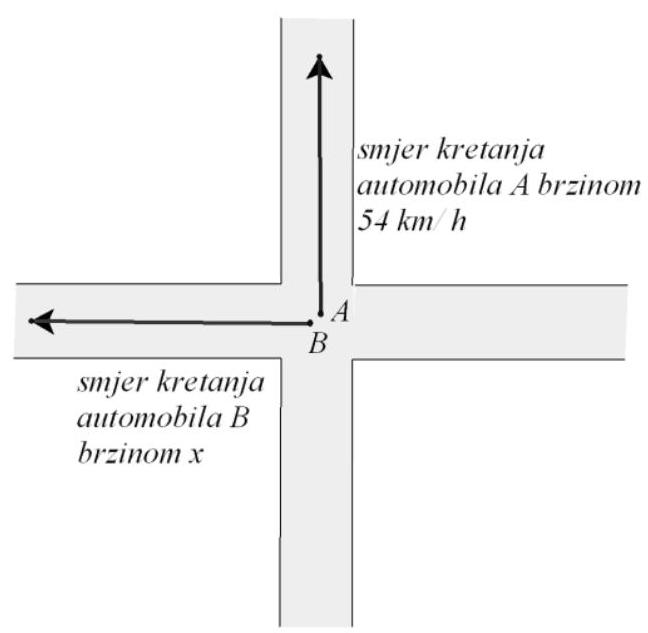
From the problem statement, we observe that the movement of the cars can be sketched as a right-angled triangle.
1 POINT
^{2}\left(x^{2}+9\right)} d x
$$ | ## Solution
$$
\int \frac{3 x^{3}+x+46}{(x-1)^{2}\left(x^{2}+9\right)} d x=
$$
We decompose the proper rational fraction into partial fractions using the method of undetermined coefficients:
$$
\begin{aligned}
& \frac{3 x^{3}+x+46}{(x-1)^{2}\left(x^{2}+9\right)}=\frac{A_{1}}{x-1}+\frac{A_{2}}{(x-1)^{2}}+\frac{B x+C}... | -\frac{5}{x-1}+\frac{3}{2}\cdot\ln(x^{2}+9)+\frac{1}{3}\cdot\operatorname{arctg}(\frac{x}{3})+C | Calculus | math-word-problem | olympiads | 61119fd1-c552-5e55-ac42-9bc3335cc9bc | [
true,
true
] | [
"<think>\nOkay, so I need to integrate the function (3x³ + x + 46) / [(x - 1)²(x² + 9)] dx. Hmm, this looks like a rational function, so probably partial fractions is the way to go. Let me recall how partial fractions work for such denominators. \n\nThe denominator here is (x - 1) squared times (x² + 9). Since (x -... | [
false,
false
] | [
true,
true
] | null | 2 | [
{
"content": "## Problem Statement\n\nFind the indefinite integral:\n\n$$\n\\int \\frac{3 x^{3}+x+46}{(x-1)^{2}\\left(x^{2}+9\\right)} d x\n$$",
"role": "user"
},
{
"content": "<think>Hmm , this looks like a rational function, so probably partial fractions is the way to go. Let me recall how partial... |
5. In $\triangle A B C$, $\angle A=60^{\circ}, A C=16, S_{\triangle A B C}=220 \sqrt{3}, B C=$ | 5. 49 .
$$
\begin{array}{c}
220 \sqrt{3}=\frac{1}{2} b c \sin A=\frac{1}{2} \times 8 c \sin 60^{\circ} \Rightarrow c=110, \\
B C=a=\sqrt{b^{2}+c^{2}-2 b c \cos A}=\sqrt{16^{2}+110^{2}-2 \times 16 \times 110 \times \frac{1}{2}}=49 .
\end{array}
$$ | 49 | Geometry | math-word-problem | olympiads | 334a3bba-bcfc-56e2-ace5-2d67096f7cbf | [
true,
true
] | [
"<think>\nOkay, let's see. I need to find the length of BC in triangle ABC. Given are angle A which is 60 degrees, AC is 16 units, and the area of the triangle is 220 times the square root of 3. Hmm. Alright, let's start by recalling some formulas related to the area of a triangle when an angle and two sides are in... | [
true,
true
] | null | null | 2 | [
{
"content": "5. In $\\triangle A B C$, $\\angle A=60^{\\circ}, A C=16, S_{\\triangle A B C}=220 \\sqrt{3}, B C=$",
"role": "user"
},
{
"content": "<think>Hmm . Alright, let's start by recalling some formulas related to the area of a triangle when an angle and two sides are involved.\n\nI remember t... |
Find the functions $f: \mathbb{R} \leftarrow \mathbb{R}$ such that:
$$
f(x+y)+y \leq f(f(f(x)))
$$ | Let $y=f(f(x))-x$. Then we have:
$$
f(f(f(x)))+f(f(x))-x \leq 0 \Longrightarrow f(f(x)) \leq x
$$
Let $z=x+y$. It follows that:
$$
f(z)+z-x \leq f(f(f(x)))
$$
From the above:
$$
f(z)+z-x \leq f(x) \Longleftrightarrow f(z)+z \leq f(x)+x
$$
This is true for all $x, z$, so $f(x)+x$ is constant. Thus, $f(x)=-x+C$. Co... | f(x)=-x+C | Algebra | math-word-problem | olympiads | b03bc77a-8075-5c6a-90db-1d18a6483faf | [
true,
true
] | [
"<think>\nOkay, so I need to find all functions f from the real numbers to the real numbers that satisfy the inequality f(x + y) + y ≤ f(f(f(x))) for all real numbers x and y. Hmm, functional equations can be tricky, but let me start by breaking this down.\n\nFirst, let me parse the inequality: for any x and y, whe... | [
false,
false
] | [
true,
false
] | null | 1 | [
{
"content": "Find the functions $f: \\mathbb{R} \\leftarrow \\mathbb{R}$ such that:\n\n$$\nf(x+y)+y \\leq f(f(f(x)))\n$$",
"role": "user"
},
{
"content": "<think>Hmm , functional equations can be tricky, but let me start by breaking this down.\n\nFirst, let me parse the inequality: for any x and y,... |
10. Let $x_{1}, x_{2}, x_{3}$ be non-negative real numbers, satisfying $x_{1}+x_{2}+x_{3}=1$, find the minimum and maximum values of $\left(x_{1}+3 x_{2}+5 x_{3}\right)\left(x_{1}+\frac{x_{2}}{3}+\frac{x_{3}}{5}\right)$. | Solve:
\[
\left(x_{1}+3 x_{2}+5 x_{3}\right)\left(x_{1}+\frac{x_{2}}{3}+\frac{x_{3}}{5}\right) \geqslant\left(\sqrt{x_{1}} \cdot \sqrt{x_{1}}+\sqrt{3 x_{2}} \cdot \sqrt{\frac{x_{2}}{3}}+\sqrt{5 x_{3}} \cdot \sqrt{\frac{x_{3}}{5}}\right)^{2}
\]
\[
=\left(x_{1}+x_{2}+x_{3}\right)^{2}=1, \text{ equality holds when } \left... | \frac{9}{5} | Algebra | math-word-problem | olympiads | 4259a180-8edb-5003-952f-56828dcf85f5 | [
true
] | [
"<think>\nOkay, so I need to find the minimum and maximum values of the expression (x₁ + 3x₂ + 5x₃)(x₁ + (x₂/3) + (x₃/5)) given that x₁, x₂, x₃ are non-negative real numbers and their sum is 1. Alright, let's start by understanding the problem.\n\nFirst, the variables x₁, x₂, x₃ are all non-negative and add up to 1... | [
false
] | [
true
] | null | 1 | [
{
"content": "10. Let $x_{1}, x_{2}, x_{3}$ be non-negative real numbers, satisfying $x_{1}+x_{2}+x_{3}=1$, find the minimum and maximum values of $\\left(x_{1}+3 x_{2}+5 x_{3}\\right)\\left(x_{1}+\\frac{x_{2}}{3}+\\frac{x_{3}}{5}\\right)$.",
"role": "user"
},
{
"content": "<think>Hmm , interesting.... |
(10 (20 points) As shown in the figure, given a pyramid $P-ABCD$, the base $ABCD$ is a rhombus, $PA \perp$ plane $ABCD$, $\angle ABC=60^{\circ}$, and $E$, $F$ are the midpoints of $BC$, $PC$ respectively.
(1) Prove: $AE \perp PD$;
(2) If $H$ is a moving point on $PD$, the maximum angle formed by $EH$ with the plane $PA... | (10) (1) Since quadrilateral $ABCD$ is a rhombus, $\angle ABC=60^{\circ}$, it follows that $\triangle ABC$ is an equilateral triangle.
Since $E$ is the midpoint of $BC$, $AE \perp BC$. Also, since $BC \parallel AD$, it follows that $AE \perp AD$.
Since $PA \perp$ plane $ABCD$, and $AE \subset$ plane $ABCD$, it follows... | \frac{\sqrt{15}}{5} | Geometry | math-word-problem | olympiads | 3805cce6-3a7f-5879-94d3-3fde8026b2f6 | [
true,
true
] | [
"<think>\nOkay, so I have this geometry problem about a pyramid P-ABCD with a rhombus base ABCD. PA is perpendicular to the base, angle ABC is 60 degrees, and E and F are midpoints of BC and PC respectively. There are two parts: first, to prove that AE is perpendicular to PD, and second, to find the cosine of the d... | [
true,
true
] | null | null | 2 | [
{
"content": "(10 (20 points) As shown in the figure, given a pyramid $P-ABCD$, the base $ABCD$ is a rhombus, $PA \\perp$ plane $ABCD$, $\\angle ABC=60^{\\circ}$, and $E$, $F$ are the midpoints of $BC$, $PC$ respectively.\n(1) Prove: $AE \\perp PD$;\n(2) If $H$ is a moving point on $PD$, the maximum angle forme... |
## Task B-3.1.
Solve the inequality
$$
8 \sin x \cos x \cos 2 x>1
$$ | ## Solution.
$$
\begin{array}{r}
4 \cdot 2 \cdot \sin x \cos x \cdot \cos 2 x>1 \Leftrightarrow \\
4 \cdot \sin 2 x \cdot \cos 2 x>1 \Leftrightarrow \\
2 \sin 4 x>1 \Leftrightarrow \sin 4 x>\frac{1}{2}
\end{array}
$$
The last inequality holds if $4 x \in\left\langle\frac{\pi}{6}+2 k \pi, \frac{5 \pi}{6}+2 k \pi\right... | x\in\langle\frac{\pi}{24}+\frac{k\pi}{2},\frac{5\pi}{24}+\frac{k\pi}{2}\rangle,k\in\mathbb{Z} | Inequalities | math-word-problem | olympiads | 557a8e4c-a05b-5cd4-8600-179aef113194 | [
true,
true
] | [
"<think>\nOkay, so I need to solve the inequality 8 sin x cos x cos 2x > 1. Hmm, let's see. First, I remember that trigonometric inequalities can sometimes be simplified using identities. Let me try to recall some identities that might help here.\n\nStarting off, the expression has sin x cos x. There's a double-ang... | [
false,
false
] | [
true,
true
] | null | 2 | [
{
"content": "## Task B-3.1.\n\nSolve the inequality\n\n$$\n8 \\sin x \\cos x \\cos 2 x>1\n$$",
"role": "user"
},
{
"content": "<think>Hmm , let's see. First, I remember that trigonometric inequalities can sometimes be simplified using identities. Let me try to recall some identities that might help... |
2. The magpie-crow was cooking porridge, feeding her chicks. The third chick received as much porridge as the first two combined. The fourth chick received as much as the second and third. The fifth chick received as much as the third and fourth. The sixth chick received as much as the fourth and fifth. The seventh chi... | Answer: 40 g.
Solution. Let the first chick receive a grams of porridge, the second - b grams, Then the others received $\mathrm{a}+\mathrm{b}, \mathrm{a}+2 \mathrm{~b}, 2 \mathrm{a}+3 \mathrm{~b}, 3 \mathrm{a}+5 \mathrm{~b}, 0$ grams respectively. In total, they received $8 \mathrm{a}+12 \mathrm{~b}$ grams of porridg... | 40 | Algebra | math-word-problem | olympiads | 7e19a209-80cc-535b-9a20-129deb6300e6 | [
true,
true
] | [
"<think>\nOkay, let's try to figure out how much porridge the magpie-crow cooked. The problem involves seven chicks, with each chick after the second one getting porridge equal to the sum of the previous two. The fifth chick got 10 grams, and the seventh got none. We need to find the total porridge cooked.\n\nFirst... | [
true,
true
] | null | null | 2 | [
{
"content": "2. The magpie-crow was cooking porridge, feeding her chicks. The third chick received as much porridge as the first two combined. The fourth chick received as much as the second and third. The fifth chick received as much as the third and fourth. The sixth chick received as much as the fourth and ... |
Read the results of a survey conducted in Pec pod Snezkou, where 1240 people were approached:
"46% of the respondents believe in the existence of Krkonose (rounded to the nearest whole number), 31% do not believe in its existence (rounded to the nearest whole number). The rest of the respondents refused to respond to ... | The number of people who responded positively will be denoted by $x$. The number of people who responded negatively will be denoted by $y$. For these numbers, the following applies:
$$
\begin{aligned}
0.455 \cdot 1240 & \leqq x < 0.465 \cdot 1240, \\
564.2 & \leqq x < 576.6, \\
0.305 \cdot 1240 & \leqq y < 0.315 \cdot... | 565 | Number Theory | math-word-problem | olympiads | 58969aa7-492b-59a5-a719-bb2859263c9a | [
true,
true
] | [
"<think>\nOkay, let's tackle these two questions. First, I need to make sure I understand the problem correctly. There was a survey of 1240 people. The results are given in percentages: 46% believe in the existence of Krkonose, 31% do not, and the rest refused to respond. The percentages are rounded to the nearest ... | [
false,
false
] | [
true,
true
] | null | 2 | [
{
"content": "Read the results of a survey conducted in Pec pod Snezkou, where 1240 people were approached:\n\n\"46% of the respondents believe in the existence of Krkonose (rounded to the nearest whole number), 31% do not believe in its existence (rounded to the nearest whole number). The rest of the responden... |
Shapovalov A.V.
Little kids were eating candies. Each one ate 7 candies less than all the others together, but still more than one candy.
How many candies were eaten in total? | Let's choose one of the children - for example, Petya. If we take away 7 candies from all the others, there will be as many left as Petya has. Therefore, twice the number of candies Petya has equals the total number of candies minus seven. The same can be said about any of the children, which means that all the childre... | 21 | Logic and Puzzles | math-word-problem | olympiads | d7d0c469-df53-51d9-9b7e-22363de31196 | [
true,
true
] | [
"<think>\nOkay, let's try to figure out this problem step by step. So, the problem says: Little kids were eating candies. Each one ate 7 candies less than all the others together, but still more than one candy. How many candies were eaten in total?\n\nHmm, first, let's parse the problem. There are several kids eati... | [
true,
true
] | null | null | 2 | [
{
"content": "Shapovalov A.V.\n\nLittle kids were eating candies. Each one ate 7 candies less than all the others together, but still more than one candy.\n\nHow many candies were eaten in total?",
"role": "user"
},
{
"content": "<think>Hmm , first, let's parse the problem. There are several kids ea... |
Example 9. Find $\lim _{x \rightarrow 0}\left[\frac{\sin x}{x}\right]^{\frac{1}{x}}$. | Solution. Since $\lim _{x \rightarrow 0} \frac{\sin x}{x}=1, \lim _{x \rightarrow 0} \frac{1}{x}=\infty$, we have an indeterminate form of $1^{\infty}$ here.
Taking into account identity (A) (see example 8), using L'Hôpital-Bernoulli's rule, we find
$$
\lim _{x \rightarrow 0}\left[\frac{\sin x}{x}\right]^{\frac{1}{x}... | 1 | Calculus | math-word-problem | olympiads | bf09d3e6-e44b-5970-a647-9426b699dc58 | [
true,
false
] | [
"<think>\nOkay, so I need to find the limit as x approaches 0 of [sinx/x]^(1/x). Hmm, let's see. Alright, I remember that when dealing with limits of the form [f(x)]^g(x), it's often helpful to take the natural logarithm to simplify the expression. That way, you can turn the exponent into a multiplier. So, let me t... | [
true,
false
] | null | null | 1 | [
{
"content": "Example 9. Find $\\lim _{x \\rightarrow 0}\\left[\\frac{\\sin x}{x}\\right]^{\\frac{1}{x}}$.",
"role": "user"
},
{
"content": "<think>Hmm , let's see. Alright, I remember that when dealing with limits of the form [f(x)]^g(x), it's often helpful to take the natural logarithm to simplify... |
In triangle $P Q R$, the midpoint of side $P Q$ is $A$, the midpoint of $Q R$ is $B$, and the midpoint of $R P$ is $C$. We enlarge triangle $A B C$ from its centroid $S$ by a factor of $k$, where $1<k<4$. The sides of the enlarged triangle intersect the sides of triangle $P Q R$ at points $D_{1} D_{2}, E_{1} E_{2}$, an... | Let the vertices of the triangle after enlargement be denoted by $K, L, M$, where $K$ is the vertex opposite to $P$. We know that the triangle $ABC$ was created by a $\frac{1}{2}$-scale reduction from the centroid $S$ of the triangle $RQP$, meaning the centroids of these two triangles coincide. Let the intersection of ... | 4-\sqrt{6} | Geometry | math-word-problem | olympiads | cb2db018-ef62-523f-8e3f-c704c17fd506 | [
true,
true
] | [
"<think>\nOkay, so I need to solve this geometry problem. Let me try to visualize it first. There's triangle PQR, and A, B, C are the midpoints of sides PQ, QR, and RP respectively. So triangle ABC is the medial triangle of triangle PQR. The centroid S of triangle ABC is also the centroid of triangle PQR, right? Be... | [
true,
false
] | null | null | 1 | [
{
"content": "In triangle $P Q R$, the midpoint of side $P Q$ is $A$, the midpoint of $Q R$ is $B$, and the midpoint of $R P$ is $C$. We enlarge triangle $A B C$ from its centroid $S$ by a factor of $k$, where $1<k<4$. The sides of the enlarged triangle intersect the sides of triangle $P Q R$ at points $D_{1} D... |
## Task B-1.4.
Points $A, B, C, D$ and $E$ are connected by segments as shown in the figure. Segments $\overline{A B}$ and $\overline{B C}$ intersect segment $\overline{D E}$ at points $F$ and $G$, respectively. If $\varangle A B C=20^{\circ}$ and if $\varangle D F A=\varangle C G E$, determine $\varangle E A B+\varan... | ## Solution.
Let $\varphi$ be the angle $\varangle D F A=\varangle C G E$.
Angles $\varangle B F G$ and $\varangle D F A$ are vertical angles, so $\varangle B F G=\varangle D F A=\varphi$. Similarly, $\varangle B G F$ and $\varangle C G E$ are vertical angles, so $\varangle B G F=\varangle C G E=\varphi$.
The sum of... | 80 | Geometry | math-word-problem | olympiads | 5ba7ca89-12db-5b5e-94ec-b2395294c4cf | [
true,
true
] | [
"<think>\nOkay, let me try to figure out this geometry problem. So, we have points A, B, C, D, E connected with segments as shown. The segments AB and BC intersect DE at points F and G respectively. We know that angle ABC is 20 degrees, and angles DFA and CGE are equal. We need to find the sum of angles EAB and DEA... | [
false,
true
] | null | null | 1 | [
{
"content": "## Task B-1.4.\n\nPoints $A, B, C, D$ and $E$ are connected by segments as shown in the figure. Segments $\\overline{A B}$ and $\\overline{B C}$ intersect segment $\\overline{D E}$ at points $F$ and $G$, respectively. If $\\varangle A B C=20^{\\circ}$ and if $\\varangle D F A=\\varangle C G E$, de... |
8. Given a six-digit decimal number composed of six positive integers, the digit in the units place is a multiple of 4, the digits in the tens and hundreds places are multiples of 3, and the sum of the digits of the six-digit number is 21. Then the number of six-digit numbers that satisfy the above conditions is $\qqua... | 8. 126 .
It is easy to know that the last three digits can only be:
$$
334,338,664,364,368,394,634,638 \text {, }
$$
934.
Also, the sum of the first three digits of 334 is 11, so there are $\mathrm{C}_{10}^{2}$ ways.
Thus, $\mathrm{C}_{10}^{2}+\mathrm{C}_{6}^{2}+\mathrm{C}_{4}^{2}+2\left(\mathrm{C}_{7}^{2}+\mathrm{C}_... | 126 | Number Theory | math-word-problem | olympiads | 1c2a6a3e-4d56-58fb-ba81-8f4d7cdbf72f | [
true,
true
] | [
"<think>\nOkay, let's tackle this problem step by step. So, we need to find the number of six-digit numbers where:\n\n1. The units digit (the last one) is a multiple of 4.\n2. The tens and hundreds digits (the second and third from the end) are multiples of 3.\n3. The sum of all six digits is 21.\n\nFirst, let me b... | [
false,
true
] | null | [
"stop",
"stop"
] | 1 | [
{
"content": "8. Given a six-digit decimal number composed of six positive integers, the digit in the units place is a multiple of 4, the digits in the tens and hundreds places are multiples of 3, and the sum of the digits of the six-digit number is 21. Then the number of six-digit numbers that satisfy the abov... |
2. 2. 1 ^ Given the equation $\sin ^{2} x-(2 a+1) \cos x-a^{2}=0$ has real solutions for $x$. Then the set of real values for $a$ is ( ).
(A) $\left[-\frac{5}{4}, 1-\sqrt{2}\right]$
(B) $\left[-\frac{5}{4}, 1+\sqrt{2}\right]$
(C) $[1-\sqrt{2}, 1+\sqrt{2}]$
(D) $\left[-\frac{3}{2}, 1-\sqrt{2}\right]$ | Transform the equation into $\cos ^{2} x+(2 a+1) \cos x+a^{2}-1=0$.
Let $t=\cos x$, then the equation becomes
$$
t^{2}+(2 a+1) t+a^{2}-1=0 .
$$
Let $f(t)=t^{2}+(2 a+1) t+a^{2}-1, t \in[-1,1]$. By the problem, the real number $a$ should satisfy
$$
\left\{\begin{array}{l}
(2 a+1)^{2}-4\left(a^{2}-1\right) \geqslant 0, \... | [-\frac{5}{4},1+\sqrt{2}] | Algebra | MCQ | olympiads | e8aa75e0-9038-526c-8079-40aef8cdb0ea | [
true,
true
] | [
"<think>\nOkay, so I have this trigonometry equation: sin²x - (2a + 1)cosx - a² = 0. The question says that this equation has real solutions for x, and I need to find the set of real values for a. The answer choices are given as A, B, C, D. Hmm, let me try to figure this out step by step.\n\nFirst, I remember that ... | [
false,
false
] | [
true,
true
] | null | 2 | [
{
"content": "2. 2. 1 ^ Given the equation $\\sin ^{2} x-(2 a+1) \\cos x-a^{2}=0$ has real solutions for $x$. Then the set of real values for $a$ is ( ).\n(A) $\\left[-\\frac{5}{4}, 1-\\sqrt{2}\\right]$\n(B) $\\left[-\\frac{5}{4}, 1+\\sqrt{2}\\right]$\n(C) $[1-\\sqrt{2}, 1+\\sqrt{2}]$\n(D) $\\left[-\\frac{3}{2}... |
2. The solution set of the equation $\sqrt{2 x+2-2 \sqrt{2 x+1}}+\sqrt{2 x+10-6 \sqrt{2 x+1}}=2$ is | 2. $[0,4]$.
(Method 1) It is easy to see that
$$
\begin{array}{l}
\sqrt{2 x+2-2 \sqrt{2 x+1}}+\sqrt{2 x+10-6 \sqrt{2 x+1}} \\
=\sqrt{(\sqrt{2 x+1})^{2}-2 \sqrt{2 x+1}+1^{2}}+\sqrt{(\sqrt{2 x+1})^{2}-6 \sqrt{2 x+1}+3^{2}} \\
=|\sqrt{2 x+1}-1|+|\sqrt{2 x+1}-3| \\
\geqslant 2,
\end{array}
$$
where the equality holds if a... | [0,4] | Algebra | math-word-problem | olympiads | 6f24879b-8378-571a-b625-8930e5d3198e | [
true,
true
] | [
"<think>\nOkay, so I need to solve this equation: √(2x + 2 - 2√(2x + 1)) + √(2x + 10 - 6√(2x + 1)) = 2. Hmm, that looks a bit complicated with the square roots and nested square roots. Let me see if I can simplify it by substitution or something.\n\nFirst, I notice that inside both square roots, there's a term √(2x... | [
true,
true
] | null | null | 2 | [
{
"content": "2. The solution set of the equation $\\sqrt{2 x+2-2 \\sqrt{2 x+1}}+\\sqrt{2 x+10-6 \\sqrt{2 x+1}}=2$ is",
"role": "user"
},
{
"content": "<think>Hmm , that looks a bit complicated with the square roots and nested square roots. Let me see if I can simplify it by substitution or somethin... |
12. A positive integer has exactly 8 divisors, the sum of its smallest 3 divisors is 15, and one prime factor of this four-digit number minus five times another prime factor equals twice the third prime factor. This number is $\qquad$ . | 【Analysis】It is known that the smallest positive divisor of a positive integer is 1, and its second smallest positive divisor must be a prime number.
Consider if the second smallest divisor is 2, then the third smallest divisor is 12, meaning this number is a multiple of 12, which clearly contains the divisor 3, so th... | 2013or1221 | Number Theory | math-word-problem | olympiads | 12f8ddf3-ecdb-5059-a4ba-34ecd31d441b | [
true,
true
] | [
"<think>\nOkay, let me try to figure out this problem step by step. So, the problem is about a four-digit positive integer that has exactly 8 divisors. The sum of its smallest three divisors is 15. Additionally, there's an equation involving its prime factors: one prime factor minus five times another prime factor ... | [
false,
false
] | [
true,
false
] | null | 1 | [
{
"content": "12. A positive integer has exactly 8 divisors, the sum of its smallest 3 divisors is 15, and one prime factor of this four-digit number minus five times another prime factor equals twice the third prime factor. This number is $\\qquad$ .",
"role": "user"
},
{
"content": "<think>Hmm , l... |
6. A rectangle $3 \times 100$ consists of 300 squares $1 \times 1$. What is the maximum number of diagonals that can be drawn in the squares so that no two diagonals share a common endpoint? (In one square, two diagonals can be drawn without sharing endpoints. Common internal points are allowed.) | Answer: 200.
Example. Let's number the rows and columns containing the squares. In each square with both odd numbers, we will draw two diagonals.
Another example. In all cells of the first and third rows, we will draw parallel diagonals.
 $126 \mathrm{~cm}$
(B) $72 \mathrm{~cm}$
(C) $4 \mathrm{~cm}$
(D) $8 \mathrm{~cm}$
(E) $2 \mathrm{~cm}$ | The volume of a rectangular box is $144 \mathrm{~cm}^{3}$. If its length is $12 \mathrm{~cm}$ and its width is $6 \mathrm{~cm}$, what is its height?
(A) $126 \mathrm{~cm}$
(B) $72 \mathrm{~cm}$
(C) $4 \mathrm{~cm}$
(D) $8 \mathrm{~cm}$
(E) $2 \mathrm{~cm}$
Solution
We know that Volume $=$ Length $¥$ Width $¥$ Height,... | 2\mathrm{~} | Algebra | MCQ | olympiads | d087487a-a581-5cd5-8c7a-88f556d4fd16 | [
true,
true
] | [
"<think>\nOkay, so I need to find the height of a rectangular box when I know its volume, length, and width. The volume is 144 cm³, the length is 12 cm, and the width is 6 cm. Hmm, let's recall the formula for the volume of a rectangular box. I think it's length multiplied by width multiplied by height. Yeah, so Vo... | [
false,
false
] | [
true,
true
] | null | 2 | [
{
"content": "The volume of a rectangular box is $144 \\mathrm{~cm}^{3}$. If its length is $12 \\mathrm{~cm}$ and its width is $6 \\mathrm{~cm}$, what is its height?\n(A) $126 \\mathrm{~cm}$\n(B) $72 \\mathrm{~cm}$\n(C) $4 \\mathrm{~cm}$\n(D) $8 \\mathrm{~cm}$\n(E) $2 \\mathrm{~cm}$",
"role": "user"
},
... |
3. The monotonic increasing interval of the function $\log _{\frac{1}{2}}\left(x^{2}-2 x-3\right)$ is
A. $(-\infty, -1)$
B. $(-\infty, 1)$
C. $(1, +\infty)$
D. $(3, +\infty)$ | 3. A Prompt: The monotonically increasing interval of the function $\log _{\frac{1}{2}}\left(x^{2}-2 x-3\right)$ is the monotonically decreasing interval of $f(x)=x^{2}-2 x-3$, and the value is greater than 0. | A | Algebra | MCQ | olympiads | 3bc50bb4-8277-538c-b568-f1fe0879928f | [
true,
true
] | [
"<think>\nOkay, so I need to find the monotonic increasing interval of the function log base 1/2 of (x² - 2x - 3). The options are given, so maybe I can check each one, but first, let me recall some concepts. \n\nA logarithmic function's behavior depends on its base. Since the base here is 1/2, which is between 0 a... | [
true,
true
] | null | null | 2 | [
{
"content": "3. The monotonic increasing interval of the function $\\log _{\\frac{1}{2}}\\left(x^{2}-2 x-3\\right)$ is\nA. $(-\\infty, -1)$\nB. $(-\\infty, 1)$\nC. $(1, +\\infty)$\nD. $(3, +\\infty)$",
"role": "user"
},
{
"content": "<think>\nOkay, so I need to find the monotonic increasing interva... |
Let $\omega = \cos\frac{2\pi}{7} + i \cdot \sin\frac{2\pi}{7},$ where $i = \sqrt{-1}.$ Find the value of the product\[\prod_{k=0}^6 \left(\omega^{3k} + \omega^k + 1\right).\] | For any $k\in Z$, we have,
\begin{align*} & \left( \omega^{3k} + \omega^k + 1 \right) \left( \omega^{3\left( 7 - k \right)} + \omega^{\left( 7 - k \right)} + 1 \right) \\ & = \omega^{3 \cdot 7} + \omega^{2k + 7} + \omega^{3k} + \omega^{-2k + 3 \cdot 7} + \omega^7 + \omega^k + \omega^{3\left( 7 - k \right)} + \omega^{\l... | 24 | Algebra | math-word-problem | amc_aime | 4ece0b0d-9426-5ceb-bd9b-0b8e6bb9946c | [
true,
true
] | [
"<think>\nOkay, so I need to find the product \\(\\prod_{k=0}^6 \\left(\\omega^{3k} + \\omega^k + 1\\right)\\) where \\(\\omega = \\cos\\frac{2\\pi}{7} + i \\cdot \\sin\\frac{2\\pi}{7}\\). Hmm, first, I remember that \\(\\omega\\) is a primitive 7th root of unity because \\(e^{2\\pi i /7} = \\cos\\frac{2\\pi}{7} + ... | [
true,
true
] | null | null | 2 | [
{
"content": "Let $\\omega = \\cos\\frac{2\\pi}{7} + i \\cdot \\sin\\frac{2\\pi}{7},$ where $i = \\sqrt{-1}.$ Find the value of the product\\[\\prod_{k=0}^6 \\left(\\omega^{3k} + \\omega^k + 1\\right).\\]",
"role": "user"
},
{
"content": "<think>Hmm , first, I remember that \\(\\omega\\) is a primit... |
14. Indicare quanti sono i valori $k \in \mathbb{R}$ per i quali il polinomio $p(x)=x^{2}-k x+36$ ha almeno una radice intera positiva che sia minore di 1000 .
(A) 3 (B) 1
(C) 2
(D) 999
(E) 995
|
Problema 14. La risposta corretta è $\mathbf{( E )}$.
Essendo uguale a 36 il prodotto delle due radici, se $p(x)$ ha una radice $n$ (dove $n$ è un intero con $1 \leqslant n \leqslant 999$ ), l'altra radice dovrà essere $36 / n$. Il polinomio corrispondente risulterà in tal caso
$$
p(x)=(x-n)\left(x-\frac{36}{n}\righ... | 995 | Algebra | MCQ | olympiads | f9a2ad01-7d95-532b-8814-d18f68e7cd26 | [
true,
true
] | [
"<think>\nOkay, let's see. The problem is asking how many real values of k there are such that the polynomial p(x) = x² - kx + 36 has at least one positive integer root less than 1000. The options are given as (A) 3, (B) 1, (C) 2, (D) 999, (E) 995. Hmm, I need to figure this out step by step.\n\nFirst, I remember t... | [
false,
false
] | [
true,
false
] | null | 1 | [
{
"content": "\n14. Indicare quanti sono i valori $k \\in \\mathbb{R}$ per i quali il polinomio $p(x)=x^{2}-k x+36$ ha almeno una radice intera positiva che sia minore di 1000 .\n(A) 3 (B) 1\n(C) 2\n(D) 999\n(E) 995\n",
"role": "user"
},
{
"content": "<think>Hmm , I need to figure this out step by s... |
7. If $a$, $b$, $c$ are all real numbers, and for any real number $x$, the inequality $a \sin x + b \cos x + c > 0$ always holds, then the necessary and sufficient condition for $a$, $b$, $c$ is $\qquad$ . | 7. $c>\sqrt{a^{2}+b^{2}}$.
$a \sin x + b \cos x = \sqrt{a^{2}+b^{2}} \sin (x+\varphi) \geqslant -\sqrt{a^{2}+b^{2}}$, to make $a \sin x + b \cos x + c > 0$ always true, it is sufficient that $-\sqrt{a^{2}+b^{2}} + c > 0, c > \sqrt{a^{2}+b^{2}}$. Conversely, if $c > \sqrt{a^{2}+b^{2}}$, then $a \sin x + b \cos x + c > a... | \sqrt{^{2}+b^{2}} | Inequalities | math-word-problem | olympiads | 1e99ac5d-e35c-565d-80ab-490ccea398e6 | [
true,
true
] | [
"<think>\nOkay, so I need to figure out the necessary and sufficient condition for the inequality \\( a \\sin x + b \\cos x + c > 0 \\) to hold for all real numbers \\( x \\), where \\( a \\), \\( b \\), and \\( c \\) are real numbers. Hmm, let's start by recalling some trigonometric identities or methods that migh... | [
false,
false
] | [
false,
true
] | null | 1 | [
{
"content": "7. If $a$, $b$, $c$ are all real numbers, and for any real number $x$, the inequality $a \\sin x + b \\cos x + c > 0$ always holds, then the necessary and sufficient condition for $a$, $b$, $c$ is $\\qquad$ .",
"role": "user"
},
{
"content": "<think>Hmm , let me try to figure this out ... |
27.6. Several points are marked on a circle, $A$ is one of them. Which are there more of: convex polygons with vertices at these points that contain point $A$ or those that do not contain it? | 27.6. Any polygon that does not contain point $A$ can be associated with a polygon that does contain point $A$ by adding it to its vertices. However, the reverse operation, i.e., removing vertex $A$, can only be performed for $n$-gons with $n \geqslant 4$. Therefore, there are more polygons containing point $A$ than po... | (n-1)(n-2)/2 | Combinatorics | math-word-problem | olympiads | d7042a5f-cdc3-5a07-a90d-3f16ff3c14a6 | [
true,
true
] | [
"<think>\nOkay, let's try to figure out this problem. So, we have several points marked on a circle, and one of them is named A. The question is asking whether there are more convex polygons with vertices at these points that include point A or more that don't include it. Hmm, interesting. \n\nFirst, I need to reca... | [
false,
false
] | [
true,
false
] | null | 1 | [
{
"content": "27.6. Several points are marked on a circle, $A$ is one of them. Which are there more of: convex polygons with vertices at these points that contain point $A$ or those that do not contain it?",
"role": "user"
},
{
"content": "<think>Hmm , interesting. \n\nFirst, I need to recall that w... |
The operation $\Theta$ is defined by $a \ominus b=a^{b}-b^{a}$. What is the value of $2 \Theta(2 \odot 5)$ ? | Using the definition,
$$
2 \odot(2 \odot 5)=2 \odot\left(2^{5}-5^{2}\right)=2 \odot(32-25)=2 \odot 7=2^{7}-7^{2}=128-49=79
$$
ANSWER: 79 | 79 | Algebra | math-word-problem | olympiads | 39573bae-4972-5ace-99db-72548535fff5 | [
true,
true
] | [
"<think>\nOkay, let's see. I need to find the value of 2 Θ (2 ⊙ 5). First, I should figure out what the operations Θ and ⊙ mean here. Wait, the problem says that the operation Θ is defined by a Θ b = a^b - b^a. So, Θ is this operation where you take the first number raised to the power of the second and subtract th... | [
true,
true
] | null | null | 2 | [
{
"content": "The operation $\\Theta$ is defined by $a \\ominus b=a^{b}-b^{a}$. What is the value of $2 \\Theta(2 \\odot 5)$ ?",
"role": "user"
},
{
"content": "<think>Wait , the problem says that the operation Θ is defined by a Θ b = a^b - b^a. So, Θ is this operation where you take the first numbe... |
Question 9: Given that $f(x)$ is an odd function defined on $R$, and when $x<0$, $f(x)$ is monotonically increasing, $f(-1)=0$. Let $\varphi(x)=\sin ^{2} x+m \cdot \cos x-2 m$, set $M=\left\{m \mid\right.$ for $\left.\forall x \in\left[0, \frac{\pi}{2}\right], \varphi(x)<0\right\}, N=\{m \mid$ for $\left.\forall \mathr... | Question 9, Answer: Since $f(x)$ is an odd function defined on $R$, and when $x>0$, $f(x)$ is also monotonically increasing, and $f(1)=0$.
According to the definition: $M \cap N=\left\{m \mid\right.$ for $\forall x \in\left[0, \frac{\pi}{2}\right], \varphi(x)>0$
$\Leftrightarrow(2-\cos x) m>2-\cos ^{2} x$
$\Leftrighta... | 4-2\sqrt{2} | Algebra | math-word-problem | olympiads | e079d25c-5c04-5c83-8cb2-199a81ad8234 | [
true,
true
] | [
"<think>\nOkay, let's try to solve this problem step by step. First, I need to understand what's being asked. We have two sets, M and N, which are defined based on certain conditions involving the function φ(x) and another function f(x). We need to find the intersection of M and N, which means the values of m that ... | [
false,
false
] | [
true,
true
] | null | 2 | [
{
"content": "Question 9: Given that $f(x)$ is an odd function defined on $R$, and when $x<0$, $f(x)$ is monotonically increasing, $f(-1)=0$. Let $\\varphi(x)=\\sin ^{2} x+m \\cdot \\cos x-2 m$, set $M=\\left\\{m \\mid\\right.$ for $\\left.\\forall x \\in\\left[0, \\frac{\\pi}{2}\\right], \\varphi(x)<0\\right\\... |
1. Given that the set $M$ is a subset of $\{1,2, \cdots, 2011\}$, and the sum of any four elements in $M$ cannot be divisible by 3. Then $|M|_{\text {max }}=$ $\qquad$ | - 1. 672.
Consider the set $A=\{3,6,9, \cdots, 2010\}$,
$$
\begin{array}{l}
B=\{1,4,7, \cdots, 2011\}, \\
C=\{2,5,8, \cdots, 2009\} .
\end{array}
$$
If $M \cap A \neq \varnothing$, then $|M \cap B|<3,|M \cap C|<3,|M \cap A|<4$. Therefore, $|M|<10$.
Now assume $M \cap A=\varnothing$.
If $|M \cap B| \geqslant 2$, then ... | 672 | Number Theory | math-word-problem | cn_contest | 7a92652e-14ba-5c89-8d38-c8af786f1585 | [
true,
true
] | [
"<think>\nOkay, so I need to figure out the maximum size of a subset M of {1, 2, ..., 2011} such that the sum of any four elements in M can't be divisible by 3. Hmm, okay. Let me start by understanding the problem better.\n\nFirst, the problem is about subsets where a certain condition on sums is met. Specifically,... | [
true,
true
] | null | [
"stop",
"stop"
] | 2 | [
{
"content": "1. Given that the set $M$ is a subset of $\\{1,2, \\cdots, 2011\\}$, and the sum of any four elements in $M$ cannot be divisible by 3. Then $|M|_{\\text {max }}=$ $\\qquad$",
"role": "user"
},
{
"content": "<think>Hmm , okay. Let me start by understanding the problem better.\n\nFirst, ... |
Try to find all positive integers $n$, such that there exist at least two pairs of positive integers $(x, y)$, satisfying
$$
n=\frac{x^{2}+y}{x y+1} .
$$ | If $xy$, then
$$
\begin{aligned}
x y+1 \mid x^{2}+y & \Rightarrow x y+1 \mid x^{2} y+y^{2} \\
& \Rightarrow x y+1 \mid\left(x^{2} y+y^{2}\right)-x(x y+1) \\
& \Rightarrow x y+1 \mid y^{2}-x .
\end{aligned}
$$
But from $x y+1>x, x y+1>y^{2}+1>y^{2}$, we know $\left|y^{2}-x\right| \leqslant \max \left\{y^{2}, x\right\}<... | 1 | Number Theory | math-word-problem | olympiads | b190c47e-099e-5af5-9b78-d8e0bade429e | [
true,
true
] | [
"<think>\nAlright, let's see. I need to find all positive integers n such that there are at least two different pairs of positive integers (x, y) that satisfy the equation n = (x² + y)/(xy + 1). Hmm, okay. Let me start by understanding the equation better.\n\nFirst, let's rewrite the equation to make it a bit clear... | [
true,
true
] | null | null | 2 | [
{
"content": "Try to find all positive integers $n$, such that there exist at least two pairs of positive integers $(x, y)$, satisfying\n$$\nn=\\frac{x^{2}+y}{x y+1} .\n$$",
"role": "user"
},
{
"content": "<think>Hmm , okay. Let me start by understanding the equation better.\n\nFirst, let's rewrite ... |
Example 12 Solve the system of equations
$$
\left\{\begin{array}{l}
\frac{1}{x}+\frac{1}{y+z}=\frac{1}{2}, \\
\frac{1}{y}+\frac{1}{z+x}=\frac{1}{3}, \\
\frac{1}{z}+\frac{1}{x+y}=\frac{1}{4} .
\end{array}\right.
$$
(1996, Beijing Junior High School Mathematics Competition) | Solving: By taking the reciprocal and finding a common denominator, we get
$$
\left\{\begin{array}{l}
\frac{x(y+z)}{x+y+z}=2, \\
\frac{y(z+x)}{x+y+z}=3, \\
\frac{z(x+y)}{x+y+z}=4 .
\end{array}\right.
$$
Adding the three equations yields $\frac{x y+y z+z x}{x+y+z}=\frac{9}{2}$.
(4) Subtracting (1), (2), and (3) respect... | x=\frac{23}{10}, y=\frac{23}{6}, z=\frac{23}{2} | Algebra | math-word-problem | cn_contest | aa8ca083-95d3-5184-abd4-66c760f19cba | [
false,
true
] | [
"<think>\nOkay, so I need to solve this system of equations:\n\n$$\n\\left\\{\n\\begin{array}{l}\n\\frac{1}{x} + \\frac{1}{y+z} = \\frac{1}{2}, \\\\\n\\frac{1}{y} + \\frac{1}{z+x} = \\frac{1}{3}, \\\\\n\\frac{1}{z} + \\frac{1}{x+y} = \\frac{1}{4} .\n\\end{array}\n\\right.\n$$\n\nHmm, all three equations have a simi... | [
false,
true
] | null | [
"length",
"stop"
] | 1 | [
{
"content": "Example 12 Solve the system of equations\n$$\n\\left\\{\\begin{array}{l}\n\\frac{1}{x}+\\frac{1}{y+z}=\\frac{1}{2}, \\\\\n\\frac{1}{y}+\\frac{1}{z+x}=\\frac{1}{3}, \\\\\n\\frac{1}{z}+\\frac{1}{x+y}=\\frac{1}{4} .\n\\end{array}\\right.\n$$\n(1996, Beijing Junior High School Mathematics Competition)... |
B2. Find all natural numbers $n$ and prime numbers $p$ for which $\sqrt[3]{n+\frac{8 p}{n}}$ is a natural number. | B2. Let $\sqrt[3]{n+\frac{8 p}{n}}=k$, where $k$ is a natural number, so $n+\frac{8 p}{n}=k^{3}$. From this, it follows that $n$ divides $8 p$. Since $p$ is a prime number, $n$ must be $1, 2, 4, 8, p, 2 p, 4 p$, or $8 p$. If $n=1$ or $n=8 p$, we get the equation $1+8 p=k^{3}$ or $8 p=(k-1)\left(k^{2}+k+1\right)$. Since... | n=4,p=2;n=8,p=19;n=19,p=19 | Number Theory | math-word-problem | olympiads | bbbba89f-5d12-5b18-a0aa-d4dd43082498 | [
true,
true
] | [
"<think>\nOkay, let's see. The problem is to find all natural numbers n and prime numbers p such that the cube root of (n + (8p)/n) is a natural number. Hmm. So, we need to find n ∈ ℕ and prime p where ∛(n + 8p/n) is a natural number. Let me try to unpack this step by step.\n\nFirst, let's denote the cube root as s... | [
false,
false
] | [
true,
true
] | null | 2 | [
{
"content": "B2. Find all natural numbers $n$ and prime numbers $p$ for which $\\sqrt[3]{n+\\frac{8 p}{n}}$ is a natural number.",
"role": "user"
},
{
"content": "<think>Hmm . So, we need to find n ∈ ℕ and prime p where ∛(n + 8p/n) is a natural number. Let me try to unpack this step by step.\n\nFir... |
Example 8 Solve the equation $3 x^{3}-[x]=3$.
Translate the text above into English, please retain the original text's line breaks and format, and output the translation result directly. | Solution: For higher-degree equations containing $[x]$, discussing by intervals can be an effective method.
If $x \leqslant -1$, then $3 x^{3} - [x] \leqslant 3 x - x + 13 x - x = 2 x \geqslant 4$.
If $0 \leqslant x < 1$, then $3 x^{3} - [x] = 3 x^{3} < 3$.
When $1 \leqslant x < 2$, $3 x^{3} - [x] = 3 x^{3} - 1$. The o... | \sqrt[3]{\frac{4}{3}} | Algebra | math-word-problem | olympiads | 66167966-fff2-58f6-9997-d28af74ca484 | [
true,
true,
true,
true
] | [
"<think>\nOkay, let's see. The user wants me to translate the Chinese text into English while keeping the original line breaks and format. The original problem is:\n\n\"Example 8 Solve the equation $3 x^{3}-[x]=3$.\"\n\nFirst, I need to make sure I understand the Chinese parts. The text before the equation is \"例如 ... | [
false,
false,
true,
false
] | null | null | 1 | [
{
"content": "Example 8 Solve the equation $3 x^{3}-[x]=3$.\n\nTranslate the text above into English, please retain the original text's line breaks and format, and output the translation result directly.",
"role": "user"
},
{
"content": "<think>\nOkay, so I need to solve the equation 3x³ minus the f... |
Let $a$, $b$, $c$, $d$ be complex numbers satisfying
\begin{align*}
5 &= a+b+c+d \\
125 &= (5-a)^4 + (5-b)^4 + (5-c)^4 + (5-d)^4 \\
1205 &= (a+b)^4 + (b+c)^4 + (c+d)^4 + (d+a)^4 + (a+c)^4 + (b+d)^4 \\
25 &= a^4+b^4+c^4+d^4
\end{align*}
Compute $abcd$.
[i]Proposed by Evan Chen[/i] | Given the complex numbers \(a, b, c, d\) satisfying the following equations:
\[
\begin{align*}
1. & \quad a + b + c + d = 5, \\
2. & \quad (5-a)^4 + (5-b)^4 + (5-c)^4 + (5-d)^4 = 125, \\
3. & \quad (a+b)^4 + (b+c)^4 + (c+d)^4 + (d+a)^4 + (a+c)^4 + (b+d)^4 = 1205, \\
4. & \quad a^4 + b^4 + c^4 + d^4 = 25.
\end{align*}
\... | 70 | Algebra | math-word-problem | aops_forum | f2fff31a-a9c2-518a-95db-55e4378301fe | [
true,
true
] | [
"<think>\nOkay, let's see. I need to find the value of abcd given these four equations involving complex numbers a, b, c, d. Hmm, the problem seems to involve symmetric sums and maybe some clever substitutions. Let me try to break it down step by step.\n\nFirst, the given equations are:\n\n1. a + b + c + d = 5\n2. ... | [
true,
true
] | null | null | 2 | [
{
"content": "Let $a$, $b$, $c$, $d$ be complex numbers satisfying\n\\begin{align*}\n 5 &= a+b+c+d \\\\\n 125 &= (5-a)^4 + (5-b)^4 + (5-c)^4 + (5-d)^4 \\\\\n 1205 &= (a+b)^4 + (b+c)^4 + (c+d)^4 + (d+a)^4 + (a+c)^4 + (b+d)^4 \\\\\n 25 &= a^4+b^4+c^4+d^4\n\\end{align*}\nCompute $abcd$.\n\n[i]Proposed by Evan ... |
## Problem Statement
Calculate the limit of the function:
$\lim _{x \rightarrow \frac{\pi}{6}} \frac{2 \sin ^{2} x+\sin x-1}{2 \sin ^{2} x-3 \sin x+1}$ | ## Solution
$$
\begin{aligned}
& \lim _{x \rightarrow \frac{\pi}{6}} \frac{2 \sin ^{2} x+\sin x-1}{2 \sin ^{2} x-3 \sin x+1}= \\
& =\lim _{x \rightarrow \frac{\pi}{6}} \frac{2\left(\sin ^{2} x+\frac{1}{2} \cdot \sin x+\frac{1}{16}\right)-\frac{9}{8}}{2\left(\sin ^{2} x-\frac{3}{2} \sin x+\frac{9}{16}\right)-\frac{1}{8... | -3 | Calculus | math-word-problem | olympiads | 125925ee-0aec-5aab-aca3-b6b42a8d25f1 | [
true,
true
] | [
"<think>\nOkay, so I need to find the limit as x approaches π/6 of this function: (2 sin²x + sinx -1)/(2 sin²x -3 sinx +1). Hmm, let's see. Limits can sometimes be tricky when they result in indeterminate forms like 0/0. Maybe I should first try plugging in x = π/6 directly and see what happens. \n\nFirst, let's co... | [
true,
true
] | null | null | 2 | [
{
"content": "## Problem Statement\n\nCalculate the limit of the function:\n\n$\\lim _{x \\rightarrow \\frac{\\pi}{6}} \\frac{2 \\sin ^{2} x+\\sin x-1}{2 \\sin ^{2} x-3 \\sin x+1}$",
"role": "user"
},
{
"content": "<think>Hmm , let's see. Limits can sometimes be tricky when they result in indetermin... |
1. 169 Determine all positive integer triples $(a, b, c)$ such that $a^{2}=2^{b}+c^{4}$ and only one of $a$, $b$, $c$ is odd. | [Solution] From $a^{2}=2^{b}+c^{4}$, we know $2^{b}=\left(a-c^{2}\right)\left(a+c^{2}\right)$.
Since $2^{b}$ is even, $a-c^{2}$ and $a+c^{2}$ have the same parity, so $a-c^{2}$ and $a+c^{2}$ are even. Without loss of generality, let
$$
\begin{array}{l}
a-c^{2}=2^{k}, \\
a+c^{2}=2^{k+m}.
\end{array}
$$
Here, $k$ and $m... | (,b,)=(3\cdot2^{2n},4n+3,2^{n}) | Number Theory | math-word-problem | olympiads | d964db25-8ca7-5f9d-b7cf-fe3df7459f44 | [
true,
true
] | [
"<think>\nOkay, let's see. The problem is to find all positive integer triples (a, b, c) such that a² = 2^b + c⁴, and only one of a, b, c is odd. Hmm, interesting. So, first, I need to parse the conditions here. \n\nWe have an equation involving squares, exponents of 2, and fourth powers. Also, there's a parity con... | [
false,
false
] | [
false,
true
] | null | 1 | [
{
"content": "1. 169 Determine all positive integer triples $(a, b, c)$ such that $a^{2}=2^{b}+c^{4}$ and only one of $a$, $b$, $c$ is odd.",
"role": "user"
},
{
"content": "<think>Hmm , interesting. Let me start by understanding the problem step by step.\n\nFirst, the equation is a² = 2^b + c⁴. So,... |
4. The general term of the sequence $101,104,109,116, \cdots$ is $a_{n}=100+n^{2}$, for each $n, d_{n}$ represents the greatest common divisor of $a_{n}$ and $a_{n+1}$, find the maximum value of $d_{n}$. | 4. Solution: Let $d_{n}=\left(100+n^{2}, 100+(n+1)^{2}\right)$.
Then we have $d_{n}\left|\left(100+n^{2}\right), d_{n}\right|\left(100+(n+1)^{2}\right)$,
so $d_{n} \mid\left(100+(n+1)^{2}-100-n^{2}\right)$,
which means $d_{n} \mid(2 n+1)$.
Also, since $2\left(100+n^{2}\right)=n(2 n+1)+200-n$,
we have $d_{n}\left|(200-... | 401 | Number Theory | math-word-problem | olympiads | 127944de-a377-5054-afca-7802410a54b2 | [
true,
true
] | [
"<think>\nOkay, let's see. The problem is about a sequence where the general term is given by a_n = 100 + n². The sequence starts as 101, 104, 109, 116, and so on. We need to find the maximum value of d_n, which is the greatest common divisor (gcd) of consecutive terms a_n and a_{n+1}.\n\nHmm, so for each n, d_n = ... | [
true,
true
] | null | null | 2 | [
{
"content": "4. The general term of the sequence $101,104,109,116, \\cdots$ is $a_{n}=100+n^{2}$, for each $n, d_{n}$ represents the greatest common divisor of $a_{n}$ and $a_{n+1}$, find the maximum value of $d_{n}$.",
"role": "user"
},
{
"content": "<think>Hmm , so for each n, d_n = gcd(a_n, a_{n... |
1. Determine all values of the parameter $m$ such that for every $x$ the following holds
$$
\left(4 m^{2}-5 m+1\right) x^{2}+2(m+1) x+1>0
$$ | The inequality $a x^{2}+b x+c>0$ holds for every real number $x$ if and only if $a>0$ and $D=b^{2}-4 a c<0$. From $a>0$ it follows that $m \in\left(-\infty,-\frac{1}{4}\right) \cup(1,+\infty)$, and from $D<0$, it follows that $m \in(-\infty, 0) \cup\left(\frac{7}{3},+\infty\right)$, i.e., the inequality (1) holds for e... | \in(-\infty,0)\cup(\frac{7}{3},+\infty) | Inequalities | math-word-problem | olympiads | ee114b06-c268-53af-ac90-a01567e23e10 | [
true,
true
] | [
"<think>\nOkay, so I have this problem here where I need to find all values of the parameter m such that the quadratic expression (4m² - 5m + 1)x² + 2(m + 1)x + 1 is always greater than zero for every x. Hmm, let me think about how to approach this.\n\nFirst, I remember that a quadratic equation ax² + bx + c is alw... | [
false,
false
] | [
true,
true
] | null | 2 | [
{
"content": "1. Determine all values of the parameter $m$ such that for every $x$ the following holds\n\n$$\n\\left(4 m^{2}-5 m+1\\right) x^{2}+2(m+1) x+1>0\n$$",
"role": "user"
},
{
"content": "<think>Hmm , let me think about how to approach this.\n\nFirst, I remember that a quadratic equation ax²... |
2. Determine the largest possible number of non-empty, pairwise disjoint sets with the same sum of elements, into which the set can be divided:
a) $\{1,2, \ldots, 2017\}$,
b) $\{1,2, \ldots, 2018\}$.
If a set consists of a single number, we consider it as the sum of its elements. | SOLUTION. Let's first look at the sets with the smallest possible number of elements; we can probably have at most one one-element set - otherwise, those two one-element sets would not have the same sum of elements. The other sets are therefore at least two-element.
In part a), let's take the one-element set to be the... | 1009 | Combinatorics | math-word-problem | olympiads | 34b64970-f984-5ad4-9fee-c89f77836ceb | [
true,
true
] | [
"<think>\nAlright, so I need to figure out the largest number of non-empty, pairwise disjoint subsets of the set {1, 2, ..., n} where each subset has the same sum of elements. Specifically, part a is for n=2017 and part b is for n=2018. Let me start by understanding the problem better.\n\nFirst, the problem is aski... | [
true,
true
] | null | null | 2 | [
{
"content": "2. Determine the largest possible number of non-empty, pairwise disjoint sets with the same sum of elements, into which the set can be divided:\na) $\\{1,2, \\ldots, 2017\\}$,\nb) $\\{1,2, \\ldots, 2018\\}$.\n\nIf a set consists of a single number, we consider it as the sum of its elements.",
... |
4.43 Given the fraction
$\frac{5}{1+\sqrt[3]{32 \cos ^{4} 15^{\circ}-10-8 \sqrt{3}}}$
Simplify the expression under the cube root, and then reduce the fraction.
## Group 6
Prove the identities (4.44-4.57):
| 4.43 Using formula (4.17), we find
$$
\begin{aligned}
& 32 \cos ^{4} 15^{\circ}-10-8 \sqrt{3}=32\left(\frac{1+\cos 30^{\circ}}{2}\right)^{2}-10-8 \sqrt{3}= \\
& =8\left(1+\frac{\sqrt{3}}{2}\right)^{2}-10-8 \sqrt{3}=4
\end{aligned}
$$
Next, we obtain
$$
\frac{5}{1+\sqrt[3]{4}}=\frac{1+4}{1+\sqrt[3]{4}}=\frac{(1+\sqrt... | 1-\sqrt[3]{4}+\sqrt[3]{16} | Algebra | math-word-problem | olympiads | 6b88ad12-0171-5239-862e-9707b06ea4ad | [
true,
true
] | [
"<think>\nOkay, so I need to simplify this fraction: 5 divided by (1 plus the cube root of (32 cos⁴ 15° minus 10 minus 8√3)). Then, after simplifying the expression under the cube root, I have to reduce the fraction. Hmm, let's start by focusing on the expression inside the cube root because that seems complicated.... | [
true,
true
] | null | null | 2 | [
{
"content": "4.43 Given the fraction\n\n$\\frac{5}{1+\\sqrt[3]{32 \\cos ^{4} 15^{\\circ}-10-8 \\sqrt{3}}}$\n\nSimplify the expression under the cube root, and then reduce the fraction.\n\n## Group 6\n\nProve the identities (4.44-4.57):\n\n",
"role": "user"
},
{
"content": "<think>Hmm , let's start ... |
Each of the first $150$ positive integers is painted on a different marble, and the $150$ marbles are placed in a bag. If $n$ marbles are chosen (without replacement) from the bag, what is the smallest value of $n$ such that we are guaranteed to choose three marbles with consecutive numbers? | To determine the smallest value of \( n \) such that we are guaranteed to choose three marbles with consecutive numbers from the first 150 positive integers, we need to consider the worst-case scenario where we avoid picking three consecutive numbers as long as possible.
1. **Identify the pattern to avoid three consec... | 101 | Combinatorics | math-word-problem | aops_forum | 3b849f5c-36fa-55a6-9794-3aef21fa5f88 | [
true,
true
] | [
"<think>\nOkay, let's see. The problem is about selecting marbles numbered from 1 to 150, and we need to find the smallest number n such that if we pick n marbles, we are guaranteed that at least three of them have consecutive numbers. Hmm, this sounds like a pigeonhole principle problem maybe? Let me think.\n\nFir... | [
true,
true
] | null | null | 2 | [
{
"content": "Each of the first $150$ positive integers is painted on a different marble, and the $150$ marbles are placed in a bag. If $n$ marbles are chosen (without replacement) from the bag, what is the smallest value of $n$ such that we are guaranteed to choose three marbles with consecutive numbers?",
... |
5、On the plane, there are 2 circles and 3 straight lines, what is the maximum number of parts the plane can be divided into? $\qquad$
What is the minimum number of parts the plane can be divided into? $\qquad$ | 【Answer】21; 6
【Explanation】Consider the maximum. 2 circles can divide into at most 4 parts. Adding one line increases 4 parts; adding a second line increases another 6 parts; adding a third line increases another 7 parts, so the maximum is $4+4+6+7=21$ parts; the minimum is when there are no intersections, originally 1... | 21;6 | Geometry | math-word-problem | olympiads | fdbfab9c-cfcb-5c59-af2b-4caa810cbc6f | [
true,
true
] | [
"<think>\nOkay, so I have this problem here: On a plane, there are 2 circles and 3 straight lines. What's the maximum number of parts the plane can be divided into? And also, what's the minimum number? Hmm, interesting. Let me try to figure this out step by step.\n\nFirst, I remember that when dealing with the maxi... | [
false,
false
] | [
true,
true
] | null | 2 | [
{
"content": "5、On the plane, there are 2 circles and 3 straight lines, what is the maximum number of parts the plane can be divided into? $\\qquad$\n\nWhat is the minimum number of parts the plane can be divided into? $\\qquad$",
"role": "user"
},
{
"content": "<think>Hmm , interesting. Let me try ... |
Example 13 Determine the largest real number $z$, such that $x+y+z=5, xy+yz+zx=3$, and $x, y$ are also real numbers.
(7th Canadian Intermediate Mathematics Competition) | Solution: $\because x+y=2 \cdot \frac{5-z}{2}$,
$\therefore x, \frac{5-z}{2}, y$ form an arithmetic sequence.
Thus, let $x=\frac{5-z}{2}+d, y=\frac{5-z}{2}-d$. Substituting into $x y+y z+z x=3$ and simplifying, we get
$$
\begin{array}{l}
3 z^{2}-10 z-13=-d^{2} . \\
\therefore 3 z^{2}-10 z-13 \leqslant 0 .
\end{array}
$... | \frac{13}{3} | Algebra | math-word-problem | cn_contest | 824a0fb9-95ee-551c-ac98-c3803afc6469 | [
true,
true,
true,
true
] | [
"<think>\nOkay, so I need to find the largest real number z such that x + y + z = 5, xy + yz + zx = 3, and x and y are real numbers. Hmm, let's see. This looks like a system of equations, and I need to maximize z. \n\nFirst, maybe I can express x and y in terms of z. Since x + y + z = 5, that means x + y = 5 - z. T... | [
true,
true,
true,
true
] | null | null | 4 | [
{
"content": "Example 13 Determine the largest real number $z$, such that $x+y+z=5, xy+yz+zx=3$, and $x, y$ are also real numbers.\n(7th Canadian Intermediate Mathematics Competition)",
"role": "user"
},
{
"content": "<think>Hmm , let's see. This looks like a system of equations, and I need to maxim... |
3.358. $\frac{\cos 68^{\circ} \cos 8^{\circ}-\cos 82^{\circ} \cos 22^{\circ}}{\cos 53^{\circ} \cos 23^{\circ}-\cos 67^{\circ} \cos 37^{\circ}}$. | ## Solution.
$$
\begin{aligned}
& \frac{\cos 68^{\circ} \cos 8^{\circ}-\cos 82^{\circ} \cos 22^{\circ}}{\cos 53^{\circ} \cos 23^{\circ}-\cos 67^{\circ} \cos 37^{\circ}}= \\
& =\frac{\cos 68^{\circ} \cos 8^{\circ}-\cos \left(90^{\circ}-8^{\circ}\right) \cos \left(90^{\circ}-68^{\circ}\right)}{\cos 53^{\circ} \cos 23^{\... | 1 | Algebra | math-word-problem | olympiads | f564b3f4-6236-5de6-a63c-571ce5b02ad9 | [
true,
true
] | [
"<think>\nOkay, let me try to solve this trigonometric expression. The problem is to evaluate the fraction:\n\n\\[\n\\frac{\\cos 68^{\\circ} \\cos 8^{\\circ} - \\cos 82^{\\circ} \\cos 22^{\\circ}}{\\cos 53^{\\circ} \\cos 23^{\\circ} - \\cos 67^{\\circ} \\cos 37^{\\circ}}\n\\]\n\nHmm, both the numerator and the deno... | [
true,
true
] | null | [
"stop",
"stop"
] | 2 | [
{
"content": "3.358. $\\frac{\\cos 68^{\\circ} \\cos 8^{\\circ}-\\cos 82^{\\circ} \\cos 22^{\\circ}}{\\cos 53^{\\circ} \\cos 23^{\\circ}-\\cos 67^{\\circ} \\cos 37^{\\circ}}$.",
"role": "user"
},
{
"content": "<think>Hmm , both the numerator and the denominator look similar in structure. They are di... |
Subsets and Splits
No community queries yet
The top public SQL queries from the community will appear here once available.