
problem string | solution string | answer string | problem_type string | question_type string | source string | uuid string | is_reasoning_complete list | generations list | correctness_math_verify list | correctness_llama list | finish_reasons list | correctness_count int64 | messages list |
|---|---|---|---|---|---|---|---|---|---|---|---|---|---|
2. As shown in Figure 1, the lengths of the sides of rectangle $A B C D$ are $A B=4$, $B C=8$. The rectangle is folded so that point $C$ coincides with point $A$. Then the length of the crease $E F$ is ( ).
(A) $3 \sqrt{2}$
(B) $2 \sqrt{5}$
(C) $\frac{15}{2}$
(D) $\frac{16}{3}$ | 2.B.
In Figure 1, connect $A C$ to intersect $E F$ at point $O$.
By the Pythagorean theorem, we know $A C=4 \sqrt{5}$.
When the rectangle is folded so that point $C$ coincides with $A$, we have $E F \perp A C$, then
$$
\begin{array}{l}
\text { Rt } \triangle E O C \backsim \mathrm{Rt} \triangle A B C \\
\Rightarrow \f... | B | Geometry | MCQ | cn_contest | 622e4fe4-8f79-5657-b4b3-c6817943377f | [
true,
true
] | [
"<think>\nOkay, so I have this problem here about folding a rectangle. Let me read it again. It says that rectangle ABCD has sides AB=4 and BC=8. Then the rectangle is folded so that point C coincides with point A. We need to find the length of the crease EF. The options are given as A) 3√2, B) 2√5, C) 15/2, D)16/3... | [
true,
true
] | null | null | 2 | [
{
"content": "2. As shown in Figure 1, the lengths of the sides of rectangle $A B C D$ are $A B=4$, $B C=8$. The rectangle is folded so that point $C$ coincides with point $A$. Then the length of the crease $E F$ is ( ).\n(A) $3 \\sqrt{2}$\n(B) $2 \\sqrt{5}$\n(C) $\\frac{15}{2}$\n(D) $\\frac{16}{3}$",
"role... |
8. In a certain World Cup, the Brazilian team has a probability of $\frac{1}{2}$ to win against each opponent, a probability of $\frac{1}{3}$ to draw, and a probability of $\frac{1}{6}$ to lose. Winning a match earns 3 points, drawing earns 1 point, and losing earns 0 points. It is known that each team plays three matc... | 8. $\frac{1}{12}$.
Let $\xi$ be the points Brazil scores in the group stage. Then $\xi=0,1, \cdots, 7,9$.
From the problem, we have
$$
\begin{array}{l}
P(\xi=4)=C_{3}^{1} \times \frac{1}{2} C_{2}^{1} \times \frac{1}{3} C_{1}^{1} \times \frac{1}{6}=\frac{1}{6}, \\
P(\xi=5)=C_{3}^{2}\left(\frac{1}{3}\right)^{2} \times \... | \frac{1}{12} | Other | math-word-problem | cn_contest | a2940b75-e877-557a-be61-36cd00ee0c75 | [
true,
true
] | [
"<think>\nOkay, let's try to tackle this probability problem step by step. So, the question is about Brazil's chance to win the World Cup, with exactly one penalty shootout in the four knockout matches. Hmm. Let's break this down.\n\nFirst, Brazil has to get through the group stage. To advance, they need at least 4... | [
true,
true
] | null | null | 2 | [
{
"content": "8. In a certain World Cup, the Brazilian team has a probability of $\\frac{1}{2}$ to win against each opponent, a probability of $\\frac{1}{3}$ to draw, and a probability of $\\frac{1}{6}$ to lose. Winning a match earns 3 points, drawing earns 1 point, and losing earns 0 points. It is known that e... |
Find all pairs $(p, q)$ of prime numbers with $p>q$ for which the number $$ \frac{(p+q)^{p+q}(p-q)^{p-q}-1}{(p+q)^{p-q}(p-q)^{p+q}-1} $$ is an integer. | Let $M=(p+q)^{p-q}(p-q)^{p+q}-1$, which is relatively prime with both $p+q$ and $p-q$. Denote by $(p-q)^{-1}$ the multiplicative inverse of $(p-q)$ modulo $M$. By eliminating the term -1 in the numerator,
$$ \begin{aligned} (p+q)^{p+q}(p-q)^{p-q}-1 & \equiv(p+q)^{p-q}(p-q)^{p+q}-1 \quad(\bmod M) \\ (p+q)^{2 q} & \equi... | (3,2) | Number Theory | math-word-problem | olympiads_ref | NaN | [
true,
true
] | [
"<think>\nOkay, so I need to find all pairs of prime numbers (p, q) where p is greater than q, and this big expression:\n\n$$\n\\frac{(p+q)^{p+q}(p-q)^{p-q} - 1}{(p+q)^{p-q}(p-q)^{p+q} - 1}\n$$\n\nis an integer. Hmm, primes, so p and q are primes with p > q. Let's start by understanding what this expression represe... | [
true,
true
] | null | [
"stop",
"stop"
] | 2 | [
{
"content": "Find all pairs $(p, q)$ of prime numbers with $p>q$ for which the number $$ \\frac{(p+q)^{p+q}(p-q)^{p-q}-1}{(p+q)^{p-q}(p-q)^{p+q}-1} $$ is an integer.",
"role": "user"
},
{
"content": "<think>Hmm , primes, so p and q are primes with p > q. Let's start by understanding what this exp... |
Lisa writes a positive whole number in the decimal system on the blackboard and now makes in each turn the following:
The last digit is deleted from the number on the board and then the remaining shorter number (or 0 if the number was one digit) becomes four times the number deleted number added. The number on the boar... | 1. **Show that the sequence of moves always ends.**
Let's denote the number on the board as \( X \). In each turn, Lisa performs the following operation:
\[
X = 10a + b \quad \text{(where \( a \) is the number formed by all digits except the last one, and \( b \) is the last digit)}
\]
The new number \(... | 39 | Logic and Puzzles | math-word-problem | aops_forum | 8affe9fe-5cc0-5116-af15-53cdf7b2ba1e | [
true,
false,
false,
false
] | [
"<think>\nOkay, so I need to solve part (a) and part (b) of this problem. Let's start with part (a). The problem says that Lisa writes a positive whole number on the blackboard and in each turn, she deletes the last digit, takes the remaining number (or 0 if there was only one digit), adds four times the deleted di... | [
true,
false,
false,
false
] | null | null | 1 | [
{
"content": "Lisa writes a positive whole number in the decimal system on the blackboard and now makes in each turn the following:\nThe last digit is deleted from the number on the board and then the remaining shorter number (or 0 if the number was one digit) becomes four times the number deleted number added.... |
31. [20] Compute
$$
\sum_{k=1}^{1007}\left(\cos \left(\frac{\pi k}{1007}\right)\right)^{2014} .
$$ | Our desired expression is
$$
\frac{1}{2^{2014}} \sum_{k=1}^{1007}\left(\omega^{k}+\omega^{-k}\right)^{2014}
$$
Using binomial expansion and switching the order of the resulting summation, this is equal to
$$
\frac{1}{2^{2014}} \sum_{j=0}^{2014}\binom{2014}{j} \sum_{k=1}^{1007}\left(\omega^{2014-2 j}\right)^{k}
$$
Not... | \frac{2014(1+\binom{2013}{1007})}{2^{2014}} | Algebra | math-word-problem | olympiads | f3382d3f-5fc2-50c5-9221-61add5396aea | [
true,
true
] | [
"<think>\nOkay, so I need to compute the sum from k = 1 to 1007 of cosine raised to the 2014th power of (πk / 1007). Hmm. Let me try to break this down step by step.\n\nFirst off, the sum is over k = 1 to 1007, and each term is [cos(πk/1007)]^2014. That exponent, 2014, is a pretty large even number. Maybe I can use... | [
true,
true
] | null | null | 2 | [
{
"content": "31. [20] Compute\n$$\n\\sum_{k=1}^{1007}\\left(\\cos \\left(\\frac{\\pi k}{1007}\\right)\\right)^{2014} .\n$$",
"role": "user"
},
{
"content": "<think>Hmm . Let me try to break this down step by step.\n\ncos^{2m}(x) = (1/2^{2m}) * [C(2m, m) + 2 * sum_{k=1}^{m} C(2m, m - k) * cos(2k x)]... |
[The ratio of the areas of triangles with a common base or common height] Complex [The ratio of the areas of triangles with a common angle
In triangle $ABC$, a line is drawn from vertex $A$, intersecting side $BC$ at point $D$, which lies between points $B$ and $C$, and $\frac{CD}{BC}=\alpha\left(\alpha<\frac{1}{2}\ri... | Express the areas of trapezoid $A C E F$ and triangle $A D C$ in terms of the area of triangle $A B C$.
## Solution
Let $B C=x$. Then
$$
\begin{gathered}
C D=\alpha x, D E=C D=\alpha x, C E=2 \alpha x, B E=(1-2 \alpha) x \\
S_{\Delta \mathrm{FBE}}=(1-2 \alpha)^{2} S_{\Delta \mathrm{ABC}} \\
S_{\mathrm{ACEF}}=\left(1... | 4(1-\alpha) | Geometry | math-word-problem | olympiads | c3d3ab41-651c-5b75-98ed-7314b46ebb27 | [
true,
true
] | [
"<think>\nOkay, let me try to solve this problem step by step. Hmm, so we have triangle ABC. A line is drawn from vertex A, intersecting BC at D, with CD/BC = α, where α is less than 1/2. Then on BC between B and D, there's a point E such that CD = DE. Then through E, they draw a line parallel to AC, intersecting A... | [
true,
true
] | null | null | 2 | [
{
"content": "[The ratio of the areas of triangles with a common base or common height] Complex [The ratio of the areas of triangles with a common angle\n\nIn triangle $ABC$, a line is drawn from vertex $A$, intersecting side $BC$ at point $D$, which lies between points $B$ and $C$, and $\\frac{CD}{BC}=\\alpha\... |
In the adjoining figure, $AB$ is a diameter of the circle, $CD$ is a chord parallel to $AB$, and $AC$ intersects $BD$ at $E$, with $\angle AED = \alpha$. The ratio of the area of $\triangle CDE$ to that of $\triangle ABE$ is
[asy]
size(200);
defaultpen(fontsize(10pt)+linewidth(.8pt));
pair A=(-1,0), B=(1,0), E=(0,-.4... | 1. **Identify Similar Triangles**:
Since \(AB\) is a diameter of the circle, \(\angle ADB = 90^\circ\) by the Inscribed Angle Theorem. Given that \(CD\) is parallel to \(AB\), \(\angle ACD = \angle ABD\) and \(\angle CAD = \angle BDA\). Therefore, \(\triangle ABE \sim \triangle CDE\) by AA similarity criterion.
2.... | \cos^2 \alpha | Geometry | MCQ | aops_forum | 99409573-5e82-5170-9bc6-4549e1bf3d51 | [
true,
true
] | [
"<think>\nOkay, let me try to figure out this problem step by step. So, we have a circle with diameter AB. CD is a chord parallel to AB. AC and BD intersect at point E, and the angle AED is given as α. We need to find the ratio of the area of triangle CDE to that of triangle ABE. The answer choices are all trigonom... | [
false,
false
] | [
true,
false
] | null | 1 | [
{
"content": "In the adjoining figure, $AB$ is a diameter of the circle, $CD$ is a chord parallel to $AB$, and $AC$ intersects $BD$ at $E$, with $\\angle AED = \\alpha$. The ratio of the area of $\\triangle CDE$ to that of $\\triangle ABE$ is\n\n[asy]\nsize(200);\ndefaultpen(fontsize(10pt)+linewidth(.8pt));\np... |
7.1. Two cars are driving on a highway at a speed of 80 km/h and with an interval of 10 m. At the speed limit sign, the cars instantly reduce their speed to 60 km/h. What will be the interval between them after the speed limit sign? | Answer: 7.5 m. Solution: Let $v$ (m/hour) be the speed of the cars before the sign, and $u$ (m/hour) be the speed of the cars after the sign. The second car will pass the sign later than the first by $10 / v$ (hours). In this time, the first car will travel $10 u / v$ (meters) $= 10 \cdot 6 / 8 = 7.5$ meters. This inte... | 7.5 | Other | math-word-problem | olympiads | e8a6c113-601b-5acc-994d-4e4500f68e7f | [
true,
true
] | [
"<think>\nOkay, let's see. So there are two cars driving on a highway, both going at 80 km/h, and they're 10 meters apart. Then they see a speed limit sign and instantly reduce their speed to 60 km/h. The question is, what will be the interval between them after they slow down? Hmm, interesting.\n\nFirst, I need to... | [
true,
true
] | null | [
"stop",
"stop"
] | 2 | [
{
"content": "7.1. Two cars are driving on a highway at a speed of 80 km/h and with an interval of 10 m. At the speed limit sign, the cars instantly reduce their speed to 60 km/h. What will be the interval between them after the speed limit sign?",
"role": "user"
},
{
"content": "<think>Hmm , intere... |
In the attached calculation, different letters represent different integers ranging from 1 to 9 .
If the letters $O$ and $J$ represent 4 and 6 respectively, find
\begin{tabular}{rrrrrrr}
& $G$ & $O$ & $L$ & $D$ & $E$ & $N$ \\
$\times$ & & & & & & \\
\hline & $D$ & $E$ & $N$ & $G$ & $O$ & $L$ \\
\hline & 1 & 4 & $L$ & ... | G7.1 $G$.
G7.2 $D$.
G7.3 $L$.
G7.4 $E$.
Carry digit in the 100000 digit is 2
$$
G=1, D=8
$$
Carry digit in the hundreds digit is 3
$$
E=5
$$
Carry digit in the tens digit is 4
$$
\begin{array}{l}
N=7, L=2 \\
\therefore G=1, D=8, L=2, E=5
\end{array}
$$ | G=1,D=8,L=2,E=5,N=7 | Logic and Puzzles | math-word-problem | olympiads | df7dff2e-469f-51a1-bdd5-104f31674b35 | [
true
] | [
"<think>\nOkay, let's see. I need to solve this multiplication cryptarithm where each letter represents a unique digit from 1 to 9. The problem is laid out in a vertical multiplication format. Given that O is 4 and J is 6, I need to figure out the rest of the digits. Let me start by writing down the problem structu... | [
false
] | [
true
] | null | 1 | [
{
"content": "In the attached calculation, different letters represent different integers ranging from 1 to 9 .\nIf the letters $O$ and $J$ represent 4 and 6 respectively, find\n\\begin{tabular}{rrrrrrr} \n& $G$ & $O$ & $L$ & $D$ & $E$ & $N$ \\\\\n$\\times$ & & & & & & \\\\\n\\hline & $D$ & $E$ & $N$ & $G$ & $O... |
5. Twenty people, including $A, B, C$, sit down at a round table at random. What is the probability that at least two of $A, B, C$ sit next to each other? | Answer: $\frac{17}{57}$.
Solution: Let's number the seats around the table clockwise from 1 to 20. We will consider any (unordered) set of three seat numbers where $A, B, C$ are sitting as an outcome, and a favorable outcome as an unordered set of three seat numbers where $A, B, C$ are sitting if the numbers are not c... | \frac{17}{57} | Combinatorics | math-word-problem | olympiads | ee5a01b7-fcf6-5a61-a534-6f65f3c60fbb | [
true,
true
] | [
"<think>\nOkay, so I need to find the probability that at least two of A, B, or C are sitting next to each other when 20 people, including them, sit randomly around a round table. Hmm, let's think about how to approach this.\n\nFirst, probability problems often require figuring out the number of favorable outcomes ... | [
true,
true
] | null | null | 2 | [
{
"content": "5. Twenty people, including $A, B, C$, sit down at a round table at random. What is the probability that at least two of $A, B, C$ sit next to each other?",
"role": "user"
},
{
"content": "<think>Hmm , let's think about how to approach this.\n\nFirst, probability problems often require... |
3. Solve the system $\left\{\begin{array}{l}2 x+y+8 \leq 0, \\ x^{4}+2 x^{2} y^{2}+y^{4}+9-10 x^{2}-10 y^{2}=8 x y .\end{array}\right.$ | Answer. $(-3 ;-2)$.
Solution. Transform the equation of the system (add $4 x^{2}+4 y^{2}$ to both sides):
$$
\begin{gathered}
\left(x^{2}+y^{2}\right)^{2}+9-6 x^{2}-6 y^{2}=4 x^{2}+4 y^{2}+8 x y \Leftrightarrow\left(x^{2}+y^{2}-3\right)^{2}=(2 x+2 y)^{2} \Leftrightarrow \\
\Leftrightarrow\left[\begin{array} { l }
{ ... | (-3,-2) | Algebra | math-word-problem | olympiads | 68df7c37-a29d-5d29-bdbc-25cd1d7b41dd | [
true,
true
] | [
"<think>\nAlright, let's tackle this system of equations. Hmm, the first inequality is 2x + y + 8 ≤ 0, and the second equation looks pretty complicated: x⁴ + 2x²y² + y⁴ + 9 - 10x² - 10y² = 8xy. Okay, let me start by trying to understand each part.\n\nFirst, the inequality. If I can express y in terms of x here, may... | [
true,
true
] | null | [
"stop",
"stop"
] | 2 | [
{
"content": "3. Solve the system $\\left\\{\\begin{array}{l}2 x+y+8 \\leq 0, \\\\ x^{4}+2 x^{2} y^{2}+y^{4}+9-10 x^{2}-10 y^{2}=8 x y .\\end{array}\\right.$",
"role": "user"
},
{
"content": "<think>Hmm , the first inequality is 2x + y + 8 ≤ 0, and the second equation looks pretty complicated: x⁴ + ... |
Problem 9.8. From the set $\{1,2,3, \ldots, n\}$, 9 distinct numbers are chosen and written in the cells of a $3 \times 3$ table such that the products of the numbers in each row, column, and diagonal are equal. Determine the smallest value of $n$ for which such a table exists. | Solution. Let $k$ be the product mentioned in the statement, and $x$ the number in the central cell of the table. The number $x$ appears in 4 products - in row 2, in column 2, and in both diagonals. The product of all numbers in row 2, column 2, and both diagonals is $k^{4}$. In this product, the number $x$ appears 4 t... | 36 | Combinatorics | math-word-problem | olympiads | f3ba942f-1876-55e2-8535-6ede01750fb3 | [
true,
true
] | [
"<think>\nOkay, so I need to figure out the smallest value of n such that we can choose 9 distinct numbers from the set {1, 2, 3, ..., n} and arrange them in a 3x3 table where the products of the numbers in each row, column, and both main diagonals are equal. Hmm, this seems similar to a magic square but with produ... | [
true,
true
] | null | null | 2 | [
{
"content": "Problem 9.8. From the set $\\{1,2,3, \\ldots, n\\}$, 9 distinct numbers are chosen and written in the cells of a $3 \\times 3$ table such that the products of the numbers in each row, column, and diagonal are equal. Determine the smallest value of $n$ for which such a table exists.",
"role": "... |
【Question 13】
City A and City B are 55 kilometers apart. Xiao Wang starts from City A to City B, first riding a bicycle for 25 kilometers, then switching to a bus, which travels at twice the speed. Upon arriving in City B, he finds that the time spent cycling is 1 hour more than the time spent on the bus. Xiao Wang's... | 【Analysis and Solution】
City A and City B are 55 kilometers apart, of which 25 kilometers were cycled, and $55-25=30$ kilometers were traveled by car; the speed of the car is twice the speed of cycling;
then in the same time, the distance traveled by car is twice the distance cycled; so traveling 30 kilometers by car, ... | 10 | Algebra | math-word-problem | olympiads | 43374b73-bdbe-5616-a7f5-c988ac330253 | [
true,
true
] | [
"<think>\nOkay, let's see. The problem is about Xiao Wang traveling from City A to City B, which are 55 kilometers apart. He starts by riding a bicycle for 25 kilometers, then switches to a bus that goes twice the speed of his cycling. When he arrives at City B, the time he spent cycling is 1 hour more than the tim... | [
true,
true
] | null | null | 2 | [
{
"content": "【Question 13】 \nCity A and City B are 55 kilometers apart. Xiao Wang starts from City A to City B, first riding a bicycle for 25 kilometers, then switching to a bus, which travels at twice the speed. Upon arriving in City B, he finds that the time spent cycling is 1 hour more than the time spent ... |
The sequence ${a_0, a_1, a_2, ...}$ of real numbers satisfies the recursive relation $$n(n+1)a_{n+1}+(n-2)a_{n-1} = n(n-1)a_n$$ for every positive integer $n$, where $a_0 = a_1 = 1$. Calculate the sum $$\frac{a_0}{a_1} + \frac{a_1}{a_2} + ... + \frac{a_{2008}}{a_{2009}}$$. | 1. **Identify the recursive relation and initial conditions:**
The sequence \(\{a_n\}\) satisfies the recursive relation:
\[
n(n+1)a_{n+1} + (n-2)a_{n-1} = n(n-1)a_n
\]
with initial conditions \(a_0 = 1\) and \(a_1 = 1\).
2. **Assume a form for \(a_n\):**
Let's assume \(a_n = \frac{1}{n!}\). We will ... | 2009 \times 1005 | Other | math-word-problem | aops_forum | f5f18959-68cf-5392-8ef7-d054844f2cc8 | [
true,
true
] | [
"<think>\nOkay, so I need to solve this problem where there's a sequence defined by a recursive relation, and then find the sum from k=0 to 2008 of a_k divided by a_{k+1}. The sequence starts with a_0 and a_1 both equal to 1. Let me start by understanding the recursive formula.\n\nThe given relation is: For every p... | [
true,
true
] | null | null | 2 | [
{
"content": "The sequence ${a_0, a_1, a_2, ...}$ of real numbers satisfies the recursive relation $$n(n+1)a_{n+1}+(n-2)a_{n-1} = n(n-1)a_n$$ for every positive integer $n$, where $a_0 = a_1 = 1$. Calculate the sum $$\\frac{a_0}{a_1} + \\frac{a_1}{a_2} + ... + \\frac{a_{2008}}{a_{2009}}$$.",
"role": "user"
... |
## Task Condition
Find the derivative.
$y=\frac{2 x-5}{4} \cdot \sqrt{5 x-4-x^{2}}+\frac{9}{4} \cdot \arcsin \sqrt{\frac{x-1}{3}}$ | ## Solution
$$
\begin{aligned}
& y^{\prime}=\left(\frac{2 x-5}{4} \cdot \sqrt{5 x-4-x^{2}}+\frac{9}{4} \cdot \arcsin \sqrt{\frac{x-1}{3}}\right)^{\prime}= \\
& =\frac{2}{4} \cdot \sqrt{5 x-4-x^{2}}+\frac{2 x-5}{4} \cdot \frac{1}{2 \sqrt{5 x-4-x^{2}}} \cdot(5-2 x)+\frac{9}{4} \cdot \frac{1}{\sqrt{1-\left(\sqrt{\frac{x-... | \sqrt{5x-4-x^{2}} | Calculus | math-word-problem | olympiads | 400bef49-671a-5954-873c-42ab94c1f835 | [
true,
true
] | [
"<think>\nOkay, so I need to find the derivative of this function y. Let me see... The function is given as y equals (2x minus 5)/4 multiplied by the square root of (5x minus 4 minus x squared) plus 9/4 times the inverse sine of the square root of (x minus 1)/3. Hmm, that's a bit complex, but let's break it down st... | [
true,
true
] | null | [
"stop",
"stop"
] | 2 | [
{
"content": "## Task Condition\n\nFind the derivative.\n\n$y=\\frac{2 x-5}{4} \\cdot \\sqrt{5 x-4-x^{2}}+\\frac{9}{4} \\cdot \\arcsin \\sqrt{\\frac{x-1}{3}}$",
"role": "user"
},
{
"content": "<think>Hmm , that's a bit complex, but let's break it down step by step.\n\nFirst, I notice that y is a sum... |
8. A cube consists of eight smaller identical cubes. Two of the smaller cubes were replaced with ones of the same size but with a density twice as high. Determine the ratio of the initial and final densities of the large cube. (10 points) | Answer: 0.8
Solution. The relationship between mass and volume: $m=\rho V$ (2 points), that is, the new cubes, with the same volume, are twice as heavy. Initial density: $\rho_{\text {initial }}=\frac{8 m_{0}}{8 V_{0}} \quad$ (3 points).
Final density: $\quad \rho_{\text {final }}=\frac{6 m_{0}+2 m_{1}}{8 V_{0}}=\fra... | 0.8 | Algebra | math-word-problem | olympiads | b94ee72d-5f0e-5b0f-9ada-48e4b7c1da9d | [
true,
true
] | [
"<think>\nOkay, so here's this problem about a cube made up of eight smaller identical cubes. Two of those small cubes are replaced with ones that have twice the density. I need to find the ratio of the initial and final densities of the large cube. Hmm, let me think step by step.\n\nFirst, let me visualize the big... | [
true,
true
] | null | [
"stop",
"stop"
] | 2 | [
{
"content": "8. A cube consists of eight smaller identical cubes. Two of the smaller cubes were replaced with ones of the same size but with a density twice as high. Determine the ratio of the initial and final densities of the large cube. (10 points)",
"role": "user"
},
{
"content": "<think>Hmm , ... |
For any real number $a$, let $\lfloor a\rfloor$ denote the greatest integer not exceeding $a$. In positive real numbers solve the following equation
$$
n+\lfloor\sqrt{n}\rfloor+\lfloor\sqrt[3]{n}\rfloor=2014
$$ | Obviously $n$ must be a positive integer. Now note that $44^{2}=1936<2000$, than $2014=n+\lfloor\sqrt{n}\rfloor+\lfloor\sqrt[3]{n}\rfloor>2000+44+12=2056$, a contradiction!
So $1950 \leq n \leq 2000$, therefore $\lfloor\sqrt{n}\rfloor=44$ and $\lfloor\sqrt[3]{n}\rfloor=12$. Plugging that into the original equation we ... | 1958 | Number Theory | math-word-problem | olympiads_ref | NaN | [
true,
true
] | [
"<think>\nOkay, so I need to solve the equation n + floor(sqrt(n)) + floor(cbrt(n)) = 2014, where n is a positive real number. Hmm, let's start by understanding what each term represents. \n\nFirst, floor(sqrt(n)) is the greatest integer less than or equal to the square root of n. Similarly, floor(cbrt(n)) is the g... | [
true,
true
] | null | [
"stop",
"stop"
] | 2 | [
{
"content": "For any real number $a$, let $\\lfloor a\\rfloor$ denote the greatest integer not exceeding $a$. In positive real numbers solve the following equation\n\n$$\nn+\\lfloor\\sqrt{n}\\rfloor+\\lfloor\\sqrt[3]{n}\\rfloor=2014\n$$",
"role": "user"
},
{
"content": "<think>Hmm , let's start by ... |
Task 3. Find a natural number $N(N>1)$, if the numbers 1743, 2019, and 3008 give the same remainder when divided by $N$. | Answer: 23.
Solution. From the condition, it follows that the numbers $2019-1743=276$ and $3008-2019=989$ are divisible by $N$. Since $276=2^{2} \cdot 3 \cdot 23$, and $989=23 \cdot 43$, then $N=23$. | 23 | Number Theory | math-word-problem | olympiads | f8ceb5c7-f1ae-5f6c-ba3d-ead30d375534 | [
true,
true
] | [
"<think>\nOkay, let's see. I need to find a natural number N greater than 1 such that when 1743, 2019, and 3008 are divided by N, they all leave the same remainder. Hmm. So, if they all leave the same remainder when divided by N, that means the difference between any two of these numbers should be divisible by N. B... | [
true,
true
] | null | [
"stop",
"stop"
] | 2 | [
{
"content": "Task 3. Find a natural number $N(N>1)$, if the numbers 1743, 2019, and 3008 give the same remainder when divided by $N$.",
"role": "user"
},
{
"content": "<think>Hmm . So, if they all leave the same remainder when divided by N, that means the difference between any two of these numbers... |
1. (SWE 2) Two ships sail on the sea with constant speeds and fixed directions. It is known that at 9:00 the distance between them was 20 miles; at 9:35, 15 miles; and at 9:55, 13 miles. At what moment were the ships the smallest distance from each other, and what was that distance? | 1. Since the ships are sailing with constant speeds and directions, the second ship is sailing at a constant speed and direction in reference to the first ship. Let $A$ be the constant position of the first ship in this frame. Let $B_{1}$, $B_{2}, B_{3}$, and $B$ on line $b$ defining the trajectory of the ship be posit... | 12 | Algebra | math-word-problem | olympiads_ref | NaN | [
true,
true
] | [
"<think>\nOkay, so here's this problem about two ships sailing with constant speeds and directions. The question is asking when they were closest to each other and what that minimum distance was. Let me try to figure this out step by step.\n\nFirst, let me parse the information given. The ships have constant speeds... | [
true,
true
] | null | [
"stop",
"stop"
] | 2 | [
{
"content": "1. (SWE 2) Two ships sail on the sea with constant speeds and fixed directions. It is known that at 9:00 the distance between them was 20 miles; at 9:35, 15 miles; and at 9:55, 13 miles. At what moment were the ships the smallest distance from each other, and what was that distance?",
"role": ... |
B4 For digging a well, we pay 60 euros for the first meter of excavation, and for each subsequent meter, we pay 6 euros more. Calculate the depth of the well if the excavation cost is 870 euros. How much do we pay for the last meter of the well excavation?
Space for solving the problems in set $B$.
## Solutions and S... | B4. We use the formula $s_{n}=\frac{n}{2}\left(2 a_{1}+(n-1) d\right)$ and get $870=\frac{n}{2}(120+(n-1) 6)$. We simplify the equation, divide by 3, and get $n^{2}+19 n-290=0$. We factor the equation $(n-10)(n+29)=0$. The appropriate solution to the equation is $n=10$, which means the depth of the well is $10 \mathrm{... | 10 | Algebra | math-word-problem | olympiads | e5860395-604b-5e61-ad3c-a9df81bc4b52 | [
true,
true
] | [
"<think>\nOkay, so I need to figure out the depth of a well where the excavation cost is 870 euros. The cost starts at 60 euros for the first meter and increases by 6 euros each subsequent meter. Hmm, let's think about how to model this.\n\nFirst, the problem is about an arithmetic sequence, right? Because each met... | [
false,
false
] | [
true,
false
] | null | 1 | [
{
"content": "B4 For digging a well, we pay 60 euros for the first meter of excavation, and for each subsequent meter, we pay 6 euros more. Calculate the depth of the well if the excavation cost is 870 euros. How much do we pay for the last meter of the well excavation?\n\nSpace for solving the problems in set ... |
Question 99, In $\triangle ABC$, the perimeter is 20, the area is $10 \sqrt{3}$, and $2 \angle A = \angle B + \angle C$.
(1) Find the length of $BC$;
(2) If point $P$ is a point on the incircle $\odot I$ of $\triangle ABC$, and $\overrightarrow{A I} = x \overrightarrow{A B} + y \overrightarrow{A C}$,
(1) Find the value... | Question 99, Answer: Let $\triangle \mathrm{ABC}$ have three interior angles $\mathrm{A}, \mathrm{B}, \mathrm{C}$ with corresponding side lengths $\mathrm{a}, \mathrm{b}, \mathrm{c}$. Given that $\angle A=60^{\circ}$, we have $\left\{\begin{array}{c}a+b+c=20 \\ \frac{b c \cdot \sin 60^{\circ}}{2}=10 \sqrt{3} \\ b^{2}+c... | [2\sqrt{3},4\sqrt{3}] | Geometry | math-word-problem | olympiads | 15b5a665-2719-5c46-ba7f-9dc2167eae8c | [
true,
true
] | [
"<think>\nOkay, so I have this triangle ABC with a perimeter of 20, area is 10√3, and 2 times angle A equals the sum of angles B and C. The questions are asking first for the length of BC, then some vector problems related to point P on the incircle. Let me tackle part (1) first.\n\nStarting with the angles. In any... | [
true,
true
] | null | null | 2 | [
{
"content": "Question 99, In $\\triangle ABC$, the perimeter is 20, the area is $10 \\sqrt{3}$, and $2 \\angle A = \\angle B + \\angle C$.\n(1) Find the length of $BC$;\n(2) If point $P$ is a point on the incircle $\\odot I$ of $\\triangle ABC$, and $\\overrightarrow{A I} = x \\overrightarrow{A B} + y \\overri... |
$20 \cdot 15$ In a circle with a radius of 5 units, $C D$ and $A B$ are perpendicular diameters, a chord $C H$ intersects $A B$ at $K$, and is 8 units long, while the diameter $A B$ is divided into two segments, whose lengths are
(A) $1.25 ; 8.75$.
(B) $2.75 ; 7.25$.
(C) $2 ; 8$.
(D) $4 ; 6$.
(E) None of the above.
(3r... | [Solution] As shown in the figure, let $A K=x$, then $K B=10-x, O K=5-x$, and
$$
\begin{array}{l}
C K=\sqrt{C O^{2}+O K^{2}}=\sqrt{5^{2}+(5-x)^{2}}, \\
H K=8-C K=8-\sqrt{5^{2}+(5-x)^{2}} .
\end{array}
$$
By the intersecting chords theorem, we know $C K \cdot H K=A K \cdot B K$,
Substituting the above expressions and s... | A | Geometry | MCQ | olympiads | b5bcae5f-d0e6-5da8-b8f3-7104f2add75e | [
true,
true
] | [
"<think>\nOkay, so I need to solve this geometry problem. Let me read it again carefully. \n\nWe have a circle with radius 5 units. CD and AB are perpendicular diameters. So, AB is a diameter, CD is another diameter perpendicular to AB. Then there's a chord CH that intersects AB at K, and the length of CH is 8 unit... | [
true,
true
] | null | null | 2 | [
{
"content": "$20 \\cdot 15$ In a circle with a radius of 5 units, $C D$ and $A B$ are perpendicular diameters, a chord $C H$ intersects $A B$ at $K$, and is 8 units long, while the diameter $A B$ is divided into two segments, whose lengths are\n(A) $1.25 ; 8.75$.\n(B) $2.75 ; 7.25$.\n(C) $2 ; 8$.\n(D) $4 ; 6$.... |
9. Let the sequence $\left\{a_{n}\right\}$ have the sum of the first $n$ terms denoted by $S_{n}$. The sequence of these sums satisfies $S_{n}+S_{n+1}+S_{n+2}=6 n^{2}+9 n+7(n \geqslant 1)$. Given that $a_{1}=1, a_{2}=5$, find the general term formula for the sequence $a_{n}$.
Let the sequence $\left\{a_{n}\right\}$ ha... | Solution one: First, $S_{1}=1, S_{2}=6, S_{3}=6+a_{3}$, and $S_{1}+S_{2}+S_{3}=22$ implies $a_{3}=9, S_{3}=15$. Similarly, we can get $a_{4}=13$.
Still using the recursive formula for $S_{n}$, we have $S_{n+1}+S_{n+2}+S_{n+3}=6 n^{2}+21 n+22$, so $a_{n+1}+a_{n+2}+$ $a_{n+3}=S_{n+3}-S_{n}=12 n+15$, that is
$$
a_{n}+a_{... | a_{n}=4n-3 | Algebra | math-word-problem | olympiads | afe0669f-bb22-5357-8bfe-ac09289618a9 | [
true,
true
] | [
"<think>\nOkay, let's see. I need to find the general term formula for the sequence {a_n} given that the sum of the first n terms is S_n, and they satisfy the equation S_n + S_{n+1} + S_{n+2} = 6n² + 9n + 7 for n ≥ 1. Also, we know that a₁ = 1 and a₂ = 5. \n\nFirst, since S_n is the sum of the first n terms, then S... | [
true,
true
] | null | null | 2 | [
{
"content": "9. Let the sequence $\\left\\{a_{n}\\right\\}$ have the sum of the first $n$ terms denoted by $S_{n}$. The sequence of these sums satisfies $S_{n}+S_{n+1}+S_{n+2}=6 n^{2}+9 n+7(n \\geqslant 1)$. Given that $a_{1}=1, a_{2}=5$, find the general term formula for the sequence $a_{n}$.\n\nLet the seque... |
3. Given $x=1-\sqrt{3}$. Then $x^{5}-2 x^{4}-2 x^{3}$ $+x^{2}-2 x-1$ is
Translate the text above into English, please keep the original text's line breaks and format, and output the translation result directly. | 3. 1 (Hint: Original expression $=x^{3}\left(x^{2}-\right.$
$$
\left.2 x-2)+\left(x^{2}-2 x-2\right)+1\right)
$$ | 1 | Algebra | math-word-problem | cn_contest | d568b618-4541-56f4-a593-be8c1597007a | [
true,
true
] | [
"<think>\nOkay, let's see. The problem is given x equals 1 minus the square root of 3, and we need to find the value of this polynomial: x^5 minus 2x^4 minus 2x^3 plus x^2 minus 2x minus 1. Hmm, that's a fifth-degree polynomial. Direct substitution might be tedious because of the square root and the high exponents.... | [
true,
true
] | null | null | 2 | [
{
"content": "3. Given $x=1-\\sqrt{3}$. Then $x^{5}-2 x^{4}-2 x^{3}$ $+x^{2}-2 x-1$ is\n\nTranslate the text above into English, please keep the original text's line breaks and format, and output the translation result directly.",
"role": "user"
},
{
"content": "<think>Hmm , that's a fifth-degree po... |
19) A right pyramid with a square base has all edges of unit length. Its volume is
(A) $\frac{1}{3}$
(B) $\frac{\sqrt{2}}{6}$
(C) $\frac{\sqrt{3}}{6}$
(D) $\frac{\sqrt{2}}{2}$
(E) $\frac{\sqrt{3}}{3}$. | 19) The answer is (B)
The apothem of the pyramid is equal to the height of an equilateral triangle with a unit side and is therefore $\frac{\sqrt{3}}{2}$. The height $h$ of the pyramid can be calculated by applying the Pythagorean theorem to a right triangle that has legs $h$ and half the base side, and hypotenuse the... | \frac{\sqrt{2}}{6} | Geometry | MCQ | olympiads | 20495791-0a46-52e8-a184-f69f8d212c3f | [
true,
true
] | [
"<think>\nOkay, so I have this problem here about a right pyramid with a square base, and all edges are of unit length. They want to find its volume, and the options are given. Hmm, let me think. Let me recall what a right pyramid with a square base is. A right pyramid means that the apex (the top point) is directl... | [
false,
false
] | [
true,
true
] | null | 2 | [
{
"content": "19) A right pyramid with a square base has all edges of unit length. Its volume is\n(A) $\\frac{1}{3}$\n(B) $\\frac{\\sqrt{2}}{6}$\n(C) $\\frac{\\sqrt{3}}{6}$\n(D) $\\frac{\\sqrt{2}}{2}$\n(E) $\\frac{\\sqrt{3}}{3}$.",
"role": "user"
},
{
"content": "<think>Hmm , let me think. Let me re... |
How many different pairs of positive integers $(a, b)$ are there such that $a+b \leq 100$ and $\frac{a+\frac{1}{b}}{\frac{1}{a}+b}=13$?
(a) 1
(b) 5
(c) 7
(d) 9
(e) 13 | The correct option is (c).
We have
$$
13=\frac{a+\frac{1}{b}}{\frac{1}{a}+b}=\frac{\frac{a b+1}{b}}{\frac{1+a b}{a}}=\frac{(a b+1) \times a}{(1+a b) \times b}=\frac{a}{b}
$$
Thus, $a=13 b$. Since $a+b \leq 100$, it follows that $14 b \leq 100$ and, therefore, $b \leq 7.14$. Since $b$ is an integer, we must have $b \... | 7 | Algebra | MCQ | olympiads | 35ad8043-8c91-5724-a682-b33da865907e | [
true,
true
] | [
"<think>\nOkay, so I need to find the number of different pairs of positive integers (a, b) such that a + b ≤ 100 and the equation (a + 1/b) / (1/a + b) = 13 holds. The answer choices are given from (a) to (e), and I need to figure out which one is correct. Let me start by understanding the problem step by step.\n\... | [
false,
false
] | [
true,
true
] | null | 2 | [
{
"content": "How many different pairs of positive integers $(a, b)$ are there such that $a+b \\leq 100$ and $\\frac{a+\\frac{1}{b}}{\\frac{1}{a}+b}=13$?\n(a) 1\n(b) 5\n(c) 7\n(d) 9\n(e) 13",
"role": "user"
},
{
"content": "<think>\nOkay, so I need to find the number of different pairs of positive i... |
2.3.18 ** On a horizontal plane, three points are 100 meters, 200 meters, and 300 meters away from the base of an antenna. The sum of the angles of elevation from these three points to the antenna is $90^{\circ}$. What is the height of the antenna? | Let the height of the antenna be $x$ meters. The angles of elevation from points 100 meters, 200 meters, and 300 meters away from the base of the antenna are $\alpha, \beta, \gamma$ respectively. Therefore, $\tan \alpha=\frac{x}{100}, \tan \beta=\frac{x}{200}, \tan \gamma=\frac{x}{300}$.
Since $\alpha+\beta+\gamma=90^{... | 100 | Geometry | math-word-problem | olympiads | 7138ec00-c720-5ba7-b280-f4ed3313438a | [
true,
true
] | [
"<think>\nOkay, so I have this problem where there are three points on a horizontal plane, each at distances of 100 meters, 200 meters, and 300 meters from the base of an antenna. The sum of the angles of elevation from these three points to the top of the antenna is 90 degrees. I need to find the height of the ant... | [
true,
true
] | null | null | 2 | [
{
"content": "2.3.18 ** On a horizontal plane, three points are 100 meters, 200 meters, and 300 meters away from the base of an antenna. The sum of the angles of elevation from these three points to the antenna is $90^{\\circ}$. What is the height of the antenna?",
"role": "user"
},
{
"content": "<t... |
7. Two identical resistors with resistance $R$ each are connected in series and connected to a source of constant voltage $U$. An ideal voltmeter is connected in parallel to one of the resistors. Its readings were $U_{v}=15 B$. After that, the voltmeter was replaced with an ideal ammeter. The ammeter readings were $-I_... | Answer: 1.5 Ohms
Solution. Voltage of the source: $U=U_{v}+U_{v}=30 V$ (4 points). The resistance of an ideal ammeter: $r_{A}=0$ Ohms (3 points). Therefore, the resistance of the resistor: $R=\frac{U}{I_{A}}=\frac{30}{20}=1.5$ Ohms (3 points). | 1.5 | Algebra | math-word-problem | olympiads | fdfd4823-af89-591c-8d96-8b077140cb56 | [
true,
true
] | [
"<think>\nOkay, so I have this problem here about two identical resistors connected in series to a voltage source. Then there's a voltmeter and an ammeter involved. Let me try to parse through this step by step.\n\nFirst, the setup: two resistors, each with resistance R, are connected in series across a voltage sou... | [
true,
true
] | null | [
"stop",
"stop"
] | 2 | [
{
"content": "7. Two identical resistors with resistance $R$ each are connected in series and connected to a source of constant voltage $U$. An ideal voltmeter is connected in parallel to one of the resistors. Its readings were $U_{v}=15 B$. After that, the voltmeter was replaced with an ideal ammeter. The amme... |
In a school, there are $m$ teachers and $n$ students. We assume that each teacher has exactly $k$ students, and that any two students always have exactly $\ell$ teachers in common. Determine a relation between $m, n, k, \ell$. | We count $T$ = the number of student-student-teacher triplets where the teacher is common to the two students.
Method 1: Each teacher has $\binom{k}{2}$ pairs of students in their class, and thus
$$
T=m \times \binom{k}{2}
$$
Method 2: There are $\binom{n}{2}$ possible pairs of students, and thus
$$
T=\binom{n}{2} ... | n(n-1)\ell=k(k-1) | Combinatorics | math-word-problem | olympiads | 1d09817d-8e2c-5b36-9320-123705e141ac | [
true,
true
] | [
"<think>\nOkay, so I have this problem about teachers and students. Let me try to understand it first. The problem says:\n\nIn a school, there are m teachers and n students. Each teacher has exactly k students, and any two students always have exactly ℓ teachers in common. I need to find a relation between m, n, k,... | [
false,
false
] | [
true,
true
] | null | 2 | [
{
"content": "In a school, there are $m$ teachers and $n$ students. We assume that each teacher has exactly $k$ students, and that any two students always have exactly $\\ell$ teachers in common. Determine a relation between $m, n, k, \\ell$.",
"role": "user"
},
{
"content": "<think>Hmm . Alright, s... |
5.79 To guard a certain target, someone needs to be on duty day and night, so there are day shifts and night shifts. Personnel can be scheduled for a single day shift or a single night shift, or they can be scheduled for a continuous day and night shift. After working a day shift, a night shift, or a day and night shif... | [Solution]If there are 4 people taking turns on duty, each working 1 day and night and then resting for 3 days and nights, it is clearly sufficient to meet the requirements, so we know that 4 people participating in the duty is enough.
Below, we prove that having only 3 people on duty is insufficient.
(1) In the proces... | 4 | Combinatorics | math-word-problem | olympiads | b52ed5f4-7eb3-51e5-a262-bccad64b9248 | [
true,
true
] | [
"<think>\nOkay, let's try to figure out how many people are needed for these shifts. So, the problem says we have day shifts and night shifts that need to be covered every day. Each shift requires one person. Personnel can work a day shift, a night shift, or a continuous day and night shift. After working each type... | [
true,
true
] | null | [
"stop",
"stop"
] | 2 | [
{
"content": "5.79 To guard a certain target, someone needs to be on duty day and night, so there are day shifts and night shifts. Personnel can be scheduled for a single day shift or a single night shift, or they can be scheduled for a continuous day and night shift. After working a day shift, a night shift, o... |
9. (i) (Grade 11) Given $\sin \theta+\cos \theta=\frac{\sqrt{2}}{5}$ $\left(\frac{\pi}{2}<\theta<\pi\right)$. Then $\tan \theta-\cot \theta=$ $\qquad$ .
(ii) (Grade 12) The function $f(x)=\frac{1}{\sin ^{2} x}+\frac{2}{\cos ^{2} x}$ $\left(0<x<\frac{\pi}{2}\right)$ has a minimum value of $\qquad$ . | 9. (i) $-\frac{8 \sqrt{6}}{23}$.
Squaring the condition $\sin \theta + \cos \theta = \frac{\sqrt{2}}{5}$, we get
$$
1 + 2 \sin \theta \cdot \cos \theta = \frac{2}{25}.
$$
Therefore, $\sin \theta \cdot \cos \theta = -\frac{23}{50}$,
$$
(\sin \theta - \cos \theta)^2 = 1 - 2 \sin \theta \cdot \cos \theta = \frac{48}{25}... | 3 + 2 \sqrt{2} | Algebra | math-word-problem | cn_contest | 742a08f9-73e9-57f5-b7a3-d91b56aaa029 | [
true,
true
] | [
"<think>\nOkay, let's start with problem 9(i). The question says: Given sinθ + cosθ = √2 / 5, where θ is between π/2 and π. Then we need to find tanθ - cotθ. Alright, let's see.\n\nFirst, I remember that when dealing with equations involving sinθ and cosθ, squaring both sides can sometimes help because of the Pytha... | [
true,
true
] | null | null | 2 | [
{
"content": "9. (i) (Grade 11) Given $\\sin \\theta+\\cos \\theta=\\frac{\\sqrt{2}}{5}$ $\\left(\\frac{\\pi}{2}<\\theta<\\pi\\right)$. Then $\\tan \\theta-\\cot \\theta=$ $\\qquad$ .\n(ii) (Grade 12) The function $f(x)=\\frac{1}{\\sin ^{2} x}+\\frac{2}{\\cos ^{2} x}$ $\\left(0<x<\\frac{\\pi}{2}\\right)$ has a ... |
12.B. Given that $a$ and $b$ are positive integers, the quadratic equation $x^{2}-2 a x+b=0$ has two real roots $x_{1}$ and $x_{2}$, and the quadratic equation $y^{2}+2 a y+b=0$ has two real roots $y_{1}$ and $y_{2}$. It is also given that $x_{1} y_{1}-x_{2} y_{2}=2008$. Find the minimum value of $b$. | 12.B. For the equation in $x$, $x^{2}-2 a x+b=0$, the roots are $a \pm \sqrt{a^{2}-b}$. For the equation in $y$, $y^{2}+2 a y+b=0$, the roots are $-a \pm \sqrt{a^{2}-b}$.
Let $\sqrt{a^{2}-b}=t$.
Then when $x_{1}=a+t, x_{2}=a-t, y_{1}=-a+t$, $y_{2}=-a-t$, we have $x_{1} y_{1}-x_{2} y_{2}=0$, which does not satisfy the c... | 62997 | Algebra | math-word-problem | cn_contest | c270e93e-9342-5bc3-bf0c-cd9a9d599930 | [
false,
false,
false,
true
] | [
"<think>\nOkay, let me try to solve this problem step by step. First, let me parse the problem again to make sure I understand all parts.\n\nWe have two quadratic equations:\n\n1. \\( x^2 - 2a x + b = 0 \\) with roots \\( x_1 \\) and \\( x_2 \\).\n2. \\( y^2 + 2a y + b = 0 \\) with roots \\( y_1 \\) and \\( y_2 \\)... | [
false,
false,
false,
true
] | null | null | 1 | [
{
"content": "12.B. Given that $a$ and $b$ are positive integers, the quadratic equation $x^{2}-2 a x+b=0$ has two real roots $x_{1}$ and $x_{2}$, and the quadratic equation $y^{2}+2 a y+b=0$ has two real roots $y_{1}$ and $y_{2}$. It is also given that $x_{1} y_{1}-x_{2} y_{2}=2008$. Find the minimum value of ... |
In an increasing sequence of four positive integers, the first three terms form an arithmetic progression, the last three terms form a geometric progression, and the first and fourth terms differ by 30. Find the sum of the four terms. | 1. Denote by \( d \) the common difference in the arithmetic progression. The first three terms are then \( a \), \( a + d \), and \( a + 2d \).
2. The last term is equal to the third term multiplied by the ratio of the third term to the second term, or \(\frac{(a + 2d)^2}{a + d}\).
3. Given that the first and fourth t... | 129 | Algebra | math-word-problem | aops_forum | b979c218-9731-57b2-a32e-674ae8101904 | [
true,
true,
true,
true
] | [
"<think>\nOkay, let's try to solve this problem. It says there's an increasing sequence of four positive integers. The first three terms form an arithmetic progression, the last three form a geometric progression, and the first and fourth terms differ by 30. We need to find the sum of the four terms.\n\nHmm, let's ... | [
true,
true,
true,
true
] | null | null | 4 | [
{
"content": "In an increasing sequence of four positive integers, the first three terms form an arithmetic progression, the last three terms form a geometric progression, and the first and fourth terms differ by 30. Find the sum of the four terms.",
"role": "user"
},
{
"content": "<think>Hmm , let... |
A function $f$ satisfies $f(x)+x f(1-x) = x^2$ for all real $x$. Determine $f$ .
| 1. Let \( P(x) \) be the assertion \( f(x) + x f(1-x) = x^2 \).
2. Substitute \( x \) with \( 1-x \) in the original equation:
\[
f(1-x) + (1-x) f(x) = (1-x)^2
\]
Simplify the right-hand side:
\[
f(1-x) + (1-x) f(x) = 1 - 2x + x^2
\]
3. We now have two equations:
\[
\begin{cases}
f(x) + ... | \frac{x^3 - 3x^2 + x}{x - x^2 - 1} | Algebra | math-word-problem | aops_forum | d66da4c4-a94f-5102-b1dd-4406520456c2 | [
true,
true
] | [
"<think>\nOkay, so I need to find the function f that satisfies the equation f(x) + x f(1 - x) = x² for all real numbers x. Hmm, functional equations can be tricky, but maybe if I substitute some specific values for x, I can get a system of equations to solve for f(x). Let me think...\n\nThe equation given is f(x) ... | [
true,
true
] | null | null | 2 | [
{
"content": "A function $f$ satisfies $f(x)+x f(1-x) = x^2$ for all real $x$. Determine $f$ .\n",
"role": "user"
},
{
"content": "<think>Hmm , functional equations can be tricky, but maybe if I substitute some specific values for x, I can get a system of equations to solve for f(x). Let me think...... |
6. (10 points) Teacher Zhang runs for 20 minutes every Monday, Saturday, and Sunday, and jumps rope for 20 minutes every other day. In a certain month, he runs a total of 5 hours. Therefore, the 10th day of this month is ( )
A. Sunday
B. Saturday
C. Tuesday
D. Monday | 【Analysis】He ran a total of 5 hours in a month, indicating there were 5 Mondays, Saturdays, and Sundays. $31 \div 7=4$ weeks $\cdots 3$ days, which means the 1st of the month was a Saturday, so the 8th was a Saturday, and the 10th was a Monday.
【Solution】Solution: He ran a total of 5 hours in a month, indicating there... | D | Other | MCQ | olympiads | 1e06deb7-5bf0-5915-847f-4bdd4ace9bed | [
true,
true
] | [
"<think>\nOkay, let me try to figure out this problem. So, Teacher Zhang runs for 20 minutes every Monday, Saturday, and Sunday. On other days, he jumps rope for 20 minutes. In a certain month, he ran a total of 5 hours. We need to find out what day the 10th of that month is, given the options: Sunday, Saturday, Tu... | [
true,
true
] | null | null | 2 | [
{
"content": "6. (10 points) Teacher Zhang runs for 20 minutes every Monday, Saturday, and Sunday, and jumps rope for 20 minutes every other day. In a certain month, he runs a total of 5 hours. Therefore, the 10th day of this month is ( )\nA. Sunday\nB. Saturday\nC. Tuesday\nD. Monday",
"role": "user"
},
... |
14. Given 10 positive integers, the sum of any 9 of them takes only the following 9 different values: $86, 87, 88, 89$, $90, 91, 93, 94, 95$, then among these 10 positive integers, when arranged in descending order, find the sum of the 3rd and the 7th numbers. | 14. Let the 10 positive integers, arranged in descending order, be $x_{1}, x_{2}, \cdots, x_{10}$, and let $S=\sum_{i=1}^{10} x_{i}$. Then, the sum of any 9 of these numbers, $x_{1}, x_{2}, \cdots, x_{10}$, has only the following $C_{10}=10$ possibilities: $S_{i}=S-x_{i}(i=1,2, \cdots, 10)$. Since $S_{1}, \cdots, S_{10... | 22 | Algebra | math-word-problem | olympiads | 5174e18f-77e8-5668-ad41-d8964ceaaa85 | [
true,
true
] | [
"<think>\nOkay, so I have this problem here where there are 10 positive integers, and if you take any 9 of them, the sum can only be one of 9 different values: 86, 87, 88, 89, 90, 91, 93, 94, 95. The question is asking, when these 10 numbers are arranged in descending order, what is the sum of the 3rd and 7th numbe... | [
true,
true
] | null | null | 2 | [
{
"content": "14. Given 10 positive integers, the sum of any 9 of them takes only the following 9 different values: $86, 87, 88, 89$, $90, 91, 93, 94, 95$, then among these 10 positive integers, when arranged in descending order, find the sum of the 3rd and the 7th numbers.",
"role": "user"
},
{
"co... |
The sum of two different prime numbers is 10 . The product of these two numbers is
(A) 24
(B) 21
(C) 16
(D) 9
(E) 7 | The prime numbers smaller than 10 are $2,3,5$, and 7 .
The two of these numbers which are different and add to 10 are 3 and 7 .
The product of 3 and 7 is $3 \times 7=21$.
ANsWER: (B) | 21 | Number Theory | MCQ | olympiads | d6c1ac61-6777-588b-b2c2-a110d1b42ee3 | [
true,
true
] | [
"<think>\nOkay, so I need to find two different prime numbers that add up to 10, and then figure out their product. Let me start by recalling what prime numbers are. Prime numbers are numbers greater than 1 that have no divisors other than 1 and themselves. The prime numbers less than 10 are 2, 3, 5, 7. Wait, 10 is... | [
false,
false
] | [
true,
true
] | null | 2 | [
{
"content": "The sum of two different prime numbers is 10 . The product of these two numbers is\n(A) 24\n(B) 21\n(C) 16\n(D) 9\n(E) 7",
"role": "user"
},
{
"content": "<think>Wait , 10 is the sum, so maybe the primes could be larger? Wait , but if the sum is 10, then each prime has to be less than... |
Example 2. Answer the following questions:
(1) $\sqrt{6^{2}}=6$, is this correct?
(2) $\sqrt{(-6)^{2}}=-6$, is this correct? | Answer: (1) Yes, (2) No.
Example 2 can be easily generalized to the general case: the square root of a number $a$ squared is the absolute value of the number $a$, that is,
$$
\sqrt{a^{2}}=|a|=\left(\begin{array}{ll}
a ; & (a>0) \\
0, & (a=0) \\
-a, & (a<0)
\end{array}\right.
$$
With this general conclusion, the soluti... | \sqrt{a^{2}}=|a| | Algebra | math-word-problem | cn_contest | 65ede91d-4388-576c-a7b6-24ee2f55de37 | [
true,
true
] | [
"<think>\nOkay, so I need to answer these two questions about square roots. Let's take them one at a time. \n\nStarting with the first question: √(6²) = 6, is this correct? Hmm. Alright, let me think. When you square a number and then take the square root, what happens? Well, squaring 6 gives 36, right? And the squ... | [
false,
false
] | [
true,
false
] | null | 1 | [
{
"content": "Example 2. Answer the following questions:\n(1) $\\sqrt{6^{2}}=6$, is this correct?\n(2) $\\sqrt{(-6)^{2}}=-6$, is this correct?",
"role": "user"
},
{
"content": "<think>Hmm . Alright, let me think. When you square a number and then take the square root, what happens? Well, squaring 6 ... |
2. Twenty numbers are arranged in a sequence. It is known that each number in the sequence, except the first one, is twice as large as the number immediately preceding it. How many times smaller is the sum of the first ten numbers in the sequence compared to the sum of the last ten numbers in the sequence? | 2. Twenty numbers are arranged in a sequence. It is known that each number in the sequence, except the first, is twice as large as the number immediately preceding it. How many times smaller is the sum of the first ten numbers in this sequence compared to the sum of the last ten numbers in this sequence?
## Solution.
... | 1024 | Algebra | math-word-problem | olympiads | f7864af4-dfe8-58ad-a494-331d82e815b8 | [
true,
true
] | [
"<think>\nOkay, let me try to figure out this problem. So, there's a sequence of twenty numbers. Each number after the first one is twice as large as the one before it. I need to find how many times smaller the sum of the first ten numbers is compared to the sum of the last ten numbers. Hmm.\n\nFirst, let me make s... | [
true,
true
] | null | null | 2 | [
{
"content": "2. Twenty numbers are arranged in a sequence. It is known that each number in the sequence, except the first one, is twice as large as the number immediately preceding it. How many times smaller is the sum of the first ten numbers in the sequence compared to the sum of the last ten numbers in the ... |
3. Is it possible to represent the number 2017 as the sum of three natural numbers such that no two of them are coprime? | 3. It is possible. Let's look for the required representation in the form, for example, $2017=6 x+10 y+15 z$ (then for any $x, y$, and $z$, the first two terms have a common divisor of 2, the first and third terms have a common divisor of 3, and the second and third terms have a common divisor of 5, so no two are copri... | 2017=12+10+1995 | Number Theory | math-word-problem | olympiads | 355b00fb-387c-55aa-b1b6-b07e940797e6 | [
true,
true
] | [
"<think>\nOkay, so the problem is asking if 2017 can be written as the sum of three natural numbers where no two of them are coprime. Hmm, let me think. First, let's make sure I understand the question correctly. We need three numbers a, b, and c such that a + b + c = 2017, and each pair among a, b, c shares a comm... | [
false,
false
] | [
false,
true
] | null | 1 | [
{
"content": "3. Is it possible to represent the number 2017 as the sum of three natural numbers such that no two of them are coprime?",
"role": "user"
},
{
"content": "<think>Hmm , let's start by understanding the problem. \n\nFirst, natural numbers here are positive integers, right? So, I need thr... |
2. Nanda and Mike both have a note with the same five-digit number on it. Nanda puts the digit 4 in front of her number and the digit 8 at the end, resulting in a seven-digit number. Mike puts a digit in front of his number. When they compare their new numbers, it turns out that Nanda's number is exactly 6 times larger... | B2. 49998 We call the five-digit starting number $x$ and the digit Mike adds in front of the number $c$. Thus, Nanda's number is $10 x + 4,000,008$ and Mike's number is $x + c \cdot 100,000$. The fact that Nanda's number is six times as large as Mike's number means that $10 x + 4,000,008 = 6 x + 6 c \cdot 100,000$. Sim... | 49998 | Number Theory | math-word-problem | olympiads | 912c6d6a-8474-5c62-bb8b-9466fee643e2 | [
true,
true
] | [
"<think>\nOkay, let's see. So, the problem is that both Nanda and Mike have the same five-digit number. Nanda adds a 4 in front and an 8 at the end, making a seven-digit number. Mike adds a single digit in front of his number, making a six-digit number. Then Nanda's number is exactly six times Mike's number. We nee... | [
true,
true
] | null | [
"stop",
"stop"
] | 2 | [
{
"content": "2. Nanda and Mike both have a note with the same five-digit number on it. Nanda puts the digit 4 in front of her number and the digit 8 at the end, resulting in a seven-digit number. Mike puts a digit in front of his number. When they compare their new numbers, it turns out that Nanda's number is ... |
11.1. Petya wrote a five-digit number on the board, consisting of different even digits. Vasya erased one digit so that the resulting number is divisible by 18. Which digit did Vasya erase? | Answer: 2.
Solution: The sum of the digits initially equals $0+2+4+6+8=20$. By erasing a digit, Vasya subtracts 0, 2, 4, 6, or 8 from the sum of the digits. The resulting number is divisible by 18, i.e., it is divisible by 9, which means the sum of its digits is divisible by 9. Therefore, Vasya can only erase 2 (other... | 2 | Number Theory | math-word-problem | olympiads | d62fef6c-eb9d-50ca-9e69-59fa7e735dd7 | [
true,
true
] | [
"<think>\nOkay, so there's this problem where Petya wrote a five-digit number with all different even digits, and Vasya erased one digit to make the resulting number divisible by 18. I need to figure out which digit Vasya erased. Hmm, let's break this down.\n\nFirst, let me recall that a number divisible by 18 must... | [
true,
true
] | null | null | 2 | [
{
"content": "11.1. Petya wrote a five-digit number on the board, consisting of different even digits. Vasya erased one digit so that the resulting number is divisible by 18. Which digit did Vasya erase?",
"role": "user"
},
{
"content": "<think>Hmm , let's break this down.\n\nFirst, let me recall th... |
Find the minimum value of $a^{2}+b^{2}+c^{2}+d^{2}$ given that $a+2 b+3 c+4 d=12$. | ## By Cauchy-Schwarz,
$$
a^{2}+b^{2}+c^{2}+d^{2} \geqslant \frac{(a+2 b+3 c+4 d)^{2}}{1+4+9+16}=\frac{144}{30}=\frac{24}{5}
$$
Conversely, this value is achieved for $a=\frac{2}{5}, b=\frac{4}{5}, c=\frac{6}{5}, d=\frac{8}{5}$. | \frac{24}{5} | Algebra | math-word-problem | olympiads | ff382303-05f6-50cc-9fd4-bce74aed1c59 | [
true,
true
] | [
"<think>\nOkay, so I need to find the minimum value of \\( a^2 + b^2 + c^2 + d^2 \\) given that \\( a + 2b + 3c + 4d = 12 \\). Hmm, this looks like an optimization problem with a constraint. I remember from my algebra class that when you have to minimize or maximize something with a constraint, you can use somethin... | [
true,
true
] | null | null | 2 | [
{
"content": "Find the minimum value of $a^{2}+b^{2}+c^{2}+d^{2}$ given that $a+2 b+3 c+4 d=12$.",
"role": "user"
},
{
"content": "<think>Hmm , this looks like an optimization problem with a constraint. I remember from my algebra class that when you have to minimize or maximize something with a cons... |
1. Given $S=1^{2}-2^{2}+3^{2}-4^{2}+\cdots-100^{2}+$ $101^{2}$. Then the remainder when $S$ is divided by 103 is | $=.1 .1$.
Notice that
$$
\begin{array}{l}
S=1+\left(3^{2}-2^{2}\right)+\left(5^{2}-4^{2}\right)+\cdots+\left(101^{2}-100^{2}\right) \\
=1+2+3+\cdots+100+101 \\
=\frac{101 \times 102}{2}=5151=50 \times 103+1 .
\end{array}
$$
Therefore, the required remainder is 1. | 1 | Algebra | math-word-problem | cn_contest | 7be8a324-ea23-5823-b0d9-dd3f9dec0292 | [
true,
true
] | [
"<think>\nOkay, let me try to figure out this problem step by step. So, the problem is to find the remainder when S is divided by 103, where S is the sum: 1² - 2² + 3² - 4² + ... - 100² + 101². Hmm, alternating signs starting with positive. Alright, first, I need to understand the pattern here and maybe find a form... | [
true,
true
] | null | null | 2 | [
{
"content": "1. Given $S=1^{2}-2^{2}+3^{2}-4^{2}+\\cdots-100^{2}+$ $101^{2}$. Then the remainder when $S$ is divided by 103 is",
"role": "user"
},
{
"content": "<think>Hmm , alternating signs starting with positive. Alright, first, I need to understand the pattern here and maybe find a formula for ... |
The number
$\frac 2{\log_4{2000^6}} + \frac 3{\log_5{2000^6}}$
can be written as $\frac mn$ where $m$ and $n$ are relatively prime positive integers. Find $m + n$. | Solution 1
$\frac 2{\log_4{2000^6}} + \frac 3{\log_5{2000^6}}$
$=\frac{\log_4{16}}{\log_4{2000^6}}+\frac{\log_5{125}}{\log_5{2000^6}}$
$=\frac{\log{16}}{\log{2000^6}}+\frac{\log{125}}{\log{2000^6}}$
$=\frac{\log{2000}}{\log{2000^6}}$
$=\frac{\log{2000}}{6\log{2000}}$
$=\frac{1}{6}$
Therefore, $m+n=1+6=\boxed{007}$
Sol... | 7 | Algebra | math-word-problem | amc_aime | a0411872-6db7-518d-a3d8-4dded608db41 | [
false,
true
] | [
"<think>\nAlright, let's tackle this problem. So, the expression given is:\n\n$\\frac{2}{\\log_4{2000^6}} + \\frac{3}{\\log_5{2000^6}}$\n\nAnd we need to express this as a reduced fraction $\\frac{m}{n}$ where m and n are coprime, then find m + n. Hmm, okay. Let me think step by step.\n\nFirst, I remember that loga... | [
false,
true
] | null | null | 1 | [
{
"content": "The number\n\n$\\frac 2{\\log_4{2000^6}} + \\frac 3{\\log_5{2000^6}}$\ncan be written as $\\frac mn$ where $m$ and $n$ are relatively prime positive integers. Find $m + n$.",
"role": "user"
},
{
"content": "<think>Hmm , right. Let me start by recalling some logarithm properties that m... |
9. In the quadrilateral pyramid $P-ABCD$,
$$
\begin{array}{l}
\overrightarrow{AB}=(4,-2,3), \overrightarrow{AD}=(-4,1,0), \\
\overrightarrow{AP}=(-6,2,-8) .
\end{array}
$$
Then the height $h$ of this quadrilateral pyramid is $(\quad)$.
(A) 1
(B) 2
(C) 13
(D) 26 | 9. B.
Let the height of the quadrilateral pyramid be $P H, \overrightarrow{P H}=(x, y, z)$. Then $\overrightarrow{P H} \cdot \overrightarrow{A B}=4 x-2 y+3 z=0$,
$\overrightarrow{P H} \cdot \overrightarrow{A D}=-4 x+y=0$.
Solving these, we get $y=4 x, z=\frac{4}{3} x$.
$\overrightarrow{P H}=\left(x, 4 x, \frac{4}{3} x... | B | Geometry | MCQ | cn_contest | 4f7aa76b-01b1-555a-8da7-84bd2d0c1d44 | [
true,
true,
true,
true
] | [
"<think>\nOkay, so I need to find the height of this quadrilateral pyramid P-ABCD. The problem gives me vectors AB, AD, and AP. Hmm, quadrilateral pyramid means the base is a quadrilateral ABCD, and the apex is point P. The height would be the perpendicular distance from point P to the base ABCD. \n\nFirst, let me ... | [
true,
true,
true,
true
] | null | null | 4 | [
{
"content": "9. In the quadrilateral pyramid $P-ABCD$,\n$$\n\\begin{array}{l}\n\\overrightarrow{AB}=(4,-2,3), \\overrightarrow{AD}=(-4,1,0), \\\\\n\\overrightarrow{AP}=(-6,2,-8) .\n\\end{array}\n$$\n\nThen the height $h$ of this quadrilateral pyramid is $(\\quad)$.\n(A) 1\n(B) 2\n(C) 13\n(D) 26",
"role": "... |
A4. In rectangle $A B C D$, $S$ is the intersection of the diagonals. E lies on $A C$ between $A$ and $S$. $D E$ is perpendicular to AS.
$D S=5, S E=3$ and $E D=4$.
Determine the length of $A B$.
$ are $\qquad$ | $$
\text { II. 1. }\left(1, \frac{1}{2}, \frac{1}{3}\right) \text {. }
$$
Substituting equation (2) into equation (1) yields
$$
\begin{array}{l}
5 x^{2}+8 y^{2}+4 x y-12 x-12 y+9=0 \\
\Rightarrow(4 y+x-3)^{2}+9(x-1)^{2}=0 \\
\Rightarrow x-1=0,4 y+x-3=0 \\
\Rightarrow(x, y, z)=\left(1, \frac{1}{2}, \frac{1}{3}\right) .... | \left(1, \frac{1}{2}, \frac{1}{3}\right) | Algebra | math-word-problem | cn_contest | 0340d9fe-0730-5e06-bad5-542a29de533a | [
true,
true
] | [
"<think>\nOkay, so I have this system of equations to solve. Let me write them down again to make sure I have them right:\n\nFirst equation: xy + yz + zx = 1\n\nSecond equation: 5x + 8y + 9z = 12\n\nHmm, two equations with three variables. That usually means there are infinitely many solutions, but the problem says... | [
true,
true
] | null | null | 2 | [
{
"content": "1. The system of equations in $x, y, z$\n$$\n\\left\\{\\begin{array}{l}\nx y+y z+z x=1, \\\\\n5 x+8 y+9 z=12\n\\end{array}\\right.\n$$\n\nall real solutions $(x, y, z)$ are $\\qquad$",
"role": "user"
},
{
"content": "<think>\nOkay, so I have this system of equations to solve. Let me wr... |
7. The number of non-negative integer solutions $(x, y, z)$ to the equation $x+2 y+3 z=2014$ is $\qquad$. | 7. 339024.
Notice that, the number of non-negative integer solutions $(x, y)$ for the equation $x+2 y=k$ is $\left[\frac{k}{2}\right]+1$ (where $[x]$ denotes the greatest integer not exceeding the real number $x$).
Therefore, the number of non-negative integer solutions for the equation $x+2 y=2014-3 z$ is
$$
\begin{... | 339024 | Combinatorics | math-word-problem | olympiads | 4d2f94ac-6540-5a08-a3e9-ef5241592cba | [
true,
true
] | [
"<think>\nOkay, so I need to find the number of non-negative integer solutions to the equation x + 2y + 3z = 2014. Hmm, let's see. I remember that for equations like this, especially linear Diophantine equations, there's a method involving generating functions or maybe iterative approaches where you fix one variabl... | [
true,
true
] | null | [
"stop",
"stop"
] | 2 | [
{
"content": "7. The number of non-negative integer solutions $(x, y, z)$ to the equation $x+2 y+3 z=2014$ is $\\qquad$.",
"role": "user"
},
{
"content": "<think>Hmm , let's see. I remember that for equations like this, especially linear Diophantine equations, there's a method involving generating f... |
5-33 If $a, b$ are integers, and $x^{2}-x-1$ is a factor of $a x^{17}+b x^{16}+1$, try to find the value of $a$.
| [Solution] The roots of the equation $x^{2}-x-1=0$ are
$$
p=\frac{1+\sqrt{5}}{2}, q=\frac{1-\sqrt{5}}{2},
$$
and $p+q=1, p q=-1$.
From the problem, we know that $p, q$ are also roots of the equation
$$
a x^{17}+b x^{16}+1=0
$$
Therefore,
$$
\begin{array}{l}
a p^{17}+b p^{16}+1=0 \\
a q^{17}+b q^{16}+1=0
\end{array}
$... | 987 | Algebra | math-word-problem | olympiads | 92fc9af5-5b13-5053-8ef3-34ea7a2036d0 | [
true,
true
] | [
"<think>\nOkay, so I have this problem here: If a and b are integers, and the polynomial x² - x - 1 is a factor of ax¹⁷ + bx¹⁶ + 1, I need to find the value of a. Hmm, let's see. I remember that if a polynomial P(x) is a factor of another polynomial Q(x), then all the roots of P(x) should also be roots of Q(x). Tha... | [
true,
true
] | null | [
"stop",
"stop"
] | 2 | [
{
"content": "5-33 If $a, b$ are integers, and $x^{2}-x-1$ is a factor of $a x^{17}+b x^{16}+1$, try to find the value of $a$.\n\n",
"role": "user"
},
{
"content": "<think>Hmm , let's see. I remember that if a polynomial P(x) is a factor of another polynomial Q(x), then all the roots of P(x) should ... |
7. Given the point sets $A=\left\{(x, y) \left\lvert\,(x-3)^{2}+(y-4)^{2} \leqslant\left(\frac{5}{2}\right)^{2}\right.\right\}, B=\left\{(x, y) \mid(x-4)^{2}+(y-\right.$ $\left.5)^{2}>\left(\frac{5}{2}\right)^{2}\right\}$, then the number of integer points in $A \cap B$ is $\qquad$. | 7. 7 Given, $A$ represents the circle and its interior with center at point $(3,4)$ and radius $\frac{5}{2}$, while $B$ represents the exterior of the circle with center at $(4,5)$ and radius $\frac{5}{2}$. There are 7 points: $(1,3),(1,4),(1,5),(2,3),(2,2),(3,2),(4,2)$. | 7 | Geometry | math-word-problem | olympiads | 4a9d2051-0b6f-562a-9d36-2c573014812b | [
true,
true
] | [
"<think>\nOkay, so I need to find the number of integer points (points with integer coordinates) that are in the intersection of sets A and B. Let me start by understanding what each set represents.\n\nSet A is defined as all points (x, y) such that (x - 3)² + (y - 4)² ≤ (5/2)². That’s a circle centered at (3, 4) w... | [
true,
true
] | null | [
"stop",
"stop"
] | 2 | [
{
"content": "7. Given the point sets $A=\\left\\{(x, y) \\left\\lvert\\,(x-3)^{2}+(y-4)^{2} \\leqslant\\left(\\frac{5}{2}\\right)^{2}\\right.\\right\\}, B=\\left\\{(x, y) \\mid(x-4)^{2}+(y-\\right.$ $\\left.5)^{2}>\\left(\\frac{5}{2}\\right)^{2}\\right\\}$, then the number of integer points in $A \\cap B$ is $... |
5. Find all functions $f: \mathbf{N}_{+} \rightarrow \mathbf{N}_{+}$, such that for all positive integers $a, b$, there exists a non-degenerate triangle with side lengths $a, f(b), f(b+f(a)-1)$ (a triangle is called non-degenerate if its three vertices are not collinear).
(France) | 5. The function $f$ that satisfies the requirements can only be $f(n)=n\left(n \in \mathbf{N}_{+}\right)$.
From the conditions and the discreteness of integers, for any positive integers $a, b$, we have
$$
\begin{array}{l}
f(b)+f(b+f(a)-1)-1 \geqslant a, \\
f(b)+a-1 \geqslant f(b+f(a)-1), \\
f(b+f(a)-1)+a-1 \geqslant ... | f(n) = n | Number Theory | math-word-problem | cn_contest | b2cc754e-c969-5f64-ad3e-48c5f3ce9760 | [
true,
true,
false,
true
] | [
"<think>\nOkay, so I need to find all functions f from the positive integers to themselves such that for any two positive integers a and b, there exists a non-degenerate triangle with side lengths a, f(b), and f(b + f(a) - 1). Hmm, non-degenerate triangle means that the sum of any two sides must be greater than the... | [
true,
true,
false,
true
] | null | null | 3 | [
{
"content": "5. Find all functions $f: \\mathbf{N}_{+} \\rightarrow \\mathbf{N}_{+}$, such that for all positive integers $a, b$, there exists a non-degenerate triangle with side lengths $a, f(b), f(b+f(a)-1)$ (a triangle is called non-degenerate if its three vertices are not collinear).\n(France)",
"role"... |
5. Person A and Person B start walking towards each other at a constant speed from points $A$ and $B$ respectively, and they meet for the first time at a point 700 meters from $A$; then they continue to walk, with A reaching $B$ and B reaching $A$, and both immediately turning back, meeting for the second time at a poi... | 5. Let the distance between places $A$ and $B$ be $x$ meters, the time for the first meeting be $t$, and the time for the second meeting be $2t$. According to the problem,
$$
\frac{700}{t}=\frac{x-700+400}{2 t} \text{, solving for } x=1700 \text{. }
$$ | 1700 | Algebra | math-word-problem | cn_contest | 991011f2-ca02-5512-a9ba-4db1f800727f | [
true,
true
] | [
"<think>\nOkay, so here's this problem about Person A and Person B walking towards each other. Let me try to visualize it first. They start from points A and B, respectively, and walk towards each other at constant speeds. The first meeting happens 700 meters from point A. Then after that, they keep walking, reach ... | [
false,
true
] | null | null | 1 | [
{
"content": "5. Person A and Person B start walking towards each other at a constant speed from points $A$ and $B$ respectively, and they meet for the first time at a point 700 meters from $A$; then they continue to walk, with A reaching $B$ and B reaching $A$, and both immediately turning back, meeting for th... |
Solve the following system of equations in the set of real numbers:
$$
|y-x|-\frac{|x|}{x}+1=0 ;|2 x-y|+|x+y-1|+|x-y|+y-1=0
$$ | The first equation only makes sense if $x \neq 0$.
1. Case: $x > 0$. In this case, from the first equation, $|y - x| = 0$, which means $x = y$. Substituting this into the second equation and using the equality $|x| = x$: $|2x - 1| = -(2x - 1)$. This is only true if $2x - 1 \leq 0$, so in this case, the solution is: $0... | 0<x=y\leq0.5 | Algebra | math-word-problem | olympiads | 61711c2b-7d28-53ba-8555-9c8e36120d03 | [
true,
true
] | [
"<think>\nOkay, so I need to solve this system of equations with absolute values. Let me take it step by step. \n\nFirst, let's write down both equations clearly:\n\n1. \\( |y - x| - \\frac{|x|}{x} + 1 = 0 \\)\n2. \\( |2x - y| + |x + y - 1| + |x - y| + y - 1 = 0 \\)\n\nHmm, absolute value equations can be tricky be... | [
false,
false
] | [
true,
false
] | null | 1 | [
{
"content": "Solve the following system of equations in the set of real numbers:\n\n$$\n|y-x|-\\frac{|x|}{x}+1=0 ;|2 x-y|+|x+y-1|+|x-y|+y-1=0\n$$",
"role": "user"
},
{
"content": "<think>\nOkay, so I need to solve this system of equations with absolute values. Let me take it step by step. \n\n1. \\... |
13. Does there exist a natural number that decreases by 1981 times when the first digit of its decimal representation is erased? | 81.13. Answer. No, such a number does not exist. | No | Number Theory | math-word-problem | olympiads | 4d6fbd95-4ebb-5e8f-9158-61c2d45f4f1b | [
true,
true
] | [
"<think>\nOkay, let me try to figure out this problem. The question is asking if there's a natural number that decreases by 1981 times when the first digit of its decimal representation is erased. Hmm, so if the original number is N, and when we erase the first digit, we get another number M, and M = N / 1981. So, ... | [
true,
true
] | null | [
"stop",
"stop"
] | 2 | [
{
"content": "13. Does there exist a natural number that decreases by 1981 times when the first digit of its decimal representation is erased?",
"role": "user"
},
{
"content": "<think>Hmm , so if the original number is N, and when we erase the first digit, we get another number M, and M = N / 1981. ... |
5. 1 way to solve.
$$
\begin{aligned}
& \left(\operatorname{tg} 9^{\circ}-\operatorname{tg} 63^{\circ}\right)+\left(\operatorname{tg} 81^{\circ}-\operatorname{tg} 27^{\circ}\right)=-\frac{\sin 54^{\circ}}{\cos 9^{\circ} \cos 63^{\circ}}+\frac{\sin 54^{\circ}}{\cos 81^{\circ} \cos 27^{\circ}}= \\
& =\frac{\sin 54^{\cir... | Answer: The second number is greater.
Answer to option: 1-2: The first number is greater. | 4 | Algebra | math-word-problem | olympiads | 7a2f4b96-8e5a-5386-8400-33465287da1a | [
true,
true
] | [
"<think>\nAlright, let me try to figure out how to solve this problem. The original question seems to be evaluating the expression: \n\n$$(\\tan 9^\\circ - \\tan 63^\\circ) + (\\tan 81^\\circ - \\tan 27^\\circ)$$\n\nAnd there are two provided solutions that both result in 4. The user wants me to understand and expl... | [
true,
true
] | null | null | 2 | [
{
"content": "5. 1 way to solve.\n\n$$\n\\begin{aligned}\n& \\left(\\operatorname{tg} 9^{\\circ}-\\operatorname{tg} 63^{\\circ}\\right)+\\left(\\operatorname{tg} 81^{\\circ}-\\operatorname{tg} 27^{\\circ}\\right)=-\\frac{\\sin 54^{\\circ}}{\\cos 9^{\\circ} \\cos 63^{\\circ}}+\\frac{\\sin 54^{\\circ}}{\\cos 81^{... |
1. Let $a, b, c$ be positive integers, satisfying $a \leqslant b \leqslant c$, and $a +$ $b+c=15$. Then, the number of triangles with side lengths $a, b, c$ is ( ) .
(A) 5
(B) 7
(C) 10
(D) 15 | (Tip: Discuss in 5 categories according to $1 \leqslant a \leqslant 5$. Answer: (B).) | B | Number Theory | MCQ | cn_contest | 908054ed-0886-504b-b85c-222af9b42f5d | [
true,
true
] | [
"<think>\nOkay, so I need to find the number of triangles with side lengths a, b, c where a ≤ b ≤ c and a + b + c = 15. The answer choices are 5, 7, 10, or 15. Hmm, let me think step by step.\n\nFirst, I remember that for three sides to form a triangle, they must satisfy the triangle inequality. That is, the sum of... | [
true,
true
] | null | null | 2 | [
{
"content": "1. Let $a, b, c$ be positive integers, satisfying $a \\leqslant b \\leqslant c$, and $a +$ $b+c=15$. Then, the number of triangles with side lengths $a, b, c$ is ( ) .\n(A) 5\n(B) 7\n(C) 10\n(D) 15",
"role": "user"
},
{
"content": "<think>Hmm , let me think step by step.\n\nFirst, I re... |
A 100 foot long moving walkway moves at a constant rate of 6 feet per second. Al steps onto the start of the walkway and stands. Bob steps onto the start of the walkway two seconds later and strolls forward along the walkway at a constant rate of 4 feet per second. Two seconds after that, Cy reaches the start of the... | Clearly we have people moving at speeds of $6,8$ and $10$ feet/second. Notice that out of the three people, Cy is at the largest disadvantage to begin with and since all speeds are close, it is hardest for him to catch up. Furthermore, Bob is clearly the farthest along. Thus it is reasonable to assume that there is som... | 52 | Algebra | math-word-problem | amc_aime | a82ba69d-ce61-5412-83be-ad4ae38cbf2a | [
false,
true,
true,
true
] | [
"<think>\nOkay, let me try to figure out this problem step by step. So, we have a moving walkway that's 100 feet long and moves at 6 feet per second. Three people—Al, Bob, and Cy—get on it at different times and move at different speeds. We need to find the distance from the start of the walkway to the person who i... | [
false,
true,
true,
true
] | null | null | 3 | [
{
"content": "A 100 foot long moving walkway moves at a constant rate of 6 feet per second. Al steps onto the start of the walkway and stands. Bob steps onto the start of the walkway two seconds later and strolls forward along the walkway at a constant rate of 4 feet per second. Two seconds after that, Cy re... |
There are 16 distinct points on a circle. Determine the number of different ways to draw 8 nonintersecting line segments connecting pairs of points so that each of the 16 points is connected to exactly one other point. (For example, when the number of points is 6 , there are 5 different ways to connect them, as shown.)... | Let $f(2 n)$ be the number of different ways to draw $n$ non-intersecting line segments connecting pairs of points so that each of the $2 n$ points is connected to exactly one other point.
Then $f(2)=1$ (since there are only 2 points) and $f(6)=5$ (from the given example).
Also, $f(4)=2$. (Can you see why?)
We show ... | 1430 | Combinatorics | math-word-problem | olympiads | 3d9810c9-dbaa-5204-92b6-048eaa380335 | [
true,
true
] | [
"<think>\nOkay, so I have this problem here where there are 16 distinct points on a circle, and I need to figure out how many different ways there are to draw 8 nonintersecting line segments connecting the points such that every point is connected to exactly one other point. The example given says that for 6 points... | [
true,
true
] | null | null | 2 | [
{
"content": "There are 16 distinct points on a circle. Determine the number of different ways to draw 8 nonintersecting line segments connecting pairs of points so that each of the 16 points is connected to exactly one other point. (For example, when the number of points is 6 , there are 5 different ways to co... |
## Task B-3.4.
If $\frac{3}{1-\sin x-\cos x}=4$, determine what $\cos 4x$ is equal to. | ## Solution.
Given the equation $\frac{3}{1-\sin x-\cos x}=4$ after reducing to the form
$\sin x+\cos x=\frac{1}{4}$, we square it. This gives us
$(\sin x+\cos x)^{2}=\frac{1}{16}$,
$\sin ^{2} x+\cos ^{2} x+2 \sin x \cos x=\frac{1}{16}$, which simplifies to
$1+2 \sin x \cos x=\frac{1}{16}$. From this, we have
$2 ... | -\frac{97}{128} | Algebra | math-word-problem | olympiads | bdc36a3d-3f84-5d63-b4c7-ff26eb7e0627 | [
true,
true
] | [
"<think>\nOkay, so I need to solve this equation: 3 divided by (1 minus sin x minus cos x) equals 4. Then, once I find x, I need to determine what cos 4x is equal to. Hmm, let me start by writing down the equation again to make sure I have it right.\n\nThe equation is: 3 / (1 - sin x - cos x) = 4. Right. So, first ... | [
true,
true
] | null | [
"stop",
"stop"
] | 2 | [
{
"content": "## Task B-3.4.\n\nIf $\\frac{3}{1-\\sin x-\\cos x}=4$, determine what $\\cos 4x$ is equal to.",
"role": "user"
},
{
"content": "<think>Hmm , let me start by writing down the equation again to make sure I have it right.\n\nThe equation is: 3 / (1 - sin x - cos x) = 4. Right. So, first s... |
11. (20 points) Given the sequence $\left\{a_{n}\right\}$ satisfies:
$a_{1}=\sqrt{2}+1$,
$\frac{a_{n}-\sqrt{n}}{a_{n-1}-\sqrt{n-1}}=\sqrt{1+\frac{1}{n}}(n=2,3, \cdots)$.
Let $b_{n}=\frac{1}{a_{n}}$, and let the sum of the first $n$ terms of the sequence $\left\{b_{n}\right\}$ be $S_{n}$.
(1) Find the general term formu... | (1) By mathematical induction, we have
$$
a_{n}=\sqrt{n+1}+\sqrt{n} \text {. }
$$
$$
\begin{array}{l}
\text { (2) By } b_{n}=\sqrt{n+1}-\sqrt{n} \\
\Rightarrow S_{n}=\sqrt{n+1}-1 \text {. }
\end{array}
$$
From $\sqrt{n+2} \leqslant \lambda\left(S_{n}+1\right) \leqslant n+101$
$$
\Rightarrow \sqrt{\frac{n+2}{n+1}} \leq... | \frac{\sqrt{6}}{2}\leqslant\lambda\leqslant20 | Algebra | math-word-problem | olympiads | def480b0-a7f7-50f2-b466-e21844e7888e | [
true,
true
] | [
"<think>\nOkay, let's see. I need to find the general term for the sequence {a_n} given the initial condition and the recursive relation. Then, using that, define b_n as 1/a_n and find the range of lambda such that the inequality holds for any positive integer n. \n\nStarting with part (1). The given recursive rela... | [
true,
true
] | null | null | 2 | [
{
"content": "11. (20 points) Given the sequence $\\left\\{a_{n}\\right\\}$ satisfies:\n$a_{1}=\\sqrt{2}+1$,\n$\\frac{a_{n}-\\sqrt{n}}{a_{n-1}-\\sqrt{n-1}}=\\sqrt{1+\\frac{1}{n}}(n=2,3, \\cdots)$.\nLet $b_{n}=\\frac{1}{a_{n}}$, and let the sum of the first $n$ terms of the sequence $\\left\\{b_{n}\\right\\}$ be... |
Problem 7. How many solutions in integers does the equation
$6 y^{2}+3 x y+x+2 y-72=0$ have? | Answer: 4.
## Solution:
Factorize:
$(3 y+1)(2 y+x)=72$.
The first factor must give a remainder of 1 when divided by 3. The number 72 has only 4 divisors that give such a remainder: $-8,-2,1,4$. They provide 4 solutions.
Problem 7a. How many solutions in integers does the equation
$6 y^{2}+3 x y+x+2 y+180=0$ have?... | 4 | Algebra | math-word-problem | olympiads | f431fde0-ca2d-566e-96cd-978ce0a958ad | [
true,
true
] | [
"<think>\nOkay, so I need to find the number of integer solutions to the equation 6y² + 3xy + x + 2y - 72 = 0. Hmm, let's see. First, maybe I can rearrange the equation to solve for one variable in terms of the other. Let me try solving for x first because the equation has both x and y, and maybe that's easier.\n\n... | [
true,
true
] | null | [
"stop",
"stop"
] | 2 | [
{
"content": "Problem 7. How many solutions in integers does the equation\n\n$6 y^{2}+3 x y+x+2 y-72=0$ have?",
"role": "user"
},
{
"content": "<think>Hmm , let's see. First, maybe I can rearrange the equation to solve for one variable in terms of the other. Let me try solving for x first because th... |
2. As shown in Figure 1, $A C=B C, D C=E C, \angle A C B=$ $\angle E C D=90^{\circ}$, and
$\angle E B D=42^{\circ}$. Then the degree measure of $\angle A E B$ is ( ).
(A) $128^{\circ}$
(B) $130^{\circ}$
(C) $132^{\circ}$
(D) $134^{\circ}$ | $$
\begin{array}{l}
\text { It is easy to see that } \triangle A C E \cong \triangle B C D . \\
\text { Therefore, } \angle C A E = \angle C B D . \\
\text { Then, } \angle A E B = \angle C A E + \angle E B C + 90^{\circ} \\
= \angle C B D + \angle E B C + 90^{\circ} \\
= \angle E B D + 90^{\circ} = 132^{\circ} .
\end{... | C | Geometry | MCQ | cn_contest | b67fc6e3-85f4-55a8-b327-847b512e4323 | [
true,
true
] | [
"<think>\nOkay, let's see. The problem says that AC equals BC, DC equals EC, angles ACB and ECD are both 90 degrees, and angle EBD is 42 degrees. We need to find the measure of angle AEB. Hmm, okay. Let me try to visualize the figure first. \n\nSince AC = BC and angle ACB is 90 degrees, triangle ACB must be an isos... | [
true,
true
] | null | null | 2 | [
{
"content": "2. As shown in Figure 1, $A C=B C, D C=E C, \\angle A C B=$ $\\angle E C D=90^{\\circ}$, and\n$\\angle E B D=42^{\\circ}$. Then the degree measure of $\\angle A E B$ is ( ).\n(A) $128^{\\circ}$\n(B) $130^{\\circ}$\n(C) $132^{\\circ}$\n(D) $134^{\\circ}$",
"role": "user"
},
{
"content":... |
2. In tetrahedron $ABCD$, $\triangle ABC$ is an equilateral triangle, $AD=BD=2, AD \perp BD, AD \perp CD$, then the distance from $D$ to plane $ABC$ is $\qquad$ . | Given, $A D \perp$ plane $B C D \Rightarrow B D=C D, \triangle A B C$ is an equilateral triangle $\Rightarrow B D \perp C D$, thus the tetrahedron $A B C D$ is a corner of a cube with edge length 2, so the distance from $D$ to the plane $A B C$ is $d=\frac{1}{3} \cdot 2 \sqrt{3}=\frac{2 \sqrt{3}}{3}$. | \frac{2\sqrt{3}}{3} | Geometry | math-word-problem | olympiads | 0780ec6b-d02c-57bd-8b20-1684eda54987 | [
true,
true
] | [
"<think>\nOkay, so I need to find the distance from point D to the plane ABC in a tetrahedron ABCD. Let me start by understanding the given information and visualizing the problem.\n\nFirst, triangle ABC is an equilateral triangle. That means all sides are equal, and all angles are 60 degrees. Then, we have AD = BD... | [
true,
true
] | null | null | 2 | [
{
"content": "2. In tetrahedron $ABCD$, $\\triangle ABC$ is an equilateral triangle, $AD=BD=2, AD \\perp BD, AD \\perp CD$, then the distance from $D$ to plane $ABC$ is $\\qquad$ .",
"role": "user"
},
{
"content": "<think>Hmm , so AD is perpendicular to both BD and CD. That seems important. Maybe AD... |
9. Solve the equation $12 \sin x-5 \cos x=13$.
$$
12 \sin x-5 \cos x=13
$$ | Solution: $\sqrt{12^{2}+5^{2}} \sin \left(x-\operatorname{arctg} \frac{5}{12}\right)=13, x-\operatorname{arctg} \frac{5}{12}=\frac{\pi}{2}+2 \pi k$. | x-\operatorname{arctg}\frac{5}{12}=\frac{\pi}{2}+2\pik | Algebra | math-word-problem | olympiads | f09984fa-dc95-5f64-a50d-a1095dcd0cce | [
true,
true
] | [
"<think>\nOkay, so I need to solve the equation 12 sin x - 5 cos x = 13. Hmm, I remember that equations involving both sine and cosine can sometimes be solved by converting them into a single trigonometric function. Maybe using the method where you express it as R sin(x + α) or something like that? Let me recall.\n... | [
false,
false
] | [
true,
false
] | null | 1 | [
{
"content": "9. Solve the equation $12 \\sin x-5 \\cos x=13$.\n\n$$\n12 \\sin x-5 \\cos x=13\n$$",
"role": "user"
},
{
"content": "<think>Hmm , I remember that equations involving both sine and cosine can sometimes be solved by converting them into a single trigonometric function. Maybe using the m... |
B4. Dijakom, who are looking for temporary employment, wish to offer as many different jobs as possible in the youth service. Therefore, they have decided to double the number of employers offering jobs over the next five years. Each year, they will increase the number of employers by the same percentage. Calculate by ... | B4. Denimo, that currently offers work through the youth service of $n$ employers. In 5 years, the number of employers will be $2 n$. Let $r$ be the annual growth factor of the number of employers and $r=1+\frac{p}{100}$. The relationship $2 n=n \cdot r^{5}$ holds, from which we get $r=\sqrt[5]{2}$, which is approximat... | 15 | Algebra | math-word-problem | olympiads | 64ecb9f8-c593-5f01-bad3-ed311baf8ea9 | [
true,
true
] | [
"<think>\nOkay, let's see. The problem is about Dijakom wanting to double the number of employers offering jobs over the next five years. They want to increase the number by the same percentage each year. I need to find out what that annual percentage increase should be, rounded to the nearest whole number. \n\nHmm... | [
true,
true
] | null | null | 2 | [
{
"content": "B4. Dijakom, who are looking for temporary employment, wish to offer as many different jobs as possible in the youth service. Therefore, they have decided to double the number of employers offering jobs over the next five years. Each year, they will increase the number of employers by the same per... |
9. (10 points) We define a five-digit number like 31024, 98567 as a "magic number". A "magic number" is one where the middle digit is the smallest, and the digits increase from the middle to both sides, with all digits being unique. Therefore, the number of such five-digit numbers is ( ).
A. 1512
B. 3024
C. 1510
D. 302... | 【Solution】Solution: Any 5 numbers chosen from $0 \sim 9$ can form a "Pegasus number", $C_{10}^{5}=\frac{10 \times 9 \times 8 \times 7 \times 6}{5 \times 4 \times 3 \times 2 \times 1}$ $=252$ (ways);
Among the 5 selected numbers, the smallest is placed in the middle, and the remaining 4 numbers are combined, from which... | 1512 | Combinatorics | MCQ | olympiads | 7acd82a4-a09b-5ae7-a14c-686a7aa0e40a | [
true,
true
] | [
"<think>\nOkay, so I need to figure out how many five-digit numbers are \"magic numbers\" as defined here. Let me first make sure I understand the problem correctly. A magic number is a five-digit number where:\n\n1. All digits are unique.\n2. The middle digit (the third one) is the smallest.\n3. The digits increas... | [
false,
false
] | [
true,
true
] | null | 2 | [
{
"content": "9. (10 points) We define a five-digit number like 31024, 98567 as a \"magic number\". A \"magic number\" is one where the middle digit is the smallest, and the digits increase from the middle to both sides, with all digits being unique. Therefore, the number of such five-digit numbers is ( ).\nA. ... |
1. The function $f(x)$ defined on $\mathbf{R}$ satisfies
$$
f\left(\frac{2 a+b}{3}\right)=\frac{2 f(a)+f(b)}{3}(a 、 b \in \mathbf{R}) \text {, }
$$
and $f(1)=1, f(4)=7$.
Then $f(2015)=$ $\qquad$ . | $$
-, 1.4029 .
$$
From the function $f(x)$ being concave or convex in reverse on $\mathbf{R}$, we know its graph is a straight line, $f(x)=a x+b$.
Given $f(1)=1$ and $f(4)=7$, we have
$$
\begin{array}{l}
a=2, b=-1 \Rightarrow f(x)=2 x-1 \\
\Rightarrow f(2015)=4029 .
\end{array}
$$ | 4029 | Algebra | math-word-problem | olympiads | 0cc38f9c-d49b-5d80-b0c8-c6abe52204b6 | [
true,
true
] | [
"<think>\nOkay, let's see. The problem is about a function f defined on all real numbers that satisfies the condition f((2a + b)/3) = (2f(a) + f(b))/3 for any real numbers a and b. We also know that f(1) = 1 and f(4) = 7. We need to find f(2015).\n\nHmm, first, let's parse the functional equation. The function's va... | [
true,
true
] | null | null | 2 | [
{
"content": "1. The function $f(x)$ defined on $\\mathbf{R}$ satisfies\n$$\nf\\left(\\frac{2 a+b}{3}\\right)=\\frac{2 f(a)+f(b)}{3}(a 、 b \\in \\mathbf{R}) \\text {, }\n$$\n\nand $f(1)=1, f(4)=7$.\nThen $f(2015)=$ $\\qquad$ .",
"role": "user"
},
{
"content": "<think>Hmm , first, let's parse the fun... |
A8. If we fill the pot with $z$ water to the top, it weighs $17 \mathrm{~kg}$, but if we fill it with $z$ water to half, it weighs $9.5 \mathrm{~kg}$. How much does the empty pot weigh?
(A) $0.5 \mathrm{~kg}$
(B) $1 \mathrm{~kg}$
(C) $1.5 \mathrm{~kg}$
(D) $2 \mathrm{~kg}$
(E) $3 \mathrm{~kg}$ | A8. From the problem statement, we can write a system of two equations: $p+v=17$ and $p+\frac{1}{2} v=9.5$. The pot $p$ weighs $2 \mathrm{~kg}$, and the water $v$ in it weighs $15 \mathrm{~kg}$.
## FURTHER PROBLEMS | 2\mathrm{~} | Algebra | MCQ | olympiads | ea085b20-8667-5148-95f7-2c6f123cb826 | [
true,
true
] | [
"<think>\nAlright, let me try to figure this problem out. So, we have a pot that when filled to the top with water weighs 17 kg, and when filled halfway with water, it weighs 9.5 kg. The question is asking for the weight of the empty pot. The options are from 0.5 kg up to 3 kg. Hmm, okay, let's break this down step... | [
false,
false
] | [
true,
true
] | null | 2 | [
{
"content": "A8. If we fill the pot with $z$ water to the top, it weighs $17 \\mathrm{~kg}$, but if we fill it with $z$ water to half, it weighs $9.5 \\mathrm{~kg}$. How much does the empty pot weigh?\n(A) $0.5 \\mathrm{~kg}$\n(B) $1 \\mathrm{~kg}$\n(C) $1.5 \\mathrm{~kg}$\n(D) $2 \\mathrm{~kg}$\n(E) $3 \\math... |
Task 1 - 180621 a) The multispectral camera MKF-6 of Soyuz-22 photographed a rectangular area of $115 \mathrm{~km}$ width and $165 \mathrm{~km}$ length with each shot.
Calculate the area of such a region!
b) During the 83rd orbit around the Earth on September 20, 1976, Soyuz 22 flew over the GDR from Eisenach to Pase... | a) Since $115 \cdot 165=18975$, the area of such a region is $18975 \mathrm{~km}^{2}$.
b) Since $700000 \cdot 65=45500000$, the distance in reality is $45500000 \mathrm{~cm}=455 \mathrm{~km}$ long. | 455\mathrm{~} | Geometry | math-word-problem | olympiads | c730733d-fbab-555b-a053-0f16464d5939 | [
true,
true
] | [
"<think>\nOkay, let's tackle these two problems step by step. Starting with part a. \n\nSo, Task 1a says that the MKF-6 multispectral camera on Soyuz-22 photographed a rectangular area that's 115 km in width and 165 km in length. I need to calculate the area of this region. Hmm, right, since it's a rectangle, the a... | [
false,
true
] | null | null | 1 | [
{
"content": "Task 1 - 180621 a) The multispectral camera MKF-6 of Soyuz-22 photographed a rectangular area of $115 \\mathrm{~km}$ width and $165 \\mathrm{~km}$ length with each shot.\n\nCalculate the area of such a region!\n\nb) During the 83rd orbit around the Earth on September 20, 1976, Soyuz 22 flew over t... |
The students having eaten a bit too much ice cream, Igor goes to the market to buy fruits for the 62 trainees of the Animath training. How many baskets of 62 different fruits can he assemble knowing that
- apples are sold in lots of 2;
- bananas are sold in lots of 5;
- there are only 4 oranges left
- there is only on... | We will solve the problem more generally for $n$ interns. It is about determining the number of ways to write $n$ in the form $n=2a+3b+c+d$ with $a, b, c, d$ being natural numbers and $c \leqslant 4, d \leqslant 1$, so we can write $x^n$ as $x^{2a} x^{3b} x^c x^d$, which is also the coefficient of $x^n$ in the expansio... | 63 | Combinatorics | math-word-problem | olympiads | c9834463-9614-5065-bf7c-e345a4bff45c | [
true,
true
] | [
"<think>\nOkay, so Igor needs to buy fruits to make baskets for 62 trainees. Each basket should have different fruits, right? Wait, the problem says \"baskets of 62 different fruits.\" Hmm, that might be a translation issue. Maybe it means each basket has one of each fruit, but there are 62 different types? Or perh... | [
false,
true
] | null | null | 1 | [
{
"content": "The students having eaten a bit too much ice cream, Igor goes to the market to buy fruits for the 62 trainees of the Animath training. How many baskets of 62 different fruits can he assemble knowing that\n\n- apples are sold in lots of 2;\n- bananas are sold in lots of 5;\n- there are only 4 orang... |
[Theorem of the lengths of the tangent and the secant; the product of the entire secant and its external part] [Sine Theorem
A circle passes through vertex $B$ of triangle $A B C$, touches side $A C$ at its midpoint $D$, and intersects sides $A B$ and $B C$ at points $M$ and $N$ respectively, $A B: B C=3: 2$. Find the... | Apply the tangent-secant theorem and the sine rule.
## Solution
From the tangent-secant theorem, it follows that
$$
A M \cdot A B = A D^{2} = C D^{2} = C N \cdot B C
$$
From this, we find that $\frac{A M}{C N} = \frac{B C}{A B} = \frac{2}{3}$. By the sine rule,
$$
\frac{\sin \angle B A C}{\sin \angle A C B} = \fra... | 4:9 | Geometry | math-word-problem | olympiads | 08d92a34-a875-58c8-8cab-c5d63801d6ca | [
true,
true
] | [
"<think>\nOkay, let's see. We have triangle ABC with AB:BC = 3:2. A circle passes through vertex B, touches side AC at its midpoint D, and intersects sides AB and BC at points M and N respectively. We need to find the ratio of the areas of triangles AMD and DNC. Hmm, okay.\n\nFirst, let me visualize the triangle. L... | [
true,
true
] | null | null | 2 | [
{
"content": "[Theorem of the lengths of the tangent and the secant; the product of the entire secant and its external part] [Sine Theorem\n\nA circle passes through vertex $B$ of triangle $A B C$, touches side $A C$ at its midpoint $D$, and intersects sides $A B$ and $B C$ at points $M$ and $N$ respectively, $... |
Find all functions $f$ that is defined on all reals but $\tfrac13$ and $- \tfrac13$ and satisfies \[ f \left(\frac{x+1}{1-3x} \right) + f(x) = x \] for all $x \in \mathbb{R} \setminus \{ \pm \tfrac13 \}$. | To find all functions \( f \) defined on all reals except \( \frac{1}{3} \) and \( -\frac{1}{3} \) that satisfy the functional equation
\[ f \left(\frac{x+1}{1-3x} \right) + f(x) = x \]
for all \( x \in \mathbb{R} \setminus \{ \pm \frac{1}{3} \} \), we proceed as follows:
1. **Substitute and denote the functional equa... | f(x) = \frac{9x^3 + 6x^2 - x + 2}{18x^2 - 2} | Other | math-word-problem | aops_forum | a675c3a2-06bc-5044-8eb8-58f3f149df20 | [
true,
true
] | [
"<think>\nOkay, so I need to find all functions f defined on all real numbers except 1/3 and -1/3 that satisfy the equation f((x+1)/(1-3x)) + f(x) = x for all x not equal to ±1/3. Hmm, functional equations can be tricky, but maybe I can use substitution or express f in terms of itself somehow.\n\nLet me start by le... | [
false,
true
] | null | null | 1 | [
{
"content": "Find all functions $f$ that is defined on all reals but $\\tfrac13$ and $- \\tfrac13$ and satisfies \\[ f \\left(\\frac{x+1}{1-3x} \\right) + f(x) = x \\] for all $x \\in \\mathbb{R} \\setminus \\{ \\pm \\tfrac13 \\}$.",
"role": "user"
},
{
"content": "<think>Hmm , functional equations... |
Box 1 contains one gold marble and one black marble. Box 2 contains one gold marble and two black marbles. Box 3 contains one gold marble and three black marbles. Whenever a marble is chosen randomly from one of the boxes, each marble in that box is equally likely to be chosen. A marble is randomly chosen from Box 1 an... | When a marble is chosen from Box 1 , the probability is $\frac{1}{2}$ that it will be gold and the probability is $\frac{1}{2}$ that it will be black.
Thus, after this choice is made, there is a probability of $\frac{1}{2}$ that Box 2 contains 2 gold marbles and 2 black marbles, and there is a probability of $\frac{1}... | \frac{11}{40} | Combinatorics | MCQ | olympiads | 67f4900a-af39-543f-9281-f0025ebbab02 | [
true,
true
] | [
"<think>\nOkay, let's see. There are three boxes here, each with different numbers of gold and black marbles. The problem involves moving marbles between the boxes and then finding the probability that the final marble chosen from Box 3 is gold. Hmm. Let me break this down step by step.\n\nFirst, Box 1 has one gold... | [
false,
false
] | [
false,
true
] | null | 1 | [
{
"content": "Box 1 contains one gold marble and one black marble. Box 2 contains one gold marble and two black marbles. Box 3 contains one gold marble and three black marbles. Whenever a marble is chosen randomly from one of the boxes, each marble in that box is equally likely to be chosen. A marble is randoml... |
2. How many five-digit numbers are roots of the equation $x=[\sqrt{x}+1][\sqrt{x}]$? The symbol $[a]$ denotes the integer part of the number $a$, that is, the greatest integer not exceeding $a$.
(0. A. Pyayve) | Solution. Let $n=[\sqrt{x}]$, then $[\sqrt{x}+1]=[\sqrt{x}]+1=n+1$, which means $x=n(n+1)$.
All numbers of the form $x=n(n+1)$ are suitable, since for them $n<\sqrt{x}<n+1$, meaning $[\sqrt{x}]$ is indeed equal to $n$.
It remains to count the five-digit numbers of this form. Note that 99$\cdot$100 $<10000<100 \cdot 1... | 216 | Number Theory | math-word-problem | olympiads | ef16ac89-7356-5838-a78e-44b21958b0d6 | [
true,
true
] | [
"<think>\nOkay, so I need to find how many five-digit numbers satisfy the equation \\( x = [\\sqrt{x} + 1][\\sqrt{x}] \\). Hmm, let's break this down step by step.\n\nFirst, let me recall that the notation [a] means the integer part of a, which is the floor function. So, [√x] is the greatest integer less than or eq... | [
true,
true
] | null | null | 2 | [
{
"content": "2. How many five-digit numbers are roots of the equation $x=[\\sqrt{x}+1][\\sqrt{x}]$? The symbol $[a]$ denotes the integer part of the number $a$, that is, the greatest integer not exceeding $a$.\n\n(0. A. Pyayve)",
"role": "user"
},
{
"content": "<think>Hmm , let's break this down st... |
How many different positive integer solutions does the equation $x y=10^{n}$ have? | $x$ and $y$ are each divisors of $10^{n}=2^{n} \cdot 5^{n}$. It is sufficient to find how many divisors $10^{n}$ has. These are, on the one hand, the terms of the sequences
$$
\begin{aligned}
& 1,2,2^{2}, \ldots 2^{n-1}, 2^{n} \\
& 1,5,5^{2}, \quad 5^{n-1}, 5^{n}
\end{aligned}
$$
and, on the other hand, they arise fr... | (n+1)^2 | Number Theory | math-word-problem | olympiads | f5c8fe23-e60d-59e3-81af-34c1b607fafb | [
true,
true
] | [
"<think>\nAlright, so I need to figure out how many different positive integer solutions the equation \\( xy = 10^n \\) has. Hmm, okay. Let's start by understanding what the problem is asking. They want the number of pairs of positive integers \\( (x, y) \\) such that when you multiply them together, you get \\( 10... | [
true,
true
] | null | null | 2 | [
{
"content": "How many different positive integer solutions does the equation $x y=10^{n}$ have?",
"role": "user"
},
{
"content": "<think>Hmm , okay. Let's start by understanding what the problem is asking. They want the number of pairs of positive integers \\( (x, y) \\) such that when you multiply... |
The initial terms of a sequence are: $c_{0}=2, c_{1}=3$, and subsequent terms for $k=2,3,4, \ldots$ can be calculated using the relation $c_{k}=3 c_{k-1}-2 c_{k-2}$. Write $c_{k}$ as a function of $k$ alone. What is the sum $S_{n}$ of the first $n$ terms of this sequence? Express $S_{n}$ in terms of $S_{n-1}$ and $S_{n... | I. Solution: With the given formation rule, the first 7 terms of the sequence are:
$2, \quad 3, \quad 5, \quad 17, \quad 33, \quad 65$.
Consider the sequence of differences between consecutive terms, thus the calculable terms of this sequence are:
$$
c_{1}-c_{0}=d_{0}=1, \quad c_{2}-c_{1}=d_{1}=2, \quad d_{2}=4, \qu... | S_{n}=3S_{n-1}-2S_{n-2}-1 | Algebra | math-word-problem | olympiads | 527908ab-439b-5757-9463-b511f00d3a10 | [
true,
true
] | [
"<think>\nOkay, so I need to find a closed-form expression for the sequence defined by the recurrence relation cₖ = 3cₖ₋₁ - 2cₖ₋₂ with initial terms c₀ = 2 and c₁ = 3. Then, I also need to express the sum Sₙ of the first n terms in terms of Sₙ₋₁ and Sₙ₋₂. Let me start with finding the closed-form expression for cₖ.... | [
true,
true
] | null | null | 2 | [
{
"content": "The initial terms of a sequence are: $c_{0}=2, c_{1}=3$, and subsequent terms for $k=2,3,4, \\ldots$ can be calculated using the relation $c_{k}=3 c_{k-1}-2 c_{k-2}$. Write $c_{k}$ as a function of $k$ alone. What is the sum $S_{n}$ of the first $n$ terms of this sequence? Express $S_{n}$ in terms... |
Solve the following system of equations:
$$
\begin{aligned}
(x+1)(3-4 y) & =(6 x+1)(3-2 y) \\
(4 x-1)(z+1) & =(x+1)(z-1) \\
(3-y)(z-2) & =(1-3 y)(z-6)
\end{aligned}
$$ | Our system of equations can also be written as:
$$
\begin{array}{r}
15 x-8 x y+2 y=0 \\
5 x+3 x z-2 z=0 \\
8 y-y z-z=0
\end{array}
$$
In this form, it is evident that
$$
x_{1}=y_{1}=z_{1}=0
$$
is a trivial solution to our system of equations, and it is also evident that if any of the unknowns is 0, it necessarily f... | x_{2}=\frac{10}{19},y_{2}=\frac{25}{7},z_{2}=\frac{25}{4} | Algebra | math-word-problem | olympiads | cb0e7188-37bc-5640-a840-7c5d3a6c2f95 | [
true,
true
] | [
"<think>\nOkay, so I need to solve this system of equations. Let me take it step by step. There are three equations here, and three variables: x, y, and z. That's good, so it's likely there's a unique solution or maybe a few solutions. Let me write them down again to make sure I have them right:\n\n1. (x + 1)(3 - 4... | [
false,
false
] | [
true,
true
] | null | 2 | [
{
"content": "Solve the following system of equations:\n\n$$\n\\begin{aligned}\n(x+1)(3-4 y) & =(6 x+1)(3-2 y) \\\\\n(4 x-1)(z+1) & =(x+1)(z-1) \\\\\n(3-y)(z-2) & =(1-3 y)(z-6)\n\\end{aligned}\n$$",
"role": "user"
},
{
"content": "<think>Hmm , all three equations are linear in variables, but they ar... |
5. As shown in Figure 1, construct sections parallel to the four faces of the regular tetrahedron $P A B C$, such that the four faces of the tetrahedron $P A B C$ are all cut into regular hexagons. After removing the four small tetrahedrons, the resulting polyhedron is denoted as $G$. Then the ratio of the surface area... | 5. 9: $7,27: 23$.
Let $S, V$ be the area of each face and the volume of the regular tetrahedron, as shown in Figure 4.
According to the given conditions,
$\triangle P A^{\prime} B^{\prime}, \triangle P B^{\prime} C^{\prime},$
$\triangle P C^{\prime} A^{\prime}$ are similar to the triangles on each face of the regular ... | 9:7,27:23 | Geometry | math-word-problem | olympiads | c5f91fb6-db57-5e80-89db-a2c2d43761ab | [
true,
true
] | [
"<think>\nOkay, so I have this problem about a regular tetrahedron PABC. The task is to construct sections parallel to each of the four faces, such that when you cut these sections and remove the four small tetrahedrons, the resulting polyhedron G has regular hexagons on each of the original faces. Then I need to f... | [
true,
false
] | null | [
"stop",
"stop"
] | 1 | [
{
"content": "5. As shown in Figure 1, construct sections parallel to the four faces of the regular tetrahedron $P A B C$, such that the four faces of the tetrahedron $P A B C$ are all cut into regular hexagons. After removing the four small tetrahedrons, the resulting polyhedron is denoted as $G$. Then the rat... |
In an isosceles trapezoid with an acute angle $\alpha$ at the base, a circle constructed on the lateral side as a diameter touches the other lateral side.
In what ratio does it divide the larger base of the trapezoid? | Express the specified segments of the larger base in terms of the lateral side of the trapezoid, that is, through the diameter of the circle.
## Solution
Let $O$ be the center of the circle (the midpoint of the lateral side $A B$ of trapezoid $A B C D$), $O P$ be the midline of the trapezoid, and $K$ be the point of ... | \sin2\alpha:1 | Geometry | math-word-problem | olympiads | 0f8d934a-d9f1-5d00-890b-3b5fca64eccf | [
true,
true
] | [
"<think>\nOkay, so I have this problem about an isosceles trapezoid with an acute angle α at the base. A circle is constructed on the lateral side as a diameter, and it touches the other lateral side. I need to find the ratio in which this circle divides the larger base of the trapezoid.\n\nFirst, let me visualize ... | [
true,
true
] | null | null | 2 | [
{
"content": "In an isosceles trapezoid with an acute angle $\\alpha$ at the base, a circle constructed on the lateral side as a diameter touches the other lateral side.\n\nIn what ratio does it divide the larger base of the trapezoid?",
"role": "user"
},
{
"content": "<think>Wait , the circle is on... |
108. Bus tickets have numbers from 000001 to 999999. A number is considered lucky if the first three digits are odd and different, the second three digits are even, and 7 and 8 do not stand next to each other. How many different lucky numbers exist? | Solution. The number of numbers satisfying the first two conditions of the problem (but perhaps not satisfying the third condition) can be calculated as follows: the first digit of such a number can be chosen in five ways, the second in four ways, the third in three ways, and each subsequent digit in five ways, so the ... | 7200 | Combinatorics | math-word-problem | olympiads | c0461eb6-2ceb-5762-8b2d-11610c68b30d | [
true,
true
] | [
"<think>\nOkay, so I need to figure out how many different lucky bus ticket numbers there are based on the given criteria. Let me break down the problem step by step. \n\nFirst, the tickets range from 000001 to 999999. That means each ticket is a 6-digit number, where each digit can be from 0 to 9. The problem defi... | [
true,
true
] | null | null | 2 | [
{
"content": "108. Bus tickets have numbers from 000001 to 999999. A number is considered lucky if the first three digits are odd and different, the second three digits are even, and 7 and 8 do not stand next to each other. How many different lucky numbers exist?",
"role": "user"
},
{
"content": "<t... |
Adriano, Bruno, César, and Daniel are four good friends. Daniel had no money, but the others did. Adriano gave Daniel one fifth of his money, Bruno gave one fourth of his money, and César gave one third of his money. Each gave Daniel the same amount. The amount Daniel now has represents what fraction of the total amoun... | The correct option is (b).
Since each friend gave Daniel the same amount, let's say Daniel received $x$ reais from each of his three friends. Initially, then, Adriano had $5 x$ reais, Bruno had $4 x$ reais, and César had $3 x$ reais. It follows that the total initial amount of money the three friends had was $5 x+4 x+... | \frac{1}{4} | Algebra | MCQ | olympiads | d5b6f369-62f8-5046-b654-9724c823c0c1 | [
true
] | [
"<think>\nOkay, let me try to figure out this problem. So, there are four friends: Adriano, Bruno, César, and Daniel. Daniel had no money initially, but the other three did. Then each of them gave Daniel some portion of their money: Adriano gave a fifth, Bruno gave a fourth, and César gave a third. And importantly,... | [
false
] | [
true
] | null | 1 | [
{
"content": "Adriano, Bruno, César, and Daniel are four good friends. Daniel had no money, but the others did. Adriano gave Daniel one fifth of his money, Bruno gave one fourth of his money, and César gave one third of his money. Each gave Daniel the same amount. The amount Daniel now has represents what fract... |
5. Anna is 13 years old. Her mother Annie is three times as old as Anna. How old will Annie be when Anna is three times as old as she is now?
A 13
B 26
C 39
D 52
E 65 | 5. E When Anna is 13 , Annie is $3 \times 13=39$ and so Annie is 26 years older than Anna. When Anna is three times as old as she is now, she will be 39 and Annie will still be 26 years older. Therefore Annie will be 65 . | 65 | Algebra | MCQ | olympiads | 992d04a1-7c38-5c07-aeb7-438f7b7b93da | [
true,
true
] | [
"<think>\nAlright, let's see. The problem is about Anna and her mother Annie. Anna is currently 13 years old, and her mother Annie is three times as old as Anna. So, first, I need to figure out Annie's current age. Then, the question is asking how old Annie will be when Anna is three times as old as she is now. Hmm... | [
false,
false
] | [
true,
false
] | null | 1 | [
{
"content": "5. Anna is 13 years old. Her mother Annie is three times as old as Anna. How old will Annie be when Anna is three times as old as she is now?\nA 13\nB 26\nC 39\nD 52\nE 65",
"role": "user"
},
{
"content": "<think>Hmm , okay.\n\nLet me break this down step by step. Right now, Anna is 13... |
Task A-3.5. (4 points)
If the lengths of the sides of a triangle satisfy the equation $\frac{a+b}{b+c}=\frac{c}{a-b}$, determine the measure of the largest angle of this triangle. | ## First solution.
From the given equality, we have in sequence
$$
\begin{gathered}
(a-b)(a+b)=c(b+c) \\
a^{2}-b^{2}=b c+c^{2} \\
b^{2}+c^{2}-a^{2}=-b c
\end{gathered}
$$
which means $\frac{b^{2}+c^{2}-a^{2}}{2 b c}=-\frac{1}{2}$.
Therefore, $\cos \alpha=-\frac{1}{2}$
and finally $\alpha=120^{\circ}$, which is cle... | 120 | Algebra | math-word-problem | olympiads | 73eac664-3c73-57a7-b00b-717903f40cc1 | [
true,
true
] | [
"<think>\nOkay, let's see. I have to find the measure of the largest angle in a triangle where the sides a, b, c satisfy the equation (a + b)/(b + c) = c/(a - b). Hmm, that looks a bit complicated. Maybe I should start by cross-multiplying to eliminate the fractions. Let me try that.\n\nSo, cross-multiplying gives ... | [
true,
true
] | null | null | 2 | [
{
"content": "Task A-3.5. (4 points)\n\nIf the lengths of the sides of a triangle satisfy the equation $\\frac{a+b}{b+c}=\\frac{c}{a-b}$, determine the measure of the largest angle of this triangle.",
"role": "user"
},
{
"content": "<think>Hmm , that looks a bit complicated. Maybe I should start by ... |
[ The ratio of the areas of triangles with a common base or common height ]
In trapezoid $M P Q F$, the bases $M F=24, P Q=4$. The height of the trapezoid is 5. Point $N$ divides the lateral side into segments $M N$ and $N P$, such that $M N=3 N P$.
Find the area of triangle $N Q F$.
# | Continue $F N$ until it intersects with line $Q P$ and consider the similar triangles formed.
## Solution
Extend segment $F N$ until it intersects with line $Q P$ at point $A$. From the similarity of triangles $A P N$ and $F M N$, we find that $A N: N F = P N: N M = 1: 3$,
$A P = \frac{1}{3} M F = 8$.
Thus, $A Q = ... | 22.5 | Geometry | math-word-problem | olympiads | 457c5cc5-2d36-5c10-a574-2c2bcb80fc55 | [
true,
true
] | [
"<think>\nOkay, so I need to find the area of triangle NQF in trapezoid MPQF. The given information is that the bases MF = 24 and PQ = 4, and the height of the trapezoid is 5. Point N divides the lateral side MP into segments MN and NP such that MN = 3 NP. Hmm, let me try to visualize this trapezoid first.\n\nTrape... | [
false,
true
] | null | null | 1 | [
{
"content": "[ The ratio of the areas of triangles with a common base or common height ]\n\nIn trapezoid $M P Q F$, the bases $M F=24, P Q=4$. The height of the trapezoid is 5. Point $N$ divides the lateral side into segments $M N$ and $N P$, such that $M N=3 N P$.\n\nFind the area of triangle $N Q F$.\n\n#",
... |
23 *. There are $k$ colors. In how many ways can the sides of a given regular $n$-gon be painted so that adjacent sides are painted in different colors (the polygon cannot be rotated)?
## $10-11$ grades | 66.23. Let's denote this number of ways by $x_{n}$. Then, as we can see, $x_{1}=0, x_{2}=k(k-1)$ and for any $n$ the relation $x_{n}=(k-2) x_{n-1}+(k-1) x_{n-2}$ holds. Indeed, let's paint the sides from the first to the $(n-2)$-th. The number of such colorings, in which the color of the $(n-2)$-th side does not match ... | x_{n}=(k-1)^{n}+(k-1)(-1)^{n} | Combinatorics | math-word-problem | olympiads | 85d2fc86-251d-50b4-8c2e-d0c347454400 | [
true,
true
] | [
"<think>\nOkay, so I need to figure out how many ways there are to paint the sides of a regular n-gon using k colors, such that adjacent sides are different colors. Also, the polygon can't be rotated, so rotations aren't considered the same. Hmm, let's start by breaking down the problem.\n\nFirst, if it were just a... | [
true,
true
] | null | null | 2 | [
{
"content": "23 *. There are $k$ colors. In how many ways can the sides of a given regular $n$-gon be painted so that adjacent sides are painted in different colors (the polygon cannot be rotated)?\n\n## $10-11$ grades",
"role": "user"
},
{
"content": "<think>Hmm , let's start by breaking down the ... |
1. The number of positive divisors of $2017^{2017}$ is | Since 2017 is a prime number, the number of positive divisors of $2017^{2017}$ is 2018. | 2018 | Number Theory | math-word-problem | olympiads | 94934ef7-da92-52b0-837c-8648ebfe25a2 | [
true,
true
] | [
"<think>\nOkay, so I need to find the number of positive divisors of \\(2017^{2017}\\). Hmm, let's start by recalling some math concepts. I remember that the number of divisors of a number relates to its prime factorization. If a number is expressed as a product of primes raised to exponents, like \\(n = p_1^{e_1} ... | [
true,
true
] | null | null | 2 | [
{
"content": "1. The number of positive divisors of $2017^{2017}$ is",
"role": "user"
},
{
"content": "<think>Hmm , let's start by recalling some math concepts. I remember that the number of divisors of a number relates to its prime factorization. If a number is expressed as a product of primes rais... |
When playing preference, each of the three players is dealt 10 cards, and two cards are placed in the pot. How many different deals are possible in this game? (Consider possible deals without regard to which specific player receives each set of 10 cards.)
# | See problems $\underline{30692}, \underline{30702}$.
## Answer
$\frac{C_{32}^{10} C_{22}^{10} C_{12}^{10}}{3!}=\frac{32!}{(10!)^{3} \cdot 2!\cdot 3!}$ arrangements. | \frac{32!}{(10!)^3\cdot2!\cdot3!} | Combinatorics | math-word-problem | olympiads | 07dd80c6-ce8d-54b5-b453-2ebefb8a57fd | [
true,
true
] | [
"<think>\nOkay, let's see. The problem is about calculating the number of different deals possible in a game called preference. Each of the three players gets 10 cards, and two go into the pot. The question specifies to consider possible deals without regard to which player gets which set of 10 cards. So, I need to... | [
true,
true
] | null | null | 2 | [
{
"content": "When playing preference, each of the three players is dealt 10 cards, and two cards are placed in the pot. How many different deals are possible in this game? (Consider possible deals without regard to which specific player receives each set of 10 cards.)\n\n#",
"role": "user"
},
{
"co... |
## Task Condition
Calculate the area of the figure bounded by the graphs of the functions:
$$
x=\sqrt{e^{y}-1}, x=0, y=\ln 2
$$ | ## Solution
## Integrals 14-17
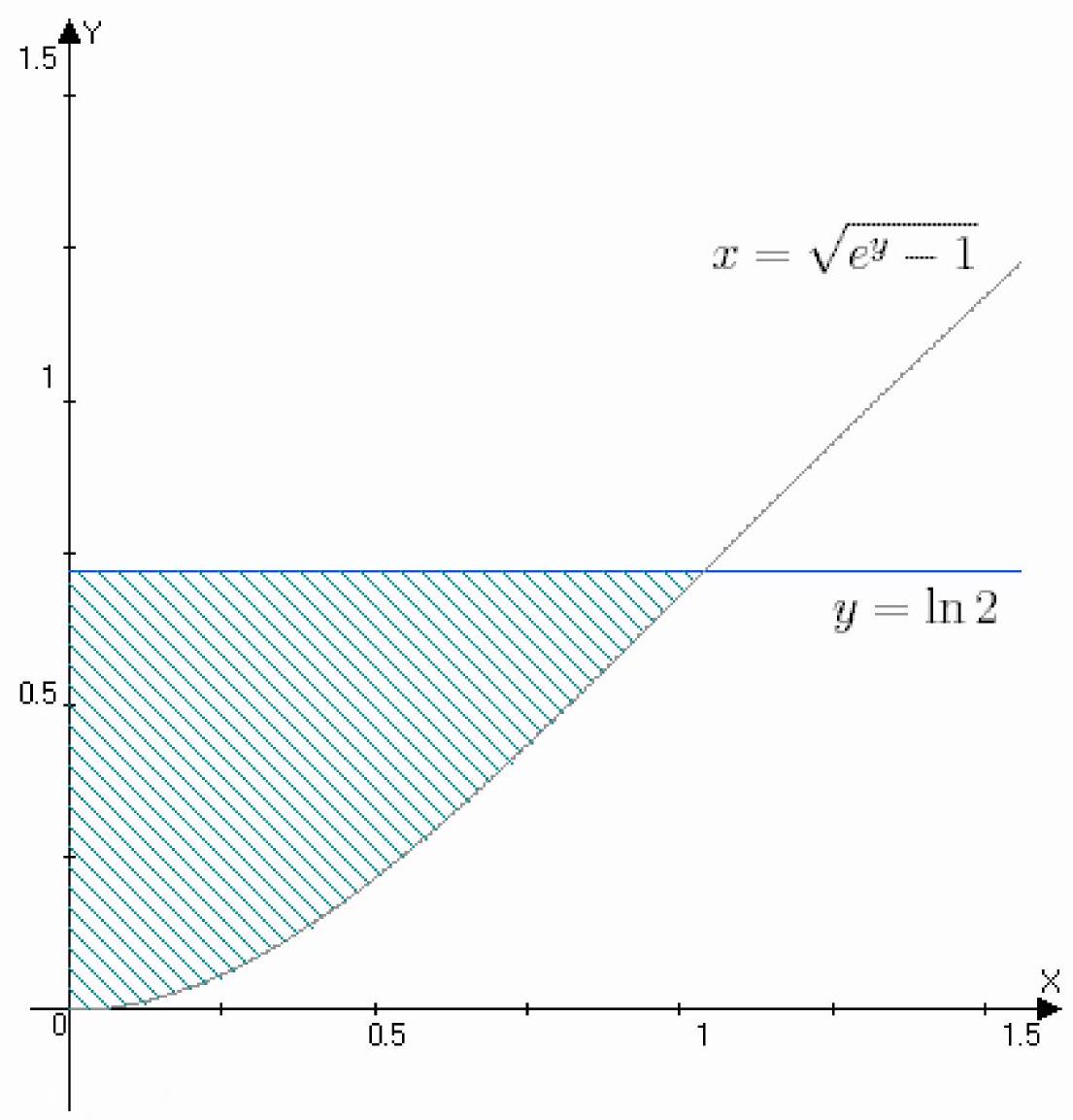
$$
x=\sqrt{e^{y}-1} \Rightarrow y=\ln \left(x^{2}+1\right)
$$
Let's find the limits of integration:
$$
\begin{aligned}
& x_{1}=0 \text { - given in the p... | 2-\frac{\pi}{2} | Calculus | math-word-problem | olympiads | 5e5e3f8a-79bf-5a5b-af62-8b857793534e | [
true,
true
] | [
"<think>\nOkay, so I need to find the area of the figure bounded by the graphs of x = sqrt(e^y - 1), x = 0, and y = ln 2. Hmm, let me visualize this first. \n\nFirst, x = sqrt(e^y - 1) is a function in terms of y. Since x is expressed in terms of y, maybe it's easier to integrate with respect to y instead of x. The... | [
true,
true
] | null | null | 2 | [
{
"content": "## Task Condition\n\nCalculate the area of the figure bounded by the graphs of the functions:\n\n$$\nx=\\sqrt{e^{y}-1}, x=0, y=\\ln 2\n$$",
"role": "user"
},
{
"content": "<think>Hmm , let me visualize this first. \n\nLet me sketch this mentally. When x = 0, that's the y-axis. The curv... |
## Problem Statement
Calculate the indefinite integral:
$$
\int(2-3 x) \sin 2 x \, dx
$$ | ## Solution
$$
\int(2-3 x) \sin 2 x d x=
$$
Let:
$$
\begin{aligned}
& u=2-3 x ; d u=-3 d x \\
& d v=\sin 2 x d x ; v=-\frac{1}{2} \cos 2 x
\end{aligned}
$$
Using the integration by parts formula $\int u d v=u v-\int v d u$. We get:
$$
\begin{aligned}
& =(2-3 x) \cdot\left(-\frac{1}{2} \cos 2 x\right)-\int\left(-\f... | \frac{1}{2}\cdot(3x-2)\cos2x-\frac{3}{4}\cdot\sin2x+C | Calculus | math-word-problem | olympiads | 6ef77f05-933b-51c0-b218-17178d7cee73 | [
true,
true
] | [
"<think>\nOkay, so I need to find the indefinite integral of (2 - 3x) multiplied by sin(2x) dx. Hmm, let me think. This looks like a product of two functions, so maybe integration by parts is the way to go here. Integration by parts formula is ∫u dv = uv - ∫v du. Right, so I need to choose u and dv from the integra... | [
true,
true
] | null | [
"stop",
"stop"
] | 2 | [
{
"content": "## Problem Statement\n\nCalculate the indefinite integral:\n\n$$\n\\int(2-3 x) \\sin 2 x \\, dx\n$$",
"role": "user"
},
{
"content": "<think>Hmm , let me think. This looks like a product of two functions, so maybe integration by parts is the way to go here. Integration by parts formula... |
3. $A B C D$ is a parallelogram with $\angle D$ obtuse. $M, N$ are the feet of perpendiculars from $D$ to $A B$ and $B C$ respectively. If $D B=D C=50$ and $D A=60$, find $D M+D N$.
$A B C D$ is a parallelogram, where $\angle D$ is obtuse. $M$ and $N$ are the feet of the perpendiculars from $D$ to $A B$ and $B C$ respe... | 3. 88
3. Note that $N$ is the mid-point of $B C$, so $N B=N C$ $=30$. By Pythagoras' Theorem, we have
$$
D N=\sqrt{50^{2}-30^{2}}=40 \text {. }
$$
Computing the area of $A B C D$ in two ways, we get
$$
60 \times 40=50 \times D M,
$$
which gives $D M=48$. It follows that
$$
D M+D N=48+40=88 \text {. }
$$ | 88 | Geometry | math-word-problem | olympiads | 842425a9-feaf-5ea6-8fa2-a4a7effddcd4 | [
true,
true
] | [
"<think>\nAlright, let's try to tackle this geometry problem step by step. So, we have a parallelogram ABCD with angle D being obtuse. M and N are the feet of the perpendiculars from D to AB and BC respectively. We know that DB = DC = 50 and DA = 60. We need to find DM + DN. Hmm, okay, let's start by recalling some... | [
true,
true
] | null | [
"stop",
"stop"
] | 2 | [
{
"content": "3. $A B C D$ is a parallelogram with $\\angle D$ obtuse. $M, N$ are the feet of perpendiculars from $D$ to $A B$ and $B C$ respectively. If $D B=D C=50$ and $D A=60$, find $D M+D N$.\n$A B C D$ is a parallelogram, where $\\angle D$ is obtuse. $M$ and $N$ are the feet of the perpendiculars from $D$... |
## Task A-1.2.
On the playground, there are 2014 athletes who have numbers from 1 to 2014 on their jerseys (each number is on exactly one jersey). At the beginning, all of them are standing. At certain time intervals, the coach shouts out all natural numbers from 1 to 2014 in sequence. Athletes whose jersey numbers ar... | ## Solution.
Each athlete will change position as many times as their number has divisors.
Thus, at the end, those athletes whose numbers have an odd number of divisors will be in the squat position.
All divisors of a number $n$ can be grouped into two-element sets $\left\{d, \frac{n}{d}\right\}$, except when $n=d^{... | 44 | Number Theory | math-word-problem | olympiads | 2f7e2242-efc3-5831-83fa-47e4c53502d3 | [
true,
true
] | [
"<think>\nOkay, let me try to figure out this problem step by step. So, we have 2014 athletes, each with a unique jersey number from 1 to 2014. They all start standing. The coach shouts numbers from 1 to 2014 in order, and every time a number is shouted, the athletes whose jersey numbers are multiples of that numbe... | [
true,
true
] | null | null | 2 | [
{
"content": "## Task A-1.2.\n\nOn the playground, there are 2014 athletes who have numbers from 1 to 2014 on their jerseys (each number is on exactly one jersey). At the beginning, all of them are standing. At certain time intervals, the coach shouts out all natural numbers from 1 to 2014 in sequence. Athletes... |
25. Fresh mushrooms contain $90 \%$ water, and when they were dried, they became lighter by 15 kg with a moisture content of $60 \%$. How much did the fresh mushrooms weigh? | 25. If there were $x$ kg of fresh mushrooms, then the dry mass in them is $0.1 x$ kg. After drying, the dry mass became $40\%$, and the water $-60\%$. This means that at a moisture content of $60\%$, the mushrooms became $\frac{0.1 x \cdot 100\%}{40\%}=\frac{1}{4} x$ (kg), and $ \frac{3}{4} x$ kg of water evaporated, w... | 20 | Algebra | math-word-problem | olympiads | 030e46e2-48d0-59bc-ae89-443216ba461b | [
true,
true
] | [
"<think>\nOkay, so I have this problem about mushrooms. Let me try to figure it out step by step. The problem says that fresh mushrooms contain 90% water, and when they're dried, they lose 15 kg and the moisture content becomes 60%. We need to find out how much the fresh mushrooms weighed originally.\n\nHmm, alrigh... | [
true,
true
] | null | null | 2 | [
{
"content": "25. Fresh mushrooms contain $90 \\%$ water, and when they were dried, they became lighter by 15 kg with a moisture content of $60 \\%$. How much did the fresh mushrooms weigh?",
"role": "user"
},
{
"content": "<think>Hmm , alright. Let's parse this again. Fresh mushrooms are 90% water,... |
A biologist wants to calculate the number of fish in a lake. On May 1 she catches a random sample of 60 fish, tags them, and releases them. On September 1 she catches a random sample of 70 fish and finds that 3 of them are tagged. To calculate the number of fish in the lake on May 1, she assumes that 25% of these fish ... | Of the $70$ fish caught in September, $40\%$ were not there in May, so $42$ fish were there in May. Since the percentage of tagged fish in September is proportional to the percentage of tagged fish in May, $\frac{3}{42} = \frac{60}{x} \Longrightarrow \boxed{x = 840}$.
(Note the 25% death rate does not affect the answer... | 840 | Algebra | math-word-problem | amc_aime | 86ae953f-0649-5c3a-bd62-75b704cbfec0 | [
true,
true
] | [
"<think>\nOkay, let me try to figure out how to solve this fish population problem. So, the biologist wants to estimate the number of fish in the lake on May 1. Here's what happened:\n\nOn May 1, she catches a random sample of 60 fish, tags them, and releases them back into the lake. Then, on September 1, she catch... | [
true,
true
] | null | null | 2 | [
{
"content": "A biologist wants to calculate the number of fish in a lake. On May 1 she catches a random sample of 60 fish, tags them, and releases them. On September 1 she catches a random sample of 70 fish and finds that 3 of them are tagged. To calculate the number of fish in the lake on May 1, she assumes t... |
17. A real-valued function $\mathrm{f}$ satisfies the relation
$$
f\left(x^{2}+x\right)+2 f\left(x^{2}-3 x+2\right)=9 x^{2}-15 x
$$
for all real values of $x$. Find $f(2011)$. | 17. Answer. 6029
Solution. Given the original equation
$$
f\left(x^{2}+x\right)+2 f\left(x^{2}-3 x+2\right)=9 x^{2}-15 x,
$$
we replace $x$ by $1-x$ and obtain
$$
\mathrm{f}\left(x^{2}-3 x+2\right)+2 \mathrm{f}\left(x^{2}+x\right)=9(1-x)^{2}-15(1-x)=9 x^{2}-3 x-6 .
$$
Eliminating $\mathrm{f}\left(x^{2}-3 x+2\right)$ f... | 6029 | Algebra | math-word-problem | olympiads | 4b7b3d0b-d7e7-5a4b-a832-376b82c5aa9d | [
true,
true
] | [
"<think>\nOkay, let's see. I need to find f(2011) given this functional equation. The equation is f(x² + x) + 2f(x² - 3x + 2) = 9x² -15x for all real x. Hmm, functional equations can be tricky, but maybe I can find expressions for f at certain arguments by choosing suitable values of x. Let me think.\n\nFirst, the ... | [
true,
true
] | null | null | 2 | [
{
"content": "17. A real-valued function $\\mathrm{f}$ satisfies the relation\n$$\nf\\left(x^{2}+x\\right)+2 f\\left(x^{2}-3 x+2\\right)=9 x^{2}-15 x\n$$\nfor all real values of $x$. Find $f(2011)$.",
"role": "user"
},
{
"content": "<think>Hmm , functional equations can be tricky, but maybe I can fi... |
A $39$-tuple of real numbers $(x_1,x_2,\ldots x_{39})$ satisfies
\[2\sum_{i=1}^{39} \sin(x_i) = \sum_{i=1}^{39} \cos(x_i) = -34.\]
The ratio between the maximum of $\cos(x_1)$ and the maximum of $\sin(x_1)$ over all tuples $(x_1,x_2,\ldots x_{39})$ satisfying the condition is $\tfrac ab$ for coprime positive integers ... | 1. **Modeling the Problem:**
We start by modeling each \( x_i \) as a vector \( \vec{v_i} = (\cos(x_i), \sin(x_i)) \) with unit magnitude. Given the conditions:
\[
2\sum_{i=1}^{39} \sin(x_i) = -34 \quad \text{and} \quad \sum_{i=1}^{39} \cos(x_i) = -34,
\]
we can rewrite these as:
\[
\sum_{i=1}^{39}... | 37 | Inequalities | math-word-problem | aops_forum | 29f2d84e-4b78-5cc1-bcc5-ca2621b105a7 | [
true,
false
] | [
"<think>\nOkay, let me try to work through this problem step by step. So, the problem is about a 39-tuple of real numbers where the sum of twice the sines of all the numbers is -34, and the sum of the cosines is also -34. We need to find the ratio between the maximum possible value of cos(x₁) and the maximum possib... | [
true,
false
] | null | null | 1 | [
{
"content": "A $39$-tuple of real numbers $(x_1,x_2,\\ldots x_{39})$ satisfies\n\\[2\\sum_{i=1}^{39} \\sin(x_i) = \\sum_{i=1}^{39} \\cos(x_i) = -34.\\] \nThe ratio between the maximum of $\\cos(x_1)$ and the maximum of $\\sin(x_1)$ over all tuples $(x_1,x_2,\\ldots x_{39})$ satisfying the condition is $\\tfrac... |
1. A circle inscribed in a right angle of an isosceles right triangle divides the hypotenuse into 3 equal parts. Find the radius of the circle if the leg of the triangle is 1. | ## Answer: $1 / 3$ or $5/3$.
Solution. It is clear that the radius of the circle inscribed in the right angle $A$ is equal to the distance from its vertex to the point of tangency of the circle with the side. Let $B C$, the hypotenuse of the given triangle $A B C$, intersect the circle at points $D$ and $E$, and $K$ b... | \frac{1}{3} | Geometry | math-word-problem | olympiads | e546e70b-2aa5-50e4-8047-5e1526db5933 | [
true,
true
] | [
"<think>\nOkay, let's try to solve this problem step by step. The problem says: \"A circle inscribed in a right angle of an isosceles right triangle divides the hypotenuse into 3 equal parts. Find the radius of the circle if the leg of the triangle is 1.\"\n\nFirst, let me make sure I understand the problem correct... | [
true,
true
] | null | null | 2 | [
{
"content": "1. A circle inscribed in a right angle of an isosceles right triangle divides the hypotenuse into 3 equal parts. Find the radius of the circle if the leg of the triangle is 1.",
"role": "user"
},
{
"content": "<think>\nOkay, let's try to solve this problem step by step. The problem say... |
9.5. On the side $AC$ of triangle $ABC$, a point $M$ is taken. It turns out that $AM = BM + MC$ and $\angle BMA = \angle MBC + \angle BAC$. Find $\angle BMA$. | Answer. $\quad 60^{\circ}$. Solution. First, we will show that triangle $A B C$ is isosceles. Indeed, this follows from the condition $\angle B M A=\angle M B C+\angle B A C$ and the property of the exterior angle: $\angle B M A=\angle M B C+\angle B C A$. From these two equalities, we have $\angle B C A=\angle B A C$.... | 60 | Geometry | math-word-problem | olympiads | 3a510b0f-c2d6-5dd2-b1a3-7fae6431e8b1 | [
true,
true
] | [
"<think>\nOkay, so I need to solve this geometry problem. Let me read it again carefully.\n\nOn the side AC of triangle ABC, a point M is taken. It turns out that AM = BM + MC and angle BMA = angle MBC + angle BAC. Find angle BMA.\n\nHmm. Let's try to visualize the triangle first. Triangle ABC with point M on side ... | [
true,
true
] | null | null | 2 | [
{
"content": "9.5. On the side $AC$ of triangle $ABC$, a point $M$ is taken. It turns out that $AM = BM + MC$ and $\\angle BMA = \\angle MBC + \\angle BAC$. Find $\\angle BMA$.",
"role": "user"
},
{
"content": "<think>Hmm . Let's try to visualize the triangle first. Triangle ABC with point M on side... |
Provide four consecutive natural numbers, each of which has a square divisor greater than 1. | The "most stubborn" method is to take the multiples of the squares of prime numbers in sequence, and look for four consecutive numbers among them. Fortunately, the smallest such solution is quite small:
$$
242=11^{2} \cdot 2, \quad 243=3^{2} \cdot 27, \quad 244=2^{2} \cdot 61, \quad 245=7^{2} \cdot 5
$$
thus the proc... | 242=11^{2}\cdot2,\quad243=3^{2}\cdot27,\quad244=2^{2}\cdot61,\quad245=7^{2}\cdot5 | Number Theory | math-word-problem | olympiads | d1602efd-e1f2-5bae-b8c2-23f536da5790 | [
true,
true
] | [
"<think>\nOkay, so I need to find four consecutive natural numbers where each one has a square divisor greater than 1. Hmm, let's start by understanding what that means. A square divisor greater than 1 implies that each number isn't square-free. Square-free numbers are integers which are divisible by no perfect squ... | [
false,
false
] | [
true,
true
] | null | 2 | [
{
"content": "Provide four consecutive natural numbers, each of which has a square divisor greater than 1.",
"role": "user"
},
{
"content": "<think>Hmm , let's start by understanding what that means. A square divisor greater than 1 implies that each number isn't square-free. Square-free numbers are ... |
1. Since $\mathrm{x} \leq \mathrm{P}$ and Р:х, let $2 \mathrm{x} \leq \mathrm{P} => \mathrm{x} \leq \mathrm{P} / 2$, and also $\mathrm{y} \leq \mathrm{P} ; \kappa \leq \mathrm{P} ; \mathrm{e} \leq \mathrm{P} ; =>$
$$
\mathrm{x}+\mathrm{y}+\mathrm{K}+\mathrm{e} \leq 3.5 \mathrm{P} ; => \mathrm{P} \geq \frac{2}{7}(\math... | Answer: 2 l
## №6: Planimetry. | 2 | Algebra | math-word-problem | olympiads | b9152cb7-6cea-5300-b11d-56d5e6e0988d | [
true,
true
] | [
"<think>\nOkay, let's try to solve this percentage problem. So, we have a bottle that's filled with a 12% salt solution. Then, they pour out 1 liter and replace it with water. They do this again—pour out 1 liter and top up with water—and end up with a 3% salt solution. The question is: what's the capacity of the bo... | [
true,
true
] | null | null | 2 | [
{
"content": "1. Since $\\mathrm{x} \\leq \\mathrm{P}$ and Р:х, let $2 \\mathrm{x} \\leq \\mathrm{P} => \\mathrm{x} \\leq \\mathrm{P} / 2$, and also $\\mathrm{y} \\leq \\mathrm{P} ; \\kappa \\leq \\mathrm{P} ; \\mathrm{e} \\leq \\mathrm{P} ; =>$\n\n$$\n\\mathrm{x}+\\mathrm{y}+\\mathrm{K}+\\mathrm{e} \\leq 3.5 \... |
Subsets and Splits
No community queries yet
The top public SQL queries from the community will appear here once available.