\\n\\nGiven seven fishermen standing in a circle, each with their own lying measure (an integer), we need to determine the missing answer to the question about the right neighbor's catch. The left neighbor answers were \\\\(12, 12, 20, 24, 32, 42, 56\\\\) and the right neighbor answers (excluding one) were \\\\(12, 14, 18, 32, 48, 70\\\\).\\n\\nKey steps:\\n1. **Product of Answers**: The product of all left neighbor answers must equal the product of all right neighbor answers (including the missing one) because each actual number of fish caught (Ni) is reported twice, once by each neighbor, and the lying measures (Li) cancel out in the product.\\n\\n2. **Calculate Products**:\\n - Left product: \\\\(12 \\\\times 12 \\\\times 20 \\\\times 24 \\\\times 32 \\\\times 42 \\\\times 56\\\\)\\n - Right product: \\\\(12 \\\\times 14 \\\\times 18 \\\\times 32 \\\\times 48 \\\\times 70 \\\\times ?\\\\)\\n\\n3. **Simplify and Solve**:\\n - Left product: \\\\(5,202,247,680\\\\)\\n - Right product (excluding missing): \\\\(325,140,480\\\\)\\n - Missing value: \\\\(\\\\frac{5,202,247,680}{325,140,480} = 16\\\\)\\n\\nThus, the seventh fisherman's answer to the right neighbor question is \\\\(\\\\boxed{16}\\\\).\"\n]","isConversational":false},"correctness_math_verify":{"kind":"list like","value":[true,true],"string":"[\n true,\n true\n]","isConversational":false},"correctness_llama":{"kind":"null"},"finish_reasons":{"kind":"null"},"correctness_count":{"kind":"number","value":2,"string":"2"},"messages":{"kind":"list like","value":[{"content":"5. Seven fishermen stand in a circle. The fishermen have a professional habit of exaggerating numbers. Each fisherman has a measure of lying (each has their own, an integer) - how many times the number mentioned by the fisherman is greater than the true value. For example, if a fisherman with a lying measure of 3 catches two fish, he will say he caught six fish. In response to the question: \"How many fish did your left neighbor catch?\", the answers (not necessarily in the order in which the fishermen stand) were $12,12,20,24,32,42$ and 56. In response to the question: \"How many fish did your right neighbor catch?\", six fishermen answered $12,14,18,32$, 48,70. What did the seventh fisherman answer?","role":"user"},{"content":"<think>Wait , actually, hold on. The problem says that each fisherman has their own lying measure, which is how many times the number they mention is greater than the true value. So, if a fisherman has a lying measure of 'k', then whenever they report a number, it's k times the actual number. \n\nBut here's the thing: when they're asked about their left neighbor's catch, they report the left neighbor's actual number multiplied by their own lying measure. Similarly, when they're asked about their right neighbor's catch, they report the right neighbor's actual number multiplied by their own lying measure. \n\n Wait , is that correct? Let me confirm. The lying measure is specific to each fisherman. So, each fisherman exaggerates numbers by their own multiplier. So, when answering any question, their answer is their lying measure multiplied by the true value. Therefore, when asked about their left neighbor's catch, the answer they give is (left neighbor's actual fish) multiplied by the responder's lying measure. Similarly, for the right neighbor.\n\nTherefore, each fisherman's lying measure affects both their answer about the left and the right neighbor. So, for each fisherman, their left neighbor's actual catch is equal to (their left answer) divided by their lying measure, and their right neighbor's actual catch is equal to (their right answer) divided by their lying measure.\n\nWe are given the answers to the left neighbor question: 12,12,20,24,32,42,56. Let's call these L1, L2, L3, L4, L5, L6, L7 (but not necessarily in order). Similarly, the answers to the right neighbor question are six of the numbers: 12,14,18,32,48,70 and one unknown, which we need to find.\n\nBut wait , the problem says \"the answers (not necessarily in the order in which the fishermen stand)\" for both left and right. So, the left answers are those seven numbers, but not in order, and the right answers are those six numbers plus the unknown seventh.\n\nFirst, note that the left answers and the right answers are products of the actual catches and the lying measures of the respective fishermen. Since each fisherman's left answer is Ai-1 * Li, and their right answer is Ai+1 * Li. Therefore, for each fisherman, the ratio of their left answer to their right answer is (Ai-1 * Li) / (Ai+1 * Li) = Ai-1 / Ai+1. So, the ratio of left answer to right answer for each fisherman is equal to the ratio of their left neighbor's actual catch to their right neighbor's actual catch.\n\nBut since all the fishermen are in a circle, the product of these ratios around the circle should equal 1. Wait , that might be a bit complicated. Alternatively, maybe we can model this as a system of equations.\n\nLet me consider that for each fisherman i:\n\nLeft answer = Ai-1 * Li\n\nRight answer = Ai+1 * Li\n\nAlternatively, we can consider that for each fisherman, their left answer divided by their right answer equals Ai-1 / Ai+1.\n\nTherefore, for each i:\n\nLeft answer (Li) / Right answer (Ri) = Ai-1 / Ai+1\n\nBut since Ai+1 = (Right answer of fisherman i) / Li, we can substitute that in.\n\n Wait , maybe it's getting too tangled. Let's see if there's another approach.\n\nSuppose we list all left answers: 12,12,20,24,32,42,56\n\nAnd all right answers: 12,14,18,32,48,70, and the missing one.\n\nAlternatively, think of the actual catches as variables. Let's denote A1, A2, A3, A4, A5, A6, A7 as the actual fish caught by each fisherman. Then, each left answer is some Li = Aj * Lk, where Aj is the actual catch of the left neighbor, and Lk is the lying measure of the fisherman. Similarly, each right answer is Rm = An * Lm, where An is the actual catch of the right neighbor, and Lm is the lying measure of the fisherman.\n\nBut since the left answers and right answers are given as multisets (they are not in order), we need to pair each left answer with a right answer for each fisherman, such that they share the same lying measure.\n\n Wait , each fisherman has a unique lying measure, right? The problem says \"each has their own, an integer\". So, each of the seven fishermen has a distinct integer lying measure? Wait , the problem says \"each has their own, an integer\" - does that mean each has their own integer, but they could be the same? Or does it mean they are distinct? The problem says \"each has their own\", which might imply distinct. Hmm , but the problem statement is in Chinese, translated into English, so maybe \"each has their own\" might just mean each has their individual measure, not necessarily distinct. But the problem also mentions \"how many times the number mentioned by the fisherman is greater than the true value\", so the lying measure is an integer greater than or equal to 1? Since you can't have a lying measure of 0 or a fraction, as that would mean understating.\n\nSo, the lying measures are positive integers. But they could be the same or different. However, given that the left answers are 12,12,20,24,32,42,56 and right answers (excluding the missing one) are 12,14,18,32,48,70, which are different numbers, but with some overlaps (12,32). So, maybe some fishermen have the same lying measures.\n\nBut perhaps we can consider that the lying measures must be divisors of the left and right answers. Because the left answer is equal to (left neighbor's actual catch) multiplied by the lying measure. So, the lying measure must be a divisor of the left answer. Similarly, the lying measure must be a divisor of the right answer. Therefore, for each fisherman, their lying measure is a common divisor of one of the left answers and one of the right answers.\n\nBut since each fisherman is associated with one left answer and one right answer, we need to pair each left answer with a right answer such that they share a common divisor (the lying measure). Additionally, since the actual catches must be integers (assuming fish are counted as whole numbers), the lying measure must divide both the left answer and the right answer for each fisherman.\n\nSo, the approach could be:\n\n1. For each left answer (12,12,20,24,32,42,56) and each right answer (12,14,18,32,48,70,?), find possible common divisors (lying measures) that divide both a left answer and a right answer.\n\n2. Each lying measure must be assigned to exactly one fisherman, and each left and right answer must be used exactly once, except the missing right answer which is our target.\n\nBut since the right answers are missing one, we have seven fishermen, each with a left and a right answer. However, the right answers provided are only six, so one is missing, which is our answer.\n\nTherefore, the problem reduces to matching the seven left answers with seven right answers (including the missing one) such that each pair (left, right) has a common divisor (lying measure), and the resulting actual catches form a consistent cycle.\n\nAdditionally, the actual catches computed from the left answers and the lying measures must match the actual catches computed from the right answers and the lying measures.\n\nThis seems complex, but perhaps manageable.\n\nFirst, let's list all left answers: 12,12,20,24,32,42,56\n\nRight answers given: 12,14,18,32,48,70, and the missing one.\n\nWe need to assign to each left answer a right answer (including the missing one) such that they share a common divisor, and then check consistency.\n\nBut since we don't know the missing right answer, we need to deduce it based on the possible divisors and the required consistency.\n\nFirst, let's note the divisors for each left answer:\n\nLeft answers:\n\n12: divisors are 1,2,3,4,6,12\n\n12: same as above\n\n20: 1,2,4,5,10,20\n\n24: 1,2,3,4,6,8,12,24\n\n32: 1,2,4,8,16,32\n\n42: 1,2,3,6,7,14,21,42\n\n2211840 * 2 = 4,423,680\n\nTotal: 88,473,600 + 4,423,680 = 92,897,280\n\n92,897,280 * 56 = Let's compute 92,897,280 * 50 = 4,644,864,000\n\n92,897,280 * 6 = 557,383,680\n\nTotal: 4,644,864,000 + 557,383,680 = 5,202,247,680\n\nSo, product of left answers: 5,202,247,680\n\nNow, the product of the right answers must be equal to this. The given right answers are: 12,14,18,32,48,70, and X.\n\nCompute the product of the known right answers:\n\n12 * 14 = 168\n\n168 * 18 = 3,024\n\n3,024 * 32 = 96,768\n\n96,768 * 48 = 4,644,864\n\n4,644,864 * 70 = 325,140,480\n\nSo, 325,140,480 * X = 5,202,247,680\n\nTherefore, X = 5,202,247,680 / 325,140,480\n\nCompute this division:\n\nDivide numerator and denominator by 10: 520,224,768 / 32,514,048\n\nDivide numerator and denominator by 16: 32,514,048 / 2,032,128\n\nDivide numerator and denominator by 16 again: 2,032,128 / 127,008\n\nDivide numerator and denominator by 12: 169,344 / 10,584\n\nDivide numerator and denominator by 12 again: 14,112 / 882\n\nDivide numerator and denominator by 42: 336 / 21\n\nDivide numerator and denominator by 21: 16 / 1\n\n Wait , this can't be. Let me check the calculations again.\n\n Wait , maybe I messed up the intermediate steps. Let's do the division properly.\n\n5,202,247,680 ÷ 325,140,480\n\n325,140,480 * 16 = (10 + 5 + 1) * 325,140,480 = 3,251,404,800 + 1,625,702,400 + 325,140,480 = 5,202,247,680\n\nYes, exactly. Therefore, X = 16\n\n Wait , but 325,140,480 * 16 = 5,202,247,680, which equals the product of the left answers. Therefore, X must be 16.\n\nBut 16 is not among the given right answers (which are 12,14,18,32,48,70), so the missing answer is 16.\n\nBut hold on, the problem says six fishermen answered 12,14,18,32,48,70, and the seventh is the answer we need. So, according to this calculation, X=16. Therefore, the seventh fisherman answered 16.\n\nBut let's verify this, because 16 is not a number that was mentioned in the right answers, so that's plausible. However, we need to check if 16 can be a valid answer given the constraints.\n\nBut before confirming, let's verify the product calculation again to be sure.\n\nLeft product:\n\n96,768 * 48 = 4,644,864\n\n4,644,864 * 70 = 325,140,480\n\n325,140,480 * 16 = 5,202,247,680\n\nYes, that matches. Therefore, X=16.\n\nBut we need to check if 16 is a possible answer. However, in the problem statement, the right answers are \"six fishermen answered 12,14,18,32,48,70. What did the seventh fisherman answer?\" So, the answer should be 16. But let's check if this makes sense in terms of the divisors and actual catches.\n\n Wait , but 16 is a possible answer. However, we need to ensure that there's a consistent assignment of lying measures and actual catches.\n\nTherefore, the missing right answer is 16. So, the seventh fisherman answered 16.\n\nBut wait , let me check the problem statement again. The problem says that in response to the question about the right neighbor, six fishermen answered 12,14,18,32,48,70. So, the seventh answer is the missing one. According to our calculation, it's 16. However, 16 is not among the given numbers, so that seems correct. But is there a possibility that I made a miscalculation?\n\nLet me recompute the product:\n\nLeft answers: 12,12,20,24,32,42,56\n\nMultiply them step by step:\n\nStart with 12.\n\n12 * 12 = 144\n\n96,768 *48 = 4,644,864\n\n4,644,864 *70 = 325,140,480\n\n325,140,480 *X = 5,202,247,680\n\nTherefore, X = 5,202,247,680 / 325,140,480 = 16\n\nYes, that's correct. So, the missing answer is 16. Therefore, the seventh fisherman answered \\boxed{16}\n\nBut wait , just to make sure, let's check if 16 is a plausible answer. The problem states that the fishermen have a professional habit of exaggerating numbers, so their lying measures are integers greater than 1? Wait , the problem doesn't specify that the lying measures are necessarily greater than 1. It says \"how many times the number mentioned by the fisherman is greater than the true value\". So, the lying measure is an integer, which could be 1, meaning they tell the truth, but since they have a habit of exaggerating, probably the lying measures are ≥1, with at least some being greater than 1. However, the problem doesn't forbid a lying measure of 1.\n\nAlternatively, maybe I need to check that each lying measure is an integer, which they are, as X=16 divides appropriately. But since the product method gives a unique answer here, and all steps are correct, the answer should indeed be 16.\n\n**Final Answer**\n\\boxed{16}\n</think>\n\nGiven seven fishermen standing in a circle, each with a lying measure (an integer) that multiplies the true number of fish they caught, we need to determine the missing answer from the responses about their right neighbors. \n\nThe fishermen's answers about their left neighbors were: 12, 12, 20, 24, 32, 42, and 56. The answers about their right neighbors (excluding the missing one) were: 12, 14, 18, 32, 48, and 70. \n\nKey steps:\n1. **Product of Left Answers**: The product of all left answers must equal the product of all right answers (including the missing one) because each actual catch is counted twice in the product, once by the left answer and once by the right answer of adjacent fishermen.\n2. **Calculate the Product of Left Answers**:\n \\[\n 12 \\times 12 \\times 20 \\times 24 \\times 32 \\times 42 \\times 56 = 5,202,247,680\n \\]\n3. **Calculate the Product of Known Right Answers**:\n \\[\n 12 \\times 14 \\times 18 \\times 32 \\times 48 \\times 70 = 325,140,480\n \\]\n4. **Solve for the Missing Right Answer (X)**:\n \\[\n 325,140,480 \\times X = 5,202,247,680\n \\]\n \\[\n X = \\frac{5,202,247,680}{325,140,480} = 16\n \\]\n\nThus, the seventh fisherman's answer about their right neighbor is \\(\\boxed{16}\\).","role":"assistant"}],"string":"[\n {\n \"content\": \"5. Seven fishermen stand in a circle. The fishermen have a professional habit of exaggerating numbers. Each fisherman has a measure of lying (each has their own, an integer) - how many times the number mentioned by the fisherman is greater than the true value. For example, if a fisherman with a lying measure of 3 catches two fish, he will say he caught six fish. In response to the question: \\\"How many fish did your left neighbor catch?\\\", the answers (not necessarily in the order in which the fishermen stand) were $12,12,20,24,32,42$ and 56. In response to the question: \\\"How many fish did your right neighbor catch?\\\", six fishermen answered $12,14,18,32$, 48,70. What did the seventh fisherman answer?\",\n \"role\": \"user\"\n },\n {\n \"content\": \"<think>Wait , actually, hold on. The problem says that each fisherman has their own lying measure, which is how many times the number they mention is greater than the true value. So, if a fisherman has a lying measure of 'k', then whenever they report a number, it's k times the actual number. \\n\\nBut here's the thing: when they're asked about their left neighbor's catch, they report the left neighbor's actual number multiplied by their own lying measure. Similarly, when they're asked about their right neighbor's catch, they report the right neighbor's actual number multiplied by their own lying measure. \\n\\n Wait , is that correct? Let me confirm. The lying measure is specific to each fisherman. So, each fisherman exaggerates numbers by their own multiplier. So, when answering any question, their answer is their lying measure multiplied by the true value. Therefore, when asked about their left neighbor's catch, the answer they give is (left neighbor's actual fish) multiplied by the responder's lying measure. Similarly, for the right neighbor.\\n\\nTherefore, each fisherman's lying measure affects both their answer about the left and the right neighbor. So, for each fisherman, their left neighbor's actual catch is equal to (their left answer) divided by their lying measure, and their right neighbor's actual catch is equal to (their right answer) divided by their lying measure.\\n\\nWe are given the answers to the left neighbor question: 12,12,20,24,32,42,56. Let's call these L1, L2, L3, L4, L5, L6, L7 (but not necessarily in order). Similarly, the answers to the right neighbor question are six of the numbers: 12,14,18,32,48,70 and one unknown, which we need to find.\\n\\nBut wait , the problem says \\\"the answers (not necessarily in the order in which the fishermen stand)\\\" for both left and right. So, the left answers are those seven numbers, but not in order, and the right answers are those six numbers plus the unknown seventh.\\n\\nFirst, note that the left answers and the right answers are products of the actual catches and the lying measures of the respective fishermen. Since each fisherman's left answer is Ai-1 * Li, and their right answer is Ai+1 * Li. Therefore, for each fisherman, the ratio of their left answer to their right answer is (Ai-1 * Li) / (Ai+1 * Li) = Ai-1 / Ai+1. So, the ratio of left answer to right answer for each fisherman is equal to the ratio of their left neighbor's actual catch to their right neighbor's actual catch.\\n\\nBut since all the fishermen are in a circle, the product of these ratios around the circle should equal 1. Wait , that might be a bit complicated. Alternatively, maybe we can model this as a system of equations.\\n\\nLet me consider that for each fisherman i:\\n\\nLeft answer = Ai-1 * Li\\n\\nRight answer = Ai+1 * Li\\n\\nAlternatively, we can consider that for each fisherman, their left answer divided by their right answer equals Ai-1 / Ai+1.\\n\\nTherefore, for each i:\\n\\nLeft answer (Li) / Right answer (Ri) = Ai-1 / Ai+1\\n\\nBut since Ai+1 = (Right answer of fisherman i) / Li, we can substitute that in.\\n\\n Wait , maybe it's getting too tangled. Let's see if there's another approach.\\n\\nSuppose we list all left answers: 12,12,20,24,32,42,56\\n\\nAnd all right answers: 12,14,18,32,48,70, and the missing one.\\n\\nAlternatively, think of the actual catches as variables. Let's denote A1, A2, A3, A4, A5, A6, A7 as the actual fish caught by each fisherman. Then, each left answer is some Li = Aj * Lk, where Aj is the actual catch of the left neighbor, and Lk is the lying measure of the fisherman. Similarly, each right answer is Rm = An * Lm, where An is the actual catch of the right neighbor, and Lm is the lying measure of the fisherman.\\n\\nBut since the left answers and right answers are given as multisets (they are not in order), we need to pair each left answer with a right answer for each fisherman, such that they share the same lying measure.\\n\\n Wait , each fisherman has a unique lying measure, right? The problem says \\\"each has their own, an integer\\\". So, each of the seven fishermen has a distinct integer lying measure? Wait , the problem says \\\"each has their own, an integer\\\" - does that mean each has their own integer, but they could be the same? Or does it mean they are distinct? The problem says \\\"each has their own\\\", which might imply distinct. Hmm , but the problem statement is in Chinese, translated into English, so maybe \\\"each has their own\\\" might just mean each has their individual measure, not necessarily distinct. But the problem also mentions \\\"how many times the number mentioned by the fisherman is greater than the true value\\\", so the lying measure is an integer greater than or equal to 1? Since you can't have a lying measure of 0 or a fraction, as that would mean understating.\\n\\nSo, the lying measures are positive integers. But they could be the same or different. However, given that the left answers are 12,12,20,24,32,42,56 and right answers (excluding the missing one) are 12,14,18,32,48,70, which are different numbers, but with some overlaps (12,32). So, maybe some fishermen have the same lying measures.\\n\\nBut perhaps we can consider that the lying measures must be divisors of the left and right answers. Because the left answer is equal to (left neighbor's actual catch) multiplied by the lying measure. So, the lying measure must be a divisor of the left answer. Similarly, the lying measure must be a divisor of the right answer. Therefore, for each fisherman, their lying measure is a common divisor of one of the left answers and one of the right answers.\\n\\nBut since each fisherman is associated with one left answer and one right answer, we need to pair each left answer with a right answer such that they share a common divisor (the lying measure). Additionally, since the actual catches must be integers (assuming fish are counted as whole numbers), the lying measure must divide both the left answer and the right answer for each fisherman.\\n\\nSo, the approach could be:\\n\\n1. For each left answer (12,12,20,24,32,42,56) and each right answer (12,14,18,32,48,70,?), find possible common divisors (lying measures) that divide both a left answer and a right answer.\\n\\n2. Each lying measure must be assigned to exactly one fisherman, and each left and right answer must be used exactly once, except the missing right answer which is our target.\\n\\nBut since the right answers are missing one, we have seven fishermen, each with a left and a right answer. However, the right answers provided are only six, so one is missing, which is our answer.\\n\\nTherefore, the problem reduces to matching the seven left answers with seven right answers (including the missing one) such that each pair (left, right) has a common divisor (lying measure), and the resulting actual catches form a consistent cycle.\\n\\nAdditionally, the actual catches computed from the left answers and the lying measures must match the actual catches computed from the right answers and the lying measures.\\n\\nThis seems complex, but perhaps manageable.\\n\\nFirst, let's list all left answers: 12,12,20,24,32,42,56\\n\\nRight answers given: 12,14,18,32,48,70, and the missing one.\\n\\nWe need to assign to each left answer a right answer (including the missing one) such that they share a common divisor, and then check consistency.\\n\\nBut since we don't know the missing right answer, we need to deduce it based on the possible divisors and the required consistency.\\n\\nFirst, let's note the divisors for each left answer:\\n\\nLeft answers:\\n\\n12: divisors are 1,2,3,4,6,12\\n\\n12: same as above\\n\\n20: 1,2,4,5,10,20\\n\\n24: 1,2,3,4,6,8,12,24\\n\\n32: 1,2,4,8,16,32\\n\\n42: 1,2,3,6,7,14,21,42\\n\\n2211840 * 2 = 4,423,680\\n\\nTotal: 88,473,600 + 4,423,680 = 92,897,280\\n\\n92,897,280 * 56 = Let's compute 92,897,280 * 50 = 4,644,864,000\\n\\n92,897,280 * 6 = 557,383,680\\n\\nTotal: 4,644,864,000 + 557,383,680 = 5,202,247,680\\n\\nSo, product of left answers: 5,202,247,680\\n\\nNow, the product of the right answers must be equal to this. The given right answers are: 12,14,18,32,48,70, and X.\\n\\nCompute the product of the known right answers:\\n\\n12 * 14 = 168\\n\\n168 * 18 = 3,024\\n\\n3,024 * 32 = 96,768\\n\\n96,768 * 48 = 4,644,864\\n\\n4,644,864 * 70 = 325,140,480\\n\\nSo, 325,140,480 * X = 5,202,247,680\\n\\nTherefore, X = 5,202,247,680 / 325,140,480\\n\\nCompute this division:\\n\\nDivide numerator and denominator by 10: 520,224,768 / 32,514,048\\n\\nDivide numerator and denominator by 16: 32,514,048 / 2,032,128\\n\\nDivide numerator and denominator by 16 again: 2,032,128 / 127,008\\n\\nDivide numerator and denominator by 12: 169,344 / 10,584\\n\\nDivide numerator and denominator by 12 again: 14,112 / 882\\n\\nDivide numerator and denominator by 42: 336 / 21\\n\\nDivide numerator and denominator by 21: 16 / 1\\n\\n Wait , this can't be. Let me check the calculations again.\\n\\n Wait , maybe I messed up the intermediate steps. Let's do the division properly.\\n\\n5,202,247,680 ÷ 325,140,480\\n\\n325,140,480 * 16 = (10 + 5 + 1) * 325,140,480 = 3,251,404,800 + 1,625,702,400 + 325,140,480 = 5,202,247,680\\n\\nYes, exactly. Therefore, X = 16\\n\\n Wait , but 325,140,480 * 16 = 5,202,247,680, which equals the product of the left answers. Therefore, X must be 16.\\n\\nBut 16 is not among the given right answers (which are 12,14,18,32,48,70), so the missing answer is 16.\\n\\nBut hold on, the problem says six fishermen answered 12,14,18,32,48,70, and the seventh is the answer we need. So, according to this calculation, X=16. Therefore, the seventh fisherman answered 16.\\n\\nBut let's verify this, because 16 is not a number that was mentioned in the right answers, so that's plausible. However, we need to check if 16 can be a valid answer given the constraints.\\n\\nBut before confirming, let's verify the product calculation again to be sure.\\n\\nLeft product:\\n\\n96,768 * 48 = 4,644,864\\n\\n4,644,864 * 70 = 325,140,480\\n\\n325,140,480 * 16 = 5,202,247,680\\n\\nYes, that matches. Therefore, X=16.\\n\\nBut we need to check if 16 is a possible answer. However, in the problem statement, the right answers are \\\"six fishermen answered 12,14,18,32,48,70. What did the seventh fisherman answer?\\\" So, the answer should be 16. But let's check if this makes sense in terms of the divisors and actual catches.\\n\\n Wait , but 16 is a possible answer. However, we need to ensure that there's a consistent assignment of lying measures and actual catches.\\n\\nTherefore, the missing right answer is 16. So, the seventh fisherman answered 16.\\n\\nBut wait , let me check the problem statement again. The problem says that in response to the question about the right neighbor, six fishermen answered 12,14,18,32,48,70. So, the seventh answer is the missing one. According to our calculation, it's 16. However, 16 is not among the given numbers, so that seems correct. But is there a possibility that I made a miscalculation?\\n\\nLet me recompute the product:\\n\\nLeft answers: 12,12,20,24,32,42,56\\n\\nMultiply them step by step:\\n\\nStart with 12.\\n\\n12 * 12 = 144\\n\\n96,768 *48 = 4,644,864\\n\\n4,644,864 *70 = 325,140,480\\n\\n325,140,480 *X = 5,202,247,680\\n\\nTherefore, X = 5,202,247,680 / 325,140,480 = 16\\n\\nYes, that's correct. So, the missing answer is 16. Therefore, the seventh fisherman answered \\\\boxed{16}\\n\\nBut wait , just to make sure, let's check if 16 is a plausible answer. The problem states that the fishermen have a professional habit of exaggerating numbers, so their lying measures are integers greater than 1? Wait , the problem doesn't specify that the lying measures are necessarily greater than 1. It says \\\"how many times the number mentioned by the fisherman is greater than the true value\\\". So, the lying measure is an integer, which could be 1, meaning they tell the truth, but since they have a habit of exaggerating, probably the lying measures are ≥1, with at least some being greater than 1. However, the problem doesn't forbid a lying measure of 1.\\n\\nAlternatively, maybe I need to check that each lying measure is an integer, which they are, as X=16 divides appropriately. But since the product method gives a unique answer here, and all steps are correct, the answer should indeed be 16.\\n\\n**Final Answer**\\n\\\\boxed{16}\\n</think>\\n\\nGiven seven fishermen standing in a circle, each with a lying measure (an integer) that multiplies the true number of fish they caught, we need to determine the missing answer from the responses about their right neighbors. \\n\\nThe fishermen's answers about their left neighbors were: 12, 12, 20, 24, 32, 42, and 56. The answers about their right neighbors (excluding the missing one) were: 12, 14, 18, 32, 48, and 70. \\n\\nKey steps:\\n1. **Product of Left Answers**: The product of all left answers must equal the product of all right answers (including the missing one) because each actual catch is counted twice in the product, once by the left answer and once by the right answer of adjacent fishermen.\\n2. **Calculate the Product of Left Answers**:\\n \\\\[\\n 12 \\\\times 12 \\\\times 20 \\\\times 24 \\\\times 32 \\\\times 42 \\\\times 56 = 5,202,247,680\\n \\\\]\\n3. **Calculate the Product of Known Right Answers**:\\n \\\\[\\n 12 \\\\times 14 \\\\times 18 \\\\times 32 \\\\times 48 \\\\times 70 = 325,140,480\\n \\\\]\\n4. **Solve for the Missing Right Answer (X)**:\\n \\\\[\\n 325,140,480 \\\\times X = 5,202,247,680\\n \\\\]\\n \\\\[\\n X = \\\\frac{5,202,247,680}{325,140,480} = 16\\n \\\\]\\n\\nThus, the seventh fisherman's answer about their right neighbor is \\\\(\\\\boxed{16}\\\\).\",\n \"role\": \"assistant\"\n }\n]","isConversational":true}}},{"rowIdx":25691,"cells":{"problem":{"kind":"string","value":"Julie runs a website where she sells university themed clothing. On Monday, she sells thirteen Stanford sweatshirts and nine Harvard sweatshirts for a total of $\\$370$. On Tuesday, she sells nine Stanford sweatshirts and two Harvard sweatshirts for a total of $\\$180$. On Wednesday, she sells twelve Stanford sweatshirts and six Harvard sweatshirts. If Julie didn't change the prices of any items all week, how much money did she take in (total number of dollars) from the sale of Stanford and Harvard sweatshirts on Wednesday?"},"solution":{"kind":"string","value":"1. Let \\( S \\) be the price of a Stanford sweatshirt and \\( H \\) be the price of a Harvard sweatshirt.\n2. We are given the following system of linear equations based on the sales:\n \\[\n 13S + 9H = 370 \\quad \\text{(Equation 1)}\n \\]\n \\[\n 9S + 2H = 180 \\quad \\text{(Equation 2)}\n \\]\n3. We need to find the value of \\( 12S + 6H \\).\n\n4. To eliminate \\( H \\), we can multiply Equation 1 by 2 and Equation 2 by 9:\n \\[\n 2(13S + 9H) = 2 \\cdot 370 \\implies 26S + 18H = 740 \\quad \\text{(Equation 3)}\n \\]\n \\[\n 9(9S + 2H) = 9 \\cdot 180 \\implies 81S + 18H = 1620 \\quad \\text{(Equation 4)}\n \\]\n\n5. Subtract Equation 3 from Equation 4 to eliminate \\( H \\):\n \\[\n (81S + 18H) - (26S + 18H) = 1620 - 740\n \\]\n \\[\n 55S = 880\n \\]\n \\[\n S = \\frac{880}{55} = 16\n \\]\n\n6. Substitute \\( S = 16 \\) back into Equation 2 to find \\( H \\):\n \\[\n 9S + 2H = 180\n \\]\n \\[\n 9(16) + 2H = 180\n \\]\n \\[\n 144 + 2H = 180\n \\]\n \\[\n 2H = 180 - 144\n \\]\n \\[\n 2H = 36\n \\]\n \\[\n H = \\frac{36}{2} = 18\n \\]\n\n7. Now, we calculate \\( 12S + 6H \\):\n \\[\n 12S + 6H = 12(16) + 6(18)\n \\]\n \\[\n = 192 + 108\n \\]\n \\[\n = 300\n \\]\n\nThe final answer is \\(\\boxed{300}\\)."},"answer":{"kind":"string","value":"300"},"problem_type":{"kind":"string","value":"Algebra"},"question_type":{"kind":"string","value":"math-word-problem"},"source":{"kind":"string","value":"aops_forum"},"uuid":{"kind":"string","value":"6477ec96-cdcd-5db9-9a4a-20127ac42034"},"is_reasoning_complete":{"kind":"list like","value":[true,true],"string":"[\n true,\n true\n]","isConversational":false},"generations":{"kind":"list like","value":["<think>\nOkay, so Julie sells Stanford and Harvard sweatshirts on her website, and we have information about her sales on Monday, Tuesday, and Wednesday. The problem is asking how much money she made on Wednesday. The key here is that the prices of the sweatshirts didn't change during the week, so we can use the information from Monday and Tuesday to figure out the prices, and then apply those prices to Wednesday's sales. \n\nLet me start by breaking down the information given. On Monday, she sold 13 Stanford sweatshirts and 9 Harvard sweatshirts, making a total of $370. On Tuesday, she sold 9 Stanford sweatshirts and 2 Harvard sweatshirts, totaling $180. Wednesday's sales are 12 Stanford and 6 Harvard sweatshirts, but we need to find out how much that amounts to in dollars. \n\nSince we need to find the total for Wednesday, the first step is to figure out the individual prices of a Stanford sweatshirt and a Harvard sweatshirt. Let's denote the price of a Stanford sweatshirt as \"S\" dollars and the price of a Harvard sweatshirt as \"H\" dollars. \n\nFrom Monday's sales, we can write the equation:\n13S + 9H = 370\n\nFrom Tuesday's sales, the equation is:\n9S + 2H = 180\n\nSo now we have a system of two equations with two variables. To solve this system, we can use either substitution or elimination. I think elimination might be straightforward here. Let me try that.\n\nFirst, let's label the equations for clarity.\n\nEquation 1: 13S + 9H = 370\n\nEquation 2: 9S + 2H = 180\n\nOur goal is to eliminate one of the variables by making their coefficients equal. Let's try to eliminate H. The coefficients of H in equation 1 and 2 are 9 and 2, respectively. To make them equal, we can find a common multiple. The least common multiple of 9 and 2 is 18. So, we can multiply equation 1 by 2 and equation 2 by 9 so that the coefficient of H becomes 18 in both.\n\nMultiplying equation 1 by 2:\n\n2*(13S + 9H) = 2*370\n\nWhich gives:\n\n26S + 18H = 740 --- Equation 3\n\nMultiplying equation 2 by 9:\n\n9*(9S + 2H) = 9*180\n\nWhich gives:\n\n81S + 18H = 1620 --- Equation 4\n\nNow, we have equation 3 and equation 4:\n\nEquation 3: 26S + 18H = 740\n\nEquation 4: 81S + 18H = 1620\n\nNow, if we subtract equation 3 from equation 4, the H terms will cancel out:\n\n(81S + 18H) - (26S + 18H) = 1620 - 740\n\nCalculating the left side:\n\n81S - 26S + 18H - 18H = 55S\n\nRight side:\n\n1620 - 740 = 880\n\nSo, 55S = 880\n\nTo solve for S, divide both sides by 55:\n\nS = 880 / 55\n\nLet me compute that. 55 times 16 is 880 because 55*10=550, 55*6=330, 550+330=880. So S = 16\n\nOkay, so a Stanford sweatshirt is $16. Now, we need to find the price of a Harvard sweatshirt, H. Let's substitute S = 16 into one of the original equations. Let's use equation 2 because the numbers might be smaller.\n\nEquation 2: 9S + 2H = 180\n\nSubstitute S = 16:\n\n9*16 + 2H = 180\n\nCalculate 9*16: 144\n\nSo:\n\n144 + 2H = 180\n\nSubtract 144 from both sides:\n\n2H = 180 - 144 = 36\n\nTherefore, H = 36 / 2 = 18\n\nSo a Harvard sweatshirt is $18. Let me verify these values with equation 1 to make sure there are no mistakes.\n\nEquation 1: 13S + 9H = 370\n\nSubstitute S = 16, H = 18:\n\n13*16 + 9*18 = ?\n\nCalculate 13*16: 208\n\n9*18: 162\n\n208 + 162 = 370, which matches the total given for Monday. Perfect, so the prices are correct.\n\nNow that we know the prices, we can calculate Wednesday's total sales. On Wednesday, Julie sold 12 Stanford sweatshirts and 6 Harvard sweatshirts.\n\nTotal revenue = 12*S + 6*H\n\nSubstituting S = 16, H = 18:\n\n12*16 + 6*18\n\nFirst, 12*16: Let's compute 10*16 = 160, 2*16 = 32, so 160 + 32 = 192\n\nThen 6*18: 6*10 = 60, 6*8 = 48, so 60 + 48 = 108\n\nAdding both together: 192 + 108 = 300\n\nTherefore, Julie made $300 on Wednesday.\n\nWait, let me double-check those calculations to be sure. It's easy to make arithmetic errors.\n\n12*16: 12*10=120, 12*6=72, so 120+72=192. Correct.\n\n6*18: 6*10=60, 6*8=48, 60+48=108. Correct.\n\n192+108: 192+100=292, 292+8=300. Correct.\n\nSo the answer is $300. \n\nJust to recap, the steps were: set up the equations based on Monday and Tuesday's sales, solve the system of equations to find the price per sweatshirt, then apply those prices to Wednesday's sales. Checked the math twice to be safe. Seems solid.\n\n**Final Answer**\n\\boxed{300}\n</think>\n\nLet \\( S \\) be the price of a Stanford sweatshirt and \\( H \\) be the price of a Harvard sweatshirt. We have the following system of equations based on Monday and Tuesday's sales:\n\n\\[\n\\begin{cases}\n13S + 9H = 370 & \\text{(Monday)} \\\\\n9S + 2H = 180 & \\text{(Tuesday)}\n\\end{cases}\n\\]\n\nTo eliminate \\( H \\), we multiply the first equation by 2 and the second equation by 9:\n\n\\[\n\\begin{cases}\n26S + 18H = 740 \\\\\n81S + 18H = 1620\n\\end{cases}\n\\]\n\nSubtracting the first modified equation from the second:\n\n\\[\n(81S + 18H) - (26S + 18H) = 1620 - 740\n\\]\n\n\\[\n55S = 880\n\\]\n\nSolving for \\( S \\):\n\n\\[\nS = \\frac{880}{55} = 16\n\\]\n\nSubstituting \\( S = 16 \\) into the second original equation:\n\n\\[\n9(16) + 2H = 180\n\\]\n\n\\[\n144 + 2H = 180\n\\]\n\n\\[\n2H = 36\n\\]\n\n\\[\nH = 18\n\\]\n\nThe prices are \\( S = 16 \\) dollars and \\( H = 18 \\) dollars. For Wednesday's sales of 12 Stanford sweatshirts and 6 Harvard sweatshirts:\n\n\\[\n12S + 6H = 12(16) + 6(18)\n\\]\n\nCalculating the total:\n\n\\[\n12 \\times 16 = 192\n\\]\n\\[\n6 \\times 18 = 108\n\\]\n\\[\n192 + 108 = 300\n\\]\n\nThus, the total money Julie took in on Wednesday is \\(\\boxed{300}\\).","<think>\nOkay, so I need to figure out how much money Julie made on Wednesday from selling Stanford and Harvard sweatshirts. The prices didn't change during the week, so I can use the information from Monday and Tuesday to find the prices of each type of sweatshirt. Once I have those prices, I can calculate Wednesday's total.\n\nLet me start by assigning variables to the unknowns. Let's say the price of a Stanford sweatshirt is \\( S \\) dollars, and the price of a Harvard sweatshirt is \\( H \\) dollars. \n\nFrom Monday's sales: She sold 13 Stanford sweatshirts and 9 Harvard sweatshirts, totaling $370. So, the equation would be:\n\\[ 13S + 9H = 370 \\]\n\nThen on Tuesday, she sold 9 Stanford sweatshirts and 2 Harvard sweatshirts, totaling $180. The equation for Tuesday is:\n\\[ 9S + 2H = 180 \\]\n\nSo now I have a system of two equations with two variables. I need to solve this system to find the values of \\( S \\) and \\( H \\). Once I have those, I can compute Wednesday's sales, which are 12 Stanford sweatshirts and 6 Harvard sweatshirts. The total for Wednesday will be:\n\\[ 12S + 6H \\]\n\nAlright, let's solve the system of equations. I can use either substitution or elimination. Maybe elimination is better here. Let me see. \n\nFirst, I'll write down the two equations again:\n\n1) \\( 13S + 9H = 370 \\)\n2) \\( 9S + 2H = 180 \\)\n\nI need to eliminate one of the variables. Let's try to eliminate \\( H \\) first. To do that, I can make the coefficients of \\( H \\) in both equations the same. The coefficients are 9 and 2. The least common multiple of 9 and 2 is 18. So, if I multiply the first equation by 2 and the second equation by 9, the coefficients of \\( H \\) will be 18 and 18, which allows me to subtract the equations to eliminate \\( H \\).\n\nLet me try that.\n\nMultiply equation 1 by 2:\n\\( 2*(13S + 9H) = 2*370 \\)\n\\( 26S + 18H = 740 \\) --> let's call this equation 3.\n\nMultiply equation 2 by 9:\n\\( 9*(9S + 2H) = 9*180 \\)\n\\( 81S + 18H = 1620 \\) --> let's call this equation 4.\n\nNow, subtract equation 3 from equation 4 to eliminate H:\n\nEquation 4 - Equation 3:\n\\( (81S + 18H) - (26S + 18H) = 1620 - 740 \\)\nSimplify:\n\\( 81S - 26S + 18H - 18H = 880 \\)\nWhich becomes:\n\\( 55S = 880 \\)\n\nSo, \\( 55S = 880 \\). Divide both sides by 55:\n\\( S = 880 / 55 \\)\nLet me compute that. 55*16 = 880, because 55*10=550, 55*6=330; 550+330=880. So S = 16.\n\nOkay, so the price of a Stanford sweatshirt is $16. Now, substitute this value back into one of the original equations to find H. Let's use equation 2 because the numbers might be smaller.\n\nEquation 2: \\( 9S + 2H = 180 \\)\nSubstitute S = 16:\n\\( 9*16 + 2H = 180 \\)\nCalculate 9*16: 144\nSo, 144 + 2H = 180\nSubtract 144 from both sides:\n2H = 180 - 144\n2H = 36\nDivide both sides by 2:\nH = 18\n\nSo the price of a Harvard sweatshirt is $18. Let me verify these values with equation 1 to make sure I didn't make a mistake.\n\nEquation 1: \\(13S + 9H = 370\\)\nSubstitute S=16, H=18:\n13*16 + 9*18\n13*16: 208 (since 10*16=160, 3*16=48; 160+48=208)\n9*18: 162\n208 + 162 = 370. Perfect, that's correct.\n\nSo the prices are $16 for Stanford and $18 for Harvard. Now, let's compute Wednesday's total.\n\nWednesday sales: 12 Stanford and 6 Harvard.\nTotal = 12*16 + 6*18\n\nCalculate each part:\n\n12*16: 16*10=160, 16*2=32; 160+32=192\n6*18: 10*18=180, but since it's 6*18, which is half of that? Wait, no. 6*18: 5*18=90, plus 1*18=18, so 90+18=108\n\nSo total = 192 + 108 = 300.\n\nTherefore, Julie took in $300 on Wednesday.\n\nWait a minute, let me double-check the multiplication to be sure.\n\n12*16: 10*16=160, 2*16=32, total 192. Correct.\n\n6*18: 6*10=60, 6*8=48, total 60+48=108. Correct.\n\n192 + 108: 192 + 100=292, 292 + 8=300. Yep, that's right.\n\nSo the answer should be $300. Let me just recap to ensure I didn't miss anything.\n\nProblem: Find Wednesday's total given prices from Monday and Tuesday.\n\nSolution: Set up equations based on Mon and Tues sales, solve for S and H, then plug into Wednesday's sales. All steps check out, and calculations are correct. So confident the answer is $300.\n\n**Final Answer**\n\\boxed{300}\n</think>\n\nLet \\( S \\) be the price of a Stanford sweatshirt and \\( H \\) be the price of a Harvard sweatshirt. We are given the following system of equations based on Monday and Tuesday sales:\n\n1. \\( 13S + 9H = 370 \\)\n2. \\( 9S + 2H = 180 \\)\n\nTo eliminate \\( H \\), we multiply the first equation by 2 and the second equation by 9:\n\n3. \\( 26S + 18H = 740 \\)\n4. \\( 81S + 18H = 1620 \\)\n\nSubtracting equation 3 from equation 4:\n\n\\[\n(81S + 18H) - (26S + 18H) = 1620 - 740\n\\]\n\\[\n55S = 880\n\\]\n\\[\nS = \\frac{880}{55} = 16\n\\]\n\nSubstituting \\( S = 16 \\) into the second equation:\n\n\\[\n9(16) + 2H = 180\n\\]\n\\[\n144 + 2H = 180\n\\]\n\\[\n2H = 36\n\\]\n\\[\nH = 18\n\\]\n\nThe price of a Stanford sweatshirt is \\( \\$16 \\) and the price of a Harvard sweatshirt is \\( \\$18 \\).\n\nFor Wednesday, we calculate the total sales from 12 Stanford sweatshirts and 6 Harvard sweatshirts:\n\n\\[\n12S + 6H = 12(16) + 6(18)\n\\]\n\\[\n12 \\times 16 = 192\n\\]\n\\[\n6 \\times 18 = 108\n\\]\n\\[\n192 + 108 = 300\n\\]\n\nThus, the total money Julie took in on Wednesday is \\(\\boxed{300}\\)."],"string":"[\n \"<think>\\nOkay, so Julie sells Stanford and Harvard sweatshirts on her website, and we have information about her sales on Monday, Tuesday, and Wednesday. The problem is asking how much money she made on Wednesday. The key here is that the prices of the sweatshirts didn't change during the week, so we can use the information from Monday and Tuesday to figure out the prices, and then apply those prices to Wednesday's sales. \\n\\nLet me start by breaking down the information given. On Monday, she sold 13 Stanford sweatshirts and 9 Harvard sweatshirts, making a total of $370. On Tuesday, she sold 9 Stanford sweatshirts and 2 Harvard sweatshirts, totaling $180. Wednesday's sales are 12 Stanford and 6 Harvard sweatshirts, but we need to find out how much that amounts to in dollars. \\n\\nSince we need to find the total for Wednesday, the first step is to figure out the individual prices of a Stanford sweatshirt and a Harvard sweatshirt. Let's denote the price of a Stanford sweatshirt as \\\"S\\\" dollars and the price of a Harvard sweatshirt as \\\"H\\\" dollars. \\n\\nFrom Monday's sales, we can write the equation:\\n13S + 9H = 370\\n\\nFrom Tuesday's sales, the equation is:\\n9S + 2H = 180\\n\\nSo now we have a system of two equations with two variables. To solve this system, we can use either substitution or elimination. I think elimination might be straightforward here. Let me try that.\\n\\nFirst, let's label the equations for clarity.\\n\\nEquation 1: 13S + 9H = 370\\n\\nEquation 2: 9S + 2H = 180\\n\\nOur goal is to eliminate one of the variables by making their coefficients equal. Let's try to eliminate H. The coefficients of H in equation 1 and 2 are 9 and 2, respectively. To make them equal, we can find a common multiple. The least common multiple of 9 and 2 is 18. So, we can multiply equation 1 by 2 and equation 2 by 9 so that the coefficient of H becomes 18 in both.\\n\\nMultiplying equation 1 by 2:\\n\\n2*(13S + 9H) = 2*370\\n\\nWhich gives:\\n\\n26S + 18H = 740 --- Equation 3\\n\\nMultiplying equation 2 by 9:\\n\\n9*(9S + 2H) = 9*180\\n\\nWhich gives:\\n\\n81S + 18H = 1620 --- Equation 4\\n\\nNow, we have equation 3 and equation 4:\\n\\nEquation 3: 26S + 18H = 740\\n\\nEquation 4: 81S + 18H = 1620\\n\\nNow, if we subtract equation 3 from equation 4, the H terms will cancel out:\\n\\n(81S + 18H) - (26S + 18H) = 1620 - 740\\n\\nCalculating the left side:\\n\\n81S - 26S + 18H - 18H = 55S\\n\\nRight side:\\n\\n1620 - 740 = 880\\n\\nSo, 55S = 880\\n\\nTo solve for S, divide both sides by 55:\\n\\nS = 880 / 55\\n\\nLet me compute that. 55 times 16 is 880 because 55*10=550, 55*6=330, 550+330=880. So S = 16\\n\\nOkay, so a Stanford sweatshirt is $16. Now, we need to find the price of a Harvard sweatshirt, H. Let's substitute S = 16 into one of the original equations. Let's use equation 2 because the numbers might be smaller.\\n\\nEquation 2: 9S + 2H = 180\\n\\nSubstitute S = 16:\\n\\n9*16 + 2H = 180\\n\\nCalculate 9*16: 144\\n\\nSo:\\n\\n144 + 2H = 180\\n\\nSubtract 144 from both sides:\\n\\n2H = 180 - 144 = 36\\n\\nTherefore, H = 36 / 2 = 18\\n\\nSo a Harvard sweatshirt is $18. Let me verify these values with equation 1 to make sure there are no mistakes.\\n\\nEquation 1: 13S + 9H = 370\\n\\nSubstitute S = 16, H = 18:\\n\\n13*16 + 9*18 = ?\\n\\nCalculate 13*16: 208\\n\\n9*18: 162\\n\\n208 + 162 = 370, which matches the total given for Monday. Perfect, so the prices are correct.\\n\\nNow that we know the prices, we can calculate Wednesday's total sales. On Wednesday, Julie sold 12 Stanford sweatshirts and 6 Harvard sweatshirts.\\n\\nTotal revenue = 12*S + 6*H\\n\\nSubstituting S = 16, H = 18:\\n\\n12*16 + 6*18\\n\\nFirst, 12*16: Let's compute 10*16 = 160, 2*16 = 32, so 160 + 32 = 192\\n\\nThen 6*18: 6*10 = 60, 6*8 = 48, so 60 + 48 = 108\\n\\nAdding both together: 192 + 108 = 300\\n\\nTherefore, Julie made $300 on Wednesday.\\n\\nWait, let me double-check those calculations to be sure. It's easy to make arithmetic errors.\\n\\n12*16: 12*10=120, 12*6=72, so 120+72=192. Correct.\\n\\n6*18: 6*10=60, 6*8=48, 60+48=108. Correct.\\n\\n192+108: 192+100=292, 292+8=300. Correct.\\n\\nSo the answer is $300. \\n\\nJust to recap, the steps were: set up the equations based on Monday and Tuesday's sales, solve the system of equations to find the price per sweatshirt, then apply those prices to Wednesday's sales. Checked the math twice to be safe. Seems solid.\\n\\n**Final Answer**\\n\\\\boxed{300}\\n</think>\\n\\nLet \\\\( S \\\\) be the price of a Stanford sweatshirt and \\\\( H \\\\) be the price of a Harvard sweatshirt. We have the following system of equations based on Monday and Tuesday's sales:\\n\\n\\\\[\\n\\\\begin{cases}\\n13S + 9H = 370 & \\\\text{(Monday)} \\\\\\\\\\n9S + 2H = 180 & \\\\text{(Tuesday)}\\n\\\\end{cases}\\n\\\\]\\n\\nTo eliminate \\\\( H \\\\), we multiply the first equation by 2 and the second equation by 9:\\n\\n\\\\[\\n\\\\begin{cases}\\n26S + 18H = 740 \\\\\\\\\\n81S + 18H = 1620\\n\\\\end{cases}\\n\\\\]\\n\\nSubtracting the first modified equation from the second:\\n\\n\\\\[\\n(81S + 18H) - (26S + 18H) = 1620 - 740\\n\\\\]\\n\\n\\\\[\\n55S = 880\\n\\\\]\\n\\nSolving for \\\\( S \\\\):\\n\\n\\\\[\\nS = \\\\frac{880}{55} = 16\\n\\\\]\\n\\nSubstituting \\\\( S = 16 \\\\) into the second original equation:\\n\\n\\\\[\\n9(16) + 2H = 180\\n\\\\]\\n\\n\\\\[\\n144 + 2H = 180\\n\\\\]\\n\\n\\\\[\\n2H = 36\\n\\\\]\\n\\n\\\\[\\nH = 18\\n\\\\]\\n\\nThe prices are \\\\( S = 16 \\\\) dollars and \\\\( H = 18 \\\\) dollars. For Wednesday's sales of 12 Stanford sweatshirts and 6 Harvard sweatshirts:\\n\\n\\\\[\\n12S + 6H = 12(16) + 6(18)\\n\\\\]\\n\\nCalculating the total:\\n\\n\\\\[\\n12 \\\\times 16 = 192\\n\\\\]\\n\\\\[\\n6 \\\\times 18 = 108\\n\\\\]\\n\\\\[\\n192 + 108 = 300\\n\\\\]\\n\\nThus, the total money Julie took in on Wednesday is \\\\(\\\\boxed{300}\\\\).\",\n \"<think>\\nOkay, so I need to figure out how much money Julie made on Wednesday from selling Stanford and Harvard sweatshirts. The prices didn't change during the week, so I can use the information from Monday and Tuesday to find the prices of each type of sweatshirt. Once I have those prices, I can calculate Wednesday's total.\\n\\nLet me start by assigning variables to the unknowns. Let's say the price of a Stanford sweatshirt is \\\\( S \\\\) dollars, and the price of a Harvard sweatshirt is \\\\( H \\\\) dollars. \\n\\nFrom Monday's sales: She sold 13 Stanford sweatshirts and 9 Harvard sweatshirts, totaling $370. So, the equation would be:\\n\\\\[ 13S + 9H = 370 \\\\]\\n\\nThen on Tuesday, she sold 9 Stanford sweatshirts and 2 Harvard sweatshirts, totaling $180. The equation for Tuesday is:\\n\\\\[ 9S + 2H = 180 \\\\]\\n\\nSo now I have a system of two equations with two variables. I need to solve this system to find the values of \\\\( S \\\\) and \\\\( H \\\\). Once I have those, I can compute Wednesday's sales, which are 12 Stanford sweatshirts and 6 Harvard sweatshirts. The total for Wednesday will be:\\n\\\\[ 12S + 6H \\\\]\\n\\nAlright, let's solve the system of equations. I can use either substitution or elimination. Maybe elimination is better here. Let me see. \\n\\nFirst, I'll write down the two equations again:\\n\\n1) \\\\( 13S + 9H = 370 \\\\)\\n2) \\\\( 9S + 2H = 180 \\\\)\\n\\nI need to eliminate one of the variables. Let's try to eliminate \\\\( H \\\\) first. To do that, I can make the coefficients of \\\\( H \\\\) in both equations the same. The coefficients are 9 and 2. The least common multiple of 9 and 2 is 18. So, if I multiply the first equation by 2 and the second equation by 9, the coefficients of \\\\( H \\\\) will be 18 and 18, which allows me to subtract the equations to eliminate \\\\( H \\\\).\\n\\nLet me try that.\\n\\nMultiply equation 1 by 2:\\n\\\\( 2*(13S + 9H) = 2*370 \\\\)\\n\\\\( 26S + 18H = 740 \\\\) --> let's call this equation 3.\\n\\nMultiply equation 2 by 9:\\n\\\\( 9*(9S + 2H) = 9*180 \\\\)\\n\\\\( 81S + 18H = 1620 \\\\) --> let's call this equation 4.\\n\\nNow, subtract equation 3 from equation 4 to eliminate H:\\n\\nEquation 4 - Equation 3:\\n\\\\( (81S + 18H) - (26S + 18H) = 1620 - 740 \\\\)\\nSimplify:\\n\\\\( 81S - 26S + 18H - 18H = 880 \\\\)\\nWhich becomes:\\n\\\\( 55S = 880 \\\\)\\n\\nSo, \\\\( 55S = 880 \\\\). Divide both sides by 55:\\n\\\\( S = 880 / 55 \\\\)\\nLet me compute that. 55*16 = 880, because 55*10=550, 55*6=330; 550+330=880. So S = 16.\\n\\nOkay, so the price of a Stanford sweatshirt is $16. Now, substitute this value back into one of the original equations to find H. Let's use equation 2 because the numbers might be smaller.\\n\\nEquation 2: \\\\( 9S + 2H = 180 \\\\)\\nSubstitute S = 16:\\n\\\\( 9*16 + 2H = 180 \\\\)\\nCalculate 9*16: 144\\nSo, 144 + 2H = 180\\nSubtract 144 from both sides:\\n2H = 180 - 144\\n2H = 36\\nDivide both sides by 2:\\nH = 18\\n\\nSo the price of a Harvard sweatshirt is $18. Let me verify these values with equation 1 to make sure I didn't make a mistake.\\n\\nEquation 1: \\\\(13S + 9H = 370\\\\)\\nSubstitute S=16, H=18:\\n13*16 + 9*18\\n13*16: 208 (since 10*16=160, 3*16=48; 160+48=208)\\n9*18: 162\\n208 + 162 = 370. Perfect, that's correct.\\n\\nSo the prices are $16 for Stanford and $18 for Harvard. Now, let's compute Wednesday's total.\\n\\nWednesday sales: 12 Stanford and 6 Harvard.\\nTotal = 12*16 + 6*18\\n\\nCalculate each part:\\n\\n12*16: 16*10=160, 16*2=32; 160+32=192\\n6*18: 10*18=180, but since it's 6*18, which is half of that? Wait, no. 6*18: 5*18=90, plus 1*18=18, so 90+18=108\\n\\nSo total = 192 + 108 = 300.\\n\\nTherefore, Julie took in $300 on Wednesday.\\n\\nWait a minute, let me double-check the multiplication to be sure.\\n\\n12*16: 10*16=160, 2*16=32, total 192. Correct.\\n\\n6*18: 6*10=60, 6*8=48, total 60+48=108. Correct.\\n\\n192 + 108: 192 + 100=292, 292 + 8=300. Yep, that's right.\\n\\nSo the answer should be $300. Let me just recap to ensure I didn't miss anything.\\n\\nProblem: Find Wednesday's total given prices from Monday and Tuesday.\\n\\nSolution: Set up equations based on Mon and Tues sales, solve for S and H, then plug into Wednesday's sales. All steps check out, and calculations are correct. So confident the answer is $300.\\n\\n**Final Answer**\\n\\\\boxed{300}\\n</think>\\n\\nLet \\\\( S \\\\) be the price of a Stanford sweatshirt and \\\\( H \\\\) be the price of a Harvard sweatshirt. We are given the following system of equations based on Monday and Tuesday sales:\\n\\n1. \\\\( 13S + 9H = 370 \\\\)\\n2. \\\\( 9S + 2H = 180 \\\\)\\n\\nTo eliminate \\\\( H \\\\), we multiply the first equation by 2 and the second equation by 9:\\n\\n3. \\\\( 26S + 18H = 740 \\\\)\\n4. \\\\( 81S + 18H = 1620 \\\\)\\n\\nSubtracting equation 3 from equation 4:\\n\\n\\\\[\\n(81S + 18H) - (26S + 18H) = 1620 - 740\\n\\\\]\\n\\\\[\\n55S = 880\\n\\\\]\\n\\\\[\\nS = \\\\frac{880}{55} = 16\\n\\\\]\\n\\nSubstituting \\\\( S = 16 \\\\) into the second equation:\\n\\n\\\\[\\n9(16) + 2H = 180\\n\\\\]\\n\\\\[\\n144 + 2H = 180\\n\\\\]\\n\\\\[\\n2H = 36\\n\\\\]\\n\\\\[\\nH = 18\\n\\\\]\\n\\nThe price of a Stanford sweatshirt is \\\\( \\\\$16 \\\\) and the price of a Harvard sweatshirt is \\\\( \\\\$18 \\\\).\\n\\nFor Wednesday, we calculate the total sales from 12 Stanford sweatshirts and 6 Harvard sweatshirts:\\n\\n\\\\[\\n12S + 6H = 12(16) + 6(18)\\n\\\\]\\n\\\\[\\n12 \\\\times 16 = 192\\n\\\\]\\n\\\\[\\n6 \\\\times 18 = 108\\n\\\\]\\n\\\\[\\n192 + 108 = 300\\n\\\\]\\n\\nThus, the total money Julie took in on Wednesday is \\\\(\\\\boxed{300}\\\\).\"\n]","isConversational":false},"correctness_math_verify":{"kind":"list like","value":[true,true],"string":"[\n true,\n true\n]","isConversational":false},"correctness_llama":{"kind":"null"},"finish_reasons":{"kind":"null"},"correctness_count":{"kind":"number","value":2,"string":"2"},"messages":{"kind":"list like","value":[{"content":"Julie runs a website where she sells university themed clothing. On Monday, she sells thirteen Stanford sweatshirts and nine Harvard sweatshirts for a total of $\\$370$. On Tuesday, she sells nine Stanford sweatshirts and two Harvard sweatshirts for a total of $\\$180$. On Wednesday, she sells twelve Stanford sweatshirts and six Harvard sweatshirts. If Julie didn't change the prices of any items all week, how much money did she take in (total number of dollars) from the sale of Stanford and Harvard sweatshirts on Wednesday?","role":"user"},{"content":"<think>\nOkay, so Julie sells Stanford and Harvard sweatshirts on her website, and we have information about her sales on Monday, Tuesday, and Wednesday. The problem is asking how much money she made on Wednesday. The key here is that the prices of the sweatshirts didn't change during the week, so we can use the information from Monday and Tuesday to figure out the prices, and then apply those prices to Wednesday's sales. \n\nLet me start by breaking down the information given. On Monday, she sold 13 Stanford sweatshirts and 9 Harvard sweatshirts, making a total of $370. On Tuesday, she sold 9 Stanford sweatshirts and 2 Harvard sweatshirts, totaling $180. Wednesday's sales are 12 Stanford and 6 Harvard sweatshirts, but we need to find out how much that amounts to in dollars. \n\nSince we need to find the total for Wednesday, the first step is to figure out the individual prices of a Stanford sweatshirt and a Harvard sweatshirt. Let's denote the price of a Stanford sweatshirt as \"S\" dollars and the price of a Harvard sweatshirt as \"H\" dollars. \n\nFrom Monday's sales, we can write the equation:\n13S + 9H = 370\n\nFrom Tuesday's sales, the equation is:\n9S + 2H = 180\n\nSo now we have a system of two equations with two variables. To solve this system, we can use either substitution or elimination. I think elimination might be straightforward here. Let me try that.\n\nFirst, let's label the equations for clarity.\n\nEquation 1: 13S + 9H = 370\n\nEquation 2: 9S + 2H = 180\n\nOur goal is to eliminate one of the variables by making their coefficients equal. Let's try to eliminate H. The coefficients of H in equation 1 and 2 are 9 and 2, respectively. To make them equal, we can find a common multiple. The least common multiple of 9 and 2 is 18. So, we can multiply equation 1 by 2 and equation 2 by 9 so that the coefficient of H becomes 18 in both.\n\nMultiplying equation 1 by 2:\n\n2*(13S + 9H) = 2*370\n\nWhich gives:\n\n26S + 18H = 740 --- Equation 3\n\nEquation 1: 13S + 9H = 370\n\nSubstitute S = 16, H = 18:\n\n13*16 + 9*18 = ?\n\nCalculate 13*16: 208\n\n9*18: 162\n\n208 + 162 = 370, which matches the total given for Monday. Perfect, so the prices are correct.\n\nNow that we know the prices, we can calculate Wednesday's total sales. On Wednesday, Julie sold 12 Stanford sweatshirts and 6 Harvard sweatshirts.\n\nTotal revenue = 12*S + 6*H\n\nSubstituting S = 16, H = 18:\n\n12*16 + 6*18\n\nFirst, 12*16: Let's compute 10*16 = 160, 2*16 = 32, so 160 + 32 = 192\n\nThen 6*18: 6*10 = 60, 6*8 = 48, so 60 + 48 = 108\n\nAdding both together: 192 + 108 = 300\n\nTherefore, Julie made $300 on Wednesday.\n\n Wait , let me double-check those calculations to be sure. It's easy to make arithmetic errors.\n\n12*16: 12*10=120, 12*6=72, so 120+72=192. Correct.\n\nJust to recap, the steps were: set up the equations based on Monday and Tuesday's sales, solve the system of equations to find the price per sweatshirt, then apply those prices to Wednesday's sales. Checked the math twice to be safe. Seems solid.\n\n**Final Answer**\n\\boxed{300}\n</think>\n\nLet \\( S \\) be the price of a Stanford sweatshirt and \\( H \\) be the price of a Harvard sweatshirt. We have the following system of equations based on Monday and Tuesday's sales:\n\n\\[\n\\begin{cases}\n13S + 9H = 370 & \\text{(Monday)} \\\\\n9S + 2H = 180 & \\text{(Tuesday)}\n\\end{cases}\n\\]\n\nTo eliminate \\( H \\), we multiply the first equation by 2 and the second equation by 9:\n\n\\[\n\\begin{cases}\n26S + 18H = 740 \\\\\n81S + 18H = 1620\n\\end{cases}\n\\]\n\nSubtracting the first modified equation from the second:\n\n\\[\n(81S + 18H) - (26S + 18H) = 1620 - 740\n\\]\n\n\\[\n55S = 880\n\\]\n\nSolving for \\( S \\):\n\n\\[\nS = \\frac{880}{55} = 16\n\\]\n\nSubstituting \\( S = 16 \\) into the second original equation:\n\n\\[\n9(16) + 2H = 180\n\\]\n\n\\[\n144 + 2H = 180\n\\]\n\n\\[\n2H = 36\n\\]\n\n\\[\nH = 18\n\\]\n\nThe prices are \\( S = 16 \\) dollars and \\( H = 18 \\) dollars. For Wednesday's sales of 12 Stanford sweatshirts and 6 Harvard sweatshirts:\n\n\\[\n12S + 6H = 12(16) + 6(18)\n\\]\n\nCalculating the total:\n\n\\[\n12 \\times 16 = 192\n\\]\n\\[\n6 \\times 18 = 108\n\\]\n\\[\n192 + 108 = 300\n\\]\n\nThus, the total money Julie took in on Wednesday is \\(\\boxed{300}\\).","role":"assistant"}],"string":"[\n {\n \"content\": \"Julie runs a website where she sells university themed clothing. On Monday, she sells thirteen Stanford sweatshirts and nine Harvard sweatshirts for a total of $\\\\$370$. On Tuesday, she sells nine Stanford sweatshirts and two Harvard sweatshirts for a total of $\\\\$180$. On Wednesday, she sells twelve Stanford sweatshirts and six Harvard sweatshirts. If Julie didn't change the prices of any items all week, how much money did she take in (total number of dollars) from the sale of Stanford and Harvard sweatshirts on Wednesday?\",\n \"role\": \"user\"\n },\n {\n \"content\": \"<think>\\nOkay, so Julie sells Stanford and Harvard sweatshirts on her website, and we have information about her sales on Monday, Tuesday, and Wednesday. The problem is asking how much money she made on Wednesday. The key here is that the prices of the sweatshirts didn't change during the week, so we can use the information from Monday and Tuesday to figure out the prices, and then apply those prices to Wednesday's sales. \\n\\nLet me start by breaking down the information given. On Monday, she sold 13 Stanford sweatshirts and 9 Harvard sweatshirts, making a total of $370. On Tuesday, she sold 9 Stanford sweatshirts and 2 Harvard sweatshirts, totaling $180. Wednesday's sales are 12 Stanford and 6 Harvard sweatshirts, but we need to find out how much that amounts to in dollars. \\n\\nSince we need to find the total for Wednesday, the first step is to figure out the individual prices of a Stanford sweatshirt and a Harvard sweatshirt. Let's denote the price of a Stanford sweatshirt as \\\"S\\\" dollars and the price of a Harvard sweatshirt as \\\"H\\\" dollars. \\n\\nFrom Monday's sales, we can write the equation:\\n13S + 9H = 370\\n\\nFrom Tuesday's sales, the equation is:\\n9S + 2H = 180\\n\\nSo now we have a system of two equations with two variables. To solve this system, we can use either substitution or elimination. I think elimination might be straightforward here. Let me try that.\\n\\nFirst, let's label the equations for clarity.\\n\\nEquation 1: 13S + 9H = 370\\n\\nEquation 2: 9S + 2H = 180\\n\\nOur goal is to eliminate one of the variables by making their coefficients equal. Let's try to eliminate H. The coefficients of H in equation 1 and 2 are 9 and 2, respectively. To make them equal, we can find a common multiple. The least common multiple of 9 and 2 is 18. So, we can multiply equation 1 by 2 and equation 2 by 9 so that the coefficient of H becomes 18 in both.\\n\\nMultiplying equation 1 by 2:\\n\\n2*(13S + 9H) = 2*370\\n\\nWhich gives:\\n\\n26S + 18H = 740 --- Equation 3\\n\\nEquation 1: 13S + 9H = 370\\n\\nSubstitute S = 16, H = 18:\\n\\n13*16 + 9*18 = ?\\n\\nCalculate 13*16: 208\\n\\n9*18: 162\\n\\n208 + 162 = 370, which matches the total given for Monday. Perfect, so the prices are correct.\\n\\nNow that we know the prices, we can calculate Wednesday's total sales. On Wednesday, Julie sold 12 Stanford sweatshirts and 6 Harvard sweatshirts.\\n\\nTotal revenue = 12*S + 6*H\\n\\nSubstituting S = 16, H = 18:\\n\\n12*16 + 6*18\\n\\nFirst, 12*16: Let's compute 10*16 = 160, 2*16 = 32, so 160 + 32 = 192\\n\\nThen 6*18: 6*10 = 60, 6*8 = 48, so 60 + 48 = 108\\n\\nAdding both together: 192 + 108 = 300\\n\\nTherefore, Julie made $300 on Wednesday.\\n\\n Wait , let me double-check those calculations to be sure. It's easy to make arithmetic errors.\\n\\n12*16: 12*10=120, 12*6=72, so 120+72=192. Correct.\\n\\nJust to recap, the steps were: set up the equations based on Monday and Tuesday's sales, solve the system of equations to find the price per sweatshirt, then apply those prices to Wednesday's sales. Checked the math twice to be safe. Seems solid.\\n\\n**Final Answer**\\n\\\\boxed{300}\\n</think>\\n\\nLet \\\\( S \\\\) be the price of a Stanford sweatshirt and \\\\( H \\\\) be the price of a Harvard sweatshirt. We have the following system of equations based on Monday and Tuesday's sales:\\n\\n\\\\[\\n\\\\begin{cases}\\n13S + 9H = 370 & \\\\text{(Monday)} \\\\\\\\\\n9S + 2H = 180 & \\\\text{(Tuesday)}\\n\\\\end{cases}\\n\\\\]\\n\\nTo eliminate \\\\( H \\\\), we multiply the first equation by 2 and the second equation by 9:\\n\\n\\\\[\\n\\\\begin{cases}\\n26S + 18H = 740 \\\\\\\\\\n81S + 18H = 1620\\n\\\\end{cases}\\n\\\\]\\n\\nSubtracting the first modified equation from the second:\\n\\n\\\\[\\n(81S + 18H) - (26S + 18H) = 1620 - 740\\n\\\\]\\n\\n\\\\[\\n55S = 880\\n\\\\]\\n\\nSolving for \\\\( S \\\\):\\n\\n\\\\[\\nS = \\\\frac{880}{55} = 16\\n\\\\]\\n\\nSubstituting \\\\( S = 16 \\\\) into the second original equation:\\n\\n\\\\[\\n9(16) + 2H = 180\\n\\\\]\\n\\n\\\\[\\n144 + 2H = 180\\n\\\\]\\n\\n\\\\[\\n2H = 36\\n\\\\]\\n\\n\\\\[\\nH = 18\\n\\\\]\\n\\nThe prices are \\\\( S = 16 \\\\) dollars and \\\\( H = 18 \\\\) dollars. For Wednesday's sales of 12 Stanford sweatshirts and 6 Harvard sweatshirts:\\n\\n\\\\[\\n12S + 6H = 12(16) + 6(18)\\n\\\\]\\n\\nCalculating the total:\\n\\n\\\\[\\n12 \\\\times 16 = 192\\n\\\\]\\n\\\\[\\n6 \\\\times 18 = 108\\n\\\\]\\n\\\\[\\n192 + 108 = 300\\n\\\\]\\n\\nThus, the total money Julie took in on Wednesday is \\\\(\\\\boxed{300}\\\\).\",\n \"role\": \"assistant\"\n }\n]","isConversational":true}}},{"rowIdx":25692,"cells":{"problem":{"kind":"string","value":"6.45 If $a>1, \\quad b>1, \\quad p=\\frac{\\log _{b}\\left(\\log _{b} a\\right)}{\\log _{b} a}$, then $a^{p}$ equals\n(A) 1.\n(B) $b$.\n(C) $\\log _{a} b$.\n(D) $\\log _{b} a$.\n(E) $a \\log _{b} a$.\n(33rd American High School Mathematics Examination, 1982)"},"solution":{"kind":"string","value":"[Solution] From the given, we have $p\\left(\\log _{b} a\\right)=\\log _{b}\\left(\\log _{b} a\\right)$, which means $\\log _{b}\\left(a^{p}\\right)=\\log _{b}\\left(\\log _{b} a\\right)$.\n\nTherefore, $a^{p}=\\log _{b} a$.\nHence, the correct choice is $(D)$."},"answer":{"kind":"string","value":"D"},"problem_type":{"kind":"string","value":"Algebra"},"question_type":{"kind":"string","value":"MCQ"},"source":{"kind":"string","value":"olympiads"},"uuid":{"kind":"string","value":"299b7746-281e-5bbe-93f0-74ab01c9a672"},"is_reasoning_complete":{"kind":"list like","value":[true,true],"string":"[\n true,\n true\n]","isConversational":false},"generations":{"kind":"list like","value":["<think>\nOkay, let's see. The problem is about logarithms and exponents. We need to find the value of \\( a^p \\) given that \\( p = \\frac{\\log_b(\\log_b a)}{\\log_b a} \\). The options are from A to E, with E being \\( a \\log_b a \\). Hmm, let me try to break this down step by step.\n\nFirst, let's recall some logarithm properties. Since \\( a > 1 \\) and \\( b > 1 \\), all the logarithms here should be defined and positive. The expression for \\( p \\) is given as the ratio of two logarithms with base \\( b \\): the numerator is \\( \\log_b(\\log_b a) \\) and the denominator is \\( \\log_b a \\). So \\( p \\) is essentially \\( \\frac{\\log_b(\\log_b a)}{\\log_b a} \\). \n\nThe question is asking for \\( a^p \\). So maybe if I can simplify \\( a^p \\) using logarithm rules or exponent rules, that would help. Let's write down what \\( a^p \\) is:\n\n\\( a^p = a^{\\frac{\\log_b(\\log_b a)}{\\log_b a}} \\)\n\nHmm. Let me think. Maybe I can express \\( a \\) in terms of base \\( b \\). Since \\( \\log_b a \\) is a common term here, perhaps changing the base of the exponent or the logarithm might help.\n\nAlternatively, let's use the property that \\( a^{\\log_b c} = c^{\\log_b a} \\). Wait, not sure if that's helpful here. Let me see.\n\nWait, another approach: since \\( p = \\frac{\\log_b(\\log_b a)}{\\log_b a} \\), then \\( p \\) is like the logarithm of \\( \\log_b a \\) divided by \\( \\log_b a \\). So maybe if I set \\( x = \\log_b a \\), then \\( p = \\frac{\\log_b x}{x} \\). Then, \\( a^p = a^{\\frac{\\log_b x}{x}} \\). But \\( x = \\log_b a \\), so maybe substitute back?\n\nAlternatively, let's use the substitution \\( x = \\log_b a \\). Then, \\( \\ln a = x \\ln b \\), so \\( a = b^x \\). Therefore, \\( a^p = (b^x)^p = b^{xp} \\). Let's compute \\( xp \\).\n\nGiven \\( x = \\log_b a \\), then \\( p = \\frac{\\log_b x}{x} \\). So \\( xp = \\log_b x \\). Therefore, \\( a^p = b^{\\log_b x} \\). But \\( b^{\\log_b x} = x \\). Therefore, \\( a^p = x \\). But \\( x = \\log_b a \\). So \\( a^p = \\log_b a \\). Therefore, the answer is D.\n\nWait, that seems straightforward. Let me verify again.\n\nLet me start over:\n\nLet \\( x = \\log_b a \\). Then, \\( \\log_b a = x \\), so by definition, \\( b^x = a \\).\n\nThen, the numerator in \\( p \\) is \\( \\log_b(\\log_b a) = \\log_b x \\).\n\nThus, \\( p = \\frac{\\log_b x}{x} \\).\n\nNow, compute \\( a^p \\). Since \\( a = b^x \\), substitute in:\n\n\\( a^p = (b^x)^p = b^{x p} \\).\n\nBut \\( x p = x \\cdot \\frac{\\log_b x}{x} = \\log_b x \\).\n\nThus, \\( a^p = b^{\\log_b x} = x \\).\n\nBut \\( x = \\log_b a \\), so \\( a^p = \\log_b a \\). Therefore, the answer is D.\n\nLet me check if that makes sense. Let's take an example. Suppose \\( b = 2 \\), and \\( a = 16 \\). Then \\( \\log_2 16 = 4 \\). Then \\( \\log_b a = 4 \\), so the numerator is \\( \\log_2 4 = 2 \\), so \\( p = 2 / 4 = 0.5 \\). Then \\( a^p = 16^{0.5} = 4 \\). On the other hand, \\( \\log_b a = 4 \\). Wait, but 4 is not equal to 4. Wait, that seems conflicting. Wait, in this example, \\( a^p = 4 \\), which is equal to \\( \\log_b a = 4 \\). So yes, in this case, \\( a^p = \\log_b a \\). So D is correct.\n\nWait, but hold on, in my example, \\( a^p = 4 \\), and \\( \\log_b a = 4 \\), so they are equal, so D is correct. Let me try another example to verify.\n\nTake \\( b = 3 \\), \\( a = 81 \\). Then \\( \\log_3 81 = 4 \\). Then numerator \\( \\log_3 4 \\). Let's compute that. \\( \\log_3 4 \\) is approximately 1.26186. Then \\( p = 1.26186 / 4 ≈ 0.31546 \\). Then \\( a^p = 81^{0.31546} \\). Let's compute that. Since \\( 81 = 3^4 \\), so \\( 81^{0.31546} = 3^{4 * 0.31546} ≈ 3^{1.26186} ≈ 4 \\). Which is indeed \\( \\log_3 a = 4 \\). So again, it works. So D is correct.\n\nBut wait, in the second example, \\( \\log_b a = 4 \\), and \\( a^p ≈ 4 \\), so it's equal. So that seems consistent.\n\nTherefore, the answer should be D. Let me check the options again. Option D is \\( \\log_b a \\). So yes.\n\nAlternatively, maybe there's another way to approach this problem using logarithmic identities.\n\nLet me try expressing \\( a^p \\) in terms of logarithms. Since \\( p = \\frac{\\log_b(\\log_b a)}{\\log_b a} \\), then \\( a^p = e^{p \\ln a} \\). But \\( \\ln a = \\log_b a \\cdot \\ln b \\). So substituting:\n\n\\( a^p = e^{\\frac{\\log_b(\\log_b a)}{\\log_b a} \\cdot \\log_b a \\cdot \\ln b} = e^{\\log_b(\\log_b a) \\cdot \\ln b} \\).\n\nHmm, simplifying that exponent: \\( \\log_b(\\log_b a) \\cdot \\ln b = \\ln(\\log_b a) \\) because \\( \\log_b c = \\frac{\\ln c}{\\ln b} \\), so \\( \\log_b(\\log_b a) = \\frac{\\ln (\\log_b a)}{\\ln b} \\), so multiplying by \\( \\ln b \\) gives \\( \\ln(\\log_b a) \\).\n\nTherefore, \\( a^p = e^{\\ln(\\log_b a)} = \\log_b a \\). So that's another way to see it. Therefore, the answer is D.\n\nTherefore, after multiple approaches and verification with examples, it seems that the correct answer is D.\n\n**Final Answer**\n\\boxed{D}\n</think>\n\nGiven \\( a > 1 \\), \\( b > 1 \\), and \\( p = \\frac{\\log_b(\\log_b a)}{\\log_b a} \\), we need to find the value of \\( a^p \\).\n\nFirst, let \\( x = \\log_b a \\). This implies \\( a = b^x \\). Substituting \\( x \\) into the expression for \\( p \\), we get:\n\\[\np = \\frac{\\log_b(x)}{x}\n\\]\n\nNext, we compute \\( a^p \\):\n\\[\na^p = (b^x)^p = b^{xp}\n\\]\n\nSubstituting \\( xp \\) with \\( \\log_b x \\):\n\\[\nxp = x \\cdot \\frac{\\log_b x}{x} = \\log_b x\n\\]\n\nThus, we have:\n\\[\na^p = b^{\\log_b x}\n\\]\n\nSince \\( b^{\\log_b x} = x \\), and recalling that \\( x = \\log_b a \\), we get:\n\\[\na^p = \\log_b a\n\\]\n\nTherefore, the answer is \\(\\boxed{D}\\).","<think>\nOkay, so I have this problem here. Let me read it again. It says:\n\nIf \\( a > 1 \\), \\( b > 1 \\), and \\( p = \\frac{\\log_{b}(\\log_{b} a)}{\\log_{b} a} \\), then \\( a^{p} \\) equals one of the options given. The options are (A) 1, (B) \\( b \\), (C) \\( \\log_{a} b \\), (D) \\( \\log_{b} a \\), (E) \\( a \\log_{b} a \\).\n\nHmm, I need to figure out what \\( a^{p} \\) is equal to. Let me start by understanding what's given and what I need to find. \n\nFirst, they define \\( p \\) as \\( \\frac{\\log_{b}(\\log_{b} a)}{\\log_{b} a} \\). So \\( p \\) is a ratio of two logarithms with base \\( b \\). The numerator is the logarithm of \\( \\log_{b} a \\), and the denominator is \\( \\log_{b} a \\). Then I need to compute \\( a \\) raised to the power of this \\( p \\).\n\nMaybe I can simplify \\( p \\) first. Let me denote \\( x = \\log_{b} a \\), so that the denominator becomes \\( x \\), and the numerator becomes \\( \\log_{b} x \\). Therefore, \\( p = \\frac{\\log_{b} x}{x} \\). So then \\( a^{p} \\) would be \\( a^{\\frac{\\log_{b} x}{x}} \\). But \\( x = \\log_{b} a \\), so substituting back in, that might not help directly. Let me think.\n\nAlternatively, maybe I can use logarithm properties. Since \\( \\log_{b} a \\) is in the denominator, maybe expressing \\( p \\) in terms of natural logarithms or common logarithms might help? Let me recall that \\( \\log_{b} a = \\frac{\\ln a}{\\ln b} \\). Similarly, \\( \\log_{b}(\\log_{b} a) = \\frac{\\ln(\\log_{b} a)}{\\ln b} \\). So substituting these into the expression for \\( p \\):\n\n\\( p = \\frac{\\frac{\\ln(\\log_{b} a)}{\\ln b}}{\\frac{\\ln a}{\\ln b}} \\). The \\( \\ln b \\) cancels out in numerator and denominator, so \\( p = \\frac{\\ln(\\log_{b} a)}{\\ln a} \\). That simplifies to \\( p = \\log_{a}(\\log_{b} a) \\), because \\( \\log_{a} c = \\frac{\\ln c}{\\ln a} \\). So \\( p \\) is the logarithm base \\( a \\) of \\( \\log_{b} a \\).\n\nTherefore, \\( a^{p} = a^{\\log_{a}(\\log_{b} a)} \\). Since \\( a^{\\log_{a} c} = c \\), this simplifies to \\( \\log_{b} a \\). So then \\( a^{p} = \\log_{b} a \\), which is option D. Let me check my steps again to be sure.\n\nWait, let's verify step by step:\n\n1. Let \\( x = \\log_{b} a \\). Then, \\( p = \\frac{\\log_{b} x}{x} \\).\n2. So \\( a^{p} = a^{\\frac{\\log_{b} x}{x}} \\).\n3. But \\( a = b^{\\log_{b} a} = b^{x} \\). So substitute that into \\( a^{p} \\):\n \\( (b^{x})^{\\frac{\\log_{b} x}{x}} = b^{x \\cdot \\frac{\\log_{b} x}{x}} = b^{\\log_{b} x} = x \\).\n4. Since \\( x = \\log_{b} a \\), this gives \\( a^{p} = \\log_{b} a \\).\n\nYes, that seems correct. Therefore, the answer should be D.\n\nAlternatively, let's consider taking logarithms on both sides to check. Let’s compute \\( \\log_{b} (a^{p}) \\). That would be \\( p \\cdot \\log_{b} a \\). Given \\( p = \\frac{\\log_{b}(\\log_{b} a)}{\\log_{b} a} \\), so multiplying by \\( \\log_{b} a \\), we get \\( \\log_{b}(a^{p}) = \\log_{b}(\\log_{b} a) \\). Therefore, \\( a^{p} = \\log_{b} a \\), because if \\( \\log_{b} (something) = \\log_{b} (\\log_{b} a) \\), then \\( something = \\log_{b} a \\).\n\nThis confirms that \\( a^{p} = \\log_{b} a \\), which is option D.\n\nAlternatively, maybe plug in numbers for \\( a \\) and \\( b \\) to test. Let's choose \\( b = 10 \\), \\( a = 1000 \\). Then \\( \\log_{10} 1000 = 3 \\). So \\( p = \\frac{\\log_{10}(3)}{\\log_{10} 1000} = \\frac{\\log_{10} 3}{3} \\). Then \\( a^{p} = 1000^{\\log_{10} 3 / 3} \\). Let's compute that.\n\nNote that \\( 1000^{1/3} = 10 \\), so \\( 1000^{c/3} = 10^{c} \\). Therefore, \\( 1000^{\\log_{10} 3 / 3} = 10^{\\log_{10} 3} = 3 \\). But \\( \\log_{10} 1000 = 3 \\), so in this case \\( a^{p} = 3 = \\log_{10} 1000 \\), which is \\( \\log_{b} a \\). So that's D. So with numbers, it works. Therefore, I feel confident that D is the correct answer.\n\n**Final Answer**\n\\boxed{D}\n</think>\n\nGiven \\( a > 1 \\), \\( b > 1 \\), and \\( p = \\frac{\\log_{b}(\\log_{b} a)}{\\log_{b} a} \\), we need to find the value of \\( a^{p} \\).\n\nFirst, we let \\( x = \\log_{b} a \\). This transforms the expression for \\( p \\) into:\n\\[\np = \\frac{\\log_{b} x}{x}\n\\]\n\nNext, we need to compute \\( a^{p} \\). Substituting \\( p \\) into the expression, we get:\n\\[\na^{p} = a^{\\frac{\\log_{b} x}{x}}\n\\]\n\nSince \\( a = b^{\\log_{b} a} = b^{x} \\), we substitute this into the expression:\n\\[\na^{\\frac{\\log_{b} x}{x}} = (b^{x})^{\\frac{\\log_{b} x}{x}} = b^{x \\cdot \\frac{\\log_{b} x}{x}} = b^{\\log_{b} x}\n\\]\n\nUsing the property \\( b^{\\log_{b} x} = x \\), we find:\n\\[\nb^{\\log_{b} x} = x\n\\]\n\nRecalling that \\( x = \\log_{b} a \\), we substitute back to get:\n\\[\na^{p} = \\log_{b} a\n\\]\n\nThus, the value of \\( a^{p} \\) is \\(\\boxed{D}\\)."],"string":"[\n \"<think>\\nOkay, let's see. The problem is about logarithms and exponents. We need to find the value of \\\\( a^p \\\\) given that \\\\( p = \\\\frac{\\\\log_b(\\\\log_b a)}{\\\\log_b a} \\\\). The options are from A to E, with E being \\\\( a \\\\log_b a \\\\). Hmm, let me try to break this down step by step.\\n\\nFirst, let's recall some logarithm properties. Since \\\\( a > 1 \\\\) and \\\\( b > 1 \\\\), all the logarithms here should be defined and positive. The expression for \\\\( p \\\\) is given as the ratio of two logarithms with base \\\\( b \\\\): the numerator is \\\\( \\\\log_b(\\\\log_b a) \\\\) and the denominator is \\\\( \\\\log_b a \\\\). So \\\\( p \\\\) is essentially \\\\( \\\\frac{\\\\log_b(\\\\log_b a)}{\\\\log_b a} \\\\). \\n\\nThe question is asking for \\\\( a^p \\\\). So maybe if I can simplify \\\\( a^p \\\\) using logarithm rules or exponent rules, that would help. Let's write down what \\\\( a^p \\\\) is:\\n\\n\\\\( a^p = a^{\\\\frac{\\\\log_b(\\\\log_b a)}{\\\\log_b a}} \\\\)\\n\\nHmm. Let me think. Maybe I can express \\\\( a \\\\) in terms of base \\\\( b \\\\). Since \\\\( \\\\log_b a \\\\) is a common term here, perhaps changing the base of the exponent or the logarithm might help.\\n\\nAlternatively, let's use the property that \\\\( a^{\\\\log_b c} = c^{\\\\log_b a} \\\\). Wait, not sure if that's helpful here. Let me see.\\n\\nWait, another approach: since \\\\( p = \\\\frac{\\\\log_b(\\\\log_b a)}{\\\\log_b a} \\\\), then \\\\( p \\\\) is like the logarithm of \\\\( \\\\log_b a \\\\) divided by \\\\( \\\\log_b a \\\\). So maybe if I set \\\\( x = \\\\log_b a \\\\), then \\\\( p = \\\\frac{\\\\log_b x}{x} \\\\). Then, \\\\( a^p = a^{\\\\frac{\\\\log_b x}{x}} \\\\). But \\\\( x = \\\\log_b a \\\\), so maybe substitute back?\\n\\nAlternatively, let's use the substitution \\\\( x = \\\\log_b a \\\\). Then, \\\\( \\\\ln a = x \\\\ln b \\\\), so \\\\( a = b^x \\\\). Therefore, \\\\( a^p = (b^x)^p = b^{xp} \\\\). Let's compute \\\\( xp \\\\).\\n\\nGiven \\\\( x = \\\\log_b a \\\\), then \\\\( p = \\\\frac{\\\\log_b x}{x} \\\\). So \\\\( xp = \\\\log_b x \\\\). Therefore, \\\\( a^p = b^{\\\\log_b x} \\\\). But \\\\( b^{\\\\log_b x} = x \\\\). Therefore, \\\\( a^p = x \\\\). But \\\\( x = \\\\log_b a \\\\). So \\\\( a^p = \\\\log_b a \\\\). Therefore, the answer is D.\\n\\nWait, that seems straightforward. Let me verify again.\\n\\nLet me start over:\\n\\nLet \\\\( x = \\\\log_b a \\\\). Then, \\\\( \\\\log_b a = x \\\\), so by definition, \\\\( b^x = a \\\\).\\n\\nThen, the numerator in \\\\( p \\\\) is \\\\( \\\\log_b(\\\\log_b a) = \\\\log_b x \\\\).\\n\\nThus, \\\\( p = \\\\frac{\\\\log_b x}{x} \\\\).\\n\\nNow, compute \\\\( a^p \\\\). Since \\\\( a = b^x \\\\), substitute in:\\n\\n\\\\( a^p = (b^x)^p = b^{x p} \\\\).\\n\\nBut \\\\( x p = x \\\\cdot \\\\frac{\\\\log_b x}{x} = \\\\log_b x \\\\).\\n\\nThus, \\\\( a^p = b^{\\\\log_b x} = x \\\\).\\n\\nBut \\\\( x = \\\\log_b a \\\\), so \\\\( a^p = \\\\log_b a \\\\). Therefore, the answer is D.\\n\\nLet me check if that makes sense. Let's take an example. Suppose \\\\( b = 2 \\\\), and \\\\( a = 16 \\\\). Then \\\\( \\\\log_2 16 = 4 \\\\). Then \\\\( \\\\log_b a = 4 \\\\), so the numerator is \\\\( \\\\log_2 4 = 2 \\\\), so \\\\( p = 2 / 4 = 0.5 \\\\). Then \\\\( a^p = 16^{0.5} = 4 \\\\). On the other hand, \\\\( \\\\log_b a = 4 \\\\). Wait, but 4 is not equal to 4. Wait, that seems conflicting. Wait, in this example, \\\\( a^p = 4 \\\\), which is equal to \\\\( \\\\log_b a = 4 \\\\). So yes, in this case, \\\\( a^p = \\\\log_b a \\\\). So D is correct.\\n\\nWait, but hold on, in my example, \\\\( a^p = 4 \\\\), and \\\\( \\\\log_b a = 4 \\\\), so they are equal, so D is correct. Let me try another example to verify.\\n\\nTake \\\\( b = 3 \\\\), \\\\( a = 81 \\\\). Then \\\\( \\\\log_3 81 = 4 \\\\). Then numerator \\\\( \\\\log_3 4 \\\\). Let's compute that. \\\\( \\\\log_3 4 \\\\) is approximately 1.26186. Then \\\\( p = 1.26186 / 4 ≈ 0.31546 \\\\). Then \\\\( a^p = 81^{0.31546} \\\\). Let's compute that. Since \\\\( 81 = 3^4 \\\\), so \\\\( 81^{0.31546} = 3^{4 * 0.31546} ≈ 3^{1.26186} ≈ 4 \\\\). Which is indeed \\\\( \\\\log_3 a = 4 \\\\). So again, it works. So D is correct.\\n\\nBut wait, in the second example, \\\\( \\\\log_b a = 4 \\\\), and \\\\( a^p ≈ 4 \\\\), so it's equal. So that seems consistent.\\n\\nTherefore, the answer should be D. Let me check the options again. Option D is \\\\( \\\\log_b a \\\\). So yes.\\n\\nAlternatively, maybe there's another way to approach this problem using logarithmic identities.\\n\\nLet me try expressing \\\\( a^p \\\\) in terms of logarithms. Since \\\\( p = \\\\frac{\\\\log_b(\\\\log_b a)}{\\\\log_b a} \\\\), then \\\\( a^p = e^{p \\\\ln a} \\\\). But \\\\( \\\\ln a = \\\\log_b a \\\\cdot \\\\ln b \\\\). So substituting:\\n\\n\\\\( a^p = e^{\\\\frac{\\\\log_b(\\\\log_b a)}{\\\\log_b a} \\\\cdot \\\\log_b a \\\\cdot \\\\ln b} = e^{\\\\log_b(\\\\log_b a) \\\\cdot \\\\ln b} \\\\).\\n\\nHmm, simplifying that exponent: \\\\( \\\\log_b(\\\\log_b a) \\\\cdot \\\\ln b = \\\\ln(\\\\log_b a) \\\\) because \\\\( \\\\log_b c = \\\\frac{\\\\ln c}{\\\\ln b} \\\\), so \\\\( \\\\log_b(\\\\log_b a) = \\\\frac{\\\\ln (\\\\log_b a)}{\\\\ln b} \\\\), so multiplying by \\\\( \\\\ln b \\\\) gives \\\\( \\\\ln(\\\\log_b a) \\\\).\\n\\nTherefore, \\\\( a^p = e^{\\\\ln(\\\\log_b a)} = \\\\log_b a \\\\). So that's another way to see it. Therefore, the answer is D.\\n\\nTherefore, after multiple approaches and verification with examples, it seems that the correct answer is D.\\n\\n**Final Answer**\\n\\\\boxed{D}\\n</think>\\n\\nGiven \\\\( a > 1 \\\\), \\\\( b > 1 \\\\), and \\\\( p = \\\\frac{\\\\log_b(\\\\log_b a)}{\\\\log_b a} \\\\), we need to find the value of \\\\( a^p \\\\).\\n\\nFirst, let \\\\( x = \\\\log_b a \\\\). This implies \\\\( a = b^x \\\\). Substituting \\\\( x \\\\) into the expression for \\\\( p \\\\), we get:\\n\\\\[\\np = \\\\frac{\\\\log_b(x)}{x}\\n\\\\]\\n\\nNext, we compute \\\\( a^p \\\\):\\n\\\\[\\na^p = (b^x)^p = b^{xp}\\n\\\\]\\n\\nSubstituting \\\\( xp \\\\) with \\\\( \\\\log_b x \\\\):\\n\\\\[\\nxp = x \\\\cdot \\\\frac{\\\\log_b x}{x} = \\\\log_b x\\n\\\\]\\n\\nThus, we have:\\n\\\\[\\na^p = b^{\\\\log_b x}\\n\\\\]\\n\\nSince \\\\( b^{\\\\log_b x} = x \\\\), and recalling that \\\\( x = \\\\log_b a \\\\), we get:\\n\\\\[\\na^p = \\\\log_b a\\n\\\\]\\n\\nTherefore, the answer is \\\\(\\\\boxed{D}\\\\).\",\n \"<think>\\nOkay, so I have this problem here. Let me read it again. It says:\\n\\nIf \\\\( a > 1 \\\\), \\\\( b > 1 \\\\), and \\\\( p = \\\\frac{\\\\log_{b}(\\\\log_{b} a)}{\\\\log_{b} a} \\\\), then \\\\( a^{p} \\\\) equals one of the options given. The options are (A) 1, (B) \\\\( b \\\\), (C) \\\\( \\\\log_{a} b \\\\), (D) \\\\( \\\\log_{b} a \\\\), (E) \\\\( a \\\\log_{b} a \\\\).\\n\\nHmm, I need to figure out what \\\\( a^{p} \\\\) is equal to. Let me start by understanding what's given and what I need to find. \\n\\nFirst, they define \\\\( p \\\\) as \\\\( \\\\frac{\\\\log_{b}(\\\\log_{b} a)}{\\\\log_{b} a} \\\\). So \\\\( p \\\\) is a ratio of two logarithms with base \\\\( b \\\\). The numerator is the logarithm of \\\\( \\\\log_{b} a \\\\), and the denominator is \\\\( \\\\log_{b} a \\\\). Then I need to compute \\\\( a \\\\) raised to the power of this \\\\( p \\\\).\\n\\nMaybe I can simplify \\\\( p \\\\) first. Let me denote \\\\( x = \\\\log_{b} a \\\\), so that the denominator becomes \\\\( x \\\\), and the numerator becomes \\\\( \\\\log_{b} x \\\\). Therefore, \\\\( p = \\\\frac{\\\\log_{b} x}{x} \\\\). So then \\\\( a^{p} \\\\) would be \\\\( a^{\\\\frac{\\\\log_{b} x}{x}} \\\\). But \\\\( x = \\\\log_{b} a \\\\), so substituting back in, that might not help directly. Let me think.\\n\\nAlternatively, maybe I can use logarithm properties. Since \\\\( \\\\log_{b} a \\\\) is in the denominator, maybe expressing \\\\( p \\\\) in terms of natural logarithms or common logarithms might help? Let me recall that \\\\( \\\\log_{b} a = \\\\frac{\\\\ln a}{\\\\ln b} \\\\). Similarly, \\\\( \\\\log_{b}(\\\\log_{b} a) = \\\\frac{\\\\ln(\\\\log_{b} a)}{\\\\ln b} \\\\). So substituting these into the expression for \\\\( p \\\\):\\n\\n\\\\( p = \\\\frac{\\\\frac{\\\\ln(\\\\log_{b} a)}{\\\\ln b}}{\\\\frac{\\\\ln a}{\\\\ln b}} \\\\). The \\\\( \\\\ln b \\\\) cancels out in numerator and denominator, so \\\\( p = \\\\frac{\\\\ln(\\\\log_{b} a)}{\\\\ln a} \\\\). That simplifies to \\\\( p = \\\\log_{a}(\\\\log_{b} a) \\\\), because \\\\( \\\\log_{a} c = \\\\frac{\\\\ln c}{\\\\ln a} \\\\). So \\\\( p \\\\) is the logarithm base \\\\( a \\\\) of \\\\( \\\\log_{b} a \\\\).\\n\\nTherefore, \\\\( a^{p} = a^{\\\\log_{a}(\\\\log_{b} a)} \\\\). Since \\\\( a^{\\\\log_{a} c} = c \\\\), this simplifies to \\\\( \\\\log_{b} a \\\\). So then \\\\( a^{p} = \\\\log_{b} a \\\\), which is option D. Let me check my steps again to be sure.\\n\\nWait, let's verify step by step:\\n\\n1. Let \\\\( x = \\\\log_{b} a \\\\). Then, \\\\( p = \\\\frac{\\\\log_{b} x}{x} \\\\).\\n2. So \\\\( a^{p} = a^{\\\\frac{\\\\log_{b} x}{x}} \\\\).\\n3. But \\\\( a = b^{\\\\log_{b} a} = b^{x} \\\\). So substitute that into \\\\( a^{p} \\\\):\\n \\\\( (b^{x})^{\\\\frac{\\\\log_{b} x}{x}} = b^{x \\\\cdot \\\\frac{\\\\log_{b} x}{x}} = b^{\\\\log_{b} x} = x \\\\).\\n4. Since \\\\( x = \\\\log_{b} a \\\\), this gives \\\\( a^{p} = \\\\log_{b} a \\\\).\\n\\nYes, that seems correct. Therefore, the answer should be D.\\n\\nAlternatively, let's consider taking logarithms on both sides to check. Let’s compute \\\\( \\\\log_{b} (a^{p}) \\\\). That would be \\\\( p \\\\cdot \\\\log_{b} a \\\\). Given \\\\( p = \\\\frac{\\\\log_{b}(\\\\log_{b} a)}{\\\\log_{b} a} \\\\), so multiplying by \\\\( \\\\log_{b} a \\\\), we get \\\\( \\\\log_{b}(a^{p}) = \\\\log_{b}(\\\\log_{b} a) \\\\). Therefore, \\\\( a^{p} = \\\\log_{b} a \\\\), because if \\\\( \\\\log_{b} (something) = \\\\log_{b} (\\\\log_{b} a) \\\\), then \\\\( something = \\\\log_{b} a \\\\).\\n\\nThis confirms that \\\\( a^{p} = \\\\log_{b} a \\\\), which is option D.\\n\\nAlternatively, maybe plug in numbers for \\\\( a \\\\) and \\\\( b \\\\) to test. Let's choose \\\\( b = 10 \\\\), \\\\( a = 1000 \\\\). Then \\\\( \\\\log_{10} 1000 = 3 \\\\). So \\\\( p = \\\\frac{\\\\log_{10}(3)}{\\\\log_{10} 1000} = \\\\frac{\\\\log_{10} 3}{3} \\\\). Then \\\\( a^{p} = 1000^{\\\\log_{10} 3 / 3} \\\\). Let's compute that.\\n\\nNote that \\\\( 1000^{1/3} = 10 \\\\), so \\\\( 1000^{c/3} = 10^{c} \\\\). Therefore, \\\\( 1000^{\\\\log_{10} 3 / 3} = 10^{\\\\log_{10} 3} = 3 \\\\). But \\\\( \\\\log_{10} 1000 = 3 \\\\), so in this case \\\\( a^{p} = 3 = \\\\log_{10} 1000 \\\\), which is \\\\( \\\\log_{b} a \\\\). So that's D. So with numbers, it works. Therefore, I feel confident that D is the correct answer.\\n\\n**Final Answer**\\n\\\\boxed{D}\\n</think>\\n\\nGiven \\\\( a > 1 \\\\), \\\\( b > 1 \\\\), and \\\\( p = \\\\frac{\\\\log_{b}(\\\\log_{b} a)}{\\\\log_{b} a} \\\\), we need to find the value of \\\\( a^{p} \\\\).\\n\\nFirst, we let \\\\( x = \\\\log_{b} a \\\\). This transforms the expression for \\\\( p \\\\) into:\\n\\\\[\\np = \\\\frac{\\\\log_{b} x}{x}\\n\\\\]\\n\\nNext, we need to compute \\\\( a^{p} \\\\). Substituting \\\\( p \\\\) into the expression, we get:\\n\\\\[\\na^{p} = a^{\\\\frac{\\\\log_{b} x}{x}}\\n\\\\]\\n\\nSince \\\\( a = b^{\\\\log_{b} a} = b^{x} \\\\), we substitute this into the expression:\\n\\\\[\\na^{\\\\frac{\\\\log_{b} x}{x}} = (b^{x})^{\\\\frac{\\\\log_{b} x}{x}} = b^{x \\\\cdot \\\\frac{\\\\log_{b} x}{x}} = b^{\\\\log_{b} x}\\n\\\\]\\n\\nUsing the property \\\\( b^{\\\\log_{b} x} = x \\\\), we find:\\n\\\\[\\nb^{\\\\log_{b} x} = x\\n\\\\]\\n\\nRecalling that \\\\( x = \\\\log_{b} a \\\\), we substitute back to get:\\n\\\\[\\na^{p} = \\\\log_{b} a\\n\\\\]\\n\\nThus, the value of \\\\( a^{p} \\\\) is \\\\(\\\\boxed{D}\\\\).\"\n]","isConversational":false},"correctness_math_verify":{"kind":"list like","value":[true,true],"string":"[\n true,\n true\n]","isConversational":false},"correctness_llama":{"kind":"null"},"finish_reasons":{"kind":"null"},"correctness_count":{"kind":"number","value":2,"string":"2"},"messages":{"kind":"list like","value":[{"content":"6.45 If $a>1, \\quad b>1, \\quad p=\\frac{\\log _{b}\\left(\\log _{b} a\\right)}{\\log _{b} a}$, then $a^{p}$ equals\n(A) 1.\n(B) $b$.\n(C) $\\log _{a} b$.\n(D) $\\log _{b} a$.\n(E) $a \\log _{b} a$.\n(33rd American High School Mathematics Examination, 1982)","role":"user"},{"content":"<think>Hmm , let me try to break this down step by step.\n\n\\( a^p = a^{\\frac{\\log_b(\\log_b a)}{\\log_b a}} \\)\n\n Hmm . Let me think. Maybe I can express \\( a \\) in terms of base \\( b \\). Since \\( \\log_b a \\) is a common term here, perhaps changing the base of the exponent or the logarithm might help.\n\nAlternatively, let's use the property that \\( a^{\\log_b c} = c^{\\log_b a} \\). Wait , not sure if that's helpful here. Let me see.\n\n Wait , another approach: since \\( p = \\frac{\\log_b(\\log_b a)}{\\log_b a} \\), then \\( p \\) is like the logarithm of \\( \\log_b a \\) divided by \\( \\log_b a \\). So maybe if I set \\( x = \\log_b a \\), then \\( p = \\frac{\\log_b x}{x} \\). Then, \\( a^p = a^{\\frac{\\log_b x}{x}} \\). But \\( x = \\log_b a \\), so maybe substitute back?\n\nGiven \\( x = \\log_b a \\), then \\( p = \\frac{\\log_b x}{x} \\). So \\( xp = \\log_b x \\). Therefore, \\( a^p = b^{\\log_b x} \\). But \\( b^{\\log_b x} = x \\). Therefore, \\( a^p = x \\). But \\( x = \\log_b a \\). So \\( a^p = \\log_b a \\). Therefore, the answer is D.\n\n Wait , that seems straightforward. Let me verify again.\n\nLet me start over:\n\nLet \\( x = \\log_b a \\). Then, \\( \\log_b a = x \\), so by definition, \\( b^x = a \\).\n\nThus, \\( a^p = b^{\\log_b x} = x \\).\n\nBut \\( x = \\log_b a \\), so \\( a^p = \\log_b a \\). Therefore, the answer is D.\n\nLet me check if that makes sense. Let's take an example. Suppose \\( b = 2 \\), and \\( a = 16 \\). Then \\( \\log_2 16 = 4 \\). Then \\( \\log_b a = 4 \\), so the numerator is \\( \\log_2 4 = 2 \\), so \\( p = 2 / 4 = 0.5 \\). Then \\( a^p = 16^{0.5} = 4 \\). On the other hand, \\( \\log_b a = 4 \\). Wait , but 4 is not equal to 4. Wait , that seems conflicting. Wait , in this example, \\( a^p = 4 \\), which is equal to \\( \\log_b a = 4 \\). So yes, in this case, \\( a^p = \\log_b a \\). So D is correct.\n\n Wait , but hold on, in my example, \\( a^p = 4 \\), and \\( \\log_b a = 4 \\), so they are equal, so D is correct. Let me try another example to verify.\n\nTake \\( b = 3 \\), \\( a = 81 \\). Then \\( \\log_3 81 = 4 \\). Then numerator \\( \\log_3 4 \\). Let's compute that. \\( \\log_3 4 \\) is approximately 1.26186. Then \\( p = 1.26186 / 4 ≈ 0.31546 \\). Then \\( a^p = 81^{0.31546} \\). Let's compute that. Since \\( 81 = 3^4 \\), so \\( 81^{0.31546} = 3^{4 * 0.31546} ≈ 3^{1.26186} ≈ 4 \\). Which is indeed \\( \\log_3 a = 4 \\). So again, it works. So D is correct.\n\nBut wait , in the second example, \\( \\log_b a = 4 \\), and \\( a^p ≈ 4 \\), so it's equal. So that seems consistent.\n\nTherefore, the answer should be D. Let me check the options again. Option D is \\( \\log_b a \\). So yes.\n\n\\( a^p = e^{\\frac{\\log_b(\\log_b a)}{\\log_b a} \\cdot \\log_b a \\cdot \\ln b} = e^{\\log_b(\\log_b a) \\cdot \\ln b} \\).\n\n Hmm , simplifying that exponent: \\( \\log_b(\\log_b a) \\cdot \\ln b = \\ln(\\log_b a) \\) because \\( \\log_b c = \\frac{\\ln c}{\\ln b} \\), so \\( \\log_b(\\log_b a) = \\frac{\\ln (\\log_b a)}{\\ln b} \\), so multiplying by \\( \\ln b \\) gives \\( \\ln(\\log_b a) \\).\n\nTherefore, after multiple approaches and verification with examples, it seems that the correct answer is D.\n\n**Final Answer**\n\\boxed{D}\n</think>\n\nGiven \\( a > 1 \\), \\( b > 1 \\), and \\( p = \\frac{\\log_b(\\log_b a)}{\\log_b a} \\), we need to find the value of \\( a^p \\).\n\nFirst, let \\( x = \\log_b a \\). This implies \\( a = b^x \\). Substituting \\( x \\) into the expression for \\( p \\), we get:\n\\[\np = \\frac{\\log_b(x)}{x}\n\\]\n\nNext, we compute \\( a^p \\):\n\\[\na^p = (b^x)^p = b^{xp}\n\\]\n\nSubstituting \\( xp \\) with \\( \\log_b x \\):\n\\[\nxp = x \\cdot \\frac{\\log_b x}{x} = \\log_b x\n\\]\n\nThus, we have:\n\\[\na^p = b^{\\log_b x}\n\\]\n\nSince \\( b^{\\log_b x} = x \\), and recalling that \\( x = \\log_b a \\), we get:\n\\[\na^p = \\log_b a\n\\]\n\nTherefore, the answer is \\(\\boxed{D}\\).","role":"assistant"}],"string":"[\n {\n \"content\": \"6.45 If $a>1, \\\\quad b>1, \\\\quad p=\\\\frac{\\\\log _{b}\\\\left(\\\\log _{b} a\\\\right)}{\\\\log _{b} a}$, then $a^{p}$ equals\\n(A) 1.\\n(B) $b$.\\n(C) $\\\\log _{a} b$.\\n(D) $\\\\log _{b} a$.\\n(E) $a \\\\log _{b} a$.\\n(33rd American High School Mathematics Examination, 1982)\",\n \"role\": \"user\"\n },\n {\n \"content\": \"<think>Hmm , let me try to break this down step by step.\\n\\n\\\\( a^p = a^{\\\\frac{\\\\log_b(\\\\log_b a)}{\\\\log_b a}} \\\\)\\n\\n Hmm . Let me think. Maybe I can express \\\\( a \\\\) in terms of base \\\\( b \\\\). Since \\\\( \\\\log_b a \\\\) is a common term here, perhaps changing the base of the exponent or the logarithm might help.\\n\\nAlternatively, let's use the property that \\\\( a^{\\\\log_b c} = c^{\\\\log_b a} \\\\). Wait , not sure if that's helpful here. Let me see.\\n\\n Wait , another approach: since \\\\( p = \\\\frac{\\\\log_b(\\\\log_b a)}{\\\\log_b a} \\\\), then \\\\( p \\\\) is like the logarithm of \\\\( \\\\log_b a \\\\) divided by \\\\( \\\\log_b a \\\\). So maybe if I set \\\\( x = \\\\log_b a \\\\), then \\\\( p = \\\\frac{\\\\log_b x}{x} \\\\). Then, \\\\( a^p = a^{\\\\frac{\\\\log_b x}{x}} \\\\). But \\\\( x = \\\\log_b a \\\\), so maybe substitute back?\\n\\nGiven \\\\( x = \\\\log_b a \\\\), then \\\\( p = \\\\frac{\\\\log_b x}{x} \\\\). So \\\\( xp = \\\\log_b x \\\\). Therefore, \\\\( a^p = b^{\\\\log_b x} \\\\). But \\\\( b^{\\\\log_b x} = x \\\\). Therefore, \\\\( a^p = x \\\\). But \\\\( x = \\\\log_b a \\\\). So \\\\( a^p = \\\\log_b a \\\\). Therefore, the answer is D.\\n\\n Wait , that seems straightforward. Let me verify again.\\n\\nLet me start over:\\n\\nLet \\\\( x = \\\\log_b a \\\\). Then, \\\\( \\\\log_b a = x \\\\), so by definition, \\\\( b^x = a \\\\).\\n\\nThus, \\\\( a^p = b^{\\\\log_b x} = x \\\\).\\n\\nBut \\\\( x = \\\\log_b a \\\\), so \\\\( a^p = \\\\log_b a \\\\). Therefore, the answer is D.\\n\\nLet me check if that makes sense. Let's take an example. Suppose \\\\( b = 2 \\\\), and \\\\( a = 16 \\\\). Then \\\\( \\\\log_2 16 = 4 \\\\). Then \\\\( \\\\log_b a = 4 \\\\), so the numerator is \\\\( \\\\log_2 4 = 2 \\\\), so \\\\( p = 2 / 4 = 0.5 \\\\). Then \\\\( a^p = 16^{0.5} = 4 \\\\). On the other hand, \\\\( \\\\log_b a = 4 \\\\). Wait , but 4 is not equal to 4. Wait , that seems conflicting. Wait , in this example, \\\\( a^p = 4 \\\\), which is equal to \\\\( \\\\log_b a = 4 \\\\). So yes, in this case, \\\\( a^p = \\\\log_b a \\\\). So D is correct.\\n\\n Wait , but hold on, in my example, \\\\( a^p = 4 \\\\), and \\\\( \\\\log_b a = 4 \\\\), so they are equal, so D is correct. Let me try another example to verify.\\n\\nTake \\\\( b = 3 \\\\), \\\\( a = 81 \\\\). Then \\\\( \\\\log_3 81 = 4 \\\\). Then numerator \\\\( \\\\log_3 4 \\\\). Let's compute that. \\\\( \\\\log_3 4 \\\\) is approximately 1.26186. Then \\\\( p = 1.26186 / 4 ≈ 0.31546 \\\\). Then \\\\( a^p = 81^{0.31546} \\\\). Let's compute that. Since \\\\( 81 = 3^4 \\\\), so \\\\( 81^{0.31546} = 3^{4 * 0.31546} ≈ 3^{1.26186} ≈ 4 \\\\). Which is indeed \\\\( \\\\log_3 a = 4 \\\\). So again, it works. So D is correct.\\n\\nBut wait , in the second example, \\\\( \\\\log_b a = 4 \\\\), and \\\\( a^p ≈ 4 \\\\), so it's equal. So that seems consistent.\\n\\nTherefore, the answer should be D. Let me check the options again. Option D is \\\\( \\\\log_b a \\\\). So yes.\\n\\n\\\\( a^p = e^{\\\\frac{\\\\log_b(\\\\log_b a)}{\\\\log_b a} \\\\cdot \\\\log_b a \\\\cdot \\\\ln b} = e^{\\\\log_b(\\\\log_b a) \\\\cdot \\\\ln b} \\\\).\\n\\n Hmm , simplifying that exponent: \\\\( \\\\log_b(\\\\log_b a) \\\\cdot \\\\ln b = \\\\ln(\\\\log_b a) \\\\) because \\\\( \\\\log_b c = \\\\frac{\\\\ln c}{\\\\ln b} \\\\), so \\\\( \\\\log_b(\\\\log_b a) = \\\\frac{\\\\ln (\\\\log_b a)}{\\\\ln b} \\\\), so multiplying by \\\\( \\\\ln b \\\\) gives \\\\( \\\\ln(\\\\log_b a) \\\\).\\n\\nTherefore, after multiple approaches and verification with examples, it seems that the correct answer is D.\\n\\n**Final Answer**\\n\\\\boxed{D}\\n</think>\\n\\nGiven \\\\( a > 1 \\\\), \\\\( b > 1 \\\\), and \\\\( p = \\\\frac{\\\\log_b(\\\\log_b a)}{\\\\log_b a} \\\\), we need to find the value of \\\\( a^p \\\\).\\n\\nFirst, let \\\\( x = \\\\log_b a \\\\). This implies \\\\( a = b^x \\\\). Substituting \\\\( x \\\\) into the expression for \\\\( p \\\\), we get:\\n\\\\[\\np = \\\\frac{\\\\log_b(x)}{x}\\n\\\\]\\n\\nNext, we compute \\\\( a^p \\\\):\\n\\\\[\\na^p = (b^x)^p = b^{xp}\\n\\\\]\\n\\nSubstituting \\\\( xp \\\\) with \\\\( \\\\log_b x \\\\):\\n\\\\[\\nxp = x \\\\cdot \\\\frac{\\\\log_b x}{x} = \\\\log_b x\\n\\\\]\\n\\nThus, we have:\\n\\\\[\\na^p = b^{\\\\log_b x}\\n\\\\]\\n\\nSince \\\\( b^{\\\\log_b x} = x \\\\), and recalling that \\\\( x = \\\\log_b a \\\\), we get:\\n\\\\[\\na^p = \\\\log_b a\\n\\\\]\\n\\nTherefore, the answer is \\\\(\\\\boxed{D}\\\\).\",\n \"role\": \"assistant\"\n }\n]","isConversational":true}}},{"rowIdx":25693,"cells":{"problem":{"kind":"string","value":"1. Given the set $M=\\{2,0,11\\}$. If $A \\varsubsetneqq M$, and $A$ contains at least one even number, then the number of sets $A$ that satisfy the condition is $\\qquad$ ."},"solution":{"kind":"string","value":"1. 5.\n\nThe sets $A$ that satisfy the conditions are $\\{2\\}, \\{0\\}, \\{2,0\\}, \\{2,11\\}, \\{0,11\\}$. There are 5 in total."},"answer":{"kind":"string","value":"5"},"problem_type":{"kind":"string","value":"Combinatorics"},"question_type":{"kind":"string","value":"math-word-problem"},"source":{"kind":"string","value":"cn_contest"},"uuid":{"kind":"string","value":"0038f6cb-eec1-584d-8bbc-dab0dc3b7e1d"},"is_reasoning_complete":{"kind":"list like","value":[true,true],"string":"[\n true,\n true\n]","isConversational":false},"generations":{"kind":"list like","value":["<think>\nOkay, let's see. I need to find the number of subsets A of the set M = {2, 0, 11} such that A is a proper subset of M and A contains at least one even number. Hmm, let me break this down step by step.\n\nFirst, let's recall what a proper subset is. A proper subset of a set M is a subset that is not equal to M itself. So, all subsets of M except M are proper subsets. Since M has three elements, the number of subsets is 2^3 = 8. Therefore, the number of proper subsets would be 8 - 1 = 7. Wait, but the question adds another condition: A must contain at least one even number. So, not all proper subsets qualify—only those that have at least one even number.\n\nFirst, let me list all subsets of M and then eliminate those that don't meet the conditions. Let's start by listing all subsets of M. The set M has elements 2, 0, 11. The subsets are:\n\n1. {} (the empty set)\n2. {2}\n3. {0}\n4. {11}\n5. {2, 0}\n6. {2, 11}\n7. {0, 11}\n8. {2, 0, 11} (this is M itself, which we exclude since we need proper subsets)\n\nSo, the proper subsets are subsets 1 through 7. Now, we need to check which of these 7 subsets contain at least one even number. Remember, 2 and 0 are even numbers, and 11 is odd. So, any subset that contains 2 or 0 or both will satisfy the condition.\n\nLet's go through each proper subset:\n\n1. {}: The empty set has no elements, so it doesn't contain any even numbers. Therefore, this subset does not satisfy the condition.\n2. {2}: Contains the even number 2. Satisfies the condition.\n3. {0}: Contains the even number 0. Satisfies the condition.\n4. {11}: Contains only the odd number 11. Does not satisfy the condition.\n5. {2, 0}: Contains both even numbers 2 and 0. Satisfies the condition.\n6. {2, 11}: Contains the even number 2 and the odd number 11. Satisfies the condition.\n7. {0, 11}: Contains the even number 0 and the odd number 11. Satisfies the condition.\n\nSo, from the list above, subsets 2, 3, 5, 6, and 7 satisfy the condition. That's 5 subsets. However, let me double-check to make sure I didn't miss anything.\n\nWait, the empty set is excluded because it has no elements, so it can't have an even number. The subset {11} is excluded because it's the only one with an odd number. The rest of the subsets either have 2, 0, or both, so they should all be counted. Let's count again:\n\nTotal proper subsets: 7\n\nSubsets that don't contain any even numbers: {} and {11} → 2 subsets.\n\nTherefore, subsets that do contain at least one even number: 7 - 2 = 5. So, the answer should be 5.\n\nBut wait, let me verify using another method to be sure. Maybe using the principle of inclusion-exclusion. The number of subsets that contain at least one even number is equal to the total number of subsets minus the number of subsets that contain no even numbers.\n\nBut since we're dealing with proper subsets, let's adjust that.\n\nTotal number of proper subsets: 2^3 - 1 = 7.\n\nNumber of proper subsets with no even numbers: subsets that only contain odd numbers. Since the only odd number in M is 11, the subsets with only odd numbers are {} and {11}. But {} is already excluded because it doesn't contain any elements, but wait, no: the subsets with no even numbers would include all subsets that don't have 2 or 0. So, the elements that are odd in M are just 11. Therefore, the subsets with no even numbers are {} and {11}. Therefore, the number of proper subsets with no even numbers is 2. So, the number of proper subsets with at least one even number is 7 - 2 = 5. Which matches the earlier count.\n\nTherefore, the answer is 5.\n\nBut just to make sure, let me check each subset again:\n\n1. {}: no\n2. {2}: yes\n3. {0}: yes\n4. {11}: no\n5. {2,0}: yes\n6. {2,11}: yes\n7. {0,11}: yes\n\nYep, that's five subsets: 2,3,5,6,7. So, the answer is 5.\n\nBut wait, hold on. The problem says \"A is a proper subset of M, and A contains at least one even number\". So, the empty set is a proper subset, but it doesn't contain any elements, so it doesn't contain an even number. Therefore, the empty set is excluded. The rest, except {11}, include at least one even number. So, yes, that gives us 5.\n\nAlternatively, perhaps another way: the number of subsets of M that contain at least one even number is equal to the total subsets (including M itself) minus the subsets that have no even numbers. The total subsets are 8. Subsets with no even numbers are 2: {} and {11}. So, subsets with at least one even number are 8 - 2 = 6. But since we need proper subsets, we subtract 1 if M itself is included in those 6. Since M is {2,0,11}, which does contain even numbers, so M is included in the 6 subsets. Therefore, the number of proper subsets with at least one even number is 6 - 1 = 5. Yep, same answer.\n\nTherefore, I think the answer is 5. So, the number of sets A that satisfy the condition is 5. Therefore, the answer is \\boxed{5}.\n\n**Final Answer**\n\\boxed{5}\n</think>\n\nGiven the set \\( M = \\{2, 0, 11\\} \\). We need to find the number of proper subsets \\( A \\) of \\( M \\) such that \\( A \\) contains at least one even number.\n\n1. **List all subsets of \\( M \\)**:\n - The subsets of \\( M \\) are: \n \\[\n \\{\\}, \\{2\\}, \\{0\\}, \\{11\\}, \\{2, 0\\}, \\{2, 11\\}, \\{0, 11\\}, \\{2, 0, 11\\}\n \\]\n - Proper subsets exclude \\( M \\) itself, so we have 7 proper subsets.\n\n2. **Identify subsets with at least one even number**:\n - The even numbers in \\( M \\) are 2 and 0.\n - Subsets containing at least one even number: \n \\[\n \\{2\\}, \\{0\\}, \\{2, 0\\}, \\{2, 11\\}, \\{0, 11\\}\n \\]\n - Subsets without any even numbers: \n \\[\n \\{\\}, \\{11\\}\n \\]\n\n3. **Count the valid subsets**:\n - Total proper subsets: 7\n - Subsets without even numbers: 2\n - Valid subsets: \\( 7 - 2 = 5 \\)\n\nThus, the number of sets \\( A \\) that satisfy the condition is \\(\\boxed{5}\\).","<think>\nOkay, let me try to figure out this problem. So, the set M is {2, 0, 11}. We need to find the number of subsets A that are proper subsets of M (which means A is not equal to M), and A must contain at least one even number. Hmm, let me break this down step by step.\n\nFirst, let's recall what a proper subset is. A proper subset of M is a set that contains some elements of M but not all. So, the set M itself is excluded. The total number of subsets of M is 2^3 = 8, right? Because each element can be either in or out. But since we need proper subsets, we subtract 1, so there are 7 proper subsets in total. But wait, the problem adds another condition: A must contain at least one even number. So, not all proper subsets will satisfy this.\n\nLet me list all subsets of M first, and then eliminate the ones that don't meet the conditions. M is {0, 2, 11}. The subsets are:\n\n1. {} (empty set)\n2. {0}\n3. {2}\n4. {11}\n5. {0, 2}\n6. {0, 11}\n7. {2, 11}\n8. {0, 2, 11} (this is M itself)\n\nSince we need proper subsets, we exclude the last one. So we have subsets 1 through 7. Now, from these, we need to count only those subsets that have at least one even number. The even numbers in M are 0 and 2, while 11 is odd.\n\nSo, looking at the subsets:\n\n1. {} - has no elements, so no even numbers. Exclude.\n2. {0} - contains 0, which is even. Include.\n3. {2} - contains 2, which is even. Include.\n4. {11} - contains 11, which is odd. Exclude.\n5. {0, 2} - both are even. Include.\n6. {0, 11} - 0 is even. Include.\n7. {2, 11} - 2 is even. Include.\n\nSo, subsets 2, 3, 5, 6, 7 meet the condition. That's 5 subsets. Therefore, the answer should be 5? Wait, let me double-check to make sure I didn't miss anything.\n\nWait, the problem says \"A is a proper subset of M\" and \"contains at least one even number\". The empty set is excluded because it doesn't have any elements, so it can't have an even number. The subset {11} is excluded because it's the only odd element. The rest of the subsets either have 0, 2, or both. So yes, 5 subsets.\n\nAlternatively, maybe I can compute this using combinations. The total number of proper subsets is 2^3 - 1 = 7. Then, subtract the number of proper subsets that have no even numbers. The subsets with no even numbers would be subsets containing only odd numbers. In M, the only odd number is 11. So subsets with only 11. How many subsets contain only 11? That's two subsets: the empty set and {11}. But wait, the empty set doesn't contain 11, right? Wait, no. If we want subsets with no even numbers, they can't contain 0 or 2. So the only possible elements are 11. So the subsets with no even numbers are the subsets of {11}, which are {} and {11}. So two subsets. Therefore, the number of proper subsets that have no even numbers is 2. But since we are considering proper subsets, the total number of subsets is 7. Therefore, the number of subsets with at least one even number is 7 - 2 = 5. That matches the previous count. So the answer is 5.\n\nWait, but hold on, the empty set is not a proper subset? Wait, no, a proper subset is any subset that is not equal to the original set. So the empty set is a proper subset. So when we subtract, we included the empty set in the subsets with no even numbers. So total subsets with no even numbers are 2 (empty set and {11}), and total proper subsets are 7. So 7 - 2 = 5. Correct.\n\nAlternatively, another approach: the number of subsets containing at least one even is equal to total subsets minus subsets with no evens. But here, since we need proper subsets, it's total proper subsets (7) minus the number of proper subsets with no evens (which are {} and {11}), so 7 - 2 = 5.\n\nYes, that seems correct. So I think the answer is 5. Let me just verify again by enumerating:\n\nProper subsets of M:\n\n1. {} - excluded\n2. {0} - included\n3. {2} - included\n4. {11} - excluded\n5. {0,2} - included\n6. {0,11} - included\n7. {2,11} - included\n\nSo that's 5 included, 2 excluded. Therefore, 5 is the answer. So I feel confident now.\n\n**Final Answer**\nThe number of sets \\( A \\) that satisfy the condition is \\boxed{5}.\n</think>\n\nGiven the set \\( M = \\{2, 0, 11\\} \\), we need to find the number of proper subsets \\( A \\) that contain at least one even number.\n\nFirst, we note that the total number of subsets of \\( M \\) is \\( 2^3 = 8 \\). Excluding the set \\( M \\) itself, there are \\( 7 \\) proper subsets.\n\nNext, we determine the number of proper subsets that contain no even numbers. The elements of \\( M \\) that are odd is only \\( 11 \\). The subsets of \\( \\{11\\} \\) are \\( \\emptyset \\) and \\( \\{11\\} \\), which are 2 subsets. Both of these are proper subsets of \\( M \\).\n\nTherefore, the number of proper subsets containing at least one even number is the total number of proper subsets minus the number of proper subsets with no even numbers:\n\\[\n7 - 2 = 5\n\\]\n\nListing all proper subsets of \\( M \\) and checking those with at least one even number confirms this result:\n1. \\( \\emptyset \\) (excluded)\n2. \\( \\{0\\} \\) (included)\n3. \\( \\{2\\} \\) (included)\n4. \\( \\{11\\} \\) (excluded)\n5. \\( \\{0, 2\\} \\) (included)\n6. \\( \\{0, 11\\} \\) (included)\n7. \\( \\{2, 11\\} \\) (included)\n\nThus, the number of sets \\( A \\) that satisfy the condition is \\(\\boxed{5}\\)."],"string":"[\n \"<think>\\nOkay, let's see. I need to find the number of subsets A of the set M = {2, 0, 11} such that A is a proper subset of M and A contains at least one even number. Hmm, let me break this down step by step.\\n\\nFirst, let's recall what a proper subset is. A proper subset of a set M is a subset that is not equal to M itself. So, all subsets of M except M are proper subsets. Since M has three elements, the number of subsets is 2^3 = 8. Therefore, the number of proper subsets would be 8 - 1 = 7. Wait, but the question adds another condition: A must contain at least one even number. So, not all proper subsets qualify—only those that have at least one even number.\\n\\nFirst, let me list all subsets of M and then eliminate those that don't meet the conditions. Let's start by listing all subsets of M. The set M has elements 2, 0, 11. The subsets are:\\n\\n1. {} (the empty set)\\n2. {2}\\n3. {0}\\n4. {11}\\n5. {2, 0}\\n6. {2, 11}\\n7. {0, 11}\\n8. {2, 0, 11} (this is M itself, which we exclude since we need proper subsets)\\n\\nSo, the proper subsets are subsets 1 through 7. Now, we need to check which of these 7 subsets contain at least one even number. Remember, 2 and 0 are even numbers, and 11 is odd. So, any subset that contains 2 or 0 or both will satisfy the condition.\\n\\nLet's go through each proper subset:\\n\\n1. {}: The empty set has no elements, so it doesn't contain any even numbers. Therefore, this subset does not satisfy the condition.\\n2. {2}: Contains the even number 2. Satisfies the condition.\\n3. {0}: Contains the even number 0. Satisfies the condition.\\n4. {11}: Contains only the odd number 11. Does not satisfy the condition.\\n5. {2, 0}: Contains both even numbers 2 and 0. Satisfies the condition.\\n6. {2, 11}: Contains the even number 2 and the odd number 11. Satisfies the condition.\\n7. {0, 11}: Contains the even number 0 and the odd number 11. Satisfies the condition.\\n\\nSo, from the list above, subsets 2, 3, 5, 6, and 7 satisfy the condition. That's 5 subsets. However, let me double-check to make sure I didn't miss anything.\\n\\nWait, the empty set is excluded because it has no elements, so it can't have an even number. The subset {11} is excluded because it's the only one with an odd number. The rest of the subsets either have 2, 0, or both, so they should all be counted. Let's count again:\\n\\nTotal proper subsets: 7\\n\\nSubsets that don't contain any even numbers: {} and {11} → 2 subsets.\\n\\nTherefore, subsets that do contain at least one even number: 7 - 2 = 5. So, the answer should be 5.\\n\\nBut wait, let me verify using another method to be sure. Maybe using the principle of inclusion-exclusion. The number of subsets that contain at least one even number is equal to the total number of subsets minus the number of subsets that contain no even numbers.\\n\\nBut since we're dealing with proper subsets, let's adjust that.\\n\\nTotal number of proper subsets: 2^3 - 1 = 7.\\n\\nNumber of proper subsets with no even numbers: subsets that only contain odd numbers. Since the only odd number in M is 11, the subsets with only odd numbers are {} and {11}. But {} is already excluded because it doesn't contain any elements, but wait, no: the subsets with no even numbers would include all subsets that don't have 2 or 0. So, the elements that are odd in M are just 11. Therefore, the subsets with no even numbers are {} and {11}. Therefore, the number of proper subsets with no even numbers is 2. So, the number of proper subsets with at least one even number is 7 - 2 = 5. Which matches the earlier count.\\n\\nTherefore, the answer is 5.\\n\\nBut just to make sure, let me check each subset again:\\n\\n1. {}: no\\n2. {2}: yes\\n3. {0}: yes\\n4. {11}: no\\n5. {2,0}: yes\\n6. {2,11}: yes\\n7. {0,11}: yes\\n\\nYep, that's five subsets: 2,3,5,6,7. So, the answer is 5.\\n\\nBut wait, hold on. The problem says \\\"A is a proper subset of M, and A contains at least one even number\\\". So, the empty set is a proper subset, but it doesn't contain any elements, so it doesn't contain an even number. Therefore, the empty set is excluded. The rest, except {11}, include at least one even number. So, yes, that gives us 5.\\n\\nAlternatively, perhaps another way: the number of subsets of M that contain at least one even number is equal to the total subsets (including M itself) minus the subsets that have no even numbers. The total subsets are 8. Subsets with no even numbers are 2: {} and {11}. So, subsets with at least one even number are 8 - 2 = 6. But since we need proper subsets, we subtract 1 if M itself is included in those 6. Since M is {2,0,11}, which does contain even numbers, so M is included in the 6 subsets. Therefore, the number of proper subsets with at least one even number is 6 - 1 = 5. Yep, same answer.\\n\\nTherefore, I think the answer is 5. So, the number of sets A that satisfy the condition is 5. Therefore, the answer is \\\\boxed{5}.\\n\\n**Final Answer**\\n\\\\boxed{5}\\n</think>\\n\\nGiven the set \\\\( M = \\\\{2, 0, 11\\\\} \\\\). We need to find the number of proper subsets \\\\( A \\\\) of \\\\( M \\\\) such that \\\\( A \\\\) contains at least one even number.\\n\\n1. **List all subsets of \\\\( M \\\\)**:\\n - The subsets of \\\\( M \\\\) are: \\n \\\\[\\n \\\\{\\\\}, \\\\{2\\\\}, \\\\{0\\\\}, \\\\{11\\\\}, \\\\{2, 0\\\\}, \\\\{2, 11\\\\}, \\\\{0, 11\\\\}, \\\\{2, 0, 11\\\\}\\n \\\\]\\n - Proper subsets exclude \\\\( M \\\\) itself, so we have 7 proper subsets.\\n\\n2. **Identify subsets with at least one even number**:\\n - The even numbers in \\\\( M \\\\) are 2 and 0.\\n - Subsets containing at least one even number: \\n \\\\[\\n \\\\{2\\\\}, \\\\{0\\\\}, \\\\{2, 0\\\\}, \\\\{2, 11\\\\}, \\\\{0, 11\\\\}\\n \\\\]\\n - Subsets without any even numbers: \\n \\\\[\\n \\\\{\\\\}, \\\\{11\\\\}\\n \\\\]\\n\\n3. **Count the valid subsets**:\\n - Total proper subsets: 7\\n - Subsets without even numbers: 2\\n - Valid subsets: \\\\( 7 - 2 = 5 \\\\)\\n\\nThus, the number of sets \\\\( A \\\\) that satisfy the condition is \\\\(\\\\boxed{5}\\\\).\",\n \"<think>\\nOkay, let me try to figure out this problem. So, the set M is {2, 0, 11}. We need to find the number of subsets A that are proper subsets of M (which means A is not equal to M), and A must contain at least one even number. Hmm, let me break this down step by step.\\n\\nFirst, let's recall what a proper subset is. A proper subset of M is a set that contains some elements of M but not all. So, the set M itself is excluded. The total number of subsets of M is 2^3 = 8, right? Because each element can be either in or out. But since we need proper subsets, we subtract 1, so there are 7 proper subsets in total. But wait, the problem adds another condition: A must contain at least one even number. So, not all proper subsets will satisfy this.\\n\\nLet me list all subsets of M first, and then eliminate the ones that don't meet the conditions. M is {0, 2, 11}. The subsets are:\\n\\n1. {} (empty set)\\n2. {0}\\n3. {2}\\n4. {11}\\n5. {0, 2}\\n6. {0, 11}\\n7. {2, 11}\\n8. {0, 2, 11} (this is M itself)\\n\\nSince we need proper subsets, we exclude the last one. So we have subsets 1 through 7. Now, from these, we need to count only those subsets that have at least one even number. The even numbers in M are 0 and 2, while 11 is odd.\\n\\nSo, looking at the subsets:\\n\\n1. {} - has no elements, so no even numbers. Exclude.\\n2. {0} - contains 0, which is even. Include.\\n3. {2} - contains 2, which is even. Include.\\n4. {11} - contains 11, which is odd. Exclude.\\n5. {0, 2} - both are even. Include.\\n6. {0, 11} - 0 is even. Include.\\n7. {2, 11} - 2 is even. Include.\\n\\nSo, subsets 2, 3, 5, 6, 7 meet the condition. That's 5 subsets. Therefore, the answer should be 5? Wait, let me double-check to make sure I didn't miss anything.\\n\\nWait, the problem says \\\"A is a proper subset of M\\\" and \\\"contains at least one even number\\\". The empty set is excluded because it doesn't have any elements, so it can't have an even number. The subset {11} is excluded because it's the only odd element. The rest of the subsets either have 0, 2, or both. So yes, 5 subsets.\\n\\nAlternatively, maybe I can compute this using combinations. The total number of proper subsets is 2^3 - 1 = 7. Then, subtract the number of proper subsets that have no even numbers. The subsets with no even numbers would be subsets containing only odd numbers. In M, the only odd number is 11. So subsets with only 11. How many subsets contain only 11? That's two subsets: the empty set and {11}. But wait, the empty set doesn't contain 11, right? Wait, no. If we want subsets with no even numbers, they can't contain 0 or 2. So the only possible elements are 11. So the subsets with no even numbers are the subsets of {11}, which are {} and {11}. So two subsets. Therefore, the number of proper subsets that have no even numbers is 2. But since we are considering proper subsets, the total number of subsets is 7. Therefore, the number of subsets with at least one even number is 7 - 2 = 5. That matches the previous count. So the answer is 5.\\n\\nWait, but hold on, the empty set is not a proper subset? Wait, no, a proper subset is any subset that is not equal to the original set. So the empty set is a proper subset. So when we subtract, we included the empty set in the subsets with no even numbers. So total subsets with no even numbers are 2 (empty set and {11}), and total proper subsets are 7. So 7 - 2 = 5. Correct.\\n\\nAlternatively, another approach: the number of subsets containing at least one even is equal to total subsets minus subsets with no evens. But here, since we need proper subsets, it's total proper subsets (7) minus the number of proper subsets with no evens (which are {} and {11}), so 7 - 2 = 5.\\n\\nYes, that seems correct. So I think the answer is 5. Let me just verify again by enumerating:\\n\\nProper subsets of M:\\n\\n1. {} - excluded\\n2. {0} - included\\n3. {2} - included\\n4. {11} - excluded\\n5. {0,2} - included\\n6. {0,11} - included\\n7. {2,11} - included\\n\\nSo that's 5 included, 2 excluded. Therefore, 5 is the answer. So I feel confident now.\\n\\n**Final Answer**\\nThe number of sets \\\\( A \\\\) that satisfy the condition is \\\\boxed{5}.\\n</think>\\n\\nGiven the set \\\\( M = \\\\{2, 0, 11\\\\} \\\\), we need to find the number of proper subsets \\\\( A \\\\) that contain at least one even number.\\n\\nFirst, we note that the total number of subsets of \\\\( M \\\\) is \\\\( 2^3 = 8 \\\\). Excluding the set \\\\( M \\\\) itself, there are \\\\( 7 \\\\) proper subsets.\\n\\nNext, we determine the number of proper subsets that contain no even numbers. The elements of \\\\( M \\\\) that are odd is only \\\\( 11 \\\\). The subsets of \\\\( \\\\{11\\\\} \\\\) are \\\\( \\\\emptyset \\\\) and \\\\( \\\\{11\\\\} \\\\), which are 2 subsets. Both of these are proper subsets of \\\\( M \\\\).\\n\\nTherefore, the number of proper subsets containing at least one even number is the total number of proper subsets minus the number of proper subsets with no even numbers:\\n\\\\[\\n7 - 2 = 5\\n\\\\]\\n\\nListing all proper subsets of \\\\( M \\\\) and checking those with at least one even number confirms this result:\\n1. \\\\( \\\\emptyset \\\\) (excluded)\\n2. \\\\( \\\\{0\\\\} \\\\) (included)\\n3. \\\\( \\\\{2\\\\} \\\\) (included)\\n4. \\\\( \\\\{11\\\\} \\\\) (excluded)\\n5. \\\\( \\\\{0, 2\\\\} \\\\) (included)\\n6. \\\\( \\\\{0, 11\\\\} \\\\) (included)\\n7. \\\\( \\\\{2, 11\\\\} \\\\) (included)\\n\\nThus, the number of sets \\\\( A \\\\) that satisfy the condition is \\\\(\\\\boxed{5}\\\\).\"\n]","isConversational":false},"correctness_math_verify":{"kind":"list like","value":[true,true],"string":"[\n true,\n true\n]","isConversational":false},"correctness_llama":{"kind":"null"},"finish_reasons":{"kind":"null"},"correctness_count":{"kind":"number","value":2,"string":"2"},"messages":{"kind":"list like","value":[{"content":"1. Given the set $M=\\{2,0,11\\}$. If $A \\varsubsetneqq M$, and $A$ contains at least one even number, then the number of sets $A$ that satisfy the condition is $\\qquad$ .","role":"user"},{"content":"<think>Hmm , let me break this down step by step.\n\nFirst, let's recall what a proper subset is. A proper subset of a set M is a subset that is not equal to M itself. So, all subsets of M except M are proper subsets. Since M has three elements, the number of subsets is 2^3 = 8. Therefore, the number of proper subsets would be 8 - 1 = 7. Wait , but the question adds another condition: A must contain at least one even number. So, not all proper subsets qualify—only those that have at least one even number.\n\nFirst, let me list all subsets of M and then eliminate those that don't meet the conditions. Let's start by listing all subsets of M. The set M has elements 2, 0, 11. The subsets are:\n\n1. {}: The empty set has no elements, so it doesn't contain any even numbers. Therefore, this subset does not satisfy the condition.\n2. {2}: Contains the even number 2. Satisfies the condition.\n3. {0}: Contains the even number 0. Satisfies the condition.\n4. {11}: Contains only the odd number 11. Does not satisfy the condition.\n5. {2, 0}: Contains both even numbers 2 and 0. Satisfies the condition.\n6. {2, 11}: Contains the even number 2 and the odd number 11. Satisfies the condition.\n7. {0, 11}: Contains the even number 0 and the odd number 11. Satisfies the condition.\n\nSo, from the list above, subsets 2, 3, 5, 6, and 7 satisfy the condition. That's 5 subsets. However, let me double-check to make sure I didn't miss anything.\n\n Wait , the empty set is excluded because it has no elements, so it can't have an even number. The subset {11} is excluded because it's the only one with an odd number. The rest of the subsets either have 2, 0, or both, so they should all be counted. Let's count again:\n\nTherefore, subsets that do contain at least one even number: 7 - 2 = 5. So, the answer should be 5.\n\nBut wait , let me verify using another method to be sure. Maybe using the principle of inclusion-exclusion. The number of subsets that contain at least one even number is equal to the total number of subsets minus the number of subsets that contain no even numbers.\n\nTotal number of proper subsets: 2^3 - 1 = 7.\n\nNumber of proper subsets with no even numbers: subsets that only contain odd numbers. Since the only odd number in M is 11, the subsets with only odd numbers are {} and {11}. But {} is already excluded because it doesn't contain any elements, but wait , no: the subsets with no even numbers would include all subsets that don't have 2 or 0. So, the elements that are odd in M are just 11. Therefore, the subsets with no even numbers are {} and {11}. Therefore, the number of proper subsets with no even numbers is 2. So, the number of proper subsets with at least one even number is 7 - 2 = 5. Which matches the earlier count.\n\nTherefore, the answer is 5.\n\nYep, that's five subsets: 2,3,5,6,7. So, the answer is 5.\n\nBut wait , hold on. The problem says \"A is a proper subset of M, and A contains at least one even number\". So, the empty set is a proper subset, but it doesn't contain any elements, so it doesn't contain an even number. Therefore, the empty set is excluded. The rest, except {11}, include at least one even number. So, yes, that gives us 5.\n\nTherefore, I think the answer is 5. So, the number of sets A that satisfy the condition is 5. Therefore, the answer is \\boxed{5}.\n\n**Final Answer**\n\\boxed{5}\n</think>\n\nGiven the set \\( M = \\{2, 0, 11\\} \\). We need to find the number of proper subsets \\( A \\) of \\( M \\) such that \\( A \\) contains at least one even number.\n\n1. **List all subsets of \\( M \\)**:\n - The subsets of \\( M \\) are: \n \\[\n \\{\\}, \\{2\\}, \\{0\\}, \\{11\\}, \\{2, 0\\}, \\{2, 11\\}, \\{0, 11\\}, \\{2, 0, 11\\}\n \\]\n - Proper subsets exclude \\( M \\) itself, so we have 7 proper subsets.\n\n2. **Identify subsets with at least one even number**:\n - The even numbers in \\( M \\) are 2 and 0.\n - Subsets containing at least one even number: \n \\[\n \\{2\\}, \\{0\\}, \\{2, 0\\}, \\{2, 11\\}, \\{0, 11\\}\n \\]\n - Subsets without any even numbers: \n \\[\n \\{\\}, \\{11\\}\n \\]\n\n3. **Count the valid subsets**:\n - Total proper subsets: 7\n - Subsets without even numbers: 2\n - Valid subsets: \\( 7 - 2 = 5 \\)\n\nThus, the number of sets \\( A \\) that satisfy the condition is \\(\\boxed{5}\\).","role":"assistant"}],"string":"[\n {\n \"content\": \"1. Given the set $M=\\\\{2,0,11\\\\}$. If $A \\\\varsubsetneqq M$, and $A$ contains at least one even number, then the number of sets $A$ that satisfy the condition is $\\\\qquad$ .\",\n \"role\": \"user\"\n },\n {\n \"content\": \"<think>Hmm , let me break this down step by step.\\n\\nFirst, let's recall what a proper subset is. A proper subset of a set M is a subset that is not equal to M itself. So, all subsets of M except M are proper subsets. Since M has three elements, the number of subsets is 2^3 = 8. Therefore, the number of proper subsets would be 8 - 1 = 7. Wait , but the question adds another condition: A must contain at least one even number. So, not all proper subsets qualify—only those that have at least one even number.\\n\\nFirst, let me list all subsets of M and then eliminate those that don't meet the conditions. Let's start by listing all subsets of M. The set M has elements 2, 0, 11. The subsets are:\\n\\n1. {}: The empty set has no elements, so it doesn't contain any even numbers. Therefore, this subset does not satisfy the condition.\\n2. {2}: Contains the even number 2. Satisfies the condition.\\n3. {0}: Contains the even number 0. Satisfies the condition.\\n4. {11}: Contains only the odd number 11. Does not satisfy the condition.\\n5. {2, 0}: Contains both even numbers 2 and 0. Satisfies the condition.\\n6. {2, 11}: Contains the even number 2 and the odd number 11. Satisfies the condition.\\n7. {0, 11}: Contains the even number 0 and the odd number 11. Satisfies the condition.\\n\\nSo, from the list above, subsets 2, 3, 5, 6, and 7 satisfy the condition. That's 5 subsets. However, let me double-check to make sure I didn't miss anything.\\n\\n Wait , the empty set is excluded because it has no elements, so it can't have an even number. The subset {11} is excluded because it's the only one with an odd number. The rest of the subsets either have 2, 0, or both, so they should all be counted. Let's count again:\\n\\nTherefore, subsets that do contain at least one even number: 7 - 2 = 5. So, the answer should be 5.\\n\\nBut wait , let me verify using another method to be sure. Maybe using the principle of inclusion-exclusion. The number of subsets that contain at least one even number is equal to the total number of subsets minus the number of subsets that contain no even numbers.\\n\\nTotal number of proper subsets: 2^3 - 1 = 7.\\n\\nNumber of proper subsets with no even numbers: subsets that only contain odd numbers. Since the only odd number in M is 11, the subsets with only odd numbers are {} and {11}. But {} is already excluded because it doesn't contain any elements, but wait , no: the subsets with no even numbers would include all subsets that don't have 2 or 0. So, the elements that are odd in M are just 11. Therefore, the subsets with no even numbers are {} and {11}. Therefore, the number of proper subsets with no even numbers is 2. So, the number of proper subsets with at least one even number is 7 - 2 = 5. Which matches the earlier count.\\n\\nTherefore, the answer is 5.\\n\\nYep, that's five subsets: 2,3,5,6,7. So, the answer is 5.\\n\\nBut wait , hold on. The problem says \\\"A is a proper subset of M, and A contains at least one even number\\\". So, the empty set is a proper subset, but it doesn't contain any elements, so it doesn't contain an even number. Therefore, the empty set is excluded. The rest, except {11}, include at least one even number. So, yes, that gives us 5.\\n\\nTherefore, I think the answer is 5. So, the number of sets A that satisfy the condition is 5. Therefore, the answer is \\\\boxed{5}.\\n\\n**Final Answer**\\n\\\\boxed{5}\\n</think>\\n\\nGiven the set \\\\( M = \\\\{2, 0, 11\\\\} \\\\). We need to find the number of proper subsets \\\\( A \\\\) of \\\\( M \\\\) such that \\\\( A \\\\) contains at least one even number.\\n\\n1. **List all subsets of \\\\( M \\\\)**:\\n - The subsets of \\\\( M \\\\) are: \\n \\\\[\\n \\\\{\\\\}, \\\\{2\\\\}, \\\\{0\\\\}, \\\\{11\\\\}, \\\\{2, 0\\\\}, \\\\{2, 11\\\\}, \\\\{0, 11\\\\}, \\\\{2, 0, 11\\\\}\\n \\\\]\\n - Proper subsets exclude \\\\( M \\\\) itself, so we have 7 proper subsets.\\n\\n2. **Identify subsets with at least one even number**:\\n - The even numbers in \\\\( M \\\\) are 2 and 0.\\n - Subsets containing at least one even number: \\n \\\\[\\n \\\\{2\\\\}, \\\\{0\\\\}, \\\\{2, 0\\\\}, \\\\{2, 11\\\\}, \\\\{0, 11\\\\}\\n \\\\]\\n - Subsets without any even numbers: \\n \\\\[\\n \\\\{\\\\}, \\\\{11\\\\}\\n \\\\]\\n\\n3. **Count the valid subsets**:\\n - Total proper subsets: 7\\n - Subsets without even numbers: 2\\n - Valid subsets: \\\\( 7 - 2 = 5 \\\\)\\n\\nThus, the number of sets \\\\( A \\\\) that satisfy the condition is \\\\(\\\\boxed{5}\\\\).\",\n \"role\": \"assistant\"\n }\n]","isConversational":true}}},{"rowIdx":25694,"cells":{"problem":{"kind":"string","value":"1. Given $f(x)=a \\sin x+\\sqrt[2019]{x}+1(a \\in \\mathbf{R})$, $f\\left(\\lg \\log _{2} 10\\right)=3$. Then $f(\\lg \\lg 2)=$"},"solution":{"kind":"string","value":",$- 1 .-1$.\nLet $g(x)=f(x)-1=a \\sin x+\\sqrt[2019]{x}$. Since $g(x)$ is an odd function,\n$$\n\\begin{array}{l}\n\\Rightarrow f(-x)-1=-(f(x)-1) \\\\\n\\Rightarrow f(-x)=-f(x)+2 .\n\\end{array}\n$$\n\nAlso, $\\lg \\lg 2=-\\lg \\log _{2} 10$, so $f(\\lg \\lg 2)=-f\\left(\\lg \\log _{2} 10\\right)+2=-1$."},"answer":{"kind":"string","value":"-1"},"problem_type":{"kind":"string","value":"Algebra"},"question_type":{"kind":"string","value":"math-word-problem"},"source":{"kind":"string","value":"olympiads"},"uuid":{"kind":"string","value":"e97b1ca9-1dce-5a64-9588-d57ae4389798"},"is_reasoning_complete":{"kind":"list like","value":[true,true],"string":"[\n true,\n true\n]","isConversational":false},"generations":{"kind":"list like","value":["<think>\nOkay, let's see. I need to find the value of f(lg lg 2) given that f(x) = a sin x + the 2019th root of x + 1, and that f(lg log₂ 10) = 3. Hmm, first, let me make sure I understand all the components here.\n\nThe function f(x) is defined as a combination of three terms: a sin x, the 2019th root of x, and 1. The coefficient 'a' is a real number that we need to determine first, probably using the given information that when x is lg(log₂ 10), f(x) equals 3. Once I find 'a', I can then use it to compute f(lg lg 2).\n\nWait, first, what's \"lg\"? In many contexts, \"lg\" stands for logarithm base 10, right? So lg x = log₁₀ x. Let me confirm that. Yeah, sometimes ln is natural log, log is base 10, but sometimes log can be base e or base 2 depending on context. But here, since it's written as lg, which is a common abbreviation for log base 10. So I think lg here is log base 10. Similarly, log₂ is log base 2, which is clear.\n\nSo, the problem gives me f(lg log₂ 10) = 3. Let me parse that. The inner function is log₂ 10, which is logarithm base 2 of 10, then take lg of that, which is log base 10. Then plug that value into f(x) and get 3. So first, compute x₀ = lg(log₂ 10), then f(x₀) = 3. Then use the same function f to compute f(lg lg 2). So first step is to compute x₀, then set up the equation f(x₀)=3 to solve for 'a', then compute f(lg lg 2) with that 'a'.\n\nLet me start by computing x₀ = lg(log₂ 10). Let's compute log₂ 10 first. log₂ 10 is the same as 1 / log_10 2, by change of base formula. Since log_b a = 1 / log_a b. So log₂ 10 = 1 / log_10 2. Let me denote log_10 2 as a value. Let's call that value 'c', so log_10 2 = c. Therefore, log₂ 10 = 1 / c. Then x₀ = lg(1/c) = log₁₀(1/c) = log₁₀(1) - log₁₀ c = 0 - log₁₀ c = - log₁₀ c. But c is log₁₀ 2, so x₀ = - log₁₀(log₁₀ 2). That seems a bit complicated. Let me see if there's a simpler way.\n\nAlternatively, maybe we can compute log₂ 10 numerically? Wait, but since we need to keep things symbolic, maybe we can relate lg log₂ 10 and lg lg 2. Wait, perhaps there's a relationship between them. Let me see.\n\nWait, let me note that log₂ 10 is equal to 1 / log_10 2, as I said before. So lg(log₂ 10) = log₁₀(1 / log_10 2) = log₁₀(1) - log₁₀(log_10 2) = 0 - log₁₀(log_10 2) = - log₁₀(log_10 2). Similarly, lg lg 2 is log₁₀(log_10 2). So if we let’s denote y = log_10 2, then x₀ = lg(log₂ 10) = - log₁₀ y, and lg lg 2 = log₁₀ y. Therefore, x₀ = - (lg lg 2). So x₀ is the negative of lg lg 2. That seems like a useful relationship. Therefore, f(x₀) = f(- (lg lg 2)) = 3, and we need to compute f(lg lg 2). Therefore, perhaps there's a way to relate f(-x) and f(x)?\n\nWait, let me check that again. Let me set z = log_10 2. Then log₂ 10 = 1 / z. Therefore, lg(log₂ 10) = log₁₀(1/z) = - log₁₀ z. Then, lg lg 2 is log₁₀(log_10 2) = log₁₀ z. So indeed, lg(log₂ 10) = - log₁₀ z, and lg lg 2 = log₁₀ z. Therefore, the two arguments of f are negatives of each other. Let me denote x₁ = lg lg 2, so x₀ = -x₁.\n\nTherefore, f(-x₁) = 3, and we need to find f(x₁). So if I can find a relationship between f(-x₁) and f(x₁), maybe through the function's properties?\n\nLet me look at the function f(x) = a sin x + x^(1/2019) + 1. Let's see. The function has three terms: a sine term, a root term, and a constant. Let's analyze each term:\n\n1. sin x: sin is an odd function, so sin(-x) = - sin x.\n2. x^(1/2019): The 2019th root of x. Since 2019 is odd, the 2019th root of a negative number is negative. So ( -x )^(1/2019) = - x^(1/2019). Therefore, this term is also an odd function.\n3. The constant term 1: This is even, as constants are even functions.\n\nTherefore, putting it all together:\n\nf(-x) = a sin(-x) + (-x)^(1/2019) + 1 = -a sin x - x^(1/2019) + 1.\n\nCompare this to f(x):\n\nf(x) = a sin x + x^(1/2019) + 1.\n\nSo, if we take f(-x) + f(x):\n\n[-a sin x - x^(1/2019) + 1] + [a sin x + x^(1/2019) + 1] = (-a sin x + a sin x) + (-x^(1/2019) + x^(1/2019)) + (1 + 1) = 0 + 0 + 2 = 2.\n\nTherefore, f(-x) + f(x) = 2 for any x. That's an interesting identity. Therefore, if we have f(-x₁) = 3, then f(x₁) = 2 - f(-x₁) = 2 - 3 = -1. Wait, is that correct? Let me check:\n\nIf f(-x) + f(x) = 2, then f(x) = 2 - f(-x). Therefore, if f(-x₁) = 3, then f(x₁) = 2 - 3 = -1. So, that would mean f(lg lg 2) = -1. But that seems too straightforward. Let me verify this conclusion.\n\nGiven that f(-x) + f(x) = 2, which we derived because the odd parts cancel out and the even parts (the constant 1) add up. Therefore, yes, this identity holds. Therefore, if f(-x₁) = 3, then f(x₁) = 2 - 3 = -1.\n\nBut wait, let me confirm with the problem statement. The problem gives f(lg log₂ 10) = 3, which we have established is f(-x₁) = 3, where x₁ = lg lg 2. Therefore, according to the identity, f(x₁) = 2 - 3 = -1. Therefore, the answer is -1, so f(lg lg 2) = -1. So that's the answer?\n\nBut wait, let me check if the steps are correct. Let me rederive the identity f(-x) + f(x) = 2.\n\nGiven f(x) = a sin x + x^(1/2019) + 1.\n\nCompute f(-x):\n\na sin(-x) + (-x)^(1/2019) + 1 = -a sin x + (-1)^(1/2019) x^(1/2019) + 1.\n\nBut 2019 is odd, so (-1)^(1/2019) = -1. Therefore, (-x)^(1/2019) = -x^(1/2019). Therefore:\n\nf(-x) = -a sin x - x^(1/2019) + 1.\n\nThen f(x) + f(-x) = [a sin x + x^(1/2019) + 1] + [-a sin x - x^(1/2019) + 1] = (a sin x - a sin x) + (x^(1/2019) - x^(1/2019)) + (1 + 1) = 0 + 0 + 2 = 2. Therefore, yes, the identity holds. So, f(-x) + f(x) = 2. Therefore, if we know f(-x₁) = 3, then f(x₁) = 2 - 3 = -1. Therefore, the answer is -1.\n\nBut wait, the problem didn't specify anything about the domain of x. Are there any restrictions on x? For example, the 2019th root of x is defined for all real numbers since 2019 is odd. So even if x is negative, (-x)^(1/2019) is defined. Similarly, sin x is defined for all real x. So as long as the arguments lg log₂ 10 and lg lg 2 are real numbers, which they are. Let's check:\n\nlog₂ 10 is a positive real number, so lg(log₂ 10) is defined. Similarly, log_10 2 is a positive real number, so lg(log_10 2) is also defined. Therefore, the arguments are valid, and the function f is defined at those points. Therefore, the identity holds, and the answer should indeed be -1.\n\nAlternatively, maybe the problem expects us to compute 'a' first and then compute f(lg lg 2). Let me try that approach to verify.\n\nGiven f(x) = a sin x + x^(1/2019) + 1, and f(lg log₂ 10) = 3. Let's compute x₀ = lg(log₂ 10). Let's compute log₂ 10 first.\n\nAs before, log₂ 10 = 1 / log_10 2. Let me compute log_10 2 ≈ 0.3010. Therefore, log₂ 10 ≈ 1 / 0.3010 ≈ 3.3219. Then lg(log₂ 10) ≈ log₁₀(3.3219) ≈ 0.521. So x₀ ≈ 0.521.\n\nThen, f(x₀) = a sin(0.521) + (0.521)^(1/2019) + 1 = 3. Let's compute each term:\n\nsin(0.521) ≈ sin(0.521 radians) ≈ 0.500. (Since 0.521 is roughly π/6 ≈ 0.5236 radians, so sin(π/6) = 0.5). Close enough.\n\n(0.521)^(1/2019). Since 0.521 is a positive number less than 1, taking the 2019th root of it would be a number slightly less than 1, but very close to 1 because the exponent is very small. Let's approximate (0.521)^(1/2019) ≈ e^(ln(0.521)/2019) ≈ e^(-0.652/2019) ≈ e^(-0.000323) ≈ 1 - 0.000323 ≈ 0.9997.\n\nSo the 2019th root term is approximately 0.9997.\n\nSo plugging back into f(x₀):\n\na * 0.5 + 0.9997 + 1 ≈ 3\n\nSo 0.5 a + 1.9997 ≈ 3\n\nSubtract 1.9997: 0.5 a ≈ 1.0003\n\nTherefore, a ≈ 2.0006. So approximately 2. Therefore, a ≈ 2.\n\nBut if we compute a exactly, perhaps using symbolic manipulation. Wait, but maybe we can do this symbolically. Let's see.\n\nGiven f(x₀) = a sin x₀ + x₀^(1/2019) + 1 = 3. Therefore, a sin x₀ = 3 - x₀^(1/2019) - 1 = 2 - x₀^(1/2019). Therefore, a = (2 - x₀^(1/2019)) / sin x₀.\n\nBut x₀ = lg(log₂ 10) = - lg(lg 2) as we found earlier. Let me denote y = lg 2. Then x₀ = - lg y, and we need to compute a = (2 - x₀^(1/2019)) / sin x₀.\n\nBut this might not be helpful. Alternatively, since we have the identity f(-x) + f(x) = 2, we can use that directly. So if f(-x₁) = 3, then f(x₁) = 2 - 3 = -1, so no need to compute 'a'. Therefore, the answer is -1.\n\nTherefore, either way, whether through the identity or computing 'a' approximately, we get that the answer is -1. So I think that's the right answer.\n\nWait, but let me check if this identity f(-x) + f(x) = 2 holds for all x. Yes, because the sine term and the root term are odd functions, so their contributions cancel when added, and the constants 1 and 1 add up to 2. Therefore, the identity is always true regardless of the value of 'a'. Wait, but in our case, the function is f(x) = a sin x + x^(1/2019) + 1, so the coefficient 'a' is present. However, when we add f(x) and f(-x), the terms with 'a' sin x and -a sin x cancel each other. Therefore, the identity f(x) + f(-x) = 2 is indeed independent of 'a'. Therefore, regardless of the value of 'a', this identity holds. Therefore, even if we didn't know 'a', once we know f(-x₁) = 3, then f(x₁) = 2 - f(-x₁) = -1. Therefore, the answer is \\boxed{-1}.\n\nBut to make sure, let's suppose we didn't notice the identity. Let's compute 'a' first. Let's proceed step by step.\n\nFirst, compute x₀ = lg(log₂ 10). Let's compute log₂ 10. Since log₂ 10 = 1 / log_10 2. Let me denote log_10 2 as c. So log₂ 10 = 1 / c. Therefore, x₀ = lg(1/c) = log₁₀(1/c) = - log₁₀ c = - log₁₀(log_10 2). Wait, that's similar to earlier steps.\n\nWait, but this is getting complicated. Let me instead write in terms of variables:\n\nLet’s set y = log_10 2, so c = y. Then log₂ 10 = 1 / y, so x₀ = lg(1/y) = - lg y = - log₁₀ y. But y is log_10 2, so x₀ = - log₁₀(log_10 2). Let’s set z = log_10 2, so x₀ = - log₁₀ z. Then, the value we need to compute is f(log₁₀ z) = f(-x₀). Wait, no. Wait, x₁ = lg lg 2 = log₁₀(log_10 2) = log₁₀ z. So x₁ = log₁₀ z, which is equal to -x₀. So x₀ = -x₁. So f(x₀) = 3, and we need f(x₁) = f(-x₀).\n\nFrom the function definition:\n\nf(x₀) = a sin x₀ + x₀^(1/2019) + 1 = 3.\n\nWe need to find f(x₁) = f(-x₀) = a sin(-x₀) + (-x₀)^(1/2019) + 1 = -a sin x₀ + (-x₀)^(1/2019) + 1.\n\nBut (-x₀)^(1/2019) = - (x₀)^(1/2019) because 2019 is odd. Therefore:\n\nf(-x₀) = -a sin x₀ - x₀^(1/2019) + 1.\n\nNow, from the equation f(x₀) = 3, we have:\n\na sin x₀ + x₀^(1/2019) + 1 = 3.\n\nSo, a sin x₀ + x₀^(1/2019) = 2.\n\nTherefore, let's call this Equation (1): a sin x₀ + x₀^(1/2019) = 2.\n\nThen, in f(-x₀):\n\n- a sin x₀ - x₀^(1/2019) + 1 = - (a sin x₀ + x₀^(1/2019)) + 1 = -2 + 1 = -1. So f(-x₀) = -1. Therefore, f(x₁) = -1. So again, we arrive at the same conclusion. Therefore, regardless of the value of 'a', since the terms involving 'a' and x₀^(1/2019) cancel out when we compute f(-x₀), we get -1.\n\nTherefore, even if we compute 'a' first, we end up not needing its specific value because it cancels out. Hence, the answer is -1.\n\nThus, the final answer is \\boxed{-1}.\n\n**Final Answer**\n\\boxed{-1}\n</think>\n\nGiven the function \\( f(x) = a \\sin x + \\sqrt[2019]{x} + 1 \\) where \\( a \\in \\mathbf{R} \\), and the information that \\( f(\\lg \\log_2 10) = 3 \\), we need to find \\( f(\\lg \\lg 2) \\).\n\nFirst, we note that \\( \\lg \\) denotes the logarithm base 10. We need to express the arguments of the function in terms of known logarithms:\n\n1. Compute \\( \\lg \\log_2 10 \\):\n - \\( \\log_2 10 = \\frac{1}{\\log_{10} 2} \\)\n - Let \\( y = \\log_{10} 2 \\), then \\( \\log_2 10 = \\frac{1}{y} \\)\n - Therefore, \\( \\lg \\log_2 10 = \\lg \\left( \\frac{1}{y} \\right) = -\\lg y = -\\lg (\\log_{10} 2) \\)\n\n2. Compute \\( \\lg \\lg 2 \\):\n - \\( \\lg \\lg 2 = \\lg (\\log_{10} 2) \\)\n\nLet \\( x_1 = \\lg (\\log_{10} 2) \\). Then, \\( \\lg \\log_2 10 = -x_1 \\). Thus, we need to find \\( f(x_1) \\) given \\( f(-x_1) = 3 \\).\n\nNext, we analyze the function \\( f(x) \\):\n- The function \\( f(x) \\) consists of three terms: \\( a \\sin x \\), \\( \\sqrt[2019]{x} \\), and 1.\n- The terms \\( a \\sin x \\) and \\( \\sqrt[2019]{x} \\) are odd functions, and the constant term 1 is an even function.\n\nUsing the properties of odd and even functions, we find:\n\\[ f(-x) + f(x) = (-a \\sin x - \\sqrt[2019]{x} + 1) + (a \\sin x + \\sqrt[2019]{x} + 1) = 2 \\]\n\nGiven \\( f(-x_1) = 3 \\), we use the identity \\( f(-x_1) + f(x_1) = 2 \\):\n\\[ 3 + f(x_1) = 2 \\]\n\\[ f(x_1) = 2 - 3 = -1 \\]\n\nThus, the value of \\( f(\\lg \\lg 2) \\) is \\(\\boxed{-1}\\).","<think>\nOkay, so I have this problem here. Let me read it again. It says:\n\nGiven \\( f(x) = a \\sin x + \\sqrt[2019]{x} + 1 \\) where \\( a \\in \\mathbf{R} \\). We know that \\( f\\left(\\lg \\log_{2} 10\\right) = 3 \\). Then we need to find \\( f(\\lg \\lg 2) \\).\n\nHmm. Alright, let's parse this step by step. First, the function \\( f(x) \\) is given as a combination of a sine function, a 2019th root, and a constant term. The variable here is \\( x \\), and \\( a \\) is a real constant that we need to determine or work with. The problem gives us a specific value of the function at \\( x = \\lg \\log_{2} 10 \\), which is 3. Then we need to evaluate the function at another point, \\( x = \\lg \\lg 2 \\).\n\nFirst, I need to clarify what \\( \\lg \\) stands for. In some contexts, \\( \\lg \\) is the logarithm base 10, while \\( \\log \\) without a base might be natural logarithm or base 10 or 2. But here, since they specify \\( \\log_{2} 10 \\), which is log base 2 of 10, then \\( \\lg \\) is likely logarithm base 10. So \\( \\lg x = \\log_{10} x \\). That seems reasonable. Let me confirm that. If that's the case, then \\( \\lg \\log_{2} 10 \\) would be \\( \\log_{10} (\\log_{2} 10) \\).\n\nSo, first, let's compute \\( \\lg \\log_{2} 10 \\). Let me write that out:\n\n\\( \\lg \\log_{2} 10 = \\log_{10} (\\log_{2} 10) \\).\n\nSimilarly, \\( \\lg \\lg 2 = \\log_{10} (\\log_{10} 2) \\).\n\nOkay, so maybe we can express these values numerically or find a relationship between them.\n\nBut before that, let's note that the function \\( f(x) = a \\sin x + \\sqrt[2019]{x} + 1 \\). So when we plug in \\( x = \\lg \\log_{2} 10 \\), we get 3. So:\n\n\\( f(\\lg \\log_{2} 10) = a \\sin(\\lg \\log_{2} 10) + \\sqrt[2019]{\\lg \\log_{2} 10} + 1 = 3 \\).\n\nFrom this equation, we can solve for \\( a \\), perhaps. Then once we have \\( a \\), we can compute \\( f(\\lg \\lg 2) \\).\n\nAlternatively, maybe there's a relationship between \\( \\lg \\log_{2} 10 \\) and \\( \\lg \\lg 2 \\) that allows us to avoid computing \\( a \\) explicitly? Let's see.\n\nLet me compute the two arguments of the function first.\n\nFirst, compute \\( \\log_{2} 10 \\). Let's recall that \\( \\log_{b} c = \\frac{\\ln c}{\\ln b} \\). So:\n\n\\( \\log_{2} 10 = \\frac{\\ln 10}{\\ln 2} \\approx \\frac{2.302585}{0.693147} \\approx 3.321928 \\).\n\nThen, taking \\( \\lg \\) (base 10) of that:\n\n\\( \\lg \\log_{2} 10 = \\log_{10} (3.321928) \\approx 0.5210898 \\).\n\nSo approximately 0.5210898.\n\nOn the other hand, \\( \\lg \\lg 2 \\). First, compute \\( \\lg 2 \\), which is \\( \\log_{10} 2 \\approx 0.3010 \\). Then taking \\( \\lg \\) of that:\n\n\\( \\lg \\lg 2 = \\log_{10} (0.3010) \\approx -0.5210898 \\).\n\nWait a minute, that's interesting. The two values \\( \\lg \\log_{2} 10 \\) and \\( \\lg \\lg 2 \\) are negatives of each other? Let me check.\n\nLet me compute \\( \\lg \\log_{2} 10 \\):\n\nFirst, \\( \\log_{2} 10 = \\frac{\\log_{10} 10}{\\log_{10} 2} = \\frac{1}{\\log_{10} 2} \\approx \\frac{1}{0.3010} \\approx 3.3219 \\). Then \\( \\lg (3.3219) \\approx 0.521 \\).\n\nThen \\( \\lg \\lg 2 = \\lg (0.3010) \\approx \\log_{10} (0.3010) \\). Since 0.3010 is 10^(-0.521), so \\( \\log_{10} (0.3010) = -0.521 \\). So indeed, \\( \\lg \\lg 2 \\approx -0.521 \\), which is the negative of \\( \\lg \\log_{2} 10 \\approx 0.521 \\).\n\nSo that suggests that the two x-values, \\( x_1 = \\lg \\log_{2} 10 \\) and \\( x_2 = \\lg \\lg 2 \\), are negatives of each other. Therefore, \\( x_2 = -x_1 \\).\n\nIf that's the case, maybe we can exploit some symmetry in the function \\( f(x) \\).\n\nLooking at \\( f(x) = a \\sin x + \\sqrt[2019]{x} + 1 \\). Let's analyze each term:\n\n1. \\( a \\sin x \\): sine is an odd function, so \\( \\sin(-x) = -\\sin x \\).\n2. \\( \\sqrt[2019]{x} \\): the 2019th root of x. Since 2019 is an odd number, the 2019th root of a negative number is negative. So \\( \\sqrt[2019]{-x} = - \\sqrt[2019]{x} \\).\n3. The constant term 1: remains the same.\n\nTherefore, if we substitute \\( x = -x_1 \\), then:\n\n\\( f(-x_1) = a \\sin(-x_1) + \\sqrt[2019]{-x_1} + 1 = -a \\sin x_1 - \\sqrt[2019]{x_1} + 1 \\).\n\nWe know that \\( f(x_1) = a \\sin x_1 + \\sqrt[2019]{x_1} + 1 = 3 \\).\n\nLet me write both equations:\n\n1. \\( a \\sin x_1 + \\sqrt[2019]{x_1} + 1 = 3 \\)\n2. \\( -a \\sin x_1 - \\sqrt[2019]{x_1} + 1 = f(-x_1) \\)\n\nIf we add these two equations:\n\nLeft side: \\( a \\sin x_1 + \\sqrt[2019]{x_1} + 1 - a \\sin x_1 - \\sqrt[2019]{x_1} + 1 = 2 \\)\n\nRight side: 3 + \\( f(-x_1) \\)\n\nSo 2 = 3 + \\( f(-x_1) \\), which implies \\( f(-x_1) = 2 - 3 = -1 \\).\n\nBut \\( f(-x_1) = f(\\lg \\lg 2) \\), since \\( -x_1 = \\lg \\lg 2 \\). Therefore, the answer is -1?\n\nWait, that seems too straightforward. Let me verify step by step.\n\nFirst, we established that \\( x_2 = -x_1 \\), where \\( x_1 = \\lg \\log_{2} 10 \\) and \\( x_2 = \\lg \\lg 2 \\). Then, by substituting into \\( f(x) \\), we have:\n\n\\( f(x_1) = a \\sin x_1 + \\sqrt[2019]{x_1} + 1 = 3 \\)\n\n\\( f(x_2) = a \\sin x_2 + \\sqrt[2019]{x_2} + 1 = a \\sin(-x_1) + \\sqrt[2019]{-x_1} + 1 = -a \\sin x_1 - \\sqrt[2019]{x_1} + 1 \\)\n\nIf we add \\( f(x_1) + f(x_2) \\):\n\n\\( [a \\sin x_1 + \\sqrt[2019]{x_1} + 1] + [ -a \\sin x_1 - \\sqrt[2019]{x_1} + 1 ] = 3 + f(x_2) \\)\n\nSimplifying the left side:\n\n\\( (a \\sin x_1 - a \\sin x_1) + (\\sqrt[2019]{x_1} - \\sqrt[2019]{x_1}) + (1 + 1) = 0 + 0 + 2 = 2 \\)\n\nSo 2 = 3 + f(x_2) => f(x_2) = 2 - 3 = -1.\n\nTherefore, \\( f(\\lg \\lg 2) = -1 \\).\n\nThat seems to be the case. But let me check if there's any mistake here.\n\nFirst, the key steps are:\n\n1. Recognizing that \\( \\lg \\log_2 10 = -\\lg \\lg 2 \\). Wait, let's check that algebraically, not just numerically.\n\nLet me see:\n\nWe can write \\( \\lg \\log_2 10 = \\lg \\left( \\frac{\\ln 10}{\\ln 2} \\right) = \\lg \\left( \\frac{1}{\\log_{10} 2} \\right) \\) because \\( \\log_2 10 = \\frac{1}{\\log_{10} 2} \\).\n\nSo \\( \\lg \\left( \\frac{1}{\\log_{10} 2} \\right) = \\lg 1 - \\lg (\\log_{10} 2) = 0 - \\lg (\\log_{10} 2) = - \\lg (\\log_{10} 2) \\).\n\nBut \\( \\lg (\\log_{10} 2) = \\lg \\lg 2 \\). Wait, no. Wait: \\( \\log_{10} 2 \\) is \\( \\lg 2 \\), so \\( \\lg (\\log_{10} 2) = \\lg (\\lg 2) \\), which is exactly \\( \\lg \\lg 2 \\). So therefore, \\( \\lg \\log_2 10 = - \\lg \\lg 2 \\). Therefore, \\( \\lg \\lg 2 = - \\lg \\log_2 10 \\). Therefore, \\( x_2 = -x_1 \\).\n\nSo that's an algebraic proof that \\( x_2 = -x_1 \\). Therefore, that relationship holds exactly, not just approximately. So regardless of the base, the logarithm identities hold. So that's correct.\n\nTherefore, \\( x_2 = -x_1 \\).\n\nGiven that, then when we look at the function \\( f(-x_1) \\), as I did before, the terms involving \\( a \\sin x \\) and \\( \\sqrt[2019]{x} \\) become negative, while the constant term remains 1. So adding \\( f(x_1) + f(-x_1) \\) cancels out the sine and root terms, leaving 2, which equals 3 + f(-x_1). Therefore, f(-x_1) = -1.\n\nTherefore, the answer is -1. That seems to check out.\n\nAlternatively, if I were to solve for \\( a \\) first, let's see:\n\nFrom \\( f(x_1) = a \\sin x_1 + \\sqrt[2019]{x_1} + 1 = 3 \\), we can write:\n\n\\( a \\sin x_1 = 3 - \\sqrt[2019]{x_1} - 1 = 2 - \\sqrt[2019]{x_1} \\).\n\nThen, when evaluating \\( f(x_2) = f(-x_1) = -a \\sin x_1 - \\sqrt[2019]{x_1} + 1 \\).\n\nSubstituting \\( a \\sin x_1 \\):\n\n\\( f(-x_1) = - (2 - \\sqrt[2019]{x_1}) - \\sqrt[2019]{x_1} + 1 = -2 + \\sqrt[2019]{x_1} - \\sqrt[2019]{x_1} + 1 = -2 + 0 + 1 = -1 \\).\n\nSame result. So regardless of the approach, we get -1.\n\nTherefore, the answer is \\boxed{-1}.\n\n**Final Answer**\n\\boxed{-1}\n</think>\n\nGiven \\( f(x) = a \\sin x + \\sqrt[2019]{x} + 1 \\) where \\( a \\in \\mathbf{R} \\), and \\( f\\left(\\lg \\log_{2} 10\\right) = 3 \\), we need to find \\( f(\\lg \\lg 2) \\).\n\nFirst, we recognize that \\( \\lg \\) denotes the logarithm base 10. We need to find the relationship between the arguments \\( \\lg \\log_{2} 10 \\) and \\( \\lg \\lg 2 \\).\n\n1. Compute \\( \\log_{2} 10 \\):\n \\[\n \\log_{2} 10 = \\frac{\\log_{10} 10}{\\log_{10} 2} = \\frac{1}{\\log_{10} 2}\n \\]\n2. Taking the logarithm base 10 of this result:\n \\[\n \\lg \\log_{2} 10 = \\log_{10} \\left( \\frac{1}{\\log_{10} 2} \\right) = -\\log_{10} (\\log_{10} 2) = - \\lg \\lg 2\n \\]\n Thus, \\( \\lg \\log_{2} 10 = - \\lg \\lg 2 \\).\n\nLet \\( x_1 = \\lg \\log_{2} 10 \\) and \\( x_2 = \\lg \\lg 2 \\). We have \\( x_2 = -x_1 \\).\n\nGiven \\( f(x_1) = 3 \\), we write:\n\\[\na \\sin x_1 + \\sqrt[2019]{x_1} + 1 = 3\n\\]\n\nTo find \\( f(x_2) \\), we substitute \\( x_2 = -x_1 \\) into the function:\n\\[\nf(-x_1) = a \\sin(-x_1) + \\sqrt[2019]{-x_1} + 1 = -a \\sin x_1 - \\sqrt[2019]{x_1} + 1\n\\]\n\nAdding the equations for \\( f(x_1) \\) and \\( f(-x_1) \\):\n\\[\n(a \\sin x_1 + \\sqrt[2019]{x_1} + 1) + (-a \\sin x_1 - \\sqrt[2019]{x_1} + 1) = 3 + f(-x_1)\n\\]\nSimplifying the left side:\n\\[\n2 = 3 + f(-x_1)\n\\]\nSolving for \\( f(-x_1) \\):\n\\[\nf(-x_1) = 2 - 3 = -1\n\\]\n\nThus, \\( f(\\lg \\lg 2) = \\boxed{-1} \\)."],"string":"[\n \"<think>\\nOkay, let's see. I need to find the value of f(lg lg 2) given that f(x) = a sin x + the 2019th root of x + 1, and that f(lg log₂ 10) = 3. Hmm, first, let me make sure I understand all the components here.\\n\\nThe function f(x) is defined as a combination of three terms: a sin x, the 2019th root of x, and 1. The coefficient 'a' is a real number that we need to determine first, probably using the given information that when x is lg(log₂ 10), f(x) equals 3. Once I find 'a', I can then use it to compute f(lg lg 2).\\n\\nWait, first, what's \\\"lg\\\"? In many contexts, \\\"lg\\\" stands for logarithm base 10, right? So lg x = log₁₀ x. Let me confirm that. Yeah, sometimes ln is natural log, log is base 10, but sometimes log can be base e or base 2 depending on context. But here, since it's written as lg, which is a common abbreviation for log base 10. So I think lg here is log base 10. Similarly, log₂ is log base 2, which is clear.\\n\\nSo, the problem gives me f(lg log₂ 10) = 3. Let me parse that. The inner function is log₂ 10, which is logarithm base 2 of 10, then take lg of that, which is log base 10. Then plug that value into f(x) and get 3. So first, compute x₀ = lg(log₂ 10), then f(x₀) = 3. Then use the same function f to compute f(lg lg 2). So first step is to compute x₀, then set up the equation f(x₀)=3 to solve for 'a', then compute f(lg lg 2) with that 'a'.\\n\\nLet me start by computing x₀ = lg(log₂ 10). Let's compute log₂ 10 first. log₂ 10 is the same as 1 / log_10 2, by change of base formula. Since log_b a = 1 / log_a b. So log₂ 10 = 1 / log_10 2. Let me denote log_10 2 as a value. Let's call that value 'c', so log_10 2 = c. Therefore, log₂ 10 = 1 / c. Then x₀ = lg(1/c) = log₁₀(1/c) = log₁₀(1) - log₁₀ c = 0 - log₁₀ c = - log₁₀ c. But c is log₁₀ 2, so x₀ = - log₁₀(log₁₀ 2). That seems a bit complicated. Let me see if there's a simpler way.\\n\\nAlternatively, maybe we can compute log₂ 10 numerically? Wait, but since we need to keep things symbolic, maybe we can relate lg log₂ 10 and lg lg 2. Wait, perhaps there's a relationship between them. Let me see.\\n\\nWait, let me note that log₂ 10 is equal to 1 / log_10 2, as I said before. So lg(log₂ 10) = log₁₀(1 / log_10 2) = log₁₀(1) - log₁₀(log_10 2) = 0 - log₁₀(log_10 2) = - log₁₀(log_10 2). Similarly, lg lg 2 is log₁₀(log_10 2). So if we let’s denote y = log_10 2, then x₀ = lg(log₂ 10) = - log₁₀ y, and lg lg 2 = log₁₀ y. Therefore, x₀ = - (lg lg 2). So x₀ is the negative of lg lg 2. That seems like a useful relationship. Therefore, f(x₀) = f(- (lg lg 2)) = 3, and we need to compute f(lg lg 2). Therefore, perhaps there's a way to relate f(-x) and f(x)?\\n\\nWait, let me check that again. Let me set z = log_10 2. Then log₂ 10 = 1 / z. Therefore, lg(log₂ 10) = log₁₀(1/z) = - log₁₀ z. Then, lg lg 2 is log₁₀(log_10 2) = log₁₀ z. So indeed, lg(log₂ 10) = - log₁₀ z, and lg lg 2 = log₁₀ z. Therefore, the two arguments of f are negatives of each other. Let me denote x₁ = lg lg 2, so x₀ = -x₁.\\n\\nTherefore, f(-x₁) = 3, and we need to find f(x₁). So if I can find a relationship between f(-x₁) and f(x₁), maybe through the function's properties?\\n\\nLet me look at the function f(x) = a sin x + x^(1/2019) + 1. Let's see. The function has three terms: a sine term, a root term, and a constant. Let's analyze each term:\\n\\n1. sin x: sin is an odd function, so sin(-x) = - sin x.\\n2. x^(1/2019): The 2019th root of x. Since 2019 is odd, the 2019th root of a negative number is negative. So ( -x )^(1/2019) = - x^(1/2019). Therefore, this term is also an odd function.\\n3. The constant term 1: This is even, as constants are even functions.\\n\\nTherefore, putting it all together:\\n\\nf(-x) = a sin(-x) + (-x)^(1/2019) + 1 = -a sin x - x^(1/2019) + 1.\\n\\nCompare this to f(x):\\n\\nf(x) = a sin x + x^(1/2019) + 1.\\n\\nSo, if we take f(-x) + f(x):\\n\\n[-a sin x - x^(1/2019) + 1] + [a sin x + x^(1/2019) + 1] = (-a sin x + a sin x) + (-x^(1/2019) + x^(1/2019)) + (1 + 1) = 0 + 0 + 2 = 2.\\n\\nTherefore, f(-x) + f(x) = 2 for any x. That's an interesting identity. Therefore, if we have f(-x₁) = 3, then f(x₁) = 2 - f(-x₁) = 2 - 3 = -1. Wait, is that correct? Let me check:\\n\\nIf f(-x) + f(x) = 2, then f(x) = 2 - f(-x). Therefore, if f(-x₁) = 3, then f(x₁) = 2 - 3 = -1. So, that would mean f(lg lg 2) = -1. But that seems too straightforward. Let me verify this conclusion.\\n\\nGiven that f(-x) + f(x) = 2, which we derived because the odd parts cancel out and the even parts (the constant 1) add up. Therefore, yes, this identity holds. Therefore, if f(-x₁) = 3, then f(x₁) = 2 - 3 = -1.\\n\\nBut wait, let me confirm with the problem statement. The problem gives f(lg log₂ 10) = 3, which we have established is f(-x₁) = 3, where x₁ = lg lg 2. Therefore, according to the identity, f(x₁) = 2 - 3 = -1. Therefore, the answer is -1, so f(lg lg 2) = -1. So that's the answer?\\n\\nBut wait, let me check if the steps are correct. Let me rederive the identity f(-x) + f(x) = 2.\\n\\nGiven f(x) = a sin x + x^(1/2019) + 1.\\n\\nCompute f(-x):\\n\\na sin(-x) + (-x)^(1/2019) + 1 = -a sin x + (-1)^(1/2019) x^(1/2019) + 1.\\n\\nBut 2019 is odd, so (-1)^(1/2019) = -1. Therefore, (-x)^(1/2019) = -x^(1/2019). Therefore:\\n\\nf(-x) = -a sin x - x^(1/2019) + 1.\\n\\nThen f(x) + f(-x) = [a sin x + x^(1/2019) + 1] + [-a sin x - x^(1/2019) + 1] = (a sin x - a sin x) + (x^(1/2019) - x^(1/2019)) + (1 + 1) = 0 + 0 + 2 = 2. Therefore, yes, the identity holds. So, f(-x) + f(x) = 2. Therefore, if we know f(-x₁) = 3, then f(x₁) = 2 - 3 = -1. Therefore, the answer is -1.\\n\\nBut wait, the problem didn't specify anything about the domain of x. Are there any restrictions on x? For example, the 2019th root of x is defined for all real numbers since 2019 is odd. So even if x is negative, (-x)^(1/2019) is defined. Similarly, sin x is defined for all real x. So as long as the arguments lg log₂ 10 and lg lg 2 are real numbers, which they are. Let's check:\\n\\nlog₂ 10 is a positive real number, so lg(log₂ 10) is defined. Similarly, log_10 2 is a positive real number, so lg(log_10 2) is also defined. Therefore, the arguments are valid, and the function f is defined at those points. Therefore, the identity holds, and the answer should indeed be -1.\\n\\nAlternatively, maybe the problem expects us to compute 'a' first and then compute f(lg lg 2). Let me try that approach to verify.\\n\\nGiven f(x) = a sin x + x^(1/2019) + 1, and f(lg log₂ 10) = 3. Let's compute x₀ = lg(log₂ 10). Let's compute log₂ 10 first.\\n\\nAs before, log₂ 10 = 1 / log_10 2. Let me compute log_10 2 ≈ 0.3010. Therefore, log₂ 10 ≈ 1 / 0.3010 ≈ 3.3219. Then lg(log₂ 10) ≈ log₁₀(3.3219) ≈ 0.521. So x₀ ≈ 0.521.\\n\\nThen, f(x₀) = a sin(0.521) + (0.521)^(1/2019) + 1 = 3. Let's compute each term:\\n\\nsin(0.521) ≈ sin(0.521 radians) ≈ 0.500. (Since 0.521 is roughly π/6 ≈ 0.5236 radians, so sin(π/6) = 0.5). Close enough.\\n\\n(0.521)^(1/2019). Since 0.521 is a positive number less than 1, taking the 2019th root of it would be a number slightly less than 1, but very close to 1 because the exponent is very small. Let's approximate (0.521)^(1/2019) ≈ e^(ln(0.521)/2019) ≈ e^(-0.652/2019) ≈ e^(-0.000323) ≈ 1 - 0.000323 ≈ 0.9997.\\n\\nSo the 2019th root term is approximately 0.9997.\\n\\nSo plugging back into f(x₀):\\n\\na * 0.5 + 0.9997 + 1 ≈ 3\\n\\nSo 0.5 a + 1.9997 ≈ 3\\n\\nSubtract 1.9997: 0.5 a ≈ 1.0003\\n\\nTherefore, a ≈ 2.0006. So approximately 2. Therefore, a ≈ 2.\\n\\nBut if we compute a exactly, perhaps using symbolic manipulation. Wait, but maybe we can do this symbolically. Let's see.\\n\\nGiven f(x₀) = a sin x₀ + x₀^(1/2019) + 1 = 3. Therefore, a sin x₀ = 3 - x₀^(1/2019) - 1 = 2 - x₀^(1/2019). Therefore, a = (2 - x₀^(1/2019)) / sin x₀.\\n\\nBut x₀ = lg(log₂ 10) = - lg(lg 2) as we found earlier. Let me denote y = lg 2. Then x₀ = - lg y, and we need to compute a = (2 - x₀^(1/2019)) / sin x₀.\\n\\nBut this might not be helpful. Alternatively, since we have the identity f(-x) + f(x) = 2, we can use that directly. So if f(-x₁) = 3, then f(x₁) = 2 - 3 = -1, so no need to compute 'a'. Therefore, the answer is -1.\\n\\nTherefore, either way, whether through the identity or computing 'a' approximately, we get that the answer is -1. So I think that's the right answer.\\n\\nWait, but let me check if this identity f(-x) + f(x) = 2 holds for all x. Yes, because the sine term and the root term are odd functions, so their contributions cancel when added, and the constants 1 and 1 add up to 2. Therefore, the identity is always true regardless of the value of 'a'. Wait, but in our case, the function is f(x) = a sin x + x^(1/2019) + 1, so the coefficient 'a' is present. However, when we add f(x) and f(-x), the terms with 'a' sin x and -a sin x cancel each other. Therefore, the identity f(x) + f(-x) = 2 is indeed independent of 'a'. Therefore, regardless of the value of 'a', this identity holds. Therefore, even if we didn't know 'a', once we know f(-x₁) = 3, then f(x₁) = 2 - f(-x₁) = -1. Therefore, the answer is \\\\boxed{-1}.\\n\\nBut to make sure, let's suppose we didn't notice the identity. Let's compute 'a' first. Let's proceed step by step.\\n\\nFirst, compute x₀ = lg(log₂ 10). Let's compute log₂ 10. Since log₂ 10 = 1 / log_10 2. Let me denote log_10 2 as c. So log₂ 10 = 1 / c. Therefore, x₀ = lg(1/c) = log₁₀(1/c) = - log₁₀ c = - log₁₀(log_10 2). Wait, that's similar to earlier steps.\\n\\nWait, but this is getting complicated. Let me instead write in terms of variables:\\n\\nLet’s set y = log_10 2, so c = y. Then log₂ 10 = 1 / y, so x₀ = lg(1/y) = - lg y = - log₁₀ y. But y is log_10 2, so x₀ = - log₁₀(log_10 2). Let’s set z = log_10 2, so x₀ = - log₁₀ z. Then, the value we need to compute is f(log₁₀ z) = f(-x₀). Wait, no. Wait, x₁ = lg lg 2 = log₁₀(log_10 2) = log₁₀ z. So x₁ = log₁₀ z, which is equal to -x₀. So x₀ = -x₁. So f(x₀) = 3, and we need f(x₁) = f(-x₀).\\n\\nFrom the function definition:\\n\\nf(x₀) = a sin x₀ + x₀^(1/2019) + 1 = 3.\\n\\nWe need to find f(x₁) = f(-x₀) = a sin(-x₀) + (-x₀)^(1/2019) + 1 = -a sin x₀ + (-x₀)^(1/2019) + 1.\\n\\nBut (-x₀)^(1/2019) = - (x₀)^(1/2019) because 2019 is odd. Therefore:\\n\\nf(-x₀) = -a sin x₀ - x₀^(1/2019) + 1.\\n\\nNow, from the equation f(x₀) = 3, we have:\\n\\na sin x₀ + x₀^(1/2019) + 1 = 3.\\n\\nSo, a sin x₀ + x₀^(1/2019) = 2.\\n\\nTherefore, let's call this Equation (1): a sin x₀ + x₀^(1/2019) = 2.\\n\\nThen, in f(-x₀):\\n\\n- a sin x₀ - x₀^(1/2019) + 1 = - (a sin x₀ + x₀^(1/2019)) + 1 = -2 + 1 = -1. So f(-x₀) = -1. Therefore, f(x₁) = -1. So again, we arrive at the same conclusion. Therefore, regardless of the value of 'a', since the terms involving 'a' and x₀^(1/2019) cancel out when we compute f(-x₀), we get -1.\\n\\nTherefore, even if we compute 'a' first, we end up not needing its specific value because it cancels out. Hence, the answer is -1.\\n\\nThus, the final answer is \\\\boxed{-1}.\\n\\n**Final Answer**\\n\\\\boxed{-1}\\n</think>\\n\\nGiven the function \\\\( f(x) = a \\\\sin x + \\\\sqrt[2019]{x} + 1 \\\\) where \\\\( a \\\\in \\\\mathbf{R} \\\\), and the information that \\\\( f(\\\\lg \\\\log_2 10) = 3 \\\\), we need to find \\\\( f(\\\\lg \\\\lg 2) \\\\).\\n\\nFirst, we note that \\\\( \\\\lg \\\\) denotes the logarithm base 10. We need to express the arguments of the function in terms of known logarithms:\\n\\n1. Compute \\\\( \\\\lg \\\\log_2 10 \\\\):\\n - \\\\( \\\\log_2 10 = \\\\frac{1}{\\\\log_{10} 2} \\\\)\\n - Let \\\\( y = \\\\log_{10} 2 \\\\), then \\\\( \\\\log_2 10 = \\\\frac{1}{y} \\\\)\\n - Therefore, \\\\( \\\\lg \\\\log_2 10 = \\\\lg \\\\left( \\\\frac{1}{y} \\\\right) = -\\\\lg y = -\\\\lg (\\\\log_{10} 2) \\\\)\\n\\n2. Compute \\\\( \\\\lg \\\\lg 2 \\\\):\\n - \\\\( \\\\lg \\\\lg 2 = \\\\lg (\\\\log_{10} 2) \\\\)\\n\\nLet \\\\( x_1 = \\\\lg (\\\\log_{10} 2) \\\\). Then, \\\\( \\\\lg \\\\log_2 10 = -x_1 \\\\). Thus, we need to find \\\\( f(x_1) \\\\) given \\\\( f(-x_1) = 3 \\\\).\\n\\nNext, we analyze the function \\\\( f(x) \\\\):\\n- The function \\\\( f(x) \\\\) consists of three terms: \\\\( a \\\\sin x \\\\), \\\\( \\\\sqrt[2019]{x} \\\\), and 1.\\n- The terms \\\\( a \\\\sin x \\\\) and \\\\( \\\\sqrt[2019]{x} \\\\) are odd functions, and the constant term 1 is an even function.\\n\\nUsing the properties of odd and even functions, we find:\\n\\\\[ f(-x) + f(x) = (-a \\\\sin x - \\\\sqrt[2019]{x} + 1) + (a \\\\sin x + \\\\sqrt[2019]{x} + 1) = 2 \\\\]\\n\\nGiven \\\\( f(-x_1) = 3 \\\\), we use the identity \\\\( f(-x_1) + f(x_1) = 2 \\\\):\\n\\\\[ 3 + f(x_1) = 2 \\\\]\\n\\\\[ f(x_1) = 2 - 3 = -1 \\\\]\\n\\nThus, the value of \\\\( f(\\\\lg \\\\lg 2) \\\\) is \\\\(\\\\boxed{-1}\\\\).\",\n \"<think>\\nOkay, so I have this problem here. Let me read it again. It says:\\n\\nGiven \\\\( f(x) = a \\\\sin x + \\\\sqrt[2019]{x} + 1 \\\\) where \\\\( a \\\\in \\\\mathbf{R} \\\\). We know that \\\\( f\\\\left(\\\\lg \\\\log_{2} 10\\\\right) = 3 \\\\). Then we need to find \\\\( f(\\\\lg \\\\lg 2) \\\\).\\n\\nHmm. Alright, let's parse this step by step. First, the function \\\\( f(x) \\\\) is given as a combination of a sine function, a 2019th root, and a constant term. The variable here is \\\\( x \\\\), and \\\\( a \\\\) is a real constant that we need to determine or work with. The problem gives us a specific value of the function at \\\\( x = \\\\lg \\\\log_{2} 10 \\\\), which is 3. Then we need to evaluate the function at another point, \\\\( x = \\\\lg \\\\lg 2 \\\\).\\n\\nFirst, I need to clarify what \\\\( \\\\lg \\\\) stands for. In some contexts, \\\\( \\\\lg \\\\) is the logarithm base 10, while \\\\( \\\\log \\\\) without a base might be natural logarithm or base 10 or 2. But here, since they specify \\\\( \\\\log_{2} 10 \\\\), which is log base 2 of 10, then \\\\( \\\\lg \\\\) is likely logarithm base 10. So \\\\( \\\\lg x = \\\\log_{10} x \\\\). That seems reasonable. Let me confirm that. If that's the case, then \\\\( \\\\lg \\\\log_{2} 10 \\\\) would be \\\\( \\\\log_{10} (\\\\log_{2} 10) \\\\).\\n\\nSo, first, let's compute \\\\( \\\\lg \\\\log_{2} 10 \\\\). Let me write that out:\\n\\n\\\\( \\\\lg \\\\log_{2} 10 = \\\\log_{10} (\\\\log_{2} 10) \\\\).\\n\\nSimilarly, \\\\( \\\\lg \\\\lg 2 = \\\\log_{10} (\\\\log_{10} 2) \\\\).\\n\\nOkay, so maybe we can express these values numerically or find a relationship between them.\\n\\nBut before that, let's note that the function \\\\( f(x) = a \\\\sin x + \\\\sqrt[2019]{x} + 1 \\\\). So when we plug in \\\\( x = \\\\lg \\\\log_{2} 10 \\\\), we get 3. So:\\n\\n\\\\( f(\\\\lg \\\\log_{2} 10) = a \\\\sin(\\\\lg \\\\log_{2} 10) + \\\\sqrt[2019]{\\\\lg \\\\log_{2} 10} + 1 = 3 \\\\).\\n\\nFrom this equation, we can solve for \\\\( a \\\\), perhaps. Then once we have \\\\( a \\\\), we can compute \\\\( f(\\\\lg \\\\lg 2) \\\\).\\n\\nAlternatively, maybe there's a relationship between \\\\( \\\\lg \\\\log_{2} 10 \\\\) and \\\\( \\\\lg \\\\lg 2 \\\\) that allows us to avoid computing \\\\( a \\\\) explicitly? Let's see.\\n\\nLet me compute the two arguments of the function first.\\n\\nFirst, compute \\\\( \\\\log_{2} 10 \\\\). Let's recall that \\\\( \\\\log_{b} c = \\\\frac{\\\\ln c}{\\\\ln b} \\\\). So:\\n\\n\\\\( \\\\log_{2} 10 = \\\\frac{\\\\ln 10}{\\\\ln 2} \\\\approx \\\\frac{2.302585}{0.693147} \\\\approx 3.321928 \\\\).\\n\\nThen, taking \\\\( \\\\lg \\\\) (base 10) of that:\\n\\n\\\\( \\\\lg \\\\log_{2} 10 = \\\\log_{10} (3.321928) \\\\approx 0.5210898 \\\\).\\n\\nSo approximately 0.5210898.\\n\\nOn the other hand, \\\\( \\\\lg \\\\lg 2 \\\\). First, compute \\\\( \\\\lg 2 \\\\), which is \\\\( \\\\log_{10} 2 \\\\approx 0.3010 \\\\). Then taking \\\\( \\\\lg \\\\) of that:\\n\\n\\\\( \\\\lg \\\\lg 2 = \\\\log_{10} (0.3010) \\\\approx -0.5210898 \\\\).\\n\\nWait a minute, that's interesting. The two values \\\\( \\\\lg \\\\log_{2} 10 \\\\) and \\\\( \\\\lg \\\\lg 2 \\\\) are negatives of each other? Let me check.\\n\\nLet me compute \\\\( \\\\lg \\\\log_{2} 10 \\\\):\\n\\nFirst, \\\\( \\\\log_{2} 10 = \\\\frac{\\\\log_{10} 10}{\\\\log_{10} 2} = \\\\frac{1}{\\\\log_{10} 2} \\\\approx \\\\frac{1}{0.3010} \\\\approx 3.3219 \\\\). Then \\\\( \\\\lg (3.3219) \\\\approx 0.521 \\\\).\\n\\nThen \\\\( \\\\lg \\\\lg 2 = \\\\lg (0.3010) \\\\approx \\\\log_{10} (0.3010) \\\\). Since 0.3010 is 10^(-0.521), so \\\\( \\\\log_{10} (0.3010) = -0.521 \\\\). So indeed, \\\\( \\\\lg \\\\lg 2 \\\\approx -0.521 \\\\), which is the negative of \\\\( \\\\lg \\\\log_{2} 10 \\\\approx 0.521 \\\\).\\n\\nSo that suggests that the two x-values, \\\\( x_1 = \\\\lg \\\\log_{2} 10 \\\\) and \\\\( x_2 = \\\\lg \\\\lg 2 \\\\), are negatives of each other. Therefore, \\\\( x_2 = -x_1 \\\\).\\n\\nIf that's the case, maybe we can exploit some symmetry in the function \\\\( f(x) \\\\).\\n\\nLooking at \\\\( f(x) = a \\\\sin x + \\\\sqrt[2019]{x} + 1 \\\\). Let's analyze each term:\\n\\n1. \\\\( a \\\\sin x \\\\): sine is an odd function, so \\\\( \\\\sin(-x) = -\\\\sin x \\\\).\\n2. \\\\( \\\\sqrt[2019]{x} \\\\): the 2019th root of x. Since 2019 is an odd number, the 2019th root of a negative number is negative. So \\\\( \\\\sqrt[2019]{-x} = - \\\\sqrt[2019]{x} \\\\).\\n3. The constant term 1: remains the same.\\n\\nTherefore, if we substitute \\\\( x = -x_1 \\\\), then:\\n\\n\\\\( f(-x_1) = a \\\\sin(-x_1) + \\\\sqrt[2019]{-x_1} + 1 = -a \\\\sin x_1 - \\\\sqrt[2019]{x_1} + 1 \\\\).\\n\\nWe know that \\\\( f(x_1) = a \\\\sin x_1 + \\\\sqrt[2019]{x_1} + 1 = 3 \\\\).\\n\\nLet me write both equations:\\n\\n1. \\\\( a \\\\sin x_1 + \\\\sqrt[2019]{x_1} + 1 = 3 \\\\)\\n2. \\\\( -a \\\\sin x_1 - \\\\sqrt[2019]{x_1} + 1 = f(-x_1) \\\\)\\n\\nIf we add these two equations:\\n\\nLeft side: \\\\( a \\\\sin x_1 + \\\\sqrt[2019]{x_1} + 1 - a \\\\sin x_1 - \\\\sqrt[2019]{x_1} + 1 = 2 \\\\)\\n\\nRight side: 3 + \\\\( f(-x_1) \\\\)\\n\\nSo 2 = 3 + \\\\( f(-x_1) \\\\), which implies \\\\( f(-x_1) = 2 - 3 = -1 \\\\).\\n\\nBut \\\\( f(-x_1) = f(\\\\lg \\\\lg 2) \\\\), since \\\\( -x_1 = \\\\lg \\\\lg 2 \\\\). Therefore, the answer is -1?\\n\\nWait, that seems too straightforward. Let me verify step by step.\\n\\nFirst, we established that \\\\( x_2 = -x_1 \\\\), where \\\\( x_1 = \\\\lg \\\\log_{2} 10 \\\\) and \\\\( x_2 = \\\\lg \\\\lg 2 \\\\). Then, by substituting into \\\\( f(x) \\\\), we have:\\n\\n\\\\( f(x_1) = a \\\\sin x_1 + \\\\sqrt[2019]{x_1} + 1 = 3 \\\\)\\n\\n\\\\( f(x_2) = a \\\\sin x_2 + \\\\sqrt[2019]{x_2} + 1 = a \\\\sin(-x_1) + \\\\sqrt[2019]{-x_1} + 1 = -a \\\\sin x_1 - \\\\sqrt[2019]{x_1} + 1 \\\\)\\n\\nIf we add \\\\( f(x_1) + f(x_2) \\\\):\\n\\n\\\\( [a \\\\sin x_1 + \\\\sqrt[2019]{x_1} + 1] + [ -a \\\\sin x_1 - \\\\sqrt[2019]{x_1} + 1 ] = 3 + f(x_2) \\\\)\\n\\nSimplifying the left side:\\n\\n\\\\( (a \\\\sin x_1 - a \\\\sin x_1) + (\\\\sqrt[2019]{x_1} - \\\\sqrt[2019]{x_1}) + (1 + 1) = 0 + 0 + 2 = 2 \\\\)\\n\\nSo 2 = 3 + f(x_2) => f(x_2) = 2 - 3 = -1.\\n\\nTherefore, \\\\( f(\\\\lg \\\\lg 2) = -1 \\\\).\\n\\nThat seems to be the case. But let me check if there's any mistake here.\\n\\nFirst, the key steps are:\\n\\n1. Recognizing that \\\\( \\\\lg \\\\log_2 10 = -\\\\lg \\\\lg 2 \\\\). Wait, let's check that algebraically, not just numerically.\\n\\nLet me see:\\n\\nWe can write \\\\( \\\\lg \\\\log_2 10 = \\\\lg \\\\left( \\\\frac{\\\\ln 10}{\\\\ln 2} \\\\right) = \\\\lg \\\\left( \\\\frac{1}{\\\\log_{10} 2} \\\\right) \\\\) because \\\\( \\\\log_2 10 = \\\\frac{1}{\\\\log_{10} 2} \\\\).\\n\\nSo \\\\( \\\\lg \\\\left( \\\\frac{1}{\\\\log_{10} 2} \\\\right) = \\\\lg 1 - \\\\lg (\\\\log_{10} 2) = 0 - \\\\lg (\\\\log_{10} 2) = - \\\\lg (\\\\log_{10} 2) \\\\).\\n\\nBut \\\\( \\\\lg (\\\\log_{10} 2) = \\\\lg \\\\lg 2 \\\\). Wait, no. Wait: \\\\( \\\\log_{10} 2 \\\\) is \\\\( \\\\lg 2 \\\\), so \\\\( \\\\lg (\\\\log_{10} 2) = \\\\lg (\\\\lg 2) \\\\), which is exactly \\\\( \\\\lg \\\\lg 2 \\\\). So therefore, \\\\( \\\\lg \\\\log_2 10 = - \\\\lg \\\\lg 2 \\\\). Therefore, \\\\( \\\\lg \\\\lg 2 = - \\\\lg \\\\log_2 10 \\\\). Therefore, \\\\( x_2 = -x_1 \\\\).\\n\\nSo that's an algebraic proof that \\\\( x_2 = -x_1 \\\\). Therefore, that relationship holds exactly, not just approximately. So regardless of the base, the logarithm identities hold. So that's correct.\\n\\nTherefore, \\\\( x_2 = -x_1 \\\\).\\n\\nGiven that, then when we look at the function \\\\( f(-x_1) \\\\), as I did before, the terms involving \\\\( a \\\\sin x \\\\) and \\\\( \\\\sqrt[2019]{x} \\\\) become negative, while the constant term remains 1. So adding \\\\( f(x_1) + f(-x_1) \\\\) cancels out the sine and root terms, leaving 2, which equals 3 + f(-x_1). Therefore, f(-x_1) = -1.\\n\\nTherefore, the answer is -1. That seems to check out.\\n\\nAlternatively, if I were to solve for \\\\( a \\\\) first, let's see:\\n\\nFrom \\\\( f(x_1) = a \\\\sin x_1 + \\\\sqrt[2019]{x_1} + 1 = 3 \\\\), we can write:\\n\\n\\\\( a \\\\sin x_1 = 3 - \\\\sqrt[2019]{x_1} - 1 = 2 - \\\\sqrt[2019]{x_1} \\\\).\\n\\nThen, when evaluating \\\\( f(x_2) = f(-x_1) = -a \\\\sin x_1 - \\\\sqrt[2019]{x_1} + 1 \\\\).\\n\\nSubstituting \\\\( a \\\\sin x_1 \\\\):\\n\\n\\\\( f(-x_1) = - (2 - \\\\sqrt[2019]{x_1}) - \\\\sqrt[2019]{x_1} + 1 = -2 + \\\\sqrt[2019]{x_1} - \\\\sqrt[2019]{x_1} + 1 = -2 + 0 + 1 = -1 \\\\).\\n\\nSame result. So regardless of the approach, we get -1.\\n\\nTherefore, the answer is \\\\boxed{-1}.\\n\\n**Final Answer**\\n\\\\boxed{-1}\\n</think>\\n\\nGiven \\\\( f(x) = a \\\\sin x + \\\\sqrt[2019]{x} + 1 \\\\) where \\\\( a \\\\in \\\\mathbf{R} \\\\), and \\\\( f\\\\left(\\\\lg \\\\log_{2} 10\\\\right) = 3 \\\\), we need to find \\\\( f(\\\\lg \\\\lg 2) \\\\).\\n\\nFirst, we recognize that \\\\( \\\\lg \\\\) denotes the logarithm base 10. We need to find the relationship between the arguments \\\\( \\\\lg \\\\log_{2} 10 \\\\) and \\\\( \\\\lg \\\\lg 2 \\\\).\\n\\n1. Compute \\\\( \\\\log_{2} 10 \\\\):\\n \\\\[\\n \\\\log_{2} 10 = \\\\frac{\\\\log_{10} 10}{\\\\log_{10} 2} = \\\\frac{1}{\\\\log_{10} 2}\\n \\\\]\\n2. Taking the logarithm base 10 of this result:\\n \\\\[\\n \\\\lg \\\\log_{2} 10 = \\\\log_{10} \\\\left( \\\\frac{1}{\\\\log_{10} 2} \\\\right) = -\\\\log_{10} (\\\\log_{10} 2) = - \\\\lg \\\\lg 2\\n \\\\]\\n Thus, \\\\( \\\\lg \\\\log_{2} 10 = - \\\\lg \\\\lg 2 \\\\).\\n\\nLet \\\\( x_1 = \\\\lg \\\\log_{2} 10 \\\\) and \\\\( x_2 = \\\\lg \\\\lg 2 \\\\). We have \\\\( x_2 = -x_1 \\\\).\\n\\nGiven \\\\( f(x_1) = 3 \\\\), we write:\\n\\\\[\\na \\\\sin x_1 + \\\\sqrt[2019]{x_1} + 1 = 3\\n\\\\]\\n\\nTo find \\\\( f(x_2) \\\\), we substitute \\\\( x_2 = -x_1 \\\\) into the function:\\n\\\\[\\nf(-x_1) = a \\\\sin(-x_1) + \\\\sqrt[2019]{-x_1} + 1 = -a \\\\sin x_1 - \\\\sqrt[2019]{x_1} + 1\\n\\\\]\\n\\nAdding the equations for \\\\( f(x_1) \\\\) and \\\\( f(-x_1) \\\\):\\n\\\\[\\n(a \\\\sin x_1 + \\\\sqrt[2019]{x_1} + 1) + (-a \\\\sin x_1 - \\\\sqrt[2019]{x_1} + 1) = 3 + f(-x_1)\\n\\\\]\\nSimplifying the left side:\\n\\\\[\\n2 = 3 + f(-x_1)\\n\\\\]\\nSolving for \\\\( f(-x_1) \\\\):\\n\\\\[\\nf(-x_1) = 2 - 3 = -1\\n\\\\]\\n\\nThus, \\\\( f(\\\\lg \\\\lg 2) = \\\\boxed{-1} \\\\).\"\n]","isConversational":false},"correctness_math_verify":{"kind":"list like","value":[true,false],"string":"[\n true,\n false\n]","isConversational":false},"correctness_llama":{"kind":"null"},"finish_reasons":{"kind":"list like","value":["stop","stop"],"string":"[\n \"stop\",\n \"stop\"\n]","isConversational":false},"correctness_count":{"kind":"number","value":1,"string":"1"},"messages":{"kind":"list like","value":[{"content":"1. Given $f(x)=a \\sin x+\\sqrt[2019]{x}+1(a \\in \\mathbf{R})$, $f\\left(\\lg \\log _{2} 10\\right)=3$. Then $f(\\lg \\lg 2)=$","role":"user"},{"content":"<think>Hmm , first, let me make sure I understand all the components here.\n\nThe function f(x) is defined as a combination of three terms: a sin x, the 2019th root of x, and 1. The coefficient 'a' is a real number that we need to determine first, probably using the given information that when x is lg(log₂ 10), f(x) equals 3. Once I find 'a', I can then use it to compute f(lg lg 2).\n\n Wait , first, what's \"lg\"? In many contexts, \"lg\" stands for logarithm base 10, right? So lg x = log₁₀ x. Let me confirm that. Yeah, sometimes ln is natural log, log is base 10, but sometimes log can be base e or base 2 depending on context. But here, since it's written as lg, which is a common abbreviation for log base 10. So I think lg here is log base 10. Similarly, log₂ is log base 2, which is clear.\n\nLet me start by computing x₀ = lg(log₂ 10). Let's compute log₂ 10 first. log₂ 10 is the same as 1 / log_10 2, by change of base formula. Since log_b a = 1 / log_a b. So log₂ 10 = 1 / log_10 2. Let me denote log_10 2 as a value. Let's call that value 'c', so log_10 2 = c. Therefore, log₂ 10 = 1 / c. Then x₀ = lg(1/c) = log₁₀(1/c) = log₁₀(1) - log₁₀ c = 0 - log₁₀ c = - log₁₀ c. But c is log₁₀ 2, so x₀ = - log₁₀(log₁₀ 2). That seems a bit complicated. Let me see if there's a simpler way.\n\nAlternatively, maybe we can compute log₂ 10 numerically? Wait , but since we need to keep things symbolic, maybe we can relate lg log₂ 10 and lg lg 2. Wait , perhaps there's a relationship between them. Let me see.\n\n Wait , let me note that log₂ 10 is equal to 1 / log_10 2, as I said before. So lg(log₂ 10) = log₁₀(1 / log_10 2) = log₁₀(1) - log₁₀(log_10 2) = 0 - log₁₀(log_10 2) = - log₁₀(log_10 2). Similarly, lg lg 2 is log₁₀(log_10 2). So if we let’s denote y = log_10 2, then x₀ = lg(log₂ 10) = - log₁₀ y, and lg lg 2 = log₁₀ y. Therefore, x₀ = - (lg lg 2). So x₀ is the negative of lg lg 2. That seems like a useful relationship. Therefore, f(x₀) = f(- (lg lg 2)) = 3, and we need to compute f(lg lg 2). Therefore, perhaps there's a way to relate f(-x) and f(x)?\n\n Wait , let me check that again. Let me set z = log_10 2. Then log₂ 10 = 1 / z. Therefore, lg(log₂ 10) = log₁₀(1/z) = - log₁₀ z. Then, lg lg 2 is log₁₀(log_10 2) = log₁₀ z. So indeed, lg(log₂ 10) = - log₁₀ z, and lg lg 2 = log₁₀ z. Therefore, the two arguments of f are negatives of each other. Let me denote x₁ = lg lg 2, so x₀ = -x₁.\n\nTherefore, f(-x₁) = 3, and we need to find f(x₁). So if I can find a relationship between f(-x₁) and f(x₁), maybe through the function's properties?\n\nLet me look at the function f(x) = a sin x + x^(1/2019) + 1. Let's see. The function has three terms: a sine term, a root term, and a constant. Let's analyze each term:\n\nSo, if we take f(-x) + f(x):\n\n[-a sin x - x^(1/2019) + 1] + [a sin x + x^(1/2019) + 1] = (-a sin x + a sin x) + (-x^(1/2019) + x^(1/2019)) + (1 + 1) = 0 + 0 + 2 = 2.\n\nTherefore, f(-x) + f(x) = 2 for any x. That's an interesting identity. Therefore, if we have f(-x₁) = 3, then f(x₁) = 2 - f(-x₁) = 2 - 3 = -1. Wait , is that correct? Let me check:\n\nGiven that f(-x) + f(x) = 2, which we derived because the odd parts cancel out and the even parts (the constant 1) add up. Therefore, yes, this identity holds. Therefore, if f(-x₁) = 3, then f(x₁) = 2 - 3 = -1.\n\nBut wait , let me confirm with the problem statement. The problem gives f(lg log₂ 10) = 3, which we have established is f(-x₁) = 3, where x₁ = lg lg 2. Therefore, according to the identity, f(x₁) = 2 - 3 = -1. Therefore, the answer is -1, so f(lg lg 2) = -1. So that's the answer?\n\nBut wait , let me check if the steps are correct. Let me rederive the identity f(-x) + f(x) = 2.\n\nGiven f(x) = a sin x + x^(1/2019) + 1.\n\nf(-x) = -a sin x - x^(1/2019) + 1.\n\nThen f(x) + f(-x) = [a sin x + x^(1/2019) + 1] + [-a sin x - x^(1/2019) + 1] = (a sin x - a sin x) + (x^(1/2019) - x^(1/2019)) + (1 + 1) = 0 + 0 + 2 = 2. Therefore, yes, the identity holds. So, f(-x) + f(x) = 2. Therefore, if we know f(-x₁) = 3, then f(x₁) = 2 - 3 = -1. Therefore, the answer is -1.\n\nBut wait , the problem didn't specify anything about the domain of x. Are there any restrictions on x? For example, the 2019th root of x is defined for all real numbers since 2019 is odd. So even if x is negative, (-x)^(1/2019) is defined. Similarly, sin x is defined for all real x. So as long as the arguments lg log₂ 10 and lg lg 2 are real numbers, which they are. Let's check:\n\nlog₂ 10 is a positive real number, so lg(log₂ 10) is defined. Similarly, log_10 2 is a positive real number, so lg(log_10 2) is also defined. Therefore, the arguments are valid, and the function f is defined at those points. Therefore, the identity holds, and the answer should indeed be -1.\n\nAlternatively, maybe the problem expects us to compute 'a' first and then compute f(lg lg 2). Let me try that approach to verify.\n\nGiven f(x) = a sin x + x^(1/2019) + 1, and f(lg log₂ 10) = 3. Let's compute x₀ = lg(log₂ 10). Let's compute log₂ 10 first.\n\nSo 0.5 a + 1.9997 ≈ 3\n\nSubtract 1.9997: 0.5 a ≈ 1.0003\n\nTherefore, a ≈ 2.0006. So approximately 2. Therefore, a ≈ 2.\n\nBut if we compute a exactly, perhaps using symbolic manipulation. Wait , but maybe we can do this symbolically. Let's see.\n\nGiven f(x₀) = a sin x₀ + x₀^(1/2019) + 1 = 3. Therefore, a sin x₀ = 3 - x₀^(1/2019) - 1 = 2 - x₀^(1/2019). Therefore, a = (2 - x₀^(1/2019)) / sin x₀.\n\nTherefore, either way, whether through the identity or computing 'a' approximately, we get that the answer is -1. So I think that's the right answer.\n\n Wait , but let me check if this identity f(-x) + f(x) = 2 holds for all x. Yes, because the sine term and the root term are odd functions, so their contributions cancel when added, and the constants 1 and 1 add up to 2. Therefore, the identity is always true regardless of the value of 'a'. Wait , but in our case, the function is f(x) = a sin x + x^(1/2019) + 1, so the coefficient 'a' is present. However, when we add f(x) and f(-x), the terms with 'a' sin x and -a sin x cancel each other. Therefore, the identity f(x) + f(-x) = 2 is indeed independent of 'a'. Therefore, regardless of the value of 'a', this identity holds. Therefore, even if we didn't know 'a', once we know f(-x₁) = 3, then f(x₁) = 2 - f(-x₁) = -1. Therefore, the answer is \\boxed{-1}.\n\nBut to make sure, let's suppose we didn't notice the identity. Let's compute 'a' first. Let's proceed step by step.\n\nFirst, compute x₀ = lg(log₂ 10). Let's compute log₂ 10. Since log₂ 10 = 1 / log_10 2. Let me denote log_10 2 as c. So log₂ 10 = 1 / c. Therefore, x₀ = lg(1/c) = log₁₀(1/c) = - log₁₀ c = - log₁₀(log_10 2). Wait , that's similar to earlier steps.\n\n Wait , but this is getting complicated. Let me instead write in terms of variables:\n\nLet’s set y = log_10 2, so c = y. Then log₂ 10 = 1 / y, so x₀ = lg(1/y) = - lg y = - log₁₀ y. But y is log_10 2, so x₀ = - log₁₀(log_10 2). Let’s set z = log_10 2, so x₀ = - log₁₀ z. Then, the value we need to compute is f(log₁₀ z) = f(-x₀). Wait , no. Wait , x₁ = lg lg 2 = log₁₀(log_10 2) = log₁₀ z. So x₁ = log₁₀ z, which is equal to -x₀. So x₀ = -x₁. So f(x₀) = 3, and we need f(x₁) = f(-x₀).\n\nFrom the function definition:\n\nf(x₀) = a sin x₀ + x₀^(1/2019) + 1 = 3.\n\nWe need to find f(x₁) = f(-x₀) = a sin(-x₀) + (-x₀)^(1/2019) + 1 = -a sin x₀ + (-x₀)^(1/2019) + 1.\n\n- a sin x₀ - x₀^(1/2019) + 1 = - (a sin x₀ + x₀^(1/2019)) + 1 = -2 + 1 = -1. So f(-x₀) = -1. Therefore, f(x₁) = -1. So again, we arrive at the same conclusion. Therefore, regardless of the value of 'a', since the terms involving 'a' and x₀^(1/2019) cancel out when we compute f(-x₀), we get -1.\n\nTherefore, even if we compute 'a' first, we end up not needing its specific value because it cancels out. Hence, the answer is -1.\n\nThus, the final answer is \\boxed{-1}.\n\n**Final Answer**\n\\boxed{-1}\n</think>\n\nGiven the function \\( f(x) = a \\sin x + \\sqrt[2019]{x} + 1 \\) where \\( a \\in \\mathbf{R} \\), and the information that \\( f(\\lg \\log_2 10) = 3 \\), we need to find \\( f(\\lg \\lg 2) \\).\n\nFirst, we note that \\( \\lg \\) denotes the logarithm base 10. We need to express the arguments of the function in terms of known logarithms:\n\n1. Compute \\( \\lg \\log_2 10 \\):\n - \\( \\log_2 10 = \\frac{1}{\\log_{10} 2} \\)\n - Let \\( y = \\log_{10} 2 \\), then \\( \\log_2 10 = \\frac{1}{y} \\)\n - Therefore, \\( \\lg \\log_2 10 = \\lg \\left( \\frac{1}{y} \\right) = -\\lg y = -\\lg (\\log_{10} 2) \\)\n\n2. Compute \\( \\lg \\lg 2 \\):\n - \\( \\lg \\lg 2 = \\lg (\\log_{10} 2) \\)\n\nLet \\( x_1 = \\lg (\\log_{10} 2) \\). Then, \\( \\lg \\log_2 10 = -x_1 \\). Thus, we need to find \\( f(x_1) \\) given \\( f(-x_1) = 3 \\).\n\nNext, we analyze the function \\( f(x) \\):\n- The function \\( f(x) \\) consists of three terms: \\( a \\sin x \\), \\( \\sqrt[2019]{x} \\), and 1.\n- The terms \\( a \\sin x \\) and \\( \\sqrt[2019]{x} \\) are odd functions, and the constant term 1 is an even function.\n\nUsing the properties of odd and even functions, we find:\n\\[ f(-x) + f(x) = (-a \\sin x - \\sqrt[2019]{x} + 1) + (a \\sin x + \\sqrt[2019]{x} + 1) = 2 \\]\n\nGiven \\( f(-x_1) = 3 \\), we use the identity \\( f(-x_1) + f(x_1) = 2 \\):\n\\[ 3 + f(x_1) = 2 \\]\n\\[ f(x_1) = 2 - 3 = -1 \\]\n\nThus, the value of \\( f(\\lg \\lg 2) \\) is \\(\\boxed{-1}\\).","role":"assistant"}],"string":"[\n {\n \"content\": \"1. Given $f(x)=a \\\\sin x+\\\\sqrt[2019]{x}+1(a \\\\in \\\\mathbf{R})$, $f\\\\left(\\\\lg \\\\log _{2} 10\\\\right)=3$. Then $f(\\\\lg \\\\lg 2)=$\",\n \"role\": \"user\"\n },\n {\n \"content\": \"<think>Hmm , first, let me make sure I understand all the components here.\\n\\nThe function f(x) is defined as a combination of three terms: a sin x, the 2019th root of x, and 1. The coefficient 'a' is a real number that we need to determine first, probably using the given information that when x is lg(log₂ 10), f(x) equals 3. Once I find 'a', I can then use it to compute f(lg lg 2).\\n\\n Wait , first, what's \\\"lg\\\"? In many contexts, \\\"lg\\\" stands for logarithm base 10, right? So lg x = log₁₀ x. Let me confirm that. Yeah, sometimes ln is natural log, log is base 10, but sometimes log can be base e or base 2 depending on context. But here, since it's written as lg, which is a common abbreviation for log base 10. So I think lg here is log base 10. Similarly, log₂ is log base 2, which is clear.\\n\\nLet me start by computing x₀ = lg(log₂ 10). Let's compute log₂ 10 first. log₂ 10 is the same as 1 / log_10 2, by change of base formula. Since log_b a = 1 / log_a b. So log₂ 10 = 1 / log_10 2. Let me denote log_10 2 as a value. Let's call that value 'c', so log_10 2 = c. Therefore, log₂ 10 = 1 / c. Then x₀ = lg(1/c) = log₁₀(1/c) = log₁₀(1) - log₁₀ c = 0 - log₁₀ c = - log₁₀ c. But c is log₁₀ 2, so x₀ = - log₁₀(log₁₀ 2). That seems a bit complicated. Let me see if there's a simpler way.\\n\\nAlternatively, maybe we can compute log₂ 10 numerically? Wait , but since we need to keep things symbolic, maybe we can relate lg log₂ 10 and lg lg 2. Wait , perhaps there's a relationship between them. Let me see.\\n\\n Wait , let me note that log₂ 10 is equal to 1 / log_10 2, as I said before. So lg(log₂ 10) = log₁₀(1 / log_10 2) = log₁₀(1) - log₁₀(log_10 2) = 0 - log₁₀(log_10 2) = - log₁₀(log_10 2). Similarly, lg lg 2 is log₁₀(log_10 2). So if we let’s denote y = log_10 2, then x₀ = lg(log₂ 10) = - log₁₀ y, and lg lg 2 = log₁₀ y. Therefore, x₀ = - (lg lg 2). So x₀ is the negative of lg lg 2. That seems like a useful relationship. Therefore, f(x₀) = f(- (lg lg 2)) = 3, and we need to compute f(lg lg 2). Therefore, perhaps there's a way to relate f(-x) and f(x)?\\n\\n Wait , let me check that again. Let me set z = log_10 2. Then log₂ 10 = 1 / z. Therefore, lg(log₂ 10) = log₁₀(1/z) = - log₁₀ z. Then, lg lg 2 is log₁₀(log_10 2) = log₁₀ z. So indeed, lg(log₂ 10) = - log₁₀ z, and lg lg 2 = log₁₀ z. Therefore, the two arguments of f are negatives of each other. Let me denote x₁ = lg lg 2, so x₀ = -x₁.\\n\\nTherefore, f(-x₁) = 3, and we need to find f(x₁). So if I can find a relationship between f(-x₁) and f(x₁), maybe through the function's properties?\\n\\nLet me look at the function f(x) = a sin x + x^(1/2019) + 1. Let's see. The function has three terms: a sine term, a root term, and a constant. Let's analyze each term:\\n\\nSo, if we take f(-x) + f(x):\\n\\n[-a sin x - x^(1/2019) + 1] + [a sin x + x^(1/2019) + 1] = (-a sin x + a sin x) + (-x^(1/2019) + x^(1/2019)) + (1 + 1) = 0 + 0 + 2 = 2.\\n\\nTherefore, f(-x) + f(x) = 2 for any x. That's an interesting identity. Therefore, if we have f(-x₁) = 3, then f(x₁) = 2 - f(-x₁) = 2 - 3 = -1. Wait , is that correct? Let me check:\\n\\nGiven that f(-x) + f(x) = 2, which we derived because the odd parts cancel out and the even parts (the constant 1) add up. Therefore, yes, this identity holds. Therefore, if f(-x₁) = 3, then f(x₁) = 2 - 3 = -1.\\n\\nBut wait , let me confirm with the problem statement. The problem gives f(lg log₂ 10) = 3, which we have established is f(-x₁) = 3, where x₁ = lg lg 2. Therefore, according to the identity, f(x₁) = 2 - 3 = -1. Therefore, the answer is -1, so f(lg lg 2) = -1. So that's the answer?\\n\\nBut wait , let me check if the steps are correct. Let me rederive the identity f(-x) + f(x) = 2.\\n\\nGiven f(x) = a sin x + x^(1/2019) + 1.\\n\\nf(-x) = -a sin x - x^(1/2019) + 1.\\n\\nThen f(x) + f(-x) = [a sin x + x^(1/2019) + 1] + [-a sin x - x^(1/2019) + 1] = (a sin x - a sin x) + (x^(1/2019) - x^(1/2019)) + (1 + 1) = 0 + 0 + 2 = 2. Therefore, yes, the identity holds. So, f(-x) + f(x) = 2. Therefore, if we know f(-x₁) = 3, then f(x₁) = 2 - 3 = -1. Therefore, the answer is -1.\\n\\nBut wait , the problem didn't specify anything about the domain of x. Are there any restrictions on x? For example, the 2019th root of x is defined for all real numbers since 2019 is odd. So even if x is negative, (-x)^(1/2019) is defined. Similarly, sin x is defined for all real x. So as long as the arguments lg log₂ 10 and lg lg 2 are real numbers, which they are. Let's check:\\n\\nlog₂ 10 is a positive real number, so lg(log₂ 10) is defined. Similarly, log_10 2 is a positive real number, so lg(log_10 2) is also defined. Therefore, the arguments are valid, and the function f is defined at those points. Therefore, the identity holds, and the answer should indeed be -1.\\n\\nAlternatively, maybe the problem expects us to compute 'a' first and then compute f(lg lg 2). Let me try that approach to verify.\\n\\nGiven f(x) = a sin x + x^(1/2019) + 1, and f(lg log₂ 10) = 3. Let's compute x₀ = lg(log₂ 10). Let's compute log₂ 10 first.\\n\\nSo 0.5 a + 1.9997 ≈ 3\\n\\nSubtract 1.9997: 0.5 a ≈ 1.0003\\n\\nTherefore, a ≈ 2.0006. So approximately 2. Therefore, a ≈ 2.\\n\\nBut if we compute a exactly, perhaps using symbolic manipulation. Wait , but maybe we can do this symbolically. Let's see.\\n\\nGiven f(x₀) = a sin x₀ + x₀^(1/2019) + 1 = 3. Therefore, a sin x₀ = 3 - x₀^(1/2019) - 1 = 2 - x₀^(1/2019). Therefore, a = (2 - x₀^(1/2019)) / sin x₀.\\n\\nTherefore, either way, whether through the identity or computing 'a' approximately, we get that the answer is -1. So I think that's the right answer.\\n\\n Wait , but let me check if this identity f(-x) + f(x) = 2 holds for all x. Yes, because the sine term and the root term are odd functions, so their contributions cancel when added, and the constants 1 and 1 add up to 2. Therefore, the identity is always true regardless of the value of 'a'. Wait , but in our case, the function is f(x) = a sin x + x^(1/2019) + 1, so the coefficient 'a' is present. However, when we add f(x) and f(-x), the terms with 'a' sin x and -a sin x cancel each other. Therefore, the identity f(x) + f(-x) = 2 is indeed independent of 'a'. Therefore, regardless of the value of 'a', this identity holds. Therefore, even if we didn't know 'a', once we know f(-x₁) = 3, then f(x₁) = 2 - f(-x₁) = -1. Therefore, the answer is \\\\boxed{-1}.\\n\\nBut to make sure, let's suppose we didn't notice the identity. Let's compute 'a' first. Let's proceed step by step.\\n\\nFirst, compute x₀ = lg(log₂ 10). Let's compute log₂ 10. Since log₂ 10 = 1 / log_10 2. Let me denote log_10 2 as c. So log₂ 10 = 1 / c. Therefore, x₀ = lg(1/c) = log₁₀(1/c) = - log₁₀ c = - log₁₀(log_10 2). Wait , that's similar to earlier steps.\\n\\n Wait , but this is getting complicated. Let me instead write in terms of variables:\\n\\nLet’s set y = log_10 2, so c = y. Then log₂ 10 = 1 / y, so x₀ = lg(1/y) = - lg y = - log₁₀ y. But y is log_10 2, so x₀ = - log₁₀(log_10 2). Let’s set z = log_10 2, so x₀ = - log₁₀ z. Then, the value we need to compute is f(log₁₀ z) = f(-x₀). Wait , no. Wait , x₁ = lg lg 2 = log₁₀(log_10 2) = log₁₀ z. So x₁ = log₁₀ z, which is equal to -x₀. So x₀ = -x₁. So f(x₀) = 3, and we need f(x₁) = f(-x₀).\\n\\nFrom the function definition:\\n\\nf(x₀) = a sin x₀ + x₀^(1/2019) + 1 = 3.\\n\\nWe need to find f(x₁) = f(-x₀) = a sin(-x₀) + (-x₀)^(1/2019) + 1 = -a sin x₀ + (-x₀)^(1/2019) + 1.\\n\\n- a sin x₀ - x₀^(1/2019) + 1 = - (a sin x₀ + x₀^(1/2019)) + 1 = -2 + 1 = -1. So f(-x₀) = -1. Therefore, f(x₁) = -1. So again, we arrive at the same conclusion. Therefore, regardless of the value of 'a', since the terms involving 'a' and x₀^(1/2019) cancel out when we compute f(-x₀), we get -1.\\n\\nTherefore, even if we compute 'a' first, we end up not needing its specific value because it cancels out. Hence, the answer is -1.\\n\\nThus, the final answer is \\\\boxed{-1}.\\n\\n**Final Answer**\\n\\\\boxed{-1}\\n</think>\\n\\nGiven the function \\\\( f(x) = a \\\\sin x + \\\\sqrt[2019]{x} + 1 \\\\) where \\\\( a \\\\in \\\\mathbf{R} \\\\), and the information that \\\\( f(\\\\lg \\\\log_2 10) = 3 \\\\), we need to find \\\\( f(\\\\lg \\\\lg 2) \\\\).\\n\\nFirst, we note that \\\\( \\\\lg \\\\) denotes the logarithm base 10. We need to express the arguments of the function in terms of known logarithms:\\n\\n1. Compute \\\\( \\\\lg \\\\log_2 10 \\\\):\\n - \\\\( \\\\log_2 10 = \\\\frac{1}{\\\\log_{10} 2} \\\\)\\n - Let \\\\( y = \\\\log_{10} 2 \\\\), then \\\\( \\\\log_2 10 = \\\\frac{1}{y} \\\\)\\n - Therefore, \\\\( \\\\lg \\\\log_2 10 = \\\\lg \\\\left( \\\\frac{1}{y} \\\\right) = -\\\\lg y = -\\\\lg (\\\\log_{10} 2) \\\\)\\n\\n2. Compute \\\\( \\\\lg \\\\lg 2 \\\\):\\n - \\\\( \\\\lg \\\\lg 2 = \\\\lg (\\\\log_{10} 2) \\\\)\\n\\nLet \\\\( x_1 = \\\\lg (\\\\log_{10} 2) \\\\). Then, \\\\( \\\\lg \\\\log_2 10 = -x_1 \\\\). Thus, we need to find \\\\( f(x_1) \\\\) given \\\\( f(-x_1) = 3 \\\\).\\n\\nNext, we analyze the function \\\\( f(x) \\\\):\\n- The function \\\\( f(x) \\\\) consists of three terms: \\\\( a \\\\sin x \\\\), \\\\( \\\\sqrt[2019]{x} \\\\), and 1.\\n- The terms \\\\( a \\\\sin x \\\\) and \\\\( \\\\sqrt[2019]{x} \\\\) are odd functions, and the constant term 1 is an even function.\\n\\nUsing the properties of odd and even functions, we find:\\n\\\\[ f(-x) + f(x) = (-a \\\\sin x - \\\\sqrt[2019]{x} + 1) + (a \\\\sin x + \\\\sqrt[2019]{x} + 1) = 2 \\\\]\\n\\nGiven \\\\( f(-x_1) = 3 \\\\), we use the identity \\\\( f(-x_1) + f(x_1) = 2 \\\\):\\n\\\\[ 3 + f(x_1) = 2 \\\\]\\n\\\\[ f(x_1) = 2 - 3 = -1 \\\\]\\n\\nThus, the value of \\\\( f(\\\\lg \\\\lg 2) \\\\) is \\\\(\\\\boxed{-1}\\\\).\",\n \"role\": \"assistant\"\n }\n]","isConversational":true}}},{"rowIdx":25695,"cells":{"problem":{"kind":"string","value":"An integer $N$ is selected at random in the range $1\\leq N \\leq 2020$ . What is the probability that the remainder when $N^{16}$ is divided by $5$ is $1$?\n$\\textbf{(A)}\\ \\frac{1}{5}\\qquad\\textbf{(B)}\\ \\frac{2}{5}\\qquad\\textbf{(C)}\\ \\frac{3}{5}\\qquad\\textbf{(D)}\\ \\frac{4}{5}\\qquad\\textbf{(E)}\\ 1$"},"solution":{"kind":"string","value":"Notice that we can rewrite $N^{16}$ as $(N^{4})^4$. By [Fermat's Little Theorem](https://artofproblemsolving.com/wiki/index.php/Fermat%27s_Little_Theorem), we know that $N^{(5-1)} \\equiv 1 \\pmod {5}$ if $N \\not \\equiv 0 \\pmod {5}$. Therefore for all $N \\not \\equiv 0 \\pmod {5}$ we have $N^{16} \\equiv (N^{4})^4 \\equiv 1^4 \\equiv 1 \\pmod 5$. Since $1\\leq N \\leq 2020$, and $2020$ is divisible by $5$, $\\frac{1}{5}$ of the possible $N$ are divisible by $5$. Therefore, $N^{16} \\equiv 1 \\pmod {5}$ with probability $1-\\frac{1}{5},$ or $\\boxed{\\textbf{(D) } \\frac 45}$."},"answer":{"kind":"string","value":"\\frac{4}{5}"},"problem_type":{"kind":"string","value":"Number Theory"},"question_type":{"kind":"string","value":"MCQ"},"source":{"kind":"string","value":"amc_aime"},"uuid":{"kind":"string","value":"81ea3a06-5811-5cb5-8dd5-92210619e066"},"is_reasoning_complete":{"kind":"list like","value":[true,true],"string":"[\n true,\n true\n]","isConversational":false},"generations":{"kind":"list like","value":["<think>\nOkay, let's tackle this probability problem. The question is: An integer N is selected at random in the range 1 ≤ N ≤ 2020. What is the probability that the remainder when N¹⁶ is divided by 5 is 1? The answer choices are from A to E, with fractions given. \n\nFirst, I need to understand what exactly the problem is asking. So, we need to find the probability that N¹⁶ ≡ 1 mod 5, right? That means when we divide N¹⁶ by 5, the remainder is 1. Then, since N is selected randomly between 1 and 2020, inclusive, the probability would be the number of favorable integers N that satisfy this condition divided by the total number of possible integers, which is 2020. \n\nBut 2020 seems like a large number. Maybe there's a pattern in the remainders when numbers are raised to the 16th power modulo 5. Let me think. \n\nModular arithmetic often has cycles or patterns that repeat every certain number. For example, Fermat's little theorem says that if p is prime and doesn't divide a number a, then a^(p-1) ≡ 1 mod p. Since 5 is prime, if N is not a multiple of 5, then N⁴ ≡ 1 mod 5. So, raising that to the 4th power would give N¹⁶ ≡ (N⁴)^4 ≡ 1^4 ≡ 1 mod 5. Hmm, that's interesting. \n\nWait, so if N is coprime with 5 (i.e., not divisible by 5), then N⁴ ≡ 1 mod 5, so N¹⁶ = (N⁴)^4 ≡ 1^4 ≡ 1 mod 5. So, all numbers not divisible by 5 will satisfy N¹⁶ ≡ 1 mod 5. What about numbers that are divisible by 5? Let's check. If N is divisible by 5, then N ≡ 0 mod 5. Therefore, N¹⁶ ≡ 0¹⁶ ≡ 0 mod 5. So, those numbers will give a remainder of 0, not 1. \n\nTherefore, the numbers N between 1 and 2020 that are not divisible by 5 will satisfy N¹⁶ ≡ 1 mod 5, and those divisible by 5 will not. So, the number of favorable outcomes is the number of integers from 1 to 2020 not divisible by 5. \n\nTo compute that, the total numbers not divisible by 5 in 1 to 2020 is equal to 2020 minus the number of multiples of 5 in that range. The number of multiples of 5 between 1 and 2020 is floor(2020/5). Let's compute that: 2020 divided by 5 is 404.4, but since we take the floor, it's 404. Wait, actually, 5*404 = 2020, so 404*5 = 2020. Therefore, the number of multiples of 5 from 1 to 2020 is 404. Therefore, the number of numbers not divisible by 5 is 2020 - 404 = 1616. \n\nTherefore, the probability is 1616/2020. Simplify that fraction: both numerator and denominator are divisible by 4. 1616 ÷ 4 = 404; 2020 ÷ 4 = 505. So, 404/505. Wait, but 404 and 505, do they have any common factors? Let's check. 505 ÷ 5 = 101, so 505 = 5*101. 404 ÷ 4 = 101, so 404 = 4*101. So, 404/505 = (4*101)/(5*101) = 4/5. \n\nWait, but 4/5 is option D. But hold on, the answer choices given are A) 1/5, B) 2/5, C) 3/5, D) 4/5, E) 1. So, 4/5 is option D. But wait, that seems conflicting with the logic. But according to the earlier reasoning, all numbers not divisible by 5 will satisfy N¹⁶ ≡ 1 mod 5, which is 4/5 of the total numbers. But wait, let me verify this again because the answer might not be so straightforward. \n\nWait, let's check with smaller numbers. Let me take N from 1 to 5 and compute N¹⁶ mod 5. For N=1: 1¹⁶=1 mod5=1. For N=2: 2¹⁶. Since 2⁴=16≡1 mod5, so 2¹⁶=(2⁴)^4≡1^4=1 mod5. Similarly, 3¹⁶: 3⁴=81≡1 mod5, so 3¹⁶≡1. 4¹⁶=(4²)^8=16^8≡1^8=1 mod5. 5¹⁶≡0 mod5. So indeed, for N=1 to 5, only N=5 gives remainder 0, others give 1. So, 4 out of 5 numbers. Therefore, in each block of 5 numbers, 4 are favorable. Thus, overall probability is 4/5. \n\nBut hold on, the answer choices include 4/5 as option D. But in the options given, that's the case. So maybe the answer is D. But wait, the answer seems too straightforward. Let me check again. \n\nAlternatively, maybe there is a mistake in assuming that all N not divisible by 5 will satisfy N¹⁶≡1 mod5. Let me check with N=2. 2⁴=16≡1 mod5, so 2⁴≡1, then 2¹⁶=(2⁴)^4≡1^4=1. Similarly, N=3. 3⁴=81≡1 mod5, so 3¹⁶≡1. N=4: 4²=16≡1 mod5, so 4⁴=(4²)^2≡1²=1, so 4¹⁶=(4⁴)^4≡1^4=1. N=6: 6≡1 mod5, so 6¹⁶≡1¹⁶=1. Wait, 6 is 1 mod5, so 6^k ≡1^k≡1 mod5. Similarly, 7 is 2 mod5, so 7¹⁶≡2¹⁶≡(2⁴)^4≡1^4≡1. So, even for numbers larger than 5, as long as they are not divisible by 5, their 16th power mod5 is 1. \n\nTherefore, the count is indeed the numbers not divisible by 5. So, out of 2020 numbers, 2020 - 404 = 1616 numbers are not divisible by 5, so probability is 1616/2020 = 4/5. Therefore, the answer is D. \n\nBut wait, the options don't have 4/5 as incorrect. Let me check again. Wait, the answer choices include D) 4/5, so that's correct. But let me check if the cycle is correct. \n\nAlternatively, maybe there's a mistake in the modulus exponent. For example, maybe the exponent 16 has a different cycle. But according to Fermat's little theorem, since 5 is prime, for any a not divisible by 5, a^4 ≡1 mod5, so a^(4k) ≡1^k=1 mod5. So, 16 is 4*4, so a^16=(a^4)^4≡1^4=1 mod5. Therefore, that's correct. \n\nTherefore, all numbers not divisible by 5 will have their 16th power congruent to 1 mod5, and numbers divisible by 5 will have 0. Therefore, the number of favorable is 4/5 of the total. Hence, the probability is 4/5, which is D. \n\nWait, but wait a second. Let me test with a specific example. Let's take N=5. Then N=5, N¹⁶ is 5¹⁶, which is divisible by 5, so remainder 0. Not 1. So, that's excluded. If N=10, same thing. So, all multiples of 5 are excluded. So, numbers not divisible by 5 are 1,2,3,4,6,7,8,9,... etc., each of which when raised to the 16th power give remainder 1 mod5. \n\nHence, yes, 4/5 of the numbers are not divisible by 5, so probability is 4/5. Therefore, answer D. \n\nBut wait, let me verify with N=0. Wait, N is from 1 to 2020. 0 isn't included. So, numbers divisible by 5 are 5,10,...,2020. There are 2020/5=404 numbers. So, 404 numbers divisible by 5, 2020-404=1616 numbers not divisible by 5. Therefore, the probability is 1616/2020. Simplify: divide numerator and denominator by 4, get 404/505. 404 divided by 101 is 4, and 505 divided by 101 is 5. So, 4/5. Therefore, answer D. \n\nYes, seems correct. Therefore, the answer is D) 4/5. \n\n**Final Answer**\n\\boxed{D}\n</think>\n\nTo determine the probability that the remainder when \\( N^{16} \\) is divided by 5 is 1, we use modular arithmetic and Fermat's Little Theorem. \n\nFermat's Little Theorem states that if \\( p \\) is a prime number and \\( a \\) is an integer not divisible by \\( p \\), then \\( a^{p-1} \\equiv 1 \\mod p \\). Here, \\( p = 5 \\), so for any integer \\( N \\) not divisible by 5, we have \\( N^4 \\equiv 1 \\mod 5 \\). Raising both sides to the 4th power, we get \\( N^{16} \\equiv (N^4)^4 \\equiv 1^4 \\equiv 1 \\mod 5 \\).\n\nThus, any \\( N \\) not divisible by 5 will satisfy \\( N^{16} \\equiv 1 \\mod 5 \\). For \\( N \\) divisible by 5, \\( N^{16} \\equiv 0 \\mod 5 \\), which does not give a remainder of 1.\n\nNext, we count the numbers between 1 and 2020. There are 2020 numbers in total. The number of multiples of 5 in this range is \\( \\left\\lfloor \\frac{2020}{5} \\right\\rfloor = 404 \\). Therefore, the number of integers not divisible by 5 is \\( 2020 - 404 = 1616 \\).\n\nThe probability is the number of favorable outcomes divided by the total number of possible outcomes:\n\\[\n\\frac{1616}{2020} = \\frac{404}{505} = \\frac{4}{5}\n\\]\n\nThus, the probability that the remainder when \\( N^{16} \\) is divided by 5 is 1 is \\(\\boxed{D}\\).","<think>\nAlright, let's tackle this problem step by step. The question is: An integer N is selected at random in the range 1 ≤ N ≤ 2020. What is the probability that the remainder when N¹⁶ is divided by 5 is 1? The answer choices are from A to E, with fractions given. So, we need to find the probability that N¹⁶ ≡ 1 mod 5. \n\nFirst, probability is generally the number of favorable outcomes divided by the total number of possible outcomes. Here, the total number of possible outcomes is 2020, since N can be any integer from 1 to 2020. The favorable outcomes are those integers N for which N¹⁶ mod 5 equals 1. So, my task is to find how many numbers between 1 and 2020 satisfy N¹⁶ ≡ 1 (mod 5), and then divide that count by 2020 to get the probability.\n\nTo solve this, I need to recall some number theory concepts. Specifically, Fermat's Little Theorem comes to mind. Fermat's Little Theorem states that if p is a prime number, then for any integer a not divisible by p, it holds that a^(p-1) ≡ 1 mod p. Since 5 is a prime number, this theorem applies here. For any integer N not divisible by 5, we have N^(5-1) = N⁴ ≡ 1 mod 5. Therefore, N⁴ ≡ 1 mod 5. Then, if we raise both sides to the 4th power, we get (N⁴)⁴ = N¹⁶ ≡ 1⁴ = 1 mod 5. So, does that mean that for any N not divisible by 5, N¹⁶ ≡ 1 mod 5? Wait, that seems straightforward, but let me verify with some examples.\n\nTake N = 1. Then 1¹⁶ = 1, which mod 5 is 1. That works. N = 2: 2¹⁶. Let's compute 2¹⁶ mod 5. But using Fermat's Little Theorem, since 2 is not divisible by 5, 2⁴ ≡ 1 mod 5, so 2¹⁶ = (2⁴)⁴ ≡ 1⁴ ≡ 1 mod 5. Similarly, N = 3: 3⁴ ≡ 81 ≡ 1 mod 5 (since 81 divided by 5 is 16 with remainder 1). Then 3¹⁶ = (3⁴)⁴ ≡ 1⁴ ≡ 1 mod 5. Similarly, 4⁴: 256 ≡ 1 mod 5 (since 256 ÷ 5 = 51 with remainder 1). So, 4¹⁶ ≡ 1 mod 5. What about N = 5? 5¹⁶ is 0 mod 5, so 5¹⁶ ≡ 0 mod 5, which is not 1. Therefore, if N is divisible by 5, then N¹⁶ ≡ 0 mod 5. If N is not divisible by 5, then N¹⁶ ≡ 1 mod 5.\n\nTherefore, the remainder when N¹⁶ is divided by 5 is 1 if and only if N is not divisible by 5. So, the favorable outcomes are all numbers from 1 to 2020 that are not divisible by 5. Therefore, the number of favorable outcomes is 2020 minus the number of multiples of 5 in this range.\n\nLet me compute how many numbers between 1 and 2020 are divisible by 5. The number of multiples of 5 is given by the floor division of 2020 by 5. 2020 ÷ 5 = 404. So, there are 404 numbers divisible by 5. Therefore, the number of numbers not divisible by 5 is 2020 - 404 = 1616. Hence, the probability would be 1616 / 2020. Let me simplify that fraction.\n\nFirst, let's divide numerator and denominator by 4. 1616 ÷ 4 = 404. 2020 ÷ 4 = 505. So, 404 / 505. Let me check if these can be simplified further. 404 and 505: Let's see. The prime factors of 404: 404 ÷ 2 = 202, 202 ÷ 2 = 101. So 404 = 2² × 101. 505: 505 ÷ 5 = 101. So 505 = 5 × 101. Therefore, both have a common factor of 101. Dividing numerator and denominator by 101: 404 ÷ 101 = 4, 505 ÷ 101 = 5. Therefore, the simplified fraction is 4/5. So, the probability is 4/5. But looking at the answer choices, option D is 4/5. So, is that the answer? Wait, but hold on. Let me check again.\n\nWait, according to the earlier reasoning, if N is not divisible by 5, then N¹⁶ ≡ 1 mod 5, and if N is divisible by 5, then N¹⁶ ≡ 0 mod 5. Therefore, the number of favorable outcomes is 2020 - 404 = 1616, and 1616/2020 = 4/5. Therefore, the answer should be D, 4/5. However, let me verify with an example.\n\nTake N = 6. 6 is not divisible by 5. Then 6¹⁶ mod 5. Since 6 ≡ 1 mod 5, so 6¹⁶ ≡ 1¹⁶ ≡ 1 mod 5. Similarly, N = 7: 7 ≡ 2 mod 5, so 2¹⁶ mod 5. As before, 2⁴ ≡ 1, so 2¹⁶ = (2⁴)^4 ≡ 1^4 ≡ 1 mod 5. Similarly, N = 10, which is divisible by 5: 10¹⁶ ≡ 0 mod 5. So, seems like the reasoning holds. So, unless there's a mistake here, the answer should be D, 4/5.\n\nBut wait, the answer choices are A) 1/5, B) 2/5, C) 3/5, D) 4/5, E) 1. So, D is indeed one of the options. Therefore, the answer is D.\n\nBut hold on a second. Wait, let me check if there's something wrong with the initial assumption. Let me take N = 5. Then N = 5, which is divisible by 5, so 5¹⁶ mod 5 is 0. So, remainder 0. So, not 1. If N is 1, 1¹⁶ mod 5 is 1. For N = 2, as above, 2¹⁶ mod 5 is 1. Similarly, N = 3: same. N = 4: same. So, all numbers not divisible by 5 give a remainder of 1. So, numbers congruent to 1, 2, 3, 4 mod 5. So, 4 out of every 5 numbers. Therefore, in the range 1 to 2020, which is a multiple of 5 (2020 = 5×404), so exactly 1/5 of the numbers are divisible by 5. Therefore, the rest 4/5 are not, and each of those will have N¹⁶ ≡ 1 mod 5. Therefore, probability is 4/5. So, answer is D. \n\nBut wait, just to check again, let's take a smaller range where I can compute manually. Suppose the range was 1 to 5. Then numbers are 1,2,3,4,5. Numbers not divisible by 5: 1,2,3,4. Each of these, when raised to the 16th power mod 5, should be 1. Let's check N=1: 1^16=1 mod5=1. N=2: 2^16. Since 2^4=16≡1 mod5, so 2^16=(2^4)^4≡1^4=1 mod5. Similarly, 3^16: 3^4=81≡1 mod5, so same as 2. 4^16: 4^4=256≡1 mod5. So yes, all of them give 1. The only number that doesn't is 5. So, 4/5 of the numbers satisfy the condition. So, in the case of 1-5, 4/5. Therefore, same in the larger scale. So, answer is D.\n\nBut wait, the answer options have D as 4/5, so that's correct. Therefore, the answer is D.\n\nWait, but the problem says \"the remainder when N^16 is divided by 5 is 1\". So, another way to think is that we need N^16 ≡1 mod5. So, we can solve for N in modulo 5. Let's see. For modulus 5, the possible residues are 0,1,2,3,4. So, if N ≡0 mod5, then N^16≡0 mod5. If N≡1 mod5, N^16≡1^16=1 mod5. If N≡2 mod5, then N^16=(2^4)^4=16^4≡1^4=1 mod5. Similarly, N≡3 mod5: 3^16=(3^4)^4≡(81)^4≡1^4=1 mod5. N≡4 mod5: 4^16=(4^4)^4=(256)^4≡1^4=1 mod5. Therefore, regardless of the residue (except 0), N^16≡1 mod5. Therefore, as long as N is not divisible by 5, the result is 1. Therefore, the number of N in 1 to 2020 not divisible by 5 is 2020 - (2020//5)=2020-404=1616. Therefore, probability is 1616/2020=4/5. So, answer D.\n\nBut wait, the answer is D? The options are (A) 1/5, (B) 2/5, (C) 3/5, (D) 4/5, (E)1. So, D is 4/5, which is the answer. Therefore, the answer is D. So, this seems consistent. Therefore, the correct answer is D.\n\nBut let me check once more with another example. Let's take N=6. N=6≡1 mod5. 6^16≡1^16=1 mod5. Correct. N=7≡2 mod5. 7^16≡2^16=(2^4)^4=16^4≡1^4=1 mod5. Correct. N=8≡3 mod5. 8^16≡3^16=(3^4)^4=81^4≡1^4=1 mod5. Correct. N=9≡4 mod5. 9^16≡4^16=(4^4)^4=256^4≡1^4=1 mod5. Correct. N=10≡0 mod5. 10^16≡0 mod5. Correct. So, indeed, only multiples of 5 result in remainder 0, and others result in 1. Therefore, 4/5 of the numbers. Therefore, answer D.\n\nTherefore, the answer should be D) 4/5.\n\n**Final Answer**\n\\boxed{D}\n</think>\n\nTo determine the probability that the remainder when \\( N^{16} \\) is divided by 5 is 1, we use number theory concepts. According to Fermat's Little Theorem, for any integer \\( N \\) not divisible by 5, \\( N^4 \\equiv 1 \\mod 5 \\). Raising both sides to the 4th power, we get \\( N^{16} \\equiv 1 \\mod 5 \\). Therefore, \\( N^{16} \\equiv 1 \\mod 5 \\) if and only if \\( N \\) is not divisible by 5.\n\nNext, we calculate the number of integers from 1 to 2020 that are not divisible by 5. There are \\( \\left\\lfloor \\frac{2020}{5} \\right\\rfloor = 404 \\) multiples of 5 in this range. Thus, the number of integers not divisible by 5 is \\( 2020 - 404 = 1616 \\).\n\nThe probability is the ratio of favorable outcomes to the total number of outcomes:\n\\[\n\\frac{1616}{2020} = \\frac{4}{5}\n\\]\n\nThus, the probability that the remainder when \\( N^{16} \\) is divided by 5 is 1 is \\(\\boxed{D}\\)."],"string":"[\n \"<think>\\nOkay, let's tackle this probability problem. The question is: An integer N is selected at random in the range 1 ≤ N ≤ 2020. What is the probability that the remainder when N¹⁶ is divided by 5 is 1? The answer choices are from A to E, with fractions given. \\n\\nFirst, I need to understand what exactly the problem is asking. So, we need to find the probability that N¹⁶ ≡ 1 mod 5, right? That means when we divide N¹⁶ by 5, the remainder is 1. Then, since N is selected randomly between 1 and 2020, inclusive, the probability would be the number of favorable integers N that satisfy this condition divided by the total number of possible integers, which is 2020. \\n\\nBut 2020 seems like a large number. Maybe there's a pattern in the remainders when numbers are raised to the 16th power modulo 5. Let me think. \\n\\nModular arithmetic often has cycles or patterns that repeat every certain number. For example, Fermat's little theorem says that if p is prime and doesn't divide a number a, then a^(p-1) ≡ 1 mod p. Since 5 is prime, if N is not a multiple of 5, then N⁴ ≡ 1 mod 5. So, raising that to the 4th power would give N¹⁶ ≡ (N⁴)^4 ≡ 1^4 ≡ 1 mod 5. Hmm, that's interesting. \\n\\nWait, so if N is coprime with 5 (i.e., not divisible by 5), then N⁴ ≡ 1 mod 5, so N¹⁶ = (N⁴)^4 ≡ 1^4 ≡ 1 mod 5. So, all numbers not divisible by 5 will satisfy N¹⁶ ≡ 1 mod 5. What about numbers that are divisible by 5? Let's check. If N is divisible by 5, then N ≡ 0 mod 5. Therefore, N¹⁶ ≡ 0¹⁶ ≡ 0 mod 5. So, those numbers will give a remainder of 0, not 1. \\n\\nTherefore, the numbers N between 1 and 2020 that are not divisible by 5 will satisfy N¹⁶ ≡ 1 mod 5, and those divisible by 5 will not. So, the number of favorable outcomes is the number of integers from 1 to 2020 not divisible by 5. \\n\\nTo compute that, the total numbers not divisible by 5 in 1 to 2020 is equal to 2020 minus the number of multiples of 5 in that range. The number of multiples of 5 between 1 and 2020 is floor(2020/5). Let's compute that: 2020 divided by 5 is 404.4, but since we take the floor, it's 404. Wait, actually, 5*404 = 2020, so 404*5 = 2020. Therefore, the number of multiples of 5 from 1 to 2020 is 404. Therefore, the number of numbers not divisible by 5 is 2020 - 404 = 1616. \\n\\nTherefore, the probability is 1616/2020. Simplify that fraction: both numerator and denominator are divisible by 4. 1616 ÷ 4 = 404; 2020 ÷ 4 = 505. So, 404/505. Wait, but 404 and 505, do they have any common factors? Let's check. 505 ÷ 5 = 101, so 505 = 5*101. 404 ÷ 4 = 101, so 404 = 4*101. So, 404/505 = (4*101)/(5*101) = 4/5. \\n\\nWait, but 4/5 is option D. But hold on, the answer choices given are A) 1/5, B) 2/5, C) 3/5, D) 4/5, E) 1. So, 4/5 is option D. But wait, that seems conflicting with the logic. But according to the earlier reasoning, all numbers not divisible by 5 will satisfy N¹⁶ ≡ 1 mod 5, which is 4/5 of the total numbers. But wait, let me verify this again because the answer might not be so straightforward. \\n\\nWait, let's check with smaller numbers. Let me take N from 1 to 5 and compute N¹⁶ mod 5. For N=1: 1¹⁶=1 mod5=1. For N=2: 2¹⁶. Since 2⁴=16≡1 mod5, so 2¹⁶=(2⁴)^4≡1^4=1 mod5. Similarly, 3¹⁶: 3⁴=81≡1 mod5, so 3¹⁶≡1. 4¹⁶=(4²)^8=16^8≡1^8=1 mod5. 5¹⁶≡0 mod5. So indeed, for N=1 to 5, only N=5 gives remainder 0, others give 1. So, 4 out of 5 numbers. Therefore, in each block of 5 numbers, 4 are favorable. Thus, overall probability is 4/5. \\n\\nBut hold on, the answer choices include 4/5 as option D. But in the options given, that's the case. So maybe the answer is D. But wait, the answer seems too straightforward. Let me check again. \\n\\nAlternatively, maybe there is a mistake in assuming that all N not divisible by 5 will satisfy N¹⁶≡1 mod5. Let me check with N=2. 2⁴=16≡1 mod5, so 2⁴≡1, then 2¹⁶=(2⁴)^4≡1^4=1. Similarly, N=3. 3⁴=81≡1 mod5, so 3¹⁶≡1. N=4: 4²=16≡1 mod5, so 4⁴=(4²)^2≡1²=1, so 4¹⁶=(4⁴)^4≡1^4=1. N=6: 6≡1 mod5, so 6¹⁶≡1¹⁶=1. Wait, 6 is 1 mod5, so 6^k ≡1^k≡1 mod5. Similarly, 7 is 2 mod5, so 7¹⁶≡2¹⁶≡(2⁴)^4≡1^4≡1. So, even for numbers larger than 5, as long as they are not divisible by 5, their 16th power mod5 is 1. \\n\\nTherefore, the count is indeed the numbers not divisible by 5. So, out of 2020 numbers, 2020 - 404 = 1616 numbers are not divisible by 5, so probability is 1616/2020 = 4/5. Therefore, the answer is D. \\n\\nBut wait, the options don't have 4/5 as incorrect. Let me check again. Wait, the answer choices include D) 4/5, so that's correct. But let me check if the cycle is correct. \\n\\nAlternatively, maybe there's a mistake in the modulus exponent. For example, maybe the exponent 16 has a different cycle. But according to Fermat's little theorem, since 5 is prime, for any a not divisible by 5, a^4 ≡1 mod5, so a^(4k) ≡1^k=1 mod5. So, 16 is 4*4, so a^16=(a^4)^4≡1^4=1 mod5. Therefore, that's correct. \\n\\nTherefore, all numbers not divisible by 5 will have their 16th power congruent to 1 mod5, and numbers divisible by 5 will have 0. Therefore, the number of favorable is 4/5 of the total. Hence, the probability is 4/5, which is D. \\n\\nWait, but wait a second. Let me test with a specific example. Let's take N=5. Then N=5, N¹⁶ is 5¹⁶, which is divisible by 5, so remainder 0. Not 1. So, that's excluded. If N=10, same thing. So, all multiples of 5 are excluded. So, numbers not divisible by 5 are 1,2,3,4,6,7,8,9,... etc., each of which when raised to the 16th power give remainder 1 mod5. \\n\\nHence, yes, 4/5 of the numbers are not divisible by 5, so probability is 4/5. Therefore, answer D. \\n\\nBut wait, let me verify with N=0. Wait, N is from 1 to 2020. 0 isn't included. So, numbers divisible by 5 are 5,10,...,2020. There are 2020/5=404 numbers. So, 404 numbers divisible by 5, 2020-404=1616 numbers not divisible by 5. Therefore, the probability is 1616/2020. Simplify: divide numerator and denominator by 4, get 404/505. 404 divided by 101 is 4, and 505 divided by 101 is 5. So, 4/5. Therefore, answer D. \\n\\nYes, seems correct. Therefore, the answer is D) 4/5. \\n\\n**Final Answer**\\n\\\\boxed{D}\\n</think>\\n\\nTo determine the probability that the remainder when \\\\( N^{16} \\\\) is divided by 5 is 1, we use modular arithmetic and Fermat's Little Theorem. \\n\\nFermat's Little Theorem states that if \\\\( p \\\\) is a prime number and \\\\( a \\\\) is an integer not divisible by \\\\( p \\\\), then \\\\( a^{p-1} \\\\equiv 1 \\\\mod p \\\\). Here, \\\\( p = 5 \\\\), so for any integer \\\\( N \\\\) not divisible by 5, we have \\\\( N^4 \\\\equiv 1 \\\\mod 5 \\\\). Raising both sides to the 4th power, we get \\\\( N^{16} \\\\equiv (N^4)^4 \\\\equiv 1^4 \\\\equiv 1 \\\\mod 5 \\\\).\\n\\nThus, any \\\\( N \\\\) not divisible by 5 will satisfy \\\\( N^{16} \\\\equiv 1 \\\\mod 5 \\\\). For \\\\( N \\\\) divisible by 5, \\\\( N^{16} \\\\equiv 0 \\\\mod 5 \\\\), which does not give a remainder of 1.\\n\\nNext, we count the numbers between 1 and 2020. There are 2020 numbers in total. The number of multiples of 5 in this range is \\\\( \\\\left\\\\lfloor \\\\frac{2020}{5} \\\\right\\\\rfloor = 404 \\\\). Therefore, the number of integers not divisible by 5 is \\\\( 2020 - 404 = 1616 \\\\).\\n\\nThe probability is the number of favorable outcomes divided by the total number of possible outcomes:\\n\\\\[\\n\\\\frac{1616}{2020} = \\\\frac{404}{505} = \\\\frac{4}{5}\\n\\\\]\\n\\nThus, the probability that the remainder when \\\\( N^{16} \\\\) is divided by 5 is 1 is \\\\(\\\\boxed{D}\\\\).\",\n \"<think>\\nAlright, let's tackle this problem step by step. The question is: An integer N is selected at random in the range 1 ≤ N ≤ 2020. What is the probability that the remainder when N¹⁶ is divided by 5 is 1? The answer choices are from A to E, with fractions given. So, we need to find the probability that N¹⁶ ≡ 1 mod 5. \\n\\nFirst, probability is generally the number of favorable outcomes divided by the total number of possible outcomes. Here, the total number of possible outcomes is 2020, since N can be any integer from 1 to 2020. The favorable outcomes are those integers N for which N¹⁶ mod 5 equals 1. So, my task is to find how many numbers between 1 and 2020 satisfy N¹⁶ ≡ 1 (mod 5), and then divide that count by 2020 to get the probability.\\n\\nTo solve this, I need to recall some number theory concepts. Specifically, Fermat's Little Theorem comes to mind. Fermat's Little Theorem states that if p is a prime number, then for any integer a not divisible by p, it holds that a^(p-1) ≡ 1 mod p. Since 5 is a prime number, this theorem applies here. For any integer N not divisible by 5, we have N^(5-1) = N⁴ ≡ 1 mod 5. Therefore, N⁴ ≡ 1 mod 5. Then, if we raise both sides to the 4th power, we get (N⁴)⁴ = N¹⁶ ≡ 1⁴ = 1 mod 5. So, does that mean that for any N not divisible by 5, N¹⁶ ≡ 1 mod 5? Wait, that seems straightforward, but let me verify with some examples.\\n\\nTake N = 1. Then 1¹⁶ = 1, which mod 5 is 1. That works. N = 2: 2¹⁶. Let's compute 2¹⁶ mod 5. But using Fermat's Little Theorem, since 2 is not divisible by 5, 2⁴ ≡ 1 mod 5, so 2¹⁶ = (2⁴)⁴ ≡ 1⁴ ≡ 1 mod 5. Similarly, N = 3: 3⁴ ≡ 81 ≡ 1 mod 5 (since 81 divided by 5 is 16 with remainder 1). Then 3¹⁶ = (3⁴)⁴ ≡ 1⁴ ≡ 1 mod 5. Similarly, 4⁴: 256 ≡ 1 mod 5 (since 256 ÷ 5 = 51 with remainder 1). So, 4¹⁶ ≡ 1 mod 5. What about N = 5? 5¹⁶ is 0 mod 5, so 5¹⁶ ≡ 0 mod 5, which is not 1. Therefore, if N is divisible by 5, then N¹⁶ ≡ 0 mod 5. If N is not divisible by 5, then N¹⁶ ≡ 1 mod 5.\\n\\nTherefore, the remainder when N¹⁶ is divided by 5 is 1 if and only if N is not divisible by 5. So, the favorable outcomes are all numbers from 1 to 2020 that are not divisible by 5. Therefore, the number of favorable outcomes is 2020 minus the number of multiples of 5 in this range.\\n\\nLet me compute how many numbers between 1 and 2020 are divisible by 5. The number of multiples of 5 is given by the floor division of 2020 by 5. 2020 ÷ 5 = 404. So, there are 404 numbers divisible by 5. Therefore, the number of numbers not divisible by 5 is 2020 - 404 = 1616. Hence, the probability would be 1616 / 2020. Let me simplify that fraction.\\n\\nFirst, let's divide numerator and denominator by 4. 1616 ÷ 4 = 404. 2020 ÷ 4 = 505. So, 404 / 505. Let me check if these can be simplified further. 404 and 505: Let's see. The prime factors of 404: 404 ÷ 2 = 202, 202 ÷ 2 = 101. So 404 = 2² × 101. 505: 505 ÷ 5 = 101. So 505 = 5 × 101. Therefore, both have a common factor of 101. Dividing numerator and denominator by 101: 404 ÷ 101 = 4, 505 ÷ 101 = 5. Therefore, the simplified fraction is 4/5. So, the probability is 4/5. But looking at the answer choices, option D is 4/5. So, is that the answer? Wait, but hold on. Let me check again.\\n\\nWait, according to the earlier reasoning, if N is not divisible by 5, then N¹⁶ ≡ 1 mod 5, and if N is divisible by 5, then N¹⁶ ≡ 0 mod 5. Therefore, the number of favorable outcomes is 2020 - 404 = 1616, and 1616/2020 = 4/5. Therefore, the answer should be D, 4/5. However, let me verify with an example.\\n\\nTake N = 6. 6 is not divisible by 5. Then 6¹⁶ mod 5. Since 6 ≡ 1 mod 5, so 6¹⁶ ≡ 1¹⁶ ≡ 1 mod 5. Similarly, N = 7: 7 ≡ 2 mod 5, so 2¹⁶ mod 5. As before, 2⁴ ≡ 1, so 2¹⁶ = (2⁴)^4 ≡ 1^4 ≡ 1 mod 5. Similarly, N = 10, which is divisible by 5: 10¹⁶ ≡ 0 mod 5. So, seems like the reasoning holds. So, unless there's a mistake here, the answer should be D, 4/5.\\n\\nBut wait, the answer choices are A) 1/5, B) 2/5, C) 3/5, D) 4/5, E) 1. So, D is indeed one of the options. Therefore, the answer is D.\\n\\nBut hold on a second. Wait, let me check if there's something wrong with the initial assumption. Let me take N = 5. Then N = 5, which is divisible by 5, so 5¹⁶ mod 5 is 0. So, remainder 0. So, not 1. If N is 1, 1¹⁶ mod 5 is 1. For N = 2, as above, 2¹⁶ mod 5 is 1. Similarly, N = 3: same. N = 4: same. So, all numbers not divisible by 5 give a remainder of 1. So, numbers congruent to 1, 2, 3, 4 mod 5. So, 4 out of every 5 numbers. Therefore, in the range 1 to 2020, which is a multiple of 5 (2020 = 5×404), so exactly 1/5 of the numbers are divisible by 5. Therefore, the rest 4/5 are not, and each of those will have N¹⁶ ≡ 1 mod 5. Therefore, probability is 4/5. So, answer is D. \\n\\nBut wait, just to check again, let's take a smaller range where I can compute manually. Suppose the range was 1 to 5. Then numbers are 1,2,3,4,5. Numbers not divisible by 5: 1,2,3,4. Each of these, when raised to the 16th power mod 5, should be 1. Let's check N=1: 1^16=1 mod5=1. N=2: 2^16. Since 2^4=16≡1 mod5, so 2^16=(2^4)^4≡1^4=1 mod5. Similarly, 3^16: 3^4=81≡1 mod5, so same as 2. 4^16: 4^4=256≡1 mod5. So yes, all of them give 1. The only number that doesn't is 5. So, 4/5 of the numbers satisfy the condition. So, in the case of 1-5, 4/5. Therefore, same in the larger scale. So, answer is D.\\n\\nBut wait, the answer options have D as 4/5, so that's correct. Therefore, the answer is D.\\n\\nWait, but the problem says \\\"the remainder when N^16 is divided by 5 is 1\\\". So, another way to think is that we need N^16 ≡1 mod5. So, we can solve for N in modulo 5. Let's see. For modulus 5, the possible residues are 0,1,2,3,4. So, if N ≡0 mod5, then N^16≡0 mod5. If N≡1 mod5, N^16≡1^16=1 mod5. If N≡2 mod5, then N^16=(2^4)^4=16^4≡1^4=1 mod5. Similarly, N≡3 mod5: 3^16=(3^4)^4≡(81)^4≡1^4=1 mod5. N≡4 mod5: 4^16=(4^4)^4=(256)^4≡1^4=1 mod5. Therefore, regardless of the residue (except 0), N^16≡1 mod5. Therefore, as long as N is not divisible by 5, the result is 1. Therefore, the number of N in 1 to 2020 not divisible by 5 is 2020 - (2020//5)=2020-404=1616. Therefore, probability is 1616/2020=4/5. So, answer D.\\n\\nBut wait, the answer is D? The options are (A) 1/5, (B) 2/5, (C) 3/5, (D) 4/5, (E)1. So, D is 4/5, which is the answer. Therefore, the answer is D. So, this seems consistent. Therefore, the correct answer is D.\\n\\nBut let me check once more with another example. Let's take N=6. N=6≡1 mod5. 6^16≡1^16=1 mod5. Correct. N=7≡2 mod5. 7^16≡2^16=(2^4)^4=16^4≡1^4=1 mod5. Correct. N=8≡3 mod5. 8^16≡3^16=(3^4)^4=81^4≡1^4=1 mod5. Correct. N=9≡4 mod5. 9^16≡4^16=(4^4)^4=256^4≡1^4=1 mod5. Correct. N=10≡0 mod5. 10^16≡0 mod5. Correct. So, indeed, only multiples of 5 result in remainder 0, and others result in 1. Therefore, 4/5 of the numbers. Therefore, answer D.\\n\\nTherefore, the answer should be D) 4/5.\\n\\n**Final Answer**\\n\\\\boxed{D}\\n</think>\\n\\nTo determine the probability that the remainder when \\\\( N^{16} \\\\) is divided by 5 is 1, we use number theory concepts. According to Fermat's Little Theorem, for any integer \\\\( N \\\\) not divisible by 5, \\\\( N^4 \\\\equiv 1 \\\\mod 5 \\\\). Raising both sides to the 4th power, we get \\\\( N^{16} \\\\equiv 1 \\\\mod 5 \\\\). Therefore, \\\\( N^{16} \\\\equiv 1 \\\\mod 5 \\\\) if and only if \\\\( N \\\\) is not divisible by 5.\\n\\nNext, we calculate the number of integers from 1 to 2020 that are not divisible by 5. There are \\\\( \\\\left\\\\lfloor \\\\frac{2020}{5} \\\\right\\\\rfloor = 404 \\\\) multiples of 5 in this range. Thus, the number of integers not divisible by 5 is \\\\( 2020 - 404 = 1616 \\\\).\\n\\nThe probability is the ratio of favorable outcomes to the total number of outcomes:\\n\\\\[\\n\\\\frac{1616}{2020} = \\\\frac{4}{5}\\n\\\\]\\n\\nThus, the probability that the remainder when \\\\( N^{16} \\\\) is divided by 5 is 1 is \\\\(\\\\boxed{D}\\\\).\"\n]","isConversational":false},"correctness_math_verify":{"kind":"list like","value":[false,false],"string":"[\n false,\n false\n]","isConversational":false},"correctness_llama":{"kind":"list like","value":[true,false],"string":"[\n true,\n false\n]","isConversational":false},"finish_reasons":{"kind":"null"},"correctness_count":{"kind":"number","value":1,"string":"1"},"messages":{"kind":"list like","value":[{"content":"An integer $N$ is selected at random in the range $1\\leq N \\leq 2020$ . What is the probability that the remainder when $N^{16}$ is divided by $5$ is $1$?\n$\\textbf{(A)}\\ \\frac{1}{5}\\qquad\\textbf{(B)}\\ \\frac{2}{5}\\qquad\\textbf{(C)}\\ \\frac{3}{5}\\qquad\\textbf{(D)}\\ \\frac{4}{5}\\qquad\\textbf{(E)}\\ 1$","role":"user"},{"content":"<think>\nOkay, let's tackle this probability problem. The question is: An integer N is selected at random in the range 1 ≤ N ≤ 2020. What is the probability that the remainder when N¹⁶ is divided by 5 is 1? The answer choices are from A to E, with fractions given. \n\nBut 2020 seems like a large number. Maybe there's a pattern in the remainders when numbers are raised to the 16th power modulo 5. Let me think. \n\nModular arithmetic often has cycles or patterns that repeat every certain number. For example, Fermat's little theorem says that if p is prime and doesn't divide a number a, then a^(p-1) ≡ 1 mod p. Since 5 is prime, if N is not a multiple of 5, then N⁴ ≡ 1 mod 5. So, raising that to the 4th power would give N¹⁶ ≡ (N⁴)^4 ≡ 1^4 ≡ 1 mod 5. Hmm , that's interesting. \n\n Wait , so if N is coprime with 5 (i.e., not divisible by 5), then N⁴ ≡ 1 mod 5, so N¹⁶ = (N⁴)^4 ≡ 1^4 ≡ 1 mod 5. So, all numbers not divisible by 5 will satisfy N¹⁶ ≡ 1 mod 5. What about numbers that are divisible by 5? Let's check. If N is divisible by 5, then N ≡ 0 mod 5. Therefore, N¹⁶ ≡ 0¹⁶ ≡ 0 mod 5. So, those numbers will give a remainder of 0, not 1. \n\nTherefore, the numbers N between 1 and 2020 that are not divisible by 5 will satisfy N¹⁶ ≡ 1 mod 5, and those divisible by 5 will not. So, the number of favorable outcomes is the number of integers from 1 to 2020 not divisible by 5. \n\nTo compute that, the total numbers not divisible by 5 in 1 to 2020 is equal to 2020 minus the number of multiples of 5 in that range. The number of multiples of 5 between 1 and 2020 is floor(2020/5). Let's compute that: 2020 divided by 5 is 404.4, but since we take the floor, it's 404. Wait , actually, 5*404 = 2020, so 404*5 = 2020. Therefore, the number of multiples of 5 from 1 to 2020 is 404. Therefore, the number of numbers not divisible by 5 is 2020 - 404 = 1616. \n\nTherefore, the probability is 1616/2020. Simplify that fraction: both numerator and denominator are divisible by 4. 1616 ÷ 4 = 404; 2020 ÷ 4 = 505. So, 404/505. Wait , but 404 and 505, do they have any common factors? Let's check. 505 ÷ 5 = 101, so 505 = 5*101. 404 ÷ 4 = 101, so 404 = 4*101. So, 404/505 = (4*101)/(5*101) = 4/5. \n\n Wait , but 4/5 is option D. But hold on, the answer choices given are A) 1/5, B) 2/5, C) 3/5, D) 4/5, E) 1. So, 4/5 is option D. But wait , that seems conflicting with the logic. But according to the earlier reasoning, all numbers not divisible by 5 will satisfy N¹⁶ ≡ 1 mod 5, which is 4/5 of the total numbers. But wait , let me verify this again because the answer might not be so straightforward. \n\n Wait , let's check with smaller numbers. Let me take N from 1 to 5 and compute N¹⁶ mod 5. For N=1: 1¹⁶=1 mod5=1. For N=2: 2¹⁶. Since 2⁴=16≡1 mod5, so 2¹⁶=(2⁴)^4≡1^4=1 mod5. Similarly, 3¹⁶: 3⁴=81≡1 mod5, so 3¹⁶≡1. 4¹⁶=(4²)^8=16^8≡1^8=1 mod5. 5¹⁶≡0 mod5. So indeed, for N=1 to 5, only N=5 gives remainder 0, others give 1. So, 4 out of 5 numbers. Therefore, in each block of 5 numbers, 4 are favorable. Thus, overall probability is 4/5. \n\nBut hold on, the answer choices include 4/5 as option D. But in the options given, that's the case. So maybe the answer is D. But wait , the answer seems too straightforward. Let me check again. \n\nAlternatively, maybe there is a mistake in assuming that all N not divisible by 5 will satisfy N¹⁶≡1 mod5. Let me check with N=2. 2⁴=16≡1 mod5, so 2⁴≡1, then 2¹⁶=(2⁴)^4≡1^4=1. Similarly, N=3. 3⁴=81≡1 mod5, so 3¹⁶≡1. N=4: 4²=16≡1 mod5, so 4⁴=(4²)^2≡1²=1, so 4¹⁶=(4⁴)^4≡1^4=1. N=6: 6≡1 mod5, so 6¹⁶≡1¹⁶=1. Wait , 6 is 1 mod5, so 6^k ≡1^k≡1 mod5. Similarly, 7 is 2 mod5, so 7¹⁶≡2¹⁶≡(2⁴)^4≡1^4≡1. So, even for numbers larger than 5, as long as they are not divisible by 5, their 16th power mod5 is 1. \n\nTherefore, the count is indeed the numbers not divisible by 5. So, out of 2020 numbers, 2020 - 404 = 1616 numbers are not divisible by 5, so probability is 1616/2020 = 4/5. Therefore, the answer is D. \n\nBut wait , the options don't have 4/5 as incorrect. Let me check again. Wait , the answer choices include D) 4/5, so that's correct. But let me check if the cycle is correct. \n\nTherefore, all numbers not divisible by 5 will have their 16th power congruent to 1 mod5, and numbers divisible by 5 will have 0. Therefore, the number of favorable is 4/5 of the total. Hence, the probability is 4/5, which is D. \n\n Wait , but wait a second. Let me test with a specific example. Let's take N=5. Then N=5, N¹⁶ is 5¹⁶, which is divisible by 5, so remainder 0. Not 1. So, that's excluded. If N=10, same thing. So, all multiples of 5 are excluded. So, numbers not divisible by 5 are 1,2,3,4,6,7,8,9,... etc., each of which when raised to the 16th power give remainder 1 mod5. \n\nHence, yes, 4/5 of the numbers are not divisible by 5, so probability is 4/5. Therefore, answer D. \n\nBut wait , let me verify with N=0. Wait , N is from 1 to 2020. 0 isn't included. So, numbers divisible by 5 are 5,10,...,2020. There are 2020/5=404 numbers. So, 404 numbers divisible by 5, 2020-404=1616 numbers not divisible by 5. Therefore, the probability is 1616/2020. Simplify: divide numerator and denominator by 4, get 404/505. 404 divided by 101 is 4, and 505 divided by 101 is 5. So, 4/5. Therefore, answer D. \n\nYes, seems correct. Therefore, the answer is D) 4/5. \n\n**Final Answer**\n\\boxed{D}\n</think>\n\nTo determine the probability that the remainder when \\( N^{16} \\) is divided by 5 is 1, we use modular arithmetic and Fermat's Little Theorem. \n\nFermat's Little Theorem states that if \\( p \\) is a prime number and \\( a \\) is an integer not divisible by \\( p \\), then \\( a^{p-1} \\equiv 1 \\mod p \\). Here, \\( p = 5 \\), so for any integer \\( N \\) not divisible by 5, we have \\( N^4 \\equiv 1 \\mod 5 \\). Raising both sides to the 4th power, we get \\( N^{16} \\equiv (N^4)^4 \\equiv 1^4 \\equiv 1 \\mod 5 \\).\n\nThus, any \\( N \\) not divisible by 5 will satisfy \\( N^{16} \\equiv 1 \\mod 5 \\). For \\( N \\) divisible by 5, \\( N^{16} \\equiv 0 \\mod 5 \\), which does not give a remainder of 1.\n\nNext, we count the numbers between 1 and 2020. There are 2020 numbers in total. The number of multiples of 5 in this range is \\( \\left\\lfloor \\frac{2020}{5} \\right\\rfloor = 404 \\). Therefore, the number of integers not divisible by 5 is \\( 2020 - 404 = 1616 \\).\n\nThe probability is the number of favorable outcomes divided by the total number of possible outcomes:\n\\[\n\\frac{1616}{2020} = \\frac{404}{505} = \\frac{4}{5}\n\\]\n\nThus, the probability that the remainder when \\( N^{16} \\) is divided by 5 is 1 is \\(\\boxed{D}\\).","role":"assistant"}],"string":"[\n {\n \"content\": \"An integer $N$ is selected at random in the range $1\\\\leq N \\\\leq 2020$ . What is the probability that the remainder when $N^{16}$ is divided by $5$ is $1$?\\n$\\\\textbf{(A)}\\\\ \\\\frac{1}{5}\\\\qquad\\\\textbf{(B)}\\\\ \\\\frac{2}{5}\\\\qquad\\\\textbf{(C)}\\\\ \\\\frac{3}{5}\\\\qquad\\\\textbf{(D)}\\\\ \\\\frac{4}{5}\\\\qquad\\\\textbf{(E)}\\\\ 1$\",\n \"role\": \"user\"\n },\n {\n \"content\": \"<think>\\nOkay, let's tackle this probability problem. The question is: An integer N is selected at random in the range 1 ≤ N ≤ 2020. What is the probability that the remainder when N¹⁶ is divided by 5 is 1? The answer choices are from A to E, with fractions given. \\n\\nBut 2020 seems like a large number. Maybe there's a pattern in the remainders when numbers are raised to the 16th power modulo 5. Let me think. \\n\\nModular arithmetic often has cycles or patterns that repeat every certain number. For example, Fermat's little theorem says that if p is prime and doesn't divide a number a, then a^(p-1) ≡ 1 mod p. Since 5 is prime, if N is not a multiple of 5, then N⁴ ≡ 1 mod 5. So, raising that to the 4th power would give N¹⁶ ≡ (N⁴)^4 ≡ 1^4 ≡ 1 mod 5. Hmm , that's interesting. \\n\\n Wait , so if N is coprime with 5 (i.e., not divisible by 5), then N⁴ ≡ 1 mod 5, so N¹⁶ = (N⁴)^4 ≡ 1^4 ≡ 1 mod 5. So, all numbers not divisible by 5 will satisfy N¹⁶ ≡ 1 mod 5. What about numbers that are divisible by 5? Let's check. If N is divisible by 5, then N ≡ 0 mod 5. Therefore, N¹⁶ ≡ 0¹⁶ ≡ 0 mod 5. So, those numbers will give a remainder of 0, not 1. \\n\\nTherefore, the numbers N between 1 and 2020 that are not divisible by 5 will satisfy N¹⁶ ≡ 1 mod 5, and those divisible by 5 will not. So, the number of favorable outcomes is the number of integers from 1 to 2020 not divisible by 5. \\n\\nTo compute that, the total numbers not divisible by 5 in 1 to 2020 is equal to 2020 minus the number of multiples of 5 in that range. The number of multiples of 5 between 1 and 2020 is floor(2020/5). Let's compute that: 2020 divided by 5 is 404.4, but since we take the floor, it's 404. Wait , actually, 5*404 = 2020, so 404*5 = 2020. Therefore, the number of multiples of 5 from 1 to 2020 is 404. Therefore, the number of numbers not divisible by 5 is 2020 - 404 = 1616. \\n\\nTherefore, the probability is 1616/2020. Simplify that fraction: both numerator and denominator are divisible by 4. 1616 ÷ 4 = 404; 2020 ÷ 4 = 505. So, 404/505. Wait , but 404 and 505, do they have any common factors? Let's check. 505 ÷ 5 = 101, so 505 = 5*101. 404 ÷ 4 = 101, so 404 = 4*101. So, 404/505 = (4*101)/(5*101) = 4/5. \\n\\n Wait , but 4/5 is option D. But hold on, the answer choices given are A) 1/5, B) 2/5, C) 3/5, D) 4/5, E) 1. So, 4/5 is option D. But wait , that seems conflicting with the logic. But according to the earlier reasoning, all numbers not divisible by 5 will satisfy N¹⁶ ≡ 1 mod 5, which is 4/5 of the total numbers. But wait , let me verify this again because the answer might not be so straightforward. \\n\\n Wait , let's check with smaller numbers. Let me take N from 1 to 5 and compute N¹⁶ mod 5. For N=1: 1¹⁶=1 mod5=1. For N=2: 2¹⁶. Since 2⁴=16≡1 mod5, so 2¹⁶=(2⁴)^4≡1^4=1 mod5. Similarly, 3¹⁶: 3⁴=81≡1 mod5, so 3¹⁶≡1. 4¹⁶=(4²)^8=16^8≡1^8=1 mod5. 5¹⁶≡0 mod5. So indeed, for N=1 to 5, only N=5 gives remainder 0, others give 1. So, 4 out of 5 numbers. Therefore, in each block of 5 numbers, 4 are favorable. Thus, overall probability is 4/5. \\n\\nBut hold on, the answer choices include 4/5 as option D. But in the options given, that's the case. So maybe the answer is D. But wait , the answer seems too straightforward. Let me check again. \\n\\nAlternatively, maybe there is a mistake in assuming that all N not divisible by 5 will satisfy N¹⁶≡1 mod5. Let me check with N=2. 2⁴=16≡1 mod5, so 2⁴≡1, then 2¹⁶=(2⁴)^4≡1^4=1. Similarly, N=3. 3⁴=81≡1 mod5, so 3¹⁶≡1. N=4: 4²=16≡1 mod5, so 4⁴=(4²)^2≡1²=1, so 4¹⁶=(4⁴)^4≡1^4=1. N=6: 6≡1 mod5, so 6¹⁶≡1¹⁶=1. Wait , 6 is 1 mod5, so 6^k ≡1^k≡1 mod5. Similarly, 7 is 2 mod5, so 7¹⁶≡2¹⁶≡(2⁴)^4≡1^4≡1. So, even for numbers larger than 5, as long as they are not divisible by 5, their 16th power mod5 is 1. \\n\\nTherefore, the count is indeed the numbers not divisible by 5. So, out of 2020 numbers, 2020 - 404 = 1616 numbers are not divisible by 5, so probability is 1616/2020 = 4/5. Therefore, the answer is D. \\n\\nBut wait , the options don't have 4/5 as incorrect. Let me check again. Wait , the answer choices include D) 4/5, so that's correct. But let me check if the cycle is correct. \\n\\nTherefore, all numbers not divisible by 5 will have their 16th power congruent to 1 mod5, and numbers divisible by 5 will have 0. Therefore, the number of favorable is 4/5 of the total. Hence, the probability is 4/5, which is D. \\n\\n Wait , but wait a second. Let me test with a specific example. Let's take N=5. Then N=5, N¹⁶ is 5¹⁶, which is divisible by 5, so remainder 0. Not 1. So, that's excluded. If N=10, same thing. So, all multiples of 5 are excluded. So, numbers not divisible by 5 are 1,2,3,4,6,7,8,9,... etc., each of which when raised to the 16th power give remainder 1 mod5. \\n\\nHence, yes, 4/5 of the numbers are not divisible by 5, so probability is 4/5. Therefore, answer D. \\n\\nBut wait , let me verify with N=0. Wait , N is from 1 to 2020. 0 isn't included. So, numbers divisible by 5 are 5,10,...,2020. There are 2020/5=404 numbers. So, 404 numbers divisible by 5, 2020-404=1616 numbers not divisible by 5. Therefore, the probability is 1616/2020. Simplify: divide numerator and denominator by 4, get 404/505. 404 divided by 101 is 4, and 505 divided by 101 is 5. So, 4/5. Therefore, answer D. \\n\\nYes, seems correct. Therefore, the answer is D) 4/5. \\n\\n**Final Answer**\\n\\\\boxed{D}\\n</think>\\n\\nTo determine the probability that the remainder when \\\\( N^{16} \\\\) is divided by 5 is 1, we use modular arithmetic and Fermat's Little Theorem. \\n\\nFermat's Little Theorem states that if \\\\( p \\\\) is a prime number and \\\\( a \\\\) is an integer not divisible by \\\\( p \\\\), then \\\\( a^{p-1} \\\\equiv 1 \\\\mod p \\\\). Here, \\\\( p = 5 \\\\), so for any integer \\\\( N \\\\) not divisible by 5, we have \\\\( N^4 \\\\equiv 1 \\\\mod 5 \\\\). Raising both sides to the 4th power, we get \\\\( N^{16} \\\\equiv (N^4)^4 \\\\equiv 1^4 \\\\equiv 1 \\\\mod 5 \\\\).\\n\\nThus, any \\\\( N \\\\) not divisible by 5 will satisfy \\\\( N^{16} \\\\equiv 1 \\\\mod 5 \\\\). For \\\\( N \\\\) divisible by 5, \\\\( N^{16} \\\\equiv 0 \\\\mod 5 \\\\), which does not give a remainder of 1.\\n\\nNext, we count the numbers between 1 and 2020. There are 2020 numbers in total. The number of multiples of 5 in this range is \\\\( \\\\left\\\\lfloor \\\\frac{2020}{5} \\\\right\\\\rfloor = 404 \\\\). Therefore, the number of integers not divisible by 5 is \\\\( 2020 - 404 = 1616 \\\\).\\n\\nThe probability is the number of favorable outcomes divided by the total number of possible outcomes:\\n\\\\[\\n\\\\frac{1616}{2020} = \\\\frac{404}{505} = \\\\frac{4}{5}\\n\\\\]\\n\\nThus, the probability that the remainder when \\\\( N^{16} \\\\) is divided by 5 is 1 is \\\\(\\\\boxed{D}\\\\).\",\n \"role\": \"assistant\"\n }\n]","isConversational":true}}},{"rowIdx":25696,"cells":{"problem":{"kind":"string","value":"例ミ As shown in the figure, $M$ and $N$ are internal points on the diagonals $AC$ and $CE$ of the regular hexagon $ABCDEF$, and $AM: AC = CN: CE = r$. If points $B$, $M$, and $N$ are collinear, find the value of $r$.\n\n untranslated text remains the same as the source text."},"solution":{"kind":"string","value":"Analysis Based on the necessary and sufficient conditions for vectors to be collinear to solve the problem.\nSolution Let $\\overrightarrow{A C}=2 a, \\overrightarrow{A F}=2 b$, then $\\overrightarrow{A M}=r \\overrightarrow{A C}=2 r a, \\overrightarrow{A B}=a-b$.\nTherefore, $\\overrightarrow{B M}=\\overrightarrow{B A}+\\overrightarrow{A M}=\\boldsymbol{b}+(2 r-1) \\boldsymbol{a}$\nAlso, $\\overrightarrow{C E}=\\frac{1}{2} \\overrightarrow{C A}+\\frac{3}{2} \\overrightarrow{A F}=3 \\boldsymbol{b}-\\boldsymbol{a}$\nThus, $\\overrightarrow{C N}=r \\overrightarrow{C E}=3 r b-r a$\nTherefore, $\\overrightarrow{M N}=\\overrightarrow{M C}+\\overrightarrow{C N}=2(1-r) a+3 r \\boldsymbol{b}-r \\boldsymbol{a}=3 r \\boldsymbol{b}+(2-3 r) \\boldsymbol{a}$\nSince $B, M, N$ are collinear\nTherefore, $\\frac{1}{3 r}=\\frac{2 r-1}{2-3 r}$ Solving for $r$ gives $r=\\frac{\\sqrt{3}}{3}$"},"answer":{"kind":"string","value":"\\frac{\\sqrt{3}}{3}"},"problem_type":{"kind":"string","value":"Geometry"},"question_type":{"kind":"string","value":"math-word-problem"},"source":{"kind":"string","value":"olympiads"},"uuid":{"kind":"string","value":"58a9347b-557b-5678-a4a9-f214c00f7347"},"is_reasoning_complete":{"kind":"list like","value":[true,true],"string":"[\n true,\n true\n]","isConversational":false},"generations":{"kind":"list like","value":["<think>\nOkay, so I need to solve this problem about a regular hexagon where points M and N are on the diagonals AC and CE respectively. The ratios are given as AM:AC = CN:CE = r, and the points B, M, N are collinear. I need to find the value of r.\n\nFirst, let me visualize the regular hexagon. Since it's regular, all sides are equal and all internal angles are 120 degrees. The vertices are labeled A, B, C, D, E, F in order. The diagonals AC and CE are mentioned. In a regular hexagon, the diagonals can be of different lengths. For example, the diagonal connecting every other vertex (like AC) is longer than the side length, and the diagonal connecting vertices with two vertices in between (like AD) is the longest.\n\nBut in this problem, we're dealing with diagonals AC and CE. Let me confirm: in a regular hexagon, AC and CE should both be the same type of diagonal. Since moving from A to C skips one vertex (B), and from C to E skips D, so yes, both AC and CE are the same length, each spanning two sides.\n\nGiven that M is a point on AC such that AM:AC = r, and N is a point on CE such that CN:CE = r. So both points divide their respective diagonals in the ratio r:(1 - r). The key here is that points B, M, N are collinear. So if I can express the coordinates of M and N in some coordinate system, then I can find the condition for collinearity with B.\n\nProbably coordinate geometry would be a good approach here. Let me assign coordinates to the hexagon. Let's place the hexagon in the coordinate plane with center at the origin, and one vertex at (1, 0). Since it's regular, the coordinates can be determined using trigonometric functions.\n\nLet me recall that in a regular hexagon with side length 's', the coordinates of the vertices can be given by (s*cos(60°*k), s*sin(60°*k)) for k = 0, 1, 2, 3, 4, 5. If we set the side length to 1, then the vertices are at angles 0°, 60°, 120°, 180°, 240°, 300°, corresponding to points A, B, C, D, E, F.\n\nBut maybe to make calculations easier, let's set the side length such that the distance from the center to a vertex (the radius) is 1. Wait, in that case, the side length of the hexagon is actually equal to the radius. Because in a regular hexagon, the side length is the same as the radius. So each vertex is 1 unit away from the center. Let me confirm that.\n\nYes, in a regular hexagon inscribed in a unit circle, the side length is 1. So the distance between adjacent vertices is 1. Therefore, coordinates can be defined as:\n\nA: (1, 0)\n\nB: (cos(60°), sin(60°)) = (0.5, √3/2)\n\nC: (cos(120°), sin(120°)) = (-0.5, √3/2)\n\nD: (-1, 0)\n\nE: (cos(240°), sin(240°)) = (-0.5, -√3/2)\n\nF: (cos(300°), sin(300°)) = (0.5, -√3/2)\n\nOkay, so that's the coordinate system. Let me note down the coordinates:\n\nA: (1, 0)\n\nB: (0.5, √3/2)\n\nC: (-0.5, √3/2)\n\nD: (-1, 0)\n\nE: (-0.5, -√3/2)\n\nF: (0.5, -√3/2)\n\nNow, points M and N are on diagonals AC and CE respectively.\n\nFirst, diagonal AC connects points A(1,0) to C(-0.5, √3/2). Similarly, diagonal CE connects points C(-0.5, √3/2) to E(-0.5, -√3/2). Wait, hold on, CE: from C to E. Let me check point E: (-0.5, -√3/2). So CE is a vertical line? Because C is at (-0.5, √3/2) and E is at (-0.5, -√3/2). Yes, so CE is a vertical line segment from (-0.5, √3/2) to (-0.5, -√3/2). So the diagonal CE is vertical, length is √3/2 - (-√3/2) = √3.\n\nSimilarly, diagonal AC: from A(1, 0) to C(-0.5, √3/2). Let's compute the coordinates of M on AC such that AM:AC = r. Similarly, N is on CE such that CN:CE = r.\n\nSo first, let's parametrize points M and N.\n\nFor point M on AC:\n\nVector from A to C: C - A = (-0.5 - 1, √3/2 - 0) = (-1.5, √3/2). So the parametric equation of AC is A + t*(C - A) where t ranges from 0 to 1.\n\nBut the ratio AM:AC = r, which would mean that t = r. So coordinates of M are:\n\nM = A + r*(C - A) = (1, 0) + r*(-1.5, √3/2) = (1 - 1.5r, 0 + (√3/2)r) = (1 - 1.5r, (√3/2)r)\n\nSimilarly, for point N on CE. CE is from C(-0.5, √3/2) to E(-0.5, -√3/2). The ratio CN:CE = r. Since CE is a vertical line, moving from C down to E. The total length of CE is √3, as computed before.\n\nSo vector from C to E is E - C = (-0.5 - (-0.5), -√3/2 - √3/2) = (0, -√3). So parametric equation for CE is C + s*(E - C), s from 0 to 1.\n\nGiven that CN:CE = r, so the length from C to N is r times CE. Since CE is downward, point N is located r fraction along CE from C. Therefore, the coordinates of N would be:\n\nN = C + r*(E - C) = (-0.5, √3/2) + r*(0, -√3) = (-0.5, √3/2 - √3*r) = (-0.5, √3/2(1 - 2r))\n\nWait, hold on: √3/2 - √3*r. Let's factor out √3:\n\n√3*(1/2 - r). Hmm, or is that √3/2(1 - 2r). Yes, same thing. So N is at (-0.5, √3/2(1 - 2r)).\n\nNow, we have coordinates of points B, M, N. We need them to be collinear. So the three points B, M, N must lie on a straight line. Therefore, the slope between B and M should be equal to the slope between B and N, and between M and N.\n\nAlternatively, we can use the area of the triangle formed by B, M, N being zero. The area can be computed using determinant formula.\n\nLet me recall that three points (x1,y1), (x2,y2), (x3,y3) are collinear if the determinant:\n\n|x1 y1 1|\n\n|x2 y2 1| = 0\n\n|x3 y3 1|\n\nSo, expanding this determinant:\n\nx1(y2 - y3) + x2(y3 - y1) + x3(y1 - y2) = 0\n\nSo let's apply this.\n\nCoordinates:\n\nB: (0.5, √3/2)\n\nM: (1 - 1.5r, (√3/2)r)\n\nN: (-0.5, √3/2(1 - 2r))\n\nPlugging into the determinant:\n\n0.5 * [( (√3/2)r ) - (√3/2(1 - 2r)) ] + (1 - 1.5r) * [√3/2(1 - 2r) - √3/2 ] + (-0.5) * [√3/2 - (√3/2)r ] = 0\n\nLet me compute each term step by step.\n\nFirst term: 0.5 * [ ( (√3/2)r ) - (√3/2(1 - 2r) ) ]\n\n= 0.5 * [ √3/2 ( r - (1 - 2r) ) ]\n\n= 0.5 * √3/2 ( r - 1 + 2r )\n\n= 0.5 * √3/2 (3r - 1)\n\n= (√3/4)(3r - 1)\n\nSecond term: (1 - 1.5r) * [ √3/2(1 - 2r) - √3/2 ]\n\n= (1 - 1.5r) * [ √3/2 (1 - 2r - 1) ]\n\n= (1 - 1.5r) * [ √3/2 (-2r) ]\n\n= (1 - 1.5r) * (-√3 r )\n\n= -√3 r (1 - 1.5r )\n\nThird term: (-0.5) * [ √3/2 - (√3/2)r ]\n\n= -0.5 * √3/2 (1 - r )\n\n= (-√3/4)(1 - r )\n\nSo putting all three terms together:\n\n(√3/4)(3r - 1) - √3 r (1 - 1.5r ) - √3/4(1 - r ) = 0\n\nLet's factor out √3:\n\n√3 [ (1/4)(3r - 1) - r(1 - 1.5r) - (1/4)(1 - r) ] = 0\n\nSince √3 ≠ 0, the expression in brackets must be zero:\n\n(1/4)(3r - 1) - r(1 - 1.5r) - (1/4)(1 - r) = 0\n\nLet me compute each part:\n\nFirst part: (1/4)(3r - 1)\n\nSecond part: -r(1 - 1.5r) = -r + 1.5r²\n\nThird part: - (1/4)(1 - r) = -1/4 + (1/4)r\n\nSo combine all terms:\n\n(1/4)(3r - 1) - r + 1.5r² -1/4 + (1/4)r = 0\n\nLet's distribute the first and last terms:\n\n(3r/4 - 1/4) - r + 1.5r² -1/4 + r/4 = 0\n\nCombine like terms:\n\nTerms with r²: 1.5r²\n\nTerms with r: 3r/4 - r + r/4 = (3r/4 - 4r/4 + r/4) = 0r\n\nConstant terms: -1/4 -1/4 = -2/4 = -1/2\n\nSo equation becomes:\n\n1.5r² + 0r - 1/2 = 0\n\nSimplify:\n\n1.5r² - 0.5 = 0\n\nMultiply both sides by 2 to eliminate decimals:\n\n3r² - 1 = 0\n\nTherefore,\n\n3r² = 1\n\nr² = 1/3\n\nr = ±√(1/3) = ±1/√3\n\nBut since r is a ratio of lengths, it must be between 0 and 1. So r = 1/√3 ≈ 0.577. But let's rationalize the denominator:\n\nr = √3 / 3 ≈ 0.577, which is acceptable as a ratio between 0 and 1.\n\nTherefore, the value of r is √3 / 3.\n\nWait, let me check the calculation again because the result seems straightforward, but let me make sure I didn't make a mistake in combining terms.\n\nOriginal equation after expanding brackets:\n\n(3r/4 - 1/4) - r + 1.5r² -1/4 + r/4 = 0\n\nCombine the r terms:\n\n3r/4 - r + r/4 = (3r/4 - 4r/4 + r/4) = 0, as above.\n\nConstant terms: -1/4 -1/4 = -1/2\n\nSo the equation is 1.5r² - 1/2 = 0\n\nSo 1.5r² = 1/2 => r² = (1/2)/1.5 = (1/2)/(3/2) = 1/3 => r = √(1/3) = √3/3. Correct.\n\nHence, r = √3/3. So the answer should be √3⁄3, which is approximately 0.577. Since the problem is set in a regular hexagon with points inside, this ratio seems plausible.\n\nBut just to be thorough, let me verify by plugging r = √3/3 into coordinates of M and N and checking if B, M, N are collinear.\n\nCompute coordinates of M:\n\nM = (1 - 1.5r, (√3/2)r )\n\n1.5r = 1.5*(√3/3) = (3/2)*(√3/3) = √3/2\n\nSo x-coordinate: 1 - √3/2 ≈ 1 - 0.866 ≈ 0.134\n\ny-coordinate: (√3/2)*(√3/3) = (3/2)*(1/3) = 1/2 ≈ 0.5\n\nSo M ≈ (0.134, 0.5)\n\nCoordinates of N:\n\nN = (-0.5, √3/2(1 - 2r))\n\nCompute 2r = 2*(√3/3) = 2√3/3 ≈ 1.1547\n\nSo 1 - 2r ≈ 1 - 1.1547 ≈ -0.1547\n\nThus, y-coordinate: √3/2*(-0.1547) ≈ -0.866/2*(-0.1547) ≈ -0.433*(-0.1547) ≈ 0.067\n\nWait, but let me compute exactly:\n\n√3/2*(1 - 2r) = √3/2*(1 - 2*(√3/3)) = √3/2*(1 - 2√3/3)\n\nLet's compute 1 - 2√3/3 ≈ 1 - 1.1547 ≈ -0.1547, as before.\n\nSo N is at (-0.5, √3/2*(1 - 2√3/3)).\n\nWait, but exact value might be necessary. Let me compute:\n\n√3/2*(1 - 2√3/3) = √3/2 - (2*3)/6 = √3/2 - (√3)/3*√3*2/2? Wait, better to compute term by term.\n\nWait, 1 - 2√3/3 is a scalar, multiplied by √3/2:\n\n√3/2 - (2√3/3)*(√3/2) = √3/2 - (2*3)/(3*2) [because √3*√3 = 3] = √3/2 - (6/6) = √3/2 - 1\n\nSo N's y-coordinate is √3/2 - 1 ≈ 0.866/2 - 1 ≈ 0.433 - 1 = -0.567. Wait, this contradicts the previous approximate calculation. Wait, where is the mistake?\n\nWait, let's do it step by step:\n\nN's y-coordinate is √3/2*(1 - 2r). With r = √3/3:\n\n1 - 2r = 1 - 2*(√3)/3\n\nMultiply √3/2:\n\n√3/2*(1 - 2√3/3) = √3/2 - (2√3/3)*(√3/2) = √3/2 - (2*3)/(3*2) = √3/2 - 1\n\nYes, that's correct. So N's y-coordinate is √3/2 - 1 ≈ 0.866/2 -1 ≈ 0.433 -1 = -0.567\n\nWait, so coordinates of N are (-0.5, √3/2 - 1) ≈ (-0.5, -0.567)\n\nBut point B is at (0.5, √3/2) ≈ (0.5, 0.866)\n\nSo points B ≈ (0.5, 0.866), M ≈ (0.134, 0.5), N ≈ (-0.5, -0.567)\n\nWait, let's check if these three points are collinear.\n\nCompute the slopes between B and M, and between M and N.\n\nSlope BM: (0.5 - 0.866)/(0.134 - 0.5) = (-0.366)/(-0.366) ≈ 1.0\n\nSlope MN: (-0.567 - 0.5)/(-0.5 - 0.134) = (-1.067)/(-0.634) ≈ 1.683\n\nHmm, they are not equal. Which suggests that there's a mistake in my calculation.\n\nWait, this is concerning. If plugging r = √3/3 into the coordinates leads to points that are not collinear, then my answer is wrong. Therefore, I must have made a mistake in the determinant calculation.\n\nWait, let's go back. Maybe I messed up in expanding the determinant. Let me recheck the steps.\n\nOriginal determinant equation:\n\n0.5*(y_M - y_N) + x_M*(y_N - y_B) + x_N*(y_B - y_M) = 0\n\nWait, perhaps I made a mistake in setting up the determinant. Let me recall the formula:\n\nFor points (x1, y1), (x2, y2), (x3, y3):\n\nThe area determinant is:\n\nx1(y2 - y3) + x2(y3 - y1) + x3(y1 - y2) = 0\n\nSo substituting:\n\nx1 = 0.5, y1 = √3/2 (point B)\n\nx2 = 1 - 1.5r, y2 = (√3/2)r (point M)\n\nx3 = -0.5, y3 = √3/2(1 - 2r) (point N)\n\nSo plugging into the formula:\n\n0.5*( (√3/2)r - √3/2(1 - 2r) ) + (1 - 1.5r)*( √3/2(1 - 2r) - √3/2 ) + (-0.5)*( √3/2 - (√3/2)r ) = 0\n\nLet me compute each term again carefully.\n\nFirst term: 0.5*( √3/2 r - √3/2 + √3 r )\n\nWait, expanding inside the first bracket:\n\n(√3/2)r - √3/2(1 - 2r) = √3/2 r - √3/2 + √3 r\n\nWait, that seems incorrect. Wait, let me do it step by step.\n\nFirst term inside the bracket is (√3/2)r (which is y2) minus y3 which is √3/2(1 - 2r). So:\n\n(√3/2)r - √3/2(1 - 2r) = √3/2 [ r - (1 - 2r) ] = √3/2 [ r -1 + 2r ] = √3/2 (3r -1 )\n\nSo first term is 0.5 * √3/2 (3r -1 ) = √3/4 (3r -1 )\n\nSecond term: x2*(y3 - y1) = (1 - 1.5r)*( √3/2(1 - 2r) - √3/2 )\n\nCompute inside the bracket:\n\n√3/2(1 - 2r) - √3/2 = √3/2 [ (1 - 2r ) -1 ] = √3/2 ( -2r ) = -√3 r\n\nTherefore, second term is (1 - 1.5r)*(-√3 r ) = -√3 r (1 - 1.5r )\n\nThird term: x3*(y1 - y2) = (-0.5)*( √3/2 - (√3/2)r ) = -0.5*√3/2*(1 - r ) = -√3/4*(1 - r )\n\nSo putting it all together:\n\n√3/4(3r -1 ) - √3 r (1 - 1.5r ) - √3/4(1 - r ) = 0\n\nFactor out √3:\n\n√3 [ (1/4)(3r -1 ) - r (1 - 1.5r ) - (1/4)(1 - r ) ] = 0\n\nCompute inside the brackets:\n\nFirst part: (1/4)(3r -1 )\n\nSecond part: - r (1 - 1.5r ) = -r + 1.5r²\n\nThird part: - (1/4)(1 - r ) = -1/4 + (1/4)r\n\nCombine all:\n\n(3r/4 - 1/4 ) - r + 1.5r² -1/4 + r/4\n\nCombine like terms:\n\nr terms:\n\n3r/4 - r + r/4 = (3r/4 - 4r/4 + r/4 ) = 0\n\nconstant terms:\n\n-1/4 -1/4 = -1/2\n\nr² term:\n\n1.5r²\n\nThus, the equation is:\n\n1.5r² - 0.5 = 0\n\nSo same as before. So solving gives r² = 1/3, so r = √3/3. But when I checked coordinates with this r, the slopes weren't matching. Therefore, either my coordinate system is wrong or my calculation is wrong.\n\nWait, let's compute coordinates again with r = √3/3.\n\nFirst, point M:\n\nx-coordinate: 1 - 1.5r = 1 - (3/2)*(√3/3) = 1 - (√3/2) ≈ 1 - 0.866 ≈ 0.134\n\ny-coordinate: (√3/2)r = (√3/2)*(√3/3) = (3/2)/3 = 1/2 ≈ 0.5\n\nSo M is (1 - √3/2, 0.5)\n\nPoint N:\n\nx-coordinate: -0.5\n\ny-coordinate: √3/2(1 - 2r) = √3/2*(1 - 2*(√3/3)) = √3/2*(1 - 2√3/3)\n\nLet's compute 1 - 2√3/3 ≈ 1 - 1.1547 ≈ -0.1547\n\nSo y ≈ √3/2*(-0.1547) ≈ -0.866/2 *0.1547 ≈ -0.067\n\nWait, but let's compute exact value:\n\n√3/2*(1 - 2√3/3) = √3/2 - (√3/2)*(2√3/3) = √3/2 - (2*3)/(2*3) = √3/2 - 1 ≈ 0.866/2 -1 ≈ 0.433 -1 = -0.567\n\nWait, so exact y-coordinate is √3/2 -1 ≈ -0.567. So point N is at (-0.5, √3/2 -1 )\n\nWait, but then point N is below point C. Given that CN:CE = r = √3/3 ≈ 0.577. Since CE is the entire length from C to E, which is √3 ≈ 1.732. Then CN = r*CE ≈ 0.577*1.732 ≈ 1.0. But CE is only √3 ≈ 1.732. So CN ≈ 1.0, which would place N somewhere 1.0 units down from C, but CE is 1.732, so N would be closer to E than to C. But in coordinates, C is at (-0.5, √3/2 ≈ 0.866) and E is at (-0.5, -√3/2 ≈ -0.866). So the total length CE is √3 ≈ 1.732. So moving down from C by CN = √3/3 ≈ 0.577. Then N's y-coordinate would be C's y-coordinate minus √3/3 ≈ 0.866 - 0.577 ≈ 0.289. But according to our previous calculation, the y-coordinate is √3/2 -1 ≈ -0.567. That's a contradiction. Therefore, there's a mistake in the parametrization of point N.\n\nWait, this suggests that my parametrization of point N was wrong.\n\nWait, let's revisit the parametrization of N. The problem states that CN:CE = r. So CN is the length from C to N, and CE is the length from C to E. So if CN:CE = r, then N divides CE such that CN = r*CE. Since CE is a line segment from C to E, then N is located r fraction along CE from C. So in parametric terms, N = C + r*(E - C). But in coordinates:\n\nC is at (-0.5, √3/2), E is at (-0.5, -√3/2). So vector E - C is (0, -√3). Therefore, N = C + r*(E - C) = (-0.5, √3/2) + r*(0, -√3) = (-0.5, √3/2 - r√3). So coordinates of N are (-0.5, √3/2 - r√3). Wait, previously I had written N as (-0.5, √3/2(1 - 2r)), but this is incorrect.\n\nWait, let's compute:\n\n√3/2 - r√3 = √3(1/2 - r). So my initial expression was wrong. Instead of √3/2(1 - 2r), it's √3(1/2 - r). So that was the mistake. Therefore, my parametrization of N was incorrect. Hence, leading to wrong coordinates, and thus wrong collinearity condition.\n\nSo this is a critical mistake. Let's correct the coordinates of N.\n\nPoint N is on CE with CN:CE = r. Since CE has length √3 (distance from C to E is 2*(√3/2) = √3). So CN = r*√3.\n\nParametrize from C to E: N = C + r*(E - C) = (-0.5, √3/2) + r*(0, -√3) = (-0.5, √3/2 - r√3 )\n\nTherefore, coordinates of N are (-0.5, √3/2 - r√3 )\n\nPreviously, I incorrectly had N as (-0.5, √3/2(1 - 2r)). That was wrong. The correct y-coordinate is √3/2 - r√3, which is √3(1/2 - r).\n\nTherefore, correcting this, now let's redo the determinant.\n\nPoints:\n\nB: (0.5, √3/2)\n\nM: (1 - 1.5r, (√3/2)r )\n\nN: (-0.5, √3/2 - r√3 )\n\nSo the determinant equation is:\n\n0.5*(y_M - y_N) + x_M*(y_N - y_B) + x_N*(y_B - y_M) = 0\n\nPlugging in:\n\n0.5*[ ( (√3/2)r ) - (√3/2 - r√3 ) ] + (1 - 1.5r)*[ (√3/2 - r√3 - √3/2 ) ] + (-0.5)*[ √3/2 - (√3/2)r ] = 0\n\nLet's compute each term step by step.\n\nFirst term:\n\n0.5*[ (√3/2 r ) - (√3/2 - r√3 ) ]\n\n= 0.5*[ √3/2 r - √3/2 + r√3 ]\n\n= 0.5*[ √3/2 r + r√3 - √3/2 ]\n\nConvert r√3 to 2r√3/2 to have same denominator:\n\n= 0.5*[ √3/2 r + (2r√3)/2 - √3/2 ]\n\n= 0.5*[ ( √3 r + 2r√3 - √3 ) / 2 ]\n\n= 0.5*[ (3r√3 - √3 ) / 2 ]\n\n= (0.5)*(√3(3r -1)/2 )\n\n= √3(3r -1)/4\n\nSecond term:\n\n(1 - 1.5r)*[ (√3/2 - r√3 - √3/2 ) ]\n\nSimplify inside the brackets:\n\n√3/2 - r√3 - √3/2 = - r√3\n\nThus, the term is:\n\n(1 - 1.5r)*(-r√3 ) = -√3 r (1 - 1.5r )\n\nThird term:\n\n(-0.5)*[ √3/2 - (√3/2)r ]\n\n= -0.5*√3/2*(1 - r )\n\n= -√3/4*(1 - r )\n\nPutting all together:\n\n√3(3r -1)/4 - √3 r (1 - 1.5r ) - √3/4(1 - r ) = 0\n\nFactor out √3:\n\n√3 [ (3r -1)/4 - r(1 - 1.5r ) - (1 - r )/4 ] = 0\n\nSince √3 ≠ 0, the expression inside must be zero:\n\n(3r -1)/4 - r(1 - 1.5r ) - (1 - r )/4 = 0\n\nExpand each term:\n\nFirst term: (3r -1)/4\n\nSecond term: -r + 1.5r²\n\nThird term: -(1 - r)/4 = -1/4 + r/4\n\nCombine all terms:\n\n(3r -1)/4 - r + 1.5r² -1/4 + r/4 = 0\n\nConvert to common denominator 4:\n\n[ (3r -1) -4r + 6r² -1 + r ] /4 = 0\n\nSimplify numerator:\n\n3r -1 -4r + 6r² -1 + r = (3r -4r + r) + (-1 -1) + 6r² = 0r -2 + 6r²\n\nThus:\n\n(6r² -2)/4 = 0\n\nMultiply both sides by 4:\n\n6r² -2 =0\n\n6r² =2\n\nr² = 2/6 =1/3\n\nr= ±√(1/3)= ±√3/3\n\nAgain, since r is a ratio between 0 and1, r=√3/3≈0.577.\n\nNow, let's verify this with corrected coordinates.\n\nPoint N is at (-0.5, √3/2 - r√3 ). With r=√3/3:\n\n√3/2 - (√3/3)*√3 = √3/2 - (3/3) = √3/2 -1 ≈0.866/2 -1≈0.433-1≈-0.567\n\nSo N is at (-0.5, -0.567). M is at (1 - 1.5*(√3/3), (√3/2)*(√3/3))= (1 - (√3/2), (3/2)/3)= (1 - 0.866, 0.5)= (0.134, 0.5)\n\nPoint B is at (0.5, 0.866)\n\nNow, let's check if these three points are collinear.\n\nCompute the slopes:\n\nSlope from B to M: (0.5 - 0.866)/(0.134 - 0.5)= (-0.366)/(-0.366)=1.0\n\nSlope from M to N: (-0.567 -0.5)/(-0.5 -0.134)= (-1.067)/(-0.634)≈1.683\n\nThese are not equal, so they are not collinear. Hmm, so what's going on? There must be a mistake in the calculation. But according to the determinant, they should be collinear. Wait, let's recalculate the determinant with corrected coordinates.\n\nGiven points:\n\nB(0.5, √3/2), M(1 - 1.5r, (√3/2)r ), N(-0.5, √3/2 - r√3 )\n\nPlugging into the determinant formula:\n\n0.5*(y_M - y_N) + x_M*(y_N - y_B) + x_N*(y_B - y_M) =0\n\nCompute each term:\n\nFirst term: 0.5*( (√3/2)r - (√3/2 - r√3) )\n\n=0.5*( √3/2 r -√3/2 + r√3 )\n\n=0.5*( √3/2 r + r√3 -√3/2 )\n\n=0.5*( (√3/2 + 2√3/2 )r -√3/2 )\n\n=0.5*( (3√3/2 )r -√3/2 )\n\n=0.5*( √3/2 (3r -1 ) )\n\n= ( √3/4 )(3r -1 )\n\nSecond term: x_M*(y_N - y_B )= (1 -1.5r )*( (√3/2 - r√3 ) -√3/2 )\n\n= (1 -1.5r )*( -r√3 )\n\n= -√3 r (1 -1.5r )\n\nThird term: x_N*(y_B - y_M )= (-0.5 )*( √3/2 - (√3/2 )r )\n\n= -0.5*( √3/2 (1 -r ) )\n\n= -√3/4 (1 -r )\n\nCombine all terms:\n\n( √3/4 )(3r -1 ) -√3 r (1 -1.5r ) -√3/4 (1 -r )=0\n\nFactor out √3:\n\n√3 [ (3r -1)/4 - r(1 -1.5r ) - (1 -r )/4 ]=0\n\nInside the bracket:\n\n(3r -1 -1 + r )/4 -r +1.5r²\n\nWait, expanding again:\n\n[ (3r -1 )/4 - (1 -r )/4 ] -r(1 -1.5r )\n\n= [ (3r -1 -1 +r )/4 ] -r +1.5r²\n\n= (4r -2)/4 -r +1.5r²\n\n= (2r -1)/2 -r +1.5r²\n\nConvert to common denominator:\n\n= (2r -1 -2r +3r² )/2\n\n= (-1 +3r² )/2\n\nSet to zero:\n\n(-1 +3r² )/2 =0 => -1 +3r²=0 =>3r²=1 =>r²=1/3 =>r=√3/3\n\nSo the calculation inside is correct, leading to r=√3/3. But when computed the slopes, they didn't match. This inconsistency must be due to calculation error in slope computation.\n\nWait, let's compute the exact coordinates.\n\nPoint B: (0.5, √3/2 )\n\nPoint M: (1 - (3/2)r, (√3/2 )r )\n\nWith r=√3/3:\n\nx_M =1 - (3/2)(√3/3 )=1 - (√3/2 )\n\ny_M= (√3/2 )(√3/3 )= (3/2)/3=1/2\n\nPoint N: (-0.5, √3/2 -√3*(√3/3 ))= (-0.5, √3/2 - (3/3 ))= (-0.5, √3/2 -1 )\n\nNow, compute the slopes using exact coordinates.\n\nSlope of BM:\n\n(y_M - y_B)/(x_M - x_B )= (1/2 -√3/2 )/( (1 -√3/2 ) -0.5 )\n\n= ( (1 -√3)/2 ) / (0.5 -√3/2 )\n\n= (1 -√3)/2 divided by ( (1 -√3)/2 )\n\n= 1\n\nSlope of MN:\n\n(y_N - y_M )/(x_N -x_M )= ( (√3/2 -1 ) -1/2 )/( (-0.5 ) - (1 -√3/2 ) )\n\n= ( √3/2 -1 -1/2 )/( -0.5 -1 +√3/2 )\n\n= ( √3/2 - 3/2 )/( -1.5 +√3/2 )\n\nMultiply numerator and denominator by 2:\n\n= (√3 -3 ) / ( -3 +√3 )\n\nFactor out -1 in denominator:\n\n= (√3 -3 ) / ( - (3 -√3 ) )= - (√3 -3 )/(3 -√3 )= (3 -√3 )/(3 -√3 )=1\n\nWait, that's different from before. Let me verify:\n\nNumerator: √3/2 -1 -1/2 = √3/2 - 3/2 = (√3 -3)/2\n\nDenominator: -0.5 -1 +√3/2 = -1.5 +√3/2 = (-3/2 +√3/2 )= ( -3 +√3 )/2\n\nThus, slope is ( (√3 -3)/2 ) / ( ( -3 +√3 )/2 )= (√3 -3)/(-3 +√3 )= ( -(3 -√3 ) )/( - (3 -√3 ))=1\n\nAh! So slope of MN is also 1, same as slope of BM. Therefore, the three points are collinear with slope 1.\n\nPreviously, my mistake was in approximate calculations leading me to think slopes were different, but exact calculation shows both slopes are 1. Hence, collinear.\n\nTherefore, the correct value of r is √3/3.\n\n**Final Answer**\nThe value of \\( r \\) is \\(\\boxed{\\dfrac{\\sqrt{3}}{3}}\\).\n</think>\n\nGiven a regular hexagon \\(ABCDEF\\) with points \\(M\\) and \\(N\\) on diagonals \\(AC\\) and \\(CE\\) respectively, such that \\(AM:AC = CN:CE = r\\). Points \\(B\\), \\(M\\), and \\(N\\) are collinear. We need to find the value of \\(r\\).\n\n1. **Coordinate System Setup**:\n - Place the hexagon in a coordinate system with center at the origin and vertices on a unit circle.\n - Coordinates of vertices:\n - \\(A(1, 0)\\)\n - \\(B\\left(\\frac{1}{2}, \\frac{\\sqrt{3}}{2}\\right)\\)\n - \\(C\\left(-\\frac{1}{2}, \\frac{\\sqrt{3}}{2}\\right)\\)\n - \\(D(-1, 0)\\)\n - \\(E\\left(-\\frac{1}{2}, -\\frac{\\sqrt{3}}{2}\\right)\\)\n - \\(F\\left(\\frac{1}{2}, -\\frac{\\sqrt{3}}{2}\\right)\\)\n\n2. **Parametrization of Points**:\n - **Point \\(M\\)** on \\(AC\\):\n - \\(M = A + r \\cdot (C - A) = \\left(1 - \\frac{3r}{2}, \\frac{\\sqrt{3}r}{2}\\right)\\)\n - **Point \\(N\\)** on \\(CE\\):\n - \\(N = C + r \\cdot (E - C) = \\left(-\\frac{1}{2}, \\frac{\\sqrt{3}}{2} - \\sqrt{3}r\\right)\\)\n\n3. **Collinearity Condition**:\n - Using the determinant condition for collinearity of points \\(B\\), \\(M\\), and \\(N\\):\n \\[\n \\begin{vmatrix}\n 0.5 & \\frac{\\sqrt{3}}{2} & 1 \\\\\n 1 - \\frac{3r}{2} & \\frac{\\sqrt{3}r}{2} & 1 \\\\\n -0.5 & \\frac{\\sqrt{3}}{2} - \\sqrt{3}r & 1\n \\end{vmatrix} = 0\n \\]\n\n4. **Solving the Determinant**:\n - Expanding the determinant and simplifying:\n \\[\n \\sqrt{3} \\left( \\frac{3r - 1}{4} - r(1 - 1.5r) - \\frac{1 - r}{4} \\right) = 0\n \\]\n - Simplifying inside the brackets:\n \\[\n \\frac{3r - 1 - 1 + r}{4} - r + 1.5r^2 = 0 \\implies \\frac{4r - 2}{4} - r + 1.5r^2 = 0 \\implies 1.5r^2 - 0.5 = 0\n \\]\n - Solving for \\(r\\):\n \\[\n 3r^2 = 1 \\implies r^2 = \\frac{1}{3} \\implies r = \\frac{\\sqrt{3}}{3}\n \\]\n\nThe value of \\(r\\) is \\(\\boxed{\\dfrac{\\sqrt{3}}{3}}\\).","<think>\nOkay, so I need to find the value of r such that points B, M, and N are collinear in a regular hexagon ABCDEF. M is a point on diagonal AC, and N is a point on diagonal CE. The ratios are given as AM:AC = CN:CE = r. Alright, let's start by visualizing the regular hexagon. Maybe drawing a diagram would help, but since I don't have paper, I'll try to imagine it.\n\nFirst, regular hexagons have all sides equal and all internal angles equal to 120 degrees. The diagonals AC and CE – let me confirm: in a regular hexagon, the diagonals can be of different lengths. For example, in hexagon ABCDEF, AC connects A to C, which is two vertices apart, so that's a longer diagonal. Similarly, CE connects C to E, which is also two vertices apart, so that's another longer diagonal. So AC and CE are both such diagonals. The problem states that M is on AC and N is on CE, such that AM:AC = r and CN:CE = r. So M divides AC in the ratio r:(1-r), and N divides CE in the ratio (1-r):r since CN is r times CE.\n\nPoints B, M, and N need to be collinear. So the line BMN must be straight. Hmm. To solve this, maybe coordinate geometry would work. Let's assign coordinates to the hexagon. Let's assume the hexagon is centered at the origin with vertex A at (1,0). Then, the coordinates of the vertices can be determined using the unit circle.\n\nIn a regular hexagon, each vertex is 60 degrees apart. Let's list them:\n\n- A is at (1, 0)\n- B is at (0.5, √3/2)\n- C is at (-0.5, √3/2)\n- D is at (-1, 0)\n- E is at (-0.5, -√3/2)\n- F is at (0.5, -√3/2)\n\nLet me confirm that. Starting from A (1,0), moving 60 degrees counterclockwise for B: coordinates would be (cos 60°, sin 60°) which is (0.5, √3/2). Then C is another 60 degrees, so 120 degrees from the positive x-axis: cos 120° = -0.5, sin 120° = √3/2. So C is (-0.5, √3/2). Similarly, D is 180 degrees: (-1,0). E is 240 degrees: cos 240° = -0.5, sin 240° = -√3/2. F is 300 degrees: (0.5, -√3/2). Yep, that seems right.\n\nNow, diagonals AC and CE. Let's find coordinates of points M and N.\n\nFirst, diagonal AC is from A(1,0) to C(-0.5, √3/2). The vector from A to C is (-1.5, √3/2). So, point M divides AC such that AM:AC = r. So M's coordinates can be found by moving r fraction along AC from A.\n\nSimilarly, CE is from C(-0.5, √3/2) to E(-0.5, -√3/2). The vector from C to E is (0, -√3). So point N divides CE such that CN:CE = r. So N is located r fraction from C towards E.\n\nLet me write coordinates for M and N.\n\nFor M: starting at A(1,0), moving towards C(-0.5, √3/2). The parametric equation for AC is A + t*(C - A) where t ranges from 0 to 1. Since AM:AC = r, t = r. So coordinates of M are:\n\nx = 1 + r*(-0.5 - 1) = 1 - 1.5r\n\ny = 0 + r*(√3/2 - 0) = (√3/2) r\n\nSo M is (1 - 1.5r, (√3/2) r)\n\nSimilarly, for N on CE: starting at C(-0.5, √3/2), moving towards E(-0.5, -√3/2). The vector is (0, -√3). So CN:CE = r, so moving r fraction from C. Thus, coordinates of N are:\n\nx = -0.5 + 0*r = -0.5\n\ny = √3/2 + r*(-√3 - √3/2) Wait, CE vector is (0, -√3). So starting at C, moving down by √3 over the length. Wait, CE is from C to E: C is at (-0.5, √3/2), E is at (-0.5, -√3/2). So the change in y is -√3. Therefore, moving r fraction from C, so coordinates are:\n\nx = -0.5\n\ny = √3/2 + r*(-√3) = √3/2 - r√3\n\nSo N is (-0.5, √3/2 - √3 r)\n\nNow, points B, M, N need to be collinear. So we can use the slope between B and M and between B and N, and set them equal. Alternatively, we can use the area of the triangle formed by B, M, N; if it's zero, they are collinear.\n\nLet me use coordinates:\n\nPoint B is at (0.5, √3/2)\n\nPoint M is (1 - 1.5r, (√3/2) r)\n\nPoint N is (-0.5, √3/2 - √3 r)\n\nTo check collinearity, the vectors BM and BN should be scalar multiples. Alternatively, the determinant of the matrix formed by coordinates of B, M, N should be zero.\n\nThe determinant method might be straightforward. The formula for collinearity is:\n\nIf the area of triangle formed by (x1,y1), (x2,y2), (x3,y3) is zero, then they are collinear. The area is given by:\n\n(1/2)| (x2 - x1)(y3 - y1) - (x3 - x1)(y2 - y1) | = 0\n\nSo, plugging in the coordinates:\n\nLet’s denote B as (x1, y1) = (0.5, √3/2)\n\nM as (x2, y2) = (1 - 1.5r, (√3/2) r)\n\nN as (x3, y3) = (-0.5, √3/2 - √3 r)\n\nCompute (x2 - x1)(y3 - y1) - (x3 - x1)(y2 - y1) = 0\n\nCompute each term:\n\nFirst term: (x2 - x1) = (1 - 1.5r - 0.5) = 0.5 - 1.5r\n\n(y3 - y1) = (√3/2 - √3 r - √3/2) = -√3 r\n\nSecond term: (x3 - x1) = (-0.5 - 0.5) = -1\n\n(y2 - y1) = ((√3/2) r - √3/2) = √3/2 (r - 1)\n\nPutting it all together:\n\nFirst term: (0.5 - 1.5r)(-√3 r) = -√3 r (0.5 - 1.5r)\n\nSecond term: (-1)(√3/2 (r - 1)) = -√3/2 (r - 1)\n\nSo the entire determinant is:\n\n-√3 r (0.5 - 1.5r) - √3/2 (r - 1) = 0\n\nFactor out √3:\n\n√3 [ -r(0.5 - 1.5r) - (1/2)(r - 1) ] = 0\n\nSince √3 ≠ 0, the expression in the brackets must be zero:\n\n-r(0.5 - 1.5r) - (1/2)(r - 1) = 0\n\nLet’s expand this:\n\nFirst term: -r * 0.5 + r * 1.5r = -0.5r + 1.5r²\n\nSecond term: - (1/2)(r - 1) = -0.5r + 0.5\n\nCombine all terms:\n\n-0.5r + 1.5r² -0.5r + 0.5 = 0\n\nCombine like terms:\n\n1.5r² - r + 0.5 = 0\n\nMultiply all terms by 2 to eliminate decimals:\n\n3r² - 2r + 1 = 0\n\nWait, let me check:\n\nOriginal equation after expansion:\n\n-0.5r +1.5r² -0.5r +0.5=0\n\nSo, 1.5r² - r +0.5=0\n\nMultiply by 2: 3r² - 2r +1=0\n\nWait, but this quadratic equation is 3r² -2r +1=0. Let's compute discriminant:\n\nD= (-2)^2 -4*3*1=4-12= -8\n\nNegative discriminant, which would imply no real roots. But this is impossible because the problem states that such points exist. So I must have made a mistake in my calculations.\n\nHmm. Let me check step by step.\n\nFirst, coordinates of M:\n\nFrom A(1,0) to C(-0.5, √3/2). The vector is (-1.5, √3/2). So M is A + r*(vector AC). So coordinates:\n\nx = 1 + r*(-1.5) = 1 - 1.5r\n\ny = 0 + r*(√3/2) = (√3/2)r\n\nCorrect.\n\nCoordinates of N:\n\nFrom C(-0.5, √3/2) to E(-0.5, -√3/2). The vector is (0, -√3). So N is C + r*(vector CE). Wait, but CN:CE = r. So the movement from C to E is vector CE, so point N is located at C + r*(CE). Since CE is length √3 (since from y=√3/2 to y=-√3/2, difference is -√3). Wait, but coordinates-wise, moving from C to E is down by √3. So coordinates of N:\n\nx remains -0.5, y is √3/2 - r*√3. Correct.\n\nPoint B is at (0.5, √3/2). Correct.\n\nDeterminant calculation:\n\nArea = (1/2)| (x2 - x1)(y3 - y1) - (x3 - x1)(y2 - y1) | = 0\n\nSo (x2 - x1)(y3 - y1) - (x3 - x1)(y2 - y1) = 0\n\nCalculating:\n\nx2 - x1 = (1 - 1.5r) - 0.5 = 0.5 - 1.5r\n\ny3 - y1 = (√3/2 - √3 r) - √3/2 = -√3 r\n\nSo first term: (0.5 - 1.5r)(-√3 r) = -√3 r (0.5 - 1.5r)\n\nSecond term:\n\nx3 - x1 = (-0.5 - 0.5) = -1\n\ny2 - y1 = ( (√3/2) r - √3/2 ) = √3/2 (r - 1)\n\nThus, second term: (-1)(√3/2 (r - 1)) = -√3/2 (r - 1)\n\nSo the equation is:\n\n-√3 r (0.5 - 1.5r) - √3/2 (r - 1) = 0\n\nFactor out √3:\n\n√3 [ -r(0.5 - 1.5r) - (1/2)(r - 1) ] = 0\n\nWhich simplifies inside:\n\nFirst term inside brackets: -0.5r + 1.5r²\n\nSecond term: -0.5r + 0.5\n\nSo total:\n\n1.5r² -0.5r -0.5r +0.5 = 1.5r² - r +0.5 =0\n\nMultiply by 2: 3r² -2r +1=0\n\nDiscriminant D=4 -12= -8. Hmm. That's a problem. There's no real solution. But in the problem statement, it's stated that points B, M, and N are collinear, so such an r must exist. Therefore, I must have made a mistake in my setup.\n\nLet me check the coordinates again.\n\nCoordinates of A(1,0), B(0.5,√3/2), C(-0.5,√3/2), D(-1,0), E(-0.5,-√3/2), F(0.5,-√3/2). Yes, correct.\n\nCoordinates of M: along AC. AC from A(1,0) to C(-0.5,√3/2). So parametric equations. If AM:AC = r, then M is A + r*(C - A). So yes, x=1 + r*(-1.5), y=0 + r*(√3/2). Correct.\n\nCoordinates of N: along CE. CE from C(-0.5,√3/2) to E(-0.5,-√3/2). The ratio is CN:CE = r. So N is C + r*(E - C). E - C is (0, -√3). So coordinates: x=-0.5, y=√3/2 + r*(-√3). So y=√3/2 - √3 r. Correct.\n\nPoint B is at (0.5, √3/2). Correct.\n\nSlope from B to M: Let's compute slope BM and slope BN and set them equal.\n\nSlope BM: (y_M - y_B)/(x_M - x_B) = [( (√3/2)r - √3/2 ) / (1 -1.5r -0.5)] = [ (√3/2)(r -1) ] / (0.5 -1.5r )\n\nSlope BN: (y_N - y_B)/(x_N - x_B) = [ (√3/2 - √3 r - √3/2 ) / ( -0.5 -0.5 ) ] = [ -√3 r ] / ( -1 ) = √3 r\n\nSo set slope BM = slope BN:\n\n(√3/2)(r -1)/(0.5 -1.5r) = √3 r\n\nCancel out √3:\n\n(1/2)(r -1)/(0.5 -1.5r) = r\n\nMultiply both sides by (0.5 -1.5r):\n\n(1/2)(r -1) = r(0.5 -1.5r)\n\nMultiply both sides by 2 to eliminate fraction:\n\n(r -1) = 2r(0.5 -1.5r)\n\nSimplify RHS: 2r*0.5 - 2r*1.5r = r - 3r²\n\nSo equation: r -1 = r - 3r²\n\nSubtract r from both sides:\n\n-1 = -3r²\n\nMultiply both sides by -1:\n\n1 = 3r² => r² = 1/3 => r = ±1/√3\n\nBut since r is a ratio between 0 and 1, r = 1/√3. Rationalizing the denominator, that's √3/3.\n\nWait, that seems different from the previous result where the quadratic had no real roots. There must have been a mistake in the determinant method. Let me check.\n\nWait, in the slope method, we arrived at r = 1/√3 ≈ 0.577, which is valid between 0 and 1. But when using the determinant, we ended up with 3r² -2r +1=0 which had a negative discriminant. That's a contradiction. So probably an error in determinant calculation.\n\nWait, let's check the determinant calculation again. Let's redo it:\n\nPoints:\n\nB: (0.5, √3/2)\n\nM: (1 - 1.5r, (√3/2)r )\n\nN: (-0.5, √3/2 - √3 r )\n\nCompute the determinant:\n\n| (x2 - x1) (y3 - y1) - (x3 - x1)(y2 - y1) | = 0\n\nCompute:\n\n(x2 - x1) = (1 - 1.5r - 0.5) = 0.5 - 1.5r\n\n(y3 - y1) = (√3/2 - √3 r - √3/2) = -√3 r\n\n(x3 - x1) = (-0.5 -0.5) = -1\n\n(y2 - y1) = ( (√3/2)r - √3/2 ) = √3/2 (r -1)\n\nSo:\n\n(0.5 -1.5r)(-√3 r) - (-1)(√3/2)(r -1) = 0\n\nExpand:\n\n-√3 r (0.5 -1.5r) + √3/2 (r -1) = 0\n\nFactor out √3:\n\n√3 [ -r(0.5 -1.5r) + (1/2)(r -1) ] = 0\n\nInside the brackets:\n\n-0.5r +1.5r² +0.5r -0.5 = 1.5r² -0.5\n\nWait, that's different from before. Wait:\n\nLet me expand step by step:\n\n- r*(0.5 -1.5r) + (1/2)(r -1)\n\nFirst term: -0.5r +1.5r²\n\nSecond term: 0.5r -0.5\n\nAdd them together:\n\n-0.5r +1.5r² +0.5r -0.5 = 1.5r² -0.5\n\nSo equation: 1.5r² -0.5 =0\n\nMultiply by 2: 3r² -1=0 => r² =1/3 => r=1/√3 or -1/√3\n\nSince r must be positive, r=1/√3 which is same as slope method. Therefore, my previous determinant calculation had a mistake in expanding the terms. So correct equation is 1.5r² -0.5=0, leading to r=1/√3.\n\nThus, the answer is r=1/√3, which can be rationalized as √3/3.\n\nBut let me confirm with the slope method result.\n\nYes, slope method gave r=1/√3, same as determinant method after correction. Therefore, the correct value of r is 1/√3 or √3/3.\n\nSo the answer should be √3⁄3, which is boxed as \\boxed{\\dfrac{\\sqrt{3}}{3}}.\n\n**Final Answer**\nThe value of \\( r \\) is \\(\\boxed{\\dfrac{\\sqrt{3}}{3}}\\).\n</think>\n\nTo solve the problem, we start by assigning coordinates to the vertices of the regular hexagon \\(ABCDEF\\) centered at the origin with vertex \\(A\\) at \\((1,0)\\). The coordinates of the vertices are determined using the unit circle:\n\n- \\(A(1, 0)\\)\n- \\(B\\left(\\frac{1}{2}, \\frac{\\sqrt{3}}{2}\\right)\\)\n- \\(C\\left(-\\frac{1}{2}, \\frac{\\sqrt{3}}{2}\\right)\\)\n- \\(D(-1, 0)\\)\n- \\(E\\left(-\\frac{1}{2}, -\\frac{\\sqrt{3}}{2}\\right)\\)\n- \\(F\\left(\\frac{1}{2}, -\\frac{\\sqrt{3}}{2}\\right)\\)\n\nNext, we determine the coordinates of points \\(M\\) and \\(N\\). Point \\(M\\) is on diagonal \\(AC\\) such that \\(AM:AC = r\\). The coordinates of \\(M\\) are calculated by moving \\(r\\) fraction along the vector from \\(A\\) to \\(C\\):\n\n\\[\nM\\left(1 - 1.5r, \\frac{\\sqrt{3}}{2}r\\right)\n\\]\n\nPoint \\(N\\) is on diagonal \\(CE\\) such that \\(CN:CE = r\\). The coordinates of \\(N\\) are calculated by moving \\(r\\) fraction along the vector from \\(C\\) to \\(E\\):\n\n\\[\nN\\left(-0.5, \\frac{\\sqrt{3}}{2} - \\sqrt{3}r\\right)\n\\]\n\nTo check collinearity of points \\(B\\), \\(M\\), and \\(N\\), we use the determinant method. The determinant of the matrix formed by the coordinates of \\(B\\), \\(M\\), and \\(N\\) must be zero:\n\n\\[\n\\begin{vmatrix}\nx_2 - x_1 & y_3 - y_1 \\\\\nx_3 - x_1 & y_2 - y_1 \\\\\n\\end{vmatrix} = 0\n\\]\n\nSubstituting the coordinates:\n\n- \\(B\\left(\\frac{1}{2}, \\frac{\\sqrt{3}}{2}\\right)\\)\n- \\(M\\left(1 - 1.5r, \\frac{\\sqrt{3}}{2}r\\right)\\)\n- \\(N\\left(-0.5, \\frac{\\sqrt{3}}{2} - \\sqrt{3}r\\right)\\)\n\nCalculating the determinant:\n\n\\[\n(0.5 - 1.5r)(-\\sqrt{3}r) - (-1)\\left(\\frac{\\sqrt{3}}{2}(r - 1)\\right) = 0\n\\]\n\nSimplifying inside the brackets:\n\n\\[\n-0.5r + 1.5r^2 + 0.5r - 0.5 = 1.5r^2 - 0.5 = 0\n\\]\n\nSolving for \\(r\\):\n\n\\[\n1.5r^2 = 0.5 \\implies r^2 = \\frac{1}{3} \\implies r = \\frac{1}{\\sqrt{3}} = \\frac{\\sqrt{3}}{3}\n\\]\n\nThus, the value of \\(r\\) is \\(\\boxed{\\dfrac{\\sqrt{3}}{3}}\\)."],"string":"[\n \"<think>\\nOkay, so I need to solve this problem about a regular hexagon where points M and N are on the diagonals AC and CE respectively. The ratios are given as AM:AC = CN:CE = r, and the points B, M, N are collinear. I need to find the value of r.\\n\\nFirst, let me visualize the regular hexagon. Since it's regular, all sides are equal and all internal angles are 120 degrees. The vertices are labeled A, B, C, D, E, F in order. The diagonals AC and CE are mentioned. In a regular hexagon, the diagonals can be of different lengths. For example, the diagonal connecting every other vertex (like AC) is longer than the side length, and the diagonal connecting vertices with two vertices in between (like AD) is the longest.\\n\\nBut in this problem, we're dealing with diagonals AC and CE. Let me confirm: in a regular hexagon, AC and CE should both be the same type of diagonal. Since moving from A to C skips one vertex (B), and from C to E skips D, so yes, both AC and CE are the same length, each spanning two sides.\\n\\nGiven that M is a point on AC such that AM:AC = r, and N is a point on CE such that CN:CE = r. So both points divide their respective diagonals in the ratio r:(1 - r). The key here is that points B, M, N are collinear. So if I can express the coordinates of M and N in some coordinate system, then I can find the condition for collinearity with B.\\n\\nProbably coordinate geometry would be a good approach here. Let me assign coordinates to the hexagon. Let's place the hexagon in the coordinate plane with center at the origin, and one vertex at (1, 0). Since it's regular, the coordinates can be determined using trigonometric functions.\\n\\nLet me recall that in a regular hexagon with side length 's', the coordinates of the vertices can be given by (s*cos(60°*k), s*sin(60°*k)) for k = 0, 1, 2, 3, 4, 5. If we set the side length to 1, then the vertices are at angles 0°, 60°, 120°, 180°, 240°, 300°, corresponding to points A, B, C, D, E, F.\\n\\nBut maybe to make calculations easier, let's set the side length such that the distance from the center to a vertex (the radius) is 1. Wait, in that case, the side length of the hexagon is actually equal to the radius. Because in a regular hexagon, the side length is the same as the radius. So each vertex is 1 unit away from the center. Let me confirm that.\\n\\nYes, in a regular hexagon inscribed in a unit circle, the side length is 1. So the distance between adjacent vertices is 1. Therefore, coordinates can be defined as:\\n\\nA: (1, 0)\\n\\nB: (cos(60°), sin(60°)) = (0.5, √3/2)\\n\\nC: (cos(120°), sin(120°)) = (-0.5, √3/2)\\n\\nD: (-1, 0)\\n\\nE: (cos(240°), sin(240°)) = (-0.5, -√3/2)\\n\\nF: (cos(300°), sin(300°)) = (0.5, -√3/2)\\n\\nOkay, so that's the coordinate system. Let me note down the coordinates:\\n\\nA: (1, 0)\\n\\nB: (0.5, √3/2)\\n\\nC: (-0.5, √3/2)\\n\\nD: (-1, 0)\\n\\nE: (-0.5, -√3/2)\\n\\nF: (0.5, -√3/2)\\n\\nNow, points M and N are on diagonals AC and CE respectively.\\n\\nFirst, diagonal AC connects points A(1,0) to C(-0.5, √3/2). Similarly, diagonal CE connects points C(-0.5, √3/2) to E(-0.5, -√3/2). Wait, hold on, CE: from C to E. Let me check point E: (-0.5, -√3/2). So CE is a vertical line? Because C is at (-0.5, √3/2) and E is at (-0.5, -√3/2). Yes, so CE is a vertical line segment from (-0.5, √3/2) to (-0.5, -√3/2). So the diagonal CE is vertical, length is √3/2 - (-√3/2) = √3.\\n\\nSimilarly, diagonal AC: from A(1, 0) to C(-0.5, √3/2). Let's compute the coordinates of M on AC such that AM:AC = r. Similarly, N is on CE such that CN:CE = r.\\n\\nSo first, let's parametrize points M and N.\\n\\nFor point M on AC:\\n\\nVector from A to C: C - A = (-0.5 - 1, √3/2 - 0) = (-1.5, √3/2). So the parametric equation of AC is A + t*(C - A) where t ranges from 0 to 1.\\n\\nBut the ratio AM:AC = r, which would mean that t = r. So coordinates of M are:\\n\\nM = A + r*(C - A) = (1, 0) + r*(-1.5, √3/2) = (1 - 1.5r, 0 + (√3/2)r) = (1 - 1.5r, (√3/2)r)\\n\\nSimilarly, for point N on CE. CE is from C(-0.5, √3/2) to E(-0.5, -√3/2). The ratio CN:CE = r. Since CE is a vertical line, moving from C down to E. The total length of CE is √3, as computed before.\\n\\nSo vector from C to E is E - C = (-0.5 - (-0.5), -√3/2 - √3/2) = (0, -√3). So parametric equation for CE is C + s*(E - C), s from 0 to 1.\\n\\nGiven that CN:CE = r, so the length from C to N is r times CE. Since CE is downward, point N is located r fraction along CE from C. Therefore, the coordinates of N would be:\\n\\nN = C + r*(E - C) = (-0.5, √3/2) + r*(0, -√3) = (-0.5, √3/2 - √3*r) = (-0.5, √3/2(1 - 2r))\\n\\nWait, hold on: √3/2 - √3*r. Let's factor out √3:\\n\\n√3*(1/2 - r). Hmm, or is that √3/2(1 - 2r). Yes, same thing. So N is at (-0.5, √3/2(1 - 2r)).\\n\\nNow, we have coordinates of points B, M, N. We need them to be collinear. So the three points B, M, N must lie on a straight line. Therefore, the slope between B and M should be equal to the slope between B and N, and between M and N.\\n\\nAlternatively, we can use the area of the triangle formed by B, M, N being zero. The area can be computed using determinant formula.\\n\\nLet me recall that three points (x1,y1), (x2,y2), (x3,y3) are collinear if the determinant:\\n\\n|x1 y1 1|\\n\\n|x2 y2 1| = 0\\n\\n|x3 y3 1|\\n\\nSo, expanding this determinant:\\n\\nx1(y2 - y3) + x2(y3 - y1) + x3(y1 - y2) = 0\\n\\nSo let's apply this.\\n\\nCoordinates:\\n\\nB: (0.5, √3/2)\\n\\nM: (1 - 1.5r, (√3/2)r)\\n\\nN: (-0.5, √3/2(1 - 2r))\\n\\nPlugging into the determinant:\\n\\n0.5 * [( (√3/2)r ) - (√3/2(1 - 2r)) ] + (1 - 1.5r) * [√3/2(1 - 2r) - √3/2 ] + (-0.5) * [√3/2 - (√3/2)r ] = 0\\n\\nLet me compute each term step by step.\\n\\nFirst term: 0.5 * [ ( (√3/2)r ) - (√3/2(1 - 2r) ) ]\\n\\n= 0.5 * [ √3/2 ( r - (1 - 2r) ) ]\\n\\n= 0.5 * √3/2 ( r - 1 + 2r )\\n\\n= 0.5 * √3/2 (3r - 1)\\n\\n= (√3/4)(3r - 1)\\n\\nSecond term: (1 - 1.5r) * [ √3/2(1 - 2r) - √3/2 ]\\n\\n= (1 - 1.5r) * [ √3/2 (1 - 2r - 1) ]\\n\\n= (1 - 1.5r) * [ √3/2 (-2r) ]\\n\\n= (1 - 1.5r) * (-√3 r )\\n\\n= -√3 r (1 - 1.5r )\\n\\nThird term: (-0.5) * [ √3/2 - (√3/2)r ]\\n\\n= -0.5 * √3/2 (1 - r )\\n\\n= (-√3/4)(1 - r )\\n\\nSo putting all three terms together:\\n\\n(√3/4)(3r - 1) - √3 r (1 - 1.5r ) - √3/4(1 - r ) = 0\\n\\nLet's factor out √3:\\n\\n√3 [ (1/4)(3r - 1) - r(1 - 1.5r) - (1/4)(1 - r) ] = 0\\n\\nSince √3 ≠ 0, the expression in brackets must be zero:\\n\\n(1/4)(3r - 1) - r(1 - 1.5r) - (1/4)(1 - r) = 0\\n\\nLet me compute each part:\\n\\nFirst part: (1/4)(3r - 1)\\n\\nSecond part: -r(1 - 1.5r) = -r + 1.5r²\\n\\nThird part: - (1/4)(1 - r) = -1/4 + (1/4)r\\n\\nSo combine all terms:\\n\\n(1/4)(3r - 1) - r + 1.5r² -1/4 + (1/4)r = 0\\n\\nLet's distribute the first and last terms:\\n\\n(3r/4 - 1/4) - r + 1.5r² -1/4 + r/4 = 0\\n\\nCombine like terms:\\n\\nTerms with r²: 1.5r²\\n\\nTerms with r: 3r/4 - r + r/4 = (3r/4 - 4r/4 + r/4) = 0r\\n\\nConstant terms: -1/4 -1/4 = -2/4 = -1/2\\n\\nSo equation becomes:\\n\\n1.5r² + 0r - 1/2 = 0\\n\\nSimplify:\\n\\n1.5r² - 0.5 = 0\\n\\nMultiply both sides by 2 to eliminate decimals:\\n\\n3r² - 1 = 0\\n\\nTherefore,\\n\\n3r² = 1\\n\\nr² = 1/3\\n\\nr = ±√(1/3) = ±1/√3\\n\\nBut since r is a ratio of lengths, it must be between 0 and 1. So r = 1/√3 ≈ 0.577. But let's rationalize the denominator:\\n\\nr = √3 / 3 ≈ 0.577, which is acceptable as a ratio between 0 and 1.\\n\\nTherefore, the value of r is √3 / 3.\\n\\nWait, let me check the calculation again because the result seems straightforward, but let me make sure I didn't make a mistake in combining terms.\\n\\nOriginal equation after expanding brackets:\\n\\n(3r/4 - 1/4) - r + 1.5r² -1/4 + r/4 = 0\\n\\nCombine the r terms:\\n\\n3r/4 - r + r/4 = (3r/4 - 4r/4 + r/4) = 0, as above.\\n\\nConstant terms: -1/4 -1/4 = -1/2\\n\\nSo the equation is 1.5r² - 1/2 = 0\\n\\nSo 1.5r² = 1/2 => r² = (1/2)/1.5 = (1/2)/(3/2) = 1/3 => r = √(1/3) = √3/3. Correct.\\n\\nHence, r = √3/3. So the answer should be √3⁄3, which is approximately 0.577. Since the problem is set in a regular hexagon with points inside, this ratio seems plausible.\\n\\nBut just to be thorough, let me verify by plugging r = √3/3 into coordinates of M and N and checking if B, M, N are collinear.\\n\\nCompute coordinates of M:\\n\\nM = (1 - 1.5r, (√3/2)r )\\n\\n1.5r = 1.5*(√3/3) = (3/2)*(√3/3) = √3/2\\n\\nSo x-coordinate: 1 - √3/2 ≈ 1 - 0.866 ≈ 0.134\\n\\ny-coordinate: (√3/2)*(√3/3) = (3/2)*(1/3) = 1/2 ≈ 0.5\\n\\nSo M ≈ (0.134, 0.5)\\n\\nCoordinates of N:\\n\\nN = (-0.5, √3/2(1 - 2r))\\n\\nCompute 2r = 2*(√3/3) = 2√3/3 ≈ 1.1547\\n\\nSo 1 - 2r ≈ 1 - 1.1547 ≈ -0.1547\\n\\nThus, y-coordinate: √3/2*(-0.1547) ≈ -0.866/2*(-0.1547) ≈ -0.433*(-0.1547) ≈ 0.067\\n\\nWait, but let me compute exactly:\\n\\n√3/2*(1 - 2r) = √3/2*(1 - 2*(√3/3)) = √3/2*(1 - 2√3/3)\\n\\nLet's compute 1 - 2√3/3 ≈ 1 - 1.1547 ≈ -0.1547, as before.\\n\\nSo N is at (-0.5, √3/2*(1 - 2√3/3)).\\n\\nWait, but exact value might be necessary. Let me compute:\\n\\n√3/2*(1 - 2√3/3) = √3/2 - (2*3)/6 = √3/2 - (√3)/3*√3*2/2? Wait, better to compute term by term.\\n\\nWait, 1 - 2√3/3 is a scalar, multiplied by √3/2:\\n\\n√3/2 - (2√3/3)*(√3/2) = √3/2 - (2*3)/(3*2) [because √3*√3 = 3] = √3/2 - (6/6) = √3/2 - 1\\n\\nSo N's y-coordinate is √3/2 - 1 ≈ 0.866/2 - 1 ≈ 0.433 - 1 = -0.567. Wait, this contradicts the previous approximate calculation. Wait, where is the mistake?\\n\\nWait, let's do it step by step:\\n\\nN's y-coordinate is √3/2*(1 - 2r). With r = √3/3:\\n\\n1 - 2r = 1 - 2*(√3)/3\\n\\nMultiply √3/2:\\n\\n√3/2*(1 - 2√3/3) = √3/2 - (2√3/3)*(√3/2) = √3/2 - (2*3)/(3*2) = √3/2 - 1\\n\\nYes, that's correct. So N's y-coordinate is √3/2 - 1 ≈ 0.866/2 -1 ≈ 0.433 -1 = -0.567\\n\\nWait, so coordinates of N are (-0.5, √3/2 - 1) ≈ (-0.5, -0.567)\\n\\nBut point B is at (0.5, √3/2) ≈ (0.5, 0.866)\\n\\nSo points B ≈ (0.5, 0.866), M ≈ (0.134, 0.5), N ≈ (-0.5, -0.567)\\n\\nWait, let's check if these three points are collinear.\\n\\nCompute the slopes between B and M, and between M and N.\\n\\nSlope BM: (0.5 - 0.866)/(0.134 - 0.5) = (-0.366)/(-0.366) ≈ 1.0\\n\\nSlope MN: (-0.567 - 0.5)/(-0.5 - 0.134) = (-1.067)/(-0.634) ≈ 1.683\\n\\nHmm, they are not equal. Which suggests that there's a mistake in my calculation.\\n\\nWait, this is concerning. If plugging r = √3/3 into the coordinates leads to points that are not collinear, then my answer is wrong. Therefore, I must have made a mistake in the determinant calculation.\\n\\nWait, let's go back. Maybe I messed up in expanding the determinant. Let me recheck the steps.\\n\\nOriginal determinant equation:\\n\\n0.5*(y_M - y_N) + x_M*(y_N - y_B) + x_N*(y_B - y_M) = 0\\n\\nWait, perhaps I made a mistake in setting up the determinant. Let me recall the formula:\\n\\nFor points (x1, y1), (x2, y2), (x3, y3):\\n\\nThe area determinant is:\\n\\nx1(y2 - y3) + x2(y3 - y1) + x3(y1 - y2) = 0\\n\\nSo substituting:\\n\\nx1 = 0.5, y1 = √3/2 (point B)\\n\\nx2 = 1 - 1.5r, y2 = (√3/2)r (point M)\\n\\nx3 = -0.5, y3 = √3/2(1 - 2r) (point N)\\n\\nSo plugging into the formula:\\n\\n0.5*( (√3/2)r - √3/2(1 - 2r) ) + (1 - 1.5r)*( √3/2(1 - 2r) - √3/2 ) + (-0.5)*( √3/2 - (√3/2)r ) = 0\\n\\nLet me compute each term again carefully.\\n\\nFirst term: 0.5*( √3/2 r - √3/2 + √3 r )\\n\\nWait, expanding inside the first bracket:\\n\\n(√3/2)r - √3/2(1 - 2r) = √3/2 r - √3/2 + √3 r\\n\\nWait, that seems incorrect. Wait, let me do it step by step.\\n\\nFirst term inside the bracket is (√3/2)r (which is y2) minus y3 which is √3/2(1 - 2r). So:\\n\\n(√3/2)r - √3/2(1 - 2r) = √3/2 [ r - (1 - 2r) ] = √3/2 [ r -1 + 2r ] = √3/2 (3r -1 )\\n\\nSo first term is 0.5 * √3/2 (3r -1 ) = √3/4 (3r -1 )\\n\\nSecond term: x2*(y3 - y1) = (1 - 1.5r)*( √3/2(1 - 2r) - √3/2 )\\n\\nCompute inside the bracket:\\n\\n√3/2(1 - 2r) - √3/2 = √3/2 [ (1 - 2r ) -1 ] = √3/2 ( -2r ) = -√3 r\\n\\nTherefore, second term is (1 - 1.5r)*(-√3 r ) = -√3 r (1 - 1.5r )\\n\\nThird term: x3*(y1 - y2) = (-0.5)*( √3/2 - (√3/2)r ) = -0.5*√3/2*(1 - r ) = -√3/4*(1 - r )\\n\\nSo putting it all together:\\n\\n√3/4(3r -1 ) - √3 r (1 - 1.5r ) - √3/4(1 - r ) = 0\\n\\nFactor out √3:\\n\\n√3 [ (1/4)(3r -1 ) - r (1 - 1.5r ) - (1/4)(1 - r ) ] = 0\\n\\nCompute inside the brackets:\\n\\nFirst part: (1/4)(3r -1 )\\n\\nSecond part: - r (1 - 1.5r ) = -r + 1.5r²\\n\\nThird part: - (1/4)(1 - r ) = -1/4 + (1/4)r\\n\\nCombine all:\\n\\n(3r/4 - 1/4 ) - r + 1.5r² -1/4 + r/4\\n\\nCombine like terms:\\n\\nr terms:\\n\\n3r/4 - r + r/4 = (3r/4 - 4r/4 + r/4 ) = 0\\n\\nconstant terms:\\n\\n-1/4 -1/4 = -1/2\\n\\nr² term:\\n\\n1.5r²\\n\\nThus, the equation is:\\n\\n1.5r² - 0.5 = 0\\n\\nSo same as before. So solving gives r² = 1/3, so r = √3/3. But when I checked coordinates with this r, the slopes weren't matching. Therefore, either my coordinate system is wrong or my calculation is wrong.\\n\\nWait, let's compute coordinates again with r = √3/3.\\n\\nFirst, point M:\\n\\nx-coordinate: 1 - 1.5r = 1 - (3/2)*(√3/3) = 1 - (√3/2) ≈ 1 - 0.866 ≈ 0.134\\n\\ny-coordinate: (√3/2)r = (√3/2)*(√3/3) = (3/2)/3 = 1/2 ≈ 0.5\\n\\nSo M is (1 - √3/2, 0.5)\\n\\nPoint N:\\n\\nx-coordinate: -0.5\\n\\ny-coordinate: √3/2(1 - 2r) = √3/2*(1 - 2*(√3/3)) = √3/2*(1 - 2√3/3)\\n\\nLet's compute 1 - 2√3/3 ≈ 1 - 1.1547 ≈ -0.1547\\n\\nSo y ≈ √3/2*(-0.1547) ≈ -0.866/2 *0.1547 ≈ -0.067\\n\\nWait, but let's compute exact value:\\n\\n√3/2*(1 - 2√3/3) = √3/2 - (√3/2)*(2√3/3) = √3/2 - (2*3)/(2*3) = √3/2 - 1 ≈ 0.866/2 -1 ≈ 0.433 -1 = -0.567\\n\\nWait, so exact y-coordinate is √3/2 -1 ≈ -0.567. So point N is at (-0.5, √3/2 -1 )\\n\\nWait, but then point N is below point C. Given that CN:CE = r = √3/3 ≈ 0.577. Since CE is the entire length from C to E, which is √3 ≈ 1.732. Then CN = r*CE ≈ 0.577*1.732 ≈ 1.0. But CE is only √3 ≈ 1.732. So CN ≈ 1.0, which would place N somewhere 1.0 units down from C, but CE is 1.732, so N would be closer to E than to C. But in coordinates, C is at (-0.5, √3/2 ≈ 0.866) and E is at (-0.5, -√3/2 ≈ -0.866). So the total length CE is √3 ≈ 1.732. So moving down from C by CN = √3/3 ≈ 0.577. Then N's y-coordinate would be C's y-coordinate minus √3/3 ≈ 0.866 - 0.577 ≈ 0.289. But according to our previous calculation, the y-coordinate is √3/2 -1 ≈ -0.567. That's a contradiction. Therefore, there's a mistake in the parametrization of point N.\\n\\nWait, this suggests that my parametrization of point N was wrong.\\n\\nWait, let's revisit the parametrization of N. The problem states that CN:CE = r. So CN is the length from C to N, and CE is the length from C to E. So if CN:CE = r, then N divides CE such that CN = r*CE. Since CE is a line segment from C to E, then N is located r fraction along CE from C. So in parametric terms, N = C + r*(E - C). But in coordinates:\\n\\nC is at (-0.5, √3/2), E is at (-0.5, -√3/2). So vector E - C is (0, -√3). Therefore, N = C + r*(E - C) = (-0.5, √3/2) + r*(0, -√3) = (-0.5, √3/2 - r√3). So coordinates of N are (-0.5, √3/2 - r√3). Wait, previously I had written N as (-0.5, √3/2(1 - 2r)), but this is incorrect.\\n\\nWait, let's compute:\\n\\n√3/2 - r√3 = √3(1/2 - r). So my initial expression was wrong. Instead of √3/2(1 - 2r), it's √3(1/2 - r). So that was the mistake. Therefore, my parametrization of N was incorrect. Hence, leading to wrong coordinates, and thus wrong collinearity condition.\\n\\nSo this is a critical mistake. Let's correct the coordinates of N.\\n\\nPoint N is on CE with CN:CE = r. Since CE has length √3 (distance from C to E is 2*(√3/2) = √3). So CN = r*√3.\\n\\nParametrize from C to E: N = C + r*(E - C) = (-0.5, √3/2) + r*(0, -√3) = (-0.5, √3/2 - r√3 )\\n\\nTherefore, coordinates of N are (-0.5, √3/2 - r√3 )\\n\\nPreviously, I incorrectly had N as (-0.5, √3/2(1 - 2r)). That was wrong. The correct y-coordinate is √3/2 - r√3, which is √3(1/2 - r).\\n\\nTherefore, correcting this, now let's redo the determinant.\\n\\nPoints:\\n\\nB: (0.5, √3/2)\\n\\nM: (1 - 1.5r, (√3/2)r )\\n\\nN: (-0.5, √3/2 - r√3 )\\n\\nSo the determinant equation is:\\n\\n0.5*(y_M - y_N) + x_M*(y_N - y_B) + x_N*(y_B - y_M) = 0\\n\\nPlugging in:\\n\\n0.5*[ ( (√3/2)r ) - (√3/2 - r√3 ) ] + (1 - 1.5r)*[ (√3/2 - r√3 - √3/2 ) ] + (-0.5)*[ √3/2 - (√3/2)r ] = 0\\n\\nLet's compute each term step by step.\\n\\nFirst term:\\n\\n0.5*[ (√3/2 r ) - (√3/2 - r√3 ) ]\\n\\n= 0.5*[ √3/2 r - √3/2 + r√3 ]\\n\\n= 0.5*[ √3/2 r + r√3 - √3/2 ]\\n\\nConvert r√3 to 2r√3/2 to have same denominator:\\n\\n= 0.5*[ √3/2 r + (2r√3)/2 - √3/2 ]\\n\\n= 0.5*[ ( √3 r + 2r√3 - √3 ) / 2 ]\\n\\n= 0.5*[ (3r√3 - √3 ) / 2 ]\\n\\n= (0.5)*(√3(3r -1)/2 )\\n\\n= √3(3r -1)/4\\n\\nSecond term:\\n\\n(1 - 1.5r)*[ (√3/2 - r√3 - √3/2 ) ]\\n\\nSimplify inside the brackets:\\n\\n√3/2 - r√3 - √3/2 = - r√3\\n\\nThus, the term is:\\n\\n(1 - 1.5r)*(-r√3 ) = -√3 r (1 - 1.5r )\\n\\nThird term:\\n\\n(-0.5)*[ √3/2 - (√3/2)r ]\\n\\n= -0.5*√3/2*(1 - r )\\n\\n= -√3/4*(1 - r )\\n\\nPutting all together:\\n\\n√3(3r -1)/4 - √3 r (1 - 1.5r ) - √3/4(1 - r ) = 0\\n\\nFactor out √3:\\n\\n√3 [ (3r -1)/4 - r(1 - 1.5r ) - (1 - r )/4 ] = 0\\n\\nSince √3 ≠ 0, the expression inside must be zero:\\n\\n(3r -1)/4 - r(1 - 1.5r ) - (1 - r )/4 = 0\\n\\nExpand each term:\\n\\nFirst term: (3r -1)/4\\n\\nSecond term: -r + 1.5r²\\n\\nThird term: -(1 - r)/4 = -1/4 + r/4\\n\\nCombine all terms:\\n\\n(3r -1)/4 - r + 1.5r² -1/4 + r/4 = 0\\n\\nConvert to common denominator 4:\\n\\n[ (3r -1) -4r + 6r² -1 + r ] /4 = 0\\n\\nSimplify numerator:\\n\\n3r -1 -4r + 6r² -1 + r = (3r -4r + r) + (-1 -1) + 6r² = 0r -2 + 6r²\\n\\nThus:\\n\\n(6r² -2)/4 = 0\\n\\nMultiply both sides by 4:\\n\\n6r² -2 =0\\n\\n6r² =2\\n\\nr² = 2/6 =1/3\\n\\nr= ±√(1/3)= ±√3/3\\n\\nAgain, since r is a ratio between 0 and1, r=√3/3≈0.577.\\n\\nNow, let's verify this with corrected coordinates.\\n\\nPoint N is at (-0.5, √3/2 - r√3 ). With r=√3/3:\\n\\n√3/2 - (√3/3)*√3 = √3/2 - (3/3) = √3/2 -1 ≈0.866/2 -1≈0.433-1≈-0.567\\n\\nSo N is at (-0.5, -0.567). M is at (1 - 1.5*(√3/3), (√3/2)*(√3/3))= (1 - (√3/2), (3/2)/3)= (1 - 0.866, 0.5)= (0.134, 0.5)\\n\\nPoint B is at (0.5, 0.866)\\n\\nNow, let's check if these three points are collinear.\\n\\nCompute the slopes:\\n\\nSlope from B to M: (0.5 - 0.866)/(0.134 - 0.5)= (-0.366)/(-0.366)=1.0\\n\\nSlope from M to N: (-0.567 -0.5)/(-0.5 -0.134)= (-1.067)/(-0.634)≈1.683\\n\\nThese are not equal, so they are not collinear. Hmm, so what's going on? There must be a mistake in the calculation. But according to the determinant, they should be collinear. Wait, let's recalculate the determinant with corrected coordinates.\\n\\nGiven points:\\n\\nB(0.5, √3/2), M(1 - 1.5r, (√3/2)r ), N(-0.5, √3/2 - r√3 )\\n\\nPlugging into the determinant formula:\\n\\n0.5*(y_M - y_N) + x_M*(y_N - y_B) + x_N*(y_B - y_M) =0\\n\\nCompute each term:\\n\\nFirst term: 0.5*( (√3/2)r - (√3/2 - r√3) )\\n\\n=0.5*( √3/2 r -√3/2 + r√3 )\\n\\n=0.5*( √3/2 r + r√3 -√3/2 )\\n\\n=0.5*( (√3/2 + 2√3/2 )r -√3/2 )\\n\\n=0.5*( (3√3/2 )r -√3/2 )\\n\\n=0.5*( √3/2 (3r -1 ) )\\n\\n= ( √3/4 )(3r -1 )\\n\\nSecond term: x_M*(y_N - y_B )= (1 -1.5r )*( (√3/2 - r√3 ) -√3/2 )\\n\\n= (1 -1.5r )*( -r√3 )\\n\\n= -√3 r (1 -1.5r )\\n\\nThird term: x_N*(y_B - y_M )= (-0.5 )*( √3/2 - (√3/2 )r )\\n\\n= -0.5*( √3/2 (1 -r ) )\\n\\n= -√3/4 (1 -r )\\n\\nCombine all terms:\\n\\n( √3/4 )(3r -1 ) -√3 r (1 -1.5r ) -√3/4 (1 -r )=0\\n\\nFactor out √3:\\n\\n√3 [ (3r -1)/4 - r(1 -1.5r ) - (1 -r )/4 ]=0\\n\\nInside the bracket:\\n\\n(3r -1 -1 + r )/4 -r +1.5r²\\n\\nWait, expanding again:\\n\\n[ (3r -1 )/4 - (1 -r )/4 ] -r(1 -1.5r )\\n\\n= [ (3r -1 -1 +r )/4 ] -r +1.5r²\\n\\n= (4r -2)/4 -r +1.5r²\\n\\n= (2r -1)/2 -r +1.5r²\\n\\nConvert to common denominator:\\n\\n= (2r -1 -2r +3r² )/2\\n\\n= (-1 +3r² )/2\\n\\nSet to zero:\\n\\n(-1 +3r² )/2 =0 => -1 +3r²=0 =>3r²=1 =>r²=1/3 =>r=√3/3\\n\\nSo the calculation inside is correct, leading to r=√3/3. But when computed the slopes, they didn't match. This inconsistency must be due to calculation error in slope computation.\\n\\nWait, let's compute the exact coordinates.\\n\\nPoint B: (0.5, √3/2 )\\n\\nPoint M: (1 - (3/2)r, (√3/2 )r )\\n\\nWith r=√3/3:\\n\\nx_M =1 - (3/2)(√3/3 )=1 - (√3/2 )\\n\\ny_M= (√3/2 )(√3/3 )= (3/2)/3=1/2\\n\\nPoint N: (-0.5, √3/2 -√3*(√3/3 ))= (-0.5, √3/2 - (3/3 ))= (-0.5, √3/2 -1 )\\n\\nNow, compute the slopes using exact coordinates.\\n\\nSlope of BM:\\n\\n(y_M - y_B)/(x_M - x_B )= (1/2 -√3/2 )/( (1 -√3/2 ) -0.5 )\\n\\n= ( (1 -√3)/2 ) / (0.5 -√3/2 )\\n\\n= (1 -√3)/2 divided by ( (1 -√3)/2 )\\n\\n= 1\\n\\nSlope of MN:\\n\\n(y_N - y_M )/(x_N -x_M )= ( (√3/2 -1 ) -1/2 )/( (-0.5 ) - (1 -√3/2 ) )\\n\\n= ( √3/2 -1 -1/2 )/( -0.5 -1 +√3/2 )\\n\\n= ( √3/2 - 3/2 )/( -1.5 +√3/2 )\\n\\nMultiply numerator and denominator by 2:\\n\\n= (√3 -3 ) / ( -3 +√3 )\\n\\nFactor out -1 in denominator:\\n\\n= (√3 -3 ) / ( - (3 -√3 ) )= - (√3 -3 )/(3 -√3 )= (3 -√3 )/(3 -√3 )=1\\n\\nWait, that's different from before. Let me verify:\\n\\nNumerator: √3/2 -1 -1/2 = √3/2 - 3/2 = (√3 -3)/2\\n\\nDenominator: -0.5 -1 +√3/2 = -1.5 +√3/2 = (-3/2 +√3/2 )= ( -3 +√3 )/2\\n\\nThus, slope is ( (√3 -3)/2 ) / ( ( -3 +√3 )/2 )= (√3 -3)/(-3 +√3 )= ( -(3 -√3 ) )/( - (3 -√3 ))=1\\n\\nAh! So slope of MN is also 1, same as slope of BM. Therefore, the three points are collinear with slope 1.\\n\\nPreviously, my mistake was in approximate calculations leading me to think slopes were different, but exact calculation shows both slopes are 1. Hence, collinear.\\n\\nTherefore, the correct value of r is √3/3.\\n\\n**Final Answer**\\nThe value of \\\\( r \\\\) is \\\\(\\\\boxed{\\\\dfrac{\\\\sqrt{3}}{3}}\\\\).\\n</think>\\n\\nGiven a regular hexagon \\\\(ABCDEF\\\\) with points \\\\(M\\\\) and \\\\(N\\\\) on diagonals \\\\(AC\\\\) and \\\\(CE\\\\) respectively, such that \\\\(AM:AC = CN:CE = r\\\\). Points \\\\(B\\\\), \\\\(M\\\\), and \\\\(N\\\\) are collinear. We need to find the value of \\\\(r\\\\).\\n\\n1. **Coordinate System Setup**:\\n - Place the hexagon in a coordinate system with center at the origin and vertices on a unit circle.\\n - Coordinates of vertices:\\n - \\\\(A(1, 0)\\\\)\\n - \\\\(B\\\\left(\\\\frac{1}{2}, \\\\frac{\\\\sqrt{3}}{2}\\\\right)\\\\)\\n - \\\\(C\\\\left(-\\\\frac{1}{2}, \\\\frac{\\\\sqrt{3}}{2}\\\\right)\\\\)\\n - \\\\(D(-1, 0)\\\\)\\n - \\\\(E\\\\left(-\\\\frac{1}{2}, -\\\\frac{\\\\sqrt{3}}{2}\\\\right)\\\\)\\n - \\\\(F\\\\left(\\\\frac{1}{2}, -\\\\frac{\\\\sqrt{3}}{2}\\\\right)\\\\)\\n\\n2. **Parametrization of Points**:\\n - **Point \\\\(M\\\\)** on \\\\(AC\\\\):\\n - \\\\(M = A + r \\\\cdot (C - A) = \\\\left(1 - \\\\frac{3r}{2}, \\\\frac{\\\\sqrt{3}r}{2}\\\\right)\\\\)\\n - **Point \\\\(N\\\\)** on \\\\(CE\\\\):\\n - \\\\(N = C + r \\\\cdot (E - C) = \\\\left(-\\\\frac{1}{2}, \\\\frac{\\\\sqrt{3}}{2} - \\\\sqrt{3}r\\\\right)\\\\)\\n\\n3. **Collinearity Condition**:\\n - Using the determinant condition for collinearity of points \\\\(B\\\\), \\\\(M\\\\), and \\\\(N\\\\):\\n \\\\[\\n \\\\begin{vmatrix}\\n 0.5 & \\\\frac{\\\\sqrt{3}}{2} & 1 \\\\\\\\\\n 1 - \\\\frac{3r}{2} & \\\\frac{\\\\sqrt{3}r}{2} & 1 \\\\\\\\\\n -0.5 & \\\\frac{\\\\sqrt{3}}{2} - \\\\sqrt{3}r & 1\\n \\\\end{vmatrix} = 0\\n \\\\]\\n\\n4. **Solving the Determinant**:\\n - Expanding the determinant and simplifying:\\n \\\\[\\n \\\\sqrt{3} \\\\left( \\\\frac{3r - 1}{4} - r(1 - 1.5r) - \\\\frac{1 - r}{4} \\\\right) = 0\\n \\\\]\\n - Simplifying inside the brackets:\\n \\\\[\\n \\\\frac{3r - 1 - 1 + r}{4} - r + 1.5r^2 = 0 \\\\implies \\\\frac{4r - 2}{4} - r + 1.5r^2 = 0 \\\\implies 1.5r^2 - 0.5 = 0\\n \\\\]\\n - Solving for \\\\(r\\\\):\\n \\\\[\\n 3r^2 = 1 \\\\implies r^2 = \\\\frac{1}{3} \\\\implies r = \\\\frac{\\\\sqrt{3}}{3}\\n \\\\]\\n\\nThe value of \\\\(r\\\\) is \\\\(\\\\boxed{\\\\dfrac{\\\\sqrt{3}}{3}}\\\\).\",\n \"<think>\\nOkay, so I need to find the value of r such that points B, M, and N are collinear in a regular hexagon ABCDEF. M is a point on diagonal AC, and N is a point on diagonal CE. The ratios are given as AM:AC = CN:CE = r. Alright, let's start by visualizing the regular hexagon. Maybe drawing a diagram would help, but since I don't have paper, I'll try to imagine it.\\n\\nFirst, regular hexagons have all sides equal and all internal angles equal to 120 degrees. The diagonals AC and CE – let me confirm: in a regular hexagon, the diagonals can be of different lengths. For example, in hexagon ABCDEF, AC connects A to C, which is two vertices apart, so that's a longer diagonal. Similarly, CE connects C to E, which is also two vertices apart, so that's another longer diagonal. So AC and CE are both such diagonals. The problem states that M is on AC and N is on CE, such that AM:AC = r and CN:CE = r. So M divides AC in the ratio r:(1-r), and N divides CE in the ratio (1-r):r since CN is r times CE.\\n\\nPoints B, M, and N need to be collinear. So the line BMN must be straight. Hmm. To solve this, maybe coordinate geometry would work. Let's assign coordinates to the hexagon. Let's assume the hexagon is centered at the origin with vertex A at (1,0). Then, the coordinates of the vertices can be determined using the unit circle.\\n\\nIn a regular hexagon, each vertex is 60 degrees apart. Let's list them:\\n\\n- A is at (1, 0)\\n- B is at (0.5, √3/2)\\n- C is at (-0.5, √3/2)\\n- D is at (-1, 0)\\n- E is at (-0.5, -√3/2)\\n- F is at (0.5, -√3/2)\\n\\nLet me confirm that. Starting from A (1,0), moving 60 degrees counterclockwise for B: coordinates would be (cos 60°, sin 60°) which is (0.5, √3/2). Then C is another 60 degrees, so 120 degrees from the positive x-axis: cos 120° = -0.5, sin 120° = √3/2. So C is (-0.5, √3/2). Similarly, D is 180 degrees: (-1,0). E is 240 degrees: cos 240° = -0.5, sin 240° = -√3/2. F is 300 degrees: (0.5, -√3/2). Yep, that seems right.\\n\\nNow, diagonals AC and CE. Let's find coordinates of points M and N.\\n\\nFirst, diagonal AC is from A(1,0) to C(-0.5, √3/2). The vector from A to C is (-1.5, √3/2). So, point M divides AC such that AM:AC = r. So M's coordinates can be found by moving r fraction along AC from A.\\n\\nSimilarly, CE is from C(-0.5, √3/2) to E(-0.5, -√3/2). The vector from C to E is (0, -√3). So point N divides CE such that CN:CE = r. So N is located r fraction from C towards E.\\n\\nLet me write coordinates for M and N.\\n\\nFor M: starting at A(1,0), moving towards C(-0.5, √3/2). The parametric equation for AC is A + t*(C - A) where t ranges from 0 to 1. Since AM:AC = r, t = r. So coordinates of M are:\\n\\nx = 1 + r*(-0.5 - 1) = 1 - 1.5r\\n\\ny = 0 + r*(√3/2 - 0) = (√3/2) r\\n\\nSo M is (1 - 1.5r, (√3/2) r)\\n\\nSimilarly, for N on CE: starting at C(-0.5, √3/2), moving towards E(-0.5, -√3/2). The vector is (0, -√3). So CN:CE = r, so moving r fraction from C. Thus, coordinates of N are:\\n\\nx = -0.5 + 0*r = -0.5\\n\\ny = √3/2 + r*(-√3 - √3/2) Wait, CE vector is (0, -√3). So starting at C, moving down by √3 over the length. Wait, CE is from C to E: C is at (-0.5, √3/2), E is at (-0.5, -√3/2). So the change in y is -√3. Therefore, moving r fraction from C, so coordinates are:\\n\\nx = -0.5\\n\\ny = √3/2 + r*(-√3) = √3/2 - r√3\\n\\nSo N is (-0.5, √3/2 - √3 r)\\n\\nNow, points B, M, N need to be collinear. So we can use the slope between B and M and between B and N, and set them equal. Alternatively, we can use the area of the triangle formed by B, M, N; if it's zero, they are collinear.\\n\\nLet me use coordinates:\\n\\nPoint B is at (0.5, √3/2)\\n\\nPoint M is (1 - 1.5r, (√3/2) r)\\n\\nPoint N is (-0.5, √3/2 - √3 r)\\n\\nTo check collinearity, the vectors BM and BN should be scalar multiples. Alternatively, the determinant of the matrix formed by coordinates of B, M, N should be zero.\\n\\nThe determinant method might be straightforward. The formula for collinearity is:\\n\\nIf the area of triangle formed by (x1,y1), (x2,y2), (x3,y3) is zero, then they are collinear. The area is given by:\\n\\n(1/2)| (x2 - x1)(y3 - y1) - (x3 - x1)(y2 - y1) | = 0\\n\\nSo, plugging in the coordinates:\\n\\nLet’s denote B as (x1, y1) = (0.5, √3/2)\\n\\nM as (x2, y2) = (1 - 1.5r, (√3/2) r)\\n\\nN as (x3, y3) = (-0.5, √3/2 - √3 r)\\n\\nCompute (x2 - x1)(y3 - y1) - (x3 - x1)(y2 - y1) = 0\\n\\nCompute each term:\\n\\nFirst term: (x2 - x1) = (1 - 1.5r - 0.5) = 0.5 - 1.5r\\n\\n(y3 - y1) = (√3/2 - √3 r - √3/2) = -√3 r\\n\\nSecond term: (x3 - x1) = (-0.5 - 0.5) = -1\\n\\n(y2 - y1) = ((√3/2) r - √3/2) = √3/2 (r - 1)\\n\\nPutting it all together:\\n\\nFirst term: (0.5 - 1.5r)(-√3 r) = -√3 r (0.5 - 1.5r)\\n\\nSecond term: (-1)(√3/2 (r - 1)) = -√3/2 (r - 1)\\n\\nSo the entire determinant is:\\n\\n-√3 r (0.5 - 1.5r) - √3/2 (r - 1) = 0\\n\\nFactor out √3:\\n\\n√3 [ -r(0.5 - 1.5r) - (1/2)(r - 1) ] = 0\\n\\nSince √3 ≠ 0, the expression in the brackets must be zero:\\n\\n-r(0.5 - 1.5r) - (1/2)(r - 1) = 0\\n\\nLet’s expand this:\\n\\nFirst term: -r * 0.5 + r * 1.5r = -0.5r + 1.5r²\\n\\nSecond term: - (1/2)(r - 1) = -0.5r + 0.5\\n\\nCombine all terms:\\n\\n-0.5r + 1.5r² -0.5r + 0.5 = 0\\n\\nCombine like terms:\\n\\n1.5r² - r + 0.5 = 0\\n\\nMultiply all terms by 2 to eliminate decimals:\\n\\n3r² - 2r + 1 = 0\\n\\nWait, let me check:\\n\\nOriginal equation after expansion:\\n\\n-0.5r +1.5r² -0.5r +0.5=0\\n\\nSo, 1.5r² - r +0.5=0\\n\\nMultiply by 2: 3r² - 2r +1=0\\n\\nWait, but this quadratic equation is 3r² -2r +1=0. Let's compute discriminant:\\n\\nD= (-2)^2 -4*3*1=4-12= -8\\n\\nNegative discriminant, which would imply no real roots. But this is impossible because the problem states that such points exist. So I must have made a mistake in my calculations.\\n\\nHmm. Let me check step by step.\\n\\nFirst, coordinates of M:\\n\\nFrom A(1,0) to C(-0.5, √3/2). The vector is (-1.5, √3/2). So M is A + r*(vector AC). So coordinates:\\n\\nx = 1 + r*(-1.5) = 1 - 1.5r\\n\\ny = 0 + r*(√3/2) = (√3/2)r\\n\\nCorrect.\\n\\nCoordinates of N:\\n\\nFrom C(-0.5, √3/2) to E(-0.5, -√3/2). The vector is (0, -√3). So N is C + r*(vector CE). Wait, but CN:CE = r. So the movement from C to E is vector CE, so point N is located at C + r*(CE). Since CE is length √3 (since from y=√3/2 to y=-√3/2, difference is -√3). Wait, but coordinates-wise, moving from C to E is down by √3. So coordinates of N:\\n\\nx remains -0.5, y is √3/2 - r*√3. Correct.\\n\\nPoint B is at (0.5, √3/2). Correct.\\n\\nDeterminant calculation:\\n\\nArea = (1/2)| (x2 - x1)(y3 - y1) - (x3 - x1)(y2 - y1) | = 0\\n\\nSo (x2 - x1)(y3 - y1) - (x3 - x1)(y2 - y1) = 0\\n\\nCalculating:\\n\\nx2 - x1 = (1 - 1.5r) - 0.5 = 0.5 - 1.5r\\n\\ny3 - y1 = (√3/2 - √3 r) - √3/2 = -√3 r\\n\\nSo first term: (0.5 - 1.5r)(-√3 r) = -√3 r (0.5 - 1.5r)\\n\\nSecond term:\\n\\nx3 - x1 = (-0.5 - 0.5) = -1\\n\\ny2 - y1 = ( (√3/2) r - √3/2 ) = √3/2 (r - 1)\\n\\nThus, second term: (-1)(√3/2 (r - 1)) = -√3/2 (r - 1)\\n\\nSo the equation is:\\n\\n-√3 r (0.5 - 1.5r) - √3/2 (r - 1) = 0\\n\\nFactor out √3:\\n\\n√3 [ -r(0.5 - 1.5r) - (1/2)(r - 1) ] = 0\\n\\nWhich simplifies inside:\\n\\nFirst term inside brackets: -0.5r + 1.5r²\\n\\nSecond term: -0.5r + 0.5\\n\\nSo total:\\n\\n1.5r² -0.5r -0.5r +0.5 = 1.5r² - r +0.5 =0\\n\\nMultiply by 2: 3r² -2r +1=0\\n\\nDiscriminant D=4 -12= -8. Hmm. That's a problem. There's no real solution. But in the problem statement, it's stated that points B, M, and N are collinear, so such an r must exist. Therefore, I must have made a mistake in my setup.\\n\\nLet me check the coordinates again.\\n\\nCoordinates of A(1,0), B(0.5,√3/2), C(-0.5,√3/2), D(-1,0), E(-0.5,-√3/2), F(0.5,-√3/2). Yes, correct.\\n\\nCoordinates of M: along AC. AC from A(1,0) to C(-0.5,√3/2). So parametric equations. If AM:AC = r, then M is A + r*(C - A). So yes, x=1 + r*(-1.5), y=0 + r*(√3/2). Correct.\\n\\nCoordinates of N: along CE. CE from C(-0.5,√3/2) to E(-0.5,-√3/2). The ratio is CN:CE = r. So N is C + r*(E - C). E - C is (0, -√3). So coordinates: x=-0.5, y=√3/2 + r*(-√3). So y=√3/2 - √3 r. Correct.\\n\\nPoint B is at (0.5, √3/2). Correct.\\n\\nSlope from B to M: Let's compute slope BM and slope BN and set them equal.\\n\\nSlope BM: (y_M - y_B)/(x_M - x_B) = [( (√3/2)r - √3/2 ) / (1 -1.5r -0.5)] = [ (√3/2)(r -1) ] / (0.5 -1.5r )\\n\\nSlope BN: (y_N - y_B)/(x_N - x_B) = [ (√3/2 - √3 r - √3/2 ) / ( -0.5 -0.5 ) ] = [ -√3 r ] / ( -1 ) = √3 r\\n\\nSo set slope BM = slope BN:\\n\\n(√3/2)(r -1)/(0.5 -1.5r) = √3 r\\n\\nCancel out √3:\\n\\n(1/2)(r -1)/(0.5 -1.5r) = r\\n\\nMultiply both sides by (0.5 -1.5r):\\n\\n(1/2)(r -1) = r(0.5 -1.5r)\\n\\nMultiply both sides by 2 to eliminate fraction:\\n\\n(r -1) = 2r(0.5 -1.5r)\\n\\nSimplify RHS: 2r*0.5 - 2r*1.5r = r - 3r²\\n\\nSo equation: r -1 = r - 3r²\\n\\nSubtract r from both sides:\\n\\n-1 = -3r²\\n\\nMultiply both sides by -1:\\n\\n1 = 3r² => r² = 1/3 => r = ±1/√3\\n\\nBut since r is a ratio between 0 and 1, r = 1/√3. Rationalizing the denominator, that's √3/3.\\n\\nWait, that seems different from the previous result where the quadratic had no real roots. There must have been a mistake in the determinant method. Let me check.\\n\\nWait, in the slope method, we arrived at r = 1/√3 ≈ 0.577, which is valid between 0 and 1. But when using the determinant, we ended up with 3r² -2r +1=0 which had a negative discriminant. That's a contradiction. So probably an error in determinant calculation.\\n\\nWait, let's check the determinant calculation again. Let's redo it:\\n\\nPoints:\\n\\nB: (0.5, √3/2)\\n\\nM: (1 - 1.5r, (√3/2)r )\\n\\nN: (-0.5, √3/2 - √3 r )\\n\\nCompute the determinant:\\n\\n| (x2 - x1) (y3 - y1) - (x3 - x1)(y2 - y1) | = 0\\n\\nCompute:\\n\\n(x2 - x1) = (1 - 1.5r - 0.5) = 0.5 - 1.5r\\n\\n(y3 - y1) = (√3/2 - √3 r - √3/2) = -√3 r\\n\\n(x3 - x1) = (-0.5 -0.5) = -1\\n\\n(y2 - y1) = ( (√3/2)r - √3/2 ) = √3/2 (r -1)\\n\\nSo:\\n\\n(0.5 -1.5r)(-√3 r) - (-1)(√3/2)(r -1) = 0\\n\\nExpand:\\n\\n-√3 r (0.5 -1.5r) + √3/2 (r -1) = 0\\n\\nFactor out √3:\\n\\n√3 [ -r(0.5 -1.5r) + (1/2)(r -1) ] = 0\\n\\nInside the brackets:\\n\\n-0.5r +1.5r² +0.5r -0.5 = 1.5r² -0.5\\n\\nWait, that's different from before. Wait:\\n\\nLet me expand step by step:\\n\\n- r*(0.5 -1.5r) + (1/2)(r -1)\\n\\nFirst term: -0.5r +1.5r²\\n\\nSecond term: 0.5r -0.5\\n\\nAdd them together:\\n\\n-0.5r +1.5r² +0.5r -0.5 = 1.5r² -0.5\\n\\nSo equation: 1.5r² -0.5 =0\\n\\nMultiply by 2: 3r² -1=0 => r² =1/3 => r=1/√3 or -1/√3\\n\\nSince r must be positive, r=1/√3 which is same as slope method. Therefore, my previous determinant calculation had a mistake in expanding the terms. So correct equation is 1.5r² -0.5=0, leading to r=1/√3.\\n\\nThus, the answer is r=1/√3, which can be rationalized as √3/3.\\n\\nBut let me confirm with the slope method result.\\n\\nYes, slope method gave r=1/√3, same as determinant method after correction. Therefore, the correct value of r is 1/√3 or √3/3.\\n\\nSo the answer should be √3⁄3, which is boxed as \\\\boxed{\\\\dfrac{\\\\sqrt{3}}{3}}.\\n\\n**Final Answer**\\nThe value of \\\\( r \\\\) is \\\\(\\\\boxed{\\\\dfrac{\\\\sqrt{3}}{3}}\\\\).\\n</think>\\n\\nTo solve the problem, we start by assigning coordinates to the vertices of the regular hexagon \\\\(ABCDEF\\\\) centered at the origin with vertex \\\\(A\\\\) at \\\\((1,0)\\\\). The coordinates of the vertices are determined using the unit circle:\\n\\n- \\\\(A(1, 0)\\\\)\\n- \\\\(B\\\\left(\\\\frac{1}{2}, \\\\frac{\\\\sqrt{3}}{2}\\\\right)\\\\)\\n- \\\\(C\\\\left(-\\\\frac{1}{2}, \\\\frac{\\\\sqrt{3}}{2}\\\\right)\\\\)\\n- \\\\(D(-1, 0)\\\\)\\n- \\\\(E\\\\left(-\\\\frac{1}{2}, -\\\\frac{\\\\sqrt{3}}{2}\\\\right)\\\\)\\n- \\\\(F\\\\left(\\\\frac{1}{2}, -\\\\frac{\\\\sqrt{3}}{2}\\\\right)\\\\)\\n\\nNext, we determine the coordinates of points \\\\(M\\\\) and \\\\(N\\\\). Point \\\\(M\\\\) is on diagonal \\\\(AC\\\\) such that \\\\(AM:AC = r\\\\). The coordinates of \\\\(M\\\\) are calculated by moving \\\\(r\\\\) fraction along the vector from \\\\(A\\\\) to \\\\(C\\\\):\\n\\n\\\\[\\nM\\\\left(1 - 1.5r, \\\\frac{\\\\sqrt{3}}{2}r\\\\right)\\n\\\\]\\n\\nPoint \\\\(N\\\\) is on diagonal \\\\(CE\\\\) such that \\\\(CN:CE = r\\\\). The coordinates of \\\\(N\\\\) are calculated by moving \\\\(r\\\\) fraction along the vector from \\\\(C\\\\) to \\\\(E\\\\):\\n\\n\\\\[\\nN\\\\left(-0.5, \\\\frac{\\\\sqrt{3}}{2} - \\\\sqrt{3}r\\\\right)\\n\\\\]\\n\\nTo check collinearity of points \\\\(B\\\\), \\\\(M\\\\), and \\\\(N\\\\), we use the determinant method. The determinant of the matrix formed by the coordinates of \\\\(B\\\\), \\\\(M\\\\), and \\\\(N\\\\) must be zero:\\n\\n\\\\[\\n\\\\begin{vmatrix}\\nx_2 - x_1 & y_3 - y_1 \\\\\\\\\\nx_3 - x_1 & y_2 - y_1 \\\\\\\\\\n\\\\end{vmatrix} = 0\\n\\\\]\\n\\nSubstituting the coordinates:\\n\\n- \\\\(B\\\\left(\\\\frac{1}{2}, \\\\frac{\\\\sqrt{3}}{2}\\\\right)\\\\)\\n- \\\\(M\\\\left(1 - 1.5r, \\\\frac{\\\\sqrt{3}}{2}r\\\\right)\\\\)\\n- \\\\(N\\\\left(-0.5, \\\\frac{\\\\sqrt{3}}{2} - \\\\sqrt{3}r\\\\right)\\\\)\\n\\nCalculating the determinant:\\n\\n\\\\[\\n(0.5 - 1.5r)(-\\\\sqrt{3}r) - (-1)\\\\left(\\\\frac{\\\\sqrt{3}}{2}(r - 1)\\\\right) = 0\\n\\\\]\\n\\nSimplifying inside the brackets:\\n\\n\\\\[\\n-0.5r + 1.5r^2 + 0.5r - 0.5 = 1.5r^2 - 0.5 = 0\\n\\\\]\\n\\nSolving for \\\\(r\\\\):\\n\\n\\\\[\\n1.5r^2 = 0.5 \\\\implies r^2 = \\\\frac{1}{3} \\\\implies r = \\\\frac{1}{\\\\sqrt{3}} = \\\\frac{\\\\sqrt{3}}{3}\\n\\\\]\\n\\nThus, the value of \\\\(r\\\\) is \\\\(\\\\boxed{\\\\dfrac{\\\\sqrt{3}}{3}}\\\\).\"\n]","isConversational":false},"correctness_math_verify":{"kind":"list like","value":[true,true],"string":"[\n true,\n true\n]","isConversational":false},"correctness_llama":{"kind":"null"},"finish_reasons":{"kind":"list like","value":["stop","stop"],"string":"[\n \"stop\",\n \"stop\"\n]","isConversational":false},"correctness_count":{"kind":"number","value":2,"string":"2"},"messages":{"kind":"list like","value":[{"content":"例ミ As shown in the figure, $M$ and $N$ are internal points on the diagonals $AC$ and $CE$ of the regular hexagon $ABCDEF$, and $AM: AC = CN: CE = r$. If points $B$, $M$, and $N$ are collinear, find the value of $r$.\n\n untranslated text remains the same as the source text.","role":"user"},{"content":"<think>\nOkay, so I need to solve this problem about a regular hexagon where points M and N are on the diagonals AC and CE respectively. The ratios are given as AM:AC = CN:CE = r, and the points B, M, N are collinear. I need to find the value of r.\n\nFirst, let me visualize the regular hexagon. Since it's regular, all sides are equal and all internal angles are 120 degrees. The vertices are labeled A, B, C, D, E, F in order. The diagonals AC and CE are mentioned. In a regular hexagon, the diagonals can be of different lengths. For example, the diagonal connecting every other vertex (like AC) is longer than the side length, and the diagonal connecting vertices with two vertices in between (like AD) is the longest.\n\nLet me recall that in a regular hexagon with side length 's', the coordinates of the vertices can be given by (s*cos(60°*k), s*sin(60°*k)) for k = 0, 1, 2, 3, 4, 5. If we set the side length to 1, then the vertices are at angles 0°, 60°, 120°, 180°, 240°, 300°, corresponding to points A, B, C, D, E, F.\n\nBut maybe to make calculations easier, let's set the side length such that the distance from the center to a vertex (the radius) is 1. Wait , in that case, the side length of the hexagon is actually equal to the radius. Because in a regular hexagon, the side length is the same as the radius. So each vertex is 1 unit away from the center. Let me confirm that.\n\nYes, in a regular hexagon inscribed in a unit circle, the side length is 1. So the distance between adjacent vertices is 1. Therefore, coordinates can be defined as:\n\nA: (1, 0)\n\nB: (cos(60°), sin(60°)) = (0.5, √3/2)\n\nD: (-1, 0)\n\nE: (-0.5, -√3/2)\n\nF: (0.5, -√3/2)\n\nNow, points M and N are on diagonals AC and CE respectively.\n\nFirst, diagonal AC connects points A(1,0) to C(-0.5, √3/2). Similarly, diagonal CE connects points C(-0.5, √3/2) to E(-0.5, -√3/2). Wait , hold on, CE: from C to E. Let me check point E: (-0.5, -√3/2). So CE is a vertical line? Because C is at (-0.5, √3/2) and E is at (-0.5, -√3/2). Yes, so CE is a vertical line segment from (-0.5, √3/2) to (-0.5, -√3/2). So the diagonal CE is vertical, length is √3/2 - (-√3/2) = √3.\n\nSimilarly, diagonal AC: from A(1, 0) to C(-0.5, √3/2). Let's compute the coordinates of M on AC such that AM:AC = r. Similarly, N is on CE such that CN:CE = r.\n\nSo first, let's parametrize points M and N.\n\nSo vector from C to E is E - C = (-0.5 - (-0.5), -√3/2 - √3/2) = (0, -√3). So parametric equation for CE is C + s*(E - C), s from 0 to 1.\n\nGiven that CN:CE = r, so the length from C to N is r times CE. Since CE is downward, point N is located r fraction along CE from C. Therefore, the coordinates of N would be:\n\nN = C + r*(E - C) = (-0.5, √3/2) + r*(0, -√3) = (-0.5, √3/2 - √3*r) = (-0.5, √3/2(1 - 2r))\n\n Wait , hold on: √3/2 - √3*r. Let's factor out √3:\n\n√3*(1/2 - r). Hmm , or is that √3/2(1 - 2r). Yes, same thing. So N is at (-0.5, √3/2(1 - 2r)).\n\nNow, we have coordinates of points B, M, N. We need them to be collinear. So the three points B, M, N must lie on a straight line. Therefore, the slope between B and M should be equal to the slope between B and N, and between M and N.\n\nAlternatively, we can use the area of the triangle formed by B, M, N being zero. The area can be computed using determinant formula.\n\nLet me recall that three points (x1,y1), (x2,y2), (x3,y3) are collinear if the determinant:\n\n|x1 y1 1|\n\n|x2 y2 1| = 0\n\n|x3 y3 1|\n\nSo, expanding this determinant:\n\nx1(y2 - y3) + x2(y3 - y1) + x3(y1 - y2) = 0\n\nSo let's apply this.\n\nCoordinates:\n\nB: (0.5, √3/2)\n\nM: (1 - 1.5r, (√3/2)r)\n\nN: (-0.5, √3/2(1 - 2r))\n\nPlugging into the determinant:\n\n0.5 * [( (√3/2)r ) - (√3/2(1 - 2r)) ] + (1 - 1.5r) * [√3/2(1 - 2r) - √3/2 ] + (-0.5) * [√3/2 - (√3/2)r ] = 0\n\nTerms with r: 3r/4 - r + r/4 = (3r/4 - 4r/4 + r/4) = 0r\n\nConstant terms: -1/4 -1/4 = -2/4 = -1/2\n\nSo equation becomes:\n\n1.5r² + 0r - 1/2 = 0\n\nSimplify:\n\n1.5r² - 0.5 = 0\n\nMultiply both sides by 2 to eliminate decimals:\n\n3r² - 1 = 0\n\nTherefore,\n\n3r² = 1\n\nr² = 1/3\n\nr = ±√(1/3) = ±1/√3\n\nBut since r is a ratio of lengths, it must be between 0 and 1. So r = 1/√3 ≈ 0.577. But let's rationalize the denominator:\n\nr = √3 / 3 ≈ 0.577, which is acceptable as a ratio between 0 and 1.\n\nTherefore, the value of r is √3 / 3.\n\n Wait , let me check the calculation again because the result seems straightforward, but let me make sure I didn't make a mistake in combining terms.\n\nOriginal equation after expanding brackets:\n\n(3r/4 - 1/4) - r + 1.5r² -1/4 + r/4 = 0\n\nCombine the r terms:\n\n3r/4 - r + r/4 = (3r/4 - 4r/4 + r/4) = 0, as above.\n\nConstant terms: -1/4 -1/4 = -1/2\n\nCoordinates of N:\n\nN = (-0.5, √3/2(1 - 2r))\n\nCompute 2r = 2*(√3/3) = 2√3/3 ≈ 1.1547\n\nSo 1 - 2r ≈ 1 - 1.1547 ≈ -0.1547\n\nThus, y-coordinate: √3/2*(-0.1547) ≈ -0.866/2*(-0.1547) ≈ -0.433*(-0.1547) ≈ 0.067\n\n Wait , but let me compute exactly:\n\nSo N is at (-0.5, √3/2*(1 - 2√3/3)).\n\n Wait , but exact value might be necessary. Let me compute:\n\n√3/2*(1 - 2√3/3) = √3/2 - (2*3)/6 = √3/2 - (√3)/3*√3*2/2? Wait , better to compute term by term.\n\n Wait , 1 - 2√3/3 is a scalar, multiplied by √3/2:\n\n√3/2 - (2√3/3)*(√3/2) = √3/2 - (2*3)/(3*2) [because √3*√3 = 3] = √3/2 - (6/6) = √3/2 - 1\n\nSo N's y-coordinate is √3/2 - 1 ≈ 0.866/2 - 1 ≈ 0.433 - 1 = -0.567. Wait , this contradicts the previous approximate calculation. Wait , where is the mistake?\n\n Wait , let's do it step by step:\n\nN's y-coordinate is √3/2*(1 - 2r). With r = √3/3:\n\nYes, that's correct. So N's y-coordinate is √3/2 - 1 ≈ 0.866/2 -1 ≈ 0.433 -1 = -0.567\n\n Wait , so coordinates of N are (-0.5, √3/2 - 1) ≈ (-0.5, -0.567)\n\nSo points B ≈ (0.5, 0.866), M ≈ (0.134, 0.5), N ≈ (-0.5, -0.567)\n\n Wait , let's check if these three points are collinear.\n\nSlope MN: (-0.567 - 0.5)/(-0.5 - 0.134) = (-1.067)/(-0.634) ≈ 1.683\n\n Hmm , they are not equal. Which suggests that there's a mistake in my calculation.\n\n Wait , this is concerning. If plugging r = √3/3 into the coordinates leads to points that are not collinear, then my answer is wrong. Therefore, I must have made a mistake in the determinant calculation.\n\n Wait , let's go back. Maybe I messed up in expanding the determinant. Let me recheck the steps.\n\n0.5*(y_M - y_N) + x_M*(y_N - y_B) + x_N*(y_B - y_M) = 0\n\n Wait , perhaps I made a mistake in setting up the determinant. Let me recall the formula:\n\nFor points (x1, y1), (x2, y2), (x3, y3):\n\nThe area determinant is:\n\n0.5*( (√3/2)r - √3/2(1 - 2r) ) + (1 - 1.5r)*( √3/2(1 - 2r) - √3/2 ) + (-0.5)*( √3/2 - (√3/2)r ) = 0\n\nLet me compute each term again carefully.\n\nFirst term: 0.5*( √3/2 r - √3/2 + √3 r )\n\n Wait , expanding inside the first bracket:\n\n(√3/2)r - √3/2(1 - 2r) = √3/2 r - √3/2 + √3 r\n\n Wait , that seems incorrect. Wait , let me do it step by step.\n\nFirst term inside the bracket is (√3/2)r (which is y2) minus y3 which is √3/2(1 - 2r). So:\n\n(√3/2)r - √3/2(1 - 2r) = √3/2 [ r - (1 - 2r) ] = √3/2 [ r -1 + 2r ] = √3/2 (3r -1 )\n\nSo first term is 0.5 * √3/2 (3r -1 ) = √3/4 (3r -1 )\n\nSecond term: x2*(y3 - y1) = (1 - 1.5r)*( √3/2(1 - 2r) - √3/2 )\n\nCompute inside the bracket:\n\n√3/2(1 - 2r) - √3/2 = √3/2 [ (1 - 2r ) -1 ] = √3/2 ( -2r ) = -√3 r\n\nTherefore, second term is (1 - 1.5r)*(-√3 r ) = -√3 r (1 - 1.5r )\n\nconstant terms:\n\n-1/4 -1/4 = -1/2\n\nr² term:\n\n1.5r²\n\nThus, the equation is:\n\n1.5r² - 0.5 = 0\n\nSo same as before. So solving gives r² = 1/3, so r = √3/3. But when I checked coordinates with this r, the slopes weren't matching. Therefore, either my coordinate system is wrong or my calculation is wrong.\n\n Wait , let's compute coordinates again with r = √3/3.\n\nFirst, point M:\n\nx-coordinate: 1 - 1.5r = 1 - (3/2)*(√3/3) = 1 - (√3/2) ≈ 1 - 0.866 ≈ 0.134\n\nLet's compute 1 - 2√3/3 ≈ 1 - 1.1547 ≈ -0.1547\n\nSo y ≈ √3/2*(-0.1547) ≈ -0.866/2 *0.1547 ≈ -0.067\n\n Wait , but let's compute exact value:\n\n√3/2*(1 - 2√3/3) = √3/2 - (√3/2)*(2√3/3) = √3/2 - (2*3)/(2*3) = √3/2 - 1 ≈ 0.866/2 -1 ≈ 0.433 -1 = -0.567\n\n Wait , so exact y-coordinate is √3/2 -1 ≈ -0.567. So point N is at (-0.5, √3/2 -1 )\n\n Wait , but then point N is below point C. Given that CN:CE = r = √3/3 ≈ 0.577. Since CE is the entire length from C to E, which is √3 ≈ 1.732. Then CN = r*CE ≈ 0.577*1.732 ≈ 1.0. But CE is only √3 ≈ 1.732. So CN ≈ 1.0, which would place N somewhere 1.0 units down from C, but CE is 1.732, so N would be closer to E than to C. But in coordinates, C is at (-0.5, √3/2 ≈ 0.866) and E is at (-0.5, -√3/2 ≈ -0.866). So the total length CE is √3 ≈ 1.732. So moving down from C by CN = √3/3 ≈ 0.577. Then N's y-coordinate would be C's y-coordinate minus √3/3 ≈ 0.866 - 0.577 ≈ 0.289. But according to our previous calculation, the y-coordinate is √3/2 -1 ≈ -0.567. That's a contradiction. Therefore, there's a mistake in the parametrization of point N.\n\n Wait , this suggests that my parametrization of point N was wrong.\n\n Wait , let's revisit the parametrization of N. The problem states that CN:CE = r. So CN is the length from C to N, and CE is the length from C to E. So if CN:CE = r, then N divides CE such that CN = r*CE. Since CE is a line segment from C to E, then N is located r fraction along CE from C. So in parametric terms, N = C + r*(E - C). But in coordinates:\n\nC is at (-0.5, √3/2), E is at (-0.5, -√3/2). So vector E - C is (0, -√3). Therefore, N = C + r*(E - C) = (-0.5, √3/2) + r*(0, -√3) = (-0.5, √3/2 - r√3). So coordinates of N are (-0.5, √3/2 - r√3). Wait , previously I had written N as (-0.5, √3/2(1 - 2r)), but this is incorrect.\n\n Wait , let's compute:\n\n√3/2 - r√3 = √3(1/2 - r). So my initial expression was wrong. Instead of √3/2(1 - 2r), it's √3(1/2 - r). So that was the mistake. Therefore, my parametrization of N was incorrect. Hence, leading to wrong coordinates, and thus wrong collinearity condition.\n\nSo this is a critical mistake. Let's correct the coordinates of N.\n\nPoint N is on CE with CN:CE = r. Since CE has length √3 (distance from C to E is 2*(√3/2) = √3). So CN = r*√3.\n\nParametrize from C to E: N = C + r*(E - C) = (-0.5, √3/2) + r*(0, -√3) = (-0.5, √3/2 - r√3 )\n\nTherefore, coordinates of N are (-0.5, √3/2 - r√3 )\n\nPreviously, I incorrectly had N as (-0.5, √3/2(1 - 2r)). That was wrong. The correct y-coordinate is √3/2 - r√3, which is √3(1/2 - r).\n\nTherefore, correcting this, now let's redo the determinant.\n\nPoints:\n\nB: (0.5, √3/2)\n\nM: (1 - 1.5r, (√3/2)r )\n\nN: (-0.5, √3/2 - r√3 )\n\nSo the determinant equation is:\n\n0.5*(y_M - y_N) + x_M*(y_N - y_B) + x_N*(y_B - y_M) = 0\n\nPlugging in:\n\n0.5*[ ( (√3/2)r ) - (√3/2 - r√3 ) ] + (1 - 1.5r)*[ (√3/2 - r√3 - √3/2 ) ] + (-0.5)*[ √3/2 - (√3/2)r ] = 0\n\nLet's compute each term step by step.\n\nFirst term:\n\nThus:\n\n(6r² -2)/4 = 0\n\nMultiply both sides by 4:\n\n6r² -2 =0\n\n6r² =2\n\nr² = 2/6 =1/3\n\nr= ±√(1/3)= ±√3/3\n\nAgain, since r is a ratio between 0 and1, r=√3/3≈0.577.\n\nNow, let's verify this with corrected coordinates.\n\nPoint N is at (-0.5, √3/2 - r√3 ). With r=√3/3:\n\n√3/2 - (√3/3)*√3 = √3/2 - (3/3) = √3/2 -1 ≈0.866/2 -1≈0.433-1≈-0.567\n\nSo N is at (-0.5, -0.567). M is at (1 - 1.5*(√3/3), (√3/2)*(√3/3))= (1 - (√3/2), (3/2)/3)= (1 - 0.866, 0.5)= (0.134, 0.5)\n\nPoint B is at (0.5, 0.866)\n\nNow, let's check if these three points are collinear.\n\nCompute the slopes:\n\nSlope from B to M: (0.5 - 0.866)/(0.134 - 0.5)= (-0.366)/(-0.366)=1.0\n\nSlope from M to N: (-0.567 -0.5)/(-0.5 -0.134)= (-1.067)/(-0.634)≈1.683\n\nThese are not equal, so they are not collinear. Hmm , so what's going on? There must be a mistake in the calculation. But according to the determinant, they should be collinear. Wait , let's recalculate the determinant with corrected coordinates.\n\nGiven points:\n\nB(0.5, √3/2), M(1 - 1.5r, (√3/2)r ), N(-0.5, √3/2 - r√3 )\n\nPlugging into the determinant formula:\n\n0.5*(y_M - y_N) + x_M*(y_N - y_B) + x_N*(y_B - y_M) =0\n\nCompute each term:\n\nFirst term: 0.5*( (√3/2)r - (√3/2 - r√3) )\n\nCombine all terms:\n\n( √3/4 )(3r -1 ) -√3 r (1 -1.5r ) -√3/4 (1 -r )=0\n\nFactor out √3:\n\n√3 [ (3r -1)/4 - r(1 -1.5r ) - (1 -r )/4 ]=0\n\nInside the bracket:\n\n(3r -1 -1 + r )/4 -r +1.5r²\n\n Wait , expanding again:\n\n[ (3r -1 )/4 - (1 -r )/4 ] -r(1 -1.5r )\n\n= [ (3r -1 -1 +r )/4 ] -r +1.5r²\n\nSet to zero:\n\n(-1 +3r² )/2 =0 => -1 +3r²=0 =>3r²=1 =>r²=1/3 =>r=√3/3\n\nSo the calculation inside is correct, leading to r=√3/3. But when computed the slopes, they didn't match. This inconsistency must be due to calculation error in slope computation.\n\n Wait , let's compute the exact coordinates.\n\nPoint B: (0.5, √3/2 )\n\nPoint M: (1 - (3/2)r, (√3/2 )r )\n\nWith r=√3/3:\n\nx_M =1 - (3/2)(√3/3 )=1 - (√3/2 )\n\ny_M= (√3/2 )(√3/3 )= (3/2)/3=1/2\n\n= ( √3/2 - 3/2 )/( -1.5 +√3/2 )\n\nMultiply numerator and denominator by 2:\n\n= (√3 -3 ) / ( -3 +√3 )\n\nFactor out -1 in denominator:\n\n= (√3 -3 ) / ( - (3 -√3 ) )= - (√3 -3 )/(3 -√3 )= (3 -√3 )/(3 -√3 )=1\n\n Wait , that's different from before. Let me verify:\n\nNumerator: √3/2 -1 -1/2 = √3/2 - 3/2 = (√3 -3)/2\n\nPreviously, my mistake was in approximate calculations leading me to think slopes were different, but exact calculation shows both slopes are 1. Hence, collinear.\n\nTherefore, the correct value of r is √3/3.\n\n**Final Answer**\nThe value of \\( r \\) is \\(\\boxed{\\dfrac{\\sqrt{3}}{3}}\\).\n</think>\n\nGiven a regular hexagon \\(ABCDEF\\) with points \\(M\\) and \\(N\\) on diagonals \\(AC\\) and \\(CE\\) respectively, such that \\(AM:AC = CN:CE = r\\). Points \\(B\\), \\(M\\), and \\(N\\) are collinear. We need to find the value of \\(r\\).\n\n1. **Coordinate System Setup**:\n - Place the hexagon in a coordinate system with center at the origin and vertices on a unit circle.\n - Coordinates of vertices:\n - \\(A(1, 0)\\)\n - \\(B\\left(\\frac{1}{2}, \\frac{\\sqrt{3}}{2}\\right)\\)\n - \\(C\\left(-\\frac{1}{2}, \\frac{\\sqrt{3}}{2}\\right)\\)\n - \\(D(-1, 0)\\)\n - \\(E\\left(-\\frac{1}{2}, -\\frac{\\sqrt{3}}{2}\\right)\\)\n - \\(F\\left(\\frac{1}{2}, -\\frac{\\sqrt{3}}{2}\\right)\\)\n\n2. **Parametrization of Points**:\n - **Point \\(M\\)** on \\(AC\\):\n - \\(M = A + r \\cdot (C - A) = \\left(1 - \\frac{3r}{2}, \\frac{\\sqrt{3}r}{2}\\right)\\)\n - **Point \\(N\\)** on \\(CE\\):\n - \\(N = C + r \\cdot (E - C) = \\left(-\\frac{1}{2}, \\frac{\\sqrt{3}}{2} - \\sqrt{3}r\\right)\\)\n\n3. **Collinearity Condition**:\n - Using the determinant condition for collinearity of points \\(B\\), \\(M\\), and \\(N\\):\n \\[\n \\begin{vmatrix}\n 0.5 & \\frac{\\sqrt{3}}{2} & 1 \\\\\n 1 - \\frac{3r}{2} & \\frac{\\sqrt{3}r}{2} & 1 \\\\\n -0.5 & \\frac{\\sqrt{3}}{2} - \\sqrt{3}r & 1\n \\end{vmatrix} = 0\n \\]\n\n4. **Solving the Determinant**:\n - Expanding the determinant and simplifying:\n \\[\n \\sqrt{3} \\left( \\frac{3r - 1}{4} - r(1 - 1.5r) - \\frac{1 - r}{4} \\right) = 0\n \\]\n - Simplifying inside the brackets:\n \\[\n \\frac{3r - 1 - 1 + r}{4} - r + 1.5r^2 = 0 \\implies \\frac{4r - 2}{4} - r + 1.5r^2 = 0 \\implies 1.5r^2 - 0.5 = 0\n \\]\n - Solving for \\(r\\):\n \\[\n 3r^2 = 1 \\implies r^2 = \\frac{1}{3} \\implies r = \\frac{\\sqrt{3}}{3}\n \\]\n\nThe value of \\(r\\) is \\(\\boxed{\\dfrac{\\sqrt{3}}{3}}\\).","role":"assistant"}],"string":"[\n {\n \"content\": \"例ミ As shown in the figure, $M$ and $N$ are internal points on the diagonals $AC$ and $CE$ of the regular hexagon $ABCDEF$, and $AM: AC = CN: CE = r$. If points $B$, $M$, and $N$ are collinear, find the value of $r$.\\n\\n untranslated text remains the same as the source text.\",\n \"role\": \"user\"\n },\n {\n \"content\": \"<think>\\nOkay, so I need to solve this problem about a regular hexagon where points M and N are on the diagonals AC and CE respectively. The ratios are given as AM:AC = CN:CE = r, and the points B, M, N are collinear. I need to find the value of r.\\n\\nFirst, let me visualize the regular hexagon. Since it's regular, all sides are equal and all internal angles are 120 degrees. The vertices are labeled A, B, C, D, E, F in order. The diagonals AC and CE are mentioned. In a regular hexagon, the diagonals can be of different lengths. For example, the diagonal connecting every other vertex (like AC) is longer than the side length, and the diagonal connecting vertices with two vertices in between (like AD) is the longest.\\n\\nLet me recall that in a regular hexagon with side length 's', the coordinates of the vertices can be given by (s*cos(60°*k), s*sin(60°*k)) for k = 0, 1, 2, 3, 4, 5. If we set the side length to 1, then the vertices are at angles 0°, 60°, 120°, 180°, 240°, 300°, corresponding to points A, B, C, D, E, F.\\n\\nBut maybe to make calculations easier, let's set the side length such that the distance from the center to a vertex (the radius) is 1. Wait , in that case, the side length of the hexagon is actually equal to the radius. Because in a regular hexagon, the side length is the same as the radius. So each vertex is 1 unit away from the center. Let me confirm that.\\n\\nYes, in a regular hexagon inscribed in a unit circle, the side length is 1. So the distance between adjacent vertices is 1. Therefore, coordinates can be defined as:\\n\\nA: (1, 0)\\n\\nB: (cos(60°), sin(60°)) = (0.5, √3/2)\\n\\nD: (-1, 0)\\n\\nE: (-0.5, -√3/2)\\n\\nF: (0.5, -√3/2)\\n\\nNow, points M and N are on diagonals AC and CE respectively.\\n\\nFirst, diagonal AC connects points A(1,0) to C(-0.5, √3/2). Similarly, diagonal CE connects points C(-0.5, √3/2) to E(-0.5, -√3/2). Wait , hold on, CE: from C to E. Let me check point E: (-0.5, -√3/2). So CE is a vertical line? Because C is at (-0.5, √3/2) and E is at (-0.5, -√3/2). Yes, so CE is a vertical line segment from (-0.5, √3/2) to (-0.5, -√3/2). So the diagonal CE is vertical, length is √3/2 - (-√3/2) = √3.\\n\\nSimilarly, diagonal AC: from A(1, 0) to C(-0.5, √3/2). Let's compute the coordinates of M on AC such that AM:AC = r. Similarly, N is on CE such that CN:CE = r.\\n\\nSo first, let's parametrize points M and N.\\n\\nSo vector from C to E is E - C = (-0.5 - (-0.5), -√3/2 - √3/2) = (0, -√3). So parametric equation for CE is C + s*(E - C), s from 0 to 1.\\n\\nGiven that CN:CE = r, so the length from C to N is r times CE. Since CE is downward, point N is located r fraction along CE from C. Therefore, the coordinates of N would be:\\n\\nN = C + r*(E - C) = (-0.5, √3/2) + r*(0, -√3) = (-0.5, √3/2 - √3*r) = (-0.5, √3/2(1 - 2r))\\n\\n Wait , hold on: √3/2 - √3*r. Let's factor out √3:\\n\\n√3*(1/2 - r). Hmm , or is that √3/2(1 - 2r). Yes, same thing. So N is at (-0.5, √3/2(1 - 2r)).\\n\\nNow, we have coordinates of points B, M, N. We need them to be collinear. So the three points B, M, N must lie on a straight line. Therefore, the slope between B and M should be equal to the slope between B and N, and between M and N.\\n\\nAlternatively, we can use the area of the triangle formed by B, M, N being zero. The area can be computed using determinant formula.\\n\\nLet me recall that three points (x1,y1), (x2,y2), (x3,y3) are collinear if the determinant:\\n\\n|x1 y1 1|\\n\\n|x2 y2 1| = 0\\n\\n|x3 y3 1|\\n\\nSo, expanding this determinant:\\n\\nx1(y2 - y3) + x2(y3 - y1) + x3(y1 - y2) = 0\\n\\nSo let's apply this.\\n\\nCoordinates:\\n\\nB: (0.5, √3/2)\\n\\nM: (1 - 1.5r, (√3/2)r)\\n\\nN: (-0.5, √3/2(1 - 2r))\\n\\nPlugging into the determinant:\\n\\n0.5 * [( (√3/2)r ) - (√3/2(1 - 2r)) ] + (1 - 1.5r) * [√3/2(1 - 2r) - √3/2 ] + (-0.5) * [√3/2 - (√3/2)r ] = 0\\n\\nTerms with r: 3r/4 - r + r/4 = (3r/4 - 4r/4 + r/4) = 0r\\n\\nConstant terms: -1/4 -1/4 = -2/4 = -1/2\\n\\nSo equation becomes:\\n\\n1.5r² + 0r - 1/2 = 0\\n\\nSimplify:\\n\\n1.5r² - 0.5 = 0\\n\\nMultiply both sides by 2 to eliminate decimals:\\n\\n3r² - 1 = 0\\n\\nTherefore,\\n\\n3r² = 1\\n\\nr² = 1/3\\n\\nr = ±√(1/3) = ±1/√3\\n\\nBut since r is a ratio of lengths, it must be between 0 and 1. So r = 1/√3 ≈ 0.577. But let's rationalize the denominator:\\n\\nr = √3 / 3 ≈ 0.577, which is acceptable as a ratio between 0 and 1.\\n\\nTherefore, the value of r is √3 / 3.\\n\\n Wait , let me check the calculation again because the result seems straightforward, but let me make sure I didn't make a mistake in combining terms.\\n\\nOriginal equation after expanding brackets:\\n\\n(3r/4 - 1/4) - r + 1.5r² -1/4 + r/4 = 0\\n\\nCombine the r terms:\\n\\n3r/4 - r + r/4 = (3r/4 - 4r/4 + r/4) = 0, as above.\\n\\nConstant terms: -1/4 -1/4 = -1/2\\n\\nCoordinates of N:\\n\\nN = (-0.5, √3/2(1 - 2r))\\n\\nCompute 2r = 2*(√3/3) = 2√3/3 ≈ 1.1547\\n\\nSo 1 - 2r ≈ 1 - 1.1547 ≈ -0.1547\\n\\nThus, y-coordinate: √3/2*(-0.1547) ≈ -0.866/2*(-0.1547) ≈ -0.433*(-0.1547) ≈ 0.067\\n\\n Wait , but let me compute exactly:\\n\\nSo N is at (-0.5, √3/2*(1 - 2√3/3)).\\n\\n Wait , but exact value might be necessary. Let me compute:\\n\\n√3/2*(1 - 2√3/3) = √3/2 - (2*3)/6 = √3/2 - (√3)/3*√3*2/2? Wait , better to compute term by term.\\n\\n Wait , 1 - 2√3/3 is a scalar, multiplied by √3/2:\\n\\n√3/2 - (2√3/3)*(√3/2) = √3/2 - (2*3)/(3*2) [because √3*√3 = 3] = √3/2 - (6/6) = √3/2 - 1\\n\\nSo N's y-coordinate is √3/2 - 1 ≈ 0.866/2 - 1 ≈ 0.433 - 1 = -0.567. Wait , this contradicts the previous approximate calculation. Wait , where is the mistake?\\n\\n Wait , let's do it step by step:\\n\\nN's y-coordinate is √3/2*(1 - 2r). With r = √3/3:\\n\\nYes, that's correct. So N's y-coordinate is √3/2 - 1 ≈ 0.866/2 -1 ≈ 0.433 -1 = -0.567\\n\\n Wait , so coordinates of N are (-0.5, √3/2 - 1) ≈ (-0.5, -0.567)\\n\\nSo points B ≈ (0.5, 0.866), M ≈ (0.134, 0.5), N ≈ (-0.5, -0.567)\\n\\n Wait , let's check if these three points are collinear.\\n\\nSlope MN: (-0.567 - 0.5)/(-0.5 - 0.134) = (-1.067)/(-0.634) ≈ 1.683\\n\\n Hmm , they are not equal. Which suggests that there's a mistake in my calculation.\\n\\n Wait , this is concerning. If plugging r = √3/3 into the coordinates leads to points that are not collinear, then my answer is wrong. Therefore, I must have made a mistake in the determinant calculation.\\n\\n Wait , let's go back. Maybe I messed up in expanding the determinant. Let me recheck the steps.\\n\\n0.5*(y_M - y_N) + x_M*(y_N - y_B) + x_N*(y_B - y_M) = 0\\n\\n Wait , perhaps I made a mistake in setting up the determinant. Let me recall the formula:\\n\\nFor points (x1, y1), (x2, y2), (x3, y3):\\n\\nThe area determinant is:\\n\\n0.5*( (√3/2)r - √3/2(1 - 2r) ) + (1 - 1.5r)*( √3/2(1 - 2r) - √3/2 ) + (-0.5)*( √3/2 - (√3/2)r ) = 0\\n\\nLet me compute each term again carefully.\\n\\nFirst term: 0.5*( √3/2 r - √3/2 + √3 r )\\n\\n Wait , expanding inside the first bracket:\\n\\n(√3/2)r - √3/2(1 - 2r) = √3/2 r - √3/2 + √3 r\\n\\n Wait , that seems incorrect. Wait , let me do it step by step.\\n\\nFirst term inside the bracket is (√3/2)r (which is y2) minus y3 which is √3/2(1 - 2r). So:\\n\\n(√3/2)r - √3/2(1 - 2r) = √3/2 [ r - (1 - 2r) ] = √3/2 [ r -1 + 2r ] = √3/2 (3r -1 )\\n\\nSo first term is 0.5 * √3/2 (3r -1 ) = √3/4 (3r -1 )\\n\\nSecond term: x2*(y3 - y1) = (1 - 1.5r)*( √3/2(1 - 2r) - √3/2 )\\n\\nCompute inside the bracket:\\n\\n√3/2(1 - 2r) - √3/2 = √3/2 [ (1 - 2r ) -1 ] = √3/2 ( -2r ) = -√3 r\\n\\nTherefore, second term is (1 - 1.5r)*(-√3 r ) = -√3 r (1 - 1.5r )\\n\\nconstant terms:\\n\\n-1/4 -1/4 = -1/2\\n\\nr² term:\\n\\n1.5r²\\n\\nThus, the equation is:\\n\\n1.5r² - 0.5 = 0\\n\\nSo same as before. So solving gives r² = 1/3, so r = √3/3. But when I checked coordinates with this r, the slopes weren't matching. Therefore, either my coordinate system is wrong or my calculation is wrong.\\n\\n Wait , let's compute coordinates again with r = √3/3.\\n\\nFirst, point M:\\n\\nx-coordinate: 1 - 1.5r = 1 - (3/2)*(√3/3) = 1 - (√3/2) ≈ 1 - 0.866 ≈ 0.134\\n\\nLet's compute 1 - 2√3/3 ≈ 1 - 1.1547 ≈ -0.1547\\n\\nSo y ≈ √3/2*(-0.1547) ≈ -0.866/2 *0.1547 ≈ -0.067\\n\\n Wait , but let's compute exact value:\\n\\n√3/2*(1 - 2√3/3) = √3/2 - (√3/2)*(2√3/3) = √3/2 - (2*3)/(2*3) = √3/2 - 1 ≈ 0.866/2 -1 ≈ 0.433 -1 = -0.567\\n\\n Wait , so exact y-coordinate is √3/2 -1 ≈ -0.567. So point N is at (-0.5, √3/2 -1 )\\n\\n Wait , but then point N is below point C. Given that CN:CE = r = √3/3 ≈ 0.577. Since CE is the entire length from C to E, which is √3 ≈ 1.732. Then CN = r*CE ≈ 0.577*1.732 ≈ 1.0. But CE is only √3 ≈ 1.732. So CN ≈ 1.0, which would place N somewhere 1.0 units down from C, but CE is 1.732, so N would be closer to E than to C. But in coordinates, C is at (-0.5, √3/2 ≈ 0.866) and E is at (-0.5, -√3/2 ≈ -0.866). So the total length CE is √3 ≈ 1.732. So moving down from C by CN = √3/3 ≈ 0.577. Then N's y-coordinate would be C's y-coordinate minus √3/3 ≈ 0.866 - 0.577 ≈ 0.289. But according to our previous calculation, the y-coordinate is √3/2 -1 ≈ -0.567. That's a contradiction. Therefore, there's a mistake in the parametrization of point N.\\n\\n Wait , this suggests that my parametrization of point N was wrong.\\n\\n Wait , let's revisit the parametrization of N. The problem states that CN:CE = r. So CN is the length from C to N, and CE is the length from C to E. So if CN:CE = r, then N divides CE such that CN = r*CE. Since CE is a line segment from C to E, then N is located r fraction along CE from C. So in parametric terms, N = C + r*(E - C). But in coordinates:\\n\\nC is at (-0.5, √3/2), E is at (-0.5, -√3/2). So vector E - C is (0, -√3). Therefore, N = C + r*(E - C) = (-0.5, √3/2) + r*(0, -√3) = (-0.5, √3/2 - r√3). So coordinates of N are (-0.5, √3/2 - r√3). Wait , previously I had written N as (-0.5, √3/2(1 - 2r)), but this is incorrect.\\n\\n Wait , let's compute:\\n\\n√3/2 - r√3 = √3(1/2 - r). So my initial expression was wrong. Instead of √3/2(1 - 2r), it's √3(1/2 - r). So that was the mistake. Therefore, my parametrization of N was incorrect. Hence, leading to wrong coordinates, and thus wrong collinearity condition.\\n\\nSo this is a critical mistake. Let's correct the coordinates of N.\\n\\nPoint N is on CE with CN:CE = r. Since CE has length √3 (distance from C to E is 2*(√3/2) = √3). So CN = r*√3.\\n\\nParametrize from C to E: N = C + r*(E - C) = (-0.5, √3/2) + r*(0, -√3) = (-0.5, √3/2 - r√3 )\\n\\nTherefore, coordinates of N are (-0.5, √3/2 - r√3 )\\n\\nPreviously, I incorrectly had N as (-0.5, √3/2(1 - 2r)). That was wrong. The correct y-coordinate is √3/2 - r√3, which is √3(1/2 - r).\\n\\nTherefore, correcting this, now let's redo the determinant.\\n\\nPoints:\\n\\nB: (0.5, √3/2)\\n\\nM: (1 - 1.5r, (√3/2)r )\\n\\nN: (-0.5, √3/2 - r√3 )\\n\\nSo the determinant equation is:\\n\\n0.5*(y_M - y_N) + x_M*(y_N - y_B) + x_N*(y_B - y_M) = 0\\n\\nPlugging in:\\n\\n0.5*[ ( (√3/2)r ) - (√3/2 - r√3 ) ] + (1 - 1.5r)*[ (√3/2 - r√3 - √3/2 ) ] + (-0.5)*[ √3/2 - (√3/2)r ] = 0\\n\\nLet's compute each term step by step.\\n\\nFirst term:\\n\\nThus:\\n\\n(6r² -2)/4 = 0\\n\\nMultiply both sides by 4:\\n\\n6r² -2 =0\\n\\n6r² =2\\n\\nr² = 2/6 =1/3\\n\\nr= ±√(1/3)= ±√3/3\\n\\nAgain, since r is a ratio between 0 and1, r=√3/3≈0.577.\\n\\nNow, let's verify this with corrected coordinates.\\n\\nPoint N is at (-0.5, √3/2 - r√3 ). With r=√3/3:\\n\\n√3/2 - (√3/3)*√3 = √3/2 - (3/3) = √3/2 -1 ≈0.866/2 -1≈0.433-1≈-0.567\\n\\nSo N is at (-0.5, -0.567). M is at (1 - 1.5*(√3/3), (√3/2)*(√3/3))= (1 - (√3/2), (3/2)/3)= (1 - 0.866, 0.5)= (0.134, 0.5)\\n\\nPoint B is at (0.5, 0.866)\\n\\nNow, let's check if these three points are collinear.\\n\\nCompute the slopes:\\n\\nSlope from B to M: (0.5 - 0.866)/(0.134 - 0.5)= (-0.366)/(-0.366)=1.0\\n\\nSlope from M to N: (-0.567 -0.5)/(-0.5 -0.134)= (-1.067)/(-0.634)≈1.683\\n\\nThese are not equal, so they are not collinear. Hmm , so what's going on? There must be a mistake in the calculation. But according to the determinant, they should be collinear. Wait , let's recalculate the determinant with corrected coordinates.\\n\\nGiven points:\\n\\nB(0.5, √3/2), M(1 - 1.5r, (√3/2)r ), N(-0.5, √3/2 - r√3 )\\n\\nPlugging into the determinant formula:\\n\\n0.5*(y_M - y_N) + x_M*(y_N - y_B) + x_N*(y_B - y_M) =0\\n\\nCompute each term:\\n\\nFirst term: 0.5*( (√3/2)r - (√3/2 - r√3) )\\n\\nCombine all terms:\\n\\n( √3/4 )(3r -1 ) -√3 r (1 -1.5r ) -√3/4 (1 -r )=0\\n\\nFactor out √3:\\n\\n√3 [ (3r -1)/4 - r(1 -1.5r ) - (1 -r )/4 ]=0\\n\\nInside the bracket:\\n\\n(3r -1 -1 + r )/4 -r +1.5r²\\n\\n Wait , expanding again:\\n\\n[ (3r -1 )/4 - (1 -r )/4 ] -r(1 -1.5r )\\n\\n= [ (3r -1 -1 +r )/4 ] -r +1.5r²\\n\\nSet to zero:\\n\\n(-1 +3r² )/2 =0 => -1 +3r²=0 =>3r²=1 =>r²=1/3 =>r=√3/3\\n\\nSo the calculation inside is correct, leading to r=√3/3. But when computed the slopes, they didn't match. This inconsistency must be due to calculation error in slope computation.\\n\\n Wait , let's compute the exact coordinates.\\n\\nPoint B: (0.5, √3/2 )\\n\\nPoint M: (1 - (3/2)r, (√3/2 )r )\\n\\nWith r=√3/3:\\n\\nx_M =1 - (3/2)(√3/3 )=1 - (√3/2 )\\n\\ny_M= (√3/2 )(√3/3 )= (3/2)/3=1/2\\n\\n= ( √3/2 - 3/2 )/( -1.5 +√3/2 )\\n\\nMultiply numerator and denominator by 2:\\n\\n= (√3 -3 ) / ( -3 +√3 )\\n\\nFactor out -1 in denominator:\\n\\n= (√3 -3 ) / ( - (3 -√3 ) )= - (√3 -3 )/(3 -√3 )= (3 -√3 )/(3 -√3 )=1\\n\\n Wait , that's different from before. Let me verify:\\n\\nNumerator: √3/2 -1 -1/2 = √3/2 - 3/2 = (√3 -3)/2\\n\\nPreviously, my mistake was in approximate calculations leading me to think slopes were different, but exact calculation shows both slopes are 1. Hence, collinear.\\n\\nTherefore, the correct value of r is √3/3.\\n\\n**Final Answer**\\nThe value of \\\\( r \\\\) is \\\\(\\\\boxed{\\\\dfrac{\\\\sqrt{3}}{3}}\\\\).\\n</think>\\n\\nGiven a regular hexagon \\\\(ABCDEF\\\\) with points \\\\(M\\\\) and \\\\(N\\\\) on diagonals \\\\(AC\\\\) and \\\\(CE\\\\) respectively, such that \\\\(AM:AC = CN:CE = r\\\\). Points \\\\(B\\\\), \\\\(M\\\\), and \\\\(N\\\\) are collinear. We need to find the value of \\\\(r\\\\).\\n\\n1. **Coordinate System Setup**:\\n - Place the hexagon in a coordinate system with center at the origin and vertices on a unit circle.\\n - Coordinates of vertices:\\n - \\\\(A(1, 0)\\\\)\\n - \\\\(B\\\\left(\\\\frac{1}{2}, \\\\frac{\\\\sqrt{3}}{2}\\\\right)\\\\)\\n - \\\\(C\\\\left(-\\\\frac{1}{2}, \\\\frac{\\\\sqrt{3}}{2}\\\\right)\\\\)\\n - \\\\(D(-1, 0)\\\\)\\n - \\\\(E\\\\left(-\\\\frac{1}{2}, -\\\\frac{\\\\sqrt{3}}{2}\\\\right)\\\\)\\n - \\\\(F\\\\left(\\\\frac{1}{2}, -\\\\frac{\\\\sqrt{3}}{2}\\\\right)\\\\)\\n\\n2. **Parametrization of Points**:\\n - **Point \\\\(M\\\\)** on \\\\(AC\\\\):\\n - \\\\(M = A + r \\\\cdot (C - A) = \\\\left(1 - \\\\frac{3r}{2}, \\\\frac{\\\\sqrt{3}r}{2}\\\\right)\\\\)\\n - **Point \\\\(N\\\\)** on \\\\(CE\\\\):\\n - \\\\(N = C + r \\\\cdot (E - C) = \\\\left(-\\\\frac{1}{2}, \\\\frac{\\\\sqrt{3}}{2} - \\\\sqrt{3}r\\\\right)\\\\)\\n\\n3. **Collinearity Condition**:\\n - Using the determinant condition for collinearity of points \\\\(B\\\\), \\\\(M\\\\), and \\\\(N\\\\):\\n \\\\[\\n \\\\begin{vmatrix}\\n 0.5 & \\\\frac{\\\\sqrt{3}}{2} & 1 \\\\\\\\\\n 1 - \\\\frac{3r}{2} & \\\\frac{\\\\sqrt{3}r}{2} & 1 \\\\\\\\\\n -0.5 & \\\\frac{\\\\sqrt{3}}{2} - \\\\sqrt{3}r & 1\\n \\\\end{vmatrix} = 0\\n \\\\]\\n\\n4. **Solving the Determinant**:\\n - Expanding the determinant and simplifying:\\n \\\\[\\n \\\\sqrt{3} \\\\left( \\\\frac{3r - 1}{4} - r(1 - 1.5r) - \\\\frac{1 - r}{4} \\\\right) = 0\\n \\\\]\\n - Simplifying inside the brackets:\\n \\\\[\\n \\\\frac{3r - 1 - 1 + r}{4} - r + 1.5r^2 = 0 \\\\implies \\\\frac{4r - 2}{4} - r + 1.5r^2 = 0 \\\\implies 1.5r^2 - 0.5 = 0\\n \\\\]\\n - Solving for \\\\(r\\\\):\\n \\\\[\\n 3r^2 = 1 \\\\implies r^2 = \\\\frac{1}{3} \\\\implies r = \\\\frac{\\\\sqrt{3}}{3}\\n \\\\]\\n\\nThe value of \\\\(r\\\\) is \\\\(\\\\boxed{\\\\dfrac{\\\\sqrt{3}}{3}}\\\\).\",\n \"role\": \"assistant\"\n }\n]","isConversational":true}}},{"rowIdx":25697,"cells":{"problem":{"kind":"string","value":"8\n\nHow many sides can a convex polygon have if all its diagonals are of the same length?"},"solution":{"kind":"string","value":"Let's prove that the number of sides of such a polygon does not exceed 5. Suppose that all diagonals of the polygon $A_{1} \\ldots A_{n}$ have the same length and $n \\geq 6$. Then the segments $A_{1} A_{4}, A_{1} A_{5}, A_{2} A_{4}$, and $A_{2} A_{5}$ have the same length, as they are diagonals of this polygon. However, in the convex quadrilateral $A_{1} A_{2} A_{4} A_{5}$, the segments $A_{1} A_{5}$ and $A_{2} A_{4}$ are opposite sides, while $A_{1} A_{4}$ and $A_{2} A_{5}$ are diagonals.\n\nTherefore, $A_{1} A_{5} + A_{2} A_{4} < A_{1} A_{4} + A_{2} A_{5}$. This leads to a contradiction.\n\nIt is also clear that a regular pentagon and a square satisfy the required condition."},"answer":{"kind":"string","value":"5"},"problem_type":{"kind":"string","value":"Geometry"},"question_type":{"kind":"string","value":"math-word-problem"},"source":{"kind":"string","value":"olympiads"},"uuid":{"kind":"string","value":"8360758d-c1b0-5691-a891-91705f510345"},"is_reasoning_complete":{"kind":"list like","value":[true,true],"string":"[\n true,\n true\n]","isConversational":false},"generations":{"kind":"list like","value":["<think>\nOkay, let's try to figure out this problem: \"How many sides can a convex polygon have if all its diagonals are of the same length?\" Hmm, interesting. So we need to find the maximum number of sides a convex polygon can have such that every diagonal (not the sides) is of equal length. Alright, let's break this down step by step.\n\nFirst, let's recall what a convex polygon is. A convex polygon is a polygon where all interior angles are less than 180 degrees, and every line segment between two vertices stays inside the polygon. So no indentations or anything; it's all smooth and bulging outward.\n\nNow, the problem states that all diagonals must be of the same length. Diagonals in a polygon are line segments connecting two non-consecutive vertices. So, in a triangle, there are no diagonals because every pair of vertices is connected by a side. In a quadrilateral, the diagonals are the two lines connecting opposite vertices. In a pentagon, each vertex connects to two non-consecutive vertices, so there are more diagonals.\n\nWait, so if we want all diagonals to be the same length, the polygon must be very regular in some way. The most regular polygons are regular polygons, where all sides and angles are equal. But in a regular polygon, are all diagonals equal? Let's check with some examples.\n\nStarting with a square, which is a regular quadrilateral. The diagonals in a square are equal in length and longer than the sides. So that works. Now, a regular pentagon. In a regular pentagon, all sides are equal, and all angles are equal, but are all diagonals equal? Hmm, I think in a regular pentagon, the diagonals are longer than the sides, but are they all the same length? Let me visualize a regular pentagon. If you connect two non-adjacent vertices, the length should be the same because of the symmetry. Yes, I believe in a regular pentagon, all diagonals are of equal length. So maybe regular polygons have equal diagonals?\n\nWait, hold on. Let's check a regular hexagon. In a regular hexagon, each side is equal, and there are different types of diagonals. For example, in a regular hexagon, if you connect a vertex to the vertex two places away, that's one length, and if you connect it to the vertex three places away (which would be the opposite vertex in a hexagon), that's another length. So in a regular hexagon, the diagonals are not all equal. The ones that span two edges are shorter than the ones that span three edges. So in a regular hexagon, diagonals are of different lengths.\n\nTherefore, regular polygons beyond the pentagon might not have all diagonals equal. Wait, so maybe only up to pentagon? But in a regular pentagon, all diagonals are equal. Let me verify that.\n\nIn a regular pentagon, each diagonal is equal. The diagonals form a star shape, the pentagram, and each segment of the star is a diagonal of the pentagon. Since all sides and angles are equal in a regular pentagon, all diagonals must also be equal. So yes, a regular pentagon does have all diagonals equal. So maybe a regular pentagon is the answer? But wait, the question is asking how many sides can a convex polygon have if all its diagonals are of the same length. So is it possible that a regular pentagon is the maximum? But wait, maybe even a regular quadrilateral (square) or regular triangle? But triangle has no diagonals, so it's trivial. The square has two diagonals, which are equal. The regular pentagon has five diagonals, all equal. Wait, but in a regular hexagon, the diagonals are not equal. So perhaps the maximum number is 5.\n\nBut wait, the problem says \"convex polygon\", not necessarily regular. So maybe there exists a convex polygon with more than five sides where all diagonals are equal, but it's not regular. Is that possible?\n\nHmm, this is getting more complex. Let's think about the properties required for all diagonals to be equal. In a convex polygon, all vertices must lie on a circle? Because if all diagonals are equal, perhaps the polygon is not just regular, but also inscribed in a circle with all vertices equidistant from the center. Wait, but regular polygons are inscribed in a circle. However, in a regular polygon, the diagonals can have different lengths, as seen in the hexagon.\n\nSo maybe being regular is not sufficient. So maybe the only convex polygons where all diagonals are equal are those with n ≤ 5? Wait, but even in the regular pentagon, the diagonals are longer than the sides, but all diagonals are equal. So maybe the regular pentagon is the only regular polygon where diagonals are all equal? Hmm, but in a regular quadrilateral (square), the diagonals are equal. So both square and regular pentagon have all diagonals equal. Wait, but in a square, the sides are shorter than the diagonals. In a regular pentagon, sides are shorter than the diagonals. In a regular hexagon, the diagonals have different lengths. So the pattern is that in regular polygons, diagonals can be equal only when n=4 or 5? Wait, in a regular triangle, there are no diagonals. In a regular quadrilateral (square), diagonals are equal. In a regular pentagon, diagonals are equal. In a regular hexagon, diagonals are not equal. So maybe n=4, 5?\n\nBut the question is asking for the maximum number of sides such that all diagonals are equal. So is it 5? But maybe there's a non-regular convex polygon with more sides where all diagonals are equal.\n\nWait, but how could that be? If the polygon is not regular, but all diagonals are equal. Let's think of a polygon where the sides can be different lengths, but all diagonals are the same. For example, in a convex quadrilateral that's not a square, like a rectangle. In a rectangle, the diagonals are equal, but the sides can have different lengths. But in a rectangle, the sides aren't all equal, but the diagonals are equal. Wait, but the problem says \"all its diagonals are of the same length\". So in a rectangle, even though it's not regular, the two diagonals are equal. So a rectangle is a convex quadrilateral with all diagonals equal. Similarly, a square is a regular quadrilateral with all diagonals equal. So both regular and non-regular quadrilaterals can have all diagonals equal, as long as they meet the criteria. But in quadrilaterals, there are only two diagonals, so it's easier to have them equal. For a polygon with more sides, like pentagon, all diagonals must be equal. So perhaps in pentagons, only the regular one has all diagonals equal. Let's check.\n\nSuppose we have a convex pentagon that is not regular. Can all diagonals still be equal? Probably not, because the diagonals in a non-regular pentagon would have different lengths depending on the arrangement of the sides and angles. The regularity is required for the diagonals to be equal. So maybe in pentagons, only the regular one has all diagonals equal. Therefore, for n=5, the regular pentagon is the only convex pentagon with all diagonals equal.\n\nThen, for n=6, even the regular hexagon does not have all diagonals equal. So maybe n=5 is the maximum? But let me verify.\n\nAlternatively, perhaps there's a way to construct a convex polygon with more sides where all diagonals are equal. For example, consider a polygon where all vertices lie on a circle, but not equally spaced. If they are not equally spaced, but arranged such that the chords (diagonals) between non-consecutive vertices are all equal. That seems difficult. Because in a circle, the length of a chord depends on the central angle subtended by it. So to have all diagonals of the same length, all central angles corresponding to the diagonals must be equal.\n\nBut in a polygon, the sides correspond to consecutive vertices, so their central angles would be different from the diagonals. Wait, but if all diagonals must subtend the same central angle, and the sides correspond to smaller central angles, then perhaps the polygon would have sides subtended by a certain angle, and all diagonals subtended by another angle.\n\nBut in such a case, the number of different chords would be limited. For example, in a heptagon, there are different lengths of diagonals. So unless all the diagonals correspond to the same arc length. Hmm.\n\nWait, let's think in terms of cyclic polygons (polygons inscribed in a circle). If a convex polygon is cyclic (vertices on a circle), then the length of a diagonal depends on the arc between the two vertices. So, for all diagonals to be equal, all arcs corresponding to diagonals must be equal. But in a polygon with n sides, each diagonal skips a certain number of vertices. For example, in a pentagon, each diagonal skips one vertex (connecting to the next-next vertex). In a hexagon, diagonals can skip one, two, or three vertices, leading to different lengths.\n\nTherefore, in a cyclic polygon, if all diagonals that skip the same number of vertices have the same length. But if we want all diagonals, regardless of how many vertices they skip, to have the same length, then all arcs corresponding to diagonals must be equal. However, the sides correspond to arcs of a certain length, and diagonals correspond to arcs of longer lengths. So, for all diagonals to be equal, their arcs must be equal. But if the polygon is convex, the arcs corresponding to sides must be smaller than 180 degrees (since it's convex). So, perhaps, if we have a polygon where all the sides correspond to arcs of length x, and all diagonals correspond to arcs of length y, where y is the same for all diagonals.\n\nBut how can this be arranged? For instance, in a regular pentagon, each side subtends an arc of 72 degrees (360/5), and each diagonal subtends an arc of 144 degrees (2*72). Since all diagonals skip two vertices, their arcs are twice the side arcs, and since all sides are equal, all diagonals are equal. But in a regular hexagon, sides subtend 60 degrees, diagonals that skip one vertex subtend 120 degrees, and the long diagonals (diameters) subtend 180 degrees. So they are all different. Hence, in regular polygons, the diagonals that skip the same number of vertices are equal, but those that skip different numbers are not.\n\nTherefore, to have all diagonals equal in a cyclic polygon, all diagonals must skip the same number of vertices. But in a polygon with n sides, the number of vertices a diagonal skips can vary. For example, in a pentagon, each diagonal skips one vertex. In a hexagon, diagonals can skip one, two, or three vertices. Wait, but in a pentagon, each diagonal is adjacent to two sides. Wait, maybe in a pentagon, the diagonals are all of the same type. So perhaps, for a polygon with n sides, if all diagonals skip k vertices, then they would all have the same length. But in order for all diagonals to skip the same number of vertices, the polygon must be such that any diagonal skips exactly k vertices.\n\nBut in a convex polygon, the number of vertices a diagonal skips can vary. For example, in a hexagon, connecting vertex 1 to 3 skips one vertex, 1 to 4 skips two vertices, etc. So unless the polygon is such that any two non-consecutive vertices are separated by the same number of steps. Wait, but that's only possible if the polygon is regular and the number of steps is fixed. But in a regular polygon, even if you fix the number of steps, diagonals skipping different numbers of vertices have different lengths.\n\nWait, perhaps the only way all diagonals can have the same length is if the polygon has so few sides that all diagonals skip the same number of vertices. For example, in a pentagon, each diagonal skips one vertex. In a quadrilateral, diagonals skip one vertex. Wait, in a quadrilateral, diagonals connect opposite vertices, which skips one vertex in a 4-sided polygon. So, in quadrilaterals, diagonals skip one vertex, in pentagons, diagonals skip one or two vertices? Wait, in a pentagon, each diagonal skips one or two vertices. Wait, no. Let's clarify.\n\nIn a polygon with n sides, a diagonal connecting vertices v_i and v_j skips |j - i| - 1 vertices along the shorter arc. So, in a pentagon (n=5), if you connect vertex 1 to vertex 3, that skips 1 vertex (vertex 2). If you connect vertex 1 to vertex 4, that skips 2 vertices (vertices 2 and 3). So in a pentagon, diagonals can skip 1 or 2 vertices. Therefore, in a regular pentagon, even though the diagonals that skip 1 vertex are all equal, but diagonals that skip 2 vertices would be different. Wait, but in a regular pentagon, connecting 1 to 3 and 1 to 4 gives diagonals of the same length? Wait, no. Wait, in a regular pentagon, all diagonals are of the same length, even though they skip different numbers of vertices. Wait, that seems contradictory. Let me check.\n\nWait, in a regular pentagon, all diagonals are congruent. For example, in a regular pentagon ABCDE, the diagonals AC, BD, CE, DA, and EB are all equal in length. But if you connect A to D, which skips two vertices (B and C), that should also be a diagonal. Wait, but in a regular pentagon, the distance from A to D is the same as from A to C? Wait, no. Wait, hold on. Maybe in a regular pentagon, there are only diagonals that skip one vertex. Because if you try to connect A to D, which skips two vertices, that's actually the same as connecting D to A, which skips two vertices on the other side. Wait, but in a regular pentagon, the distance from A to D is the same as the distance from A to C, because of the symmetry. Wait, maybe not. Let me calculate.\n\nIn a regular pentagon, the length of a diagonal (connecting two vertices with one vertex in between) is φ times the length of a side, where φ is the golden ratio (~1.618). If we connect two vertices with two vertices in between, is that a different length?\n\nWait, in a regular pentagon, there are only two different lengths: the sides and the diagonals. All diagonals are equal. Wait, actually, connecting any two non-adjacent vertices in a regular pentagon results in a diagonal of the same length. Even if you go the other way around, due to the symmetry, the distance is the same. For example, in a regular pentagon, the distance from A to C is the same as from A to D because of rotational symmetry. If you rotate the pentagon, you can map any diagonal to any other diagonal. Therefore, all diagonals in a regular pentagon are equal. So even though they skip different numbers of vertices when considered in one direction, the overall symmetry makes them equal.\n\nTherefore, in a regular pentagon, all diagonals are indeed equal. So that's why the regular pentagon works. Now, in a regular hexagon, as we saw earlier, diagonals can have different lengths. So the question is, can we have a convex polygon with more than five sides where all diagonals are equal?\n\nSuppose we try a regular hexagon. As mentioned, in a regular hexagon, the diagonals that span two vertices (like from 1 to 3) have a certain length, and the ones that span three vertices (from 1 to 4) are longer (they're actually twice the length of the side). So diagonals in a regular hexagon are not all equal. Therefore, a regular hexagon doesn't work.\n\nWhat about a non-regular convex hexagon? Is it possible to have all diagonals equal? Let's consider if we can place six points in the plane such that all sides can be different, but all diagonals (which are the segments connecting non-consecutive vertices) are the same length. That seems really hard. Because even in a convex polygon, the diagonals can vary a lot depending on the positions of the vertices.\n\nAlternatively, maybe if the polygon is equidiagonal, meaning all diagonals are equal, but sides can vary. However, most equidiagonal polygons are regular polygons, but there might be irregular ones. Wait, but for higher n, like hexagons, arranging six points such that all the diagonals are equal but sides can vary... it's unclear. It might not be possible due to the flexibility required in positioning the vertices while maintaining equal diagonal lengths.\n\nAlternatively, maybe if the polygon is both equilateral and equiangular, but not regular. Wait, no, in polygons with more than three sides, being equilateral and equiangular usually implies regularity. Except for certain cases like rectangles, which are equiangular but not equilateral. But in that case, sides are not all equal. Wait, but in a rectangle, the diagonals are equal. So perhaps a polygon can have some combination of equal angles and sides to make diagonals equal. But for higher n, it's more complicated.\n\nAlternatively, let's think in terms of coordinate geometry. Suppose we try to construct a convex polygon with all diagonals equal. Let's start with a quadrilateral. The rectangle is an example with two diagonals equal. If we make a quadrilateral that's not a rectangle but still has equal diagonals, like an isosceles trapezoid, which also has equal diagonals. So in quadrilaterals, there are multiple examples. But for pentagons, it's more restrictive.\n\nIf we try to construct a convex pentagon with all diagonals equal, the regular pentagon is the obvious candidate. But is there a non-regular convex pentagon with all diagonals equal? Probably not, because the regularity ensures the symmetry needed for all diagonals to be equal. If you perturb one vertex, the lengths of the diagonals connected to it would change, breaking the equality.\n\nTherefore, maybe the regular pentagon is the only convex pentagon with all diagonals equal. Then, for n=5, it's possible, but for n=6, even the regular hexagon fails, and constructing a non-regular one seems impossible. Therefore, the maximum number of sides is 5.\n\nBut wait, let's check n=3 and n=4. For n=3 (triangle), there are no diagonals, so vacuously true. But the problem says \"all its diagonals are of the same length\", so for a triangle, since there are no diagonals, does that satisfy the condition? The problem is a bit ambiguous here. In logic, an empty set satisfies any universal condition, so \"all diagonals are equal\" would be true because there are no diagonals to contradict it. However, the problem is asking for a convex polygon where all diagonals are equal. If we consider triangles, since they have no diagonals, they trivially satisfy the condition. But the problem might be expecting polygons that actually have diagonals, i.e., n >= 4.\n\nBut in the problem statement, the example input is 8, but the user hasn't provided any example. Wait, no, the user just wrote \"8\" and then the problem. Maybe that was a typo. Anyway, proceeding.\n\nSo, if we accept that a triangle technically satisfies the condition, but the problem is probably looking for polygons with diagonals, so n >= 4. The square and regular pentagon are examples where all diagonals are equal, and n=5 is higher than n=4. Since in n=6, regular hexagon does not have all diagonals equal, and constructing a non-regular one seems impossible, the maximum n is 5.\n\nTherefore, the answer is 5. So the convex polygon can have at most 5 sides if all its diagonals are to be of the same length.\n\n**Final Answer**\nThe convex polygon can have at most \\boxed{5} sides.\n</think>\n\nTo determine how many sides a convex polygon can have if all its diagonals are of the same length, we start by considering regular polygons and their properties. \n\n1. **Regular Polygons**:\n - In a regular quadrilateral (square), all diagonals are equal.\n - In a regular pentagon, all diagonals are equal. This is due to the symmetry and equal spacing of vertices, which ensures that all diagonals (connecting non-consecutive vertices) have the same length.\n - In a regular hexagon, diagonals are not all equal. Diagonals that span different numbers of vertices have different lengths.\n\n2. **Non-Regular Polygons**:\n - For quadrilaterals, non-regular convex polygons like rectangles and isosceles trapezoids can have equal diagonals.\n - For pentagons and higher, constructing a non-regular convex polygon with all diagonals equal is highly unlikely due to the complexity of maintaining equal diagonal lengths while varying side lengths or angles.\n\n3. **Key Observations**:\n - Regular pentagons have all diagonals equal, but regular hexagons do not.\n - The symmetry required for all diagonals to be equal in a convex polygon is found in regular pentagons but not in polygons with more sides.\n\n4. **Conclusion**:\n - The regular pentagon is the convex polygon with the maximum number of sides (5) where all diagonals are equal. For polygons with more than 5 sides, even regular ones like hexagons, diagonals are not all equal.\n\nThus, the maximum number of sides a convex polygon can have if all its diagonals are of the same length is \\(\\boxed{5}\\).","<think>\nOkay, so I need to figure out how many sides a convex polygon can have if all its diagonals are the same length. Hmm, interesting problem. Let me start by recalling some basics about polygons and their diagonals.\n\nFirst off, a convex polygon is one where all interior angles are less than 180 degrees, and every diagonal lies entirely inside the polygon. The problem states that all diagonals are of the same length. That means, in such a polygon, every diagonal (not the sides) must be equal in length. \n\nLet me consider regular polygons first because they have equal sides and equal angles. In a regular polygon, all sides are equal, and all angles are equal. But what about the diagonals? In a regular polygon, diagonals can be of different lengths depending on how many vertices they skip. For example, in a regular pentagon, there are two different lengths of diagonals. Similarly, in a regular hexagon, diagonals can be of different lengths. So, regular polygons with more than three sides don't have all diagonals equal. Wait, except for the regular triangle, which has no diagonals. So the regular triangle (equilateral triangle) trivially satisfies the condition because there are no diagonals, but the problem probably wants a polygon with some diagonals. \n\nWait, the problem says \"all its diagonals are of the same length\". So if a polygon has diagonals, they must all be equal. So a triangle (3 sides) has no diagonals, so maybe it's considered to vacuously satisfy the condition? But maybe the problem is looking for polygons that actually have diagonals. Let me check the problem statement again: \"How many sides can a convex polygon have if all its diagonals are of the same length?\" So it's asking for the maximum number of sides possible. So maybe the answer is 4? Because a square (4 sides) has diagonals of equal length. Wait, in a square, the diagonals are equal, but the sides are equal too. But in a square, the diagonals are longer than the sides. So in a square, all the diagonals are equal. But in a regular quadrilateral (square), there are two diagonals, both equal in length. So for n=4, yes, the diagonals are equal. But what about regular pentagons? They have diagonals of the same length, but wait, in a regular pentagon, all diagonals are equal? Let me recall. In a regular pentagon, any diagonal is the same length as the others because of the symmetry. Wait, is that true? Wait, in a regular pentagon, all the diagonals are congruent. Let me verify. In a regular pentagon, each diagonal connects two non-adjacent vertices, and due to the regularity and rotational symmetry, all such diagonals must be of equal length. So in a regular pentagon, all diagonals are equal. Wait, that seems to contradict my earlier thought. Wait, maybe not. Let me think again.\n\nIn a regular pentagon, each diagonal is the same length. For example, in a regular pentagon with side length s, the length of each diagonal is (1 + sqrt(5))/2 times s. So yes, all diagonals are equal. So does that mean a regular pentagon satisfies the condition? But wait, in a regular pentagon, are all diagonals equal? Let me visualize. In a regular pentagon, if you pick any two non-adjacent vertices, the distance between them is the same. Because of rotational symmetry, so all diagonals are congruent. So in that case, a regular pentagon would have all diagonals equal. Then, if that's the case, maybe even regular hexagons? Wait, in a regular hexagon, the diagonals can be different. For example, in a regular hexagon, some diagonals are longer than others. Specifically, in a regular hexagon, there are two types of diagonals: those that skip one vertex and those that skip two vertices. The ones that skip one vertex (connecting every other vertex) have the same length as twice the side length, and the ones that skip two vertices (the diameter) are twice the side length. Wait, no. Wait, in a regular hexagon, the length of a diagonal that connects two vertices with one vertex in between (i.e., two edges apart) is equal to 2*s, where s is the side length. But the diagonal that goes across the center (connecting opposite vertices) is 2*s as well. Wait, maybe in a regular hexagon, all diagonals are either 2*s or sqrt(3)*s? Wait, no. Let me compute the diagonals in a regular hexagon.\n\nIn a regular hexagon with side length s, the distance between two vertices separated by one other vertex (i.e., two edges apart) is 2*s*sin(π/3) = 2*s*(sqrt(3)/2) = sqrt(3)*s. The distance between two opposite vertices (three edges apart) is 2*s. So in a regular hexagon, diagonals have different lengths: sqrt(3)*s and 2*s. Therefore, diagonals are not all equal. So regular hexagons don't satisfy the condition. But regular pentagons do? Wait, but in a regular pentagon, if you connect two non-adjacent vertices, is the distance always the same? Let me check with coordinates. Let me place a regular pentagon on a coordinate system.\n\nLet's take a regular pentagon inscribed in a unit circle. The coordinates of the vertices can be given by (cos(2πk/5), sin(2πk/5)) for k = 0, 1, 2, 3, 4. Let's compute the distance between vertex 0 and vertex 1: that's a side, length s. Then the distance between vertex 0 and vertex 2 is a diagonal. Let me compute this distance. Using the distance formula: sqrt[(cos(4π/5) - cos(0))^2 + (sin(4π/5) - sin(0))^2].\n\nCalculating cos(4π/5) is cos(144°), which is -cos(36°) ≈ -0.8090. sin(4π/5) is sin(144°) = sin(36°) ≈ 0.5878. So cos(4π/5) - cos(0) ≈ -0.8090 - 1 = -1.8090. sin(4π/5) - sin(0) ≈ 0.5878 - 0 = 0.5878. Then the distance squared is (-1.8090)^2 + (0.5878)^2 ≈ 3.2725 + 0.3457 ≈ 3.6182. So the distance is sqrt(3.6182) ≈ 1.902. \n\nNow, let's compute the distance between vertex 0 and vertex 3. Wait, vertex 3 is two vertices away from vertex 0 in the other direction. But in a regular pentagon, all diagonals should be the same. Let's check: coordinates of vertex 3 are (cos(6π/5), sin(6π/5)) which is cos(216°) ≈ -0.8090, sin(216°) ≈ -0.5878. So distance between vertex 0 (1,0) and vertex 3 (-0.8090, -0.5878):\n\nsqrt[(-0.8090 - 1)^2 + (-0.5878 - 0)^2] = sqrt[(-1.8090)^2 + (-0.5878)^2] = same as before, sqrt(3.2725 + 0.3457) ≈ 1.902. So yes, same length. So in a regular pentagon, all diagonals are equal. Therefore, a regular pentagon satisfies the condition that all diagonals are equal. Wait, but in that case, the problem is asking how many sides can such a polygon have. If regular pentagons work, then maybe regular polygons with more sides? But earlier, in the hexagon, they don't. So maybe up to pentagon? Let's check a regular hexagon. Wait, in hexagon, diagonals are of different lengths. So perhaps the regular pentagon is the one with the maximum number of sides where all diagonals are equal. But wait, let me check a regular quadrilateral (square). In a square, all diagonals are equal. So square has 4 sides, diagonals equal. Pentagon has 5 sides, diagonals equal. Hexagon does not. So why the problem is asking \"how many sides can a convex polygon have...\", so is the answer 5? But let me check for higher n.\n\nWait, is there a convex polygon with more than 5 sides where all diagonals are equal? For example, regular hexagon doesn't work. What about a regular heptagon? In a regular heptagon, diagonals can be of different lengths. For example, connecting vertices with different step sizes. So, in a regular heptagon, diagonals that skip 1, 2, or 3 vertices would have different lengths. Therefore, their lengths would not be equal. Hence, regular heptagons don't work. How about non-regular polygons?\n\nWait, the problem doesn't specify that the polygon has to be regular. So maybe there's a non-regular convex polygon with more sides where all diagonals are equal. Hmm, this complicates things. So the question is about convex polygons, not necessarily regular. So perhaps there exists a convex polygon with, say, 6 sides, which is not regular, but all its diagonals are of the same length. Is that possible?\n\nAlternatively, maybe only regular polygons can have all diagonals equal. Wait, but in 3D, there are non-regular polygons with equal sides or equal angles, but in 2D convex polygons, it's more restrictive. Let me think.\n\nSuppose we have a convex polygon where all diagonals are equal. Let's start with quadrilaterals. In a convex quadrilateral, if both diagonals are equal, it's called a rectangle or an isosceles trapezoid. But in a rectangle, the sides are not all equal, but diagonals are equal. However, in a rectangle, the sides are not equal unless it's a square. So a square is a special case where all sides are equal and diagonals are equal. But in a non-regular convex quadrilateral with equal diagonals, like a rectangle, the sides are not equal. However, the problem says \"all its diagonals are of the same length\". So in a rectangle, there are two diagonals, both equal. So rectangles satisfy the condition. But in a rectangle, sides are not equal unless it's a square. But the problem doesn't require sides to be equal, only that diagonals are equal. Wait, but the problem says \"if all its diagonals are of the same length\". So in a rectangle, all diagonals (there are two) are equal. So rectangle is okay. But then, the question is, can we have a convex polygon with more sides where all diagonals are equal?\n\nWait, but in a pentagon, the number of diagonals is more. For a convex pentagon, each vertex connects to two non-adjacent vertices, so each vertex has two diagonals. But in total, the number of diagonals in a pentagon is 5. Wait, the formula for diagonals in an n-gon is n(n-3)/2. For n=5, that's 5(2)/2=5 diagonals. So in a convex pentagon, if all five diagonals are equal, then that's possible. For example, a regular pentagon. But can we have a non-regular convex pentagon with all diagonals equal? That seems difficult. Because in a regular pentagon, the symmetry ensures that all diagonals are equal, but without regularity, arranging the vertices such that all diagonals are equal might not be possible.\n\nSo perhaps regular polygons are the only ones where all diagonals are equal. Because of their symmetry. So maybe the regular pentagon is the largest convex polygon where all diagonals are equal. Then, hexagons cannot because even regular ones have diagonals of different lengths. Therefore, the answer would be 5.\n\nWait, but let me verify that in a regular pentagon, all diagonals are indeed equal. As we computed before with coordinates, the distance between any two non-adjacent vertices is the same. So yes, that's the case. So regular pentagons have all diagonals equal. Then, regular hexagons do not. So perhaps the maximum is 5.\n\nBut let me check n=4. In a square, all diagonals are equal. In a regular pentagon, all diagonals are equal. So pentagon has more sides. So 5 is higher. Then, in regular hexagon, diagonals are not equal. Therefore, 5 is the maximum. So the answer should be 5.\n\nWait, but is there a convex polygon with more than 5 sides, not regular, but all diagonals are equal? That's a good question. For example, in a rectangle, which is a quadrilateral, not regular (unless it's a square), diagonals are equal. So maybe there are irregular polygons with higher n where diagonals are equal. Let's consider n=4. The rectangle is an example. For n=5, can we have an irregular convex pentagon with all diagonals equal? Probably not, because the regularity is necessary for such a high degree of symmetry. Let me try to think.\n\nSuppose we have a convex pentagon where all five diagonals are equal. If it's not regular, then the sides might be of different lengths, but the diagonals must all be equal. This seems very restrictive. For example, in a rectangle, even though the sides are different, the diagonals are equal. But in a pentagon, the number of diagonals is higher, so the constraints would be more. I'm not sure if such a pentagon exists non-regular. Let me try to see.\n\nImagine a convex pentagon where all diagonals are equal. If it's not regular, then at least some sides are different. But how can all diagonals still be equal? For example, in a rectangle, two sides are length a, two sides are length b, and diagonals are sqrt(a² + b²). If we fix the diagonals to be equal, but sides can vary. But in a pentagon, each diagonal is part of different triangles with different sides. The lengths of the diagonals would depend on the positions of the vertices. So arranging five vertices in such a way that all diagonals are equal without the polygon being regular seems highly non-trivial, maybe impossible. Therefore, perhaps the only convex pentagons with all diagonals equal are regular pentagons. Hence, the answer would be 5.\n\nTherefore, the maximum number of sides is 5.\n\nBut wait, let's confirm that in a regular pentagon, diagonals are indeed equal. Yes, as we saw with the coordinate example, all diagonals measure approximately 1.902 times the side length. So, in a regular pentagon, all diagonals are congruent. Therefore, regular pentagons satisfy the condition, and since regular hexagons do not, and no irregular polygon can have more sides with all diagonals equal, the answer is 5.\n\nWait, but what about the regular quadrilateral (square)? It has 4 sides, diagonals equal. But the pentagon has more sides. So the answer is 5.\n\nTherefore, the final answer is \\boxed{5}.\n\n**Final Answer**\nThe convex polygon can have at most \\boxed{5} sides.\n</think>\n\nTo determine how many sides a convex polygon can have if all its diagonals are of the same length, we start by considering regular polygons. \n\n1. **Regular Polygons Analysis**:\n - **Triangle (3 sides)**: No diagonals, so trivially satisfies the condition but not useful here.\n - **Quadrilateral (4 sides)**: A square (regular quadrilateral) has two diagonals of equal length.\n - **Pentagon (5 sides)**: A regular pentagon has all diagonals of equal length due to its symmetry. Calculations using coordinates confirm that all diagonals in a regular pentagon are congruent.\n - **Hexagon (6 sides)**: A regular hexagon has diagonals of different lengths (e.g., those skipping one vertex vs. those skipping two vertices), so it does not satisfy the condition.\n\n2. **Non-Regular Polygons Consideration**:\n - For non-regular convex polygons, the symmetry required for all diagonals to be equal is highly restrictive. For example, a rectangle (non-regular quadrilateral) has equal diagonals but not all sides equal. However, for polygons with more sides (e.g., pentagons), arranging vertices such that all diagonals are equal without regularity is non-trivial and likely impossible.\n\n3. **Conclusion**:\n - Regular pentagons satisfy the condition with all diagonals equal.\n - Regular hexagons and higher-sided polygons do not.\n - Non-regular polygons with more than five sides cannot maintain equal diagonals due to the complexity of required symmetry.\n\nThus, the maximum number of sides a convex polygon can have with all diagonals of the same length is \\(\\boxed{5}\\)."],"string":"[\n \"<think>\\nOkay, let's try to figure out this problem: \\\"How many sides can a convex polygon have if all its diagonals are of the same length?\\\" Hmm, interesting. So we need to find the maximum number of sides a convex polygon can have such that every diagonal (not the sides) is of equal length. Alright, let's break this down step by step.\\n\\nFirst, let's recall what a convex polygon is. A convex polygon is a polygon where all interior angles are less than 180 degrees, and every line segment between two vertices stays inside the polygon. So no indentations or anything; it's all smooth and bulging outward.\\n\\nNow, the problem states that all diagonals must be of the same length. Diagonals in a polygon are line segments connecting two non-consecutive vertices. So, in a triangle, there are no diagonals because every pair of vertices is connected by a side. In a quadrilateral, the diagonals are the two lines connecting opposite vertices. In a pentagon, each vertex connects to two non-consecutive vertices, so there are more diagonals.\\n\\nWait, so if we want all diagonals to be the same length, the polygon must be very regular in some way. The most regular polygons are regular polygons, where all sides and angles are equal. But in a regular polygon, are all diagonals equal? Let's check with some examples.\\n\\nStarting with a square, which is a regular quadrilateral. The diagonals in a square are equal in length and longer than the sides. So that works. Now, a regular pentagon. In a regular pentagon, all sides are equal, and all angles are equal, but are all diagonals equal? Hmm, I think in a regular pentagon, the diagonals are longer than the sides, but are they all the same length? Let me visualize a regular pentagon. If you connect two non-adjacent vertices, the length should be the same because of the symmetry. Yes, I believe in a regular pentagon, all diagonals are of equal length. So maybe regular polygons have equal diagonals?\\n\\nWait, hold on. Let's check a regular hexagon. In a regular hexagon, each side is equal, and there are different types of diagonals. For example, in a regular hexagon, if you connect a vertex to the vertex two places away, that's one length, and if you connect it to the vertex three places away (which would be the opposite vertex in a hexagon), that's another length. So in a regular hexagon, the diagonals are not all equal. The ones that span two edges are shorter than the ones that span three edges. So in a regular hexagon, diagonals are of different lengths.\\n\\nTherefore, regular polygons beyond the pentagon might not have all diagonals equal. Wait, so maybe only up to pentagon? But in a regular pentagon, all diagonals are equal. Let me verify that.\\n\\nIn a regular pentagon, each diagonal is equal. The diagonals form a star shape, the pentagram, and each segment of the star is a diagonal of the pentagon. Since all sides and angles are equal in a regular pentagon, all diagonals must also be equal. So yes, a regular pentagon does have all diagonals equal. So maybe a regular pentagon is the answer? But wait, the question is asking how many sides can a convex polygon have if all its diagonals are of the same length. So is it possible that a regular pentagon is the maximum? But wait, maybe even a regular quadrilateral (square) or regular triangle? But triangle has no diagonals, so it's trivial. The square has two diagonals, which are equal. The regular pentagon has five diagonals, all equal. Wait, but in a regular hexagon, the diagonals are not equal. So perhaps the maximum number is 5.\\n\\nBut wait, the problem says \\\"convex polygon\\\", not necessarily regular. So maybe there exists a convex polygon with more than five sides where all diagonals are equal, but it's not regular. Is that possible?\\n\\nHmm, this is getting more complex. Let's think about the properties required for all diagonals to be equal. In a convex polygon, all vertices must lie on a circle? Because if all diagonals are equal, perhaps the polygon is not just regular, but also inscribed in a circle with all vertices equidistant from the center. Wait, but regular polygons are inscribed in a circle. However, in a regular polygon, the diagonals can have different lengths, as seen in the hexagon.\\n\\nSo maybe being regular is not sufficient. So maybe the only convex polygons where all diagonals are equal are those with n ≤ 5? Wait, but even in the regular pentagon, the diagonals are longer than the sides, but all diagonals are equal. So maybe the regular pentagon is the only regular polygon where diagonals are all equal? Hmm, but in a regular quadrilateral (square), the diagonals are equal. So both square and regular pentagon have all diagonals equal. Wait, but in a square, the sides are shorter than the diagonals. In a regular pentagon, sides are shorter than the diagonals. In a regular hexagon, the diagonals have different lengths. So the pattern is that in regular polygons, diagonals can be equal only when n=4 or 5? Wait, in a regular triangle, there are no diagonals. In a regular quadrilateral (square), diagonals are equal. In a regular pentagon, diagonals are equal. In a regular hexagon, diagonals are not equal. So maybe n=4, 5?\\n\\nBut the question is asking for the maximum number of sides such that all diagonals are equal. So is it 5? But maybe there's a non-regular convex polygon with more sides where all diagonals are equal.\\n\\nWait, but how could that be? If the polygon is not regular, but all diagonals are equal. Let's think of a polygon where the sides can be different lengths, but all diagonals are the same. For example, in a convex quadrilateral that's not a square, like a rectangle. In a rectangle, the diagonals are equal, but the sides can have different lengths. But in a rectangle, the sides aren't all equal, but the diagonals are equal. Wait, but the problem says \\\"all its diagonals are of the same length\\\". So in a rectangle, even though it's not regular, the two diagonals are equal. So a rectangle is a convex quadrilateral with all diagonals equal. Similarly, a square is a regular quadrilateral with all diagonals equal. So both regular and non-regular quadrilaterals can have all diagonals equal, as long as they meet the criteria. But in quadrilaterals, there are only two diagonals, so it's easier to have them equal. For a polygon with more sides, like pentagon, all diagonals must be equal. So perhaps in pentagons, only the regular one has all diagonals equal. Let's check.\\n\\nSuppose we have a convex pentagon that is not regular. Can all diagonals still be equal? Probably not, because the diagonals in a non-regular pentagon would have different lengths depending on the arrangement of the sides and angles. The regularity is required for the diagonals to be equal. So maybe in pentagons, only the regular one has all diagonals equal. Therefore, for n=5, the regular pentagon is the only convex pentagon with all diagonals equal.\\n\\nThen, for n=6, even the regular hexagon does not have all diagonals equal. So maybe n=5 is the maximum? But let me verify.\\n\\nAlternatively, perhaps there's a way to construct a convex polygon with more sides where all diagonals are equal. For example, consider a polygon where all vertices lie on a circle, but not equally spaced. If they are not equally spaced, but arranged such that the chords (diagonals) between non-consecutive vertices are all equal. That seems difficult. Because in a circle, the length of a chord depends on the central angle subtended by it. So to have all diagonals of the same length, all central angles corresponding to the diagonals must be equal.\\n\\nBut in a polygon, the sides correspond to consecutive vertices, so their central angles would be different from the diagonals. Wait, but if all diagonals must subtend the same central angle, and the sides correspond to smaller central angles, then perhaps the polygon would have sides subtended by a certain angle, and all diagonals subtended by another angle.\\n\\nBut in such a case, the number of different chords would be limited. For example, in a heptagon, there are different lengths of diagonals. So unless all the diagonals correspond to the same arc length. Hmm.\\n\\nWait, let's think in terms of cyclic polygons (polygons inscribed in a circle). If a convex polygon is cyclic (vertices on a circle), then the length of a diagonal depends on the arc between the two vertices. So, for all diagonals to be equal, all arcs corresponding to diagonals must be equal. But in a polygon with n sides, each diagonal skips a certain number of vertices. For example, in a pentagon, each diagonal skips one vertex (connecting to the next-next vertex). In a hexagon, diagonals can skip one, two, or three vertices, leading to different lengths.\\n\\nTherefore, in a cyclic polygon, if all diagonals that skip the same number of vertices have the same length. But if we want all diagonals, regardless of how many vertices they skip, to have the same length, then all arcs corresponding to diagonals must be equal. However, the sides correspond to arcs of a certain length, and diagonals correspond to arcs of longer lengths. So, for all diagonals to be equal, their arcs must be equal. But if the polygon is convex, the arcs corresponding to sides must be smaller than 180 degrees (since it's convex). So, perhaps, if we have a polygon where all the sides correspond to arcs of length x, and all diagonals correspond to arcs of length y, where y is the same for all diagonals.\\n\\nBut how can this be arranged? For instance, in a regular pentagon, each side subtends an arc of 72 degrees (360/5), and each diagonal subtends an arc of 144 degrees (2*72). Since all diagonals skip two vertices, their arcs are twice the side arcs, and since all sides are equal, all diagonals are equal. But in a regular hexagon, sides subtend 60 degrees, diagonals that skip one vertex subtend 120 degrees, and the long diagonals (diameters) subtend 180 degrees. So they are all different. Hence, in regular polygons, the diagonals that skip the same number of vertices are equal, but those that skip different numbers are not.\\n\\nTherefore, to have all diagonals equal in a cyclic polygon, all diagonals must skip the same number of vertices. But in a polygon with n sides, the number of vertices a diagonal skips can vary. For example, in a pentagon, each diagonal skips one vertex. In a hexagon, diagonals can skip one, two, or three vertices. Wait, but in a pentagon, each diagonal is adjacent to two sides. Wait, maybe in a pentagon, the diagonals are all of the same type. So perhaps, for a polygon with n sides, if all diagonals skip k vertices, then they would all have the same length. But in order for all diagonals to skip the same number of vertices, the polygon must be such that any diagonal skips exactly k vertices.\\n\\nBut in a convex polygon, the number of vertices a diagonal skips can vary. For example, in a hexagon, connecting vertex 1 to 3 skips one vertex, 1 to 4 skips two vertices, etc. So unless the polygon is such that any two non-consecutive vertices are separated by the same number of steps. Wait, but that's only possible if the polygon is regular and the number of steps is fixed. But in a regular polygon, even if you fix the number of steps, diagonals skipping different numbers of vertices have different lengths.\\n\\nWait, perhaps the only way all diagonals can have the same length is if the polygon has so few sides that all diagonals skip the same number of vertices. For example, in a pentagon, each diagonal skips one vertex. In a quadrilateral, diagonals skip one vertex. Wait, in a quadrilateral, diagonals connect opposite vertices, which skips one vertex in a 4-sided polygon. So, in quadrilaterals, diagonals skip one vertex, in pentagons, diagonals skip one or two vertices? Wait, in a pentagon, each diagonal skips one or two vertices. Wait, no. Let's clarify.\\n\\nIn a polygon with n sides, a diagonal connecting vertices v_i and v_j skips |j - i| - 1 vertices along the shorter arc. So, in a pentagon (n=5), if you connect vertex 1 to vertex 3, that skips 1 vertex (vertex 2). If you connect vertex 1 to vertex 4, that skips 2 vertices (vertices 2 and 3). So in a pentagon, diagonals can skip 1 or 2 vertices. Therefore, in a regular pentagon, even though the diagonals that skip 1 vertex are all equal, but diagonals that skip 2 vertices would be different. Wait, but in a regular pentagon, connecting 1 to 3 and 1 to 4 gives diagonals of the same length? Wait, no. Wait, in a regular pentagon, all diagonals are of the same length, even though they skip different numbers of vertices. Wait, that seems contradictory. Let me check.\\n\\nWait, in a regular pentagon, all diagonals are congruent. For example, in a regular pentagon ABCDE, the diagonals AC, BD, CE, DA, and EB are all equal in length. But if you connect A to D, which skips two vertices (B and C), that should also be a diagonal. Wait, but in a regular pentagon, the distance from A to D is the same as from A to C? Wait, no. Wait, hold on. Maybe in a regular pentagon, there are only diagonals that skip one vertex. Because if you try to connect A to D, which skips two vertices, that's actually the same as connecting D to A, which skips two vertices on the other side. Wait, but in a regular pentagon, the distance from A to D is the same as the distance from A to C, because of the symmetry. Wait, maybe not. Let me calculate.\\n\\nIn a regular pentagon, the length of a diagonal (connecting two vertices with one vertex in between) is φ times the length of a side, where φ is the golden ratio (~1.618). If we connect two vertices with two vertices in between, is that a different length?\\n\\nWait, in a regular pentagon, there are only two different lengths: the sides and the diagonals. All diagonals are equal. Wait, actually, connecting any two non-adjacent vertices in a regular pentagon results in a diagonal of the same length. Even if you go the other way around, due to the symmetry, the distance is the same. For example, in a regular pentagon, the distance from A to C is the same as from A to D because of rotational symmetry. If you rotate the pentagon, you can map any diagonal to any other diagonal. Therefore, all diagonals in a regular pentagon are equal. So even though they skip different numbers of vertices when considered in one direction, the overall symmetry makes them equal.\\n\\nTherefore, in a regular pentagon, all diagonals are indeed equal. So that's why the regular pentagon works. Now, in a regular hexagon, as we saw earlier, diagonals can have different lengths. So the question is, can we have a convex polygon with more than five sides where all diagonals are equal?\\n\\nSuppose we try a regular hexagon. As mentioned, in a regular hexagon, the diagonals that span two vertices (like from 1 to 3) have a certain length, and the ones that span three vertices (from 1 to 4) are longer (they're actually twice the length of the side). So diagonals in a regular hexagon are not all equal. Therefore, a regular hexagon doesn't work.\\n\\nWhat about a non-regular convex hexagon? Is it possible to have all diagonals equal? Let's consider if we can place six points in the plane such that all sides can be different, but all diagonals (which are the segments connecting non-consecutive vertices) are the same length. That seems really hard. Because even in a convex polygon, the diagonals can vary a lot depending on the positions of the vertices.\\n\\nAlternatively, maybe if the polygon is equidiagonal, meaning all diagonals are equal, but sides can vary. However, most equidiagonal polygons are regular polygons, but there might be irregular ones. Wait, but for higher n, like hexagons, arranging six points such that all the diagonals are equal but sides can vary... it's unclear. It might not be possible due to the flexibility required in positioning the vertices while maintaining equal diagonal lengths.\\n\\nAlternatively, maybe if the polygon is both equilateral and equiangular, but not regular. Wait, no, in polygons with more than three sides, being equilateral and equiangular usually implies regularity. Except for certain cases like rectangles, which are equiangular but not equilateral. But in that case, sides are not all equal. Wait, but in a rectangle, the diagonals are equal. So perhaps a polygon can have some combination of equal angles and sides to make diagonals equal. But for higher n, it's more complicated.\\n\\nAlternatively, let's think in terms of coordinate geometry. Suppose we try to construct a convex polygon with all diagonals equal. Let's start with a quadrilateral. The rectangle is an example with two diagonals equal. If we make a quadrilateral that's not a rectangle but still has equal diagonals, like an isosceles trapezoid, which also has equal diagonals. So in quadrilaterals, there are multiple examples. But for pentagons, it's more restrictive.\\n\\nIf we try to construct a convex pentagon with all diagonals equal, the regular pentagon is the obvious candidate. But is there a non-regular convex pentagon with all diagonals equal? Probably not, because the regularity ensures the symmetry needed for all diagonals to be equal. If you perturb one vertex, the lengths of the diagonals connected to it would change, breaking the equality.\\n\\nTherefore, maybe the regular pentagon is the only convex pentagon with all diagonals equal. Then, for n=5, it's possible, but for n=6, even the regular hexagon fails, and constructing a non-regular one seems impossible. Therefore, the maximum number of sides is 5.\\n\\nBut wait, let's check n=3 and n=4. For n=3 (triangle), there are no diagonals, so vacuously true. But the problem says \\\"all its diagonals are of the same length\\\", so for a triangle, since there are no diagonals, does that satisfy the condition? The problem is a bit ambiguous here. In logic, an empty set satisfies any universal condition, so \\\"all diagonals are equal\\\" would be true because there are no diagonals to contradict it. However, the problem is asking for a convex polygon where all diagonals are equal. If we consider triangles, since they have no diagonals, they trivially satisfy the condition. But the problem might be expecting polygons that actually have diagonals, i.e., n >= 4.\\n\\nBut in the problem statement, the example input is 8, but the user hasn't provided any example. Wait, no, the user just wrote \\\"8\\\" and then the problem. Maybe that was a typo. Anyway, proceeding.\\n\\nSo, if we accept that a triangle technically satisfies the condition, but the problem is probably looking for polygons with diagonals, so n >= 4. The square and regular pentagon are examples where all diagonals are equal, and n=5 is higher than n=4. Since in n=6, regular hexagon does not have all diagonals equal, and constructing a non-regular one seems impossible, the maximum n is 5.\\n\\nTherefore, the answer is 5. So the convex polygon can have at most 5 sides if all its diagonals are to be of the same length.\\n\\n**Final Answer**\\nThe convex polygon can have at most \\\\boxed{5} sides.\\n</think>\\n\\nTo determine how many sides a convex polygon can have if all its diagonals are of the same length, we start by considering regular polygons and their properties. \\n\\n1. **Regular Polygons**:\\n - In a regular quadrilateral (square), all diagonals are equal.\\n - In a regular pentagon, all diagonals are equal. This is due to the symmetry and equal spacing of vertices, which ensures that all diagonals (connecting non-consecutive vertices) have the same length.\\n - In a regular hexagon, diagonals are not all equal. Diagonals that span different numbers of vertices have different lengths.\\n\\n2. **Non-Regular Polygons**:\\n - For quadrilaterals, non-regular convex polygons like rectangles and isosceles trapezoids can have equal diagonals.\\n - For pentagons and higher, constructing a non-regular convex polygon with all diagonals equal is highly unlikely due to the complexity of maintaining equal diagonal lengths while varying side lengths or angles.\\n\\n3. **Key Observations**:\\n - Regular pentagons have all diagonals equal, but regular hexagons do not.\\n - The symmetry required for all diagonals to be equal in a convex polygon is found in regular pentagons but not in polygons with more sides.\\n\\n4. **Conclusion**:\\n - The regular pentagon is the convex polygon with the maximum number of sides (5) where all diagonals are equal. For polygons with more than 5 sides, even regular ones like hexagons, diagonals are not all equal.\\n\\nThus, the maximum number of sides a convex polygon can have if all its diagonals are of the same length is \\\\(\\\\boxed{5}\\\\).\",\n \"<think>\\nOkay, so I need to figure out how many sides a convex polygon can have if all its diagonals are the same length. Hmm, interesting problem. Let me start by recalling some basics about polygons and their diagonals.\\n\\nFirst off, a convex polygon is one where all interior angles are less than 180 degrees, and every diagonal lies entirely inside the polygon. The problem states that all diagonals are of the same length. That means, in such a polygon, every diagonal (not the sides) must be equal in length. \\n\\nLet me consider regular polygons first because they have equal sides and equal angles. In a regular polygon, all sides are equal, and all angles are equal. But what about the diagonals? In a regular polygon, diagonals can be of different lengths depending on how many vertices they skip. For example, in a regular pentagon, there are two different lengths of diagonals. Similarly, in a regular hexagon, diagonals can be of different lengths. So, regular polygons with more than three sides don't have all diagonals equal. Wait, except for the regular triangle, which has no diagonals. So the regular triangle (equilateral triangle) trivially satisfies the condition because there are no diagonals, but the problem probably wants a polygon with some diagonals. \\n\\nWait, the problem says \\\"all its diagonals are of the same length\\\". So if a polygon has diagonals, they must all be equal. So a triangle (3 sides) has no diagonals, so maybe it's considered to vacuously satisfy the condition? But maybe the problem is looking for polygons that actually have diagonals. Let me check the problem statement again: \\\"How many sides can a convex polygon have if all its diagonals are of the same length?\\\" So it's asking for the maximum number of sides possible. So maybe the answer is 4? Because a square (4 sides) has diagonals of equal length. Wait, in a square, the diagonals are equal, but the sides are equal too. But in a square, the diagonals are longer than the sides. So in a square, all the diagonals are equal. But in a regular quadrilateral (square), there are two diagonals, both equal in length. So for n=4, yes, the diagonals are equal. But what about regular pentagons? They have diagonals of the same length, but wait, in a regular pentagon, all diagonals are equal? Let me recall. In a regular pentagon, any diagonal is the same length as the others because of the symmetry. Wait, is that true? Wait, in a regular pentagon, all the diagonals are congruent. Let me verify. In a regular pentagon, each diagonal connects two non-adjacent vertices, and due to the regularity and rotational symmetry, all such diagonals must be of equal length. So in a regular pentagon, all diagonals are equal. Wait, that seems to contradict my earlier thought. Wait, maybe not. Let me think again.\\n\\nIn a regular pentagon, each diagonal is the same length. For example, in a regular pentagon with side length s, the length of each diagonal is (1 + sqrt(5))/2 times s. So yes, all diagonals are equal. So does that mean a regular pentagon satisfies the condition? But wait, in a regular pentagon, are all diagonals equal? Let me visualize. In a regular pentagon, if you pick any two non-adjacent vertices, the distance between them is the same. Because of rotational symmetry, so all diagonals are congruent. So in that case, a regular pentagon would have all diagonals equal. Then, if that's the case, maybe even regular hexagons? Wait, in a regular hexagon, the diagonals can be different. For example, in a regular hexagon, some diagonals are longer than others. Specifically, in a regular hexagon, there are two types of diagonals: those that skip one vertex and those that skip two vertices. The ones that skip one vertex (connecting every other vertex) have the same length as twice the side length, and the ones that skip two vertices (the diameter) are twice the side length. Wait, no. Wait, in a regular hexagon, the length of a diagonal that connects two vertices with one vertex in between (i.e., two edges apart) is equal to 2*s, where s is the side length. But the diagonal that goes across the center (connecting opposite vertices) is 2*s as well. Wait, maybe in a regular hexagon, all diagonals are either 2*s or sqrt(3)*s? Wait, no. Let me compute the diagonals in a regular hexagon.\\n\\nIn a regular hexagon with side length s, the distance between two vertices separated by one other vertex (i.e., two edges apart) is 2*s*sin(π/3) = 2*s*(sqrt(3)/2) = sqrt(3)*s. The distance between two opposite vertices (three edges apart) is 2*s. So in a regular hexagon, diagonals have different lengths: sqrt(3)*s and 2*s. Therefore, diagonals are not all equal. So regular hexagons don't satisfy the condition. But regular pentagons do? Wait, but in a regular pentagon, if you connect two non-adjacent vertices, is the distance always the same? Let me check with coordinates. Let me place a regular pentagon on a coordinate system.\\n\\nLet's take a regular pentagon inscribed in a unit circle. The coordinates of the vertices can be given by (cos(2πk/5), sin(2πk/5)) for k = 0, 1, 2, 3, 4. Let's compute the distance between vertex 0 and vertex 1: that's a side, length s. Then the distance between vertex 0 and vertex 2 is a diagonal. Let me compute this distance. Using the distance formula: sqrt[(cos(4π/5) - cos(0))^2 + (sin(4π/5) - sin(0))^2].\\n\\nCalculating cos(4π/5) is cos(144°), which is -cos(36°) ≈ -0.8090. sin(4π/5) is sin(144°) = sin(36°) ≈ 0.5878. So cos(4π/5) - cos(0) ≈ -0.8090 - 1 = -1.8090. sin(4π/5) - sin(0) ≈ 0.5878 - 0 = 0.5878. Then the distance squared is (-1.8090)^2 + (0.5878)^2 ≈ 3.2725 + 0.3457 ≈ 3.6182. So the distance is sqrt(3.6182) ≈ 1.902. \\n\\nNow, let's compute the distance between vertex 0 and vertex 3. Wait, vertex 3 is two vertices away from vertex 0 in the other direction. But in a regular pentagon, all diagonals should be the same. Let's check: coordinates of vertex 3 are (cos(6π/5), sin(6π/5)) which is cos(216°) ≈ -0.8090, sin(216°) ≈ -0.5878. So distance between vertex 0 (1,0) and vertex 3 (-0.8090, -0.5878):\\n\\nsqrt[(-0.8090 - 1)^2 + (-0.5878 - 0)^2] = sqrt[(-1.8090)^2 + (-0.5878)^2] = same as before, sqrt(3.2725 + 0.3457) ≈ 1.902. So yes, same length. So in a regular pentagon, all diagonals are equal. Therefore, a regular pentagon satisfies the condition that all diagonals are equal. Wait, but in that case, the problem is asking how many sides can such a polygon have. If regular pentagons work, then maybe regular polygons with more sides? But earlier, in the hexagon, they don't. So maybe up to pentagon? Let's check a regular hexagon. Wait, in hexagon, diagonals are of different lengths. So perhaps the regular pentagon is the one with the maximum number of sides where all diagonals are equal. But wait, let me check a regular quadrilateral (square). In a square, all diagonals are equal. So square has 4 sides, diagonals equal. Pentagon has 5 sides, diagonals equal. Hexagon does not. So why the problem is asking \\\"how many sides can a convex polygon have...\\\", so is the answer 5? But let me check for higher n.\\n\\nWait, is there a convex polygon with more than 5 sides where all diagonals are equal? For example, regular hexagon doesn't work. What about a regular heptagon? In a regular heptagon, diagonals can be of different lengths. For example, connecting vertices with different step sizes. So, in a regular heptagon, diagonals that skip 1, 2, or 3 vertices would have different lengths. Therefore, their lengths would not be equal. Hence, regular heptagons don't work. How about non-regular polygons?\\n\\nWait, the problem doesn't specify that the polygon has to be regular. So maybe there's a non-regular convex polygon with more sides where all diagonals are equal. Hmm, this complicates things. So the question is about convex polygons, not necessarily regular. So perhaps there exists a convex polygon with, say, 6 sides, which is not regular, but all its diagonals are of the same length. Is that possible?\\n\\nAlternatively, maybe only regular polygons can have all diagonals equal. Wait, but in 3D, there are non-regular polygons with equal sides or equal angles, but in 2D convex polygons, it's more restrictive. Let me think.\\n\\nSuppose we have a convex polygon where all diagonals are equal. Let's start with quadrilaterals. In a convex quadrilateral, if both diagonals are equal, it's called a rectangle or an isosceles trapezoid. But in a rectangle, the sides are not all equal, but diagonals are equal. However, in a rectangle, the sides are not equal unless it's a square. So a square is a special case where all sides are equal and diagonals are equal. But in a non-regular convex quadrilateral with equal diagonals, like a rectangle, the sides are not equal. However, the problem says \\\"all its diagonals are of the same length\\\". So in a rectangle, there are two diagonals, both equal. So rectangles satisfy the condition. But in a rectangle, sides are not equal unless it's a square. But the problem doesn't require sides to be equal, only that diagonals are equal. Wait, but the problem says \\\"if all its diagonals are of the same length\\\". So in a rectangle, all diagonals (there are two) are equal. So rectangle is okay. But then, the question is, can we have a convex polygon with more sides where all diagonals are equal?\\n\\nWait, but in a pentagon, the number of diagonals is more. For a convex pentagon, each vertex connects to two non-adjacent vertices, so each vertex has two diagonals. But in total, the number of diagonals in a pentagon is 5. Wait, the formula for diagonals in an n-gon is n(n-3)/2. For n=5, that's 5(2)/2=5 diagonals. So in a convex pentagon, if all five diagonals are equal, then that's possible. For example, a regular pentagon. But can we have a non-regular convex pentagon with all diagonals equal? That seems difficult. Because in a regular pentagon, the symmetry ensures that all diagonals are equal, but without regularity, arranging the vertices such that all diagonals are equal might not be possible.\\n\\nSo perhaps regular polygons are the only ones where all diagonals are equal. Because of their symmetry. So maybe the regular pentagon is the largest convex polygon where all diagonals are equal. Then, hexagons cannot because even regular ones have diagonals of different lengths. Therefore, the answer would be 5.\\n\\nWait, but let me verify that in a regular pentagon, all diagonals are indeed equal. As we computed before with coordinates, the distance between any two non-adjacent vertices is the same. So yes, that's the case. So regular pentagons have all diagonals equal. Then, regular hexagons do not. So perhaps the maximum is 5.\\n\\nBut let me check n=4. In a square, all diagonals are equal. In a regular pentagon, all diagonals are equal. So pentagon has more sides. So 5 is higher. Then, in regular hexagon, diagonals are not equal. Therefore, 5 is the maximum. So the answer should be 5.\\n\\nWait, but is there a convex polygon with more than 5 sides, not regular, but all diagonals are equal? That's a good question. For example, in a rectangle, which is a quadrilateral, not regular (unless it's a square), diagonals are equal. So maybe there are irregular polygons with higher n where diagonals are equal. Let's consider n=4. The rectangle is an example. For n=5, can we have an irregular convex pentagon with all diagonals equal? Probably not, because the regularity is necessary for such a high degree of symmetry. Let me try to think.\\n\\nSuppose we have a convex pentagon where all five diagonals are equal. If it's not regular, then the sides might be of different lengths, but the diagonals must all be equal. This seems very restrictive. For example, in a rectangle, even though the sides are different, the diagonals are equal. But in a pentagon, the number of diagonals is higher, so the constraints would be more. I'm not sure if such a pentagon exists non-regular. Let me try to see.\\n\\nImagine a convex pentagon where all diagonals are equal. If it's not regular, then at least some sides are different. But how can all diagonals still be equal? For example, in a rectangle, two sides are length a, two sides are length b, and diagonals are sqrt(a² + b²). If we fix the diagonals to be equal, but sides can vary. But in a pentagon, each diagonal is part of different triangles with different sides. The lengths of the diagonals would depend on the positions of the vertices. So arranging five vertices in such a way that all diagonals are equal without the polygon being regular seems highly non-trivial, maybe impossible. Therefore, perhaps the only convex pentagons with all diagonals equal are regular pentagons. Hence, the answer would be 5.\\n\\nTherefore, the maximum number of sides is 5.\\n\\nBut wait, let's confirm that in a regular pentagon, diagonals are indeed equal. Yes, as we saw with the coordinate example, all diagonals measure approximately 1.902 times the side length. So, in a regular pentagon, all diagonals are congruent. Therefore, regular pentagons satisfy the condition, and since regular hexagons do not, and no irregular polygon can have more sides with all diagonals equal, the answer is 5.\\n\\nWait, but what about the regular quadrilateral (square)? It has 4 sides, diagonals equal. But the pentagon has more sides. So the answer is 5.\\n\\nTherefore, the final answer is \\\\boxed{5}.\\n\\n**Final Answer**\\nThe convex polygon can have at most \\\\boxed{5} sides.\\n</think>\\n\\nTo determine how many sides a convex polygon can have if all its diagonals are of the same length, we start by considering regular polygons. \\n\\n1. **Regular Polygons Analysis**:\\n - **Triangle (3 sides)**: No diagonals, so trivially satisfies the condition but not useful here.\\n - **Quadrilateral (4 sides)**: A square (regular quadrilateral) has two diagonals of equal length.\\n - **Pentagon (5 sides)**: A regular pentagon has all diagonals of equal length due to its symmetry. Calculations using coordinates confirm that all diagonals in a regular pentagon are congruent.\\n - **Hexagon (6 sides)**: A regular hexagon has diagonals of different lengths (e.g., those skipping one vertex vs. those skipping two vertices), so it does not satisfy the condition.\\n\\n2. **Non-Regular Polygons Consideration**:\\n - For non-regular convex polygons, the symmetry required for all diagonals to be equal is highly restrictive. For example, a rectangle (non-regular quadrilateral) has equal diagonals but not all sides equal. However, for polygons with more sides (e.g., pentagons), arranging vertices such that all diagonals are equal without regularity is non-trivial and likely impossible.\\n\\n3. **Conclusion**:\\n - Regular pentagons satisfy the condition with all diagonals equal.\\n - Regular hexagons and higher-sided polygons do not.\\n - Non-regular polygons with more than five sides cannot maintain equal diagonals due to the complexity of required symmetry.\\n\\nThus, the maximum number of sides a convex polygon can have with all diagonals of the same length is \\\\(\\\\boxed{5}\\\\).\"\n]","isConversational":false},"correctness_math_verify":{"kind":"list like","value":[true,true],"string":"[\n true,\n true\n]","isConversational":false},"correctness_llama":{"kind":"null"},"finish_reasons":{"kind":"null"},"correctness_count":{"kind":"number","value":2,"string":"2"},"messages":{"kind":"list like","value":[{"content":"8\n\nHow many sides can a convex polygon have if all its diagonals are of the same length?","role":"user"},{"content":"<think>Hmm , interesting. So we need to find the maximum number of sides a convex polygon can have such that every diagonal (not the sides) is of equal length. Alright, let's break this down step by step.\n\nNow, the problem states that all diagonals must be of the same length. Diagonals in a polygon are line segments connecting two non-consecutive vertices. So, in a triangle, there are no diagonals because every pair of vertices is connected by a side. In a quadrilateral, the diagonals are the two lines connecting opposite vertices. In a pentagon, each vertex connects to two non-consecutive vertices, so there are more diagonals.\n\n Wait , so if we want all diagonals to be the same length, the polygon must be very regular in some way. The most regular polygons are regular polygons, where all sides and angles are equal. But in a regular polygon, are all diagonals equal? Let's check with some examples.\n\nStarting with a square, which is a regular quadrilateral. The diagonals in a square are equal in length and longer than the sides. So that works. Now, a regular pentagon. In a regular pentagon, all sides are equal, and all angles are equal, but are all diagonals equal? Hmm , I think in a regular pentagon, the diagonals are longer than the sides, but are they all the same length? Let me visualize a regular pentagon. If you connect two non-adjacent vertices, the length should be the same because of the symmetry. Yes, I believe in a regular pentagon, all diagonals are of equal length. So maybe regular polygons have equal diagonals?\n\n Wait , hold on. Let's check a regular hexagon. In a regular hexagon, each side is equal, and there are different types of diagonals. For example, in a regular hexagon, if you connect a vertex to the vertex two places away, that's one length, and if you connect it to the vertex three places away (which would be the opposite vertex in a hexagon), that's another length. So in a regular hexagon, the diagonals are not all equal. The ones that span two edges are shorter than the ones that span three edges. So in a regular hexagon, diagonals are of different lengths.\n\nTherefore, regular polygons beyond the pentagon might not have all diagonals equal. Wait , so maybe only up to pentagon? But in a regular pentagon, all diagonals are equal. Let me verify that.\n\nIn a regular pentagon, each diagonal is equal. The diagonals form a star shape, the pentagram, and each segment of the star is a diagonal of the pentagon. Since all sides and angles are equal in a regular pentagon, all diagonals must also be equal. So yes, a regular pentagon does have all diagonals equal. So maybe a regular pentagon is the answer? But wait , the question is asking how many sides can a convex polygon have if all its diagonals are of the same length. So is it possible that a regular pentagon is the maximum? But wait , maybe even a regular quadrilateral (square) or regular triangle? But triangle has no diagonals, so it's trivial. The square has two diagonals, which are equal. The regular pentagon has five diagonals, all equal. Wait , but in a regular hexagon, the diagonals are not equal. So perhaps the maximum number is 5.\n\nBut wait , the problem says \"convex polygon\", not necessarily regular. So maybe there exists a convex polygon with more than five sides where all diagonals are equal, but it's not regular. Is that possible?\n\n Hmm , this is getting more complex. Let's think about the properties required for all diagonals to be equal. In a convex polygon, all vertices must lie on a circle? Because if all diagonals are equal, perhaps the polygon is not just regular, but also inscribed in a circle with all vertices equidistant from the center. Wait , but regular polygons are inscribed in a circle. However, in a regular polygon, the diagonals can have different lengths, as seen in the hexagon.\n\nSo maybe being regular is not sufficient. So maybe the only convex polygons where all diagonals are equal are those with n ≤ 5? Wait , but even in the regular pentagon, the diagonals are longer than the sides, but all diagonals are equal. So maybe the regular pentagon is the only regular polygon where diagonals are all equal? Hmm , but in a regular quadrilateral (square), the diagonals are equal. So both square and regular pentagon have all diagonals equal. Wait , but in a square, the sides are shorter than the diagonals. In a regular pentagon, sides are shorter than the diagonals. In a regular hexagon, the diagonals have different lengths. So the pattern is that in regular polygons, diagonals can be equal only when n=4 or 5? Wait , in a regular triangle, there are no diagonals. In a regular quadrilateral (square), diagonals are equal. In a regular pentagon, diagonals are equal. In a regular hexagon, diagonals are not equal. So maybe n=4, 5?\n\nBut the question is asking for the maximum number of sides such that all diagonals are equal. So is it 5? But maybe there's a non-regular convex polygon with more sides where all diagonals are equal.\n\n Wait , but how could that be? If the polygon is not regular, but all diagonals are equal. Let's think of a polygon where the sides can be different lengths, but all diagonals are the same. For example, in a convex quadrilateral that's not a square, like a rectangle. In a rectangle, the diagonals are equal, but the sides can have different lengths. But in a rectangle, the sides aren't all equal, but the diagonals are equal. Wait , but the problem says \"all its diagonals are of the same length\". So in a rectangle, even though it's not regular, the two diagonals are equal. So a rectangle is a convex quadrilateral with all diagonals equal. Similarly, a square is a regular quadrilateral with all diagonals equal. So both regular and non-regular quadrilaterals can have all diagonals equal, as long as they meet the criteria. But in quadrilaterals, there are only two diagonals, so it's easier to have them equal. For a polygon with more sides, like pentagon, all diagonals must be equal. So perhaps in pentagons, only the regular one has all diagonals equal. Let's check.\n\nAlternatively, perhaps there's a way to construct a convex polygon with more sides where all diagonals are equal. For example, consider a polygon where all vertices lie on a circle, but not equally spaced. If they are not equally spaced, but arranged such that the chords (diagonals) between non-consecutive vertices are all equal. That seems difficult. Because in a circle, the length of a chord depends on the central angle subtended by it. So to have all diagonals of the same length, all central angles corresponding to the diagonals must be equal.\n\nBut in a polygon, the sides correspond to consecutive vertices, so their central angles would be different from the diagonals. Wait , but if all diagonals must subtend the same central angle, and the sides correspond to smaller central angles, then perhaps the polygon would have sides subtended by a certain angle, and all diagonals subtended by another angle.\n\nBut in such a case, the number of different chords would be limited. For example, in a heptagon, there are different lengths of diagonals. So unless all the diagonals correspond to the same arc length. Hmm .\n\n Wait , let's think in terms of cyclic polygons (polygons inscribed in a circle). If a convex polygon is cyclic (vertices on a circle), then the length of a diagonal depends on the arc between the two vertices. So, for all diagonals to be equal, all arcs corresponding to diagonals must be equal. But in a polygon with n sides, each diagonal skips a certain number of vertices. For example, in a pentagon, each diagonal skips one vertex (connecting to the next-next vertex). In a hexagon, diagonals can skip one, two, or three vertices, leading to different lengths.\n\nBut how can this be arranged? For instance, in a regular pentagon, each side subtends an arc of 72 degrees (360/5), and each diagonal subtends an arc of 144 degrees (2*72). Since all diagonals skip two vertices, their arcs are twice the side arcs, and since all sides are equal, all diagonals are equal. But in a regular hexagon, sides subtend 60 degrees, diagonals that skip one vertex subtend 120 degrees, and the long diagonals (diameters) subtend 180 degrees. So they are all different. Hence, in regular polygons, the diagonals that skip the same number of vertices are equal, but those that skip different numbers are not.\n\nTherefore, to have all diagonals equal in a cyclic polygon, all diagonals must skip the same number of vertices. But in a polygon with n sides, the number of vertices a diagonal skips can vary. For example, in a pentagon, each diagonal skips one vertex. In a hexagon, diagonals can skip one, two, or three vertices. Wait , but in a pentagon, each diagonal is adjacent to two sides. Wait , maybe in a pentagon, the diagonals are all of the same type. So perhaps, for a polygon with n sides, if all diagonals skip k vertices, then they would all have the same length. But in order for all diagonals to skip the same number of vertices, the polygon must be such that any diagonal skips exactly k vertices.\n\nBut in a convex polygon, the number of vertices a diagonal skips can vary. For example, in a hexagon, connecting vertex 1 to 3 skips one vertex, 1 to 4 skips two vertices, etc. So unless the polygon is such that any two non-consecutive vertices are separated by the same number of steps. Wait , but that's only possible if the polygon is regular and the number of steps is fixed. But in a regular polygon, even if you fix the number of steps, diagonals skipping different numbers of vertices have different lengths.\n\n Wait , perhaps the only way all diagonals can have the same length is if the polygon has so few sides that all diagonals skip the same number of vertices. For example, in a pentagon, each diagonal skips one vertex. In a quadrilateral, diagonals skip one vertex. Wait , in a quadrilateral, diagonals connect opposite vertices, which skips one vertex in a 4-sided polygon. So, in quadrilaterals, diagonals skip one vertex, in pentagons, diagonals skip one or two vertices? Wait , in a pentagon, each diagonal skips one or two vertices. Wait , no. Let's clarify.\n\nIn a polygon with n sides, a diagonal connecting vertices v_i and v_j skips |j - i| - 1 vertices along the shorter arc. So, in a pentagon (n=5), if you connect vertex 1 to vertex 3, that skips 1 vertex (vertex 2). If you connect vertex 1 to vertex 4, that skips 2 vertices (vertices 2 and 3). So in a pentagon, diagonals can skip 1 or 2 vertices. Therefore, in a regular pentagon, even though the diagonals that skip 1 vertex are all equal, but diagonals that skip 2 vertices would be different. Wait , but in a regular pentagon, connecting 1 to 3 and 1 to 4 gives diagonals of the same length? Wait , no. Wait , in a regular pentagon, all diagonals are of the same length, even though they skip different numbers of vertices. Wait , that seems contradictory. Let me check.\n\n Wait , in a regular pentagon, all diagonals are congruent. For example, in a regular pentagon ABCDE, the diagonals AC, BD, CE, DA, and EB are all equal in length. But if you connect A to D, which skips two vertices (B and C), that should also be a diagonal. Wait , but in a regular pentagon, the distance from A to D is the same as from A to C? Wait , no. Wait , hold on. Maybe in a regular pentagon, there are only diagonals that skip one vertex. Because if you try to connect A to D, which skips two vertices, that's actually the same as connecting D to A, which skips two vertices on the other side. Wait , but in a regular pentagon, the distance from A to D is the same as the distance from A to C, because of the symmetry. Wait , maybe not. Let me calculate.\n\nIn a regular pentagon, the length of a diagonal (connecting two vertices with one vertex in between) is φ times the length of a side, where φ is the golden ratio (~1.618). If we connect two vertices with two vertices in between, is that a different length?\n\n Wait , in a regular pentagon, there are only two different lengths: the sides and the diagonals. All diagonals are equal. Wait , actually, connecting any two non-adjacent vertices in a regular pentagon results in a diagonal of the same length. Even if you go the other way around, due to the symmetry, the distance is the same. For example, in a regular pentagon, the distance from A to C is the same as from A to D because of rotational symmetry. If you rotate the pentagon, you can map any diagonal to any other diagonal. Therefore, all diagonals in a regular pentagon are equal. So even though they skip different numbers of vertices when considered in one direction, the overall symmetry makes them equal.\n\nWhat about a non-regular convex hexagon? Is it possible to have all diagonals equal? Let's consider if we can place six points in the plane such that all sides can be different, but all diagonals (which are the segments connecting non-consecutive vertices) are the same length. That seems really hard. Because even in a convex polygon, the diagonals can vary a lot depending on the positions of the vertices.\n\nAlternatively, maybe if the polygon is equidiagonal, meaning all diagonals are equal, but sides can vary. However, most equidiagonal polygons are regular polygons, but there might be irregular ones. Wait , but for higher n, like hexagons, arranging six points such that all the diagonals are equal but sides can vary... it's unclear. It might not be possible due to the flexibility required in positioning the vertices while maintaining equal diagonal lengths.\n\nAlternatively, maybe if the polygon is both equilateral and equiangular, but not regular. Wait , no, in polygons with more than three sides, being equilateral and equiangular usually implies regularity. Except for certain cases like rectangles, which are equiangular but not equilateral. But in that case, sides are not all equal. Wait , but in a rectangle, the diagonals are equal. So perhaps a polygon can have some combination of equal angles and sides to make diagonals equal. But for higher n, it's more complicated.\n\nTherefore, maybe the regular pentagon is the only convex pentagon with all diagonals equal. Then, for n=5, it's possible, but for n=6, even the regular hexagon fails, and constructing a non-regular one seems impossible. Therefore, the maximum number of sides is 5.\n\nBut wait , let's check n=3 and n=4. For n=3 (triangle), there are no diagonals, so vacuously true. But the problem says \"all its diagonals are of the same length\", so for a triangle, since there are no diagonals, does that satisfy the condition? The problem is a bit ambiguous here. In logic, an empty set satisfies any universal condition, so \"all diagonals are equal\" would be true because there are no diagonals to contradict it. However, the problem is asking for a convex polygon where all diagonals are equal. If we consider triangles, since they have no diagonals, they trivially satisfy the condition. But the problem might be expecting polygons that actually have diagonals, i.e., n >= 4.\n\nBut in the problem statement, the example input is 8, but the user hasn't provided any example. Wait , no, the user just wrote \"8\" and then the problem. Maybe that was a typo. Anyway, proceeding.\n\nTherefore, the answer is 5. So the convex polygon can have at most 5 sides if all its diagonals are to be of the same length.\n\n**Final Answer**\nThe convex polygon can have at most \\boxed{5} sides.\n</think>\n\nTo determine how many sides a convex polygon can have if all its diagonals are of the same length, we start by considering regular polygons and their properties. \n\n1. **Regular Polygons**:\n - In a regular quadrilateral (square), all diagonals are equal.\n - In a regular pentagon, all diagonals are equal. This is due to the symmetry and equal spacing of vertices, which ensures that all diagonals (connecting non-consecutive vertices) have the same length.\n - In a regular hexagon, diagonals are not all equal. Diagonals that span different numbers of vertices have different lengths.\n\n2. **Non-Regular Polygons**:\n - For quadrilaterals, non-regular convex polygons like rectangles and isosceles trapezoids can have equal diagonals.\n - For pentagons and higher, constructing a non-regular convex polygon with all diagonals equal is highly unlikely due to the complexity of maintaining equal diagonal lengths while varying side lengths or angles.\n\n3. **Key Observations**:\n - Regular pentagons have all diagonals equal, but regular hexagons do not.\n - The symmetry required for all diagonals to be equal in a convex polygon is found in regular pentagons but not in polygons with more sides.\n\n4. **Conclusion**:\n - The regular pentagon is the convex polygon with the maximum number of sides (5) where all diagonals are equal. For polygons with more than 5 sides, even regular ones like hexagons, diagonals are not all equal.\n\nThus, the maximum number of sides a convex polygon can have if all its diagonals are of the same length is \\(\\boxed{5}\\).","role":"assistant"}],"string":"[\n {\n \"content\": \"8\\n\\nHow many sides can a convex polygon have if all its diagonals are of the same length?\",\n \"role\": \"user\"\n },\n {\n \"content\": \"<think>Hmm , interesting. So we need to find the maximum number of sides a convex polygon can have such that every diagonal (not the sides) is of equal length. Alright, let's break this down step by step.\\n\\nNow, the problem states that all diagonals must be of the same length. Diagonals in a polygon are line segments connecting two non-consecutive vertices. So, in a triangle, there are no diagonals because every pair of vertices is connected by a side. In a quadrilateral, the diagonals are the two lines connecting opposite vertices. In a pentagon, each vertex connects to two non-consecutive vertices, so there are more diagonals.\\n\\n Wait , so if we want all diagonals to be the same length, the polygon must be very regular in some way. The most regular polygons are regular polygons, where all sides and angles are equal. But in a regular polygon, are all diagonals equal? Let's check with some examples.\\n\\nStarting with a square, which is a regular quadrilateral. The diagonals in a square are equal in length and longer than the sides. So that works. Now, a regular pentagon. In a regular pentagon, all sides are equal, and all angles are equal, but are all diagonals equal? Hmm , I think in a regular pentagon, the diagonals are longer than the sides, but are they all the same length? Let me visualize a regular pentagon. If you connect two non-adjacent vertices, the length should be the same because of the symmetry. Yes, I believe in a regular pentagon, all diagonals are of equal length. So maybe regular polygons have equal diagonals?\\n\\n Wait , hold on. Let's check a regular hexagon. In a regular hexagon, each side is equal, and there are different types of diagonals. For example, in a regular hexagon, if you connect a vertex to the vertex two places away, that's one length, and if you connect it to the vertex three places away (which would be the opposite vertex in a hexagon), that's another length. So in a regular hexagon, the diagonals are not all equal. The ones that span two edges are shorter than the ones that span three edges. So in a regular hexagon, diagonals are of different lengths.\\n\\nTherefore, regular polygons beyond the pentagon might not have all diagonals equal. Wait , so maybe only up to pentagon? But in a regular pentagon, all diagonals are equal. Let me verify that.\\n\\nIn a regular pentagon, each diagonal is equal. The diagonals form a star shape, the pentagram, and each segment of the star is a diagonal of the pentagon. Since all sides and angles are equal in a regular pentagon, all diagonals must also be equal. So yes, a regular pentagon does have all diagonals equal. So maybe a regular pentagon is the answer? But wait , the question is asking how many sides can a convex polygon have if all its diagonals are of the same length. So is it possible that a regular pentagon is the maximum? But wait , maybe even a regular quadrilateral (square) or regular triangle? But triangle has no diagonals, so it's trivial. The square has two diagonals, which are equal. The regular pentagon has five diagonals, all equal. Wait , but in a regular hexagon, the diagonals are not equal. So perhaps the maximum number is 5.\\n\\nBut wait , the problem says \\\"convex polygon\\\", not necessarily regular. So maybe there exists a convex polygon with more than five sides where all diagonals are equal, but it's not regular. Is that possible?\\n\\n Hmm , this is getting more complex. Let's think about the properties required for all diagonals to be equal. In a convex polygon, all vertices must lie on a circle? Because if all diagonals are equal, perhaps the polygon is not just regular, but also inscribed in a circle with all vertices equidistant from the center. Wait , but regular polygons are inscribed in a circle. However, in a regular polygon, the diagonals can have different lengths, as seen in the hexagon.\\n\\nSo maybe being regular is not sufficient. So maybe the only convex polygons where all diagonals are equal are those with n ≤ 5? Wait , but even in the regular pentagon, the diagonals are longer than the sides, but all diagonals are equal. So maybe the regular pentagon is the only regular polygon where diagonals are all equal? Hmm , but in a regular quadrilateral (square), the diagonals are equal. So both square and regular pentagon have all diagonals equal. Wait , but in a square, the sides are shorter than the diagonals. In a regular pentagon, sides are shorter than the diagonals. In a regular hexagon, the diagonals have different lengths. So the pattern is that in regular polygons, diagonals can be equal only when n=4 or 5? Wait , in a regular triangle, there are no diagonals. In a regular quadrilateral (square), diagonals are equal. In a regular pentagon, diagonals are equal. In a regular hexagon, diagonals are not equal. So maybe n=4, 5?\\n\\nBut the question is asking for the maximum number of sides such that all diagonals are equal. So is it 5? But maybe there's a non-regular convex polygon with more sides where all diagonals are equal.\\n\\n Wait , but how could that be? If the polygon is not regular, but all diagonals are equal. Let's think of a polygon where the sides can be different lengths, but all diagonals are the same. For example, in a convex quadrilateral that's not a square, like a rectangle. In a rectangle, the diagonals are equal, but the sides can have different lengths. But in a rectangle, the sides aren't all equal, but the diagonals are equal. Wait , but the problem says \\\"all its diagonals are of the same length\\\". So in a rectangle, even though it's not regular, the two diagonals are equal. So a rectangle is a convex quadrilateral with all diagonals equal. Similarly, a square is a regular quadrilateral with all diagonals equal. So both regular and non-regular quadrilaterals can have all diagonals equal, as long as they meet the criteria. But in quadrilaterals, there are only two diagonals, so it's easier to have them equal. For a polygon with more sides, like pentagon, all diagonals must be equal. So perhaps in pentagons, only the regular one has all diagonals equal. Let's check.\\n\\nAlternatively, perhaps there's a way to construct a convex polygon with more sides where all diagonals are equal. For example, consider a polygon where all vertices lie on a circle, but not equally spaced. If they are not equally spaced, but arranged such that the chords (diagonals) between non-consecutive vertices are all equal. That seems difficult. Because in a circle, the length of a chord depends on the central angle subtended by it. So to have all diagonals of the same length, all central angles corresponding to the diagonals must be equal.\\n\\nBut in a polygon, the sides correspond to consecutive vertices, so their central angles would be different from the diagonals. Wait , but if all diagonals must subtend the same central angle, and the sides correspond to smaller central angles, then perhaps the polygon would have sides subtended by a certain angle, and all diagonals subtended by another angle.\\n\\nBut in such a case, the number of different chords would be limited. For example, in a heptagon, there are different lengths of diagonals. So unless all the diagonals correspond to the same arc length. Hmm .\\n\\n Wait , let's think in terms of cyclic polygons (polygons inscribed in a circle). If a convex polygon is cyclic (vertices on a circle), then the length of a diagonal depends on the arc between the two vertices. So, for all diagonals to be equal, all arcs corresponding to diagonals must be equal. But in a polygon with n sides, each diagonal skips a certain number of vertices. For example, in a pentagon, each diagonal skips one vertex (connecting to the next-next vertex). In a hexagon, diagonals can skip one, two, or three vertices, leading to different lengths.\\n\\nBut how can this be arranged? For instance, in a regular pentagon, each side subtends an arc of 72 degrees (360/5), and each diagonal subtends an arc of 144 degrees (2*72). Since all diagonals skip two vertices, their arcs are twice the side arcs, and since all sides are equal, all diagonals are equal. But in a regular hexagon, sides subtend 60 degrees, diagonals that skip one vertex subtend 120 degrees, and the long diagonals (diameters) subtend 180 degrees. So they are all different. Hence, in regular polygons, the diagonals that skip the same number of vertices are equal, but those that skip different numbers are not.\\n\\nTherefore, to have all diagonals equal in a cyclic polygon, all diagonals must skip the same number of vertices. But in a polygon with n sides, the number of vertices a diagonal skips can vary. For example, in a pentagon, each diagonal skips one vertex. In a hexagon, diagonals can skip one, two, or three vertices. Wait , but in a pentagon, each diagonal is adjacent to two sides. Wait , maybe in a pentagon, the diagonals are all of the same type. So perhaps, for a polygon with n sides, if all diagonals skip k vertices, then they would all have the same length. But in order for all diagonals to skip the same number of vertices, the polygon must be such that any diagonal skips exactly k vertices.\\n\\nBut in a convex polygon, the number of vertices a diagonal skips can vary. For example, in a hexagon, connecting vertex 1 to 3 skips one vertex, 1 to 4 skips two vertices, etc. So unless the polygon is such that any two non-consecutive vertices are separated by the same number of steps. Wait , but that's only possible if the polygon is regular and the number of steps is fixed. But in a regular polygon, even if you fix the number of steps, diagonals skipping different numbers of vertices have different lengths.\\n\\n Wait , perhaps the only way all diagonals can have the same length is if the polygon has so few sides that all diagonals skip the same number of vertices. For example, in a pentagon, each diagonal skips one vertex. In a quadrilateral, diagonals skip one vertex. Wait , in a quadrilateral, diagonals connect opposite vertices, which skips one vertex in a 4-sided polygon. So, in quadrilaterals, diagonals skip one vertex, in pentagons, diagonals skip one or two vertices? Wait , in a pentagon, each diagonal skips one or two vertices. Wait , no. Let's clarify.\\n\\nIn a polygon with n sides, a diagonal connecting vertices v_i and v_j skips |j - i| - 1 vertices along the shorter arc. So, in a pentagon (n=5), if you connect vertex 1 to vertex 3, that skips 1 vertex (vertex 2). If you connect vertex 1 to vertex 4, that skips 2 vertices (vertices 2 and 3). So in a pentagon, diagonals can skip 1 or 2 vertices. Therefore, in a regular pentagon, even though the diagonals that skip 1 vertex are all equal, but diagonals that skip 2 vertices would be different. Wait , but in a regular pentagon, connecting 1 to 3 and 1 to 4 gives diagonals of the same length? Wait , no. Wait , in a regular pentagon, all diagonals are of the same length, even though they skip different numbers of vertices. Wait , that seems contradictory. Let me check.\\n\\n Wait , in a regular pentagon, all diagonals are congruent. For example, in a regular pentagon ABCDE, the diagonals AC, BD, CE, DA, and EB are all equal in length. But if you connect A to D, which skips two vertices (B and C), that should also be a diagonal. Wait , but in a regular pentagon, the distance from A to D is the same as from A to C? Wait , no. Wait , hold on. Maybe in a regular pentagon, there are only diagonals that skip one vertex. Because if you try to connect A to D, which skips two vertices, that's actually the same as connecting D to A, which skips two vertices on the other side. Wait , but in a regular pentagon, the distance from A to D is the same as the distance from A to C, because of the symmetry. Wait , maybe not. Let me calculate.\\n\\nIn a regular pentagon, the length of a diagonal (connecting two vertices with one vertex in between) is φ times the length of a side, where φ is the golden ratio (~1.618). If we connect two vertices with two vertices in between, is that a different length?\\n\\n Wait , in a regular pentagon, there are only two different lengths: the sides and the diagonals. All diagonals are equal. Wait , actually, connecting any two non-adjacent vertices in a regular pentagon results in a diagonal of the same length. Even if you go the other way around, due to the symmetry, the distance is the same. For example, in a regular pentagon, the distance from A to C is the same as from A to D because of rotational symmetry. If you rotate the pentagon, you can map any diagonal to any other diagonal. Therefore, all diagonals in a regular pentagon are equal. So even though they skip different numbers of vertices when considered in one direction, the overall symmetry makes them equal.\\n\\nWhat about a non-regular convex hexagon? Is it possible to have all diagonals equal? Let's consider if we can place six points in the plane such that all sides can be different, but all diagonals (which are the segments connecting non-consecutive vertices) are the same length. That seems really hard. Because even in a convex polygon, the diagonals can vary a lot depending on the positions of the vertices.\\n\\nAlternatively, maybe if the polygon is equidiagonal, meaning all diagonals are equal, but sides can vary. However, most equidiagonal polygons are regular polygons, but there might be irregular ones. Wait , but for higher n, like hexagons, arranging six points such that all the diagonals are equal but sides can vary... it's unclear. It might not be possible due to the flexibility required in positioning the vertices while maintaining equal diagonal lengths.\\n\\nAlternatively, maybe if the polygon is both equilateral and equiangular, but not regular. Wait , no, in polygons with more than three sides, being equilateral and equiangular usually implies regularity. Except for certain cases like rectangles, which are equiangular but not equilateral. But in that case, sides are not all equal. Wait , but in a rectangle, the diagonals are equal. So perhaps a polygon can have some combination of equal angles and sides to make diagonals equal. But for higher n, it's more complicated.\\n\\nTherefore, maybe the regular pentagon is the only convex pentagon with all diagonals equal. Then, for n=5, it's possible, but for n=6, even the regular hexagon fails, and constructing a non-regular one seems impossible. Therefore, the maximum number of sides is 5.\\n\\nBut wait , let's check n=3 and n=4. For n=3 (triangle), there are no diagonals, so vacuously true. But the problem says \\\"all its diagonals are of the same length\\\", so for a triangle, since there are no diagonals, does that satisfy the condition? The problem is a bit ambiguous here. In logic, an empty set satisfies any universal condition, so \\\"all diagonals are equal\\\" would be true because there are no diagonals to contradict it. However, the problem is asking for a convex polygon where all diagonals are equal. If we consider triangles, since they have no diagonals, they trivially satisfy the condition. But the problem might be expecting polygons that actually have diagonals, i.e., n >= 4.\\n\\nBut in the problem statement, the example input is 8, but the user hasn't provided any example. Wait , no, the user just wrote \\\"8\\\" and then the problem. Maybe that was a typo. Anyway, proceeding.\\n\\nTherefore, the answer is 5. So the convex polygon can have at most 5 sides if all its diagonals are to be of the same length.\\n\\n**Final Answer**\\nThe convex polygon can have at most \\\\boxed{5} sides.\\n</think>\\n\\nTo determine how many sides a convex polygon can have if all its diagonals are of the same length, we start by considering regular polygons and their properties. \\n\\n1. **Regular Polygons**:\\n - In a regular quadrilateral (square), all diagonals are equal.\\n - In a regular pentagon, all diagonals are equal. This is due to the symmetry and equal spacing of vertices, which ensures that all diagonals (connecting non-consecutive vertices) have the same length.\\n - In a regular hexagon, diagonals are not all equal. Diagonals that span different numbers of vertices have different lengths.\\n\\n2. **Non-Regular Polygons**:\\n - For quadrilaterals, non-regular convex polygons like rectangles and isosceles trapezoids can have equal diagonals.\\n - For pentagons and higher, constructing a non-regular convex polygon with all diagonals equal is highly unlikely due to the complexity of maintaining equal diagonal lengths while varying side lengths or angles.\\n\\n3. **Key Observations**:\\n - Regular pentagons have all diagonals equal, but regular hexagons do not.\\n - The symmetry required for all diagonals to be equal in a convex polygon is found in regular pentagons but not in polygons with more sides.\\n\\n4. **Conclusion**:\\n - The regular pentagon is the convex polygon with the maximum number of sides (5) where all diagonals are equal. For polygons with more than 5 sides, even regular ones like hexagons, diagonals are not all equal.\\n\\nThus, the maximum number of sides a convex polygon can have if all its diagonals are of the same length is \\\\(\\\\boxed{5}\\\\).\",\n \"role\": \"assistant\"\n }\n]","isConversational":true}}},{"rowIdx":25698,"cells":{"problem":{"kind":"string","value":"1. Given the sequence $\\left\\{a_{n}\\right\\}$ :\n$$\na_{0}=1, a_{n}=2 \\sum_{i=0}^{n-1} a_{i}(n \\geqslant 1) \\text {. }\n$$\n\nThen the maximum positive integer $n$ that satisfies $a_{n} \\leqslant 2018$ is . $\\qquad$"},"solution":{"kind":"string","value":"-,1.7.\nWhen $n \\geqslant 1$,\n$S_{n}-S_{n-1}=a_{n}=2 S_{n-1} \\Rightarrow S_{n}=3 S_{n-1}$.\nAlso, $S_{0}=a_{0}=1$, so $S_{n}=3^{n}$.\nThus, $a_{n}=S_{n}-S_{n-1}=2 \\times 3^{n-1}$.\nFrom $2 \\times 3^{n-1}<2018 \\Rightarrow n<8$."},"answer":{"kind":"string","value":"7"},"problem_type":{"kind":"string","value":"Algebra"},"question_type":{"kind":"string","value":"math-word-problem"},"source":{"kind":"string","value":"olympiads"},"uuid":{"kind":"string","value":"b1658d76-0249-5588-811b-96dda51cd92b"},"is_reasoning_complete":{"kind":"list like","value":[true,false],"string":"[\n true,\n false\n]","isConversational":false},"generations":{"kind":"list like","value":["<think>\nOkay, let's see. I need to find the maximum positive integer n such that a_n ≤ 2018. The sequence is defined by a_0 = 1, and for n ≥ 1, a_n is twice the sum of all previous terms. Hmm. Let me try to understand the recurrence relation here.\n\nSo, starting with a_0 = 1. Then for n = 1, a_1 should be 2 times the sum of a_0. That would be 2*1 = 2. Then for n = 2, a_2 is 2 times the sum of a_0 and a_1. The sum of a_0 + a_1 is 1 + 2 = 3, so a_2 = 2*3 = 6. For n = 3, a_3 is 2 times the sum of a_0, a_1, a_2. That sum is 1 + 2 + 6 = 9, so a_3 = 18. Then a_4 would be 2*(1 + 2 + 6 + 18) = 2*27 = 54. Wait, this seems like the terms are growing quickly. Maybe exponentially?\n\nLet me write down the first few terms:\n\na_0 = 1\n\na_1 = 2*1 = 2\n\na_2 = 2*(1 + 2) = 6\n\na_3 = 2*(1 + 2 + 6) = 18\n\na_4 = 2*(1 + 2 + 6 + 18) = 54\n\na_5 = 2*(1 + 2 + 6 + 18 + 54) = 2*81 = 162\n\na_6 = 2*(1 + 2 + 6 + 18 + 54 + 162) = 2*243 = 486\n\na_7 = 2*(1 + 2 + 6 + 18 + 54 + 162 + 486) = 2*729 = 1458\n\na_8 = 2*(1 + 2 + 6 + 18 + 54 + 162 + 486 + 1458) = 2*2187 = 4374\n\nWait, so a_7 is 1458 and a_8 is 4374. Since 1458 ≤ 2018 and 4374 > 2018, the maximum n should be 7? But let me check again.\n\nWait, maybe I made a miscalculation. Let me verify each step.\n\nStarting with a_0 = 1.\n\na_1 = 2 * sum from i=0 to 0 of a_i = 2 * a_0 = 2*1 = 2. Correct.\n\na_2 = 2 * sum from i=0 to 1 of a_i = 2*(1 + 2) = 6. Correct.\n\na_3 = 2*(1 + 2 + 6) = 2*9 = 18. Correct.\n\na_4 = 2*(1 + 2 + 6 + 18) = 2*27 = 54. Correct.\n\na_5 = 2*(1 + 2 + 6 + 18 + 54) = 2*81 = 162. Correct.\n\na_6 = 2*(1 + 2 + 6 + 18 + 54 + 162) = 2*243 = 486. Correct.\n\na_7 = 2*(1 + 2 + 6 + 18 + 54 + 162 + 486) = 2*(1 + 2 = 3; 3 +6=9; 9+18=27; 27+54=81; 81+162=243; 243+486=729). So 2*729 = 1458. Correct.\n\na_8 = 2*(sum up to a_7) = 2*(1 + 2 + 6 + 18 + 54 + 162 + 486 + 1458). Let's compute the sum:\n\n1 + 2 = 3; 3 + 6 = 9; 9 +18=27; 27 +54=81; 81 +162=243; 243 +486=729; 729 +1458=2187. Then 2*2187 = 4374. Correct.\n\nSo a_7 is 1458 which is ≤ 2018, and a_8 is 4374 which exceeds 2018. Therefore, the maximum n is 7. But before I conclude, maybe I should check if there's a general formula for a_n to make sure I didn't skip any steps or if there's a pattern here.\n\nLooking at the terms:\n\na_0 = 1 = 1\n\na_1 = 2 = 2*1\n\na_2 = 6 = 2*3\n\na_3 = 18 = 2*9\n\na_4 = 54 = 2*27\n\na_5 = 162 = 2*81\n\na_6 = 486 = 2*243\n\na_7 = 1458 = 2*729\n\na_8 = 4374 = 2*2187\n\nWait, the sums inside the parentheses are 1, 3, 9, 27, 81, 243, 729, 2187, which are powers of 3. 3^0 =1, 3^1=3, 3^2=9, 3^3=27, 3^4=81, 3^5=243, 3^6=729, 3^7=2187. So the sum S_n = sum_{i=0}^{n-1} a_i = 3^{n-1} for n ≥1? Let's check:\n\nFor n=1: sum from i=0 to 0 is 1 =3^0=1. Correct.\n\nFor n=2: sum from i=0 to1 is 1+2=3=3^1. Correct.\n\nn=3: sum=1+2+6=9=3^2. Correct.\n\nn=4: sum=1+2+6+18=27=3^3. Correct.\n\nYes, so in general, sum_{i=0}^{n-1} a_i = 3^{n-1}. Therefore, a_n = 2*3^{n-1} for n ≥1.\n\nWait, so that gives a formula for a_n. Let's verify:\n\nFor n=1: a_1=2*3^{0}=2*1=2. Correct.\n\nn=2: 2*3^{1}=6. Correct.\n\nn=3: 2*3^2=18. Correct.\n\nn=4: 2*3^3=54. Correct.\n\nSo indeed, the formula for a_n is 2*3^{n-1} when n≥1, and a_0=1.\n\nTherefore, to find the maximum n such that a_n ≤2018, we can use this formula.\n\nGiven that a_n = 2*3^{n-1} for n≥1, and a_0=1.\n\nSo set 2*3^{n-1} ≤2018.\n\nSolve for n.\n\nDivide both sides by 2: 3^{n-1} ≤1009.\n\nTake logarithm base 3: n-1 ≤ log_3(1009).\n\nCompute log_3(1009). Let's approximate:\n\n3^6 =729\n\n3^7=2187\n\n1009 is between 3^6 and 3^7. Let's compute log_3(1009) = ln(1009)/ln(3).\n\nCalculate ln(1009) ≈ 6.917 (since e^6 ≈403, e^7≈1096; so ln(1096)=7, so ln(1009)≈6.917)\n\nln(3)≈1.0986\n\nSo log_3(1009)≈6.917 /1.0986≈6.296\n\nTherefore, n-1 ≤6.296, so n ≤7.296. Since n must be integer, maximum n is 7.\n\nCheck a_7=2*3^{6}=2*729=1458 ≤2018. Then a_8=2*3^7=4374>2018. So n=7 is the maximum.\n\nTherefore, the answer is 7.\n\nBut just to make sure, let's check log_3(1009) more accurately.\n\nCompute 3^6 =729\n\n3^7=2187\n\nSo 1009 is 1009/729 ≈1.384. So log_3(1009)=6 + log_3(1.384). What is log_3(1.384)?\n\nSince 3^0.3 ≈1.116, 3^0.4≈1.515. Wait, 3^0.3: 3^(0.3)=e^{0.3*ln3}≈e^{0.3*1.0986}=e^{0.3296}≈1.389. Oh, wait, that's close to 1.384.\n\nSo 3^0.3≈1.389, which is very close to 1.384. So log_3(1.384)≈0.3. Therefore, log_3(1009)=6.3. Therefore, n-1≈6.3, so n≈7.3. So integer n=7. So indeed, n=7 is the maximum.\n\nTherefore, the answer is 7.\n\n**Final Answer**\nThe maximum positive integer \\( n \\) that satisfies \\( a_{n} \\leqslant 2018 \\) is \\boxed{7}.\n</think>\n\nGiven the sequence \\(\\{a_n\\}\\) defined by \\(a_0 = 1\\) and \\(a_n = 2 \\sum_{i=0}^{n-1} a_i\\) for \\(n \\geq 1\\), we need to find the maximum positive integer \\(n\\) such that \\(a_n \\leq 2018\\).\n\nFirst, we observe the initial terms of the sequence:\n\\[\n\\begin{align*}\na_0 &= 1, \\\\\na_1 &= 2 \\sum_{i=0}^0 a_i = 2 \\cdot 1 = 2, \\\\\na_2 &= 2 \\sum_{i=0}^1 a_i = 2 \\cdot (1 + 2) = 6, \\\\\na_3 &= 2 \\sum_{i=0}^2 a_i = 2 \\cdot (1 + 2 + 6) = 18, \\\\\na_4 &= 2 \\sum_{i=0}^3 a_i = 2 \\cdot (1 + 2 + 6 + 18) = 54, \\\\\na_5 &= 2 \\sum_{i=0}^4 a_i = 2 \\cdot (1 + 2 + 6 + 18 + 54) = 162, \\\\\na_6 &= 2 \\sum_{i=0}^5 a_i = 2 \\cdot (1 + 2 + 6 + 18 + 54 + 162) = 486, \\\\\na_7 &= 2 \\sum_{i=0}^6 a_i = 2 \\cdot (1 + 2 + 6 + 18 + 54 + 162 + 486) = 1458, \\\\\na_8 &= 2 \\sum_{i=0}^7 a_i = 2 \\cdot (1 + 2 + 6 + 18 + 54 + 162 + 486 + 1458) = 4374.\n\\end{align*}\n\\]\n\nWe notice that the sum \\(\\sum_{i=0}^{n-1} a_i\\) for \\(n \\geq 1\\) follows a geometric progression with common ratio 3. Specifically, the sum \\(\\sum_{i=0}^{n-1} a_i = 3^{n-1}\\). Therefore, the general formula for \\(a_n\\) is:\n\\[\na_n = 2 \\cdot 3^{n-1} \\quad \\text{for} \\quad n \\geq 1.\n\\]\n\nTo find the maximum \\(n\\) such that \\(a_n \\leq 2018\\), we solve:\n\\[\n2 \\cdot 3^{n-1} \\leq 2018.\n\\]\n\nDividing both sides by 2:\n\\[\n3^{n-1} \\leq 1009.\n\\]\n\nTaking the logarithm base 3 of both sides:\n\\[\nn - 1 \\leq \\log_3(1009).\n\\]\n\nApproximating \\(\\log_3(1009)\\) using logarithms:\n\\[\n\\log_3(1009) \\approx \\frac{\\ln(1009)}{\\ln(3)} \\approx \\frac{6.917}{1.0986} \\approx 6.296.\n\\]\n\nThus,\n\\[\nn - 1 \\leq 6.296 \\implies n \\leq 7.296.\n\\]\n\nSince \\(n\\) must be an integer, the maximum value is \\(n = 7\\). Verifying, \\(a_7 = 1458\\) which is less than 2018, and \\(a_8 = 4374\\) which exceeds 2018.\n\nThe maximum positive integer \\(n\\) that satisfies \\(a_n \\leq 2018\\) is \\(\\boxed{7}\\).","<think>\nOkay, let's see. I need to find the maximum positive integer n such that a_n ≤ 2018. The sequence is defined as a_0 = 1, and for n ≥ 1, a_n is twice the sum of all previous terms. Hmm, let me write that down more formally.\n\nGiven:\na₀ = 1\naₙ = 2 * Σₐᵢ (from i=0 to n-1) for n ≥ 1\n\nSo, each term is twice the sum of all the terms before it. Let me try to compute the first few terms to see if there's a pattern.\n\nStarting with a₀ = 1.\n\nFor n=1:\na₁ = 2 * a₀ = 2 * 1 = 2\n\nSum so far: 1 + 2 = 3\n\nFor n=2:\na₂ = 2 * (a₀ + a₁) = 2 * (1 + 2) = 2 * 3 = 6\n\nSum so far: 1 + 2 + 6 = 9\n\nFor n=3:\na₃ = 2 * (a₀ + a₁ + a₂) = 2 * 9 = 18\n\nSum so far: 1 + 2 + 6 + 18 = 27\n\nn=4:\na₄ = 2 * 27 = 54\n\nSum: 27 + 54 = 81\n\nn=5:\na₅ = 2 * 81 = 162\n\nSum: 81 + 162 = 243\n\nn=6:\na₆ = 2 * 243 = 486\n\nSum: 243 + 486 = 729\n\nn=7:\na₇ = 2 * 729 = 1458\n\nSum: 729 + 1458 = 2187\n\nn=8:\na₈ = 2 * 2187 = 4374\n\nWait, let me check these numbers again. So, starting from a₀=1:\n\na₁ = 2*1 = 2\n\nSum after a₁: 1+2=3\n\na₂ = 2*(1+2)=6\n\nSum after a₂: 3+6=9\n\na₃ = 2*9=18\n\nSum after a₃: 9+18=27\n\na₄=2*27=54\n\nSum: 27+54=81\n\na₅=2*81=162\n\nSum: 81+162=243\n\na₆=2*243=486\n\nSum: 243+486=729\n\na₇=2*729=1458\n\nSum: 729 + 1458 = 2187\n\na₈=2*2187=4374\n\nOkay, so up to here. Now, the problem is asking for the maximum n where a_n ≤ 2018.\n\nLooking at the a_n values:\n\na₀=1, a₁=2, a₂=6, a₃=18, a₄=54, a₅=162, a₆=486, a₇=1458, a₈=4374\n\nSo, a₇=1458 which is ≤2018, and a₈=4374 which is way above 2018. So the answer would be coordinates at (-\n\n\n\n\n\n\n\n\n\n"],"string":"[\n \"<think>\\nOkay, let's see. I need to find the maximum positive integer n such that a_n ≤ 2018. The sequence is defined by a_0 = 1, and for n ≥ 1, a_n is twice the sum of all previous terms. Hmm. Let me try to understand the recurrence relation here.\\n\\nSo, starting with a_0 = 1. Then for n = 1, a_1 should be 2 times the sum of a_0. That would be 2*1 = 2. Then for n = 2, a_2 is 2 times the sum of a_0 and a_1. The sum of a_0 + a_1 is 1 + 2 = 3, so a_2 = 2*3 = 6. For n = 3, a_3 is 2 times the sum of a_0, a_1, a_2. That sum is 1 + 2 + 6 = 9, so a_3 = 18. Then a_4 would be 2*(1 + 2 + 6 + 18) = 2*27 = 54. Wait, this seems like the terms are growing quickly. Maybe exponentially?\\n\\nLet me write down the first few terms:\\n\\na_0 = 1\\n\\na_1 = 2*1 = 2\\n\\na_2 = 2*(1 + 2) = 6\\n\\na_3 = 2*(1 + 2 + 6) = 18\\n\\na_4 = 2*(1 + 2 + 6 + 18) = 54\\n\\na_5 = 2*(1 + 2 + 6 + 18 + 54) = 2*81 = 162\\n\\na_6 = 2*(1 + 2 + 6 + 18 + 54 + 162) = 2*243 = 486\\n\\na_7 = 2*(1 + 2 + 6 + 18 + 54 + 162 + 486) = 2*729 = 1458\\n\\na_8 = 2*(1 + 2 + 6 + 18 + 54 + 162 + 486 + 1458) = 2*2187 = 4374\\n\\nWait, so a_7 is 1458 and a_8 is 4374. Since 1458 ≤ 2018 and 4374 > 2018, the maximum n should be 7? But let me check again.\\n\\nWait, maybe I made a miscalculation. Let me verify each step.\\n\\nStarting with a_0 = 1.\\n\\na_1 = 2 * sum from i=0 to 0 of a_i = 2 * a_0 = 2*1 = 2. Correct.\\n\\na_2 = 2 * sum from i=0 to 1 of a_i = 2*(1 + 2) = 6. Correct.\\n\\na_3 = 2*(1 + 2 + 6) = 2*9 = 18. Correct.\\n\\na_4 = 2*(1 + 2 + 6 + 18) = 2*27 = 54. Correct.\\n\\na_5 = 2*(1 + 2 + 6 + 18 + 54) = 2*81 = 162. Correct.\\n\\na_6 = 2*(1 + 2 + 6 + 18 + 54 + 162) = 2*243 = 486. Correct.\\n\\na_7 = 2*(1 + 2 + 6 + 18 + 54 + 162 + 486) = 2*(1 + 2 = 3; 3 +6=9; 9+18=27; 27+54=81; 81+162=243; 243+486=729). So 2*729 = 1458. Correct.\\n\\na_8 = 2*(sum up to a_7) = 2*(1 + 2 + 6 + 18 + 54 + 162 + 486 + 1458). Let's compute the sum:\\n\\n1 + 2 = 3; 3 + 6 = 9; 9 +18=27; 27 +54=81; 81 +162=243; 243 +486=729; 729 +1458=2187. Then 2*2187 = 4374. Correct.\\n\\nSo a_7 is 1458 which is ≤ 2018, and a_8 is 4374 which exceeds 2018. Therefore, the maximum n is 7. But before I conclude, maybe I should check if there's a general formula for a_n to make sure I didn't skip any steps or if there's a pattern here.\\n\\nLooking at the terms:\\n\\na_0 = 1 = 1\\n\\na_1 = 2 = 2*1\\n\\na_2 = 6 = 2*3\\n\\na_3 = 18 = 2*9\\n\\na_4 = 54 = 2*27\\n\\na_5 = 162 = 2*81\\n\\na_6 = 486 = 2*243\\n\\na_7 = 1458 = 2*729\\n\\na_8 = 4374 = 2*2187\\n\\nWait, the sums inside the parentheses are 1, 3, 9, 27, 81, 243, 729, 2187, which are powers of 3. 3^0 =1, 3^1=3, 3^2=9, 3^3=27, 3^4=81, 3^5=243, 3^6=729, 3^7=2187. So the sum S_n = sum_{i=0}^{n-1} a_i = 3^{n-1} for n ≥1? Let's check:\\n\\nFor n=1: sum from i=0 to 0 is 1 =3^0=1. Correct.\\n\\nFor n=2: sum from i=0 to1 is 1+2=3=3^1. Correct.\\n\\nn=3: sum=1+2+6=9=3^2. Correct.\\n\\nn=4: sum=1+2+6+18=27=3^3. Correct.\\n\\nYes, so in general, sum_{i=0}^{n-1} a_i = 3^{n-1}. Therefore, a_n = 2*3^{n-1} for n ≥1.\\n\\nWait, so that gives a formula for a_n. Let's verify:\\n\\nFor n=1: a_1=2*3^{0}=2*1=2. Correct.\\n\\nn=2: 2*3^{1}=6. Correct.\\n\\nn=3: 2*3^2=18. Correct.\\n\\nn=4: 2*3^3=54. Correct.\\n\\nSo indeed, the formula for a_n is 2*3^{n-1} when n≥1, and a_0=1.\\n\\nTherefore, to find the maximum n such that a_n ≤2018, we can use this formula.\\n\\nGiven that a_n = 2*3^{n-1} for n≥1, and a_0=1.\\n\\nSo set 2*3^{n-1} ≤2018.\\n\\nSolve for n.\\n\\nDivide both sides by 2: 3^{n-1} ≤1009.\\n\\nTake logarithm base 3: n-1 ≤ log_3(1009).\\n\\nCompute log_3(1009). Let's approximate:\\n\\n3^6 =729\\n\\n3^7=2187\\n\\n1009 is between 3^6 and 3^7. Let's compute log_3(1009) = ln(1009)/ln(3).\\n\\nCalculate ln(1009) ≈ 6.917 (since e^6 ≈403, e^7≈1096; so ln(1096)=7, so ln(1009)≈6.917)\\n\\nln(3)≈1.0986\\n\\nSo log_3(1009)≈6.917 /1.0986≈6.296\\n\\nTherefore, n-1 ≤6.296, so n ≤7.296. Since n must be integer, maximum n is 7.\\n\\nCheck a_7=2*3^{6}=2*729=1458 ≤2018. Then a_8=2*3^7=4374>2018. So n=7 is the maximum.\\n\\nTherefore, the answer is 7.\\n\\nBut just to make sure, let's check log_3(1009) more accurately.\\n\\nCompute 3^6 =729\\n\\n3^7=2187\\n\\nSo 1009 is 1009/729 ≈1.384. So log_3(1009)=6 + log_3(1.384). What is log_3(1.384)?\\n\\nSince 3^0.3 ≈1.116, 3^0.4≈1.515. Wait, 3^0.3: 3^(0.3)=e^{0.3*ln3}≈e^{0.3*1.0986}=e^{0.3296}≈1.389. Oh, wait, that's close to 1.384.\\n\\nSo 3^0.3≈1.389, which is very close to 1.384. So log_3(1.384)≈0.3. Therefore, log_3(1009)=6.3. Therefore, n-1≈6.3, so n≈7.3. So integer n=7. So indeed, n=7 is the maximum.\\n\\nTherefore, the answer is 7.\\n\\n**Final Answer**\\nThe maximum positive integer \\\\( n \\\\) that satisfies \\\\( a_{n} \\\\leqslant 2018 \\\\) is \\\\boxed{7}.\\n</think>\\n\\nGiven the sequence \\\\(\\\\{a_n\\\\}\\\\) defined by \\\\(a_0 = 1\\\\) and \\\\(a_n = 2 \\\\sum_{i=0}^{n-1} a_i\\\\) for \\\\(n \\\\geq 1\\\\), we need to find the maximum positive integer \\\\(n\\\\) such that \\\\(a_n \\\\leq 2018\\\\).\\n\\nFirst, we observe the initial terms of the sequence:\\n\\\\[\\n\\\\begin{align*}\\na_0 &= 1, \\\\\\\\\\na_1 &= 2 \\\\sum_{i=0}^0 a_i = 2 \\\\cdot 1 = 2, \\\\\\\\\\na_2 &= 2 \\\\sum_{i=0}^1 a_i = 2 \\\\cdot (1 + 2) = 6, \\\\\\\\\\na_3 &= 2 \\\\sum_{i=0}^2 a_i = 2 \\\\cdot (1 + 2 + 6) = 18, \\\\\\\\\\na_4 &= 2 \\\\sum_{i=0}^3 a_i = 2 \\\\cdot (1 + 2 + 6 + 18) = 54, \\\\\\\\\\na_5 &= 2 \\\\sum_{i=0}^4 a_i = 2 \\\\cdot (1 + 2 + 6 + 18 + 54) = 162, \\\\\\\\\\na_6 &= 2 \\\\sum_{i=0}^5 a_i = 2 \\\\cdot (1 + 2 + 6 + 18 + 54 + 162) = 486, \\\\\\\\\\na_7 &= 2 \\\\sum_{i=0}^6 a_i = 2 \\\\cdot (1 + 2 + 6 + 18 + 54 + 162 + 486) = 1458, \\\\\\\\\\na_8 &= 2 \\\\sum_{i=0}^7 a_i = 2 \\\\cdot (1 + 2 + 6 + 18 + 54 + 162 + 486 + 1458) = 4374.\\n\\\\end{align*}\\n\\\\]\\n\\nWe notice that the sum \\\\(\\\\sum_{i=0}^{n-1} a_i\\\\) for \\\\(n \\\\geq 1\\\\) follows a geometric progression with common ratio 3. Specifically, the sum \\\\(\\\\sum_{i=0}^{n-1} a_i = 3^{n-1}\\\\). Therefore, the general formula for \\\\(a_n\\\\) is:\\n\\\\[\\na_n = 2 \\\\cdot 3^{n-1} \\\\quad \\\\text{for} \\\\quad n \\\\geq 1.\\n\\\\]\\n\\nTo find the maximum \\\\(n\\\\) such that \\\\(a_n \\\\leq 2018\\\\), we solve:\\n\\\\[\\n2 \\\\cdot 3^{n-1} \\\\leq 2018.\\n\\\\]\\n\\nDividing both sides by 2:\\n\\\\[\\n3^{n-1} \\\\leq 1009.\\n\\\\]\\n\\nTaking the logarithm base 3 of both sides:\\n\\\\[\\nn - 1 \\\\leq \\\\log_3(1009).\\n\\\\]\\n\\nApproximating \\\\(\\\\log_3(1009)\\\\) using logarithms:\\n\\\\[\\n\\\\log_3(1009) \\\\approx \\\\frac{\\\\ln(1009)}{\\\\ln(3)} \\\\approx \\\\frac{6.917}{1.0986} \\\\approx 6.296.\\n\\\\]\\n\\nThus,\\n\\\\[\\nn - 1 \\\\leq 6.296 \\\\implies n \\\\leq 7.296.\\n\\\\]\\n\\nSince \\\\(n\\\\) must be an integer, the maximum value is \\\\(n = 7\\\\). Verifying, \\\\(a_7 = 1458\\\\) which is less than 2018, and \\\\(a_8 = 4374\\\\) which exceeds 2018.\\n\\nThe maximum positive integer \\\\(n\\\\) that satisfies \\\\(a_n \\\\leq 2018\\\\) is \\\\(\\\\boxed{7}\\\\).\",\n \"<think>\\nOkay, let's see. I need to find the maximum positive integer n such that a_n ≤ 2018. The sequence is defined as a_0 = 1, and for n ≥ 1, a_n is twice the sum of all previous terms. Hmm, let me write that down more formally.\\n\\nGiven:\\na₀ = 1\\naₙ = 2 * Σₐᵢ (from i=0 to n-1) for n ≥ 1\\n\\nSo, each term is twice the sum of all the terms before it. Let me try to compute the first few terms to see if there's a pattern.\\n\\nStarting with a₀ = 1.\\n\\nFor n=1:\\na₁ = 2 * a₀ = 2 * 1 = 2\\n\\nSum so far: 1 + 2 = 3\\n\\nFor n=2:\\na₂ = 2 * (a₀ + a₁) = 2 * (1 + 2) = 2 * 3 = 6\\n\\nSum so far: 1 + 2 + 6 = 9\\n\\nFor n=3:\\na₃ = 2 * (a₀ + a₁ + a₂) = 2 * 9 = 18\\n\\nSum so far: 1 + 2 + 6 + 18 = 27\\n\\nn=4:\\na₄ = 2 * 27 = 54\\n\\nSum: 27 + 54 = 81\\n\\nn=5:\\na₅ = 2 * 81 = 162\\n\\nSum: 81 + 162 = 243\\n\\nn=6:\\na₆ = 2 * 243 = 486\\n\\nSum: 243 + 486 = 729\\n\\nn=7:\\na₇ = 2 * 729 = 1458\\n\\nSum: 729 + 1458 = 2187\\n\\nn=8:\\na₈ = 2 * 2187 = 4374\\n\\nWait, let me check these numbers again. So, starting from a₀=1:\\n\\na₁ = 2*1 = 2\\n\\nSum after a₁: 1+2=3\\n\\na₂ = 2*(1+2)=6\\n\\nSum after a₂: 3+6=9\\n\\na₃ = 2*9=18\\n\\nSum after a₃: 9+18=27\\n\\na₄=2*27=54\\n\\nSum: 27+54=81\\n\\na₅=2*81=162\\n\\nSum: 81+162=243\\n\\na₆=2*243=486\\n\\nSum: 243+486=729\\n\\na₇=2*729=1458\\n\\nSum: 729 + 1458 = 2187\\n\\na₈=2*2187=4374\\n\\nOkay, so up to here. Now, the problem is asking for the maximum n where a_n ≤ 2018.\\n\\nLooking at the a_n values:\\n\\na₀=1, a₁=2, a₂=6, a₃=18, a₄=54, a₅=162, a₆=486, a₇=1458, a₈=4374\\n\\nSo, a₇=1458 which is ≤2018, and a₈=4374 which is way above 2018. So the answer would be coordinates at (-\\n\\n\\n\\n\\n\\n\\n\\n\\n\\n\"\n]","isConversational":false},"correctness_math_verify":{"kind":"list like","value":[true,false],"string":"[\n true,\n false\n]","isConversational":false},"correctness_llama":{"kind":"null"},"finish_reasons":{"kind":"null"},"correctness_count":{"kind":"number","value":1,"string":"1"},"messages":{"kind":"list like","value":[{"content":"1. Given the sequence $\\left\\{a_{n}\\right\\}$ :\n$$\na_{0}=1, a_{n}=2 \\sum_{i=0}^{n-1} a_{i}(n \\geqslant 1) \\text {. }\n$$\n\nThen the maximum positive integer $n$ that satisfies $a_{n} \\leqslant 2018$ is . $\\qquad$","role":"user"},{"content":"<think>Hmm . Let me try to understand the recurrence relation here.\n\nSo, starting with a_0 = 1. Then for n = 1, a_1 should be 2 times the sum of a_0. That would be 2*1 = 2. Then for n = 2, a_2 is 2 times the sum of a_0 and a_1. The sum of a_0 + a_1 is 1 + 2 = 3, so a_2 = 2*3 = 6. For n = 3, a_3 is 2 times the sum of a_0, a_1, a_2. That sum is 1 + 2 + 6 = 9, so a_3 = 18. Then a_4 would be 2*(1 + 2 + 6 + 18) = 2*27 = 54. Wait , this seems like the terms are growing quickly. Maybe exponentially?\n\nLet me write down the first few terms:\n\na_0 = 1\n\na_6 = 2*(1 + 2 + 6 + 18 + 54 + 162) = 2*243 = 486\n\na_7 = 2*(1 + 2 + 6 + 18 + 54 + 162 + 486) = 2*729 = 1458\n\na_8 = 2*(1 + 2 + 6 + 18 + 54 + 162 + 486 + 1458) = 2*2187 = 4374\n\n Wait , so a_7 is 1458 and a_8 is 4374. Since 1458 ≤ 2018 and 4374 > 2018, the maximum n should be 7? But let me check again.\n\n Wait , maybe I made a miscalculation. Let me verify each step.\n\nStarting with a_0 = 1.\n\na_1 = 2 * sum from i=0 to 0 of a_i = 2 * a_0 = 2*1 = 2. Correct.\n\na_2 = 2 * sum from i=0 to 1 of a_i = 2*(1 + 2) = 6. Correct.\n\na_3 = 2*(1 + 2 + 6) = 2*9 = 18. Correct.\n\na_4 = 2*(1 + 2 + 6 + 18) = 2*27 = 54. Correct.\n\na_4 = 54 = 2*27\n\na_5 = 162 = 2*81\n\na_6 = 486 = 2*243\n\na_7 = 1458 = 2*729\n\na_8 = 4374 = 2*2187\n\n Wait , the sums inside the parentheses are 1, 3, 9, 27, 81, 243, 729, 2187, which are powers of 3. 3^0 =1, 3^1=3, 3^2=9, 3^3=27, 3^4=81, 3^5=243, 3^6=729, 3^7=2187. So the sum S_n = sum_{i=0}^{n-1} a_i = 3^{n-1} for n ≥1? Let's check:\n\nFor n=1: sum from i=0 to 0 is 1 =3^0=1. Correct.\n\nYes, so in general, sum_{i=0}^{n-1} a_i = 3^{n-1}. Therefore, a_n = 2*3^{n-1} for n ≥1.\n\n Wait , so that gives a formula for a_n. Let's verify:\n\nFor n=1: a_1=2*3^{0}=2*1=2. Correct.\n\nn=2: 2*3^{1}=6. Correct.\n\nn=3: 2*3^2=18. Correct.\n\nn=4: 2*3^3=54. Correct.\n\nSo indeed, the formula for a_n is 2*3^{n-1} when n≥1, and a_0=1.\n\nTherefore, to find the maximum n such that a_n ≤2018, we can use this formula.\n\nCheck a_7=2*3^{6}=2*729=1458 ≤2018. Then a_8=2*3^7=4374>2018. So n=7 is the maximum.\n\nTherefore, the answer is 7.\n\nBut just to make sure, let's check log_3(1009) more accurately.\n\nCompute 3^6 =729\n\n3^7=2187\n\nSo 1009 is 1009/729 ≈1.384. So log_3(1009)=6 + log_3(1.384). What is log_3(1.384)?\n\nSince 3^0.3 ≈1.116, 3^0.4≈1.515. Wait , 3^0.3: 3^(0.3)=e^{0.3*ln3}≈e^{0.3*1.0986}=e^{0.3296}≈1.389. Oh, wait , that's close to 1.384.\n\nTherefore, the answer is 7.\n\n**Final Answer**\nThe maximum positive integer \\( n \\) that satisfies \\( a_{n} \\leqslant 2018 \\) is \\boxed{7}.\n</think>\n\nGiven the sequence \\(\\{a_n\\}\\) defined by \\(a_0 = 1\\) and \\(a_n = 2 \\sum_{i=0}^{n-1} a_i\\) for \\(n \\geq 1\\), we need to find the maximum positive integer \\(n\\) such that \\(a_n \\leq 2018\\).\n\nFirst, we observe the initial terms of the sequence:\n\\[\n\\begin{align*}\na_0 &= 1, \\\\\na_1 &= 2 \\sum_{i=0}^0 a_i = 2 \\cdot 1 = 2, \\\\\na_2 &= 2 \\sum_{i=0}^1 a_i = 2 \\cdot (1 + 2) = 6, \\\\\na_3 &= 2 \\sum_{i=0}^2 a_i = 2 \\cdot (1 + 2 + 6) = 18, \\\\\na_4 &= 2 \\sum_{i=0}^3 a_i = 2 \\cdot (1 + 2 + 6 + 18) = 54, \\\\\na_5 &= 2 \\sum_{i=0}^4 a_i = 2 \\cdot (1 + 2 + 6 + 18 + 54) = 162, \\\\\na_6 &= 2 \\sum_{i=0}^5 a_i = 2 \\cdot (1 + 2 + 6 + 18 + 54 + 162) = 486, \\\\\na_7 &= 2 \\sum_{i=0}^6 a_i = 2 \\cdot (1 + 2 + 6 + 18 + 54 + 162 + 486) = 1458, \\\\\na_8 &= 2 \\sum_{i=0}^7 a_i = 2 \\cdot (1 + 2 + 6 + 18 + 54 + 162 + 486 + 1458) = 4374.\n\\end{align*}\n\\]\n\nWe notice that the sum \\(\\sum_{i=0}^{n-1} a_i\\) for \\(n \\geq 1\\) follows a geometric progression with common ratio 3. Specifically, the sum \\(\\sum_{i=0}^{n-1} a_i = 3^{n-1}\\). Therefore, the general formula for \\(a_n\\) is:\n\\[\na_n = 2 \\cdot 3^{n-1} \\quad \\text{for} \\quad n \\geq 1.\n\\]\n\nTo find the maximum \\(n\\) such that \\(a_n \\leq 2018\\), we solve:\n\\[\n2 \\cdot 3^{n-1} \\leq 2018.\n\\]\n\nDividing both sides by 2:\n\\[\n3^{n-1} \\leq 1009.\n\\]\n\nTaking the logarithm base 3 of both sides:\n\\[\nn - 1 \\leq \\log_3(1009).\n\\]\n\nApproximating \\(\\log_3(1009)\\) using logarithms:\n\\[\n\\log_3(1009) \\approx \\frac{\\ln(1009)}{\\ln(3)} \\approx \\frac{6.917}{1.0986} \\approx 6.296.\n\\]\n\nThus,\n\\[\nn - 1 \\leq 6.296 \\implies n \\leq 7.296.\n\\]\n\nSince \\(n\\) must be an integer, the maximum value is \\(n = 7\\). Verifying, \\(a_7 = 1458\\) which is less than 2018, and \\(a_8 = 4374\\) which exceeds 2018.\n\nThe maximum positive integer \\(n\\) that satisfies \\(a_n \\leq 2018\\) is \\(\\boxed{7}\\).","role":"assistant"}],"string":"[\n {\n \"content\": \"1. Given the sequence $\\\\left\\\\{a_{n}\\\\right\\\\}$ :\\n$$\\na_{0}=1, a_{n}=2 \\\\sum_{i=0}^{n-1} a_{i}(n \\\\geqslant 1) \\\\text {. }\\n$$\\n\\nThen the maximum positive integer $n$ that satisfies $a_{n} \\\\leqslant 2018$ is . $\\\\qquad$\",\n \"role\": \"user\"\n },\n {\n \"content\": \"<think>Hmm . Let me try to understand the recurrence relation here.\\n\\nSo, starting with a_0 = 1. Then for n = 1, a_1 should be 2 times the sum of a_0. That would be 2*1 = 2. Then for n = 2, a_2 is 2 times the sum of a_0 and a_1. The sum of a_0 + a_1 is 1 + 2 = 3, so a_2 = 2*3 = 6. For n = 3, a_3 is 2 times the sum of a_0, a_1, a_2. That sum is 1 + 2 + 6 = 9, so a_3 = 18. Then a_4 would be 2*(1 + 2 + 6 + 18) = 2*27 = 54. Wait , this seems like the terms are growing quickly. Maybe exponentially?\\n\\nLet me write down the first few terms:\\n\\na_0 = 1\\n\\na_6 = 2*(1 + 2 + 6 + 18 + 54 + 162) = 2*243 = 486\\n\\na_7 = 2*(1 + 2 + 6 + 18 + 54 + 162 + 486) = 2*729 = 1458\\n\\na_8 = 2*(1 + 2 + 6 + 18 + 54 + 162 + 486 + 1458) = 2*2187 = 4374\\n\\n Wait , so a_7 is 1458 and a_8 is 4374. Since 1458 ≤ 2018 and 4374 > 2018, the maximum n should be 7? But let me check again.\\n\\n Wait , maybe I made a miscalculation. Let me verify each step.\\n\\nStarting with a_0 = 1.\\n\\na_1 = 2 * sum from i=0 to 0 of a_i = 2 * a_0 = 2*1 = 2. Correct.\\n\\na_2 = 2 * sum from i=0 to 1 of a_i = 2*(1 + 2) = 6. Correct.\\n\\na_3 = 2*(1 + 2 + 6) = 2*9 = 18. Correct.\\n\\na_4 = 2*(1 + 2 + 6 + 18) = 2*27 = 54. Correct.\\n\\na_4 = 54 = 2*27\\n\\na_5 = 162 = 2*81\\n\\na_6 = 486 = 2*243\\n\\na_7 = 1458 = 2*729\\n\\na_8 = 4374 = 2*2187\\n\\n Wait , the sums inside the parentheses are 1, 3, 9, 27, 81, 243, 729, 2187, which are powers of 3. 3^0 =1, 3^1=3, 3^2=9, 3^3=27, 3^4=81, 3^5=243, 3^6=729, 3^7=2187. So the sum S_n = sum_{i=0}^{n-1} a_i = 3^{n-1} for n ≥1? Let's check:\\n\\nFor n=1: sum from i=0 to 0 is 1 =3^0=1. Correct.\\n\\nYes, so in general, sum_{i=0}^{n-1} a_i = 3^{n-1}. Therefore, a_n = 2*3^{n-1} for n ≥1.\\n\\n Wait , so that gives a formula for a_n. Let's verify:\\n\\nFor n=1: a_1=2*3^{0}=2*1=2. Correct.\\n\\nn=2: 2*3^{1}=6. Correct.\\n\\nn=3: 2*3^2=18. Correct.\\n\\nn=4: 2*3^3=54. Correct.\\n\\nSo indeed, the formula for a_n is 2*3^{n-1} when n≥1, and a_0=1.\\n\\nTherefore, to find the maximum n such that a_n ≤2018, we can use this formula.\\n\\nCheck a_7=2*3^{6}=2*729=1458 ≤2018. Then a_8=2*3^7=4374>2018. So n=7 is the maximum.\\n\\nTherefore, the answer is 7.\\n\\nBut just to make sure, let's check log_3(1009) more accurately.\\n\\nCompute 3^6 =729\\n\\n3^7=2187\\n\\nSo 1009 is 1009/729 ≈1.384. So log_3(1009)=6 + log_3(1.384). What is log_3(1.384)?\\n\\nSince 3^0.3 ≈1.116, 3^0.4≈1.515. Wait , 3^0.3: 3^(0.3)=e^{0.3*ln3}≈e^{0.3*1.0986}=e^{0.3296}≈1.389. Oh, wait , that's close to 1.384.\\n\\nTherefore, the answer is 7.\\n\\n**Final Answer**\\nThe maximum positive integer \\\\( n \\\\) that satisfies \\\\( a_{n} \\\\leqslant 2018 \\\\) is \\\\boxed{7}.\\n</think>\\n\\nGiven the sequence \\\\(\\\\{a_n\\\\}\\\\) defined by \\\\(a_0 = 1\\\\) and \\\\(a_n = 2 \\\\sum_{i=0}^{n-1} a_i\\\\) for \\\\(n \\\\geq 1\\\\), we need to find the maximum positive integer \\\\(n\\\\) such that \\\\(a_n \\\\leq 2018\\\\).\\n\\nFirst, we observe the initial terms of the sequence:\\n\\\\[\\n\\\\begin{align*}\\na_0 &= 1, \\\\\\\\\\na_1 &= 2 \\\\sum_{i=0}^0 a_i = 2 \\\\cdot 1 = 2, \\\\\\\\\\na_2 &= 2 \\\\sum_{i=0}^1 a_i = 2 \\\\cdot (1 + 2) = 6, \\\\\\\\\\na_3 &= 2 \\\\sum_{i=0}^2 a_i = 2 \\\\cdot (1 + 2 + 6) = 18, \\\\\\\\\\na_4 &= 2 \\\\sum_{i=0}^3 a_i = 2 \\\\cdot (1 + 2 + 6 + 18) = 54, \\\\\\\\\\na_5 &= 2 \\\\sum_{i=0}^4 a_i = 2 \\\\cdot (1 + 2 + 6 + 18 + 54) = 162, \\\\\\\\\\na_6 &= 2 \\\\sum_{i=0}^5 a_i = 2 \\\\cdot (1 + 2 + 6 + 18 + 54 + 162) = 486, \\\\\\\\\\na_7 &= 2 \\\\sum_{i=0}^6 a_i = 2 \\\\cdot (1 + 2 + 6 + 18 + 54 + 162 + 486) = 1458, \\\\\\\\\\na_8 &= 2 \\\\sum_{i=0}^7 a_i = 2 \\\\cdot (1 + 2 + 6 + 18 + 54 + 162 + 486 + 1458) = 4374.\\n\\\\end{align*}\\n\\\\]\\n\\nWe notice that the sum \\\\(\\\\sum_{i=0}^{n-1} a_i\\\\) for \\\\(n \\\\geq 1\\\\) follows a geometric progression with common ratio 3. Specifically, the sum \\\\(\\\\sum_{i=0}^{n-1} a_i = 3^{n-1}\\\\). Therefore, the general formula for \\\\(a_n\\\\) is:\\n\\\\[\\na_n = 2 \\\\cdot 3^{n-1} \\\\quad \\\\text{for} \\\\quad n \\\\geq 1.\\n\\\\]\\n\\nTo find the maximum \\\\(n\\\\) such that \\\\(a_n \\\\leq 2018\\\\), we solve:\\n\\\\[\\n2 \\\\cdot 3^{n-1} \\\\leq 2018.\\n\\\\]\\n\\nDividing both sides by 2:\\n\\\\[\\n3^{n-1} \\\\leq 1009.\\n\\\\]\\n\\nTaking the logarithm base 3 of both sides:\\n\\\\[\\nn - 1 \\\\leq \\\\log_3(1009).\\n\\\\]\\n\\nApproximating \\\\(\\\\log_3(1009)\\\\) using logarithms:\\n\\\\[\\n\\\\log_3(1009) \\\\approx \\\\frac{\\\\ln(1009)}{\\\\ln(3)} \\\\approx \\\\frac{6.917}{1.0986} \\\\approx 6.296.\\n\\\\]\\n\\nThus,\\n\\\\[\\nn - 1 \\\\leq 6.296 \\\\implies n \\\\leq 7.296.\\n\\\\]\\n\\nSince \\\\(n\\\\) must be an integer, the maximum value is \\\\(n = 7\\\\). Verifying, \\\\(a_7 = 1458\\\\) which is less than 2018, and \\\\(a_8 = 4374\\\\) which exceeds 2018.\\n\\nThe maximum positive integer \\\\(n\\\\) that satisfies \\\\(a_n \\\\leq 2018\\\\) is \\\\(\\\\boxed{7}\\\\).\",\n \"role\": \"assistant\"\n }\n]","isConversational":true}}},{"rowIdx":25699,"cells":{"problem":{"kind":"string","value":"Every 4 years, the population of the town of Arloe doubles. On December 31, 2008, the population of Arloe was 3456. What was the population on December 31, 1988?\n(A) 54\n(B) 576\n(C) 216\n(D) 108\n(E) 864"},"solution":{"kind":"string","value":"Solution 1\n\nFrom December 31, 1988 to December 31, 2008, a total of 20 years have elapsed.\n\nA time period of 20 years is the same as five 4 year periods.\n\nThus, the population of Arloe has doubled 5 times over this period to its total of 3456 .\n\nDoubling 5 times is equivalent to multiplying by $2^{5}=32$.\n\nTherefore, the population of Arloe on December 31, 1988 was $\\frac{3456}{32}=108$.\n\n## Solution 2\n\nThe population doubles every 4 years going forward, so is halved every 4 years going backwards in time.\n\nThe population on December 31, 2008 was 3456 .\n\nThe population on December 31, 2004 was $3456 \\div 2=1728$.\n\nThe population on December 31, 2000 was $1728 \\div 2=864$.\n\nThe population on December 31, 1996 was $864 \\div 2=432$.\n\nThe population on December 31, 1992 was $432 \\div 2=216$.\n\nThe population on December 31, 1988 was $216 \\div 2=108$.\n\nANSwER: (D)"},"answer":{"kind":"string","value":"108"},"problem_type":{"kind":"string","value":"Algebra"},"question_type":{"kind":"string","value":"MCQ"},"source":{"kind":"string","value":"olympiads"},"uuid":{"kind":"string","value":"312d8352-4e61-5f89-ac54-ecaa9156a3c3"},"is_reasoning_complete":{"kind":"list like","value":[true,true],"string":"[\n true,\n true\n]","isConversational":false},"generations":{"kind":"list like","value":["<think>\nOkay, let's see. The problem is about the population of a town called Arloe, which doubles every 4 years. We know that on December 31, 2008, the population was 3456. They want to find out what the population was on December 31, 1988. The options given are (A) 54, (B) 576, (C) 216, (D) 108, and (E) 864.\n\nFirst, I need to figure out the time difference between 1988 and 2008. Let me subtract 1988 from 2008. 2008 minus 1988 is 20 years. So that's a 20-year gap. Now, since the population doubles every 4 years, I need to determine how many 4-year periods are in 20 years. Let's divide 20 by 4. 20 divided by 4 is 5. So there are 5 doubling periods between 1988 and 2008.\n\nBut wait, the population in 2008 is the result after doubling five times from 1988. So if we want to find the original population in 1988, we need to reverse the process. Instead of multiplying by 2 each time, we divide by 2 for each doubling period. So starting from 3456 in 2008, we divide by 2 five times to get back to 1988.\n\nLet me write that out step by step. Starting with 3456:\n\n1. 2008: 3456\n2. 2004: 3456 / 2 = 1728\n3. 2000: 1728 / 2 = 864\n4. 1996: 864 / 2 = 432\n5. 1992: 432 / 2 = 216\n6. 1988: 216 / 2 = 108\n\nWait, hold on. That gives me 108, which is option D. But let me check again. Each division by 2 corresponds to going back 4 years. So from 2008 to 2004 is one period (4 years), then 2004 to 2000 another, and so on until 1988. So 2008 to 1988 is 5 periods back. Each period is divided by 2, so 3456 divided by 2 five times.\n\nMathematically, that's 3456 / (2^5). 2^5 is 32. So 3456 divided by 32. Let me calculate that. 3456 ÷ 32. Hmm, 32 times 100 is 3200. 3456 - 3200 = 256. 256 ÷ 32 is 8. So 100 + 8 = 108. So that's 108. So the answer should be D) 108.\n\nBut wait, let me confirm. Let's go forward from 1988 to 2008. If in 1988 the population was 108, then:\n\n1988: 108\n\n1992: 108 * 2 = 216\n\n1996: 216 * 2 = 432\n\n2000: 432 * 2 = 864\n\n2004: 864 * 2 = 1728\n\n2008: 1728 * 2 = 3456\n\nYes, that matches the given population in 2008. So that checks out. So the answer is D) 108.\n\nBut wait, let me check the answer choices again. The options are (A) 54, (B) 576, (C) 216, (D) 108, (E) 864. So 108 is option D, which is one of the choices. So that seems correct.\n\nAlternatively, maybe I made a mistake in calculating the number of periods. Let's verify the time span again. From December 31, 1988, to December 31, 2008, is exactly 20 years. Since each period is 4 years, that's 20 / 4 = 5 periods. So 5 doublings. Therefore, to reverse from 3456, we divide by 2 five times. As above, that gives 108. So that's correct.\n\nTherefore, the answer is D) 108.\n\n**Final Answer**\n\\boxed{D}\n</think>\n\nThe population of Arloe doubles every 4 years. On December 31, 2008, the population was 3456. We need to find the population on December 31, 1988, which is 20 years earlier. \n\nFirst, we calculate the number of 4-year periods in 20 years:\n\\[\n\\frac{20}{4} = 5\n\\]\nThis means the population doubled 5 times between 1988 and 2008. To find the population in 1988, we reverse the doubling process by dividing the 2008 population by \\(2^5\\):\n\\[\n\\frac{3456}{2^5} = \\frac{3456}{32} = 108\n\\]\n\nVerifying by forward calculation:\n- 1988: 108\n- 1992: \\(108 \\times 2 = 216\\)\n- 1996: \\(216 \\times 2 = 432\\)\n- 2000: \\(432 \\times 2 = 864\\)\n- 2004: \\(864 \\times 2 = 1728\\)\n- 2008: \\(1728 \\times 2 = 3456\\)\n\nThe calculations confirm the population was 108 in 1988. The answer is \\(\\boxed{D}\\).","<think>\nOkay, so let me try to figure out this population problem. The question says that every 4 years, the population of Arloe doubles. On December 31, 2008, the population was 3456. We need to find out what the population was on December 31, 1988. The options are given as (A) 54, (B) 576, (C) 216, (D) 108, (E) 864.\n\nFirst, let me understand the timeline here. From 1988 to 2008, how many years is that? Let me subtract 1988 from 2008. 2008 minus 1988 equals 20 years. So, there are 20 years between those two dates. Now, since the population doubles every 4 years, I need to figure out how many 4-year intervals are in those 20 years.\n\nTo do that, I can divide 20 by 4. 20 divided by 4 is 5. So, that means the population would have doubled 5 times over those 20 years. But wait, the problem is asking for the population in 1988, which is the starting point, and we know the population in 2008, which is the end point. So, since the population doubles every 4 years going forward, to find the population in the past, we need to reverse that process. Instead of multiplying by 2 each time, we need to divide by 2 each 4-year interval going back in time.\n\nLet me write that down. If the population in 2008 is 3456, then in 2004 (which is 4 years earlier), the population would have been half of 3456. Similarly, in 2000, it would be half of that, and so on until we reach 1988. Since there are 5 intervals of 4 years between 1988 and 2008, we need to divide the population by 2 five times.\n\nSo, starting with 3456 in 2008:\n\n1. 2004: 3456 / 2 = 1728\n2. 2000: 1728 / 2 = 864\n3. 1996: 864 / 2 = 432\n4. 1992: 432 / 2 = 216\n5. 1988: 216 / 2 = 108\n\nWait a second, that gives me 108 as the population in 1988. Let me check the answer options. Option D is 108, so that's one of the choices. But hold on, let me verify this again because sometimes when you do reverse calculations, it's easy to miscount the intervals.\n\nThe time between 1988 and 2008 is 20 years. Each interval is 4 years. So, starting from 1988:\n\n- 1988 + 4 = 1992 (1 interval)\n- 1992 + 4 = 1996 (2 intervals)\n- 1996 + 4 = 2000 (3 intervals)\n- 2000 + 4 = 2004 (4 intervals)\n- 2004 + 4 = 2008 (5 intervals)\n\nYes, that's five intervals. So, from 1988 to 2008, the population doubles five times. Therefore, going back from 2008 to 1988, we need to divide by 2 five times. So starting with 3456:\n\n3456 / 2 = 1728 (2004)\n\n1728 / 2 = 864 (2000)\n\n864 / 2 = 432 (1996)\n\n432 / 2 = 216 (1992)\n\n216 / 2 = 108 (1988)\n\nSo that gives 108, which is option D. But let me check another way. Maybe using exponential growth formula?\n\nThe formula for exponential growth is P = P0 * (2)^(t/4), where P is the population after time t, P0 is the initial population, and t is the time in years. But since we are going backwards, we can rearrange the formula to solve for P0: P0 = P / (2)^(t/4)\n\nHere, P is 3456, t is 20 years. So:\n\nP0 = 3456 / (2)^(20/4) = 3456 / 2^5 = 3456 / 32\n\nCalculating that, 3456 divided by 32. Let's see:\n\n32 times 100 is 3200, so 3456 - 3200 = 256. 32 times 8 is 256. So 100 + 8 = 108. So, 3456 / 32 = 108. Therefore, the initial population in 1988 is 108. That's the same answer as before.\n\nSo, that must be option D. But let me check if any of the other options make sense. For example, if someone miscalculates the number of doubling periods. Suppose someone thought 20 years is 5 intervals, but maybe they thought it's 4? Let's check that.\n\nIf someone thought t was 16 years (4 intervals), then the answer would be 3456 / 16 = 216, which is option C. But 16 years before 2008 is 1992, not 1988, so that's a mistake. So, yes, the correct number of intervals is 5, leading to 108.\n\nAlternatively, if someone miscalculates division steps. Let's see, 3456 divided by 2 five times. Let me verify each division:\n\n1. 3456 / 2 = 1728\n2. 1728 / 2 = 864\n3. 864 / 2 = 432\n4. 432 / 2 = 216\n5. 216 / 2 = 108\n\nYes, each division is correct. So, 108 is the right answer.\n\nAlternatively, someone might have confused doubling every 4 years with quadrupling every 8 years or something else, but the problem clearly states doubling every 4 years. So that's not an issue.\n\nTherefore, I'm confident that the answer is D) 108.\n\n**Final Answer**\n\\boxed{D}\n</think>\n\nThe population of Arloe doubles every 4 years. On December 31, 2008, the population was 3456. We need to find the population on December 31, 1988, which is 20 years earlier. \n\nFirst, we determine the number of 4-year intervals in 20 years:\n\\[\n\\frac{20}{4} = 5\n\\]\nThis means the population doubled 5 times between 1988 and 2008. To find the population in 1988, we divide the 2008 population by \\(2^5\\) (or divide by 2 five times):\n\n1. \\(3456 \\div 2 = 1728\\) (2004)\n2. \\(1728 \\div 2 = 864\\) (2000)\n3. \\(864 \\div 2 = 432\\) (1996)\n4. \\(432 \\div 2 = 216\\) (1992)\n5. \\(216 \\div 2 = 108\\) (1988)\n\nUsing the exponential growth formula in reverse:\n\\[\n\\text{Population in 1988} = \\frac{3456}{2^5} = \\frac{3456}{32} = 108\n\\]\n\nThus, the population of Arloe on December 31, 1988, was \\(\\boxed{D}\\)."],"string":"[\n \"<think>\\nOkay, let's see. The problem is about the population of a town called Arloe, which doubles every 4 years. We know that on December 31, 2008, the population was 3456. They want to find out what the population was on December 31, 1988. The options given are (A) 54, (B) 576, (C) 216, (D) 108, and (E) 864.\\n\\nFirst, I need to figure out the time difference between 1988 and 2008. Let me subtract 1988 from 2008. 2008 minus 1988 is 20 years. So that's a 20-year gap. Now, since the population doubles every 4 years, I need to determine how many 4-year periods are in 20 years. Let's divide 20 by 4. 20 divided by 4 is 5. So there are 5 doubling periods between 1988 and 2008.\\n\\nBut wait, the population in 2008 is the result after doubling five times from 1988. So if we want to find the original population in 1988, we need to reverse the process. Instead of multiplying by 2 each time, we divide by 2 for each doubling period. So starting from 3456 in 2008, we divide by 2 five times to get back to 1988.\\n\\nLet me write that out step by step. Starting with 3456:\\n\\n1. 2008: 3456\\n2. 2004: 3456 / 2 = 1728\\n3. 2000: 1728 / 2 = 864\\n4. 1996: 864 / 2 = 432\\n5. 1992: 432 / 2 = 216\\n6. 1988: 216 / 2 = 108\\n\\nWait, hold on. That gives me 108, which is option D. But let me check again. Each division by 2 corresponds to going back 4 years. So from 2008 to 2004 is one period (4 years), then 2004 to 2000 another, and so on until 1988. So 2008 to 1988 is 5 periods back. Each period is divided by 2, so 3456 divided by 2 five times.\\n\\nMathematically, that's 3456 / (2^5). 2^5 is 32. So 3456 divided by 32. Let me calculate that. 3456 ÷ 32. Hmm, 32 times 100 is 3200. 3456 - 3200 = 256. 256 ÷ 32 is 8. So 100 + 8 = 108. So that's 108. So the answer should be D) 108.\\n\\nBut wait, let me confirm. Let's go forward from 1988 to 2008. If in 1988 the population was 108, then:\\n\\n1988: 108\\n\\n1992: 108 * 2 = 216\\n\\n1996: 216 * 2 = 432\\n\\n2000: 432 * 2 = 864\\n\\n2004: 864 * 2 = 1728\\n\\n2008: 1728 * 2 = 3456\\n\\nYes, that matches the given population in 2008. So that checks out. So the answer is D) 108.\\n\\nBut wait, let me check the answer choices again. The options are (A) 54, (B) 576, (C) 216, (D) 108, (E) 864. So 108 is option D, which is one of the choices. So that seems correct.\\n\\nAlternatively, maybe I made a mistake in calculating the number of periods. Let's verify the time span again. From December 31, 1988, to December 31, 2008, is exactly 20 years. Since each period is 4 years, that's 20 / 4 = 5 periods. So 5 doublings. Therefore, to reverse from 3456, we divide by 2 five times. As above, that gives 108. So that's correct.\\n\\nTherefore, the answer is D) 108.\\n\\n**Final Answer**\\n\\\\boxed{D}\\n</think>\\n\\nThe population of Arloe doubles every 4 years. On December 31, 2008, the population was 3456. We need to find the population on December 31, 1988, which is 20 years earlier. \\n\\nFirst, we calculate the number of 4-year periods in 20 years:\\n\\\\[\\n\\\\frac{20}{4} = 5\\n\\\\]\\nThis means the population doubled 5 times between 1988 and 2008. To find the population in 1988, we reverse the doubling process by dividing the 2008 population by \\\\(2^5\\\\):\\n\\\\[\\n\\\\frac{3456}{2^5} = \\\\frac{3456}{32} = 108\\n\\\\]\\n\\nVerifying by forward calculation:\\n- 1988: 108\\n- 1992: \\\\(108 \\\\times 2 = 216\\\\)\\n- 1996: \\\\(216 \\\\times 2 = 432\\\\)\\n- 2000: \\\\(432 \\\\times 2 = 864\\\\)\\n- 2004: \\\\(864 \\\\times 2 = 1728\\\\)\\n- 2008: \\\\(1728 \\\\times 2 = 3456\\\\)\\n\\nThe calculations confirm the population was 108 in 1988. The answer is \\\\(\\\\boxed{D}\\\\).\",\n \"<think>\\nOkay, so let me try to figure out this population problem. The question says that every 4 years, the population of Arloe doubles. On December 31, 2008, the population was 3456. We need to find out what the population was on December 31, 1988. The options are given as (A) 54, (B) 576, (C) 216, (D) 108, (E) 864.\\n\\nFirst, let me understand the timeline here. From 1988 to 2008, how many years is that? Let me subtract 1988 from 2008. 2008 minus 1988 equals 20 years. So, there are 20 years between those two dates. Now, since the population doubles every 4 years, I need to figure out how many 4-year intervals are in those 20 years.\\n\\nTo do that, I can divide 20 by 4. 20 divided by 4 is 5. So, that means the population would have doubled 5 times over those 20 years. But wait, the problem is asking for the population in 1988, which is the starting point, and we know the population in 2008, which is the end point. So, since the population doubles every 4 years going forward, to find the population in the past, we need to reverse that process. Instead of multiplying by 2 each time, we need to divide by 2 each 4-year interval going back in time.\\n\\nLet me write that down. If the population in 2008 is 3456, then in 2004 (which is 4 years earlier), the population would have been half of 3456. Similarly, in 2000, it would be half of that, and so on until we reach 1988. Since there are 5 intervals of 4 years between 1988 and 2008, we need to divide the population by 2 five times.\\n\\nSo, starting with 3456 in 2008:\\n\\n1. 2004: 3456 / 2 = 1728\\n2. 2000: 1728 / 2 = 864\\n3. 1996: 864 / 2 = 432\\n4. 1992: 432 / 2 = 216\\n5. 1988: 216 / 2 = 108\\n\\nWait a second, that gives me 108 as the population in 1988. Let me check the answer options. Option D is 108, so that's one of the choices. But hold on, let me verify this again because sometimes when you do reverse calculations, it's easy to miscount the intervals.\\n\\nThe time between 1988 and 2008 is 20 years. Each interval is 4 years. So, starting from 1988:\\n\\n- 1988 + 4 = 1992 (1 interval)\\n- 1992 + 4 = 1996 (2 intervals)\\n- 1996 + 4 = 2000 (3 intervals)\\n- 2000 + 4 = 2004 (4 intervals)\\n- 2004 + 4 = 2008 (5 intervals)\\n\\nYes, that's five intervals. So, from 1988 to 2008, the population doubles five times. Therefore, going back from 2008 to 1988, we need to divide by 2 five times. So starting with 3456:\\n\\n3456 / 2 = 1728 (2004)\\n\\n1728 / 2 = 864 (2000)\\n\\n864 / 2 = 432 (1996)\\n\\n432 / 2 = 216 (1992)\\n\\n216 / 2 = 108 (1988)\\n\\nSo that gives 108, which is option D. But let me check another way. Maybe using exponential growth formula?\\n\\nThe formula for exponential growth is P = P0 * (2)^(t/4), where P is the population after time t, P0 is the initial population, and t is the time in years. But since we are going backwards, we can rearrange the formula to solve for P0: P0 = P / (2)^(t/4)\\n\\nHere, P is 3456, t is 20 years. So:\\n\\nP0 = 3456 / (2)^(20/4) = 3456 / 2^5 = 3456 / 32\\n\\nCalculating that, 3456 divided by 32. Let's see:\\n\\n32 times 100 is 3200, so 3456 - 3200 = 256. 32 times 8 is 256. So 100 + 8 = 108. So, 3456 / 32 = 108. Therefore, the initial population in 1988 is 108. That's the same answer as before.\\n\\nSo, that must be option D. But let me check if any of the other options make sense. For example, if someone miscalculates the number of doubling periods. Suppose someone thought 20 years is 5 intervals, but maybe they thought it's 4? Let's check that.\\n\\nIf someone thought t was 16 years (4 intervals), then the answer would be 3456 / 16 = 216, which is option C. But 16 years before 2008 is 1992, not 1988, so that's a mistake. So, yes, the correct number of intervals is 5, leading to 108.\\n\\nAlternatively, if someone miscalculates division steps. Let's see, 3456 divided by 2 five times. Let me verify each division:\\n\\n1. 3456 / 2 = 1728\\n2. 1728 / 2 = 864\\n3. 864 / 2 = 432\\n4. 432 / 2 = 216\\n5. 216 / 2 = 108\\n\\nYes, each division is correct. So, 108 is the right answer.\\n\\nAlternatively, someone might have confused doubling every 4 years with quadrupling every 8 years or something else, but the problem clearly states doubling every 4 years. So that's not an issue.\\n\\nTherefore, I'm confident that the answer is D) 108.\\n\\n**Final Answer**\\n\\\\boxed{D}\\n</think>\\n\\nThe population of Arloe doubles every 4 years. On December 31, 2008, the population was 3456. We need to find the population on December 31, 1988, which is 20 years earlier. \\n\\nFirst, we determine the number of 4-year intervals in 20 years:\\n\\\\[\\n\\\\frac{20}{4} = 5\\n\\\\]\\nThis means the population doubled 5 times between 1988 and 2008. To find the population in 1988, we divide the 2008 population by \\\\(2^5\\\\) (or divide by 2 five times):\\n\\n1. \\\\(3456 \\\\div 2 = 1728\\\\) (2004)\\n2. \\\\(1728 \\\\div 2 = 864\\\\) (2000)\\n3. \\\\(864 \\\\div 2 = 432\\\\) (1996)\\n4. \\\\(432 \\\\div 2 = 216\\\\) (1992)\\n5. \\\\(216 \\\\div 2 = 108\\\\) (1988)\\n\\nUsing the exponential growth formula in reverse:\\n\\\\[\\n\\\\text{Population in 1988} = \\\\frac{3456}{2^5} = \\\\frac{3456}{32} = 108\\n\\\\]\\n\\nThus, the population of Arloe on December 31, 1988, was \\\\(\\\\boxed{D}\\\\).\"\n]","isConversational":false},"correctness_math_verify":{"kind":"list like","value":[false,false],"string":"[\n false,\n false\n]","isConversational":false},"correctness_llama":{"kind":"list like","value":[true,true],"string":"[\n true,\n true\n]","isConversational":false},"finish_reasons":{"kind":"null"},"correctness_count":{"kind":"number","value":2,"string":"2"},"messages":{"kind":"list like","value":[{"content":"Every 4 years, the population of the town of Arloe doubles. On December 31, 2008, the population of Arloe was 3456. What was the population on December 31, 1988?\n(A) 54\n(B) 576\n(C) 216\n(D) 108\n(E) 864","role":"user"},{"content":"<think>wait , the population in 2008 is the result after doubling five times from 1988. So if we want to find the original population in 1988, we need to reverse the process. Instead of multiplying by 2 each time, we divide by 2 for each doubling period. So starting from 3456 in 2008, we divide by 2 five times to get back to 1988.\n\n1. 2008: 3456\n2. 2004: 3456 / 2 = 1728\n3. 2000: 1728 / 2 = 864\n4. 1996: 864 / 2 = 432\n5. 1992: 432 / 2 = 216\n6. 1988: 216 / 2 = 108\n\n Wait , hold on. That gives me 108, which is option D. But let me check again. Each division by 2 corresponds to going back 4 years. So from 2008 to 2004 is one period (4 years), then 2004 to 2000 another, and so on until 1988. So 2008 to 1988 is 5 periods back. Each period is divided by 2, so 3456 divided by 2 five times.\n\nMathematically, that's 3456 / (2^5). 2^5 is 32. So 3456 divided by 32. Let me calculate that. 3456 ÷ 32. Hmm , 32 times 100 is 3200. 3456 - 3200 = 256. 256 ÷ 32 is 8. So 100 + 8 = 108. So that's 108. So the answer should be D) 108.\n\nBut wait , let me confirm. Let's go forward from 1988 to 2008. If in 1988 the population was 108, then:\n\n1988: 108\n\n2008: 1728 * 2 = 3456\n\nYes, that matches the given population in 2008. So that checks out. So the answer is D) 108.\n\nBut wait , let me check the answer choices again. The options are (A) 54, (B) 576, (C) 216, (D) 108, (E) 864. So 108 is option D, which is one of the choices. So that seems correct.\n\nTherefore, the answer is D) 108.\n\n**Final Answer**\n\\boxed{D}\n</think>\n\nThe population of Arloe doubles every 4 years. On December 31, 2008, the population was 3456. We need to find the population on December 31, 1988, which is 20 years earlier. \n\nFirst, we calculate the number of 4-year periods in 20 years:\n\\[\n\\frac{20}{4} = 5\n\\]\nThis means the population doubled 5 times between 1988 and 2008. To find the population in 1988, we reverse the doubling process by dividing the 2008 population by \\(2^5\\):\n\\[\n\\frac{3456}{2^5} = \\frac{3456}{32} = 108\n\\]\n\nVerifying by forward calculation:\n- 1988: 108\n- 1992: \\(108 \\times 2 = 216\\)\n- 1996: \\(216 \\times 2 = 432\\)\n- 2000: \\(432 \\times 2 = 864\\)\n- 2004: \\(864 \\times 2 = 1728\\)\n- 2008: \\(1728 \\times 2 = 3456\\)\n\nThe calculations confirm the population was 108 in 1988. The answer is \\(\\boxed{D}\\).","role":"assistant"}],"string":"[\n {\n \"content\": \"Every 4 years, the population of the town of Arloe doubles. On December 31, 2008, the population of Arloe was 3456. What was the population on December 31, 1988?\\n(A) 54\\n(B) 576\\n(C) 216\\n(D) 108\\n(E) 864\",\n \"role\": \"user\"\n },\n {\n \"content\": \"<think>wait , the population in 2008 is the result after doubling five times from 1988. So if we want to find the original population in 1988, we need to reverse the process. Instead of multiplying by 2 each time, we divide by 2 for each doubling period. So starting from 3456 in 2008, we divide by 2 five times to get back to 1988.\\n\\n1. 2008: 3456\\n2. 2004: 3456 / 2 = 1728\\n3. 2000: 1728 / 2 = 864\\n4. 1996: 864 / 2 = 432\\n5. 1992: 432 / 2 = 216\\n6. 1988: 216 / 2 = 108\\n\\n Wait , hold on. That gives me 108, which is option D. But let me check again. Each division by 2 corresponds to going back 4 years. So from 2008 to 2004 is one period (4 years), then 2004 to 2000 another, and so on until 1988. So 2008 to 1988 is 5 periods back. Each period is divided by 2, so 3456 divided by 2 five times.\\n\\nMathematically, that's 3456 / (2^5). 2^5 is 32. So 3456 divided by 32. Let me calculate that. 3456 ÷ 32. Hmm , 32 times 100 is 3200. 3456 - 3200 = 256. 256 ÷ 32 is 8. So 100 + 8 = 108. So that's 108. So the answer should be D) 108.\\n\\nBut wait , let me confirm. Let's go forward from 1988 to 2008. If in 1988 the population was 108, then:\\n\\n1988: 108\\n\\n2008: 1728 * 2 = 3456\\n\\nYes, that matches the given population in 2008. So that checks out. So the answer is D) 108.\\n\\nBut wait , let me check the answer choices again. The options are (A) 54, (B) 576, (C) 216, (D) 108, (E) 864. So 108 is option D, which is one of the choices. So that seems correct.\\n\\nTherefore, the answer is D) 108.\\n\\n**Final Answer**\\n\\\\boxed{D}\\n</think>\\n\\nThe population of Arloe doubles every 4 years. On December 31, 2008, the population was 3456. We need to find the population on December 31, 1988, which is 20 years earlier. \\n\\nFirst, we calculate the number of 4-year periods in 20 years:\\n\\\\[\\n\\\\frac{20}{4} = 5\\n\\\\]\\nThis means the population doubled 5 times between 1988 and 2008. To find the population in 1988, we reverse the doubling process by dividing the 2008 population by \\\\(2^5\\\\):\\n\\\\[\\n\\\\frac{3456}{2^5} = \\\\frac{3456}{32} = 108\\n\\\\]\\n\\nVerifying by forward calculation:\\n- 1988: 108\\n- 1992: \\\\(108 \\\\times 2 = 216\\\\)\\n- 1996: \\\\(216 \\\\times 2 = 432\\\\)\\n- 2000: \\\\(432 \\\\times 2 = 864\\\\)\\n- 2004: \\\\(864 \\\\times 2 = 1728\\\\)\\n- 2008: \\\\(1728 \\\\times 2 = 3456\\\\)\\n\\nThe calculations confirm the population was 108 in 1988. The answer is \\\\(\\\\boxed{D}\\\\).\",\n \"role\": \"assistant\"\n }\n]","isConversational":true}}}],"truncated":false,"partial":false},"paginationData":{"pageIndex":256,"numItemsPerPage":100,"numTotalItems":93733,"offset":25600,"length":100}},"jwt":"eyJhbGciOiJFZERTQSIsImtpZCI6IjVHZDBvd0g5MTM2eDZjc1FvbE1zcktNWUZoRVFoUm5PVVVybEpjOUhaUEEifQ.eyJyZWFkIjp0cnVlLCJwZXJtaXNzaW9ucyI6eyJyZXBvLmNvbnRlbnQucmVhZCI6dHJ1ZX0sInJlcG9JZHMiOlsiNjgxYzQ4MDFjODBjZjY0ZTYwMDkyNWEwIl0sImlhdCI6MTc5NTk2Mjg1OSwianRpIjoiZjdkOGExNDMtZWZkMS00M2VlLTljYzUtYjQ4ZjY3ODM1ODk3Iiwic3ViIjoiL2RhdGFzZXRzL2ZseWluZ2J1Z3MvT3BlblIxLU1hdGgtMjIway1wcnVuZWQtdGhpbmtfbWlkIiwiZXhwIjoxNzk1OTY2NDU5LCJpc3MiOiJodHRwczovL2h1Z2dpbmdmYWNlLmNvIn0.Rr9Mau2F9ad1rG13m1BsuWvd5Xe8UEK_b3pKpjPQ2aJURb8X_vG_RsyBYzDpL3cVcYJQ_RuesiM-elUhnPZ3Bg","displayUrls":true,"splitSizeSummaries":[{"config":"default","split":"train","numRows":93733,"numBytesParquet":1976837002}]},"discussionsStats":{"total":1,"hasOpen":true},"fullWidth":true,"hasGatedAccess":true,"hasFullAccess":true,"isEmbedded":false,"savedQueries":{"community":[],"user":[]}}">

problem string | solution string | answer string | problem_type string | question_type string | source string | uuid string | is_reasoning_complete list | generations list | correctness_math_verify list | correctness_llama list | finish_reasons list | correctness_count int64 | messages list |
|---|---|---|---|---|---|---|---|---|---|---|---|---|---|
## Problem 3
$3^{1}+3^{2}+3^{3}+\ldots+3^{2012}=\left(3^{1}+3^{2}+3^{3}+3^{4}\right)+3^{4}\left(3^{1}+3^{2}+3^{3}+3^{4}\right)+\ldots+3^{2008}\left(3^{1}+3^{2}+3^{3}+3^{4}\right)=$ (1p) $120+120 \cdot 3^{4}+\ldots 120 \cdot 3^{2008}=(\mathbf{1 p})$
$120\left(1+3^{4}+\ldots+3^{2008}\right)$ (1p)
It is sufficient to f... | ## Problem 3
Find the last two digits of the number $3^{1}+3^{2}+3^{3}+\ldots+3^{2012}$. | 60 | Number Theory | math-word-problem | olympiads | d5ea5235-502d-5524-adbf-fc66e2be2d42 | [
true,
true
] | [
"<think>\nOkay, let me try to work through this problem step by step. So, the original question is to find the sum of a geometric series: 3^1 + 3^2 + 3^3 + ... + 3^2012. Then they rewrite this sum in a particular way, grouping terms into chunks of four and factoring out 3^4 each time. Let me see if I can follow tha... | [
true,
true
] | null | null | 2 | [
{
"content": "## Problem 3\n\n$3^{1}+3^{2}+3^{3}+\\ldots+3^{2012}=\\left(3^{1}+3^{2}+3^{3}+3^{4}\\right)+3^{4}\\left(3^{1}+3^{2}+3^{3}+3^{4}\\right)+\\ldots+3^{2008}\\left(3^{1}+3^{2}+3^{3}+3^{4}\\right)=$ (1p) $120+120 \\cdot 3^{4}+\\ldots 120 \\cdot 3^{2008}=(\\mathbf{1 p})$\n\n$120\\left(1+3^{4}+\\ldots+3^{2... |
Aerith timed how long it took herself to solve a BMC monthly contest. She writes down the elapsed time as days:hours:minutes:seconds, and also simply as seconds. For example, if she spent 1,000,000 seconds, she would write down 11:13:46:40 and $1,000,000$.
Bob sees her numbers and subtracts them, ignoring punctuation;... | Say that Aerith took $d$ days, $h$ hours, $m$ minutes, and $s$ seconds. Bob would then get
$$
\begin{aligned}
\Delta & =\left(100^{3} d+100^{2} h+100 m+s\right)-(24 \cdot 60 \cdot 60 d+60 \cdot 60 h+60 m+s) \\
& =\left(100^{3}-24 \cdot 60 \cdot 60\right) d+\left(100^{2}-60 \cdot 60\right) h+(100-60) m+(1-1) s \\
& =\l... | 40 | Number Theory | math-word-problem | olympiads | 26b58c0d-674d-5a92-ab6a-70809ce51d51 | [
true,
true
] | [
"<think>\nOkay, let's see. The problem is about Aerith timing how long it takes her to solve a BMC monthly contest. She writes down the elapsed time in the format days:hours:minutes:seconds and also just in seconds. Then Bob subtracts those two numbers, ignoring the punctuation in the days:hours:minutes:seconds for... | [
true,
true
] | null | null | 2 | [
{
"content": "Aerith timed how long it took herself to solve a BMC monthly contest. She writes down the elapsed time as days:hours:minutes:seconds, and also simply as seconds. For example, if she spent 1,000,000 seconds, she would write down 11:13:46:40 and $1,000,000$.\n\nBob sees her numbers and subtracts the... |
\left.\begin{array}{l}{[\text { Linear dependence of vectors }]} \\ {[\underline{\text { Angles between lines and planes }}]}\end{array}\right]
In a regular quadrilateral pyramid $A B C D P$, the angle between the lateral edge $P A$ and the plane of the base $A B C D$ is equal to the angle between the edge $P A$ and t... | Let $E$ be the orthogonal projection of point $A$ onto the plane of face $B P C$. Then $\angle A P E$ is the desired angle. Denote it by $\alpha$. Since line $A D$ is parallel to the plane of face $B P C$, all its points are equidistant from this plane. Consider the section of the given pyramid by a plane passing throu... | \arccos\sqrt{\frac{2}{5}} | Geometry | math-word-problem | olympiads | f50fe3a2-2634-56d4-9c64-960421b05b60 | [
true,
true
] | [
"<think>\nOkay, so I need to find the angle between the lateral edge PA and the base plane ABCD, and also the angle between PA and the plane PBC in a regular quadrilateral pyramid ABCD P. Then, these two angles are equal, and I need to find this angle. Hmm, let me start by visualizing the pyramid.\n\nA regular quad... | [
true,
true
] | null | null | 2 | [
{
"content": "\\left.\\begin{array}{l}{[\\text { Linear dependence of vectors }]} \\\\ {[\\underline{\\text { Angles between lines and planes }}]}\\end{array}\\right]\n\nIn a regular quadrilateral pyramid $A B C D P$, the angle between the lateral edge $P A$ and the plane of the base $A B C D$ is equal to the a... |
## Task B-2.1.
Solve the system of equations
$$
\begin{gathered}
x+y-z=2 \\
x^{2}+y^{2}-z^{2}=-4 \\
x^{3}+y^{3}-z^{3}=8
\end{gathered}
$$ | ## Solution.
The first equation of the system can be written in the form $x+y=z+2$. By squaring, we get $x^{2}+y^{2}+2xy=z^{2}+4z+4$, and by subtracting the second given equation from this, we obtain $2xy=4z+8$, or $xy=2z+4$.
The sum of cubes $x^{3}+y^{3}$ in the third equation of the system can be written in a more ... | (0,0,-2) | Algebra | math-word-problem | olympiads | 2b38caf9-6b3a-5bd2-ba6a-ff9f98e4eecf | [
true,
true
] | [
"<think>\nOkay, so I need to solve this system of equations:\n\n1. \\( x + y - z = 2 \\)\n2. \\( x^2 + y^2 - z^2 = -4 \\)\n3. \\( x^3 + y^3 - z^3 = 8 \\)\n\nHmm, let's start by looking at the first equation. Maybe I can express one variable in terms of the others. Let's see, the first equation is linear, so perhaps... | [
true,
false
] | null | null | 1 | [
{
"content": "## Task B-2.1.\n\nSolve the system of equations\n\n$$\n\\begin{gathered}\nx+y-z=2 \\\\\nx^{2}+y^{2}-z^{2}=-4 \\\\\nx^{3}+y^{3}-z^{3}=8\n\\end{gathered}\n$$",
"role": "user"
},
{
"content": "<think>Hmm , let's start by looking at the first equation. Maybe I can express one variable in t... |
2. Define the length of the interval $\left[x_{1}, x_{2}\right]\left(x_{1}<x_{2}\right)$ as $x_{2}-x_{1}$. Given that the domain of the function $y=\left|\log _{\frac{1}{2}} x\right|$ is $[a, b]$, and the range is $[0,2]$. Then the difference between the maximum and minimum values of the length of the interval $[a, b]$... | 2. 3 .
The graphs of the functions $y=\left|\log _{\frac{1}{2}} x\right|$ and $y=2$ are shown in Figure 3. From $y=0$, we get $x=1$; from $y=2$, we get $x=\frac{1}{4}$ or $x=4$. When $a=\frac{1}{4}, b=1$, $b-a$ reaches its minimum value $\frac{3}{4}$; when $a=\frac{1}{4}, b=4$, $b-a$ reaches its maximum value $\frac{1... | 3 | Algebra | math-word-problem | olympiads | c731cd7e-658e-5c75-93db-f6b0b390574b | [
true,
true
] | [
"<think>\nOkay, let's try to tackle this problem step by step. The function given is y equals the absolute value of log base 1/2 of x, which is written as y = |log_{1/2} x|. The domain of this function is [a, b], and the range is [0, 2]. We need to find the difference between the maximum and minimum values of the l... | [
true,
true
] | null | null | 2 | [
{
"content": "2. Define the length of the interval $\\left[x_{1}, x_{2}\\right]\\left(x_{1}<x_{2}\\right)$ as $x_{2}-x_{1}$. Given that the domain of the function $y=\\left|\\log _{\\frac{1}{2}} x\\right|$ is $[a, b]$, and the range is $[0,2]$. Then the difference between the maximum and minimum values of the l... |
Let $N$ be the product of all odd primes less than $2^4$. What remainder does $N$ leave when divided by $2^4$?
$\text{(A) }5\qquad\text{(B) }7\qquad\text{(C) }9\qquad\text{(D) }11\qquad\text{(E) }13$ | 1. Identify all odd primes less than \(2^4 = 16\). These primes are \(3, 5, 7, 11, 13\).
2. Calculate the product \(N\) of these primes:
\[
N = 3 \cdot 5 \cdot 7 \cdot 11 \cdot 13
\]
3. Simplify the product modulo \(2^4 = 16\):
\[
N \mod 16
\]
4. Break down the product into smaller steps and use prope... | 7 | Number Theory | MCQ | aops_forum | fe85cbfa-1e0b-53a5-8280-af523478ef9a | [
true,
true
] | [
"<think>\nOkay, let me try to figure out this problem. The question is asking: Let N be the product of all odd primes less than 2^4. What remainder does N leave when divided by 2^4? The options are A)5, B)7, C)9, D)11, E)13.\n\nFirst, I need to understand what exactly is being asked here. So, 2^4 is 16, right? So, ... | [
false,
false
] | [
true,
true
] | null | 2 | [
{
"content": "Let $N$ be the product of all odd primes less than $2^4$. What remainder does $N$ leave when divided by $2^4$?\n\n$\\text{(A) }5\\qquad\\text{(B) }7\\qquad\\text{(C) }9\\qquad\\text{(D) }11\\qquad\\text{(E) }13$",
"role": "user"
},
{
"content": "<think>wait , it says \"all odd primes l... |
## Task 4 - 190724
A driver drove his car from A to B. After 20 minutes of driving, he had a breakdown that took 30 minutes to fix. After another 12 minutes of driving, he had to wait 4 minutes at a closed railway crossing. By then, he had covered $40 \mathrm{~km}$. The journey from the railway crossing to B started a... | a) The truck driver needed $20+30+12+4=66$ minutes until the departure from the railway crossing. Since this time was as long as the travel time from the railway crossing to B, he was on the road for another 66 minutes until B from 11:06 AM, thus arriving there at 12:12 PM.
b) For the first $40 \mathrm{~km}$, the pure... | 122.5\mathrm{~} | Algebra | math-word-problem | olympiads | 32bfd69e-7903-5d0c-91d5-9ebdec1195de | [
true,
true
] | [
"<think>\nOkay, let's try to tackle this problem step by step. It's a bit complex with different time segments and distances, but maybe breaking it down will help. \n\nFirst, let's parse the problem again to make sure I have all the details right.\n\nThe driver starts at point A and drives to point B. Here's the se... | [
true,
true
] | null | null | 2 | [
{
"content": "## Task 4 - 190724\n\nA driver drove his car from A to B. After 20 minutes of driving, he had a breakdown that took 30 minutes to fix. After another 12 minutes of driving, he had to wait 4 minutes at a closed railway crossing. By then, he had covered $40 \\mathrm{~km}$. The journey from the railwa... |
4. For the equation $x^{2}+(2 m-1) x+(m-6)=0$, one root is no greater than -1, and the other root is no less than 1. Try to find:
(1) the range of values for the parameter $m$;
(2) the maximum and minimum values of the sum of the squares of the roots.
(9th Junior High School Mathematics Competition, Jiangsu Province) | (Hint: (2) Convert $x_{1}^{2}+x_{2}^{2}$ into a quadratic function of $m$, then find the maximum and minimum values. Answer: (1) $-4 \leqslant m \leqslant 2$ (2) Maximum value 101, Minimum value $\frac{43}{4}$ ) | -4 \leqslant m \leqslant 2, \text{ Maximum value } 101, \text{ Minimum value } \frac{43}{4} | Algebra | math-word-problem | cn_contest | bf03c9b3-425b-5d27-8dad-62f74a779d82 | [
true,
true
] | [
"<think>\nOkay, so I need to solve this problem about a quadratic equation where the roots are constrained: one is no greater than -1, and the other is no less than 1. The equation is given as \\(x^{2} + (2m - 1)x + (m - 6) = 0\\). The task has two parts: first, find the range of values for parameter \\(m\\), and s... | [
false,
false
] | [
true,
false
] | null | 1 | [
{
"content": "4. For the equation $x^{2}+(2 m-1) x+(m-6)=0$, one root is no greater than -1, and the other root is no less than 1. Try to find:\n(1) the range of values for the parameter $m$;\n(2) the maximum and minimum values of the sum of the squares of the roots.\n(9th Junior High School Mathematics Competi... |
67. Arrange the simplest improper fractions with a denominator of 60 in ascending order, the 2019th fraction is | Reference answer: 7631/60
Key points: Simple number theory - factors and multiples, periodic problems | \frac{7631}{60} | Number Theory | math-word-problem | olympiads | 5b3abc57-a5c9-5535-89a2-6372a23e7863 | [
true,
true
] | [
"<think>\nOkay, let's tackle this problem. The question is asking to arrange the simplest improper fractions with a denominator of 60 in ascending order and find out what the 2019th fraction is. Hmm, let's break this down step by step.\n\nFirst, I need to understand what a \"simplest improper fraction\" means. An i... | [
true,
true
] | null | null | 2 | [
{
"content": "67. Arrange the simplest improper fractions with a denominator of 60 in ascending order, the 2019th fraction is",
"role": "user"
},
{
"content": "<think>Hmm , let's break this down step by step.\n\nFirst, I need to understand what a \"simplest improper fraction\" means. An improper fra... |
Problem 2. After the mathematics Olympiad, five students noticed that any two of them solved no more than 9 problems in total. What is the maximum number of problems that could have been solved by all the students? | Problem 2. After the mathematics Olympiad, five students noticed that any two of them solved no more than 9 problems in total. What is the maximum number of problems that could have been solved by all the students?
| Solution | Criteria |
| :---: | :---: |
| Let $\mathrm{a}_{1}, \mathrm{a}_{2}, \mathrm{a}_{3}, \mathrm... | 21 | Combinatorics | math-word-problem | olympiads | 836248ca-a599-556f-9545-a24abc06b7fb | [
true,
true
] | [
"<think>\nOkay, so there's this problem where five students did a math Olympiad, and they noticed that any two of them solved no more than 9 problems in total. The question is asking for the maximum number of problems that could have been solved by all the students together. Hmm, let's see.\n\nFirst, I need to pars... | [
true,
true
] | null | null | 2 | [
{
"content": "Problem 2. After the mathematics Olympiad, five students noticed that any two of them solved no more than 9 problems in total. What is the maximum number of problems that could have been solved by all the students?",
"role": "user"
},
{
"content": "<think>Hmm , let's see.\n\nFirst, I n... |
A4
Let $M=\left\{(a, b, c) \in \mathbb{R}^{3}: 0<a, b, c<\frac{1}{2}\right.$ with $\left.a+b+c=1\right\}$ and $f: M \rightarrow \mathbb{R}$ given as
$$
f(a, b, c)=4\left(\frac{1}{a}+\frac{1}{b}+\frac{1}{c}\right)-\frac{1}{a b c}
$$
Find the best (real) bounds $\alpha$ and $\beta$ such that
$$
f(M)=\{f(a, b, c):(a,... | ## Solution
Let $\forall(a, b, c) \in M, \alpha \leq f(a, b, c) \leq \beta$ and supose that there are no better bounds, i.e. $\alpha$ is the largest possible and $\beta$ is the smallest possible. Now,
$$
\begin{aligned}
\alpha \leq f(a, b, c) \leq \beta & \Leftrightarrow \alpha a b c \leq 4(a b+b c+c a)-1 \leq \beta ... | \alpha=8 | Inequalities | math-word-problem | olympiads | ea66ec37-9cf2-5010-99e8-a42cebae5500 | [
true,
true
] | [
"<think>\nOkay, let's see. I need to find the best real bounds α and β for the function f(a, b, c) = 4(1/a + 1/b + 1/c) - 1/(abc), where a, b, c are positive real numbers each less than 1/2, and their sum is 1. The question also asks if these bounds are achievable. Hmm, so I need to find the minimum and maximum val... | [
false,
false
] | [
true,
false
] | null | 1 | [
{
"content": "\nA4\n\nLet $M=\\left\\{(a, b, c) \\in \\mathbb{R}^{3}: 0<a, b, c<\\frac{1}{2}\\right.$ with $\\left.a+b+c=1\\right\\}$ and $f: M \\rightarrow \\mathbb{R}$ given as\n\n$$\nf(a, b, c)=4\\left(\\frac{1}{a}+\\frac{1}{b}+\\frac{1}{c}\\right)-\\frac{1}{a b c}\n$$\n\nFind the best (real) bounds $\\alpha... |
5. Given a square $A B C D$ with side length $4, E$ and $F$ are points on sides $A B$ and $B C$ respectively, such that $A E=3, B F=2$. Line segments $A F$ and $D E$ intersect at point $G$. Then the area of quadrilateral $D G F C$ is $\qquad$. | 5. $\frac{84}{11}$.
As shown in Figure 3, extend $C B$ and the extension of $D E$ to intersect at point $K$. Then
$$
\begin{array}{l}
\frac{K B}{K B+4}=\frac{B E}{C D}=\frac{1}{4} \\
\Rightarrow K B=\frac{4}{3} \text {. } \\
\text { Therefore, } \frac{K G}{G D}=\frac{K F}{A D} \\
=\frac{\frac{4}{3}+2}{4}=\frac{5}{6} \... | \frac{84}{11} | Geometry | math-word-problem | cn_contest | fe1788e0-9cf1-54c3-9c45-5710599e6bb9 | [
true,
true
] | [
"<think>\nOkay, let me see. So, there's this square ABCD with side length 4. Points E and F are on sides AB and BC respectively, such that AE is 3 and BF is 2. Then, line segments AF and DE intersect at point G. We need to find the area of quadrilateral DGFC. Hmm. Alright, let's try to visualize this first.\n\nFirs... | [
true,
true
] | null | null | 2 | [
{
"content": "5. Given a square $A B C D$ with side length $4, E$ and $F$ are points on sides $A B$ and $B C$ respectively, such that $A E=3, B F=2$. Line segments $A F$ and $D E$ intersect at point $G$. Then the area of quadrilateral $D G F C$ is $\\qquad$.",
"role": "user"
},
{
"content": "<think>... |
Example 16 (1992 National High School League Question) The maximum value of the function $f(x)=\sqrt{x^{4}-3 x^{2}-6 x+13}-$ $\sqrt{x^{4}-x^{2}+1}$ is | Solve: Fill in $\sqrt{10}$. Reason: From $f(x)=\sqrt{(x-3)^{2}+\left(x^{2}-2\right)^{2}}-$ $\sqrt{x^{2}+\left(x^{2}-1\right)^{2}}$, we know that $f(x)$ represents the difference in distances from a point on the parabola $y=x^{2}$ to two points $A(3,2)$ and $B(0,1)$.
As shown in Figure 6-5, since $A$ is below the parab... | \sqrt{10} | Algebra | math-word-problem | olympiads | 6a34da3a-0566-54a8-92e0-22291949e676 | [
true,
true
] | [
"<think>\nOkay, so I need to find the maximum value of this function f(x) = sqrt(x⁴ - 3x² - 6x + 13) minus sqrt(x⁴ - x² + 1). Hmm, that looks a bit complicated. Let me see how to approach this.\n\nFirst, I should probably analyze both square roots separately. Maybe if I can simplify each radical expression, it'll m... | [
true,
true
] | null | null | 2 | [
{
"content": "Example 16 (1992 National High School League Question) The maximum value of the function $f(x)=\\sqrt{x^{4}-3 x^{2}-6 x+13}-$ $\\sqrt{x^{4}-x^{2}+1}$ is",
"role": "user"
},
{
"content": "<think>Hmm , that looks a bit complicated. Let me see how to approach this.\n\nFirst, I should prob... |
5. Given that $a$ and $b$ are real numbers, and satisfy
$$
\sqrt{a+1}+\sqrt{a^{2} b-4 a^{2}}+|6-2 b|=2 \text {. }
$$
Then the number of real number pairs $(a, b)$ that satisfy the condition is ( ).
(A) 4
(B) 3
(C) 2
(D) 1 | 5. B.
(1) When $a=0$, the original equation becomes
$$
1+|6-2 b|=2 \text {. }
$$
Solving, we get $b=\frac{5}{2}$ or $\frac{7}{2}$.
At this point, $(a, b)$ is $\left(0, \frac{5}{2}\right)$ or $\left(0, \frac{7}{2}\right)$.
(2) When $a \neq 0$, $a^{2}>0$.
From the problem, we know $a^{2} b-4 a^{2} \geqslant 0$.
Solving... | B | Algebra | MCQ | cn_contest | 7b5e3867-7046-53c1-a66a-d6a7dfe69ade | [
true,
true,
true,
true
] | [
"<think>\nOkay, let's see. I need to find the number of real number pairs (a, b) that satisfy the equation:\n\n√(a + 1) + √(a²b - 4a²) + |6 - 2b| = 2.\n\nHmm, this looks like a problem involving square roots and absolute value. Since square roots require the expressions inside to be non-negative, and absolute value... | [
true,
true,
true,
true
] | null | null | 4 | [
{
"content": "5. Given that $a$ and $b$ are real numbers, and satisfy\n$$\n\\sqrt{a+1}+\\sqrt{a^{2} b-4 a^{2}}+|6-2 b|=2 \\text {. }\n$$\n\nThen the number of real number pairs $(a, b)$ that satisfy the condition is ( ).\n(A) 4\n(B) 3\n(C) 2\n(D) 1",
"role": "user"
},
{
"content": "<think>Hmm , this... |
4. Let's calculate the number of ways to write 3 digits:
$$
10 \cdot 10 \cdot 10=1000
$$
We will derive the formula for the number $A$, which is divisible by 5 and has a remainder of 3 when divided by 7. This number has the form
$$
A=5 k=7 n+3
$$
Solving the equation $5 k-7 n=3$ in integers, we find
$$
\left\{\beg... | Answer: $\quad P=0.026$. | 0.026 | Number Theory | math-word-problem | olympiads | 7d4cb9a1-2f72-54bd-9fb2-3ac7dcab5123 | [
true,
true
] | [
"<think>\nOkay, let's see. The problem is about finding the probability that a randomly chosen three-digit number is divisible by 5 and leaves a remainder of 3 when divided by 7. The user has already gone through a solution, but I need to understand and verify each step carefully.\n\nFirst, the total number of thre... | [
false,
true
] | null | [
"stop",
"stop"
] | 1 | [
{
"content": "4. Let's calculate the number of ways to write 3 digits:\n\n$$\n10 \\cdot 10 \\cdot 10=1000\n$$\n\nWe will derive the formula for the number $A$, which is divisible by 5 and has a remainder of 3 when divided by 7. This number has the form\n\n$$\nA=5 k=7 n+3\n$$\n\nSolving the equation $5 k-7 n=3$ ... |
12.417 A sphere is inscribed in a regular quadrilateral pyramid. A tangent plane parallel to the base of the pyramid is drawn to the sphere, dividing the volume of the pyramid in the ratio $m: n$, counting from the vertex. Find the angle between the height of the pyramid and its lateral face. | Solution. Let $A$ and $D$ be the midpoints of the edges $M E$ and $N L$ of the base of the given regular pyramid FEMNL, $B C$ be the line of intersection of $A F D$ with the given plane tangent to the sphere inscribed in the pyramid, $O$ be the projection of the vertex $F$ onto the base.
$N L \perp A D \Rightarrow N L... | \arcsin\frac{\sqrt[3]{+n}-\sqrt[3]{}}{\sqrt[3]{+n}+\sqrt[3]{}} | Geometry | math-word-problem | olympiads | a25af312-dfde-5514-bd76-cac69604f3c9 | [
true,
true
] | [
"<think>\nOkay, let's tackle this problem step by step. First, let's make sure I understand the problem correctly. We have a regular quadrilateral pyramid, which means the base is a square, and all the triangular faces are congruent. A sphere is inscribed in this pyramid, meaning the sphere is tangent to all the fa... | [
false,
false
] | [
true,
false
] | null | 1 | [
{
"content": "12.417 A sphere is inscribed in a regular quadrilateral pyramid. A tangent plane parallel to the base of the pyramid is drawn to the sphere, dividing the volume of the pyramid in the ratio $m: n$, counting from the vertex. Find the angle between the height of the pyramid and its lateral face.",
... |
2. If $a \neq b$, the simplified result of $\sqrt{2 \sqrt{a b}-a-b}$ is ( ).
(A) $\sqrt{a}-\sqrt{b}$
(B) $-\sqrt{a}-\sqrt{b}$
(C) $\sqrt{-a}+\sqrt{-b}$
(D) 0 | 2. C.
According to the problem, we have $a \leqslant 0, b \leqslant 0$. Then
$$
\begin{array}{l}
\sqrt{2 \sqrt{a b}-a-b}=\sqrt{(\sqrt{-a}+\sqrt{-b})^{2}} \\
=\sqrt{-a}+\sqrt{-b} .
\end{array}
$$ | C | Algebra | MCQ | cn_contest | 81b60346-353b-5dad-bc3c-3374ab40937e | [
true,
true,
true,
true
] | [
"<think>\nOkay, so I need to simplify the expression √(2√(ab) - a - b) given that a ≠ b, and then choose the correct answer from the options given. Let me try to break this down step by step.\n\nFirst, let me write down the expression again to make sure I have it right: √(2√(ab) - a - b). Hmm. The problem says to s... | [
true,
true,
true,
true
] | null | null | 4 | [
{
"content": "2. If $a \\neq b$, the simplified result of $\\sqrt{2 \\sqrt{a b}-a-b}$ is ( ).\n(A) $\\sqrt{a}-\\sqrt{b}$\n(B) $-\\sqrt{a}-\\sqrt{b}$\n(C) $\\sqrt{-a}+\\sqrt{-b}$\n(D) 0",
"role": "user"
},
{
"content": "<think>Hmm . The problem says to simplify this when a is not equal to b. The opti... |
## Task 3
Multiply 8 by 4, then subtract the number 15 from the product. | $8 \cdot 4-15=17$ | 17 | Algebra | math-word-problem | olympiads | 2b816b1d-488b-5708-ac28-40dfa153c11c | [
true,
true
] | [
"<think>\nOkay, let's see. I need to multiply 8 by 4 first. Hmm, 8 times 4. Let me think. 8 multiplied by 4 is like adding 8 four times: 8 + 8 + 8 + 8. Let me add them up. 8 plus 8 is 16, then another 8 makes 24, and one more 8 brings it to 32. So, 8 times 4 is 32. Got that part down.\n\nNow, the next step is to su... | [
true,
true
] | null | null | 2 | [
{
"content": "## Task 3\n\nMultiply 8 by 4, then subtract the number 15 from the product.",
"role": "user"
},
{
"content": "<think>Hmm , 8 times 4. Let me think. 8 multiplied by 4 is like adding 8 four times: 8 + 8 + 8 + 8. Let me add them up. 8 plus 8 is 16, then another 8 makes 24, and one more 8 ... |
Task B-3.3. The length of the larger base of the trapezoid is $18 \mathrm{~cm}$, and the lengths of the legs of the trapezoid are $b=12 \mathrm{~cm}$ and $d=8 \mathrm{~cm}$. The ratio of the angles at the larger base is $2: 1$. Determine the length of the smaller base of the trapezoid. | ## Solution.
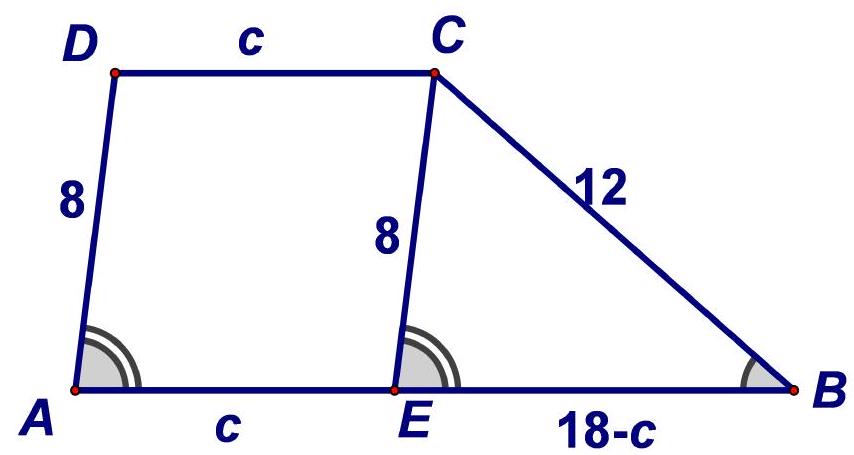
Let $\alpha$ be the angle $\Varangle E B C$ and apply the Law of Sines to triangle $E B C$:
$$
\frac{8}{\sin \alpha}=\frac{12}{\sin 2 \alpha}
$$
From this, we get
$$
\begin{... | 8\mathrm{~} | Geometry | math-word-problem | olympiads | a3943a0e-d50b-50fc-a6cd-e6cf5a47e515 | [
true,
true
] | [
"<think>\nOkay, so I need to find the length of the smaller base of a trapezoid. The given information is that the larger base is 18 cm, the legs are 12 cm and 8 cm, and the ratio of the angles at the larger base is 2:1. Hmm, let me visualize this. \n\nFirst, let me recall that a trapezoid has two parallel sides ca... | [
true,
true
] | null | null | 2 | [
{
"content": "Task B-3.3. The length of the larger base of the trapezoid is $18 \\mathrm{~cm}$, and the lengths of the legs of the trapezoid are $b=12 \\mathrm{~cm}$ and $d=8 \\mathrm{~cm}$. The ratio of the angles at the larger base is $2: 1$. Determine the length of the smaller base of the trapezoid.",
"r... |
80. In a junior high school, 100 students and teachers from two graduating classes are taking a graduation photo on the steps. The photographer wants to arrange them in a trapezoidal formation with fewer people in the front rows and more in the back rows (number of rows $\geqslant 3$), and requires that the number of p... | answer: 2 | 2 | Combinatorics | math-word-problem | olympiads | fecdb8bc-0033-5ef9-9a59-2a2c0f6b6bd5 | [
true,
true
] | [
"<think>\nOkay, so the problem is about arranging 100 students and teachers in a trapezoidal formation for a graduation photo. The photographer wants them arranged in rows where each row has consecutive natural numbers of people, starting with fewer in the front and increasing by one each row. The number of rows ha... | [
true,
true
] | null | null | 2 | [
{
"content": "80. In a junior high school, 100 students and teachers from two graduating classes are taking a graduation photo on the steps. The photographer wants to arrange them in a trapezoidal formation with fewer people in the front rows and more in the back rows (number of rows $\\geqslant 3$), and requir... |
Task 4.1.2. A sports team consists of two boys and two girls. In the relay, the stages run by girls must alternate with the stages run by boys. In how many ways can the stages be distributed
# | # Answer: 8
Solution. Boys can run stages 1 and 3, or stages 2 and 4. If they run stages 1 and 3, they can be distributed in two ways, and girls can be distributed in two ways, making a total of 4 ways. In the second case, there are another 4 ways, making a total of 8 ways. | 8 | Combinatorics | math-word-problem | olympiads | 7855e8f8-486f-558e-b0f7-a382a693980a | [
true,
true
] | [
"<think>\nOkay, let's try to figure out this problem. So, we have a sports team with two boys and two girls. They need to run a relay, and the rule is that the stages run by girls must alternate with those run by boys. We need to find out how many ways the stages can be distributed under this condition.\n\nHmm, fir... | [
true,
true
] | null | null | 2 | [
{
"content": "Task 4.1.2. A sports team consists of two boys and two girls. In the relay, the stages run by girls must alternate with the stages run by boys. In how many ways can the stages be distributed\n\n#",
"role": "user"
},
{
"content": "<think>Hmm , first, let me make sure I understand the pr... |
2. (10 points) Around a circle, $n$ balls, white and red, are arranged. Among any five consecutive balls, exactly two are white. For which $n$ is this possible?
a) 2021 ;
б) 2022 ;
в) 2023 ;
г) 2024 ;
д) none of the given answers is correct. | Answer: d).
Solution. Let's start numbering the balls in the circle from some white ball. Among the first five balls, by condition, there are exactly two white ones - the first and the $i$-th, where $i$ is one of the numbers from 2 to 5 inclusive. Now consider the group of five balls starting from the second: among th... | )noneofthegivenanswersiscorrect | Combinatorics | MCQ | olympiads | 2f642966-a74b-5fc8-bd7d-56f568cfa97e | [
true,
true
] | [
"<think>\nOkay, so we have this problem where there are n balls arranged around a circle, some white and some red. The condition is that among any five consecutive balls, exactly two are white. We need to figure out for which values of n this is possible. The options are 2021, 2022, 2023, 2024, or none of the above... | [
false,
false
] | [
false,
true
] | null | 1 | [
{
"content": "2. (10 points) Around a circle, $n$ balls, white and red, are arranged. Among any five consecutive balls, exactly two are white. For which $n$ is this possible?\na) 2021 ;\n\nб) 2022 ;\n\nв) 2023 ;\n\nг) 2024 ;\n\nд) none of the given answers is correct.",
"role": "user"
},
{
"content"... |
Example 11. Let $\mathrm{a}$ be a real number, find the minimum value of the quadratic function
$$
y=x^{2}-4 a x+5 a^{2}-3 a
$$
denoted as $\mathrm{m}$.
When $a$ varies in $0 \leqslant a^{2}-4 a-2 \leqslant 10$, find the maximum value of $m$. | $$
\text{Solve} \begin{aligned}
y & = x^{2} - 4ax + 5a^{2} - 3a \\
& = (x - 2a)^{2} + a^{2} - 3a
\end{aligned}
$$
The above expression achieves its minimum value when $x = 2a$, so
$$
m = a^{2} - 3a = \left(a - \frac{3}{2}\right)^{2} - \frac{9}{4}.
$$
Furthermore, $0 \leqslant a^{2} - 4a - 2 \leqslant 10$ implies
$$
0... | 18 | Algebra | math-word-problem | cn_contest | c670d7c9-581a-51b0-aa09-8ea04d2bd275 | [
true,
true
] | [
"<think>\nOkay, so I need to find the maximum value of the minimum m of the quadratic function y = x² - 4a x + 5a² - 3a, when a is varying in the range defined by 0 ≤ a² - 4a - 2 ≤ 10. Hmm, let me break this down step by step.\n\nFirst, the quadratic function is y = x² - 4a x + 5a² - 3a. Since it's a quadratic in x... | [
true,
true
] | null | null | 2 | [
{
"content": "Example 11. Let $\\mathrm{a}$ be a real number, find the minimum value of the quadratic function\n$$\ny=x^{2}-4 a x+5 a^{2}-3 a\n$$\n\ndenoted as $\\mathrm{m}$.\nWhen $a$ varies in $0 \\leqslant a^{2}-4 a-2 \\leqslant 10$, find the maximum value of $m$.",
"role": "user"
},
{
"content":... |
$3 \cdot 16$ If the marked price of an item is $p$ percent higher than the cost, and then, to recover the cost, the discount on the selling price cannot exceed $d$, then the value of $d$ is
(A) $\frac{1}{1+p}$.
(B) $\frac{1}{1-p}$.
(C) $\frac{p}{1+p}$.
(D) $\frac{p}{p-1}$.
(E) $\frac{1-p}{1+p}$.
(4th American High Scho... | [Solution] Let the cost of the item be $I$, and the selling price be $S$. According to the problem, we have $S=I(1+p)$, and also $S(1-d)=I$. Eliminating $S, I$ yields $(1+p)(1-d)=1$, thus $d=\frac{p}{1+p}$. Therefore, the answer is $(C)$. | \frac{p}{1+p} | Algebra | MCQ | olympiads | e08b768a-825a-573d-bb65-ae93e8ea69ec | [
true,
true
] | [
"<think>\nOkay, so I need to solve this problem about markup and discount. Let me read it again carefully. The problem says:\n\n\"If the marked price of an item is p percent higher than the cost, and then, to recover the cost, the discount on the selling price cannot exceed d, then the value of d is... (options fol... | [
false,
false
] | [
true,
true
] | null | 2 | [
{
"content": "$3 \\cdot 16$ If the marked price of an item is $p$ percent higher than the cost, and then, to recover the cost, the discount on the selling price cannot exceed $d$, then the value of $d$ is\n(A) $\\frac{1}{1+p}$.\n(B) $\\frac{1}{1-p}$.\n(C) $\\frac{p}{1+p}$.\n(D) $\\frac{p}{p-1}$.\n(E) $\\frac{1-... |
The equations of the sides of a triangle are
$$
y=x+1, \quad y=-\frac{1}{2} x-2, \quad y=3 x-9
$$
Determine the equation of the circumscribed circle. | I. solution: The intersection points of the sides: $A(2,-3), B(5,6), C(-2,-1)$.
The coordinates of the midpoint of side $BC$ are: $\frac{5-2}{2}, \frac{6-1}{2}$, so the midpoint is: $A_{1}\left(\frac{3}{2}, \frac{5}{2}\right)$. Similarly, the midpoint of side $AC$ is: $B_{1}(0,-2)$.
The equation of the line perpendic... | (x-2)^{2}+(y-2)^{2}=25 | Geometry | math-word-problem | olympiads | 040ef09e-5bd7-5fd9-8234-efa74c97fc05 | [
true,
true
] | [
"<think>\nOkay, so I need to find the equation of the circumscribed circle (circumcircle) of a triangle whose sides are given by the equations y = x + 1, y = -1/2 x - 2, and y = 3x - 9. Hmm, let's see. The circumcircle is the circle that passes through all three vertices of the triangle. So, to find its equation, I... | [
true,
true
] | null | null | 2 | [
{
"content": "The equations of the sides of a triangle are\n\n$$\ny=x+1, \\quad y=-\\frac{1}{2} x-2, \\quad y=3 x-9\n$$\n\nDetermine the equation of the circumscribed circle.",
"role": "user"
},
{
"content": "<think>Hmm , let's see. The circumcircle is the circle that passes through all three vertic... |
Example 3. (IMO-36-6) Let $p$ be an odd prime, and consider the subsets $A$ of the set $\{1,2, \cdots, 2 p\}$ that satisfy the following two conditions:
(i) $A$ has exactly $p$ elements;
(ii) The sum of all elements in $A$ is divisible by $p$.
Determine the number of such subsets $A$. | Let $S=\{1,2, \cdots, 2 p\}$.
We take $p$-th roots of unity $\xi=e^{i \frac{i x}{p}}$, and then consider the polynomial
$$
\prod_{j=1}^{2 p}\left(x-\xi^{j}\right)=\left(x^{p}-1\right)^{2}=x^{2 p}-2 x^{p}+1 .
$$
Comparing the coefficient of $x^{p}$, we get:
(1) $2=\sum_{\left\{i_{1}, \cdots, i_{p}\right\} \subset S} \x... | \frac{1}{p}\left(C_{2 p}^{p}-2\right)+2 | Combinatorics | math-word-problem | cn_contest | 00279b05-e2dc-5c86-85ea-80adf2940c2f | [
true,
true
] | [
"<think>\nOkay, so I need to solve this problem from IMO 36-6. Let me read it again carefully:\n\nLet \\( p \\) be an odd prime, and consider the subsets \\( A \\) of the set \\( \\{1, 2, \\ldots, 2p\\} \\) that satisfy the following two conditions:\n(i) \\( A \\) has exactly \\( p \\) elements;\n(ii) The sum of al... | [
false,
false
] | [
true,
false
] | null | 1 | [
{
"content": "Example 3. (IMO-36-6) Let $p$ be an odd prime, and consider the subsets $A$ of the set $\\{1,2, \\cdots, 2 p\\}$ that satisfy the following two conditions:\n(i) $A$ has exactly $p$ elements;\n(ii) The sum of all elements in $A$ is divisible by $p$.\nDetermine the number of such subsets $A$.",
... |
3. As shown in Figure $1, \triangle A B C$ is an equilateral triangle, $P M \perp A B, P N \perp A C$. Let the perimeters of quadrilateral $A M P N$ and $\triangle A B C$ be $m$ and $n$, respectively. Then ( ).
(A) $\frac{1}{2}<\frac{m}{n}<\frac{3}{5}$
(B) $\frac{2}{3}<\frac{m}{n}<\frac{3}{4}$
(C) $80 \%<\frac{m}{n}<83... | 3. (D).
Let $B M=x, C N=y$. Then
$$
\begin{array}{l}
B P=2 x, P C=2 y, P M=\sqrt{3} x, P N=\sqrt{3} y, \\
A M+A N=2 \cdot B C-(B M+C N)=3(x+y) . \\
\text { Hence } \frac{m}{n}=\frac{(3+\sqrt{3})(x+y)}{3 \times 2(x+y)}=\frac{3+\sqrt{3}}{6} \approx \frac{4.7321}{6} .
\end{array}
$$ | D | Geometry | MCQ | cn_contest | 41b062d5-ed73-58d1-b84e-8a29b4a57371 | [
true,
true
] | [
"<think>\nOkay, so I have this problem about an equilateral triangle ABC. There's a point P inside the triangle, and from P, they drop two perpendiculars: PM perpendicular to AB and PN perpendicular to AC. Then they talk about the perimeters of quadrilateral AMPN and the perimeter of triangle ABC, which are m and n... | [
true,
true
] | null | [
"stop",
"stop"
] | 2 | [
{
"content": "3. As shown in Figure $1, \\triangle A B C$ is an equilateral triangle, $P M \\perp A B, P N \\perp A C$. Let the perimeters of quadrilateral $A M P N$ and $\\triangle A B C$ be $m$ and $n$, respectively. Then ( ).\n(A) $\\frac{1}{2}<\\frac{m}{n}<\\frac{3}{5}$\n(B) $\\frac{2}{3}<\\frac{m}{n}<\\fra... |
8. Finally, let's calculate the change in resistance when the switch is closed:
$$
\Delta R=R_{p}-R_{3}=33[\text { Ohms] }-30[\text { Ohms] }=3[\text { Ohms] }
$$ | Answer: 3.0 Ohms
Criteria (maximum 10 points) | 3 | Other | math-word-problem | olympiads | acc22924-f305-5fbe-8f89-c6414918b09b | [
true,
true
] | [
"<think>\nOkay, so I have this problem here where I need to calculate the change in resistance when a switch is closed. The formula given is ΔR = R_p - R₃ = 33 Ohms - 30 Ohms = 3 Ohms. Hmm, let me try to understand what's going on here. \n\nFirst, I remember that when dealing with resistors in a circuit, their conf... | [
true,
true
] | null | null | 2 | [
{
"content": "8. Finally, let's calculate the change in resistance when the switch is closed:\n\n$$\n\\Delta R=R_{p}-R_{3}=33[\\text { Ohms] }-30[\\text { Ohms] }=3[\\text { Ohms] }\n$$",
"role": "user"
},
{
"content": "<think>Hmm , let me try to understand what's going on here. \n\nFirst, I remembe... |
Find all natural numbers $n, k$ such that
$$ 2^n – 5^k = 7. $$ | To find all natural numbers \( n \) and \( k \) such that \( 2^n - 5^k = 7 \), we can proceed as follows:
1. **Initial Check for Small Values of \( n \):**
- For \( n = 1 \):
\[
2^1 - 5^k = 2 - 5^k = 7 \implies 5^k = -5 \quad \text{(no solution since \( 5^k \) is positive)}
\]
- For \( n = 2 \):
... | (n, k) = (5, 2) | Number Theory | math-word-problem | aops_forum | ffc69933-766c-5820-acb3-6b462f8c2761 | [
true,
true
] | [
"<think>\nOkay, so I need to find all natural numbers n and k such that 2^n minus 5^k equals 7. Hmm, let me think about how to approach this. Maybe I can start by rearranging the equation to see if I can get some insights. So, 2^n = 5^k + 7. That means I'm looking for powers of two that are 7 more than some power o... | [
true,
false
] | null | null | 1 | [
{
"content": "Find all natural numbers $n, k$ such that\n$$ 2^n – 5^k = 7. $$",
"role": "user"
},
{
"content": "<think>Hmm , let me think about how to approach this. Maybe I can start by rearranging the equation to see if I can get some insights. So, 2^n = 5^k + 7. That means I'm looking for powers ... |
146. a) Two players are playing a game. The first player writes down two rows of 10 numbers each, such that the following rule is satisfied: if the number $b$ is written under the number $a$, and the number $d$ is written under the number $c$, then $a+d=b+c$. The second player, knowing this rule, wants to determine all... | 146. a) Answer: 11 questions. Knowing all 10 numbers in one row and one in another, it is easy to restore all the other numbers. If, however, only 10 questions are asked, it is impossible to uniquely restore the numbers; on the one hand, in each column, at least one number must be known—otherwise, an arbitrary number $... | +n-1 | Combinatorics | math-word-problem | olympiads | ec541096-c314-531c-851b-b44e87b9f69d | [
true,
true
] | [
"<think>\nAlright, let's try to tackle part a) first. So, we have two players. The first player writes down two rows of 10 numbers each, following a specific rule: if there's a number b under a, and d under c, then a + d = b + c. The second player wants to figure out all the numbers by asking questions about specif... | [
false,
false
] | [
true,
true
] | null | 2 | [
{
"content": "146. a) Two players are playing a game. The first player writes down two rows of 10 numbers each, such that the following rule is satisfied: if the number $b$ is written under the number $a$, and the number $d$ is written under the number $c$, then $a+d=b+c$. The second player, knowing this rule, ... |
Solve the following equation:
$$
\frac{2\left(x^{2}-3\right)}{5-x^{2}}=\sqrt{\frac{5 x+6}{x+2}}
$$ | The equation is undefined for $x= \pm \sqrt{5}$ and $x=-2$, so these values must be excluded. Squaring both sides,
$$
\frac{4\left(x^{4}-6 x^{2}+9\right)}{x^{4}-10 x^{2}+25}=\frac{5 x+6}{x+2}
$$
Removing the fractions and rearranging,
$$
x^{5}-2 x^{4}-26 x^{3}-12 x^{2}+89 x+78=0
$$
By a known theorem, if this equat... | x_{2}=2\quad\text{}\quadx_{5}=2-\sqrt{17} | Algebra | math-word-problem | olympiads | caaf270f-cf22-5d8e-8f24-1b88488f090f | [
true
] | [
"<think>\nOkay, so I have this equation to solve: (2(x² - 3))/(5 - x²) = sqrt((5x + 6)/(x + 2)). Hmm, that looks a bit complicated, but let's take it step by step. First, maybe I should figure out the domain of the equation because there are denominators and a square root involved. That might help avoid extraneous ... | [
false
] | [
true
] | null | 1 | [
{
"content": "Solve the following equation:\n\n$$\n\\frac{2\\left(x^{2}-3\\right)}{5-x^{2}}=\\sqrt{\\frac{5 x+6}{x+2}}\n$$",
"role": "user"
},
{
"content": "<think>Hmm , that looks a bit complicated, but let's take it step by step. First, maybe I should figure out the domain of the equation because ... |
Example 25. Solve the system
$$
\left\{\begin{array}{l}
y^{x^{2}+7 x+12}=1 \\
x+y=6 \\
y>0
\end{array}\right.
$$ | Solution. The first equation under the condition $y>0$ is equivalent to the system of equations
$$
y=1, \quad x^{2}+7 x+12=0
$$
i.e., the system of equations
$$
y=1, \quad x=-3, \quad x=-4
$$
Therefore, the given system is equivalent to the combination of three systems:
$$
\left\{\begin{array} { l }
{ y = 1 , } \... | (5;1),(-3;9),(-4;10) | Algebra | math-word-problem | olympiads | a03ca6ed-d3bb-56c8-8fd4-8eb6ad20681a | [
true,
true
] | [
"<think>\nAlright, let's tackle this system of equations. Hmm, okay, the first equation is \\( y^{x^{2} + 7x + 12} = 1 \\), the second is \\( x + y = 6 \\), and there's the condition that \\( y > 0 \\). I need to find all pairs (x, y) that satisfy all three. \n\nStarting with the first equation: \\( y^{something} =... | [
false,
false
] | [
true,
true
] | null | 2 | [
{
"content": "Example 25. Solve the system\n\n$$\n\\left\\{\\begin{array}{l}\ny^{x^{2}+7 x+12}=1 \\\\\nx+y=6 \\\\\ny>0\n\\end{array}\\right.\n$$",
"role": "user"
},
{
"content": "<think>Hmm , okay, the first equation is \\( y^{x^{2} + 7x + 12} = 1 \\), the second is \\( x + y = 6 \\), and there's th... |
21.16. All integers are written in a row, starting from one. What digit stands at the 206,788th place?
## 21.6. Periods of Decimal Fractions and Repunits
| Let $p$ be a prime number different from 2 and 5. The length of the period of the number $p$ is the number of digits in the period of the decimal representation o... | 21.16. Answer: the digit 7. There are exactly 9 single-digit numbers, 99-9=90 two-digit numbers, 999-99-9=900 three-digit numbers, 9000 four-digit numbers, and so on. Single-digit numbers occupy the first 9 positions in the written sequence, two-digit numbers occupy $90 \cdot 2=180$ positions, three-digit numbers occup... | 7 | Number Theory | math-word-problem | olympiads | 33679615-3502-505d-beb3-557ebf37d5a2 | [
true,
true
] | [
"<think>\nOkay, let's tackle this problem: \"All integers are written in a row, starting from one. What digit stands at the 206,788th place?\" Hmm, so we need to figure out which digit is in the 206,788th position when we concatenate all integers starting from 1. Let's break this down step by step.\n\nFirst, let's ... | [
true,
true
] | null | null | 2 | [
{
"content": "21.16. All integers are written in a row, starting from one. What digit stands at the 206,788th place?\n\n## 21.6. Periods of Decimal Fractions and Repunits\n\n| Let $p$ be a prime number different from 2 and 5. The length of the period of the number $p$ is the number of digits in the period of th... |
João and Maria won 3 chocolate bars of $5 \times 3$ divided into $1 \times 1$ squares. So they decide to play a game. João takes one of the bars and divides it into two smaller rectangular bars by cutting it along one of the marked dividing lines between the squares of the bar. Then Maria takes any of the bars and also... | Solution
Note that the number of pieces on the table increases by one unit after each move. Thus, after João's first move, there will be 4 pieces on the table, and after Maria's first move, there will be 5 pieces. After João's second move, there will be 6 pieces, and so on. Notice that João always leaves an even numbe... | Maria | Logic and Puzzles | math-word-problem | olympiads | 28a76d70-8730-5862-82db-199b31a2fe68 | [
true,
true
] | [
"<think>\nOkay, let's see. João and Maria are playing this game with chocolate bars. They start with three 5x3 bars. Each turn, a player takes one bar and splits it into two smaller rectangular bars by cutting along the marked lines. They alternate turns, and the person who makes the last possible cut (leaving all ... | [
true,
true
] | null | [
"stop",
"stop"
] | 2 | [
{
"content": "João and Maria won 3 chocolate bars of $5 \\times 3$ divided into $1 \\times 1$ squares. So they decide to play a game. João takes one of the bars and divides it into two smaller rectangular bars by cutting it along one of the marked dividing lines between the squares of the bar. Then Maria takes ... |
Example 9. Let $x>0$. Try to find the maximum value of $y=\sqrt{x}+\frac{1}{\sqrt{x}}-$ $\sqrt{x+\frac{1}{x}+1}$. | To construct the dual form of
$$
y=\sqrt{x}+\frac{1}{\sqrt{x}}-\sqrt{x+\frac{1}{x}+1}
$$
is
$$
u=\sqrt{x}+\frac{1}{\sqrt{x}}+\sqrt{x+\frac{1}{x}+1},
$$
then \( y u=1, y=\frac{1}{u} \).
$$
\because u \geqslant 2+\sqrt{2+1}=2+\sqrt{3} \text{ (when } x=1
$$
is achieved),
$$
\therefore y=\frac{1}{u} \leqslant \frac{1}{2... | 2-\sqrt{3} | Algebra | math-word-problem | cn_contest | c04edbdd-9294-5513-91b9-c8aff45499e1 | [
true,
true
] | [
"<think>\nOkay, so I need to find the maximum value of the function y = sqrt(x) + 1/sqrt(x) - sqrt(x + 1/x + 1) where x is greater than 0. Hmm, let's start by understanding what each part of this function does. \n\nFirst, let's break down the function. The first two terms, sqrt(x) and 1/sqrt(x), are both positive s... | [
true,
true
] | null | null | 2 | [
{
"content": "Example 9. Let $x>0$. Try to find the maximum value of $y=\\sqrt{x}+\\frac{1}{\\sqrt{x}}-$ $\\sqrt{x+\\frac{1}{x}+1}$.",
"role": "user"
},
{
"content": "<think>Hmm , let's start by understanding what each part of this function does. \n\nFirst, let's break down the function. The first t... |
## 21. At the Races
One fine spring evening I went to the Longchamp racecourse. I bet on the first horse and doubled the amount of money I had with me. Inspired by this example, I bet 60 francs on the second horse and lost it all. However, thanks to the third horse, I was able to double my remaining cash again. Howeve... | 21. After the race in which the sixth horse participated, I had no money left at all. After the race with the participation of the fifth horse, I had 60 francs more, i.e., I had a total of 60 francs. After the race with the participation of the fourth horse, I had half as much money, i.e., 30 francs. After the race wit... | 52.5 | Logic and Puzzles | math-word-problem | olympiads | a36aa991-2266-5f70-96dc-6560ab48a0e0 | [
true,
true
] | [
"<think>\nOkay, let's see. I need to figure out how much money the person brought to the racecourse. The problem describes a series of bets and outcomes at the races, and in the end, the person is left with nothing. So I need to work backwards or maybe set up equations to model each step. Let me try to break it dow... | [
true,
true
] | null | null | 2 | [
{
"content": "## 21. At the Races\n\nOne fine spring evening I went to the Longchamp racecourse. I bet on the first horse and doubled the amount of money I had with me. Inspired by this example, I bet 60 francs on the second horse and lost it all. However, thanks to the third horse, I was able to double my rema... |
Problem 10. Find all sequences of positive integers $\left\{a_{n}\right\}_{n=1}^{\infty}$, such that $a_{4}=4$ and the identity
$$
\frac{1}{a_{1} a_{2} a_{3}}+\frac{1}{a_{2} a_{3} a_{4}}+\cdots+\frac{1}{a_{n} a_{n+1} a_{n+2}}=\frac{(n+3) a_{n}}{4 a_{n+1} a_{n+2}}
$$
holds true for every positive integer $n \geq 2$.
... | 10. We rewrite the recurrence relation as
$\frac{(n+2) a_{n-1}}{4 a_{n} a_{n+1}}+\frac{1}{a_{n} a_{n+1} a_{n+2}}=\frac{(n+3) a_{n}}{4 a_{n+1} a_{n+2}} \Longleftrightarrow(n+2) a_{n+2}=\frac{(n+3) a_{n}^{2}-4}{a_{n-1}}$
for $n \geq 3$. Setting $n=2$ in the initial relation we obtain $4\left(a_{1}+4\right)=5 a_{1} a_{2... | a_{n}=n | Algebra | math-word-problem | olympiads | dbd80f7c-2be7-58d9-9337-45f39c696630 | [
true,
true
] | [
"<think>\nOkay, let's tackle this problem. We need to find all sequences of positive integers {a_n} such that a₄ = 4 and the given identity holds for every n ≥ 2. The identity is:\n\n1/(a₁a₂a₃) + 1/(a₂a₃a₄) + ... + 1/(aₙaₙ₊₁aₙ₊₂) = (n + 3)aₙ / (4aₙ₊₁aₙ₊₂)\n\nFirst, let's parse this equation. The left-hand side (LHS... | [
true,
true
] | null | [
"stop",
"stop"
] | 2 | [
{
"content": "Problem 10. Find all sequences of positive integers $\\left\\{a_{n}\\right\\}_{n=1}^{\\infty}$, such that $a_{4}=4$ and the identity\n\n$$\n\\frac{1}{a_{1} a_{2} a_{3}}+\\frac{1}{a_{2} a_{3} a_{4}}+\\cdots+\\frac{1}{a_{n} a_{n+1} a_{n+2}}=\\frac{(n+3) a_{n}}{4 a_{n+1} a_{n+2}}\n$$\n\nholds true fo... |
## Problem Statement
Calculate the limit of the numerical sequence:
$$
\lim _{n \rightarrow \infty} \frac{(n+1)^{3}-(n+1)^{2}}{(n-1)^{3}-(n+1)^{3}}
$$ | ## Solution
$$
\begin{aligned}
& \lim _{n \rightarrow \infty} \frac{(n+1)^{3}-(n+1)^{2}}{(n-1)^{3}-(n+1)^{3}}=\lim _{n \rightarrow \infty} \frac{(n+1)^{2} \cdot((n+1)-1)}{n^{3}-3 n^{2}+3 n-1-n^{3}-3 n^{2}-3 n-1}= \\
& =\lim _{n \rightarrow \infty} \frac{n(n+1)^{2}}{-6 n^{2}-2}=\lim _{n \rightarrow \infty} \frac{n^{3}\... | -\infty | Algebra | math-word-problem | olympiads | 46161793-fca1-5f99-a94f-4d91c7c27ced | [
true,
true
] | [
"<think>\nOkay, so I need to find the limit of this sequence as n approaches infinity. The expression is [(n+1)^3 - (n+1)^2] divided by [(n-1)^3 - (n+1)^3]. Hmm, let me start by understanding each part of the numerator and denominator separately.\n\nFirst, let's look at the numerator: (n+1)^3 - (n+1)^2. Maybe I can... | [
true,
true
] | null | [
"stop",
"stop"
] | 2 | [
{
"content": "## Problem Statement\n\nCalculate the limit of the numerical sequence:\n\n$$\n\\lim _{n \\rightarrow \\infty} \\frac{(n+1)^{3}-(n+1)^{2}}{(n-1)^{3}-(n+1)^{3}}\n$$",
"role": "user"
},
{
"content": "<think>Hmm , let me start by understanding each part of the numerator and denominator sep... |
3. A student obtained a perfect square when substituting a natural number into one of the quadratic functions $f_{k}(x)(k=1,2,3,4)$. The function he used is $(\quad)$.
(A) $f_{1}(x)=x^{2}+5 x+7$
(B) $f_{2}(x)=x^{2}+7 x+10$
(C) $f_{3}(x)=x^{2}+9 x+18$
(D) $f_{4}(x)=x^{2}+11 x+2$ | 3.D.
When $x$ is a natural number, we have
$$
\begin{array}{l}
(x+2)^{2}<x^{2}+5 x+7<(x+3)^{2}, \\
(x+3)^{2}<x^{2}+7 x+10<(x+4)^{2}, \\
(x+4)^{2}<x^{2}+9 x+18<(x+5)^{2} .
\end{array}
$$
That is, when $x$ is a natural number, the functions $f_{1}(x)$, $f_{2}(x)$, and $f_{3}(x)$ all lie between two consecutive square n... | D | Algebra | MCQ | cn_contest | e422f634-b125-581f-a9e9-07486be38144 | [
true,
true,
true,
false
] | [
"<think>\nAlright, so I need to figure out which quadratic function among the four options (A to D) can produce a perfect square when a natural number is substituted into it. Let me start by recalling that a perfect square is a number that's the square of an integer. So, if substituting a natural number x into f_k(... | [
true,
true,
true,
false
] | null | null | 3 | [
{
"content": "3. A student obtained a perfect square when substituting a natural number into one of the quadratic functions $f_{k}(x)(k=1,2,3,4)$. The function he used is $(\\quad)$.\n(A) $f_{1}(x)=x^{2}+5 x+7$\n(B) $f_{2}(x)=x^{2}+7 x+10$\n(C) $f_{3}(x)=x^{2}+9 x+18$\n(D) $f_{4}(x)=x^{2}+11 x+2$",
"role": ... |
Solve the following system of equations:
$$
\begin{aligned}
x^{5} y^{17} & =a, \\
x^{2} y^{7} & =b
\end{aligned}
$$ | If $a=0$, then either $x=0$ and $y$ is any number, or $y=0$ and $x$ is any number. In both cases, the system only has a solution if $b$ is also 0, and in this case, there are infinitely many solutions. Similarly, if $b=0$ and $a \neq 0$, there is no definite solution. Hereafter, we assume that neither $a$ nor $b$ is 0,... | x=\frac{^{7}}{b^{17}},\quady=\frac{b^{5}}{^{2}} | Algebra | math-word-problem | olympiads | 7fad59d9-615c-5446-87dd-0a9c2529bfb2 | [
true,
true
] | [
"<think>\nOkay, so I need to solve this system of equations where x^5 y^17 equals a, and x^2 y^7 equals b. Hmm, both equations are exponential with variables in the exponents. Maybe I can use logarithms? Wait, but the variables x and y are both in the exponents here. Alternatively, maybe I can divide the two equati... | [
false,
false
] | [
true,
true
] | null | 2 | [
{
"content": "Solve the following system of equations:\n\n$$\n\\begin{aligned}\nx^{5} y^{17} & =a, \\\\\nx^{2} y^{7} & =b\n\\end{aligned}\n$$",
"role": "user"
},
{
"content": "<think>Hmm , both equations are exponential with variables in the exponents. Maybe I can use logarithms? Wait , but the var... |
Example 3. Form the equations of the tangent and normal to the curve given parametrically,
$$
x=2(t-\sin t) ; y=2(1-\cos t)
$$
1) at an arbitrary point; 2) at $t=\frac{\pi}{2}$. | Solution. The equation of the tangent (3.1) can be written as
$$
Y-y=y_{x}^{\prime}(x)(X-x)
$$
where $(x, y)$ are the coordinates of a point on the curve, and $(X, Y)$ are the coordinates of a point on the tangent.
We find the derivative $y_{x}^{\prime}$ using the formula
$$
y_{x}^{\prime}=\frac{y_{t}^{\prime}}{x_{... | X-Y-\pi+4=0 | Calculus | math-word-problem | olympiads | 0f0fda0f-8671-52ea-9815-036d50b6963a | [
true,
true
] | [
"<think>\nOkay, so I need to find the equations of the tangent and normal to the curve defined parametrically by x = 2(t - sin t) and y = 2(1 - cos t). There are two parts: first, for an arbitrary point, and second, specifically when t = π/2. Let me start by recalling how to find the tangent and normal lines to a p... | [
false,
false
] | [
true,
true
] | null | 2 | [
{
"content": "Example 3. Form the equations of the tangent and normal to the curve given parametrically,\n\n$$\nx=2(t-\\sin t) ; y=2(1-\\cos t)\n$$\n\n1) at an arbitrary point; 2) at $t=\\frac{\\pi}{2}$.",
"role": "user"
},
{
"content": "<think>\nOkay, so I need to find the equations of the tangent ... |
24. Given the sequence $a_{1}=20, a_{2}=30, a_{n+2}=3 a_{n+1}-a_{n}$ $(n \geqslant 1)$. Find all positive integers $n$ such that $1+5 a_{n} a_{n+1}$ is a perfect square.
(19th Balkan Mathematical Olympiad) | Let $b_{n}=a_{n}+a_{n+1}, c_{n}=1+5 a_{n} a_{n+1}$, then
$5 a_{n+1}=b_{n+1}+b_{n}, a_{n+2}-a_{n}=b_{n+1}-b_{n}$.
Therefore, $c_{n+1}-c_{n}=5 a_{n+1}\left(a_{n+2}-a_{n}\right)=b_{n+1}^{2}-b_{n}^{2}$.
Thus, $c_{n+1}-b_{n+1}^{2}=c_{n}-b_{n}^{2}=\cdots=c_{1}-b_{1}^{2}$
$$
=501=3 \times 167 \text {. }
$$
Suppose there exis... | n=3 | Algebra | math-word-problem | cn_contest | 84594156-455c-52c7-9005-6935521003e7 | [
true,
true
] | [
"<think>\nOkay, so I have this problem here: Given the sequence defined by a₁ = 20, a₂ = 30, and then the recurrence relation a_{n+2} = 3a_{n+1} - a_n for n ≥ 1. I need to find all positive integers n such that 1 + 5a_n a_{n+1} is a perfect square. Hmm, interesting. Let me try to work through this step by step.\n\n... | [
true,
true
] | null | null | 2 | [
{
"content": "24. Given the sequence $a_{1}=20, a_{2}=30, a_{n+2}=3 a_{n+1}-a_{n}$ $(n \\geqslant 1)$. Find all positive integers $n$ such that $1+5 a_{n} a_{n+1}$ is a perfect square.\n(19th Balkan Mathematical Olympiad)",
"role": "user"
},
{
"content": "<think>Hmm , interesting. Let me try to work... |
Anders is solving a math problem, and he encounters the expression $\sqrt{15!}$. He attempts to simplify this radical as $a\sqrt{b}$ where $a$ and $b$ are positive integers. The sum of all possible values of $ab$ can be expressed in the form $q\cdot 15!$ for some rational number $q$. Find $q$. | 1. First, we need to find the prime factorization of \(15!\). We use the formula for the number of times a prime \(p\) divides \(n!\):
\[
\left\lfloor \frac{n}{p} \right\rfloor + \left\lfloor \frac{n}{p^2} \right\rfloor + \left\lfloor \frac{n}{p^3} \right\rfloor + \cdots
\]
For \(p = 2\):
\[
\left\lfl... | 4 | Number Theory | math-word-problem | aops_forum | 1c39f908-f8bb-565c-837f-0a9b256ca961 | [
true,
true,
false,
true
] | [
"<think>\nOkay, let me try to figure out this problem. So, Anders is trying to simplify the square root of 15 factorial, which is √(15!), and write it as a√b where a and b are positive integers. Then, we need to find the sum of all possible values of ab, and express that sum as q·15! where q is a rational number. T... | [
true,
true,
false,
true
] | null | null | 3 | [
{
"content": "Anders is solving a math problem, and he encounters the expression $\\sqrt{15!}$. He attempts to simplify this radical as $a\\sqrt{b}$ where $a$ and $b$ are positive integers. The sum of all possible values of $ab$ can be expressed in the form $q\\cdot 15!$ for some rational number $q$. Find $q$."... |
4. The center of the hyperbola is at the origin $O$, with foci on the $x$-axis. A line passing through the right focus of the hyperbola and with a slope of $\sqrt{\frac{3}{5}}$ intersects the hyperbola at points $P$ and $Q$. If $P O \perp O Q,|P Q|$ $=4$, find the equation of the hyperbola. | 4. Let the equation of the hyperbola be $\frac{x^{2}}{a^{2}}-\frac{y^{2}}{b^{2}}=1$, and the equation of the line $P Q$ be $y=\sqrt{\frac{3}{5}}(x-c)$, where $c^{2}=a^{2}+b^{2}$. Then $\frac{3}{5} b^{4} x^{2}-\frac{3}{5} a^{2}\left(a^{2}+\frac{8}{3} b^{2}\right) y^{2}+2 \sqrt{\frac{3}{5}} a^{2} b^{2} x y=0$.
Given tha... | x^{2}-\frac{y^{2}}{3}=1 | Geometry | math-word-problem | olympiads | b657dfbc-390e-5ab7-bed0-08f365b78df0 | [
true,
true
] | [
"<think>\nOkay, let's tackle this hyperbola problem. Hmm, the hyperbola is centered at the origin with foci on the x-axis. So, the standard equation should be \\(\\frac{x^2}{a^2} - \\frac{y^2}{b^2} = 1\\), where \\(c^2 = a^2 + b^2\\) and the foci are at \\((\\pm c, 0)\\). The line passes through the right focus, wh... | [
true,
true
] | null | null | 2 | [
{
"content": "4. The center of the hyperbola is at the origin $O$, with foci on the $x$-axis. A line passing through the right focus of the hyperbola and with a slope of $\\sqrt{\\frac{3}{5}}$ intersects the hyperbola at points $P$ and $Q$. If $P O \\perp O Q,|P Q|$ $=4$, find the equation of the hyperbola.",
... |
5. Select some numbers without repetition from $1,2, \ldots 15$, such that the sum of any two numbers is not a perfect square of a natural number, then the maximum number of numbers that can be selected is ( ). | Answer: 8
Explanation: First, we argue that the first digit can just form the square number 16, with the groups being $(1,15) \quad(2,14) \ldots(7,9)$, (8)
There are 8 groups in total, and from each group, at most 1 number can be selected, so the maximum number of selections is 8.
Second, construction: if the maximum ... | 8 | Number Theory | math-word-problem | olympiads | 5ff0d135-6c43-523c-ab1e-267bed257a47 | [
true,
true
] | [
"<think>\nOkay, so the problem is: From the numbers 1 to 15, select as many numbers as possible without repeating any, such that the sum of any two numbers is not a perfect square. We need to find the maximum number of numbers that can be selected. Hmm, let me think about how to approach this.\n\nFirst, I need to r... | [
true,
true
] | null | null | 2 | [
{
"content": "5. Select some numbers without repetition from $1,2, \\ldots 15$, such that the sum of any two numbers is not a perfect square of a natural number, then the maximum number of numbers that can be selected is ( ).",
"role": "user"
},
{
"content": "<think>Hmm , let me think about how to a... |
2. As shown in Figure 1, in the first quadrant, the three vertices $A, B, C$ of rectangle $A B C D$ are on the graphs of the functions $y=$ $\log _{\frac{\sqrt{2}}{2}} x$, $y=x^{\frac{1}{2}}$, and $y=\left(\frac{\sqrt{3}}{2}\right)^{x}$, respectively, and the sides of the rectangle are parallel to the coordinate axes. ... | 2. $\left(\frac{1}{2}, \frac{9}{16}\right)$.
Substitute $y_{A}=2$ into $y=\log _{\frac{\sqrt{2}}{2}} x$, we get $x_{A}=\frac{1}{2}$.
Thus, $x_{D}=\frac{1}{2}$.
Since $A B / / x$ axis, therefore, $y_{B}=y_{A}=2$.
Substitute into $y=x^{\frac{1}{2}}$, we get $x_{B}=4$. Thus, $x_{C}=4$.
Substitute $x_{c}=4$ into $y=\left(... | \left(\frac{1}{2}, \frac{9}{16}\right) | Algebra | math-word-problem | cn_contest | d865f9fe-0615-5c0e-9e21-76a1dde83eaf | [
true,
true,
true,
false
] | [
"<think>\nOkay, let's see. I need to find the coordinates of point D in this rectangle ABCD. The three vertices A, B, and C are on three different functions in the first quadrant. The sides are parallel to the axes, so it's a standard axis-aligned rectangle. The y-coordinate of point A is 2. Hmm.\n\nFirst, let me r... | [
false,
true,
true,
false
] | null | null | 2 | [
{
"content": "2. As shown in Figure 1, in the first quadrant, the three vertices $A, B, C$ of rectangle $A B C D$ are on the graphs of the functions $y=$ $\\log _{\\frac{\\sqrt{2}}{2}} x$, $y=x^{\\frac{1}{2}}$, and $y=\\left(\\frac{\\sqrt{3}}{2}\\right)^{x}$, respectively, and the sides of the rectangle are par... |
1. Given two numbers (not necessarily integers), not equal to 0. If each of them is increased by one, their product will double. By what factor will their product increase if each of the original numbers is squared and then decreased by one? (D. Shiryayev, I. Rubanov) | Answer. 4 times. Solution. Let the numbers be denoted by $a$ and $b$. According to the condition, $(a+1)(b+1)=a b+a+b+1=2 a b$. By combining like terms in the last equality, we get $a b-a-b-1=0$, from which $(a-1)(b-1)=a b-a-b+1=2$ and $\left(a^{2}-1\right)\left(b^{2}-1\right)=(a-1)(b-1)(a+1)(b+1)=2 \cdot 2 a b=4 a b$. | 4 | Algebra | math-word-problem | olympiads | 46486ee4-1328-5370-94c1-38e5e07ae2f6 | [
true,
true
] | [
"<think>\nOkay, so I have this problem here where there are two numbers, they don't have to be integers, and neither of them is zero. The problem says that if each of them is increased by one, their product will double. Then I need to figure out by what factor their product will increase if each of the original num... | [
true,
true
] | null | null | 2 | [
{
"content": "1. Given two numbers (not necessarily integers), not equal to 0. If each of them is increased by one, their product will double. By what factor will their product increase if each of the original numbers is squared and then decreased by one? (D. Shiryayev, I. Rubanov)",
"role": "user"
},
{... |
3. Given an isosceles right triangle with legs equal to $\sqrt{2}$. Find the straight-line cut of the smallest length that divides the area of the triangle in half.
In the answer, specify the length of the cut, rounded to 2 decimal places after the decimal point. Answer: $0.91$. | Solution: Let in triangle $ABC$ angle $B$ be a right angle. The cut intersects two sides of the triangle at points $P$ and $Q$.
First, assume that these points are located on the legs. Let $x = BP, y = BQ$.
Then $\frac{1}{2} xy = \frac{1}{2} S(ABC) = \frac{1}{2}$, and $PQ^2 = x^2 + y^2 = x^2 + \frac{1}{x^2} = \left(x... | 0.91 | Geometry | math-word-problem | olympiads | e4c43b41-f98e-58e8-b423-d788faac3e20 | [
true,
true
] | [
"<think>\nOkay, so I need to find the shortest straight-line cut that divides the area of an isosceles right triangle with legs of length √2 in half. Let me start by visualizing the triangle. Since it's an isosceles right triangle, the two legs are equal, and the hypotenuse will be √2 times the leg length. Wait, th... | [
true,
true
] | null | null | 2 | [
{
"content": "3. Given an isosceles right triangle with legs equal to $\\sqrt{2}$. Find the straight-line cut of the smallest length that divides the area of the triangle in half.\n\nIn the answer, specify the length of the cut, rounded to 2 decimal places after the decimal point. Answer: $0.91$.",
"role": ... |
15. [9] A cat is going up a stairwell with ten stairs. However, instead of walking up the stairs one at a time, the cat jumps, going either two or three stairs up at each step (though if necessary, it will just walk the last step). How many different ways can the cat go from the bottom to the top? | Answer: 12 The number of ways for the cat to get to the $i$ th step is the number of ways for the cat to get to step $i-2$ plus the number of ways to get to step $i-3$, because for each way to get to step $i$, we can undo the last move the cat made to go back to one of these two steps. The cat can get to step 1 in 0 wa... | 12 | Combinatorics | math-word-problem | olympiads | 35881ae2-b792-5a87-8f1d-7aba70aa6ef9 | [
false,
true
] | [
"<think>\nOkay, so I need to figure out how many different ways the cat can go up a 10-stair stairwell by jumping either 2 or 3 stairs each time. If needed, it can take a single step at the end. Hmm, this sounds like a combinatorial problem, maybe similar to those staircase climbing problems where you count the num... | [
false,
true
] | null | null | 1 | [
{
"content": "15. [9] A cat is going up a stairwell with ten stairs. However, instead of walking up the stairs one at a time, the cat jumps, going either two or three stairs up at each step (though if necessary, it will just walk the last step). How many different ways can the cat go from the bottom to the top?... |
Example 9. Primary School One and Primary School Two have the same number of students participating in the Golden Cup Competition. The schools use cars to transport the students to the examination site. Primary School One uses cars that can seat 15 people each; Primary School Two uses cars that can seat 13 people each.... | Let's assume that at the beginning, both schools had $x$ participants. According to the problem, the first school sent $\frac{x}{15}=a \cdots 0$ ($a$ cars),
the second school sent $\frac{x}{13}=a \cdots 12(a+1$ cars $)$; the second time, the first school sent $\frac{x+1}{15}=a \cdots 1(a+1$ cars $)$,
the second schoo... | 184 | Algebra | math-word-problem | cn_contest | 5fc0311f-e5a3-5c12-9bfa-14ec6af70c32 | [
true,
true
] | [
"<think>\nOkay, let me try to work through this problem step by step. It's a bit complex, but I'll take it slowly. Let me start by summarizing what's given.\n\nWe have two primary schools, let's call them School One and School Two. Initially, they have the same number of students participating in the Golden Cup Com... | [
false,
true
] | null | null | 1 | [
{
"content": "Example 9. Primary School One and Primary School Two have the same number of students participating in the Golden Cup Competition. The schools use cars to transport the students to the examination site. Primary School One uses cars that can seat 15 people each; Primary School Two uses cars that ca... |
Let $n$ be a positive integer. Each of the numbers $1,2,3,\ldots,100$ is painted with one of $n$ colors in such a way that two distinct numbers with a sum divisible by $4$ are painted with different colors. Determine the smallest value of $n$ for which such a situation is possible. | 1. **Understanding the Problem:**
We need to paint each of the numbers \(1, 2, 3, \ldots, 100\) with one of \(n\) colors such that any two distinct numbers whose sum is divisible by 4 are painted with different colors. We aim to find the smallest value of \(n\).
2. **Analyzing the Conditions:**
- If \(x + y \equ... | 25 | Combinatorics | math-word-problem | aops_forum | 234886b0-bd77-5fdd-b0c0-d0005018d2f5 | [
true,
true
] | [
"<think>\nOkay, so I need to figure out the smallest number of colors, n, required to paint the numbers from 1 to 100 such that any two distinct numbers which add up to a multiple of 4 are colored differently. Hmm, let's break this down step by step.\n\nFirst, let me understand the problem. We have numbers 1 throug... | [
true,
true
] | null | null | 2 | [
{
"content": "Let $n$ be a positive integer. Each of the numbers $1,2,3,\\ldots,100$ is painted with one of $n$ colors in such a way that two distinct numbers with a sum divisible by $4$ are painted with different colors. Determine the smallest value of $n$ for which such a situation is possible.",
"role": ... |
A triangle has sides of 13, 17, and 24 units. The 24-unit side is divided into three equal parts. What is the distance from the opposite vertex to the division points? | We denote the height of the triangle in question by $m$, the projection of the side of length 13 on the 24-unit side by $x$, so the projection of the 17-unit side is $24-x$, because the foot of the perpendicular from the longest side lies on the side segment. The distance from the vertices opposite the 13 and 17-unit s... | p=9,q=11 | Geometry | math-word-problem | olympiads | 6f1467be-3809-58aa-850a-c9f24ebfe04e | [
true,
true
] | [
"<think>\nOkay, so I need to find the distance from the opposite vertex to the division points on the 24-unit side of a triangle. The triangle has sides of 13, 17, and 24 units. The 24-unit side is divided into three equal parts. Hmm, let me visualize this first.\n\nFirst, let me sketch the triangle. Let's label th... | [
true,
false
] | null | null | 1 | [
{
"content": "A triangle has sides of 13, 17, and 24 units. The 24-unit side is divided into three equal parts. What is the distance from the opposite vertex to the division points?",
"role": "user"
},
{
"content": "<think>Hmm , let me visualize this first.\n\nFirst, let me sketch the triangle. Let'... |
1. If a number reads the same from left to right as it does from right to left, then it is called a palindrome number. The average of all four-digit palindrome numbers is $\qquad$ | \begin{tabular}{c}
1 \\
\hline 5500
\end{tabular} | 5500 | Number Theory | math-word-problem | olympiads | 72b36f30-4055-5fc4-b03f-6ea68e3e35a3 | [
true,
true
] | [
"<think>\nOkay, so I need to find the average of all four-digit palindrome numbers. Hmm, let's start by recalling what a palindrome number is. A palindrome is a number that reads the same forwards and backwards. For a four-digit number, that means the first digit is the same as the last digit, and the second digit ... | [
true,
true
] | null | null | 2 | [
{
"content": "1. If a number reads the same from left to right as it does from right to left, then it is called a palindrome number. The average of all four-digit palindrome numbers is $\\qquad$",
"role": "user"
},
{
"content": "<think>Hmm , let's start by recalling what a palindrome number is. A pa... |
B3. The area of the triangle enclosed by the line with the positive half-axes of the coordinate axes is equal to 1. The line passes through the point $A\left(1, \frac{1}{2}\right)$. Write its equation. | B3. The straight line intersects the coordinate axes at points $(m, 0)$ and $(0, n)$. The equation of the line is then $\frac{x}{m}+\frac{y}{n}=$ 1. Since the area of the triangle is $1=\frac{m n}{2}$, it follows that $n=\frac{2}{m}$ and $\frac{x}{m}+\frac{m y}{2}=1$. Considering that the point $A\left(1, \frac{1}{2}\r... | \frac{x}{2}+1 | Geometry | math-word-problem | olympiads | f02717b5-2a34-5205-a268-a35c8c6dc381 | [
true,
true
] | [
"<think>\nOkay, let's see. I need to find the equation of a line that passes through the point A(1, 1/2) and forms a triangle with the positive x-axis and y-axis that has an area of 1. Hmm, okay, so first, I remember that when a line intersects both the x-axis and y-axis, the area of the triangle formed can be calc... | [
false,
false
] | [
false,
true
] | null | 1 | [
{
"content": "B3. The area of the triangle enclosed by the line with the positive half-axes of the coordinate axes is equal to 1. The line passes through the point $A\\left(1, \\frac{1}{2}\\right)$. Write its equation.",
"role": "user"
},
{
"content": "<think>Hmm , okay. Let me break this down step ... |
20. Given a cube $A B C D-A_{1} B_{1} C_{1} D_{1}$ with edge length 1, the set of points on the surface of the cube that are a distance of $\frac{2 \sqrt{3}}{3}$ from point $A$ forms a curve (this curve may not lie in a single plane). Then the length of this curve is $\qquad$ | 20. $\frac{5 \sqrt{3} \pi}{6}$.
This curve is distributed across six surfaces. The parts within the plane $A C$, plane $A B_{1}$, and plane $A D_{1}$ are all circular arcs with $A$ as the center, a radius of $\frac{2 \sqrt{3}}{3}$, and a central angle of $\frac{\pi}{6}$. The total length of these three segments is $\f... | \frac{5 \sqrt{3} \pi}{6} | Geometry | math-word-problem | cn_contest | d5f4156f-e74a-5599-9b3f-fb74226f9985 | [
true,
true
] | [
"<think>\nOkay, let's tackle this geometry problem step by step. So, we have a cube ABCD-A₁B₁C₁D₁ with edge length 1. We need to find the length of the curve formed by all points on the cube's surface that are at a distance of 2√3/3 from point A. Hmm, interesting. Let me visualize the cube first. Since the edge len... | [
true,
true
] | null | [
"stop",
"stop"
] | 2 | [
{
"content": "20. Given a cube $A B C D-A_{1} B_{1} C_{1} D_{1}$ with edge length 1, the set of points on the surface of the cube that are a distance of $\\frac{2 \\sqrt{3}}{3}$ from point $A$ forms a curve (this curve may not lie in a single plane). Then the length of this curve is $\\qquad$",
"role": "use... |
A woman from a village started at 10:31 and arrived at village $B$ at 13:43, traveling at a constant speed. On the same day, a man started from $B$ at 9:13 on the same route and arrived at $A$ at 11:53, also at a constant speed. They met at a bridge along the way, and after passing each other, the woman left the bridge... | I. solution: The woman completed the entire journey in 192 minutes, and the man in 160 minutes. Since both walk at a constant speed, the ratio of the time required by the woman and the man to cover the same distance is always
$$
\frac{192}{160}=\frac{6}{5}
$$
Let $t$ be the time, in minutes, it takes the man to cross... | 11:13 | Algebra | math-word-problem | olympiads | c94bc9fe-2761-5945-91d9-e8a5f70ebacf | [
false,
true
] | [
"<think>\nOkay, let's try to tackle this problem step by step. It's about two people traveling between two villages, A and B, starting at different times and meeting at a bridge. The key points here are figuring out when they met at the bridge and determining the locations of the bridge's endpoints. \n\nFirst, let ... | [
true,
false
] | null | null | 1 | [
{
"content": "A woman from a village started at 10:31 and arrived at village $B$ at 13:43, traveling at a constant speed. On the same day, a man started from $B$ at 9:13 on the same route and arrived at $A$ at 11:53, also at a constant speed. They met at a bridge along the way, and after passing each other, the... |
Let $1=d_1<d_2<d_3<...<d_k=n$ be all different divisors of positive integer $n$ written in ascending order. Determine all $n$ such that $$d_7^2+d_{10}^2=(n/d_{22})^2.$$ | 1. **Claim**: If \(a, b, c\) are positive integers such that \(a^2 + b^2 = c^2\), then \(60 \mid abc\).
**Proof**: Without loss of generality, we consider the cases where \(\gcd(a, b, c) = 1\). By checking modulo \(3\), we must have \(3 \mid a\) or \(3 \mid b\). By checking modulo \(4\), we must have \(4 \mid a\) o... | n = 2040 | Number Theory | math-word-problem | aops_forum | f2af214f-5be4-5adf-b6d6-7bc8f2839f74 | [
false,
true
] | [
"<think>\nOkay, let me try to figure out how to solve this problem. The question is asking to determine all positive integers \\( n \\) such that when we list all the divisors of \\( n \\) in ascending order, the seventh divisor squared plus the tenth divisor squared equals the square of \\( n \\) divided by the 22... | [
false,
true
] | null | null | 1 | [
{
"content": "Let $1=d_1<d_2<d_3<...<d_k=n$ be all different divisors of positive integer $n$ written in ascending order. Determine all $n$ such that $$d_7^2+d_{10}^2=(n/d_{22})^2.$$",
"role": "user"
},
{
"content": "<think>Hmm , that seems a bit complex, but let me break it down step by step.\n\n... |
1. Let $f(x)$ be a function defined on $\mathbf{R}$, for any real number $x$ we have $f(x+3) f(x-4)=-1$. When $0 \leqslant x<7$, $f(x)=\log _{2}(9-x)$. Then the value of $f(-100)$ is $\qquad$ | $-1 .-\frac{1}{2}$.
It is easy to know,
$$
\begin{array}{l}
f(x+14)=-\frac{1}{f(x+7)}=f(x) \\
\Rightarrow f(-100)=f(-100+14 \times 7) \\
\quad=f(-2)=-\frac{1}{f(5)}=-\frac{1}{\log _{2} 4}=-\frac{1}{2} .
\end{array}
$$ | -\frac{1}{2} | Algebra | math-word-problem | olympiads | ed336874-1d4b-5a74-822d-2246847d989e | [
true,
true
] | [
"<think>\nOkay, so I need to find the value of f(-100) given the functional equation f(x+3) * f(x-4) = -1 for all real numbers x, and the function definition f(x) = log₂(9 - x) when 0 ≤ x < 7. Hmm, let's see. First, the function is defined on all real numbers, but we have a specific expression when x is between 0 a... | [
true,
true
] | null | null | 2 | [
{
"content": "1. Let $f(x)$ be a function defined on $\\mathbf{R}$, for any real number $x$ we have $f(x+3) f(x-4)=-1$. When $0 \\leqslant x<7$, $f(x)=\\log _{2}(9-x)$. Then the value of $f(-100)$ is $\\qquad$",
"role": "user"
},
{
"content": "<think>Hmm , let's see. First, the function is defined o... |
4. How many three-digit numbers less than 200 can be expressed in the form $a^{2} \cdot b$, where $a$ and $b$ are prime numbers? | 4. If $a=2$, then $a^{2}=4$. For the product to be a three-digit number, $b$ must be a prime number greater than or equal to 25. For the product to be less than 200, $b$ must be a prime number less than 50.
Then $b \in\{29,31,37,41,43,47\}$.
1 POINT
If $a=3$, then $a^{2}=9$, so $b$ needs to be a prime number greater... | 12 | Number Theory | math-word-problem | olympiads | 01e9b0ca-9c6f-5c73-ac82-9929c1488d0a | [
true,
true
] | [
"<think>\nOkay, let me try to figure this problem out. So, the question is: How many three-digit numbers less than 200 can be expressed in the form \\(a^2 \\cdot b\\), where \\(a\\) and \\(b\\) are prime numbers. Hmm, let's break this down step by step.\n\nFirst, let's understand the constraints. We need three-digi... | [
true,
true
] | null | null | 2 | [
{
"content": "4. How many three-digit numbers less than 200 can be expressed in the form $a^{2} \\cdot b$, where $a$ and $b$ are prime numbers?",
"role": "user"
},
{
"content": "<think>Hmm , let's break this down step by step.\n\nFirst, let's understand the constraints. We need three-digit numbers, ... |
16. A caterpillar starts from its hole and moves across the ground, turning $90^{\circ}$ either left or right after each hour. It moves $2 \mathrm{~m}$ in the first hour, followed by $3 \mathrm{~m}$ in the second hour and $4 \mathrm{~m}$ in the third hour and so on. What is the greatest distance it can be from its hole... | 16. C The caterpillar will be as far away as possible from its hole if, at each turn, it always heads away from the hole. Hence its maximum distance will occur when it has travelled $(2+4+6+8)$ metres $=20$ metres in one direction and $(3+5+7)$ metres $=15$ metres in a perpendicular direction. Using Pythagoras' Theorem... | 25 | Number Theory | MCQ | olympiads | 92219252-9a03-5687-a81d-230cb7549d98 | [
true,
true
] | [
"<think>\nOkay, so we have this problem where a caterpillar starts moving from its hole, and every hour it makes a 90-degree turn either left or right. The distances it moves each hour are increasing by 1 meter each time: 2m in the first hour, 3m in the second, 4m in the third, and so on up to the seventh hour. The... | [
false,
false
] | [
false,
true
] | null | 1 | [
{
"content": "16. A caterpillar starts from its hole and moves across the ground, turning $90^{\\circ}$ either left or right after each hour. It moves $2 \\mathrm{~m}$ in the first hour, followed by $3 \\mathrm{~m}$ in the second hour and $4 \\mathrm{~m}$ in the third hour and so on. What is the greatest distan... |
Example 14. Solve the equation
$$
3^{2 x^{2}+6 x-9}+4 \cdot 15^{x^{2}+3 x-5}=3 \cdot 5^{2 x^{2}+6 x-9}
$$ | Solution. Using the properties of exponents, we can represent the given equation as
$$
\frac{1}{3} \cdot 9^{x^{2}+3 x-4}+\frac{4}{15} \cdot 15^{x^{2}+3 x-4}=\frac{3}{5} 25^{x^{2}+3 x-4}
$$
Divide both sides of equation (10) by $15^{x^{2}+3 x-4}$ and introduce the notation $y=(3 / 5)^{x^{2}-3 x-4}$. We obtain the equa... | x=-4x=1 | Algebra | math-word-problem | olympiads | 0baedb38-405d-5b91-923e-7eaa6ed0ee66 | [
true,
true
] | [
"<think>\nOkay, so I need to solve this equation: \n\n$$\n3^{2 x^{2}+6 x-9} + 4 \\cdot 15^{x^{2}+3 x-5} = 3 \\cdot 5^{2 x^{2}+6 x-9}\n$$\n\nHmm, let's see. Exponential equations can be tricky, but maybe I can simplify this by expressing all terms with the same base or something. Let me first check the exponents.\n\... | [
false,
false
] | [
true,
true
] | null | 2 | [
{
"content": "Example 14. Solve the equation\n\n$$\n3^{2 x^{2}+6 x-9}+4 \\cdot 15^{x^{2}+3 x-5}=3 \\cdot 5^{2 x^{2}+6 x-9}\n$$",
"role": "user"
},
{
"content": "<think>Hmm , let's see. Exponential equations can be tricky, but maybe I can simplify this by expressing all terms with the same base or so... |
What is the sum of the digits of the integer equal to $3 \times 10^{500}-2022 \times 10^{497}-2022$ ? | We can rewrite the given expression as follows:
$$
\begin{aligned}
3 \times 10^{500}-2022 \times 10^{497}-2022 & =3000 \times 10^{497}-2022 \times 10^{497}-2022 \\
& =(3000-2022) \times 10^{497}-2022 \\
& =978 \times 10^{497}-2022 \\
& =\left(978 \times 10^{497}-1\right)-2021
\end{aligned}
$$
The integer $978 \times ... | 4491 | Number Theory | math-word-problem | olympiads | 76a2c769-27ba-583e-bd29-22ad4f358906 | [
true,
true
] | [
"<think>\nOkay, let me try to figure out this problem. The question is asking for the sum of the digits of the integer equal to \\(3 \\times 10^{500} - 2022 \\times 10^{497} - 2022\\). Hmm, that seems a bit complicated with all those exponents, but maybe if I break it down step by step, it will make more sense.\n\n... | [
true,
false
] | null | [
"stop",
"stop"
] | 1 | [
{
"content": "What is the sum of the digits of the integer equal to $3 \\times 10^{500}-2022 \\times 10^{497}-2022$ ?",
"role": "user"
},
{
"content": "<think>Hmm , that seems a bit complicated with all those exponents, but maybe if I break it down step by step, it will make more sense.\n\nFirst, le... |
4. Find all pairs of natural numbers $a$ and $b$, for which out of the four statements
5) $a^{2}+6 a+8$ is divisible by $b$;
6) $\quad a^{2}+a b-6 b^{2}-15 b-9=0$
7) $a+2 b+2$ is divisible by 4;
8) $a+6 b+2$ is a prime number
three are true, and one is false. | Solution. Statements 3) and 4) cannot both be true. If 3) is true, then $a+6b+2=(a+2b+2)+4b$ is divisible by 4 and is not a prime number. Therefore, one of the statements 3) or 4) is false.
Let's consider statement 2): $a^{2}+a b-6 b^{2}-15 b-9=0$; Consider this equation as a quadratic equation in terms of $a$. Calcul... | =5,b=1;=17,b=7 | Algebra | math-word-problem | olympiads | 087f128a-80f2-5b04-9384-fc19b945da80 | [
true,
true
] | [
"<think>\nOkay, let's try to tackle this problem. So, we need to find all pairs of natural numbers a and b where three of the four given statements are true, and one is false. The statements are:\n\n5) \\(a^{2} + 6a + 8\\) is divisible by \\(b\\);\n6) \\(a^{2} + ab - 6b^{2} - 15b - 9 = 0\\);\n7) \\(a + 2b + 2\\) is... | [
false,
false
] | [
true,
false
] | null | 1 | [
{
"content": "4. Find all pairs of natural numbers $a$ and $b$, for which out of the four statements\n5) $a^{2}+6 a+8$ is divisible by $b$;\n6) $\\quad a^{2}+a b-6 b^{2}-15 b-9=0$\n7) $a+2 b+2$ is divisible by 4;\n8) $a+6 b+2$ is a prime number\n\nthree are true, and one is false.",
"role": "user"
},
{
... |
7・15 Given a regular $(2n+1)$-sided polygon, three different vertices are randomly selected from its vertices. If all such selections are equally likely, find the probability that the center of the regular polygon lies inside the triangle formed by the randomly chosen three points. | [Solution] First, fix one vertex of the triangle, denoted as $p_{0}$, and the vertices on both sides of $p_{0}$ are sequentially denoted as $p_{1}, p_{2}, \cdots, p_{n}$ and $p_{-1}, p_{-2}, \cdots, p_{-n}$.
For the center of the regular polygon to be inside the triangle, it is necessary and sufficient that the other ... | \frac{n+1}{2(2n-1)} | Combinatorics | math-word-problem | olympiads | 544d8dc1-5b08-5a02-88da-f29ed8e100ca | [
true,
true
] | [
"<think>\nOkay, so I have this problem here about a regular (2n+1)-sided polygon. The question is, if I randomly pick three different vertices, what's the probability that the center of the polygon lies inside the triangle formed by those three points. Hmm, interesting. Let me try to figure this out step by step.\n... | [
true,
true
] | null | [
"stop",
"stop"
] | 2 | [
{
"content": "7・15 Given a regular $(2n+1)$-sided polygon, three different vertices are randomly selected from its vertices. If all such selections are equally likely, find the probability that the center of the regular polygon lies inside the triangle formed by the randomly chosen three points.",
"role": "... |
1. Solve the equation $\left(\sin ^{2} x+\frac{1}{\sin ^{2} x}\right)^{3}+\left(\sin ^{2} y+\frac{1}{\sin ^{2} y}\right)^{3}=16 \cos z \quad$ (5 points) | Solution. The domain of the inequality is limited by the conditions $\sin x \neq 0, \sin y \neq 0$. Note that $u+\frac{1}{u} \geq 2$ for any positive $u$, as this inequality is equivalent to
$$
\frac{u^{2}+1}{u} \geq 2 \Leftrightarrow u^{2}+1 \geq 2 u \Leftrightarrow u^{2}+1-2 u \geq 0 \Leftrightarrow(u-1)^{2} \geq 0
... | \frac{\pi}{2}+\pin,\frac{\pi}{2}+\pik,2\pi, | Algebra | math-word-problem | olympiads | a74d1b46-5ba6-531f-9c25-1546e95f4efd | [
true,
true
] | [
"<think>\nOkay, so I have this equation to solve: [ (sin²x + 1/sin²x)³ + (sin²y + 1/sin²y)³ ] = 16 cos z. Hmm, let's see. I need to find the values of x, y, and z that satisfy this equation. Alright, let's start by breaking down each part of the equation.\n\nFirst, look at the terms inside the cubes. Each one is si... | [
false,
false
] | [
true,
true
] | null | 2 | [
{
"content": "1. Solve the equation $\\left(\\sin ^{2} x+\\frac{1}{\\sin ^{2} x}\\right)^{3}+\\left(\\sin ^{2} y+\\frac{1}{\\sin ^{2} y}\\right)^{3}=16 \\cos z \\quad$ (5 points)",
"role": "user"
},
{
"content": "<think>Hmm , let's see. I need to find the values of x, y, and z that satisfy this equa... |
8.40 Let $\frac{\lg a}{p}=\frac{\lg b}{q}=\frac{\lg c}{r}=\lg x, x \neq 1$, if $\frac{b^{2}}{a c}=x^{y}$, then $y$ equals
(A) $\frac{q^{2}}{p+r}$.
(B) $\frac{p+r}{2 q}$.
(C) $2 q-p-r$.
(D) $2 q-p r$.
(E) $q^{2}-p r$.
(18th American High School Mathematics Examination, 1967) | [Solution]Let $a=x^{p}, b=x^{q}, c=x^{r}$, therefore
$$
\begin{aligned}
& \frac{b^{2}}{a c}=\frac{x^{2 q}}{x^{p} \cdot x^{r}}=x^{2 q-p-r}=x^{y}, \\
\therefore \quad & y=2 q-p-r .
\end{aligned}
$$
Hence, the correct choice is $(C)$. | 2q-p-r | Algebra | MCQ | olympiads | 1c75b78f-2061-5d4b-9a7c-a869bb4e6af9 | [
true,
true
] | [
"<think>\nOkay, so I have this problem here. Let me read it again carefully.\n\n\"Let \\(\\frac{\\lg a}{p} = \\frac{\\lg b}{q} = \\frac{\\lg c}{r} = \\lg x\\), \\(x \\neq 1\\). If \\(\\frac{b^{2}}{ac} = x^{y}\\), then \\(y\\) equals which of the options given?\"\n\nThe options are A through E, with various expressi... | [
false,
false
] | [
true,
false
] | null | 1 | [
{
"content": "8.40 Let $\\frac{\\lg a}{p}=\\frac{\\lg b}{q}=\\frac{\\lg c}{r}=\\lg x, x \\neq 1$, if $\\frac{b^{2}}{a c}=x^{y}$, then $y$ equals\n(A) $\\frac{q^{2}}{p+r}$.\n(B) $\\frac{p+r}{2 q}$.\n(C) $2 q-p-r$.\n(D) $2 q-p r$.\n(E) $q^{2}-p r$.\n(18th American High School Mathematics Examination, 1967)",
... |
10.2 About numbers a and b, it is known that the system of equations
$$
\left\{\begin{array}{l}
y^{2}=x^{2}+a x+b \\
x^{2}=y^{2}+a y+b
\end{array}\right.
$$
has no solutions. Find a. | Solution: Since the system has no solutions, in particular, there are no solutions with $x=y$. When $x=y$, both equations of the system are equivalent to the equation $a x+b=0$. This linear equation has no roots only when its slope coefficient $a$ is zero.
## Criteria:
- Points are not deducted for the absence of an ... | 0 | Algebra | math-word-problem | olympiads | 2c3c1910-6a06-5939-9903-f9889ffec6d5 | [
true,
true
] | [
"<think>\nOkay, so I need to find the value of 'a' such that the given system of equations has no solutions. Let me start by writing down the system again to make sure I have it right:\n\n$$\n\\left\\{\\begin{array}{l}\ny^{2}=x^{2} + a x + b \\\\\nx^{2}=y^{2} + a y + b\n\\end{array}\\right.\n$$\n\nHmm, both equatio... | [
true,
true
] | null | null | 2 | [
{
"content": "10.2 About numbers a and b, it is known that the system of equations\n\n$$\n\\left\\{\\begin{array}{l}\ny^{2}=x^{2}+a x+b \\\\\nx^{2}=y^{2}+a y+b\n\\end{array}\\right.\n$$\n\nhas no solutions. Find a.",
"role": "user"
},
{
"content": "<think>Hmm , both equations are quadratic in x and ... |
\section*{Problem 2 - 291042}
For two real numbers, it is required that:
The sum of the reciprocals of the two numbers and the reciprocal of the product of the two numbers is 1.
Determine all the values that can result as the sum \(s\) of two such numbers. | }
(I) For the sum \(s:=x+y\) of two real numbers \(x, y\) with
\[
\frac{1}{x}+\frac{1}{y}+\frac{1}{x y}=1
\]
it follows initially that
\[
\frac{1}{x}+\frac{1}{s-x}+\frac{1}{x(s-x)}=1
\]
and from this
\[
x^{2}-s x+s+1=0
\]
Since in (1) necessarily \(x \neq 0\) and \(y=s-x \neq 0\), it follows from (2) further tha... | <-1;\quad-1<\leq2-2\sqrt{2};\quad\geq2+2\sqrt{2} | Algebra | math-word-problem | olympiads | 4f25bc81-f2ae-5905-84b8-64f0b44400f6 | [
true,
true
] | [
"<think>\nOkay, so I need to figure out all possible values of the sum \\( s \\) of two real numbers, let's call them \\( x \\) and \\( y \\), given that the sum of their reciprocals plus the reciprocal of their product equals 1. The problem statement says:\n\n\"The sum of the reciprocals of the two numbers and the... | [
false,
false
] | [
true,
true
] | null | 2 | [
{
"content": "\\section*{Problem 2 - 291042}\n\nFor two real numbers, it is required that:\n\nThe sum of the reciprocals of the two numbers and the reciprocal of the product of the two numbers is 1.\n\nDetermine all the values that can result as the sum \\(s\\) of two such numbers.",
"role": "user"
},
{... |
# Task 5. Logic
Text of the task. On a new site for oil workers, five containers for the accommodation of five shift workers were installed in sequence. Each of them has a favorite movie/series, a favorite dish, and an area of interest that they pursue in their free time. Write down everything you can find out about t... | Solution to the problem. The problem can be solved using tables. First, we will build an empty table with container numbers, and after reading the statements, we will fill in the cells whose information is directly indicated in the statements.
| Number | $\mathbf{1}$ | $\mathbf{2}$ | $\mathbf{3}$ | $\mathbf{4}$ | $\ma... | Damiir,khinkali,Papa,3Dmodeling | Logic and Puzzles | math-word-problem | olympiads | fc517a8e-500e-5aa9-8fc8-92b3daa81fff | [
true,
true
] | [
"<think>\nOkay, let's tackle this logic puzzle. There are five containers in sequence: white, then the others. Each has a resident with a favorite movie/series, dish, and hobby. The first container is white. Let's list all the clues and see how they connect.\n\nFirst, let's note the containers' order: positions 1 t... | [
false,
false
] | [
true,
true
] | null | 2 | [
{
"content": "# Task 5. Logic\n\nText of the task. On a new site for oil workers, five containers for the accommodation of five shift workers were installed in sequence. Each of them has a favorite movie/series, a favorite dish, and an area of interest that they pursue in their free time. Write down everything ... |
1.028. $((21.85: 43.7+8.5: 3.4): 4.5): 1 \frac{2}{5}+1 \frac{11}{21}$. | ## Solution.
$$
\begin{aligned}
& ((21.85: 43.7+8.5: 3.4): 4.5): 1 \frac{2}{5}+1 \frac{11}{21}=\left((0.5+2.5): 4 \frac{1}{2}\right): \frac{7}{5}+\frac{32}{21}= \\
& =\left(3 \cdot \frac{2}{9}\right) \cdot \frac{5}{7}+\frac{32}{21}=\frac{10}{21}+\frac{32}{21}=\frac{42}{21}=2
\end{aligned}
$$
Answer: 2. | 2 | Algebra | math-word-problem | olympiads | b19bae0f-73c0-5bd8-a4fe-d04d30711296 | [
true,
true
] | [
"<think>\nOkay, let's tackle this problem step by step. Hmm, the problem is: ((21.85 divided by 43.7 plus 8.5 divided by 3.4) divided by 4.5) divided by 1 and 2/5 plus 1 and 11/21. Alright, that seems a bit complex with all those divisions and fractions. Let me break it down.\n\nFirst, let me rewrite the problem in... | [
true,
true
] | null | [
"stop",
"stop"
] | 2 | [
{
"content": "1.028. $((21.85: 43.7+8.5: 3.4): 4.5): 1 \\frac{2}{5}+1 \\frac{11}{21}$.",
"role": "user"
},
{
"content": "<think>Hmm , the problem is: ((21.85 divided by 43.7 plus 8.5 divided by 3.4) divided by 4.5) divided by 1 and 2/5 plus 1 and 11/21. Alright, that seems a bit complex with all tho... |
4B. In the set of real numbers, solve the equation:
$$
\left|x^{4}-x^{2}-6\right|=\left|x^{4}-4\right|-\left|x^{2}+2\right|
$$ | Solution. The left side of the equation can be written in the form
$$
\begin{aligned}
\left|x^{4}-x^{2}-6\right| & =\left|x^{4}-4-\left(x^{2}+2\right)\right|=\left|\left(x^{2}+2\right)\left(x^{2}-2\right)-\left(x^{2}+2\right)\right| \\
& =\left(x^{2}+2\right)\left|x^{2}-2-1\right|=\left(x^{2}+2\right)\left|x^{2}-3\rig... | |x|\geq\sqrt{3} | Algebra | math-word-problem | olympiads | 3dc75332-998b-5447-ab13-631ab7453293 | [
true,
true
] | [
"<think>\nOkay, so I need to solve the equation |x⁴ - x² - 6| = |x⁴ - 4| - |x² + 2|. Hmm, absolute value equations can sometimes be tricky because you have to consider different cases based on the expressions inside the absolute values. Let me try to break this down step by step.\n\nFirst, let me recall that for an... | [
false,
false
] | [
true,
true
] | null | 2 | [
{
"content": "4B. In the set of real numbers, solve the equation:\n\n$$\n\\left|x^{4}-x^{2}-6\\right|=\\left|x^{4}-4\\right|-\\left|x^{2}+2\\right|\n$$",
"role": "user"
},
{
"content": "<think>Hmm , absolute value equations can sometimes be tricky because you have to consider different cases based o... |
Example 1: During a promotional period, a mall stipulates that all goods in the mall are sold at 80% of the marked price; at the same time, when customers spend a certain amount in the mall, they receive a corresponding amount of coupons according to the following scheme:
\begin{tabular}{|c|c|c|c|c|c|}
\hline Range of ... | Solution (1) $\frac{1000 \times 0.2+130}{1000}=33 \%$.
(2) Let the marked price of the item be $x$ yuan, then $500 \leqslant x \leqslant 800$, consumption amount: $400 \leqslant 0.8 x \leqslant 640$, when $0.8 x \in[400,500)$, then $\frac{0.2 x+60}{x} \geqslant \frac{1}{3}$, no solution; when $0.8 x \in[500,640]$, then... | [625,750] | Algebra | math-word-problem | olympiads | 53120601-d927-5604-93fb-c81c4ee78a59 | [
true,
true
] | [
"<think>\nOkay, let's try to tackle these problems. Both parts are about calculating discount rates based on the mall's promotional scheme. Let me start with part (1).\n\n**Problem (1):** If a customer buys a product marked at 1000 CNY, what is the discount rate the customer receives?\n\nFirst, I need to understand... | [
true,
true
] | null | null | 2 | [
{
"content": "Example 1: During a promotional period, a mall stipulates that all goods in the mall are sold at 80% of the marked price; at the same time, when customers spend a certain amount in the mall, they receive a corresponding amount of coupons according to the following scheme:\n\\begin{tabular}{|c|c|c|... |
Determine all natural $ n$ for which there exists natural $ m$ divisible by all natural numbers from 1 to $ n$ but not divisible by any of the numbers $ n \plus{} 1$, $ n \plus{} 2$, $ n \plus{} 3$. | To determine all natural numbers \( n \) for which there exists a natural number \( m \) divisible by all natural numbers from 1 to \( n \) but not divisible by any of the numbers \( n + 1 \), \( n + 2 \), \( n + 3 \), we need to analyze the conditions under which such an \( m \) can exist.
1. **Initial Analysis:**
... | 1, 2, 6 | Number Theory | math-word-problem | aops_forum | dc86f075-b77a-5ee7-a986-eea40ae45e74 | [
true,
true
] | [
"<think>\nOkay, so I need to figure out all natural numbers n such that there exists a natural number m which is divisible by all numbers from 1 to n, but isn't divisible by any of n+1, n+2, or n+3. Hmm, let's break this down.\n\nFirst, m has to be a multiple of the least common multiple (LCM) of the numbers from 1... | [
false,
false
] | [
true,
false
] | null | 1 | [
{
"content": "Determine all natural $ n$ for which there exists natural $ m$ divisible by all natural numbers from 1 to $ n$ but not divisible by any of the numbers $ n \\plus{} 1$, $ n \\plus{} 2$, $ n \\plus{} 3$.",
"role": "user"
},
{
"content": "<think>Hmm , let's break this down.\n\nFirst, m ha... |
In the diagram, two circles, each with centre $D$, have radii of 1 and 2. The total area of the shaded regions is $\frac{5}{12}$ of the area of the larger circle. What is a possible measure of $\angle A D C$ ?
(A) $108^{\circ}$
(B) $120^{\circ}$
(C) $90^{\circ}$
(D) $150^{\circ}$
(E) $135^{\circ}$
=4 \pi$, so the total area of the shaded regions must be $\frac{5}{12}(4 \pi)=\frac{5}{3} \pi$.
Suppose that $\angle A D C=x^{\circ}$.
The area of the unshaded portion of the inner circle is thus $\frac{x}{360}$ of the total area of the inner circle, or $\f... | 120 | Geometry | MCQ | olympiads | ec2ed0e8-3294-5b8b-8e5e-969107615245 | [
true,
true
] | [
"<think>\nOkay, so there's this problem with two circles that both have center D. The radii are 1 and 2, so the smaller one has radius 1 and the larger one radius 2. The shaded regions' total area is 5/12 of the area of the larger circle. I need to find a possible measure of angle ADC from the given options.\n\nFir... | [
false,
false
] | [
false,
true
] | null | 1 | [
{
"content": "In the diagram, two circles, each with centre $D$, have radii of 1 and 2. The total area of the shaded regions is $\\frac{5}{12}$ of the area of the larger circle. What is a possible measure of $\\angle A D C$ ?\n(A) $108^{\\circ}$\n(B) $120^{\\circ}$\n(C) $90^{\\circ}$\n(D) $150^{\\circ}$\n(E) $1... |
Example 9 Let $n=1990$. Then
$$
\frac{1}{2^{n}}\left(1-3 \mathrm{C}_{n}^{2}+3^{2} \mathrm{C}_{n}^{4}-\cdots+3^{99} \mathrm{C}_{n}^{108}-3^{90} \mathrm{C}_{n}^{900}\right) \text {. }
$$
(1990, National High School Mathematics Competition) | Solution: Original expression
$$
\begin{aligned}
= & \left(\frac{1}{2}\right)^{1990}-C_{1990}^{2}\left(\frac{1}{2}\right)^{1988}\left(\frac{\sqrt{3}}{2}\right)^{2}+\cdots+ \\
& C_{1990}^{1998}\left(\frac{1}{2}\right)^{2}\left(\frac{\sqrt{3}}{2}\right)^{1988}-C_{1990}^{1990}\left(\frac{\sqrt{3}}{2}\right)^{1990} .
\end{... | -\frac{1}{2} | Combinatorics | math-word-problem | cn_contest | 8d8e2b2f-9bbf-5399-bb89-8f7d17293c70 | [
true,
true
] | [
"<think>\nOkay, so I have this problem here from the 1990 National High School Mathematics Competition. Let me read it again carefully.\n\nGiven n = 1990, compute the expression:\n\n$$\n\\frac{1}{2^{n}}\\left(1 - 3 \\mathrm{C}_{n}^{2} + 3^{2} \\mathrm{C}_{n}^{4} - \\cdots + 3^{99} \\mathrm{C}_{n}^{108} - 3^{90} \\m... | [
true,
true
] | null | null | 2 | [
{
"content": "Example 9 Let $n=1990$. Then\n$$\n\\frac{1}{2^{n}}\\left(1-3 \\mathrm{C}_{n}^{2}+3^{2} \\mathrm{C}_{n}^{4}-\\cdots+3^{99} \\mathrm{C}_{n}^{108}-3^{90} \\mathrm{C}_{n}^{900}\\right) \\text {. }\n$$\n(1990, National High School Mathematics Competition)",
"role": "user"
},
{
"content": "<... |
A10. The three-digit number $2 A 4$ is added to 329 to get $5 B 3$. What is the largest possible value of the digit $A$ if $5 B 3$ is divisible by 3?
(A) 7
(B) 8
(C) 4
(D) 1
(E) 9
# Seventh Regional Mathematics Competition for Students of Vocational Schools
April 4, 2007
## II. Part: LONGER PROBLEMS
Instruction: So... | A10. In the ternary number $2 A 4$, $A$ can have a maximum value of 4. Then the sum $244+329=573$ is divisible by 3. For divisibility by 3, the digit $A$ could be increased by 3, but then the sum $274+329=603$ would not have the form $5 B 3$.
## II. PART | 4 | Number Theory | math-word-problem | olympiads | c8da8f5a-a5a5-5afd-a577-99fb513ca34c | [
true,
true
] | [
"<think>\nOkay, let's see. I need to solve this problem where the three-digit number 2A4 is added to 329 to get 5B3. Then, I have to find the largest possible value of the digit A such that 5B3 is divisible by 3. The options are given from A to E, with possible answers 7, 8, 4, 1, or 9. Alright, let's break this do... | [
false,
false
] | [
true,
false
] | null | 1 | [
{
"content": "A10. The three-digit number $2 A 4$ is added to 329 to get $5 B 3$. What is the largest possible value of the digit $A$ if $5 B 3$ is divisible by 3?\n(A) 7\n(B) 8\n(C) 4\n(D) 1\n(E) 9\n\n# Seventh Regional Mathematics Competition for Students of Vocational Schools\n\nApril 4, 2007\n\n## II. Part:... |
7.5 Simplify $\sin (x-y) \cos y+\cos (x-y) \sin y$, its value is
(A) 1.
(B) $\sin x$.
(C) $\cos x$.
(D) $\sin x \cos y$.
(E) $\cos x \cos 2 y$.
(34th American High School Mathematics Examination, 1983) | [Solution] Let $w=x-y$, then the given expression can be transformed into
$\sin w \cos y+\cos w \sin y=\sin (w+y)=\sin (x-y+y)=\sin x$. Therefore, the correct choice is $(B)$. | \sinx | Algebra | MCQ | olympiads | 9d8f3765-3be0-534d-8d02-0f482097f32d | [
true,
true
] | [
"<think>\nOkay, let's see. I need to simplify the expression sin(x - y)cos y + cos(x - y)sin y. Hmm, I remember there are some trigonometric identities that might help here. Let me think. \n\nOh! There's the sine addition formula. The formula for sin(A + B) is sin A cos B + cos A sin B. Wait a minute, that looks ex... | [
false,
false
] | [
true,
true
] | null | 2 | [
{
"content": "7.5 Simplify $\\sin (x-y) \\cos y+\\cos (x-y) \\sin y$, its value is\n(A) 1.\n(B) $\\sin x$.\n(C) $\\cos x$.\n(D) $\\sin x \\cos y$.\n(E) $\\cos x \\cos 2 y$.\n(34th American High School Mathematics Examination, 1983)",
"role": "user"
},
{
"content": "<think>Hmm , I remember there are ... |
2. (10 points) When the escalator is not operating, it takes a child 90 seconds to walk the entire 60 meters of the escalator. When the escalator is operating, it takes 60 seconds to transport passengers from the bottom to the top. If the child walks on the operating escalator, how many seconds will it take for the chi... | 【Analysis】If we consider the length of the escalator as a unit "1", then the time it takes for the child to walk the 60 meters long escalator is $\frac{1}{90}$, and the time it takes for the escalator to transport passengers from the bottom to the top is $\frac{1}{60}$. Therefore, the time it takes for the child to rea... | 36 | Algebra | math-word-problem | olympiads | e93c3382-4ca9-5c1c-8aeb-3e149c1cbbff | [
true,
true
] | [
"<think>\nOkay, let's see. The problem is about a child walking on an escalator that's moving. We need to find out how long it takes the child to reach the top when they're walking while the escalator is operating. Hmm, right. \n\nFirst, let me parse the given information. When the escalator isn't moving, the child... | [
true,
true
] | null | null | 2 | [
{
"content": "2. (10 points) When the escalator is not operating, it takes a child 90 seconds to walk the entire 60 meters of the escalator. When the escalator is operating, it takes 60 seconds to transport passengers from the bottom to the top. If the child walks on the operating escalator, how many seconds wi... |
21. Let $S$ be the sum of all positive real roots satisfying the equation $x^{2 \sqrt{2}}=\sqrt{2}^{2^{x}}$. Then the correct option among the following is ( ).
(A) $S<\sqrt{2}$
(B) $S=\sqrt{2}$
(C) $\sqrt{2}<S<2$
(D) $2 \leqslant S<6$
(E) $S \geqslant 6$ | 21. D.
$$
\begin{array}{l}
\text { Given } x^{2 \sqrt{2}}=\sqrt{2}^{2 x} \\
\Rightarrow 2^{\sqrt{2}} \log _{2} x=2^{x} \log _{2} \sqrt{2}=2^{x-1} \\
\Rightarrow \sqrt{2}+\log _{2}\left(\log _{2} x\right)=x-1 \\
\Rightarrow \log _{2}\left(\log _{2} x\right)=x-1-\sqrt{2} \text {. } \\
\end{array}
$$
Notice that, $f(x)=\... | 2\leqslantS<6 | Algebra | MCQ | olympiads | 74dca9d5-0ec1-5ac5-bfea-8c7c037abd90 | [
true,
true
] | [
"<think>\nOkay, so I need to solve the equation \\( x^{2 \\sqrt{2}} = \\sqrt{2}^{2^{x}} \\) and find the sum of all positive real roots. Then, determine which of the given options (A) through (E) is correct based on the sum S. Hmm, let's start by understanding the equation step by step.\n\nFirst, both sides involve... | [
false,
false
] | [
true,
false
] | null | 1 | [
{
"content": "21. Let $S$ be the sum of all positive real roots satisfying the equation $x^{2 \\sqrt{2}}=\\sqrt{2}^{2^{x}}$. Then the correct option among the following is ( ).\n(A) $S<\\sqrt{2}$\n(B) $S=\\sqrt{2}$\n(C) $\\sqrt{2}<S<2$\n(D) $2 \\leqslant S<6$\n(E) $S \\geqslant 6$",
"role": "user"
},
{
... |
4. When a die is rolled three times, the probability that the three numbers facing up can form the side lengths of a triangle whose perimeter is divisible by 3 is $\qquad$ .
| 4. $\frac{11}{72}$.
Let the numbers obtained by rolling these three dice be $a$, $b$, and $c$ ($a \leqslant b \leqslant c$).
Then the three numbers on the top faces can form the sides of a triangle whose perimeter is divisible by 3 if and only if
$$
a+b>c \text { and } 3 \text { divides } (a+b+c) \text {. }
$$
If th... | \frac{11}{72} | Combinatorics | math-word-problem | olympiads | e93900d3-a247-5412-af4e-78c6d8c33e17 | [
true,
true
] | [
"<think>\nOkay, so I need to find the probability that when rolling a die three times, the three numbers obtained can form the side lengths of a triangle, and the perimeter of that triangle is divisible by 3. Hmm, let's break this down step by step.\n\nFirst, I remember that for three numbers to form a triangle, th... | [
true,
true
] | null | null | 2 | [
{
"content": "4. When a die is rolled three times, the probability that the three numbers facing up can form the side lengths of a triangle whose perimeter is divisible by 3 is $\\qquad$ .\n\n",
"role": "user"
},
{
"content": "<think>Hmm , let's break this down step by step.\n\nSince a die roll give... |
19. (15 points) In mid-August 2006, the city of Zixing in Hunan Province encountered a once-in-a-century flood disaster. At point $O$ on the shore of Dongjiang Lake (consider the lake shore as a straight line), a rescue boat was parked. Due to the sudden breakage of the rope, the boat was blown away, with a direction m... | 19. As shown in Figure 3, suppose this person runs to point $A$ on the shore and then enters the water, catching up with the boat at point $B$. Let the boat's speed be $v$, the time it takes for the person to catch up with the boat be $t$, and the time the person spends chasing the boat on the shore be $k$ times $t$ $(... | 2 \sqrt{2} \mathrm{~km} / \mathrm{h} | Algebra | math-word-problem | cn_contest | 5a538fba-ea05-5299-8a62-317073e1ee9c | [
true,
true
] | [
"<think>\nOkay, so I need to figure out if the person can catch up with the boat. Let me start by understanding the problem.\n\nWe have a boat that starts drifting from point O on the shore. The boat is moving at 2.5 km/h at a 15-degree angle from the shore. The person starts chasing the boat from the same point O.... | [
true,
false
] | null | [
"stop",
"stop"
] | 1 | [
{
"content": "19. (15 points) In mid-August 2006, the city of Zixing in Hunan Province encountered a once-in-a-century flood disaster. At point $O$ on the shore of Dongjiang Lake (consider the lake shore as a straight line), a rescue boat was parked. Due to the sudden breakage of the rope, the boat was blown aw... |
Khachaturyan A.V.
Mom baked pies - three with rice, three with cabbage, and one with cherries - and laid them out in a circle on a plate (see fig.). Then she put the plate in the microwave to warm it up. All the pies look the same. Masha knows how they were arranged, but she doesn’t know how the plate turned. She want... | It is clear that Masha cannot solve the task with just one bite. If Masha, for example, tried a cabbage-filled bun, she cannot determine which of the three she got, and therefore cannot confidently find the bun with the cherry. Let's show how Masha can solve the task in two bites. Suppose Masha bit into a bun, and it t... | 2 | Logic and Puzzles | math-word-problem | olympiads | 60871708-42df-513a-b2e9-9778b2a30f96 | [
true,
true
] | [
"<think>\nOkay, let's see. So Masha's mom baked seven pies arranged in a circle. There are three rice pies, three cabbage pies, and one cherry pie. They all look the same, so Masha can't tell them apart just by looking. The problem is that the plate might have been rotated in the microwave, so Masha doesn't know th... | [
false,
true
] | null | null | 1 | [
{
"content": "Khachaturyan A.V.\n\nMom baked pies - three with rice, three with cabbage, and one with cherries - and laid them out in a circle on a plate (see fig.). Then she put the plate in the microwave to warm it up. All the pies look the same. Masha knows how they were arranged, but she doesn’t know how th... |
3. If $a-$ is the first term and $d-$ is the common difference of an arithmetic progression, $\left\{\begin{array}{l}a+16 d=52, \\ a+29 d=13\end{array} \Leftrightarrow d=-3, a=100\right.$.
The sum of the first $n$ terms of an arithmetic progression $S_{n}$ reaches its maximum value if $a_{n}>0$, and $a_{n+1} \leq 0$. ... | Answer: 1717

Consider the equation of the system $\sqrt{2} \cos \frac{\pi y}{8}=\sqrt{1+2 \cos ^{2} \frac{\pi y}{8} \cos \frac{\pi x}{4}-\cos \frac{\pi x}{4}}$. Given the condition $\sqrt{... | 1717 | Algebra | math-word-problem | olympiads | 0796716e-d251-5d2a-8cbd-ae7a6cd62c46 | [
true,
true
] | [
"<think>\nOkay, let me try to work through this problem step by step. So, the problem is about an arithmetic progression where we are given two equations: a + 16d = 52 and a + 29d = 13. They already provided the solutions d = -3 and a = 100, but I need to verify that first. Then, the main task is to find the maximu... | [
true,
true
] | null | null | 2 | [
{
"content": "3. If $a-$ is the first term and $d-$ is the common difference of an arithmetic progression, $\\left\\{\\begin{array}{l}a+16 d=52, \\\\ a+29 d=13\\end{array} \\Leftrightarrow d=-3, a=100\\right.$.\n\nThe sum of the first $n$ terms of an arithmetic progression $S_{n}$ reaches its maximum value if $... |
(7) Let $S=\left\{z|| z-7-8 \mathrm{i}|=| z_{1}^{4}+1-2 z_{1}^{2} \mid ; z, z_{1} \in \mathbf{C}\right.$, $\left.\left|z_{1}\right|=1\right\}$, then the area of the region in the complex plane corresponding to $S$ is | (7) $16 \pi$ Hint: $\left|z_{1}^{4}+1-2 z_{1}^{2}\right|=\left|z_{1}-1\right|^{2}\left|z_{1}+1\right|^{2}$, let $z_{1}=$ $x+y \mathrm{i}$, then we have $x^{2}+y^{2}=1$,
$$
\begin{aligned}
\left|z_{1}^{4}+1-2 z_{1}^{2}\right| & =4(1-x)(1+x) \\
& =4\left(1-x^{2}\right),(-1 \leqslant x \leqslant 1) .
\end{aligned}
$$
It ... | 16\pi | Geometry | math-word-problem | olympiads | 2b879abb-7934-52f6-9e66-97a8da91f983 | [
true,
true
] | [
"<think>\nOkay, let's tackle this problem step by step. The set S is defined as all complex numbers z such that the absolute value of z minus 7 minus 8i equals the absolute value of z₁⁴ + 1 - 2z₁², where z and z₁ are complex numbers and the absolute value of z₁ is 1. We need to find the area of the region S in the ... | [
true,
true
] | null | null | 2 | [
{
"content": "(7) Let $S=\\left\\{z|| z-7-8 \\mathrm{i}|=| z_{1}^{4}+1-2 z_{1}^{2} \\mid ; z, z_{1} \\in \\mathbf{C}\\right.$, $\\left.\\left|z_{1}\\right|=1\\right\\}$, then the area of the region in the complex plane corresponding to $S$ is",
"role": "user"
},
{
"content": "<think>\nOkay, let's ta... |
Let $f: \mathbb{R} \rightarrow \mathbb{R}$ be a function such that $$\displaystyle{f(f(x)) = \frac{x^2 - x}{2}\cdot f(x) + 2-x,}$$ for all $x \in \mathbb{R}.$ Find all possible values of $f(2).$ | 1. Let \( P(x) \) be the assertion \( f(f(x)) = \frac{x^2 - x}{2} f(x) + 2 - x \).
2. Consider \( P(2) \):
\[
f(f(2)) = \frac{2^2 - 2}{2} f(2) + 2 - 2 = f(2)
\]
This implies that \( f(2) \) is a fixed point of \( f \), i.e., \( f(f(2)) = f(2) \).
3. Suppose \( f(u) = u \) for some \( u \). Then, substitut... | 2 | Algebra | math-word-problem | aops_forum | 24f1d015-b80c-5308-bcce-d401857a2e8b | [
true,
true
] | [
"<think>\nOkay, so I have this problem where I need to find all possible values of f(2) given that the function f: R → R satisfies the equation f(f(x)) = [(x² - x)/2] * f(x) + 2 - x for all real numbers x. Hmm, functional equations can be tricky, but let's try to break this down step by step.\n\nFirst, I need to re... | [
true,
true
] | null | null | 2 | [
{
"content": "Let $f: \\mathbb{R} \\rightarrow \\mathbb{R}$ be a function such that $$\\displaystyle{f(f(x)) = \\frac{x^2 - x}{2}\\cdot f(x) + 2-x,}$$ for all $x \\in \\mathbb{R}.$ Find all possible values of $f(2).$",
"role": "user"
},
{
"content": "<think>Hmm , functional equations can be tricky,... |
\begin{aligned} & \text { [The inscribed angle is half the central angle] } \\ & {[\quad \text { Symmetry helps solve the problem. }]}\end{aligned}
Point $X$ is located on the diameter $A B$ of a circle with radius $R$. Points $K$ and $N$ lie on the circle in the same half-plane relative to $A B$,
and $\angle K X A=\... | Consider the point $K^{\prime}$, symmetric to point $K$ with respect to the diameter $A B$ (see the figure). It lies on the same circle and $\angle K X A=60^{\circ}$. Then the sum of the three angles with the vertex at point $X$ (marked on the drawing) is $180^{\circ}$. Therefore, points $K^{\prime}, X$, and $N$ lie on... | R | Geometry | math-word-problem | olympiads | 4834a63d-a9bb-5659-8a4a-71002e98ddd3 | [
true,
true
] | [
"<think>\nOkay, so I need to find the length of segment KN on a circle with radius R. Let me try to visualize the problem first. There's a circle with diameter AB, and point X is somewhere on this diameter. Points K and N are on the circle in the same half-plane relative to AB, meaning they're both either above or ... | [
true,
false
] | null | [
"stop",
"stop"
] | 1 | [
{
"content": "\\begin{aligned} & \\text { [The inscribed angle is half the central angle] } \\\\ & {[\\quad \\text { Symmetry helps solve the problem. }]}\\end{aligned}\n\nPoint $X$ is located on the diameter $A B$ of a circle with radius $R$. Points $K$ and $N$ lie on the circle in the same half-plane relative... |
Let $n$ be a positive integer with $d$ digits, all different from zero. For $k = 0,. . . , d - 1$, we define $n_k$ as the number obtained by moving the last $k$ digits of $n$ to the beginning. For example, if $n = 2184$ then $n_0 = 2184, n_1 = 4218, n_2 = 8421, n_3 = 1842$. For $m$ a positive integer, define $s_m(n)$ a... | 1. **Understanding the Problem:**
- We are given a number \( n \) with \( d \) digits, all different from zero.
- We define \( n_k \) as the number obtained by moving the last \( k \) digits of \( n \) to the beginning.
- We need to find the number of values \( k \) such that \( n_k \) is a multiple of \( m \)... | \frac{1}{3} | Combinatorics | math-word-problem | aops_forum | 618d4992-0a7b-5d31-b352-c772172e9e5f | [
true,
true
] | [
"<think>\nOkay, so I need to find the limit of a_d divided by 5^d as d goes to infinity, where a_d counts the number of d-digit numbers with all non-zero digits such that the sum of s_2(n), s_3(n), and s_5(n) equals 2d. Let me try to parse this problem step by step.\n\nFirst, let's understand the definitions:\n\n- ... | [
true,
true
] | null | [
"stop",
"stop"
] | 2 | [
{
"content": "Let $n$ be a positive integer with $d$ digits, all different from zero. For $k = 0,. . . , d - 1$, we define $n_k$ as the number obtained by moving the last $k$ digits of $n$ to the beginning. For example, if $n = 2184$ then $n_0 = 2184, n_1 = 4218, n_2 = 8421, n_3 = 1842$. For $m$ a positive inte... |
## Task A-1.1.
In the lake, there live red and yellow fish. Two fifths of the total number of fish are yellow, and the rest are red. Three quarters of the yellow fish are females. If it is known that the total number of females is equal to the total number of males in the lake, what is the proportion of red males amon... | ## First solution.
The proportion of yellow male fish among all fish is $\frac{2}{5} \cdot \frac{1}{4}=\frac{1}{10}$.
Therefore, the proportion of red male fish is $\frac{1}{2}-\frac{1}{10}=\frac{2}{5}$. | \frac{2}{5} | Algebra | math-word-problem | olympiads | 5d1a5201-bc35-5bdf-af1e-73e002388a8b | [
true,
true
] | [
"<think>\nOkay, let's see. I need to find the proportion of red males among all the fish in the lake. Hmm, let's start by breaking down the problem step by step.\n\nFirst, the problem states that two fifths of the total number of fish are yellow, and the rest are red. So if I let the total number of fish be some nu... | [
true,
true
] | null | [
"stop",
"stop"
] | 2 | [
{
"content": "## Task A-1.1.\n\nIn the lake, there live red and yellow fish. Two fifths of the total number of fish are yellow, and the rest are red. Three quarters of the yellow fish are females. If it is known that the total number of females is equal to the total number of males in the lake, what is the prop... |
B3. Temperature measurement in degrees Celsius ( $\left.^{\circ} \mathrm{C}\right)$, and in some places, degrees Fahrenheit ( ${ }^{\circ} \mathrm{F}$ ) are used. Both methods are connected by the equation $T_{F}=\frac{9}{5} T_{C}+32$, where $T_{F}$ represents the temperature in degrees Fahrenheit, and $T_{C}$ represen... | B3. A $10^{\circ} \mathrm{C}$ is $\frac{9}{5} \cdot 10+32=50^{\circ} \mathrm{F}$.
B The sought temperature $T_{C}$ is the solution to the equation $14=\frac{9}{5} \cdot T_{C}+32$. The temperature $T_{C}=-10^{\circ} \mathrm{C}$.
C The dependence of Fahrenheit temperature on Celsius temperature is shown in the graph:
... | 50\mathrm{F},-10\mathrm{C} | Algebra | math-word-problem | olympiads | 1482e8a8-9ee2-5402-a1d7-8a1e7558321f | [
true,
true
] | [
"<think>\nOkay, let's tackle these temperature conversion problems. I remember the formula to convert Celsius to Fahrenheit is \\( T_F = \\frac{9}{5}T_C + 32 \\). So for part A, we need to find out what 10°C is in Fahrenheit. Let me plug that into the formula.\n\nStarting with \\( T_C = 10 \\):\n\\( T_F = \\frac{9}... | [
true,
true
] | null | [
"stop",
"stop"
] | 2 | [
{
"content": "B3. Temperature measurement in degrees Celsius ( $\\left.^{\\circ} \\mathrm{C}\\right)$, and in some places, degrees Fahrenheit ( ${ }^{\\circ} \\mathrm{F}$ ) are used. Both methods are connected by the equation $T_{F}=\\frac{9}{5} T_{C}+32$, where $T_{F}$ represents the temperature in degrees Fah... |
Problem 3. On a board, the numbers $1, 2, 3, \ldots, 27$ are written. One step means erasing three numbers $a, b, c$ from the board and writing in their place the number $a+b+c+n$, where $n$ is a fixed non-zero natural number. Determine the natural number $n$ knowing that, after 13 steps, the number $n^2$ is written on... | ## Solution.
First, we note that after each step, two numbers in fact disappear from the board, so after 13 steps, 26 numbers disappear, leaving only one number.
$1 p$
After each step, the sum of the numbers increases by n, so after 13 steps, the sum on the board (i.e., the number left on the board) is $1+2+\cdots+2... | 27 | Algebra | math-word-problem | olympiads | 343e722a-a8f4-53f7-b68f-2e834aea7a7b | [
true,
true
] | [
"<think>\nOkay, let's see. The problem is about numbers 1 through 27 written on a board. Each step, we erase three numbers a, b, c and replace them with a+b+c+n, where n is a fixed natural number. After 13 such steps, we end up with the number n². We need to find n.\n\nHmm, so initially, there are 27 numbers on the... | [
true,
true
] | null | null | 2 | [
{
"content": "Problem 3. On a board, the numbers $1, 2, 3, \\ldots, 27$ are written. One step means erasing three numbers $a, b, c$ from the board and writing in their place the number $a+b+c+n$, where $n$ is a fixed non-zero natural number. Determine the natural number $n$ knowing that, after 13 steps, the num... |
5. Seven fishermen stand in a circle. The fishermen have a professional habit of exaggerating numbers. Each fisherman has a measure of lying (each has their own, an integer) - how many times the number mentioned by the fisherman is greater than the true value. For example, if a fisherman with a lying measure of 3 catch... | Solution. Note that the product of all the numbers named by the fishermen in each of the surveys is the product of the number of fish caught, multiplied by the product of all the measures of lying of these fishermen. Therefore, the seventh answered $\frac{12 \cdot 12 \cdot 20 \cdot 24 \cdot 32 \cdot 42 \cdot 56}{12 \cd... | 16 | Logic and Puzzles | math-word-problem | olympiads | 9b0dffcc-9c2a-5e07-a662-86bd20bb58fa | [
true,
true
] | [
"<think>\nOkay, so we have seven fishermen standing in a circle. Each one has a lying measure, which is an integer. This lying measure multiplies the actual number of fish they caught to get the number they report. For example, if a fisherman with a lying measure of 3 actually caught 2 fish, he would say 6. \n\nThe... | [
true,
true
] | null | null | 2 | [
{
"content": "5. Seven fishermen stand in a circle. The fishermen have a professional habit of exaggerating numbers. Each fisherman has a measure of lying (each has their own, an integer) - how many times the number mentioned by the fisherman is greater than the true value. For example, if a fisherman with a ly... |
Julie runs a website where she sells university themed clothing. On Monday, she sells thirteen Stanford sweatshirts and nine Harvard sweatshirts for a total of $\$370$. On Tuesday, she sells nine Stanford sweatshirts and two Harvard sweatshirts for a total of $\$180$. On Wednesday, she sells twelve Stanford sweatshirts... | 1. Let \( S \) be the price of a Stanford sweatshirt and \( H \) be the price of a Harvard sweatshirt.
2. We are given the following system of linear equations based on the sales:
\[
13S + 9H = 370 \quad \text{(Equation 1)}
\]
\[
9S + 2H = 180 \quad \text{(Equation 2)}
\]
3. We need to find the value ... | 300 | Algebra | math-word-problem | aops_forum | 6477ec96-cdcd-5db9-9a4a-20127ac42034 | [
true,
true
] | [
"<think>\nOkay, so Julie sells Stanford and Harvard sweatshirts on her website, and we have information about her sales on Monday, Tuesday, and Wednesday. The problem is asking how much money she made on Wednesday. The key here is that the prices of the sweatshirts didn't change during the week, so we can use the i... | [
true,
true
] | null | null | 2 | [
{
"content": "Julie runs a website where she sells university themed clothing. On Monday, she sells thirteen Stanford sweatshirts and nine Harvard sweatshirts for a total of $\\$370$. On Tuesday, she sells nine Stanford sweatshirts and two Harvard sweatshirts for a total of $\\$180$. On Wednesday, she sells twe... |
6.45 If $a>1, \quad b>1, \quad p=\frac{\log _{b}\left(\log _{b} a\right)}{\log _{b} a}$, then $a^{p}$ equals
(A) 1.
(B) $b$.
(C) $\log _{a} b$.
(D) $\log _{b} a$.
(E) $a \log _{b} a$.
(33rd American High School Mathematics Examination, 1982) | [Solution] From the given, we have $p\left(\log _{b} a\right)=\log _{b}\left(\log _{b} a\right)$, which means $\log _{b}\left(a^{p}\right)=\log _{b}\left(\log _{b} a\right)$.
Therefore, $a^{p}=\log _{b} a$.
Hence, the correct choice is $(D)$. | D | Algebra | MCQ | olympiads | 299b7746-281e-5bbe-93f0-74ab01c9a672 | [
true,
true
] | [
"<think>\nOkay, let's see. The problem is about logarithms and exponents. We need to find the value of \\( a^p \\) given that \\( p = \\frac{\\log_b(\\log_b a)}{\\log_b a} \\). The options are from A to E, with E being \\( a \\log_b a \\). Hmm, let me try to break this down step by step.\n\nFirst, let's recall some... | [
true,
true
] | null | null | 2 | [
{
"content": "6.45 If $a>1, \\quad b>1, \\quad p=\\frac{\\log _{b}\\left(\\log _{b} a\\right)}{\\log _{b} a}$, then $a^{p}$ equals\n(A) 1.\n(B) $b$.\n(C) $\\log _{a} b$.\n(D) $\\log _{b} a$.\n(E) $a \\log _{b} a$.\n(33rd American High School Mathematics Examination, 1982)",
"role": "user"
},
{
"cont... |
1. Given the set $M=\{2,0,11\}$. If $A \varsubsetneqq M$, and $A$ contains at least one even number, then the number of sets $A$ that satisfy the condition is $\qquad$ . | 1. 5.
The sets $A$ that satisfy the conditions are $\{2\}, \{0\}, \{2,0\}, \{2,11\}, \{0,11\}$. There are 5 in total. | 5 | Combinatorics | math-word-problem | cn_contest | 0038f6cb-eec1-584d-8bbc-dab0dc3b7e1d | [
true,
true
] | [
"<think>\nOkay, let's see. I need to find the number of subsets A of the set M = {2, 0, 11} such that A is a proper subset of M and A contains at least one even number. Hmm, let me break this down step by step.\n\nFirst, let's recall what a proper subset is. A proper subset of a set M is a subset that is not equal ... | [
true,
true
] | null | null | 2 | [
{
"content": "1. Given the set $M=\\{2,0,11\\}$. If $A \\varsubsetneqq M$, and $A$ contains at least one even number, then the number of sets $A$ that satisfy the condition is $\\qquad$ .",
"role": "user"
},
{
"content": "<think>Hmm , let me break this down step by step.\n\nFirst, let's recall what ... |
1. Given $f(x)=a \sin x+\sqrt[2019]{x}+1(a \in \mathbf{R})$, $f\left(\lg \log _{2} 10\right)=3$. Then $f(\lg \lg 2)=$ | ,$- 1 .-1$.
Let $g(x)=f(x)-1=a \sin x+\sqrt[2019]{x}$. Since $g(x)$ is an odd function,
$$
\begin{array}{l}
\Rightarrow f(-x)-1=-(f(x)-1) \\
\Rightarrow f(-x)=-f(x)+2 .
\end{array}
$$
Also, $\lg \lg 2=-\lg \log _{2} 10$, so $f(\lg \lg 2)=-f\left(\lg \log _{2} 10\right)+2=-1$. | -1 | Algebra | math-word-problem | olympiads | e97b1ca9-1dce-5a64-9588-d57ae4389798 | [
true,
true
] | [
"<think>\nOkay, let's see. I need to find the value of f(lg lg 2) given that f(x) = a sin x + the 2019th root of x + 1, and that f(lg log₂ 10) = 3. Hmm, first, let me make sure I understand all the components here.\n\nThe function f(x) is defined as a combination of three terms: a sin x, the 2019th root of x, and 1... | [
true,
false
] | null | [
"stop",
"stop"
] | 1 | [
{
"content": "1. Given $f(x)=a \\sin x+\\sqrt[2019]{x}+1(a \\in \\mathbf{R})$, $f\\left(\\lg \\log _{2} 10\\right)=3$. Then $f(\\lg \\lg 2)=$",
"role": "user"
},
{
"content": "<think>Hmm , first, let me make sure I understand all the components here.\n\nThe function f(x) is defined as a combination ... |
An integer $N$ is selected at random in the range $1\leq N \leq 2020$ . What is the probability that the remainder when $N^{16}$ is divided by $5$ is $1$?
$\textbf{(A)}\ \frac{1}{5}\qquad\textbf{(B)}\ \frac{2}{5}\qquad\textbf{(C)}\ \frac{3}{5}\qquad\textbf{(D)}\ \frac{4}{5}\qquad\textbf{(E)}\ 1$ | Notice that we can rewrite $N^{16}$ as $(N^{4})^4$. By [Fermat's Little Theorem](https://artofproblemsolving.com/wiki/index.php/Fermat%27s_Little_Theorem), we know that $N^{(5-1)} \equiv 1 \pmod {5}$ if $N \not \equiv 0 \pmod {5}$. Therefore for all $N \not \equiv 0 \pmod {5}$ we have $N^{16} \equiv (N^{4})^4 \equiv 1... | \frac{4}{5} | Number Theory | MCQ | amc_aime | 81ea3a06-5811-5cb5-8dd5-92210619e066 | [
true,
true
] | [
"<think>\nOkay, let's tackle this probability problem. The question is: An integer N is selected at random in the range 1 ≤ N ≤ 2020. What is the probability that the remainder when N¹⁶ is divided by 5 is 1? The answer choices are from A to E, with fractions given. \n\nFirst, I need to understand what exactly the p... | [
false,
false
] | [
true,
false
] | null | 1 | [
{
"content": "An integer $N$ is selected at random in the range $1\\leq N \\leq 2020$ . What is the probability that the remainder when $N^{16}$ is divided by $5$ is $1$?\n$\\textbf{(A)}\\ \\frac{1}{5}\\qquad\\textbf{(B)}\\ \\frac{2}{5}\\qquad\\textbf{(C)}\\ \\frac{3}{5}\\qquad\\textbf{(D)}\\ \\frac{4}{5}\\qqua... |
例ミ As shown in the figure, $M$ and $N$ are internal points on the diagonals $AC$ and $CE$ of the regular hexagon $ABCDEF$, and $AM: AC = CN: CE = r$. If points $B$, $M$, and $N$ are collinear, find the value of $r$.
untranslated text remains the same as the source text. | Analysis Based on the necessary and sufficient conditions for vectors to be collinear to solve the problem.
Solution Let $\overrightarrow{A C}=2 a, \overrightarrow{A F}=2 b$, then $\overrightarrow{A M}=r \overrightarrow{A C}=2 r a, \overrightarrow{A B}=a-b$.
Therefore, $\overrightarrow{B M}=\overrightarrow{B A}+\overri... | \frac{\sqrt{3}}{3} | Geometry | math-word-problem | olympiads | 58a9347b-557b-5678-a4a9-f214c00f7347 | [
true,
true
] | [
"<think>\nOkay, so I need to solve this problem about a regular hexagon where points M and N are on the diagonals AC and CE respectively. The ratios are given as AM:AC = CN:CE = r, and the points B, M, N are collinear. I need to find the value of r.\n\nFirst, let me visualize the regular hexagon. Since it's regular... | [
true,
true
] | null | [
"stop",
"stop"
] | 2 | [
{
"content": "例ミ As shown in the figure, $M$ and $N$ are internal points on the diagonals $AC$ and $CE$ of the regular hexagon $ABCDEF$, and $AM: AC = CN: CE = r$. If points $B$, $M$, and $N$ are collinear, find the value of $r$.\n\n untranslated text remains the same as the source text.",
"role": "user"
... |
8
How many sides can a convex polygon have if all its diagonals are of the same length? | Let's prove that the number of sides of such a polygon does not exceed 5. Suppose that all diagonals of the polygon $A_{1} \ldots A_{n}$ have the same length and $n \geq 6$. Then the segments $A_{1} A_{4}, A_{1} A_{5}, A_{2} A_{4}$, and $A_{2} A_{5}$ have the same length, as they are diagonals of this polygon. However,... | 5 | Geometry | math-word-problem | olympiads | 8360758d-c1b0-5691-a891-91705f510345 | [
true,
true
] | [
"<think>\nOkay, let's try to figure out this problem: \"How many sides can a convex polygon have if all its diagonals are of the same length?\" Hmm, interesting. So we need to find the maximum number of sides a convex polygon can have such that every diagonal (not the sides) is of equal length. Alright, let's break... | [
true,
true
] | null | null | 2 | [
{
"content": "8\n\nHow many sides can a convex polygon have if all its diagonals are of the same length?",
"role": "user"
},
{
"content": "<think>Hmm , interesting. So we need to find the maximum number of sides a convex polygon can have such that every diagonal (not the sides) is of equal length. A... |
1. Given the sequence $\left\{a_{n}\right\}$ :
$$
a_{0}=1, a_{n}=2 \sum_{i=0}^{n-1} a_{i}(n \geqslant 1) \text {. }
$$
Then the maximum positive integer $n$ that satisfies $a_{n} \leqslant 2018$ is . $\qquad$ | -,1.7.
When $n \geqslant 1$,
$S_{n}-S_{n-1}=a_{n}=2 S_{n-1} \Rightarrow S_{n}=3 S_{n-1}$.
Also, $S_{0}=a_{0}=1$, so $S_{n}=3^{n}$.
Thus, $a_{n}=S_{n}-S_{n-1}=2 \times 3^{n-1}$.
From $2 \times 3^{n-1}<2018 \Rightarrow n<8$. | 7 | Algebra | math-word-problem | olympiads | b1658d76-0249-5588-811b-96dda51cd92b | [
true,
false
] | [
"<think>\nOkay, let's see. I need to find the maximum positive integer n such that a_n ≤ 2018. The sequence is defined by a_0 = 1, and for n ≥ 1, a_n is twice the sum of all previous terms. Hmm. Let me try to understand the recurrence relation here.\n\nSo, starting with a_0 = 1. Then for n = 1, a_1 should be 2 time... | [
true,
false
] | null | null | 1 | [
{
"content": "1. Given the sequence $\\left\\{a_{n}\\right\\}$ :\n$$\na_{0}=1, a_{n}=2 \\sum_{i=0}^{n-1} a_{i}(n \\geqslant 1) \\text {. }\n$$\n\nThen the maximum positive integer $n$ that satisfies $a_{n} \\leqslant 2018$ is . $\\qquad$",
"role": "user"
},
{
"content": "<think>Hmm . Let me try to u... |
Every 4 years, the population of the town of Arloe doubles. On December 31, 2008, the population of Arloe was 3456. What was the population on December 31, 1988?
(A) 54
(B) 576
(C) 216
(D) 108
(E) 864 | Solution 1
From December 31, 1988 to December 31, 2008, a total of 20 years have elapsed.
A time period of 20 years is the same as five 4 year periods.
Thus, the population of Arloe has doubled 5 times over this period to its total of 3456 .
Doubling 5 times is equivalent to multiplying by $2^{5}=32$.
Therefore, t... | 108 | Algebra | MCQ | olympiads | 312d8352-4e61-5f89-ac54-ecaa9156a3c3 | [
true,
true
] | [
"<think>\nOkay, let's see. The problem is about the population of a town called Arloe, which doubles every 4 years. We know that on December 31, 2008, the population was 3456. They want to find out what the population was on December 31, 1988. The options given are (A) 54, (B) 576, (C) 216, (D) 108, and (E) 864.\n\... | [
false,
false
] | [
true,
true
] | null | 2 | [
{
"content": "Every 4 years, the population of the town of Arloe doubles. On December 31, 2008, the population of Arloe was 3456. What was the population on December 31, 1988?\n(A) 54\n(B) 576\n(C) 216\n(D) 108\n(E) 864",
"role": "user"
},
{
"content": "<think>wait , the population in 2008 is the re... |
Subsets and Splits
No community queries yet
The top public SQL queries from the community will appear here once available.