
instruction_seed stringlengths 2 10.7k | solution stringlengths 0 10.8k ⌀ | answer stringlengths 0 575 ⌀ | problem_type stringclasses 9
values | question_type stringclasses 5
values | problem_is_valid stringclasses 5
values | solution_is_valid stringclasses 4
values | source stringclasses 11
values | synthetic bool 2
classes |
|---|---|---|---|---|---|---|---|---|
Let $ABC$ be a triangle with $AB = AC$. With center in a point of the side $BC$, the circle $S$ is constructed that is tangent to the sides $AB$ and $AC$. Let $P$ and $Q$ be any points on the sides $AB$ and $AC$ respectively, such that $PQ$ is tangent to $S$. Show that $PB \cdot CQ = \left(\frac{BC}{2}\right)^2$ | null | null | Geometry | proof | Yes | Yes | aops_forum | false |
In quadrilateral $ABCD$, it is known that $\angle A + \angle C = 150^{\circ}$. What is the measure of $\angle B$?
A: $75^{\circ}$
B: $105^{\circ}$
C: $115^{\circ}$
D: $150^{\circ}$ | To solve for the measure of $\angle B$ in quadrilateral $ABCD$, given that $\angle A + \angle C = 150^{\circ}$, we follow these steps:
1. It's given that $\angle A = \angle C$ and $\angle A + \angle B = 180^{\circ}$. This implies that $\angle A$ and $\angle C$ are supplementary to $\angle B$ in a quadrilateral since t... | \text{B} | Geometry | MCQ | Yes | Incomplete | cn_k12 | false |
Given the ellipse $\frac{x^{2}}{m^{2}} + \frac{y^{2}}{9} = 1$ (m > 0) and the hyperbola $\frac{x^{2}}{n^{2}} - \frac{y^{2}}{4} = 1$ (n > 0) share the same foci $F_1$ and $F_2$. If point P is one of the intersection points of the ellipse and the hyperbola, find the value of $|PF_1| \cdot |PF_2|$. | Since the given ellipse $\frac{x^{2}}{m^{2}} + \frac{y^{2}}{9} = 1$ (m > 0) and the hyperbola $\frac{x^{2}}{n^{2}} - \frac{y^{2}}{4} = 1$ (n > 0) share the same foci $F_1$ and $F_2$,
we have $m^2 - 9 = n^2 + 4$, which implies $m^2 - n^2 = 13$.
Assume point P is in the first quadrant. According to the definitions of t... | 13 | Geometry | math-word-problem | Yes | Yes | cn_k12 | false |
[ Tournaments and tournament tables ] [ Problems on percentages and ratios ]
In a volleyball tournament, which was held in a round-robin format, $20 \%$ of all teams did not win a single game. How many teams were there
# | Can it happen that two teams did not win a single game?
## Solution
Note that there cannot be two teams that did not win a single game. Indeed, in the match between these teams, one of them won. Thus, $20 \%$ (that is, $1 / 5$) of the total number of teams is one team.
## Answer
5 teams. | 5 | Combinatorics | math-word-problem | Yes | Yes | olympiads | false |
A3. What is the maximum number of different triangles you can draw if you take any three of five marked points on a circle as vertices?
(A) 7
(B) 8
(C) 9
(D) 10
(E) 11
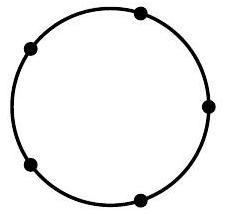 | A3. We mark the points on the circle as $A, B, C, D$ and $E$. If we write down all the different possible triangles: $A B C, A B D, A B E, A C D, A C E, A D E, B C D, B C E, B D E, C D E$, there are 10. | 10 | Combinatorics | MCQ | Yes | Yes | olympiads | false |
Find all functions $f: \mathbf{R} \rightarrow \mathbf{R}$, such that for all real numbers $x, y$, we have
$$
f\left(f(y)+x^{2}+1\right)+2 x=y+f^{2}(x+1) \text {. }
$$
(2014, Turkey National Team Selection Exam) | Let $x=0$, we get
$$
f(f(y)+1)=y+f^{2}(1) \text {. }
$$
In equation (2), replace $y$ with $f(y)+1$ to get
$$
f\left(y+f^{2}(1)+1\right)=f(y)+1+f^{2}(1) \text {. }
$$
Replace $y$ with $x^{2}+y$ in the above equation to get
$$
\begin{array}{l}
f\left(x^{2}+y+f^{2}(1)+1\right)=f(y)+1+f^{2}(1) \\
\Rightarrow f\left(x^{2}... | f(x)=x | Algebra | math-word-problem | Yes | Yes | cn_contest | false |
There are 12 chairs arranged in a circle. Find the number of subsets of this set of chairs that contain at least three adjacent chairs but no more than 7 adjacent chairs. | Let's denote the total number of chairs as \( n = 12 \). We need to find subsets with at least 3 and at most 7 adjacent chairs.
**3 adjacent chairs**:
- Choices for each set of exactly 3 adjacent chairs: \( n = 12 \)
- Subsets of exactly 3 chairs: \( 12 \)
**4 adjacent chairs**:
- Choices for each set of exactly 4 ad... | 60 | Combinatorics | math-word-problem | Yes | Incomplete | synthetic_math | true |
If the line $y=kx+1$ intersects the circle $O: x^2+y^2=1$ at points $A$ and $B$, and $\angle AOB=60^\circ$, then the real number $k=$ \_\_\_\_\_\_ . | The line $y=kx+1$ always passes through $(0,1)$, and since $(0,1)$ is on the circle, we can assume $A$ is at $(0,1)$.
Because $\angle AOB=60^\circ$, triangle $A0B$ is an equilateral triangle, so $\angle OAB=60^\circ$.
Therefore, the slope angle of the line is either $150^\circ$ or $30^\circ$,
which means the slop... | \pm \frac{\sqrt{3}}{3} | Geometry | math-word-problem | Yes | Yes | cn_k12 | false |
In triangle $ABC$, $\angle B=60^{\circ}$, $b=2\sqrt{3}$, then the maximum value of the perimeter of $\triangle ABC$ is ( )
A: $2$
B: $2\sqrt{3}$
C: $3\sqrt{3}$
D: $6\sqrt{3}$ | **Analysis**
This question tests knowledge of the sine theorem, the monotonicity of the sine function, and the sine and cosine formulas for the sum and difference of two angles. It also tests reasoning and computational skills. According to the sine theorem, we have $\frac{a+b+c}{\sin A+\sin B+\sin C}= \frac{b}{\sin B... | D | Geometry | MCQ | Yes | Yes | cn_k12 | false |
Given the universal set $U=\mathbb{R}$, $A={x|x 1}$, determine the set $∁_{U}(A∪B)=($ $)$.
A: ${x|x\\geqslant 0}$
B: ${x|x\\leqslant 1}$
C: ${x|0\\leqslant x\\leqslant 1}$
D: ${x|0 < x < 1}$ | The universal set is $U=\mathbb{R}$, $A={x|x 1}$,
$∴A∪B={x|x 1}$,
$∴∁_{U}(A∪B)={x|0\\leqslant x\\leqslant 1}$.
Hence, the answer is: $\boxed{C}$.
According to the definition of the union and complement of sets, the result can be obtained.
This question tests the understanding of set definitions and operations, a... | C | Algebra | MCQ | Incomplete | Yes | cn_k12 | false |
The width of a rectangle is 10 m, and its area is some square meters. If the length of the rectangle is increased, then its new area is 1 (1/3) times the original area. The new perimeter of the rectangle is 60 m. What is the original area of the rectangle? | Let's denote the original length of the rectangle as \( L \) meters and the original area as \( A \) square meters. Since the width is 10 m, we can write the original area as:
\[ A = L \times 10 \]
When the length is increased, the new area becomes \( \frac{4}{3} \) times the original area (since \( 1 \frac{1}{3} = \... | 150 | Algebra | math-word-problem | Yes | Yes | orca_math | true |
Given that the sequences $\{a\_n\}$ and $\{b\_n\}$ are an arithmetic sequence and a geometric sequence, respectively, and satisfy $a\_3=8$, $a\_6=17$, $b\_1=2$, and $b\_1b\_2b\_3=9(a\_2+a\_3+a\_4)$.
1. Find the general terms of the sequences $\{a\_n\}$ and $\{b\_n\}$.
2. Let $c\_n=\log \_3 b\_n$. Prove that the sequen... | 1. Since $\{a\_n\}$ is an arithmetic sequence, with $a\_3=8$ and $a\_6=17$,
we have $d=\frac{a\_6-a\_3}{6-3}=\frac{17-8}{3}=3$.
Thus, $a\_n=a\_3+(n-3)d=8+3(n-3)=3n-1$.
It follows that $a\_2+a\_3+a\_4=3a\_3=24$.
Since $\{b\_n\}$ is a geometric sequence, let the common ratio be $q$, with $b\_1=2$,
we have $b\_1b\_2b\_3=2... | \frac{1}{13}(27^n-1) | Algebra | math-word-problem | Yes | Yes | cn_k12 | false |
## 6. Meta-problem
When I reached this point in my narrative, I was interrupted by Alice (the birthday girl).
- Raymond, - she said, - the characters in your last problem are not quite well chosen.
I thought for a moment and suddenly realized what an extraordinarily clever girl my Alice is!
Those of you who have re... | 6. Meta-task. Those of you who have read "Alice's Adventures in Wonderland" will surely remember that Omar (unlike the Griffin and the Mock Turtle) is not among the characters in Lewis Carroll's famous fairy tale. He appears only in the poem "This is the Voice of Omar," which Alice reads. | notfound | Logic and Puzzles | math-word-problem | Incomplete | Yes | olympiads | false |
John was 66 inches tall. He had a growth spurt and grew 2 inches per month for his first 3 months. After those three months every following month, he began to grow 10% more than he did the previous month. After one year from the start of his growth spurt, determine his height in centimeters. Additionally, find the aver... | Let's start by calculating John's height after the initial 3 months of growth.
He grew 2 inches per month for the first 3 months, so that's a total of:
2 inches/month * 3 months = 6 inches
Adding this to his original height of 66 inches, we get:
66 inches + 6 inches = 72 inches
Now, for the remaining 9 months, his ... | 3.07 | Algebra | math-word-problem | Yes | Yes | orca_math | true |
John weighs 220 pounds when he starts exercising. He manages to lose 10% of his body weight. After losing weight, he gains back some pounds and ends up weighing 200 pounds. How many pounds did John gain back? | First, let's calculate how much weight John lost when he lost 10% of his body weight.
10% of 220 pounds is:
0.10 * 220 = 22 pounds
So, John lost 22 pounds from his original weight of 220 pounds.
Now let's find out what his weight was after losing 22 pounds:
220 - 22 = 198 pounds
John weighed 198 pounds after losin... | 2 | Algebra | math-word-problem | Yes | Yes | orca_math | true |
A function $g(x)$ is defined for all real numbers $x$. For all non-zero $x$, we have
\[3g\left(x\right) + 2g\left(\frac{1}{x}\right) = 7x + 6\]
Let $T$ denote the sum of all of the values of $x$ for which $g(x) = 2024$. Compute the integer nearest to $T$. | Substituting $x$ with $\frac{1}{x}$ in the given equation, we get
\[3g\left(\frac{1}{x}\right) + 2g(x) = \frac{7}{x} + 6\]
This results in two equations:
\[3g(x) + 2g\left(\frac{1}{x}\right) = 7x + 6\]
\[3g\left(\frac{1}{x}\right) + 2g(x) = \frac{7}{x} + 6\]
We can eliminate $g\left(\frac{1}{x}\right)$:
\[3(3g(x) + 2g... | 482 | Algebra | math-word-problem | Yes | Yes | synthetic_math | true |
Given the function $f(x)= \frac{1}{ \sqrt{mx^{2}+mx+1}}$ with a domain of $R$, determine the range of values for the real number $m$. | Since the domain of the function $f(x)= \frac{1}{ \sqrt{mx^{2}+mx+1}}$ is $R$, it implies that the inequality $mx^{2}+mx+1 > 0$ holds true for any $x∈R$.
If $m=0$, the inequality simplifies to $1 > 0$, which is evidently true.
If $m \neq 0$, then we need $m^{2}-4m 0$. Solving this inequality yields $0 0$ always tru... | [0,4) | Algebra | math-word-problem | Yes | Yes | cn_k12 | false |
Let $p_1(x)=p(x)=4x^3-3x$ and $p_{n+1}(x)=p(p_n(x))$ for each positive integer $n$. Also, let $A(n)$ be the set of all the real roots of the equation $p_n(x)=x$.
Prove that $A(n)\subseteq A(2n)$ and that the product of the elements of $A(n)$ is the average of the elements of $A(2n)$. | 1. **Prove that \( A(n) \subseteq A(2n) \):**
Given \( p_n(x) = x \), we need to show that \( p_{2n}(x) = x \). By definition, \( p_{n+1}(x) = p(p_n(x)) \). Therefore,
\[
p_{2n}(x) = p(p_{2n-1}(x)) = p(p(p_{2n-2}(x))) = \ldots = p(p(\ldots p(p_n(x))\ldots)) = p_n(x) = x.
\]
Hence, if \( x \) is a root ... | null | Algebra | proof | Yes | Yes | aops_forum | false |
Given the function $f(x)= \frac {1}{e^{x}}+a\ln x$ $(a\in\mathbb{R})$.
(I) When $a= \frac {1}{e}$, find the equation of the tangent line to the curve $y=f(x)$ at $(1,f(1))$.
(II) If the function $f(x)$ is not monotonic within its domain, find the range of values for $a$. | The domain of the function $f(x)$ is $(0,+\infty)$,
The derivative $f'(x)=- \frac {1}{e^{x}}+ \frac {a}{x}= \frac {ae^{x}-x}{xe^{x}}$.
(I) When $a= \frac {1}{e}$, since $f'(1)=- \frac {1}{e}+ \frac {1}{e}=0$, $f(1)= \frac {1}{e}$,
the equation of the tangent line to the curve $y=f(x)$ at $(1,f(1))$ is $y= \frac {... | 0 < a < \frac {1}{e} | Calculus | math-word-problem | Yes | Yes | cn_k12 | false |
Find positive integers $a$ and $b$ satisfying the system of equations:
\begin{align*}
3 \log_{10} a + 2 \log_{10} (\text{gcd}(a,b)) &= 90, \\
\log_{10} b + 2 \log_{10} (\text{lcm}(a,b)) &= 310.
\end{align*}
Let $p$ be the number of (not necessarily distinct) prime factors in the prime factorization of $a$, and let $q$ ... | 1. Add the two equations together:
\begin{align*}
3 \log_{10} a + \log_{10} b + 2 \log_{10} (\text{gcd}(a,b)) + 2 \log_{10} (\text{lcm}(a,b)) &= 400.
\end{align*}
2. Use the identity $\log_{10} (\text{gcd}(a,b)) + \log_{10} (\text{lcm}(a,b)) = \log_{10} a + \log_{10} b$:
\begin{align*}
3 \log_{10} a + \log_{10} b + 2(... | 800 | Number Theory | math-word-problem | Yes | Yes | synthetic_math | true |
A sphere is inscribed in a cube with an edge length of 12 inches. A smaller cube is then inscribed in the sphere. Calculate the volume of the inscribed cube, expressing your answer in simplest radical form. | 1. **Sphere and Cube Relationship**: A sphere inscribed in a cube touches all six faces of the cube. Thus, the diameter of the sphere is equal to the edge length of the cube, which is 12 inches.
2. **Sphere's Diameter and Smaller Cube's Space Diagonal**: The sphere's diameter, being 12 inches, is also the space diagon... | 192\sqrt{3} \text{ cubic inches} | Geometry | math-word-problem | Yes | Yes | synthetic_math | true |
Given the function $f(x+1)=a\log _{3}(x+1)$, and $f(2)=1$.
$(1)$ Find the analytical expression of $f(x)$;
$(2)$ Given that the domain of $f(x)$ is $\left[2,+\infty \right)$. If the equation $f(4^{x}+1)-f(k\cdot 2^{x}+k)=x$ has a unique real root, find the range of real number $k$. | **Solution:**
**Part (1): Finding the analytical expression of $f(x)$**
Given $f(x+1)=a\log _{3}(x+1)$, and knowing that $f(2)=1$.
1. Let $t=x+1$ with the condition that $t>0$. This substitution simplifies the function to $f(t)=a\log _{3}t$, which directly implies $f(x)=a\log _{3}x$ due to the substitution of $t=x+1... | k=1 | Algebra | math-word-problem | Yes | Yes | cn_k12 | false |
How many ways are there to cover a $3 \times 8$ rectangle with 12 identical dominoes? | Solution: Trivially there is 1 way to tile a $3 \times 0$ rectangle, and it is not hard to see there are 3 ways to tile a $3 \times 2$. Let $T_{n}$ be the number of tilings of a $3 \times n$ rectangle, where $n$ is even. From the diagram below we see the recursion $T_{n}=3 T_{n-2}+2\left(T_{n-4}+T_{n-6}+\ldots+T_{2}+T_... | 153 | NaN | NaN | NaN | NaN | olympiads | false |
357*. Solve the systems of equations:
a) $\left\{\begin{array}{l}x^{2}+x y+y^{2}=7, \\ y^{2}+y z+z^{2}=13, \\ z^{2}+z x+x^{2}=19 ;\end{array}\right.$
b) $\left\{\begin{array}{l}x y+x z=x^{2}+2, \\ x y+y z=y^{2}+3, \\ x z+y z=z^{2}+4 .\end{array}\right.$ | $\triangle$ a) Multiply the first equation of the system by $x-y$, the second by $y-z$, and the third by $z-x$. Why? To obtain a linear equation with $x, y$, and $z$. We will have:
$$
x^{3}-y^{3}=7(x-y), \quad y^{3}-z^{3}=13(y-z), \quad z^{3}-x^{3}=19(z-x)
$$
Add all these equations:
$$
\begin{aligned}
0 & =7 x-7 y+... | )(2;1;3),(-2;-1;-3);b)(\frac{2\sqrt{15}}{3};\frac{3\sqrt{15}}{5};\frac{4\sqrt{15}}{15}),(-\frac{2\sqrt{15}}{3};-\frac{3\sqrt{15}}{5} | Algebra | math-word-problem | Yes | Yes | olympiads | false |
Compute the value of the expression $\frac{\sin 47^{\circ}-\sin 17^{\circ}\cos 30^{\circ}}{\cos 17^{\circ}}$. | **Step 1: Identify the relevant trigonometric identity**
The problem requires the application of the sine sum identity, which states that $\sin(a+b) = \sin a \cos b + \cos a \sin b$. Here, let $a = 30^{\circ}$ and $b = 17^{\circ}$.
**Step 2: Apply the identity**
Rewrite the given expression as $\frac{\sin(30^{\circ}+1... | \frac{1}{2} | Algebra | math-word-problem | Yes | Yes | cn_k12 | false |
In triangle $ABC,$ $AC = BC = 10.$ Let $D$ be a point on $\overline{AB}$ so that $AD = 12$ and $CD = 5.$ Find $BD.$ | Firstly, apply the Law of Cosines in triangle $ACD$:
\[
\cos \angle ADC = \frac{12^2 + 5^2 - 10^2}{2 \cdot 12 \cdot 5} = \frac{144 + 25 - 100}{120} = \frac{69}{120} = \frac{23}{40}.
\]
This gives us $\angle ADC$.
Using the cosine value to find angle $\angle BDC$:
\[
\angle BDC = 180^\circ - \angle ADC.
\]
Since we don... | 6.79 | Geometry | math-word-problem | Yes | Incomplete | synthetic_math | true |
If a normal vector of the line $ax+by+c=0$ is $\overrightarrow{n}=(\sqrt{3},-1)$, then the inclination angle of the line is ( )
A: $\frac{π}{6}$
B: $\frac{π}{3}$
C: $\frac{{2π}}{3}$
D: $\frac{{5π}}{6}$ | Given a normal vector of the line $ax+by+c=0$ is $\overrightarrow{n}=(\sqrt{3},-1)$, we can find the inclination angle of the line by following these steps:
1. Identify the normal vector $\overrightarrow{n}=(\sqrt{3},-1)$.
2. The directional vector $\overrightarrow{m}$ of the line is perpendicular to $\overrightarrow{... | \text{B: }\frac{\pi}{3} | Geometry | MCQ | Yes | Yes | cn_k12 | false |
Given a real number $a$ chosen randomly from the interval $[0,4]$, find the probability that the equation $x^{2}+2x+a=0$ has real roots.
A: $0.25$
B: $0.5$
C: $0.6$
D: $0.75$ | For the equation $x^{2}+2x+a=0$ to have real roots,
the discriminant $\triangle = 4 - 4a \geqslant 0$,
which implies $a \leqslant 1$.
Given that $a$ is chosen randomly from the interval $[0,4]$,
we have $0 \leqslant a \leqslant 1$.
Therefore, the probability that the equation $x^{2}+2x+a=0$ has real roots when $a$ is... | \text{A} | Algebra | MCQ | Yes | Yes | cn_k12 | false |
The long jump finals contained four national champions competing against one another. The first competitor jumped a distance of 22 feet. The second competitor jumped x foot farther than the first competitor. The third competitor jumped two feet shorter than the third competitor. And the fourth competitor jumped 3 f... | To determine the distance jumped by the fourth competitor and the value of the unknown variable \( x \), we will follow these steps:
1. **First Competitor's Jump:**
The first competitor jumped a distance of 22 feet.
2. **Second Competitor's Jump:**
The second competitor jumped \( x \) feet farther than the firs... | 23+x | Algebra | math-word-problem | Incomplete | Yes | metamath | true |
A set of marbles can be split evenly among 2, 3, 5, or 7 children with none leftover. What is the smallest possible number of marbles in the set? | To find the smallest number of marbles that can be divided evenly among 2, 3, 5, or 7 children, determine the least common multiple (LCM) of the numbers 2, 3, 5, and 7. Each number is prime, so the LCM is simply the product of these numbers:
\[
\text{LCM} = 2 \times 3 \times 5 \times 7 = 210
\]
However, let’s verify ... | 210 | Number Theory | math-word-problem | Yes | Yes | synthetic_math | true |
For a positive integer x, we have
$$
\frac{2}{3} n \sqrt{n}<\sum_{i=1}^{n} \sqrt{i}<\frac{4 n}{6}+3 \sqrt{n} .
$$ | $$
\frac{2 n+1}{3} \sqrt{n} \leqslant \sum_{i=1}^{n} \sqrt{i} \leqslant \frac{4 n+3}{6} \sqrt{n}-\frac{1}{6} .
$$
In fact, when $n=1$, equation (14) obviously holds. Hereafter, we assume $n \geqslant 2$.
Let $S_{n}=\sum_{i=1}^{n} \sqrt{i}$, by Abel's identity, we have
$$
\begin{aligned}
S_{n}= & \sum_{k=1}^{n-1}\left(... | proof | Inequalities | proof | Yes | Yes | cn_contest | false |
Given that the maximum value of $x$ that satisfies the inequality $|x^{2}-4x+k|+|x-3|\leqslant 5$ is $3$, find the value of the real number $k$. | Since the maximum value of $x$ is $3$, we have $x-3 < 0$. The given inequality can be rewritten as:
$$|x^{2}-4x+k|-x+3\leqslant 5$$
This simplifies to:
$$-x-2\leqslant x^{2}-4x+k\leqslant x+2$$
which leads to two inequalities:
$$x^{2}-5x+k-2\leqslant 0$$
$$x^{2}-3x+k+2\geqslant 0$$
Let $x\_1$ and $x\_2$ be the roots of... | k=8 | Inequalities | math-word-problem | Yes | Yes | cn_k12 | false |
Calculate the value of $\sin 43^{\circ}\cos 13^{\circ}-\sin 13^{\circ}\cos 43^{\circ}$.
A: $\frac{1}{2}$
B: $\frac{\sqrt{3}}{3}$
C: $\frac{\sqrt{2}}{2}$
D: $\frac{\sqrt{3}}{2}$ | We have $\sin 43^{\circ}\cos 13^{\circ}-\sin 13^{\circ}\cos 43^{\circ}=\sin (43^{\circ}-13^{\circ})=\sin 30^{\circ}= \frac{1}{2}$,
Therefore, the correct choice is $\boxed{A}$.
This problem involves using the sine formula for the sum and difference of two angles to find the value of the given expression.
It mainl... | A | Algebra | MCQ | Yes | Yes | cn_k12 | false |
Given that "a" has characteristics such as birth, death, gender, and age, while "b" has characteristics such as birth rate and death rate, gender ratio, and age composition, then "a" and "b" respectively belong to
A: A carp, a carp population
B: A carp, a carp
C: A carp population, a carp population
D: A carp populatio... | Analysis: "a" pertains to individual characteristics, while "b" pertains to population characteristics. Therefore, the correct answer is $\boxed{\text{A: A carp, a carp population}}$. | \text{A: A carp, a carp population} | Other | MCQ | Yes | Yes | cn_k12 | false |
$PQR$ is an equilateral triangle with each side of length 4 cm. $\overline{QR}$ is extended by 50% of its own length to point $S$, and $T$ is the midpoint of $\overline{PQ}$. Suppose $\overline{TS}$ meets $\overline{PR}$ at point $U$. Find the area of the quadrilateral $QTUR$. | 1. **Triangle and Extensions**:
$PQR$ is equilateral, side length $= 4$ cm. Extend $QR$ by 50% to $S$. Thus, $RS = QR/2 = 2$ cm and $QS = QR + RS = 4 + 2 = 6$ cm.
$T$ is the midpoint of $PQ$, hence $PT = TQ = 2$ cm.
2. **Intersection Point $U$**:
Since $T$ is the midpoint of $PQ$, and $S$ extends $R$ ... | 3\sqrt{3} | Geometry | math-word-problem | Yes | Yes | synthetic_math | true |
Given that the graph of the power function $f(x)$ passes through the point $\left(\frac{1}{8}, \frac{\sqrt{2}}{4}\right)$, and $P(x_1, y_1)$, $Q(x_2, y_2)$ ($x_1 x_2f(x_2)$;
2. $x_1f(x_1) \frac{f(x_2)}{x_2}$;
4. $\frac{f(x_1)}{x_1} < \frac{f(x_2)}{x_2}$.
Among these, the correct conclusion(s) is/are __________. | According to the problem, let $f(x) = x^\alpha$, then we have $\left(\frac{1}{8}\right)^\alpha = \frac{\sqrt{2}}{4}$, which means $\left(\frac{1}{8}\right)^\alpha = \left(\frac{1}{8}\right)^{\frac{1}{2}}$,
Therefore, $\alpha = \frac{1}{2}$, and thus $f(x) = x^{\frac{1}{2}}$.
Since the function $f(x) = x^{\frac{1}{2}}... | \text{2, 3} | Algebra | math-word-problem | Yes | Yes | cn_k12 | false |
In the arithmetic sequence $\{a_n\}$, it is known that $a_6+a_9+a_{13}+a_{16}=20$. Then, $S_{21}$ equals ( )
A: 100
B: 105
C: 200
D: 0 | Since in the arithmetic sequence $\{a_n\}$, $a_6+a_9+a_{13}+a_{16}=20$,
by the properties of the arithmetic sequence, we can get $a_1+a_{21}=a_6+a_{16}=a_9+a_{13}$,
thus, $2(a_1+a_{21})=20$, solving this gives $a_1+a_{21}=10$,
therefore, $S_{21}=\frac{21}{2}(a_1+a_{21})=105$,
hence, the correct choice is $\boxe... | \text{B} | Algebra | MCQ | Yes | Yes | cn_k12 | false |
The sequence of integers $\{a_i\}_{i = 0}^{\infty}$ satisfies $a_0 = 3$, $a_1 = 4$, and
\[a_{n+2} = a_{n+1} a_n + \left\lceil \sqrt{a_{n+1}^2 - 1} \sqrt{a_n^2 - 1}\right\rceil\]
for $n \ge 0$. Evaluate the sum
\[\sum_{n = 0}^{\infty} \left(\frac{a_{n+3}}{a_{n+2}} - \frac{a_{n+2}}{a_n} + \frac{a_{n+1}}{a_{n+3}} - \frac{... | 1. **Define the sequence and initial conditions:**
The sequence of integers \(\{a_i\}_{i=0}^{\infty}\) is given by:
\[
a_0 = 3, \quad a_1 = 4
\]
and for \(n \geq 0\),
\[
a_{n+2} = a_{n+1} a_n + \left\lceil \sqrt{a_{n+1}^2 - 1} \sqrt{a_n^2 - 1} \right\rceil.
\]
2. **Evaluate the first few terms:... | 0.518 | Other | other | Yes | Yes | aops_forum | false |
Determine the values of $k$ for which the quadratic equation $3x^2 + (k + 6)x + 12 = 0$ has exactly one solution. What is the sum of these values? | We can express the quadratic equation as:
\[3x^2 + (k+6)x + 12 = 0.\]
For the equation to have exactly one solution (a double root), the discriminant must be zero:
\[(k + 6)^2 - 4 \cdot 3 \cdot 12 = 0.\]
Expanding and simplifying this equation, we get:
\[k^2 + 12k + 36 - 144 = 0 \]
\[k^2 + 12k - 108 = 0.\]
To find t... | -12 | Algebra | math-word-problem | Yes | Yes | synthetic_math | true |
If the curve $f(x) = ax^2 + \ln x$ has a tangent line perpendicular to the y-axis, then the range of the real number $a$ is __________. | To find the value of $a$ for which the curve $f(x) = ax^2 + \ln x$ has a vertical tangent (perpendicular to the y-axis), we need to look at the derivative of $f(x)$, as the slope of the tangent line at any point is given by the derivative of the function at that point.
Differentiate $f(x)$ with respect to $x$ to get:
... | a \in (-\infty, 0) | Calculus | math-word-problem | Yes | Yes | cn_k12 | false |
## Problem Statement
Calculate the limit of the function:
$$
\lim _{x \rightarrow 2} \sqrt[3]{\lg (x+2)+\sin \sqrt{4-x^{2}} \cdot \cos \frac{x+2}{x-2}}
$$ | ## Solution
Since $\cos \frac{x+2}{x-2}$ is bounded, and $\sin \sqrt{4-x^{2}} \rightarrow 0$, as $x \rightarrow 2$, then $\sin \sqrt{4-x^{2}} \cdot \cos \frac{x+2}{x-2} \rightarrow 0$, as $x \rightarrow 2$
Then:
$\lim _{x \rightarrow 2} \sqrt[3]{\lg (x+2)+\sin \sqrt{4-x^{2}} \cdot \cos \frac{x+2}{x-2}}=\sqrt[3]{\lg ... | \sqrt[3]{\lg4} | Calculus | math-word-problem | Yes | Yes | olympiads | false |
Nancy went to a store to buy soap for her bathrooms. She bought 4 packs from Brand A, each pack having 3 bars. Then, she bought 3 packs from Brand B with each pack comprising of 5 bars. After this, she realized that Brand C was offering a discount on their soap packs where, if you buy 2 packs with 6 bars in each, you g... | First, let's calculate the number of bars from Brand A:
4 packs * 3 bars per pack = 12 bars
Next, the number of bars from Brand B:
3 packs * 5 bars per pack = 15 bars
Now, for Brand C, Nancy gets 2 packs with 6 bars each, plus an extra pack with 4 bars for free:
2 packs * 6 bars per pack = 12 bars
1 free pack * 4 bar... | 43 | Logic and Puzzles | math-word-problem | Yes | Yes | orca_math | true |
Condition of the problem
Calculate the limit of the function:
$\lim _{x \rightarrow-2} \frac{\operatorname{tg} \pi x}{x+2}$ | ## Solution
Substitution:
$x=y-2 \Rightarrow y=x+2$
$x \rightarrow-2 \Rightarrow y \rightarrow 0$
We get:
$\lim _{x \rightarrow-2} \frac{\tan \pi x}{x+2}=\lim _{y \rightarrow 0} \frac{\tan \pi(y-2)}{(y-2)+2}=$
$=\lim _{y \rightarrow 0} \frac{\tan(\pi y-2 \pi)}{y}=\lim _{y \rightarrow 0} \frac{\tan \pi y}{y}=$
Us... | \pi | Calculus | math-word-problem | Yes | Yes | olympiads | false |
A can do a piece of work in 15 days. A works for 5 days only and leaves the job. B and C together complete the remaining work in 3 days. If B alone takes 'x' days to complete the work, and C alone takes 'y' days to complete the work, how long would it take for B and C to complete the entire job together? | Let's first find out how much work A completes in 5 days. Since A can complete the entire job in 15 days, in 5 days A would complete \(\frac{5}{15} = \frac{1}{3}\) of the work.
This means that \(\frac{2}{3}\) of the work is left after A leaves.
B and C together complete this remaining \(\frac{2}{3}\) of the work in 3... | 4.5 | Algebra | math-word-problem | Yes | Yes | orca_math | true |
Let $ABCD$ be a convex quadrilateral with $\angle A=60^o$. Let $E$ and $Z$ be the symmetric points of $A$ wrt $BC$ and $CD$ respectively. If the points $B,D,E$ and $Z$ are collinear, then calculate the angle $\angle BCD$. | 1. Given that $ABCD$ is a convex quadrilateral with $\angle A = 60^\circ$. Let $E$ and $Z$ be the symmetric points of $A$ with respect to $BC$ and $CD$ respectively. This means that $E$ and $Z$ are reflections of $A$ over lines $BC$ and $CD$ respectively.
2. Since $E$ is the reflection of $A$ over $BC$, $\triangle ABE$... | 60^\circ | Geometry | math-word-problem | Yes | Yes | aops_forum | false |
Let $g(x) = (x-3)^2 + 4$. Find the smallest value of $d$ such that $g(x)$ can have an inverse when its domain is restricted to $[d, \infty)$. | For $g(x)$ to have an inverse function, $g(x)$ must be either strictly increasing or strictly decreasing. The graph of $y = (x-3)^2 + 4$ is a parabola with vertex at $(3,4)$.
Since the parabola opens upwards (coefficient of $x^2$ is positive), the function is decreasing for $x 3$. To ensure the function $g(x)$ is mon... | 3 | Algebra | math-word-problem | Yes | Yes | synthetic_math | true |
Let $a_1, a_2, . . . , a_n$ be positive real numbers and $n \ge 1$. Show that
$n (\frac{1}{a_1}+...+\frac{1}{a_n}) \ge (\frac{1}{1+a_1}+...+\frac{1}{1+a_n})(n+\frac{1}{a_1}+...+\frac{1}{a_n})$
When does equality hold? | null | null | Inequalities | math-word-problem | Yes | Yes | aops_forum | false |
Compare the sizes: $-\frac{4}{5}$______$-\frac{2}{3}$ (Fill in "$$"). | To compare the sizes of $-\frac{4}{5}$ and $-\frac{2}{3}$, we start by considering their absolute values to understand their magnitudes without the influence of their signs.
1. Calculate the absolute values:
- For $-\frac{4}{5}$, the absolute value is $|-\frac{4}{5}| = \frac{4}{5}$.
- For $-\frac{2}{3}$, the abs... | < | Inequalities | math-word-problem | Yes | Yes | cn_k12 | false |
Two dice are thrown, find
$(1)$ the probability that the sum of the points is odd;
$(2)$ the probability that the product of the points is even. | $(1)$ When two dice are thrown, the total number of basic events is $n=6\times6=36$.
The number of basic events in which the sum of the points is odd is $m\_1= C\_3^1 C\_3^1 + C\_3^1 C\_3^1 =18$.
Therefore, the probability that the sum of the points is odd is $p\_1=\frac{m\_1}{n}=\frac{18}{36}=\boxed{\frac{1}{2}}$.
$(... | \frac{3}{4} | Combinatorics | math-word-problem | Yes | Yes | cn_k12 | false |
Let \\(a > b > 0\\), \\(m= \sqrt{a}− \sqrt{b} \\), \\(n=\sqrt{a-b}\\), then the relationship between \\(m\\) and \\(n\\) is \_\_\_\_\_\_\_\_. | **Analysis**
This question examines the knowledge of proving inequalities and judging the relationship between them. From \\((\sqrt{a+b}+ \sqrt{b} )^{2}=a+2\sqrt{ab-{b}^{2}} > a={(\sqrt{a})}^{2} \\), we can conclude, which is a medium-level question.
**Solution**
Given \\(∵a > b > 0\\),
then \\(∴( \sqrt{a-b}+ \sqr... | m < n | Algebra | math-word-problem | Yes | Yes | cn_k12 | false |
The additive inverse of $a$ is itself, and the multiplicative inverse of $b$ is itself. Then, the value of $a+b$ is ( ).
A: $-1$ or $0$
B: $1$ or $0$
C: $1$ or $-1$
D: $0$ | Let's analyze the conditions one by one.
1. The additive inverse (also known as the opposite number) of a number is the number that, when added to the original number, yields zero. Therefore, if $a$ is its own additive inverse, the equation we have is:
$$
a + a = 0
$$
Solving for $a$ gives us:
$$
2a ... | \text{The value of } a+b \text{ is either } 1 \text{ or } -1. | Algebra | MCQ | Yes | Yes | cn_k12 | false |
How many different four-digit numbers can be formed by arranging the digits in 2025? | To form a four-digit number using the digits 2, 0, 2, and 5, the digit in the thousands place must be 2 or 5 to ensure a valid four-digit number.
1. Let's consider two cases:
- The thousands digit is 2.
- The thousands digit is 5.
2. **Case 1: Thousands digit is 2**
- The remaining digits are 0, 2, and 5. ... | 6 | Combinatorics | math-word-problem | Yes | Yes | synthetic_math | true |
Aviov N.I.
$N^{3}$ unit cubes are drilled through the diagonal and tightly strung on a thread, after which the thread is tied into a ring (that is, the vertex of the first cube is connected to the vertex of the last one). For which $N$ can such a necklace of cubes be packed into a cubic box with an edge length of $N$? | Let's choose a cube in the necklace and mark it with the number 1. Then we will number the remaining cubes in sequence, moving along the thread in one of the two possible directions. In the cube with number $n$, we denote by $A_{n}$ the vertex belonging to the thread that adjoins the previous cube.
We choose a coordin... | N | Geometry | math-word-problem | Yes | Yes | olympiads | false |
44. Andrey, Borya, Vitya, and Gena are playing on a $100 \times 2019$ board (100 rows, 2019 columns). They take turns - first Andrey, then Borya, followed by Vitya, and finally Gena, then again Andrey, and so on. Each turn, a player must color two uncolored cells forming a rectangle of two cells, with Andrey and Borya ... | 44. Let's show how players A, B, and C can beat D. We will divide the board into vertical dominoes of size $2 \times 1$. Let players A and B cover any dominoes of the partition with their moves, and C complements D's move to a pair of dominoes of the partition. Then, before D's move, several dominoes of the partition w... | proof | Combinatorics | math-word-problem | Yes | Yes | olympiads | false |
[b]Classical Probability Distribution for Quantum States?[/b]
The goal of this problem is to try and mimic a Statistical Mechanics approach to Quantum Mechanics. In Classical Statistical Mechanics one has the usual Gibbs-Boltzmann Formula which gives the probability distribution in phase-space to be:
\[ \rho(x_1,\do... | 1. **Why can't we demand a similar probability distribution over phase-space in Quantum Mechanics?**
In Quantum Mechanics, the state of a system is described by a wave function $\psi(x_1, \dots, x_n)$, which is a complex-valued function. The probability density for finding the system in a particular configuration o... | null | Other | math-word-problem | Yes | Yes | aops_forum | false |
Given that the base radius of Cylinder 1 is twice the base radius of Cylinder 2, and their lateral surface areas are the same, find the ratio of the volume of Cylinder 1 to the volume of Cylinder 2. | **Analysis**
This problem involves the lateral surface area and volume of cylinders. According to the problem, we know that $r_1 = 2r_2$ and $h_1 = \frac{1}{2}h_2$. We can use the formula for the volume of a cylinder to find the required ratio.
**Solution**
Since $r_1 = 2r_2$ and the lateral surface areas are equal,... | 2 : 1 | Geometry | math-word-problem | Yes | Yes | cn_k12 | false |
5. Let prime $p$, satisfying $p \mid \left(2^{2019}-1\right)$. Define the sequence $\left\{a_{n}\right\}$:
$$
\begin{array}{l}
a_{0}=2, a_{1}=1, \\
a_{n+1}=a_{n}+\frac{p^{2}-1}{4} a_{n-1}(n \geqslant 1) .
\end{array}
$$
Prove: For any $n \geqslant 0$, we have $p \nmid\left(1+a_{n}\right)$. | 5. The characteristic equation of the sequence $\left\{a_{n}\right\}$ is
$$
x^{2}-x-\frac{p^{2}-1}{4}=0 \text {, }
$$
with its two roots being $\frac{1 \pm p}{2}$.
Given $a_{0}=2, a_{1}=1$, we have
$$
a_{n}=\left(\frac{1+p}{2}\right)^{n}+\left(\frac{1-p}{2}\right)^{n} \text {. }
$$
Since $2^{2019}-1$ is odd,
$$
2^{20... | proof | Number Theory | proof | Yes | Yes | olympiads | false |
The function f(x) is defined on the set of real numbers R and is both an odd function and a periodic function. Its minimum positive period is π, and when x belongs to the interval [0, $\frac{\pi}{2}$], f(x) = -4sin(2x). What is the value of f($\frac{8\pi}{3}$)? | Since f(x) is an odd function defined on R with a period of π, and f(x) = -4sin(2x) for x in the interval [0, $\frac{\pi}{2}$], we have:
$$f(\frac{8\pi}{3}) = f(\frac{2\pi}{3} + 2\pi) = f(\frac{2\pi}{3}) = f(-\frac{\pi}{3} + \pi) = f(-\frac{\pi}{3}) = -f(\frac{\pi}{3}) = 4\sin(\frac{2\pi}{3}) = 2\sqrt{3}.$$
So the an... | 2\sqrt{3} | Algebra | math-word-problem | Yes | Yes | cn_k12 | false |
11. (20 points) Let the sequence $\left\{A_{n}\right\}$ satisfy
$$
\begin{array}{l}
A_{1}=1, A_{2}=3, A_{n}=4 A_{n-1}-A_{n-2} . \\
\text { Find } \sum_{n=1}^{+\infty} \operatorname{arccot} 2 A_{n}^{2} \text { . }
\end{array}
$$ | 11. From the given conditions, we have
$$
\begin{array}{l}
A_{3}=4 A_{2}-A_{1}=4 \times 3-1=11, \\
\frac{A_{0}}{A_{1}}=\frac{4 A_{1}-A_{2}}{A_{1}}=1 .
\end{array}
$$
Solving the characteristic equation \(x^{2}-4 x+1=0\), we get
$$
x_{1}=2+\sqrt{3}, x_{2}=2-\sqrt{3} \text {. }
$$
Thus, the general term formula is
$$
\... | \frac{\pi}{6} | Algebra | math-word-problem | Yes | Yes | olympiads | false |
Let the sequence $\{a_n\}$ satisfy $a_1 + 2a_2 + 4a_3 + \ldots + 2^{n-1}a_n = n$.
(Ⅰ) Find the general formula for the sequence $\{a_n\}$;
(Ⅱ) Find the sum of the first $n$ terms of the sequence $\{a_n + \log_2 a_n\}$. | Solution:
(Ⅰ) Since the sequence $\{a_n\}$ satisfies $a_1 + 2a_2 + 4a_3 + \ldots + 2^{n-1}a_n = n$,
when $n \geqslant 2$, we have $a_1 + 2a_2 + 4a_3 + \ldots + 2^{n-2}a_{n-1} = n-1$
Therefore, when $n \geqslant 2$, $2^{n-1}a_n = 1$,
which means $a_n = \dfrac{1}{2^{n-1}}$
When $n=1$, $a_n=1$ also satisfies the... | 2 - \dfrac{1}{2^{n-1}} - \dfrac{n^2}{2} + \dfrac{n}{2} | Algebra | math-word-problem | Yes | Yes | cn_k12 | false |
Let $M=\{x|x=2^t, t\in \mathbb{R}\}$, and $N=\{x|x=\sin t, t\in \mathbb{R}\}$. Then $M \cap N$ equals to ( )
A: $[-1, 1]$
B: $[-1, 0]$
C: $(0, 1]$
D: $\emptyset$ | Given $M=\{x|x=2^t, t\in \mathbb{R}\}=\{x|x>0\}$, and $N=\{x|x=\sin t, t\in \mathbb{R}\}=\{x|-1\leq x\leq 1\}$,
Therefore, $M \cap N=\{x|x>0\} \cap \{x|-1\leq x\leq 1\}=(0, 1]$.
Hence, the correct choice is $\boxed{C}$. | C | Algebra | MCQ | Yes | Yes | cn_k12 | false |
Euler discovered that the circumcenter, centroid, and orthocenter of any triangle lie on the same line, which is now known as the Euler line. Given the vertices of $\triangle ABC$, $A(2,0)$, $B(0,4)$, and the equation of its Euler line $x-y+2=0$, find the coordinates of vertex $C$( ).
A: $(-4,0)$
B: $(0,-4)$
C: $(4,0)$... | **Analysis**
This problem involves finding the equation of a line, utilizing the slope-point form of a line equation, and solving systems of equations. It is a fundamental computational problem.
Assume the coordinates of point $C$ and find the centroid using the centroid formula. Substitute it into the Euler line equa... | (-4,0) | Geometry | MCQ | Yes | Yes | cn_k12 | false |
Given an arithmetic sequence $\{a_n\}$ with a non-zero common difference, if $a_5$, $a_9$, and $a_{15}$ form a geometric sequence, then the value of $$\frac {a_{15}}{a_{9}}$$ is ( )
A: $$\frac {2}{3}$$
B: $$\frac {3}{4}$$
C: $$\frac {4}{3}$$
D: $$\frac {3}{2}$$ | Let the common difference of the arithmetic sequence $\{a_n\}$ be $d$ ($d \neq 0$).
Since $a_5$, $a_9$, and $a_{15}$ form a geometric sequence, we have $$a_{9}^{2}=a_{5}a_{15}$$,
which implies $$a_{9}^{2}=(a_{9}-4d)(a_{9}+6d)=a_{9}^{2}+2a_{9}d-24d^{2}$$,
Therefore, $a_{9}=12d$.
Then, $a_{15}=a_{9}+6d=12d+6d=18d$... | \text{D} | Algebra | MCQ | Yes | Yes | cn_k12 | false |
4. Find all polynomials $P(x)$ with real coefficients such that
$$
P(a) \in \mathbb{Z} \quad \text { implies that } \quad a \in \mathbb{Z} \text {. }
$$ | 4. Let $P(x)=a_{n} x^{n}+\cdots+a_{1} x+a_{0}$. Define $Q(x)=P(x+1)-P(x)$. Then $Q(x)$ is of degree $n-1$. We'll prove by contradiction that $|Q(x)| \leq 3$ for all $x$. This will imply that $n \leq 1$. Assume that $|Q(a)|>3$ for some $a \in \mathbb{R}$. Then $|P(a+1)-P(a)|>3$. Thus there are 3 integers between $P(a)$ ... | P(x)=\frac{x}{p}+\frac{q}{p}wherep,q\in\mathbb{Z}p\neq0 | Algebra | math-word-problem | Yes | Yes | olympiads | false |
Given: In the sequence $\{a_n\}$, $a_1=7$, $a_{n+1} = \frac{7a_n}{a_n + 7}$,
(1) Please write out the first 4 terms of this sequence and conjecture the general formula of this sequence.
(2) Please prove the correctness of your conjectured general formula. | Solution:
(1) Based on the given information, we have $a_1=7$, $a_2= \frac{7}{2}$, $a_3= \frac{7}{3}$, $a_4= \frac{7}{4}$... (3 points)
Conjecture: $a_n= \frac{7}{n}$... (6 points)
(2) Given $a_{n+1}= \frac{7a_n}{a_n + 7}$,
Taking the reciprocal of both sides yields: $\Leftrightarrow \frac{1}{a_{n+1}}= \frac{1}... | a_n = \frac{7}{n} | Algebra | math-word-problem | Yes | Yes | cn_k12 | false |
Jackie's favorite cosmetic company was offering free shipping when you spent $50.00. Jackie ordered her favorite shampoo and conditioner that each cost $10.00 a bottle and 3 bottles of lotion that cost a certain amount each. Jackie needs to spend $12 more to be eligible for free shipping. How much does each bottle of l... | Let's denote the cost of each bottle of lotion as x dollars.
Jackie has already spent $10.00 on shampoo and $10.00 on conditioner, which totals $20.00.
She needs to spend $12 more to reach the $50.00 threshold for free shipping. So, the total amount she needs to spend on the lotion is $50.00 - $20.00 = $30.00.
Since... | \$10.00 | Algebra | math-word-problem | Yes | Yes | orca_math | true |
Example 6 Let $S=\{1,2, \cdots, 2005\}$. If any set of $n$ pairwise coprime numbers in $S$ contains at least one prime number, find the minimum value of $n$.
(2005, China Western Mathematical Olympiad) | Explanation: First, take a subset of $S$
$$
A_{0}=\left\{1,2^{2}, 3^{2}, 5^{2}, \cdots, 41^{2}, 43^{2}\right\},
$$
then $\left|A_{0}\right|=15, A_{0}$ contains any two numbers that are coprime, but there are no primes in it. This indicates that $n \geqslant 16$.
Second, it can be proven: For any $A \subseteq S, n=|A|... | 16 | Number Theory | math-word-problem | Yes | Yes | cn_contest | false |
Let the function $f(x) = \begin{cases} 3^{x}-a, & x < 1 \\ \pi(x-3a)(x-2a), & x \geq 1 \end{cases}$. If $f(x)$ has exactly 2 zeros, then the range of the real number $a$ is \_\_\_\_\_\_. | First, let $y=3^{x}-a=0$, then $x=\log_{3}a$.
Next, let $y=\pi(x-3a)(x-2a)=0$, then $x=2a$, or $x=3a$.
- If $a \leq 0$, then $x=\log_{3}a$ is meaningless, and in this case, the function has no zeros.
- If $0 < a < 3$, then $x=\log_{3}a < 1$ must be a zero of the function. If $f(x)$ has exactly 2 zeros, then $\begin{c... | \left[ \frac{1}{3}, \frac{1}{2} \right) \cup [3, +\infty) | Algebra | math-word-problem | Yes | Yes | cn_k12 | false |
A fractional number $x$ is called [i][b]pretty[/b][/i] if it has finite expression in base$-b$ numeral system, $b$ is a positive integer in $[2;2022]$. Prove that there exists finite positive integers $n\geq 4$ that with every $m$ in $(\frac{2n}{3}; n)$ then there is at least one pretty number between $\frac{m}{n-m}$ a... | 1. **Lemma 1:** For every base \( b \), a rational number \( x \) with its simplest form of fraction \( \frac{y}{z} \) has a finite expression in base \( -b \) if and only if \( z \) has no prime factor that divides \( b \).
**Proof:** This is straightforward. If \( z \) has a prime factor that divides \( b \), the... | null | Number Theory | proof | Yes | Yes | aops_forum | false |
Given the function f(x) = $$\frac{1}{x+1}$$ + x - 2, determine the equation of the tangent line to the curve y = f(x) at the point (1, f(1)). | The function is f(x) = $$\frac{1}{x+1}$$ + x - 2. We first find f(1):
f(1) = $$\frac{1}{1+1}$$ + 1 - 2 = $$\frac{1}{2}$$ - $$\frac{1}{2}$$ = -$$\frac{1}{2}$$
Next, we calculate the derivative of the function, f'(x):
f'(x) = -$$\frac{1}{(x+1)^2}$$ + 1
Now, we find f'(1):
f'(1) = -$$\frac{1}{(1+1)^2}$$ + 1 = -$$\fra... | 3x - 4y - 5 = 0 | Calculus | math-word-problem | Yes | Yes | cn_k12 | false |
In the Cartesian coordinate system, let $d$ be the distance from point $P(\cos \theta, \sin \theta)$ to the line $x-my-2=0$. When $\theta$ and $m$ vary, the maximum value of $d$ is:
A: $1$
B: $2$
C: $3$
D: $4$ | To find the maximum distance $d$ from point $P(\cos \theta, \sin \theta)$ to the line $x-my-2=0$, we start by expressing $d$ in terms of $\theta$ and $m$. The distance formula for a point to a line gives us:
\[d = \frac{|\cos \theta - m\sin \theta - 2|}{\sqrt{1^2 + m^2}}\]
This expression can be rewritten by introduc... | C | Geometry | MCQ | Yes | Yes | cn_k12 | false |
For what $n$ will $\binom{n}{k}$ be odd for all $0 \leq k \leq n$? | I. solution. $n=1$ clearly satisfies, $n=2$ does not: $\binom{1}{0}=\binom{1}{1}=1$ is odd, but $\binom{2}{1}=2$ is even. For the rest, let $n$ be an integer greater than 2 that satisfies the conditions. It is known that
$$
\binom{n}{k}=\frac{n(n-1) \ldots(n-k+2)(n-k+1)}{k!}
$$
If $\binom{n}{1}=n$ is odd, then $\bino... | 2^{}-1where\geqq1 | Combinatorics | math-word-problem | Yes | Yes | olympiads | false |
The center of a circle is on the positive half of the $x$-axis, and its radius is the length of the imaginary semi-axis of the hyperbola $\dfrac{x^{2}}{16} - \dfrac{y^{2}}{9} = 1$, and it is tangent to the asymptotes of this hyperbola. The equation of the circle is __________. | Solution: The length of the imaginary semi-axis of the hyperbola $\dfrac{x^{2}}{16} - \dfrac{y^{2}}{9} = 1$ is $3$, so the radius of the circle is $3$.
The asymptotes of the hyperbola are $3x \pm 4y = 0$. Let the center of the circle be $(m,0)$ where $m > 0$.
Since the asymptotes of the hyperbola are tangent to the c... | (x-5)^{2} + y^{2} = 9 | Geometry | math-word-problem | Yes | Yes | cn_k12 | false |
There are originally 14 caterpillars on the tree. After a storm, 3 caterpillars fall off the tree. Meanwhile, 6 eggs hatch, and baby caterpillars climb out to munch on the leaves. The baby caterpillars eat a total of 18 leaves before they grow into larger caterpillars. During the next week, 9 fat caterpillars leave the... | Let's break down the problem step by step:
1. Originally, there are 14 caterpillars on the tree.
2. After the storm, 3 caterpillars fall off, so 14 - 3 = 11 caterpillars remain.
3. 6 eggs hatch, adding 6 baby caterpillars to the tree, so 11 + 6 = 17 caterpillars are now on the tree.
4. The baby caterpillars eat a tota... | 130 | Other | math-word-problem | Yes | Yes | orca_math | true |
6. Given $a_{1}>a_{2}>a_{3}, b_{1}>b_{2}>b_{3}$. Among the following expressions, the one with the largest value is ()
(A) $a_{2} b_{3}+a_{2} b_{1}+a_{3} b_{1}$
(B) $a_{1} \dot{b}_{1}+a_{2} b_{2}+a_{2} b_{3}$
(C) $a_{1} b_{2}+a_{2} b_{3}+a_{3} b_{1}$
(D) $a_{2} b_{1}+a_{3} b_{2}+a_{1} b_{3}$ | 6. B
Translate the text above into English, please retain the original text's line breaks and format, and output the translation result directly. | null | Algebra | MCQ | Yes | Yes | cn_contest | false |
Let $A$, $B$, $C$ be the angles of an obtuse triangle, with $A$ being the obtuse angle. Compute
\[
\begin{vmatrix} \tan A & 1 & 1 \\ 1 & \tan B & 1 \\ 1 & 1 & \tan C \end{vmatrix}.
\] | Expanding the determinant, we have:
\[
\begin{vmatrix} \tan A & 1 & 1 \\ 1 & \tan B & 1 \\ 1 & 1 & \tan C \end{vmatrix} = \tan A \begin{vmatrix} \tan B & 1 \\ 1 & \tan C \end{vmatrix} - \begin{vmatrix} 1 & 1 \\ 1 & \tan C \end{vmatrix} + \begin{vmatrix} 1 & \tan B \\ 1 & 1 \end{vmatrix}
\]
\[
= \tan A (\tan B \tan C - ... | 2 | Algebra | math-word-problem | Yes | Yes | synthetic_math | true |

In a rectangular trapezoid, the ratio of the diagonals is 2, and the ratio of the bases is 4. Find the angles of the trapezoid. | Let $BC = x$ and $AD = 4x$ be the bases of trapezoid $ABCD$, and $AC = y$, $BD = 2y$ be its diagonals, with $AB \perp AD$. By the Pythagorean theorem, $y^2 - x^2 = 4y^2 - 16x^2$, or $5x^2 = y^2$.
Let $CK$ be the height of the trapezoid. Then $CK^2 = AB^2 = AC^2 - BC^2 = 4x^2$, and $DK = AD - BC = 3x$.
Therefore, $\op... | \pi/2,\pi/2,\operatorname{arctg}2/3,\pi-\operatorname{arctg}2/3 | Geometry | math-word-problem | Incomplete | Yes | olympiads | false |
14. For $i=1,2, \cdots, n$, we have $\left|x_{i}\right|<1$, and $\left|x_{1}\right|+\left|x_{2}\right|+\cdots+\left|x_{n}\right|=2005+\mid x_{1}+$ $x_{2}+\cdots+x_{n} \mid$. Find the minimum value of the positive integer $n$. | 15. The minimum value of $a_{2005}$ is 2048. First, since $45 \times 46=2070>2048$, the sequence $A_{0}=\{1,45,46, \cdots, 2048\}$ satisfies the condition, where $a_{2005}=2048$.
If $a_{2005} \leqslant 2047$, it is clear that $a_{1} \leqslant 44$, then $k a_{1}$ are not in $a_{1} \sim a_{2005}$, where $k \leqslant 204... | Algebra | math-word-problem | Yes | Problem not solved | olympiads | false | |
6. Find all positive integers $n$, that satisfy
$$
n=2^{2 x-1}-5 x-3=\left(2^{x-1}-1\right)\left(2^{x}+1\right)
$$
for some positive integer $x$. | Solution 1. By performing the product of the right-hand side and rearranging terms, the equality between the second and third members can be written as
$$
2^{x-1}=5 x+2
$$
It is easily verified that neither $x=1$ nor $x=2$ are solutions, while if $x \geq 3$, then $5 x+2$ must be a multiple of 4, so $x$ is even but no... | 2015 | Number Theory | math-word-problem | Yes | Yes | olympiads | false |
Given the function $f(x) = \cos 2x + 2\sin x \cdot \sin x$.
(1) Find the smallest positive period of $f(x)$, its maximum value, and the set of $x$ values for which the maximum value is attained;
(2) If $A$ is an acute angle of the triangle $\triangle ABC$, and $f(A) = 0$, with $b = 5$, $a = 7$, find the area of $\tri... | (1) The smallest positive period of $f(x)$ is $\boxed{\pi}$, the maximum value is $\boxed{2}$, and the set of $x$ values for which the maximum value is attained is $\boxed{x = k\pi}$, where $k$ is an integer.
(2) The area of $\triangle ABC$ is $\boxed{10}$. | 10 | Algebra | math-word-problem | Yes | Yes | cn_k12 | false |
Let \\(i\\) be the imaginary unit. If the complex number \\(z= \dfrac {i}{1-i^{3}}\\), then \\( \overline {z}=(\\) \\()\\)
A: \\( \dfrac {1}{2}- \dfrac {1}{2}i\\)
B: \\(1+ \dfrac {1}{2}i\\)
C: \\(1- \dfrac {1}{2}i\\)
D: \\( \dfrac {1}{2}+ \dfrac {1}{2}i\\) | Since \\(z= \dfrac {i}{1-i^{3}}= \dfrac {i}{1+i}= \dfrac {i(1-i)}{(1+i)(1-i)}= \dfrac {1}{2}+ \dfrac {1}{2}i\\),
then \\(\overline {z}= \dfrac {1}{2}- \dfrac {1}{2}i\\).
Therefore, the correct answer is: \\(\boxed{A}\\).
This problem involves simplifying using the algebraic operations of complex numbers and solvi... | A | Algebra | MCQ | Yes | Yes | cn_k12 | false |
Jane's mom picked some cherry tomatoes from their backyard. She is about to place them in small jars which can contain 8 cherry tomatoes at a time. She will need 7 jars. How many cherry tomatoes did she gather? | If each jar can contain 8 cherry tomatoes and she needs 7 jars, then the total number of cherry tomatoes she gathered is:
8 cherry tomatoes/jar × 7 jars = $\boxed{56}$ cherry tomatoes. | 56 | Logic and Puzzles | math-word-problem | Yes | Yes | orca_math | true |
A cylindrical glass is one-third full of lemonade. The ratio of lemon juice to water in the lemonade is 1:5. If the glass is 8 inches tall and has a diameter of 4 inches, what is the volume of lemon juice in the glass? Express your answer as a decimal to the nearest hundredth. | First, calculate the volume of the liquid in the glass. Given that the glass is one-third full and has a height of 8 inches, the height of the liquid in the glass is $\frac{1}{3} \times 8 = \frac{8}{3}$ inches. The radius of the glass, with a diameter of 4 inches, is 2 inches. The volume of the lemonade is calculated a... | 5.59 | Algebra | math-word-problem | Yes | Yes | synthetic_math | true |
Theorem 1 Let $p$ be a prime number. Then, for any $n$-variable integer coefficient polynomial $f\left(x_{1}, \cdots, x_{n}\right)$ not equivalent to zero modulo $p$, there must exist a unique $n$-variable integer coefficient polynomial $f^{*}\left(x_{1}, \cdots, x_{n}\right)$ such that (i) $f$ and $f^{*}$ are equivale... | Proof: When $n=1$, by Theorem 6 of §8, the conclusion holds (why). Assume the theorem holds for $n=k$. When $n=k+1$, repeatedly use Fermat's Little Theorem $x^{p} \equiv x(\bmod p)$ for each variable $x_{j}$ of $f$ until all exponents are less than $p$, and replace each coefficient $a$ of a monomial in $f$ with $a^{*} ... | proof | Number Theory | proof | Yes | Yes | number_theory | false |
two trains 111 meters and 165 meters in length respectively are running in opposite directions , one at the rate of 60 km and the other at the rate of 90 kmph . in what time will they be completely clear of each other from the moment they meet ? | To find out how long it will take for the two trains to be completely clear of each other, we need to calculate the relative speed at which they are moving apart and then determine how long it will take for them to cover a distance equal to the sum of their lengths.
The length of the first train is 111 meters, and the... | 6.62 | Algebra | math-word-problem | Yes | Yes | orca_math | true |
Let
\[ y^8 + 64y^4 + 36 = p(y) q(y), \]
where \( p(y) \) and \( q(y) \) are monic, non-constant polynomials with integer coefficients. Find \( p(1) + q(1) \). | We start by rewriting the expression:
\[
y^8 + 64y^4 + 36 = (y^8 - 16y^4 + 36) + 80y^4.
\]
Factoring this as a difference of squares:
\[
y^8 - 16y^4 + 36 = (y^4)^2 - (4y^2)^2 + 36 = (y^4 + 4y^2 + 6)(y^4 - 4y^2 + 6).
\]
Now, adding the \( 80y^4 \) back distributed into the factors:
\[
(y^4 + 4y^2 + 6) + 40y^4 = y^4 + 4... | 14 | Algebra | math-word-problem | Yes | Yes | synthetic_math | true |
Example 13 Let $n$ be a positive integer greater than 1, find the number of permutations $\left(a_{1}, a_{2}, \cdots, a_{n}\right)$ of $1,2, \cdots, n$ that satisfy the following property: there exists exactly one $i \in\{1,2, \cdots, n-1\}$, such that $a_{i} > a_{i+1}$. | Let $p_{n}$ denote the number of permutations with the given property. It is easy to see that $p_{1}=0, p_{2}=1$.
For $n \geqslant 2$, if $a_{n}=n$, then the number of such permutations is $p_{n-1}$;
If $a_{i}=n, 1 \leqslant i \leqslant n-1$, consider all such permutations. We can choose $i-1$ numbers from the $n-1$ nu... | 2^{n}-n-1 | Combinatorics | math-word-problem | Yes | Yes | olympiads | false |
There are 2 sections, A and B, in a class. Section A has a certain number of students and section B has 70 students. The average weight of section A is 50 kg and that of section B is 70 kg. The average weight of the whole class is 61.67 kg. How many students are in section A? | Let's denote the number of students in section A as \( x \).
The total weight of students in section A is \( 50x \) kg (since the average weight is 50 kg and there are \( x \) students).
The total weight of students in section B is \( 70 \times 70 \) kg (since there are 70 students and the average weight is 70 kg).
... | 50 | Algebra | math-word-problem | Yes | Yes | orca_math | true |
Let $f(x) = x^2 - 9x + 20$ and let $g(f(x)) = 3x + 1$. What is the sum of all possible values of $g(10)$? | To find $g(10)$, start by solving $f(x) = 10$. Set up the equation:
\[
x^2 - 9x + 20 = 10
\]
\[
x^2 - 9x + 10 = 0
\]
\[
(x-5)(x-4) = 0
\]
Thus, $x = 5$ or $x = 4$.
Using the expression for $g(f(x)) = 3x + 1$, we substitute $x = 5$ and $x = 4$:
\[
g(10) = g(f(5)) = 3 \cdot 5 + 1 = 16
\]
\[
g(10) = g(f(4)) = 3 \cdot 4 +... | 29 | Algebra | math-word-problem | Yes | Yes | synthetic_math | true |
Given the function $f(x)= \sqrt {-x^{2}+bx+c}$ with domain $D$, and for any $x$ in $D$, the condition $f(-1)\leqslant f(x)\leqslant f(1)$ holds, find the value of $b \cdot c + f(3)$.
Options:
A) $6$
B) $0$
C) $5$
D) None of the above answers are correct | To ensure the function $f(x)= \sqrt{-x^2 + bx + c}$ is defined, the condition inside the square root must be non-negative:
$$-x^2 + bx + c \geqslant 0.$$
This can be rewritten as:
$$x^2 - bx - c \leqslant 0.$$
Since $f(x)$ has to satisfy $f(-1)\leqslant f(x)\leqslant f(1)$ for any $x$ in $D$, then $f(1)$ is the max... | 6 | Algebra | MCQ | Yes | Yes | cn_k12 | false |
Calculate: ${\left(-2\right)}^{2}+2\sin {60}^{\circ }-\tan {60}^{\circ }$ | To solve the given expression step by step, we start with the original expression and break it down:
\[
\begin{align*}
\mathrm{Original\ expression} & = {\left(-2\right)}^{2}+2\sin {60}^{\circ }-\tan {60}^{\circ } \\
& = 4 + 2 \times \frac{\sqrt{3}}{2} - \sqrt{3} \\
& = 4 + \sqrt{3} - \sqrt{3} \\
& = 4
\end{align*}
\]... | 4 | Algebra | math-word-problem | Yes | Yes | cn_k12 | false |
If one side of a triangle is $12$ inches and the opposite angle is $30^{\circ}$, then the diameter of the circumscribed circle is:
$\textbf{(A)}\ 18\text{ inches} \qquad \textbf{(B)}\ 30\text{ inches} \qquad \textbf{(C)}\ 24\text{ inches} \qquad \textbf{(D)}\ 20\text{ inches}\\ \textbf{(E)}\ \text{none of these}$ | By the Extended Law of Sines, the diameter, or twice the circumradius $R$, is given by
\[2R=\frac{12\text{ inches}}{\sin30^\circ}=\boxed{\textbf{(C)}\ 24\text{ inches}}.\] | 24 | Geometry | MCQ | Yes | Yes | amc_aime | false |
Example 3 Proof: Any set of 18 consecutive positive integers cannot be partitioned into two subsets such that the product of the numbers in each subset is equal. | Prove that if there exists a set $A=\{a+1, a+2, \cdots, a+18\}$ (where $a \in \mathbf{N}$), which can be divided into two sets $B$ and $C$ (i.e., $B \cap C=\varnothing, B \cup C=A$), such that the product of the numbers in $B$ and $C$, $\pi(B)$ and $\pi(C)$, are equal, then from the fact that there is at most one numbe... | proof | Number Theory | proof | Yes | Yes | number_theory | false |
A chef had seventy-seven cherries. He used sixty of them to make a pie. How many cherries does he still have? | The chef had seventy-seven cherries and used sixty of them to make a pie. To find out how many cherries he still has, subtract the number of cherries used from the total number of cherries:
77 cherries - 60 cherries = 17 cherries
The chef still has $\boxed{17}$ cherries. | 17 | Other | math-word-problem | Yes | Yes | orca_math | true |
For lines $l_1$: $(3+m)x+4y=5$ and $l_2$: $2x+(5+m)y=8$ to be parallel, the value of the real number $m$ is ( )
A: -1
B: -7
C: -1 or -7
D: 1 or 7 | Since lines $l_1$: $(3+m)x+4y=5$ and $l_2$: $2x+(5+m)y=8$ are parallel,
we have $\frac{3+m}{2} = \frac{4}{5+m} \neq \frac{-5}{-8}$,
solving this gives $m = -1$ or $m = -7$.
Therefore, the correct choice is: $\boxed{\text{C}}$.
This can be determined by using the necessary and sufficient condition for two lines ... | \text{C} | Algebra | MCQ | Yes | Yes | cn_k12 | false |
Given the function $f(x)= \frac {ax}{e^{x}+1}+be^{-x}$, point $M(0,1)$ is on the curve $y=f(x)$, and the tangent line at point $M$ is perpendicular to the line $2x-y=0$.
$(1)$ Find the values of $a$ and $b$;
$(2)$ If for $x\neq 0$, $f(x) > \frac {x}{e^{x}-1}+ke^{-x}$, find the range of values for $k$. | Solution:
$(1)$ The derivative of $f(x)= \frac {ax}{e^{x}+1}+be^{-x}$ is
$f′(x)= \frac {a(e^{x}+1)-axe^{x}}{(e^{x}+1)^{2}}$,
Since the tangent line is perpendicular to the line $2x-y=0$, we have
$f(0)=1$, $f′(0)=- \frac {1}{2}$,
which gives $b=1$, $ \frac {1}{2}a-b=- \frac {1}{2}$,
solving this yields $a=b=... | (-\infty,0] | Calculus | math-word-problem | Yes | Yes | cn_k12 | false |
If the sum of the monomial $3x^4y^n$ and the monomial $-2x^{2m+3}y^3$ is still a monomial, calculate $(4m-n)^n$. | For the sum of two monomials to still be a monomial, they must be like terms. This means that their variables and corresponding exponents must be identical.
Given the two monomials $3x^4y^n$ and $-2x^{2m+3}y^3$, for them to be like terms, the exponents of $x$ and $y$ must be the same.
Setting the exponents of $x$ equ... | -1 | Algebra | math-word-problem | Yes | Yes | cn_k12 | false |
Problem 3. Find all prime numbers $p$ and $q$, such that the number $2^{p}+2^{q}$ is divisible by p.q.
|
Solution.
Lemma. If $k>1$, then $k$ doesn't divide $2^{k-1}+1$.
Proof. Assume that $k$ divides $2^{k-1}+1$. Obviously $k$ is odd. Let $k=p_{1}^{\alpha_{1}} p_{2}^{\alpha_{2}} \ldots p_{r}^{\alpha_{r}}$, where $p_{1}, p_{2}, \ldots, p_{r}$ are odd prime numbers ( $p_{i} \neq p_{j}$ if $i \neq j$ ), $\alpha_{1}, \alph... | p=q=2;p=2,q=3;p=3,q=2 | Number Theory | math-word-problem | Yes | Yes | olympiads | false |
What is the result of subtracting 2 from the product of $\frac{1}{2}$, $\frac{1}{3}$, and $\frac{1}{6}$ of 72? | To find the answer, first calculate the multiplication of the fractions by 72:
\[ \frac{1}{2} \times \frac{1}{3} \times \frac{1}{6} \times 72 = \left(\frac{1 \times 1 \times 1}{2 \times 3 \times 6}\right) \times 72 = \frac{1}{36} \times 72. \]
Next, simplify and compute the multiplication:
\[ \frac{1}{36} \times 72 = \... | 0 | Algebra | math-word-problem | Yes | Yes | synthetic_math | true |
The sequence $\{a\_n\}$ satisfies the relation $a_{n+1}=3a\_n+4$, where $a\_1=1$.
(1) Prove that the sequence $\{b\_n\}$, where $b\_n=a\_n+2$, is a geometric sequence.
(2) Find the general term formula for the sequence $\{a\_n\}$.
(3) If $c\_n=(2n-1)(a\_n+2)$, find the sum $T\_n$ of the first $n$ terms of the sequence... | (1) Given that $a_{n+1}=3a\_n+4$, we can rewrite this as $a_{n+1}+2=3(a\_n+2)$ for all $n\in\mathbb{N}^*$. Letting $b\_n=a\_n+2$, we have $b_{n+1}=3b\_n$.
Thus, $\frac{b_{n+1}}{b\_n}=3$, which implies that $\{b\_n\}$ is a geometric sequence.
(2) From part (1), we know that $\{b\_n\}$ is a geometric sequence with firs... | T\_n=(n+1)\times3^{n+1}+3 | Algebra | math-word-problem | Yes | Yes | cn_k12 | false |
Subsets and Splits
No community queries yet
The top public SQL queries from the community will appear here once available.