
instruction_seed stringlengths 2 10.7k | solution stringlengths 0 10.8k ⌀ | answer stringlengths 0 575 ⌀ | problem_type stringclasses 9
values | question_type stringclasses 5
values | problem_is_valid stringclasses 5
values | solution_is_valid stringclasses 4
values | source stringclasses 11
values | synthetic bool 2
classes |
|---|---|---|---|---|---|---|---|---|
a grocery store priced a gallon of milk at 25 % above the wholesale price of $ 4 . if a customer comes in with a coupon for 5 % off milk , how much does that customer pay ? | First, let's calculate the grocery store's retail price for the gallon of milk, which is 25% above the wholesale price of $4.
25% of $4 is calculated as:
0.25 * $4 = $1
So the retail price is:
$4 + $1 = $5
Now, if a customer has a coupon for 5% off, we need to calculate 5% of the retail price.
5% of $5 is calculate... | \$4.75 | Algebra | math-word-problem | Yes | Yes | orca_math | true |
The projection of $\begin{pmatrix} 1 \\ 4 \end{pmatrix}$ onto a vector $\mathbf{w}$ is $\begin{pmatrix} 2/5 \\ 8/5 \end{pmatrix}$. Find the projection of $\begin{pmatrix} 5 \\ -2 \end{pmatrix}$ onto $\mathbf{w}$. | 1. **Identify $\mathbf{w}$**: Since the projection of $\begin{pmatrix} 1 \\ 4 \end{pmatrix}$ onto $\mathbf{w}$ is given as $\begin{pmatrix} 2/5 \\ 8/5 \end{pmatrix}$, assume $\mathbf{w}$ is a scalar multiple of $\begin{pmatrix} 2/5 \\ 8/5 \end{pmatrix}$. Let $\mathbf{w} = k \begin{pmatrix} 2/5 \\ 8/5 \end{pmatrix} = \b... | \begin{pmatrix} -6/17 \\ -24/17 \end{pmatrix} | Algebra | math-word-problem | Yes | Yes | synthetic_math | true |
## Task 6B - 181246B
a) Let $M$ be the set of all triples $(x, y, z)$ of real numbers for which the following inequalities (1) to (5) are satisfied:
$$
\begin{aligned}
55 x + z & \leq 54 \\
55 y + z & \leq 54 \\
55 x - 4 z & \geq 4 \\
55 y - 4 z & \geq 4 \\
z & \geq -1
\end{aligned}
$$
Investigate whether there exis... | a) Let $x, y, z$ be real numbers that satisfy inequalities (1) to (5). Then, due to (3) and (1),
$$
4 z - 55 x \leq -4 ; \quad z + 55 x \leq 54 \quad \text{thus} \quad 5 z \leq 40 \rightarrow z \leq 10
$$
Due to (5), it follows that $-1 \leq z \leq 10$ (7). Now, from (1) and (3),
$$
\frac{4 + 4 z}{55} \leq x \leq \f... | 3 | Inequalities | math-word-problem | Yes | Yes | olympiads | false |
In the Cartesian coordinate system, if the parabola $y=x^2+3x+m$ is translated 5 units to the right, then the two parabolas, before and after the translation, are symmetric about a certain line. This line is ( )
A: Line $x=\frac{3}{2}$
B: Line $x=1$
C: Line $x=2$
D: Line $x=\frac{5}{2}$ | Let's solve this problem. Since $y=x^2+3x+m=\left(x+\frac{3}{2}\right)^2+m-\frac{9}{4}$,
the vertex of the parabola $y=x^2+3x+m$ is $\left(-\frac{3}{2}, m-\frac{9}{4}\right)$.
Since the point $\left(-\frac{3}{2}, m-\frac{9}{4}\right)$ is translated 5 units to the right, the coordinates of the corresponding point beco... | \text{B} | Algebra | MCQ | Yes | Yes | cn_k12 | false |
In a rectangular coordinate system, find the distance from the origin to the point $(12, 5)$. Additionally, verify whether this point lies on the circle centered at the origin with radius 13 units. | First, we calculate the distance from the origin $(0, 0)$ to the point $(12, 5)$ using the distance formula:
\[
\sqrt{(12-0)^2 + (5-0)^2} = \sqrt{144 + 25} = \sqrt{169} = 13
\]
Thus, the distance from the origin to the point is $\boxed{13}$ units.
Next, we check if the point $(12, 5)$ lies on the circle centered at th... | 13 | Geometry | math-word-problem | Yes | Yes | synthetic_math | true |
 [ The area of the figure is equal to the sum of the areas of the figures into which it is divided ]}
Point $M$ is located on side $BC$ of parallelogram $ABCD$, such that $BM: MC = 3: 2$. Seg... | Find the ratio $B K: K D$.
## Solution
From the similarity of triangles $B K M$ and $D K A$, we find that $B K: K D = B M: A D = B M: M C = 3: 5$. Therefore, $B K: B D = 3: 8$, and $\quad S_{B K M} = \frac{B K}{K D} \cdot \frac{B M}{M C} S_{B C D} = \frac{3}{8} \cdot \frac{3}{5} \cdot \frac{1}{2} = \frac{9}{80}$. Thu... | \frac{31}{80} | Geometry | math-word-problem | Incomplete | Yes | olympiads | false |
2log510+log50.25=( )
A: 0
B: 1
C: 2
D: 4 | Given $2\log_{5}10+\log_{5}0.25$, we have
\begin{align*}
2\log_{5}10+\log_{5}0.25 &= \log_{5}100+\log_{5}0.25 \\
&= \log_{5}25 \\
&= 2
\end{align*}
Therefore, the correct option is $\boxed{C}$.
**Analysis:** The answer can be directly obtained by applying the logarithm operation rules. | C | Algebra | MCQ | Yes | Yes | cn_k12 | false |
# 5. Can we find two such natural numbers $x$ and $y$ that the sum of these numbers minus 2021 is less than the sum of their GCD and LCM?
Can we find two such natural numbers $x$ and $y$ that the sum of these numbers minus 2021 is less than the sum of their GCD and LCM? | Solution: In other words, we need to determine whether the equation GCD(x, y) + LCM(x, y) - (x + y) = 2021 has a solution in the set of natural numbers. Let's rewrite this equation as GCD(x, y) + LCM(x, y) + x + y = 2021. Let's analyze the obtained equation in terms of parity. If both numbers x and y are even, then the... | They\do\not\exist | Number Theory | math-word-problem | Yes | Incomplete | olympiads | false |
Given that $\{a_n\}$ is a geometric sequence with all positive terms, $\frac{1}{2}a_3$ is the arithmetic mean of $3a_1$ and $2a_2$, and $a_1a_2=a_3$.
$(1)$ Find the general formula for the sequence $\{a_n\}$;
$(2)$ Let $b_n=\log_3a_n$, and let $S_n$ be the sum of the first $n$ terms of the sequence $\{b_n\}$. Find th... | Solution:
$(1)$ Let the common ratio of the geometric sequence be $q$, knowing from the problem statement that $q>0$, and $3a_1+2a_2=a_3$, $a_1a_2=a_3$.
Thus, we have
$$
\begin{cases}
3a_{1}+2a_{1}q=a_{1}q^{2} \\
a_{1}^{2}q=a_{1}q^{2}
\end{cases}
$$
Solving these, we get $a_1=q=3$, hence $a_n=3^n$;
$(2)$ $b_n=\... | \frac{2n^2+4n}{n+1} | Algebra | math-word-problem | Yes | Yes | cn_k12 | false |
The workers in a factory produce containers and covers. Each product's production time is constant and identical for all workers, but different between products. In two hours, 80 workers can produce 320 containers and 160 covers. In three hours, 100 workers can produce 450 containers and 300 covers. In four hours, 40 w... | From the first situation, we deduce:
80 workers produce 320 containers in 2 hours. Therefore, in one hour:
\[ 80 \text{ workers produce } 160 \text{ containers}. \]
Thus, in three hours:
\[ 100 \text{ workers produce } 450 \text{ containers}, \]
and indicates:
\[ 80 \text{ workers in one hour produce } 160 \text{ cover... | n = 160 | Algebra | math-word-problem | Yes | Yes | synthetic_math | true |
If 40% of a certain number is a value, and 30% of that number is 120, what is the value that corresponds to 40% of the number? | Let's call the certain number "x".
If 30% of x is 120, we can write this as:
0.30 * x = 120
To find x, we divide both sides of the equation by 0.30:
x = 120 / 0.30
x = 400
Now that we know x is 400, we can find the value that corresponds to 40% of x:
0.40 * x = 0.40 * 400
0.40 * x = 160
So, the value that correspo... | 160 | Algebra | math-word-problem | Yes | Yes | orca_math | true |
If the complex number $z$ satisfies $z(2+i)=5i-10$, then $|z|=$ ()
A: $25$
B: $5 \sqrt {5}$
C: $\sqrt {5}$
D: $5$ | Given that the complex number $z$ satisfies $z(2+i)=5i-10$, we have $z= \frac {5i-10}{2+i}= \frac {(5i-10)(2-i)}{(2+i)(2-i)}=(i-2)(2-i)=-3+4i$.
Therefore, $|z|= \sqrt {(-3)^{2}+4^{2}}=5$.
Hence, the correct choice is $\boxed{D}$.
This problem can be solved by using the rules of complex number operations and the f... | D | Algebra | MCQ | Yes | Yes | cn_k12 | false |
114. Calculate the sum:
$$
x=\sqrt[3]{9+4 \sqrt{5}}+\sqrt[3]{9-4 \sqrt{5}}
$$ | $$
\triangle$ Let's raise the equality to the third power, using the formula
$$
(a+b)^{3}=a^{3}+b^{3}+3 a b(a+b)
$$
We get:
$$
\begin{aligned}
& x^{3}=(9+4 \sqrt{5})+(9-4 \sqrt{5})+3 \sqrt[3]{81-80} \cdot(\sqrt[3]{9+4 \sqrt{5}}+\sqrt[3]{9-4 \sqrt{5}}) \\
& x^{3}=18+3 x, \quad x^{3}-3 x-18=0
\end{aligned}
$$
The las... | 3 | Algebra | math-word-problem | Yes | Yes | olympiads | false |
Of 60 children, 30 are happy, 10 are sad, and 20 are neither happy nor sad. There are some boys and 38 girls. There are 6 happy boys and 4 sad girls. There are 10 boys who are neither happy nor sad. How many boys are there in total? | Let's denote the total number of boys as B.
We know that there are 38 girls, so the remaining children must be boys. Since there are 60 children in total, we can calculate the number of boys as follows:
B = Total children - Number of girls
B = 60 - 38
B = 22
So, there are $\boxed{22}$ boys in total. | 22 | Logic and Puzzles | math-word-problem | Yes | Yes | orca_math | true |
The smallest positive angle that has the same terminal side as 1000° is . | Since $1000° = 2 \times 360° + 280°$,
it follows that $280°$ has the same terminal side as $1000°$. Furthermore, two angles with the same terminal side differ by an integer multiple of $360°$.
Therefore, in the interval $[0°, 360°)$, only $280°$ has the same terminal side as $1000°$.
Thus, the smallest positive a... | 280° | Algebra | math-word-problem | Yes | Yes | cn_k12 | false |
Find all $a$, $0^\circ < a < 360^\circ$, such that $\sin a$, $\sin 2a$, and $\sin 3a$ form a geometric sequence, in that order. Enter the solutions, separated by commas, in degrees. | For $\sin a$, $\sin 2a$, and $\sin 3a$ to form a geometric sequence, it must satisfy:
\[
\frac{\sin 2a}{\sin a} = \frac{\sin 3a}{\sin 2a}
\]
This simplifies to:
\[
\sin^2 2a = \sin a \cdot \sin 3a
\]
Using the double-angle and triple-angle identities for sine:
\[
\sin 2a = 2 \sin a \cos a
\]
\[
\sin 3a = 3 \sin a - 4 \... | \text{No solutions} | Algebra | math-word-problem | Yes | Incomplete | synthetic_math | true |
Suppose $ABCD$ is a trapezoid with $AB\parallel CD$ and $AB\perp BC$. Let $X$ be a point on segment $\overline{AD}$ such that $AD$ bisects $\angle BXC$ externally, and denote $Y$ as the intersection of $AC$ and $BD$. If $AB=10$ and $CD=15$, compute the maximum possible value of $XY$. | 1. **Identify the given information and setup the problem:**
- $ABCD$ is a trapezoid with $AB \parallel CD$ and $AB \perp BC$.
- $X$ is a point on segment $\overline{AD}$ such that $AD$ bisects $\angle BXC$ externally.
- $Y$ is the intersection of $AC$ and $BD$.
- $AB = 10$ and $CD = 15$.
2. **Introduce po... | 6 | Geometry | math-word-problem | Yes | Yes | aops_forum | false |
Let \( P \) be the parabola with equation \( y = x^2 \) and let \( Q = (10, 5) \). Determine the real numbers \( r \) and \( s \) such that the line through \( Q \) with slope \( m \) does not intersect \( P \) if and only if \( r < m < s \). What is \( r + s \)? | The equation of the line passing through \( Q = (10, 5) \) with slope \( m \) is given by:
\[ y - 5 = m(x - 10) \]
Thus, substituting \( y = x^2 \) into the line's equation:
\[ x^2 - 5 = m(x - 10) \]
\[ x^2 - mx + (10m - 5) = 0 \]
For the line to not intersect the parabola, the quadratic must have no real solutions. T... | 40 | Algebra | math-word-problem | Yes | Yes | synthetic_math | true |
Given vectors $\overrightarrow{a}$ and $\overrightarrow{b}$ with magnitudes $|\overrightarrow{a}| = 4$ and $|\overrightarrow{b}| = 3$ respectively, and the scalar product $(2\overrightarrow{a} - 3\overrightarrow{b}) \cdot (2\overrightarrow{a} + \overrightarrow{b}) = 61$,
find:
(1) The angle between $\overrightarrow... | (1) Since $|\overrightarrow{a}|=4$ and $|\overrightarrow{b}|=3$, the given scalar product equation $(2\overrightarrow{a} - 3\overrightarrow{b}) \cdot (2\overrightarrow{a} + \overrightarrow{b}) = 61$ can be expanded using the distributive property as follows:
\begin{align*}
(2\overrightarrow{a} - 3\overrightarrow{b}) \c... | \sqrt{40} | Algebra | math-word-problem | Yes | Yes | cn_k12 | false |
Find $y$ such that $\log_y 8 = \log_{64} 4$. | 1. **Evaluate the RHS of the equation**: We know that $64 = 4^3$, thus $\log_{64} 4$ can be simplified by considering that $64^{\frac{1}{3}} = 4$, hence $\log_{64} 4 = \frac{1}{3}$.
2. **Rewrite the simplified equation**: We now have $\log_y 8 = \frac{1}{3}$. Converting this to its exponential form, we obtain $y^{\fra... | 512 | Algebra | math-word-problem | Yes | Yes | synthetic_math | true |
two bullet train s 140 m and 210 m long run at the speed of 60 km / hr and 40 km / hr respectively in opposite directions on parallel tracks . the time ( in seconds ) which they take to cross each other , is : | To find the time it takes for the two trains to cross each other, we need to first determine the relative speed at which they are approaching each other. Since they are moving in opposite directions, we add their speeds together.
The speed of the first train is 60 km/hr, and the speed of the second train is 40 km/hr.
... | 12.59 | Algebra | math-word-problem | Yes | Yes | orca_math | true |
Margo walks to her friend's house and it takes her 15 minutes. Returning via the same route, it takes her only 10 minutes due to a quicker pace. If her average walking rate for the entire trip is 3.6 miles per hour, how many total miles did she walk? | First, calculate the total time Margo spent walking. She walked for 15 minutes to her friend's house and 10 minutes to return home, totaling:
\[ 15 + 10 = 25 \text{ minutes}.\]
Convert the time from minutes to hours:
\[ 25 \text{ minutes} = \frac{25}{60} \text{ hours} = \frac{5}{12} \text{ hours}. \]
Next, use the ave... | 1.5 \text{ miles} | Algebra | math-word-problem | Yes | Yes | synthetic_math | true |
The set $A=\{x|x^2+x-2\leq0, x\in \mathbb{Z}\}$, then the sum of all elements in set $A$ is. | Given the set $A=\{x|x^2+x-2\leq0, x\in \mathbb{Z}\}$, we can simplify this to $A=\{x|-2\leq x\leq 1, x\in \mathbb{Z}\}=\{-2, -1, 0, 1\}$,
Therefore, the sum of all elements in set $A$ is $-2+(-1)+0+1=-2$,
Hence, the answer is $\boxed{-2}$. | -2 | Algebra | math-word-problem | Yes | Yes | cn_k12 | false |
Anna rolls 7 fair 12-sided dice, where the 12 faces of each die are numbered from 1 to 12. What is the probability that exactly three of the dice show a number greater than 6? | Each die has a probability of $\frac{1}{2}$ of showing a number greater than 6 (numbers 7 to 12), and similarly, $\frac{1}{2}$ probability for numbers 1 to 6. We can choose which of the 7 dice will show a number greater than 6 in $\binom{7}{3} = 35$ ways.
For each of these ways, the probability that exactly those thre... | \frac{35}{128} | Combinatorics | math-word-problem | Yes | Yes | synthetic_math | true |
Mark bought a set of 6 flower pots of different sizes at a total cost of $8.25. Each pot cost $0.15 more than the next one below it in size. What was the cost, in dollars, of the largest pot? | Let's denote the cost of the smallest pot as x dollars. Then, each subsequent pot costs x + $0.15 more than the previous one.
The cost of the 6 pots can be represented as a series:
x + (x + $0.15) + (x + 2($0.15)) + (x + 3($0.15)) + (x + 4($0.15)) + (x + 5($0.15))
Since there are 6 pots, we can factor out the x:
6x +... | \$1.75 | Algebra | math-word-problem | Yes | Yes | orca_math | true |
3・1 Simplify:
$$\log _{a}\left[\left(\frac{m^{4} n^{-4}}{m^{-1} n}\right)^{-3} \div\left(\frac{m^{-2} n^{2}}{m n^{-1}}\right)^{5}\right]$$
Here $m$, $n$, and $a$ are all positive numbers, $a \neq 1$. | [Solution] $\begin{aligned} & \log _{a}\left[\left(\frac{m^{4} n^{-4}}{m^{-1} n}\right)^{-3} \div\left(\frac{m^{-2} n^{2}}{m n^{-1}}\right)^{5}\right] \\ = & \log _{a}\left[\left(m^{5} n^{-5}\right)^{-3} \div\left(m^{-3} n^{3}\right)^{5}\right] \\ = & \log _{a}\left(m^{-15} n^{15} \div m^{-15} n^{15}\right) \\ = & \log... | 0 | Algebra | math-word-problem | Yes | Yes | inequalities | false |
A cone has a volume of $19683\pi$ cubic inches and the vertex angle of the vertical cross section is $90$ degrees. What is the height of the cone? Express your answer as a decimal to the nearest tenth. | For a $90^\circ$ vertex angle, the cross-section of the cone is an isosceles right triangle, meaning the height-to-base ratio is 1 to 1. Thus, the height equals the radius of the base, $r$.
Using the formula for the volume of a cone, \( V = \frac{1}{3} \pi r^2 h \), and knowing that \( h = r \) (since the cross-sectio... | 39.0 | Geometry | math-word-problem | Yes | Yes | synthetic_math | true |
If $q(x) = x^4 - 4x^2 + 3$, find the coefficient of the $x^3$ term in the polynomial $(q(x))^3$. | First, notice that $q(x) = x^4 - 4x^2 + 3$. When expanding $(q(x))^3 = (x^4 - 4x^2 + 3)^3$, we need to identify combinations of terms that result in a degree of $x^3$.
The terms of $q(x)$ are:
- $x^4$, which is a quartic term.
- $-4x^2$, which is a quadratic term.
- $3$, a constant term.
When expanding $(q(x))^3$, t... | 0 | Algebra | math-word-problem | Yes | Yes | synthetic_math | true |
Given an integer $n > 3$, let real numbers $x_{1}, x_{2}, \cdots, x_{n}$, $x_{n+1}, x_{n+2}$ satisfy the condition
$$
0 < x_{1} < x_{2} < \cdots < x_{n} < x_{n+1} < x_{n+2}.
$$
Find the minimum value of
$$
\frac{\left(\sum_{i=1}^{n} \frac{x_{i+1}}{x_{i}}\right)\left(\sum_{j=1}^{n} \frac{x_{j+2}}{x_{j+1}}\right)}{\left... | Solution: (I) Let $t_{i}=\frac{x_{i+1}}{x_{i}}(>1), 1 \leqslant i \leqslant n+1$. The expression in the problem can be written as
$$
\frac{\left(\sum_{i=1}^{n} t_{i}\right)\left(\sum_{i=1}^{n} i_{i+1}\right)}{\left(\sum_{i=1}^{n} \frac{t_{i=1}}{t_{i}+t_{i+1}}\right)\left(\sum_{i=1}^{n}\left(t_{i}+t_{i+1}\right)\right)}... | 1 | Inequalities | math-word-problem | Yes | Yes | cn_contest | false |
Example 2 As shown in Figure $3.5 .8, \triangle A B C, \triangle C D E$, $\triangle E F G$ are all equilateral triangles, $O_{1}, O_{2}, O_{3}$ are the midpoints of $A D, D F, B G$ respectively. Prove: $\triangle O_{1} O_{2} O_{3}$ is an equilateral triangle. | Prove: Take the midpoint $P$ of $A E$, and the midpoint $Q$ of $C F$. By Eulers Theorem 1, we know that $\triangle O_{3} Q P$ is an equilateral triangle. Also, $O_{1} P \cong \frac{1}{2} D E, O_{2} Q \cong \frac{1}{2} D C$, so $O_{1} P = O_{2} Q$. The included acute angle is $60^{\circ}$. By rotating $\triangle O_{3} Q... | proof | Geometry | proof | Yes | Yes | olympiads | false |
The mass of an oxygen atom is $0.000 000 000 000 000 000 000 000 02657kg$. Express it in scientific notation as ( )
A: $26.57\times 10^{-25}$
B: $26.57\times 10^{-27}$
C: $2.657\times 10^{-26}$
D: $2.657\times 10^{-27}$ | To express the mass of an oxygen atom in scientific notation, we start by identifying the significant figures and the decimal point's movement to achieve a number between 1 and 10. The given mass is $0.000 000 000 000 000 000 000 000 02657kg$.
Step 1: Identify the significant figures in the number, which are $2657$.
... | C | Algebra | MCQ | Yes | Yes | cn_k12 | false |
James has 3 more than a certain multiple of the number of Oreos Jordan has. There are 36 Oreos total, and Jordan has 11 Oreos. What is the multiple of the number of Oreos Jordan has that James has 3 more than? | Let's denote the multiple of the number of Oreos Jordan has that James has as "m".
According to the problem, James has 3 more than m times the number of Oreos Jordan has. So, if Jordan has 11 Oreos, then James has m * 11 + 3 Oreos.
We also know that there are 36 Oreos in total. Therefore, the number of Oreos Jordan ... | 2 | Algebra | math-word-problem | Yes | Yes | orca_math | true |
A rectangle with a length of 12cm and a width of 8cm is used to form the lateral surface of a cylindrical shape. Calculate the volume of this cylinder. | Since the lateral surface unfolds into a rectangle with a length of 12cm and a width of 8cm,
- If the circumference of the cylinder's base is 12cm, then the base radius $R = \frac{6}{\pi}$cm, and the height $h = 8$cm. At this time, the volume of the cylinder $V = \pi \cdot R^2 \cdot h = \frac{288}{\pi}$cm$^3$.
- If t... | \frac{192}{\pi} \text{ or } \frac{288}{\pi} | Geometry | math-word-problem | Yes | Yes | cn_k12 | false |
Let $\mathcal P$ be the parabola defined by the equation $y = x^2 + 1$. Let $V_1$ and $F_1$ be the vertex and focus, respectively, of $\mathcal P$. Let $A$ and $B$ be two points on $\mathcal P$ such that $\angle AV_1 B = 90^\circ$. Let $\mathcal Q$ be the locus of the midpoint of segment $\overline{AB}$. If $\mathcal Q... | We know that $\mathcal P$ is the curve $y = x^2 + 1$, so $V_1 = (0,1)$. If $A = (a, a^2 + 1)$ and $B = (b, b^2 + 1)$, then the midpoint $M$ of $\overline{AB}$ has coordinates:
\[
M = \left( \frac{a+b}{2}, \frac{a^2 + b^2 + 2}{2} \right).
\]
Since $\angle AV_1 B = 90^\circ$, we have $ab = -1$. Express $a^2 + b^2$ using ... | \frac{9}{8} | Geometry | math-word-problem | Yes | Yes | synthetic_math | true |
(2) If the graph of $y=f(x)$ passes through the point $(1,-1)$, then the graph of $y=f^{-1}(x-1)$ must pass through the point | (2) $(0,1)$ | (0,1) | Algebra | math-word-problem | Yes | Problem not solved | olympiads | false |
Some raspberries, blackberries, and blueberries were picked in total. Half of all the berries were raspberries, and a third of the berries were blackberries. There were 7 blueberries. How many berries were picked in total? | Let's denote the total number of berries picked as B. According to the information given:
- Half of all the berries were raspberries, so the number of raspberries is B/2.
- A third of the berries were blackberries, so the number of blackberries is B/3.
- There were 7 blueberries.
Since all the berries picked are eith... | 42 | Algebra | math-word-problem | Yes | Yes | orca_math | true |
6. Let $0<a<1$, if $x_{1}=a, x_{2}=a^{x_{1}}, x_{3}=a^{x_{2}}, \cdots, x_{n}=a^{x_{n-1}}, \cdots$, then the sequence $\left\{x_{n}\right\}$
A. is increasing
B. is decreasing
C. odd terms are increasing, even terms are decreasing
D. even terms are increasing, odd terms are decreasing | Solve:
$0<a<1 \Rightarrow y=a^{x}$ is monotonically decreasing $\Rightarrow a^{1}<a^{a}<a^{0} \Rightarrow x_{1}<x_{2}<1$
$$
\begin{array}{l}
\Rightarrow a^{1}<a^{x_{2}}<a^{x_{1}} \Rightarrow x_{1}<x_{3}<x_{2} \Rightarrow a^{x_{2}}<a^{x_{3}}<a^{x_{1}} \Rightarrow x_{3}<x_{4}<x_{2} \\
\Rightarrow a^{x_{2}}<a^{x_{4}}<a^{x... | C | Algebra | MCQ | Yes | Yes | olympiads | false |
Let $S$ be a set of integers (not necessarily positive) such that
(a) there exist $a,b \in S$ with $\gcd(a,b) = \gcd(a - 2,b - 2) = 1$;
(b) if $x$ and $y$ are elements of $S$ (possibly equal), then $x^2 - y$ also belongs to $S$.
Prove that $S$ is the set of all integers. | In the solution below we use the expression $S$ is stable under $x\mapsto f(x)$ to mean that if $x$ belongs to $S$ then $f(x)$ also belongs to $S$. If $c,d\in S$, then by (B), $S$ is stable under $x\mapsto c^2 - x$ and $x\mapsto d^2 - x$, hence stable under $x\mapsto c^2 - (d^2 - x) = x + (c^2 - d^2)$. Similarly $S$ is... | proof | Number Theory | proof | Yes | Yes | amc_aime | false |
In an examination, 25% of total students failed in Hindi, some percentage failed in English, and 25% in both. The percentage of students who passed in both the subjects is 50%. What is the percentage of students who failed in English? | Let's assume the total number of students is 100 for simplicity.
According to the given information:
- 25% of students failed in Hindi.
- 25% of students failed in both Hindi and English.
- 50% of students passed in both subjects.
Let x be the percentage of students who failed in English.
Now, we know that the sum o... | 50\% | Algebra | math-word-problem | Yes | Yes | orca_math | true |
If a and b are positive integers and (2 ^ a) ^ b = 2 ^ 2, what is the value of 2 ^ a * 2 ^ b? | Given that (2^a)^b = 2^2, we can simplify the left side of the equation by using the property of exponents that states (x^m)^n = x^(m*n). So we have:
(2^a)^b = 2^(a*b)
Now we know that 2^(a*b) = 2^2. Since the bases are the same (both are 2), we can equate the exponents:
a*b = 2
Since a and b are positive integers,... | 8 | Algebra | math-word-problem | Yes | Yes | orca_math | true |
The HCF and LCM of two numbers are 12 and 396 respectively. If one of the numbers is 36, what is the other number? | The relationship between the Highest Common Factor (HCF) and the Least Common Multiple (LCM) of two numbers is given by the formula:
HCF × LCM = Product of the two numbers
Given that the HCF is 12 and the LCM is 396, and one of the numbers is 36, we can find the other number by rearranging the formula:
Other number ... | 132 | Number Theory | math-word-problem | Yes | Yes | orca_math | true |
For $n$ vectors, $\overrightarrow{a_1}, \overrightarrow{a_2}, \ldots, \overrightarrow{a_n}$, if there exist $n$ non-zero real numbers $k_1, k_2, \ldots, k_n$ such that $k_1\overrightarrow{a_1} + k_2\overrightarrow{a_2} + \ldots + k_n\overrightarrow{a_n} = \overrightarrow{0}$ holds, then the vectors $\overrightarrow{a_1... | Assume there exist non-zero real numbers $k_1, k_2, k_3$ such that $k_1\overrightarrow{a_1} + k_2\overrightarrow{a_2} + k_3\overrightarrow{a_3} = \overrightarrow{0}$. Then, we have the system of equations:
$$
\begin{cases}
k_1 + k_2 + 2k_3 = 0 \\
-k_2 + 2k_3 = 0
\end{cases}
$$
Without loss of generality, let $k_2 = 2$,... | -4, 2, 1 | Algebra | math-word-problem | Yes | Yes | cn_k12 | false |
How many ways are there to put 5 balls in X boxes if the balls are not distinguishable but the boxes are?
If we know the answer to the above question is 21, what is the value of unknown variable X? | To determine the number of ways to put 5 indistinguishable balls into \( X \) distinguishable boxes, we can use the "stars and bars" theorem. The stars and bars theorem states that the number of ways to distribute \( n \) indistinguishable objects into \( k \) distinguishable bins is given by the binomial coefficient:
... | 6 | Combinatorics | math-word-problem | Yes | Yes | metamath | true |
Let's determine the value of the parameter $k$ such that the roots of the following equation, when listed in ascending order, have the same difference between each pair of consecutive roots.
$$
4 x^{4}-(4 k+13) x^{2}+(9 k+9)=0
$$ | I. solution. Our equation is quadratic in terms of $x^{2}$, and it can have at most two solutions for $x^{2}$. If these solutions are real, distinct, and positive, then we will get four roots for $x$, which are equal in absolute value in pairs. (1) can be rewritten as:
$$
x^{4}-\left(\frac{13}{4}+k\right) x^{2}+\frac{... | k_{1}=-\frac{3}{4},k_{2}=\frac{77}{4} | Algebra | math-word-problem | Yes | Yes | olympiads | false |
7. In the electrical circuit depicted in the figure, the resistances of the resistors are $R_{1}=1 \Omega$, $R_{2}=2 \Omega$, $R_{3}=3 \Omega$, and $R_{4}=4 \Omega$. Assume that the resistances of all diodes in the forward direction are negligibly small, and in the reverse direction are infinite. Determine the resistan... | Answer: 2.08 Ω
Solution. In the given situation, the following equivalent circuit is obtained (5 points):
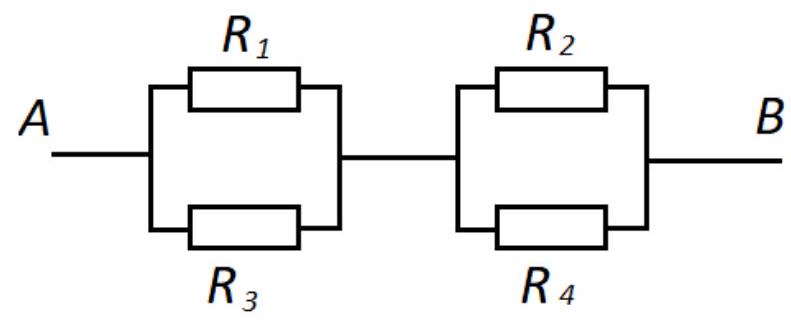
Its total resistance: $R=\frac{R_{1} R_{3}}{R_{1}+R_{3}}+\frac{R_{2} R_{4}}{R_{2}+... | 2.08\Omega | Other | math-word-problem | Yes | Yes | olympiads | false |
Given the function $f(x)=\frac{x-1}{{e}^{x}}$, the equation of the tangent line to the curve $y=f\left(x\right)$ at the point $\left(0,f\left(0\right)\right)$ is ______. | To find the equation of the tangent line to the curve $y=f(x)$ at the point $(0,f(0))$, we first need to determine $f(0)$ and the slope of the tangent line at that point, which is given by $f'(x)$.
Given $f(x)=\frac{x-1}{e^x}$, let's calculate $f(0)$ and $f'(x)$:
1. **Calculate $f(0)$:**
\[f(0) = \frac{0-1}{e^0} = \f... | 2x-y-1=0 | Calculus | math-word-problem | Yes | Yes | cn_k12 | false |
If the solution set of the inequality $ax^{2}+bx+c \gt 0$ with respect to $x$ is $\{x|1 \lt x \lt 3\}$, then the solution set of the inequality $cx^{2}+bx+a \gt 0$ is ( )
A: $\{x| -3 \lt x \lt -1\}$
B: $\{x|\frac{1}{3} \lt x \lt 1\}$
C: $\{x|x \lt \frac{1}{3}$ or $x \gt 1\}$
D: $\{x| x \lt -3$ or $x \gt -1\}$ | Given that the solution set of the inequality $ax^2 + bx + c > 0$ is $\{x | 1 0$ holds between these two roots, and knowing the parabolic nature of quadratic equations, $a$ must be less than $0$ (the parabola opens downwards).
2. **Relating $a$, $b$, and $c$ to the Roots**:
- By Vieta's formulas, the sum of the ro... | B | Inequalities | MCQ | Yes | Yes | cn_k12 | false |
Prove the equality: $C_{n}^{1}-\frac{1}{3} C_{n}^{3}+\frac{1}{9} C_{n}^{5}-\ldots=\frac{2^{n}}{3^{(n-1) / 2}} \sin \frac{n \pi}{6}$. | This sum is equal to the imaginary part of the expression $\sqrt{3}\left(1+\frac{i}{\sqrt{3}}\right)^{n}$, and $1+\frac{i}{\sqrt{3}}=\frac{2}{\sqrt{3}}\left(\cos \frac{\pi}{6}+i \sin \frac{\pi}{6}\right)$. | proof | Combinatorics | proof | Yes | Yes | olympiads | false |
Given the function $f(x)=-x^{3}+ax^{2}-x-1$ is monotonically decreasing on $(-\infty,+\infty)$, the range of the real number $a$ is ( )
A: $(-\infty,- \sqrt{3}]∪[ \sqrt{3},+\infty)$
B: $\left[- \sqrt{3}, \sqrt{3}\right]$
C: $(-\infty,- \sqrt{3})∪\left( \sqrt{3},+\infty\right)$
D: $\left(- \sqrt{3}, \sqrt{3}\... | **Analysis**
To find the derivative of the function, since $f(x)$ is monotonically decreasing on $(-\infty,+\infty)$, then $f'(x) \leqslant 0$ always holds. Solving the inequality will give the answer.
This question mainly tests the application of derivatives, requiring a good grasp of the relationship between deriv... | \left[- \sqrt {3}, \sqrt {3}\right] | Algebra | MCQ | Yes | Yes | cn_k12 | false |
10. As shown in the figure, given $\triangle A B C$ is inscribed in the parabola $G: x^{2}=y$, and the lines containing sides $A B, A C$ are tangent to the parabola $M: y^{2}=4 x$, $F$ is the focus of the parabola $M$.
Prove: (1) The line containing side $B C$ is tangent to the parabola $M$;
(2) Points $A, C, B, F$ are... | (1) Let $A\left(t, t^{2}\right)$, the lines $A B, A C$ are tangent to the parabola $y^{2}=4 x$ at points $D\left(x_{1}, y_{1}\right), E\left(x_{2}, y_{2}\right)$, then $A D: y_{1} y=2\left(x+x_{1}\right), A E: y_{2} y=2\left(x+x_{2}\right)$, thus $D E: t^{2} y=2(x+t)$.
Solving $\left\{\begin{array}{l}y^{2}=4 x, \\ t^{2... | proof | Geometry | proof | Yes | Yes | olympiads | false |
In the geometric sequence $\{a_n\}$, $a_1=2$, $a_8=4$, and the function $f(x)=x(x-a_1)(x-a_2)\ldots(x-a_8)$, then $f′(0)=$ ( )
A: $2^6$
B: $2^9$
C: $2^{12}$
D: $2^{15}$ | Considering the derivative $f′(0)$, where terms containing $x$ are all taken as $0$, we get: $f′(0)=a_1a_2a_3\ldots a_8=(a_1a_8)^4=2^{12}$.
Therefore, the correct choice is $\boxed{C}$. | C | Algebra | MCQ | Yes | Yes | cn_k12 | false |
If point P $(m, m-1)$ is on the x-axis, then $m=$ __ . | Since point P $(m, m-1)$ is on the x-axis in the Cartesian coordinate system,
Therefore, the y-coordinate of this point is $0$,
Thus, $m-1=0$,
Solving this, we get $m=1$.
Hence, the answer is $\boxed{1}$. | 1 | Algebra | math-word-problem | Yes | Yes | cn_k12 | false |
Find all sequence of consecutive positive numbers which the sum of them is equal with $2019$. | null | null | Number Theory | math-word-problem | Yes | Yes | aops_forum | false |
Compare the sizes of $\frac{2}{3}$ ____ $\frac{5-\sqrt{11}}{3}$. (Fill in with "$>$", "$<$", or "$=$") | To compare $\frac{2}{3}$ and $\frac{5-\sqrt{11}}{3}$, we first estimate the value of $\sqrt{11}$ and then compare the two fractions.
1. **Estimate $\sqrt{11}$:**
We know that $3^2 = 9$ and $4^2 = 16$. Therefore, $3 \frac{5-\sqrt{11}}{3}$.
Hence, the correct comparison is $\boxed{>}$.
**Analysis:**
This problem... | > | Inequalities | math-word-problem | Yes | Yes | cn_k12 | false |
Calculate $0.01^{-\frac{1}{2}} + 8^{\frac{2}{3}} + 2^{\log_{4}5} =$ __________. | **Analysis**
This problem tests the knowledge of exponential and logarithmic operations. The key to solving it is to be proficient in the rules of operations for exponentials and logarithms.
The solution can be directly calculated using the rules of operations for exponentials and logarithms.
**Solution**
Given: $0... | 14 + \sqrt{5} | Algebra | math-word-problem | Yes | Yes | cn_k12 | false |
To be proven: if for the natural numbers $a, b, c, d$, $a b=c d$, then $(a, c) \cdot(a, d):(a, b, c, d)=a$. (The greatest common divisor of the numbers enclosed in parentheses is denoted by the parentheses.) | I. Solution: Consider the prime factorization of the numbers $a, b, c, d$, and form the necessary greatest common divisors (GCD) in product form. In this, the exponent of each prime $p$ is equal to the smallest of the exponents with which $p$ appears in the prime factorization of the relevant numbers. Thus, the proof c... | proof | Number Theory | proof | Yes | Yes | olympiads | false |
By the time Anne is two times as old as Emile, Emile will be six times as old as Maude. If Anne will be 96 years old, how old will Maude be at that time? | Let's denote Anne's age at the time in question as A, Emile's age as E, and Maude's age as M.
According to the problem, Anne will be 96 years old when she is twice as old as Emile. So we can write the first equation as:
A = 2E
96 = 2E
From this, we can solve for E:
E = 96 / 2
E = 48
Now, we are told that at this t... | 96 | Algebra | math-word-problem | Yes | Yes | orca_math | true |
Five volunteers participate in community service for two days, Saturday and Sunday. Each day, two people are selected from the group to serve. The number of ways to select exactly one person to serve both days is:
A: $120$
B: $60$
C: $40$
D: $30$ | To solve this problem, we'll break it down into a series of steps that follow the logic of the provided solution.
**Step 1: Select 1 person to serve both days.**
Since we have 5 volunteers and we need to choose 1 person who will serve on both Saturday and Sunday, we can calculate the number of ways to make this selec... | B | Combinatorics | MCQ | Yes | Yes | cn_k12 | false |
Let set $A=\{1,2,3\}$, $B=\{2,4,6\}$, then $A \cap B=$. | Given set $A=\{1,2,3\}$, $B=\{2,4,6\}$,
thus $A \cap B=\{1,2,3\} \cap \{2,4,6\}=\{2\}$.
Therefore, the answer is $\boxed{\{2\}}$. | \{2\} | Logic and Puzzles | math-word-problem | Yes | Yes | cn_k12 | false |
The flights map of air company $K_{r,r}$ presents several cities. Some cities are connected by a direct (two way) flight, the total number of flights is m. One must choose two non-intersecting groups of r cities each so that every city of the first group is connected by a flight with every city of the second group. Pr... | 1. **Define the problem and relevant pairs:**
- We need to choose two non-intersecting groups of \( r \) cities each, such that every city in the first group is connected by a flight to every city in the second group.
- Consider all pairs \((A, B)\) where:
- \(P\) and \(Q\) are two disjoint groups of cities,... | k \leq 2 \cdot m^r | Combinatorics | proof | Yes | Yes | aops_forum | false |
Problem 8.2. The numbers from 1 to 9 were placed in the cells of a $3 \times 3$ table such that the sum of the numbers on one diagonal is 7, and on the other diagonal is 21. What is the sum of the numbers in the five shaded cells?
. Therefore, it must contain the num... | 25 | Logic and Puzzles | math-word-problem | Yes | Yes | olympiads | false |
Given two vectors $\overrightarrow{a}$ and $\overrightarrow{b}$ in a plane that are orthogonal to each other, with magnitudes $|\overrightarrow{a}|=2$ and $|\overrightarrow{b}|=1$, and $k$ and $t$ are real numbers that are not simultaneously zero.
(1) If the vectors $\overrightarrow{x} = \overrightarrow{a} + (t-3)\over... | (1) Since $\overrightarrow{a}$ and $\overrightarrow{b}$ are orthogonal, we have $\overrightarrow{a} \cdot \overrightarrow{b} = 0$. The vectors $\overrightarrow{x}$ and $\overrightarrow{y}$ are also orthogonal, so we have $\overrightarrow{x} \cdot \overrightarrow{y} = 0$. Expanding the dot product yields:
\begin{align*}... | -\frac{9}{16} | Algebra | math-word-problem | Yes | Yes | cn_k12 | false |
13. (6 points) Fill the numbers $1-6$ in the $O$'s in the figure below, so that the sum of the three numbers on each side of the triangle is equal.
保留了源文本的换行和格式,如上所示。 | 13. (6 points) Fill the numbers $1-6$ in the $O$ in the figure, so that the sum of the three numbers on each side of the triangle is equal.
【Solution】Let the three numbers at the vertices be $a$, $b$, and $c$. According to the problem, we have:
$$
1+2+3+4+5+6+a+b+c=21+a+b+c
$$
When $a+b+c=6+5+4$, the value of $21+a+b+... | notfound | Logic and Puzzles | math-word-problem | Yes | Yes | olympiads | false |
15.5*. From the vertex $B$ of the parallelogram $A B C D$, its heights $B K$ and $B H$ are drawn. It is known that $K H=a$ and $B D=b$. Find the distance from point $B$ to the intersection point of the heights of triangle $B K H$.
untranslated text:
15.5*. Из вершины $B$ параллелограмма $A B C D$ проведены его высоты... | 15.5. Let the intersection point of the altitudes of triangle $B K H$ be denoted as $H_{1}$. Since $H H_{1} \perp B K$ and $K H_{1} \perp B H$, it follows that $H H_{1} \| A D$ and $K H_{1} \| D C$, i.e., $H_{1} H D K$ is a parallelo-
 by... | 70 | Algebra | math-word-problem | Yes | Yes | orca_math | true |
21.19. The periods of regular fractions with denominator 7 are obtained from each other by cyclic permutation:
$$
\begin{array}{lll}
1 / 7=0,(142857), & 3 / 7=0,(428571), & 2 / 7=0,(285714) \\
6 / 7=0,(857142), & 4 / 7=0,(571428), & 5 / 7=0,(714285)
\end{array}
$$
Prove that all prime numbers $p$ for which the period... | 21.19. We will divide 1 by $p$ in a column. As a result, some remainders will periodically repeat. For example, when dividing 1 by 7, the remainders $1,3,2,6,4,5$ periodically repeat. In the case where the period length is $p-1$, this sequence contains all possible remainders $1,2, \ldots, p-1$.
Let's return to the ex... | proof | Number Theory | proof | Yes | Yes | olympiads | false |
In the numbers $1,2, \cdots, 2002$, the number of positive integers that have exactly one digit 0 in their binary representation is ( ),
(A) 495
(B) 414
(C) 324
(D) 243 | 6. (B).
For 2, 3, and 4-digit numbers, the number of positive integers sought is $9+2 \times 9^{2}+3 \times 9^{2}=414$. | 414 | Combinatorics | MCQ | Yes | Yes | olympiads | false |
What is the remainder if the dividend is 222, the divisor is 13, and the quotient is 17? | To find the remainder, we can use the formula:
Dividend = (Divisor × Quotient) + Remainder
Given the dividend is 222, the divisor is 13, and the quotient is 17, we can plug these values into the formula:
222 = (13 × 17) + Remainder
Now, let's calculate the product of the divisor and the quotient:
13 × 17 = 221
No... | 1 | Number Theory | math-word-problem | Yes | Yes | orca_math | true |
The graph of the equation \(y = \frac{x}{x^3 + Ax^2 + Bx + C}\), where \(A, B, C\) are integers, is given. The graph shows vertical asymptotes at \(x = -3, 0, 2\). Find the sum \(A + B + C\). | From the problem, we know that the vertical asymptotes occur where the denominator is zero. Therefore, the denominator \(x^3 + Ax^2 + Bx + C\) should factor as \((x + 3)(x - 2)(x)\).
To find \(A\), \(B\), and \(C\), we expand this product:
\[
(x + 3)(x - 2)(x) = (x^2 + 3x - 2x - 6)(x) = (x^2 + x - 6)(x) = x^3 + x^2 - ... | -5 | Algebra | math-word-problem | Yes | Yes | synthetic_math | true |
In the Cartesian coordinate system xOy, the parametric equations for curves $C_1$ and $C_2$ are respectively given by
$$
\begin{cases}
x=t \\
y= \sqrt{t}
\end{cases}
\quad \text{(where $t$ is the parameter)}
$$
and
$$
\begin{cases}
x= \sqrt{2}\cos\theta \\
y= \sqrt{2}\sin\theta
\end{cases}
\quad \text{(where $\theta$... | To find the intersection point(s) of $C_1$ and $C_2$, we can convert the parametric equations into their standard form.
For curve $C_1$, by squaring the equation of y, we get:
$$ y^2 = (\sqrt{t})^2 $$
Thus, the standard form is:
$$ y^2 = t $$
And since $x=t$, we can write:
$$ y^2 = x \quad \text{(Equation 1)} $$
For... | (1,1) | Algebra | math-word-problem | Yes | Yes | cn_k12 | false |
Simplify:
$$\sqrt[3]{5488000}$$ | First, we recognize that $5488000$ can be broken down into factors that include cubes. Begin by factoring out $1000 = 10^3$, so we have $\sqrt[3]{5488000} = 10 \sqrt[3]{5488}$.
Next, factorize $5488$:
$$ 5488 = 2 \cdot 2744 = 2 \cdot 2^3 \cdot 343 = 2^4 \cdot 343. $$
Since $2^3$ and $343$ are both cubes ($343 = 7^3$ ... | 280 \cdot \sqrt[3]{2} | Number Theory | math-word-problem | Yes | Yes | synthetic_math | true |
If $2^{m}=3$ and $2^{n}=2$, then the value of $2^{2m+2n}$ is ______. | Given that $2^{m}=3$ and $2^{n}=2$, we want to find the value of $2^{2m+2n}$. Let's break this down step by step.
First, we use the property of exponents that allows us to distribute the exponent over a product:
\[2^{2m+2n} = 2^{2m} \cdot 2^{2n}\]
Next, we can rewrite each term as a power raised to another power, usi... | 36 | Algebra | math-word-problem | Yes | Yes | cn_k12 | false |
Let $\triangle ABC$ have sides $a$, $b$, and $c$ opposite to angles $A$, $B$, and $C$ respectively. Given that $\sin C\sin \left(A-B\right)=\sin B\sin \left(C-A\right)$. Prove the following:
$(1)$ Show that $2a^{2}=b^{2}+c^{2}$;
$(2)$ If $a=5$ and $\cos A=\frac{{25}}{{31}}$, find the perimeter of $\triangle ABC$. | ### Solution:
#### Part (1): Proof
Given $\sin C\sin(A-B) = \sin B\sin(C-A)$, we start by expanding the sine of differences:
\begin{align*}
\sin C(\sin A\cos B - \cos A\sin B) &= \sin B(\sin C\cos A - \cos C\sin A) \\
\sin A\sin B\cos C + \sin A\cos B\sin C &= \sin B\sin C\cos A + \sin A\sin B\sin C \\
\sin A(\sin B\... | 14 | Algebra | proof | Yes | Yes | cn_k12 | false |
For integers \( a \), \( b \), \( c \), and \( d \), let \( (x^2 + ax + b)(x^2 + cx + d) = x^4 - 2x^3 + 3x^2 - 4x + 6 \). What is the value of \( a + b + c + d \)? | 1. First, expand the left side and match the coefficients to those in the polynomial on the right:
\[
(x^2 + ax + b)(x^2 + cx + d) = x^4 + (a+c)x^3 + (ac + b + d)x^2 + (ad + bc)x + bd
\]
Equate to the given polynomial:
\[
x^4 - 2x^3 + 3x^2 - 4x + 6
\]
So, \( a+c = -2 \), \( ac + b + d = 3 \), \(... | a + b + c + d | Algebra | math-word-problem | Yes | Yes | synthetic_math | true |
You are given a sequence of $45$ terms; each term has the form $Q+n$ where $Q$ stands for the product $3 \times 5 \times 7 \times\ldots \times 47$ of all prime numbers less than or equal to $47$, and $n$ takes successively the values $3, 4, 5,\ldots, 47$. Let $M$ be the number of primes appearing in this sequence. What... | First, note that $Q = 3 \times 5 \times 7 \times\ldots \times 47$, a product of all primes up to $47$. Each term in the sequence is of the form $Q + n$ where $n$ ranges from $3$ to $47$. Because we want to find how many such terms are prime, we should consider the properties of $Q$ and $n$:
- $Q$ is divisible by each ... | 0 | Number Theory | math-word-problem | Yes | Yes | synthetic_math | true |
Given $p$: The curve represented by the equation $\frac{x^2}{3-t} + \frac{y^2}{t+1} = 1$ is an ellipse with foci on the x-axis; $q$: The real number $t$ satisfies the inequality $t^2 - (a-1)t - a < 0$.
(Ⅰ) If $p$ is true, find the range of the real number $t$;
(Ⅱ) If $p$ is a sufficient but not necessary condition for ... | Solution:
(Ⅰ) Since the curve represented by the equation $\frac{x^2}{3-t} + \frac{y^2}{t+1} = 1$ is an ellipse with foci on the x-axis,
it follows that $3-t > t+1 > 0$, solving this yields $-1 1$,
hence, the range of the real number $a$ is $\boxed{\{a|a > 1\}}$. | \{a|a > 1\} | Algebra | math-word-problem | Yes | Yes | cn_k12 | false |
Find the coefficient of $x^4$ when the expression $4(x^4 - 2x^3) + 3(x - x^4 + 2x^5) - (5x^5 - 2x^4)$ is simplified. | First, distribute the constants through the terms in each polynomial:
\[
4(x^4 - 2x^3) = 4x^4 - 8x^3,
\]
\[
3(x - x^4 + 2x^5) = 3x - 3x^4 + 6x^5,
\]
\[
-(5x^5 - 2x^4) = -5x^5 + 2x^4.
\]
Next, combine all the terms:
\[
(4x^4 - 8x^3) + (3x - 3x^4 + 6x^5) + (-5x^5 + 2x^4) \\
= 4x^4 - 3x^4 + 2x^4 - 8x^3 + 3x + 6x^5 - 5x^5... | 3 | Algebra | math-word-problem | Yes | Yes | synthetic_math | true |
19.6.11 * | Prove: If $A_{1}, A_{2}, \cdots, A_{t}$ are $k_{1}, k_{2}, \cdots, k_{t}$ sets respectively, and
$$
A_{1} \cup A_{2} \cup \cdots \cup A_{t}=\mathbf{Z},
$$
then
$$
\frac{1}{k_{1}}+\frac{1}{k_{2}}+\cdots+\frac{1}{k_{t}} \geqslant 1.
$$
Solution: Take a sufficiently large positive integer $x$, and let
$$
A_{(x)}=\{a \mi... | proof | Algebra | math-word-problem | Incomplete | Yes | olympiads | false |
17. Let $Q$ be a point inside a convex polyhedron $M$. A line $\ell$ passing through $Q$ intersects the surface of the polyhedron at points $A$ and $B$. Prove that for an infinite set of directions of the line $\ell$, it is true that $A Q = B Q$. | Let $M^{\prime}$ be the polyhedron symmetric to $M$ with respect to $Q$. The polyhedra $M$ and $M^{\prime}$ intersect, since both contain the point $Q$. At the same time, neither of them is contained in the other, since the volumes of $M$ and $M^{\prime}$ are equal. Therefore, the surfaces of the polyhedra $M$ and $M^{... | proof | Geometry | proof | Yes | Yes | olympiads | false |
Alexander is going food shopping. He buys some apples for $1 each and 2 oranges for $2 each. He spends $9. How many apples did he buy? | Let's denote the number of apples Alexander buys as A. Each apple costs $1, so the total cost for the apples is $1 * A.
He also buys 2 oranges, each costing $2, so the total cost for the oranges is $2 * 2 = $4.
The total amount spent is $9, which is the sum of the cost of apples and oranges.
So, we have the equation... | 5 | Algebra | math-word-problem | Yes | Yes | orca_math | true |
Given vectors $\overrightarrow{a}=( \sqrt {3},1)$, $\overrightarrow{b}=(0,-1)$, $\overrightarrow{c}=( \sqrt {3},k)$, if $\overrightarrow{a}-2 \overrightarrow{b}$ is perpendicular to $\overrightarrow{c}$, then $k=$ _____ . | Since $\overrightarrow{a}=( \sqrt {3},1)$ and $\overrightarrow{b}=(0,-1)$,
we have $\overrightarrow{a}-2 \overrightarrow{b}=( \sqrt {3},3)$.
Also, $\overrightarrow{c}=( \sqrt {3},k)$, and $\overrightarrow{a}-2 \overrightarrow{b}$ is perpendicular to $\overrightarrow{c}$,
we have $\sqrt {3} \times \sqrt {3} + 3k = 0$... | -1 | Algebra | math-word-problem | Yes | Yes | cn_k12 | false |
Josh has 100 feet of rope. He cuts the rope in half, and then takes one of the halves and cuts it in half again. He grabs one of the remaining pieces and cuts it into equal parts. He's stuck holding one length of the rope he's most recently cut, which is 5 feet long. What is the ratio of the length of the third cut rop... | Let's break down the process step by step:
1. Josh starts with 100 feet of rope.
2. He cuts the rope in half, so he now has two pieces of 50 feet each.
3. He takes one of the 50-foot pieces and cuts it in half again, resulting in two pieces of 25 feet each.
4. He takes one of the 25-foot pieces and cuts it into equal ... | 1:5 | Logic and Puzzles | math-word-problem | Yes | Yes | orca_math | true |
Making an equal number of drums of paint each day, a paint mixer takes three days to make 18 drums of paint. How many days will it take for him to make a certain number of drums of paint if it takes him 60 days to make 360 drums of paint? | First, let's find out how many drums of paint the mixer makes each day when he takes three days to make 18 drums of paint.
18 drums / 3 days = 6 drums per day
Now, let's find out how many drums of paint he makes each day when it takes him 60 days to make 360 drums of paint.
360 drums / 60 days = 6 drums per day
Si... | 6 | Algebra | math-word-problem | Yes | Yes | orca_math | true |
Given a sector with a central angle of 3 radians and a radius of 4, find the area of the sector. | We know that the length of the arc, $ l $, in a circle is given by the product of the central angle in radians and the radius of the circle. Thus we have:
$$ l = \theta \cdot r = 3 \cdot 4 = 12 $$
Next, we use the formula for the area of a sector, which is half the product of the arc length times the radius:
$$ S = \f... | 24 | Geometry | math-word-problem | Yes | Yes | cn_k12 | false |
How many natural numbers $(a,b,n)$ with $ gcd(a,b)=1$ and $ n>1 $ such that the equation \[ x^{an} +y^{bn} = 2^{2010} \] has natural numbers solution $ (x,y) $ | 1. **Given Equation and Conditions:**
We start with the equation:
\[
x^{an} + y^{bn} = 2^{2010}
\]
where \(a, b, n\) are natural numbers, \(\gcd(a, b) = 1\), and \(n > 1\). We need to find the number of natural number solutions \((x, y)\).
2. **Considering Prime Divisors of \(n\):**
If \(p\) is an od... | 54 | Number Theory | math-word-problem | Yes | Yes | aops_forum | false |
The negation of the proposition "$\exists x_0 \in \mathbb{R}$, $5^{x_0} + \sin x_0 \leqslant 0$" is ( )
A: $\exists x_0 \in \mathbb{R}$, $5^{x_0} + \sin x_0 \leqslant 0$
B: $\forall x \in \mathbb{R}$, $5^x + \sin x > 0$
C: $\forall x \in \mathbb{R}$, $5^x + \sin x \geqslant 0$
D: $\exists x_0 \in \mathbb{R}$, $5^{x_... | **Analysis**
This question tests the negation of a proposition with a quantifier, which is a basic question.
Change "exists" to "for all" and negate the conclusion accordingly.
**Solution**
The negation of the proposition "$\exists x_0 \in \mathbb{R}$, $5^{x_0} + \sin x_0 \leqslant 0$" is "$\forall x \in \mathbb{R}... | \text{B} | Algebra | MCQ | Yes | Yes | cn_k12 | false |
If there are 4 different red envelopes in a WeChat group of 3 people, and each red envelope can only be grabbed once, and each person must grab at least one red envelope, then the total number of ways the red envelopes can be grabbed is
A: 36 ways
B: 24 ways
C: 18 ways
D: 12 ways | **Analysis**
This question examines the comprehensive application of permutations and combinations, dividing the four red envelopes into three groups, and then distributing these three groups among three people.
**Solution**
Given the condition, one person among the three will grab 2 red envelopes. Therefore, select... | A | Combinatorics | MCQ | Yes | Yes | cn_k12 | false |
Given that $\sin (3π-α)=2\sin ( \frac {π}{2}+α)$, find the value of $\frac {\sin ^{3}(π-α)-\sin ( \frac {π}{2}-α)}{3\cos ( \frac {π}{2}+α)+2\cos (π+a)}$. | We have $\sin (3π-α)=2\sin ( \frac {π}{2}+α)$,
This implies that $\sin α=2\cos α$, hence $\tan α=2$ and $\sin ^{2}α= \frac {\tan ^{2}α}{1+\tan ^{2}α} = \frac {4}{5}$.
Thus, $\frac {\sin ^{3}(π-α)-\sin ( \frac {π}{2}-α)}{3\cos ( \frac {π}{2}+α)+2\cos (π+a)} = \frac {\sin ^{3}α-\cos α}{-3\sin α -2\cos α} = \frac {\tan ... | -\frac{3}{40} | Algebra | math-word-problem | Yes | Yes | cn_k12 | false |
Let $A$ be a real $n\times n$ Matrix and define $e^{A}=\sum_{k=0}^{\infty} \frac{A^{k}}{k!}$
Prove or disprove that for any real polynomial $P(x)$ and any real matrices $A,B$,
$P(e^{AB})$ is nilpotent if and only if $P(e^{BA})$ is nilpotent. | 1. **Matrix Exponential Definition**:
The matrix exponential \( e^A \) for a square matrix \( A \) is defined as:
\[
e^A = \sum_{k=0}^{\infty} \frac{A^k}{k!}
\]
This series converges for any square matrix \( A \).
2. **Eigenvalues and Matrix Exponential**:
If \( \lambda \) is an eigenvalue of a matri... | null | Algebra | proof | Yes | Yes | aops_forum | false |
How does the function
$$
y^{2}=\frac{4 a^{2} x^{2}+b^{2}\left(x^{2}-1\right)^{2}}{\left(x^{2}+1\right)^{2}}
$$
change as $x$ varies from $-\infty$ to $+\infty$?
Determine the maximum and minimum values of $y$ if $a > b$.
Furthermore, show that if $y$ is given a value between $a$ and $b$, then the equation in $x$ is... | Currently, we can only display texts that were published before December 1905 or between January 1937 and December 2020. Please write to archiv@komal.hu if you need the text. | notfound | Algebra | math-word-problem | Yes | Incomplete | olympiads | false |

Prove that if there exists a circle that touches all sides of a convex quadrilateral $ABCD$, and a circle that touches the extensions of all its sides, then the diagonals of such a quadrilate... | Consider two circles touching the sides of a given quadrilateral and their extensions. The lines containing the sides of the quadrilateral are common internal and external tangents to these circles. The line connecting the centers of the circles contains a diagonal of the quadrilateral, and, moreover, it is the axis of... | proof | Geometry | proof | Incomplete | Yes | olympiads | false |
A certain kind of fuel is 1515 high octane and 4545 regular octane. If high octane costs 3 times as much as regular octane, what fraction of the cost of the fuel is due to the high octane? | Let's assume the cost of regular octane is $1 per unit. Then the cost of high octane would be $3 per unit since it costs 3 times as much.
If the fuel consists of 15 units of high octane and 45 units of regular octane, the total cost of the high octane would be 15 units * $3/unit = $45.
The total cost of the regular o... | 50\%) | Algebra | math-word-problem | Incomplete | Yes | orca_math | true |
38. Prove that for any point in the plane, the area of the polygon obtained by the intersection of a given triangle $ABC$ with the triangle symmetric to it with respect to this point does not exceed $2/3$ of the area of triangle $ABC$. | 83.38. Note. If the center of symmetry is chosen as the centroid of the triangle, then the area of the resulting hexagon is exactly $2 / 3$ of the area of the original triangle. | proof | Geometry | proof | Yes | Incomplete | olympiads | false |
for a certain art exhibit , a museum sold admission tickets to a group of 30 people every 5 minutes from 9 : 00 in the morning to 4 : 55 in the afternoon , inclusive . the price of a regular admission ticket was $ 10 and the price of a student ticket was $ 6 . if on one day 3 times as many regular admission tickets wer... | First, let's calculate the number of 5-minute intervals between 9:00 AM and 4:55 PM.
From 9:00 AM to 4:00 PM is 7 hours, and each hour has 12 five-minute intervals (since 60 minutes / 5 minutes per interval = 12 intervals per hour). So, for 7 hours, we have 7 hours * 12 intervals/hour = 84 intervals.
From 4:00 PM to ... | \$25,652 | Algebra | math-word-problem | Yes | Yes | orca_math | true |
If the domain of functions $f(x)$ and $g(x)$ is $R$, and $\frac{{f(x)}}{{g(x)}}=\frac{{g({x+2})}}{{f({x-2})}},\frac{{f({2022})}}{{g({2024})}}=2$, then $\sum_{k=0}^{23}{\frac{{f(2k)}}{{g(2k+2)}}}=$
A: $28$
B: $30$
C: $46$
D: $48$ | Given that $\frac{f(x)}{g(x)} = \frac{g(x+2)}{f(x-2)}$, we can manipulate this equation to understand the relationship between $f(x)$ and $g(x)$ in a more useful form. Let's start by cross-multiplying to get a clearer picture:
\[
\frac{f(x)}{g(x)} = \frac{g(x+2)}{f(x-2)} \implies f(x)f(x-2) = g(x)g(x+2)
\]
Now, divid... | B: 30 | Algebra | MCQ | Yes | Incomplete | cn_k12 | false |
How many 100-digit natural numbers are there, all of whose digits are even and the difference between any two adjacent digits is $2$? | Let's try to write down these numbers! First, let the first digit be 2 or 6. In both cases, there are 3 possibilities for the second and third digits: 202, 242, 246, and 686, 642, 646. Notice that the third digit is also either 2 or 6. The fourth and fifth digits can then be chosen in 3 ways, and so on. Thus, after eve... | 7\cdot3^{49} | Combinatorics | math-word-problem | Yes | Yes | olympiads | false |
The square root of the expression $(m-2n-3)(m-2n+3)+9$ is ( )
A: $m-2n$
B: $2n-m$
C: When $m \geq 2n$, $m-2n$; when $m < 2n$, $2n-m$
D: When $m \geq 2n$, $2n-m$; when $m < 2n$, $m-2n$ | **Solution**: Starting with $(m-2n-3)(m-2n+3)+9$
$= [(m-2n)-3][(m-2n)+3]+9$
$= (m-2n)^2 - 3^2 + 9$
$= (m-2n)^2$,
when $m \geq 2n$, we have $m-2n \geq 0$, thus the square root of the original expression is
$$
\sqrt{(m-2n)^2} = |m-2n| = m-2n;
$$
when $m < 2n$, we have $m-2n < 0$, thus the square root of the ori... | C | Algebra | MCQ | Yes | Yes | cn_k12 | false |
Simplify: $\sqrt{{(-\;9)}^{2}}=\_\_\_\_\_\_.$ | To simplify $\sqrt{{(-9)}^{2}}$, we follow the properties of square roots and exponents.
First, we recognize that when we square a negative number, the result is positive. This is because $(-9) \times (-9) = 81$.
Next, we take the square root of the result. The square root of a number is a value that, when multipli... | 9 | Algebra | math-word-problem | Yes | Yes | cn_k12 | false |
What is the value of \(x^6 - x^3 - 6x\) when \(x = 3\)? | Given the expression \(x^6 - x^3 - 6x\), we need to substitute \(x = 3\).
1. Calculate \(x^6\): \(3^6 = 729\).
2. Calculate \(x^3\): \(3^3 = 27\).
3. Calculate \(6x\): \(6 \times 3 = 18\).
4. Solve the expression:
\[
729 - 27 - 18 = 684.
\]
Therefore, the value is \(\boxed{684}\). | 684 | Algebra | math-word-problem | Yes | Yes | synthetic_math | true |
Given that $a$ and $b$ are additive inverses, $b$ and $c$ are multiplicative inverses, and $m^3 = m$.
1. Determine the value of $\frac{2a+2b}{m+2} + ac$.
2. If $a > 1$ and $m < 0$, let $S = |2a - 3b| - 2|b - m| - |b + \frac{1}{2}|$. Find the value of $4(2a - S) + 2(2a - S) - (2a - S)$.
3. If $m \neq 0$, discuss whether... | 1. Since $a + b = 0$ and $b \cdot c = 1$, it follows that $a \cdot c = \frac{a}{b} = \frac{-b}{b} = -1$. \[\frac{2a+2b}{m+2} + ac = \frac{2(a + b)}{m + 2} + ac = \frac{2 \cdot 0}{m + 2} - 1 = -1\]
Hence, the value we seek is $\boxed{-1}$.
2. Given $a > 1$, we get $b 0$ and $b + \frac{1}{2} 1: |x + 1| - |x - 1| = (x ... | 2 | Algebra | math-word-problem | Yes | Yes | cn_k12 | false |
Subsets and Splits
No community queries yet
The top public SQL queries from the community will appear here once available.