
instruction_seed stringlengths 2 10.7k | solution stringlengths 0 10.8k ⌀ | answer stringlengths 0 575 ⌀ | problem_type stringclasses 9
values | question_type stringclasses 5
values | problem_is_valid stringclasses 5
values | solution_is_valid stringclasses 4
values | source stringclasses 11
values | synthetic bool 2
classes |
|---|---|---|---|---|---|---|---|---|
My school now has 10 boys and 12 girls in the math club. We still need to select a team to send to the state math competition, increasing the team size to 8. The team must consist of exactly 4 boys and 4 girls. How many ways can I select such a team? | 1. **Choosing Boys**: Since there are 10 boys and the team requires exactly 4 boys, the number of ways to choose the boys is given by the combination formula:
\[
\binom{10}{4}
\]
2. **Choosing Girls**: There are 12 girls, and we need exactly 4 girls for the team, so:
\[
\binom{12}{4}
\]
3. **Total C... | 103950 | Combinatorics | math-word-problem | Yes | Yes | synthetic_math | true |
Consider the set
\[\{0, 1\}^n = \{X = (x_1, x_2,\dots , x_n) : x_i \in \{0, 1\}, 1 \leq i \leq n\}.\]
We say that $X > Y$ if $X \neq Y$ and the following $n$ inequalities are satisfy
\[x_1 \geq y_1, x_1 + x_2 \geq y_1 + y_2,\dots , x_1 + x_2 + \cdots + x_n \geq y_1 + y_2 + \cdots + y_n.\]
We define a chain of length ... | null | null | Combinatorics | math-word-problem | Yes | Yes | aops_forum | false |
Given that $f(x)$ is an odd function defined on the interval $[-1,1]$ and $f(1)=1$. If $m, n \in [-1,1]$ and $m+n \neq 0$, then $\frac{f(m)+f(n)}{m+n} > 0$.
$(1)$ Prove that $f(x)$ is an increasing function on the interval $[-1,1]$;
$(2)$ Solve the inequality $f(x^{2}-1)+f(3-3x) < 0$;
$(3)$ If $f(x) \leqslant t^{2}-... | Solution:
$(1)$ For any $-1 \leqslant x_{1} 0$ and $x_{1}-x_{2} < 0$,
Therefore, $f(x_{1})-f(x_{2}) < 0$, which means $f(x_{1}) < f(x_{2})$,
Therefore, $f(x)$ is an increasing function on $[-1,1]$.
$(2)$ Since $f(x)$ is an odd function defined on $[-1,1]$ and is increasing on $[-1,1]$,
The inequality becomes $f(x... | t=0 | Algebra | math-word-problem | Yes | Yes | cn_k12 | false |
Marissa is serving her kids lunch. Each kid gets a burger with 400 calories and 5 carrot sticks with 20 calories each, and some cookies with a certain number of calories each. Marissa wants each kid to eat a total of 750 calories for lunch. How many calories does each cookie have? | First, let's calculate the total calories from the burger and carrot sticks for each kid.
The burger has 400 calories.
Each carrot stick has 20 calories, so 5 carrot sticks have 5 * 20 = 100 calories.
Now, let's add the calories from the burger and carrot sticks together:
400 calories (burger) + 100 calories (carrot ... | 250 | Algebra | math-word-problem | Yes | Incomplete | orca_math | true |
How many ordered pairs of integers $(a,b)$ satisfy all of the following inequalities?
\[
\begin{aligned}
a^2 + b^2 &< 25, \\
a^2 + b^2 &< 10a, \\
a^2 + b^2 &< 10b.
\end{aligned}
\] | The graph of $a^2 + b^2 < 25$ is the set of points inside the circle centered at the origin with radius 5.
From $a^2 + b^2 < 10a,$ we rearrange the inequality:
\[(a - 5)^2 + b^2 < 25.\]
This represents the inside of the circle centered at $(5,0)$ with a radius of 5.
From $a^2 + b^2 < 10b,$ rearranging gives:
\[a^2 + ... | 15 | Inequalities | math-word-problem | Yes | Yes | synthetic_math | true |
Sarah picked 45.0 apples. Her brother picked 9.0 apples. How many times as many apples did Sarah pick. | To find out how many times as many apples Sarah picked compared to her brother, you divide the number of apples Sarah picked by the number of apples her brother picked.
Sarah picked 45.0 apples, and her brother picked 9.0 apples.
So, you divide 45.0 by 9.0:
45.0 ÷ 9.0 = 5
Sarah picked $\boxed{5}$ times as many app... | 5 | Algebra | math-word-problem | Yes | Yes | orca_math | true |
Russian problems Problem 27 Given 5 circles. Every 4 have a common point. Prove that there is a point common to all 5. | Let the circles be a, b, c, d, e. Let A be a point common to b, c, d, e, let B be a point common to a, c, d, e and so on. If any two of A, B, C, D, E coincide then the coincident point is on all 5 circles. Suppose they are all distinct. Then A, B, C are on d and e. Hence d and e coincide (3 points determine a circle). ... | proof | Geometry | proof | Yes | Yes | olympiads | false |
12. [4] Trapezoid $A B C D$, with bases $A B$ and $C D$, has side lengths $A B=28, B C=13, C D=14$, and $D A=15$. Let diagonals $A C$ and $B D$ intersect at $P$, and let $E$ and $F$ be the midpoints of $A P$ and $B P$, respectively. Find the area of quadrilateral $C D E F$. | Answer: 112
Note that $E F$ is a midline of triangle $A P B$, so $E F$ is parallel to $A B$ and $E F=\frac{1}{2} A B=14=C D$. We also have that $E F$ is parallel to $C D$, and so $C D E F$ is a parallelogram. From this, we have $E P=P C$ as well, so $\frac{C E}{C A}=\frac{2}{3}$. It follows that the height from $C$ to ... | 112 | NaN | NaN | NaN | NaN | olympiads | false |
If a windmill rotates clockwise by $60^{\circ}$, it is denoted as $+60^{\circ}$. Then, rotating counterclockwise by $15^{\circ}$ is denoted as ____. | Given that a clockwise rotation by $60^{\circ}$ is denoted as $+60^{\circ}$, we can infer that rotations in the opposite direction, which is counterclockwise, would be denoted with a negative sign. Therefore, for a counterclockwise rotation by $15^{\circ}$, we denote it as:
\[
\begin{align*}
\text{Clockwise rotation} ... | -15^{\circ} | Geometry | math-word-problem | Yes | Yes | cn_k12 | false |
3. From the vertex $A$ of $\triangle A B C$, draw perpendiculars to the internal and external angle bisectors $B E, B F$ of $\angle B$, with feet of the perpendiculars at $E, F$. Then draw perpendiculars to the internal and external angle bisectors $C G, C D$ of $\angle C$, with feet of the perpendiculars at $G, D$. Pr... | 3. Extend $B E, C D$ to intersect at point $K$, and extend $C G, B F$ to intersect at point $L$. Let $C G$ intersect $B E$ at point $I$, then $I$ is the incenter of $\triangle A B C$. Since $\angle C A I=\frac{1}{2} \angle B A C$, and $\angle C K I=90^{\circ}-\angle C I K=90^{\circ}-\frac{1}{2}(\angle B+\angle C)=\frac... | proof | Geometry | proof | Yes | Yes | olympiads | false |
In a race of 1000 m, A can beat B by 100 m. In a race of some distance, B can beat C by 100 m. A beats C by 127.5 m in a race of 600 m. What is the distance of the race where B can beat C by 100 m? | Let's denote the speeds of A, B, and C as Va, Vb, and Vc respectively, and the time it takes for each of them to complete a race as Ta, Tb, and Tc respectively.
From the given information, we know that when A finishes 1000 m, B finishes 900 m. This gives us the ratio of their speeds:
Va / Vb = 1000 / 900 = 10 / 9
No... | 700 | Algebra | math-word-problem | Yes | Yes | orca_math | true |
In the arithmetic sequence $\{a_n\}$, the sum of the first $n$ terms is $S_n$, and the common difference $d < 0$. Given that $S_7 = S_{11}$ and $a_9 = 6$, find the value of $a_{10}$.
Options:
A: $0$
B: $-6$
C: The value of $a_{10}$ is undetermined
D: $a_{10} = 6$ | Given that the sum of the first $n$ terms of an arithmetic sequence $\{a_n\}$ with a common difference $d < 0$ satisfies $S_7 = S_{11}$, and knowing that $a_9 = 6$, we can set up the following system of equations:
\[
\begin{cases}
7a_1 + \dfrac{7 \times 6}{2}d = 11a_1 + \dfrac{11 \times 10}{2}d \\
a_1 + 8d = 6
\end{cas... | -6 | Algebra | MCQ | Yes | Yes | cn_k12 | false |
## Task 1
In 5 windows of a residential building, there are a total of 40 glass panes.
How many panes are in 3 windows? | $40: 5=8 ; 3 \cdot 8=24$. In three windows there are 24 panes. | 24 | Logic and Puzzles | math-word-problem | Yes | Yes | olympiads | false |
9. In the figure, the perimeter of the equilateral triangle is equal to that of the regular hexagon. Given that the area of the equilateral triangle is $10 \mathrm{~cm}^{2}$, then the area of the regular hexagon is $\qquad$ $\mathrm{cm}^{2}$ | 【Answer】15
Analysis: Let the length of each side of the regular hexagon be $\mathrm{a}$, then the length of each side of the equilateral triangle is $2 \mathrm{a}$. After division, the area of each small triangle is the same, $10 \div 4 \times 6=15 \mathrm{~cm}^{2}$ | 15 | Geometry | math-word-problem | Yes | Yes | olympiads | false |
31.41. a) Prove the quadratic reciprocity law using problem 31.39.
b) Let $m$ be an odd prime number. Prove that
$$
\left(\frac{2}{m}\right)=(-1)^{\left(m^{2}-1\right) / 8}
$$ | 31.41. a) Let $P=\{0,1, \ldots, p q-1\}$ and $\bar{P}=\{(a, b): 0 \leqslant aq a^{\prime}+b^{\prime}$ and $a+p ba^{\prime}$ and $b<b^{\prime}$. Thus, $k=C_{q}^{2} C_{p}^{2}=\frac{p-1}{2} \cdot \frac{q-1}{2}$. In the end, we get
$$
\left(\frac{p}{q}\right)\left(\frac{q}{p}\right)=\operatorname{sgn} \mu \operatorname{sg... | proof | Number Theory | proof | Yes | Yes | olympiads | false |
Regarding the inverse proportion function $y=\frac{6}{x}$, which of the following statements is incorrect?
A: The graph of the function lies in the first and third quadrants.
B: The intersection points of the graph and the function $y=x-1$ are $(3,2)$ or $(-2,-3)$.
C: When $x \gt -2$, $y \lt -3$.
D: The graph of th... | To analyze each statement regarding the inverse proportion function $y=\frac{6}{x}$, we proceed as follows:
**Statement A**: The graph of $y=\frac{6}{x}$ lies in the first and third quadrants. This is because for $x > 0$, $y > 0$, and for $x 0$, the graph indeed lies in the first and third quadrants, making this stat... | \text{C} | Algebra | MCQ | Yes | Yes | cn_k12 | false |
Let $\vartriangle A_0B_0C_0$ be an equilateral triangle with area $1$, and let $A_1$, $B_1$, $C_1$ be the midpoints of $\overline{A_0B_0}$, $\overline{B_0C_0}$, and $\overline{C_0A_0}$, respectively. Furthermore, set $A_2$, $B_2$, $C_2$ as the midpoints of segments $\overline{A_0A_1}$, $\overline{B_0B_1}$, and $\overli... | null | null | Geometry | math-word-problem | Yes | Yes | aops_forum | false |
A cylindrical oil tank is $\frac{1}{6}$ full. If four liters were added, the tank would be $\frac{1}{3}$ full. How many liters does the tank hold when it is full? | Let the number of liters of oil in the tank originally be $o$, and let the total capacity of the tank be $t$. Initially, we have $\frac{o}{t} = \frac{1}{6}$. This implies $o = \frac{t}{6}$. After adding four liters of oil, the equation becomes $\frac{o+4}{t} = \frac{1}{3}$. Substituting the first equation into the seco... | 24 | Algebra | math-word-problem | Yes | Yes | synthetic_math | true |
10. The function relationship between the total production $C$ of a certain product and time $t$ (years) in a factory over eight years is shown in Figure $8-2$. Among the following four statements: (1) The production growth rate was accelerating in the first three years; (2) The production growth rate was decelerating ... | 10. (2), (3).
Translate the text above into English, preserving the original text's line breaks and formatting, and output the translation result directly.
However, since the text you provided is already in a numerical and bracket format which is universal, it doesn't need translation. The result is:
10. (2), (3). | (2),(3) | Calculus | math-word-problem | Yes | Incomplete | olympiads | false |
Given that $b$ is an even multiple of $953$, find the greatest common divisor of $3b^2 + 17b + 23$ and $b + 19$. | We start by using the Euclidean Algorithm to find the greatest common divisor (gcd). We have:
1. Compute $\gcd(3b^2 + 17b + 23, b + 19)$.
2. Start by performing the polynomial division on $3b^2 + 17b + 23$ by $b + 19$. The remainder of this division will be of the form:
\[
3b^2 + 17b + 23 - (b + 19)(3b + k) = 3b... | 34 | Algebra | math-word-problem | Yes | Yes | synthetic_math | true |
Find all integers $n$ for which there exists a table with $n$ rows, $2022$ columns, and integer entries, such that subtracting any two rows entry-wise leaves every remainder modulo $2022$.
[i]Proposed by Tony Wang[/i] | To solve the problem, we need to find all integers \( n \) for which there exists a table with \( n \) rows and \( 2022 \) columns, such that subtracting any two rows entry-wise leaves every remainder modulo \( 2022 \).
1. **Assume the existence of such a table:**
Let the rows of the table be denoted by \( \mathbf{... | n \leq 2 | Number Theory | math-word-problem | Yes | Yes | aops_forum | false |
julie put half of her savings in a savings account that pays an annual simple interest and half in a savings account that pays an annual compound interest . after two years she earned $ 120 and $ 126 from the simple interest account and the compound interest account respectively . if the interest rates for both account... | Let's denote the initial amount of Julie's savings as S. She put half of her savings in each account, so the amount in each account is S/2.
For the simple interest account, the interest earned after two years is $120. The formula for simple interest is:
Simple Interest = Principal × Rate × Time
Here, the Principal i... | \$1200 | Algebra | math-word-problem | Yes | Yes | orca_math | true |
Choose any three out of the following four quadratic equations and solve them using appropriate methods.$(1)3x^{2}-2x-1=0$;$(2)\left(y+1\right)^{2}-4=0$;$(3)t^{2}-6t-7=0$;$(4)m\left(m+3\right)-2m=0$.I choose question number ______. | ### Solution:
#### For Equation (1) $3x^{2}-2x-1=0$:
- Factoring the quadratic equation: $(3x+1)(x-1)=0$.
- Setting each factor equal to zero gives us two equations: $3x+1=0$ and $x-1=0$.
- Solving $3x+1=0$ for $x$ gives $x=-\frac{1}{3}$.
- Solving $x-1=0$ for $x$ gives $x=1$.
- Therefore, the solutions are $x_{1}=-\... | (1)(2)(3)(4) | Algebra | math-word-problem | Yes | Yes | cn_k12 | false |
6. Consider the infinite grid of lattice points in $\mathbb{Z}^{3}$. Little $\mathrm{D}$ and Big $\mathrm{Z}$ play a game, where Little $\mathrm{D}$ first loses a shoe on an unmunched point in the grid. Then, Big Z munches a shoe-free plane perpendicular to one of the coordinate axes. They continue to alternature turns... | Solution: We claim that Little D can accomplish this for all $n$.
We will start by separating out the three coordinate axes: thus, if Little D loses a shoe at the point $(i, j, k)$ for integers $i, j$, and $k$, he plays on $i$ on the $x$-axis, $j$ on the $y$-axis, and $k$ on the $z$-axis in the same move. Meanwhile, wh... | proof | Combinatorics | math-word-problem | Yes | Yes | olympiads | false |
In triangle $ABC$, $BC = 40$ and $\angle C = 45^\circ$. Let the perpendicular bisector of $BC$ intersect $BC$ at $D$ and extend to meet an extension of $AB$ at $E$. Find the length of $DE$. | 1. Since $D$ is the midpoint of \( BC \), we have \( CD = BD = \frac{BC}{2} = \frac{40}{2} = 20 \).
2. Since \(\angle C = 45^\circ\), and $D$ lying on the perpendicular bisector of $BC$, the triangle formed by $CD$ and $DE$ is a $45^\circ - 45^\circ - 90^\circ$ right triangle.
3. By the properties of $45^\circ - 45^\... | 20 | Geometry | math-word-problem | Yes | Yes | synthetic_math | true |
Find the value of $x$ such that $\sqrt{4 - 5x + x^2} = 9$. | 1. Start by squaring both sides of the equation:
\[
\sqrt{4 - 5x + x^2} = 9 \implies 4 - 5x + x^2 = 81
\]
2. Rearrange the equation to form a standard quadratic equation:
\[
x^2 - 5x + 4 - 81 = 0 \implies x^2 - 5x - 77 = 0
\]
3. Solve the quadratic equation using the quadratic formula \(x = \frac{-b... | x = \frac{5 \pm \sqrt{333}}{2} | Algebra | math-word-problem | Yes | Yes | synthetic_math | true |
During a class gathering, the number of female students who attended was 6 more than the number of male students. A random student is selected to perform. If the probability of selecting a female student is $\frac{2}{3}$, then the total number of students who attended the gathering is:
A. 12
B. 18
C. 24
D. 32 | Let the number of male students be $x$. Therefore, the number of female students is $x+6$. According to the problem, the probability of selecting a female student is $\frac{2}{3}$. Therefore, we can set up the following equation:
$$
\frac{x+6}{x+(x+6)} = \frac{2}{3}
$$
Now, let's solve the equation step-by-step:
1. ... | 18 | Algebra | MCQ | Yes | Yes | cn_k12 | false |
To manufacture a certain part, two processes are required. If the defect rates of the first and second processes are 3% and 5% respectively, assuming that the processes do not affect each other, then the probability that the manufactured part is qualified is ____. | Since the defect rates of the first and second processes are 3% and 5% respectively,
the probability that the part is qualified after the first process, $P(A) = 1 - 3\% = 97\%$,
and the probability that the part is qualified after the second process, $P(B) = 1 - 5\% = 95\%$.
Since the processes do not affect each... | 0.9215 | Logic and Puzzles | math-word-problem | Yes | Yes | cn_k12 | false |
Three monkeys, A, B, and C, distribute 540 bananas amongst themselves. Monkey A takes a certain number of bananas, keeps half and divides the rest equally between monkeys B and C. Monkey B then takes some bananas, keeps one-third of what he took, and divides the remainder equally among monkeys A and C. Lastly, monkey C... | Let $a$, $b$, and $c$ be the number of bananas initially taken by monkeys A, B, and C, respectively.
Monkey A keeps $\frac{1}{2}a$ bananas and gives $\frac{1}{4}a$ each to monkeys B and C.
Monkey B keeps $\frac{1}{3}b$ and gives $\frac{1}{3}b$ each to monkeys A and C.
Monkey C keeps $\frac{1}{4}c$ and gives $\frac{3... | 108 | Algebra | math-word-problem | Yes | Yes | synthetic_math | true |
Which of the following statements about $\sqrt {8}$ is incorrect? $(\,$
A: $\sqrt {8}=±2 \sqrt {2}$
B: $\sqrt {8}$ is an irrational number
C: $2 < \sqrt {8} < 3$
D: $\sqrt {8}=2 \sqrt {2}$ | Solution:
A, $\sqrt {8}=2 \sqrt {2} \neq ±2 \sqrt {2}$, hence this option is incorrect;
B, $\sqrt {8}$ cannot be expressed as a finite decimal, thus it is an irrational number, hence this option is correct;
C, since $\sqrt {4} < \sqrt {8} < \sqrt {9}$, it follows that $2 < \sqrt {8} < 3$, hence this option is correct;
... | \text{A} | Algebra | MCQ | Yes | Yes | cn_k12 | false |
The radius of a semi-circle is 6.7 cm. What is its perimeter? | To find the perimeter of a semi-circle, we need to calculate the length of the curved part (half of the circumference of a full circle) and then add the diameter (which is the straight line across the semi-circle).
The formula for the circumference of a full circle is:
C = 2 * π * r
Where C is the circumference and r... | 34.45 | Geometry | math-word-problem | Yes | Yes | orca_math | true |
Andrew, Annie's other friend, was assigned with the preparation of appetizers. He decided to bring 60 hotdogs on sticks, 40 pieces of bite-sized cheese pops, 80 pieces of chicken nuggets, 100 pieces of mini quiches, and 50 stuffed mushrooms. How many portions of appetizers did Andrew bring in all? | To find the total number of portions of appetizers Andrew brought, we need to add up all the individual items:
60 hotdogs on sticks
+ 40 bite-sized cheese pops
+ 80 chicken nuggets
+ 100 mini quiches
+ 50 stuffed mushrooms
_____________________
= 330 portions of appetizers
Andrew brought a total of $\boxed{330}$ por... | 330 | Other | math-word-problem | Yes | Yes | orca_math | true |
377. Find the angles at which the parabola $y=x^{2}-x$ intersects the x-axis (Fig. 105). | Solution. Let's find the abscissas of the points of intersection of the parabola with the $O x$ axis, for which we solve the equation $x^{2}-x=0$, from which $x_{1}=0$ and $x_{2}=1$. The angle of the curve with the $O x$ axis is the angle that the tangent, drawn at the point of intersection of the curve with the $O x$ ... | \alpha_{1}=\frac{3\pi}{4},\alpha_{2}=\frac{\pi}{4} | Algebra | math-word-problem | Yes | Yes | olympiads | false |
A bag contains 10 balls, including 3 black balls and 7 white balls. Two balls are drawn from the bag without replacement. What is the probability that the second ball drawn is black?
A: $\frac{2}{9}$
B: $\frac{3}{9}$
C: $\frac{3}{10}$
D: $\frac{7}{10}$ | To solve this problem, we first identify the total number of ways to draw two balls from the bag, and then the number of ways to draw a black ball second, given the conditions.
Step 1: Calculate the total number of ways to draw two balls from the bag. Since the order of drawing matters (because we are interested in th... | C | Combinatorics | MCQ | Yes | Yes | cn_k12 | false |
Good morning, I.v.
Vasya has 100 bank cards. Vasya knows that one of the cards has 1 ruble, another has 2 rubles, and so on, with the last card having 100 rubles, but he does not know how much money is on which card. Vasya can insert a card into an ATM and request a certain amount. The ATM dispenses the requested amou... | This is the amount Vasya will receive if he requests 50 rubles 100 times (or 51 rubles 100 times). Let's prove that Vasya cannot guarantee himself a larger amount. Imagine that next to Vasya stands a banker Kolya, who knows the denominations of the cards. Vasya names a sum, and Kolya selects one of the cards and insert... | 2550 | Logic and Puzzles | math-word-problem | Yes | Yes | olympiads | false |
1. Find the value of the expression $(3 x-y)(x+3 y)+(3 x+y)(x-3 y)$ given that $x^{2}+y^{2}+4 x-10 y+29=0$. | Solution. We have
$$
x^{2}+y^{2}+4 x-10 y+29=(x+2)^{2}+(y-5)^{2}
$$
it follows that
$$
(x+2)^{2}+(y-5)^{2}=0
$$
From this, $x+2=0$ and $y-5=0$, hence $x=-2$ and $y=5$. Therefore,
$$
(3 x-y)(x+3 y)+(3 x+y)(x-3 y)=-11 \cdot 13+17=-126
$$ | -126 | Algebra | math-word-problem | Yes | Yes | olympiads | false |
Prove the equality:
$$
\operatorname{ctg} 30^{\circ}+\operatorname{ctg} 75^{\circ}=2
$$ | Consider an isosceles triangle with a $30^{\circ}$ angle at the vertex. | proof | Algebra | proof | Yes | Problem not solved | olympiads | false |
Let $f(x)$ be an even function defined on $\mathbb{R}$, satisfying $f(x + 1) = -f(x)$ for all $x$. Given that $f(x) = x + 1$ when $x \in [0, 1]$, find the value of $f(2015.5)$. | Since $f(x + 1) = -f(x)$, we have that $f(x + 2) = f(x)$. This implies that $f(x)$ is a periodic function with a period of $2$.
Hence, $f(2015.5) = f(2015.5 - 2 \cdot 1007) = f(1.5)$. Due to the even nature of the function, we have $f(1.5) = f(-1.5)$.
Now, considering the periodicity once more, we get $f(-1.5) = f(-1... | f(2015.5) = 1.5 | Algebra | math-word-problem | Yes | Yes | cn_k12 | false |
Using the digits 1, 2, 3, 4, how many odd three-digit numbers less than 400 can be formed if each digit can be used more than once? | Here are the steps to solve the problem:
1. **Hundreds Digit:** The number must be less than 400. Thus, the hundreds digit has three choices: 1, 2, or 3.
2. **Tens Digit:** There is no restriction on the tens digit, and it can be any of the four digits: 1, 2, 3, or 4.
3. **Units Digit:** To ensure the number is odd, th... | 24 | Combinatorics | math-word-problem | Yes | Yes | synthetic_math | true |
2. If the medians from vertices $B$ and $C$ of triangle $ABC$ are perpendicular, then prove that $\operatorname{ctg} \beta + \operatorname{ctg} \gamma \geq \frac{2}{3}$. | Solution. Let $AD$ be the height dropped from vertex $A$. Then $\operatorname{ctg} \beta=\frac{\overline{BD}}{\overline{AD}}, \operatorname{ctg} \gamma=\frac{\overline{CD}}{\overline{AD}}$, hence $\operatorname{ctg} \beta+\operatorname{ctg} \gamma=\frac{\overline{BC}}{\overline{AD}}$. Since $\measuredangle CTB=90^{\cir... | \frac{2}{3} | Geometry | proof | Yes | Yes | olympiads | false |
A rectangular floor has a length that is more than its breadth by 450%. If Rs. 1360 is required to paint the floor at the rate of Rs. 5 per sq m, then what would be the length of the floor? | Let's denote the breadth of the floor as \( b \) meters. According to the problem, the length of the floor is more than its breadth by 450%. This means the length is 450% of the breadth, which can be expressed as:
\[ \text{Length} = b + 450\% \times b \]
\[ \text{Length} = b + 4.5b \]
\[ \text{Length} = 5.5b \]
The a... | 38.665 | Algebra | math-word-problem | Yes | Yes | orca_math | true |
The area of the sector formed by the unfolding of a cone's lateral surface is twice the area of its base circle. If the volume of the cone is $9\sqrt{3}\pi$, then the length of the cone's generatrix is ( )
A: $3$
B: $3\sqrt{3}$
C: $6$
D: $6\sqrt{3}$ | Given the problem, we start by letting the radius of the cone's base circle be $r$, its height be $h$, and its generatrix (the slant height) be $l$.
1. The area of the sector formed by the unfolding of the cone's lateral surface is given by $\pi rl$. The area of the base circle is $\pi r^2$. According to the problem,... | C | Geometry | MCQ | Yes | Yes | cn_k12 | false |
6. $B D, C E$ are the altitudes of $\triangle A B C$, through $D$ draw $D G \perp B C$ at $G$, intersecting $C E$ at $F$, the extension of $C D$ intersects the extension of $B A$ at $H$. Prove: $G D^{2}=G F \cdot G H$. | None
Translate the text above into English, please retain the original text's line breaks and format, and output the translation result directly.
Note: The provided instruction is a meta-instruction and not part of the text to be translated. Since the text to be translated is "None", the translation is also "None". ... | proof | Geometry | proof | Yes | Incomplete | olympiads | false |
Lorraine made a pan of brownies and cut them into 16 pieces. Her children ate 25% of the brownies when they got home from school. After dinner, the entire family ate 50% of the remaining brownies. After everyone went to bed, Lorraine ate 1 more brownie. How many brownies are left over? | Lorraine's children ate 25% of the 16 brownies, which is 0.25 * 16 = 4 brownies.
After the children ate some, there were 16 - 4 = 12 brownies left.
The family then ate 50% of the remaining 12 brownies, which is 0.50 * 12 = 6 brownies.
After the family ate, there were 12 - 6 = 6 brownies left.
Lorraine ate 1 more br... | 5 | Algebra | math-word-problem | Yes | Yes | orca_math | true |
Tamika drove for 8 hours at an average speed of 45 miles per hour. Logan drove for some hours at 55 miles an hour, and Tamika drove 85 miles farther than Logan. How many hours did Logan drive? | Let's denote the number of hours Logan drove as \( h \).
Tamika's distance can be calculated using the formula:
\[ \text{Distance} = \text{Speed} \times \text{Time} \]
So, Tamika's distance is:
\[ \text{Distance}_{\text{Tamika}} = 45 \text{ mph} \times 8 \text{ hours} = 360 \text{ miles} \]
Since Tamika drove 85 mile... | 5 | Algebra | math-word-problem | Yes | Yes | orca_math | true |
Given that the three internal angles $A$, $B$, and $C$ of $\triangle ABC$ satisfy: $A + C = 2B, \frac{1}{\cos A} + \frac{1}{\cos C} = - \frac{\sqrt{2}}{\cos B}$, find the value of $\cos \frac{A - C}{2}$. | From the given conditions, we know that $B = 60^{\circ}$, $A + C = 120^{\circ}$.
Since $\frac{- \sqrt{2}}{\cos 60^{\circ}} = -2 \sqrt{2}$,
We have $\frac{1}{\cos A} + \frac{1}{\cos C} = -2 \sqrt{2}$.
Rewriting the above equation, we get $\cos A + \cos C = -2 \sqrt{2} \cos A \cos C$.
Using the sum-to-product and pro... | \cos \frac{A - C}{2} = \frac{\sqrt{2}}{2} | Algebra | math-word-problem | Yes | Yes | cn_k12 | false |
If Felicity collects a lollipop every time she goes to the store and uses the sticks to build a fort, which requires 400 sticks to be completed, and the fort is currently 60% complete, how many weeks has Felicity been collecting lollipops for, considering that her family goes to the store three times a week and she alw... | To determine how many weeks Felicity has been collecting lollipops, we need to follow these steps:
1. **Calculate the number of sticks needed to complete the fort:**
The fort requires 400 sticks to be fully completed.
2. **Determine the number of sticks already collected:**
The fort is currently 60% complete.
... | 54 | Logic and Puzzles | math-word-problem | Yes | Yes | metamath | true |
Nathan is buying decorations for his wedding reception. The reception hall will have 20 tables. Each table needs a linen tablecloth ($25 to rent), 4 place settings at a certain cost each to rent, and a centerpiece. Each centerpiece will have 10 roses ($5 each) and 15 lilies ($4 each). The decorations will cost $3500. H... | Let's break down the costs step by step.
First, we calculate the cost of the linen tablecloths for all tables:
20 tables * $25/tablecloth = $500
Next, we calculate the cost of the flowers for the centerpieces:
Each centerpiece has 10 roses at $5 each and 15 lilies at $4 each.
Cost of roses per centerpiece = 10 roses ... | \$10 | Algebra | math-word-problem | Yes | Yes | orca_math | true |
Given a sequence $\{a\_n\}$ with the sum of the first $n$ terms denoted as $S\_n$, and $a\_n = b \cdot a_{n-1}$, which of the following statements is correct?
A: When $b=0$, the sequence $\{a\_n\}$ is an arithmetic sequence.
B: When $b \neq 0$, the sequence $\{a\_n\}$ is a geometric sequence.
C: When $b=0$, $S\_n = a\... | The sum of the first $n$ terms of the sequence $\{a\_n\}$ is $S\_n$, and it satisfies $a\_n = b \cdot a_{n-1}$.
For option A, when $b = 0$, the sequence $\{a\_n\}$ is not an arithmetic sequence. For example, consider the sequence $1, 0, 0, 0, \ldots$.
For option B, when $b \neq 0$, the sequence $\{a\_n\}$ is not nece... | C | Algebra | MCQ | Yes | Yes | cn_k12 | false |
The graph of \( y = \frac{p(x)}{q(x)} \) is given, where \( p(x) \) is linear and \( q(x) \) is quadratic. From the graph, it is evident that there are vertical asymptotes at \( x = -4 \) and \( x = 1 \), and the graph passes through the points \( (0,0) \) and \( (2, -1) \). Determine \( \frac{p(1)}{q(1)} \). | 1. From the vertical asymptotes at \( x = -4 \) and \( x = 1 \), we assume \( q(x) = (x + 4)(x - 1) \).
2. Since the graph passes through \( (0,0) \), we can assume \( p(x) = kx \). Thus,
\[
\frac{p(x)}{q(x)} = \frac{kx}{(x + 4)(x - 1)}.
\]
3. Using the point \( (2, -1) \) to find \( k \),
\[
\frac{2k}{(... | -\frac{3}{5} | Algebra | math-word-problem | Yes | Yes | synthetic_math | true |
6. Answer: $n \in \mathbb{N} \backslash\{1,2,4,5,8,11\}$. | Solution. We will calculate the sum of Vanya's grades for each week. Let's see how the sum of grades could have changed during a successful week. Let the grades of Vanya have worsened in $x$ subjects. Then they improved in at least $x+2$ subjects. Therefore, $x+(x+2) \leqslant 7$, which means $x \leqslant 2$. The sum o... | n\in\mathbb{N}\backslash{1,2,4,5,8,11} | Number Theory | math-word-problem | Incomplete | Yes | olympiads | false |
Compute $63 \times 37$ in your head. | We can rewrite this expression as $(50 + 13) \times (50 - 13)$. This is a difference of squares:
\[
(50 + 13)(50 - 13) = 50^2 - 13^2
\]
Calculating each square:
\[
50^2 = 2500, \quad 13^2 = 169
\]
Subtracting the squares:
\[
2500 - 169 = \boxed{2331}
\] | 2331 | Algebra | math-word-problem | Yes | Yes | synthetic_math | true |
Given a sequence $\{a_{n}\}$ where $a_{1}=4$ and $a_{n+1}=2a_{n}-2n+1$.
$(1)$ Prove that the sequence $\{a_{n}-2n-1\}$ is a geometric sequence.
$(2)$ Let $b_{n}=tn+2$. For any $n\in \mathbb{N}^{*}$, if $b_{n} \lt 2a_{n}$ always holds, find the range of values for $t$. | ### Solution:
#### Part $(1)$: Proving the sequence $\{a_{n}-2n-1\}$ is a geometric sequence
Given $a_{1}=4$ and $a_{n+1}=2a_{n}-2n+1$, we aim to prove that $\{a_{n}-2n-1\}$ is a geometric sequence.
- Start with the recursive formula:
$$a_{n+1}=2a_{n}-2n+1$$
- Subtract $2(n+1)+1$ from both sides to find the differe... | t \lt 6 | Algebra | math-word-problem | Yes | Yes | cn_k12 | false |
For the quadratic function $y=mx^{2}+nx+t\left(m\neq 0\right)$, if there exists $x_{0}\in R$ such that $m{x}_{0}^{2}+n{x}_{0}+t={x}_{0}$ holds, then $x_{0}$ is called a fixed point of the quadratic function $y=mx^{2}+nx+t\left(m\neq 0\right)$.
$(1)$ Find the fixed points of the quadratic function $y=x^{2}-x-3$;
$(2... | **Solution:**
**Part (1):**
Given the quadratic function $y=x^2-x-3$, we need to find the fixed points. A fixed point $x_0$ satisfies the equation $x_0^2-x_0-3=x_0$.
Starting with the given equation:
\[x^2-x-3=x\]
Subtract $x$ from both sides to set the equation to $0$:
\[x^2-2x-3=0\]
Factoring the quadratic equat... | 6 | Algebra | math-word-problem | Yes | Yes | cn_k12 | false |
Imagine you have a wardrobe with 6 shirts, 7 pairs of pants, and 8 pairs of socks. You decide to randomly select four articles of clothing. What is the probability of selecting exactly two shirts, one pair of pants, and one pair of socks? | 1. **Determining the total number of ways to pick any four articles from the wardrobe:**
The wardrobe has \(6 + 7 + 8 = 21\) articles of clothing in total. The number of ways to choose any four articles from these is given by \(\dbinom{21}{4}\). Using the combination formula \(\dbinom{n}{k} = \frac{n!}{k!(n-k)!}\),
... | \frac{40}{285} | Combinatorics | math-word-problem | Yes | Yes | synthetic_math | true |
Given a parabola $x^2=4y$ with focus $F$ and the point $A(-1, 8)$, if $P$ is a point on the parabola, then the minimum value of $|PA| + |PF|$ is \_\_\_\_\_. | First, we identify the standard equation of the given parabola as $x^2 = 4y$. From this, it can be deduced that $p = 2$, where $p$ is the distance from the vertex to the focus. Hence, the focus of the parabola is at $F(0,1)$, and the equation of the directrix is $y = -1$.
Let the distance from a point $P$ on the parab... | 9 | Geometry | math-word-problem | Yes | Yes | cn_k12 | false |
Kiran completes 1/3 of work in 6 days, and after that, his friend Rahul joins him. Rahul is twice as fast as Kiran. In how many more days will they finish the remaining work together? | Kiran completes 1/3 of the work in 6 days, which means he would take 3 times that amount of time to complete the entire work alone. So, Kiran would take \(6 \text{ days} \times 3 = 18 \text{ days}\) to complete the work by himself.
Since Kiran has already worked for 6 days, he has completed 1/3 of the work, leaving 2/... | 4 | Algebra | math-word-problem | Yes | Yes | orca_math | true |
(Center of Gravity)
Show that the medians of a triangle are concurrent at a point $G$ satisfying:
$$
\overrightarrow{G A}+\overrightarrow{G B}+\overrightarrow{G C}=\overrightarrow{0}
$$ | To begin, a point $G$ satisfying the vector condition does indeed exist. According to the Chasles relation, this is equivalent to:
$$
3 \overrightarrow{G A}+\overrightarrow{A B}+\overrightarrow{A C}=\overrightarrow{0}
$$
which simplifies to $\overrightarrow{A G}=\frac{1}{3}(\overrightarrow{A B}+\overrightarrow{A C})$... | proof | Geometry | proof | Yes | Yes | olympiads | false |
44. Two lines are given by the systems of equations:
$$
\frac{x-x_{1}}{m_{1}}=\frac{y-y_{1}}{n_{1}}=\frac{z-z_{1}}{p_{1}} \quad \text { and } \quad \frac{x-x_{2}}{m_{2}}=\frac{y-y_{2}}{n_{2}}=\frac{z-z_{2}}{p_{2}}
$$
Write the condition for the parallelism of these lines. Write the condition for their perpendicularit... | 44. If the lines are parallel, then their direction vectors are collinear, the direction cosines are the same, and the coefficients determining these cosines must be proportional. Hence, the condition for parallelism is:
$$
\frac{m_{1}}{m_{2}}=\frac{n_{1}}{n_{2}}=\frac{p_{1}}{p_{2}}
$$
For perpendicular lines, the sc... | \frac{m_{1}}{m_{2}}=\frac{n_{1}}{n_{2}}=\frac{p_{1}}{p_{2}}\quad\quadm_{1}m_{2}+n_{1}n_{2}+p_{1}p_{2}=0 | Geometry | math-word-problem | Yes | Yes | olympiads | false |
In the arithmetic sequence $\left\{ a_n \right\}$, $S_n = 40$, $a_1 = 13$, and $d = -2$ when $n = \_\_\_\_\_\_\_\_\_\_\_\_\_\_$; | **Analysis**
This problem examines the sum of an arithmetic sequence. By substituting the known conditions into the formula, we can solve it.
**Solution**
Given that $\left\{ a_n \right\}$ is an arithmetic sequence, $a_1 = 13$, and $d = -2$,
Therefore, $S_n = na_1 + \dfrac{n(n-1)}{2}d = 13n + \dfrac{n(n-1)}{2} \tim... | 4 \text{ or } 10 | Algebra | math-word-problem | Yes | Yes | cn_k12 | false |
Given a parabola $C:x^{2}=2py (p > 0)$ and a point $A(m,4)$ on it such that the distance from point $A$ to its focus is $\frac{17}{4}$, find the values of $p$ and $m$.
A. $p=1, m=2$
B. $p=1, m=\pm 2$
C. $p=\frac{1}{2}, m=2$
D. $p=\frac{1}{2}, m=\pm 2$ | **Analysis**: This problem tests our understanding of the definition and standard equation of a parabola. The key to solving it is to convert the distance to the focus into a distance to the directrix. By doing so, we can find the value of $p$ and subsequently the value of $m$ by substituting the point's coordinates.
... | p=\frac{1}{2}, m=\pm 2 | Geometry | MCQ | Yes | Yes | cn_k12 | false |
My age is five times that of my son. Next year, my son will be eight years old. How old am I now? | If next year your son will be eight years old, that means he is currently seven years old. Since you mentioned that your age is five times that of your son's, we can calculate your current age by multiplying your son's age by five.
Your age = Son's age × 5
Your age = 7 years × 5
Your age = 35 years
So, you are curren... | 35 | Algebra | math-word-problem | Yes | Yes | orca_math | true |
Given the function $f(x)=\ln x+\tan α (0 < α < \dfrac {π}{2})$, where $f''(x)$ is the derivative of the function, if the root $x_{0}$ of the equation $f''(x)=f(x)$ is less than $1$, then the range of $α$ is $(\ $ \ \ $)$.
A: $( \dfrac {π}{4}, \dfrac {π}{2})$
B: $(0, \dfrac {π}{3})$
C: $( \dfrac {π}{6}, \dfrac {π}{4})$
... | 1. Find the derivative of the given function: $f'(x)=\dfrac {1}{x}$.
2. According to the given condition, $f'(x_{0})=\dfrac {1}{x_{0}}$ and $f'(x_{0})=f(x_{0})$.
3. Combining these equalities, we get $\dfrac {1}{x_{0}}=\ln x_{0}+\tan α$.
4. Solving for $\tan α$, we obtain $\tan α=\dfrac {1}{x_{0}}-\ln x_{0}$.
5. Since ... | A: ( \dfrac {π}{4}, \dfrac {π}{2}) | Calculus | MCQ | Yes | Yes | cn_k12 | false |
Square $ABCD$ is inscribed in the region bound by the parabola $y = x^2 - 10x + 20$ and the $x$-axis. Find the area of square $ABCD$. | The vertex of the parabola can be identified as the point where \(x = \frac{-b}{2a}\) for the parabola \(y = ax^2 + bx + c\). Here, \(a = 1, b = -10, c = 20\), so
\[
x = \frac{-(-10)}{2 \cdot 1} = 5.
\]
This makes the vertex of the parabola \((5, 5^2 - 10 \cdot 5 + 20) = (5, 5)\).
Let $2t$ be the side length of the sq... | 400 | Geometry | math-word-problem | Yes | Yes | synthetic_math | true |
For any real numbers $a$ and $b$, define $a⊗b= \begin{cases} ab & ab\geqslant 0 \\\\ \dfrac {a}{b} & ab < 0\end{cases}$, and let the function $f(x)=(\log _{2}x)⊗x$. The sequence $\{a_{n}\}$ is a geometric sequence with a common ratio greater than $0$, and $a_{6}=1$. $f(a_{1})+f(a_{2})+f(a_{3})+…+f(a_{9})+f(a_{10})=2a_{... | Given $f(x)=(\log _{2}x)⊗x= \begin{cases} x\log _{2}x,x\geqslant 1 \\\\ \dfrac {\log _{2}x}{x},0 < x < 1\end{cases}$,
Since $\{a_{n}\}$ is a geometric sequence with a common ratio greater than $0$, and $a_{6}=1$,
1. When $1 < q$, $a_{1}$, $a_{2}$, $…$, $a_{5} \in (0,1)$, $a_{7}$, $a_{8}$, $a_{9}$, $a_{10} \in [1,+\in... | 4 | Algebra | math-word-problem | Yes | Yes | cn_k12 | false |
2. Given the circumcircle $\Gamma$ of $\triangle A B C$, the midpoints of sides $A B$ and $A C$ are $M$ and $N$ respectively, and the midpoint of the arc $\overparen{B C}$ of circle $\Gamma$ not containing point $A$ is $T$. The circumcircles of $\triangle A M T$ and $\triangle A N T$ intersect the perpendicular bisecto... | 2. As shown in Figure 1, let the center of circle $\Gamma$ be $O$. Then $O$ is the intersection of $M Y$ and $N X$.
Let the perpendicular bisector of segment $A T$ be $l$. Then line $l$ passes through point $O$. Denote the reflection transformation about line $l$ as $r$.
Since $A T$ is the angle bisector of $\angle B... | proof | Geometry | proof | Yes | Yes | cn_contest | false |
Define binary operations $\diamondsuit$ and $\heartsuit$ by $$a \, \diamondsuit \, b = a^{\log_{7}(b)} \qquad \text{and} \qquad a \, \heartsuit \, b = a^{\frac{1}{\log_{7}(b)}}$$
for all real numbers $a$ and $b$ for which these expressions are defined. The sequence $(a_n)$ is defined recursively by $a_3 = 3\, \hearts... | null | null | Algebra | MCQ | Yes | Yes | aops_forum | false |
$17 \cdot 94$ In an equilateral triangle, a point is chosen at random, and perpendiculars are drawn from this point to the three sides. The sum of the lengths of these perpendicular segments is
(A) minimum when this point is the centroid of the equilateral triangle.
(B) greater than the height of this triangle.
(C) equ... | [Solution] As shown, $P$ is a point inside the equilateral $\triangle ABC$, and the feet of the perpendiculars from $P$ to the three sides are $L, M, N$ respectively. Connect $PA, PB, PC$. If $a$ is the side length of the equilateral triangle and $h$ is the height of one of its sides, then
$$
S_{\triangle ABC}=S_{\tria... | C | Geometry | MCQ | Yes | Yes | olympiads | false |
4. Two cards have four different digits written on them - one on each side of the card. Can it be so that every two-digit number that can be formed from these cards is prime? (Digits cannot be flipped upside down, i.e., you cannot turn a 6 into a 9 or vice versa.) | Solution. All two-digit numbers ending in $0, 2, 4, 6$ or 8 are even, and those ending in 5 are multiples of five. Therefore, such numbers cannot be prime, and it makes no sense to write these digits on cards. The remaining digits are 1, 3, 7, and 9. If the digits 3 and 9 are written on different cards, then they can f... | proof | Logic and Puzzles | math-word-problem | Yes | Yes | olympiads | false |
2. (7 points) Show how to cut the figure into three parts and assemble them into a square.

# | # Solution.
First method.
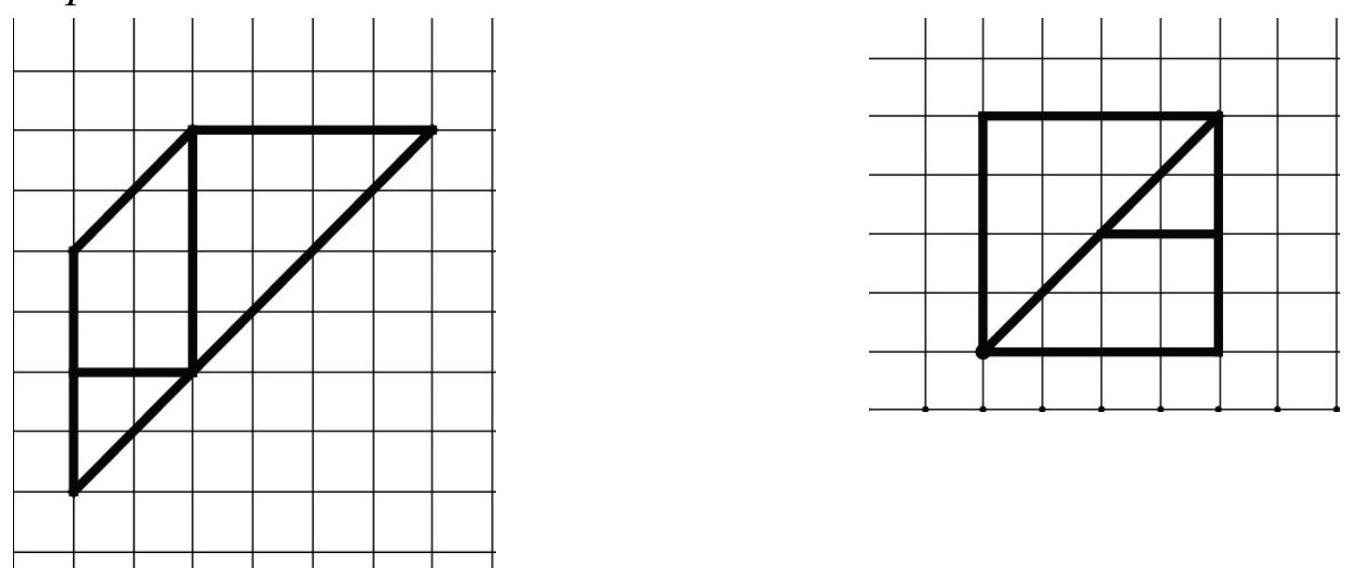
Second method.

.
Translate the above text into English, please keep the original text's line breaks and format, and output the translatio... | [Solution] Write down the squares of all two-digit numbers whose last digit is 3 or 7, and we can see that the last two digits of the number $x$ can be $17, 33, 67, 83$. Since the first four digits of the square of the number we are looking for are 2525, we have
$$
2525 \times 10^{8}<x^{2}<2526 \times 10^{8} .
$$
That... | Geometry | math-word-problem | Yes | Yes | olympiads | false | |
Define $\#N$ by the formula $\#N = .6(N) + 2$. Calculate $\#(\#(\#40))$. | We start by applying the transformation $\#N = 0.6N + 2$ to $N = 40$:
\[
\#40 = 0.6(40) + 2 = 24 + 2 = 26.
\]
Next, we apply the transformation to $\#40 = 26$:
\[
\#26 = 0.6(26) + 2 = 15.6 + 2 = 17.6.
\]
However, since the operation seems to involve integers (based on the original problem), we take the integer part of ... | 12 | Algebra | math-word-problem | Yes | Incomplete | synthetic_math | true |
What common fraction (i.e., a fraction reduced to its lowest terms) is equivalent to $.4\overline{37}$? | Let's denote the decimal $.4\overline{37}$ by $x$. We represent the repeating nature algebraically:
$$
100x = 43.737373\ldots
$$
$$
x = 0.43737373\ldots
$$
Now we subtract $x$ from $100x$ to eliminate the repeating part:
$$
100x - x = 43.737373\ldots - 0.43737373\ldots
$$
$$
99x = 43.3
$$
Therefore, solving for $x$, we... | \frac{433}{990} | Algebra | math-word-problem | Yes | Yes | synthetic_math | true |
In a renowned city, the average birth rate varies between 4 and 6 people every two minutes and the death rate varies between 3 and 5 people every two minutes. The city experiences daily migration in which an average of 120 people move into the city and 150 people move out of the city. On the given day, a special event ... | To estimate the net population increase for the day, we need to consider the birth rate, death rate, migration, and the special event.
First, let's calculate the average birth and death rates per day:
Average birth rate per minute = (4 + 6) / 2 = 5 people
Average death rate per minute = (3 + 5) / 2 = 4 people
Since ... | 1860 | Other | math-word-problem | Yes | Yes | orca_math | true |
In the diagram, the value of $x$ is
(A) 40
(B) 60
(D) 120
(E) 80
(C) 100
 | We label the three points of intersection as $A, B$ and $C$, as shown.
Then $\angle A B C=40^{\circ}$ since it is equal to its opposite angle.
Also, $\angle C A B=60^{\circ}$ since it is the supplement of a $120^{\circ}$ angle. In $\triangle A B C$,
$x^{\circ}+60^{\circ}+40^{\circ}=180^{\circ}$
$$
x=80
$$
-1=2023-(k+1)
$$
so by the principle of mathematical induction it follows that $a_{n} \geq 2023-n... | proof | Algebra | proof | Yes | Incomplete | olympiads | false |
a teacher grades students ’ tests by subtracting twice the number of incorrect responses from the number of correct responses . if student a answers each of the 100 questions on her test and receives a score of 70 , how many questions did student a answer correctly ? | Let's denote the number of correct answers as C and the number of incorrect answers as I. According to the grading system, the score is calculated as follows:
Score = C - 2I
We know that the total number of questions is 100, so we can also say that:
C + I = 100
We are given that the score (Score) is 70, so we can w... | 90 | Algebra | math-word-problem | Yes | Yes | orca_math | true |
217. How many terms will there be in the expansion of $(x+a)^{n}$? Can some of these terms disappear? | 217. $n+1$; no. | n+1 | Algebra | math-word-problem | Yes | Yes | olympiads | false |
In $\triangle ABC$, $b=2$, $\cos C= \frac {3}{4}$, and the area of $\triangle ABC$ is $\frac { \sqrt {7}}{4}$.
(Ⅰ) Find the value of $a$;
(Ⅱ) Find the value of $\sin 2A$. | Solution:
(Ⅰ) In $\triangle ABC$, since $b=2$ and $\cos C= \frac {3}{4}$, we have $\sin C= \frac { \sqrt {7}}{4}$.
Therefore, the area of $\triangle ABC$ is $\frac { \sqrt {7}}{4} = \frac {1}{2}ab \cdot \sin C = \frac {1}{2}a \cdot 2 \cdot \frac { \sqrt {7}}{4}$.
Thus, $a=1$.
(Ⅱ) By the Law of Cosines, we have ... | \frac {5 \sqrt {7}}{16} | Geometry | math-word-problem | Yes | Yes | cn_k12 | false |
A small poultry farm has 300 chickens, 200 turkeys, and 80 guinea fowls. A strange, incurable disease hit the farm, and every day the farmer lost a varying number of birds. The number of birds lost daily follows a pattern: on odd days (1st, 3rd, 5th, etc.) the farm loses 20 chickens, 8 turkeys, and 5 guinea fowls, whil... | To calculate the number of birds left after a week, we need to consider the losses on both odd and even days.
A week has 7 days, which means there are 4 odd days (1st, 3rd, 5th, 7th) and 3 even days (2nd, 4th, 6th).
On odd days, the farm loses:
- 20 chickens per day
- 8 turkeys per day
- 5 guinea fowls per day
On ev... | 379 | Logic and Puzzles | math-word-problem | Yes | Yes | orca_math | true |
Which of the following calculations is correct?
A: $\sqrt{6}+\sqrt{2}=\sqrt{8}$
B: $2\sqrt{7}+3=5\sqrt{7}$
C: $3\sqrt{2}×\sqrt{6}=6\sqrt{3}$
D: $\sqrt{20}÷2=\sqrt{10}$ | To solve this problem, we need to evaluate each option step by step:
**Option A: $\sqrt{6}+\sqrt{2}=\sqrt{8}$**
- We know that $\sqrt{6}$ and $\sqrt{2}$ cannot be directly added because they are square roots of different numbers. Therefore, option A is incorrect.
**Option B: $2\sqrt{7}+3=5\sqrt{7}$**
- Similarly, $... | C | Algebra | MCQ | Yes | Yes | cn_k12 | false |
Let $E$ be the set of $1983^3$ points of the space $\mathbb R^3$ all three of whose coordinates are integers between $0$ and $1982$ (including $0$ and $1982$). A coloring of $E$ is a map from $E$ to the set {red, blue}. How many colorings of $E$ are there satisfying the following property: The number of red vertices am... | 1. **Understanding the Problem:**
We are given a set \( E \) consisting of \( 1983^3 \) points in \(\mathbb{R}^3\), where each coordinate is an integer between \(0\) and \(1982\). We need to find the number of ways to color these points red or blue such that the number of red vertices in any right-angled parallelepi... | null | Combinatorics | math-word-problem | Yes | Yes | aops_forum | false |
Let $\overrightarrow{a}$ and $\overrightarrow{b}$ be vectors. Then "$|\overrightarrow{a}|=|\overrightarrow{b}|$" is a ( ) condition for "$|\overrightarrow{a}+\overrightarrow{b}|=|\overrightarrow{a}-\overrightarrow{b}|$".
A: Sufficient but not necessary
B: Necessary but not sufficient
C: Both sufficient and necessary
D:... | If "$|\overrightarrow{a}|=|\overrightarrow{b}|$", then the parallelogram formed by $\overrightarrow{a}$ and $\overrightarrow{b}$ as adjacent sides is a rhombus;
If "$|\overrightarrow{a}+\overrightarrow{b}|=|\overrightarrow{a}-\overrightarrow{b}|$", then the parallelogram formed by $\overrightarrow{a}$ and $\overright... | D | Algebra | MCQ | Yes | Yes | cn_k12 | false |
Today is Thursday. After $2^{2009}$ days, the day is ( )
A: Monday
B: Tuesday
C: Friday
D: Saturday | To find out what day it will be after $2^{2009}$ days, we need to consider the pattern of powers of 2 modulo 7 (since there are 7 days in a week).
Let's calculate the powers of 2 modulo 7 to find the pattern:
- $2^1 \equiv 2 \pmod{7}$
- $2^2 \equiv 4 \pmod{7}$
- $2^3 \equiv 8 \equiv 1 \pmod{7}$ (since $8 - 7 = 1$)
- ... | \text{The answer is A: Monday.} | Number Theory | MCQ | Yes | Yes | cn_k12 | false |
Given vectors $\vec{a} =(1,3)$, $\vec{b} =(-2,m)$, if $\vec{a}$ is perpendicular to $\vec{a}+2\vec{b}$, then the value of $m$ is ______. | **Analysis**
This problem examines the operation of the dot product of vectors in coordinates. According to the problem, we can get $\vec{a}+2\vec{b}=(-3,3+2m)$. Based on the perpendicularity of $\vec{a}$ and $\vec{a}+2\vec{b}$, we can obtain $\vec{a} \cdot (\vec{a}+2\vec{b})=0$, which allows us to find the result.
*... | -1 | Algebra | math-word-problem | Yes | Yes | cn_k12 | false |
Given $n\in\mathbb{N}^{*}$, the terms of the sequence $\{a_n\}$ are positive, the sum of the first $n$ terms is $S_n$, and $a_1=1$, $a_2=2$. Let $b_n=a_{2n-1}+a_{2n}$.
$(1)$ If the sequence $\{b_n\}$ is a geometric sequence with a common ratio of $3$, find $S_{2n}$;
$(2)$ If for any $n\in\mathbb{N}^{*}$, $S_n= \frac{... | Solution:
$(1)$ Since $b_1=a_1+a_2=3$, we have $b_n=3^n=a_{2n-1}+a_{2n}$.
Therefore, $S_{2n}=3+3^2+\ldots+3^n= \frac{3(3^n-1)}{3-1}= \frac{3^{n+1}-3}{2}$.
So, $S_{2n} = \boxed{\frac{3^{n+1}-3}{2}}$.
$(2)$ For any $n\in\mathbb{N}^{*}$, since $S_n= \frac{a_n^2+n}{2}$ always holds,
for $n\geqslant 2$, we have $a_n... | \begin{cases} 2^{\frac{n-1}{2}}, & n=2k-1 \\ 2^{\frac{n}{2}}, & n=2k \end{cases} | Algebra | math-word-problem | Yes | Yes | cn_k12 | false |
At a certain restaurant, the average (arithmetic mean) number of customers served for the past x days was 65. If the restaurant serves a certain number of customers today, the average is raised to 90 customers per day. The value of x is 1. How many customers were served today? | Let's denote the number of customers served today as C.
Since the average number of customers served for the past x days was 65, the total number of customers served over those x days is 65x.
Today, after serving C customers, the new average is 90 customers per day, and this average is over x+1 days (the past x days ... | 115 | Algebra | math-word-problem | Yes | Yes | orca_math | true |
In the rectangular coordinate system $(xOy)$, the parametric equations of curve $C\_1$ are given by $\begin{cases} x=2\cos \alpha \ y=2+2\sin \alpha \end{cases}$, where $\alpha$ is the parameter. $M$ is a moving point on $C\_1$, and point $P$ satisfies $\overrightarrow{OP} =2\overrightarrow{OM}$. The trajectory of poin... | 1. Let $P(x,y)$, then by the given condition $M(\frac{x}{2}, \frac{y}{2})$. Since $M$ is on curve $C\_1$, we have $\begin{cases} \frac{x}{2}=2\cos \alpha \ \frac{y}{2}=2+2\sin \alpha \end{cases}$. Thus, the parametric equations of $C\_2$ are $\begin{cases} x=4\cos \alpha \ y=4+4\sin \alpha \end{cases}$ (with $\alpha$ a... | |HG|=2\left( \sqrt{3}-1\right) | Algebra | math-word-problem | Yes | Yes | cn_k12 | false |
Example 3. 8. 3 (IMO 40 Preliminary) Let $M$ be a point inside a convex quadrilateral $ABCD$ such that $MA = MC$,
$$
\begin{array}{l}
\angle AMB = \angle MAD + \angle MCD, \angle CMD = \angle MCB + \angle MAB. \text{ Prove: } AB \cdot CM = BC \cdot MD, \\
BM \cdot AD = MA \cdot CD.
\end{array}
$$ | Prove the construction of a convex quadrilateral $P Q R S$ and an interior point $T$, such that $\triangle P T Q \cong \triangle A M B, \triangle Q T R \backsim \triangle A M D, \triangle P T S \backsim \triangle C M D$, as shown in the figure.
$\because P T=M A=M C, \therefore T S=M D \cdot P T: M C=M D$,
and $\becaus... | proof | Geometry | proof | Yes | Yes | olympiads | false |
Example 3 Given $2 x>3 y>0$, find the minimum value of $\sqrt{2} x^{3}+\frac{3}{2 x y-3 y^{2}}$.
Translate the above text into English, please retain the original text's line breaks and format, and output the translation result directly. | Given that $2 x>3 y>0$, we have $2 x-3 y>0$. By the AM-GM inequality, we get
$$\begin{aligned}
2 x y-3 y^{2} & =y(2 x-3 y)=\frac{1}{3} \cdot 3 y(2 x-3 y) \\
& \leqslant \frac{1}{3} \cdot\left[\frac{3 y+(2 x-3 y)}{2}\right]^{2}=\frac{1}{3} x^{2}
\end{aligned}$$
Therefore,
$$\begin{aligned}
& \sqrt{2} x^{3}+\frac{3}{2 x... | 5 \sqrt[5]{\frac{27}{2}} | Algebra | math-word-problem | Yes | Yes | inequalities | false |
Given that $z=(1+i)i$ ($i$ is the imaginary unit), find the imaginary part of $\overline{z}$ (the conjugate of $z$). The options are:
A: $1$
B: $-1$
C: $i$
D: $-i$ | **Step 1:** Expand the given expression for $z$.
$$z=(1+i)i=i+i^2$$
Recall that $i^2 = -1$, so we have:
$$z=i-1$$
**Step 2:** Find the conjugate of $z$.
The conjugate of a complex number $a+bi$ is given by $a-bi$. So, the conjugate of $z=i-1$ is:
$$\overline{z}=-1-i$$
**Step 3:** Identify the imaginary part of $\over... | -1 | Algebra | MCQ | Yes | Yes | cn_k12 | false |
Let $x$, $y$, and $z$ be positive real numbers with $x+y+z = 3$. Prove that at least one of the three numbers
$$x(x+y-z)$$
$$y(y+z-x)$$
$$z(z+x-y)$$
is less or equal $1$.
(Karl Czakler) | 1. **Assume to the contrary**: Suppose that all three expressions \( x(x+y-z) \), \( y(y+z-x) \), and \( z(z+x-y) \) are greater than 1.
2. **Rewrite the expressions**:
\[
x(x+y-z) = x(x+y+z - 2z) = x(3-2z) > 1
\]
\[
y(y+z-x) = y(y+z+x - 2x) = y(3-2x) > 1
\]
\[
z(z+x-y) = z(z+x+y - 2y) = z(3-2... | null | Inequalities | proof | Yes | Yes | aops_forum | false |
Suppose $m^2+n^2=t^2$ (where $m$, $n$, $t$ are real numbers and $t \neq 0$), find the value set for $\frac{n}{m-2t}$. | Firstly, we have $m^2+n^2=t^2$ (where $m$, $n$, $t$ are real numbers and $t \neq 0$). Therefore, we can write $(\frac{m}{t})^2+(\frac{n}{t})^2=1$. Let's set $\frac{m}{t}=\sin\theta$ and $\frac{n}{t}=\cos\theta$.
So, the expression $\frac{n}{m-2t}$ can be rewritten as $\frac{\frac{n}{t}}{\frac{m}{t}-2} = \frac{\cos\the... | \left[-\frac{\sqrt{3}}{3}, \frac{\sqrt{3}}{3}\right] | Algebra | math-word-problem | Yes | Yes | cn_k12 | false |
In the circle $C$: $({x-\frac{6}{5}})^2 + y^2 = \frac{36}{25}$, if any two points are randomly selected from all the integer points (points with integer coordinates) on and inside the circle, what is the probability that these two points lie on the coordinate axes?
A: $\frac{1}{5}$
B: $\frac{1}{2}$
C: $\frac{2}{5}$
... | Given the circle $C$: $\left(x-\frac{6}{5}\right)^2 + y^2 = \frac{36}{25}$, we first identify the integer points on and inside the circle. These points are $(0,0)$, $(1,-1)$, $(1,0)$, $(1,1)$, and $(2,0)$, which gives us a total of $5$ integer points.
To calculate the total number of ways to choose any two points from... | D | Combinatorics | MCQ | Yes | Yes | cn_k12 | false |
Octagon $ABCDEFGH$ is equiangular. Given that $AB=1$, $BC=2$, $CD=3$, $DE=4$, and $EF=FG=2$, compute the perimeter of the octagon. |
Given that the octagon \(ABCDEFGH\) is equiangular, we know that all its internal angles are equal. For an octagon, each internal angle is \(135^\circ\). This property allows us to use the fact that the opposite sides of an equiangular octagon sum to the same value.
We are given the side lengths \(AB = 1\), \(BC = 2\... | 23 | NaN | NaN | NaN | NaN | aops_forum | false |
If the inequality $mx^{2}+mx-4 \lt 2x^{2}+2x-1$ holds for any real number $x$, then the range of real number $m$ is ( ).
A: $(-2,2)$
B: $(-10,2]$
C: $(-\infty ,-2)\cup \left[2,+\infty \right)$
D: $(-\infty ,-2)$ | To solve the given inequality $mx^{2}+mx-4 < 2x^{2}+2x-1$, we start by moving all terms to one side to get a clearer picture of the inequality:
\[
mx^{2}+mx-4 - (2x^{2}+2x-1) < 0
\]
This simplifies to:
\[
(m-2)x^{2} + (m-2)x - 3 < 0
\]
Now, we consider two cases based on the value of $m-2$:
**Case 1:** When $m-2 =... | \text{B} | Inequalities | MCQ | Yes | Yes | cn_k12 | false |
In the expansion of $(4^{-x}-1)(2^{x}-3)^{5}$, the constant term is __________. | First, consider the expansion of $(2^x-3)^5$ by using the Binomial Theorem. It is important to note that the constant term in the entire expression $(4^{-x}-1)(2^{x}-3)^{5}$ will come from the multiple of the -1 from $(4^{-x}-1)$ and any term independent of $x$ in the expansion of $(2^x-3)^5$, or from $4^{-x}$ multipli... | -27 | Algebra | math-word-problem | Yes | Yes | cn_k12 | false |
Determine the area in square units of a right triangle on a Cartesian plane, formed by vertices at points A and B, and the origin. The coordinates of point A are (-4, 8) and point B is (-9, 3). | 1. Calculate the slope of the line AB to confirm if it's a right triangle with one side on the axis:
\[
\text{slope of AB} = \frac{8 - 3}{-4 + 9} = \frac{5}{5} = 1
\]
Since the slope does not indicate a right triangle with respect to the axes, let's find the third vertex C on one of the axes.
2. Since both... | 18 \text{ square units} | Geometry | math-word-problem | Yes | Yes | synthetic_math | true |
For the function $y=x^{2}-\log _{a}(x+1)-4x+4$, if the function values are all less than $0$ when $x\in \left(1,2\right)$, then the range of real number $a$ is ____. | To analyze the function $y=x^{2}-\log _{a}(x+1)-4x+4$ and determine the range of real numbers $a$ for which the function values are all less than $0$ when $x\in \left(1,2\right)$, we proceed in a step-by-step manner.
1. **Considering the case when $0 0$ because the logarithm of a positive number to a base between $0$... | (1,2] | Algebra | math-word-problem | Yes | Yes | cn_k12 | false |
Subsets and Splits
No community queries yet
The top public SQL queries from the community will appear here once available.