
instruction_seed stringlengths 2 10.7k | solution stringlengths 0 10.8k ⌀ | answer stringlengths 0 575 ⌀ | problem_type stringclasses 9
values | question_type stringclasses 5
values | problem_is_valid stringclasses 5
values | solution_is_valid stringclasses 4
values | source stringclasses 11
values | synthetic bool 2
classes |
|---|---|---|---|---|---|---|---|---|
Transforming the quadratic function $y=x^{2}-2x+3$ into vertex form, the resulting analytical expression is ( ).
A: $y=\left(x-1\right)^{2}+4$
B: $y=\left(x-1\right)^{2}+2$
C: $y=\left(x+2\right)^{2}+6$
D: $y=\left(x-2\right)^{2}+6$ | To transform the quadratic function $y = x^2 - 2x + 3$ into vertex form, we follow the steps of completing the square:
1. Start with the given quadratic equation:
\[y = x^2 - 2x + 3\]
2. Rewrite the equation, focusing on completing the square for the $x^2$ and $x$ terms. To do this, we need to add and subtract the sq... | B | Algebra | MCQ | Yes | Yes | cn_k12 | false |
Let $ABCDEF$ be a convex equilateral hexagon such that lines $BC$, $AD$, and $EF$ are parallel. Let $H$ be the orthocenter of triangle $ABD$. If the smallest interior angle of the hexagon is $4$ degrees, determine the smallest angle of the triangle $HAD$ in degrees. | null | null | Geometry | math-word-problem | Yes | Yes | aops_forum | false |
## SUBJECT II
Calculate the sum of natural numbers, between 400 and 600, which when divided by 12 give a remainder of 10. | ## SUBJECT II
$\mathrm{x}: 12=\mathrm{a}$, remainder 10; thus $\mathrm{x}=12 \mathrm{a}+10$.
$1 p$
Since the numbers are between 400 and 600, the following appear:
$$
12 \cdot 33+10=406
$$
$12 \cdot 34+10$
$12 \cdot 35+10$
$12 \cdot 49+10=598$
2p
- justification that there are 17 numbers $1 p$
By adding the r... | 8534 | Number Theory | math-word-problem | Yes | Yes | olympiads | false |
Let $Q$ be the circumcenter of $\triangle ABC$. Prove that for any point $P$,
$$
\begin{aligned}
& a(P A)^{2}+b(P B)^{2}+c(P C)^{2} \\
= & a(Q A)^{2}+b(Q B)^{2}+c(Q C)^{2} \\
& +(a+b+c)(Q P)^{2} .
\end{aligned}
$$
where $a=BC, b=CA, c=AB$. | Let $A_{1}, A_{2}, \cdots, A_{1}$ be points on a plane with $n$ points.
$$
\left.\sum_{1=1}^{n}(m, P A,)^{2}\right]
$$
$=(P G)^{2} \sum_{\dot{L}}^{m_{1}}+\sum_{i=1}^{\infty}\left(m,(1, G)^{2}\right]$, (2)
$$
\begin{array}{l}
\sum_{i=1}^{\infty}\left[m\left(x_{1}-\frac{\sum_{i=1}^{\infty} m, x_{i}}{\sum_{i=1}^{m} m_{i}}... | proof | Geometry | proof | Yes | Incomplete | cn_contest | false |
Consider the polynomial equation
$$a(3+i)^4 + b(3+i)^3 + c(3+i)^2 + d(3+i) + e = 0,$$
where $a, b, c, d, e$ are integers with no common factors other than 1. Determine $|d|$. | Let $g(x) = ax^4 + bx^3 + cx^2 + dx + e$. From the given, $x=3+i$ is a root of $g$.
Note the symmetry in coefficients. If $x = r$ is a root, then due to the polynomial's real coefficients, $x = \overline{r}$ (the conjugate) is also a root. Hence, $3-i$ is a root.
For the polynomial to have integer coefficients and g... | 40 | Algebra | math-word-problem | Yes | Yes | synthetic_math | true |
Anton now has three species of ants in his ant farm: Species A, Species B, and Species C. Each species grows at different rates; Species A doubles every day, Species B triples every day, while Species C increases fivefold every day. On Day 0, there are 50 ants in the farm. After 4 days, Anton counts 6230 ants in total.... | Let $a$, $b$, $c$ represent the number of ants of Species A, B, C on Day 0 respectively, such that $a + b + c = 50$. On Day 4:
- Species A: $a \times 2^4 = 16a$
- Species B: $b \times 3^4 = 81b$
- Species C: $c \times 5^4 = 625c$
The total number of ants on Day 4 then is $16a + 81b + 625c = 6230$.
To solve, we re-wri... | 736 | Algebra | math-word-problem | Yes | Yes | synthetic_math | true |
The equation of the line passing through the point (2, 0) with a slope of 3 is ( )
A: y=3x+2
B: y=3x-2
C: y=3(x-2)
D: y=3(x+2) | Using the point-slope form, the equation of the line passing through the point (2, 0) with a slope of 3 is obtained as $y-0=3(x-2)$, which simplifies to $y=3(x-2)$.
Therefore, the correct option is $\boxed{C}$. | C | Algebra | MCQ | Yes | Yes | cn_k12 | false |
What is the largest prime factor of 675? | First, consider the number 675. Notice that $675 = 6 + 7 + 5 = 18$, which is divisible by 3. Thus, 675 is also divisible by 3. Begin by dividing 675 by 3:
$$ 675 \div 3 = 225 $$
Next, $225 = 2 + 2 + 5 = 9$, which again is divisible by 3. Divide 225 by 3:
$$ 225 \div 3 = 75 $$
Then, $75 = 7 + 5 = 12$, which is divis... | 5 | Number Theory | math-word-problem | Yes | Incomplete | synthetic_math | true |
Find the square root of $\dfrac{10!}{210}$. | First, factorize the factorial and the denominator:
$$10! = 10 \cdot 9 \cdot 8 \cdot 7 \cdot 6 \cdot 5 \cdot 4 \cdot 3 \cdot 2 \cdot 1,$$
$$210 = 2 \cdot 3 \cdot 5 \cdot 7.$$
Now, simplify $\dfrac{10!}{210}$:
$$\dfrac{10!}{210} = \dfrac{10 \cdot 9 \cdot 8 \cdot 7 \cdot 6 \cdot 5 \cdot 4 \cdot 3 \cdot 2 \cdot 1}{2 \cdo... | 24\sqrt{30} | Algebra | math-word-problem | Yes | Yes | synthetic_math | true |
Evaluate the expression \[ \frac{a+3}{a+1} \cdot \frac{b-2}{b-3} \cdot \frac{c + 9}{c+7} , \] given that $c = b-11$, $b = a+3$, $a = 5$, and none of the denominators are zero. | First, substitute for $c$:
\[
\frac{a+3}{a+1} \cdot \frac{b-2}{b-3} \cdot \frac{(b-11)+9}{(b-11)+7} = \frac{a+3}{a+1} \cdot \frac{b-2}{b-3} \cdot \frac{b-2}{b-4}.
\]
Since the denominators must not be zero, we can cancel the $(b-2)$ terms:
\[
\frac{a+3}{a+1} \cdot \frac{1}{b-4}.
\]
Substituting $b = a+3$, we get:
\[
\f... | \frac{1}{3} | Algebra | math-word-problem | Yes | Yes | synthetic_math | true |
Let $ABCD$ be a parallelogram. A line $\ell$ intersects lines $AB,~ BC,~ CD, ~DA$ at four different points $E,~ F,~ G,~ H,$ respectively. The circumcircles of triangles $AEF$ and $AGH$ intersect again at $P$. The circumcircles of triangles $CEF$ and $CGH$ intersect again at $Q$. Prove that the line $P Q$ bisects the di... | null | null | Geometry | proof | Yes | Yes | aops_forum | false |
Given a linear function $f(x)$ satisfies $f(f(x))=4x+9$, find the expression of $f(x)$. | Since $f(x)$ is a linear function, let $f(x)=kx+b$ where $k \neq 0$.
Then we have $f(f(x))=f(kx+b)=k(kx+b)+b=k^2x+kb+b$.
Given that $f(f(x))=4x+9$, we can set up the following system of equations to match the coefficients:
$$
\begin{cases}
k^2=4\\
kb+b=9
\end{cases}
$$
Solving the first equation, we find $k^2=4$ wh... | f(x)=-2x-9 | Algebra | math-word-problem | Yes | Yes | cn_k12 | false |
We say that the set of step lengths $D\subset \mathbb{Z}_+=\{1,2,\ldots\}$ is [i]excellent[/i] if it has the following property: If we split the set of integers into two subsets $A$ and $\mathbb{Z}\setminus{A}$, at least other set contains element $a-d,a,a+d$ (i.e. $\{a-d,a,a+d\} \subset A$ or $\{a-d,a,a+d\}\in \mathbb... | To show that $\{1,2,3,4\}$ is excellent, we need to demonstrate that for any partition of $\mathbb{Z}$ into two subsets $A$ and $\mathbb{Z} \setminus A$, at least one of these subsets contains the triplet $\{a-d, a, a+d\}$ for some $a \in \mathbb{Z}$ and $d \in \{1,2,3,4\}$.
1. Assume for contradiction that $\{1,2,3,4... | null | Logic and Puzzles | proof | Yes | Yes | aops_forum | false |
Ninety percent of people in a survey say they use smartphones, and eighty percent say they use laptops. What is the smallest possible percentage of people who use both smartphones and laptops? | To find the smallest percentage of people who use both smartphones and laptops, we can use the principle of inclusion-exclusion for the two sets.
1. Sum the percentages:
\[
90\% + 80\% = 170\%
\]
2. Since the sum of the percentages is 170%, which exceeds 100%, we must have double-counted the people who use b... | 70\% | Logic and Puzzles | math-word-problem | Yes | Yes | synthetic_math | true |
Let $P_0, P_1,\ldots, P_{2021}$ points on the unit circle of centre $O$ such that for each $n\in \{1,2,\ldots, 2021\}$ the length of the arc from $P_{n-1}$ to $P_n$ (in anti-clockwise direction) is in the interval $\left[\frac{\pi}2,\pi\right]$. Determine the maximum possible length of the vector:
\[\overrightarrow{OP_... | null | null | Geometry | math-word-problem | Yes | Yes | aops_forum | false |
A certain company has a credit rating of $96$ points this month, which is $20\%$ higher than last month's credit rating. Let $x$ be the credit rating of the company last month. Then, which of the following is correct?
A: $20\%x=96$
B: $(1-20\%)x=96$
C: $(1+20\%)x=96$
D: $96\times \left(1+20\%\right)=x$ | To solve the problem, let's denote the credit rating of the company last month as $x$. According to the information given, the credit rating this month is $20\%$ higher than last month's rating. This can be mathematically represented as:
\[x + 20\% \cdot x = 96\]
This equation can be simplified by factoring out $x$:
... | C | Algebra | MCQ | Yes | Yes | cn_k12 | false |
10.128. A circle is circumscribed around a square with side length $a$, and a regular hexagon is circumscribed around the circle. Determine the area of the hexagon. | ## Solution.
The radius of the circle circumscribed around the square is equal to half the diagonal of the square $r=\frac{a \sqrt{2}}{2}$. This same circle is inscribed in the hexagon: $r=\frac{a_{6}}{2 \operatorname{tg} \frac{180^{\circ}}{6}}=\frac{a_{6} \sqrt{3}}{2}$. We get $\frac{a \sqrt{2}}{2}=\frac{a_{6} \sqrt{... | \sqrt{3}^{2} | Geometry | math-word-problem | Yes | Yes | olympiads | false |
Let $E$ be a finite set of points such that $E$ is not contained in a plane and no three points of $E$ are collinear. Show that at least one of the following alternatives holds:
(i) $E$ contains five points that are vertices of a convex pyramid having no other points in common with $E;$
(ii) some plane contains exact... | null | null | Geometry | proof | Yes | Yes | aops_forum | false |
Find the value of the sum of the vertices of the rectangle and the pentagon. | To find the sum of the vertices of a rectangle and a pentagon, we need to know how many vertices each shape has.
A rectangle has 4 vertices (corners).
A pentagon has 5 vertices.
To find the total sum of the vertices, we simply add the number of vertices of both shapes together:
Rectangle vertices (4) + Pentagon vert... | 9 | Geometry | math-word-problem | Incomplete | Yes | orca_math | true |
A positive integer, when increased by 100, becomes a perfect square, and when increased by 168, it becomes another perfect square. Find this number. | Let's denote this number as $m$. Then, we have:
1. $100 + m = 10^2 + 20n + n^2$, which simplifies to $m = 20n + n^2$.
2. $168 + m = 10^2 + 68 + m = 10^2 + 68 + n^2 + 20n = 10^2 + 20x + x^2$; hence, $68 + n^2 + 20n = 20x + x^2$.
3. Rearranging the equation gives $x^2 - n^2 + 20(x - n) = 68$.
4. Factoring, we get $(x - ... | 156 | Number Theory | math-word-problem | Yes | Yes | cn_k12 | false |
Let \(\mathbf{a}\), \(\mathbf{b}\), and \(\mathbf{c}\) be unit vectors such that the angle between \(\mathbf{a}\) and \(\mathbf{b}\) is \(\alpha\), and the angle between \(\mathbf{c}\) and \(\mathbf{a} \times \mathbf{b}\) is also \(\alpha\). If \(\mathbf{b} \cdot (\mathbf{c} \times \mathbf{a}) = \frac{1}{8}\), find the... | From the scalar triple product,
\[
\mathbf{c} \cdot (\mathbf{a} \times \mathbf{b}) = \mathbf{b} \cdot (\mathbf{c} \times \mathbf{a}) = \frac{1}{8}.
\]
So,
\[
\|\mathbf{c}\| \|\mathbf{a} \times \mathbf{b}\| \cos \alpha = \frac{1}{8}.
\]
Knowing \(\|\mathbf{a} \times \mathbf{b}\| = \|\mathbf{a}\| \|\mathbf{b}\| \sin \alp... | 7.24^\circ | Algebra | math-word-problem | Yes | Yes | synthetic_math | true |
$3+$ [ Divisibility rules for 3 and 9 ]
In the following multi-digit numbers, the digits have been replaced by letters (the same digits by the same letters, and different digits by different letters). It turned out that DEVYANOSTO is divisible by 90, and DEVYATKA is divisible by 9. Can SOTKA be divisible by 9?
# | Since ДЕВЯНОСТО is divisible by 90, then $\mathrm{O}=0$, so the sum Д + Е + В + Я + (Н + С) + Т is divisible by 9. Since ДЕВЯТКА is divisible by 9, the sum Д + Е + В + Я + Т + (К + А) is also divisible by 9. Note that these two sums contain nine different letters, meaning all digits from 1 to 9 are used. The sum of all... | proof | Number Theory | math-word-problem | Yes | Yes | olympiads | false |
Given $f(x)=\ln x+ \frac{1}{x}$, determine the relationship between $f(\sin \frac{π}{5})$ and $f(\cos \frac{π}{5})$.
A: $f(\sin \frac{π}{5}) > f(\cos \frac{π}{5})$
B: $f(\sin \frac{π}{5}) < f(\cos \frac{π}{5})$
C: $f(\sin \frac{π}{5})=f(\cos \frac{π}{5})$
D: The relationship cannot be determined | We have $f(x)=\ln x+ \frac{1}{x}$. The derivative of $f(x)$ is $f'(x)= \frac{1}{x}- \frac{1}{x^{2}}= \frac{x-1}{x^{2}}$.
Let $f'(x) f(\cos \frac{π}{5})$.
Therefore, the answer is: $\boxed{A}$.
To solve this problem, we find the monotonic interval of the function $f(x)$, compare the size of $\sin \frac{π}{5}$ and $\... | A | Calculus | MCQ | Yes | Yes | cn_k12 | false |
An integer with two digits has its units digit as $a$ and its tens digit as $b$. The integer can be represented as:
A: $ab$
B: $a+b$
C: $10a+b$
D: $10b+a$ | To represent a two-digit integer with its units digit as $a$ and its tens digit as $b$, we can break it down as follows:
- The tens digit $b$ contributes $b \times 10$ to the overall value of the number.
- The units digit $a$ contributes $a \times 1$ to the overall value of the number.
Therefore, the integer can be r... | D | Number Theory | MCQ | Yes | Yes | cn_k12 | false |
G45 (22-5, USSR) Given three equal circles with a common point $O$, and all inside a given triangle, each circle is tangent to two sides of the triangle. Prove: The incenter, circumcenter, and point $O$ of the triangle are collinear. | Prove that the triangle is represented by $A, B, C$. The centers of the circles are denoted by $A^{\prime}, B^{\prime}, C^{\prime}$, as shown in Figure 4-44.
Thus, because the radii of the three circles are equal, the corresponding sides of $\triangle A B C$ are parallel to the corresponding sides of $\triangle A^{\pr... | proof | Geometry | proof | Yes | Yes | olympiads | false |
If $0 b$
C: $ab 2$ | From the given conditions, we have $a = \sin\alpha + \cos\alpha = \sqrt{2}\sin\left(\alpha + \frac{\pi}{4}\right)$,
and $b = \sin\beta + \cos\beta = \sqrt{2}\sin\left(\beta + \frac{\pi}{4}\right)$.
Since $0 < \alpha < \beta < \frac{\pi}{4}$, it follows that $\frac{\pi}{4} < \alpha + \frac{\pi}{4} < \beta + \frac{\pi}... | A | Inequalities | math-word-problem | Incomplete | Yes | cn_k12 | false |
Let $f(x,y,z) = x^2+y^2+z^2+xyz$. Let $p(x,y,z), q(x,y,z)$, $r(x,y,z)$ be polynomials with real coefficients satisfying
\[
f(p(x,y,z), q(x,y,z), r(x,y,z)) = f(x,y,z).
\]
Prove or disprove the assertion that the sequence $p,q,r$ consists of some permutation of $\pm x, \pm y, \pm z$, where the number of minus signs is $0... | 1. **Degree Analysis**:
- Given the function \( f(x,y,z) = x^2 + y^2 + z^2 + xyz \), we need to analyze the degrees of the polynomials \( p(x,y,z) \), \( q(x,y,z) \), and \( r(x,y,z) \).
- The degree of \( f(p(x,y,z), q(x,y,z), r(x,y,z)) \) must match the degree of \( f(x,y,z) \), which is 2.
- Therefore, we h... | null | Logic and Puzzles | proof | Yes | Yes | aops_forum | false |
The integers $a, b, c$ are not $0$ such that $\frac{a}{b + c^2}=\frac{a + c^2}{b}$. Prove that $a + b + c \le 0$. | 1. Start with the given equation:
\[
\frac{a}{b + c^2} = \frac{a + c^2}{b}
\]
2. Cross-multiply to eliminate the fractions:
\[
a \cdot b = (a + c^2) \cdot (b + c^2)
\]
3. Expand the right-hand side:
\[
ab = ab + ac^2 + bc^2 + c^4
\]
4. Subtract \(ab\) from both sides:
\[
0 = ac^2 + b... | null | Inequalities | proof | Yes | Yes | aops_forum | false |
1349. Knowing that $I=\int_{1}^{2} \frac{d x}{x}=\ln 2$, compute approximately the value of $\ln 2$ using the rectangle and trapezoidal formulas (for $n=10$). Estimate the absolute error of the obtained results. | Solution. The interval [1, 2] is divided into 10 equal parts, and we construct a table of values of the integrand function $y=\frac{1}{x}$
$$
\begin{array}{llll}
x_{0}=1,0 & y_{0}=1,0000 & x_{6}=1,6 & y_{6}=0,6250 \\
x_{1}=1,1 & y_{1}=0,9091 & x_{7}=1,7 & y_{7}=0,5882 \\
x_{2}=1,2 & y_{2}=0,8333 & x_{8}=1,8 & y_{8}=0,... | 0,6938 | Calculus | math-word-problem | Yes | Yes | olympiads | false |
Mary had 18.0 baseball cards and promised to give Fred 26.0 baseball cards. She bought some baseball cards and had 32 baseball cards left after giving the promised cards to Fred. How many baseball cards did Mary buy? | Mary had 18.0 baseball cards initially and promised to give Fred 26.0 baseball cards. After giving Fred the promised cards, she had 32.0 baseball cards left.
First, let's find out how many baseball cards Mary would have after giving Fred the 26.0 cards if she didn't buy any more:
18.0 (initial cards) - 26.0 (promised... | 24.0 | Algebra | math-word-problem | Yes | Yes | orca_math | true |
Prove that the natural number $n$ can be expressed as the sum of natural numbers in $2^{n-1}$ different ways, considering the order of the terms in the addition. | I. solution. According to the statement for the case $n=1$, there exists 1 sum-decomposition. However, 1 cannot be decomposed into natural numbers. This indicates that the single-term sum, the number $n$ itself, must also be considered as a representation, for example, the number of all representations of $n=2$ is $2^{... | proof | Combinatorics | proof | Yes | Incomplete | olympiads | false |
A salt solution contains 15 grams of salt per a certain volume of solution. If 25 cubic centimeters of the solution were poured into an empty container, there would be 0.375 grams of salt in the container. What is the volume of the solution that contains 15 grams of salt? | To find the volume of the solution that contains 15 grams of salt, we can set up a proportion based on the information given:
0.375 grams of salt is in 25 cubic centimeters of solution.
We want to find out how many cubic centimeters of solution contain 15 grams of salt.
Let's call the volume of the solution that con... | 1000 | Algebra | math-word-problem | Yes | Yes | orca_math | true |
Alyana has a pizza that is cut into 16 slices. After she and her friends finish eating, there are some slices left. If each of them ate 2 slices of pizza and 6 people ate the pizza, how many slices are left? | If each of the 6 people ate 2 slices of pizza, then the total number of slices eaten is:
6 people * 2 slices/person = 12 slices
The pizza originally had 16 slices, so the number of slices left after they finished eating is:
16 slices - 12 slices eaten = 4 slices left
Therefore, there are $\boxed{4}$ slices of pizz... | 4 | Logic and Puzzles | math-word-problem | Yes | Yes | orca_math | true |
Convert \(1978_{10}\) to base 6. | 1. Determine the largest power of 6 less than 1978. The powers of 6 are: \(6^1 = 6\), \(6^2 = 36\), \(6^3 = 216\), \(6^4 = 1296\). Here, \(6^5 = 7776\) is too large, so the largest usable power is \(6^4 = 1296\).
2. Find how many times \(1296\) fits into \(1978\). We have \(\frac{1978}{1296} \approx 1\) (since \(2 \ti... | 13054_6 | Number Theory | math-word-problem | Yes | Yes | synthetic_math | true |
Compute the determinant of the following matrix:
\[
\begin{vmatrix} 5 & -4 \\ 2 & 3 \end{vmatrix}.
\] | Using the formula for the determinant of a 2x2 matrix, where \( A = \begin{bmatrix} a & b \\ c & d \end{bmatrix} \), the determinant \(\text{det}(A)\) is calculated as \(ad - bc\).
Here, \(a = 5\), \(b = -4\), \(c = 2\), and \(d = 3\). Substituting these values, we calculate:
\[
\text{det}(A) = (5)(3) - (-4)(2) = 15 +... | 23 | Algebra | math-word-problem | Yes | Yes | synthetic_math | true |
Some people play kabadi, 15 play kho kho only, and 5 play both games. In total, there are 25 players. How many people play kabadi? | Let's denote the number of people who play kabadi as K, the number of people who play kho kho only as Kho_only, and the number of people who play both games as Both.
From the information given, we have:
Kho_only = 15 (since 15 people play kho kho only)
Both = 5 (since 5 people play both games)
We also know that the ... | 15 | Combinatorics | math-word-problem | Yes | Yes | orca_math | true |
1. Simplify and evaluate the expression: ($\sqrt[3]{2} \times \sqrt{3}$)$^6$ + (-2018)$^0$ - 4 $\times$ ($\frac{16}{49}$)$^{-\frac{1}{2}}$ + $\sqrt[4]{(3 - \pi)^4}$
2. Simplify and evaluate the expression: $\frac{\log_5 8 \times \log_5 2 + 25^{\log_5 3}}{\log 4 + \log 25}$ + $5 \log_3 2 - \log_3 \frac{32}{9}$ | 1. The given expression can be simplified as follows:
- ($\sqrt[3]{2} \times \sqrt{3}$)$^6$ = ($2^{1/3} \times 3^{1/2}$)$^6$ = $2^2 \times 3^3$ = 108
- (-2018)$^0$ = 1 (since any non-zero number to the power of 0 is 1)
- 4 $\times$ ($\frac{16}{49}$)$^{-\frac{1}{2}}$ = 4 $\times$ ($\frac{49}{16}$)$^{\frac{1}{2}... | 8 | Algebra | math-word-problem | Yes | Yes | cn_k12 | false |
Solve the equation $125 = 5(25)^{x-2}$ for $x$. | Start by simplifying the equation. First, recognize that $25 = 5^2$, so the equation becomes:
\[ 125 = 5(5^2)^{x-2}. \]
Using the properties of exponents, simplify the right-hand side:
\[ 5(5^2)^{x-2} = 5 \cdot 5^{2(x-2)} = 5 \cdot 5^{2x-4}. \]
Thus, the equation is:
\[ 125 = 5^{2x-4+1} = 5^{2x-3}. \]
Since $125 = 5^... | x = 3 | Algebra | math-word-problem | Yes | Yes | synthetic_math | true |
(A.Myakishev, 9--10) Given triangle $ ABC$. One of its excircles is tangent to the side $ BC$ at point $ A_1$ and to the extensions of two other sides. Another excircle is tangent to side $ AC$ at point $ B_1$. Segments $ AA_1$ and $ BB_1$ meet at point $ N$. Point $ P$ is chosen on the ray $ AA_1$ so that $ AP\equal{}... | null | null | Geometry | proof | Yes | Yes | aops_forum | false |
when a certain tree was first planted , it was 4 feet tall , and the height of the tree increased by a constant amount each year for the next 6 years . at the end of the 6 th year , the tree was 1 / 4 taller than it was at the end of the 4 th year . by how many feet did the height of the tree increase each year ? | Let's denote the constant annual increase in the height of the tree as \( h \) feet per year.
At the end of the 4th year, the height of the tree would be:
\( 4 + 4h \) feet
At the end of the 6th year, the height of the tree would be:
\( 4 + 6h \) feet
According to the problem, the height of the tree at the end of th... | 1 | Algebra | math-word-problem | Yes | Yes | orca_math | true |
There were some students assigned in a minibus for a field trip. Eight of these students were boys. On the day of the field trip, the number of girls and boys was the same since some of the girls were not able to join the trip. Two girls were not able to join the field trip. How many students were assigned in the minib... | If two girls were not able to join the field trip and the number of girls and boys became the same, that means there were originally two more girls than boys. Since there were eight boys, there must have been 8 + 2 = 10 girls originally assigned to the minibus.
So, the total number of students assigned to the minibus ... | 18 | Logic and Puzzles | math-word-problem | Yes | Yes | orca_math | true |
Arrange $$\frac {1}{2}$$, $$\frac {3}{4}$$, 0.25, $$\frac {1}{5}$$, 0.42 in ascending order:
\_\_\_\_\_\_ < \_\_\_\_\_\_ < \_\_\_\_\_\_ < \_\_\_\_\_\_ < \_\_\_\_\_\_. | Solution: $$\frac {1}{2}$$ = 0.5, $$\frac {3}{4}$$ = 0.75, $$\frac {1}{5}$$ = 0.2
Since: 0.2 < 0.25 < 0.42 < 0.5 < 0.75
Therefore: $$\frac {1}{5}$$ < 0.25 < 0.42 < $$\frac {1}{2}$$ < $$\frac {3}{4}$$
Hence, the answer is: $$\boxed{\frac {1}{5}, 0.25, 0.42, \frac {1}{2}, \frac {3}{4}}$$.
When comparing numbers o... | \frac {1}{5}, 0.25, 0.42, \frac {1}{2}, \frac {3}{4} | Number Theory | math-word-problem | Yes | Yes | cn_k12 | false |
Find all values of $x$ such that $\arccos x < 2 \arcsin x.$ | We know $\arccos x$ is a decreasing function and $\arcsin x$ is an increasing function. We must find where $\arccos x \theta$.
- Numerical methods or graphing might be necessary for full verification.
3. **Determining the inequality**: For $x \frac{\pi}{4}$, and $\arcsin x 2 \arcsin x$. For $x > \frac{1}{\sqrt{2... | \left(\frac{1}{\sqrt{2}}, 1\right] | Inequalities | math-word-problem | Yes | Yes | synthetic_math | true |
# Task 4. (12 points)
The angle bisectors of angles $A, B$, and $C$ of triangle $A B C$ intersect the circumcircle of this triangle at points $A_{1}, B_{1}$, and $C_{1}$, respectively. Find the distances between point $A_{1}$ and the center of the inscribed circle of triangle $A B C$, given that $\angle A_{1} B_{1} C_... | # Solution.
In the figure, identical numbers mark equal angles (this follows from the fact that $A A_{1}, B B_{1}, C C_{1}$ are the angle bisectors of triangle $ABC$, the angle marked "1+2" near point $O$ (which is the center of the inscribed circle) is equal to $\angle O A B + \angle O B A = \angle 1 + \angle 2$ by t... | 1 | Geometry | math-word-problem | Yes | Yes | olympiads | false |
Patrick tosses four four-sided dice, each numbered $1$ through $4$. What's the probability their product is a multiple of four? | To determine the probability that the product of four four-sided dice is a multiple of 4, we can use complementary counting and casework.
1. **Identify the total number of outcomes:**
Each die has 4 faces, so the total number of possible outcomes when rolling four dice is:
\[
4^4 = 256
\]
2. **Complementa... | \frac{13}{16} | Combinatorics | math-word-problem | Yes | Yes | aops_forum | false |
When purchasing 400 units of a product at an original price of 80 yuan each, they can all be sold out at a price of 90 yuan each. It is known that for every 1 yuan increase in price per unit, the number of units sold decreases by 20. What should the selling price be to maximize profit? | Let the selling price be increased by $x$ yuan on the basis of 90 yuan, where $0 < x \leq 20$.
Since the sales volume decreases by 20 units for every 1 yuan increase in price per unit,
if the price is increased by $x$ yuan, then the sales volume decreases by $20x$ units.
Given that all units can be sold out at 90 yu... | 95 | Algebra | math-word-problem | Yes | Yes | cn_k12 | false |
Yatsenko I.v.
From the volcano station to the summit of Stromboli, it takes 4 hours to walk along the road, and then another 4 hours along the path. At the summit, there are two craters. The first crater erupts for 1 hour, then remains silent for 17 hours, then erupts again for 1 hour, and so on. The second crater eru... | The path along the road and the trail (there and back) takes 16 hours. Therefore, if you start immediately after the eruption of the first crater, this crater will not be dangerous.
Movement along the trail (there and back) takes 8 hours. Therefore, if you start moving along the trail immediately after the eruption of... | 38 | Logic and Puzzles | math-word-problem | Yes | Yes | olympiads | false |
Determine the positive value of $x$ which satisfies:
\[\log_5 (x - 1) + \log_{5} (x^2 - 1) + \log_{\frac{1}{5}} (x - 1) = 3.\] | First, simplify the expression using logarithmic identities:
\[\log_{\frac{1}{5}} (x - 1) = \frac{\log_5 (x - 1)}{\log_5 \frac{1}{5}} = -\log_5 (x - 1),\]
Substituting this into the equation, we get:
\[\log_5 (x - 1) + \log_5 (x^2 - 1) - \log_5 (x - 1) = 3,\]
The terms \(\log_5 (x - 1)\) and \(-\log_5 (x - 1)\) cance... | 3\sqrt{14} | Algebra | math-word-problem | Yes | Yes | synthetic_math | true |
The solution to the inequality $C_{5}^{x} + A_{x}^{3} < 30$ is ______. | From the given problem, $x=3$ or $x=4$,
When $x=3$, the inequality $C_{5}^{x} + A_{x}^{3} = 10 + 6 = 16 < 30$ holds true;
When $x=4$, the inequality $C_{5}^{x} + A_{x}^{3} = 5 + 24 = 29 < 30$ also holds true;
Therefore, the solution to the inequality $C_{5}^{x} + A_{x}^{3} < 30$ is $3$ or $4$.
Hence, the answer is:... | 3 \text{ or } 4 | Combinatorics | math-word-problem | Yes | Yes | cn_k12 | false |
The greatest common divisor of 175, 100, 65 is ______. | First, we have $175 = 100 + 75$, $100 = 75 + 25$, and $75 = 25 \times 3$. Therefore, the greatest common divisor of 175 and 75 is 25.
Next, $65 = 25 \times 2 + 15$, $25 = 15 + 10$, $15 = 10 + 5$, and $10 = 5 \times 2$.
Therefore, the greatest common divisor of 65 and 75 is 5.
Hence, the greatest common divisor of 17... | 5 | Number Theory | math-word-problem | Yes | Yes | cn_k12 | false |
Solve the inequality
$$
2^{-\cos ^{2} x}+2^{-\sin ^{2} x} \geqq \sin y+\cos y
$$
where $x, y$ are real numbers. | We will show that for any real number pair $x, y$,
$$
2^{-\cos ^{2} x}+2^{-\sin ^{2} x} \geqq \sqrt{2}
$$
and
$$
\sqrt{2} \leqq \sin y+\cos y
$$
From these two relationships, it follows that the inequality of the problem holds for any real number pair $x, y$.
Since $2^{-\cos ^{2} x}>0$ and $2^{-\sin ^{2} x}>0$, by... | proof | Inequalities | math-word-problem | Yes | Yes | olympiads | false |
In how many different ways can five students line up in a row according to the following requirements?
(1) A and B must be adjacent
(2) A and B are not adjacent
(3) A is not in the middle, and B is not at either end | (1) Bundling method: Consider A and B as a single unit, reducing the number of people to 4. Using the permutation formula, there are $A_{4}^{4} = 4! = 24$ ways. However, since A and B can be arranged within their unit in 2! ways, the total number of arrangements is $2! \times A_{4}^{4} = \boxed{48}$.
(2) Gap principle... | 60 | Combinatorics | math-word-problem | Yes | Yes | cn_k12 | false |
Nick has a $3\times3$ grid and wants to color each square in the grid one of three colors such that no two squares that are adjacent horizontally or vertically are the same color. Compute the number of distinct grids that Nick can create. | 1. **Define the problem and colors:**
We need to color a $3 \times 3$ grid using three colors (red, blue, and green) such that no two adjacent squares (horizontally or vertically) have the same color.
2. **Fix the middle square:**
Assume without loss of generality that the middle square is red. This assumption s... | 174 | Combinatorics | math-word-problem | Yes | Yes | aops_forum | false |
Given sets $A=\{x\in N\left|\right.x-4 \lt 0\}$ and $B=\{0,1,3,4\}$, then $A\cap B=\underline{\hspace{1cm}}$
A: $\{1,3\}$
B: $\{1,3,4\}$
C: $\{0,1,3\}$
D: $\{0,1,3,4\}$ | To solve the problem, let's break down the solution step by step:
1. First, we need to understand what set $A$ represents. By definition, $A=\{x\in \mathbb{N}\ |\ x-4 < 0\}$. This means we are looking for natural numbers $x$ that, when subtracted by 4, give a negative result.
2. Solving the inequality $x-4 < 0$ for ... | C | Number Theory | MCQ | Yes | Yes | cn_k12 | false |
Calculate $(3 \cos 30^\circ + 3i \sin 30^\circ)^{8}$. Enter your answer in rectangular form. | We can express the given expression in a more usable form by factoring out the common factor:
\[
(3 \cos 30^\circ + 3i \sin 30^\circ) = 3 (\cos 30^\circ + i \sin 30^\circ).
\]
Then raise it to the 8th power:
\[
(3 (\cos 30^\circ + i \sin 30^\circ))^8 = 3^8 \times (\cos 30^\circ + i \sin 30^\circ)^8 = 6561 \times (\cos ... | -3280.5 - 3280.5i \sqrt{3} | Algebra | math-word-problem | Yes | Yes | synthetic_math | true |
13. Given the function $y=f(x)$ defined on the interval $[0,1]$ with its graph shown on the right, for $0<x_{1}<x_{2}<1$, the following statements are:
(1) $x_{2}-x_{1}>0$;
(2) $x_{2} f\left(x_{1}\right)>x_{1} f\left(x_{2}\right)$;
(3) $\frac{f\left(x_{1}\right)+f\left(x_{2}\right)}{2}<f\left(\frac{x_{1}+x_{2}}{2}\rig... | 13. (2) (3) | (2)(3) | Inequalities | math-word-problem | Yes | Incomplete | olympiads | false |
In a certain school, 20% of students are below 8 years of age. The number of students above 8 years of age is some fraction of the number of students of 8 years of age which is 60. The total number of students in the school is 125. What is the ratio of the number of students above 8 years of age to the number of studen... | Let's denote the number of students above 8 years of age as A and the number of students of 8 years of age as B. We are given that B = 60.
We are also given that 20% of the students are below 8 years of age. Since the total number of students is 125, the number of students below 8 years of age is 20% of 125, which is:... | 2:3 | Algebra | math-word-problem | Yes | Yes | orca_math | true |
Jame gets a raise to $20 per hour and works 40 hours a week. His old job was $16 an hour for a certain number of hours per week. He makes $20800 more per year in his new job than the old job if he works 52 weeks a year. How many hours did Jame work per week in his old job? | Let's calculate Jame's annual income at his new job first.
He makes $20 per hour and works 40 hours a week. So, his weekly income is:
$20/hour * 40 hours/week = $800/week
Since he works 52 weeks a year, his annual income is:
$800/week * 52 weeks/year = $41,600/year
Now, we know that he makes $20,800 more per year i... | 25 | Algebra | math-word-problem | Yes | Yes | orca_math | true |
Given the sets $A=\{5\}$, $B=\{1,2\}$, and $C=\{1,3,4\}$. If we take one element from each of these three sets to form the coordinates of a point in the Cartesian coordinate system, then the number of distinct points determined is ( )
A: 33
B: 34
C: 35
D: 36 | Since set $A$ has 1 element, set $B$ has 2 elements, and set $C$ has 3 elements, the total number of different points that can be formed by taking one element from each set is $1 \times 2 \times 3 = 6$. However, the correct answer is given as option A, which is a mistake in the original problem statement. The correct c... | \text{A} | Combinatorics | MCQ | Yes | Problem not solved | cn_k12 | false |
A group of men decided to do a work in some days, but 5 of them became absent. The rest of the group did the work in 60 days. The original number of men was 15. In how many days did the group initially plan to complete the work? | Let's denote the original number of days planned to complete the work as \( D \).
The work done is the same in both scenarios, so we can equate the work done by the original group to the work done by the smaller group.
The work done by a group is equal to the number of men multiplied by the number of days they work. ... | 40 | Algebra | math-word-problem | Yes | Yes | orca_math | true |
How many zeroes are there at the end the number $9^{999} + 1$? | null | null | Number Theory | math-word-problem | Yes | Yes | aops_forum | false |
Given the function $f(x)=2\sin x\cos x- \sqrt {3}\cos 2x$.
(I) Find the value of $f(0)$ and the monotonically increasing interval of the function $f(x)$;
(II) Find the maximum and minimum values of the function $f(x)$ on the interval $[0, \frac {π}{2}]$. | (I) Since $f(x)=\sin 2x- \sqrt {3}\cos 2x=2\sin (2x- \frac {π}{3})$,
we have $f(0)=- \sqrt {3}$.
From $- \frac {π}{2}+2kπ\leqslant 2x- \frac {π}{3}\leqslant \frac {π}{2}+2kπ$, $k\in\mathbb{Z}$,
we get $- \frac {π}{12}+kπ\leqslant x\leqslant \frac {5π}{12}+kπ$, $k\in\mathbb{Z}$.
Therefore, the monotonically increasing i... | 2 | Algebra | math-word-problem | Yes | Yes | cn_k12 | false |
Example 3 (2006 Shanghai Volume for Science) Three students proposed their own ideas for the problem "The inequality $x^{2}+25+\left|x^{3}-5 x^{2}\right| \geqslant a x$ holds for all $x$ in $[1,12]$, find the range of the real number $a$."
Student A says: "We only need the minimum value of the left side of the inequali... | Analyzing, this problem is about finding the range of a parameter for which an inequality always holds. The problem setter simplifies the difficulty, setting up a scenario where three students provide their approaches to solving the problem, testing the ability to gather, analyze, and process information in practical o... | \in(-\infty,10] | Inequalities | math-word-problem | Yes | Yes | olympiads | false |
Given the graph of the power function $f(x)$ passes through the point $(2, \frac{\sqrt{2}}{2})$, the value of $f(4)$ is ( )
A: 16
B: $$\frac{1}{16}$$
C: $$\frac{1}{2}$$
D: 2 | Let's assume the power function $f(x) = x^a$.
Since the graph of the power function $f(x)$ passes through the point $(2, \frac{\sqrt{2}}{2})$,
we have $$\frac{\sqrt{2}}{2} = 2^a$$, which means $2^a = 2^{-\frac{1}{2}}$,
thus $a = -\frac{1}{2}$,
therefore $f(x) = x^{-\frac{1}{2}}$,
so $f(4) = 4^{-\frac{1}{2}} =... | C | Algebra | MCQ | Yes | Yes | cn_k12 | false |
The student drew a right triangle $ABC$ on the board with a right angle at the vertex $B$ and inscribed in it an equilateral triangle $KMP$ such that the points $K, M, P$ lie on the sides $AB, BC, AC$, respectively, and $KM \parallel AC$. Then the picture was erased, leaving only points $A, P$ and $C$. Restore erased p... | null | null | Geometry | other | Yes | Yes | aops_forum | false |
Problem 4.8. The figure shows a road map between the houses of five children. The shortest distance by road from Asya to Galia is 12 km, from Galia to Borya - 10 km, from Asya to Borya 8 km, from Dasha to Galia - 15 km, from Vasya to Galia - 17 km. How many kilometers is the shortest distance by road from Dasha to Vasy... | Answer: 18.
Solution. Add the distances from Dasha to Gala and from Vasya to Gala: $15+17=32$. This will include the "main" road (from Dasha to Vasya) and twice the "branch" from it to Gala.
Add the distance from Asey to Bory to the obtained sum: $32+8=40$. Now all three branches (to Gala - twice) and the main road w... | 18 | Logic and Puzzles | math-word-problem | Yes | Yes | olympiads | false |
To qualify for a geometry class, a student needs to have an average of at least $85\%$ over five different tests. If Jamie scored $80\%$, $90\%$, and $78\%$ on the first three tests, what is the minimum average score she must achieve on the next two tests to be eligible for the class? | To average $85\%$ over five tests, a student must earn a total of $5 \times 85 = 425$ percentage points.
So far, Jamie's scores add up to $80 + 90 + 78 = 248$ percentage points.
Let $x$ and $y$ be the scores Jamie needs on the fourth and fifth tests respectively. The total of these scores must make up the difference t... | 88.5\% | Algebra | math-word-problem | Yes | Yes | synthetic_math | true |
2. In the Cartesian coordinate system $x O y$, it is known that points $A$ and $B$ lie on the parabola $y^{2}=4 x$, and satisfy $\overrightarrow{O A} \cdot \overrightarrow{O B}=-4, F$ is the focus of the parabola. Then $S_{\triangle O F A} \cdot S_{\triangle O F B}=$ $\qquad$ . | 2. 2 .
From the problem, we know the point $F(1,0)$.
Let $A\left(x_{1}, y_{1}\right), B\left(x_{2}, y_{2}\right)$.
Thus, $x_{1}=\frac{y_{1}^{2}}{4}, x_{2}=\frac{y_{2}^{2}}{4}$.
Then $-4=\overrightarrow{O A} \cdot \overrightarrow{O B}=x_{1} x_{2}+y_{1} y_{2}$
$$
\begin{array}{l}
=\frac{1}{16}\left(y_{1} y_{2}\right)^{2... | 2 | Geometry | math-word-problem | Yes | Yes | cn_contest | false |
An experiment was conducted to study the effect of ozone. The experimental design is as follows: 40 mice were selected, with 20 randomly assigned to the experimental group and the other 20 assigned to the control group. The mice in the experimental group were raised in a high-concentration ozone environment, while thos... | ### Solution:
#### Part 1:
Given that $X$ represents the number of specified two mice assigned to the control group, we can have $X=0, 1, 2$.
- For $X=0$, the probability is calculated as:
$$P(X=0) = \frac{{C}_{20}^{0}{C}_{20}^{2}}{{C}_{40}^{2}} = \frac{1 \cdot \frac{20 \cdot 19}{2 \cdot 1}}{{\frac{40 \cdot 39}{2 \cd... | \text{Yes, there is a significant difference} | Combinatorics | math-word-problem | Yes | Yes | cn_k12 | false |
When I mistakenly multiplied a decimal that should be divided by 12, I got 84.6. Find the original decimal. | If you mistakenly multiplied a decimal by 12 and got 84.6, we can find the original decimal by dividing 84.6 by 12.
So, the calculation would be:
84.6 ÷ 12 = 7.05
Therefore, the original decimal should be $\boxed{7.05}$ . | 7.05 | Algebra | math-word-problem | Yes | Yes | orca_math | true |
$2 \cdot 53$ (1) Prove: There exist three integers $a, b, c$, not all zero, each with an absolute value less than $10^{6}$, such that
$$
|a+b \sqrt{2}+c \sqrt{3}| < 10^{-21}.
$$ | [Proof] (1) Let $S=\{x \mid x=r+s \sqrt{2}+t \sqrt{3}\}$, where $r, s, t \in\{0$, $\left.1,2, \cdots, 10^{6}-1\right\}$. Then $S$ contains $10^{18}$ elements. Let $d=(1+\sqrt{2}+\sqrt{3}) 10^{6}$. Then $0 \leqslant x10^{-7}, i=1,2,3,4$,
Since $\left|F_{1} F_{2} F_{3} F_{4}\right| \geqslant 1$,
then
$$
\begin{aligned}
... | proof | Number Theory | proof | Yes | Incomplete | olympiads | false |
In the Cartesian coordinate system $xOy$, we are given Circle $O: x^{2}+y^{2}=1$ and Circle $O_{1}: (x-4)^{2}+y^{2}=4$. A moving point $P$ lies on the line $x + \sqrt{3}y - b = 0$. Tangents to Circle $O$ and Circle $O_{1}$ at points $A$ and $B$, respectively, pass through point $P$. If there are exactly two such points... | Let $O(0,0)$ and $O_{1}(4,0)$. Suppose $P(x,y)$, then since $PB=2PA$, we have
$$(x-4)^{2}+y^{2}=4(x^{2}+y^{2}),$$
which simplifies to
$$x^{2}+y^{2}+\frac{8}{3}x-\frac{16}{3}=0.$$
The center of the circle is at $(-\frac{4}{3},0)$, and the radius is $\frac{8}{3}$.
Given that the moving point $P$ is on the line $x+\s... | -\frac{20}{3} < b < 4 | Geometry | math-word-problem | Yes | Yes | cn_k12 | false |
Four villages stand at the four corners of a $10 \mathrm{~km}$ square. The population would like to build a road system that allows travel from any village to any other village. They have enough money to build a road that is $27.5 \mathrm{~km}$ long. Is this enough to build the desired road system?
(I. osztályosoktól ... | Label the four villages in the order of the square's perimeter as $A$, $B$, $C$, $D$, and the midpoints of segments $AB$, $CD$ as $E$, $F$. Measure 3 km from $E$ and 3 km from $F$ on segment $EF$, and mark the resulting points as $G$ and $H$.
 = \sin x + \ln x$, then $f'(1) = \_\_\_\_\_\_$. | To find the derivative of the function $f(x)$ at $x=1$, we first compute the derivative of $f(x)$ with respect to $x$. The derivative of $\sin x$ is $\cos x$, and the derivative of $\ln x$ is $\frac{1}{x}$. Using these rules, we find that the derivative of $f(x)$ is:
$$f'(x) = \cos x + \frac{1}{x}.$$
Now we evaluate ... | \cos(1) + 1 | Calculus | math-word-problem | Yes | Yes | cn_k12 | false |
Given $\overrightarrow{a}=(x,3)$ and $\overrightarrow{b}=(2,-1)$, if $\overrightarrow{a} \perp \overrightarrow{b}$, find $|2\overrightarrow{a}+\overrightarrow{b}|$. | Since $\overrightarrow{a} \perp \overrightarrow{b}$, their dot product is zero. Therefore,
$$
\overrightarrow{a}\cdot \overrightarrow{b} = 2x-3 = 0,
$$
which yields $x=\frac{3}{2}$.
Next, compute $2\overrightarrow{a}+\overrightarrow{b}$:
$$
2\overrightarrow{a}+\overrightarrow{b} = 2\left(\frac{3}{2}, 3\right)+(2,-1) =... | 5\sqrt{2} | Algebra | math-word-problem | Yes | Yes | cn_k12 | false |
The earliest use of negative numbers by the Chinese can be traced back to the Qin and Han dynasties more than two thousand years ago. The opposite of $2023$ is ( )
A: $-2023$
B: $2023$
C: $-\frac{1}{2023}$
D: $\frac{1}{2023}$ | The concept of the "opposite" of a number in mathematics refers to its additive inverse. The additive inverse of a number $x$ is the number that, when added to $x$, results in zero. This is mathematically represented as:
\[x + (-x) = 0\]
Applying this concept to the number $2023$, we look for a number that, when adde... | A | Algebra | MCQ | Yes | Yes | cn_k12 | false |
An integer greater than 99 and less than 1000 is randomly chosen. What is the probability that its digits are all different? | To solve this problem, we first need to calculate the total number of integers between 100 and 999. This range can be represented as \(999 - 100 + 1 = 900\) integers.
Next, we calculate the total number of integers in this range where all digits are the same. These integers are 111, 222, 333, ..., 999. There are 9 suc... | \frac{99}{100} | Combinatorics | math-word-problem | Yes | Problem not solved | synthetic_math | true |
What is the greatest number of regions into which four planes can divide three-dimensional space? | null | null | Combinatorics | math-word-problem | Yes | Yes | aops_forum | false |
Let $x, y, z$ be three positive numbers such that $(x + y-z) \left( \frac{1}{x}+ \frac{1}{y}- \frac{1}{z} \right)=4$.
Find the minimal value of the expression $$E(x, y, z) = (x^4 + y^4 + z^4) \left( \frac{1}{x^4}+ \frac{1}{y^4}+ \frac{1}{z^4} \right) .$$
| null | null | Inequalities | math-word-problem | Yes | Yes | aops_forum | false |
Find five-fourths of \(\frac{12}{5}\). | To solve the problem, we need to calculate five-fourths of \(\frac{12}{5}\). This translates to multiplying \(\frac{5}{4}\) by \(\frac{12}{5}\).
\[
\frac{5}{4} \times \frac{12}{5} = \frac{5 \times 12}{4 \times 5} = \frac{60}{20}
\]
Simplifying the fraction \(\frac{60}{20}\) gives:
\[
\frac{60}{20} = 3
\]
Thus, five... | 3 | Algebra | math-word-problem | Yes | Yes | synthetic_math | true |
In a restaurant, the profit is 130% of the cost. If the cost increases by a certain percentage but the selling price remains constant, the profit is approximately 51.304347826086946% of the selling price. What is the percentage increase in the cost? | Let's denote the original cost as C and the selling price as S.
Given that the profit is 130% of the cost, we can write the profit as 1.3C. The selling price is then the cost plus the profit, which gives us:
S = C + 1.3C
S = 2.3C
Now, let's say the cost increases by a certain percentage, which we'll call X%. The new... | 12.01\% | Algebra | math-word-problem | Yes | Yes | orca_math | true |
6. [4 points] Two parallel lines $\ell_{1}$ and $\ell_{2}$ touch the circle $\omega_{1}$ with center $O_{1}$ at points $A$ and $B$ respectively. The circle $\omega_{2}$ with center $O_{2}$ touches the line $\ell_{1}$ at point $D$, intersects the line $\ell_{2}$ at points $B$ and $E$, and intersects the circle $\omega_{... | Answer: $\frac{R_{2}}{R_{1}}=\frac{6}{5}$.
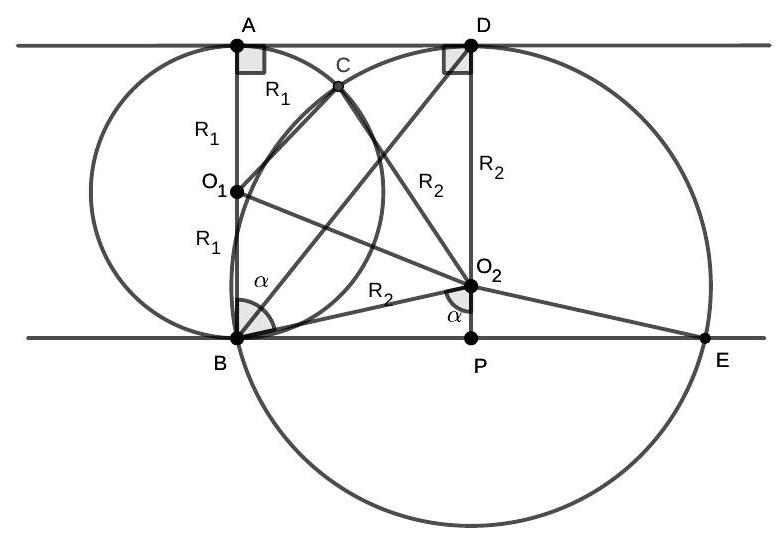
Fig. 1: Option 9, Problem 6
Solution. a) Let $R_{1}, R_{2}$ be the radii of circles $\omega_{1}$, $\omega_{2}$ respectively, $\angle O_{1} B O_{2}... | \frac{6}{5} | Geometry | math-word-problem | Yes | Yes | olympiads | false |
Solve for \( x \):
\[ \frac{x+10}{x-4} = \frac{x-3}{x+6} \] | Start by cross-multiplying to eliminate the fractions:
\[ (x+10)(x+6) = (x-3)(x-4) \]
Expand both sides of the equation:
\[ x^2 + 6x + 10x + 60 = x^2 - 4x - 3x + 12 \]
Simplify and collect like terms:
\[ x^2 + 16x + 60 = x^2 - 7x + 12 \]
Bring all terms to one side (subtract \( x^2 \), add \( 7x \), and subtract \( ... | -\frac{48}{23} | Algebra | math-word-problem | Yes | Yes | synthetic_math | true |
The sum of the first $25$ positive even integers is also the sum of five consecutive even integers. What is the smallest of these five integers? | The sum of the first 25 positive even integers is from $2$ to $50$, calculated as $2(1 + 2 + \dots + 25)$. Using the formula for the sum of the first $n$ natural numbers, $1 + 2 + \dots + n = \frac{n(n + 1)}{2}$, we get:
\[
2 \left(\frac{25 \cdot 26}{2}\right) = 25 \cdot 26 = 650.
\]
Let the five consecutive even inte... | 126 | Algebra | math-word-problem | Yes | Yes | synthetic_math | true |
Example 7: When and only when do real numbers $x_{0}, x_{1}, \cdots, x_{n}(n \geqslant 2)$ satisfy what conditions for there to exist real numbers $y_{0}$, $y_{1}, \cdots, y_{n}$, such that $z_{0}^{2}=z_{1}^{2}+z_{2}^{2}+\cdots+z_{n}^{2}$ holds? Here $z_{k}=x_{k}+\mathrm{i} y_{k}$, $\mathrm{i}$ is the imaginary unit, $... | It is easy to know that (1) is equivalent to
$$
\left\{\begin{array}{l}
\sum_{k=1}^{n} x_{k}^{2}-x_{0}^{2}=\sum_{k=1}^{n} y_{k}^{2}-y_{0}^{2}, \\
\sum_{k=1}^{n} x_{k} y_{k}=x_{0} y_{0} .
\end{array}\right.
$$
If there exist real numbers $y_{0}, y_{1}, \cdots, y_{n}$ such that (2) holds, then $x_{0}^{2} y_{0}^{2}=\left... | x_{0}^{2}\leqslant\sum_{k=1}^{n}x_{k}^{2} | Algebra | proof | Yes | Yes | olympiads | false |
Compute
\[
\sum_{1 \le a < b < c < d} \frac{1}{2^a 3^b 5^c 7^d}.
\]
(The sum is taken over all quadruples $(a, b, c, d)$ of positive integers such that $1 \le a < b < c < d.$) | Let \( x = a \), \( y = b - a \), \( z = c - b \), and \( w = d - c \) so that \( x \ge 1 \), \( y \ge 1 \), \( z \ge 1 \), and \( w \ge 1 \). Also, \( b = a + y = x + y \), \( c = b + z = x + y + z \), and \( d = c + w = x + y + z + w \). Therefore, we can rewrite the sum as:
\[
\sum_{x = 1}^\infty \sum_{y = 1}^\infty... | \frac{1}{45435456} | Combinatorics | math-word-problem | Yes | Yes | synthetic_math | true |
The difference of two numbers is 88. The second number is 20% of the first number. What is the first number? | Let's call the first number x and the second number y.
According to the problem, the difference between the two numbers is 88, so we can write the equation:
x - y = 88 (1)
It is also given that the second number is 20% of the first number, which can be written as:
y = 0.20 * x (2)
Now we can substitute equation ... | 110 | Algebra | math-word-problem | Yes | Yes | orca_math | true |
Find the roots of $8x^4 + 26x^3 - 65x^2 + 24x$. Enter your answer as a list of numbers separated by commas. | Given the polynomial has no constant term, factor out an $x$:
$$x(8x^3 + 26x^2 - 65x + 24).$$
Let $f(x) = x$ and $g(x) = 8x^3 + 26x^2 - 65x + 24$. The first root is $x=0$.
Next, consider $g(x)$ and check for rational roots. Using the rational root theorem, possible roots are ratios of factors of 24 (constant term) to ... | 0, \frac{1}{2}, \frac{3}{2}, -4 | Algebra | math-word-problem | Yes | Yes | synthetic_math | true |
451. How many values of the linear function $y=a x+b$ need to be given to fully define the function? Geometric meaning of the answer. | 451. Two. A straight line is defined by two points lying on it. | 2 | Algebra | math-word-problem | Yes | Yes | olympiads | false |
The Ponde family's Ultraflow jets 560 gallons of water per hour. Using this rate, calculate how many gallons of water it will pump in 75 minutes. Additionally, if they also use a MiniFlow which pumps 220 gallons per hour, how much total water can both pumps together pump in 50 minutes? | 1. **Calculate the gallons pumped by the Ultraflow in 75 minutes**:
Since 75 minutes is $\frac{75}{60} = 1.25$ hours, the Ultraflow will pump:
\[
560 \times 1.25 = 700 \text{ gallons}
\]
2. **Calculate the gallons pumped by the MiniFlow in 50 minutes**:
Since 50 minutes is $\frac{50}{60} \approx 0.8333$... | 883 | Algebra | math-word-problem | Yes | Yes | synthetic_math | true |
Find the value of $x$ such that $\sqrt{4 - 5x} = 3$. | 1. **Squaring both sides**: From $\sqrt{4 - 5x} = 3$, square both sides to eliminate the square root.
\[
(\sqrt{4 - 5x})^2 = 3^2 \implies 4 - 5x = 9
\]
2. **Solve for x**: Rearrange the equation to solve for $x$.
\[
4 - 9 = 5x \implies -5 = 5x \implies x = \frac{-5}{5} = -1
\]
Therefore, the solut... | -1 | Algebra | math-word-problem | Yes | Yes | synthetic_math | true |
3. The sum and the quotient of two numbers are both 6, then the product of these two numbers minus the difference of these two numbers (larger minus smaller) equals ( ).
(A) $26 \frac{4}{7}$
(B) $5 \frac{1}{7}$
(C) $\frac{6}{7}$
(D) $\frac{6}{49}$. | $\mathrm{D}$, | \frac{6}{49} | Algebra | MCQ | Yes | Problem not solved | olympiads | false |
Let $α$ and $β$ be two distinct planes, and $l$ be a line. The correct conclusion among the following is ( ).
A: If $l \parallel α$ and $α \perp β$, then $l \perp β$.
B: If $l \perp α$ and $α \perp β$, then $l \parallel β$.
C: If $l \parallel α$ and $α \parallel β$, then $l \parallel β$.
D: If $l \perp α$ and $α \p... | For option A: if line $l$ happens to be parallel to the intersection line of planes $α$ and $β$, then $l \parallel α$, which is not necessarily perpendicular to $β$, so this option is incorrect.
For option B: if $l \perp α$ and $α \perp β$, it does not necessarily imply that $l$ is parallel to $β$ since $l$ could be c... | D | Geometry | MCQ | Yes | Yes | cn_k12 | false |
Given the function $f(x)=3x^{2}-2ax-8$ is not monotonic on the interval $(1,2)$, then the range of the real number $a$ is $(\quad)$
A: $[3,6]$
B: $(-\infty,3]\cup[6,+\infty)$
C: $[3,6)$
D: $(3,6)$ | Since it is known that the function $f(x)=3x^{2}-2ax-8$ is not monotonic in the interval $(1,2)$,
the axis of symmetry of the quadratic function $f(x)$ is $x= \dfrac {a}{3}$,
$\therefore 1 < \dfrac {a}{3} < 2$, solving this yields: $3 < a < 6$,
thus, the correct choice is $\boxed{D}$.
By finding the axis of sym... | D | Algebra | MCQ | Yes | Yes | cn_k12 | false |
At the start of the game there are $ r$ red and $ g$ green pieces/stones on the table. Hojoo and Kestutis make moves in turn. Hojoo starts. The person due to make a move, chooses a colour and removes $ k$ pieces of this colour. The number $ k$ has to be a divisor of the current number of stones of the other colour. The... | 1. **Initial Setup**: Let \( r = 2^k i \) and \( g = 2^l j \), where \( i \) and \( j \) are odd numbers. Here, \( 2^k \) and \( 2^l \) are referred to as the *even parts* of \( r \) and \( g \) respectively.
2. **Winning Condition**: The player who removes the last piece wins. We need to determine who can force a vic... | r | Logic and Puzzles | math-word-problem | Yes | Yes | aops_forum | false |
What is the distance between the points (-3, 5) and (7, -10)? | To solve this problem, we calculate the distance between these two points using the distance formula:
1. Identify the coordinates: $(x_1, y_1) = (-3, 5)$ and $(x_2, y_2) = (7, -10)$.
2. Substitute into the formula: $$\sqrt{(x_2 - x_1)^2 + (y_2 - y_1)^2} = \sqrt{(7 - (-3))^2 + (-10 - 5)^2}.$$
3. Simplify the arithmetic:... | \sqrt{325} | Geometry | math-word-problem | Yes | Yes | synthetic_math | true |
The population of a town is 8000. It decreases annually at some rate. The population of the town after 2 years is 6480. What is the annual rate of decrease in population? | Let's denote the annual rate of decrease as r (in percentage). The population decreases annually, so after one year, the population would be 8000 * (1 - r/100), and after two years, it would be 8000 * (1 - r/100)^2.
According to the information given, the population after two years is 6480. So we can set up the equati... | 10\% | Algebra | math-word-problem | Yes | Yes | orca_math | true |
Evaluate \[\frac{3}{\log_8{1000^4}} + \frac{4}{\log_{10}{1000^4}},\] giving your answer as a fraction in lowest terms. | First, using the power rule of logarithms, $\log_a b^x = x \log_a b$, where $a$ is the base, $b$ is the argument, and $x$ is the exponent:
\[
\frac{3}{\log_8{1000^4}} + \frac{4}{\log_{10}{1000^4}} = \frac{3}{4\log_8 1000} + \frac{4}{4\log_{10} 1000}
\]
This simplifies to:
\[
\frac{3}{4\log_8 1000} + \frac{4}{4\log_{10}... | \frac{49}{40} | Algebra | math-word-problem | Yes | Incomplete | synthetic_math | true |
Sofia asked the students to suggest specific types of food. Some students suggested adding mashed potatoes while 489 suggested adding bacon to the menu. 10 more students suggested bacon than those that suggested mashed potatoes. How many students suggested adding mashed potatoes? |
If 489 students suggested adding bacon and that number is 10 more than those who suggested mashed potatoes, then the number of students who suggested mashed potatoes is 489 - 10 = $\boxed{479}$ students. | 479 | Algebra | math-word-problem | Yes | Yes | orca_math | true |
Subsets and Splits
No community queries yet
The top public SQL queries from the community will appear here once available.