
instruction_seed stringlengths 2 10.7k | solution stringlengths 0 10.8k ⌀ | answer stringlengths 0 575 ⌀ | problem_type stringclasses 9
values | question_type stringclasses 5
values | problem_is_valid stringclasses 5
values | solution_is_valid stringclasses 4
values | source stringclasses 11
values | synthetic bool 2
classes |
|---|---|---|---|---|---|---|---|---|
1. Given $I$ is the incenter of $\triangle A B C$, $A C=2, B C=3$, $A B=4$. If $\overrightarrow{A I}=x \overrightarrow{A B}+y \overrightarrow{A C}$, then $x+y=$ $\qquad$ | $-1 . \frac{2}{3}$.
Connect $A I$ and extend it to intersect $B C$ at point $D$. Then $D$ divides the segment $B C$ in the ratio $\lambda=\frac{A B}{A C}=\frac{4}{2}=2$.
Thus, $\overrightarrow{A D}=\frac{1}{3} \overrightarrow{A B}+\frac{2}{3} \overrightarrow{A C}$.
Since $B C=3$, we have $B D=2, D C=1$.
In $\triangle A... | \frac{2}{3} | Geometry | math-word-problem | Yes | Yes | cn_contest | false |
## Task 1 - 260731
Mr. Anders drove past a gas station (A) on the highway at a speed of $100 \frac{\mathrm{km}}{\mathrm{h}}$. After driving an additional distance of $175 \mathrm{~km}$, Mr. Anders had to switch the fuel valve to reserve.
Since the next gas station (B) is still $45 \mathrm{~km}$ away from this point o... | The distance from A to the point where the speed was reduced is $s_{1}=175$ $\mathrm{km}$, the distance from this point to B is $s_{2}=45 \mathrm{~km}$, so the total distance from A to B is $s=s_{1}+s_{2}=220 \mathrm{~km}$. (1)
The speed at which the first segment was covered is $v_{1}=100 \frac{\mathrm{km}}{\mathrm{h... | 88\frac{\mathrm{}}{\mathrm{}} | Algebra | math-word-problem | Yes | Yes | olympiads | false |
Given the function $y=x^{3}-3x+c$ whose graph intersects the $x$-axis at exactly 2 points, determine the value(s) of $c$.
A: $-3$ or $1$
B: $-9$ or $3$
C: $-1$ or $1$
D: $-2$ or $2$ | The graph of the function $y=x^{3}-3x+c$ intersects the $x$-axis at exactly 2 points, which is equivalent to the function $f(x)=x^{3}-3x$ intersecting with $g(x)=-c$ at 2 points.
We know that $f'(x) = 3x^{2}-3$,
When $f'(x) > 0$, we have $x > 1$ or $x < -1$.
When $f'(x) < 0$, we have $-1 < x < 1$.
So, the function ... | D | Algebra | MCQ | Yes | Yes | cn_k12 | false |
Let's denote the distances from a point arbitrarily chosen on the circumference of the circumscribed circle of a cyclic quadrilateral to the consecutive sides of the quadrilateral as $p$, $q$, $r$, and $s$. Show that $p r = q s$.
| Let $A B C D$ be a cyclic quadrilateral, and let $M$ be a point on the circle circumscribed around it. If $M$ coincides with a vertex, the equality is obviously true, with zero on both sides. In other cases, we can choose the labeling such that $M$ is an internal point of the arc $A B$ that does not contain $C$ and $D$... | proof | Geometry | proof | Yes | Yes | olympiads | false |
Example 5 As shown in Figure 8, in $\triangle A B C$, $\angle B A C=40^{\circ}$, $\angle A B C=60^{\circ}$. Points $D$ and $E$ are taken on sides $A C$ and $A B$ respectively, such that $\angle C B D=40^{\circ}$, $\angle B C E=70^{\circ}$, and $B D \cap C E=F$. Prove that $A F \perp B C$. | Proof 1: Since $\angle A B C=60^{\circ}, \angle C B D=40^{\circ}$, $\angle B A C=40^{\circ}, \angle B C E=70^{\circ}$, then
$\angle A B D=20^{\circ}, \angle A C B=80^{\circ}, \angle A C E=10^{\circ}$.
Let $\angle B A F=x$, thus, $\angle F A C=40^{\circ}-x$.
Applying the trigonometric form of Ceva's Theorem to $\triangl... | proof | Geometry | proof | Yes | Yes | cn_contest | false |
A circle with center $O$ is drawn in the first quadrant of the 2D Cartesian plane (the quadrant with both positive $x$ and $y$ values) such that it lies tangent to the $x$ and $y$-axes. A line is drawn with slope $m>1$ and passing through the origin; the line intersects the circle at two points $A$ and $B$, with $A$ cl... | null | null | Geometry | math-word-problem | Yes | Yes | aops_forum | false |
An plane covers a certain distance at a certain speed in 5 hours. To cover the same distance in 5/3 hours, it must travel at a speed of 720 kmph. What is the initial speed of the plane? | Let's denote the initial speed of the plane as V_initial (in km/h) and the distance covered as D (in km).
According to the given information, the plane covers the distance D in 5 hours at the initial speed V_initial. So we can write the following equation:
D = V_initial * 5 (1)
To cover the same distance in 5/3 hou... | 240 | Algebra | math-word-problem | Yes | Yes | orca_math | true |
Given that $a > 0$ and $b > 0$ are real numbers, and $\sqrt {2}$ is the geometric mean of $4^{a}$ and $2^{b}$, find the minimum value of $\dfrac {1}{a}+ \dfrac {2}{b}$.
A: $\dfrac {8}{3}$
B: $\dfrac {11}{3}$
C: $8$
D: $4$ | Since $a > 0$ and $b > 0$ are real numbers, and $\sqrt {2}$ is the geometric mean of $4^{a}$ and $2^{b}$, we have $2=4^{a}\cdot2^{b}$, which implies that $2a+b=1$.
We want to find the minimum value of $\dfrac {1}{a}+ \dfrac {2}{b}$. Using the fact that $2a+b=1$, we can rewrite the expression as $(2a+b)(\dfrac {1}{a}+ ... | 8 | Algebra | MCQ | Yes | Yes | cn_k12 | false |
Let \( r \) be a real number, \( |r| > 2, \) and let \( z \) be a complex number such that
\[ z + \frac{1}{z} = r. \]
Find \( |z| \). | From the given equation \( z + \frac{1}{z} = r \), we can manipulate it to form the quadratic equation:
\[ z^2 - rz + 1 = 0. \]
The quadratic formula gives:
\[ z = \frac{r \pm \sqrt{r^2 - 4}}{2}. \]
Since \( |r| > 2 \), the term under the square root \( r^2 - 4 \) is positive, hence no imaginary part is directly invoke... | 1 | Algebra | math-word-problem | Yes | Incomplete | synthetic_math | true |
Prove that $1155^{1958}+34^{1958} \neq n^{2}$, where $n-$ is an integer. | On the one hand, $1155^{1958}+34^{1958}=\left(1155^{979}\right)^{2}+34^{1958}>\left(1155^{979}\right)^{2}$. On the other hand, $1155^{1958}+34^{1958}<$ $\left(1155^{979}+2\right)^{2}$, since $34^{1958}=1156^{979}<4 \cdot 1155^{979}$. Indeed, $\left({ }^{1956} / 1955\right)^{979}=\left(1+\frac{1}{1955}\right)^{979}<\lef... | proof | Number Theory | proof | Yes | Yes | olympiads | false |
Express the number 7600 in scientific notation ( ):
A: 0.76$ imes10^{4}$
B: 7.6$ imes10^{3}$
C: 7.6$ imes10^{4}$
D: 76$ imes10^{2}$ | Solution: Express 7600 in scientific notation: 7.6$ imes10^{3}$,
Hence, the answer is: $\boxed{\text{B}}$.
Scientific notation is represented in the form of $a imes10^{n}$, where $1 le |a| < 10$, and $n$ is an integer. To determine the value of $n$, observe how many positions the decimal point has moved to convert the... | \text{B} | Algebra | MCQ | Yes | Yes | cn_k12 | false |
Consider all 7 tetrominos as shown below.

Émile has 2023 copies of each tetromino. By allowing the pieces to be rotated, can he arrange all the pieces together, without overlapping, to for... | Suppose by contradiction that we have a rectangle that can be tiled by the $7 \times 2023$ tetrominos. We color the cells of the grid in a checkerboard pattern. Then in each tetromino other than those in "T" shape, there are 2 white cells and 2 black cells, and in the "T" shaped tetromino, there are 3 cells of one colo... | proof | Combinatorics | math-word-problem | Incomplete | Yes | olympiads | false |
Exercise 6. Determine all triplets $(x, y, z)$ of natural numbers satisfying the equation:
$$
2^{x}+3^{y}=z^{2}
$$ | Solution to Exercise 6 First, let's analyze the problem: we have a Diophantine equation with a power of 2, a power of 3, and a square. We quickly test small values of $z$ to find the solution. We can observe that $2^{0}+3^{1}=2^{2}, 2^{3}+3^{0}=3^{2}$, and $2^{4}+3^{2}=5^{2}$. Since we have a few solutions, we won't fi... | (0,1,2),(3,0,3),(4,2,5) | Number Theory | math-word-problem | Yes | Incomplete | olympiads | false |
One afternoon, Rachelle, Gretchen, and Rocky threw pennies into the fountain and made wishes. Rachelle threw some pennies into the fountain. Gretchen threw half as many pennies as Rachelle, and Rocky threw in one-third as many pennies as Gretchen. The total number of pennies thrown into the fountain by the three of the... | Let's denote the number of pennies Rachelle threw into the fountain as R. According to the problem, Gretchen threw half as many pennies as Rachelle, so Gretchen threw R/2 pennies. Rocky threw one-third as many pennies as Gretchen, so Rocky threw (1/3) * (R/2) = R/6 pennies.
The total number of pennies thrown into the ... | 180 | Algebra | math-word-problem | Yes | Yes | orca_math | true |
Determine the value of $\sin {210^{0}}$. The options are:
A: $-\frac{\sqrt{3}}{2}$
B: $-\frac{1}{2}$
C: $\frac{1}{2}$
D: $\frac{\sqrt{3}}{2}$ | This problem primarily tests your understanding of the cofunction identities and the values of trigonometric functions for special angles. By directly applying the cofunction identities and simplifying, we can find the solution.
Step 1: Apply the cofunction identity for sine.
$\sin {210^{0}}$
$= \sin \left(180^{\circ}... | -\frac{1}{2} | Algebra | MCQ | Yes | Yes | cn_k12 | false |
On Misha's new phone, a passlock consists of six circles arranged in a $2\times 3$ rectangle. The lock is opened by a continuous path connecting the six circles; the path cannot pass through a circle on the way between two others (e.g. the top left and right circles cannot be adjacent). For example, the left path sho... | null | null | Combinatorics | math-word-problem | Yes | Yes | aops_forum | false |
[b]a)[/b] Is it possible to find a function $f:\mathbb N^2\to\mathbb N$ such that for every function $g:\mathbb N\to\mathbb N$ and positive integer $M$ there exists $n\in\mathbb N$ such that set $\left\{k\in \mathbb N : f(n,k)=g(k)\right\}$ has at least $M$ elements?
[b]b)[/b] Is it possible to find a function $f:\math... |
To solve the given problem, we need to analyze the properties of the function \( f: \mathbb{N}^2 \to \mathbb{N} \) and the sets defined in terms of \( f \) and another function \( g: \mathbb{N} \to \mathbb{N} \).
### Part a)
We need to determine if there exists a function \( f: \mathbb{N}^2 \to \mathbb{N} \) such tha... | No | NaN | NaN | NaN | NaN | aops_forum | false |
23. N4 (ROM) Let $b$ be an integer greater than 5. For each positive integer $n$, consider the number
$$ x_{n}=\underbrace{11 \ldots 1}_{n-1} \underbrace{22 \ldots 2}_{n} 5, $$
written in base $b$. Prove that the following condition holds if and only if $b=10$: There exists a positive integer $M$ such that for every i... | 23. Assume that $b \geq 6$ has the required property. Consider the sequence $y_{n}=(b-1) x_{n}$. From the definition of $x_{n}$ we easily find that $y_{n}=b^{2 n}+$ $b^{n+1}+3 b-5$. Then $y_{n} y_{n+1}=(b-1)^{2} x_{n} x_{n+1}$ is a perfect square for all $n>M$. Also, straightforward calculation implies
$$ \left(b^{2 n... | b=10 | Number Theory | proof | Yes | Yes | olympiads_ref | false |
A girl is traveling across the floor for a distance of 96 meters. It takes her 16 seconds to reach the other side. What is her speed in m/s? | To calculate her speed in meters per second (m/s), you need to divide the distance traveled by the time it took to travel that distance.
Speed = Distance / Time
Given:
Distance = 96 meters
Time = 16 seconds
Speed = 96 meters / 16 seconds = 6 meters/second
Therefore, her speed is $\boxed{6}$ m/s. | 6 | Algebra | math-word-problem | Yes | Yes | orca_math | true |
Solve the set of simultaneous equations
\begin{align*}
v^2+ w^2+ x^2+ y^2 &= 6 - 2u, \\
u^2+ w^2+ x^2+ y^2 &= 6 - 2v, \\
u^2+ v^2+ x^2+ y^2 &= 6- 2w, \\
u^2+ v^2+ w^2+ y^2 &= 6 - 2x, \\
u^2+ v^2+ w^2+ x^2 &= 6- 2y.
\end{align*} | 1. Consider the given set of simultaneous equations:
\[
\begin{align*}
v^2 + w^2 + x^2 + y^2 &= 6 - 2u, \\
u^2 + w^2 + x^2 + y^2 &= 6 - 2v, \\
u^2 + v^2 + x^2 + y^2 &= 6 - 2w, \\
u^2 + v^2 + w^2 + y^2 &= 6 - 2x, \\
u^2 + v^2 + w^2 + x^2 &= 6 - 2y.
\end{align*}
\]
2. Add all five equations:
... | null | Algebra | math-word-problem | Yes | Yes | aops_forum | false |
Bob wants to build a pyramid out of legos with 3 levels where the bottom level has some legos per side and each level has one less lego per side than the level below it. He will need 110 legos total. How many legos per side does the bottom level have? | Let's denote the number of legos per side on the bottom level as \( x \). Since each level has one less lego per side than the level below it, the second level will have \( x - 1 \) legos per side, and the top level will have \( x - 2 \) legos per side.
For a pyramid, the number of legos in each level is the square of... | 7 | Algebra | math-word-problem | Yes | Yes | orca_math | true |
Alex has 6 pieces of paper, each with a different math problem. He wants to distribute these problems to his 15 friends. Each friend can receive more than one problem. In how many ways can Alex distribute these problems? | The process to solve this problem is similar to the original, but with updated numbers.
- Alex has 6 distinct problems.
- For each problem, he can choose any of his 15 friends. This choice is independent of the choice he makes for the other problems.
- Thus, for each of the 6 problems, there are 15 possibilities.
Th... | 11390625 | Combinatorics | math-word-problem | Yes | Yes | synthetic_math | true |
Given the proposition $p$: $\exists x \in \mathbb{R}$, $x^{2}+2x=3$, then $\neg p$ is ______. | Since the proposition $p$: $\exists x \in \mathbb{R}$, $x^{2}+2x=3$ is an existential proposition,
According to the rule that the negation of an existential proposition is a universal proposition, we get $\neg p$: $\forall x \in \mathbb{R}$, $x^{2}+2x \neq 3$.
Therefore, the answer is: $\forall x \in \mathbb{R}$, $x^... | \forall x \in \mathbb{R}, x^{2}+2x \neq 3 | Algebra | math-word-problem | Yes | Yes | cn_k12 | false |
Three, the sequence $\left\{a_{n}\right\}$ satisfies
$$
(n-1) a_{n+1}=(n+1) a_{n}-2(n-1) \text {, }
$$
$n=1,2, \cdots$, and $a_{100}=10098$. Find the general term formula of the sequence $\left\{a_{n}\right\}$. | Three, Solution 1: The given equation can be transformed into
$$
(n-1)\left(a_{n+1}-2 n\right)=(n+1)\left[a_{n}-2(n-1)\right] \text {. }
$$
Let $b_{n}=a_{n}-2(n-1)$, then we have
$(n-1) b_{n+1}=(n+1) b_{n}$.
When $n \geqslant 2$, $b_{n+1}=\frac{n+1}{n-1} \cdot b_{n}$;
When $n \geqslant 3$, $b_{n}=\frac{n}{n-2} \cdot b... | a_{n}=(n-1)(n+2) | Algebra | math-word-problem | Yes | Yes | cn_contest | false |
Given $$x \in (0, \frac{1}{2})$$, find the minimum value of $$\frac{2}{x} + \frac{9}{1-2x}$$. | Since $$x \in (0, \frac{1}{2})$$, it follows that $$1-2x > 0$$.
Therefore, $$\frac{2}{x} + \frac{9}{1-2x} = (2x + 1 - 2x)\left( \frac{4}{2x} + \frac{9}{1-2x}\right) = 13 + \frac{4(1-2x)}{2x} + \frac{9 \cdot 2x}{1-2x} \geq 13 + 2\sqrt{\frac{4(1-2x)}{2x} \cdot \frac{9 \cdot 2x}{1-2x}} = 25$$
This inequality holds if ... | 25 | Algebra | math-word-problem | Yes | Yes | cn_k12 | false |
If the foci of the hyperbola $\frac{x^2}{a^2} - \frac{y^2}{b^2} = 1$ (where $a > 0, b > 0$) are $F_1$ and $F_2$ respectively, and the segment $\overline{F_1F_2}$ is divided by the focus of the parabola $y^2 = 4bx$ into two segments in the ratio 5:3, then the eccentricity of the hyperbola is
A: $\frac{2\sqrt{3}}{3}$
B: ... | To solve this problem, we'll analyze the properties and geometric meanings of both the hyperbola and the parabola.
The focus of the parabola $y^2=4bx$ is $F(b,0)$, and we are given that the distance between the foci of the hyperbola is divided into two segments in the ratio of $5:3$ by the parabola's focus. With that,... | \frac{4\sqrt{15}}{15} | Algebra | MCQ | Yes | Yes | cn_k12 | false |
if there are only 2 wheelers and 4 wheelers parked in a school located at the heart of the city , find the number of 4 wheelers parked there if the total number of wheels is 66 ? | Let's denote the number of 2-wheelers as \( x \) and the number of 4-wheelers as \( y \).
The total number of wheels from 2-wheelers would be \( 2x \) and from 4-wheelers would be \( 4y \).
According to the problem, the total number of wheels is 66, so we can write the equation:
\( 2x + 4y = 66 \)
We can simplify t... | 1 | Algebra | math-word-problem | Yes | Yes | orca_math | true |
Carmen is preparing dinner plates for a row of customers at the counter in a diner. She likes to put a couple of sprigs of parsley on each plate for decoration. However, she is very low on parsley and doesn't have enough to even put 1 sprig on every plate, so she needs to break several of the parsley sprigs in two to m... | To determine the value of the unknown variable \( x \), we need to follow these steps:
1. **Calculate the total number of sprigs used for the 8 plates with one whole sprig each:**
\[
8 \text{ plates} \times 1 \text{ sprig/plate} = 8 \text{ sprigs}
\]
2. **Determine the total number of sprigs used for the 12 ... | \frac{1}{2} | Algebra | math-word-problem | Yes | Yes | metamath | true |
Example 4 Let $a>b>0$, prove: $\sqrt{2} a^{3}+\frac{3}{a b-b^{2}} \geqslant 10$. | Prove that since $a b-b^{2}=b(a-b) \leqslant \frac{[b+(a-b)]^{2}}{4}=\frac{a^{2}}{4}$, therefore
$$\begin{aligned}
& \sqrt{2} a^{3}+\frac{3}{a b-b^{2}} \geqslant \sqrt{2} a^{3}+\frac{12}{a^{2}} \\
= & \frac{\sqrt{2}}{2} a^{3}+\frac{\sqrt{2}}{2} a^{3}+\frac{4}{a^{2}}+\frac{4}{a^{2}}+\frac{4}{a^{2}} \\
\geqslant & 5 \sqr... | 10 | Inequalities | proof | Yes | Yes | inequalities | false |
Evaluate $\left\lceil \sqrt{\frac{16}{5}} \right\rceil + \left\lceil \frac{16}{5} \right\rceil + \left\lceil \left(\frac{16}{5}\right)^2 \right\rceil + \left\lceil \left(\frac{16}{5}\right)^3 \right\rceil$. | 1. **Square Root Term**: $\sqrt{\frac{16}{5}} = \sqrt{3.2} \approx 1.78885$. The smallest integer greater than $1.78885$ is $2$.
2. **Fraction Term**: $\frac{16}{5} = 3.2$. The smallest integer greater than $3.2$ is $4$.
3. **Square of Fraction Term**: $\left(\frac{16}{5}\right)^2 = \left(\frac{256}{25}\right) = 10.24$... | 50 | Algebra | math-word-problem | Yes | Yes | synthetic_math | true |
Compute $\begin{pmatrix} -3 & 5 \\ 4 & 2 \end{pmatrix} \begin{pmatrix} 2 & -4 \\ -1 & 3 \end{pmatrix}.$ | We need to perform the matrix multiplication:
\[
\begin{pmatrix} -3 & 5 \\ 4 & 2 \end{pmatrix} \begin{pmatrix} 2 & -4 \\ -1 & 3 \end{pmatrix}
= \begin{pmatrix} (-3)(2) + (5)(-1) & (-3)(-4) + (5)(3) \\ (4)(2) + (2)(-1) & (4)(-4) + (2)(3) \end{pmatrix}
\]
Calculate each entry:
- Top left: $(-3)(2) + (5)(-1) = -6 - 5 = -... |
\begin{pmatrix} -11 & 27 \\ 6 & -10 \end{pmatrix}
| Algebra | math-word-problem | Yes | Yes | synthetic_math | true |
Which of the following line segments can form a triangle with line segments of length $2$ and $6$?
A: $2$
B: $4$
C: $6$
D: $9$ | To determine which line segments can form a triangle with line segments of lengths $2$ and $6$, we use the triangle inequality theorem. This theorem states that the sum of the lengths of any two sides of a triangle must be greater than the length of the third side.
Given sides of lengths $2$ and $6$, we can express th... | C | Geometry | MCQ | Yes | Yes | cn_k12 | false |
Let $a,$ $b,$ and $c$ be the roots of the equation $x^3 - 24x^2 + 50x - 14 = 0.$ Find the value of $\frac{a}{\frac{1}{a}+bc} + \frac{b}{\frac{1}{b}+ca} + \frac{c}{\frac{1}{c}+ab}.$ | Using Vieta's formulas, we identify:
- $a+b+c = 24$
- $ab+bc+ca = 50$
- $abc = 14$
Each term simplifies as:
\[
\frac{a}{\frac{1}{a}+bc} = \frac{a^2}{1+abc} = \frac{a^2}{1+14} = \frac{a^2}{15}
\]
Similarly, the expressions for $b$ and $c$ are:
\[
\frac{b}{\frac{1}{b}+ca} = \frac{b^2}{15}, \quad \frac{c}{\frac{1}{c}+ab}... | \frac{476}{15} | Algebra | math-word-problem | Yes | Yes | synthetic_math | true |
Given: The function $f(x) = x\ln x$, then $f'(1) = \underline{\quad}$. | **Answer**
To find the derivative of $f(x) = x\ln x$ at $x=1$, we apply the product rule of differentiation. The derivative of $x$ is $1$, and the derivative of $\ln x$ is $\frac{1}{x}$. Therefore, the derivative of $f(x)$ is:
\[f'(x) = 1 \cdot \ln x + x \cdot \frac{1}{x} = \ln x + 1\]
Substituting $x=1$ into $f'(x)... | 1 | Calculus | math-word-problem | Yes | Yes | cn_k12 | false |
9. Given that the function $y=f(x)$ is a monotonically increasing function defined on $\mathbf{R}$, for any $x \in \mathbf{R}$, we have $f(5-x)=$ $-f(-1+x)$, solve the inequality $\left|f\left(x^{2}-2 x+7\right)\right|<f\left(x^{2}+3 a+2\right)$. | 9. By the given conditions, $y=f(x)$ is a generalized (II) type odd function symmetric about the point $(2,0)$, and it is monotonically increasing on $\mathbf{R}$. By Conclusion 4(2) of this chapter, the original inequality is equivalent to $\left|\left(x^{2}-2 x+7\right)-2\right|1$.
---
Note: The original text seems... | Algebra | math-word-problem | Yes | Incomplete | olympiads | false | |
Denote the dot product of two sequences $\langle x_1,\dots,x_n\rangle$ and $\langle y_1,\dots,y_n\rangle$ to be
$$x_1y_1+x_2y_2+\dots+x_ny_n.$$
Let $\langle a_1,\dots,a_n\rangle$ and $\langle b_1,\dots,b_n\rangle$ be two sequences of consecutive integers (i.e. for $1\leq i,i+1\leq n$, $a_i+1=a_{i+1}$ and similarly for ... | null | null | Combinatorics | math-word-problem | Yes | Yes | aops_forum | false |
Let the focus of the parabola $y^2=4x$ be $F$, and a line passing through the focus $F$ intersects the parabola at points $A$ and $B$, with the x-coordinate of the midpoint of $AB$ being 2. Then the value of $|AF|+|BF|$ is ( )
A: 4
B: 5
C: 6
D: 7 | Let the points $A$ and $B$ on the parabola $y^2=4x$ have their projections on the directrix $x=-1$ at $M$ and $N$, respectively.
According to the definition of a parabola, we have $|AF|=|AM|$ and $|BF|=|BN|$,
Therefore, $|AF|+|BF|=|AM|+|BN|$,
Since the x-coordinate of the midpoint $P$ of $AB$ is 2, let the projec... | \text{C} | Geometry | MCQ | Yes | Yes | cn_k12 | false |
a 6 - liter solution is 35 % alcohol . how many liters of pure alcohol must be added to produce a solution that is 50 % alcohol ? | Let's call the number of liters of pure alcohol that needs to be added "x".
The initial 6-liter solution contains 35% alcohol, which means it has 0.35 * 6 = 2.1 liters of pure alcohol.
After adding x liters of pure alcohol, the total volume of the solution will be 6 + x liters, and the total amount of pure alcohol wi... | 50\% | Algebra | math-word-problem | Yes | Yes | orca_math | true |
Elective 4-4: Coordinate System and Parametric Equations
In the Cartesian coordinate system $xOy$, there is a line $l: \begin{cases}x=t \\ y= \sqrt{5}+2t\end{cases} (t$ is the parameter$)$, with the origin $O$ as the pole and the positive $x$-axis as the polar axis, a polar coordinate system is established. The polar ... | Solution:
$(1)$ Since ${\rho}^{2}\cos 2\theta+4=0$,
$\therefore {\rho}^{2}\cos ^{2}\theta-{\rho}^{2}\sin ^{2}\theta+4=0$,
$\therefore x^{2}-y^{2}+4=0$,
$\therefore y^{2}-x^{2}=4$;
$(2)$ Converting the parametric equation of line $l$ to its standard form:
$\begin{cases} x= \dfrac {1}{ \sqrt {5}}t \\ y= \sqrt {5}+ ... | 4 | Algebra | math-word-problem | Yes | Yes | cn_k12 | false |
The domain of the function $y=\frac{1}{x-1}$ is $(-\infty, 1) \cup [2,5)$. Determine its range.
A: $(-\infty, 0) \cup (\frac{1}{2}, 2]$
B: $(-\infty, 0) \cup [\frac{1}{4}, 1]$
C: $(-\infty, \frac{1}{2}) \cup \{2, +\infty\}$
D: $(-\infty, 0) \cup (\frac{1}{4}, 1]$ | This problem requires understanding the monotonicity of a function and how to determine its range. We can utilize the function's monotonicity to find the answer.
The function $y=\frac{1}{x-1}$ is strictly decreasing on both intervals $(-\infty, 1)$ and $[2,5)$.
When $x \in (-\infty, 1)$, we have $y \in (-\infty, 0)$.... | \text{D} | Algebra | MCQ | Yes | Yes | cn_k12 | false |
a and b together can do a piece of work in 6 days and a alone can do it in 11 days. In how many days can b alone do the work? | Let's denote the work done by A and B together in one day as \( \frac{1}{6} \) of the work, since they can complete the work in 6 days.
Similarly, the work done by A alone in one day is \( \frac{1}{11} \) of the work, since A can complete the work in 11 days.
Now, let's denote the work done by B alone in one day as \... | 13.2 | Algebra | math-word-problem | Yes | Yes | orca_math | true |

Given a rectangle $100 \times 101$, divided by grid lines into unit squares. Find the number of segments into which the grid lines divide its diagonal. | Each horizontal and each vertical line of the grid intersects the diagonal at some point.
## Solution
Each of the 100 horizontal and each of the 99 vertical lines of the grid, located inside the rectangle, intersects the diagonal at some point. For convenience, let's introduce a coordinate system such that the origin... | 200 | Geometry | math-word-problem | Incomplete | Yes | olympiads | false |
Let $ A\in M_2\left( \mathbb{C}\right) $ such that $ \det \left( A^2+A+I_2\right) =\det \left( A^2-A+I_2\right) =3. $
Prove that $ A^2\left( A^2+I_2\right) =2I_2. $ | 1. Given \( A \in M_2(\mathbb{C}) \) such that \( \det(A^2 + A + I_2) = \det(A^2 - A + I_2) = 3 \). We need to prove that \( A^2(A^2 + I_2) = 2I_2 \).
2. Consider the characteristic polynomial of \( A \), which is \( \det(\lambda I - A) = \lambda^2 - \text{tr}(A)\lambda + \det(A) \). Let the eigenvalues of \( A \) be ... | null | Algebra | proof | Yes | Yes | aops_forum | false |
Let \( x, y, \) and \( z \) be positive real numbers, and let \( k \) be a positive constant. Find the minimum value of
\[
\frac{6z}{x + 2y + k} + \frac{6x}{2z + y + k} + \frac{3y}{x + z + k}.
\] | Let \( a = x, b = 2y, \) and \( c = 2z \). Then \( x = a, y = \frac{b}{2}, \) and \( z = \frac{c}{2} \), so the expression becomes
\[
\frac{3c}{a + b + k} + \frac{3a}{c + \frac{b}{2} + k} + \frac{\frac{3b}{2}}{a + \frac{c}{2} + k}.
\]
To handle the fractions, simplify the expression:
\[
\frac{3c}{a + b + k} + \frac{6a}... | 4.5 | Inequalities | math-word-problem | Yes | Yes | synthetic_math | true |
Two locations $A$ and $B$ are 225 kilometers apart. The price of a metric ton of coal is 3 crowns 75 fillers in $A$ and 4 crowns 25 fillers in $B$, and the transportation cost is 8 fillers per ton and per kilometer. At which point on the line $AB$ will the coal cost the same, whether we bring it from $A$ or $B$? - Furt... | The price of coal at point $C$, which is $x$ kilometers from $A$ and $225-x$ kilometers from $B$, is on one hand
$$
3.75 + 0.008 x
$$
and on the other hand
$$
4.25 + 0.008 (225 - x)
$$
where the coal can be brought to a single price whether from $A$ or $B$:
$$
\begin{gathered}
3.75 + 0.008 x_{0} = 4.25 + 1.8 - 0.0... | 143.75 | Algebra | math-word-problem | Yes | Yes | olympiads | false |
Example 3 Given $a, b, c \in \mathbf{R}$ and $a+b+c=1$, prove: $\sqrt{\frac{7}{5}} \leqslant \sqrt{a+b}+\sqrt{2 b+c}+\sqrt{3 c+a} \leqslant$ $\sqrt{\frac{119}{10}}$. (Mathematical Problems 1464, Mathematics Bulletin) | \begin{array}{l}\text { Prove: Let } x=\sqrt{a+b}, y=\sqrt{2 b+c}, z \\ =\sqrt{3 c+a}, \text { then } x, y, z \geqslant 0 \text { and } 5 x^{2}+y^{2}+2 z^{2} \\ =7, \text { by the Cauchy-Schwarz inequality, we have }(x+y+z)^{2}= \\ \left(\frac{1}{\sqrt{5}} \cdot \sqrt{5} x+y+\frac{1}{\sqrt{2}} \cdot \sqrt{2} z\right)^{... | \sqrt{\frac{7}{5}} \leqslant \sqrt{a+b}+\sqrt{2 b+c}+\sqrt{3 c+a} \leqslant \sqrt{\frac{119}{10}} | Inequalities | proof | Yes | Yes | inequalities | false |
Given the function $f(x)=ax^{3}+f'(2)x^{2}+3$, if $f'(1)=-5$, then $f'(2)=$ ? | **Analysis**
This question examines the operation of derivatives.
The conclusion can be directly calculated using the operation of derivatives.
**Solution**
Since $f(x)=ax^{3}+f'(2)x^{2}+3$,
we have $f'(x)=3ax^{2}+2f'(2)x$.
From $f'(1)=-5$, we get $f'(1)=3a+2f'(2)=-5$,
which gives $3a=-5-2f'(2)$.
Therefore, $f'... | -5 | Calculus | math-word-problem | Yes | Yes | cn_k12 | false |
The common factor of $2a^{2}$ and $4ab$ is ______. | To find the common factor of $2a^{2}$ and $4ab$, we look for the highest power of each variable and the greatest common divisor of the coefficients that both terms share.
1. For the coefficients, the greatest common divisor of $2$ and $4$ is $2$.
2. For the variable $a$, both terms have at least one $a$. The lowest po... | 2a | Algebra | math-word-problem | Yes | Yes | cn_k12 | false |
Example 2 Given any 16 points in a plane, the distance between any two points does not exceed 1. Prove: there must be two points among them whose distance does not exceed $\frac{\sqrt{2}}{4}$.
| Proof: Since the distance between any two points does not exceed 1, all 16 points can be covered by a square with a side length of 1 (this is because, if $A$ and $B$ are the points with the maximum distance, draw perpendicular lines $l_{1}$ and $l_{2}$ from points $A$ and $B$ to $AB$, respectively, then any point in th... | proof | Combinatorics | proof | Yes | Yes | cn_contest | false |
A sphere can be inscribed into a pyramid, the base of which is a parallelogram. Prove that the sums of the areas of its opposite side faces are equal.
(M. Volchkevich) | null | null | Geometry | proof | Yes | Yes | aops_forum | false |
Given that \( z \) is a complex number such that \( z + \frac{1}{z} = 2\cos 5^\circ \), find \( z^{100} + \frac{1}{z^{100}} \). | From the given equation, \( z + \frac{1}{z} = 2\cos 5^\circ \), we have:
\[ z^2 + 1 = 2z \cos 5^\circ, \]
or
\[ z^2 - 2z \cos 5^\circ + 1 = 0. \]
Applying the quadratic formula:
\[ z = \frac{2 \cos 5^\circ \pm \sqrt{(2 \cos 5^\circ)^2 - 4}}{2} = \cos 5^\circ \pm i \sin 5^\circ. \]
Using DeMoivre's Theorem:
\[ z^{100} =... | -2 \cos 40^\circ | Algebra | math-word-problem | Yes | Yes | synthetic_math | true |
Given the function $f(x)$ on $\mathbb{R}$, where $f(x) = \begin{cases} \log_{2}^{(3-x)} & (x \leqslant 0) \\ f(x-1) - f(x-2) & (x > 0) \end{cases}$, find $f(2017)$. | Since the function $f(x)$ on $\mathbb{R}$ is given as $f(x) = \begin{cases} \log_{2}^{(3-x)} & (x \leqslant 0) \\ f(x-1) - f(x-2) & (x > 0) \end{cases}$,
We have $f(x+6) = f(x+5) - f(x+4) = [f(x+4) - f(x+3)] - f(x+4) = -f(x+3) = -[f(x+2) - f(x+1)] = -f[f(x+1) - f(x) - f(x+1)] = f(x)$.
Thus, $f(2017) = f(1) = f(0) - f... | \log_{2}3 - 2 | Algebra | math-word-problem | Yes | Yes | cn_k12 | false |
To obtain the graph of the function $y=\sqrt{2}\sin x$, it is only necessary to modify the graph of the function $y=\sqrt{2}\cos (2x-\frac{\pi}{4})$ by doing the following to all points on it:
A: Stretch the x-coordinates to twice their original length (the y-coordinates remain unchanged), then shift it left by $\frac{... | **Analysis**
This question mainly examines the transformation rules of the graph of the function $y=Af(\omega x+\varphi)$, which is a basic question. By using the transformation rules of the graph of the function $y=Af(\omega x+\varphi)$, it is important to first use the invariant sign of the trigonometric identity $\... | B | Algebra | MCQ | Yes | Yes | cn_k12 | false |
Calculate:
$(1)\left(3-\pi \right)^{0}-2^{2}+(\frac{1}{2})^{-2}$;
$(2)[(ab^{2})^{2}-2ab^{4}]\div ab^{4}$. | For the given problems, let's break down the solutions step by step:
### Problem 1:
Calculate:
$(1)\left(3-\pi \right)^{0}-2^{2}+(\frac{1}{2})^{-2}$.
**Step-by-Step Solution:**
1. Evaluate each term individually:
- $\left(3-\pi \right)^{0}$: Any number (except 0) raised to the power of 0 equals 1.
- $2^{2}$... | a-2 | Algebra | math-word-problem | Yes | Yes | cn_k12 | false |
A team of 6 entered for a shooting competition. The best marksman scored 85 points. If he had scored 92 points, the average scores for the team would have been 84. How many points altogether did the team score? | Let's denote the total points scored by the team as T. The average score for the team is the total points scored divided by the number of team members, which is 6.
According to the information given, if the best marksman had scored 92 points instead of 85 points, the team's average would have been 84 points. This mean... | 497 | Algebra | math-word-problem | Yes | Yes | orca_math | true |
The probability that a purchased light bulb will work is $0.95$.
How many light bulbs need to be bought so that with a probability of $0.99$ there are at least five working ones among them?
# | Let's take 6 light bulbs. The probability that at least 5 of them will be working is the sum of the probabilities that exactly 5 of them will be working and that all 6 will be working, which is $6 \cdot 0.95^{5} \cdot 0.05 + 0.95^{6} = 0.9672$.
Let's take 7 light bulbs. The desired probability is $21 \cdot 0.95^{5} \c... | 7 | Combinatorics | math-word-problem | Yes | Yes | olympiads | false |
Determine the largest value the expression
$$ \sum_{1\le i<j\le 4} \left( x_i+x_j \right)\sqrt{x_ix_j} $$
may achieve, as $ x_1,x_2,x_3,x_4 $ run through the non-negative real numbers, and add up to $ 1. $ Find also the specific values of this numbers that make the above sum achieve the asked maximum. | 1. **Expression Analysis**:
We need to determine the largest value of the expression
\[
\sum_{1 \le i < j \le 4} \left( x_i + x_j \right) \sqrt{x_i x_j}
\]
where \( x_1, x_2, x_3, x_4 \) are non-negative real numbers that sum to 1, i.e., \( x_1 + x_2 + x_3 + x_4 = 1 \).
2. **Inequality Derivation**:
... | \frac{3}{4} | Inequalities | math-word-problem | Yes | Yes | aops_forum | false |
## Problem Statement
Find the point of intersection of the line and the plane.
$\frac{x-7}{3}=\frac{y-3}{1}=\frac{z+1}{-2}$
$2 x+y+7 z-3=0$ | ## Solution
Let's write the parametric equations of the line.
$$
\begin{aligned}
& \frac{x-7}{3}=\frac{y-3}{1}=\frac{z+1}{-2}=t \Rightarrow \\
& \left\{\begin{array}{l}
x=7+3 t \\
y=3+t \\
z=-1-2 t
\end{array}\right.
\end{aligned}
$$
Substitute into the equation of the plane:
$2(7+3 t)+(3+t)+7(-1-2 t)-3=0$
$14+6 t+... | (10;4;-3) | Algebra | math-word-problem | Yes | Yes | olympiads | false |
## Task A-3.1.
Given a right triangle $A B C$ with a right angle at vertex $C$, where $M$ is the midpoint of the leg $\overline{B C}$. Prove that $\sin (\varangle M A B) \leqslant \frac{1}{3}$. When is equality achieved? | ## Solution.

Since $\varangle M A B = \varangle C A B - \varangle C A M$, by the addition theorem for sine, we have
$$
\sin (\varangle M A B) = \sin (\varangle C A B) \cos (\varangle C A M)... | proof | Geometry | proof | Yes | Yes | olympiads | false |
In a five term arithmetic sequence, the first term is $2020$ and the last term is $4040.$ Find the second term of the sequence.
[i]Proposed by Ada Tsui[/i] | 1. Let the first term of the arithmetic sequence be \( a_1 = 2020 \).
2. Let the common difference be \( d \).
3. The general form of the \( n \)-th term of an arithmetic sequence is given by:
\[
a_n = a_1 + (n-1)d
\]
4. For a five-term arithmetic sequence, the fifth term \( a_5 \) is given by:
\[
a_5 = ... | 2525 | Algebra | math-word-problem | Yes | Yes | aops_forum | false |
11.5. On the coordinate plane, there is a rectangle with integer coordinates of vertices, different from a square. Prove that several lines can be drawn, parallel to the sides of the rectangle, so that the rectangle is divided into squares with integer coordinates of vertices. | Solution. See problem 10.5. | proof | Geometry | proof | Yes | Problem not solved | olympiads | false |
Given that the circle $x^{2}+\left(y-1\right)^{2}=1$ intersects the $y$-axis at points $O$ (origin) and $C$, with point $A$ being a moving point on the circle, and point $B(2,0)$, then ( )
A: The maximum value of $|{\overrightarrow{AB}}|$ is $\sqrt{5}+1$
B: For all $x\in{R}$, the minimum value of $|{\overrightarrow{O... | To solve this problem, let's break down the solution into detailed steps:
**For Option A:**
1. The center of the circle is $M(0,1)$, and its radius is $r=1$.
2. The distance from $M$ to $B(2,0)$ is calculated using the distance formula: $|MB| = \sqrt{(2-0)^2 + (0-1)^2} = \sqrt{4 + 1} = \sqrt{5}$.
3. The maximum dista... | \text{C} | Geometry | MCQ | Yes | Yes | cn_k12 | false |
Consider the polynomials
\[f(x) = 2 - 15x + 4x^2 - 3x^3 + 6x^4\]
and
\[g(x) = 4 - 3x + x^2 - 7x^3 + 10x^4.\]
Find \(c\) such that the polynomial \(f(x) + c g(x)\) still has degree 3. | For \(f(x) + c g(x)\) to have degree 3, the \(x^4\) terms must cancel. We calculate:
\[6x^4 + c(10x^4) = (6 + 10c)x^4.\]
Setting this equal to zero gives:
\[6 + 10c = 0 \Rightarrow c = -\frac{6}{10} = -\frac{3}{5}.\]
With \(c = -\frac{3}{5}\), the \(x^3\) term of \(f(x) + c g(x)\) becomes:
\[-3x^3 + c(-7x^3) = -3x^3 -... | -\frac{3}{5} | Algebra | math-word-problem | Yes | Yes | synthetic_math | true |
Hadassah takes six hours to paint 12 small paintings and eight hours to paint 6 large paintings. If she paints 15 more small paintings and 10 more large paintings, what would be the total time she's taken to finish all the paintings? | First, let's calculate the time Hadassah takes to paint one small painting and one large painting.
For small paintings:
She paints 12 small paintings in 6 hours, so the time taken to paint one small painting is:
6 hours / 12 paintings = 0.5 hours per small painting
For large paintings:
She paints 6 large paintings in... | 34.8 | Algebra | math-word-problem | Yes | Yes | orca_math | true |
Given that the complex number $z$ corresponds to the point $(1,-2)$ in the complex plane, and $i$ is the imaginary unit, then $\frac{z+2}{z-1} =$ ( )
A: $(-1-i)$
B: $(1+i)$
C: $(1- \frac{3}{2}i)$
D: $(1+ \frac{3}{2}i)$ | **Analysis**
This problem primarily tests the application of complex numbers. Proficiency in the arithmetic operations of complex numbers is the key to solving this problem. It is a moderately difficult problem.
**Step-by-step Solution**
1. According to the problem, the complex number $z$ corresponds to the point $(1... | 1 + \frac{3}{2}i | Algebra | MCQ | Yes | Yes | cn_k12 | false |
Given the function $f(x) = (x \ln x + ax + a^2 - a - 1)e^x$, where $a \geq -2$.
(I) If $a=0$, find the monotonic intervals of $f(x)$;
(II) Discuss the number of extreme points of the function $f(x)$ in the interval $(\frac{1}{e}, +\infty)$;
(III) Determine whether there exists an $a$ such that the graph of the function... | (1) When $a=0$: $f(x) = (x \ln x - 1)e^x$, $(x > 0)$
Then $f'(x) = (\ln x + 1 + x \ln x - 1)e^x = \ln x(x+1)e^x$.
When $x=1$: $f'(x)=0$. When $x > 1$: $f'(x) > 0$. When $x 1$: $g''(x) > 0$.
Thus, $g'(x)_{\text{min}} = g'(1) = 2 + a$. Since $a \geq -2$, $g'(x) \geq g'(x)_{\text{min}} = 2 + a \geq 0$.
So, $g(x)$ is mono... | a = -1 | Calculus | math-word-problem | Yes | Yes | cn_k12 | false |
In each of the corner fields of the outer square, one of the numbers $2, 4, 6,$ and $8$ should be written, with different numbers in different fields. In the four fields of the inner square, the products of the numbers from the adjacent fields of the outer square should be written. In the circle, the sum of the numbers... | The numbers 2, 4, 6, and 8 can be written in the corner fields in many ways. However, for different arrangements, we can end up with the same sum in the circle, as in the following cases:
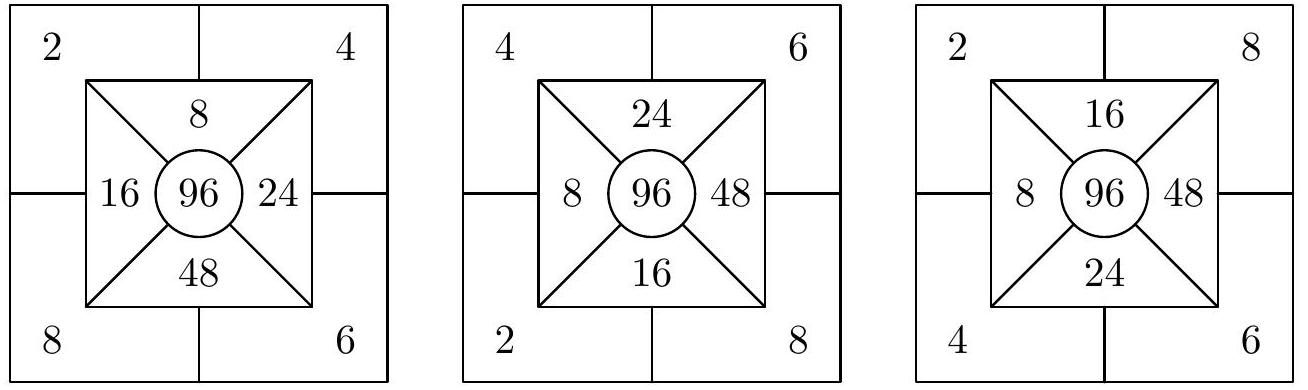
Th... | 84,96,100 | Logic and Puzzles | math-word-problem | Yes | Yes | olympiads | false |
Katie had 11 songs on her mp3 player. She deleted 7 old songs from it and then added some new songs. She now has 28 songs on her mp3 player. How many new songs did she add? | Katie started with 11 songs and deleted 7, so she had:
11 - 7 = 4 songs left.
She now has 28 songs, so the number of new songs she added is:
28 - 4 = $\boxed{24}$ new songs. | 24 | Algebra | math-word-problem | Yes | Yes | orca_math | true |
If the first car displayed in the auction event was manufactured in 1970, and it was made 10 years earlier than the second car, and the third car was manufactured 20 years after the second car, what is the year of manufacturing for the third car? | To determine the year of manufacturing for the third car, we need to follow the information given step by step.
1. The first car was manufactured in 1970.
2. The second car was made 10 years earlier than the first car.
- To find the year of the second car, we subtract 10 years from the year of the first car:
\... | 1980 | Algebra | math-word-problem | Yes | Yes | metamath | true |
Given a sequence $\{a_n\}$ whose sum of the first $n$ terms is $S_n$, and $S_n=2a_n-2$ $(n\in \mathbb{N}^*)$,
(1) Find the general formula for the sequence $\{a_n\}$;
(2) If the sequence $\{b_n\}$ satisfies $\frac{1}{a_n}= \frac{b_1}{2^1+1}- \frac{b_2}{2^2+1}+ \frac{b_3}{2^3+1}-…+(-1)^{n+1} \frac{b_n}{2^n+1}$, find t... | Solution:
(1) From $S_n=2a_n-2$ $(n\in \mathbb{N}^*)$, we can derive that $a_1=2a_1-2$, which gives $a_1=2$;
For $n\geqslant 2$, $a_n=S_n-S_{n-1}=2a_n-2-(2a_{n-1}-2)$, which simplifies to $a_n=2a_{n-1}$.
Therefore, the sequence $\{a_n\}$ is a geometric sequence with a common ratio of $2$ and the first term being $... | (- \frac{128}{35}, \frac{32}{19}) | Algebra | math-word-problem | Yes | Yes | cn_k12 | false |
If 2^5, 3^3, and 11^2 are all factors of the product of 936 and a positive integer, what is the smallest possible value of that positive integer? | To find the smallest possible value of the positive integer that makes 2^5, 3^3, and 11^2 factors of the product of 936 and that integer, we need to first factorize 936 and then determine what additional factors are needed to include 2^5, 3^3, and 11^2.
Let's start by factorizing 936:
936 = 2^3 * 3^1 * 13^1
Now, let... | 4356 | Number Theory | math-word-problem | Yes | Yes | orca_math | true |
6. Answer. a) 31 coins; b) 30 coins. | Solution. From each detachment of $N$ bogatyrs, Chernomor will receive at most $N-1$ coins, since the remainder is less than the divisor. Therefore, he will receive no more than $33-K$ coins in total, where $K$ is the number of detachments. Will Chernomor receive 32 coins if there is only one detachment? No, because $2... | 31 | Number Theory | math-word-problem | Incomplete | Yes | olympiads | false |
$5 . n$ is a 1996-digit integer, and it is a multiple of 9. The sum of the digits of $n$ is $p, p$'s sum of digits is $q, q$'s sum of digits is $r$. Then the value of $r$ is | $5.9$ | 9 | Number Theory | math-word-problem | Yes | Problem not solved | cn_contest | false |
The integers from 1 to 2022 are written on the board. An operation consists of choosing two of them, erasing them, and rewriting on the board the absolute value of their difference. Show that the last number written on the board is odd.[^0] | At each step, the sum of the numbers involved in the transformation changes from $a+b$ to $a-b$ or $b-a$, so it is modified by an even amount (either $2b$ or $2a$ respectively). The parity of the sum of the numbers on the board is therefore an invariant. In the initial configuration, it is $\frac{2022 \cdot 2023}{2}=10... | proof | Number Theory | proof | Yes | Yes | olympiads | false |
What is the number of square units in the area of trapezoid PQRS with vertices P(0,0), Q(-2,0), R(-2,5), and S(3,5)? | Firstly, plot the points and draw trapezoid PQRS:
- P(0,0)
- Q(-2,0)
- R(-2,5)
- S(3,5)
Analyzing the properties:
- The parallel sides of the trapezoid are QR and PS, both horizontal.
- The lengths of QR and PS are:
- QR = 0 - (-2) = 2 units
- PS = 3 - (-2) = 5 units
- Height (h) between the bases (the vertical di... | 17.5 | Geometry | math-word-problem | Yes | Yes | synthetic_math | true |
2. (A. Shapovalov) For any natural number n greater than 2009, from the fractions $\frac{1}{n}, \frac{2}{n-1}, \frac{3}{n-2}, \ldots, \frac{n-1}{2}, \frac{n}{1}$, can two pairs of fractions with the same sums always be selected? | Answer: Yes. Solution. Each of the given fractions has the form $\frac{n+1-a}{a}=\frac{n+1}{a}-1$, where $1 \leq a \leq n$. Therefore, we need to find such distinct natural numbers $a, b$, $c$ and $d$, not greater than 2009, for which $\left(\frac{n+1}{a}-1\right)+\left(\frac{n+1}{b}-1\right)=\left(\frac{n+1}{c}-1\righ... | \frac{1}{12}+\frac{1}{3}=\frac{1}{6}+\frac{1}{4} | Number Theory | proof | Yes | Yes | olympiads | false |
In a certain town, on each of the initial five days of January, the probability that it won't snow increases evenly from $\frac{1}{2}$ on the first day to $\frac{5}{6}$ on the fifth day. For each of the next two days, the probability of no snow is $\frac{7}{8}$. Calculate the probability that it snows at least once dur... | For the first five days, the probabilities of no snow are $\frac{1}{2}, \frac{2}{3}, \frac{3}{4}, \frac{4}{5}, \frac{5}{6}$ respectively. For the next two days, the probability of no snow is each $\frac{7}{8}$. The product of these probabilities is:
\[
\left( \frac{1}{2} \right) \times \left( \frac{2}{3} \right) \times... | \frac{139}{384} | Combinatorics | math-word-problem | Yes | Yes | synthetic_math | true |
G.A. Galperin
Two identical rectangles are positioned so that their contours intersect at eight points. Prove that the area of intersection of these rectangles is greater than half the area of each of them.
# | Let the lengths of the sides of the rectangles be $a$ and $b$. Note that on each side of the rectangles, there are exactly two intersection points with two adjacent sides of the other. (It is easy to prove that if there are a total of 8 intersection points, then there must be at least two points on each side, and that ... | proof | Geometry | proof | Yes | Yes | olympiads | false |
In the arithmetic sequence $\{a_n\}$, if $a_3+a_4+\ldots+a_9=14$, then $a_6=$ ( )
A: 1
B: 2
C: 4
D: 7 | Since $\{a_n\}$ is an arithmetic sequence,
we have $a_3+a_4+a_5+\ldots+a_9=(a_3+a_9)+(a_4+a_8)+(a_5+a_7)+a_6=7a_6=14$.
Therefore, $a_6=2$.
Hence, the correct answer is $\boxed{\text{B}}$. | \text{B} | Algebra | MCQ | Yes | Yes | cn_k12 | false |
If $a, b, c > 0$ satisfy $a + b + c = 3$, then prove that
$$\frac{a^2(b + 1)}{ ab + a + b} + \frac{b^2(c + 1)}{ bc + b + c} + \frac{c^2(a + 1)}{ ca + c + a} \ge 2$$
Mathematical Excalibur P322/Vol.14, no.2 | null | null | Inequalities | proof | Yes | Yes | aops_forum | false |
Latia wants to buy a Samsung TV worth $1700. She works for a delivery service company for a month earning $10 per hour for a 30-hour workweek. How many more hours does she have to work to buy the TV? | First, let's calculate how much Latia earns in a month.
She works 30 hours per week, so in a month (assuming 4 weeks in a month), she would work:
30 hours/week * 4 weeks/month = 120 hours/month
At $10 per hour, her monthly earnings would be:
120 hours/month * $10/hour = $1200/month
Now, let's see how much more she n... | 50 | Algebra | math-word-problem | Yes | Yes | orca_math | true |
Task 2. The technical control department inspected $n=100$ batches of $N=10$ items each, and as a result, obtained a distribution table of the random variable $X$ - the number of non-standard items in one batch:
| $x_{\imath}$ | 0 | 1 | 2 | 3 | 4 | 5 | 6 | 7 |
| :--- | :--- | :--- | :--- | :--- | :--- | :--- | :--- | ... | Solution. We will construct a distribution polygon (Fig. 8.7). The Poisson law has the form:
$$
p(k)=\lambda^{k} \cdot \frac{e^{-\lambda}}{k!} \quad(\lambda=p \cdot n)
$$
We will apply the rule (see above).
1) We have $\bar{x}_{\text {v }}=\frac{1}{200}(116 \cdot 0+56 \cdot 1+$ $+22 \cdot 2+4 \cdot 3+2 \cdot 4)=0.6$... | notfound | Algebra | math-word-problem | Yes | Yes | olympiads | false |
6. Let $a>b>0$, then the minimum value of $a^{2 n}+\frac{1}{4 b(a-b)}\left(n \in \mathbf{N}^{*}\right)$ is
A. $n \sqrt[n]{n}$
B. $(n+1) \sqrt[n]{n}$
C. $\frac{n+1}{n} \sqrt[\pi]{n}$
D. $\frac{n+1}{n} \sqrt[n+1]{n}$ | 6. $\mathrm{C}$ | \frac{n+1}{n}\sqrt[\pi]{n} | Inequalities | MCQ | Yes | Incomplete | olympiads | false |
Determine the domain of the function \( g(x) = \frac{x-2}{\sqrt{x^2 - 5x + 6}} \). | For the function \( g(x) \) to be defined, the expression under the square root must be positive, and the denominator as a whole must not be zero.
1. **Solve the inequality \( x^2 - 5x + 6 > 0 \):**
Factorize the quadratic:
\[
x^2 - 5x + 6 = (x - 2)(x - 3)
\]
The product of these factors is positive whe... | (-\infty, 2) \cup (3, \infty) | Algebra | math-word-problem | Yes | Yes | synthetic_math | true |
Given $A=\{x|2^{x}>1\}$, and $B=\{x|-1<x<1\}$.
1. Find $A\cup B$ and $(\complement_{\mathbb{R}}A) \cap B$;
2. If the set $C=\{x|x<a\}$ satisfies $B\cup C=C$, find the range of the real number $a$. | Solution:
1. The set $A=\{x|2^{x}>1\}=\{x|x>0\}$, ... (2 points)
Since $B=\{x|-1-1\}$; ... (4 points)
Since $A=\{x|x>0\}$,
$\therefore \complement_{\mathbb{R}}A=\{x|x\leq0\}$; ... (5 points)
$\therefore (\complement_{\mathbb{R}}A) \cap B=\{x|-1-1\}}$ and $(\complement_{\mathbb{R}}A) \cap B=\boxed{\{x|-1<x\leq0\... | a\geq2 | Algebra | math-word-problem | Yes | Yes | cn_k12 | false |
Given the propositions $p: \exists x \in \mathbb{R}, x^2 2, \log_{\frac{1}{2}}x < 0$, determine the true proposition(s) among the following options:
A) $p \wedge q$
B) $p \wedge \neg q$
C) $\neg p \wedge q$
D) $p \vee \neg q$ | This problem primarily tests our understanding of the truth or falsity of compound propositions.
First, let's analyze each proposition:
1. Proposition $p$: $\exists x \in \mathbb{R}, x^2 2, \log_{\frac{1}{2}}x < 0$
The logarithm base $\frac{1}{2}$ of any number greater than 2 will always be less than 0, because $\f... | \neg p \wedge q | Algebra | MCQ | Incomplete | Yes | cn_k12 | false |
Let \( T \) be the set of points \( (x, y) \) in the Cartesian plane that satisfy
\[
\Big|\big| |x|-3 \big| - 2 \Big| + \Big|\big| |y|-3 \big| - 2 \Big| = 2.
\]
What is the total length of all the lines that make up \( T \)? | As in the initial problem, for any real numbers \( a \) and \( b \), the graph of \[ |x-a| + |y-b| = 2 \] is a diamond with each side having a length of \( 2\sqrt{2} \) and centered at \( (a, b) \).
Given the equation's symmetry around both axes, it suffices to find the solution in the first quadrant and then multiply... | 128\sqrt{2} | Geometry | math-word-problem | Yes | Yes | synthetic_math | true |
The width of a rectangular hall is ½ of its length. The area of the hall is some value. The difference between its length and breadth is 10 m. What is the area of the hall? | Let's denote the length of the hall as L and the width as W. According to the information given:
W = ½L
The area of the hall (A) is given by the formula:
A = L * W
We are also told that the difference between the length and the width is 10 meters:
L - W = 10
Now, we can substitute the expression for W from the fi... | 200 | Algebra | math-word-problem | Yes | Yes | orca_math | true |
Let $a$ and $b$ be positive integers. Show that if $a^3+b^3$ is the square of an integer, then $a + b$ is not a product of two different prime numbers. | 1. Let \( a \) and \( b \) be positive integers such that \( a^3 + b^3 \) is the square of an integer. We need to show that \( a + b \) is not a product of two different prime numbers.
2. Assume for contradiction that \( a + b = pq \), where \( p \) and \( q \) are distinct prime numbers.
3. We know that:
\[
a^3 ... | null | Number Theory | proof | Yes | Yes | aops_forum | false |
Given an arithmetic sequence $\left\{a_{n}\right\}$ with the sum of the first $n$ terms denoted as $S_{n}$, if $S_{17}=170$, then the value of $a_{7}+a_{9}+a_{11}$ is ( ).
A: $10$
B: $20$
C: $25$
D: $30$ | To solve the problem, we start by understanding the properties of an arithmetic sequence and its sum. Given that the sum of the first $n$ terms of an arithmetic sequence $\{a_n\}$ is denoted as $S_n$, and we are given $S_{17} = 170$, we aim to find the value of $a_7 + a_9 + a_{11}$.
1. **Using the property of an arith... | D | Algebra | MCQ | Yes | Yes | cn_k12 | false |
Given $a > 0$ and $b > 0$, the geometric mean of $a$ and $b$ is $1$, and $m = b + \frac{1}{a}$, $n = a + \frac{1}{b}$, find the minimum value of $m + n$.
A: $3$
B: $4$
C: $5$
D: $6$ | Since the geometric mean of the positive numbers $a$ and $b$ is $1$, we have $ab = 1^2 = 1$.
Now, consider the expressions for $m$ and $n$ given by $m = b + \frac{1}{a}$ and $n = a + \frac{1}{b}$. We want to find the minimum value of $m + n$:
$$ m + n = \left(b + \frac{1}{a}\right) + \left(a + \frac{1}{b}\right) = a +... | m + n \geq 4 | Algebra | MCQ | Yes | Yes | cn_k12 | false |
Let $Q = 3 + 4i$, $E = -i$, and $D = 3 - 4i$. Calculate $Q \cdot E \cdot D$. | Firstly, compute the product of $Q$ and $D$:
\[
QD = (3+4i)(3-4i)
\]
This involves using the formula for the product of two conjugates which is given as:
\[
a^2 + b^2 \text{ for } (a+bi)(a-bi)
\]
For $a = 3$ and $b = 4$, this yields:
\[
3^2 + 4^2 = 9 + 16 = 25
\]
Now compute $QED$:
\[
QED = QD \cdot E = 25 \cdot (-i) =... | -25i | Algebra | math-word-problem | Yes | Yes | synthetic_math | true |
Calculate $8 \cdot 11\frac{1}{4}$. | We use the distributive property to simplify the calculation, which handles the mixed number directly:
\[
8 \cdot 11\frac{1}{4} = 8 \cdot \left(11 + \frac{1}{4}\right)
\]
Breaking this down:
\[
8 \cdot 11 + 8 \cdot \frac{1}{4} = 88 + 8 \cdot \frac{1}{4}
\]
Calculate the fractional part:
\[
8 \cdot \frac{1}{4} = \frac{8... | 90 | Algebra | math-word-problem | Yes | Yes | synthetic_math | true |
Compute $\arccos (\sin 3)$. All functions are in radians. | Let \( x = \arccos (\sin 3) \). Then:
\[
\cos x = \sin 3 = \cos \left( \frac{\pi}{2} - 3 \right) = \cos \left( 3 - \frac{\pi}{2} \right).
\]
Since \( \frac{\pi}{2} < 3 < \frac{3\pi}{2} \), \( 3 - \frac{\pi}{2} \) simplifies to a value within the range of \([0, \pi]\), specifically:
\[
3 - \frac{\pi}{2} \approx 3 - 1.57... | 3 - \frac{\pi}{2} | Algebra | math-word-problem | Yes | Yes | synthetic_math | true |
4. [4] Find the number of ordered triples of nonnegative integers $(a, b, c)$ that satisfy
$$
(a b+1)(b c+1)(c a+1)=84 .
$$ | Answer: 12
The solutions are $(0,1,83)$ and $(1,2,3)$ up to permutation. First, we do the case where at least one of $a, b, c$ is 0 . WLOG, say $a=0$. Then we have $1+b c=84 \Longrightarrow b c=83$. As 83 is prime, the only solution is $(0,1,83)$ up to permutation.
Otherwise, we claim that at least one of $a, b, c$ is... | 12 | NaN | NaN | NaN | NaN | olympiads | false |
18. $20182018 \div 2019$ The remainder obtained is | Reference answer: 94 | 94 | Number Theory | math-word-problem | Yes | Problem not solved | olympiads | false |
Given proposition $p$: If $\triangle ABC$ is an obtuse triangle, then $\sin A < \cos B$; proposition $q$: $\forall x, y \in \mathbb{R}$, if $x + y \neq 2$, then $x \neq -1$ or $y \neq 3$, then the true proposition among the following is $({\ })$
A: $p \lor (\neg q)$
B: $(\neg p) \land q$
C: $p \land q$
D: $(\neg p) \la... | **Analysis**
This question examines the understanding of triangles, simple logic judgment methods, and tests reasoning and computational abilities, belonging to the medium level.
Proposition $P$: Given $\triangle ABC$ is an obtuse triangle, then $\frac{\pi}{2} \sin \left( \frac{\pi}{2} - B \right) = \cos B$, which a... | B | Logic and Puzzles | MCQ | Yes | Yes | cn_k12 | false |
A pet shop has some animals. 32 of them are kittens and 15 of them are hamsters. There are 30 birds. How many animals are there in total in the pet shop? | To find the total number of animals in the pet shop, you need to add the number of kittens, hamsters, and birds together.
Number of kittens = 32
Number of hamsters = 15
Number of birds = 30
Total number of animals = Number of kittens + Number of hamsters + Number of birds
Total number of animals = 32 + 15 + 30
Total ... | 77 | Other | math-word-problem | Yes | Yes | orca_math | true |
Given the set $A = \{x \mid x = 2k + 1, k \in \mathbb{Z} \}$ and $B = \{x \mid 0 < x < 5 \}$, find $A \cap B$. | This problem tests our understanding of intersections and their operations. The key to solving this problem is to be proficient in the definition of intersections.
We find the intersection of sets $A$ and $B$.
Set $A$ consists of all odd integers since $x = 2k + 1$ for any integer $k$. The odd integers within the ran... | \{1, 3\} | Number Theory | math-word-problem | Yes | Yes | cn_k12 | false |
Steve owns a lake shop that sells fish. He has a stock of 200 fish. He sells some fish and because his refrigerators stop working a third of the remaining fish become spoiled. A new stock of 200 more fish arrives. Now, he has 300 fish in stock. How many fish did he sell? | Let's denote the number of fish Steve sold as x.
Initially, Steve had 200 fish in stock. After selling x fish, he was left with 200 - x fish.
Due to the refrigerators stopping working, a third of the remaining fish became spoiled. So, the number of spoiled fish is (200 - x) / 3.
After the spoilage, the number of goo... | 50 | Algebra | math-word-problem | Yes | Yes | orca_math | true |
Subsets and Splits
No community queries yet
The top public SQL queries from the community will appear here once available.