
instruction_seed stringlengths 2 10.7k | solution stringlengths 0 10.8k ⌀ | answer stringlengths 0 575 ⌀ | problem_type stringclasses 9
values | question_type stringclasses 5
values | problem_is_valid stringclasses 5
values | solution_is_valid stringclasses 4
values | source stringclasses 11
values | synthetic bool 2
classes |
|---|---|---|---|---|---|---|---|---|
We are restarting the elevator of problem F. 2280 in the ten-story building. It starts again from the ground floor, and during its journey, it will stop exactly once on every floor, just as before. However, this time we also ensure that after stopping at an even-numbered floor, it stops at an odd-numbered floor, and af... | I. solution. In the solution to problem F. 2280 (Volume 62, No. 4, p. 155, 1981), we saw that if we do not assume that the elevator stops alternately at even and odd numbered floors, it can travel a maximum of 55 floors. If we now also assume that it stops alternately at even and odd numbered floors, then between any t... | 216 | Logic and Puzzles | math-word-problem | Yes | Yes | olympiads | false |
Let n$\ge$2.Each 1x1 square of a nxn board is colored in black or white such that every black square has at least 3 white neighbors(Two squares are neighbors if they have a common side).What is the maximum number of black squares? | 1. **Claim for Even \( n \):**
We claim that for even \( n \), we can have \(\frac{n^2-4}{2}\) black squares. This is achieved by using a chessboard pattern but ensuring that the four corner squares are white.
2. **Explanation for Even \( n \):**
- The four corner squares must be white because each black square ... | \frac{n^2-4}{2} \text{ for even } n \text{ and } \frac{n^2-1}{2} \text{ for odd } n | Combinatorics | math-word-problem | Yes | Yes | aops_forum | false |
$n$ is a given positive integer, such that it’s possible to weigh out the mass of any product weighing $1,2,3,\cdots ,ng$ with a counter balance without sliding poise and $k$ counterweights, which weigh $x_ig(i=1,2,\cdots ,k),$ respectively, where $x_i\in \mathbb{N}^*$ for any $i \in \{ 1,2,\cdots ,k\}$ and $x_1\leq x_... | 1. **Understanding the Problem:**
We need to find the minimum number of counterweights \( k \) such that any integer mass from \( 1 \) to \( n \) grams can be weighed using these counterweights on a balance scale. The counterweights can be placed on either side of the balance, and their weights are positive integers... | f(n) = m | Number Theory | math-word-problem | Yes | Yes | aops_forum | false |
Let \( b_1, b_2, \dots \) be a sequence defined by \( b_1 = 2, b_2 = 3 \) and \( b_{n+2}=2b_{n+1}+3b_n \) for \( n\geq 1 \). Find
\[
\sum_{n=1}^\infty \frac{b_n}{3^{n+1}}.
\] | Let \( Y \) denote the desired sum. Note that:
\[
Y = \frac{2}{3^2} + \frac{3}{3^3} + \frac{12}{3^4} + \frac{33}{3^5} + \dotsb
\]
\[
3Y = \frac{2}{3^1} + \frac{3}{3^2} + \frac{12}{3^3} + \frac{33}{3^4} + \dotsb
\]
\[
9Y= \frac{2}{3^0} + \frac{3}{3^1} + \frac{12}{3^2} + \frac{33}{3^3} + \dotsb
\]
Here, each term in ... | \frac{2}{5} | Algebra | math-word-problem | Yes | Yes | synthetic_math | true |
The first three terms of an arithmetic sequence are 3, 13, and 23. What is the value of the 15th term? | 1. **Identify the common difference**: The first term is 3 and the second term is 13, so the common difference, $d$, is $13 - 3 = 10$.
2. **Use the formula for the nth term**: The formula for the nth term of an arithmetic sequence is given by
\[
a_n = a_1 + (n-1)d
\]
where $a_1$ is the first term and $d$ ... | 143 | Algebra | math-word-problem | Yes | Yes | synthetic_math | true |
15. Find all solutions of the congruence $x^{2} \equiv 1(\bmod 15)$. | 15. $x \equiv 1,4,11,14(\bmod 15)$ | x \equiv 1,4,11,14(\bmod 15) | Number Theory | math-word-problem | Yes | Yes | number_theory | false |
Gilbert grows herbs in his yard to use in his cooking. At the beginning of the spring, he planted three basil bushes, a parsley plant, and some kinds of mint. Halfway through spring, one of the basil plants dropped seeds from a flower and made an extra basil plant grow. However, a rabbit came by the garden near the end... | At the beginning of spring, Gilbert planted three basil bushes and a parsley plant, which makes a total of 4 plants. Halfway through spring, an extra basil plant grew from dropped seeds, increasing the total number of plants to 5. However, by the end of spring, a rabbit ate all the mint, and Gilbert still had 5 herb pl... | 0, | Logic and Puzzles | math-word-problem | Yes | Incomplete | orca_math | true |
Let $ a$, $ b$, $ c$ be positive real numbers such that $ abc=1$.
Prove that
$ \frac{1}{1+b+c}+\frac{1}{1+c+a}+\frac{1}{1+a+b}\leq\frac{1}{2+a}+\frac{1}{2+b}+\frac{1}{2+c}$. | null | null | Inequalities | proof | Yes | Yes | aops_forum | false |
A giraffe is 2.3 meters (m) tall, a baby is 9/10 meters (m) tall, a gorilla is 1.8 meters (m) tall, and a dinosaur is 2.5 meters (m) tall. What is the second tallest creature? |
The second tallest creature among the ones listed is the giraffe, which is $\boxed{2.3}$ meters tall. The tallest is the dinosaur at 2.5 meters, followed by the giraffe at 2.3 meters, then the gorilla at 1.8 meters, and finally the baby at 0.9 meters (9/10 meters). | 2.3 | Logic and Puzzles | math-word-problem | Yes | Yes | orca_math | true |
In an opaque bag, there are $2$ white balls and $2$ black balls that are completely identical except for their colors. One ball is randomly drawn from the bag. If a black ball is drawn, it is replaced with $2$ white balls of the same kind. If a white ball is drawn, it is put back into the bag.
$(1)$ Find the probabil... | ### Step-by-Step Solution
#### Part $(1)$: Probability of Exactly Drawing Two Black Balls in the $4$th Draw
To achieve this, we need to consider the scenarios where exactly one black ball is drawn in the first three draws, and then a black ball is drawn in the $4$th draw. The probability can be calculated as follows:... | \frac{641}{1000} | Combinatorics | math-word-problem | Yes | Yes | cn_k12 | false |
a can do a piece of work in 15 days . a does the work for 5 days only and leaves the job . b does the remaining work in 10 days . in how many days b alone can do the work ? | Let's calculate the amount of work A does in 5 days. Since A can complete the entire work in 15 days, in 5 days A would complete 5/15 or 1/3 of the work.
This means that 2/3 of the work is left for B to complete. B completes this remaining work in 10 days.
Now, let's find out how many days B would take to complete th... | 15 | Algebra | math-word-problem | Yes | Yes | orca_math | true |
Given the equation $2x+y=6$, express $y$ in terms of $x$, then $y=\_\_\_\_\_\_.$ | To express $y$ in terms of $x$ from the given equation $2x+y=6$, we follow these steps:
1. Start with the given equation:
\[2x + y = 6\]
2. To solve for $y$, we need to isolate $y$ on one side of the equation. We do this by subtracting $2x$ from both sides of the equation:
\[y = 6 - 2x\]
Therefore, expressed in term... | 6-2x | Algebra | math-word-problem | Yes | Yes | cn_k12 | false |
If the inequality $2x^2-8x-4-a>0$ has solutions for $1<x<4$, then the range of $a$ is \_\_\_\_\_\_. | To solve the original inequality $2x^2-8x-4-a>0$, it can be transformed into: $a0$ is transformed into: $a0$ has solutions within $\{x|1<x<4\}$, it is sufficient for $a$ to be less than the maximum value of $y=2x^2-8x-4$ within $1\leq x\leq 4$, thereby determining the range of the real number $a$.
This problem mainly ... | a<-4 | Inequalities | math-word-problem | Yes | Yes | cn_k12 | false |
Determine which quadrant the complex number $z=i+i^2$ is located in on the complex plane.
A: I (First)
B: II (Second)
C: III (Third)
D: IV (Fourth) | Firstly, we need to understand the value of $i^2$. Since $i$ is the imaginary unit, it represents $\sqrt{-1}$, and therefore, $i^2$ equals to $-1$.
Now, we can calculate the actual value of the complex number $z$:
$$ z = i + i^2 = i - 1. $$
This means that the complex number $z$ has a real part equal to $-1$ and an ... | \text{B: II (Second)} | Algebra | MCQ | Yes | Yes | cn_k12 | false |
a circular well with a diameter of 2 meters , is dug to a depth of 14 meters . what is the volume of the earth dug out . | To calculate the volume of the earth dug out from the circular well, we can use the formula for the volume of a cylinder:
Volume = π × r^2 × h
where r is the radius of the circular base and h is the height (or depth) of the cylinder.
First, we need to find the radius of the well. Since the diameter is given as 2 met... | 44.01746 | Geometry | math-word-problem | Yes | Yes | orca_math | true |
Let $ABC$ be an acute-angled triangle with $AB < AC$, and let points $D$ and $E$ be chosen on the side $AC$ and $BC$ respectively in such a way that $AD = AE = AB$. The circumcircle of $ABE$ intersects the line $AC$ at $A$ and $F$ and the line $DE$ at $E$ and $P$. Prove that $P$ is the circumcentre of $BDF$. | null | null | Geometry | proof | Yes | Yes | aops_forum | false |
the volume of water inside a swimming pool doubles every hour . if the pool is filled to its full capacity within 8 hours , in how many hours was it filled to one quarter of its capacity ? | If the volume of water doubles every hour and the pool is filled to its full capacity in 8 hours, then one hour before it was filled to its full capacity, it would have been at half its capacity.
So at 7 hours, the pool would be at 1/2 of its full capacity.
Following the same logic, two hours before it was filled to... | 6 | Algebra | math-word-problem | Yes | Yes | orca_math | true |
Given the derivative of the function $f(x)$, denoted as $f''(x)$, and it satisfies $f(x)=2xf''(1)+\ln x$, then $f''(1)=$
A: $-1$
B: $-e$
C: $1$
D: $e$ | **Analysis**
This question requires students to master the rules of differentiation. When differentiating $f(x)$, note that $f'(1)$ is a constant, which is a common mistake in this problem. By applying the differentiation rules to find the derivative of $f(x)$ and substituting $x=1$ into the derivative, we get an equa... | A | Calculus | MCQ | Yes | Yes | cn_k12 | false |
Given the following equations:
1. a - b = 5
2. a² + b² = 34
3. a³ - b³ = 30
4. a² + b² - c² = 50
5. c = 2a - b
Find the value of ab. | To find the value of ab, we can use the given equations to solve for a and b.
From equation 1, we have:
a - b = 5 (1)
From equation 2, we have:
a² + b² = 34 (2)
From equation 3, we have:
a³ - b³ = 30 (3)
We can use equation 1 to express b in terms of a:
b = a - 5 (4)
Now, we can substitute equation 4 into equa... | 17 | Algebra | math-word-problem | Yes | Yes | orca_math | true |
Explore the pattern based on the following equations:The $1$st equation: $\frac{2}{1×3}=1-\frac{1}{3}$.The $2$nd equation: $\frac{2}{3×5}=\frac{1}{3}-\frac{1}{5}$.The $3$rd equation: $\frac{2}{5×7}=\frac{1}{5}-\frac{1}{7}$.The $4$th equation: $\frac{2}{7×9}=\frac{1}{7}-\frac{1}{9}$.$(1)$ According to the above pattern,... | ### Step-by-Step Solution
#### Part 1: Finding the 5th Equation
Given the pattern from the previous equations:
- The $1$st equation: $\frac{2}{1×3}=1-\frac{1}{3}$.
- The $2$nd equation: $\frac{2}{3×5}=\frac{1}{3}-\frac{1}{5}$.
- The $3$rd equation: $\frac{2}{5×7}=\frac{1}{5}-\frac{1}{7}$.
- The $4$th equation: $\fra... | \frac{100}{101} | Algebra | math-word-problem | Yes | Yes | cn_k12 | false |
Given the sequence $\{a_n\}$ with the sum of its first $n$ terms $S_n = n^2 + 2n$,
(1) Find $a_n$;
(2) If $b_n = \frac{1}{a_n \cdot a_{n+1}}$, find the sum of the first $n$ terms of the sequence $\{b_n\}$, denoted as $T_n$. | (1) For $n \geq 2$, we have $S_{n-1} = (n-1)^2 + 2(n-1)$. Subtracting this from the given expression for $S_n$, we find:
$$\begin{align*}
a_n &= S_n - S_{n-1} \\
&= [n^2 + 2n] - [(n-1)^2 + 2(n-1)] \\
&= 2n + 1
\end{align*}$$
For $n=1$, we have $S_1 = a_1 = 3$, which satisfies $a_1 = 2\times1 + 1 = 3$. Thus, we confir... | T_n = \frac{n}{6n+9} | Algebra | math-word-problem | Yes | Yes | cn_k12 | false |
The solution set of the inequality $ax^2 + 5x - 2 > 0$ is $\left\{x|\frac{1}{2} 0$.
A) $\left\{x|-3 \frac{1}{2}\right\}$
D) $\left\{x|x \frac{1}{3}\right\}$ | [Analysis]
This problem primarily tests the relationship between quadratic inequalities and quadratic equations. The key to solving the problem is to convert and apply the relationship between quadratic inequalities and quadratic equations.
[Solution]
Given that the solution set of the inequality $ax^2 + 5x - 2 > 0$ ... | \text{A) }\left\{x|-3 < x < \frac{1}{2}\right\} | Inequalities | MCQ | Incomplete | Yes | cn_k12 | false |
Trevor and two of his neighborhood friends go to the toy shop every year to buy toys. Trevor always spends $20 more than his friend Reed on toys, and Reed spends 2 times as much money as their friend Quinn on the toys. Trevor spends a certain amount every year to buy his toys. The three friends spend a total of $680 in... | Let's denote the amount Trevor spends every year on toys as T dollars. According to the information given:
Trevor spends $20 more than Reed: T = R + $20
Reed spends 2 times as much as Quinn: R = 2Q
Since Trevor spends T dollars every year, in 4 years he spends 4T dollars.
Now, let's express Reed's and Quinn's spendi... | \$80 | Algebra | math-word-problem | Yes | Yes | orca_math | true |
Find all the triples of positive integers $(a, b, c)$ for which the number
$$
\frac{(a+b)^{4}}{c}+\frac{(b+c)^{4}}{a}+\frac{(c+a)^{4}}{b}
$$
is an integer and $a+b+c$ is a prime. | $(1,1,1),(1,2,2),(2,3,6)$.
Let $p=a+b+c$, then $a+b=p-c, b+c=p-a, c+a=p-b$ and
$$
\frac{(p-c)^{4}}{c}+\frac{(p-a)^{4}}{a}+\frac{(p-b)^{4}}{b}
$$
is a non-negative integer. By expanding brackets we obtain that the number $p^{4}\left(\frac{1}{a}+\frac{1}{b}+\frac{1}{c}\right)$ is integer, too. But the numbers $a, b, c... | (1,1,1),(1,2,2),(2,3,6) | Number Theory | math-word-problem | Yes | Yes | olympiads_ref | false |
Given two circles C1: $x^{2}+y^{2}-x+y-2=0$ and C2: $x^{2}+y^{2}=5$, determine the positional relationship between the two circles; if they intersect, find the equation of the common chord and the length of the common chord. | Solution: Solve the system of equations $$\begin{cases} \left.\begin{matrix}x^{2}+y^{2}-x+y-2=0 \\ x^{2}+y^{2}=5\end{matrix}\right.\end{cases}$$
Subtracting the two equations gives: $x-y-3=0$, which is the equation of the common chord.
Substitute $y=x-3$ into $x^{2}+y^{2}=5$ to get $x^{2}-3x+2=0$
Since $\Delta=9-... | \sqrt{2} | Geometry | math-word-problem | Yes | Yes | cn_k12 | false |
Determine all $x$ such that $\lfloor \lfloor 3x \rfloor + 1/3 \rfloor = \lfloor x + 3 \rfloor.$ | Start by examining the expression $\lfloor \lfloor 3x \rfloor + 1/3 \rfloor$. Since $\lfloor 3x \rfloor$ is an integer, adding $1/3$ does not change the integer part, hence $$\lfloor \lfloor 3x \rfloor + 1/3 \rfloor = \lfloor 3x \rfloor.$$
Next, consider $\lfloor x + 3 \rfloor$. This simplifies to $\lfloor x \rfloor + ... | \left[ \frac{4}{3}, \frac{5}{3} \right) | Algebra | math-word-problem | Yes | Yes | synthetic_math | true |
Example 14 Let $x, y, z$ be positive real numbers, prove that: $(x y+y z+z x)\left[\frac{1}{(x+y)^{2}}+\frac{1}{(y+z)^{2}}+\right.$ $\left.\frac{1}{(z+x)^{2}}\right] \geqslant \frac{9}{4} .$(1996 Iranian Mathematical Olympiad) | $$\begin{array}{l}
4(x y+y z+z x)\left[(x+y)^{2}(y+z)^{2}+(y+z)^{2}(z+x)^{2}+(z+x)^{2}(x+y)^{2}\right]= \\
4(x y+y z+z x)\left[\left(y^{2}+x y+y z+z x\right)^{2}+ \\
\left(z^{2}+x y+y z+z x\right)^{2}+\left(x^{2}+x y+y z+z x\right)^{2}\right]= \\
4(x y+y z+z x)\left[\left(x^{4}+y^{4}+z^{4}\right)+ \\
2\left(x^{2}+y^{2}... | proof | Inequalities | proof | Yes | Yes | inequalities | false |
Given that \\(z\\) is a complex number, both \\(z+2i\\) and \\( \dfrac{z}{1-i} \\) are real numbers (where \\(i\\) is the imaginary unit). If the complex number \\((z+ai)^{2}\\) corresponds to a point in the first quadrant on the complex plane, find the range of the real number \\(a\\). | Let the complex number \\(z=m+ni(m,n∈R)\\).
From the given conditions, we have \\(z+2i=m+ni+2i=m+(n+2)i∈R\\),
\\(∴n+2=0\\), which implies \\(n=-2\\).
Also, \\(∵ \\dfrac {z}{1-i}= \\dfrac {(m+ni)(1+i)}{2}= \\dfrac {m-n}{2}+ \\dfrac {m+n}{2}i∈R\\),
\\(∴m+n=0\\), which implies \\(m=-2n=4\\). Therefore, \\(z=4-2i\\).
... | 2 < a < 6 | Algebra | math-word-problem | Yes | Yes | cn_k12 | false |
It is known that the annual fixed cost of producing a certain model of phone by an electronics company is $400,000. An additional $160,000 is required for every 10,000 units produced. Let the company produce a total of $x$ thousand units of this phone in a year and sell them all. The sales revenue per thousand units is... | To solve this problem, we'll break it down into two parts as requested:
### Part 1: Function Expression of Annual Profit $W$
The annual profit $W$ is given by the formula Profit = Sales Revenue - Cost. We have two scenarios based on the production quantity $x$ (in thousand units).
**When $0 40$:**
The sales revenu... | 6104 | Algebra | math-word-problem | Yes | Yes | cn_k12 | false |
Triangle $PQR$ has side lengths $PQ=7$, $QR=8$, and $PR=9$. Two bugs start simultaneously from $P$ and crawl along the perimeter of the triangle in opposite directions at the same speed. They meet at point $S$. What is the length of $QS$? | 1. **Calculate the perimeter of triangle $PQR$:**
\[
\text{Perimeter} = PQ + QR + PR = 7 + 8 + 9 = 24
\]
2. **Determine the distance each bug crawls before meeting:**
\[
\text{Distance each bug crawls} = \frac{\text{Perimeter}}{2} = \frac{24}{2} = 12
\]
3. **Calculate the segment length $QS$:**
S... | 5 | Geometry | math-word-problem | Yes | Yes | synthetic_math | true |
Let $\omega$ be a nonreal root of the equation $z^4 = 1$. Let $b_1, b_2, \dots, b_n$ be real numbers such that
\[
\frac{1}{b_1 + \omega} + \frac{1}{b_2 + \omega} + \dots + \frac{1}{b_n + \omega} = 3 + 4i.
\]
Compute
\[
\frac{2b_1 - 1}{b_1^2 - b_1 + 1} + \frac{2b_2 - 1}{b_2^2 - b_2 + 1} + \dots + \frac{2b_n - 1}{b_n^2 -... | Since $\omega$ is a nonreal fourth root of unity, $\omega^4 = 1$. Therefore, $(\omega - 1)(\omega^3 + \omega^2 + \omega + 1) = 0$. $\omega \neq 1$, so $\omega^3 + \omega^2 + \omega + 1 = 0$. Using the conjugate $\overline{\omega}$, we have:
\[
\frac{1}{b_1 + \overline{\omega}} + \frac{1}{b_2 + \overline{\omega}} + \dot... | 6 | Algebra | math-word-problem | Yes | Yes | synthetic_math | true |
Given the sets S={x||x|<5} and T={x|(x+7)(x-3)<0}, find S∩T.
A: {x|-7<x<-5}
B: {x|3<x<5}
C: {x|-5<x<3}
D: {x|-7<x<5} | From the inequality in set S, we get -5<x<5, hence S={x|-5<x<5}.
From the inequality in set T, we get -7<x<3, hence T={x|-7<x<3}.
Therefore, S∩T={x|-5<x<3}.
So, the answer is $\boxed{\text{C}}$.
To solve this problem, we need to determine the solution sets of the inequalities in S and T, and then find their intersect... | \text{C} | Inequalities | MCQ | Yes | Yes | cn_k12 | false |
Let $ p$ be a prime number and $ f$ an integer polynomial of degree $ d$ such that $ f(0) = 0,f(1) = 1$ and $ f(n)$ is congruent to $ 0$ or $ 1$ modulo $ p$ for every integer $ n$. Prove that $ d\geq p - 1$. | 1. **Lemma Statement and Proof:**
We start with the lemma: If \( f \) is a polynomial with integer coefficients and \( \deg f < p-1 \), then
\[
f(0) + f(1) + \cdots + f(p-1) \equiv 0 \pmod{p}.
\]
To prove this lemma, we can reduce it to the case of monomials. Consider a monomial \( f(x) = x^k \) where \... | null | Number Theory | proof | Yes | Yes | aops_forum | false |
6. If $7n+1$ and $8n+1$ can both be expressed as the sum of three distinct positive integers in a geometric progression, then the smallest positive integer $n$ is $\qquad$.
Translate the above text into English, please retain the original text's line breaks and format, and output the translation result directly. | 6.6.
Notice that when $n=6$,
$$
\begin{array}{l}
7 n+1=43=1+6+6^{2}, \\
8 n+1=49=3^{2}+3 \times 5+5^{2}
\end{array}
$$
are both the sums of three positive integers in geometric progression.
When $n \leqslant 5$, it is easy to see that,
$$
\begin{array}{l}
7 \times 1+1=8, \\
8 \times 2+1=17, \\
8 \times 3+1=25, \\
7 \... | null | Inequalities | math-word-problem | Yes | Yes | cn_contest | false |
4-123 Let $a, b, c$ be given positive real numbers, try to determine all positive real numbers $x, y, z$ that satisfy the system of equations
$$\left\{\begin{array}{l}
x+y+z=a+b+c \\
4 x y z-\left(a^{2} x+b^{2} y+c^{2} z\right)=a b c .
\end{array}\right.$$ | [Solution] The second equation above is equivalent to
$$\frac{a^{2}}{y z}+\frac{b^{2}}{x z}+\frac{c^{2}}{x y}+\frac{a b c}{x y z}=4$$
Let $x_{1}=\frac{a}{\sqrt{y z}}, y_{1}=\frac{b}{\sqrt{z x}}, z_{1}=\frac{c}{\sqrt{x y}}$, then
$$x_{1}^{2}+y_{1}^{2}+z_{1}^{2}+x_{1} y_{1} z_{1}=4$$
Obviously, $00$, thus
$$z_{1}=-2 \s... | x=\frac{b+c}{2}, y=\frac{c+a}{2}, z=\frac{a+b}{2} | Algebra | math-word-problem | Yes | Yes | inequalities | false |
The derivative of the quadratic function $f(x)=ax^{2}+bx+c$ is $f'(x)$, for $\forall x \in \mathbb{R}$, the inequality $f(x) \geqslant f'(x)$ always holds, then the maximum value of $\dfrac{b^{2}}{a^{2}+2c^{2}}$ is $\boxed{\sqrt{6}-2}$. | **Analysis**
This question examines the properties of quadratic functions, derivatives, problems that always hold, maximum and minimum values, basic inequalities, and is a comprehensive application of function, equation, inequality, and derivative, with a high level of difficulty.
Given the information, we can derive... | \sqrt{6}-2 | Algebra | math-word-problem | Yes | Yes | cn_k12 | false |
Given: $a+b=m$, $ab=-4$, simplify the expression $\left(a-2\right)\left(b-2\right)$.
A: $6$
B: $2m-8$
C: $2m$
D: $-2m$ | To simplify the expression $\left(a-2\right)\left(b-2\right)$ given $a+b=m$ and $ab=-4$, we follow these steps:
\begin{align*}
\left(a-2\right)\left(b-2\right) &= ab - 2a - 2b + 4 \\
&= ab - 2(a + b) + 4 \\
&= -4 - 2m + 4 \\
&= -2m.
\end{align*}
Therefore, the simplified expression is $-2m$. Hence, the correct answer... | \text{D} | Algebra | MCQ | Yes | Yes | cn_k12 | false |
What is the value of the expression $3x^2 - 4x + 2$, when $x = 3$? | Substitute $x = 3$ into the expression $3x^2 - 4x + 2$:
\[
3x^2 - 4x + 2 = 3(3)^2 - 4(3) + 2 = 3 \times 9 - 12 + 2 = 27 - 12 + 2.
\]
Simplify the calculations:
\[
27 - 12 + 2 = 15 + 2 = \boxed{17}.
\]
Conclusion:
The value of the expression $3x^2 - 4x + 2$ when $x = 3$ is $\boxed{17}$. | 17 | Algebra | math-word-problem | Yes | Yes | synthetic_math | true |
Nancy had a total of 103 files on her computer consisting of 43 PDFs, 30 Word files, and 30 PPT files. She decided to delete all the PPT files and 33 PDFs. Then, she allocated the remaining files into folders. Each folder can contain a maximum of 7 files. If Word files are twice as important as PDFs, and it's ideal to ... | First, let's calculate the number of files Nancy has left after deleting the PPT files and 33 PDFs:
- She deleted all 30 PPT files.
- She deleted 33 out of 43 PDFs, leaving her with 43 - 33 = 10 PDFs.
So, she has 30 Word files + 10 PDFs = 40 files remaining.
Now, since Word files are twice as important as PDFs, we w... | 6 | Logic and Puzzles | math-word-problem | Yes | Yes | orca_math | true |
Problem 4. Lucia has a total of 2018 yellow, blue, and green balls. The number of green balls is 4 times greater than the number of blue balls. In an exchange, Lucia gives her friend Cristina 13 yellow balls and receives 5 blue balls and 7 green balls. After several such exchanges, Lucia is left with no yellow balls, b... | Solution and grading: Let $k$ be the number of exchanges made between the two friends. Then the number of yellow balls is $13 k$. .................................................. The initial number of blue balls is $\frac{2018-13 k}{5}$, and the initial number of green balls is $\frac{4(2018-13 k)}{5}$
$2 p$
The fi... | 1313 | Algebra | math-word-problem | Yes | Yes | olympiads | false |
An urn contains $k$ balls marked with $k$, for all $k=1,2, \ldots, 2016$. What is the minimum number of balls we must withdraw, without replacement and without looking at the balls, to be sure that we have 12 balls with the same number? | Solution
Let's sum the maximum number of balls that can be drawn of each type without obtaining 12 balls of each color:
$$
1+2+3+4+5+6+7+8+9+10+11+\underbrace{11+11+\ldots+11}_{2005 \text { times }}=22121
$$
Thus, it is possible that we have bad luck and draw such a number of balls without obtaining 12 balls of each... | 22122 | Combinatorics | math-word-problem | Yes | Yes | olympiads | false |
Find the intersection of the lines \(8x - 3y = 24\) and \(5x + 2y = 17\). Express your answer as an ordered pair \((x, y)\). | To eliminate \(y\) and solve for \(x\), multiply the first equation by 2 and the second equation by 3:
\[
2(8x - 3y) = 2(24) \implies 16x - 6y = 48,
\]
\[
3(5x + 2y) = 3(17) \implies 15x + 6y = 51.
\]
Adding these equations gives:
\[
16x - 6y + 15x + 6y = 48 + 51 \implies 31x = 99 \implies x = \frac{99}{31}.
\]
Substi... | \left(\frac{99}{31}, \frac{16}{31}\right) | Algebra | math-word-problem | Yes | Yes | synthetic_math | true |
The radius of a semi-circle is 5.2 cm. What is its perimeter? | To find the perimeter of a semi-circle, we need to calculate the length of the curved part (half of the circumference of a full circle) and then add the diameter (which is the straight line across the semi-circle).
First, let's find the circumference of a full circle using the formula:
Circumference (C) = 2 * π * radi... | 26.74 | Geometry | math-word-problem | Yes | Yes | orca_math | true |
Given the function $f(x) = \ln x - ax - 1$ where $a \in \mathbb{R}$.
$(1)$ If the function $y = f(x)$ is monotonically decreasing on the interval $[1, +\infty)$, find the range of real number $a$.
$(2)$ If the equation $f(x) + 2 = 0$ has two real roots $x_1$ and $x_2$, and $x_2 > 2x_1$, prove that ${x_1}x_2^2 > \fr... | ### Solution:
#### Part (1): Finding the range of $a$
1. **Derivative of $f(x)$**: To analyze the monotonic behavior of $f(x) = \ln x - ax - 1$, we find its derivative:
\[
f'(x) = \frac{d}{dx}(\ln x - ax - 1) = \frac{1}{x} - a = \frac{1 - ax}{x}.
\]
2. **Monotonicity Analysis**:
- When $a \leq 0$, we hav... | {x_1}x_2^2 > \frac{32}{{e^3}} | Calculus | math-word-problem | Yes | Yes | cn_k12 | false |
B2. Simplify the expression $\sqrt[3]{\frac{a+b}{(a-b)^{2}}} \cdot \sqrt{\frac{a^{3} \sqrt[3]{b}}{a^{2}-b^{2}}}: \sqrt[6]{\frac{a^{8} b}{a+b}}$. | B2. We can calculate
$$
\sqrt[3]{\frac{a+b}{(a-b)^{2}}} \cdot \sqrt{\frac{a^{3} \sqrt[3]{b}}{a^{2}-b^{2}}}: \sqrt[6]{\frac{a^{8} b}{a+b}}=\sqrt[6]{\frac{(a+b)^{2}}{(a-b)^{4}} \cdot \frac{a^{9} b}{(a-b)^{3}(a+b)^{3}} \cdot \frac{a+b}{a^{8} b}}=\sqrt[6]{\frac{a}{(a-b)^{7}}}
$$ | \sqrt[6]{\frac{}{(-b)^{7}}} | Algebra | math-word-problem | Yes | Yes | olympiads | false |
(For Liberal Arts) If $f(x) = \sin x + e^x$, then $f'(0) = \ $. | Given $f(x) = \sin x + e^x$, then $f'(x) = \cos x + e^x$.
Therefore, $f'(0) = \cos 0 + e^0 = 1 + 1 = 2$.
Hence, the answer is $\boxed{2}$. | 2 | Calculus | math-word-problem | Yes | Yes | cn_k12 | false |
10. The students built 9 campsites during their camping trip, and the roads connecting the campsites are shown in the figure. Beibei wants to plant a flag in each campsite, requiring that the colors of the flags in adjacent campsites be different. Therefore, Beibei needs at least _— kinds of colored flags. If Beibei st... | 10. Solution: At least 3 different colors of flags are needed. Because the three points in the middle form a triangle,
to ensure that the camps represented by these three points are adjacent and that adjacent camps do not have flags of the same color, each point must be marked with a flag of a different color from the... | cannot | Combinatorics | math-word-problem | Incomplete | Yes | olympiads | false |
if a person walks at 20 km / hr instead of 12 km / hr , he would have walked 36 km more. The actual distance traveled by him is: | Let's denote the actual distance traveled by the person as \( D \) km.
We know that time is equal to distance divided by speed. So, if the person walks at 12 km/hr, the time taken to travel the actual distance \( D \) would be \( D / 12 \) hours.
If the person walks at 20 km/hr, the time taken to travel the same dist... | 54 | Algebra | math-word-problem | Yes | Yes | orca_math | true |
Andrew purchased 7 kg of grapes at the rate of $68 per kg, 9kg of mangoes at the rate of $48 per kg, 5 kg of apples at the rate of $55 per kg, and 4 kg of oranges at the rate of $38 per kg. The shopkeeper offers a 10% discount on the total cost of grapes and mangoes, and there is a 5% sales tax applied to the total cos... | First, let's calculate the total cost of each type of fruit before any discounts or taxes:
Cost of grapes = 7 kg * $68/kg = $476
Cost of mangoes = 9 kg * $48/kg = $432
Cost of apples = 5 kg * $55/kg = $275
Cost of oranges = 4 kg * $38/kg = $152
Now, let's calculate the total cost of grapes and mangoes before the disc... | \$1306.41 | Algebra | math-word-problem | Yes | Yes | orca_math | true |
Bailey needs to buy 2 new sets of towels for the guest bathroom and 4 new sets for her master bathroom. Additionally, she wants to buy 3 sets of hand towels for the powder room and 5 sets of kitchen towels. The set of towels for the guest bathroom are $40.00 each, the master bathroom set is $50.00 each, the hand towel ... | First, let's calculate the discounted prices for each type of towel set:
1. Guest bathroom sets:
Original price: $40.00
Discount: 15% of $40.00 = 0.15 * $40.00 = $6.00
Discounted price: $40.00 - $6.00 = $34.00
2. Master bathroom sets:
Original price: $50.00
Discount: 20% of $50.00 = 0.20 * $50.00 = $10.00
Discounted ... | \$426.06 | Algebra | math-word-problem | Yes | Yes | orca_math | true |
Bill and Chris left the student union at the same time on bicycles . Bill traveled east , and Chris traveled west . After 0.5 hour , they were 14 miles apart . If Bill was going 2 miles per hour faster than Chris , how fast was each of the bicycles going ? | Let's denote Chris's speed as \( x \) miles per hour. Since Bill was going 2 miles per hour faster than Chris, Bill's speed would be \( x + 2 \) miles per hour.
Since they are traveling in opposite directions, their speeds will add up when calculating the distance between them. After 0.5 hours, the total distance betw... | 15 | Algebra | math-word-problem | Yes | Yes | orca_math | true |
Problem 4. Solve in the set of natural numbers the equation $21^{x}+4^{y}=z^{2}$. | Solution. We have $\left(z-2^{y}\right)\left(z+2^{y}\right)=21^{x}$ and, denoting $d=\left(z-2^{y}, z+2^{y}\right)$, it follows that $d \mid\left(z+2^{y}\right)-\left(z-2^{y}\right)$, so $d \mid 2^{y+1}$. Since $d \mid z+2^{y}$ and $z+2^{y} \mid 21^{x}$, it follows that $d \mid\left(2^{y+1}, 21^{x}\right)$, so $d=1$.
... | (1,1,5) | Number Theory | math-word-problem | Yes | Yes | olympiads | false |
Calculate the sum of the series $1 \times 2 + 2 \times 3 + \ldots + n(n+1)$. A student learned the following method: first rewrite the $k^{th}$ term as $k(k+1) = \frac{1}{3}[k(k+1)(k+2) - (k-1)k(k+1)]$. Using this, we get:
$$1 \times 2 = \frac{1}{3}(1 \times 2 \times 3 - 0 \times 1 \times 2),$$
$$2 \times 3 = \frac{1}{... | Given that $n(n+1)(n+2) = \frac{1}{4}[n(n+1)(n+2)(n+3) - (n-1)n(n+1)(n+2)]$, we rewrite each term of the series as follows:
$$1 \times 2 \times 3 = \frac{1}{4}(1 \times 2 \times 3 \times 4 - 0 \times 1 \times 2 \times 3),$$
$$2 \times 3 \times 4 = \frac{1}{4}(2 \times 3 \times 4 \times 5 - 1 \times 2 \times 3 \times 4)... | \frac{1}{4}n(n+1)(n+2)(n+3) | Algebra | math-word-problem | Yes | Yes | cn_k12 | false |
The U.S. produces about 6.2 million tons of oranges each year. Of the total, $30\%$ is exported, with $60\%$ of the remainder used for orange juice and the other $40\%$ sold fresh. How many million tons of oranges are used for orange juice? Express your answer as a decimal to the nearest tenth. | First, calculate the amount of oranges that remain after $30\%$ is exported:
\[ 70\% \text{ of } 6.2 \text{ million tons} = 0.7 \times 6.2 = 4.34 \text{ million tons}. \]
Next, determine the amount of the remaining oranges that is used for orange juice:
\[ 60\% \text{ of } 4.34 \text{ million tons} = 0.6 \times 4.34 =... | 2.6 | Algebra | math-word-problem | Yes | Yes | synthetic_math | true |
$4 \cdot 55$ Let $b, m, n$ be positive integers, satisfying $b>1$ and $m \neq n$. Prove that if $b^{m}-1$ and $b^{n}-1$ have the same prime divisors, then $b+1$ is a power of 2.
(38th International Mathematical Olympiad Preliminary Question, 1997) | [Proof] For any positive integers $x$ and $y$, we use the symbol $x \sim y$ to denote that they have the same prime divisors.
Given $\left(b^{m}-1\right) \sim\left(b^{n}-1\right)$, therefore, any prime that divides $b^{\prime \prime \prime}-1$ also divides $b^{n}-1$, and thus also divides their greatest common divisor... | proof | Number Theory | proof | Yes | Yes | olympiads | false |
Given that the line $x-y=2$ intersects the parabola $y^2=4x$ at points A and B, find the coordinates of the midpoint of segment AB. | **Answer:**
The midpoint of segment AB is $\boxed{(4, 2)}$. | (4, 2) | Algebra | math-word-problem | Yes | Incomplete | cn_k12 | false |
Let $\alpha$ and $\beta$ be nonnegative integers. Suppose the number of strictly increasing sequences of integers $a_0,a_1,\dots,a_{2014}$ satisfying $0 \leq a_m \leq 3m$ is $2^\alpha (2\beta + 1)$. Find $\alpha$.
[i]Proposed by Lewis Chen[/i] | null | null | Combinatorics | math-word-problem | Yes | Yes | aops_forum | false |
Some identical machines, working alone and at their constant rates, take 6 hours to complete a job lot. It would take 4 such machines 12 hours to perform the same job. How many machines were working in the first scenario? | Let's denote the number of machines working in the first scenario as \( N \).
Each machine has a certain work rate, which we can call \( R \) (the amount of work it can complete per hour). Since the machines are identical, they all have the same work rate.
When \( N \) machines work together for 6 hours, they complet... | 8 | Algebra | math-word-problem | Incomplete | Yes | orca_math | true |
$\begin{array}{l}\text { 6. (50 points) For any } x, y, z \in \mathbf{R}, \text { prove: } \\ -\frac{3}{2}\left(x^{2}+y^{2}+2 z^{2}\right) \leqslant 3 x y+y z+z x \\ \leqslant \frac{3+\sqrt{13}}{4}\left(x^{2}+y^{2}+2 z^{2}\right) .\end{array}$ | 6. When $x=y=z=0$, the inequality obviously holds. When $x, y, z$ are not all 0, transform the inequality into
$$
-\frac{3}{2} \leqslant \frac{3 x y+y z+z x}{x^{2}+y^{2}+2 z^{2}} \leqslant \frac{3+\sqrt{13}}{4} \text {. }
$$
Let $F(x, y, z)=\frac{3 x y+y z+z x}{x^{2}+y^{2}+2 z^{2}}$.
Below, we find the range of $F(x, ... | proof | Inequalities | proof | Yes | Yes | cn_contest | false |
Let $a$ and $b$ be positive real numbers with $a \ge b$. Let $\sigma$ be the maximum possible value of $\frac{b}{a}$ for which the system of equations
$$
b^2 + x^2 = a^2 + y^2 = (b - x)^2 + (a - y)^2
$$
has a solution in $(x,y)$ satisfying $0 \le x < b$ and $0 \le y < a$. Find $\sigma^2$. | Expanding the given equations, we have:
\[
a^2 + y^2 = b^2 - 2bx + x^2 + a^2 - 2ay + y^2.
\]
Simplifying, this gives:
\[
b^2 + x^2 = 2bx + 2ay.
\]
Note that:
\[
2bx > 2x^2 \ge x^2,
\]
so $2bx - x^2 \ge 0$. Since $2bx - x^2 = a^2 - 2ay$, we have $a^2 - 2ay \ge 0$, or
\[
a^2 \ge 2ay.
\]
As $a > 0$, this implies $a \ge 2y... | \frac{4}{3} | Algebra | math-word-problem | Yes | Yes | synthetic_math | true |
Find the minimum value of the function $f(x)=x+ \frac {4}{x}$ where $x > 0$. | Given that $x > 0$,
We have $f(x)=x+ \frac {4}{x}$. By applying the arithmetic mean-geometric mean inequality (AM-GM inequality), we get:
$f(x)=x+ \frac {4}{x} \geqslant 2 \sqrt {x \cdot \frac {4}{x}}=4$.
The equality holds if and only if $x= \frac {4}{x}$, which implies $x=2$. Thus, the minimum value of the functio... | 4 | Algebra | math-word-problem | Yes | Yes | cn_k12 | false |
The Eiffel Tower is 984 feet tall. A scale model of the Eiffel Tower is 6 inches tall. How many feet of the Eiffel Tower does one inch of the model represent? | The ratio between a length on the model and a length on the actual Eiffel Tower is given as \(6\text{ inches} : 984\text{ feet}\). To find out how many feet of the Eiffel Tower one inch of the model represents, we divide the height of the Eiffel Tower by the height of the model:
\[
\text{Ratio} = \frac{984\text{ feet}... | 164 | Algebra | math-word-problem | Yes | Yes | synthetic_math | true |
What is the area, in square units, of the region bounded by the lines \( y = 3x - 6, y = -2x + 18 \), and the \( y \)-axis? | First, find the intersection of the lines \( y = 3x - 6 \) and \( y = -2x + 18 \).
Setting \( 3x - 6 = -2x + 18 \), we solve for \( x \):
\[ 3x + 2x = 18 + 6 \]
\[ 5x = 24 \]
\[ x = 4.8 \]
Substitute \( x = 4.8 \) back into either equation, use \( y = 3x - 6 \):
\[ y = 3(4.8) - 6 = 14.4 - 6 = 8.4 \]
Thus, the intersect... | 57.6 | Algebra | math-word-problem | Yes | Yes | synthetic_math | true |
There is a cube of $3 \times 3 \times 3$ formed by the union of $27$ cubes of $1 \times 1 \times 1$. Some cubes are removed in such a way that those that remain continue to form a solid made up of cubes that are united by at least one facing the rest of the solid. When a cube is removed, those that remain do so in the ... | null | null | Geometry | math-word-problem | Yes | Yes | aops_forum | false |
For the system of equations involving $x$ and $y$: $\left\{\begin{array}{l}x-2y=-3\\2x+3y=m-1\end{array}\right.$, if the solutions are opposite to each other, then $m=\_\_\_\_\_\_$. | Given the system of equations involving $x$ and $y$:
$$\left\{\begin{array}{l}
x-2y=-3\\
2x+3y=m-1
\end{array}\right.$$
And given that the solutions are opposite to each other, which implies $x=-y$, we substitute this condition into the first equation:
$$x-2y=-3 \implies -y-2y=-3 \implies -3y=-3 \implies y=1$$
Subs... | 2 | Algebra | math-word-problem | Yes | Yes | cn_k12 | false |
A cone with a base radius of 2 is cut by a plane that passes through the midpoint of the height and is parallel to the base. The area of the circular section is . | Since the cone with a base radius of 2 is cut by a plane that passes through the midpoint of the height and is parallel to the base, the section formed is a triangle similar to the original triangle.
Therefore, the radius of the circular section is 1, and the area of the circular section is $\pi$.
The answer is: $\... | \pi | Geometry | math-word-problem | Yes | Yes | cn_k12 | false |
Given $f(x) = a \cdot 2^x + x^2 + bx$, if $\{x|f(x)=0\}=\{x|f(f(x))=0\} \neq \emptyset$, then the range of values for $a+b$ is ( )
A: $[0,1)$
B: $[-1,4]$
C: $[0,4)$
D: $[-1,3]$ | Let $t=f(x)$,
From $\{x|f(x)=0\}=\{x|f(f(x))=0\}$, we can deduce that when $t=0$, $f(t)=f(0)=a=0$,
Thus, $f(x)=x^2+bx$,
Then $\{x|f(x)=0\}=\{0, -b\}$,
When $f(f(x))=0$, $f(x)=0$ or $f(x)=-b$,
From $\{x|f(x)=0\}=\{x|f(f(x))=0\}$,
We can deduce that $f(x)=-b$ has no solution, or the solution for $f(x)=-b$ is $0$ or... | C | Algebra | MCQ | Yes | Yes | cn_k12 | false |
Collinear points $A$, $B$, and $C$ are given in the Cartesian plane such that $A= (a, 0)$ lies along the x-axis, $B$ lies along the line $y=x$, $C$ lies along the line $y=2x$, and $\frac{AB}{BC}=2$. If $D= (a, a)$, and the circumcircle of triangle $ADC$ intersects the line $y=x$ again at $E$, and ray $AE$ intersects $y... | 1. **Identify the coordinates of points \( B \) and \( C \):**
- Since \( B \) lies on the line \( y = x \), let \( B = (b, b) \).
- Since \( C \) lies on the line \( y = 2x \), let \( C = (c, 2c) \).
2. **Use the given ratio \( \frac{AB}{BC} = 2 \) to find the relationship between \( a \), \( b \), and \( c \):... | \frac{\sqrt{2}}{2} | Geometry | other | Yes | Yes | aops_forum | false |
Find the number of positive integer triples $(x, y, z)$ that satisfy $x \cdot y = 6$ and $y \cdot z = 15$. | Since $x \cdot y = 6$ and $y \cdot z = 15$, we have $6 \leq xy < 7$ and $15 \leq yz < 16$. Given that $x$, $y$, and $z$ are positive integers, it follows that $xy = 6$ and $yz = 15$. Therefore, the possible values are $x = 2$, $y = 3$, $z = 5$ or $x = 6$, $y = 1$, $z = 15$. Hence, there are two sets of positive integer... | 2 | Number Theory | math-word-problem | Yes | Yes | cn_k12 | false |
We know that out of 11 externally identical balls, two are radioactive. With one measurement, we can determine whether a group of balls contains a radioactive one or not. Show that the two radioactive balls can be identified with seven measurements. | We show more at the task statement: that it is possible to select the radioactive balls from 12 balls with seven measurements. From this, the practical statement easily follows. Let's add a non-radioactive 12th ball to the 11 balls, and from these, select the two radioactive ones.
First, let's form three groups from t... | proof | Logic and Puzzles | proof | Yes | Yes | olympiads | false |
N5. Find all surjective functions $f: \mathbb{N} \rightarrow \mathbb{N}$ such that for every $m, n \in \mathbb{N}$ and every prime $p$, the number $f(m+n)$ is divisible by $p$ if and only if $f(m)+f(n)$ is divisible by $p$.
( $\mathbb{N}$ is the set of all positive integers.) | Answer. $f(n)=n$.
Solution. Suppose that function $f: \mathbb{N} \rightarrow \mathbb{N}$ satisfies the problem conditions.
Lemma. For any prime $p$ and any $x, y \in \mathbb{N}$, we have $x \equiv y(\bmod p)$ if and only if $f(x) \equiv f(y)$ $(\bmod p)$. Moreover, $p \mid f(x)$ if and only if $p \mid x$.
Proof. Consid... | f(n)=n | Number Theory | proof | Yes | Yes | olympiads | false |
14. As shown in the figure, an acute isosceles $\triangle ABC$ is inscribed in a circle, and the tangents to the circle at $B$ and $C$ intersect at $D$. If $\angle ABC = \angle ACB = 2 \angle D$, and $x$ is the radian measure of $\angle A$, then $x=$ ( ).
( $1 ; \frac{3}{7} \pi$.
(B) $\frac{4}{9} \pi$.
(C) $\frac{5}{1... | $A$ | A | Geometry | MCQ | Yes | Incomplete | cn_contest | false |
7. Consider 2018 circles that intersect each other pairwise, and any three circles have no common point. These circles divide the plane into regions bounded by arcs and intersection points of the circles, where each circle has an even number of intersection points. Color the intersection points on each circle alternate... | 7. Let $n=2018$.
Let $[x]$ denote the greatest integer not exceeding the real number $x$.
The following proof shows that if each region has at least one non-yellow vertex, then each circle has at most $n+[\sqrt{n-2}]-2$ yellow points. Specifically, when $n=2018$,
$$
n+[\sqrt{n-2}]-2=2018+44-2=2060,
$$
which is a cont... | proof | Combinatorics | proof | Yes | Incomplete | olympiads | false |
There exists an $x$ in the set of real numbers such that $x^2 - mx + 1 \leqslant 0$ holds true. Determine the range of values for the real number $m$. | **Analysis**
This problem involves existential quantification and requires us to convert the given condition into a solvable quadratic inequality. By utilizing the discriminant, we can solve this basic level problem.
**Step-by-step solution**
1. The given condition states that there exists an $x$ in the set of real ... | m \geqslant 2 \quad \text{or} \quad m \leqslant -2 | Inequalities | math-word-problem | Yes | Yes | cn_k12 | false |
A truck can carry a maximum of 13,500 kgs of supplies. Yesterday, the truck was loaded with some boxes that weigh 100 kgs each, 10 crates which weigh 60 kgs each, and today with 50 sacks which weigh 50 kilograms each. The truck can still carry 10 bags weighing 40 kilograms each. How many boxes were loaded yesterday? | Let's calculate the total weight of the items loaded on the truck yesterday and today.
Yesterday:
- Boxes: Let's assume the number of boxes is \( x \).
- Crates: There are 10 crates, each weighing 60 kgs.
Today:
- Sacks: There are 50 sacks, each weighing 50 kgs.
- Bags: The truck can still carry 10 bags, each weighin... | 100 | Algebra | math-word-problem | Yes | Yes | orca_math | true |
Given a pyramid $P-ABC$ where $PA=PB=2PC=2$, and $\triangle ABC$ is an equilateral triangle with side length $\sqrt{3}$, the radius of the circumscribed sphere of the pyramid $P-ABC$ is _______. | **Analysis**
This problem mainly examines the knowledge of finding the radius of the circumscribed sphere. According to the problem statement, we first prove that $PC$ is perpendicular to plane $ABC$, and then complete the pyramid to a prism to find the result.
**Solution**
Given the problem statement, we have $PC^2... | \dfrac{\sqrt{5}}{2} | Geometry | math-word-problem | Yes | Yes | cn_k12 | false |
In an opaque box, there are $10$ identical balls except for their colors. Among them, there is $1$ yellow ball and $3$ green balls, with the rest being red balls. The probability of randomly drawing a red ball from the box is ( ).
A: $\frac{3}{5}$
B: $\frac{3}{10}$
C: $\frac{1}{5}$
D: $\frac{1}{3}$ | To solve this problem, we start by identifying the total number of balls and the distribution of colors within the opaque box. Given that there are $10$ balls in total, with $1$ yellow ball, $3$ green balls, and the rest being red balls, we can calculate the number of red balls as follows:
- Total number of balls = $1... | A | Combinatorics | MCQ | Yes | Yes | cn_k12 | false |
The positive integers $N$ and $N^2$ both end in the same sequence of three digits $abc$ when written in base $10$, where digit $a$ is not zero. Find the three-digit number $abc$. | Given that $N^2 \equiv N \pmod{1000}$, we have $N^2 - N = N(N - 1) \equiv 0 \pmod{1000}$.
This implies that $N(N-1)$ must be divisible by both $5^3 = 125$ and $2^3 = 8$. Neither $N$ nor $N-1$ can contain both factors of $5$ and $2$, as at least one of them must have all $5$'s, the other all $2$'s.
- Consider $N \equiv... | 876 | Number Theory | math-word-problem | Yes | Yes | synthetic_math | true |
Let the function $f(x)=\ln x$, and $g(x)=ax+ \frac {b}{x}-c$ where $a,b,c\in\mathbb{R}$.
$(1)$ When $c=0$, if the graph of function $f(x)$ and $g(x)$ have the same tangent line at $x=1$, find the values of $a$ and $b$;
$(2)$ When $b=3-a$, if for any $x_{0}\in(1,+\infty)$ and any $a\in(0,3)$, there always exist two ... | Solution:
$(1)$ Since $f(x)=\ln x$, we have $f(1)=0$, and $f′(x)= \frac {1}{x}$, so $f′(1)=1$,
when $c=0$, $g(x)=ax+ \frac {b}{x}$, so $g′(x)=a- \frac {b}{x^{2}}$,
thus $g′(1)=a-b$,
because the graph of function $f(x)$ and $g(x)$ have the same tangent line at $x=1$,
we have $\begin{cases} f′(1)=g′(1) \\ f(1)=... | null | Algebra | math-word-problem | Yes | Yes | cn_k12 | false |
If your [average](https://artofproblemsolving.com/wiki/index.php/Average) score on your first six mathematics tests was $84$ and your average score on your first seven mathematics tests was $85$, then your score on the seventh test was
$\text{(A)}\ 86 \qquad \text{(B)}\ 88 \qquad \text{(C)}\ 90 \qquad \text{(D)}\ 91 \q... | If the average score of the first six is $84$, then the [sum](https://artofproblemsolving.com/wiki/index.php/Sum) of those six scores is $6\times 84=504$.
The average score of the first seven is $85$, so the sum of the seven is $7\times 85=595$
Taking the difference leaves us with just the seventh score, which is $595... | 91 | Algebra | MCQ | Yes | Yes | amc_aime | false |


Petya has a total of 28 classmates. Each of the 28 classmates ha... | Petya's classmates can have $0,1,2, \ldots, 28$ friends - a total of 29 options. But if someone is friends with everyone, then everyone has at least one friend. Therefore, either someone is friends with everyone, or someone is not friends with anyone. In both cases, there are 28 options left: $1,2, \ldots, 28$ or $0,1,... | 14 | Logic and Puzzles | math-word-problem | Incomplete | Yes | olympiads | false |
Example 1 Solve the inequalities: (1) $\sqrt{x-1}<1$; (2) $\sqrt{2 x-3} \leqslant \sqrt{x-1}$. | Solution (1) Since $\sqrt{x-1}<1 \Leftrightarrow\left\{\begin{array}{l}x-1 \geqslant 0, \\ x-1<1 .\end{array}\right.$
Therefore, the solution set of the original inequality is $[1,2)$.
(2) Since $\sqrt{2 x-3} \leqslant \sqrt{x-1} \Leftrightarrow\left\{\begin{array}{l}2 x-3 \geqslant 0, \\ x-1 \geqslant 0, \\ 2 x-3 \leq... | [1,2)[\frac{3}{2},2] | Inequalities | math-word-problem | Yes | Yes | olympiads | false |
Mike made 69 dollars mowing lawns over the summer. He spent some money buying new mower blades, and with the money he had left, he could buy 9 five-dollar games. How much money did Mike spend on new mower blades? | Mike could buy 9 five-dollar games with the money he had left, which means he had 9 * $5 = $45 left after buying the new mower blades.
He originally made $69 over the summer, so the amount he spent on new mower blades is $69 - $45 = $\boxed{\$24}$ . | \$24 | Algebra | math-word-problem | Yes | Yes | orca_math | true |
What is the degree measure of an interior angle of a regular heptagon (7-sided polygon)? | To find the degree measure of an interior angle of a regular heptagon, we start by figuring out the total sum of the interior angles. The sum \(S\) of the interior angles in any \(n\)-sided polygon is given by:
\[ S = (n-2) \times 180^\circ \]
For a heptagon (\(n = 7\)):
\[ S = (7-2) \times 180^\circ = 5 \times 180^\ci... | \frac{900^\circ}{7} | Geometry | math-word-problem | Yes | Yes | synthetic_math | true |
Prize winning numbers are 5 numbers. Their average is 81.6, and the average excluding the hightest number is 6 points smaller than the average excluding the lowest number. When the middle three numbers are 88, 84, and 76, find the highest number. | Let's denote the five prize-winning numbers as A, B, C, D, and E, where A < B < C < D < E. We are given that B = 76, C = 84, and D = 88. We need to find E, the highest number.
The average of all five numbers is 81.6, so the sum of all five numbers is 5 * 81.6 = 408.
The average excluding the highest number (E) is 6 p... | 92 | Algebra | math-word-problem | Yes | Yes | orca_math | true |
The coefficient of $$\frac {1}{x}$$ in the expansion of $$(1-x^2)^4\left(\frac {x+1}{x}\right)^5$$ is __________. | Given: $$(1-x^2)^4\left(\frac {x+1}{x}\right)^5 = (1-x)^4(1+x)^9\frac {1}{x^5}$$,
The expansion of $(1-x)^4(1+x)^9$ includes the term $x^4$ as follows:
$$C_4^0C_9^4x^4 + C_4^1(-x)C_9^3x^3 + C_4^2(-x)^2C_9^2x^2 + C_4^3(-x)^3C_9^1x + C_4^4(-x)^4C_9^0$$;
Therefore, the coefficient of $$\frac {1}{x}$$ in the expansion is... | -29 | Algebra | math-word-problem | Yes | Yes | cn_k12 | false |
How many bricks, each measuring 100 cm x 11.25 cm x 6 cm, will be needed to build a wall of 8 m x 6 m x 22.5 cm? | First, let's convert all measurements to the same unit. We'll use centimeters for this calculation.
The wall dimensions in centimeters are:
- Length: 8 m = 800 cm
- Height: 6 m = 600 cm
- Thickness: 22.5 cm (already in centimeters)
The volume of the wall is:
Volume_wall = Length_wall x Height_wall x Thickness_wall
Vo... | 1,600 | Geometry | math-word-problem | Yes | Yes | orca_math | true |
Let $p$ and $c$ be an prime and a composite, respectively. Prove that there exist two integers $m,n,$ such that
$$0<m-n<\frac{\textup{lcm}(n+1,n+2,\cdots,m)}{\textup{lcm}(n,n+1,\cdots,m-1)}=p^c.$$ | null | null | Number Theory | proof | Yes | Yes | aops_forum | false |
In the Cartesian coordinate system, point $O$ is the origin, $A(1,2)$, $B(-3,4)$.
(Ⅰ) Find the coordinates of vector $\overrightarrow{AB}$ and $|\overrightarrow{AB}|$;
(Ⅱ) Find the cosine of the angle between vectors $\overrightarrow{OA}$ and $\overrightarrow{OB}$. | Solution:
(Ⅰ) Since $A(1,2)$, $B(-3,4)$,
$\therefore \overrightarrow{AB}=(-3-1,4-2)=(-4,2)$,
$|\overrightarrow{AB}|= \sqrt{(-4)^2+2^2}=2\sqrt{5}$;
(Ⅱ) Let the angle between vectors $\overrightarrow{OA}$ and $\overrightarrow{OB}$ be $\theta$, then:
$\overrightarrow{OA} \cdot \overrightarrow{OB}=1 \times (-3) +... | \dfrac{\sqrt{5}}{5} | Algebra | math-word-problem | Yes | Yes | cn_k12 | false |
Evaluate \( \left| \frac{3}{4} - \frac{5}{6}i \right| \). | To find the magnitude of the complex number \( \frac{3}{4} - \frac{5}{6}i \), we use the formula for the magnitude of a complex number:
\[
\left| \frac{3}{4} - \frac{5}{6}i \right| = \sqrt{\left(\frac{3}{4}\right)^2 + \left(-\frac{5}{6}\right)^2}
\]
Calculating inside the square root:
\[
\left(\frac{3}{4}\right)^2 = \f... | \frac{\sqrt{181}}{12} | Algebra | math-word-problem | Yes | Yes | synthetic_math | true |
Given that $\sqrt{18n}$ is an integer, what is the smallest positive integer value of $n$?
A: $4$
B: $3$
C: $2$
D: $1$ | To find the smallest positive integer value of $n$ for which $\sqrt{18n}$ is an integer, we start by examining the given expression:
\[
\sqrt{18n} = \sqrt{18 \times n}
\]
We know that $18 = 9 \times 2 = 3^2 \times 2$. For $\sqrt{18n}$ to be an integer, $n$ must make $18n$ a perfect square. The smallest $n$ that accom... | C | Number Theory | MCQ | Yes | Yes | cn_k12 | false |
## 3. Spheres
In a red and blue box, there are a total of 105 spheres. After transferring as many spheres from the red box to the blue box as there were in the blue box initially, the red box had 13 more spheres than the blue box. Determine five times the difference between the initial number of spheres in the red and... | ## Solution:
Let's graphically represent the given conditions.
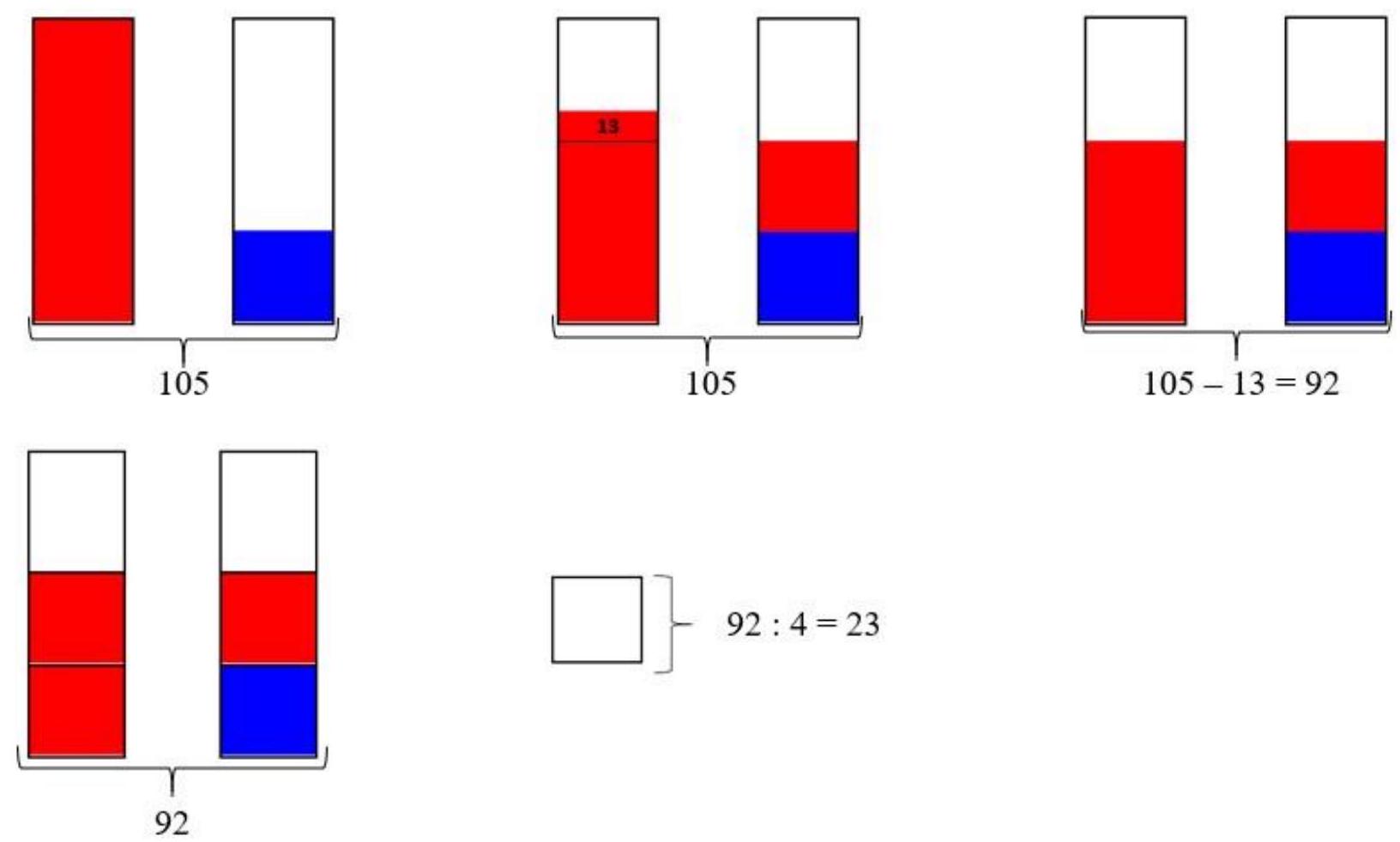
In the blue box, there are 23 balls, and in the red box, there are $105-23=82$ balls.
Five times the difference is $5 \cdot(82... | 295 | Algebra | math-word-problem | Yes | Yes | olympiads | false |
In the era of "Internet$+$", there is a method of producing passwords using the "factorization method": factorizing a polynomial. For example, factorizing the polynomial $x^{3}-x$ results in $x\left(x+1\right)\left(x-1\right)$. When $x=20$, $x-1=19$, $x+1=21$, we can obtain the numerical password $201921$, or $192021$.... | To solve this problem, let's start by factorizing the given polynomial $x^{3}+\left(m-n\right)x^{2}+nx$ in a similar manner to the example provided in the question. The polynomial can be rewritten as:
$$x^{3}+\left(m-n\right)x^{2}+nx = x\left[x^{2}+\left(m-n\right)x+n\right]$$
Given that when $x=10$, the password obt... | m=11; \ n=6 | Algebra | math-word-problem | Yes | Yes | cn_k12 | false |
20 kids in preschool are ready for a nap. 1/2 of the kids fall asleep within the first x minutes. Then half of the kids remaining fall asleep within another 5 minutes. How many kids are still awake?
If we know the answer to the above question is 5, what is the value of unknown variable x? | To determine the value of \( x \), let's follow the problem step by step.
1. **Initial number of kids:** There are 20 kids in preschool.
2. **Kids falling asleep in the first \( x \) minutes:** Half of the kids fall asleep. So, the number of kids that fall asleep is:
\[
\frac{20}{2} = 10
\]
Therefore, the ... | 10 | Algebra | math-word-problem | Yes | Yes | metamath | true |
Laura took out a charge account at the general store and agreed to pay 4% simple annual interest. She charges $35 on her account in January. How much will she owe a year later, assuming she does not make any additional charges or payments? | To calculate the amount Laura will owe a year later, we need to calculate the interest on the $35 charge and then add it to the original amount.
The formula for simple interest is:
\[ \text{Interest} = \text{Principal} \times \text{Rate} \times \text{Time} \]
Where:
- Principal is the initial amount charged ($35 in ... | \$36.40 | Algebra | math-word-problem | Yes | Yes | orca_math | true |
Let $H$ be the orthocenter of triangle $ABC$. Prove that the distance between the midpoints of segments $BC$ and $AH$ is equal to the radius of the circumcircle of triangle $ABC$. | The distance from the orthocenter of a triangle to one of its vertices is twice the distance from the center of the circumscribed circle to the opposite side.
## Solution
Let $O$ be the center of the circumscribed circle of triangle $ABC$, $M$ and $N$ be the midpoints of segments $AH$ and $BC$ respectively. First, we... | proof | Geometry | proof | Yes | Yes | olympiads | false |
The average weight of 12 people increases by 2.7 kg when three new persons come in place of three of them weighing 65 kg, 75 kg, and 85 kg. What might be the total weight of the three new persons? | Let's denote the total weight of the three new persons as W_new.
The average weight of the 12 people increased by 2.7 kg when the three new persons replaced the three persons weighing 65 kg, 75 kg, and 85 kg. This means that the total weight increase for the group of 12 people is 12 * 2.7 kg.
Total weight increase = ... | 257.4 | Algebra | math-word-problem | Yes | Yes | orca_math | true |
In the rectangular coordinate system, a polar coordinate system is established with the origin as the pole and the positive semi-axis of the $x$-axis as the polar axis. Given the curve $C:ρ\sin^2θ=2a\cos θ (a > 0)$, the line $l:\begin{cases}x=-2+\frac{\sqrt{2}}{2}t\\y=-4+\frac{\sqrt{2}}{2}t\end{cases} (t$ is the parame... | (I) Since $\begin{cases} x=ρ\cos θ \\ y=ρ\sin θ \end{cases}$, multiplying both sides of the equation $ρ\sin^2θ=2a\cos θ (a > 0)$ by $ρ$, we get the rectangular coordinate equation of curve $C$ as $y^2=2ax (a > 0)$. The ordinary equation of line $l$ is $x-y-2=0$.
(II) Solving the system of equations $\begin{cases} y^2=... | a=1 | Algebra | math-word-problem | Yes | Yes | cn_k12 | false |
Given a sequence $\{a_n\}$ with the sum of the first $n$ terms denoted as $S_n$, and the general term formula as ${a}_n= \dfrac{1}{n}$, define $f(n)=\begin{cases}{S}_{2n}, & n=1 \\ {S}_{2n}-{S}_{n-1}, & n\geqslant 2\end{cases}$
(Ⅰ) Calculate the values of $f(1)$, $f(2)$, $f(3)$;
(Ⅱ) Compare the magnitude of $f(n)$ ... | Solution:
(Ⅰ) From the given information, $f(1)=S_{2}=1+ \dfrac {1}{2}= \dfrac {3}{2}$, $f(2)=S_{4}-S_{1}= \dfrac {1}{2}+ \dfrac {1}{3}+ \dfrac {1}{4}= \dfrac {13}{12}$, $f(3)=S_{6}-S_{2}= \dfrac {1}{3}+ \dfrac {1}{4}+ \dfrac {1}{5}+ \dfrac {1}{6}= \dfrac {19}{20}$;
(Ⅱ) From (Ⅰ), we know $f(1) > 1$, $f(2) > 1$; whe... | null | Algebra | math-word-problem | Yes | Yes | cn_k12 | false |
2B. In three gardens there is water. If half of the water in the first garden is poured into the second, then one third of the water in the second garden is poured into the third, and finally one quarter of the water in the third garden is poured into the first, then each garden will have 6 liters of water. How much wa... | Solution. Let's assume that at the beginning, the first tank had $x$ liters of water, the second tank had $y$ liters, and the third tank had $z$ liters.
After the first transfer, the first tank had $\frac{x}{2}$ liters left, the second tank had $y+\frac{x}{2}$ liters, and the third tank had $z$ liters. After the secon... | 8,5,5 | Algebra | math-word-problem | Yes | Yes | olympiads | false |
Subsets and Splits
No community queries yet
The top public SQL queries from the community will appear here once available.