
instruction_seed stringlengths 2 10.7k | solution stringlengths 0 10.8k ⌀ | answer stringlengths 0 575 ⌀ | problem_type stringclasses 9
values | question_type stringclasses 5
values | problem_is_valid stringclasses 5
values | solution_is_valid stringclasses 4
values | source stringclasses 11
values | synthetic bool 2
classes |
|---|---|---|---|---|---|---|---|---|
Example 3 In a regular $(6n+1)$-gon, $k$ vertices are colored red, and the remaining vertices are colored blue. Prove that the number of isosceles triangles with vertices of the same color is independent of the coloring method.
Prove that the number of isosceles triangles with vertices of the same color is independent... | Let $k$ points be colored red, and the rest be colored blue. Let the number of isosceles triangles with all vertices blue be $a_{k}$, and the number of isosceles triangles with all vertices red be $b_{k}$.
Since $316 n+1$, no three vertices form a right-angled triangle. For any vertex as the "apex" of an isosceles tri... | 3n(6n+1)-9kn+\frac{3}{2}k(k-1) | Combinatorics | proof | Yes | Yes | olympiads | false |
Let $f(x)$ be an odd function defined on $\mathbb{R}$, and for any $a$, $b\in \mathbb{R}$, when $a+b\ne 0$, we have $\frac{f(a)+f(b)}{a+b} > 0$.
(1) Compare the sizes of $f(a)$ and $f(b)$ when $a > b$;
(2) If $f({9}^{x}-2\cdot {{3}^{x}})+f(2\cdot {{9}^{x}}-k) > 0$ holds for any $x\in [0,+\infty)$, find the range of v... | (1) Since $a+b\ne 0$, $\frac{f(a)+f(b)}{a+b} > 0$ holds for any $a$, $b$.
Thus, $\frac{f(a)+f(-b)}{a-b} > 0$.
As $a > b$, we have $a-b > 0$, which implies $f(a)+f(-b) > 0$.
Given that $f(x)$ is an odd function, we have $f(-b)=-f(b)$.
Therefore, $f(a)-f(b) > 0$, which means $f(a) > f(b)$.
(2) From (1), we know that... | k < 1 | Algebra | math-word-problem | Yes | Yes | cn_k12 | false |
For nonnegative integers $n$ and $k$, define $Q(n, k)$ to be the coefficient of $x^{k}$ in the expansion $(1+x+x^{2}+x^{3})^{n}$. Prove that
$Q(n, k) = \sum_{j=0}^{k}\binom{n}{j}\binom{n}{k-2j}$.
[hide="hint"]
Think of $\binom{n}{j}$ as the number of ways you can pick the $x^{2}$ term in the expansion.[/hide] | To prove that \( Q(n, k) = \sum_{j=0}^{k} \binom{n}{j} \binom{n}{k-2j} \), we start by analyzing the given expression \( (1 + x + x^2 + x^3)^n \).
1. **Rewrite the Expression:**
\[
(1 + x + x^2 + x^3)^n = \left( \frac{1 - x^4}{1 - x} \right)^n = (1 - x^4)^n (1 - x)^{-n}
\]
This step uses the geometric seri... | null | Combinatorics | proof | Yes | Yes | aops_forum | false |
Segment $s_1$ has endpoints at $(2, -4)$ and $(10, 4)$. Segment $s_2$ is obtained by translating $s_1$ by $3$ units to the left and $5$ units down. Find the midpoint of segment $s_2$. Express your answer as $(a,b)$ with $a$ and $b$ integers. | First, find the midpoint of segment $s_1$:
The midpoint formula is $\left(\frac{x_1+x_2}{2}, \frac{y_1+y_2}{2}\right)$. Applying this to the endpoints $(2, -4)$ and $(10, 4)$, we get:
\[ \text{Midpoint of } s_1 = \left(\frac{2+10}{2}, \frac{-4+4}{2}\right) = (6, 0). \]
Now, apply the translation to this midpoint to ge... | (3, -5) | Geometry | math-word-problem | Yes | Yes | synthetic_math | true |
Evaluate the expression \(\dfrac{\sqrt[4]{7}}{\sqrt[7]{7}}\) in terms of 7 raised to what power? | We start by converting the radicals into fractional exponents:
\[
\dfrac{\sqrt[4]{7}}{\sqrt[7]{7}} = \dfrac{7^{\frac{1}{4}}}{7^{\frac{1}{7}}}
\]
Next, we use the property of exponents that allows us to subtract exponents when dividing powers with the same base:
\[
7^{\frac{1}{4} - \frac{1}{7}} = 7^{\frac{7}{28} - \frac... | \frac{3}{28} | Algebra | math-word-problem | Yes | Yes | synthetic_math | true |
A rectangular field is to be fenced on three sides leaving a side of 30 feet uncovered. If a total of 78 feet of fencing will be required, what is the area of the field? | Let's call the length of the uncovered side L and the length of the other two sides that need to be fenced W (for width). We know that L is 30 feet.
The total amount of fencing needed is 78 feet, and this is used to cover two widths and one length. So we can write the equation:
2W + L = 78
We know L is 30 feet, so ... | 720 | Geometry | math-word-problem | Yes | Yes | orca_math | true |
245. One angle of the triangle is twice as large as another. Find the sides of the triangle, knowing that they are expressed as integers. | 245. $A=2B$. Let $BC=a, AC=b, AB=c$. Obviously $a>b$.
Draw the bisector $AD$ of angle $A$, then $\angle CDA = \angle DAB + \angle DBA = 2B; \angle CDA = \angle CAB$. By the property of the angle bisector in a triangle, as well as considering the similarity of triangles, we find $c=\frac{a^2-b^2}{b}$ (1). From (1) and ... | =mn,b=n^2,=^2-n^2 | Geometry | math-word-problem | Yes | Yes | olympiads | false |
The integer $m$ is between $30$ and $80$ and is a multiple of $6$. When $m$ is divided by X the remainder is $2$. Similarly, when $m$ is divided by $5,$ the remainder is $2$. The value of $m$ is 42. What is the value of unknown variable X? | To solve for the unknown variable \( X \) given the conditions, let's follow these steps:
1. **Identify the range and properties of \( m \):**
- \( m \) is an integer between 30 and 80.
- \( m \) is a multiple of 6.
- When \( m \) is divided by \( X \), the remainder is 2.
- When \( m \) is divided by 5, t... | 20 | Number Theory | math-word-problem | Yes | Incomplete | metamath | true |
A circular sheet of paper with a radius of $9$ cm is divided into four congruent sectors. What is the height of the cone in centimeters that can be created by rolling one of these sectors until the edges meet? Express your answer in simplest radical form. | The circumference of the entire circle is $2 \pi \times 9 = 18 \pi$. Consequently, the circumference of the base of the cone formed by one sector is $\frac{18 \pi}{4} = 4.5 \pi$. This becomes the circumference of the cone's base, from which we can calculate the radius $r$ as follows:
\[ r = \frac{circumference}{2\pi} =... | 5 \sqrt{3}\text{ cm} | Geometry | math-word-problem | Yes | Yes | synthetic_math | true |
Let $\mathrm{n}$ be a strictly positive integer. How many polynomials $\mathrm{P}$ with coefficients in $\{0,1,2,3\}$ are there such that $P(2)=n$?
## - Other examples - | Let $a_{n}$ be the number sought, and $f(t)$ the generating function of the sequence $\left(a_{n}\right)$. For $i \geqslant 0$ we call $A_{i}=\left\{2^{i}, 2^{i+1}, 3 \cdot 2^{i}\right\}, a_{n}$ is the number of different ways to obtain $n$ by choosing at most one number from each of the $A_{i}$ and summing all the cho... | a_{n}=[\frac{n}{2}]+1 | Combinatorics | math-word-problem | Yes | Yes | olympiads | false |
Example 1.2.7 (IMO 34) Let $D$ be a point inside an acute-angled $\triangle ABC$ such that $\angle ADB = \angle ACB + 90^\circ$ and $AC \cdot BD = AD \cdot BC$.
(1) Find the value of $AB \cdot CD : AC \cdot BD$;
(2) Prove that the tangents to the circumcircles of $\triangle ACD$ and $\triangle BCD$ at $C$ are perpendic... | Analyze how to make good use of the special conditions in this example: “$\angle A D B = \angle A C B + 90^{\circ}$, and $A C \cdot B D = A D \cdot B C$”. What can be derived from these conditions? Also, there is a particularly special value to find: “Find the value of $A B \cdot C D : A C \cdot B D$”. What approach sh... | \sqrt{2} | Geometry | proof | Yes | Yes | olympiads | false |
Given the function $f(x)=|\ln x|$, determine the number of zeros of the function $y=f(x)-f(e-x)$.
A: $1$
B: $2$
C: $3$
D: $5$ | The function is given as $f(x)=|\ln x|$, and we are looking for the zeros of the function $y=f(x)-f(e-x)$. Setting this equal to zero, we have $|\ln x|=|\ln (e-x)|$, where $x\in(0,e)$.
There are two possible cases to consider:
1. $x=e-x$
2. $e-x=\frac{1}{x}$
Solving for the first case, we have $x=\frac{e}{2}$. For th... | C: 3 | Algebra | MCQ | Yes | Yes | cn_k12 | false |
Proizvolov V.V.
A rectangle was cut by six vertical and six horizontal cuts into 49 rectangles (see figure). It turned out that the perimeter of each of the resulting rectangles is an integer number of meters. Is it necessarily true that the perimeter of the original rectangle is an integer number of meters?
.
## Solution
Consider the shaded rectangles on the diagram ("diagonal"). The horizontal side of the original rectangle is composed of their horizontal sides. The same applies to the vertical side.
Therefore, the perimeter of the original rectan... | proof | Geometry | math-word-problem | Yes | Yes | olympiads | false |
Find the inverse of the matrix
\[\begin{pmatrix} 2 & 3 \\ -1 & X \end{pmatrix}.\]If the inverse does not exist, then enter the zero matrix. The answer is 17. What is the value of unknown variable X? | To find the inverse of the matrix \(\begin{pmatrix} 2 & 3 \\ -1 & X \end{pmatrix}\), we need to use the formula for the inverse of a \(2 \times 2\) matrix. The inverse of a matrix \(\begin{pmatrix} a & b \\ c & d \end{pmatrix}\) is given by:
\[
\frac{1}{ad - bc} \begin{pmatrix} d & -b \\ -c & a \end{pmatrix}
\]
For t... | -\frac{3}{2} | Algebra | math-word-problem | Yes | Yes | metamath | true |
7. In a convex quadrilateral $ABCD$, the angle bisectors of $\angle A$ and $\angle C$ intersect at point $E$, and the angle bisectors of $\angle B$ and $\angle D$ intersect at point $F$, with points $E$ and $F$ inside quadrilateral $ABCD$. $M$ is the midpoint of segment $EF$, and through point $M$ perpendiculars are dr... | 7. Since point $E$ lies on the bisector of $\angle B A D (\angle B C D)$, the distances from point $E$ to sides $A B$ and $A D$ are equal (the distances to sides $B C$ and $C D$ are equal).
Similarly for point $F$.
Let the distances from point $E$ to $A B$ and $B C$ be $x_{1}$ and $y_{1}$, respectively, and the distanc... | proof | Geometry | proof | Yes | Yes | olympiads | false |
3. From point $O$, rays $O A, O B, O C$ and $O D$ were laid out, and $\angle A O B=\angle B O C=\angle C O D=3 \angle A O D$. What can $\angle A O D$ be equal to? | Answer: $36^{\circ}, 45^{\circ}$.
## Solution:
Notice that the angles $A O B, B O C$ and $C O D$ follow each other in one direction (otherwise, some rays would coincide).
Let $\angle A O D=X$. Then $\angle A O B=\angle B O C=\angle \underline{\mathrm{COD}}=3 X$.
If the sum of the angles $A O B, B O C$ and $C O D$ i... | 36,45 | Geometry | math-word-problem | Yes | Yes | olympiads | false |
Bertalan thought about a $4$-digit positive number. Then he draw a simple graph on $4$ vertices and wrote the digits of the number to the vertices of the graph in such a way that every vertex received exactly the degree of the vertex. In how many ways could he think about? In a simple graph every edge connects two diff... | null | null | Combinatorics | math-word-problem | Yes | Yes | aops_forum | false |
Five. (15 points) As shown in Figure 5, given that $AB$ is a chord of $\odot O$, a line parallel to $AB$ is drawn through $O$ and intersects $\odot O$ at point $C$, and intersects the tangent line of $\odot O$ at point $B$ at point $D$. Prove:
$$
\angle ACB = \angle D \text{. }
$$ | Five, as shown in Figure 12, draw diameter $A M$, and connect $O B$, $B M$. Then $A B / / O D$, that is,
$$
\begin{array}{l}
\angle A B O \\
=\angle B O D .
\end{array}
$$
But $\angle A B O$
$$
=\angle B A O \text {, }
$$
then $\angle B A O=\angle B O D$.
Since $A M$ is the diameter and $B D$ is the tangent of the ci... | proof | Geometry | proof | Yes | Yes | cn_contest | false |
A class selects 6 people to participate in two public welfare activities, with each activity being able to arrange a maximum of 4 people. The number of different arrangements is $(\;\;\;\;\;).$
A: 50 kinds
B: 70 kinds
C: 35 kinds
D: 55 kinds | This problem is a classification counting problem.
When two activities are arranged with 2 and 4 people respectively, there are $C_{6}^{2}A_{2}^{2}=30$ results,
When both activities are arranged with 3 people each, there are $C_{6}^{3}=20$ results,
$\therefore$ According to the principle of classification countin... | A | Combinatorics | MCQ | Yes | Yes | cn_k12 | false |
If there are $3$ lines passing through the point $P(1,m)$ where $m\in R$ and tangent to the graph of the function $f(x)=xe^{x}$, then the range of $m$ is ____. | To find the range of $m$ for which there are $3$ lines passing through the point $P(1,m)$ and tangent to the graph of $f(x)=xe^{x}$, we proceed as follows:
1. **Identify the Tangent Line Equation**: Let the point of tangency on the graph of $f(x)$ be $(x_{0}, y_{0})$. The slope of the tangent at this point is given by... | (-\frac{5}{e^{2}}, 0) | Calculus | math-word-problem | Yes | Yes | cn_k12 | false |
Let $a$, $b$, and $c$ be positive real numbers such that $2a + 3b + 5c = 100$. Find the smallest possible value of
\[a^2 + b^2 + c^2.\] | By Cauchy-Schwarz inequality, we have:
\[
(2^2 + 3^2 + 5^2)(a^2 + b^2 + c^2) \geq (2a + 3b + 5c)^2 = 100^2
\]
\[
(4 + 9 + 25)(a^2 + b^2 + c^2) \geq 10000
\]
\[
38(a^2 + b^2 + c^2) \geq 10000
\]
\[
a^2 + b^2 + c^2 \geq \frac{10000}{38} = \frac{5000}{19}
\]
Equality occurs when $\frac{a}{2} = \frac{b}{3} = \frac{c}{5}$. ... | \frac{5000}{19} | Algebra | math-word-problem | Yes | Yes | synthetic_math | true |
Given unit vectors $\overrightarrow{a}$ and $\overrightarrow{b}$, if the inequality $|{x\overrightarrow{a}+\overrightarrow{b}}|≥\frac{1}{2}$ holds for any real number $x$, then the range of values for the angle between vectors $\overrightarrow{a}$ and $\overrightarrow{b}$ is ()
A: $[{\frac{π}{6},\frac{{5π}}{6}}]$
B: ... | To solve this problem, we use the given information and apply some algebraic and trigonometric manipulations.
1. Given the inequality $|x\overrightarrow{a}+\overrightarrow{b}|\geq\frac{1}{2}$ for any real number $x$, we start by squaring both sides of the inequality to get rid of the absolute value. This gives us:
... | \text{A} | Inequalities | MCQ | Yes | Yes | cn_k12 | false |
Example 4.4.6 (IMO 27) Let $O$ be the center of a regular $n$-gon $(n \geqslant 5)$, and let two adjacent vertices be denoted as $A$ and $B$. Triangle $XYZ$ is congruent to $\triangle OAB$. Initially, let $\triangle XYZ$ overlap with $\triangle OAB$, then move $\triangle XYZ$ on the plane so that points $Y$ and $Z$ bot... | Place $O$ at the origin of the complex plane.
Let $A, B, C$ be three consecutive vertices of the $n$-sided polygon, arranged counterclockwise. Suppose at some moment during the movement, $Y$ is on the line segment $AB$, and $Z$ is on the line segment $BC$. By the section formula, we have
$Y = (1 - \lambda)A + \lambda B... | (1-\cos\frac{\pi}{n})(\sin\frac{2\pi}{n})^{-1} | Geometry | math-word-problem | Yes | Yes | olympiads | false |
Find $h+k$ where $(h,k)$ is the center of the circle given by the equation $x^2 + y^2 - 6x + 8y - 24= 0$. | First, we bring the equation $x^2 + y^2 - 6x + 8y - 24 = 0$ into the standard form of a circle by completing the square:
1. For $x$, consider the term $-6x$. Complete the square by adding and subtracting $(6/2)^2 = 9$:
\[ x^2 - 6x = (x - 3)^2 - 9. \]
2. For $y$, deal with $8y$ by adding and subtracting $(8/2)^2 = 16$... | -1 | Geometry | math-word-problem | Yes | Yes | synthetic_math | true |
Given the function $f(x)=alnx+\frac{1}{x}+bx$, and the tangent line of the curve $y=f(x)$ at the point $(1,f(1))$ is $2x-y+1=0$.
$(1)$ Find the values of real numbers $a$ and $b$;
$(2)$ Determine the monotonic intervals of the function $f(x)$. | ### Step-by-Step Solution
#### Part 1: Finding the values of $a$ and $b$
Given the function $f(x) = a\ln x + \frac{1}{x} + bx$, we first find its derivative to understand how the function changes. The derivative of $f(x)$ is calculated as follows:
$$f'(x) = \frac{d}{dx}(a\ln x) + \frac{d}{dx}\left(\frac{1}{x}\right)... | \text{Decreasing on } (0, \frac{1}{2}) \text{ and Increasing on } (\frac{1}{2}, +\infty) | Calculus | math-word-problem | Yes | Yes | cn_k12 | false |
There are 5 students standing in a line. Find the number of arrangements where a certain student does not stand at the head of the line. (Answer with a number). | To solve this problem, we first consider the total number of ways to arrange 5 students in a line, which is $5! = 120$. Since there are 5 students, and we want to find the number of arrangements where a specific student does not stand at the head of the line, we subtract the arrangements where this student stands at th... | 96 | Combinatorics | math-word-problem | Yes | Yes | cn_k12 | false |
Solve for $y$: $\sqrt[3]{30y + \sqrt[3]{30y + 27}} = 15.$ | Start by noting $g(y) = \sqrt[3]{30y + \sqrt[3]{30y + 27}}$. We need to find $y$ such that $g(y) = 15$. Assuming $\sqrt[3]{30y + 27} = 15$, we solve:
\[ 30y + 27 = 15^3. \]
\[ 15^3 = 3375, \]
\[ 30y + 27 = 3375, \]
\[ 30y = 3375 - 27, \]
\[ 30y = 3348, \]
\[ y = \frac{3348}{30}, \]
\[ y = \frac{1674}{15}. \]
Thus, the ... | \frac{1674}{15} | Algebra | math-word-problem | Yes | Yes | synthetic_math | true |
A wheel is divided into four regions labeled $A$, $B$, $C$, and $D$. The probability of the arrow stopping on region $A$ is $\frac{2}{5}$, and the probability of the arrow stopping on region $B$ is $\frac{1}{4}$. What is the probability of the arrow stopping on region $C$ if the probability of stopping on region $D$ is... | The total probability for all regions must be 1. Thus, we need to find $P(C)$, i.e., the probability of the arrow stopping on region $C$. We can use the formula:
$$
P(C) = 1 - P(A) - P(B) - P(D)
$$
Substituting the known probabilities:
$$
P(C) = 1 - \frac{2}{5} - \frac{1}{4} - \frac{1}{5}
$$
Finding a common denominato... | \frac{3}{20} | Algebra | math-word-problem | Yes | Yes | synthetic_math | true |
There are 1009 positive numbers such that both their sum and the sum of their reciprocals equal to 1010. Let \( x \) be one of these numbers. Find the maximum value of \( x + \frac{1}{x} \). | Let the other 1008 numbers be \( y_1, y_2, \dots, y_{1008} \). Then \( y_1 + y_2 + \dots + y_{1008} = 1010 - x \) and \( \frac{1}{y_1} + \frac{1}{y_2} + \dots + \frac{1}{y_{1008}} = 1010 - \frac{1}{x} \). By applying the Cauchy-Schwarz inequality:
\[
\left( \sum_{i=1}^{1008} y_i \right) \left( \sum_{i=1}^{1008} \frac{... | \frac{2029}{1010} | Algebra | math-word-problem | Yes | Yes | synthetic_math | true |
(non treated in class) Show that if $a, b, c > 0$ are real numbers such that $abc = 1$, then $(a+b)(b+c)(c+a) \geqslant 4(a+b+c-1)$.
## Abbreviated solutions to basic exercises | After simplifying the inequality, we need to show that if $\sigma_{3}=1$ then $\sigma_{2}+\frac{3}{\sigma_{1}} \geqslant 4$
Since $3(x y+y z+z x) \leqslant(x+y+z)^{2}$, by taking $x=a b, y=b c$ and $z=c a$ we get that $\sigma_{2}^{2} \geqslant 3 \sigma_{1} \sigma_{3}$, so $\left(\frac{\sigma_{2}}{3}\right)^{2} \geqsla... | proof | Inequalities | proof | Yes | Yes | olympiads | false |
If the probability that a baby born in a certain hospital will speak in the next day is \( \frac{1}{5} \), what is the probability that at least 3 babies out of a cluster of 7 babies will speak tomorrow? | We will use complementary probability again: we want the probability that less than 3 babies speak, and subtract from 1.
1) The probability that none of the 7 babies will speak is \( \left(\frac{4}{5}\right)^7 \).
2) The probability that exactly 1 baby speaks is \( \binom{7}{1} \left(\frac{4}{5}\right)^6 \left(\frac{... | \frac{45349}{78125} | Combinatorics | math-word-problem | Yes | Yes | synthetic_math | true |
Problem 83. Let \(a, b, c, d\) be positive real numbers with sum 4. Prove that
\[
\frac{1}{5-abc}+\frac{1}{5-bcd}+\frac{1}{5-cda}+\frac{1}{5-dab} \leq 1.
\] | None
Translate the text above into English, please retain the original text's line breaks and format, and output the translation result directly.
Note: The provided instruction is a meta-instruction and not part of the text to be translated. Since the text to be translated is "None", the translation is also "None". ... | not found | Inequalities | proof | Yes | Incomplete | inequalities | false |
To fill a tank, some buckets of water is required. If the capacity of the bucket is reduced to 4-fifths of its present, 250 buckets of water will be required to fill the same tank. How many buckets of water are required with the original bucket capacity? | Let's denote the original capacity of the bucket as C liters and the number of buckets required with the original capacity as N.
When the capacity of the bucket is reduced to 4/5 of its original capacity, the new capacity becomes (4/5)C liters. According to the problem, 250 buckets of this reduced capacity are requir... | 200 | Algebra | math-word-problem | Yes | Yes | orca_math | true |
Two cars start at the same time from opposite ends of a highway. One car is riding at 25 mph and the second car is riding at 45 mph. They meet after 2.5 hours. How long is the highway? | To find the length of the highway, we need to calculate the total distance covered by both cars before they meet.
The first car is traveling at 25 mph, and the second car is traveling at 45 mph. Together, they are covering a combined speed of 25 mph + 45 mph = 70 mph.
They meet after 2.5 hours, so the total distance ... | 175 | Algebra | math-word-problem | Yes | Yes | orca_math | true |
Circle $U$ has its center at point $U(3, -4)$. Circle $U$ is reflected across the x-axis and then the y-axis, and finally translated 10 units down. What are the coordinates of the image of the center of circle $U$? | 1. Reflect the center $U(3, -4)$ across the x-axis, changing the sign of the y-coordinate:
\[(3, -4) \xrightarrow{\text{reflect across x-axis}} (3, 4)\]
2. Reflect the new center across the y-axis, changing the sign of the x-coordinate:
\[(3, 4) \xrightarrow{\text{reflect across y-axis}} (-3, 4)\]
3. Tran... | (-3, -6) | Geometry | math-word-problem | Yes | Yes | synthetic_math | true |
If the function $f(x)=a\ln x (a\in R)$ and the function $g(x)=\sqrt{x}$ have a common tangent line at a common point, then the value of the real number $a$ is ( ).
A: $4$
B: $\frac{1}{2}$
C: $\frac{e}{2}$
D: $e$ | Given that the functions $f(x) = a\ln x$ and $g(x) = \sqrt{x}$ have a common tangent line at a common point, we need to find the value of $a$.
First, we find the derivatives of both functions to determine the slope of their tangent lines at any point $x$:
- For $f(x)$, the derivative is $f'(x) = \frac{a}{x}$.
- For $... | \frac{e}{2} | Calculus | MCQ | Yes | Yes | cn_k12 | false |
In the polar coordinate system, a line given by $\theta =\frac{\pi }{4} (\rho \in \mathbb{R})$ intersects with a circle described by $\rho =4\cos \theta$. The length of the chord obtained is __________. | To find the length of the chord where the line $\theta = \frac{\pi}{4}$ intersects with the circle $\rho = 4\cos \theta$, we first recognize that $\rho = 4\cos \theta$ represents a circle with a radius of 2 and centered at $(2,0)$ in the Cartesian coordinate system.
Substitute $\theta = \frac{\pi}{4}$ into $\rho = 4\c... | 2 \cdot \rho | Geometry | math-word-problem | Yes | Yes | cn_k12 | false |
The blue parabola shown is the graph of the equation \( y = ax^2 + bx + c \). Find \( c \). (Assume that the graph has the standard unit scale.)
[asy]
size(150);
real ticklen=3;
real tickspace=2;
real ticklength=0.1cm;
real axisarrowsize=0.14cm;
pen axispen=black+1.3bp;
real vectorarrowsize=0.2cm;
real tickdown=-0.5;... | The vertex of the parabola is \((-1, -2)\), so the equation of the parabola is of the form \[ y = a(x + 1)^2 - 2. \] The parabola passes through the point \((-2, -1)\). Substituting these values into the vertex form, we get \[ -1 = a(-2 + 1)^2 - 2. \] Solving for \( a \), we find \( a = 1 \). Hence, the equation of the... | -1 | Algebra | math-word-problem | Yes | Yes | synthetic_math | true |
Among the following propositions:
① If a line is parallel to a line within a plane, then this line is parallel to the plane;
② Two planes perpendicular to the same line are parallel to each other;
③ If a line is perpendicular to countless lines within a plane, then this line is perpendicular to the plane;
④ If ... | Solution:
① If a line outside a plane is parallel to a line within the plane, then this line is parallel to the plane, hence it is incorrect;
② Two planes perpendicular to the same line are parallel to each other, according to the theorem for determining parallel planes, this is correct;
③ When countless lines wi... | \text{②④} | Geometry | math-word-problem | Yes | Yes | cn_k12 | false |
If $\{a_n\}$ is an arithmetic sequence, with the first term $a_1 > 0$, $a_{2012} + a_{2013} > 0$, and $a_{2012} \cdot a_{2013} 0$ is. | Given that $\{a_n\}$ is an arithmetic sequence, with the first term $a_1 > 0$, $a_{2012} + a_{2013} > 0$, and $a_{2012} \cdot a_{2013} 0$ and $a_{2013} 0$. Since $a_1 > 0$, we would have $a_{2012} = a_1 + 2011d > 0$, which is a contradiction. Therefore, it is not possible.
Thus, the largest natural number $n$ for wh... | 2012 | Algebra | math-word-problem | Incomplete | Yes | cn_k12 | false |
Roberto is raising chickens for eggs. He buys x chickens for $20 each. They cost $1 in total a week to feed and each produces 3 eggs a week that will last forever. He used to buy 1 dozen eggs a week and spent $2 per dozen. The chickens will be cheaper than buying his eggs after 81 weeks. What is the value of unknown va... | To determine the value of \( x \), the number of chickens Roberto buys, we need to compare the total cost of raising the chickens with the total cost of buying eggs over 81 weeks. Let's break down the problem step by step.
1. **Calculate the cost of buying eggs for 81 weeks:**
- Roberto used to buy 1 dozen eggs a w... | 1 | Algebra | math-word-problem | Yes | Yes | metamath | true |
Find the minimum value attained by $\sum_{m=1}^{100} \gcd(M - m, 400)$ for $M$ an integer in the range $[1746, 2017]$.
| null | null | Number Theory | math-word-problem | Yes | Yes | aops_forum | false |
a sum of money deposited at c . i . amounts to rs . 2420 in 2 years and to rs . 3267 in 3 years . find the rate percent ? | Let's denote the principal (the initial sum of money deposited) as P, the rate of interest as r (in percentage), and the compound interest for 2 years and 3 years as CI_2 and CI_3, respectively.
According to the given information, the amount after 2 years (A_2) is Rs. 2420, and the amount after 3 years (A_3) is Rs. 32... | 35\% | Algebra | math-word-problem | Yes | Yes | orca_math | true |
There are some girls and 32 boys who want to participate in 6th grade intramurals. If each team must have the same number of girls and the same number of boys, and the greatest number of teams that can participate in intramurals is 8, how many girls want to participate? | If the greatest number of teams that can participate is 8, and each team must have the same number of boys, then the number of boys per team must be a factor of 32 (the total number of boys).
The factors of 32 are 1, 2, 4, 8, 16, and 32. Since we want the greatest number of teams, we choose the largest factor that is ... | 8 | Number Theory | math-word-problem | Yes | Yes | orca_math | true |
1. Find all pairs of positive integers $m$ and $n$ for which
$$
\sqrt{m^{2}-4}<2 \sqrt{n}-m<\sqrt{m^{2}-2} .
$$
|
Solution. If $m, n$ satisfy the given inequalities, then clearly
$$
m \geqslant 2 \text { and } 2 \sqrt{n}-m>0 \text {, }
$$
otherwise the square roots would not be defined or the middle term $2 \sqrt{n}-m$ would not be positive, and thus could not be greater than the nonnegative expression $\sqrt{m^{2}-4}$.
Assumi... | (,n)=(,^{2}-2),where\geqslant2 | Inequalities | math-word-problem | Yes | Yes | olympiads | false |
3. In the sequence $\left\{a_{n}\right\}$, $a_{2}=3, a_{3}=6, a_{n+2}=a_{n+1}-\frac{1}{a_{n}},$ the value of $a_{5}$ is ( ).
A. 12
B. 24
C. $\frac{11}{4}$
D. $\frac{11}{2}$ | 3. D. Since $a_{2}=3, a_{3}=6, a_{4}=6-\frac{1}{3}=\frac{17}{3}$, so $a_{5}=\frac{17}{3}-\frac{1}{6}=\frac{11}{2}$. | \frac{11}{2} | Algebra | MCQ | Yes | Yes | olympiads | false |
Sure, here is the translated text:
```
II. Try to find all prime numbers $p$ that satisfy the following conditions:
For any prime number $q<p$, if $p=b_{q}+r, 0 \leqslant r<\dot{q}$, then there does not exist an integer $a$ greater than 1 such that $a^{i}$ divides $r$.
``` | Solution: It is easy to verify that $p=2,3,5,7$ all satisfy the conditions. Now let's discuss the prime $p \geqslant 11$. If $p$ satisfies the conditions, then we have:
(i) $p-4$ has no prime factors greater than 4;
(ii) $p-8$ has no prime factors greater than 8;
(iii) $p-9$ has no prime factors greater than 9.
From (i... | 2,3,5,7,13 | Number Theory | math-word-problem | Yes | Yes | cn_contest | false |
Let $a\in\mathbb{R}-\{0\}$. Find all functions $f: \mathbb{R}\to\mathbb{R}$ such that $f(a+x) = f(x) - x$ for all $x\in\mathbb{R}$.
[i]Dan Schwartz[/i] | 1. Given the functional equation \( f(a + x) = f(x) - x \), we aim to find all functions \( f: \mathbb{R} \to \mathbb{R} \) that satisfy this equation.
2. Define a new function \( g(x) = f(x) - \frac{x^2}{2a} + \frac{x}{2} \). We will show that \( g(a + x) = g(x) \).
3. Start by substituting \( g(a + x) \):
\[
g(... | f(x) = C + \frac{x^2}{2a} - \frac{x}{2} | Logic and Puzzles | math-word-problem | Yes | Yes | aops_forum | false |
Brenda picks 250 peaches. When she sorts through them, a certain percentage are fresh, and Brenda has to throw 15 away for being too small. Brenda has 135 peaches left. What percentage of the peaches are fresh? | To find the percentage of fresh peaches, we first need to determine the total number of peaches that were not fresh. Brenda threw away 15 peaches for being too small, and she has 135 peaches left. So, the number of peaches that were not fresh is the sum of the peaches thrown away and the peaches missing from the origin... | 48\% | Algebra | math-word-problem | Yes | Yes | orca_math | true |
The radius of the circle $x^2+y^2+2x-2y-7=0$ is ______. | Solution: The equation of the circle $x^2+y^2+2x-2y-7=0$ can be rewritten as $(x+1)^2+(y-1)^2=9$,
Therefore, the radius of the circle $x^2+y^2+2x-2y-7=0$ is 3,
Hence, the answer is: $\boxed{3}$
This problem involves converting the equation of a circle into its standard form and then finding the radius.
It prima... | 3 | Geometry | math-word-problem | Yes | Yes | cn_k12 | false |
What integer is closest to the value of $\sqrt[3]{9^3 + 7^3}$? | First, we compute the cube of 9 and 7:
\[ 9^3 = 729 \]
\[ 7^3 = 343 \]
Add these two values:
\[ 729 + 343 = 1072 \]
Next, we need to find the cube root of 1072:
\[ \sqrt[3]{1072} \]
We know:
\[ 10^3 = 1000 \]
\[ 11^3 = 1331 \]
Since 1072 is between 1000 and 1331, and closer to 1000, we estimate the cube root of 1072 to... | 10 | Algebra | math-word-problem | Yes | Yes | synthetic_math | true |
Given vectors $\overrightarrow{a}$ and $\overrightarrow{b}$ are not parallel, if the vector $λ \overrightarrow{a}+ \overrightarrow{b}$ is parallel to $\overrightarrow{a}-2 \overrightarrow{b}$, then the value of the real number $λ$ is \_\_\_\_\_\_. | Since vector $λ \overrightarrow{a}+ \overrightarrow{b}$ is parallel to $\overrightarrow{a}-2 \overrightarrow{b}$,
there exists a real number $k$ such that $λ \overrightarrow{a}+ \overrightarrow{b}=k( \overrightarrow{a}-2 \overrightarrow{b})$,
which simplifies to $(λ-k) \overrightarrow{a}+(1+2k) \overrightarrow{b}= ... | - \dfrac {1}{2} | Algebra | math-word-problem | Yes | Yes | cn_k12 | false |
Consider the set $X$ = $\{ 1,2 \ldots 10 \}$ . Find two disjoint nonempty sunsets $A$ and $B$ of $X$ such that
a) $A \cup B = X$;
b) $\prod_{x\in A}x$ is divisible by $\prod_{x\in B}x$, where $\prod_{x\in C}x$ is the product of all numbers in $C$;
c) $\frac{ \prod\limits_{x\in A}x}{ \prod\limits_{x\in B}x}$ ... | 1. **Understanding the Problem:**
We need to find two disjoint nonempty subsets \(A\) and \(B\) of \(X = \{1, 2, \ldots, 10\}\) such that:
- \(A \cup B = X\)
- \(\prod_{x \in A} x\) is divisible by \(\prod_{x \in B} x\)
- \(\frac{\prod_{x \in A} x}{\prod_{x \in B} x}\) is as small as possible.
2. **Product... | B = \{4, 2, 6, 3, 5\} | Combinatorics | math-word-problem | Yes | Yes | aops_forum | false |
Consider a collection of 10 cubes, where the cubes have edge-lengths $k$ for each integer $k$, $1 \le k \le 10$. A tower is to be built using all 10 cubes with the following conditions:
- Any cube can be the base of the tower.
- The cube immediately on top of a cube with edge-length $k$ must have edge-length at most $k... | Just as in the original problem, we can approach the solution using recursion. Define $T_m$ as the number of towers that can be built using cubes with edge-lengths $1, 2, \ldots, m$. We need to determine how towers may be augmented by adding a cube of size $m+1$ under the new rule.
Given a tower using blocks $1, 2, \l... | 144 | Combinatorics | math-word-problem | Yes | Yes | synthetic_math | true |
Example 5 In a sports competition with $n(n \geqslant 3)$ participants, every two participants have played against each other once, and there were no ties. Furthermore, no participant has defeated all the others. Prove: there must exist three participants $A$, $B$, and $C$, such that the results between them are $A$ be... | Prove that if player $A$ beats player $B$, denoted as $A \rightarrow B$, this results in a tournament graph.
Since no one has achieved a perfect record, assume without loss of generality that $A$ is the player with the most wins. Therefore, there exists $A \rightarrow B$, and among the players $A$ has beaten, there mu... | proof | Combinatorics | proof | Yes | Yes | cn_contest | false |
Let's construct a triangle, given the base, the foot of the corresponding height, and the difference of the angles at the base. | Consider the problem as solved. Let $ABC$ be the sought triangle, $BC$ the given base, $A_1$ the foot of the altitude, and the difference of the angles at the base $\beta - \gamma = \delta$. Take a point $D$ on the base of the triangle such that $A_1D = A_1B$. Then:
$$
\angle CAD = \angle CAA_1 - \angle DAA_1 = (90^\c... | proof | Geometry | math-word-problem | Yes | Yes | olympiads | false |
Given the lines $l_1: ax+2y-1=0$ and $l_2: x+by-3=0$, where the angle of inclination of $l_1$ is $\frac{\pi}{4}$, find the value of $a$. If $l_1$ is perpendicular to $l_2$, find the value of $b$. If $l_1$ is parallel to $l_2$, find the distance between the two lines. | Since the angle of inclination of $l_1$ is $\frac{\pi}{4}$, the slope of $l_1$ is $\tan\left(\frac{\pi}{4}\right) = 1$. We can obtain this slope from the standard form of equation by comparing to the form $y=mx+b$, where $m$ is the slope. Hence, we have
$$
1 = -\frac{a}{2},
$$
which solves to $a=-2$. Thus, the equation... | \frac{7\sqrt{2}}{4} | Algebra | math-word-problem | Yes | Yes | cn_k12 | false |
Given that the radius of circle $\odot O$ is $6cm$ and point $P$ lies on the line $l$ with $OP=6cm$, the relationship between line $l$ and circle $\odot O$ is ______. | Given that the radius of circle $\odot O$ is $6cm$ and point $P$ lies on the line $l$ with $OP=6cm$, we analyze the relationship between line $l$ and circle $\odot O$ step by step.
First, we note the given information:
- The radius of circle $\odot O$, denoted as $r$, is $6cm$.
- The distance from point $O$ to point $... | \text{tangent or intersect} | Geometry | math-word-problem | Yes | Yes | cn_k12 | false |
Jill runs a business breeding llamas. Nine of her llamas got pregnant, and 5 of them got pregnant with twins. After they give birth, Jill traded 8 of the calves for 2 new adult llamas. Then she sells 1/3 of her herd at the market. Jill now has a total of 18 llamas (calves and adults). How many calves did each of these ... | Let's start by calculating the total number of calves born. We know that 5 llamas got pregnant with twins, so that's 5 * 2 = 10 twin calves. The other 4 llamas got pregnant with single calves, so that's 4 * 1 = 4 single calves. In total, the llamas gave birth to 10 + 4 = 14 calves.
After giving birth, Jill traded 8 of... | 14 | Logic and Puzzles | math-word-problem | Yes | Yes | orca_math | true |
5. In $\triangle A B C$, the lengths of the sides opposite to angles $A, B, C$ are $a, b, c$ respectively. If $c-a$ equals the height $h$ from vertex $A$ to side $AC$, then the value of $\sin \frac{C-A}{2}+\cos \frac{C+A}{2}$ is
(A) 1;
(B) $\frac{1}{2}$;
(C) $\frac{1}{3}$;
(D) -1. | 5. (A)
As shown in the figure,
$$
1=c-a=h=a .
$$
At this moment, $\sin \frac{C-\angle A}{2}+\cos \frac{C+\angle A}{2}$
$$
=\sin 30^{\circ}+\cos 60^{\circ}=1 \text {. }
$$ | 1 | Geometry | MCQ | Yes | Yes | olympiads | false |
Randomly select an integer \( p \) between \( 1 \) and \( 20 \) inclusive. What is the probability that \( p \) and some integer \( q \) satisfy the equation \( pq - 6p - 3q = 6 \)? Express your answer as a common fraction. | First, we manipulate the equation \( pq - 6p - 3q = 6 \) to use Simon's Favorite Factoring Trick. We need to add a constant to both sides to make the left side factorable:
\[ pq - 6p - 3q + 18 = 24 \]
\[ (p-3)(q-6) = 24 \]
Next, we determine the values of \( p \) for which \( p-3 \) is a divisor of 24. The divisors of... | \frac{7}{20} | Algebra | math-word-problem | Yes | Yes | synthetic_math | true |
Let $\triangle ABC$ be a right triangle such that $B$ is a right angle. A circle with diameter $BC$ meets side $AC$ at $D$. Another circle with diameter $AB$ meets $AC$ at $E$. If the area of $\triangle ABC$ is $200$ and $AC = 40$, what is $DE$? | In $\triangle ABC$, since $B$ is a right angle and circles have diameters along $BC$ and $AB$, $\angle BDC$ and $\angle BEA$ are right angles. $BD$ and $BE$ are thus altitudes of the triangle.
Given the area of $\triangle ABC$ is $200$, we use the area formula for a right triangle:
\[ \text{Area} = \frac{1}{2} \cdot AC... | DE = 0 | Geometry | math-word-problem | Yes | Yes | synthetic_math | true |
To obtain the graph of the function $y=\cos (2x+ \frac {π}{3})$, the graph of the function $y=\sin 2x$ needs to be ($\ \ \ \ $)
A: shifted right by $\frac {5π}{6}$ units
B: shifted right by $\frac {5π}{12}$ units
C: shifted left by $\frac {5π}{6}$ units
D: shifted left by $\frac {5π}{12}$ units | Since the function $y=\cos (2x+ \frac {π}{3})=\sin (2x+ \frac {5π}{6})=\sin 2(x+ \frac {5π}{12})$,
Therefore, the graph of the function $y=\sin 2x$ should be shifted left by $\frac {5π}{12}$ units to obtain the graph of the function $y=\cos (2x+ \frac {π}{3})=\sin (2x+ \frac {5π}{6})$,
Hence, the answer is: $\boxed{D... | D | Algebra | MCQ | Yes | Yes | cn_k12 | false |
8
On a circle, points $A, B, C, D$ are given in the specified order. $M$ is the midpoint of arc $AB$. Denote the points of intersection of chords $MC$ and $MD$ with chord $AB$ as $E$ and $K$. Prove that $K E C D$ is a cyclic quadrilateral. | Clearly, $2(\angle K E C+\angle K D C)=(\smile M B+\smile A C)+(\smile M B+\smile B C)=360^{\circ}$, since $\left.\smile M B=\smile A M\right)$.
Two circles intersect at points $P$ and $Q$. Through point $A$ of the first circle, lines $A P$ and $A Q$ are drawn, intersecting the second circle at points $B$ and $C$. Pro... | proof | Geometry | proof | Yes | Yes | olympiads | false |
7. Let $x_{i}>0(i=1,2, \cdots, n, n>2)$. Then $S=$ $\sum_{i j, k \text { distinct }} \frac{x_{i}}{x_{j}+x_{k}}$ has a minimum value of $\qquad$ $1 \leqslant, \ldots, k \leq n$ | $$
\begin{array}{l}
\text { 7. } \frac{n(n-1)(n-2)}{4} \text {. } \\
S=\sum_{1 \leqslant i<j<k \leqslant n}\left(\frac{x_{i}}{x_{j}+x_{k}}+\frac{x_{j}}{x_{i}+x_{k}}+\frac{x_{k}}{x_{i}+x_{j}}\right) \\
=\sum_{1 \leqslant i<j<k \leqslant n}\left[( x _ { i } + x _ { j } + x _ { k } ) \left(\frac{1}{x_{j}+x_{k}}+\right.\ri... | \frac{n(n-1)(n-2)}{4} | Inequalities | math-word-problem | Incomplete | Yes | cn_contest | false |
2. (6 points) The units digit of the product of nine 13s is $\qquad$
Translate the above text into English, please keep the original text's line breaks and format, and output the translation result directly. | 【Answer】Solution: Since 1 three is $3, 3 \times 3=9, 3 \times 3 \times 3=27, 3 \times 3 \times 3 \times 3=81, 3 \times 3 \times 3 \times 3$ $\times 3=243, \cdots$,
the unit digits are $3, 9, 7, 1, 3, \cdots$,
which means every 4 numbers form a cycle, $9 \div 4=2 \cdots 1$,
so the unit digit of the product of 9 thirtee... | Number Theory | math-word-problem | Yes | Yes | olympiads | false | |
A town is trying to clear litter from its streets. The council pays for adding 14 trash cans to the streets and also pays for adding some trash cans to the back of stores. The town has paid for 42 trash cans. What is the ratio of the number of trash cans added to the back of stores to the number of trash cans added to ... | The town has added 14 trash cans to the streets. In total, the town has paid for 42 trash cans. To find out how many trash cans were added to the back of stores, we subtract the number of trash cans on the streets from the total number of trash cans:
42 (total trash cans) - 14 (trash cans on the streets) = 28 (trash c... | 2:1 | Algebra | math-word-problem | Yes | Yes | orca_math | true |
TreQuan is throwing rocks in the river. He tosses 6 pebbles, 3 rocks, and 2 boulders, and the total width of the splashes he makes is 7 meters. Rocks make a splash that is 1/2 a meter wide, and boulders create a splash that is 2 meters wide. How wide is the splash made by a pebble? | Let's denote the width of the splash made by a pebble as P meters.
According to the information given:
- 3 rocks make a splash that is 3 * (1/2) = 1.5 meters wide in total.
- 2 boulders make a splash that is 2 * 2 = 4 meters wide in total.
The total width of the splashes made by rocks and boulders is 1.5 + 4 = 5.5 me... | 0.25 | Algebra | math-word-problem | Yes | Yes | orca_math | true |
## Condition of the problem
Prove that $\lim _{n \rightarrow \infty} a_{n}=a_{\text {(specify }} N(\varepsilon)$ ).
$a_{n}=\frac{3 n^{2}+2}{4 n^{2}-1}, a=\frac{3}{4}$ | ## Solution
By the definition of the limit:
$\forall \varepsilon>0: \exists N(\varepsilon) \in \mathbb{N}: \forall n: n \geq N(\varepsilon):\left|a_{n}-a\right| \\
& \left|\frac{12 n^{2}+8-12 n^{2}+3}{4\left(4 n^{2}-1\right)}\right| \\
& \left.\frac{11}{4\left(4 n^{2}-1\right)} \right\rvert\, \\
& \frac{11}{4\left(4 ... | proof | Calculus | proof | Yes | Yes | olympiads | false |
Joan bought toy cars for $14.88, a skateboard, and got toy trucks for $5.86. She spent $14.55 on pants. In total, Joan spent $25.62 on toys. How much did she spend on the skateboard? | To find out how much Joan spent on the skateboard, we need to calculate the total cost of the toy cars and toy trucks and then subtract that from the total amount she spent on toys.
The total cost of the toy cars is $14.88.
The total cost of the toy trucks is $5.86.
Now, let's add the cost of the toy cars and toy tru... | \$4.88 | Algebra | math-word-problem | Incomplete | Yes | orca_math | true |
In a certain 7th-grade class, 15 students received an "excellent" grade in Chinese, 18 students received an "excellent" grade in mathematics, 8 students received an "excellent" grade in both subjects, and 20 students did not receive an "excellent" grade in either subject. How many students are there in this class in to... | First, determine the total number of students who received an "excellent" grade, and then add the number of students who did not receive an "excellent" grade in either subject to find the total number of students in the class.
Solution: Since 15 students received an "excellent" grade in Chinese, 18 students received a... | 45 | Combinatorics | math-word-problem | Yes | Yes | cn_k12 | false |
B2. Without using a pocket calculator, calculate the value of the expression
$$
8 \cdot \sqrt[20]{32}-9 \cdot \sqrt[5]{\sqrt[6]{9}}-4 \cdot \sqrt[16]{16}+4 \cdot \sqrt[5]{\sqrt[9]{27}}+5 \cdot \sqrt[5]{\sqrt[12]{81}}
$$ | B2. Simplify the expression: $8 \cdot \sqrt[20]{2^{5}}-9 \cdot \sqrt[30]{3^{2}}-4 \cdot \sqrt[16]{2^{4}}+4 \cdot \sqrt[45]{3^{3}}+5 \cdot \sqrt[60]{3^{4}}=8 \cdot \sqrt[4]{2}-9 \cdot \sqrt[15]{3}-$ $4 \cdot \sqrt[4]{2}+4 \cdot \sqrt[15]{3}+5 \cdot \sqrt[15]{3}=4 \cdot \sqrt[4]{2}$
Simplification of each term:
:
- Ratio of sides $DE/BE = \frac{1}{2}$
Since the ratio of the areas of two similar triangles is the square of the ratio of t... | 153.75 | Geometry | math-word-problem | Yes | Yes | synthetic_math | true |
In a dairy farm, 26 cows eat 26 bags of husk in 26 days. In how many days will one cow eat one bag of husk? | If 26 cows eat 26 bags of husk in 26 days, then each cow eats 1 bag of husk in 26 days.
Therefore, one cow will eat one bag of husk in $\boxed{26}$ days. | 26 | Logic and Puzzles | math-word-problem | Yes | Yes | orca_math | true |
Solve the system of equations:$(1)\left\{\begin{array}{l}{p+q=4}\\{2p-q=5}\end{array}\right.$$(2)2v+t=3v-2t=3$. | For the system of equations problem, we'll solve each system step by step.
**System 1:**
Given:
\[
\left\{\begin{array}{l}
p + q = 4 \quad (1) \\
2p - q = 5 \quad (2)
\end{array}\right.
\]
Adding equations (1) and (2) together:
\[
(p + q) + (2p - q) = 4 + 5 \\
3p = 9
\]
Solving for $p$:
\[
p = \frac{9}{3} = 3
\]
S... | null | Algebra | math-word-problem | More than one problem | Yes | cn_k12 | false |
Shared bicycles have brought great convenience to residents for short-distance travel. According to the "2017 Shenzhen Internet Bicycle Development Evaluation Report," the daily average number of people using shared bicycles in Shenzhen is 2,590,000. This number can be expressed in scientific notation as ( ).
A: $259\... | To express the number 2,590,000 in scientific notation, we start by placing the decimal point after the first non-zero digit, which gives us 2.59. Next, we count the number of places the decimal point has moved from its original position at the end of the number to its new position. In this case, the decimal point has ... | C | Logic and Puzzles | MCQ | Yes | Yes | cn_k12 | false |
Problem 9. Solve the equation
$$
\log _{3} x=1+\frac{-3}{2 x-1}
$$
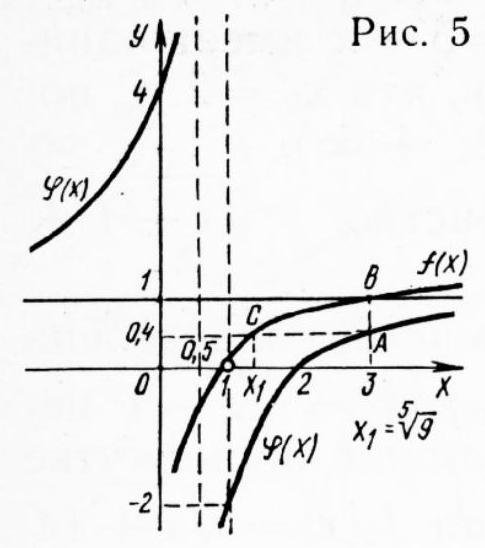 | Solved. We construct the graphs of the functions $f(x)=\log _{3} x, \quad \varphi(x)=$ $=1+\frac{-3}{2 x-1}$ (Fig. 5).
On the half-interval $(-\infty ; 0]$, the function $f(x)$ is not defined, so there are no solutions to equation (1) on this interval.
On the interval $(0 ; 0.5)$, the function $\varphi(x)$ is positiv... | nosolution | Algebra | math-word-problem | Yes | Yes | olympiads | false |
Prove the equalities (see Leibniz triangle, problem 60424):
a) $1=1 / 2+1 / 6+1 / 12+1 / 20+1 / 30+\ldots ;$
b) $1 / 2=1 / 3+1 / 12+1 / 30+1 / 60+1 / 105+\ldots ;$
c) $1 / 3=1 / 4+1 / 20+1 / 60+1 / 140+1 / 280+\ldots$. | a) According to the main property of Leibniz's triangle
$1=1 / 2+1 / 2=1 / 2+1 / 6+1 / 3=1 / 2+1 / 6+1 / 12+1 / 4=1 / 2+1 / 6+1 / 12+1 / 20+1 / 5=\ldots$.
b) and c) are proved similarly. | proof | Algebra | proof | Yes | Yes | olympiads | false |
Balls of equal size are arranged in rows to form an equilateral triangle. The top most row consists of one ball, the 2nd row of two balls and so on. If a certain number of balls are added, then all the balls can be arranged in the shape of a square and each of the sides of the square contains 8 balls less than each sid... | Let's denote the number of balls on each side of the equilateral triangle as \( n \). The total number of balls in an equilateral triangle formed by arranging balls in this way is given by the sum of the first \( n \) natural numbers, which is:
\[ \frac{n(n + 1)}{2} \]
We are given that the total number of balls in t... | 424 | Number Theory | math-word-problem | Yes | Yes | orca_math | true |
Given x^2 + 1/x^2 = 7, x*y = 1, and z^2 + 1/z^2 = 9, find the value of x^4 + y^4 - z^4. | Let's solve this step by step.
First, we have the equation \( x^2 + \frac{1}{x^2} = 7 \). To find \( x^4 \), we can square both sides of the equation:
\( (x^2 + \frac{1}{x^2})^2 = 7^2 \)
\( x^4 + 2x^2(\frac{1}{x^2}) + \frac{1}{x^4} = 49 \)
Since \( x^2 \cdot \frac{1}{x^2} = 1 \), we have:
\( x^4 + 2 + \frac{1}{x^4... | 15 | Algebra | math-word-problem | Yes | Yes | orca_math | true |
3. The equation about $x$
$$
\frac{x-a}{b c}+\frac{x-b}{a c}+\frac{x-c}{a b}=2\left(\frac{1}{a}+\frac{1}{b}+\frac{1}{c}\right) \text {, }
$$
where $a+b+c \neq 0$, the solution of the equation is $\qquad$ . | 3. $x=a+b+c$. Transform the original equation into
$$
\begin{array}{l}
\left(\frac{x-a}{b c}-\frac{1}{b}-\frac{1}{c}\right)+\left(\frac{x-b}{a c}-\frac{1}{a}-\frac{1}{c}\right)+ \\
\left(\frac{x-c}{a b}-\frac{1}{a}-\frac{1}{b}\right)=0 .
\end{array}
$$
From this, we can solve for $x=a+b+c$. | x=a+b+c | Algebra | math-word-problem | Yes | Yes | cn_contest | false |
The length of a rectangular plot is some multiple of its breadth. The area of the rectangular plot is 588 sq m, and the breadth is 14 m. What is the ratio of the length to the breadth of the rectangular plot? | Let's denote the breadth of the rectangular plot as \( b \) and the length as \( l \). We are given that \( b = 14 \) m and the area \( A \) of the rectangle is 588 sq m.
The area of a rectangle is given by the formula:
\[ A = l \times b \]
Substituting the given values, we have:
\[ 588 = l \times 14 \]
To find the ... | 3:1 | Geometry | math-word-problem | Yes | Yes | orca_math | true |
Let $a$ and $b$ be positive numbers. Prove the inequality
$$\sqrt[3]{\frac ab}+\sqrt[3]{\frac ba}\le\sqrt[3]{2(a+b)\left(\frac1a+\frac1b\right)}.$$ | We will start by proving the inequality for two positive numbers \(a\) and \(b\):
\[ \sqrt[3]{\frac{a}{b}} + \sqrt[3]{\frac{b}{a}} \le \sqrt[3]{2(a+b)\left(\frac{1}{a} + \frac{1}{b}\right)}. \]
1. **Apply the AM-GM Inequality:**
The Arithmetic Mean-Geometric Mean (AM-GM) Inequality states that for any non-negative ... | null | Inequalities | proof | Yes | Yes | aops_forum | false |
John trains for ultramarathons. He starts only able to run 8 hours straight but eventually increases that by 75%. He also increases his initial speed by 4 mph. He can now run 168 miles. What was his initial speed? | Let's denote John's initial speed as \( S \) mph.
After increasing his running time by 75%, his new running time is \( 8 \) hours \( + 0.75 \times 8 \) hours \( = 8 + 6 \) hours \( = 14 \) hours.
His new speed after increasing by 4 mph is \( S + 4 \) mph.
Since he can now run 168 miles, we can use the formula for di... | 8 | Algebra | math-word-problem | Yes | Yes | orca_math | true |
Given the function f(x) = x^2 * e^x.
(I) Find the extreme values of f(x);
(II) If the function y = f(x) - ax has three zeros in its domain, find the range of real number a. | ### Problem:
Given the function $f(x) = x^2 e^x$.
#### (I) Find the extreme values of $f(x)$;
#### (II) If the function $y = f(x) - ax$ has three zeros in its domain, find the range of real number $a$.
### Solution:
#### Part (I)
Given that the domain of the function $f(x)$ is $\mathbb{R}$.
- Since $f(x) = x^2 e... | -1/e < a < 0 | Calculus | math-word-problem | Yes | Yes | cn_k12 | false |
22nd Putnam 1961 Problem B1 a n is a sequence of positive reals. h = lim (a 1 + a 2 + ... + a n )/n and k = lim (1/a 1 + 1/a 2 + ... + 1/a n )/n exist. Show that h k ≥ 1. | Apply the arithmetic-geometric mean theorem to each sum. We get that (a 1 + a 2 + ... + a n )/n ≥ (a 1 a 2 ... a n ) 1/n , (1/a 1 + 1/a 2 + ... + 1/a n )/n = 1/(a 1 a 2 ... a n ) 1/n . Hence their product is at least 1. Hence the product of the limits also. 22nd Putnam 1961 © John Scholes jscholes@kalva.demon.co.uk 15 ... | \ge1 | Inequalities | proof | Yes | Yes | olympiads | false |
Calculate the value of $2^{345} - 8^3 \div 8^2 + 3^2$. | First, note that $2^{345}$ remains very large but isn't changed due to no simplification rules applying to it.
Next, simplify $\frac{8^3}{8^2}$:
- $\frac{8^3}{8^2} = 8^{3-2} = 8^1 = 8$.
Additionally, calculate $3^2$:
- $3^2 = 9$.
Now, combine all terms:
- $2^{345} - 8 + 9$.
Since a simplified exact value calculatio... | 2^{345} + 1 | Algebra | math-word-problem | Yes | Yes | synthetic_math | true |
Let $\mathcal{L}$ be the set of all lines in the plane and let $f$ be a function that assigns to each line $\ell \in \mathcal{L}$ a point $f(\ell)$ on $\ell$. Suppose that for any point $X$, and for any three lines $\ell_{1}, \ell_{2}, \ell_{3}$ passing through $X$, the points $f\left(\ell_{1}\right), f\left(\ell_{2}\r... | We provide a complete characterisation of the functions satisfying the given condition. Write $\angle\left(\ell_{1}, \ell_{2}\right)$ for the directed angle modulo $180^{\circ}$ between the lines $\ell_{1}$ and $\ell_{2}$. Given a point $P$ and an angle $\alpha \in\left(0,180^{\circ}\right)$, for each line $\ell$, let ... | proof | Geometry | proof | Yes | Incomplete | olympiads_ref | false |
The solution set of the inequality $\frac{2x-1}{x+1} \leqslant 1$ is ($\,\,$).
A: $(-\infty, 2]$
B: $(-\infty, -1) \cup (-1, 2]$
C: $[-1, 2]$
D: $(-1, 2]$ | First, subtract $1$ from both sides of the inequality $\frac{2x-1}{x+1} \leqslant 1$ to get $\frac{2x - 1}{x + 1} - \frac{x + 1}{x + 1} \leqslant 0$, which simplifies to $\frac{x - 2}{x + 1} \leqslant 0$.
Next, we have the system of inequalities:
$$
\begin{cases}
x \neq -1 \\
(x - 2)(x + 1) \leqslant 0 \\
\end{cases}
... | (D)\, (-1, \, 2] | Inequalities | MCQ | Yes | Yes | cn_k12 | false |
10. Find all ordered 4-tuples of integers $(a, b, c, d)$ (not necessarily distinct) satisfying the following system of equations:
$$
\begin{aligned}
a^{2}-b^{2}-c^{2}-d^{2} & =c-b-2 \\
2 a b & =a-d-32 \\
2 a c & =28-a-d \\
2 a d & =b+c+31 .
\end{aligned}
$$ | Answer: $(5,-3,2,3)$ We first give two systematic solutions using standard manipulations and divisibility conditions (with some casework), and then a third solution using quaternionic number theory (not very practical, so mostly for your cultural benefit).
Solution 1. Subtract the second equation from the third to get ... | (5,-3,2,3) | NaN | NaN | NaN | NaN | olympiads | false |
Proposition 1 Let the area of $\triangle A B C$ be $\triangle$, the lengths of the three sides be $a, b, c$, and the corresponding median lengths be $m_{a}, m_{b}, m_{c}$. If there exists a relationship
$$
f(a, b, c, \Delta) \geqslant 0,
$$
then it must be true that
$$
f\left(m_{\mathrm{a}}, m_{\mathrm{b}}, m_{\mathrm... | Line $m_{\mathrm{a}}, m_{\mathrm{h}}, m_{\mathrm{e}}$ can serve as the three sides of a triangle similar to a given triangle. Let this triangle be $\triangle A_{1} B_{1} C_{1}$, then it is easy to prove: the area of $\triangle A_{1} B_{1} C_{1}$ is $\frac{3}{4}$ of the area of $\triangle A B C$. Applying (1) to $\trian... | proof | Geometry | proof | Yes | Yes | cn_contest | false |
Colin can skip at six times the speed that Brandon can. Brandon can skip at one-third the speed that Tony can. Tony can skip at twice the speed that Bruce can. Daniel can skip at one-fourth the speed that Colin can. At what speed, in miles per hour, can Colin skip if Bruce skips at 1 mile per hour? | Let's denote the skipping speeds of each person as follows:
- Bruce's speed = B
- Tony's speed = T
- Brandon's speed = Br
- Colin's speed = C
- Daniel's speed = D
From the information given, we can write the following equations:
1. Tony can skip at twice the speed that Bruce can: T = 2B
2. Brandon can skip at one-th... | 4 | Algebra | math-word-problem | Yes | Yes | orca_math | true |
Calculate: $(x+2)(x-2)-x(x+1)$. | To solve the given expression step-by-step, we start with the original expression and simplify it as follows:
\[
\begin{align*}
(x+2)(x-2)-x(x+1) &= x^2 - 2x + 2x - 4 - (x^2 + x) \\
&= x^2 - 4 - x^2 - x \\
&= -x - 4.
\end{align*}
\]
Therefore, the simplified form of the given expression is $\boxed{-x - 4}$. | -x - 4 | Algebra | math-word-problem | Yes | Yes | cn_k12 | false |
Two trucks A and B start from the same point in opposite directions. Truck A travels at a constant speed of 54 kilometers per hour, while truck B travels at a constant speed of 72 kilometers per hour. After 30 seconds, find the distance between the two trucks. (1 kilometer = 1000 meters) | First, we need to convert the speed of the trucks from kilometers per hour to meters per second to match the time unit given (30 seconds).
1 kilometer per hour (km/h) is equivalent to \(\frac{1000 \text{ meters}}{3600 \text{ seconds}}\) (since there are 3600 seconds in an hour).
So, for truck A traveling at 54 km/h:
... | 1050 | Algebra | math-word-problem | Yes | Yes | orca_math | true |
Given the function $f(x)=ax^2+bx+1$ ($a,b$ are real numbers, $a\neq 0$, $x\in \mathbb{R}$),
(1) If the graph of the function for $1\leqslant x_1 < x_2$ passes through the point $(-2,1)$, and the equation $f(x)=0$ has exactly one root, find the expression for $1\leqslant x_1 < x_2$;
(2) Under the condition of (1), whe... | Solution:
(1) Since the graph of the function for $1\leqslant x_1 < x_2$ passes through the point $(-2,1)$,
we have $f(-2)=1$, which gives $4a-2b+1=1$,
thus $b=2a$,
Because the equation $f(x)=0$ has exactly one root, we get $\Delta =b^2-4a=0$,
which leads to $4a^2-4a=0$,
hence $a=1$ (discard $a=0$), $b=2$.
There... | k\leqslant 0 | Algebra | math-word-problem | Yes | Yes | cn_k12 | false |
If the system of linear inequalities in one variable $x$ is $\left\{\begin{array}{l}x-m≥0\\ \frac{1}{2}x+\frac{1}{2}<2\end{array}\right.$ has no solution, then the range of values for $m$ is ( )
A: $m \lt 3$
B: $m\leqslant 3$
C: $m\geqslant 3$
D: $m \gt 3$ | To solve the system of linear inequalities for $x$ given by $\left\{\begin{array}{l}x-m≥0\\ \frac{1}{2}x+\frac{1}{2}<2\end{array}\right.$ and determine the range of values for $m$ for which this system has no solution, we proceed as follows:
1. **Solve the first inequality**:
- The first inequality is $x - m \geq 0... | C | Inequalities | MCQ | Yes | Yes | cn_k12 | false |
If $f(x) = |x+2|$, calculate the integral $$\int_{-4}^{3} f(x) dx = \_\_\_\_\_\_.$$ | To solve $$\int_{-4}^{3} f(x) dx = \int_{-4}^{3} |x+2| dx = \int_{-4}^{-2} (-x-2) dx + \int_{-2}^{3} (x+2) dx$$
= $(-\frac{1}{2}x^2 - 2x)|_{-4}^{-2} + (\frac{1}{2}x^2 + 2x)|_{-2}^{3}$
= $(-2 + 4 + 8 - 8) + (\frac{9}{2} + 6 - 2 + 4) = \boxed{\frac{29}{2}}$
Therefore, the answer is: $\boxed{\frac{29}{2}}$.
The i... | \frac{29}{2} | Calculus | math-word-problem | Yes | Yes | cn_k12 | false |
Example 1.13.7. Let $a, b, c$ be positive real numbers. Prove that
$$\frac{1}{4 a}+\frac{1}{4 b}+\frac{1}{4 c}+\frac{1}{3 a+b}+\frac{1}{3 b+c}+\frac{1}{3 c+a} \geq \frac{2}{a+3 b}+\frac{2}{b+3 c}+\frac{2}{c+3 a}$$ | SOLUTION. We use the following familiar result (shown in the first volume)
$$a^{4}+b^{4}+c^{4}+a^{3} b+b^{3} c+c^{3} a \geq 2\left(a b^{3}+b c^{3}+c a^{3}\right)$$
to deduce the desired result. The equality holds for $a=b=c$. | proof | Inequalities | proof | Yes | Incomplete | inequalities | false |
In the arithmetic sequence $\{{a_n}\}$, ${a_2 = 3}$, and ${a_3 + a_6 = 11}$.
(I) Find the general term formula for the sequence $\{{a_n}\}$;
(II) Let ${b_n = a_n + \frac{1}{2^{a_n}}}$, where $n \in \mathbb{N}^*$, find the sum of the first $n$ terms of the sequence $\{{b_n}\}$, denoted as ${S_n}$. | (I) Let the common difference of the arithmetic sequence $\{{a_n}\}$ be $d$. We have the following system of equations:
\begin{cases}
a_1 + d = 3 \\
2a_1 + 7d = 11
\end{cases}
Solving the system of equations, we find $a_1 = 2$ and $d = 1$.
Hence, the general term formula for the sequence $\{{a_n}\}$ is given by:
\[
{... | \frac{n^2+3n+1}{2} - \frac{1}{2^{n+1}} | Algebra | math-word-problem | Yes | Yes | cn_k12 | false |
Subsets and Splits
No community queries yet
The top public SQL queries from the community will appear here once available.