
instruction_seed stringlengths 2 10.7k | solution stringlengths 0 10.8k ⌀ | answer stringlengths 0 575 ⌀ | problem_type stringclasses 9
values | question_type stringclasses 5
values | problem_is_valid stringclasses 5
values | solution_is_valid stringclasses 4
values | source stringclasses 11
values | synthetic bool 2
classes |
|---|---|---|---|---|---|---|---|---|
Carol was competing in a trivia game where the points earned in each round depended on a particular multiplier. In the first round, she scored 17 points, and in the second round, she scored 6 points. However, every point earned in the second round was doubled, owing to the day's specific rules. During the last round, s... | Let's calculate Carol's points round by round.
In the first round, she scored 17 points.
In the second round, she scored 6 points, but each point was doubled. So, her points for the second round are:
6 points * 2 = 12 points
Now, let's add the points from the first two rounds:
17 points (first round) + 12 points (se... | -19 | Algebra | math-word-problem | Yes | Yes | orca_math | true |
In triangle $PQR$, $QR = 30$ and $\angle R = 45^\circ$. Let the perpendicular bisector of $QR$ intersect $QR$ and $PR$ at $S$ and $T$, respectively. Find the length of $ST$. | First, note that $S$ is the midpoint of $QR$, so $RS = QR/2 = 15$.
Since the perpendicular bisector of $QR$ intersects $PR$ at $T$, and $\angle R = 45^\circ$, triangle $RST$ is a $45^\circ$-$45^\circ$-$90^\circ$ triangle. In such triangles, the lengths of the legs are equal, and the length of the hypotenuse is $\sqrt{... | \frac{15\sqrt{2}}{2} | Geometry | math-word-problem | Yes | Yes | synthetic_math | true |
Bobby can deadlift 300 pounds at 13. When he is 18, he can deadlift 100 pounds more than a certain percentage of his previous deadlift. He added 110 pounds per year. What is the percentage of his previous deadlift that Bobby can deadlift 100 pounds more than when he is 18? | First, let's calculate how much Bobby can deadlift when he is 18.
He starts at 13 years old with a deadlift of 300 pounds. He adds 110 pounds per year for 5 years (from age 13 to 18).
The total amount added over 5 years is:
110 pounds/year * 5 years = 550 pounds
So, at 18, Bobby can deadlift:
300 pounds + 550 pounds... | 18 | Algebra | math-word-problem | Yes | Yes | orca_math | true |
A restaurant made some hamburgers and 4 hot dogs to serve during lunch. Only 3 hamburgers were actually served, and 6 hamburgers were left over. How many hamburgers did the restaurant make? | The restaurant served 3 hamburgers and had 6 left over. To find out the total number of hamburgers made, we add the ones served to the ones left over:
3 hamburgers (served) + 6 hamburgers (left over) = 9 hamburgers
The restaurant made $\boxed{9}$ hamburgers. | 9 | Logic and Puzzles | math-word-problem | Yes | Yes | orca_math | true |
Calculate: $-\left(-1\right)+3^{2}\div \left(1-4\right)\times 2$. | To calculate the given expression step by step, we start with the original expression and simplify it gradually:
\[
\begin{align*}
-\left(-1\right)+3^{2}\div \left(1-4\right)\times 2 & = 1 + 9 \div \left(-3\right) \times 2 \\
& = 1 + \left(\frac{9}{-3}\right) \times 2 \\
& = 1 - 3 \times 2 \\
& = 1 - 6 \\
& = -5.
\end... | -5 | Algebra | math-word-problem | Yes | Yes | cn_k12 | false |
If the function $f(2x+1)=x^2-2x$, then find $f(3)=\underline{\qquad\qquad}$. | **Step 1: Understanding the Problem**
This problem requires knowledge of basic function concepts. We can solve for $f(3)$ by setting $2x+1$ equal to $3$.
**Step 2: Solving for $x$**
Let's set up the equation:
$$2x+1=3$$
Subtracting $1$ from both sides, we have:
$$2x=2$$
Finally, dividing by $2$ gives us:
$$x=1$$
**St... | -1 | Algebra | math-word-problem | Yes | Yes | cn_k12 | false |
Example 1.31 Let $C_{n, m}$ denote the number of $m$-covers of an $n$-element set $A$. Find the counting formula for $C_{n, n}$. | Let $W$ denote the set of all $m$-element subsets of $P^{*}(A)$. Since $\left|P^{*}(A)\right|=2^{n}-1$, we have $|W|=\binom{2^{n}-1}{m}$. Now, we classify the elements of $W$ into $n$ categories as follows: Let $\Gamma \in W$. If $\left|\bigcup_{F \in \Gamma} F\right|=j(1 \leqslant j \leqslant n)$, then $\Gamma$ is cal... | C_{n,}=\sum_{j=1}^{n}(-1)^{n-j}\binom{n}{j}\binom{2^{j}-1}{} | Combinatorics | math-word-problem | Yes | Yes | olympiads | false |
"How big is the 'friend circle' of the 'Belt and Road Initiative'? The 'Belt and Road Initiative' involves 65 countries along the route, with a total population of approximately 4,500,000,000. Express 4,500,000,000 in scientific notation as ( )."
A: $4.5\times 10^{7}$
B: $45\times 10^{8}$
C: $4.5\times 10^{9}$
D: $... | To express the number 4,500,000,000 in scientific notation, we start by placing the decimal point after the first non-zero digit, which gives us 4.5. Then, we count how many places we moved the decimal point to get from the original number to 4.5. We moved it 9 places to the right. Therefore, we express 4,500,000,000 a... | C | Algebra | MCQ | Yes | Yes | cn_k12 | false |
In a two-day mathematics contest, Alpha and Beta each attempted questions worth a total of 600 points. Alpha scored 180 points out of 350 points attempted on the first day, and scored 170 points out of 250 points attempted on the second day. Beta did not attempt the same number of questions as Alpha on each day but had... | Let Beta's scores be \(a\) out of \(b\) on the first day and \(c\) out of \(d\) on the second day. Therefore, the conditions are:
- \(0 0\), leading to \(M < 408\). Testing \(M = 407\), gives:
\[
a < \frac{91800 - 225 \times 407}{200} = \frac{825}{200} \approx 4.125
\]
So, \(a\) can be at most 4. For \(a = 4\), \(b\) ... | \frac{407}{600} | Algebra | math-word-problem | Yes | Yes | synthetic_math | true |
A line is parameterized by a parameter $t,$ such that the vector on the line at $t = 0$ is $\begin{pmatrix} 2 \\ 6 \\ 16 \end{pmatrix},$ and the vector on the line at $t = 1$ is $\begin{pmatrix} 1 \\ 1 \\ 8 \end{pmatrix}.$ Find the vector on the line at $t = -1.$ | Let the line be parameterized as:
\[
\begin{pmatrix} x \\ y \\ z \end{pmatrix} = \mathbf{a} + t \mathbf{d}.
\]
Then, using the given information at $t = 0$ and $t = 1$:
\[
\begin{pmatrix} 2 \\ 6 \\ 16 \end{pmatrix} = \mathbf{a} + 0 \mathbf{d}, \quad \text{and} \quad \begin{pmatrix} 1 \\ 1 \\ 8 \end{pmatrix} = \mathbf{a... | \begin{pmatrix} 3 \\ 11 \\ 24 \end{pmatrix} | Algebra | math-word-problem | Yes | Yes | synthetic_math | true |
Calculate the sum $3_8 + 4_8 + 5_8 + \cdots + 100_8$ and express your answer in base $8$. | First, convert the upper limit from base $8$ to base $10$ to find the number of terms:
$$100_8 = 1 \times 8^2 + 0 \times 8^1 + 0 \times 8^0 = 64_{10}$$
The sequence from $3_8$ to $100_8$ in base $8$ corresponds to $3_{10}$ to $64_{10}$ in decimal. Hence, the number of terms is:
$$n = 64 - 3 + 1 = 62$$
The sum of an a... | 4035_8 | Algebra | math-word-problem | Yes | Yes | synthetic_math | true |
【Question 2】Using 1 one, 2 twos, 2 threes to form some four-digit numbers, the total number of different four-digit numbers that can be formed is $\qquad$.
Translating the above text into English, please retain the original text's line breaks and format, and output the translation result directly. | Analysis: First, selecting 4 numbers from 5 numbers results in three cases:
(1): 1, 2, 2, 3 can form $\frac{A_{4}^{4}}{A_{2}^{2}}=12$ different four-digit numbers
(2): 1, 2, 3, 3 can form $\frac{A_{4}^{4}}{A_{2}^{2}}=12$ different four-digit numbers
(3): 2, 2, 3, 3 can form $\frac{A_{4}^{4}}{A_{2}^{2} \times A_{2}^{2}}... | 30 | Combinatorics | math-word-problem | Yes | Yes | olympiads | false |
The number of solutions of $2^{2x}-3^{2y}=55$, in which $x$ and $y$ are integers, is:
\[\textbf{(A)} \ 0 \qquad\textbf{(B)} \ 1 \qquad \textbf{(C)} \ 2 \qquad\textbf{(D)} \ 3\qquad \textbf{(E)} \ \text{More than three, but finite}\] | Let $a = 2^x$ and $b = 3^y$. Substituting these values results in
\[a^2 - b^2 = 55\]
Factor the [difference of squares](https://artofproblemsolving.com/wiki/index.php/Difference_of_squares) to get
\[(a + b)(a - b) = 55\]
If $y < 0$, then $55 + 3^{2y} < 64$, so $y$ can not be negative. If $x < 0$, then $2^{2x} < 1$. ... | \textbf{(B)} | Number Theory | MCQ | Yes | Yes | amc_aime | false |
Given a circle with equation (x-1)2+(y-1)2=1, and a point P(3,2) outside the circle, draw two tangent lines from point P to the circle, with the tangent points being A and B. Find the value of cos∠APB. | First, let's denote the center of the circle as C(1,1). We know that the radius of the circle is 1, so AC=BC=1. The distance between point P and the center C, PC, can be calculated using the distance formula:
PC = $$\sqrt {(3-1)^{2}+(2-1)^{2}}$$ = $$\sqrt {5}$$.
To find the length of PA, we can use the Pythagorean th... | cos∠APB = $$\frac {3}{5}$$ | Geometry | math-word-problem | Yes | Yes | cn_k12 | false |
$36 \cdot 39$ As shown, $A, B$ are fixed points, $O$ is a moving point. On the side different from point $O$, take two points $A', B'$ such that $\angle OAA' = \angle OBB' = 90^{\circ}$, and $AA' = OA$, $BB' = OB$. Let the midpoint of $A'B'$ be $O'$. When $O$ moves on one side of $AB$, then
(A) $O'$ moves along a certa... | [Solution] As shown in the figure, draw perpendiculars from $O, A^{\prime}, O^{\prime}, B^{\prime}$ to $A B$, with the feet of the perpendiculars being $C, D$, $M, E$ respectively.
It is easy to prove that $B E=O C=A D$, and $B^{\prime} E=B C, A^{\prime} D=A C$.
$$
\begin{aligned}
\therefore \quad O^{\prime} M & =\frac... | C | Geometry | MCQ | Yes | Yes | olympiads | false |
Given that $α \in \left(0, \frac{π}{2}\right)$, $β \in \left(0, \frac{π}{2}\right)$, and $\frac{α}{2(1+\cos \frac{α}{2})} < \tan β < \frac{1-\cos α}{α}$, then
A: $\frac{α}{4} < β < \frac{α}{2}$
B: $\frac{α}{2} < β < α$
C: $\frac{α}{8} < β < \frac{α}{4}$
D: $\frac{α}{16} < β < \frac{α}{8}$ | [Analysis]
This problem tests the understanding of double-angle formulas. By simplifying the given inequality using these formulas, we can find the range of $β$.
[Step-by-step Solution]
Step 1: Simplify the left side of the given inequality:
$\frac{α}{2(1+\cos \frac{α}{2})} = \frac{α}{2 \times 2\cos^2 \frac{α}{4}} = ... | \frac{α}{4} < β < \frac{α}{2} | Inequalities | MCQ | Yes | Yes | cn_k12 | false |
$\cos 13^\circ \cos 17^\circ - \sin 17^\circ \sin 13^\circ = $ ( )
A: $-\frac{\sqrt{3}}{2}$
B: $-\frac{1}{2}$
C: $\frac{1}{2}$
D: $\frac{\sqrt{3}}{2}$ | Solution: $\cos 13^\circ \cos 17^\circ - \sin 17^\circ \sin 13^\circ = \cos(17^\circ + 13^\circ) = \cos 30^\circ = \frac{\sqrt{3}}{2}$.
Therefore, the correct option is: $\boxed{D}$.
This problem directly applies the cosine of the sum and difference of two angles and the trigonometric functions of special angles fo... | D | Algebra | MCQ | Yes | Yes | cn_k12 | false |
21.3.9 $\star \star$ Let $a_{1}, a_{2}, \cdots, a_{n}$ be a permutation of $1,2, \cdots, n$, satisfying $a_{i} \neq i(i=1$, $2, \cdots, n)$, there are $D_{n}$ such groups of $a_{1}, a_{2}, \cdots, a_{n}$, find $D_{n}$. | Let the set of permutations of $a_{k}=k$ be denoted as $A_{k}(k=1,2, \cdots, n)$, then $\left|A_{i}\right|=(n-1)!$ $(i=1,2, \cdots, n), \sum_{i=1}^{n}\left|A_{i}\right|=\mathrm{C}_{n}^{1} \cdot(n-1)!$, similarly:
$\sum_{1 \leqslant i<i \leqslant n}\left|A_{i} \cap A_{j}\right|=\mathrm{C}_{n}^{2}(n-2)!, \cdots,\left|A_{... | D_{n}=n!\cdot\sum_{k=0}^{n}\frac{(-1)^{k}}{k!} | Combinatorics | math-word-problem | Yes | Yes | olympiads | false |
2. Show that the integer 15841 is an Euler pseudoprime to the base 2 , a strong pseudoprime to the base 2 and a Carmichael number. | None | proof | Number Theory | proof | Yes | Problem not solved | number_theory | false |
Let $\triangle ABC$ be a right-angled triangle with $\angle BAC = 90^{\circ}$ and let $E$ be the foot of the perpendicular from $A$ to $BC$. Let $Z \ne A$ be a point on the line $AB$ with $AB = BZ$. Let $(c)$ be the circumcircle of the triangle $\triangle AEZ$. Let $D$ be the second point of intersection of $(c)$ with ... | 1. **Identify the given elements and their properties:**
- $\triangle ABC$ is a right-angled triangle with $\angle BAC = 90^\circ$.
- $E$ is the foot of the perpendicular from $A$ to $BC$.
- $Z \ne A$ is a point on the line $AB$ such that $AB = BZ$.
- $(c)$ is the circumcircle of $\triangle AEZ$.
- $D$ i... | null | Geometry | proof | Yes | Yes | aops_forum | false |
Compute the product of the matrices:
\[
\begin{pmatrix}
2 & 0 & -1 \\
1 & 3 & -2 \\
0 & 5 & 4 \\
-2 & 2 & 3
\end{pmatrix}
\begin{pmatrix}
3 & -1 & 0 & 4\\
2 & 0 & -3 & -1\\
1 & 0 & 0 & 2
\end{pmatrix}.
\] | To find the product of the given matrices, we multiply rows of the first matrix by columns of the second matrix and sum the products:
1. **First row times each column**:
- $(2)(3) + (0)(2) + (-1)(1) = 6 + 0 - 1 = 5$
- $(2)(-1) + (0)(0) + (-1)(0) = -2 + 0 + 0 = -2$
- $(2)(0) + (0)(-3) + (-1)(0) = 0 + 0 + 0 = 0... |
\begin{pmatrix}
5 & -2 & 0 & 6 \\
7 & -1 & -9 & -3 \\
14 & 0 & -15 & 3 \\
1 & 2 & -6 & -4
\end{pmatrix}
| Algebra | math-word-problem | Yes | Yes | synthetic_math | true |
Let $a$, $b$ be real numbers. One of the roots of
\[ x^3 + ax^2 + bx - c = 0 \]
is $1 - 2i$, and another is $2 - i$. Find the ordered triple $(a, b, c)$. | Given the roots $1 - 2i$, $1 + 2i$ (conjugate pair) and third root $2 - i$, the conjugate of the third root, $2+i$, must also be a root based on the problem's requirement for real coefficients. Hence, the polynomial can be formulated from the roots as:
\[
(x - 1 + 2i)(x - 1 - 2i)(x - 2 + i)(x - 2 - i).
\]
Expanding the... | (-6, 21, -30) | Algebra | math-word-problem | Yes | Yes | synthetic_math | true |
If 45% of z is 90% of y and y is 75% of x, what percent of x is z? | Let's solve this step by step.
First, we have the equation:
0.45z = 0.90y (1)
And we also know that:
y = 0.75x (2)
We want to find what percent of x is z, which means we want to express z as a percentage of x.
From equation (2), we can express y in terms of x:
y = 0.75x
Now, let's substitute y in equation (1) wi... | 150\% | Algebra | math-word-problem | Yes | Yes | orca_math | true |
How many seconds are in 5 1/2 minutes? | Since there are 60 seconds in one minute, to find how many seconds are in 5 1/2 minutes:
1. Express 5 1/2 minutes as a mixed number: \(5 \frac{1}{2} = 5 + \frac{1}{2} = \frac{11}{2}\) minutes.
2. Multiply by 60 to convert minutes to seconds: \(\frac{11}{2} \times 60 = \frac{11 \times 60}{2} = \frac{660}{2} = 330\).
3. ... | 330 | Logic and Puzzles | math-word-problem | Yes | Yes | synthetic_math | true |
Geli is committed to her 3 times a week workout. On her first day, she started doing 10 push-ups. Her fitness trainer encouraged her to add 5 more push-ups each day. How many push-ups will she do in total throughout her first week? | Geli starts with 10 push-ups on her first day. She adds 5 more push-ups each day. So, on her second day, she will do 10 + 5 = 15 push-ups. On her third day, she will do 15 + 5 = 20 push-ups.
To find the total number of push-ups she will do throughout her first week, we add the push-ups from each day:
First day: 10 pu... | 45 | Algebra | math-word-problem | Yes | Yes | orca_math | true |
1. M. Evdokimov
}
A natural number is written on the board. If the last digit (in the units place) is erased, the remaining non-zero number will be divisible by 20, and if the first digit is erased, the remaining number will be divisible by 21. What is the smallest number that can be written on the board if its second... | Answer: 1609.
Solution.
The second to last digit of the number is 0, since the number without the last digit is divisible by 20. Therefore, the number is at least four digits. Note that the number remaining after erasing the last digit cannot be 100 according to the condition. Also, this number cannot be 120 or 140, ... | 1609 | Number Theory | math-word-problem | Yes | Yes | olympiads | false |
In a table tennis tournament, $n$ Asian and $2 n$ European players participated. The number of matches won by the Europeans is 5/7 of the number of matches won by the Asians. How many players participated in the tournament? | In table tennis, there are no ties, so each match has a winner. The number of matches is distributed as follows. The number of matches where two Asians played against each other is exactly $\frac{n(n-1)}{2}$; in these matches, an Asian always won. The Europeans played $\frac{2 n(2 n-1)}{2}$ matches against each other; ... | 9 | Algebra | math-word-problem | Yes | Yes | olympiads | false |
Let $[x]$ denote the greatest integer less than or equal to $x$, and suppose it satisfies the equation $3x + 5[x] - 49 = 0$. Then, $x =$ . | Let $[x] = n$. Substituting into the original equation, we get $3x + 5n - 49 = 0$, which simplifies to $x = \frac{49 - 5n}{3}$.
Since $[x] \leq x < [x] + 1$, we have $n \leq \frac{49 - 5n}{3} < n + 1$.
Rearranging, we get $\frac{46}{8} < n \leq \frac{49}{8}$, thus $n = 6$.
Substituting back into the original equatio... | \frac{19}{3} | Algebra | math-word-problem | Yes | Yes | cn_k12 | false |
If
\[1 \cdot 1987 + X \cdot 1986 + 3 \cdot 1985 + \dots + 1986 \cdot 2 + 1987 \cdot 1 = 1987 \cdot 994 \cdot x,\]compute the integer $x.$
If we know the answer to the above question is 663, what is the value of unknown variable X? | To solve the given equation, we first need to understand the pattern in the left-hand side of the equation. The left-hand side can be written as:
\[1 \cdot 1987 + X \cdot 1986 + 3 \cdot 1985 + \dots + 1986 \cdot 2 + 1987 \cdot 1.\]
We can rewrite this sum by pairing the terms from the beginning and the end:
\[(1 \cd... | 994 | Algebra | math-word-problem | Yes | Yes | metamath | true |
7. Show that if $a, b$, and $c$ are integers such that $(a, b)=1$ and $c \mid(a+b)$, then $(c, a)=(c, b)=1$ | None | proof | Number Theory | proof | Yes | Problem not solved | number_theory | false |
2. The day before the day before yesterday was two days after the day before my birthday. Today is Thursday. On what day was my birthday?
A Sunday
B Monday
C Tuesday
D Wednesday
E Friday | 2. A Today is Thursday, so the day before the day before yesterday was Monday. This was two days after the day before my birthday, hence the day before my birthday was Saturday. Therefore my birthday was on Sunday. | Sunday | Logic and Puzzles | MCQ | Yes | Yes | olympiads | false |
Compute the number of functions $f\colon\{1, \dots, 15\} \to \{1, \dots, 15\}$ such that, for all $x \in \{1, \dots, 15\}$, \[
\frac{f(f(x)) - 2f(x) + x}{15}
\]is an integer.
[i]Proposed by Ankan Bhattacharya[/i] | To solve the problem, we need to find the number of functions \( f: \{1, \dots, 15\} \to \{1, \dots, 15\} \) such that for all \( x \in \{1, \dots, 15\} \),
\[
\frac{f(f(x)) - 2f(x) + x}{15}
\]
is an integer. This condition implies that \( f(f(x)) - 2f(x) + x \equiv 0 \pmod{15} \). We can rewrite this as:
\[
f(f(x))... | 375 | Combinatorics | math-word-problem | Yes | Yes | aops_forum | false |
The game starts with the number 0. On a turn, it is allowed to add to the current number any natural number from 1 to 9. The player who reaches the number 100 wins.
# | This task is an example of how geometric interpretation is not necessary to conduct an analysis from the end. Here, pluses and minuses are conveniently used to mark numbers. Pluses turn out to mark numbers divisible by 10. Thus, the second player wins. | notfound | Logic and Puzzles | math-word-problem | Yes | Yes | olympiads | false |
Example 3 Let $0 \leqslant a, b, c \leqslant 1$, prove:
$$\frac{a}{b c+1}+\frac{b}{c a+1}+\frac{c}{a b+1} \leqslant 2$$ | Proof We first prove
$$\frac{a}{b c+1} \leqslant \frac{2 a}{a+b+c}$$
Notice that (1) is equivalent to $a+b+c \leqslant 2 b c+2$, i.e.,
$$(b-1)(c-1)+b c+1 \geqslant a .$$
Since $a, b, c \in[0,1]$, the above inequality clearly holds, so (1) is true.
Similarly, we have
$$\begin{array}{l}
\frac{b}{c a+1} \leqslant \frac{... | proof | Inequalities | proof | Yes | Yes | inequalities | false |
In the diagram below, triangle $PQR$ is reflected over its median $\overline{PM}$ to produce triangle $PQ'R'$. If $PE = 8$, $ER =16$, and $QD = 15$, then find $PQ$.
[asy]
size(250);
pair P,Q,R,D,M,QQ,RR,EE;
Q = (0,0);
D = (15,0);
M = (20,0);
R=2*M;
P = D + (scale(1.5)*rotate(aCos((300-169-36)/150))*(M-D));
RR = D + D ... | Since $M$ is the midpoint of $\overline{QR}$, we have $[PQM] = [PRM]$. Reflecting over $\overline{PM}$, we have $[QDM] = [PEM]$ and $QD = PE = 8$. Similarly, $[R'DM] = [REM]$ and $R'D = RE = 16$.
We know $[PQM]=[PRM]$ and $[QDM]=[PEM]$, hence $[PQD] = [REM]$. With $[REM]=[R'DM]$, we get $[PQD] = [R'DM]$. Therefore,
\[... | \sqrt{373} | Geometry | math-word-problem | Yes | Yes | synthetic_math | true |
On the eve of the Dragon Boat Festival, a supermarket purchased egg yolk zongzi and red bean zongzi from the manufacturer twice. The purchase price of the two types of zongzi remained the same for both purchases. The first purchase included 60 bags of egg yolk zongzi and 90 bags of red bean zongzi, totaling 4800 yuan. ... | ### Solution:
#### Part 1: Finding the Purchase Price
Let's denote the purchase price of egg yolk zongzi as $x$ yuan per bag and the purchase price of red bean zongzi as $y$ yuan per bag.
From the given information, we can set up the following system of equations:
1. For the first purchase:
\[60x + 90y = 4800\]
2.... | \text{The selling price of egg yolk zongzi per bag should be 52 yuan to achieve a daily profit of 220 yuan.} | Algebra | math-word-problem | Yes | Yes | cn_k12 | false |
a technician makes a round - trip to and from a certain service center by the same route . if the technician completes the drive to the center and then completes 30 percent of the drive from the center , what percent of the round - trip has the technician completed ? | Let's assume the distance from the starting point to the service center is D miles. Therefore, the round-trip distance would be 2D miles (going to the center and then returning).
The technician completes the drive to the center, which is D miles, and then completes 30 percent of the drive from the center. Thirty perce... | 65 | Algebra | math-word-problem | Yes | Yes | orca_math | true |
Given $z \in \mathbb{C}$, and $|z - 2 - 2i| = 1$ (where $i$ is the imaginary unit), find the maximum value of $|z + 2 - i|$. | The equation $|z - 2 - 2i| = 1$ represents a circle with center $C(2, 2)$ and radius $1$. To find the maximum value of $|z + 2 - i|$, we look for the farthest point $z$ from the point $M(-2, 1)$ that lies on the circle's circumference.
The distance $d$ from the center $C$ of the circle to the point $M$ can be calculat... | \sqrt{17} + 1 | Geometry | math-word-problem | Yes | Yes | cn_k12 | false |
Given an increasing sequence of different natural numbers $a_1 < a_2 < a_3 < ... < a_n$ such that for any two distinct numbers in this sequence their sum is not divisible by $10$. It is known that $a_n = 2023$.
a) Can $n$ be greater than $800$?
b) What is the largest possible value of $n$?
c) For the value $n$ found in... | null | null | Number Theory | math-word-problem | Yes | Yes | aops_forum | false |
In the town of Ridgeville, each car license plate contains three sections. The first section is chosen from the set $\{F, G, H, J, K\}$, the second from $\{E, U, Y\}$, and the third from $\{S, Z, Q\}$. To meet the demand for more plates, officials decide to add three new letters. These letters can all be added to one s... | Initially, the number of license plates possible is calculated by:
\[ 5 \times 3 \times 3 = 45 \text{ plates} \]
To maximize the number of additional plates, we should distribute the new letters to make the product of choices in the sets as equal as possible. Let's consider adding two letters to the second set and one... | 55 | Combinatorics | math-word-problem | Yes | Yes | synthetic_math | true |
Determine the period of the function $y = \sin(3x + \pi)$. | - The function given is $y = \sin(3x + \pi)$.
- The period of a sine function, $y = \sin(kx + c)$, is determined by the coefficient $k$ before $x$, and it is $\frac{2\pi}{k}$.
- For the given function, $k = 3$. Therefore, the period is $\frac{2\pi}{3}$.
\[
\boxed{\frac{2\pi}{3}}
\] | \frac{2\pi}{3} | Algebra | math-word-problem | Yes | Yes | synthetic_math | true |
Which of the following equations is incorrect? ( )
A: $a-b=b-a$
B: $(a-b)^2=(b-a)^2$
C: $|a-b|=|b-a|$
D: $a-b=-b+a$ | **Answer**: Option A, $a-b=b-a$, is only true when $a=b$. If $a \neq b$, then $a-b \neq b-a$, so the equation $a-b=b-a$ is incorrect.
Options B and C are correct because $a-b$ and $b-a$ are opposites of each other, which means their squares and absolute values are equal.
Option D, $a-b=a+(-b)=-b+a$, shows that $a-b=-... | A | Algebra | MCQ | Yes | Yes | cn_k12 | false |
A man can row upstream at 25 kmph and downstream at a certain speed. The speed of the man in still water is 28 kmph. What is the speed of the man rowing downstream? | To find the speed of the man rowing downstream, we need to use the concept of relative speed in the context of boats and streams.
Let's denote the speed of the man in still water as Vm and the speed of the stream (current) as Vs.
When the man is rowing upstream, his effective speed (Vu) is the difference between his ... | 31 | Algebra | math-word-problem | Yes | Yes | orca_math | true |
A train 250 m long running at 72 kmph crosses a platform in 20 sec. What is the length of the platform? | First, we need to convert the speed of the train from km/h to m/s to match the units of the length of the train and the time taken to cross the platform.
Speed in m/s = Speed in km/h * (1000 m / 1 km) * (1 h / 3600 s)
Speed in m/s = 72 * (1000 / 1) * (1 / 3600)
Speed in m/s = 72 * (1000 / 3600)
Speed in m/s = 72 * (5... | 150 | Algebra | math-word-problem | Yes | Yes | orca_math | true |
A circular dartboard of a certain radius is at a distance of 20 feet from you. You throw a dart at it and it hits the dartboard at some point Q in the circle. The probability that Q is closer to the center of the circle than the periphery is 0.25. What is the radius of the dartboard? | Let's denote the radius of the dartboard as r.
The probability that point Q is closer to the center than the periphery is the ratio of the area of the smaller circle (with radius r/2, because we want the point to be closer to the center than the edge) to the area of the dartboard.
The area of the smaller circle (A_sm... | 0.25 | Geometry | math-word-problem | Yes | Incomplete | orca_math | true |
What least number should be added to 1019, so that the sum is completely divisible by both 25 and 17 (two different prime numbers)? | To find the least number that should be added to 1019 so that the sum is completely divisible by both 25 and 17, we need to find the least common multiple (LCM) of 25 and 17 and then find the smallest number that, when added to 1019, results in a multiple of that LCM.
Since 25 and 17 are both prime numbers, their LCM ... | 256 | Number Theory | math-word-problem | Yes | Yes | orca_math | true |

|Given a triangle . Points and are taken on sides and such that and are symmetric to points and with respect to sides and , respectively. Let intersect at point , and intersect at point . Pr... | Let , - points symmetric to and with respect to lines and respectively, and and - altitudes of triangle . Applying Menelaus' theorem to triangle and line , we get $\frac{B X}{X A_{1}}=2$ And $\frac{B X}{X A_{1}}$ й $_{1} \underline{R}$ leads to the statement of the problem.
$ denote the number of all integer points (i.e., points on the $X O Y$ plane where both coordinates $x, y$ are integers) within $D$. If $A$ represents the region enclosed by the curve $y=x^{2} (x \geqslant 0)$ and the two lines $x=10, y=1$ (including the boundaries); $B$ represents ... | 16. 1010 . | 1010 | Combinatorics | math-word-problem | Yes | Yes | cn_contest | false |
6. Along the diagonals of the bases $AC$ and $B_{1}D_{1}$ of the cube $ABCD A_{1}B_{1}C_{1}D_{1}$ with edge $a$, two ants, Gosha and Lesha, are crawling. They started moving simultaneously from points $A$ and $B_{1}$ respectively at a constant speed, with Lesha's speed being twice that of Gosha's, and they finished whe... | # Solution:

$A$ - the position of the bus on the road at the moment Petya saw it;
$P$ - the position of Petya on the road at the moment he saw the bus;
$B$ - the position of the last stop ... | \frac{8}{15} | Geometry | math-word-problem | Yes | Incomplete | olympiads | false |
45 multiplied by 9 equals 45% of a certain number. What is that number? | Let's call the certain number "x".
According to the problem, 45 multiplied by 9 equals 45% of x.
So, we can write the equation as:
45 * 9 = 0.45 * x
Now, we solve for x:
405 = 0.45 * x
To find x, we divide both sides of the equation by 0.45:
x = 405 / 0.45
x = 900
Therefore, the certain number is $\boxed{900... | 900 | Algebra | math-word-problem | Yes | Yes | orca_math | true |
Given a point P inside an equilateral triangle with side length 1, the distances from P to the three sides of the triangle are a, b, c respectively (where a, b, c > 0). Find the range of the sum of the products ab + bc + ca. | To find the range of the expression ab + bc + ca, we need to use the geometric property that the sum of the distances from a point inside an equilateral triangle to its sides is equal to the height of the triangle.
Let the side length of the equilateral triangle be 1. Then, its height can be determined using the Pytha... | (0, \frac{1}{4}] | Geometry | math-word-problem | Yes | Yes | cn_k12 | false |
Find the area of a trapezium whose parallel sides are 20 cm and 18 cm long, and the distance between them is a certain length. The area of the trapezium is 323 square centimeters. What is the distance between the parallel sides? | The area of a trapezium (trapezoid) can be calculated using the formula:
Area = (1/2) * (sum of the lengths of the parallel sides) * (distance between the parallel sides)
Let's denote the distance between the parallel sides as h.
Given the area of the trapezium is 323 square centimeters, and the lengths of the paral... | 17 | Geometry | math-word-problem | Yes | Yes | orca_math | true |
The famous physicist Newton proposed Newton's law of cooling in the 17th century, which describes the law followed by an object with a temperature higher than its surrounding environment as it gradually cools by transferring heat to the surrounding medium. Journalists have found that news popularity also follows such a... | To solve this problem, we start with the given equation for the popularity of the news after $t$ days, which is $N(t) = N_{0}e^{-\alpha t}$. We want to find the time $t$ when the popularity of the news is less than $10\%$ of its initial popularity, $N_{0}$. This condition can be expressed as:
\[N(t) 0$, we can divide... | C | Algebra | MCQ | Yes | Yes | cn_k12 | false |
Given that $0 < m < 9$, proposition $p$: the equation $\frac{{{x}^{2}}}{2m}+ \frac{{{y}^{2}}}{9-m}=1$ represents an ellipse with foci on the $y$-axis, and proposition $q$: the eccentricity $e$ of the hyperbola $\frac{{{y}^{2}}}{5}- \frac{{{x}^{2}}}{m}=1$ is in the interval $(\frac{\sqrt{6}}{2},\sqrt{2})$, if the propos... | If $p$ is true, then $9 - m > 2m > 0$, which implies $0 0$ and $e^2 = 1 + \frac{{b}^{2}}{{a}^{2}} = 1 + \frac{m}{5} \in (\frac{3}{2}, 2)$, which implies $\frac{5}{2} < m < 5$.
Given that the proposition "$p \vee q$" is true and "$p \wedge q$" is false, either $p$ or $q$ must be true, but not both.
$\boxed{(1)}$ If $... | (0, \frac{5}{2}] \cup [3, 5) | Algebra | math-word-problem | Yes | Yes | cn_k12 | false |
Given the parametric equation of line \\(l\\) as \\( \begin{cases} x= \dfrac {1}{2}t \\ y= \dfrac { \sqrt {3}}{2}t+1.\\end{cases} \\) (where \\(t\\) is the parameter), and the parametric equation of curve \\(C\\) as \\( \begin{cases} x=2+\cos θ \\ y=\sin θ.\\end{cases} \\) (where \\(θ\\) is the parameter). Then, the sl... | Solution: From the parametric equation of line \\(l\\), \\( \begin{cases} x= \dfrac {1}{2}t \\ y= \dfrac { \sqrt {3}}{2}t+1.\\end{cases} \\) (where \\(t\\) is the parameter), we get \\(y= \sqrt {3}x+1\\). Thus, the slope of line \\(l\\) is \\(k= \sqrt {3}\\).
Let the slope angle of \\(l\\) be \\(α\\). Since \\(0 \leqs... | \dfrac {2 \sqrt {3}-1}{2} | Geometry | math-word-problem | Yes | Yes | cn_k12 | false |
Let $A$ and $B$ be non-empty sets, and define $A*B = \{x | x \in A \cup B \text{ and } x \notin A \cap B\}$. Given $A = \{x | 0 \leq x \leq 3\}$ and $B = \{x | x \geq 1\}$, find $A*B$. | Since $A$ and $B$ are non-empty sets, and $A*B$ is defined as $\{x | x \in A \cup B \text{ and } x \notin A \cap B\}$, with $A = \{x | 0 \leq x \leq 3\}$ and $B = \{x | x \geq 1\}$,
Therefore, $A \cup B = \{x | x \geq 0\}$ and $A \cap B = \{x | 1 \leq x \leq 3\}$,
Thus, $A*B = \{x | 0 \leq x 3\}$.
Hence, the answer... | [0, 1) \cup (3, +\infty) | Algebra | math-word-problem | Yes | Incomplete | cn_k12 | false |
3. Solve the equation $y^{3}=x^{3}+8 x^{2}-6 x+8$, for positive integers $x$ and $y$.
|
Solution: We have
$$
y^{3}-(x+1)^{3}=x^{3}+8 x^{2}-6 x+8-\left(x^{3}+3 x^{2}+3 x+1\right)=5 x^{2}-9 x+7
$$
Consider the quadratic equation $5 x^{2}-9 x+7=0$. The discriminant of this equation is $D=9^{2}-4 \times 5 \times 7=-590
$$
for all positive $x$. We conclude that $y<x+3$. Thus we must have $y=x+2$. Putting t... | 9,11 | Algebra | math-word-problem | Yes | Incomplete | olympiads | false |
Darrel is an experienced tracker. He saw a set of coyote footprints and could tell the animal was traveling east at 15 miles per hour. The animal left the prints 1 hour ago. If the coyote continues to travel east at 15 miles per hour, and Darrell hops on his motorbike and travels east at 30 miles per hour, how long, in... | If the coyote has been traveling east at 15 miles per hour and left the prints 1 hour ago, it means the coyote is already 15 miles ahead (15 miles/hour * 1 hour = 15 miles).
Darrel is traveling on his motorbike at 30 miles per hour, which is twice the speed of the coyote. The relative speed at which Darrel is catching... | 1 | Algebra | math-word-problem | Yes | Yes | orca_math | true |
Katy participated in a summer reading program at her local library. She read 8 books in June, twice as many in July and three fewer in August than she did in July. How many books did Katy read during the summer? | In June, Katy read 8 books.
In July, she read twice as many as in June, so she read 8 * 2 = 16 books.
In August, she read three fewer than in July, so she read 16 - 3 = 13 books.
To find the total number of books she read during the summer, we add the books from each month together: 8 (June) + 16 (July) + 13 (August... | 37 | Algebra | math-word-problem | Yes | Yes | orca_math | true |
Example 3 (Recorded from Vasile Cirtoaje's edited book "Algebraic Inequalities. Old and New Methods" 8 8.1. Applications Problem 70) Let $a, b, c \in \mathbf{R}^{+}$, prove that
$$a^{3}+b^{3}+c^{3}+3 a b c \geqslant \sum b c \sqrt{2\left(b^{2}+c^{2}\right)}$$
Equality in (19) holds if and only if $a=b=c$. | Prove that by the Cauchy-Schwarz inequality, we have
$$\left[\sum b c \sqrt{2\left(b^{2}+c^{2}\right)}\right]^{2} \leqslant 2 \sum b c \cdot \sum b c\left(b^{2}+c^{2}\right)$$
Therefore, it suffices to prove
$$\left(a^{3}+b^{3}+c^{3}+3 a b c\right)^{2} \geqslant 2 \sum b c \cdot \sum b c\left(b^{2}+c^{2}\right)$$
Now... | proof | Inequalities | proof | Yes | Yes | inequalities | false |
Consider a polynomial \( p(x) \) such that when it is divided by \( x - 2 \), the remainder is 3, and when divided by \( x - 3 \), the remainder is -4. Find the remainder when \( p(x) \) is divided by \( (x - 2)(x - 3) \). | Let the remainder when \( p(x) \) is divided by \( (x - 2)(x - 3) \) be \( ax + b \). Then we can write
\[ p(x) = (x - 2)(x - 3)q(x) + ax + b, \]
where \( q(x) \) is the quotient.
By the Remainder Theorem, \( p(2) = 3 \) and \( p(3) = -4 \). Plugging in \( x = 2 \) and \( x = 3 \) into the equation, we get
\[
\begin{a... | -7x + 17 | Algebra | math-word-problem | Yes | Yes | synthetic_math | true |
Let ABCD be a cyclic quadrilateral in which AB = BC and AD =CD. Point M is on the small arc CD of the circle circumscribed to the quadrilateral.
The lines BM and CD intersect at point P, and the lines AM and BD intersect at point Q. Prove that PQ is parralel to AC. | null | null | Geometry | proof | Yes | Yes | aops_forum | false |
The interval that contains the root of the function $f(x) = x + \lg(x - 2)$ is ( )
A: $(2, 2.0001)$
B: $(2.0001, 2.001)$
C: $(2.001, 2.01)$
D: $(2.01, 3)$ | Solution: $f(2.001) = 2.001 + \lg(2.001 - 2) = 2.001 - 3 0$,
By the existence theorem of roots for functions, the interval that contains the root of the function $f(x) = x + \lg(x - 2)$ is $(2.001, 2.01)$.
Therefore, the correct choice is: $\boxed{C}$
The existence theorem of roots for functions, combined with d... | C | Algebra | MCQ | Yes | Yes | cn_k12 | false |
12 From the set $M=\{1,2, \cdots, 2008\}$ of the first 2008 positive integers, select a $k$-element subset $A$, such that the sum of any two numbers in $A$ cannot be divisible by their difference. Then the maximum value of $k$ is $\qquad$. | (12) First, we can take the set $A=\{1,4,7, \cdots, 2008\}$, where the sum of any two numbers in $A$ cannot be divisible by 3, while their difference is a multiple of 3; second, we divide the numbers in $M$ from smallest to largest into 670 segments of three numbers each:
$$
1,2,3,|4,5,6,| 7,8,9,|\cdots,| 2005,2006,200... | 670 | Combinatorics | math-word-problem | Yes | Yes | olympiads | false |
A square has an area of 144 square units. Four points are placed on each side of the square, dividing the side into 5 equal parts. Quarter-circle arcs connect the points on adjacent sides. Calculate the length of the boundary of the formed figure. Express your answer as a decimal to the nearest tenth. | First, find the side length of the square:
\[ \text{Side length} = \sqrt{144} = 12 \text{ units} \]
Each side is divided into 5 equal parts:
\[ \text{Segment length} = \frac{12}{5} = 2.4 \text{ units} \]
The radius of each quarter-circle is the same as the segment length:
\[ \text{Radius} = 2.4 \text{ units} \]
Calc... | 34.3 | Geometry | math-word-problem | Yes | Yes | synthetic_math | true |
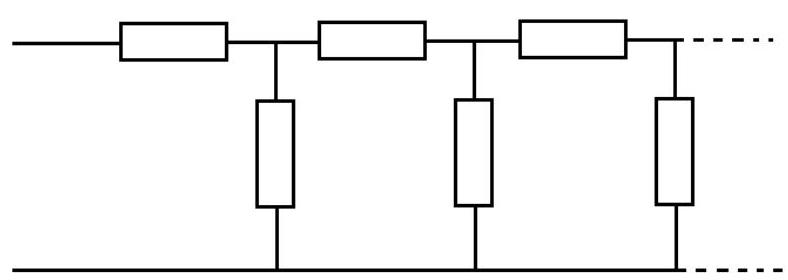
8. (10 points) Determine the resistance of an infinitely long chain composed of identical resistors \( R_{0}=10 \) Ohms.
 | Answer: $\approx 16.20 \, \Omega$
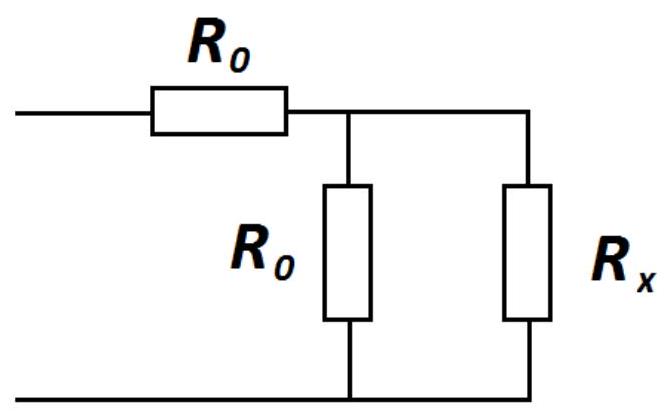
Solution. Let the resistance of the entire circuit be $R_{X}$. Then, by adding two resistors $R_{0}$ to $R_{X}$, we obtain the following circuit:
Its resis... | 16.2\,\Omega | Other | math-word-problem | Incomplete | Yes | olympiads | false |
Let $x$, $y$, and $z$ be real numbers such that
\[\cos x + \cos y + \cos z = \sin x + \sin y + \sin z = \cos x + \sin y + \cos z = 0.\]
Find the sum of all possible values of $\cos 2x + \cos 2y + \cos 2z.$ | Let $a = e^{ix}$, $b = e^{iy}$, and $c = e^{iz}$. Then
\[
a + b + c = e^{ix} + e^{iy} + e^{iz} = (\cos x + \cos y + \cos z) + i (\sin x + \sin y + \sin z) = 0.
\]
Also,
\[
e^{ix} + e^{-iy} + e^{iz} = \cos x + i\sin x + \cos y - i\sin y + \cos z + i\sin z = (\cos x + \cos y + \cos z) + i (\sin x - \sin y + \sin z) = 0.
... | 0 | Algebra | math-word-problem | Yes | Yes | synthetic_math | true |
[b]Q12.[/b] Find all positive integers $P$ such that the sum and product of all its divisors are $2P$ and $P^2$, respectively. | 1. Let \( P \) be a positive integer. We are given that the sum of all divisors of \( P \) is \( 2P \) and the product of all divisors of \( P \) is \( P^2 \).
2. Let \( \tau(P) \) denote the number of divisors of \( P \). The product of all divisors of \( P \) is known to be \( P^{\tau(P)/2} \). This is because each ... | 6 | Number Theory | math-word-problem | Yes | Yes | aops_forum | false |
Given the function $f\left(x\right)=ax^{3}+bx$ has a local extremum of $2$ at $x=1$.
$(1)$ Find the values of $a$ and $b$;
$(2)$ Find the extreme values of the function $f\left(x\right)$ on the interval $\left[-2,3\right]$. | ### Solution:
#### Part 1: Finding the values of $a$ and $b$
Given the function $f\left(x\right)=ax^{3}+bx$, its derivative is ${f'}\left(x\right)=3ax^{2}+b$.
Since $f\left(x\right)$ has a local extremum at $x=1$ with the value $2$, we have two conditions:
1. $f\left(1\right)=a+b=2$
2. ${f'}\left(1\right)=3a+b=0$
S... | \text{Minimum value} = -18, \text{Maximum value} = 2 | Calculus | math-word-problem | Yes | Yes | cn_k12 | false |
In triangle $\Delta ABC$, $CD \parallel AB$ and $m\angle DCB = 50^\circ$. Determine the number of degrees in $m\angle BCD$.
[asy]
pair A,B,C,D,E;
B = dir(-40);
A = dir(-140);
D = (.5,0);
E = .4 * dir(40);
draw(C--B--A--E,EndArrow);
draw(C--D,EndArrow);
label("$A$",A,W);
label("$C$",C,NW);
label("$B$",B,E);
label("$D$",... | Since $CD$ is parallel to $AB$, $\angle DCB$ and $\angle B$ are corresponding angles. This implies that $m\angle B = 50^\circ$ in $\Delta ABC$.
Now, consider $\Delta BCD$. Since $\angle DCB = 50^\circ$, and $\angle B = 50^\circ$, the third angle $\angle BCD$ of triangle $\Delta BCD$ can be calculated by knowing that t... | 80^\circ | Geometry | math-word-problem | Yes | Yes | synthetic_math | true |
In the same plane rectangular coordinate system, the transformation of the curve $y=\tan x$ into the curve $y'=3\tan 2x'$ is $\_\_\_\_\_\_$. | The function $y'=3\tan 2x'$ can be rewritten as $\frac{y'}{3}=\tan 2x'$.
To transform the function $y=\tan x$ into the function $y'=3\tan 2x'$, or equivalently, $\frac{y'}{3}=\tan 2x'$, we have the following system of equations:
$$\begin{cases}x=2x' \\\\ y= \frac{y'}{3}\end{cases}$$
Thus, the transformation is:
$$\... | \begin{cases}x'= \frac{1}{2}x \\\\ y'=3y\end{cases} | Algebra | math-word-problem | Yes | Yes | cn_k12 | false |
In January, an air-conditioning unit costs $470. In February, there was a 12% discount on the unit due to a clearance sale. Following that, in March, after restocking, the price increased by 8% due to production cost adjustments. In April, a Spring promotion offered a 10% discount on all air-conditioning units. In June... | Let's calculate the price of the air-conditioning unit step by step, considering each change in price throughout the year.
1. January: Original price = $470
2. February: 12% discount
Discount amount = 12% of $470 = 0.12 * $470 = $56.4
Price after discount = $470 - $56.4 = $413.6
3. March: 8% price increase
Increase ... | \$353.71 | Algebra | math-word-problem | Yes | Yes | orca_math | true |
A regular polygon has each exterior angle measuring $20^\circ$. If each side of the polygon has a length of 10 units, what is the perimeter of the polygon? | 1. **Finding the number of sides**:
The sum of the exterior angles of any polygon is $360^\circ$. If each exterior angle is $20^\circ$, the number of sides \( n \) can be found using:
\[
n = \frac{360}{20} = 18
\]
So, the polygon is an 18-sided regular polygon.
2. **Calculating the perimeter**:
Given... | 180 \text{ units} | Geometry | math-word-problem | Yes | Yes | synthetic_math | true |
7. (3 points) Eight students from a school participate in a math competition, and their average score is 82.5 points, with student $A$ scoring 86 points. If student $A$ only scores 74 points, then their average score would decrease by $\qquad$ points. | 【Solution】Solution: $(86-74) \div 8$,
$$
\begin{array}{l}
=12 \div 8, \\
=1.5 \text { (points); }
\end{array}
$$
Answer: Their average score decreased by 1.5 points; hence the answer is: 1.5. | 1.5 | Algebra | math-word-problem | Yes | Yes | olympiads | false |
Behind Chernomor, an endless number of bogatyrs of different heights are lined up. Prove that he can order some of them to step out of the line so that an infinite number of bogatyrs remain in the line and all of them stand in order of height (either ascending or descending).
# | Take the tallest bogatyr, then the tallest among those standing behind him, then the tallest among those standing behind the second chosen one, and so on. If this is impossible - find an infinite subsequence of bogatyrs standing in decreasing order of height.
## Solution
Let's call the $B$-tail the entire sequence of... | proof | Combinatorics | proof | Yes | Yes | olympiads | false |
114. The incircle of $\triangle ABC$ touches the sides $BC$, $CA$, $AB$ at $A_1$, $B_1$, $C_1$ respectively. Let $I_1$, $I_2$, $I_3$ be the lengths of the shorter arcs $B_1C_1$, $C_1A_1$, $A_1B_1$ respectively. Denote the lengths of the sides $BC$, $CA$, $AB$ of $\triangle ABC$ as $a$, $b$, $c$ respectively. Prove that... | 114. Let the inradius of $\triangle ABC$ be $r$, it is easy to get $I_{1}=r(\pi-A), I_{2}=r(\pi-B), I_{3}=$ $r(\pi-C)$, thus $\frac{a}{I_{1}}+\frac{b}{I_{2}}+\frac{c}{I_{3}} \geqslant \frac{9 \sqrt{3}}{\pi}$ is equivalent to
$$\frac{a}{\pi-A}+\frac{b}{\pi-B}+\frac{c}{\pi-C} \geqslant \frac{9 \sqrt{3}}{\pi} r$$
By Cheb... | proof | Inequalities | proof | Yes | Yes | inequalities | false |
Suppose $p$ and $q$ are inversely proportional. If $p=30$ when $q=4$, find the value of $p$ when $q=10$. | Given the inverse proportionality, $p \cdot q = k$. When $p=30$ and $q=4$,
\[ p \cdot q = 30 \cdot 4 = 120. \]
Thus, $k=120$. Now, when $q=10$, we need to find $p$ such that
\[ p \cdot 10 = 120. \]
Solving for $p$,
\[ p = \frac{120}{10} = 12. \]
Therefore, the value of $p$ when $q=10$ is $\boxed{12}$. | 12 | Algebra | math-word-problem | Yes | Yes | synthetic_math | true |
4. Let $ABC$ be a triangle, $M \in (AB)$ such that $\overrightarrow{AM} = \frac{1}{2} \overrightarrow{AB}$ and $N \in (AC)$ such that $\overrightarrow{AN} = \frac{3}{4} \overrightarrow{AC}$. Denote by $P$ the midpoint of $(BC)$ and by $R$ the intersection point of the lines $AP$ and $MN$. If $\overrightarrow{AR} = k \c... | Solution: From MP||AN we deduce $\frac{M P}{A N}=\frac{P R}{A R} \Leftrightarrow \frac{A C: 2}{3 A C: 4}=\frac{P R}{A R} \Leftrightarrow \frac{2}{3}=\frac{P R}{A R} \Rightarrow$ $\frac{5}{3}=\frac{A P}{A R} \Rightarrow \overrightarrow{A R}=\frac{3}{5} \overrightarrow{A P}$. (7p)
Note: Working time 3 hours.
Each subje... | \frac{3}{5} | Geometry | math-word-problem | Yes | Yes | olympiads | false |
If the point $(-1,2)$ lies on the graph of the inverse proportion function $y=\frac{k}{x}$ (where $k$ is a constant and $k\neq 0$), then which of the following statements about this function is correct?
A: The graph of the function passes through the point $(1,2)$.
B: The graph of the function lies in the first and t... | Given that the point $(-1,2)$ lies on the graph of the inverse proportion function $y=\frac{k}{x}$, where $k$ is a constant and $k\neq 0$, we can find the value of $k$ by substituting the coordinates of the point into the equation.
Step 1: Substitute $x = -1$ and $y = 2$ into the equation $y = \frac{k}{x}$.
\[2 = \fr... | D | Algebra | MCQ | Yes | Yes | cn_k12 | false |
Example 9. Solve the inequality
$$
\frac{\sqrt{2-x}+4 x-3}{x} \geqslant 2
$$
## 148 CH. 3. INEQUALITIES WITH ONE UNKNOWN | Solution. From the conditions $2-x \geqslant 0$ and $x \neq 0$, we find the domain of the inequality (11): $x<2$, and $x \neq 0$. If $x>1$, then by the properties of exponents we have
$$
\sqrt{2-x} 0 , } \\
{ \sqrt { 2 - x } \geqslant 3 - 2 x , } \\
{ \{ \begin{array} { l }
{ x 0, \\
3-2 x0, \\
3-2 x \geqslant 0, \\
... | (-\infty;0)\cup[1;2] | Inequalities | math-word-problem | Yes | Yes | olympiads | false |
Example 10 (2004 Russian Mathematical Olympiad) Given that $\odot O_{1}$ and $\odot O_{2}$ intersect at $A$ and $B$, and from point $A$ tangents $l_{1}$ and $l_{2}$ are drawn to $\odot O_{1}$ and $\odot O_{2}$ respectively. Points $T_{1}$ and $T_{2}$ are on $\odot O_{1}$ and $\odot O_{2}$ respectively, and $\angle T_{1... | Prove that with $A$ as the center, performing a homothety with a coefficient of $k (k>0)$, transforms $\odot O_{1}$ into $\odot O_{1}^{\prime}$. Use the same letter (along with the original subscript) with a prime to denote the images of each point and each line under this transformation.
Let $B_{1}$ be the second int... | proof | Geometry | proof | Yes | Yes | olympiads | false |
## Problem 3.
Let $A B C$ be a triangle and $D, E$, and $F$ be points located on the segments $A C, B A$, and $C B$ respectively, such that the segments $A F, B D, C E$ concur at a point $P$ inside the triangle. We know that $B P=6, P D=6, P C=9, P E=3$, and $A F=20$. Find the area of triangle $A B C$. | Solution.

We use several times that the areas of two triangles with the same base are proportional to the heights and that the areas of two triangles with the same height are proportional to ... | 108 | Geometry | math-word-problem | Yes | Yes | olympiads | false |
In the arithmetic sequence $\{a_n\}$, it is known that $a_3 = 3$, $a_5 = 6$, and $a_3$, $a_5$, $a_m$ form a geometric sequence. Find the value of $m$. | Let's suppose the common difference of the arithmetic sequence $\{a_n\}$ is $d$. Since $a_3 = 3$ and $a_5 = 6$, we have:
$$a_1 + 2d = 3,$$
$$a_1 + 4d = 6.$$
Solving this system of equations, we get:
$$a_1 = 0,$$
$$d = \frac{3}{2}.$$
Since $a_3$, $a_5$, and $a_m$ form a geometric sequence, we have:
$$a_5^2 = a_3 \c... | 9 | Algebra | math-word-problem | Yes | Yes | cn_k12 | false |
The contrapositive of the proposition "If $ab=0$, then $a=0$ or $b=0$" is ____, and it is a ____ proposition (fill in "true" or "false"). | If $a \neq 0$ and $b \neq 0$, then $ab \neq 0$, which is a true proposition.
Key point: The truth relationship of the four types of propositions.
Special topic: Pattern type.
Analysis: By negating the condition and conclusion of the original proposition and then swapping them, we can obtain the contrapositive of ... | \text{true} | Algebra | math-word-problem | Yes | Yes | cn_k12 | false |
Frank is making hamburgers and he wants to sell them to make $50. He is selling each hamburger for a certain price and 2 people purchased 4 and another 2 customers purchased 2 hamburgers. Frank needs to sell 4 more hamburgers to make $50. How much is Frank selling each hamburger for? | Let's denote the price of each hamburger as P.
From the information given, we know that 2 people purchased 4 hamburgers each, and another 2 customers purchased 2 hamburgers each. So the total number of hamburgers sold so far is:
(2 people * 4 hamburgers/person) + (2 people * 2 hamburgers/person) = 8 hamburgers + 4 ha... | \$3.125 | Algebra | math-word-problem | Yes | Yes | orca_math | true |
The numbers in the sequence \( 121, 125, 131, 139, \ldots \) are of the form \( b_n = 120 + n^2 \), where \( n = 1, 2, 3, \ldots \) For each \( n \), let \( e_n \) be the greatest common divisor of \( b_n \) and \( b_{n+1} \). Find the maximum value of \( e_n \) as \( n \) ranges through the positive integers. | Given that \( b_n = 120 + n^2 \) and \( b_{n+1} = 120 + (n+1)^2 = 120 + n^2 + 2n + 1 \), we compute \( e_n \) as follows:
\[ e_n = (b_n, b_{n+1}) = (120 + n^2, 120 + n^2 + 2n + 1) \]
Using the properties of GCD:
\[ e_n = (120 + n^2, 2n + 1) \]
Since \( 2n + 1 \) is odd, we focus on the odd factors:
\[ e_n = (120 + n^2,... | 5 | Number Theory | math-word-problem | Yes | Yes | synthetic_math | true |
4. Suppose the roots of the equation $a^{x}+2 x-4=0(a>0, a \neq 1)$ are $u_{1}, u_{2}, \cdots, u_{k}$, where $k$ is a positive integer, and the roots of the equation $\log _{a}(2 x)+x-2=0(a>0, a \neq 1)$ are $v_{1}, v_{2}, \cdots, v_{l}$, where $l$ is a positive integer, then the value of $\frac{u_{1}+u_{2}+\cdots+u_{k... | Answer: Choose $C$.
The equation $a^{x}+2 x-4=0$ is equivalent to $\frac{a^{x}}{2}=2-x$, and its roots are the x-coordinates of the intersection points of $y=\frac{a^{x}}{2}$ and $y=2-x$. The equation $\log _{a}(2 x)+x-2=0$ is equivalent to $\log _{a}(2 x)=2-x$, and its roots are the x-coordinates of the intersection p... | 1 | Algebra | MCQ | Yes | Yes | olympiads | false |
The expression \(25x^2 - 160x - 144\) can be written as \((5x + a)(5x + b)\), where \(a\) and \(b\) are integers. What is \(a + 2b\)? | Given the expression \(25x^2 - 160x - 144\), we need to factorize it into the form \((5x + a)(5x + b)\).
1. Expand \((5x + a)(5x + b)\) to get:
\[
25x^2 + (a+b)5x + ab
\]
2. Equate the coefficients with \(25x^2 - 160x - 144\):
\[
a+b = -32 \quad \text{and} \quad ab = -144
\]
3. Solve the system of eq... | -68 | Algebra | math-word-problem | Yes | Yes | synthetic_math | true |
On dividing a certain number by a divisor, we get 89 as quotient and 14 as remainder. The divisor is 187.46067415730337. What is the dividend? | To find the dividend, we can use the formula:
Dividend = (Divisor × Quotient) + Remainder
Given:
Quotient = 89
Remainder = 14
Divisor = 187.46067415730337
Let's plug these values into the formula:
Dividend = (187.46067415730337 × 89) + 14
Now, let's calculate the product of the divisor and the quotient:
187.46067... | 16698 | Algebra | math-word-problem | Yes | Yes | orca_math | true |
Point $P$ is on the ellipse $\dfrac{x^2}{16} + \dfrac{y^2}{9} = 1$. $F_1$ and $F_2$ are the left and right foci of the ellipse, respectively. If $|PF_1| \cdot |PF_2| = 12$, then the size of $\angle F_1PF_2$ is ( ).
A: $30^{\circ}$
B: $60^{\circ}$
C: $120^{\circ}$
D: $150^{\circ}$ | **Analysis**
This question examines the definition of an ellipse and its simple geometric properties, as well as the cosine theorem. By applying the cosine theorem in $\triangle PF_1F_2$ and combining it with the definition of an ellipse, the problem can be solved.
**Solution**
By the definition of an ellipse, we kn... | B | Geometry | MCQ | Yes | Yes | cn_k12 | false |
A list of seven positive integers has a median of 4 and a mean of 10. What is the maximum possible value of the list's largest element? | Given that the mean of the seven integers is 10, the sum of these integers is $7 \times 10 = 70$.
For the median to be 4, the fourth number in this ordered list must be 4. To maximize the largest element, we need to minimize the values of the other numbers while still adhering to the requirement that the median is 4. ... | 52 | Algebra | math-word-problem | Yes | Yes | synthetic_math | true |
Simplify and then evaluate the expression: $$\frac{x-2}{x-1} \div \left(x+1-\frac{3}{x-1}\right)$$, where $x=3$. | First, we simplify the expression:
$$\frac{x-2}{x-1} \div \left(\frac{x^2-1}{x-1} - \frac{3}{x-1}\right)$$
Combine the fractions in the parentheses:
$$\frac{x-2}{x-1} \div \left(\frac{x^2-1-3}{x-1}\right)$$
Simplify the expression in the parentheses:
$$\frac{x-2}{x-1} \div \left(\frac{x^2-4}{x-1}\right)$$
Rewrite... | \frac{1}{5} | Algebra | math-word-problem | Yes | Yes | cn_k12 | false |
What is the distance between the points (1, -3) and (-4, 5)? | We use the distance formula to find the distance between these two points. Let's denote point \( A = (1, -3) \) and point \( B = (-4, 5) \).
1. Calculate the differences in the coordinates:
- \( x_2 - x_1 = -4 - 1 = -5 \)
- \( y_2 - y_1 = 5 - (-3) = 8 \)
2. Square each difference:
- \( (-5)^2 = 25 \)
... | \sqrt{89} | Geometry | math-word-problem | Yes | Yes | synthetic_math | true |
Determine the coefficient of $x^{5}$ in the expansion of $(\frac{1}{3x}+2x\sqrt{x})^{7}$. | Let's first find the general term $T_{r+1}$ of the binomial expansion.
$$T_{r+1}=C_7^r\left(\frac{1}{3x}\right)^{7-r}\left(2x\sqrt{x}\right)^r=2^rC_7^rx^{\frac{11r-14}{6}}$$
We want to find the term where the exponent of $x$ is $5$. Thus, we need to solve the equation:
$$\frac{11r-14}{6}=5$$
Solving for $r$, we get:
$$... | 560 | Algebra | math-word-problem | Yes | Yes | cn_k12 | false |
5.19. In an isosceles triangle \(ABC\) with base \(AC\), the bisector \(CD\) is drawn. A line passing through point \(D\) perpendicular to \(DC\) intersects \(AC\) at point \(E\). Prove that \(EC = 2AD\). | 5.19. Let $F$ be the point of intersection of lines $D E$ and $B C$; $K$ be the midpoint of segment $E C$. Segment $C D$ is the bisector and altitude of triangle $E C F$, so $E D = D F$, which means $D K \| F C$. The median $D K$ of the right triangle $E D C$ is half the length of its hypotenuse $E C$ (problem 5.17), s... | proof | Geometry | proof | Yes | Yes | olympiads | false |
Given the function $f(x)=(x+3)(x+2)(x+1)x(x-1)(x-2)(x-3)$, find the value of $f'(2)$.
A: $24$
B: $120$
C: $-120$
D: $0$ | **Analysis**
This problem tests our understanding of the operations involving derivatives. We should treat $(x-2)$ as one term and the remaining part as another term. Then, we apply the product rule of derivatives to solve for $f'(2)$.
**Step-by-step Solution**
1. Apply the product rule of derivatives:
$f'(x) = \left... | \text{C: } -120 | Calculus | MCQ | Yes | Yes | cn_k12 | false |
What is the least posssible number of cells that can be marked on an $n \times n$ board such that for each $m >\frac{ n}{2}$ both diagonals of any $m \times m$ sub-board contain a marked cell? | 1. **Understanding the Problem:**
We need to find the minimum number of cells that must be marked on an \( n \times n \) board such that for any \( m \times m \) sub-board with \( m > \frac{n}{2} \), both diagonals of the sub-board contain at least one marked cell.
2. **Analyzing the Example:**
- For odd \( n = ... | n | Combinatorics | math-word-problem | Yes | Yes | aops_forum | false |
In the expansion of $(x-4+\frac{4}{x})^{3}$, the constant term is ____ (answer with a number). | To find the constant term in the expansion of $(x-4+\frac{4}{x})^{3}$, we first simplify the given expression. We can rewrite the expression as follows:
\[
(x-4+\frac{4}{x})^{3} = \left(x + \frac{4}{x} - 4\right)^{3} = \left(\frac{x^2 + 4 - 4x}{x}\right)^{3} = \frac{(x^2 - 4x + 4)^{3}}{x^{3}} = \frac{(x-2)^{6}}{x^{3}}... | -160 | Algebra | math-word-problem | Yes | Yes | cn_k12 | false |
In an arithmetic sequence $\{a_n\}$, if $S_{10} = 10$ and $S_{20} = 30$, find the sum of the first thirty terms, $S_{30}$. | Consider the properties of an arithmetic sequence. The sum of the first $m$ terms ($S_m$), the sum of terms from $m+1$ to $2m$ ($S_{2m} - S_m$), and the sum of terms from $2m+1$ to $3m$ ($S_{3m} - S_{2m}$) will also form an arithmetic sequence.
Given that $S_{10} = 10$ and $S_{20} = 30$, we can analyze the sequence ba... | 50 | Algebra | math-word-problem | Yes | Yes | cn_k12 | false |
If the function $f(x)=\ln x- \frac {1}{e^{2}}x+a$ has a root, then the range of the real number $a$ is ( )
A: $(-\infty,-1]$
B: $(-\infty,1]$
C: $[-1,+\infty)$
D: $[1,+\infty)$ | Solution: The derivative of $f(x)$ is $f′(x)= \frac {1}{x}- \frac {1}{e^{2}}$,
$\therefore$ when $0 0$, and when $x > e^{2}$, $f′(x) < 0$,
$\therefore f(x)$ is monotonically increasing on $(0,e^{2})$ and monotonically decreasing on $(e^{2},+\infty)$,
$\therefore$ when $x=e^{2}$, $f(x)$ reaches its maximum value ... | C | Calculus | MCQ | Yes | Yes | cn_k12 | false |
Subsets and Splits
No community queries yet
The top public SQL queries from the community will appear here once available.