
instruction_seed stringlengths 2 10.7k | solution stringlengths 0 10.8k ⌀ | answer stringlengths 0 575 ⌀ | problem_type stringclasses 9
values | question_type stringclasses 5
values | problem_is_valid stringclasses 5
values | solution_is_valid stringclasses 4
values | source stringclasses 11
values | synthetic bool 2
classes |
|---|---|---|---|---|---|---|---|---|
The polynomial $g(x)=x^4+px^3+qx^2+rx+s$ has real coefficients, and $g(3i)=g(3+2i)=0$. What is $p+q+r+s$? | Since $g(x)$ has real coefficients and $3i$ and $3+2i$ are zeros, their conjugates $-3i$ and $3-2i$ are also zeros. Therefore, the polynomial can be factored as:
\[
g(x) = (x - 3i)(x + 3i)(x - (3+2i))(x - (3-2i)).
\]
This simplifies to:
\[
g(x) = (x^2 + 9)((x - 3)^2 + 2^2) = (x^2 + 9)(x^2 - 6x + 13).
\]
Expanding th... | 79 | Algebra | math-word-problem | Yes | Yes | synthetic_math | true |
Given the general term of the sequence $\{a_n\}$ is $a_n = n^2 + kn + 2$, if for all $n \in \mathbb{N}^*$, the inequality $a_{n+1} > a_n$ holds, then the range of the real number $k$ is ( )
A: $k > 0$
B: $k > -1$
C: $k > -2$
D: $k > -3$ | Let's analyze the conditions given and find the range of $k$.
Since $a_n = n^2 + kn + 2$, for $a_{n+1}$, we have $a_{n+1} = (n + 1)^2 + k(n + 1) + 2$.
For the inequality $a_{n+1} > a_n$ to hold for all $n \in \mathbb{N}^*$, we can write the inequality as:
$$(n + 1)^2 + k(n + 1) + 2 > n^2 + kn + 2.$$
Expanding an... | \text{D: } k > -3 | Algebra | MCQ | Yes | Yes | cn_k12 | false |
The tangent line of the graph of the function $y=x^2$ $(x > 0)$ at the point $(a_n, a_n^2)$ intersects the $x$-axis at a point with the $x$-coordinate $a_{n+1}$, where $n$ is a positive integer. If $a_1=16$, then find the value of $a_1 + a_3 + a_5$. | According to the problem, the derivative of $y$ with respect to $x$ is $y' = 2x$.
The equation of the tangent line at the point $(a_n, a_n^2)$ is given by $y - a_n^2 = 2a_n(x - a_n)$.
Setting $y = 0$ in the tangent line equation, we find the $x$-coordinate of the intersection with the $x$-axis to be $x = \frac{1}{2}a... | 21 | Calculus | math-word-problem | Yes | Yes | cn_k12 | false |
Circles $\omega_1$ and $\omega_2$ meet at points $A$ and $B$. Let points $K_1$ and $K_2 $ of $\omega_1$ and $\omega_2$ respectively be such that $K_1A$ touches $\omega_2$, and $K_2A$ touches $\omega_1$. The circumcircle of triangle $K_1BK_2$ meets lines $AK_1$ and $AK_2$ for the second time at points $L_1$ and $L_2$ re... | null | null | Geometry | proof | Yes | Yes | aops_forum | false |
Decide if it is possible to consider 2011 points in a plane such that the distance between every two of these points is different from 1 and each unit circle centered at one of these points leaves exactly 1005 points outside the circle. | NO. If such a configuration existed, the number of segments starting from each of the 2011 points towards the other one and having length less than 1 would be 1005. Since each segment is counted twice, their total number would be $1005 \cdot 2011 / 2$ which is not an integer, contradiction! | proof | Geometry | proof | Yes | Yes | olympiads_ref | false |
What is the sum of the squares of the coefficients of $6(x^5 + 2x^3 + x^2 + 3)$? | First, distribute the $6$ through the polynomial expression:
\[ 6(x^5 + 2x^3 + x^2 + 3) = 6x^5 + 12x^3 + 6x^2 + 18. \]
Next, identify the coefficients: $6$ for $x^5$, $12$ for $x^3$, $6$ for $x^2$, and $18$ for $x^0$ (constant term).
Then calculate the squares of these coefficients:
- $6^2 = 36$
- $12^2 = 144$
- $6^2 ... | 540 | Algebra | math-word-problem | Yes | Yes | synthetic_math | true |
We have a collection of $1720$ balls, half of which are black and half of which are white, aligned in a straight line. Our task is to make the balls alternating in color along the line. The following greedy algorithm accomplishes that task for $2n$ balls:
\begin{tabular}{l}
1: \textbf{FOR} $i$ \textbf{IN} $[2,3,\dots,... | null | null | Combinatorics | math-word-problem | Yes | Yes | aops_forum | false |
During vacation, Jimmy visits different beaches on an island, so he changes his place of lodging from time to time. The first 3 days he stays in a hostel, where he is charged $15 per night. The fourth and fifth days he stays in a cabin where he shares expenses with 2 of his friends, and they are charged $45 total per n... | For the first 3 days, Jimmy stays in a hostel and is charged $15 per night. So for 3 days, the cost is:
3 days * $15/night = $45
For the fourth and fifth days, he stays in a cabin with 2 friends, and they are charged $45 total per night. Since they share the expenses, Jimmy's share per night would be:
$45 total/nigh... | \$75 | Logic and Puzzles | math-word-problem | Yes | Yes | orca_math | true |
Given the function $$f(x)=\sin(2x+ \frac {π}{6})$$, its graph is translation to the left by $$\frac {π}{6}$$ units to obtain the graph of function g(x). The analytical expression of g(x) is ( )
A: g(x)=cos2x
B: g(x)=cos2x
C: g(x)=sin2x
D: $$g(x)=\sin(2x+ \frac {π}{3})$$ | To solve this problem, we will translate the function $$f(x)=\sin(2x+ \frac {π}{6})$$ to the left by $$\frac {π}{6}$$ units.
When translating a function to the left by 'a' units, we replace 'x' with 'x+a' in the given function. Therefore, we substitute $$x + \frac {π}{6}$$ for 'x' in the given function:
$$g(x) = \sin... | g(x) = \cos(2x) | Algebra | MCQ | Yes | Yes | cn_k12 | false |
XV OM - II - Task 1
Prove that if $ n $ is a natural number, and angle $ \alpha $ is not a multiple of $ \frac{180^{\circ}}{2^n} $, then | We will apply complete induction.
1. If $ \alpha $ is not a multiple of $ 90^\circ $, then
The theorem we need to prove is therefore true when $ n=1 $.
2. Suppose the theorem is true for some natural number $ n $, i.e., if $ \alpha $ is not a multiple of $ \frac{180^\circ}{2^n} $, then formula (1) holds.
Assume ... | proof | Number Theory | proof | Yes | Incomplete | olympiads | false |
14. An intelligence test consists of 5 true or false questions, with 20 points awarded for each correct answer and 0 points for each incorrect or unanswered question. If Xiaohua randomly answers "true" or "false" for each question, what is the probability that she scores 60 points or more? $\qquad$ $\%$. | 【Answer】Solution: There are six cases: answering one question correctly, two questions, three questions, four questions, five questions, or all wrong. Scoring 60 points for answering three questions correctly, 80 points for four questions, and 100 points for five questions, the probability of her scoring 60 points or m... | 50 | Combinatorics | math-word-problem | Yes | Problem not solved | olympiads | false |
$1 \cdot 18$ Prove that if $u$ and $v$ are integers, $u^{2}+u v+v^{2}$ is divisible by 9, then $u$ and $v$ are both divisible by 3.
(Hungarian Mathematical Olympiad, 1958) | [Proof] Given the expression can be transformed into
$$
u^{2}+u v+v^{2}=(u-v)^{2}+3 u v .
$$
Since $9\left|u^{2}+u v+v^{2}, \quad 3\right| 3 u v$, it follows that
$$
3 \text { | }(u-v)^{2} \text {. }
$$
Thus,
$$
9\left|(u-v)^{2}, 3\right| u-v .
$$
Therefore,
$$
\text { 9| } 3 \text { uv. }
$$
That is,
$$
3 \mid u v... | proof | Number Theory | proof | Yes | Yes | olympiads | false |
8. Given any two positive real numbers $x$ and $y$, then $x \diamond y$ is a positive real number defined in terms of $x$ and $y$ by some fixed rule. Suppose the operation $x \diamond y$ satisfies the equations $(x \cdot y) \diamond y=x(y \diamond y)$ and $(x \diamond 1) \diamond x=x \diamond 1$ for all $x, y>0$. Given... | Answer: $\square$ 19. Note first that $x \diamond 1=(x \cdot 1) \diamond 1=x \cdot(1 \diamond 1)=x \cdot 1=x$. Also, $x \diamond x=(x \diamond 1) \diamond x=x \diamond 1=x$. Now, we have $(x \cdot y) \diamond y=x \cdot(y \diamond y)=x \cdot y$. So $19 \diamond 98=\left(\frac{19}{98} \cdot 98\right) \diamond 98=\frac{19... | 19 | NaN | NaN | NaN | NaN | olympiads | false |
Point $N$ is a moving point on the circle $(x+5)^{2}+y^{2}=1$. In the right triangle $Rt\triangle ABC$ with point $A(3,0)$ as the right-angle vertex, the other two vertices $B$ and $C$ are on the circle $x^{2}+y^{2}=25$, and the midpoint of $BC$ is $M$. Find the maximum value of $|MN|$. | Given that $MA=MC$, we set $M$ to have coordinates $(x, y)$. The equation of the circle on which $M$ lies can be formulated using the midpoint distance to both $A$ and $C$ (knowing that $C$ also lies on the bigger circle):
$$
x^{2}+y^{2}+(x-3)^{2}+y^{2}=25,
$$
Simplifying, we get:
$$
2x^{2}-6x+2y^{2}=25 - 9,
$$
whi... | \frac{15+\sqrt{23}}{2} | Geometry | math-word-problem | Yes | Yes | cn_k12 | false |
Among the following sets of line segment lengths, which can form a triangle?
A: $1$, $2$, $3$
B: $3$, $4$, $8$
C: $5$, $5$, $11$
D: $6$, $6$, $6$ | To determine which set of line segment lengths can form a triangle, we apply the triangle inequality theorem. This theorem states that the sum of the lengths of any two sides of a triangle must be greater than the length of the remaining side. Let's analyze each option step by step:
- **Option A**: For the set $1$, $2... | D | Geometry | MCQ | Yes | Yes | cn_k12 | false |
10. Does there exist a function $f(n)$, which maps the set of positive integers to itself, and for every positive integer $n>1$, satisfies: $f(n)=f^{(2)}(n-1)+f^{(2)}(n+1)$. | 9. Let $f(x)=\frac{x^{2}}{2 x-1}, g(x)=x^{2}, \varphi_{x}=1-\frac{1}{x}$, then $\varphi^{-1}(x)=\frac{1}{1-x}, \varphi^{-1}(g(\varphi(x)))=$ $\varphi^{-1}\left(\left(1-\frac{1}{x}\right)^{2}\right)=\frac{1}{1-\left(1-\frac{1}{x}\right)^{2}}=\frac{x^{2}}{2 x-1}=f(x)$. Thus, $f^{(n)}(x)=\varphi^{-1}\left(g^{n}(\varphi(x)... | proof | Algebra | proof | Yes | Yes | olympiads | false |
5. Let $t=2 x-1$. Consider the function $f(t)=\frac{t}{t^{2}+4}$. Since $t^{2}+4 \geqslant 2 \sqrt{4 t^{2}}=$ $4|t|$, then $-\frac{1}{4} \leqslant \frac{t}{t^{2}+4} \leqslant \frac{1}{4}$. The values $\pm \frac{1}{4}$ are achieved at $t= \pm 2$. Therefore, the range of the function $g(t)=16^{\frac{2 x-1}{4 x^{2}-4 x+5}... | Answer to option: $3-2: a>3, b \leqslant \frac{1}{3}$.
Answers and solutions to option 4-1 | \geqslant2,\frac{1}{2} | Algebra | math-word-problem | Incomplete | Problem not solved | olympiads | false |
A sporting goods store sold 60 frisbees in one week, some for a certain price and the rest for $4 each. The receipts from frisbee sales for the week totaled $204. The fewest number of $4 frisbees that could have been sold is 24. What was the price of the other frisbees? | Let's denote the price of the other frisbees as \( P \) and the number of these frisbees sold as \( x \). The number of $4 frisbees sold would then be \( 60 - x \), since the total number of frisbees sold is 60.
The total receipts from the frisbee sales can be represented by the equation:
\[ P \cdot x + 4 \cdot (60 -... | \$3 | Algebra | math-word-problem | Yes | Yes | orca_math | true |
11.4. Proof: There exists a natural number $n$, such that when an equilateral triangle with side length $n$ is divided by lines parallel to its sides into $n^{2}$ smaller equilateral triangles with side length 1, then among the vertices of these smaller triangles, one can select $1993 n$ vertices, such that no three of... | Incidentally, for any equilateral triangle with these points as vertices, all vertices either have different colors or the same color. It is easy to prove that if such a triangle is rotated $60^{\circ}$ around any of its vertices (without loss of generality, assume it has color $A$), then the vertex that remains in the... | proof | Combinatorics | proof | Yes | Yes | cn_contest | false |
Maisy has been offered a new job and now has the option of continuing to work at her current job or take the new job. Her current job is 8 hours a week with a wage of $10 per hour. The new job is offering 4 hours a week with a wage of $15 per hour with an additional bonus of $35 per week if she exceeds her quota. Maisy... | First, let's calculate Maisy's weekly earnings at her current job:
Current job earnings = Hours per week * Wage per hour
Current job earnings = 8 hours/week * $10/hour
Current job earnings = $80/week
Now, let's calculate Maisy's weekly earnings at her new job, including the bonus:
New job earnings without bonus = Ho... | \$15 | Algebra | math-word-problem | Yes | Yes | orca_math | true |
Given the line $l$: $ax+by-2=0$ bisects the circle $x^{2}+y^{2}-6x-4y-12=0$, where $a$ and $b$ are both positive numbers. Find the minimum value of $\frac{3}{a}+\frac{2}{b}$ $(\ )$.
A: $25$
B: $12$
C: $\frac{25}{2}$
D: $9$ | The given circle can be rewritten in the standard form as $(x-3)^{2}+(y-2)^{2}=25$, with the center at $C(3,2)$.
Since the line $ax+by-2=0$ $(a,b\in\mathbb{R}^{\*})$ bisects the circle $x^{2}+y^{2}-6x-4y-12=0$, it must pass through the center $C(3,2)$. Thus, we have $3a+2b-2=0$, which can be simplified to $\frac{3}{2}... | \frac{3}{a}+\frac{2}{b}_{\text{min}}=\frac{25}{2} | Geometry | MCQ | Yes | Yes | cn_k12 | false |
The average age of an adult class is some years. 2 new students with an average age of 32 years join the class, therefore decreasing the average by 4 years. The original strength of the class was 2. What was the original average age of the class? | Let's denote the original average age of the class as A years and the original number of students as N. According to the problem, N = 2.
When the 2 new students, each with an average age of 32 years, join the class, the total number of students becomes N + 2.
The total age of the original class is A * N.
The total a... | 40 | Algebra | math-word-problem | Yes | Yes | orca_math | true |
Haley grew 14 trees in her backyard. After a typhoon, some trees died and 4 more trees died in the typhoon than those that survived. How many trees died in the typhoon? | Let's denote the number of trees that survived the typhoon as S. According to the information given, the number of trees that died in the typhoon is S + 4.
We know that Haley originally had 14 trees. After the typhoon, the total number of trees (those that survived and those that died) should still equal 14. Therefore... | 9 | Algebra | math-word-problem | Yes | Yes | orca_math | true |
Given the function $$f(x)= \frac {x-6}{x+2}$$, find the value of $x$ when $f(x) = 2$. The options are:
A: $-4$
B: $4$
C: $-10$
D: $10$ | We are given the function $$f(x)= \frac {x-6}{x+2}$$. We need to find the value of $x$ when $f(x) = 2$.
Setting the function equal to $2$, we get:
$$2 = \frac {x-6}{x+2}$$
To solve for $x$, we can cross-multiply and simplify:
$$2(x+2) = x-6$$
Expanding and rearranging terms, we get:
$$2x + 4 = x - 6$$
Subtractin... | C: \ -10 | Algebra | MCQ | Yes | Yes | cn_k12 | false |
Determine the value of the sum \[ \sum_{n=0}^{332} (-1)^{n} {1008 \choose 3n} \] and find the remainder when the sum is divided by $500$. | Consider the polynomial \[ f(x) = (x - 1)^{1008} = \sum_{n=0}^{1008} \binom{1008}{n} (-1)^n x^{1008-n}. \]
Let $\omega^3 = 1$ with $\omega \neq 1$. Note that:
\[ \frac{f(1) + f(\omega) + f(\omega^2)}{3} = \frac{(1-1)^{1008} + (\omega-1)^{1008} + (\omega^2-1)^{1008}}{3}. \]
We then calculate:
\[ = \frac{1}{3} \sum_{n=0}... | 54 | Combinatorics | math-word-problem | Yes | Yes | synthetic_math | true |
A boy sells a book for Rs. 540 and he gets a certain loss. To gain 10%, the selling price should be Rs. 660. What was the percentage of his loss? | Let's denote the cost price of the book as CP.
According to the information given, if the boy sells the book for Rs. 660, he would gain 10%. This means that 110% of the cost price is Rs. 660.
So, we can write the equation as:
110% of CP = Rs. 660
(110/100) * CP = 660
1.1 * CP = 660
Now, we can solve for CP:
CP = 660... | 10\% | Algebra | math-word-problem | Yes | Yes | orca_math | true |
the length of a rectangular plot is thrice its breadth . if the area of the rectangular plot is 588 sq m , then what is the breadth of the rectangular plot ? | Let the breadth of the rectangular plot be \( b \) meters. Since the length is thrice the breadth, the length will be \( 3b \) meters.
The area of a rectangle is given by the formula:
\[ \text{Area} = \text{length} \times \text{breadth} \]
Given that the area of the rectangular plot is 588 square meters, we can set u... | 14 | Algebra | math-word-problem | Yes | Yes | orca_math | true |
[ Perimeter of a Triangle ]
On side $A C$ of triangle $A B C$, point $E$ is marked. It is known that the perimeter of triangle $A B C$ is 25 cm, the perimeter of triangle $A B E$ is 15 cm, and the perimeter of triangle $B C E$ is 17 cm. Find the length of segment $B E$. | $15+17=P_{A B E}+P_{B C E}=P_{A B C}+2 B E=25+2 B E$. Therefore, $B E=(32-25): 2=3.5$.
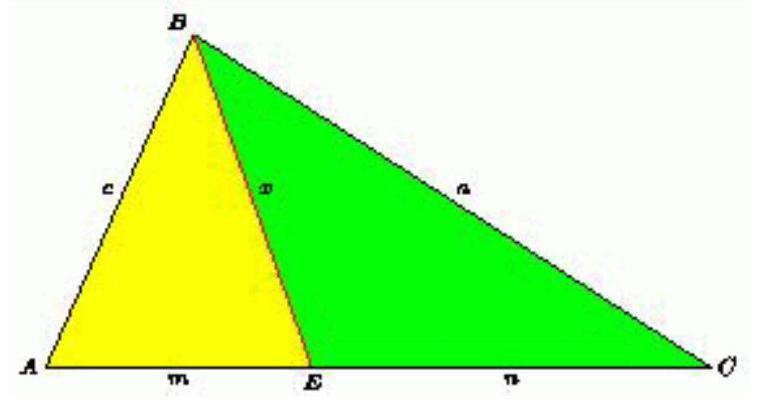
## Answer
3.5 cm. | 3.5 | Geometry | math-word-problem | Yes | Yes | olympiads | false |
$ABC$ is a triangle with $A=(0,0)$, $B=(42,18)$, and both coordinates of $C$ are integers. What is the minimum area $\triangle ABC$ can have? | Let $C$ have coordinates $(p, q)$. By the Shoelace Formula, the area of $\triangle ABC$ is given by:
\[
\text{Area} = \frac{1}{2} \left| 0\cdot(18-q) + 42\cdot q + p\cdot 0 - (0\cdot p + 18\cdot 42 + q\cdot 0) \right|
= \frac{1}{2} \left| 42q - 756 \right|
= \frac{1}{2} \left| 42q - 756 \right|
= \frac{1}{2} \left| 42(... | 21 | Geometry | math-word-problem | Yes | Yes | synthetic_math | true |
There are 4 more women than there are men on a local co-ed softball team. If there are a total of 18 players on the team, the players are divided into three skill levels - beginner, intermediate, and advanced. Given that the ratio of men to women is different for each skill level, what is the overall ratio of men to wo... | To find the overall ratio of men to women on the team, we need to add up the number of men and women at each skill level and then calculate the ratio.
Beginner level:
Men: 2
Women: 4
Intermediate level:
Men: 3
Women: 5
Advanced level:
Men: 1
Women: 3
Now, let's add up the men and women across all levels:
Total men... | 1:2 | Algebra | math-word-problem | Yes | Yes | orca_math | true |
In triangle $ABC$, we have $AB=1$ and $AC=3$. Side $\overline{BC}$ is equal to $k$ times the median from $A$ to $\overline{BC}$. Find $BC$ in terms of $k$ and express your answer in its simplest form. | Let $M$ be the midpoint of $\overline{BC}$. Define $AM = kx$ and $BC = x$. Thus, $BM = MC = \frac{x}{2}$. We apply the Law of Cosines to triangles $ABM$ and $AMC$ to form new equations.
1. **Triangle $ABM$**:
\[
\left(\frac{x}{2}\right)^2 + 1^2 - 2 \cdot \frac{x}{2} \cdot 1 \cdot \cos\theta = (kx)^2
\]
Si... | BC = \sqrt{\frac{20}{4k^2 - 1}} | Geometry | math-word-problem | Yes | Yes | synthetic_math | true |
26th CanMO 1994 Problem 5 ABC is an acute-angled triangle. K is a point inside the triangle on the altitude AD. The line BK meets AC at Y, and the line CK meets AB at Z. Show that ∠ADY = ∠ADZ. | Let the rays DZ, DY meet the line through A parallel to BC at U, V respectively. Then UZA is similar to DZB, so UA/ZA = DB/ZB. Similarly VA/YA = DC/YC. Hence UA/VA = ZA (DB/ZB) (YC/DC) 1/YA = (DB/DC) (YC/YA) (ZA/ZB). But that is 1 by Ceva's theorem. Hence UA = VA, so ∠ADZ = ∠ADY. 26th CanMO 1994 © John Scholes jscholes... | proof | Geometry | proof | Yes | Yes | olympiads | false |
The number of zeros of the function equation $y = \sin x - \lg x$ is ( )
A: 0
B: 1
C: 2
D: 3 | Since the function equation is $y = \sin x - \lg x$,
we have $\sin x = \lg x$,
Let $y_1 = \sin x$ and $y_2 = \lg x$,
The number of intersection points of these two functions' graphs is the number of zeros of the function,
Therefore, $y_2 = \lg x$ passes through $(1, 0)$ and $(10, 1)$,
In this interval, the nu... | D | Calculus | MCQ | Yes | Yes | cn_k12 | false |
Determine the values of $m$ and $n$ if the domain and range of the function $f(x) = -x^{2} + 2x$ are given by the intervals $[m, n]$ and $[3m, 3n]$ respectively. Find the sum $m + n$. | The equation of the axis of symmetry for the function $f(x) = -x^{2} + 2x$ is $x = 1$. This function is a downward-opening parabola, and $x = 1$ is the value where it reaches its maximum.
Given the domain $[m, n]$, the function is increasing on this interval; hence $m$ must be to the left of the axis of symmetry (i.e.... | -1 | Algebra | math-word-problem | Yes | Yes | cn_k12 | false |
Calculate the integral $$\int_{ 0 }^{ 2 }( \sqrt {4-x^{2}}-2x)dx=$$ ( )
A: 2π-4
B: π-4
C: ln2-4
D: ln2-2 | We split the integral into two parts:
$$\int_{ 0 }^{ 2 }( \sqrt {4-x^{2}}-2x)dx = \int_{ 0 }^{ 2 }\sqrt {4-x^{2}}\,dx - \int_{ 0 }^{ 2 }2x\,dx.$$
For the first part, the integral $\int_{ 0 }^{ 2 }\sqrt {4-x^{2}}\,dx$ can be interpreted geometrically as one quarter of the area of a circle with radius 2 centered at the ... | B: \pi - 4 | Calculus | MCQ | Yes | Yes | cn_k12 | false |
Find the equation of the circle that passes through the intersection points of the two circles $x^2+y^2+6x-4=0$ and $x^2+y^2+6y-28=0$, and whose center lies on the line $x-y-4=0$. | The equation of the required circle is $\boxed{x^2+y^2-x+7y-32=0}$. | x^2+y^2-x+7y-32=0 | Geometry | math-word-problem | Yes | Yes | cn_k12 | false |
Given that the points $(-m,0)$ and $(3m,0)$ lie on the graph of the quadratic function $y=ax^{2}+bx+3$ ($a$ and $b$ are constants, $a\neq 0$).$(1)$ When $m=-1$, find the values of $a$ and $b$;$(2)$ If the graph of the quadratic function passes through the point $A(n,3)$ and the point $A$ is not on the coordinate axes, ... | ### Solution:
#### Part (1): Finding $a$ and $b$ when $m=-1$
Given that the points $(-m,0)$ and $(3m,0)$ lie on the graph of the quadratic function $y=ax^{2}+bx+3$, when $m=-1$, these points become $(1,0)$ and $(-3,0)$.
Substituting these points into the equation $y=ax^{2}+bx+3$, we get two equations:
1. For $(1,0)$... | b^{2} + 4a = 0 | Algebra | math-word-problem | Yes | Yes | cn_k12 | false |
Given that $α \in (0, \frac{π}{2})$, and $\cos(α + \frac{π}{4}) = \frac{5}{13}$, find the value of $\sin α$. | Since $α \in (0, \frac{π}{2})$, and $\cos(α + \frac{π}{4}) = \frac{5}{13}$,
We know that $α + \frac{π}{4} \in (\frac{π}{4}, \frac{3π}{4})$, and $\sin(α + \frac{π}{4}) = \sqrt{1 - \cos^2(α + \frac{π}{4})} = \frac{12}{13}$.
Now, we can find $\sin α$ using the sine difference formula:
$\sin α = \sin(α + \frac{π}{4} - \... | \frac{7\sqrt{2}}{26} | Algebra | math-word-problem | Yes | Yes | cn_k12 | false |
110. (11th grade) In a regular hexagonal pyramid, a line passing through the centers of the circles circumscribed around one lateral face and another around a larger diagonal section intersects with a side of the base. Determine the dihedral angle at the base.
## SOLUTIONS, HINTS, AND ANSWERS
Translate the text above... | 110. Answer: $\cos \varphi=\sqrt{\frac{3}{13}}$.
## LITERATURE | Geometry | math-word-problem | Yes | Yes | olympiads | false | |
Given $f(x)=\frac{[\sin(\frac{\pi}{2}-x)\tan(\pi-x)]^{2}-1}{4\sin(\frac{3\pi}{2}+x)+\cos(\pi-x)+\cos(2\pi-x)}$,
(1) Find $f(-1860^{\circ})$;
(2) If the equation $f^{2}(x)+(1+\frac{1}{2}a)\sin x+2a=0$ has two roots in $x\in[\frac{\pi}{6},\frac{3\pi}{4}]$, find the range of the real number $a$;
(3) Find the maximum value... | (1) Since $f(x)=\frac{[\sin(\frac{\pi}{2}-x)\tan(\pi-x)]^{2}}{4\sin(\frac{3\pi}{2}+x)+\cos(\pi-x)+\cos(2\pi-x)}=-\frac{1}{2}\sin x$,
we have $f(-1860^{\circ})=-\frac{1}{2}\sin(-1860^{\circ})=\boxed{\frac{\sqrt{3}}{4}}$.
(2) The given equation can be rewritten as $\sin^{2}x+(4+2a)\sin x+8a=0$, or $(\sin x+4)(\sin x+2a)... | y_\text{max}=2 | Algebra | math-word-problem | Yes | Yes | cn_k12 | false |
Given a sequence -1, $a_1$, $a_2$, -4 that forms an arithmetic sequence, and -1, $b_1$, $b_2$, $b_3$, -4 that forms a geometric sequence, find the value of $\frac{a_2 - a_1}{b_2}$. | Since -1, $a_1$, $a_2$, -4 form an arithmetic sequence, the common difference $d$ is given by
$$ d = \frac{-4 - (-1)}{4 - 1} = \frac{-3}{3} = -1. $$
Therefore, we can write $a_1$ and $a_2$ as follows:
$$ a_1 = -1 + d = -1 - 1 = -2, $$
$$ a_2 = a_1 + d = -2 - 1 = -3. $$
Since -1, $b_1$, $b_2$, $b_3$, -4 form a geometr... | \frac{1}{2} | Algebra | math-word-problem | Yes | Yes | cn_k12 | false |
In any three residents of a resort, there are two who do not know each other, but among any week's residents, there are at least two who know each other. At the end of the vacation, everyone gifts each of their acquaintances a gift item. Prove that in the case of $n$ vacationers, at most $6 n$ items are gifted. | We will show that no guest at the resort can have more than 6 acquaintances, from which the statement of the problem follows. The acquaintances of any guest $A$ - if there are any - cannot know each other, otherwise any two of them and $A$ would know each other, which the problem statement excludes. According to the ot... | 6n | Combinatorics | proof | Yes | Yes | olympiads | false |
There are two types of boats, large and small. One large boat and four small boats can carry 46 passengers at a time, while two large boats and three small boats can carry 57 passengers at a time. In Xianhai Lake, Mianyang City, there is a boat owner who has three large boats and six small boats. The number of passenge... | Let's denote the capacity of a large boat as $L$ and that of a small boat as $S$. From the given information, we can set up the following equations:
1. $1L + 4S = 46$
2. $2L + 3S = 57$
To find the capacity of 3 large boats and 6 small boats, we first need to solve these equations for $L$ and $S$.
Multiplying the fir... | \text{D: 96} | Algebra | MCQ | Yes | Yes | cn_k12 | false |
What is the simplified form of the expression \[3 - 5x - 7x^2 + 9 + 11x - 13x^2 - 15 + 17x + 19x^2\]? | To simplify the given expression, combine like terms:
1. Constants: $3 + 9 - 15 = -3$
2. Linear terms: $-5x + 11x + 17x = 23x$
3. Quadratic terms: $-7x^2 - 13x^2 + 19x^2 = -1x^2$
Now, sum these simplified terms:
\[
-3 + 23x - x^2
\]
Thus, the simplified expression in terms of $x$ is:
\[
\boxed{-x^2 + 23x - 3}
\] | -x^2 + 23x - 3 | Algebra | math-word-problem | Yes | Yes | synthetic_math | true |
Consider a sequence \(y_1, y_2, y_3, \dots\) defined by
\begin{align*}
y_1 &= \sqrt[4]{4}, \\
y_2 &= (\sqrt[4]{4})^{\sqrt[4]{4}},
\end{align*}
and in general,
\[y_n = (y_{n - 1})^{\sqrt[4]{4}}\] for \(n > 1.\) What is the smallest value of \(n\) for which \(y_n\) is an integer? | We begin by calculating \(y_3\) and \(y_4\):
\[
y_3 = \left((\sqrt[4]{4})^{\sqrt[4]{4}}\right)^{\sqrt[4]{4}} = (\sqrt[4]{4})^{\sqrt[4]{16}},
\]
\[
y_4 = \left((\sqrt[4]{4})^{\sqrt[16]{4}}\right)^{\sqrt[4]{4}} = (\sqrt[4]{4})^{\sqrt[4]{64}} = (\sqrt[4]{4})^4 = 4,
\]
Therefore, the smallest such \(n\) is \(\boxed{4}\). | 4 | Algebra | math-word-problem | Yes | Yes | synthetic_math | true |
14. (20 points) Prove: For all positive integers $n \geqslant 4$, there exists a set $S$ that satisfies the following conditions:
(1) $S$ consists of $n$ positive integers, all of which are less than $2^{n-1}$;
(2) For any two different non-empty subsets $A$ and $B$ of $S$, the sum of the elements in set $A$ is not equ... | 14. When $n=4$, take $S=\{3,5,6,7\}$, then $S$ satisfies the condition.
When $n \geqslant 5$, let
$$
\begin{aligned}
S= & \left\{3,2^{3}, 2^{4}, \cdots, 2^{n-2}, 2^{n-1}-3,2^{n-1}-2,\right. \\
& \left.2^{n-1}-1\right\} .
\end{aligned}
$$
We will now prove that such an $S$ satisfies the condition.
In fact, let $A$ and ... | proof | Combinatorics | proof | Yes | Yes | olympiads | false |
16. (NET 1) ${ }^{\text {IMO6 }}$ Is there a 1990-gon with the following properties (i) and (ii)? (i) All angles are equal; (ii) The lengths of the 1990 sides are a permutation of the numbers $1^{2}, 2^{2}, \ldots, 1989^{2}, 1990^{2}$. | 16. Let \( A_{0} A_{1} \ldots A_{1989} \) be the desired 1990-gon. We also define \( A_{1990} = A_{0} \). Let \( O \) be an arbitrary point. For \( 1 \leq i \leq 1990 \) let \( B_{i} \) be a point such that \( \overrightarrow{O B_{i}} = \overrightarrow{A_{i-1} A_{i}} \). We define \( B_{0} = B_{1990} \). The points \( ... | proof | Geometry | proof | Yes | Yes | olympiads_ref | false |
Triangle $XYZ$ is equilateral. Lines $\overline{BC}$, $\overline{DE}$, $\overline{FG}$, and $\overline{HI}$ are all parallel to $\overline{YZ}$, dividing the altitude into equal segments with $XB = BD = DF = FH = HI$. Determine the ratio of the area of trapezoid $HIYZ$ to the area of triangle $XYZ$. | Triangle $XHI$ is similar to triangle $XYZ$ because they share an angle and their sides are parallel. The segments are given as equal, so the height of triangle $XHI$ is $\frac{5}{6}$ of the height of $XYZ$ ($\frac{6}{6} - \frac{1}{6}$ left after removing $HI$ segment).
The ratio of the side lengths of triangles $XHI$... | \frac{11}{36} | Geometry | math-word-problem | Yes | Yes | synthetic_math | true |
Mustafa buys a fridge, a TV and a computer with a total budget of $1600. He spends a certain amount on the TV and the fridge costs $500 more than the computer, which costs $250. How much does the TV cost? | Let's denote the cost of the TV as T, the cost of the fridge as F, and the cost of the computer as C.
From the information given, we know that:
C = $250 (cost of the computer)
F = C + $500 (the fridge costs $500 more than the computer)
Since the computer costs $250, the fridge costs:
F = $250 + $500
F = $750
The tot... | \$600 | Algebra | math-word-problem | Yes | Yes | orca_math | true |
Let $\triangle ABC$ have side lengths $a$, $b$, and $c$ opposite to angles $A$, $B$, and $C$ respectively. Given that the area of the triangle is $\sqrt{3}$, $B=60^{\circ}$, and $a^{2}+c^{2}=3ac$, find $b$. | Given $\triangle ABC$ with side lengths $a$, $b$, and $c$ opposite angles $A$, $B$, and $C$ respectively, and given that the area of the triangle is $\sqrt{3}$, $B=60^{\circ}$, and $a^{2}+c^{2}=3ac$, we aim to find the length of side $b$.
Step 1: Use the formula for the area of a triangle and the given conditions.
Th... | 2\sqrt{2} | Geometry | math-word-problem | Yes | Yes | cn_k12 | false |
Given that $x^2 + y^2 = 4x$, determine the range of values for $x^2 + y^2$. | Given the equation $x^2 + y^2 = 4x$, we can rewrite this by completing the square for the $x$ variable:
$$(x - 2)^2 + y^2 = 4$$
Now let's set $x - 2 = 2\cos\theta$ and $y = 2\sin\theta$. These substitutions are possible because the equation describes a circle centered at $(2, 0)$ with a radius of 2. By substituting t... | [0, 16] | Algebra | math-word-problem | Yes | Yes | cn_k12 | false |
At the entrance and exit of a library, there is a board each. Every person entering or leaving must write on the corresponding board how many people they found or left in the library.
Prove that over the course of a full day, the same numbers will appear on both boards, possibly in a different order (assuming that onl... | I. solution. If someone enters the library, then two things can happen that are significant from the perspective of the problem. Either they remember that they left their reader's card at home and leave before another person enters, - in which case it is obvious that they leave as many people as they found, -; or they ... | proof | Logic and Puzzles | proof | Yes | Yes | olympiads | false |
There are three numbers 10, 11, and 12. What is the sum of the largest and smallest numbers? | The largest number is 12 and the smallest number is 10.
The sum of the largest and smallest numbers is 12 + 10 = $\boxed{22}$ . | 22 | Number Theory | math-word-problem | Yes | Yes | orca_math | true |
Hannah harvests strawberries daily for the whole month of April, which has 30 days. On odd-numbered days, she harvests 5 strawberries, and on even-numbered days, she harvests 7 strawberries. She gives away 25% of her strawberries to her friends. 15% of the strawberries she keeps are lost to spoilage, and 20 strawberrie... | First, let's calculate the total number of strawberries Hannah harvests on odd and even days.
There are 15 odd-numbered days in April and 15 even-numbered days.
On odd-numbered days, she harvests 5 strawberries, so for 15 days:
5 strawberries/day * 15 days = 75 strawberries
On even-numbered days, she harvests 7 stra... | 95 | Algebra | math-word-problem | Yes | Yes | orca_math | true |
Let $X_1, X_2,...,X_n$ be points in the plane. For every $i$, let $A_i$ be the list of $n-1$ distances from $X_i$ to the remaining points. Find all arrangements of the $n$ points such all of these lists are the same, except for the order. | null | null | Geometry | math-word-problem | Yes | Yes | aops_forum | false |

On the occasion of celebrating April Fool's Day, John and Ivan prepared cocktails for themselves. John mixed whiskey with liqueur, while Ivan mixed vodka with beer. It is known that whiskey ... | Ivan's cocktail can consist almost entirely of vodka, while John's cocktail can be almost entirely of liqueur.
## Solution
Let's provide a counterexample. Suppose the percentage of alcohol content in beer is $-5\%$, in liqueur is $-10\%$, in vodka is $-40\%$, and in whiskey is $-50\%$. Suppose Ivan mixes 400 g of vod... | No | Logic and Puzzles | math-word-problem | Incomplete | Incomplete | olympiads | false |
Task 1. The lengths of the sides of an isosceles triangle are expressed in natural numbers in centimeters. How many different isosceles triangles can be constructed if the perimeter of the triangle is $22 \mathrm{~cm}$. | Solution. The sum of the lengths of the two sides of a triangle must be greater than the length of the third side. Furthermore,
$$
a+2 b=22
$$
since $2 b$ and 22 are even numbers, $a$ must also be an even number. From the inequality $2 b>a$ and from (1), the following table is derived
| $a$ | 2 | 4 | 6 | 8 | 10 |
| ... | 5 | Geometry | math-word-problem | Yes | Yes | olympiads | false |
Convert the following rectangular coordinate equations or polar coordinate equations to each other:
(1) $\rho(2\cos\theta-3\sin\theta)+1=0$
(2) $x^2+y^2-4x=0$ | (1) Expanding the original polar coordinate equation $\rho(2\cos\theta-3\sin\theta)+1=0$ gives:
$2\rho\cos\theta-3\rho\sin\theta+1=0$,
Converting it into a rectangular coordinate equation yields: $2x-3y+1=0$.
(2) Substituting the formulas $x=\rho\cos\theta$, $y=\rho\sin\theta$
into the curve's rectangular coordi... | \rho=4\cos\theta | Algebra | math-word-problem | Yes | Yes | cn_k12 | false |
3. [5] The side lengths of a triangle are distinct positive integers. One of the side lengths is a multiple of 42 , and another is a multiple of 72 . What is the minimum possible length of the third side? | Answer: 7 Suppose that two of the side lengths are $42 a$ and $72 b$, for some positive integers $a$ and $b$. Let $c$ be the third side length. We know that $42 a$ is not equal to $72 b$, since the side lengths are distinct. Also, $6 \mid 42 a-72 b$. Therefore, by the triangle inequality, we get $c>|42 a-72 b| \geq 6$ ... | 7 | NaN | NaN | NaN | NaN | olympiads | false |
2. Given that $\odot O_{1}$ and $\odot O_{2}$ are externally tangent at point $C$, line $l$ intersects $\odot O_{1}$ at two distinct points $A$ and $B$, and is tangent to $\odot O_{2}$ at point $D$. Let $T$ be the second intersection point of $\odot O_{1}$ and $C D$. Prove: $A T=T B$ | 2. From the problem, we know that $\odot O_{1}$ and $\odot O_{2}$ are homothetic with respect to point $C$.
Thus, points $T$ and $D$ are corresponding points of the homothety.
Therefore, $O_{1} T \underline{ } \|_{2} D$.
Since $O_{2} D \perp A B \Rightarrow O_{1} T \perp A B$
$\Rightarrow$ point $T$ lies on the perpen... | proof | Geometry | proof | Yes | Yes | olympiads | false |
The length of a rectangular plot is 24 meters more than its breadth. The cost of fencing the plot at 26.50 per meter is a certain amount. The length of the plot is 62 meters. What is the total cost of fencing the plot? | Given that the length of the plot is 24 meters more than its breadth, and the length is 62 meters, we can find the breadth by subtracting 24 meters from the length.
Breadth = Length - 24 meters
Breadth = 62 meters - 24 meters
Breadth = 38 meters
Now that we have both the length and the breadth, we can calculate the p... | 5300 | Geometry | math-word-problem | Yes | Yes | orca_math | true |
Rolling a die twice in succession and observing the upward-facing numbers, the probability that the sum of the two numbers is not less than 10 is ( )
A: $$\frac {1}{3}$$
B: $$\frac {5}{18}$$
C: $$\frac {2}{9}$$
D: $$\frac {1}{6}$$ | Solution: When a die is rolled twice in succession and the upward-facing numbers are observed,
the total number of basic events $n=6\times6=36$,
the basic events where the sum of the two numbers is not less than 10 include:
$(4,6)$, $(5,5)$, $(5,6)$, $(6,4)$, $(6,5)$, $(6,6)$, totaling 6 events,
∴ the probabili... | D | Combinatorics | MCQ | Yes | Yes | cn_k12 | false |
Given the universal set $U = \{3, 6, k^2 + 3k + 5\}$ and the set $A = \{3, k + 8\}$, find the complement of $A$ with respect to $U$. | Since the universal set is $U = \{3, 6, k^2 + 3k + 5\}$ and set $A = \{3, k + 8\}$,
1. If $6 = k + 8$, then $k = -2$. Substituting $k$ into the expression $k^2 + 3k + 5$, we get $(-2)^2 + 3(-2) + 5 = 4 - 6 + 5 = 3$. But since $3$ is already a member of $U$, this does not change the set. Thus, $A = \{3, 6\}$ and $U = \... | \emptyset | Algebra | math-word-problem | Yes | Yes | cn_k12 | false |
what is the area of a square field whose diagonal of length 12 m ? | To find the area of a square field when given the length of the diagonal, we can use the following relationship:
The diagonal of a square divides the square into two right-angled triangles. In each of these triangles, the diagonal is the hypotenuse, and the sides of the square are the other two sides of the triangle.
... | 72 | Geometry | math-word-problem | Yes | Yes | orca_math | true |
Factorize the expression
\[a(b - c)^4 + b(c - a)^4 + c(a - b)^4\]
into the form $(a - b)(b - c)(c - a) q(a,b,c),$ for some polynomial $q(a,b,c).$ Find $q(a,b,c).$ | First, expand the given expression:
\[a(b - c)^4 + b(c - a)^4 + c(a - b)^4 = a(b^4 - 4b^3c + 6b^2c^2 - 4bc^3 + c^4) + b(c^4 - 4c^3a + 6c^2a^2 - 4ca^3 + a^4) + c(a^4 - 4a^3b + 6a^2b^2 - 4ab^3 + b^4).\]
Factoring out $(a - b)$:
\[\begin{align*}
&= a(b^4 - 4b^3c + 6b^2c^2 - 4bc^3 + c^4) - a(a^4 - 4a^3b + 6a^2b^2 - 4ab^3 ... | a^3 + b^3 + c^3 - 3abc | Algebra | math-word-problem | Yes | Yes | synthetic_math | true |
Notebooks are sold in packages of some number or 7 only. Wilson bought 69 notebooks exactly, and he bought 7 large packs. What is the number of notebooks in the smaller package? | Let's denote the number of notebooks in the smaller package as x. Since Wilson bought 7 large packs, each containing 7 notebooks, he bought a total of 7 * 7 = 49 notebooks in large packs.
Wilson bought a total of 69 notebooks, so the remaining number of notebooks he bought in smaller packages is 69 - 49 = 20 notebooks... | 5 | Number Theory | math-word-problem | Yes | Yes | orca_math | true |
Which of the following sets of numbers can form a triangle when the lengths of the three segments are connected end to end?
A: $1$, $2$, $6$
B: $2$, $2$, $4$
C: $1$, $2$, $3$
D: $2$, $3$, $4$ | To determine which set of numbers can form a triangle, we apply the triangle inequality theorem. This theorem states that the sum of the lengths of any two sides of a triangle must be greater than the length of the remaining side. Let's examine each option:
**Option A: $1$, $2$, $6$**
We check if the sum of any two s... | D | Geometry | MCQ | Yes | Yes | cn_k12 | false |
Example 2 Given that $A$ and $B$ are two subsets of the set $\{1,2,3, \cdots, 100\}$, satisfying $|A|=|B|$, and $A \cap$ $B=\varnothing$. If $x \in A$ always implies $2 x+2 \in B$, then the maximum number of elements in the set $A \cup B$ is $\qquad$. | Solution: When $x \in A$, $2 x+2 \in B \subseteq\{1,2, \cdots, 100\}$. Therefore, $2 x+2 \leqslant 100, x \in 49$, hence $A \subseteq$ $\{1,2,3, \cdots, 49\}$. Divide $\{1,2,3, \cdots, 49\}$ into the following 33 subsets: $\{1,4\},\{3,8\},\{5,12\}, \cdots,\{23, 48\}$, a total of 12; $\{2,6\},\{10,22\},\{14,30\},\{18,38... | 66 | Combinatorics | math-word-problem | Yes | Yes | olympiads | false |
A [i]Pattano coin[/i] is a coin which has a blue side and a yellow side. A positive integer not exceeding $100$ is written on each side of every coin (the sides may have different integers).
Two Pattano coins are [i]identical [/i] if the number on the blue side of both coins are equal and the number on the yellow side... | null | null | Combinatorics | proof | Yes | Yes | aops_forum | false |
Given the function $f(x)=(x-a)^{2}\ln x$, where $a\in\mathbb{R}$.
(1) If $a=3 \sqrt {e}$, where $e$ is the base of the natural logarithm, find the monotonic intervals of the function $g(x)= \frac {f(x)}{x}$;
(2) If the function $f(x)$ has both a maximum and a minimum value, find the range of values for the real number ... | (1) We have $g(x)= \frac {(x-a)^{2}\ln x}{x}$. The derivative is $g'(x)= \frac {(x^{2}-a)\ln x+(x-a)^{2}}{x^{2}}= \frac {(x-a)[(x+a)\ln x+x-a]}{x^{2}}$.
Substituting $a=3 \sqrt {e}$ gives $g'(x)= \frac {(x-3 \sqrt {e})[(x+3 \sqrt {e})\ln x+x-3 \sqrt {e}]}{x^{2}}$.
Let $m(x)=(x+3 \sqrt {e})\ln x+x-3 \sqrt {e}$. Then $m'... | a > -2e^{- \frac {3}{2}}, a\neq 0, a\neq 1 | Calculus | math-word-problem | Yes | Yes | cn_k12 | false |
a girl was asked to multiply a certain number by 43 . she multiplied it by 34 and got his answer less than the correct one by 1206 . find the number to be multiplied . | Let's denote the certain number to be multiplied as \( x \).
According to the problem, the girl was supposed to multiply \( x \) by 43, but she multiplied it by 34 instead.
The correct result should have been \( 43x \), but she got \( 34x \).
We are told that her answer was 1206 less than the correct one. So we can ... | 134 | Algebra | math-word-problem | Yes | Yes | orca_math | true |
An engineer undertakes a project to build a road 10 km long in a certain number of days and employs 30 men for the purpose. After 10 days, he finds only 2 km of the road has been completed. He needs to employ approximately 30 extra men to finish the work in time. How many days was the project initially planned to be co... | Let's denote the total number of days initially planned to complete the project as D days.
In the first 10 days, 30 men completed 2 km of the road. This means that the rate at which the work is being done is:
Work done (in km) = Number of men × Number of days
2 km = 30 men × 10 days
Now, we can calculate the work ra... | 30 | Algebra | math-word-problem | Yes | Yes | orca_math | true |
The region consisting of all points in three-dimensional space within $3$ units of line segment $\overline{AB}$ has volume $216\pi$. What is the length $\textit{AB}$?
$\textbf{(A)}\ 6\qquad\textbf{(B)}\ 12\qquad\textbf{(C)}\ 18\qquad\textbf{(D)}\ 20\qquad\textbf{(E)}\ 24$ | In order to solve this problem, we must first visualize what the region looks like. We know that, in a three dimensional space, the region consisting of all points within $3$ units of a point would be a sphere with radius $3$. However, we need to find the region containing all points within $3$ units of a segment. It... | 20 | Geometry | MCQ | Yes | Yes | amc_aime | false |
There are 28 notebooks. I gave 1/4 of the 28 books to Yeonju, and 3/7 of the 28 books to Minji. Find how many notebooks are left. | First, let's find out how many notebooks Yeonju received.
Yeonju received 1/4 of the 28 notebooks, so we calculate:
1/4 * 28 = 7 notebooks
Now, let's find out how many notebooks Minji received.
Minji received 3/7 of the 28 notebooks, so we calculate:
3/7 * 28 = 12 notebooks
Now, let's find out how many notebooks a... | 9 | Algebra | math-word-problem | Yes | Yes | orca_math | true |
The endpoints of a line segment are (3, 4) and (9, 18). What is the sum of the coordinates of the midpoint of the segment? | 1. **Midpoint Calculation:** Using the formula for the midpoint of a line segment, the midpoint of the segment with endpoints $(3, 4)$ and $(9, 18)$ is:
\[
\left(\frac{3 + 9}{2}, \frac{4 + 18}{2}\right) = \left(\frac{12}{2}, \frac{22}{2}\right) = (6, 11)
\]
2. **Sum of Coordinates:** The sum of the coordinates... | 17 | Geometry | math-word-problem | Yes | Yes | synthetic_math | true |
Compute the length of the segment tangent from the origin to the circle that passes through the points \( (2,3) \), \( (4,6) \), and \( (3,9) \). | Let \( O = (0,0) \), \( A = (2,3) \), \( B = (4,6) \), and \( C = (3,9) \). Let \( T \) be a point on the circumcircle of triangle \( ABC \), such that \( \overline{OT} \) is tangent to the circumcircle. We first verify if \( O, A, \) and \( B \) are collinear:
The slope between \( O \) and \( A \) is \(\frac{3-0}{2-0... | 13^{1/2} \cdot 2^{1/2} | Geometry | math-word-problem | Incomplete | Yes | synthetic_math | true |
The equation of a circle with center at (2, -1) and a chord of length $2 \sqrt {2}$ on the line $x-y-1=0$ is ( )
A: $(x-2)^2+(y+1)^2=4$
B: $(x-2)^2+(y+1)^2=2$
C: $(x+2)^2+(y-1)^2=4$
D: $(x+2)^2+(y-1)^2=2$ | Given that the distance $d$ from the center of the circle to the line $x-y-1=0$ is $\frac{2+1-1}{\sqrt{2}} = \sqrt{2}$, and the chord length is $2 \sqrt{2}$,
Therefore, the radius $r$ of the circle is $\sqrt{(\sqrt{2})^2+(\frac{2 \sqrt{2}}{2})^2} = 2$,
Thus, the equation of the circle is $(x-2)^2+(y+1)^2=4$.
Hence, ... | \text{A} | Geometry | MCQ | Yes | Yes | cn_k12 | false |
The average of some numbers is 4.60. The average of 2 of them is 3.4, while the average of another 2 is 3.8. The average of the remaining 2 numbers is 6.6. How many numbers are there in total? | Let's denote the total number of numbers as N. We are given that the average of all the numbers is 4.60.
The average of 2 of them is 3.4, which means the sum of these 2 numbers is 2 * 3.4 = 6.8.
The average of another 2 is 3.8, which means the sum of these 2 numbers is 2 * 3.8 = 7.6.
The average of the remaining 2 n... | 6 | Algebra | math-word-problem | Yes | Yes | orca_math | true |
Given that the terminal side of angle $\theta$ passes through point P(-4k, 3k) (k < 0), the value of $2\sin\theta + \cos\theta$ is ( )
A: $\boxed{\frac {2}{5}}$
B: $\boxed{-\frac {2}{5}}$
C: $\boxed{\frac {2}{5}}$ or $-\frac {2}{5}$
D: The value varies with different values of k | Since the terminal side of angle $\theta$ passes through point P(-4k, 3k), and (k < 0),
the radius $r = \sqrt{(-4k)^{2}+(3k)^{2}} = 5|k| = -5k$,
thus, $\sin\theta = \frac{3k}{-5k} = -\frac{3}{5}$,
and $\cos\theta = \frac{-4k}{-5k} = \frac{4}{5}$,
therefore, $2\sin\theta + \cos\theta = 2\left(-\frac{3}{5}\right) + \... | B | Algebra | MCQ | Yes | Yes | cn_k12 | false |
If the sum of interior angles of a polygon is $1080^{\circ}$, then the number of sides of this polygon is ( )
A: $6$
B: $7$
C: $8$
D: $9$ | To solve for the number of sides of a polygon given that the sum of its interior angles is $1080^{\circ}$, we follow these steps:
1. Let the number of sides of the polygon be denoted as $n$.
2. We know that the formula for the sum of interior angles of a polygon is $180^{\circ}(n-2)$.
3. Given that the sum of interior... | C | Geometry | MCQ | Yes | Yes | cn_k12 | false |
2. Choose any three vertices from a regular nonagon to form a triangle, then the probability that the center of the nonagon is inside the triangle is | Solve $\frac{5}{14}$.
Analysis As shown in the figure, the triangles containing the center in a regular nonagon have the following three shapes:
For (1), there are 3 cases; for (2), there are 9 cases; for (3), there are 18 cases; hence the required probability is
$$
P=\frac{3+9+18}{C_{9}^{3}}=\frac{5}{14}
$$ | \frac{5}{14} | Combinatorics | math-word-problem | Yes | Yes | olympiads | false |
If $\left(a-5\right)^{2}+|2b+2|=0$, then $b^{a}=\_\_\_\_\_\_$. | Given the equation $\left(a-5\right)^{2}+|2b+2|=0$, we can analyze it step by step.
First, notice that both terms on the left-hand side of the equation are non-negative because squares and absolute values are always non-negative. For their sum to be $0$, each term must individually be equal to $0$. This gives us two s... | -1 | Algebra | math-word-problem | Yes | Yes | cn_k12 | false |
I1.3 If $b(2 x-5)+x+3 \equiv 5 x-c$, find $c$. | $\begin{array}{l}2(2 x-5)+x+3 \equiv 5 x-c \\ \Rightarrow c=7\end{array}$ | 7 | Algebra | math-word-problem | Yes | Yes | olympiads | false |
Let $p$ be an odd prime. Determine positive integers $x$ and $y$ for which $x \le y$ and $\sqrt{2p}-\sqrt{x}-\sqrt{y}$ is nonnegative and as small as possible. | 1. **Claim**: The required integers \( x \) and \( y \) are \( x = \frac{p-1}{2} \) and \( y = \frac{p+1}{2} \). We need to show that the number \( \sqrt{2p} - \sqrt{\frac{p-1}{2}} - \sqrt{\frac{p+1}{2}} \) is the smallest possible nonnegative value of the term \( \sqrt{2p} - \sqrt{x} - \sqrt{y} \) for positive integer... | x = \frac{p-1}{2} | Inequalities | math-word-problem | Yes | Yes | aops_forum | false |
Henry's Hamburger Heaven has expanded its menu to offer hamburgers with ten different condiments: ketchup, mustard, mayonnaise, tomato, lettuce, pickles, cheese, onions, bacon, and avocado. Customers can choose from one to four meat patties for their burger. How many different kinds of hamburgers can be ordered now, co... | - Each of the ten condiments can be either included or not, leading to $2^{10}$ possible combinations of condiments. Since there are 10 condiments, the calculation would be:
\[ 2^{10} = 1024 \]
- Customers can now choose between four different quantities of meat patties (1, 2, 3, or 4). Thus, for each combination of ... | 4096 | Combinatorics | math-word-problem | Yes | Yes | synthetic_math | true |
Example 21 Given $f(z)=C_{0} z^{n}+C_{1} z^{n-1}+C_{2} z^{n-2}+\cdots+C_{n-1} z+C_{n}$ is an $n$-degree polynomial with complex coefficients. Prove: there must exist a complex number $z_{0},\left|z_{0}\right| \leqslant 1$, and it satisfies $\left|f\left(z_{0}\right)\right| \geqslant\left|C_{0}\right|+\left|C_{n}\right|... | Let $\omega=\cos \frac{2 \pi}{n}+i \sin \frac{2 \pi}{n}$. Take $\eta$ as a complex number with modulus 1. If $n \geqslant 2$, for natural numbers $k=1,2, \cdots, n-1$, we have
$$
\begin{array}{l}
f\left(\omega^{k} \eta\right)=C_{0}\left(\omega^{k} \eta\right)^{n}+C_{1}\left(\omega^{k} \eta\right)^{n-1}+C_{2}\left(\ome... | proof | Algebra | proof | Yes | Yes | olympiads | false |
Lingling and Mingming were racing. Within 5 minutes, Lingling ran 380.5 meters, and Mingming ran 405.9 meters. How many more meters did Mingming run than Lingling? | Since both used the same amount of time, we only need to find out how much more one number is than the other, which can be done using subtraction.
$405.9 - 380.5 = 25.4$ meters.
**Analysis:** This problem involves the operation of addition and subtraction with decimals.
Therefore, Mingming ran $\boxed{25.4}$ meter... | 25.4 | Other | math-word-problem | Yes | Yes | cn_k12 | false |
Sara has some dozens of golf balls. She has 108 golf balls in total. How many dozens of golf balls does she have? | A dozen is equal to 12 items. To find out how many dozens Sara has, we divide the total number of golf balls by 12.
108 golf balls ÷ 12 golf balls per dozen = 9 dozens
Sara has $\boxed{9}$ dozens of golf balls. | 9 | Number Theory | math-word-problem | Yes | Yes | orca_math | true |
14. Given the equation about $x$: $\lg (x-1)+\lg (3-x)=\lg (x-a)$ has only one solution, try to determine the range of the real number $a$. | 14. The original equation is $\left\{\begin{array}{l}(x-1)(3-x)=x-a \\ 10\end{array}\right.$, here $f(x)=x^{2}-3 x+3-a$. Therefore, when $a=\frac{3}{4}$ or $1 \leqslant a<3$, the original equation has a unique solution. | \frac{3}{4}or1\leqslant<3 | Algebra | math-word-problem | Yes | Yes | olympiads | false |
Given $y= \frac {1}{3}x^{3}+bx^{2}+(b+2)x+3$ is a monotonic function on $\mathbb{R}$, then the range of $b$ is ( ).
A: $-1\leqslant b\leqslant 2$
B: $b\leqslant -1$ or $b\geqslant 2$
C: $-1 2$ | To ensure that the function $y= \frac {1}{3}x^{3}+bx^{2}+(b+2)x+3$ is monotonic on $\mathbb{R}$,
it suffices that $y'=x^{2}+2bx+b+2\geqslant 0$ holds true for all $x$ in $\mathbb{R}$
or $y'=x^{2}+2bx+b+2\leqslant 0$ holds true for all $x$ in $\mathbb{R}$;
However, since the graph of the quadratic function corresp... | A | Calculus | MCQ | Yes | Yes | cn_k12 | false |
8.061. $4 \operatorname{tg}^{2} 3 x-\cos ^{-2} 3 x=2$.
Translate to English:
8.061. $4 \tan^{2} 3 x-\cos ^{-2} 3 x=2$. | ## Solution.
Domain of definition: $\cos 3 x \neq 0$.
## We have
$$
\frac{4 \sin ^{2} 3 x}{\cos ^{2} 3 x}-\frac{1}{\cos ^{2} 3 x}-2=0 \Leftrightarrow \frac{4\left(1-\cos ^{2} 3 x\right)}{\cos ^{2} 3 x}-\frac{1}{\cos ^{2} 3 x}-2=0
$$
$$
4\left(1-\cos ^{2} 3 x\right)-1-2 \cos ^{2} 3 x=0, \cos ^{2} 3 x=\frac{1}{2}
$$
... | \\frac{\pi}{12}+\frac{\pik}{3},k\inZ | Algebra | math-word-problem | Yes | Yes | olympiads | false |
Let $\triangle A B C$ be a non-equilateral, acute triangle with $\angle A=60^{\circ}$, and let $O$ and $H$ denote the circumcenter and orthocenter of $\triangle A B C$, respectively. (a) Prove that line $O H$ intersects both segments $A B$ and $A C$ at two points $P$ and $Q$, respectively. (b) Denote by $s$ and $t$ the... | We begin with some synthetic work. Let \( I \) denote the incenter, and recall ("fact 5") that the arc midpoint \( M \) is the center of \( (B I C) \), which we denote by \( \gamma \). Now we have that
\[ \angle B O C = \angle B I C = \angle B H C = 120^{\circ}. \]
Since all three centers lie inside \( \triangle ABC \... | \frac{4}{5} < \frac{s}{t} < 1 | Geometry | proof | Yes | Yes | olympiads_ref | false |
(solved by Ambroise Marigot). Show that there exists an integer divisible by $2^{100}$ and consisting only of the digits 8 and 9. | . First, note that for $p>0$, the last digit of $2^{p}$ is $6, 2, 4$ or 8 depending on whether the remainder of $p$ modulo 4 is $0, 1, 2$ or 3. Thus $2^{101}$ ends with a 2. Let's prove by induction that there exists an integer $N$ divisible by $2^{100}$ and whose last $n$ digits are 8s and 9s. For $n=1$, it suffices t... | proof | Number Theory | proof | Yes | Yes | olympiads | false |
Michael has 2 cats and some dogs. He needs to pay a friend to watch them, who charges $13 a night per animal. Michael has to pay $65. How many dogs does Michael have? | Michael has to pay $65 in total for the pet-sitting service. The cost per animal is $13 per night.
First, let's calculate the cost for the 2 cats:
Cost for cats = 2 cats * $13/cat = $26
Now, let's subtract the cost for the cats from the total cost to find out how much is left for the dogs:
Cost for dogs = Total cost ... | 3 | Algebra | math-word-problem | Yes | Yes | orca_math | true |
Example 2 Let the prime $p$ satisfy $p \equiv 7(\bmod 8)$, prove that $p$ cannot be expressed as the sum of three squares. | Analysis We use the property of square numbers modulo 8 for processing.
Proof Suppose there exist three integers $a, b, c$ such that $p=a^{2}+b^{2}+c^{2}$, where $a, b, c$ are either even or odd. Therefore, one of the following three equations must hold: $a^{2} \equiv 0(\bmod 8), a^{2} \equiv 1(\bmod 8), a^{2} \equiv 4... | proof | Number Theory | proof | Yes | Yes | olympiads | false |
Given that a certain lottery issues 1,000,000 tickets, with a winning rate of 0.001, the correct statement among the following options is ( )
A: Buying 1 ticket will definitely not win.
B: Buying 1000 tickets will definitely win.
C: Buying 1000 tickets might not necessarily win.
D: Buying 1000 tickets will definitely w... | To evaluate the correctness of each statement, we need to understand the probability of winning the lottery when a certain number of tickets are bought.
- For option A, buying a single ticket, there is a probability of winning that is not zero (specifically, it is 0.001). Therefore, it is possible to win with just 1 t... | C | Combinatorics | MCQ | Yes | Yes | cn_k12 | false |
I have four distinct mystery novels, four distinct fantasy novels, and four distinct biographies. I'm planning a vacation and want to pack two books of different genres. How many different pairs of books can I take? | To solve this problem, we will use a similar approach to the given solution but adjust for the increased number of books.
1. **Total books available**: There are four mystery novels, four fantasy novels, and four biographies, making a total of \(4 + 4 + 4 = 12\) books.
2. **Choosing two books of different genres**:
... | 48 | Combinatorics | math-word-problem | Yes | Yes | synthetic_math | true |
The equation about $x$, $\left(a-1\right)x^{2}+\sqrt {a+1}x+2=0$, is a quadratic equation in one variable. The range of values for $a$ is:
A: $a\neq 1$
B: $ a\geqslant -1$ and $a\neq 1$
C: $ a \gt -1$ and $a\neq 1$
D: $ a\neq \pm 1$ | To analyze the range of values for $a$ in the given quadratic equation $\left(a-1\right)x^{2}+\sqrt {a+1}x+2=0$, we need to consider the conditions under which the equation is valid as a quadratic equation.
1. For the equation to be quadratic, the coefficient of $x^2$ must not be zero. This gives us the condition:
\[a... | B: a\geqslant -1 \text{ and } a\neq 1 | Algebra | MCQ | Yes | Yes | cn_k12 | false |
Regarding the function $f(x) = (2x - x^2)e^x$, the following conclusions are given:
1. The solution set for $f(x) > 0$ is $\{x \mid 0 < x < 2\}$;
2. The minimum value of $f(x)$ is $f(-\sqrt{2})$, and the maximum value is $f(\sqrt{2})$;
3. $f(x)$ has no minimum value and no maximum value;
4. $f(x)$ has no minimum value ... | **Analysis:**
This problem tests the ability to analyze a function's extreme values using derivatives. Understanding the relationship between a function's extreme values and its derivative is crucial for solving the problem. When a function attains an extreme value, its derivative must equal 0. However, when the deriv... | \text{A} | Calculus | MCQ | Yes | Yes | cn_k12 | false |
Find the length of the chord formed by the intersection of the line $x - 3y + 3 = 0$ and the circle $(x - 1)^2 + (y - 3)^2 = 10$.
A: $\sqrt{30}$
B: $\frac{5\sqrt{3}}{2}$
C: $4\sqrt{2}$
D: $3\sqrt{3}$ | This problem tests our understanding of the relationship between a line and a circle, the formula for the distance from a point to a line, and proficiency in the chord length formula for a circle.
Given the standard equation of the circle and the general equation of the line, we can find the distance from the circle's... | \sqrt{30} | Geometry | MCQ | Yes | Yes | cn_k12 | false |
Subsets and Splits
No community queries yet
The top public SQL queries from the community will appear here once available.