
instruction_seed stringlengths 2 10.7k | solution stringlengths 0 10.8k ⌀ | answer stringlengths 0 575 ⌀ | problem_type stringclasses 9
values | question_type stringclasses 5
values | problem_is_valid stringclasses 5
values | solution_is_valid stringclasses 4
values | source stringclasses 11
values | synthetic bool 2
classes |
|---|---|---|---|---|---|---|---|---|
Let $d$ and $e$ denote the solutions of $2x^{2}+3x-5=0$. What is the value of $(d-1)(e-1)$?
$\mathrm{(A) \ } -\frac{5}{2}\qquad \mathrm{(B) \ } 0\qquad \mathrm{(C) \ } 3\qquad \mathrm{(D) \ } 5\qquad \mathrm{(E) \ } 6$ | Solution 1
Using factoring:
$2x^{2}+3x-5=0$
$(2x+5)(x-1)=0$
$x = -\frac{5}{2}$ or $x=1$
So $d$ and $e$ are $-\frac{5}{2}$ and $1$.
Therefore the answer is $\left(-\frac{5}{2}-1\right)(1-1)=\left(-\frac{7}{2}\right)(0)=\boxed{\mathrm{(B)}\ 0}$
Solution 2
We can use the sum and product of a quadratic (a.k.a Vieta):
$(... | 0 | Algebra | MCQ | Yes | Yes | amc_aime | false |

Find the area of the triangle if two of its sides are 35 and 14 cm, and the bisector of the angle between them is 12 cm. | Let $A K$ be the given bisector of triangle $A B C$. Find $\sin \angle A$ from the equation $S(A B C)=S(A C K)+S(A B K)$.
## Solution
Let $A K$ be the bisector of triangle $A B C, A C=35, A B=14, A K=12$. Denote $\angle C A B=2 \alpha$.
Since $S(A B C)=S(A C K)+S(A B K)$, then
Applying the formula $\sin 2 \alpha=2 ... | 235.2 | Geometry | math-word-problem | Incomplete | Yes | olympiads | false |
Given that the function $f(x)$ is an odd function defined on $\mathbb{R}$, and satisfies $f(x+2)=-f(x)$, when $0 \leq x \leq 1$, $f(x)= \frac {1}{2}x$. Find the values of $x$ that make $f(x)=- \frac {1}{2}$.
Options:
A. $2n$ $(n \in \mathbb{Z})$
B. $2n-1$ $(n \in \mathbb{Z})$
C. $4n+1$ $(n \in \mathbb{Z})$
D. $4n-1$ $... | Since $f(x)$ is an odd function and satisfies $f(x+2)=-f(x)$, it follows that
$$f(x+4)=-f(x+2)=f(x).$$
Therefore, the period $T$ of the function $f(x)$ is 4.
Given that when $0 \leq x \leq 1$, $f(x)=\frac{1}{2}x$, and since $f(x)$ is an odd function, we also have
$$ f(-x) = -f(x). $$
So, when $-1 \leq x \leq 0$, we ... | D. \ 4n-1 \ (n \in \mathbb{Z}) | Algebra | MCQ | Yes | Yes | cn_k12 | false |
15. In $\triangle A B C$, $A B=5, B C=7$, $A C=9, D$ is a point on $A C$ such that $B D=5$, then $A D: D C$ is
(A) $4: 3$,
(B) $7: 5$,
(C) $11: 6$,
(D)13:5, (E) $19: 8$. | $E$ | E | Geometry | MCQ | Yes | Problem not solved | cn_contest | false |
Sandy buys an old scooter for $900 and spends $300 on its repairs. If Sandy sells the scooter for $1500, what is the gain percent? | To calculate the gain percent, we first need to determine the total cost of the scooter including the purchase price and the repair costs. Then we'll calculate the gain by subtracting the total cost from the selling price. Finally, we'll find the gain percent by dividing the gain by the total cost and multiplying by 10... | 25\% | Algebra | math-word-problem | Yes | Yes | orca_math | true |
G4. In triangle $A B C$, let $\omega$ be the excircle opposite $A$. Let $D, E$, and $F$ be the points where $\omega$ is tangent to lines $B C, C A$, and $A B$, respectively. The circle $A E F$ intersects line $B C$ at $P$ and $Q$. Let $M$ be the midpoint of $A D$. Prove that the circle $M P Q$ is tangent to $\omega$. | Solution 1. Denote by $\Omega$ the circle $A E F P Q$, and denote by $\gamma$ the circle $P Q M$. Let the line $A D$ meet $\omega$ again at $T \neq D$. We will show that $\gamma$ is tangent to $\omega$ at $T$.
We first prove that points $P, Q, M, T$ are concyclic. Let $A^{\prime}$ be the center of $\omega$. Since $A^{... | proof | Geometry | proof | Yes | Yes | olympiads | false |
The side edges OA, OB, and OC of the triangular pyramid O-ABC are pairwise perpendicular and have lengths of 2cm, 2cm, and 1cm respectively. What is the surface area of its circumscribed sphere? | The side edges OA, OB, and OC of the triangular pyramid O-ABC are pairwise perpendicular. Its circumscribed sphere is the same as the one for the rectangular prism that the pyramid can be extended into. First, we find the length of the space diagonal of the rectangular prism:
$$\sqrt {2^{2}+2^{2}+1^{2}}=3$$
So, the d... | 9π \text{ cm}^2 | Geometry | math-word-problem | Yes | Yes | cn_k12 | false |
Given points A(2, -2) and B(4, 6).
(Ⅰ) Find the equation of line AB;
(Ⅱ) Find the equation of the line passing through point C(-2, 0) and perpendicular to AB. | Solution:
(Ⅰ) Given the points, the slope of line AB is $$k= \frac{-2-6}{2-4}=4$$,
Therefore, the equation of line AB is $y+2=4(x-2)$, which simplifies to $4x-y-10=0$.
(Ⅱ) Let the slope of the desired line $l$ be $k'$, then $k \cdot k'=-1$, solving this gives $$k'=- \frac{1}{4}$$.
Thus, the equation of line $l$ is $$y... | x+4y+2=0 | Algebra | math-word-problem | Yes | Yes | cn_k12 | false |
From the given diagram, calculate the positive difference in the $x$-coordinates when lines $l$ and $m$ reach $y = 20.$ Assume that line $l$ passes through $(0,5)$ and $(3,0),$ and line $m$ passes through $(0,2)$ and $(7,0).$ | First, calculate the slope of each line. Line $l$ passes through points $(0,5)$ and $(3,0)$, giving a slope of:
$$ \text{slope of } l = \frac{0 - 5}{3 - 0} = -\frac{5}{3}. $$
Therefore, the equation of line $l$ is:
$$ y = -\frac{5}{3}x + 5. $$
Line $m$ passes through points $(0,2)$ and $(7,0)$, yielding a slope of:
$$... | 54 | Algebra | math-word-problem | Yes | Yes | synthetic_math | true |
Given $x - y = 2$ and $x^2 + y^2 = 4$, find the value of $x^{2001} + y^{2001}$. | Since $x - y = 2$ (1), and $x^2 + y^2 = 4$ (2),
squaring equation (1) and subtracting equation (2) gives: $(x - y)^2 - (x^2 + y^2) = x^2 + y^2 - 2xy - x^2 - y^2 = 2^2 - 4 = 0$,
which implies $2xy = 0$.
Therefore, either $x = 0$ or $y = 0$.
Given $x - y = 2$, we have either $x = 0, y = -2$ or $x = 2, y = 0$.
T... | \pm 2^{2001} | Algebra | math-word-problem | Yes | Yes | cn_k12 | false |
John had a stock of 700 books in his bookshop. He sold 50 on Monday, 82 on Tuesday, some books on Wednesday, 48 on Thursday and 40 on Friday. 60% of the books were not sold. How many books did John sell on Wednesday? | Let's calculate the total number of books that were sold from Monday to Friday, excluding Wednesday since we don't know that number yet.
Monday: 50 books
Tuesday: 82 books
Thursday: 48 books
Friday: 40 books
Total books sold (excluding Wednesday) = 50 + 82 + 48 + 40 = 220 books
John had a stock of 700 books, and 60%... | 60 | Algebra | math-word-problem | Yes | Yes | orca_math | true |
13.98 Prove that for any $n \in N$, we have
$$
\sum_{1 \leqslant i_{1}<i_{2}<\cdots<i_{k} \leqslant n} \frac{1}{i_{1} i_{2} \cdots i_{k}}=n,
$$
where the summation is over all arrays $i_{1}<i_{2}<\cdots<i_{k}, k=$ $1,2, \cdots, n$ taken from the set $\{1,2, \cdots, n\}$. | [Proof 1] Consider the polynomial
$$
P(x)=\left(x+\frac{1}{1}\right)\left(x+\frac{1}{2}\right) \cdots\left(x+\frac{1}{n}\right),
$$
its expanded form is denoted as
$$
P(x)=x^{n}+a_{1} x^{n-1}+a_{2} x^{n-2}+\cdots+a_{n} .
$$
By Vieta's formulas, we have
$$
\begin{array}{l}
a_{1}=\sum_{i_{1}=1}^{n} \frac{1}{i_{1}}, a_{... | proof | Combinatorics | proof | Yes | Yes | olympiads | false |
19 Let $n \geqslant 3$, can the set $M=\{1,2, \cdots, 3 n\}$ be partitioned into three $n$-element subsets $A_{1}, A_{2}, A_{3}$, such that for each subset $A_{i}$, the sum of any two numbers, when divided by $3 n+1$, leaves a remainder that is neither zero nor equal to another number in the set? Discuss the problem fo... | For example, divide
$\{1,2, \cdots, 12\}=\{1,2,4,7\} \cup\{5,9,10,11\} \cup\{3,6,8,12\} ;$
$\{1,2, \cdots, 12\}=\{1,5,7,10\} \cup\{2,3,4,8\} \cup\{6,9,11,12\} ;$
$\{1,2, \cdots, 12\}=\{1,2,4,8\} \cup\{3,6,11,12\} \cup\{5,7,9,10\}$;
$\{1,2, \cdots, 12\}=\{1,2,7,10\} \cup\{3,4,6,8\} \cup\{5,9,11,12\}$.
(There are only th... | proof | Combinatorics | math-word-problem | Yes | Yes | olympiads | false |
The three views of a certain solid are shown in the figure. The solid is ( )
A: Sphere
B: Cylinder
C: Cone
D: Cuboid | Based on the three views, the solid is identified as a cylinder. Therefore, the correct option is $\boxed{\text{B}}$. | \text{B} | Geometry | MCQ | Incomplete | Yes | cn_k12 | false |
4. Determine all functions $f: \mathbb{N} \rightarrow \mathbb{N}$ that satisfy the following two conditions:
(i) $f(n!)=f(n)$ for every natural number $n$;
(ii) $m-n$ divides $f(m)-f(n)$ for all distinct natural numbers $m$ and $n$.
(Saudi Arabia) | 4. From $f(1)=f(1)!$ and $f(2)=f(2)!$ it follows that $f(1), f(2) \in \{1,2\}$.
Assume $f(3)=3$. If we define inductively $n_{0}=3$ and $n_{i+1}=n_{i}!$ for $i \geqslant 0$, then $f\left(n_{i}\right)=n_{i}$ for all $i$. Consider an arbitrary natural number $m$. Since the difference $m-n_{i}$ divides $f(m)-f\left(n_{i}... | f\equiv1,f\equiv2,f(x)=x | Number Theory | math-word-problem | Yes | Yes | olympiads | false |
Given in $\triangle ABC$, $a\cos B+b\cos A=2c\sin C$.
$(1)$ Find the size of $\angle C$;
$(2)$ If $b=2\sqrt{3}$ and $c=\sqrt{19}$, find the area $S$ of $\triangle ABC$. | Solution:
$(I)$ According to the problem, in $\triangle ABC$, we have $a\cos B+b\cos A=2c\sin C$,
then $a\cos B+b\cos A=a\times \dfrac{a^{2}+c^{2}-b^{2}}{2ac}+b\times \dfrac{b^{2}+c^{2}-a^{2}}{2bc}= \dfrac{2c^{2}}{2c}=c$,
thus $c=2c\sin C$,
rearranging gives: $\sin C= \dfrac{1}{2}$,
and since $0 < C < \pi$, ... | S= \dfrac{7\sqrt{3}}{2} \text{ or } \dfrac{\sqrt{3}}{2} | Geometry | math-word-problem | Yes | Yes | cn_k12 | false |
[Theorem of Three Perpendiculars]
The height of a right triangle $ABC$, dropped to the hypotenuse, is 9.6. From the vertex $C$ of the right angle, a perpendicular $CM$ is erected to the plane of triangle $ABC$, with $CM=28$. Find the distance from point $M$ to the hypotenuse $AB$. | Apply the theorem of three perpendiculars.
## Solution
Let $C K$ be the height of the given right triangle. Then $M K$ is the oblique to the plane of triangle $A B C$, and $C K$ is the orthogonal projection of this oblique on the plane of triangle $A B C$. Since $C K \perp A B$, by the theorem of three perpendiculars... | 29.6 | Geometry | math-word-problem | Yes | Yes | olympiads | false |
Angle ABC is a right angle. The diagram shows four quadrilaterals, where three are squares on each side of triangle ABC, and one square is on the hypotenuse. The sum of the areas of all four squares is 500 square centimeters. What is the number of square centimeters in the area of the largest square? | Let AB, AC, and BC represent the sides of triangle ABC, with BC being the hypotenuse. According to the Pythagorean theorem, $AB^2 + AC^2 = BC^2$ as $\angle ABC$ is a right angle.
Since there are squares on each side of the triangle ABC, their areas are $AB^2$, $AC^2$, and $BC^2$. Additionally, place another square als... | \frac{500}{3} | Geometry | math-word-problem | Yes | Yes | synthetic_math | true |
Lana picked 36 tulips and some roses to make flower bouquets. She only used 70 of the flowers and had 3 extra flowers. How many roses did Lana pick? | Lana picked a total of 70 flowers that she used, plus 3 extra flowers that she did not use. So, the total number of flowers she picked is 70 + 3 = 73 flowers.
We know that Lana picked 36 tulips. To find out how many roses she picked, we subtract the number of tulips from the total number of flowers:
73 (total flowers... | 37 | Algebra | math-word-problem | Yes | Yes | orca_math | true |
It is known that an ellipse centered at the origin shares a common focus with a hyperbola. The left and right foci are denoted as $F_{1}$ and $F_{2}$, respectively. The intersection of the two curves in the first quadrant is $P$, and $\triangle PF_{1}F_{2}$ is an isosceles triangle with $PF_{1}$ as its base. If $|PF_{1... | Let the semi-focal distance of the ellipse and hyperbola be $c$, $|PF_{1}|=m$, $|PF_{2}|=n$, $(m > n)$. Since $\triangle PF_{1}F_{2}$ is an isosceles triangle with $PF_{1}$ as its base, if $|PF_{1}|=8$, then $m=8$, $n=2c$. According to the definition of an ellipse, we have $m+n=2a_{1}$. According to the definition of a... | ( \dfrac {4}{3},+\infty) | Geometry | MCQ | Yes | Yes | cn_k12 | false |
Determine the domain of the function $f(x)= \dfrac { \sqrt {|x-2|-1}}{\log_{2}(x-1)}$. | To find the domain of the function $f(x)= \dfrac { \sqrt {|x-2|-1}}{\log_{2}(x-1)}$, the expression must be meaningful, which imposes the following conditions on the variable $x$:
1. The expression under the square root must be non-negative:
$$|x-2|-1 \geq 0$$
2. The base of the logarithm must be positive and not ... | x \in [3, +\infty) | Algebra | math-word-problem | Yes | Yes | cn_k12 | false |
Ex. 143. In quadrilateral $A B C D \quad A B=$ $A D, \angle A C D=\angle A C B, \angle B A D=140^{\circ}, \angle B E A=110^{\circ}$. Find $\angle C D B$.
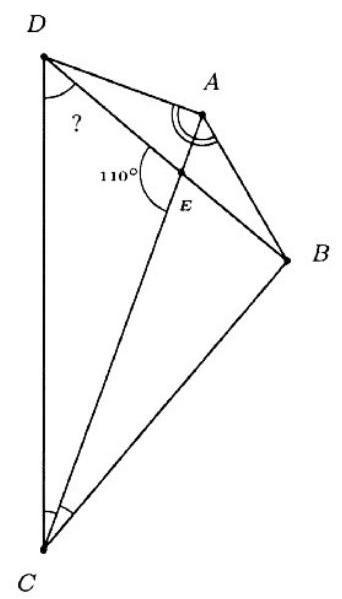 | Ex. 143. $\angle C D B=50^{\circ}$. | 50 | Geometry | math-word-problem | Yes | Incomplete | olympiads | false |
4. In trapezoid $A B C D$ with bases $A B$ and $C D$, it holds that $|A B|>|C D|$ and $\angle A D C = 90^{\circ}$. Let $E$ be the orthogonal projection of vertex $A$ onto line $B C$. Prove that lines $A C$ and $D E$ intersect perpendicularly if and only if triangle $A B C$ is isosceles with vertex $B$. | III/4. Let's denote the angles in triangle $ABC$ as $\alpha, \beta$, and $\gamma$, and the intersection of $AC$ and $DE$ as $F$. Then, $\angle CAD = \frac{\pi}{2} - \alpha$. Since $\angle CEA = \frac{\pi}{2} = \angle ADC$, quadrilateral $AEC D$ is cyclic, so $\gamma = \angle ACE = \angle ADE$. Then, $AC$ is perpendicul... | proof | Geometry | proof | Yes | Yes | olympiads | false |
At a certain rate percent on simple interest, some amount amounts to Rs. 1050 in 5 years. The rate is 8%. What is the initial amount? | To find the initial amount (principal), we can use the formula for simple interest:
Simple Interest (SI) = Principal (P) × Rate (R) × Time (T) / 100
We are given:
- The final amount (A) after 5 years is Rs. 1050.
- The rate (R) is 8%.
- The time (T) is 5 years.
First, we need to find the simple interest earned over ... | 750 | Algebra | math-word-problem | Yes | Yes | orca_math | true |
The solution set of the inequality about $x$, $$\frac {ax-1}{x+1} < 0$$ (where $a < -1$), is ( )
A: ($$\frac {1}{a}$$, -1)
B: (-1, $$\frac {1}{a}$$)
C: (-∞, $$\frac {1}{a}$$) ∪ (-1, +∞)
D: (-∞, -1) ∪ ($$\frac {1}{a}$$, +∞) | To solve the inequality $$\frac {ax-1}{x+1} 0$,
This can be transformed into: $$\begin{cases} x- \frac {1}{a} > 0 \\ x+1 > 0\end{cases}$$ or $$\begin{cases} x- \frac {1}{a} \frac {1}{a}$,
Therefore, the solution set of the original inequality is: $(-\infty, -1) \cup (\frac {1}{a}, +\infty)$.
Hence, the correct ... | D | Inequalities | MCQ | Yes | Yes | cn_k12 | false |
Each number in a set of data is subtracted by 80 to obtain a new set of data. If the average of the new data is 1.2 and the variance is 4.4, then the variance of the original data is. | Since subtracting the same number from each data point does not change the dispersion of the data,
the variance remains unchanged.
Therefore, the variance of the original data is $4.4$.
Hence, the answer is $\boxed{4.4}$. | 4.4 | Algebra | math-word-problem | Yes | Yes | cn_k12 | false |
A salesman's commission is 10% on all sales up to $5000 and 5% on all sales exceeding this. He remits a certain amount to his parent company after deducting his commission. The total sales were $15885.42. How much did he remit to his parent company? | To calculate the amount the salesman remitted to his parent company, we first need to calculate his commission on the total sales.
The total sales were $15885.42.
The commission on the first $5000 is 10%, so:
Commission on first $5000 = 10% of $5000 = 0.10 * $5000 = $500
The remaining amount of sales over $5000 is:
... | \$14841.149 | Algebra | math-word-problem | Yes | Yes | orca_math | true |
6. From the set $\{1,2,3, \cdots, 20\}$, choose any 4 different numbers such that these 4 numbers form an arithmetic sequence. There are $\qquad$ such sequences. | 6.114 个.
Let $a_{i}(i=1,2,3,4) \in\{1,2,3, \cdots, 20\}$ and form an $AP$.
The common difference is $d$, then $d=\frac{a_{4}-a_{1}}{4-1}=\frac{a_{4}-a_{1}}{3} \in \mathbf{Z}$, so $a_{4}=a_{1}(\bmod 3)$. Therefore, we only need to classify $1,2, \cdots, 20$ by modulo 3.
Let $\left.P_{r}=\mid p H=3 q+r \quad(1 \leqslant... | 114 | Combinatorics | math-word-problem | Yes | Yes | olympiads | false |
Among 40 products, there are 10 top-quality items, 25 second-quality items, and 5 defective items. If 8 products are to be drawn for quality analysis, which sampling method should be used?
A: Drawing lots
B: Random number table method
C: Systematic sampling
D: Stratified sampling | Given that the products consist of top-quality items, second-quality items, and defective items with clear distinctions between each category, stratified sampling is the most suitable approach. Stratified sampling involves dividing the population into different subgroups, or "strata," and then sampling from each subgro... | D. \text{Stratified sampling} | Combinatorics | MCQ | Yes | Yes | cn_k12 | false |
4. Prove that for any real numbers $a, b, c$ from the interval $\langle 0,1\rangle$ the following holds:
$$
1 \leqq a+b+c+2(a b+b c+c a)+3(1-a)(1-b)(1-c) \leqq 9
$$
The regional round of category B takes place
## on Tuesday, March 21, 2006
so that it starts in the morning and the contestants have 4 hours of pure ti... | 4. Throughout the text, let's assume that $a, b, c \in [0,1]$. Denote
$$
V=a+b+c+2(ab+ac+bc)+3(1-a)(1-b)(1-c)
$$
and first, instead of the inequality $V \geq 1$, let's prove the stronger inequality
$$
a+b+c+(1-a)(1-b)(1-c) \geq 1.
$$
By expanding and rearranging the left side, we get
$$
\begin{aligned}
(a+b+c)+(1-... | proof | Inequalities | proof | Yes | Yes | olympiads | false |
The probability that Liam completes his homework on time is $\frac{5}{9}$. What is the probability that Liam does not complete his homework on time? Express your answer as a common fraction. | To find the probability that Liam does not complete his homework, we use the probability complement rule. This rule states that the probability of the complement event is $1$ minus the probability of the event.
Given that the probability Liam completes his homework on time is $\frac{5}{9}$, the probability that he do... | \frac{4}{9} | Algebra | math-word-problem | Yes | Yes | synthetic_math | true |
I3.2 If the sum of the coefficients in the expansion of $(x+y)^{a}$ is $b$, find $b$. | Put $x=1$ and $y=1$, then $b=(1+1)^{4}=16$ | 16 | Algebra | math-word-problem | Yes | Yes | olympiads | false |
The sides of a triangle form a geometric sequence with a common ratio $q$; what are its angles? (for example, $q=\frac{3}{2}$). | Let $\alpha$ be the angle opposite to $a$, $\beta$ be the angle opposite to $a q$, and $\gamma$ be the angle opposite to $a q^{2}$. Applying Carnot's theorem:
$$
a^{2} q^{2} + a^{2} q^{4} - 2 a^{2} q^{3} \cos \alpha = a^{2}
$$
from which
$$
\cos \alpha = \frac{q^{4} + q^{2} - 1}{2 q^{3}}
$$
Similarly,
$$
\cos \bet... | \alpha=2044^{\}27^{\\},\beta=3205^{\}22^{\\},\gamma=12710^{\}11^{\\} | Geometry | math-word-problem | Yes | Yes | olympiads | false |
9. (20 points) Can this figure, drawn on graph paper, be cut into three pieces and rearranged to form a square
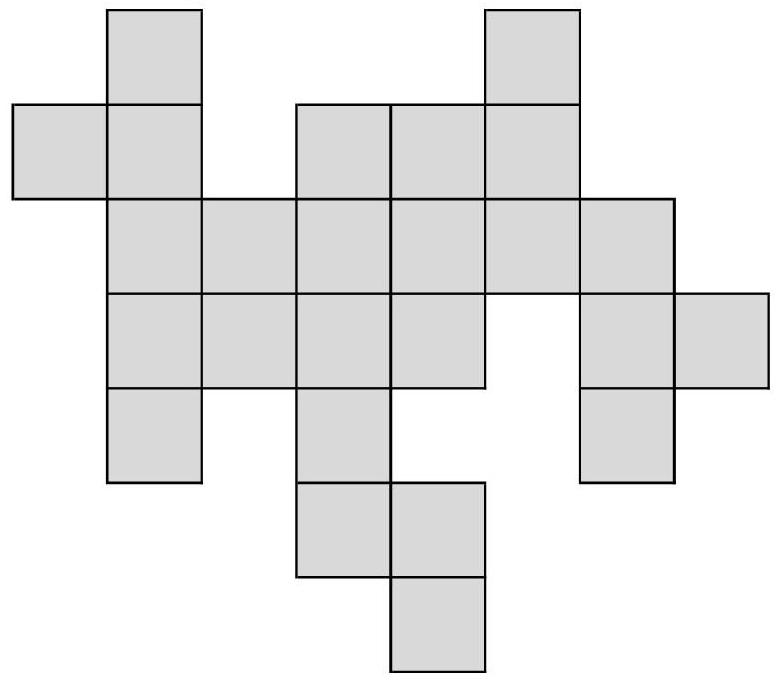 | Answer: It is possible.
Solution: An example of cutting:
 | Itispossible | Logic and Puzzles | math-word-problem | Incomplete | Yes | olympiads | false |
"φ= $\frac{\pi}{2}$" is a condition for "the curve $y=\sin(x+\phi)$ to be symmetric about the y-axis" is ( )
A: Necessary and sufficient condition
B: Sufficient but not necessary condition
C: Necessary but not sufficient condition
D: Neither sufficient nor necessary condition | If $y=\sin(x+\phi)$ is symmetric about the y-axis,
then $\phi= \frac{\pi}{2} + k\pi$, where $k\in \mathbb{Z}$,
thus, "φ= $\frac{\pi}{2}$" is a sufficient but not necessary condition for "the curve $y=\sin(x+\phi)$ to be symmetric about the y-axis",
therefore, the answer is: $\boxed{\text{B}}$.
This can be deter... | \text{B} | Algebra | MCQ | Yes | Yes | cn_k12 | false |
34th CanMO 2002 Problem 5 Let X be the set of non-negative integers. Find all functions f: X → X such that x f(y) + y f(x) = (x + y) f(x 2 + y 2 ) for all x, y. | Putting x = 0 we get y f(0) = y f(y 2 ), so f(y 2 ) = f(0) for all y. That strongly suggests f is constant. Obviously any constant function satisfies the condition. Suppose f(x) 1. So f is constant. 34th CanMO 2002 © John Scholes jscholes@kalva.demon.co.uk 10 June 2002 | f(x)= | Algebra | proof | Yes | Yes | olympiads | false |
In a year when Thanksgiving falls on Thursday, November 23, which day of the week does December 23 fall on? | To determine the day of the week for December 23 given that Thanksgiving falls on Thursday, November 23, we can follow these steps:
1. **Identify the number of days between November 23 and December 23:**
- November has 30 days.
- From November 23 to November 30 is \(30 - 23 = 7\) days.
- December 23 is 23 day... | Saturday | Logic and Puzzles | math-word-problem | Yes | Yes | metamath | true |
Given the following propositions:
(1) If $a > 0$ and $b > 0$, then $a+b > 0$;
(2) The diagonals of a square are perpendicular bisectors of each other;
(3) The median to the hypotenuse of a right triangle is half the length of the hypotenuse;
(4) All sides of a rhombus are equal.
Determine how many of these pr... | **
(1) The statement, "If $a > 0$ and $b > 0$, then $a+b > 0$", is a true proposition; its converse, "If $a+b > 0$, then $a > 0$ and $b > 0$", is false because $a$ or $b$ can be negative as long as their sum is positive.
(2) The statement, "The diagonals of a square are perpendicular bisectors of each other", is a tru... | B | Geometry | MCQ | Yes | Yes | cn_k12 | false |
Can any triangle be cut into four convex figures: a triangle, a quadrilateral, a pentagon, a hexagon? | null | null | Logic and Puzzles | math-word-problem | Yes | Yes | aops_forum | false |
Given the curve $f(x) = \ln{x} + nx$, the equation of the tangent line at $x = x_0$ is $y = 2x - 1$. Find $f(1) + f'(1) = \_\_\_\_\_\_.$ | We have $f(x) = \ln{x} + nx$, so $f'(x) = \frac{1}{x} + n$.
Then, $f'(x_0) = \frac{1}{x_0} + n = 2$, which implies $x_0 = \frac{1}{2 - n}$.
So, $f(\frac{1}{2 - n}) = \ln{\frac{1}{2 - n}} + \frac{n}{2 - n} = \frac{2}{2 - n} - 1 = \frac{n}{2 - n}$.
Thus, $\ln{\frac{1}{2 - n}} = 0$, which means $n = 1$.
So, $f(x) = \l... | 3 | Calculus | math-word-problem | Yes | Yes | cn_k12 | false |
The ratio of the degree measure of an angle to the degree measure of its complementary angle is 1:8. Find the degree measure of its supplementary angle. | Let's denote the angle as $x$ degrees. Therefore, its complementary angle has a measure of $(90^\circ - x)$ degrees. According to the problem, the ratio of these two angles is 1:8. We can set up the following equation:
\[ x : (90^\circ - x) = 1 : 8 \]
To solve this, let's rewrite it in the form of an equation,
\[ \fra... | 170^\circ | Geometry | math-word-problem | Yes | Yes | cn_k12 | false |
Two circles, one with a radius of 4 inches and the other with a radius of 3 inches, are tangent at point P. A bug starts crawling from point P on the larger circle at 4π inches per minute, and another bug starts from an angle of 90 degrees on the smaller circle at 3π inches per minute. Calculate how many minutes it wil... | - The circumference of the larger circle, \( C_1 \), is \( 2 \times 4\pi = 8\pi \) inches.
- The circumference of the smaller circle, \( C_2 \), is \( 2 \times 3\pi = 6\pi \) inches.
- The time taken by the bug on \( C_1 \) to crawl one complete circle is \( \frac{8\pi}{4\pi} = 2 \) minutes.
- The time taken by the bug... | t = 2.5 \text{ minutes} | Geometry | math-word-problem | Yes | Yes | synthetic_math | true |
Given real numbers $a$, $b$, $c$ satisfying the inequality $0 < a < b < c < 1$, and $M=2^{a}$, $N=5^{-b}$, $P=\ln c$, then the relationship among $M$, $N$, $P$ is ( )
A: $P < N < M$
B: $P < M < N$
C: $M < P < N$
D: $N < P < M$ | Since $0 2^{0}=1$,
$N=5^{-b} 0$;
$P=\ln c < \ln 1=0$,
thus $P < N < M$;
Therefore, the answer is: $\boxed{A}$.
This problem examines the monotonicity of logarithmic and exponential functions and the application of the method of special values, which is a basic question. | A | Algebra | MCQ | Yes | Yes | cn_k12 | false |
A college student drove his compact car $ 120$ miles home for the weekend and averaged $ 30$ miles per gallon. On the return trip the student drove his parents' SUV and averaged only $ 20$ miles per gallon. What was the average gas mileage, in miles per gallon, for the round trip?
$ \textbf{(A)}\ 22 \qquad \textbf{(... | null | null | Algebra | MCQ | Yes | Yes | aops_forum | false |
Find the ratio of the area of $\triangle BCX$ to the area of $\triangle ACX$ in the diagram if $CX$ bisects $\angle ACB$. In the diagram, $AB = 40$, $BC = 45$, and $AC = 50$.
[asy]
import markers;
real t=45/(45+50);
pair A=(-20,0);
pair B=(20,0);
pair C=(0,30);
pair X=t*A+(1-t)*B;
draw(C--A--B--C--X);
label("$A$",A,... | First, by the Angle Bisector Theorem, the ratio $\frac{BX}{AX}$ is equal to the ratio $\frac{BC}{AC}$:
\[
\frac{BX}{AX} = \frac{BC}{AC} = \frac{45}{50} = \frac{9}{10}.
\]
Since $\triangle BCX$ and $\triangle ACX$ share the same height from $C$ perpendicular to line $AB$, the ratio of their areas is the same as the rat... | \frac{9}{10} | Geometry | math-word-problem | Yes | Yes | synthetic_math | true |
## Task 1 - 300521
a) The figure shows a decomposition of a square by straight cuts into four sub-figures.
Indicate how these sub-figures can be combined to form two equal-sized squares! A drawing of the two newly assembled squares is sufficient as a solution.
 | notfound | Geometry | math-word-problem | Yes | Yes | olympiads | false |
12.359. The radius of the sphere circumscribed around a regular triangular pyramid is equal to the pyramid's apothem. Find the angle between the apothem and the plane of the pyramid's base. | ## Solution.
Consider the regular pyramid $DABC$ (Fig. 12.219), the center $O_1$ of the inscribed sphere lies on its height $DO_2$, and $E$ is the midpoint of $AD$.
Let $R$ be the radius of the sphere, $DO_1 = AO_1 = R$, $H$ be the height, $DA = L$, and $\angle AO_1O_2 = \alpha$.
In $\triangle AO_2O_1 \left(\angle A... | \arcsin\frac{\sqrt{13}-1}{3} | Geometry | math-word-problem | Incomplete | Yes | olympiads | false |
If the price of a book is first decreased by 15 % and then increased by 10 %, what is the net change in the price? | Let's assume the original price of the book is P.
First, the price is decreased by 15%. The decrease in price is:
0.15 * P
So the new price after the decrease is:
P - 0.15P = 0.85P
Next, this new price is increased by 10%. The increase in price is:
0.10 * 0.85P
So the new price after the increase is:
0.85P + 0.10 *... | 6.5\% | Algebra | math-word-problem | Yes | Yes | orca_math | true |
## Task A-4.1.
Determine all prime numbers $p$ and $q$ such that $p^{q}+1$ is also prime. | ## Solution.
Let $p$ and $q$ be prime numbers and suppose $p^{q}+1$ is prime. Since $p, q \geqslant 2$, it follows that $p^{q}+1 \geqslant p^{2}+1 > p$. Therefore, $p^{q}+1$ is an odd prime number, which is only possible if $p=2$.
If $q=2$, then $p^{q}+1=2^{2}+1=5$ is a prime number, so this is one solution.
Otherwi... | p=2,q=2 | Number Theory | math-word-problem | Yes | Yes | olympiads | false |
Joe, Susie's brother, collected 94 trading cards scattered in his room and placed them in boxes. If a full box can hold a certain number of cards, and 11 boxes were fully filled, what is the maximum number of cards a full box can hold? | To find the maximum number of cards a full box can hold, we need to divide the total number of cards Joe collected by the number of boxes that were fully filled.
Total number of cards = 94
Number of fully filled boxes = 11
Maximum number of cards per full box = Total number of cards / Number of fully filled boxes
Max... | 8 | Number Theory | math-word-problem | Yes | Incomplete | orca_math | true |
Add the following two polynomials:
\[ (3x^4 + 2x^3 - 5x^2 + 9x - 2) + (-3x^4 - 5x^3 + 7x^2 - 9x + 4). \] | To combine these two polynomials, align and sum corresponding terms:
\begin{align*}
& (3x^4 + 2x^3 - 5x^2 + 9x - 2) + (-3x^4 - 5x^3 + 7x^2 - 9x + 4) \\
&\qquad= (3x^4 - 3x^4) + (2x^3 - 5x^3) + (-5x^2 + 7x^2) + (9x - 9x) + (-2 + 4) \\
&\qquad= 0x^4 + (-3x^3) + (2x^2) + (0x) + 2 \\
&\qquad=\boxed{-3x^3 + 2x^2 + 2}.
\end{... | -3x^3 + 2x^2 + 2 | Algebra | math-word-problem | Yes | Yes | synthetic_math | true |
15. Let $\xi$ be an integer-valued random variable and $\varphi_{\xi}(t)$ its characteristic function. Show that
$$
\mathrm{P}(\xi=n)=\frac{1}{2 \pi} \int_{-\pi}^{\pi} e^{-i n t} \varphi_{\xi}(t) d t, \quad k \in \mathbb{Z}
$$ | Solution. By Fubini's theorem
$$
\int_{-\pi}^{\pi} e^{-i n t} \varphi_{\xi}(t) d t=\mathrm{E} \int_{-\pi}^{\pi} e^{i(\xi-n) t} d t=2 \pi \mathrm{P}(\xi=n)
$$ | proof | Calculus | proof | Yes | Yes | olympiads | false |
Two trains of equal lengths take 9 sec and 15 sec respectively to cross a telegraph post. The length of each train is 120 m. In what time will they cross each other travelling in opposite direction? | First, let's find the speed of each train.
Speed is calculated by the formula:
Speed = Distance / Time
For the first train:
Speed of Train 1 (S1) = Length of Train 1 / Time taken to cross the telegraph post
S1 = 120 m / 9 sec
S1 = 13.33 m/s
For the second train:
Speed of Train 2 (S2) = Length of Train 2 / Time taken... | 11.25 | Algebra | math-word-problem | Yes | Yes | orca_math | true |
A candy store has some boxes of chocolates. Each box has 500 pieces. Altogether, there are 3000 pieces in the boxes. How many boxes of chocolates are there? | To find out how many boxes of chocolates there are, you need to divide the total number of pieces by the number of pieces in each box.
Total number of pieces = 3000
Number of pieces in each box = 500
Number of boxes = Total number of pieces / Number of pieces in each box
Number of boxes = 3000 / 500
Number of boxes =... | 6 | Algebra | math-word-problem | Yes | Yes | orca_math | true |
\section*{Products and factorials $\quad]$ Decimal number system $\quad]$ Formulas for abbreviated multiplication (etc.).]

The product of four consecutive positive odd numbers ends in 9. Fin... | Among the four given numbers, there is no number ending in 5 (otherwise the product would end in 5); therefore, these numbers end in the digits 7, 9, 1, and 3 (in that order).
Thus, the product of these numbers is $(10 n-3)(10 n-1)(10 n+1)(10 n+3)=\left(100 n^{2}-9\right)\left(100 n^{2}-1\right)=$ $10000 n^{4}-1000 n^... | 0 | Number Theory | math-word-problem | Incomplete | Yes | olympiads | false |
Let $g(x) = \frac{1}{2ax + 3b}$, where $a$ and $b$ are non-zero constants. Find all solutions to $g^{-1}(x) = -1$. Express your answer in terms of $a$ and/or $b$. | First, we need to determine what $x$ value makes $g(x) = -1$. That is, we solve:
\[
-1 = \frac{1}{2ax + 3b}
\]
Multiplying both sides by $2ax + 3b$ to clear the fraction gives:
\[
-1 \cdot (2ax + 3b) = 1 \implies 2ax + 3b = -1
\]
To isolate $x$, we solve for $x$:
\[
2ax = -1 - 3b \implies x = \frac{-1 - 3b}{2a}
\]
So,... | \frac{-1 - 3b}{2a} | Algebra | math-word-problem | Yes | Yes | synthetic_math | true |
A poverty alleviation office in a certain county decides to dispatch 8 officials (5 males and 3 females) into two groups to participate in poverty alleviation work in two poor villages, Village A and Village B. The requirement is that each group must have at least 3 people and must include male officials. The number of... | Since each group must have at least 3 people and must include male officials, there are two ways to group by number, 3 people in one group and 5 people in the other, or 4 people in each group, evenly divided into two groups.
1. If the female officials form a group by themselves, there is only 1 dispatch plan. If we do... | 180 | Combinatorics | math-word-problem | Yes | Yes | cn_k12 | false |
Factorize
(1) $4-12(x-y)+9(x-y)^2$;
(2) $2a(x^2+1)^2-8ax^2$. | **Solution**:
(1) $4-12(x-y)+9(x-y)^2$,
$=2^2-2 \times 2 \times 3(x-y)+[3(x-y)]^2$,
$=[2-3(x-y)]^2$,
$=(2-3x+3y)^2$;
(2) $2a(x^2+1)^2-8ax^2$,
$=2a[(x^2+1)^2-4x^2]$,
$=2a(x^2+1-2x)(x^2+1+2x)$,
$=2a(x-1)^2(x+1)^2$.
Thus, the factorized forms are $\boxed{(2-3x+3y)^2}$ for the first expression and $\boxed... | 2a(x-1)^2(x+1)^2 | Algebra | math-word-problem | Yes | Yes | cn_k12 | false |
For a positive integer $n$, denote $c_n=2017^n$. A function $f: \mathbb{N} \rightarrow \mathbb{R}$ satisfies the following two conditions.
1. For all positive integers $m, n$, $f(m+n) \le 2017 \cdot f(m) \cdot f(n+325)$.
2. For all positive integer $n$, we have $0<f(c_{n+1})<f(c_n)^{2017}$.
Prove that there exists ... | To prove the existence of a sequence \(a_1, a_2, \cdots\) such that for all \(n, k\) with \(a_k < n\), we have \(f(n)^{c_k} < f(c_k)^n\), we will proceed as follows:
1. **Express \(n\) in terms of \(2017^i\):**
Let \(n\) be expressed as:
\[
n = a_t (2017^t - 235) + a_{t-1} (2017^{t-1} - 235) + \cdots + a_k (2... | null | Logic and Puzzles | proof | Yes | Yes | aops_forum | false |
When solving the fractional equation $\frac{x}{x-1}=\frac{3}{2x-2}-3$, the correct simplification is:
A: $2x=3-3x+3$
B: $2x=3-6x-6$
C: $2x=3-6x+6$
D: $2x=3-6x+2$ | To solve the given fractional equation $\frac{x}{x-1}=\frac{3}{2x-2}-3$, we start by simplifying both sides of the equation to eliminate the denominators. This process involves finding a common denominator and then multiplying each term by that common denominator to clear the fractions. Here, the denominators are $(x-1... | C | Algebra | MCQ | Yes | Yes | cn_k12 | false |
If Mary Anne consumes 1/5 of a bottle of sparkling water every night at dinner and each bottle costs $2.00, what is her yearly expenditure on sparkling water? | To determine Mary Anne's yearly expenditure on sparkling water, we need to follow these steps:
1. Calculate the number of bottles Mary Anne consumes in one week.
2. Calculate the number of bottles Mary Anne consumes in one year.
3. Calculate the total cost of the bottles consumed in one year.
**Step 1: Calculate the ... | 145.60 | Algebra | math-word-problem | Yes | Yes | metamath | true |
51. In $\triangle A B C$, the radii of the excircles opposite to sides $B C, C A, A B$ are $r_{a}, r_{b}, r_{c}$ respectively, and $2 p$ is the perimeter of $\triangle A B C$. Prove that: $\frac{r_{a}}{\sin A}+\frac{r_{b}}{\sin B}+\frac{r_{c}}{\sin C} \geqslant 2 p$. (1993 Poland-Austria Mathematical Olympiad) | 51. For $\triangle ABC$, the radius of the excircle opposite to side $BC$ is $r_{a}$, then
$$S_{\triangle ABC}=\frac{bc \sin A}{2}=\frac{(b+c-a) r_{a}}{2}$$
Therefore,
$$\begin{aligned}
r_{a}= & \frac{bc \sin A}{b+c-a}=\frac{2 R \sin B \sin C \sin A}{\sin B+\sin C-\sin A}= \\
& \frac{2 R \sin B \sin C \sin A}{2 \sin \... | proof | Inequalities | proof | Yes | Yes | inequalities | false |
In $\triangle ABC$, $\tan A$ is the common difference of an arithmetic sequence with the third term as $-4$ and the seventh term as $4$, and $\tan B$ is the common ratio of a geometric sequence with the third term as $\frac{1}{3}$ and the sixth term as $9$. The shape of this triangle is \_\_\_\_\_\_. | Let's denote the common difference of the arithmetic sequence, which has $-4$ as its third term and $4$ as its seventh term, as $d$.
Then we have $d = \frac{1}{4}[4 - (-4)] = 2$.
Thus, $\tan A = 2$.
Let's denote the common ratio of the geometric sequence, which has $\frac{1}{3}$ as its third term and $9$ as its s... | \text{acute triangle} | Algebra | math-word-problem | Yes | Yes | cn_k12 | false |
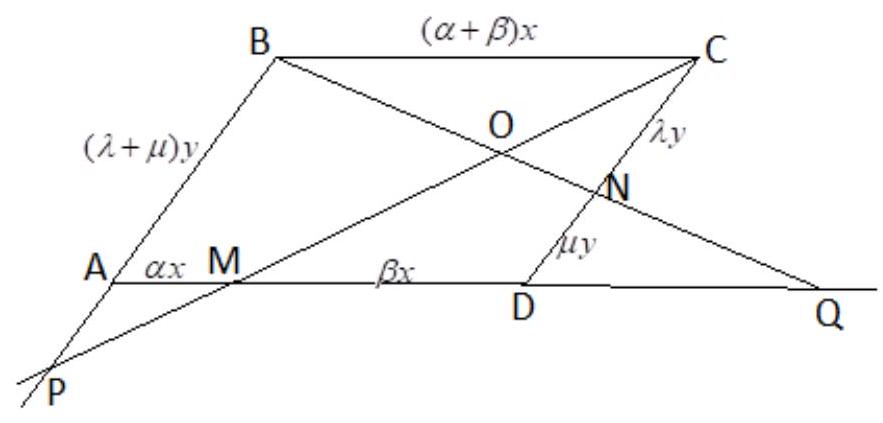
Problem 5. Answer: $O M: O C=13: 6$.
## Variant 0
Points $M$ and $N$ divide the sides $A D$ and $C D$ of parallelogram $A B C D$ in the ratios $A M: M D=\alpha: \beta$ and $C N: N D=\lambda: \mu$, respectively. Lines $C M$ and $B N$ intersect at point $O$. Find the ratio of the lengths of segments $O M$ and $O C$. Fi... | Answer: 1) $O M: O C=\frac{\beta}{\alpha+\beta}+\frac{\mu}{\lambda} ; \quad$ 2) $B O: O N=\frac{(\lambda+\mu)(\alpha+\beta)}{\lambda \beta}$.
## Solution.
Notations: $A M=\alpha x, M B=\bet... | Geometry | math-word-problem | Yes | Yes | olympiads | false | |
5. There are 5 visually identical weights, of which three weights weigh the same, the fourth weight is heavier than each of the three, and the fifth weight is lighter than each of the three. Determine the heaviest and the lightest weights in three weighings. | 5. Let's number the weights as $1,2,3,4,5$. (We will use equalities or inequalities to show the comparisons of the weights of the weights)
1) Weigh weights 1 and 2.
a) $1=2$.
2) Weigh 3 and 4. The weights cannot be equal.
Let $34$ be symmetric)
3) Weigh 1 and 5.
a) $1=5$, so 3 is light, 4 is heavy.
b) $1<5$, so 5 i... | Logic and Puzzles | math-word-problem | Yes | Yes | olympiads | false | |
If the vectors $a$ and $b$ satisfy $| \overrightarrow{a} | = 8$ and $| \overrightarrow{b} | = 12$, find the minimum value of $| \overrightarrow{a} + \overrightarrow{b} |$. | **Analysis:**
This problem involves the dot product of vectors and requires an understanding of the geometric meaning of vector operations. The following inequality can be applied to solve the problem: $|| \overrightarrow{a} | - | \overrightarrow{b} || \leq | \overrightarrow{a} + \overrightarrow{b} | \leq | \overrighta... | 4 | Algebra | math-word-problem | Yes | Yes | cn_k12 | false |
A works at a certain speed compared to B. If B can complete a work in 12 days independently, A and B can together finish the work in 4 days. What is the ratio of A's work speed to B's work speed? | Let's denote A's work speed as A and B's work speed as B.
Given that B can complete the work in 12 days independently, we can say that B's work speed is 1/12 of the work per day.
When A and B work together, they can finish the work in 4 days. This means that their combined work speed is 1/4 of the work per day.
So, ... | 2:1 | Algebra | math-word-problem | Yes | Yes | orca_math | true |
7. Let $m$ and $n$ both be positive integers greater than 1. Given that $\frac{(n+m)!}{n!}=17297280$. Then $\frac{n}{m}=$ $\qquad$ | 7.1 or $\frac{31}{2}$.
Since $\frac{(n+m)!}{n!}=17297280$, factorizing it we get
$$
\begin{array}{l}
17297280=10 \times 1001 \times 27 \times 64 \\
=2^{7} \times 3^{3} \times 5 \times 7 \times 11 \times 13, \\
\frac{(n+m)!}{n!}=(n+1)(n+2) \cdots(n+m),
\end{array}
$$
Therefore, it can be decomposed into two cases, i.e... | \frac{31}{2} | Combinatorics | math-word-problem | Yes | Yes | olympiads | false |
Two numbers have a difference of 5 and a sum of 37. What is the larger of the two numbers? | Let the numbers be $x$ and $y$. Given the equations $x + y = 37$ and $x - y = 5$.
1. Add the two equations:
\[
x + y + x - y = 37 + 5 \implies 2x = 42 \implies x = 21.
\]
2. Substitute $x = 21$ into the sum equation to find $y$:
\[
21 + y = 37 \implies y = 16.
\]
3. Since $x - y = 5$ checks out:
... | 21 | Algebra | math-word-problem | Yes | Yes | synthetic_math | true |
Is it possible to draw in the plane the graph presented in the figure so that all the vertices are different points and all the edges are unit segments? (The segments can intersect at points different from vertices.) | null | null | Geometry | math-word-problem | Yes | Yes | aops_forum | false |
Given vectors $\overrightarrow{a}=({2,1}),\overrightarrow{b}=({x,-2})$, if $\overrightarrow{a}∥\overrightarrow{b}$, then $\overrightarrow{a}+\overrightarrow{b}$ is equal to:
A: $(-3,1)$
B: $(3,-1)$
C: $(2,1)$
D: $(-2,-1)$ | Given vectors $\overrightarrow{a}=({2,1})$ and $\overrightarrow{b}=({x,-2})$, and knowing that $\overrightarrow{a}$ is parallel to $\overrightarrow{b}$, we can find the value of $x$ that satisfies this condition.
Step 1: Since $\overrightarrow{a}∥\overrightarrow{b}$, the components of these vectors must be proportiona... | D | Algebra | MCQ | Yes | Yes | cn_k12 | false |
## Task 2 - 140822
Four trucks $A, B, C$, and $D$ travel the same route. If $A$ travels at an average speed of $56 \frac{km}{h}$ and $B$ at $40 \frac{km}{h}$, then $A$ takes exactly 2 hours less than $B$ to complete this route.
At what average speed would $C$ need to travel if $D$ were to start 4 hours earlier than $... | Assuming that $A$ has covered the distance mentioned in the problem in $t$ hours. Then $B$ needed $(t+2)$ hours for the same distance. Therefore, $56 t=40(t+2)$, from which $t=5$ is obtained.
Thus, $A$ covered the distance with an average speed of $56 \mathrm{~km} \cdot \mathrm{h}^{-1}$ in 5 hours. The distance was th... | 70\mathrm{~}\cdot\mathrm{}^{-1} | Algebra | math-word-problem | Yes | Yes | olympiads | false |
Third question: Let $\mathrm{A}$ be a finite set of positive integers. Prove: There exists a finite set of positive integers $\mathrm{B}$ such that $\mathrm{A} \subseteq \mathrm{B}$, and the product of all elements in $\mathrm{B}$ equals the sum of the squares of all elements in $\mathrm{B}$. | None
Translate the text above into English, please retain the original text's line breaks and format, and output the translation result directly.
Note: The provided instruction is a meta-instruction and not part of the text to be translated. Since the text to be translated is "None", the translation is also "None". ... | notfound | Number Theory | proof | Yes | Problem not solved | olympiads | false |
A train running at the speed of 120 kmph crosses another train running in opposite direction at the speed of 80 kmph in 9 seconds. The other train is 230.04 meters long. What is the length of the first train? | To find the length of the first train, we need to calculate the relative speed at which the two trains cross each other and then use the time they take to cross each other to find the combined length of the two trains. Once we have the combined length, we can subtract the length of the second train to find the length o... | 270 | Algebra | math-word-problem | Yes | Yes | orca_math | true |
In the complex plane, the point corresponding to the complex number $z$ is symmetric to the point corresponding to the complex number $\dfrac{2}{i-1}$ with respect to the real axis. Then the complex number $z=$
A: $-1-i$
B: $1+i$
C: $2i$
D: $-1+i$ | Solution: $\dfrac{2}{i-1}= \dfrac{2(i+1)}{(i-1)(i+1)}= \dfrac{2(1+i)}{-2}=-1-i$, the coordinates of the corresponding point are $(-1,-1)$,
Since the point corresponding to the complex number $z$ is symmetric to the point corresponding to the complex number $\dfrac{2}{i-1}$ with respect to the real axis,
Therefore, ... | D | Algebra | MCQ | Yes | Yes | cn_k12 | false |
Let $S=\{1,2, \cdots, 50\}$. Find the smallest natural number $k$, such that for any $k$-element subset of $S$, there exist two distinct numbers $a$ and $b$, satisfying $(a+b)(a-b)$.
(National Competition Question) | Let $a, b \in S$ satisfy the condition $(a+b) \mid a b$. Let $c = (a, b)$, then $a = c a_{1}, b = c b_{1}$, where $a_{1}, b_{1} \in \mathbb{N}$ and $(a_{1}, b_{1}) = 1$. Therefore, we have
$$
\begin{array}{l}
c\left(a_{1}+b_{1}\right) = (a+b) \mid a b = c^{2} a_{1} b_{1}, \\
\left(a_{1}+b_{1}\right) \mid c a_{1} b_{1}.... | 39 | Combinatorics | math-word-problem | Incomplete | Yes | cn_contest | false |
The sum of the first $n$ terms of an arithmetic sequence $\{a_n\}$ is denoted as $S_n$. If $a_2 + a_6 + a_{16}$ is a certain constant, then among the following numbers, which is also a constant?
A: $S_{13}$
B: $S_{15}$
C: $S_{17}$
D: $S_{19}$ | Since $a_2 + a_6 + a_{16} = 3a_1 + 21d = 3a_8$, it follows that $a_8$ is a constant.
Furthermore, $S_{15} = 15a_8$,
∴ $S_{15}$ is a constant.
Therefore, the correct choice is $\boxed{\text{B}}$. | \text{B} | Algebra | MCQ | Yes | Yes | cn_k12 | false |
What is the base-ten number represented by the base-eight number 52? | To find the base-ten equivalent of the base-eight number $52_8$:
1. Break down the number $52_8$ as $5 \cdot 8^1 + 2 \cdot 8^0$.
2. Calculate each term:
- $5 \cdot 8^1 = 5 \cdot 8 = 40$
- $2 \cdot 8^0 = 2 \cdot 1 = 2$
3. Add the results of these calculations together: $40 + 2 = 42$.
Thus, the base-ten equivalent... | 42 | Number Theory | math-word-problem | Yes | Yes | synthetic_math | true |
Carla's brush is 12 inches long. If the square root of the length of Carmen's brush, expressed as a percentage of Carla's brush, is 125%, how long is Carmen's brush in millimeters? (There are 25.4 millimeters per inch.) | First, let's find the length of Carmen's brush in inches. If the square root of the length of Carmen's brush is 125% of Carla's brush, we can express this as:
√(Carmen's brush length) = 125% of Carla's brush length
Since Carla's brush is 12 inches long, we have:
√(Carmen's brush length) = 1.25 * 12 inches
Now, let'... | 381 | Algebra | math-word-problem | Yes | Yes | orca_math | true |
A ball is thrown vertically upward with an initial speed of 80 feet per second. The height $y$ of the ball at time $t$ (in seconds) is given by the equation $y = -16t^2 + 80t$. At what time will the ball first reach the height of 100 feet? | We set $y = 100$ feet and solve for $t$:
$$
100 = -16t^2 + 80t
$$
Rearrange the equation:
$$
0 = -16t^2 + 80t - 100
$$
Simplify by factoring out a common factor:
$$
0 = 16t^2 - 80t + 100
$$
$$
0 = 4t^2 - 20t + 25
$$
Use the quadratic formula where $a=4$, $b=-20$, and $c=25$:
$$
t = \frac{-(-20) \pm \sqrt{(-20)^2 - 4 \c... | 2.5 | Algebra | math-word-problem | Yes | Yes | synthetic_math | true |
8.1. Lada, Lera, and Lara were solving problems. It turned out that Lada solved as many more problems than Lera as Lera solved more than Lara. Could it be that they solved a total of 2015 problems together? | Answer: No.
Solution: Let Lara solve x problems, and Lera solve x + a problems. Then Lada solved $\mathrm{x}+2 \mathrm{a}$ problems, and all together the girls solved $3 x+3 a=2015$ problems. However, 2015 is not divisible by three, leading to a contradiction.
Criteria: Only answer - 0 points. | proof | Algebra | math-word-problem | Yes | Yes | olympiads | false |
Determine all values of $p$ such that, for every $q > 0$, the following inequality holds:
$$\frac{5(pq^2 + p^2q + 4q^2 + 4pq)}{p + q} > 3p^2q.$$
Express your answer in interval notation. | Firstly, begin by simplifying the numerator of the left-hand side:
\begin{align*}
pq^2 + p^2q + 4q^2 + 4pq &= q(pq + p^2 + 4q + 4p) \\
&= q(p+4)(q+p).
\end{align*}
Now, substitute this back into the inequality:
$$\frac{5q(p+4)(p+q)}{p+q} > 3p^2q.$$
Here, $p+q$ appears in both the numerator and the denominator, and we c... | (2.5, \infty) | Inequalities | math-word-problem | Yes | Yes | synthetic_math | true |
Three lines form a triangle. On each of them, we draw a perpendicular line such that the perpendiculars also form a triangle (that is, the perpendicular drawn to the third line does not pass through the intersection point of the first two). Show that the angles of the new triangle are always equal to the respective ang... | I. solution. Let the triangles be $ABC=H$ and $A_1B_1C_1=H_1$, and let $A_1B_1 \perp AB, A_1C_1 \perp AC$. According to the well-known theorem for right angles, the angle $B_1A_1C_1$ is either equal to the angle $BAC$, or they complement each other to $180^\circ$, and both statements are true if $\angle BAC = 90^\circ$... | proof | Geometry | proof | Yes | Yes | olympiads | false |
Given that $x$ and $y$ are real numbers, and $\sqrt{3x+4} + y^2 + 6y + 9 = 0$, if $axy - 3x = y$, then the value of the real number $a$ is ( ).
A: $\dfrac{1}{4}$
B: $- \dfrac{1}{4}$
C: $\dfrac{7}{4}$
D: $- \dfrac{7}{4}$ | Since $\sqrt{3x+4} + y^2 + 6y + 9 = \sqrt{3x+4} + (y+3)^2 = 0$,
it follows that $3x+4=0$ and $y+3=0$,
thus $x=-\dfrac{4}{3}$ and $y=-3$.
Given $axy - 3x = y$, we have $4a + 4 = -3$,
solving this gives $a=-\dfrac{7}{4}$.
Therefore, the correct choice is $\boxed{D}$.
By using the formula for completing the sq... | D | Algebra | MCQ | Yes | Yes | cn_k12 | false |
Calculate the value of \( n \) for which the following complex number is a root of unity:
\[
\frac{\tan \frac{\pi}{4} + i}{\tan \frac{\pi}{4} - i}
\]
Verify if it equals to \(\cos \frac{2n \pi}{8} + i \sin \frac{2n \pi}{8}\) for some integer \( n \) between 0 and 7 inclusive. | We start by noting that \(\tan \frac{\pi}{4} = 1\). Thus, our expression simplifies as follows:
\[
\frac{\tan \frac{\pi}{4} + i}{\tan \frac{\pi}{4} - i} = \frac{1 + i}{1 - i}
\]
Multiplying numerator and denominator by the conjugate of the denominator, we get:
\[
\frac{(1+i)(1+i)}{(1-i)(1+i)} = \frac{(1+i)^2}{1 - i^2} ... | 2 | Algebra | math-word-problem | Yes | Yes | synthetic_math | true |
5. Below are four equations:
(1) $0.6+0.133=0.733$
(2) $0.625=\frac{5}{8}$
(3) $\frac{5}{14}+\frac{3}{2}=\frac{3+5}{14+2}=\frac{8}{16}=\frac{1}{2}$
(4) $3 \frac{3}{7} \times 4 \frac{1}{5}=14 \frac{2}{5}$
Among the correct equations are
(A) (1) and (2)
(B) (2) and (4)
(C) (2) and (3)
(D) (1) and (4) | B
Translate the text above into English, please retain the original text's line breaks and format, and output the translation result directly. | Algebra | MCQ | Yes | Yes | olympiads | false | |
Delaney has to catch a bus that leaves at 8:00 a.m to school every day. He always takes 30 minutes to reach the pick-up point from his home. One day he woke up late and left his home at 7:50. How much time did he miss the bus by when he reached the pick-up point? | If Delaney takes 30 minutes to reach the pick-up point and he left his home at 7:50 a.m., he would reach the pick-up point at 8:20 a.m. (since 7:50 + 30 minutes = 8:20).
The bus leaves at 8:00 a.m., so by the time Delaney reaches the pick-up point at 8:20 a.m., he has missed the bus by 20 minutes (since 8:20 - 8:00 = ... | 20 | Other | math-word-problem | Yes | Yes | orca_math | true |
The distance from point M on the parabola $y^2 = 4x$ to its focus F is 4. Find the x-coordinate of point M. | According to the equation of the parabola, we know that the equation of its directrix is $x = -1$.
Based on the definition of a parabola, the distance from point M to its focus F is equal to the distance from M to the directrix $x = -1$, which means $x_M + 1 = 4$.
Therefore, $x_M = 3$.
Hence, the answer is $\boxed{3... | 3 | Geometry | math-word-problem | Yes | Yes | cn_k12 | false |
Given the function $f(x)=\ln x- \frac {1}{2}ax^{2}+x$, where $a\in\mathbb{R}$.
$(1)$ If $f(1)=0$, find the interval of monotonic decrease for the function $f(x)$.
$(2)$ If the inequality $f(x)\leqslant ax-1$ always holds for $x$, find the minimum integer value of $a$.
$(3)$ If $a=-2$, and the positive real number... | Solution:
$(1)$ Since $f(x)=\ln x- \frac {1}{2}ax^{2}+x$ and $f(1)=0$,
we have $a=2$ and $x > 0$.
Therefore, $f(x)=\ln x-x^{2}+x$,
and $f′(x)= \frac {1}{x}-2x+1=- \frac {2x^{2}-x-1}{x}$.
When $f′(x) 1$, the function $f(x)$ is monotonically decreasing,
thus, the interval of monotonic decrease for the functi... | \frac { \sqrt {5}-1}{2} | Calculus | math-word-problem | Yes | Yes | cn_k12 | false |
Define $E(a,b,c) = a \times b^c$. What is the smallest positive integer value of $s$ that satisfies the equation $E(s, s, 4) = 2401$? | $E(s,s,4)$ simplifies to $s \times s^4 = s^5$. So our equation becomes:
\[ s^5 = 2401 \]
Now, solve for $s$:
\[ 2401 = 7^4 \]
Thus,
\[ s^5 = 7^4 \]
\[ s = \sqrt[5]{7^4} = 7^{4/5} \]
As $s$ must be a positive integer by problem statement, calculate \( s \):
\[ s = 7^{4/5} \]
This is approximately $s = 7^{0.8}$, which ... | s = 7 | Algebra | math-word-problem | Yes | Incomplete | synthetic_math | true |
Find the greatest natural number \( n \) such that \( n \leq 2050 \) and \((1^2+2^2+3^2+\cdots + n^2)\left[(n+1)^2+(n+2)^2+(n+3)^2+\cdots + (2n)^2\right]\) is a perfect cube. | The sum of squares from 1 to \( n \) is given by:
\[
\sum_{i=1}^n i^2 = \frac{n(n+1)(2n+1)}{6}
\]
Consider the sum of squares from \( n+1 \) to \( 2n \):
\[
\sum_{i=n+1}^{2n} i^2 = \sum_{i=1}^{2n} i^2 - \sum_{i=1}^n i^2 = \frac{2n(2n+1)(4n+1)}{6} - \frac{n(n+1)(2n+1)}{6} = \frac{n(14n^2 + 9n + 1)}{6}
\]
Thus, the produ... | 2016 | Number Theory | math-word-problem | Yes | Yes | synthetic_math | true |
Given that $a$, $b$, and $c$ are the sides opposite to angles $A$, $B$, and $C$ respectively in $\triangle ABC$, and they satisfy the equation $(b-c)^2 = a^2 - bc$.
1. Find the measure of angle $A$.
2. If $a = 3$ and $\sin C = 2\sin B$, find the area of $\triangle ABC$. | 1. Since $(b-c)^2 = a^2 - bc$, we can rearrange the equation to get $b^2 + c^2 - a^2 = bc$. By the cosine rule, we have $\cos A = \frac{b^2 + c^2 - a^2}{2bc} = \frac{bc}{2bc} = \frac{1}{2}$. Since $A \in (0, \pi)$, we have $A = \frac{\pi}{3}$.
2. From $\sin C = 2\sin B$ and the sine rule, we get $c = 2b$. Given that $... | \frac{3\sqrt{3}}{2} | Geometry | math-word-problem | Yes | Yes | cn_k12 | false |
If (-2)^2m equals a certain number raised to the power of (3-m), and m = 1, what is the number? | Let's first substitute m = 1 into the equation (-2)^(2m) = a^(3-m).
(-2)^(2*1) = a^(3-1)
(-2)^2 = a^2
Now we know that (-2)^2 is 4, because when you square a negative number, the result is positive.
So we have:
4 = a^2
To find the value of a, we take the square root of both sides:
√4 = √(a^2)
2 = a
Therefore, t... | 2 | Algebra | math-word-problem | Yes | Yes | orca_math | true |
[ Quadrilateral: calculations, metric relations.]
Diagonals $A C$ and $B D$ of the convex quadrilateral $A B C D$, whose area is 28, intersect at point $O$. Find the areas of triangles $A O B, B O C, C O D$, and $D O A$, given that the area of triangle $A O B$ is twice the area of triangle $C O D$, and the area of tri... | Compose a system of equations.
## Answer
$6 ; 18 ; 3 ; 1$. | 6;18;3;1 | Geometry | math-word-problem | Yes | Yes | olympiads | false |
The 29th question: In a class, there are $\mathrm{n}$ students, and any two are either friends or not friends, with the friendship being mutual. In this class, any $\mathrm{n}-1$ students can be arranged in a circle such that any two adjacent students in the circle are friends, but all $\mathrm{n}$ students cannot be a... | The 29th question,
Answer: Represent students with points, and if two students are friends, connect the corresponding two points with an edge, to get the graph $G(V, E)$. The condition is: for any $v \in V(G), G-v$ is an $H$-graph, while $G$ itself is not an $H$-graph.
For any $v \in V(G)$, since $G-v$ is an $H$-graph... | 10 | Combinatorics | math-word-problem | Yes | Yes | olympiads | false |
Donald has 4 oranges. He finds some more. In all, Donald has 9 oranges. How many oranges did Donald find? | Donald originally had 4 oranges. After finding more, he has a total of 9 oranges. To find out how many oranges Donald found, we subtract the number of oranges he originally had from the total number of oranges he has now.
9 oranges (total) - 4 oranges (originally had) = 5 oranges (found)
Donald found $\boxed{5}$ ora... | 5 | Algebra | math-word-problem | Yes | Yes | orca_math | true |
1. Four students, Amir, Boris, Tsvetko, and Darko, collected old paper. Together they collected $288 \mathrm{~kg}$ of paper. How many kilograms did each of them collect, given that Amir collected $36 \mathrm{~kg}$ more than Boris, which is $\frac{3}{4}$ of the amount collected together by Boris and Tsvetko, and Darko c... | Solution. Let $a, b, c, d$ denote the quantities of paper collected by the mentioned students. Then
$$
a=b+36, a=\frac{3}{4}(b+c), d=2 c, a+b+c+d=288
$$
From $b+36=\frac{3}{4}(b+c)$ we get $b=3 c-144$, then $a=3 c-108$ and if we substitute in $a+b+c+d=288$ we have
$$
(3 c-108)+(3 c-144)+c+2 c=288
$$
from which we f... | =72,b=36,=60,=120 | Algebra | math-word-problem | Yes | Yes | olympiads | false |
Given proposition p: $m \in \mathbb{R}$, and $m + 1 \leq 0$, proposition q: $\forall x \in \mathbb{R}, x^2 + mx + 1 > 0$ always holds. If proposition $p \land q$ is false, then the range of $m$ is \_\_\_\_\_\_\_\_. | When proposition p is true, we have $m \leq -1$. When proposition q is true, we have $m^2 - 4 -1$.
So, the range of $m$ is $\boxed{m \leq -2 \text{ or } m > -1}$. | m \leq -2 \text{ or } m > -1 | Algebra | math-word-problem | Yes | Yes | cn_k12 | false |
For a function $f(x)=x^3-x^2+x$, find the limit $\lim_{n\to\infty} \int_{n}^{2n}\frac{1}{f^{-1}(x)^3+|f^{-1}(x)|}\ dx.$ | null | null | Calculus | math-word-problem | Yes | Yes | aops_forum | false |
Steve went grocery shopping and spent a total of $50. He bought a gallon of milk for $4, three boxes of cereal for $3 each, 6 bananas for $0.2 each, 8 apples for $0.75 each, a pack of chicken priced at $10, and a jar of peanut butter for $5. He also bought a loaf of bread that cost half the price of two boxes of cereal... | Let's calculate the total cost of the items we know the price of:
- Gallon of milk: $4
- Three boxes of cereal: 3 * $3 = $9
- Six bananas: 6 * $0.2 = $1.2
- Eight apples: 8 * $0.75 = $6
- Pack of chicken: $10
- Jar of peanut butter: $5
Now, let's find the cost of the loaf of bread, which is half the price of two boxe... | 3 | Algebra | math-word-problem | Yes | Yes | orca_math | true |
Subsets and Splits
No community queries yet
The top public SQL queries from the community will appear here once available.