
instruction_seed stringlengths 2 10.7k | solution stringlengths 0 10.8k ⌀ | answer stringlengths 0 575 ⌀ | problem_type stringclasses 9
values | question_type stringclasses 5
values | problem_is_valid stringclasses 5
values | solution_is_valid stringclasses 4
values | source stringclasses 11
values | synthetic bool 2
classes |
|---|---|---|---|---|---|---|---|---|
Given an arithmetic sequence with 10 terms, the sum of the odd terms is 15, and the sum of the even terms is 30. Find the common difference. | **Analysis of the Problem:** Since $30 - 15 = (a_2 - a_1) + (a_4 - a_3) + \ldots + (a_{10} - a_9) = 5d$, we have $d = 3$. Therefore, the answer is $\boxed{3}$.
**Key Point:** Sum of the first $n$ terms of an arithmetic sequence. | 3 | Algebra | math-word-problem | Yes | Yes | cn_k12 | false |
19. Tommaso, to pass the time, enjoys filling a $3 \times 3$ square grid using all the numbers from 1 to 9, in such a way that the sum of the numbers in each row and each column is always the same. In how many ways can Tommaso fill the grid?
(A) 72
(B) 69
(C) 64
(D) 70
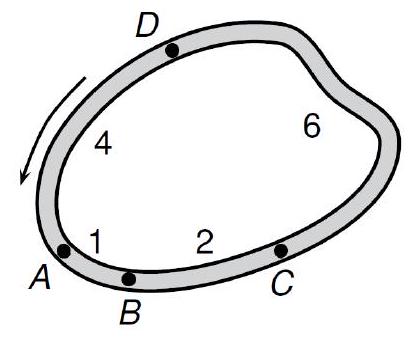
(E) 75 | Problem 19. The answer is (B).
The ant will have to travel at least the entire length of the grid formed by the four squares (12 meters) to cover it all. However, since the grid has four points $A, B, C, D$ (different from the initial vertex) from each of which three sides depart, it will have to pass through all four... | notfound | Combinatorics | MCQ | Yes | Problem not solved | olympiads | false |
4. Construct on the plane the set of points whose coordinates satisfy the inequality $|3 x+4|+|4 y-3| \leq 12$. In your answer, specify the area of the resulting figure.
ANSWER: 24. | Solution: We will shift the coordinate axes by $-\frac{4}{3}$ along the Ox axis, and by $\frac{3}{4}$ along the Oy axis. In the new coordinates, the obtained figure is described by the inequality $|3 x|+|4 y| \leq 12$. It is not difficult to show that this will be a rhombus with diagonals of 6 and 8, therefore, its are... | 24 | Inequalities | math-word-problem | Yes | Yes | olympiads | false |
Determine how many terms are in the expansion of \[(a+b+c)(x+d+e+f+g+h).\] | First, we recognize that $(a+b+c)$ consists of 3 terms and $(x+d+e+f+g+h)$ consists of 6 terms. We initially form the product by multiplying each of the 3 terms in $a+b+c$ by each of the 6 terms in $x+d+e+f+g+h$.
This multiplication forms $3 \times 6 = 18$ pairs of products. However, because all variables are distinct... | 18 | Algebra | math-word-problem | Yes | Yes | synthetic_math | true |
Two places, A and B, are $60$ km apart. A boat travels downstream from A to B, and then immediately upstream from B to A, taking a total of $8$ hours. Given that the speed of the water flow is $5$ km/h, if the speed of the boat in still water is $x$ km/h, the equation can be written as:
A: $\frac{60}{5+x}+\frac{60}{5-... | To solve this problem, we need to establish the equation based on the information given. The total distance traveled by the boat is twice the distance between A and B, once downstream and once upstream. The speed of the boat in still water is $x$ km/h, and the speed of the water flow is $5$ km/h.
When the boat travel... | B: \frac{60}{x+5}+\frac{60}{x-5}=8 | Algebra | MCQ | Yes | Yes | cn_k12 | false |
In parallelogram $ABCD$, $\overrightarrow{AC}-\overrightarrow{BC}=$
A: $\overrightarrow{DA}$
B: $\overrightarrow{BD}$
C: $\overrightarrow{BA}$
D: $\overrightarrow{DC}$ | In parallelogram $ABCD$, we are given the vectors $\overrightarrow{AC}$ and $\overrightarrow{BC}$. We are asked to find the result of the operation $\overrightarrow{AC}-\overrightarrow{BC}$.
First, let's understand that in vector operations, subtracting a vector is equivalent to adding its opposite. Therefore, we can... | D | Geometry | MCQ | Yes | Yes | cn_k12 | false |
The library has 400 science books and 250 history books. Second graders borrowed 30% of the science books, while the third graders reserved 40% of the history books. What is the difference between the total number of books the library had in the beginning and the combined number of books borrowed by the second graders ... | First, let's calculate the number of science books borrowed by the second graders.
30% of 400 science books is:
0.30 * 400 = 120 books
Now, let's calculate the number of history books reserved by the third graders.
40% of 250 history books is:
0.40 * 250 = 100 books
The total number of books borrowed by the second... | 430 | Algebra | math-word-problem | Yes | Yes | orca_math | true |
1. Answer: The wolf will suffer from hunger. | Solution. Let the "satiety" of a piglet be denoted by $p$, and that of a goat kid by $k$. Then from the condition we have
$$
3 p+7 k<7 p+k
$$[^2]from which $6 k<4 p$, and thus $k<2 p / 3$. Therefore, $11 k<7 k+$ $+3 p$, which means the Wolf will suffer from hunger after eating 11 goat kids. | 11k<7k+3p | Other | math-word-problem | Incomplete | Yes | olympiads | false |
Given that $C_{x}^{m} = \frac{x(x-1)\ldots(x-m+1)}{m!}$ where $x \in \mathbb{R}$ and $m$ is a positive integer, this is a generalization of the binomial coefficient $C_{n}^{m}$ (where $m$ and $n$ are positive integers, and $m \leq n$). Suppose $x > 0$, find the minimum value of $\frac{C_{x}^{3}}{(C_{x}^{1})^2}$. | According to the definition, for $x>0$, we have:
$$
\frac{C_{x}^{3}}{(C_{x}^{1})^2} = \frac{x(x-1)(x-2)}{6x^2} = \frac{x^2 - 3x + 2}{6x}.
$$
Break it down and simplify:
$$
\frac{x^2 - 3x + 2}{6x} = \frac{x}{6} - \frac{1}{2} + \frac{1}{3x}.
$$
Applying the AM-GM inequality (arithmetic mean - geometric mean inequality)... | \frac{\sqrt{2}}{3} - \frac{1}{2} | Combinatorics | math-word-problem | Yes | Yes | cn_k12 | false |
Given the function $y= \frac {1}{3}x^{3}+bx^{2}+(b+2)x+3$ is strictly increasing on $R$, determine the range of values for $b$.
A: $[0,1]$
B: $[1,2]$
C: $[-1,2]$
D: $[1,+\infty]$ | Since the function $y= \frac {1}{3}x^{3}+bx^{2}+(b+2)x+3$,
Its derivative is $f′(x)=x^{2}+2bx+b+2$.
Given that the function $y= \frac {1}{3}x^{3}+bx^{2}+(b+2)x+3$ is strictly increasing on $R$,
Its derivative must be non-negative, i.e., $f′(x)=x^{2}+2bx+b+2 \geqslant 0$ must hold true.
Thus, the discriminant $\tria... | C | Calculus | MCQ | Yes | Yes | cn_k12 | false |
Thrice the sum of a number and a certain value equals 24 added with the same number. The number is 9. What is the value added to the number? | Let's denote the number as \( n \) and the certain value as \( v \). According to the problem, we have the following equation:
\[ 3(n + v) = n + 24 \]
We are given that the number \( n \) is 9. Let's substitute \( n \) with 9 in the equation:
\[ 3(9 + v) = 9 + 24 \]
Now, let's solve for \( v \):
\[ 27 + 3v = 33 \]... | 2 | Algebra | math-word-problem | Yes | Yes | orca_math | true |
Given the system of inequalities \\( \begin{cases} \overset{x^{2}-x-2 > 0}{2x^{2}+(2k+7)x+7k < 0} \end{cases}\\), if its only integer solutions are \\(-3\\) and \\(-2\\), find the range of values for \\(k\\). | From the given system of inequalities, we have \\( \begin{cases} \overset{(x-2)(x+1) > 0}{(2x+7)(x+k) 2 \\
(2x+7)(x+k) < 0
\end{cases}
\\]
Since the only integer solutions are \\(-3\\) and \\(-2\\), and \\(- \frac {7}{2} < -3\\), we have \\(-2 < -k \leqslant 3\\). Solving for \\(k\\), we get \\(-3 \leqslant k < 2\\).
... | [-3,2) | Inequalities | math-word-problem | Yes | Yes | cn_k12 | false |
$\left.\begin{array}{l}{[\underline{\text { Right triangle with an angle of }}} \\ {[\underline{\text { Chords and secants (other) }}}\end{array}\right]$
A chord intersects a diameter at an angle of $30^{\circ}$ and divides it into two segments, equal to 2 and 6. Find the distance from the center of the circle to this... | The leg opposite the $30^{\circ}$ angle is half the hypotenuse.
## Solution
Let $O$ be the center of the circle, $M$ be the intersection point of the given chord and the diameter $AB (AM=2, MB=6)$, and $K$ be the foot of the perpendicular dropped from the center $O$ to the given chord. Then,
$$
MC=AO-AM=2, OK=\frac{... | 1 | Geometry | math-word-problem | Incomplete | Yes | olympiads | false |
Example 1 Suppose the equation $3 x^{2}-6(m-1) x+m^{2}+1$ $=0$ has 2 roots whose magnitudes sum to 2. Find the value of the real number $m$. | (1) When $\Delta=36(m-1)^{2}-12\left(m^{2}+1\right) \geqslant 0$, let the equation have 2 real roots $x_{1} 、 x_{2}$.
By Vieta's formulas, we have $x_{1} x_{2}=\frac{m^{2}+1}{3}>0$, so $x_{1}$ and $x_{2}$ have the same sign. Therefore,
$$
\left|x_{1}\right|+\left|x_{2}\right|=\left|x_{1}+x_{2}\right| .
$$
Again by Vi... | m=0 \text{ or } m=\sqrt{2} | Algebra | math-word-problem | Yes | Yes | cn_contest | false |
After Peggy fell off her bike and used two bandages on her left knee and three bandages on her right knee, the box of bandages had 8 less than two dozen bandages. How many bandages were left in the box after Peggy finished using them on her knees? | To determine how many bandages are left in the box after Peggy used some, we need to follow these steps:
1. **Calculate the total number of bandages Peggy used:**
- Peggy used 2 bandages on her left knee.
- Peggy used 3 bandages on her right knee.
- Total bandages used = \(2 + 3 = 5\).
2. **Determine the ini... | 16 | Logic and Puzzles | math-word-problem | Yes | Yes | metamath | true |
Find the greatest common divisor of 1021 and 2729. | To find the gcd of 1021 and 2729, we'll use the Euclidean algorithm:
\begin{align*}
\text{gcd}(1021, 2729) &= \text{gcd}(1021, 2729 - 1021) \\
&= \text{gcd}(1021, 1708) \\
&= \text{gcd}(1708, 1021) \\
&= \text{gcd}(1021, 1708 - 1021) \\
&= \text{gcd}(1021, 687) \\
&= \text{gcd}(687, 1021 - 687) \\
&= \text{gcd}(687, 33... | 1 | Number Theory | math-word-problem | Yes | Yes | synthetic_math | true |
Let $ABC$ be a triangle, $\Gamma$ its circumcircle with center $O$. Let $H$ be the orthocenter and $X, Y$ the feet of the altitudes from $B$ and $C$. Let $M$ be the midpoint of $[BC]$, $P=(AO) \cap (BC)$, and $Q=(XY) \cap (CH)$.
Show that $(PQ)$ is parallel to $MH$. | According to the properties of the orthocenter, $H^{\prime}=(H M) \cap(A P) \in \Gamma$. Our statement therefore comes down to showing that $\frac{A Q}{A H}=\frac{A P}{A H^{\prime}}$. Consider $S$, the composition of the symmetry with respect to the bisector of $\widehat{B A C}$ and the direct similarity with ratio $\f... | proof | Geometry | proof | Yes | Yes | olympiads | false |
3. Find the number of pairs of consecutive integers in the set $\{1000,1001,1002, \ldots, 2000\}$ such that no carrying is required when the two integers are added.
(1 mark)
3. 在集合 $\{1000,1001,1002, \ldots, 2000\}$ 中, 有多少對連續整數加起來時不用進位? | 3. 156
3. Suppose $n$ and $n+1$ are to be added, and write $n$ in the form $1 \mathrm{ABC}$. If any one of $\mathrm{A}, \mathrm{B}$ and $\mathrm{C}$ is equal to $5,6,7$ or 8 , then carrying is needed in the addition. If $\mathrm{B}$ is 9 and $\mathrm{C}$ is not 9 , or if $\mathrm{A}$ is 9 and $\mathrm{B}$ and $\mathrm{... | 156 | Number Theory | math-word-problem | Yes | Yes | olympiads | false |
1. Find the solution set of the system of inequalities
Example 1. Find the solution set of the system of two quadratic inequalities in two variables:
$$
\left\{\begin{array}{r}
16 x^{2}+25 y^{2}-4000
\end{array}\right.
$$
The solution region. | Solve: First, draw the ellipse
$$
\frac{\mathrm{x}^{2}}{25} + \frac{\mathrm{y}^{2}}{16}=1,
$$
the equilateral hyperbola
$\mathrm{x} y=1$ and the parabola
$\mathrm{y}^{2}=3 \mathrm{x}$. The points satisfying (1) and (2) lie within the region containing the center of the ellipse and the hyperbola; the points satisfying ... | not found | Inequalities | math-word-problem | Incomplete | Yes | cn_contest | false |
Stoney Hollow Middle School is taking a field trip to the zoo. There are some fifth graders, 115 sixth graders, and 118 seventh graders. There are 4 teachers and 2 parents from each grade coming along to chaperone on the trip. They needed 5 buses with 72 seats each for the field trip. How many fifth graders are going o... | First, let's calculate the total number of seats available on the buses:
5 buses * 72 seats each = 360 seats
Next, let's calculate the total number of chaperones:
(4 teachers + 2 parents) * 3 grades = 6 chaperones * 3 grades = 18 chaperones
Now, let's calculate the total number of sixth and seventh graders:
115 si... | 109 | Logic and Puzzles | math-word-problem | Yes | Yes | orca_math | true |
The monotonic decreasing interval of the function $f(x)=(4-x)e^{x}$ is $(\quad)$
A: $(-\infty,4)$
B: $(-\infty,3)$
C: $(4,+\infty)$
D: $(3,+\infty)$ | **Analysis**
This question examines the issue of the monotonicity of a function, applying the concept of derivatives, and is a basic problem.
First, we find the derivative of the function, set $f'(x) 0$,
we have $3-x 3$,
Therefore, the correct choice is $\boxed{D}$. | D | Calculus | MCQ | Yes | Incomplete | cn_k12 | false |
The Math Club, after increasing its membership, now has 20 candidates nominated for 5 equal officer positions, of which 10 are past officers. How many possible elections of the officers will include at least one of the past officers? | 1. Calculate the total number of ways to choose 5 officers from 20 candidates:
\[
\binom{20}{5} = \frac{20 \times 19 \times 18 \times 17 \times 16}{5 \times 4 \times 3 \times 2 \times 1} = 15504
\]
2. Calculate the number of ways to choose 5 officers without including any past officers. Here, we have 20 - 10 ... | 15252 | Combinatorics | math-word-problem | Yes | Yes | synthetic_math | true |
A dog discovers $645_{7}$ unique ways to navigate through its seven zones. How many ways are there in base 10? | Given the number $645_{7}$, we need to convert this number from base 7 to base 10. We do this by expressing it in terms of powers of 7:
\[ 645_{7} = 5\cdot7^{0} + 4\cdot7^{1} + 6\cdot7^{2} \]
Compute each term:
- $5\cdot7^{0} = 5$
- $4\cdot7^{1} = 28$
- $6\cdot7^{2} = 294$
Add these numbers together to get the value ... | 327 | Number Theory | math-word-problem | Yes | Yes | synthetic_math | true |
12. As shown in Figure 4, the four corners of the rectangular paper $ABCD$ are folded inward, with $EF, FG, GH, HE$ as the creases. After folding, points $A, D$ fall on point $P$ on $EG$, and points $B, C$ fall on point $Q$ on $EG$.
(1) If $EH=3, EF=4$, find the length of $EG$;
(2) If $\frac{EH}{EF}=\frac{1}{2}$, find ... | 12. (1) According to the problem, we have
$$
\begin{array}{l}
\triangle P H E \cong \triangle A H E \\
\Rightarrow \angle P H E=\angle A H E \\
\Rightarrow \angle P H E=\frac{1}{2} \angle A H P .
\end{array}
$$
Similarly, $\angle P H G=\frac{1}{2} \angle D H P$.
Since $\angle A H P+\angle D H P=180^{\circ}$, then
$\an... | \frac{5}{4} | Geometry | math-word-problem | Yes | Yes | olympiads | false |
A small square is made by dividing a square with a side of 20 centimeters (cm) into thirds. Find the area of the newly created small square in square centimeters (cm2), rounded to two decimal places. | To find the area of the newly created small square, we first need to determine the side length of the small square.
Since the original square with a side of 20 cm is divided into thirds, each third will have a side length of \( \frac{20}{3} \) cm.
The area of a square is found by squaring the side length. So, the are... | 44.44 | Geometry | math-word-problem | Yes | Yes | orca_math | true |
For example, prove that the set of rational numbers is an infinite set. | Proof: Let $Q^{\prime}$ be the set of all rational numbers remaining after removing “1” from the set of rational numbers $Q$. We know $Q^{\prime} \supset Q$, i.e., $Q^{\prime}$ is a proper subset of $Q$.
From $Q^{\prime}$, take $\{2,3,4, 6, \cdots\}$, and from $Q$, take $\{1,2,3,4,5, \cdots\}$. Establish the correspon... | proof | Number Theory | proof | Yes | Yes | cn_contest | false |
Translate the graph of the function $f(x)=\cos(2x- \frac{\pi}{3})$ to the left by $\frac{\pi}{6}$ units. The equation of the resulting graph is \_\_\_\_\_\_. | To translate the graph of the function $f(x)=\cos(2x- \frac{\pi}{3})$ to the left by $\frac{\pi}{6}$ units,
the equation of the resulting graph is
$y=\cos[2(x+ \frac{\pi}{6})- \frac{\pi}{3}]=\cos(2x)$.
Therefore, the answer is: $y=\cos(2x)$.
This conclusion can be drawn according to the transformation rules of ... | y=\cos(2x) | Algebra | math-word-problem | Yes | Yes | cn_k12 | false |
2. There is an unlimited number of test tubes of three types - A, B, and C. Each test tube contains one gram of a solution of the same substance. Test tubes of type A contain a $10\%$ solution of this substance, type B $-20\%$ solution, and type C $-90\%$ solution. Sequentially, one after another, the contents of the t... | Solution: Let the number of test tubes of types A, B, and C be \(a\), \(b\), and \(c\) respectively. According to the problem, \(0.1a + 0.2b + 0.9c = 0.2017 \cdot (a + b + c) \Leftrightarrow 1000 \cdot (a + 2b + 9c) = 2017 \cdot (a + b + c)\). The left side of the last equation is divisible by 1000, so the right side m... | 73 | Algebra | math-word-problem | Yes | Yes | olympiads | false |
A certain brand of toys is purchased at a unit price of $30$ yuan. According to market research, when the selling price is $40$ yuan, the sales volume is 600 units. Furthermore, for every increase of $1$ yuan in the selling price, 10 fewer toys are sold.
$(1)$ Let the selling price of this brand of toys be $x$ yuan $(x... | ### Step-by-Step Solution
#### Part (1): Functional Relationship
Given that the sales volume is 600 units at a selling price of $40$ yuan, and for every increase of $1$ yuan in the selling price, 10 fewer toys are sold, we can establish the relationship between the sales volume $y$ and the selling price $x$ as follow... | 8640 \text{ yuan} | Algebra | math-word-problem | Yes | Yes | cn_k12 | false |
For each positive integer $n$, define $f(n)$ to be the least positive integer for which the following holds:
For any partition of $\{1,2,\dots, n\}$ into $k>1$ disjoint subsets $A_1, \dots, A_k$, [u]all of the same size[/u], let $P_i(x)=\prod_{a\in A_i}(x-a)$. Then there exist $i\neq j$ for which
\[\deg(P_i(x)-P_j(x))... | null | null | Combinatorics | proof | Yes | Yes | aops_forum | false |
Black and white checkers are placed on an $8 \times 8$ chessboard, with at most one checker on each cell. What is the maximum number of checkers that can be placed such that each row and each column contains twice as many white checkers as black ones? | 1. **Understanding the Problem:**
We need to place checkers on an $8 \times 8$ chessboard such that each row and each column contains twice as many white checkers as black ones.
2. **Constraints:**
- Each row and each column can have at most 6 checkers.
- The ratio of white to black checkers in each row and ... | 48 | Combinatorics | math-word-problem | Yes | Yes | aops_forum | false |
A train running at a speed of 36 kmph crosses an electric pole in 12 seconds. In how much time will it cross a platform of a certain length if it takes 48.997 seconds to cross it? | To determine the time it will take for the train to cross a platform of a certain length, we first need to calculate the length of the train.
Given that the train crosses an electric pole in 12 seconds at a speed of 36 kmph, we can convert the speed to meters per second (m/s) since the time is given in seconds.
Speed... | 36.997 | Algebra | math-word-problem | Yes | Yes | orca_math | true |
Toss a fair die twice. Let event A be {the two outcomes are different}, and event B be {at least one outcome is a 3}. Then $P(B|A)$ is ( ).
A: $\frac{10}{11}$
B: $\frac{5}{18}$
C: $\frac{1}{2}$
D: $\frac{1}{3}$ | Given that event A is that the two outcomes of tossing the die are different, there are $36 - 6 = 30$ possible outcomes for this event as the die has 6 faces and we must exclude the 6 cases where both outcomes are the same.
Event B, which is having at least one 3 in either of the two tosses, can occur in $2 \times 5 =... | \frac{1}{3} | Combinatorics | MCQ | Yes | Yes | cn_k12 | false |
Haley was playing a video game and had 14 lives. In a hard part of the game she lost 4 lives. She got some more lives in the next level and then she had 46 lives. How many lives did Haley get in the next level? | Haley started with 14 lives and lost 4, so she had 14 - 4 = 10 lives left. After the next level, she had 46 lives. To find out how many lives she gained, we subtract the number of lives she had left after losing 4 from the total she had after the next level.
So, 46 (lives after next level) - 10 (lives left after losin... | 36 | Algebra | math-word-problem | Yes | Yes | orca_math | true |
4 A class has 30 students, all of different ages, and each student has the same number of friends within the class. For a student $A$, if $A$ is older than more than half (not including half) of $A$'s friends, then $A$ is called elderly. What is the maximum number of elderly students? (20th All-Russian Mathematical Oly... | 4. Suppose there are $t$ older students, each of whom has $k$ friends. For the convenience of describing the problem, use 30 points to represent 30 students. For any two points $A$ and $B$, if $A$ and $B$ are friends, and $A$ is older than $B$, then draw a directed edge pointing to $B$, resulting in a tournament graph.... | 25 | Combinatorics | math-word-problem | Yes | Yes | inequalities | false |
If q = (x - 5)^2 + (x + 1)^2 - 6, then y is least when x = what value? | To find the value of x that minimizes y, we need to first express q in terms of x and then find the minimum value of the resulting expression.
Given q = (x - 5)^2 + (x + 1)^2 - 6, let's expand the squares:
q = (x^2 - 10x + 25) + (x^2 + 2x + 1) - 6
Combine like terms:
q = 2x^2 - 8x + 20
Now, we have a quadratic equ... | 2 | Algebra | math-word-problem | Yes | Yes | orca_math | true |
The number of correct statements is ( )
(1) "If $a+b\geqslant 4$, then at least one of $a$, $b$ is not less than $2$" has a true converse statement.
(2) The statement "Let $a$, $b\in\mathbb{R}$, if $a+b\neq 6$, then $a\neq 3$ or $b\neq 3$" is true.
(3) The negation of "There exists $x_{0}\in\mathbb{R}... | **Analysis**
This question examines the relationship between four types of propositions, the negation of particular propositions, and the judgment of sufficient and necessary conditions. It is a basic question that can be solved by evaluating the truth of each statement accordingly.
**Solution**
For (1), the convers... | C | Algebra | MCQ | Yes | Yes | cn_k12 | false |
Determine all real numbers $a$ such that the inequality $|x^2 + 4ax + 5a| \leq 3$ has exactly one solution in $x$. | Let $g(x) = x^2 + 4ax + 5a$. We seek the condition under which the graph of $y = g(x)$ intersects the strip $-3 \leq y \leq 3$ in exactly one point. The graph of $y = g(x)$ is a parabola opening upwards, so this scenario occurs if and only if the minimum value of $g(x)$ is $3$.
Complete the square for $g(x)$:
\[ g(x) ... | \text{no real solutions} | Inequalities | math-word-problem | Yes | Yes | synthetic_math | true |
Exercise 12. Find all pairs of positive integers $(x, y)$ such that $2^{x}+5^{y}+2$ is a perfect square. | Solution to Exercise 12 Here we are dealing with a Diophantine equation involving a square and a power of 2. We can see by testing small cases that $(x, y)=(0,0)$ and $(1,1)$ are solutions. Since we have a square and a power of 2, we are very tempted to look modulo 4 or 8. Let's first look modulo 4 to see if there is a... | (0,0)(1,1) | Number Theory | math-word-problem | Yes | Yes | olympiads | false |
Example 8. Find the residue of the function
$$
w=z^{2} \sin \frac{1}{z+1}
$$
at its singular point. | Solution. A singular point of the given function is the point $z=-1$. To determine the nature of this point, we expand the function into a Laurent series in the neighborhood of the point $z=-1$. For this, we express $z^{2}$ in terms of powers of the difference $z-(-1)=z+1$. We have
$$
z^{2}=[(z+1)-1]^{2}=(z+1)^{2}-2(z... | \frac{5}{6} | Calculus | math-word-problem | Yes | Yes | olympiads | false |
Each of the three Morales sisters owns an orange grove that has 110 trees. At harvest time, Gabriela's grove produced 600 oranges per tree, while Alba harvested 400 per tree. Each of Maricela's trees produced 500 oranges. With such a huge harvest, the sisters are thinking of making orange juice for sale. It takes three... | First, let's calculate the total number of oranges harvested by each sister:
Gabriela: 110 trees * 600 oranges/tree = 66,000 oranges
Alba: 110 trees * 400 oranges/tree = 44,000 oranges
Maricela: 110 trees * 500 oranges/tree = 55,000 oranges
Now, let's add up the total number of oranges harvested by all three sisters:... | \$4 | Algebra | math-word-problem | Yes | Yes | orca_math | true |
II. (50 points) Find all prime pairs $(p, q)$ such that $p q \mid 5^{p}+5^{q}$.
untranslated text remains unchanged. | If $2 \mid p q$, without loss of generality, let $p=2$, then $2 q \mid 5^{2}+5^{q}$, so $q \mid 5^{q}+25$.
By Fermat's Little Theorem, $q \mid 5^{q}-5$, thus $q \mid 30$, i.e., $q=2,3,5$.
It is easy to verify that the prime pair $(2,2)$ does not meet the requirements, while $(2,3),(2,5)$ do meet the requirements.
If $p... | (2,3),(3,2),(2,5),(5,2),(5,5),(5,313),(313,5) | Number Theory | math-word-problem | Yes | Yes | olympiads | false |
If $1-\frac{4}{x}+\frac{4}{x^2}=0$, then $\frac{2}{x}$ equals
$\textbf{(A) }-1\qquad \textbf{(B) }1\qquad \textbf{(C) }2\qquad \textbf{(D) }-1\text{ or }2\qquad \textbf{(E) }-1\text{ or }-2$ | By guessing and checking, 2 works.
$\frac{2}{x} = \boxed{\textbf{(B) }1}$
~awin | 1 | Algebra | MCQ | Yes | Problem not solved | amc_aime | false |
Let's calculate the value of the following expression:
$$
\frac{\sqrt{6}+2 \sqrt{2}}{3-\sqrt{6}-\sqrt{3}+\sqrt{2}}
$$ | It is visible that the denominator can be transformed into a product:
$$
(\sqrt{9}-\sqrt{6})-(\sqrt{3}-\sqrt{2})=(\sqrt{3}-1)(\sqrt{3}-\sqrt{2})
$$
Therefore, by extending with $K-\mathrm{t}(\sqrt{3}+1)(\sqrt{3}+\sqrt{2})$, the new denominator will be $(3-1)(3-2)=2$. Performing the multiplications,
$$
\begin{aligned... | 22.684 | Algebra | math-word-problem | Yes | Yes | olympiads | false |
9. (10 points) Given that the product of 4 prime numbers is 11 times their sum, then their sum is ( )
A. 46
B. 47
C. 48
D. There are no numbers that meet the condition | 【Solution】Solution: Let the four prime numbers be $a, b, c, d$.
According to the problem: $a b c d$ is a multiple of 11, so one of these 4 prime numbers must be 11. Let's set $d$ to be 11. $a b c d=11(a+b+c+d)$, rearranging gives $a b c=a+b+c+11$
If $a, b, c$ are odd, then $a b c$ is odd, and $a+b+c+11$ is even, which... | D | Number Theory | MCQ | Yes | Yes | olympiads | false |
Point $P(2,-5)$ is symmetric with respect to the $x$-axis. What are the coordinates of this symmetric point?
A: $(-2,5)$
B: $(2,5)$
C: $(-2,-5)$
D: $(2,-5)$ | To find the coordinates of a point symmetric to $P(2,-5)$ with respect to the $x$-axis, we need to keep the $x$-coordinate the same and change the sign of the $y$-coordinate. This is because reflection across the $x$-axis affects the $y$-coordinate only.
Given point $P(2,-5)$, let's denote the symmetric point as $P'(x... | B | Geometry | MCQ | Yes | Yes | cn_k12 | false |
The six edges of a tetrahedron $ABCD$ measure $8, 15, 17, 24, 31$ and $40$ units. If the length of edge $AB$ is $40$, then the length of edge $CD$ is
$\textbf{(A)}\ 8\qquad \textbf{(B)}\ 15\qquad \textbf{(C)}\ 17\qquad \textbf{(D)}\ 24\qquad \textbf{(E)}\ 31$ | By the triangle inequality in $\triangle ABC$, the sum of $BC$ and $CA$ must be greater than $40$. The pairs that satisfy this are (in some order) $8$ and $31$, $15$ and $31$, $17$ and $24$, $17$ and $31$, or $24$ and $31$. Testing these pairs:
- Choose $BC = 31$, $CA = 8$. Remaining edges for $\triangle ABD$ are $15$,... | 15 | Geometry | MCQ | Yes | Yes | synthetic_math | true |
The figure below represents the layout of a race track.
The posts $A, B, C$, and $D$ are used for the start and finish of all races. The distances between adjacent posts, in kilometers, are ... | Solution
a) One complete lap around the track has a length of $1 \mathrm{~km}+2 \mathrm{~km}+6 \mathrm{~km}+4 \mathrm{~km}=13 \mathrm{~km}$. Therefore, to cover $14 \mathrm{~km}$, one must complete one full lap and cover an additional $1 \mathrm{~km}$. The only way to cover $1 \mathrm{~km}$ while respecting the direct... | proof | Number Theory | math-word-problem | Yes | Yes | olympiads | false |
A shopkeeper sold an article offering an initial discount of 5%, followed by an additional discount of 3% on the new price, ultimately earning a profit of 34.9%. The shopkeeper also offers a bulk purchase discount of 2% for customers who buy 10 or more articles. If he accounts for local sales tax of 6.5% on the final s... | Let's assume the cost price (CP) of the article is $100.
The shopkeeper initially offers a 5% discount, so the price after the first discount is:
Price after 5% discount = 100 - (5/100 * 100) = $95
Then, an additional 3% discount is applied on the new price, so the price after the second discount is:
Price after 3% ... | 4.37\% | Algebra | math-word-problem | Yes | Yes | orca_math | true |
Show that the sequence $\{a_n\}_{n\geq1}$ defined by $a_n = [n \sqrt 2]$ contains an infinite number of integer powers of $2$. ($[x]$ is the integer part of $x$.) | To show that the sequence $\{a_n\}_{n \geq 1}$ defined by $a_n = \lfloor n \sqrt{2} \rfloor$ contains an infinite number of integer powers of $2$, we will use properties of the fractional part and integer part of real numbers.
1. **Define the sequence and the fractional part:**
Let $a_n = \lfloor n \sqrt{2} \rfloor... | null | Number Theory | proof | Yes | Yes | aops_forum | false |
M4. What are the solutions of the simultaneous equations:
$$
\begin{aligned}
3 x^{2}+x y-2 y^{2} & =-5 \\
x^{2}+2 x y+y^{2} & =1 ?
\end{aligned}
$$ | Solution
For convenience, we number the equations, as follows:
$$
\begin{aligned}
3 x^{2}+x y-2 y^{2} & =-5 \\
x^{2}+2 x y+y^{2} & =1
\end{aligned}
$$
By adding equation (1) to $5 \times$ equation (2), we obtain
$$
8 x^{2}+11 x y+3 y^{2}=0 \text {, }
$$
that is,
$$
(8 x+3 y)(x+y)=0 .
$$
Thus either $8 x+3 y=0$ or $x+... | \frac{3}{5},-\frac{8}{5};-\frac{3}{5},\frac{8}{5} | Algebra | math-word-problem | Yes | Yes | olympiads | false |
For the function $y= \frac {6}{x}$, which of the following statements is incorrect?
A: Its graph is distributed in the first and third quadrants.
B: Its graph is both axisymmetric and centrally symmetric.
C: When $x > 0$, the value of $y$ increases as $x$ increases.
D: When $x < 0$, the value of $y$ decreases as $x$ in... | Solution:
A: Since the function $y= \frac {6}{x}$ has $k=6 > 0$, the two branches of this function's graph are respectively in the first and third quadrants. Therefore, this option is correct.
B: Since the function $y= \frac {6}{x}$ is an inverse proportion function, its graph is both axisymmetric and centrally sym... | null | Algebra | MCQ | Yes | Yes | cn_k12 | false |
BoatWorks built 5 kayaks in February of this year and then each subsequent month they built three times the number of kayaks they had built the previous month. How many total kayaks were built by BoatWorks by the end of April of this year? | Let's calculate the number of kayaks built each month and their total by April:
- **February**: 5 kayaks
- **March**: \(5 \times 3 = 15\) kayaks
- **April**: \(15 \times 3 = 45\) kayaks
Adding these together gives the total number of kayaks:
\[ 5 + 15 + 45 = \boxed{65} \] | 65 | Algebra | math-word-problem | Yes | Yes | synthetic_math | true |
8. At half-time in a handball match, the home team was losing 9-14 to the visiting team. However, in the second half, the home team scored twice as many goals as the visitors and won by one goal.
What was the full-time score?
A $20-19$
B $21-20$
C 22-21
D $23-22$
E $24-23$ | SolUtion
B
Let $x$ be the number of goals scored by the visiting team in the second half, making their final score $14+x$. The home team scored twice as many so their final score was $9+2 x$. They won by one goal so $9+2 x=14+x+1$. Subtracting 9 and $x$ from both sides gives $x=6$. Substituting this into $9+2 x$ and $... | 21-20 | Algebra | MCQ | Yes | Yes | olympiads | false |
54. Let $0 \leqslant a \leqslant 1,0 \leqslant b \leqslant 1,0 \leqslant c \leqslant 1$, prove that: $a^{2}+b^{2}+c^{2} \leqslant a^{2} b+b^{2} c+c^{2} a+1$. (1993 Italian Mathematical Olympiad) | 54. Since $0 \leqslant a \leqslant 1, 0 \leqslant b \leqslant 1, 0 \leqslant c \leqslant 1$, therefore
$$(a-1)(b-1)(c-1) \leqslant 0$$
Also, since $0 \leqslant a \leqslant 1, 0 \leqslant b \leqslant 1$, therefore
$$(1-a)(1-b) \geqslant 0, 1-a-b+ab \geqslant 0$$
$$-ab \leqslant 1-a-b, -a^2b \leqslant a-a^2-ab$$
Simila... | proof | Inequalities | proof | Yes | Yes | inequalities | false |
Bush and Matt are brothers. Bush is younger than Matt by some years. This year Bush will be 12 years old, and Matt will be 25 years old 10 years from now. How many years younger is Bush than Matt? | If Matt will be 25 years old 10 years from now, that means Matt is currently 25 - 10 = 15 years old.
Bush is currently 12 years old.
To find out how many years younger Bush is than Matt, we subtract Bush's current age from Matt's current age:
Matt's current age - Bush's current age = Difference in age
15 years (Matt... | 3 | Algebra | math-word-problem | Yes | Yes | orca_math | true |
Find the maximum possible number of three term arithmetic progressions in a monotone sequence of $n$ distinct reals. | Consider the first few cases for $n$ with the entire $n$ numbers forming an arithmetic sequence \[(1, 2, 3, \ldots, n)\]
If $n = 3$, there will be one ascending triplet (123). Let's only consider the ascending order for now.
If $n = 4$, the first 3 numbers give 1 triplet, the addition of the 4 gives one more, for 2 in ... | \biggl\lfloor\frac{(n-1)^2}2\biggr\rfloor | NaN | NaN | NaN | NaN | amc_aime | false |
Petya has a deck of 36 cards (4 suits with 9 cards each). He chooses half of the cards (whichever he wants) and gives them to Vasya, while keeping the other half for himself. Then, each turn, the players take turns laying one card on the table (of their choice, face up); Petya starts. If, in response to Petya's move, V... | If Petya takes all the hearts, all the aces, kings, and queens, then Vasya will not be able to score points on the ace, king, and queen of hearts, i.e., he will score no more than 15 points.
Let's rephrase the problem. Consider a $4 \times 9$ board. Petya colors 18 cells black. We need to prove that Vasya can select a... | 15 | Combinatorics | math-word-problem | Yes | Yes | olympiads | false |
For an arbitrary square matrix $M$, define
$$\exp(M)=I+\frac M{1!}+\frac{M^2}{2!}+\frac{M^3}{3!}+\ldots.$$Construct $2\times2$ matrices $A$ and $B$ such that $\exp(A+B)\ne\exp(A)\exp(B)$. | To construct \(2 \times 2\) matrices \(A\) and \(B\) such that \(\exp(A+B) \ne \exp(A)\exp(B)\), we need to find matrices \(A\) and \(B\) that do not commute, i.e., \(AB \ne BA\).
1. **Choose non-commuting matrices**:
Let's choose the following matrices:
\[
A = \begin{pmatrix} 0 & 1 \\ 0 & 0 \end{pmatrix}, \... | \exp(A+B) \ne \exp(A)\exp(B) | Algebra | other | Yes | Yes | aops_forum | false |
A person wants to give his money of $15,800 to his 4 children A, B, C, and D in the ratio of 5 : 9 : 6 : 5 after investing 10% in a charity and 8% in a savings account. What is the combined share of A and C? | First, we need to calculate the amount of money that will be left after the person invests 10% in charity and 8% in a savings account.
The total amount to be invested in charity is 10% of $15,800:
Charity = 10/100 * $15,800 = $1,580
The total amount to be invested in a savings account is 8% of $15,800:
Savings = 8/10... | \$5,700.64 | Algebra | math-word-problem | Yes | Yes | orca_math | true |
Given \\(f(x)=a(x-\\ln x)+ \dfrac{2x-1}{{x}^{2}},a∈R \\).
\\((1)\\) Discuss the monotonicity of \\(f(x)\\);
\\((2)\\) When \\(a=1\\), prove that \\(f(x) > f'(x)+ \dfrac{3}{2} \\) holds for any \\(x∈[1,2]\\). | Solution:
\\((1)\\) From \\(f(x)=a(x-\\ln x)+ \dfrac{2x-1}{{x}^{2}} \\),
we get \\(f'(x)=a(1- \dfrac{1}{x} )+ \dfrac{2{x}^{2}-\left(2x-1\right)2x}{{x}^{4}} \\)
\\(= \dfrac {ax-a}{x}+ \dfrac {2-2x}{x^{3}}= \dfrac {ax^{3}-ax^{2}+2-2x}{x^{3}}= \dfrac {(x-1)(ax^{2}-2)}{x^{3}}(x > 0)\\).
If \\(a\leqslant 0\\), then \... | \text{answer} | Calculus | proof | Yes | Yes | cn_k12 | false |
Prove that we can put in any arbitrary triangle with sidelengths $a,b,c$ such that $0\le a,b,c \le \sqrt2$ into a unit cube. | 1. **Understanding the Problem:**
We need to prove that any triangle with side lengths \(a, b, c\) such that \(0 \le a, b, c \le \sqrt{2}\) can be placed inside a unit cube.
2. **Strategy:**
The strategy is to show that if we can fit an equilateral triangle with side length \(\sqrt{2}\) into the cube, then any t... | null | Geometry | proof | Yes | Yes | aops_forum | false |
Jasmine and her older sister Alexa went to the store to buy shoes. Alexa's shoes are twice as big as Jasmine's shoes. If Jasmine's shoe size is 7, what's the combined shoe size for both of them? | If Jasmine's shoe size is 7 and Alexa's shoes are twice as big, then Alexa's shoe size is 7 x 2 = 14.
The combined shoe size for both of them would be Jasmine's shoe size plus Alexa's shoe size, which is 7 + 14 = $\boxed{21}$ . | 21 | Algebra | math-word-problem | Yes | Yes | orca_math | true |
Ellen made smoothies in the blender. She used 0.2 cup of strawberries, some amount of yogurt, and 0.2 cup of orange juice. Ellen used 0.5 cups of ingredients for the smoothies. How many cups of yogurt did she use? | To find out how many cups of yogurt Ellen used, we need to subtract the total amount of the other ingredients from the total amount of ingredients used for the smoothies.
Ellen used:
- 0.2 cups of strawberries
- 0.2 cups of orange juice
Total amount of strawberries and orange juice used = 0.2 + 0.2 = 0.4 cups
Ellen ... | 0.1 | Algebra | math-word-problem | Yes | Yes | orca_math | true |
3 people decided to put a down payment on a car. They each have to pay the same amount, and they cannot use any bills below $1. They each have to pay $1166.67. What is the total amount of the down payment? | If each person has to pay $1166.67, we can round this amount to the nearest dollar since they cannot use any bills below $1. Therefore, each person would pay $1167.
Now, to find the total amount of the down payment, we multiply the amount each person pays by the number of people:
$1167 * 3 = $3501
So, the total amou... | \$3501 | Algebra | math-word-problem | Yes | Yes | orca_math | true |
367. Let $h$ be the length of the greatest altitude of an acute-angled triangle, $R$ and $r$ be the radii of the circumcircle and the incircle, respectively. Prove that $R + r \leqslant h$ (Erdős). | 367. Let for an acute-angled triangle $A B C$ the inequality $|A C| \leqslant|A B| \leqslant|B C|$ holds; $B D$ is the altitude, $O$ is the circumcenter, $I$ is the incenter of $\triangle A B C, E$ is the projection of $I$ onto $B D$. Since $|E D|=r$, it is necessary to prove that $|B E| \geqslant R=|B O|$. But $B I$ i... | proof | Inequalities | proof | Yes | Yes | olympiads | false |
Consider the sequence $\{a_n\}$ satisfying the following conditions: $a_1 = 2$, $a_2 = 3$, and $a_{n+2} = 3a_{n+1} - 2a_n$ for all $n \in \mathbb{N}^*$.
(1) Let $d_n = a_{n+1} - a_n$. Prove that the sequence $\{d_n\}$ is a geometric progression (GP).
(2) If $\left\{\frac{1}{a_n}\right\}$ is a sequence whose sum of ... | (1) Since $a_{n+2} = 3a_{n+1} - 2a_n$, we have:
$$\frac{d_{n+1}}{d_n} = \frac{a_{n+2} - a_{n+1}}{a_{n+1} - a_n} = \frac{3a_{n+1} - 2a_n - a_{n+1}}{a_{n+1} - a_n} = \frac{2(a_{n+1} - a_n)}{a_{n+1} - a_n} = 2.$$
Therefore, the sequence $\{d_n\}$ is a geometric progression with $d_1 = a_2 - a_1 = 1$ and common ratio $q = ... | S_n < \frac{3}{2} | Algebra | proof | Yes | Yes | cn_k12 | false |
1. Prove that for each integer number $n, n \geqslant 3$, the following $2 n$-digit number
$$
\underbrace{1 \ldots 1}_{n-1} 2 \underbrace{8 \ldots 8}_{n-2} 96
$$
is a perfect square.
(Vojtech Bálint)
|
Solution. The number under consideration can be expressed as follows:
$$
\begin{aligned}
\left(10^{2 n-1}+\right. & \left.10^{2 n-2}+\cdots+10^{n+1}\right)+2 \cdot 10^{n}+8 \cdot\left(10^{n-1}+10^{n-2}+\cdots+10^{2}\right)+96 \\
& =10^{n+1} \cdot \frac{10^{n-1}-1}{9}+2 \cdot 10^{n}+8 \cdot 10^{2} \cdot \frac{10^{n-2}... | proof | Number Theory | proof | Yes | Yes | olympiads | false |
Question 3 Given $H$ is the orthocenter of acute $\triangle ABC$, point $G$ satisfies that quadrilateral $ABGH$ is a parallelogram, $I$ is a point on line $GH$ such that $AC$ bisects segment $HI$. If line $AC$ intersects the circumcircle of $\triangle GCI$ at points $C, J$, prove: $IJ = AM$. ${ }^{[1]}$
(56th IMO Short... | Proof As shown in Figure 5.
From $I, J, G, C$ being concyclic
$\Rightarrow \angle J I G=\angle J C G, \angle J=\angle C G I$
$\Rightarrow \triangle I M J \backsim \triangle C M G$
$\Rightarrow I J=\frac{I M \cdot G C}{C M}$.
From $\square A H G B$ and orthocenter $H$
$$
\begin{array}{l}
\Rightarrow H G / / A B, C H \pe... | proof | Geometry | proof | Yes | Yes | cn_contest | false |
433. From a point $M$ inside triangle $ABC$, perpendiculars $MK$, $ML$, and $MN$ are dropped to its sides. Prove that the set of points $M$, for which the segments $MK$, $ML$, and $MN$ can form a triangle, is located inside the triangle whose vertices coincide with the feet of the angle bisectors of triangle $ABC$.
##... | 433. Use the results of problems № 283 and 347 to establish that the sought set consists only of points located inside the triangle whose vertices are the feet of the bisectors of the given triangle. | proof | Geometry | proof | Yes | Yes | olympiads | false |
Alex has 5 pieces of paper, each containing a unique math problem. He needs to distribute these problems among his 12 friends. However, the first and second problems must be given to different friends. In how many ways can Alex distribute these problems? | 1. **Distribute the first two problems to different friends**: For the first problem, Alex has 12 choices of friends. For the second problem, since it must go to a different friend, Alex has 11 choices left.
2. **Distribute the remaining three problems**: For each of the remaining three problems, Alex can still cho... | 228,096 | Combinatorics | math-word-problem | Yes | Yes | synthetic_math | true |
The graph of the function $y=a^{x-2}+1$ ($a > 0$ and $a \neq 1$) always passes through a fixed point $A$. The coordinates of $A$ are __________. | **Analysis**
This question examines the property that the graph of an exponential function always passes through a fixed point $(0,1)$, which means we need to set the exponent to zero to find the corresponding $x$ and $y$ values. This will give us the coordinates of the fixed point through which the function passes.
... | (2,2) | Algebra | math-word-problem | Yes | Yes | cn_k12 | false |
Lemma 4 Let $10, \beta>0, (b_{1}, 10)=1, b_{1}>1$
Suppose the order of 10 modulo $b_{1}$ is $h$, then
(1) When $\alpha=\beta=0$, $\frac{a}{b}$ can be expressed as a pure repeating decimal, and the length of the repeating part is exactly $h$, that is
$$\frac{a}{b}=0 . \dot{a}_{1} \cdots \dot{a}_{h}$$
(2) When $\mu=\max... | Proof see the same book above, p 26 - 33.
Below we will further study a particularly interesting example. | proof | Number Theory | proof | Yes | Incomplete | number_theory | false |
Let $p$ and $q$ satisfy $pq = 15$ and $p + q = 8$. What are the values of $p^2 + q^2$ and $p^3 + q^3$? | Given are $pq = 15$ and $p + q = 8$. We need to find $p^2 + q^2$ and $p^3 + q^3$.
First, we will calculate $p^2 + q^2$ using the identity:
\[(p+q)^2 = p^2 + 2pq + q^2.\]
Substituting the known values:
\[8^2 = p^2 + 2*15 + q^2,\]
\[64 = p^2 + 30 + q^2,\]
\[p^2 + q^2 = 64 - 30 = \boxed{34}.\]
Next, to find $p^3 + q^3$, ... | 152 | Algebra | math-word-problem | Yes | Yes | synthetic_math | true |
The average of four different positive whole numbers is $6.$ If the difference between the largest and smallest of these numbers is as large as possible, what is the average of the other two numbers? | Since the average of four numbers is $6,$ their sum is $6 \times 4 = 24.$
To maximize the difference between the largest and smallest numbers, we choose the smallest number to be $2.$ This leaves a sum of $24 - 2 = 22$ for the other three numbers.
The largest number should be as large as possible, given the constrain... | 3.5 | Number Theory | math-word-problem | Yes | Yes | synthetic_math | true |
10.79 If the last $k$ digits of integer $A$ and integer $B$ are the same. Prove that the last $k$ digits of the numbers $A^{n}$ and $B^{n}$ (where $n$ is a natural number) are also the same.
(Kyiv Mathematical Olympiad, 1940) | [Proof] Since the last $k$ digits of $A$ and $B$ are the same, we have $10^{k}$ । A-B.
Also,
then
$$
\begin{array}{c}
A^{n}-B^{n} \\
=(A-B)\left(A^{n-1}+A^{n-2} B+\cdots+B^{n-1}\right), \\
A-B \mid A^{n}-B^{n} . \\
10^{k} \mid A^{n}-B^{n} .
\end{array}
$$
Therefore,
the last $k$ digits of $A^{n}$ and $B^{n}$ are the ... | proof | Number Theory | proof | Yes | Yes | olympiads | false |
7.2. Connect points $A$ and $B$ (see the figure) with a broken line consisting of four segments of equal length so that the following conditions are simultaneously met:
1) the ends of the segments can only be some of the marked points;
2) there should be no marked points inside the segments;
3) adjacent segments shoul... | Answer: One of the options for the construction of the broken line, as shown in Fig. 7.2 a, b, c (with accuracy up to symmetry relative to the line $A B$).

Fig. 7.2 a
 possible outcomes.
We then calculate the number of favorable outcomes where at least 6 of the flips are heads. This involves the following cases:
- **Case 1... | \frac{65}{256} | Combinatorics | math-word-problem | Yes | Yes | synthetic_math | true |
6. A horse eats a stack of hay in 1 month, a goat - in 2 months, a sheep - in three months. How long will a horse, a goat, and a sheep together eat the same stack of hay
将上面的文本翻译成英文,请保留源文本的换行和格式,直接输出翻译结果。 | 6. 7) $6: 1=6$ (stacks) - a horse eats in half a year;
2) $6: 2=3$ (stacks) - a goat eats in half a year;
3) $6: 3=2$ (stacks) - a sheep eats in half a year;
4) $6+3+2=11$ (stacks) - all animals will eat in 6 months.
Therefore, the stack of hay they will eat in $6 / 11$ month.
Answer: one stack of hay the animals wil... | Inequalities | math-word-problem | Yes | Yes | olympiads | false | |
[ Mean proportional in a right triangle ]
The height of a right triangle, drawn from the vertex of the right angle, divides the hypotenuse into segments equal to $a$ and $b$. Find the legs.
# | Each leg of a right triangle is the mean proportional between the hypotenuse and its projection on the hypotenuse.
## Answer
$$
\sqrt{a(a+b)}, \sqrt{b(a+b)}
$$ | \sqrt{(+b)},\sqrt{b(+b)} | Geometry | math-word-problem | Yes | Yes | olympiads | false |
Given a circle C: $x^2+y^2+x-6y+m=0$ and a line $l: x+2y-3=0$.
(1) When $m= \frac {5}{4}$, determine the positional relationship between circle C and line $l$;
(2) If line $l$ and circle C have no common points, find the range of values for $m$;
(3) If line $l$ intersects circle C at points P and Q, and O is the o... | (1) When $m= \frac {5}{4}$, the equation of circle C becomes: $(x+ \frac {1}{2})^2+(y-3)^2=8$,
The distance $d$ from the center of the circle to line $l$ is $d= \frac {|- \frac {1}{2}+2×3-3|}{ \sqrt {5}}= \frac { \sqrt {5}}{2}0$, solving this gives $m8$.
Therefore, the range of values for $m$ is $(8, \frac {37}{4})... | 3 | Geometry | math-word-problem | Yes | Yes | cn_k12 | false |
Jennifer had $120 to spend on herself. She spent 1/5 of the money on a sandwich, 1/6 for a ticket to a museum, and 1/2 of it on a book. How much money does Jennifer have left over? | First, let's calculate how much Jennifer spent on each item:
1. Sandwich: 1/5 of $120 = $120 / 5 = $24
2. Museum ticket: 1/6 of $120 = $120 / 6 = $20
3. Book: 1/2 of $120 = $120 / 2 = $60
Now, let's add up the total amount spent:
Total spent = $24 (sandwich) + $20 (museum ticket) + $60 (book) = $104
Finally, let's ... | \$16 | Algebra | math-word-problem | Yes | Yes | orca_math | true |
Example 6 As shown in Figure 7-7, in the acute triangle $\triangle ABC$, the angle bisector of $\angle A$ intersects the circumcircle of the triangle at another point $A_{1}$, and points $B_{1}, C_{1}$ are defined similarly. The line $A A_{1}$ intersects the external angle bisectors of $\angle B$ and $\angle C$ at $A_{... | Prove (1) Let the incenter of $\triangle ABC$ be $I\left(I=AA_{0} \cap BB_{0} \cap CC_{0}\right)$, then $I$ is also the orthocenter of $\triangle A_{0}B_{0}C_{0}$ (the internal and external angle bisectors are perpendicular to each other). Clearly, the circumcircle of $\triangle ABC$ is the nine-point circle of $\trian... | proof | Geometry | proof | Yes | Yes | olympiads | false |
A alone can finish a work in some days which B alone can finish in 15 days. If they work together and finish it, then out of a total wages of Rs. 3500, A will get Rs. 2100. How many days does it take for A to finish the work alone? | Let's denote the number of days A takes to finish the work alone as \( A \) days.
The rate at which A works is \( \frac{1}{A} \) of the work per day, and the rate at which B works is \( \frac{1}{15} \) of the work per day.
When A and B work together, their combined rate is \( \frac{1}{A} + \frac{1}{15} \) of the work... | 10 | Algebra | math-word-problem | Yes | Yes | orca_math | true |
Viviana has five more chocolate chips than Susana, while Susana has 3/4 as many vanilla chips as Viviana. If Viviana has 20 Vanilla chips and Susana 25 chocolate chips, and their friend Manuel has twice as many vanilla chips as Susana but half as many chocolate chips as Viviana, calculate the total number of chips they... | Let's start by calculating the number of chocolate chips Viviana has. Since Viviana has five more chocolate chips than Susana, and Susana has 25 chocolate chips, Viviana has:
25 chocolate chips (Susana) + 5 = 30 chocolate chips (Viviana)
Now, let's calculate the number of vanilla chips Susana has. Since Susana has 3/... | 135 | Algebra | math-word-problem | Yes | Yes | orca_math | true |
Kevin starts with 7 cards. He finds some more cards and ends up with 54 cards. How many cards did Kevin find? | Kevin initially had 7 cards. After finding more cards, he ended up with 54 cards. To find out how many cards Kevin found, we subtract the number of cards he started with from the total number of cards he ended up with.
Number of cards found = Total number of cards - Initial number of cards
Number of cards found = 54 -... | 47 | Algebra | math-word-problem | Yes | Yes | orca_math | true |
If $\cos \left( \frac {\pi}{4}-\alpha \right)= \frac {3}{5}$, then find $\sin 2\alpha$.
(A) $\frac {7}{25}$
(B) $\frac {1}{5}$
(C) $- \frac {1}{5}$
(D) $- \frac {7}{25}$ | There are two methods to solve this problem:
**Method 1:**
Since $\cos \left( \frac {\pi}{4}-\alpha \right)= \frac {3}{5}$,
by using the cosine double-angle formula, we can derive:
\[
\begin{align*}
\sin 2\alpha &= \cos \left( \frac {\pi}{2}-2\alpha \right) \\
&= \cos 2\left( \frac {\pi}{4}-\alpha \right) \\
&= 2\c... | - \frac {7}{25} | Algebra | MCQ | Yes | Yes | cn_k12 | false |
In triangle $ABC$, with sides $a$, $b$, $c$ opposite angles $A$, $B$, $C$ respectively, if $a^2 + b^2 = 2018c^2$, find the value of $\frac{2\sin A \sin B \cos C}{1-\cos^2 C}$. | Since we are given in triangle $ABC$ that $a^2 + b^2 = 2018c^2$, we can use the Law of Cosines to express $\cos C$:
$$ \cos C = \frac{a^2 + b^2 - c^2}{2ab} = \frac{2017c^2}{2ab} $$
Multiplying both sides by $2ab$ gives us:
$$ 2ab\cos C = 2017c^2 \quad (1) $$
By the Law of Sines, we know that:
$$ \frac{a}{\sin A} =... | 2017 | Geometry | math-word-problem | Yes | Yes | cn_k12 | false |
Let proposition A be: $ax^2+2ax+1>0$ always holds true in $\mathbb{R}$; proposition B be: $0<a<1$. The condition for proposition B to hold true is ( )
A: Sufficient but not necessary condition
B: Necessary and sufficient condition
C: Necessary but not sufficient condition
D: Neither sufficient nor necessary condition | Given proposition A: $ax^2+2ax+1>0$,
Let $a=0$, we can get $1>0$ always holds true, thus proposition A does not imply proposition B,
Since $00$, $\Delta=4a^2-4a=4a(a-1)0$ always holds true,
Proposition B implies proposition A,
Therefore, proposition A: $ax^2+2ax+1>0$ is a necessary but not sufficient condition ... | \text{C} | Inequalities | MCQ | Yes | Yes | cn_k12 | false |
when a student joe , weighing 44 kg , joins a group of students whose average weight is 30 kg , the average weight goes up by 1 kg . subsequently , if two students , excluding joe , leave the group the average weight comes back to 30 kg . what is the difference between the average weight of the two students who left an... | Let's denote the number of students in the original group as n. The total weight of the original group is then 30n kg.
When Joe joins the group, the total number of students becomes n + 1, and the total weight becomes 30n + 44 kg. The new average weight is 31 kg, so we can write the equation:
(30n + 44) / (n + 1) = 3... | 7 | Algebra | math-word-problem | Yes | Yes | orca_math | true |
Problem 1. Consider three collinear points $A, B$, and $C$ such that $\frac{A B}{B C}=\frac{3}{5}$ and $A C=40 \text{ cm}$. Let $M$ and $P$ be the midpoints of segments $[A B]$, respectively $[B C]$.
a) Determine the lengths of segments $[A B]$ and $[B C]$.
b) Determine the value of the ratio $\frac{A P}{M C}$. | ## Solution and Scoring
The lengths of the segments $[A B],[B C]$, and the value of the ratio $\frac{A P}{M C}$ will be calculated based on the position of point $C$ relative to points $A$ and $B$, using the relationship $A B=\frac{3}{5} \cdot B C$
Thus:
a) If $B \in[A C]$, then $A C=A B+B C=\frac{3}{5} \cdot B C+B ... | \frac{11}{13} | Geometry | math-word-problem | Yes | Yes | olympiads | false |
\section*{[ Two pairs of similar triangles ]

On the sides $A B, B C, C D$ and $D A$ of parallelogram $A B C D$, points $M, N, K$ and $L$ are taken respectively, such that $A M: M B = C K: K ... | Find the ratio in which the segment $C L$ is divided by the point of intersection with the segment $D M$.
## Solution
Let $P$ be the point of intersection of segments $A N$ and $B K$, $Q$ - of $B K$ and $C L$, $T$ - of $C L$ and $D M$, $R$ - of $A N$ and $D M$. Extend $D M$ to intersect the extension of $C B$ at poin... | \frac{6}{13} | Geometry | math-word-problem | Incomplete | Yes | olympiads | false |
You have a rectangular prism box with length $x+3$ units, width $x-2$ units, and height $x^2+10$ units. Determine how many positive integer values of $x$ make the volume of the box less than 500 units. | To determine the volume of the box, multiply the three dimensions:
\[(x+3)(x-2)(x^2+10).\]
First, simplify $(x+3)(x-2)$:
\[
(x+3)(x-2) = x^2 + x - 6.
\]
Now, find the complete expression for the volume of the box:
\[
(x^2+x-6)(x^2+10) = x^4 + 10x^2 + x^3 - 6x^2 - 60 = x^4 + x^3 + 4x^2 - 60.
\]
We need \(x^4 + x^3 +... | 3 | Algebra | math-word-problem | Yes | Incomplete | synthetic_math | true |
Two positive integers \(m\) and \(n\) are chosen such that \(m\) is the smallest positive integer with only two positive divisors, and \(n\) is the largest integer less than 200 that has exactly four positive divisors. What is \(m+n\)? | - \(m\), having only two positive divisors, must be the smallest prime number, which is \(2\).
- For \(n\), having four positive divisors, it can be of the form \(p^3\) or \(pq\), where \(p\) and \(q\) are different primes. The highest value of \(n < 200\) that fits this would need to be evaluated: \(p^3\) with \(p\) a... | 192 | Number Theory | math-word-problem | Yes | Yes | synthetic_math | true |
1. Let $x, y \in \mathbf{R}$, if $2 x, 1, y-1$ form an arithmetic sequence, and $y+3,|x+1|+|x-1|, \cos (\arccos x)$ form a geometric sequence, then the value of $(x+1)(y+1)$ is $\qquad$. | 1. 4 .
From $2 x, 1, y-1$ forming an arithmetic sequence, we get
$$
y=3-2 x .
$$
From $\cos (\arccos x)=x$ and $-1 \leqslant x \leqslant 1$, we deduce $|x+1|+|x-1|=2$. Therefore, $y+3,2, x$ form a geometric sequence, which gives
$$
x(y+3)=4 \text {. }
$$
Substituting equation (1) into equation (2), we get $2 x^{2}-6... | 4 | Algebra | math-word-problem | Yes | Yes | olympiads | false |
Find the $3 \times 3$ matrix $\mathbf{N}$ such that
\[\mathbf{N} \mathbf{u} = 3 \mathbf{u}\] for all three-dimensional vectors $\mathbf{u}$. | To find matrix $\mathbf{N}$ that satisfies $\mathbf{N} \mathbf{u} = 3 \mathbf{u}$ for all vectors $\mathbf{u}$, we follow these steps:
1. Assume $\mathbf{u} = \mathbf{i}$ (the first standard basis vector). Then,
\[\mathbf{N} \mathbf{i} = 3 \mathbf{i} = \begin{pmatrix} 3 \\ 0 \\ 0 \end{pmatrix}.\]
This establishe... | \begin{pmatrix} 3 & 0 & 0 \\ 0 & 3 & 0 \\ 0 & 0 & 3 \end{pmatrix} | Algebra | math-word-problem | Yes | Yes | synthetic_math | true |
Given the set $M={x|x^{2} < 4$, and $x∈R$}, and $N={x|x < 2}$, then "$a∈M$" is "$a∈N$"'s ( )
A: Sufficient but not necessary condition
B: Necessary but not sufficient condition
C: Necessary and sufficient condition
D: Neither necessary nor sufficient condition | $M={x|x^{2} < 4$, and $x∈R}={x|-2 < x < 2}$. $N={x|x < 2}$,
If $a∈M$, we can deduce that $a∈N$. However, if $a∈N$, it does not necessarily mean that $a∈M$. For example, $a=-3$.
Therefore, the correct answer is A.
This problem tests the method of determining necessary and sufficient conditions. We can make judgments ... | A | Inequalities | MCQ | Yes | Yes | cn_k12 | false |
Given the following propositions:
- \\(①\\) "In \\(\\triangle ABC\\), if \\(\\sin A = \\sin B\\), then \\(A = B\\)" is a true proposition;
- \\(②\\) If a moving point \\(P\\) has a constant sum of distances to two fixed points \\(F_{1}(-4,0)\\) and \\(F_{2}(4,0)\\) equal to \\(8\\), then the trajectory of point \\(P\\)... | For \\(①\\), in \\(\\triangle ABC\\), if \\(\\sin A = \\sin B\\), then \\(2R\\sin A = 2R\\sin B\\), which implies \\(a = b\\), and hence \\(A = B\\). Therefore, it is correct.
For \\(②\\), since \\(|MF_{1}| + |MF_{2}| = 8 = |F_{1}F_{2}|\\), the moving point \\(M\\) can be any point on the line segment \\(F_{1}F_{2}\\)... | ①②④ | Algebra | math-word-problem | Yes | Yes | cn_k12 | false |
In a triangle, the area is numerically three times the perimeter. What is the radius of the inscribed circle? | As stated, the relevant formula for the inradius \( r \) of a triangle when area \( A \) and semiperimeter \( s \) are known is:
\[
A = rs
\]
Also given is the condition \( A = 3p \) where \( p \) is the perimeter of the triangle. Since \( p = 2s \), this equivalently means:
\[
A = 6s
\]
Setting the two expressions for... | 6 | Geometry | math-word-problem | Yes | Yes | synthetic_math | true |
一、(50 分) Let $K$ be the incenter of $\triangle A B C$, and points $C_{1}, B_{1}$ be the midpoints of sides $A B, A C$ respectively. Line $A C$ intersects $C_{1} K$ at point $B_{2}$, and line $A B$ intersects $B_{1} K$ at point $C_{2}$. If the area of $\triangle A B_{2} C_{2}$ is equal to the area of $\triangle A B C$, ... | Let $a=BC, b=CA, c=AB, b^{*}=AC_{2}, c^{*}=AB_{2}, s=\frac{1}{2}(a+b+\epsilon)$. Suppose the inradius of $\triangle ABC$ is $r$.
$\because S_{\triangle AC_{1}B_{2}}=\frac{1}{2} AC_{1} \cdot AB_{2} \sin A$,
$S_{\triangle ABC}=\frac{1}{2} AC \cdot AB \sin A$,
$\therefore$ From $C_{1}$ being the midpoint of $AB$ and $S_{\... | 60^{\circ} | Geometry | math-word-problem | Yes | Yes | cn_contest | false |
Subsets and Splits
No community queries yet
The top public SQL queries from the community will appear here once available.