
instruction_seed stringlengths 2 10.7k | solution stringlengths 0 10.8k ⌀ | answer stringlengths 0 575 ⌀ | problem_type stringclasses 9
values | question_type stringclasses 5
values | problem_is_valid stringclasses 5
values | solution_is_valid stringclasses 4
values | source stringclasses 11
values | synthetic bool 2
classes |
|---|---|---|---|---|---|---|---|---|
Solve the following equation in the set of real numbers:
$$
8^{x}+27^{x}+2 \cdot 30^{x}+54^{x}+60^{x}=12^{x}+18^{x}+20^{x}+24^{x}+45^{x}+90^{x}
$$ | Solution. For better clarity, let $2^{x}=a, 3^{x}=b$ and $5^{x}=c$. With these notations, the equation to be solved is:
$$
a^{3}+b^{3}+2 a b c+a b^{3}+a^{2} b c=a^{2} b+a b^{2}+a^{2} c+a^{3} b+b^{2} c+a b^{2} c
$$
We rearrange the right side to zero and group the terms on the left side to factorize it:
$$
\begin{ali... | 0,1,-1 | Algebra | math-word-problem | Yes | Yes | olympiads | false |
We cut a circular piece of paper into $n$ identical sectors, and then shape each of the resulting sectors into a cone. For what value of $n$ will the total volume of the cones determined by the cone-shaped sectors be maximized? | Let the radius of the circle be $R=1$, the central angle of a sector $\frac{360^{\circ}}{n}$, and the arc length $i=\frac{2 \pi}{n}$.
The radius of the base circle of the cone is $r$. From the equation $2 r \pi=\frac{2 \pi}{n}$,
$$
r=\frac{1}{n}
$$
The height of the cone can be calculated using the Pythagorean theor... | 2 | Geometry | math-word-problem | Yes | Yes | olympiads | false |
2. The positive integer pairs $(x, y)$ that satisfy $y=\sqrt{x+3}+\sqrt{x+2007}$ ( ).
(A) There is only one pair
(B) There are exactly two pairs
(C) There are at least three pairs
(D) None exist | 2.B.
Let $a^{2}=x+3, b^{2}=x+2007$, where $a, b$ are natural numbers. Then
$$
\begin{array}{l}
y=a+b, \\
b^{2}-a^{2}=(b-a)(b+a) \\
=2004=2^{2} \times 3 \times 167 .
\end{array}
$$
Since $b+a$ and $b-a$ have the same parity, and $b+a > b-a$, we have
$$
\left\{\begin{array} { l }
{ b + a = 1 0 0 2 , } \\
{ b - a = 2 }... | B | Algebra | MCQ | Yes | Yes | cn_contest | false |
Uncle Wang deposited 20,000 yuan into the bank in January for a fixed term of two years. If the annual interest rate is 3.25%, how much money can he withdraw at the end of the term, including both the principal and the interest? | First, calculate the interest:
20000 × 3.25% × 2
= 650 × 2
= 1300 (yuan)
Then, add the interest to the principal:
20000 + 1300 = 21300 (yuan)
Therefore, the final answer is: $\boxed{21300}$.
To solve this problem, first calculate the interest using the formula: Interest = Principal × Rate × Time. In this problem, ... | 21300 | Algebra | math-word-problem | Yes | Yes | cn_k12 | false |
A convex quadrilateral $ABCD$ has perpendicular diagonals. The perpendicular bisectors of the sides $AB$ and $CD$ meet at a unique point $P$ inside $ABCD$. Prove that the quadrilateral $ABCD$ is cyclic if and only if triangles $ABP$ and $CDP$ have equal areas. | null | null | Geometry | proof | Yes | Yes | aops_forum | false |
A positive integer whose every digit is a prime number is called a lovely number. There are exactly two three-digit positive integers, $n$, such that both $n+2024$ and $n-34$ are lovely numbers. Find all such $n$. | null | null | Number Theory | math-word-problem | Yes | Yes | aops_forum | false |
Let the sum of the first $n$ terms of the sequence $\{a_n\}$ be $S_n$ ($n\in\mathbb{N}^*$). There are four propositions about the sequence $\{a_n\}$:
① If $a_{n+1}=a_n$ ($n\in\mathbb{N}^*$), then $\{a_n\}$ is both an arithmetic sequence and a geometric sequence;
② If $S_n=a_n^2+b_n$ ($a, b\in\mathbb{R}$), then $\{a... | For ①, when $a_{n+1}=a_n\neq0$, $\{a_n\}$ is both an arithmetic sequence and a geometric sequence; otherwise, it is not true. Therefore, ① is incorrect.
For ②, consider $a_n=n^2$ and $b_n=1$, then $S_n=a_n^2+b_n=n^4+1$, and $\{a_n\}$ is not an arithmetic sequence. Therefore, ② is incorrect.
For ③, when $S_n=1-(-1)^n$... | \text{③④} | Algebra | math-word-problem | Yes | Yes | cn_k12 | false |
Find $546_{8} - 321_{8} - 105_{8}$. Express your answer in base $8$. | We start by subtracting the rightmost digits of $546_8$ and $321_8$, considering that we are in base $8$.
1. Subtracting the rightmost digits: $6_8 - 1_8 = 5_8$.
2. Next, subtract the middle digits: $4_8 - 2_8 = 2_8$.
3. Finally, the leftmost digits: $5_8 - 3_8 = 2_8$.
So, $546_{8} - 321_{8} = 225_{8}$.
Next, we nee... | 120_8 | Number Theory | math-word-problem | Yes | Yes | synthetic_math | true |
3.71. Find the ratio of the area of a sector with a given central angle $\alpha$ radians to the area of the circle inscribed in it. | 3.71. By the condition, $O A n B$ is a sector, $\angle A O B=\alpha$ radians, $O_{1}$ is the center of the circle inscribed in the sector $O A n B$ (Fig. 3.72). Let $R$ be the radius of the sector, $r$ be the radius of the inscribed circle; then $S_{O A n B}=\frac{1}{2} R^{2} \alpha, S_{O_{1}}=\pi r^{2}$. In $\Delta O_... | \frac{2\alpha\cos^{2}(\frac{\pi}{4}-\frac{\alpha}{4})}{\pi\sin^{2}\frac{\alpha}{2}} | Geometry | math-word-problem | Yes | Yes | olympiads | false |
In an examination, a student scores 4 marks for every correct answer and loses 1 mark for every wrong answer. He attempts all 60 questions and attempts 40 questions correctly. How many marks does he secure in total? | The student attempts 40 questions correctly, so he earns 4 marks for each of those questions. Therefore, for the correct answers, he earns:
40 questions * 4 marks/question = 160 marks
The remaining 20 questions are answered incorrectly (since he attempted all 60 questions). For each incorrect answer, he loses 1 mark.... | 140 | Algebra | math-word-problem | Yes | Yes | orca_math | true |
Given point A(1, -3), vector $\overrightarrow{a} = (3, 4)$, and $\overrightarrow{AB} = 2\overrightarrow{a}$, find the coordinates of point B. | Given: A(1, -3), $\overrightarrow{a} = (3, 4)$, and $\overrightarrow{AB} = 2\overrightarrow{a}$,
Let B be (m, n). Then, $(m-1, n+3) = (6, 8)$,
Thus, $m = 7$ and $n = 5$.
Therefore, the coordinates of point B are: (7, 5).
Hence, the answer is: $\boxed{(7, 5)}$.
By setting the coordinates of B and using the given co... | (7, 5) | Algebra | math-word-problem | Yes | Yes | cn_k12 | false |
How many solutions does the equation:
$$[\frac{x}{20}]=[\frac{x}{17}]$$
have over the set of positve integers?
$[a]$ denotes the largest integer that is less than or equal to $a$.
[i]Proposed by Karl Czakler[/i] | To solve the equation \(\left\lfloor \frac{x}{20} \right\rfloor = \left\lfloor \frac{x}{17} \right\rfloor\) over the set of positive integers, we need to find the values of \(x\) for which the floor functions of \(\frac{x}{20}\) and \(\frac{x}{17}\) are equal.
1. Let \(k = \left\lfloor \frac{x}{20} \right\rfloor = \le... | 57 | Number Theory | math-word-problem | Yes | Yes | aops_forum | false |
Sara got fast food for lunch. She spent $5.36 on a hotdog, $5.10 on a salad, $2.50 on a drink and $3.75 on an additional side item. What was the total of her lunch bill? | To find the total of Sara's lunch bill, we need to add up the cost of each item:
Hotdog: $5.36
Salad: $5.10
Drink: $2.50
Side item: $3.75
Total = $5.36 + $5.10 + $2.50 + $3.75
Total = $16.71
Sara's lunch bill totaled $\boxed{\$16.71}$ . | \$16.71 | Other | math-word-problem | Yes | Yes | orca_math | true |
Mark can jump some inches off the ground. Lisa can jump double the height as Mark, and Jacob can jump double the height of Lisa. James can jump 16 inches high, which is 2/3 as high as Jacob. How high can Mark jump? | Let's denote Mark's jump height as M inches. According to the information given:
Lisa can jump double the height of Mark, so Lisa's jump height is 2M inches.
Jacob can jump double the height of Lisa, so Jacob's jump height is 2 * (2M) = 4M inches.
James can jump 16 inches high, which is 2/3 as high as Jacob. Therefore... | 6 | Algebra | math-word-problem | Yes | Yes | orca_math | true |
Let $A,B$ be two points in the plane with integer coordinates $A=(x_1,y_1)$ and $B=(x_2,y_2)$. (Thus $x_i,y_i\in\mathbb Z$, for $i=1,2$.) A path $\pi:A\to B$ is a sequence of [b]down[/b] and [b]right[/b] steps, where each step has an integer length, and the initial step starts from $A$, the last step ending at $B$. In ... |
To solve the problem, we need to find the distance between two points \(A\) and \(B\) and then prove that the determinant of a certain matrix is positive. Let's start with part (a).
### Part (a)
Given two points \(A = (x_1, y_1)\) and \(B = (x_2, y_2)\) with \(x_1 < x_2\) and \(y_1 > y_2\), a path from \(A\) to \(B\)... | \detM>0 | NaN | NaN | NaN | NaN | aops_forum | false |
Given $f(x)=x+\frac{1}{x}-1$, and $f(a)=2$, find $f(-a)$.
A: $-4$
B: $-2$
C: $-1$
D: $-3$ | Since $f(x)=x+\frac{1}{x}-1$, and given that $f(a)=2$, we can write the equation as
$$f(a)=a+\frac{1}{a}-1=2.$$
Simplifying, we get
$$a+\frac{1}{a}=3.$$
Now, to find $f(-a)$, we substitute $-a$ into the function:
\begin{align*}
f(-a) &= -a + \frac{1}{-a} - 1 \\
&= -a - \frac{1}{a} - 1 \\
&= -(a + \frac{1}{a}) - 1 \\
&... | -4 | Algebra | MCQ | Yes | Yes | cn_k12 | false |
Find all positive integers $n$ for which the equation \[a+b+c+d=n \sqrt{abcd}\] has a solution in positive integers. | null | null | Number Theory | math-word-problem | Yes | Yes | aops_forum | false |
Let $a$ and $b$ be the roots of $m(x^2 - 2x) + 3x + 7 = 0.$ Let $m_1$ and $m_2$ be the values of $m$ for which $a$ and $b$ satisfy
\[\frac{a}{b} + \frac{b}{a} = \frac{7}{10}.\] Find
\[\frac{m_1}{m_2} + \frac{m_2}{m_1}.\] | The quadratic equation in $x$ is $mx^2 - (2m - 3)x + 7 = 0.$ By Vieta's formulas, $a + b = \frac{2m - 3}{m}$ and $ab = \frac{7}{m}.$ Then
\[
\frac{a}{b} + \frac{b}{a} = \frac{a^2 + b^2}{ab} = \frac{(a + b)^2 - 2ab}{ab} = \frac{(a + b)^2}{ab} - 2 = \frac{(\frac{2m - 3}{m})^2}{\frac{7}{m}} - 2 = \frac{(2m - 3)^2}{7m} - 2... | \frac{253}{36} | Algebra | math-word-problem | Yes | Yes | synthetic_math | true |
Let $I$ be an incenter of $\triangle ABC$. Denote $D, \ S \neq A$ intersections of $AI$ with $BC, \ O(ABC)$ respectively. Let $K, \ L$ be incenters of $\triangle DSB, \ \triangle DCS$. Let $P$ be a reflection of $I$ with the respect to $KL$. Prove that $BP \perp CP$. | null | null | Geometry | proof | Yes | Yes | aops_forum | false |
The incircle of the triangle $\mathrm{ABC}$ touches $\mathrm{BC}, \mathrm{CA}, \mathrm{AB}$ at $\mathrm{D}, \mathrm{E}, \mathrm{F}$ respectively. $\mathrm{AD}$ meets the circle again at $\mathrm{Q}$. Show that the line $\mathrm{EQ}$ passes through the midpoint of $\mathrm{AF}$ iff $\mathrm{AC}=\mathrm{BC}$. | 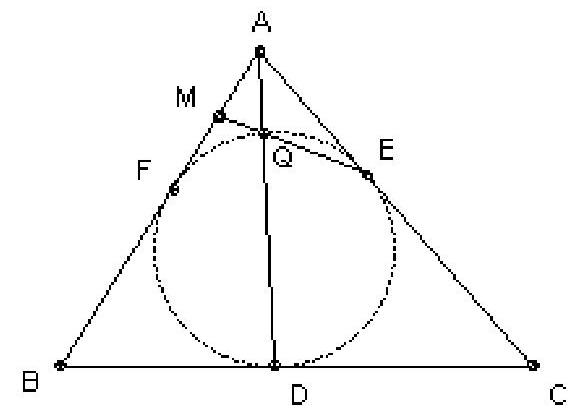
$\angle \mathrm{AQM}=\angle \mathrm{EQD}($ opposite angle $)=\angle \mathrm{EDC}(\mathrm{CD}$ tangent to circle $\mathrm{EQD})=\left(180^{\circ}-\angle \mathrm{C}\right) / 2=$ $\angle \mathrm... | proof | Geometry | proof | Yes | Yes | olympiads_ref | false |
The average monthly salary of 20 employees in an organization is Rs. 1600. If the manager's salary is added, then the average salary increases by a certain amount. The manager's monthly salary is Rs. 3700. By how much does the average salary increase when the manager's salary is added? | Let's first calculate the total salary of the 20 employees before the manager's salary is added:
Total salary of 20 employees = Average salary of 20 employees × Number of employees
Total salary of 20 employees = Rs. 1600 × 20
Total salary of 20 employees = Rs. 32000
Now, let's add the manager's salary to the total sa... | 100 | Algebra | math-word-problem | Yes | Yes | orca_math | true |
Ben's potato gun can launch a potato 6 football fields. If a football field is 200 yards long and Ben's dog can run at a certain speed in feet/minute, it takes his dog 9 minutes to fetch a potato he launches. How fast can Ben's dog run in feet/minute? | First, we need to calculate the total distance the potato is launched in yards. Since one football field is 200 yards long and the potato gun can launch a potato 6 football fields, the total distance is:
6 football fields * 200 yards/football field = 1200 yards
Now we need to convert this distance to feet because we ... | 400 | Algebra | math-word-problem | Yes | Yes | orca_math | true |

Construct a triangle given an angle and the median and altitude drawn from the vertex of this angle. | Complete the triangle $A B C$ to a parallelogram by extending its median $A M$ by a segment equal to this median.
## Solution
Suppose the triangle $A B C$ is constructed. Let angle $A$ be the given angle, $A M=m$ be the given median, and $A H=h$ be the given height. On the extension of the median $A M$ beyond point $... | notfound | Geometry | math-word-problem | Incomplete | Yes | olympiads | false |
8.062. $\cos ^{3} x+\cos ^{2} x-4 \cos ^{2} \frac{x}{2}=0$.
8.062. $\cos ^{3} x+\cos ^{2} x-4 \cos ^{2} \frac{x}{2}=0$. | ## Solution.
From the condition
$$
\cos ^{3} x+\cos ^{2} x-4 \cdot \frac{1}{2}(1+\cos x)=0, \cos ^{3} x+\cos ^{2} x-2 \cos x-2=0, \Leftrightarrow
$$
$\Leftrightarrow \cos ^{2} x(\cos x+1)-2(\cos x+1)=0, \Leftrightarrow(\cos x+1)\left(\cos ^{2} x-2\right)=0$.
Then $\cos x+1=0, \cos x=-1, x_{1}=\pi+2 \pi n=\pi(2 n+1)... | \pi(2n+1),\quadn\inZ | Algebra | math-word-problem | Yes | Yes | olympiads | false |
a vendor sells 50 percent of the apples he had and throws away 20 percent of the remainder . the next day , the vendor sells 50 percent of the remaining apples and throws away the rest . in total , what percent of his apples does the vendor throw away ? | Let's assume the vendor starts with 100 apples for simplicity.
On the first day, he sells 50% of his apples, so he sells 50 apples and is left with 50 apples.
He then throws away 20% of the remaining 50 apples, which is 10 apples. So he's left with 40 apples.
On the second day, he sells 50% of the remaining 40 apple... | 30\% | Algebra | math-word-problem | Yes | Yes | orca_math | true |
18.3. $45 \star \star$ Determine (and prove) all integer solutions of the equation $a^{2}+b^{2}+c^{2}=a^{2} b^{2}$.
Translate the above text into English, please retain the original text's line breaks and format, and output the translation result directly. | Let integers $a$, $b$, $c$ satisfy the equation.
Since the square of an odd number modulo 4 leaves a remainder of 1, if one, two, or all three of $a$, $b$, $c$ are odd, the equation will not be congruent modulo 4. Therefore, $a$, $b$, $c$ must all be even.
Let $a=2a_{1}$, $b=2b_{1}$, $c=2c_{1}$, and substitute into th... | Geometry | math-word-problem | Yes | Yes | olympiads | false | |
In a division, the dividend is 689, the divisor is 36, and the quotient is unknown. The remainder is 5. What is the quotient? | To find the quotient, we can use the following relationship between the dividend (D), the divisor (d), the quotient (Q), and the remainder (R):
D = d * Q + R
We are given:
D (dividend) = 689
d (divisor) = 36
R (remainder) = 5
We need to find Q (quotient).
Using the relationship, we can rearrange the equation to sol... | 19 | Number Theory | math-word-problem | Yes | Yes | orca_math | true |
1. Given $f(x)=3^{x-m}$ with the domain $[2,4]$, and it passes through the point $A(2,1)$. Then the range of $F(x)=\left(f^{-1}(x)\right)^{2}-$ $f^{-1}(x)$ is $(\quad)$.
(A) $[2,9]$
(B) $[2,12]$
(C) $[1,9]$
(D) $[1,12]$ | 1. B
Translate the text above into English, please retain the original text's line breaks and format, and output the translation result directly. | null | Algebra | MCQ | Yes | Yes | cn_contest | false |
Calculate: $(-18) + (-12) - (-33) + 17$. | To solve the given expression step-by-step, we start by grouping the negative numbers and simplifying them accordingly:
\[
\begin{align*}
(-18) + (-12) - (-33) + 17 &= (-18 - 12 + 33) + 17 \\
&= (-30 + 33) + 17 \\
&= 3 + 17 \\
&= 20.
\end{align*}
\]
Therefore, the final answer is $\boxed{20}$. | 20 | Algebra | math-word-problem | Yes | Yes | cn_k12 | false |
Given the space vectors $\overrightarrow{a}=(0,1,1)$ and $\overrightarrow{b}=(1,0,1)$, the angle between vector $\overrightarrow{a}$ and $\overrightarrow{b}$ is ( )
A: $60^{\circ}$
B: $120^{\circ}$
C: $30^{\circ}$
D: $150^{\circ}$ | **Analysis**
This question examines the application of spatial vectors, specifically the calculation of the angle between two spatial vectors, which involves the use of the dot product of vectors.
**Solution**
Given: $\overrightarrow{a}=(0,1,1), \overrightarrow{b}=(1,0,1)$,
Therefore, $|\overrightarrow{a}|= \sqrt{2... | A | Geometry | MCQ | Yes | Yes | cn_k12 | false |
An investor deposited $5,000 to open a new savings account that earned 8 percent annual interest, compounded quarterly. If there were no other transactions in the account, what was the amount of money in the account 6 months after the account was opened? | To calculate the amount of money in the account after 6 months with quarterly compounding interest, we can use the formula for compound interest:
A = P(1 + r/n)^(nt)
Where:
A = the amount of money accumulated after n years, including interest.
P = the principal amount (the initial amount of money).
r = the annual int... | \$5,202 | Algebra | math-word-problem | Yes | Yes | orca_math | true |
There are $2000$ components in a circuit, every two of which were initially joined by a wire. The hooligans Vasya and Petya cut the wires one after another. Vasya, who starts, cuts one wire on his turn, while Petya cuts two or three. The hooligan who cuts the last wire from some component loses. Who has the winning... | 1. **Initial Setup**:
- There are 2000 components in a circuit, and every two components are initially joined by a wire. This forms a complete graph \( K_{2000} \) with \( \binom{2000}{2} = 1999000 \) edges.
- Vasya and Petya take turns cutting wires. Vasya cuts one wire per turn, while Petya cuts two or three wi... | null | Logic and Puzzles | math-word-problem | Yes | Yes | aops_forum | false |
Vasiev $H .5$.
Let $k$ and $n$ be natural numbers, $k \leq n$. Arrange the first $n^{2}$ natural numbers in an $n \times n$ table so that the numbers in each row are in increasing order, and at the same time, the sum of the numbers in the $k$-th column is a) the smallest; b) the largest. | a) Example. If the numbers are arranged as shown in the table - first filling the first $k$ columns, row by row, with numbers from 1 to $k n$, and then filling the remaining $n-k$ columns with the remaining numbers (in any order, as long as the condition of increasing numbers in each row is met) - then the sum of the n... | )\frac{1}{2}kn(n+1);b)\frac{1}{2}n((n-1)^{2}+k(n+1)) | Combinatorics | math-word-problem | Incomplete | Yes | olympiads | false |
Which of the following propositions is true?
A: If the graph of the power function $f(x)$ passes through the point $A(3, \frac{1}{27})$, then $f(x) = x^{-3}$.
B: If the domain of the function $f(x+1)$ is $\left[0,1\right]$, then the domain of $f(3^{x})$ is $\left[3,9\right]$.
C: For $x \in \mathbb{R}$, if $f(x)$ is ... | Let's analyze each proposition step by step:
**A**: We are given that $f(x) = x^{\alpha}$ passes through the point $(3, \frac{1}{27})$. This means:
\[f(3) = 3^{\alpha} = \frac{1}{27}\]
Since $\frac{1}{27} = 3^{-3}$, we find that:
\[3^{\alpha} = 3^{-3}\]
This implies that $\alpha = -3$, so:
\[f(x) = x^{-3}\]
Therefore,... | A \text{ and } C | Algebra | MCQ | Yes | Incomplete | cn_k12 | false |
The city of Richmond has 1000 more people than Victoria. Victoria has 4 times as many people as Beacon. If Richmond has 3000 people, how many people are there in Beacon? | If Richmond has 3000 people and it has 1000 more people than Victoria, then Victoria has 3000 - 1000 = 2000 people.
Since Victoria has 4 times as many people as Beacon, we can find the population of Beacon by dividing the population of Victoria by 4.
So, Beacon has 2000 / 4 = $\boxed{500}$ people. | 500 | Algebra | math-word-problem | Yes | Yes | orca_math | true |
If the proposition $p \lor q$ is true, and the proposition $p \land q$ is false, then ( )
A: Both p and q are false
B: Both p and q are true
C: The truth values of p and $\neg q$ are different
D: The truth values of p and $\neg q$ are the same | If the proposition $p \lor q$ is true, then at least one of $p$, $q$ is true. If the proposition $p \land q$ is false, then at least one of $p$, $q$ is false. Therefore, one of $p$, $q$ is true and the other is false. That is, the truth values of $p$ and $\neg q$ are the same. Hence, the correct choice is $\boxed{D}$. | D | Logic and Puzzles | MCQ | Yes | Yes | cn_k12 | false |
Given a line $l$ has a y-intercept of $10$, and the distance from the origin to line $l$ is $8$, then the equation of line $l$ is ______________. | **Analysis**
This question examines the formula for the distance from a point to a line, as well as the equation of a line, which is a basic problem. By setting up the equation of the line based on the given conditions, and then using the formula for the distance from a point to a line, we can find the equation of the... | 3x+4y-40=0 | Geometry | math-word-problem | Yes | Yes | cn_k12 | false |
Determine how many perfect squares less than 20,000 can be expressed as the difference of squares of two consecutive even numbers. | We need a perfect square, say $a^2$, to be expressed as $(2b+2)^2 - (2b)^2$ for some nonnegative integer $b$. Simplifying the expression, we have:
\[
(2b+2)^2 - (2b)^2 = 4b^2 + 8b + 4 - 4b^2 = 8b + 4.
\]
This can be rewritten as $4(2b + 1)$, which represents all numbers that are four times an odd integer.
Now, we need... | 35 | Number Theory | math-word-problem | Yes | Yes | synthetic_math | true |
A $3\times3$ square is partitioned into $9$ unit squares. Each unit square is painted either white or black with each color being equally likely, chosen independently and at random. The square is the rotated $90^\circ$ clockwise about its center, and every white square in a position formerly occupied by a black squar... | null | null | Combinatorics | MCQ | Yes | Yes | aops_forum | false |
Given that $|\overrightarrow{a}|=1$, $|\overrightarrow{b}|=2$, and the angle between $\overrightarrow{a}$ and $\overrightarrow{b}$ is $60^{\circ}$, find the value of $|2\overrightarrow{a}-\overrightarrow{b}|=$ ( ).
A: $2$
B: $4$
C: $2\sqrt{2}$
D: $8$ | Since $|\overrightarrow{a}|=1$, $|\overrightarrow{b}|=2$, and the angle between $\overrightarrow{a}$ and $\overrightarrow{b}$ is $60^{\circ}$,
We have $\overrightarrow{a} \cdot \overrightarrow{b} = |\overrightarrow{a}| \cdot |\overrightarrow{b}| \cdot \cos 60^{\circ} = 1 \times 2 \times \frac{1}{2} = 1$.
Therefore, $... | 2 | Algebra | MCQ | Yes | Yes | cn_k12 | false |
Let's prove that there are infinitely many positive integer pairs $(a, b)$ such that
$$
2019<\frac{2^{a}}{3^{b}}<2020
$$ | Currently, we can only display texts that were published before December 1905 or between January 1937 and December 2020. Issues of KöMaL following this period can be ordered on the
http://www.komal.hu/megrendelolap/reszletek.h.shtml
page. | proof | Number Theory | proof | Yes | Problem not solved | olympiads | false |
Josie's mom gave her a $20 bill and asked her to go to the store for a few items. The list included a carton of milk for $4.00, a loaf of bread for $3.50, a box of laundry detergent, and 2 pounds of bananas that were $0.75 per pound. Her mom also gave her a coupon for $1.25 off of the laundry detergent. At checkout, th... | Let's calculate the total cost of the items Josie bought, excluding the laundry detergent, and then we can find out the initial price of the laundry detergent.
First, the milk was half off, so instead of $4.00, it cost:
$4.00 * 1/2 = $2.00
The loaf of bread cost:
$3.50
The bananas cost $0.75 per pound, and she bough... | \$10.25 | Algebra | math-word-problem | Yes | Yes | orca_math | true |
Given $a \in \mathbb{R}$, the statement "a = -2" is a ( ) condition for "line $l_1: ax+2y-1=0$ is parallel to line $l_2: x+(a+1)y+4=0$."
A. Sufficient but not necessary
B. Necessary but not sufficient
C. Both sufficient and necessary
D. Neither sufficient nor necessary | To determine if "a = -2" is a sufficient and/or necessary condition for the lines $l_1$ and $l_2$ to be parallel, we must consider two cases.
**Sufficient Condition:**
- Assume $a = -2$. Then, the equations of the lines become $l_1: -2x+2y-1=0$ and $l_2: x-y+4=0$.
- For the lines to be parallel, their slopes must be e... | A. \text{Sufficient but not necessary} | Algebra | MCQ | Yes | Yes | cn_k12 | false |
Find the sum of the solutions for the quadratic equation $-48x^2 + 110x + 165 = 0$. | For a quadratic equation of the form $ax^2 + bx + c = 0$, Vieta's formulas tell us that the sum of the roots ($x_1 + x_2$) can be found using the formula $-\frac{b}{a}$.
Here, $a = -48$ and $b = 110$. Plugging these values into the formula gives:
\[ x_1 + x_2 = -\frac{b}{a} = -\frac{110}{-48} = \frac{110}{48} = \fra... | \frac{55}{24} | Algebra | math-word-problem | Yes | Yes | synthetic_math | true |
Given that for any $x \in (-\infty, 1) \cup (5, +\infty)$, it holds that $x^2 - 2(a-2)x + a > 0$, then the range of the real number $a$ is. | **Analysis**
This problem mainly examines the solution method for quadratic inequalities. According to the graph of the quadratic function, we list different conditions based on the position of the axis of symmetry and solve them separately, then combine the results.
**Solution**
Given the condition, for any $x \in ... | (1, 5] | Inequalities | math-word-problem | Yes | Yes | cn_k12 | false |
Which of the following pairs of numbers have a greatest common divisor of 45?
A: 819, 333
B: 98, 196
C: 153, 111
D: 225, 135 | For option A: Since $819 \div 333 = 2$ remainder $153$,
$333 \div 153 = 2$ remainder $27$,
$153 \div 27 = 5$ remainder $18$,
$27 \div 18 = 1$ remainder $9$,
$18 \div 9 = 2$,
thus, the greatest common divisor of these two numbers is not 3.
For option B: Since 98 cannot be divided by 45 without a remainder, t... | \text{D} | Number Theory | MCQ | Yes | Yes | cn_k12 | false |
Compute the number of two digit positive integers that are divisible by both of their digits. For example, $36$ is one of these two digit positive integers because it is divisible by both $3$ and $6$.
[i]2021 CCA Math Bonanza Lightning Round #2.4[/i] | 1. Let the two-digit number be represented as $\overline{ab}$, where $a$ and $b$ are its digits. This means the number can be written as $10a + b$.
2. For the number $10a + b$ to be divisible by both $a$ and $b$, the following conditions must hold:
- $a \mid (10a + b)$
- $b \mid (10a + b)$
3. Since $a \mid (10a +... | 14 | Number Theory | math-word-problem | Yes | Yes | aops_forum | false |
In triangle $DEF$, $DE = 7$, $EF = 10$, and the length of median $DM$ is 5. Find $DF$. | Since $EF = 10$ and $M$ is the midpoint of $EF$, $EM = MF = 5$. Also, $DM = 5$, thus $M$ is the circumcenter of triangle $DEF$. Furthermore, $EF$ acts as a diameter of the circle, so $\angle DEF = 90^\circ$.
Then by Pythagoras' theorem applied to the right triangle $DEF$, we have:
\[ DF = \sqrt{EF^2 - DE^2} = \sqrt{10... | \sqrt{51} | Geometry | math-word-problem | Yes | Yes | synthetic_math | true |
The product of the complex number $(-1+3i)$ and $i$ is equal to _____.
A: $-3-i$
B: $3+i$
C: $-1+3i$
D: $3-i$ | Let's calculate the product of the complex number $(-1+3i)$ by $i$:
\begin{align*}
(-1+3i) \cdot i &= (-1) \cdot i + (3i) \cdot i \\
&= -i + 3i^2.
\end{align*}
Now we'll use the property that $i^2 = -1$:
\begin{align*}
-i + 3i^2 &= -i + 3(-1) \\
&= -i - 3 \\
&= -3 - i.
\end{align*}
So the product is $\boxed{-3 - i}$. | -3 - i | Algebra | MCQ | Yes | Yes | cn_k12 | false |
In the Cartesian coordinate system $xOy$, the point that is on the same side of the origin as the line $3x+2y+5=0$ is ( )
A: $(-3, 4)$
B: $(-3, -2)$
C: $(-3, -4)$
D: $(0, -3)$ | When $x=0$, $y=0$, we have $0+0+5>0$.
For option A: When $x=-3$, $y=4$, we get $-9+8+5>0$, thus it satisfies the condition.
For option B: When $x=-3$, $y=-2$, we get $-9-4+5<0$, thus it does not satisfy the condition.
For option C: When $x=-3$, $y=-4$, we get $-9-8+5<0$, thus it does not satisfy the condition.
For ... | \text{A} | Geometry | MCQ | Yes | Yes | cn_k12 | false |
Let $a$, $b$ and $c$ positive integers. Three sequences are defined as follows:
[list]
[*] $a_1=a$, $b_1=b$, $c_1=c$[/*]
[*] $a_{n+1}=\lfloor{\sqrt{a_nb_n}}\rfloor$, $\:b_{n+1}=\lfloor{\sqrt{b_nc_n}}\rfloor$, $\:c_{n+1}=\lfloor{\sqrt{c_na_n}}\rfloor$ for $n \ge 1$[/*]
[/list]
[list = a]
[*]Prove that for any $a$, $b$,... | ### Part (a)
1. Define the sequences \(a_n\), \(b_n\), and \(c_n\) as given:
\[
a_1 = a, \quad b_1 = b, \quad c_1 = c
\]
\[
a_{n+1} = \lfloor \sqrt{a_n b_n} \rfloor, \quad b_{n+1} = \lfloor \sqrt{b_n c_n} \rfloor, \quad c_{n+1} = \lfloor \sqrt{c_n a_n} \rfloor \quad \text{for} \quad n \geq 1
\]
2. Co... | N = 3 | Number Theory | math-word-problem | Yes | Yes | aops_forum | false |
If the function $f(x)=\log_{a}(2-ax) (a > 0, a \neq 1)$ is monotonically increasing in the interval $(1,3)$, then the range of values for $a$ is $(\quad)$
A: $\left[ \frac{2}{3},1\right)$
B: $\left(0, \frac{2}{3}\right]$
C: $\left(1, \frac{3}{2}\right)$
D: $\left[ \frac{3}{2},+\infty\right)$ | Let $y=\log_{a}t$, $t=2-ax$,
Since $a > 0$,
Therefore, $t=2-ax$ is monotonically decreasing in $(1,3)$.
Since $f(x)=\log_{a}(2-ax) (a > 0, a \neq 1)$ is monotonically increasing in the interval $(1,3)$,
Therefore, the function $y=\log_{a}t$ is a decreasing function, and $t(x) > 0$ holds in $(1,3)$.
Therefore,... | \text{B} | Algebra | MCQ | Yes | Yes | cn_k12 | false |
$12 \cdot 148 p$ is a prime number, find all positive integer solutions $(x, y, z, p)$ of the equation $x^{p}+y^{p}=p^{z}$.
(Bulgarian Mathematical Olympiad, 1994) | [Solution] If $(x, y, z, p)$ is a set of positive integer solutions to the equation
$$
x^{p}+y^{p}=p^{z}
$$
and since $p$ is a prime number, then
$$
(x, y)=p^{k}.
$$
Here $k$ is a non-negative integer. From (2) we have
$$
x=p^{k} x_{0}, \quad y=p^{k} y_{0}.
$$
Here $\left(x_{0}, y_{0}\right)=1, x_{0} \in N, y_{0} \i... | (2^{k},2^{k},2k+1,2),(3^{k},2\cdot3^{k},2+3k,3),(2\cdot3^{k},3^{k},2+3k,3) | Number Theory | math-word-problem | Yes | Yes | olympiads | false |
The digits $1, 3, 4, 5,$ and $6$ can be arranged to form many different $5$-digit positive integers with five distinct digits. In how many such integers is the digit $1$ to the left of both digits $3$ and $5$? | 1. Calculate the total number of arrangements of the digits, which is $5! = 5 \times 4 \times 3 \times 2 \times 1 = 120$.
2. For each arrangement where $1$ is to the left of both $3$ and $5$, notice that there can be multiple scenarios: $3$ and $5$ can be in any order relative to each other but must both be right of $1... | 36 | Combinatorics | math-word-problem | Yes | Yes | synthetic_math | true |
16) Determine the area of the polygon obtained as the union of two squares, both with side length 1, having the same center and rotated by $45^{\circ}$ relative to each other.
(A) $4-2 \sqrt{2}$
(B) $\frac{9}{8}$
(C) $2-\frac{\sqrt{3}}{2}$
(D) $\frac{5}{4}$
(E) the above answers are incorrect.
 The answer is (A). The segments $A B, B C, C D$ and $E D$ have the same length, which we denote as $x$. The side $B D$ is the hypotenuse of the right-angled and isosceles triangle $B C D$, so its length is $x \sqrt{2}$. The length of the side $A E$, which we know is 1, is equal to the sum of the lengths of $A B, B ... | 4-2\sqrt{2} | Geometry | MCQ | Yes | Yes | olympiads | false |
The negation of the proposition "For any $x \in \mathbb{R}, |x| + x^2 \geq 0$" is ( )
A: For any $x \in \mathbb{R}, |x| + x^2 < 0$
B: There exists an $x \in \mathbb{R}, |x| + x^2 \leq 0$
C: There exists an $x_0 \in \mathbb{R}, |x_0| + x_0^2 < 0$
D: There exists an $x_0 \in \mathbb{R}, |x_0| + x_0^2 \geq 0$ | Since the negation of a universal proposition is an existential proposition, the negation of the proposition "For any $x \in \mathbb{R}, |x| + x^2 \geq 0$" is "There exists an $x_0 \in \mathbb{R}, |x_0| + x_0^2 < 0$".
Therefore, the correct option is: C.
**Analysis:** Directly use the fact that the negation of a uni... | C | Inequalities | MCQ | Yes | Yes | cn_k12 | false |
4. In rectangle $A B C D$, point $E$ is the midpoint of side $B C$, and distinct points $F$ and $G$ lie on segment $[\mathrm{AB}]$, such that $\mathrm{AF}=\mathrm{FG}$. Lines $\mathrm{EF}$ and $\mathrm{CG}$ intersect lines $\mathrm{AC}$ and $\mathrm{AD}$ at points $M$ and $N$, respectively. Prove that lines $MN$ and $B... | Solution. Let K be the midpoint of segment $[\mathrm{CD}]$ and $\mathrm{O}$ the center of the rectangle.

From $\triangle N A G \sim \triangle N D C$ we get $\frac{A G}{D C}=\frac{N A}{N D} \... | proof | Geometry | proof | Yes | Yes | olympiads | false |
The pet shop grooms dogs. It takes some time to groom a poodle. It takes half as much time to groom a terrier as it takes to groom a poodle. They do not groom cats. If the pet shop grooms 3 poodles and 8 terriers, and it takes a total of 210 minutes, how long does it take to groom a poodle? | Let's denote the time it takes to groom a poodle as P minutes. According to the information given, it takes half as much time to groom a terrier, which would be P/2 minutes.
We are told that the pet shop grooms 3 poodles and 8 terriers, and the total time taken is 210 minutes. We can set up the following equation to r... | 30 | Algebra | math-word-problem | Yes | Yes | orca_math | true |
A straight line is tangent to the graphs of the functions $y=\ln x$ and $y=e^{x}$ at points $P(x_{1}, y_{1})$ and $Q(x_{2}, y_{2})$ respectively. The value of $(1-e^{y_1})(1+x_2)$ is ______. | To solve for the value of $(1-e^{y_1})(1+x_2)$ given that a straight line is tangent to the graphs of the functions $y=\ln x$ and $y=e^{x}$ at points $P(x_{1}, y_{1})$ and $Q(x_{2}, y_{2})$ respectively, we follow these steps:
1. **Differentiate the given functions** to find the slopes of the tangents at any point on ... | 2 | Calculus | math-word-problem | Yes | Yes | cn_k12 | false |
A person spends 1/3 of the money he has on clothes, 1/5 of the remaining on food, and 1/4 of the remaining on travel. Now, he is left with Rs 200. How much money did he have with him in the beginning? | Let's denote the initial amount of money the person had as M.
After spending 1/3 on clothes, he is left with 2/3 of M.
Then he spends 1/5 of the remaining amount on food, so he is left with 4/5 of (2/3 of M), which is (4/5) * (2/3) * M = (8/15) * M.
Next, he spends 1/4 of the remaining amount on travel, so he is lef... | 500 | Algebra | math-word-problem | Yes | Yes | orca_math | true |
Among the natural numbers not exceeding 10,000, the number of odd numbers with distinct digits is ( )
A: 1260
B: 1530
C: 2260
D: 2605 | (1) There are 5 one-digit numbers that meet the criteria: 1, 3, 5, 7, 9.
(2) There are $5 \times 8 = 40$ two-digit numbers that meet the criteria.
(3) For three-digit numbers, there are:
- 40 numbers containing 0, calculated as $5 \times 8 = 40$.
- 280 numbers not containing 0, calculated as $5 \times 8 \times ... | D | Combinatorics | MCQ | Yes | Yes | cn_k12 | false |
The line $2x+3y-6=0$ intersects the x-axis and y-axis at points A and B, respectively. Point P is on the line $y=-x$. To minimize $|PA|+|PB|$, the coordinates of point P are ( )
A: $(-1,1)$
B: $(0,0)$
C: $(1,-1)$
D: $\left(\frac{1}{2},-\frac{1}{2}\right)$ | From the problem, we have $A(3,0)$ and $B(0,2)$.
Let the point $B'$ be the reflection of point $B(0,2)$ across the line $y=-x$,
then from $$\begin{cases} \frac{n-2}{m}\cdot (-1)=-1 \\ \frac{2+n}{2}=-\frac{m}{2}\end{cases}$$, we find $$\begin{cases} m=-2 \\ n=0\end{cases}$$, thus $B'(-2,0)$,
Therefore, the equatio... | B | Geometry | MCQ | Yes | Yes | cn_k12 | false |
5,200 people boarded a ferry. 55% of the passengers were women. If 16% of the women and 12% of the men wore hats, how many passengers in total were wearing hats? | First, we determine the number of women and men from the total passengers:
- Total passengers = 5,200
- Percentage of women = 55%
- Number of women = 55% of 5,200 = 0.55 × 5,200 = 2,860
- Number of men = 45% of 5,200 = 0.45 × 5,200 = 2,340
Next, we calculate the number of women and men who were wearing hats:
- 16% of ... | 739 | Algebra | math-word-problem | Yes | Yes | synthetic_math | true |
Calculate the volume in cubic feet of a cylindrical water tank that is 20 feet in diameter and 10 feet deep. Express your answer in terms of $\pi$. | 1. **Find the radius of the tank:** Since the diameter of the tank is 20 feet, the radius $r$ is half of the diameter.
\[
r = \frac{20}{2} = 10 \text{ feet}
\]
2. **Use the volume formula for a cylinder:** The formula for the volume $V$ of a cylinder is given by $V = \pi r^2 h$, where $r$ is the radius and $... | 1000\pi | Geometry | math-word-problem | Yes | Yes | synthetic_math | true |
Given that the complex number $z$ satisfies $(z+i)i=-3+4i$ ($i$ is the imaginary unit), find the modulus of $z$. | We start with the given equation $(z+i)i=-3+4i$.
Multiply both sides by $i$:
$(z+i)i^2=(-3+4i)i$,
Recall that $i^2=-1$, so we have:
$-z-i=-3i-4$.
Now, solve for $z$:
$z=4+2i$.
The modulus of a complex number $z=a+bi$ is given by $|z|=\sqrt{a^2+b^2}$, so:
$|z|=\sqrt{4^2+2^2}=2\sqrt{5}$.
Therefore, the modulus o... | 2\sqrt{5} | Algebra | math-word-problem | Yes | Yes | cn_k12 | false |
Problem 9.5. Given a rectangle $A B C D$. A circle intersects side $A B$ at points $K$

$C$ and $N)$. Find the length of segment $M N$, if $A K=10, K L=17, D N=7$.
 at least three dwarfs do these two... | 【Analysis】This problem can be transformed into a number-filling problem on a chessboard table, specifically as follows:
In a $7 \times 16$ grid, fill numbers. If the $i$-th dwarf works in the mine on the $j$-th day, then the cell in the $i$-th row and $j$-th column is filled with 0; otherwise, it is filled with 1.
Th... | proof | Combinatorics | proof | Yes | Yes | olympiads | false |
Three unit squares and two line segments connecting two pairs of vertices are shown. What is the area of $\triangle ABC$?
[asy]
size(200);
defaultpen(linewidth(.6pt)+fontsize(12pt));
dotfactor=4;
draw((0,0)--(0,2));
draw((0,0)--(1,0));
draw((1,0)--(1,2));
draw((0,1)--(2,1));
draw((0,0)--(1,2));
draw((0,2)--(2,1));
dra... | null | null | Geometry | MCQ | Yes | Yes | aops_forum | false |
Given the inequality in $x$, $\frac {x-a}{x+1} < 0$, let its solution set be P. Let the solution set of the inequality $|x-1| \leq 1$ be Q.
(1) If $a=3$, find P.
(2) If $P \cap Q = Q$, find the value of the positive number $a$. | (1) When $a=3$, the inequality becomes $\frac {x-3}{x+1} -1$, the denominator is positive. Thus, the numerator must be negative, which occurs when $x 0$ which leads to $x > -1$,
b. $x-3 < 0$ which leads to $x < 3$.
Combining these conditions, we get $-1 < x < 3$. Therefore, the solution set P is $\boxed{P = \{x | -1... | P = \{x | -1 < x < 3\} | Inequalities | math-word-problem | Yes | Incomplete | cn_k12 | false |
Let $I$ be the incenter of triangle $ABC$ and let $D$ be the midpoint of side $AB$. Prove that if the angle $\angle AOD$ is right, then $AB+BC=3AC$.
[I]Proposed by S. Ivanov[/i] | 1. **Identify Key Points and Given Information:**
- Let \( I \) be the incenter of triangle \( ABC \).
- Let \( D \) be the midpoint of side \( AB \).
- Given that \( \angle AOD \) is a right angle, where \( O \) is the circumcenter of \( \triangle ABC \).
2. **Use the Incenter Lemma:**
- Let \( BI \) inte... | AB + BC = 3AC | Geometry | proof | Yes | Yes | aops_forum | false |
5. (1999 National High School Mathematics League Question) Given that the base of the tetrahedron $S-ABC$ is an equilateral triangle, the projection of point $A$ on the side face $SBC$ is $H$, which is the orthocenter of $\triangle SBC$, the plane angle of the dihedral angle $H-ABC$ is $30^{\circ}$, and $SA=2\sqrt{3}$.... | 5. Given that the dihedral angle $H-AB-C$ has a plane angle of $30^{\circ}$, we can first construct the plane angle of the dihedral angle, and then find the height and the area of the base.
From the problem, $AH \perp$ plane $SBC$. Draw $BH \perp SC$ at $E$. By the theorem of three perpendiculars, we know that $SC \pe... | \frac{9}{4}\sqrt{3} | Geometry | math-word-problem | Yes | Yes | olympiads | false |
In the 2017 zero-start minor language direct admission interview of a certain school, our school obtained a total of 5 recommendation spots, among which there were 2 for Russian, 2 for Japanese, and 1 for Spanish. Additionally, it was required that both the Japanese and Russian exams must have male participants. The sc... | Since the problem states that both the Japanese and Russian exams must have male participants,
First, select one of the three male students to take the Japanese exam, which has 3 possible outcomes,
Then, select one of the remaining male students to take the Russian exam, which has 2 possible outcomes,
The remaini... | C | Combinatorics | MCQ | Yes | Yes | cn_k12 | false |
146. a) Two players are playing a game. The first player writes down two rows of 10 numbers each, such that the following rule is satisfied: if the number $b$ is written under the number $a$, and the number $d$ is written under the number $c$, then $a+d=b+c$. The second player, knowing this rule, wants to determine all... | 146. a) Answer: 11 questions. Knowing all 10 numbers in one row and one in another, it is easy to restore all the other numbers. If, however, only 10 questions are asked, it is impossible to uniquely restore the numbers; on the one hand, in each column, at least one number must be known—otherwise, an arbitrary number $... | +n-1 | Combinatorics | math-word-problem | Yes | Yes | olympiads | false |
It is now 3:00:00 PM, as read on a 12-hour digital clock. In 315 hours, 58 minutes, and 36 seconds, the time will be $A:B:C$. What is the value of $A + B + C$? | 1. **Determine the hour**: Since the clock operates on a 12-hour cycle, we divide 315 hours by 12 to find the remainder:
\[
315 \div 12 = 26 \text{ remainder } 3
\]
So, 3 hours past the last complete cycle. Starting at 3:00:00 PM and adding 3 hours gives 6:00:00 PM.
2. **Add minutes and seconds**: Adding 5... | 100 | Logic and Puzzles | math-word-problem | Yes | Yes | synthetic_math | true |
Tom takes medication to help him sleep. He takes 2 pills every day before bed. He needs to go to the doctor every 6 months to get a new prescription and a visit to the doctor costs $400. The medication costs $5 per pill. He pays $1530 a year for everything, including insurance coverage. What percentage of the medicatio... | First, let's calculate the total cost of the medication for a year without insurance.
Tom takes 2 pills every day, so in a year (365 days), he will take:
2 pills/day * 365 days/year = 730 pills/year
At $5 per pill, the total cost for the pills alone would be:
730 pills/year * $5/pill = $3650/year
Tom also visits the... | 80\% | Algebra | math-word-problem | Yes | Yes | orca_math | true |
Example 3 Let positive integers $x, y, p, n, k$ satisfy
$$
x^{n}+y^{n}=p^{k} \text {. }
$$
Prove: If $n$ is an odd number greater than 1, and $p$ is an odd prime, then $n$ can be expressed as a power of $p$ with a natural number as the exponent.
(22nd Russian Mathematical Olympiad (9th grade)) | Prove that since $n$ is odd, then
$$
(x+y) \mid\left(x^{n}+y^{n}\right) \text {. }
$$
From the equation, we know $x+y=p^{r}$ (positive integer $r \leqslant k$). Let $p^{s} \| n$. By the lemma, we have
$$
p^{s+r} \|\left[x^{n}-(-y)^{n}\right]=x^{n}+y^{n}=p^{k} \text {. }
$$
Therefore, $s=k-r$.
If $n=p^{s} q(q>1,(p, q)... | proof | Number Theory | proof | Yes | Yes | cn_contest | false |
Example 3 Find the values of $a$ and $b$ such that the polynomial
$$
x^{4}+(2 a+1) x^{3}+(a-1)^{2} x^{2}+b x+4
$$
can be factored into the product of two quadratic polynomials $P(x)$ and $Q(x)$ with leading coefficients of 1, and
(1) $P(x)=0$ has two distinct real roots $r$ and $s$;
(2) $\boldsymbol{Q}(r)=s, Q(s)=r$.
... | Solution: From (1), let
$$
\begin{aligned}
P(x) & =x^{2}+u x+v \\
& =x^{2}-(r+s) x+r s .
\end{aligned}
$$
Let $Q(x)=x^{2}+w x+t$, then from (2) we have
$$
\left\{\begin{array}{l}
r^{2}+w r+t=s, \\
s^{2}+w s+t=r .
\end{array}\right.
$$
Solving, we get $\left\{\begin{array}{l}w=-(r+s+1) \\ t=r s+r+s .\end{array}\right.... | a=2, b=-14 \text { or } a=-1, b=-2 | Algebra | math-word-problem | Yes | Yes | cn_contest | false |
To obtain the graph of the function $y=\sin 3x+\cos 3x$, the graph of the function $y=\sqrt {2}\sin 3x$ should be:
A: shifted right by $\frac {π}{4}$ units
B: shifted left by $\frac {π}{4}$ units
C: shifted right by $\frac {π}{12}$ units
D: shifted left by $\frac {π}{12}$ units | Since the function $y=\sin 3x+\cos 3x= \sqrt {2}\sin (3x+ \frac {π}{4})= \sqrt {2}\sin 3(x+ \frac {π}{12})$,
Therefore, by shifting the graph of the function $y= \sqrt {2}\sin 3x$ left by $\frac {π}{12}$ units, we can obtain the graph of the function $y=\sin 3x+\cos 3x$.
Hence, the answer is $\boxed{D}$.
According t... | D | Algebra | MCQ | Yes | Yes | cn_k12 | false |
11 Given a closed spatial broken line. A certain plane intersects all its segments: $A_{1} A_{2}$ at point $B_{1}, A_{2} A_{3}$ - at point $B_{2}, \ldots, A_{\mathrm{n}} A_{1}$-- at point $B_{\mathrm{n}}$. Prove that
$$
\frac{A_{1} B_{1}}{B_{1} A_{2}} \frac{A_{2} B_{2}}{B_{2} A_{3}} \cdots \frac{A_{n} B_{n}}{B_{n} A_{... | Consider the projection onto a line orthogonal to the plane of section. All points $B_{1}, \ldots, B_{\mathrm{n}}$ are projected into the same point $B$. Let $A_{1}^{\prime}, \ldots, A_{\mathrm{n}}^{\prime}$ be the projections of points $A_{1}, \ldots, A_{\mathrm{n}}$. Then
$$
\frac{A_{1} B_{1}}{B_{1} A_{2}} \frac{A_{... | proof | Geometry | proof | Yes | Yes | olympiads | false |
A girl was asked to multiply a certain number by 43. She mistakenly multiplied it by 34 and got her answer less than the correct one by some amount. The number to be multiplied is 135. By how much was her answer less than the correct one? | To find out by how much her answer was less than the correct one, we need to calculate the difference between the correct multiplication and the mistaken multiplication.
The correct multiplication is:
135 (the number to be multiplied) × 43 (the correct multiplier)
The mistaken multiplication is:
135 (the number to be... | 1215 | Algebra | math-word-problem | Yes | Yes | orca_math | true |
There were 8 friends playing a video game online when some players quit. Each player left had 3 lives. They had a total of 15 lives. How many players quit the game? | If each player left had 3 lives and together they had a total of 15 lives, we can divide the total number of lives by the number of lives per player to find out how many players are left.
15 lives ÷ 3 lives per player = 5 players left
Originally, there were 8 friends playing the game. If there are now 5 players left,... | 3 | Logic and Puzzles | math-word-problem | Yes | Yes | orca_math | true |
Given the sequence $\{a_n\}$ whose general term formula is $a_n=-n^2+12n-32$, and its sum of the first $n$ terms is $S_n$, then for any $n > m$ (where $m, n \in \mathbb{N}^*$), the maximum value of $S_n-S_m$ is | **Analysis**
This question examines the general term formula of a sequence and its summation, which is a basic problem.
**Solution**
Given $a_n=-n^2+12n-32=-(n-4)\cdot(n-8) > 0$ implies $4 < n < 8$,
which means in the sequence $\{a_n\}$, the first three terms and the terms from the ninth onwards are all negative, a... | 10 | Algebra | math-word-problem | Yes | Yes | cn_k12 | false |
Let $ABCD$ be a convex quadrilateral. A circle passing through the points $A$ and $D$ and a circle passing through the points $B$ and $C$ are externally tangent at a point $P$ inside the quadrilateral. Suppose that $\angle PAB+\angle PDC \leq 90^{\circ}$ and $\angle PBA+\angle PCD \leq 90^{\circ}.$ Prove that $AB+CD\ge... | null | null | Geometry | proof | Yes | Yes | aops_forum | false |
Given the function $f(x)=x^{5}+ax^{4}-bx^{2}+1$, where $a$ is the decimal equivalent of $1202_{(3)}$, and $b$ is the greatest common divisor of $8251$ and $6105$. Use Qin Jiushao's algorithm to find the value of $V_{3}$ when $x=-1$. | First, convert the ternary number $1202_{(3)}$ to decimal: $a=1\times3^{3}+2\times3^{2}+0\times3^{1}+2\times3^{0}=47$.
Next, apply the Euclidean algorithm to find the greatest common divisor of $8251$ and $6105$:
$8251=6105+2146$,
$6105=2146\times2+1813$,
$2146=1813+333$,
$1813=333\times5+148$,
$333=148\times2+37$,
$1... | 9 | Algebra | math-word-problem | Yes | Yes | cn_k12 | false |
Mandy’s phone data plan charges $x per month for data. Her first month, she got a promotional rate of one-third the normal price. However, in the fourth month she went over her data limit and was charged an extra fee of $15. Mandy paid 175 in the first 6 months for data. What is the value of unknown variable x? What is... | To determine the value of \( x \), the monthly data plan charge, we need to set up an equation based on the information given about Mandy's payments over the first 6 months.
1. **First Month:**
Mandy paid one-third of the normal price.
\[
\text{Cost for the first month} = \frac{x}{3}
\]
2. **Second and Th... | 25.26 | Algebra | math-word-problem | Yes | Yes | metamath | true |
Group Event 10
In rectangle $A B C D, A D=10, C D=15, P$ is a point inside the rectangle such that $P B=9, P A=12$. Find (Reference: $\mathbf{2 0 0 1}$ FG2.2, $\mathbf{2 0 0 3}$ FI3.4) | G10.1 $a$, the length of $P D$ and
$$
\begin{array}{l}
A P^{2}+B P^{2}=12^{2}+9^{2}=144+81=225=15^{2}=A B^{2} \\
\therefore \angle A P B=90^{\circ} \text { (Converse, Pythagoras' theorem) }
\end{array}
$$
Let $\angle A B P=\theta$, then $\cos \theta=\frac{9}{15}=\frac{3}{5}, \sin \theta=\frac{4}{5}$
$$
\begin{array}{l... | 4 | Geometry | math-word-problem | Incomplete | Yes | olympiads | false |
Find the smallest positive angle $\theta$, in degrees, for which
\[
\cos \theta = \sin 45^\circ + \cos 60^\circ - \sin 30^\circ - \cos 15^\circ.
\] | Firstly, apply the known trigonometric identities:
\[
\sin 45^\circ = \cos (90^\circ - 45^\circ) = \cos 45^\circ,
\]
\[
\cos 60^\circ = \cos (360^\circ - 60^\circ) = \cos 300^\circ,
\]
\[
-\sin 30^\circ = -\cos (90^\circ - 30^\circ) = -\cos 60^\circ = \cos (180^\circ - 60^\circ) = \cos 120^\circ,
\]
\[
-\cos 15^\circ =... | 75^\circ | Algebra | math-word-problem | Yes | Yes | synthetic_math | true |
A factory's emissions are filtered before being released. The pollution level of the emissions before filtering is $P_0$ mg/L. The relationship between the pollution level $P$ mg/L and time $t$ hours during the filtering process is $P = P_0e^{-kt}$. If 10% of the pollutants are eliminated in the first 5 hours, then aft... | Given that $P_0e^{-5k} = P_0 \times (1 - 10\%)$, we have $e^{-5k} = 0.9$. Therefore, $P_0e^{-10k} = P_0 \times 0.81$, which means that after 10 hours, 81% of the pollutants remain.
Thus, the final answer is $\boxed{81\%}$. | 81\% | Algebra | math-word-problem | Yes | Yes | cn_k12 | false |
The forty-seventh question, as shown in the figure, $\triangle A B C$ is inscribed in $\odot 0, A D \perp B C$ at $D, A D$ intersects $C O$ at $E, F$ is the midpoint of $A E, F O$ intersects $E C$ at $\mathrm{H}, \mathrm{CG} \perp \mathrm{AO}$ at $\mathrm{G}$, prove that: $\mathrm{B}, \mathrm{H}, O, G$ are concyclic. | Proof Method One: As shown in the figure, extend $\mathrm{AO}$ to intersect $\odot 0$ at J, and connect $\mathrm{EJ}$, $\mathrm{BJ}$, and $\mathrm{CJ}$.
Since $\angle \mathrm{BCJ} = \angle \mathrm{BAJ} = \angle \mathrm{CAE}$ and $\angle \mathrm{CBJ} = \angle \mathrm{CAJ} = \angle \mathrm{ACE}$, we have $\triangle \math... | proof | Geometry | proof | Yes | Yes | olympiads | false |
9.1. What is the largest number of different natural numbers that can be chosen so that the sum of any three of them is a prime number? | Solution. One example of four numbers that satisfy the condition of the problem is $1,3,7,9$. Indeed, the numbers $1+3+7=11, 1+3+9=13, 1+7+9=17, 3+7+9=19$ are prime.
Suppose it was possible to choose five numbers. Consider the remainders of these numbers when divided by 3. If there are three identical remainders among... | 4 | Number Theory | math-word-problem | Yes | Yes | olympiads | false |
Find the number of ordered pairs $(x,y)$ of real numbers such that
\[16^{x^2 + y} + 16^{x + y^2} = X
If we know the answer to the above question is 1, what is the value of unknown variable X? | To determine the value of \(X\) for which the equation \(16^{x^2 + y} + 16^{x + y^2} = X\) has exactly one ordered pair \((x, y)\) of real numbers, we start by analyzing the given equation.
First, let's rewrite the equation using the properties of exponents:
\[
16^{x^2 + y} + 16^{x + y^2} = X
\]
Since \(16 = 2^4\), we... | 2 | Algebra | math-word-problem | Yes | Incomplete | metamath | true |
The number $6\,41G\,507\,3H6$ must be divisible by $72$. If $G$ and $H$ each represent a single digit, find the sum of all distinct possible values of the product $GH$ (count each possible value of $GH$ only once, even if it results from multiple $G,$ $H$ pairs). | For $6\,41G\,507\,3H6$ to be divisible by $72,$ it must be divisible by both $8$ and $9.$
**Divisibility by 8**:
To fulfill the condition of divisibility by $8,$ the last three digits $3H6$ must be divisible by $8.$ We test the possible values:
- $H=0$: $306$ is divisible by $8.$
- $H=2$: $326$ is not divisible by $8... | 42 | Number Theory | math-word-problem | Yes | Yes | synthetic_math | true |
To build a wall of 8 m x 6 m x some height, 1600 bricks, each measuring 100 cm x 11.25 cm x 6 cm, will be needed. What is the height of the wall? | First, let's calculate the volume of one brick. The volume of a brick is found by multiplying its length, width, and height:
Volume of one brick = Length × Width × Height
Volume of one brick = 100 cm × 11.25 cm × 6 cm
Volume of one brick = 1125 cm × 6 cm
Volume of one brick = 6750 cm³
Now, let's calculate the total v... | 22.5 | Geometry | math-word-problem | Yes | Yes | orca_math | true |
If $C_{n}^{0}+2C_{n}^{1}+4C_{n}^{2}+\cdots+{2}^{n}C_{n}^{n}=729$, then $n=\_\_\_\_\_$, $C_{n}^{1}+C_{n}^{2}+C_{n}^{3}+\cdots+C_{n}^{n}=\_\_\_\_\_$. | **Analysis**
This question examines combinations and the combinatorial formula. When $n=6$, $C_{6}^{0}+2C_{6}^{1}+4C_{6}^{2}+\cdots+{2}^{6}C_{6}^{6}=729$, we can obtain $n=6$, $C_{n}^{1}+C_{n}^{2}+C_{n}^{3}+\cdots+C_{n}^{n}=C_{6}^{1}+C_{6}^{2}+C_{6}^{3}+\cdots+C_{6}^{6}$, and then derive the answer.
**Solution**
Whe... | 63 | Combinatorics | math-word-problem | Yes | Yes | cn_k12 | false |
If $a_3 = 5$, $a_5 = 8$, and there exists a positive integer $n$ such that $a_n + a_{n+1} + a_{n+2} = 7$, then $a_{2005} =$ ? | Given $a_1 + a_2 + a_3 = 7$ (1), $a_2 + a_3 + a_4 = 7$ (2), and $a_3 + a_4 + a_5 = 7$ (3),
By adding equations (1) and (3) and then subtracting equation (2), we get $5 + a_1 + 8 = 7$, which leads to $a_1 = -6$.
Therefore, from $5 + a_2 - 6 = 7$, we find $a_2 = 8$.
And from $8 - 6 + a_4 = 7$, we get $a_4 = 5$.
Thus,... | -6 | Algebra | math-word-problem | Yes | Yes | cn_k12 | false |
Wendy ran 19.83 miles and walked 9.17 miles. Wendy ran _____ farther than she walked . | To find out how much farther Wendy ran than she walked, you subtract the distance she walked from the distance she ran:
19.83 miles (ran) - 9.17 miles (walked) = 10.66 miles
Wendy ran $\boxed{10.66}$ miles farther than she walked. | 10.66 | Algebra | math-word-problem | Yes | Yes | orca_math | true |
A class composed of some girls and 10 boys was sent to the library for their reading class. Their teacher found out that only 5/6 of the girls and 4/5 of the boys are reading. There are 4 students not reading. How many girls are in the class? | Let's denote the number of girls in the class as G.
According to the information given, 5/6 of the girls are reading, which means 1/6 of the girls are not reading. Similarly, 4/5 of the boys are reading, which means 1/5 of the boys are not reading.
We know there are 10 boys in the class, so the number of boys not rea... | 12 | Algebra | math-word-problem | Yes | Yes | orca_math | true |
Given vectors $\overrightarrow{a}=(\cos 2x,\sin 2x)$ and $\overrightarrow{b}=(\sqrt{3},1)$, and the function $f(x)= \overrightarrow{a}\cdot \overrightarrow{b}+m$.
$(1)$ Find the smallest positive period of $f(x)$;
$(2)$ When $x\in[0, \frac{\pi}{2}]$, the minimum value of $f(x)$ is $5$, find the value of $m$. | $(1)$ According to the problem, we have: $f(x)=\cos (2x,\sin 2x)\cdot( \sqrt{3},1)= \sqrt{3}\cos 2x+\sin 2x+m=2\sin (2x+ \frac{\pi}{3})+m$,
so the smallest positive period of $f(x)$ is $T=\pi$.
Thus, the answer to the first question is $\boxed{\pi}$.
$(2)$ From $(1)$, we know: $f(x)=2\sin (2x+ \frac{\pi}{3})+m$, ... | 5+\sqrt{3} | Algebra | math-word-problem | Yes | Yes | cn_k12 | false |
Given that $f(x)$ is an odd function defined on $\mathbb{R}$, and when $x > 0$, $f(x)=\log_{2}x$, determine the solution set for $f(x) > 0$. | Let $x 0$.
- When $x \in (0, +\infty)$, $f(x) = \log_{2}x$, thus $f(-x) = \log_{2}(-x)$.
- Since $f(x)$ is an odd function, $f(x) = -f(-x) = -\log_{2}(-x)$.
Now we have two cases:
1. When $x \in (0, +\infty)$, $f(x) > 0$, which implies $\log_{2}x > 0$. Solving this inequality, we get $1 0$, which implies $-\log_{2... | (1, +\infty) \cup (-1, 0) | Algebra | math-word-problem | Yes | Yes | cn_k12 | false |
98. One day, Tang僧 and his four disciples came to a small shop. The owner and the young helper were so frightened by the appearance of the disciples that they ran away. The four disciples had to do the cooking themselves, with one fetching water, one washing vegetables, one making a fire, and one rinsing rice. Now we k... | 答案: washing vegetables, rinsing rice, fetching water, making fire | Logic and Puzzles | math-word-problem | Yes | Problem not solved | olympiads | false |
Subsets and Splits
No community queries yet
The top public SQL queries from the community will appear here once available.