
instruction_seed stringlengths 2 10.7k | solution stringlengths 0 10.8k ⌀ | answer stringlengths 0 575 ⌀ | problem_type stringclasses 9
values | question_type stringclasses 5
values | problem_is_valid stringclasses 5
values | solution_is_valid stringclasses 4
values | source stringclasses 11
values | synthetic bool 2
classes |
|---|---|---|---|---|---|---|---|---|
$7.9(C M O 20)$ A circle intersects the sides $BC$, $CA$, and $AB$ of $\triangle ABC$ at points $D_{1}$, $D_{2}$, $E_{1}$, $E_{2}$, $F_{1}$, and $F_{2}$, respectively. The line segments $D_{1} E_{1}$ and $D_{2} F_{2}$ intersect at point $L$, the line segments $E_{1} F_{1}$ and $E_{2} D_{2}$ intersect at point $M$, and ... | 7.9 Draw perpendiculars from point $L$ to $AB$ and $AC$, with feet of the perpendiculars being $L'$ and $L''$, respectively. Let $\angle L A B=\alpha_{1}, \angle L A C=\alpha_{2}, \angle L F_{2} A=\alpha_{3}, \angle L E_{1} A=\alpha_{4}$. Similarly, mark $\beta_{1}, \beta_{2}, \gamma_{1}, \gamma_{2}$, etc. It is suffic... | proof | Geometry | proof | Yes | Yes | olympiads | false |
In a four-year program, a student takes a varying number of courses each semester as follows:
Year 1: Fall - 4 courses with an average grade of 75 points, Spring - 5 courses with an average grade of 90 points
Year 2: Fall - 6 courses with an average grade of 85 points, Spring - 3 courses with an average grade of 95 p... | To calculate the student's weighted average grade for the entire four-year period, we need to multiply the number of courses each semester by the average grade for that semester, sum all of these products, and then divide by the total number of courses taken over the four years.
Let's calculate it step by step:
Year ... | 88.2 | Algebra | math-word-problem | Yes | Yes | orca_math | true |
Let $P$ be a point on the circumcircle of acute triangle $ABC$. Let $D,E,F$ be the reflections of $P$ in the $A$-midline, $B$-midline, and $C$-midline. Let $\omega$ be the circumcircle of the triangle formed by the perpendicular bisectors of $AD, BE, CF$.
Show that the circumcircles of $\triangle ADP, \triangle BEP, ... | 1. **Define the Problem and Setup:**
- Let $P$ be a point on the circumcircle of acute triangle $ABC$.
- Let $D, E, F$ be the reflections of $P$ in the $A$-midline, $B$-midline, and $C$-midline, respectively.
- Let $\omega$ be the circumcircle of the triangle formed by the perpendicular bisectors of $AD, BE, C... | null | Geometry | proof | Yes | Yes | aops_forum | false |
Give an example of a quadratic function that has zeroes at $x=1$ and $x=5$, and that takes the value $8$ when $x=3$.
Enter your answer in the expanded form "ax^2 + bx + c", where a, b, c are replaced by appropriate numbers. | An example of a quadratic function with zeroes at $x=1$ and $x=5$ is \((x-1)(x-5)\). When \(x=3\), this function evaluates to:
\[
(x-1)(x-5) = (3-1)(3-5) = 2 \cdot (-2) = -4
\]
To adjust this function such that it takes the value 8 when \(x=3\), we need a factor that when multiplied with \(-4\) results in \(8\). This f... | -2x^2 + 12x - 10 | Algebra | math-word-problem | Yes | Yes | synthetic_math | true |
If three segments are randomly selected from five segments of length $1$, $3$, $7$, $8$, and $9$, what is the probability that the three segments can form a triangle?
A: $\frac{1}{5}$
B: $\frac{2}{5}$
C: $\frac{3}{5}$
D: $\frac{4}{5}$ | To solve this problem, we first need to determine the total number of ways to select $3$ segments from the $5$ segments available. This can be calculated using the combination formula ${C}_{n}^{r} = \frac{n!}{r!(n-r)!}$, where $n$ is the total number of items, and $r$ is the number of items to choose. In this case, $n=... | B | Geometry | MCQ | Yes | Yes | cn_k12 | false |
Given the line $y=1-x$ and the hyperbola $ax^{2}+by^{2}=1(a > 0,b < 0)$, whose asymptotes intersect at points $A$ and $B$. The slope of the line passing through the origin and the midpoint of segment $AB$ is $- \frac { \sqrt {3}}{2}$. Determine the value of $\frac {a}{b}$($\ \ \ $).
A: $- \frac { \sqrt {3}}{2}$
B: $- ... | The asymptotes of the hyperbola $ax^{2}+by^{2}=1(a > 0,b < 0)$ are given by the equations:
$y=± \sqrt { \frac {a}{-b}}x$,
Substitute $y=1-x$ into $y=± \sqrt { \frac {a}{-b}}x$, we can find the coordinates of points $A$ and $B$:
$A( \frac {1}{1+ \sqrt { \frac {a}{-b}}}, \frac { \sqrt { \frac {a}{-b}}}{1+ \sqrt { \frac ... | A | Algebra | MCQ | Yes | Yes | cn_k12 | false |
Let the function $f(x)= \frac{2^x}{2^x+ \sqrt{2}}$, then the value of $f\left( \frac{1}{2018}\right)+f\left( \frac{2}{2018}\right)+\cdots+f\left( \frac{2017}{2018}\right)=$ ? | **Analysis**
This question tests the method of calculating function values and is a basic question. When solving it, pay careful attention to the question and make reasonable use of the properties of the function.
**Solution**
Given $f(x)= \frac{2^x}{2^x+ \sqrt{2}}$,
$f(x)+f(1-x)=\frac{2^x}{2^x+ \sqrt{2}}+ \frac{2^... | \frac{2017}{2} | Algebra | math-word-problem | Yes | Yes | cn_k12 | false |
36. Find the sum of all positive three-digit numbers that are not divisible by 2 or 3. | 36. Subtract from the sum of all positive three-digit numbers $S^{(1)}$ the sum of positive three-digit numbers divisible by 2 ($S^{(2)}$), and the sum of positive three-digit numbers divisible by 3 ($S^{(3)}$). In this process, numbers divisible by both 2 and 3, i.e., divisible by 6, are subtracted twice.
Therefore, ... | 164700 | Number Theory | math-word-problem | Yes | Yes | olympiads | false |
Given proposition $p$: For all $x \in \mathbb{R}$, $x^{2}+ax+a^{2} \geqslant 0$ ($a \in \mathbb{R}$), and proposition $q$: There exists $x_{0} \in \mathbb{N}^{*}$, such that $2x_{0}^{2}-1 \leqslant 0$, then among the following propositions, the true proposition is ( ).
A: $p \land q$
B: $p \lor q$
C: $(\neg p) \lor q$
... | Solution: For proposition $p$: Since $\Delta = a^{2}-4a^{2}=-3a^{2} \leqslant 0$, therefore, for all $x \in \mathbb{R}$, $x^{2}+ax+a^{2} \geqslant 0$ ($a \in \mathbb{R}$) is a true proposition.
For proposition $q$: From $2x^{2}-1 \leqslant 0$, we get $- \frac{\sqrt{2}}{2} \leqslant x \leqslant \frac{\sqrt{2}}{2}$. The... | B | Algebra | MCQ | Yes | Yes | cn_k12 | false |
1. At a chess tournament, 5 players participated, each playing one game with every other player, as is customary. For a win, 1 point was awarded, for a draw $\frac{1}{2}$ points, and for a loss 0 points. At the end of the tournament:
- no players had the same number of points;
- the winner did not draw any games;
- th... | Solution. Since the winner did not draw any game, and the second-place finisher did not lose to anyone, it follows that the winner lost to the second-place finisher. Since the second-place finisher has not lost any game, they could have at least 2.5 points. From this, it follows that the first place won against all oth... | notfound | Logic and Puzzles | math-word-problem | Yes | Yes | olympiads | false |
According to the properties of equations and inequalities, we can compare the sizes of two quantities using the following method: if $A-B \gt 0$, then $A \gt B$; if $A-B=0$, then $A=B$; if $A-B \lt 0$, then $A \lt B$. This method of comparing sizes is called the "subtractive comparison method". Compare the sizes of $2x... | To compare the sizes of $2x^{2}-2x+1$ and $x^{2}-2x$ using the subtractive comparison method, we subtract the second expression from the first:
\begin{align*}
(2x^{2}-2x+1)-(x^{2}-2x) &= 2x^{2}-2x+1-x^{2}+2x \\
&= x^{2}+1.
\end{align*}
Since $x^{2} \geq 0$ for all real numbers $x$, and adding $1$ to $x^{2}$ gives us ... | 2x^{2}-2x+1 > x^{2}-2x | Algebra | math-word-problem | Yes | Yes | cn_k12 | false |
Emily surveyed a group of people about their knowledge of bats. To the nearest tenth of a percent, she found that $74.5\%$ of the people surveyed thought bats carried diseases. Of the people who thought bats carried diseases, $52.3\%$ said that bats frequently carried Lyme disease. Since bats do not frequently carry Ly... | First, we need to find the total number of people who believe that bats carry diseases. Let's denote this total as $x$. We know from the problem that $52.3\%$ of these individuals mistakenly believe that bats carry Lyme disease, and that this corresponds to 34 people. Thus, we set up the equation for $x$ as follows:
\[... | 87 | Algebra | math-word-problem | Yes | Yes | synthetic_math | true |
A sells a cricket bat to B at some profit. B sells it to C at a profit of 25%. C pays $234 for it. The cost price of the cricket bat for A is $156. What is the profit percentage of A? | Let's first find out the selling price of B to C, which is given as $234. This price includes a 25% profit for B.
To find the original price (cost price for B), we can use the formula:
Selling Price = Cost Price + Profit
Since the profit is 25%, we can express the Cost Price (CP) for B as follows:
$234 = CP + (25% ... | 20\% | Algebra | math-word-problem | Yes | Yes | orca_math | true |
What perfect-square integer is closest to 350 that is also a multiple of 4? | We have to find perfect-square integers close to 350, and also ensure that these integers are multiples of 4.
1. Calculate square roots around 350:
\[
\sqrt{350} \approx 18.7
\]
So, we consider the integers 18 and 19 for calculation.
2. Calculate squares of these numbers:
\[
18^2 = 324, \quad 19... | 324 | Number Theory | math-word-problem | Yes | Yes | synthetic_math | true |
Jackson works 5 days a week going door-to-door collecting for charity. His goal is to raise $1000 for the week. He earned $300 on Monday and some money on Tuesday. If he collects an average of $10 for every 4 houses he visits and needs to visit 88 houses on each of the remaining days of the week, how much money did he ... | To find out how much money Jackson earned on Tuesday, we first need to calculate how much he needs to earn in total for the remaining days of the week to reach his goal of $1000.
He has already earned $300 on Monday, so he needs to earn:
$1000 (goal) - $300 (Monday) = $700 for the rest of the week.
Since he works 5 d... | \$40 | Algebra | math-word-problem | Yes | Yes | orca_math | true |
Mia is buying Christmas gifts for her family. She has spent $30 on each of her 3 siblings, and the rest of her spending was for her parents. Mia spent a total of $150 on Christmas gifts and each of her parents received gifts of equal value. How much money, in dollars, did she spend on each parent’s gift? | Mia spent $30 on each of her 3 siblings, so the total amount spent on her siblings is:
3 siblings * $30/sibling = $90
Mia spent a total of $150 on Christmas gifts. Subtracting the amount spent on her siblings from the total amount spent, we get the amount spent on her parents:
$150 total - $90 for siblings = $60 for... | \$30 | Algebra | math-word-problem | Yes | Yes | orca_math | true |
68. Among the 6 hidden beads, $\bigcirc$ is more than $\mathrm{O}$ | answer: 2 | 2 | Logic and Puzzles | math-word-problem | Incomplete | Problem not solved | olympiads | false |
A, B, and C enter into a partnership. A invests 3 times as much as B, and B invests two-thirds of what C invests. At the end of the year, the profit earned is Rs. 3300. What is the share of B in the profit? | Let's assume the investment of C is Rs. x. According to the given information, B invests two-thirds of what C invests, so B's investment is (2/3)x. A invests 3 times as much as B, so A's investment is 3 * (2/3)x = 2x.
Now, let's calculate the total investment of A, B, and C together:
A's investment = 2x
B's investment... | 600 | Algebra | math-word-problem | Yes | Yes | orca_math | true |
What is the number of $4$-digit numbers that contains exactly $3$ different digits that have consecutive value? Such numbers are for instance $5464$ or $2001$.
Two digits in base $10$ are consecutive if their difference is $1$. | null | null | Combinatorics | math-word-problem | Yes | Yes | aops_forum | false |
Kenia has three times as many rats as Hunter and Elodie have together. Elodie has 30 rats, some rats more than Hunter. The total number of pets the three have together is 200. How many rats does Hunter have? | Let's denote the number of rats Hunter has as H. Since Elodie has 30 rats and some rats more than Hunter, we can express Elodie's number of rats as H + 30.
Kenia has three times as many rats as Hunter and Elodie have together, so Kenia's number of rats can be expressed as 3(H + H + 30).
The total number of pets the t... | 10 | Algebra | math-word-problem | Yes | Yes | orca_math | true |
A certain express delivery company plans to purchase two models of robots, $A$ and $B$, to improve work efficiency. It is known that each $A$ robot can carry $20$ tons more goods per day than each $B$ robot, and that $3$ $A$ robots and $2$ $B$ robots together carry $460$ tons of goods per day.
$(1)$ Find out how many... | ### Step-by-Step Solution
#### Part 1: Determining the Amount of Goods Carried by Each Robot
Let's denote the amount of goods carried per day by each $A$ robot as $x$ tons, and by each $B$ robot as $y$ tons. According to the given information, we can establish the following system of equations:
1. Each $A$ robot car... | 51 | Algebra | math-word-problem | Yes | Yes | cn_k12 | false |
A10. The sizes of the interior angles of a certain triangle, measured in degrees, are $x-20^{\circ}, 2 x-40^{\circ}$, and $5 x$. What is $x$?
(A) $30^{\circ}$
(B) $40^{\circ}$
(C) $50^{\circ}$
(D) $100^{\circ}$
(E) $180^{\circ}$ | A10 The sum of the interior angles of a triangle is $180^{\circ}$. From the equation
$$
\left(x-20^{\circ}\right)+\left(2 x-40^{\circ}\right)+5 x=180^{\circ}
$$
it follows that $x=30^{\circ}$.
## FURTHER PROBLEMS | 30 | Geometry | MCQ | Yes | Yes | olympiads | false |
In a $3 \times 3$ grid, there are four $2 \times 2$ subgrids, each of which is bordered by a thick line in one of the four grids below.
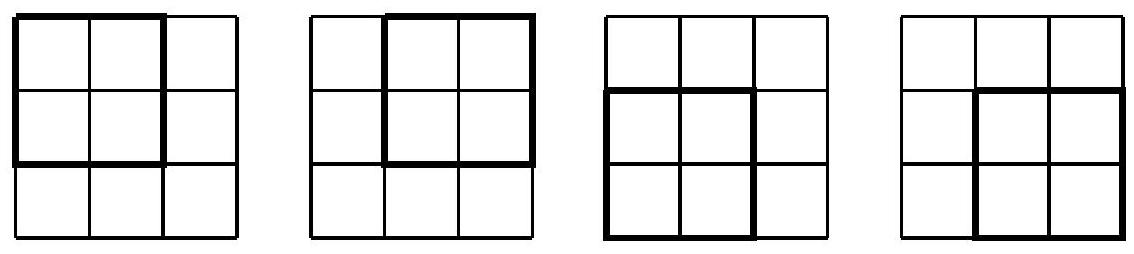
Kasun wants to place an integer from 1 to 4 inclusive ... | Suppose $a, b, c$, and $d$ are the digits 1 through 4 in some order and are placed in the top-left subgrid as shown below.
| $a$ | $b$ | |
| :--- | :--- | :--- |
| $c$ | $d$ | |
| | | |
In order for the bottom-left subgrid to contain the integers from 1 through 4, the leftmost two cells in the bottom row must co... | 72 | Combinatorics | math-word-problem | Yes | Yes | olympiads | false |
Given the function $f(x)=\frac{a\ln x}{x}+b$ has a tangent line equation $x-y-1=0$ at the point $(1,0)$.
(1) Find $a$ and $b$;
(2) Find the maximum value of $f(x)$;
(3) Let $c > 0$ and $c\neq 1$, if the function $g(x)=\log_c x-x$ has at least one zero point, find the maximum value of $c$. | (1) The domain of $f(x)$ is $(0,+\infty)$, and $f'(x)=\frac{a(1-\ln x)}{x^{2}}$. Thus, $f'(1)=a$. The slope of the tangent line $x-y-1=0$ is $1$. Therefore, $a=1$. Since $f(1)=0$, we have $b=0$. Hence, $a=1$ and $b=0$.
(2) From part (1), we know $f(x)=\frac{\ln x}{x}$. Then, $f'(x)=\frac{1-\ln x}{x^{2}}$. When $00$; w... | e^{\frac{1}{e}} | Calculus | math-word-problem | Yes | Yes | cn_k12 | false |
A line passes through the points $(1, -7)$ and $(k, 19)$ and is parallel to the line $3x + 4y = 12$. Determine the value of $k$. | First, we find the slope of the line $3x + 4y = 12$. Rewriting it in slope-intercept form $y = mx + c$:
\[
4y = -3x + 12 \rightarrow y = -\frac{3}{4}x + 3
\]
Thus, the slope (m) is $-\frac{3}{4}$.
Since the new line through $(1, -7)$ and $(k, 19)$ must be parallel to the original line, its slope must also be $-\frac{3... | -\frac{101}{3} | Algebra | math-word-problem | Yes | Yes | synthetic_math | true |
The range of all real numbers $x$ that satisfy the inequality $\lg(x+1) < \lg(3-x)$ is
A: $(-\infty, 1)$
B: $(-1, 1)$
C: $(-1, 3)$
D: $(1, 3)$ | From $\lg(x+1) 0 \\
3-x > 0 \\
x+1 < 3-x
\end{cases}
$$
Solving these, we find $-1 < x < 1$.
Therefore, the range of real numbers $x$ is $(-1, 1)$,
Hence, the correct choice is $\boxed{\text{B}}$.
This solution directly utilizes the monotonicity of the logarithmic function to transform the logarithmic inequality in... | \text{B} | Inequalities | MCQ | Yes | Yes | cn_k12 | false |
Given a line passing through point $P(2,2)$ is tangent to the circle $(x-1)^{2}+y^{2}=5$, and is parallel to the line $x-ay+1=0$, find the value of $a$. | According to the problem, let's denote the center of the circle $(x-1)^{2}+y^{2}=5$ as $M$, where $M(1,0)$.
For point $P(2,2)$ and the circle $(x-1)^{2}+y^{2}=5$, we have $(2-1)^{2}+2^{2}=5$,
which means point $P(2,2)$ satisfies the equation of the circle $(x-1)^{2}+y^{2}=5$, so $P$ is on the circle.
Since the li... | -2 | Geometry | math-word-problem | Yes | Yes | cn_k12 | false |
Let the complex number $z=-1-i$ (where $i$ is the imaginary unit), and $\bar{z}$ be the conjugate of $z$. Then, the magnitude of $(1-z) \cdot \bar{z}$ is
A: $\sqrt{10}$
B: $2$
C: $\sqrt{2}$
D: $1$ | **Analysis**
This problem examines the operation of complex numbers in algebraic form and the calculation of magnitude. Given $z=-1-i$, we find $\bar{z} =-1+i$. Substituting into $(1-z) \cdot \bar{z}$ and then simplifying to find the magnitude.
**Solution**
Given $z=-1-i$, then $\bar{z} =-1+i$,
$\therefore |(1-z) \... | A | Algebra | MCQ | Yes | Yes | cn_k12 | false |
A manager schedules an informal review at a café with two of his team leads. He forgets to communicate a specific time, resulting in all parties arriving randomly between 2:00 and 4:30 p.m. The manager will wait for both team leads, but only if at least one has arrived before him or arrives within 30 minutes after him.... | Let the times after 2:00 p.m. that the two team leads arrive be $x$ and $y$, measured in hours, and the time the manager arrives be $z$. Then $0 \leq x, y, z \leq 2.5$. The event occurs in a rectangular prism where points $(x, y, z)$ satisfy the volume determined by the maximum time of wait constraints.
For the manage... | \frac{1}{2} | Combinatorics | math-word-problem | Yes | Yes | synthetic_math | true |
In a stationery store, there are three kinds of pencils. A pencil with an eraser, which costs $0.8 each, a regular pencil for some amount each, and a short pencil for $0.4 each. This store was able to sell 200 pencils with an eraser, 40 regular pencils, and 35 short pencils. The store made $194 from these sales. How mu... | Let's denote the cost of a regular pencil as \( x \) dollars.
From the information given, we can set up the following equation based on the total sales:
\[ (200 \text{ pencils with eraser} \times \$0.8) + (40 \text{ regular pencils} \times x) + (35 \text{ short pencils} \times \$0.4) = \$194 \]
Now, let's calculate ... | \$0.5 | Algebra | math-word-problem | Yes | Yes | orca_math | true |
Let \[ f(n)= \sum_{p|n , \;p^{\alpha} \leq n < p^{\alpha+1} \ } p^{\alpha} .\] Prove that \[ \limsup_{n \rightarrow \infty}f(n) \frac{ \log \log n}{n \log n}=1 .\]
[i]P. Erdos[/i] | To prove that
\[ \limsup_{n \rightarrow \infty} f(n) \frac{\log \log n}{n \log n} = 1, \]
we need to show both the upper bound and the lower bound.
### Upper Bound
1. **Expression for \( f(n) \):**
The function \( f(n) \) is defined as:
\[ f(n) = \sum_{p|n, \; p^{\alpha} \leq n < p^{\alpha+1}} p^{\alpha}. \]
... | null | Number Theory | proof | Yes | Yes | aops_forum | false |
Which of the following calculations is correct? ( )
A: $2 \sqrt {5} \times 3 \sqrt {5} = 6 \sqrt {5}$
B: $5 \sqrt {2} \times 5 \sqrt {3} = 5$
C: $\sqrt {12} \times \sqrt {8} = 4 \sqrt {6}$
D: $3 \sqrt {2} \times 2 \sqrt {3} = 6 \sqrt {5}$ | Solution: For option A, $2 \sqrt {5} \times 3 \sqrt {5} = 30$, so option A is incorrect;
For option B, $5 \sqrt {2} \times 5 \sqrt {3} = 25 \sqrt {6}$, so option B is incorrect;
For option C, $\sqrt {12} \times \sqrt {8} = 4 \sqrt {6}$, so option C is correct;
For option D, $3 \sqrt {2} \times 2 \sqrt {3} = 6 \sq... | C | Algebra | MCQ | Yes | Yes | cn_k12 | false |
In how many different ways can 4 men and 3 women be placed into one group of five people and one group of two people if the group of five must contain at least two men and two women? | 1. To satisfy the problem's conditions:
- The group of five must contain at least two men and two women, leaving an optional member who could be either a man or a woman.
- The group of two will consist of the remaining two people not in the group of five.
2. Calculate the combinations:
- Choose two men from f... | 54 | Combinatorics | math-word-problem | Yes | Yes | synthetic_math | true |
Find the integer solutions of $a b-a-b=1$ for $a>b>0$.
将上面的文本翻译成英文,请保留源文本的换行和格式,直接输出翻译结果。
(注:最后一句为说明,不需要翻译,仅在翻译结果中保持原样) | The equation is equivalent to:
$$
(a-1)(b-1)=2
$$
Since $a>b>0$, then $b=1$ and $a=2$. | =2,b=1 | Logic and Puzzles | math-word-problem | Yes | Yes | olympiads | false |
A cake has 8 slices and each slice contains 347 calories. A pan of brownies has 6 brownies and each slice contains 375 calories. How many more calories does the cake have? | First, let's calculate the total calories in the cake. Since each slice contains 347 calories and there are 8 slices, the total calories in the cake would be:
8 slices * 347 calories/slice = 2776 calories
Next, let's calculate the total calories in the pan of brownies. Since each brownie contains 375 calories and the... | 526 | Algebra | math-word-problem | Yes | Yes | orca_math | true |
8.2. Solve the cryptarithm: БЕДА digits are denoted by one letter, and different digits - by different letters. | Solution. Adding up, we get the options: 1) $4 A=8$, 2) $4 A=28$. Next: 1) $A=2$, then $3 D=21$, i.e., $D=7$, and 1.1) $2 E+2=10$ or 1.2) $2 E+2=20$. 1.1.) $A=2, D=7, E=4$, then $E=1 ; 1.2) A=2, \quad$, 2) $A=7$, then $3 D+2=11$ and $D=3$, but $2 E+1=10$ and $2 E+1=20$ is impossible
Answer: $1472+472+72+2=2018$ or $09... | 2018 | Logic and Puzzles | math-word-problem | Incomplete | Yes | olympiads | false |
John goes to his office by car at a speed of 40 kmph and reaches 8 minutes earlier. If he goes at a certain speed, he reaches 4 minutes late. The distance from his house to office is 24 km. What is the speed at which he reaches 4 minutes late? | Let's denote the speed at which John reaches 4 minutes late as \( v \) kmph.
First, we calculate the time it takes for John to reach his office when he travels at 40 kmph:
Time = Distance / Speed
Time at 40 kmph = 24 km / 40 kmph = 0.6 hours = 36 minutes
Since John reaches 8 minutes earlier when he travels at 40 kmp... | 30 | Algebra | math-word-problem | Yes | Yes | orca_math | true |
Factor completely the expression: \[(12x^6 + 40x^4 - 6) - (2x^6 - 6x^4 - 6).\] | First, combine like terms in the expression:
\[
(12x^6 + 40x^4 - 6) - (2x^6 - 6x^4 - 6) = 12x^6 + 40x^4 - 6 - 2x^6 + 6x^4 + 6
\]
\[
= 10x^6 + 46x^4
\]
Now, factor out the greatest common factor from the expression:
\[
10x^6 + 46x^4 = 2x^4(5x^2 + 23)
\]
Thus, the completely factored form of the given expression is:
\[... | 2x^4(5x^2 + 23) | Algebra | math-word-problem | Yes | Yes | synthetic_math | true |
18.3. In the sequence $1,0,1,0,1,0, \ldots$ each term starting from the seventh is equal to the last digit of the sum of the six preceding terms. Prove that in this sequence, the six numbers $0,1,0,1,0,1$ will never appear consecutively.
## 18.2. Semi-invariants | 18.3. We will replace the sextet of numbers $\left(x_{1}, \ldots, x_{6}\right)$ with the sextet of numbers $\left(x_{2}, x_{3}, \ldots, x_{6}, x_{7}\right)$, where $x_{7}$ is the last digit of the number $x_{1}+\ldots+x_{6}$. We will show that under such an operation, the last digit of the number $S\left(x_{1}, \ldots,... | proof | Number Theory | proof | Yes | Yes | olympiads | false |
Given that $a > 0$, $b > 0$, and $ab = 2a + b$, find the minimum value of $a + b$. | Since $a > 0$, $b > 0$, and $ab = 2a + b$, we can derive that $b = \frac{2a}{a - 1} > 0$, which leads to $a > 1$.
Then, $a + b = a + \frac{2a}{a - 1} = a - 1 + \frac{2}{a - 1} + 3 \geqslant 3 + 2\sqrt{(a - 1) \times \frac{2}{a - 1}} = 3 + 2\sqrt{2}$, with equality holding if and only if $a = \sqrt{2} + 1$.
Therefore,... | 2\sqrt{2} + 3 | Algebra | math-word-problem | Yes | Yes | cn_k12 | false |
Let \( a, b, \) and \( c \) be distinct real numbers satisfying:
\[
\frac{a^3 + 12}{a} = \frac{b^3 + 12}{b} = \frac{c^3 + 12}{c}.
\]
Find \( a^3 + b^3 + c^3 \). | Set:
\[
k = \frac{a^3 + 12}{a} = \frac{b^3 + 12}{b} = \frac{c^3 + 12}{c}.
\]
This leads to the equation:
\[
a^3 - ka + 12 = 0, \quad b^3 - kb + 12 = 0, \quad c^3 - kc + 12 = 0.
\]
Each of \( a, b, \) and \( c \) are roots of this polynomial:
\[
x^3 - kx + 12 = 0.
\]
From Vieta’s formulas, the sum of the roots \( a + b ... | -36 | Algebra | math-word-problem | Yes | Yes | synthetic_math | true |
One. (20 points) Given three different real numbers $a, b, c$ satisfying $a-b+c=3$, the equations
$$
x^{2}+a x+1=0 \text { and } x^{2}+b x+c=0
$$
have one common real root, and the equations
$$
x^{2}+x+a=0 \text { and } x^{2}+c x+b=0
$$
also have one common real root. Find the values of $a, b, c$. | I. Sequentially number the four equations given in the problem as (1), (2), (3), and (4).
Let $x_{1}$ be a common real root of equations (1) and (2).
(1) - (2) gives $x_{1}=\frac{c-1}{a-b}$.
Let $x_{2}$ be a common real root of equations (3) and (4).
(3) - (4) gives $x_{2}=\frac{a-b}{c-1}$.
Thus, $x_{1} x_{2}=1$.
Since... | a=-2, b=-3, c=2 | Algebra | math-word-problem | Yes | Yes | cn_contest | false |
Example 4 After a single round-robin ice hockey tournament (i.e., each pair of teams played one game), for any group of teams, there exists a team (which may be in the group), whose total score against all teams in the group is odd (each game's loser gets zero points, a draw gives each team one point, and the winner ge... | 【Analysis】Obviously, the teams that have a win or loss will not change the parity of their scores. Therefore, we only need to consider which teams have drawn.
Construct a simple graph with teams as vertices and draw relationships as edges
$$
G=G(V, E) \text {. }
$$
The problem condition is: for any set of vertices $V_... | proof | Combinatorics | proof | Yes | Yes | cn_contest | false |
Football tickets now cost $\$15$ each. Jane has $\$180$. If Jane buys more than 10 tickets, she receives a discount of $\$2$ per ticket for every ticket. What is the maximum number of tickets Jane can buy? | Let $n$ be the number of tickets Jane purchases. If $n \leq 10$, each ticket costs $\$15$, and the total cost is $15n$. If $n > 10$, each ticket costs $\$13$ (after a $\$2$ discount), and the total cost is $13n$. Jane can only purchase tickets if the total cost is less than or equal to her budget of $\$180$.
1. **Case... | 13 | Algebra | math-word-problem | Yes | Yes | synthetic_math | true |
The noon temperatures for nine consecutive days were $82^\circ$, $78^\circ$, $84^\circ$, $86^\circ$, $88^\circ$, $90^\circ$, $92^\circ$, $84^\circ$, and $85^\circ$ Fahrenheit. Calculate the mean noon temperature, in degrees Fahrenheit, for these days, excluding any temperatures below $80^\circ$. | 1. List the temperatures, excluding those below $80^\circ$: $82^\circ$, $84^\circ$, $86^\circ$, $88^\circ$, $90^\circ$, $92^\circ$, $84^\circ$, $85^\circ$.
2. Sum these temperatures:
\[
82 + 84 + 86 + 88 + 90 + 92 + 84 + 85 = 691.
\]
3. Count the valid temperatures: 8 temperatures.
4. Calculate the mean temper... | 86.375^\circ | Algebra | math-word-problem | Yes | Yes | synthetic_math | true |
How many real triples $(x,y,z)$ are there such that $x^4+y^4+z^4+1 = 4xyz$?
$
\textbf{(A)}\ 0
\qquad\textbf{(B)}\ 4
\qquad\textbf{(C)}\ 6
\qquad\textbf{(D)}\ 10
\qquad\textbf{(E)}\ \text{Infinitely many}
$ | null | null | Algebra | MCQ | Yes | Yes | aops_forum | false |
The function $g : [0, \infty) \to [0, \infty)$ satisfies the functional equation: $g(g(x)) = \frac{3x}{x + 3}$, for all $x \ge 0$.
You are also told that for $2 \le x \le 3$: $g(x) = \frac{x + 1}{2}$.
(a) Find $g(2021)$.
(b) Find $g(1/2021)$. | Given the function \( g : [0, \infty) \to [0, \infty) \) satisfies the functional equation \( g(g(x)) = \frac{3x}{x + 3} \) for all \( x \ge 0 \). We are also given that for \( 2 \le x \le 3 \), \( g(x) = \frac{x + 1}{2} \).
(a) Find \( g(2021) \).
(b) Find \( g(1/2021) \).
To solve this, we introduce a new function... | g(2021) = 2021.5 | Calculus | math-word-problem | Yes | Yes | aops_forum | false |
70 + 5 * 12 / ( 180 / 3 ) = ? | To solve this expression, we should follow the order of operations, which is Parentheses, Exponents, Multiplication and Division (from left to right), Addition and Subtraction (from left to right). This rule is often remembered by the acronym PEMDAS.
Let's solve it step by step:
1. Solve the expression inside the par... | 71 | Algebra | math-word-problem | Yes | Yes | orca_math | true |
Given the function $$f(x)= \begin{cases} \log_{3}x, & x>0 \\ f(x+2), & x\leq0 \end{cases}$$, then $$f(f( \frac {1}{9}))$$ equals \_\_\_\_\_\_. | To solve the function $$f(x)= \begin{cases} \log_{3}x, & x>0 \\ f(x+2), & x\leq0 \end{cases}$$,
we find that $f\left( \frac {1}{9} \right) = \log_{3} \frac {1}{9} = -2$,
then $$f(f( \frac {1}{9})) = f(-2) = f(0) = f(2) = \log_{3}2.$$
Therefore, the answer is: $\boxed{\log_{3}2}$.
By using the piecewise function... | \log_{3}2 | Algebra | math-word-problem | Yes | Yes | cn_k12 | false |
3. Let $P(x)$ be a polynomial with integer coefficients
$$
P(x)=a_{n} x^{n}+a_{n-1} x^{n-1}+\ldots+a_{2} x^{2}+a_{1} x+a_{0}
$$
If
$$
P(a)=1991, P(b)=1992 \text { and } P(c)=1993 \text { and } a, b, c \in \mathbb{Z} \text {, }
$$
then $a, b, c$ are consecutive numbers. | Solution. We have
$$
\begin{aligned}
1 & =1992-1991=P(b)-P(a) \\
& =a_{n}\left(b^{n}-a^{n}\right)+a_{n-1}\left(b^{n-1}-a^{n-1}\right)+\ldots+a_{2}\left(b^{2}-a^{2}\right)+a_{1}(b-a) .
\end{aligned}
$$
The right-hand side is divisible by $b-a$, so according to this, the left-hand side is also divisible by $b-a$, i.e.,... | proof | Algebra | proof | Yes | Yes | olympiads | false |
1st CIS 1992 Problem 13 Define the sequence a 1 = 1, a 2 , a 3 , ... by a n+1 = a 1 2 + a 2 2 + a 3 2 + ... + a n 2 + n. Show that 1 is the only square in the sequence. | Obviously all a n are positive integers. So we have a n 2 < a n+1 = a n 2 + (a 1 2 + ... + a n-1 2 + n-1) + 1 = a n 2 + a n + 1 < (a n + 1) 2 . So a n+1 lies between two consecutive squares and hence cannot be a square 1st CIS 1992 © John Scholes jscholes@kalva.demon.co.uk 5 December 2003 Last corrected/updated 5 Dec 0... | proof | Number Theory | proof | Yes | Yes | olympiads | false |
Given a sequence $\{a_n\}$ is a monotonically increasing sequence, and $S_n$ is the sum of its first $n$ terms, $2S_n=a_n^2+n$.
$(1)$ Find the general formula for $\{a_n\}$.
$(2)$ If $b_n= \frac {a_{n+2}}{2^{n+1}\cdot a_n\cdot a_{n+1}}$, and $T_n$ is the sum of the first $n$ terms of the sequence $\{b_n\}$, prove t... | Solution:
$(1)$ When $n=1$, $2S_1=2a_1=a_1^2+1$,
so $(a_1-1)^2=0$, which means $a_1=1$,
and since $\{a_n\}$ is a monotonically increasing sequence, we have $a_n \geqslant 1$.
From $2S_n=a_n^2+n$, we get $2S_{n+1}=a_{n+1}^2+n+1$, so $2S_{n+1}-2S_n=a_{n+1}^2-a_n^2+1$,
after rearranging, we have $2a_{n+1}=a_{n+1... | T_n < \frac {1}{2} | Algebra | math-word-problem | Yes | Yes | cn_k12 | false |
11.3. Given a circle of unit radius, $AB$ is its diameter. Point $M$ moves along the circle, $M_{1}$ is its projection on $AB$. Denote $f(M)=AB+MM_{1}-AM-BM$. Find the maximum and minimum values of the function $f(M)$. | Answer: the minimum value is 0; the maximum value is $3-2 \sqrt{2}$.
Solution. Let $\angle M A B=\alpha, \alpha \in\left[0, \frac{\pi}{2}\right]$. Then $f(M)=2+2 \cos \alpha \sin \alpha-2 \cos \alpha-2 \sin \alpha$. Denote this expression by $g(\alpha)$. We have $g^{\prime}(\alpha)=2\left(\cos ^{2} \alpha-\sin ^{2} \a... | 3-2\sqrt{2} | Geometry | math-word-problem | Yes | Yes | olympiads | false |
Theorem 5.1.3 (Grötzsch, 1959) Every planar graph that does not contain a triangle is 3-colorable. | None
Translate the text above into English, please retain the original text's line breaks and format, and output the translation result directly.
Note: The provided instruction is a meta-instruction and not part of the text to be translated. Since the text to be translated is "None", the translation is also "None". ... | notfound | Combinatorics | proof | Yes | Problem not solved | olympiads | false |
Equilateral triangle $OAB$ of side length $1$ lies in the $xy$-plane ($O$ is the origin). Let $\ell, m$ be the vertical lines passing through $A,B$, respectively. Let $P,Q$ be on $\ell, m$ respectively such that the ratio $\overline{OP} : \overline{OQ} : \overline{PQ} = 3 : 3 : 5$. Let $Q = (x, y, z)$. If $z^2 = \frac{... | null | null | Geometry | math-word-problem | Yes | Yes | aops_forum | false |
Triangle $ABC$ has sides $AB = 9$, and the ratio of $BC: AC = 3:4$. What is the largest area that this triangle can have? | Let $BC = 3x$ and $AC = 4x.$ By the Triangle Inequality:
1. $9 + 3x > 4x$ implies $x > 9$,
2. $9 + 4x > 3x$ holds for any positive $x$,
3. $3x + 4x > 9$ implies $x > 1.5$.
Combining these, we have $x > 9$ as the meaningful range for $x$. The area of a triangle can be maximized by arranging $ABC$ such that it forms a r... | \frac{243}{2\sqrt{7}} | Geometry | math-word-problem | Yes | Yes | synthetic_math | true |
Five coworkers were talking during the lunch break. Roger, the oldest one, said that he has the same amount of experience in years as all four of the others combined. Peter said that when he came to the company his daughter was 7 years old, and now she is 19 years old. Tom then said he has twice as many years of experi... | Let's denote the years of experience of each coworker as follows:
Roger = R
Peter = P
Tom = T
Robert = Rb
Mike = M
From the information given:
1. Roger has the same amount of experience as all four others combined:
R = P + T + Rb + M
2. Peter's experience is the difference between his daughter's current age and her... | 50 | Algebra | math-word-problem | Yes | Yes | orca_math | true |
Given the function $f(x) = x - \sin x$, determine the properties of the function $f(x)$ on the set of real numbers $\mathbb{R}$ by selecting the correct option:
A. It is an odd function with zero points
B. It is an odd function without zero points
C. It is both an odd and a decreasing function
D. It is both an odd and ... | First, let's check if the function has zero points:
$f(0) = 0 - \sin 0 = 0$.
Since $f(0)$ exists and equals to zero, the function has at least one zero point.
Next, we'll determine if the function $f(x)$ is odd, even, or neither:
$f(-x) = -x - \sin(-x) = -(x - \sin x) = -f(x)$.
The function $f(x)$ satisfies the condit... | D. \text{It is both an odd and an increasing function} | Calculus | MCQ | Yes | Yes | cn_k12 | false |
Question 1 In the acute triangle $\triangle ABC$, $AB > BC$, $P$ and $Q$ are the midpoints of the minor arc $\overparen{AC}$ and the major arc $\overparen{AC}$ of its circumcircle $\odot O$, respectively. A perpendicular line is drawn from $Q$ to the segment $AB$, with the foot of the perpendicular being $M$. Prove: Th... | Prove: As shown in Figure 1, connect $A Q, B Q, C Q$, and draw $Q N \perp B C$ at point $N$.
It is easy to see that Rt $\triangle Q B M \cong$ Rt $\triangle Q B N$.
By $\angle Q A C=\angle Q B N=\angle Q B A=\angle Q C A$
$\Rightarrow A Q=C Q, Q N=Q M$
$\Rightarrow$ Rt $\triangle A Q M \cong$ Rt $\triangle C Q N$
$\Rig... | proof | Geometry | proof | Yes | Yes | cn_contest | false |
I am about to read the book in 4 days. I read 1/2 of the book on the first day and 1/4 of the book on the second day. Then on the third day, I read 1/6 of the entire book and on the fourth day, I had 20 pages left. Find how many pages are in the entire book. | Let's denote the total number of pages in the book as P.
On the first day, you read 1/2 of the book, so you read 1/2 * P pages.
On the second day, you read 1/4 of the book, so you read 1/4 * P pages.
On the third day, you read 1/6 of the book, so you read 1/6 * P pages.
By the end of the third day, you have read:
(1/... | 240 | Algebra | math-word-problem | Yes | Yes | orca_math | true |
Find a monic cubic polynomial $Q(x)$ with integer coefficients such that
\[Q(\sqrt[3]{5} + 1) = 0.\] | Let $x = \sqrt[3]{5} + 1$. Then, $x - 1 = \sqrt[3]{5}$, so
\[(x - 1)^3 = 5.\]
Expanding $(x - 1)^3$ gives $x^3 - 3x^2 + 3x - 1$:
\[x^3 - 3x^2 + 3x - 1 = 5.\]
Subtract 5 from both sides to set the polynomial equal to zero:
\[x^3 - 3x^2 + 3x - 6 = 0.\]
Thus, we can take $Q(x) = \boxed{x^3 - 3x^2 + 3x - 6}$. | x^3 - 3x^2 + 3x - 6 | Algebra | math-word-problem | Yes | Yes | synthetic_math | true |
Exercise 3. Let $A B C$ be an isosceles triangle such that $\widehat{A B C}=60^{\circ}$; it is not known at which vertex $A B C$ is isosceles. Find all possible values of $\widehat{A C B}$. | Solution to Exercise 3 We will demonstrate that $\widehat{\mathrm{ACB}}$ can be $60^{\circ}$, and no other value.
First, if $A B C$ is equilateral, then it is indeed isosceles, and we have $\widehat{A B C}=60^{\circ}$, so $A B C$ meets the conditions of the problem, and we observe that $\widehat{\mathrm{ACB}}=60^{\cir... | 60 | Geometry | math-word-problem | Yes | Yes | olympiads | false |
Forty-three increased by three times a number is 58. What is the number? | We need to solve the equation \(43 + 3x = 58\) for \(x\).
1. Subtract 43 from both sides of the equation:
\[
43 + 3x - 43 = 58 - 43
\]
\[
3x = 15
\]
2. Divide both sides by 3 to isolate \(x\):
\[
\frac{3x}{3} = \frac{15}{3}
\]
\[
x = \boxed{5}
\] | 5 | Algebra | math-word-problem | Yes | Yes | synthetic_math | true |
Given a sequence $\{a_n\}$, the sum of its first $n$ terms is $S_n$, and it satisfies $S_n = 2 - a_n$ for $n=1, 2, 3, \ldots$.
1. Find the general term formula for the sequence $\{a_n\}$.
2. If the sequence $\{b_n\}$ satisfies $b_1 = 1$, and $b_{n+1} = b_n + a_n$, find the general term formula for the sequence $\{b_n\}... | (1) Since for $n=1$, we have $a_1 + S_1 = a_1 + a_1 = 2$, thus $a_1 = 1$.
Since $S_n = 2 - a_n$, we have $a_n + S_n = 2$. Therefore, for the next term, $a_{n+1} + S_{n+1} = 2$ as well.
Subtracting these two expressions, we get $a_{n+1} - a_n + S_{n+1} - S_n = 0$, or equivalently, $a_{n+1} - a_n + a_{n+1} = 0$. Theref... | 8 - (8 + 4n) \frac{1}{2^n} | Algebra | math-word-problem | Yes | Yes | cn_k12 | false |
At 12:00 hours, J starts to walk from his house at a certain speed. At 13:30, P follows him from J's house on his bicycle at 8 kmph. J will be 3 km behind P at 19.3 hours. What is J's walking speed in kmph? | Let's denote J's walking speed as \( v \) kmph.
P starts 1.5 hours after J, at 13:30. By the time P starts, J has already walked for 1.5 hours at speed \( v \), so J has covered a distance of \( 1.5v \) km.
P cycles at a speed of 8 kmph and catches up to J at 19.3 hours, which is 19:18 (since 0.3 hours is 18 minutes)... | 5.945 | Algebra | math-word-problem | Yes | Yes | orca_math | true |
\section*{Exercise 3 - 181023}
Prove that the sum of the squares of two consecutive natural numbers is not divisible by 3! | }
Let the first of the two numbers be \(a\). Then the other is \(a+1\), and for the sum \(s\) of their squares we have
\[
s=a^{2}+(a+1)^{2}=2 a^{2}+2 a=2 a(a+1)+1
\]
Every natural number, when divided by 3, leaves a remainder of 0, 1, or 2.
Case 1: \(a\) is divisible by 3.
Then \(2 a(a+1)\) is also divisible by 3,... | proof | Number Theory | proof | Yes | Yes | olympiads | false |
One ton has 2600 pounds, and one pound has 16 ounces. There are 2080 packets containing wheat weighing a certain amount each that would totally fill a gunny bag of capacity 13 tons. What is the weight of each packet? | First, let's calculate the total weight in pounds for 13 tons, given that 1 ton has 2600 pounds.
13 tons * 2600 pounds/ton = 33800 pounds
Now, we know that there are 2080 packets that would fill this capacity. To find the weight of each packet, we divide the total weight by the number of packets:
33800 pounds / 2080... | 16.25 | Algebra | math-word-problem | Yes | Yes | orca_math | true |
Example 1 Given that all terms of the sequence $\left\{a_{n}\right\}$ are positive, and the sum of the first $n$ terms $S_{n}$ satisfies $6 S_{n}=a_{n}^{2}+$ $3 a_{n}+2$. If $a_{2} 、 a_{4} 、 a_{9}$ form a geometric sequence, find the general term formula of this sequence. | When $n=1$, by the problem, we have $6 a_{1}=a_{1}^{2}+3 a_{1}+2$, thus $a_{1}=1$ or $a_{1}=2$.
When $n \geqslant 2$, we have
\[
\begin{array}{c}
6 S_{n}=a_{n}^{2}+3 a_{n}+2 \\
6 S_{n-1}=a_{n-1}^{2}+3 a_{n-1}+2
\end{array}
\]
Subtracting the two equations gives $\left(a_{n}+a_{n-1}\right)\left(a_{n}-a_{n-1}-3\right)=0... | a_{n}=3n-2 | Algebra | math-word-problem | Yes | Yes | olympiads | false |
Adam is 5 years younger than Eve. In one year, Eve will be three times the age Adam was four years ago. How old is Adam? | Let's call Adam's current age A and Eve's current age E.
From the information given, we can write two equations:
1) Adam is 5 years younger than Eve:
A = E - 5
2) In one year, Eve will be three times the age Adam was four years ago:
E + 1 = 3 * (A - 4)
Now we can solve these equations to find Adam's age.
First, le... | 9 | Algebra | math-word-problem | Yes | Yes | orca_math | true |
Folklore
Do there exist 2013 such distinct natural numbers that the sum of any two of them is divisible by their difference? | Let's first construct an auxiliary sequence $\left\{x_{n}\right\}$, which contains 2013 numbers. Starting this construction from the end, we set:
$x_{2013}=1, x_{2012}=2, x_{i}=\left(x_{i+1}+x_{i+2}+\ldots+x_{2013}\right)$ ! for $i$ from 1 to 2011. Then we set $a_{n}=x_{1}+x_{2}+\ldots+x_{n}$. We will prove that $\lef... | proof | Number Theory | proof | Yes | Yes | olympiads | false |
1. If $|a|=1,|b|=2, \boldsymbol{c}=a+b$, and $c \perp$ $a$, then the angle between vector $a$ and $b$ is degrees. | Given $c \perp a \Rightarrow c \cdot a=0 \Rightarrow(a+b) \cdot a=0$
$$
\Rightarrow|\boldsymbol{a}|^{2}+|\boldsymbol{a}| \cdot|\boldsymbol{b}| \cos \alpha=0 \Rightarrow \cos \alpha=-\frac{1}{2} \text {. }
$$
Therefore, the angle $\alpha$ between vector $a$ and $b$ is $120^{\circ}$. | 120^{\circ} | Algebra | math-word-problem | Yes | Yes | cn_contest | false |
Find the area of the triangle with vertices $(2, 3)$, $(10, -2)$, and $(15, 6)$. | Let $A = (2, 3)$, $B = (10, -2)$, and $C = (15, 6)$. Define vectors:
\[
\mathbf{v} = \overrightarrow{CA} = \begin{pmatrix} 2 - 15 \\ 3 - 6 \end{pmatrix} = \begin{pmatrix} -13 \\ -3 \end{pmatrix}, \quad \mathbf{w} = \overrightarrow{CB} = \begin{pmatrix} 10 - 15 \\ -2 - 6 \end{pmatrix} = \begin{pmatrix} -5 \\ -8 \end{pma... | 44.5 | Geometry | math-word-problem | Yes | Yes | synthetic_math | true |
Joan had some dimes in her bank. She spent 2 of her dimes and now has 3 dimes left. How many dimes did she have initially? | Joan spent 2 dimes and now has 3 dimes left. To find out how many dimes she had initially, we add the dimes she spent to the dimes she has left:
2 dimes (spent) + 3 dimes (left) = 5 dimes
Joan had $\boxed{5}$ dimes initially. | 5 | Algebra | math-word-problem | Yes | Yes | orca_math | true |
In the spatial rectangular coordinate system, point M is located at (4, 1, 2). Point P is on the x-axis, and the distance PM is $\sqrt{30}$. The coordinates of point P are __________. | Let's assume the coordinates of point P are $(x, 0, 0)$.
According to the problem, the distance $|MP|$ is $\sqrt{(4-x)^2 + 1^2 + 2^2}$.
Since $PM = \sqrt{30}$, we have $\sqrt{30} = \sqrt{(4-x)^2 + 1^2 + 2^2}$.
Therefore, $(x-4)^2 = 25$. Solving this equation, we get $x = 9$ or $x = -1$.
Thus, the coordinates of poi... | \text{The coordinates of point P are either }(9, 0, 0) \text{ or } (-1, 0, 0). | Geometry | math-word-problem | Yes | Yes | cn_k12 | false |
Sheila has been invited to a picnic tomorrow, which will happen regardless of the weather. She also has another event to attend. If it rains, there is a $30\%$ probability that Sheila will decide to go to the picnic, but if it is sunny, there is a $70\%$ probability that she will go to the picnic. The forecast for tomo... | 1. Calculate the probability that it rains and Sheila attends the picnic:
- Probability of rain = $0.5$
- Probability Sheila attends if it rains = $0.3$
- Combined probability (rain and attends) = $0.5 \times 0.3 = 0.15$
2. Calculate the probability that it does not rain and Sheila attends the picnic:
- Pr... | 0.5 = 50\% | Algebra | math-word-problem | Yes | Yes | synthetic_math | true |
The variance of the data 3, 1, 0, -1, -3 is . | The mean of this set of data is: $(3+1+0-1-3)÷5=0$,
then the variance is calculated as follows:
\[
\frac{1}{5} \left(3^2+1^2+(-1)^2+(-3)^2\right)=4.
\]
Therefore, the answer is $\boxed{4}$. | 4 | Algebra | math-word-problem | Yes | Yes | cn_k12 | false |
Circles $\omega_1$, $\omega_2$, and $\omega_3$ each have radius $5$ and are placed in the plane so that each circle is externally tangent to the other two. Points $Q_1$, $Q_2$, and $Q_3$ lie on $\omega_1$, $\omega_2$, and $\omega_3$ respectively such that $Q_1Q_2=Q_2Q_3=Q_3Q_1$ and line $Q_iQ_{i+1}$ is tangent to $\ome... | Let $O_i$ be the center of circle $\omega_i$ for $i=1,2,3$, and let $L$ be the intersection of lines $O_1Q_1$ and $O_2Q_2$. Because $\angle Q_1Q_2Q_3 = 60^\circ$, it follows that $\triangle Q_2LQ_1$ is a $30-60-90^\circ$ triangle. Let $e=Q_1L$; then $Q_2L = 2e$ and $Q_1Q_2 = \sqrt 3e$. The Law of Cosines in $\triangle ... | 3700/9 | Geometry | math-word-problem | Yes | Incomplete | synthetic_math | true |
Peyton Manning throws a football 20 yards when the temperature is 50 degrees Fahrenheit, but the ball moves twice as far when the temperature is 80 degrees Fahrenheit. Last Saturday, the temperature was 50 degrees Fahrenheit, and he threw the ball twenty times. On Sunday, the temperature rose to 80 degrees Fahrenheit, ... | On Saturday, when the temperature was 50 degrees Fahrenheit, Peyton Manning threw the football 20 yards each time. Since he threw the ball 20 times, the total yards for Saturday would be:
20 yards/throw * 20 throws = 400 yards
On Sunday, the temperature was 80 degrees Fahrenheit, and the ball moves twice as far. So, ... | 1600 | Algebra | math-word-problem | Yes | Yes | orca_math | true |
$\underline{\text { Frame }}$ D:
The legs of a compass are located at the nodes of an infinite sheet of graph paper, the cells of which are squares with a side length of 1. It is allowed, without changing the setting of the compass, to rotate it around one of the legs to move the second leg to another node on the shee... | Let's introduce a rectangular coordinate system on the sheet with axes parallel to the grid lines and the origin at one of the nodes. We will call the parity of a node the parity of the sum of its coordinates. We will consider one leg of the compass as the first and the other as the second, and see how the parity of th... | proof | Geometry | math-word-problem | Yes | Yes | olympiads | false |
16. (14 points) Given the function $f(x)=\frac{\ln x}{x}$.
(1) Suppose a real number $k$ makes $f(x)<k x$ always true, find the range of $k$.
(2) Let $g(x)=f(x)-k x(k \in \mathbf{R})$. If the function $g(x)$ has two zeros in the interval $\left[\frac{1}{\mathrm{e}}, \mathrm{e}^{2}\right]$, find the range of $k$. | 16. (1) Let $h(x)=\frac{f(x)}{x}=\frac{\ln x}{x^{2}}(x>0)$.
Then $h^{\prime}(x)=\frac{1-2 \ln x}{x^{3}}(x>0)$.
Let $h^{\prime}(x)=\frac{1-2 \ln x}{x^{3}}=0 \Rightarrow x=\sqrt{\mathrm{e}}$.
When $x$ varies in the interval $(0,+\infty)$, the changes in $h^{\prime}(x)$ and $h(x)$ are as shown in Table 2.
Table 2
\begin{... | \frac{2}{\mathrm{e}^{4}}\leqslantk<\frac{1}{2\mathrm{e}} | Calculus | math-word-problem | Yes | Yes | olympiads | false |
A polynomial $f (x)$ with real coefficients is called [i]completely reducible[/i] if it is a product of at least two non-constant polynomials whose coefficientsare all nonnegative real numbers. Show: If $f (x^{2011})$ is completely reducible, then $f(x)$ is also. | null | null | Algebra | proof | Yes | Yes | aops_forum | false |
7 people went to a restaurant for dinner . 6 of them spent $ 11 each on their meals and the seventh person spent $ 6 more than the average expenditure of all 7 people . what was the total amount of money that the 7 people spent ? | Let's denote the average expenditure of all 7 people as A.
According to the information given, 6 people spent $11 each, so the total amount spent by these 6 people is 6 * $11 = $66.
The seventh person spent $6 more than the average expenditure of all 7 people, so the seventh person spent A + $6.
The total amount spe... | \$84 | Algebra | math-word-problem | Yes | Yes | orca_math | true |
Jia, Yi, and Bing went to study with Teacher Li. Jia visits every 6 days, Yi every 8 days, and Bing every 9 days. If they met at Teacher Li's place on August 17th, when is the next time they will meet at Teacher Li's place? | To solve this problem, we note that Jia, Yi, and Bing visit Teacher Li every 6, 8, and 9 days, respectively.
Therefore, the number of days until their next meeting is the least common multiple (LCM) of 6, 8, and 9.
Since the LCM of 6, 8, and 9 is 72,
they will meet again 72 days later, which is on $\boxed{\text{O... | \text{October 28th} | Number Theory | math-word-problem | Yes | Yes | cn_k12 | false |
A merchant first increases the original price of a color TV by 40%, and then offers a "20% discount". As a result, each color TV earns $144 more than the original price. What is the original price of each color TV? | Let the original price of each color TV be $x. According to the problem, we have the equation $(1 + 40\%)x \cdot 0.8 - x = 144$.
Solving this equation, we get $x = 1200$.
Therefore, the answer is $\boxed{1200}$.
To solve this problem, we set the original price of each color TV as $x$ and use the given conditions to ... | 1200 | Algebra | math-word-problem | Yes | Yes | cn_k12 | false |
## Problem 5
Show that the cube roots of three distinct primes cannot be terms in an arithmetic progression (whether consecutive or not).
| ## Solution
Suppose the primes are $p, q, r$ so that $q^{1 / 3}=p^{1 / 3}+m d, r^{1 / 3}=p^{1 / 3}+n d$, where $m$ and $n$ (but not necessarily $d$ ) are integers. Then $n q^{1 / 3}-m r^{1 / 3}=(n-m) p^{1 / 3}$. Cubing: $n^{3} q-3 n^{2} m q^{2 / 3} r^{1 / 3}+3 n m^{2} q^{1 / 3} r^{2 / 3}-m^{3} r=(n-m)^{3} p$, or $q^{1... | proof | Number Theory | proof | Yes | Yes | olympiads | false |
The average of temperatures at noontime from Monday to Friday is 45; the lowest one is some value. The possible maximum range of the temperatures is 15. What is the lowest temperature at noontime from Monday to Friday? | Let's denote the lowest temperature as \( L \). Since the average temperature from Monday to Friday is 45, the sum of the temperatures for these five days is \( 5 \times 45 = 225 \).
The range of temperatures is the difference between the highest and lowest temperatures. If the maximum possible range is 15, then the h... | 33 | Algebra | math-word-problem | Yes | Yes | orca_math | true |
In a bus, there are some seats available on the left side, and there are 3 fewer seats on the right side because of the rear exit door. Each seat can hold 3 people. In addition, there is a seat in the back that can sit 12 people all together. The bus can hold 93 people. How many seats are available on the left side? | Let's denote the number of seats on the left side as L. Since there are 3 fewer seats on the right side, the number of seats on the right side would be L - 3.
Each seat can hold 3 people, so the total number of people that can be seated on the left side is 3L, and on the right side is 3(L - 3).
There is also a seat i... | 15 | Algebra | math-word-problem | Yes | Yes | orca_math | true |
If $\frac{a}{b} = \frac{3}{5}$ and $\frac{b}{c} = \frac{2}{7}$, what is the value of $\frac{c}{a}$? Express your answer as a simplified fraction. | Using the given relationships, we know:
$$ \frac{a}{b} = \frac{3}{5}, \quad \frac{b}{c} = \frac{2}{7}. $$
The relationship between $c$ and $a$ can be calculated by taking the reciprocal of the product of the reciprocals of $\frac{a}{b}$ and $\frac{b}{c}$. Thus:
$$ \frac{c}{a} = \left(\frac{b}{a}\right) \cdot \left(\fr... | \frac{35}{6} | Algebra | math-word-problem | Yes | Yes | synthetic_math | true |
Lloyd normally works 7.5 hours per day and earns a certain amount per hour. For each hour he works in excess of 7.5 hours on a given day, he is paid 2.5 times his regular rate. If Lloyd works 10.5 hours on a given day, he earns $67.5 for that day. How much does he earn per hour for his regular hours? | Let's denote Lloyd's regular hourly rate as \( R \).
For the first 7.5 hours, he earns at his regular rate, so the total for these hours is \( 7.5R \).
For the hours worked beyond 7.5 hours, he earns 2.5 times his regular rate. On this particular day, he worked 10.5 hours, which means he worked \( 10.5 - 7.5 = 3 \) h... | \$4.5 | Algebra | math-word-problem | Yes | Yes | orca_math | true |
Given the function f(x) = ax^2 - (2a + 1)x + lnx (a ∈ R)
(I) Find the monotonic intervals of function f(x) when a > 0.
(II) Let g(x) = f(x) + 2ax. If g(x) has two extreme points x1, x2, and the inequality g(x1) + g(x2) < λ(x1 + x2) always holds, find the range of the real number λ. | (I) From the function f(x) = ax^2 - (1 + 2a)x + lnx (a ∈ R, x > 0),
We can find the derivative f′(x) = 2ax - (2a + 1) + $\frac{1}{x}$ = $\frac{2ax^2 - (2a + 1)x + 1}{x}$ = $\frac{(2ax - 1)(x - 1)}{x}$
1. When a = $\frac{1}{2}$, x > 0, f′(x) ≥ 0 is always true in (0, +∞), so the monotonically increasing interval of f(x... | \frac{1}{e^{2}}-\frac{1}{2} | Calculus | math-word-problem | Yes | Yes | cn_k12 | false |
The bowl of fruit contains apples, pears, and bananas. There are two more pears than apples, and some more bananas than pears. The bowl contains 19 pieces of fruit, and it has 9 bananas. How many more bananas are there than pears? | Let's denote the number of apples as A, the number of pears as P, and the number of bananas as B. We are given the following information:
1. There are two more pears than apples: P = A + 2
2. The bowl contains 19 pieces of fruit in total: A + P + B = 19
3. There are 9 bananas: B = 9
We can substitute the value of B i... | 3 | Algebra | math-word-problem | Yes | Yes | orca_math | true |
Given vectors $\overrightarrow{a}=(\cos x,\cos x)$, $\overrightarrow{b}=(\sin x,-\cos x)$, let the function $f(x)=2\overrightarrow{a}\cdot\overrightarrow{b}+1$, where $x\in\mathbb{R}$.
(Ⅰ) Find the smallest positive period of the function $f(x)$ and the coordinates of the symmetry center of the graph of the function ... | Solution: $f(x)=2(\sin x\cos x-\cos^2x)+1$,
$=\sin 2x-\cos 2x= \sqrt{2}\sin (2x- \frac{\pi}{4})$,
(Ⅰ) The smallest positive period of the function $f(x)$ is $T= \frac{2\pi}{2}=\pi$.
Let $2x- \frac{\pi}{4}=k\pi$,
Solving, we get $x= \frac{\pi}{8}+ \frac{k\pi}{2}$,
Therefore, the coordinates of the symmetry cen... | - \frac{2\sqrt{14}}{9} | Algebra | math-word-problem | Yes | Yes | cn_k12 | false |
\section*{Problem 1 - 111031}
Determine all ordered pairs \((a ; b)\) of real numbers \(a, b\) with \(a \neq 0, b \neq 0\), for which the following holds:
(1) The sum of the two numbers is 6.
(2) The sum of the reciprocals of both numbers is also 6. | Assume there is a pair of numbers \((a ; b)\) that satisfies conditions (1), (2). Then:
\[
\text { (3) } \quad a+b=6 \quad \text { and } \quad \text { (4) } \quad \frac{1}{a}+\frac{1}{b}=6
\]
From (3) it follows that \(b=6-a\) and \(a \neq 6\). From this and (4): \(\frac{1}{a}+\frac{1}{6-a}=6\).
After multiplying by... | (3+2\sqrt{2};3-2\sqrt{2})(3-2\sqrt{2};3+2\sqrt{2}) | Algebra | math-word-problem | Yes | Yes | olympiads | false |
If $a > 1$, $b < -1$, then the graph of the function $f(x) = a^x + b$ is in ( )
A: Quadrants I, II, III
B: Quadrants I, III, IV
C: Quadrants II, III, IV
D: Quadrants I, II, IV | Since $a > 1$,
the graph of $y = a^x$ passes through Quadrants I and II and is a monotonically increasing function, passing through the point $(0, 1)$.
The graph of $f(x) = a^x + b$ can be considered as shifting the graph of $y = a^x$ downwards by $-b$ (where $-b > 1$) units.
Therefore, the graph of $f(x) = a^x +... | \text{B} | Algebra | MCQ | Yes | Yes | cn_k12 | false |
Find $\cos \frac{14 \pi}{3}.$ | Convert the angle $\frac{14 \pi}{3}$ to degrees,
\[\frac{14 \pi}{3} = \frac{180^\circ}{\pi} \cdot \frac{14 \pi}{3} = 840^\circ.\]
The cosine function also has a period of $360^\circ,$ hence:
\[\cos 840^\circ = \cos (840^\circ - 2 \cdot 360^\circ) = \cos (120^\circ).\]
Remembering the cosine values:
\[\cos 120^\circ = -... | -\frac{1}{2} | Algebra | math-word-problem | Yes | Yes | synthetic_math | true |
A dealer has some hard candy worth 2 dollars a pound and some worth 3 dollars a pound. He wishes to make a mixture that he can sell for 2.20 dollars per pound. He should use 16 pounds of 3 dollars a pound candy. How many pounds should the mixture weigh? | Let's denote the amount of 2 dollars per pound candy as \( x \) pounds. The dealer wants to mix this with 16 pounds of 3 dollars per pound candy to create a mixture that will sell for 2.20 dollars per pound.
The total value of the 2 dollars per pound candy is \( 2x \) dollars, and the total value of the 3 dollars per ... | 80 | Algebra | math-word-problem | Yes | Yes | orca_math | true |
To make a cherry pie, Veronica needs 3 pounds of pitted cherries. There are 80 single cherries in one pound of cherries. It takes 10 minutes to pit 20 cherries. How many hours will it take Veronica to pit all the cherries? | First, let's find out how many cherries Veronica needs to pit for the cherry pie. She needs 3 pounds of cherries, and there are 80 cherries in one pound. So, she needs:
3 pounds * 80 cherries/pound = 240 cherries
Now, let's find out how long it will take her to pit all 240 cherries. She can pit 20 cherries in 10 minu... | 2 | Logic and Puzzles | math-word-problem | Yes | Yes | orca_math | true |
Given the universal set $U={2,4,a^2-a+1}$, set $A={a+4,4}$, and the complement of $A$ relative to $U$ as ${7}$, find the value of $a$. | Since the universal set $U={2,4,a^2-a+1}$, set $A={a+4,4}$, and the complement of $A$ relative to $U$ is ${7}$,
We have $a+4=2$, $a^2-a+1=7$, which simplifies to $(a-3)(a+2)=0$,
Solving for $a$ gives us $a=-2$ or $a=3$,
When $a=3$, $A={4,7}$, $U={2,4,7}$, and the complement of $A$ relative to $U$ is ${2}$, which is not... | a=-2 | Algebra | math-word-problem | Yes | Yes | cn_k12 | false |
Ruby A.
Is there a sphere on which there is exactly one rational point? (A rational point is a point where all three Cartesian coordinates are rational numbers.)
# | Consider the sphere with the equation $(x-\sqrt{2})^{2}+y^{2}+z^{2}=2$. The point $O$ with coordinates $(0,0,0)$ is a rational point lying on this sphere. Suppose there is another rational point $(x, y, z)$ on the sphere, with $x \neq 0$, since when $x=0$ there is only one solution $(0,0,0)$. Expanding the brackets:
$... | proof | Number Theory | math-word-problem | Yes | Yes | olympiads | false |
8-158 Let the infinite sequence $\left\{x_{n}\right\}$ satisfy
$$
x_{0}=1,0<x_{n+1} \leqslant x_{n}, n=0,1,2, \cdots
$$
(1) Prove that there exists $n \geqslant 1$ such that
$$
\frac{x_{0}^{2}}{x_{1}}+\frac{x_{1}^{2}}{x_{2}}+\cdots+\frac{x_{n-1}^{2}}{x_{n}} \geqslant 3.999 .
$$
(2) Construct a sequence that satisfies t... | [Solution] (1) Let $s_{n}=\frac{x_{0}^{2}}{x_{1}}+\frac{x_{1}^{2}}{x_{2}}+\cdots+\frac{x_{n-1}^{2}}{x_{n}}$. Since $\left\{x_{k}\right\}$ is a non-increasing sequence of positive numbers, we have
$$
\begin{aligned}
S_{2}= & \frac{x_{0}^{2}}{x_{1}}+\frac{x_{1}^{2}}{x_{2}} \geqslant 2 x_{0} \sqrt{\frac{x_{1}}{x_{2}}} \ge... | proof | Inequalities | proof | Yes | Yes | olympiads | false |
Subsets and Splits
No community queries yet
The top public SQL queries from the community will appear here once available.