
instruction_seed stringlengths 2 10.7k | solution stringlengths 0 10.8k ⌀ | answer stringlengths 0 575 ⌀ | problem_type stringclasses 9
values | question_type stringclasses 5
values | problem_is_valid stringclasses 5
values | solution_is_valid stringclasses 4
values | source stringclasses 11
values | synthetic bool 2
classes |
|---|---|---|---|---|---|---|---|---|
i bought two books ; for rs . 480 . i sold one at a loss of 15 % and other at a gain of 19 % and then i found each book was sold at the same price . find the cost of the book sold at a loss ? | Let's denote the cost price of the first book (sold at a loss) as \( C_1 \) and the cost price of the second book (sold at a gain) as \( C_2 \). According to the problem, the total cost of both books is Rs. 480. So we can write:
\( C_1 + C_2 = 480 \) (Equation 1)
The first book is sold at a loss of 15%, so the selli... | 280 | Algebra | math-word-problem | Yes | Yes | orca_math | true |
John gets a two-part bonus each year based on his performance. The first part of his bonus increases by a certain percentage every year. Last year, he made $100,000 and got a $10,000 bonus of this type. This year, he makes $200,000, and his recurring bonus percentage increases at a compound annual growth rate of 5%.
... | First, let's calculate the increase in the first part of John's bonus due to the compound annual growth rate (CAGR) of 5%.
The formula to calculate the future value of an investment (or in this case, the bonus) using CAGR is:
\[ \text{Future Value} = \text{Present Value} \times (1 + \text{CAGR})^{\text{number of year... | \$226,500 | Algebra | math-word-problem | Yes | Yes | orca_math | true |
Estimate the value of $\sqrt{10}+2$ is in which of the following ranges?
A: between $2$ and $3$
B: between $3$ and $4$
C: between $4$ and $5$
D: between $5$ and $6$ | To estimate the value of $\sqrt{10}+2$ and determine its range, we follow these steps:
1. First, we recognize that $\sqrt{9} < \sqrt{10} < \sqrt{16}$ because $9 < 10 < 16$.
2. This implies $3 < \sqrt{10} < 4$ since $\sqrt{9} = 3$ and $\sqrt{16} = 4$.
3. Adding $2$ to each part of the inequality, we get $3 + 2 < \sqrt{... | D | Algebra | MCQ | Yes | Yes | cn_k12 | false |
We rolled a truncated conical cup around a circular table in such a way that it never reached the edge of the table during its movement. The diameter of the table is $1.6 \mathrm{~m}$. The bottom of the cup has a diameter of $5 \mathrm{~cm}$, and the top has a diameter of $6.5 \mathrm{~cm}$. How tall can the cup be? | Solution. When a right circular cone rolls, it moves along a circular path with a radius equal to the length of the cone's slant height (the vertex of the cone remains at the center of the circle). Thus, when a frustum of a cone rolls, it moves along a circular path with a radius equal to the slant height of the cone f... | 18.45\mathrm{~} | Geometry | math-word-problem | Yes | Yes | olympiads | false |
Are there $1998$ different positive integers, the product of any two being divisible by the square of their difference? | 1. **Base Case:**
- For \( n = 1 \), we can take \( S = \{1\} \). Clearly, for any \( a, b \in S \), the condition \( (a - b)^2 \mid ab \) is trivially satisfied since there is only one element.
2. **Inductive Step:**
- Assume that for some \( n \geq 1 \), there exists a set \( S \) of size \( n \) such that for... | null | Number Theory | math-word-problem | Yes | Yes | aops_forum | false |
Let \(x\) and \(y\) be real numbers such that
\[
3 < \frac{x - y}{x + y} < 6.
\]
If \(\frac{x}{y}\) is an integer, what is its value? | Let \(\frac{x}{y} = t\). Then \(x = ty\), so we can write
\[
\frac{x-y}{x+y} = \frac{ty-y}{ty+y} = \frac{t-1}{t+1}.
\]
Thus, we have
\[
3 &\frac{1}{t+1} > -2.5.
\end{aligned}
\]
The only number of the form \(\frac{1}{t+1}\) (where \(t\) is an integer) which lies in the interval \((-2.5, -1)\) is \(-\frac{4}{3}\), corr... | -2 | Inequalities | math-word-problem | Yes | Yes | synthetic_math | true |
Given that $m$ and $n$ are the roots of the equation $x^2+2\sqrt{2}x+1=0$, the value of the algebraic expression $\sqrt{m^2+n^2+3mn}$ is ( )
A: 9
B: ±3
C: 3
D: 5 | **Analysis of the problem**: According to the relationship between the roots and coefficients of a quadratic equation $ax^2+bx+c=0$ ($a\neq0$), we get $m+n=-2\sqrt{2}$ and $mn=1$. Then, we transform $\sqrt{m^2+n^2+3mn}$ into $\sqrt{(m+n)^2+mn}$. Next, we substitute $m+n=-2\sqrt{2}$ and $mn=1$ into the equation for calc... | \text{C} | Algebra | MCQ | Yes | Yes | cn_k12 | false |
the arithmetic mean and standard deviation of a certain normal distribution are 12 and 1.2 , respectively . what value is exactly 2 standard deviations less than the mean ? | The arithmetic mean of the distribution is 12, and the standard deviation is 1.2.
To find the value that is exactly 2 standard deviations less than the mean, we subtract 2 times the standard deviation from the mean:
Value = Mean - 2 * Standard Deviation
Value = 12 - 2 * 1.2
Value = 12 - 2.4
Value = 9.6
So, the valu... | 9.6 | Algebra | math-word-problem | Yes | Yes | orca_math | true |
Given the function f(x) = $|x - \frac{1}{2}| + |x + \frac{1}{2}|$, let M be the solution set of the inequality f(x) < 2.
1. Find M.
2. Prove that $|a + b| < |1 + ab|$ when $a, b \in M$. | 1. We will find the solution set M by considering three cases based on the value of x.
- Case 1: When $x -1$. Therefore, the interval for this case is $-1 \frac{1}{2}$, the inequality f(x) 0$. Expanding and rearranging the terms, we have $a^2b^2 + 1 > a^2 + b^2$.
Adding $2ab$ to both sides of this inequality, we... | |a + b| < |1 + ab| | Inequalities | math-word-problem | Yes | Yes | cn_k12 | false |
(1) For any side $b$ of a convex polygon $P$, construct a triangle with the largest area inside $P$ using $b$ as one of its sides. Prove: For each side of $P$, the sum of the areas of the triangles obtained by the above method is at least twice the area of $P$. | First, we prove a lemma.
Lemma: For each convex $2n$-gon with area $S$, the area of the triangles formed by its sides and vertices is not less than $\frac{S}{2}$.
Proof of the lemma: The main diagonal of a $2n$-gon is a diagonal that divides the $2n$-gon into two polygons, each containing the same side. For any side $b... | proof | Geometry | proof | Yes | Yes | olympiads | false |
In the United States, coins have the following revised thicknesses: penny, 1.65 mm; nickel, 1.85 mm; dime, 1.25 mm; quarter, 1.80 mm. If a stack of these coins has a total height of 15 mm and a total monetary value of 85 cents, how many of each type of coin are in the stack? | Let the number of pennies be $p$, nickels be $n$, dimes be $d$, and quarters be $q$.
1. Based on thickness, the equation for the total height of the coins:
\[
1.65p + 1.85n + 1.25d + 1.80q = 15
\]
2. The equation based on the monetary value of the coins:
\[
1p + 5n + 10d + 25q = 85
\]
(Values are... | p = 4, n = 1, d = 1, q = 3 | Algebra | math-word-problem | Yes | Yes | synthetic_math | true |
5. Given integers $a_{1}, a_{2}, \cdots, a_{m}, b_{1}, b_{2}, \cdots, b_{n}$, such that $a_{i} b_{j}(1 \leqslant i \leqslant m, 1 \leqslant j \leqslant n)$ form a complete residue system modulo $m n$. Prove: $a_{1}, a_{2}, \cdots, a_{m}$ form a complete residue system modulo $m$, $b_{1}$, $b_{2}, \cdots, b_{n}$ form a ... | Hint: Suppose $m n \mid a_{1} b_{1}$. Take positive integers $a^{\prime} 、 b^{\prime}$, such that
$$
a^{\prime}\left|a_{1}, b^{\prime}\right| b_{1}, a^{\prime} b^{\prime}=m n .
$$
Since there are no two $a_{i}$ congruent modulo $a^{\prime}$ (otherwise, if there exist $i \neq k$ such that $a^{\prime} \mid\left(a_{i}-a_... | proof | Number Theory | proof | Yes | Yes | olympiads | false |
Let \\( \{a_n\} \\) be a sequence with the sum of the first \\( n \\) terms denoted as \\( S_n \\). If \\( S_2 = 4 \\) and \\( a_{n+1} = 2S_n + 1 \\) where \\( n \in \mathbb{N}^* \\), find the values of \\( a_1 \\) and \\( S_5 \\). | Given \\( a_{n+1} = 2S_n + 1 \\), we can express \\( a_1 \\) in terms of \\( S_1 \\) since \\( a_1 = S_1 \\) for \\( n=1 \\). This directly leads us to calculate \\( a_2 \\) as follows:
$$ a_2 = 2S_1 + 1 = 2a_1 + 1, $$
and since we have \\( S_2 = a_1 + a_2 = 4 \\), setting up the equation gives us:
$$ 3a_1 + 1 = 4. $$
... | 121 | Algebra | math-word-problem | Yes | Yes | cn_k12 | false |
A man sells a car to his friend at an 11% loss. The friend then sells it to another person at a 15% gain. That person does some improvements on the car and finally sells it for Rs. 75,000, making a 25% gain. Calculate the original cost price of the car. | Let's denote the original cost price of the car as \( C \).
The man sells the car to his friend at an 11% loss, so the selling price for the friend is:
\[ C - 0.11C = 0.89C \]
The friend then sells it to another person at a 15% gain, so the selling price for that person is:
\[ 0.89C + 0.15 \times 0.89C = 0.89C \times... | 58,744.16 | Algebra | math-word-problem | Yes | Yes | orca_math | true |
Given $a= \int_{0}^{\pi}\sin x \, dx$, find the constant term in the expansion of the binomial $(a\sqrt{x} - \frac{1}{\sqrt{x}})^6$. | Since $a= \int_{0}^{\pi}\sin x \, dx = -(\cos \pi - \cos 0) = 2$,
the expression $(a\sqrt{x} - \frac{1}{\sqrt{x}})^6$ becomes $(2\sqrt{x} - \frac{1}{\sqrt{x}})^6$.
The general term of the binomial expansion is
\[ T_{r+1} = \binom{6}{r}(2\sqrt{x})^{6-r}\left(-\frac{1}{\sqrt{x}}\right)^{r} = (-1)^r \binom{6}{r}2^{6-r}x... | 1 | Algebra | math-word-problem | Yes | Yes | cn_k12 | false |
The local aquarium has 4 dolphins that each require 3 hours of training daily. The aquarium has a certain number of trainers and they want to split the hours they spend training the dolphins equally. Each trainer will spend 6 hours training the dolphins. How many trainers are there in the aquarium? | If there are 4 dolphins and each requires 3 hours of training daily, then the total number of training hours required for all dolphins is:
4 dolphins * 3 hours/dolphin = 12 hours
If each trainer will spend 6 hours training the dolphins, and the total number of training hours required is 12 hours, then the number of t... | 2 | Algebra | math-word-problem | Yes | Yes | orca_math | true |
Given the function $f(x)=\log_a(1-x)+\log_a(x+2)$, where $a > 1$, let the domain of $f(x)$ be $D$.
(1) Determine the domain $D$ of the function $f(x)$.
(2) If the maximum value of the function $f(x)$ is $2$, find the value of $a$.
(3) If the inequality $x^2 - mx + m + 1 > 0$ holds for any real number $x$ within the ... | (1) For the function to be meaningful, the following conditions must hold:
$$
\begin{cases}
1-x > 0 \\
x+2 > 0
\end{cases}
$$
Solving these inequalities, we find $-2 1$, we have
$$\log_a\left[-\left(x+\frac{1}{2}\right)^2+\frac{9}{4}\right] \leq \log_a\frac{9}{4}.$$
Therefore, the maximum value of the function is $\l... | m > 2 - 2\sqrt{2} | Algebra | math-word-problem | Yes | Yes | cn_k12 | false |
There are 300 integers between a certain number and 1000 such that their unit digit is odd. What is the starting number? | To find the starting number, we need to determine how many integers with an odd unit digit there are between the starting number and 1000.
Since we're looking for integers with an odd unit digit, we're interested in numbers ending in 1, 3, 5, 7, or 9. For every 10 consecutive integers, there are 5 that have an odd uni... | 400 | Number Theory | math-word-problem | Yes | Yes | orca_math | true |
Let's construct a rectangle if the difference between a diagonal and a side $(e-a)$ and the angle $(\varphi)$ between the diagonals is given. | We measure the side $AB$ of the rectangle from $B$ to the diagonal $BC$, thus obtaining point $A_{1}$; therefore
$$
A_{1} C=e-a, \text{ and if } \angle AOC=\varphi
$$
then
$$
\angle ACO=90^{\circ}-\frac{\varphi}{2},
$$
and
$$
\angle AA_{1}C=\frac{\varphi}{2}+\frac{180^{\circ}-\frac{\varphi}{2}}{2}=90^{\circ}+\frac... | notfound | Geometry | math-word-problem | Incomplete | Yes | olympiads | false |
The cubic function $y = ax^3 - x$ is a decreasing function on $(-\infty, +\infty)$, then
A: $a \leq 0$
B: $a = 1$
C: $a = 2$
D: $a =$ | To determine the conditions under which the given cubic function is a decreasing function on the entire real line, we need to analyze its derivative. The derivative of $y = ax^3 - x$ with respect to $x$ is given by $y' = 3ax^2 - 1$. For the function to be decreasing, its derivative must be less than or equal to zero fo... | A: a \leq 0 | Algebra | MCQ | Yes | Yes | cn_k12 | false |
1. Fill an empty live water truck with water, using three water pipes $A$, $B$, and $C$. If pipes $A$ and $C$ are used simultaneously, the truck is full when pipe $A$ has injected 4 tons of water; if pipes $B$ and $C$ are used simultaneously, the truck is full when pipe $B$ has injected 6 tons of water. It is known tha... | 1. 【Answer】Solution: Let the water tanker can add $x$ tons of water
$$
\begin{array}{l}
\text { Then: Work efficiency ratio: } A: C=4:(x-4) ; B: C=6:(x-6) \\
\because A: B=1: 2 \\
\therefore \text { Let } A=12, B=24 \\
A: C=12:(3 x-12) \\
B: C=24:(4 x-24) \\
\therefore 3 x-12=4 x-24 \\
x=12
\end{array}
$$
Answer: The ... | 12 | Algebra | math-word-problem | Yes | Yes | olympiads | false |
8. (3 points) An object is made up of several small cubes. When viewed from the front, right side, and top, it appears as follows:
The object is made up of at least $\qquad$ small cubes. | 【Solution】Solution: It is easy to see from the top view that the number of small cubes in the bottom layer is 3. From the right view, we can see there are two layers. From the front view, we can see there is 1 cube on top, so the object is made up of at least $3+1=4$ cubes. Therefore, the answer is: 4. | 4 | Geometry | math-word-problem | Incomplete | Yes | olympiads | false |
Given the function $f(x)=2x+ \frac {2}{x}+a\ln x,a∈R$.
(1) If the function $f(x)$ is monotonically increasing on $[1,+∞)$, find the range of values for the real number $a$.
(2) Let the function $g(x)=x^{2}[f′(x)+2x-2]$, if the minimum value of $g(x)$ is $(-6)$, find the analytic expression of the function $f(x)$. | (This question is worth a total of 14 points)
Solution: (1) $f′(x)=2- \frac {2}{x^{2}}+ \frac {a}{x}\geqslant 0$,
$\therefore a\geqslant \frac {2}{x}-2x$ holds true on $[1,+∞)$ $(2$ points$)$
Let $h(x)= \frac {2}{x}-2x,x∈[1,+∞)$
$\because h^{′}(x)=- \frac {2}{x^{2}}-2 0$
$\because g′(x)=6x^{2}+a$ $(9$ points$)$
When ... | f(x) = 2x + \frac{2}{x} - 6\ln x | Calculus | math-word-problem | Yes | Yes | cn_k12 | false |
Problem 7. (8 points) Peter has a $5 \times 5$ table filled with 25 different numbers. Peter selects the largest number in the table and crosses out the row and column in which this number is located. Then he selects the largest of the remaining numbers, crosses out the row and column in which it is located, and so on.... | Solution. a) It cannot. Let's denote the numbers in the order of their selection: Peter chooses $b_{0}, b_{1}, b_{2}, b_{3}, b_{4}$, and Ivan chooses $-m_{0}, m_{1}, m_{2}, m_{3}, m_{4}$. We will prove that if $i+j<5$, then $b_{i} \geq m_{j}$. The index is equal to the number of rows and columns that have been marked b... | proof | Combinatorics | math-word-problem | Yes | Yes | olympiads | false |
[ Volume of a parallelepiped $]$ [Volume of a tetrahedron and pyramid]
The volume of the parallelepiped $A B C D A 1 B 1 C 1 D 1$ is $V$. Find the volume of the pyramid $A B C C 1$.
# | Let $S$ be the area of the base $ABCD$ of the parallelepiped $ABCD A1 B1 C1 D1$, and $h$ be the height of the parallelepiped. Then
$$
V_{ABCC^{1}}=\frac{1}{3} S_{\triangle ABC} \cdot h=\frac{1}{3 \cdot} \cdot \frac{1}{2} S \cdot h=\frac{1}{6} S h=\frac{1}{6} V .
$$
## Answer
$\frac{1}{6} V$. | \frac{1}{6}V | Geometry | math-word-problem | Yes | Yes | olympiads | false |
## Task B-4.4.
The center of the circle $2 x^{2}+2 y^{2}-4 x+8 y-20=0$ is passed through by the lines given by the equations $m x-y+3=0$ and $x-n y+2=0$. Determine the angle between these lines. | ## Solution.
The equation of the circle in the standard form is $(x-1)^{2}+(y+2)^{2}=15 \Rightarrow S(1,-2)$.
If we substitute the coordinates of the center into the equations of the lines
$$
y=m x+3 \text { and } y=\frac{1}{n} x+\frac{2}{n}
$$
we get $m=-5, n=-\frac{3}{2}$.
2 points
The equations of the given li... | 45 | Geometry | math-word-problem | Yes | Yes | olympiads | false |
Shapovalov A.V.
For which $n$ can all the edges of an $n$-sided prism (bases are $n$-gons) be colored in three colors so that all three colors meet at each vertex and each face (including the bases) has sides of all three colors? | Let the prism be painted in the required manner; then, in the base, there are three edges of all three colors in a row (otherwise, the base is painted with a period of 2 in two colors). Consider such a triplet and number the colors in it counterclockwise. It is not difficult to verify that the coloring of this segment ... | n | Combinatorics | math-word-problem | Yes | Yes | olympiads | false |
| Problem 109870 Topics | [ Reconfigurations |
| :---: | :---: |
| Problem $1098 / 0$ themes | $\left[\begin{array}{l}\text { Colorings } \\ {[\text { Invariants }}\end{array}\right.$ |
The streets of the city of Duzhinsk - simple broken lines, not intersecting each other at internal points. Each street connects two i... | Let's replace each white street in the city with two - a blue one and a red one, connecting the ends of the blue streets adjacent to the white one with a blue color, and the ends of the adjacent red streets with a red color (see the figure). According to these figures, we will call the white streets types a, b, v, and ... | proof | Combinatorics | proof | Yes | Yes | olympiads | false |
A real number $b$ is chosen randomly and uniformly from the interval $[-25, 22]$. Find the probability that the roots of the polynomial
\[x^4 + 3bx^3 + (3b - 5)x^2 + (-6b + 4)x - 3\]
are all real. | Let $q(x)$ be the given polynomial. First, check if $x=1$ is a root:
\[q(1) = 1 + 3b + (3b - 5) - (6b + 4) - 3 = 3b + 3b - 6b - 1 = 0,\]
so $1$ is indeed a root of $q(x)$. We perform polynomial division of $q(x)$ by $(x-1)$:
\[q(x) = (x-1)(x^3 + (3b+1)x^2 + (6b-4)x + 3).\]
Next, check if $x=-2$ is a root:
\[q(-2) = (-... | \frac{137}{141} | Algebra | math-word-problem | Yes | Yes | synthetic_math | true |
Jason joined his school's band. He bought a flute, a music tool for $8.89, and a song book for $7. Jason spent $158.35 at the music store. How much did the flute cost? | To find out how much the flute cost, we need to subtract the cost of the music tool and the song book from the total amount Jason spent at the music store.
The cost of the music tool is $8.89.
The cost of the song book is $7.
First, let's add the cost of the music tool and the song book together:
$8.89 (music tool) +... | \$142.46 | Algebra | math-word-problem | Yes | Yes | orca_math | true |
If $\int_{0}^{2}(3x^{2}+k)dx=10$, then $k=$
A: $1$
B: $2$
C: $3$
D: $4$ | **Analysis**
This question mainly examines the basic properties of definite integrals. To find the value of $k$, we only need to calculate the definite integral of the function. Therefore, we first use the derivative to find the original function, and then apply the integral theorem to find the solution.
**Solution*... | A | Calculus | MCQ | Yes | Yes | cn_k12 | false |
Given the circle $O: x^2 + y^2 = 1$, and point $P$ is a moving point on the line $x - 2y - 3 = 0$. Two tangents $PA$ and $PB$ are drawn from point $P$ to circle $O$, with $A$ and $B$ being the points of tangency. Then, the line $AB$ passes through a fixed point ( )
A: $(2, 0)$
B: $(3, 0)$
C: $\left( \frac{1}{2}, ... | Since $P$ is any point on the line $x - 2y - 3 = 0$, we can set $P(2m + 3, m)$.
Given the circle $x^2 + y^2 = 1$ with two tangents $PA$ and $PB$, where $A$ and $B$ are the points of tangency,
it follows that $OA \perp PA$ and $OB \perp PB$,
thus, points $A$ and $B$ lie on the circle with diameter $OP$, meaning $A... | D | Geometry | MCQ | Yes | Yes | cn_k12 | false |
## Task 2 - 241212
Determine all real numbers $x, y$ with $x \neq 0$ and $y \neq 0$ that satisfy the system of equations
$$
\begin{aligned}
x^{2} y-\frac{6}{x y} & =13 \\
x y+x^{2} y & =6 \quad \text { satisfy. }
\end{aligned}
$$ | Let $x$ and $y$ be real numbers with $x \neq 0$ and $y \neq 0$, which satisfy the given system of equations. Then it follows:
The numbers $a = xy$ and $b = x^2 y$ satisfy the system of equations
$$
\begin{aligned}
b - \frac{6}{a} & = 13 \\
a + b & = 6
\end{aligned}
$$
Subtracting (1) from (2), we get $a + \frac{6}{a... | x_1=-7,y_1=\frac{1}{7}x_2=-2,y_2=3 | Algebra | math-word-problem | Yes | Yes | olympiads | false |
2. In triangle $\mathrm{ABC}$ with sides $\overline{\mathrm{AB}}=32 \mathrm{~cm}$ and $\overline{\mathrm{BC}}=24 \mathrm{~cm}$, the medians AA and CC intersect at a right angle. Calculate the length of side $\mathrm{AC}$ of triangle $\mathrm{ABC}$. | Solution. Let T be the centroid of triangle $\mathrm{ABC}$ and let $\overline{\mathrm{TC}_{1}}=x, \overline{\mathrm{TA}_{1}}=\mathrm{y}$
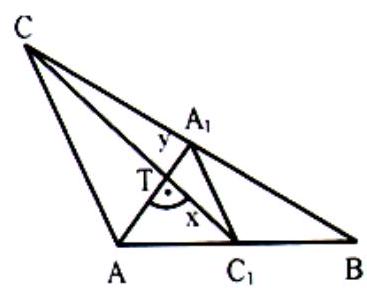
fig. 11
(fig. 11). Then from the right triangle CTA, ... | 8\sqrt{5} | Geometry | math-word-problem | Yes | Yes | olympiads | false |
Given the functions $f(x)=e^{x}$, where $x\in R$, and $g(x)=\ln x$, where $x\in(0,+\infty)$.
(I) If the line $y=kx+2$ is tangent to the graph of $g(x)$, find the value of the real number $k$.
(II) Discuss the number of common points of the curve $y=f(x)$ and the curve $y=mx^{2}$ (where $m > 0$) when $x > 0$.
(III) G... | (I) Let the line $y=kx+2$ be tangent to $g(x)=\ln x$ at point $P(x_{0},y_{0})$. Then we have the system of equations:
$$
\begin{cases}
kx_{0}+2=\ln x_{0} \\
k=g'(x_{0})=\frac{1}{x_{0}}
\end{cases}
$$
Solving the system, we get $x_{0}=e^{3}$, $k=e^{-3}$.
(II) When $x > 0$ and $m > 0$, the number of common points of t... | \frac{f(a)+f(b)}{2} > \frac{f(b)-f(a)}{b-a} | Calculus | math-word-problem | Yes | Yes | cn_k12 | false |
In convex hexagon $A X B Y C Z$, sides $A X, B Y$ and $C Z$ are parallel to diagonals $B C$, $X C$ and $X Y$, respectively. Prove that $\triangle A B C$ and $\triangle X Y Z$ have the same area. | Let $[\mathcal{P}]$ denote the area of a polygon $\mathcal{P}$.
The important claim is that if $\overline{K L} \| \overline{M N}$, then $[K L M]=[K L N]$. This is a simple consequence of the formula $A=\frac{1}{2} b h$.
Then, we find that
$$
\begin{aligned}
& {[A B C]=[X B C] \quad(\text { since } \overline{A X} \| ... | proof | Geometry | proof | Yes | Yes | olympiads | false |
Faye and her mom were picking carrots from their garden. Faye picked some carrots and her mother picked 5. If only 12 of the carrots were good, and they had 16 bad carrots, how many carrots did Faye pick? | Faye and her mom picked a total of 12 good carrots and 16 bad carrots, which is 12 + 16 = 28 carrots.
Since Faye's mom picked 5 carrots, we subtract those from the total to find out how many Faye picked: 28 - 5 = 23 carrots.
Therefore, Faye picked $\boxed{23}$ carrots. | 23 | Logic and Puzzles | math-word-problem | Yes | Yes | orca_math | true |
The problem of a woman weaving cloth from the "Zhang Qiu Jian Suan Jing" states: A woman excels at weaving, and each day she weaves faster than the day before, starting from the second day, she weaves more cloth each day than she did the previous day by the same amount. It’s known that she weaves 5 yards on the first d... | Given the problem's conditions, we are dealing with an arithmetic sequence. The first term $a_1$ is 5 yards, and the common difference is $d$. The sum of the first 30 terms is 390 yards.
We can use the formula for the sum of the first $n$ terms of an arithmetic sequence:
$$S_n = \frac{n}{2} (2a_1 + (n - 1)d)$$
Subst... | \frac{16}{29} | Algebra | MCQ | Yes | Yes | cn_k12 | false |
$\left[\begin{array}{l}\text { Symmetry helps solve the problem_ ] } \\ \text { [ Examples and counterexamples. Constructions }]\end{array}\right.$
What is the maximum number of axes of symmetry that the union of three segments on a plane can have? | Select one of the three segments and consider all segments into which it can be translated by some symmetry.
## Solution
Consider one of these segments. Each symmetry translates it into one of the three segments, but there are no more than two symmetries that translate one segment into another. There are a total of s... | 6 | Geometry | math-word-problem | Incomplete | Yes | olympiads | false |
Let $\{b_k\}$ be a sequence of integers such that $b_1=2$ and $b_{m+n}=b_m+b_n + m^2 + n^2$ for all positive integers $m$ and $n.$ Find $b_{10}.$ | We start by computing the initial terms using the given formula:
\[
b_2 = b_1 + b_1 + 1^2 + 1^2 = 2 + 2 + 1 + 1 = 6,
\]
\[
b_3 = b_1 + b_2 + 1^2 + 2^2 = 2 + 6 + 1 + 4 = 13,
\]
\[
b_4 = b_2 + b_2 + 2^2 + 2^2 = 6 + 6 + 4 + 4 = 20,
\]
\[
b_5 = b_2 + b_3 + 2^2 + 3^2 = 6 + 13 + 4 + 9 = 32,
\]
\[
b_6 = b_3 + b_3 + 3^2 + 3^2 ... | 114 | Algebra | math-word-problem | Yes | Yes | synthetic_math | true |
Calculate: $|-2|-(-\sqrt{2})^{0}+(\frac{1}{3})^{-1}$. | To solve the expression $|-2|-(-\sqrt{2})^{0}+(\frac{1}{3})^{-1}$ step by step:
1. Calculate the absolute value of $-2$: $|-2| = 2$.
2. Evaluate the exponent: $(-\sqrt{2})^{0} = 1$ because any number to the power of $0$ is $1$.
3. Evaluate the negative exponent: $(\frac{1}{3})^{-1} = 3$ because taking the reciprocal a... | 4 | Algebra | math-word-problem | Yes | Yes | cn_k12 | false |
Let $a$ and $b$ be the two distinct solutions to the equation $$(x-3)(2x+7) = x^2 - 11x + 28.$$ What is $(a + 2)(b + 2)$? | First, observe that the right side of the equation can be factored as $x^2 - 11x + 28 = (x-4)(x-7)$. We match this with the left side:
$$(x-3)(2x+7) = 2x^2 + 7x - 6x - 21 = 2x^2 + x - 21.$$
By equating this to the factored form of the right side:
$$2x^2 + x - 21 = x^2 - 11x + 28.$$
Subtracting $x^2 - 11x + 28$ from bot... | -66 | Algebra | math-word-problem | Yes | Incomplete | synthetic_math | true |
In the plane Cartesian coordinate system $xOy$, the equation of the line $l$ is $x+y=5$. The circle $M$ has its center at $(3,0)$ and is tangent to the line $l$. Establish a polar coordinate system with the origin as the pole and the positive x-axis as the polar axis.$(1)$ Find the polar coordinate equation of the circ... | **Step-by-Step Solution:**
**(1) Finding the Polar Coordinate Equation of Circle $M$:**
Given that the equation of line $l$ is $x+y=5$ and the center of circle $M$ is at $(3,0)$, we first find the radius $r$ of circle $M$ by calculating the perpendicular distance from the center to the line $l$:
\[r = \frac{|3+0-5|}... | y = \sqrt{35}x | Geometry | math-word-problem | Yes | Yes | cn_k12 | false |
In a sector of a circle, the radius is given as $8$ and the arc length is given as $12$. Find the central angle in radians and the area of the sector. | The central angle, $\alpha$, can be found using the formula for arc length, which is $l = r\alpha$:
$$ \alpha = \frac{l}{r} = \frac{12}{8} = \frac{3}{2} $$
The area of the sector, $S$, can be found using the formula for the area of a sector, which is $S = \frac{1}{2}lr$:
$$ S = \frac{1}{2} \times 12 \times 8 = 48 $$
... | 48 \text{ square units} | Geometry | math-word-problem | Yes | Yes | cn_k12 | false |
169. Prove that if a line passes through the vertex of a triangle perpendicular to the median drawn from the same vertex, then the sum of the distances from the other two vertices of the triangle to this line is the greatest. | 169. Reflect the triangle and the secant line relative to the midpoint of the side and consider the resulting rectangle. On two sides of the parallelogram, as diameters, describe circles and establish that the segment of the secant, passing through the vertex of the triangle and enclosed within the circles, will be max... | proof | Geometry | proof | Yes | Yes | olympiads | false |
The circumferences of two circles are some meters and 352 meters. The difference between the areas of the larger and the smaller circles is 4313.735577562732 square meters. What is the circumference of the smaller circle? | Let's denote the radius of the smaller circle as \( r \) and the radius of the larger circle as \( R \). The circumference of a circle is given by the formula \( C = 2\pi r \), where \( \pi \) is approximately 3.14159.
Given that the circumference of the larger circle is 352 meters, we can find its radius \( R \) usin... | 263.8934 | Geometry | math-word-problem | Yes | Yes | orca_math | true |
Suppose a projectile is fired with an initial velocity of $v$ at an angle of $\theta$ from the ground, and additionally, there is a constant wind resistance acting against the projectile in the vertical direction. This wind resistance can be modeled as $-kt$, where $k$ is a constant resistance factor, and $t$ denotes t... | - **Time to top of the arch**: Since the vertical component of velocity becomes zero at the highest point,
\[ v \sin(\theta) - gt - k = 0 \]
\[ t = \frac{v \sin(\theta) - k}{g}. \]
- **Substitute to find x and y coordinates**:
\begin{align*}
x &= v \left(\frac{v \sin(\theta) - k}{g}\right) \cos(\theta) = \frac{v^2}{g}... | \frac{\pi}{8} | Algebra | math-word-problem | Yes | Yes | synthetic_math | true |
In a square $JKLM$, four identical right-angled isosceles triangles are cut from its corners, leaving a smaller square $WXYZ$. The total area removed is $288 \text{ cm}^2$. What is the length of the side of square $WXYZ$? | Let each side of square $JKLM$ be $s$ cm, and let each leg of the right-angled isosceles triangles be $x$ cm.
Since each triangle is right-angled and isosceles, the area of each triangle is $\frac{1}{2}x^2$. Given that four such triangles are cut off, the total area removed is $4 \times \frac{1}{2}x^2 = 2x^2$ cm². Giv... | 12\sqrt{2} \text{ cm} | Geometry | math-word-problem | Yes | Yes | synthetic_math | true |
In triangle \( ABC \), the sides opposite angles \( A \), \( B \), and \( C \) are \( a \), \( b \), and \( c \) respectively, and it is given that \( \dfrac{b\cos C + c\cos B}{2} = \dfrac{\sqrt{3}}{3}a\cos B \).
\( (1) \) Find \( B \);
\( (2) \) If \( b = \sqrt{7} \), \( c = 2\sqrt{3} \), and \( a > b \), calculat... | \( (1) \) Given that \( \dfrac{b\cos C + c\cos B}{2} = \dfrac{\sqrt{3}}{3}a\cos B \).
Using the cosine rule, we have
\[ b\cos C + c\cos B = b \cdot \dfrac{a^2 + b^2 - c^2}{2ab} + c \cdot \dfrac{a^2 + c^2 - b^2}{2ac} \]
\[ = \dfrac{a^2(b + c) + b^2c - b^2c - bc^2 + bc^2}{2ab} \]
\[ = \dfrac{a^2(b + c)}{2ab} \]
\[ = \df... | \dfrac{3\sqrt{7}}{2} | Geometry | math-word-problem | Yes | Yes | cn_k12 | false |
Prove that if the real numbers $a, b$ and $c$ satisfy $a^{2}+b^{2}+c^{2}=3$ then
$$
\frac{a^{2}}{2+b+c^{2}}+\frac{b^{2}}{2+c+a^{2}}+\frac{c^{2}}{2+a+b^{2}} \geq \frac{(a+b+c)^{2}}{12} .
$$
When does equality hold? | Let $2+b+c^{2}=u, 2+c+a^{2}=v, 2+a+b^{2}=w$. We note that it follows from $a^{2}+b^{2}+c^{2}=3$ that $a, b, c \geq-\sqrt{3}>-2$. Therefore, $u, v$ and $w$ are positive. From the Cauchy-Schwartz inequality we get then
$$
\begin{aligned}
(a+b+c)^{2} & =\left(\frac{a}{\sqrt{u}} \sqrt{u}+\frac{b}{\sqrt{v}} \sqrt{v}+\frac{... | proof | Inequalities | proof | Yes | Yes | olympiads_ref | false |
3. 1. 2 * Let the sequences $\left\{a_{n}\right\}$ and $\left\{b_{n}\right\}$, both consisting of positive numbers, satisfy: $a_{n} 、 b_{n} 、 a_{n+1}$ form an arithmetic sequence, $b_{n} 、 a_{n+1} 、 b_{n+1}$ form a geometric sequence, and $a_{1}=1, b_{1}=2, a_{2}=3$. Find the general terms $a_{n}, b_{n}$. | Given that $2 b_{n}=a_{n}+a_{n+1} \cdots$ (1), $a_{n+1}^{2}=b_{n} \cdot b_{n+1} \cdots$ (2), since $\left\{a_{n}\right\}$ and $\left\{b_{n}\right\}$ are positive sequences, from (2) we get $a_{n+1}=\sqrt{b_{n} b_{n+1}}, a_{n+2}=\sqrt{b_{n+1} \cdot b_{n+2}}$. Substituting into (1) and dividing by $\sqrt{b_{n+1}}$, we ge... | a_{n}=\frac{n(n+1)}{2},b_{n}=\frac{(n+1)^{2}}{2} | Algebra | math-word-problem | Yes | Yes | olympiads | false |
Find the product of the real roots of the equation $x^4 - 4x^3 + 6x^2 - 2x = 2010$. | Begin by recognizing and slightly adjusting the binomial expansion in the equation. We address $x^4 - 4x^3 + 6x^2 - 4x + 1 = 2011$, noting this resembles $(x-1)^4$ except for the linear term coefficient. Correcting for this:
\[ x^4 - 4x^3 + 6x^2 - 2x = 2010 \implies x^4 - 4x^3 + 6x^2 - 4x + 2 = 2011. \]
However, this ... | P = 1 - \sqrt{2010} | Algebra | math-word-problem | Yes | Yes | synthetic_math | true |
$[\underline{\text { Pigeonhole Principle (other) }}] ~$
There were twenty spies. Each of them wrote a denunciation on ten of their colleagues.
Prove that at least ten pairs of spies denounced each other. | See the solution to problem $\underline{9031}$ and the remark to it. | proof | Combinatorics | proof | Yes | Problem not solved | olympiads | false |
If the average of 744, 745, 747, 748, 749, 752, 752, 753, 755 and some number is 750, what is the value of the missing number? | To find the missing number, we first need to calculate the sum of the numbers given and then subtract it from the total sum that would give an average of 750 for all the numbers including the missing one.
The sum of the given numbers is:
744 + 745 + 747 + 748 + 749 + 752 + 752 + 753 + 755 = 6245
Since there are 10 nu... | 1255 | Algebra | math-word-problem | Yes | Yes | orca_math | true |
Owen bred 21 turtles, and Johanna has 5 fewer turtles than Owen. After 1 month, Owen has twice as many turtles as before and Johanna loses half of her turtles and donates the rest to Owen. How many turtles did Owen have after receiving the donated turtles from Johanna? | Owen originally had 21 turtles.
Johanna had 5 fewer turtles than Owen, so she had 21 - 5 = 16 turtles.
After 1 month, Owen has twice as many turtles as before, so he has 21 * 2 = 42 turtles.
Johanna loses half of her turtles, so she has 16 / 2 = 8 turtles left.
Johanna donates the remaining 8 turtles to Owen.
Afte... | 50 | Algebra | math-word-problem | Yes | Yes | orca_math | true |
A cube has all its vertices on the surface of a sphere, and its edge length is $2$. What is the surface area of the sphere? | The edge length of the cube is $2$, so the length of the space diagonal of the cube is $2\sqrt{3}$, which is also the diameter of the sphere.
The surface area $S$ of a sphere is given by the formula $S = 4\pi r^2$, where $r$ is the radius. Since the diameter of the sphere is $2\sqrt{3}$, the radius is $\sqrt{3}$. Subs... | 12\pi | Geometry | math-word-problem | Yes | Yes | cn_k12 | false |
The equation of the circle with center at (1,1) and passing through the point (2,2) is ( )
A: $(x-1)^2+(y-1)^2=2$
B: $(x-1)^2+(y-1)^2=4$
C: $(x+1)^2+(y+1)^2=2$
D: $(x+1)^2+(y+1)^2=4$ | To determine the equation of a circle, we need the center coordinates and the radius. The center is given as $(1,1)$. Using the distance formula to calculate the radius $r$ from the center $(1,1)$ to the point $(2,2)$, we get:
\[ r = \sqrt{(2-1)^2 + (2-1)^2} = \sqrt{1+1} = \sqrt{2} \]
Thus, the correct equation of the... | (x-1)^2+(y-1)^2=2 | Geometry | MCQ | Yes | Yes | cn_k12 | false |
Given that the function $f(x) = 3x^2 - 1$ has a unique zero point $x_0$ in the interval $(0, 1)$. If the "bisection method" is used to approximate this zero point with an accuracy of $\epsilon = 0.05$, then the minimum number of times the interval $(0, 1)$ needs to be equally divided is \_\_\_\_\_\_, and it is stipulat... | Solution: The length of the open interval $(0, 1)$ is equal to 1. After each operation, the length of the interval becomes half of its original length. After $n$ operations, the length of the interval becomes $\frac{1}{2^n}$. Therefore, we have $\frac{1}{2^n} \leq 0.05$, which means $2^n > 20$. Since $2^5 = 32$, we hav... | 5; \frac{37}{64} | Algebra | math-word-problem | Yes | Yes | cn_k12 | false |
Three primes $p,q$, and $r$ satisfy $p+q = r$ and $1 < p < q$. Then $p$ equals
$\textbf{(A)}\ 2\qquad \textbf{(B)}\ 3\qquad \textbf{(C)}\ 7\qquad \textbf{(D)}\ 13\qquad \textbf{(E)}\ 17$ | We are given that $p,q$ and $r$ are primes. In order for $p$ and $q$ to sum to another prime, either $p$ or $q$ has to be even, because the sum of two odd numbers would be even, and the only even prime is $2$ (but $p + q = 2$ would have, as the only solution in positive integers, $p = q = 1$, and $1$ is not prime). Thu... | 2 | Number Theory | MCQ | Yes | Yes | amc_aime | false |
5. Find the set of points in the coordinate plane, the coordinates \(x\) and \(y\) of which satisfy the condition:
1) \(y^{2}-y x^{2}=0\)
2) \(x^{5}+x^{4}=0\). | 5. The sets of desired points are determined by the conditions:
1) \(y=0\) or \(y=x^{2}\) (parabola or x-axis);
2) \(x=0\) or \(x=-1\) (a pair of parallel lines). | Algebra | math-word-problem | Yes | Yes | olympiads | false | |
Janice adds 3 tablespoons of koolaid powder and 20 tablespoons of water to a jug. She leaves it out long enough for 25% of the water to evaporate. Then, she increases the amount of water in the jug by 5 times, and raises this mixture to the power of 3. What percentage of the liquid in the newly obtained mixture is kool... | Let's break down the problem step by step:
1. Janice starts with 3 tablespoons of Kool-Aid powder and 20 tablespoons of water.
2. She leaves the mixture out, and 25% of the water evaporates. To find out how much water is left after evaporation, we calculate 75% of 20 tablespoons (since 100% - 25% = 75%):
\( 0.75 \tim... | 3.846\% | Algebra | math-word-problem | Yes | Yes | orca_math | true |
What is the smallest three-digit number that is divisible by 4 and 5? | 1. Since the number needs to be divisible by both 4 and 5, it must be divisible by their least common multiple, which is 20.
2. The smallest three-digit number is 100. Check if it is divisible by 20. If not, find the smallest three-digit number that is.
3. Calculate $100 \mod 20$ to find the remainder. Since $100 \div ... | 100 | Number Theory | math-word-problem | Yes | Yes | synthetic_math | true |
Given \\(a \in \mathbb{R}\\), the function \\(f(x) = -x^3 + \frac{1}{2}ax^2\\), \\(g(x) = a\ln x\\).
\\((1)\\) Discuss the monotonicity of the function \\(f(x)\\);
\\((2)\\) Let the derivative functions of \\(f(x)\\) and \\(g(x)\\) be \\(f'(x)\\) and \\(g'(x)\\) respectively
\\(①\\) When \\(a=3\\), for \\(\forall x > 1... | Solution:
\\((1)\\) \\(f'(x) = -3x^2 + \frac{a}{3}x\\),
When \\(a 0\\), \\(f(x)\\) is decreasing in \\((-\infty, 0)\\) and \\((\frac{a}{3}, +\infty)\\), and increasing in \\((0, \frac{a}{3})\\);
\\((2)①\\) When \\(a=3\\), \\(f'(x) = -3x^2 + 3x\\), \\(g(x) = 3\ln x\\),
When \\(x > 1\\), since \\(f'(x) \leqslant kg(x)\\... | 16 | Calculus | math-word-problem | Yes | Yes | cn_k12 | false |
We put a figure of a king on some $6 \times 6$ chessboard. It can in one thrust jump either vertically or horizontally. The length of this jump is alternately one and two squares, whereby a jump of one (i.e. to the adjacent square) of the piece begins. Decide whether you can choose the starting position of the pieces ... | null | null | Logic and Puzzles | other | Yes | Yes | aops_forum | false |
Determine the number of solutions to the equation
\[ \sin x (2\sin^2 x - 1)(\sin x - 2) = 0 \]
in the range $0 \leq x \leq 2\pi.$ | The given equation can be factored as:
\[\sin x (2\sin^2 x - 1)(\sin x - 2) = 0.\]
This implies $\sin x = 0$, $2\sin^2 x - 1 = 0$, or $\sin x = 2$.
1. The solutions for $\sin x = 0$ are $x = 0, \pi, 2\pi$.
2. The equation $2\sin^2 x - 1 = 0$ can be rewritten as $\sin^2 x = \frac{1}{2}$, giving $\sin x = \pm \frac{1}{\... | 7 | Algebra | math-word-problem | Yes | Yes | synthetic_math | true |
Vishal invested 10% more than Trishul. Trishul invested some percentage less than Raghu. The total sum of their investments is Rs. 6069. Raghu invested Rs. 2100. What is the percentage by which Trishul invested less than Raghu? | Let's denote the amount Trishul invested as T and the amount Vishal invested as V. We know that Raghu invested Rs. 2100.
According to the information given:
V = T + 10% of T
V = T + 0.10T
V = 1.10T
The total sum of their investments is Rs. 6069, so:
T + V + 2100 = 6069
Substitute V with 1.10T:
T + 1.10T + 2100 = 606... | 10\% | Algebra | math-word-problem | Yes | Yes | orca_math | true |
a certain number of men can finish a piece of work in 100 days . if there were 10 men less , it would take 10 days more for the work to be finished . how many men were there originally ? | Let's denote the original number of men as M and the amount of work as W.
According to the problem, M men can finish the work in 100 days. This means that the work rate of M men is W/100 per day.
If there were 10 fewer men, there would be M - 10 men, and it would take 110 days to finish the same work. This means that... | 110 | Algebra | math-word-problem | Yes | Yes | orca_math | true |
$7.5 \quad 7^{x}(\sqrt{2})^{2 x^{2}-6}-\left(\frac{7}{4}\right)^{x}=0$. | 7.5 Instruction. Divide both sides of the equation by the positive number $\left(\frac{7}{4}\right)^{x}$.
Omвem: $x_{1}=-3, x_{2}=1$. | x_{1}=-3,x_{2}=1 | Algebra | math-word-problem | Yes | Yes | olympiads | false |
A certain company retirement plan has a rule of 70 provision that allows an employee to retire when the employee's age plus years of employment with the company total at least 70. A female employee was hired on her 32nd birthday and could first be eligible to retire under this provision in 2008. In what year was she hi... | Let's denote the year the female employee was hired as \( Y \), her age when she was hired as \( A \), and the number of years she worked for the company as \( W \).
According to the rule of 70 provision, she can retire when her age plus her years of employment equals at least 70:
\[ A + W = 70 \]
We know that she w... | 1970 | Algebra | math-word-problem | Yes | Yes | orca_math | true |
a, b, and c started a business by investing Rs. 800, Rs. 1000, and Rs. 1200 respectively for two years. The total profit is Rs. 1000. What is C's share of the profit? | To determine C's share of the profit, we first need to calculate the ratio of their investments.
The ratio of their investments is determined by the amount each person invested and the duration of their investment. Since all three invested for the same duration (two years), we only need to consider the amount of their... | 400 | Algebra | math-word-problem | Yes | Yes | orca_math | true |
Given the equation $x^{2}+ \frac{y^{2}}{a}=1$ ($a$ is a constant), which of the following conclusions is correct?
A: For any real number $a$, the equation represents an ellipse.
B: There exists a real number $a$ such that the equation represents an ellipse.
C: For any real number $a$, the equation represents a hyperbo... | For $a=1$, the equation $x^{2}+ \frac{y^{2}}{a}=1$ represents a circle, so option A is incorrect.
When $a > 0$ and $a \neq 1$, the equation $x^{2}+ \frac{y^{2}}{a}=1$ represents an ellipse, so option B is correct.
When $a < 0$, the equation $x^{2}+ \frac{y^{2}}{a}=1$ represents a hyperbola, so option C is incorrect.
... | B | Algebra | MCQ | Yes | Yes | cn_k12 | false |
Abby, Bret, Carl, and Dana are seated in a row of four seats numbered #1 to #4. Joe looks at them and says:
"Bret is next to Carl."
"Abby is between Bret and Carl."
However each one of Joe's statements is false. Bret is actually sitting in seat #3. Who is sitting in seat #2?
$\text{(A)}\ \text{Abby} \qquad \text{(... | \[\text{-----}\qquad \text{-----} \qquad \text{Bret} \qquad \text{-----}\]
We know that Carl does not sit next to Bret, so he must sit in seat #1. Since Abby is not between Bret and Carl, she must sit in seat #4. Finally, Dana has to take the last seat available, which is #2.
$\boxed{\text{D}}$ | D | Logic and Puzzles | MCQ | Yes | Yes | amc_aime | false |
Let set $A = \{x | (x+1)(x-2) < 0\}$, and set $B = \{x | 1 < x \leq 3\}$. Find $A \cup B$. | To find $A \cup B$, we first need to describe the sets $A$ and $B$ more clearly by solving the inequalities that define them.
For set $A$, we have the inequality:
$$(x+1)(x-2) 2$, both factors are positive, and their product is positive.
Therefore, set $A$ can be expressed as the interval:
$$A = \{x | -1 < x < 2\} =... | (-1, 3] | Inequalities | math-word-problem | Yes | Yes | cn_k12 | false |
If $x$ satisfies $\frac{x}{i}=1-i$ (where $i$ is the imaginary unit), then $x=$____. | Given $\frac{x}{i}=1-i$, we aim to find the value of $x$.
First, we multiply both sides of the equation by $i$ to isolate $x$:
\begin{align*}
x &= (1-i) \cdot i \\
&= i - i^2.
\end{align*}
Recalling that $i^2 = -1$, we substitute this into our equation:
\begin{align*}
x &= i - (-1) \\
&= 1 + i.
\end{align*}
Therefor... | 1+i | Algebra | math-word-problem | Yes | Yes | cn_k12 | false |
In the arithmetic sequence $\{a_n\}$, $a_5=11$, $a_8=5$, find the general formula for $a_n$ and the sum of the first $10$ terms $S_{10}$. | Let's assume the common difference of the arithmetic sequence $\{a_n\}$ is $d$.
Since $a_5=11$ and $a_8=5$,
we have $d= \dfrac{a_8-a_5}{8-5}= \dfrac{5-11}{3}=-2$,
thus $a_1=a_5-4d=11-4\times(-2)=19$,
therefore, the general formula for $a_n$ is $a_n=a_1+(n-1)d=19-2(n-1)=-2n+21$,
and the sum of the first $10$ t... | 100 | Algebra | math-word-problem | Yes | Yes | cn_k12 | false |
Given $ABCD$ is a unit square, $O$ is its center, $P$ is a point on $CD$, line $AP$ intersects the extension of $BC$ at point $Q$, intersects $DO$ at point $E$, and $OQ$ intersects $PC$ at point $F$. If $EF \| AC$, find the length of $AP$. | Solution: As shown in Figure 1, let $DP$
$$
=x(0<x<1), CQ=y,
$$
then $AP=\sqrt{1+x^{2}}, PC=$
1 - $x$. From the similarity of Rt $\triangle PCQ \sim \text{Rt}$
$\triangle PDA$, we get $\frac{CQ}{AD}=\frac{PC}{PD}$.
Therefore, $CQ=y=$
$$
\frac{AD \cdot PC}{PD}=\frac{1-x}{x}.
$$
Since $EF \parallel AC$, we have $\frac{... | \frac{\sqrt{5}}{2} | Geometry | math-word-problem | Yes | Yes | cn_contest | false |
If the inequality $|ax^3 - \ln x| \geqslant 1$ holds for any $x \in (0, 1]$, determine the range of values for the real number $a$. | **Analysis**
This problem primarily assesses the understanding of inequalities that always hold true. The key to solving this problem involves constructing a function, utilizing the relationship between the function's derivative and its extreme values, and employing case-based reasoning. This problem is relatively com... | \frac{e^2}{3} | Inequalities | math-word-problem | Yes | Yes | cn_k12 | false |
Example 6: Prove the Vandermonde identity $\sum C_{n}^{k} C_{m}^{-k}=C_{n}^{r}$ | Proof 1 Consider the identity $(1+x)^{n m}(1+x)^{m}=(1+x)^{n}$. By expanding both sides and comparing the coefficients of $x^{r}$, we can prove the identity.
Proof 2 From a combinatorial perspective, the right side of equation (10) $C_{n}^{\prime}$ represents the number of combinations of taking $r$ elements from $n$ ... | proof | Combinatorics | proof | Incomplete | Yes | olympiads | false |
If point $A$ has coordinates $(3,2)$, and $F$ is the focus of the parabola $y^2=2x$, the coordinates of point $M$ on the parabola that minimizes the sum $|MF|+|MA|$ are ( ).
A: $(0,0)$
B: $(\frac{1}{2},1)$
C: $(1,\sqrt{2})$
D: $(2,2)$ | **Analysis**
This question examines the concept and properties of parabolas. According to the property that the distance from a point on the parabola to the focus is equal to its distance to the directrix, the given minimum value problem can be transformed into the distance from a point to a line, thus solving the pro... | \text{D} | Geometry | MCQ | Yes | Yes | cn_k12 | false |
Max has 8 children and each of his children has the same number of children as he does except for 2 who have 5 children each. How many grandchildren does Max have? | Max has 8 children. Six of them have the same number of children as Max, which is 8 children each. Two of them have 5 children each.
So, for the six children who have 8 children each:
6 children * 8 grandchildren each = 48 grandchildren
And for the two children who have 5 children each:
2 children * 5 grandchildren e... | 58 | Logic and Puzzles | math-word-problem | Yes | Yes | orca_math | true |
Hannah wanted to make an apple pie that would serve 8 people. The recipe required three types of apples: Granny Smith, Gala, and Honeycrisp. She needed 0.5 pounds of Granny Smith apples at $1.80 per pound, 0.8 pounds of Gala apples at $2.20 per pound, and 0.7 pounds of Honeycrisp apples at $2.50 per pound. If Granny Sm... | First, let's calculate the discounted price of Granny Smith apples. The original price is $1.80 per pound, and there is a 20% discount on that price.
Discount on Granny Smith apples = 20% of $1.80
= (20/100) * $1.80
= 0.20 * $1.80
= $0.36
Now, let's subtract the discount from the original price to get the new price p... | \$1.14 | Algebra | math-word-problem | Yes | Yes | orca_math | true |
Given a geometric sequence $\{a_n\}$ satisfying $a_1 + a_3 = 20$ and $a_2 + a_4 = 10$, find the maximum value of the product $a_1a_2a_3...a_n$. | Let the common ratio of the geometric sequence $\{a_n\}$ be $q$. Since $a_1 + a_3 = 20$ and $a_2 + a_4 = 10$, we have
$$
\begin{cases}
a_1(1+q^2)=20\\
a_1(q+q^3)=10
\end{cases}
$$
Solving these equations, we get $a_1 = 16$ and $q = \frac{1}{2}$.
Therefore, $a_n = 16 \times \left( \frac{1}{2} \right)^{n-1} = 2^{5-n}$.
... | 2^{10} | Algebra | math-word-problem | Yes | Yes | cn_k12 | false |
The parabola $y=ax^{2}+bx+c$ passes through $A(-1,3)$ and $B(2,3)$. The solutions of the quadratic equation in $x$, $a(x-2)^{2}-3=2b-bx-c$, are ____. | To solve for the solutions of the quadratic equation $a(x-2)^{2}-3=2b-bx-c$, let's follow the steps closely aligned with the provided solution:
1. Start with the given quadratic equation in $x$: $a(x-2)^{2}-3=2b-bx-c$.
2. Rearrange this equation to match the form of a shifted parabola: $a(x-2)^{2}+b(x-2)+c=0$.
By und... | 1 \text{ or } 4 | Algebra | math-word-problem | Yes | Yes | cn_k12 | false |
For a function $f(x)$, if there exists a constant $a \ne 0$ such that for every value in a certain domain, $f(x) = f(2a - x)$ holds, then $f(x)$ is called a *pseudo-even function*. Among the following options, the pseudo-even function is:
A. $f(x) = \sqrt{x}$
B. $f(x) = x^2$
C. $f(x) = \tan(x)$
D. $f(x) = \cos(x + 1)$ | For a function $f(x)$, if there exists a constant $a \ne 0$ such that for every value in the specified domain, the condition $f(x) = f(2a - x)$ holds, then $f(x)$ is defined as a pseudo-even function.
Let's analyze each option:
A. $f(x) = \sqrt{x}$ does not satisfy the condition for all $x$ because it is only defined... | \text{D. } f(x) = \cos(x + 1) | Algebra | MCQ | Yes | Yes | cn_k12 | false |
Example 3 Let $a \leqslant b<c$ be the side lengths of a right-angled triangle. Find the maximum constant $M$ such that $\frac{1}{a}+\frac{1}{b}+\frac{1}{c} \geqslant \frac{M}{a+b+c}$.
(1991 China National Training Team Test) | Let $I=(a+b+c)\left(\frac{1}{a}+\frac{1}{b}+\frac{1}{c}\right)$, then $I=3+\frac{b}{a}+\frac{a}{b}+\frac{a}{c}+\frac{c}{a}+\frac{b}{c}+\frac{c}{b}$.
Since $\frac{b}{a}+\frac{a}{b} \geqslant 2$,
$$
\begin{array}{l}
\frac{a}{c}+\frac{c}{a}=\frac{2 a}{c}+\frac{c}{a}-\frac{a}{c} \geqslant 2 \sqrt{2}-\frac{a}{c}, \\
\frac{b... | 5+3\sqrt{2} | Inequalities | math-word-problem | Yes | Yes | olympiads | false |
4. There is a basket of peaches, the number of which is a two-digit number. The first monkey takes away all $1 / 4$, the number of which is exactly the sum of the two digits of the total number. The second monkey takes away $1 / 4$ of the remainder, and the number is also exactly the sum of the two digits of the remain... | 4. 48.
The above text has been translated into English, maintaining the original text's line breaks and format. | 48 | Number Theory | math-word-problem | Yes | Incomplete | cn_contest | false |
A runner runs the 40 miles from Marathon to Athens at a constant speed. Halfway through the run, she injures her foot and continues to run at a different speed. The second half takes her 11 hours longer than the first half. It took the runner 22 hours to run the second half. What is the ratio of her speed before and af... | Let's denote the runner's speed before the injury as \( v_1 \) and the speed after the injury as \( v_2 \).
The runner runs the first 20 miles (half of the 40 miles) at speed \( v_1 \) and the second 20 miles at speed \( v_2 \).
The time it takes to run the first half is \( t_1 = \frac{20}{v_1} \) and the time it ta... | 2:1 | Algebra | math-word-problem | Yes | Yes | orca_math | true |
In a triangle, $\angle A=45^{\circ}, \angle B=75^{\circ}$. The altitude from $A$ meets $BC$ at $D$, and the altitude from $C$ meets $AB$ at $F$. The perpendicular from $F$ to $AC$ meets $AC$ at $G$. Prove that $AG=GD$. | Since the triangle is acute-angled, both altitudes intersect the opposite sides at internal points. The triangle $AFC$ is right-angled and one of its angles is $45^{\circ}$, so the other angle, $\angle ACF$, is also $45^{\circ}$. Therefore, $FG$ bisects the base $AC$ of the triangle.
# $1984-05-216-2 . e p s$
The Th... | proof | Geometry | proof | Yes | Yes | olympiads | false |
Given a square with a side length of $1$, the volume of the geometric solid formed by rotating the square around one of its edges is ______. | To solve the problem, we follow these steps:
1. Identify the geometric solid formed by rotating the square around one of its edges. Since the square is rotated around one of its edges, the resulting solid is a cylinder.
2. Determine the dimensions of the cylinder. The base radius ($r$) of the cylinder is equal to the... | \pi | Geometry | math-word-problem | Yes | Yes | cn_k12 | false |
Every day, Billie bakes 3 pumpkin pies for 11 days and puts them in the refrigerator. It takes 2 cans of whipped cream to cover 1 pie. If Tiffany comes over and eats 4 pies, how many cans of whipped cream does Billie need to buy to cover the remaining pies? | First, let's calculate the total number of pies Billie bakes in 11 days:
3 pies/day * 11 days = 33 pies
Tiffany eats 4 pies, so we subtract those from the total:
33 pies - 4 pies = 29 pies remaining
Since it takes 2 cans of whipped cream to cover 1 pie, we need to calculate how many cans are needed for the remainin... | 58 | Logic and Puzzles | math-word-problem | Yes | Yes | orca_math | true |
1. As shown in the figure, $A D, B E, C F$ are the three altitudes of $\triangle A B C$, then the number of right-angled triangles in the figure is ( ).
(A) 6.
(B) 8.
(C) 10.
(D) 12. | $\mathrm{D}$ | D | Geometry | MCQ | Yes | Incomplete | cn_contest | false |
1. Prove: A 21-sided polygon must have two diagonals whose angle is less than $1^{\circ}$.
| 1. Prove: An $n$-sided polygon has $\frac{n(n-3)}{2}$ diagonals. Therefore, a 21-sided polygon has 189 diagonals. If there exist two parallel diagonals, the conclusion holds. Otherwise, draw all the parallel lines to these diagonals through any fixed point in the plane, these lines will divide the $360^{\circ}$ full an... | proof | Geometry | proof | Yes | Yes | olympiads | false |
Given that $\frac{\tan \alpha}{\tan \alpha - 1} = -1$, find:
1. The value of $\frac{\sin \alpha - 2 \cos \alpha}{\sin \alpha + \cos \alpha}$;
2. The value of $\sin^2 \alpha + \sin \alpha \cos \alpha$. | Since $\frac{\tan \alpha}{\tan \alpha - 1} = -1$, we can solve for $\tan \alpha$ as follows:
$$\begin{align*}
\frac{\tan \alpha}{\tan \alpha - 1} &= -1 \\
\tan \alpha &= -\tan \alpha + 1 \\
2\tan \alpha &= 1 \\
\tan \alpha &= \boxed{\frac{1}{2}} \\
\end{align*}$$
1. Now, we find the value of $\frac{\sin \alpha - 2 \c... | \frac{3}{5} | Algebra | math-word-problem | Yes | Yes | cn_k12 | false |
15. $[\mathbf{8}]$ Given a regular pentagon of area 1, a pivot line is a line not passing through any of the pentagon's vertices such that there are 3 vertices of the pentagon on one side of the line and 2 on the other. A pivot point is a point inside the pentagon with only finitely many non-pivot lines passing through... | Answer: $\frac{1}{2}(7-3 \sqrt{5})$ Let the pentagon be labeled $A B C D E$. First, no pivot point can be on the same side of $A C$ as vertex $B$. Any such point $P$ has the infinite set of non-pivot lines within the hourglass shape formed by the acute angles between lines $P A$ and $P C$. Similar logic can be applied ... | \frac{1}{2}(7-3\sqrt{5}) | NaN | NaN | NaN | NaN | olympiads | false |
2. As shown in Figure 1, there is a rectangular paper piece $A B C D$ with an area of $m$. Point $M$ is on side $C D$, and point $N$ is on side $A B$, such that $A N = C M$.
When the paper piece $A B C D$ is folded along $M N$, as shown in Figure 2, $B C$ intersects $A D$ and $D M$ at points $G$ and $E$, respectively,... | 2. C
Translate the text above into English, please retain the original text's line breaks and format, and output the translation result directly. | null | Geometry | MCQ | Yes | Incomplete | cn_contest | false |
The simple interest on a sum of money will be Rs. 400 after 10 years. If the principal is trebled after 5 years, what will be the total interest at the end of the tenth year? | Let's denote the principal amount as P and the rate of interest as R (in percentage per annum).
According to the simple interest formula, we have:
Simple Interest (SI) = (Principal * Rate * Time) / 100
Given that the simple interest after 10 years is Rs. 400, we can write:
400 = (P * R * 10) / 100
=> P * R = 4000 / 1... | 800 | Algebra | math-word-problem | Yes | Yes | orca_math | true |
A shipping boat's crew consisted of 17 sailors, with five inexperienced sailors. Each experienced sailor was paid 1/5 times more than the inexperienced sailors. The inexperienced sailors were paid $10 per hour for a certain number of hours per week. The total combined monthly earnings of the experienced sailors were $3... | Let's denote the number of hours per week the inexperienced sailors worked as H.
Each experienced sailor earns 1/5 times more than an inexperienced sailor. So, if an inexperienced sailor earns $10 per hour, an experienced sailor earns $10 + ($10 * 1/5) = $10 + $2 = $12 per hour.
There are 17 sailors in total, with 5 ... | 55.43 | Algebra | math-word-problem | Yes | Yes | orca_math | true |
Evaluate $\log_4\frac{1}{16}$. | Let $x = \log_4\frac{1}{16}$. According to the properties of logarithms, this is equivalent to finding a number $x$ such that $4^x = \frac{1}{16}$.
We can write $\frac{1}{16}$ as $16^{-1}$ and recognize that $16$ is $4^2$. Thus, this becomes:
$$
4^x = \left(4^2\right)^{-1}.
$$
Using the power of a power property, $(a^... | -2 | Algebra | math-word-problem | Yes | Yes | synthetic_math | true |
Given that the coordinates of the focus of the parabola $y^{2}=2px\left(p \gt 0\right)$ are $\left(2,0\right)$, find the value of $p$. | Given the parabola $y^{2}=2px\left(p > 0\right)$, we know that the focus of this parabola is at $\left(\frac{p}{2},0\right)$. Given that the focus is at $\left(2,0\right)$, we can set up the equation to find $p$ as follows:
\[
\frac{p}{2} = 2
\]
Solving for $p$, we multiply both sides by $2$ to isolate $p$:
\[
p = 2... | 4 | Geometry | math-word-problem | Yes | Yes | cn_k12 | false |
Draw a tangent line to the graph of the function $y = e^x$ that passes through the origin. What are the coordinates of the tangent point? | First, we find the derivative of $y$, which is $y' = e^x$.
Assume the coordinates of the tangent point are $(x, e^x)$. The slope of the tangent line, denoted as $k$, would then be $k = e^x$. Therefore, the equation of the tangent line can be expressed as $y - e^x = e^x(x - x)$.
Since the tangent line passes through... | (1, e) | Calculus | math-word-problem | Yes | Yes | cn_k12 | false |
Subsets and Splits
No community queries yet
The top public SQL queries from the community will appear here once available.