
instruction_seed stringlengths 2 10.7k | solution stringlengths 0 10.8k ⌀ | answer stringlengths 0 575 ⌀ | problem_type stringclasses 9
values | question_type stringclasses 5
values | problem_is_valid stringclasses 5
values | solution_is_valid stringclasses 4
values | source stringclasses 11
values | synthetic bool 2
classes |
|---|---|---|---|---|---|---|---|---|
The equation $\frac{x^2}{k-4} + \frac{y^2}{10-k} = 1$ represents an ellipse with foci on the $x$-axis. Determine the range of values for the real number $k$. The options are:
A: $(4, +\infty)$
B: $(4, 7)$
C: $(7, 10)$
D: $(4, 10)$ | Given that $\frac{x^2}{k-4} + \frac{y^2}{10-k} = 1$ represents an ellipse with foci on the $x$-axis, we have the following conditions:
\begin{cases}
k - 4 > 0 \\
10 - k > 0 \\
k - 4 > 10 - k
\end{cases}
Solving the inequalities, we obtain $7 < k < 10$.
Therefore, the range of values for the real number $k$ is $(7, 1... | \text{C} | Algebra | MCQ | Yes | Yes | cn_k12 | false |
What is the smallest possible three-digit number that is divisible by 4 and divisible by 5? | To find the smallest three-digit number divisible by both 4 and 5, we look for the least common multiple (LCM) of 4 and 5. The LCM of 4 and 5 is 20. The smallest three-digit number divisible by 20 is the smallest three-digit multiple of 20.
- The smallest three-digit number is 100.
- Check if 100 is divisible by 20: \... | 100 | Number Theory | math-word-problem | Yes | Yes | synthetic_math | true |
Find all functions $ f : Z\rightarrow Z$ for which we have $ f (0) \equal{} 1$ and $ f ( f (n)) \equal{} f ( f (n\plus{}2)\plus{}2) \equal{} n$, for every natural number $ n$. | 1. **Given Conditions:**
- \( f : \mathbb{Z} \rightarrow \mathbb{Z} \)
- \( f(0) = 1 \)
- \( f(f(n)) = n \)
- \( f(f(n+2) + 2) = n \)
2. **Substitute \( n = 0 \) in the second condition:**
\[
f(f(0)) = 0
\]
Since \( f(0) = 1 \), we have:
\[
f(1) = 0
\]
3. **Substitute \( n = f(n) \) i... | f(n) = 1 - n | Logic and Puzzles | math-word-problem | Yes | Yes | aops_forum | false |
Mary has a mystery book library. She started with 72 mystery books at the beginning of the year. She joined a book club that sent her 1 book each month of the year. She went to a bookstore halfway through the year and bought 5 more books, then bought 2 books at yard sales later. Her daughter gave her another book for h... | Let's calculate the total number of books Mary acquired throughout the year:
- She started with 72 books.
- She received 1 book each month from the book club, so that's 1 book/month * 12 months = 12 books.
- She bought 5 books from the bookstore.
- She bought 2 books at yard sales.
- Her daughter gave her 1 book for h... | 81 | Other | math-word-problem | Yes | Yes | orca_math | true |
Let's determine all non-negative numbers $a, b, c$ for which: $\sqrt{a-b+c}=\sqrt{a}-\sqrt{b}+\sqrt{c}$. | Solution. Rearrange the equation, and then square both sides:
$$
\begin{gathered}
\sqrt{a-b+c}+\sqrt{b}=\sqrt{a}+\sqrt{c} \\
a-b+c+2 \sqrt{b} \sqrt{a-b+c}+b=a+2 \sqrt{a c}+c
\end{gathered}
$$
After rearrangement, we get $\sqrt{a b-b^{2}+b c}=\sqrt{a c}$. The equality holds if $a b-b^{2}+b c=a c$. Factoring, we arrive... | Algebra | math-word-problem | Yes | Yes | olympiads | false | |
Example 1. Prove: A $5 \times$ 5 chessboard is 2-good. | Proof According to the Pigeonhole Principle, in a $5 \times 5$ chessboard with 25 small squares, at least 13 of the small squares are of the same color, let's assume they are black. Using Theorem 2, we have
$$
\begin{array}{l}
m=n=5, \quad a=13, \quad q=2, \quad r=3, \\
r C_{4+1}^{2}+(n-r) C_{4}^{2}=11, \\
C_{\mathrm{m... | proof | Combinatorics | proof | Yes | Yes | cn_contest | false |
1. Given that the domain of the function $f(x)$ is $[-1,1]$, find the domain of $f(a x)+f\left(\frac{x}{a}\right)$ (where $a>0$). | 1. From the problem, we know that the range of $x$ is $-\frac{1}{a} \leqslant x \leqslant \frac{1}{a}$, or $-a \leqslant x \leqslant a$. When $a \geqslant 1$, the solution is $-\frac{1}{a} \leqslant x \leqslant \frac{1}{a}$; when $0<a<1$, the solution is $-a \leqslant x \leqslant a$. Therefore, for any given $a \in(0,1... | [-,]for\in(0,1);[-\frac{1}{},\frac{1}{}]for\in[1,+\infty) | Algebra | math-word-problem | Yes | Yes | olympiads | false |
The bar graph shows the results of a survey on color preferences. What percent preferred blue?
$\text{(A)}\ 20\% \qquad \text{(B)}\ 24\% \qquad \text{(C)}\ 30\% \qquad \text{(D)}\ 36\% \qquad \text{(E)}\ 42\%$ | The total frequency is $50+60+40+60+40=250$, with the blue frequency of $60$. Therefore, the precentage that preferred blue is $\frac{60}{250}=\boxed{\text{(B)}\ 24\%}$. | 24 | Other | MCQ | Yes | Yes | amc_aime | false |
In a school of 900 students, 44% wear blue shirts, 28% wear red shirts, 10% wear green shirts, and the remaining students wear other colors. How many students wear other colors (not blue, not red, not green)? | To find out how many students wear other colors, we first need to calculate the total percentage of students who wear blue, red, and green shirts. Then we can subtract that from 100% to find the percentage of students who wear other colors.
Percentage of students who wear blue shirts = 44%
Percentage of students who w... | 162 | Logic and Puzzles | math-word-problem | Yes | Yes | orca_math | true |
Given the line $l$: $\begin{cases} x=1+t \\ y=3-2t \end{cases}$ (where $t$ is a parameter and $t \in \mathbb{R}$) and the curve $C$: $\begin{cases} x=\cos \alpha \\ y=2+\cos 2\alpha \end{cases}$ (where $\alpha$ is a parameter and $\alpha \in [0,2\pi))$, find the coordinates of the intersection point(s) between line $l$... | Solution: For the line $l$: $\begin{cases} x=1+t \\ y=3-2t \end{cases}$ (where $t$ is a parameter and $t \in \mathbb{R}$),
it can be converted into the standard equation: $2x+y-5=0$;
For the curve $C$: $\begin{cases} x=\cos \alpha \\ y=2+\cos 2\alpha \end{cases}$ (where $\alpha$ is a parameter and $\alpha \in [0,2\... | (1,3) | Algebra | math-word-problem | Yes | Yes | cn_k12 | false |
The numbers $1$ and $2$ are written on an empty blackboard.
Whenever the numbers $m$ and $n$ appear on the blackboard the number $m + n + mn$ may be written.
Can we obtain :
(1) $13121$,
(2) $12131$? | null | null | Logic and Puzzles | math-word-problem | Yes | Yes | aops_forum | false |
Proposition $p: \exists x \in \mathbb{R}$, $x^{2}+2x+2-m \lt 0$ is false, then the possible values of real number $m$ are ()
A: $-1$
B: $0$
C: $1$
D: $2$ | To determine the possible values of the real number $m$ for which the proposition $p: \exists x \in \mathbb{R}$, $x^{2}+2x+2-m 0 \Rightarrow 4m > 4 \Rightarrow m > 1.
\]
This means that for the proposition $p$ to be true, $m$ must be greater than $1$. Conversely, for the proposition $p$ to be false, we require $m \le... | ABC | Algebra | MCQ | Yes | Yes | cn_k12 | false |
In △ABC, ∠BAC=60°, point D is on line segment BC, and BC=3BD, AD=2, then the maximum area of △ABC is $\boxed{\text{answer}}$. | Let the sides opposite to angles A, B, C in △ABC be a, b, c, respectively.
Given BC=3BD,
∴BD= $$\frac {a}{3}$$
In △ABD, ∠BAC=60°, AD=2,
By the cosine rule, AD2\=AB2+BD2\-2AB•BD•cosB,
i.e., 4=c2+ $$\frac {1}{9}$$a2\- $$\frac {ac}{3}$$≥2× $$\frac {ac}{3}$$\- $$\frac {ac}{3}$$\= $$\frac {ac}{3}$$, the equality holds ... | 3 \sqrt {3} | Geometry | math-word-problem | Yes | Yes | cn_k12 | false |
The integers from $1$ to $9$ can be arranged into a $3\times3$ array (as shown on the right) so that the sum of the numbers in every row, column, and diagonal is a multiple of $9$.
(a.) Prove that the number in the center of the array must be a multiple of $3$.
(b.) Give an example of such an array with $6$ in the... | ### Part (a)
1. **Identify the sums involving the center square:**
The sums involving the center square \( E \) are:
\[
A + E + I, \quad B + E + H, \quad D + E + F, \quad C + E + G
\]
Each of these sums must be a multiple of \( 9 \).
2. **Sum of all elements in the array:**
The sum of all the numbers... | null | Number Theory | proof | Yes | Yes | aops_forum | false |
Calculate:
1. $(-1)^{2}+(\pi-3.14)^{0}+2\sin60°+|1-\sqrt{3}|-\sqrt{12}$;
2. Solve the quadratic equation $x(x-2)=x-2$;
3. Simplify and evaluate $(x+2+\frac{4}{x-2})÷\frac{x^{3}}{x^{2}-4x+4}$, where $x$ is a suitable non-negative integer that satisfies $x\leqslant 2$. | 1. Let's break down the calculation step by step:
\[
\begin{align*}
(-1)^{2}+(\pi-3.14)^{0}+2\sin60°+|1-\sqrt{3}|-\sqrt{12} &= 1 + 1 + 2 \times \frac{\sqrt{3}}{2} + |\sqrt{3}-1| - \sqrt{12} \\
&= 1 + 1 + \sqrt{3} + (\sqrt{3}-1) - 2\sqrt{3} \\
&= 1 + 1 + \sqrt{3} + \sqrt{3} - 1 - 2\sqrt{3} \\
&= 1
\end{align*}
\]
Thus... | -1 | Algebra | math-word-problem | Yes | Yes | cn_k12 | false |
3. Given 5 different natural numbers. The product of the two smallest of them is greater than 25, and the product of the two largest is less than 75. Find all these numbers (list all possible options and prove that there are no other options). | Solution. Let these numbers in ascending order be $a, b, c, d, e$. If $b$ is not greater than 5, then $a$ is not greater than 4, so $a b$ is not greater than 20. Therefore, $b$ is not less than 6. Similarly, if $d$ is not less than 9, then $e$ is not less than 10, and $d e$ is not less than 90. Therefore, $d$ is not gr... | 5,6,7,8,9 | Number Theory | math-word-problem | Yes | Yes | olympiads | false |
If the one-variable quadratic equation $ax^{2}+2x-1=0$ has no solution with respect to $x$, then the range of values for $a$ is ____. | Given the one-variable quadratic equation $ax^{2}+2x-1=0$, for it to have no solution with respect to $x$, the discriminant $\Delta$ must be less than $0$. The discriminant of a quadratic equation $ax^{2}+bx+c=0$ is given by $\Delta = b^{2}-4ac$.
For our equation, $a=a$, $b=2$, and $c=-1$. Substituting these values i... | a < -1 | Algebra | math-word-problem | Yes | Yes | cn_k12 | false |
5. Prove that $\alpha+2 \beta=45^{\circ}$, if $\alpha$ and $\beta$ are acute positive angles and $\operatorname{tg} \alpha=\frac{1}{7}, \sin \beta=\frac{1}{\sqrt{10}}$. | 5. Let's preliminarily calculate $\operatorname{tg} \beta$ and $\operatorname{tg} 2 \beta$, knowing that $\sin \beta=\frac{1}{\sqrt{10}}$. After this, it is easy to show that $\operatorname{tg}(\alpha+2 \beta)=1, \alpha+2 \beta=45^{\circ}$. | \alpha+2\beta=45 | Algebra | proof | Yes | Yes | olympiads | false |
Determine how many real solutions exist for the equation $$(2x - 6)^2 + 4 = -2|x|$$ | 1. **Expression Simplification**:
\((2x - 6)^2\) is always nonnegative since it is a squared term.
2. **Analyze the Equation**:
Adding 4 to a nonnegative number \((2x - 6)^2\) ensures that \((2x - 6)^2 + 4\) is always strictly positive because the smallest value \((2x - 6)^2\) can take is 0 (when x = 3), in whi... | 0 | Algebra | math-word-problem | Yes | Yes | synthetic_math | true |
1. $\cos ^{2} 10^{\circ}+\cos ^{2} 50^{\circ}-\sin 40^{\circ} \sin 80^{\circ}=$ | 1. Original expression $\begin{aligned} & =\left(\cos 10^{\circ}-\cos 50^{\circ}\right)+\cos 10^{\circ} \cos 50^{\circ} \\ & =\sin ^{2} 20^{\circ}+\cos 10^{\circ} \cos 50^{\circ} \\ & =\frac{1}{2}\left(1-\cos 40^{\circ}+\cos 60^{\circ}+\cos 40^{\circ}\right)=\frac{3}{4} .\end{aligned}$ | \frac{3}{4} | Algebra | math-word-problem | Yes | Yes | olympiads | false |
12.23. Prove that if $d \equiv 3(\bmod 4)$, then the equation $x^{2}-d y^{2}=-1$ has no solutions in natural numbers. | 12.23. It is clear that $d$ has a prime divisor $p=4k+3$. Suppose that $x^{2}-d y^{2}=-1$. Then $x^{2} \equiv-1(\bmod p)$, so the number -1 is a quadratic residue modulo $p$. On the other hand, if $p=4k+3$ is a prime number, then according to problem 31.36, the number -1 is not a quadratic residue modulo $p$. | proof | Number Theory | proof | Yes | Yes | olympiads | false |
Tom bought 40 tickets at the state fair. He spent 28 tickets at the 'dunk a clown' booth and decided to use the rest on rides. He could go on a certain number of rides and he used up all his remaining tickets. How many tickets did each ride cost? | Tom started with 40 tickets and spent 28 tickets at the 'dunk a clown' booth. To find out how many tickets he had left for rides, we subtract the tickets he spent from his total tickets:
40 tickets - 28 tickets = 12 tickets
Tom used all of his remaining 12 tickets on rides. Since he used up all his tickets and went o... | 12 | Logic and Puzzles | math-word-problem | Yes | Yes | orca_math | true |
1. On the sides $AB$ and $AC$ of $\triangle ABC$, intercept $BE = CF$. Prove: The perpendicular bisector of segment $EF$ passes through a fixed point. | Let the perpendicular bisector of $E F$ intersect the circumcircle of $\triangle A B C$ at point $N$. It is easy to see that $\triangle N B E \cong \triangle N C F$, thus $N E = N F$. This implies that the perpendicular bisector of $E F$ always passes through the fixed point $N$. | proof | Geometry | proof | Yes | Yes | olympiads | false |
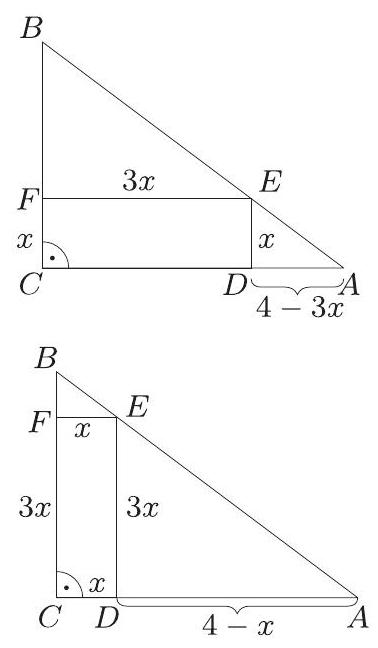
4. For which natural numbers $n \geq 5$ is it possible to cover a table of dimensions $n \times n$ without overlapping using tiles

and
.

Let $n \geq 10$. We write $n=5k+r$, where $0 \leq r < 5$. Then $n=5(k-1)+(r+5)$. Since $n \geq 10$, we have $k \geq 2$, so $k-1$ is a nat... | proof | Combinatorics | math-word-problem | Incomplete | Incomplete | olympiads | false |
Regular hexagon $ABCDEF$ is the base of right pyramid $PABCDEF$. If $PAD$ is an equilateral triangle with side length 10, and point $P$ lies directly above vertex $A$, what is the volume of the pyramid? | The hexagon can be divided into six equilateral triangles. The side length of the hexagon (and each of these triangles) is the same as the side length of $PAD$, which is 10. The area of an equilateral triangle with side length 10 is given by:
\[
\text{Area} = \frac{\sqrt{3}}{4} \times 10^2 = 25\sqrt{3}
\]
Since the h... | 750 | Geometry | math-word-problem | Yes | Yes | synthetic_math | true |
If $x = 3$, $y = 4$, and $z = 2$, calculate the value of $\frac{x^5 + 3y^3 + z^2}{12}$. | Given $x = 3$, $y = 4$, and $z = 2$, substitute these values into the expression:
\[
\frac{x^5 + 3y^3 + z^2}{12} = \frac{3^5 + 3 \times 4^3 + 2^2}{12} = \frac{243 + 3 \times 64 + 4}{12} = \frac{243 + 192 + 4}{12} = \frac{439}{12} = \boxed{36.5833}.
\]
However, to keep the answer in exact form as requested:
\[
\boxed{\... | \frac{439}{12} | Algebra | math-word-problem | Yes | Yes | synthetic_math | true |
Bret takes a 9 hour train ride to go to Boston. He spends 2 hours reading a book, 1 hour to eat his dinner, and 3 hours watching movies on his computer. How many hours does he have left to take a nap? | Bret spends a total of 2 hours reading, 1 hour eating, and 3 hours watching movies. That's a total of 2 + 1 + 3 = 6 hours.
The train ride is 9 hours long, so if he spends 6 hours on other activities, he has 9 - 6 = $\boxed{3}$ hours left to take a nap. | 3 | Other | math-word-problem | Yes | Yes | orca_math | true |
Let the function be $f(x)=(x-1)^{2}(e^{x}-a)$.
$(1)$ If $a=e$, discuss the monotonicity of $f(x)$;
$(2)$ Find the value of the positive real number $a$ such that $2a^{2}$ is an extremum of $f(x)$. | Solution:
$(1)$ The domain of $f(x)$ is $\mathbb{R}$, and $f'(x)=(x-1)[e^{x}(x+1)-2e]$.
When $x\geqslant 1$, $f'(x)\geqslant 0$; when $x 0$. Therefore, $f(x)$ is monotonically increasing on $\mathbb{R}$. $\boxed{4\text{ points}}$
$(2)$ $f'(x)=(x-1)[(x+1)e^{x}-2a]$,
Since $a > 0$, when $x 0$.
Let $g(x)=(x+1)... | 12\text{ points} | Calculus | math-word-problem | Yes | Yes | cn_k12 | false |
A high school has a total of 2000 students. Using stratified sampling, a sample of 100 students is drawn from students across three grades. If 30 students are drawn from both the first and second grades, then the number of students drawn from the third grade is $\boxed{40}$. | Since the total sample size is 100 students and 30 students are drawn from both the first and second grades, the number of students drawn from the third grade is $100 - 30 - 30 = \boxed{40}$. | 40 | Combinatorics | math-word-problem | Yes | Yes | cn_k12 | false |
The monthly salary $y$ (in yuan) of a worker and the labor productivity $x$ (in thousand yuan) have a regression equation of $\hat{y}=50+80x$. Which of the following judgments is correct?
A: When the labor productivity is 1000 yuan, the salary is 130 yuan.
B: If the labor productivity increases by 1000 yuan, then the s... | The monthly salary $y$ (in yuan) of a worker and the labor productivity $x$ (in thousand yuan) have a regression equation of $\hat{y}=50+80x$.
When the labor productivity is 1000 yuan, the predicted salary is 130 yuan, not that the salary is 130 yuan, so option A is incorrect.
If the labor productivity increases by 1... | B | Algebra | MCQ | Yes | Yes | cn_k12 | false |
In a group of 250 readers who read science fiction or literary works or both, some read science fiction and 88 read literary works. There are 18 readers who read both science fiction and literary works. How many readers read science fiction? | Let's denote the number of readers who read science fiction as S, the number of readers who read literary works as L, and the number of readers who read both as B.
We are given the following information:
- The total number of readers is 250.
- L (readers of literary works) is 88.
- B (readers of both) is 18.
We want ... | 180 | Combinatorics | math-word-problem | Yes | Yes | orca_math | true |
Given the proposition $P$: $\forall x \in \mathbb{R}$, $e^{x}-x-1 > 0$, then $\lnot P$ is ($\quad\quad$).
A: $\forall x \in \mathbb{R}$, $e^{x}-x-1 < 0$
B: $\exists x_{0} \in \mathbb{R}$, $e^{x_{0}}-x_{0}-1 \leqslant 0$
C: $\exists x_{0} \in \mathbb{R}$, $e^{x_{0}}-x_{0}-1 < 0$
D: $\forall x \in \mathbb{R}$, $e^{x}-x-... | The negation of a universal proposition is an existential proposition. Therefore, the negation of proposition $P$: $\forall x \in \mathbb{R}$, $e^{x}-x-1 > 0$ is $\exists x_{0} \in \mathbb{R}$, $e^{x_{0}}-x_{0}-1 \leqslant 0$.
Hence, the answer is: $\boxed{B}$.
This result can be obtained directly by applying the neg... | B | Inequalities | MCQ | Yes | Yes | cn_k12 | false |
A portable computer drive has enough kilobytes of storage space to store 2000 photos. Each photo has a certain size in kilobytes. The drive can store 12 200-kilobyte videos if it already has 400 photos on it. What is the size of each photo in kilobytes? | Let's denote the size of each photo as P kilobytes.
We know that the drive can store 2000 photos, so the total storage space of the drive in kilobytes is 2000P.
Now, we are told that if the drive already has 400 photos on it, it can store 12 videos, each of 200 kilobytes. The space taken by the 400 photos is 400P kil... | 1.5 | Algebra | math-word-problem | Yes | Yes | orca_math | true |
Task 5. Find all increasing arithmetic progressions with prime number terms that have the property: the number of terms in the progression is finite and greater than the difference of the progression. | Solution: We will prove that the sought progressions are 2,3 and $3,5,7$.
Consider a progression with a difference of 1 that satisfies the condition of the problem. It has at least two terms. One of them must be even, and the only even prime number is 2. There are no prime numbers less than 2, so 2 is the first term o... | 2,33,5,7 | Number Theory | math-word-problem | Yes | Yes | olympiads | false |
Example 12 Six lines in space, no three of which lie in the same plane. Prove: there exist three lines among them that satisfy one of the following three conditions,
(1) pairwise skew,
(2) mutually parallel,
(3) intersecting at a point. | We will represent these 6 lines with 6 points. If two lines are represented as 6, it means proving that in a 2-colored complete graph $k_{0}$, there is at least one monochromatic triangle. In fact, if the sides of the monochromatic triangle are red, then the three lines are pairwise skew; if the sides of the monochroma... | proof | Combinatorics | proof | Yes | Yes | olympiads | false |
3. Given a positive integer $n(n \geqslant 2)$, consider an $n$-layer inverted triangular alphabet table that satisfies the following conditions:
(1) The $i$-th row consists of $n+1-i$ letters, each of which is one of $A, J, Z$;
② Any three adjacent letters forming a small inverted triangle must be either three differe... | Let the letter in the $i$-th row and $j$-th column of the alphabet be $a_{ij}$. Let $A, J, Z$ correspond to the numbers $0, 1, 2$ respectively. According to the problem, $a_{ij} + a_{i, j+1} + a_{i+1, j}$ is a multiple of 3, i.e., $a_{i+1, j} \equiv - (a_{ij} + a_{i, j+1}) \pmod{3}$.
By induction, we can guess that $a_... | 3^{}+1(\in{N}) | Combinatorics | math-word-problem | Incomplete | Yes | olympiads | false |
Two circles $\Gamma_{1}$ and $\Gamma_{2}$ intersect at $A$ and $B$. A third circle $\Gamma$ containing them is tangent to $\Gamma_{1}$ at $C$ and to $\Gamma_{2}$ at $D$. $(AB)$ intersects $\Gamma$ at $E$ and $F$. Show that the tangents to $\Gamma$ passing through $E$ and $F$ intersect on $(CD)$. | The tangent at $C$ is the radical axis of $\Gamma$ and $\Gamma_{1}$, and the tangent at $D$ is the radical axis of $\Gamma$ and $\Gamma_{2}$. Therefore, these tangents intersect on the radical axis $(A B)$ of $\Gamma_{1}$ and $\Gamma_{2}$. Therefore, $C, D, E, F$ are harmonic, which proves the assertion to be demonstra... | proof | Geometry | proof | Yes | Yes | olympiads | false |
anil had to do a multiplication . instead of taking 35 as one of the multipliers , he took 53 . as a result , the product went up by 540 . what is the new product ? | Let's denote the other multiplier that Anil used correctly as "x".
According to the problem, Anil was supposed to multiply 35 by x, but instead, he multiplied 53 by x. The difference in the product is 540.
So, the equation representing the situation is:
53x - 35x = 540
Solving for x:
18x = 540
x = 540 / 18
x = 30... | 1590 | Algebra | math-word-problem | Yes | Yes | orca_math | true |
Tonya has opened a lemonade stand selling lemonade in small, medium, and large cups at $1, $2 and $3 respectively. At the close of business she ended up making $50. She sold some worth of small lemonades, $24 worth of medium lemonades and 5 cups of large lemonade. How much money did Tonya make from selling small lemona... | Let's denote the number of small lemonades sold as S. Each small lemonade is sold at $1, so the total revenue from small lemonades is $1 * S.
We know that Tonya made $50 in total, $24 from medium lemonades, and sold 5 large lemonades at $3 each. So the revenue from large lemonades is $3 * 5 = $15.
Now, let's calculat... | \$11 | Algebra | math-word-problem | Yes | Yes | orca_math | true |
What is the smaller of the solutions to the equation $x^2 + 15x + 36 = 0$? | 1. Factor the given quadratic equation $x^2 + 15x + 36$.
2. We look for two numbers whose product is 36 and whose sum is 15. This can be achieved with the numbers 12 and 3.
3. Rewrite the quadratic equation using these numbers: $(x + 12)(x + 3) = 0$.
4. Set each factor to zero to find the roots: $x + 12 = 0$ or $x + 3 ... | -12 | Algebra | math-word-problem | Yes | Yes | synthetic_math | true |
In the acute triangle $\triangle ABC$, $\angle C > \angle B$. Point $I$ is a point on side $BC$ such that $\angle ADB$ is obtuse, $H$ is the orthocenter of $\triangle ABD$, and point $F$ is inside $\triangle ABC$. $H_1$ is on the circumcircle of $\triangle ABD$. Prove that point $F$ is the orthocenter of $\triangle ABC... | Prove: First point out a simple and useful fact: In $\triangle U V W$, if $\angle U V W$ and $\angle V W U$ are acute angles, then
"Point $P$ is the orthocenter of $\triangle U V W$" $\Leftrightarrow$ "$U P \perp V W$, and $\angle V P W=\pi - \angle V U W$".
Use this simple fact to prove the conclusion of the problem.
... | proof | Geometry | proof | Incomplete | Yes | cn_contest | false |
Someone bought 5 consecutive train ticket numbers, and the sum of these 5 ticket numbers is 120. What is the product of these 5 ticket numbers? | Let's denote the middle number as $x$. Therefore, the two numbers smaller than it are $(x-1)$ and $(x-2)$, and the two numbers larger than it are $(x+1)$ and $(x+2)$.
We have the equation: $(x-1) + (x-2) + x + (x+1) + (x+2) = 120$.
Solving this equation, we find $x = 24$.
Therefore, the other four numbers are 22, 23... | 7893600 | Algebra | math-word-problem | Yes | Yes | cn_k12 | false |
Find the range of values for the real number $m$ such that the solution set of the inequality $|x-m|+|x+2|<4$ is not empty. The options are:
A: $(-2, 6)$
B: $(-\infty, -2) \cup (6, +\infty)$
C: $(-\infty, -6) \cup (2, +\infty)$
D: $(-6, 2)$ | 1. First, let's find the minimum value of the expression $|x-m|+|x+2|$.
2. According to the properties of absolute values, we know that $|a|+|b| \geq |a-b|$.
3. Applying this property to our expression yields: $|x-m|+|x+2| \geq |(x-m)-(x+2)|=|m+2|$.
4. Therefore, if $|m+2|<4$, then the solution set of the inequality $|... | \text{D: }(-6, 2) | Inequalities | MCQ | Yes | Yes | cn_k12 | false |
A student scored an average of 60 marks in 3 subjects: physics, chemistry, and mathematics. If the average marks in physics and mathematics is 90 and that in physics and chemistry is 70, what are the marks in physics? | Let's denote the marks in physics as P, in chemistry as C, and in mathematics as M.
According to the information given:
1) The average marks in all three subjects is 60. Therefore, the total marks in all three subjects is 3 * 60 = 180. This gives us the equation:
P + C + M = 180 (Equation 1)
2) The average marks i... | 140 | Algebra | math-word-problem | Yes | Problem not solved | orca_math | true |
Given the sets $A=\{x|x^{2}-px-2=0\}$ and $B=\{x|x^{2}+qx+r=0\}$, if $A\cup B=\{-2,1,5\}$ and $A\cap B=\{-2\}$, find the value of $p+q+r$. | From the given conditions, we know that $-2 \in A$.
Substituting into the equation for $A$, we get $p=-1$, thus $A=\{-2,1\}$.
Given $A\cup B=\{-2,1,5\}$ and $A\cap B=\{-2\}$, we have:
$B=\{-2,5\}$.
Substituting into the equation for $B$, we get: $q=-3$, $r=-10$.
Therefore, the value of $p+q+r$ is $\boxed{-14}$. | -14 | Algebra | math-word-problem | Yes | Yes | cn_k12 | false |
Which of the following statements about the chi-square ($K^2$) is correct? ( )
A: $K^2$ can be used to test whether there is a relationship or not in any independent problem.
B: The larger the value of $K^2$, the greater the correlation between two events.
C: $K^2$ is a random variable used to determine whether ... | Analysis: $K^2$ is only applicable to 2×2 contingency table problems, and $K^2$ can only infer the degree of correlation between two categorical variables, so option A is incorrect.
When the value is very small, it can only indicate that the degree of correlation between the two variables is low, but it cannot infer ... | \text{B} | Algebra | MCQ | Yes | Yes | cn_k12 | false |
Given $\tan \theta = 2$, the value of $\frac{1-\sin 2\theta}{2\cos^2\theta}$ is (__).
A: $\frac{1}{2}$
B: $\frac{3}{2}$
C: $-\frac{1}{2}$
D: $-\frac{3}{2}$ | **Analysis**
First, replace the numerator's $1$ with $\sin^2\theta + \cos^2\theta$, and replace $\sin 2\theta$ with $2\sin \theta\cos \theta$. Then, use the basic trigonometric identity for the same angle, and finally substitute $\tan \theta = 2$ into the calculation.
**Solution**
Since $\tan \theta = 2$,
$\therefo... | A | Algebra | MCQ | Yes | Yes | cn_k12 | false |
Factorize: $-ax^2+2ax-a= \quad .$ | Start with $-ax^2+2ax-a$
$=-a(x^2-2x+1)$
$=-a(x-1)^2.$
Therefore, the answer is $\boxed{-a(x-1)^2}$. | -a(x-1)^2 | Algebra | math-word-problem | Yes | Yes | cn_k12 | false |
Zassaessiya.A.A.
Given a triangle ABC. A line $l$ is tangent to the inscribed circle of the triangle. Denote by $l_{a}, l_{b}, l_{c}$ the lines symmetric to $l$ with respect to the bisectors of the external angles of the triangle. Prove that the triangle formed by these lines is equal to triangle $ABC$.
# | Note that the center I of the inscribed circle of triangle ABC is the orthocenter of triangle KLM, formed by the external angle bisectors. Draw a line $m$ through I, parallel to $l$. The lines $m_{a}, m_{b}, m_{c}$, symmetric to $m$ with respect to these bisectors, intersect at a single point $T$, lying on the circumci... | proof | Geometry | proof | Yes | Yes | olympiads | false |
Calculate the value of $n$ modulo 9, where $$2+33+444+5555+66666+777777+8888888+99999999 \equiv n \pmod{9},$$ and $0 \leq n < 9$. | Using the rule that a number is congruent to the sum of its digits modulo 9, we compute:
\begin{align*}
2 &\equiv 2 \pmod{9}, \\
33 &\equiv 3+3=6 \pmod{9}, \\
444 &\equiv 4+4+4=12 \equiv 3 \pmod{9}, \\
5555 &\equiv 5+5+5+5=20 \equiv 2 \pmod{9}, \\
66666 &\equiv 6+6+6+6+6=30 \equiv 3 \pmod{9}, \\
777777 &\equiv 7+7+7+7+... | n = 6 | Number Theory | math-word-problem | Yes | Yes | synthetic_math | true |
How many different sequences of 18 coin tosses will contain exactly three HH, four HT, five TH, and six TT subsequences? | 1. **Sequence Structure:** From the given subsequences:
- Switch from H to T: four times (HT)
- Switch from T to H: five times (TH)
- This implies a sequence starting with T and alternating for the switches: THTHTHTHT.
2. **Add TT subsequences:** Adding TT does not change the last T. There are six TT subseque... | 4200 | Combinatorics | math-word-problem | Yes | Yes | synthetic_math | true |
If $4b = 3 + 4a$, then the value of the algebraic expression $a + \{a - [a - (a - b) - b] - b\} - b$ is equal to . | Given $4b = 3 + 4a$,
we have $a - b = -\frac{3}{4}$,
The original algebraic expression can be simplified as follows:
= $a + \{a - [a - a + b - b] - b\} - b$
= $a + \{a - b\} - b$
= $(a - b) + \{a - b\}$
= $-\frac{3}{4} - \frac{3}{4}$
= $-\frac{3}{2}$,
Therefore, the answer is $\boxed{-\frac{3}{2}}$. | -\frac{3}{2} | Algebra | math-word-problem | Yes | Yes | cn_k12 | false |
12. Let the parabola $y=x^{2}+(2 a+1) x+2 a+$ $\frac{5}{4}$ intersect the $x$-axis at only one point.
(1) Find the value of $a$;
(2) Find the value of $a^{18}+32 a^{-6}$. | 12. (1) Since the parabola intersects the $x$-axis at only one point, the quadratic equation $x^{2}+(2 a+1) x+2 a+\frac{5}{4}=0$ has two equal real roots. Therefore,
$$
\Delta=(2 a+1)^{2}-4\left(2 a+\frac{5}{4}\right)=0,
$$
which simplifies to $a^{2} \cdots a-1=0$.
$$
\ldots a=\frac{1 \pm \sqrt{5}}{2} \text {. }
$$
(2... | 5796 | Algebra | math-word-problem | Yes | Yes | cn_contest | false |
On Monday, Millie puts a quart of seeds, $ 25\%$ of which are millet, into a bird feeder. On each successive day she adds another quart of the same mix of seeds without removing any seeds that are left. Each day the birds eat only $ 25\%$ of the millet in the feeder, but they eat all of the other seeds. On which day... | null | null | Logic and Puzzles | MCQ | Yes | Yes | aops_forum | false |
Pyramid $EARLY$ has rectangular base $EARL$ and apex $Y$, and all of its edges are of integer length. The four edges from the apex have lengths $1, 4, 7, 8$ (in no particular order), and EY is perpendicular to $YR$. Find the area of rectangle $EARL$. | null | null | Geometry | math-word-problem | Yes | Yes | aops_forum | false |
Given the function $f(x)=x^{2}$, find the area of the triangle formed by the tangent line at $x=1$ and the two coordinate axes. | The derivative of the function $f(x)=x^{2}$ is $f′(x)=2x$.
At $x=1$, the slope of the tangent line is $2$, and the tangent point is $(1,1)$.
Thus, the equation of the tangent line at $x=1$ is $y-1=2(x-1)$.
Letting $x=0$, we get $y=-1$; and letting $y=0$, we get $x= \frac {1}{2}$.
Therefore, the area of the triangle for... | \frac {1}{4} | Calculus | math-word-problem | Yes | Yes | cn_k12 | false |
Find the roots of
\[4x^4 + 8x^3 - 53x^2 + 8x + 4 = 0.\] | Dividing the equation by \( x^2 \), we have:
\[4x^2 + 8x - 53 + \frac{8}{x} + \frac{4}{x^2} = 0.\]
Let \( y = x - \frac{1}{x} \). Then:
\[y^2 = x^2 - 2 + \frac{1}{x^2},\]
so \( x^2 - \frac{1}{x^2} = y^2 + 2 \). Substituting this into the original equation gives:
\[4(y^2 + 2) + 8y - 53 = 0,\]
which simplifies to:
\[4y^2... | \frac{5 \pm \sqrt{41}}{4}, \frac{-9 \pm \sqrt{97}}{4} | Algebra | math-word-problem | Yes | Yes | synthetic_math | true |
if a cube has a volume of 125 , what is the surface area of one side ? | To find the surface area of one side of a cube, we first need to determine the length of one edge of the cube.
Since the volume of a cube is given by the formula V = s^3, where s is the length of one edge, we can find the edge length by taking the cube root of the volume.
Given that the volume V is 125, we have:
s^3... | 25 | Geometry | math-word-problem | Yes | Yes | orca_math | true |
13. [5] Fisica and Ritmo discovered a piece of Notalium shaped like a rectangular box, and wanted to find its volume. To do so, Fisica measured its three dimensions using a ruler with infinite precision, multiplied the results and rounded the product to the nearest cubic centimeter, getting a result of $V$ cubic centim... | Answer:
4035
The only possible way for Ritmo to get 2017 cubic centimeters is to have his measurements rounded to $1,1,2017$ centimeters respectively. Therefore the largest value of $V$ is achieved when the dimensions are $(1.5-\epsilon)(1.5-\epsilon)(2017.5-\epsilon)=4539.375-\epsilon^{\prime}$ for some very small po... | 4035 | NaN | NaN | NaN | NaN | olympiads | false |
There are 5 numbered drawers, and 8 identical small balls need to be placed into them. The total number of ways to place the balls into the drawers without any drawer being empty is _______. | To solve the problem of placing 8 identical small balls into 5 numbered drawers without leaving any drawer empty, we follow these steps:
1. **Arrange the Balls**: First, we place the 8 balls in a row. This creates 7 spaces between the balls where we can potentially insert dividers to create groups of balls. The spaces... | 35 | Combinatorics | math-word-problem | Yes | Yes | cn_k12 | false |
Consider the graph on $1000$ vertices $v_1, v_2, ...v_{1000}$ such that for all $1 \le i < j \le 1000$, $v_i$ is connected to $v_j$ if and only if $i$ divides $j$. Determine the minimum number of colors that must be used to color the vertices of this graph such that no two vertices sharing an edge are the same color. | 1. **Understanding the Graph Construction**:
- We have a graph with vertices \( v_1, v_2, \ldots, v_{1000} \).
- An edge exists between \( v_i \) and \( v_j \) if and only if \( i \) divides \( j \) (i.e., \( i \mid j \)).
2. **Identifying Cliques**:
- A clique is a subset of vertices such that every two dist... | 10 | Combinatorics | math-word-problem | Yes | Yes | aops_forum | false |
if the remainder is 12 when the integer n is divided by 22 , what is the remainder when 2 n is divided by 11 ? | If the remainder is 12 when the integer n is divided by 22, it means that n can be expressed as:
n = 22k + 12
where k is some integer.
Now, let's find the remainder when 2n is divided by 11:
2n = 2(22k + 12)
= 44k + 24
Since 44k is a multiple of 11, it will not contribute to the remainder when divided by 11. So... | 2 | Number Theory | math-word-problem | Yes | Yes | orca_math | true |
Given a geometric sequence $\{a_n\}$ satisfies $a_1 + a_2 = 3$ and $a_2 + a_3 = 6$, then $a_7 =$ ( )
A: 64
B: 81
C: 128
D: 243 | From $a_2 + a_3 = q(a_1 + a_2) = 3q = 6$,
$\therefore q = 2$,
$\therefore a_1(1 + q) = 3$,
$\therefore a_1 = 1$,
$\therefore a_7 = 2^6 = 64$.
Hence, the correct choice is $\boxed{A}$.
By using the relationship between $a_1 + a_2 = 3$ and $a_2 + a_3 = 6$ to find $q$, and then finding $a_1$, we can solve for ... | A | Algebra | MCQ | Yes | Yes | cn_k12 | false |
Example 3-15 Derangement Problem. | The derangement problem has been discussed twice before, once by deriving the derangement formula using a recurrence relation, and the second time through the principle of inclusion-exclusion. Now, we will solve it using permutations with restricted positions, which is essentially another way of expressing the principl... | n!-C(n,1)(n-1)!+C(n,2)(n | Combinatorics | math-word-problem | Incomplete | Yes | olympiads | false |
Which of the following statements is incorrect? ( )
A: If a line in one plane is perpendicular to any line in another plane, then the two planes are perpendicular.
B: If any line in one plane is parallel to another plane, then the two planes are parallel.
C: If a line is parallel to a plane, and a plane that passes thr... | **Analysis of the problem:**
Option A is the definition of a line being perpendicular to a plane. Option B is the definition of a line being parallel to a plane. Given that a line is parallel to a plane, and this line is not in the plane, and because a plane passing through this line intersects with this plane, it ca... | \text{B} | Geometry | MCQ | Yes | Yes | cn_k12 | false |
4 . For $i=1,2, \cdots, n$, we have $\left|x_{i}\right|<1$, and assume $\left|x_{1}\right|+\left|x_{2}\right|+\cdots+\left|x_{1}\right|=19+\mid x_{1}$ $+x_{2}+\cdots+x_{2} \mid$. What is the minimum value of the integer $n$? | $$
\begin{array}{l}
4 . \quad(20) \\
\because\left|x_{i}\right|19 .
\end{array}
$$
When $n=20$, we have
$$
x_{\mathrm{i}}=\left\{\begin{array}{l}
0.95, \text { when } i \text { is an odd number: } \\
-0.95, \text { when } i \text { is an even number. }
\end{array}\right.
$$
Satisfying the given conditions and the kno... | 20 | Algebra | math-word-problem | Incomplete | Yes | cn_contest | false |
Eight points are spaced around at intervals of one unit around a $2 \times 2$ square, as shown. Two of the $8$ points are chosen at random. What is the probability that the two points are one unit apart?
[asy] size((50)); dot((5,0)); dot((5,5)); dot((0,5)); dot((-5,5)); dot((-5,0)); dot((-5,-5)); dot((0,-5)); dot((5,-5... | The two points are one unit apart at $8$ places around the edge of the square. There are $8 \choose 2$$= 28$ ways to choose two points. The probability is
\[\frac{8}{28} = \boxed{\textbf{(B)}\ \frac27}\] | \frac{2}{7} | Combinatorics | MCQ | Yes | Yes | amc_aime | false |
The bacteria in a lab dish double in number every three hours. If 200 bacteria cells are in the dish now, in how many hours will there be exactly 25,600 bacteria? | First, calculate how many times the initial number of bacteria (200) needs to double to reach 25,600 bacteria:
\[ \frac{25600}{200} = 128 \]
\[ 128 = 2^7 \]
The bacteria double 7 times to reach 25,600.
Since the bacteria double every three hours, the time required for 7 doublings is:
\[ 3 \times 7 = \boxed{21} \text{ ... | 21 | Algebra | math-word-problem | Yes | Yes | synthetic_math | true |
Given a line segment of length $3m$, a point is randomly chosen from it such that its distance to both ends is greater than $1m$. What is the probability of this occurring? The options are:
A: $\dfrac {1}{3}$
B: $\dfrac {1}{2}$
C: $\dfrac {2}{3}$
D: $\dfrac {1}{4}$ | Let the "line segment $AB$ of length $3m$" correspond to the interval $[0,3]$.
Let event $A$ be "the distance to both endpoints $A$ and $B$ is greater than $1m$". The interval that satisfies $A$ is $[1,2]$.
According to the geometric probability calculation formula, $P= \dfrac {2-1}{3-0}= \dfrac {1}{3}$.
Therefore, the... | A | Geometry | MCQ | Yes | Yes | cn_k12 | false |
Let $a$ and $b$ be the roots of the equation $x^2 - mx + 3 = 0$. Suppose that $a^2 + \frac{1}{b^2}$ and $b^2 + \frac{1}{a^2}$ are the roots of the equation $x^2 - sx + t = 0$. Determine the value of $t$. | From Vieta's formulas, we know for the first quadratic equation (with roots $a$ and $b$):
1. $a + b = m$
2. $ab = 3$
For the new polynomial with roots $a^2 + \frac{1}{b^2}$ and $b^2 + \frac{1}{a^2}$, we need to find $t$:
\[
t = \left(a^2 + \frac{1}{b^2}\right)\left(b^2 + \frac{1}{a^2}\right) = a^2b^2 + a^2 \cdot \frac... | \frac{100}{9} | Algebra | math-word-problem | Yes | Yes | synthetic_math | true |
In the Egyptian triangle, whose sides are 3, 4, and 5 units long, inscribe a rectangle whose vertices lie on the sides of the triangle and the ratio of its sides is $1: 3$. Determine the lengths of the sides of the rectangle. | Solution. The given rectangular shape can be placed in the triangle in several ways. The simplest case is when the sides of the rectangle are parallel to the legs of the triangle:
The vertices... | \frac{12}{13},\frac{36}{13},\frac{4}{5},\frac{12}{5},\frac{60}{61},\frac{180}{61},\frac{20}{29},\frac{60}{29} | Geometry | math-word-problem | Yes | Yes | olympiads | false |
In $\triangle ABC$, the lengths of the sides opposite to angles $A$, $B$, and $C$ are $a$, $b$, and $c$ respectively. Given that $b(\cos A - 2\cos C) = (2c - a)\cos B$.
(I) Find the value of $\frac{\sin A}{\sin C}$;
(II) If $\cos B = \frac{1}{4}$, $b = 2$, find the area $S$ of $\triangle ABC$. | (1) From the given equation $b(\cos A - 2\cos C) = (2c - a)\cos B$, we can use the sine law to simplify it. First, let's rewrite the equation as:
$$\frac{b}{2c - a} = \frac{\cos B}{\cos A - 2\cos C}$$
Now, using the sine law, we have $\frac{a}{\sin A} = \frac{b}{\sin B} = \frac{c}{\sin C}$. We can rewrite the equation ... | \frac{\sqrt{15}}{4} | Geometry | math-word-problem | Yes | Yes | cn_k12 | false |
For $f(x)=\frac{1}{x}\ (x>0)$, prove the following inequality.
\[f\left(t+\frac 12 \right)\leq \int_t^{t+1} f(x)\ dx\leq \frac 16\left\{f(t)+4f\left(t+\frac 12\right)+f(t+1)\right\}\] | null | null | Inequalities | proof | Yes | Yes | aops_forum | false |
32. Let $a_{1}=3$, and for $n \geq 1$, let $a_{n+1}=(n+1) a_{n}-n$. Find the smallest $m \geq 2005$ such that $a_{m+1}-1 \mid a_{m}^{2}-1$. | Solution:
$$
2010
$$
We will show that $a_{n}=2 \cdot n!+1$ by induction. Indeed, the claim is obvious for $n=1$, and $(n+1)(2 \cdot n!+1)-n=2 \cdot(n+1)!+1$. Then we wish to find $m \geq 2005$ such that $2(m+1)!\mid 4(m!)^{2}+4 m!$, or dividing by $2 \cdot m!$, we want $m+1 \mid 2(m!+1)$. Suppose $m+1$ is composite. ... | 2010 | NaN | NaN | NaN | NaN | olympiads | false |
Given $A=\{x|y= \sqrt{x-3} - \frac{1}{\sqrt{7-x}}\}$, $B=\{y|y=-x^{2}+2x+8\}$, $C=\{x \in \mathbb{R}|x a+1\}$
(1) Find $A$, $(\mathbb{R} \setminus A) \cap B$;
(2) If $A \cup C = C$, find the range of values for $a$. | (1) According to the problem, we have: $A=\{x|y= \sqrt{x-3} - \frac{1}{\sqrt{7-x}}\}=\{x|3 \leqslant x a+1\}$, and $A \cup C = C$,
Therefore, $A \subseteq C$, which means $a \geqslant 7$ or $a+1 < 3$.
Thus, the range of values for $a$ is $\boxed{a \geqslant 7 \text{ or } a+1 < 3}$. | a \geqslant 7 \text{ or } a+1 < 3 | Algebra | math-word-problem | Yes | Incomplete | cn_k12 | false |
Example 2. $\sin 2 \alpha=-\frac{24}{25}$ and $\frac{3}{4} \pi<\alpha<\pi$, then the value of tg $\boldsymbol{\alpha}$ is
(A) $\frac{4}{3}$ or $\frac{3}{4}$,
(B) $-\frac{4}{3}$ or $-\frac{3}{4}$,
(C) $-\frac{4}{3}$,
(D) $-\frac{3}{4}$. | Using the universal formula to verify, $-\frac{4}{3}$ and $-\frac{3}{4}$ are both possible, which would lead to mistakenly choosing $B$. However, an implicit condition is overlooked: due to the monotonicity of $\tan \alpha$, when $\frac{3}{4} \pi < \alpha < \pi$, $-1 < \tan \alpha < 0$. Therefore, $-\frac{4}{3}$ cannot... | D | Algebra | MCQ | Yes | Yes | cn_contest | false |
Example 2. Given that $C D$ is the altitude on the hypotenuse of $R t \triangle A B C$, and a circle is constructed with $C D$ as its diameter, intersecting $\mathrm{AC}$ and $\mathrm{BC}$ at $E$ and $F$ respectively. Prove:
$$
\frac{\mathrm{AE}}{\mathrm{BF}}=\frac{\mathrm{AC}^{\mathrm{S}}}{\mathrm{BC}^{3}} \text {. }
... | Proof As shown in Figure 2, let the angle parameter $\alpha = \angle \mathrm{A}$, and connect $\mathrm{DE}$ and $\mathrm{DF}$.
Then
$$
\begin{aligned}
\mathrm{AE} & = \mathrm{AD} \cos \alpha = (\mathrm{AC} \cdot \cos \alpha) \cos \alpha \\
& = (\mathrm{AB} \cdot \cos \alpha) \cos^{2} \alpha = \mathrm{AB} \cos^{3} \alph... | proof | Geometry | proof | Yes | Yes | cn_contest | false |
Express as a common fraction in simplest form: $$
\sqrt[3]{17\frac{1}{9}}
$$ | First, convert $17\frac{1}{9}$ into an improper fraction. We calculate $17\frac{1}{9} = 17 + \frac{1}{9} = \frac{153}{9} + \frac{1}{9} = \frac{154}{9}$.
Now, apply the cube root to the improper fraction:
$$
\sqrt[3]{17\frac{1}{9}} = \sqrt[3]{\frac{154}{9}}.
$$
We then take the cube root of the numerator and the denomi... | \frac{\sqrt[3]{154}}{\sqrt[3]{9}} | Algebra | math-word-problem | Yes | Yes | synthetic_math | true |
The perimeter of a rectangular stadium is some meters. Its length is 100 m when its breadth is 300 m. What is the perimeter of the stadium? | To find the perimeter of a rectangle, we use the formula:
Perimeter = 2 * (Length + Breadth)
Given that the length (L) is 100 meters and the breadth (B) is 300 meters, we can plug these values into the formula:
Perimeter = 2 * (100 m + 300 m)
Perimeter = 2 * (400 m)
Perimeter = 800 meters
So, the perimeter of the s... | 800 | Geometry | math-word-problem | Incomplete | Yes | orca_math | true |
A point $O$ is chosen inside the square $ABCD$. The square $A'B'C'D'$ is the image of the square $ABCD$ under the homothety with center at point $O$ and coefficient $k> 1$ (points $A', B', C', D' $ are images of points $A, B, C, D$ respectively). Prove that the sum of the areas of the quadrilaterals $A'ABB'$ and $C'CDD... | null | null | Geometry | proof | Yes | Yes | aops_forum | false |
Maria gave some of her money to her friend Isha, half of what she gave to Florence. Florence received three times as much money as Maria's cousin Rene, and Rene received $300. Maria gave her three friends $1650. What is the ratio of the money Maria gave to Isha to her total money? | Let's start by figuring out how much money each person received.
Rene received $300.
Florence received three times as much as Rene, so Florence received 3 * $300 = $900.
Maria gave half as much to Isha as she gave to Florence, so Isha received $900 / 2 = $450.
Now, let's add up the total amount Maria gave to her thre... | 1:3.67 | Algebra | math-word-problem | Yes | Yes | orca_math | true |
What is the smallest positive integer $n$ such that $19n \equiv 2701 \pmod{9}?$ | First, simplify $2701 \pmod{9}$. Since $2 + 7 + 0 + 1 = 10$ and $10 \pmod{9} = 1$, we have $2701 \equiv 1 \pmod{9}$. This simplifies our equation to:
$$
19n \equiv 1 \pmod{9}
$$
This means that $19n$ can be written in the form $9a + 1$ where $a$ is an integer. To find $n$, we need $19n = 9a + 1$.
To find the smallest ... | 2 | Number Theory | math-word-problem | Yes | Yes | synthetic_math | true |
- - - - - - - - - - - - - - - - yes - - - - - - - - - no - - - - unsure subject m - - - - 500 - - - - - - - - 200 - - - - - 100 subject r - - - - 400 - - - - - - - - 100 - - - - - 300 a total of 800 students were asked whether they found two subjects , m and r , interesting . each answer was either yes or no or unsure ... | Let's analyze the given data:
For Subject M:
- Yes: 500 students
- No: 200 students
- Unsure: 100 students
For Subject R:
- Yes: 400 students
- No: 100 students
- Unsure: 300 students
A total of 800 students were asked.
We are told that 170 students answered "Yes" only for Subject M. This means that these 170 stude... | 230 | Combinatorics | math-word-problem | Incomplete | Yes | orca_math | true |
Let $I$ be the incenter of triangle $ABC$, tangent to sides $AB$ and $AC$ at points $E$ and $F$, respectively. The lines through $E$ and $F$ parallel to $AI$ intersect lines $BI$ and $CI$ at points $P$ and $Q$, respectively. Prove that the center of the circumcircle of triangle $IPQ$ lies on line $BC$. | null | null | Geometry | proof | Yes | Yes | aops_forum | false |
12.66*. On the segment $A B$, a point $C$ is taken, and on the segments $A C$, $B C$, and $A B$ as diameters, semicircles are constructed lying on the same side of the line $A B$. Through the point $C$, a line perpendicular to $A B$ is drawn, and in the curvilinear triangles $A C D$ and $B C D$ inscribed circles $S_{1}... | 12.66. Let $P$ and $Q$ be the midpoints of segments $AC$ and $AB$, $R$ be the center of circle $S_{1}$; $a=AC/2$, $b=BC/2$, $x$ be the radius of circle $S_{1}$. It is easy to verify that $PR=a+x$, $QR=a+b-x$, and $PQ=b$. Let's draw the altitude $RH$ in triangle $PQR$. The distance from point $R$ to line $CD$ is $x$, so... | \frac{}{+b} | Geometry | proof | Yes | Yes | olympiads | false |
The ruler of Laputa will set up a train network between cities in the state, which satisfies the following conditions:
- [i]Uniformity[/i]: From one city to another, by train, possibly through exchanges.
- [i]Prohibition N[/i]: There exist no four cities $A, B, C, D$ such that there are direct routes between $A$ and $B... | null | null | Logic and Puzzles | proof | Yes | Yes | aops_forum | false |
Rich likes to take long walks through town. First he walks 20 feet from his house to the sidewalk. Then he walks 200 feet down the sidewalk to the end of the road. Then he makes a left and walks double his total distance so far until he reaches the next intersection. Then he walks half the total distance up to this poi... | Let's calculate the total distance Rich walks step by step.
1. From his house to the sidewalk: 20 feet
2. Down the sidewalk to the end of the road: 200 feet
So far, Rich has walked 20 + 200 = 220 feet.
3. He then makes a left and walks double his total distance so far, which is 2 * 220 = 440 feet.
Now, the total di... | 1980 | Logic and Puzzles | math-word-problem | Yes | Yes | orca_math | true |
An apple orchard grows red and green apples. On the first day of harvest, 496 apples are collected. There are 3 times as many red apples as there are green apples. How many green apples were harvested? | Let's denote the number of green apples as G and the number of red apples as R.
According to the problem, there are 3 times as many red apples as there are green apples. So we can write the following equation:
R = 3G
We also know that the total number of apples collected on the first day of harvest is 496. So we can... | 124 | Algebra | math-word-problem | Yes | Yes | orca_math | true |
8.278. $4 \sin ^{3} x \cos 3 x+4 \cos ^{3} x \sin 3 x=3 \sin 2 x$.
8.278. $4 \sin ^{3} x \cos 3 x + 4 \cos ^{3} x \sin 3 x = 3 \sin 2 x$. | ## Solution.
Let's rewrite the equation as
$2 \sin ^{2} x(2 \sin x \cos 3 x)+2 \cos ^{2} x(2 \sin 3 x \cos x)-3 \sin 2 x=0 \Leftrightarrow$
$\Leftrightarrow 2 \sin ^{2} x(-\sin 2 x+\sin 4 x)+2 \cos ^{2} x(\sin 2 x+\sin 4 x)-3 \sin 2 x=0 \Leftrightarrow$ $\Leftrightarrow-2 \sin ^{2} x \sin 2 x+2 \sin ^{2} x \sin 4 x+... | x_{1}=\frac{\pi}{6}(2n+1),n\inZ;x_{2}=\pik,k\inZ | Algebra | math-word-problem | Yes | Yes | olympiads | false |
Dikembe wants to teach everyone at school about the importance of flossing, so he plans to bring enough packets of floss for everyone. There are three classes with 20, 25, and 30 students, respectively. Each student in the first class needs 1.5 yards of floss, each student in the second class needs 1.75 yards of floss,... | First, let's calculate the total amount of floss Dikembe needs for each class:
For the first class with 20 students, each needing 1.5 yards of floss:
20 students * 1.5 yards/student = 30 yards
For the second class with 25 students, each needing 1.75 yards of floss:
25 students * 1.75 yards/student = 43.75 yards
For ... | 27.737 | Algebra | math-word-problem | Yes | Yes | orca_math | true |
Given that the slant height of a cone is 2, and the angle between the slant height and the axis of rotation is 30°, the surface area of the cone is \_\_\_\_\_\_. | Since the slant height of the cone is 2, and the angle between the slant height and the axis of rotation is 30°,
it follows that the radius of the base of the cone is 1.
Therefore, the circumference of the base is $2\pi$.
The area of the base of the cone is $\pi$, and the lateral surface area of the cone is: $$\f... | 3\pi | Geometry | math-word-problem | Yes | Yes | cn_k12 | false |
Given that $f(x) = (\sin{\theta})^x$, where $\theta \in (0, \frac{\pi}{2})$, and $a = f(\frac{1}{2}\log_{2}{\sqrt{7}})$, $b = f(\log_{4}{3})$, $c = f(\log_{16}{5})$, determine the relationship among $a$, $b$, and $c$ ( ).
A: $c > a > b$
B: $a > c > b$
C: $b > a > c$
D: $c > b > a$ | **Analysis:**
This problem tests our understanding of the monotonicity of functions and their applications, involving properties of exponential and logarithmic functions. Pay close attention to the analysis of the monotonicity of the function $f(x) = (\sin{\theta})^x$, which is a basic problem.
According to the probl... | A | Algebra | MCQ | Yes | Yes | cn_k12 | false |
7. Given the function $f(x)=\frac{3+x}{1+x}$, let $f(1)+f(2)+f(4)+\cdots+f(1024)=m$, $f\left(\frac{1}{2}\right)+f\left(\frac{1}{4}\right)+f\left(\frac{1}{8}\right)+\cdots+f\left(\frac{1}{1024}\right)=n$, then $m+n=$ $\qquad$ . | 7,42 | 742 | Algebra | math-word-problem | Yes | Yes | olympiads | false |
For some integer values of n, the value of the expression 4n + 7 is an integer greater than 1 and less than a certain number. There are 30 such values of n. What is the upper bound for the expression to satisfy the condition? | Let's denote the upper bound for the expression 4n + 7 as U. We are looking for the largest value of 4n + 7 that is less than U.
Since there are 30 values of n that satisfy the condition, we can set up the following inequality for the smallest and largest values of n:
For the smallest value of n (let's call it n_min)... | 120 | Number Theory | math-word-problem | Yes | Yes | orca_math | true |
[ Construction with a double-sided ruler]
Given an angle $A O B$, a line $l$ and a point $P$ on it. Using a single double-sided ruler, draw through point $P$ lines that form with line $l$ an angle equal to angle $A O B$. | Draw through point $P$ the lines $P A_{1} \parallel O A$ and $P B_{1} \parallel O B$. Let the line $P M$ bisect the angle between the lines $l$ and $P A_{1}$. Under the symmetry with respect to the line $P M$, the line $P A_{1}$ is transformed into the line $l$, so the line $P B_{1}$ under this symmetry is transformed ... | notfound | Geometry | math-word-problem | Yes | Yes | olympiads | false |
Suppose that \( x_1+1 = x_2+2 = x_3+3 = x_4+4 = x_5+5 = x_1+x_2+x_3+x_4+x_5+6 \). Find the value of \( |S| \), where \( S=\sum_{n=1}^{5}x_n \). | Given for any integer \( a \) (where \( 1 \leq a \leq 5 \)), we have:
\[ x_a + a = \sum_{n=1}^{5} x_n + 6 \]
Adding up the equations for \( a = 1, 2, 3, 4, 5 \):
\[ (x_1 + 1) + (x_2 + 2) + (x_3 + 3) + (x_4 + 4) + (x_5 + 5) = 5(\sum_{n=1}^{5} x_n + 6) \]
\[ \sum_{n=1}^{5} x_n + 15 = 5S + 30 \]
Solving for \( S \):
\[... | |S| = 3.75 | Algebra | math-word-problem | Yes | Yes | synthetic_math | true |
3. A polygon is cut out of paper. Two points on its boundary are connected by a segment, along which the polygon is folded. Prove that the perimeter of the polygon, which is the contour of the figure obtained after folding, is less than the perimeter of the original polygon.
 For brevity, we will call the set of segments of two adjacent sides of ... | proof | Geometry | proof | Incomplete | Yes | olympiads | false |
Ava and Sarah decided to play chess but found that some pieces were missing. There were 22 pieces present. How many pieces were missing? | A standard chess set has 32 pieces, with each player having 16 pieces (1 king, 1 queen, 2 rooks, 2 knights, 2 bishops, and 8 pawns). If Ava and Sarah found that there were only 22 pieces present, then the number of missing pieces would be:
32 (total pieces in a full set) - 22 (pieces present) = $\boxed{10}$ pieces mi... | 10 | Logic and Puzzles | math-word-problem | Yes | Yes | orca_math | true |
2. Find all values of the parameter $a$, for each of which the equation $\left|x^{3}-a^{3}\right|=x-a$ has three distinct roots. | Answer. $\frac{-2}{\sqrt{3}}<a<\frac{-1}{\sqrt{3}}$. Hint. See problem 2 for 10th grade | \frac{-2}{\sqrt{3}}<<\frac{-1}{\sqrt{3}} | Algebra | math-word-problem | Yes | Incomplete | olympiads | false |
Given $\tan \alpha= \frac{1}{2}$, find $\tan 2\alpha =$ \_\_\_\_\_\_. | Since $\tan \alpha= \frac{1}{2}$, we can apply the double angle formula for tangent to find $\tan 2\alpha$. The formula is given by:
$$\tan 2\alpha = \frac{2\tan \alpha}{1 - \tan^2 \alpha}$$
Substituting $\tan \alpha = \frac{1}{2}$ into the formula, we have:
$$\tan 2\alpha = \frac{2 \times \frac{1}{2}}{1 - \left(\fr... | \frac{4}{3} | Algebra | math-word-problem | Yes | Yes | cn_k12 | false |
Subsets and Splits
No community queries yet
The top public SQL queries from the community will appear here once available.