
instruction_seed stringlengths 2 10.7k | solution stringlengths 0 10.8k ⌀ | answer stringlengths 0 575 ⌀ | problem_type stringclasses 9
values | question_type stringclasses 5
values | problem_is_valid stringclasses 5
values | solution_is_valid stringclasses 4
values | source stringclasses 11
values | synthetic bool 2
classes |
|---|---|---|---|---|---|---|---|---|
Tokarev S.I.
All sides and diagonals of a regular 12-gon are colored in 12 colors (each segment - one color).
Does there exist such a coloring that for any three colors, there are three vertices pairwise connected by segments of these colors?
# | Suppose such a coloring is possible.
The first method. Consider segments of a single color, for example, red. The total number of triangles, one of whose sides is red, is not less than the number of pairs from the remaining 11 colors, which is 55. Since each red segment serves as a side for ten triangles, the number o... | proof | Combinatorics | proof | Yes | Yes | olympiads | false |
Compute \[\frac{(N+2)!(N+1)}{(N+3)!}.\] | First, simplify the expression. The numerator expands using the definition of factorial as:
\[ (N+2)! = (N+2)(N+1)N! \]
Thus, the given fraction is:
\[ \frac{(N+2)!(N+1)}{(N+3)!} = \frac{(N+2)(N+1)N!(N+1)}{(N+3)!} \]
We know that $(N+3)! = (N+3)(N+2)(N+1)N!$, so by substituting this into the equation, the fraction bec... | \frac{N+1}{N+3} | Algebra | math-word-problem | Yes | Yes | synthetic_math | true |
4.1. (12 points) In trapezoid $A B C D$ with bases $A D=17$ and $B C=9$, points $E$ and $F$ are marked on the bases respectively such that $M E N F$ is a rectangle, where $M$ and $N$ are the midpoints of the diagonals of the trapezoid. Find the length of segment $E F$. | Answer: 4.
Solution. The segment connecting the midpoints of the diagonals of a trapezoid is equal to half the difference of the bases, so $M N=\frac{A D-B C}{2}=4$. Since $M E N F$ is a rectangle, its diagonals are equal. Therefore, $E F=M N=4$. | 4 | Geometry | math-word-problem | Yes | Yes | olympiads | false |
Given that in the expansion of \\((2x-1)(ax+2)^{5}\\), the term \\(x^{4}\\) is not present, and \\(a \neq 0\\), then \\(a=\\) \_\_\_\_\_\_. | To solve this, consider the expansion of \\((ax+2)^{5}\\), where the general term formula is \\(T_{r+1}= C_{5}^{r} \cdot (ax)^{5-r} \cdot 2^{r}\\);
Let \\(5-r=3\\), solving gives \\(r=2\\),
\\(\therefore T_{3}=4 C_{5}^{2} \cdot a^{3} \cdot x^{3}\\);
Let \\(5-r=4\\), solving gives \\(r=1\\),
\\(\therefore T_{2}=... | 8 | Algebra | math-word-problem | Yes | Yes | cn_k12 | false |
In a survey, $50\%$ of the participants chose option A while $30\%$ chose option B. If 150 participants chose option A, how many participants chose option B? | 1. Determine the fraction of participants who chose option B relative to those who chose option A, which is $\frac{30\%}{50\%} = \frac{3}{5}$.
2. Calculate the number of participants who chose option B: $\frac{3}{5} \times 150 = 90$.
Thus, $\boxed{90}$ participants chose option B. | 90 | Algebra | math-word-problem | Yes | Yes | synthetic_math | true |
The lines $-4x + y = k$ and $1.5x + y = 20$ intersect when $x = -6$. What is the value of $k$? | First, substitute $x = -6$ into the second equation to find $y$:
\[ 1.5(-6) + y = 20 \]
\[ -9 + y = 20 \]
\[ y = 29 \]
Next, use $x = -6$ and $y = 29$ in the first equation to find $k$:
\[ k = -4(-6) + 29 \]
\[ k = 24 + 29 \]
\[ k = \boxed{53} \]
Conclusion:
The calculation process correctly determines $k$, following... | 53 | Algebra | math-word-problem | Yes | Yes | synthetic_math | true |
Among the following functions, the one whose minimum value is $4$ is ( )
A: $y=\log_{3}x+4\log_{x}3$
B: $y=e^{x}+4e^{-x}$
C: $y=\sin x+ \frac{4}{\sin x}(0 < x < \pi)$
D: $y=x+ \frac{4}{x}$ | A. For $0 0$, we have $y\geqslant 2 \sqrt{e^{x}\cdot 4e^{-x}}=4$. Equality holds if and only if $x=\ln 2$, which is correct.
C. Let $\sin x=t\in(0,1)$, then $y=f(t)=t+ \frac{4}{t}$. We have $y'=1- \frac{4}{t^{2}} f(1)=5$, which is incorrect.
D. For $x 0$, we can use the property of the basic inequality to determ... | null | Algebra | MCQ | Yes | Yes | cn_k12 | false |
Two objects $A$ and $B$ are $343 \mathrm{~m}$ apart. Both start moving towards each other at the same moment with uniform acceleration. One object has an initial velocity of $3 \mathrm{~m}$ and an acceleration of $5 \mathrm{~m}$; the other object has an initial velocity of $4 \mathrm{~m}$ and an acceleration of $7 \mat... | If two bodies meet after $t \mathrm{~s}$, then the distance covered by $A$ is $3 t+\frac{5 t^{2}}{2}$, and the distance covered by $B$ is $4 t+\frac{7 t^{2}}{2}$; thus
$$
3 t+\frac{5 t^{2}}{2}+4 t+\frac{7 t^{2}}{2}=343
$$
or
$$
6 t^{2}+7 t=343
$$
from which
$$
t=\frac{-7 \pm 91}{12}
$$
Since in this case $t$ can ... | 7\mathrm{~},A | Algebra | math-word-problem | Yes | Yes | olympiads | false |
If $a > b > 0$, then among the following inequalities, the one that does not necessarily hold is ( )
A: $a+c > b+c$
B: $ac > bc$
C: $a^2 > b^2$
D: $\sqrt{a} > \sqrt{b}$ | By using the basic properties of inequalities, we can deduce:
Since $a > b > 0$, it follows that $a+c > b+c$, $a^2 > b^2$, and $\sqrt{a} > \sqrt{b}$. Therefore, options A, C, and D are correct.
Since $a > b > 0$, it follows that when $c > 0$, $ac > bc$; when $c = 0$, $ac = bc$; when $c b > 0$, $a+c > b+c$, $a^2 > b^2$... | null | Inequalities | MCQ | Yes | Yes | cn_k12 | false |
## SUBJECT I
Determine the real numbers $x$ and $y$ for which: $\left\{\begin{array}{l}3^{x+2 y}+2=5^{x+2 y} \\ 2^{x-2 y}=2 y-x+11\end{array}\right.$. | ## Problem 1.


Completion ......................................... | Algebra | math-word-problem | Yes | Incomplete | olympiads | false | |
Two cross sections of a right octagonal pyramid are obtained by cutting the pyramid with planes parallel to the octagonal base. The areas of the cross sections are $256\sqrt{2}$ square feet and $576\sqrt{2}$ square feet. The two planes are $12$ feet apart. How far from the apex of the pyramid is the larger cross sectio... | The ratio of the areas of the cross-sections is $\frac{256\sqrt{2}}{576\sqrt{2}} = \frac{256}{576} = \frac{4}{9}$. Since the ratio of the area of two similar figures is the square of the ratio of their corresponding sides, it follows that the ratio of the corresponding sides of the cross-sections is $\sqrt{\frac{4}{9}}... | 36 | Geometry | math-word-problem | Yes | Yes | synthetic_math | true |

Are there three natural numbers such that the sum of any two of them is a power of three? | Let there be three numbers that satisfy the condition. Among them, there will be two numbers of the same parity. Their sum is an even number, while a power of three is an odd number.
## Answer
They will not be found. | proof | Number Theory | math-word-problem | Incomplete | Yes | olympiads | false |
Mark is filling a punch bowl that can hold 16 gallons of punch. He fills it part way, then his cousin comes along and drinks a portion of the punch in the bowl. Mark starts to refill the bowl and adds 4 more gallons, but then his friend Sally comes in and drinks 2 more gallons of punch. After that, Mark has to add 12 g... | Let's denote the amount of punch initially in the bowl as \( x \) gallons.
Mark's cousin drinks some of the punch, so the amount of punch left in the bowl is \( x - \text{cousin's drink} \).
Mark then adds 4 gallons, so the amount of punch in the bowl becomes \( x - \text{cousin's drink} + 4 \).
Sally drinks 2 gallo... | 1:1 | Algebra | math-word-problem | Yes | Yes | orca_math | true |
(1) Given that for any $x > 0$, the inequality $\frac{x}{x^{2}+3x+1}\leqslant a$ always holds, determine the range of values for the real number $a$.
(2) If there exists a real number $x$ such that the inequality $|x-1|-|x+4|\leqslant b$ holds, determine the range of values for the real number $b$. | (1) Since $x > 0$, the original inequality is equivalent to:
$0 0$, we have $x + \frac{1}{x} \geqslant 2 \sqrt{x \cdot \frac{1}{x}} = 2$,
Thus, $x + \frac{1}{x} + 3 \geqslant 5$, with equality holding if and only if $x=1$.
Consequently, $\left(x + \frac{1}{x} + 3\right)_{\text{min}} = 5$,
This implies $0 < \frac{1... | [-5, +\infty) | Inequalities | math-word-problem | Yes | Yes | cn_k12 | false |
Maddie's mom makes herself 2 cups of coffee per day. Each cup has 1.5 ounces of coffee beans. A bag of coffee costs $8 and contains some ounces of beans. She uses 1/2 a gallon of milk per week. A gallon of milk costs $4. She doesn't add any sugar to the coffee. Her mom spends $18 on her coffee per week. How many ounces... | Let's break down the costs per week for Maddie's mom's coffee consumption:
1. Coffee beans cost:
Since Maddie's mom spends $18 per week on her coffee and we know that the milk costs $2 per week (half a gallon at $4 per gallon), we can subtract the milk cost from the total to find out how much is spent on coffee beans ... | 10.5 | Algebra | math-word-problem | Yes | Yes | orca_math | true |
The partial fraction decomposition of
\[
\frac{x^2 - 25}{x^3 - 3x^2 - 4x + 12}
\]
is
\[
\frac{A}{x - 2} + \frac{B}{x + 2} + \frac{C}{x - 3}.
\]
Find the product \(ABC\). | First, factorize the denominator:
\[
x^3 - 3x^2 - 4x + 12 = (x - 2)(x + 2)(x - 3).
\]
The partial fraction decomposition is:
\[
\frac{x^2 - 25}{(x - 2)(x + 2)(x - 3)} = \frac{A}{x - 2} + \frac{B}{x + 2} + \frac{C}{x - 3}.
\]
Multiplying through by \((x - 2)(x + 2)(x - 3)\), we have:
\[
x^2 - 25 = A(x + 2)(x - 3) + B(x ... | 17.64 | Algebra | math-word-problem | Yes | Yes | synthetic_math | true |
Let's prove that if $A_{1} B_{1} C_{1}$ and $A_{2} B_{2} C_{2}$ are similarly oriented similar triangles in the plane, and we draw the distances $A_{1} A_{2}, B_{1} B_{2}, C_{1} C_{2}$ connecting the corresponding points, and then draw the similarly oriented and similar triangles $A_{1} A_{2} A_{3}$, $B_{1} B_{2} B_{3}... | First, we show that for any two similar and congruent perimeter triangles, there exists a point $O$ in the plane from which the two triangles can be transformed into each other by a rotation and dilation.
If the corresponding sides are already parallel in the initial position (i.e., the two triangles are in a "perspec... | proof | Geometry | proof | Yes | Yes | olympiads | false |
[ Products and factorials ]
Prove that for a prime $p(p-1)!\equiv-1(\bmod p)$.
# | All numbers from 2 to $p-2$ can be divided into pairs of mutually inverse numbers under multiplication, that is, for each $a$ in this interval, there exists a $b$ (different from $a$ according to problem $\underline{60718}$) such that $a b \equiv 1(\bmod p)$. Therefore, $(p-1)!\equiv p-$ $1(\bmod p)$ | (p-1)!\equivp-1(\bmodp) | Number Theory | proof | Yes | Yes | olympiads | false |
Simplify $$(2x^4 + 3x^3 - 5x^2 + 6x - 8) + (-7x^4 - 4x^3 + 2x^2 - 6x + 15).$$ Express your answer as a polynomial with the terms ordered by decreasing degree. | To simplify the given expression, rearrange and combine like terms:
\begin{align*}
&(2x^4 + 3x^3 - 5x^2 + 6x - 8) + (-7x^4 - 4x^3 + 2x^2 - 6x + 15) \\
&= (2x^4 - 7x^4) + (3x^3 - 4x^3) + (-5x^2 + 2x^2) + (6x - 6x) + (-8 + 15) \\
&= -5x^4 - x^3 - 3x^2 + 0x + 7 \\
&= \boxed{-5x^4 - x^3 - 3x^2 + 7}.
\end{align*} | -5x^4 - x^3 - 3x^2 + 7 | Algebra | math-word-problem | Yes | Yes | synthetic_math | true |
Suppose two arithmetic sequences $\{a\_n\}$ and $\{b\_n\}$ have the sum of their first $n$ terms as $S\_n$ and $T\_n$, respectively. Given that $\frac{S_n}{T_n} = \frac{7n}{n+3}$, find the value of $\frac{a_5}{b_5}$. The options are:
A: $7$
B: $\frac{2}{3}$
C: $\frac{27}{8}$
D: $\frac{21}{4}$ | First, let's rewrite $\frac{a_5}{b_5}$ as $\frac{2a_5}{2b_5}$. By using the properties of arithmetic sequences, we can express this as $\frac{a_1+a_9}{b_1+b_9}$.
Next, we can rewrite this expression in terms of the sum of the first 9 terms of each sequence:
$$\frac{a_1+a_9}{b_1+b_9} = \frac{\frac{9(a_1+a_9)}{2}}{\fra... | \frac{21}{4} | Algebra | MCQ | Yes | Yes | cn_k12 | false |
Let $\mathbf{A}$ be a $2 \times 2$ matrix with real entries such that $\mathbf{A}^4 = \mathbf{0}$. Determine the number of different possible matrices that $\mathbf{A}^3$ can be. If you think the answer is infinite, then enter "infinite". | Let $\mathbf{A} = \begin{pmatrix} a & b \\ c & d \end{pmatrix}$. Then the powers of $\mathbf{A}$ are computed as:
\[
\mathbf{A}^2 = \begin{pmatrix} a & b \\ c & d \end{pmatrix} \begin{pmatrix} a & b \\ c & d \end{pmatrix} = \begin{pmatrix} a^2 + bc & ab + bd \\ ac + cd & bc + d^2 \end{pmatrix}
\]
\[
\mathbf{A}^3 = \mat... | 1 | Algebra | math-word-problem | Yes | Yes | synthetic_math | true |
8. There are 11 cups with their mouths facing up. Each operation involves flipping 7 of these cups over. At least $\qquad$ operations are needed to achieve a situation where 6 cups have their mouths facing up and 5 cups have their mouths facing down. | \begin{tabular}{l}
8 \\
\hline 3
\end{tabular} | 3 | Logic and Puzzles | math-word-problem | Yes | Incomplete | olympiads | false |
In the arithmetic sequence $\{a\_n\}$, $S\_n$ denotes the sum of its first $n$ terms. If $a\_3 + a\_5 = 14$, find the value of $S\_7$ $(\quad)$.
A: $49$
B: $44$
C: $53$
D: $56$ | Given that $\{a\_n\}$ is an arithmetic sequence, we know that the sum of the first and last terms is equal to the sum of any two terms equally spaced from the ends. Therefore, $a\_1 + a\_7 = a\_3 + a\_5 = 14$.
The sum of an arithmetic series can be found using the formula $S\_n = \frac{n}{2}(a\_1 + a\_n)$. Therefore, ... | 49 | Algebra | MCQ | Yes | Yes | cn_k12 | false |
The difference between two numbers is 9. Find the smaller number, if their sum is 46. | Let's call the two numbers x and y, with x being the larger number and y being the smaller number. We are given two pieces of information:
1. The difference between the two numbers is 9, so we can write this as:
x - y = 9
2. The sum of the two numbers is 46, so we can write this as:
x + y = 46
Now we have a sy... | 18.5 | Algebra | math-word-problem | Yes | Yes | orca_math | true |
Let $a$ and $b$ be nonnegative real numbers. Consider the following five statements:
1. $\frac{1}{a} b^2$
3. $a 0$
5. $b > 0$
What is the maximum number of these statements that can be true for any values of $a$ and $b$? | Assume $a > 0$, $b > 0$, and $a \frac{1}{b}$ becomes true because $a 1/b$ when $a, b > 0$ (this condition negates statement 1).
For statement 2, which claims $a^2 > b^2$, it requires $a > b$. Hence it conflicts with statement 3 ($a \frac{1}{b}$.
- $1^2 = 1$, $2^2 = 4$, so $a^2 0$ and $b > 0$ are both true.
Under ... | 4 | Algebra | math-word-problem | Incomplete | Yes | synthetic_math | true |
In one alloy there is 12% chromium while in another alloy it is 10%. A certain amount of the first alloy was melted together with 35 kg of the second one to form a third alloy. The percentage of chromium in the new alloy is 10.6%. How many kilograms of the first alloy were used? | Let's denote the amount of the first alloy used as \( x \) kg.
The amount of chromium in the first alloy is \( 0.12x \) kg (since it has 12% chromium).
The amount of chromium in the second alloy is \( 0.10 \times 35 \) kg (since it has 10% chromium).
When these two alloys are melted together, the total weight of the ... | 15 | Algebra | math-word-problem | Yes | Yes | orca_math | true |
When two fair dice are thrown, the numbers obtained are $a$ and $b$, respectively. Then, the probability that the slope $k$ of the line $bx+ay=1$ is greater than or equal to $-\dfrac{2}{5}$ is ( ).
A: $\dfrac{1}{12}$
B: $\dfrac{1}{6}$
C: $\dfrac{2}{5}$
D: $\dfrac{1}{3}$ | Solution: When two fair dice are thrown, the numbers obtained are $a$ and $b$, respectively.
The total number of basic events is $n=6\times6=36$.
Since the slope $k$ of the line $bx+ay=1$ is greater than or equal to $-\dfrac{2}{5}$, it follows that $\dfrac{b}{a}\leqslant\dfrac{2}{5}$.
The possible values of $(a,b)$ ... | B | Algebra | MCQ | Yes | Yes | cn_k12 | false |
The function $f(x)=x+2\cos x$ has its minimum value on the interval $\left[- \frac {\pi}{2},0\right]$ at $(\quad)$
A: $- \frac {\pi}{2}$
B: $.2$
C: $\frac {\pi}{6}+ \sqrt {3}$
D: $\frac {\pi}{3}+1$ | Solution: Since $f(x)=x+2\cos x$, and $x\in\left[- \frac {\pi}{2},0\right]$,
then $f'(x)=1-2\sin x > 0$.
Therefore, $f(x)$ is an increasing function on $\left[- \frac {\pi}{2},0\right]$. Hence, the minimum value of $f(x)$ is $f(- \frac {\pi}{2})=- \frac {\pi}{2}$.
Thus, the correct choice is $\boxed{A}$.
By fin... | A | Calculus | MCQ | Yes | Yes | cn_k12 | false |
Malcolm has some followers on Instagram and 500 followers on Facebook. The number of followers he has on Twitter is half the number of followers he has on Instagram and Facebook combined. Meanwhile, the number of followers he has on TikTok is 3 times the number of followers he has on Twitter, and he has 510 more follow... | Let's denote the number of followers Malcolm has on Instagram as I.
According to the information given:
- Malcolm has 500 followers on Facebook.
- The number of followers on Twitter is half the number of followers on Instagram and Facebook combined, so Twitter followers = (I + 500) / 2.
- The number of followers on Ti... | 240 | Algebra | math-word-problem | Yes | Yes | orca_math | true |
What is the length of the longest tape in cm which can be used to measure exactly the length of 6 m, 5 m, and 12 m? | To find the length of the longest tape that can measure the lengths of 6 m, 5 m, and 12 m exactly, we need to find the greatest common divisor (GCD) of these three lengths. The GCD is the largest number that can divide all three lengths without leaving a remainder.
First, let's convert the lengths to centimeters, sinc... | 100 | Number Theory | math-word-problem | Yes | Yes | orca_math | true |
On Tuesday, Max's mom gave him $8.5 dollars for a hot dog at the Grand Boulevard park. On Wednesday, his mom gave him 5.5 times as much money as she gave him on Tuesday. On Thursday, his mom gave him 10% more money than she gave him on Wednesday. On Friday, his mom gave him 75% of the money she gave on Thursday. How mu... | Let's calculate the amount of money Max received each day step by step.
On Tuesday, Max's mom gave him $8.5.
On Wednesday, she gave him 5.5 times as much as Tuesday, so:
Wednesday's amount = 5.5 * Tuesday's amount
Wednesday's amount = 5.5 * $8.5
Wednesday's amount = $46.75
On Thursday, she gave him 10% more than Wed... | \$30.06875 | Algebra | math-word-problem | Yes | Yes | orca_math | true |
Let $a = \pi/2016$. Find the smallest positive integer $n$ such that \[2[\cos(a)\sin(a) + \cos(4a)\sin(2a) + \cos(9a)\sin(3a) + \cdots + \cos(n^2a)\sin(na)]\] is an integer. | Using the product-to-sum identities again:
\[
2\cos(k^2a)\sin(ka) = \sin((k^2+k)a) - \sin((k^2-k)a)
\]
For the sum from $k=1$ to $n$, it becomes a telescoping series as earlier:
\[
\sum_{k=1}^{n} [\sin((k^2+k)a) - \sin((k^2-k)a)] = -\sin(0) + \sin(n(n+1)a) = \sin(n(n+1)a)
\]
The angle $a = \pi/2016$, so we need $\sin \... | 1008 | Algebra | math-word-problem | Yes | Yes | synthetic_math | true |
The height of a right triangle, drawn to the hypotenuse, divides the right angle into two unequal angles. Prove that the leg adjacent to the smaller of these angles is less than the other leg.
# | If $C D$ is the height of the right triangle $A B C$, drawn to the hypotenuse $A B$, then $\angle A C D=\angle B$ and $\angle B C D$ $=\angle A$.
## Solution
If $C D$ is the height of the right triangle $A B C$, drawn to the hypotenuse $A B$, then $\angle A C D=\angle B, \angle B C D=$ $\angle A$.
Let $\angle A C D>... | proof | Geometry | proof | Yes | Yes | olympiads | false |
Zachary did 51 push-ups and David did 44 push-ups in gym class today. How many more push-ups did Zachary do than David? | Zachary did 51 push-ups and David did 44 push-ups. To find out how many more push-ups Zachary did than David, you subtract the number of push-ups David did from the number of push-ups Zachary did:
51 (Zachary's push-ups) - 44 (David's push-ups) = 7 more push-ups
Zachary did $\boxed{7}$ more push-ups than David. | 7 | Logic and Puzzles | math-word-problem | Yes | Yes | orca_math | true |
N6. Denote by $\mathbb{N}$ the set of all positive integers. Find all functions $f: \mathbb{N} \rightarrow \mathbb{N}$ such that for all positive integers $m$ and $n$, the integer $f(m)+f(n)-m n$ is nonzero and divides $m f(m)+n f(n)$. | Answer. $f(n)=n^{2}$ for any $n \in \mathbb{N}$.
Solution. It is given that
$$
f(m)+f(n)-m n \mid m f(m)+n f(n) .
$$
Taking $m=n=1$ in (1), we have $2 f(1)-1 \mid 2 f(1)$. Then $2 f(1)-1 \mid 2 f(1)-(2 f(1)-1)=1$ and hence $f(1)=1$.
Let $p \geqslant 7$ be a prime. Taking $m=p$ and $n=1$ in (1), we have $f(p)-p+1 \mid... | f(n)=n^{2} | NaN | NaN | NaN | NaN | olympiads | false |
2.24. The tangent at point $A$ to the circumcircle of triangle $A B C$ intersects line $B C$ at point $E$; $A D$ is the angle bisector of triangle $A B C$. Prove that $A E=E D$. | 2.24. Let point $E$ lie on ray $B C$ for definiteness. Then $\angle A B C = \angle E A C$ and $\angle A D E = \angle A B C + \angle B A D = \angle E A C + \angle C A D = \angle D A E$. | proof | Geometry | proof | Yes | Yes | olympiads | false |
Prove that for all positive integers $0<a_1<a_2<\cdots <a_n$ the following inequality holds: \[ (a_1+a_2+\cdots + a_n)^2 \leq a_1^3+a_2^3 + \cdots + a_n^3 . \]
[i]Viorel Vajaitu[/i] | To prove the inequality \((a_1 + a_2 + \cdots + a_n)^2 \leq a_1^3 + a_2^3 + \cdots + a_n^3\) for all positive integers \(0 < a_1 < a_2 < \cdots < a_n\), we will use mathematical induction.
1. **Base Case: \(n = 1\)**
For \(n = 1\), the inequality becomes:
\[
(a_1)^2 \leq a_1^3
\]
Since \(a_1\) is a posi... | null | Inequalities | proof | Yes | Yes | aops_forum | false |
The class mean score on a test was 60, and the standard deviation was a certain value. Jack's score was within 2 standard deviations of the mean. The lowest score he could have received is 20. What was the standard deviation? | If Jack's score was within 2 standard deviations of the mean, then the lowest score he could have received would be 2 standard deviations below the mean.
Let's denote the standard deviation as "σ" (sigma).
The formula for the lowest score within 2 standard deviations below the mean is:
Lowest score = Mean - 2σ
We ... | 20 | Algebra | math-word-problem | Yes | Yes | orca_math | true |
Lena has 37.5 candy bars. She needs 9.5 more candy bars to have 5 times as many as Kevin, and Kevin has 8.5 candy bars less than Nicole. How many more candy bars does Lena have than Nicole? | Let's denote the number of candy bars Kevin has as K and the number of candy bars Nicole has as N.
According to the information given, Lena needs 9.5 more candy bars to have 5 times as many as Kevin. This means that if Lena had 9.5 more candy bars, she would have 5K candy bars. We can express this as:
37.5 + 9.5 = 5K... | 19.6 | Algebra | math-word-problem | Yes | Yes | orca_math | true |
Given three lines $x-y+1=0$, $2x+y-4=0$, and $ax-y+2=0$ that share exactly two points of intersection, find the value of $a$. | To satisfy the condition that there are only two points of intersection among the three lines, two of these lines must be parallel to each other.
Considering the first two lines, $x-y+1=0$ and $2x+y-4=0$, we can see that they are not parallel because their slopes are not equal (the slope of $x-y+1=0$ is 1, and the slo... | a = 1 \text{ or } a = -2 | Algebra | math-word-problem | Yes | Yes | cn_k12 | false |
2. On a set $M$ is defined an associative composition law, with the property
$$
(x y)^{2016}=y x
$$
for any $x, y$. Show that the law is commutative. | Solution. We substitute $n$ for 2016. We have $(x y)^{n}=y x$, from which $\left((x y)^{n}\right)^{n}=(y x)^{n}=x y$
On the other hand, $\left((x y)^{n}\right)^{n}=\left((x y)^{n-1}(x y)\right)^{n}=(x y)(x y)^{n-1}=(x y)^{n}=y x$, hence the conclusion | proof | Algebra | proof | Yes | Yes | olympiads | false |
A man, a woman, and a boy can together complete a piece of work in 3 days. A man alone can do it in 6 days, and a boy alone in 12 days. How long will a woman take to complete the work? | Let's denote the work rate of the man, woman, and boy as M, W, and B respectively. The work rate is typically the fraction of work they can complete in a day.
According to the problem, the combined work rate of the man, woman, and boy is such that they can complete the work in 3 days. Therefore, their combined work ra... | 1/12 | Algebra | math-word-problem | Yes | Yes | orca_math | true |
Question 5 In quadrilateral $A B C D$, $\angle A B C=$ $\angle A D C=90^{\circ}, P$ is the intersection of diagonals $A C$ and $B D$, $B F$ $\perp A C$ at $F, D E \perp A C$ at $E$, a line through $P$ intersects $B C$ and $A D$ at points $G$ and $H$, $G F$ intersects $C D$ at $N, H E$ intersects $A B$ at $M$. Prove: $M... | Proof: As shown in Figure 5, if line $N P$ intersects $D A$, let the intersection point be $R$, and let $N P$ intersect $A B$ at $M^{\prime}$.
We need to prove that $H$, $E$, and $M^{\prime}$ are collinear.
Let $\angle A P R = \alpha$, $\angle A P H = \beta$, $\angle H P D = \gamma$, $\angle F C N = \theta$, and $\an... | proof | Geometry | proof | Yes | Yes | cn_contest | false |
There were 8 friends playing a video game online when 3 players quit. Each player left had a certain number of lives, and they had a total of 15 lives. How many lives did each player left have? | Originally, there were 8 friends playing the game. When 3 players quit, there were 8 - 3 = 5 players left.
If the 5 remaining players had a total of 15 lives, then to find out how many lives each player had, we divide the total number of lives by the number of players left.
15 lives ÷ 5 players = 3 lives per player.
... | 3 | Logic and Puzzles | math-word-problem | Yes | Yes | orca_math | true |
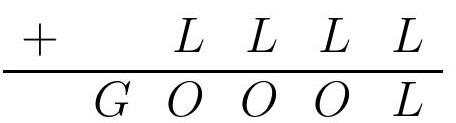
5. Different letters in the account represent different
$$
\begin{aligned}
& G G G G \\
& +O O O O
\end{aligned}
$$
$$
\begin{aligned}
& \text { digits. Which digits are represented by th... | II/5. Since the sum of three four-digit numbers is a five-digit number, $G$ is equal to 1 or 2. When adding the units $G, O$, and $L$, their sum is greater than 10 by $L$, since the unit digit in the sum is $L$. This means that $G+O=10$, and $O$ can be 9 or 8.
When adding the tens, we must consider that the sum of the... | G=1,O=9,L=8 | Logic and Puzzles | math-word-problem | Incomplete | Yes | olympiads | false |
Theorem 10.16. If the two infinite simple continued fractions $\left[a_{0} ; a_{1}, a_{2}, \ldots\right]$ and $\left[b_{0} ; b_{1}, b_{2}, \ldots\right]$ represents the same irrational number, then $a_{k}=b_{k}$ for $k=0,1,2, \ldots$ | Proof. Suppose that $\alpha=\left[a_{0} ; a_{1}, a_{2}, \ldots\right]$. Then, since $C_{0}=a_{0}$ and $C_{1}=a_{0}+1 / a_{1}$, Theorem 10.11 tells us that
$$a_{0}<\alpha<a_{0}+1 / a_{1}$$
so that $a_{0}=[\alpha]$. Further, we note that
$$\left[a_{0} ; a_{1}, a_{2}, \ldots\right]=a_{0}+\frac{1}{\left[a_{1} ; a_{2}, a_{3... | proof | Number Theory | proof | Yes | Yes | number_theory | false |
There are 9 oak trees currently in the park. Park workers had to cut down some oak trees that were damaged. The park will have 7 oak trees when the workers are finished. How many oak trees did the workers have to cut down? | If the park currently has 9 oak trees and will have 7 oak trees after the workers are finished, then the workers had to cut down:
9 (current number of oak trees) - 7 (number of oak trees after cutting) = 2 oak trees
So, the workers had to cut down $\boxed{2}$ oak trees. | 2 | Logic and Puzzles | math-word-problem | Yes | Yes | orca_math | true |
1. $x, y$ are real numbers, and $\left(x+\sqrt{x^{2}+1}\right)(y+$ $\left.\sqrt{y^{2}+1}\right)=1$. Then $x+y=$ $\qquad$ . | 二、1.0.
Multiply both sides of the original equation by $\sqrt{x^{2}+1}-x$, we get $y+\sqrt{y^{2}+1}=\sqrt{x^{2}+1}-x$; multiply both sides of the original equation by $\sqrt{y^{2}+1}-y$, we get $x+\sqrt{x^{2}+1}=\sqrt{y^{2}+1}-y$. Adding the two equations immediately yields $x+y=0$. | 0 | Algebra | math-word-problem | Yes | Yes | cn_contest | false |
264. Prove that
$$
(a+b+c)^{2} \geqslant a(b+c-a)+b(a+c-b)+c(a+b-c)
$$ | Instruction. Form the difference between the parts of the inequality and determine its sign: $a^{2}+b^{2}+c^{2} \geqslant 0$. | proof | Inequalities | proof | Yes | Incomplete | olympiads | false |
A quadrilateral's vertices are not in the same plane. Can each angle of such a skew quadrilateral be a right angle? | A quadrilateral with vertices defines a tetrahedron, which has a circumscribed sphere. Let the midpoints of the diagonals be \( E \) and \( F \), and assume that each angle of the quadrilateral is a right angle. From the right triangle \( \triangle ABC \), we have \( EA = EC = EB \), and from the right triangle \( \tri... | proof | Geometry | math-word-problem | Yes | Yes | olympiads | false |
sony and johnny caught 40 fishes . sony caught 4 times as many as johnny . how many fishes did johnny catch ? | Let's denote the number of fishes Johnny caught as J. According to the information given, Sony caught 4 times as many fishes as Johnny, so Sony caught 4J fishes.
The total number of fishes caught by both Sony and Johnny is 40. Therefore, we can write the equation:
J + 4J = 40
Combining like terms, we get:
5J = 40
... | 8 | Algebra | math-word-problem | Yes | Yes | orca_math | true |
Among 25 bags of milk, 4 have passed their expiration date. The probability of randomly selecting a bag that has expired is ( )
A: $$\frac {2}{25}$$
B: $$\frac {4}{25}$$
C: $$\frac {9}{10}$$
D: $$\frac {1}{6}$$ | According to the problem, there are 4 out of 25 bags of milk that have expired. Therefore, the probability of exactly drawing an expired bag of milk is $$\frac {4}{25}$$.
Hence, the answer is $\boxed{B}$.
To find the desired probability, divide the number of expired milk bags by the total number of milk bags, which... | B | Combinatorics | MCQ | Yes | Yes | cn_k12 | false |
In a can, there is a mixture of milk and water in the ratio 5 : 3. If the can is filled with an additional 8 liters of milk, the can would be full. The capacity of the can is 72 liters. What is the final ratio of milk to water in the can when it is full? | Let's first find out how much milk and water are there in the can before the additional 8 liters of milk is added.
Let the amount of milk in the can initially be 5x liters and the amount of water be 3x liters. According to the ratio, we have:
5x + 3x = 72 - 8 (since adding 8 liters of milk would fill the can)
8x = 6... | 2 | Algebra | math-word-problem | Yes | Yes | orca_math | true |
6. (8 points) Let for positive numbers $x, y, z$ the system of equations holds:
$$
\left\{\begin{array}{l}
x^{2}+x y+y^{2}=147 \\
y^{2}+y z+z^{2}=16 \\
z^{2}+x z+x^{2}=163
\end{array}\right.
$$
Find the value of the expression $x y+y z+x z$. | Answer: 56
Solution: Let there be three rays with vertex $O$, forming angles of $120^{\circ}$ with each other. On these rays, we lay off segments $O A=x, O B=y, O C=z$. Then, by the cosine theorem, $A B^{2}=147$, $B C^{2}=16, A C^{2}=163$. Note that triangle $A B C$ is a right triangle with hypotenuse $A C$. The sum o... | 56 | Algebra | math-word-problem | Yes | Yes | olympiads | false |
What is the simplified form of the following expression: \[3 - 5x - 7x^2 + 9 - 11x + 13x^2 - 15 + 17x + 19x^2\] in terms of $x$? | Start by grouping similar terms (constants, linear terms, and quadratic terms):
- Constants: $3 + 9 - 15 = -3$
- Linear terms: $-5x - 11x + 17x = 1x$
- Quadratic terms: $-7x^2 + 13x^2 + 19x^2 = 25x^2$
Combining these grouped terms results in:
\[ (-3) + (1x) + (25x^2) = 25x^2 + x - 3 \]
Thus, the expression simplifies... | 25x^2 + x - 3 | Algebra | math-word-problem | Yes | Yes | synthetic_math | true |
Find all values of $z$ such that $z^4 - 6z^2 + 8 = 0$. List all solutions separated by commas. | Let $y = z^2$, transforming the equation $z^4 - 6z^2 + 8 = 0$ into a quadratic form:
$$y^2 - 6y + 8 = 0.$$
This equation can be factored as:
$$(y - 4)(y - 2) = 0.$$
Thus, $y - 4 = 0$ or $y - 2 = 0$.
For $y - 4 = 0$:
- $y = 4$, so $z^2 = 4$, leading to $z = \pm 2$.
For $y - 2 = 0$:
- $y = 2$, so $z^2 = 2$, leading to ... | -2, -\sqrt{2}, \sqrt{2}, 2 | Algebra | math-word-problem | Yes | Yes | synthetic_math | true |
Given $a \gt 0$, $b \gt 0$, and the function $f\left(x\right)=ax-bx^{2}$.
$(Ⅰ)$ If $f\left(x\right)\leqslant 1$ for all $x\in R$, prove that $a≤2\sqrt{b}$;
$(Ⅱ)$ When $b \gt 1$, prove that for all $x\in \left[0,1\right]$, $|f\left(x\right)|\leqslant 1$ if and only if $b-1≤a≤2\sqrt{b}$;
$(Ⅲ)$ Discuss the necessary and s... | ### Rewritten Solution
#### Part (Ⅰ)
To prove: $a\leqslant 2\sqrt{b}$
**Proof:**
Given $f(x) = ax - bx^2 \leqslant 1$ for all $x \in \mathbb{R}$,
We rewrite $f(x)$ as $f(x) = -b\left(x - \frac{a}{2b}\right)^2 + \frac{a^2}{4b}$.
At $x = \frac{a}{2b}$, the function reaches its maximum value, so
$f\left(\frac{a}{2b}... | a \leqslant b+1 | Algebra | proof | Yes | Yes | cn_k12 | false |
12. In how many ways can a segment of length 1 m be formed from segments of length \(7 \mathrm{~cm}\) and 12 cm? | 12. In one way. Hint. The solution of the problem can be reduced to solving the equation in integers: \(7 x+12 y=100\). (MVSh, 1972, No. 2, p. 77.) | 1 | Number Theory | math-word-problem | Yes | Incomplete | olympiads | false |
3. Let $m$ be an integer greater than 1, and the sequence $\left\{a_{n}\right\}$ is defined as follows:
$$
\begin{array}{l}
a_{0}=m, a_{1}=\varphi(m), \\
a_{2}=\varphi^{(2)}(m)=\varphi(\varphi(m)), \cdots, \\
a_{n}=\varphi^{(n)}(m)=\varphi\left(\varphi^{(n-1)}(m)\right),
\end{array}
$$
where $\varphi(m)$ is the Euler'... | 3. It is known that if $a \mid b$, then $\varphi(a) \mid \varphi(b)$.
Moreover, when $m>2$, $\varphi(m)$ is even.
Therefore, it is only necessary to find integers $m$ such that $a_{1} \mid a_{0}$, which implies $a_{k+1} \mid a_{k}$.
If $m$ is an odd number greater than 2, it is impossible for $a_{1} \mid m$.
Let $m=2^... | 1944 | Number Theory | math-word-problem | Yes | Yes | cn_contest | false |
Find constants $P,$ $Q,$ and $R$ so that
\[\frac{3x^2 + 2x}{(x - 4)(x - 2)^2} = \frac{P}{x - 4} + \frac{Q}{x - 2} + \frac{R}{(x - 2)^2}.\]Enter the ordered triple $(P,Q,R).$ | First, multiply both sides by $(x - 4)(x - 2)^2$ to clear the denominators:
\[3x^2 + 2x = P(x - 2)^2 + Q(x - 4)(x - 2) + R(x - 4).\]
Set $x = 4$ to eliminate $Q$ and $R$ and solve for $P$:
\[3(4)^2 + 2(4) = P(4 - 2)^2,\]
\[48 + 8 = 4P,\]
\[56 = 4P,\]
\[P = 14.\]
Set $x = 2$ to eliminate $P$ and $Q$ and solve for $R$:... | (14, -11, -8) | Algebra | math-word-problem | Yes | Yes | synthetic_math | true |
\[ \frac {(1-i)(1+2i)}{1+i}=\] \(\)
A: \(-2-i\)
B: \(-2+i\)
C: \(2-i\)
D: \(2+i\) | Solution: \[ \frac {(1-i)(1+2i)}{1+i}= \frac {(1-i)^{2}(1+2i)}{(1+i)(1-i)}=2-i\].
Therefore, the correct option is C.
By multiplying both the numerator and the denominator of the complex number by the conjugate of the denominator, we can simplify the expression.
This question tests the operation of complex number... | C | Algebra | MCQ | Yes | Yes | cn_k12 | false |
Evaluate \(\frac{5 + x(5 + x) - 5^2}{x - 5 + x^2}\) for \(x = -3\). | Given the expression \(\frac{5 + x(5 + x) - 5^2}{x - 5 + x^2}\), we first simplify the numerator and the denominator.
1. **Numerator**:
\[
5 + x(5 + x) - 5^2 = 5 + x \cdot 5 + x^2 - 25 = x^2 + 5x - 20
\]
2. **Denominator**:
\[
x - 5 + x^2 = x^2 + x - 5
\]
Now, substituting \(x = -3\) into the sim... | -26 | Algebra | math-word-problem | Yes | Yes | synthetic_math | true |
Given a sequence of real numbers $\{a_n\}$ that satisfies: $a_{n+2} = |a_{n+1}| - a_n$ $(n=1,2,\cdots)$, where $a_1 = a$, $a_2 = b$, let set $M = \{a_n | n \in \mathbb{N}^*\}$.
(I) If $a = 1$, $b = 2$, write out set $M$ using the listing method;
(II) If $a < 0$, $b < 0$, determine whether the sequence $\{a_n\}$ is a ... | (I) Since $a_1 = a$, $a_2 = b$, and $a_{n+2} = |a_{n+1}| - a_n$,
We have $a_3 = 2 - 1 = 1$, $a_4 = |a_3| - a_2 = -1$, $a_5 = |a_4| - a_3 = 0$, $a_6 = |a_5| - a_4 = 0 - (-1) = 1$, $a_7 = |a_6| - a_5 = 1 - 0 = 1$, $a_8 = |a_7| - a_6 = 0$.
Thus, when $n \geqslant 5$, $a_{n+3} = a_n$.
So, $M = \{1, 2, -1, 0\}$.
(II) If... | \text{The minimum number of elements in set } M \text{ is } 4 | Algebra | math-word-problem | Yes | Yes | cn_k12 | false |
## Task 28/68
Prove that for every prime number $p \geq 7$, the term
$$
T=p^{4}-20 p^{2}+64
$$
is divisible by 45 without a remainder! | The given term is factored as follows:
$$
T=p^{4}-20 p^{2}+64=\left(p^{2}-4\right)\left(p^{2}-16\right)=(p-2)(p+2)(p-4)(p+4)
$$
We investigate the divisibility of the factors by 3 and 5. Since $p \neq 3$, we have $p \equiv 1(\bmod 3)$ or $p \equiv 2(\bmod 3)$. In this case, either $p-4 \equiv 0(\bmod 3)$ and $p+2 \eq... | proof | Number Theory | proof | Yes | Yes | olympiads | false |
In a school, the average age of 30 students in a class is 14 years. In addition to the students, there are 3 teachers and 1 principal. When the ages of the 3 teachers are included, the average age of the group increases to 16 years. When the principal's age is also included, the overall average age becomes 17 years. Fi... | Let's start by calculating the total age of the 30 students using the average age:
Total age of students = Average age of students * Number of students
Total age of students = 14 years * 30 students
Total age of students = 420 years
When the 3 teachers are included, the average age increases to 16 years for the group... | 50 | Algebra | math-word-problem | Yes | Yes | orca_math | true |
The graph of the quadratic function $y=(x-h)^{2}+k$ (where $h$ and $k$ are constants) passes through three points $P_{1}(-3,y_{1})$, $P_{2}(-1,y_{2})$, and $P_{3}(1,y_{3})$. If $y_{2} \lt y_{1} \lt y_{3}$, then the range of $h$ is ____. | To solve for the range of $h$ in the quadratic function $y=(x-h)^{2}+k$, given that it passes through the points $P_{1}(-3,y_{1})$, $P_{2}(-1,y_{2})$, and $P_{3}(1,y_{3})$ with $y_{2} < y_{1} < y_{3}$, we follow these steps:
1. **Understanding the Relationship Between $y$ Values and Distance to Axis of Symmetry**: The... | -2 < h < -1 | Algebra | math-word-problem | Yes | Yes | cn_k12 | false |
\section*{Problem 4 - 041034}
Of six students from a school who participated in the second stage of the Mathematical Olympiad, two achieved full marks. The students are abbreviated as \(A, B, C, D, E\), and \(F\).
In response to the question of which two students achieved full marks, the following five different answ... | }
A good start would be to consider candidate A, as this one appears in 3 statements. If A does not have full marks, then one of these 3 statements must contain both false statements. If A and C are both false, then F and D must have received full marks. This would mean that B and E both came up empty, and thus in sta... | AE | Logic and Puzzles | math-word-problem | Yes | Yes | olympiads | false |
(5) Given that $x, y$ are both positive real numbers, then the maximum value of $\frac{x}{2 x+y}+\frac{y}{x+2 y}$ is ( ).
(A) 2
(B) $\frac{2}{3}$
(C) 4
(D) $\frac{4}{3}$ | $5 \mathrm{~B}$ Hint: Solution 1 Let $s=2 x+y, t=x+2 y$, then
$$
x=\frac{1}{3}(2 s-t), y=\frac{1}{3}(2 t-s) .
$$
Therefore,
$$
\frac{x}{2 x+y}+\frac{y}{x+2 y}=\frac{4}{3}-\frac{1}{3}\left(\frac{t}{s}+\frac{s}{t}\right) \leqslant \frac{2}{3} .
$$
Solution 2 Let $t=\frac{y}{x}$, then $t \in(0,+\infty)$, at this time
$$... | \frac{2}{3} | Algebra | MCQ | Yes | Yes | olympiads | false |
Rubble has $15 in his pocket and he needs to buy 2 notebooks and 2 pens. Each notebook cost $4.00, meanwhile each pen costs a certain amount. After the purchase, Rubble will have $4 left. How much does each pen cost? | Let's calculate the total cost of the notebooks first. Since each notebook costs $4.00 and Rubble needs to buy 2 notebooks, the total cost for the notebooks is:
2 notebooks * $4.00/notebook = $8.00
Now, let's find out how much money Rubble spent in total. He had $15 and was left with $4 after the purchase, so the tot... | \$1.50 | Algebra | math-word-problem | Yes | Yes | orca_math | true |
If for any real number $x\in R$, the inequality $x^2+mx+2m-3\geqslant 0$ always holds, then the range of values for the real number $m$ is $(\quad\quad)$.
A: $[2,6]$
B: $[-6,-2]$
C: $(2,6)$
D: $(-6,-2)$ | Given that for any real number $x\in R$, the inequality $x^2+mx+2m-3\geqslant 0$ always holds, we can infer that the discriminant of the quadratic function must be non-positive, i.e., $\Delta=m^2-4(2m-3)=m^2-8m+12\leqslant 0$.
Solving this inequality for $m$, we find that $2\leqslant m\leqslant 6$.
Therefore, the ran... | [2,6] | Inequalities | MCQ | Yes | Yes | cn_k12 | false |
Given the sequence ${a_n}$, which is an arithmetic progression with a positive common difference, it also satisfies $a_3·a_6=55$ and $a_2+a_7=16$.
(1) Find the general formula for the sequence ${a_n}$.
(2) Let $S_n$ be the sum of the first $n$ terms of the sequence ${a_n}$. Does there exist a positive integer $n$ s... | (1) Since ${a_n}$ is an arithmetic progression,
$a_3 + a_6 = a_2 + a_7 = 16$.
From the system
$$\begin{cases}
a_3 + a_6 = 16 \\
a_3 \cdot a_6 = 55
\end{cases}$$,
we solve and find:
$$\begin{cases}
a_3 = 5 \\
a_6 = 11
\end{cases} \text{or}
\begin{cases}
a_3 = 11 \\
a_6 = 5
\end{cases}.$$
Since the common dif... | 2^{n+2} - 6 | Algebra | math-word-problem | Yes | Yes | cn_k12 | false |
A triangle $DEF$ has an inradius of $2$ and a circumradius of $9$. If $2\cos{E} = \cos{D} + \cos{F}$, then what is the area of triangle $DEF$? | First, using the identity for a triangle, $\cos D + \cos E + \cos F = 1+\frac{r}{R}$, substitute $r = 2$ and $R = 9$:
$$ \cos D + \cos E + \cos F = 1 + \frac{2}{9} = \frac{11}{9} $$
Given $2\cos E = \cos D + \cos F$, replace $\cos D + \cos F$ in the first equation:
$$ \cos D + 2\cos E + \cos F = \frac{11}{9} $$
Thus, ... | 54 | Geometry | math-word-problem | Yes | Yes | synthetic_math | true |
A right circular cone is inscribed in a right rectangular prism. The base of the prism is a rectangle with side lengths $2r$ and $3r$, and the height of the prism is $h$. The base of the cone is a circle that fits exactly within the rectangle, and the height of the cone is also $h$. What is the ratio of the volume of t... | Given a right circular cone inscribed in a right rectangular prism, the diameter of the base of the cone touches the shorter sides of the rectangular base of the prism.
1. **Find the volume of the cone**:
- The radius of the circular base of the cone is $r$, and the height is $h$.
- Therefore, the volume of the... | \frac{\pi}{18} | Geometry | math-word-problem | Yes | Yes | synthetic_math | true |
10. Given a sequence $\left\{a_{n}\right\}$ with all terms being positive integers, it satisfies: for any positive integers $m, k$ there are $a_{m^{2}}=a_{m}^{2}$ and $a_{m^{2}+k^{2}}=$ $a_{m} a_{k}$, find the general term formula of the sequence $\left\{a_{n}\right\}$. | Using the identity $\left(a^{2}-b^{2}\right)^{2}+(2 a b)^{2}=\left(a^{2}+b^{2}\right)^{2}$, we get $\left(m^{2}-1\right)^{2}+(2 m)^{2}=\left(m^{2}+1\right)^{2}$, $\left[(m+1)^{2}-m^{2}\right]^{2}+[2 m(m+1)]^{2}=\left[(m+1)^{2}+m^{2}\right]^{2}$. Combining the conditions, we have $a_{\left(m^{2}+1\right)^{2}}=a_{m^{2}-1... | a_{n}=1 | Number Theory | math-word-problem | Yes | Yes | olympiads | false |
Two positive integers differ by 8 and their product is 224. What is the larger integer? | First, factorize 224 into its possible pairs:
\[ 224 = 1 \times 224, \; 2 \times 112, \; 4 \times 56, \; 7 \times 32, \; 8 \times 28, \; 14 \times 16 \]
Now, identify the pair where the integers differ by 8:
\[ 14 \times 16 \]
Here, the integers 14 and 16 indeed have a difference of 8. Therefore, the larger integer is:... | 16 | Algebra | math-word-problem | Yes | Yes | synthetic_math | true |
Given two sets A and B where A = {x^2, 2x - 1, -4} and B = {x - 5, 1 - x, 9}, and the intersection of B and A is {9}, find the union of sets A and B. | To find the union of sets A and B, we must first determine the elements of each set that satisfy the given condition of their intersection. As B ∩ A = {9}, the number 9 must be an element of both set A and set B.
- Since 9 is in A, we have either x^2 = 9 or 2x - 1 = 9.
- We solve these equations to find potential valu... | {-8, -7, -4, 4, 9} | Algebra | math-word-problem | Yes | Yes | cn_k12 | false |
Carefully observe the following equations:The $1$st one: $2^{2}-1=1\times 3$;The $2$nd one: $3^{2}-1=2\times 4$;The $3$rd one: $4^{2}-1=3\times 5$;The $4$th one: $5^{2}-1=4\times 6$;The $5$th one: $6^{2}-1=5\times 7$;$\ldots $These equations reflect a certain operation rule among natural numbers. Answer the following q... | ### Step-by-Step Solution
#### Part 1: Writing Down the 6th Equation
Observing the pattern from the given equations, we can deduce that for each equation, the square of a number minus $1$ equals the product of two consecutive numbers, where the first number is one less than the square's base and the second number is ... | \frac{1012}{2025} | Algebra | math-word-problem | Yes | Yes | cn_k12 | false |
A 60-foot by 20-foot rectangular garden is enclosed by a fence. To make the garden larger, while using the same amount of fencing, its shape is changed to a circle. What is the increase in square footage of the new garden compared to the old garden? | The original garden has an area of \(60 \times 20 = 1200 \text{ ft}^2\). Its perimeter is \(2(60+20) = 160 \text{ ft}\).
To change the shape to a circle using the same fencing, the perimeter of the circle (which is its circumference) must equal the perimeter of the rectangle. The circumference \(C\) of a circle is gi... | 837.75 \text{ ft}^2 | Geometry | math-word-problem | Yes | Yes | synthetic_math | true |
The $2016$ players in the Gensokyo Tennis Club are playing Up and Down the River. The players first randomly form $1008$ pairs, and each pair is assigned to a tennis court (The courts are numbered from $1$ to $1008$). Every day, the two players on the same court play a match against each other to determine a winner and... | 1. **Initial Positions and Movement Rules**:
- Reimu starts on court \(123\).
- Marisa starts on court \(876\).
- Winners move to the next lower-numbered court (except court \(1\)).
- Losers move to the next higher-numbered court (except court \(1008\)).
2. **Reimu's Path**:
- Reimu will win each match ... | 1139 | Combinatorics | math-word-problem | Yes | Yes | aops_forum | false |
if a sum of money doubles itself in 15 years at simple interest , the ratepercent per annum is | To calculate the rate of interest per annum, we can use the formula for simple interest:
Simple Interest (SI) = Principal (P) × Rate (R) × Time (T) / 100
Given that the sum of money doubles itself in 15 years, we can say that the Simple Interest earned is equal to the Principal itself (because the final amount is twi... | 6.67\% | Algebra | math-word-problem | Yes | Yes | orca_math | true |
Sofia asked the students to suggest specific types of food. 228 students suggested adding mashed potatoes, 337 suggested adding bacon to the menu, and some students suggested adding tomatoes. There were 314 more students who suggested bacon than those that suggested tomatoes. How many students suggested adding tomatoes... | Let's denote the number of students who suggested adding tomatoes as T.
According to the information given, there were 314 more students who suggested bacon than those that suggested tomatoes. We know that 337 students suggested bacon. Therefore, we can write the following equation:
337 (bacon) = T (tomatoes) + 314
... | 23 | Algebra | math-word-problem | Yes | Yes | orca_math | true |
19. [11] Let $A B C D$ be a trapezoid with $A B \| C D$. The bisectors of $\angle C D A$ and $\angle D A B$ meet at $E$, the bisectors of $\angle A B C$ and $\angle B C D$ meet at $F$, the bisectors of $\angle B C D$ and $\angle C D A$ meet at $G$, and the bisectors of $\angle D A B$ and $\angle A B C$ meet at $H$. Qua... | Answer: $\sqrt[256]{7}$ Let $M, N$ be the midpoints of $A D, B C$ respectively. Since $A E$ and $D E$ are bisectors of supplementary angles, the triangle $A E D$ is right with right angle $E$. Then $E M$ is the median of a right triangle from the right angle, so triangles $E M A$ and $E M D$ are isosceles with vertex $... | \frac{256}{7} | Geometry | math-word-problem | Yes | Incomplete | olympiads | false |
Let $A$ be the product of all positive integers less than $1000$ whose ones or hundreds digit is $7$. Compute the remainder when $A/101$ is divided by $101$. | null | null | Number Theory | math-word-problem | Yes | Yes | aops_forum | false |
Two vessels contain equal number of mixtures of milk and water. The first vessel has a ratio of milk to water of 4 : 2, and the second vessel has a certain ratio of milk to water. Both the mixtures are now mixed thoroughly, and the ratio of milk to water in the new mixture so obtained is 3. What is the ratio of milk to... | Let's denote the total volume of the mixture in each vessel as V. Since the vessels contain equal amounts of mixture, the total volume of the combined mixture will be 2V.
For the first vessel, the ratio of milk to water is 4:2, which simplifies to 2:1. This means that for every 2 parts of milk, there is 1 part of wate... | 5:7 | Algebra | math-word-problem | Yes | Yes | orca_math | true |
Given a sequence $\{a_n\}$ whose sum of the first $n$ terms is $S_n$, and it satisfies $\log_{2}(S_{n}+1)=n+1$ ($n\in\mathbb{N}^*$), find $a_{n}=$ ______. | From the given information, we can derive that $S_{n}+1=2^{n+1}$, thus $S_{n}=2^{n+1}-1$.
When $n=1$, $a_{1}=S_{1}=3$,
When $n\geqslant 2$, $a_{n}=S_{n}-S_{n-1}=2^{n+1}-1-(2^{n}+1-1)=2^{n}$,
Since $n=1$ does not satisfy $a_{n}=2^{n}$, therefore $a_n=\begin{cases} & 3, & n=1, \\ & 2^{n}, & n\geqslant 2. \end{cases}$
... | \begin{cases} 3, & n=1, \\ 2^{n}, & n\geqslant 2. \end{cases} | Algebra | math-word-problem | Yes | Yes | cn_k12 | false |
Example 6 There is a loop made of silk thread on the table, with a perimeter of $2 a$. Prove:
(1) When the loop is formed into a parallelogram, it can be completely covered by a circular paper with a diameter of $a$;
(2) Regardless of the shape of the loop, it can be completely covered by this circular paper. [2]
(1964... | Proof: (1) As shown in Figure 4, let the diagonals of the parallelogram $ABCD$ intersect at point $O$. Clearly,
$$
O B=O D=\frac{1}{2} B D<\frac{1}{2}(B C+C D)=\frac{a}{2} \text {. }
$$
Similarly, $O A=O C<\frac{a}{2}$.
Thus, by placing the center of the circle at point $O$, the circle can cover the parallelogram $ABC... | proof | Geometry | proof | Yes | Yes | cn_contest | false |
Given vectors $\overrightarrow{a}$ and $\overrightarrow{b}$, then $\dfrac{1}{2} (2 \overrightarrow{a} -4 \overrightarrow{b} )+2 \overrightarrow{b}$ equals \_\_\_\_\_\_\_\_\_\_\_\_\_\_\_\_\_\_\_\_\_\_. | **Analysis**
According to the rules of vector addition, subtraction, and scalar multiplication, similar to combining like terms, we can solve the problem by adding the coefficients of $\overrightarrow{a}$ and $\overrightarrow{b}$ together. This is a basic question with low computational difficulty.
**Answer**
Soluti... | \overrightarrow{a} | Algebra | math-word-problem | Yes | Yes | cn_k12 | false |
9. Let $n$ be a natural number, for any real numbers $x, y, z$ there is always $\left(x^{2}+y^{2}+z^{2}\right)^{2} \leqslant n\left(x^{4}+y^{4}+z^{4}\right)$, then the minimum value of $n$ is $\qquad$ | By the Cauchy-Schwarz inequality, we have $\left(x^{2}+y^{2}+z^{2}\right)^{2} \leqslant 3\left(x^{4}+y^{4}+z^{4}\right) \Rightarrow \frac{\left(x^{2}+y^{2}+z^{2}\right)^{2}}{x^{4}+y^{4}+z^{4}} \leqslant 3$ $\Rightarrow n \geqslant 3$, so the minimum value of $n$ is 3. | 3 | Inequalities | math-word-problem | Yes | Yes | olympiads | false |
Solve for $n$ if $9^n \cdot 9^n \cdot 9^n = 81^4$. | 1. The given equation is $9^n \cdot 9^n \cdot 9^n = 81^4$.
2. Rewrite the left-hand side as $9^{3n}$, combining the exponents.
3. Knowing that $81 = 9^2$, rewrite the right-hand side as $(9^2)^4 = 9^{8}$.
4. Therefore, the equation simplifies to $9^{3n} = 9^{8}$.
5. Since the bases are the same, we equate exponents: $3... | n = \frac{8}{3} | Algebra | math-word-problem | Yes | Yes | synthetic_math | true |
If $\log _{2}a \lt 0$ and $\left(\dfrac{1}{2}\right)^{b} \gt 1$, then which of the following is true?
A: $a \gt 1$, $b \gt 0$
B: $a \gt 1$, $b \lt 0$
C: $0 \lt a \lt 1$, $b \gt 0$
D: $0 \lt a \lt 1$, $b \lt 0$ | To analyze the given conditions and find which of the statements is true, let's break down the problem into more detailed steps.
First, consider the condition $\log_{2}a 0$, it follows that $a$ must be less than $1$.
- Also, since we're working within the domain of the logarithmic function, $a > 0$.
- Hence, we dedu... | \text{D} | Algebra | MCQ | Yes | Yes | cn_k12 | false |
How many integers between 1000 and 3000 have all three of the numbers 30, 45, and 60 as factors? | - **Compute the LCM of 30, 45, and 60:**
- $30 = 2 \times 3 \times 5$
- $45 = 3^2 \times 5$
- $60 = 2^2 \times 3 \times 5$
The LCM is $2^2 \times 3^2 \times 5 = 180$.
- **Count the multiples of 180 between 1000 and 3000:**
- The smallest multiple of 180 greater than or equal to 1000 is $180 \times 6 = 1... | 11 | Number Theory | math-word-problem | Yes | Yes | synthetic_math | true |
Solve the system of equations:
$ y^2\equal{}(x\plus{}8)(x^2\plus{}2),$
$ y^2\minus{}(8\plus{}4x)y\plus{}(16\plus{}16x\minus{}5x^2)\equal{}0.$ | null | null | Algebra | math-word-problem | Yes | Yes | aops_forum | false |
What is the sum of all values of $x$ for which $\sqrt{(x-5)^2} = 9$? | We need to solve the equation $\sqrt{(x-5)^2} = 9$. Squaring both sides gives:
\[
(x-5)^2 = 81.
\]
This equation implies:
\[
x-5 = 9 \quad \text{or} \quad x-5 = -9.
\]
Solving these, we find:
\[
x = 9 + 5 = 14 \quad \text{and} \quad x = -9 + 5 = -4.
\]
Thus, the sum of all values of $x$ is:
\[
14 + (-4) = \boxed{10}.
\... | 10 | Algebra | math-word-problem | Yes | Yes | synthetic_math | true |
Let $ABC$ be an acute triangle with orthocentre $H$, and let $M$ be the midpoint of $AC$. The point $C_1$ on $AB$ is such that $CC_1$ is an altitude of the triangle $ABC$. Let $H_1$ be the reflection of $H$ in $AB$. The orthogonal projections of $C_1$ onto the lines $AH_1$, $AC$ and $BC$ are $P$, $Q$ and $R$, respectiv... | 1. **Define the given elements and their properties:**
- Let \(ABC\) be an acute triangle with orthocenter \(H\).
- Let \(M\) be the midpoint of \(AC\).
- Let \(C_1\) be the point on \(AB\) such that \(CC_1\) is an altitude of the triangle \(ABC\).
- Let \(H_1\) be the reflection of \(H\) in \(AB\).
- Th... | null | Geometry | proof | Yes | Yes | aops_forum | false |
Given $\left\{\begin{array}{l}{x=-2}\\{y=3}\end{array}\right.$ and $\left\{\begin{array}{l}{x=4}\\{y=1}\end{array}\right.$ are two solutions of the linear equation $ax-3by=5$, find $a+b$. | To solve the given problem, we start by substituting the given pairs of $(x, y)$ into the equation $ax-3by=5$.
For the first pair $\left\{\begin{array}{l}{x=-2}\\{y=3}\end{array}\right.$, we substitute these values into the equation, which gives us:
\[
-2a - 3(3)b = 5 \implies -2a - 9b = 5 \quad \text{(Equation 1)}
\... | 0 | Algebra | math-word-problem | Yes | Yes | cn_k12 | false |
Given the function $f(x) = \begin{cases} \log_{2}x & (x > 0) \\ 3^{x} & (x \leqslant 0) \end{cases}$, find the value of $f(2)+f(-2)$. | First, let's find the value of $f(2)$ and $f(-2)$ separately by applying the given function definition.
For $f(2)$, we use the first part of the function definition since $2 > 0$:
$$f(2) = \log_{2}2$$
Using the property of logarithms that $\log_{a}a = 1$, we get:
$$f(2) = 1$$
For $f(-2)$, we use the second part of th... | \frac{10}{9} | Algebra | math-word-problem | Yes | Yes | cn_k12 | false |
the average age of an adult class is 40 years . 15 new students with an avg age of 32 years join the class . therefore decreasing the average by 4 year . find what was theoriginal strength of class ? | Let's denote the original number of students in the class as \( N \) and the total age of all the original students as \( T \).
Given that the average age of the original class is 40 years, we can write the total age of the original students as:
\[ T = 40N \]
When 15 new students with an average age of 32 years join... | 15 | Algebra | math-word-problem | Yes | Yes | orca_math | true |
Find the smallest positive integer $n$ such that
\[
\begin{pmatrix}
\cos 60^\circ & -\sin 60^\circ \\
\sin 60^\circ & \cos 60^\circ
\end{pmatrix}^n = \mathbf{I}.
\] | The given matrix corresponds to a rotation about the origin by $60^\circ$ counter-clockwise:
\[
\begin{pmatrix}
\cos 60^\circ & -\sin 60^\circ \\
\sin 60^\circ & \cos 60^\circ
\end{pmatrix}.
\]
This matrix's effect is to rotate a vector by $60^\circ$ each time it is applied. Therefore, to find the smallest $n$ such ... | 6 | Algebra | math-word-problem | Yes | Yes | synthetic_math | true |
A transparent and flexible rectangular sheet $ABCD$ is made of a material, with $BC = 2AB$. The midpoints of sides $AD$ and $BC$ are $E$ and $F$. We have marked the segments $AF$ and $EC$ on the sheet. By bending the sheet into a cylindrical shape, we join the generators $AD$ and $BC$, thus $E$ and $F$ merge, and the m... | I. We place a cylindrical shell with a horizontal axis at eye level such that $AD$ is the nearest generator to us, and consider the projection of the shell onto a vertical $S_{1}$ plane, which is parallel to the axis. We will denote the projection of every point with a 1 subscript.
 is divisible by \( p \).
2. **Modulo \( p \) Analysis:**
Consider the expression modulo \( p \). We can rewrite the sum as... | null | Number Theory | proof | Yes | Yes | aops_forum | false |
Subsets and Splits
No community queries yet
The top public SQL queries from the community will appear here once available.