
instruction_seed stringlengths 2 10.7k | solution stringlengths 0 10.8k ⌀ | answer stringlengths 0 575 ⌀ | problem_type stringclasses 9
values | question_type stringclasses 5
values | problem_is_valid stringclasses 5
values | solution_is_valid stringclasses 4
values | source stringclasses 11
values | synthetic bool 2
classes |
|---|---|---|---|---|---|---|---|---|
The American Mathematics College is holding its orientation for incoming freshmen. The incoming freshman class contains fewer than $500$ people. When the freshmen are told to line up in columns of $19$, $17$ people are in the last column. When the freshmen are told to line up in columns of $18$, $9$ people are in the l... | Let $n$ be the number of people in the incoming class. Then:
- From the first condition, $n \equiv 17 \pmod{19}$.
- From the second condition, $n \equiv 9 \pmod{18}$.
We need to solve this system of linear congruences:
\[
\begin{align*}
n &\equiv 17 \pmod{19}, \\
n &\equiv 9 \pmod{18}.
\end{align*}
\]
First, consider... | 207 | Number Theory | math-word-problem | Yes | Yes | synthetic_math | true |
Mary is 30 years old. Tom is older than Mary. In $n$ years, where $n$ is a positive integer, Tom's age and Mary's age will both be two-digit numbers and will have the property that Mary's age is obtained by interchanging the digits of Tom's age. Let $t$ be Tom's present age. How many ordered pairs of positive integers ... | Let Mary's age $n$ years from now be $10a+b$, and let Tom's age be $10b+a$. If $10b+a>10a+b$, then $b>a$. The possible pairs of $a,b$ are:
$(1,2), (1,3), (2,3), (1,4), (2,4), (3,4), \dots , (8,9)$
That makes 36 total pairs. But $10a+b>30$, so we subtract all the pairs where Mary's future age does not exceed 30: $(1,2),... | 23 | Number Theory | math-word-problem | Yes | Yes | synthetic_math | true |
In $\triangle ABC$, the sides opposite to angles $A$, $B$, and $C$ are $a$, $b$, and $c$ respectively. If $(\sqrt{3}b-c)\cos A=a\cos C$, find the value of $\cos A$. | Using the Law of Sines, we have:
From the given equation $(\sqrt{3}b-c)\cos A=a\cos C$, we get:
$(\sqrt{3}\sin B-\sin C)\cos A=\sin A\cos C$
This implies that:
$\sqrt{3}\sin B\cos A=\sin A\cos C+\sin C\cos A$
Using the sine addition formula, we get:
$\sqrt{3}\sin B\cos A=\sin(A+C)=\sin B$
Therefore, $\cos A=\fra... | \frac{\sqrt{3}}{3} | Geometry | math-word-problem | Yes | Yes | cn_k12 | false |
A circular dining table has 6 seats arranged in order: _A_, _B_, _C_, _D_, _E_, _F_. Now, 3 adults and 3 children are to be seated for a meal, with the requirement that no two children can sit next to each other. The total number of different seating arrangements is ( )
A: 6
B: 12
C: 72
D: 144 | From the problem statement: Considering the circular dining table with 6 seats labeled A, B, C, D, E, F in order, and ensuring that no two children sit next to each other, it implies that adults cannot sit next to each other either. This can be viewed in two scenarios: one is adult, child, adult, child, adult, child; t... | \text{C} | Combinatorics | MCQ | Yes | Yes | cn_k12 | false |
To analyze the relationship between height and weight, one can use ( )
A: Error analysis
B: Regression analysis
C: Independence test
D: None of the above | Solution: Regression analysis is a common method used for statistical analysis of two variables that are related.
Clearly, there is a relationship between height and weight,
thus, the correct choice is: B.
Based on the relationship between height and weight, the conclusion can be drawn.
This question tests the ... | \text{B} | Algebra | MCQ | Yes | Yes | cn_k12 | false |
Beth has 72 marbles of three colors. Each color has the same amount of marbles. If Beth loses some red marbles, twice as many blue, and three times as many yellow ones than red ones, she has 42 marbles left. How many red marbles did she lose? | Let's denote the number of red marbles Beth lost as R. Since she loses twice as many blue marbles, she loses 2R blue marbles, and since she loses three times as many yellow marbles, she loses 3R yellow marbles.
Beth originally has 72 marbles, and they are equally divided into three colors. So, she has 72 / 3 = 24 marb... | 5 | Algebra | math-word-problem | Yes | Yes | orca_math | true |
Let $x = 7^{5} - 7^{-5}$ and $y = 7^{5} + 7^{-5}.$ Calculate $x^2 - y^2.$ | Given:
\[ x = 7^5 - 7^{-5} \]
\[ y = 7^5 + 7^{-5} \]
The expression to find is $x^2 - y^2$. Use the formula:
\[ x^2 - y^2 = (x+y)(x-y) \]
We know $x+y = 7^5 + 7^{-5} + 7^5 - 7^{-5}$, which simplifies to $2 \times 7^5$. And, $x-y = 7^5 - 7^{-5} - (7^5 + 7^{-5})$, which simplifies to $-2 \times 7^{-5}$.
Now, multiply ... | -4 | Algebra | math-word-problem | Yes | Yes | synthetic_math | true |
3. Consider the sequence $p_{1}, p_{2}, \ldots$ of primes such that for each $i \geq 2$, either $p_{i}=$ $2 p_{i-1}-1$ or $p_{i}=2 p_{i-1}+1$. An example is the sequence $2,5,11,23,47$. Show that any such sequence has a finite number of terms. | 3. Except for 2 or 3 , each prime is of the form $6 u \pm 1$. If a prime $p=6 u+1$ is in the chain, its successor, if any, must be of the form $2 p-1=2(6 u)+1$ since $2 p+1$ is divisible by 3 . Hence the successors are:
$$
2(6 u)+1,2^{2}(6 u)+1, \ldots, 2^{i}(6 u)+1, \ldots
$$
This sequence cannot go on forever giving... | proof | Number Theory | proof | Yes | Yes | olympiads | false |
## Task 3 - 230723
Blue, yellow, and red cubes are to be placed in a row. The first cube in the row should be blue, the second should be yellow. In the row, no two cubes of the same color should be next to each other, and the color sequence of any two adjacent cubes should never be repeated. Determine the maximum poss... | I) If $b, g$ and $r$ denote a blue, yellow, and red cube, respectively, the following examples show that there are sequences of 7 cubes that meet all the given conditions:
$$
b, g, b, r, g, r, b ; \quad b, g, r, b, r, g, b ; \quad b, g, r, g, b, r, b
$$
II) If $w_{1}, w_{2}, w_{3}, \ldots, w_{8}, \ldots$ is a sequenc... | 7 | Combinatorics | math-word-problem | Yes | Yes | olympiads | false |
Given that $f(x)$ and $g(x)$ are neither odd nor even functions defined on $\mathbb{R}$, and $h(x) = f(x)g(x)$ is an even function defined on $\mathbb{R}$. Please provide a pair of functions $f(x)$ and $g(x)$ that satisfy the conditions (only one pair is required). | Since $h(x) = f(x)g(x)$ is an even function, we have $h(-x) = h(x)$. This means that for all $x$ in $\mathbb{R}$:
$$ f(-x)g(-x) = f(x)g(x). $$
In order to find a pair of functions $f(x)$ and $g(x)$ that satisfy these conditions, we can choose $f(x)$ and $g(x)$ such that their product is symmetric with respect to the ... | -x + 1 | Algebra | math-word-problem | Yes | Yes | cn_k12 | false |
20.7 (IMO 19) On each side of the given square \(ABCD\), equilateral triangles \(ABK\), \(BCL\), \(CDM\), and \(DAN\) are constructed inward. Prove that the midpoints of the four segments \(KL\), \(LM\), \(MN\), \(NK\), and the midpoints of the eight segments \(AK\), \(BK\), \(BL\), \(CL\), \(CM\), \(DM\), \(DN\), \(AN... | 20.7 In the complex plane, let's assume points $A, B, C, D$ are represented by the complex numbers $1, \mathrm{i}, -1, -\mathrm{i}$, respectively.
Let $u=e^{i \pi / 6}=\frac{\sqrt{3}+\mathrm{i}}{2}$. Then $u^{2}=\frac{1+\sqrt{3} \mathrm{i}}{2}$. By the condition that the vertices of an equilateral triangle should sati... | proof | Geometry | proof | Yes | Yes | olympiads | false |
a, b, and c completed a piece of work. a worked for 6 days, b for some days, and c for 4 days. Their daily wages were in the ratio of 3 : 4 : 5. Their total earning was Rs. 1406, and the daily wage of c is Rs. 95. How many days did b work? | Let's denote the number of days b worked as \( d \).
Given that the daily wages of a, b, and c are in the ratio of 3:4:5, and the daily wage of c is Rs. 95, we can find the daily wages of a and b by using the ratio.
If the daily wage of c is Rs. 95, which corresponds to the ratio of 5, then each unit in the ratio rep... | 9 | Algebra | math-word-problem | Yes | Yes | orca_math | true |
A certain online store sells a certain children's clothing item for $80$ yuan each, and can sell $20$ items per day. In order to increase sales, increase profits, and reduce inventory quickly, the online store decides to sell at a discounted price. Market research shows that for every $1$ yuan reduction in price, they ... | ### Step-by-Step Solution
#### Part 1: Functional Relationship between $y$ and $x$
Given that the store sells $20$ items per day at a price of $80$ yuan each, and for every $1$ yuan reduction in price, they can sell an additional $2$ items per day. Let $x$ represent the selling price of each item, and $y$ represent t... | x = 75 \, \text{yuan} | Algebra | math-word-problem | Yes | Yes | cn_k12 | false |
What is the largest positive integer with only odd digits that is less than $10,000$ and is a multiple of $5$? | For the largest integer with odd digits that is less than $10,000$, it must have the largest odd digit, $9$, in the thousands place. So, we have $9\_\_\_$. The largest integer with only odd digits is $9999$. However, we need this integer to be a multiple of $5$. A number's divisibility by $5$ depends only on its last d... | 9995 | Number Theory | math-word-problem | Yes | Yes | synthetic_math | true |
How many integers from 1 to 200 are neither multiples of 2, 3, nor 5? Explain your reasoning. | To solve this problem, we consider the integers from 1 to 200 that are not multiples of 2, 3, or 5. The reasoning is as follows:
Let set A represent the set of integers from 1 to 200 that are multiples of 2,
set B represent the set of integers from 1 to 200 that are multiples of 3,
and set C represent the set of i... | 54 | Number Theory | math-word-problem | Yes | Yes | cn_k12 | false |
22. The Hermes spacecraft flies from Earth to Mars, originally planned to arrive in 550 days, but actually averaged 10,000 kilometers more per day than planned, resulting in an arrival 50 days ahead of schedule. Therefore, the distance from Earth to Mars is $\qquad$ ten thousand kilometers. | $5500$ | 5500 | Algebra | math-word-problem | Yes | Problem not solved | olympiads | false |
A massive crate contains 54 large boxes, each large box contains 24 small boxes, and each small box contains 37 chocolate bars. How many chocolate bars are in the massive crate? | To find the total number of chocolate bars in the massive crate, we need to multiply the number of large boxes by the number of small boxes in each large box, and then multiply that by the number of chocolate bars in each small box.
Number of chocolate bars in the massive crate = Number of large boxes × Number of smal... | 47,952 | Algebra | math-word-problem | Yes | Yes | orca_math | true |
28.25*. In a segment, all possible pairs of intersecting circles are inscribed, and for each pair, a line is drawn through their points of intersection. Prove that all these lines pass through one point (see problem 3.44$)$.
将上面的文本翻译成英文,请保留源文本的换行和格式,直接输出翻译结果。 | 28.25. Let \( S_{1} \) and \( S_{2} \) be the circles inscribed in a segment; \( M, N \) be their points of intersection (Fig. 28.9). We will show that the line \( MN \) passes through the point \( P \) of the circle of the segment, equidistant from its endpoints \( A \) and \( B \). Indeed, according to the previous p... | Number Theory | proof | Incomplete | Yes | olympiads | false | |
Which of the following statements is correct?
A: In order to understand the time spent by students in the school on doing math homework, Xiaoming surveyed $3$ friends online.
B: In order to understand the condition of the components of the "Fengyun-3 $G$ satellite," the inspectors used a sampling survey.
C: In order... | To evaluate each statement for correctness, we will analyze them one by one based on the principles of statistical surveys and data grouping:
**Statement A Analysis:**
- The goal is to understand the time spent by students in the school on doing math homework.
- The method used is surveying $3$ friends online.
- Corre... | D | Other | MCQ | Yes | Yes | cn_k12 | false |
A unit cube is cut diagonally from one vertex to three vertices on the opposite face, forming four triangular prisms and one tetrahedron. The cube is then further dissected along another set of dashed lines as shown in a new diagram, resulting in 10 pieces. Calculate the volume of the tetrahedral piece that contains ve... | The tetrahedral piece containing vertex $P$ has vertices $P, Q, R, S$. The base $QRS$ is a right triangle with legs of length $\frac{1}{2}$, and the altitude $PP'$ (from $P$ to the base triangle $QRS$) is $\frac{1}{2}$. The area of the triangle $QRS$ is:
\[
\text{Area} = \frac{1}{2} \times \frac{1}{2} \times \frac{1}{2... | \frac{1}{48} | Geometry | math-word-problem | Incomplete | Yes | synthetic_math | true |
For $n\in \mathbb{N}^*$, if $C_{9}^{n+1}=C_{9}^{2n-1}$, then the value of $n$ can be ( )
A: $2$
B: $3$
C: $4$
D: $5$ | Given the equality $C_{9}^{n+1}=C_{9}^{2n-1}$, where $n\in \mathbb{N}^*$, we aim to find the possible values of $n$.
The properties of combination tell us that for any $C_{n}^{r} = C_{n}^{n-r}$. Therefore, the equation $C_{9}^{n+1}=C_{9}^{2n-1}$ implies that either $n+1=2n-1$ or $n+1+2n-1=9$ due to the symmetry prope... | AB | Combinatorics | MCQ | Yes | Yes | cn_k12 | false |
Numbers $1, 2,\cdots, 16$ are written in a $4\times 4$ square matrix so that the sum of the numbers in every row, every column, and every diagonal is the same and furthermore that the numbers $1$ and $16$ lie in opposite corners. Prove that the sum of any two numbers symmetric with respect to the center of the square e... | null | null | Logic and Puzzles | proof | Yes | Yes | aops_forum | false |
What is the average of the first 21 multiples of a certain number if the average is 77? | Let's denote the certain number as \( n \).
The first 21 multiples of \( n \) are:
\( n, 2n, 3n, \ldots, 21n \)
The sum of an arithmetic series is given by the formula:
\( S = \frac{n}{2} \times (a_1 + a_n) \)
where \( S \) is the sum of the series, \( n \) is the number of terms, \( a_1 \) is the first term, and \( ... | 7 | Algebra | math-word-problem | Yes | Yes | orca_math | true |
Seventy percent of a ship's passengers are women, and fifteen percent of these women are in first class. What is the number of women in first class if the ship is carrying 300 passengers? | Step 1: Calculate the number of women on the ship.
Seventy percent of the ship's 300 passengers are women:
\[ 300 \cdot \frac{70}{100} = 210 \text{ women} \]
Step 2: Calculate the number of these women who are in first class.
Fifteen percent of these 210 women are in first class:
\[ 210 \cdot \frac{15}{100} = 31.5 \]
... | 31 | Algebra | math-word-problem | Yes | Incomplete | synthetic_math | true |
A kilogram of pork costs $6, while a kilogram of chicken costs $2 less. A kilogram of beef costs $4 more than a kilogram of chicken, and a kilogram of lamb costs $3 more than a kilogram of pork. If you wanted to purchase 3.5 kilograms of chicken, 1.2 kilograms of pork, 2.3 kilograms of beef, and 0.8 kilograms of lamb, ... | First, let's find out the cost of each type of meat per kilogram:
- Pork costs $6 per kilogram.
- Chicken costs $2 less than pork, so it costs $6 - $2 = $4 per kilogram.
- Beef costs $4 more than chicken, so it costs $4 + $4 = $8 per kilogram.
- Lamb costs $3 more than pork, so it costs $6 + $3 = $9 per kilogram.
Now... | \$46.8 | Algebra | math-word-problem | Yes | Yes | orca_math | true |
Let $ a_1$, $ \ldots$, $ a_k$, $ a_{k\plus{}1}$, $ \ldots$, $ a_n$ be $ n$ positive numbers ($ k<n$). Suppose that the values of $ a_{k\plus{}1}$, $ a_{k\plus{}2}$, $ \ldots$, $ a_n$ are fixed. Choose the values of $ a_1$, $ a_2$, $ \ldots$, $ a_k$ that minimize the sum $ \sum_{i, j, i\neq j}\frac{a_i}{a_j}$ | null | null | Calculus | other | Yes | Yes | aops_forum | false |
## Problem Statement
Calculate the volumes of the bodies bounded by the surfaces.
$$
\frac{x^{2}}{27}+\frac{y^{2}}{25}=1, z=\frac{y}{\sqrt{3}}, z=0(y \geq 0)
$$ | ## Solution
The base of the considered area is a semi-ellipse, in which
$$
\begin{aligned}
& x=0 \text { when } y=5 \\
& y=0 \text { when } x=\sqrt{27}=3 \sqrt{3}
\end{aligned}
$$
That is,
$x \in[-3 \sqrt{3}, 3 \sqrt{3}], y \in[0,5]$
Consider the surface $z=\frac{y}{\sqrt{3}}:$
$, there is a line $l: \begin{cases} x=-\sqrt{2}+t\cos \alpha \\ y=t\sin \alpha \end{cases} (t$ is a parameter, $0\leqslant \alpha\leqslant \frac{\pi}{2} )$. In the polar coordinate system with the coordinate origin as the pole and the positive semi-axis of $x$ as the polar axis... | (1) From $\rho^{2}=\frac{3}{1+2\sin^{2}\theta}$, we get $\rho^{2}+2\rho^{2}\sin^{2}\theta=3$. Since $x=\rho\cos \theta$, $y=\rho\sin \theta$, and $\rho^{2}=x^{2}+y^{2}$, the rectangular coordinate equation of the curve $C$ is $\frac{x^{2}}{3}+y^{2}=1$. According to the problem, the abscissa of point $M$ is $0$. Substit... | \frac{\pi}{6} | Geometry | math-word-problem | Yes | Yes | cn_k12 | false |
Find two integers, neither of which ends in a zero, and whose product is exactly 00000. What are the integers? |
The product of any two integers that do not end in zero cannot be exactly 00000 because 00000 is equivalent to 0, and the only way to get a product of 0 is if at least one of the integers is $\boxed{0}$ . However, 0 ends with a zero, which violates the condition given. Therefore, it is impossible to find two such inte... | 0 | Number Theory | math-word-problem | Incomplete | Yes | orca_math | true |
Before the recent housing boom, there were 1426 houses in Lawrence County. Developers built 574 houses during the housing boom. How many houses are there in Lawrence County now? | To find the total number of houses in Lawrence County now, you simply need to add the number of houses built during the housing boom to the number of houses that were there before the boom.
Before the boom: 1426 houses
During the boom: +574 houses
---------------------------
Total now: 1426 + 574 = 2000 houses
There ... | 2000 | Algebra | math-word-problem | Yes | Yes | orca_math | true |
3. In the spatial rectangular coordinate system, given $O(0,0,0), A(1,0,0), B(0,1,0), C(0,0,1)$, the number of points that are equidistant from the planes $O A B$, $O B C$, $O A C$, and $A B C$ is ( )
A: 1
B: 4
C: 5
D: infinitely many | Huijun $\mathrm{C}$.
Analysis The incenter of the tetrahedron $O A B C$ and the centers of the four "exspheres" are equidistant from the faces $O A B$, $O B C$, $O A C$, and $A B C$, so the number of points that satisfy the condition is 5. | 5 | Geometry | MCQ | Yes | Yes | olympiads | false |
The organizers of a fair projected a 25 percent increase in attendance this year over that of last year, but attendance this year actually decreased by a certain percent. The actual attendance was 64 percent of the projected attendance. What was the actual percent decrease in attendance? | Let's assume that the attendance last year was \( P \) people.
The projected attendance for this year was a 25 percent increase over last year, so it would be:
\[ P + 0.25P = 1.25P \]
However, the actual attendance this year was only 64 percent of the projected attendance, so it was:
\[ 0.64 \times 1.25P = 0.80P \]
... | 20 | Algebra | math-word-problem | Yes | Yes | orca_math | true |
## Task B-1.6.
A student has passed 31 exams over the course of a five-year study. Each year, he took more exams than the previous year, and in the fifth year, he took three times as many exams as in the first year. How many exams did the student take in the fourth year? | ## Solution.
Let's denote the number of exams the student passed in the $i$-th year by $x_{i}, i \in\{1,2,3,4,5\}$.
Then $x_{5}=3 x_{1}, x_{1}<x_{2}<x_{3}<x_{4}<x_{5}$ and $x_{1}+x_{2}+x_{3}+x_{4}+x_{5}=31$.
1 point
If $x_{1}=1$, then $x_{5}=3$. This is impossible because there are no 3 different natural numbers be... | 8 | Algebra | math-word-problem | Yes | Yes | olympiads | false |
If point $M$ is on the same plane as $\triangle ABC$ and satisfies $(\vec{MB} - \vec{MC})\cdot(\vec{MB} + \vec{MC} - 2\vec{MA})=0$, then the shape of $\triangle ABC$ is ( )
A: Equilateral triangle
B: Right triangle
C: Isosceles triangle
D: Isosceles right triangle | Given that $(\vec{MB} - \vec{MC})\cdot(\vec{MB} + \vec{MC} - 2\vec{MA})=0$, it leads to $\vec{CB}\cdot(\vec{MB} - \vec{MA} + \vec{MC} - \vec{MA})=0$.
Simplifying this, we get $\vec{CB}\cdot(\vec{AB} + \vec{AC})=0$, which indicates that the diagonal of a parallelogram formed by the adjacent sides $\vec{AB}$ and $\vec{AC... | C | Geometry | MCQ | Yes | Yes | cn_k12 | false |
$\square$ Example 1 Prove that for any $x, y, z \in(0,1)$, the inequality $x(1-y)+$ $y(1-z)+z(1-x)<1$ holds. (15th All-Russian Mathematical Olympiad Problem) | None
Translate the text above into English, please retain the original text's line breaks and format, and output the translation result directly.
Note: The provided instruction is a meta-instruction and not part of the text to be translated. Since the text to be translated is "None", the translation is also "None". ... | not found | Inequalities | proof | Yes | Incomplete | inequalities | false |
If $(1-2x)^9 = a_0 + a_1x + a_2x^2 + \dots + a_8x^8 + a_9x^9$, then the value of $a_1 + a_2 + \dots + a_8$ is ( ).
A: 510
B: -1
C: 1
D: 254 | To find $a_1 + a_2 + \dots + a_8$, we can consider the expansion of $(1-2x)^9$ using the binomial theorem. Each $a_i$ corresponds to a term with $x^i$ in the expansion, and its coefficient will be $\binom{9}{i}(-2)^i$.
Consider $x=0$: When we plug $x=0$ into the expansion, all terms including and beyond $x^1$ disappea... | 510 | Algebra | MCQ | Yes | Yes | cn_k12 | false |
In the space rectangular coordinate system $O-xyz$, given $P(3,-4,1)$, and the normal vector of plane $OAB$ is $\overrightarrow{n}=(2,-2,3)$, then the distance from $P$ to plane $OAB$ is ()
A: $2\sqrt{3}$
B: $4$
C: $\sqrt{17}$
D: $3\sqrt{2}$ | To find the distance from point $P$ to plane $OAB$, we first need to determine the vector $\overrightarrow{OP}$ and the normal vector $\overrightarrow{n}$ of plane $OAB$. Given that $P(3,-4,1)$ and $O(0,0,0)$, the coordinates of these points allow us to calculate $\overrightarrow{OP}$ directly. We are also given the no... | C | Geometry | MCQ | Yes | Yes | cn_k12 | false |
2. On the coordinate plane $x O y$, plot the set of points $(x, y)$ for which the inequality $\sqrt{x y} \geq x-2 y$ holds. Explain why the set of points is exactly this.
# | # Solution:
The expression under the root must be non-negative ($xy \geq 0$), so $x$ and $y$ must have the same sign (or one of them is 0). This means that the set of points will be located in the I and III coordinate quadrants. For such values of the variables, the inequality will be satisfied if the right-hand side ... | notfound | Inequalities | math-word-problem | Incomplete | Yes | olympiads | false |
7 red peaches, 71 yellow peaches and 8 green peaches are in the basket.. How many more green peaches than red peaches are in the basket? | There are 7 red peaches and 8 green peaches in the basket. To find out how many more green peaches there are than red peaches, you subtract the number of red peaches from the number of green peaches:
8 green peaches - 7 red peaches = $\boxed{1}$ more green peach than red peaches. | 1 | Other | math-word-problem | Yes | Yes | orca_math | true |
From August 27th to 29th, 2022, the World Clean Energy Equipment Conference with the theme of "New Energy, New Intelligent Manufacturing, New Era" was held in Deyang. The conference focused on the hotspots and forward-looking issues of the clean energy equipment industry, aiming to achieve industry convergence through ... | ### Solution:
#### Part 1: Finding the months Team B needs to work alone
Given that Team A alone needs 18 months to complete the task, and if Team B works alone for 2 months first, then both teams work together for 10 months to complete the task, we can set up the following equation to find $x$, the number of months ... | \text{Option 1: Team A works for 2 months, Team B works for 24 months, resulting in the lowest cost.} | Algebra | math-word-problem | Yes | Yes | cn_k12 | false |
Let $f(x)$ be an odd function defined over the reals, satisfying $f(x+3) = -f(x)$. Compute the value of $f(1998)$. | Given that $f(x)$ is an odd function, we have the property that for any real number $x$, $f(-x) = -f(x)$.
According to the problem, the function also satisfies $f(x+3) = -f(x)$. Using this, we calculate $f(x+6)$ as follows:
\begin{align*}
f(x+6) &= f((x+3) + 3) \\
&= f(x+3) + f(3) \\
&= -f(x) + f(3) \quad (\text{since... | 0 | Algebra | math-word-problem | Yes | Incomplete | cn_k12 | false |
Given plane vectors $\overrightarrow{a}=(1,3)$, $\overrightarrow{b}=(2x-1,-x)$ where $x\in Z$.
$(1)$ If $2\overrightarrow{a}+\overrightarrow{b}$ is perpendicular to $\overrightarrow{a}-2\overrightarrow{b}$, find $x$;
$(2)$ If vector $\overrightarrow{c}=(7,-1)$, and $\overrightarrow{a}+\overrightarrow{b}$ is collinear w... | ### Solution:
#### Part (1)
Given $\overrightarrow{a}=(1,3)$ and $\overrightarrow{b}=(2x-1,-x)$, we can calculate $2\overrightarrow{a}+\overrightarrow{b}$ and $\overrightarrow{a}-2\overrightarrow{b}$ as follows:
- $2\overrightarrow{a}+\overrightarrow{b} = 2(1,3)+(2x-1,-x) = (2+2x-1, 6-x) = (2x+1,6-x)$
- $\overrighta... | |\overrightarrow{a}-\overrightarrow{b}| = \sqrt{29} | Algebra | math-word-problem | Yes | Yes | cn_k12 | false |
Deduce that the altitudes are indeed concurrent.
Translate the above text into English, please keep the original text's line breaks and format, and output the translation result directly.
---
Deduce that the altitudes are indeed concurrent. | We deduce that $H$ is the intersection of the angle bisectors of $E F D$. Since these are concurrent, we deduce that the altitudes are also concurrent. | proof | Geometry | proof | Yes | Yes | olympiads | false |
Given the following data, how much cheaper, in cents, is the cheaper store's price for Camera $Y$ compared to the more expensive one?
\begin{tabular}{|l|l|}
\hline
\textbf{Store}& \textbf{Sale Price for Camera $Y$} \\ \hline
Value Deals & $\$12$~off the list price~$\$50.00$ \\ \hline
Budget Buys & $20\%$~off the list p... | 1. Calculate the sale price at Value Deals:
The list price of Camera $Y$ at Value Deals is $\$50.00$.
Value Deals offers a discount of $\$12$.
Thus, the price at Value Deals is $\$50.00 - \$12 = \$38.00$.
2. Calculate the sale price at Budget Buys:
The list price at Budget Buys is also $\$50.00$.
Budget... | 200 | Algebra | math-word-problem | Yes | Yes | synthetic_math | true |
8. On a sphere with radius 1, there are three points $A, B, C$. It is known that the spherical distances from $A$ to $B, C$ are both $\frac{\pi}{2}$, and the spherical distance between $B, C$ is $\frac{\pi}{3}$. Then, the distance from the center of the sphere to the plane $ABC$ is . $\qquad$ | $\frac{\sqrt{21}}{7}$. | \frac{\sqrt{21}}{7} | Geometry | math-word-problem | Yes | Yes | olympiads | false |
Milly is figuring out how long she needs to spend studying. She knows that her math homework will take some time. Her geography homework will take half as long as her math homework, and her science homework will take time equal to the mean amount of time she spent studying math and geography. Milly spends 135 minutes s... | Let's denote the time Milly spends on her math homework as M minutes. According to the information given:
- Her geography homework takes half as long as her math homework, so it takes M/2 minutes.
- Her science homework takes the mean amount of time she spent studying math and geography, which is (M + M/2) / 2 = (3M/4... | 72 | Algebra | math-word-problem | Yes | Yes | orca_math | true |
Fred had 26 baseball cards and gave 18 to Mary. He then finds an unopened box of 40. How many cards does he have in all. | Fred started with 26 baseball cards and gave away 18, so he had:
26 - 18 = 8 cards left.
Then he found an unopened box of 40 cards, so he now has:
8 + 40 = $\boxed{48}$ cards in total. | 48 | Logic and Puzzles | math-word-problem | Yes | Yes | orca_math | true |
Example 3. Try to find the four-digit number $\overline{x x y y}$, such that it is a perfect square. | Solution: Since the required square number $\overline{x x y y}=11 \cdot(100 x + y)$, therefore, $100 x+y$ can be divided by 11, i.e., $11 | (x + y)$. Noting that $x$ and $y$ are both digits, thus $x+y=11$. After verification, only $x=7, y=4$ satisfies the condition, hence the required four-digit square number is 7744. | 7744 | Number Theory | math-word-problem | Yes | Yes | cn_contest | false |
Write a system of two linear equations with the solution $\left\{\begin{array}{l}{x=2}\\{y=-1}\end{array}\right.$, this system of equations can be ____. | Given the solution $\left\{\begin{array}{l}{x=2}\\{y=-1}\end{array}\right.$, we aim to construct a system of two linear equations that satisfies this solution.
Starting with the given values for $x$ and $y$, we can form equations by combining $x$ and $y$ in different ways.
First, let's add $x$ and $y$ together:
\be... | null | Algebra | math-word-problem | Yes | Yes | cn_k12 | false |
Compute the unique value of $\theta$, in degrees, where $0^\circ<\theta<90^\circ$, such that
$$\csc\theta=\sum_{i=3}^{11}\csc(2^i)^\circ.$$ | null | null | Other | math-word-problem | Yes | Yes | aops_forum | false |
Karla has 3 and 1/2 gallons of purified water and uses 2 and 1/3 gallons for watering her plants. How much water does she have left? | We start by converting the mixed numbers into improper fractions to simplify the subtraction:
- Convert \(3 \frac{1}{2}\) to an improper fraction:
\[
3 \frac{1}{2} = \frac{3 \times 2 + 1}{2} = \frac{7}{2}
\]
- Convert \(2 \frac{1}{3}\) to an improper fraction:
\[
2 \frac{1}{3} = \frac{2 \times 3 + 1}{3} = \f... | 1 \frac{1}{6} | Algebra | math-word-problem | Yes | Yes | synthetic_math | true |
Let $a$, $b$, and $c$ be positive real numbers. Find the maximum value of
\[3(a - x)(x + \sqrt{x^2 + b^2 + c})\]
in terms of $a$, $b$, and $c$. | Let $t = x + \sqrt{x^2 + b^2 + c}$. Then $t - x = \sqrt{x^2 + b^2 + c}$, so
\[(t - x)^2 = x^2 + b^2 + c.\]
Expanding, we have
\[t^2 - 2tx + x^2 = x^2 + b^2 + c,\]
which simplifies to
\[x = \frac{t^2 - b^2 - c}{2t}.\]
Substituting $x$ back into the original expression,
\[
3(a - x)(x + \sqrt{x^2 + b^2 + c}) = 3 \left(a -... | \frac{3}{2}(b^2 + c) + 3a^2 | Algebra | math-word-problem | Yes | Yes | synthetic_math | true |
The area of a triangle $t=234 \mathrm{~cm}^{2}$, perimeter $k=108 \mathrm{~cm}$, one of the angles $\alpha=130^{\circ} 26^{\prime} 59^{\prime \prime}$. What are the lengths of the sides and the angles? | Let $s$ denote the semi-perimeter of the triangle, thus:
$$
\tan \frac{1}{2} \alpha=\sqrt{\frac{(s-b)(s-c)}{s(s-a)}}=\frac{t}{s(s-a)}
$$
from which
$$
s-a=\frac{t}{s} \cot \frac{1}{2} \alpha
$$
or
$$
s-a=\frac{2 t}{k} \cot \frac{1}{2} \alpha
$$
Substituting the given values, we obtain:
$$
s-a=2, \text { hence } ... | 52 | Geometry | math-word-problem | Yes | Yes | olympiads | false |
For any integer k > 1, the term “length of an integer” refers to the number of positive prime factors, not necessarily distinct, whose product is equal to k. For example, if k = 24, the length of k is a certain number, since 24 = 2 × 2 × 2 × 3. If x and y are positive integers such that x > 1, y > 1, and x + 3y < 920, ... | To maximize the sum of the lengths of x and y, we want to maximize the number of prime factors in each. Since the smallest prime is 2, we should try to express x and y as powers of 2 to get the most factors.
Let's start by maximizing y, as it is multiplied by 3 in the inequality x + 3y < 920, which means it will contr... | 15 | Number Theory | math-word-problem | Yes | Yes | orca_math | true |
The ratio of spinsters to cats is 2 to 7. If there are 35 more cats than spinsters, how many spinsters are there? | Let's denote the number of spinsters as S and the number of cats as C. According to the problem, the ratio of spinsters to cats is 2 to 7, which can be written as:
S/C = 2/7
We are also told that there are 35 more cats than spinsters, so we can write:
C = S + 35
Now we can substitute the value of C from the second ... | 14 | Algebra | math-word-problem | Yes | Yes | orca_math | true |
A set of $1985$ points is distributed around the circumference of a circle and each of the points is marked with $1$ or $-1$. A point is called “good” if the partial sums that can be formed by starting at that point and proceeding around the circle for any distance in either direction are all strictly positive. Show th... | 1. **Restate the problem in general terms:**
Let \( n \) be the number of points on the circumference of a circle, each marked with either \( 1 \) or \( -1 \). A point is called "good" if the partial sums formed by starting at that point and proceeding around the circle for any distance in either direction are all s... | null | Logic and Puzzles | proof | Yes | Yes | aops_forum | false |
For the equation $x^{2}+mx+6=0$ with one root being $-2$, the other root is ______. | Given the quadratic equation $x^{2}+mx+6=0$, we know that if $-2$ is one of its roots, then by Vieta's formulas, the product of the roots $x_1$ and $x_2$ is equal to the constant term divided by the coefficient of $x^2$, which in this case is $6$. Let's denote the roots as $x_1 = -2$ and $x_2$. We can express the relat... | -3 | Algebra | math-word-problem | Yes | Yes | cn_k12 | false |
9 Let $a, b, c$ be positive real numbers, prove that:
$$a^{2}+b^{2}+c^{2} \geqslant \frac{c\left(a^{2}+b^{2}\right)}{a+b}+\frac{b\left(c^{2}+a^{2}\right)}{c+a}+\frac{a\left(b^{2}+c^{2}\right)}{b+c} .$$ | 9. Let $a \geqslant b \geqslant c$, and set $\frac{a}{c}=x, \frac{b}{c}=y$, then $x \geqslant y \geqslant 1$.
The original inequality transforms to $x^{2}+y^{2}+1 \geqslant \frac{x^{2}+y^{2}}{x+y}+\frac{y\left(1+x^{2}\right)}{1+x}+\frac{x\left(1+y^{2}\right)}{1+y}$.
Clearing the denominators and rearranging, we get $\... | proof | Inequalities | proof | Yes | Yes | inequalities | false |
How many 4-digit numbers have no repeat digits, do not contain zero, and have a sum of digits equal to 28? | To find 4-digit numbers with no repeated digits, not containing zero, and having a sum of digits equal to 28, we need to consider the possible combinations of digits that meet these criteria.
Since the numbers are 4-digit, they range from 1000 to 9999, and since zero is not allowed, the digits can only be from 1 to 9.... | 48 | Combinatorics | math-word-problem | Yes | Yes | orca_math | true |
Given a decreasing arithmetic sequence $\{a_n\}$, where $a_3 = -1$, and $a_1$, $a_4$, $-a_6$ form a geometric sequence. If $S_n$ represents the sum of the first $n$ terms of $\{a_n\}$, then the value of $S_7$ is ( )
A: -14
B: -9
C: -5
D: -1 | Let's assume the common difference of the decreasing arithmetic sequence $\{a_n\}$ is $d < 0$,
Since $a_1$, $a_4$, $-a_6$ form a geometric sequence, we have $a_4^2 = a_1 \times (-a_6)$,
Thus, $(a_1 + 3d)^2 = a_1 \times (-a_1 + 5d)$,
Given $a_3 = -1 = a_1 + 2d$, solving these equations simultaneously yields $d = -1$,... | \text{A} | Algebra | MCQ | Yes | Yes | cn_k12 | false |
A right cylindrical water tank is 20 feet tall and its circular bases have diameters of 6 feet each. When the tank is lying flat on its side (not on one of the circular ends), the water inside is 4 feet deep. How deep, in feet, would the water have been if the tank had been standing upright on one of its bases? Express... | 1. **Geometry and Area Calculation**:
- The radius of the tank's base is 3 feet. When the tank is horizontal, and the water is 4 feet deep, the remaining height above the water to the top of the tank is $3 - 4 = -1$ feet, which is not possible. Thus, the problem states incorrectly the depth when the tank is horizon... | 5.3 | Geometry | math-word-problem | Yes | Yes | synthetic_math | true |
Avor: Chernosanov E. Both Anya and Borya had a long strip of paper. On one of them, the letter A was written, and on the other, B. Every minute, one of them (not necessarily in turns) adds to the left or right of the word on their strip the word from the other's strip. Prove that after a day, the word on Anya's strip ... | Let's call a word a palindrome if it reads the same from right to left and from left to right.
We will prove by induction on $n$ that after $n$ minutes, the word on any strip can be cut into two palindromes (one of which may be empty). Then, if these palindromes are swapped, the same word, written in reverse order, wi... | proof | Combinatorics | proof | Yes | Incomplete | olympiads | false |
A garden center sells a certain grass seed in 5-pound bags at $13.85 per bag, 10-pound bags at a certain price per bag, and 25-pound bags at $32.25 per bag. If a customer is to buy at least 65 pounds of the grass seed, but no more than 80 pounds, the least possible cost of the grass seed that the customer will buy is $... | To find the price of the 10-pound bag of grass seed, we need to determine the combination of bags that would result in the customer buying at least 65 pounds but no more than 80 pounds of grass seed at the least possible cost of $98.77.
Let's denote the price of the 10-pound bag as P.
Since the customer needs to buy ... | \$20.42 | Algebra | math-word-problem | Yes | Yes | orca_math | true |
A certain mechanical part processing consists of 2 procedures. The scrap rate of the first procedure is $a$, and the scrap rate of the second procedure is $b$. Assuming that the scrap production of these two procedures is independent of each other, then the scrap rate of the product is __________. | Since the two procedures are independent, the probability that a product is not scrapped in both procedures is $(1-a)(1-b)$. Therefore, the scrap rate of the product, which is the probability that a product is scrapped in at least one of the procedures, is $1 - (1-a)(1-b)$.
Thus, the scrap rate of the product is $\bo... | 1 - (1-a)(1-b) | Algebra | math-word-problem | Yes | Yes | cn_k12 | false |
Determine the interval(s) where the function $f(x) = \log_{\frac{1}{3}}(5 - 4x - x^2)$ is strictly decreasing.
A: $(-\infty, -2)$
B: $[-2, +\infty]$
C: $(-5, -2)$
D: $[-2, 1]$ | First, let's find the domain of the function $f(x) = \log_{\frac{1}{3}}(5 - 4x - x^2)$. Since the logarithmic function is defined only for positive arguments, we must have:
$$\begin{align*}
5 - 4x - x^2 &> 0 \\
-(x^2 + 4x - 5) &> 0 \\
x^2 + 4x - 5 &< 0 \\
(x + 5)(x - 1) &< 0
\end{align*}$$
The solutions to the inequa... | (-5, -2) | Algebra | MCQ | Yes | Yes | cn_k12 | false |
Compute $41^{1723} - 18^{1723}$ modulo 7. | Note that, modulo 7, $41 \equiv 6$ and $18 \equiv 4$. Thus, $41^{1723} - 18^{1723} \equiv 6^{1723} - 4^{1723}$ modulo 7.
- For $6^{1723}$: Knowing that $6 \equiv -1$ modulo 7, we have $6^{1723} \equiv (-1)^{1723} \equiv -1$ modulo 7.
- For $4^{1723}$: Observe that $4^2 \equiv 16 \equiv 2$ modulo 7. A further exponentia... | 2 | Number Theory | math-word-problem | Yes | Yes | synthetic_math | true |
If
\[\begin{pmatrix} 1 & 2 & a \\ 0 & 1 & 4 \\ 0 & 0 & 1 \end{pmatrix}^n = \begin{pmatrix} 1 & 18 & 2007 \\ 0 & 1 & X \\ 0 & 0 & 1 \end{pmatrix},\]then find $a + n.$
If we know the answer to the above question is 200, what is the value of unknown variable X? | To solve the given problem, we need to find \( a \) and \( n \) such that:
\[
\begin{pmatrix} 1 & 2 & a \\ 0 & 1 & 4 \\ 0 & 0 & 1 \end{pmatrix}^n = \begin{pmatrix} 1 & 18 & 2007 \\ 0 & 1 & X \\ 0 & 0 & 1 \end{pmatrix}
\]
and then determine the value of \( X \).
First, let's denote the matrix \( A \) as:
\[
A = \begin{... | 12 | Algebra | math-word-problem | Yes | Yes | metamath | true |
A mother is some years older than her daughter. A year ago, the mother was twice as old as her daughter. The mother is now 55 years old. How many years older is the mother than her daughter? | Let's denote the daughter's current age as \(D\) and the mother's current age as \(M\). We are given that \(M = 55\).
We are also told that a year ago, the mother was twice as old as her daughter. This means that one year ago, the mother was \(M - 1\) years old and the daughter was \(D - 1\) years old. At that time, t... | 27 | Algebra | math-word-problem | Yes | Yes | orca_math | true |
In an isosceles triangle, the lengths of the two equal sides are \(a\) each, and the length of the base is \(b\). A circle is inscribed in this triangle with radius \(r\). Determine the ratio of the area of the circle to the area of the triangle. | 1. In an isosceles triangle, the area \(A\) can be expressed using the formula for the area of a triangle, \(A = \frac{1}{2} \times \text{base} \times \text{height}\). The height \(h\) can be calculated using the Pythagorean theorem in one of the two right triangles formed by the altitude as \(h = \sqrt{a^2 - \left(\fr... | \frac{\pi \left(\frac{\frac{1}{2} b \sqrt{a^2 - \left(\frac{b}{2}\right)^2}}{a + \frac{b}{2}}\right)^2}{\frac{1}{2} b \sqrt{a^2 - \left(\frac{b}{2}\right)^2}} | Geometry | math-word-problem | Yes | Yes | synthetic_math | true |
13th USAMO 1984 Problem 4 A maths exam has two papers, each with at least one question and 28 questions in total. Each pupil attempted 7 questions. Each pair of questions was attempted by just two pupils. Show that one pupil attempted either nil or at least 4 questions in the first paper. | Each pupil attempts 7 questions and hence 21 pairs of questions. There are 28·27/2 = 378 pairs of questions in total and each is attempted by 2 pupils. So there must be 378·2/21 = 36 pupils. Suppose n pupils solved question 1. Each solved 6 pairs involving question 1, so there must be 3n pairs involving question 1. But... | proof | Combinatorics | proof | Yes | Yes | olympiads | false |
Given the set $A=\{x\in \mathbb{R} | ax^2+2x+1=0\}$, where $a\in \mathbb{R}$.
1. If $1$ is an element of $A$, represent $A$ using the roster method.
2. If $A$ contains exactly one element, find the set $B$ composed of the real number $a$.
3. If $A$ contains at most one element, determine the range of values for $a$. | Solution:
1. Since $1$ is an element of $A$, it means $1$ is a root of the equation $ax^2+2x+1=0$.
Therefore, $a+2+1=0$, which implies $a=-3$.
At this time, $A=\{x|-3x^2+2x+1=0\}$.
Therefore, $x_1=1$, $x_2=-\frac{1}{3}$. Thus, at this time, the set $A=\left\{-\frac{1}{3}, 1\right\}$.
2. If $a=0$, the equat... | \{a|a\geq 1 \text{ or } a=0\} | Algebra | math-word-problem | Yes | Yes | cn_k12 | false |
201*. The number $1 \cdot 2 \cdot 3 \cdot \ldots \cdot(p-1)+1$ is divisible by $p$ if and only if $p$ is a prime number (Wilson's theorem). | 201. Consider the polynomial $f(x)=$
$=x(x-1)(x-2) \ldots[x-(p-1)]-\left(x^{p}-x\right)(1)$, where $p$ is a prime number greater than 2.
The degree of this polynomial is $p-1$; moreover, $x^{p}-x$ is divisible by $p$ for any $x$; further, we note that $f(0)$, $f(1), f(2), \ldots, f(p-1)$ are divisible by $p$. Therefo... | proof | Number Theory | proof | Yes | Yes | olympiads | false |
Fred and Lisa each roll a fair eight-sided die. What is the probability that the product of the numbers they roll is odd? | The total number of possible outcomes when two eight-sided dice are rolled is \(8 \times 8 = 64\). For their product to be odd, both outcomes must be odd. On an eight-sided die (1-8), the odd numbers are 1, 3, 5, and 7. So, there are 4 odd numbers on each die.
The number of ways both dice can roll odd numbers (thus yi... | \frac{1}{4} | Combinatorics | math-word-problem | Yes | Yes | synthetic_math | true |
Let $\Gamma$ be a circle and $[B C]$ a chord of this circle. We denote $A$ as the midpoint of the arc $B C$. Let $D$ and $E$ be two points on the circle that are not on the arc of $A$. Consider $F$ and $G$ as the points of intersection of the chords $[A D]$ and $[A E]$ with $B C$. Show that $D, E, F, G$ are concyclic. | We will show that $D E G F$ is cyclic by showing that $\widehat{D E G} + \widehat{D F G} = 180^{\circ}$. We define $\widehat{A E D} = \alpha$ and $\widehat{A C B} = \beta$.
First, we note that $A B C$ is isosceles at $A$ (this is how we can define the midpoint), so $\widehat{A B C} = \widehat{A C B} = \beta$. Since $A... | proof | Geometry | proof | Yes | Yes | olympiads | false |
Given the function $f(x)=(x+1)e^{ax}$ $(a\neq 0)$, and $x= \frac {2}{a}$ is its extremum point.
$(1)$ Find the value of $a$;
$(2)$ Find the maximum value of $f(x)$ on $[t-1,t+1]$;
$(3)$ Let $g(x)=f(x)+2x+3x\ln x$, prove that for any $x_{1}$, $x_{2}\in(0,1)$, we have $|g(x_{1})-g(x_{2})| < \frac {2}{e^{3}}+ \frac ... | Solution:
$(1)$ The derivative of $f(x)=(x+1)e^{ax}$ $(a\neq 0)$ is
$f′(x)=e^{ax}+a(x+1)e^{ax}=(ax+a+1)e^{ax}$,
Since $x= \frac {2}{a}$ is an extremum point of $f(x)$,
we have $f′( \frac {2}{a})=(a+3)e^{2}=0$,
thus, $a=-3$.
$(2)$ From $(1)$, we know $f(x)=(x+1)e^{-3x}$, $f′(x)=(-3x-2)e^{-3x}$,
it is easy ... | \frac {2}{e^{3}}+ \frac {3}{e}+1 | Calculus | math-word-problem | Yes | Yes | cn_k12 | false |
The number of games won by five baseball teams are displayed on the graph, but the names of the teams are missing. Here are some clues:
1. The Lions won more games than the Falcons.
2. The Warriors won more games than the Foxes, but fewer games than the Knights.
3. The Foxes won more than 24 games.
How many games did... | The three teams that won more than 24 games won 27, 33, and 40 games. Since the Warriors and the Knights both won more games than the Foxes, the Foxes must have won 27 games. As the Knights won more games than the Warriors (per the clues), the Knights won 40 games and the Warriors won $\boxed{33}$ games. | 33 | Logic and Puzzles | math-word-problem | Yes | Yes | synthetic_math | true |
Five. (20 points) Let the binary function be
$$
z=f(x, y)=2 x^{2}+3 y^{2}-6 y
$$
with the domain
$$
D=\left\{(x, y) \mid 3 x^{2}+2 y^{2} \leqslant 7 x y, x, y \in \mathbf{R}\right\} \text {. }
$$
(1) Find the range of values of $z=f(x, y)$ (for $(x, y) \in D$);
(2) Find all real numbers $a$ such that in the Cartesian ... | (1) When $x=0$, $2 y_{-}^{2} \leqslant 0, y=0$,
$$
f(x, y)=f(0,0)=0 \text {; }
$$
When $x \neq 0$, $2\left(\frac{y}{x}\right)^{2}-7 \times \frac{y}{x}+3 \leqslant 0$, that is
$$
\left(\frac{y}{x}-\frac{1}{2}\right)\left(\frac{y}{x}-3\right) \leqslant 0 \text {. }
$$
Solving, we get $\frac{1}{2} \leqslant \frac{y}{x} ... | -\frac{81}{26} | Algebra | math-word-problem | Yes | Yes | cn_contest | false |
1. (1) Use the Factor Theorem to prove that $a-b, b-c, c-a$ are all factors of $a^{2}(b-c)+b^{2}(c-a)+c^{2}(a-b)$.
(2) Using the conclusion from (1), factorize $a^{2}(b-c)+b^{2}(c-a)+c^{2}(a-b)$.
(3) Factorize: $(x+y+z)^{3}-x^{3}-y^{3}-z^{3}$.
1. (1) Omitted
(2) From (1), we know $a^{2}(b-c)+b^{2}(c-a)+c^{2}(a-b)=k(a-b... | None
Translate the text above into English, please retain the original text's line breaks and format, and output the translation result directly.
Note: The provided instruction is a meta-instruction and not part of the text to be translated. Since the text to be translated is "None", the translation is also "None". ... | notfound | Algebra | math-word-problem | Yes | Yes | olympiads | false |
Calculate the income over four years where Jo earns annually an amount given by the formula: $3^{5} - 3^{4} + 3^{3} - 3^{2} + 3$, and then decides to invest it at an interest rate where the investment return is equivalent to $2^5 - 2^4 + 2^3 - 2^2 + 2$ USD each year for the same period. What will be the total amount of... | Using the properties of exponents and computation for Jo’s annual earnings,
\[
3^{5} - 3^{4} + 3^{3} - 3^{2} + 3 = 243 - 81 + 27 - 9 + 3 = 183 \text{ USD per year}
\]
Calculating the annual investment returns,
\[
2^5 - 2^4 + 2^3 - 2^2 + 2 = 32 - 16 + 8 - 4 + 2 = 22 \text{ USD per year}
\]
Since Jo earns and invests th... | 820 \text{ USD} | Algebra | math-word-problem | Yes | Yes | synthetic_math | true |
Banникova A.
Kolya and Maks live in a city with a triangular road grid (see figure). In this city, people move around by bicycle, and are only allowed to turn left. Kolya went to visit Maks and made exactly 4 left turns on the way. The next day, Maks went to Kolya and arrived at his place, making only one left turn. I... | See fig. (the length of each route - 8 unit segments).
 | notfound | Geometry | math-word-problem | Incomplete | Incomplete | olympiads | false |
Given that the function $f(x)$ is an increasing function on $\mathbb{R}$, and points $A(0, -1)$, $B(3, 1)$ are on its graph, then the solution set for $|f(x+1)| < 1$ is ( )
A: $(1, 4)$
B: $(-1, 2)$
C: $(-\infty, 1] \cup [4, +\infty)$
D: $(-\infty, -1] \cup [2, +\infty)$ | From the problem, we know that $f(0) = -1$, and $f(3) = 1$. Also, $|f(x+1)| < 1 \Leftrightarrow -1 < f(x+1) < 1$,
which means $f(0) < f(x+1) < f(3)$. Since $f(x)$ is an increasing function on $\mathbb{R}$,
$\therefore 0 < x+1 < 3$. Thus, $-1 < x < 2$,
so the correct choice is $\boxed{\text{B}}$. | \text{B} | Algebra | MCQ | Yes | Yes | cn_k12 | false |
In $\triangle ABC$ lines $CE$ and $AD$ are drawn so that
$\dfrac{CD}{DB}=\dfrac{3}{1}$ and $\dfrac{AE}{EB}=\dfrac{3}{2}$. Let $r=\dfrac{CP}{PE}$
where $P$ is the intersection point of $CE$ and $AD$. Then $r$ equals:
$\textbf{(A)}\ 3 \qquad \textbf{(B)}\ \dfrac{3}{2}\qquad \textbf{(C)}\ 4 \qquad \textbf{(D)}\ 5 \qqua... | Draw line $PB$, and let $[PEB] = 2b$, $[PDB] = a$, and $[CAP] = c$, so $[CPD] = 3a$ and $[APE] = 3b$. Because $\triangle CAE$ and $\triangle CEB$ share an altitude,
\[c + 3b = \tfrac{3}{2} (3a+a+2b)\]
\[c + 3b = 6a + 3b\]
\[c = 6a\]
Because $\triangle ACD$ and $\triangle ABD$ share an altitude,
\[6a+3a = 3(a+2b+3b)\]... | 5 | Geometry | MCQ | Yes | Yes | amc_aime | false |
How many integer solutions are there for the inequality $x^2-x-2\leq0$? | The inequality $x^2-x-2\leq0$ can be factored into $(x-2)(x+1)\leq0$.
Therefore, we have $-1\leq x \leq 2$.
This means the integer solutions are $-1, 0, 1, 2$, totaling $\boxed{4}$ solutions.
Hence, the answer is $\boxed{4}$. | 4 | Inequalities | math-word-problem | Yes | Yes | cn_k12 | false |
The school bought some basketballs and distributed them equally into 7 classes. Each class got 7 basketballs. How many basketballs did the school buy? | If each of the 7 classes received 7 basketballs, then the total number of basketballs the school bought is:
7 classes × 7 basketballs per class = 49 basketballs
The school bought $\boxed{49}$ basketballs. | 49 | Logic and Puzzles | math-word-problem | Yes | Yes | orca_math | true |
If $BBBB_5$ can be expressed as $44_c$, where $B$ is a digit in base 5 and $c$ is a base greater than 6, what is the smallest possible sum $B+c$? | First, we need to convert $BBBB_5$ and $44_c$ to base 10:
\[ BBBB_5 = 625B + 125B + 25B + 5B = 780B \]
\[ 44_c = 4c + 4 = 4(c+1) \]
Equating the two expressions gives:
\[ 780B = 4(c+1) \]
\[ 195B = c + 1 \]
\[ c = 195B - 1 \]
We know that $c > 6$ and $B$ can range from 1 to 4 (since the digit must be valid in base 5).... | 195 | Number Theory | math-word-problem | Yes | Yes | synthetic_math | true |
3. In $\triangle A B C$, the sides opposite to $\angle A, \angle B, \angle C$ are $a, b, c$ respectively, and $\tan A=\frac{1}{2}, \cos B=\frac{3 \sqrt{10}}{10}$. If the longest side of $\triangle A B C$ is 1, then the length of the shortest side is ( ).
(A) $\frac{2 \sqrt{5}}{5}$
(B) $\frac{3 \sqrt{5}}{5}$
(C) $\frac{... | 3. D.
Given $\cos B=\frac{3 \sqrt{10}}{10}$, we know that $\angle B$ is an acute angle. Thus, $\tan B=\frac{1}{3}$.
Therefore, $\tan C=\tan (\pi-A-B)$
$$
\begin{array}{l}
=-\tan (A+B) \\
=-\frac{\tan A+\tan B}{1-\tan A \cdot \tan B}=-1 .
\end{array}
$$
So, $\angle C=135^{\circ}$.
Thus, the side opposite $\angle C$ is... | D | Geometry | MCQ | Yes | Yes | cn_contest | false |
Sam drove $96$ miles in $90$ minutes. His average speed during the first $30$ minutes was $60$ mph (miles per hour), and his average speed during the second $30$ minutes was $65$ mph. What was his average speed, in mph, during the last $30$ minutes?
$\textbf{(A) } 64 \qquad \textbf{(B) } 65 \qquad \textbf{(C) } 66 \qqu... | Suppose that Sam's average speed during the last $30$ minutes was $x$ mph.
Recall that a half hour is equal to $30$ minutes. Therefore, Sam drove $60\cdot0.5=30$ miles during the first half hour, $65\cdot0.5=32.5$ miles during the second half hour, and $x\cdot0.5$ miles during the last half hour. We have \begin{align*}... | 67 | Algebra | MCQ | Yes | Yes | amc_aime | false |
3. A circle is circumscribed around an acute-angled triangle $A B C$. Point $K$ is the midpoint of the smaller arc $A C$ of this circle, and point $L$ is the midpoint of the smaller arc $A K$ of this circle. Segments $B K$ and $A C$ intersect at point $P$. Find the angle between the lines $B C$ and $L P$, given that $B... | Answer: $90^{\circ}$.
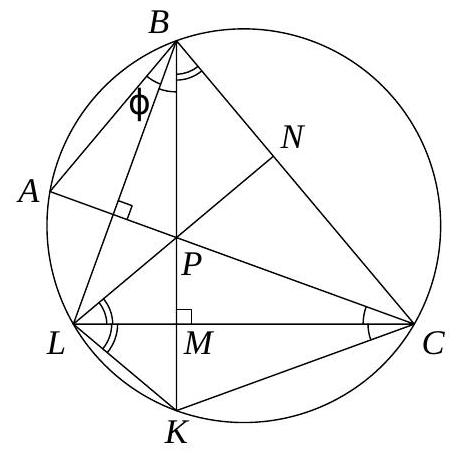
Solution. Let $\angle A B L=\varphi$. Then $\angle K B L=\varphi$ and $\angle K B C=2 \varphi$. Since $B K=B C$, we get $\angle B K C=\angle B C K=90^{\circ}-\varphi$.... | 90 | Geometry | math-word-problem | Yes | Yes | olympiads | false |
The equation of the circle \\(C'\\) that is symmetric to the circle \\(C: (x-2)^{2}+(y-1)^{2}=4\\) with respect to the line \\(l: x+y=0\\) is ( )
A: \\((x-1)^{2}+(y-2)^{2}=4\\)
B: \\((x+1)^{2}+(y+2)^{2}=4\\)
C: \\(x^{2}+(y-3)^{2}=4\\)
D: \\((x+3)^{2}+y^{2}=4\\) | **Analysis**
This question examines the equation of a circle symmetric to another circle with respect to a line, which is a basic problem. First, write out the center of the given circle using its standard equation, find the symmetric point with respect to the line \\(y=x\\), which will be the center of the sought cir... | \text{B} | Geometry | MCQ | Yes | Yes | cn_k12 | false |
11. (15 points) Prove: Among any four positive numbers, there must exist two numbers $x$ and $y$, such that the inequality $0 \leqslant$ $\frac{x-y}{1+x+y+2xy}<2-\sqrt{3}$ holds. | 11. Solution: If $x_{1}, x_{2}, x_{3}, x_{4}$ have two that are equal, it is obviously true. Now, let's assume four positive numbers $x_{1}<x_{2}<x_{3}<x_{4}$. We have
$$
\begin{array}{l}
\frac{x-y}{1+x+y+2 x y}=\frac{(x y+x)-(x y+y)}{(1+x)(1+y)+x y}= \\
\frac{\left(1+\frac{1}{y}\right)-\left(1+\frac{1}{x}\right)}{\lef... | proof | Inequalities | proof | Yes | Yes | olympiads | false |
If $\lim_{\Delta x \to 0} \frac {f(x_{0}+2\Delta x)-f(x_{0})}{\Delta x} =1$, then $f'(x_0)$ is equal to (__).
A: 2
B: -2
C: $\frac {1}{2}$
D: $- \frac {1}{2}$ | By the definition of the derivative, we have:
$$
f'(x_{0}) = \lim_{\Delta x \to 0} \frac {f(x_{0}+\Delta x)-f(x_{0})}{\Delta x}
$$
However, in the given limit, instead of $\Delta x$, we have $2\Delta x$. To make it fit the definition of the derivative, let’s consider the limit as the derivative but with a $2\Delta x$... | \frac{1}{2} | Calculus | MCQ | Yes | Yes | cn_k12 | false |
In order to stay hydrated while being active, Cassie, an athletic person, aims to consume at least 12 cups of water per day. Her water bottle can hold 16 ounces, and there are 8 ounces in a cup. How many times does Cassie need to refill her water bottle each day to ensure she drinks the required 12 cups? | To determine how many times Cassie needs to refill her water bottle each day to ensure she drinks the required 12 cups, we can follow these steps:
1. **Convert cups to ounces**: Since there are 8 ounces in a cup, we need to find out how many ounces are in 12 cups.
\[
12 \text{ cups} \times 8 \text{ ounces per cu... | 5 | Logic and Puzzles | math-word-problem | Yes | Yes | metamath | true |
Subtracting 7 from a number gives 9. What is the product of multiplying a number by 5? | Let's call the number we're looking for "x". According to the information given:
x - 7 = 9
To find the value of x, we add 7 to both sides of the equation:
x - 7 + 7 = 9 + 7
x = 16
Now that we know x is 16, we can find the product of multiplying this number by 5:
16 * 5 = 80
So, the product of multiplying the numb... | 80 | Algebra | math-word-problem | Yes | Yes | orca_math | true |
Example 1. Show that the vector $\alpha(t)=t i+\sin t \mathbf{j}$ is an infinitesimal vector as $t \rightarrow 0$. | ## Solution. We have
$$
|\alpha(t)|=|t i+\sin t j| \leqslant|t|+|\sin t| \leqslant 2|t|
$$
from which it is clear that if for any $\varepsilon>0$ we take $\delta=\frac{\varepsilon}{2}$, then for $|t-0|<\delta$, the inequality $|\alpha(t)|<\varepsilon$ holds. This shows that for any $\varepsilon>0$ there exists $\delt... | proof | Calculus | proof | Yes | Yes | olympiads | false |
17. $[\mathbf{1 0}]$ Compute the value of
$$
\frac{\cos 30.5^{\circ}+\cos 31.5^{\circ}+\ldots+\cos 44.5^{\circ}}{\sin 30.5^{\circ}+\sin 31.5^{\circ}+\ldots+\sin 44.5^{\circ}}
$$ | Answer:
$$
(\sqrt{2}-1)(\sqrt{3}+\sqrt{2})=2-\sqrt{2}-\sqrt{3}+\sqrt{6}
$$
Consider a 360-sided regular polygon with side length 1 , rotated so that its sides are at half-degree inclinations (that is, its sides all have inclinations of $0.5^{\circ}, 1.5^{\circ}, 2.5^{\circ}$, and so on. Go to the bottom point on this ... | 2-\sqrt{2}-\sqrt{3}+\sqrt{6} | Algebra | math-word-problem | Yes | Yes | olympiads | false |
Determine all the possible positive integer $n,$ such that $3^n+n^2+2019$ is a perfect square. | null | null | Number Theory | math-word-problem | Yes | Yes | aops_forum | false |
[b]a)[/b] Let be a continuous function $ f:\mathbb{R}_{\ge 0}\longrightarrow\mathbb{R}_{>0} . $ Show that there exists a natural number $ n_0 $ and a sequence of positive real numbers $ \left( x_n \right)_{n>n_0} $ that satisfy the following relation.
$$ n\int_0^{x_n} f(t)dt=1,\quad n_0<\forall n\in\mathbb{N} $$
[b]b)... | ### Part (a)
1. **Existence of \( n_0 \) and \( x_n \):**
Given that \( f \) is a continuous function on \( \mathbb{R}_{\ge 0} \) and \( f(t) > 0 \) for all \( t \ge 0 \), we can consider the integral \( \int_0^1 f(t) \, dt \). Since \( f \) is continuous and positive on \([0, 1]\), this integral is positive:
\... | \lim_{n \to \infty} nx_n = \frac{1}{f(0)} | Calculus | math-word-problem | Yes | Yes | aops_forum | false |
The base radius of a cone is 5cm, and its height is 10cm. What should be the value of the base radius $r$ of the inscribed cylinder so that the sum $S$ of the areas of the cylinder's two bases and lateral surface area is maximized? | As shown in the diagram, $\triangle SAB$ is the axial section of the cone, where $SO=10$ and $OB=5$.
Let the base radius of the inscribed cylinder be $O_1C=r$.
Since $\triangle SOB \sim \triangle SO'C'$,
we have $\frac{SO_1}{O_1C} = \frac{SO}{OB}$,
thus $SO_1 = \frac{SO}{OB} \cdot O_1C = \frac{10}{5}r = 2r$,
and $... | \text{There does not exist such a value of } r | Geometry | math-word-problem | Yes | Yes | cn_k12 | false |
Given the function $f(x)=x^{3}+ax^{2}+x+1$, where $a\in\mathbb{R}$.
$(1)$ Find the intervals of monotonicity for the function $f(x)$.
$(2)$ If the function $f(x)$ is decreasing on the interval $\left( -\frac{2}{3},-\frac{1}{3} \right)$, find the range of values for $a$. | Solution:
$(1)$ For $f(x)=x^{3}+ax^{2}+x+1$, we differentiate it: $f'(x)=3x^{2}+2ax+1$.
When $a^{2}\leqslant 3$, $\Delta \leqslant 0$, $f'(x)\geqslant 0$, $f(x)$ is increasing on $\mathbb{R}$.
When $a^{2} > 3$, solving $f'(x)=0$ yields two roots: $x= \frac{-a\pm \sqrt{a^{2}-3}}{3}$.
Thus, $f(x)$ is increasing on $\... | [2,+\infty) | Calculus | math-word-problem | Yes | Yes | cn_k12 | false |
Given that the function $f(x)$ defined on $\mathbb{R}$ satisfies $f(-x)=f(x)$, and when $x < 0$, $f(x)=3^{x}+1$. Let $a=2^{\frac {4}{3}}$, $b=4^{\frac {2}{5}}$, and $c=25^{\frac {1}{3}}$. Then,
A: $f(a) < f(b) < f(c)$
B: $f(b) < f(c) < f(a)$
C: $f(b) < f(a) < f(c)$
D: $f(c) < f(a) < f(b)$ | Since the function $f(x)$ is even ($f(-x)=f(x)$) and $f(x)=3^{x}+1$ for $x 0$.
Given that $a=2^{\frac {4}{3}}=4^{\frac {2}{3}}$, $b=4^{\frac {2}{5}}$, and $c=25^{\frac {1}{3}}=5^{\frac {2}{3}}$, we have $c > a > b$.
As $f(x)$ is a decreasing function when $x>0$, we conclude that $f(c) < f(a) < f(b)$.
Hence, the ans... | D | Algebra | MCQ | Yes | Yes | cn_k12 | false |
Subsets and Splits
No community queries yet
The top public SQL queries from the community will appear here once available.