
instruction_seed stringlengths 2 10.7k | solution stringlengths 0 10.8k ⌀ | answer stringlengths 0 575 ⌀ | problem_type stringclasses 9
values | question_type stringclasses 5
values | problem_is_valid stringclasses 5
values | solution_is_valid stringclasses 4
values | source stringclasses 11
values | synthetic bool 2
classes |
|---|---|---|---|---|---|---|---|---|
If $a_n$ is a sequence defined by $a_1=4$ and $a_{n+1}=a_n+2\sqrt{a_n}+1$, find the value of $\sqrt{a_{2015}}$.
A: $2014$
B: $2015$
C: $2016$
D: $2017$ | Analyze the given recursive formula for the sequence. We can rewrite the $n+1$ term expression as a perfect square:
$$(\sqrt{a_{n+1}})^2 = (\sqrt{a_n}+1)^2.$$
Using the fact that $a_n > 0$, we can deduce that the sequence $\{\sqrt{a_n}\}$ is an arithmetic sequence with the first term $\sqrt{a_1}=2$ and a common differe... | 2016 | Algebra | MCQ | Yes | Yes | cn_k12 | false |
Determine the integer $n$, $0 \le n \le 6$, such that \[n \equiv -2890 \pmod{7}.\] | To solve the problem, we first calculate $-2890 \mod 7$.
- Divide $-2890$ by $7$ and find the remainder:
- $-2890 \div 7 = -412.857$, so the quotient (rounded down to the nearest integer) is $-413$.
- Calculate the product $-413 \times 7 = -2891$.
- The remainder is $-2890 - (-2891) = 1$, however since the actual... | 6 | Number Theory | math-word-problem | Yes | Yes | synthetic_math | true |
A line $l$ passes through the point $M(2,4)$ and intersects the parabola $y^{2} = 8x$ at only one point. How many such lines are there?
A: $0$ lines
B: $1$ line
C: $2$ lines
D: $3$ lines | Given the conditions, we know that the point $(2,4)$ lies on the parabola $y^{2}=8x$.
Therefore, a line passing through $(2,4)$ and having only one intersection point with the parabola $y^{2}=8x$ can be either:
$(i)$ Tangent to the parabola at $(2,4)$, or
$(ii)$ Parallel to the axis of symmetry of the parabola. ... | C | Algebra | MCQ | Yes | Yes | cn_k12 | false |
Given an arithmetic sequence $\{a_n\}$ where the sum of the first four terms is $A_4 = 60$, and the sum of the second and fourth terms is $34$. Also given a geometric sequence $\{b_n\}$ where the sum of the first four terms is $B_4 = 120$, and the sum of the second and fourth terms is $90$.
(1) Find the explicit formul... | (1) According to the problem statement regarding the arithmetic sequence $\{a_n\}$:
We have the sum of the first four terms: $A_4 = a_1 + a_2 + a_3 + a_4 = 60$
And the sum of the second and fourth terms: $a_2 + a_4 = 34$
From the properties of an arithmetic sequence:
$a_2 = a_1 + d$
$a_4 = a_1 + 3d$
where $d$ is the ... | \frac{(4n + 3) \cdot 3^{n+1} - 9}{2} | Algebra | math-word-problem | Yes | Yes | cn_k12 | false |
Given the functions $f(x)=e^{x}$ and $g(x)=1+x$.
- $(1)$ Find the minimum value of the function $h(x)=f(x)-g(x)$;
- $(2)$ If $k > 1$, prove that when $|x| 1- \frac {x^{2}}{k}$. | Solution:
- (I) Since $f(x)=e^{x}$ and $g(x)=1+x$, we have $h(x)=f(x)-g(x)=e^{x}-1-x$, and $h′(x)=e^{x}-1$.
- When $x\in(-\infty,0)$, $h′(x) 0$, $h(x)$ is monotonically increasing.
- When $x=0$, $h(x)$ reaches its minimum value $h(0)=0$. $\boxed{0}$
- (II) To prove $\left[f\left( \frac {x}{k}\right)g\left(- \frac... | \text{Proved} | Calculus | math-word-problem | Yes | Yes | cn_k12 | false |
## Problem 3
Solve the equation in the set $\mathbb{R}$: $\sqrt{x-2}+\sqrt[3]{4-x}=2$. | ## Problem 3
CE: $x \geq 2 \Rightarrow x \in[2, \infty)$, let $\sqrt{x-2}=u \geq 0$ and $\sqrt[3]{4-x}=v \Rightarrow u+v=2 \Rightarrow u=2-v$ (1).
$\left\{\begin{array}{l}u^{2}=x-2 \\ v^{3}=4-x\end{array} \Rightarrow u^{2}+v^{3}=2\right.$ $\qquad$
From (1) and (2) $\Rightarrow v^{3}+v^{2}-4 v+2=0 \Leftrightarrow(v-1)... | x_1=3,x_2=14-6\sqrt{3},x_3=14+6\sqrt{3} | Algebra | math-word-problem | Yes | Yes | olympiads | false |
Two players take turns writing symbols in the cells of a $5 \times 5$ table; the first player always writes an $\mathrm{x}$ symbol, while the second player always writes two 0 symbols. The player who first has five of their symbols in a row or column wins. What strategy should the second player follow if they want to w... | Let the first player's name be $A$, and the second player's name be $B$. We will play the game until $B$ gets five ßs in a row.
$A$'s first $\S x$ mark occupies a row and a column. $B$ can place two ßs such that they are in a free column and two free rows.
No matter what $A$'s second move is, there will still be a fr... | proof | Logic and Puzzles | math-word-problem | Yes | Yes | olympiads | false |
A cistern is 8 m long and has a certain width. It contains water up to a depth of 1 m 25 cm. The total area of the wet surface is 83 m². What is the width of the cistern? | Let's denote the width of the cistern as \( w \) meters.
The wet surface of the cistern includes the bottom, the two longer sides, and the two shorter sides (the water surface is not included since it's not a "wet" surface). We can calculate the area of each of these surfaces and sum them up to get the total wet surfa... | 6 | Geometry | math-word-problem | Yes | Yes | orca_math | true |
How many integers $m$ are there such that $4 \leq m \leq 12$ and $232_m$ (the number written as $232$ in base $m$) is a perfect square? | The value of $232_m$ in base $m$ is $2m^2 + 3m + 2$. We need to determine if this can be a perfect square for any $m$ in the range $4 \leq m \leq 12$.
1. **Expression Simplification**:
\[
2m^2 + 3m + 2 = (m + 1)^2 + m
\]
This must be a perfect square.
2. **Checking for Perfect Squares**:
We need to ch... | 0 | Number Theory | math-word-problem | Yes | Yes | synthetic_math | true |
A school's Chess Club has 24 members. They need to elect 3 officers: president, secretary, and treasurer. Each person can hold at most one office. Three of the members, Penelope, Quentin, and Rachel, will only serve as officers if at least two of them are chosen. In how many ways can the club choose its officers? | - **Case 1: No one or only one of P, Q, R is an officer:** This scenario is not possible according to the given condition.
- **Case 2: Exactly two of P, Q, R are officers:**
1. Choose 2 out of 3 (P, Q, R) to serve as officers: $\binom{3}{2} = 3$ ways.
2. Assign them to any of the 3 available positions: $3 \times 2 ... | 384 | Combinatorics | math-word-problem | Yes | Yes | synthetic_math | true |
Given the set $A=\{x| \frac { \sqrt {x^{2}-1}}{ \sqrt {x}}=0\}$ and $B=\{y|-2\leq y\leq 2\}$, find $A\cap B$ ( ).
A: $[-2,-1]\cup[1,2]$
B: $\emptyset$
C: $\{1\}$
D: $X$ | Since the set $A=\{x| \frac { \sqrt {x^{2}-1}}{ \sqrt {x}}=0\}=\{1\}$ and $B=\{y|-2\leq y\leq 2\}$,
we have $A\cap B=\{1\}$.
Therefore, the answer is $\boxed{\text{C}}$.
To solve this problem, we first find the sets $A$ and $B$ separately, and then find their intersection. This problem tests the understanding of the... | \text{C} | Algebra | MCQ | Yes | Yes | cn_k12 | false |
Given the function $f(x) = ax + \frac{b}{x} - 2a + 2$ (where $a > 0$), the tangent line to the graph at the point $(1, f(1))$ is parallel to the line $y = 2x + 1$.
(I) Find the value of $\log_{4}(a - b)$;
(II) If the inequality $f(x) - 2\ln x \geq 0$ holds true for $x \in [1, +\infty)$, determine the range of values fo... | (I) Since $f(x) = ax + \frac{b}{x} - 2a + 2$ (with $a > 0$),
then $f'(x) = a - \frac{b}{x^2}$.
Because the tangent line of the function $f(x) = ax + \frac{b}{x} - 2a + 2$ (where $a > 0$) at the point $(1, f(1))$ is parallel to the line $y = 2x + 1$,
we have that $f′(1) = a - b = 2$.
Hence, $\log_{4}(a - b) = \log_{4}2... | [1, +\infty) | Algebra | math-word-problem | Yes | Yes | cn_k12 | false |
8. Let $M$ be the midpoint of side $B C$ of $\triangle A B C$. When $\angle M A C=15^{\circ}$, find the maximum value of $\angle A B C$. | None
Translate the text above into English, please retain the original text's line breaks and format, and output the translation result directly.
Note: The provided instruction is a meta-instruction and not part of the text to be translated. Since the text to be translated is "None", the translation is also "None". ... | notfound | Geometry | math-word-problem | Yes | Incomplete | olympiads | false |
Given the proposition $p$: $\exists x \in \mathbb{R}$ such that $x^{2}-2x+a^{2}=0$; and the proposition $q$: $\forall x \in \mathbb{R}$, we have $ax^{2}-ax+1 > 0$. If $p \wedge (\neg q)$ is a true proposition, find the range of values for the real number $a$. | If $p$ is true: $\triangle = 4 - 4a^{2} \geqslant 0$,
Thus, $-1 \leqslant a \leqslant 1$,
If $q$ is true: when $a=0$, $1 > 0$ is always true,
When $a \neq 0$, we have $\begin{cases} a > 0 \\ \triangle = a^{2} - 4a < 0 \end{cases}$,
Thus, $0 < a < 4$,
So, $0 \leqslant a < 4$,
If $p \wedge (\neg q)$ is a true propo... | -1 \leqslant a < 0 | Algebra | math-word-problem | Yes | Yes | cn_k12 | false |
Find all polynomials $ f\in\mathbb Z[x]$ such that for each $ a,b,x\in\mathbb N$
\[ a\plus{}b\plus{}c|f(a)\plus{}f(b)\plus{}f(c)\] | null | null | Number Theory | math-word-problem | Yes | Yes | aops_forum | false |
466*. Prove that for $x>0$ and natural $n$, greater than 1, the inequality $(1+x)^{n}>1+n x$ (Bernoulli's inequality) holds. | Proof. 1) For $n=2$ we have
$$
(1+x)^{2}=1+2 x+x^{2}>1+2 x
$$
since
$$
x>0
$$
thus, the inequality holds.
2) Assume that
$$
(1+x)^{k}>1+k x
$$
and we will prove that then
$$
(1+x)^{k+1}>1+(1+k) x
$$
3) To prove this, multiply both sides of inequality (1) by $1+x>0$, we get:
$$
(1+x)^{k+1}>(1+k x)(1+x)
$$
or
... | proof | Inequalities | proof | Yes | Yes | olympiads | false |
Given sets $A=\{x∈Z|\frac{x+2}{x-3}≤0\}$ and $B=\{x|x≤-1$ or $x \gt 3\}$, then $A\cap (\complement _{R}B)=\left(\ \ \right)$
A: $(-1,3)$
B: $\{0,1\}$
C: $\{0,1,2,3\}$
D: $\{0,1,2\}$ | To solve this problem, we need to find the intersection of set $A$ with the complement of set $B$ in the real numbers, denoted as $\complement _{R}B$. Let's break down the solution step by step.
**Step 1: Determine Set $A$**
Given $A=\{x∈Z|\frac{x+2}{x-3}≤0\}$, we need to find the integer values of $x$ that satisfy t... | D | Inequalities | MCQ | Yes | Yes | cn_k12 | false |
What is the greatest positive integer that must divide the sum of the first 15 terms of any arithmetic sequence whose terms are positive integers? | Let the first term of the arithmetic sequence be represented by $a$, and let the common difference be $d$. The first 15 terms of the sequence will be $a$, $a + d$, $a + 2d$, ..., $a + 14d$.
The sum \( S \) of the first 15 terms of an arithmetic sequence can be found using the formula:
\[ S = \frac{n}{2} \times (2a + (... | 15 | Number Theory | math-word-problem | Yes | Yes | synthetic_math | true |
Golenev-Kumuzoova et al.
Yura drew a rectangle (along the cells) on graph paper and painted a picture on it. After that, he drew a frame one cell wide around the picture (see fig.). It turned out that the area of the picture is equal to the area of the frame. What could be the dimensions of Yura's picture?
. Then, in the small frame, as in the large one, there will be four corner cells (they are shaded), and each side will be two cells shorter. Therefore, there will be 8 cells less in the small f... | 3\times10 | Geometry | math-word-problem | Yes | Yes | olympiads | false |
In a set of data $3$, $5$, $1$, $4$, $6$, $5$, the mode and median are respectively ( ).
A: $5$, $4.5$
B: $4.5$, $4$
C: $4$, $4.5$
D: $5$, $5$ | To solve this problem, we first identify the mode and then calculate the median of the given set of data.
**Step 1: Identify the Mode**
The mode is the number that appears most frequently in a set of data. In the given set $3$, $5$, $1$, $4$, $6$, $5$, we can see that:
- $3$ appears once
- $5$ appears twice
- $1$ app... | A: 5, 4.5 | Other | MCQ | Yes | Yes | cn_k12 | false |
On street AB, Xiao Nan is walking from A to B, and Xiao Yu is cycling from B to A. Xiao Yu's speed is 3 times that of Xiao Nan. At this time, a bus departs from the starting station A towards B, and buses are dispatched at regular intervals. After a while, Xiao Nan notices that a bus catches up with him every 10 minute... | Let the speed of the bus be $V_1$, and the speed of Xiao Nan be $V_2$. According to the problem, we have:
- For Xiao Nan: $s = 10(V_1 - V_2)$ ①
- For Xiao Yu: $s = 5(V_1 + 3V_2)$ ②
Subtracting equation ② from ①, we get $0 = 5V_1 - 25V_2$, which simplifies to $V_1 = 5V_2$ ③.
Substituting ③ into ①, we get $s = 10(V_1 ... | 8 \text{ minutes} | Algebra | math-word-problem | Yes | Yes | cn_k12 | false |
Consider the second-degree polynomial \(P(x) = 4x^2+12x-3015\). Define the sequence of polynomials
\(P_1(x)=\frac{P(x)}{2016}\) and \(P_{n+1}(x)=\frac{P(P_n(x))}{2016}\) for every integer \(n \geq 1\).
[list='a']
[*]Show that exists a real number \(r\) such that \(P_n(r) < 0\) for every positive integer \(n\).
[*]Fin... | 1. **Define the sequence of polynomials:**
Given \( P(x) = 4x^2 + 12x - 3015 \), we define \( P_1(x) = \frac{P(x)}{2016} \) and \( P_{n+1}(x) = \frac{P(P_n(x))}{2016} \) for every integer \( n \geq 1 \).
2. **Express \( P(x) \) in a different form:**
\[
P(x) = 4x^2 + 12x - 3015 = 4(x^2 + 3x - 753.75)
\]
... | 1008 | Algebra | math-word-problem | Yes | Yes | aops_forum | false |
Given the line $l: ax + y + b = 0$ intersects with the circle $O: x^{2} + y^{2} = 4$ at points $A$ and $B$, and $M(\sqrt{3}, -1)$, and $\overrightarrow{OA} + \overrightarrow{OB} = \frac{2}{3} \overrightarrow{OM}$, then $\sqrt{3}ab = $ ______. | From the given conditions, $l \perp OM$, and the distance from the center $O$ to the line $l$ is $\frac{1}{2} \times \frac{2}{3} \times |\overrightarrow{OM}| = \frac{2}{3}$,
$\therefore \begin{cases} a = -\sqrt{3} \\ \frac{b}{\sqrt{a^{2}+1}} = \frac{2}{3} \end{cases}$,
Since $b > 0$, $\therefore a = -\sqrt{3}$, $b = ... | -4 | Geometry | math-word-problem | Yes | Yes | cn_k12 | false |
Given that the equation of the tangent line to the graph of the function $y=f(x)$ at the point $M(1,f(1))$ is $y=\frac{1}{2}x+3$, find the value of $f(1)+f′(1)$. | Since the equation of the tangent line to the graph of the function $y=f(x)$ at the point $M(1,f(1))$ is $y=\frac{1}{2}x+3$,
We know that the slope of the tangent line is $\frac{1}{2}$, and the tangent line passes through the point $(1, f(1))$. Therefore, we can write the equation of the tangent line in point-slope fo... | 4 | Calculus | math-word-problem | Yes | Yes | cn_k12 | false |
$ABC$ is a triangle with $\angle B = 90^o$ and altitude $BH$. The inradii of $ABC, ABH, CBH$ are $r, r_1, r_2$. Find a relation between them. | 1. Given that $\triangle ABC$ is a right triangle with $\angle B = 90^\circ$ and altitude $BH$. Let $a = AB$ and $c = BC$. We need to find a relation between the inradii $r$, $r_1$, and $r_2$ of triangles $ABC$, $ABH$, and $CBH$ respectively.
2. Using the properties of similar triangles, we can find the lengths of $BH... | null | Geometry | math-word-problem | Yes | Yes | aops_forum | false |
32. In the future world, scientists discover that the sun is rapidly aging and expanding, and the entire solar system, including Earth, will be swallowed by the sun in a short time. To save themselves, humans propose a bold plan called “Wandering Earth,” which involves building tens of thousands of engines and steering... | $59$ | 59 | Algebra | math-word-problem | Yes | Yes | olympiads | false |
Get $p \mid a k+b l$.
Translate the text above into English, keeping the original text's line breaks and format, and output the translation result directly.
However, since the provided text is already in a form that can be considered as English (it's a mathematical statement), the translation would be the same:
Get... | Let $(b, p-a)=d$, i.e., $b=k d, p-a=l d, (k, l)=1$. Therefore, $a k+b l=$ $\frac{a b}{d}+\frac{(p-a) b}{d}=p k$. Hence, $p \mid a k+b l$.
We will prove that the prime number $p$ satisfying the condition can only be 11.
It is not difficult to see that when $p=5,7$, $p \nmid N_{p-4}$, so let $p \geqslant 11$. Then $\fra... | 11 | Number Theory | math-word-problem | Yes | Yes | olympiads | false |
Given that $θ$ is an acute angle and $\sin(θ - \frac{π}{4}) = \frac{\sqrt{2}}{10}$, find the value of $\tan θ + \frac{1}{\tan θ} =(\ \ \ \ )$.
A: $\frac{25}{12}$
B: $\frac{7}{24}$
C: $\frac{24}{7}$
D: $\frac{12}{25}$ | Since $θ$ is an acute angle, we have $\sin(θ - \frac{π}{4}) = \frac{\sqrt{2}}{10}$,
Using the sine difference identity, we get $\frac{\sqrt{2}}{2} \sin θ - \frac{\sqrt{2}}{2} \cos θ = \frac{\sqrt{2}}{10}$, which simplifies to:
$\sin θ - \cos θ = \frac{1}{5}$
Squaring both sides, we get:
$1 - 2 \sin θ \cos θ = \frac... | \frac{25}{12} | Algebra | MCQ | Yes | Yes | cn_k12 | false |
What are the last two digits of the number
$$
8+88+888+\cdots+\overbrace{88 \cdots 88}^{2008} ?
$$ | Solution 1: Since we only want to know the last two digits, it is enough to know the last two columns of this sum (the tens and the units), that is,
$$
8+88 \times 2007=8+\ldots 16
$$
Since $8+16=24$, the last two digits of the number are 24.
, we need to analyze the given conditions and derive the necessary geometric properties.
1. **Given Conditions and Setup:**
- Triangle \(ABC\) with points \(M\) on \(BA\) and \(N\) on \(AC\) such that \(BM = CN\).
... | \ell | Geometry | math-word-problem | Yes | Yes | aops_forum | false |
a garrison of 2000 men has provisions for 54 days . at the end of 18 days , a reinforcement arrives , and it is now found that the provisions will last only for 20 days more . what is the reinforcement ? | Let's calculate the total amount of provisions the garrison initially had for 2000 men for 54 days. We'll call this total amount of provisions P.
P = 2000 men * 54 days
After 18 days, the provisions left would be enough for the remaining 2000 men for 54 - 18 = 36 days.
So, the provisions left after 18 days would be:... | 1600 | Algebra | math-word-problem | Yes | Yes | orca_math | true |
Dante subtracts $4 - 2i$ from $7 + 6i$. | To solve the problem, we follow these steps:
1. Separate the real and imaginary parts of the complex numbers:
- From $7 + 6i$, the real part is $7$ and the imaginary part is $6i$.
- From $4 - 2i$, the real part is $4$ and the imaginary part is $-2i$.
2. Subtract the real parts and the imaginary parts:
- Rea... | 3 + 8i | Algebra | math-word-problem | Yes | Yes | synthetic_math | true |
Joseph drives his car at a certain speed for 2.5 hours. Kyle drives his car at 62 mph for 2 hours. Joseph drives 1 mile more than Kyle. What is Joseph's speed in mph? | Let's denote Joseph's speed as \( J \) mph.
Kyle drives at 62 mph for 2 hours, so he covers a distance of \( 62 \times 2 = 124 \) miles.
Joseph drives 1 mile more than Kyle, so Joseph covers a distance of \( 124 + 1 = 125 \) miles.
Joseph drives for 2.5 hours, so we can set up the equation:
\[ J \times 2.5 = 125 \]... | 50 | Algebra | math-word-problem | Yes | Yes | orca_math | true |
Workers at a campaign office have 2000 fliers to send out. They send out 1/10 of them in the morning and a fraction of the remaining ones out during the afternoon. They have 1350 fliers left for the next day. What fraction of the remaining fliers did they send out during the afternoon? | Let's first calculate how many fliers were sent out in the morning. Since they sent out 1/10 of the fliers in the morning, we can calculate this as:
2000 fliers * 1/10 = 200 fliers
Now, let's find out how many fliers were left after the morning:
2000 fliers - 200 fliers = 1800 fliers
They have 1350 fliers left for ... | 1/4 | Algebra | math-word-problem | Yes | Yes | orca_math | true |
Example 13 Given $x \geqslant 0, y \geqslant 0, z \geqslant 0$, prove the inequality $8\left(x^{3}+y^{3}+z^{3}\right)^{2} \geqslant 9\left(x^{2}+\right.$ $y z)\left(y^{2}+z x\right)\left(z^{2}+x y\right) \cdot(1982$ German National Team Question) | Prove that the original inequality is equivalent to
$$\begin{array}{l}
8\left[x^{6}+y^{6}+z^{6}+2\left(x^{3} y^{3}+y^{3} z^{3}+z^{3} x^{3}\right)\right] \\
9\left[2 x^{2} y^{2} z^{2}+\left(x^{3} y^{3}+y^{3} z^{3}+z^{3} x^{3}\right)+\left(x^{4} y z+x y^{4} z+x y z^{4}\right)\right] \geqslant 0 \Leftrightarrow \\
8\left(... | proof | Inequalities | proof | Yes | Yes | inequalities | false |
What is the positive difference between the $3000^{\mathrm{th}}$ term and the $3010^{\mathrm{th}}$ term of the arithmetic sequence $-8,$ $-2,$ $4,$ $10,$ $\ldots$? | - The common difference \(d\) in this arithmetic sequence is calculated as $-2 - (-8) = 6$.
- The $3000^{\text{th}}$ term is: \(a + 2999d = -8 + 2999 \cdot 6\).
- The $3010^{\text{th}}$ term is: \(a + 3009d = -8 + 3009 \cdot 6\).
- The positive difference between the $3010^{\text{th}}$ term and the $3000^{\text{th}}$ t... | 60 | Algebra | math-word-problem | Yes | Yes | synthetic_math | true |
Bipin is 6 times as old as Alok. Bipin's age will be twice Chandan's age after 10 years. Chandan's 7th birthday was celebrated 3 years ago. What is Alok's present age? | Let's denote Alok's current age as A, Bipin's current age as B, and Chandan's current age as C.
From the information given, we have the following relationships:
1. Bipin is 6 times as old as Alok:
B = 6A
2. Bipin's age will be twice Chandan's age after 10 years:
B + 10 = 2(C + 10)
3. Chandan's 7th birthday wa... | 5 | Algebra | math-word-problem | Yes | Yes | orca_math | true |
After the "Nine Chapters on the Mathematical Art," people further used the arithmetic sequence summation formula to solve more problems. The 22nd question in the first volume of "Zhang Qiujian's Mathematical Manual" is: "There is a woman skilled in weaving, who increases her output speed daily (Note: starting from the ... | Let's denote the additional yards of fabric woven each day starting from the second day as $d$ yards.
According to the problem, we have $30 \times 5 + \frac{30 \times 29}{2}d = 390$,
Solving this equation, we find $d = \frac{16}{29}$.
Therefore, the correct answer is $\boxed{D}$.
This problem is solved by using... | D | Algebra | MCQ | Yes | Yes | cn_k12 | false |
Find the number of positive integer solutions to the equation $(x_1+x_2+x_3)^2(y_1+y_2) = 2548$. | null | null | Combinatorics | math-word-problem | Yes | Yes | aops_forum | false |
There are 3 squares between 2011 and a certain number. What is the ending number? | To find the ending number, we need to find the next square number after 2011. Since we know that 44^2 = 1936 and 45^2 = 2025, the next square number after 2011 is 2025.
Now, we need to find the next two square numbers after 2025:
- The next square after 2025 is 46^2 = 2116.
- The next square after 2116 is 47^2 = 2209... | 2209 | Number Theory | math-word-problem | Incomplete | Yes | orca_math | true |
Define $\frac{n}{P\_1+P\_2+...+P\_n}$ as the "harmonic mean" of $n$ positive numbers $(P\_1,P\_2,...,P\_n)$. It is known that the "harmonic mean" of the first $n$ terms of the sequence $\{a\_n\}$ is $\frac{1}{2n+1}$, and $b\_n=\frac{a\_n+1}{4}$. Find the value of $\frac{1}{b\_1b\_2}+\frac{1}{b\_2b\_3}+...+\frac{1}{b\_1... | [Analysis]
This problem involves the recursive relationship of sequences, the method of splitting terms for summation, and a new definition. It tests both reasoning and computational skills and is of moderate difficulty. From $\frac{n}{a\_1+a\_2+...+a\_n}=\frac{1}{2n+1}$, we can obtain $a\_1+a\_2+...+a\_n=n(2n+1)$. Us... | \frac{10}{11} | Algebra | MCQ | Yes | Yes | cn_k12 | false |
2. [5 points] Solve the equation $\frac{\cos 8 x}{\cos 3 x+\sin 3 x}+\frac{\sin 8 x}{\cos 3 x-\sin 3 x}=\sqrt{2}$. | Answer: $x=\frac{\pi}{44}+\frac{2 \pi k}{11}, k \neq 11 p+4, k \in \mathbb{Z}, p \in \mathbb{Z}$.
Solution. By bringing the fractions on the left side of the equation to a common denominator, we obtain
$$
\frac{\cos 8 x \cos 3 x-\cos 8 x \sin 3 x+\cos 3 x \sin 8 x+\sin 3 x \sin 8 x}{\cos ^{2} 3 x-\sin ^{2} 3 x}=\sqrt... | \frac{\pi}{44}+\frac{2\pik}{11},k\neq11p+4,k\in\mathbb{Z},p\in\mathbb{Z} | Algebra | math-word-problem | Yes | Yes | olympiads | false |
257. Given a regular tetrahedron with edge $a$. Find the radius of a sphere centered at the center of the tetrahedron, such that the combined volume of the part of the tetrahedron outside the sphere and the part of the sphere outside the tetrahedron is minimized. | 257. Let $x$ be the radius of the sphere, $V(x)$ be the sum of the volume of the part of the sphere located outside the tetrahedron and the part of the tetrahedron located outside the sphere. It is easy to see that $V^{\prime \prime}(x)=$ $=S_{1}(x)-S_{2}(x)$, where $S_{1}(x)$ is the surface area of the part of the sph... | \frac{1}{3}\sqrt{\frac{2}{3}} | Geometry | math-word-problem | Yes | Yes | olympiads | false |
8.23. A system of roads passing along the edges of a convex

Fig. 56
polyhedron, as shown in Fig. 56, connects all its vertices and does not divide it into two parts. Prove that this system... | 8.23. Let's color the vertices of a polyhedron in 2 colors as shown in Fig. 60. Then any edge connects 2 vertices of different colors. For the given system of roads, the degree of a vertex of the polyhedron is the number of roads passing through this vertex. If the system of roads has no vertices of degree more than 2,... | proof | Geometry | proof | Incomplete | Yes | olympiads | false |
Given the complex number $z=i^2$, the imaginary part of $z$ is ( ).
A: $i$
B: $1$
C: $-1$
D: $0$ | **Analysis**
This question tests the basic concepts and arithmetic operations of complex numbers.
**Solution**
We have $z=i^2=-1$,
Therefore, the imaginary part of $z$ is $0$.
Hence, the correct answer is $\boxed{\text{D}}$. | \text{D} | Algebra | MCQ | Yes | Yes | cn_k12 | false |
Example 11 As shown in Figure 2.10.10, through any point $P$ inside $\triangle ABC$, draw three lines parallel to its sides, forming three triangles with two of these lines and one side of the triangle. Let the areas of these three triangles be $S_{1}, S_{2}, S_{3}$. Try to find such a point that $S_{1}+S_{2}+S_{3}$ re... | Let $A B=c, D P=A L=u, G P=B K=v$, then $L K=c-u-v$. Also,
$$
\begin{array}{c}
S_{\triangle D P E}=\frac{u^{2} \cdot \sin A \cdot \sin B}{2 \sin ^{2} C}=S_{1} \\
S_{\triangle F \mu G}=\frac{v^{2} \cdot \sin A \cdot \sin B}{2 \sin ^{2} C}=S_{2} \\
S_{\triangle P L X}=\frac{(c-u-v)^{2} \cdot \sin A \cdot \sin B}{2 \sin ^... | \frac{^{2}\sinA\cdot\sinB}{6\sin^{2}C} | Geometry | math-word-problem | Yes | Yes | olympiads | false |
Find the number of complex solutions to the equation
\[\frac{z^4 - 1}{z^3 + z^2 - 2z} = 0.\] | Step 1: Factorize the numerator:
\[ z^4 - 1 = (z^2 + 1)(z^2 - 1) = (z^2 + 1)(z - 1)(z + 1). \]
Step 2: Factorize the denominator and ensure it's not zero where the numerator is zero:
\[ z^3 + z^2 - 2z = z(z^2 + z - 2) = z(z - 1)(z + 2). \]
Step 3: Examine the roots:
- The numerator equals zero for \( z^2 + 1 = 0 \) w... | 3 | Algebra | math-word-problem | Yes | Yes | synthetic_math | true |
3. (3rd Latin American Mathematical Competition) Consider expressions of the form $x+y t+z t^{2}\left(x, y, z \in Q, t^{2}=2\right)$. Prove: If $x+y t+z t^{2} \neq 0$, then there exist $u$, $v, w \in Q$, such that
$$
\left(x+y t+z t^{2}\right)\left(u+\nu t+w t^{2}\right)=1
$$ | Prove that since $t$ is an irrational number, when
$$
x+y t+z t^{2}=(x+2 z)+y t \neq 0,
$$
then, $(x+2 z)-y t \neq 0$. Therefore,
$$
\begin{array}{l}
(x+2 z)^{2}-y^{2} t^{2} \\
=(x+2 z)^{2}-2 y^{2} \neq 0 .
\end{array}
$$
Take $\quad v=\frac{-y}{(x+2 z)^{2}-2 y^{2}}$,
then $v$ is a rational number. Take
$$
u+w t^{2}=... | proof | Algebra | proof | Yes | Yes | cn_contest | false |
Given the functions $y=\cos x$ and $y=\sin(2x+\varphi)$ ($0 \leq \varphi < \pi$), their graphs intersect at a point where the x-coordinate is $\frac{\pi}{3}$. Find the value of $\varphi$. | Since the functions $y=\cos x$ and $y=\sin(2x+\varphi)$ intersect at a point where the x-coordinate is $\frac{\pi}{3}$,
we have $\sin\left(\frac{2\pi}{3}+\varphi\right)=\cos\left(\frac{\pi}{3}\right)=\frac{1}{2}$.
Given $0 \leq \varphi < \pi$, we have $\frac{2\pi}{3} \leq \frac{2\pi}{3}+\varphi \leq \frac{5\pi}{3}$.
... | \frac{\pi}{6} | Algebra | math-word-problem | Yes | Yes | cn_k12 | false |
In the expansion of the binomial $(x+ \frac {6}{x})^{6}$, the constant term is ______. | To solve this, we use the general term formula of the binomial expansion $(x+ \frac {6}{x})^{6}$, which is $T_{r+1}= C_{6}^{r} \cdot 6^{r} \cdot x^{6-2r}$.
Let $6-2r=0$, solving for $r$ gives $r=3$. Thus, the constant term is $C_{6}^{3} \cdot 6^{3}=4320$.
Therefore, the answer is $\boxed{4320}$.
In the general te... | 4320 | Algebra | math-word-problem | Yes | Yes | cn_k12 | false |
A company needs to transport two types of products, $A$ and $B$, with the following volumes and masses per unit as shown in the table:
| | Volume $(m^{3}/$unit) | Mass (tons$/$unit) |
|----------|-----------------------|--------------------|
| $A$ type | $0.8$ | $0.5$ |
| $B$ type... | 1. To find the number of units for each type of product, we set up a system of equations based on the given information. Let $x$ be the number of units for type $A$ products and $y$ be the number of units for type $B$ products. The total volume and mass equations are:
\[
\begin{align*}
0.8x + 2y &= 20 \quad \text{(Vol... | 2100 | Algebra | math-word-problem | Yes | Yes | cn_k12 | false |
There are 193 items that are members of set U. Of these items, 49 are members of set B, 59 are not members of either set A or set B, and some are members of both sets A and B. There are 110 members of set U that are members of set A. How many of the members of set U are members of both sets A and B? | Let's denote the number of members of set U that are in both sets A and B as x.
According to the given information, we have:
- Total members in set U: 193
- Members in set B: 49
- Members not in set A or B: 59
- Members in set A: 110
We know that the total number of members in set U is the sum of members exclusive t... | 25 | Combinatorics | math-word-problem | Yes | Yes | orca_math | true |
Let \( f(x) = 2x^2 - 5 \) and \( g(f(3)) = 12 \). What is \( g(f(-3)) \)? | 1. First, compute \( f(3) \) using the function definition:
\[
f(3) = 2(3)^2 - 5 = 18 - 5 = 13
\]
This tells us \( g(f(3)) = g(13) = 12 \).
2. Next, calculate \( f(-3) \). The function \( f(x) \) is symmetric since it only involves even powers of \( x \):
\[
f(-3) = 2(-3)^2 - 5 = 18 - 5 = 13
\]
... | 12 | Algebra | math-word-problem | Yes | Yes | synthetic_math | true |
Malcolm can run a race at a speed of 7 minutes per mile, while Joshua runs at 8 minutes per mile. In a 12-mile race, how many minutes after Malcolm crosses the finish line will Joshua cross the finish line if they start the race together? | First, calculate the time taken by Malcolm to finish the race:
\[ \text{Time by Malcolm} = 7 \text{ minutes/mile} \times 12 \text{ miles} = 84 \text{ minutes} \]
Next, calculate the time taken by Joshua to finish the race:
\[ \text{Time by Joshua} = 8 \text{ minutes/mile} \times 12 \text{ miles} = 96 \text{ minutes} \... | 12 | Algebra | math-word-problem | Yes | Yes | synthetic_math | true |
9・131 Let $a<b$, prove that:
$$
a^{3}-3 a \leqslant b^{3}-3 b+4 \text {, }
$$
and determine when the equality holds. | [Proof] Let $c=b-a>0$, then
$$
\begin{aligned}
b^{3}-3 b+4-a^{3}+3 a & =3 c a^{2}+3 c^{2} a+c^{3}-3 c+4 \\
& =3 c\left(a+\frac{c}{2}\right)^{2}+\frac{1}{4} c^{3}-3 c+4 .
\end{aligned}
$$
Furthermore,
$$
\begin{aligned}
\frac{1}{4} c^{3}-3 c+4 & =\frac{1}{4}\left(c^{3}-12 c+16\right)=\frac{1}{4}\left(c^{3}-16 c+4 c+16\... | proof | Inequalities | proof | Yes | Yes | olympiads | false |
$11$ different books are on a $3$-shelf bookcase. In how many different ways can the books be arranged such that at most one shelf is empty?
$ \textbf{(A)}\ 75\cdot 11!
\qquad\textbf{(B)}\ 62\cdot 11!
\qquad\textbf{(C)}\ 68\cdot 12!
\qquad\textbf{(D)}\ 12\cdot 13!
\qquad\textbf{(E)}\ 6 \cdot 13!
$ | 1. **Understanding the problem**: We need to arrange 11 different books on a 3-shelf bookcase such that at most one shelf is empty. This means we can have either:
- One shelf empty and the other two shelves with books.
- No shelf empty (all three shelves have books).
2. **Total arrangements without any restricti... | 75 \cdot 11! | Combinatorics | MCQ | Yes | Yes | aops_forum | false |
Given that $i$ is the imaginary unit, then the complex number $i(1+i)=$ ( )
A: $-1-i$
B: $-1+i$
C: $1+i$
D: $1-i$ | The complex number $i(1+i) = i + i^2 = -1 + i$.
Therefore, the correct answer is $\boxed{\text{B}}$. | \text{B} | Algebra | MCQ | Yes | Yes | cn_k12 | false |
A bus covered a distance of 250 km, partly at an average speed of some kmph and partly at 60 kmph. The total time taken is 6 hours. The distance covered at that speed is 220 km. What is the average speed for the 220 km distance? | Let's denote the average speed for the 220 km distance as "x" kmph.
We know that the total distance covered is 250 km, and the total time taken is 6 hours. The distance covered at 60 kmph is the remaining distance after subtracting the 220 km, which is 250 km - 220 km = 30 km.
Now, we can use the formula for time, wh... | 40 | Algebra | math-word-problem | Yes | Yes | orca_math | true |
If $\mathbf{v} \times \mathbf{w} = \begin{pmatrix} 3 \\ -1 \\ 2 \end{pmatrix}$ and $\mathbf{u} \times \mathbf{w} = \begin{pmatrix} 2 \\ 3 \\ -4 \end{pmatrix}$, find $2(\mathbf{v} + \mathbf{u}) \times 2(\mathbf{v} + \mathbf{u}).$ | Expand and simplify the given operation using scalar multiplication and vector summation properties:
\begin{align*}
2(\mathbf{v} + \mathbf{u}) \times 2(\mathbf{v} + \mathbf{u}) &= 4(\mathbf{v} + \mathbf{u}) \times (\mathbf{v} + \mathbf{u})\\
&= 4 \left( \mathbf{v} \times \mathbf{v} + \mathbf{v} \times \mathbf{u} + \mat... | \begin{pmatrix} 0 \\ 0 \\ 0 \end{pmatrix} | Algebra | math-word-problem | Yes | Yes | synthetic_math | true |
The graph of the function $y=2\sin \left( 2x-\frac{\pi }{6} \right)$ is:
A: Symmetrical about the origin
B: Symmetrical about the $y$-axis
C: Symmetrical about the line $x=\frac{\pi }{12}$
D: Symmetrical about the point $\left( \frac{\pi }{12},0 \right)$ | **Analysis**:
This problem tests our understanding of the graph and properties of the function $y=A\sin \left( \omega x+\phi \right)$. By utilizing the symmetry of the graph of $y=A\sin \left( \omega x+\phi \right)$, we can calculate the conclusion.
**Step-by-step Solution**:
1. From the function $y=2\sin \left( 2x-\... | \left( \frac{\pi }{12},0 \right) | Algebra | MCQ | Yes | Yes | cn_k12 | false |
[Rectangle](https://artofproblemsolving.com/wiki/index.php/Rectangle) $ABCD$ is given with $AB=63$ and $BC=448.$ Points $E$ and $F$ lie on $AD$ and $BC$ respectively, such that $AE=CF=84.$ The [inscribed circle](https://artofproblemsolving.com/wiki/index.php/Inscribed_circle) of [triangle](https://artofproblemsolving.c... | [2007 AIME II-9.png](https://artofproblemsolving.com/wiki/index.php/File:2007_AIME_II-9.png)
Solution 1
Several [Pythagorean triples](https://artofproblemsolving.com/wiki/index.php/Pythagorean_triple) exist amongst the numbers given. $BE = DF = \sqrt{63^2 + 84^2} = 21\sqrt{3^2 + 4^2} = 105$. Also, the length of $EF = ... | 259 | Geometry | math-word-problem | Yes | Yes | amc_aime | false |
2. Factorize $f(x, y, z)=(y-z)^{5}+(x-z)^{5}+(x-y)^{5}$.
| 2. This is a fifth-degree homogeneous cyclic polynomial in $x, y, z$, and when $y=z$, $f(x, y, z)=0$, so $f(x, y, z)$ has the factors $y-z, z-x, x-y$ (or these three factors can also be derived from $f(x, y, z)$ being an alternating polynomial). Therefore, we can set $(y-z)^{5}+(z-x)^{5}+(x-$ $y)^{5}=(y-z) \cdot(z-x) \... | 5(y-z)(z-x)(x-y)\cdot(x^{2}+y^{2}+z^{2}-xy-yz-xz) | Algebra | math-word-problem | Yes | Yes | olympiads | false |
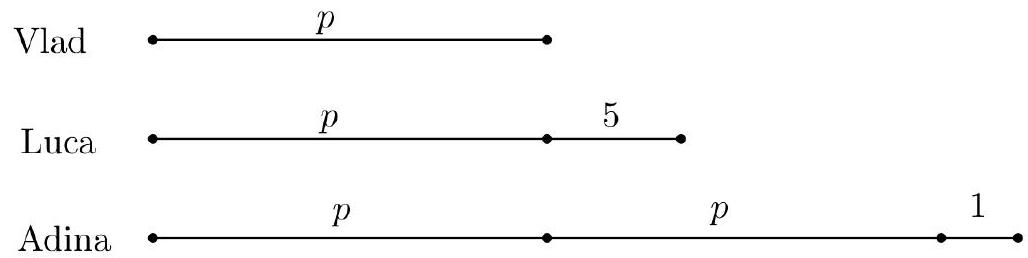
Problem 1. Vlad, Luca, and Adina bought stationery from a bookstore for a total value of 118 lei. Vlad bought 5 pens, 4 notebooks, and 3 boxes of colored pencils, Luca bought 7 pens, 3 notebooks, and 4 boxes of colored pencils, and Adina bought 8 pens, 7 notebooks, and 7 boxes of colored pencils.
Knowing that Luca pai... | Solution. We use the graphical method to find the amounts paid by each child. In the representation below, $p$ is the amount paid by Vlad:
$p + p + 5 + 2p + 1 = 118$, from which $p = 28$, so... | 1 | Algebra | math-word-problem | Yes | Yes | olympiads | false |
## Task 14/79
Prove: If $a, b, c$ are the side lengths of any triangle, then the inequality chain
$$
\frac{3}{2} \leq \frac{a}{b+c}+\frac{b}{a+c}+\frac{c}{a+b}<3
$$
holds. | The right inequality follows immediately from the validity of the triangle inequalities. Since $a < b+c, b < a+c, c < a+b$, we have
$$
\frac{a}{b+c}<1 \quad ; \quad \frac{b}{a+c}<1 \quad ; \quad \frac{c}{b+a}<1
$$
and thus
$$
\frac{a}{b+c} + \frac{b}{a+c} + \frac{c}{b+a} < 3
$$
To prove the left inequality, we star... | proof | Inequalities | proof | Yes | Yes | olympiads | false |
A rectangular room has a width that is ½ of its length, and its height is ¾ of its length. If the volume of the room is 384 cubic meters, what is the difference between its length, width, and height? | Let's denote the length of the room as L, the width as W, and the height as H.
According to the problem, we have the following relationships:
W = ½L
H = ¾L
The volume V of a rectangular room is given by the formula:
V = L * W * H
We know the volume is 384 cubic meters, so we can write:
384 = L * (½L) * (¾L)
Now, le... | 2.52 | Algebra | math-word-problem | Yes | Yes | orca_math | true |
In the unit cube $A B C D-A_{1} B_{1} C_{1} D_{1}$, point $E$ is on edge $A \Lambda_{1}$, and $A E=\frac{3-\sqrt{6}}{3}$. A plane $\alpha$ is constructed through points $E, C, D_{1}$. The dihedral angle between $\alpha$ and the face $D C C_{1} D_{1}$ is $\qquad$ | 9. $60^{\circ}$.
$\alpha k_{j}$ face $I C C_{1} D_{1}$ has two common points, therefore line $C D_{1}, \alpha$ intersects face $\triangle B B_{1} A_{1}$ at point $E$, thus forming intersection line $E F$, and $E F / / C D_{1}$, forming trapezoid $E F C D_{1}$ (as shown in the figure).
Draw a line through $E$ parallel ... | 60 | Geometry | math-word-problem | Yes | Yes | olympiads | false |
Three. (25 points) Let $a$ be a prime number, $b$ be a positive integer, and
$$
9(2 a+b)^{2}=509(4 a+511 b) \text {. }
$$
Find the values of $a$ and $b$. | Three, Equation (1) is $\left(\frac{6 a+3 b}{509}\right)^{2}=\frac{4 a+511 b}{509}$.
Let $m=\frac{6 a+3 b}{509}, n=\frac{4 a+511 b}{509}$. Then
$$
b=\frac{509 m-6 a}{3}=\frac{509 n-4 a}{511} \text {. }
$$
Thus, $3 n-511 m+6 a=0$.
Since $n=m^{2}$, we have
$$
3 m^{2}-511 m+6 a=0 .
$$
From Equation (1), we know that $(2... | a=251, b=7 | Number Theory | math-word-problem | Yes | Yes | cn_contest | false |
Given that the first three terms of the arithmetic sequence $\{a_n\}$ are $1$, $a$, $b$, and the first three terms of the geometric sequence $\{b_n\}$ with a common ratio not equal to $1$ are $4$, $2a+2$, $3b+1$.
(I) Find the general term formulas for the sequences $\{a_n\}$ and $\{b_n\}$.
(II) Let $$c_{n}= \frac {2}{... | (I) The first three terms of the arithmetic sequence $\{a_n\}$ are given as $1$, $a$, $b$.
We can write the equation $2a = 1 + b$, ①
The first three terms of the geometric sequence $\{b_n\}$ with a common ratio not equal to $1$ are $4$, $2a+2$, $3b+1$.
We can write the equation $(2a+2)^2 = 4(3b+1)$, ②
Solving ① and ②... | \frac{2n}{2n+1} | Algebra | math-word-problem | Yes | Yes | cn_k12 | false |
Let $\{a_n\}$ be an arithmetic sequence with a positive common difference. If $a_1+a_2+a_3=15$ and $a_1a_2a_3=45$, then $a_{2009}+a_{2010}+a_{2011}$ equals to which of the following options?
A: 21111
B: 22111
C: 23111
D: 24111 | Let the common difference of the sequence $\{a_n\}$ be $d$, and $d>0$.
From $a_1+a_2+a_3=15$, we get $3a_2=15$, which gives $a_2=5$.
Since $a_1a_2a_3=45$, we have $(a_2-d)a_2(a_2+d)=45$.
Solving this, we find $d=4$.
Therefore, $a_{2009}+a_{2010}+a_{2011}=3a_{2010}=3(a_2+2008d)=24111$.
Hence, the correct choice is ... | \text{D} | Algebra | MCQ | Yes | Yes | cn_k12 | false |
Given $(tanα−3)(sinα+cosα+3)=0$, find the value of:
$(1) \frac{4sinα+2cosα}{5cosα+3sinα}$
$(2) 2+\frac{2}{3}sin^2α+\frac{1}{4}cos^2α$ | (1) Since $(tanα−3)(sinα+cosα+3)=0$, we have $tanα=3$.
Thus, $\frac{4sinα+2cosα}{5cosα+3sinα} = \frac{4tanα+2}{5+3tanα} = \frac{12+2}{5+9} = \boxed{1}$.
(2) Now, let's find the value of $2+\frac{2}{3}sin^2α+\frac{1}{4}cos^2α$.
First, we know that $tanα=3$, so we can express $sinα$ and $cosα$ in terms of ... | \frac{21}{8} | Algebra | math-word-problem | Yes | Yes | cn_k12 | false |
Smirnova L.
Circles $S_{1}$ and $S_{2}$ intersect at points $M$ and $N$. Prove that if vertices $A$ and $C$ of some rectangle $A B C D$ lie on circle $S_{1}$, and vertices $B$ and $D$ lie on circle $S_{2}$, then the point of intersection of the diagonals of the rectangle lies on the line $M N$. | Let $O$ be the point of intersection of the diagonals of rectangle $ABCD$, and let line $MO$ intersect circle $S_{1}$ again at point $N_{1}$, and circle $S_{2}$ at point $N_{2}$. Since point $O$ lies inside each circle, points $N_{1}$ and $N_{2}$ lie on the same side of $O$. By the theorem of the products of segments o... | proof | Geometry | proof | Yes | Yes | olympiads | false |
A store had 130 coloring books in stock. They decided to put them on sale at a 20% discount, which led them to sell 47 of them during the promotion. After the sale, the store rearranged the remaining books onto shelves, placing 15 on each shelf. How many shelves did they use? | The store sold 47 coloring books during the promotion. So, the number of coloring books left after the sale is:
130 (original stock) - 47 (sold) = 83 coloring books
Now, they arranged these 83 coloring books on shelves, with each shelf holding 15 books. To find out how many shelves they used, we divide the number of ... | 6 | Other | math-word-problem | Yes | Yes | orca_math | true |
Given that the solution set of the inequality $x^2+ax+4<0$ is empty, find the range of values for $a$. | For the inequality $x^2+ax+4<0$ to have no solutions, the quadratic function $f(x)=x^2+ax+4$ must not intersect the x-axis, meaning the discriminant must be non-positive. That is, the quadratic must not have real roots. The discriminant of a quadratic equation $ax^2+bx+c=0$ is given by $\Delta = b^2-4ac$. In this case,... | [-4, 4] | Inequalities | math-word-problem | Yes | Yes | cn_k12 | false |
In a car racing competition, Skye drove a 6-kilometer track. For the first part of the race, his speed was 150 kilometers per hour. For the next 2 kilometers, his speed was 50 kilometers per hour more. For the remaining 1 kilometer, his speed was twice as fast as his speed on the first part. Skye's average speed for th... | Let's break down the race into its parts and calculate the time Skye took for each part.
Let \( x \) be the length of the first part of the race in kilometers.
1. For the first part of the race, Skye's speed was 150 km/h. The time taken for this part is \( \frac{x}{150} \) hours.
2. For the next 2 kilometers, his sp... | 3 | Algebra | math-word-problem | Yes | Yes | orca_math | true |
Among the following square roots, which one can be combined with $\sqrt{3}$?
A: $\sqrt{\frac{3}{2}}$
B: $\sqrt{8}$
C: $\sqrt{0.5}$
D: $\sqrt{12}$ | To determine which square root can be combined with $\sqrt{3}$, we will simplify each option and see if it results in a term that can be combined with $\sqrt{3}$.
**Option A:** $\sqrt{\frac{3}{2}}$
- Simplify: $\sqrt{\frac{3}{2}} = \sqrt{\frac{3}{1} \cdot \frac{1}{2}} = \sqrt{3} \cdot \sqrt{\frac{1}{2}} = \frac{\sqrt{... | D | Algebra | MCQ | Yes | Yes | cn_k12 | false |
In a year, at most how many months have five Sundays?
(a) 3
(b) 4
(c) 5
(d) 6
(e) 7 | The correct option is (c).
A common year has 365 days and a leap year has 366. From the division of 365 by 7, we get $365=52 \times 7+1$ and from the division of 366 by 7 we get $366=52 \times 7+2$. Therefore,
$$
\begin{aligned}
\text { common year } & =52 \text { weeks }+1 \text { day } \\
\text { leap year } & =52 ... | 5 | Logic and Puzzles | MCQ | Yes | Yes | olympiads | false |
Among the transformations from left to right below, which one belongs to factorization?
A: $(x+1)(x-1)={{x}^{2}}-1$
B: ${{m}^{2}}+m-4=\left( m+3 \right)(m-2)+2$
C: ${{x}^{2}}+2x=x(x+2)$
D: $2{{x}^{2}}+2x=2{{x}^{2}}(1+\dfrac{1}{x})$ | **Analysis**
This question mainly tests the understanding of the meaning of factorization. The key to this type of problem is whether the definition of factorization can be correctly applied to make a judgment. According to the definition, factorization is the process of expressing a polynomial as the product of sever... | C | Algebra | MCQ | Yes | Yes | cn_k12 | false |
13. (6 points) Squirrels $A$, $B$, and $C$ have a total of some pine nuts. Squirrel $A$ originally had 26 pine nuts, from which it took out 10 pine nuts and divided them equally between $B$ and $C$. Then, Squirrel $B$ took out 18 of its own pine nuts and divided them equally between $A$ and $C$. Finally, Squirrel $C$ d... | 【Answer】Solution: $10 \div 2=5$ (nuts)
$18 \div 2=9$ (nuts)
At this point, $A$ has: $26-10+9=25$ (nuts)
At this point, $C$ has: $25 \times 4=100$ (nuts)
Originally, $C$ had: $100-9-5=86$ (nuts)
Answer: Squirrel $C$ originally had 86 nuts.
Therefore, the answer is: 86. | 86 | Algebra | math-word-problem | Yes | Yes | olympiads | false |
7.2. Cut a square into 9 triangles, eight of which are equal, and the ninth is different from them. | Solution. See fig.
Comment. A variant of cutting is provided - 7 points.
 | notfound | Geometry | math-word-problem | Yes | Yes | olympiads | false |
In the arithmetic sequence $\{a_n\}$, $a_2=4$, and $1+a_3$, $a_6$, $4+a_{10}$ form a geometric sequence, then the common difference $d=$_______. | **Analysis**
First, we can obtain $1+a_3$, $a_6$, $4+a_{10}$ from the general formula of the arithmetic sequence, and then solve for $d$ based on the given conditions.
**Solution**
Let the common difference be $d$, then $1+a_3=5+d$, $a_6=4+4d$, $4+a_{10}=8+8d$
Therefore, $(5+d) \times (8+8d) = (4+4d)^2$,
$\there... | 3 | Algebra | math-word-problem | Yes | Yes | cn_k12 | false |
Julie runs the school newspaper and is preparing to print the next issue of The School News. She bought two types of paper boxes: Box A and Box B. Box A contains 4 packages of 200 sheets of paper per package, and Box B contains 3 packages of 350 sheets of paper per package. This issue of The School News has different s... | First, let's calculate the total number of sheets of paper Julie has from both Box A and Box B.
Box A:
4 packages * 200 sheets per package = 800 sheets
Box B:
3 packages * 350 sheets per package = 1050 sheets
Total sheets of paper:
800 sheets (from Box A) + 1050 sheets (from Box B) = 1850 sheets
Now, let's calculat... | 74 | Other | math-word-problem | Yes | Yes | orca_math | true |
If \(x + y = 10\) and \(x^2 - y^2 = 40\), then what is \(x - y\)? | Given the equations:
1. \(x + y = 10\)
2. \(x^2 - y^2 = 40\)
From the difference of squares formula, we know:
\[ x^2 - y^2 = (x+y)(x-y) \]
Substitute the value from equation 1 into the equation derived from the identity:
\[ 40 = (10)(x-y) \]
Solving for \(x-y\):
\[ x-y = \frac{40}{10} = 4 \]
Thus, \(x-y = \boxed{4}... | 4 | Algebra | math-word-problem | Yes | Yes | synthetic_math | true |
Find all pairs of coprime natural numbers $a$ and $b$ such that the fraction $\frac{a}{b}$ is written in the decimal system as $b.a.$ | To solve the problem, we need to find all pairs of coprime natural numbers \(a\) and \(b\) such that the fraction \(\frac{a}{b}\) is written in the decimal system as \(b.a\). This means that:
\[
\frac{a}{b} = b + \frac{a}{10^n}
\]
where \(10^{n-1} \leq a < 10^n\) and \(1 \leq b\).
1. **Rewrite the equation:**
\[... | (a, b) = (5, 2) | Number Theory | math-word-problem | Yes | Yes | aops_forum | false |
A can do a piece of work in 4 days. B can do it in 8 days. With the assistance of C, they completed the work in some days. C can do it alone in 8 days. In how many days did A, B, and C together complete the work? | Let's first find out how much work A, B, and C can do in one day.
A can complete the work in 4 days, so A's work rate is 1/4 of the work per day.
B can complete the work in 8 days, so B's work rate is 1/8 of the work per day.
C can also complete the work in 8 days, so C's work rate is 1/8 of the work per day.
When A,... | 2 | Algebra | math-word-problem | Yes | Yes | orca_math | true |
$1 - 2 + 3 -4 + \cdots - 98 + 99 =$
$\mathrm{\textbf{(A)} \ -50 } \qquad \mathrm{\textbf{(B)} \ -49 } \qquad \mathrm{\textbf{(C)} \ 0 } \qquad \mathrm{\textbf{(D)} \ 49 } \qquad \mathrm{\textbf{(E)} \ 50 }$ | Solution 1
If we group consecutive terms together, we get $(-1) + (-1) + \cdots + 99$, and since there are 49 pairs of terms the answer is $-49 + 99 = 50 \Rightarrow \mathrm{\textbf{(E)}}$.
Solution 2
( Similar to Solution 1 )
If we rearranged the terms, we get $1+3-2+5-4 \cdots + 99-98$ then $1 + 1 + \cdots + 1$, and... | 50 | Algebra | MCQ | Yes | Yes | amc_aime | false |
Given the function $f(x)={e^{{x^3}-ax}}$, where $a\in R$.
$(1)$ Discuss the monotonicity of the function $f(x)$;
$(2)$ If the function $g(x)=f(x)-x^{2}$ has exactly two zeros, find the range of real number $a$. | ### Solution:
#### Part (1): Discussing the monotonicity of the function $f(x)={e^{{x^3}-ax}}$
- The domain of $f(x)$ is $\mathbb{R}$.
- The derivative of $f(x)$ is ${f'}(x)=({3{x^2}-a}){e^{{x^3}-ax}}$.
**Case 1:** When $a\leqslant 0$,
- We have $3x^{2}-a\geqslant 0$, thus ${f'}\left(x\right)\geqslant 0$.
- This imp... | \text{The range of real number } a \text{ is } (1, +\infty). | Calculus | math-word-problem | Yes | Yes | cn_k12 | false |
Cheryl had 40 m&m's at the beginning. She ate 7 m&m's after lunch and 5 m&m's after dinner. She then gave some m&m's to her sister and some to her friend Jake. If Cheryl has 10 m&m's remaining, how many m&m's did she give to her sister and Jake combined? | Cheryl started with 40 m&m's. After eating 7 m&m's after lunch and 5 m&m's after dinner, she would have:
40 - 7 - 5 = 28 m&m's left.
If Cheryl has 10 m&m's remaining after giving some to her sister and Jake, then the total number of m&m's she gave to both of them combined would be:
28 - 10 = $\boxed{18}$ m&m's. | 18 | Algebra | math-word-problem | Yes | Yes | orca_math | true |
9.020. $y=\sqrt{5-x-\frac{6}{x}}$.
The above text is translated into English as follows, retaining the original text's line breaks and format:
9.020. $y=\sqrt{5-x-\frac{6}{x}}$. | ## Solution.
$$
D(y): 5-x-\frac{6}{x} \geq 0,\left\{\begin{array}{l}
x\left(x^{2}-5 x+6\right) \leq 0, \\
x \neq 0
\end{array},\left\{\begin{array}{l}
x(x-2)(x-3) \leq 0 \\
x \neq 0
\end{array}\right.\right.
$$
Using the interval method, we find $x<0$ or $2 \leq x \leq 3$.
\cup[2;3] | Algebra | math-word-problem | Yes | Yes | olympiads | false |
The ratio of spinsters to cats is 2 to 9. If there are 63 more cats than spinsters, how many spinsters are there? | Let's denote the number of spinsters as S and the number of cats as C. According to the problem, the ratio of spinsters to cats is 2 to 9, which can be written as:
S/C = 2/9
We are also told that there are 63 more cats than spinsters, which can be written as:
C = S + 63
Now, we can use the ratio to express C in ter... | 18 | Algebra | math-word-problem | Yes | Yes | orca_math | true |
2. [20] For what positive integers $n$ do there exist functions $f, g:\{1,2, \ldots, n\} \rightarrow\{1,2, \ldots, n\}$ such that for each $1 \leq i \leq n$, either $f(g(i))=i$ or $g(f(i))=i$, but not both? | Answer: $n$ even We claim that this is possible for all even $n$. First, a construction: set $f(2 m-1)=$ $f(2 m)=2 m-1$ and $g(2 m-1)=g(2 m)=2 m$ for $m=1, \ldots, \frac{n}{2}$. It is easy to verify that this solution works.
Now, we show that this is impossible for odd $n$. Without loss of generality, suppose that $f(... | n | Combinatorics | math-word-problem | Yes | Yes | olympiads | false |
Example 4.14. Find the general solution of the equation
$$
y^{\prime \prime}=1-x^{2}
$$ | Solution. Let $\frac{d y}{d x}=z$, then the given equation can be written as:
$$
\frac{d z}{d x}=1-x^{2}, \text { or } d z=\left(1-x^{2}\right) d x
$$
After integration, we find
$$
z=x-\frac{x^{3}}{3}+C_{1}
$$
Hence,
$$
\frac{d y}{d x}=x-\frac{x^{3}}{3}+C_{1}, \text { or } \quad d y=x-\frac{x^{3}}{3}+C_{1} d x .
$... | \frac{x^{2}}{2}-\frac{x^{4}}{12}+C_{1}x+C_{2} | Calculus | math-word-problem | Yes | Yes | olympiads | false |
\section*{Problem 1 - 181031}
Prove the following statement!
If a function \(f\) is defined for all real numbers \(x\) and for all \(x\) satisfies the equation
\[
x \cdot f(x+2)=(x^{2}-9) \cdot f(x)
\]
then it has at least three real roots. | }
If we substitute \(x=0, x=3, x=-3\) into the given equation, we obtain:
\[
\begin{aligned}
0 \cdot f(2)=-9 \cdot f(0), & \text { so } \quad f(0) & =0 \\
3 \cdot f(5)=0 \cdot f(3), & \text { so } \quad f(5) & =0 \\
-3 \cdot f(-1)=0 \cdot f(-3), & \text { so } \quad f(-1) & =0
\end{aligned}
\]
The function \(f\) thus... | proof | Algebra | proof | Yes | Yes | olympiads | false |
Let $ABC$ be an acute triangle with side $AB$ of length $1$. Say we reflect the points $A$ and $B$
across the midpoints of $BC$ and $AC$, respectively to obtain the points $A’$ and $B’$ . Assume that the orthocenters of triangles $ ABC$, $A’BC$ and $B’AC$ form an equilateral triangle.
a) Prove that triangle $ABC$ is i... | null | null | Geometry | math-word-problem | Yes | Yes | aops_forum | false |
Given $f\left(x\right)=\sin ^{2}\left(2x-\dfrac{\pi }{4}\right)-2t\cdot \sin \left(2x-\dfrac{\pi }{4}\right)+t^{2}-6t+1$ for $x\in [\dfrac{\pi }{24}, \dfrac{\pi }{2}]$, and its minimum value is $g\left(t\right)$.
1. If $t=1$, find the value of $f\left(\dfrac{\pi }{8}\right)$.
2. Find the expression for $g\left(t\right)... | ### Step-by-Step Solution
#### 1. Finding $f\left(\dfrac{\pi }{8}\right)$ when $t=1$
Given $f\left(x\right)=\sin ^{2}\left(2x-\dfrac{\pi }{4}\right)-2t\cdot \sin \left(2x-\dfrac{\pi }{4}\right)+t^{2}-6t+1$ and $t=1$, we substitute $x=\dfrac{\pi }{8}$ and $t=1$ into the equation:
$$
f\left(\dfrac{\pi }{8}\right) = \s... | k \leq -8 \text{ or } k \geq -5 | Algebra | math-word-problem | Yes | Yes | cn_k12 | false |
$9 \cdot 87$ Using the formula $1^{3}+2^{3}+\cdots+n^{3}=\left(\frac{n(n+1)}{2}\right)^{2}$, prove: For distinct natural numbers $a_{1}, a_{2}, \cdots, a_{n}$, we have
$$
\sum_{k=1}^{n}\left(a_{k}^{7}+a_{k}^{5}\right) \geqslant 2\left(\sum_{k=1}^{n} a_{k}^{3}\right)^{2},
$$
and ask whether the equality can hold. | [Proof]By induction. It is easy to verify that the inequality holds for $n=1$. Assume the inequality holds for $n=k$. For $n=k+1$, without loss of generality, let $a_{1}<a_{2}<\cdots<a_{k}<a_{k+1}$. Since
$$
\left(\sum_{i=1}^{k+1} a_{i}^{3}\right)^{2}=\left(\sum_{i=1}^{k} a_{i}^{3}\right)^{2}+2 a_{k+1}^{3} \sum_{i=1}^{... | proof | Inequalities | proof | Yes | Yes | olympiads | false |
Gage skated 1 hr 20 min each day for 4 days and 1 hr 40 min each day for 3 days. How many minutes would he have to skate the eighth day in order to average 95 minutes of skating each day for the entire time? | 1. Calculate the total skating time for the first 7 days:
- In 4 days, skating 1 hr 20 min per day: \(4 \times 80 = 320\) minutes.
- In 3 days, skating 1 hr 40 min per day: \(3 \times 100 = 300\) minutes.
- Total skating time for 7 days: \(320 + 300 = 620\) minutes.
2. Determine the total required skating tim... | 140 | Algebra | math-word-problem | Yes | Yes | synthetic_math | true |
A class of 50 students took tests in long jump and shot put. The number of students who passed each test was 40 and 31, respectively. Four students failed both tests. How many students passed both tests? | The class can be divided into four categories based on test performance:
- Students who passed both tests.
- Students who only passed the long jump test.
- Students who only passed the shot put test.
- Students who failed both tests.
Let $x$ represent the number of students who passed both tests.
From the information ... | 25 | Combinatorics | math-word-problem | Yes | Yes | cn_k12 | false |
A number line has 40 consecutive integers marked on it. If the smallest of these integers is -11 , what is the largest?
(A) 29
(B) 30
(C) 28
(D) 51
(E) 50 | A number line has 40 consecutive integers marked on it. If the smallest of these integers is -11 , what is the largest?
(A) 29
(B) 30
(C) 28
(D) 51
(E) 50
## Solution
We note, first of all, that 0 is an integer. This means from -11 to 0 , including 0 , that there are 12 integers. The remaining 28 mark from 1 to 28 on... | 28 | Number Theory | MCQ | Yes | Yes | olympiads | false |
In $\triangle ABC$, the sides opposite to angles $A$, $B$, and $C$ are respectively $a$, $b$, and $c$, and it is given that $\sqrt{3}a\cos C = (2b - \sqrt{3}c)\cos A$
(Ⅰ) Find the magnitude of angle $A$;
(Ⅱ) If $a=2$, find the maximum area of $\triangle ABC$. | Solution:
(Ⅰ) By the Sine Rule, we have: $\sqrt{3}\sin A\cos C = 2\sin B\cos A - \sqrt{3}\sin C\cos A$,
which leads to: $\sqrt{3}\sin (A+C) = 2\sin B\cos A$, i.e., $\sqrt{3}\sin B = 2\sin B\cos A$,
Since $B$ is an internal angle of the triangle,
we have $\sin B \neq 0$,
thus $\cos A = \frac{\sqrt{3}}{2}$,
a... | 2 + \sqrt{3} | Geometry | math-word-problem | Yes | Yes | cn_k12 | false |
There are four sticks with lengths of 2cm, 3cm, 4cm, and 6cm. How many triangles can be formed by choosing three of these sticks as the sides?
A: 1
B: 2
C: 3
D: 4 | **Analysis:** According to the condition for forming a triangle: the sum of any two sides must be greater than the third side, and the difference between any two sides must be less than the third side.
The different triangles that can be formed are:
- 2cm, 3cm, 4cm;
- 3cm, 4cm, 6cm; totaling 2.
Therefore, the correc... | \text{B} | Geometry | MCQ | Yes | Yes | cn_k12 | false |
Subsets and Splits
No community queries yet
The top public SQL queries from the community will appear here once available.