
instruction_seed stringlengths 2 10.7k | solution stringlengths 0 10.8k ⌀ | answer stringlengths 0 575 ⌀ | problem_type stringclasses 9
values | question_type stringclasses 5
values | problem_is_valid stringclasses 5
values | solution_is_valid stringclasses 4
values | source stringclasses 11
values | synthetic bool 2
classes |
|---|---|---|---|---|---|---|---|---|
Find all positive integers $a$, $b$, $n$ and prime numbers $p$ that satisfy
\[ a^{2013} + b^{2013} = p^n\text{.}\]
[i]Proposed by Matija Bucić.[/i] |
To solve the equation \(a^{2013} + b^{2013} = p^n\) for positive integers \(a\), \(b\), \(n\) and a prime number \(p\), we will use properties of prime numbers and algebraic identities.
First, consider the case when \(a = b\). Then the equation becomes:
\[a^{2013} + a^{2013} = 2a^{2013} = p^n.\]
This implies that \(p... | (2^k,2^k,2013k+1,2)foranypositiveintegerk | NaN | NaN | NaN | NaN | aops_forum | false |
35.1. How many natural numbers $n$ exist such that
$$
100<\sqrt{n}<101 ?
$$
$$
\text { (8-9 grades) }
$$ | 35.1. If $100<\sqrt{ } \bar{n}<101$, then $10000<n<10201$. The last inequality is satisfied by 200 natural numbers: 10001, 10002, ..., 10200. These and only these numbers satisfy the given inequality. Answer. 200. | 200 | Number Theory | math-word-problem | Yes | Yes | olympiads | false |
6. A factory's output value in March is $\mathrm{a}$ yuan, in April it increases by $10 \%$ compared to March, and in May it decreases by $10 \%$ compared to April. The output value in May is $\qquad$ yuan, | $6 . \frac{99}{100}$ a
Translate the text above into English, please retain the original text's line breaks and format, and output the translation result directly.
$6 . \frac{99}{100}$ a | \frac{99}{100} a | Algebra | math-word-problem | Yes | Incomplete | cn_contest | false |
Given the curve $C$: $x^2 + y^2 - 2x - 4y + m = 0$, where $O$ is the coordinate origin.
(1) For what value of $m$ does the curve $C$ represent a circle?
(2) If the curve $C$ intersects with the line $x + 2y - 3 = 0$ at points $M$ and $N$, and $OM \perp ON$, find the value of $m$. | (1) From the given equation, we know that $D^2 + E^2 - 4F = (-2)^2 + (-4)^2 - 4m = 20 - 4m > 0$. Solving for $m$, we get $m 0$, which implies $m + 3 < \frac{36}{5}$, or $m < \frac{21}{5}$.
Combining this with the result from part (1), we have $m < \frac{21}{5}$.
By Vieta's formulas, we have $y_1 + y_2 = \frac{12}{5}... | m = \frac{12}{5} | Geometry | math-word-problem | Yes | Yes | cn_k12 | false |
A boat travels back and forth between ports A and B. It travels downstream from A to B and upstream from B to A. It is known that the speed of the boat in still water is $8 km/h$. The ratio of the time taken for upstream travel to downstream travel is $2:1$. One day, there was a heavy rain, and the speed of the water f... | To solve this problem, let's break it down into steps:
**Step 1: Determine the speed of the water flow under normal conditions.**
Given that the speed of the boat in still water is $8$ km/h and the ratio of the time taken for upstream travel to downstream travel is $2:1$, we can set up an equation based on the fact t... | 20 \text{ km} | Algebra | MCQ | Yes | Yes | cn_k12 | false |
11. For what value of the real number $a$ does the equation $a x=\ln x$ have no solution, one solution, or two solutions? | When $a \leqslant 0$, in the same coordinate system, draw the graphs of the functions $y=a x$ and $y=\ln x$. It is easy to see that the two graphs have exactly one intersection point, so the equation has exactly one solution.
When $a>0$, let $f(x)=a x-\ln x$. Then
$$
f^{\prime}(x)=a-\frac{1}{x}=\frac{a x-1}{x}(x>0) \te... | When\ a>\frac{1}{\mathrm{e}},\ the\ original\ equation\ has\ no\ solution;\ When\ a\ \leqslant\ 0\ or\ a=\frac{1}{\mathrm{e}},\ the\ original\ equation\ has\ one\ solution;\ When\ 0<a<\frac{1}{\mathrm{e}},\ the\ original\ equation\ has\ two\ solutions. | Calculus | math-word-problem | Yes | Yes | cn_contest | false |
Given the sequence $\{a_n\}$ where the sum of the first $n$ terms is $S_n = n(2n+1)$, find $a_2$. | We are given that the sum of the first $n$ terms of a sequence $\{a_n\}$ is $S_n = n(2n+1)$.
We need to find $a_2$, which is the second term of the sequence. To do that, we will find $S_1$ and $S_2$ first.
For $n=1$, we have
$$S_1 = 1(2\cdot1+1) = 3.$$
Here, $S_1$ is simply the first term, hence
$$a_1 = S_1 = 3.$$
... | 7 | Algebra | math-word-problem | Yes | Yes | cn_k12 | false |
A desert garden’s sprinkler system runs twice a day during the cool morning and evening hours. It waters the garden with four liters of water in the morning and some liters in the evening. It takes the sprinkler system 5 days to use 50 liters of water. How many liters of water does the sprinkler system use in the eveni... | Let's denote the amount of water the sprinkler system uses in the evening as E liters.
The sprinkler system runs twice a day, so it uses 4 liters in the morning and E liters in the evening each day. Therefore, in one day, the total water used is 4 + E liters.
Over the course of 5 days, the total water used by the spr... | 6 | Algebra | math-word-problem | Yes | Yes | orca_math | true |
For a certain art exhibit, a museum sold admission tickets to a group of 30 people every 5 minutes from 9:00 in the morning to 5:55 in the afternoon, inclusive. The price of a regular admission ticket was $8 and the price of a student ticket was $4. On one day, 3 times as many regular admission tickets were sold as stu... | First, let's calculate the total number of 5-minute intervals between 9:00 AM and 5:55 PM.
From 9:00 AM to 5:00 PM is 8 hours, and each hour has 12 five-minute intervals (since 60 minutes / 5 minutes per interval = 12 intervals per hour). So, for the 8 hours, we have 8 hours * 12 intervals/hour = 96 intervals.
From 5... | \$22456 | Algebra | math-word-problem | Yes | Yes | orca_math | true |
Given two vectors in the plane, $\overrightarrow{a}$ and $\overrightarrow{b}$, with an angle of $60^{\circ}$ between them, and $|\overrightarrow{a}|=2$, $|\overrightarrow{b}|=1$, find the magnitude of $\overrightarrow{a}-2\overrightarrow{b}$.
A: $\sqrt{3}$
B: $2\sqrt{3}$
C: $1$
D: $2$ | Since the angle between the plane vectors $\overrightarrow{a}$ and $\overrightarrow{b}$ is $60^{\circ}$, and $|\overrightarrow{a}|=2$, $|\overrightarrow{b}|=1$, we have:
$$|\overrightarrow{a}-2\overrightarrow{b}|= \sqrt{(\overrightarrow{a}-2\overrightarrow{b})^2}= \sqrt{\overrightarrow{a}^2-4\overrightarrow{a}\cdot\ov... | D | Geometry | MCQ | Yes | Yes | cn_k12 | false |
Three, (50 points) Solve the equation $x^{2} \equiv 1\left(\bmod 2^{t}\right)$.
| When $t=1$, the number of solutions is $1, x \equiv 1(\bmod 2)$. When $t=2$, the number of solutions is $2, x \equiv \pm 1\left(\bmod 2^{2}\right)$.
When $t \geqslant 3$, write the congruence equation as: $(x-1)(x+1) \equiv 0\left(\bmod 2^{t}\right)$. Since $x$ must be odd, let $x=2 m+1$, substituting gives $4 m(m+1) \... | x\equiv1,1+2^{-1},-1,-1+2^{-1}(\bmod2^{}) | Number Theory | math-word-problem | Yes | Yes | olympiads | false |
[ Trigonometric substitutions $]$
How many roots does the equation $8 x\left(1-2 x^{2}\right)\left(8 x^{4}-8 x^{2}+1\right)=1$ have on the interval $[0,1]$? | Note that $8 x^{4}-8 x^{2}+1=2\left(2 x^{2}-1\right)^{2}-1$. By making the substitution $x=\cos \varphi$, we get $8 \cos \varphi \cos 2 \varphi \cos 4 \varphi=-1$. Multiplying by $\sin \varphi$, we obtain $\sin 8 \varphi=-\sin \varphi$, from which $8 \varphi=-\varphi+2 k \pi$ or $8 \varphi=\pi+\varphi+2 k \pi$, that is... | 4 | Algebra | math-word-problem | Yes | Yes | olympiads | false |
Given that $\begin{cases} x=-3 \\ y=-2\end{cases}$ is the solution to the system of equations $\begin{cases} ax+cy=1 \\ cx-by=2\end{cases}$, find the relationship between $a$ and $b$. | Since $(x, y) = (-3, -2)$ is a solution to the system, we can substitute these values into the equations to find:
\begin{align*}
a(-3) + c(-2) &= 1 \\
c(-3) - b(-2) &= 2
\end{align*}
Simplifying these equations, we get:
\begin{align*}
-3a - 2c &= 1 \hspace{40pt} &(1) \\
-3c + 2b &= 2 \hspace{40pt} &(2)
\end{align*}
... | 9a + 4b = 1 | Algebra | math-word-problem | Yes | Incomplete | cn_k12 | false |
16. 2.37 $* \star$ Let $p>3$ be a prime number, for some natural number $n$, the number $p^{n}$ is exactly a 20-digit number. Prove: $p^{n}$ contains at least three identical digits. | Assume that in $p^{n}$, each digit appears at most twice. Since $p^{n}$ is a 20-digit number, and there are only 10 different digits, each digit must appear exactly twice. Therefore, the sum of the digits of $\dot{p}^{n}$ is $2 \times(0+1+2+\cdots+9)=90$. Thus, $3\left|p^{n}, 3\right| p$, which contradicts the given th... | proof | Number Theory | proof | Yes | Yes | olympiads | false |
Lucius owns a small business and spends $10 every day on ingredients. He then makes a portion of French Fries and a portion of Poutine and sells them to the market, paying ten percent of his weekly income as tax. If the price of French fries is $12 and the price of Poutine is $8, how much does he earn every week after ... | To calculate Lucius's weekly earnings after taxes and expenses, we need to know how many portions of French Fries and Poutine he sells each day. Since that information is not provided, I'll assume he sells one portion of each per day.
Here's the calculation:
Daily earnings from French Fries: $12
Daily earnings from P... | \$56 | Algebra | math-word-problem | Yes | Yes | orca_math | true |
The angle formed by the hands of a clock at $ 2: 15$ is:
$ \textbf{(A)}\ 30^\circ \qquad
\textbf{(B)}\ 27\frac{1}{2}^\circ\qquad
\textbf{(C)}\ 157\frac{1}{2}^\circ\qquad
\textbf{(D)}\ 172\frac{1}{2}^\circ\qquad
\textbf{(E)}\ \text{none of these}$ | null | null | Geometry | MCQ | Yes | Yes | aops_forum | false |
9.18 Solve the system of equations
$$
\left\{\begin{array}{l}
A_{y}^{x}: P_{x-1}+C_{y}^{y-x}=126 \\
P_{x+1}=720
\end{array}\right.
$$ | 9.18 From the second equation, it follows that $(x+1)!=720$; since $720=6!$, then $x=5$. Considering that $C_{y}^{y-x}=C_{y}^{x}$ (according to formula (9.6)), we rewrite the first equation as: $A_{y}^{5}: P_{4}+C_{y}^{5}=126$. Further, using formula (9.4), we have $A_{y}^{5}: P_{4}=P_{5} C_{y}^{5}: P_{4}=5 C_{y}^{5}$,... | (5;7) | Combinatorics | math-word-problem | Yes | Yes | olympiads | false |
Let $a_0$, $a_1$, $a_2$, $\dots$ be an infinite sequence of real numbers such that $a_0 = \frac{5}{13}$ and
\[
a_{n} = X a_{n-1}^2 - 1
\]for every positive integer $n$. Let $c$ be the smallest number such that for every positive integer $n$, the product of the first $n$ terms satisfies the inequality
\[|a_0 a_1 \dot... | To determine the value of \(X\) in the sequence defined by \(a_0 = \frac{5}{13}\) and \(a_n = X a_{n-1}^2 - 1\) for every positive integer \(n\), we need to find the smallest \(c\) such that the inequality \(|a_0 a_1 \dotsm a_{n-1}| \le \frac{c}{2^n}\) holds for all positive integers \(n\). We will start by examining t... | 4 | Algebra | math-word-problem | Yes | Yes | metamath | true |
(5 points) Given that the function $f(x)$ is an odd function defined on $(-\infty, +\infty)$, and when $x \in (-\infty, 0)$, $f(x) = -x^2 + x$, then when $x \in (0, +\infty)$, $f(x) =$ . | $x^2 + x$
**Key Point:** Properties of odd and even functions.
**Topic:** Calculation problems; properties and applications of functions.
**Analysis:** Let $x > 0$, then $-x 0$, then $-x 0$).
Therefore, the answer is: $x^2 + x$.
**Review:** This question examines the application of the properties of odd and even... | x^2 + x | Algebra | math-word-problem | Yes | Yes | cn_k12 | false |
Camden went swimming 16 times in March and Susannah went 24 times. If the number of times they went throughout the month was divided equally among some weeks, Susannah swam 2 more times a week than Camden. How many weeks are considered in this scenario? | Let's denote the number of weeks in the scenario as \( w \).
Since the number of times they went swimming was divided equally among the weeks, we can say that Camden went swimming \( \frac{16}{w} \) times per week and Susannah went swimming \( \frac{24}{w} \) times per week.
According to the information given, Susann... | 4 | Algebra | math-word-problem | Yes | Yes | orca_math | true |
73. Given three two-digit numbers that increase by 6 in sequence from smallest to largest, and the number of factors of these three numbers also increases by 1 in sequence, then the smallest of the three numbers is $\qquad$ . | Answer: 43 | 43 | Number Theory | math-word-problem | Yes | Incomplete | olympiads | false |
25 % of a number is more than 20 % of 650 by 190 . find the number ? | Let's denote the number we are looking for as "x".
According to the problem, 25% of x is more than 20% of 650 by 190. This can be written as an equation:
25% of x = 20% of 650 + 190
First, let's find 20% of 650:
20% of 650 = 0.20 * 650 = 130
Now, let's write the equation with this value:
25% of x = 130 + 190
25%... | 1280 | Algebra | math-word-problem | Yes | Yes | orca_math | true |
Selected Exercise $(4-5)$: Inequality Lecture
Given that the solution set of the inequality $|x-a| < b$ with respect to $x$ is $\{x|2 < x < 4\}$.
(I) Find the values of the real numbers $a$ and $b$;
(II) Suppose the real numbers $x$, $y$, and $z$ satisfy the equation $\frac{{{(x-b)}^{2}}}{16}+ \frac{{{(y+a-b)}^{2}}}... | (I) From $|x-a| < b$, we solve for $x$ to get $\{x|a-b < x < a+b\}$.
Thus, we have $a-b=2$ and $a+b=4$, solving which gives $a=3$ and $b=1$.
(II) According to the problem, we have $\frac{{{(x-1)}^{2}}}{16}+ \frac{{{(y+2)}^{2}}}{5}+ \frac{{{(z-3)}^{2}}}{4}=1$. By the Cauchy-Schwarz inequality, we know that
$[4^{2}+(\... | -3 | Inequalities | math-word-problem | Yes | Yes | cn_k12 | false |
A picnic attracts 200 persons. There are 20 more men than women, and a certain number of adults and children. There are 65 men at this picnic. What is the difference between the number of adults and children at this picnic? | Let's denote the number of men as M, the number of women as W, the number of adults as A, and the number of children as C.
From the information given, we know that:
1. The total number of people at the picnic is 200.
2. There are 20 more men than women.
3. There are 65 men at the picnic.
From point 3, we know that M... | 20 | Algebra | math-word-problem | Yes | Yes | orca_math | true |
Given the sequence $\{a_{11}\}$ where all terms are positive numbers, and it satisfies $a_{1} =1$, $(2a_{n+1}-1)a_{n}—2a_{n+1} =0$.
(I) Find $a_{2}$, $a_{3}$;
(II) Find the general term formula for $\{a_{n}\}$. | (1) According to the problem, we have
$a_{1}^{2}-(2{a}_{2}-1){a}_{1}-2{a}_{2}=0$,
which simplifies to
$1-2{a}_{2}+1-2{a}_{2}=0$,
Thus, ${a}_{2}= \frac{1}{2}$,
Similarly, $a_{2}^{2}-(2{a}_{3}-1){a}_{2}-2{a}_{3}=0$,
which simplifies to
$\frac{1}{4}-{a}_{3}+ \frac{1}{2}-2{a}_{3}=0$,
Solving for ${a}_{3}$ gives ${a... | \frac{1}{{{2}^{n-1}}} | Algebra | math-word-problem | Yes | Yes | cn_k12 | false |
If $3x^{2n-1}y^{m}$ and $-5x^{m}y^{3}$ are like terms, then the values of $m$ and $n$ are respectively ( ).
A: $3$, $2$
B: $-3$, $2$
C: $3$, $-2$
D: $-3$, $-2$ | To determine if $3x^{2n-1}y^{m}$ and $-5x^{m}y^{3}$ are like terms, we need to compare the exponents of $x$ and $y$ in both expressions. For two algebraic terms to be considered like terms, the variables and their corresponding exponents must match.
Given that the terms are like terms, we equate the exponents of $x$ a... | A | Algebra | MCQ | Yes | Yes | cn_k12 | false |
If $\log_2 x^2 + \log_4 x = 6,$ compute $x.$ | 1. **Rewriting the expression for $\log_2 x^2$:**
\[\log_2 x^2 = 2 \log_2 x.\]
2. **Using the change-of-base formula for $\log_4 x$:**
\[ \log_4 x = \frac{\log_2 x}{\log_2 4} = \frac{\log_2 x}{2}.\]
3. **Forming the equation:**
\[ 2 \log_2 x + \frac{1}{2} \log_2 x = 6.\]
4. **Combining the terms:**... | 2^{\frac{12}{5}} | Algebra | math-word-problem | Yes | Yes | synthetic_math | true |
The function $y = 1 + 3x - x^3$ has ( ).
A: A minimum value of $-1$, a maximum value of $1$
B: A minimum value of $-2$, a maximum value of $3$
C: A minimum value of $-2$, a maximum value of $2$
D: A minimum value of $-1$, a maximum value of $3$ | First, we find the derivative of $y$, which is $y' = 3 - 3x^2$. Setting $y' = 0$, we solve to find $x = \pm1$. When $x 1$, $y' 0$. Therefore, $f(1) = 3$ is a maximum value, and $f(-1) = -1$ is a minimum value.
Hence, the correct answer is $\boxed{\text{D: A minimum value of } -1, \text{a maximum value of } 3}$. | \text{D: A minimum value of } -1, \text{a maximum value of } 3 | Calculus | MCQ | Yes | Yes | cn_k12 | false |
Given: The equation about $x$ is $x^{2}-(k+2)x+2k=0$.
$(1)$ Prove that no matter what real number $k$ is chosen, the equation always has real roots.
$(2)$ If the three sides of an isosceles triangle are $a$, $b$, and $c$, where $a=1$, and $b$ and $c$ are exactly the two real roots of this equation, find the perimet... | ### Solution:
#### Part 1: Proving the Equation Always Has Real Roots
Given the quadratic equation $x^{2}-(k+2)x+2k=0$, we need to prove that it always has real roots regardless of the value of $k$. To do this, we examine the discriminant $\Delta$ of the equation, which is given by $\Delta = b^{2} - 4ac$, where $a$, ... | 5 | Algebra | math-word-problem | Yes | Yes | cn_k12 | false |
Tony loved to solve difficult pen and paper puzzles. He did a warm-up puzzle that took some time and after that he did 2 puzzles that each took 3 times as long. He spent 70 minutes solving puzzles. How long did the warm-up puzzle take? | Let's denote the time Tony took to solve the warm-up puzzle as \( W \) minutes.
According to the information given, the other two puzzles each took 3 times as long as the warm-up puzzle. Therefore, each of these puzzles took \( 3W \) minutes to solve.
Since Tony solved a total of 3 puzzles (1 warm-up and 2 longer puz... | 10 | Algebra | math-word-problem | Yes | Yes | orca_math | true |
Compute
\[
\cos^2 0^\circ + \cos^2 2^\circ + \cos^2 4^\circ + \dots + \cos^2 180^\circ.
\] | Let \( S = \cos^2 0^\circ + \cos^2 2^\circ + \cos^2 4^\circ + \dots + \cos^2 180^\circ. \)
Notice that:
\[ S = \cos^2 180^\circ + \cos^2 178^\circ + \cos^2 176^\circ + \dots + \cos^2 0^\circ \]
Since \( \cos(180^\circ - \theta) = -\cos \theta \), we have \( \cos^2 \theta = \cos^2(180^\circ - \theta) \).
This symmetry s... | \frac{91}{2} | Algebra | math-word-problem | Yes | Yes | synthetic_math | true |
Let $\{a_n\}$ be an arithmetic sequence with first term $a_1$ and common difference $-1$. Let $s_n$ denote the sum of its first $n$ terms. If $s_2$ is the geometric mean of $s_1$ and $s_4$, find the value of $a_1$.
A: $2$
B: $-2$
C: $\frac{1}{2}$
D: $-\frac{1}{2}$ | 1. Given that $\{a_n\}$ is an arithmetic sequence with first term $a_1$ and common difference $-1$, and $s_n$ is the sum of its first $n$ terms.
2. The problem states that $s_2$ is the geometric mean of $s_1$ and $s_4$. Mathematically, this can be written as $s_2^2=s_1 \cdot s_4$.
3. Using the arithmetic series formula... | -\frac{1}{2} | Algebra | MCQ | Yes | Yes | cn_k12 | false |
Given a point $P$ in the plane such that $P \in \{(x, y) | (x - 2\cos\alpha)^2 + (y - 2\sin\alpha)^2 = 16, \alpha \in \mathbb{R}\}$, then the area of the shape formed by all such points $P$ in the plane is ( )
A: $36\pi$
B: $32\pi$
C: $16\pi$
D: $4\pi$ | Given $(x - 2\cos\alpha)^2 + (y - 2\sin\alpha)^2 = 16$,
The center of the circle is $(2\cos\alpha, 2\sin\alpha)$ with a radius of $4$.
Therefore, the center of the circle is a moving point on a circle with center $(0, 0)$ and radius $2$.
Therefore, the area of the shape formed by all such points $P$ in the plane is ... | B | Geometry | MCQ | Yes | Yes | cn_k12 | false |
Two circles $\Gamma_1$ and $\Gamma_2$ intersect at points $M,N$. A line $\ell$ is tangent to $\Gamma_1 ,\Gamma_2$ at $A$ and $B$, respectively. The lines passing through $A$ and $B$ and perpendicular to $\ell$ intersects $MN$ at $C$ and $D$ respectively. Prove that $ABCD$ is a parallelogram. | 1. **Identify the Midpoint \( E \) of \( AB \):**
Let \( E \) be the midpoint of \( AB \). Since \( \ell \) is tangent to both circles \( \Gamma_1 \) and \( \Gamma_2 \) at points \( A \) and \( B \) respectively, and \( E \) is the midpoint, we have:
\[
|EA| = |EB|
\]
2. **Radical Axis and Perpendicular Li... | null | Geometry | proof | Yes | Yes | aops_forum | false |
Given a set $M$ consisting of all functions $f(x)$ that satisfy the following property: there exists a real number $t$ in the domain such that $f(t+2)=f(t)+f(2)$.
(1) Determine whether $f(x)=3x+2$ belongs to set $M$, and explain the reason;
(2) If $f(x)=\lg \frac{a}{x^{2}+2}$ belongs to set $M$, find the range of t... | (1) When $f(x)=3x+2$, the equation $f(t+2)=f(t)+f(2) \Leftrightarrow 3t+8=3t+10$... (2 points)
This equation has no solution, so there does not exist a real number $t$ such that $f(t+2)=f(t)+f(2)$,
thus $f(x)=3x+2$ does not belong to set $M$. $\boxed{\text{No}}$ ... (4 points)
(2) Given $f(x)=\lg \frac{a}{x^{2}+2... | \text{Yes} | Algebra | math-word-problem | Yes | Yes | cn_k12 | false |
Given the set $A=\{x\in \mathbb{R} | ax^2-3x+2=0, a\in \mathbb{R}\}$.
1) If $A$ is an empty set, find the range of values for $a$;
2) If $A$ contains only one element, find the value of $a$ and write down this element;
3) If $A$ contains at most one element, find the range of values for $a$. | Solution:
1) If $A$ is an empty set,
then the equation $ax^2-3x+2=0$ has no solution.
At this time, $\Delta=9-8a\boxed{\frac{9}{8}}$
2) If $A$ contains only one element,
then the equation $ax^2-3x+2=0$ has exactly one real root.
When $a=0$, the equation becomes a linear equation, which satisfies the condition... | \frac{9}{8} | Algebra | math-word-problem | Yes | Yes | cn_k12 | false |
A person was asked to state his age in years. His reply was, "Take my age 5 years hence, multiply it by a certain number and subtract the same number times my age 5 years ago and you will know how old I am." The person's age was 30. What is the number he used to multiply his age? | Let's denote the person's age as A and the certain number he used to multiply his age as N.
According to the problem, we have the following equation:
(A + 5) * N - (A - 5) * N = A
We know that the person's age (A) is 30. Let's substitute A with 30 in the equation:
(30 + 5) * N - (30 - 5) * N = 30
(35) * N - (25) * ... | 3 | Algebra | math-word-problem | Yes | Yes | orca_math | true |
Given that $a$ and $b$ satisfy $2a+3b=6$, $a > 0$, and $b > 0$, find the minimum value of $\frac{2}{a}+\frac{3}{b}$ ($\ $).
A: $\frac{25}{6}$
B: $\frac{8}{3}$
C: $\frac{11}{3}$
D: $4$ | Since $a > 0$, $b > 0$, and $2a+3b=6$, we have $\frac{1}{3}a+\frac{1}{2}b=1$.
Then,
$$
\begin{align}
\frac{2}{a}+\frac{3}{b} &= \left(\frac{2}{a}+\frac{3}{b}\right)\left(\frac{1}{3}a+\frac{1}{2}b\right) \
&= \frac{13}{6}+\frac{b}{a}+\frac{a}{b} \
&\geq \frac{13}{6}+2\sqrt{\frac{b}{a}\cdot\frac{a}{b}} \
&= \frac{25}{6}... | \frac{25}{6} | Algebra | MCQ | Yes | Yes | cn_k12 | false |
9.018. $y=\sqrt{\log _{0.3} \frac{x-1}{x+5}}$. | ## Solution.
$D(y):\left\{\begin{array}{l}\frac{x-1}{x+5}>0, \\ \log _{0.3} \frac{x-1}{x+5} \geq 0,\end{array}\left\{\begin{array}{l}\frac{x-1}{x+5}>0, \\ \frac{x-1}{x+5} \leq 1, \\ x+5 \neq 0\end{array} \Leftrightarrow\left\{\begin{array}{l}(x-1)(x+5)>0, \\ x+5>0 .\end{array}\right.\right.\right.$
Using the interval... | x\in(1;\infty) | Algebra | math-word-problem | Yes | Yes | olympiads | false |
The diagonal of a square is 8 cm, and the circumference of a circle is also 8 cm. Calculate by how many square centimeters the area of the circle is greater than the area of the square. Express your answer as a decimal to the nearest tenth. | Let the side length of the square be \( s \). The area of the square, \( A_{\text{square}} \), is \( s^2 \).
Using the Pythagorean theorem, since the diagonal is 8 cm,
\[
s^2 + s^2 = 8^2 \Rightarrow 2s^2 = 64 \Rightarrow s^2 = 32.
\]
Thus, the area of the square is 32 square cm.
For the circle, the circumference is gi... | 26.9 | Geometry | math-word-problem | Yes | Incomplete | synthetic_math | true |
If the function $f(x)=kx-\ln x$ is monotonically increasing on the interval $(1,+\infty)$, then the range of $k$ is $(\quad)$
A: $( -\infty ,-2 ]$
B: $( -\infty ,-1 ]$
C: $[ 2,+\infty )$
D: $[ 1,+\infty ) $ | **Analysis**
This question examines the application of derivatives in studying the monotonicity of functions. The increase or decrease of a function can be solved by examining the sign of its derivative.
**Solution**
Since $f(x)=kx-\ln x$,
we have $f'(x)=k- \frac{1}{x}$,
Because the function is monotonically incre... | \text{D} | Calculus | MCQ | Yes | Yes | cn_k12 | false |
Example 5. Let $a, b, c$ be the lengths of the three sides of a triangle. Prove:
$$
\begin{array}{l}
a^{2}(b+c-a)+b^{2}(c+a-b) \\
+c^{2}(a+b-c) \leqslant 3 a b c .
\end{array}
$$
(From the 6th International Mathematical Olympiad) | Assume without loss of generality that $a \geqslant b \geqslant c$,
then
$$
\begin{array}{l}
b(c+a-b)-a(b+c-a) \\
=(a-b)(a+b-c) \geqslant 0, \\
c(a+b-c)-b(c+a-b) \\
=(b-c)(2+a-c) \geqslant 0,
\end{array}
$$
Therefore, $a(b+c-c) \leqslant b(c+a-b)$
$$
\leqslant c(a+b-c) \text {. }
$$
Since $a \geqslant b \geqslant c$,... | proof | Inequalities | proof | Yes | Yes | cn_contest | false |
How many positive integers \(N\) less than \(500\) are there such that the equation \(x^{\lceil x\rceil} = N\) has a solution for \(x\)? (The notation \(\lceil x \rceil\) denotes the smallest integer that is greater than or equal to \(x\)). | Consider cases based on the value of \(\lceil x \rceil\):
- If \(\lceil x \rceil = 1\), then \(0 \leq x < 1\), and \(x^{\lceil x \rceil} = x^1 = x\). Since \(x\) must be a positive integer, \(N = 1\) is the only solution.
- If \(\lceil x \rceil = 2\), then \(1 \leq x < 2\), and \(x^{\lceil x \rceil} = x^2\), giving \(... | 199 | Number Theory | math-word-problem | Yes | Yes | synthetic_math | true |
Let the function $y = ax^2 + bx + k$ ($k > 0$) have an extremum at $x = 0$, and the tangent line to the curve $y = f(x)$ at the point $(1, f(1))$ is perpendicular to the line $x + 2y + 1 = 0$. The value of $a + b$ is
A: 4
B: 3
C: 2
D: 1 | Since the function $y = ax^2 + bx + k$ has an extremum at $x = 0$, the first derivative $y' = 2ax + b$ must equal $0$ when $x = 0$. Therefore, we have $b = 0$.
The slope of the line $x + 2y + 1 = 0$ is $-\frac{1}{2}$. Since the tangent line to the curve at $(1, f(1))$ is perpendicular to this line, the slope of the ta... | 1 | Algebra | MCQ | Yes | Yes | cn_k12 | false |
There are eight identical Black Queens in the first row of a chessboard and eight identical White Queens in the last row. The Queens move one at a time, horizontally, vertically or diagonally by any number of squares as long as no other Queens are in the way. Black and White Queens move alternately. What is the minimal... | To solve this problem, we need to find the minimal number of moves required to interchange the positions of the Black Queens in the first row and the White Queens in the last row on a chessboard. Let's break down the solution step by step.
1. **Initial Setup:**
- The Black Queens are initially placed at positions \... | 24 | Logic and Puzzles | math-word-problem | Yes | Yes | aops_forum | false |
In a right triangle, the two legs are $6$ and $8$ respectively. Find the height on the hypotenuse of this right triangle. | To find the height on the hypotenuse of a right triangle with legs of $6$ and $8$, we proceed as follows:
1. First, calculate the hypotenuse using the Pythagorean theorem. The hypotenuse $c$ is given by $c = \sqrt{a^2 + b^2}$, where $a$ and $b$ are the lengths of the legs. Thus, for our triangle,
\[
c = \sqrt{6^... | 4.8 | Geometry | math-word-problem | Yes | Yes | cn_k12 | false |
The equation of a circle with endpoints of diameter at point \(A(1,4)\) and \(B(3,-2)\) is ______. | To find the equation of the circle whose diameter has endpoints at points \(A\) and \(B\), first, we determine the center of the circle, which is the midpoint of line segment \(AB\).
Let the midpoint of \(AB\) be \(O\). The coordinates for \(O\) are given by
\[
O \left(\frac{1+3}{2}, \frac{4+(-2)}{2}\right) = (2, 1),
... | (x-2)^2 + (y-1)^2 = 10 | Geometry | math-word-problem | Yes | Yes | cn_k12 | false |
Farmer Brown fed 7 chickens, 5 sheep, 10 grasshoppers, and 3 spiders. How many total legs were there among all the animals he fed? | Let's calculate the total number of legs for each type of animal:
Chickens have 2 legs each. So, 7 chickens would have 7 * 2 = 14 legs.
Sheep have 4 legs each. So, 5 sheep would have 5 * 4 = 20 legs.
Grasshoppers have 6 legs each. So, 10 grasshoppers would have 10 * 6 = 60 legs.
Spiders have 8 legs each. So, 3 spid... | 118 | Logic and Puzzles | math-word-problem | Yes | Yes | orca_math | true |
Exercise 10. Let $\mathrm{d}_{1}, \mathrm{~d}_{2}, \mathrm{~d}_{3}$ be concurrent lines and $A, A^{\prime}$ be points on the line $\mathrm{d}_{1}, B, B^{\prime}$ be points on the line $d_{2}, C, C^{\prime}$ be points on the line $d_{3}$ such that the lines $(A B)$ and $\left(A^{\prime} B^{\prime}\right)$ are parallel a... | Solution to Exercise 10 Let $S$ be the point of concurrency of the three lines. Since the lines $(A B)$ and $\left(A^{\prime} B^{\prime}\right)$ are parallel, by Thales' theorem,
$$
\frac{A S}{A^{\prime} S}=\frac{B S}{B^{\prime} S}
$$
Similarly, we find
$$
\frac{\mathrm{BS}}{\mathrm{B}^{\prime} \mathrm{S}}=\frac{\ma... | proof | Geometry | proof | Yes | Yes | olympiads | false |
There are three types of goods, A, B, and C. If a person buys 3 units of A, 7 units of B, and 1 unit of C, the total cost is 24 yuan; if the person buys 4 units of A, 10 units of B, and 1 unit of C, the total cost is 33 yuan. How much does it cost to buy one unit of each, A, B, and C? | Let the unit prices of goods A, B, and C be $x$ yuan, $y$ yuan, and $z$ yuan, respectively.
Based on the problem, we can set up the following system of equations:
$$
\begin{align*}
3x + 7y + z &= 24 \quad \quad (1) \\
4x + 10y + z &= 33 \quad \quad (2)
\end{align*}
$$
By multiplying equation (1) by 3 and equation (... | 6 | Algebra | math-word-problem | Yes | Yes | cn_k12 | false |
There are 5 students standing in a row for a photo, where A and B must stand next to each other, and A cannot stand at either end of the row. The total number of arrangements is ( ).
A: $24$
B: $36$
C: $48$
D: $60$ | **Analysis**
We should discuss this problem by classifying the cases, prioritizing A and B to draw a conclusion. This question tests the application of counting principles and the mathematical idea of classifying discussions, which is quite basic.
**Answer**
Let's discuss this by cases. If A stands in the second pos... | B | Combinatorics | MCQ | Yes | Yes | cn_k12 | false |
2. For the set $A=\left\{a_{1}, a_{2}, \cdots, a_{m}\right\}$, denote $P(A)=a_{1} a_{2} \cdots a_{m}$. Let $A_{1}, A_{2}, \cdots A_{n}\left(n=\mathrm{C}_{2010}^{99}\right)$ be all the 99-element subsets of the set $\{1,2, \cdots, 2010\}$. Prove that: $2011 \mid \sum_{i=1}^{n} P\left(A_{i}\right)$.
(Provided by Yongnan ... | None
Translate the text above into English, please retain the original text's line breaks and format, and output the translation result directly.
Note: The provided instruction is a meta-instruction and not part of the text to be translated. Since the text to be translated is "None", the translation is also "None". ... | notfound | Combinatorics | proof | Yes | Incomplete | olympiads | false |
Prove that there exist many natural numbers n so that both roots of the quadratic equation $x^2+(2-3n^2)x+(n^2-1)^2=0$ are perfect squares.
S. Kuzmich | To prove that there exist many natural numbers \( n \) such that both roots of the quadratic equation \( x^2 + (2 - 3n^2)x + (n^2 - 1)^2 = 0 \) are perfect squares, we will follow these steps:
1. **Identify the roots of the quadratic equation:**
The roots of the quadratic equation \( x^2 + (2 - 3n^2)x + (n^2 - 1)^2... | null | Number Theory | proof | Yes | Yes | aops_forum | false |
Daniel works for a sports stadium filling water bottles for athletes. He filled 254 water bottles this season. The football team had 11 players that wanted 6 bottles each. The soccer team had him fill 53 bottles. The lacrosse team needed 12 more bottles than the football team. Each team coach during the season also wan... | To determine the value of the unknown variable \( x \), we need to calculate the total number of water bottles filled for all the teams and compare it to the total number of bottles Daniel filled this season. Let's break it down step by step.
1. Calculate the number of bottles filled for the football team:
The foot... | 3 | Algebra | math-word-problem | Yes | Incomplete | metamath | true |
In triangle $ABC$, the lengths of the sides opposite angles $A$, $B$, and $C$ are $a$, $b$, and $c$ respectively. If $a\sin A + b\sin B < c\sin C$, then the shape of triangle $ABC$ is
(A) Acute triangle
(B) Right triangle
(C) Obtuse triangle
(D) Equilateral triangle | Given that $a\sin A + b\sin B < c\sin C$, let's analyze the possible types of triangles to determine which one meets this condition.
1. **Acute Triangle**: In an acute triangle, all angles are less than $90^\circ$, which implies all $\sin$ values are positive. By the Law of Sines, $\frac{a}{\sin A} = \frac{b}{\sin B} ... | (C) \text{ Obtuse triangle} | Geometry | MCQ | Yes | Yes | cn_k12 | false |
Fernanda purchased six audiobooks from Audible to listen to from her audible app. If each audiobook was x hours long and she listened to 2 hours of an audiobook each day, It took her 90 total time to finish the six audiobooks. What is the value of unknown variable x? | To determine the value of \( x \), the length of each audiobook in hours, we can follow these steps:
1. **Total time spent listening to all audiobooks:**
Fernanda spent a total of 90 hours listening to all six audiobooks.
2. **Total number of audiobooks:**
She purchased six audiobooks.
3. **Length of each audi... | 15 | Algebra | math-word-problem | Yes | Yes | metamath | true |
6. As shown in the figure, the diagonals of isosceles trapezoid $ABCD$ intersect at point $O$, and the areas of $\triangle OBC$, $\triangle OCD$, $\triangle ODA$, and trapezoid $ABCD$ are $S_{1}$, $S_{2}$, $S_{3}$, and $S$, respectively. For the following three conclusions:
(1) Knowing $S_{1}: S$, the ratio $AD: BC$ ca... | 6. (D)
Solution Extend $B C$ to $E$, such that $C E=A D$,
then
$$
\begin{array}{l}
S_{\triangle B D E}=S^{\prime} . \\
\because \quad A D: B C=\frac{B E}{B C}-1 \\
=\sqrt{\frac{S}{S_{1}}}-1,
\end{array}
$$
and $A D: B C=\frac{S_{2}+S_{3}}{S_{1}+S_{2}}$
$$
=\frac{S}{S_{1}+S_{2}}-1,
$$
$\therefore$ (1) and (2) are bot... | D | Geometry | MCQ | Yes | Yes | olympiads | false |
Let $M=\{a, b, c\}$, $N=\{0, 1\}$, and let $f: M \rightarrow N$ be a mapping that satisfies $f(a) + f(b) = f(c)$. Find the number of such mappings from $M$ to $N$. | Since $f(a) \in N$, $f(b) \in N$, $f(c) \in N$, and $f(a) + f(b) = f(c)$, we can consider two cases: either $0 + 0 = 0$ or $0 + 1 = 1$.
**Case 1:** All three mappings produce 0, i.e., $f(a) = f(b) = f(c) = 0$. There is only one such mapping in this case.
**Case 2:** The value of $f(c)$ is 1, and $f(a)$ and $f(b)$ ca... | 3 | Combinatorics | math-word-problem | Yes | Yes | cn_k12 | false |
8.1. A number is called good if any two adjacent digits in its notation differ by at least 4. Vera wrote some good number, and then replaced identical digits with identical letters, and different ones with different letters. Could she have ended up with the word NOVOSIBIRSK? | Answer: For example, the number 82729161593 could work ( $\mathrm{H}=8, \mathrm{O}=2, \mathrm{~B}=7, \mathrm{C}=9$, I = 1, B = 6, $\mathrm{P}=5, \mathrm{~K}=3$).
Criterion: any valid example without verification - 7 points. | 82729161593 | Other | math-word-problem | Yes | Yes | olympiads | false |
A shooter fires 10 shots, and the scores are as follows:
10, 10, 10, 9, 10, 8, 8, 10, 10, 8.
The standard deviation of the shooter's scores is ( ).
A: 0.81
B: 0.9
C: 0.64
D: 0.8 | First, calculate the mean score $\bar{x} = \frac{1}{10}(60+9+24)=9.3$,
Then, the variance is $s^{2}= \frac{1}{10}(0.49\times6+0.09+1.69\times3)=0.81$,
Therefore, the standard deviation $s=0.9$,
So, the correct option is $\boxed{B}$.
Based on the data provided in the problem, and by applying the formulas for cal... | B | Algebra | MCQ | Yes | Yes | cn_k12 | false |
Let $ z_1,z_2,z_3\in\mathbb{C} $ such that
$\text{(i)}\quad \left|z_1\right| = \left|z_2\right| = \left|z_3\right| = 1$
$\text{(ii)}\quad z_1+z_2+z_3\neq 0 $
$\text{(iii)}\quad z_1^2 +z_2^2+z_3^2 =0. $
Show that $ \left| z_1^3+z_2^3+z_3^3\right| = 1. $ | null | null | Algebra | proof | Yes | Yes | aops_forum | false |
Consider an arithmetic sequence with common ratio $c$ and first term $a\_1=1$. The sequence satisfies $a\_n=\frac{a_{n-1}+a_{n-2}}{2}$ for all $n \geq 3$.
(I) Find the value of $c$;
(II) Find the sum $S\_n$ of the first $n$ terms of the sequence ${na\_n}$. | (I) Given that $a\_n=c^2a_{n-2}$, $a_{n-1}=ca_{n-2}$, and $a\_n=\frac{a_{n-1}+a_{n-2}}{2}=\frac{1+c}{2}a_{n-2}$, we have $c^2=\frac{1+c}{2}$ since $a_{n-2}\neq 0$ by the given condition. Solving the equation $2c^2-c-1=0$, we get $c=1$ or $c=-\frac{1}{2}$.
(II) We consider two cases based on the value of $c$:
* Case 1... | \frac{1}{9}\left(4-(-1)^n\frac{3n+2}{2^{n-1}}\right) | Algebra | math-word-problem | Yes | Yes | cn_k12 | false |
The triangle $A'B'C'$ is the horizontal perspective drawing of the equilateral triangle $ABC$ using oblique projection. If the area of $\triangle A'B'C'$ is $\sqrt{3}$, then the area of $\triangle ABC$ is \_\_\_\_\_\_. | Since the ratio of the area of the perspective drawing to the area of the original figure is $\frac{\sqrt{2}}{4}$, and the area of $\triangle A'B'C'$ is $\sqrt{3}$,
then the area of $\triangle ABC$ is $2\sqrt{6}$.
Therefore, the answer is $\boxed{2\sqrt{6}}$.
This problem is solved directly by using the relations... | 2\sqrt{6} | Geometry | math-word-problem | Yes | Yes | cn_k12 | false |
Ajay spends 45% of his monthly income on household items, 25% of his monthly income on buying clothes, 7.5% of his monthly income on medicines, and saves a certain amount. His monthly income is Rs. 40000. How much does he save each month? | To calculate how much Ajay saves each month, we need to find out the total percentage of his income that he spends on household items, clothes, and medicines, and then subtract that from 100% to find out the percentage he saves. Then we can calculate the actual amount he saves based on his monthly income.
Percentage s... | 9000 | Algebra | math-word-problem | Yes | Yes | orca_math | true |
A set $X$ of positive integers is said to be [i]iberic[/i] if $X$ is a subset of $\{2, 3, \dots, 2018\}$, and whenever $m, n$ are both in $X$, $\gcd(m, n)$ is also in $X$. An iberic set is said to be [i]olympic[/i] if it is not properly contained in any other iberic set. Find all olympic iberic sets that contain the nu... | To solve the problem, we need to find all olympic iberic sets that contain the number \(33\). Let's break down the problem step by step.
1. **Definition of Iberic Set**:
A set \(X\) of positive integers is iberic if \(X\) is a subset of \(\{2, 3, \dots, 2018\}\), and whenever \(m, n \in X\), \(\gcd(m, n) \in X\).
... | \{3, 6, 9, 12, \dots, 2016\} | Number Theory | math-word-problem | Yes | Yes | aops_forum | false |
a train 500 m long , running with a speed of 180 km / hr will pass a tree in ? | To find out how long it will take for the train to pass a tree, we need to convert the speed of the train from kilometers per hour (km/hr) to meters per second (m/s), because the length of the train is given in meters.
The conversion factor between km/hr and m/s is:
1 km/hr = 1000 meters / 3600 seconds
So, to convert... | 10 | Algebra | math-word-problem | Yes | Yes | orca_math | true |
Find the maximum value of the function
\[ g(x) = 4x - x^4 \]
for \( 0 \leq x \leq 2 \). | Firstly, find the derivative of the function to locate the critical points:
\[ g'(x) = 4 - 4x^3 \]
Set the derivative equal to zero to solve for x:
\[ 4 - 4x^3 = 0 \]
\[ 4x^3 = 4 \]
\[ x^3 = 1 \]
\[ x = 1 \]
Check the second derivative to confirm if it's a maximum at \( x = 1 \):
\[ g''(x) = -12x^2 \]
\[ g''(1) = -12 ... | 3 | Calculus | math-word-problem | Yes | Yes | synthetic_math | true |
At a hotel one night, 260 rooms were booked. Some were single rooms and some were double rooms. The single rooms cost 35 dollars each and the double rooms cost 60 dollars. The hotel made a certain amount of money that night and there were 196 double rooms booked. How much money did the hotel make that night? | To find out how much money the hotel made that night, we need to calculate the total revenue from both the single and double rooms.
First, let's find out how many single rooms were booked. We know that there were 260 rooms booked in total and 196 of them were double rooms. So, the number of single rooms booked is:
To... | 14000 | Algebra | math-word-problem | Yes | Yes | orca_math | true |
The extensions of the sides $AB$ and $CD$ of the trapezoid $ABCD$ intersect at point $E$. Denote by $H$ and $G$ the midpoints of $BD$ and $AC$. Find the ratio of the area $AEGH$ to the area $ABCD$. | null | null | Geometry | math-word-problem | Yes | Yes | aops_forum | false |
Xiaobo determines his weekend activity through a game. He randomly throws a point into a unit circle. If the distance from this point to the center of the circle is greater than $\frac{1}{2}$, he will go to the movies on the weekend; if this point is less than $\frac{1}{4}$ from the center of the circle, he will play b... | The area of the circle is $\pi$. The area where the distance from the point to the center of the circle is greater than $\frac{1}{2}$ is $\pi - \frac{1}{4}\pi = \frac{3}{4}\pi$. The area where the distance from the point to the center of the circle is less than $\frac{1}{4}$ is $\frac{1}{16}\pi$.
By geometric probabil... | \frac{13}{16} | Geometry | math-word-problem | Yes | Yes | cn_k12 | false |
the area of a rectangular plot is 15 times its breadth . if the difference between the length and the breadth is 10 metres , what is its breadth ? | Let the breadth of the rectangular plot be \( b \) meters. According to the problem, the area of the plot is 15 times the breadth, so the area \( A \) can be expressed as:
\[ A = 15b \]
The difference between the length \( l \) and the breadth \( b \) is 10 meters, so we can write:
\[ l = b + 10 \]
The area of a re... | 5 | Algebra | math-word-problem | Yes | Yes | orca_math | true |
3. Let $D$ be the midpoint of side $AB$ of an acute triangle $ABC$. Let $A'$ and $B'$ be points on segments $AC$ and $BC$ such that triangles $ADA'$ and $DBB'$ are isosceles with a common vertex at $D$. Show: if line $CD$ is perpendicular to line $A'B'$, then triangle $ABC$ is isosceles. | I/3. Since $D$ is the midpoint of side $AB$, it follows that $|AD| = |DB|$. Triangles $ADA'$ and $DBB'$ are isosceles with vertex $D$, so $\left|A'D\right| = |AD| = |BD| = \left|B'D\right|$, and triangle $A'DB'$ is isosceles with vertex $D$. Let $E$ be the intersection of $A'B'$ and $CD$. If $DE$ is perpendicular to $A... | proof | Geometry | proof | Yes | Yes | olympiads | false |
After spending some amount on rent, Rs. 1500 on milk, Rs. 4500 on groceries, Rs. 2500 on children's education, Rs. 2000 on petrol and Rs. 2500 on miscellaneous expenses, Mr. Kishore saved 10% of his monthly salary. He saved Rs. 2000. How much did he spend on rent? | Let's denote Mr. Kishore's monthly salary as S.
According to the information given, Mr. Kishore saved 10% of his salary, which amounts to Rs. 2000.
So, 10% of S = Rs. 2000
0.10 * S = Rs. 2000
S = Rs. 2000 / 0.10
S = Rs. 20000
Now, let's calculate the total amount spent on other items except for rent:
Total spent on... | 5000 | Algebra | math-word-problem | Yes | Yes | orca_math | true |
If a series of functions have the same analytical expression and range, but different domains, these functions are called "homologous functions." For example, the function $y=x^2$, $x\in[1,2]$ and $y=x^2$, $x\in[-2,-1]$ are considered "homologous functions." Among the following six functions: ①$y=\tan x$; ②$y=\cos x$; ... | For functions ③$y=x^3$, ④$y=2^x$, and ⑤$y=\lg x$, as long as the range of the function is the same, the domain must be the same because they are one-to-one functions.
Functions ①$y=\tan x$, ②$y=\cos x$, and ⑥$y=x^4$ have the same analytical expression and range, but their domains can be different because they are "man... | \text{①②⑥} | Algebra | math-word-problem | Yes | Yes | cn_k12 | false |
Find the number of ordered pairs of integers $(x, y)$ such that $2167$ divides $3x^2 + 27y^2 + 2021$ with $0 \le x, y \le 2166$. | null | null | Number Theory | math-word-problem | Yes | Yes | aops_forum | false |
7.122. $\sqrt[3]{27^{5 \sqrt{x}}}=3^{x(\sqrt{x}-4)}$.
7.122. $\sqrt[3]{27^{5 \sqrt{x}}}=3^{x(\sqrt{x}-4)}$. | Solution.
Domain of definition: $x \geq 0$.
We have $3^{5 \sqrt{x}}=3^{x(\sqrt{x}-4)} \Rightarrow 5 \sqrt{x}=x(\sqrt{x}-4) \quad \sqrt{x}=0, x_{1}=0, \quad$ or $(\sqrt{x})^{2}-4 \sqrt{x}-5=0$.
Solving this equation as a quadratic equation in terms of $\sqrt{x}$, we get $\sqrt{x}=-1, \varnothing$; or $\sqrt{x}=5, x=2... | 0;25 | Algebra | math-word-problem | Yes | Yes | olympiads | false |
Proposition $p$: For all $x \in \mathbb{R}$, $ax^{2}+ax+1 \geqslant 0$. If $\neg p$ is true, then the range of the real number $a$ is $(\quad)$
A: $(0,4]$
B: $[0,4]$
C: $(-\infty,0] \cup [4,+\infty)$
D: $(-\infty,0) \cup (4,+\infty)$ | The negation of proposition $p$, $\neg p$, states: There exists $x \in \mathbb{R}$ such that $ax^{2}+ax+1 0$, for the inequality to hold, it must be that $a^{2}-4a > 0$,
solving this gives $a > 4$ or $a 4$;
When $a 0$ and $a < 0$, thereby determining the range of $a$.
This question tests the application of uni... | null | Algebra | MCQ | Yes | Yes | cn_k12 | false |
Given the matrix $$M= \begin{bmatrix} a & b \\ c & d\end{bmatrix}$$, $$N= \begin{bmatrix} 1 & 0 \\ 0 & \frac {1}{2}\end{bmatrix}$$, and $$(MN)^{-1}= \begin{bmatrix} \frac {1}{4} & 0 \\ 0 & 2\end{bmatrix}$$, find the matrix M. | 1. From the given information, we know that $$(MN)^{-1}= \begin{bmatrix} \frac {1}{4} & 0 \\ 0 & 2\end{bmatrix}$$. To find M, we first need to find the matrix MN. The inverse of an inverse is the original matrix, so we take the inverse of $$(MN)^{-1}$$ to get MN.
$$(MN)^{-1}= \begin{bmatrix} \frac {1}{4} & 0 \\ 0 & 2\... | \begin{bmatrix} 4 & 0 \\ 0 & 1\end{bmatrix} | Algebra | math-word-problem | Yes | Yes | cn_k12 | false |
In triangle $ABC$, if $AC = \sqrt{3}$, $A = 45^\circ$, and $C = 75^\circ$, find the length of $BC$. | Since we are given that $AC = \sqrt{3}$, $A = 45^\circ$, and $C = 75^\circ$, we can find the measurement of angle $B$ by using the triangle angle sum theorem, which states that the sum of the angles in a triangle equals $180^\circ$. As such, we have
$$ B = 180^\circ - A - C = 180^\circ - 45^\circ - 75^\circ = 60^\circ.... | \sqrt{2} | Geometry | math-word-problem | Yes | Yes | cn_k12 | false |
Hazel wants to buy a gold ring for each of the index fingers of his spouse. If one ring costs 12 dollars. Find the amount Hazel will have to pay. | If Hazel wants to buy a gold ring for each of the index fingers of his spouse, and assuming his spouse has two hands with one index finger on each hand, Hazel will need to buy 2 rings.
If one ring costs 12 dollars, then the total cost for 2 rings will be:
2 rings x 12 dollars/ring = 24 dollars
Hazel will have to pay... | 24 | Logic and Puzzles | math-word-problem | Yes | Yes | orca_math | true |
5 Let the left and right foci of the hyperbola be $F_{1}, F_{2}$, and the left and right vertices be $M, N$. If the vertex $P$ of $\triangle P F_{1} F_{2}$ is on the hyperbola, then the point where the incircle of $\triangle P F_{1} F_{2}$ touches the side $F_{1} F_{2}$ is
A. inside the segment $M N$
B. at point $M$ or... | 5 B. Let the incircle of $\triangle P F_{1} F_{2}$ touch $F_{1} F_{2}$ at point $G$, touch $P F_{1}$ at $H$, and touch $P F_{2}$ at $K$. According to the problem, we have
$$
\begin{aligned}
\left|G F_{1}\right|-\left|G F_{2}\right| & =\left|H F_{1}\right|-\left|K F_{2}\right| \\
& =\left(\left|H F_{1}\right|+|H P|\righ... | B | Geometry | MCQ | Yes | Yes | olympiads | false |
Let $k$ be a circumcircle of triangle $ABC$ $(AC<BC)$. Also, let $CL$ be an angle bisector of angle $ACB$ $(L \in AB)$, $M$ be a midpoint of arc $AB$ of circle $k$ containing the point $C$, and let $I$ be an incenter of a triangle $ABC$. Circle $k$ cuts line $MI$ at point $K$ and circle with diameter $CI$ at $H$. If th... | null | null | Geometry | proof | Yes | Yes | aops_forum | false |
Find the area of a rhombus with diagonals given as algebraic expressions, where d1 = 3x + 5 and d2 = 2x + 4. | The area of a rhombus can be calculated using the formula:
Area = (d1 * d2) / 2
where d1 and d2 are the lengths of the diagonals.
Given d1 = 3x + 5 and d2 = 2x + 4, we can substitute these values into the formula:
Area = ((3x + 5) * (2x + 4)) / 2
Now, we need to multiply the expressions for d1 and d2:
Area = (3x ... | 3x^2 | Geometry | math-word-problem | Yes | Yes | orca_math | true |
Let $ F_0\equal{}\ln x.$ For $ n\ge 0$ and $ x>0,$ let $ \displaystyle F_{n\plus{}1}(x)\equal{}\int_0^xF_n(t)\,dt.$ Evaluate $ \displaystyle\lim_{n\to\infty}\frac{n!F_n(1)}{\ln n}.$ | null | null | Calculus | other | Yes | Yes | aops_forum | false |
When comparing the fitting effects of two models, the values of the coefficient of determination $R^2$ for models A and B are approximately 0.96 and 0.85, respectively. Which model has a better fitting effect? | Since the higher the value of the coefficient of determination $R^2$, the smaller the sum of squares of residuals, indicating a better fitting effect of the model, and since the values of $R^2$ for models A and B are approximately 0.96 and 0.85, respectively,
$0.96 > 0.85$
Therefore, model A has a better fitting effe... | \text{A} | Algebra | math-word-problem | Yes | Yes | cn_k12 | false |
The function $f(x) = \log_2|x|$ is
A: an even function, monotonically increasing on the interval $(-\infty, 0)$
B: an even function, monotonically decreasing on the interval $(-\infty, 0)$
C: an odd function, monotonically increasing on the interval $(0, +\infty)$
D: an odd function, monotonically decreasing on the int... | The domain of $f(x)$ is $(-\infty, 0) \cup (0, +\infty)$, which is symmetric about the origin.
Additionally, since
$$f(-x) = \log_2|-x| = \log_2|x| = f(x),$$
we can conclude that $f(x)$ is an even function. This eliminates options C and D.
When $x \in (-\infty, 0)$, we have:
$$f(x) = \log_2|x| = \log_2(-x).$$
Let $t... | B | Algebra | MCQ | Yes | Yes | cn_k12 | false |
There were a total of 75 guests in a movie screening of which 40% of the guests are women, 25 are men, and the rest are children. In the middle of the movie, 1/3 of the men and 20% of the children left. How many people stayed? | First, let's find out how many women were at the movie screening. Since 40% of the guests are women, we can calculate the number of women as follows:
Number of women = 40% of 75 guests
Number of women = 0.40 * 75
Number of women = 30
We are given that there are 25 men at the screening. Now, let's find out how many ch... | 63 | Logic and Puzzles | math-word-problem | Yes | Yes | orca_math | true |
There were some boys who took an examination. The average of marks obtained by these boys was 35. If the average of marks of passed boys was 39 and that of failed boys was 15, and 100 boys passed the examination, how many boys took the examination? | Let's denote the total number of boys who took the examination as T, and the number of boys who failed the examination as F.
We know that the average marks of all boys is 35, the average marks of passed boys is 39, and the average marks of failed boys is 15. We also know that 100 boys passed the examination.
The tota... | 120 | Algebra | math-word-problem | Yes | Yes | orca_math | true |
Consider a matrix
\[\begin{pmatrix} p & q \\ \frac{3}{4} & -\frac{1}{4} \end{pmatrix}\]
that corresponds to a reflection. Determine the ordered pair $(p, q)$. | Let $\mathbf{R}$ be the matrix above and let $\mathbf{v}$ be any vector. Since $\mathbf{R}$ corresponds to a reflection, we have $\mathbf{R}^2 \mathbf{v} = \mathbf{v}$ for all $\mathbf{v}$, which implies:
\[\mathbf{R}^2 = \mathbf{I}.\]
We calculate $\mathbf{R}^2$:
\[\mathbf{R}^2 = \begin{pmatrix} p & q \\ \frac{3}{4} &... | \left(\frac{1}{4}, \frac{5}{4}\right) | Geometry | math-word-problem | Yes | Yes | synthetic_math | true |
In a mathematics competition, 1000 students are numbered as follows: 0001, 0002, 0003, ..., 1000. It is planned to draw a sample of size 50 by dividing into 50 parts using systematic sampling. If the first part includes the numbers 0001, 0002, ..., 0020, and a number 0015 is randomly selected from it, then the 40th num... | Solution: Since systematic sampling involves dividing the total population into $k= \frac{N}{n}$ segments and then selecting every $k^{th}$ item,
and since the total number of individuals is 1000 and the sample size is 50, we have $k=20$.
Therefore, if the first number is 0015, then the 40th number is $0015 + 20 \t... | 0795 | Number Theory | math-word-problem | Yes | Yes | cn_k12 | false |
Zoe bought an app that cost $5 dollars. Then each month, she had to pay $8 to play online. In addition to the monthly fee, she also spent $10 on in-game items and $12 on an upgraded feature. If she played the game online for 2 months and made these additional purchases, how much money would she have spent in total for ... | Let's break down the costs:
1. Initial app cost: $5
2. Monthly online play cost: $8 per month
3. In-game items cost: $10
4. Upgraded feature cost: $12
Zoe played online for 2 months, so the total cost for online play would be:
2 months * $8/month = $16
Now, let's add up all the costs:
Initial app cost: $5
Total onli... | \$43 | Algebra | math-word-problem | Yes | Yes | orca_math | true |
The general term of the sequence $\{a\_n\}$ is given by $a\_n= \dfrac {1}{n(n+1)}$. If the sum of the first $n$ terms of the sequence is $\dfrac {10}{11}$, find the value of $n$.
A: $12$
B: $11$
C: $10$
D: $9$ | Given the general term of the sequence is $a\_n= \dfrac {1}{n(n+1)}$, we can rewrite it as $a\_n= \dfrac {1}{n}- \dfrac {1}{n+1}$.
The sum of the first $n$ terms of the sequence can be written as:
$$\begin{align}
\dfrac {10}{11} &= a\_1+a\_2+a\_3+...+a\_n \\
&= \left(\dfrac {1}{1}-\dfrac {1}{2}\right) + \left(\dfrac ... | 10 | Algebra | MCQ | Yes | Yes | cn_k12 | false |
Given that 0.5 liters is approximately 1.13 pints, how many pints are in 3 liters? Express your answer as a decimal to the nearest tenth. | Firstly, establish the proportion:
- Step 1: Calculate the number of pints in 1 liter by doubling the given amount in 0.5 liters (since 1 liter is double of 0.5 liters):
\[ \text{Pints in 1 liter} = 2 \times 1.13 = 2.26 \]
- Step 2: Since 1 liter is 2.26 pints, to find the pints in 3 liters, multiply 2.26 pints by 3:
\... | 6.8 | Algebra | math-word-problem | Yes | Yes | synthetic_math | true |
Two pipes p and q can fill a cistern in some minutes and 15 minutes respectively. Both are opened together, but at the end of 4 minutes the first is turned off. It takes 6 more minutes for the cistern to fill after the first pipe is turned off. How many minutes does it take for pipe p to fill the cistern? | Let's denote the time it takes for pipe p to fill the cistern as \( t \) minutes.
Pipe q takes 15 minutes to fill the cistern, so its rate of filling is \( \frac{1}{15} \) of the cistern per minute.
When both pipes are opened together for 4 minutes, they fill \( 4 \left( \frac{1}{t} + \frac{1}{15} \right) \) of the c... | 12 | Algebra | math-word-problem | Yes | Yes | orca_math | true |
The sixth term of the expansion of $(x+1)^{10}$ is ( )
A: $210x^{4}$
B: $252x^{5}$
C: $210x^{6}$
D: $210$ | The general term of the expansion of $(x+1)^{10}$ is $T_{r+1} = \binom{10}{r}x^{r}$.
Letting $r=5$, we get the sixth term of the expansion as
$T_{6} = \binom{10}{5}x^{5} = 252x^{5}$.
Therefore, the correct option is $\boxed{\text{B}}$. | \text{B} | Algebra | MCQ | Yes | Yes | cn_k12 | false |
Prove that the number $N_{k}=\frac{(2 k)!}{k!}$ is divisible by $2^{k}$ and not divisible by $2^{k+1}$.
# | Show that $N_{k+1}$ compared to $N_{k}$ is divisible by one more power of two.
## Solution
We will prove the statement by induction on $k$. The base case ($k=1$) is obvious.
Induction step. $\quad N_{k+1}=\frac{(2(k+2))!}{(k+1)!}=N_{k} \cdot \frac{(2 n+1)(2 n+2)}{n+1}=2 N_{k}(2 n+1)$. Thus, the number $N_{k+1}$ is o... | proof | Number Theory | proof | Yes | Yes | olympiads | false |
The "Nine Chapters on the Mathematical Art" is an ancient Chinese mathematical classic, which contains the following problem: "There are five people: Daifu, Bugeng, Chaiwan, Shangzao, and Gongshi, who hunted five deers together and want to distribute them according to their ranks. How much does each person get?" This m... | The weights of the deers that the five people get form an arithmetic sequence {a\_n},
Then the weight that Daifu gets is a\_1 = 1 + $\frac {2}{3}$ = $\frac {5}{3}$, S\_5 = 5, and the weight that Gongshi gets is ${a}_{5}$,
So ${S}_{5}= \frac{5\left({a}_{1}+{a}_{5}\right)}{2}=5 ⇒ {a}_{5}= \frac{1}{3}$,
Hence, the answer ... | \text{A} | Algebra | MCQ | Yes | Yes | cn_k12 | false |
Snail Josephine landed on a table right in the middle of a square grid consisting of 81 squares, see the image. She decided that she would not crawl away directly, but in the following way: first one square to the south, then one to the east, then two to the north, then two to the west, and again one to the south, one ... | Let's draw the entire path of the snail Josefína on this square grid.
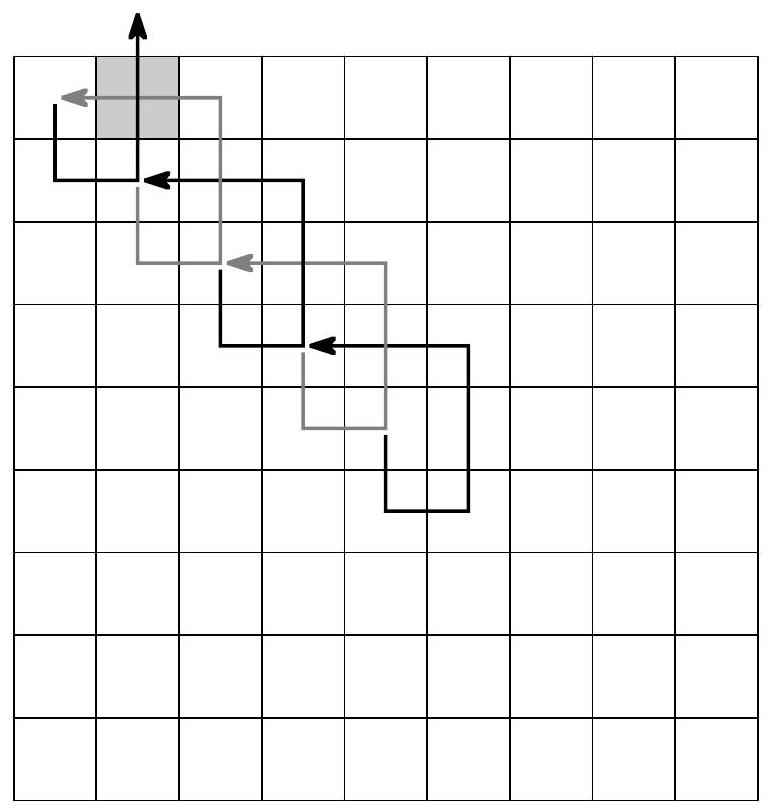
Before Josefína slid off the square grid, she was on the gray-marked square. In total, she crawled over twenty squares of... | 20 | Logic and Puzzles | math-word-problem | Yes | Yes | olympiads | false |
4. A vessel is divided by a partition into 2 unequal parts. In one part of the vessel, there is $1 / 3$ mole of a monatomic ideal gas with a temperature of $T_{1}=300 \mathrm{~K}$. In the other part, there is $1 / 5$ mole of another monatomic ideal gas with a temperature of $T_{2}=500$ K. The walls of the vessel and th... | 4. Since p-const, then $\frac{v_{1} T_{1}}{V_{1}}=\frac{v_{2} T_{2}}{V_{2}} ; \quad \frac{V_{2}}{V_{1}}=\frac{v_{2} T_{2}}{v_{1} T_{1}}$
$3 C E: v_{1} C_{\mathrm{V}} T_{1}+v_{2} C_{V} T_{2}=\left(v_{1}+v_{2}\right) C_{v} T \Rightarrow$ $\Rightarrow T=\frac{v_{1} T_{1}+v_{2} T_{2}}{v_{1}+v_{2}}=\frac{\frac{1}{3} \cdot ... | T=375K,\frac{P'}{P}=1 | Other | math-word-problem | Yes | Yes | olympiads | false |
Let's prove that in a triangle with sides $a, b, c$ inscribed in a unit circle,
$$
a^{2}+b^{2}+c^{2} \begin{cases}>8, & \text { if the triangle is acute, } \\ =8, & \text { if the triangle is right, } \\ <8, & \text { if the triangle is obtuse. }\end{cases}
$$ | I. solution. Let's denote the sides and angles of the triangle in the usual way, and the radius of the circumscribed circle by $r$. We know that the sides can be expressed using the radius as follows:
$$
a=2 r \sin \alpha, \quad b=2 r \cdot \sin \beta, \quad c=2 r \sin \gamma
$$
From this,
$$
a^{2}+b^{2}+c^{2}=4\lef... | proof | Geometry | proof | Yes | Yes | olympiads | false |
Subsets and Splits
No community queries yet
The top public SQL queries from the community will appear here once available.