
instruction_seed stringlengths 2 10.7k | solution stringlengths 0 10.8k ⌀ | answer stringlengths 0 575 ⌀ | problem_type stringclasses 9
values | question_type stringclasses 5
values | problem_is_valid stringclasses 5
values | solution_is_valid stringclasses 4
values | source stringclasses 11
values | synthetic bool 2
classes |
|---|---|---|---|---|---|---|---|---|
95. Can a number of the form $n^{2}+9 n+12$, where $n \in \boldsymbol{N}$, be divisible by 121? | Solution. Let's write the equality $n^{2}+9 n+12=(n-1) \times$ $\times(n+10)+22$. If $n-1$ is not divisible by 11, then $n+10(n+10=$ $=n-1+11$ ) is also not divisible by 11. In this case, the right-hand side of the obtained equality is not divisible by 11, and even more so not by 121. If, however, $n-1$ is divisible by... | proof | Number Theory | math-word-problem | Yes | Yes | olympiads | false |
What is the average of all the integer values of $N$ such that $\frac{N}{42}$ is strictly between $\frac{2}{5}$ and $\frac{1}{3}$? | First, convert $\frac{2}{5}$ and $\frac{1}{3}$ into fractions with a denominator of 42:
$$ \frac{2}{5} = \frac{2 \times 42}{5 \times 42} = \frac{16.8}{42}, $$
$$ \frac{1}{3} = \frac{1 \times 42}{3 \times 42} = \frac{14}{42}. $$
Since we are dealing with integers, we consider the nearest integers strictly inside these b... | 15 | Number Theory | math-word-problem | Yes | Yes | synthetic_math | true |
A high school senior is preparing to take the college entrance exams for independent admissions. He needs to choose 3 out of 6 colleges to apply to. However, since two of the colleges have their exams scheduled at the same time, he cannot apply to both of these colleges simultaneously. The number of different ways this... | To solve this problem, we can consider two scenarios:
1. The student does not choose any of the two colleges with the scheduling conflict. In this case, the student has to choose 3 colleges out of the remaining 4. The number of ways to do this is given by the combination formula $\binom{4}{3} = 4$.
2. The student cho... | C: 16 | Combinatorics | MCQ | Yes | Yes | cn_k12 | false |
The domain of the function $f(x)= \sqrt {2-2^{x}}+\ln x$ is __________. | To determine the domain of the function $f(x)= \sqrt {2-2^{x}}+\ln x$,
we need $2-2^{x} \geqslant 0$ and $x > 0$.
Solving these, we find $x \leqslant 1$ and $x > 0$.
Therefore, the domain of the function is $(0,1]$.
Hence, the answer is: $\boxed{(0,1]}$.
The function $f(x)= \sqrt {2-2^{x}}+\ln x$ is meaningful ... | (0,1] | Algebra | math-word-problem | Yes | Yes | cn_k12 | false |
Factorize: $(2a+1)a-4a-2=\_\_\_\_\_\_.$ | First, we rewrite the expression:
$$(2a+1)a-4a-2$$
We can observe that $(2a+1)$ is a common factor of the first two terms, and $-2$ is a common factor of the last two terms. We can rewrite the expression as:
$$(2a+1)a-2(2a+1)$$
Now, we can factor out $(2a+1)$ from the expression:
$$(2a+1)(a-2)$$
So the answer is: $\box... | (2a+1)(a-2) | Algebra | math-word-problem | Yes | Yes | cn_k12 | false |
What is the measure, in degrees, of the acute angle formed by the minute hand and the hour hand on a standard clock when it indicates 4:50? | 1. Calculate the position of the hour hand:
- At 4:00, the hour hand is at 120 degrees (as each hour represents $360/12=30^\circ$, and $4 \times 30^\circ = 120^\circ$).
- By 4:50, the hour hand has moved further. It moves $0.5^\circ$ per minute (since $30^\circ$ per hour and there are 60 minutes in an hour). Ther... | 155^\circ | Geometry | math-word-problem | Yes | Incomplete | synthetic_math | true |
Given that the asymptote equations of a hyperbola are $y = \pm \frac{1}{2}x$, determine the eccentricity of this hyperbola. | This problem tests our understanding of the basic geometric properties of a hyperbola and its asymptote equations. We will discuss and solve the problem by considering focus on both the $x$-axis and $y$-axis.
1. **Focus on the $x$-axis:**
If the focus is on the $x$-axis, then $\frac{b}{a} = \frac{1}{2}$. Therefore, $... | \frac{\sqrt{5}}{2} \text{ or } \sqrt{5} | Geometry | math-word-problem | Yes | Yes | cn_k12 | false |
4. Find all prime numbers for which 3 is a quadratic non-residue and 2 is a quadratic residue (i.e., all prime numbers for which 3 is the smallest positive quadratic non-residue).
将上面的文本翻译成英文,请保留源文本的换行和格式,直接输出翻译结果。 | 4. $p \equiv \pm 7(\bmod 24)$. | p \equiv \pm 7(\bmod 24) | Logic and Puzzles | math-word-problem | Yes | Yes | number_theory | false |
Provide two proofs of Vandermonde's identity:
$$
\sum_{k=0}^{d}\binom{n}{k}\binom{m}{d-k}=\binom{n+m}{d}
$$ | The first proof is combinatorial: We count the number of ways to choose $d$ people from a group of $n$ people and a group of $m$ people. This is equivalent to choosing an integer $k$, then selecting a group of $k$ people from the first $n$, and then choosing $d-k$ people from the other $m$.
We can also show this in a ... | proof | Combinatorics | proof | Yes | Yes | olympiads | false |
In a basketball shooting contest, Reggie and his brother each get to take 10 shots. Layups are worth 1 point, free throws are worth 2 points, and anything further away is worth 3 points. Reggie makes 3 layups, two free throws, and one long shot. His brother only shoots long shots and makes some of them. Reggie loses by... | Let's calculate the total points Reggie scored first:
Reggie made 3 layups, each worth 1 point, so that's 3 * 1 = 3 points.
He made 2 free throws, each worth 2 points, so that's 2 * 2 = 4 points.
He made 1 long shot, worth 3 points, so that's 1 * 3 = 3 points.
Adding these up, Reggie's total points are 3 + 4 + 3 = 10... | 4 | Algebra | math-word-problem | Yes | Yes | orca_math | true |
A small poultry farm has 300 chickens, 200 turkeys and x guinea fowls. A strange, incurable disease hit the farm and every day the farmer lost 20 chickens, 8 turkeys and 5 guinea fowls. After a week, There will be 349 birds left in the poultry. What is the value of unknown variable x? | To determine the value of \( x \), the number of guinea fowls on the poultry farm, we need to follow these steps:
1. **Calculate the total number of birds initially on the farm:**
\[
\text{Initial total birds} = 300 \text{ (chickens)} + 200 \text{ (turkeys)} + x \text{ (guinea fowls)}
\]
2. **Determine the d... | 115 | Algebra | math-word-problem | Yes | Yes | metamath | true |
Let $x,$ $y,$ $z$ be real numbers such that
\[
x + y + z = 6,
\]
\[
x^2 + y^2 + z^2 = 14.
\]
Let $m$ and $M$ be the smallest and largest possible values of $x,$ respectively. Find $m + M.$ | Given the equations, substitute and use Cauchy-Schwarz:
\[
y + z = 6 - x \quad \text{and} \quad y^2 + z^2 = 14 - x^2.
\]
Apply Cauchy-Schwarz:
\[
(1 + 1)(y^2 + z^2) \geq (y + z)^2 \implies 2(14 - x^2) \geq (6 - x)^2.
\]
Simplify and solve the inequality:
\[
28 - 2x^2 \geq 36 - 12x + x^2 \implies 3x^2 - 12x + 8 \leq 0... | \frac{10}{3} | Algebra | math-word-problem | Yes | Yes | synthetic_math | true |
Given point $A(5,0)$, if the distance from a point $P(m,n)$ on the parabola $y^{2}=4x$ to the line $x=-1$ is equal to the distance from point $A$, then $m=$ _____ . | A line passing through a point $P$ on the parabola $y^{2}=4x$ is perpendicular to the line $x=-1$ and intersects at point $B$.
According to the problem, $|PB|=|PA|$, therefore the x-coordinate of $P$ is $3$.
Hence, the answer is $\boxed{3}$.
This problem tests the understanding of the equation and properties of a pa... | 3 | Geometry | math-word-problem | Yes | Yes | cn_k12 | false |
An error of some percentage in excess is made while measuring the side of a square. The percentage of error in the calculated area of the square is 5.0625%. What is the percentage of error made while measuring the side of the square? | Let's denote the actual side length of the square as \( S \) and the measured side length as \( S' \). The error percentage in measuring the side is what we want to find.
The actual area of the square is \( A = S^2 \), and the calculated (erroneous) area is \( A' = S'^2 \).
Given that the error in the area is 5.0625%... | 2.5\% | Algebra | math-word-problem | Yes | Yes | orca_math | true |
A square $EFGH$ is inscribed in the region bounded by the parabola $y = x^2 - 10x + 21$ and the $x$-axis. Find the area of square $EFGH$. | 1. **Determine the axis of symmetry of the parabola:**
The vertex form of a parabola $y = ax^2 + bx + c$ is $y = a(x - h)^2 + k$ where $h = -\frac{b}{2a}$. For the parabola $y = x^2 - 10x + 21$, the axis of symmetry is $x = \frac{10}{2} = 5$.
2. **Set up coordinates for the vertices of the square:**
Let $s$ be t... | 24 - 8 \sqrt{5} | Geometry | math-word-problem | Yes | Yes | synthetic_math | true |
In triangle $XYZ$, you know that $\angle X = 90^\circ$, the hypotenuse $YZ = 15$, and $\tan Z = 3\sin Z$. What is the length of side $XZ$? | Given:
- $\angle X = 90^\circ$, implying $XYZ$ is a right triangle.
- Hypotenuse $YZ = 15$.
- Relationship $\tan Z = 3\sin Z$.
Using the relationship involving tangent and sine functions:
- $\tan Z = \frac{XY}{XZ}$
- $\sin Z = \frac{XY}{YZ} = \frac{XY}{15}$
From the equation $\tan Z = 3\sin Z$, we substitute:
\[ \fra... | 5 | Geometry | math-word-problem | Yes | Yes | synthetic_math | true |
A, B, and C enter into a partnership. A invests some money at the beginning, B invests double the amount after 6 months, and C invests thrice the amount after 8 months. The annual gain is a certain amount. A's share is Rs. 6000. What is the total annual gain of the partnership? | Let's assume that A invests Rs. x at the beginning.
According to the given information:
- B invests double the amount of A after 6 months, which means B invests 2x after 6 months.
- C invests thrice the amount of A after 8 months, which means C invests 3x after 8 months.
Since the profits are divided based on the am... | 18000 | Algebra | math-word-problem | Yes | Yes | orca_math | true |
A football field has an area of 10800 square yards. On this field, two types of fertilizer are spread evenly. Fertilizer A has an application rate of 150 pounds per 3000 square yards, and Fertilizer B has an application rate of 180 pounds per 4000 square yards.
Calculate the total weight of both fertilizers applied to... | First, let's calculate the amount of Fertilizer A needed for 3600 square yards.
The application rate for Fertilizer A is 150 pounds per 3000 square yards. To find out how much is needed for 3600 square yards, we can set up a proportion:
150 pounds / 3000 square yards = X pounds / 3600 square yards
Cross-multiply to ... | 342 | Algebra | math-word-problem | Yes | Yes | orca_math | true |
The edge of a cube is 6 cm. What is the surface area of the cube? | The surface area of a cube is calculated by the formula:
Surface Area = 6 * (edge length)^2
Given that the edge length of the cube is 6 cm, we can substitute this value into the formula:
Surface Area = 6 * (6 cm)^2
Surface Area = 6 * 36 cm^2
Surface Area = 216 cm^2
Therefore, the surface area of the cube is $\boxed... | 216 | Geometry | math-word-problem | Yes | Yes | orca_math | true |
Given positive real numbers $x,y$ satisfying $4x+y+12=xy$, the minimum value of $xy$ is __( ).
A: $4$
B: $18$
C: $24$
D: $36$ | **Analysis**
This problem mainly tests the ability to solve minimum value problems using basic inequalities, as well as the idea of substitution and the solution of simple quadratic inequalities, which is a basic question.
**Solution**
Given the condition and using the basic inequality, we have $xy=4x+y+12\geqslant ... | D | Algebra | MCQ | Yes | Yes | cn_k12 | false |
Determine the largest of the following quantities (write $A$, $B$, or $C$):
\[ A.\ \ \frac{3003}{3002} + \frac{3003}{3004} \quad B.\ \ \frac{2}{1} + \frac{4}{2} + \frac{3005}{3004} \quad C.\ \ \frac{3004}{3003} + \frac{3004}{3005} \] | Firstly, let's analyze each quantity:
- **A and C** still follow the form $\frac{n}{n-1} + \frac{n}{n+1}$, where specifically:
- For $A$, $n = 3003$, we compute:
\[ A = \frac{3003}{3002} + \frac{3003}{3004} = \frac{3003 \cdot 3004 + 3003 \cdot 3002}{3002 \cdot 3004} = \frac{3003 \cdot (3004 + 3002)}{3002 \cdot 30... | B | Algebra | math-word-problem | Yes | Yes | synthetic_math | true |
Given a sequence $\{a_n\}$ with the sum of the first $n$ terms denoted as $S_n$, and $S_n= \frac {1}{2}n^{2}+ \frac {9}{2}n, (n\in\mathbb{N}^*)$
$(1)$ Find the general formula for the sequence $\{a_n\}$;
$(2)$ Let $c_n= \frac {1}{(2a_n-9)(2a_n-7)}$, and the sum of the first $n$ terms of the sequence $\{c_n\}$ be $T_... | Solution:
$(1)$ Since $S_n= \frac {1}{2}n^{2}+ \frac {9}{2}n, (n\in\mathbb{N}^*)$,
we have $a_n=S_n-S_{n-1}=n+4 (n\geqslant 2)$,
and since $a_1=S_1=5$ satisfies the above equation,
we have $a_n=n+4, n\in\mathbb{N}^*$;
$(2)$ From $(1)$, we know $c_n= \frac {1}{(2n-1)(2n+1)}= \frac {1}{2}( \frac {1}{2n-1}- \fra... | k_{max}=672 | Algebra | math-word-problem | Yes | Yes | cn_k12 | false |
I added 36 to a number and it resulted in 71. Find the result of adding 10 to the number. | Let's call the number you're referring to as "x". According to the information given:
x + 36 = 71
To find the value of x, we subtract 36 from both sides of the equation:
x + 36 - 36 = 71 - 36
x = 35
Now, to find the result of adding 10 to the number (x), we simply add 10 to 35:
35 + 10 = 45
So, the result of addi... | 45 | Algebra | math-word-problem | Yes | Yes | orca_math | true |
Every day Ryan spends some hours on learning Chinese and some more hours on learning English. He spends 7 hours on learning English, which is 2 hours more than he spends on learning Chinese. How many hours does he spend on learning Chinese? |
If Ryan spends 7 hours on learning English, which is 2 hours more than he spends on learning Chinese, then he spends 7 - 2 = $\boxed{5}$ hours on learning Chinese. | 5 | Algebra | math-word-problem | Yes | Yes | orca_math | true |

Given a line $l$ in space and a point $A$ not lying on it. For each line $l'$ passing through $A$, we construct the common perpendicular $XY$ ($Y$ lies on $l'$) to the lines $l$ and $l'$. Fi... | Let the plane passing through $A$ and perpendicular to $l$ intersect $l$ at point $B$, and let $C$ be the projection of $Y$ onto this plane. Since $B C \| X Y$, then $B C \perp A Y$ and by the theorem of three perpendiculars, $B C \perp A C$. Therefore, $C$ lies on the circle with diameter $A B$, and $Y$ lies on the cy... | proof | Geometry | math-word-problem | Incomplete | Yes | olympiads | false |
Which of the following expressions have a positive value?
A: $\tan 188^{\circ}\cos 158^{\circ}$
B: $\sin 305^{\circ}\cos 460^{\circ}$
C: $\cos 378^{\circ}\sin 1100^{\circ}$
D: $\tan 400^{\circ}\tan 470^{\circ}$ | Let's analyze the given options step by step:
**Option A: $\tan 188^{\circ}\cos 158^{\circ}$**
- We can simplify this as $\tan 188^{\circ} = \tan (180^{\circ} + 8^{\circ}) = \tan 8^{\circ}$.
- And $\cos 158^{\circ} = \cos (180^{\circ} - 22^{\circ}) = -\cos 22^{\circ}$.
- Therefore, $\tan 188^{\circ}\cos 158^{\circ} =... | \text{B and C} | Algebra | MCQ | Yes | Yes | cn_k12 | false |
In a difficult physics course, the final grades received by the students are distributed as follows: 3/10 of the grades are A's, 3/10 are B's, 2/10 are C's, 1/10 are D's, the remaining 12 grades are E's, and 5 grades are F's. What is the total number of students in the course? | Let's denote the total number of students in the course as T.
According to the information given, the distribution of grades is as follows:
- A's: 3/10 of T
- B's: 3/10 of T
- C's: 2/10 of T
- D's: 1/10 of T
- E's: 12
- F's: 5
We can express the total number of students (T) as the sum of all these parts:
T = (3/10)... | 170 | Algebra | math-word-problem | Yes | Yes | orca_math | true |
Given the distribution table of the random variable $\xi$ as shown in the table below, when $\frac{1}{x}+\frac{4}{y}$ reaches its minimum value, $x=\_\_\_\_\_\_$, $E\left(\xi \right)=\_\_\_\_\_\_$.
| $\xi$ | 1 | 2 | 3 |
|-------|-----|-----|-----|
| $P$ | $x$ | $\frac{1}{2}$ | $y$ | | To solve the problem step-by-step, we start with the given distribution table of the random variable $\xi$ and the conditions provided in the problem.
**Step 1**: Recognize the total probability condition.
Given the distribution table:
- For $\xi = 1$, the probability is $x$.
- For $\xi = 2$, the probability is $\fra... | \frac{13}{6} | Algebra | math-word-problem | Yes | Yes | cn_k12 | false |
Prove that for each $n \geq 2$, there is a set $S$ of $n$ integers such that $(a-b)^{2}$ divides $a b$ for every distinct $a, b \in S$. | This is a direct corollary of the more difficult USA TST $2015 / 2$, reproduced below.
Prove that for every positive integer $n$, there exists a set $S$ of $n$ positive integers such that for any two distinct $a, b \in S, a-b$ divides $a$ and $b$ but none of the other elements of $S$. | proof | Number Theory | proof | Yes | Incomplete | olympiads | false |
A quadrilateral with consecutive side lengths $50, 80, 140, and 120$ is inscribed in a circle and has a circle inscribed within it. The point of tangency of the inscribed circle with the side of length 140 divides this side into segments of length $x$ and $y$. Determine $|x-y|$. | Let the vertices of this quadrilateral be $A$, $B$, $C$, and $D$ such that $AB=50$, $BC=80$, $CD=140$, and $DA=120$. Let $O$ be the center of the incircle. Draw radii from $O$ to the points of tangency $X$, $Y$, $Z$, and $W$ on $AB$, $BC$, $CD$, and $DA$, respectively. The quadrilateral being cyclic and the symmetrical... | 19 | Geometry | math-word-problem | Yes | Yes | synthetic_math | true |
6. A wire 104 centimeters long was bent into a rectangular frame. The length and width of this frame are whole numbers of centimeters. In how many ways can the frame be obtained? | 6. First, let's determine what the sum of the length and width is, that is, we will calculate the semi-perimeter. For this, we divide 104 by 2 and get 52. Let's represent the number 52 as the sum of two addends:
$$
52=1+51=2+50=3+49=\ldots=25+27=26+26 \text {. }
$$
We get 26 ways.
Answer: 26 ways. | 26 | Number Theory | math-word-problem | Yes | Yes | olympiads | false |
Each week, Harry is paid x dollars per hour for the first 30 hours and 2x dollars for each additional hour worked that week. Each week, James is paid x dollars per hour for the first 40 hours and 1.5x dollars for each additional hour worked that week. Last week James worked a total of some hours. If Harry and James wer... | Let's denote the number of hours James worked last week as J hours. We know that James worked 40 hours at a rate of x dollars per hour and the remaining (J - 40) hours at a rate of 1.5x dollars per hour.
James's total pay for the week is:
\( 40x + 1.5x(J - 40) \)
Now, let's denote the number of hours Harry worked las... | 5 | Algebra | math-word-problem | Yes | Yes | orca_math | true |
[ Tournaments and tournament tables ] Counting in two ways
[ Examples and counterexamples. Constructions ]
In the competition, 10 figure skaters participate. The competition is judged by three judges in the following way: each judge independently distributes places (from first to tenth) among the skaters, after which ... | Evaluation. Since each of the three judges distributed a set of places from first to tenth, the sum of the places awarded by all judges to all participants in the competition is $3 \cdot (1 + 2 + \ldots + 10) = 165$.
On the other hand, if the winner received a sum of no less than 16, then all the others received a sum... | 15 | Combinatorics | math-word-problem | Yes | Yes | olympiads | false |
Debra is the host of a country music radio show, and she broadcasts interviews with celebrity country music singers. Each week, she interviews three singers, one at a time. The first interview segment is always twice as long as the other two segments combined, and the third interview segment is always half as long as t... | Let's denote the length of the first interview segment as \( F \), the second as \( S \), and the third as \( T \).
According to the information given:
1. \( F = 2 \times (S + T) \)
2. \( T = \frac{1}{2} \times S \)
3. \( T = 10 \) minutes
From the second condition, we can find the length of the second segment:
\( ... | 90 | Algebra | math-word-problem | Yes | Yes | orca_math | true |
Determine all real numbers $a$ for which the system of equations
\begin{align*}
3x^2+2y^2+2z^2&=a\\
4x^2+4y^2+5z^2&=1-a
\end{align*}
has at least one solution $(x,y,z)$ in the real numbers. | 1. **Substitute variables**:
We start by substituting \( u = x^2 \), \( v = y^2 \), and \( w = z^2 \). This transforms the system of equations into:
\[
3u + 2v + 2w = a
\]
\[
4u + 4v + 5w = 1 - a
\]
2. **Combine equations**:
To eliminate \( a \), we add the two equations:
\[
(3u + 2v + 2w... | \left[ \frac{2}{7}, \frac{3}{7} \right] | Inequalities | math-word-problem | Yes | Yes | aops_forum | false |
If $\overrightarrow{AB}⋅\overrightarrow{AC}={\overrightarrow{AB}^2}=4$, and $|{\overrightarrow{AP}}|=1$, then $|{\overrightarrow{AB}}|=$______, the maximum value of $\overrightarrow{CP}⋅\overrightarrow{AB}$ is ______. | Given that $\overrightarrow{AB} \cdot \overrightarrow{AC} = {\overrightarrow{AB}}^2 = 4$, we can deduce the magnitude of vector $\overrightarrow{AB}$ as follows:
\[|\overrightarrow{AB}|^2 = 4\]
Taking the square root on both sides, we get:
\[|\overrightarrow{AB}| = \sqrt{4} = 2\]
Thus, $|\overrightarrow{AB}| = 2$.
Nex... | -2 | Algebra | math-word-problem | Yes | Yes | cn_k12 | false |
The base of a triangular field is three times its altitude. The cost of cultivating the field at Rs. 24.68 per hectare is a certain amount. The base and height of the field are 300. What is the total cost of cultivating the field? | To find the total cost of cultivating the field, we first need to calculate the area of the triangular field and then multiply it by the cost per hectare.
Given that the base of the triangular field is three times its altitude, and both the base and height are given as 300, we can assume that the altitude (height) of ... | 333.18 | Geometry | math-word-problem | Incomplete | Yes | orca_math | true |
34. Let $a_{1}, a_{2}, \cdots, a_{n}>0$, and $\sum_{i=1}^{n} a_{i}^{3}=3, \sum_{i=1}^{n} a_{i}^{5}=5$, prove: $\sum_{i=1}^{n} a_{i}>\frac{3}{2}$. (2001 Baltic Way Competition Problem) | 34. By Hölder's inequality, we have
$$\begin{array}{c}
\sum_{i=1}^{n} a_{i}^{3}=\sum_{i=1}^{n}\left(a_{i} \cdot a_{i}^{2}\right) \leqslant\left(\sum_{i=1}^{n} a_{i}^{\frac{5}{3}}\right)^{\frac{3}{5}}\left(\sum_{i=1}^{n}\left(a_{i}^{2}\right)^{\frac{5}{2}}\right)^{\frac{2}{5}}= \\
\left(\sum_{i=1}^{n} a_{i}^{\frac{5}{3}... | \sum_{i=1}^{n} a_{i} > \frac{3}{2} | Inequalities | proof | Yes | Yes | inequalities | false |
1. find all natural numbers $a, b$ and $n$ so that the following equation holds:
$$
a!+b!=2^{n}
$$
## Solution: | The equation is symmetrical in $a$ and $b$, therefore we can assume oBdA $a \leq b$. If $a \geq 3$, then the LS of the equation is divisible by 3, but the RS is not, contradiction. If $a=1$, then $1+b!=2^{n}$ follows. For $b \geq 2$, the LS is odd and greater than 1, contradiction. Consequently, $b=1$ and therefore $n=... | (1,1,1),(2,2,2),(2,3,3),(3,2,3) | Number Theory | math-word-problem | Yes | Yes | olympiads | false |
2. Simplify the radical expression $\frac{\sqrt{11}+5 \sqrt{7}+4 \sqrt{6}}{7+\sqrt{ } 77+\sqrt{66}+\sqrt{42}}$ | 2. $\sqrt{11}-\sqrt{6}$, | \sqrt{11}-\sqrt{6} | Algebra | math-word-problem | Incomplete | Yes | cn_contest | false |
A certain telescope increases the visual range at a particular location from some distance to 150 kilometers. The visual range is increased by 200% by using the telescope. What was the initial visual range without the telescope? | If the visual range is increased by 200% using the telescope, it means the visual range is tripled because 100% represents the original amount, and an increase of 200% would mean the original amount is doubled and then added to the original amount (100% + 200% = 300%).
Let the initial visual range without the telescop... | 50 | Algebra | math-word-problem | Yes | Yes | orca_math | true |
Problem 32. Let $a, b, c, k$ be positive real numbers and $k \geq \frac{3}{2}$. Prove that
$$\frac{a^{k}}{a+b}+\frac{b^{k}}{b+c}+\frac{c^{k}}{c+a} \geq \frac{1}{2}\left(a^{k-1}+b^{k-1}+c^{k-1}\right)$$
(Vasile Cirtoaje and Pham Kim Hung)
Solution. I have two solutions to this problem. | First Solution. (Cauchy reverse) Rewrite the inequality in the form
$$\sum_{c y c}\left(a^{k-1}-\frac{a^{k}}{a+b}\right) \leq \frac{1}{2}\left(\sum_{c y c} a^{k-1}\right) \Leftrightarrow \sum_{c y c} \frac{a^{k-1} b}{a+b} \leq \frac{1}{2}\left(\sum_{c y c} a^{k-1}\right)$$
Notice that
$$\sum_{c y c} \frac{a^{k-1} b}{a... | proof | Inequalities | proof | Yes | Yes | inequalities | false |
Solve the system of equations $\left\{{\begin{array}{l}{2x-3y=1}\\{\frac{{2+x}}{3}=\frac{{y+1}}{4}}\end{array}}\right.$. | To solve the system of equations $\left\{{\begin{array}{l}{2x-3y=1}\\{\frac{{2+x}}{3}=\frac{{y+1}}{4}}\end{array}}\right.$, we first need to manipulate the equations to a more manageable form.
1. Start with the given system of equations:
\[
\left\{
\begin{array}{l}
2x-3y=1 \quad (1) \\
\frac{2+x}{3}=\fr... | null | Algebra | math-word-problem | Yes | Yes | cn_k12 | false |
Solve the equation $\lg(2^x + 2x - 16) = x(1 - \lg 5)$. | Given $\lg(2^x + 2x - 16) = x(1 - \lg 5)$, we can simplify this as follows:
Since $1 - \lg 5 = \lg 2$, we have:
$\lg(2^x + 2x - 16) = x\lg 2 = \lg 2^x$.
Therefore, the original equation can be transformed into: $2^x + 2x - 16 = 2^x$.
This simplifies to $2x = 16$.
Thus, we find $x = 8$.
So, the solution to the equ... | x = 8 | Algebra | math-word-problem | Yes | Yes | cn_k12 | false |
A special school for deaf and blind students has a certain number of deaf students and blind students. The number of deaf students is 180, and there are 240 students altogether. What is the ratio of the number of deaf students to the number of blind students? | To find the ratio of the number of deaf students to the number of blind students, we first need to determine the number of blind students.
We know there are 240 students in total and 180 of them are deaf. So, the number of blind students can be found by subtracting the number of deaf students from the total number of ... | 3:1 | Algebra | math-word-problem | Yes | Yes | orca_math | true |
How many plants will be there in a circular bed whose outer edge measures some length, allowing 4 cm² for each plant, if there are 19.118487538913932 plants in total? | To find the number of plants in a circular bed, we need to know the area of the bed and then divide that by the area allocated for each plant. However, since you've already provided the total number of plants as 19.118487538913932, we can work backwards to find the area of the bed.
First, let's round the number of pla... | 30.91 | Geometry | math-word-problem | Incomplete | Yes | orca_math | true |
Gálnierin $\Gamma$.
Each face of a rectangular parallelepiped $3 \times 4 \times 5$ is divided into unit squares. Is it possible to inscribe a number in each square such that the sum of the numbers in each checkerboard ring of width 1, encircling the parallelepiped, equals 120? | For example, fill in 9 in all the squares of the faces $4 \times 5$, 8 in all the squares of the faces $3 \times 5$, and 5 in all the squares of the faces $3 \times 4$:
$2(4 \cdot 9+3 \cdot 8)=2(5 \cdot 9+3 \cdot 5)=2(5 \cdot 9+4 \cdot 5)=120$.
## Answer
It is possible. | 120 | Combinatorics | math-word-problem | Yes | Yes | olympiads | false |
Given sets A={x|y= $\frac {1}{ \sqrt {1-2^{x}}}$} and B={x|y=log2x-1}, find A∪B=( )
A: (0,+∞)
B: (-∞,0)∪(2,+∞)
C: (-∞,0)∪(0,+∞)
D: R | Solution: A={x|x0};
Hence, A∪B=($-\infty$, 0) $\cup$ (0, $+\infty$).
So, the answer is: $\boxed{\text{C}}$.
We can solve for sets A and B, and then perform the union operation.
This problem tests knowledge of descriptive methods, interval definitions, the domain of logarithmic functions, and union operations. | \text{C} | Algebra | MCQ | Yes | Incomplete | cn_k12 | false |
Problem 5.8. There are 7 completely identical cubes, on which 3 points are marked on one face, 2 points on two faces, and 1 point on the rest. These cubes were glued together to form a figure in the shape of the letter "P", as shown in the image, with the number of points on any two touching faces being the same.
.
A: $3$
B: $18$
C: $54$
D: $152$ | Given that $\{a_{n}\}$ is a geometric sequence and $a_{n+1}=2S_{n}+2$, we can start by finding the first few terms of the sequence and their relationships.
1. For $n=1$, we have $a_{2}=2S_{1}+2$. Since $S_{1}=a_{1}$, this gives us:
\[a_{2}=2a_{1}+2\]
2. For $n=2$, we have $a_{3}=2S_{2}+2$. Since $S_{2}=a_{1}+a_{2}... | 54 | Algebra | MCQ | Yes | Yes | cn_k12 | false |
4. If the sum of 12 distinct positive integers is 2016, then the maximum value of the greatest common divisor of these positive integers is $\qquad$ . | 4. 24 .
Let the greatest common divisor be $d$, and the 12 numbers be $a_{1} d$, $a_{2} d, \cdots, a_{12} d\left(\left(a_{1}, a_{2}, \cdots, a_{12}\right)=1\right)$.
Let $S=\sum_{i=1}^{12} a_{i}$. Then, $2016=S d$.
To maximize $d$, $S$ should be minimized.
Since $a_{1}, a_{2}, \cdots, a_{12}$ are distinct, then
$$
S \... | 24 | Number Theory | math-word-problem | Yes | Yes | olympiads | false |
Example 4 Let $a$ be a real number greater than zero. It is known that there exists a unique real number $k$, such that the quadratic equation in $x$
$$
x^{2}+\left(k^{2}+a k\right) x+1999+k^{2}+a k=0
$$
has two roots that are both prime numbers. Find the value of $a$.
(1999, National Junior High School Mathematics Co... | Let the two prime roots of the equation be $p, q$. By the relationship between roots and coefficients, we have
$$
\begin{array}{l}
p+q=-k^{2}-a k, \\
p q=1999+k^{2}+a k . \\
\text { Adding (1) and (2) gives } p+q+p q=1999, \text { i.e., } \\
(p+1)(q+1)=2^{4} \times 5^{3} .
\end{array}
$$
From equation (3), it is clear... | 2 \sqrt{502} | Algebra | math-word-problem | Yes | Yes | cn_contest | false |
Determine the range of the function $f(x) = 2x + \sqrt{1 - x}$. | Let $\sqrt{1 - x} = t$ where $t \geq 0$. Then we have $x = 1 - t^2$.
Substituting into the original function, we get
\begin{align*}
y &= 2(1 - t^2) + t \\
&= -2t^2 + t + 2 \\
&= -2\left(t - \frac{1}{4}\right)^2 + \frac{17}{8}.
\end{align*}
The expression $-2\left(t - \frac{1}{4}\right)^2$ reaches its maximum value of ... | (-\infty, \frac{17}{8}] | Algebra | math-word-problem | Yes | Yes | cn_k12 | false |
$$
\begin{array}{c}
\text { 3. Given } x+y+z=3 a \quad(a \neq 0) \text {, then } \\
\frac{(x-a)(y-a)+(y-a)(z-a)+(z-a)(x-a)}{(x-a)^{2}+(y-a)^{2}+(z-a)^{2}}
\end{array}
$$
The value is $\qquad$ | 3. $-\frac{1}{2}$, | -\frac{1}{2} | Algebra | math-word-problem | Yes | Yes | cn_contest | false |
4. Consider a 20 -sided convex polygon $K$, with vertices $A_{1}, A_{2}, \ldots, A_{20}$ in that order. Find the number of ways in which three sides of $K$ can be chosen so that every pair among them has at least two sides of $K$ between them. (For example $\left(A_{1} A_{2}, A_{4} A_{5}, A_{11} A_{12}\right)$ is an a... |
Solution: First let us count all
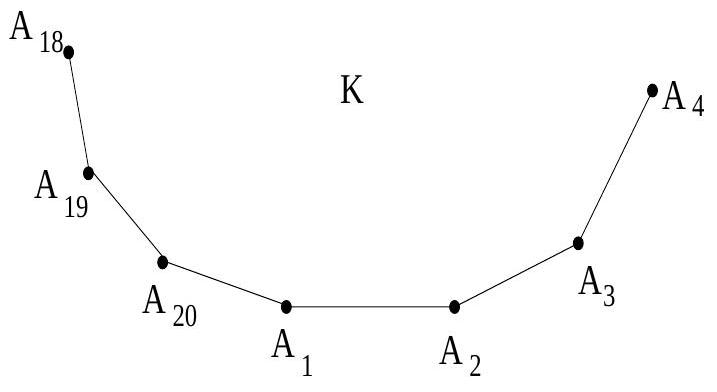
the admissible triples having $A_{1} A_{2}$ as one of the sides. Having chosen $A_{1} A_{2}$, we cannot choose $A_{2} A_{3}$, $A_{3} A_{4}, A_{20} A_{1}$ nor ... | 520 | Combinatorics | math-word-problem | Yes | Yes | olympiads | false |
Set J consists of some consecutive even numbers. If the smallest term in the set is -4, the range of the positive integers in set J is 12. How many consecutive even numbers are in set J? | The range of a set of numbers is the difference between the largest and smallest numbers in the set. Since we are given that the range of the positive integers in set J is 12, we can use this information to find the largest positive even number in the set.
Let's denote the largest positive even number in set J as x. S... | 10 | Number Theory | math-word-problem | Yes | Yes | orca_math | true |
Rebecca wants to split a collection of eggs into groups of 6. She has a certain number of eggs, 72 bananas, and 66 marbles. She will create 3 groups. How many eggs does Rebecca have? | The question states that Rebecca will create 3 groups of eggs, each group containing 6 eggs. To find out the total number of eggs, we need to multiply the number of groups by the number of eggs in each group.
3 groups * 6 eggs/group = 18 eggs
Therefore, Rebecca has $\boxed{18}$ eggs. | 18 | Number Theory | math-word-problem | Incomplete | Yes | orca_math | true |
206. Prove that in Lobachevsky's non-Euclidean geometry, the three perpendiculars erected at the midpoints of the sides of a triangle belong to one pencil (i.e., either all intersect at one point, or all are parallel to each other, or all three are perpendicular to one line; see p. 152). | 206. If the perpendiculars erected to the two sides of a triangle $ABC$ at their midpoints intersect at one point $O$, then the third perpendicular also passes through $O$; the proof of this fact does not differ from the usual one (compare with the proof that in non-Euclidean Lobachevsky geometry, the three bisectors o... | proof | Geometry | proof | Yes | Yes | olympiads | false |
Example 10 When $a, b$ take what real numbers, the equation
$$
x^{2}+2(1+a) x+\left(3 a^{2}+4 a b+4 b^{2}+2\right)=0
$$
has real roots?
(1987, National Junior High School Mathematics League) | Solution: When $\Delta \geqslant 0$, the equation has real roots
$$
\begin{array}{l}
\Leftrightarrow[2(1+a)]^{2}-4\left(3 a^{2}+4 a b+4 b^{2}+2\right) \geqslant 0 \\
\Leftrightarrow 2 a^{2}+4 a b+4 b^{2}-2 a+1 \leqslant 0 \\
\Leftrightarrow(a+2 b)^{2}+(a-1)^{2} \leqslant 0 . \\
\text { Also, }(a+2 b)^{2}+(a-1)^{2} \geq... | a=1, b=-\frac{1}{2} | Algebra | math-word-problem | Yes | Yes | cn_contest | false |
It is now 3:00:00 PM, as read on a 12-hour digital clock. In 314 hours, 21 minutes, and 56 seconds the time will be $A:B:C$. What is the value of $A + B + C$? | 1. **Determine the new time's hours component**: Compute `314 hours % 12 = 2 hours`, because 314 divided by 12 gives a remainder of 2.
2. **Calculate the final hour**: Since it starts at 3:00:00 PM, adding 2 hours results in 5:00:00 PM.
3. **Add minutes and seconds**: The minutes and seconds are straightforward additio... | 82 | Logic and Puzzles | math-word-problem | Yes | Yes | synthetic_math | true |
Given the universal set $U = \mathbb{R}$, let set $A = \{x | \log_{2}(3-x) \leq 2\}$, and set $B = \{x | x \geq 1\}$.
(1) Find sets $A$ and $B$.
(2) Find $(\complement_{U}A) \cap B$. | (1) From the given information, we have $\log_{2}(3-x) \leq \log_{2}4$,
thus solving this yields $-1 \leq x < 3$,
therefore, $A = \{x | -1 \leq x < 3\}$.
Given $x \geq 1$, we find $(x+2)(x-3) \leq 0$, and $x+2 \neq 0$,
solving this yields $-2 < x \leq 3$.
Therefore, $B = \{x | -2 < x \leq 3\}$.
(2) From (1)... | \{x | -2 < x < -1 \text{ or } x = 3\} | Algebra | math-word-problem | Yes | Yes | cn_k12 | false |
A point $M$ on the parabola $y=4x^{2}$ is at a distance of $1$ from the focus. The ordinate of point $M$ is __________. | According to the definition of a parabola, the distance from point $M$ to the focus is $1$, which means the distance from $M$ to the directrix is also $1$.
Since the equation of the directrix of the parabola is $y=-\frac{1}{16}$,
the ordinate of point $M$ is $1- \frac{1}{16}= \frac{15}{16}$.
Therefore, the answer... | \frac{15}{16} | Geometry | math-word-problem | Yes | Yes | cn_k12 | false |
Write out the positive integers consisting of only $1$s, $6$s, and $9$s in ascending order as in: $1,6,9,11,16,\dots$.
a. Find the order of $1996$ in the sequence.
b. Find the $1996$th term in the sequence. | ### Part (a)
1. **Identify the number of terms with different digit lengths:**
- For 1-digit numbers: There are \(3\) numbers (1, 6, 9).
- For 2-digit numbers: There are \(3^2 = 9\) numbers.
- For 3-digit numbers: There are \(3^3 = 27\) numbers.
- For 4-digit numbers: There are \(3^4 = 81\) numbers.
- Fo... | null | Combinatorics | math-word-problem | Yes | Yes | aops_forum | false |
$(\frac {1}{4})^{-2}+ \frac {1}{2}\log_{3}6-\log_{3} \sqrt {2}= \_\_\_\_\_\_$. | Solution: $(\frac {1}{4})^{-2}+ \frac {1}{2}\log_{3}6-\log_{3} \sqrt {2}= [(\frac {1}{2})^{2}]^{-2}+\log_{3} \frac { \sqrt {6}}{ \sqrt {2}}= 16+ \frac {1}{2}= \frac {33}{2}$,
Therefore, the answer is: $\boxed{\frac {33}{2}}$.
This solution is directly derived from the properties of logarithmic operations.
This qu... | \frac {33}{2} | Algebra | math-word-problem | Yes | Yes | cn_k12 | false |
Given points A(4, 1, 3) and B(2, -5, 1), point C lies on segment AB and $\overrightarrow {AB}$ = 3$\overrightarrow {AC}$. Determine the coordinates of point C. | Let the coordinates of point C be (x, y, z).
Given A(4, 1, 3) and B(2, -5, 1),
$\overrightarrow {AB}$ = (-2, -6, -2) and $\overrightarrow {AC}$ = (x - 4, y - 1, z - 3).
Since $\overrightarrow {AB}$ = 3$\overrightarrow {AC}$,
We have the system of equations:
$$\begin{cases} -2=3(x-4) \\ -6=3(y-1) \\ -2=3(z-3)\end{ca... | (\frac {10}{3}, -1, \frac {7}{3}) | Algebra | math-word-problem | Yes | Yes | cn_k12 | false |
We play a game of musical chairs with $n$ chairs numbered 1 to $n$. You hang $n$ slips of paper, numbered 1 to $n$, on the chairs such that the number on a slip does not match the number on the chair.
Each chair has a player sitting on it. When you clap, each player looks at the number on the slip on their current cha... | When $m=n$, you can hang the slip with number $i+1$ on chair $i$. Everyone then moves one chair over with each clap, and the first time someone is back in their own chair is after $n$ claps. And then everyone is back in their own chair. Now suppose that $m < n$ and that there are $k, \ell > 0$ such that
$$
a k+b \ell=... | proof | Combinatorics | proof | Yes | Yes | olympiads_ref | false |
Given a non-right triangle with side lengths a, b, and c, find its area using the cosine formula: area = (1/2)ab * sin(C), where C is the angle between sides a and b. The side lengths are 27 cm, 31 cm, and 15 cm. | To find the area of the triangle using the formula area = (1/2)ab * sin(C), we first need to find the angle C between sides a and b. We can use the Law of Cosines to find angle C. The Law of Cosines states that for any triangle with sides a, b, and c, and the angle C opposite side c:
c^2 = a^2 + b^2 - 2ab * cos(C)
We... | 204.5 | Geometry | math-word-problem | Yes | Yes | orca_math | true |
Determine all pairs of functions $f,g:\mathbb{R}\rightarrow\mathbb{R}$ such that for any $x,y\in \mathbb{R}$,
\[f(x)f(y)=g(x)g(y)+g(x)+g(y).\] | null | null | Algebra | math-word-problem | Yes | Yes | aops_forum | false |
Consider the hyperbola $C$: $\frac{x^{2}}{a^{2}} - \frac{y^{2}}{b^{2}} = 1 (a > 0, b > 0)$ with its right focus $F$ and left and right vertices $A\_1$ and $A\_2$, respectively. A circle with diameter $A\_1A\_2$ intersects one of the hyperbola's asymptotes at point $P$ (located in the first quadrant). If line $FP$ is pa... | 1. Let the right focus of the hyperbola $\frac{x^{2}}{a^{2}} - \frac{y^{2}}{b^{2}} = 1 (a > 0, b > 0)$ be $F(c, 0)$.
2. The equations of the asymptotes are $y = \pm\frac{b}{a}x$.
3. Find the intersection point $P$ of the circle $x^2 + y^2 = a^2$ and the line $y = \frac{b}{a}x$. The result is $P\left(\frac{a^2}{c}, \fra... | A | Geometry | MCQ | Yes | Yes | cn_k12 | false |
Find the cost of fencing around a circular field of some diameter at the rate of Rs. 2 a meter. The total cost of fencing is Rs. 201.06. What is the diameter of the field? | To find the diameter of the field, we first need to calculate the circumference of the field, which is the total length of the fence required to go around the field. We know the cost per meter of fencing is Rs. 2, and the total cost of fencing is Rs. 201.06.
Let's denote the circumference of the field as C.
The total... | 32 | Geometry | math-word-problem | Yes | Yes | orca_math | true |
【Example 3.15】If point $O$ is inside $\triangle A B C$, and $A O, B O, C O$ intersect $B C, C A, A B$ at $D, E, F$ (Figure 3.22), prove:
$$
\frac{O D}{A D}+\frac{O E}{B E}+\frac{O F}{C F}=1
$$ | Prove that $\frac{OD}{AD}=\frac{S_{\triangle ODC}}{S_{\triangle ADC}}=\frac{S_{\triangle ODB}}{S_{\triangle ADB}}$
$$
=\frac{S_{\triangle ODC}+S_{\triangle ODB}}{S_{\triangle ADC}+S_{\triangle ADB}}=\frac{S_{\triangle OBC}}{S_{\triangle ABC}}.
$$
Similarly, we can get
$$
\begin{array}{c}
\frac{OE}{BE}=\frac{S_{\triang... | 1 | Geometry | proof | Yes | Yes | olympiads | false |
Given a tetrahedron with an edge length of 2, where all faces are equilateral triangles, its surface area is ( )
A: 12
B: $$2 \sqrt {3}$$
C: $$4 \sqrt {3}$$
D: $$\frac {4}{3} \sqrt {3}$$ | Solution: Given the edge length is 2, and all faces are equilateral triangles,
the surface area is:
$S=4\times\left(\frac{1}{2}\times2\times2\times\sin60^\circ\right)=4\sqrt{3}$.
Therefore, the correct choice is $\boxed{C}$.
This problem is solved by utilizing the structural characteristics of a regular tetrahe... | C | Geometry | MCQ | Yes | Yes | cn_k12 | false |
A certain store sells badminton rackets and shuttlecocks. The badminton rackets are priced at $40$ yuan per pair, and the shuttlecocks are priced at $10$ yuan per barrel. During the "Double Eleven" promotion, the store decided to offer two discount options to customers.Option 1: Buy one pair of badminton rackets and ge... | ### Step-by-Step Solution
#### Part (1): Calculating the Payment for Each Option
- **Option 1 Calculation:**
The cost of 10 pairs of badminton rackets is $40 \times 10$. For $x$ barrels of shuttlecocks, since 10 of them are free, the customer pays for $(x - 10)$ barrels. Thus, the total cost is:
$$
40 \times 10 + 10... | 580 | Algebra | math-word-problem | Yes | Yes | cn_k12 | false |
Jesse's room is some feet long and 8 feet wide. She needs 96 feet of carpet to cover the whole floor. How long is Jesse's room? | To find the length of Jesse's room, we need to divide the total area of the carpet by the width of the room.
The total area of the carpet is 96 square feet, and the width of the room is 8 feet.
Length of the room = Total area of carpet / Width of the room
Length of the room = 96 feet / 8 feet
Length of the room = 12 ... | 12 | Geometry | math-word-problem | Yes | Yes | orca_math | true |
A number multiplied by 4 and then multiplied by 4 again is 32. Find out what number this is. | Let's call the number we are looking for "x".
According to the problem, we first multiply x by 4, and then we multiply the result by 4 again. The final result is 32.
So, we can write the equation as:
(4 * x) * 4 = 32
Now, we can simplify the equation by multiplying the 4s together:
4 * 4 * x = 32
16 * x = 32
Now... | 2 | Algebra | math-word-problem | Yes | Yes | orca_math | true |
Given the function $f(x)=\begin{cases} e^{x-1}, & x\leqslant 2 \\ \log_{2}(x^{2}-1), & x > 2 \end{cases}$, find the value of $f(f(\sqrt{5}))$. | First, we need to find the value of $f(\sqrt{5})$. Since $\sqrt{5} > 2$, we use the second part of the function definition, which gives us $f(\sqrt{5}) = \log_{2}((\sqrt{5})^{2}-1) = \log_{2}(5-1) = \log_{2}{4} = 2$.
Next, we find $f(f(\sqrt{5}))$, which is equivalent to $f(2)$. Since $2 \leqslant 2$, we use the first... | e | Algebra | math-word-problem | Yes | Yes | cn_k12 | false |
Juliet is 3 years older than her sister Maggie but 2 years younger than her elder brother Ralph. The sum of Maggie's and Ralph's ages is 19. How old is Juliet? | Let's denote Maggie's age as M, Juliet's age as J, and Ralph's age as R.
From the information given, we can write the following equations:
1) Juliet is 3 years older than Maggie: J = M + 3
2) Juliet is 2 years younger than Ralph: J = R - 2
3) The sum of Maggie's and Ralph's ages is 19: M + R = 19
Now, we can use the... | 10 | Algebra | math-word-problem | Yes | Yes | orca_math | true |
30 pens and 75 pencils were purchased for 510 . if the average price of a pencil was 2.00 , find the average price of a pen . | Let's denote the average price of a pen as P.
We know that 75 pencils were purchased at an average price of $2.00 each, so the total cost for the pencils is:
75 pencils * $2.00/pencil = $150.00
The total cost for the pens and pencils together is $510.00. Since we already know the cost of the pencils, we can find the ... | \$12.00 | Algebra | math-word-problem | Yes | Yes | orca_math | true |
7. Given a positive real number $k$, for any positive real numbers $a, b$, let $m=\min \left\{a, \frac{b}{k a^{2}+b^{2}}\right\}$, then the maximum value of $m$ is $\qquad$ .
(Note: $\min \{x, y\}$ denotes the smaller of the real numbers $x, y$) | Given $a, \frac{b}{k a^{2}+b^{2}}=\frac{1}{\frac{k a^{2}}{b}+b} \leqslant \frac{1}{2 \sqrt{k} a}$, then the maximum value of $\frac{b}{k a^{2}+b^{2}}$ is $\frac{1}{2 \sqrt{k} a}$, with equality when $b=\sqrt{k} a$. Therefore, when $a=\frac{1}{2 \sqrt{k} a} \Rightarrow a=\frac{1}{\sqrt{2 \sqrt{k}}}=\frac{\sqrt{2}}{2} k^... | \frac{\sqrt{2}}{2}k^{-\frac{1}{4}} | Algebra | math-word-problem | Yes | Yes | olympiads | false |
16. Compare the size of $a, b, c$: $\qquad$ $<$ $\qquad$ $<$ $\qquad$ .
$$
a=\underbrace{3 \times 3 \times \cdots \times 3}_{25 \uparrow 3} \quad b=\underbrace{4 \times 4 \times \cdot \cdot \times}_{20 \uparrow 4} \quad c=\underbrace{5 \times 5 \times \cdot \times}_{1 \$ 5} \times
$$ | Reference answer: $c, a, b$
Exam point: Calculation -- comparison of size | b | Number Theory | math-word-problem | Incomplete | Yes | olympiads | false |
Expand $(3t^3 - 4t^2 + 5t - 3)(4t^2 - 2t + 1)$. | Using the distributive property, the expansion is calculated as:
\[
(3t^3 - 4t^2 + 5t - 3)(4t^2 - 2t + 1) = 3t^3(4t^2 - 2t + 1) - 4t^2(4t^2 - 2t + 1) + 5t(4t^2 - 2t + 1) - 3(4t^2 - 2t + 1)
\]
Expanding each term individually:
\[
3t^3 \cdot 4t^2 = 12t^5, \quad 3t^3 \cdot (-2t) = -6t^4, \quad 3t^3 \cdot 1 = 3t^3
\]
\[
-4... | 12t^5 - 22t^4 + 31t^3 - 26t^2 + 11t - 3 | Algebra | math-word-problem | Yes | Yes | synthetic_math | true |
Given $a=e^{0.2}$, $b=\sin 1.2$, $c=1+\ln 1.2$, then ()
A: $a \lt c \lt b$
B: $b \lt c \lt a$
C: $b \lt a \lt c$
D: $c \lt b \lt a$ | To solve this problem, we start by evaluating the given expressions for $a$, $b$, and $c$:
1. For $a=e^{0.2}$, since the exponential function $e^x$ is always greater than 1 for any positive $x$, we have:
\[a = e^{0.2} > 1\]
2. For $b=\sin 1.2$, knowing that the sine function oscillates between -1 and 1, and since $1.... | B | Algebra | MCQ | Yes | Incomplete | cn_k12 | false |
Show that there exist no integers $a$ and $b$ such that $a^3+a^2b+ab^2+b^3=2001$. | null | null | Number Theory | proof | Yes | Yes | aops_forum | false |
Joey wants to buy the latest released pair of designer High Jump basketball sneakers which cost $92. He plans to mow 3 neighbors’ lawns for $8 a lawn, sell 2 collectible figures to his friends for $9 each, and work an after-school job for a certain number of hours at $5 per hour. How many hours does he need to work to ... | First, let's calculate the total amount Joey will earn from mowing lawns and selling collectible figures.
From mowing lawns:
3 lawns * $8 per lawn = $24
From selling collectible figures:
2 figures * $9 per figure = $18
Now, let's add these amounts together to find out how much Joey will have before his after-school ... | 10 | Algebra | math-word-problem | Yes | Yes | orca_math | true |
5. Circle G with radius $4 \sqrt{3}$ touches sides $B C$ and $A C$ of triangle $A B C$ at points $K$ and $L$ respectively and intersects side $A B$ at points $M$ and $N$ ( $M$ lies between $A$ and $N$ ) such that segment $M K$ is parallel to $A C, C L=4, B K=3$. Find $\angle A C B$, the lengths of segments $M K, A B$ a... | Answer: $\angle A C B=\frac{2 \pi}{3}, M K=12, A B=7 \sqrt{21}, S_{\triangle B K N}=\frac{3 \sqrt{3}}{7}$.
Solution. Let the center of the circle be denoted as $O$, and the angle $C B A$ as $\beta$.
Since the radius drawn to the point of tangency is perpendicular to the tangent, $\operatorname{to} \operatorname{tg} \... | \angleACB=\frac{2\pi}{3},MK=12,AB=7\sqrt{21},S_{\triangleBKN}=\frac{3\sqrt{3}}{7} | Geometry | math-word-problem | Yes | Yes | olympiads | false |
Bobbo starts swimming at $2$ feet/s across a $100$ foot wide river with a current of $5$ feet/s. Bobbo doesn’t know that there is a waterfall $175$ feet from where he entered the river. He realizes his predicament midway across the river. What is the minimum speed that Bobbo must increase to make it to the other side ... | 1. Bobbo starts swimming at a speed of $2$ feet per second across a $100$ foot wide river. The current of the river is $5$ feet per second.
2. Bobbo realizes his predicament midway across the river, which means he has swum $50$ feet. The time taken to swim $50$ feet at $2$ feet per second is:
\[
\frac{50 \text{ f... | 3 | Calculus | math-word-problem | Yes | Yes | aops_forum | false |
Let $G$ be the set of polynomials of the form
\[P(z)=z^n+c_{n-1}z^{n-1}+\cdots+c_2z^2+c_1z+50,\]
where $c_1,c_2,\cdots, c_{n-1}$ are integers and $P(z)$ has $n$ distinct roots of the form $a+ib$ with $a$ and $b$ integers. How many polynomials are in $G$?
${ \textbf{(A)}\ 288\qquad\textbf{(B)}\ 528\qquad\textbf{(C)}\ 5... | 1. **Understanding the problem**: We need to find the number of polynomials of the form
\[
P(z) = z^n + c_{n-1}z^{n-1} + \cdots + c_2z^2 + c_1z + 50
\]
where \(c_1, c_2, \ldots, c_{n-1}\) are integers, and \(P(z)\) has \(n\) distinct roots of the form \(a + ib\) with \(a\) and \(b\) being integers.
2. **F... | 528 | Combinatorics | MCQ | Yes | Yes | aops_forum | false |
Given the set A={2, 0, 1, 9}, and B={x|x=2a, a∈A}, find the sum of all elements in A∪B. | First, let's determine the elements of set B by substituting each element of set A into the given equation x=2a:
- For a=0, we get x=2*0=0,
- For a=1, we get x=2*1=2,
- For a=2, we get x=2*2=4,
- For a=9, we get x=2*9=18.
So, set B={0, 2, 4, 18}.
Now, let's find the union of sets A and B, denoted as A∪B. The union of... | 34 | Algebra | math-word-problem | Yes | Yes | cn_k12 | false |
In triangle $ABC$, the sides opposite to angles $A$, $B$, $C$ are denoted as $a$, $b$, $c$ respectively. It is given that $b^{2}+c^{2}-a^{2}= \sqrt {3}bc$ and $a=1$. The area of the circumcircle of triangle $ABC$ is ______. | **Analysis**
We use the cosine rule to express $\cos A$, substitute the given equation to find the value of $\cos A$. Since $A$ is an internal angle of the triangle, we can find the value of $\sin A$. Then, using the sine rule, we can find the radius of the circumcircle, and finally, use the formula for the area of a ... | \pi | Geometry | math-word-problem | Yes | Yes | cn_k12 | false |
Three congruent isosceles triangles $DAO$, $AOB$, and $OBC$ have $AD=AO=OB=BC=12$ and $AB=DO=OC=16$. These triangles are arranged to form trapezoid $ABCD$. Point $P$ is on side $AB$ so that $OP$ is perpendicular to $AB$. Points $X$ and $Y$ are the midpoints of $AD$ and $BC$, respectively. When $X$ and $Y$ are joined, t... | Since $\triangle AOB$ is isosceles with $AO=OB$ and $OP$ is perpendicular to $AB$, point $P$ is the midpoint of $AB$, so $AP=PB=\frac{1}{2}AB=\frac{1}{2}(16)=8$. By the Pythagorean Theorem, $OP = \sqrt{AO^2 - AP^2}=\sqrt{12^2-8^2}=\sqrt{80}=4\sqrt{5}$.
Since $ABCD$ is a trapezoid with height $4\sqrt{5}$ and parallel s... | 12 | Geometry | math-word-problem | Yes | Yes | synthetic_math | true |
12.8 Study of the Pedal Triangle: Let $P$ be any interior point of the known $\triangle ABC$. Draw perpendiculars $PA_{1}$, $PB_{1}$, $PC_{1}$ from this point to $BC$, $CA$, $AB$, respectively. The triangle $A_{1}B_{1}C_{1}$, with the feet of these perpendiculars as vertices, is called the pedal triangle with respect t... | 12. 8 The pedal triangle and the medial triangle are special cases of a more general class of associated triangles. Let \( P \) be any interior point of the known \(\triangle ABC\). Draw perpendiculars \( PA_1, PB_1, PC_1 \) from this point to \( BC, CA, AB \), respectively. Then \(\triangle A_1B_1C_1\) is called the p... | proof | Geometry | proof | Yes | Yes | olympiads | false |
Put 15 identical balls in color and size into three boxes numbered 1, 2, and 3, so that the number of balls in each box is not less than the number of the box. The number of different ways to place the balls is ( )
A: 15
B: 182
C: 91
D: 120 | First, place 1 ball in box 1, 2 balls in box 2, and 3 balls in box 3. Then, there are 9 balls left to be placed into the three boxes. The scenarios are as follows:
- 0, 0, 9: Place all 9 balls in any one of the boxes numbered 1, 2, or 3, resulting in 3 scenarios.
- 0, 1, 8: Place 8 balls in one box and 1 ball in anoth... | 91 | Combinatorics | MCQ | Yes | Yes | cn_k12 | false |
A sum is divided among w, x, y, and z in such a way that for each rupee w gets, x gets 0.8 rupees, y gets 0.65 rupees, and z gets 0.45 rupees. If the share of y is Rs. 78, what is the total amount? | Let's denote the amount that w gets as W rupees. According to the problem, for each rupee that w gets, x gets 0.8 rupees, y gets 0.65 rupees, and z gets 0.45 rupees.
So, if w gets W rupees, then:
- x gets 0.8W rupees,
- y gets 0.65W rupees,
- z gets 0.45W rupees.
We are given that y's share is Rs. 78, so we can write... | 348 | Algebra | math-word-problem | Yes | Yes | orca_math | true |
6. In $\triangle A B C$, $\sin ^{2} A+\sin ^{2} C=2018 \sin ^{2} B$, then $\frac{(\tan A+\tan C) \tan ^{2} B}{\tan A+\tan B+\tan C}=$ | Solve $\frac{2}{2017}$.
Analysis Since $\sin ^{2} A+\sin ^{2} C=2018 \sin ^{2} B$, we have $a^{2}+c^{2}=2018 b^{2}$. Note that:
$$
\tan A+\tan B+\tan C=\tan A \cdot \tan B \cdot \tan C
$$
Therefore,
$$
\begin{aligned}
\frac{(\tan A+\tan C) \tan ^{2} B}{\tan A+\tan B+\tan C} & =\frac{(\tan A+\tan C) \tan ^{2} B}{\tan A... | \frac{2}{2017} | Algebra | math-word-problem | Yes | Yes | olympiads | false |
calculate the l . c . m of 7 / 10 , 8 / 9 , 3 / 8 , 5 / 12 is : | To find the least common multiple (LCM) of fractions, we need to find the LCM of the denominators and the greatest common divisor (GCD) of the numerators.
The fractions are 7/10, 8/9, 3/8, and 5/12. Let's first list the denominators: 10, 9, 8, and 12.
Now, we find the LCM of the denominators:
- The prime factors of ... | 360 | Number Theory | math-word-problem | Incomplete | Yes | orca_math | true |
An engineering student has to secure 36% marks to pass. He gets 130 marks and fails by a certain number of marks. The maximum number of marks he can obtain is 400. By how many marks did he fail? | To find out by how many marks the student failed, we first need to calculate the minimum number of marks required to pass the exam.
Given that the student needs to secure 36% of the total marks to pass, and the maximum number of marks is 400, we can calculate the passing marks as follows:
Passing marks = 36% of 400
... | 14 | Algebra | math-word-problem | Yes | Yes | orca_math | true |
A new game is underway with 50 participants sitting in a circle, including the organizer, Sam. Sam starts with 3 calculators: one displaying 1, another displaying 0, and the last with -1. He performs the following actions: he squares the number on the 1-display calculator, presses the square button on the 0-display cal... | 1. **Calculator initially with 1**: Squaring the number 1 always results in 1, so after 50 passes, the number on this calculator remains 1.
2. **Calculator initially with 0**: Squaring 0 results in 0, hence after 50 turns, this calculator still shows 0.
3. **Calculator initially with -1**: The operation toggles betwe... | 0 | Logic and Puzzles | math-word-problem | Yes | Yes | synthetic_math | true |
Let $A_{n}=\{1,2,3,\ldots ,n\}$ $(n\geqslant 2, n\in \mathbb{N})$, and let $P\subseteq A_{n}$. If for any element $x\in P$, either $x-1\in P$ or $x+1\in P$, then the set $P$ is called a self-neighbor set of $A_{n}$. Let $a_{n}(k)$ $(1\leqslant k\leqslant n, k\in \mathbb{N})$ be the number of sets of all self-neighbor s... | ### Step-by-Step Solution
#### Part (1)
First, let's examine the set $P=\{1,2,3,5\}$:
- For $5 \in P$, we check if $5-1=4 \in P$ or $5+1=6 \in P$. Neither $4$ nor $6$ is in $P$, so $P$ does not satisfy the condition to be a self-neighbor set of $A_{5}$.
Next, let's consider the set $Q=\{1,2,4,5\}$:
- For every eleme... | a_{10}(6) > a_{10}(5) + a_{10}(3) | Combinatorics | math-word-problem | Yes | Yes | cn_k12 | false |
Any two vectors in a plane can be used as a basis. $\_\_\_\_\_\_(True/False)$ | To determine the truth of the statement "Any two vectors in a plane can be used as a basis," we must consider the definition of a basis in a vector space. A basis of a vector space is a set of vectors that is linearly independent and spans the vector space.
1. For any two vectors to serve as a basis in a plane, they ... | \text{False} | Geometry | math-word-problem | Yes | Yes | cn_k12 | false |
At the Boisjoli farm, there is a chicken coop where 270 hens and 3 roosters live. Every morning, around 8 a.m., Ms. Mosel goes to collect the eggs because, every morning, each hen lays one. Then, after 1 hour of collection, she puts all these eggs in boxes of 6. It takes her another 40 minutes. Once all this is done, M... | First, let's calculate the number of eggs laid by the hens each day. Since each hen lays one egg and there are 270 hens, there will be:
270 hens * 1 egg/hen = 270 eggs per day
Now, let's find out how many boxes are filled each day. Since each box holds 6 eggs, the number of boxes needed per day is:
270 eggs / 6 eggs... | 315 | Other | math-word-problem | Yes | Yes | orca_math | true |
Subsets and Splits
No community queries yet
The top public SQL queries from the community will appear here once available.