
instruction_seed stringlengths 2 10.7k | solution stringlengths 0 10.8k ⌀ | answer stringlengths 0 575 ⌀ | problem_type stringclasses 9
values | question_type stringclasses 5
values | problem_is_valid stringclasses 5
values | solution_is_valid stringclasses 4
values | source stringclasses 11
values | synthetic bool 2
classes |
|---|---|---|---|---|---|---|---|---|
Given the hyperbola $\frac{x^2}{a^2} - \frac{y^2}{b^2} = 1$, where $F_1$ is the left focus and $O$ is the origin. If there exists a point $P$ on the hyperbola such that $|PO| = |PF_1|$, then the range of the eccentricity of this hyperbola is ( )
A: $(1, 2]$
B: $(1, +\infty)$
C: $(1, 3)$
D: $[2, +\infty)$ | To begin, we recall that the eccentricity $e$ of a hyperbola is defined as $e = \frac{c}{a}$, where $c = \sqrt{a^2 + b^2}$ is the distance from the center to a focus.
For the point $P$ to exist such that $|PO| = |PF_1|$, it implies that the perpendicular bisector of segment $OF_1$ must intersect the hyperbola. Essenti... | D: [2, +\infty) | Geometry | MCQ | Yes | Yes | cn_k12 | false |
A bookstore has a sale on days of the month that are multiples of 4 (such as July 4, July 8, etc.). A sportswear store has a sale every 7 days. The sportswear store has a sale on July 5. How many times in July do the two stores have sales on the same date? | The days that the bookstore has a sale in July are: July 4, 8, 12, 16, 20, 24, 28.
The days that the sportswear store has a sale in July are: July 5 (first sale), 12, 19, 26 (by adding 7 days successively).
Common sale days are calculated by checking each bookstore sale day to see if it matches any sportswear store s... | 1 | Number Theory | math-word-problem | Yes | Yes | synthetic_math | true |
Which of the following operations is correct?
A: $(\pi -3)^{0}=1$
B: $a^{3}+a^{3}=a^{6}$
C: $x^{9}\div x^{3}=x^{3}$
D: $(a^{3})^{2}=a^{5}$ | To solve this problem, let's analyze each option step by step:
**Option A:**
The operation involves an exponent of zero, which states that any non-zero number raised to the power of zero equals one. Therefore, for $(\pi -3)^{0}$, regardless of the value of $\pi - 3$, as long as it's not zero, the result is always $1$... | A | Algebra | MCQ | Yes | Yes | cn_k12 | false |
In a geometric sequence $\{a_n\}$ where each term is positive, if $a_1 \cdot a_7 = 36$, then the value of $a_4$ is ( )
A: 6
B: 8
C: 5
D: 7 | Since in the geometric sequence $\{a_n\}$ with each term being positive, we have $a_1 \cdot a_7 = 36$,
then $a_4 = \sqrt{a_1 \cdot a_7} = \sqrt{36} = 6$.
Therefore, the correct choice is: $\boxed{A}$.
By using the formula and properties of a geometric sequence, we can deduce that $a_4 = \sqrt{a_1 \cdot a_7}$. Sub... | A | Algebra | MCQ | Yes | Yes | cn_k12 | false |
559 (1) In the first quadrant of the Cartesian coordinate system, there are $(n+1)^{2}$ grid points with coordinates $(i, j)(i, j \in \mathbf{Z}, 1 \leqslant i, j \leqslant n)$. Find the number of squares that can be formed with these grid points as vertices (squares can be tilted);
(2) In space, does there exist a cub... | (1) First, the number of squares with vertices on the points of the edges of a $k \times k$ square is denoted as $k$. For example, as shown in Figure 1, for a $4 \times 4$ square, the squares with vertices on the 4 edges are the 4 squares with vertices at $A$, $B$, $C$, and $D$, so the number is 4.
Second, in an $n \t... | \frac{n(n+1)^{2}(n+2)}{12} | Combinatorics | math-word-problem | Yes | Yes | olympiads | false |
The numbers 1 through 30 are written on 30 cards with one number on each card. Mark picks one of the 30 cards at random. What is the probability that the number on his card will be a multiple of 3 or 4? Express your answer as a common fraction. | First, count the number of multiples of each specified number within the range:
- Multiples of 3: They are from 3, 6, 9, ..., up to 30. These numbers form an arithmetic sequence with the first term \(a = 3\) and the common difference \(d = 3\) with the last term \(l = 30\). To find the number of terms \(n\), use the f... | \frac{1}{2} | Number Theory | math-word-problem | Yes | Yes | synthetic_math | true |
Solve the system of equations using the method of substitution and elimination: $\left\{\begin{array}{l}y=2x+1,①\\ 5x-2y=7,②\end{array}\right.$ Substituting ① into ②, we get ( ).
A: $5x-4x-2=7$
B: $5x-2x-1=7$
C: $5x-4x+1=7$
D: $5x-4x+2=7$ | To solve the system of equations using substitution and elimination, we start with the given equations:
1. $y = 2x + 1 \quad (①)$
2. $5x - 2y = 7 \quad (②)$
We substitute equation ① into equation ② to eliminate $y$:
\[
5x - 2(2x + 1) = 7
\]
Expanding the equation:
\[
5x - 4x - 2 = 7
\]
This simplifies to:
\[
x -... | A | Algebra | MCQ | Yes | Yes | cn_k12 | false |
5. Let $a, b \in \mathrm{N}$, and $a>b, \sin \theta=\frac{2 a b}{a^{2}+b^{2}}\left(0<\theta<\frac{\pi}{2}\right), A_{n}=\left(a^{2}+\right.$ $\left.b^{2}\right)^{n} \sin n \theta$, then for all natural numbers $n, A_{n}$ is an integer. | 5. Let \( F=A_{n}=\left(a^{2}+b^{2}\right)^{n} \sin n \theta, F^{\prime}=\left(a^{2}+b^{2}\right) n \cos n \theta \), given that \( \sin \theta=\frac{2 a b}{a^{2}+b^{2}} \), then \( \cos \theta=\frac{a^{2}-b^{2}}{a^{2}+b^{2}} \), thus
\[
\begin{aligned}
F^{\prime}+F i & =\left(a^{2}+b^{2}\right)^{n}(\cos n \theta+i \si... | proof | Algebra | proof | Yes | Yes | olympiads | false |
Example 6 Let the infinite sequence $\left\{x_{i}\right\}$ be:
$$
x_{0}=1, x_{i+1} \leqslant x_{i}(i=0,1,2, \cdots) \text {. }
$$
Prove: For every such sequence, there is an $n \geqslant 1$, such that
$$
\frac{x_{0}^{2}}{x_{1}}+\frac{x_{1}^{2}}{x_{2}}+\cdots+\frac{x_{n-1}^{2}}{x_{n}} \geqslant 3.999 .
$$ | 【Analysis】First, it is not difficult to construct $x_{i}=\frac{1}{2^{i}}$, which can make
$$
\frac{x_{0}^{2}}{x_{1}}+\frac{x_{1}^{2}}{x_{2}}+\cdots+\frac{x_{n-1}^{2}}{x_{n}} \rightarrow 4 \text {. }
$$
Note the characteristics of this sequence.
Consider constructing a new sequence $\left\{a_{n}\right\}$, such that
$$
... | proof | Inequalities | proof | Yes | Yes | olympiads | false |
Let $A=\{x|0\leqslant x+1\leqslant 3\}$, $B=\{x|4x+3 \gt 0\}$. Find $A\cap B$.
A: $\left[2,+\infty \right)$
B: $[{-1,-\frac{3}{4}}]$
C: $({-\frac{3}{4},2}]$
D: $[{-\frac{3}{4},2}]$ | To find the intersection $A\cap B$ between sets $A$ and $B$, we first need to clearly define each set:
- For set $A$, we have the condition $0\leqslant x+1\leqslant 3$. Solving for $x$ in this inequality gives us:
\[
-1 \leqslant x \leqslant 2.
\]
This means that set $A$ consists of all $x$ such that $-1\leqsl... | ({-\frac{3}{4},2}] | Inequalities | MCQ | Yes | Yes | cn_k12 | false |
2. (17 points) The medians drawn from vertices $A$ and $B$ of triangle $ABC$ are perpendicular to each other. Find the area of the square with side $AB$, if $BC=36, AC=48$.
# | # Answer: 720
Solution. Let $D$ be the midpoint of $B C$, $E$ be the midpoint of $A C$, and $M$ be the point of intersection of the medians. Let $M D=a$, $M E=b$. Then $A M=2 a$, $B M=2 b$. From the right triangles $B M D$ and $A M E$, we have $a^{2}+4 b^{2}=B D^{2}=18^{2}$ and $4 a^{2}+b^{2}=A E^{2}=24^{2}$. Adding t... | 720 | Geometry | math-word-problem | Yes | Yes | olympiads | false |
## Problem A2
In the triangle $\mathrm{ABC}$, the midpoints of $\mathrm{AC}$ and $\mathrm{AB}$ are $\mathrm{M}$ and $\mathrm{N}$ respectively. $\mathrm{BM}$ and $\mathrm{CN}$ meet at $P$. Show that if it is possible to inscribe a circle in the quadrilateral AMPN (touching every side), then $\mathrm{ABC}$ is isosceles.... | ## Solution
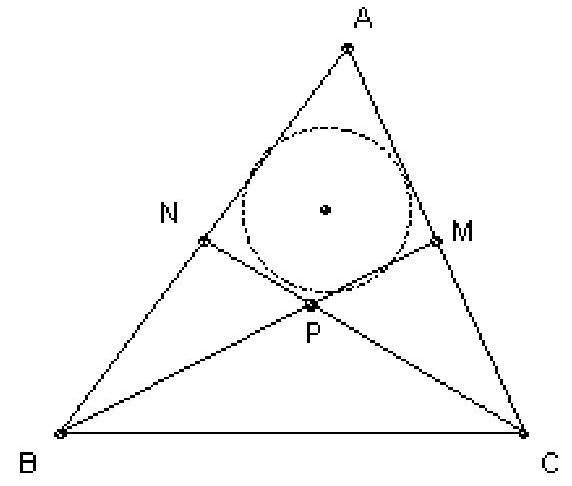
If the quadrilateral has an inscribed circle then $\mathrm{AM}+\mathrm{PN}=\mathrm{AN}+\mathrm{PM}$ (consider the tangents to the circle from $A, M, P, N$ ). But if $\mathrm{AB}... | proof | Geometry | proof | Yes | Yes | olympiads | false |
If $|x-1| = 1-x$, then ( )
A: $x 1$
C: $x \leq 1$
D: $x \geq 1$ | **Analysis:** According to $|x-1| = 1-x$, we can determine the sign of $x-1$, and then solve it based on the properties of inequalities.
Since $|x-1| = 1-x$,
it follows that $x-1 \leq 0$,
thus, $x \leq 1$.
Therefore, the correct choice is $\boxed{C}$.
**Review:** Summary of absolute value rules: The absolute... | C | Algebra | MCQ | Yes | Yes | cn_k12 | false |

The population of China is one billion people. It would seem that on a map of China with a scale of $1: 1000000$ (1 cm: 10 km), one million times fewer people could fit than are in the entire... | Note: We are talking about area, not linear dimensions.
## Solution
Since we are talking about area, not linear dimensions, the number of people should be reduced not by 1,000,000, but by $1000000^{2}$, i.e., by a trillion times.
## Answer
Since we are talking about area, not linear dimensions, the number of people... | 1000000^2 | Logic and Puzzles | math-word-problem | Incomplete | Yes | olympiads | false |
Mary goes with her 3 children to the circus. Tickets cost $2 for adults and a certain amount for children. Mary pays with a $20 bill and receives $15 change. How much does a child ticket cost? | Let's denote the cost of a child's ticket as \( x \) dollars.
Mary is an adult, so her ticket costs $2. She has 3 children, so the cost for the children's tickets is \( 3x \).
The total cost for all the tickets is the cost of Mary's ticket plus the cost of the children's tickets, which is \( 2 + 3x \).
Mary pays wit... | \$1 | Algebra | math-word-problem | Yes | Yes | orca_math | true |
A box has some water bottles and half a dozen more apple bottles than water bottles. There are 54 bottles in the box. How many water bottles are in the box? | Let's denote the number of water bottles as W and the number of apple bottles as A.
According to the problem, there are half a dozen more apple bottles than water bottles. Half a dozen is equal to 6, so we can write the following equation:
A = W + 6
We also know that the total number of bottles in the box is 54:
W ... | 24 | Algebra | math-word-problem | Yes | Yes | orca_math | true |
$S_n$ is the sum of the first $n$ terms of a geometric sequence $\{a_n\}$, satisfying $S_n = 2a_n - 1$. Find the common ratio $q$ of the sequence $\{a_n\}$. | Given $S_n = 2a_n - 1$, for $n=1$, we have $a_1 = 2a_1 - 1$, solving this gives $a_1 = 1$. For $n=2$, we have $a_1 + a_2 = 2a_2 - 1$, solving this gives $a_2 = 2$.
Therefore, the common ratio $q$ of the geometric sequence $\{a_n\}$ is $2$.
Hence, the answer is $\boxed{2}$.
**Analysis**: From $S_n = 2a_n - 1$, by set... | 2 | Algebra | math-word-problem | Yes | Yes | cn_k12 | false |
Given a convex pentagon $A B C D E$ with the properties $B C \| A E$ and $\overline{A B}=\overline{A E}$. Furthermore, let $F$ be a point on the segment $A E$ such that $\overline{A B}=\overline{B C}+\overline{A F}$ and $\Varangle C B A=\Varangle F D C$ are satisfied. Finally, let $M$ be the midpoint of the segment $C ... | From the conditions, it follows that $\overline{F E}=\overline{A E}-\overline{A F}=\overline{A B}-(\overline{A B}-\overline{B C})=\overline{B C}$.
Therefore, $B C E F$ is a parallelogram, whose diagonals $C F$ and $B E$ bisect each other at $M$.
Due to the point symmetry about $M$, $\Varangle C B E=\Varangle A E B$, an... | proof | Geometry | proof | Yes | Yes | olympiads_ref | false |
An 8-sided die numbered from 1 to 8 is rolled. What is the probability that the number rolled is a divisor of 12? | First, identify the divisors of 12: they are $1, 2, 3, 4, 6, 12$.
However, since the die only has 8 sides, we only consider the divisors that are less than or equal to 8, which are $1, 2, 3, 4, 6$.
There are 5 such divisors.
Since the die has 8 sides, the probability that the number rolled is a divisor of 12 is given b... | \frac{5}{8} | Number Theory | math-word-problem | Yes | Yes | synthetic_math | true |
Given a regular 103-sided polygon. 79 vertices are colored red and the remaining vertices are colored blue. Let $A$ be the number of pairs of adjacent red vertices and $B$ be the number of pairs of adjacent blue vertices.
a) Find all possible values of pair $(A,B).$
b) Determine the number of pairwise non-similar color... | 1. **Define the problem and variables:**
- We have a regular 103-sided polygon.
- 79 vertices are colored red, and the remaining \(103 - 79 = 24\) vertices are colored blue.
- Let \(A\) be the number of pairs of adjacent red vertices.
- Let \(B\) be the number of pairs of adjacent blue vertices.
2. **Defin... | \frac{\binom{23}{10} \binom{78}{9}}{14} = \frac{\binom{23}{9} \binom{78}{9}}{10} = \frac{\binom{24}{10} \binom{78}{9}}{24} | Combinatorics | math-word-problem | Yes | Yes | aops_forum | false |
Problem 4. A finite set $S$ of positive integers is called cardinal if $S$ contains the integer $|S|$, where $|S|$ denotes the number of distinct elements in $S$. Let $f$ be a function from the set of positive integers to itself, such that for any cardinal set $S$, the set $f(S)$ is also cardinal. Here $f(S)$ denotes ... |
Solution 1. The possible values are 1, 2, and 2024 .
Construction. The function $f(x)=1$ for all $x \in \mathbb{N}$ works. Also, $f(x)=1$ for all $x \neq 2024$ and $f(2024)=2$, works. Finally, $f(x)=x$ for all $x \in \mathbb{N}$ works as well.
It remains to show these are the only possible values for $f(2024)$.
Pro... | 1,2,2024 | Number Theory | math-word-problem | Yes | Yes | olympiads | false |
Determine the smallest positive integer that can be expressed as $2016m + 43200n$, where $m$ and $n$ are integers. | To solve this problem, we need to find the greatest common divisor (gcd) of $2016$ and $43200$, as the smallest integer expressible in the form $2016m + 43200n$ will be this gcd.
We apply the Euclidean algorithm as follows:
\[
\begin{align*}
\gcd(2016, 43200) &= \gcd(2016, 43200 - 21 \times 2016) \\
&= \gcd(2016, 1272... | 24 | Number Theory | math-word-problem | Yes | Yes | synthetic_math | true |
List $5 x_{n+1}=\frac{2 x}{1-x_{n}^{2}}, x_{1}=\sqrt{3}$. Find $x_{n}$. | Let $y_{n}=\operatorname{arc} g i_{n}$. Then $x_{n}=\operatorname{tg} y_{n}$, substituting into the original equation we get $\operatorname{tg} y_{n+1}=\operatorname{tg} 2 y_{n}$. We can take $y_{n+1}=2 y_{n}$, then $x_{n}=\operatorname{tg}\left[\frac{2^{n-1} \pi}{3}\right]$. | x_{n}=\operatorname{tg}\left[\frac{2^{n-1} \pi}{3}\right] | Algebra | math-word-problem | Yes | Yes | cn_contest | false |
Sweeoㅡ D.V.
Point $H$ is the orthocenter of triangle $ABC$. The tangents drawn to the circumcircles of triangles $CHB$ and $AHB$ at point $H$ intersect the line $AC$ at points $A_1$ and $C_1$ respectively. Prove that $A_1H = C_1H$. | If angle $B$ is a right angle, the condition makes no sense.
Let angle $B$ be acute. From the condition, it follows that $\angle A H C_{1} = \angle A B H$. Therefore, $\angle C_{1} H B^{\prime} = \angle A H B^{\prime} - \angle A B H = \angle H A B = 90^{\circ} - \angle B$ (where $B^{\prime}$ is the foot of the altitud... | proof | Geometry | proof | Yes | Yes | olympiads | false |
In a group of $12$ people with common interests, there are $5$ "three-good students". If $6$ people are randomly selected from this group to participate in a competition, let $\xi$ represent the number of "three-good students" among these $6$ people. The probability equal to $\frac{C_5^3 C_7^3}{C_{12}^6}$ is:
A. $P(\xi... | This problem requires us to find the probability using the classical probability model. First, calculate the total number of ways to choose $6$ people out of $12$. Then, find the number of ways to choose $6$ people with exactly $3$ "three-good students". Finally, apply the probability formula.
1. Calculate the total n... | B. P(\xi=3) | Combinatorics | MCQ | Yes | Yes | cn_k12 | false |
Given that the terminal side of angle α passes through point P(t, 2t) (t > 0), find the value of cosα. | Since the terminal side of angle α passes through point P(t, 2t) (t > 0), we can use the definition of trigonometric functions for any angle to find the value of cosα.
The formula for cosine is given by $cosα = \frac{x}{r}$, where x is the x-coordinate of the point on the terminal side of the angle, and r is the dista... | \frac{\sqrt{5}}{5} | Algebra | math-word-problem | Yes | Yes | cn_k12 | false |
8. From the vertices of a regular 1680-gon, several are chosen and connected in sequence to form polygons. The number of regular polygons that can be formed is
保留源文本的换行和格式,所以翻译结果如下:
8. From the vertices of a regular 1680-gon, several are chosen and connected in sequence to form polygons. The number of regular polygon... | $1680=2^{4} \cdot 3 \cdot 5 \cdot 7$, the sum of its divisors is $\left(1+2+2^{2}+2^{3}+2^{4}\right)(1+3)(1+5)(1+7)=5952$, noting that 1680 and 840 do not meet the requirements, so the number of regular polygons is $5952-2520=3432$. | 3432 | Number Theory | math-word-problem | Yes | Yes | olympiads | false |
Given the function $f(x) = x^2 + 2x + 1$, if there exists a real number $t$, such that for $x \in [1, m]$, $f(x+t) \leq x$ always holds, then the maximum value of the real number $m$ is ( )
A: 1
B: 2
C: 3
D: 4 | Let $g(x) = f(x+t) - x = x^2 + (2t+1)x + (1+t)^2$,
According to the condition that $f(x+t) - x \leq 0$ always holds, we have $g(1) \leq 0$ and $g(m) \leq 0$, which respectively lead to:
$t \in [-3, -1]$, $m^2 + (2t+1)m + (t+1)^2 \leq 0$,
Specifically, when $t = -1$, we get $m^2 - m \leq 0$, which solves to $0 \le... | \text{D} | Algebra | MCQ | Yes | Yes | cn_k12 | false |
3. Given the function
$$
\begin{aligned}
f(x)= & a \tan ^{2017} x+b x^{2017}+ \\
& c \ln \left(x+\sqrt{x^{2}+1}\right)+20,
\end{aligned}
$$
where $a$, $b$, and $c$ are real numbers. If $f\left(\ln \log _{5} 21\right)=17$, then $f\left(\ln \log _{21} 5\right)=$ $\qquad$ | 3. 23 .
Let $g(x)$
$$
=a \tan ^{2017} x+b x^{2017}+c \ln \left(x+\sqrt{x^{2}+1}\right) \text {. }
$$
Then $g(-x)=-g(x)$
$$
\begin{array}{l}
\Rightarrow f(-x)-20=-(f(x)-20) \\
\Rightarrow f(-x)=40-f(x) .
\end{array}
$$
Therefore, $f\left(\ln \log _{21} 5\right)=f\left(-\ln \log _{5} 21\right)$
$$
=40-f\left(\ln \log ... | 23 | Algebra | math-word-problem | Yes | Yes | cn_contest | false |
8,9 [ Pythagorean Theorem (direct and inverse). ]
The median $A D$ and the bisector $C E$ of a right triangle $A B C\left(\angle B=90^{\circ}\right)$ intersect at point $M$. Find the area of triangle $A B C$, if $C M=8, M E=5$. | See task 110964.
## Answer
$1352 / 15$
Send comment | \frac{1352}{15} | Geometry | math-word-problem | Yes | Incomplete | olympiads | false |
[ Extreme properties. Problems on maximum and minimum. Translation helps solve the task
Where should a bridge $MN$ be built across a river that separates two given villages $A$ and $B$, so that the path $AMNB$ from village $A$ to village $B$ is the shortest (the river banks are considered parallel lines, the bridge is... | Consider the images of points $A$ and $M$ under a parallel translation by the vector $\overrightarrow{M N}$ and use the triangle inequality.
## Solution
Suppose some position of the bridge is found. Under a parallel translation by the vector $\overrightarrow{M N}$, point $A$ will move to some point $A_{1}$, and point... | \cdot | Geometry | math-word-problem | Yes | Yes | olympiads | false |
A straight stick is stuck in a V-shaped water channel. The two ends of the stick touch the two different sides of the channel, and they form angles of the same size with the planes of the two sides. Show that in this case, the two ends of the stick are at equal distances from the bottom of the channel. | Let the planes of the two sides of the ditch be denoted by $S_{1}$ and $S_{2}$. If the stick is perpendicular to the intersection line of the two planes, then it forms equal angles with the two planes, and the statement is obviously true (Figure 1).
Let the two endpoints of the stick be denoted by $A$ and $B$. $A$ is ... | proof | Geometry | proof | Yes | Yes | olympiads | false |
For two non-coincident planes $\alpha$ and $\beta$, given the following conditions:
1. There exists a plane $\gamma$ such that both $\alpha$ and $\beta$ are parallel to $\gamma$.
2. There exists a plane $\gamma$ such that both $\alpha$ and $\beta$ are perpendicular to $\gamma$.
3. There are three non-collinear points i... | 1. When $\alpha$ is parallel to $\beta$. In this case, it can be determined that there exists a plane $\gamma$ such that both $\alpha$ and $\beta$ are parallel to $\gamma$. When the two planes are not parallel, there does not exist a plane $\gamma$ that satisfies condition 1, so it is incorrect.
2. There exists a plane... | \text{B} | Geometry | MCQ | Yes | Yes | cn_k12 | false |
4. Xiaoli put a plate of cat food in front of the big cat QiQi and the small cat TianTian. Later, Xiaoli felt that she had given too much to QiQi, so she transferred 7 pieces of cat food from QiQi's plate to TianTian's. As a result, QiQi still had 9 more pieces of cat food than TianTian. Initially, QiQi had $\qquad$ mo... | $23$ | 23 | Logic and Puzzles | math-word-problem | Yes | Yes | olympiads | false |
A polygon has the sum of its interior angles equal to three times the sum of its exterior angles. What is the number of sides of the polygon?
A: Octagon
B: Heptagon
C: Hexagon
D: Nonagon | To solve the problem, let's denote the number of sides of the polygon as $n$. The sum of the interior angles of a polygon is given by the formula $(n-2) \times 180^\circ$. The sum of the exterior angles of any polygon is always $360^\circ$, regardless of the number of sides.
Given that the sum of the interior angles i... | \text{A: Octagon} | Geometry | MCQ | Yes | Yes | cn_k12 | false |
The distance between the centers of two circles with polar equations $\rho =4\cos \theta$ and $\rho =4\sin \theta$ is________.
A: $1$
B: $2\sqrt{2}$
C: $2$
D: $\sqrt{2}$ | **Analysis**
This problem primarily examines the conversion between polar and rectangular coordinate equations of a circle, as well as the calculation of the distance between the circle centers using geometric properties. First, we will use the relationships between rectangular and polar coordinates, namely $x = \rho \... | 2\sqrt{2} | Geometry | MCQ | Yes | Yes | cn_k12 | false |
2. (8 points) Shuaishuai memorized more than a hundred words in seven days. The ratio of the number of words memorized in the first three days to the number of words memorized in the last four days is $3: 4$, and the ratio of the number of words memorized in the last three days to the number of words memorized in the f... | 【Solution】Solution: According to the analysis, let the number of words memorized in the first three days be $3k$, then the number of words memorized in the following four days be $4k$, and the number of words memorized on the fourth day be $a$, then the number of words memorized in the last three days be $4k-a$,
Accord... | 18 | Algebra | math-word-problem | Yes | Yes | olympiads | false |
Find the polynomial of minimal degree, with rational coefficients and leading coefficient $1$, that has roots $2+\sqrt{3}$ and $2+\sqrt{5}$. | Since the polynomial has rational coefficients, it must also include the conjugates $2-\sqrt{3}$ and $2-\sqrt{5}$ as roots. The polynomial is therefore divisible by:
- $(x - (2 + \sqrt{3}))(x - (2 - \sqrt{3})) = x^2 - 4x + 1$
- $(x - (2 + \sqrt{5}))(x - (2 - \sqrt{5})) = x^2 - 4x - 3$
Multiplying these two quadratics ... | x^4 - 8x^3 + 14x^2 + 8x - 3 | Algebra | math-word-problem | Yes | Yes | synthetic_math | true |
the total marks obtained by a student in mathematics and physics is 32 and his score in chemistry is 20 marks more than that in physics . find the average marks scored in mathamatics and chemistry together . | Let's denote the marks obtained by the student in mathematics as M, in physics as P, and in chemistry as C.
According to the information given:
M + P = 32 (1)
It is also given that the student's score in chemistry is 20 marks more than that in physics, so:
C = P + 20 (2)
We need to find the average marks scored in... | 26 | Algebra | math-word-problem | Yes | Yes | orca_math | true |
Determine whether there exist $1976$ nonsimilar triangles with angles $\alpha, \beta, \gamma,$ each of them satisfying the relations
\[\frac{\sin \alpha + \sin\beta + \sin\gamma}{\cos \alpha + \cos \beta + \cos \gamma}=\frac{12}{7}\text{ and }\sin \alpha \sin \beta \sin \gamma =\frac{12}{25}\] | null | null | Geometry | math-word-problem | Yes | Yes | aops_forum | false |
A regular octahedron is formed by joining the centers of adjoining faces of a cube. The ratio of the volume of the octahedron to the volume of the cube is
$ \textbf{(A)}\ \frac{\sqrt{3}}{12} \qquad\textbf{(B)}\ \frac{\sqrt{6}}{16} \qquad\textbf{(C)}\ \frac{1}{6} \qquad\textbf{(D)}\ \frac{\sqrt{2}}{8} \qquad\textbf{(E)... | 1. **Identify the side length of the cube and the octahedron:**
Let the side length of the cube be \( a \). The octahedron is formed by joining the centers of the adjoining faces of the cube. The distance between the centers of two adjacent faces of the cube is \( \frac{a}{\sqrt{2}} \). This distance is the edge len... | \frac{1}{6} | Geometry | MCQ | Yes | Yes | aops_forum | false |
(17) (12 points) In $\triangle ABC$, the opposite sides of the internal angles $A, B, C$ are $a, b, c$ respectively. The vectors $m=(2 \sin B, -\sqrt{3})$, $n=\left(\cos 2B, 2 \cos ^{2} \frac{B}{2}-1\right)$, and $\boldsymbol{m} / / \boldsymbol{n}$.
(1) Find the size of the acute angle $B$;
(2) If $b=2$, find the maxim... | 17 (1) Because $\boldsymbol{m} / / \boldsymbol{n}$, so
$$
2 \sin B\left(2 \cos ^{2} \frac{B}{2}-1\right)=-\sqrt{3} \cos 2 B,
$$
so $\sin 2 B=-\sqrt{3} \cos 2 B$, i.e., $\tan 2 B=-\sqrt{3}$.
Since $B$ is an acute angle, $2 B \in(0, \pi), 2 B=\frac{2 \pi}{3}$, so $B=\frac{\pi}{3}$.
(2) Because $B=\frac{\pi}{3}, b=2$, by... | \sqrt{3} | Algebra | math-word-problem | Yes | Yes | olympiads | false |
Given $$\cos\left(x- \frac{\pi}{4}\right) = \frac{\sqrt{2}}{10}, x \in \left(\frac{\pi}{2}, \frac{3\pi}{4}\right)$$.
(1) Find the value of $\sin x$;
(2) Find the value of $$\sin\left(2x+ \frac{\pi}{6}\right)$$. | (This question is worth a total of 12 points)
Solution:
(1) Since $$x \in \left(\frac{\pi}{2}, \frac{3\pi}{4}\right)$$,
then $$x- \frac{\pi}{4} \in \left(\frac{\pi}{4}, \frac{\pi}{2}\right)$$,...(1 point)
thus $$\sin\left(x- \frac{\pi}{4}\right) = \sqrt{1-\cos^2\left(x- \frac{\pi}{4}\right)} = \frac{7\sqrt{2}}{10}$$..... | \sin\left(2x+ \frac{\pi}{6}\right) = -\frac{7+24\sqrt{3}}{50} | Algebra | math-word-problem | Yes | Yes | cn_k12 | false |
3. Given a rectangular parallelepiped with sides 2, 6, and \( x \). For what values of the number \( x \) is the product of the surface area and the perimeter (the sum of the lengths of all edges) of this parallelepiped no more than 88 times its volume? | Write the answer in the form of an interval.
Answer: $[3 ; 4] \|[3,4]$
## Examples of writing answers:
$[1 ; 5]$
# | [3,4] | Algebra | math-word-problem | Yes | Yes | olympiads | false |
The grade received on a certain teacher's 100-point test varies in direct proportion to the effective hours spent preparing for the test. An effective hour is defined as 80% of an actual hour spent studying. If a student receives 80 points on a test for which she spent 5 actual hours preparing, what score would she rec... | Since the grade received varies directly with the effective hours spent preparing, and each actual hour counts as 80% of an hour, we first calculate the effective hours for each preparation time.
\[ \text{Effective hours for first test} = 5 \times 0.8 = 4 \text{ hours} \]
\[ \text{Effective hours for second test} = 6 \... | 96 | Algebra | math-word-problem | Yes | Yes | synthetic_math | true |
If three lines $y=2x$, $x+y=3$, and $mx-2y-5=0$ intersect at the same point, then the value of $m$ is ______. | To find the value of $m$ for which the three lines $y=2x$, $x+y=3$, and $mx-2y-5=0$ intersect at the same point, we follow these steps:
1. **Solve the system of equations for the first two lines** to find the intersection point. The system is:
\[
\left\{
\begin{array}{l}
y = 2x \\
x + y = 3
\end{arra... | 9 | Algebra | math-word-problem | Yes | Yes | cn_k12 | false |
On Saturday, Sara spent $10.62 each on 2 tickets to a movie theater. She also rented a movie, and bought a movie for $13.95. Sara spent a total of $36.78 on movies. How much did the rented movie cost? | First, let's calculate the total cost of the movie theater tickets. Since Sara bought 2 tickets at $10.62 each, we multiply the cost of one ticket by 2:
$10.62 * 2 = $21.24
Next, we know that Sara also bought a movie for $13.95. Let's add that to the cost of the movie theater tickets:
$21.24 (cost of tickets) + $13.... | \$1.59 | Algebra | math-word-problem | Yes | Yes | orca_math | true |
Let $a, b, n$ be positive integers, $b < 10$ and $2^n = 10a + b$.
Prove that if $n > 3$, then $6$ divides $ab$. | To prove that if \( n > 3 \), then \( 6 \) divides \( ab \), we start by analyzing the given equation \( 2^n = 10a + b \) where \( a, b, n \) are positive integers and \( b < 10 \).
1. **Divisibility by 2**:
Since \( b \) is a single-digit number and \( 2^n \) is even, \( b \) must also be even. Therefore, \( b \) ... | null | Number Theory | proof | Yes | Yes | aops_forum | false |
How many paths are there from point $C$ to point $D$, if every step must be either up or to the right, on a grid where the distance from $C$ to $D$ involves moving 7 steps to the right and 3 steps up? | The problem involves moving 7 steps to the right and 3 steps up to get from point $C$ to point $D$. This means there are a total of \(7 + 3 = 10\) steps to be taken. Out of these 10 steps, 3 steps are "up" steps.
The number of different ways to arrange these "up" steps among the total steps can be calculated using the... | 120 | Combinatorics | math-word-problem | Yes | Yes | synthetic_math | true |
The school nurse must conduct lice checks at the elementary school. She must check 26 Kindergarteners, some first graders, 20 second graders, and 25 third graders. Each check takes 2 minutes. It will take the nurse 3 hours to complete all the checks. How many first graders does she need to check? | First, let's calculate the total time the nurse has to conduct the lice checks in minutes. Since there are 60 minutes in an hour, and the nurse has 3 hours, we multiply 3 hours by 60 minutes per hour:
3 hours * 60 minutes/hour = 180 minutes
Next, let's calculate the time it takes to check the Kindergarteners, second ... | 19 | Algebra | math-word-problem | Yes | Yes | orca_math | true |
Given that $a > 0$, $b > 0$, and $2a + 3b = 6$, find the minimum value of $\frac{3}{a} + \frac{2}{b}$. | Since $a > 0$, $b > 0$, and $2a + 3b = 6$,
We have $\frac{3}{a} + \frac{2}{b} = \frac{1}{6}(2a + 3b)(\frac{3}{a} + \frac{2}{b}) = \frac{1}{6}(12 + \frac{9b}{a} + \frac{4a}{b}) \geqslant \frac{1}{6}(12 + 2\sqrt{\frac{9b}{a} \cdot \frac{4a}{b}}) = 4$,
The equality holds if and only if $3b = 2a = 3$.
Therefore, the min... | 4 | Algebra | math-word-problem | Yes | Yes | cn_k12 | false |
16. Let the circumcircle $O$ of $\triangle ABC$ have radius $R$, the incenter be $I$, $\angle B=60^{\circ}$, $\angle A<\angle C$, and the external angle bisector of $\angle A$ intersect the circle $O$ at $E$. Prove: (1) $IO=AE$; (2) $2R<IO+IA+IC<(1+\sqrt{3})R$, | None
Translate the text above into English, please retain the original text's line breaks and format, and output the translation result directly.
Note: The provided instruction is a meta-instruction and not part of the text to be translated. Since the text to be translated is "None", the translation is also "None". ... | notfound | Geometry | proof | Yes | Incomplete | olympiads | false |
Procopenko D:
On the side $B E$ of the equilateral triangle $A B E$, a rhombus $B C D E$ is constructed outside of it. Segments $A C$ and $B D$ intersect at point $F$. Prove that $A F < B D$.
# | Triangle $A B C$ is isosceles, hence $\angle B A C = \angle B C A$ (see figure). Moreover, due to symmetry, $\angle B C A = \angle B E F$. Therefore, $\angle B A F = \angle B E F$, which means quadrilateral $A B F E$ is cyclic. Thus, $\angle A F E = \angle A B E = 60^{\circ}$ and $\angle D F E = \angle B A E = 60^{\cir... | proof | Geometry | proof | Yes | Yes | olympiads | false |
A mathematical worm starts from point $A$ and reaches point $B$ in the figure below.
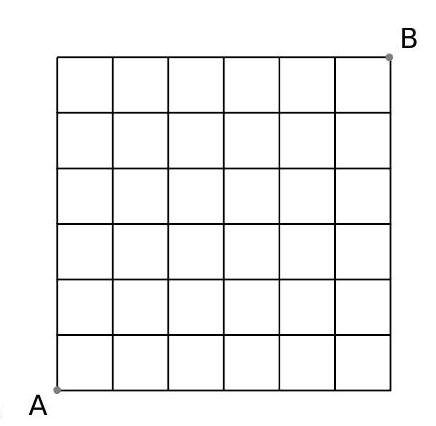
B
This mathematical worm always moves along the black lines in the drawing above, and never passes over ... | Solution
a) To make a path contained in the segments of the figure, the mathematical worm must choose, every two steps, one up and one to the right, or one to the right and one up. For example, if the worm takes the path illustrated below (in the thicker line)
 Massimo wants to save on calendars. So with his computer, he printed many sheets with the numbers of the days and next to each number the day of the week. Every month, Massimo chooses the appropriate sheet and places a removable label with the name of the month on top. How many sheets must he have printed at a minim... | 3) The answer is (C). There are four different types of months: with 28, 29, 30, or 31 days. A month of any type can start on any of the seven days of the week. Therefore, there can only be seven pages for each type of month. That is, $4 \times 7=28$ pages. | 28 | Combinatorics | MCQ | Yes | Yes | olympiads | false |
Calculate:$(1)(π-3)^0+(-\frac{1}{2})^{-2}$;$(2)x^{2}\cdot x^{4}+(-2x^{2})^{3}$;$(3)\left(x+4\right)^{2}-\left(x-2\right)\left(x-5\right)$;$(4)\left(2a-b+3\right)\left(2a+b-3)$. | ### Problem 1: Calculate $(1)(π-3)^0+(-\frac{1}{2})^{-2}$
**Step-by-step Solution:**
- $(π-3)^0+(-\frac{1}{2})^{-2}$
- $= 1 + 4$
- $= 5$
Therefore, the answer is $\boxed{5}$.
### Problem 2: Calculate $x^{2}\cdot x^{4}+(-2x^{2})^{3}$
**Step-by-step Solution:**
- $x^{2}\cdot x^{4}+(-2x^{2})^{3}$
- $= x^{6} - 8x^{6}... | 4a^{2}-b^{2}+6b-9 | Algebra | math-word-problem | Yes | Yes | cn_k12 | false |
An equilateral triangle with a side length of $4 \mathrm{~cm}$ is given (see figure). Determine the area of the dark part and also what percentage of the area of the original triangle is occupied by the dark part? (P. Tlustý)

It is given that $v=2 \sqrt{3} \mathrm{~cm}$, so the area of the equilateral triangle is $S=4 \sqrt{3} \mathrm{~cm}^{2... | \frac{3}{2}\sqrt{3}\mathrm{~}^{2},37.5 | Geometry | math-word-problem | Yes | Yes | olympiads | false |
In a bag filled with red, yellow, and white ping pong balls, it is possible to draw out a green ping pong ball. (True or False) | Solution: In a bag filled with red, yellow, and white ping pong balls, it is impossible to draw out a green ping pong ball. Therefore, the statement in the question is incorrect.
Hence, the answer is: $\boxed{\times}$.
The term "definitely" represents a certain event, "possibly" represents an uncertain event, and "im... | \times | Logic and Puzzles | math-word-problem | Incomplete | Yes | cn_k12 | false |
Let $ABC$ be a triangle. Let $T$ be the point of tangency of the circumcircle of triangle $ABC$ and the $A$-mixtilinear incircle. The incircle of triangle $ABC$ has center $I$ and touches sides $BC,CA$ and $AB$ at points $D,E$ and $F,$ respectively. Let $N$ be the midpoint of line segment $DF.$ Prove that the circumcir... | null | null | Geometry | proof | Yes | Yes | aops_forum | false |
Given that $\overline{AD} \| \overline{FG}$, determine the measure of angle $EFG$ in the diagram below:
[asy]
import olympiad;
pair A = (-15,20);
pair B = (-12,35);
pair C = (35,50);
pair D = (35,20);
pair E = (14,20);
pair F = (0,0);
pair G = (40,0);
draw(F--G);
draw(F--C);
draw(A--D);
draw(B--E);
label("F", F, W)... | - Since $\overline{AD} \| \overline{FG}$, by the corresponding angles theorem, $\angle CFG + \angle CEA = 180^\circ$.
- From the problem, we have $\angle CFG = 2x$ and $\angle CEA = x + 3x = 4x$.
- Setting up the equation, $2x + 4x = 180^\circ$ leads to $6x = 180^\circ$, so $x = 30^\circ$.
- Therefore, $\angle EFG = 2(... | 60^\circ | Geometry | math-word-problem | Yes | Yes | synthetic_math | true |
Let $a$ be a positive integer, $a < 100$, and $a^3 + 23$ is divisible by 24. Then, the number of such $a$ is ( )
A: 4
B: 5
C: 9
D: 10 | Since $a^3 + 23 = (a^3 - 1) + 24$,
when $a^3 + 23$ is divisible by 24,
$a^3 - 1 = (a - 1)(a^2 + a + 1)$ must also be a multiple of 24.
Since when $a$ is a positive integer, $a^2 + a + 1$ is odd and cannot be a multiple of 24,
thus, when $a - 1$ is a multiple of 24, i.e., when $a$ equals 1, 25, 49, 73, or 97, th... | \text{B} | Number Theory | MCQ | Yes | Yes | cn_k12 | false |
One man traveled a distance of 61 km in some hours. He traveled partly on foot at 4 km/hr and partly on bicycle at 9 km/hr. The distance traveled on foot is 16 km. How many hours did he spend traveling? | The man traveled 16 km on foot at a speed of 4 km/hr. To find the time spent on foot, we divide the distance by the speed:
Time on foot = Distance on foot / Speed on foot
Time on foot = 16 km / 4 km/hr
Time on foot = 4 hours
The remaining distance traveled on bicycle is the total distance minus the distance traveled ... | 9 | Algebra | math-word-problem | Yes | Yes | orca_math | true |
If $\cos(75° + \alpha) = \frac{1}{3}$, then $\sin(60° + 2\alpha) =$ ______. | Since we know
$$
\cos(\alpha + 75°) = \frac{1}{3},
$$
by the co-function identity for cosine and sine, which says $\cos(\theta) = \sin(90° - \theta)$, we can find $\sin(15° - \alpha)$ as follows:
$$
\sin(90° - (\alpha + 75°)) = \sin(15° - \alpha) = \frac{1}{3}.
$$
Now, to find $\sin(60° + 2\alpha)$, we can use the fol... | \frac{7}{9} | Algebra | math-word-problem | Yes | Yes | cn_k12 | false |
Find the minimum value of the function $f(x)=x^{3}-3x$. | First, take the derivative of the function $f(x)$ with respect to $x$. This gives us $f'(x)=3x^{2}-3$.
Next, set the derivative equal to zero and solve for $x$. This gives us $3x^{2}-3=0$, which simplifies to $x^2 = 1$, and thus $x=±1$.
Now, we evaluate the function $f(x)$ at these critical points. We find that $f(1)... | -2 | Calculus | math-word-problem | Yes | Yes | cn_k12 | false |
Among the following options, the one that can be the center of symmetry for the graph of the function $y = \sin x - \sqrt{3} \cos x$ is ( ):
A: ($$\frac{\pi}{3}$$, 0)
B: ($$\frac{\pi}{6}$$, 0)
C: ($$\frac{2\pi}{3}$$, 0)
D: ($$\frac{5\pi}{6}$$, 0) | Solution: The function $y = \sin x - \sqrt{3} \cos x$ can be rewritten as $y = 2 \sin(x - \frac{\pi}{3})$.
Let $x - \frac{\pi}{3} = k\pi$, where $k \in \mathbb{Z}$, then we get $x = k\pi + \frac{\pi}{3}$, where $k \in \mathbb{Z}$.
When $k = 0$, we can find that the center of symmetry for the graph of the function $y = ... | \text{A} | Algebra | MCQ | Yes | Yes | cn_k12 | false |
A wall photo 2 inches wide is placed around a rectangular paper with a certain length and a width of 12 inches. The area of the wall photo is 96 square inches. What is the length of the rectangular paper? | Let's denote the length of the rectangular paper as L inches. The width of the paper is given as 12 inches.
The wall photo is placed around the paper, so it adds to the dimensions of the paper. Since the photo is 2 inches wide, it will add 2 inches to each side of the length and 2 inches to each side of the width of t... | 2 | Geometry | math-word-problem | Yes | Incomplete | orca_math | true |
the ratio of pens to pencils is 5 to 6 . there are 4 more pencils than pens . how many pencils are there ? | Let's denote the number of pens as P and the number of pencils as L. According to the problem, the ratio of pens to pencils is 5 to 6, which can be written as:
P/L = 5/6
It is also given that there are 4 more pencils than pens, which can be written as:
L = P + 4
Now, we can use these two equations to solve for the ... | 24 | Algebra | math-word-problem | Yes | Yes | orca_math | true |
Given a triangle with vertices A(-5, 0), B(4, -4), and C(0, 2),
(Ⅰ) Find the equation of the line on which the median to side BC lies;
(Ⅱ) Find the equation of the line on which the altitude from A to side BC lies. | Solution:
(I) Since B(4, -4) and C(0, 2),
the midpoint of BC is D(2, -1).
The slope of line AD is $$k_{AD} = \frac{-1-0}{2+5} = -\frac{1}{7}$$
Therefore, the equation of line AD is $y = -\frac{1}{7}(x + 5)$,
which simplifies to $x + 7y + 5 = 0$. This is the equation of the line on which the median to side BC lies.
(II... | 2x - 3y + 10 = 0 | Geometry | math-word-problem | Yes | Yes | cn_k12 | false |
Corey earns extra money finding lost golf balls. His goal is to find some golf balls every weekend. He found 16 golf balls on Saturday and 18 more golf balls on Sunday. Corey needs to find 14 more golf balls to reach his goal. What is his goal for the number of golf balls to find every weekend? | Corey found 16 golf balls on Saturday and 18 on Sunday, which totals to:
16 + 18 = 34 golf balls
He still needs to find 14 more golf balls to reach his goal. Therefore, his goal for the number of golf balls to find every weekend is:
34 + 14 = $\boxed{48}$ golf balls | 48 | Algebra | math-word-problem | Yes | Yes | orca_math | true |
The sum of the first $n$ terms of the sequence $\{a_n\}$ is $S_n$, $a_1=1$, $2S_n=a_{n+1}$ $(n\in\mathbb{N}_+)$, then $a_n=$ ______. | Given $a_1=1$, $2S_n=a_{n+1}$ $(n\in\mathbb{N}_+)$ (1),
thus, when $n\geqslant 2$, $2S_{n-1}=a_n$ (2),
subtracting (2) from (1) gives: $2a_n=a_{n+1}-a_n$,
therefore, $\dfrac{a_{n+1}}{a_n}=3$ $(n\geqslant 2)$,
also, $a_2=2S_1=2a_1=2$,
therefore, starting from the second term, the sequence $\{a_n\}$ is a geomet... | a_n= \begin{cases} 1, & n=1 \\ 2\cdot 3^{n-2}, & n\geqslant 2 \end{cases} | Algebra | math-word-problem | Yes | Yes | cn_k12 | false |
A circle $\omega$ is inscribed in the acute-angled triangle $\vartriangle ABC$, which touches the side $BC$ at the point $K$. On the lines $AB$ and $AC$, the points $P$ and $Q$, respectively, are chosen so that $PK \perp AC$ and $QK \perp AB$. Denote by $M$ and $N$ the points of intersection of $KP$ and $KQ$ with the c... | null | null | Geometry | proof | Yes | Yes | aops_forum | false |
Example 3 Use the residue system modulo 3 to represent the residue system modulo $3^{n}(n \geqslant 2)$. | From Theorem 13, we know that when $x^{(1)}$ runs through the complete (reduced) residue system modulo 3, and $x^{(j)} (2 \leqslant j \leqslant n)$ runs through the complete residue system modulo 3,
$$x=x^{(1)}+3 x^{(2)}+\cdots+3^{n-1} x^{(n)}$$
runs through the complete (reduced) residue system modulo $3^{n}$. Specif... | not found | Number Theory | math-word-problem | Yes | Yes | number_theory | false |
Each interior angle of a regular polygon measures $160^\circ$. How many sides does this polygon have? | Let \( n \) represent the number of sides of the polygon. For any polygon, the sum of its interior angles is \( 180(n-2) \) degrees. Given that each angle in this polygon measures \( 160^\circ \), we can set up the equation:
\[ 180(n-2) = 160n. \]
Expanding and simplifying:
\[ 180n - 360 = 160n, \]
\[ 20n = 360, \]
\[ ... | 18 | Geometry | math-word-problem | Yes | Yes | synthetic_math | true |
17. (12 points) In the sequence $\left\{a_{n}\right\}$, $a_{1}=1$, and its first $n$ terms sum $S_{n}$ satisfies the relation
$$
3 t S_{n}-(2 t+3) S_{n-1}=3 t(t>0, n=2,3, \cdots) \text {. }
$$
(1) Prove that the sequence $\left\{a_{n}\right\}$ is a geometric sequence;
(2) Let the common ratio of the sequence $\left\{a_... | 17. (1) From the given $3 S_{2}-(2 t+3) S_{1}=3 t$,
i.e., $3 t\left(a_{1}+a_{2}\right)-(2 t+3) a_{1}=3 t$.
Given $a_{1}=1$, solving for $a_{2}$ yields $a_{2}=\frac{2 t+3}{3 t}$.
Thus, $\frac{a_{2}}{a_{1}}=\frac{2 t+3}{3 t}$.
For $n \geqslant 2$, we have
$$
\begin{array}{l}
3 t S_{n+1}-(2 t+3) S_{n}=3 t, \\
3 t S_{n}-(... | -\frac{8}{9} n^{2}-\frac{4}{3} n | Algebra | math-word-problem | Yes | Yes | cn_contest | false |
5. In $\triangle A B C$, it is known that $\overrightarrow{A B} \cdot \overrightarrow{B C}=3 \overrightarrow{C A} \cdot \overrightarrow{A B}$, then the maximum value of $\frac{|\overrightarrow{A C}|+|\overrightarrow{A B}|}{|\overrightarrow{B C}|}$ is
A. $\frac{\sqrt{5}}{2}$
B. $\sqrt{3}$
C. 2
D. $\sqrt{5}$ | 【 $B$ 】 | notfound | Geometry | MCQ | Yes | Yes | olympiads | false |
18.4 In the convex quadrilateral $A B C D$, $A C$ bisects $\angle B A D$. A line $C E \perp A B$ is drawn through $C$ at $E$, and $A E=\frac{1}{2}(A B+A D)$. Then, the relationship between $\angle A B C$ and $\angle A D C$ is
(A) $\angle A B C=\angle A D C$.
(B) $\angle A B C+\angle A D C=180^{\circ}$.
(C) $\angle A B ... | [Solution] $\because A E=\frac{1}{2}(A B+A D)$,
then
$$
A E=A B+A D-A E,
$$
or $A E=A D+E B$.
Extend $A D$ to $F$, such that $D F=E B$, then $A F=A E$.
Connect $F C$, and since $A C$ bisects $\angle B A D$,
then
$$
\triangle A E C \cong \triangle A F C,
$$
we have $\angle F=90^{\circ}$, and $C E=C F$.
Therefore, $\t... | \angleABC+\angleADC=180 | Geometry | MCQ | Yes | Yes | olympiads | false |
1. The length of the common chord of the circles $(x^2+y^2=4)$ and $(x^2+y^2+2ay-6=0 (a > 0))$ is $2\sqrt{3}$. Find the value of $a$.
2. In the Cartesian coordinate plane, the number of lines that are at a distance of $\sqrt{2}$ from point $A(1,2)$ and at a distance of $2\sqrt{2}$ from point $B(4,5)$ is \_\_\_\_.
3. Gi... | 1. This problem involves the relationship between two circles.
By subtracting the equations of the two circles, we can obtain the equation of the chord of intersection as $y = \frac{1}{a}$. The distance $d$ from the center of the circle $(0,0)$ to the line $y = \frac{1}{a}$ is $d = \frac{1}{a} = \sqrt{4-(\sqrt{3})^2} ... | ①③④ | Geometry | math-word-problem | Yes | Yes | cn_k12 | false |
In one hour, Addison mountain's temperature will decrease to some fraction of its temperature. If the current temperature of the mountain is 84 degrees, the temperature will decrease by 21 degrees. What is the fraction of the current temperature that the temperature will decrease to? | If the current temperature is 84 degrees and it will decrease by 21 degrees, then the new temperature will be:
84 degrees - 21 degrees = 63 degrees
To find the fraction of the current temperature that the new temperature represents, we divide the new temperature by the current temperature:
63 degrees / 84 degrees = ... | 3/4 | Algebra | math-word-problem | Yes | Yes | orca_math | true |
Given the function $y=\sin \left[2\left(x-\frac{\pi }{3}\right)+\varphi \right]$, it is an even function, and $0<\varphi <\pi$, then $\varphi=$ _____ . | Since the function $y=\sin \left[2\left(x-\frac{\pi }{3}\right)+\varphi \right]$ is an even function, we have $-\frac{2\pi }{3}+\varphi =k\pi +\frac{\pi }{2}$, where $k\in \mathbb{Z}$, which simplifies to $\varphi =k\pi +\frac{7\pi }{6}$, where $k\in \mathbb{Z}$.
Considering $0<\varphi <\pi$, we obtain $\varphi =\boxe... | \frac{\pi }{6} | Algebra | math-word-problem | Yes | Yes | cn_k12 | false |
For a geometric sequence $\{a_n\}$ where each term is positive, and $a_{10}a_{11} = e^5$, find the value of $\ln a_1 + \ln a_2 + \ldots + \ln a_{20}$. | Since the sequence $\{a_n\}$ is a geometric sequence with all positive terms, and $a_{10}a_{11} = e^5$, it follows that $a_1a_{20} = a_2a_{19} = \ldots = a_{10}a_{11} = e^5$.
Therefore, $\ln a_1 + \ln a_2 + \ldots + \ln a_{20} = \ln(a_1 \times a_2 \times \ldots \times a_{20}) = \ln\left(e^5\right)^{10} = 50$.
Hence, ... | 50 | Algebra | math-word-problem | Yes | Yes | cn_k12 | false |
The three-digit positive integer $M$ has a ones digit of 9. What is the probability that $M$ is divisible by 5? Express your answer as a common fraction. | Let $M = xy9$, where $x$ and $y$ are digits in the range 0-9. For $M$ to be divisible by 5, it must end in 0 or 5 based on divisibility rules. However, since $M$ always ends in 9, $M$ can never be divisible by 5 barring any exceptional conditions not included in the problem statement. Thus, the probability that $M$ is ... | 0 | Number Theory | math-word-problem | Yes | Yes | synthetic_math | true |
In China, from $2009$ to $2011, the government at all levels invested a total of 850 billion yuan in the field of medical and health care. Express "850 billion yuan" in scientific notation as ( ).
A: $8.5\times 10^{10}$ yuan
B: $8.5\times 10^{11}$ yuan
C: $0.85\times 10^{11}$ yuan
D: $0.85\times 10^{12}$ yuan | To express "850 billion yuan" in scientific notation, we start by understanding what "billion" means in terms of numerical value. In this context, "billion" refers to $1,000,000,000$ or $10^9$. Therefore, "850 billion" can be initially written as $850 \times 10^9$.
Next, we convert this into scientific notation, which... | \text{B} | Algebra | MCQ | Yes | Yes | cn_k12 | false |
208. Biscuits. A trader packed his biscuits (all of the same quality) into boxes weighing $16, 17, 23, 39$, and 40 pounds respectively and was unwilling to sell them in any other way than whole boxes. A customer asked him to supply 100 pounds of biscuits.
Could you fulfill this order? If not, how close can you get to ... | 208. You need to give the customer four boxes at 17 pounds each and two at 16 pounds, which will make exactly 100 pounds. | 100 | Number Theory | math-word-problem | Yes | Yes | olympiads | false |
Two concentric circles are centered at point Q. The sides of a 60-degree angle at Q form an arc on the smaller circle that is the same length as an arc on the larger circle formed by the sides of a 30-degree angle at Q. What is the ratio of the area of the smaller circle to the area of the larger circle? Express your a... | Let $C_1$ and $C_2$ be the circumferences of the smaller and larger circles, respectively. The length of the $60^\circ$ arc on the smaller circle is $\left(\frac{60^\circ}{360^\circ}\right)C_1$, and the length of the $30^\circ$ arc on the larger circle is $\left(\frac{30^\circ}{360^\circ}\right)C_2$. Setting these two ... | \frac{1}{4} | Geometry | math-word-problem | Yes | Yes | synthetic_math | true |
The perimeter of triangle $ABC$ is 8. An incircle is inscribed in the triangle, and a tangent is drawn to it, parallel to side $AB$. The segment of this tangent, enclosed between sides $AC$ and $CB$, is equal to 1. Find the side $AB$.
# | The truncated triangle is similar to the given one with a coefficient equal to the ratio of their perimeters.
## Solution
Let the points of intersection of the tangent with sides $A C$ and $C B$ be $M$ and $N$, and the points of tangency of these sides with the inscribed circle be $P$ and $Q$. Then the semiperimeter ... | 2 | Geometry | math-word-problem | Yes | Yes | olympiads | false |
If the line $(1+a)x+y+1=0$ is tangent to the circle ${x}^{2}+{y}^{2}-2x=0$, then the value of $a$ is ( ).
A: $1$ or $-1$
B: $2$ or $-2$
C: $1$
D: $-1$ | **Analysis**
This question mainly examines the geometric properties of the tangent line of a circle and the application of the formula for the distance from a point to a circle. It tests the application of transformation ideas.
By finding the center coordinates and radius from the standard equation of the circle, and... | D | Geometry | MCQ | Yes | Yes | cn_k12 | false |
Luther made some pancakes for breakfast. His family has 8 people. He needs to make 4 more pancakes for everyone to have a second pancake. How many pancakes did he make initially? | If Luther needs to make 4 more pancakes for everyone to have a second pancake, that means he is currently 4 pancakes short of having enough for everyone to have two pancakes. Since there are 8 people in his family, he would need a total of 8 x 2 = 16 pancakes for everyone to have two.
Since he is 4 pancakes short of t... | 12 | Algebra | math-word-problem | Yes | Yes | orca_math | true |
1. Let $f(x)=x^{3}+a x+b$, with $a \neq b$, and suppose the tangent lines to the graph of $f$ at $x=a$ and $x=b$ are parallel. Find $f(1)$. | Solution: $\square$
Since $f^{\prime}(x)=3 x^{2}+a$, we must have $3 a^{2}+a=3 b^{2}+a$. Then $a^{2}=b^{2}$, and since $a \neq b$, $a=-b$. Thus $f(1)=1+a+b=1$. | 1 | Algebra | math-word-problem | Yes | Yes | olympiads | false |
Let $AA'BCC'B'$ be a convex cyclic hexagon such that $AC$ is tangent to the incircle of the triangle $A'B'C'$, and $A'C'$ is tangent to the incircle of the triangle $ABC$. Let the lines $AB$ and $A'B'$ meet at $X$ and let the lines $BC$ and $B'C'$ meet at $Y$.
Prove that if $XBYB'$ is a convex quadrilateral, then it h... | 1. **Define the incircles and their centers:**
Let $\omega$ and $\omega'$ be the incircles of $\triangle ABC$ and $\triangle A'B'C'$, centered at $I$ and $I'$, respectively.
2. **Identify the intersection point $K$:**
Let $K = AC \cap A'C'$. By symmetry, $K$ lies on the line $II'$.
3. **Define the intersection ... | null | Geometry | proof | Yes | Yes | aops_forum | false |
They were able to make some institutions happy. Each institution has 80 people. The mayor and vice-mayor made 480 people happy. How many institutions were made happy by the mayor and vice-mayor? | If each institution has 80 people and the mayor and vice-mayor made 480 people happy, we can find out how many institutions were made happy by dividing the total number of people made happy by the number of people in each institution.
So, we divide 480 by 80:
480 ÷ 80 = 6
Therefore, the mayor and vice-mayor made $\b... | 6 | Algebra | math-word-problem | Yes | Yes | orca_math | true |
Assume variable $a$ is quadrupled and then 6 is added to it. From this result, subtract $7a$ and finally divide the result by three. What is the final expression in simplest form? | 1. **Quadruple and add**: Start by quadrupling $a$ and adding 6: $4 \cdot a + 6$.
2. **Subtract $7a$**: Subtract $7a$ from the expression: $4a + 6 - 7a = -3a + 6$.
3. **Divide by three**: Divide the expression by three to simplify: $\frac{-3a + 6}{3}$. Simplifying each term separately gives $\frac{-3a}{3} + \frac{6}{3}... | -a + 2 | Algebra | math-word-problem | Yes | Yes | synthetic_math | true |
Calculate $$\int_{0}^{1} \sqrt{1-x^{2}}dx$$. | According to the geometric meaning of the integral, the value of the original integral is equal to the area of the unit circle in the first quadrant.
Therefore, $$\int_{0}^{1} \sqrt{1-x^{2}}dx = \frac{\pi}{4}$$,
Hence, the answer is: $$\boxed{\frac{\pi}{4}}$$.
To find the definite integral $$\int_{0}^{1} \sqrt{1-... | \frac{\pi}{4} | Calculus | math-word-problem | Yes | Yes | cn_k12 | false |
If \(f(x) = \sqrt{x-5}\), what is the smallest real number \(x\) in the domain of \(f(f(x))\)? | First, let's find the domain of \(f(x)\). For \(f(x)\) to be defined, the expression under the square root must be non-negative:
\[x - 5 \geq 0 \quad \Rightarrow \quad x \geq 5.\]
Next, we consider \(f(f(x))\):
\[f(f(x)) = f(\sqrt{x-5}).\]
For \(f(\sqrt{x-5})\) to be defined, the argument \(\sqrt{x-5}\) must be at le... | 30 | Algebra | math-word-problem | Yes | Yes | synthetic_math | true |
Larry has 67 cards. Dennis takes some cards away, and now Larry has 58 cards. How many cards did Dennis take away? |
Dennis took away 67 - 58 = $\boxed{9}$ cards. | 9 | Algebra | math-word-problem | Yes | Yes | orca_math | true |
Given that $\cos (\frac{π}{4}+x)= \frac{4}{5}$, where $x \in (-\frac{π}{2},-\frac{π}{4})$, find the value of $\frac{\sin 2x - 2\sin^2 x}{1 + \tan x}$. | Since $x \in (-\frac{π}{2},-\frac{π}{4})$, and $\cos (\frac{π}{4}+x)= \frac{4}{5}$, we can derive the following:
$$\frac{\sqrt{2}}{2} \cos x - \frac{\sqrt{2}}{2} \sin x = \frac{4}{5} \quad (1)$$
$$\cos x - \sin x = \frac{4\sqrt{2}}{5}$$
Also, $x + \frac{π}{4} \in (-\frac{π}{4}, 0)$, therefore $\sin (x + \frac{π}{4})... | \frac{28}{75} | Algebra | math-word-problem | Yes | Yes | cn_k12 | false |
|
| $[\underline{\text { Evenness and Oddness }}]$ | | |
Authors: Akopyan E., Kalinin D. $\underline{\text {. }}$.
Malvina wrote down 2016 common proper fractions in order: $1 / 2,1 / 3,2 / 3,1 / 4,2 / 4,3 / 4, \ldots$ (including reducible ones). Fractions whose value is less than $1 / 2$ she painted red, and the r... | Note that only one fraction with a denominator of 2 is recorded, exactly two fractions with a denominator of 3, exactly three with a denominator of 4, and so on. Since
$2016=64 \cdot 63: 2$, the number 2016 is equal to the sum of all natural numbers from 1 to 63. Therefore, Malvina recorded all fractions with denomina... | 32 | Number Theory | math-word-problem | Yes | Yes | olympiads | false |
Find all real solutions $(x,y,z)$ of the system of equations
$$\begin{cases} x^3 = 2y-1 \\y^3 = 2z-1\\ z^3 = 2x-1\end{cases}$$ | 1. We start with the given system of equations:
\[
\begin{cases}
x^3 = 2y - 1 \\
y^3 = 2z - 1 \\
z^3 = 2x - 1
\end{cases}
\]
2. We claim that the only solution is \((1, 1, 1)\). To verify this, we substitute \(x = 1\), \(y = 1\), and \(z = 1\) into the system:
\[
\begin{cases}
1^3 = 2 \cd... | (1, 1, 1) | Algebra | math-word-problem | Yes | Yes | aops_forum | false |
Let $n$ be a positive integer. Two players, Alice and Bob, are playing the following game:
- Alice chooses $n$ real numbers; not necessarily distinct.
- Alice writes all pairwise sums on a sheet of paper and gives it to Bob. (There are $\frac{n(n-1)}{2}$ such sums; not necessarily distinct.)
- Bob wins if he finds corr... | ### Case \( n = 5 \)
1. **Identify the smallest and largest sums:**
- Let the numbers be \( a_1, a_2, a_3, a_4, a_5 \) in increasing order.
- The smallest pairwise sum is \( a_1 + a_2 \).
- The largest pairwise sum is \( a_4 + a_5 \).
2. **Calculate the sum of all pairwise sums:**
- There are \( \frac{5(5... | null | Logic and Puzzles | math-word-problem | Yes | Yes | aops_forum | false |
1. Using the digits $1,9,0,1,2,0,1,9$, form a four-digit number divisible by 3 (each digit can be used as many times as it appears). Which is:
a) the largest such number;
b) the fourth largest such number? | 1. a) The largest number that can be formed from these four digits is 9921; since it is divisible by 3, it is precisely the answer we are looking for.
b) If we place the two largest digits on the first two positions from the left, i.e., 99, and since $3 \mid 9+9$, we conclude that the remaining two positions must be f... | 9921 | Number Theory | math-word-problem | Yes | Yes | olympiads | false |
In an electrical engineering application, the voltage $V$ in an alternating current (AC) system is represented by the complex number $3+4i$, and the impedance $Z$ in the circuit is given by $2+5i$. Calculate the current $I$ using the formula $I = \frac{V}{Z}$. Provide the result as a complex number in the form $a+bi$. | To find the current $I = \frac{V}{Z}$, we use the given values: $V = 3+4i$ and $Z = 2+5i$. Compute $I$ as follows:
$$
I = \frac{3+4i}{2+5i}.
$$
Multiply both the numerator and the denominator by the conjugate of the denominator:
$$
I = \frac{3+4i}{2+5i} \cdot \frac{2-5i}{2-5i} = \frac{(3+4i)(2-5i)}{2^2 + 5^2}.
$$
Expan... | \frac{26}{29} - \frac{7}{29}i | Algebra | math-word-problem | Yes | Yes | synthetic_math | true |
Subsets and Splits
No community queries yet
The top public SQL queries from the community will appear here once available.