
instruction_seed stringlengths 2 10.7k | solution stringlengths 0 10.8k ⌀ | answer stringlengths 0 575 ⌀ | problem_type stringclasses 9
values | question_type stringclasses 5
values | problem_is_valid stringclasses 5
values | solution_is_valid stringclasses 4
values | source stringclasses 11
values | synthetic bool 2
classes |
|---|---|---|---|---|---|---|---|---|
Determine all positive integers relatively prime to all the terms of the infinite sequence \[ a_n=2^n+3^n+6^n -1,\ n\geq 1. \] |
To determine all positive integers relatively prime to all the terms of the infinite sequence \(a_n = 2^n + 3^n + 6^n - 1\) for \(n \geq 1\), we need to find the integers that do not share any prime factors with any term in the sequence. Let's start by examining the sequence for small values of \(n\).
For \(n = 1\):
... | 1 | NaN | NaN | NaN | NaN | aops_forum | false |
Select 4 students from 5 female students and 4 male students to participate in four different speeches, according to the following requirements, how many different methods of selection are there?
(1) 2 male students and 2 female students;
(2) At least 1 male student and 1 female student;
(3) Under the premise of ... | (1) The number of ways to select 2 male students and 2 female students is $C_4^2 \times C_5^2 = 6 \times 10 = 60$, thus the total number of different methods of selection is $60 \times A_4^4 = 1440$;
Therefore, there are a total of $\boxed{1440}$ different methods of selection for 2 male students and 2 female student... | 2376 | Combinatorics | math-word-problem | Yes | Yes | cn_k12 | false |
Given the function $f(x) = e^{2x} \cos x$, find the derivative $f'(x)$. | To find the derivative of the product of two functions, we will apply the product rule. The product rule states that if we have two functions $u(x)$ and $v(x)$, their derivative $d(uv)/dx$ is found by applying the formula $u'v + uv'$, where $u'$ and $v'$ are the derivatives of $u$ and $v$, respectively.
Let $u(x) = e^... | f'(x) = e^{2x}(2\cos x - \sin x) | Calculus | math-word-problem | Yes | Yes | cn_k12 | false |
Jason is trying to figure out whether he can afford a new car that costs $32,000. He can make a certain down payment and will have to get a loan for the rest of the amount and make 48 equal monthly payments on it. Each month, he also has to pay interest equal to 5% of that month's payment. His monthly payments will be ... | To find out Jason's down payment, we first need to calculate the total amount he will pay for the car including the interest.
Since Jason will make 48 equal monthly payments of $525, the total amount paid without interest is:
48 months * $525/month = $25,200
Now, we need to calculate the total interest paid over the... | \$5,540 | Algebra | math-word-problem | Yes | Yes | orca_math | true |
Given that events $A$ and $B$ are mutually exclusive, and event $\overline{B}$ represents the complementary event of event $B$. If $P(A)=0.6$ and $P(B)=0.2$, then $P(A+\overline{B})$ is
A: $0.6$
B: $0.8$
C: $0.2$
D: $0.48$ | Given the problem statement, we know that events $A$ and $B$ are mutually exclusive, which means they cannot happen at the same time, and $\overline{B}$ represents the complement of event $B$. We are given $P(A)=0.6$ and $P(B)=0.2$. Let's break down the solution step by step:
1. First, we calculate the probability of ... | \text{B: } 0.8 | Algebra | MCQ | Yes | Yes | cn_k12 | false |
The total price of a basic computer and printer are $2,500. If the same printer had been purchased with an enhanced computer whose price was $500 more than the price of the basic computer, then the price of the printer would have been some fraction of that total. What is the ratio of the price of the printer to the tot... | Let's denote the price of the basic computer as C_basic and the price of the printer as P.
According to the information given, we have:
C_basic + P = $2,500
We are also told that the price of the basic computer is $1,500, so:
C_basic = $1,500
Now we can find the price of the printer by substituting the value of C_... | 1:3 | Algebra | math-word-problem | Yes | Yes | orca_math | true |
2. Let $\mathscr{A}=\left\{A_{1}, A_{2}, \ldots, A_{k}\right\}$ be a collection of subsets of a set $S$ which has $n$ ($n \geqslant 2$) elements. If for any two elements $x, y \in S$ there exists a subset $A_{i} \in \mathscr{A}$ such that $A_{i}$ contains exactly one of the elements $x, y$, prove that $n \leqslant 2^{k... | 2. To each element $a$ of the set $S$, we associate a sequence of zeros and ones $[a]=\left(x_{1}, \ldots, x_{k}\right)$, where $x_{i}=1$ if $a \in A_{i}$, and $x_{i}=0$ otherwise. According to the condition of the problem, all sequences [a] are distinct, and there are a total of $2^{k}$ sequences of zeros and ones of ... | proof | Combinatorics | proof | Yes | Yes | olympiads | false |
87. Let $a, b, c$ be non-negative real numbers, prove:
$\sqrt{\frac{a b}{4 a^{2}+b^{2}+4 c^{2}}}+\sqrt{\frac{b c}{4 b^{2}+c^{2}+4 a^{2}}}+\sqrt{\frac{c a}{4 c^{2}+a^{2}+4 b^{2}}} \leq 1$ (Pham Kim Hung) | Proof: Without loss of generality, assume $a^{2}+b^{2}+c^{2}=3$. By the weighted Jensen's inequality, we have
$$\begin{array}{l}
\sum_{c y c} \sqrt{\frac{a b}{4 a^{2}+b^{2}+4 c^{2}}}=\sum_{c y c} \frac{a^{2}+4 b^{2}+4 c^{2}}{27} \cdot \sqrt{\frac{27^{2} \cdot a b}{\left(4 a^{2}+b^{2}+4 c^{2}\right)\left(a^{2}+4 b^{2}+4... | proof | Inequalities | proof | Yes | Yes | inequalities | false |
Consider quadrilateral $ABCD$ with $|DC| > |AD|$. Let $P$ be a point on $DC$ such that $PC = AD$ and let $Q$ be the midpoint of $DP$. Let $L_1$ be the line perpendicular on $DC$ passing through $Q$ and let $L_2$ be the bisector of the angle $ \angle ABC$. Let us call $X = L_1 \cap L_2$. Show that if quadrilateral is cy... | null | null | Geometry | proof | Yes | Yes | aops_forum | false |
3. Let $p$ be a prime number. Then the number of integer pairs $(a, b)$ that satisfy
$$
|a+b|+(a-b)^{2}=p
$$
is ( ) pairs.
(A) 3
(B) 4
(C) 5
(D) 6 | 3. D.
Since $a+b$ and $a-b$ have the same parity, we have
$$
p=2 \text {. }
$$
Thus, the integer pairs $(a, b)$ are
$$
\begin{array}{l}
(1,1),(-1,-1),(0,1), \\
(1,0),(-1,0),(0,-1) .
\end{array}
$$
There are 6 pairs in total. | D | Number Theory | MCQ | Yes | Yes | cn_contest | false |
If $k$ is a positive number and $f$ is a function such that, for every positive number $x$, $\left[f(x^2+1)\right]^{\sqrt{x}}=k$;
then, for every positive number $y$, $\left[f(\frac{9+y^2}{y^2})\right]^{\sqrt{\frac{12}{y}}}$ is equal to
$\textbf{(A) }\sqrt{k}\qquad \textbf{(B) }2k\qquad \textbf{(C) }k\sqrt{k}\qquad \t... | empty | D | Algebra | MCQ | Yes | Yes | amc_aime | false |
Three. (25 points) Given that the equilateral $\triangle ABE$ shares vertex $A$ with the convex quadrilateral $ACFD$, and points $B$ and $E$ lie on sides $CF$ and $FD$ respectively. Prove:
(1) If quadrilateral $ACFD$ is a square, then
$S_{\triangle ADE} + S_{\triangle ABC} = S_{\triangle BEF}$.
(2) If quadrilateral $AC... | Three, as shown in Figure 4, consider the case where quadrilateral $A C F D$ is a rectangle.
Construct $\mathrm{Rt} \triangle B F H$ and $\mathrm{Rt} \triangle A D G$ outward with $B F$ and $A D$ as the legs, such that
$$
\angle G=\angle H=60^{\circ} \text {. }
$$
Let $B F=\sqrt{3} a, A D=\sqrt{3} b$. Then
$$
A G=2 G... | proof | Geometry | proof | Yes | Yes | olympiads | false |
3. Find the value of $f(2019)$, given that $f(x)$ simultaneously satisfies the following three conditions:
1) $f(x)>0$ for any $x>0$
2) $f(1)=1$;
3) $f(a+b) \cdot(f(a)+f(b))=2 f(a) \cdot f(b)+a^{2}+b^{2}$ for any $a, b \in \mathbb{R}$. | Solution. In the identity given in the problem
$$
f(a+b) \cdot(f(a)+f(b))=2 f(a) \cdot f(b)+a^{2}+b^{2}
$$
let $a=1, b=0$. Then $f(1) \cdot(f(1)+f(0))=2 f(1) \cdot f(0)+1$. Since $f(1)=1$, we find
$$
f(0)=0
$$
Next, by setting $b=-a$ in (1), we get, taking (2) into account, that
$$
f(a) \cdot f(-a)=-a^{2}
$$
Fina... | 2019 | Algebra | math-word-problem | Yes | Yes | olympiads | false |
Find the area of a trapezium whose one parallel side is 16 cm long, the other parallel side is of some length, and the distance between them is 15 cm. The area of the trapezium is 270 cm². What is the length of the other parallel side? | The area of a trapezium (trapezoid) can be calculated using the formula:
Area = 1/2 * (sum of the lengths of the parallel sides) * (distance between the parallel sides)
Let's denote the length of the unknown parallel side as x cm. We are given that the area of the trapezium is 270 cm², one parallel side is 16 cm, and... | 20 | Geometry | math-word-problem | Yes | Yes | orca_math | true |
Some men have provisions for 20 days. If 200 more men join them, the provisions will last for about 16.67 days. How many men were there initially? | Let's denote the initial number of men as \( M \) and the amount of provisions they have as \( P \). We know that these provisions are enough to last \( M \) men for 20 days. This means that the total amount of provisions can be represented as \( P = M \times 20 \) (since provisions per day per man is constant).
Now, ... | 1000 | Algebra | math-word-problem | Yes | Yes | orca_math | true |
20. Figure (1) has 1 circle, Figure (2) has 5 circles, Figure (3) has 21 circles, $\cdot$ following this pattern, Figure (5) has $\qquad$ circles. | $341$ | 341 | Combinatorics | math-word-problem | Yes | Problem not solved | olympiads | false |
Given real numbers $x$ and $y$ satisfying $x^2 + y^2 = 2x$, find the range of values for $x^2y^2$. | From $x^2 + y^2 = 2x$, we get $y^2 = 2x - x^2 \geq 0$,
$\therefore 0 \leq x \leq 2$, and $x^2y^2 = x^2(2x - x^2) = 2x^3 - x^4$.
Let $f(x) = 2x^3 - x^4$ ($0 \leq x \leq 2$),
then $f'(x) = 6x^2 - 4x^3 = 2x^2(3 - 2x)$,
when $0 0$, the function $f(x)$ is increasing on $(0, \frac{3}{2})$;
when $\frac{3}{2} < x < 2$, $... | \left[0, \frac{27}{16}\right] | Algebra | math-word-problem | Yes | Yes | cn_k12 | false |
$\frac{17}{10}$.
9. Given $a>0, b>0, c>0, a+b+c=abc$, prove that at least one of $a, b, c$ is greater than
(1994 Latvia Mathematical Olympiad) | None
Translate the text above into English, please retain the original text's line breaks and format, and output the translation result directly.
Note: The provided instruction is a meta-instruction and not part of the text to be translated. Since the text to be translated is "None", the translation is also "None". ... | not found | Algebra | proof | Incomplete | Incomplete | inequalities | false |
In a class of $12$ students, no two people are the same height. Compute the total number of ways for the students to arrange themselves in a line such that:
[list]
[*] for all $1 < i < 12$, the person in the $i$-th position (with the leftmost position being $1$) is taller than exactly $i\pmod 3$ of their adjace... | 1. **Understanding the Problem:**
- We have 12 students, each with a unique height.
- We need to arrange them in a line such that:
- For all \(1 < i < 12\), the person in the \(i\)-th position is taller than exactly \(i \pmod{3}\) of their adjacent neighbors.
- The students standing at positions which a... | null | Combinatorics | math-word-problem | Yes | Yes | aops_forum | false |
While playing a trivia game Adam scored some points total. He scored 71 points each round and played about 4 rounds. How many points did Adam score in total? | If Adam scored 71 points each round and played about 4 rounds, then the total points he scored would be:
71 points/round * 4 rounds = 284 points
So, Adam scored $\boxed{284}$ points in total. | 284 | Algebra | math-word-problem | Yes | Yes | orca_math | true |
Midtown Academy has 150 students enrolled, consisting of 90 boys and 60 girls. If $\frac{1}{6}$ of the boys and $\frac{1}{4}$ of the girls are absent on a particular day, what percent of the total student population is absent? | 1. Calculate the number of boys absent:
\(\frac{1}{6} \times 90 = 15\) boys are absent.
2. Calculate the number of girls absent:
\(\frac{1}{4} \times 60 = 15\) girls are absent.
3. Calculate the total number of students absent:
\(15 (\text{boys}) + 15 (\text{girls}) = 30\) students are absent.
4. Calculate ... | 20 \% | Algebra | math-word-problem | Yes | Yes | synthetic_math | true |
9. Let the quadratic function $f(x)=a x^{2}+b x+c$, when $x=-2$, it has a maximum value of $a^{2}$, and its graph passes through the point $(-1,6)$, then $\frac{a+c}{b}=$ $\qquad$ | 9. $\frac{1}{2}$ According to the problem, $-\frac{b}{2 a}=-2, \frac{4 a c-b^{2}}{4 a}=a^{2}, 6=a-b+c$, and $a<0$, we can solve to get $a=-3, b=-12, c=-3$. | \frac{1}{2} | Algebra | math-word-problem | Yes | Yes | olympiads | false |
6. Find the sum of the digits of the number $\underbrace{44 \ldots 4}_{2012 \text { times }} \cdot \underbrace{99 \ldots 9}_{2012 \text { times }}$ | Answer: 18108.
Solution: Note that $\underbrace{4 \ldots 4}_{2012} \cdot \underbrace{9 \ldots 9}_{2012}=\underbrace{4 \ldots 4}_{2012} \underbrace{0 \ldots 0}_{2012}-\underbrace{4 \ldots 4}_{2012}=\underbrace{4 \ldots 4}_{2011} 3 \underbrace{5 \ldots 5}_{2011} 6$. The sum of the digits is $4 \cdot 2011+3+5 \cdot 2011+... | 18108 | Number Theory | math-word-problem | Yes | Yes | olympiads | false |
$n$ positive integers are given. For each pair of these integers, either their arithmetic mean is an integer, or their geometric mean is. Prove that they are in fact all integers. | Let us show this property by induction on the number of integers considered.
Initialization: For $n=2$, the arithmetic or geometric mean of the two integers is an integer, and we have the desired property.
Hereditary: Suppose the property is verified at rank $n$ and let us show it at rank $n+1$. Let $a_{1}, a_{2}, \l... | proof | Number Theory | proof | Yes | Yes | olympiads | false |
The value of $3+3^{3}$ is
(A) 12
(B) 18
(C) 216
(D) 30
(E) 36 | Calculating, $3+3^{3}=3+27=30$.
ANswer: (D) | 30 | Algebra | MCQ | Yes | Yes | olympiads | false |
When 7 fair standard 6-sided dice are thrown, the probability that the sum of the numbers on the top faces is 10 can be written as $$\frac{n}{6^7},$$where $n$ is a positive integer. What is $n$?
$\textbf{(A) } 42 \qquad \textbf{(B) } 49 \qquad \textbf{(C) } 56 \qquad \textbf{(D) } 63 \qquad \... | null | null | Combinatorics | math-word-problem | Yes | Yes | aops_forum | false |
Example. Find the characteristic function of a discrete random variable $\xi$ having a geometric distribution (this means that $\xi$ takes values $n=1,2, \ldots$ and
$$
\mathrm{P}(\xi=n)=p q^{n-1}
$$
where $p>0, q>0, p+q=1)$. Using the characteristic function, find the mathematical expectation $\mathrm{M} \xi$ and th... | Solution. Let $a_{n}=n$, then $p_{n}=\mathrm{P}\left(\xi=a_{n}\right)=p q^{n-1}$, $n=1,2, \ldots$
1. We find the characteristic function $\varphi(t)$ of the discrete random variable $\xi$ using formula (1). We get
$$
\begin{aligned}
& \varphi(t)=\sum_{n=1}^{\infty} e^{i t a_{n}} p_{n}=\sum_{n=1}^{\infty} e^{i t n} p ... | \varphi()=\frac{p}{e^{-i}-q},\mathrm{M}\xi=\frac{1}{p},\quad\mathrm{D}\xi=\frac{q}{p^{2}} | Algebra | math-word-problem | Yes | Yes | olympiads | false |
Let \(x, y, z\) be complex numbers such that:
\[
xy + 6y = -24, \\
yz + 6z = -24, \\
zx + 6x = -24.
\]
Determine all possible values of \(xyz\). | Adding the equations, we obtain:
\[
xy + yz + zx + 6(x + y + z) = -72.
\]
Next, multiplying the equations by \(z, x, y\) respectively, we get:
\[
xyz + 6yz = -24z, \\
xyz + 6zx = -24x, \\
xyz + 6xy = -24y.
\]
Adding these three results:
\[
3xyz + 6(xy + yz + zx) = -24(x + y + z).
\]
Thus:
\[
3xyz = -6(xy + yz + zx) - 2... | 144 | Algebra | math-word-problem | Yes | Yes | synthetic_math | true |
Given that the binomial expansion of $(x-2)^{n}$ has $7$ terms, the coefficient of the term with the largest binomial coefficient in the expansion is ( ).
A: $-280$
B: $-160$
C: $160$
D: $560$ | Since the binomial expansion of $(x-2)^{n}$ has $7$ terms, we have $n=6$.
Therefore, the term with the largest binomial coefficient in the expansion is the $4^{th}$ term, $T_{4}= \binom{6}{3}x^{3}(-2)^{3}=-160x^{3}$.
The coefficient of this term is $-160$.
Hence, the correct choice is $\boxed{B}$.
From the fact... | B | Algebra | MCQ | Yes | Yes | cn_k12 | false |
24. A rabbit walks along the edges of a grid from $A$ to $B$, and it is stipulated that it can only move up or to the right, but it must pass over a single log bridge $MN$. The rabbit has $\qquad$ different routes. | Answer: 18 | 18 | Combinatorics | math-word-problem | Incomplete | Problem not solved | olympiads | false |
Which of the following conditions cannot determine that two right-angled triangles are congruent?
A: The hypotenuse and one leg are equal in length.
B: Two acute angles are equal.
C: One acute angle and the hypotenuse are equal.
D: Two legs are equal in length. | To determine which of the given conditions cannot establish that two right-angled triangles are congruent, let's analyze each option step by step:
- **Option A: The hypotenuse and one leg are equal in length.**
- This condition aligns with the Hypotenuse-Leg ($HL$) congruence theorem for right-angled triangles. If t... | \text{B: Two acute angles are equal.} | Geometry | MCQ | Yes | Yes | cn_k12 | false |
41. Let $X$ be a non-negative random variable with a continuous distribution function $F=F(x)$. Provide an example of some non-negative function $G=G(x)$, depending on $F$, such that $\mathrm{E} G(X)<\infty$ and at the same time, the finiteness of $\mathrm{E} G(\alpha X)^{2}$ for some $0<\alpha<1$ ensures the existence... | Solution. We can take $G=(1-F)^{-1/2}$. Then
$$
\mathrm{E} G(X)=\int_{0}^{\infty}[1-F(x)]^{-1/2} d F(x)=\int_{0}^{1} \frac{d y}{\sqrt{y}}=2
$$
If at the same time
$$
\mathrm{E} G(\alpha X)^{2}=\int_{0}^{\infty} \frac{d F(x)}{1-F(\alpha x)}=\frac{1-F(z)}{1-F(\alpha z)} \leqslant \int_{z}^{\infty} \frac{d F(x)}{1-F(\a... | proof | Calculus | math-word-problem | Yes | Yes | olympiads | false |
A train of a certain length is running with a speed of 60 kmph. In 9 seconds, it will pass a man who is running at 6 kmph in the direction opposite to that in which the train is going. What is the length of the train? | First, let's convert the speeds from km/h to m/s because the time given is in seconds.
Speed of train in m/s = 60 km/h * (1000 m / 1 km) * (1 h / 3600 s) = 16.67 m/s
Speed of man in m/s = 6 km/h * (1000 m / 1 km) * (1 h / 3600 s) = 1.67 m/s
Since the man is running in the opposite direction to the train, their relati... | 165.06 | Algebra | math-word-problem | Yes | Yes | orca_math | true |
Given vectors $\overrightarrow{a}$ and $\overrightarrow{b}$ satisfy $|\overrightarrow{a}|=2|\overrightarrow{b}|=2$, $\overrightarrow{a}•\overrightarrow{b}=1$, find $|2\overrightarrow{a}-\overrightarrow{b}|$. | Given the vectors $\overrightarrow{a}$ and $\overrightarrow{b}$, we have the following information:
1. $|\overrightarrow{a}|=2|\overrightarrow{b}|=2$. This implies that $|\overrightarrow{a}|=2$ and $|\overrightarrow{b}|=1$.
2. $\overrightarrow{a}•\overrightarrow{b}=1$.
We are asked to find $|2\overrightarrow{a}-\over... | \sqrt{13} | Algebra | math-word-problem | Yes | Yes | cn_k12 | false |
Ninety-four bricks, each measuring $3''\times11''\times20''$, are stacked to form a tower. Each brick can be oriented so it contributes $3''$, $11''$, or $20''$ to the total height of the tower. How many different tower heights can be achieved using all ninety-four of the bricks? | We start by calculating the smallest possible tower height, where each brick contributes $3''$ to the height:
\[ 94 \times 3 = 282'' \]
The increments are now $8''$ (from $11'' - 3''$) and $17''$ (from $20'' - 3''$). These are not multiples of the same number, so the possible increments are a bit more complex to calcu... | 1541 | Combinatorics | math-word-problem | Yes | Yes | synthetic_math | true |
The sum of the $x$-coordinates of the vertices of a triangle in the Cartesian plane equals $18$, and each $x$-coordinate is scaled by a factor of $2$. Find the sum of the $x$-coordinates of the midpoints of the sides of the triangle. | Let the original $x$-coordinates of the vertices be $a, b, c$ before scaling. The scaled coordinates become $2a, 2b, 2c$. Given that the sum of the original $x$-coordinates is $18$, we have:
\[ 2a + 2b + 2c = 36. \]
The x-coordinates of the midpoints of the sides, using the original unscaled coordinates, are:
\[ \frac... | 36 | Geometry | math-word-problem | Yes | Yes | synthetic_math | true |
The polynomial $x^3 - cx^2 + dx - 3990$ has three positive integer roots. What is the smallest possible value of $c$? | By Vieta's Formulas, we know that $c$ is the sum of the three roots of the polynomial $x^3 - cx^2 + dx - 3990$. Also, Vieta's Formulas indicate that $3990$ is the product of the three roots. Factoring $3990$ into its prime components, we have $3990 = 2 \cdot 3 \cdot 5 \cdot 7 \cdot 19$. We need to combine these factors... | 56 | Algebra | math-word-problem | Yes | Yes | synthetic_math | true |
Problem 4. Solve the inequality
$$
\sqrt[4]{x^{2}+2 x+10}+x^{4} \leqslant 62-32 x
$$ | Solution. Since $x^{2}+2 x+10=(x+1)^{2}+9>0$ for any value of $x$, the given inequality is defined for any real value of $x$. Let's investigate some properties of the continuous function
$$
f(x)=\sqrt[4]{(x+1)^{2}+9}+x^{4}+32 x-62
$$
If $x \geqslant 0$, then the continuous function $f(x)$ is increasing. Therefore, th... | x_{1}=-\sqrt{7}-1,x_{2}=\sqrt{7}-1 | Inequalities | math-word-problem | Yes | Yes | olympiads | false |
at milk factory , each employee working the second shift produced 2 / 3 as many widgets as each employee working the first shift . if the first shift has 3 / 4 as many employees , what fraction of the total widgets did the second shift produce ? | Let's assume that each employee working the first shift produced \( x \) widgets.
Since each employee working the second shift produced \( \frac{2}{3} \) as many widgets as each employee working the first shift, each second shift employee produced \( \frac{2}{3}x \) widgets.
Let's also assume that the first shift has... | \frac{1}{3} | Algebra | math-word-problem | Yes | Yes | orca_math | true |
10. A hotel has 100 standard rooms, with a room rate of 400 yuan/day, but the occupancy rate is only $50 \%$. If the room rate is reduced by 20 yuan, it can increase the number of occupied rooms by 5. Find the appropriate room rate to maximize the hotel's room revenue,
| 【Answer】 22500
【Analysis】The initial situation is: 400 yuan, 50 rooms. Let the price be reduced by $x$ times 20 yuan,
The room fee is: $(400-20 x)(50+5 x)=100(20-x)(10+x)$
And $(20-x)+(10+x)=30$, the sum is constant, the product is maximized when the difference is minimized, $20-x=10+x=15$ at the maximum;
So the highes... | 22500 | Algebra | math-word-problem | Yes | Yes | olympiads | false |
Example 6 Let $z_{1}, z_{2}, \cdots, z_{n}$ be the $n(n \geqslant 1)$ complex roots of the equation $z^{n}+a_{1} z^{n-1}+\cdots+a_{n-1} z+a_{n}=0$, where $a_{1}, a_{2}, \cdots, a_{n}$ are complex numbers. Let $A=\max _{1 \leqslant k \leqslant n}\left|a_{k}\right|$, prove that: $\left|z_{j}\right| \leqslant 1+A, j=1,2, ... | Prove that for $f(z)=z^{n}+a_{1} z^{n-1}+\cdots+a_{n-1} z+a_{n}$, assume there exists some $z_{k}, 1 \leqslant k \leqslant n$, such that $\left|z_{k}\right|>$ $1+A$, then we have
$$
\begin{aligned}
0 & =\left|f\left(z_{k}\right)\right|=\left|z_{k}^{n}\left(1+\frac{a_{1}}{z_{k}}+\cdots+\frac{a_{n-1}}{z_{k}^{n-1}}+\frac{... | proof | Algebra | proof | Yes | Yes | olympiads | false |
The first $20$ numbers of an arrangement are shown below. What would be the value of the $60^{\mathrm{th}}$ number if the arrangement were continued?
$\bullet$ Row 1: $2,$ $2$
$\bullet$ Row 2: $4,$ $4,$ $4,$ $4$
$\bullet$ Row 3: $6,$ $6,$ $6,$ $6,$ $6,$ $6$
$\bullet$ Row 4: $8,$ $8,$ $8,$ $8,$ $8,$ $8,$ $8,$ $8$ | To solve this problem, we need to understand the pattern in the arrangement:
- Each row $n$ contains the number $2n$, repeated $2n$ times.
- The total number of values in each row is thus $2n \times 2n = 4n^2$.
Calculate the cumulative number of values to determine the row where the $60^{\mathrm{th}}$ number lies:
- R... | 16 | Number Theory | math-word-problem | Yes | Yes | synthetic_math | true |
a cube 125 mt is colored pink on two opposite surfaces and then cut in to 125 smaller cubes then find how many number of cubes have pink color ? | If a cube with a side length of 125 meters is colored pink on two opposite surfaces and then cut into 125 smaller cubes, we need to determine the dimensions of each smaller cube.
Since the larger cube is cut into 125 smaller cubes, we can find the side length of each smaller cube by taking the cube root of 125. The cu... | 46 | Geometry | math-word-problem | Yes | Yes | orca_math | true |
## Task B-2.1.
For which values of the real parameter $m$ does the inequality $\left(\frac{x_{1}}{x_{2}}\right)^{2}+\left(\frac{x_{2}}{x_{1}}\right)^{2}<47$ hold if $x_{1}$ and $x_{2}$ are the solutions of the equation $x^{2}-\left(2^{m-1}-5\right) x+1=0$? | ## Solution.
For the solutions of the equation $x^{2}-\left(2^{m-1}-5\right) x+1=0$, we have
$$
x_{1}+x_{2}=2^{m-1}-5 \quad \text{and} \quad x_{1} x_{2}=1
$$
Therefore,
$$
\begin{aligned}
\left(\frac{x_{1}}{x_{2}}\right)^{2}+\left(\frac{x_{2}}{x_{1}}\right)^{2} & =\frac{x_{1}^{4}+x_{2}^{4}}{x_{1}^{2} x_{2}^{2}}=\fr... | \in(2,4) | Algebra | math-word-problem | Yes | Yes | olympiads | false |
Solve the inequality
\[\frac{x^2 - 9}{x + 3} < 0.\] | Let’s start by factoring the numerator of the given expression:
\[x^2 - 9 = (x - 3)(x + 3).\]
This results in:
\[\frac{(x - 3)(x + 3)}{x + 3} < 0.\]
To simplify, assuming $x \neq -3$, the expression becomes:
\[x - 3 < 0.\]
This simplifies to $x < 3$. However, we must consider the domain where $x + 3 \neq 0$ or $x \neq ... | (-3, 3) | Inequalities | math-word-problem | Yes | Yes | synthetic_math | true |
A rectangle has a perimeter of 40 inches. What is the number of square inches in the maximum possible area for this rectangle? | Let the length of the rectangle be $x$ inches, and the width be $y$ inches. Then the perimeter of the rectangle can be expressed as:
$$ 2x + 2y = 40 $$
Simplify this to:
$$ x + y = 20 $$
Solving for $y$ gives:
$$ y = 20 - x $$
The area $A$ of the rectangle is given by:
$$ A = x \cdot y = x(20 - x) = 20x - x^2 $$
To fin... | 100 | Geometry | math-word-problem | Yes | Yes | synthetic_math | true |
In the Cartesian coordinate system $xOy$, given a circle $C$: $(x-a)^{2}+(y-a-2)^{2}=1$, and a point $A(0,3)$. If there exists a point $M$ on circle $C$ such that $|MA|=2|MO|$ (where $O$ is the origin), then the range of the real number $a$ is ( ).
A: $[-3,0]$
B: $(-\infty,-3] \cup [0,+\infty)$
C: $[0,3]$
D: $(-\in... | Let $M(x,y)$, then $|MA|= \sqrt {x^{2}+(y-3)^{2}}$, $|MO|= \sqrt {x^{2}+y^{2}}$,
Since $|MA|=2|MO|$, we have $x^{2}+(y-3)^{2}=4(x^{2}+y^{2})$,
After simplification, we get: $x^{2}+(y+1)^{2}=4$,
The trajectory of $M$ is a circle with center $N(0,-1)$ and radius $2$,
Since $M$ is on circle $C$,
Therefore, circle $C$... | A | Geometry | MCQ | Yes | Yes | cn_k12 | false |
Each day, Mark ate $25\%$ of the gumballs that were in his dispenser at the beginning of that day. At the end of the third day, 27 gumballs remained. How many gumballs were in the dispenser originally? | Since Mark ate $25\%$ of the gumballs remaining each day, $75\%$ of the gumballs are left at the end of each day. Let $x$ be the number of gumballs in the dispenser originally. The amount of gumballs remaining at the end of each day can be modeled by:
- After day 1: $0.75x$
- After day 2: $(0.75)^2x$
- After day 3: $(0... | 64 | Algebra | math-word-problem | Yes | Yes | synthetic_math | true |
Find the solution set for the inequality $2^{x^{2}-5x+5} > \frac{1}{2}$. | Since the exponential function $y=2^{x}$ is an increasing function, we can simplify the inequality $2^{x^{2}-5x+5} > \frac{1}{2}$ to $x^{2}-5x+5 > -1$, which leads to $x^{2}-5x+6 > 0$. By solving this quadratic inequality, we obtain that $x 3$.
Thus, the solution set for the given inequality is $\boxed{\{x \mid x 3\... | \{x \mid x 3\} | Inequalities | math-word-problem | Yes | Incomplete | cn_k12 | false |
Compare $\tan(\sin x)$ with $\sin(\tan x)$, for $x\in \left]0,\frac{\pi}{2}\right[$. | null | null | Inequalities | other | Yes | Yes | aops_forum | false |
If point P is any point on the graph of the function $y= \frac {2\sin x}{\sin x+\cos x}$, and line $l$ is the tangent line at point P, then the range of the inclination angle of line $l$ is ( )
A: $[0, \frac {\pi}{4}]$
B: $[\frac {\pi}{4}, \frac {\pi}{3}]$
C: $[\frac {\pi}{4}, \frac {\pi}{2})$
D: $(\frac {\pi}{2},... | Given $y= \frac {2\sin x}{\sin x+\cos x}$,
Therefore, $y'= \frac {2\cos x(\sin x+\cos x)-2\sin x(\cos x-\sin x)}{(\sin x+\cos x)^{2}}$
$= \frac {2\cos^{2}x+2\sin^{2}x}{1+2\sin x\cos x}= \frac {2}{1+\sin 2x}$.
Since $-1<\sin 2x\leq1$, then $0<1+\sin 2x\leq2$,
Therefore, $\frac {1}{1+\sin 2x}\geq \frac {1}{2}$, then ... | C | Calculus | MCQ | Yes | Yes | cn_k12 | false |
2. $\left\{\begin{array}{c}y=x+\sqrt{2} \\ \left\{\begin{array}{l}x=3 \sqrt{2} \cos \alpha \\ y=3 \sqrt{2} \sin \alpha\end{array}\right.\end{array} \alpha \in\left[\frac{\pi}{4} ; \frac{\pi}{2}\right) \rightarrow \sin \alpha-\cos \alpha=\frac{1}{3} \rightarrow \alpha_{2}=\frac{\pi}{4}+\arcsin \frac{1}{3 \sqrt{2}}\right... | Solution. A. The plane must pass through the centers of the cubes.
B. Calculation of the area of the triangle of the centers of the bases on the plane $P$.
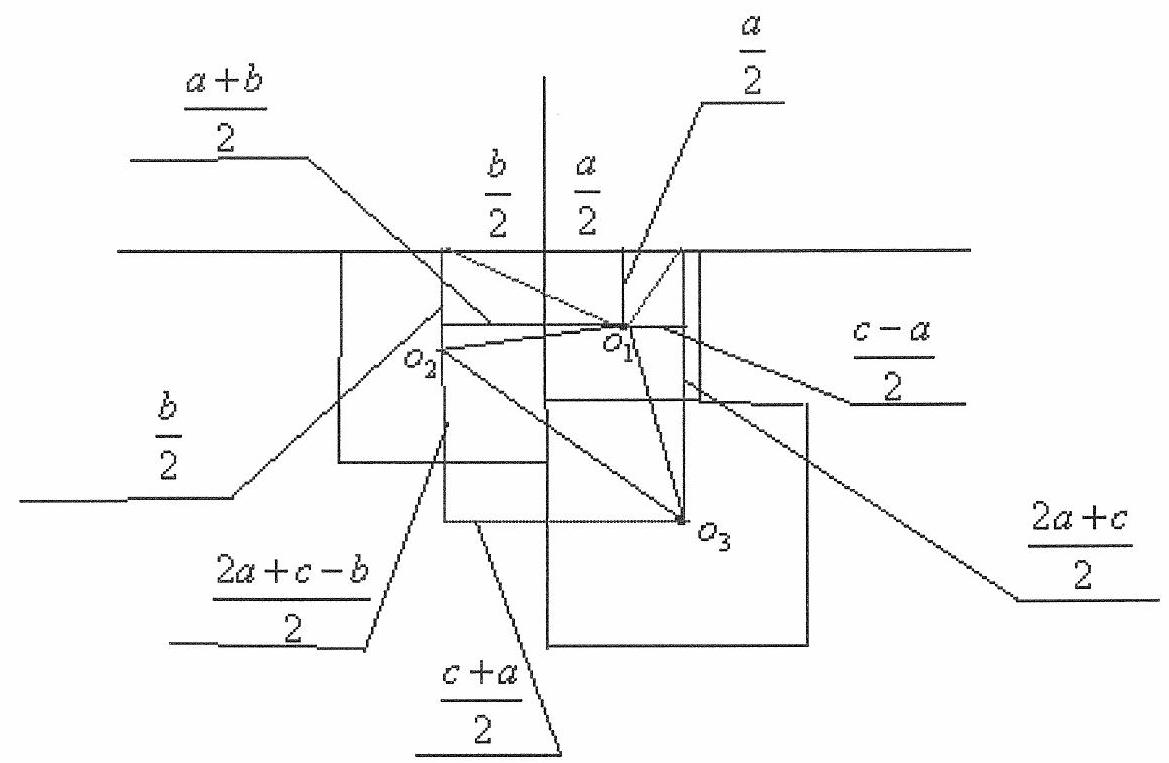
$S_{0,0_{2} 0_{3}}=\frac{(a+c)(a... | \frac{\sqrt{b^{2}(-)^{2}+^{2}(-b)^{2}}}{(+)(+b)}=\frac{\sqrt{2}}{4} | Algebra | math-word-problem | Incomplete | Yes | olympiads | false |
if the sum of the 4 th term and the 12 th term of an arithmetic progression is 24 , what is the sum of the first 15 terms of the progression ? | Let's denote the first term of the arithmetic progression as \( a \) and the common difference as \( d \).
The \( n \)th term of an arithmetic progression can be found using the formula:
\[ a_n = a + (n - 1)d \]
Given that the sum of the 4th term and the 12th term is 24, we can write:
\[ a_4 + a_{12} = 24 \]
Using t... | 180 | Algebra | math-word-problem | Yes | Yes | orca_math | true |
Show that if $a, b, c$ are strictly positive real numbers such that $a b + b c + c a = a b c$, then $\sum_{c y c} \frac{a^{4} + b^{4}}{a b \left(a^{3} + b^{3}\right)} \geqslant 1$. | Let $x=1 / a$, etc. We have $\sum x=1$ and we want to show that $\sum \frac{x^{4}+y^{4}}{x^{3}+y^{3}} \geqslant 1$. We seek $a$ such that $\frac{x^{4}+y^{4}}{x^{3}+y^{3}} \geqslant a x+(1-a) y$. For symmetry reasons, it is natural to try $a=1 / 2$. It then suffices to show that $t^{4}+1 \geqslant\left(t^{3}+1\right)(t+... | proof | Inequalities | proof | Yes | Yes | olympiads | false |
p, q, and r enter into a partnership & their shares are in the ratio 1 / 2 : 1 / 3 : 1 / 4. After two months, p withdraws half of the capitals & after 10 months, a certain profit is divided among them. q's share is Rs 144. What is the total profit that was divided among them? | Let's denote the initial capitals of p, q, and r as P, Q, and R respectively. According to the given ratio of their shares, we have:
P / Q = 1/2 : 1/3 = 3 : 2
Q / R = 1/3 : 1/4 = 4 : 3
To make calculations easier, let's assume a common multiple for the denominators of the ratios, which is 12. So, we can assume the in... | 486 | Algebra | math-word-problem | Yes | Yes | orca_math | true |
Let $a= \int_{0}^{\pi} (\cos x - \sin x) dx$, then the coefficient of the $x^3$ term in the expansion of $(x^2+ \frac{a}{x})^6$ is \_\_\_\_\_\_. | Given $a= \int_{0}^{\pi} (\cos x - \sin x) dx = (\sin x + \cos x) |_{0}^{\pi} = -2$,
thus $(x^2+ \frac{a}{x})^6 = (x^2- \frac{2}{x})^6$.
Since $T_{k+1} = C_{6}^{k} (x^2)^{6-k} \cdot (- \frac{2}{x})^k = (-1)^k \cdot 2^k \cdot C_{6}^{k} \cdot x^{12-3k}$,
to find the coefficient of $x^3$, set $12-3k=3$.
Solving th... | -160 | Calculus | math-word-problem | Yes | Yes | cn_k12 | false |
Example 3. Two dice are rolled. Find the probability of event $A$ - "the sum of the points rolled does not exceed four". | Solution. Event $A$ is the sum of three mutually exclusive events $B_{2}, B_{3}, B_{4}$, which means the sum of the points is 2, 3, or 4, respectively. Since
$$
P\left(B_{2}\right)=\frac{1}{36}, \quad P\left(B_{3}\right)=\frac{2}{36}, \quad P\left(B_{4}\right)=\frac{3}{36}
$$
by the theorem of addition of probabiliti... | \frac{1}{6} | Combinatorics | math-word-problem | Yes | Yes | olympiads | false |
In 1748, Swiss mathematician Euler discovered the relationship between complex exponential functions and trigonometric functions, and wrote the formula $e^{ix}=\cos x+i\sin x$ ($x\in R$, $i$ is the imaginary unit). This formula holds a very important position in complex analysis and is known as the "bridge in mathemati... | To analyze each option based on Euler's formula $e^{ix}=\cos x+i\sin x$, we proceed as follows:
**Option A:**
Given $x=\pi$, we apply Euler's formula:
\[
e^{i\pi} = \cos \pi + i\sin \pi = -1 + i\cdot0 = -1
\]
Therefore,
\[
e^{i\pi} + 1 = -1 + 1 = 0
\]
So, option A is correct.
**Option B:**
We have the expression $\le... | \text{D} | Algebra | MCQ | Yes | Yes | cn_k12 | false |
Given the function $f(t)= \sqrt { \frac {1-t}{1+t}}$, $F(x)=\sin x\cdot f(\cos x)+\cos x\cdot f(\sin x)$ and $\pi 0$, $\omega > 0$, $\varphi\in[0,2\pi)$);
(II) Find the range of the function $F(x)$. | (I) Given $\pi < x < \frac {3\pi}{2}$, we know that $\sin x < 0$ and $\cos x < 0$.
$\therefore F(x)=\sin x \sqrt { \frac {1-\cos x}{1+\cos x}}+\cos x \sqrt { \frac {1-\sin x}{1+\sin x}}=\sin x\cdot \frac {1-\cos x}{|\sin x|}+\cos x\cdot \frac {1-\sin x}{|\cos x|}=\sin x+\cos x-2= \sqrt {2}\sin (x+ \frac {\pi}{4})-2$;
... | [-2- \sqrt {2},-3) | Algebra | math-word-problem | Yes | Yes | cn_k12 | false |
In triangle $ABC$, $AB=2$, $AC=1+\sqrt{5}$, and $\angle CAB=54^{\circ}$. Suppose $D$ lies on the extension of $AC$ through $C$ such that $CD=\sqrt{5}-1$. If $M$ is the midpoint of $BD$, determine the measure of $\angle ACM$, in degrees. | null | null | Geometry | math-word-problem | Yes | Yes | aops_forum | false |
A bakery sells 3 different types of cakes: chocolate, vanilla, and strawberry. During a full week, from Monday to Sunday, the bakery sold the following number of cakes each day:
- Monday: 6 chocolate, 4 vanilla, 3 strawberry
- Tuesday: 7 chocolate, 5 vanilla, 2 strawberry
- Wednesday: 4 chocolate, 3 vanilla, 6 strawbe... | To find out how many cakes of each type were sold during the whole week, we need to add up the number of cakes sold each day for each type.
For chocolate cakes:
Monday: 6
Tuesday: 7
Wednesday: 4
Thursday: 8
Friday: 9
Saturday: 10
Sunday: 5
Total chocolate cakes sold = 6 + 7 + 4 + 8 + 9 + 10 + 5 = 49
For vanilla cakes... | 31 | Algebra | math-word-problem | Yes | Yes | orca_math | true |
In a triangle $ABC$, the internal angle bisectors at $A, B$, and $C$ intersect the circumcircle at $A_{1}, B_{1}$, and $C_{1}$ respectively. Show that $A A_{1} + B B_{1} + C C_{1} > A B + B C + C A$. | We will use Ptolemy's theorem: the product of the diagonals of a convex cyclic quadrilateral is equal to the sum of the products of the opposite sides. Here, for example: \( A A_{1} \times B C = (A B \times A_{1} C) + (A C \times A_{1} B) \). Since \( A A_{1} \) is the angle bisector of \( \widehat{B A C} \), \( A_{1} ... | proof | Geometry | proof | Yes | Yes | olympiads | false |
Evaluate: $6 - 8\left(9 - 4^2\right)/2$. | Following the order of operations for the expression, we begin with the exponentiation and proceed with operations inside the parentheses, then the division, and finally the subtraction:
\begin{align*}
6 - 8\left(9 - 4^2\right)/2 &= 6 - 8\left(9 - 16\right)/2\\
&= 6 - 8(-7)/2\\
&= 6 - (-28)/2\\
&= 6 + 14\\
&= \boxed{20... | 20 | Algebra | math-word-problem | Yes | Yes | synthetic_math | true |
For what value(s) of the real number \\(m\\), does \\(z=\\dfrac{{{m}^{2}}-m-6}{m+3}+({{m}^{2}}-5m+6)i\\)
\\((1)\\) become a purely imaginary number;
\\((2)\\) the point corresponding to the complex number \\(z\\) lie in the second quadrant of the complex plane. | Solution:
\\((1)\\) For \\(z\\) to be purely imaginary, \\(\\dfrac{{{m}^{2}}-m-6}{m+3}\\ne 0\\) and \\({{m}^{2}}-5m+6=0\\) must hold.
\\(\therefore m=-2;\\)
\\((2)\\) For the point corresponding to \\(z\\) to lie in the second quadrant, \\({{m}^{2}}-5m+6 0\\) must hold.
\\(\therefore m 3\\).
Thus, the answers... | m 3 | Algebra | math-word-problem | Yes | Yes | cn_k12 | false |
$ABCD$ is a convex quadrilateral such that $AB=2$, $BC=3$, $CD=7$, and $AD=6$. It also has an incircle. Given that $\angle ABC$ is right, determine the radius of this incircle. | 1. **Identify the given information and the goal:**
- We have a convex quadrilateral \(ABCD\) with sides \(AB = 2\), \(BC = 3\), \(CD = 7\), and \(AD = 6\).
- \(\angle ABC\) is a right angle.
- The quadrilateral has an incircle, and we need to determine the radius of this incircle.
2. **Use the Pythagorean th... | null | Geometry | math-word-problem | Yes | Yes | aops_forum | false |
Find the equation of the tangent line to the curve $f(x)=e^{x}+5\sin x$ at the point $(0,1)$. | The derivative of the function is $f'(x)=e^{x}+5\cos x$.
Then $f'(0)=e^{0}+5\cos 0=1+5=6$.
Thus, the slope of the tangent line at the point $(0,1)$ is $k=f'(0)=6$.
The corresponding equation is $y-1=6x$, which simplifies to $y=6x+1$.
Hence, the answer is: $\boxed{y=6x+1}$.
To solve this problem, we need to find th... | y=6x+1 | Calculus | math-word-problem | Yes | Yes | cn_k12 | false |
Penelope decided to save 24 dollars every day for a certain period. At the end of that period, she had saved 8760 dollars. How long did Penelope save money for? | To find out how long Penelope saved money for, we need to divide the total amount she saved by the amount she saved each day.
Total amount saved: $8760
Amount saved each day: $24
Number of days she saved for = Total amount saved / Amount saved each day
Number of days she saved for = $8760 / $24
Now, let's do the cal... | 365 | Algebra | math-word-problem | Yes | Yes | orca_math | true |
Let $a$ and $b$ be real numbers such that $a + 3i$ and $b + 6i$ are the roots of
\[ z^2 - (12 + 9i) z + (15 + 65i) = 0. \] | Using Vieta's formulas:
\[
(a + 3i) + (b + 6i) = 12 + 9i \quad \text{and} \quad (a + 3i)(b + 6i) = 15 + 65i.
\]
From the first equation, $a + b + 9i = 12 + 9i$, so $a + b = 12.$
Expanding and equating the second equation:
\[
ab + 3bi + 6ai - 18 + (6a + 3b + 18)i = 15 + 65i.
\]
Equating real and imaginary parts:
\[
ab ... | \left(\frac{7}{3}, \frac{29}{3}\right) | Algebra | math-word-problem | Yes | Yes | synthetic_math | true |
One day, Lao Wang went out for a trip on a motorcycle. At the beginning of the journey, the fuel tank had 9 liters of fuel. After traveling for 2 hours, he found that there were 6 liters of fuel left in the tank.
(1) Find the functional relationship between the remaining fuel $Q$ (in liters) and the time traveled $t$ ... | ### Solution
#### Part 1: Finding the Functional Relationship
Given that Lao Wang started with 9 liters of fuel and after 2 hours had 6 liters left, we can determine the rate of fuel consumption and establish the functional relationship between the remaining fuel $Q$ (in liters) and the time traveled $t$ (in hours).
... | 200 \text{ kilometers} | Algebra | math-word-problem | Yes | Yes | cn_k12 | false |
10.50*. On the median $B M$ of triangle $A B C$, a point $X$ is taken. Prove that if $A B \angle X C B$.
Note: The original problem seems to have a typo or is incomplete, as the condition "if $A B \angle X C B$" does not form a complete statement. It might be intended to say something like "if $\angle ABX = \angle XC... | 10.50. Since $A B \sin X C B$. Given that angle $X C B$ is acute, we obtain the required result. | proof | Geometry | proof | Incomplete | Problem not solved | olympiads | false |
Given the graph of $y = f(x)$:
[Diagram identical to the one provided in the original problem]
Determine the graph of the function $y = f\left(2x + 1\right)$:
[Diagrams of five options A, B, C, D, E showing various transformed graphs of $y = f(x)$] | The transformation $x \rightarrow 2x + 1$ means we compress the graph of $y = f(x)$ horizontally by a factor of $\frac{1}{2}$ (since $2x$ compresses by $\frac{1}{2}$) and then shift it left by $\frac{1}{2}$ unit.
1. **Compress Horizontally by $\frac{1}{2}$**: Apply the transformation $x \rightarrow 2x$.
- This impa... | \text{C} | Algebra | MCQ | Yes | Yes | synthetic_math | true |
Determine the value of $\cos \frac{2017\pi }{6}$. The options are:
A: $-\frac{1}{2}$
B: $-\frac{\sqrt{3}}{2}$
C: $\frac{1}{2}$
D: $\frac{\sqrt{3}}{2}$ | This problem tests our understanding of the trigonometric functions of special angles and the application of the reduction formula.
Step 1: Simplify the given angle.
We notice that $\frac{2017\pi}{6}$ is greater than $2\pi$. To find the cosine of this angle, we can subtract $2\pi$ as many times as necessary until we g... | \text{D: } \frac{\sqrt{3}}{2} | Algebra | MCQ | Yes | Yes | cn_k12 | false |
There are 128 students in the school, distributed among 4 classrooms with a varying number of students in each. In Classroom A, there are 37 students; in Classroom B, 31 students; in Classroom C, 25 students; and in Classroom D, 35 students. The teacher needs to create a total of 9 groups of equal sizes combining stude... | First, let's find the total number of students that can be divided into 9 groups. We have:
Classroom A: 37 students
Classroom B: 31 students
Classroom C: 25 students
Classroom D: 35 students
Total students = 37 + 31 + 25 + 35 = 128 students
Now, we need to divide these 128 students into 9 groups of equal size. To fi... | 2 | Logic and Puzzles | math-word-problem | Yes | Yes | orca_math | true |
To get clean, Michael takes a bath twice a week and a shower once a week. How many total times does he clean himself in 52 weeks, 156 is about x year. What is the value of unknown variable x? What is the value of unknown variable x? | To determine the total number of times Michael cleans himself in 52 weeks, we need to calculate the number of baths and showers he takes in a week and then extend that to 52 weeks.
First, let's find out how many baths Michael takes in a week:
\[ \text{Number of baths per week} = 2 \]
Next, let's find out how many sho... | 3 | Logic and Puzzles | math-word-problem | Incomplete | Yes | metamath | true |
Given the function $f\left(x\right)=x^{3}(3\ln x-1)$, then ( )
A: The minimum value of the function $f\left(x\right)$ is $-1$
B: If the tangent line of the function $f\left(x\right)$ at the point $\left(m,f\left(m\right)\right)$ is parallel to the line $y=9e^{2}x-1$, then $f\left(m\right)=2e^{3}$
C: The function $g\... | **For A:**
First, we find the derivative of the function $f(x)$:
\[
f'(x) = \frac{d}{dx}[x^{3}(3\ln x-1)] = 3x^{2}(3\ln x-1) + x^{3}\cdot \frac{3}{x} = 9x^{2}\ln x
\]
Next, we set $f'(x) = 0$ to find critical points:
\[
9x^{2}\ln x = 0 \implies x = 1
\]
Analyzing the sign of $f'(x)$:
- On $(0,1)$, $f'(x) 0$, indicati... | ABD | Calculus | MCQ | Yes | Yes | cn_k12 | false |
8.20. $\angle A, h_{b}$ and $h_{c}$. | 8.20. Construct angle \( B' A C' \), equal to \(\angle A\). Point \( B \) is constructed as the intersection of ray \( A B' \) and a line parallel to ray \( A C' \) and at a distance \( h_b \) from it. Point \( C \) is constructed similarly. | notfound | Geometry | math-word-problem | Incomplete | Yes | olympiads | false |
4. Let $H$ be the orthocenter of $\triangle A B C$, and $O$ be the circumcenter of $\triangle A B C$. If $|\overrightarrow{H A}+\overrightarrow{H B}+\overrightarrow{H C}|=2$, then $|\overrightarrow{O A}+\overrightarrow{O B}+\overrightarrow{O C}|=$ $\qquad$ . | 4. 1.
From the problem, we know
$$
\begin{array}{l}
\overrightarrow{O A}+\overrightarrow{O B}+\overrightarrow{O C}=\overrightarrow{O H} \\
\Rightarrow|\overrightarrow{H A}+\overrightarrow{H B}+\overrightarrow{H C}| \\
\quad=|\overrightarrow{O A}+\overrightarrow{O B}+\overrightarrow{O C}-3 \overrightarrow{O H}| \\
\qua... | 1 | Geometry | math-word-problem | Yes | Yes | olympiads | false |
For how many real numbers $a$ does the quadratic equation $x^2 + ax + 9a = 0$ have only integer roots for $x$? | Let $r$ and $s$ be the integer roots. By Vieta's formulas, $r+s = -a$ and $rs = 9a.$
Now, formulate an equation with these:
\[ rs + 9(r+s) = 0. \]
Expanding and rearranging,
\[ rs + 9r + 9s = 0. \]
Applying the factorization trick (Simon's Favorite Factoring Trick):
\[ rs + 9r + 9s + 81 = 81 \implies (r+9)(s+9) = 81.... | 6 | Algebra | math-word-problem | Yes | Yes | synthetic_math | true |
Given positive real numbers $x$ and $y$ satisfying $2x + y = 2$, find the minimum value of $x + \sqrt{x^2 + y^2}$. | Let's consider the function $f(x) = x + \sqrt{x^2 + y^2}$, where $y = 2 - 2x$. Since $x$ and $y$ are positive, we have $0 0$ when $x \in (\frac{3}{5}, 1)$. This means that $f(x)$ has a local minimum at $x = \frac{3}{5}$ within the domain of $x$.
Plugging in $x = \frac{3}{5}$ into $f(x)$, we find the minimum value:
$$... | \frac{8}{5} | Algebra | math-word-problem | Yes | Yes | cn_k12 | false |
If the complex number $((1+i)(1+mi))$ is a real number, then the real number $m=$ \_\_\_\_\_\_. | First, we expand and simplify the given complex number:
\begin{align*}
(1+i)(1+mi) &= 1 \cdot (1+mi) + i \cdot (1+mi) \\
&= (1+mi) + i(1+mi) \\
&= 1 + mi + i + mi^2 \\
&= 1 + mi + i - m \quad (\text{since } i^2=-1) \\
&= -m + 1 + (m+1)i.
\end{align*}
A complex number is a real number if and only if its imaginary part ... | -1 | Algebra | math-word-problem | Yes | Yes | cn_k12 | false |
In triangle $\triangle ABC$, a line passing through the midpoint $E$ of the median $AD$ intersects sides $AB$ and $AC$ at points $M$ and $N$ respectively. Let $\overrightarrow{AM} = x\overrightarrow{AB}$ and $\overrightarrow{AN} = y\overrightarrow{AC}$ ($x, y \neq 0$), then the minimum value of $4x+y$ is \_\_\_\_\_\_. | From the given conditions, we have $\overrightarrow{AM} = \overrightarrow{AE} + \overrightarrow{EM} = \frac{\overrightarrow{AD}}{2} + \overrightarrow{EM} = \frac{\overrightarrow{AB} + \overrightarrow{AC}}{4} + \overrightarrow{EM} = x\overrightarrow{AB}$. Therefore, $\overrightarrow{EM} = (x- \frac{1}{4})\overrightarrow... | \frac{9}{4} | Geometry | math-word-problem | Yes | Yes | cn_k12 | false |
Let $f(x) = \displaystyle \frac{1}{ax+b}$ where $a$ and $b$ are nonzero constants. Find all solutions to $f^{-1}(x) = X$. Express your answer in terms of $a$ and/or $b$. 1. What is the value of unknown variable X? | To find the value of \(X\) for which \(f^{-1}(x) = X\), we first need to determine the inverse function \(f^{-1}(x)\) of the function \(f(x) = \frac{1}{ax+b}\). Here are the steps:
1. **Express \(y\) in terms of \(x\):**
Start with the function \(y = f(x) = \frac{1}{ax+b}\).
2. **Solve for \(x\) in terms of \(y\):... | \frac{1-bx}{ax} | Algebra | math-word-problem | Yes | Yes | metamath | true |
in a certain game of dice , the player ’ s score is determined as a sum of 3 throws of a single die . the player with the highest score wins the round . if more than one player has the highest score , the winnings of the round are divided equally among these players . if john plays this game against 22 other players , ... | To guarantee some monetary payoff, John needs to score the maximum possible with three throws of a single die. Since a standard die has six faces, the highest score on one throw is 6. Therefore, the highest score John can achieve with three throws is 6 + 6 + 6 = 18.
If John scores 18, no other player can score higher ... | 18 | Combinatorics | math-word-problem | Yes | Yes | orca_math | true |
In triangle $ABC$, $AX = XY = YB = BC$, and the measure of angle $ABC$ is 90 degrees. What is the number of degrees in the measure of angle $BAC$? | Let $t$ be the number of degrees in the measure of angle $BAC$.
Since $AX=XY$, we have $\angle AYX = \angle YAX = \angle BAC = t^\circ$. Then, since the sum of angles in $\triangle AXY$ is $180^\circ$, we have $\angle AXY = (180-2t)^\circ$.
Angles $\angle AXY$ and $\angle BXY$ are supplementary; thus, $\angle BXY = (... | 22.5 | Geometry | math-word-problem | Yes | Yes | synthetic_math | true |
Given $\sin (\frac{\pi }{3}-x)=\frac{3}{5}$, find $\cos (\frac{5\pi }{6}-x)=$ $(\ $ $\ )$
A: $\frac{3}{5}$
B: $\frac{4}{5}$
C: $-\frac{3}{5}$
D: $-\frac{4}{5}$ | This problem tests your understanding of trigonometric function induction formulas and simple trigonometric function evaluation. The key to solving this problem is to flexibly apply the induction formulas.
Step 1: We know that $\sin (\frac{\pi }{3}-x)=\sin (\frac{\pi }{2}-(\frac{\pi }{6}+x))=\cos (\frac{\pi }{6}+x)=\f... | -\frac{3}{5} | Algebra | MCQ | Yes | Yes | cn_k12 | false |
Do there exist integers $a$ and $b$ such that none of the numbers $a,a+1,\ldots,a+2023,b,b+1,\ldots,b+2023$ divides any of the $4047$ other numbers, but $a(a+1)(a+2)\cdots(a+2023)$ divides $b(b+1)\cdots(b+2023)$?
| 1. **Choosing \( a \)**:
- Let \( p_{ij} \) for \( 0 \le i, j \le 2023 \) be a sequence of distinct primes, all of which are sufficiently large (in particular, larger than 2023).
- Set \( a \) such that \( a \equiv p_{ij} - i \pmod{p_{ij}^2} \) for any \( i, j \). Such an \( a \) exists due to the Chinese Remaind... | null | Number Theory | math-word-problem | Yes | Yes | aops_forum | false |
If some persons can do 7 times of a particular work in 7 days, then 9 persons can do 9 times of that work in 7 days. How many persons were in the first group? | Let's denote the amount of work done by one person in one day as W.
If some persons can do 7 times of a particular work in 7 days, we can write the following equation:
Number of persons * 7 days * W = 7 times the work
Let's call the number of persons in the first group P. Then we have:
P * 7W = 7
Now, we are told t... | 9 | Algebra | math-word-problem | Yes | Yes | orca_math | true |
In a certain species of fungi, the number of fungi triples every day. The colony starts with 4 fungi, and has 12 at the end of day 1, 36 at the end of day 2, and so on. Determine the number of the first day which ends with the colony having more than 1000 fungi. | The number of fungi is multiplied by 3 at the end of each day, so the number of fungi at the end of day $n$ is $4 \cdot 3^n$. We want $4 \cdot 3^n > 1000$, or $3^n > 250$.
We calculate the smallest $n$ such that $3^n > 250$:
- $3^0 = 1$
- $3^1 = 3$
- $3^2 = 9$
- $3^3 = 27$
- $3^4 = 81$
- $3^5 = 243$
- $3^6 = 729$
Sin... | 6 | Algebra | math-word-problem | Yes | Yes | synthetic_math | true |
What is the range of the function $$s(y) = \frac{1}{(1+y)^2 + 1}~?$$ Express your answer in interval notation. | To find the range of the function $$s(y) = \frac{1}{(1+y)^2 + 1},$$ we analyze the behavior of the denominator and its impact on the function values:
1. Calculate the denominator's behavior:
For any $y \in \mathbb{R}$, the expression $(1+y)^2 \geq 0$. Therefore, $(1+y)^2+1 \geq 1$ because we add 1 to a nonnegative ... | (0, 1] | Algebra | math-word-problem | Yes | Yes | synthetic_math | true |
During the "May Day" holiday, a school organizes a trip for its students. If they rent buses with 45 seats each, exactly $x$ buses are needed to accommodate everyone. However, if they rent buses with 60 seats each, they can rent one less bus, and the last bus will have some empty seats. The number of empty seats in the... | The total number of people is $45x$.
Thus, the number of people in the last bus is: $45x - 60(x-1) = 120 - 15x$,
The number of empty seats is $60 - (120 - 15x) = 15x - 60$.
Therefore, the correct option is $\boxed{\text{B}}$. | \text{B} | Algebra | MCQ | Yes | Yes | cn_k12 | false |
In the diagram, square $P Q R S$ has side length 42 and is divided into four non-overlapping rectangles. If each of these four rectangles has the same perimeter, what is the area of the shaded rectangle?
(A) 252
(B) 432
(C) 441
(D) 490
(E) 540
, then the perimeter of the bottom rectangle is $2(42)+2(42-2 x)=168-4 x$.
Suppose that t... | 540 | Geometry | MCQ | Yes | Yes | olympiads | false |
Given that the random variable $\xi$ follows a standard normal distribution $N(0,1)$, and $P(\xi \leqslant -1.96)=0.025$, determine the value of $P(|ξ| < 1.96)$ equals ( ).
A: $0.025$
B: $0.950$
C: $0.050$
D: $0.975$ | **Analysis**
This problem tests our understanding of the properties of normal distributions, specifically, their symmetry. Consequently, we can utilize this property to find the required probability.
**Step-by-step Solution**
1. We know that $\xi$ is a random variable following the standard normal distribution $N(0,... | 0.950 | Algebra | MCQ | Yes | Yes | cn_k12 | false |
John hiked a total of $3562_9$ kilometers in his adventurous trek. How many kilometers (in base ten) did John trek? | To convert the base-9 number $3562_9$ to base-10, we can use the formula:
$$ b_ka^k + b_{k-1}a^{k-1} + \ldots + b_1a^1 + b_0a^0 $$
For the number $3562_9$, applying the powers of 9:
- $3 \cdot 9^3 = 3 \cdot 729 = 2187$
- $5 \cdot 9^2 = 5 \cdot 81 = 405$
- $6 \cdot 9^1 = 6 \cdot 9 = 54$
- $2 \cdot 9^0 = 2 \cdot 1 = 2$
... | 2648 | Number Theory | math-word-problem | Yes | Yes | synthetic_math | true |
Of the land owned by a farmer, 90 percent was cleared for planting. Of the cleared land, 30 percent was planted with soybeans and 60 percent of the cleared land was planted with wheat. The remaining 540 acres of cleared land was planted with corn. How many acres did the farmer own? | Let's denote the total land owned by the farmer as \( A \) acres.
According to the problem, 90% of the land was cleared for planting. So, the cleared land is \( 0.90A \).
Of the cleared land, 30% was planted with soybeans and 60% with wheat. This means that the remaining 10% of the cleared land was planted with corn ... | 6000 | Algebra | math-word-problem | Yes | Yes | orca_math | true |
Given the complex number $\omega = (m^2 - 2m - 3) + (m^2 - m - 12)i$, where $m \in \mathbb{R}$ and $i$ is the imaginary unit,
(1) If $\omega$ is a real number, find the value of $m$;
(2) If the point corresponding to the complex number $\omega$ is in the fourth quadrant, determine the range of real values of $m$. | (1) Since $\omega = (m^2 - 2m - 3) + (m^2 - m - 12)i$ is a real number,
the imaginary part must be zero, i.e., $m^2 - m - 12 = 0$.
Solving this quadratic equation gives us:
\[
m^2 - m - 12 = (m-4)(m+3) = 0.
\]
Therefore, the possible values of $m$ are $m = 4$ or $m = -3$.
So, we have:
\[
\boxed{m = 4 \text{ or } m = -... | 3 < m < 4 | Algebra | math-word-problem | Yes | Yes | cn_k12 | false |
If the following sequence of five arrows repeats itself continuously, what arrow would be in the 48th position?

$(\mathbf{A}) \longrightarrow$
(B)
(C)
(D)

(A)
(B)
(C)
(D)
(E)
## Solution
Since this sequence repeats itself, once it ... | C | Combinatorics | MCQ | Incomplete | Yes | olympiads | false |
Given that $S_n$ is the sum of the first $n$ terms of the sequence $\{a_n\}$, with $a_1=1$, $a_2=2$, $a_3=3$, and the sequence $\{a_n+a_{n+1}+a_{n+2}\}$ forms an arithmetic sequence with a common difference of $2$, then $S_{24}=$ .
A: $110$
B: $216$
C: $214$
D: $218$ | Since the sequence $\{a_n+a_{n+1}+a_{n+2}\}$ forms an arithmetic sequence with a common difference of $2$,
$\therefore a_{n+3}-a_{n} = a_{n+1}+a_{n+2}+a_{n+3}-(a_{n}+a_{n+1}+a_{n+2}) = 2$,
$\therefore$ The sequence formed by taking every second term has a common difference of $2$,
Given $a_1=1$, $a_2=2$, $a_3=3$,
$... | B | Algebra | MCQ | Yes | Yes | cn_k12 | false |
In a geometric sequence $\{a_{n}\}$, the sum of the first $n$ terms is ${S_n}={3^n}+r$. Find the value of $r$. | To find the value of $r$ in the given geometric sequence $\{a_{n}\}$ where the sum of the first $n$ terms is $S_n = 3^n + r$, we proceed as follows:
1. We know that $S_n = 3^n + r$. For $n \geqslant 2$, $n \in \mathbb{N}^{+}$, we can express $S_{n-1}$ as $S_{n-1} = 3^{n-1} + r$.
2. The $n$-th term of the sequence, $a... | -1 | Algebra | math-word-problem | Yes | Yes | cn_k12 | false |
If the l.c.m. of three numbers is 1200 and their product is 108,000, find the h.c.f. of the numbers. | Let the three numbers be a, b, and c. We are given that the least common multiple (l.c.m.) of these numbers is 1200 and their product is 108,000.
The relationship between the least common multiple (l.c.m.) and the highest common factor (h.c.f.) of any two numbers is given by the formula:
l.c.m.(a, b) * h.c.f.(a, b) =... | 90 | Number Theory | math-word-problem | Yes | Yes | orca_math | true |
Let $k$ and $N$ be two integers.
Show that
$$
\sum_{n=k}^{N}\binom{n}{k}=\binom{N+1}{k+1}
$$ | We fix $k$ and proceed by induction on $N \geqslant k$ using Pascal's formula (it is highly recommended to make a diagram).
Initialization For $N=k$ we have
$$
\sum_{n=k}^{k}\binom{n}{k}=\binom{k}{k}=\binom{k+1}{k+1}
$$
so $\mathcal{P}_{k}$ is true.
![](https://cdn.mathpix.com/cropped/2024_05_10_6d86e9a87432417d5c9... | proof | Combinatorics | proof | Yes | Incomplete | olympiads | false |
Subsets and Splits
No community queries yet
The top public SQL queries from the community will appear here once available.