
instruction_seed stringlengths 2 10.7k | solution stringlengths 0 10.8k ⌀ | answer stringlengths 0 575 ⌀ | problem_type stringclasses 9
values | question_type stringclasses 5
values | problem_is_valid stringclasses 5
values | solution_is_valid stringclasses 4
values | source stringclasses 11
values | synthetic bool 2
classes |
|---|---|---|---|---|---|---|---|---|
Given the function $f(x)=\log\frac{1-x}{1+x}$.
$(1)$ Find the solution set of the inequality $f(x) > 0$;
$(2)$ For the function $g(x)=2-a^{x}$ where $(a > 0, a \neq 1)$, if there exist $x_{1}$ and $x_{2} \in [0,1)$ such that $f(x_{1})=g(x_{2})$, find the range of real numbers for $a$. | ### Solution:
#### Part (1)
We start by analyzing the given inequality $f(x) > 0$, where $f(x)=\log\frac{1-x}{1+x}$.
1. First, we observe that $\log\frac{1-x}{1+x} > 0$ can be rewritten as $\log\frac{1-x}{1+x} > \log 1$ because the logarithm of 1 is 0.
2. Knowing that the logarithm function is strictly increasing, w... | (2, +\infty) | Algebra | math-word-problem | Yes | Yes | cn_k12 | false |
Given the complex number $z= \frac {2i}{1-i}$ (where $i$ is the imaginary unit), find $|z|=$
A: $1$
B: $\sqrt {2}$
C: $\sqrt {3}$
D: $2$ | Since the complex number $z= \frac {2i}{1-i}$,
we have $|z|=| \frac {2i}{1-i}|= \frac {2}{ \sqrt {2}}= \sqrt {2}$.
Therefore, the correct choice is $\boxed{B}$.
To solve this, we calculate the modulus of the numerator and the denominator separately to reach the conclusion.
This question tests the understanding of t... | B | Algebra | MCQ | Yes | Yes | cn_k12 | false |
Consider the function $h(x) = 5x - 7$. For what value of $b$ is $h(b) = 0$? | Given $h(x) = 5x - 7$, we need to find $b$ such that $h(b) = 0$.
Setting up the equation:
\[ 5b - 7 = 0 \]
Adding 7 to both sides:
\[ 5b = 7 \]
Dividing both sides by 5:
\[ b = \frac{7}{5} \]
Thus, the solution is $b = \boxed{\frac{7}{5}}$. | \frac{7}{5} | Algebra | math-word-problem | Yes | Yes | synthetic_math | true |
$\{a,b,c\}\subset\left(\frac{1}{\sqrt6},+\infty\right)$ such that $a^{2}+b^{2}+c^{2}=1.$ Prove that
$\frac{1+a^{2}}{\sqrt{2a^{2}+3ab-c^{2}}}+\frac{1+b^{2}}{\sqrt{2b^{2}+3bc-a^{2}}}+\frac{1+c^{2}}{\sqrt{2c^{2}+3ca-b^{2}}}\ge2(a+b+c).$ | null | null | Inequalities | proof | Yes | Yes | aops_forum | false |
Given point A(2, 0) and line $l: x = \frac{1}{2}$, if the ratio of the distance from moving point M to A and line $l$ is 2, then the equation of the trajectory of point M is _____. | According to the problem, the ratio of the distance from moving point M(x, y) to point A(2, 0) and line $l: x = \frac{1}{2}$ is 2.
We get $\frac{\sqrt{(x - 2)^2 + y^2}}{|x - \frac{1}{2}|} = 2$.
Simplify and rearrange to get $x^2 - \frac{y^2}{3} = 1$.
Therefore, the equation of the trajectory C of moving point M(x, y... | x^2 - \frac{y^2}{3} = 1 | Geometry | math-word-problem | Yes | Yes | cn_k12 | false |
Thomas has twelve socks in his drawer: three of each color (red, blue, green, and yellow). He randomly selects five socks. What is the probability that he has exactly two pairs of socks with different colors? | First, calculate the total number of ways Thomas can select five socks from twelve:
$$ \binom{12}{5} = 792 $$
For the desired event—selecting exactly two pairs and one other sock of a different color—we follow these steps:
1. Choose which two colors will provide the pairs. This can be done in:
$$ \binom{4}{2} = 6 \tex... | \frac{9}{22} | Combinatorics | math-word-problem | Yes | Yes | synthetic_math | true |
In the space rectangular coordinate system, points $A(1,2,3)$, $B(-1,0,5)$, $C(3,0,4)$, and $D(4,1,3)$ are given. The positional relationship between line $AB$ and line $CD$ is ( ).
A: Parallel
B: Perpendicular
C: Intersect but not perpendicular
D: Cannot be determined | Since in the space rectangular coordinate system,
$A(1,2,3)$, $B(-1,0,5)$, $C(3,0,4)$, $D(4,1,3)$,
therefore $\overrightarrow{AB}=(-2,-2,2)$, $\overrightarrow{CD}=(1,1,-1)$,
thus $\overrightarrow{AB}=-2 \overrightarrow{CD}$,
therefore, line $AB$ is parallel to line $CD$.
Hence, the correct choice is: $\boxed{... | A | Geometry | MCQ | Yes | Yes | cn_k12 | false |
$H,I,O,N$ are orthogonal center, incenter, circumcenter, and Nagelian point of triangle $ABC$. $I_{a},I_{b},I_{c}$ are excenters of $ABC$ corresponding vertices $A,B,C$. $S$ is point that $O$ is midpoint of $HS$. Prove that centroid of triangles $I_{a}I_{b}I_{c}$ and $SIN$ concide. | 1. Define the points and their roles in the triangle \(ABC\):
- \(H\) is the orthocenter.
- \(I\) is the incenter.
- \(O\) is the circumcenter.
- \(N\) is the Nagelian point.
- \(I_a, I_b, I_c\) are the excenters corresponding to vertices \(A, B, C\).
- \(S\) is a point such that \(O\) is the midpoint... | null | Geometry | proof | Yes | Yes | aops_forum | false |
What is the greatest number which on dividing 1657 and 2037 leaves remainders 6 and 5 respectively? | To find the greatest number that divides 1657 and 2037 leaving remainders of 6 and 5 respectively, we need to find the greatest common divisor (GCD) of the differences between the numbers and their respective remainders.
For 1657 with a remainder of 6, the number that is being divided is 1657 - 6 = 1651.
For 2037 with... | 127 | Number Theory | math-word-problem | Yes | Yes | orca_math | true |
Given the inequality $(x+y)\left( \frac {1}{x}+ \frac {a}{y}\right)\geqslant 9$ holds for any positive real numbers $x$, $y$, then the minimum value of the positive real number $a$ is ( ).
A: $2$
B: $4$
C: $6$
D: $8$ | To solve the given inequality $(x+y)\left( \frac {1}{x}+ \frac {a}{y}\right)\geqslant 9$ which holds for any positive real numbers $x$, $y$,
we need to find the minimum value of $(x+y)\left( \frac {1}{x}+ \frac {a}{y}\right)$ that is $\geqslant 9$
Since $1+a+ \frac {y}{x}+ \frac {ax}{y}\geqslant a+2 \sqrt {a}+1$, ... | B | Inequalities | MCQ | Yes | Yes | cn_k12 | false |
Once a week, it takes Kitty some minutes to pick up toys and straighten the living room. It takes another 20 minutes to vacuum the living room floor, seating and drapes. She spends 15 minutes cleaning the windows and 10 minutes dusting the furniture. After 4 weeks, Kitty has spent 200 minutes cleaning just the living r... | Let's denote the time Kitty takes to pick up toys and straighten the living room as \( T \) minutes.
From the information given, we know that each week Kitty spends:
- \( T \) minutes picking up toys and straightening the living room
- 20 minutes vacuuming
- 15 minutes cleaning the windows
- 10 minutes dusting the fur... | 5 | Algebra | math-word-problem | Yes | Yes | orca_math | true |
Example 5 If the diagonals of a convex quadrilateral are $2 a$ and $2 b$, prove that there must be one side not less than $\sqrt{a^{2}+b^{2}}$. Refer to Example 5 in the second chapter of the first article. | Let $O$ be the intersection point of the diagonals of quadrilateral $ABCD$. For the sake of definiteness, assume $\angle AOB = \angle COD \geqslant 90^{\circ}$. Then,
$$
AB^{2} = AO^{2} + BO^{2} - 2AO \cdot BO \cdot \cos \angle AOB \geqslant AO^{2} + BO^{2}
$$
Similarly, $CD^{2} \geqslant CO^{2} + DO^{2}$, thus
$$
AB^... | proof | Geometry | proof | Yes | Yes | olympiads | false |
## Task 6B - 261246B
Let $x_{1}, x_{2}, \ldots, x_{1987}$ be nonnegative real numbers, for which the sum of the squares is equal to 10 and the sum of the third powers is greater than 1.
Investigate whether it is always possible under these conditions to select
a) 9 of these numbers
b) 10 of these numbers
such that... | a) Such a selection is not always possible, e.g., not for
$$
x_{1}=\frac{1}{\sqrt{50}}, \quad x_{2}=\ldots=x_{999}=\frac{1}{10}, \quad x_{1000}=\ldots=x_{1987}=0
$$
For these numbers,
$$
\begin{gathered}
x_{1}^{2}+\ldots+x_{1987}^{2}=\frac{1}{50}+\frac{998}{100}=10 \quad \text{and} \\
x_{1}^{3}+\ldots+x_{1987}^{3}=\... | proof | Inequalities | math-word-problem | Yes | Yes | olympiads | false |
Let \(c\) and \(d\) be constants. Suppose that the equation \[\frac{(x+c)(x+d)(x-5)}{(x+4)^2} = 0\] has exactly 3 distinct roots, while the equation \[\frac{(x+2c)(x+6)(x+9)}{(x+d)(x-5)} = 0\] has exactly 1 distinct root. Compute \(100c + d.\) | 1. The roots of the first equation are \(x=-c\), \(x=-d\), and \(x=5\), and they are distinct. Also, these roots must be distinct from \(-4\) as the denominator \((x+4)^2\) should not be zero to avoid undefined conditions.
2. For the second equation, \(x=-4\) should be its only distinct root for it to have exactly ... | 93 | Algebra | math-word-problem | Yes | Yes | synthetic_math | true |
Given vectors $\overrightarrow{OA}=(k,12)$, $\overrightarrow{OB}=(4,5)$, $\overrightarrow{OC}=(10,k)$, and points $A$, $B$, $C$ are collinear. When $k < 0$, if $k$ is the slope of the line, then the equation of the line passing through point $(2,-1)$ is ___. | From the given information, we have $\overrightarrow{AB}=(4-k,-7)$ and $\overrightarrow{BC}=(6,k-5)$. Since $\overrightarrow{AB}$ and $\overrightarrow{BC}$ are collinear,
we have $(4-k)(k-5)+42=0$. Solving for $k$, we get $k=11$ or $k=-2$.
Since $k < 0$, we have $k=-2$.
Thus, the equation of the line passing through p... | 2x+y-3=0 | Algebra | math-word-problem | Yes | Yes | cn_k12 | false |
The solution set of the quadratic inequality $-x^2+2x-3>0$. | Given $-x^2+2x-3>0$,
we have $x^2-2x+3<0$,
which simplifies to $(x-1)^2+2<0$.
Therefore, there are no real solutions, so $x \in \emptyset$.
Hence, the answer is $\boxed{\emptyset}$. | \emptyset | Inequalities | math-word-problem | Yes | Yes | cn_k12 | false |
Given that $5^{12} \cdot 5^3$ is expressed as some integer to the third power, what is that integer? | To solve the problem, we will use the exponents rule for multiplications and adjust modifications to create a scenario for evaluation to the third power:
1. Using the product of powers rule:
\[ a^m \cdot a^n = a^{m+n} \]
Apply this to $5^{12} \cdot 5^3$:
\[ 5^{12} \cdot 5^3 = 5^{12+3} = 5^{15} \]
2. Rewriting $15$ as... | 125 | Algebra | math-word-problem | Yes | Yes | synthetic_math | true |
In the sequence $\{a\_n\}$, if $a\_1=1$ and $a\_{n+1}=2a\_n$ for all $n \geq 1$, find the general term $a\_n$. | Since $a\_1=1$ and $a\_{n+1}=2a\_n$ for all $n \geq 1$, the sequence is a geometric sequence with first term $1$ and common ratio $2$.
Thus, the general term of the sequence is given by $a\_n = 1 \times 2^{n-1} = \boxed{2^{n-1}}$.
To find the general term of the sequence, we can use the formula for a geometric sequenc... | 2^{n-1} | Algebra | math-word-problem | Yes | Yes | cn_k12 | false |
Given $x-2=4(y-1)+3$, express $y$ as an algebraic expression in terms of $x$. | Since $x-2=4(y-1)+3$,
Expanding the parentheses, we get: $x-2=4y-4+3$,
Rearranging and combining like terms, we obtain: $4y=x-1$,
Therefore, $y=\boxed{\frac{1}{4}x-\frac{1}{4}}$. | \frac{1}{4}x-\frac{1}{4} | Algebra | math-word-problem | Yes | Yes | cn_k12 | false |
[b]p1.[/b] Anka wants to know if it hurt when her crush fell from the sky. She curls up into a ball and jumps off a $80 $ meter high building. If she bounces up to $3/4$ of the previous height each bounce, how many times can she bounce while still moving a total distance of less than $300$ meters?
[b]p2.[/b] Alex wan... | 1. Notice that our sum is just
\[
\sum_{i_1 \ge 1, i_2, i_3, \cdots, i_{26} \ge 0}^{\infty} \frac{1}{2^{i_1}3^{i_2}4^{i_3} \cdots 27^{i_{26}}}
\]
Therefore, this is just the product of a geometric series with first term \(\frac{1}{2}\) and common ratio \(\frac{1}{2}\) and the 25 other geometric series with... | 13.5 | Calculus | math-word-problem | Yes | Yes | aops_forum | false |
Tickets for a play at the community theater cost 12 dollars for an adult and 4 dollars for a child. If 130 tickets were sold and a certain amount was collected in total receipts, and 40 adult tickets were sold, what was the total amount collected from ticket sales? | Let's calculate the total amount collected from ticket sales.
First, we know that 40 adult tickets were sold at $12 each. So, the total amount collected from adult tickets is:
40 adult tickets * $12/adult ticket = $480
Next, we need to find out how many child tickets were sold. We know that a total of 130 tickets wer... | \$840 | Algebra | math-word-problem | Yes | Yes | orca_math | true |
Determine values for $C$ and $D$ such that \[\frac{Dx - 17}{x^2 - 6x + 8} = \frac{C}{x - 2} + \frac{4}{x - 4}.\] Find $C + D$. | First, factor the denominator on the left-hand side:
\[x^2 - 6x + 8 = (x - 2)(x - 4).\]
The equation becomes:
\[\frac{Dx - 17}{(x-2)(x-4)} = \frac{C}{x-2} + \frac{4}{x-4}.\]
Multiply both sides by $(x-2)(x-4)$ to clear the denominators:
\[Dx - 17 = C(x - 4) + 4(x - 2).\]
To find $D$, substitute $x = 4$:
\[4D - 17 = 8.\... | 8.5 | Algebra | math-word-problem | Yes | Yes | synthetic_math | true |
Let $u$ and $v$ be integers satisfying $0 < v < u$. Define points as $A = (2u,v)$, and for transformations, let $B$ be the reflection of $A$ across the line $y = x$, $C$ be the reflection of $B$ across the y-axis, $D$ be the reflection of $C$ across the x-axis, and $E$ be the reflection of $D$ across the y-axis. The ar... | Given $A = (2u, v)$, we compute the coordinates of the points $B$, $C$, $D$, and $E$:
- $B = (v, 2u)$ (reflection across $y = x$),
- $C = (-v, 2u)$ (reflection across the y-axis),
- $D = (-v, -2u)$ (reflection across the x-axis),
- $E = (v, -2u)$ (reflection across the y-axis).
These points form the vertices of the pe... | 29 | Geometry | math-word-problem | Yes | Yes | synthetic_math | true |
The negation of the proposition "For all $x$ in $\mathbb{R}$, $\sin(2x) > 1$" is ( ).
A. For all $x$ in $R$, $\sin(2x) \leq 1$
B. For all $x$ not in $R$, $\sin(2x) > 1$
C. There exists an $x_0$ in $\mathbb{R}$ such that $\sin(2x_0) \leq 1$
D. There exists an $x_0$ not in $\mathbb{R}$ with $\sin(2x_0) > 1$ | To negate the proposition, we have to reverse the quantifier and the inequality at the same time.
The original proposition:
$$\forall x \in \mathbb{R}, \sin(2x) > 1 $$
Negating the quantifier and the inequality:
$$\exists x_0 \in \mathbb{R}, \sin(2x_0) \leq 1 $$
So, the correct choice is option C, which matches the ... | \text{C} | Logic and Puzzles | MCQ | Yes | Yes | cn_k12 | false |
Find the number of even digits in the base-7 representation of $1250_{10}$. Also, check if the sum of the even digits is divisible by 3. | 1. **Convert $1250_{10}$ to base-7**:
- Largest power of 7 less than 1250 is $7^3 = 343$.
- $1250 \div 343 \approx 3$, so the coefficient for $7^3$ is 3. The remainder is $1250 - 3 \times 343 = 221$.
- Next, $7^2 = 49$. $221 \div 49 \approx 4$, so the coefficient for $7^2$ is 4. The remainder is $221 - 4 \time... | \text{not divisible by 3} | Number Theory | math-word-problem | Yes | Yes | synthetic_math | true |
If $9^{3y}=729$, what is the value of $9^{3y-2}$? | 1. Start by expressing $9^{3y-2}$ in terms of $9^{3y}$ using exponent rules:
\[
9^{3y-2} = 9^{3y} \cdot 9^{-2}
\]
2. Substitute the given $9^{3y} = 729$ into the expression:
\[
9^{3y-2} = 729 \cdot 9^{-2}
\]
3. Simplify $9^{-2}$:
\[
9^{-2} = \left(9^2\right)^{-1} = \left(81\right)^{-1} = \frac{... | 9 | Algebra | math-word-problem | Yes | Yes | synthetic_math | true |
Given lines $m$, $n$ and plane $\alpha$, a necessary but not sufficient condition for $m \parallel n$ is ( )
A: $m \parallel \alpha$, $n \parallel \alpha$
B: $m \perp \alpha$, $n \perp \alpha$
C: $m \parallel \alpha$, $n \subset \alpha$
D: $m$, $n$ form equal angles with $\alpha$ | For option A, $m \parallel \alpha$, $n \parallel \alpha$ is neither a necessary nor a sufficient condition for $m \parallel n$; For option B, $m \perp \alpha$, $n \perp \alpha$ is a sufficient but not necessary condition for $m \parallel n$; For option C, $m \parallel \alpha$, $n \subset \alpha$ is neither a necessary ... | \text{D} | Geometry | MCQ | Yes | Yes | cn_k12 | false |
Zika virus is a type of arbovirus transmitted through mosquitoes, with a diameter of approximately 0.0000021 cm. Express the data 0.0000021 in scientific notation. | To express 0.0000021 in scientific notation, we can write it as $2.1 \times 10^{-6}$.
In general, positive numbers smaller than 1 can also be expressed in scientific notation, with the form $a \times 10^{-n}$. This is different from the scientific notation for larger numbers, as it uses a negative exponent, where the ... | 2.1 \times 10^{-6} | Algebra | math-word-problem | Yes | Yes | cn_k12 | false |
How many ordered triples of integers $(x, y, z)$ are there such that
\[
x^2 + y^2 + z^2 = 34 \, ?
\] | To find the number of ordered triples \((x, y, z)\) such that \(x^2 + y^2 + z^2 = 34\), we will systematically examine the possible values for \(x^2\), \(y^2\), and \(z^2\).
1. **Case \(x^2 = 0\):**
\[
y^2 + z^2 = 34
\]
- Possible values for \(y^2\) and \(z^2\) are \(9\) and \(25\) respectively:
\[
... | null | Number Theory | math-word-problem | Yes | Yes | aops_forum | false |
Two diagonals of a regular decagon (a 10-sided polygon) are chosen. What is the probability that their intersection lies inside the decagon and forms a convex quadrilateral? | - **Step 1**: Calculate total pairs of points in a decagon. Since there are 10 points,
\[
\binom{10}{2} = 45 \text{ pairs of points}
\]
- **Step 2**: Subtract the number of sides (10) from total pairs to find number of diagonals.
\[
45 - 10 = 35 \text{ diagonals}
\]
- **Step 3**: Calculate pairs of diagonal... | \dfrac{42}{119} | Combinatorics | math-word-problem | Yes | Yes | synthetic_math | true |
Example 5. For what values of $B$ and $C$ is the line $\frac{x-3}{1}=\frac{y-2}{B}=$ $=\frac{z+2}{C}$ perpendicular to the plane $3 x-2 y+5 z=0$? | Solution. The condition of perpendicularity of a line and a plane is equivalent to the condition of parallelism of their vectors $\vec{l}=\{1, B, C\}$ and $\vec{N}=$ $=\{3,-2,5\}$. The corresponding coordinates of these vectors must be proportional ( $\$ 3$ ): $\frac{1}{3}=\frac{B}{-2}=\frac{C}{5}$. From this, $B=-\fra... | B=-\frac{2}{3},C=\frac{5}{3} | Geometry | math-word-problem | Yes | Yes | olympiads | false |
A certain calculator is priced at $80 each. If you purchase no more than 20 units, you will pay the original price. If you purchase more than 20 units at once, the excess will be discounted by 30%. Let the quantity purchased at one time be $x (x > 20)$ units, and the payment amount be $y$ dollars. The expression betwee... | To solve the problem, let's break down the payment calculation into two parts based on the quantity purchased, $x$, where $x > 20$:
1. For the first 20 units, the price per unit is the original price, which is $80. So, the total cost for these 20 units is $80 \times 20$.
2. For any units purchased beyond the first 20... | A | Algebra | MCQ | Yes | Yes | cn_k12 | false |
Find two such common fractions - one with a denominator of 8, the other with a denominator of 13 - so that they are not equal, but the difference between the larger and the smaller of them is as small as possible.
# | Let the first fraction be $x / 8$, and the second be $y / 13$. Then the difference between the larger and the smaller of them is $1 / 104 \mid 13 x-$ $8 y \mid$. The numerator of the resulting fraction is a natural number. Therefore, it cannot be less than $\frac{1}{1} 104$. It can be equal to $1 / 104$. For this to ha... | \frac{3}{8},\frac{5}{13} | Number Theory | math-word-problem | Yes | Yes | olympiads | false |
If \( x \) satisfies \( \frac{1}{4} - \frac{1}{6} = \frac{4}{x} \), then what is the value of \( x \)? | First, evaluate the subtraction of the fractions on the left side:
\[ \frac{1}{4} - \frac{1}{6} = \frac{3}{12} - \frac{2}{12} = \frac{1}{12}. \]
Given that \( \frac{4}{x} = \frac{1}{12} \), solve for \( x \) by cross-multiplying:
\[ 4 = x \cdot \frac{1}{12} \implies x = 4 \cdot 12 = 48. \]
Thus, the value of \( x \) ... | 48 | Algebra | math-word-problem | Yes | Yes | synthetic_math | true |
Let $\gamma$ be circle and let $P$ be a point outside $\gamma$. Let $PA$ and $PB$ be the tangents from $P$ to $\gamma$ (where $A, B \in \gamma$). A line passing through $P$ intersects $\gamma$ at points $Q$ and $R$. Let $S$ be a point on $\gamma$ such that $BS \parallel QR$. Prove that $SA$ bisects $QR$. | 1. **Setup and Definitions**:
- Let $\gamma$ be a circle with center $O$.
- Let $P$ be a point outside $\gamma$.
- Let $PA$ and $PB$ be the tangents from $P$ to $\gamma$, with $A$ and $B$ being the points of tangency.
- A line passing through $P$ intersects $\gamma$ at points $Q$ and $R$.
- Let $S$ be a ... | null | Geometry | proof | Yes | Yes | aops_forum | false |
An octagon is inscribed in a circle of radius 3 units. In square units, what is the area of the octagon? Express your answer in simplest radical form. | First, observe that the octagon being regular means all sides are equal, and all central angles are 45 degrees, since \( 360^\circ / 8 = 45^\circ \).
Each side of the octagon subtends a \( 45^\circ \) angle at the center of the circle. Hence, we can consider the isosceles triangle formed by any two adjacent vertices o... | 18\sqrt{2} | Geometry | math-word-problem | Yes | Yes | synthetic_math | true |
If $(x^2+y^2+2)(x^2+y^2-3)=6$, then $x^2+y^2=$ ? | Given the equation, we can transform it into: $(x^2+y^2)^2-(x^2+y^2)-12=0$, which simplifies to $(x^2+y^2-4)(x^2+y^2+3)=0$.
Solving this, we get $x^2+y^2=4$ or $x^2+y^2=-3$ (discard this solution),
Therefore, $x^2+y^2=4$.
Hence, the answer is $\boxed{4}$. | 4 | Algebra | math-word-problem | Yes | Yes | cn_k12 | false |
$\overrightarrow{a}=(1,-1,2)$, $\overrightarrow{b}=(-2,1,0)$, $\overrightarrow{c}=(-3,1,k)$, if $\overrightarrow{a}$, $\overrightarrow{b}$, $\overrightarrow{c}$ are coplanar, then the real number $k=\_\_\_\_\_\_$. | To determine the value of $k$ for which vectors $\overrightarrow{a}$, $\overrightarrow{b}$, and $\overrightarrow{c}$ are coplanar, we can express $\overrightarrow{c}$ as a linear combination of $\overrightarrow{a}$ and $\overrightarrow{b}$. Given $\overrightarrow{a}=(1,-1,2)$, $\overrightarrow{b}=(-2,1,0)$, and $\overr... | 2 | Algebra | math-word-problem | Yes | Yes | cn_k12 | false |
Tolesnikov A. Several points are marked on a plane, and not all of these points lie on the same line. A circle is circumscribed around each triangle with vertices at the marked points. Can the centers of all these circles coincide with the marked points? | Consider the smallest of the circles $\omega$. Let it be circumscribed around triangle $A B C$, and $O$ - its center. If triangle $A B C$ is not equilateral, then one of its angles, for example, angle $C$, is less than $60^{\circ}$. But then $\angle C < \sin \angle C$. By the Law of Sines, the radius of the circumscrib... | proof | Geometry | proof | Yes | Yes | olympiads | false |
Find the amount of Barium oxide that is required to react with 2 moles of Water to form 2 moles of Barium hydroxide. How much Barium oxide is needed? | The reaction between barium oxide (BaO) and water (H2O) to form barium hydroxide (Ba(OH)2) can be represented by the following balanced chemical equation:
BaO + H2O → Ba(OH)2
From the balanced equation, we can see that 1 mole of barium oxide reacts with 1 mole of water to produce 1 mole of barium hydroxide.
If we ne... | 2 | Algebra | math-word-problem | Yes | Yes | orca_math | true |
Find the number of all $\text{permutations}$ of $\left \{ 1,2,\cdots ,n \right \}$ like $p$ such that there exists a unique $i \in \left \{ 1,2,\cdots ,n \right \}$ that :
$$p(p(i)) \geq i$$ | 1. We need to find the number of permutations \( p \) of the set \(\{1, 2, \ldots, n\}\) such that there exists a unique \( i \in \{1, 2, \ldots, n\} \) for which \( p(p(i)) \geq i \).
2. Let's analyze the condition \( p(p(i)) \geq i \). For simplicity, let's start with \( i = 1 \):
- If \( p(p(1)) \geq 1 \), then ... | 1 | Combinatorics | math-word-problem | Yes | Yes | aops_forum | false |
Three marketing executives from a chewing gum company were each in charge of a different product line - standard gum, sugar-free gum, and bubble gum. For their respective product lines, they projected an increase in revenue this year over that of last year by 30 percent, 50 percent, and 40 percent. However, at the end ... | First, let's calculate the projected revenue for each product line based on the projected increases:
1. Standard gum projected increase: 30% of $100,000 = 0.30 * $100,000 = $30,000
Projected revenue for standard gum this year = $100,000 + $30,000 = $130,000
2. Sugar-free gum projected increase: 50% of $150,000 = 0... | 52.76\% | Algebra | math-word-problem | Yes | Yes | orca_math | true |
If the inequality $2x+a\leqslant 1$ has only $2$ positive integer solutions for $x$, then the range of values for $a$ is:
A: $-5 \lt a \lt -3$
B: $-5\leqslant a \lt -3$
C: $-5 \lt a\leqslant -3$
D: $-5\leqslant a\leqslant -3$ | To solve the inequality $2x + a \leqslant 1$ for $x$, we first isolate $x$ on one side of the inequality:
1. Subtract $a$ from both sides: $2x \leqslant 1 - a$
2. Divide both sides by $2$: $x \leqslant \frac{1 - a}{2}$
Given that the inequality has only $2$ positive integer solutions for $x$, these solutions must be ... | C | Inequalities | MCQ | Yes | Yes | cn_k12 | false |
Given the sets $A=\{x|x < 1\}$ and $B=\{x|3^{x} < 1\}$, then $A\cap B=$\_\_\_\_$.$ | **Analysis**
This question tests knowledge on the intersection, union, and complement of sets and their operations, which is not difficult and is considered a basic question. By solving the exponential inequality for $B$ and combining the definition of the intersection of sets, we can find the answer.
**Solution**
G... | \{x|x < 0\} | Inequalities | math-word-problem | Yes | Yes | cn_k12 | false |
In the complex plane, the point corresponding to the complex number $z= \frac{1-i}{1+2i}$ is located in $\text{( }$ $\text{)}$
A: the first quadrant
B: the second quadrant
C: the third quadrant
D: the fourth quadrant | First, we simplify the given complex number $z= \frac{1-i}{1+2i}$. To do this, we multiply both the numerator and the denominator by the conjugate of the denominator, which is $1-2i$. This gives us:
$$z= \frac{1-i}{1+2i} \cdot \frac{1-2i}{1-2i} = \frac{(1-i)(1-2i)}{(1+2i)(1-2i)} = \frac{1-2i-i+2i^{2}}{1^2+2^2} = \frac... | \text{C} | Algebra | MCQ | Yes | Yes | cn_k12 | false |
Example 4 Let $k \geqslant 1$ be an odd number, prove: for any positive integer $n$, the number $1^{k}+2^{k}+\cdots+n^{k}$ cannot be divisible by $n+2$.
Translate the above text into English, please keep the original text's line breaks and format, and output the translation result directly. | Prove that the conclusion is obviously true when $n=1$. Let $n \geqslant 2$, and denote the said sum as $A$, then
$$2 A=2+\left(2^{k}+n^{k}\right)+\left(3^{k}+(n-1)^{k}\right)+\cdots+\left(n^{k}+2^{k}\right) .$$
Since $k$ is a positive odd number, by the factorization formula (6), for each $i \geqslant 2$, the number ... | null | Number Theory | proof | Yes | Yes | number_theory | false |
Given \\(A = \{x \in \mathbb{Z} | -2 < x < 4\}\\) and \\(B = \{x | \frac{2}{x-1} \geqslant 0\}\\), find the number of elements in \\(A \cap (\mathbb{C}_\mathbb{R}B)\\).
A: \\(1\\)
B: \\(2\\)
C: \\(3\\)
D: \\(4\\) | First, determine the set \\(B\). The inequality \\(\frac{2}{x-1} \geqslant 0\\) holds when \\(x-1 > 0\\), which simplifies to \\(x > 1\\). Therefore, \\(B = \{x | x > 1\}\\).
Next, find \\(\mathbb{C}_\mathbb{R}B\\), the complement of \\(B\\) in the real numbers, which is \\(\{x | x \leqslant 1\}\\).
Then, find the in... | \text{C} | Algebra | MCQ | Yes | Yes | cn_k12 | false |
a man engaged a servant on the condition that he would pay him rs . 800 and a uniform after one year service . he served only for 9 months and received uniform and rs . 400 , find the price of the uniform ? | Let's denote the price of the uniform as U.
According to the agreement, the servant was to receive Rs. 800 and a uniform after one year of service. However, he only worked for 9 months, which is 3/4 of a year.
Since he worked for 3/4 of the time, he should receive 3/4 of the agreed salary, which is 3/4 * Rs. 800 = Rs... | 200 | Algebra | math-word-problem | Yes | Yes | orca_math | true |
Problem 9.7. In triangle $ABC$, the bisector $AL$ is drawn. Points $E$ and $D$ are marked on segments $AB$ and $BL$ respectively such that $DL = LC$, $ED \parallel AC$. Find the length of segment $ED$, given that $AE = 15$, $AC = 12$.

Fig. 5: to the solution of problem 9.7
Solution. On the ray $AL$ beyond point $L$, mark a point $X$ such that $XL = LA$ (Fig. 5). Since in the quadrilateral $ACXD$ the diagonals ... | 3 | Geometry | math-word-problem | Yes | Yes | olympiads | false |
9. On a plane, there are four points. If the distance between any two points takes only two different values, then the figure formed by these four points and the lines connecting any two of them is called the Zu Chongzhi figure of the four points. Please draw 4-6 different shapes of the Zu Chongzhi figure of four point... | (Fifth Zu Chongzhi Cup Junior High School Mathematics Invitational Competition) (Answers: (1) square; (2) rhombus with two angles of $60^{\circ}$; (3) equilateral triangle and its center; (4) equilateral $\triangle A B C$ and an external point $D$, where $A, I$ are on opposite sides of $B C$, and $A D=A B, B D=D C$; (5... | not found | Geometry | math-word-problem | Yes | Incomplete | cn_contest | false |
If points $A(-3, y_{1})$ and $B(2, y_{2})$ both lie on the graph of the inverse proportion function $y=\frac{6}{x}$, then the relationship between $y_{1}$ and $y_{2}$ is ( )
A: $y_{1} \lt y_{2}$
B: $y_{1}=y_{2}$
C: $y_{1} \gt y_{2}$
D: cannot be determined | Given the inverse proportion function $y = \frac{6}{x}$, we are asked to determine the relationship between $y_1$ and $y_2$ for points $A(-3, y_{1})$ and $B(2, y_{2})$ that lie on the graph of this function.
1. First, we acknowledge that the constant $k = 6 > 0$, which means the graph of the function $y = \frac{6}{x}$... | A | Algebra | MCQ | Yes | Yes | cn_k12 | false |
The fraction $\frac{2x-6}{x+1}$ is meaningful when ______. | To ensure the fraction $\frac{2x-6}{x+1}$ is meaningful, the denominator must not be equal to zero. Thus, we set up the inequality:
\[x + 1 \neq 0\]
Solving for $x$, we subtract $1$ from both sides:
\[x \neq -1\]
Therefore, for the fraction $\frac{2x-6}{x+1}$ to be meaningful, $x$ must not equal $-1$. Hence, the an... | x \neq -1 | Algebra | math-word-problem | Yes | Yes | cn_k12 | false |
Since the implementation of the "targeted poverty alleviation" policy in the country, many impoverished people have embarked on the road to prosperity. At the end of $2019$, there were $90,000$ impoverished people in a certain region. Through the efforts of various sectors of society, the number of impoverished people ... | To solve this problem, we need to understand how the average annual decrease rate affects the number of impoverished people over a period of time. Given that the number of impoverished people decreased from $90,000$ to $10,000$ over two years, we can model this change using an exponential decay formula. The initial num... | B | Algebra | MCQ | Yes | Yes | cn_k12 | false |
Abigail spent 60% of her money on food, and 25% of the remainder on her phone bill. After spending $20 on entertainment, she is left with some money. Abigail initially had $200. How much money is she left with after all her expenses? | Let's calculate how much money Abigail spent on food and how much she had left after that.
She spent 60% of her $200 on food, which is:
0.60 * $200 = $120
After spending on food, she had:
$200 - $120 = $80 left
Then, she spent 25% of the remainder on her phone bill. The amount spent on the phone bill is:
0.25 * $80 ... | \$40 | Algebra | math-word-problem | Yes | Yes | orca_math | true |
Bethany loved riding horses. She rode 1 hour after school every Monday, Wednesday, and Friday. On Tuesday and Thursday, she rode for 30 min and on Saturdays, she could ride for 2 hours. How many hours in total did she ride over a 2 week period? | Let's calculate the total riding time for one week first and then multiply it by two for the two-week period.
Monday, Wednesday, and Friday (3 days at 1 hour each):
3 days * 1 hour/day = 3 hours
Tuesday and Thursday (2 days at 30 minutes each):
2 days * 0.5 hours/day (since 30 minutes is 0.5 hours) = 1 hour
Saturday... | 12 | Other | math-word-problem | Yes | Yes | orca_math | true |
Let $f:\mathbb{R}\backslash0 \rightarrow \mathbb{R}\backslash0$ be a non-constant, continuous function defined such that $f(3^x2^y)=\frac{y}{x}f(3^y)$ for any $x,y \neq 0.$ Compute $\frac{f(1296)}{f(6)}.$
[i]Proposed by Richard Chen and Zachary Perry[/i] | null | null | Algebra | math-word-problem | Yes | Yes | aops_forum | false |
Let $\mathbf{u} = \begin{pmatrix} 4 \\ -2 \\ -1 \end{pmatrix},$ $\mathbf{v} = \begin{pmatrix} -2 \\ -3 \\ 6 \end{pmatrix},$ and $\mathbf{w} = \begin{pmatrix} 3 \\ 7 \\ 0 \end{pmatrix}.$ Compute
\[
(\mathbf{u} - \mathbf{v}) \cdot [(\mathbf{v} - \mathbf{w}) \times (\mathbf{w} - \mathbf{u})].
\] | First, calculate the difference vectors:
\[
\mathbf{u} - \mathbf{v} = \begin{pmatrix} 4 - (-2) \\ -2 - (-3) \\ -1 - 6 \end{pmatrix} = \begin{pmatrix} 6 \\ 1 \\ -7 \end{pmatrix}.
\]
\[
\mathbf{v} - \mathbf{w} = \begin{pmatrix} -2 - 3 \\ -3 - 7 \\ 6 - 0 \end{pmatrix} = \begin{pmatrix} -5 \\ -10 \\ 6 \end{pmatrix}.
\]
\[
... | 8 | Algebra | math-word-problem | Yes | Yes | synthetic_math | true |
Anna baked 60 cupcakes. She gives away 4/5 of the cupcakes to her classmates. Of the remaining 1/5 of cupcakes, she eats some cupcakes. She has 9 cupcakes left. How many cupcakes did she eat? | First, let's find out how many cupcakes Anna gave away to her classmates. Since she gave away 4/5 of the cupcakes, we can calculate this by:
(4/5) * 60 cupcakes = 48 cupcakes
Now, we know that Anna is left with 1/5 of the cupcakes after giving away 4/5 of them. So, the remaining cupcakes are:
(1/5) * 60 cupcakes = 1... | 3 | Algebra | math-word-problem | Yes | Yes | orca_math | true |
If the function $f(x)=a(x^{2}+ \frac {2}{x})-\ln x$ ($a > 0$) has a unique zero point $x_{0}$, and $m < x_{0} < n$ ($m,n$ are consecutive integers), where the natural logarithm base $e=2.71828…$, then the value of $m+n$ is
A: $1$
B: $3$
C: $5$
D: $7$ | Since the function $f(x)=a(x^{2}+ \frac {2}{x})-\ln x$ ($a > 0$) has a unique zero point $x_{0}$, the equation $x^{2}+ \frac {2}{x}= \frac {1}{a}\ln x$ has one root.
This means $g(x)=x^{2}+ \frac {2}{x}$ and $h(x)= \frac {1}{a}\ln x$ share a common point.
Since $g′(x)= \frac {2(x^{3}-1)}{x^{2}}$, it follows that $g... | C | Algebra | MCQ | Yes | Yes | cn_k12 | false |
Given the function $f(x)=4\cos x \cdot \cos(x-\frac{\pi}{3})+a$.
$(I)$ Find the smallest positive period of the function $f(x)$.
$(II)$ Determine the interval of monotonic increase of the function $f(x)$ for $x \in [0,\frac{\pi}{2}]$.
$(III)$ If $\frac{2\pi}{3}$ is a zero of the function $f(x)$, find the value of... | ### Solution:
#### Part (I): Finding the Smallest Positive Period
Given the function $f(x) = 4\cos x \cdot \cos(x-\frac{\pi}{3}) + a$, we can use trigonometric identities to simplify it:
\[
\begin{aligned}
f(x) &= 4\cos x \cdot \left( \cos x \cos \frac{\pi}{3} + \sin x \sin \frac{\pi}{3} \right) + a \\
&= 4\cos x \c... | [1, 4] | Algebra | math-word-problem | Yes | Yes | cn_k12 | false |

Does there exist a convex 1976-gon that would have the following property: for any arbitrary coloring
# | Answer: it exists. Consider an arbitrary pyramid with a 1975-gon at its base. When considering the product

What values can the difference of the increasing arithmetic progression \(a_{1}, a_... | notfound | Combinatorics | proof | Incomplete | Incomplete | olympiads | false |
In a test, $30$ students from Class 9(1) scored on a certain question (full score of $4$ points) as shown in the table below:
| Score | $0$ | $1$ | $2$ | $3$ | $4$ |
|-------|-----|-----|-----|-----|-----|
| Number of Students | $1$ | $3$ | $4$ | $14$ | $8$ |
What are the mode and median of the scores for this questi... | To determine the mode and median of the scores for this question, we analyze the given data:
- The scores are $0, 1, 2, 3, 4$.
- The number of students scoring $0, 1, 2, 3, 4$ are $1, 3, 4, 14, 8$ respectively.
**Step 1: Finding the Mode**
The mode is the score that appears most frequently. From the table, we see th... | C | Other | MCQ | Yes | Yes | cn_k12 | false |
$9 \cdot 76$ Prove: When the integer $n>2$, $(n!)^{2}>n^{n}$.
Translate the above text into English, please keep the original text's line breaks and format, and output the translation result directly. | [Proof 1] $(n!)^{2}=(1 \cdot n) \cdot(2 \cdot(n-1)) \cdot \cdots \cdot((n-1) \cdot 2) \cdot(n$ - 1).
For $1(k-1) k$ we get
$$
k(n-k+1)>n \text {. }
$$
This immediately yields $(n!)^{2}>n^{n}$, for any $n \geqslant 3$.
[Proof 2] Using induction, when $n=3$, it is clearly
$$
(3!)^{2}=36>27=3^{3} \text {. }
$$
Assume t... | Inequalities | math-word-problem | Yes | Yes | olympiads | false | |
$\triangle ABC$ is a triangle with sides $a,b,c$. Each side of $\triangle ABC$ is divided in $n$ equal segments. Let $S$ be the sum of the squares of the distances from each vertex to each of the points of division on its opposite side. Show that $\frac{S}{a^2+b^2+c^2}$ is a rational number. | 1. **Define the points of division:**
Let \( D_k \) be the point on \( BC \) such that \( BD_k = \frac{k}{n}BC \). Similarly, define \( E_k \) and \( F_k \) on sides \( CA \) and \( AB \) respectively, where \( 1 \le k \le n-1 \).
2. **Barycentric coordinates:**
In Barycentric coordinates, the vertices of the tr... | \frac{(n-1)(5n-1)}{6n} | Geometry | proof | Yes | Yes | aops_forum | false |
In a class of boys standing in a single line, one boy is in a certain position from both the ends. There are 37 boys in the class. What is the position of the boy from both the ends? | If a boy is in the same position from both ends in a single line of 37 boys, it means he is standing exactly in the middle of the line. To find the middle position, we can divide the total number of boys by 2 and then add 1 (since we are looking for a whole number position and the line starts from 1, not 0).
So, the c... | 19 | Logic and Puzzles | math-word-problem | Yes | Incomplete | orca_math | true |
3A. Find all positive numbers $a$ for which both roots of the equation $a^{2} x^{2}+a x+1-7 a^{2}=0$ are integers. | Solution. The equation will have real solutions if $D \geq 0$, i.e.
$$
0 \leq a^{2}-4 a^{2}\left(1-7 a^{2}\right)=a^{2}\left(28 a^{2}-3\right)
$$
from which we get $a^{2} \geq \frac{3}{28}$, i.e. $\frac{1}{a} \leq \sqrt{\frac{28}{3}}$.
From Vieta's formulas, we have $x_{1}+x_{2}=-\frac{1}{a}$. Since $x_{1}$ and $x_{... | \in{1,\frac{1}{2},\frac{1}{3}} | Algebra | math-word-problem | Yes | Yes | olympiads | false |
A paint store mixes some amount of red paint and 2/3 pint of white paint to make a new paint color called perfect pink. To make 30 pints of perfect pink paint, 15 pints of red paint would be needed. What is the ratio of red paint to white paint in the perfect pink paint? | To find the ratio of red paint to white paint in the perfect pink paint, we need to determine the amount of white paint used to make 30 pints of perfect pink paint.
We are given that 15 pints of red paint are needed to make 30 pints of perfect pink paint. This means that the remaining 15 pints must be white paint beca... | 1:1 | Algebra | math-word-problem | Yes | Yes | orca_math | true |
Find all $10$ digit numbers $a_0a_1...a_9$ such that for each $k, a_k$ is the number of times that the digit $k$ appears in the number. | null | null | Logic and Puzzles | math-word-problem | Yes | Yes | aops_forum | false |
Let $n$ and $k$ be two integers with $n > k \geqslant 1$. There are $2n+1$ students standing in a circle. Each student $S$ has $2k$ neighbours - namely, the $k$ students closest to $S$ on the right, and the $k$ students closest to $S$ on the left. Suppose that $n+1$ of the students are girls, and the other $n$ are boys... | We replace the girls by 1's, and the boys by 0's, getting the numbers \(a_{1}, a_{2}, \ldots, a_{2 n+1}\) arranged in a circle. We extend this sequence periodically by letting \(a_{2 n+1+k}=a_{k}\) for all \(k \in \mathbb{Z}\). We get an infinite periodic sequence
\[ \ldots, a_{1}, a_{2}, \ldots, a_{2 n+1}, a_{1}, a_{... | proof | Combinatorics | proof | Yes | Yes | olympiads_ref | false |
Prove that: $\sqrt{6} - \sqrt{5} > 2\sqrt{2} - \sqrt{7}$. | Proof: Method 1 (Synthetic Approach): Since $42 > 40$, it follows that $13 + 2\sqrt{42} > 13 + 2\sqrt{40}$,
which means $(\sqrt{6} + \sqrt{7})^2 > (2\sqrt{2} + \sqrt{5})^2$,
thus $\sqrt{6} + \sqrt{7} > 2\sqrt{2} + \sqrt{5}$,
which implies $\sqrt{6} - \sqrt{5} > 2\sqrt{2} - \sqrt{7}$.
Method 2 (Analytical Approac... | \sqrt{6} - \sqrt{5} > 2\sqrt{2} - \sqrt{7} | Inequalities | proof | Yes | Yes | cn_k12 | false |
A school has 65 students in one section of chemistry in class X, 35 students in the second section, 45 students in the third section, and some students in the fourth section. The mean marks obtained in the chemistry test are 50, 60, 55, and 45 respectively for the 4 sections. The overall average of marks per student is... | Let's denote the number of students in the fourth section as \( x \).
The total number of students in all four sections is \( 65 + 35 + 45 + x \).
The total marks obtained by all the students in each section are:
- For the first section: \( 65 \times 50 \)
- For the second section: \( 35 \times 60 \)
- For the third ... | 42 | Algebra | math-word-problem | Yes | Yes | orca_math | true |
Marion received some more turtles than Martha at the animal rescue center where they had gone to take part in the animal saving day event. Martha received 40 turtles. They received 100 turtles together. How many more turtles did Marion receive than Martha? | Let's denote the number of turtles Marion received as M.
According to the information given, Marion received some more turtles than Martha, and Martha received 40 turtles. Together, they received 100 turtles.
So, we can write the equation:
Martha's turtles + Marion's turtles = Total turtles
40 + M = 100
To find out... | 20 | Algebra | math-word-problem | Yes | Yes | orca_math | true |
14.38*. Let $M$ be the centroid of triangle $ABC$, and $X$ be an arbitrary point. On the lines $BC$, $CA$, and $AB$, points $A_{1}$, $B_{1}$, and $C_{1}$ are taken such that $A_{1} X \parallel AM$, $B_{1} X \parallel BM$, and $C_{1} X \parallel CM$. Prove that the centroid $M_{1}$ of triangle $A_{1} B_{1} C_{1}$ coinci... | 14.38. Let the lines passing through point $X$ parallel to $A C$ and $B C$ intersect line $A B$ at points $K$ and $L$ respectively. If ( $\alpha: \beta: \gamma$ ) are the barycentric coordinates of point $X$, with $\alpha+\beta+\gamma=1$, then $2 \overrightarrow{X C_{1}}=\overrightarrow{X K}+\overrightarrow{X L}=$ $=\g... | proof | Geometry | proof | Yes | Yes | olympiads | false |
|
Integers $m$ and $n$ are such that the sum $\sqrt{n}+\sqrt[3]{m}$ is an integer. Is it true that both terms are integers? | Let $\sqrt{n}+\sqrt[3]{m}=k$, that is, $\sqrt[3]{m}=k-\sqrt{n}$. Raise both sides to the cube:
$m=k^{3}-3 k^{2} \sqrt{n}+3 k n-n \sqrt{n}$, that is,
$k^{3}+3 k n-m=\left(3 k^{2}+n\right) \sqrt{n}$
Since $3 k^{2}+n>0$, the last equality is equivalent to
$$
\sqrt{n}=\frac{k^{3}+3 k n-m}{3 k^{2}+n} . \text { Thus }
$$... | proof | Number Theory | math-word-problem | Yes | Yes | olympiads | false |
(Simson Line, treated)
Let $ABC$ be a triangle with circumcircle $\Gamma$. Let $P$ be a point on $\Gamma$ and $D, E, F$ the orthogonal projections of $P$ onto $(AB), (BC), (CA)$ respectively. Show that $D, E, F$ are collinear. | 
Since $\widehat{P E C}=90^{\circ}=\widehat{P F C}$, by the converse of the inscribed angle theorem, $P, E, F, C$ are concyclic.
Furthermore, $\widehat{B D P}+\widehat{B E P}=90^{\circ}+90^{... | proof | Geometry | proof | Yes | Yes | olympiads | false |
111. The graph of the probability density function $f(x)$ of a random variable $X$ is shown in Fig. 17.
Find the analytical expression for $f(x)$ over the entire real line.
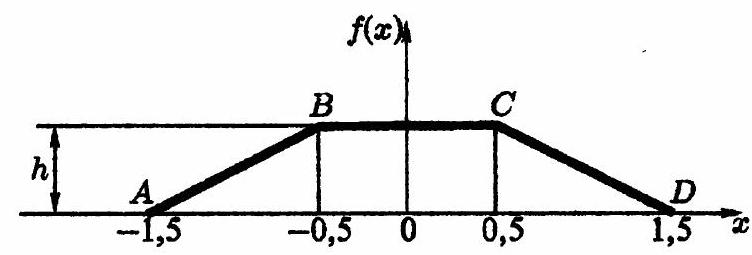
Fig. 17 | S o l u t i o n. If the function $f(x)$ represents the probability density function of a random variable $X$, then the area bounded by the graph of this function and the $O x$ axis is equal to one. Since Fig. 17 shows the probability density function graph of the random variable $X$, the area of trapezoid $A B C D$ sho... | Calculus | math-word-problem | Incomplete | Yes | olympiads | false | |
Given that $\{a_n\}$ is an increasing arithmetic sequence with $a_3 = \frac{5}{2}$, and $a_2a_4=6$.
1. Find the first term $a_1$ and the common difference $d$.
2. Find the general term $a_n$ and the sum of the first $n$ terms $S_n$. | 1. From the given information, we know that the common difference $d > 0$.
We have $a_3 = \frac{5}{2}$, and $a_2a_4=6$.
This implies that $a_2 + a_4 = 2a_3 = 5$.
Solving for $a_2$ and $a_4$, we get $a_2 = 2$ and $a_4 = 3$.
Then, we can find the common difference: $2d = a_4 - a_2 = 1$, which gives $d=\frac{1}{2}$.
Thus,... | \frac{1}{4}n^2 + \frac{5}{4}n | Algebra | math-word-problem | Yes | Yes | cn_k12 | false |
Let \[f(x) =
\begin{cases}
3x + 4 &\text{if } x \geq 1, \\
7 - 3x &\text{if } x < 1.
\end{cases}
\] Find $f(-2)$. | - To find $f(-2)$, first determine which piece of the function to use.
- Since $-2 < 1$, we use the second case of the piecewise function.
Calculation process:
\[ f(-2) = 7 - 3(-2) = 7 + 6 = 13. \]
Therefore,
\[ \boxed{13} \] | 13 | Algebra | math-word-problem | Yes | Yes | synthetic_math | true |
in a maths test , students were asked to find 5 / 16 of a certain number . one of the students by mistake found 5 / 6 th of that number and his answer was 300 more than the correct answer . find the number . | Let's denote the certain number as \( N \).
The correct answer should have been \( \frac{5}{16}N \).
However, the student found \( \frac{5}{6}N \) by mistake.
According to the problem, the mistaken answer is 300 more than the correct answer. So we can set up the following equation:
\[ \frac{5}{6}N = \frac{5}{16}N +... | 576 | Algebra | math-word-problem | Yes | Yes | orca_math | true |
4. A student divides an integer $m$ by a positive integer $n$, where $n \leq 100$, and claims that
$$
\frac{m}{n}=0: 167 a_{1} a_{2} \cdots .
$$
Show the student must be wrong. | 4. We have
$$
0 \cdot 167 \leq \frac{m}{n}0$. Thus $6000 m-1000 n \geq 1000$ since it is a multiple of 1000. We thus get a contradiction. | proof | Number Theory | proof | Incomplete | Incomplete | olympiads | false |
94. A, B, and C are playing table tennis. Each match involves two players, and the loser is replaced by the third player. This continues. When A has played 9 matches and B has played 6 matches, what is the maximum number of matches C could have played?
将上面的文本翻译成英文,请保留源文本的换行和格式,直接输出翻译结果。
94. A, B, and C are playing t... | Answer: 11 | 11 | Combinatorics | math-word-problem | Yes | Yes | olympiads | false |
TreShawn's mom needs to order pizza for her son and his two friends. She knows that TreShawn always eats x a pizza. His friend Michael eats 1/3 of a pizza and his other friend LaMar eats 1/6 of a pizza. She needs to order 1 pizza. What is the value of unknown variable x? | To determine the value of the unknown variable \( x \), we need to calculate the total amount of pizza consumed by TreShawn, Michael, and LaMar, and set it equal to 1 pizza since that is what TreShawn's mom needs to order.
1. Identify the amount of pizza each person eats:
- TreShawn eats \( x \) of a pizza.
- Mi... | \frac{1}{2} | Algebra | math-word-problem | Yes | Yes | metamath | true |
Let the function $f(x)= \begin{cases} 2^{1-x}, & x\leqslant 1 \\ 1-\log_{2}x, & x > 1 \end{cases}$, then the range of $x$ that satisfies $f(x)\leqslant 2$ is $(\quad)$
A: $[-1,2]$
B: $[0,2]$
C: $[1,+\infty)$
D: $[0,+\infty)$ | When $x\leqslant 1$, the inequality $2^{1-x}\leqslant 2$ can be transformed into $1-x\leqslant 1$, which gives $x\geqslant 0$,
$\therefore 0\leqslant x\leqslant 1$.
When $x > 1$, the inequality $1-\log_{2}x\leqslant 2$ can be transformed into $x\geqslant \frac{1}{2}$,
$\therefore x\geqslant 1$,
Therefore, the answe... | D | Algebra | MCQ | Yes | Yes | cn_k12 | false |
$8 \cdot 7$ If $x, y$ are integers, the number of solutions to the equation $(x-8)(x-10)=2^{y}$ is
(A) 0.
(B) 1.
(C) 2.
(D) 3.
(E) More than 3.
(13th American High School Mathematics Examination, 1962) | [Solution] The given equation can be transformed into
$$
x^{2}-18 x+80-2^{y}=0 \text {. }
$$
Considering it as an equation in $x$, we have
$$
x=9 \pm \sqrt{1+2^{y}} \text {, }
$$
where $x$ is an integer if and only if $1+2^{y}$ is a perfect square.
That is, $1+2^{y}=n^{2}$ or $n^{2}-1=2^{y}$.
Since $n^{2}-1=(n-1)(n+1... | 2 | Number Theory | MCQ | Yes | Yes | olympiads | false |
In the diagram, $ABC$ is a straight line. Determine the value of $y$.
[asy]
draw((-3,0)--(10,0),linewidth(0.7)); draw((10,0)--(6,-6)--(0,0),linewidth(0.7));
label("$A$",(-3,0),W); label("$B$",(0,0),N); label("$C$",(10,0),E); label("$D$",(6,-6),S);
label("$148^\circ$",(0,0),SW); label("$58^\circ$",(9,0),S);
label("$y... | From the problem, we recognize $\angle ABD$ as an exterior angle of $\triangle BCD$ in the diagram. According to the exterior angle theorem, $\angle ABD$ equals the sum of the non-adjacent interior angles of the triangle. Hence, we have:
$$ \angle ABD = \angle BCD + \angle BDC $$
Substituting the given values:
$$ 148^... | 90^\circ | Geometry | math-word-problem | Yes | Yes | synthetic_math | true |
James pays $1000 for advertising. It brought 100 customers to his site and 80% of those bought something at the store. He gained $1000 in profit from the ad. How much did each item cost at the store? | First, let's find out how many customers actually bought something at the store. If 80% of the 100 customers made a purchase, then:
80% of 100 customers = 0.80 * 100 = 80 customers
Now, we know that James gained $1000 in profit from these 80 customers. To find out how much each item cost, we need to divide the total ... | \$12.50 | Algebra | math-word-problem | Yes | Yes | orca_math | true |
## Task A-4.5.
A cube is formed from 27 identical white cubes, and all its outer faces are painted black.
(a) One of these cubes is randomly selected and placed on a table on a randomly chosen face. What is the probability that all five visible faces of the cube will be white?
(b) A cube is on the table with all fiv... | ## Solution.
After painting the outer sides of the large cube black, 8 small cubes have 3 white faces, 12 small cubes have 4 white faces, 6 small cubes have 5 white faces, and 1 small cube has 6 white faces.
Each of the 27 small cubes can be placed on the table in 6 different ways (depending on which face is on the t... | \frac{1}{2} | Combinatorics | math-word-problem | Yes | Yes | olympiads | false |
2. When a wooden block is submerged in water, it displaces some of the water, causing the water level to rise. Since the pressure at the bottom is determined only by the level of the liquid and not by the shape of the container, the pressure at the bottom will increase. | Answer: It will change, it will increase. | itwill | Other | math-word-problem | Incomplete | Yes | olympiads | false |
The cash realized on selling a 14% stock is Rs. 109.25. The cash amount before brokerage is Rs. 109. What is the percentage of the brokerage? | To find the percentage of the brokerage, we need to calculate the difference between the cash amount before brokerage and the cash realized on selling the stock, and then find out what percentage this difference is of the cash amount before brokerage.
The difference between the cash amount before brokerage and the cas... | 0.23\% | Algebra | math-word-problem | Yes | Yes | orca_math | true |
Determine the set that is different from the other three sets in the following:
\[①\{x|x=1\}\ \ ②\{y|(y-1)^{2}=0\}\ \ ③\{x=1\}\ \ ④\{1\}.\] | First, let's analyze each set:
1. Set ①: A set containing only the element $x=1$.
2. Set ②: A set containing the solution(s) of equation $(y-1)^{2}=0$. Solving the equation gives $y=1$, so this set also contains only the element $y=1$.
3. Set ③: A set containing the element $x=1$. Although it's written differently, it ... | \{x=1\} | Algebra | math-word-problem | Incomplete | Yes | cn_k12 | false |
Find the integer $n$, $0 \le n \le 15$, such that \[n \equiv 15827 \pmod{16}.\] | To solve for $n$:
1. Calculate $15827 \mod 16$:
\[ 15827 \div 16 = 989.1875 \]
Therefore, the integer part of the division is 989, and when multiplied back, $989 \times 16 = 15824$. The remainder is $15827 - 15824 = 3$.
So, $15827 \equiv 3 \pmod{16}$.
2. We are asked to find $n$ such that $0 \le n \le 15$ and ... | 3 | Number Theory | math-word-problem | Yes | Yes | synthetic_math | true |
Let $C$ be a circle with radius $R$ and centre $O$, and $S$ a fixed point in the interior of $C$. Let $AA'$ and $BB'$ be perpendicular chords through $S$. Consider the rectangles $SAMB$, $SBN'A'$, $SA'M'B'$, and $SB'NA$. Find the set of all points $M$, $N'$, $M'$, and $N$ when $A$ moves around the whole circle. | 1. **Understanding the Problem:**
- We have a circle \( C \) with radius \( R \) and center \( O \).
- \( S \) is a fixed point inside the circle.
- \( AA' \) and \( BB' \) are perpendicular chords passing through \( S \).
- We need to find the set of all points \( M \), \( N' \), \( M' \), and \( N \) when... | \sqrt{2R^2 - OS^2} | Geometry | math-word-problem | Yes | Yes | aops_forum | false |
A certain shopping mall is selling a batch of brand-name shirts. Currently, they can sell an average of 20 shirts per day, with a profit of $40 per shirt. In order to reduce inventory quickly, the mall decides to take a price reduction measure. After investigation, it was found that if the selling price of these shirts... | To solve this problem, let's denote the amount by which the price of each shirt should be reduced as $x$ dollars. The initial condition is that the mall sells an average of 20 shirts per day at a profit of $40 per shirt. When the selling price is reduced by $x$ dollars, the average daily sales increase by 2 shirts for ... | 20 | Algebra | math-word-problem | Yes | Yes | cn_k12 | false |
**
Compute $\arccos(1)$. Express your answer in radians.
** | **
To solve $\arccos(1)$, we need to find an angle $\theta$ such that $\cos(\theta) = 1$.
1. Recognize key angle: The well-known values for cosine where the output is 1 occur primarily at angles that are multiples of $2\pi$. However, the primary value (and the principal value for the range of $\arccos$, which is $[0, ... | 0 | Algebra | math-word-problem | Yes | Yes | synthetic_math | true |
The two roots of the equation $x^{2}+4x+3=0$ are ( ).
A: $x_{1}=1$, $x_{2}=3$
B: $x_{1}=-1$, $x_{2}=3$
C: $x_{1}=1$, $x_{2}=-3$
D: $x_{1}=-1$, $x_{2}=-3$ | To solve the equation $x^{2}+4x+3=0$, we factor it as follows:
1. Start with the given equation:
$$x^{2}+4x+3=0$$
2. Factor the quadratic equation:
$$(x+3)(x+1)=0$$
3. Set each factor equal to zero:
- For the first factor: $$x+3=0$$
- Solve for $x$: $$x=-3$$
- For the second factor: $$x+1=0$$
-... | D | Algebra | MCQ | Yes | Yes | cn_k12 | false |
Dolly wants to ride the Ferris wheel twice, the roller coaster three times, and the log ride seven times. The Ferris wheel costs 2 tickets, the roller coaster costs 5 tickets and the log ride costs 1 ticket. Dolly needs to buy 6 more tickets. How many tickets does Dolly have initially? | Let's calculate the total number of tickets Dolly needs for all the rides:
Ferris wheel: 2 tickets x 2 rides = 4 tickets
Roller coaster: 5 tickets x 3 rides = 15 tickets
Log ride: 1 ticket x 7 rides = 7 tickets
Total tickets needed = 4 tickets (Ferris wheel) + 15 tickets (Roller coaster) + 7 tickets (Log ride) = 26 t... | 20 | Algebra | math-word-problem | Yes | Yes | orca_math | true |
A math interest group at a certain school organized, grouped, and plotted 60 pieces of data into a pie chart. If the frequency of a certain group of data is 15, then the central angle of this group of data in the pie chart is ______ degrees. | To find the central angle of a specific group of data in a pie chart, we use the formula:
\[
\text{Central Angle} = \left( \frac{\text{Frequency of the Group}}{\text{Total Frequency}} \right) \times 360^{\circ}
\]
Given that the frequency of the group is 15 and the total frequency (total pieces of data) is 60, we sub... | 90^{\circ} | Geometry | math-word-problem | Yes | Yes | cn_k12 | false |
Given that $\frac{a}{36-a}+\frac{b}{48-b}+\frac{c}{72-c}=9$, evaluate $\frac{4}{36-a}+\frac{6}{48-b}+\frac{9}{72-c}$. | Begin by manipulating each term in the given equation:
1. For $\frac{a}{36-a}$, adding one to this fraction can be expressed as $\frac{a}{36-a}+1=\frac{a+36-a}{36-a}=\frac{36}{36-a}$.
2. Similarly, for $\frac{b}{48-b}$, we get $\frac{b}{48-b}+1=\frac{48}{48-b}$.
3. And for $\frac{c}{72-c}$, we get $\frac{c}{72-c}+1=\f... | \frac{13}{3} | Algebra | math-word-problem | Yes | Yes | synthetic_math | true |
15. The sides of a triangle are all integers, and the perimeter equals 7. Then the maximum area of this triangle is ( ).
A. $\frac{3 \sqrt{7}}{4}$
B. $\frac{\sqrt{35}}{4}$
C. $\sqrt{7}$
D. $\frac{\sqrt{35}}{5}$
E. $2 \sqrt{2}$ | A
Translate the text above into English, please retain the original text's line breaks and format, and output the translation result directly. | Geometry | MCQ | Yes | Yes | olympiads | false | |
Machine P and Machine Q are each used to manufacture 550 sprockets. It takes Machine P 10 hours longer to produce 550 sprockets than Machine Q. Machine Q produces 10% more sprockets per hour than Machine A. How many sprockets per hour does Machine A produce? | Let's denote the number of sprockets Machine A produces per hour as A. Since Machine Q produces 10% more sprockets per hour than Machine A, Machine Q produces A + 0.1A = 1.1A sprockets per hour.
Let's denote the time it takes for Machine Q to produce 550 sprockets as T_Q hours. Therefore, Machine P takes T_Q + 10 hour... | 5 | Algebra | math-word-problem | Yes | Yes | orca_math | true |
Subsets and Splits
No community queries yet
The top public SQL queries from the community will appear here once available.