
source stringclasses 1
value | problem stringlengths 22 3.47k | solution stringlengths 577 6.77k | messages listlengths 2 2 |
|---|---|---|---|
olympiads | Prove that the ratio of the area of any triangle to the area of its circumscribed circle is less than $2 / 3$. |
1. Let the sides and angles of triangle $ \triangle ABC $ be $ a, b, c $ and $ \alpha, \beta, \gamma $ respectively. Let $ R $ be the radius of the circumscribed circle around the triangle $ \triangle ABC $.
2. The area \( S_{ABC} \) of the triangle can be calculated using the formula involving sides $ b $ and $ c $ ... | [
{
"content": "Prove that the ratio of the area of any triangle to the area of its circumscribed circle is less than $2 / 3$.",
"role": "user"
},
{
"content": "\n1. Let the sides and angles of triangle $ \\triangle ABC $ be $ a, b, c $ and $ \\alpha, \\beta, \\gamma $ respectively. Let $ R $ be the r... |
olympiads | Prove that the three lines, passing respectively through the bases of two altitudes of a triangle, the ends of two of its angle bisectors, and through two points of tangency of the incircle with its sides (all points located on two sides of the triangle), intersect at a single point. |
1. Consider the vertex \( A \) of the triangle \( ABC \). Describe three points on one side of the angle at \( A \): \( B_1, B_2, B_3 \). Similarly, describe three points on the other side: \( C_1, C_2, C_3 \). The lines considered are \( B_1C_1 \), \( B_2C_2 \), and \( B_3C_3 \).
2. According to Menelaus' Theorem (Pr... | [
{
"content": "Prove that the three lines, passing respectively through the bases of two altitudes of a triangle, the ends of two of its angle bisectors, and through two points of tangency of the incircle with its sides (all points located on two sides of the triangle), intersect at a single point.",
"role":... |
olympiads | Color each point in the plane either red or blue. Prove:
(1) There exists an equilateral triangle with side length $673 \sqrt{3}$ or 2019 with all three vertices the same color.
(2) There exists an isosceles right triangle with leg length $1010 \sqrt{2}$ or 2020 with all three vertices the same color. |
1. **Establish Reference Triangle**:
Consider a point $A$ in the plane. Assume without loss of generality that $A$ is colored red.
2. **Construct a Circle**:
Draw a circle centered at $A$ with radius $673\sqrt{3}$.
3. **Case Analysis for Circle's Points**:
- If all points on the circumference of the cir... | [
{
"content": "Color each point in the plane either red or blue. Prove:\n(1) There exists an equilateral triangle with side length $673 \\sqrt{3}$ or 2019 with all three vertices the same color.\n(2) There exists an isosceles right triangle with leg length $1010 \\sqrt{2}$ or 2020 with all three vertices the sam... |
olympiads | Given \(a_1, a_2, \ldots, a_n\) are real numbers and \(b < \frac{\left( \sum a_i \right)^2}{n - 1} - \sum a_i^2\), show that \(b < 2a_i a_j\) for all distinct \(i, j\). | Consider the given inequality:
\[ b < \frac{ \left( \sum_{i=1}^n a_i \right)^2 }{n-1} - \sum_{i=1}^n a_i^2 \]
We need to show that:
\[ b < 2a_i a_j \text{ for all distinct } i, j \]
To achieve this, we start by proving a stronger statement. It is sufficient to show that:
\[ \frac{ \left( \sum_{i=1}^n a_i \right)^2... | [
{
"content": "Given \\(a_1, a_2, \\ldots, a_n\\) are real numbers and \\(b < \\frac{\\left( \\sum a_i \\right)^2}{n - 1} - \\sum a_i^2\\), show that \\(b < 2a_i a_j\\) for all distinct \\(i, j\\).",
"role": "user"
},
{
"content": "Consider the given inequality:\n\n\\[ b < \\frac{ \\left( \\sum_{i=1}... |
olympiads | Let \( ABCD \) and \( CDEF \) be two quadrilaterals inscribed in two circles \( \Gamma_{1} \) and \( \Gamma_{2} \), respectively. Assume that no two of the lines \( (AB), (CD), \) and \( (EF) \) are parallel. Then the lines \( (AB), (CD), \) and \( (EF) \) are concurrent if, and only if, the points \( A, B, E, \) and \... |
**Etape 1**: Supposons d’abord que les trois droites $(AB)$, $(CD)$ et $(EF)$ soient concourantes en un point \( I \).
**Etape 2**: La puissance du point \( I \) par rapport au cercle \(\Gamma_1\) (le cercle gauche) est donnée par la formule suivante :
\[ \text{Puissance de } I \text{ par rapport à } \Gamma_1 = IA \c... | [
{
"content": "Let \\( ABCD \\) and \\( CDEF \\) be two quadrilaterals inscribed in two circles \\( \\Gamma_{1} \\) and \\( \\Gamma_{2} \\), respectively. Assume that no two of the lines \\( (AB), (CD), \\) and \\( (EF) \\) are parallel. Then the lines \\( (AB), (CD), \\) and \\( (EF) \\) are concurrent if, and ... |
olympiads | Misha came up with two composite numbers: \(a\) and \(b\). On the board, he wrote down all the proper natural divisors of \(a\) in the left column and all the proper natural divisors of \(b\) in the right column. There were no duplicate numbers on the board. Misha wants the sum \(a+b\) to not be divisible by the sum of... |
1. **Understanding the Problem:**
- We need to prove that Misha only needs to erase at most half of the numbers in each column to ensure that the sum $a + b$ is not divisible by any sum of two numbers from different columns.
2. **Identify the Structure of the Argument:**
- For each divisor \( c \) of \( a \), t... | [
{
"content": "Misha came up with two composite numbers: \\(a\\) and \\(b\\). On the board, he wrote down all the proper natural divisors of \\(a\\) in the left column and all the proper natural divisors of \\(b\\) in the right column. There were no duplicate numbers on the board. Misha wants the sum \\(a+b\\) t... |
olympiads | From a collection of \( n \) persons, \( q \) distinct two-member teams are selected and ranked \( 1, \ldots, q \) (no ties). Let \( m \) be the least integer larger than or equal to \( \frac{2q}{n} \). Show that there are \( m \) distinct teams that may be listed so that (i) each pair of consecutive teams on the list ... |
To prove the problem, we will use the alternative formulation.
1. **Problem Restatement**:
* We are given a graph with \( n \) vertices and \( q \) edges, each edge is uniquely numbered from 1 to \( q \).
* We need to show that there exists a chain of \( m \) edges each two consecutive edges sharing a common ... | [
{
"content": "From a collection of \\( n \\) persons, \\( q \\) distinct two-member teams are selected and ranked \\( 1, \\ldots, q \\) (no ties). Let \\( m \\) be the least integer larger than or equal to \\( \\frac{2q}{n} \\). Show that there are \\( m \\) distinct teams that may be listed so that (i) each pa... |
olympiads | From a balloon, places $A$ and $B$ are seen at depression angles $\alpha$ and $\beta$ respectively, and the distance $c$ between the two places is seen at an angle $\gamma$. What is the height at which the balloon is hovering and what is the distance from the balloon to these places? |
To determine the height of the balloon above the ground and the distances from $A$ and $B$ to the balloon, we follow these steps:
1. **Label Definitions and Setup:**
- Let the balloon be at point \( C \).
- Let the projection of \( C \) on the ground be \( C_{1} \).
- The angle of depression from the ball... | [
{
"content": "From a balloon, places $A$ and $B$ are seen at depression angles $\\alpha$ and $\\beta$ respectively, and the distance $c$ between the two places is seen at an angle $\\gamma$. What is the height at which the balloon is hovering and what is the distance from the balloon to these places?",
"rol... |
olympiads | Prove that the product of any three consecutive natural numbers is divisible by 6. |
Let's prove that the product of any three consecutive natural numbers is divisible by 6.
1. **Identify the three consecutive natural numbers:**
Let the three consecutive natural numbers be \( n, n+1, \) and \( n+2 \).
2. **Check divisibility by 2:**
Among any three consecutive natural numbers, there is at leas... | [
{
"content": "Prove that the product of any three consecutive natural numbers is divisible by 6.",
"role": "user"
},
{
"content": "\nLet's prove that the product of any three consecutive natural numbers is divisible by 6.\n\n1. **Identify the three consecutive natural numbers:**\n Let the three co... |
olympiads | Prove that if a five-digit number is divisible by 271, then all numbers obtained by moving any segment of digits from the end of the number to the beginning are also divisible by 271. (For example, 98102, 29810, 2981, 10298, 81029). |
To prove that if a five-digit number is divisible by 271, then any number formed by moving a segment of any number of digits from the end of the number to the front is also divisible by 271, we begin by considering the simpler case where we only move the last digit to the front. If we prove this, then by repeatedly ap... | [
{
"content": "Prove that if a five-digit number is divisible by 271, then all numbers obtained by moving any segment of digits from the end of the number to the beginning are also divisible by 271. (For example, 98102, 29810, 2981, 10298, 81029).",
"role": "user"
},
{
"content": "\nTo prove that if ... |
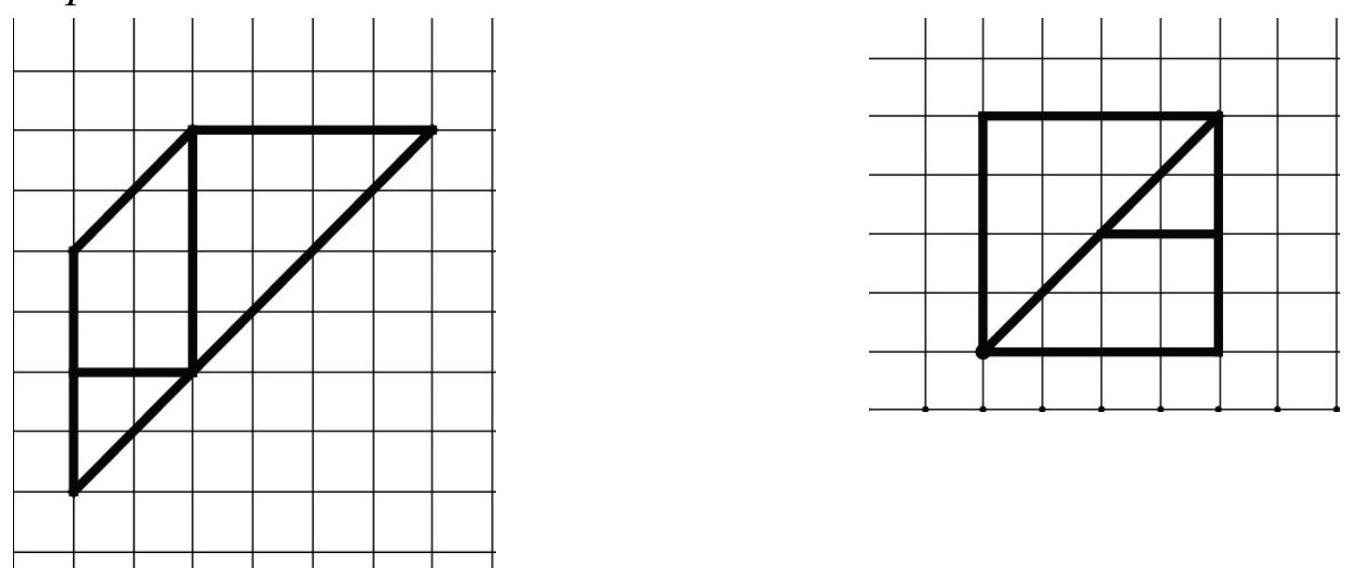
olympiads | Mojmír cut a regular hexagon into 12 identical pieces. From these pieces (not necessarily all of them), he created various right-angled triangles.
What could Mojmír's assembled triangles look like? Draw at least four possibilities. |
1. **Initial Hexagon Division**:
- Start by noting that the regular hexagon can be divided into 6 congruent equilateral triangles. Each of these equilateral triangles is then further bisected to yield 12 smaller congruent triangles.
- These triangles created by bisecting the equilateral triangles have ang... | [
{
"content": "Mojmír cut a regular hexagon into 12 identical pieces. From these pieces (not necessarily all of them), he created various right-angled triangles.\n\nWhat could Mojmír's assembled triangles look like? Draw at least four possibilities.",
"role": "user"
},
{
"content": "\n1. **Initial He... |
olympiads | Prove that the intersection point of the diagonals of a quadrilateral circumscribed around a circle coincides with the intersection point of the diagonals of another quadrilateral whose vertices are the points of tangency of the sides of the first quadrilateral with the circle. |
1. **Identify the elements and notation**:
- Let $ABCD$ be a quadrilateral inscribed around a circle, i.e., a tangential quadrilateral.
- Let $E, F, G,$ and $K$ be the points of tangency of the circle with sides $AB, BC, CD,$ and $DA$ respectively.
- Let $M$ be the point of intersection of diagonals $AC$ and ... | [
{
"content": "Prove that the intersection point of the diagonals of a quadrilateral circumscribed around a circle coincides with the intersection point of the diagonals of another quadrilateral whose vertices are the points of tangency of the sides of the first quadrilateral with the circle.",
"role": "user... |
olympiads | Given that \( p \) (where \( p \geq 5 \)) is a prime number. From a \( p \times p \) chessboard, select \( p \) squares such that no two squares are in the same row (they may be in the same column). Let \( r \) be the number of such selections. Prove that \( p^5 \mid r \). | Given:
- \( p \) is a prime number with \( p \geqslant 5 \).
- We need to show that for selecting \( p \) squares on a \( p \times p \) chessboard such that no two squares are in the same row, the total number of such ways \( r \) is divisible by \( p^5 \).
We begin by noting the combinatorial expression for \( r \):
... | [
{
"content": "Given that \\( p \\) (where \\( p \\geq 5 \\)) is a prime number. From a \\( p \\times p \\) chessboard, select \\( p \\) squares such that no two squares are in the same row (they may be in the same column). Let \\( r \\) be the number of such selections. Prove that \\( p^5 \\mid r \\).",
"ro... |
olympiads | A pile of pebbles is divided into four, not necessarily equal, piles, then gathered together and redistributed, this time into five piles.
Prove that the second time at least two pebbles are in a smaller pile than in the first distribution. |
#### Step 1: Define the Initial Configuration
Let \(a_1, a_2, a_3,\) and \(a_4\) denote the number of pebbles in each of the four piles after the first distribution. Thus, the total number of pebbles is:
\[
a_1 + a_2 + a_3 + a_4 = N \quad \text{(some constant total number of pebbles)}
\]
#### Step 2: Define the Secon... | [
{
"content": "A pile of pebbles is divided into four, not necessarily equal, piles, then gathered together and redistributed, this time into five piles.\n\nProve that the second time at least two pebbles are in a smaller pile than in the first distribution.",
"role": "user"
},
{
"content": "\n#### S... |
olympiads | Show that there is a finite set of points in the plane such that for any point \( P \) in the set, we can find 1993 points in the set a distance 1 from \( P \). |
To solve the problem of finding a finite set of points in the plane such that for any point \( P \) in the set, we can find 1993 points in the set a distance 1 from \( P \), we follow these steps:
1. **Finding Points on the Unit Circle:**
Consider the unit circle \((x - a)^2 + (y - b)^2 = 1\). We need a large numb... | [
{
"content": "Show that there is a finite set of points in the plane such that for any point \\( P \\) in the set, we can find 1993 points in the set a distance 1 from \\( P \\).",
"role": "user"
},
{
"content": "\nTo solve the problem of finding a finite set of points in the plane such that for any... |
olympiads | Determine all perfect squares that end in 444 when written in decimal notation. Is there one among them that ends in 4444? | 1. Let \( a^2 \) be a square number ending in 444, i.e., \( a^2 = 1000k + 444 \) for non-negative integer \( k \).
\[
a^2 = 1000k + 444
\]
2. Divide both sides by 4:
\[
\left(\frac{a}{2}\right)^2 = 250k + 111
\]
Since the right-hand side must be an integer, denote \( \frac{a}{2} = b \), so:
... | [
{
"content": "Determine all perfect squares that end in 444 when written in decimal notation. Is there one among them that ends in 4444?",
"role": "user"
},
{
"content": "1. Let \\( a^2 \\) be a square number ending in 444, i.e., \\( a^2 = 1000k + 444 \\) for non-negative integer \\( k \\).\n \\[\... |
olympiads | Consider $\triangle ABC$. Choose a point \( M \) on its side \( BC \) and let \( O \) be the center of the circle passing through the vertices of \(\triangle ABM\). Let \( k \) be the circle that passes through \( A \) and \( M \) and whose center lies on line \( BC \). Let line \( MO \) intersect \( k \) again in poin... |
We start by considering $\triangle ABC$ and choosing a point $M$ on its side $BC$. Let $O$ be the center of the circumcircle of $\triangle ABM$. Let $k$ be the circle that passes through $A$ and $M$ with its center on the line $BC$. We need to prove that the line $BK$ is invariant for any choice of the point $M$ on th... | [
{
"content": "Consider $\\triangle ABC$. Choose a point \\( M \\) on its side \\( BC \\) and let \\( O \\) be the center of the circle passing through the vertices of \\(\\triangle ABM\\). Let \\( k \\) be the circle that passes through \\( A \\) and \\( M \\) and whose center lies on line \\( BC \\). Let line ... |
olympiads | In a rectangular box with a base of $m \times n$, where $m$ and $n$ are odd numbers, dominoes of size $2 \times 1$ are placed so that only one $1 \times 1$ square (a hole) is left uncovered in a corner of the box. If a domino is adjacent to the hole along its shorter side, it is allowed to slide one cell along itself, ... |
1. **Labeling the Grid:**
We start by labeling the rows and columns of the rectangular grid formed by the box of dimensions \(m \times n\), where both \(m\) and \(n\) are odd numbers. Let's assign coordinates \((i, j)\) to the cell located at the intersection of the \(i\)-th row and \(j\)-th column, starting from \... | [
{
"content": "In a rectangular box with a base of $m \\times n$, where $m$ and $n$ are odd numbers, dominoes of size $2 \\times 1$ are placed so that only one $1 \\times 1$ square (a hole) is left uncovered in a corner of the box. If a domino is adjacent to the hole along its shorter side, it is allowed to slid... |
olympiads | Let $ABC$ be a triangle with three points $D, E,$ and $F$ inside the triangle $ABC$ such that $\widehat{BAF} = \widehat{EAC}$, $\widehat{CBD} = $\widehat{FBA}$, and $\widehat{ACE} = \widehat{DCB}$. Show that the lines $(AD)$, $(BE)$, and $(CF)$ are concurrent. | :
1. **Analyzing the Given Angles:**
We are given that:
\[
\widehat{B A F} = \widehat{E A C}, \quad \widehat{C B D} = \widehat{F B A}, \quad \widehat{A C E} = \widehat{D C B}.
\]
2. **Applying the Dual of the Co-Conicity Lemma:**
According to the dual of the lemma of co-conicity, if the given angles... | [
{
"content": "Let $ABC$ be a triangle with three points $D, E,$ and $F$ inside the triangle $ABC$ such that $\\widehat{BAF} = \\widehat{EAC}$, $\\widehat{CBD} = $\\widehat{FBA}$, and $\\widehat{ACE} = \\widehat{DCB}$. Show that the lines $(AD)$, $(BE)$, and $(CF)$ are concurrent.",
"role": "user"
},
{
... |
olympiads | Given two sets of three distinct points \( x_1, x_2, x_3 \) and \( y_1, y_2, y_3 \), prove that it is always possible to find a unique fractional-linear function \( f(x) \) such that \( f(x_1) = y_1 \), \( f(x_2) = y_2 \), and \( f(x_3) = y_3 \). |
To solve this problem, we need to construct a unique fractional-linear (or Möbius) function \( f(x) \) that maps three given points \( x_1, x_2, x_3 \) to another three points \( y_1, y_2, y_3 \). A fractional linear function typically takes the form:
\[ f(x) = \frac{ax + b}{cx + d} \]
where \( a, b, c, d \) are con... | [
{
"content": "Given two sets of three distinct points \\( x_1, x_2, x_3 \\) and \\( y_1, y_2, y_3 \\), prove that it is always possible to find a unique fractional-linear function \\( f(x) \\) such that \\( f(x_1) = y_1 \\), \\( f(x_2) = y_2 \\), and \\( f(x_3) = y_3 \\).",
"role": "user"
},
{
"cont... |
olympiads | Several points are marked on a plane. For any three of them, there exists a Cartesian coordinate system (i.e., perpendicular axes and a common scale) in which these points have integer coordinates. Prove that there exists a Cartesian coordinate system in which all the marked points have integer coordinates. |
1. Consider any three points \( A, B, \) and \( C \) that do not all lie on a single straight line. If all points lie on a single line, the problem's claim is trivial.
2. Let \( T_1 \) be a coordinate system where \( A, B, \) and \( C \) have integer coordinates. This coordinate system exists by the problem's conditi... | [
{
"content": "Several points are marked on a plane. For any three of them, there exists a Cartesian coordinate system (i.e., perpendicular axes and a common scale) in which these points have integer coordinates. Prove that there exists a Cartesian coordinate system in which all the marked points have integer co... |
olympiads | Consider a rectangle with sides of odd integer lengths. This rectangle is divided into smaller rectangles whose sides are also integers. Show that there exists one of these smaller rectangles such that the distances to all four sides of the larger rectangle are of the same parity. |
The problem statement requires us to show that there exists at least one smaller rectangle within a larger rectangle with integer side lengths (both odd) such that the distances of its sides to the sides of the larger rectangle are all of the same parity. Here is a detailed step-by-step solution:
1. **Setting Up the ... | [
{
"content": "Consider a rectangle with sides of odd integer lengths. This rectangle is divided into smaller rectangles whose sides are also integers. Show that there exists one of these smaller rectangles such that the distances to all four sides of the larger rectangle are of the same parity.",
"role": "u... |
olympiads | Given two isosceles triangles with a common base, prove that their medians drawn to the base lie on the same line. |
1. Let $AB$ be the common base of the isosceles triangles $ABC$ and $AB{C_1}$.
2. Denote $M$ as the midpoint of $AB$.
3. $CM$ and $C_{1}M$ are the medians of triangles $ABC$ and $AB{C_{1}}$, respectively, drawn to the base $AB$.
4. In isosceles triangles, the median drawn to the base is also the altitude. This is a k... | [
{
"content": "Given two isosceles triangles with a common base, prove that their medians drawn to the base lie on the same line.",
"role": "user"
},
{
"content": "\n1. Let $AB$ be the common base of the isosceles triangles $ABC$ and $AB{C_1}$.\n2. Denote $M$ as the midpoint of $AB$.\n3. $CM$ and $C_... |
olympiads | From the endpoints of a quarter-circle, equal lengths are cut off. Connecting the endpoints to the center of the circle forms a sector. If perpendicular lines are drawn from the endpoints to one radius of the quarter-circle, they enclose a semicircle segment. Prove that the areas of the two resulting circle segments ar... |
1. Let's denote the center of the quarter-circle arc $MN$ as $O$. Let the points where the arcs are truncated be $MA = NB$. Project the points $A$ and $B$ to the radius $OM$ as points $C$ and $D$ respectively. Also, let the intersection point of $OA$ and $BD$ be $E$. Finally, denote the angles $\angle MOA = \angle NOB... | [
{
"content": "From the endpoints of a quarter-circle, equal lengths are cut off. Connecting the endpoints to the center of the circle forms a sector. If perpendicular lines are drawn from the endpoints to one radius of the quarter-circle, they enclose a semicircle segment. Prove that the areas of the two result... |
olympiads | Let \( P \in \mathbb{R}[X] \) be a polynomial with real coefficients.
Show that
$$
\forall t \in \mathbb{R}, P(t) P^{\prime \prime}(t) \leq \left(P^{\prime}(t)\right)^2
$$ |
Given \( P \in \mathbb{R}[X] \) is a polynomial, we want to show that
\[ \forall t \in \mathbb{R}, \, P(t) P''(t) \leq (P'(t))^2. \]
1. **Expressing the Polynomial**:
Since \( P \) is split in \( \mathbb{R}[X] \), we can write it as
\[ P(X) = \alpha \prod_{k=1}^{r} (X - \lambda_k) \]
where the \( \la... | [
{
"content": "Let \\( P \\in \\mathbb{R}[X] \\) be a polynomial with real coefficients.\n\nShow that\n\n$$\n\\forall t \\in \\mathbb{R}, P(t) P^{\\prime \\prime}(t) \\leq \\left(P^{\\prime}(t)\\right)^2\n$$",
"role": "user"
},
{
"content": "\nGiven \\( P \\in \\mathbb{R}[X] \\) is a polynomial, we w... |
olympiads | Two intersecting lines are given on the plane, and one point is marked on each of them ($D$ and $E$). Construct a triangle $ABC$ such that the angle bisectors $CD$ and $AE$ lie on the given lines, and the bases of these angle bisectors are the points $D$ and $E$. |
1. **Assume the triangle \(ABC\) has been constructed**:
- Let \(AE\) and \(CD\) be the angle bisectors of \(\angle BAC\) and \(\angle BCA\), respectively.
2. **Consider the images \(E_1\) and \(D_1\)**:
- \(E_1\) is the reflection of point \(E\) across line \(CD\).
- \(D_1\) is the reflection of point \(D\)... | [
{
"content": "Two intersecting lines are given on the plane, and one point is marked on each of them ($D$ and $E$). Construct a triangle $ABC$ such that the angle bisectors $CD$ and $AE$ lie on the given lines, and the bases of these angle bisectors are the points $D$ and $E$.",
"role": "user"
},
{
... |
olympiads | Two players are playing on a triangular board, coloring triangular cells in turn. One cell (the starting cell) is already colored before the game starts.
On the first move, players color a cell adjacent (by side) to the starting cell, and each subsequent move colors a cell adjacent to the one just colored. Cells canno... |
#### Case (a): The initial cell is a corner cell, field of any size.
1. The first move must be one of the cells adjacent to the corner cell.
2. The second player will choose another cell adjacent to this new cell, still remaining within the boundary.
3. These moves continue back and forth, with each new cell always to... | [
{
"content": "Two players are playing on a triangular board, coloring triangular cells in turn. One cell (the starting cell) is already colored before the game starts.\n\nOn the first move, players color a cell adjacent (by side) to the starting cell, and each subsequent move colors a cell adjacent to the one j... |
olympiads | In a rectangle with dimensions $20 \times 25$, 120 squares with side lengths of 1 are placed arbitrarily. Prove that a circle with a diameter of 1 can also be placed in the rectangle such that it does not overlap with any of the 120 squares.
| ## Solution
### Problem
In a rectangle with dimensions \(20 \times 25\), we place 120 squares each with a side length of 1. Prove that there is still space to place a circle with a diameter of 1 that does not overlap with any of the 120 squares.
Steps
1. **Reduction of Usable Area**:
- Consider the circle \(O\)... | [
{
"content": "In a rectangle with dimensions $20 \\times 25$, 120 squares with side lengths of 1 are placed arbitrarily. Prove that a circle with a diameter of 1 can also be placed in the rectangle such that it does not overlap with any of the 120 squares.\n",
"role": "user"
},
{
"content": "## Solu... |
olympiads | Let \( P \in \mathbb{C}[X] \) be a polynomial with complex coefficients. Show that \( P \) has a root in \( \mathbb{C} \). |
1. Consider \( P \in \mathbb{C}[X] \), a polynomial with complex coefficients. We are tasked to show that \( P \) admits a root in \( \mathbb{C} \).
2. Define a new polynomial \( Q(X) = P(X) \overline{P}(X) \), where \(\overline{P}(X)\) denotes the polynomial with complex coefficients conjugated.
3. For any real num... | [
{
"content": "Let \\( P \\in \\mathbb{C}[X] \\) be a polynomial with complex coefficients. Show that \\( P \\) has a root in \\( \\mathbb{C} \\).",
"role": "user"
},
{
"content": "\n1. Consider \\( P \\in \\mathbb{C}[X] \\), a polynomial with complex coefficients. We are tasked to show that \\( P \\... |
olympiads | Cut an arbitrary triangle into pieces that can be reassembled into a triangle symmetrical to the original triangle with respect to a certain line (without flipping the pieces). | To solve this problem, we need to perform a specific geometric transformation on a given triangle to create a new triangle that is symmetric to the original one with respect to a certain line. Here's the step-by-step process:
1. **Identify the Largest Angle:**
- Let \( A \) be the largest angle of the triangle \( ... | [
{
"content": "Cut an arbitrary triangle into pieces that can be reassembled into a triangle symmetrical to the original triangle with respect to a certain line (without flipping the pieces).",
"role": "user"
},
{
"content": "To solve this problem, we need to perform a specific geometric transformati... |
olympiads | Show that in a non-obtuse triangle, the perimeter of the triangle is always greater than two times the diameter of the circumcircle. | Let's go through the steps in detail to prove that the perimeter of a non-obtuse triangle is always greater than two times the diameter of its circumcircle.
1. **Identify the Midpoints and Centre**:
Let \( K, L, M \) be the midpoints of the sides \( AB, BC, AC \) of the non-obtuse triangle \( ABC \). This means:
... | [
{
"content": "Show that in a non-obtuse triangle, the perimeter of the triangle is always greater than two times the diameter of the circumcircle.",
"role": "user"
},
{
"content": "Let's go through the steps in detail to prove that the perimeter of a non-obtuse triangle is always greater than two ti... |
olympiads | Write a program (in any programming language) that generates all permutations of the first 100 numbers. |
1. **Initialization**:
- Define two arrays, \( X \) and \( Y \), both of size 100.
- Initialize array \( X \) with the numbers from 1 to 100.
- Initialize array \( Y \) such that \( Y(i) = i \) for all \( 1 \leq i \leq 100 \).
2. **Original Order of Numbers**:
- We consider the initial permutation to ... | [
{
"content": "Write a program (in any programming language) that generates all permutations of the first 100 numbers.",
"role": "user"
},
{
"content": "\n1. **Initialization**:\n - Define two arrays, \\( X \\) and \\( Y \\), both of size 100.\n - Initialize array \\( X \\) with the numbers fro... |
olympiads | On a board, a trapezoid \(ABCD\) (\(AD \parallel BC\)) was drawn and a perpendicular \(OK\) was drawn from the point \(O\), the intersection of the diagonals, to the base \(AD\), as well as the midline \(EF\). Then the trapezoid was erased. How can the drawing be restored from the preserved segments \(OK\) and \(EF\)? |
1. **Notation and Basics:**
Let us denote the midpoints of the bases \( AD \) and \( BC \) as \( L \) and \( N \) respectively. Let the midpoint of \( EF \) be denoted as \( M \). The points \( L \), \( O \), \( and \) \( N \) lie on the same line, as referenced in Problem 19.2.
2. **Identifying Line and Perpendi... | [
{
"content": "On a board, a trapezoid \\(ABCD\\) (\\(AD \\parallel BC\\)) was drawn and a perpendicular \\(OK\\) was drawn from the point \\(O\\), the intersection of the diagonals, to the base \\(AD\\), as well as the midline \\(EF\\). Then the trapezoid was erased. How can the drawing be restored from the pre... |
olympiads | Points \( A, B, C \) divide the circumcircle \(\Omega\) of the triangle \( ABC \) into three arcs. Let \( X \) be a variable point on the arc \( AB \), and let \( O_1, O_2 \) be the incenters of the triangles \( CAX \) and \( CBX \). Prove that the circumcircle of the triangle \( X O_1 O_2 \) intersects \(\Omega\) in a... | Let's analyze the given problem step-by-step and add all necessary details and calculations for clarity.
1. **Lemma Introduction**:
- **Lemma**: Consider $\triangle ABC$ with incenter $I$. Let $M$ be the center of the arc $\overarc{BC}$ (excluding $A$) on the circumcircle of $\triangle ABC$. Then we have:
\[... | [
{
"content": "Points \\( A, B, C \\) divide the circumcircle \\(\\Omega\\) of the triangle \\( ABC \\) into three arcs. Let \\( X \\) be a variable point on the arc \\( AB \\), and let \\( O_1, O_2 \\) be the incenters of the triangles \\( CAX \\) and \\( CBX \\). Prove that the circumcircle of the triangle \\(... |
olympiads | Given \( v_{0}=0, v_{1}=1, \) and the recurrence relation \( v_{n+1}=8 v_{n} \cdot v_{n-1} \quad n=1,2, \cdots \). Prove that there is no term in the sequence \(\left\{v_{n}\right\}\) that can be written in the form \( 3^{\alpha} \cdot 5^{\beta} \) where \( \alpha \) and \( \beta \) are positive integers.
(China Natio... |
To prove that in the sequence \(\left\{v_{n}\right\}\), there is no term of the form \(3^{\alpha} \cdot 5^{\beta}\) (where \(\alpha, \beta\) are positive integers), follow these steps:
1. **Calculate the first few terms of the sequence:**
Given:
\[
v_{0} = 0, \quad v_{1} = 1, \quad v_{n+1} = 8v_{n} - v_{n-1... | [
{
"content": "Given \\( v_{0}=0, v_{1}=1, \\) and the recurrence relation \\( v_{n+1}=8 v_{n} \\cdot v_{n-1} \\quad n=1,2, \\cdots \\). Prove that there is no term in the sequence \\(\\left\\{v_{n}\\right\\}\\) that can be written in the form \\( 3^{\\alpha} \\cdot 5^{\\beta} \\) where \\( \\alpha \\) and \\( \... |
olympiads | Given a triangle \(ABC\) with a point \(P\) on its side \(BC\), let \(O_1\) be the circumcenter of triangle \(APB\) and \(O_2\) be the circumcenter of triangle \(APC\). Prove that triangle \(AO_1O_2\) is similar to the original triangle \(ABC\). |
1. **Position of Point \( P \) on Segment \( BC \):**
First, let's consider the case when \( P \) is an internal point on the segment \( BC \). This setup is illustrated in Figure 1.
 with a point \\(P\\) on its side \\(BC\\), let \\(O_1\\) be the circumcenter of triangle \\(APB\\) and \\(O_2\\) be the circumcenter of triangle \\(APC\\). Prove that triangle \\(AO_1O_2\\) is similar to the original triangle \\(ABC\\).",
"role": "user"
},
{
... |
olympiads | Given a line on a plane with several (more than two) marked points on it, prove that it is possible to mark an additional point on the plane (outside the given line) so that more than half of the triangles with the marked points as vertices are acute-angled. | 1. Consider the given line \( L \) on the plane and a set of points \( P_1, P_2, ..., P_n \) marked on this line where \( n > 2 \).
2. By definition, the value of \( n \) must be greater than 2, ensuring we have multiple points (at least 3) on line \( L \).
#### Step 1: Basic Construct Analysis
- We need to prove that... | [
{
"content": "Given a line on a plane with several (more than two) marked points on it, prove that it is possible to mark an additional point on the plane (outside the given line) so that more than half of the triangles with the marked points as vertices are acute-angled.",
"role": "user"
},
{
"cont... |
olympiads | Prove that the equation \(x^{2} + y^{2} + z^{2} = x^{3} + y^{3} + z^{3}\) has an infinite number of solutions in integers \(x, y, z\). |
We are given the equation:
\[
x^2 + y^2 + z^2 = x^3 + y^3 + z^3
\]
To show that this equation has infinitely many integer solutions \(x, y, z\), we will provide a specific parametric solution and demonstrate that it satisfies the given equation.
1. **Propose a parametric solution:**
Let us take:
\[
x = k(2... | [
{
"content": "Prove that the equation \\(x^{2} + y^{2} + z^{2} = x^{3} + y^{3} + z^{3}\\) has an infinite number of solutions in integers \\(x, y, z\\).",
"role": "user"
},
{
"content": "\nWe are given the equation:\n\\[\nx^2 + y^2 + z^2 = x^3 + y^3 + z^3\n\\]\n\nTo show that this equation has infin... |
olympiads | Prove that
$$\frac{1}{k+1} n^{k+1}<1^{k}+2^{k}+3^{k}+\ldots+n^{k}<\left(1+\frac{1}{n}\right)^{k+1} \frac{1}{k+1} n^{k+1}$$
where \( n \) and \( k \) are arbitrary integers. |
**Objective:** We need to prove the inequalities:
\[
\frac{1}{k+1} n^{k+1} < 1^k + 2^k + 3^k + \ldots + n^k < \left(1+\frac{1}{n}\right)^{k+1} \frac{1}{k+1} n^{k+1}
\]
for any integers \( n \) and \( k \).
### Step-by-Step Solution:
1. **Lower Bound:**
We start by considering the sum \( S = 1^k + 2^k + 3^k ... | [
{
"content": "Prove that\n\n$$\\frac{1}{k+1} n^{k+1}<1^{k}+2^{k}+3^{k}+\\ldots+n^{k}<\\left(1+\\frac{1}{n}\\right)^{k+1} \\frac{1}{k+1} n^{k+1}$$\n\nwhere \\( n \\) and \\( k \\) are arbitrary integers.",
"role": "user"
},
{
"content": "\n**Objective:** We need to prove the inequalities:\n\n\\[\n\\f... |
olympiads | In an \( n \times 6 \) grid, each cell contains either the integer 1 or 0 (\( n \geq 2 \)). It is known that the integers in each row are distinct from one another, and for any two rows of numbers \(\left(a_{1}, a_{2}, \cdots, a_{6}\right)\) and \(\left(b_{1}, b_{2}, \cdots, b_{6}\right)\), there must be a row whose nu... |
We begin by considering an \(n \times 6\) grid, where each cell contains either a 1 or a 0, and \(n \geqslant 2\). We are given that the integer sequences in each row are distinct, and for any two rows \( \left(a_{1}, a_{2}, \cdots, a_{6}\right) \) and \( \left(b_{1}, b_{2}, \cdots, b_{6}\right) \), there exists a row... | [
{
"content": "In an \\( n \\times 6 \\) grid, each cell contains either the integer 1 or 0 (\\( n \\geq 2 \\)). It is known that the integers in each row are distinct from one another, and for any two rows of numbers \\(\\left(a_{1}, a_{2}, \\cdots, a_{6}\\right)\\) and \\(\\left(b_{1}, b_{2}, \\cdots, b_{6}\\r... |
olympiads | Let $a$ and $b$ be natural numbers. Show that $a$ divides $b$ if and only if all the prime factors present in the prime factorization of $a$ are also present in the prime factorization of $b$, and each of them appears at least as many times in $b$ as they do in $a$. |
1. **Décomposition en facteurs premiers**: Supposons que la décomposition en facteurs premiers de \(a\) soit \(a = p_1^{k_1} p_2^{k_2} \ldots p_n^{k_n}\) où \(p_1, p_2, \ldots, p_n\) sont des nombres premiers distincts, et \(k_1, k_2, \ldots, k_n\) sont leurs puissances respectives.
2. **Hypothèse de la présence des ... | [
{
"content": "Let $a$ and $b$ be natural numbers. Show that $a$ divides $b$ if and only if all the prime factors present in the prime factorization of $a$ are also present in the prime factorization of $b$, and each of them appears at least as many times in $b$ as they do in $a$.",
"role": "user"
},
{
... |
olympiads | Given a non-empty finite set, prove that the number of its subsets containing an even number of elements is equal to the number of its subsets containing an odd number of elements. | ### Problem:
Given a non-empty finite set, prove that the number of its subsets containing an even number of elements is equal to the number of subsets containing an odd number of elements.
1. **Fix an Element in the Set**:
Let's fix an element \( x \) in the given non-empty finite set \( S \).
2. **Construct Pa... | [
{
"content": "Given a non-empty finite set, prove that the number of its subsets containing an even number of elements is equal to the number of its subsets containing an odd number of elements.",
"role": "user"
},
{
"content": "### Problem:\n\nGiven a non-empty finite set, prove that the number of ... |
olympiads | Write the numbers $1, 2, \cdots, n$ in any order on a circle. Each time, you are allowed to swap the positions of two adjacent numbers as long as the absolute difference between these two numbers is greater than 1. Prove that after a certain number of such swaps, all the numbers can be arranged on the circle in natural... |
1. **Initialization**:
- We start with the numbers $1, 2, \ldots, n$ arranged arbitrarily on a circle.
2. **Concepts and Strategy**:
- We are allowed to swap any two adjacent numbers whose absolute difference is greater than 1.
- Our goal is to rearrange these numbers in clockwise order on the circle.
-... | [
{
"content": "Write the numbers $1, 2, \\cdots, n$ in any order on a circle. Each time, you are allowed to swap the positions of two adjacent numbers as long as the absolute difference between these two numbers is greater than 1. Prove that after a certain number of such swaps, all the numbers can be arranged o... |
olympiads | Let \( ABCD \) be a cyclic convex quadrilateral and \(\Gamma\) be its circumcircle. Let \( E \) be the intersection of the diagonals \( AC \) and \( BD \), let \( L \) be the center of the circle tangent to sides \( AB, BC \), and \( CD \), and let \( M \) be the midpoint of the arc \( BC \) of \(\Gamma\) not containin... |
Given:
- $ABCD$ is a cyclic convex quadrilateral.
- $\Gamma$ is the circumcircle.
- $E$ is the intersection of diagonals $AC$ and $BD$.
- $L$ is the center of the circle tangent to sides $AB$, $BC$, and $CD$.
- $M$ is the midpoint of the arc $BC$ of $\Gamma$ not containing $A$ and $D$.
We need to prove that the exce... | [
{
"content": "Let \\( ABCD \\) be a cyclic convex quadrilateral and \\(\\Gamma\\) be its circumcircle. Let \\( E \\) be the intersection of the diagonals \\( AC \\) and \\( BD \\), let \\( L \\) be the center of the circle tangent to sides \\( AB, BC \\), and \\( CD \\), and let \\( M \\) be the midpoint of the... |
olympiads | Prove that there do not exist integer coefficients $a, b, c,$ and $d$ such that the value of the polynomial $a x^{3} + b x^{2} + c x + d$ is 1 when $x = 19$ and 2 when $x = 62$. | 1. Let's denote the polynomial as \( P(x) = a x^3 + b x^2 + c x + d \).
2. We are given the following conditions:
\[
\begin{aligned}
&P(19) = 1, \\
&P(62) = 2.
\end{aligned}
\]
This translates to the system of equations:
\[
\begin{aligned}
&a \cdot 19^3 + b \cdot 19^2 + c \cdot 19 + d = 1,... | [
{
"content": "Prove that there do not exist integer coefficients $a, b, c,$ and $d$ such that the value of the polynomial $a x^{3} + b x^{2} + c x + d$ is 1 when $x = 19$ and 2 when $x = 62$.",
"role": "user"
},
{
"content": "1. Let's denote the polynomial as \\( P(x) = a x^3 + b x^2 + c x + d \\).\... |
olympiads | An acute angle is drawn on a plane with its vertex at point \( \mathrm{O} \), and a point \( \mathrm{P} \) is inside the angle. Construct points \( \mathrm{A} \) and \( \mathrm{B} \) on the sides of the angle such that the triangle \( \mathrm{PAB} \) has the smallest possible perimeter. |
Let's follow the detailed steps to solve the problem:
1. **Define Points and Symmetry:**
- Let points \(A\) and \(B\) be some positions on the sides \(OA\) and \(OB\) respectively.
- Consider points \(P_1\) and \(P_2\) which are symmetric to point \(P\) with respect to the sides \(OA\) and \(OB\) respectively.
... | [
{
"content": "An acute angle is drawn on a plane with its vertex at point \\( \\mathrm{O} \\), and a point \\( \\mathrm{P} \\) is inside the angle. Construct points \\( \\mathrm{A} \\) and \\( \\mathrm{B} \\) on the sides of the angle such that the triangle \\( \\mathrm{PAB} \\) has the smallest possible perime... |
olympiads | Explain why the answers are different in problems $\underline{89914}$ and $\underline{89915}$. | ### Решение:
1. Рассмотрим задачу № 89914. Здесь предполагается, что из бублика нужно сделать бревно линией разреза. Для этого нужно один раз разрезать бублик, обеспечивая прямой разрез, разделяющий бублик на две равные части.
\[
\text{Бублик} \xrightarrow{\text{1 разрез}} \text{Два полубублика (бревна)}
\]
... | [
{
"content": "Explain why the answers are different in problems $\\underline{89914}$ and $\\underline{89915}$.",
"role": "user"
},
{
"content": "### Решение:\n\n1. Рассмотрим задачу № 89914. Здесь предполагается, что из бублика нужно сделать бревно линией разреза. Для этого нужно один раз разрезать ... |
olympiads | Find all real-coefficient polynomials $P(x)=x^{5}+a_{4} x^{4}+a_{3} x^{3}+a_{2} x^{2}+a_{1} x+a_{0}$ such that for any root $\alpha$ (real or complex) of $P(x)$, both $\frac{1}{\alpha}$ and $1-\alpha$ are also roots of $P(x)$. |
1. Given a polynomial \( P(x) = x^5 + a_4 x^4 + a_3 x^3 + a_2 x^2 + a_1 x + a_0 \), we know that for any root \( \alpha \) (real or complex), both \( \frac{1}{\alpha} \) and \( 1-\alpha \) must also be roots of \( P(x) \).
2. Derive additional candidate roots from existing roots:
- If \( \alpha \) is a root, then:... | [
{
"content": "Find all real-coefficient polynomials $P(x)=x^{5}+a_{4} x^{4}+a_{3} x^{3}+a_{2} x^{2}+a_{1} x+a_{0}$ such that for any root $\\alpha$ (real or complex) of $P(x)$, both $\\frac{1}{\\alpha}$ and $1-\\alpha$ are also roots of $P(x)$.",
"role": "user"
},
{
"content": "\n1. Given a polynomi... |
olympiads | Quadrilateral \(ABCD\) is inscribed in a circle. Point \(P\) moves along the arc \(AD\) that does not contain points \(B\) and \(C\). A fixed line, denoted as \(1\), perpendicular to line \(BC\), intersects rays \(BP\) and \(CP\) at points \(B_0\) and \(C_0\) respectively. Prove that the tangent drawn to the circumscri... |
1. **Setup and Initial Definitions:**
Given that quadrilateral \(ABCD\) is inscribed in a circle, we have the circle passing through all four vertices. Point \(P\) is moving along the arc \(AD\) that does not contain points \(B\) and \(C\).
Let's denote the fixed perpendicular line to \(BC\) as line 1. Line 1 i... | [
{
"content": "Quadrilateral \\(ABCD\\) is inscribed in a circle. Point \\(P\\) moves along the arc \\(AD\\) that does not contain points \\(B\\) and \\(C\\). A fixed line, denoted as \\(1\\), perpendicular to line \\(BC\\), intersects rays \\(BP\\) and \\(CP\\) at points \\(B_0\\) and \\(C_0\\) respectively. Pr... |
olympiads | Prove that for any natural number \( a_{1} > 1 \), there exists an increasing sequence of natural numbers \( a_{1}, a_{2}, a_{3}, \ldots \), such that the sum \( a_{1}^{2}+a_{2}^{2}+\ldots+a_{k}^{2} \) is divisible by \( a_{1}+a_{2}+\ldots+a_{k} \) for all \( k \geq 1 \). | 1. **Start with the initial sequence:**
We start with a natural number $a_1 > 1$. Hence, our initial sequence is just $\{a_1\}$, a single element sequence.
2. **Generalize the formulation:**
Assume we have a sequence of natural numbers $a_1, a_2, a_3, \ldots, a_n$ such that the sum of their squares $S_n = a_1... | [
{
"content": "Prove that for any natural number \\( a_{1} > 1 \\), there exists an increasing sequence of natural numbers \\( a_{1}, a_{2}, a_{3}, \\ldots \\), such that the sum \\( a_{1}^{2}+a_{2}^{2}+\\ldots+a_{k}^{2} \\) is divisible by \\( a_{1}+a_{2}+\\ldots+a_{k} \\) for all \\( k \\geq 1 \\).",
"role... |
olympiads | A convex polyhedron has faces that are similar triangles.
Prove that the polyhedron has two pairs of equal faces (one pair of equal faces and another pair of equal faces). | 1. **Identify the relationships**: The problem states that the faces of a convex polyhedron are similar triangles. We are to prove that the polyhedron has at least two pairs of equal faces.
2. **Largest and smallest edges**: Consider the largest edge and the smallest edge in the polyhedron. Let \(E_{max}\) and \(E_{mi... | [
{
"content": "A convex polyhedron has faces that are similar triangles.\n\nProve that the polyhedron has two pairs of equal faces (one pair of equal faces and another pair of equal faces).",
"role": "user"
},
{
"content": "1. **Identify the relationships**: The problem states that the faces of a con... |
olympiads | In a tournament, each competitor meets every other competitor exactly once. There are no draws. At the end of the competition, each player makes a list that includes the names of the players she has beaten, as well as the names of the players who have beaten the players she has beaten.
Show that there exists a list th... |
1. **Definition of the structure**:
- Let \( A \) be the player who won the most matches in the tournament.
- We assume for the sake of contradiction that there is no list containing the names of all the players.
2. **Assumption for contradiction**:
- Suppose there is no player with a list that includes t... | [
{
"content": "In a tournament, each competitor meets every other competitor exactly once. There are no draws. At the end of the competition, each player makes a list that includes the names of the players she has beaten, as well as the names of the players who have beaten the players she has beaten.\n\nShow tha... |
olympiads | Given a circle, a point \( A \) on it, and a point \( M \) inside it. Chords \( BC \) passing through \( M \) are considered. Prove that the circles passing through the midpoints of the sides of all triangles \( ABC \) are tangent to a certain fixed circle. |
1. **Identify the given elements:**
- Let $ O $ be the center of the given circle.
- Point $ A $ lies on the circumference of the circle.
- Point $ M $ is inside the circle.
- We consider chords $ BC $ passing through $ M $.
- Let $ O' $ be the center of a circle passing through the midpoints of t... | [
{
"content": "Given a circle, a point \\( A \\) on it, and a point \\( M \\) inside it. Chords \\( BC \\) passing through \\( M \\) are considered. Prove that the circles passing through the midpoints of the sides of all triangles \\( ABC \\) are tangent to a certain fixed circle.",
"role": "user"
},
{
... |
olympiads | In the vertices of a convex $n$-gon, $m$ chips are placed ($m > n$). In one move, it is allowed to shift two chips that are in the same vertex to the adjacent vertices: one moves to the right and the other moves to the left. Prove that if, after several moves, each vertex of the $n$-gon has the same number of chips as ... |
1. Let's label the vertices of the convex $n$-gon in a clockwise manner from 1 to $n$.
2. Suppose that $a_i$ represents the number of moves performed at vertex $i$.
3. From the problem's conditions, each move involves moving two tokens from one vertex to its adjacent vertices - one to the right and one to the left. ... | [
{
"content": "In the vertices of a convex $n$-gon, $m$ chips are placed ($m > n$). In one move, it is allowed to shift two chips that are in the same vertex to the adjacent vertices: one moves to the right and the other moves to the left. Prove that if, after several moves, each vertex of the $n$-gon has the sa... |
olympiads | How can one obtain three smaller Greek crosses from one larger Greek cross by cutting the larger cross into as few pieces as possible? Note that all three resulting crosses must be of the same size. |
We need to cut a large Greek cross into three smaller Greek crosses of the same size. Let's proceed step by step:
1. **Identify the components of the large cross:** Note that a Greek cross is composed of 5 smaller squares: one central square and four adjacent squares on its sides.
2. **Cutting the cross:**
- Fir... | [
{
"content": "How can one obtain three smaller Greek crosses from one larger Greek cross by cutting the larger cross into as few pieces as possible? Note that all three resulting crosses must be of the same size.",
"role": "user"
},
{
"content": "\nWe need to cut a large Greek cross into three small... |
olympiads | The sequence \( a_n \) is defined by \( a_1 = \alpha \), \( a_2 = \beta \), and \( a_{n+2} = \frac{a_n a_{n+1}}{2a_n - a_{n+1}} \). The values \( \alpha \) and \( \beta \) are chosen such that \( a_{n+1} \neq 2a_n \). For which values of \( \alpha \) and \( \beta \) are infinitely many \( a_n \) integral? |
Consider the sequence $\{a_n\}$ defined by:
- $a_1 = \alpha$
- $a_2 = \beta$
- $a_{n+2} = \frac{a_n a_{n+1}}{2a_n - a_{n+1}}$
We aim to find values of $\alpha$ and $\beta$ such that infinitely many terms $a_n$ are integral.
1. **Base Cases:**
- Let’s start with the given base values:
\[
a_1 = \alpha ... | [
{
"content": "The sequence \\( a_n \\) is defined by \\( a_1 = \\alpha \\), \\( a_2 = \\beta \\), and \\( a_{n+2} = \\frac{a_n a_{n+1}}{2a_n - a_{n+1}} \\). The values \\( \\alpha \\) and \\( \\beta \\) are chosen such that \\( a_{n+1} \\neq 2a_n \\). For which values of \\( \\alpha \\) and \\( \\beta \\) are i... |
olympiads | In the trapezoid $ABCD$ (with $AB \parallel DC$), draw any line $AX$. Show that the perpendicular dropped from vertex $C$ to line $AX$ is equal to the sum or difference (depending on whether $AX$ intersects the trapezoid or not) of the perpendiculars dropped from vertices $B$ and $D$ to $AX$. |
1. Consider a parallelogram $ABCD$ with $AB \parallel DC$.
2. Draw an arbitrary line $AX$.
3. Let $B_1$, $C_1$, and $D_1$ be the feet of the perpendiculars dropped from vertices $B$, $C$, and $D$ to the line $AX$. Also, let $M$ be the foot of the perpendicular dropped from $C$ to $B_1$.
4. Now, observe the two scen... | [
{
"content": "In the trapezoid $ABCD$ (with $AB \\parallel DC$), draw any line $AX$. Show that the perpendicular dropped from vertex $C$ to line $AX$ is equal to the sum or difference (depending on whether $AX$ intersects the trapezoid or not) of the perpendiculars dropped from vertices $B$ and $D$ to $AX$.",
... |
olympiads | Prove that any affine transformation can be represented as the composition of two stretches and an affine transformation that maps any triangle to a similar triangle. |
1. **Introduction:**
Any affine transformation is uniquely determined by the images of the vertices of any fixed triangle. This can be deduced from the nature of affine transformations which preserve collinearity and ratios of distances (non-points). Therefore, it suffices to prove that by utilizing two stretchings... | [
{
"content": "Prove that any affine transformation can be represented as the composition of two stretches and an affine transformation that maps any triangle to a similar triangle.",
"role": "user"
},
{
"content": "\n1. **Introduction:**\n Any affine transformation is uniquely determined by the im... |
olympiads | Students in a class form groups each of which contains exactly three members such that any two distinct groups have at most one member in common. Prove that, when the class size is 46, there is a set of 10 students in which no group is properly contained. | :
We are tasked with proving that among 46 students, there exists a subset of 10 students such that no group is properly contained within that subset.
1. **Introduction of Variables and Definitions:**
We let \( C \) be the set of all 46 students in the class. Define \( s \) as the size of the largest subset \( S ... | [
{
"content": "Students in a class form groups each of which contains exactly three members such that any two distinct groups have at most one member in common. Prove that, when the class size is 46, there is a set of 10 students in which no group is properly contained.",
"role": "user"
},
{
"content... |
olympiads | In the figure, quadrilateral $ABCD$ is inscribed in circle $\odot O$. Extend $AB$ and $DC$ to intersect at point $P$, and extend $AD$ and $BC$ to intersect at point $Q$. Draw two tangents from $Q$ to the circle, touching the circle at points $E$ and $F$. Prove that points $P$, $E$, and $F$ are collinear. |
1. **Understanding the Problem:**
- Consider quadrilateral $ABCD$ inscribed in circle $\odot O$ as illustrated.
- Extend sides $AB$ and $DC$ to intersect at point $P$.
- Extend sides $AD$ and $BC$ to intersect at point $Q$.
- Let $QX$ be a secant line intersecting circle $\odot O$ at points $E$ and $F$... | [
{
"content": "In the figure, quadrilateral $ABCD$ is inscribed in circle $\\odot O$. Extend $AB$ and $DC$ to intersect at point $P$, and extend $AD$ and $BC$ to intersect at point $Q$. Draw two tangents from $Q$ to the circle, touching the circle at points $E$ and $F$. Prove that points $P$, $E$, and $F$ are co... |
olympiads | Prove that the sum of the squares of any 10 consecutive natural numbers is not a perfect square. |
Let's denote the smallest of 10 consecutive natural numbers as \(n-4\) (assuming \(n > 4\)). Thus, the largest of these numbers would be \(n+5\). The sum of the squares of these numbers is:
\[
(n-4)^2 + (n-3)^2 + (n-2)^2 + (n-1)^2 + n^2 + (n+1)^2 + (n+2)^2 + (n+3)^2 + (n+4)^2 + (n+5)^2
\]
We can expand each of these... | [
{
"content": "Prove that the sum of the squares of any 10 consecutive natural numbers is not a perfect square.",
"role": "user"
},
{
"content": "\nLet's denote the smallest of 10 consecutive natural numbers as \\(n-4\\) (assuming \\(n > 4\\)). Thus, the largest of these numbers would be \\(n+5\\). T... |
olympiads | Often in cinemas and entertainment centers, popcorn is sold in containers of different volumes. For example, customers are offered three options of popcorn containers: small, medium, and large, which contain 50g, 70g, and 130g of popcorn priced at 200, 400, and 500 rubles respectively.
(a) Explain how the "decoy effec... |
#### (a) How is the "decoy effect" or asymmetric dominance effect used in this example?
1. **Definition of the decoy effect**:
- The decoy effect (also known as the asymmetric dominance effect) is a phenomenon in consumer behavior where the presence of a third option (the "decoy") can influence the preferences of... | [
{
"content": "Often in cinemas and entertainment centers, popcorn is sold in containers of different volumes. For example, customers are offered three options of popcorn containers: small, medium, and large, which contain 50g, 70g, and 130g of popcorn priced at 200, 400, and 500 rubles respectively.\n\n(a) Expl... |
olympiads | Show how to cut a figure into three parts and assemble them into a square. |
1. **First Method**
We are given a figure (trapezoid) and need to transform it into a square by cutting it into three parts.
- **Step 1:** Visualize the figure and identify poss... | [
{
"content": "Show how to cut a figure into three parts and assemble them into a square.",
"role": "user"
},
{
"content": "\n1. **First Method**\n\n We are given a figure (trapezoid) and need to transform it into a square by cutting it into three parts. \n\n . | 1. Consider the triangle \(ABC\) with altitude feet \(A_{1}\), \(B_{1}\), and \(C_{1}\).
2. We are required to prove that the altitudes of the original triangle \(ABC\) bisect the angles of the triangle \(A_{1}B_{1}C_{1}\).
3. We analyze the quadrilateral \(ABA_{1}B_{1}\). Because \(A_{1}\) and \(B_{1}\) are feet ... | [
{
"content": "Let $A_1$, $B_1$, $C_1$ be the feet of the altitudes of triangle $ABC$.\n\nShow that the altitudes of the original triangle bisect the angles of the triangle $A_1B_1C_1$ (the so-called pedal triangle).",
"role": "user"
},
{
"content": "1. Consider the triangle \\(ABC\\) with altitude f... |
olympiads | Let \(A B C\) be an acute angled triangle with its circumcenter denoted by \(K\). A line passing through \(K\) and parallel to \(A B\) intersects the line \(B C\) at point \(D\) and the line \(C A\) at point \(E\). Similarly, a line passing through \(K\) and parallel to \(B C\) intersects the line \(C A\) at point \(F\... |
1. Let us utilize the notations in the diagram. Denote the circle centered at \( K \) as \( k \), and the circles centered at \( E \) and \( F \) as \( k_1 \) and \( k_2 \), respectively.
2. Note that the lines \( DE \) and \( FG \) are axes of symmetry for the circumcircle of triangle \( ABC \), since they pass thro... | [
{
"content": "Let \\(A B C\\) be an acute angled triangle with its circumcenter denoted by \\(K\\). A line passing through \\(K\\) and parallel to \\(A B\\) intersects the line \\(B C\\) at point \\(D\\) and the line \\(C A\\) at point \\(E\\). Similarly, a line passing through \\(K\\) and parallel to \\(B C\\)... |
olympiads | On side $AB$ of the triangle $ABC$, a semicircle is constructed with $AB$ as its diameter. The semicircle intersects sides $AC$ and $BC$ (or their extensions) at points $M$ and $N$ respectively. Prove that the tangents to the semicircle at points $M$ and $N$ intersect on the altitude $CH_3$ of the triangle or its exten... |
1. **Understanding the Problem:**
We start with triangle \(ABC\) and a semicircle constructed on its side \(AB\) as the diameter. This semicircle intersects the sides \(AC\) and \(BC\) (or their extensions) at points \(M\) and \(N\) respectively. We need to prove that the tangents to the semicircle at \(M\) and \(N... | [
{
"content": "On side $AB$ of the triangle $ABC$, a semicircle is constructed with $AB$ as its diameter. The semicircle intersects sides $AC$ and $BC$ (or their extensions) at points $M$ and $N$ respectively. Prove that the tangents to the semicircle at points $M$ and $N$ intersect on the altitude $CH_3$ of the... |
olympiads | Prove that for every positive integer \( n \), there exists a polynomial \( p \) of degree at most \( 100n \) such that
\[ |p(0)| > |p(1)| + |p(2)| + \cdots + \left| p\left(n^2\right) \right| \] |
1. **Define the Chebyshev Polynomials**:
Let $T_{k}$ be the $k$-th Chebyshev polynomial, defined such that $\cos(kt) = T_{k}(\cos(t))$. For example, $T_{2}(x) = 2x^2 - 1$.
2. **Construct the Initial Polynomial**:
Define the polynomial \( p_{0}(x) \) as follows:
\[
p_{0}(x) = T_{0}(x) + T_{1}(x... | [
{
"content": "Prove that for every positive integer \\( n \\), there exists a polynomial \\( p \\) of degree at most \\( 100n \\) such that\n\n\\[ |p(0)| > |p(1)| + |p(2)| + \\cdots + \\left| p\\left(n^2\\right) \\right| \\]",
"role": "user"
},
{
"content": " \n1. **Define the Chebyshev Polynomials... |
olympiads | In the acute-angled triangle \(ABC\), two circles are inscribed such that one touches the sides \(AC\) and \(BC\) and the other touches the sides \(AB\) and \(BC\), as well as each other. Prove that the sum of their radii is greater than the radius of the incircle of triangle \(ABC\). |
1. **Define the tangency points**:
Place two circles inside acute triangle $ABC$ that are tangent to sides $AC$ and $BC$, and $AB$ and $BC$ respectively, and tangent to each other at one point. Let $D$ and $E$ be the points where the first and second circles, respectively, touch side $BC$.
2. **Construct tangents ... | [
{
"content": "In the acute-angled triangle \\(ABC\\), two circles are inscribed such that one touches the sides \\(AC\\) and \\(BC\\) and the other touches the sides \\(AB\\) and \\(BC\\), as well as each other. Prove that the sum of their radii is greater than the radius of the incircle of triangle \\(ABC\\)."... |
olympiads | Find a point on each of the 12 edges of an octahedron such that these points form the vertices of an icosahedron inscribed within the given octahedron. |
Consider an octahedron with face $ABC$ and the opposite face $A'B'C'$. The vertices are symmetrical with respect to the center of the octahedron. Let the length of the edge of the octahedron be denoted as $m$.
We need to place one face $MNP$ of an icosahedron on a face of the octahedron and divide all edges of the fa... | [
{
"content": "Find a point on each of the 12 edges of an octahedron such that these points form the vertices of an icosahedron inscribed within the given octahedron.",
"role": "user"
},
{
"content": "\nConsider an octahedron with face $ABC$ and the opposite face $A'B'C'$. The vertices are symmetrica... |
olympiads | $ABCD$ and $A'B'C'D'$ are two trapezoids with corresponding sides that are equal:
\[ AB = A'B', \quad BC = B'C', \quad CD = C'D', \quad AD = A'D'. \]
However, in $ABCD$, the sides $[AB]$ and $[CD]$ are parallel, while in $A'B'C'D'$, the sides $[B'C']$ and $[A'D']$ are parallel. Show that the two trapezoids are, in fa... | We are given that \(ABCD\) and \(A'B'C'D'\) are two trapezoids with corresponding sides equal:
\[ AB = A'B', \quad BC = B'C', \quad CD = C'D', \quad AD = A'D'. \]
However, in trapezoid \(ABCD\), sides \([AB]\) and \([CD]\) are parallel, while in trapezoid \(A'B'C'D'\), it is the sides \([B'C']\) and \([A'D']\) that are... | [
{
"content": "$ABCD$ and $A'B'C'D'$ are two trapezoids with corresponding sides that are equal:\n\n\\[ AB = A'B', \\quad BC = B'C', \\quad CD = C'D', \\quad AD = A'D'. \\]\n\nHowever, in $ABCD$, the sides $[AB]$ and $[CD]$ are parallel, while in $A'B'C'D'$, the sides $[B'C']$ and $[A'D']$ are parallel. Show tha... |
olympiads | Given a line $I$ and points $A$ and $B$ on one side of it. Let $A_{1}$ and $B_{1}$ be the projections of these points onto line $I$. With the help of a compass and a straightedge, construct a point $M$ on line $I$ so that the angle $A M A_{1}$ is half the angle $B M B_{1}$. | 1. Let us first consider the construction of the symmetric point $O$. Assume that point $O$ is symmetric to point $A$ with respect to the given line $I$.
To obtain point $O$:
- Draw the perpendicular from point $A$ to the line $I$. Let the intersection point be $A_1$.
- Determine point $O$ such that $O$ li... | [
{
"content": "Given a line $I$ and points $A$ and $B$ on one side of it. Let $A_{1}$ and $B_{1}$ be the projections of these points onto line $I$. With the help of a compass and a straightedge, construct a point $M$ on line $I$ so that the angle $A M A_{1}$ is half the angle $B M B_{1}$.",
"role": "user"
... |
olympiads | Prove that the number of positive roots of the polynomial \( f(x) = a_{n} x^{n} + \ldots + a_{1} x + a_{0} \) does not exceed the number of sign changes in the sequence \( a_{n}, \ldots, a_{1}, a_{0} \). |
To prove that the number of positive roots of the polynomial \( f(x) = a_n x^n + \ldots + a_1 x + a_0 \) does not exceed the number of sign changes in the sequence of coefficients \( a_n, \ldots, a_1, a_0 \):
1. **Define the number of sign changes \( L(f) \)**:
- Let \( L(f) \) denote the number of sign changes in... | [
{
"content": "Prove that the number of positive roots of the polynomial \\( f(x) = a_{n} x^{n} + \\ldots + a_{1} x + a_{0} \\) does not exceed the number of sign changes in the sequence \\( a_{n}, \\ldots, a_{1}, a_{0} \\).",
"role": "user"
},
{
"content": "\nTo prove that the number of positive roo... |
olympiads | On each side of a triangle, two points are taken in such a way that all six segments connecting each point with the opposite vertex are equal to each other. Prove that the midpoints of these six segments lie on the same circle. |
1. **Introduction and Setup**
Given: A triangle with each side containing two points such that the six segments connecting each point to the opposite vertex are equal in length. We need to prove that the midpoints of these six segments lie on a single circle.
2. **Identify Key Points and Segments**
Let ... | [
{
"content": "On each side of a triangle, two points are taken in such a way that all six segments connecting each point with the opposite vertex are equal to each other. Prove that the midpoints of these six segments lie on the same circle.",
"role": "user"
},
{
"content": "\n1. **Introduction and ... |
olympiads | Two circles with centers \( O_1 \) and \( O_2 \) intersect at points \( A \) and \( B \). The circle ( \( O_1 B O_2 \) ) intersects the second circle also at point \( P \). Prove that points \( O_1, A \), and \( P \) are collinear. | 1. Let's consider two circles with centers \( O_1 \) and \( O_2 \) intersecting at points \( A \) and \( B \).
2. We know that the circle passing through points \( O_1, B, \) and \( O_2 \) also intersects the second circle at another point \( P \).
3. We want to prove that points \( O_1, A, \) and \( P \) are colline... | [
{
"content": "Two circles with centers \\( O_1 \\) and \\( O_2 \\) intersect at points \\( A \\) and \\( B \\). The circle ( \\( O_1 B O_2 \\) ) intersects the second circle also at point \\( P \\). Prove that points \\( O_1, A \\), and \\( P \\) are collinear.",
"role": "user"
},
{
"content": "1. L... |
olympiads | Let \( a_{1}, a_{2}, \cdots, a_{n} \) and \( b_{1}, b_{2}, \cdots, b_{n} \) be \( 2n \) distinct real numbers. They are filled into an \( n \times n \) grid following the rule: the element in the \( i \)-th row and \( j \)-th column is \( a_{i} + b_{j} \). Given that the product of all elements in each column is the sa... |
Let's denote the sums of the entries in each row and column of the \( n \times n \) matrix as given.
1. **Define the Polynomial Function**:
Consider the polynomial:
\[
f(x) = \prod_{i=1}^{n} (x + a_i) - \prod_{j=1}^{n} (x - b_j).
\]
2. **Degree of the Polynomial**:
Note that each product in \(f(x)... | [
{
"content": "Let \\( a_{1}, a_{2}, \\cdots, a_{n} \\) and \\( b_{1}, b_{2}, \\cdots, b_{n} \\) be \\( 2n \\) distinct real numbers. They are filled into an \\( n \\times n \\) grid following the rule: the element in the \\( i \\)-th row and \\( j \\)-th column is \\( a_{i} + b_{j} \\). Given that the product o... |
olympiads | Draw a grid figure that can be divided into 4 equal shapes with 5 cells each in the shape of a letter "C" (as seen in the image), and also into 5 equal shapes with 4 cells each. The shapes can be rotated and flipped. |
To solve this problem, we need to find a figure that can be divided into both four identical 5-cell shapes resembling an "S" and five identical 4-cell shapes. Each cell is a unit square on a grid.
1. **Understanding the Constraints**:
- The figure must be divided into four 5-cell "S" shapes.
- The same figure... | [
{
"content": "Draw a grid figure that can be divided into 4 equal shapes with 5 cells each in the shape of a letter \"C\" (as seen in the image), and also into 5 equal shapes with 4 cells each. The shapes can be rotated and flipped.",
"role": "user"
},
{
"content": "\nTo solve this problem, we need ... |
olympiads | If \( p, q_{1} \), and \( q_{2} \) are real numbers, and \( p = q_{1} + q_{2} + 1 \), then at least one of the following equations has two distinct real roots:
\[ x^{2} + x + q_{1} = 0 \]
\[ x^{2} + p x + q_{2} = 0 \] | 1. Consider the quadratic equation \(x^{2} + x + q_{1} = 0\). For this equation to not have two distinct real roots, the discriminant condition must be satisfied. Recall that the discriminant \(\Delta_1\) of a quadratic equation \(ax^2 + bx + c = 0\) is given by:
\[
\Delta_1 = b^2 - 4ac
\]
For the equation \(x^{2} + ... | [
{
"content": "If \\( p, q_{1} \\), and \\( q_{2} \\) are real numbers, and \\( p = q_{1} + q_{2} + 1 \\), then at least one of the following equations has two distinct real roots:\n\\[ x^{2} + x + q_{1} = 0 \\]\n\\[ x^{2} + p x + q_{2} = 0 \\]",
"role": "user"
},
{
"content": "1. Consider the quadra... |
olympiads | Given the numbers \(a_{1}, \ldots, a_{n}\).
For \(1 \leq i \leq n\), define
$$
\begin{gathered}
d_{i} = \operatorname{MAX} \left\{a_{j} \mid 1 \leq j \leq i \right\} - \operatorname{MIN} \left\{a_{j} \mid i \leq j \leq n \right\} \\
d = \operatorname{MAX} \left\{d_{i} \mid 1 \leq i \leq n \right\}
\end{gathered}
$$
... | 1. **Understanding the Function $|x - R|$:**
The function $|x - R|$ is piecewise linear with a point of nonlinearity at $x = R$. Since the function is piecewise linear, the maximum or minimum of this function over an interval is achieved at the boundaries of the interval.
2. **Defining $d_i$ and $d$:**
Give... | [
{
"content": "Given the numbers \\(a_{1}, \\ldots, a_{n}\\).\n\nFor \\(1 \\leq i \\leq n\\), define\n\n$$\n\\begin{gathered}\nd_{i} = \\operatorname{MAX} \\left\\{a_{j} \\mid 1 \\leq j \\leq i \\right\\} - \\operatorname{MIN} \\left\\{a_{j} \\mid i \\leq j \\leq n \\right\\} \\\\\nd = \\operatorname{MAX} \\left... |
olympiads | The complete graph with 6 points and 15 edges has each edge colored red or blue. Show that we can find 3 points such that the 3 edges joining them are the same color. |
1. **Identify the number of vertices and edges:**
The complete graph with 6 points (vertices) is denoted \(K_6\). It has \(\binom{6}{2} = 15\) edges, where \(\binom{n}{k}\) represents the binomial coefficient.
2. **Select a point and apply the pigeonhole principle:**
Take any point \(A\). Since \(A\) is connec... | [
{
"content": "The complete graph with 6 points and 15 edges has each edge colored red or blue. Show that we can find 3 points such that the 3 edges joining them are the same color.",
"role": "user"
},
{
"content": "\n1. **Identify the number of vertices and edges:**\n The complete graph with 6 poi... |
olympiads | Prove that if a convex figure $\Phi$ is different from a circle, then there exists a figure $\Phi^{\prime}$ with the same perimeter as $\Phi$ but a larger area. |
1. Consider a chord \(AB\) that bisects the perimeter of the convex figure \(\Phi\).
2. If \(AB\) divides the figure \(\Phi\) into two parts of different areas, by Theorem 22 from problem BIs 11, another figure \(\Phi^\prime\) can be constructed such that it has the same perimeter as \(\Phi\) but a larger area.
3. T... | [
{
"content": "Prove that if a convex figure $\\Phi$ is different from a circle, then there exists a figure $\\Phi^{\\prime}$ with the same perimeter as $\\Phi$ but a larger area.",
"role": "user"
},
{
"content": "\n1. Consider a chord \\(AB\\) that bisects the perimeter of the convex figure \\(\\Phi... |
olympiads | A magician and an assistant perform a trick. There are 12 closed empty boxes in a row. The magician leaves, and a spectator, in the assistant's view, hides a coin in any two boxes of their choice. Then the magician returns. The assistant opens one box without a coin. Next, the magician points to 4 boxes, which are then... | 1. **Visualization and Initial Setup:**
- Imagine arranging the 12 closed, empty boxes in a circular fashion.
- Each box is represented as a point on a circle, with points dividing the circle into 12 equal arcs of length 1.
2. **Expression of Distances:**
- The distance between any two boxes along one side... | [
{
"content": "A magician and an assistant perform a trick. There are 12 closed empty boxes in a row. The magician leaves, and a spectator, in the assistant's view, hides a coin in any two boxes of their choice. Then the magician returns. The assistant opens one box without a coin. Next, the magician points to 4... |
olympiads | An acute-angled triangle has unequal sides. Show that the line through the circumcenter and incenter intersects the longest side and the shortest side. | 1. **Label the Vertices and Given Conditions:**
Let the vertices of the acute-angled triangle be \(A\), \(B\), and \(C\). Assume that the sides are ordered such that \(AB > BC > CA\). The circumcenter is denoted by \(O\) and the incenter by \(I\).
2. **Define Critical Points:**
To assist with the geometric consi... | [
{
"content": "An acute-angled triangle has unequal sides. Show that the line through the circumcenter and incenter intersects the longest side and the shortest side.",
"role": "user"
},
{
"content": "1. **Label the Vertices and Given Conditions:**\n Let the vertices of the acute-angled triangle be... |
olympiads | Let \( P(x) \) be a polynomial of odd degree. Prove that the equation \( P(P(x)) = 0 \) has at least as many distinct real roots as the equation \( P(x) = 0 \). | Given: \( P(x) \) is a polynomial of odd degree.
Objective: Prove that the equation \( P(P(x)) = 0 \) has at least as many distinct real roots as the equation \( P(x) = 0 \).
1. **Identify the roots of \( P(x) = 0 \)**:
- Let \( x_1, x_2, \ldots, x_n \) be the \( n \) distinct real roots of the equation \( P(x) =... | [
{
"content": "Let \\( P(x) \\) be a polynomial of odd degree. Prove that the equation \\( P(P(x)) = 0 \\) has at least as many distinct real roots as the equation \\( P(x) = 0 \\).",
"role": "user"
},
{
"content": "Given: \\( P(x) \\) is a polynomial of odd degree.\n\nObjective: Prove that the equat... |
olympiads | Place 1 white piece on each of the 8 squares of the 1st row and 1 black piece on each of the 8 squares of the 8th row of an $8 \times 8$ chessboard. The game proceeds with the following rules: White moves first, and then both sides alternate moves by moving one of their pieces vertically either forward or backward any ... |
1. We will first divide the chessboard into 4 parts, where each part consists of two adjacent files or columns of squares. This results in pairs of columns: \( \{1, 2\}, \{3, 4\}, \{5, 6\}, \{7, 8\} \).
2. Let's name these parts as \( P_1, P_2, P_3, \) and \( P_4 \) respectively. Each part contains 8 squares (4 squar... | [
{
"content": "Place 1 white piece on each of the 8 squares of the 1st row and 1 black piece on each of the 8 squares of the 8th row of an $8 \\times 8$ chessboard. The game proceeds with the following rules: White moves first, and then both sides alternate moves by moving one of their pieces vertically either f... |
olympiads | Given \( a_{1} = 2 \),
\[ a_{n+1} = \frac{2^{n+1} a_{n}}{\left(n+\frac{1}{2}\right) a_{n}+2^{n}} \quad (n \in \mathbf{Z}_{+}). \]
(1) Find the general term formula for the sequence \(\{a_{n}\}\).
(2) Let \( b_{n} = \frac{n^{3} + 2 n^{2} + 2 n + 2}{n(n+1)(n^{2}+1) a} \). Find the sum of the first \(n\) terms \(S_{n}\)... |
#### Part (1):
We are given the sequence defined by the relations:
\[ a_1 = 2, \]
\[ a_{n+1} = \frac{2^{n+1} a_n}{\left(n + \frac{1}{2}\right) a_n + 2^n} \quad \text{for} \quad n \in \mathbf{Z}_{+}. \]
To find the general term, let's simplify the recurrence relation by isolating \(\frac{2^{n+1}}{a_{n+1}}\):
\[
\frac{... | [
{
"content": "Given \\( a_{1} = 2 \\),\n\\[ a_{n+1} = \\frac{2^{n+1} a_{n}}{\\left(n+\\frac{1}{2}\\right) a_{n}+2^{n}} \\quad (n \\in \\mathbf{Z}_{+}). \\]\n\n(1) Find the general term formula for the sequence \\(\\{a_{n}\\}\\).\n\n(2) Let \\( b_{n} = \\frac{n^{3} + 2 n^{2} + 2 n + 2}{n(n+1)(n^{2}+1) a} \\). Fi... |
olympiads | Given an infinite sequence \( a_{1} \geqslant a_{2} \geqslant a_{3} \geqslant \cdots \) with a total sum of 1 and where \( a_{1}=\frac{1}{2 k} \) ( \( k \) is a given natural number greater than 1), prove that it is possible to find \( k \) terms such that the smallest term is greater than half the largest term. | :
1. Consider the sequence \( \{a_n\} \) such that \(a_1 \geq a_2 \geq a_3 \geq \cdots \) and the series \( \sum_{n=1}^{\infty} a_n = 1 \). We are given \( a_1 = \frac{1}{2k} \) where \( k \) is a given natural number greater than 1.
2. We will prove that it is possible to select \( k \) terms from this sequence ... | [
{
"content": "Given an infinite sequence \\( a_{1} \\geqslant a_{2} \\geqslant a_{3} \\geqslant \\cdots \\) with a total sum of 1 and where \\( a_{1}=\\frac{1}{2 k} \\) ( \\( k \\) is a given natural number greater than 1), prove that it is possible to find \\( k \\) terms such that the smallest term is greater... |
olympiads | Determine all value systems of the unknowns $x_{1}, x_{2}, x_{3}, x_{4},$ and $x_{5}$ that satisfy the following system of equations, where $y$ denotes a parameter:
$$
\begin{aligned}
& \text{(1) } x_{5}+x_{2}=y x_{1}, \\
& \text{(2) } x_{1}+x_{3}=y x_{2}, \\
& \text{(3) } x_{2}+x_{4}=y x_{3}, \\
& \text{(4) } x_{3}+x... | Let's determine the values of \( x_1, x_2, x_3, x_4,\) and \( x_5 \) that satisfy the given system of equations with parameter \( y \):
\[
\begin{aligned}
(1) \quad & x_5 + x_2 = y x_1, \\
(2) \quad & x_1 + x_3 = y x_2, \\
(3) \quad & x_2 + x_4 = y x_3, \\
(4) \quad & x_3 + x_5 = y x_4, \\
(5) \quad & x_4 + x_1 = y x_... | [
{
"content": "Determine all value systems of the unknowns $x_{1}, x_{2}, x_{3}, x_{4},$ and $x_{5}$ that satisfy the following system of equations, where $y$ denotes a parameter:\n\n$$\n\\begin{aligned}\n& \\text{(1) } x_{5}+x_{2}=y x_{1}, \\\\\n& \\text{(2) } x_{1}+x_{3}=y x_{2}, \\\\\n& \\text{(3) } x_{2}+x_{... |
olympiads | Let the vector $\vec{c}$ be given (see Fig. 26). Construct the vectors: $\overrightarrow{4}$; $-4 \vec{c}$; $1.5 \vec{c}$. |
1. **Understanding the Problem and Vectors Involved:**
We are given a vector $\vec{c}$ and asked to construct the vectors:
- $\overrightarrow{4}$,
- $-4 \vec{c}$,
- $1.5 \vec{c}$.
2. **Constructing the Vector $\overrightarrow{4}$:**
- It appears there might be a typographical error with $\overrightarro... | [
{
"content": "Let the vector $\\vec{c}$ be given (see Fig. 26). Construct the vectors: $\\overrightarrow{4}$; $-4 \\vec{c}$; $1.5 \\vec{c}$.",
"role": "user"
},
{
"content": "\n1. **Understanding the Problem and Vectors Involved:**\n We are given a vector $\\vec{c}$ and asked to construct the vect... |
olympiads |
Let \(P_{1}, P_{2}, \ldots, P_{2n}\) be \(2n\) distinct points on the unit circle \(x^{2}+y^{2}=1\), other than \((1,0)\). Each point is colored either red or blue, with exactly \(n\) red points and \(n\) blue points. Let \(R_{1}, R_{2}, \ldots, R_{n}\) be any ordering of the red points. Let \(B_{1}\) be the nearest b... |
1. **Define Points and Coloring**:
Let \( P_{1}, P_{2}, \ldots, P_{2n} \) be \( 2n \) distinct points on the unit circle \( x^{2} + y^{2} = 1 \), excluding the point \((1,0)\). Among these, \( n \) points are colored red and \( n \) points are colored blue.
2. **Order Red Points**:
Consider any ordering of th... | [
{
"content": "\nLet \\(P_{1}, P_{2}, \\ldots, P_{2n}\\) be \\(2n\\) distinct points on the unit circle \\(x^{2}+y^{2}=1\\), other than \\((1,0)\\). Each point is colored either red or blue, with exactly \\(n\\) red points and \\(n\\) blue points. Let \\(R_{1}, R_{2}, \\ldots, R_{n}\\) be any ordering of the red... |
olympiads | Given a point in the plane and 1980 circles such that each circle passes through the given point, show that we can select five of these circles such that the centers of all the remaining circles lie inside or on the boundary of at least one of the selected circles. |
1. Let the given point be denoted by \( P \).
2. Among the 1980 circles passing through \( P \), identify the center \( O_1 \) of the circle that is farthest from \( P \). If there are multiple such centers, choose any of them.
3. Denote the circle centered at \( O_1 \) as \( k_1 \).
4. Every center of the 1980 circle... | [
{
"content": "Given a point in the plane and 1980 circles such that each circle passes through the given point, show that we can select five of these circles such that the centers of all the remaining circles lie inside or on the boundary of at least one of the selected circles.",
"role": "user"
},
{
... |
olympiads | Show how to paste four small shapes onto a larger shape so that they completely cover it. |
To show how to cover a larger square with four smaller squares, you can follow these steps:
1. **Start with the larger square**: Consider the larger square that you need to cover completely with the smaller squares.
2. **Divide the larger square**: Imagine that the larger square is divided into four equal parts by d... | [
{
"content": "Show how to paste four small shapes onto a larger shape so that they completely cover it.",
"role": "user"
},
{
"content": "\nTo show how to cover a larger square with four smaller squares, you can follow these steps:\n\n1. **Start with the larger square**: Consider the larger square t... |
olympiads | Given a triangle \( ABC \) with orthocenter \( H \), and any point \( P \) on its circumcircle, prove that the "Simson line" of \(\triangle ABC\) with respect to point \( P \) bisects the segment \( PH \). |
1. Consider $\triangle ABC$ with orthocenter $H$, and let $P$ be an arbitrary point on the circumcircle of $\triangle ABC$.
2. Extend the altitude $AD$ to meet the circumcircle at $D'$.
3. Extend the perpendicular from $P$ to $BC$ (call this line $PA_1$) to meet $BC$ at point $V$ such that $P A_1 = A_1 V$. Note that ... | [
{
"content": "Given a triangle \\( ABC \\) with orthocenter \\( H \\), and any point \\( P \\) on its circumcircle, prove that the \"Simson line\" of \\(\\triangle ABC\\) with respect to point \\( P \\) bisects the segment \\( PH \\).",
"role": "user"
},
{
"content": "\n1. Consider $\\triangle ABC$ ... |
olympiads | Prove that the set \( A = \{2, 2^2, 2^3, \ldots\} \) satisfies the following properties:
1. For any \( a \in A \) and \( b \in \mathbf{Z}_{+} \), if \( b < 2a - 1 \), then \( b(b+1) \) is not a multiple of \( 2a \).
2. For any \( a \in \mathbf{Z}_{+} \setminus A \), and \( a \neq 1 \), there exists \( b \in \mathbf{Z}_... |
To prove the properties of the set \( A = \left\{2, 2^{2}, 2^{3}, \ldots \right\} \), let's explore the given statements in detail.
**Statement (1)**: For any \( a \in A, b \in \mathbf{Z}_{+} \), if \( b < 2a - 1 \), then \( b(b+1) \) is not a multiple of \( 2a \).
1. Consider \( a = 2^n \) where \( n \geq 1 \).
2.... | [
{
"content": "Prove that the set \\( A = \\{2, 2^2, 2^3, \\ldots\\} \\) satisfies the following properties:\n1. For any \\( a \\in A \\) and \\( b \\in \\mathbf{Z}_{+} \\), if \\( b < 2a - 1 \\), then \\( b(b+1) \\) is not a multiple of \\( 2a \\).\n2. For any \\( a \\in \\mathbf{Z}_{+} \\setminus A \\), and \\... |
olympiads | Given that \( p \) is a prime number greater than 3, prove that the remainder when \( p^2 \) is divided by 24 is 1. |
To solve the given problem, we need to show that for a prime number \( p \) greater than 3, the square of \( p \), denoted \( p^2 \), leaves a remainder of 1 when divided by 24.
1. **Prime \( p \) greater than 3:**
Since \( p \) is a prime number greater than 3, \( p \) must be an odd prime.
2. **Representation ... | [
{
"content": "Given that \\( p \\) is a prime number greater than 3, prove that the remainder when \\( p^2 \\) is divided by 24 is 1.",
"role": "user"
},
{
"content": "\nTo solve the given problem, we need to show that for a prime number \\( p \\) greater than 3, the square of \\( p \\), denoted \\(... |
olympiads | Let $a, b, c, d, x, y, z, w$ be distinct positive integers satisfying the following three equations:
$$
\begin{array}{l}
a+b+c+d=x+y+z+w, \\
a^{2}+b^{2}+c^{2}+d^{2}=x^{2}+y^{2}+z^{2}+w^{2}, \\
a^{3}+b^{3}+c^{3}+d^{3}=x^{3}+y^{3}+z^{3}+w^{3}.
\end{array}
$$
Prove: There are infinitely many sets of positive integer solu... |
To show that the system of equations
\[
\begin{array}{l}
a + b + c + d = x + y + z + w, \\
a^2 + b^2 + c^2 + d^2 = x^2 + y^2 + z^2 + w^2, \\
a^3 + b^3 + c^3 + d^3 = x^3 + y^3 + z^3 + w^3
\end{array}
\]
has infinitely many sets of solutions in positive integers, we can demonstrate that setting specific integer va... | [
{
"content": "Let $a, b, c, d, x, y, z, w$ be distinct positive integers satisfying the following three equations:\n$$\n\\begin{array}{l}\na+b+c+d=x+y+z+w, \\\\\na^{2}+b^{2}+c^{2}+d^{2}=x^{2}+y^{2}+z^{2}+w^{2}, \\\\\na^{3}+b^{3}+c^{3}+d^{3}=x^{3}+y^{3}+z^{3}+w^{3}.\n\\end{array}\n$$\n\nProve: There are infinite... |
olympiads | Show that if \( a \mid b \) and \( c \mid d \), then \( ac \mid bd \). |
1. **Given**: We have two divisibility conditions:
- \( a \mid b \)
- \( c \mid d \)
2. **Translate to Equations**:
- Since \( a \mid b \), there exists an integer \( \lambda \) such that:
\[
b = \lambda a
\]
- Since \( c \mid d \), there exists an integer \( \mu \) such that:
\[
... | [
{
"content": "Show that if \\( a \\mid b \\) and \\( c \\mid d \\), then \\( ac \\mid bd \\).",
"role": "user"
},
{
"content": "\n1. **Given**: We have two divisibility conditions:\n - \\( a \\mid b \\)\n - \\( c \\mid d \\)\n\n2. **Translate to Equations**:\n - Since \\( a \\mid b \\), there ... |
olympiads | Let $n$ and $k$ be integers such that $1 \leq k \leq n$. Provide two proofs of the following formula: $\binom{n+1}{k+1}=\binom{n}{k}+\binom{n-1}{k}+\ldots+\binom{k}{k}$. |
1. **Understanding the Combinatorial Context:**
We need to prove the following identity involving binomial coefficients:
$$
\binom{n+1}{k+1} = \binom{n}{k} + \binom{n-1}{k} + \cdots + \binom{k}{k}
$$
where \( n \) and \( k \) are integers such that \( 1 \leq k \leq n \).
2. **Interpreting the Left-Hand... | [
{
"content": "Let $n$ and $k$ be integers such that $1 \\leq k \\leq n$. Provide two proofs of the following formula: $\\binom{n+1}{k+1}=\\binom{n}{k}+\\binom{n-1}{k}+\\ldots+\\binom{k}{k}$.",
"role": "user"
},
{
"content": "\n1. **Understanding the Combinatorial Context:**\n We need to prove the ... |
olympiads | Let \( Q(x) \) be a non-zero polynomial. Prove that for each \( n \in \mathbb{Z}^+ \), the polynomial
\[
P(x) = (x-1)^n Q(x)
\]
has at least \( n+1 \) non-zero coefficients. | 1. **Base Case:**
- Let's consider the case when \( n = 0 \).
- Since \( Q(x) \neq 0 \) and \( P(x) = Q(x) \), it is clear that \( P(x) \) has at least one non-zero coefficient because \( Q(x) \) itself is non-zero.
2. **Induction Hypothesis:**
- Assume that for some \( n \geq 0 \), the polynomial \( P(x... | [
{
"content": "Let \\( Q(x) \\) be a non-zero polynomial. Prove that for each \\( n \\in \\mathbb{Z}^+ \\), the polynomial \n\\[ \nP(x) = (x-1)^n Q(x) \n\\] \nhas at least \\( n+1 \\) non-zero coefficients.",
"role": "user"
},
{
"content": "1. **Base Case:**\n - Let's consider the case when \\( n ... |
olympiads | Let \( ABC \) be a triangle, \( D \) the point of tangency of the incircle with \( [BC] \), \( J \) the center of the excircle opposite \( A \), and \( M \) the midpoint of the altitude from \( A \). Show that \( D \), \( M \), and \( J \) are collinear. |
1. Let's start by analyzing the given setup. We have a triangle \( ABC \) with \( D \) being the point of tangency of the incircle with side \( [BC] \), \( J \) as the center of the excircle opposite to vertex \( A \), and \( M \) as the midpoint of the altitude from \( A \).
2. We need to show that points \( D, M, \... | [
{
"content": "Let \\( ABC \\) be a triangle, \\( D \\) the point of tangency of the incircle with \\( [BC] \\), \\( J \\) the center of the excircle opposite \\( A \\), and \\( M \\) the midpoint of the altitude from \\( A \\). Show that \\( D \\), \\( M \\), and \\( J \\) are collinear.",
"role": "user"
... |
olympiads | We choose $n+1$ integers between 1 and $2n$. Show that among them there are two that are coprime. | 1. **We start by understanding the problem and the set of integers we are dealing with:**
We are choosing \( n+1 \) integers from the set \(\{1, 2, 3, \ldots, 2n\}\).
2. **Apply the Pigeonhole Principle:**
The Pigeonhole Principle states that if \( n \) items are put into \( m \) containers, with \( n > m \), ... | [
{
"content": "We choose $n+1$ integers between 1 and $2n$. Show that among them there are two that are coprime.",
"role": "user"
},
{
"content": "1. **We start by understanding the problem and the set of integers we are dealing with:**\n\n We are choosing \\( n+1 \\) integers from the set \\(\\{1,... |
Subsets and Splits
No community queries yet
The top public SQL queries from the community will appear here once available.