
source stringclasses 1
value | problem stringlengths 22 3.47k | solution stringlengths 577 6.77k | messages listlengths 2 2 |
|---|---|---|---|
olympiads | Let \( r \geq 0 \) be a real number. Let \(\left(a_{n}\right)_{n \geq 0}\) be a sequence of integers such that, for all \( n \geq 0 \), we have \( a_{n} \leq a_{n+2} \leq \sqrt{a_{n}^{2} + r a_{n+1}} \). Show that if \( r \leq 2 \), then necessarily \( a_{n+2} = a_{n} \) for all sufficiently large \( n \), while if \( ... |
1. **Case \( r > 2 \):**
- We need to show that for \( r > 2 \), the sequence \( (a_n)_{n \geq 0} \) does not necessarily satisfy \( a_{n+2} = a_n \) for all sufficiently large \( n \).
- Consider the sequence defined by \( a_0 > \frac{1}{r-2} \) and \( a_n = a_0 + \left\lfloor \frac{n}{2} \right\rfloor \).
... | [
{
"content": "Let \\( r \\geq 0 \\) be a real number. Let \\(\\left(a_{n}\\right)_{n \\geq 0}\\) be a sequence of integers such that, for all \\( n \\geq 0 \\), we have \\( a_{n} \\leq a_{n+2} \\leq \\sqrt{a_{n}^{2} + r a_{n+1}} \\). Show that if \\( r \\leq 2 \\), then necessarily \\( a_{n+2} = a_{n} \\) for a... |
olympiads | Prove that if the square of a number starts with 0.999...9 (100 nines), then the number itself starts with 0.999...9 (100 nines). |
1. Let \(a\) be a number such that \(0<a<1\). Hence, \(a\) is a decimal number less than 1.
2. We know that for any \(0<a<1\), the square of \(a\), which is \(a^2\), satisfies the inequality:
\[
0 < a^2 < a < 1.
\]
3. According to the problem, \(a^2\) starts with 99...9 followed by other digits or exactl... | [
{
"content": "Prove that if the square of a number starts with 0.999...9 (100 nines), then the number itself starts with 0.999...9 (100 nines).",
"role": "user"
},
{
"content": "\n1. Let \\(a\\) be a number such that \\(0<a<1\\). Hence, \\(a\\) is a decimal number less than 1.\n \n2. We know that ... |
olympiads | In the trapezoid \(ABCD\) and parallelogram \(MBDK\), the sides of the parallelogram are parallel to the diagonals of the trapezoid. Prove that the area of the gray part is equal to the sum of the areas of the black parts. |
1. **Identify Key Elements**:
- We are given a trapezoid \(ABCD\) and a parallelogram \(MBDK\).
- The sides of the parallelogram are parallel to the diagonals of the trapezoid.
2. **Recognize the Equivalent Areas**:
- We want to prove that the area of the gray part is equal to the sum of the areas of the bla... | [
{
"content": "In the trapezoid \\(ABCD\\) and parallelogram \\(MBDK\\), the sides of the parallelogram are parallel to the diagonals of the trapezoid. Prove that the area of the gray part is equal to the sum of the areas of the black parts.",
"role": "user"
},
{
"content": "\n1. **Identify Key Eleme... |
olympiads | Define the function \( f:(0,1) \rightarrow (0,1) \) by
\[ f(x) =
\begin{cases}
x + \frac{1}{2} & \text{if } x < \frac{1}{2}, \\
x^2 & \text{if } x \geq \frac{1}{2}.
\end{cases}
\]
Let \( a \) and \( b \) be two real numbers such that \( 0 < a < b < 1 \). We define the sequences \( a_n \) and \( b_n \) by \( a_0 = a ... | Let's begin by understanding the function \( f: (0,1) \to (0,1) \), defined as:
\[
f(x) =
\begin{cases}
x + \frac{1}{2} & \text{if } x < \frac{1}{2}, \\
x^2 & \text{if } x \geq \frac{1}{2}.
\end{cases}
\]
Next, we define sequences \( (a_n) \) and \( (b_n) \) as follows:
\[
a_0 = a, \quad b_0 = b,
\]
and for \( n >... | [
{
"content": "Define the function \\( f:(0,1) \\rightarrow (0,1) \\) by\n\\[ f(x) = \n\\begin{cases} \nx + \\frac{1}{2} & \\text{if } x < \\frac{1}{2}, \\\\\nx^2 & \\text{if } x \\geq \\frac{1}{2}.\n\\end{cases}\n\\]\n\nLet \\( a \\) and \\( b \\) be two real numbers such that \\( 0 < a < b < 1 \\). We define t... |
olympiads | Two chess players play a game with clocks (after making a move, a player stops their clock and starts the clock of the other player). It is known that after both players made 40 moves, both clocks showed the same time: 2 hours and 30 minutes.
a) Prove that during the game there was a moment when one player's clock was... |
#### Part (a): Prove that at some point during the game, the time difference between the clocks was at least 1 minute 51 seconds.
1. Let the notation $\Delta(t)$ represent the absolute difference in the times displayed by the two clocks at any given moment $t$ during the game.
2. Suppose for contradiction that $\... | [
{
"content": "Two chess players play a game with clocks (after making a move, a player stops their clock and starts the clock of the other player). It is known that after both players made 40 moves, both clocks showed the same time: 2 hours and 30 minutes.\n\na) Prove that during the game there was a moment whe... |
olympiads | Prove that if the polynomial $f(x)$ has all real roots, then for any real number $\lambda$, the polynomial $f(x) + \lambda f^{\prime}(x)$ also has all real roots. |
1. **Restate the Problem in Appropriate Mathematical Terms**:
Given a polynomial \( f(x) \) with all real roots, we need to demonstrate that for any real number \( \lambda \), the polynomial \( f(x) + \lambda f'(x) \) has only real roots.
2. **Express \( f(x) \) in Terms of Its Roots**:
Since \( f(x) \)... | [
{
"content": "Prove that if the polynomial $f(x)$ has all real roots, then for any real number $\\lambda$, the polynomial $f(x) + \\lambda f^{\\prime}(x)$ also has all real roots.",
"role": "user"
},
{
"content": "\n1. **Restate the Problem in Appropriate Mathematical Terms**:\n \n Given a polyn... |
olympiads | Let \( n \geq 100 \). Ivan writes the numbers \( n, n+1, \ldots, 2n \) on different cards. He shuffles the cards and divides them into two piles. Show that at least one of the piles contains 2 cards whose sum of the numbers is a perfect square. |
To solve the given problem, we need to demonstrate that when splitting the numbers from \( n \) to \( 2n \) into two piles, at least one pile will contain two cards whose numbers add up to a perfect square.
1. **Define Numbers and Graph Construction:**
Consider the numbers \(n, n+1, n+2, \ldots, 2n\). We repres... | [
{
"content": "Let \\( n \\geq 100 \\). Ivan writes the numbers \\( n, n+1, \\ldots, 2n \\) on different cards. He shuffles the cards and divides them into two piles. Show that at least one of the piles contains 2 cards whose sum of the numbers is a perfect square.",
"role": "user"
},
{
"content": "\... |
olympiads | Let \(a_{0}, a_{2}, \ldots, a_{10}\) be integers. Prove that there exist numbers \(\alpha_{0}, \alpha_{2}, \ldots, \alpha_{10}\) equal to \(-1, 0,\) or \(1\), not all zero, such that \(\sum_{i=0}^{10} \alpha_{i} a_{i}\) is divisible by 2014. | 1. Considérons l’ensemble des coefficients \(\beta_{0}, \beta_{1}, \ldots, \beta_{10}\), chacun étant égal à \(0\) ou \(1\). Il existe donc \(2^{11} = 2048\) combinaisons possibles.
2. Notons \[ S(\beta_{0}, \beta_{1}, \ldots, \beta_{10}) = \sum_{i=0}^{10} \beta_{i} a_{i} \] la somme associée à une combinaison donn... | [
{
"content": "Let \\(a_{0}, a_{2}, \\ldots, a_{10}\\) be integers. Prove that there exist numbers \\(\\alpha_{0}, \\alpha_{2}, \\ldots, \\alpha_{10}\\) equal to \\(-1, 0,\\) or \\(1\\), not all zero, such that \\(\\sum_{i=0}^{10} \\alpha_{i} a_{i}\\) is divisible by 2014.",
"role": "user"
},
{
"cont... |
olympiads | Let \( g(x) \) be an \( n \)-th degree polynomial. Prove that if \( a \geqslant 3 \), then at least one of the values \( |1 - g(0)|, |a - g(1)|, |a^2 - g(2)|, \cdots, |a^{n+1} - g(n+1)| \) must be at least 1. |
1. **Define the Function**:
Let \( g(x) \) be a polynomial of degree \( n \). We need to show that for \( a \geq 3 \), at least one of \( |1 - g(0)| \), \( |a - g(1)| \), \( |a^2 - g(2)| \), ..., \( |a^{n+1} - g(n+1)| \) is not less than 1.
2. **Consider the Difference Function**:
Define the function \( f(x) ... | [
{
"content": "Let \\( g(x) \\) be an \\( n \\)-th degree polynomial. Prove that if \\( a \\geqslant 3 \\), then at least one of the values \\( |1 - g(0)|, |a - g(1)|, |a^2 - g(2)|, \\cdots, |a^{n+1} - g(n+1)| \\) must be at least 1.",
"role": "user"
},
{
"content": "\n1. **Define the Function**: \n ... |
olympiads | On side $AB$ of triangle $ABC$, a point $D$ is chosen. A circle is inscribed in angle $ADC$, touching the circumcircle of triangle $ACD$ internally, and a circle is inscribed in angle $BDC$, touching the circumcircle of triangle $BCD$ internally. It turns out that these circles touch segment $CD$ at the same point $X$.... |
1. Let $I_{1}$ and $I_{2}$ be the centers of the incircles of triangles $ACD$ and $BCD$, respectively. By the lemma, $XI_{1}$ is perpendicular to the bisector of angle $ADC$, while $XI_{2}$ is perpendicular to the bisector of angle $BDC$. This means the quadrilateral $DI_{1}XI_{2}$ is rectangle.
2. Let $Y$, $C_{1}$, ... | [
{
"content": "On side $AB$ of triangle $ABC$, a point $D$ is chosen. A circle is inscribed in angle $ADC$, touching the circumcircle of triangle $ACD$ internally, and a circle is inscribed in angle $BDC$, touching the circumcircle of triangle $BCD$ internally. It turns out that these circles touch segment $CD$ ... |
olympiads | Consider all circles that are tangent to a given line and a given circle (externally). In each case, draw a line through the points of tangency. Prove that all these lines pass through the same point. (This is also true for the case of internal tangency of the circles.) | :
Given: A line and a circle, along with all other circles that are tangent to both (externally or internally). For each case, consider a line through the points of tangency. We need to show that all of these lines pass through a single point.
### Step-by-Step Proof:
1. **Concept of Homothety:**
- Two circles a... | [
{
"content": "Consider all circles that are tangent to a given line and a given circle (externally). In each case, draw a line through the points of tangency. Prove that all these lines pass through the same point. (This is also true for the case of internal tangency of the circles.)",
"role": "user"
},
... |
olympiads | Given points \( P \) and \( Q \) on the \( x \)-axis and \( y \)-axis respectively, and point \( R(0, -3) \),
\[
\overrightarrow{PR} \cdot \overrightarrow{PM}=0, \quad \overrightarrow{PQ}=\frac{1}{2} \overrightarrow{QM}.
\]
(1) Find the locus \( C \) of the moving point \( M \).
(2) Given a point \( A(a, b) \) (\( a ... |
#### Part (1)
1. Let the coordinates of the point \(M\) be \((x, y)\).
2. Given the conditions \(\overrightarrow{P Q} = \frac{1}{2} \overrightarrow{Q M}\):
- This implies \(P\) is the midpoint between \(Q\) and \(M\).
3. Therefore, if \(P\) is on the \(x\)-axis, let \(P = \left(-\frac{x}{2}, 0\right)\), and if \(... | [
{
"content": "Given points \\( P \\) and \\( Q \\) on the \\( x \\)-axis and \\( y \\)-axis respectively, and point \\( R(0, -3) \\),\n\\[\n\\overrightarrow{PR} \\cdot \\overrightarrow{PM}=0, \\quad \\overrightarrow{PQ}=\\frac{1}{2} \\overrightarrow{QM}.\n\\]\n(1) Find the locus \\( C \\) of the moving point \\... |
olympiads | Color every point on a plane with one of 1992 colors such that every color is used. Prove that for any given triangle \( T \), there exists a triangle congruent to \( T \) such that each of its sides (excluding the vertices) contains points of the same color. | To prove: For any triangle $\Delta T$ in the plane, there exists another triangle congruent to $T$ such that at least two of its edges contain points of the same color. Note: We have 1992 colors painted in the plane such that each color appears at least once.
**Step-by-step proof:**
1. Let $\Delta ABC \cong T$ be any... | [
{
"content": "Color every point on a plane with one of 1992 colors such that every color is used. Prove that for any given triangle \\( T \\), there exists a triangle congruent to \\( T \\) such that each of its sides (excluding the vertices) contains points of the same color.",
"role": "user"
},
{
... |
olympiads |
Let \( a_{1}, \ldots, a_{n} \) be distinct integers. Prove that the polynomial
\[ \left(x-a_{1}\right)\left(x-a_{2}\right)\ldots\left(x-a_{n}\right)-1 \]
cannot be written as the product of two nonconstant polynomials with integer coefficients (i.e., it is irreducible over the integers). |
To prove that the polynomial
\[ P(x) = (x - a_1)(x - a_2) \cdots (x - a_n) - 1 \]
cannot be written as the product of two nonconstant polynomials with integer coefficients, assume, for contradiction, that there exist two nonconstant polynomials \(f(x)\) and \(g(x)\) with integer coefficients such that:
\[ P(x) = f... | [
{
"content": "\nLet \\( a_{1}, \\ldots, a_{n} \\) be distinct integers. Prove that the polynomial\n\n\\[ \\left(x-a_{1}\\right)\\left(x-a_{2}\\right)\\ldots\\left(x-a_{n}\\right)-1 \\]\n\ncannot be written as the product of two nonconstant polynomials with integer coefficients (i.e., it is irreducible over the ... |
olympiads | In a certain city, age is reckoned in terms of real numbers rather than integers. Every two citizens \(x\) and \(x^{\prime}\) either know each other or do not know each other. Moreover, if they do not, then there exists a chain of citizens \(x = x_{0}, x_{1}, \ldots, x_{n} = x^{\prime}\) for some integer \(n \geq 2\) s... |
1. **Understanding the Setup and Initial Observations:**
Let \(a_{1}, a_{2}, \ldots, a_{m}\) be the ages of the male citizens, where \(m \geq 1\). Each female citizen provides the information that her age is the average of the ages of all the citizens she knows. We aim to prove that the age of each female citizen c... | [
{
"content": "In a certain city, age is reckoned in terms of real numbers rather than integers. Every two citizens \\(x\\) and \\(x^{\\prime}\\) either know each other or do not know each other. Moreover, if they do not, then there exists a chain of citizens \\(x = x_{0}, x_{1}, \\ldots, x_{n} = x^{\\prime}\\) ... |
olympiads | Let \( T_{1}=2 \) and \( T_{n+1}=T_{n}^{2}-T_{n}+1 \) for \( n>0 \). Prove that \( T_{m} \) and \( T_{n} \) are relatively prime for \( m \neq n \). | 1. **Base Case**:
- Given the initial term \( T_1 = 2 \).
- For \( n=1 \),
\[
T_{2} = T_1^2 - T_1 + 1 = 2^2 - 2 + 1 = 4 - 2 + 1 = 3
\]
- This verifies the recurrence relation for \( n=1 \).
2. **Inductive Hypothesis**:
- Assume for a fixed positive integer \( n \) and any positive integers... | [
{
"content": "Let \\( T_{1}=2 \\) and \\( T_{n+1}=T_{n}^{2}-T_{n}+1 \\) for \\( n>0 \\). Prove that \\( T_{m} \\) and \\( T_{n} \\) are relatively prime for \\( m \\neq n \\).",
"role": "user"
},
{
"content": "1. **Base Case**: \n - Given the initial term \\( T_1 = 2 \\).\n - For \\( n=1 \\),\n ... |
olympiads | Prove that if a natural number \( n \) is divisible by 5, then the \( n \)-th Fibonacci number \( u_{n} \) (see problem 185) is also divisible by 5. |
1. Let us denote the Fibonacci sequence as $u_1, u_2, u_3, \ldots$, and consider the remainders of these numbers when divided by 5, which we will denote as $\alpha_1, \alpha_2, \alpha_3, \ldots$.
2. From the recurrence relation of Fibonacci numbers $u_k = u_{k-1} + u_{k-2}$ for all $k \geq 3$, it follows that:
\[
... | [
{
"content": "Prove that if a natural number \\( n \\) is divisible by 5, then the \\( n \\)-th Fibonacci number \\( u_{n} \\) (see problem 185) is also divisible by 5.",
"role": "user"
},
{
"content": "\n1. Let us denote the Fibonacci sequence as $u_1, u_2, u_3, \\ldots$, and consider the remainder... |
olympiads | There are \( n \) line segments on the plane, no three intersecting at a point, and each pair intersecting once in their respective interiors. Tony and his \( 2n-1 \) friends each stand at a distinct endpoint of a line segment. Tony wishes to send Christmas presents to each of his friends as follows:
First, he chooses... |
1. **Problem Setup**: Tony and his $2n - 1$ friends are standing at distinct endpoints of $n$ line segments, where no three segments intersect at a single point, and each pair intersects exactly once. Tony wants to send presents to his friends such that each endpoint of the segments can receive a present.
2. **Endpoi... | [
{
"content": "There are \\( n \\) line segments on the plane, no three intersecting at a point, and each pair intersecting once in their respective interiors. Tony and his \\( 2n-1 \\) friends each stand at a distinct endpoint of a line segment. Tony wishes to send Christmas presents to each of his friends as f... |
olympiads | The normal to a point \( M \) on a parabola intersects the parabola at another point \( N \). What is the locus of the midpoint of the chord \( MN \)? (Determine the essential properties of this locus.) |
First, recall the given parabola equation:
$$
y^2 - 2px = 0
$$
1. **Equation of the Normal Line:**
For the parabola \(y^2 - 2px = 0\), the normal line at any point with slope \(m\) is given by:
$$
y - mx + p\left(m + \frac{m^3}{2}\right) = 0
$$
2. **Equation of the Conjugate Diameter:**
The equati... | [
{
"content": "The normal to a point \\( M \\) on a parabola intersects the parabola at another point \\( N \\). What is the locus of the midpoint of the chord \\( MN \\)? (Determine the essential properties of this locus.)",
"role": "user"
},
{
"content": "\nFirst, recall the given parabola equation... |
olympiads | Let $AB$ and $AC$ be two distinct rays not lying on the same line, and let $\omega$ be a circle with center $O$ that is tangent to ray $AC$ at $E$ and ray $AB$ at $F$. Let $R$ be a point on segment $EF$. The line through $O$ parallel to $EF$ intersects line $AB$ at $P$. Let $N$ be the intersection of lines $PR$ and $AC... |
1. **Introduction of Points and Application of Menelaus' Theorem:**
Let $M'$ be the point on the segment $AB$ such that $M'N \parallel AC$. To prove $MN$ is tangent to the circle $\omega$, we must show:
\[
\frac{PR}{RN} = \frac{PM'}{M'A}
\]
Using Menelaus' theorem in $\triangle ANP$ with transversa... | [
{
"content": "Let $AB$ and $AC$ be two distinct rays not lying on the same line, and let $\\omega$ be a circle with center $O$ that is tangent to ray $AC$ at $E$ and ray $AB$ at $F$. Let $R$ be a point on segment $EF$. The line through $O$ parallel to $EF$ intersects line $AB$ at $P$. Let $N$ be the intersectio... |
olympiads | Intersect the given convex polyhedral angle with a plane so that the resulting cross-section is a parallelogram. | 1. Let a convex tetrahedral angle \( S a_{1} a_{2} a_{3} a_{4} \) be given. Consider the planes of the faces \( a_1 S a_2 \) and \( a_3 S a_4 \). These planes intersect at a common line \( m \), since they share the point \( S \).
2. Similarly, the planes of the faces \( a_2 S a_3 \) and \( a_4 S a_1 \) intersect along... | [
{
"content": "Intersect the given convex polyhedral angle with a plane so that the resulting cross-section is a parallelogram.",
"role": "user"
},
{
"content": "1. Let a convex tetrahedral angle \\( S a_{1} a_{2} a_{3} a_{4} \\) be given. Consider the planes of the faces \\( a_1 S a_2 \\) and \\( a_... |
olympiads | For \( a \in \mathbf{N}_{+} \), let \( S_{a} \) be the set of prime numbers \( p \) that satisfy the following condition: for any \( p \in S_{a} \), there exists an odd number \( b \) such that \( p \) divides \(\left[\left(2^{2^{a}}\right)^{b}-1\right] \). Prove that for all \( a \in \mathbf{N}_{+} \), there are infin... |
We are given the problem where \( S_a \) is the set of prime numbers satisfying the condition: for any \( p \in S_a \), there exists an odd number \( b \) such that \( p \mid \left[ \left( 2^{2^a} \right)^b - 1 \right] \). We need to prove that for all \( a \in \mathbb{N}_{+} \), there exist infinitely many primes whi... | [
{
"content": "For \\( a \\in \\mathbf{N}_{+} \\), let \\( S_{a} \\) be the set of prime numbers \\( p \\) that satisfy the following condition: for any \\( p \\in S_{a} \\), there exists an odd number \\( b \\) such that \\( p \\) divides \\(\\left[\\left(2^{2^{a}}\\right)^{b}-1\\right] \\). Prove that for all ... |
olympiads | Show that in a $10 \times 8 \times 6$ rectangular prism with unit-length edges, regardless of how 9 non-overlapping unit cubes are placed inside it, it is always possible to fit an additional sphere with a radius of 1 unit such that the sphere does not overlap with any of the unit cubes and all points of the sphere lie... |
1. **Define the Problem and Central Idea:**
- We are tasked with showing the existence of a point within a $10 \times 8 \times 6$ rectangular prism (box) where a sphere with radius 1 unit can be placed such that it does not intersect with any of 9 non-overlapping unit cubes also placed within the box.
- The ke... | [
{
"content": "Show that in a $10 \\times 8 \\times 6$ rectangular prism with unit-length edges, regardless of how 9 non-overlapping unit cubes are placed inside it, it is always possible to fit an additional sphere with a radius of 1 unit such that the sphere does not overlap with any of the unit cubes and all ... |
olympiads | The equation \(x^{2} + b x + c = 0\) has two different integer solutions, and the equation \(x^{2} + b x - c = 0\) also has two different integer solutions, where \(b\) and \(c\) are nonzero.
(i) Show that it is possible to find different positive integers \(p\) and \(q\) such that \(2b^{2} = p^{2} + q^{2}\).
(ii) Sh... |
**Part (i):** Show that it is possible to find different positive integers $p$ and $q$ such that $2b^2 = p^2 + q^2$.
1. Given the equations \(x^2 + bx + c = 0\) and \(x^2 + bx - c = 0\) both have two different integer solutions. Let these roots be \(m, n\) for the first equation and \(r, s\) for the second equation.
... | [
{
"content": "The equation \\(x^{2} + b x + c = 0\\) has two different integer solutions, and the equation \\(x^{2} + b x - c = 0\\) also has two different integer solutions, where \\(b\\) and \\(c\\) are nonzero.\n\n(i) Show that it is possible to find different positive integers \\(p\\) and \\(q\\) such that ... |
olympiads | The fifth power of an integer ends with the same digit as the first power of the same number, the sixth power ends with the same digit as the second power, and so on. |
1. **Utilizing Fermat's Little Theorem:**
Given any integer $a$, if $a$ is not divisible by a prime number 37, Fermat's Little Theorem tells us that:
\[
a^{36} \equiv 1 \pmod{37}
\]
Thus, for different integers \(a\) and \(b\) which are not divisible by 37:
\[
a^{36} \equiv 1 \pmod{37} \quad \tex... | [
{
"content": "The fifth power of an integer ends with the same digit as the first power of the same number, the sixth power ends with the same digit as the second power, and so on.",
"role": "user"
},
{
"content": "\n1. **Utilizing Fermat's Little Theorem:**\n\n Given any integer $a$, if $a$ is no... |
olympiads | Prove that if there is a perfect square in an infinite arithmetic sequence of positive integers, then there are infinitely many perfect squares in it. |
1. **Define the Arithmetic Sequence and Properties**:
Consider a positive integer arithmetic sequence with a common difference \( d \). An arithmetic sequence is defined as:
\[
a, a + d, a + 2d, a + 3d, \ldots
\]
where \( a \) is the first term and \( d \) is the common difference.
2. **Determine the T... | [
{
"content": "Prove that if there is a perfect square in an infinite arithmetic sequence of positive integers, then there are infinitely many perfect squares in it.",
"role": "user"
},
{
"content": "\n1. **Define the Arithmetic Sequence and Properties**:\n Consider a positive integer arithmetic se... |
olympiads |
Consider a closed contour with linear elements; the equation of the contour is:
$$
L \frac{d^{2} x}{d t^{2}}+R \frac{d x}{d t}+\frac{1}{C} x+g\left(x, \frac{d x}{d t}\right)=0
$$
Here $x$ is the charge of the capacitor and, therefore, $\frac{d x}{d t}$ is the current in the circuit; $R$ is the resistance; $L$ is the... |
Given the differential equation for a closed circuit with linear elements:
\[
L \frac{d^{2} x}{d t^{2}} + R \frac{d x}{d t} + \frac{1}{C} x + g\left(x, \frac{d x}{d t}\right) = 0
\]
where \(x\) is the charge of the capacitor, \(\frac{d x}{d t}\) represents the current in the circuit, \(R\) is the resistance, \(L\... | [
{
"content": "\nConsider a closed contour with linear elements; the equation of the contour is:\n\n$$\nL \\frac{d^{2} x}{d t^{2}}+R \\frac{d x}{d t}+\\frac{1}{C} x+g\\left(x, \\frac{d x}{d t}\\right)=0\n$$\n\nHere $x$ is the charge of the capacitor and, therefore, $\\frac{d x}{d t}$ is the current in the circui... |
olympiads | Given the function \( f(x) = \frac{\ln (1+x)}{x} \):
1. Prove that \( f(x) > \frac{2}{x+2} \) when \( x > 0 \).
2. Determine the value of the real number \( k \) such that the inequality \( f(x) < \frac{1 + kx}{1 + x} \) holds for \( x > -1 \) and \( x \neq 0 \). | Given the function \( f(x) = \frac{\ln(1+x)}{x} \):
1. **Part (1)**: Show that \( f(x) > \frac{2}{x+2} \) when \( x > 0 \).
Define the function \( h(x) \) as follows:
\[ h(x) = \ln(1+x) - \frac{2x}{x+2} \]
First, compute the derivative \( h'(x) \):
\[ h'(x) = \frac{d}{dx}\left(\ln(1+x) - \frac{2x}{x+2}\right) = \fra... | [
{
"content": "Given the function \\( f(x) = \\frac{\\ln (1+x)}{x} \\):\n\n1. Prove that \\( f(x) > \\frac{2}{x+2} \\) when \\( x > 0 \\).\n2. Determine the value of the real number \\( k \\) such that the inequality \\( f(x) < \\frac{1 + kx}{1 + x} \\) holds for \\( x > -1 \\) and \\( x \\neq 0 \\).",
"role... |
olympiads | On side $CD$ of square $ABCD$, point $E$ is taken. The angle bisector of $\angle BAE$ intersects side $BC$ at point $F$. Prove that $AE = ED + BF$. |
Given a square \(ABCD\) and a point \(E\) on side \(CD\), we denote the angle bisector of \( \angle BAE \) as the line that intersects side \(BC\) at point \(F\). We aim to prove that \( AE = ED + BF \).
1. **Label the Angle:**
- Denote the angle \(\angle BAF\) by \(\alpha\).
2. **Rotation Description:**
- Rot... | [
{
"content": "On side $CD$ of square $ABCD$, point $E$ is taken. The angle bisector of $\\angle BAE$ intersects side $BC$ at point $F$. Prove that $AE = ED + BF$.",
"role": "user"
},
{
"content": "\nGiven a square \\(ABCD\\) and a point \\(E\\) on side \\(CD\\), we denote the angle bisector of \\( \... |
olympiads | Find the derivative.
\[ y = \frac{\operatorname{ctg}\left(\sin \frac{1}{3}\right) \cdot \sin^2 (17x)}{17 \cos (34x)} \] | We need to find the derivative of the function:
$$
y = \frac{\operatorname{ctg}\left(\sin \frac{1}{3}\right) \cdot \sin^2(17x)}{17 \cos(34x)}.
$$
1. **Identify the Constants and Function Components**:
- Here, $\operatorname{ctg}\left(\sin \frac{1}{3}\right)$ is a constant since it does not depend on $x$.
- Ap... | [
{
"content": "Find the derivative.\n\n\\[ y = \\frac{\\operatorname{ctg}\\left(\\sin \\frac{1}{3}\\right) \\cdot \\sin^2 (17x)}{17 \\cos (34x)} \\]",
"role": "user"
},
{
"content": "We need to find the derivative of the function:\n\n$$\ny = \\frac{\\operatorname{ctg}\\left(\\sin \\frac{1}{3}\\right)... |
olympiads | Let $ABC$ be an acute-angled triangle, and let $\Gamma$ be its circumcircle. Let $H$ be the orthocenter. Let $K$ be a point on $\Gamma$ on the arc that does not contain $A$. Let $L$ be the reflection of $K$ over line $(AB)$, and $M$ the reflection of $K$ over line $(BC)$. Let $E$ be the second intersection point of $\G... | 1. **Symmetry and Preliminary Setup:**
- Let us denote \( c_2 \) as the symmetric of \(\Gamma\) with respect to the line \((AB)\).
- Similarly, denote \( c_3 \) as the symmetric of \(\Gamma\) with respect to the line \((BC)\).
- Notably, the orthocenter \( H \) lies on both \( c_2 \) and \( c_3 \).
2. **Ident... | [
{
"content": "Let $ABC$ be an acute-angled triangle, and let $\\Gamma$ be its circumcircle. Let $H$ be the orthocenter. Let $K$ be a point on $\\Gamma$ on the arc that does not contain $A$. Let $L$ be the reflection of $K$ over line $(AB)$, and $M$ the reflection of $K$ over line $(BC)$. Let $E$ be the second i... |
olympiads | Let \(AB\) and \(A'B'\) be chords of the ellipse \(\frac{x^2}{a^2} + \frac{y^2}{b^2} = 1\) (where \(a > b > 0\)) and the circle \(x^2 + y^2 = a^2\), respectively. The endpoints \(A\) and \(A'\), \(B\) and \(B'\) have the same x-coordinates and y-coordinates with the same sign. Prove that when \(AB\) passes through a fi... | Given:
- $AB$ and $A'B'$ are chords of the ellipse \(\frac{x^2}{a^2} + \frac{y^2}{b^2} = 1\) (where \(a > b > 0\)) and the circle \(x^2 + y^2 = a^2\) respectively.
- The endpoints \(A\) and \(A'\), and \(B\) and \(B'\) have the same x-coordinates and y-coordinates with the same sign.
- When the chord \(AB\) passes thro... | [
{
"content": "Let \\(AB\\) and \\(A'B'\\) be chords of the ellipse \\(\\frac{x^2}{a^2} + \\frac{y^2}{b^2} = 1\\) (where \\(a > b > 0\\)) and the circle \\(x^2 + y^2 = a^2\\), respectively. The endpoints \\(A\\) and \\(A'\\), \\(B\\) and \\(B'\\) have the same x-coordinates and y-coordinates with the same sign. ... |
olympiads | Prove that in any polygon, there are two sides whose ratio is between \( \frac{1}{2} \) and 2. |
1. **Introduce Assumptions and Structure:**
Let us denote the side lengths of the polygon by \( \mathrm{a}_1, \mathrm{a}_2, \ldots, \mathrm{a}_n \) in descending order, where \( \mathrm{a}_1 \) is the longest side. We assume for contradiction that there are no two sides whose length ratio is between \( \frac{1}{2}... | [
{
"content": "Prove that in any polygon, there are two sides whose ratio is between \\( \\frac{1}{2} \\) and 2.",
"role": "user"
},
{
"content": "\n1. **Introduce Assumptions and Structure:**\n\n Let us denote the side lengths of the polygon by \\( \\mathrm{a}_1, \\mathrm{a}_2, \\ldots, \\mathrm{a... |
olympiads | Consider a problem similar to problem 118 but with the distance $AB$ equal to:
a) $666 \mathrm{km}$; b) $1000 \mathrm{km}$.
$120^{\circ}$. Prove that the product of a $k$-digit natural number and an $n$-digit natural number is written with $k+n$ or $k+n-1$ digits. |
To solve the problem, we will follow a step-by-step approach:
1. **Minimum Number of Digits in the Product of Minimal $k$-Digit and $n$-Digit Numbers**:
Consider the smallest $k$-digit number and the smallest $n$-digit number, which are \(10^{k-1}\) and \(10^{n-1}\) respectively.
\[
10^{k-1} \cdot 10^{n-... | [
{
"content": "Consider a problem similar to problem 118 but with the distance $AB$ equal to:\na) $666 \\mathrm{km}$; b) $1000 \\mathrm{km}$.\n\n$120^{\\circ}$. Prove that the product of a $k$-digit natural number and an $n$-digit natural number is written with $k+n$ or $k+n-1$ digits.",
"role": "user"
},
... |
olympiads | Construct a line that cuts a given triangle to form a quadrilateral with an area equal to $\frac{2}{3}$ of the triangle's area. Is it always possible to solve this problem? |
1. **Problem Interpretation and Initial Setup:**
- We are tasked with constructing a line that creates a quadrilateral inside a given triangle such that the area of the quadrilateral is $\frac{2}{3}$ of the area of the triangle.
- Let's consider such a quadrilateral, which has one side as $a$ and the opposite si... | [
{
"content": "Construct a line that cuts a given triangle to form a quadrilateral with an area equal to $\\frac{2}{3}$ of the triangle's area. Is it always possible to solve this problem?",
"role": "user"
},
{
"content": "\n1. **Problem Interpretation and Initial Setup:**\n - We are tasked with co... |
olympiads | Among the dihedral angles of the tetrahedron \(ABCD\), none have a right angle. Let the projection of vertex \(A\) onto the line segment \(BD\) be \(A_1\) and onto the line segment \(DC\) be \(A_2\). Let the projection of vertex \(B\) onto the line segments \(CD\) and \(AD\) be \(B_1\) and \(B_2\) respectively. Let the... |
1. **Identify the plane $S$ through point $B_2$ parallel to a given plane**:
We begin by looking for the plane $S$ through the point $B_2$, which will be parallel to the desired plane. This means $S$ will contain the line $B_2 B_1$.
2. **Condition for parallelism**:
Next, $S$ must also be parallel to $C_1 C_2$... | [
{
"content": "Among the dihedral angles of the tetrahedron \\(ABCD\\), none have a right angle. Let the projection of vertex \\(A\\) onto the line segment \\(BD\\) be \\(A_1\\) and onto the line segment \\(DC\\) be \\(A_2\\). Let the projection of vertex \\(B\\) onto the line segments \\(CD\\) and \\(AD\\) be \... |
olympiads | \( m \) and \( n \) are different positive integers. Show that \( 2^{2^m} + 1 \) and \( 2^{2^n} + 1 \) are coprime. |
1. **Assume Without Loss of Generality (WLOG):**
Consider $m < n$ without loss of generality (WLOG).
2. **Suppose a Common Prime Divisor:**
Let $p$ be a prime number that divides both \(2^{2^m} + 1\) and \(2^{2^n} + 1\).
3. **Properties of $p$:**
Since \(2^{2^m} + 1\) and \(2^{2^n} + 1\) are both odd, $p$ m... | [
{
"content": "\\( m \\) and \\( n \\) are different positive integers. Show that \\( 2^{2^m} + 1 \\) and \\( 2^{2^n} + 1 \\) are coprime.",
"role": "user"
},
{
"content": "\n1. **Assume Without Loss of Generality (WLOG):**\n Consider $m < n$ without loss of generality (WLOG).\n\n2. **Suppose a Com... |
olympiads | Let $ABC$ be a triangle. Let $M, N, O$ be the midpoints of segments $[BC], [AC],$ and $[AB]$, and let $P, Q,$ and $R$ be the feet of the altitudes of the triangle from $A, B,$ and $C$.
Show that $M, N, O, P, Q, R$ are concyclic. |
**Step 1: Understanding the definitions and properties**
We need to demonstrate that the points \( M, N, O, P, Q, R \) are concyclic, meaning they all lie on the same circle. Let us recall their definitions:
- \( M, N, O \) are the midpoints of segments \( [BC], [AC], [AB] \) respectively.
- \( P, Q, R \) are the fee... | [
{
"content": "Let $ABC$ be a triangle. Let $M, N, O$ be the midpoints of segments $[BC], [AC],$ and $[AB]$, and let $P, Q,$ and $R$ be the feet of the altitudes of the triangle from $A, B,$ and $C$.\n\nShow that $M, N, O, P, Q, R$ are concyclic.",
"role": "user"
},
{
"content": "\n**Step 1: Understa... |
olympiads | Prove that if \( n \) is an integer greater than 1, then:
$$
2n < 4^{1/n} + 4^{2/n} + \ldots + 4^{n/n} \leq 3n
$$ |
We need to prove that for any integer $n > 1$, the following inequality holds:
$$
2n < 4^{1/n} + 4^{2/n} + \ldots + 4^{n/n} \leq 3n
$$
#### I. Proof
1. Let $T_n$ represent the arithmetic mean of the sequence $4^{1/n}, 4^{2/n}, \ldots, 4^{n/n}$:
$$
T_n = \frac{4^{1/n} + 4^{2/n} + \ldots + 4^{n/n}}{n}
$$
We need to... | [
{
"content": "Prove that if \\( n \\) is an integer greater than 1, then:\n\n$$\n2n < 4^{1/n} + 4^{2/n} + \\ldots + 4^{n/n} \\leq 3n \n$$",
"role": "user"
},
{
"content": "\nWe need to prove that for any integer $n > 1$, the following inequality holds:\n\n$$\n2n < 4^{1/n} + 4^{2/n} + \\ldots + 4^{n/... |
olympiads | For each \(1 \leq i \leq 9\) and \(T \in \mathbb{N}\), define \(d_{i}(T)\) to be the total number of times the digit \(i\) appears when all the multiples of 1829 between 1 and \(T\) inclusive are written out in base 10. Show that there are infinitely many \(T \in \mathbb{N}\) such that there are precisely two distinct ... |
1. Define \( n = 1829 \).
2. Select \( k \) such that \( n \) divides \( 10^k - 1 \). By Euler's theorem, given that \( n \) is coprime to 10, a suitable \( k \) can be any multiple of \( \varphi(n) \).
3. Our goal is to demonstrate that there exist values \( T = 10^k - 1 \) or \( T = 10^k - 2 \) such that the numbe... | [
{
"content": "For each \\(1 \\leq i \\leq 9\\) and \\(T \\in \\mathbb{N}\\), define \\(d_{i}(T)\\) to be the total number of times the digit \\(i\\) appears when all the multiples of 1829 between 1 and \\(T\\) inclusive are written out in base 10. Show that there are infinitely many \\(T \\in \\mathbb{N}\\) suc... |
olympiads | In a $3 \times 3$ square grid, the numbers $a, b, c$ are placed (see the diagram). Can we write numbers in the empty cells such that the sum of the numbers in each column, each row, and along both diagonals is always the same? | 1. We begin by labeling the unknown quantities as $x, y, z, t, u, v$ and place them in the $3 \times 3$ grid as shown in Figure 1.
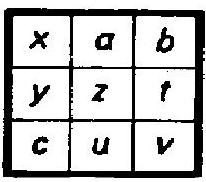
2. We write the equations for the sums of r... | [
{
"content": "In a $3 \\times 3$ square grid, the numbers $a, b, c$ are placed (see the diagram). Can we write numbers in the empty cells such that the sum of the numbers in each column, each row, and along both diagonals is always the same?",
"role": "user"
},
{
"content": "1. We begin by labeling ... |
olympiads | Show that the area of a regular $2n$-gon inscribed in a circle is the geometric mean of the areas of the regular $n$-gons inscribed in and circumscribed about the circle. |
To solve the problem, we need to show that the area of a regular $2n$-gon inscribed in a circle is the geometric mean of the areas of the inscribed and circumscribed $n$-gons for the same circle.
1. **Area of inscribed $n$-gon:**
The area \( t_{n} \) of an inscribed regular $n$-gon can be determined using the for... | [
{
"content": "Show that the area of a regular $2n$-gon inscribed in a circle is the geometric mean of the areas of the regular $n$-gons inscribed in and circumscribed about the circle.",
"role": "user"
},
{
"content": "\nTo solve the problem, we need to show that the area of a regular $2n$-gon inscr... |
olympiads | In a cinema, there are seven rows with 10 seats each. A group of 50 children went to a morning show and then to an evening show.
Prove that there will be two children who sat in the same row during the morning show and also sat in the same row during the evening show. | ### Problem:
In a cinema, there are 7 rows with 10 seats in each row. A group of 50 children attended a morning show and then an evening show. Prove that there exist two children who sat in the same row during the morning show and also sat in the same row during the evening show.
1. **Understanding the initial condi... | [
{
"content": "In a cinema, there are seven rows with 10 seats each. A group of 50 children went to a morning show and then to an evening show.\n\nProve that there will be two children who sat in the same row during the morning show and also sat in the same row during the evening show.",
"role": "user"
},
... |
olympiads | In triangle \( ABC \), the altitudes \( AA_1 \), \( BB_1 \), and \( CC_1 \) are drawn. The line \( KL \) is parallel to \( CC_1 \), and the points \( K \) and \( L \) lie on the lines \( BC \) and \( B_1C_1 \) respectively. Prove that the circumcenter of the triangle \( A_1KL \) lies on the line \( AC \). |
1. **Symmetric Point $M$**: Let the point $M$ be symmetric to point $A_1$ with respect to the line $AC$. By the symmetry, $M$ is the reflection of $A_1$ across $AC$.
2. **Reference to Problem 1.58**: According to problem 1.58, the point $M$ must lie on the line $B_1 C_1$. This conclusion follows from the properties o... | [
{
"content": "In triangle \\( ABC \\), the altitudes \\( AA_1 \\), \\( BB_1 \\), and \\( CC_1 \\) are drawn. The line \\( KL \\) is parallel to \\( CC_1 \\), and the points \\( K \\) and \\( L \\) lie on the lines \\( BC \\) and \\( B_1C_1 \\) respectively. Prove that the circumcenter of the triangle \\( A_1KL ... |
olympiads | Let \(ABC\) be a triangle with \(AB = AC\), and let \(D\) be the midpoint of \(AC\). The angle bisector of \(\angle BAC\) intersects the circle through \(D, B\), and \(C\) in a point \(E\) inside the triangle \(ABC\). The line \(BD\) intersects the circle through \(A, E\), and \(B\) in two points \(B\) and \(F\). The l... |
Let's solve this problem step by step.
1. **Identifying Key Points and Angles:**
- Let $D'$ be the midpoint of the segment $AB$, and let $M$ be the midpoint of $BC$.
- By the symmetry along the line $AM$, $D'$ has to lie on the circle passing through $B$, $C$, and $D$.
- Since the arcs $D'E$ and $ED$ of tha... | [
{
"content": "Let \\(ABC\\) be a triangle with \\(AB = AC\\), and let \\(D\\) be the midpoint of \\(AC\\). The angle bisector of \\(\\angle BAC\\) intersects the circle through \\(D, B\\), and \\(C\\) in a point \\(E\\) inside the triangle \\(ABC\\). The line \\(BD\\) intersects the circle through \\(A, E\\), a... |
olympiads | Cut the corner shown in the diagram into four identical corners of half the size. |
To solve the problem of cutting the provided shape into four smaller identical pieces, we need to follow these steps:
1. **Analyze the Structure of the Shape:**
- The given shape is a right-angled isosceles triangular corner (angle), which can be imagined as 1/4th of a square if that square were cut diagonally twi... | [
{
"content": "Cut the corner shown in the diagram into four identical corners of half the size.",
"role": "user"
},
{
"content": "\nTo solve the problem of cutting the provided shape into four smaller identical pieces, we need to follow these steps:\n\n1. **Analyze the Structure of the Shape:**\n ... |
olympiads | In a plane, there are $N$ lines ($N > 1$), no three of which intersect at a single point and no two of which are parallel. Prove that it is possible to assign nonzero integers, each within the absolute value of $N$, to the regions into which these lines divide the plane such that the sum of the numbers on either side o... |
1. **Color the Plane:**
- Begin by coloring the plane with two colors: black and white, in a chessboard-like manner. This ensures that any two adjacent regions (regions sharing a boundary) will have different colors. This pattern guarantees that no two neighboring areas will have the same color.
2. **Assignment ... | [
{
"content": "In a plane, there are $N$ lines ($N > 1$), no three of which intersect at a single point and no two of which are parallel. Prove that it is possible to assign nonzero integers, each within the absolute value of $N$, to the regions into which these lines divide the plane such that the sum of the nu... |
olympiads | From any four points on a plane, no three of which lie on the same line, it is possible to select three points such that the triangle formed by these points has at least one angle not greater than $45^{\circ}$. Prove this. |
Let us consider the given problem which involves proving a certain property about four points in the plane, none of which are collinear.
We proceed by considering two main cases:
#### Case 1: The points form the vertices of a convex quadrilateral
1. Assume the four points are labeled as \( A, B, C, \) and \( D \) ... | [
{
"content": "From any four points on a plane, no three of which lie on the same line, it is possible to select three points such that the triangle formed by these points has at least one angle not greater than $45^{\\circ}$. Prove this.",
"role": "user"
},
{
"content": "\nLet us consider the given ... |
olympiads | A circle passing through the vertices $A$ and $C$ of triangle $ABC$ intersects side $AB$ at its midpoint $D$, and side $BC$ at point $E$. Another circle that passes through point $E$ and is tangent to line $AC$ at point $C$ intersects line $DE$ at point $F$. $K$ is the intersection point of lines $AC$ and $DE$.
Prove ... |
To prove that the lines \( CF \), \( AE \), and \( BK \) intersect at a single point, we will analyze the geometric properties and employ certain theorems.
1. **Observing the Inscribed Quadrilateral:**
- Given that quadrilateral \( ADE{C} \) is inscribed in a circle.
2. **Utilizing the Angle Between Tangent a... | [
{
"content": "A circle passing through the vertices $A$ and $C$ of triangle $ABC$ intersects side $AB$ at its midpoint $D$, and side $BC$ at point $E$. Another circle that passes through point $E$ and is tangent to line $AC$ at point $C$ intersects line $DE$ at point $F$. $K$ is the intersection point of lines ... |
olympiads | Write the function that is defined for all real numbers and consists of four linear parts: two line segments and two half-lines. The function has breakpoints at $(-4,2)$, $(0,0)$, and $(2,5)$, and it passes through the points $(-9,3)$ and $(5,6)$. |
Given the function \( f \) that is piecewise defined and passes through the points \((-9,3)\) and \((5,6)\) with breakpoints at \((-4,2)\), \((0,0)\), and \((2,5)\), we need to define it in terms of linear segments.
We organize the points in increasing order of their x-coordinates:
\[ A = (-9, 3), \, B = (-4, 2), \... | [
{
"content": "Write the function that is defined for all real numbers and consists of four linear parts: two line segments and two half-lines. The function has breakpoints at $(-4,2)$, $(0,0)$, and $(2,5)$, and it passes through the points $(-9,3)$ and $(5,6)$.",
"role": "user"
},
{
"content": "\nGi... |
olympiads | Prove that for any $\alpha \leq 1$ and any numbers $x_1, x_2, \cdots, x_n$ satisfying $1 \geq x_{1} \geq x_{2} \geq \cdots \geq x_{n} > 0$, the following inequality holds:
$$
\left(1 + x_{1} + x_{2} + \cdots + x_{n}\right)^{0} \leq 1 + 1^{\alpha - 1} \cdot x_{1}^{\alpha} + 2^{\alpha - 1} x_{2}^{\alpha} + \cdots + n^{\a... |
To prove the inequality
\[
\left(1+x_{1}+x_{2}+\cdots+x_{n}\right)^{\alpha} \leqslant 1 + 1^{\alpha-1} x_{1}^{\alpha} + 2^{\alpha-1} x_{2}^{\alpha} + \cdots + n^{\alpha-1} x_{n}^{\alpha},
\]
for any $\alpha \leqslant 1$ and any sequence of numbers $x_{1}, x_{2}, \ldots, x_{n}$ satisfying $1 \geqslant x_{1} \geqslant x... | [
{
"content": "Prove that for any $\\alpha \\leq 1$ and any numbers $x_1, x_2, \\cdots, x_n$ satisfying $1 \\geq x_{1} \\geq x_{2} \\geq \\cdots \\geq x_{n} > 0$, the following inequality holds:\n$$\n\\left(1 + x_{1} + x_{2} + \\cdots + x_{n}\\right)^{0} \\leq 1 + 1^{\\alpha - 1} \\cdot x_{1}^{\\alpha} + 2^{\\al... |
olympiads | Prove: A positive integer \( n \) can be expressed as the sum of two squares if and only if the exponents of the prime factors of \( n \) of the form \( 4k-1 \) are all even. Also, \( n \) can be expressed as the sum of the squares of two coprime positive integers if and only if \( n \) does not have any prime factors ... |
1. **Identify the two cases for \(n\):**
We need to prove the following:
- If \(n\) has prime factors of the form \(4k-1\) each an even number of times, then \(n\) can be expressed as a sum of two squares.
- If \(n\) has no prime factors of the form \(4k-1\) and \(4\nmid n\), then \(n\) can be expressed ... | [
{
"content": "Prove: A positive integer \\( n \\) can be expressed as the sum of two squares if and only if the exponents of the prime factors of \\( n \\) of the form \\( 4k-1 \\) are all even. Also, \\( n \\) can be expressed as the sum of the squares of two coprime positive integers if and only if \\( n \\) ... |
olympiads | Show that in a certain vicinity of the winter solstice (i.e., before and after Dec. 21), the Sun rises earlier in Szeged than in Nyíregyháza. Is it possible that the Sun sets earlier in Szeged than in Nyíregyháza? |
To show that the Sun rises earlier in Szeged than in Nyíregyháza around the winter solstice (specifically before and after December 21), we proceed with the detailed steps as follows:
1. The geographical coordinates of Szeged are approximately \((\lambda_1' \approx 20^\circ 10', \varphi_1' = 46^\circ 15')\), and for ... | [
{
"content": "Show that in a certain vicinity of the winter solstice (i.e., before and after Dec. 21), the Sun rises earlier in Szeged than in Nyíregyháza. Is it possible that the Sun sets earlier in Szeged than in Nyíregyháza?",
"role": "user"
},
{
"content": "\nTo show that the Sun rises earlier i... |
olympiads | Construct a parabola given the vertex tangent $t$ and two additional tangents $t_{1}$ and $t_{2}$. |
To construct a parabola given the vertex tangent $t$ and two other tangents $t_1$ and $t_2$, we proceed as follows:
1. **Understanding Critical Points and Lines**:
- In Conic Sections, the parabolas are special cases of ellipses and hyperbolas. The following theorems are relevant:
- An ellipse (or hyperbola)... | [
{
"content": "Construct a parabola given the vertex tangent $t$ and two additional tangents $t_{1}$ and $t_{2}$.",
"role": "user"
},
{
"content": "\nTo construct a parabola given the vertex tangent $t$ and two other tangents $t_1$ and $t_2$, we proceed as follows:\n\n1. **Understanding Critical Poin... |
olympiads | Given the theorem: A prime number \( p > 2 \) can be written as the sum of two squares (i.e., \( p = m^2 + n^2 \), where \( m \) and \( n \) are integers) if and only if \( p \equiv 1 \ (\bmod \ 4) \).
Find the prime numbers that can be written in either of the following forms:
1. \( x^2 + 16y^2 \)
2. \( 4x^2 + 4xy + ... |
1. Let $p$ be a prime such that $p \equiv 1 \pmod{4}$.
According to a known theorem, a prime number $p > 2$ can be expressed as the sum of two squares ($p = m^2 + n^2$, where $m$ and $n$ are integers) if and only if $p \equiv 1 \pmod{4}$.
2. Considering the cases:
\[
\text{If } p \equiv 1 \pmod{4}, \tex... | [
{
"content": "Given the theorem: A prime number \\( p > 2 \\) can be written as the sum of two squares (i.e., \\( p = m^2 + n^2 \\), where \\( m \\) and \\( n \\) are integers) if and only if \\( p \\equiv 1 \\ (\\bmod \\ 4) \\).\n\nFind the prime numbers that can be written in either of the following forms:\n1... |
olympiads | Prove that the polynomial \( x^{44} + x^{33} + x^{22} + x^{11} + 1 \) is divisible by \( x^{4} + x^{3} + x^{2} + x + 1 \). | ### Problem:
Prove that the polynomial \( x^{44} + x^{33} + x^{22} + x^{11} + 1 \) is divisible by \( x^4 + x^3 + x^2 + x + 1 \).
1. **Observation Using Roots of Unity**:
We know that \( x^5 - 1 = (x - 1)(x^4 + x^3 + x^2 + x + 1) \). Therefore, the polynomial \( x^4 + x^3 + x^2 + x + 1 \) is a factor of \( x^5 - 1 ... | [
{
"content": "Prove that the polynomial \\( x^{44} + x^{33} + x^{22} + x^{11} + 1 \\) is divisible by \\( x^{4} + x^{3} + x^{2} + x + 1 \\).",
"role": "user"
},
{
"content": "### Problem:\nProve that the polynomial \\( x^{44} + x^{33} + x^{22} + x^{11} + 1 \\) is divisible by \\( x^4 + x^3 + x^2 + x... |
olympiads | Given a polynomial
\[
P(x) = x^3 + a x^2 + b x + c, \quad \text{where } a, b, c \in \mathbb{Z},
\]
one of whose roots is equal to the product of the other two, prove that the number \(2P(-1)\) is divisible by the number \(P(1) + P(-1) - 2(1 + P(0))\). |
We start by noting that \(P(x)=x^3+ax^2+bx+c\). Let's denote the roots of the polynomial by \(r, s,\) and \(rs\). By Vieta’s formulas, we have the following relationships:
1. The sum of the roots is equal to the negation of the coefficient of \(x^2\), thus:
\[
r + s + rs = -a
\]
2. The product of the roots ... | [
{
"content": "Given a polynomial\n\n\\[ \nP(x) = x^3 + a x^2 + b x + c, \\quad \\text{where } a, b, c \\in \\mathbb{Z}, \n\\]\n\none of whose roots is equal to the product of the other two, prove that the number \\(2P(-1)\\) is divisible by the number \\(P(1) + P(-1) - 2(1 + P(0))\\).",
"role": "user"
},
... |
olympiads | Mark several cells on an $8 \times 8$ board in such a way that any cell (including any marked ones) is adjacent on its side to exactly one marked cell. |
1. **Structure Analysis of an 8 × 8 Chessboard**
Since we are dealing with an 8 × 8 chessboard, it is useful to remember the unique properties of such a board. Each cell on a chessboard is either black or white, with no two adjacent cells sharing the same color. This can be visualized as an alternation of blac... | [
{
"content": "Mark several cells on an $8 \\times 8$ board in such a way that any cell (including any marked ones) is adjacent on its side to exactly one marked cell.",
"role": "user"
},
{
"content": "\n\n1. **Structure Analysis of an 8 × 8 Chessboard** \n\n Since we are dealing with an 8 × 8 ch... |
olympiads | 68. a) Squares are constructed on the sides of triangle \(ABC\) externally. Construct the triangle, knowing three points \(A_1, B_1, C_1\) which are the centers of these squares.
b) * Equilateral triangles are constructed on the sides of triangle \(ABC\) externally. Construct the triangle, knowing three points \(A_1, ... |
Let's solve part (a) first. We are given a triangle $ABC$ and squares constructed on its sides outside the triangle. We need to reconstruct triangle $ABC$ knowing the centers of the squares $A_1, B_1,$ and $C_1$.
#### Part (a)
We will use two different methods to find the desired triangle.
#### First Solution
1. Ass... | [
{
"content": "68. a) Squares are constructed on the sides of triangle \\(ABC\\) externally. Construct the triangle, knowing three points \\(A_1, B_1, C_1\\) which are the centers of these squares.\n\nb) * Equilateral triangles are constructed on the sides of triangle \\(ABC\\) externally. Construct the triangle... |
olympiads | Point \( P \) is inside the angle region \( XOY \), and the line \( e \) passes through \( O \) and lies outside the angle region \( XOY \). Draw a line parallel to \( e \) through an arbitrary point \( Q \) on the segment \( OP \) such that it intersects the arms of the angle at points \( E \) and \( F \). Determine t... |
#### Step 1: Previous Result Application
According to the earlier solution from problem 1557, for the triangle \( \triangle EFP \) to have a maximum area, the point \( Q \) must be the midpoint of the segment \( OP \).
#### Step 2: Define Point \(Q\)
Let's consider \( Q \) as the midpoint of segment \( OP \). Now d... | [
{
"content": "Point \\( P \\) is inside the angle region \\( XOY \\), and the line \\( e \\) passes through \\( O \\) and lies outside the angle region \\( XOY \\). Draw a line parallel to \\( e \\) through an arbitrary point \\( Q \\) on the segment \\( OP \\) such that it intersects the arms of the angle at p... |
olympiads | a) The continuation of the angle bisector of $\angle B$ of triangle $ABC$ intersects the circumcircle at point $M$. Let $O$ be the center of the incircle, and $O_b$ be the center of the excircle that touches side $AC$. Prove that points $A$, $C$, $O$, and $O_b$ lie on a circle centered at $M$.
b) The point $O$, locate... |
**Part (a)**:
1. **Given**: The point \( M \) is the intersection of the extension of the angle bisector of \(\angle B\) of triangle \( ABC \) with the circumcircle of \( \triangle ABC \). \( O \) is the center of the incircle and \( O_b \) is the center of the excircle tangent to side \( AC \).
2. **Step 1**: Confi... | [
{
"content": "a) The continuation of the angle bisector of $\\angle B$ of triangle $ABC$ intersects the circumcircle at point $M$. Let $O$ be the center of the incircle, and $O_b$ be the center of the excircle that touches side $AC$. Prove that points $A$, $C$, $O$, and $O_b$ lie on a circle centered at $M$.\n\... |
olympiads | Prove that among 50 people, there will be two who have an even number of mutual acquaintances (possibly 0) among the remaining 48 people. |
1. Let us denote one of our 50 people as $A$ and let $N$ be the group of people who are acquaintances of $A$.
2. For each person $B$ in $N$, the set of their mutual acquaintances with $A$ consists precisely of the people in $N$ who are also acquainted with $B$.
3. If $N$ contains an odd number of people, then by a k... | [
{
"content": "Prove that among 50 people, there will be two who have an even number of mutual acquaintances (possibly 0) among the remaining 48 people.",
"role": "user"
},
{
"content": "\n1. Let us denote one of our 50 people as $A$ and let $N$ be the group of people who are acquaintances of $A$.\n\... |
olympiads | Given any positive integer \( N \), show that there is just one solution to \( m + \frac{1}{2}(m + n - 1)(m + n - 2) = N \) in positive integers. |
1. **Understand the Problem:**
We are given a problem involving the equation:
\[
m + \frac{1}{2}(m + n - 1)(m + n - 2) = N
\]
where \( N \) is a positive integer. We need to show that there is exactly one solution in positive integers \((m, n)\).
2. **Substitute and Define:**
Let \( T_r = \frac{1}{2... | [
{
"content": "Given any positive integer \\( N \\), show that there is just one solution to \\( m + \\frac{1}{2}(m + n - 1)(m + n - 2) = N \\) in positive integers.",
"role": "user"
},
{
"content": "\n1. **Understand the Problem:**\n We are given a problem involving the equation:\n \\[\n m + \... |
olympiads | In the given diagram, let $\odot O$ be the circumcircle of $\triangle ABC$, and let $\mathrm{I}$ be the incenter of $\triangle ABC$. Let $\odot \mathrm{J}$ be a circle that is tangent to $AB$ and $AC$ at points $D$ and $E$ respectively, and is internally tangent to $\odot O$ at point $F$. Prove that line $\mathrm{IF}$ ... | :
1. Given: In the figure, $\odot O$ is the circumcircle of $\triangle ABC$, and $I$ is the incenter. $\odot J$ intersects $AB$ and $AC$ at points $D$ and $E$ respectively, and intersects internally with $\odot O$ at point $F$. We are required to prove that $\mathrm{IF}$ bisects $\angle \mathrm{BFC}$.
2. Extend line... | [
{
"content": "In the given diagram, let $\\odot O$ be the circumcircle of $\\triangle ABC$, and let $\\mathrm{I}$ be the incenter of $\\triangle ABC$. Let $\\odot \\mathrm{J}$ be a circle that is tangent to $AB$ and $AC$ at points $D$ and $E$ respectively, and is internally tangent to $\\odot O$ at point $F$. P... |
olympiads | In a quiz, 10 students participated and collectively gave 42 correct answers. Prove that at least 2 students gave the same number of correct answers (possibly zero). | To demonstrate that at least 2 out of 10 students gave the same number of correct answers, we will prove the statement by contradiction.
1. **Define the Assumption:**
Assume that each of the 10 students gave a different number of correct answers.
2. **Number Assignment Range:**
If each student gave a different ... | [
{
"content": "In a quiz, 10 students participated and collectively gave 42 correct answers. Prove that at least 2 students gave the same number of correct answers (possibly zero).",
"role": "user"
},
{
"content": "To demonstrate that at least 2 out of 10 students gave the same number of correct answ... |
olympiads | It is known that among several banknotes with pairwise distinct natural denominations, there are exactly $N$ counterfeit ones. A detector determines the sum of the denominations of all genuine banknotes in a selected set in one check. Prove that all counterfeit banknotes can be found in $N$ checks, if: a) $N=2$; b) $N=... | The problem requires proving that, using a detector that sums the nominal values of all genuine notes in a selected set, one can identify all the counterfeit notes within $ N $ tests, given $ N $ counterfeit notes.
#### Problem a) $N = 2$
1. **Initial Step:** Sum the nominal values of the entire set of bills, denoted... | [
{
"content": "It is known that among several banknotes with pairwise distinct natural denominations, there are exactly $N$ counterfeit ones. A detector determines the sum of the denominations of all genuine banknotes in a selected set in one check. Prove that all counterfeit banknotes can be found in $N$ checks... |
olympiads | Find all integer solutions to the equation \(2^{n} - 1 = x^{m}\), where \(m\) and \(n\) are natural numbers.
|
1. Consider the equation \(2^n - 1 = x^m\) where both \(m\) and \(n\) are natural numbers.
2. **Case 1: \(n = 1\)**
- When \(n = 1\), the equation becomes:
\[
x^m = 1
\]
- For \(m\) being an even number, \(x = \pm 1\) are the solutions.
- For \(m\) being an odd number, \(x = 1\) is the solutio... | [
{
"content": "Find all integer solutions to the equation \\(2^{n} - 1 = x^{m}\\), where \\(m\\) and \\(n\\) are natural numbers.\n",
"role": "user"
},
{
"content": "\n1. Consider the equation \\(2^n - 1 = x^m\\) where both \\(m\\) and \\(n\\) are natural numbers.\n\n2. **Case 1: \\(n = 1\\)**\n - ... |
olympiads | Prove that among the roots of the polynomial
$$
f(x) = x^3 + a x^2 + b x + c
$$
there are two opposite numbers if and only if $ab = c$, where $b \leq 0$. |
To prove that among the roots of the polynomial
\[ f(x) = x^{3} + a x^{2} + b x + c \]
there are two numbers that are negatives of each other if and only if \( ab = c \), where \( b \leq 0 \), we will consider two cases:
#### Case 1: Assume \( ab = c \) where \( b \leq 0 \).
1. Given that \( ab = c \), substitute ... | [
{
"content": "Prove that among the roots of the polynomial\n\n$$\nf(x) = x^3 + a x^2 + b x + c\n$$\n\nthere are two opposite numbers if and only if $ab = c$, where $b \\leq 0$.",
"role": "user"
},
{
"content": "\nTo prove that among the roots of the polynomial \n\\[ f(x) = x^{3} + a x^{2} + b x + c ... |
olympiads | The number \( t \) is a root of the quadratic equation \( a x^{2} + b x + c = 0 \) with integer coefficients (\( a \neq 0 \)). Prove that the number \( t + 2 \) is also a root of a quadratic equation with integer coefficients. |
To demonstrate that if \( t \) is a root of the quadratic equation \( a x^2 + b x + c = 0 \) with integer coefficients (where \( a \neq 0 \)), then \( t + 2 \) is also a root of some quadratic equation with integer coefficients, we proceed as follows:
1. **Rewriting \( x \) in terms of the new root \( t + 2 \)**:
... | [
{
"content": "The number \\( t \\) is a root of the quadratic equation \\( a x^{2} + b x + c = 0 \\) with integer coefficients (\\( a \\neq 0 \\)). Prove that the number \\( t + 2 \\) is also a root of a quadratic equation with integer coefficients.",
"role": "user"
},
{
"content": "\nTo demonstrate... |
olympiads | Let \( X \) be a Gaussian vector taking values in \( \mathbb{R}^{n} \). Prove that the matrix \( \mathrm{D}X \) is degenerate if and only if there exists a non-zero vector \( b \in \mathbb{R}^{n} \) such that \( \mathrm{P}\left(X^{*} b = \mathrm{E} X^{*} b\right) = 1 \), where, as usual, \( X^{*} = X^{\top} \). |
Let \( X \) be a Gaussian vector with values in \( \mathbb{R}^n \). We aim to prove that the covariance matrix \( \mathrm{D}(X) \) is singular if and only if there exists a non-zero vector \( b \in \mathbb{R}^n \) such that \( \mathrm{P}(X^* b = \mathrm{E}[X^*] b) = 1 \), where \( X^* = X^{\top} \).
1. **Necessity**:... | [
{
"content": "Let \\( X \\) be a Gaussian vector taking values in \\( \\mathbb{R}^{n} \\). Prove that the matrix \\( \\mathrm{D}X \\) is degenerate if and only if there exists a non-zero vector \\( b \\in \\mathbb{R}^{n} \\) such that \\( \\mathrm{P}\\left(X^{*} b = \\mathrm{E} X^{*} b\\right) = 1 \\), where, a... |
olympiads | Prove that for any positive integer \( m \), there exist infinitely many pairs of integers \( (x, y) \) such that:
(1) \( x \) and \( y \) are coprime;
(2) \( x \mid (y^2 + m) \) and \( y \mid (x^2 + m) \). |
We want to prove the following: For any positive integer \( m \), there exist infinitely many pairs of integers \((x, y)\) such that:
1. \( x \) and \( y \) are coprime, i.e., \(\gcd(x, y) = 1\).
2. \( x \mid (y^2 + m) \) and \( y \mid (x^2 + m) \).
1. Let us start by noting that the pair \((x, y) = (1, 1)\) satisfi... | [
{
"content": "Prove that for any positive integer \\( m \\), there exist infinitely many pairs of integers \\( (x, y) \\) such that: \n(1) \\( x \\) and \\( y \\) are coprime;\n(2) \\( x \\mid (y^2 + m) \\) and \\( y \\mid (x^2 + m) \\).",
"role": "user"
},
{
"content": "\nWe want to prove the follo... |
olympiads | Two circles touch the line AB at points A and B, respectively, and intersect each other at points X and Y, with X being closer to the line AB. The tangent to the circle AXY at X intersects the circle BXY at point W. The ray AX intersects BW at point Z. Show that BW and BX are tangents to the circle XYZ. | The given problem discusses a configuration of circles, tangents, and intersections, and we need to show that certain lines are tangents to a particular circle. Here is the complete detailed step-by-step solution.
1. **Restate the Problem and Setup:**
- We have two circles that touch the line \( AB \) at points \(... | [
{
"content": "Two circles touch the line AB at points A and B, respectively, and intersect each other at points X and Y, with X being closer to the line AB. The tangent to the circle AXY at X intersects the circle BXY at point W. The ray AX intersects BW at point Z. Show that BW and BX are tangents to the circl... |
olympiads | Let \(a, b, c > 0\) with \(abc = 1\). Show that
\[3 + \frac{a}{b} + \frac{b}{c} + \frac{c}{a} \geq a + b + c + \frac{1}{a} + \frac{1}{b} + \frac{1}{c}\] |
1. Given the condition \(a b c = 1\), we make the substitutions \(\mathrm{a} = \frac{y}{x}, \, \mathrm{b} = \frac{z}{y}, \, \mathrm{c} = \frac{x}{z}\). This ensures that \(a b c = \left(\frac{y}{x}\right) \left(\frac{z}{y}\right) \left(\frac{x}{z}\right) = 1\), which holds true by definition.
2. Substituting \(a\), \... | [
{
"content": "Let \\(a, b, c > 0\\) with \\(abc = 1\\). Show that\n\n\\[3 + \\frac{a}{b} + \\frac{b}{c} + \\frac{c}{a} \\geq a + b + c + \\frac{1}{a} + \\frac{1}{b} + \\frac{1}{c}\\]",
"role": "user"
},
{
"content": "\n1. Given the condition \\(a b c = 1\\), we make the substitutions \\(\\mathrm{a} ... |
olympiads | A police emergency number is a positive integer that ends with the digits 133 in the decimal system. Prove that every police emergency number has a prime divisor greater than 7. | ### Lösung:
1. **Definition and Assumption:**
Eine Polizeinotrufzahl \( N \) sei eine positive ganze Zahl, die auf die Ziffern 133 endet. Das bedeutet, dass \( N \) in der Form
\[
N = 100k + 133 \quad \text{für ein nicht-negatives ganzzahliges } k.
\]
2. **Modulo berechnen:**
Diese Zahl \( N \) können ... | [
{
"content": "A police emergency number is a positive integer that ends with the digits 133 in the decimal system. Prove that every police emergency number has a prime divisor greater than 7.",
"role": "user"
},
{
"content": "### Lösung:\n\n1. **Definition and Assumption:**\n Eine Polizeinotrufzah... |
olympiads | There are 9 delegates at a conference, each speaking at most three languages. Given any three delegates, at least 2 speak a common language. Show that there are three delegates with a common language. |
To prove that there exist three delegates at the conference who speak a common language, let's proceed by contradiction.
1. **Assumption:**
Suppose the contrary, i.e., no three delegates share a common language.
2. **Delegate Analysis:**
Consider a delegate \( A \). This delegate \( A \) can communicate in a... | [
{
"content": "There are 9 delegates at a conference, each speaking at most three languages. Given any three delegates, at least 2 speak a common language. Show that there are three delegates with a common language.",
"role": "user"
},
{
"content": "\nTo prove that there exist three delegates at the ... |
olympiads | Show that the function \( y = e^{2x} \) is a solution to the differential equation \( y''' - 8y = 0 \). |
1. First, we are given the function \( y = e^{2x} \) and we need to verify if it is a solution to the differential equation \( y''' - 8y = 0 \).
2. To do this, we need the first, second, and third derivatives of the given function \( y = e^{2x} \).
3. Calculate the first derivative:
\[
y' = \frac{d}{dx} (e^{... | [
{
"content": "Show that the function \\( y = e^{2x} \\) is a solution to the differential equation \\( y''' - 8y = 0 \\).",
"role": "user"
},
{
"content": "\n1. First, we are given the function \\( y = e^{2x} \\) and we need to verify if it is a solution to the differential equation \\( y''' - 8y = ... |
olympiads | Prove that the decimal logarithms of positive integers, which are not integer powers of 10, are irrational numbers. | :
1. **Assumption and definition**:
Suppose that $N$ is a positive integer which is not an exact power of 10 (i.e., $N \neq 10^k$ for any integer $k$).
2. **Assume rationality**:
Assume, for the sake of contradiction, that the base-10 logarithm of $N$ is rational. That means $\log_{10} N = \frac{n}{p}$ for s... | [
{
"content": "Prove that the decimal logarithms of positive integers, which are not integer powers of 10, are irrational numbers.",
"role": "user"
},
{
"content": ": \n\n1. **Assumption and definition**:\n Suppose that $N$ is a positive integer which is not an exact power of 10 (i.e., $N \\neq 10... |
olympiads | Three pedestrians are walking along three straight roads at constant speeds. Initially, they were not on the same line. Prove that they can be on the same line at most twice. | To prove that three pedestrians moving in straight lines with constant velocities can be collinear at most twice, follow these steps:
1. **Define the positions of the pedestrians**:
Let the positions of the three pedestrians at any time \( t \) be given by \((x_0(t), y_0(t))\), \((x_1(t), y_1(t))\), and \((x_2(t), ... | [
{
"content": "Three pedestrians are walking along three straight roads at constant speeds. Initially, they were not on the same line. Prove that they can be on the same line at most twice.",
"role": "user"
},
{
"content": "To prove that three pedestrians moving in straight lines with constant veloci... |
olympiads | Prove that the third intersection points of the side lines of the pedal triangle with the side lines of the original triangle are collinear. |
Let's consider two solutions to prove that the third intersection points of the side lines of the pedal triangle with the side lines of the original triangle are collinear.
#### First Solution:
1. Consider $\triangle ABC$ and its pedal triangle $\triangle A_1B_1C_1$ constructed with respect to a point $P$.
2. Join t... | [
{
"content": "Prove that the third intersection points of the side lines of the pedal triangle with the side lines of the original triangle are collinear.",
"role": "user"
},
{
"content": "\nLet's consider two solutions to prove that the third intersection points of the side lines of the pedal trian... |
olympiads | A circle is drawn through the bases of the angle bisectors of triangle $ABC$. Prove that one of the chords formed by the intersection of this circle with the sides of the triangle is equal to the sum of the other two. | To prove that one of the chords formed at the intersection of the circumcircle with the sides of triangle $ABC$ is equal to the sum of the other two, we will consider the following steps:
1. **Identify the Points and Chords:**
Let $K_{1}$ and $L_{1}$ be points on sides $BC$ and $BA$ respectively, such that $K_{1}K ... | [
{
"content": "A circle is drawn through the bases of the angle bisectors of triangle $ABC$. Prove that one of the chords formed by the intersection of this circle with the sides of the triangle is equal to the sum of the other two.",
"role": "user"
},
{
"content": "To prove that one of the chords fo... |
olympiads | A positive integer is called a "pretty number" if each of its prime factors appears with an exponent of at least 2 (i.e., in its prime factorization, the exponent of each prime factor is no less than 2). If two consecutive positive integers are both "pretty numbers," they are referred to as a pair of "twin pretty numbe... |
To prove that there are infinitely many pairs of "twin beautiful numbers," we proceed as follows:
1. **Definition and Initial Pair $(n, n+1)$:**
According to the problem, a "beautiful number" is an integer where every prime factor appears with at least an exponent of 2 in its prime factorization. A pair of integ... | [
{
"content": "A positive integer is called a \"pretty number\" if each of its prime factors appears with an exponent of at least 2 (i.e., in its prime factorization, the exponent of each prime factor is no less than 2). If two consecutive positive integers are both \"pretty numbers,\" they are referred to as a ... |
olympiads | A convex polyhedron has one vertex \( A \) with degree 5, while all other vertices have degree 3. A coloring of the edges of the polyhedron using three colors (blue, red, and purple) is called "good" if, for every vertex of degree 3, all edges incident to that vertex are colored in different colors. It turns out that t... | To solve the problem, let's delve into the details step by step.
1. **Vertex Degrees and Edge Coloring**: Given a convex polyhedron with one vertex \( A \) of degree 5, and all other vertices of degree 3. A coloring of the edges of the polyhedron is considered "good" if, at each vertex of degree 3, all the incident ed... | [
{
"content": "A convex polyhedron has one vertex \\( A \\) with degree 5, while all other vertices have degree 3. A coloring of the edges of the polyhedron using three colors (blue, red, and purple) is called \"good\" if, for every vertex of degree 3, all edges incident to that vertex are colored in different c... |
olympiads | Construct an $n$-gon if $n$ points are known, which form the vertices of isosceles triangles built on the sides of this $n$-gon and have given angles $\alpha_{1}, \alpha_{2}, \ldots, \alpha_{n}$ at the vertices (see Fig. 28, where $n = 6$). |
Let us construct an $n$-gon given $n$ points that are vertices of isosceles triangles with known angles at the vertices. As a special case, this problem includes problem 13, where $x_{1} = \alpha_{2} = \ldots = \alpha_{n} = 180^\circ$ and $n$ is odd.
#### Step-by-Step Procedure:
1. **Assumption of Solution:** Assume... | [
{
"content": "Construct an $n$-gon if $n$ points are known, which form the vertices of isosceles triangles built on the sides of this $n$-gon and have given angles $\\alpha_{1}, \\alpha_{2}, \\ldots, \\alpha_{n}$ at the vertices (see Fig. 28, where $n = 6$).",
"role": "user"
},
{
"content": "\nLet u... |
olympiads | In a given square \(ABCD\), equilateral triangles \(ABK\), \(BCL\), \(CDM\), and \(DAN\) are constructed inward on each side. Prove that the midpoints of the segments \(KL\), \(LM\), \(MN\), \(NK\), as well as the midpoints of the segments \(AK\), \(BK\), \(BL\), \(CL\), \(CM\), \(DM\), \(DN\), and \(AN\) form the vert... |
1. Let's first represent the points \(A, B, C, D\) on the complex plane where the square \(ABCD\) has side length 2 centered at the origin. We choose:
\[
A = 1, \quad B = \mathrm{i}, \quad C = -1, \quad D = -\mathrm{i}
\]
where \(\mathrm{i}\) is the imaginary unit.
2. Next, we consider the equilateral tri... | [
{
"content": "In a given square \\(ABCD\\), equilateral triangles \\(ABK\\), \\(BCL\\), \\(CDM\\), and \\(DAN\\) are constructed inward on each side. Prove that the midpoints of the segments \\(KL\\), \\(LM\\), \\(MN\\), \\(NK\\), as well as the midpoints of the segments \\(AK\\), \\(BK\\), \\(BL\\), \\(CL\\), ... |
olympiads | Let \( a \) and \( r \) be given real numbers greater than 1, and the function \( f: \mathbf{R}^{+} \rightarrow \mathbf{R} \) satisfies: for any \( x > 0 \), \( f^{2}(x) \leqslant a x' f\left(\frac{x}{a}\right) \).
1. If for any \( 0 < x < \frac{1}{2^{2005}} \), we have \( f(x) < 2^{2005} \), prove that for any \( x >... | ### Problem:
Consider the function \( f: \mathbf{R}^{+} \rightarrow \mathbf{R} \) which satisfies the following condition: for any \( x > 0 \), we have
\[ f^2(x) \leq a x^{\prime} f \left( \frac{x}{a} \right), \]
where \(a > 1\).
1. If for any \( 0 < x < \frac{1}{2^{2005}} \), we have \( f(x) < 2^{2005} \), prove that... | [
{
"content": "Let \\( a \\) and \\( r \\) be given real numbers greater than 1, and the function \\( f: \\mathbf{R}^{+} \\rightarrow \\mathbf{R} \\) satisfies: for any \\( x > 0 \\), \\( f^{2}(x) \\leqslant a x' f\\left(\\frac{x}{a}\\right) \\).\n\n1. If for any \\( 0 < x < \\frac{1}{2^{2005}} \\), we have \\( ... |
olympiads | a) Prove that if for some triangle \( p = 2R + r \), then this triangle is a right triangle.
b) Prove that if \( p = 2R \sin \varphi + r \cot(\varphi / 2) \), then \( \varphi \) is one of the angles of the triangle (assuming \( 0 < \varphi < \pi \)). |
#### Part (a):
1. **Given:**
\[
p = 2R + r
\]
where \( p \) is the semi-perimeter of the triangle, \( R \) is the circumradius, and \( r \) is the inradius.
2. **Recall known relationships:**
- The semi-perimeter \( p \) of a triangle is given by:
\[
p = \frac{a + b + c}{2}
\]
- F... | [
{
"content": "a) Prove that if for some triangle \\( p = 2R + r \\), then this triangle is a right triangle.\n\nb) Prove that if \\( p = 2R \\sin \\varphi + r \\cot(\\varphi / 2) \\), then \\( \\varphi \\) is one of the angles of the triangle (assuming \\( 0 < \\varphi < \\pi \\)).",
"role": "user"
},
{... |
olympiads | Prove that there exist a positive integer \( n \) and linear forms \( P_{1}, \ldots, P_{n} \) in 2017 variables such that the equation
\[
x_{1} \cdot x_{2} \cdot \ldots \cdot x_{2017} = P_{1}\left(x_{1}, \ldots, x_{2017}\right)^{2017} + \ldots + P_{n}\left(x_{1}, \ldots, x_{2017}\right)^{2017}
\]
holds for all real n... |
We aim to show that for every integer \( k \geq 1 \), there exists a positive integer \( n = n_k \), real numbers \( \lambda_1, \ldots, \lambda_{n_k} \), and linear forms \( P_{k, 1}, \ldots, P_{k, n_k} \) in \( k \) variables such that:
\[
x_1 \cdot x_2 \cdot \ldots \cdot x_k = \lambda_1 P_{k,1}(x_1, \ldots, x_k)^k ... | [
{
"content": "Prove that there exist a positive integer \\( n \\) and linear forms \\( P_{1}, \\ldots, P_{n} \\) in 2017 variables such that the equation\n\n\\[\nx_{1} \\cdot x_{2} \\cdot \\ldots \\cdot x_{2017} = P_{1}\\left(x_{1}, \\ldots, x_{2017}\\right)^{2017} + \\ldots + P_{n}\\left(x_{1}, \\ldots, x_{201... |
olympiads | Ten vectors are such that the length of the sum of any nine of them is less than the length of the sum of all ten vectors. Prove that there exists an axis such that the projection of each of the ten vectors onto this axis is positive. | 1. Given vectors $\mathbf{e}_{1}, \ldots, \mathbf{e}_{10}$, we need to demonstrate the property about the projection of each vector.
2. Denote the resultant vector as $\overrightarrow{AB} = \mathbf{e}_{1} + \mathbf{e}_{2} + \cdots + \mathbf{e}_{10}$ and consider its properties.
3. We want to show that the ray $AB$ ser... | [
{
"content": "Ten vectors are such that the length of the sum of any nine of them is less than the length of the sum of all ten vectors. Prove that there exists an axis such that the projection of each of the ten vectors onto this axis is positive.",
"role": "user"
},
{
"content": "1. Given vectors ... |
olympiads | We define the sequence \(\left(a_{n}\right)\) by \(a_{0}=0\), \(a_{1}=1\), \(a_{2}=2\), \(a_{3}=6\) and
\[
\forall n \geqslant 0, a_{n+4}=2 a_{n+3}+a_{n+2}-2 a_{n+1}-a_{n}
\]
Show that \(n^{2}\) divides \(a_{n}\) for an infinite number of \(n \in \mathbb{N}\). |
The problem defines a sequence \( \left(a_n\right) \) by the initial conditions \( a_0 = 0 \), \( a_1 = 1 \), \( a_2 = 2 \), \( a_3 = 6 \), and the recurrence relation:
\[
\forall n \geq 0, \quad a_{n+4} = 2a_{n+3} + a_{n+2} - 2a_{n+1} - a_n.
\]
We aim to show that \( n^2 \) divides \( a_n \) for an infinite number ... | [
{
"content": "We define the sequence \\(\\left(a_{n}\\right)\\) by \\(a_{0}=0\\), \\(a_{1}=1\\), \\(a_{2}=2\\), \\(a_{3}=6\\) and\n\n\\[\n\\forall n \\geqslant 0, a_{n+4}=2 a_{n+3}+a_{n+2}-2 a_{n+1}-a_{n}\n\\]\n\nShow that \\(n^{2}\\) divides \\(a_{n}\\) for an infinite number of \\(n \\in \\mathbb{N}\\).",
... |
olympiads | Prove that in a triangle with sides \(a\), \(b\), and \(c\), the median \(m\) drawn to the side \(c\) satisfies the inequality \(m > \frac{a+b-c}{2}\). | ### Problem
Prove that in a triangle with sides \(a\), \(b\), and \(c\), the median \(m\) to side \(c\) satisfies the inequality \(m > \frac{a + b - c}{2}\).
1. **Identify the two triangles created by the median:**
- The median splits the original triangle into two smaller triangles, each with sides \(m\), \(\fr... | [
{
"content": "Prove that in a triangle with sides \\(a\\), \\(b\\), and \\(c\\), the median \\(m\\) drawn to the side \\(c\\) satisfies the inequality \\(m > \\frac{a+b-c}{2}\\).",
"role": "user"
},
{
"content": "### Problem\n\nProve that in a triangle with sides \\(a\\), \\(b\\), and \\(c\\), the m... |
olympiads | T is a torus with center O. The plane P contains O and touches T. Prove that the intersection of P and T is two circles. |
The aim is to prove that the intersection of the plane \( P \) containing the center \( O \) of a torus \( T \) and touching \( T \) forms two circles.
1. **Torus Equation and Interpretation in 2D:**
We start by considering the standard equation of the torus:
\[
(\sqrt{x^2 + y^2} - a)^2 + z^2 = b^2,
\]
... | [
{
"content": "T is a torus with center O. The plane P contains O and touches T. Prove that the intersection of P and T is two circles.",
"role": "user"
},
{
"content": "\nThe aim is to prove that the intersection of the plane \\( P \\) containing the center \\( O \\) of a torus \\( T \\) and touchin... |
olympiads | Find all natural numbers \( n \) such that \( n \cdot 2^n + 1 \) is divisible by 3. |
To solve this problem, we need to find all natural numbers \( n \) such that \( n \cdot 2^n + 1 \) is divisible by 3. This is satisfied if and only if \( n \cdot 2^n \equiv 2 \pmod{3} \).
We will analyze the expression \( n \cdot 2^n \pmod{3} \) for different values of \( n \).
1. **For \( n = 6k + 1 \) (where \( k ... | [
{
"content": "Find all natural numbers \\( n \\) such that \\( n \\cdot 2^n + 1 \\) is divisible by 3.",
"role": "user"
},
{
"content": "\nTo solve this problem, we need to find all natural numbers \\( n \\) such that \\( n \\cdot 2^n + 1 \\) is divisible by 3. This is satisfied if and only if \\( n... |
olympiads | In the country of Leonardia, all roads are one-way. Each road connects two cities without passing through other cities. The Department of Statistics calculated for each city the total number of residents in cities from which roads lead into it, and the total number of residents in cities to which roads lead out of it. ... |
1. We start by constructing a graph corresponding to the given problem. In this graph:
- Each vertex represents a city in the country of Leonardia.
- Each directed edge represents a one-way road between cities, with the direction corresponding to the direction of travel on the road.
2. For each vertex \( v \) i... | [
{
"content": "In the country of Leonardia, all roads are one-way. Each road connects two cities without passing through other cities. The Department of Statistics calculated for each city the total number of residents in cities from which roads lead into it, and the total number of residents in cities to which ... |
olympiads | Given an angle $X O Y$, with point $A$ on the ray $O X$ and point $B$ inside the angle. Draw a line through point $B$ that intersects $O X$ at point $C$ and $O Y$ at point $D$ such that $D C = D A$. |
To solve the problem, we proceed as follows:
1. **Identify the essential points and axes:**
- Let $O$ be the vertex of angle $X O Y$.
- Point $A$ lies on the segment $O X$.
- Point $B$ lies inside the angle $X O Y$.
- We need to find the point $D$ such that a line through $B$ intersects $O X$ at $C$ and $... | [
{
"content": "Given an angle $X O Y$, with point $A$ on the ray $O X$ and point $B$ inside the angle. Draw a line through point $B$ that intersects $O X$ at point $C$ and $O Y$ at point $D$ such that $D C = D A$.",
"role": "user"
},
{
"content": "\nTo solve the problem, we proceed as follows:\n\n1. ... |
olympiads | Given a positive integer \( k \), prove that the set \( \{0, 1, 2, 3, \ldots, 2^{k+1} - 1\} \) can be partitioned into two disjoint subsets \( \{x_1, x_2, \ldots, x_{2^k}\} \) and \( \{y_1, y_2, \ldots, y_{2^k}\} \) such that
$$
\sum_{i=1}^{2^k} x_i^m = \sum_{i=1}^{2^k} y_i^m
$$
for any \( m \in \{1, 2, \ldots, k\} \). |
1. **Base Case:**
When \( k = 1 \):
We start with the set \( \left\{0, 1, 2, 3\right\} \) and choose subsets as follows:
\[
x_1 = 0, \, x_2 = 3, \, y_1 = 1, \, y_2 = 2
\]
Check if the subsets satisfy the required condition:
\[
\sum_{i=1}^{2} x_i = 0 + 3 = 3, \quad \sum_{i=1}^{2} y_i = 1 + 2 = ... | [
{
"content": "Given a positive integer \\( k \\), prove that the set \\( \\{0, 1, 2, 3, \\ldots, 2^{k+1} - 1\\} \\) can be partitioned into two disjoint subsets \\( \\{x_1, x_2, \\ldots, x_{2^k}\\} \\) and \\( \\{y_1, y_2, \\ldots, y_{2^k}\\} \\) such that\n$$\n\\sum_{i=1}^{2^k} x_i^m = \\sum_{i=1}^{2^k} y_i^m\... |
olympiads | Prove that if the diagonals of a quadrilateral $ABCD$ are perpendicular, then the diagonals of any other quadrilateral with the same side lengths are also perpendicular. |
1. **Introduce vectors**: Let's represent the sides of the quadrilateral \(ABCD\) as vectors. We let \(\mathbf{a} = \overrightarrow{AB}\), \(\mathbf{b} = \overrightarrow{BC}\), \(\mathbf{c} = \overrightarrow{CD}\), and \(\mathbf{d} = \overrightarrow{DA}\).
2. **Condition of perpendicular diagonals**: To prove that th... | [
{
"content": "Prove that if the diagonals of a quadrilateral $ABCD$ are perpendicular, then the diagonals of any other quadrilateral with the same side lengths are also perpendicular.",
"role": "user"
},
{
"content": "\n1. **Introduce vectors**: Let's represent the sides of the quadrilateral \\(ABCD... |
olympiads | In triangle \( \triangle ABC \), point \( D \) is on the side \( BC \). Let \( O_1 \) and \( O_2 \) be the circumcenters of triangles \( \triangle ABD \) and \( \triangle ACD \) respectively. Let \( O' \) be the center of the circle passing through \( A \), \( O_1 \), and \( O_2 \). Prove that the condition for \( O'D ... |
1. **Identify the Centers**: Let $O$ be the circumcenter of $\triangle ABC$, $O_1$ be the circumcenter of $\triangle ABD$, and $O_2$ be the circumcenter of $\triangle ACD$. Also, let $O'$ be the circumcenter of the circumcircle passing through points $A$, $O_1$, and $O_2$.
2. **Cyclic Property**: Note that points $A$... | [
{
"content": "In triangle \\( \\triangle ABC \\), point \\( D \\) is on the side \\( BC \\). Let \\( O_1 \\) and \\( O_2 \\) be the circumcenters of triangles \\( \\triangle ABD \\) and \\( \\triangle ACD \\) respectively. Let \\( O' \\) be the center of the circle passing through \\( A \\), \\( O_1 \\), and \\... |
olympiads | As shown in Figure 2.7.13, three rays $PA$, $PB$, and $PC$ emanate from point $P$. Let $\angle APB = \alpha$, $\angle CPB = \beta$, and $\angle APC = \alpha + \beta < 180^\circ$. If $PB \cdot \sin(\alpha + \beta) = PC \cdot \sin(\alpha) + PA \cdot \sin(\beta)$, then points $P$, $A$, $B$, and $C$ lie on the same circle. |
1. Draw a circle passing through the points \( P, A, \) and \( C \). Let this circle intersect the line \( PB \) at a point \( B' \), which might be different from \( B \).
2. According to the properties of circles, we can use the Extended Law of Sines, which states that:
\[
\frac{PA}{\sin(\angle PBA)} = \frac{... | [
{
"content": "As shown in Figure 2.7.13, three rays $PA$, $PB$, and $PC$ emanate from point $P$. Let $\\angle APB = \\alpha$, $\\angle CPB = \\beta$, and $\\angle APC = \\alpha + \\beta < 180^\\circ$. If $PB \\cdot \\sin(\\alpha + \\beta) = PC \\cdot \\sin(\\alpha) + PA \\cdot \\sin(\\beta)$, then points $P$, $... |
olympiads | In $\triangle ABC$, $AB = AC$. Points $D$ and $E$ are located on the minor arcs $\overarc{AB}$ and $\overarc{AC}$, respectively, of the circumcircle of $\triangle ABC$ (excluding the endpoints of the arcs). Line $AD$ intersects $BC$ at point $F$, and line $AE$ intersects the circumcircle of $\triangle DEF$ at a second ... |
1. Given:
- In $\triangle ABC$, $AB = AC$.
- Points $D$ and $E$ lie on arcs $\overparen{AB}$ and $\overparen{AC}$ of the circumcircle of $\triangle ABC$, respectively (excluding the endpoints).
- Line $AD$ intersects $BC$ at point $F$.
- Line $AE$ intersects the circumcircle of $\triangle DEF$ at poin... | [
{
"content": "In $\\triangle ABC$, $AB = AC$. Points $D$ and $E$ are located on the minor arcs $\\overarc{AB}$ and $\\overarc{AC}$, respectively, of the circumcircle of $\\triangle ABC$ (excluding the endpoints of the arcs). Line $AD$ intersects $BC$ at point $F$, and line $AE$ intersects the circumcircle of $\... |
olympiads | 1. Show that among the numbers $2, 22, 222, 2222, \ldots, 222 \cdots 222$ (the last number contains 2011 times the digit 2), at least one is divisible by 2011.
2. Show that among 2011 arbitrary integers, one can always choose some such that their sum is divisible by 2011.
3. Consider 5 positive integers. By adding them... |
#### 1. Montrer que parmi les nombres \(2, 22, 222, 2222, \ldots, 222 \cdots 222\) (le dernier nombre contient 2011 fois le chiffre 2) au moins un est divisible par 2011.
Soient \( S_n \) la suite des nombres formés exclusivement par le chiffre 2 répété \( n \) fois, autrement dit:
\[ S_n = \underbrace{222\cdots2}_{n... | [
{
"content": "1. Show that among the numbers $2, 22, 222, 2222, \\ldots, 222 \\cdots 222$ (the last number contains 2011 times the digit 2), at least one is divisible by 2011.\n2. Show that among 2011 arbitrary integers, one can always choose some such that their sum is divisible by 2011.\n3. Consider 5 positiv... |
Subsets and Splits
No community queries yet
The top public SQL queries from the community will appear here once available.