

File size: 10,040 Bytes
9a46c96 | 1 2 3 4 5 6 7 8 9 10 11 12 13 14 15 16 17 18 19 20 21 22 23 24 25 26 27 28 29 30 31 32 33 34 35 36 37 38 39 40 41 42 43 44 45 46 47 48 49 50 51 52 53 54 55 56 57 58 59 60 61 62 63 64 65 66 67 68 69 70 71 72 73 74 75 76 77 78 79 80 81 82 83 84 85 86 87 88 89 90 91 92 93 94 95 96 97 98 99 100 101 102 103 104 105 106 107 108 109 110 111 112 113 114 115 116 117 118 119 120 121 122 123 124 125 126 127 128 129 130 131 132 133 134 135 136 137 138 139 140 141 142 143 144 145 146 147 148 149 150 151 152 153 154 155 156 157 158 159 160 161 162 163 164 165 166 167 168 169 170 171 172 173 174 175 176 177 178 179 180 181 182 183 184 185 186 187 188 189 190 191 192 193 194 195 196 197 198 199 200 201 202 203 204 205 206 207 208 209 210 211 212 213 214 215 216 217 218 219 220 221 222 223 224 225 226 | # [Beyond Autoregression: Fast LLMs via Self-Distillation Through Time](https://arxiv.org/abs/2410.21035)
By [Justin Deschenaux](https://x.com/jdeschena) and [Caglar Gulcehre](https://x.com/caglarml).
[](https://arxiv.org/abs/2410.21035)
[](https://jdeschena.github.io/sdtt-blog)
[](https://huggingface.co/jdeschena/sdtt)
## Summary
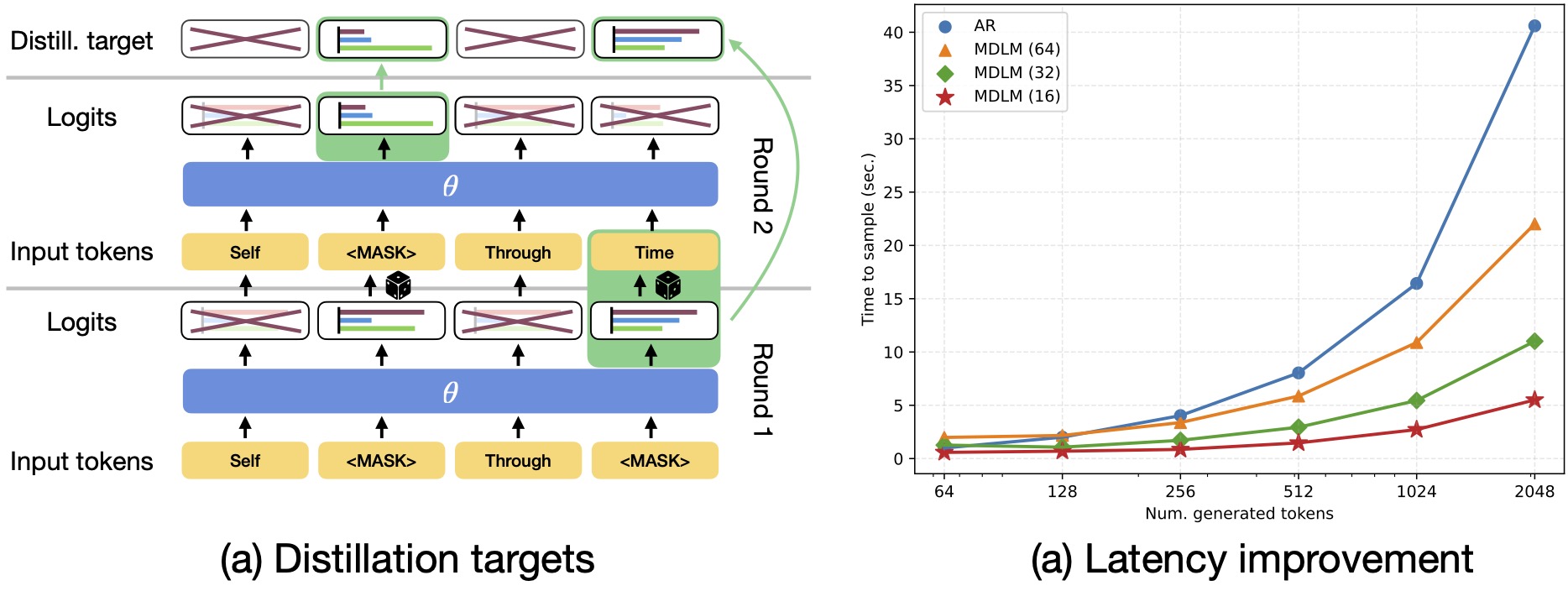
- We present *Self-Distillation Through Time* (SDTT), a novel method to distill discrete diffusion language models. SDTT is design to sample with few steps (less than 64), while retaining the quality of samples generated with 1024 sampling steps.
- SDTT teaches the diffusion language model to match the distribution of samples generated with 1024 steps, using few steps. It requires generating distillation targets, with the approach visualized in the above figure, and teaching a student model to match the teacher targets through a divergence measure $d$ between the teacher (many sampling steps) and the student (few sampling steps).
- We obtain our best results using the reverse KL divergence. In particular, the KLD was the only divergence measure that retained or improved performance when decreasing the number of steps.
- We evaluate the performance of the student in generative perplexity, using the [MAUVE metric](https://arxiv.org/abs/2102.01454), and on the [LAMBADA ](https://arxiv.org/abs/1606.06031) natural language understanding benchmark.
## How to run the code?
### Install our code
- To run examples, you need to install our code first.
- To install, run:
```bash
mamba create -n sdtt python=3.10 -y
mamba activate sdtt
git clone https://github.com/jdeschena/sdtt.git
pushd sdtt
pip install -r requirements.txt
mamba install flash-attn -y
pip install --pre torchdata --index-url https://download.pytorch.org/whl/nightly/cpu
pip install -e .
popd
```
### Try our pre-trained models
- We released 3 groups of models:
1. The **baseline students** distilled with the `kld`, `mse` and `tvd` objectives, distilled from a model trained for 1M steps.
2. The **students from the scaling experiments**, with sizes `sm`, `md`, `large`, distilled from models trained for 400k steps.
3. The **teachers from the scaling experiments**, with sizes `sm`, `md`, `large`, before any distillation.
- To load those models, first install our code (see previous section).
#### Load the original MDLM (small) weights
```python
from sdtt import load_mdlm_small
mldm_small = load_mdlm_small()
```
#### Load the baseline students
```python
from sdtt import load_small_student
student = load_small_student(loss="kld", round=7) # load the kld student after the last distillation round
student = load_small_student(loss="mse", round=2) # load the mse student after the second distillation round
student = load_small_student(loss="tvd", round=1) # load the tvd student after the first distillation round
```
#### Load the students from the scaling experiment
```python
from sdtt import load_scaling_student
student = load_scaling_student(size="sm", round=7) # load small student after the last distillation round
student = load_scaling_student(size="md", round=1) # load medium student after the first distillation round
student = load_scaling_student(size="large", round=3) # load large student after the third distillation round
```
#### Load the teachers from the scaling experiment
```python
from sdtt import load_scaling_teacher
student = load_scaling_student(size="sm",) # load small teacher
student = load_scaling_student(size="md",) # load medium teacher
student = load_scaling_student(size="large",) # load large teacher
```
#### Sample from the pretrained models
```python
from sdtt import load_small_student, load_scaling_student, load_scaling_teacher
import torch
model = load_small_student(loss="kld", round=7) # load model, see above
model.cuda() # put model on gpu
# Unconditional generation
tokens = model.sample(
n_samples=8,
num_steps=256,
seq_len=1024,
verbose=True,
)
# Detokenize
uncond_text = model.tokenizer.batch_decode(tokens)
# Conditional generation, based on a prompt
# Prepare a prompt
prompt = "Today is a great day. The sun is shining,"
prompt_tokens = model.tokenizer(prompt)["input_ids"]
prompt_tokens.insert(0, model.tokenizer.bos_token_id)
prompt_tokens = torch.tensor(prompt_tokens, device="cuda")
prompt_len = len(prompt_tokens)
def project_fn(x):
# Project the first 10 tokens of all examples to the prompt
x[:, :prompt_len] = prompt_tokens
return x # Don't forget to return
tokens = model.sample(
n_samples=8,
num_steps=256,
seq_len=1024,
verbose=True,
project_fn=project_fn
)
cond_text = model.tokenizer.batch_decode(tokens)
```
### Distill models
#### Distill the pre-trained [MDLM of Sahoo et al.](https://huggingface.co/kuleshov-group/mdlm-owt)
```bash
python src/sdtt/main.py \
mode=train \
parameterization.num_distill_steps=2 \
model=dit-orig-small \
time_conditioning=False \
loader.global_batch_size=128 \
loader.batch_size=32 \
trainer.max_steps=80000 \
hydra.run.dir="./outputs/distill_2_steps_from_hf_sm" \
loader.num_workers=16 \
compile=False \
optim.lr=6e-5 \
trainer.val_check_interval=5000 \
data_preprocess.data_cache=./data_cache \
wandb.project=debug
```
#### Distill a model you trained yourself
- First, you need to train a model [using the original MDLM codebase](https://github.com/kuleshov-group/mdlm/).
- For example, you could train medium-sized mdlm (460M) parameters. See `src/sdtt/configs/model/dit-orig-medium.yaml` for the hyperparameters.
```bash
python src/sdtt/main.py \
mode=train \
parameterization.start_from_hf=False \
model=dit-orig-medium \
parameterization.checkpoint_path=<REPLACE_BY:path_to_mdlm_code>/outputs/openwebtext/mdlm_md/checkpoints/0-1000000.ckpt \
parameterization.num_distill_steps=2 \
time_conditioning=False \
loader.global_batch_size=128 \
loader.batch_size=16 \
trainer.max_steps=80000 \
hydra.run.dir="./outputs/distill_2_steps_md" \
loader.num_workers=16 \
compile=False \
optim.lr=6e-5 \
trainer.val_check_interval=5000 \
data_preprocess.data_cache=./data_cache \
wandb.project=debug
```
### Sample from a distilled model (for evaluation)
- To evaluate the generation quality, you must sample from the model.
- The samples are saved in the run directory (defined by the config key `hydra.run.dir`), in the sub-folder `samples`.
- You can specify the checkpoint to use with the argument `checkpointing.resume_ckpt_path`. The argument to use is different than for training, since for training we load a *teacher* checkpoint to distill, while here we load the *student* checkpoint to sample from.
- To sample unconditionally (no prompt), set `parameterization.sampling.uncond.run`
- To sample conditionally (prompted using the first tokens of a dataset. Default: webtext), set `parameterization.sampling.cond_prefix.run`
- The sampling code is paralellized over the specificed devices, as for training.
- To use a
```bash
python src/sdtt/main.py \
mode=sample \
parameterization.num_distill_steps=2 \
parameterization.start_from_hf=False \
parameterization.sampling.uncond.run=True \
parameterization.sampling.cond_prefix.run=True \
parameterization.sampling.uncond.num_steps=2 \
parameterization.sampling.cond_prefix.num_steps=2 \
model=dit-orig-medium \
parameterization.checkpoint_path=<REPLACE_BY:path_to_mdlm_code>/outputs/openwebtext/mdlm_md/checkpoints/0-1000000.ckpt \
time_conditioning=False \
loader.global_batch_size=128 \
loader.batch_size=32 \
hydra.run.dir="./outputs/distill_2_steps_md" \
trainer.val_check_interval=5000 \
data_preprocess.data_cache=./data_cache \
wandb.project=debug
```
### Run evaluations
- After sampling, you can evaluate the generative perplexity and the mauve score. The generative perplexity is computed when `eval.ppl_with_ar.run` is `True`. The mauve score is computed when `eval.mauve.run` is `True`.
- Evaluation on the lambada benchmark does not require sampling beforehand. The lambada evaluation is run when `eval.lambada_openai.run` is `True`.
- You can use `llama3` to evaluate the generative perplexity instead of `gpt2-large` by setting the flag `eval.ppl_with_ar=llama3-8b`.
```bash
python src/sdtt/main.py \
mode=eval \
eval.ppl_with_ar.run=True \
eval.mauve.run=True \
eval.lambada_openai.run=True \
hydra.run.dir="./outputs/distill_2_steps_md" \
data_preprocess.data_cache=./data_cache \
loader.num_workers=32 \
compile=True \
```
## Code structure
* The entrypoint script is `src/sdtt/main.py`. It can be used to train, sample and evaluate our models. The mode (train, sample, eval) is selected via the `mode` flag in `src/sdtt/configs/config.yaml`.
* We use hydra to manage config files, and all configuration files are in `src/sdtt/configs`.
* The implementation of the distillation algorithm is in `src/sdtt/core/distill/mdlm_double_dt_correct.py`. It contains the code to compute the loss and the training loop. We use Pytorch Lightning to organize our code cleanly.
## Citation
```
@article{deschenaux2024autoregressionfastllmsselfdistillation,
title={Beyond Autoregression: Fast LLMs via Self-Distillation Through Time},
author={Deschenaux, Justin and Gulcehre, Caglar}
eprint={2410.21035},
archivePrefix={arXiv},
primaryClass={cs.LG},
url={https://arxiv.org/abs/2410.21035},
}
```
## Acknowledgements
Our codebase is inspired by recent discrete diffusion language models projects. Namely, [MDLM](https://github.com/kuleshov-group/mdlm) and [SEDD](https://github.com/louaaron/Score-Entropy-Discrete-Diffusion).
|