
VideoJev: System One Model for Video Understanding and Interaction








Abstract
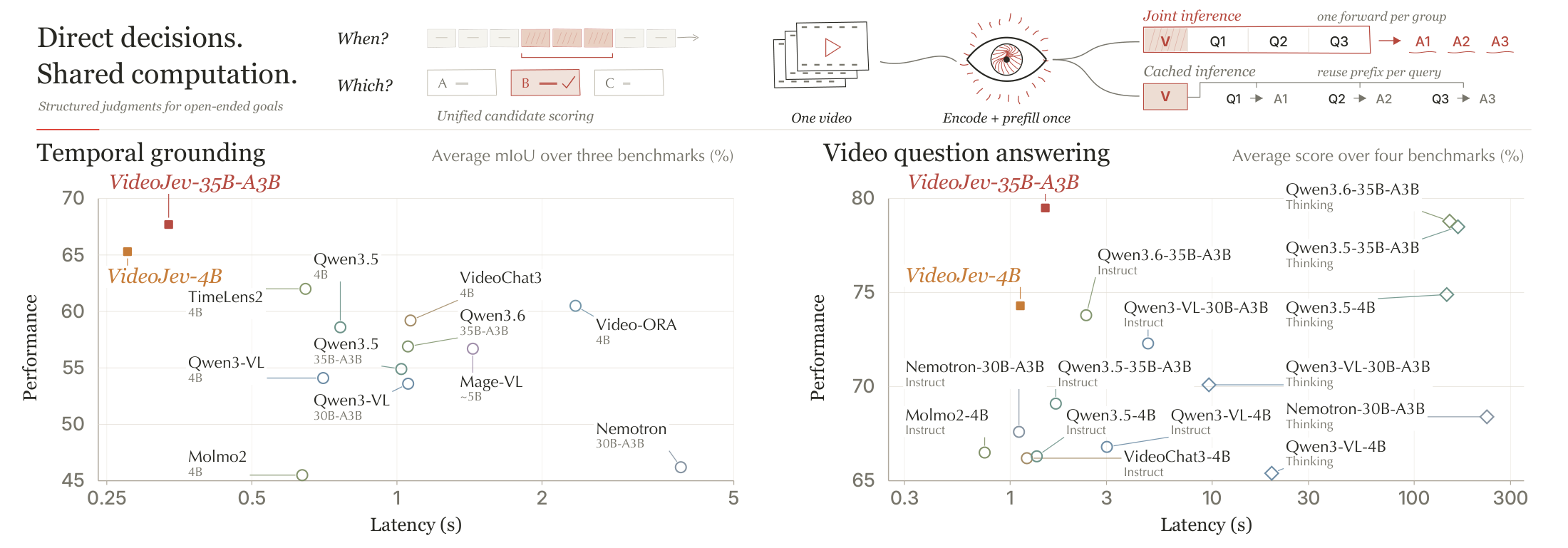
Visual agents must turn video observations into timely decisions to track progress and choose what to do next. Building on the emerging System One paradigm, we introduce VideoJev, a family of models that cast video understanding and interaction as structured decision tasks. We adapt pretrained multimodal large language models (MLLMs) by replacing autoregressive answer decoding with a shared head that scores temporal intervals and textual options against video evidence. These scores yield event spans or answer choices, unifying temporal grounding and multiple-choice video question answering. This combines the semantic flexibility of MLLMs with efficient decisions that agents can use directly. As an interaction unfolds, new goals and intermediate results prompt further queries about the same visual history. VideoJev therefore reuses visual computation through Cached inference for queries as they arrive and Joint inference for multiple queries in a single forward pass. Across three temporal grounding benchmarks, VideoJev-4B and VideoJev-35B-A3B improve mean mIoU over their backbones by 6.7 and 10.8 points, respectively, with measured inference speedups of 2.8-3.1times. On four video QA benchmarks, both achieve performance comparable to their backbones in Thinking mode, with measured inference speedups exceeding 100times. These results offer a unified, reusable decision interface for composing structured visual judgments into complex, open-ended workflows.
Community
🎬 Introducing VideoJev, a family of 4B and 35B-A3B System One models for video understanding and interaction.
VideoJev directly scores temporal intervals and answer choices through a shared head, unifying temporal grounding and multiple-choice video QA without autoregressive answer decoding.
- ⚡ Reuse video computation: Cached inference supports questions as they arrive; Joint inference answers multiple questions in a single forward pass.
- 🎯 Stronger grounding: the 4B and 35B-A3B models improve mean mIoU over their Qwen backbones by 6.7 and 10.8 points, respectively, with 2.8–3.1× faster model forward passes.
- 🚀 Fast video QA: performance comparable to the corresponding Qwen Thinking models, with over 100× faster model forward passes.
Training/evaluation code and both checkpoints are available!
🌐 Project page · 💻 Code · 🤗 4B / 35B-A3B
We welcome your questions and feedback!



Get this paper in your agent:
hf papers read 2610.18615 Don't have the latest CLI?
curl -LsSf https://hf.co/cli/install.sh | bash Models citing this paper 2
Datasets citing this paper 0
No dataset linking this paper