
RoughCut-Bench: A Benchmark for Automatic Video Rough-Cut with Large Vision-Language Models


Abstract
A new benchmark and agentic workflows assess vision-language models for automatic video rough-cut, revealing current models struggle to match expert cut plans.
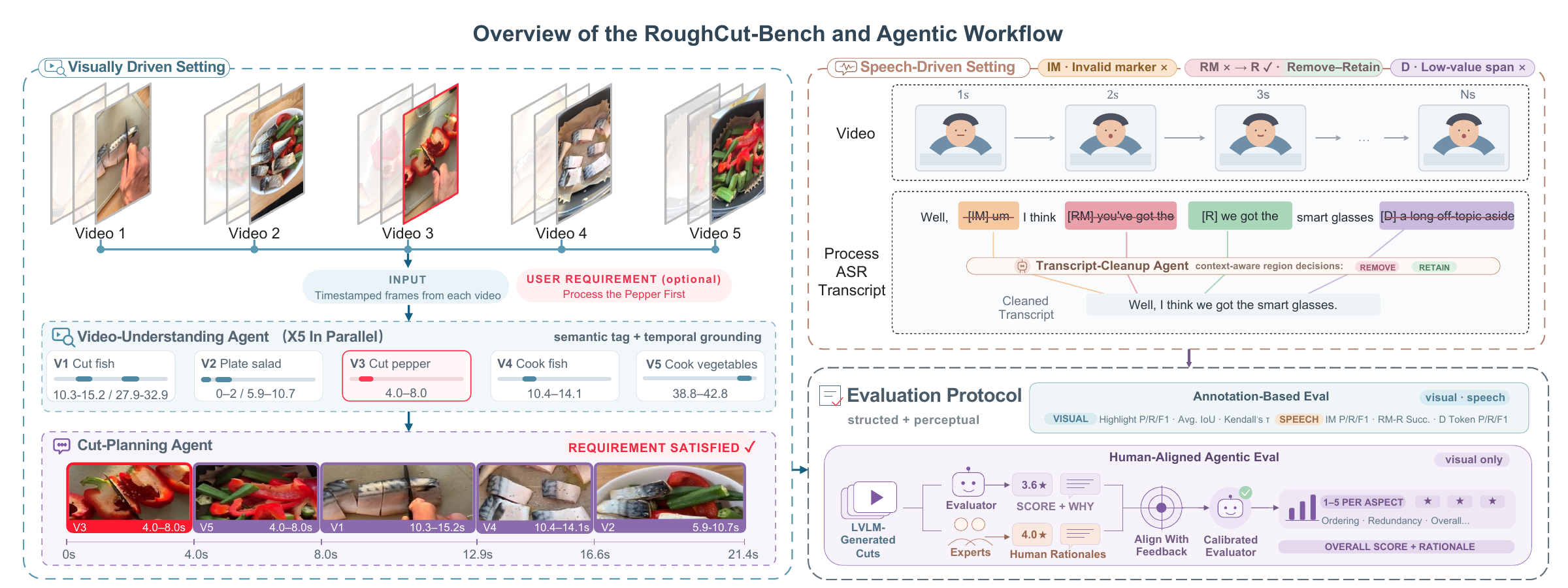
Video rough-cut is a core stage in media production workflows, organizing raw media materials into an initial video cut. Despite recent advances in large vision-language models (LVLMs) for video-related tasks, automatic rough-cut remains underexplored, without a comprehensive benchmark for evaluation or mature workflows for producing executable cut plans. To address the evaluation gap, we introduce RoughCut-Bench, which covers two practical settings: (1) a visually driven setting over video cases, covering highlight detection and selection, source-video ordering, and adherence to user requirements when provided; and (2) a speech-driven setting over automatic speech recognition (ASR) transcripts, covering filler removal, expression deduplication, and low-value content trimming. Across these settings, the benchmark contains 101 visually driven cases, including 831 raw videos with 1,476 highlight annotations. It also includes 84 speech-driven cases, each consisting of an ASR transcript with annotated cleanup spans. The evaluation compares cut plans with these annotations in both settings and additionally uses a human-aligned agentic evaluator to assess rendered-cut quality in the visual setting. To apply LVLMs to automatic rough-cut, we further propose agentic workflows that guide them to produce structured cut plans from input materials. Experiments show that current LVLMs remain limited in producing expert-aligned cut plans. Our benchmark, code, and prompts are released at https://whalesong-zrs.github.io/RoughCut-Bench-Project-Page.
Community
Accepted to KDD 2027
We introduce RoughCut-Bench, a benchmark for automatic video rough-cut with large vision-language models. It covers two practical settings: visually driven editing—highlight selection, source-media ordering, and optional user requirements—and speech-driven cleanup of ASR transcripts. The benchmark includes 101 visual cases, 831 source assets, and 1,476 highlight annotations, plus 84 speech-driven cases. We provide agentic workflows that generate executable cut plans, together with annotation-based metrics and a human-aligned agentic evaluator for rendered cuts. Our experiments highlight the remaining gap between current LVLMs and expert editing decisions. Code, prompts, and benchmark data are publicly available.
Models citing this paper 0
No model linking this paper
Datasets citing this paper 1
Spaces citing this paper 0
No Space linking this paper
Collections including this paper 0
No Collection including this paper