

| {"instruction": "Explain the purpose and usage of the laravel library based on its documentation.", "output": "<p align=\"center\"><a href=\"https://laravel.com\" target=\"_blank\"><img src=\"https://raw.githubusercontent.com/laravel/art/master/logo-lockup/5%20SVG/2%20CMYK/1%20Full%20Color/laravel-logolockup-cmyk-red.svg\" width=\"400\" alt=\"Laravel Logo\"></a></p>\n\n<p align=\"center\">\n<a href=\"https://github.com/laravel/framework/actions\"><img src=\"https://github.com/laravel/framework/workflows/tests/badge.svg\" alt=\"Build Status\"></a>\n<a href=\"https://packagist.org/packages/laravel/framework\"><img src=\"https://img.shields.io/packagist/dt/laravel/framework\" alt=\"Total Downloads\"></a>\n<a href=\"https://packagist.org/packages/laravel/framework\"><img src=\"https://img.shields.io/packagist/v/laravel/framework\" alt=\"Latest Stable Version\"></a>\n<a href=\"https://packagist.org/packages/laravel/framework\"><img src=\"https://img.shields.io/packagist/l/laravel/framework\" alt=\"License\"></a>\n</p>\n\n## About Laravel\n\nLaravel is a web application framework with expressive, elegant syntax. We believe development must be an enjoyable and creative experience to be truly fulfilling. Laravel takes the pain out of development by easing common tasks used in many web projects, such as:\n\n- [Simple, fast routing engine](https://laravel.com/docs/routing).\n- [Powerful dependency injection container](https://laravel.com/docs/container).\n- Multiple back-ends for [session](https://laravel.com/docs/session) and [cache](https://laravel.com/docs/cache) storage.\n- Expressive, intuitive [database ORM](https://laravel.com/docs/eloquent).\n- Database agnostic [schema migrations](https://laravel.com/docs/migrations).\n- [Robust background job processing](https://laravel.com/docs/queues).\n- [Real-time event broadcasting](https://laravel.com/docs/broadcasting).\n\nLaravel is accessible, powerful, and provides tools required for large, robust applications.\n\n## Learning Laravel\n\nLaravel has the most extensive and thorough [documentation](https://laravel.com/docs) and video tutorial library of all modern web application frameworks, making it a breeze to get started with the framework. You can also check out [Laravel Learn](https://laravel.com/learn), where you will be guided through building a modern Laravel application.\n\nIf you don't feel like reading, [Laracasts](https://laracasts.com) can help. Laracasts contains thousands of video tutorials on a range of topics including Laravel, modern PHP, unit testing, and JavaScript. Boost your skills by digging into our comprehensive video library.\n\n## Laravel Sponsors\n\nWe would like to extend our thanks to the following sponsors for funding Laravel development. If you are interested in becoming a sponsor, please visit the [Laravel Partners program](https://partners.laravel.com).\n\n### Premium Partners\n\n- **[Vehikl](https://vehikl.com)**\n- **[Tighten Co.](https://tighten.co)**\n- **[Kirschbaum Development Group](https://kirschbaumdevelopment.com)**\n- **[64 Robots](https://64robots.com)**\n- **[Curotec](https://www.curotec.com/services/technologies/laravel)**\n- **[DevSquad](https://devsquad.com/hire-laravel-developers)**\n- **[Redberry](https://redberry.international/laravel-development)**\n- **[Active Logic](https://activelogic.com)**\n\n## Contributing\n\nThank you for considering contributing to the Laravel framework! The contribution guide can be found in the [Laravel documentation](https://laravel.com/docs/contributions).\n\n## Code of Conduct\n\nIn order to ensure that the Laravel community is welcoming to all, please review and abide by the [Code of Conduct](https://laravel.com/docs/contributions#code-of-conduct).\n\n## Security Vulnerabilities\n\nIf you discover a security vulnerability within Laravel, please send an e-mail to Taylor Otwell via [taylor@laravel.com](mailto:taylor@laravel.com). All security vulnerabilities will be promptly addressed.\n\n## License\n\nThe Laravel framework is open-sourced software licensed under the [MIT license](https://opensource.org/licenses/MIT).\n", "source": "github_readme", "repo": "https://github.com/laravel/laravel", "path": "README.md"} | |
| {"instruction": "Provide the default configuration for app.php in laravel.", "output": "<?php\n\nreturn [\n\n /*\n |--------------------------------------------------------------------------\n | Application Name\n |--------------------------------------------------------------------------\n |\n | This value is the name of your application, which will be used when the\n | framework needs to place the application's name in a notification or\n | other UI elements where an application name needs to be displayed.\n |\n */\n\n 'name' => env('APP_NAME', 'Laravel'),\n\n /*\n |--------------------------------------------------------------------------\n | Application Environment\n |--------------------------------------------------------------------------\n |\n | This value determines the \"environment\" your application is currently\n | running in. This may determine how you prefer to configure various\n | services the application utilizes. Set this in your \".env\" file.\n |\n */\n\n 'env' => env('APP_ENV', 'production'),\n\n /*\n |--------------------------------------------------------------------------\n | Application Debug Mode\n |--------------------------------------------------------------------------\n |\n | When your application is in debug mode, detailed error messages with\n | stack traces will be shown on every error that occurs within your\n | application. If disabled, a simple generic error page is shown.\n |\n */\n\n 'debug' => (bool) env('APP_DEBUG', false),\n\n /*\n |--------------------------------------------------------------------------\n | Application URL\n |--------------------------------------------------------------------------\n |\n | This URL is used by the console to properly generate URLs when using\n | the Artisan command line tool. You should set this to the root of\n | the application so that it's available within Artisan commands.\n |\n */\n\n 'url' => env('APP_URL', 'http://localhost'),\n\n /*\n |--------------------------------------------------------------------------\n | Application Timezone\n |--------------------------------------------------------------------------\n |\n | Here you may specify the default timezone for your application, which\n | will be used by the PHP date and date-time functions. The timezone\n | is set to \"UTC\" by default as it is suitable for most use cases.\n |\n */\n\n 'timezone' => 'UTC',\n\n /*\n |--------------------------------------------------------------------------\n | Application Locale Configuration\n |--------------------------------------------------------------------------\n |\n | The application locale determines the default locale that will be used\n | by Laravel's translation / localization methods. This option can be\n | set to any locale for which you plan to have translation strings.\n |\n */\n\n 'locale' => env('APP_LOCALE', 'en'),\n\n 'fallback_locale' => env('APP_FALLBACK_LOCALE', 'en'),\n\n 'faker_locale' => env('APP_FAKER_LOCALE', 'en_US'),\n\n /*\n |--------------------------------------------------------------------------\n | Encryption Key\n |--------------------------------------------------------------------------\n |\n | This key is utilized by Laravel's encryption services and should be set\n | to a random, 32 character string to ensure that all encrypted values\n | are secure. You should do this prior to deploying the application.\n |\n */\n\n 'cipher' => 'AES-256-CBC',\n\n 'key' => env('APP_KEY'),\n\n 'previous_keys' => [\n ...array_filter(\n explode(',', (string) env('APP_PREVIOUS_KEYS', ''))\n ),\n ],\n\n /*\n |--------------------------------------------------------------------------\n | Maintenance Mode Driver\n |--------------------------------------------------------------------------\n |\n | These configuration options determine the driver used to determine and\n | manage Laravel's \"maintenance mode\" status. The \"cache\" driver will\n | allow maintenance mode to be controlled across multiple machines.\n |\n | Supported drivers: \"file\", \"cache\"\n |\n */\n\n 'maintenance' => [\n 'driver' => env('APP_MAINTENANCE_DRIVER', 'file'),\n 'store' => env('APP_MAINTENANCE_STORE', 'database'),\n ],\n\n];\n", "source": "github_code", "repo": "https://github.com/laravel/laravel", "path": "config\\app.php"} | |
| {"instruction": "Provide the default configuration for auth.php in laravel.", "output": "<?php\n\nreturn [\n\n /*\n |--------------------------------------------------------------------------\n | Authentication Defaults\n |--------------------------------------------------------------------------\n |\n | This option defines the default authentication \"guard\" and password\n | reset \"broker\" for your application. You may change these values\n | as required, but they're a perfect start for most applications.\n |\n */\n\n 'defaults' => [\n 'guard' => env('AUTH_GUARD', 'web'),\n 'passwords' => env('AUTH_PASSWORD_BROKER', 'users'),\n ],\n\n /*\n |--------------------------------------------------------------------------\n | Authentication Guards\n |--------------------------------------------------------------------------\n |\n | Next, you may define every authentication guard for your application.\n | Of course, a great default configuration has been defined for you\n | which utilizes session storage plus the Eloquent user provider.\n |\n | All authentication guards have a user provider, which defines how the\n | users are actually retrieved out of your database or other storage\n | system used by the application. Typically, Eloquent is utilized.\n |\n | Supported: \"session\"\n |\n */\n\n 'guards' => [\n 'web' => [\n 'driver' => 'session',\n 'provider' => 'users',\n ],\n ],\n\n /*\n |--------------------------------------------------------------------------\n | User Providers\n |--------------------------------------------------------------------------\n |\n | All authentication guards have a user provider, which defines how the\n | users are actually retrieved out of your database or other storage\n | system used by the application. Typically, Eloquent is utilized.\n |\n | If you have multiple user tables or models you may configure multiple\n | providers to represent the model / table. These providers may then\n | be assigned to any extra authentication guards you have defined.\n |\n | Supported: \"database\", \"eloquent\"\n |\n */\n\n 'providers' => [\n 'users' => [\n 'driver' => 'eloquent',\n 'model' => env('AUTH_MODEL', App\\Models\\User::class),\n ],\n\n // 'users' => [\n // 'driver' => 'database',\n // 'table' => 'users',\n // ],\n ],\n\n /*\n |--------------------------------------------------------------------------\n | Resetting Passwords\n |--------------------------------------------------------------------------\n |\n | These configuration options specify the behavior of Laravel's password\n | reset functionality, including the table utilized for token storage\n | and the user provider that is invoked to actually retrieve users.\n |\n | The expiry time is the number of minutes that each reset token will be\n | considered valid. This security feature keeps tokens short-lived so\n | they have less time to be guessed. You may change this as needed.\n |\n | The throttle setting is the number of seconds a user must wait before\n | generating more password reset tokens. This prevents the user from\n | quickly generating a very large amount of password reset tokens.\n |\n */\n\n 'passwords' => [\n 'users' => [\n 'provider' => 'users',\n 'table' => env('AUTH_PASSWORD_RESET_TOKEN_TABLE', 'password_reset_tokens'),\n 'expire' => 60,\n 'throttle' => 60,\n ],\n ],\n\n /*\n |--------------------------------------------------------------------------\n | Password Confirmation Timeout\n |--------------------------------------------------------------------------\n |\n | Here you may define the number of seconds before a password confirmation\n | window expires and users are asked to re-enter their password via the\n | confirmation screen. By default, the timeout lasts for three hours.\n |\n */\n\n 'password_timeout' => env('AUTH_PASSWORD_TIMEOUT', 10800),\n\n];\n", "source": "github_code", "repo": "https://github.com/laravel/laravel", "path": "config\\auth.php"} | |
| {"instruction": "Provide the default configuration for cache.php in laravel.", "output": "<?php\n\nuse Illuminate\\Support\\Str;\n\nreturn [\n\n /*\n |--------------------------------------------------------------------------\n | Default Cache Store\n |--------------------------------------------------------------------------\n |\n | This option controls the default cache store that will be used by the\n | framework. This connection is utilized if another isn't explicitly\n | specified when running a cache operation inside the application.\n |\n */\n\n 'default' => env('CACHE_STORE', 'database'),\n\n /*\n |--------------------------------------------------------------------------\n | Cache Stores\n |--------------------------------------------------------------------------\n |\n | Here you may define all of the cache \"stores\" for your application as\n | well as their drivers. You may even define multiple stores for the\n | same cache driver to group types of items stored in your caches.\n |\n | Supported drivers: \"array\", \"database\", \"file\", \"memcached\",\n | \"redis\", \"dynamodb\", \"octane\",\n | \"failover\", \"null\"\n |\n */\n\n 'stores' => [\n\n 'array' => [\n 'driver' => 'array',\n 'serialize' => false,\n ],\n\n 'database' => [\n 'driver' => 'database',\n 'connection' => env('DB_CACHE_CONNECTION'),\n 'table' => env('DB_CACHE_TABLE', 'cache'),\n 'lock_connection' => env('DB_CACHE_LOCK_CONNECTION'),\n 'lock_table' => env('DB_CACHE_LOCK_TABLE'),\n ],\n\n 'file' => [\n 'driver' => 'file',\n 'path' => storage_path('framework/cache/data'),\n 'lock_path' => storage_path('framework/cache/data'),\n ],\n\n 'memcached' => [\n 'driver' => 'memcached',\n 'persistent_id' => env('MEMCACHED_PERSISTENT_ID'),\n 'sasl' => [\n env('MEMCACHED_USERNAME'),\n env('MEMCACHED_PASSWORD'),\n ],\n 'options' => [\n // Memcached::OPT_CONNECT_TIMEOUT => 2000,\n ],\n 'servers' => [\n [\n 'host' => env('MEMCACHED_HOST', '127.0.0.1'),\n 'port' => env('MEMCACHED_PORT', 11211),\n 'weight' => 100,\n ],\n ],\n ],\n\n 'redis' => [\n 'driver' => 'redis',\n 'connection' => env('REDIS_CACHE_CONNECTION', 'cache'),\n 'lock_connection' => env('REDIS_CACHE_LOCK_CONNECTION', 'default'),\n ],\n\n 'dynamodb' => [\n 'driver' => 'dynamodb',\n 'key' => env('AWS_ACCESS_KEY_ID'),\n 'secret' => env('AWS_SECRET_ACCESS_KEY'),\n 'region' => env('AWS_DEFAULT_REGION', 'us-east-1'),\n 'table' => env('DYNAMODB_CACHE_TABLE', 'cache'),\n 'endpoint' => env('DYNAMODB_ENDPOINT'),\n ],\n\n 'octane' => [\n 'driver' => 'octane',\n ],\n\n 'failover' => [\n 'driver' => 'failover',\n 'stores' => [\n 'database',\n 'array',\n ],\n ],\n\n ],\n\n /*\n |--------------------------------------------------------------------------\n | Cache Key Prefix\n |--------------------------------------------------------------------------\n |\n | When utilizing the APC, database, memcached, Redis, and DynamoDB cache\n | stores, there might be other applications using the same cache. For\n | that reason, you may prefix every cache key to avoid collisions.\n |\n */\n\n 'prefix' => env('CACHE_PREFIX', Str::slug((string) env('APP_NAME', 'laravel')).'-cache-'),\n\n];\n", "source": "github_code", "repo": "https://github.com/laravel/laravel", "path": "config\\cache.php"} | |
| {"instruction": "Provide the default configuration for database.php in laravel.", "output": "<?php\n\nuse Illuminate\\Support\\Str;\n\nreturn [\n\n /*\n |--------------------------------------------------------------------------\n | Default Database Connection Name\n |--------------------------------------------------------------------------\n |\n | Here you may specify which of the database connections below you wish\n | to use as your default connection for database operations. This is\n | the connection which will be utilized unless another connection\n | is explicitly specified when you execute a query / statement.\n |\n */\n\n 'default' => env('DB_CONNECTION', 'sqlite'),\n\n /*\n |--------------------------------------------------------------------------\n | Database Connections\n |--------------------------------------------------------------------------\n |\n | Below are all of the database connections defined for your application.\n | An example configuration is provided for each database system which\n | is supported by Laravel. You're free to add / remove connections.\n |\n */\n\n 'connections' => [\n\n 'sqlite' => [\n 'driver' => 'sqlite',\n 'url' => env('DB_URL'),\n 'database' => env('DB_DATABASE', database_path('database.sqlite')),\n 'prefix' => '',\n 'foreign_key_constraints' => env('DB_FOREIGN_KEYS', true),\n 'busy_timeout' => null,\n 'journal_mode' => null,\n 'synchronous' => null,\n 'transaction_mode' => 'DEFERRED',\n ],\n\n 'mysql' => [\n 'driver' => 'mysql',\n 'url' => env('DB_URL'),\n 'host' => env('DB_HOST', '127.0.0.1'),\n 'port' => env('DB_PORT', '3306'),\n 'database' => env('DB_DATABASE', 'laravel'),\n 'username' => env('DB_USERNAME', 'root'),\n 'password' => env('DB_PASSWORD', ''),\n 'unix_socket' => env('DB_SOCKET', ''),\n 'charset' => env('DB_CHARSET', 'utf8mb4'),\n 'collation' => env('DB_COLLATION', 'utf8mb4_unicode_ci'),\n 'prefix' => '',\n 'prefix_indexes' => true,\n 'strict' => true,\n 'engine' => null,\n 'options' => extension_loaded('pdo_mysql') ? array_filter([\n (PHP_VERSION_ID >= 80500 ? \\Pdo\\Mysql::ATTR_SSL_CA : \\PDO::MYSQL_ATTR_SSL_CA) => env('MYSQL_ATTR_SSL_CA'),\n ]) : [],\n ],\n\n 'mariadb' => [\n 'driver' => 'mariadb',\n 'url' => env('DB_URL'),\n 'host' => env('DB_HOST', '127.0.0.1'),\n 'port' => env('DB_PORT', '3306'),\n 'database' => env('DB_DATABASE', 'laravel'),\n 'username' => env('DB_USERNAME', 'root'),\n 'password' => env('DB_PASSWORD', ''),\n 'unix_socket' => env('DB_SOCKET', ''),\n 'charset' => env('DB_CHARSET', 'utf8mb4'),\n 'collation' => env('DB_COLLATION', 'utf8mb4_unicode_ci'),\n 'prefix' => '',\n 'prefix_indexes' => true,\n 'strict' => true,\n 'engine' => null,\n 'options' => extension_loaded('pdo_mysql') ? array_filter([\n (PHP_VERSION_ID >= 80500 ? \\Pdo\\Mysql::ATTR_SSL_CA : \\PDO::MYSQL_ATTR_SSL_CA) => env('MYSQL_ATTR_SSL_CA'),\n ]) : [],\n ],\n\n 'pgsql' => [\n 'driver' => 'pgsql',\n 'url' => env('DB_URL'),\n 'host' => env('DB_HOST', '127.0.0.1'),\n 'port' => env('DB_PORT', '5432'),\n 'database' => env('DB_DATABASE', 'laravel'),\n 'username' => env('DB_USERNAME', 'root'),\n 'password' => env('DB_PASSWORD', ''),\n 'charset' => env('DB_CHARSET', 'utf8'),\n 'prefix' => '',\n 'prefix_indexes' => true,\n 'search_path' => 'public',\n 'sslmode' => env('DB_SSLMODE', 'prefer'),\n ],\n\n 'sqlsrv' => [\n 'driver' => 'sqlsrv',\n 'url' => env('DB_URL'),\n 'host' => env('DB_HOST', 'localhost'),\n 'port' => env('DB_PORT', '1433'),\n 'database' => env('DB_DATABASE', 'laravel'),\n 'username' => env('DB_USERNAME', 'root'),\n 'password' => env('DB_PASSWORD', ''),\n 'charset' => env('DB_CHARSET', 'utf8'),\n 'prefix' => '',\n 'prefix_indexes' => true,\n // 'encrypt' => env('DB_ENCRYPT', 'yes'),\n // 'trust_server_certificate' => env('DB_TRUST_SERVER_CERTIFICATE', 'false'),\n ],\n\n ],\n\n /*\n |--------------------------------------------------------------------------\n | Migration Repository Table\n |--------------------------------------------------------------------------\n |\n | This table keeps track of all the migrations that have already run for\n | your application. Using this information, we can determine which of\n | the migrations on disk haven't actually been run on the database.\n |\n */\n\n 'migrations' => [\n 'table' => 'migrations',\n 'update_date_on_publish' => true,\n ],\n\n /*\n |--------------------------------------------------------------------------\n | Redis Databases\n |--------------------------------------------------------------------------\n |\n | Redis is an open source, fast, and advanced key-value store that also\n | provides a richer body of commands than a typical key-value system\n | such as Memcached. You may define your connection settings here.\n |\n */\n\n 'redis' => [\n\n 'client' => env('REDIS_CLIENT', 'phpredis'),\n\n 'options' => [\n 'cluster' => env('REDIS_CLUSTER', 'redis'),\n 'prefix' => env('REDIS_PREFIX', Str::slug((string) env('APP_NAME', 'laravel')).'-database-'),\n 'persistent' => env('REDIS_PERSISTENT', false),\n ],\n\n 'default' => [\n 'url' => env('REDIS_URL'),\n 'host' => env('REDIS_HOST', '127.0.0.1'),\n 'username' => env('REDIS_USERNAME'),\n 'password' => env('REDIS_PASSWORD'),\n 'port' => env('REDIS_PORT', '6379'),\n 'database' => env('REDIS_DB', '0'),\n 'max_retries' => env('REDIS_MAX_RETRIES', 3),\n 'backoff_algorithm' => env('REDIS_BACKOFF_ALGORITHM', 'decorrelated_jitter'),\n 'backoff_base' => env('REDIS_BACKOFF_BASE', 100),\n 'backoff_cap' => env('REDIS_BACKOFF_CAP', 1000),\n ],\n\n 'cache' => [\n 'url' => env('REDIS_URL'),\n 'host' => env('REDIS_HOST', '127.0.0.1'),\n 'username' => env('REDIS_USERNAME'),\n 'password' => env('REDIS_PASSWORD'),\n 'port' => env('REDIS_PORT', '6379'),\n 'database' => env('REDIS_CACHE_DB', '1'),\n 'max_retries' => env('REDIS_MAX_RETRIES', 3),\n 'backoff_algorithm' => env('REDIS_BACKOFF_ALGORITHM', 'decorrelated_jitter'),\n 'backoff_base' => env('REDIS_BACKOFF_BASE', 100),\n 'backoff_cap' => env('REDIS_BACKOFF_CAP', 1000),\n ],\n\n ],\n\n];\n", "source": "github_code", "repo": "https://github.com/laravel/laravel", "path": "config\\database.php"} | |
| {"instruction": "Provide the default configuration for filesystems.php in laravel.", "output": "<?php\n\nreturn [\n\n /*\n |--------------------------------------------------------------------------\n | Default Filesystem Disk\n |--------------------------------------------------------------------------\n |\n | Here you may specify the default filesystem disk that should be used\n | by the framework. The \"local\" disk, as well as a variety of cloud\n | based disks are available to your application for file storage.\n |\n */\n\n 'default' => env('FILESYSTEM_DISK', 'local'),\n\n /*\n |--------------------------------------------------------------------------\n | Filesystem Disks\n |--------------------------------------------------------------------------\n |\n | Below you may configure as many filesystem disks as necessary, and you\n | may even configure multiple disks for the same driver. Examples for\n | most supported storage drivers are configured here for reference.\n |\n | Supported drivers: \"local\", \"ftp\", \"sftp\", \"s3\"\n |\n */\n\n 'disks' => [\n\n 'local' => [\n 'driver' => 'local',\n 'root' => storage_path('app/private'),\n 'serve' => true,\n 'throw' => false,\n 'report' => false,\n ],\n\n 'public' => [\n 'driver' => 'local',\n 'root' => storage_path('app/public'),\n 'url' => rtrim(env('APP_URL'), '/').'/storage',\n 'visibility' => 'public',\n 'throw' => false,\n 'report' => false,\n ],\n\n 's3' => [\n 'driver' => 's3',\n 'key' => env('AWS_ACCESS_KEY_ID'),\n 'secret' => env('AWS_SECRET_ACCESS_KEY'),\n 'region' => env('AWS_DEFAULT_REGION'),\n 'bucket' => env('AWS_BUCKET'),\n 'url' => env('AWS_URL'),\n 'endpoint' => env('AWS_ENDPOINT'),\n 'use_path_style_endpoint' => env('AWS_USE_PATH_STYLE_ENDPOINT', false),\n 'throw' => false,\n 'report' => false,\n ],\n\n ],\n\n /*\n |--------------------------------------------------------------------------\n | Symbolic Links\n |--------------------------------------------------------------------------\n |\n | Here you may configure the symbolic links that will be created when the\n | `storage:link` Artisan command is executed. The array keys should be\n | the locations of the links and the values should be their targets.\n |\n */\n\n 'links' => [\n public_path('storage') => storage_path('app/public'),\n ],\n\n];\n", "source": "github_code", "repo": "https://github.com/laravel/laravel", "path": "config\\filesystems.php"} | |
| {"instruction": "Provide the default configuration for logging.php in laravel.", "output": "<?php\n\nuse Monolog\\Handler\\NullHandler;\nuse Monolog\\Handler\\StreamHandler;\nuse Monolog\\Handler\\SyslogUdpHandler;\nuse Monolog\\Processor\\PsrLogMessageProcessor;\n\nreturn [\n\n /*\n |--------------------------------------------------------------------------\n | Default Log Channel\n |--------------------------------------------------------------------------\n |\n | This option defines the default log channel that is utilized to write\n | messages to your logs. The value provided here should match one of\n | the channels present in the list of \"channels\" configured below.\n |\n */\n\n 'default' => env('LOG_CHANNEL', 'stack'),\n\n /*\n |--------------------------------------------------------------------------\n | Deprecations Log Channel\n |--------------------------------------------------------------------------\n |\n | This option controls the log channel that should be used to log warnings\n | regarding deprecated PHP and library features. This allows you to get\n | your application ready for upcoming major versions of dependencies.\n |\n */\n\n 'deprecations' => [\n 'channel' => env('LOG_DEPRECATIONS_CHANNEL', 'null'),\n 'trace' => env('LOG_DEPRECATIONS_TRACE', false),\n ],\n\n /*\n |--------------------------------------------------------------------------\n | Log Channels\n |--------------------------------------------------------------------------\n |\n | Here you may configure the log channels for your application. Laravel\n | utilizes the Monolog PHP logging library, which includes a variety\n | of powerful log handlers and formatters that you're free to use.\n |\n | Available drivers: \"single\", \"daily\", \"slack\", \"syslog\",\n | \"errorlog\", \"monolog\", \"custom\", \"stack\"\n |\n */\n\n 'channels' => [\n\n 'stack' => [\n 'driver' => 'stack',\n 'channels' => explode(',', (string) env('LOG_STACK', 'single')),\n 'ignore_exceptions' => false,\n ],\n\n 'single' => [\n 'driver' => 'single',\n 'path' => storage_path('logs/laravel.log'),\n 'level' => env('LOG_LEVEL', 'debug'),\n 'replace_placeholders' => true,\n ],\n\n 'daily' => [\n 'driver' => 'daily',\n 'path' => storage_path('logs/laravel.log'),\n 'level' => env('LOG_LEVEL', 'debug'),\n 'days' => env('LOG_DAILY_DAYS', 14),\n 'replace_placeholders' => true,\n ],\n\n 'slack' => [\n 'driver' => 'slack',\n 'url' => env('LOG_SLACK_WEBHOOK_URL'),\n 'username' => env('LOG_SLACK_USERNAME', 'Laravel Log'),\n 'emoji' => env('LOG_SLACK_EMOJI', ':boom:'),\n 'level' => env('LOG_LEVEL', 'critical'),\n 'replace_placeholders' => true,\n ],\n\n 'papertrail' => [\n 'driver' => 'monolog',\n 'level' => env('LOG_LEVEL', 'debug'),\n 'handler' => env('LOG_PAPERTRAIL_HANDLER', SyslogUdpHandler::class),\n 'handler_with' => [\n 'host' => env('PAPERTRAIL_URL'),\n 'port' => env('PAPERTRAIL_PORT'),\n 'connectionString' => 'tls://'.env('PAPERTRAIL_URL').':'.env('PAPERTRAIL_PORT'),\n ],\n 'processors' => [PsrLogMessageProcessor::class],\n ],\n\n 'stderr' => [\n 'driver' => 'monolog',\n 'level' => env('LOG_LEVEL', 'debug'),\n 'handler' => StreamHandler::class,\n 'handler_with' => [\n 'stream' => 'php://stderr',\n ],\n 'formatter' => env('LOG_STDERR_FORMATTER'),\n 'processors' => [PsrLogMessageProcessor::class],\n ],\n\n 'syslog' => [\n 'driver' => 'syslog',\n 'level' => env('LOG_LEVEL', 'debug'),\n 'facility' => env('LOG_SYSLOG_FACILITY', LOG_USER),\n 'replace_placeholders' => true,\n ],\n\n 'errorlog' => [\n 'driver' => 'errorlog',\n 'level' => env('LOG_LEVEL', 'debug'),\n 'replace_placeholders' => true,\n ],\n\n 'null' => [\n 'driver' => 'monolog',\n 'handler' => NullHandler::class,\n ],\n\n 'emergency' => [\n 'path' => storage_path('logs/laravel.log'),\n ],\n\n ],\n\n];\n", "source": "github_code", "repo": "https://github.com/laravel/laravel", "path": "config\\logging.php"} | |
| {"instruction": "Provide the default configuration for mail.php in laravel.", "output": "<?php\n\nreturn [\n\n /*\n |--------------------------------------------------------------------------\n | Default Mailer\n |--------------------------------------------------------------------------\n |\n | This option controls the default mailer that is used to send all email\n | messages unless another mailer is explicitly specified when sending\n | the message. All additional mailers can be configured within the\n | \"mailers\" array. Examples of each type of mailer are provided.\n |\n */\n\n 'default' => env('MAIL_MAILER', 'log'),\n\n /*\n |--------------------------------------------------------------------------\n | Mailer Configurations\n |--------------------------------------------------------------------------\n |\n | Here you may configure all of the mailers used by your application plus\n | their respective settings. Several examples have been configured for\n | you and you are free to add your own as your application requires.\n |\n | Laravel supports a variety of mail \"transport\" drivers that can be used\n | when delivering an email. You may specify which one you're using for\n | your mailers below. You may also add additional mailers if needed.\n |\n | Supported: \"smtp\", \"sendmail\", \"mailgun\", \"ses\", \"ses-v2\",\n | \"postmark\", \"resend\", \"log\", \"array\",\n | \"failover\", \"roundrobin\"\n |\n */\n\n 'mailers' => [\n\n 'smtp' => [\n 'transport' => 'smtp',\n 'scheme' => env('MAIL_SCHEME'),\n 'url' => env('MAIL_URL'),\n 'host' => env('MAIL_HOST', '127.0.0.1'),\n 'port' => env('MAIL_PORT', 2525),\n 'username' => env('MAIL_USERNAME'),\n 'password' => env('MAIL_PASSWORD'),\n 'timeout' => null,\n 'local_domain' => env('MAIL_EHLO_DOMAIN', parse_url((string) env('APP_URL', 'http://localhost'), PHP_URL_HOST)),\n ],\n\n 'ses' => [\n 'transport' => 'ses',\n ],\n\n 'postmark' => [\n 'transport' => 'postmark',\n // 'message_stream_id' => env('POSTMARK_MESSAGE_STREAM_ID'),\n // 'client' => [\n // 'timeout' => 5,\n // ],\n ],\n\n 'resend' => [\n 'transport' => 'resend',\n ],\n\n 'sendmail' => [\n 'transport' => 'sendmail',\n 'path' => env('MAIL_SENDMAIL_PATH', '/usr/sbin/sendmail -bs -i'),\n ],\n\n 'log' => [\n 'transport' => 'log',\n 'channel' => env('MAIL_LOG_CHANNEL'),\n ],\n\n 'array' => [\n 'transport' => 'array',\n ],\n\n 'failover' => [\n 'transport' => 'failover',\n 'mailers' => [\n 'smtp',\n 'log',\n ],\n 'retry_after' => 60,\n ],\n\n 'roundrobin' => [\n 'transport' => 'roundrobin',\n 'mailers' => [\n 'ses',\n 'postmark',\n ],\n 'retry_after' => 60,\n ],\n\n ],\n\n /*\n |--------------------------------------------------------------------------\n | Global \"From\" Address\n |--------------------------------------------------------------------------\n |\n | You may wish for all emails sent by your application to be sent from\n | the same address. Here you may specify a name and address that is\n | used globally for all emails that are sent by your application.\n |\n */\n\n 'from' => [\n 'address' => env('MAIL_FROM_ADDRESS', 'hello@example.com'),\n 'name' => env('MAIL_FROM_NAME', 'Example'),\n ],\n\n];\n", "source": "github_code", "repo": "https://github.com/laravel/laravel", "path": "config\\mail.php"} | |
| {"instruction": "Provide the default configuration for queue.php in laravel.", "output": "<?php\n\nreturn [\n\n /*\n |--------------------------------------------------------------------------\n | Default Queue Connection Name\n |--------------------------------------------------------------------------\n |\n | Laravel's queue supports a variety of backends via a single, unified\n | API, giving you convenient access to each backend using identical\n | syntax for each. The default queue connection is defined below.\n |\n */\n\n 'default' => env('QUEUE_CONNECTION', 'database'),\n\n /*\n |--------------------------------------------------------------------------\n | Queue Connections\n |--------------------------------------------------------------------------\n |\n | Here you may configure the connection options for every queue backend\n | used by your application. An example configuration is provided for\n | each backend supported by Laravel. You're also free to add more.\n |\n | Drivers: \"sync\", \"database\", \"beanstalkd\", \"sqs\", \"redis\",\n | \"deferred\", \"background\", \"failover\", \"null\"\n |\n */\n\n 'connections' => [\n\n 'sync' => [\n 'driver' => 'sync',\n ],\n\n 'database' => [\n 'driver' => 'database',\n 'connection' => env('DB_QUEUE_CONNECTION'),\n 'table' => env('DB_QUEUE_TABLE', 'jobs'),\n 'queue' => env('DB_QUEUE', 'default'),\n 'retry_after' => (int) env('DB_QUEUE_RETRY_AFTER', 90),\n 'after_commit' => false,\n ],\n\n 'beanstalkd' => [\n 'driver' => 'beanstalkd',\n 'host' => env('BEANSTALKD_QUEUE_HOST', 'localhost'),\n 'queue' => env('BEANSTALKD_QUEUE', 'default'),\n 'retry_after' => (int) env('BEANSTALKD_QUEUE_RETRY_AFTER', 90),\n 'block_for' => 0,\n 'after_commit' => false,\n ],\n\n 'sqs' => [\n 'driver' => 'sqs',\n 'key' => env('AWS_ACCESS_KEY_ID'),\n 'secret' => env('AWS_SECRET_ACCESS_KEY'),\n 'prefix' => env('SQS_PREFIX', 'https://sqs.us-east-1.amazonaws.com/your-account-id'),\n 'queue' => env('SQS_QUEUE', 'default'),\n 'suffix' => env('SQS_SUFFIX'),\n 'region' => env('AWS_DEFAULT_REGION', 'us-east-1'),\n 'after_commit' => false,\n ],\n\n 'redis' => [\n 'driver' => 'redis',\n 'connection' => env('REDIS_QUEUE_CONNECTION', 'default'),\n 'queue' => env('REDIS_QUEUE', 'default'),\n 'retry_after' => (int) env('REDIS_QUEUE_RETRY_AFTER', 90),\n 'block_for' => null,\n 'after_commit' => false,\n ],\n\n 'deferred' => [\n 'driver' => 'deferred',\n ],\n\n 'background' => [\n 'driver' => 'background',\n ],\n\n 'failover' => [\n 'driver' => 'failover',\n 'connections' => [\n 'database',\n 'deferred',\n ],\n ],\n\n ],\n\n /*\n |--------------------------------------------------------------------------\n | Job Batching\n |--------------------------------------------------------------------------\n |\n | The following options configure the database and table that store job\n | batching information. These options can be updated to any database\n | connection and table which has been defined by your application.\n |\n */\n\n 'batching' => [\n 'database' => env('DB_CONNECTION', 'sqlite'),\n 'table' => 'job_batches',\n ],\n\n /*\n |--------------------------------------------------------------------------\n | Failed Queue Jobs\n |--------------------------------------------------------------------------\n |\n | These options configure the behavior of failed queue job logging so you\n | can control how and where failed jobs are stored. Laravel ships with\n | support for storing failed jobs in a simple file or in a database.\n |\n | Supported drivers: \"database-uuids\", \"dynamodb\", \"file\", \"null\"\n |\n */\n\n 'failed' => [\n 'driver' => env('QUEUE_FAILED_DRIVER', 'database-uuids'),\n 'database' => env('DB_CONNECTION', 'sqlite'),\n 'table' => 'failed_jobs',\n ],\n\n];\n", "source": "github_code", "repo": "https://github.com/laravel/laravel", "path": "config\\queue.php"} | |
| {"instruction": "Provide the default configuration for services.php in laravel.", "output": "<?php\n\nreturn [\n\n /*\n |--------------------------------------------------------------------------\n | Third Party Services\n |--------------------------------------------------------------------------\n |\n | This file is for storing the credentials for third party services such\n | as Mailgun, Postmark, AWS and more. This file provides the de facto\n | location for this type of information, allowing packages to have\n | a conventional file to locate the various service credentials.\n |\n */\n\n 'postmark' => [\n 'key' => env('POSTMARK_API_KEY'),\n ],\n\n 'resend' => [\n 'key' => env('RESEND_API_KEY'),\n ],\n\n 'ses' => [\n 'key' => env('AWS_ACCESS_KEY_ID'),\n 'secret' => env('AWS_SECRET_ACCESS_KEY'),\n 'region' => env('AWS_DEFAULT_REGION', 'us-east-1'),\n ],\n\n 'slack' => [\n 'notifications' => [\n 'bot_user_oauth_token' => env('SLACK_BOT_USER_OAUTH_TOKEN'),\n 'channel' => env('SLACK_BOT_USER_DEFAULT_CHANNEL'),\n ],\n ],\n\n];\n", "source": "github_code", "repo": "https://github.com/laravel/laravel", "path": "config\\services.php"} | |
| {"instruction": "Provide the default configuration for session.php in laravel.", "output": "<?php\n\nuse Illuminate\\Support\\Str;\n\nreturn [\n\n /*\n |--------------------------------------------------------------------------\n | Default Session Driver\n |--------------------------------------------------------------------------\n |\n | This option determines the default session driver that is utilized for\n | incoming requests. Laravel supports a variety of storage options to\n | persist session data. Database storage is a great default choice.\n |\n | Supported: \"file\", \"cookie\", \"database\", \"memcached\",\n | \"redis\", \"dynamodb\", \"array\"\n |\n */\n\n 'driver' => env('SESSION_DRIVER', 'database'),\n\n /*\n |--------------------------------------------------------------------------\n | Session Lifetime\n |--------------------------------------------------------------------------\n |\n | Here you may specify the number of minutes that you wish the session\n | to be allowed to remain idle before it expires. If you want them\n | to expire immediately when the browser is closed then you may\n | indicate that via the expire_on_close configuration option.\n |\n */\n\n 'lifetime' => (int) env('SESSION_LIFETIME', 120),\n\n 'expire_on_close' => env('SESSION_EXPIRE_ON_CLOSE', false),\n\n /*\n |--------------------------------------------------------------------------\n | Session Encryption\n |--------------------------------------------------------------------------\n |\n | This option allows you to easily specify that all of your session data\n | should be encrypted before it's stored. All encryption is performed\n | automatically by Laravel and you may use the session like normal.\n |\n */\n\n 'encrypt' => env('SESSION_ENCRYPT', false),\n\n /*\n |--------------------------------------------------------------------------\n | Session File Location\n |--------------------------------------------------------------------------\n |\n | When utilizing the \"file\" session driver, the session files are placed\n | on disk. The default storage location is defined here; however, you\n | are free to provide another location where they should be stored.\n |\n */\n\n 'files' => storage_path('framework/sessions'),\n\n /*\n |--------------------------------------------------------------------------\n | Session Database Connection\n |--------------------------------------------------------------------------\n |\n | When using the \"database\" or \"redis\" session drivers, you may specify a\n | connection that should be used to manage these sessions. This should\n | correspond to a connection in your database configuration options.\n |\n */\n\n 'connection' => env('SESSION_CONNECTION'),\n\n /*\n |--------------------------------------------------------------------------\n | Session Database Table\n |--------------------------------------------------------------------------\n |\n | When using the \"database\" session driver, you may specify the table to\n | be used to store sessions. Of course, a sensible default is defined\n | for you; however, you're welcome to change this to another table.\n |\n */\n\n 'table' => env('SESSION_TABLE', 'sessions'),\n\n /*\n |--------------------------------------------------------------------------\n | Session Cache Store\n |--------------------------------------------------------------------------\n |\n | When using one of the framework's cache driven session backends, you may\n | define the cache store which should be used to store the session data\n | between requests. This must match one of your defined cache stores.\n |\n | Affects: \"dynamodb\", \"memcached\", \"redis\"\n |\n */\n\n 'store' => env('SESSION_STORE'),\n\n /*\n |--------------------------------------------------------------------------\n | Session Sweeping Lottery\n |--------------------------------------------------------------------------\n |\n | Some session drivers must manually sweep their storage location to get\n | rid of old sessions from storage. Here are the chances that it will\n | happen on a given request. By default, the odds are 2 out of 100.\n |\n */\n\n 'lottery' => [2, 100],\n\n /*\n |--------------------------------------------------------------------------\n | Session Cookie Name\n |--------------------------------------------------------------------------\n |\n | Here you may change the name of the session cookie that is created by\n | the framework. Typically, you should not need to change this value\n | since doing so does not grant a meaningful security improvement.\n |\n */\n\n 'cookie' => env(\n 'SESSION_COOKIE',\n Str::slug((string) env('APP_NAME', 'laravel')).'-session'\n ),\n\n /*\n |--------------------------------------------------------------------------\n | Session Cookie Path\n |--------------------------------------------------------------------------\n |\n | The session cookie path determines the path for which the cookie will\n | be regarded as available. Typically, this will be the root path of\n | your application, but you're free to change this when necessary.\n |\n */\n\n 'path' => env('SESSION_PATH', '/'),\n\n /*\n |--------------------------------------------------------------------------\n | Session Cookie Domain\n |--------------------------------------------------------------------------\n |\n | This value determines the domain and subdomains the session cookie is\n | available to. By default, the cookie will be available to the root\n | domain without subdomains. Typically, this shouldn't be changed.\n |\n */\n\n 'domain' => env('SESSION_DOMAIN'),\n\n /*\n |--------------------------------------------------------------------------\n | HTTPS Only Cookies\n |--------------------------------------------------------------------------\n |\n | By setting this option to true, session cookies will only be sent back\n | to the server if the browser has a HTTPS connection. This will keep\n | the cookie from being sent to you when it can't be done securely.\n |\n */\n\n 'secure' => env('SESSION_SECURE_COOKIE'),\n\n /*\n |--------------------------------------------------------------------------\n | HTTP Access Only\n |--------------------------------------------------------------------------\n |\n | Setting this value to true will prevent JavaScript from accessing the\n | value of the cookie and the cookie will only be accessible through\n | the HTTP protocol. It's unlikely you should disable this option.\n |\n */\n\n 'http_only' => env('SESSION_HTTP_ONLY', true),\n\n /*\n |--------------------------------------------------------------------------\n | Same-Site Cookies\n |--------------------------------------------------------------------------\n |\n | This option determines how your cookies behave when cross-site requests\n | take place, and can be used to mitigate CSRF attacks. By default, we\n | will set this value to \"lax\" to permit secure cross-site requests.\n |\n | See: https://developer.mozilla.org/en-US/docs/Web/HTTP/Headers/Set-Cookie#samesitesamesite-value\n |\n | Supported: \"lax\", \"strict\", \"none\", null\n |\n */\n\n 'same_site' => env('SESSION_SAME_SITE', 'lax'),\n\n /*\n |--------------------------------------------------------------------------\n | Partitioned Cookies\n |--------------------------------------------------------------------------\n |\n | Setting this value to true will tie the cookie to the top-level site for\n | a cross-site context. Partitioned cookies are accepted by the browser\n | when flagged \"secure\" and the Same-Site attribute is set to \"none\".\n |\n */\n\n 'partitioned' => env('SESSION_PARTITIONED_COOKIE', false),\n\n];\n", "source": "github_code", "repo": "https://github.com/laravel/laravel", "path": "config\\session.php"} | |
| {"instruction": "Explain the purpose and usage of the seotools library based on its documentation.", "output": "<p align=\"center\">\n <a href=\"https://github.com/artesaos\" target=\"_blank\">\n <img src=\"https://avatars3.githubusercontent.com/u/11164074\" height=\"100px\">\n </a>\n <h1 align=\"center\">SEOTools - SEO Tools for Laravel and Lumen</h1>\n <br>\n</p>\n\nSEOTools is a package for [Laravel 5.8+](https://laravel.com/) and [Lumen](https://lumen.laravel.com/) that provides helpers for some common SEO techniques.\n\n> Current Build Status\n\n[](https://travis-ci.org/artesaos/seotools)\n[](https://codeclimate.com/github/artesaos/seotools)\n\n> Statistics\n\n[](https://packagist.org/packages/artesaos/seotools) [](https://packagist.org/packages/artesaos/seotools) [](https://packagist.org/packages/artesaos/seotools) [](https://packagist.org/packages/artesaos/seotools)\n\nFor license information check the [LICENSE](LICENSE.md)-file.\n\nFeatures\n--------\n\n- Friendly simple interface\n- Easy of set titles and meta tags\n- Easy of set metas for [Twitter Cards](https://developer.twitter.com/en/docs/tweets/optimize-with-cards/overview/abouts-cards) and [Open Graph](https://ogp.me/)\n- Easy of set for [JSON Linked Data](https://json-ld.org/)\n\nInstallation\n------------\n\n### 1 - Dependency\n\nThe first step is using composer to install the package and automatically update your `composer.json` file, you can do this by running:\n\n```shell\ncomposer require artesaos/seotools\n```\n\n> **Note**: If you are using Laravel 5.5, the steps 2 and 3, for providers and aliases, are unnecessaries. SEOTools supports Laravel new [Package Discovery](https://laravel.com/docs/5.5/packages#package-discovery).\n\n### 2 - Provider\n\nYou need to update your application configuration in order to register the package so it can be loaded by Laravel, just update your `config/app.php` file adding the following code at the end of your `'providers'` section:\n\n> **Note**: If you are using Laravel 11+, you will have to update `bootstrap/providers.php` instead. [Package Discovery](https://laravel.com/docs/12.x/packages#package-discovery).\n\n> `config/app.php`\n\n```php\n<?php\n\nreturn [\n // ...\n 'providers' => [\n Artesaos\\SEOTools\\Providers\\SEOToolsServiceProvider::class,\n // ...\n ],\n // ...\n];\n```\n\n#### Lumen\n\nGo to `/bootstrap/app.php` file and add this line:\n\n```php\n<?php\n// ...\n\n$app = new Laravel\\Lumen\\Application(\n dirname(__DIR__)\n);\n\n// ...\n\n$app->register(Artesaos\\SEOTools\\Providers\\SEOToolsServiceProvider::class);\n\n// ...\n\nreturn $app;\n```\n\n### 3 - Facades\n\n> Note: facades are not supported in Lumen.\n\nYou may get access to the SEO tool services using following facades:\n\n - `Artesaos\\SEOTools\\Facades\\SEOMeta`\n - `Artesaos\\SEOTools\\Facades\\OpenGraph`\n - `Artesaos\\SEOTools\\Facades\\TwitterCard`\n - `Artesaos\\SEOTools\\Facades\\JsonLd`\n - `Artesaos\\SEOTools\\Facades\\JsonLdMulti`\n - `Artesaos\\SEOTools\\Facades\\SEOTools`\n\nYou can setup a short-version aliases for these facades in your `config/app.php` file. For example:\n\n```php\n<?php\n\nreturn [\n // ...\n 'aliases' => [\n 'SEOMeta' => Artesaos\\SEOTools\\Facades\\SEOMeta::class,\n 'OpenGraph' => Artesaos\\SEOTools\\Facades\\OpenGraph::class,\n 'Twitter' => Artesaos\\SEOTools\\Facades\\TwitterCard::class,\n 'JsonLd' => Artesaos\\SEOTools\\Facades\\JsonLd::class,\n 'JsonLdMulti' => Artesaos\\SEOTools\\Facades\\JsonLdMulti::class,\n // or\n 'SEO' => Artesaos\\SEOTools\\Facades\\SEOTools::class,\n // ...\n ],\n // ...\n];\n```\n\n### 4 Configuration\n\n#### Publish config\n\nIn your terminal type\n\n```shell\nphp artisan vendor:publish\n```\n\nor\n\n```shell\nphp artisan vendor:publish --provider=\"Artesaos\\SEOTools\\Providers\\SEOToolsServiceProvider\"\n```\n\n> Lumen does not support this command, for it you should copy the file `src/resources/config/seotools.php` to `config/seotools.php` of your project\n\nIn `seotools.php` configuration file you can determine the properties of the default values and some behaviors.\n\n#### seotools.php\n\n- **meta**\n - `defaults` - What values are displayed if not specified any value for the page display. If the value is `false`, nothing is displayed.\n - `webmaster` - Are the settings of tags values for major webmaster tools. If you are `null` nothing is displayed.\n- **opengraph**\n - `defaults` - Are the properties that will always be displayed and when no other value is set instead. **You can add additional tags** that are not included in the original configuration file.\n- **twitter**\n - `defaults` - Are the properties that will always be displayed and when no other value is set instead. **You can add additional tags** that are not included in the original configuration file.\n- **json-ld**\n - `defaults` - Are the properties that will always be displayed and when no other value is set instead. **You can add additional tags** that are not included in the original configuration file.\n\nUsage\n-----\n\n### Lumen Usage\n\n> Note: facades are not supported in Lumen.\n\n```php\n<?php\n\n$seotools = app('seotools');\n$metatags = app('seotools.metatags');\n$twitter = app('seotools.twitter');\n$opengraph = app('seotools.opengraph');\n$jsonld = app('seotools.json-ld');\n$jsonldMulti = app('seotools.json-ld-multi');\n\n// The behavior is the same as the facade\n\necho app('seotools')->generate();\n```\n\n### Meta tags Generator\n\nWith **SEOMeta** you can create meta tags to the `head`\n\n### Opengraph tags Generator\n\nWith **OpenGraph** you can create OpenGraph tags to the `head`\n\n### Twitter for Twitter Cards tags Generator\n\nWith **Twitter** you can create OpenGraph tags to the `head`\n\n#### In your controller\n\n```php\n<?php\n\nnamespace App\\Http\\Controllers;\n\nuse Artesaos\\SEOTools\\Facades\\SEOMeta;\nuse Artesaos\\SEOTools\\Facades\\OpenGraph;\nuse Artesaos\\SEOTools\\Facades\\TwitterCard;\nuse Artesaos\\SEOTools\\Facades\\JsonLd;\n// OR with multi\nuse Artesaos\\SEOTools\\Facades\\JsonLdMulti;\n\n// OR\nuse Artesaos\\SEOTools\\Facades\\SEOTools;\n\nclass CommonController extends Controller\n{\n public function index()\n {\n SEOMeta::setTitle('Home');\n SEOMeta::setDescription('This is my page description');\n SEOMeta::setCanonical('https://codecasts.com.br/lesson');\n\n OpenGraph::setDescription('This is my page description');\n OpenGraph::setTitle('Home');\n OpenGraph::setUrl('http://current.url.com');\n OpenGraph::addProperty('type', 'articles');\n\n TwitterCard::setTitle('Homepage');\n TwitterCard::setSite('@LuizVinicius73');\n\n JsonLd::setTitle('Homepage');\n JsonLd::setDescription('This is my page description');\n JsonLd::addImage('https://codecasts.com.br/img/logo.jpg');\n\n // OR\n\n SEOTools::setTitle('Home');\n SEOTools::setDescription('This is my page description');\n SEOTools::opengraph()->setUrl('http://current.url.com');\n SEOTools::setCanonical('https://codecasts.com.br/lesson');\n SEOTools::opengraph()->addProperty('type', 'articles');\n SEOTools::twitter()->setSite('@LuizVinicius73');\n SEOTools::jsonLd()->addImage('https://codecasts.com.br/img/logo.jpg');\n\n $posts = Post::all();\n\n return view('myindex', compact('posts'));\n }\n\n public function show($id)\n {\n $post = Post::find($id);\n\n SEOMeta::setTitle($post->title);\n SEOMeta::setDescription($post->resume);\n SEOMeta::addMeta('article:published_time', $post->published_date->toW3CString(), 'property');\n SEOMeta::addMeta('article:section', $post->category, 'property');\n SEOMeta::addKeyword(['key1', 'key2', 'key3']);\n\n OpenGraph::setDescription($post->resume);\n OpenGraph::setTitle($post->title);\n OpenGraph::setUrl('http://current.url.com');\n OpenGraph::addProperty('type', 'article');\n OpenGraph::addProperty('locale', 'pt-br');\n OpenGraph::addProperty('locale:alternate', ['pt-pt', 'en-us']);\n\n OpenGraph::addImage($post->cover->url);\n OpenGraph::addImage($post->images->list('url'));\n OpenGraph::addImage(['url' => 'http://image.url.com/cover.jpg', 'size' => 300]);\n OpenGraph::addImage('http://image.url.com/cover.jpg', ['height' => 300, 'width' => 300]);\n\n JsonLd::setTitle($post->title);\n JsonLd::setDescription($post->resume);\n JsonLd::setType('Article');\n JsonLd::addImage($post->images->list('url'));\n\n // OR with multi\n\n JsonLdMulti::setTitle($post->title);\n JsonLdMulti::setDescription($post->resume);\n JsonLdMulti::setType('Article');\n JsonLdMulti::addImage($post->images->list('url'));\n if(! JsonLdMulti::isEmpty()) {\n JsonLdMulti::newJsonLd();\n JsonLdMulti::setType('WebPage');\n JsonLdMulti::setTitle('Page Article - '.$post->title);\n }\n\n // Namespace URI: http://ogp.me/ns/article#\n // article\n OpenGraph::setTitle('Article')\n ->setDescription('Some Article')\n ->setType('article')\n ->setArticle([\n 'published_time' => 'datetime',\n 'modified_time' => 'datetime',\n 'expiration_time' => 'datetime',\n 'author' => 'profile / array',\n 'section' => 'string',\n 'tag' => 'string / array'\n ]);\n\n // Namespace URI: http://ogp.me/ns/book#\n // book\n OpenGraph::setTitle('Book')\n ->setDescription('Some Book')\n ->setType('book')\n ->setBook([\n 'author' => 'profile / array',\n 'isbn' => 'string',\n 'release_date' => 'datetime',\n 'tag' => 'string / array'\n ]);\n\n // Namespace URI: http://ogp.me/ns/profile#\n // profile\n OpenGraph::setTitle('Profile')\n ->setDescription('Some Person')\n ->setType('profile')\n ->setProfile([\n 'first_name' => 'string',\n 'last_name' => 'string',\n 'username' => 'string',\n 'gender' => 'enum(male, female)'\n ]);\n\n // Namespace URI: http://ogp.me/ns/music#\n // music.song\n OpenGraph::setType('music.song')\n ->setMusicSong([\n 'duration' => 'integer',\n 'album' => 'array',\n 'album:disc' => 'integer',\n 'album:track' => 'integer',\n 'musician' => 'array'\n ]);\n\n // music.album\n OpenGraph::setType('music.album')\n ->setMusicAlbum([\n 'song' => 'music.song',\n 'song:disc' => 'integer',\n 'song:track' => 'integer',\n 'musician' => 'profile',\n 'release_date' => 'datetime'\n ]);\n\n //music.playlist\n OpenGraph::setType('music.playlist')\n ->setMusicPlaylist([\n 'song' => 'music.song',\n 'song:disc' => 'integer',\n 'song:track' => 'integer',\n 'creator' => 'profile'\n ]);\n\n // music.radio_station\n OpenGraph::setType('music.radio_station')\n ->setMusicRadioStation([\n 'creator' => 'profile'\n ]);\n\n // Namespace URI: http://ogp.me/ns/video#\n // video.movie\n OpenGraph::setType('video.movie')\n ->setVideoMovie([\n 'actor' => 'profile / array',\n 'actor:role' => 'string',\n 'director' => 'profile /array',\n 'writer' => 'profile / array',\n 'duration' => 'integer',\n 'release_date' => 'datetime',\n 'tag' => 'string / array'\n ]);\n\n // video.episode\n OpenGraph::setType('video.episode')\n ->setVideoEpisode([\n 'actor' => 'profile / array',\n 'actor:role' => 'string',\n 'director' => 'profile /array',\n 'writer' => 'profile / array',\n 'duration' => 'integer',\n 'release_date' => 'datetime',\n 'tag' => 'string / array',\n 'series' => 'video.tv_show'\n ]);\n\n // video.tv_show\n OpenGraph::setType('video.tv_show')\n ->setVideoTVShow([\n 'actor' => 'profile / array',\n 'actor:role' => 'string',\n 'director' => 'profile /array',\n 'writer' => 'profile / array',\n 'duration' => 'integer',\n 'release_date' => 'datetime',\n 'tag' => 'string / array'\n ]);\n\n // video.other\n OpenGraph::setType('video.other')\n ->setVideoOther([\n 'actor' => 'profile / array',\n 'actor:role' => 'string',\n 'director' => 'profile /array',\n 'writer' => 'profile / array',\n 'duration' => 'integer',\n 'release_date' => 'datetime',\n 'tag' => 'string / array'\n ]);\n\n // og:video\n OpenGraph::addVideo('http://example.com/movie.swf', [\n 'secure_url' => 'https://example.com/movie.swf',\n 'type' => 'application/x-shockwave-flash',\n 'width' => 400,\n 'height' => 300\n ]);\n\n // og:audio\n OpenGraph::addAudio('http://example.com/sound.mp3', [\n 'secure_url' => 'https://secure.example.com/sound.mp3',\n 'type' => 'audio/mpeg'\n ]);\n\n // og:place\n OpenGraph::setTitle('Place')\n ->setDescription('Some Place')\n ->setType('place')\n ->setPlace([\n 'location:latitude' => 'float',\n 'location:longitude' => 'float',\n ]);\n\n return view('myshow', compact('post'));\n }\n}\n```\n\n#### SEOTrait\n\n```php\n<?php\n\nnamespace App\\Http\\Controllers;\n\nuse Artesaos\\SEOTools\\Traits\\SEOTools as SEOToolsTrait;\n\nclass CommonController extends Controller\n{\n use SEOToolsTrait;\n\n public function index()\n {\n $this->seo()->setTitle('Home');\n $this->seo()->setDescription('This is my page description');\n $this->seo()->opengraph()->setUrl('http://current.url.com');\n $this->seo()->opengraph()->addProperty('type', 'articles');\n $this->seo()->twitter()->setSite('@LuizVinicius73');\n $this->seo()->jsonLd()->setType('Article');\n\n $posts = Post::all();\n\n return view('myindex', compact('posts'));\n }\n}\n```\n\n### In Your View\n\n> **Pro Tip**: Pass the parameter `true` to get minified code and reduce filesize.\n\n```html\n<html>\n<head>\n {!! SEOMeta::generate() !!}\n {!! OpenGraph::generate() !!}\n {!! Twitter::generate() !!}\n {!! JsonLd::generate() !!}\n // OR with multi\n {!! JsonLdMulti::generate() !!}\n\n <!-- OR -->\n {!! SEO::generate() !!}\n\n <!-- MINIFIED -->\n {!! SEO::generate(true) !!}\n\n <!-- LUMEN -->\n {!! app('seotools')->generate() !!}\n</head>\n<body>\n\n</body>\n</html>\n```\n\n```html\n<html>\n<head>\n <title>Title - Over 9000 Thousand!</title>\n <meta name='description' itemprop='description' content='description...'>\n <meta name='keywords' content='key1, key2, key3'>\n <meta property='article:published_time' content='2015-01-31T20:30:11-02:00'>\n <meta property='article:section' content='news'>\n\n <meta property=\"og:description\" content=\"description...\">\n <meta property=\"og:title\" content=\"Title\">\n <meta property=\"og:url\" content=\"http://current.url.com\">\n <meta property=\"og:type\" content=\"article\">\n <meta property=\"og:locale\" content=\"pt-br\">\n <meta property=\"og:locale:alternate\" content=\"pt-pt\">\n <meta property=\"og:locale:alternate\" content=\"en-us\">\n <meta property=\"og:site_name\" content=\"name\">\n <meta property=\"og:image\" content=\"http://image.url.com/cover.jpg\">\n <meta property=\"og:image\" content=\"http://image.url.com/img1.jpg\">\n <meta property=\"og:image\" content=\"http://image.url.com/img2.jpg\">\n <meta property=\"og:image\" content=\"http://image.url.com/img3.jpg\">\n <meta property=\"og:image:url\" content=\"http://image.url.com/cover.jpg\">\n <meta property=\"og:image:size\" content=\"300\">\n\n <meta name=\"twitter:card\"content=\"summary\">\n <meta name=\"twitter:title\"content=\"Title\">\n <meta name=\"twitter:site\"content=\"@LuizVinicius73\">\n\n <script type=\"application/ld+json\">{\"@context\":\"https://schema.org\",\"@type\":\"Article\",\"name\":\"Title - Over 9000 Thousand!\"}</script>\n <!-- OR with multi -->\n <script type=\"application/ld+json\">{\"@context\":\"https://schema.org\",\"@type\":\"Article\",\"name\":\"Title - Over 9000 Thousand!\"}</script>\n <script type=\"application/ld+json\">{\"@context\":\"https://schema.org\",\"@type\":\"WebPage\",\"name\":\"Title - Over 9000 Thousand!\"}</script>\n</head>\n<body>\n\n</body>\n</html>\n```\n\n#### Using Macro\nUsing the same code in multiple places can be tedious, which is why this package includes a Macroable trait. This trait allows additional functionality to be added to a class that was not defined in the class definition, using a simple trait.\n\nFor example, imagine that you need to add meta titles and descriptions for your pages. You can add your Macroable functions in the AppServiceProvider or create a dedicated file for this purpose, and define your function as shown in the code snippet:\n```php\n SEOTools::macro('webPage', function (string $title, string $description) {\n SEOMeta::setTitle($title);\n SEOMeta::setDescription($description);\n SEOMeta::setCanonical('http://current.url.com');\n OpenGraph::setDescription($description);\n OpenGraph::setTitle($title);\n OpenGraph::setUrl('http://current.url.com');\n OpenGraph::addProperty('type', 'webpage');\n });\n```\n\nIn your controller, you can use the following code to utilize the function:\n```php\n SEOTools::webPage('Page title', 'Page description');\n```\n\n#### API (SEOMeta)\n\n```php\n<?php\n\nuse Artesaos\\SEOTools\\Facades\\SEOMeta;\n\nSEOMeta::addKeyword($keyword);\nSEOMeta::addMeta($meta, $value = null, $name = 'name');\nSEOMeta::addAlternateLanguage($lang, $url);\nSEOMeta::addAlternateLanguages(array $languages);\nSEOMeta::setAlternateLanguage($lang, $url);\nSEOMeta::setAlternateLanguages(array $languages);\nSEOMeta::setTitleSeparator($separator);\nSEOMeta::setTitle($title);\nSEOMeta::setTitleDefault($default);\nSEOMeta::setDescription($description);\nSEOMeta::setKeywords($keywords);\nSEOMeta::setRobots($robots);\nSEOMeta::setCanonical($url);\nSEOMeta::setPrev($url);\nSEOMeta::setNext($url);\nSEOMeta::removeMeta($key);\n\n// You can chain methods\nSEOMeta::setTitle($title)\n ->setDescription($description)\n ->setKeywords($keywords)\n ->addKeyword($keyword)\n ->addMeta($meta, $value);\n\n// Retrieving data\nSEOMeta::getTitle();\nSEOMeta::getTitleSession();\nSEOMeta::getTitleSeparator();\nSEOMeta::getKeywords();\nSEOMeta::getDescription();\nSEOMeta::getCanonical($url);\nSEOMeta::getPrev($url);\nSEOMeta::getNext($url);\nSEOMeta::getRobots();\nSEOMeta::reset();\n\nSEOMeta::generate();\n```\n\n#### API (OpenGraph)\n\n```php\n<?php\n\nuse Artesaos\\SEOTools\\Facades\\OpenGraph;\n\nOpenGraph::addProperty($key, $value); // value can be string or array\nOpenGraph::addImage($url); // add image url\nOpenGraph::addImages($url); // add an array of url images\nOpenGraph::setTitle($title); // define title\nOpenGraph::setDescription($description); // define description\nOpenGraph::setUrl($url); // define url\nOpenGraph::setSiteName($name); //define site_name\n\n// You can chain methods\nOpenGraph::addProperty($key, $value)\n ->addImage($url)\n ->addImages($url)\n ->setTitle($title)\n ->setDescription($description)\n ->setUrl($url)\n ->setSiteName($name);\n\n// Generate html tags\nOpenGraph::generate();\n```\n\n### API (TwitterCard)\n\n```php\n<?php\n\nuse Artesaos\\SEOTools\\Facades\\TwitterCard;\n\nTwitterCard::addValue($key, $value); // value can be string or array\nTwitterCard::setType($type); // type of twitter card tag\nTwitterCard::setTitle($type); // title of twitter card tag\nTwitterCard::setSite($type); // site of twitter card tag\nTwitterCard::setDescription($type); // description of twitter card tag\nTwitterCard::setUrl($type); // url of twitter card tag\nTwitterCard::setImage($url); // add image url\n\n// You can chain methods\nTwitterCard::addValue($key, $value)\n ->setType($type)\n ->setImage($url)\n ->setTitle($title)\n ->setDescription($description)\n ->setUrl($url)\n ->setSite($name);\n\n// Generate html tags\nTwitterCard::generate();\n```\n\n### API (JsonLd)\n\n```php\n<?php\n\nuse Artesaos\\SEOTools\\Facades\\JsonLd;\n\nJsonLd::addValue($key, $value); // value can be string or array\nJsonLd::setType($type); // type of twitter card tag\nJsonLd::setTitle($type); // title of twitter card tag\nJsonLd::setSite($type); // site of twitter card tag\nJsonLd::setDescription($type); // description of twitter card tag\nJsonLd::setUrl($type); // url of twitter card tag\nJsonLd::setImage($url); // add image url\n\n// You can chain methods\nJsonLd::addValue($key, $value)\n ->setType($type)\n ->setImage($url)\n ->setTitle($title)\n ->setDescription($description)\n ->setUrl($url)\n ->setSite($name);\n\n// Generate html tags\nJsonLd::generate();\n```\n\n### API (JsonLdMulti)\n\n```php\n<?php\n\nuse Artesaos\\SEOTools\\Facades\\JsonLdMulti;\n\nJsonLdMulti::newJsonLd(); // create a new JsonLd group\nJsonLdMulti::isEmpty(); // check if the current JsonLd group is empty\nJsonLdMulti::select($index); // choose the JsonLd group that will be edited by the methods below\nJsonLdMulti::addValue($key, $value); // value can be string or array\nJsonLdMulti::setType($type); // type of twitter card tag\nJsonLdMulti::setTitle($type); // title of twitter card tag\nJsonLdMulti::setSite($type); // site of twitter card tag\nJsonLdMulti::setDescription($type); // description of twitter card tag\nJsonLdMulti::setUrl($type); // url of twitter card tag\nJsonLdMulti::setImage($url); // add image url\n\n// You can chain methods\nJsonLdMulti::addValue($key, $value)\n ->setType($type)\n ->setImage($url)\n ->setTitle($title)\n ->setDescription($description)\n ->setUrl($url)\n ->setSite($name);\n// You can add an other group\nif(! JsonLdMulti::isEmpty()) {\n JsonLdMulti::newJsonLd()\n ->setType($type)\n ->setImage($url)\n ->setTitle($title)\n ->setDescription($description)\n ->setUrl($url)\n ->setSite($name);\n}\n// Generate html tags\nJsonLdMulti::generate();\n// You will have retrieve <script content=\"application/ld+json\"/>\n```\n\n#### API (SEO)\n\n> Facilitates access to all the SEO Providers\n\n```php\n<?php\n\nuse Artesaos\\SEOTools\\Facades\\SEOTools;\n\nSEOTools::metatags();\nSEOTools::twitter();\nSEOTools::opengraph();\nSEOTools::jsonLd();\n\nSEOTools::setTitle($title);\nSEOTools::getTitle($session = false);\nSEOTools::setDescription($description);\nSEOTools::setCanonical($url);\nSEOTools::addImages($urls);\n```\n\nMissing Features\n----------------\n\nThere are many SEO-related features, which you may need for your project. While this package provides support for the basic ones,\nother are out of its scope. You'll have to use separate packages for their integration.\n\n### SiteMap\n\nThis package does not support sitemap files generation. Please consider usage one of the following packages for it:\n\n- [laravelium/sitemap](https://packagist.org/packages/laravelium/sitemap)\n\n- [spatie/laravel-sitemap](https://packagist.org/packages/spatie/laravel-sitemap)\n\n### URL Trailing Slash\n\nThis package does not handle URL consistency regardless absence or presence of the slash symbol at its end.\nPlease consider usage one of the following packages if you need it:\n\n- [illuminatech/url-trailing-slash](https://packagist.org/packages/illuminatech/url-trailing-slash)\n\n- [fsasvari/laravel-trailing-slash](https://packagist.org/packages/fsasvari/laravel-trailing-slash)\n\n### Microdata Markup\n\nThis package does provide generation of the [microdata HTML markup](https://www.w3.org/TR/microdata/). If you need to create HTML like the following one:\n\n```html\n<div itemscope>\n <p>My name is\n <span itemprop=\"name\">Elizabeth</span>.</p>\n</div>\n```\n\nyou will need to handle it yourself.\n\n> Note: nowadays microdata markup is considered to be outdated. It is recommened to use [JSON Linked Data](https://json-ld.org/) instead,\n which is supported by this extension.\n\n### RSS\n\nThis package does not support RSS feed generation or related meta data composition. Please consider usage one of the following packages for it:\n\n- [spatie/laravel-feed](https://packagist.org/packages/spatie/laravel-feed)\n", "source": "github_readme", "repo": "https://github.com/artesaos/seotools", "path": "README.md"} | |
| {"instruction": "Explain the purpose and usage of the laravel library based on its documentation.", "output": "<p align=\"center\"><a href=\"https://laravel.com\" target=\"_blank\"><img src=\"https://raw.githubusercontent.com/laravel/art/master/logo-lockup/5%20SVG/2%20CMYK/1%20Full%20Color/laravel-logolockup-cmyk-red.svg\" width=\"400\" alt=\"Laravel Logo\"></a></p>\n\n<p align=\"center\">\n<a href=\"https://github.com/laravel/framework/actions\"><img src=\"https://github.com/laravel/framework/workflows/tests/badge.svg\" alt=\"Build Status\"></a>\n<a href=\"https://packagist.org/packages/laravel/framework\"><img src=\"https://img.shields.io/packagist/dt/laravel/framework\" alt=\"Total Downloads\"></a>\n<a href=\"https://packagist.org/packages/laravel/framework\"><img src=\"https://img.shields.io/packagist/v/laravel/framework\" alt=\"Latest Stable Version\"></a>\n<a href=\"https://packagist.org/packages/laravel/framework\"><img src=\"https://img.shields.io/packagist/l/laravel/framework\" alt=\"License\"></a>\n</p>\n\n## About Laravel\n\nLaravel is a web application framework with expressive, elegant syntax. We believe development must be an enjoyable and creative experience to be truly fulfilling. Laravel takes the pain out of development by easing common tasks used in many web projects, such as:\n\n- [Simple, fast routing engine](https://laravel.com/docs/routing).\n- [Powerful dependency injection container](https://laravel.com/docs/container).\n- Multiple back-ends for [session](https://laravel.com/docs/session) and [cache](https://laravel.com/docs/cache) storage.\n- Expressive, intuitive [database ORM](https://laravel.com/docs/eloquent).\n- Database agnostic [schema migrations](https://laravel.com/docs/migrations).\n- [Robust background job processing](https://laravel.com/docs/queues).\n- [Real-time event broadcasting](https://laravel.com/docs/broadcasting).\n\nLaravel is accessible, powerful, and provides tools required for large, robust applications.\n\n## Learning Laravel\n\nLaravel has the most extensive and thorough [documentation](https://laravel.com/docs) and video tutorial library of all modern web application frameworks, making it a breeze to get started with the framework. You can also check out [Laravel Learn](https://laravel.com/learn), where you will be guided through building a modern Laravel application.\n\nIf you don't feel like reading, [Laracasts](https://laracasts.com) can help. Laracasts contains thousands of video tutorials on a range of topics including Laravel, modern PHP, unit testing, and JavaScript. Boost your skills by digging into our comprehensive video library.\n\n## Laravel Sponsors\n\nWe would like to extend our thanks to the following sponsors for funding Laravel development. If you are interested in becoming a sponsor, please visit the [Laravel Partners program](https://partners.laravel.com).\n\n### Premium Partners\n\n- **[Vehikl](https://vehikl.com)**\n- **[Tighten Co.](https://tighten.co)**\n- **[Kirschbaum Development Group](https://kirschbaumdevelopment.com)**\n- **[64 Robots](https://64robots.com)**\n- **[Curotec](https://www.curotec.com/services/technologies/laravel)**\n- **[DevSquad](https://devsquad.com/hire-laravel-developers)**\n- **[Redberry](https://redberry.international/laravel-development)**\n- **[Active Logic](https://activelogic.com)**\n\n## Contributing\n\nThank you for considering contributing to the Laravel framework! The contribution guide can be found in the [Laravel documentation](https://laravel.com/docs/contributions).\n\n## Code of Conduct\n\nIn order to ensure that the Laravel community is welcoming to all, please review and abide by the [Code of Conduct](https://laravel.com/docs/contributions#code-of-conduct).\n\n## Security Vulnerabilities\n\nIf you discover a security vulnerability within Laravel, please send an e-mail to Taylor Otwell via [taylor@laravel.com](mailto:taylor@laravel.com). All security vulnerabilities will be promptly addressed.\n\n## License\n\nThe Laravel framework is open-sourced software licensed under the [MIT license](https://opensource.org/licenses/MIT).\n", "source": "github_readme", "repo": "https://github.com/openai-php/laravel", "path": "README.md"} | |
| {"instruction": "Provide the default configuration for app.php in laravel.", "output": "<?php\n\nreturn [\n\n /*\n |--------------------------------------------------------------------------\n | Application Name\n |--------------------------------------------------------------------------\n |\n | This value is the name of your application, which will be used when the\n | framework needs to place the application's name in a notification or\n | other UI elements where an application name needs to be displayed.\n |\n */\n\n 'name' => env('APP_NAME', 'Laravel'),\n\n /*\n |--------------------------------------------------------------------------\n | Application Environment\n |--------------------------------------------------------------------------\n |\n | This value determines the \"environment\" your application is currently\n | running in. This may determine how you prefer to configure various\n | services the application utilizes. Set this in your \".env\" file.\n |\n */\n\n 'env' => env('APP_ENV', 'production'),\n\n /*\n |--------------------------------------------------------------------------\n | Application Debug Mode\n |--------------------------------------------------------------------------\n |\n | When your application is in debug mode, detailed error messages with\n | stack traces will be shown on every error that occurs within your\n | application. If disabled, a simple generic error page is shown.\n |\n */\n\n 'debug' => (bool) env('APP_DEBUG', false),\n\n /*\n |--------------------------------------------------------------------------\n | Application URL\n |--------------------------------------------------------------------------\n |\n | This URL is used by the console to properly generate URLs when using\n | the Artisan command line tool. You should set this to the root of\n | the application so that it's available within Artisan commands.\n |\n */\n\n 'url' => env('APP_URL', 'http://localhost'),\n\n /*\n |--------------------------------------------------------------------------\n | Application Timezone\n |--------------------------------------------------------------------------\n |\n | Here you may specify the default timezone for your application, which\n | will be used by the PHP date and date-time functions. The timezone\n | is set to \"UTC\" by default as it is suitable for most use cases.\n |\n */\n\n 'timezone' => 'UTC',\n\n /*\n |--------------------------------------------------------------------------\n | Application Locale Configuration\n |--------------------------------------------------------------------------\n |\n | The application locale determines the default locale that will be used\n | by Laravel's translation / localization methods. This option can be\n | set to any locale for which you plan to have translation strings.\n |\n */\n\n 'locale' => env('APP_LOCALE', 'en'),\n\n 'fallback_locale' => env('APP_FALLBACK_LOCALE', 'en'),\n\n 'faker_locale' => env('APP_FAKER_LOCALE', 'en_US'),\n\n /*\n |--------------------------------------------------------------------------\n | Encryption Key\n |--------------------------------------------------------------------------\n |\n | This key is utilized by Laravel's encryption services and should be set\n | to a random, 32 character string to ensure that all encrypted values\n | are secure. You should do this prior to deploying the application.\n |\n */\n\n 'cipher' => 'AES-256-CBC',\n\n 'key' => env('APP_KEY'),\n\n 'previous_keys' => [\n ...array_filter(\n explode(',', (string) env('APP_PREVIOUS_KEYS', ''))\n ),\n ],\n\n /*\n |--------------------------------------------------------------------------\n | Maintenance Mode Driver\n |--------------------------------------------------------------------------\n |\n | These configuration options determine the driver used to determine and\n | manage Laravel's \"maintenance mode\" status. The \"cache\" driver will\n | allow maintenance mode to be controlled across multiple machines.\n |\n | Supported drivers: \"file\", \"cache\"\n |\n */\n\n 'maintenance' => [\n 'driver' => env('APP_MAINTENANCE_DRIVER', 'file'),\n 'store' => env('APP_MAINTENANCE_STORE', 'database'),\n ],\n\n];\n", "source": "github_code", "repo": "https://github.com/openai-php/laravel", "path": "config\\app.php"} | |
| {"instruction": "Provide the default configuration for auth.php in laravel.", "output": "<?php\n\nreturn [\n\n /*\n |--------------------------------------------------------------------------\n | Authentication Defaults\n |--------------------------------------------------------------------------\n |\n | This option defines the default authentication \"guard\" and password\n | reset \"broker\" for your application. You may change these values\n | as required, but they're a perfect start for most applications.\n |\n */\n\n 'defaults' => [\n 'guard' => env('AUTH_GUARD', 'web'),\n 'passwords' => env('AUTH_PASSWORD_BROKER', 'users'),\n ],\n\n /*\n |--------------------------------------------------------------------------\n | Authentication Guards\n |--------------------------------------------------------------------------\n |\n | Next, you may define every authentication guard for your application.\n | Of course, a great default configuration has been defined for you\n | which utilizes session storage plus the Eloquent user provider.\n |\n | All authentication guards have a user provider, which defines how the\n | users are actually retrieved out of your database or other storage\n | system used by the application. Typically, Eloquent is utilized.\n |\n | Supported: \"session\"\n |\n */\n\n 'guards' => [\n 'web' => [\n 'driver' => 'session',\n 'provider' => 'users',\n ],\n ],\n\n /*\n |--------------------------------------------------------------------------\n | User Providers\n |--------------------------------------------------------------------------\n |\n | All authentication guards have a user provider, which defines how the\n | users are actually retrieved out of your database or other storage\n | system used by the application. Typically, Eloquent is utilized.\n |\n | If you have multiple user tables or models you may configure multiple\n | providers to represent the model / table. These providers may then\n | be assigned to any extra authentication guards you have defined.\n |\n | Supported: \"database\", \"eloquent\"\n |\n */\n\n 'providers' => [\n 'users' => [\n 'driver' => 'eloquent',\n 'model' => env('AUTH_MODEL', App\\Models\\User::class),\n ],\n\n // 'users' => [\n // 'driver' => 'database',\n // 'table' => 'users',\n // ],\n ],\n\n /*\n |--------------------------------------------------------------------------\n | Resetting Passwords\n |--------------------------------------------------------------------------\n |\n | These configuration options specify the behavior of Laravel's password\n | reset functionality, including the table utilized for token storage\n | and the user provider that is invoked to actually retrieve users.\n |\n | The expiry time is the number of minutes that each reset token will be\n | considered valid. This security feature keeps tokens short-lived so\n | they have less time to be guessed. You may change this as needed.\n |\n | The throttle setting is the number of seconds a user must wait before\n | generating more password reset tokens. This prevents the user from\n | quickly generating a very large amount of password reset tokens.\n |\n */\n\n 'passwords' => [\n 'users' => [\n 'provider' => 'users',\n 'table' => env('AUTH_PASSWORD_RESET_TOKEN_TABLE', 'password_reset_tokens'),\n 'expire' => 60,\n 'throttle' => 60,\n ],\n ],\n\n /*\n |--------------------------------------------------------------------------\n | Password Confirmation Timeout\n |--------------------------------------------------------------------------\n |\n | Here you may define the number of seconds before a password confirmation\n | window expires and users are asked to re-enter their password via the\n | confirmation screen. By default, the timeout lasts for three hours.\n |\n */\n\n 'password_timeout' => env('AUTH_PASSWORD_TIMEOUT', 10800),\n\n];\n", "source": "github_code", "repo": "https://github.com/openai-php/laravel", "path": "config\\auth.php"} | |
| {"instruction": "Provide the default configuration for cache.php in laravel.", "output": "<?php\n\nuse Illuminate\\Support\\Str;\n\nreturn [\n\n /*\n |--------------------------------------------------------------------------\n | Default Cache Store\n |--------------------------------------------------------------------------\n |\n | This option controls the default cache store that will be used by the\n | framework. This connection is utilized if another isn't explicitly\n | specified when running a cache operation inside the application.\n |\n */\n\n 'default' => env('CACHE_STORE', 'database'),\n\n /*\n |--------------------------------------------------------------------------\n | Cache Stores\n |--------------------------------------------------------------------------\n |\n | Here you may define all of the cache \"stores\" for your application as\n | well as their drivers. You may even define multiple stores for the\n | same cache driver to group types of items stored in your caches.\n |\n | Supported drivers: \"array\", \"database\", \"file\", \"memcached\",\n | \"redis\", \"dynamodb\", \"octane\",\n | \"failover\", \"null\"\n |\n */\n\n 'stores' => [\n\n 'array' => [\n 'driver' => 'array',\n 'serialize' => false,\n ],\n\n 'database' => [\n 'driver' => 'database',\n 'connection' => env('DB_CACHE_CONNECTION'),\n 'table' => env('DB_CACHE_TABLE', 'cache'),\n 'lock_connection' => env('DB_CACHE_LOCK_CONNECTION'),\n 'lock_table' => env('DB_CACHE_LOCK_TABLE'),\n ],\n\n 'file' => [\n 'driver' => 'file',\n 'path' => storage_path('framework/cache/data'),\n 'lock_path' => storage_path('framework/cache/data'),\n ],\n\n 'memcached' => [\n 'driver' => 'memcached',\n 'persistent_id' => env('MEMCACHED_PERSISTENT_ID'),\n 'sasl' => [\n env('MEMCACHED_USERNAME'),\n env('MEMCACHED_PASSWORD'),\n ],\n 'options' => [\n // Memcached::OPT_CONNECT_TIMEOUT => 2000,\n ],\n 'servers' => [\n [\n 'host' => env('MEMCACHED_HOST', '127.0.0.1'),\n 'port' => env('MEMCACHED_PORT', 11211),\n 'weight' => 100,\n ],\n ],\n ],\n\n 'redis' => [\n 'driver' => 'redis',\n 'connection' => env('REDIS_CACHE_CONNECTION', 'cache'),\n 'lock_connection' => env('REDIS_CACHE_LOCK_CONNECTION', 'default'),\n ],\n\n 'dynamodb' => [\n 'driver' => 'dynamodb',\n 'key' => env('AWS_ACCESS_KEY_ID'),\n 'secret' => env('AWS_SECRET_ACCESS_KEY'),\n 'region' => env('AWS_DEFAULT_REGION', 'us-east-1'),\n 'table' => env('DYNAMODB_CACHE_TABLE', 'cache'),\n 'endpoint' => env('DYNAMODB_ENDPOINT'),\n ],\n\n 'octane' => [\n 'driver' => 'octane',\n ],\n\n 'failover' => [\n 'driver' => 'failover',\n 'stores' => [\n 'database',\n 'array',\n ],\n ],\n\n ],\n\n /*\n |--------------------------------------------------------------------------\n | Cache Key Prefix\n |--------------------------------------------------------------------------\n |\n | When utilizing the APC, database, memcached, Redis, and DynamoDB cache\n | stores, there might be other applications using the same cache. For\n | that reason, you may prefix every cache key to avoid collisions.\n |\n */\n\n 'prefix' => env('CACHE_PREFIX', Str::slug((string) env('APP_NAME', 'laravel')).'-cache-'),\n\n];\n", "source": "github_code", "repo": "https://github.com/openai-php/laravel", "path": "config\\cache.php"} | |
| {"instruction": "Provide the default configuration for database.php in laravel.", "output": "<?php\n\nuse Illuminate\\Support\\Str;\n\nreturn [\n\n /*\n |--------------------------------------------------------------------------\n | Default Database Connection Name\n |--------------------------------------------------------------------------\n |\n | Here you may specify which of the database connections below you wish\n | to use as your default connection for database operations. This is\n | the connection which will be utilized unless another connection\n | is explicitly specified when you execute a query / statement.\n |\n */\n\n 'default' => env('DB_CONNECTION', 'sqlite'),\n\n /*\n |--------------------------------------------------------------------------\n | Database Connections\n |--------------------------------------------------------------------------\n |\n | Below are all of the database connections defined for your application.\n | An example configuration is provided for each database system which\n | is supported by Laravel. You're free to add / remove connections.\n |\n */\n\n 'connections' => [\n\n 'sqlite' => [\n 'driver' => 'sqlite',\n 'url' => env('DB_URL'),\n 'database' => env('DB_DATABASE', database_path('database.sqlite')),\n 'prefix' => '',\n 'foreign_key_constraints' => env('DB_FOREIGN_KEYS', true),\n 'busy_timeout' => null,\n 'journal_mode' => null,\n 'synchronous' => null,\n 'transaction_mode' => 'DEFERRED',\n ],\n\n 'mysql' => [\n 'driver' => 'mysql',\n 'url' => env('DB_URL'),\n 'host' => env('DB_HOST', '127.0.0.1'),\n 'port' => env('DB_PORT', '3306'),\n 'database' => env('DB_DATABASE', 'laravel'),\n 'username' => env('DB_USERNAME', 'root'),\n 'password' => env('DB_PASSWORD', ''),\n 'unix_socket' => env('DB_SOCKET', ''),\n 'charset' => env('DB_CHARSET', 'utf8mb4'),\n 'collation' => env('DB_COLLATION', 'utf8mb4_unicode_ci'),\n 'prefix' => '',\n 'prefix_indexes' => true,\n 'strict' => true,\n 'engine' => null,\n 'options' => extension_loaded('pdo_mysql') ? array_filter([\n (PHP_VERSION_ID >= 80500 ? \\Pdo\\Mysql::ATTR_SSL_CA : \\PDO::MYSQL_ATTR_SSL_CA) => env('MYSQL_ATTR_SSL_CA'),\n ]) : [],\n ],\n\n 'mariadb' => [\n 'driver' => 'mariadb',\n 'url' => env('DB_URL'),\n 'host' => env('DB_HOST', '127.0.0.1'),\n 'port' => env('DB_PORT', '3306'),\n 'database' => env('DB_DATABASE', 'laravel'),\n 'username' => env('DB_USERNAME', 'root'),\n 'password' => env('DB_PASSWORD', ''),\n 'unix_socket' => env('DB_SOCKET', ''),\n 'charset' => env('DB_CHARSET', 'utf8mb4'),\n 'collation' => env('DB_COLLATION', 'utf8mb4_unicode_ci'),\n 'prefix' => '',\n 'prefix_indexes' => true,\n 'strict' => true,\n 'engine' => null,\n 'options' => extension_loaded('pdo_mysql') ? array_filter([\n (PHP_VERSION_ID >= 80500 ? \\Pdo\\Mysql::ATTR_SSL_CA : \\PDO::MYSQL_ATTR_SSL_CA) => env('MYSQL_ATTR_SSL_CA'),\n ]) : [],\n ],\n\n 'pgsql' => [\n 'driver' => 'pgsql',\n 'url' => env('DB_URL'),\n 'host' => env('DB_HOST', '127.0.0.1'),\n 'port' => env('DB_PORT', '5432'),\n 'database' => env('DB_DATABASE', 'laravel'),\n 'username' => env('DB_USERNAME', 'root'),\n 'password' => env('DB_PASSWORD', ''),\n 'charset' => env('DB_CHARSET', 'utf8'),\n 'prefix' => '',\n 'prefix_indexes' => true,\n 'search_path' => 'public',\n 'sslmode' => env('DB_SSLMODE', 'prefer'),\n ],\n\n 'sqlsrv' => [\n 'driver' => 'sqlsrv',\n 'url' => env('DB_URL'),\n 'host' => env('DB_HOST', 'localhost'),\n 'port' => env('DB_PORT', '1433'),\n 'database' => env('DB_DATABASE', 'laravel'),\n 'username' => env('DB_USERNAME', 'root'),\n 'password' => env('DB_PASSWORD', ''),\n 'charset' => env('DB_CHARSET', 'utf8'),\n 'prefix' => '',\n 'prefix_indexes' => true,\n // 'encrypt' => env('DB_ENCRYPT', 'yes'),\n // 'trust_server_certificate' => env('DB_TRUST_SERVER_CERTIFICATE', 'false'),\n ],\n\n ],\n\n /*\n |--------------------------------------------------------------------------\n | Migration Repository Table\n |--------------------------------------------------------------------------\n |\n | This table keeps track of all the migrations that have already run for\n | your application. Using this information, we can determine which of\n | the migrations on disk haven't actually been run on the database.\n |\n */\n\n 'migrations' => [\n 'table' => 'migrations',\n 'update_date_on_publish' => true,\n ],\n\n /*\n |--------------------------------------------------------------------------\n | Redis Databases\n |--------------------------------------------------------------------------\n |\n | Redis is an open source, fast, and advanced key-value store that also\n | provides a richer body of commands than a typical key-value system\n | such as Memcached. You may define your connection settings here.\n |\n */\n\n 'redis' => [\n\n 'client' => env('REDIS_CLIENT', 'phpredis'),\n\n 'options' => [\n 'cluster' => env('REDIS_CLUSTER', 'redis'),\n 'prefix' => env('REDIS_PREFIX', Str::slug((string) env('APP_NAME', 'laravel')).'-database-'),\n 'persistent' => env('REDIS_PERSISTENT', false),\n ],\n\n 'default' => [\n 'url' => env('REDIS_URL'),\n 'host' => env('REDIS_HOST', '127.0.0.1'),\n 'username' => env('REDIS_USERNAME'),\n 'password' => env('REDIS_PASSWORD'),\n 'port' => env('REDIS_PORT', '6379'),\n 'database' => env('REDIS_DB', '0'),\n 'max_retries' => env('REDIS_MAX_RETRIES', 3),\n 'backoff_algorithm' => env('REDIS_BACKOFF_ALGORITHM', 'decorrelated_jitter'),\n 'backoff_base' => env('REDIS_BACKOFF_BASE', 100),\n 'backoff_cap' => env('REDIS_BACKOFF_CAP', 1000),\n ],\n\n 'cache' => [\n 'url' => env('REDIS_URL'),\n 'host' => env('REDIS_HOST', '127.0.0.1'),\n 'username' => env('REDIS_USERNAME'),\n 'password' => env('REDIS_PASSWORD'),\n 'port' => env('REDIS_PORT', '6379'),\n 'database' => env('REDIS_CACHE_DB', '1'),\n 'max_retries' => env('REDIS_MAX_RETRIES', 3),\n 'backoff_algorithm' => env('REDIS_BACKOFF_ALGORITHM', 'decorrelated_jitter'),\n 'backoff_base' => env('REDIS_BACKOFF_BASE', 100),\n 'backoff_cap' => env('REDIS_BACKOFF_CAP', 1000),\n ],\n\n ],\n\n];\n", "source": "github_code", "repo": "https://github.com/openai-php/laravel", "path": "config\\database.php"} | |
| {"instruction": "Provide the default configuration for filesystems.php in laravel.", "output": "<?php\n\nreturn [\n\n /*\n |--------------------------------------------------------------------------\n | Default Filesystem Disk\n |--------------------------------------------------------------------------\n |\n | Here you may specify the default filesystem disk that should be used\n | by the framework. The \"local\" disk, as well as a variety of cloud\n | based disks are available to your application for file storage.\n |\n */\n\n 'default' => env('FILESYSTEM_DISK', 'local'),\n\n /*\n |--------------------------------------------------------------------------\n | Filesystem Disks\n |--------------------------------------------------------------------------\n |\n | Below you may configure as many filesystem disks as necessary, and you\n | may even configure multiple disks for the same driver. Examples for\n | most supported storage drivers are configured here for reference.\n |\n | Supported drivers: \"local\", \"ftp\", \"sftp\", \"s3\"\n |\n */\n\n 'disks' => [\n\n 'local' => [\n 'driver' => 'local',\n 'root' => storage_path('app/private'),\n 'serve' => true,\n 'throw' => false,\n 'report' => false,\n ],\n\n 'public' => [\n 'driver' => 'local',\n 'root' => storage_path('app/public'),\n 'url' => rtrim(env('APP_URL'), '/').'/storage',\n 'visibility' => 'public',\n 'throw' => false,\n 'report' => false,\n ],\n\n 's3' => [\n 'driver' => 's3',\n 'key' => env('AWS_ACCESS_KEY_ID'),\n 'secret' => env('AWS_SECRET_ACCESS_KEY'),\n 'region' => env('AWS_DEFAULT_REGION'),\n 'bucket' => env('AWS_BUCKET'),\n 'url' => env('AWS_URL'),\n 'endpoint' => env('AWS_ENDPOINT'),\n 'use_path_style_endpoint' => env('AWS_USE_PATH_STYLE_ENDPOINT', false),\n 'throw' => false,\n 'report' => false,\n ],\n\n ],\n\n /*\n |--------------------------------------------------------------------------\n | Symbolic Links\n |--------------------------------------------------------------------------\n |\n | Here you may configure the symbolic links that will be created when the\n | `storage:link` Artisan command is executed. The array keys should be\n | the locations of the links and the values should be their targets.\n |\n */\n\n 'links' => [\n public_path('storage') => storage_path('app/public'),\n ],\n\n];\n", "source": "github_code", "repo": "https://github.com/openai-php/laravel", "path": "config\\filesystems.php"} | |
| {"instruction": "Provide the default configuration for logging.php in laravel.", "output": "<?php\n\nuse Monolog\\Handler\\NullHandler;\nuse Monolog\\Handler\\StreamHandler;\nuse Monolog\\Handler\\SyslogUdpHandler;\nuse Monolog\\Processor\\PsrLogMessageProcessor;\n\nreturn [\n\n /*\n |--------------------------------------------------------------------------\n | Default Log Channel\n |--------------------------------------------------------------------------\n |\n | This option defines the default log channel that is utilized to write\n | messages to your logs. The value provided here should match one of\n | the channels present in the list of \"channels\" configured below.\n |\n */\n\n 'default' => env('LOG_CHANNEL', 'stack'),\n\n /*\n |--------------------------------------------------------------------------\n | Deprecations Log Channel\n |--------------------------------------------------------------------------\n |\n | This option controls the log channel that should be used to log warnings\n | regarding deprecated PHP and library features. This allows you to get\n | your application ready for upcoming major versions of dependencies.\n |\n */\n\n 'deprecations' => [\n 'channel' => env('LOG_DEPRECATIONS_CHANNEL', 'null'),\n 'trace' => env('LOG_DEPRECATIONS_TRACE', false),\n ],\n\n /*\n |--------------------------------------------------------------------------\n | Log Channels\n |--------------------------------------------------------------------------\n |\n | Here you may configure the log channels for your application. Laravel\n | utilizes the Monolog PHP logging library, which includes a variety\n | of powerful log handlers and formatters that you're free to use.\n |\n | Available drivers: \"single\", \"daily\", \"slack\", \"syslog\",\n | \"errorlog\", \"monolog\", \"custom\", \"stack\"\n |\n */\n\n 'channels' => [\n\n 'stack' => [\n 'driver' => 'stack',\n 'channels' => explode(',', (string) env('LOG_STACK', 'single')),\n 'ignore_exceptions' => false,\n ],\n\n 'single' => [\n 'driver' => 'single',\n 'path' => storage_path('logs/laravel.log'),\n 'level' => env('LOG_LEVEL', 'debug'),\n 'replace_placeholders' => true,\n ],\n\n 'daily' => [\n 'driver' => 'daily',\n 'path' => storage_path('logs/laravel.log'),\n 'level' => env('LOG_LEVEL', 'debug'),\n 'days' => env('LOG_DAILY_DAYS', 14),\n 'replace_placeholders' => true,\n ],\n\n 'slack' => [\n 'driver' => 'slack',\n 'url' => env('LOG_SLACK_WEBHOOK_URL'),\n 'username' => env('LOG_SLACK_USERNAME', 'Laravel Log'),\n 'emoji' => env('LOG_SLACK_EMOJI', ':boom:'),\n 'level' => env('LOG_LEVEL', 'critical'),\n 'replace_placeholders' => true,\n ],\n\n 'papertrail' => [\n 'driver' => 'monolog',\n 'level' => env('LOG_LEVEL', 'debug'),\n 'handler' => env('LOG_PAPERTRAIL_HANDLER', SyslogUdpHandler::class),\n 'handler_with' => [\n 'host' => env('PAPERTRAIL_URL'),\n 'port' => env('PAPERTRAIL_PORT'),\n 'connectionString' => 'tls://'.env('PAPERTRAIL_URL').':'.env('PAPERTRAIL_PORT'),\n ],\n 'processors' => [PsrLogMessageProcessor::class],\n ],\n\n 'stderr' => [\n 'driver' => 'monolog',\n 'level' => env('LOG_LEVEL', 'debug'),\n 'handler' => StreamHandler::class,\n 'handler_with' => [\n 'stream' => 'php://stderr',\n ],\n 'formatter' => env('LOG_STDERR_FORMATTER'),\n 'processors' => [PsrLogMessageProcessor::class],\n ],\n\n 'syslog' => [\n 'driver' => 'syslog',\n 'level' => env('LOG_LEVEL', 'debug'),\n 'facility' => env('LOG_SYSLOG_FACILITY', LOG_USER),\n 'replace_placeholders' => true,\n ],\n\n 'errorlog' => [\n 'driver' => 'errorlog',\n 'level' => env('LOG_LEVEL', 'debug'),\n 'replace_placeholders' => true,\n ],\n\n 'null' => [\n 'driver' => 'monolog',\n 'handler' => NullHandler::class,\n ],\n\n 'emergency' => [\n 'path' => storage_path('logs/laravel.log'),\n ],\n\n ],\n\n];\n", "source": "github_code", "repo": "https://github.com/openai-php/laravel", "path": "config\\logging.php"} | |
| {"instruction": "Provide the default configuration for mail.php in laravel.", "output": "<?php\n\nreturn [\n\n /*\n |--------------------------------------------------------------------------\n | Default Mailer\n |--------------------------------------------------------------------------\n |\n | This option controls the default mailer that is used to send all email\n | messages unless another mailer is explicitly specified when sending\n | the message. All additional mailers can be configured within the\n | \"mailers\" array. Examples of each type of mailer are provided.\n |\n */\n\n 'default' => env('MAIL_MAILER', 'log'),\n\n /*\n |--------------------------------------------------------------------------\n | Mailer Configurations\n |--------------------------------------------------------------------------\n |\n | Here you may configure all of the mailers used by your application plus\n | their respective settings. Several examples have been configured for\n | you and you are free to add your own as your application requires.\n |\n | Laravel supports a variety of mail \"transport\" drivers that can be used\n | when delivering an email. You may specify which one you're using for\n | your mailers below. You may also add additional mailers if needed.\n |\n | Supported: \"smtp\", \"sendmail\", \"mailgun\", \"ses\", \"ses-v2\",\n | \"postmark\", \"resend\", \"log\", \"array\",\n | \"failover\", \"roundrobin\"\n |\n */\n\n 'mailers' => [\n\n 'smtp' => [\n 'transport' => 'smtp',\n 'scheme' => env('MAIL_SCHEME'),\n 'url' => env('MAIL_URL'),\n 'host' => env('MAIL_HOST', '127.0.0.1'),\n 'port' => env('MAIL_PORT', 2525),\n 'username' => env('MAIL_USERNAME'),\n 'password' => env('MAIL_PASSWORD'),\n 'timeout' => null,\n 'local_domain' => env('MAIL_EHLO_DOMAIN', parse_url((string) env('APP_URL', 'http://localhost'), PHP_URL_HOST)),\n ],\n\n 'ses' => [\n 'transport' => 'ses',\n ],\n\n 'postmark' => [\n 'transport' => 'postmark',\n // 'message_stream_id' => env('POSTMARK_MESSAGE_STREAM_ID'),\n // 'client' => [\n // 'timeout' => 5,\n // ],\n ],\n\n 'resend' => [\n 'transport' => 'resend',\n ],\n\n 'sendmail' => [\n 'transport' => 'sendmail',\n 'path' => env('MAIL_SENDMAIL_PATH', '/usr/sbin/sendmail -bs -i'),\n ],\n\n 'log' => [\n 'transport' => 'log',\n 'channel' => env('MAIL_LOG_CHANNEL'),\n ],\n\n 'array' => [\n 'transport' => 'array',\n ],\n\n 'failover' => [\n 'transport' => 'failover',\n 'mailers' => [\n 'smtp',\n 'log',\n ],\n 'retry_after' => 60,\n ],\n\n 'roundrobin' => [\n 'transport' => 'roundrobin',\n 'mailers' => [\n 'ses',\n 'postmark',\n ],\n 'retry_after' => 60,\n ],\n\n ],\n\n /*\n |--------------------------------------------------------------------------\n | Global \"From\" Address\n |--------------------------------------------------------------------------\n |\n | You may wish for all emails sent by your application to be sent from\n | the same address. Here you may specify a name and address that is\n | used globally for all emails that are sent by your application.\n |\n */\n\n 'from' => [\n 'address' => env('MAIL_FROM_ADDRESS', 'hello@example.com'),\n 'name' => env('MAIL_FROM_NAME', 'Example'),\n ],\n\n];\n", "source": "github_code", "repo": "https://github.com/openai-php/laravel", "path": "config\\mail.php"} | |
| {"instruction": "Provide the default configuration for queue.php in laravel.", "output": "<?php\n\nreturn [\n\n /*\n |--------------------------------------------------------------------------\n | Default Queue Connection Name\n |--------------------------------------------------------------------------\n |\n | Laravel's queue supports a variety of backends via a single, unified\n | API, giving you convenient access to each backend using identical\n | syntax for each. The default queue connection is defined below.\n |\n */\n\n 'default' => env('QUEUE_CONNECTION', 'database'),\n\n /*\n |--------------------------------------------------------------------------\n | Queue Connections\n |--------------------------------------------------------------------------\n |\n | Here you may configure the connection options for every queue backend\n | used by your application. An example configuration is provided for\n | each backend supported by Laravel. You're also free to add more.\n |\n | Drivers: \"sync\", \"database\", \"beanstalkd\", \"sqs\", \"redis\",\n | \"deferred\", \"background\", \"failover\", \"null\"\n |\n */\n\n 'connections' => [\n\n 'sync' => [\n 'driver' => 'sync',\n ],\n\n 'database' => [\n 'driver' => 'database',\n 'connection' => env('DB_QUEUE_CONNECTION'),\n 'table' => env('DB_QUEUE_TABLE', 'jobs'),\n 'queue' => env('DB_QUEUE', 'default'),\n 'retry_after' => (int) env('DB_QUEUE_RETRY_AFTER', 90),\n 'after_commit' => false,\n ],\n\n 'beanstalkd' => [\n 'driver' => 'beanstalkd',\n 'host' => env('BEANSTALKD_QUEUE_HOST', 'localhost'),\n 'queue' => env('BEANSTALKD_QUEUE', 'default'),\n 'retry_after' => (int) env('BEANSTALKD_QUEUE_RETRY_AFTER', 90),\n 'block_for' => 0,\n 'after_commit' => false,\n ],\n\n 'sqs' => [\n 'driver' => 'sqs',\n 'key' => env('AWS_ACCESS_KEY_ID'),\n 'secret' => env('AWS_SECRET_ACCESS_KEY'),\n 'prefix' => env('SQS_PREFIX', 'https://sqs.us-east-1.amazonaws.com/your-account-id'),\n 'queue' => env('SQS_QUEUE', 'default'),\n 'suffix' => env('SQS_SUFFIX'),\n 'region' => env('AWS_DEFAULT_REGION', 'us-east-1'),\n 'after_commit' => false,\n ],\n\n 'redis' => [\n 'driver' => 'redis',\n 'connection' => env('REDIS_QUEUE_CONNECTION', 'default'),\n 'queue' => env('REDIS_QUEUE', 'default'),\n 'retry_after' => (int) env('REDIS_QUEUE_RETRY_AFTER', 90),\n 'block_for' => null,\n 'after_commit' => false,\n ],\n\n 'deferred' => [\n 'driver' => 'deferred',\n ],\n\n 'background' => [\n 'driver' => 'background',\n ],\n\n 'failover' => [\n 'driver' => 'failover',\n 'connections' => [\n 'database',\n 'deferred',\n ],\n ],\n\n ],\n\n /*\n |--------------------------------------------------------------------------\n | Job Batching\n |--------------------------------------------------------------------------\n |\n | The following options configure the database and table that store job\n | batching information. These options can be updated to any database\n | connection and table which has been defined by your application.\n |\n */\n\n 'batching' => [\n 'database' => env('DB_CONNECTION', 'sqlite'),\n 'table' => 'job_batches',\n ],\n\n /*\n |--------------------------------------------------------------------------\n | Failed Queue Jobs\n |--------------------------------------------------------------------------\n |\n | These options configure the behavior of failed queue job logging so you\n | can control how and where failed jobs are stored. Laravel ships with\n | support for storing failed jobs in a simple file or in a database.\n |\n | Supported drivers: \"database-uuids\", \"dynamodb\", \"file\", \"null\"\n |\n */\n\n 'failed' => [\n 'driver' => env('QUEUE_FAILED_DRIVER', 'database-uuids'),\n 'database' => env('DB_CONNECTION', 'sqlite'),\n 'table' => 'failed_jobs',\n ],\n\n];\n", "source": "github_code", "repo": "https://github.com/openai-php/laravel", "path": "config\\queue.php"} | |
| {"instruction": "Provide the default configuration for services.php in laravel.", "output": "<?php\n\nreturn [\n\n /*\n |--------------------------------------------------------------------------\n | Third Party Services\n |--------------------------------------------------------------------------\n |\n | This file is for storing the credentials for third party services such\n | as Mailgun, Postmark, AWS and more. This file provides the de facto\n | location for this type of information, allowing packages to have\n | a conventional file to locate the various service credentials.\n |\n */\n\n 'postmark' => [\n 'key' => env('POSTMARK_API_KEY'),\n ],\n\n 'resend' => [\n 'key' => env('RESEND_API_KEY'),\n ],\n\n 'ses' => [\n 'key' => env('AWS_ACCESS_KEY_ID'),\n 'secret' => env('AWS_SECRET_ACCESS_KEY'),\n 'region' => env('AWS_DEFAULT_REGION', 'us-east-1'),\n ],\n\n 'slack' => [\n 'notifications' => [\n 'bot_user_oauth_token' => env('SLACK_BOT_USER_OAUTH_TOKEN'),\n 'channel' => env('SLACK_BOT_USER_DEFAULT_CHANNEL'),\n ],\n ],\n\n];\n", "source": "github_code", "repo": "https://github.com/openai-php/laravel", "path": "config\\services.php"} | |
| {"instruction": "Provide the default configuration for session.php in laravel.", "output": "<?php\n\nuse Illuminate\\Support\\Str;\n\nreturn [\n\n /*\n |--------------------------------------------------------------------------\n | Default Session Driver\n |--------------------------------------------------------------------------\n |\n | This option determines the default session driver that is utilized for\n | incoming requests. Laravel supports a variety of storage options to\n | persist session data. Database storage is a great default choice.\n |\n | Supported: \"file\", \"cookie\", \"database\", \"memcached\",\n | \"redis\", \"dynamodb\", \"array\"\n |\n */\n\n 'driver' => env('SESSION_DRIVER', 'database'),\n\n /*\n |--------------------------------------------------------------------------\n | Session Lifetime\n |--------------------------------------------------------------------------\n |\n | Here you may specify the number of minutes that you wish the session\n | to be allowed to remain idle before it expires. If you want them\n | to expire immediately when the browser is closed then you may\n | indicate that via the expire_on_close configuration option.\n |\n */\n\n 'lifetime' => (int) env('SESSION_LIFETIME', 120),\n\n 'expire_on_close' => env('SESSION_EXPIRE_ON_CLOSE', false),\n\n /*\n |--------------------------------------------------------------------------\n | Session Encryption\n |--------------------------------------------------------------------------\n |\n | This option allows you to easily specify that all of your session data\n | should be encrypted before it's stored. All encryption is performed\n | automatically by Laravel and you may use the session like normal.\n |\n */\n\n 'encrypt' => env('SESSION_ENCRYPT', false),\n\n /*\n |--------------------------------------------------------------------------\n | Session File Location\n |--------------------------------------------------------------------------\n |\n | When utilizing the \"file\" session driver, the session files are placed\n | on disk. The default storage location is defined here; however, you\n | are free to provide another location where they should be stored.\n |\n */\n\n 'files' => storage_path('framework/sessions'),\n\n /*\n |--------------------------------------------------------------------------\n | Session Database Connection\n |--------------------------------------------------------------------------\n |\n | When using the \"database\" or \"redis\" session drivers, you may specify a\n | connection that should be used to manage these sessions. This should\n | correspond to a connection in your database configuration options.\n |\n */\n\n 'connection' => env('SESSION_CONNECTION'),\n\n /*\n |--------------------------------------------------------------------------\n | Session Database Table\n |--------------------------------------------------------------------------\n |\n | When using the \"database\" session driver, you may specify the table to\n | be used to store sessions. Of course, a sensible default is defined\n | for you; however, you're welcome to change this to another table.\n |\n */\n\n 'table' => env('SESSION_TABLE', 'sessions'),\n\n /*\n |--------------------------------------------------------------------------\n | Session Cache Store\n |--------------------------------------------------------------------------\n |\n | When using one of the framework's cache driven session backends, you may\n | define the cache store which should be used to store the session data\n | between requests. This must match one of your defined cache stores.\n |\n | Affects: \"dynamodb\", \"memcached\", \"redis\"\n |\n */\n\n 'store' => env('SESSION_STORE'),\n\n /*\n |--------------------------------------------------------------------------\n | Session Sweeping Lottery\n |--------------------------------------------------------------------------\n |\n | Some session drivers must manually sweep their storage location to get\n | rid of old sessions from storage. Here are the chances that it will\n | happen on a given request. By default, the odds are 2 out of 100.\n |\n */\n\n 'lottery' => [2, 100],\n\n /*\n |--------------------------------------------------------------------------\n | Session Cookie Name\n |--------------------------------------------------------------------------\n |\n | Here you may change the name of the session cookie that is created by\n | the framework. Typically, you should not need to change this value\n | since doing so does not grant a meaningful security improvement.\n |\n */\n\n 'cookie' => env(\n 'SESSION_COOKIE',\n Str::slug((string) env('APP_NAME', 'laravel')).'-session'\n ),\n\n /*\n |--------------------------------------------------------------------------\n | Session Cookie Path\n |--------------------------------------------------------------------------\n |\n | The session cookie path determines the path for which the cookie will\n | be regarded as available. Typically, this will be the root path of\n | your application, but you're free to change this when necessary.\n |\n */\n\n 'path' => env('SESSION_PATH', '/'),\n\n /*\n |--------------------------------------------------------------------------\n | Session Cookie Domain\n |--------------------------------------------------------------------------\n |\n | This value determines the domain and subdomains the session cookie is\n | available to. By default, the cookie will be available to the root\n | domain without subdomains. Typically, this shouldn't be changed.\n |\n */\n\n 'domain' => env('SESSION_DOMAIN'),\n\n /*\n |--------------------------------------------------------------------------\n | HTTPS Only Cookies\n |--------------------------------------------------------------------------\n |\n | By setting this option to true, session cookies will only be sent back\n | to the server if the browser has a HTTPS connection. This will keep\n | the cookie from being sent to you when it can't be done securely.\n |\n */\n\n 'secure' => env('SESSION_SECURE_COOKIE'),\n\n /*\n |--------------------------------------------------------------------------\n | HTTP Access Only\n |--------------------------------------------------------------------------\n |\n | Setting this value to true will prevent JavaScript from accessing the\n | value of the cookie and the cookie will only be accessible through\n | the HTTP protocol. It's unlikely you should disable this option.\n |\n */\n\n 'http_only' => env('SESSION_HTTP_ONLY', true),\n\n /*\n |--------------------------------------------------------------------------\n | Same-Site Cookies\n |--------------------------------------------------------------------------\n |\n | This option determines how your cookies behave when cross-site requests\n | take place, and can be used to mitigate CSRF attacks. By default, we\n | will set this value to \"lax\" to permit secure cross-site requests.\n |\n | See: https://developer.mozilla.org/en-US/docs/Web/HTTP/Headers/Set-Cookie#samesitesamesite-value\n |\n | Supported: \"lax\", \"strict\", \"none\", null\n |\n */\n\n 'same_site' => env('SESSION_SAME_SITE', 'lax'),\n\n /*\n |--------------------------------------------------------------------------\n | Partitioned Cookies\n |--------------------------------------------------------------------------\n |\n | Setting this value to true will tie the cookie to the top-level site for\n | a cross-site context. Partitioned cookies are accepted by the browser\n | when flagged \"secure\" and the Same-Site attribute is set to \"none\".\n |\n */\n\n 'partitioned' => env('SESSION_PARTITIONED_COOKIE', false),\n\n];\n", "source": "github_code", "repo": "https://github.com/openai-php/laravel", "path": "config\\session.php"} | |
| {"instruction": "Explain the purpose and usage of the laravel-boilerplate library based on its documentation.", "output": "## Laravel Boilerplate (Current: Laravel 8.*) ([Demo](https://demo.laravel-boilerplate.com))\n\n[](https://packagist.org/packages/rappasoft/laravel-boilerplate)\n[](https://packagist.org/packages/rappasoft/laravel-boilerplate) \n<br/>\n[](https://github.styleci.io/repos/30171828)\n\n<br/>\n\n\n\n### Enjoying this project? [Buy me a beer \ud83c\udf7a](https://www.buymeacoffee.com/rappasoft)\n\n### Demo Credentials\n\n**Admin:** admin@admin.com \n**Password:** secret\n\n**User:** user@user.com \n**Password:** secret\n\n### Official Documentation\n\n[Click here for the official documentation](http://laravel-boilerplate.com)\n\n### Slack Channel\n\nPlease join us in our Slack channel to get faster responses to your questions. Get your invite here: https://laravel-5-boilerplate.herokuapp.com\n\n### Introduction\n\nLaravel Boilerplate provides you with a massive head start on any size web application. Out of the box it has features like a backend built on CoreUI with Spatie/Permission authorization. It has a frontend scaffold built on Bootstrap 4. Other features such as Two Factor Authentication, User/Role management, searchable/sortable tables built on my [Laravel Livewire tables plugin](https://github.com/rappasoft/laravel-livewire-tables), user impersonation, timezone support, multi-lingual support with 20+ built in languages, demo mode, and much more.\n\n### Issues\n\nIf you come across any issues please [report them here](https://github.com/rappasoft/laravel-boilerplate/issues).\n\n### Contributing\n\nThank you for considering contributing to the Laravel Boilerplate project! Please feel free to make any pull requests, or e-mail me a feature request you would like to see in the future to Anthony Rappa at rappa819@gmail.com.\n\n### Security Vulnerabilities\n\nIf you discover a security vulnerability within this boilerplate, please send an e-mail to Anthony Rappa at rappa819@gmail.com, or create a pull request if possible. All security vulnerabilities will be promptly addressed.\n\n### License\n\nMIT: [http://anthony.mit-license.org](http://anthony.mit-license.org)\n", "source": "github_readme", "repo": "https://github.com/rappasoft/laravel-boilerplate", "path": "README.md"} | |
| {"instruction": "Provide the default configuration for activitylog.php in laravel-boilerplate.", "output": "<?php\n\nreturn [\n\n /*\n * If set to false, no activities will be saved to the database.\n */\n 'enabled' => env('ACTIVITY_LOGGER_ENABLED', true),\n\n /*\n * When the clean-command is executed, all recording activities older than\n * the number of days specified here will be deleted.\n */\n 'delete_records_older_than_days' => 365,\n\n /*\n * If no log name is passed to the activity() helper\n * we use this default log name.\n */\n 'default_log_name' => 'default',\n\n /*\n * You can specify an auth driver here that gets user models.\n * If this is null we'll use the default Laravel auth driver.\n */\n 'default_auth_driver' => null,\n\n /*\n * If set to true, the subject returns soft deleted models.\n */\n 'subject_returns_soft_deleted_models' => false,\n\n /*\n * This model will be used to log activity.\n * It should be implements the Spatie\\Activitylog\\Contracts\\Activity interface\n * and extend Illuminate\\Database\\Eloquent\\Model.\n */\n 'activity_model' => \\Spatie\\Activitylog\\Models\\Activity::class,\n\n /*\n * This is the name of the table that will be created by the migration and\n * used by the Activity model shipped with this package.\n */\n 'table_name' => 'activity_log',\n\n /*\n * This is the database connection that will be used by the migration and\n * the Activity model shipped with this package. In case it's not set\n * Laravel database.default will be used instead.\n */\n 'database_connection' => env('ACTIVITY_LOGGER_DB_CONNECTION'),\n];\n", "source": "github_code", "repo": "https://github.com/rappasoft/laravel-boilerplate", "path": "config\\activitylog.php"} | |
| {"instruction": "Provide the default configuration for app.php in laravel-boilerplate.", "output": "<?php\n\nreturn [\n\n /*\n |--------------------------------------------------------------------------\n | Application Name\n |--------------------------------------------------------------------------\n |\n | This value is the name of your application. This value is used when the\n | framework needs to place the application's name in a notification or\n | any other location as required by the application or its packages.\n |\n */\n\n 'name' => env('APP_NAME', 'Laravel Boilerplate'),\n\n /*\n |--------------------------------------------------------------------------\n | Application Environment\n |--------------------------------------------------------------------------\n |\n | This value determines the \"environment\" your application is currently\n | running in. This may determine how you prefer to configure various\n | services the application utilizes. Set this in your \".env\" file.\n |\n */\n\n 'env' => env('APP_ENV', 'production'),\n\n /*\n |--------------------------------------------------------------------------\n | Application Debug Mode\n |--------------------------------------------------------------------------\n |\n | When your application is in debug mode, detailed error messages with\n | stack traces will be shown on every error that occurs within your\n | application. If disabled, a simple generic error page is shown.\n |\n */\n\n 'debug' => (bool) env('APP_DEBUG', false),\n\n /*\n |--------------------------------------------------------------------------\n | Application URL\n |--------------------------------------------------------------------------\n |\n | This URL is used by the console to properly generate URLs when using\n | the Artisan command line tool. You should set this to the root of\n | your application so that it is used when running Artisan tasks.\n |\n */\n\n 'url' => env('APP_URL', 'http://localhost'),\n\n 'asset_url' => env('ASSET_URL', null),\n\n /*\n |--------------------------------------------------------------------------\n | Application Timezone\n |--------------------------------------------------------------------------\n |\n | Here you may specify the default timezone for your application, which\n | will be used by the PHP date and date-time functions. We have gone\n | ahead and set this to a sensible default for you out of the box.\n |\n */\n\n 'timezone' => 'UTC',\n\n /*\n |--------------------------------------------------------------------------\n | Application Locale Configuration\n |--------------------------------------------------------------------------\n |\n | The application locale determines the default locale that will be used\n | by the translation service provider. You are free to set this value\n | to any of the locales which will be supported by the application.\n |\n */\n\n 'locale' => 'en',\n\n /*\n |--------------------------------------------------------------------------\n | Application Fallback Locale\n |--------------------------------------------------------------------------\n |\n | The fallback locale determines the locale to use when the current one\n | is not available. You may change the value to correspond to any of\n | the language folders that are provided through your application.\n |\n */\n\n 'fallback_locale' => 'en',\n\n /*\n |--------------------------------------------------------------------------\n | Faker Locale\n |--------------------------------------------------------------------------\n |\n | This locale will be used by the Faker PHP library when generating fake\n | data for your database seeds. For example, this will be used to get\n | localized telephone numbers, street address information and more.\n |\n */\n\n 'faker_locale' => 'en_US',\n\n /*\n |--------------------------------------------------------------------------\n | Encryption Key\n |--------------------------------------------------------------------------\n |\n | This key is used by the Illuminate encrypter service and should be set\n | to a random, 32 character string, otherwise these encrypted strings\n | will not be safe. Please do this before deploying an application!\n |\n */\n\n 'key' => env('APP_KEY'),\n\n 'cipher' => 'AES-256-CBC',\n\n /*\n |--------------------------------------------------------------------------\n | Autoloaded Service Providers\n |--------------------------------------------------------------------------\n |\n | The service providers listed here will be automatically loaded on the\n | request to your application. Feel free to add your own services to\n | this array to grant expanded functionality to your applications.\n |\n */\n\n 'providers' => [\n\n /*\n * Laravel Framework Service Providers...\n */\n Illuminate\\Auth\\AuthServiceProvider::class,\n Illuminate\\Broadcasting\\BroadcastServiceProvider::class,\n Illuminate\\Bus\\BusServiceProvider::class,\n Illuminate\\Cache\\CacheServiceProvider::class,\n Illuminate\\Foundation\\Providers\\ConsoleSupportServiceProvider::class,\n Illuminate\\Cookie\\CookieServiceProvider::class,\n Illuminate\\Database\\DatabaseServiceProvider::class,\n Illuminate\\Encryption\\EncryptionServiceProvider::class,\n Illuminate\\Filesystem\\FilesystemServiceProvider::class,\n Illuminate\\Foundation\\Providers\\FoundationServiceProvider::class,\n Illuminate\\Hashing\\HashServiceProvider::class,\n Illuminate\\Mail\\MailServiceProvider::class,\n Illuminate\\Notifications\\NotificationServiceProvider::class,\n Illuminate\\Pagination\\PaginationServiceProvider::class,\n Illuminate\\Pipeline\\PipelineServiceProvider::class,\n Illuminate\\Queue\\QueueServiceProvider::class,\n Illuminate\\Redis\\RedisServiceProvider::class,\n Illuminate\\Auth\\Passwords\\PasswordResetServiceProvider::class,\n Illuminate\\Session\\SessionServiceProvider::class,\n Illuminate\\Translation\\TranslationServiceProvider::class,\n Illuminate\\Validation\\ValidationServiceProvider::class,\n Illuminate\\View\\ViewServiceProvider::class,\n\n /*\n * Package Service Providers...\n */\n\n /*\n * Application Service Providers...\n */\n App\\Providers\\AppServiceProvider::class,\n App\\Providers\\AuthServiceProvider::class,\n App\\Providers\\BladeServiceProvider::class,\n // App\\Providers\\BroadcastServiceProvider::class,\n App\\Providers\\ComposerServiceProvider::class,\n App\\Providers\\EventServiceProvider::class,\n App\\Providers\\HelperServiceProvider::class,\n App\\Providers\\LocaleServiceProvider::class,\n App\\Providers\\ObserverServiceProvider::class,\n App\\Providers\\RouteServiceProvider::class,\n\n ],\n\n /*\n |--------------------------------------------------------------------------\n | Class Aliases\n |--------------------------------------------------------------------------\n |\n | This array of class aliases will be registered when this application\n | is started. However, feel free to register as many as you wish as\n | the aliases are \"lazy\" loaded so they don't hinder performance.\n |\n */\n\n 'aliases' => [\n\n 'App' => Illuminate\\Support\\Facades\\App::class,\n 'Arr' => Illuminate\\Support\\Arr::class,\n 'Artisan' => Illuminate\\Support\\Facades\\Artisan::class,\n 'Auth' => Illuminate\\Support\\Facades\\Auth::class,\n 'Blade' => Illuminate\\Support\\Facades\\Blade::class,\n 'Broadcast' => Illuminate\\Support\\Facades\\Broadcast::class,\n 'Bus' => Illuminate\\Support\\Facades\\Bus::class,\n 'Cache' => Illuminate\\Support\\Facades\\Cache::class,\n 'Config' => Illuminate\\Support\\Facades\\Config::class,\n 'Cookie' => Illuminate\\Support\\Facades\\Cookie::class,\n 'Crypt' => Illuminate\\Support\\Facades\\Crypt::class,\n 'Date' => Illuminate\\Support\\Facades\\Date::class,\n 'DB' => Illuminate\\Support\\Facades\\DB::class,\n 'Eloquent' => Illuminate\\Database\\Eloquent\\Model::class,\n 'Event' => Illuminate\\Support\\Facades\\Event::class,\n 'File' => Illuminate\\Support\\Facades\\File::class,\n 'Gate' => Illuminate\\Support\\Facades\\Gate::class,\n 'Hash' => Illuminate\\Support\\Facades\\Hash::class,\n 'Http' => Illuminate\\Support\\Facades\\Http::class,\n 'Lang' => Illuminate\\Support\\Facades\\Lang::class,\n 'Log' => Illuminate\\Support\\Facades\\Log::class,\n 'Mail' => Illuminate\\Support\\Facades\\Mail::class,\n 'Notification' => Illuminate\\Support\\Facades\\Notification::class,\n 'Password' => Illuminate\\Support\\Facades\\Password::class,\n 'Queue' => Illuminate\\Support\\Facades\\Queue::class,\n 'RateLimiter' => Illuminate\\Support\\Facades\\RateLimiter::class,\n 'Redirect' => Illuminate\\Support\\Facades\\Redirect::class,\n // 'Redis' => Illuminate\\Support\\Facades\\Redis::class,\n 'Request' => Illuminate\\Support\\Facades\\Request::class,\n 'Response' => Illuminate\\Support\\Facades\\Response::class,\n 'Route' => Illuminate\\Support\\Facades\\Route::class,\n 'Schema' => Illuminate\\Support\\Facades\\Schema::class,\n 'Session' => Illuminate\\Support\\Facades\\Session::class,\n 'Storage' => Illuminate\\Support\\Facades\\Storage::class,\n 'Str' => Illuminate\\Support\\Str::class,\n 'URL' => Illuminate\\Support\\Facades\\URL::class,\n 'Validator' => Illuminate\\Support\\Facades\\Validator::class,\n 'View' => Illuminate\\Support\\Facades\\View::class,\n\n ],\n\n];\n", "source": "github_code", "repo": "https://github.com/rappasoft/laravel-boilerplate", "path": "config\\app.php"} | |
| {"instruction": "Provide the default configuration for auth.php in laravel-boilerplate.", "output": "<?php\n\nreturn [\n\n /*\n |--------------------------------------------------------------------------\n | Authentication Defaults\n |--------------------------------------------------------------------------\n |\n | This option controls the default authentication \"guard\" and password\n | reset options for your application. You may change these defaults\n | as required, but they're a perfect start for most applications.\n |\n */\n\n 'defaults' => [\n 'guard' => 'web',\n 'passwords' => 'users',\n ],\n\n /*\n |--------------------------------------------------------------------------\n | Authentication Guards\n |--------------------------------------------------------------------------\n |\n | Next, you may define every authentication guard for your application.\n | Of course, a great default configuration has been defined for you\n | here which uses session storage and the Eloquent user provider.\n |\n | All authentication drivers have a user provider. This defines how the\n | users are actually retrieved out of your database or other storage\n | mechanisms used by this application to persist your user's data.\n |\n | Supported: \"session\"\n |\n */\n\n 'guards' => [\n 'web' => [\n 'driver' => 'session',\n 'provider' => 'users',\n ],\n ],\n\n /*\n |--------------------------------------------------------------------------\n | User Providers\n |--------------------------------------------------------------------------\n |\n | All authentication drivers have a user provider. This defines how the\n | users are actually retrieved out of your database or other storage\n | mechanisms used by this application to persist your user's data.\n |\n | If you have multiple user tables or models you may configure multiple\n | sources which represent each model / table. These sources may then\n | be assigned to any extra authentication guards you have defined.\n |\n | Supported: \"database\", \"eloquent\"\n |\n */\n\n 'providers' => [\n 'users' => [\n 'driver' => 'eloquent',\n 'model' => App\\Domains\\Auth\\Models\\User::class,\n ],\n\n // 'users' => [\n // 'driver' => 'database',\n // 'table' => 'users',\n // ],\n ],\n\n /*\n |--------------------------------------------------------------------------\n | Resetting Passwords\n |--------------------------------------------------------------------------\n |\n | You may specify multiple password reset configurations if you have more\n | than one user table or model in the application and you want to have\n | separate password reset settings based on the specific user types.\n |\n | The expire time is the number of minutes that the reset token should be\n | considered valid. This security feature keeps tokens short-lived so\n | they have less time to be guessed. You may change this as needed.\n |\n */\n\n 'passwords' => [\n 'users' => [\n 'provider' => 'users',\n 'table' => 'password_resets',\n 'expire' => 60,\n 'throttle' => 60,\n ],\n ],\n\n /*\n |--------------------------------------------------------------------------\n | Password Confirmation Timeout\n |--------------------------------------------------------------------------\n |\n | Here you may define the amount of seconds before a password confirmation\n | times out and the user is prompted to re-enter their password via the\n | confirmation screen. By default, the timeout lasts for three hours.\n |\n */\n\n 'password_timeout' => 10800,\n\n];\n", "source": "github_code", "repo": "https://github.com/rappasoft/laravel-boilerplate", "path": "config\\auth.php"} | |
| {"instruction": "Provide the default configuration for boilerplate.php in laravel-boilerplate.", "output": "<?php\n\n/*\n * All configuration options for Laravel Boilerplate\n * http://laravel-boilerplate.com.\n */\n\nreturn [\n /*\n |--------------------------------------------------------------------------\n | Access\n |--------------------------------------------------------------------------\n |\n | Configurations related to the boilerplate's access/authorization options\n */\n 'access' => [\n 'captcha' => [\n 'configs' => [\n 'site_key' => env('INVISIBLE_RECAPTCHA_SITEKEY'),\n 'secret_key' => env('INVISIBLE_RECAPTCHA_SECRETKEY'),\n 'options' => [\n 'hidden' => false,\n 'location' => 'bottomright',\n 'timeout' => 5,\n ],\n ],\n 'login' => env('LOGIN_CAPTCHA_STATUS', false),\n 'registration' => env('REGISTRATION_CAPTCHA_STATUS', false),\n ],\n\n 'middleware' => [\n 'confirm' => 'password.confirm:frontend.auth.password.confirm',\n 'verified' => 'verified:frontend.auth.verification.notice',\n ],\n\n 'user' => [\n /*\n * Whether or not admins need 2FA enabled to visit the backend\n */\n 'admin_requires_2fa' => env('ADMIN_REQUIRES_2FA', true),\n\n /*\n * Whether or not a user can change their email address after\n * their account has already been created\n */\n 'change_email' => env('CHANGE_EMAIL', true),\n\n /*\n * When creating users from the backend, only allow the assigning of roles and not individual permissions\n */\n 'only_roles' => false,\n\n /*\n * How many days before users have to change their passwords\n * false is off\n */\n 'password_expires_days' => env('PASSWORD_EXPIRES_DAYS', 180),\n\n /*\n * The number of most recent previous passwords to check against when changing/resetting a password\n * false is off which doesn't log password changes or check against them\n *\n * Note: Enabling single_login will have an effect on this as it force changes the users password on login,\n * which will force a record into the password_histories table. I currently do not have a fix in mind.\n */\n 'password_history' => env('PASSWORD_HISTORY', 3),\n\n /*\n * Whether or not a user can be permanently deleted from the system via the backend\n * The regular delete button will still exist, and will soft delete the user\n * but the permanently deleted button on the 'deleted users' screen will be hidden.\n */\n 'permanently_delete' => false,\n\n /*\n * Whether or not the register route and view are active\n */\n 'registration' => env('ENABLE_REGISTRATION', true),\n\n /*\n * When active, a user can only have one session active at a time\n * That is all other sessions for that user will be deleted when they log in\n * (They can only be logged into one place at a time, all others will be logged out)\n * AuthenticateSession middleware must be enabled\n */\n 'single_login' => env('SINGLE_LOGIN', false),\n ],\n\n 'role' => [\n\n /*\n * The name of the administrator role\n * Should be Administrator by design and unable to change from the backend\n * It is not recommended to change\n */\n 'admin' => 'Administrator',\n ],\n ],\n\n /*\n |--------------------------------------------------------------------------\n | Avatar\n |--------------------------------------------------------------------------\n |\n | Configurations related to the boilerplate's avatar system\n */\n 'avatar' => [\n\n /*\n * Default size of the avatar if none is supplied\n */\n 'size' => 80,\n ],\n\n /*\n |--------------------------------------------------------------------------\n | Frontend Breadcrumbs\n |--------------------------------------------------------------------------\n |\n | Whether or not to show the breadcrumb trail on the frontend\n | Note: Turning this off does not unregister the breadcrumbs in the routes file, it just hides the navbar\n */\n 'frontend_breadcrumbs' => true,\n\n /*\n |--------------------------------------------------------------------------\n | Locale\n |--------------------------------------------------------------------------\n |\n | Configurations related to the boilerplate's locale system\n */\n 'locale' => [\n /*\n * Whether or not to show the language picker, or just default to the default\n * locale specified in the app config file\n */\n 'status' => true,\n\n /*\n * Available languages\n *\n * Add your language code to this array.\n * The code must have the same name as the language folder.\n * Be sure to add the new language in an alphabetical order.\n *\n * The language picker will not be available if there is only one language option\n * Commenting out languages will make them unavailable to the user\n */\n 'languages' => [\n 'ar' => ['name' => 'Arabic', 'rtl' => true],\n 'az' => ['name' => 'Azerbaijan', 'rtl' => false],\n 'zh' => ['name' => 'Chinese Simplified', 'rtl' => false],\n 'zh-TW' => ['name' => 'Chinese Traditional', 'rtl' => false],\n 'cs' => ['name' => 'Czech', 'rtl' => false],\n 'da' => ['name' => 'Danish', 'rtl' => false],\n 'de' => ['name' => 'German', 'rtl' => false],\n 'el' => ['name' => 'Greek', 'rtl' => false],\n 'en' => ['name' => 'English', 'rtl' => false],\n 'es' => ['name' => 'Spanish', 'rtl' => false],\n 'fa' => ['name' => 'Persian', 'rtl' => true],\n 'fr' => ['name' => 'French', 'rtl' => false],\n 'he' => ['name' => 'Hebrew', 'rtl' => true],\n 'id' => ['name' => 'Indonesian', 'rtl' => false],\n 'it' => ['name' => 'Italian', 'rtl' => false],\n 'ja' => ['name' => 'Japanese', 'rtl' => false],\n 'ko' => ['name' => 'Korean', 'rtl' => false],\n 'nl' => ['name' => 'Dutch', 'rtl' => false],\n 'no' => ['name' => 'Norwegian', 'rtl' => false],\n 'pl' => ['name' => 'Polish', 'rtl' => false],\n 'pt_BR' => ['name' => 'Brazilian Portuguese', 'rtl' => false],\n 'pt_PT' => ['name' => 'Portuguese', 'rtl' => false],\n 'ro' => ['name' => 'Romana', 'rtl' => false],\n 'ru' => ['name' => 'Russian', 'rtl' => false],\n 'sv' => ['name' => 'Swedish', 'rtl' => false],\n 'th' => ['name' => 'Thai', 'rtl' => false],\n 'tr' => ['name' => 'Turkish', 'rtl' => false],\n 'uk' => ['name' => 'Ukrainian', 'rtl' => false],\n 'vi' => ['name' => 'Vietnam', 'rtl' => false],\n ],\n ],\n\n /*\n |--------------------------------------------------------------------------\n | Application Testing Mode\n |--------------------------------------------------------------------------\n |\n | When your application is currently running tests\n |\n */\n 'testing' => env('APP_TESTING', false),\n];\n", "source": "github_code", "repo": "https://github.com/rappasoft/laravel-boilerplate", "path": "config\\boilerplate.php"} | |
| {"instruction": "Provide the default configuration for broadcasting.php in laravel-boilerplate.", "output": "<?php\n\nreturn [\n\n /*\n |--------------------------------------------------------------------------\n | Default Broadcaster\n |--------------------------------------------------------------------------\n |\n | This option controls the default broadcaster that will be used by the\n | framework when an event needs to be broadcast. You may set this to\n | any of the connections defined in the \"connections\" array below.\n |\n | Supported: \"pusher\", \"ably\", \"redis\", \"log\", \"null\"\n |\n */\n\n 'default' => env('BROADCAST_DRIVER', 'null'),\n\n /*\n |--------------------------------------------------------------------------\n | Broadcast Connections\n |--------------------------------------------------------------------------\n |\n | Here you may define all of the broadcast connections that will be used\n | to broadcast events to other systems or over websockets. Samples of\n | each available type of connection are provided inside this array.\n |\n */\n\n 'connections' => [\n\n 'pusher' => [\n 'driver' => 'pusher',\n 'key' => env('PUSHER_APP_KEY'),\n 'secret' => env('PUSHER_APP_SECRET'),\n 'app_id' => env('PUSHER_APP_ID'),\n 'options' => [\n 'cluster' => env('PUSHER_APP_CLUSTER'),\n 'useTLS' => true,\n ],\n ],\n\n 'ably' => [\n 'driver' => 'ably',\n 'key' => env('ABLY_KEY'),\n ],\n\n 'redis' => [\n 'driver' => 'redis',\n 'connection' => 'default',\n ],\n\n 'log' => [\n 'driver' => 'log',\n ],\n\n 'null' => [\n 'driver' => 'null',\n ],\n\n ],\n\n];\n", "source": "github_code", "repo": "https://github.com/rappasoft/laravel-boilerplate", "path": "config\\broadcasting.php"} | |
| {"instruction": "Provide the default configuration for cache.php in laravel-boilerplate.", "output": "<?php\n\nuse Illuminate\\Support\\Str;\n\nreturn [\n\n /*\n |--------------------------------------------------------------------------\n | Default Cache Store\n |--------------------------------------------------------------------------\n |\n | This option controls the default cache connection that gets used while\n | using this caching library. This connection is used when another is\n | not explicitly specified when executing a given caching function.\n |\n */\n\n 'default' => env('CACHE_DRIVER', 'file'),\n\n /*\n |--------------------------------------------------------------------------\n | Cache Stores\n |--------------------------------------------------------------------------\n |\n | Here you may define all of the cache \"stores\" for your application as\n | well as their drivers. You may even define multiple stores for the\n | same cache driver to group types of items stored in your caches.\n |\n | Supported drivers: \"apc\", \"array\", \"database\", \"file\",\n | \"memcached\", \"redis\", \"dynamodb\", \"octane\", \"null\"\n |\n */\n\n 'stores' => [\n\n 'apc' => [\n 'driver' => 'apc',\n ],\n\n 'array' => [\n 'driver' => 'array',\n 'serialize' => false,\n ],\n\n 'database' => [\n 'driver' => 'database',\n 'table' => 'cache',\n 'connection' => null,\n 'lock_connection' => null,\n ],\n\n 'file' => [\n 'driver' => 'file',\n 'path' => storage_path('framework/cache/data'),\n ],\n\n 'memcached' => [\n 'driver' => 'memcached',\n 'persistent_id' => env('MEMCACHED_PERSISTENT_ID'),\n 'sasl' => [\n env('MEMCACHED_USERNAME'),\n env('MEMCACHED_PASSWORD'),\n ],\n 'options' => [\n // Memcached::OPT_CONNECT_TIMEOUT => 2000,\n ],\n 'servers' => [\n [\n 'host' => env('MEMCACHED_HOST', '127.0.0.1'),\n 'port' => env('MEMCACHED_PORT', 11211),\n 'weight' => 100,\n ],\n ],\n ],\n\n 'redis' => [\n 'driver' => 'redis',\n 'connection' => 'cache',\n 'lock_connection' => 'default',\n ],\n\n 'dynamodb' => [\n 'driver' => 'dynamodb',\n 'key' => env('AWS_ACCESS_KEY_ID'),\n 'secret' => env('AWS_SECRET_ACCESS_KEY'),\n 'region' => env('AWS_DEFAULT_REGION', 'us-east-1'),\n 'table' => env('DYNAMODB_CACHE_TABLE', 'cache'),\n 'endpoint' => env('DYNAMODB_ENDPOINT'),\n ],\n\n 'octane' => [\n 'driver' => 'octane',\n ],\n\n ],\n\n /*\n |--------------------------------------------------------------------------\n | Cache Key Prefix\n |--------------------------------------------------------------------------\n |\n | When utilizing a RAM based store such as APC or Memcached, there might\n | be other applications utilizing the same cache. So, we'll specify a\n | value to get prefixed to all our keys so we can avoid collisions.\n |\n */\n\n 'prefix' => env('CACHE_PREFIX', Str::slug(env('APP_NAME', 'laravel'), '_').'_cache'),\n\n];\n", "source": "github_code", "repo": "https://github.com/rappasoft/laravel-boilerplate", "path": "config\\cache.php"} | |
| {"instruction": "Provide the default configuration for cors.php in laravel-boilerplate.", "output": "<?php\n\nreturn [\n\n /*\n |--------------------------------------------------------------------------\n | Cross-Origin Resource Sharing (CORS) Configuration\n |--------------------------------------------------------------------------\n |\n | Here you may configure your settings for cross-origin resource sharing\n | or \"CORS\". This determines what cross-origin operations may execute\n | in web browsers. You are free to adjust these settings as needed.\n |\n | To learn more: https://developer.mozilla.org/en-US/docs/Web/HTTP/CORS\n |\n */\n\n 'paths' => ['api/*', 'sanctum/csrf-cookie'],\n\n 'allowed_methods' => ['*'],\n\n 'allowed_origins' => ['*'],\n\n 'allowed_origins_patterns' => [],\n\n 'allowed_headers' => ['*'],\n\n 'exposed_headers' => [],\n\n 'max_age' => 0,\n\n 'supports_credentials' => false,\n\n];\n", "source": "github_code", "repo": "https://github.com/rappasoft/laravel-boilerplate", "path": "config\\cors.php"} | |
| {"instruction": "Provide the default configuration for database.php in laravel-boilerplate.", "output": "<?php\n\nuse Illuminate\\Support\\Str;\n\nreturn [\n\n /*\n |--------------------------------------------------------------------------\n | Default Database Connection Name\n |--------------------------------------------------------------------------\n |\n | Here you may specify which of the database connections below you wish\n | to use as your default connection for all database work. Of course\n | you may use many connections at once using the Database library.\n |\n */\n\n 'default' => env('DB_CONNECTION', 'mysql'),\n\n /*\n |--------------------------------------------------------------------------\n | Database Connections\n |--------------------------------------------------------------------------\n |\n | Here are each of the database connections setup for your application.\n | Of course, examples of configuring each database platform that is\n | supported by Laravel is shown below to make development simple.\n |\n |\n | All database work in Laravel is done through the PHP PDO facilities\n | so make sure you have the driver for your particular database of\n | choice installed on your machine before you begin development.\n |\n */\n\n 'connections' => [\n\n 'sqlite' => [\n 'driver' => 'sqlite',\n 'url' => env('DATABASE_URL'),\n 'database' => env('DB_DATABASE', database_path('database.sqlite')),\n 'prefix' => '',\n 'foreign_key_constraints' => env('DB_FOREIGN_KEYS', true),\n ],\n\n 'mysql' => [\n 'driver' => 'mysql',\n 'url' => env('DATABASE_URL'),\n 'host' => env('DB_HOST', '127.0.0.1'),\n 'port' => env('DB_PORT', '3306'),\n 'database' => env('DB_DATABASE', 'forge'),\n 'username' => env('DB_USERNAME', 'forge'),\n 'password' => env('DB_PASSWORD', ''),\n 'unix_socket' => env('DB_SOCKET', ''),\n 'charset' => 'utf8mb4',\n 'collation' => 'utf8mb4_unicode_ci',\n 'prefix' => '',\n 'prefix_indexes' => true,\n 'strict' => true,\n 'engine' => null,\n 'options' => extension_loaded('pdo_mysql') ? array_filter([\n PDO::MYSQL_ATTR_SSL_CA => env('MYSQL_ATTR_SSL_CA'),\n ]) : [],\n ],\n\n 'pgsql' => [\n 'driver' => 'pgsql',\n 'url' => env('DATABASE_URL'),\n 'host' => env('DB_HOST', '127.0.0.1'),\n 'port' => env('DB_PORT', '5432'),\n 'database' => env('DB_DATABASE', 'forge'),\n 'username' => env('DB_USERNAME', 'forge'),\n 'password' => env('DB_PASSWORD', ''),\n 'charset' => 'utf8',\n 'prefix' => '',\n 'prefix_indexes' => true,\n 'schema' => [env('DB_SCHEMA', 'public'), 'public'],\n 'sslmode' => 'prefer',\n ],\n\n 'sqlsrv' => [\n 'driver' => 'sqlsrv',\n 'url' => env('DATABASE_URL'),\n 'host' => env('DB_HOST', 'localhost'),\n 'port' => env('DB_PORT', '1433'),\n 'database' => env('DB_DATABASE', 'forge'),\n 'username' => env('DB_USERNAME', 'forge'),\n 'password' => env('DB_PASSWORD', ''),\n 'charset' => 'utf8',\n 'prefix' => '',\n 'prefix_indexes' => true,\n ],\n\n ],\n\n /*\n |--------------------------------------------------------------------------\n | Migration Repository Table\n |--------------------------------------------------------------------------\n |\n | This table keeps track of all the migrations that have already run for\n | your application. Using this information, we can determine which of\n | the migrations on disk haven't actually been run in the database.\n |\n */\n\n 'migrations' => 'migrations',\n\n /*\n |--------------------------------------------------------------------------\n | Redis Databases\n |--------------------------------------------------------------------------\n |\n | Redis is an open source, fast, and advanced key-value store that also\n | provides a richer body of commands than a typical key-value system\n | such as APC or Memcached. Laravel makes it easy to dig right in.\n |\n */\n\n 'redis' => [\n\n 'client' => env('REDIS_CLIENT', 'phpredis'),\n\n 'options' => [\n 'cluster' => env('REDIS_CLUSTER', 'redis'),\n 'prefix' => env('REDIS_PREFIX', Str::slug(env('APP_NAME', 'laravel'), '_').'_database_'),\n ],\n\n 'default' => [\n 'url' => env('REDIS_URL'),\n 'host' => env('REDIS_HOST', '127.0.0.1'),\n 'password' => env('REDIS_PASSWORD', null),\n 'port' => env('REDIS_PORT', '6379'),\n 'database' => env('REDIS_DB', '0'),\n ],\n\n 'cache' => [\n 'url' => env('REDIS_URL'),\n 'host' => env('REDIS_HOST', '127.0.0.1'),\n 'password' => env('REDIS_PASSWORD', null),\n 'port' => env('REDIS_PORT', '6379'),\n 'database' => env('REDIS_CACHE_DB', '1'),\n ],\n\n ],\n\n];\n", "source": "github_code", "repo": "https://github.com/rappasoft/laravel-boilerplate", "path": "config\\database.php"} | |
| {"instruction": "Provide the default configuration for filesystems.php in laravel-boilerplate.", "output": "<?php\n\nreturn [\n\n /*\n |--------------------------------------------------------------------------\n | Default Filesystem Disk\n |--------------------------------------------------------------------------\n |\n | Here you may specify the default filesystem disk that should be used\n | by the framework. The \"local\" disk, as well as a variety of cloud\n | based disks are available to your application. Just store away!\n |\n */\n\n 'default' => env('FILESYSTEM_DRIVER', 'local'),\n\n /*\n |--------------------------------------------------------------------------\n | Filesystem Disks\n |--------------------------------------------------------------------------\n |\n | Here you may configure as many filesystem \"disks\" as you wish, and you\n | may even configure multiple disks of the same driver. Defaults have\n | been setup for each driver as an example of the required options.\n |\n | Supported Drivers: \"local\", \"ftp\", \"sftp\", \"s3\"\n |\n */\n\n 'disks' => [\n\n 'local' => [\n 'driver' => 'local',\n 'root' => storage_path('app'),\n ],\n\n 'public' => [\n 'driver' => 'local',\n 'root' => storage_path('app/public'),\n 'url' => env('APP_URL').'/storage',\n 'visibility' => 'public',\n ],\n\n 's3' => [\n 'driver' => 's3',\n 'key' => env('AWS_ACCESS_KEY_ID'),\n 'secret' => env('AWS_SECRET_ACCESS_KEY'),\n 'region' => env('AWS_DEFAULT_REGION'),\n 'bucket' => env('AWS_BUCKET'),\n 'url' => env('AWS_URL'),\n 'endpoint' => env('AWS_ENDPOINT'),\n 'use_path_style_endpoint' => env('AWS_USE_PATH_STYLE_ENDPOINT', false),\n ],\n\n ],\n\n /*\n |--------------------------------------------------------------------------\n | Symbolic Links\n |--------------------------------------------------------------------------\n |\n | Here you may configure the symbolic links that will be created when the\n | `storage:link` Artisan command is executed. The array keys should be\n | the locations of the links and the values should be their targets.\n |\n */\n\n 'links' => [\n public_path('storage') => storage_path('app/public'),\n ],\n\n];\n", "source": "github_code", "repo": "https://github.com/rappasoft/laravel-boilerplate", "path": "config\\filesystems.php"} | |
| {"instruction": "Provide the default configuration for geoip.php in laravel-boilerplate.", "output": "<?php\n\nreturn [\n\n /*\n |--------------------------------------------------------------------------\n | Logging Configuration\n |--------------------------------------------------------------------------\n |\n | Here you may configure the log settings for when a location is not found\n | for the IP provided.\n |\n */\n\n 'log_failures' => true,\n\n /*\n |--------------------------------------------------------------------------\n | Include Currency in Results\n |--------------------------------------------------------------------------\n |\n | When enabled the system will do it's best in deciding the user's currency\n | by matching their ISO code to a preset list of currencies.\n |\n */\n\n 'include_currency' => true,\n\n /*\n |--------------------------------------------------------------------------\n | Default Service\n |--------------------------------------------------------------------------\n |\n | Here you may specify the default storage driver that should be used\n | by the framework.\n |\n | Supported: \"maxmind_database\", \"maxmind_api\", \"ipapi\"\n |\n */\n\n 'service' => 'ipapi',\n\n /*\n |--------------------------------------------------------------------------\n | Storage Specific Configuration\n |--------------------------------------------------------------------------\n |\n | Here you may configure as many storage drivers as you wish.\n |\n */\n\n 'services' => [\n\n 'maxmind_database' => [\n 'class' => \\Torann\\GeoIP\\Services\\MaxMindDatabase::class,\n 'database_path' => storage_path('app/geoip.mmdb'),\n 'update_url' => sprintf('https://download.maxmind.com/app/geoip_download?edition_id=GeoLite2-City&license_key=%s&suffix=tar.gz', env('MAXMIND_LICENSE_KEY')),\n 'locales' => ['en'],\n ],\n\n 'maxmind_api' => [\n 'class' => \\Torann\\GeoIP\\Services\\MaxMindWebService::class,\n 'user_id' => env('MAXMIND_USER_ID'),\n 'license_key' => env('MAXMIND_LICENSE_KEY'),\n 'locales' => ['en'],\n ],\n\n 'ipapi' => [\n 'class' => \\Torann\\GeoIP\\Services\\IPApi::class,\n 'secure' => true,\n 'key' => env('IPAPI_KEY'),\n 'continent_path' => storage_path('app/continents.json'),\n 'lang' => 'en',\n ],\n\n 'ipgeolocation' => [\n 'class' => \\Torann\\GeoIP\\Services\\IPGeoLocation::class,\n 'secure' => true,\n 'key' => env('IPGEOLOCATION_KEY'),\n 'continent_path' => storage_path('app/continents.json'),\n 'lang' => 'en',\n ],\n\n 'ipdata' => [\n 'class' => \\Torann\\GeoIP\\Services\\IPData::class,\n 'key' => env('IPDATA_API_KEY'),\n 'secure' => true,\n ],\n\n 'ipfinder' => [\n 'class' => \\Torann\\GeoIP\\Services\\IPFinder::class,\n 'key' => env('IPFINDER_API_KEY'),\n 'secure' => true,\n 'locales' => ['en'],\n ],\n\n ],\n\n /*\n |--------------------------------------------------------------------------\n | Default Cache Driver\n |--------------------------------------------------------------------------\n |\n | Here you may specify the type of caching that should be used\n | by the package.\n |\n | Options:\n |\n | all - All location are cached\n | some - Cache only the requesting user\n | none - Disable cached\n |\n */\n\n 'cache' => 'none',\n\n /*\n |--------------------------------------------------------------------------\n | Cache Tags\n |--------------------------------------------------------------------------\n |\n | Cache tags are not supported when using the file or database cache\n | drivers in Laravel. This is done so that only locations can be cleared.\n |\n */\n\n 'cache_tags' => [],\n\n /*\n |--------------------------------------------------------------------------\n | Cache Expiration\n |--------------------------------------------------------------------------\n |\n | Define how long cached location are valid.\n |\n */\n\n 'cache_expires' => 30,\n\n /*\n |--------------------------------------------------------------------------\n | Default Location\n |--------------------------------------------------------------------------\n |\n | Return when a location is not found.\n |\n */\n\n 'default_location' => [\n 'ip' => '127.0.0.0',\n 'iso_code' => 'US',\n 'country' => 'United States',\n 'city' => 'New Haven',\n 'state' => 'CT',\n 'state_name' => 'Connecticut',\n 'postal_code' => '06510',\n 'lat' => 41.31,\n 'lon' => -72.92,\n 'timezone' => 'America/New_York',\n 'continent' => 'NA',\n 'default' => true,\n 'currency' => 'USD',\n ],\n\n];\n", "source": "github_code", "repo": "https://github.com/rappasoft/laravel-boilerplate", "path": "config\\geoip.php"} | |
| {"instruction": "Provide the default configuration for hashing.php in laravel-boilerplate.", "output": "<?php\n\nreturn [\n\n /*\n |--------------------------------------------------------------------------\n | Default Hash Driver\n |--------------------------------------------------------------------------\n |\n | This option controls the default hash driver that will be used to hash\n | passwords for your application. By default, the bcrypt algorithm is\n | used; however, you remain free to modify this option if you wish.\n |\n | Supported: \"bcrypt\", \"argon\", \"argon2id\"\n |\n */\n\n 'driver' => 'bcrypt',\n\n /*\n |--------------------------------------------------------------------------\n | Bcrypt Options\n |--------------------------------------------------------------------------\n |\n | Here you may specify the configuration options that should be used when\n | passwords are hashed using the Bcrypt algorithm. This will allow you\n | to control the amount of time it takes to hash the given password.\n |\n */\n\n 'bcrypt' => [\n 'rounds' => env('BCRYPT_ROUNDS', 10),\n ],\n\n /*\n |--------------------------------------------------------------------------\n | Argon Options\n |--------------------------------------------------------------------------\n |\n | Here you may specify the configuration options that should be used when\n | passwords are hashed using the Argon algorithm. These will allow you\n | to control the amount of time it takes to hash the given password.\n |\n */\n\n 'argon' => [\n 'memory' => 1024,\n 'threads' => 2,\n 'time' => 2,\n ],\n\n];\n", "source": "github_code", "repo": "https://github.com/rappasoft/laravel-boilerplate", "path": "config\\hashing.php"} | |
| {"instruction": "Provide the default configuration for livewire-tables.php in laravel-boilerplate.", "output": "<?php\n\nreturn [\n /**\n * Options: tailwind | bootstrap-4 | bootstrap-5.\n */\n 'theme' => 'bootstrap-4',\n];\n", "source": "github_code", "repo": "https://github.com/rappasoft/laravel-boilerplate", "path": "config\\livewire-tables.php"} | |
| {"instruction": "Provide the default configuration for livewire.php in laravel-boilerplate.", "output": "<?php\n\nreturn [\n\n /*\n |--------------------------------------------------------------------------\n | Class Namespace\n |--------------------------------------------------------------------------\n |\n | This value sets the root namespace for Livewire component classes in\n | your application. This value effects component auto-discovery and\n | any livewire file helper commands, like `artisan make:livewire`.\n |\n | After changing this item, run: `php artisan livewire:discover`\n |\n */\n\n 'class_namespace' => 'App\\\\Http\\\\Livewire',\n\n /*\n |--------------------------------------------------------------------------\n | View Path\n |--------------------------------------------------------------------------\n |\n | This value sets the path for Livewire component views. This effects\n | File manipulation helper commands like `artisan make:livewire`\n |\n */\n\n 'view_path' => resource_path('views/livewire'),\n\n /*\n |--------------------------------------------------------------------------\n | Livewire Assets URL\n |--------------------------------------------------------------------------\n |\n | This value sets the path to Livewire JavaScript assets, for cases where\n | your app's domain root is not the correct path. By default, Livewire\n | will load its JavaScript assets from the app's \"relative root\".\n |\n | Examples: \"/assets\", \"myurl.com/app\"\n |\n */\n\n 'asset_url' => null,\n\n /*\n |--------------------------------------------------------------------------\n | Livewire Endpoint Middleware Group\n |--------------------------------------------------------------------------\n |\n | This value sets the middleware group that will be applied to the main\n | Livewire \"message\" endpoint (the endpoint that gets hit everytime,\n | a Livewire component updates). It is set to \"web\" by default.\n |\n */\n\n 'middleware_group' => 'web',\n\n /*\n |--------------------------------------------------------------------------\n | Manifest File Path\n |--------------------------------------------------------------------------\n |\n | This value sets the path to Livewire manifest file path.\n | The default should work for most cases (which is\n | \"<app_root>/bootstrap/cache/livewire-components.php)\", but for specific\n | cases like when hosting on Laravel Vapor, it could be set to a different value.\n |\n | Example: For Laravel Vapor, it would be \"/tmp/storage/bootstrap/cache/livewire-components.php\"\n |\n */\n\n 'manifest_path' => null,\n\n];\n", "source": "github_code", "repo": "https://github.com/rappasoft/laravel-boilerplate", "path": "config\\livewire.php"} | |
| {"instruction": "Provide the default configuration for lockout.php in laravel-boilerplate.", "output": "<?php\n\nreturn [\n\n /*\n |--------------------------------------------------------------------------\n | Flag to enable/disable read-only mode from the .env file\n |--------------------------------------------------------------------------\n */\n 'enabled' => env('APP_READ_ONLY', false),\n\n /*\n |--------------------------------------------------------------------------\n | Put the app in read-only mode but still allow users to login and view\n | Good if you want to give access to view a secure area but not alter data\n |--------------------------------------------------------------------------\n */\n 'allow_login' => env('APP_READ_ONLY_LOGIN', false),\n\n /*\n |--------------------------------------------------------------------------\n | Path to your login/logout paths from the root, http://mysite.com/login\n | If allow_login = true\n |--------------------------------------------------------------------------\n */\n 'login_path' => 'login',\n 'logout_path' => 'logout',\n\n /*\n |--------------------------------------------------------------------------\n | The request types that you want to block\n |--------------------------------------------------------------------------\n */\n 'locked_types' => [\n 'post',\n 'put',\n 'patch',\n 'delete',\n ],\n\n /*\n |--------------------------------------------------------------------------\n | The GET request, or paths that you want to prevent access to\n |--------------------------------------------------------------------------\n */\n 'pages' => [\n //\n ],\n\n /*\n |--------------------------------------------------------------------------\n | White list certain request types to certain pages\n |--------------------------------------------------------------------------\n */\n 'whitelist' => [\n 'post' => 'password/confirm',\n ],\n];\n", "source": "github_code", "repo": "https://github.com/rappasoft/laravel-boilerplate", "path": "config\\lockout.php"} | |
| {"instruction": "Provide the default configuration for log-viewer.php in laravel-boilerplate.", "output": "<?php\n\nuse Arcanedev\\LogViewer\\Contracts\\Utilities\\Filesystem;\n\nreturn [\n\n /* -----------------------------------------------------------------\n | Log files storage path\n | -----------------------------------------------------------------\n */\n\n 'storage-path' => storage_path('logs'),\n\n /* -----------------------------------------------------------------\n | Log files pattern\n | -----------------------------------------------------------------\n */\n\n 'pattern' => [\n 'prefix' => Filesystem::PATTERN_PREFIX, // 'laravel-'\n 'date' => Filesystem::PATTERN_DATE, // '[0-9][0-9][0-9][0-9]-[0-9][0-9]-[0-9][0-9]'\n 'extension' => Filesystem::PATTERN_EXTENSION, // '.log'\n ],\n\n /* -----------------------------------------------------------------\n | Locale\n | -----------------------------------------------------------------\n | Supported locales :\n | 'auto', 'ar', 'bg', 'de', 'en', 'es', 'et', 'fa', 'fr', 'hu', 'hy', 'id', 'it', 'ja', 'ko', 'nl',\n | 'pl', 'pt-BR', 'ro', 'ru', 'sv', 'th', 'tr', 'zh-TW', 'zh'\n */\n\n 'locale' => 'auto',\n\n /* -----------------------------------------------------------------\n | Theme\n | -----------------------------------------------------------------\n | Supported themes :\n | 'bootstrap-3', 'bootstrap-4'\n | Make your own theme by adding a folder to the views directory and specifying it here.\n */\n\n 'theme' => 'bootstrap-4',\n\n /* -----------------------------------------------------------------\n | Route settings\n | -----------------------------------------------------------------\n */\n\n 'route' => [\n 'enabled' => true,\n\n 'attributes' => [\n 'prefix' => 'admin/log-viewer',\n\n 'middleware' => ['web', 'admin', 'is_super_admin'],\n ],\n ],\n\n /* -----------------------------------------------------------------\n | Log entries per page\n | -----------------------------------------------------------------\n | This defines how many logs & entries are displayed per page.\n */\n\n 'per-page' => 30,\n\n /* -----------------------------------------------------------------\n | Download settings\n | -----------------------------------------------------------------\n */\n\n 'download' => [\n 'prefix' => 'laravel-',\n\n 'extension' => 'log',\n ],\n\n /* -----------------------------------------------------------------\n | Menu settings\n | -----------------------------------------------------------------\n */\n\n 'menu' => [\n 'filter-route' => 'log-viewer::logs.filter',\n\n 'icons-enabled' => true,\n ],\n\n /* -----------------------------------------------------------------\n | Icons\n | -----------------------------------------------------------------\n */\n\n 'icons' => [\n /**\n * Font awesome >= 4.3\n * http://fontawesome.io/icons/.\n */\n 'all' => 'fa fa-fw fa-list', // http://fontawesome.io/icon/list/\n 'emergency' => 'fa fa-fw fa-bug', // http://fontawesome.io/icon/bug/\n 'alert' => 'fa fa-fw fa-bullhorn', // http://fontawesome.io/icon/bullhorn/\n 'critical' => 'fa fa-fw fa-heartbeat', // http://fontawesome.io/icon/heartbeat/\n 'error' => 'fa fa-fw fa-times-circle', // http://fontawesome.io/icon/times-circle/\n 'warning' => 'fa fa-fw fa-exclamation-triangle', // http://fontawesome.io/icon/exclamation-triangle/\n 'notice' => 'fa fa-fw fa-exclamation-circle', // http://fontawesome.io/icon/exclamation-circle/\n 'info' => 'fa fa-fw fa-info-circle', // http://fontawesome.io/icon/info-circle/\n 'debug' => 'fa fa-fw fa-life-ring', // http://fontawesome.io/icon/life-ring/\n ],\n\n /* -----------------------------------------------------------------\n | Colors\n | -----------------------------------------------------------------\n */\n\n 'colors' => [\n 'levels' => [\n 'empty' => '#D1D1D1',\n 'all' => '#8A8A8A',\n 'emergency' => '#B71C1C',\n 'alert' => '#D32F2F',\n 'critical' => '#F44336',\n 'error' => '#FF5722',\n 'warning' => '#FF9100',\n 'notice' => '#4CAF50',\n 'info' => '#1976D2',\n 'debug' => '#90CAF9',\n ],\n ],\n\n /* -----------------------------------------------------------------\n | Strings to highlight in stack trace\n | -----------------------------------------------------------------\n */\n\n 'highlight' => [\n '^#\\d+',\n '^Stack trace:',\n ],\n\n];\n", "source": "github_code", "repo": "https://github.com/rappasoft/laravel-boilerplate", "path": "config\\log-viewer.php"} | |
| {"instruction": "Provide the default configuration for logging.php in laravel-boilerplate.", "output": "<?php\n\nuse Monolog\\Handler\\NullHandler;\nuse Monolog\\Handler\\StreamHandler;\nuse Monolog\\Handler\\SyslogUdpHandler;\n\nreturn [\n\n /*\n |--------------------------------------------------------------------------\n | Default Log Channel\n |--------------------------------------------------------------------------\n |\n | This option defines the default log channel that gets used when writing\n | messages to the logs. The name specified in this option should match\n | one of the channels defined in the \"channels\" configuration array.\n |\n */\n\n 'default' => env('LOG_CHANNEL', 'stack'),\n\n /*\n |--------------------------------------------------------------------------\n | Log Channels\n |--------------------------------------------------------------------------\n |\n | Here you may configure the log channels for your application. Out of\n | the box, Laravel uses the Monolog PHP logging library. This gives\n | you a variety of powerful log handlers / formatters to utilize.\n |\n | Available Drivers: \"single\", \"daily\", \"slack\", \"syslog\",\n | \"errorlog\", \"monolog\",\n | \"custom\", \"stack\"\n |\n */\n\n 'channels' => [\n 'stack' => [\n 'driver' => 'stack',\n 'channels' => ['single'],\n 'ignore_exceptions' => false,\n ],\n\n 'single' => [\n 'driver' => 'single',\n 'path' => storage_path('logs/laravel.log'),\n 'level' => env('LOG_LEVEL', 'debug'),\n ],\n\n 'daily' => [\n 'driver' => 'daily',\n 'path' => storage_path('logs/laravel.log'),\n 'level' => env('LOG_LEVEL', 'debug'),\n 'days' => 14,\n ],\n\n 'slack' => [\n 'driver' => 'slack',\n 'url' => env('LOG_SLACK_WEBHOOK_URL'),\n 'username' => 'Laravel Log',\n 'emoji' => ':boom:',\n 'level' => env('LOG_LEVEL', 'critical'),\n ],\n\n 'papertrail' => [\n 'driver' => 'monolog',\n 'level' => env('LOG_LEVEL', 'debug'),\n 'handler' => SyslogUdpHandler::class,\n 'handler_with' => [\n 'host' => env('PAPERTRAIL_URL'),\n 'port' => env('PAPERTRAIL_PORT'),\n ],\n ],\n\n 'stderr' => [\n 'driver' => 'monolog',\n 'level' => env('LOG_LEVEL', 'debug'),\n 'handler' => StreamHandler::class,\n 'formatter' => env('LOG_STDERR_FORMATTER'),\n 'with' => [\n 'stream' => 'php://stderr',\n ],\n ],\n\n 'syslog' => [\n 'driver' => 'syslog',\n 'level' => env('LOG_LEVEL', 'debug'),\n ],\n\n 'errorlog' => [\n 'driver' => 'errorlog',\n 'level' => env('LOG_LEVEL', 'debug'),\n ],\n\n 'null' => [\n 'driver' => 'monolog',\n 'handler' => NullHandler::class,\n ],\n\n 'emergency' => [\n 'path' => storage_path('logs/laravel.log'),\n ],\n ],\n\n];\n", "source": "github_code", "repo": "https://github.com/rappasoft/laravel-boilerplate", "path": "config\\logging.php"} | |
| {"instruction": "Provide the default configuration for mail.php in laravel-boilerplate.", "output": "<?php\n\nreturn [\n\n /*\n |--------------------------------------------------------------------------\n | Default Mailer\n |--------------------------------------------------------------------------\n |\n | This option controls the default mailer that is used to send any email\n | messages sent by your application. Alternative mailers may be setup\n | and used as needed; however, this mailer will be used by default.\n |\n */\n\n 'default' => env('MAIL_MAILER', 'smtp'),\n\n /*\n |--------------------------------------------------------------------------\n | Mailer Configurations\n |--------------------------------------------------------------------------\n |\n | Here you may configure all of the mailers used by your application plus\n | their respective settings. Several examples have been configured for\n | you and you are free to add your own as your application requires.\n |\n | Laravel supports a variety of mail \"transport\" drivers to be used while\n | sending an e-mail. You will specify which one you are using for your\n | mailers below. You are free to add additional mailers as required.\n |\n | Supported: \"smtp\", \"sendmail\", \"mailgun\", \"ses\",\n | \"postmark\", \"log\", \"array\"\n |\n */\n\n 'mailers' => [\n 'smtp' => [\n 'transport' => 'smtp',\n 'host' => env('MAIL_HOST', 'smtp.mailgun.org'),\n 'port' => env('MAIL_PORT', 587),\n 'encryption' => env('MAIL_ENCRYPTION', 'tls'),\n 'username' => env('MAIL_USERNAME'),\n 'password' => env('MAIL_PASSWORD'),\n 'timeout' => null,\n 'auth_mode' => null,\n ],\n\n 'ses' => [\n 'transport' => 'ses',\n ],\n\n 'mailgun' => [\n 'transport' => 'mailgun',\n ],\n\n 'postmark' => [\n 'transport' => 'postmark',\n ],\n\n 'sendmail' => [\n 'transport' => 'sendmail',\n 'path' => '/usr/sbin/sendmail -bs',\n ],\n\n 'log' => [\n 'transport' => 'log',\n 'channel' => env('MAIL_LOG_CHANNEL'),\n ],\n\n 'array' => [\n 'transport' => 'array',\n ],\n\n 'failover' => [\n 'transport' => 'failover',\n 'mailers' => [\n 'smtp',\n 'log',\n ],\n ],\n ],\n\n /*\n |--------------------------------------------------------------------------\n | Global \"From\" Address\n |--------------------------------------------------------------------------\n |\n | You may wish for all e-mails sent by your application to be sent from\n | the same address. Here, you may specify a name and address that is\n | used globally for all e-mails that are sent by your application.\n |\n */\n\n 'from' => [\n 'address' => env('MAIL_FROM_ADDRESS', 'hello@example.com'),\n 'name' => env('MAIL_FROM_NAME', 'Example'),\n ],\n\n /*\n |--------------------------------------------------------------------------\n | Markdown Mail Settings\n |--------------------------------------------------------------------------\n |\n | If you are using Markdown based email rendering, you may configure your\n | theme and component paths here, allowing you to customize the design\n | of the emails. Or, you may simply stick with the Laravel defaults!\n |\n */\n\n 'markdown' => [\n 'theme' => 'default',\n\n 'paths' => [\n resource_path('views/vendor/mail'),\n ],\n ],\n\n];\n", "source": "github_code", "repo": "https://github.com/rappasoft/laravel-boilerplate", "path": "config\\mail.php"} | |
| {"instruction": "Provide the default configuration for permission.php in laravel-boilerplate.", "output": "<?php\n\nuse App\\Domains\\Auth\\Models\\Role;\n\nreturn [\n\n 'models' => [\n\n /*\n * When using the \"HasPermissions\" trait from this package, we need to know which\n * Eloquent model should be used to retrieve your permissions. Of course, it\n * is often just the \"Permission\" model but you may use whatever you like.\n *\n * The model you want to use as a Permission model needs to implement the\n * `Spatie\\Permission\\Contracts\\Permission` contract.\n */\n\n 'permission' => \\App\\Domains\\Auth\\Models\\Permission::class,\n\n /*\n * When using the \"HasRoles\" trait from this package, we need to know which\n * Eloquent model should be used to retrieve your roles. Of course, it\n * is often just the \"Role\" model but you may use whatever you like.\n *\n * The model you want to use as a Role model needs to implement the\n * `Spatie\\Permission\\Contracts\\Role` contract.\n */\n\n 'role' => \\App\\Domains\\Auth\\Models\\Role::class,\n\n ],\n\n 'table_names' => [\n\n /*\n * When using the \"HasRoles\" trait from this package, we need to know which\n * table should be used to retrieve your roles. We have chosen a basic\n * default value but you may easily change it to any table you like.\n */\n\n 'roles' => 'roles',\n\n /*\n * When using the \"HasPermissions\" trait from this package, we need to know which\n * table should be used to retrieve your permissions. We have chosen a basic\n * default value but you may easily change it to any table you like.\n */\n\n 'permissions' => 'permissions',\n\n /*\n * When using the \"HasPermissions\" trait from this package, we need to know which\n * table should be used to retrieve your models permissions. We have chosen a\n * basic default value but you may easily change it to any table you like.\n */\n\n 'model_has_permissions' => 'model_has_permissions',\n\n /*\n * When using the \"HasRoles\" trait from this package, we need to know which\n * table should be used to retrieve your models roles. We have chosen a\n * basic default value but you may easily change it to any table you like.\n */\n\n 'model_has_roles' => 'model_has_roles',\n\n /*\n * When using the \"HasRoles\" trait from this package, we need to know which\n * table should be used to retrieve your roles permissions. We have chosen a\n * basic default value but you may easily change it to any table you like.\n */\n\n 'role_has_permissions' => 'role_has_permissions',\n ],\n\n 'column_names' => [\n\n /*\n * Change this if you want to name the related model primary key other than\n * `model_id`.\n *\n * For example, this would be nice if your primary keys are all UUIDs. In\n * that case, name this `model_uuid`.\n */\n\n 'model_morph_key' => 'model_id',\n ],\n\n /*\n * When set to true, the required permission/role names are added to the exception\n * message. This could be considered an information leak in some contexts, so\n * the default setting is false here for optimum safety.\n */\n\n 'display_permission_in_exception' => false,\n\n /*\n * By default wildcard permission lookups are disabled.\n */\n\n 'enable_wildcard_permission' => true, // Keep this enabled!\n\n 'cache' => [\n\n /*\n * By default all permissions are cached for 24 hours to speed up performance.\n * When permissions or roles are updated the cache is flushed automatically.\n */\n\n 'expiration_time' => \\DateInterval::createFromDateString('24 hours'),\n\n /*\n * The cache key used to store all permissions.\n */\n\n 'key' => 'spatie.permission.cache',\n\n /*\n * When checking for a permission against a model by passing a Permission\n * instance to the check, this key determines what attribute on the\n * Permissions model is used to cache against.\n *\n * Ideally, this should match your preferred way of checking permissions, eg:\n * `$user->can('view-posts')` would be 'name'.\n */\n\n 'model_key' => 'name',\n\n /*\n * You may optionally indicate a specific cache driver to use for permission and\n * role caching using any of the `store` drivers listed in the cache.php config\n * file. Using 'default' here means to use the `default` set in cache.php.\n */\n\n 'store' => 'default',\n ],\n];\n", "source": "github_code", "repo": "https://github.com/rappasoft/laravel-boilerplate", "path": "config\\permission.php"} | |
| {"instruction": "Provide the default configuration for queue.php in laravel-boilerplate.", "output": "<?php\n\nreturn [\n\n /*\n |--------------------------------------------------------------------------\n | Default Queue Connection Name\n |--------------------------------------------------------------------------\n |\n | Laravel's queue API supports an assortment of back-ends via a single\n | API, giving you convenient access to each back-end using the same\n | syntax for every one. Here you may define a default connection.\n |\n */\n\n 'default' => env('QUEUE_CONNECTION', 'sync'),\n\n /*\n |--------------------------------------------------------------------------\n | Queue Connections\n |--------------------------------------------------------------------------\n |\n | Here you may configure the connection information for each server that\n | is used by your application. A default configuration has been added\n | for each back-end shipped with Laravel. You are free to add more.\n |\n | Drivers: \"sync\", \"database\", \"beanstalkd\", \"sqs\", \"redis\", \"null\"\n |\n */\n\n 'connections' => [\n\n 'sync' => [\n 'driver' => 'sync',\n ],\n\n 'database' => [\n 'driver' => 'database',\n 'table' => 'jobs',\n 'queue' => 'default',\n 'retry_after' => 90,\n 'after_commit' => false,\n ],\n\n 'beanstalkd' => [\n 'driver' => 'beanstalkd',\n 'host' => 'localhost',\n 'queue' => 'default',\n 'retry_after' => 90,\n 'block_for' => 0,\n 'after_commit' => false,\n ],\n\n 'sqs' => [\n 'driver' => 'sqs',\n 'key' => env('AWS_ACCESS_KEY_ID'),\n 'secret' => env('AWS_SECRET_ACCESS_KEY'),\n 'prefix' => env('SQS_PREFIX', 'https://sqs.us-east-1.amazonaws.com/your-account-id'),\n 'queue' => env('SQS_QUEUE', 'default'),\n 'suffix' => env('SQS_SUFFIX'),\n 'region' => env('AWS_DEFAULT_REGION', 'us-east-1'),\n 'after_commit' => false,\n ],\n\n 'redis' => [\n 'driver' => 'redis',\n 'connection' => 'default',\n 'queue' => env('REDIS_QUEUE', 'default'),\n 'retry_after' => 90,\n 'block_for' => null,\n 'after_commit' => false,\n ],\n\n ],\n\n /*\n |--------------------------------------------------------------------------\n | Failed Queue Jobs\n |--------------------------------------------------------------------------\n |\n | These options configure the behavior of failed queue job logging so you\n | can control which database and table are used to store the jobs that\n | have failed. You may change them to any database / table you wish.\n |\n */\n\n 'failed' => [\n 'driver' => env('QUEUE_FAILED_DRIVER', 'database-uuids'),\n 'database' => env('DB_CONNECTION', 'mysql'),\n 'table' => 'failed_jobs',\n ],\n\n];\n", "source": "github_code", "repo": "https://github.com/rappasoft/laravel-boilerplate", "path": "config\\queue.php"} | |
| {"instruction": "Provide the default configuration for sanctum.php in laravel-boilerplate.", "output": "<?php\n\nreturn [\n\n /*\n |--------------------------------------------------------------------------\n | Stateful Domains\n |--------------------------------------------------------------------------\n |\n | Requests from the following domains / hosts will receive stateful API\n | authentication cookies. Typically, these should include your local\n | and production domains which access your API via a frontend SPA.\n |\n */\n\n 'stateful' => explode(',', env('SANCTUM_STATEFUL_DOMAINS', sprintf(\n '%s%s',\n 'localhost,localhost:3000,127.0.0.1,127.0.0.1:8000,::1',\n env('APP_URL') ? ','.parse_url(env('APP_URL'), PHP_URL_HOST) : ''\n ))),\n\n /*\n |--------------------------------------------------------------------------\n | Expiration Minutes\n |--------------------------------------------------------------------------\n |\n | This value controls the number of minutes until an issued token will be\n | considered expired. If this value is null, personal access tokens do\n | not expire. This won't tweak the lifetime of first-party sessions.\n |\n */\n\n 'expiration' => null,\n\n /*\n |--------------------------------------------------------------------------\n | Sanctum Middleware\n |--------------------------------------------------------------------------\n |\n | When authenticating your first-party SPA with Sanctum you may need to\n | customize some of the middleware Sanctum uses while processing the\n | request. You may change the middleware listed below as required.\n |\n */\n\n 'middleware' => [\n 'verify_csrf_token' => App\\Http\\Middleware\\VerifyCsrfToken::class,\n 'encrypt_cookies' => App\\Http\\Middleware\\EncryptCookies::class,\n ],\n\n];\n", "source": "github_code", "repo": "https://github.com/rappasoft/laravel-boilerplate", "path": "config\\sanctum.php"} | |
| {"instruction": "Provide the default configuration for services.php in laravel-boilerplate.", "output": "<?php\n\nreturn [\n\n /*\n |--------------------------------------------------------------------------\n | Third Party Services\n |--------------------------------------------------------------------------\n |\n | This file is for storing the credentials for third party services such\n | as Mailgun, Postmark, AWS and more. This file provides the de facto\n | location for this type of information, allowing packages to have\n | a conventional file to locate the various service credentials.\n |\n */\n\n 'mailgun' => [\n 'domain' => env('MAILGUN_DOMAIN'),\n 'secret' => env('MAILGUN_SECRET'),\n 'endpoint' => env('MAILGUN_ENDPOINT', 'api.mailgun.net'),\n ],\n\n 'postmark' => [\n 'token' => env('POSTMARK_TOKEN'),\n ],\n\n 'ses' => [\n 'key' => env('AWS_ACCESS_KEY_ID'),\n 'secret' => env('AWS_SECRET_ACCESS_KEY'),\n 'region' => env('AWS_DEFAULT_REGION', 'us-east-1'),\n ],\n\n /*\n * Socialite Credentials\n * Redirect URL's need to be the same as specified on each network you set up this application on\n * as well as conform to the route:\n * http://localhost/public/login/SERVICE/callback\n * Where service can github, facebook, twitter, google, linkedin, or bitbucket\n * Docs: https://github.com/laravel/socialite\n */\n 'bitbucket' => [\n 'active' => env('BITBUCKET_ACTIVE', false),\n 'client_id' => env('BITBUCKET_CLIENT_ID'),\n 'client_secret' => env('BITBUCKET_CLIENT_SECRET'),\n 'redirect' => env('BITBUCKET_REDIRECT'),\n ],\n\n 'facebook' => [\n 'active' => env('FACEBOOK_ACTIVE', false),\n 'client_id' => env('FACEBOOK_CLIENT_ID'),\n 'client_secret' => env('FACEBOOK_CLIENT_SECRET'),\n 'redirect' => env('FACEBOOK_REDIRECT'),\n ],\n\n 'github' => [\n 'active' => env('GITHUB_ACTIVE', false),\n 'client_id' => env('GITHUB_CLIENT_ID'),\n 'client_secret' => env('GITHUB_CLIENT_SECRET'),\n 'redirect' => env('GITHUB_REDIRECT'),\n ],\n\n 'google' => [\n 'active' => env('GOOGLE_ACTIVE', false),\n 'client_id' => env('GOOGLE_CLIENT_ID'),\n 'client_secret' => env('GOOGLE_CLIENT_SECRET'),\n 'redirect' => env('GOOGLE_REDIRECT'),\n ],\n\n 'linkedin' => [\n 'active' => env('LINKEDIN_ACTIVE', false),\n 'client_id' => env('LINKEDIN_CLIENT_ID'),\n 'client_secret' => env('LINKEDIN_CLIENT_SECRET'),\n 'redirect' => env('LINKEDIN_REDIRECT'),\n ],\n\n 'twitter' => [\n 'active' => env('TWITTER_ACTIVE', false),\n 'client_id' => env('TWITTER_CLIENT_ID'),\n 'client_secret' => env('TWITTER_CLIENT_SECRET'),\n 'redirect' => env('TWITTER_REDIRECT'),\n ],\n];\n", "source": "github_code", "repo": "https://github.com/rappasoft/laravel-boilerplate", "path": "config\\services.php"} | |
| {"instruction": "Provide the default configuration for session.php in laravel-boilerplate.", "output": "<?php\n\nuse Illuminate\\Support\\Str;\n\nreturn [\n\n /*\n |--------------------------------------------------------------------------\n | Default Session Driver\n |--------------------------------------------------------------------------\n |\n | This option controls the default session \"driver\" that will be used on\n | requests. By default, we will use the lightweight native driver but\n | you may specify any of the other wonderful drivers provided here.\n |\n | Supported: \"file\", \"cookie\", \"database\", \"apc\",\n | \"memcached\", \"redis\", \"dynamodb\", \"array\"\n |\n */\n\n 'driver' => env('SESSION_DRIVER', 'file'),\n\n /*\n |--------------------------------------------------------------------------\n | Session Lifetime\n |--------------------------------------------------------------------------\n |\n | Here you may specify the number of minutes that you wish the session\n | to be allowed to remain idle before it expires. If you want them\n | to immediately expire on the browser closing, set that option.\n |\n */\n\n 'lifetime' => env('SESSION_LIFETIME', 120),\n\n 'expire_on_close' => false,\n\n /*\n |--------------------------------------------------------------------------\n | Session Encryption\n |--------------------------------------------------------------------------\n |\n | This option allows you to easily specify that all of your session data\n | should be encrypted before it is stored. All encryption will be run\n | automatically by Laravel and you can use the Session like normal.\n |\n */\n\n 'encrypt' => false,\n\n /*\n |--------------------------------------------------------------------------\n | Session File Location\n |--------------------------------------------------------------------------\n |\n | When using the native session driver, we need a location where session\n | files may be stored. A default has been set for you but a different\n | location may be specified. This is only needed for file sessions.\n |\n */\n\n 'files' => storage_path('framework/sessions'),\n\n /*\n |--------------------------------------------------------------------------\n | Session Database Connection\n |--------------------------------------------------------------------------\n |\n | When using the \"database\" or \"redis\" session drivers, you may specify a\n | connection that should be used to manage these sessions. This should\n | correspond to a connection in your database configuration options.\n |\n */\n\n 'connection' => env('SESSION_CONNECTION', null),\n\n /*\n |--------------------------------------------------------------------------\n | Session Database Table\n |--------------------------------------------------------------------------\n |\n | When using the \"database\" session driver, you may specify the table we\n | should use to manage the sessions. Of course, a sensible default is\n | provided for you; however, you are free to change this as needed.\n |\n */\n\n 'table' => 'sessions',\n\n /*\n |--------------------------------------------------------------------------\n | Session Cache Store\n |--------------------------------------------------------------------------\n |\n | While using one of the framework's cache driven session backends you may\n | list a cache store that should be used for these sessions. This value\n | must match with one of the application's configured cache \"stores\".\n |\n | Affects: \"apc\", \"dynamodb\", \"memcached\", \"redis\"\n |\n */\n\n 'store' => env('SESSION_STORE', null),\n\n /*\n |--------------------------------------------------------------------------\n | Session Sweeping Lottery\n |--------------------------------------------------------------------------\n |\n | Some session drivers must manually sweep their storage location to get\n | rid of old sessions from storage. Here are the chances that it will\n | happen on a given request. By default, the odds are 2 out of 100.\n |\n */\n\n 'lottery' => [2, 100],\n\n /*\n |--------------------------------------------------------------------------\n | Session Cookie Name\n |--------------------------------------------------------------------------\n |\n | Here you may change the name of the cookie used to identify a session\n | instance by ID. The name specified here will get used every time a\n | new session cookie is created by the framework for every driver.\n |\n */\n\n 'cookie' => env(\n 'SESSION_COOKIE',\n Str::slug(env('APP_NAME', 'laravel'), '_').'_session'\n ),\n\n /*\n |--------------------------------------------------------------------------\n | Session Cookie Path\n |--------------------------------------------------------------------------\n |\n | The session cookie path determines the path for which the cookie will\n | be regarded as available. Typically, this will be the root path of\n | your application but you are free to change this when necessary.\n |\n */\n\n 'path' => '/',\n\n /*\n |--------------------------------------------------------------------------\n | Session Cookie Domain\n |--------------------------------------------------------------------------\n |\n | Here you may change the domain of the cookie used to identify a session\n | in your application. This will determine which domains the cookie is\n | available to in your application. A sensible default has been set.\n |\n */\n\n 'domain' => env('SESSION_DOMAIN', null),\n\n /*\n |--------------------------------------------------------------------------\n | HTTPS Only Cookies\n |--------------------------------------------------------------------------\n |\n | By setting this option to true, session cookies will only be sent back\n | to the server if the browser has a HTTPS connection. This will keep\n | the cookie from being sent to you when it can't be done securely.\n |\n */\n\n 'secure' => env('SESSION_SECURE_COOKIE'),\n\n /*\n |--------------------------------------------------------------------------\n | HTTP Access Only\n |--------------------------------------------------------------------------\n |\n | Setting this value to true will prevent JavaScript from accessing the\n | value of the cookie and the cookie will only be accessible through\n | the HTTP protocol. You are free to modify this option if needed.\n |\n */\n\n 'http_only' => true,\n\n /*\n |--------------------------------------------------------------------------\n | Same-Site Cookies\n |--------------------------------------------------------------------------\n |\n | This option determines how your cookies behave when cross-site requests\n | take place, and can be used to mitigate CSRF attacks. By default, we\n | will set this value to \"lax\" since this is a secure default value.\n |\n | Supported: \"lax\", \"strict\", \"none\", null\n |\n */\n\n 'same_site' => 'lax',\n\n];\n", "source": "github_code", "repo": "https://github.com/rappasoft/laravel-boilerplate", "path": "config\\session.php"} | |
| {"instruction": "Provide the default configuration for timezone.php in laravel-boilerplate.", "output": "<?php\n\nreturn [\n\n /*\n |--------------------------------------------------------------------------\n | Flash messages\n |--------------------------------------------------------------------------\n |\n | Here you may configure if to use the laracasts/flash package for flash\n | notifications when a users timezone is set.\n | options [laravel, laracasts, mercuryseries, spatie, mckenziearts]\n |\n */\n\n 'flash' => 'off',\n\n /*\n |--------------------------------------------------------------------------\n | Overwrite Existing Timezone\n |--------------------------------------------------------------------------\n |\n | Here you may configure if you would like to overwrite existing\n | timezones if they have been already set in the database.\n | options [true, false]\n |\n */\n\n 'overwrite' => true,\n\n /*\n |--------------------------------------------------------------------------\n | Overwrite Default Format\n |--------------------------------------------------------------------------\n |\n | Here you may configure if you would like to overwrite the\n | default format.\n |\n */\n\n 'format' => 'l, F jS Y, g:i A T',\n\n /*\n |--------------------------------------------------------------------------\n | Lookup Array\n |--------------------------------------------------------------------------\n |\n | Here you may configure the lookup array whom it will be used to fetch the user remote address.\n | When a key is found inside the lookup array that key it will be used.\n |\n */\n\n 'lookup' => [\n 'server' => [\n 'REMOTE_ADDR',\n ],\n 'headers' => [\n\n ],\n ],\n\n];\n", "source": "github_code", "repo": "https://github.com/rappasoft/laravel-boilerplate", "path": "config\\timezone.php"} | |
| {"instruction": "Provide the default configuration for view.php in laravel-boilerplate.", "output": "<?php\n\nreturn [\n\n /*\n |--------------------------------------------------------------------------\n | View Storage Paths\n |--------------------------------------------------------------------------\n |\n | Most templating systems load templates from disk. Here you may specify\n | an array of paths that should be checked for your views. Of course\n | the usual Laravel view path has already been registered for you.\n |\n */\n\n 'paths' => [\n resource_path('views'),\n ],\n\n /*\n |--------------------------------------------------------------------------\n | Compiled View Path\n |--------------------------------------------------------------------------\n |\n | This option determines where all the compiled Blade templates will be\n | stored for your application. Typically, this is within the storage\n | directory. However, as usual, you are free to change this value.\n |\n */\n\n 'compiled' => env(\n 'VIEW_COMPILED_PATH',\n realpath(storage_path('framework/views'))\n ),\n\n];\n", "source": "github_code", "repo": "https://github.com/rappasoft/laravel-boilerplate", "path": "config\\view.php"} | |
| {"instruction": "Explain the purpose and usage of the laravel-admin library based on its documentation.", "output": "<p align=\"center\">\n<a href=\"https://laravel-admin.org/\">\n<img src=\"https://laravel-admin.org/images/logo002.png\" alt=\"laravel-admin\">\n</a>\n\n<p align=\"center\">\u26f5<code>laravel-admin</code> is administrative interface builder for laravel which can help you build CRUD backends just with few lines of code.</p>\n\n<p align=\"center\">\n<a href=\"https://laravel-admin.org/docs\">Documentation</a> |\n<a href=\"https://laravel-admin.org/docs/zh\">\u4e2d\u6587\u6587\u6863</a> |\n<a href=\"https://demo.laravel-admin.org\">Demo</a> |\n<a href=\"https://github.com/z-song/demo.laravel-admin.org\">Demo source code</a> |\n<a href=\"#extensions\">Extensions</a>\n</p>\n\n<p align=\"center\">\n <a href=\"https://travis-ci.org/z-song/laravel-admin\">\n <img src=\"https://travis-ci.org/z-song/laravel-admin.svg?branch=master\" alt=\"Build Status\">\n </a>\n <a href=\"https://styleci.io/repos/48796179\">\n <img src=\"https://styleci.io/repos/48796179/shield\" alt=\"StyleCI\">\n </a>\n <a href=\"https://packagist.org/packages/encore/laravel-admin\">\n <img src=\"https://img.shields.io/packagist/l/encore/laravel-admin.svg?maxAge=2592000&&style=flat-square\" alt=\"Packagist\">\n </a>\n <a href=\"https://packagist.org/packages/encore/laravel-admin\">\n <img src=\"https://img.shields.io/packagist/dt/encore/laravel-admin.svg?style=flat-square\" alt=\"Total Downloads\">\n </a>\n <a href=\"https://github.com/z-song/laravel-admin\">\n <img src=\"https://img.shields.io/badge/Awesome-Laravel-brightgreen.svg?style=flat-square\" alt=\"Awesome Laravel\">\n </a>\n <a href=\"#backers\" alt=\"sponsors on Open Collective\">\n <img src=\"https://opencollective.com/laravel-admin/backers/badge.svg?style=flat-square\" />\n </a> \n <a href=\"https://www.paypal.me/zousong\" alt=\"Paypal donate\">\n <img src=\"https://img.shields.io/badge/Donate-Paypal-green.svg?style=flat-square\" />\n </a> \n</div>\n\n<p align=\"center\">\n Inspired by <a href=\"https://github.com/sleeping-owl/admin\" target=\"_blank\">SleepingOwlAdmin</a> and <a href=\"https://github.com/zofe/rapyd-laravel\" target=\"_blank\">rapyd-laravel</a>.\n</p>\n\nSponsor\n------------\n\n<a href=\"https://ter.li/32ifxj\">\n<img src=\"https://user-images.githubusercontent.com/1479100/102449272-dc356880-406e-11eb-9079-169c8c2af81c.png\" alt=\"laravel-admin\" width=\"200px;\">\n</a>\n\n\nRequirements\n------------\n - PHP >= 7.0.0\n - Laravel >= 5.5.0\n - Fileinfo PHP Extension\n\nInstallation\n------------\n\n> This package requires PHP 7+ and Laravel 5.5, for old versions please refer to [1.4](https://laravel-admin.org/docs/v1.4/#/)\n\nFirst, install laravel 5.5, and make sure that the database connection settings are correct.\n\n```\ncomposer require encore/laravel-admin\n```\n\nThen run these commands to publish assets and config\uff1a\n\n```\nphp artisan vendor:publish --provider=\"Encore\\Admin\\AdminServiceProvider\"\n```\nAfter run command you can find config file in `config/admin.php`, in this file you can change the install directory,db connection or table names.\n\nAt last run following command to finish install.\n```\nphp artisan admin:install\n```\n\nOpen `http://localhost/admin/` in browser,use username `admin` and password `admin` to login.\n\nConfigurations\n------------\nThe file `config/admin.php` contains an array of configurations, you can find the default configurations in there.\n\nRight to left support\n------------\njust go to this path `<YOUR_PROJECT_PATH>\\vendor\\encore\\laravel-admin\\src\\Traits\\HasAssets.php` and modify `$baseCss` array for loading right to left (rtl) version of bootstap and AdminLTE css files. \n**bootstrap.min.css** change it to **bootstrap.rtl.min.css** \n**AdminLTE.min.css** change it to **AdminLTE.rtl.min.css** \n\n## Extensions\n\n| Extension | Description | laravel-admin |\n| ------------------------------------------------ | ---------------------------------------- |---------------------------------------- |\n| [helpers](https://github.com/laravel-admin-extensions/helpers) | Several tools to help you in development | ~1.5 |\n| [media-manager](https://github.com/laravel-admin-extensions/media-manager) | Provides a web interface to manage local files | ~1.5 |\n| [api-tester](https://github.com/laravel-admin-extensions/api-tester) | Help you to test the local laravel APIs |~1.5 |\n| [scheduling](https://github.com/laravel-admin-extensions/scheduling) | Scheduling task manager for laravel-admin |~1.5 |\n| [redis-manager](https://github.com/laravel-admin-extensions/redis-manager) | Redis manager for laravel-admin |~1.5 |\n| [backup](https://github.com/laravel-admin-extensions/backup) | An admin interface for managing backups |~1.5 |\n| [log-viewer](https://github.com/laravel-admin-extensions/log-viewer) | Log viewer for laravel |~1.5 |\n| [config](https://github.com/laravel-admin-extensions/config) | Config manager for laravel-admin |~1.5 |\n| [reporter](https://github.com/laravel-admin-extensions/reporter) | Provides a developer-friendly web interface to view the exception |~1.5 |\n| [wangEditor](https://github.com/laravel-admin-extensions/wangEditor) | A rich text editor based on [wangeditor](http://www.wangeditor.com/) |~1.6 |\n| [summernote](https://github.com/laravel-admin-extensions/summernote) | A rich text editor based on [summernote](https://summernote.org/) |~1.6 |\n| [china-distpicker](https://github.com/laravel-admin-extensions/china-distpicker) | \u4e00\u4e2a\u57fa\u4e8e[distpicker](https://github.com/fengyuanchen/distpicker)\u7684\u4e2d\u56fd\u7701\u5e02\u533a\u9009\u62e9\u5668 |~1.6 |\n| [simplemde](https://github.com/laravel-admin-extensions/simplemde) | A markdown editor based on [simplemde](https://github.com/sparksuite/simplemde-markdown-editor) |~1.6 |\n| [phpinfo](https://github.com/laravel-admin-extensions/phpinfo) | Integrate the `phpinfo` page into laravel-admin |~1.6 |\n| [php-editor](https://github.com/laravel-admin-extensions/php-editor) <br/> [python-editor](https://github.com/laravel-admin-extensions/python-editor) <br/> [js-editor](https://github.com/laravel-admin-extensions/js-editor)<br/> [css-editor](https://github.com/laravel-admin-extensions/css-editor)<br/> [clike-editor](https://github.com/laravel-admin-extensions/clike-editor)| Several programing language editor extensions based on code-mirror |~1.6 |\n| [star-rating](https://github.com/laravel-admin-extensions/star-rating) | Star Rating extension for laravel-admin |~1.6 |\n| [json-editor](https://github.com/laravel-admin-extensions/json-editor) | JSON Editor for Laravel-admin |~1.6 |\n| [grid-lightbox](https://github.com/laravel-admin-extensions/grid-lightbox) | Turn your grid into a lightbox & gallery |~1.6 |\n| [daterangepicker](https://github.com/laravel-admin-extensions/daterangepicker) | Integrates daterangepicker into laravel-admin |~1.6 |\n| [material-ui](https://github.com/laravel-admin-extensions/material-ui) | Material-UI extension for laravel-admin |~1.6 |\n| [sparkline](https://github.com/laravel-admin-extensions/sparkline) | Integrates jQuery sparkline into laravel-admin |~1.6 |\n| [chartjs](https://github.com/laravel-admin-extensions/chartjs) | Use Chartjs in laravel-admin |~1.6 |\n| [echarts](https://github.com/laravel-admin-extensions/echarts) | Use Echarts in laravel-admin |~1.6 |\n| [simditor](https://github.com/laravel-admin-extensions/simditor) | Integrates simditor full-rich editor into laravel-admin |~1.6 |\n| [cropper](https://github.com/laravel-admin-extensions/cropper) | A simple jQuery image cropping plugin. |~1.6 |\n| [composer-viewer](https://github.com/laravel-admin-extensions/composer-viewer) | A web interface of composer packages in laravel. |~1.6 |\n| [data-table](https://github.com/laravel-admin-extensions/data-table) | Advanced table widget for laravel-admin |~1.6 |\n| [watermark](https://github.com/laravel-admin-extensions/watermark) | Text watermark for laravel-admin |~1.6 |\n| [google-authenticator](https://github.com/ylic/laravel-admin-google-authenticator) | Google authenticator |~1.6 |\n\n\n\n## Contributors\n This project exists thanks to all the people who contribute. [[Contribute](CONTRIBUTING.md)].\n<a href=\"graphs/contributors\"><img src=\"https://opencollective.com/laravel-admin/contributors.svg?width=890&button=false\" /></a>\n ## Backers\n Thank you to all our backers! \ud83d\ude4f [[Become a backer](https://opencollective.com/laravel-admin#backer)]\n <a href=\"https://opencollective.com/laravel-admin#backers\" target=\"_blank\"><img src=\"https://opencollective.com/laravel-admin/backers.svg?width=890\"></a>\n ## Sponsors\n Support this project by becoming a sponsor. Your logo will show up here with a link to your website. [[Become a sponsor](https://opencollective.com/laravel-admin#sponsor)]\n <a href=\"https://opencollective.com/laravel-admin/sponsor/0/website\" target=\"_blank\"><img src=\"https://opencollective.com/laravel-admin/sponsor/0/avatar.svg\"></a>\n<a href=\"https://opencollective.com/laravel-admin/sponsor/1/website\" target=\"_blank\"><img src=\"https://opencollective.com/laravel-admin/sponsor/1/avatar.svg\"></a>\n<a href=\"https://opencollective.com/laravel-admin/sponsor/2/website\" target=\"_blank\"><img src=\"https://opencollective.com/laravel-admin/sponsor/2/avatar.svg\"></a>\n<a href=\"https://opencollective.com/laravel-admin/sponsor/3/website\" target=\"_blank\"><img src=\"https://opencollective.com/laravel-admin/sponsor/3/avatar.svg\"></a>\n<a href=\"https://opencollective.com/laravel-admin/sponsor/4/website\" target=\"_blank\"><img src=\"https://opencollective.com/laravel-admin/sponsor/4/avatar.svg\"></a>\n<a href=\"https://opencollective.com/laravel-admin/sponsor/5/website\" target=\"_blank\"><img src=\"https://opencollective.com/laravel-admin/sponsor/5/avatar.svg\"></a>\n<a href=\"https://opencollective.com/laravel-admin/sponsor/6/website\" target=\"_blank\"><img src=\"https://opencollective.com/laravel-admin/sponsor/6/avatar.svg\"></a>\n<a href=\"https://opencollective.com/laravel-admin/sponsor/7/website\" target=\"_blank\"><img src=\"https://opencollective.com/laravel-admin/sponsor/7/avatar.svg\"></a>\n<a href=\"https://opencollective.com/laravel-admin/sponsor/8/website\" target=\"_blank\"><img src=\"https://opencollective.com/laravel-admin/sponsor/8/avatar.svg\"></a>\n<a href=\"https://opencollective.com/laravel-admin/sponsor/9/website\" target=\"_blank\"><img src=\"https://opencollective.com/laravel-admin/sponsor/9/avatar.svg\"></a>\n\nOther\n------------\n`laravel-admin` based on following plugins or services:\n\n+ [Laravel](https://laravel.com/)\n+ [AdminLTE](https://adminlte.io/)\n+ [Datetimepicker](http://eonasdan.github.io/bootstrap-datetimepicker/)\n+ [font-awesome](http://fontawesome.io)\n+ [moment](http://momentjs.com/)\n+ [Google map](https://www.google.com/maps)\n+ [Tencent map](http://lbs.qq.com/)\n+ [bootstrap-fileinput](https://github.com/kartik-v/bootstrap-fileinput)\n+ [jquery-pjax](https://github.com/defunkt/jquery-pjax)\n+ [Nestable](http://dbushell.github.io/Nestable/)\n+ [toastr](http://codeseven.github.io/toastr/)\n+ [X-editable](http://github.com/vitalets/x-editable)\n+ [bootstrap-number-input](https://github.com/wpic/bootstrap-number-input)\n+ [fontawesome-iconpicker](https://github.com/itsjavi/fontawesome-iconpicker)\n+ [sweetalert2](https://github.com/sweetalert2/sweetalert2)\n\nLicense\n------------\n`laravel-admin` is licensed under [The MIT License (MIT)](LICENSE).\n", "source": "github_readme", "repo": "https://github.com/z-song/laravel-admin", "path": "README.md"} | |
| {"instruction": "Provide the default configuration for admin.php in laravel-admin.", "output": "<?php\n\nreturn [\n\n /*\n |--------------------------------------------------------------------------\n | Laravel-admin name\n |--------------------------------------------------------------------------\n |\n | This value is the name of laravel-admin, This setting is displayed on the\n | login page.\n |\n */\n 'name' => 'Laravel-admin',\n\n /*\n |--------------------------------------------------------------------------\n | Laravel-admin logo\n |--------------------------------------------------------------------------\n |\n | The logo of all admin pages. You can also set it as an image by using a\n | `img` tag, eg '<img src=\"http://logo-url\" alt=\"Admin logo\">'.\n |\n */\n 'logo' => '<b>Laravel</b> admin',\n\n /*\n |--------------------------------------------------------------------------\n | Laravel-admin mini logo\n |--------------------------------------------------------------------------\n |\n | The logo of all admin pages when the sidebar menu is collapsed. You can\n | also set it as an image by using a `img` tag, eg\n | '<img src=\"http://logo-url\" alt=\"Admin logo\">'.\n |\n */\n 'logo-mini' => '<b>La</b>',\n\n /*\n |--------------------------------------------------------------------------\n | Laravel-admin bootstrap setting\n |--------------------------------------------------------------------------\n |\n | This value is the path of laravel-admin bootstrap file.\n |\n */\n 'bootstrap' => app_path('Admin/bootstrap.php'),\n\n /*\n |--------------------------------------------------------------------------\n | Laravel-admin route settings\n |--------------------------------------------------------------------------\n |\n | The routing configuration of the admin page, including the path prefix,\n | the controller namespace, and the default middleware. If you want to\n | access through the root path, just set the prefix to empty string.\n |\n */\n 'route' => [\n\n 'prefix' => env('ADMIN_ROUTE_PREFIX', 'admin'),\n\n 'namespace' => 'App\\\\Admin\\\\Controllers',\n\n 'middleware' => ['web', 'admin'],\n ],\n\n /*\n |--------------------------------------------------------------------------\n | Laravel-admin install directory\n |--------------------------------------------------------------------------\n |\n | The installation directory of the controller and routing configuration\n | files of the administration page. The default is `app/Admin`, which must\n | be set before running `artisan admin::install` to take effect.\n |\n */\n 'directory' => app_path('Admin'),\n\n /*\n |--------------------------------------------------------------------------\n | Laravel-admin html title\n |--------------------------------------------------------------------------\n |\n | Html title for all pages.\n |\n */\n 'title' => 'Admin',\n\n /*\n |--------------------------------------------------------------------------\n | Access via `https`\n |--------------------------------------------------------------------------\n |\n | If your page is going to be accessed via https, set it to `true`.\n |\n */\n 'https' => env('ADMIN_HTTPS', false),\n\n /*\n |--------------------------------------------------------------------------\n | Laravel-admin auth setting\n |--------------------------------------------------------------------------\n |\n | Authentication settings for all admin pages. Include an authentication\n | guard and a user provider setting of authentication driver.\n |\n | You can specify a controller for `login` `logout` and other auth routes.\n |\n */\n 'auth' => [\n\n 'controller' => App\\Admin\\Controllers\\AuthController::class,\n\n 'guard' => 'admin',\n\n 'guards' => [\n 'admin' => [\n 'driver' => 'session',\n 'provider' => 'admin',\n ],\n ],\n\n 'providers' => [\n 'admin' => [\n 'driver' => 'eloquent',\n 'model' => Encore\\Admin\\Auth\\Database\\Administrator::class,\n ],\n ],\n\n // Add \"remember me\" to login form\n 'remember' => true,\n\n // Redirect to the specified URI when user is not authorized.\n 'redirect_to' => 'auth/login',\n\n // The URIs that should be excluded from authorization.\n 'excepts' => [\n 'auth/login',\n 'auth/logout',\n ],\n ],\n\n /*\n |--------------------------------------------------------------------------\n | Laravel-admin upload setting\n |--------------------------------------------------------------------------\n |\n | File system configuration for form upload files and images, including\n | disk and upload path.\n |\n */\n 'upload' => [\n\n // Disk in `config/filesystem.php`.\n 'disk' => 'admin',\n\n // Image and file upload path under the disk above.\n 'directory' => [\n 'image' => 'images',\n 'file' => 'files',\n ],\n ],\n\n /*\n |--------------------------------------------------------------------------\n | Laravel-admin database settings\n |--------------------------------------------------------------------------\n |\n | Here are database settings for laravel-admin builtin model & tables.\n |\n */\n 'database' => [\n\n // Database connection for following tables.\n 'connection' => '',\n\n // User tables and model.\n 'users_table' => 'admin_users',\n 'users_model' => Encore\\Admin\\Auth\\Database\\Administrator::class,\n\n // Role table and model.\n 'roles_table' => 'admin_roles',\n 'roles_model' => Encore\\Admin\\Auth\\Database\\Role::class,\n\n // Permission table and model.\n 'permissions_table' => 'admin_permissions',\n 'permissions_model' => Encore\\Admin\\Auth\\Database\\Permission::class,\n\n // Menu table and model.\n 'menu_table' => 'admin_menu',\n 'menu_model' => Encore\\Admin\\Auth\\Database\\Menu::class,\n\n // Pivot table for table above.\n 'operation_log_table' => 'admin_operation_log',\n 'user_permissions_table' => 'admin_user_permissions',\n 'role_users_table' => 'admin_role_users',\n 'role_permissions_table' => 'admin_role_permissions',\n 'role_menu_table' => 'admin_role_menu',\n ],\n\n /*\n |--------------------------------------------------------------------------\n | User operation log setting\n |--------------------------------------------------------------------------\n |\n | By setting this option to open or close operation log in laravel-admin.\n |\n */\n 'operation_log' => [\n\n 'enable' => true,\n\n /*\n * Only logging allowed methods in the list\n */\n 'allowed_methods' => ['GET', 'HEAD', 'POST', 'PUT', 'DELETE', 'CONNECT', 'OPTIONS', 'TRACE', 'PATCH'],\n\n /*\n * Routes that will not log to database.\n *\n * All method to path like: admin/auth/logs\n * or specific method to path like: get:admin/auth/logs.\n */\n 'except' => [\n env('ADMIN_ROUTE_PREFIX', 'admin').'/auth/logs*',\n ],\n ],\n\n /*\n |--------------------------------------------------------------------------\n | Indicates whether to check route permission.\n |--------------------------------------------------------------------------\n */\n 'check_route_permission' => true,\n\n /*\n |--------------------------------------------------------------------------\n | Indicates whether to check menu roles.\n |--------------------------------------------------------------------------\n */\n 'check_menu_roles' => true,\n\n /*\n |--------------------------------------------------------------------------\n | User default avatar\n |--------------------------------------------------------------------------\n |\n | Set a default avatar for newly created users.\n |\n */\n 'default_avatar' => '/vendor/laravel-admin/AdminLTE/dist/img/user2-160x160.jpg',\n\n /*\n |--------------------------------------------------------------------------\n | Admin map field provider\n |--------------------------------------------------------------------------\n |\n | Supported: \"tencent\", \"google\", \"yandex\".\n |\n */\n 'map_provider' => 'google',\n\n /*\n |--------------------------------------------------------------------------\n | Application Skin\n |--------------------------------------------------------------------------\n |\n | This value is the skin of admin pages.\n | @see https://adminlte.io/docs/2.4/layout\n |\n | Supported:\n | \"skin-blue\", \"skin-blue-light\", \"skin-yellow\", \"skin-yellow-light\",\n | \"skin-green\", \"skin-green-light\", \"skin-purple\", \"skin-purple-light\",\n | \"skin-red\", \"skin-red-light\", \"skin-black\", \"skin-black-light\".\n |\n */\n 'skin' => env('ADMIN_SKIN', 'skin-blue-light'),\n\n /*\n |--------------------------------------------------------------------------\n | Application layout\n |--------------------------------------------------------------------------\n |\n | This value is the layout of admin pages.\n | @see https://adminlte.io/docs/2.4/layout\n |\n | Supported: \"fixed\", \"layout-boxed\", \"layout-top-nav\", \"sidebar-collapse\",\n | \"sidebar-mini\".\n |\n */\n 'layout' => ['sidebar-mini', 'sidebar-collapse'],\n\n /*\n |--------------------------------------------------------------------------\n | Login page background image\n |--------------------------------------------------------------------------\n |\n | This value is used to set the background image of login page.\n |\n */\n 'login_background_image' => '',\n\n /*\n |--------------------------------------------------------------------------\n | Show version at footer\n |--------------------------------------------------------------------------\n |\n | Whether to display the version number of laravel-admin at the footer of\n | each page\n |\n */\n 'show_version' => true,\n\n /*\n |--------------------------------------------------------------------------\n | Show environment at footer\n |--------------------------------------------------------------------------\n |\n | Whether to display the environment at the footer of each page\n |\n */\n 'show_environment' => true,\n\n /*\n |--------------------------------------------------------------------------\n | Menu bind to permission\n |--------------------------------------------------------------------------\n |\n | whether enable menu bind to a permission\n */\n 'menu_bind_permission' => true,\n\n /*\n |--------------------------------------------------------------------------\n | Enable default breadcrumb\n |--------------------------------------------------------------------------\n |\n | Whether enable default breadcrumb for every page content.\n */\n 'enable_default_breadcrumb' => true,\n\n /*\n |--------------------------------------------------------------------------\n | Enable/Disable assets minify\n |--------------------------------------------------------------------------\n */\n 'minify_assets' => [\n\n // Assets will not be minified.\n 'excepts' => [\n\n ],\n\n ],\n\n /*\n |--------------------------------------------------------------------------\n | Enable/Disable sidebar menu search\n |--------------------------------------------------------------------------\n */\n 'enable_menu_search' => true,\n\n /*\n |--------------------------------------------------------------------------\n | Exclude route from generate menu command\n |--------------------------------------------------------------------------\n */\n 'menu_exclude' => [\n '_handle_selectable_',\n '_handle_renderable_',\n ],\n\n /*\n |--------------------------------------------------------------------------\n | Alert message that will displayed on top of the page.\n |--------------------------------------------------------------------------\n */\n 'top_alert' => '',\n\n /*\n |--------------------------------------------------------------------------\n | The global Grid action display class.\n |--------------------------------------------------------------------------\n */\n 'grid_action_class' => \\Encore\\Admin\\Grid\\Displayers\\DropdownActions::class,\n\n /*\n |--------------------------------------------------------------------------\n | Extension Directory\n |--------------------------------------------------------------------------\n |\n | When you use command `php artisan admin:extend` to generate extensions,\n | the extension files will be generated in this directory.\n */\n 'extension_dir' => app_path('Admin/Extensions'),\n\n /*\n |--------------------------------------------------------------------------\n | Settings for extensions.\n |--------------------------------------------------------------------------\n |\n | You can find all available extensions here\n | https://github.com/laravel-admin-extensions.\n |\n */\n 'extensions' => [\n\n ],\n];\n", "source": "github_code", "repo": "https://github.com/z-song/laravel-admin", "path": "config\\admin.php"} | |
| {"instruction": "Explain the purpose and usage of the laravel library based on its documentation.", "output": "<p align=\"center\"><a href=\"https://laravel.com\" target=\"_blank\"><img src=\"https://raw.githubusercontent.com/laravel/art/master/logo-lockup/5%20SVG/2%20CMYK/1%20Full%20Color/laravel-logolockup-cmyk-red.svg\" width=\"400\" alt=\"Laravel Logo\"></a></p>\n\n<p align=\"center\">\n<a href=\"https://github.com/laravel/framework/actions\"><img src=\"https://github.com/laravel/framework/workflows/tests/badge.svg\" alt=\"Build Status\"></a>\n<a href=\"https://packagist.org/packages/laravel/framework\"><img src=\"https://img.shields.io/packagist/dt/laravel/framework\" alt=\"Total Downloads\"></a>\n<a href=\"https://packagist.org/packages/laravel/framework\"><img src=\"https://img.shields.io/packagist/v/laravel/framework\" alt=\"Latest Stable Version\"></a>\n<a href=\"https://packagist.org/packages/laravel/framework\"><img src=\"https://img.shields.io/packagist/l/laravel/framework\" alt=\"License\"></a>\n</p>\n\n## About Laravel\n\nLaravel is a web application framework with expressive, elegant syntax. We believe development must be an enjoyable and creative experience to be truly fulfilling. Laravel takes the pain out of development by easing common tasks used in many web projects, such as:\n\n- [Simple, fast routing engine](https://laravel.com/docs/routing).\n- [Powerful dependency injection container](https://laravel.com/docs/container).\n- Multiple back-ends for [session](https://laravel.com/docs/session) and [cache](https://laravel.com/docs/cache) storage.\n- Expressive, intuitive [database ORM](https://laravel.com/docs/eloquent).\n- Database agnostic [schema migrations](https://laravel.com/docs/migrations).\n- [Robust background job processing](https://laravel.com/docs/queues).\n- [Real-time event broadcasting](https://laravel.com/docs/broadcasting).\n\nLaravel is accessible, powerful, and provides tools required for large, robust applications.\n\n## Learning Laravel\n\nLaravel has the most extensive and thorough [documentation](https://laravel.com/docs) and video tutorial library of all modern web application frameworks, making it a breeze to get started with the framework. You can also check out [Laravel Learn](https://laravel.com/learn), where you will be guided through building a modern Laravel application.\n\nIf you don't feel like reading, [Laracasts](https://laracasts.com) can help. Laracasts contains thousands of video tutorials on a range of topics including Laravel, modern PHP, unit testing, and JavaScript. Boost your skills by digging into our comprehensive video library.\n\n## Laravel Sponsors\n\nWe would like to extend our thanks to the following sponsors for funding Laravel development. If you are interested in becoming a sponsor, please visit the [Laravel Partners program](https://partners.laravel.com).\n\n### Premium Partners\n\n- **[Vehikl](https://vehikl.com)**\n- **[Tighten Co.](https://tighten.co)**\n- **[Kirschbaum Development Group](https://kirschbaumdevelopment.com)**\n- **[64 Robots](https://64robots.com)**\n- **[Curotec](https://www.curotec.com/services/technologies/laravel)**\n- **[DevSquad](https://devsquad.com/hire-laravel-developers)**\n- **[Redberry](https://redberry.international/laravel-development)**\n- **[Active Logic](https://activelogic.com)**\n\n## Contributing\n\nThank you for considering contributing to the Laravel framework! The contribution guide can be found in the [Laravel documentation](https://laravel.com/docs/contributions).\n\n## Code of Conduct\n\nIn order to ensure that the Laravel community is welcoming to all, please review and abide by the [Code of Conduct](https://laravel.com/docs/contributions#code-of-conduct).\n\n## Security Vulnerabilities\n\nIf you discover a security vulnerability within Laravel, please send an e-mail to Taylor Otwell via [taylor@laravel.com](mailto:taylor@laravel.com). All security vulnerabilities will be promptly addressed.\n\n## License\n\nThe Laravel framework is open-sourced software licensed under the [MIT license](https://opensource.org/licenses/MIT).\n", "source": "github_readme", "repo": "https://github.com/google-gemini-php/laravel", "path": "README.md"} | |
| {"instruction": "Provide the default configuration for app.php in laravel.", "output": "<?php\n\nreturn [\n\n /*\n |--------------------------------------------------------------------------\n | Application Name\n |--------------------------------------------------------------------------\n |\n | This value is the name of your application, which will be used when the\n | framework needs to place the application's name in a notification or\n | other UI elements where an application name needs to be displayed.\n |\n */\n\n 'name' => env('APP_NAME', 'Laravel'),\n\n /*\n |--------------------------------------------------------------------------\n | Application Environment\n |--------------------------------------------------------------------------\n |\n | This value determines the \"environment\" your application is currently\n | running in. This may determine how you prefer to configure various\n | services the application utilizes. Set this in your \".env\" file.\n |\n */\n\n 'env' => env('APP_ENV', 'production'),\n\n /*\n |--------------------------------------------------------------------------\n | Application Debug Mode\n |--------------------------------------------------------------------------\n |\n | When your application is in debug mode, detailed error messages with\n | stack traces will be shown on every error that occurs within your\n | application. If disabled, a simple generic error page is shown.\n |\n */\n\n 'debug' => (bool) env('APP_DEBUG', false),\n\n /*\n |--------------------------------------------------------------------------\n | Application URL\n |--------------------------------------------------------------------------\n |\n | This URL is used by the console to properly generate URLs when using\n | the Artisan command line tool. You should set this to the root of\n | the application so that it's available within Artisan commands.\n |\n */\n\n 'url' => env('APP_URL', 'http://localhost'),\n\n /*\n |--------------------------------------------------------------------------\n | Application Timezone\n |--------------------------------------------------------------------------\n |\n | Here you may specify the default timezone for your application, which\n | will be used by the PHP date and date-time functions. The timezone\n | is set to \"UTC\" by default as it is suitable for most use cases.\n |\n */\n\n 'timezone' => 'UTC',\n\n /*\n |--------------------------------------------------------------------------\n | Application Locale Configuration\n |--------------------------------------------------------------------------\n |\n | The application locale determines the default locale that will be used\n | by Laravel's translation / localization methods. This option can be\n | set to any locale for which you plan to have translation strings.\n |\n */\n\n 'locale' => env('APP_LOCALE', 'en'),\n\n 'fallback_locale' => env('APP_FALLBACK_LOCALE', 'en'),\n\n 'faker_locale' => env('APP_FAKER_LOCALE', 'en_US'),\n\n /*\n |--------------------------------------------------------------------------\n | Encryption Key\n |--------------------------------------------------------------------------\n |\n | This key is utilized by Laravel's encryption services and should be set\n | to a random, 32 character string to ensure that all encrypted values\n | are secure. You should do this prior to deploying the application.\n |\n */\n\n 'cipher' => 'AES-256-CBC',\n\n 'key' => env('APP_KEY'),\n\n 'previous_keys' => [\n ...array_filter(\n explode(',', (string) env('APP_PREVIOUS_KEYS', ''))\n ),\n ],\n\n /*\n |--------------------------------------------------------------------------\n | Maintenance Mode Driver\n |--------------------------------------------------------------------------\n |\n | These configuration options determine the driver used to determine and\n | manage Laravel's \"maintenance mode\" status. The \"cache\" driver will\n | allow maintenance mode to be controlled across multiple machines.\n |\n | Supported drivers: \"file\", \"cache\"\n |\n */\n\n 'maintenance' => [\n 'driver' => env('APP_MAINTENANCE_DRIVER', 'file'),\n 'store' => env('APP_MAINTENANCE_STORE', 'database'),\n ],\n\n];\n", "source": "github_code", "repo": "https://github.com/google-gemini-php/laravel", "path": "config\\app.php"} | |
| {"instruction": "Provide the default configuration for auth.php in laravel.", "output": "<?php\n\nreturn [\n\n /*\n |--------------------------------------------------------------------------\n | Authentication Defaults\n |--------------------------------------------------------------------------\n |\n | This option defines the default authentication \"guard\" and password\n | reset \"broker\" for your application. You may change these values\n | as required, but they're a perfect start for most applications.\n |\n */\n\n 'defaults' => [\n 'guard' => env('AUTH_GUARD', 'web'),\n 'passwords' => env('AUTH_PASSWORD_BROKER', 'users'),\n ],\n\n /*\n |--------------------------------------------------------------------------\n | Authentication Guards\n |--------------------------------------------------------------------------\n |\n | Next, you may define every authentication guard for your application.\n | Of course, a great default configuration has been defined for you\n | which utilizes session storage plus the Eloquent user provider.\n |\n | All authentication guards have a user provider, which defines how the\n | users are actually retrieved out of your database or other storage\n | system used by the application. Typically, Eloquent is utilized.\n |\n | Supported: \"session\"\n |\n */\n\n 'guards' => [\n 'web' => [\n 'driver' => 'session',\n 'provider' => 'users',\n ],\n ],\n\n /*\n |--------------------------------------------------------------------------\n | User Providers\n |--------------------------------------------------------------------------\n |\n | All authentication guards have a user provider, which defines how the\n | users are actually retrieved out of your database or other storage\n | system used by the application. Typically, Eloquent is utilized.\n |\n | If you have multiple user tables or models you may configure multiple\n | providers to represent the model / table. These providers may then\n | be assigned to any extra authentication guards you have defined.\n |\n | Supported: \"database\", \"eloquent\"\n |\n */\n\n 'providers' => [\n 'users' => [\n 'driver' => 'eloquent',\n 'model' => env('AUTH_MODEL', App\\Models\\User::class),\n ],\n\n // 'users' => [\n // 'driver' => 'database',\n // 'table' => 'users',\n // ],\n ],\n\n /*\n |--------------------------------------------------------------------------\n | Resetting Passwords\n |--------------------------------------------------------------------------\n |\n | These configuration options specify the behavior of Laravel's password\n | reset functionality, including the table utilized for token storage\n | and the user provider that is invoked to actually retrieve users.\n |\n | The expiry time is the number of minutes that each reset token will be\n | considered valid. This security feature keeps tokens short-lived so\n | they have less time to be guessed. You may change this as needed.\n |\n | The throttle setting is the number of seconds a user must wait before\n | generating more password reset tokens. This prevents the user from\n | quickly generating a very large amount of password reset tokens.\n |\n */\n\n 'passwords' => [\n 'users' => [\n 'provider' => 'users',\n 'table' => env('AUTH_PASSWORD_RESET_TOKEN_TABLE', 'password_reset_tokens'),\n 'expire' => 60,\n 'throttle' => 60,\n ],\n ],\n\n /*\n |--------------------------------------------------------------------------\n | Password Confirmation Timeout\n |--------------------------------------------------------------------------\n |\n | Here you may define the number of seconds before a password confirmation\n | window expires and users are asked to re-enter their password via the\n | confirmation screen. By default, the timeout lasts for three hours.\n |\n */\n\n 'password_timeout' => env('AUTH_PASSWORD_TIMEOUT', 10800),\n\n];\n", "source": "github_code", "repo": "https://github.com/google-gemini-php/laravel", "path": "config\\auth.php"} | |
| {"instruction": "Provide the default configuration for cache.php in laravel.", "output": "<?php\n\nuse Illuminate\\Support\\Str;\n\nreturn [\n\n /*\n |--------------------------------------------------------------------------\n | Default Cache Store\n |--------------------------------------------------------------------------\n |\n | This option controls the default cache store that will be used by the\n | framework. This connection is utilized if another isn't explicitly\n | specified when running a cache operation inside the application.\n |\n */\n\n 'default' => env('CACHE_STORE', 'database'),\n\n /*\n |--------------------------------------------------------------------------\n | Cache Stores\n |--------------------------------------------------------------------------\n |\n | Here you may define all of the cache \"stores\" for your application as\n | well as their drivers. You may even define multiple stores for the\n | same cache driver to group types of items stored in your caches.\n |\n | Supported drivers: \"array\", \"database\", \"file\", \"memcached\",\n | \"redis\", \"dynamodb\", \"octane\",\n | \"failover\", \"null\"\n |\n */\n\n 'stores' => [\n\n 'array' => [\n 'driver' => 'array',\n 'serialize' => false,\n ],\n\n 'database' => [\n 'driver' => 'database',\n 'connection' => env('DB_CACHE_CONNECTION'),\n 'table' => env('DB_CACHE_TABLE', 'cache'),\n 'lock_connection' => env('DB_CACHE_LOCK_CONNECTION'),\n 'lock_table' => env('DB_CACHE_LOCK_TABLE'),\n ],\n\n 'file' => [\n 'driver' => 'file',\n 'path' => storage_path('framework/cache/data'),\n 'lock_path' => storage_path('framework/cache/data'),\n ],\n\n 'memcached' => [\n 'driver' => 'memcached',\n 'persistent_id' => env('MEMCACHED_PERSISTENT_ID'),\n 'sasl' => [\n env('MEMCACHED_USERNAME'),\n env('MEMCACHED_PASSWORD'),\n ],\n 'options' => [\n // Memcached::OPT_CONNECT_TIMEOUT => 2000,\n ],\n 'servers' => [\n [\n 'host' => env('MEMCACHED_HOST', '127.0.0.1'),\n 'port' => env('MEMCACHED_PORT', 11211),\n 'weight' => 100,\n ],\n ],\n ],\n\n 'redis' => [\n 'driver' => 'redis',\n 'connection' => env('REDIS_CACHE_CONNECTION', 'cache'),\n 'lock_connection' => env('REDIS_CACHE_LOCK_CONNECTION', 'default'),\n ],\n\n 'dynamodb' => [\n 'driver' => 'dynamodb',\n 'key' => env('AWS_ACCESS_KEY_ID'),\n 'secret' => env('AWS_SECRET_ACCESS_KEY'),\n 'region' => env('AWS_DEFAULT_REGION', 'us-east-1'),\n 'table' => env('DYNAMODB_CACHE_TABLE', 'cache'),\n 'endpoint' => env('DYNAMODB_ENDPOINT'),\n ],\n\n 'octane' => [\n 'driver' => 'octane',\n ],\n\n 'failover' => [\n 'driver' => 'failover',\n 'stores' => [\n 'database',\n 'array',\n ],\n ],\n\n ],\n\n /*\n |--------------------------------------------------------------------------\n | Cache Key Prefix\n |--------------------------------------------------------------------------\n |\n | When utilizing the APC, database, memcached, Redis, and DynamoDB cache\n | stores, there might be other applications using the same cache. For\n | that reason, you may prefix every cache key to avoid collisions.\n |\n */\n\n 'prefix' => env('CACHE_PREFIX', Str::slug((string) env('APP_NAME', 'laravel')).'-cache-'),\n\n];\n", "source": "github_code", "repo": "https://github.com/google-gemini-php/laravel", "path": "config\\cache.php"} | |
| {"instruction": "Provide the default configuration for database.php in laravel.", "output": "<?php\n\nuse Illuminate\\Support\\Str;\n\nreturn [\n\n /*\n |--------------------------------------------------------------------------\n | Default Database Connection Name\n |--------------------------------------------------------------------------\n |\n | Here you may specify which of the database connections below you wish\n | to use as your default connection for database operations. This is\n | the connection which will be utilized unless another connection\n | is explicitly specified when you execute a query / statement.\n |\n */\n\n 'default' => env('DB_CONNECTION', 'sqlite'),\n\n /*\n |--------------------------------------------------------------------------\n | Database Connections\n |--------------------------------------------------------------------------\n |\n | Below are all of the database connections defined for your application.\n | An example configuration is provided for each database system which\n | is supported by Laravel. You're free to add / remove connections.\n |\n */\n\n 'connections' => [\n\n 'sqlite' => [\n 'driver' => 'sqlite',\n 'url' => env('DB_URL'),\n 'database' => env('DB_DATABASE', database_path('database.sqlite')),\n 'prefix' => '',\n 'foreign_key_constraints' => env('DB_FOREIGN_KEYS', true),\n 'busy_timeout' => null,\n 'journal_mode' => null,\n 'synchronous' => null,\n 'transaction_mode' => 'DEFERRED',\n ],\n\n 'mysql' => [\n 'driver' => 'mysql',\n 'url' => env('DB_URL'),\n 'host' => env('DB_HOST', '127.0.0.1'),\n 'port' => env('DB_PORT', '3306'),\n 'database' => env('DB_DATABASE', 'laravel'),\n 'username' => env('DB_USERNAME', 'root'),\n 'password' => env('DB_PASSWORD', ''),\n 'unix_socket' => env('DB_SOCKET', ''),\n 'charset' => env('DB_CHARSET', 'utf8mb4'),\n 'collation' => env('DB_COLLATION', 'utf8mb4_unicode_ci'),\n 'prefix' => '',\n 'prefix_indexes' => true,\n 'strict' => true,\n 'engine' => null,\n 'options' => extension_loaded('pdo_mysql') ? array_filter([\n (PHP_VERSION_ID >= 80500 ? \\Pdo\\Mysql::ATTR_SSL_CA : \\PDO::MYSQL_ATTR_SSL_CA) => env('MYSQL_ATTR_SSL_CA'),\n ]) : [],\n ],\n\n 'mariadb' => [\n 'driver' => 'mariadb',\n 'url' => env('DB_URL'),\n 'host' => env('DB_HOST', '127.0.0.1'),\n 'port' => env('DB_PORT', '3306'),\n 'database' => env('DB_DATABASE', 'laravel'),\n 'username' => env('DB_USERNAME', 'root'),\n 'password' => env('DB_PASSWORD', ''),\n 'unix_socket' => env('DB_SOCKET', ''),\n 'charset' => env('DB_CHARSET', 'utf8mb4'),\n 'collation' => env('DB_COLLATION', 'utf8mb4_unicode_ci'),\n 'prefix' => '',\n 'prefix_indexes' => true,\n 'strict' => true,\n 'engine' => null,\n 'options' => extension_loaded('pdo_mysql') ? array_filter([\n (PHP_VERSION_ID >= 80500 ? \\Pdo\\Mysql::ATTR_SSL_CA : \\PDO::MYSQL_ATTR_SSL_CA) => env('MYSQL_ATTR_SSL_CA'),\n ]) : [],\n ],\n\n 'pgsql' => [\n 'driver' => 'pgsql',\n 'url' => env('DB_URL'),\n 'host' => env('DB_HOST', '127.0.0.1'),\n 'port' => env('DB_PORT', '5432'),\n 'database' => env('DB_DATABASE', 'laravel'),\n 'username' => env('DB_USERNAME', 'root'),\n 'password' => env('DB_PASSWORD', ''),\n 'charset' => env('DB_CHARSET', 'utf8'),\n 'prefix' => '',\n 'prefix_indexes' => true,\n 'search_path' => 'public',\n 'sslmode' => env('DB_SSLMODE', 'prefer'),\n ],\n\n 'sqlsrv' => [\n 'driver' => 'sqlsrv',\n 'url' => env('DB_URL'),\n 'host' => env('DB_HOST', 'localhost'),\n 'port' => env('DB_PORT', '1433'),\n 'database' => env('DB_DATABASE', 'laravel'),\n 'username' => env('DB_USERNAME', 'root'),\n 'password' => env('DB_PASSWORD', ''),\n 'charset' => env('DB_CHARSET', 'utf8'),\n 'prefix' => '',\n 'prefix_indexes' => true,\n // 'encrypt' => env('DB_ENCRYPT', 'yes'),\n // 'trust_server_certificate' => env('DB_TRUST_SERVER_CERTIFICATE', 'false'),\n ],\n\n ],\n\n /*\n |--------------------------------------------------------------------------\n | Migration Repository Table\n |--------------------------------------------------------------------------\n |\n | This table keeps track of all the migrations that have already run for\n | your application. Using this information, we can determine which of\n | the migrations on disk haven't actually been run on the database.\n |\n */\n\n 'migrations' => [\n 'table' => 'migrations',\n 'update_date_on_publish' => true,\n ],\n\n /*\n |--------------------------------------------------------------------------\n | Redis Databases\n |--------------------------------------------------------------------------\n |\n | Redis is an open source, fast, and advanced key-value store that also\n | provides a richer body of commands than a typical key-value system\n | such as Memcached. You may define your connection settings here.\n |\n */\n\n 'redis' => [\n\n 'client' => env('REDIS_CLIENT', 'phpredis'),\n\n 'options' => [\n 'cluster' => env('REDIS_CLUSTER', 'redis'),\n 'prefix' => env('REDIS_PREFIX', Str::slug((string) env('APP_NAME', 'laravel')).'-database-'),\n 'persistent' => env('REDIS_PERSISTENT', false),\n ],\n\n 'default' => [\n 'url' => env('REDIS_URL'),\n 'host' => env('REDIS_HOST', '127.0.0.1'),\n 'username' => env('REDIS_USERNAME'),\n 'password' => env('REDIS_PASSWORD'),\n 'port' => env('REDIS_PORT', '6379'),\n 'database' => env('REDIS_DB', '0'),\n 'max_retries' => env('REDIS_MAX_RETRIES', 3),\n 'backoff_algorithm' => env('REDIS_BACKOFF_ALGORITHM', 'decorrelated_jitter'),\n 'backoff_base' => env('REDIS_BACKOFF_BASE', 100),\n 'backoff_cap' => env('REDIS_BACKOFF_CAP', 1000),\n ],\n\n 'cache' => [\n 'url' => env('REDIS_URL'),\n 'host' => env('REDIS_HOST', '127.0.0.1'),\n 'username' => env('REDIS_USERNAME'),\n 'password' => env('REDIS_PASSWORD'),\n 'port' => env('REDIS_PORT', '6379'),\n 'database' => env('REDIS_CACHE_DB', '1'),\n 'max_retries' => env('REDIS_MAX_RETRIES', 3),\n 'backoff_algorithm' => env('REDIS_BACKOFF_ALGORITHM', 'decorrelated_jitter'),\n 'backoff_base' => env('REDIS_BACKOFF_BASE', 100),\n 'backoff_cap' => env('REDIS_BACKOFF_CAP', 1000),\n ],\n\n ],\n\n];\n", "source": "github_code", "repo": "https://github.com/google-gemini-php/laravel", "path": "config\\database.php"} | |
| {"instruction": "Provide the default configuration for filesystems.php in laravel.", "output": "<?php\n\nreturn [\n\n /*\n |--------------------------------------------------------------------------\n | Default Filesystem Disk\n |--------------------------------------------------------------------------\n |\n | Here you may specify the default filesystem disk that should be used\n | by the framework. The \"local\" disk, as well as a variety of cloud\n | based disks are available to your application for file storage.\n |\n */\n\n 'default' => env('FILESYSTEM_DISK', 'local'),\n\n /*\n |--------------------------------------------------------------------------\n | Filesystem Disks\n |--------------------------------------------------------------------------\n |\n | Below you may configure as many filesystem disks as necessary, and you\n | may even configure multiple disks for the same driver. Examples for\n | most supported storage drivers are configured here for reference.\n |\n | Supported drivers: \"local\", \"ftp\", \"sftp\", \"s3\"\n |\n */\n\n 'disks' => [\n\n 'local' => [\n 'driver' => 'local',\n 'root' => storage_path('app/private'),\n 'serve' => true,\n 'throw' => false,\n 'report' => false,\n ],\n\n 'public' => [\n 'driver' => 'local',\n 'root' => storage_path('app/public'),\n 'url' => rtrim(env('APP_URL'), '/').'/storage',\n 'visibility' => 'public',\n 'throw' => false,\n 'report' => false,\n ],\n\n 's3' => [\n 'driver' => 's3',\n 'key' => env('AWS_ACCESS_KEY_ID'),\n 'secret' => env('AWS_SECRET_ACCESS_KEY'),\n 'region' => env('AWS_DEFAULT_REGION'),\n 'bucket' => env('AWS_BUCKET'),\n 'url' => env('AWS_URL'),\n 'endpoint' => env('AWS_ENDPOINT'),\n 'use_path_style_endpoint' => env('AWS_USE_PATH_STYLE_ENDPOINT', false),\n 'throw' => false,\n 'report' => false,\n ],\n\n ],\n\n /*\n |--------------------------------------------------------------------------\n | Symbolic Links\n |--------------------------------------------------------------------------\n |\n | Here you may configure the symbolic links that will be created when the\n | `storage:link` Artisan command is executed. The array keys should be\n | the locations of the links and the values should be their targets.\n |\n */\n\n 'links' => [\n public_path('storage') => storage_path('app/public'),\n ],\n\n];\n", "source": "github_code", "repo": "https://github.com/google-gemini-php/laravel", "path": "config\\filesystems.php"} | |
| {"instruction": "Provide the default configuration for logging.php in laravel.", "output": "<?php\n\nuse Monolog\\Handler\\NullHandler;\nuse Monolog\\Handler\\StreamHandler;\nuse Monolog\\Handler\\SyslogUdpHandler;\nuse Monolog\\Processor\\PsrLogMessageProcessor;\n\nreturn [\n\n /*\n |--------------------------------------------------------------------------\n | Default Log Channel\n |--------------------------------------------------------------------------\n |\n | This option defines the default log channel that is utilized to write\n | messages to your logs. The value provided here should match one of\n | the channels present in the list of \"channels\" configured below.\n |\n */\n\n 'default' => env('LOG_CHANNEL', 'stack'),\n\n /*\n |--------------------------------------------------------------------------\n | Deprecations Log Channel\n |--------------------------------------------------------------------------\n |\n | This option controls the log channel that should be used to log warnings\n | regarding deprecated PHP and library features. This allows you to get\n | your application ready for upcoming major versions of dependencies.\n |\n */\n\n 'deprecations' => [\n 'channel' => env('LOG_DEPRECATIONS_CHANNEL', 'null'),\n 'trace' => env('LOG_DEPRECATIONS_TRACE', false),\n ],\n\n /*\n |--------------------------------------------------------------------------\n | Log Channels\n |--------------------------------------------------------------------------\n |\n | Here you may configure the log channels for your application. Laravel\n | utilizes the Monolog PHP logging library, which includes a variety\n | of powerful log handlers and formatters that you're free to use.\n |\n | Available drivers: \"single\", \"daily\", \"slack\", \"syslog\",\n | \"errorlog\", \"monolog\", \"custom\", \"stack\"\n |\n */\n\n 'channels' => [\n\n 'stack' => [\n 'driver' => 'stack',\n 'channels' => explode(',', (string) env('LOG_STACK', 'single')),\n 'ignore_exceptions' => false,\n ],\n\n 'single' => [\n 'driver' => 'single',\n 'path' => storage_path('logs/laravel.log'),\n 'level' => env('LOG_LEVEL', 'debug'),\n 'replace_placeholders' => true,\n ],\n\n 'daily' => [\n 'driver' => 'daily',\n 'path' => storage_path('logs/laravel.log'),\n 'level' => env('LOG_LEVEL', 'debug'),\n 'days' => env('LOG_DAILY_DAYS', 14),\n 'replace_placeholders' => true,\n ],\n\n 'slack' => [\n 'driver' => 'slack',\n 'url' => env('LOG_SLACK_WEBHOOK_URL'),\n 'username' => env('LOG_SLACK_USERNAME', 'Laravel Log'),\n 'emoji' => env('LOG_SLACK_EMOJI', ':boom:'),\n 'level' => env('LOG_LEVEL', 'critical'),\n 'replace_placeholders' => true,\n ],\n\n 'papertrail' => [\n 'driver' => 'monolog',\n 'level' => env('LOG_LEVEL', 'debug'),\n 'handler' => env('LOG_PAPERTRAIL_HANDLER', SyslogUdpHandler::class),\n 'handler_with' => [\n 'host' => env('PAPERTRAIL_URL'),\n 'port' => env('PAPERTRAIL_PORT'),\n 'connectionString' => 'tls://'.env('PAPERTRAIL_URL').':'.env('PAPERTRAIL_PORT'),\n ],\n 'processors' => [PsrLogMessageProcessor::class],\n ],\n\n 'stderr' => [\n 'driver' => 'monolog',\n 'level' => env('LOG_LEVEL', 'debug'),\n 'handler' => StreamHandler::class,\n 'handler_with' => [\n 'stream' => 'php://stderr',\n ],\n 'formatter' => env('LOG_STDERR_FORMATTER'),\n 'processors' => [PsrLogMessageProcessor::class],\n ],\n\n 'syslog' => [\n 'driver' => 'syslog',\n 'level' => env('LOG_LEVEL', 'debug'),\n 'facility' => env('LOG_SYSLOG_FACILITY', LOG_USER),\n 'replace_placeholders' => true,\n ],\n\n 'errorlog' => [\n 'driver' => 'errorlog',\n 'level' => env('LOG_LEVEL', 'debug'),\n 'replace_placeholders' => true,\n ],\n\n 'null' => [\n 'driver' => 'monolog',\n 'handler' => NullHandler::class,\n ],\n\n 'emergency' => [\n 'path' => storage_path('logs/laravel.log'),\n ],\n\n ],\n\n];\n", "source": "github_code", "repo": "https://github.com/google-gemini-php/laravel", "path": "config\\logging.php"} | |
| {"instruction": "Provide the default configuration for mail.php in laravel.", "output": "<?php\n\nreturn [\n\n /*\n |--------------------------------------------------------------------------\n | Default Mailer\n |--------------------------------------------------------------------------\n |\n | This option controls the default mailer that is used to send all email\n | messages unless another mailer is explicitly specified when sending\n | the message. All additional mailers can be configured within the\n | \"mailers\" array. Examples of each type of mailer are provided.\n |\n */\n\n 'default' => env('MAIL_MAILER', 'log'),\n\n /*\n |--------------------------------------------------------------------------\n | Mailer Configurations\n |--------------------------------------------------------------------------\n |\n | Here you may configure all of the mailers used by your application plus\n | their respective settings. Several examples have been configured for\n | you and you are free to add your own as your application requires.\n |\n | Laravel supports a variety of mail \"transport\" drivers that can be used\n | when delivering an email. You may specify which one you're using for\n | your mailers below. You may also add additional mailers if needed.\n |\n | Supported: \"smtp\", \"sendmail\", \"mailgun\", \"ses\", \"ses-v2\",\n | \"postmark\", \"resend\", \"log\", \"array\",\n | \"failover\", \"roundrobin\"\n |\n */\n\n 'mailers' => [\n\n 'smtp' => [\n 'transport' => 'smtp',\n 'scheme' => env('MAIL_SCHEME'),\n 'url' => env('MAIL_URL'),\n 'host' => env('MAIL_HOST', '127.0.0.1'),\n 'port' => env('MAIL_PORT', 2525),\n 'username' => env('MAIL_USERNAME'),\n 'password' => env('MAIL_PASSWORD'),\n 'timeout' => null,\n 'local_domain' => env('MAIL_EHLO_DOMAIN', parse_url((string) env('APP_URL', 'http://localhost'), PHP_URL_HOST)),\n ],\n\n 'ses' => [\n 'transport' => 'ses',\n ],\n\n 'postmark' => [\n 'transport' => 'postmark',\n // 'message_stream_id' => env('POSTMARK_MESSAGE_STREAM_ID'),\n // 'client' => [\n // 'timeout' => 5,\n // ],\n ],\n\n 'resend' => [\n 'transport' => 'resend',\n ],\n\n 'sendmail' => [\n 'transport' => 'sendmail',\n 'path' => env('MAIL_SENDMAIL_PATH', '/usr/sbin/sendmail -bs -i'),\n ],\n\n 'log' => [\n 'transport' => 'log',\n 'channel' => env('MAIL_LOG_CHANNEL'),\n ],\n\n 'array' => [\n 'transport' => 'array',\n ],\n\n 'failover' => [\n 'transport' => 'failover',\n 'mailers' => [\n 'smtp',\n 'log',\n ],\n 'retry_after' => 60,\n ],\n\n 'roundrobin' => [\n 'transport' => 'roundrobin',\n 'mailers' => [\n 'ses',\n 'postmark',\n ],\n 'retry_after' => 60,\n ],\n\n ],\n\n /*\n |--------------------------------------------------------------------------\n | Global \"From\" Address\n |--------------------------------------------------------------------------\n |\n | You may wish for all emails sent by your application to be sent from\n | the same address. Here you may specify a name and address that is\n | used globally for all emails that are sent by your application.\n |\n */\n\n 'from' => [\n 'address' => env('MAIL_FROM_ADDRESS', 'hello@example.com'),\n 'name' => env('MAIL_FROM_NAME', 'Example'),\n ],\n\n];\n", "source": "github_code", "repo": "https://github.com/google-gemini-php/laravel", "path": "config\\mail.php"} | |
| {"instruction": "Provide the default configuration for queue.php in laravel.", "output": "<?php\n\nreturn [\n\n /*\n |--------------------------------------------------------------------------\n | Default Queue Connection Name\n |--------------------------------------------------------------------------\n |\n | Laravel's queue supports a variety of backends via a single, unified\n | API, giving you convenient access to each backend using identical\n | syntax for each. The default queue connection is defined below.\n |\n */\n\n 'default' => env('QUEUE_CONNECTION', 'database'),\n\n /*\n |--------------------------------------------------------------------------\n | Queue Connections\n |--------------------------------------------------------------------------\n |\n | Here you may configure the connection options for every queue backend\n | used by your application. An example configuration is provided for\n | each backend supported by Laravel. You're also free to add more.\n |\n | Drivers: \"sync\", \"database\", \"beanstalkd\", \"sqs\", \"redis\",\n | \"deferred\", \"background\", \"failover\", \"null\"\n |\n */\n\n 'connections' => [\n\n 'sync' => [\n 'driver' => 'sync',\n ],\n\n 'database' => [\n 'driver' => 'database',\n 'connection' => env('DB_QUEUE_CONNECTION'),\n 'table' => env('DB_QUEUE_TABLE', 'jobs'),\n 'queue' => env('DB_QUEUE', 'default'),\n 'retry_after' => (int) env('DB_QUEUE_RETRY_AFTER', 90),\n 'after_commit' => false,\n ],\n\n 'beanstalkd' => [\n 'driver' => 'beanstalkd',\n 'host' => env('BEANSTALKD_QUEUE_HOST', 'localhost'),\n 'queue' => env('BEANSTALKD_QUEUE', 'default'),\n 'retry_after' => (int) env('BEANSTALKD_QUEUE_RETRY_AFTER', 90),\n 'block_for' => 0,\n 'after_commit' => false,\n ],\n\n 'sqs' => [\n 'driver' => 'sqs',\n 'key' => env('AWS_ACCESS_KEY_ID'),\n 'secret' => env('AWS_SECRET_ACCESS_KEY'),\n 'prefix' => env('SQS_PREFIX', 'https://sqs.us-east-1.amazonaws.com/your-account-id'),\n 'queue' => env('SQS_QUEUE', 'default'),\n 'suffix' => env('SQS_SUFFIX'),\n 'region' => env('AWS_DEFAULT_REGION', 'us-east-1'),\n 'after_commit' => false,\n ],\n\n 'redis' => [\n 'driver' => 'redis',\n 'connection' => env('REDIS_QUEUE_CONNECTION', 'default'),\n 'queue' => env('REDIS_QUEUE', 'default'),\n 'retry_after' => (int) env('REDIS_QUEUE_RETRY_AFTER', 90),\n 'block_for' => null,\n 'after_commit' => false,\n ],\n\n 'deferred' => [\n 'driver' => 'deferred',\n ],\n\n 'background' => [\n 'driver' => 'background',\n ],\n\n 'failover' => [\n 'driver' => 'failover',\n 'connections' => [\n 'database',\n 'deferred',\n ],\n ],\n\n ],\n\n /*\n |--------------------------------------------------------------------------\n | Job Batching\n |--------------------------------------------------------------------------\n |\n | The following options configure the database and table that store job\n | batching information. These options can be updated to any database\n | connection and table which has been defined by your application.\n |\n */\n\n 'batching' => [\n 'database' => env('DB_CONNECTION', 'sqlite'),\n 'table' => 'job_batches',\n ],\n\n /*\n |--------------------------------------------------------------------------\n | Failed Queue Jobs\n |--------------------------------------------------------------------------\n |\n | These options configure the behavior of failed queue job logging so you\n | can control how and where failed jobs are stored. Laravel ships with\n | support for storing failed jobs in a simple file or in a database.\n |\n | Supported drivers: \"database-uuids\", \"dynamodb\", \"file\", \"null\"\n |\n */\n\n 'failed' => [\n 'driver' => env('QUEUE_FAILED_DRIVER', 'database-uuids'),\n 'database' => env('DB_CONNECTION', 'sqlite'),\n 'table' => 'failed_jobs',\n ],\n\n];\n", "source": "github_code", "repo": "https://github.com/google-gemini-php/laravel", "path": "config\\queue.php"} | |
| {"instruction": "Provide the default configuration for services.php in laravel.", "output": "<?php\n\nreturn [\n\n /*\n |--------------------------------------------------------------------------\n | Third Party Services\n |--------------------------------------------------------------------------\n |\n | This file is for storing the credentials for third party services such\n | as Mailgun, Postmark, AWS and more. This file provides the de facto\n | location for this type of information, allowing packages to have\n | a conventional file to locate the various service credentials.\n |\n */\n\n 'postmark' => [\n 'key' => env('POSTMARK_API_KEY'),\n ],\n\n 'resend' => [\n 'key' => env('RESEND_API_KEY'),\n ],\n\n 'ses' => [\n 'key' => env('AWS_ACCESS_KEY_ID'),\n 'secret' => env('AWS_SECRET_ACCESS_KEY'),\n 'region' => env('AWS_DEFAULT_REGION', 'us-east-1'),\n ],\n\n 'slack' => [\n 'notifications' => [\n 'bot_user_oauth_token' => env('SLACK_BOT_USER_OAUTH_TOKEN'),\n 'channel' => env('SLACK_BOT_USER_DEFAULT_CHANNEL'),\n ],\n ],\n\n];\n", "source": "github_code", "repo": "https://github.com/google-gemini-php/laravel", "path": "config\\services.php"} | |
| {"instruction": "Provide the default configuration for session.php in laravel.", "output": "<?php\n\nuse Illuminate\\Support\\Str;\n\nreturn [\n\n /*\n |--------------------------------------------------------------------------\n | Default Session Driver\n |--------------------------------------------------------------------------\n |\n | This option determines the default session driver that is utilized for\n | incoming requests. Laravel supports a variety of storage options to\n | persist session data. Database storage is a great default choice.\n |\n | Supported: \"file\", \"cookie\", \"database\", \"memcached\",\n | \"redis\", \"dynamodb\", \"array\"\n |\n */\n\n 'driver' => env('SESSION_DRIVER', 'database'),\n\n /*\n |--------------------------------------------------------------------------\n | Session Lifetime\n |--------------------------------------------------------------------------\n |\n | Here you may specify the number of minutes that you wish the session\n | to be allowed to remain idle before it expires. If you want them\n | to expire immediately when the browser is closed then you may\n | indicate that via the expire_on_close configuration option.\n |\n */\n\n 'lifetime' => (int) env('SESSION_LIFETIME', 120),\n\n 'expire_on_close' => env('SESSION_EXPIRE_ON_CLOSE', false),\n\n /*\n |--------------------------------------------------------------------------\n | Session Encryption\n |--------------------------------------------------------------------------\n |\n | This option allows you to easily specify that all of your session data\n | should be encrypted before it's stored. All encryption is performed\n | automatically by Laravel and you may use the session like normal.\n |\n */\n\n 'encrypt' => env('SESSION_ENCRYPT', false),\n\n /*\n |--------------------------------------------------------------------------\n | Session File Location\n |--------------------------------------------------------------------------\n |\n | When utilizing the \"file\" session driver, the session files are placed\n | on disk. The default storage location is defined here; however, you\n | are free to provide another location where they should be stored.\n |\n */\n\n 'files' => storage_path('framework/sessions'),\n\n /*\n |--------------------------------------------------------------------------\n | Session Database Connection\n |--------------------------------------------------------------------------\n |\n | When using the \"database\" or \"redis\" session drivers, you may specify a\n | connection that should be used to manage these sessions. This should\n | correspond to a connection in your database configuration options.\n |\n */\n\n 'connection' => env('SESSION_CONNECTION'),\n\n /*\n |--------------------------------------------------------------------------\n | Session Database Table\n |--------------------------------------------------------------------------\n |\n | When using the \"database\" session driver, you may specify the table to\n | be used to store sessions. Of course, a sensible default is defined\n | for you; however, you're welcome to change this to another table.\n |\n */\n\n 'table' => env('SESSION_TABLE', 'sessions'),\n\n /*\n |--------------------------------------------------------------------------\n | Session Cache Store\n |--------------------------------------------------------------------------\n |\n | When using one of the framework's cache driven session backends, you may\n | define the cache store which should be used to store the session data\n | between requests. This must match one of your defined cache stores.\n |\n | Affects: \"dynamodb\", \"memcached\", \"redis\"\n |\n */\n\n 'store' => env('SESSION_STORE'),\n\n /*\n |--------------------------------------------------------------------------\n | Session Sweeping Lottery\n |--------------------------------------------------------------------------\n |\n | Some session drivers must manually sweep their storage location to get\n | rid of old sessions from storage. Here are the chances that it will\n | happen on a given request. By default, the odds are 2 out of 100.\n |\n */\n\n 'lottery' => [2, 100],\n\n /*\n |--------------------------------------------------------------------------\n | Session Cookie Name\n |--------------------------------------------------------------------------\n |\n | Here you may change the name of the session cookie that is created by\n | the framework. Typically, you should not need to change this value\n | since doing so does not grant a meaningful security improvement.\n |\n */\n\n 'cookie' => env(\n 'SESSION_COOKIE',\n Str::slug((string) env('APP_NAME', 'laravel')).'-session'\n ),\n\n /*\n |--------------------------------------------------------------------------\n | Session Cookie Path\n |--------------------------------------------------------------------------\n |\n | The session cookie path determines the path for which the cookie will\n | be regarded as available. Typically, this will be the root path of\n | your application, but you're free to change this when necessary.\n |\n */\n\n 'path' => env('SESSION_PATH', '/'),\n\n /*\n |--------------------------------------------------------------------------\n | Session Cookie Domain\n |--------------------------------------------------------------------------\n |\n | This value determines the domain and subdomains the session cookie is\n | available to. By default, the cookie will be available to the root\n | domain without subdomains. Typically, this shouldn't be changed.\n |\n */\n\n 'domain' => env('SESSION_DOMAIN'),\n\n /*\n |--------------------------------------------------------------------------\n | HTTPS Only Cookies\n |--------------------------------------------------------------------------\n |\n | By setting this option to true, session cookies will only be sent back\n | to the server if the browser has a HTTPS connection. This will keep\n | the cookie from being sent to you when it can't be done securely.\n |\n */\n\n 'secure' => env('SESSION_SECURE_COOKIE'),\n\n /*\n |--------------------------------------------------------------------------\n | HTTP Access Only\n |--------------------------------------------------------------------------\n |\n | Setting this value to true will prevent JavaScript from accessing the\n | value of the cookie and the cookie will only be accessible through\n | the HTTP protocol. It's unlikely you should disable this option.\n |\n */\n\n 'http_only' => env('SESSION_HTTP_ONLY', true),\n\n /*\n |--------------------------------------------------------------------------\n | Same-Site Cookies\n |--------------------------------------------------------------------------\n |\n | This option determines how your cookies behave when cross-site requests\n | take place, and can be used to mitigate CSRF attacks. By default, we\n | will set this value to \"lax\" to permit secure cross-site requests.\n |\n | See: https://developer.mozilla.org/en-US/docs/Web/HTTP/Headers/Set-Cookie#samesitesamesite-value\n |\n | Supported: \"lax\", \"strict\", \"none\", null\n |\n */\n\n 'same_site' => env('SESSION_SAME_SITE', 'lax'),\n\n /*\n |--------------------------------------------------------------------------\n | Partitioned Cookies\n |--------------------------------------------------------------------------\n |\n | Setting this value to true will tie the cookie to the top-level site for\n | a cross-site context. Partitioned cookies are accepted by the browser\n | when flagged \"secure\" and the Same-Site attribute is set to \"none\".\n |\n */\n\n 'partitioned' => env('SESSION_PARTITIONED_COOKIE', false),\n\n];\n", "source": "github_code", "repo": "https://github.com/google-gemini-php/laravel", "path": "config\\session.php"} | |
| {"instruction": "Explain the purpose and usage of the laravel-restify library based on its documentation.", "output": "<p align=\"center\"><img src=\"/docs-v2/static/logo.png\"></p>\n\n<p align=\"center\">\n <a href=\"https://github.com/BinarCode/laravel-restify/actions\"><img src=\"https://github.com/BinarCode/laravel-restify/actions/workflows/tests.yml/badge.svg\" alt=\"Build Status\"></a>\n <a href=\"https://packagist.org/packages/binaryk/laravel-restify\"><img src=\"https://poser.pugx.org/binaryk/laravel-restify/d/total.svg\" alt=\"Total Downloads\"></a>\n <a href=\"https://packagist.org/packages/binaryk/laravel-restify\"><img src=\"https://poser.pugx.org/binaryk/laravel-restify/v/stable.svg\" alt=\"Latest Stable Version\"></a>\n <a href=\"https://packagist.org/packages/binaryk/laravel-restify\"><img src=\"https://poser.pugx.org/binaryk/laravel-restify/license.svg\" alt=\"License\"></a>\n</p>\n\n# Unified Laravel API Layer for Humans and AI\n\n**One Codebase. REST for Humans, MCP for AI Agents.**\n\nLaravel Restify turns your Eloquent models into both JSON:API endpoints and MCP servers -- automatically. Build once, and instantly serve APIs that work seamlessly for developers, apps, and AI agents.\n\n## \ud83d\ude80 The Power of One Codebase\n\nTraditional API development requires separate implementations for different consumers. Laravel Restify changes that:\n\n- **\ud83d\udc65 Humans** get full-featured JSON:API endpoints\n- **\ud83e\udd16 AI Agents** get structured MCP (Model Context Protocol) servers\n- **\ud83d\udd12 Same Rules** - All authentication, authorization, and policies apply to both\n- **\ud83d\udcdd One Definition** - Write your repository once, serve everywhere\n\n## Key Features\n\n- **JSON:API Endpoints** - Full [JSON:API](https://jsonapi.org) specification compliance\n- **MCP Server Generation** - Automatic AI agent interfaces with tool definitions\n- **Unified Authorization** - Laravel policies protect both human and AI access\n- **Search & Filtering** - Powerful query capabilities for all consumers\n- **Authentication** - Laravel Sanctum integration for secure access\n- **GraphQL Support** - Auto-generated GraphQL schemas\n- **Field Validation** - Consistent validation rules across all interfaces\n\n## Installation\n\n```bash\ncomposer require binaryk/laravel-restify\n```\n\n## Quick Start\n\n**1. Setup the package:**\n```bash\nphp artisan restify:setup\n```\n\n**2. Create your first repository:**\n```bash\nphp artisan restify:repository PostRepository --all\n```\n\n**3. Enable MCP for AI agents (optional):**\n\nAdd to your `config/ai.php`:\n```php\nuse Binaryk\\LaravelRestify\\MCP\\RestifyServer;\nuse Laravel\\Mcp\\Facades\\Mcp;\n\nMcp::web('restify', RestifyServer::class)\n ->middleware(['auth:sanctum'])\n ->name('mcp.restify');\n```\n\n**That's it!** Your API now serves both:\n\n**For Humans (JSON:API):**\n```bash\nGET /api/restify/posts\nPOST /api/restify/posts\nPUT /api/restify/posts/1\nDELETE /api/restify/posts/1\n```\n\n**For AI Agents (MCP):**\n```bash\nGET /mcp/restify # Tool definitions and capabilities\n```\n\n## Example Repository\n\n```php\nuse Binaryk\\LaravelRestify\\Http\\Requests\\RestifyRequest;\nuse Binaryk\\LaravelRestify\\Repositories\\Repository;\nuse Binaryk\\LaravelRestify\\Attributes\\Model;\n\n#[Model(Post::class)]\nclass PostRepository extends Repository\n{\n public function fields(RestifyRequest $request): array\n {\n return [\n field('title')->rules('required', 'string', 'max:255'),\n textarea('content')->rules('required'),\n field('author')->readonly(),\n datetime('published_at')->nullable(),\n ];\n }\n}\n```\n\nThis single definition automatically provides:\n- \u2705 JSON:API CRUD endpoints with validation\n- \u2705 MCP tools for AI agents with the same validation\n- \u2705 Authorization policies applied to both interfaces\n- \u2705 Search and filtering capabilities for all consumers\n\n## One Codebase, Two Outputs\n\nHere's what you get from one repository definition:\n\n### For Humans (JSON:API Response)\n```bash\nGET /api/restify/posts\n```\n\n```json\n{\n \"data\": [\n {\n \"id\": \"1\",\n \"type\": \"posts\",\n \"attributes\": {\n \"title\": \"Laravel Restify Guide\",\n \"content\": \"Build APIs fast...\",\n \"published_at\": \"2024-01-15\"\n }\n }\n ],\n \"links\": {\n \"self\": \"/api/restify/posts\",\n \"next\": \"/api/restify/posts?page=2\"\n }\n}\n```\n\n### For AI Agents (MCP Tool Definition)\n```bash\nGET /mcp/restify # Tool definitions for AI agents\n```\n\n```json\n{\n \"tools\": [\n {\n \"name\": \"posts-index-tool\",\n \"description\": \"Retrieve a paginated list of Post records from the posts repository with filtering, sorting, and search capabilities.\",\n \"inputSchema\": {\n \"type\": \"object\",\n \"properties\": {\n \"page\": {\n \"type\": \"number\",\n \"description\": \"Page number for pagination\"\n },\n \"perPage\": {\n \"type\": \"number\", \n \"description\": \"Number of posts per page\"\n },\n \"search\": {\n \"type\": \"string\",\n \"description\": \"Search term to filter posts by title or content\"\n },\n \"sort\": {\n \"type\": \"string\",\n \"description\": \"Sorting criteria (e.g., sort=title or sort=-published_at for descending)\"\n },\n \"title\": {\n \"type\": \"string\",\n \"description\": \"Filter by exact match for title (e.g., title=Laravel). Accepts negation with -title=value\"\n },\n \"published_at\": {\n \"type\": \"string\",\n \"description\": \"Filter by publication date (e.g., published_at=2024-01-15)\"\n }\n }\n }\n }\n ]\n}\n```\n\n**All generated from this simple repository:**\n```php\n#[Model(Post::class)]\nclass PostRepository extends Repository\n{\n use HasMcpTools;\n \n public function fields(RestifyRequest $request): array\n {\n return [\n field('title')->required()->matchable(),\n field('content'),\n field('published_at')->rules('date')->matchable(),\n ];\n }\n}\n```\n\n## Restify Boost\n\n**Laravel Restify Boost** is a development companion that provides MCP server capabilities to help you build Restify APIs faster with AI assistance.\n\n**Repository:** [laravel-restify-boost](https://github.com/BinarCode/laravel-restify-boost)\n\n**Features:**\n- Documentation access for AI agents\n- Repository and action generation assistance\n- Code examples and best practices\n- Integration with Claude Desktop and other AI tools\n\n**Installation:**\n```bash\ncomposer require --dev binarcode/laravel-restify-boost\n```\n\n## Templates\n\nNeed a production-ready starting point? Check out [Restify Templates](https://restifytemplates.com) for complete API starter kits with authentication, permissions, and team management.\n\n## Resources\n\n- **[Documentation](https://laravel-restify.com)** - Complete guides and API reference\n- **[Demo Repository](https://github.com/BinarCode/restify-demo)** - Working example\n- **[Video Course](https://www.binarcode.com/learn/restify)** - Visual learning resource\n\n## Testing\n\n```bash\ncomposer test\n```\n\n## Contributing\n\nPlease see [CONTRIBUTING](CONTRIBUTING.md) for details.\n\n## Security\n\nIf you discover any security related issues, please email eduard.lupacescu@binarcode.com instead of using the issue tracker.\n\n## Credits\n\n- [Eduard Lupacescu](https://twitter.com/LupacescuEuard)\n- [Koen Koenster](https://github.com/Koenster)\n- [All Contributors](../../contributors)\n\n## License\n\nThe MIT License (MIT). Please see [License File](LICENSE.md) for more information.\n", "source": "github_readme", "repo": "https://github.com/BinarCode/laravel-restify", "path": "README.md"} | |
| {"instruction": "Provide the default configuration for restify-graphql.php in laravel-restify.", "output": "<?php\n\nreturn [\n /*\n |--------------------------------------------------------------------------\n | GraphQL Schema Generation\n |--------------------------------------------------------------------------\n |\n | Configure how Laravel Restify generates GraphQL schemas from your\n | repositories. These settings control the output and behavior of\n | the `php artisan restify:graphql:generate` command.\n |\n */\n\n 'schema' => [\n /*\n * Default output path for generated GraphQL schema and resolvers\n */\n 'output_path' => base_path('app/GraphQL'),\n\n /*\n * Default schema file name\n */\n 'schema_file' => 'schema.graphql',\n\n /*\n * Whether to generate resolver classes by default\n */\n 'generate_resolvers' => true,\n\n /*\n * Namespace for generated resolver classes\n */\n 'resolver_namespace' => 'App\\\\GraphQL\\\\Resolvers',\n ],\n\n /*\n |--------------------------------------------------------------------------\n | Type Mapping\n |--------------------------------------------------------------------------\n |\n | Configure how Restify field types map to GraphQL types. You can\n | customize these mappings to match your specific requirements.\n |\n */\n\n 'type_mapping' => [\n // Basic types\n 'Field' => 'String',\n 'Text' => 'String',\n 'Textarea' => 'String',\n 'Email' => 'String',\n 'Password' => 'String',\n 'Url' => 'String',\n\n // Numeric types\n 'Number' => 'Int',\n 'Integer' => 'Int',\n 'Float' => 'Float',\n 'Decimal' => 'Float',\n\n // Boolean\n 'Boolean' => 'Boolean',\n 'Toggle' => 'Boolean',\n\n // Date/Time\n 'Date' => 'String', // Consider using custom Date scalar\n 'DateTime' => 'String', // Consider using custom DateTime scalar\n 'Time' => 'String',\n\n // Relationships\n 'BelongsTo' => 'ID', // For input types, reference for output types\n 'HasMany' => '[ID!]', // For input types, array for output types\n 'HasOne' => 'ID',\n 'MorphTo' => 'ID',\n 'MorphOne' => 'ID',\n 'MorphMany' => '[ID!]',\n\n // File handling\n 'File' => 'String', // File path/URL\n 'Image' => 'String', // Image path/URL\n\n // Special types\n 'Json' => 'JSON', // Requires custom JSON scalar\n 'Select' => 'String',\n 'MultiSelect' => '[String!]',\n ],\n\n /*\n |--------------------------------------------------------------------------\n | Schema Customization\n |--------------------------------------------------------------------------\n |\n | Configure additional schema generation options and customizations.\n |\n */\n\n 'schema_options' => [\n /*\n * Include timestamps (created_at, updated_at) in generated types\n */\n 'include_timestamps' => true,\n\n /*\n * Include soft delete timestamp (deleted_at) in generated types\n */\n 'include_soft_deletes' => false,\n\n /*\n * Generate pagination types for list queries\n */\n 'generate_pagination' => true,\n\n /*\n * Default pagination limit\n */\n 'default_pagination_limit' => 15,\n\n /*\n * Maximum pagination limit\n */\n 'max_pagination_limit' => 100,\n\n /*\n * Include authorization checks in generated resolvers\n */\n 'include_authorization' => true,\n\n /*\n * Include validation in generated resolvers\n */\n 'include_validation' => true,\n ],\n\n /*\n |--------------------------------------------------------------------------\n | Repository Configuration\n |--------------------------------------------------------------------------\n |\n | Configure which repositories should be included in GraphQL schema\n | generation and how they should be processed.\n |\n */\n\n 'repositories' => [\n /*\n * Automatically discover repositories from the configured namespace\n */\n 'auto_discover' => true,\n\n /*\n * Repository namespace to scan for auto-discovery\n */\n 'namespace' => 'App\\\\Restify',\n\n /*\n * Specific repositories to include (if auto_discover is false)\n */\n 'include' => [\n // 'App\\\\Restify\\\\UserRepository',\n // 'App\\\\Restify\\\\PostRepository',\n ],\n\n /*\n * Repositories to exclude from schema generation\n */\n 'exclude' => [\n // 'App\\\\Restify\\\\InternalRepository',\n ],\n\n /*\n * Custom type names for repositories\n * Key: Repository class name, Value: GraphQL type name\n */\n 'custom_type_names' => [\n // 'UserRepository' => 'User',\n // 'BlogPostRepository' => 'Article',\n ],\n ],\n\n /*\n |--------------------------------------------------------------------------\n | Advanced Options\n |--------------------------------------------------------------------------\n |\n | Advanced configuration options for GraphQL integration.\n |\n */\n\n 'advanced' => [\n /*\n * Custom scalar types to register\n */\n 'custom_scalars' => [\n 'Date' => 'App\\\\GraphQL\\\\Scalars\\\\DateScalar',\n 'DateTime' => 'App\\\\GraphQL\\\\Scalars\\\\DateTimeScalar',\n 'JSON' => 'Nuwave\\\\Lighthouse\\\\Schema\\\\Types\\\\Scalars\\\\JSON',\n ],\n\n /*\n * Custom directives to include in schema\n */\n 'custom_directives' => [\n '@can' => 'Nuwave\\\\Lighthouse\\\\Schema\\\\Directives\\\\CanDirective',\n '@guard' => 'Nuwave\\\\Lighthouse\\\\Schema\\\\Directives\\\\GuardDirective',\n ],\n\n /*\n * Generate subscription types for real-time updates\n */\n 'generate_subscriptions' => false,\n\n /*\n * Subscription channels configuration\n */\n 'subscriptions' => [\n 'channels' => [\n 'created' => '{type}_created',\n 'updated' => '{type}_updated',\n 'deleted' => '{type}_deleted',\n ],\n ],\n ],\n];\n", "source": "github_code", "repo": "https://github.com/BinarCode/laravel-restify", "path": "config\\restify-graphql.php"} | |
| {"instruction": "Provide the default configuration for restify.php in laravel-restify.", "output": "<?php\n\nuse Binaryk\\LaravelRestify\\Http\\Middleware\\AuthorizeRestify;\nuse Binaryk\\LaravelRestify\\Http\\Middleware\\DispatchRestifyStartingEvent;\nuse Binaryk\\LaravelRestify\\MCP\\Tools\\GlobalSearchTool;\nuse Binaryk\\LaravelRestify\\Repositories\\ActionLogRepository;\n\nreturn [\n 'auth' => [\n /*\n |--------------------------------------------------------------------------\n | Table containing authenticatable resource\n |--------------------------------------------------------------------------\n |\n | This configuration contain the name of the table used for the authentication.\n |\n */\n\n 'table' => 'users',\n\n /*\n |--------------------------------------------------------------------------\n |\n |--------------------------------------------------------------------------\n |\n | Next you may configure the package you're using for the personal tokens generation,\n | this will be used for the verification of the authenticatable model and provide the\n | authorizable functionality\n |\n | Supported: \"sanctum\"\n */\n\n 'provider' => 'sanctum',\n\n /*\n |--------------------------------------------------------------------------\n | Auth frontend app url\n |--------------------------------------------------------------------------\n |\n |URL used for reset password URL generating.\n |\n |\n */\n\n 'frontend_app_url' => env('FRONTEND_APP_URL', env('APP_URL')),\n\n 'password_reset_url' => env('FRONTEND_APP_URL').'/password/reset?token={token}&email={email}',\n\n /*\n |--------------------------------------------------------------------------\n | User Email Verification URL\n |--------------------------------------------------------------------------\n |\n | This URL is used to redirect users after they click the email verification\n | link. The API will validate the verification and redirect to this frontend\n | URL with success/failure query parameters.\n |\n | Available placeholders:\n | {id} - User ID\n | {emailHash} - SHA1 hash of user's email\n |\n | Query parameters added by API:\n | ?success=true&message=Email verified successfully.\n | ?success=false&message=Invalid or expired verification link.\n |\n */\n 'user_verify_url' => env('FRONTEND_APP_URL').'/verify/{id}/{emailHash}',\n\n 'user_model' => \"\\App\\Models\\User\",\n\n /*\n |--------------------------------------------------------------------------\n | Token TTL (Time To Live)\n |--------------------------------------------------------------------------\n |\n | This value determines the number of minutes that authentication tokens\n | will be considered valid. After this time expires, users will need to\n | re-authenticate. Set to null for tokens that never expire.\n |\n | Default: null (never expires)\n |\n */\n 'token_ttl' => env('RESTIFY_TOKEN_TTL', null),\n ],\n\n /*\n |--------------------------------------------------------------------------\n | RestifyJS\n |--------------------------------------------------------------------------\n |\n | This configuration is used for supporting the RestifyJS\n |\n */\n 'restifyjs' => [\n /*\n | Token to authorize the setup endpoint.\n */\n 'token' => env('RESTIFYJS_TOKEN', 'testing'),\n\n /*\n | The API base url.\n */\n 'api_url' => env('API_URL', env('APP_URL')),\n ],\n\n /*\n |--------------------------------------------------------------------------\n | Restify Base Route\n |--------------------------------------------------------------------------\n |\n | This configuration is used as a prefix path where Restify will be accessible from.\n | Feel free to change this path to anything you like.\n |\n */\n\n 'base' => '/api/restify',\n\n /*\n |--------------------------------------------------------------------------\n | Restify Route Middleware\n |--------------------------------------------------------------------------\n |\n | These middleware will be assigned to every Restify route, giving you the\n | chance to add your own middleware to this stack or override any of\n | the existing middleware. Or, you can just stick with this stack.\n |\n */\n\n 'middleware' => [\n 'api',\n // 'auth:sanctum',\n DispatchRestifyStartingEvent::class,\n AuthorizeRestify::class,\n ],\n\n /*\n |--------------------------------------------------------------------------\n | Restify Logs\n |--------------------------------------------------------------------------\n */\n 'logs' => [\n /*\n | Repository used to list logs.\n */\n 'repository' => ActionLogRepository::class,\n\n /**\n | Inform restify to log or not action logs.\n */\n 'enable' => env('RESTIFY_ENABLE_LOGS', true),\n\n /**\n | Inform restify to log model changes from any source, or just restify. Set to `false` to log just restify logs.\n */\n 'all' => env('RESTIFY_WRITE_ALL_LOGS', false),\n ],\n\n /*\n |--------------------------------------------------------------------------\n | Restify Search\n |--------------------------------------------------------------------------\n */\n 'search' => [\n /*\n | Specify either the search should be case-sensitive or not.\n */\n 'case_sensitive' => true,\n\n /*\n |--------------------------------------------------------------------------\n | Use JOINs for BelongsTo Relationships\n |--------------------------------------------------------------------------\n |\n | When enabled, BelongsTo relationship searches will use JOINs instead of\n | subqueries for better performance. This is generally recommended for\n | better query performance, but can be disabled if compatibility issues arise.\n |\n | Default: true (recommended for better performance)\n |\n */\n 'use_joins_for_belongs_to' => env('RESTIFY_USE_JOINS_FOR_BELONGS_TO', false),\n ],\n\n 'repositories' => [\n\n /*\n | Specify either to serialize index meta (policy) information or not. For performance reasons we recommend disabling it.\n */\n 'serialize_index_meta' => false,\n\n /*\n | Specify either to serialize show meta (policy) information or not.\n */\n 'serialize_show_meta' => true,\n\n /*\n |--------------------------------------------------------------------------\n | Repository Index Caching\n |--------------------------------------------------------------------------\n |\n | These settings control caching for repository index requests. Caching\n | can significantly improve performance for expensive queries with filters,\n | searches, and sorts. Cache is automatically disabled in test environment.\n |\n */\n 'cache' => [\n /*\n | Enable or disable repository index caching globally.\n | Individual repositories can override this setting.\n */\n 'enabled' => env('RESTIFY_REPOSITORY_CACHE_ENABLED', false),\n\n /*\n | Default cache TTL in seconds for repository index requests.\n | Individual repositories can override this setting.\n */\n 'ttl' => env('RESTIFY_REPOSITORY_CACHE_TTL', 300), // 5 minutes\n\n /*\n | Cache store to use. If null, uses the default cache store.\n */\n 'store' => env('RESTIFY_REPOSITORY_CACHE_STORE'),\n\n /*\n | Skip caching for authenticated requests. Useful if you have\n | user-specific authorization that makes caching less effective.\n */\n 'skip_authenticated' => env('RESTIFY_REPOSITORY_CACHE_SKIP_AUTHENTICATED', false),\n\n /*\n | Enable caching in test environment. By default, caching is\n | automatically disabled during testing to avoid test isolation issues.\n */\n 'enable_in_tests' => env('RESTIFY_REPOSITORY_CACHE_ENABLE_IN_TESTS', false),\n\n /*\n | Default cache tags for all repositories. Individual repositories\n | can add their own tags in addition to these.\n |\n | Note: Cache tags are only used if the cache store supports them.\n | Database and file cache stores do not support tagging.\n | Redis and Memcached stores support tagging.\n */\n 'tags' => ['restify', 'repositories'],\n ],\n ],\n\n 'cache' => [\n /*\n | Specify the cache configuration for the resources policies.\n | When enabled, methods from the policy will be cached for the active user.\n */\n 'policies' => [\n 'enabled' => false,\n\n 'ttl' => 5 * 60, // seconds\n ],\n ],\n\n /*\n | Specify if restify can call OpenAI for solution generation.\n |\n | By default this feature is enabled, but you still have to extend the Exception handler with the Restify one and set the API key.\n */\n 'ai_solutions' => [\n /*\n | Specify the OpenAI model to use.\n */\n 'model' => 'gpt-4.1-mini',\n\n /*\n | Specify the OpenAI temperature to use.\n */\n 'max_tokens' => 1000,\n ],\n\n /*\n |--------------------------------------------------------------------------\n | Model Context Protocol (MCP)\n |--------------------------------------------------------------------------\n |\n | These settings control the MCP integration that allows AI agents to\n | interact with your Restify repositories through structured tool interfaces.\n |\n */\n 'mcp' => [\n /*\n |--------------------------------------------------------------------------\n | MCP Mode\n |--------------------------------------------------------------------------\n |\n | This setting controls how repository operations are exposed to MCP clients.\n |\n | - 'direct': Each repository operation (index, show, store, etc.) is\n | registered as a separate MCP tool. This provides immediate access to\n | all operations but can result in many tools.\n |\n | - 'wrapper': Repository operations are accessed through 4 wrapper tools\n | (discover, get operations, get details, execute). This reduces tool\n | count and provides progressive discovery but requires multiple calls.\n |\n | Static tools (like GlobalSearchTool) are always registered directly\n | regardless of this setting.\n |\n */\n 'mode' => env('RESTIFY_MCP_MODE', 'direct'),\n\n 'tools' => [\n 'exclude' => [\n // Tool classes to exclude from discovery\n // 'App\\MCP\\Tools\\SensitiveTool',\n ],\n 'include' => [\n // Additional tool classes to include\n // 'App\\MCP\\Tools\\CustomTool',\n ],\n ],\n 'resources' => [\n 'exclude' => [\n GlobalSearchTool::class,\n ],\n 'include' => [\n // Additional resource classes to include\n ],\n ],\n 'prompts' => [\n 'exclude' => [\n // Prompt classes to exclude from discovery\n ],\n 'include' => [\n // Additional prompt classes to include\n ],\n ],\n ],\n];\n", "source": "github_code", "repo": "https://github.com/BinarCode/laravel-restify", "path": "config\\restify.php"} | |
| {"instruction": "Explain the purpose and usage of the laravel library based on its documentation.", "output": "<p align=\"center\"><a href=\"https://laravel.com\" target=\"_blank\"><img src=\"https://raw.githubusercontent.com/laravel/art/master/logo-lockup/5%20SVG/2%20CMYK/1%20Full%20Color/laravel-logolockup-cmyk-red.svg\" width=\"400\" alt=\"Laravel Logo\"></a></p>\n\n<p align=\"center\">\n<a href=\"https://github.com/laravel/framework/actions\"><img src=\"https://github.com/laravel/framework/workflows/tests/badge.svg\" alt=\"Build Status\"></a>\n<a href=\"https://packagist.org/packages/laravel/framework\"><img src=\"https://img.shields.io/packagist/dt/laravel/framework\" alt=\"Total Downloads\"></a>\n<a href=\"https://packagist.org/packages/laravel/framework\"><img src=\"https://img.shields.io/packagist/v/laravel/framework\" alt=\"Latest Stable Version\"></a>\n<a href=\"https://packagist.org/packages/laravel/framework\"><img src=\"https://img.shields.io/packagist/l/laravel/framework\" alt=\"License\"></a>\n</p>\n\n## About Laravel\n\nLaravel is a web application framework with expressive, elegant syntax. We believe development must be an enjoyable and creative experience to be truly fulfilling. Laravel takes the pain out of development by easing common tasks used in many web projects, such as:\n\n- [Simple, fast routing engine](https://laravel.com/docs/routing).\n- [Powerful dependency injection container](https://laravel.com/docs/container).\n- Multiple back-ends for [session](https://laravel.com/docs/session) and [cache](https://laravel.com/docs/cache) storage.\n- Expressive, intuitive [database ORM](https://laravel.com/docs/eloquent).\n- Database agnostic [schema migrations](https://laravel.com/docs/migrations).\n- [Robust background job processing](https://laravel.com/docs/queues).\n- [Real-time event broadcasting](https://laravel.com/docs/broadcasting).\n\nLaravel is accessible, powerful, and provides tools required for large, robust applications.\n\n## Learning Laravel\n\nLaravel has the most extensive and thorough [documentation](https://laravel.com/docs) and video tutorial library of all modern web application frameworks, making it a breeze to get started with the framework. You can also check out [Laravel Learn](https://laravel.com/learn), where you will be guided through building a modern Laravel application.\n\nIf you don't feel like reading, [Laracasts](https://laracasts.com) can help. Laracasts contains thousands of video tutorials on a range of topics including Laravel, modern PHP, unit testing, and JavaScript. Boost your skills by digging into our comprehensive video library.\n\n## Laravel Sponsors\n\nWe would like to extend our thanks to the following sponsors for funding Laravel development. If you are interested in becoming a sponsor, please visit the [Laravel Partners program](https://partners.laravel.com).\n\n### Premium Partners\n\n- **[Vehikl](https://vehikl.com)**\n- **[Tighten Co.](https://tighten.co)**\n- **[Kirschbaum Development Group](https://kirschbaumdevelopment.com)**\n- **[64 Robots](https://64robots.com)**\n- **[Curotec](https://www.curotec.com/services/technologies/laravel)**\n- **[DevSquad](https://devsquad.com/hire-laravel-developers)**\n- **[Redberry](https://redberry.international/laravel-development)**\n- **[Active Logic](https://activelogic.com)**\n\n## Contributing\n\nThank you for considering contributing to the Laravel framework! The contribution guide can be found in the [Laravel documentation](https://laravel.com/docs/contributions).\n\n## Code of Conduct\n\nIn order to ensure that the Laravel community is welcoming to all, please review and abide by the [Code of Conduct](https://laravel.com/docs/contributions#code-of-conduct).\n\n## Security Vulnerabilities\n\nIf you discover a security vulnerability within Laravel, please send an e-mail to Taylor Otwell via [taylor@laravel.com](mailto:taylor@laravel.com). All security vulnerabilities will be promptly addressed.\n\n## License\n\nThe Laravel framework is open-sourced software licensed under the [MIT license](https://opensource.org/licenses/MIT).\n", "source": "github_readme", "repo": "https://github.com/NativePHP/laravel", "path": "README.md"} | |
| {"instruction": "Provide the default configuration for app.php in laravel.", "output": "<?php\n\nreturn [\n\n /*\n |--------------------------------------------------------------------------\n | Application Name\n |--------------------------------------------------------------------------\n |\n | This value is the name of your application, which will be used when the\n | framework needs to place the application's name in a notification or\n | other UI elements where an application name needs to be displayed.\n |\n */\n\n 'name' => env('APP_NAME', 'Laravel'),\n\n /*\n |--------------------------------------------------------------------------\n | Application Environment\n |--------------------------------------------------------------------------\n |\n | This value determines the \"environment\" your application is currently\n | running in. This may determine how you prefer to configure various\n | services the application utilizes. Set this in your \".env\" file.\n |\n */\n\n 'env' => env('APP_ENV', 'production'),\n\n /*\n |--------------------------------------------------------------------------\n | Application Debug Mode\n |--------------------------------------------------------------------------\n |\n | When your application is in debug mode, detailed error messages with\n | stack traces will be shown on every error that occurs within your\n | application. If disabled, a simple generic error page is shown.\n |\n */\n\n 'debug' => (bool) env('APP_DEBUG', false),\n\n /*\n |--------------------------------------------------------------------------\n | Application URL\n |--------------------------------------------------------------------------\n |\n | This URL is used by the console to properly generate URLs when using\n | the Artisan command line tool. You should set this to the root of\n | the application so that it's available within Artisan commands.\n |\n */\n\n 'url' => env('APP_URL', 'http://localhost'),\n\n /*\n |--------------------------------------------------------------------------\n | Application Timezone\n |--------------------------------------------------------------------------\n |\n | Here you may specify the default timezone for your application, which\n | will be used by the PHP date and date-time functions. The timezone\n | is set to \"UTC\" by default as it is suitable for most use cases.\n |\n */\n\n 'timezone' => 'UTC',\n\n /*\n |--------------------------------------------------------------------------\n | Application Locale Configuration\n |--------------------------------------------------------------------------\n |\n | The application locale determines the default locale that will be used\n | by Laravel's translation / localization methods. This option can be\n | set to any locale for which you plan to have translation strings.\n |\n */\n\n 'locale' => env('APP_LOCALE', 'en'),\n\n 'fallback_locale' => env('APP_FALLBACK_LOCALE', 'en'),\n\n 'faker_locale' => env('APP_FAKER_LOCALE', 'en_US'),\n\n /*\n |--------------------------------------------------------------------------\n | Encryption Key\n |--------------------------------------------------------------------------\n |\n | This key is utilized by Laravel's encryption services and should be set\n | to a random, 32 character string to ensure that all encrypted values\n | are secure. You should do this prior to deploying the application.\n |\n */\n\n 'cipher' => 'AES-256-CBC',\n\n 'key' => env('APP_KEY'),\n\n 'previous_keys' => [\n ...array_filter(\n explode(',', (string) env('APP_PREVIOUS_KEYS', ''))\n ),\n ],\n\n /*\n |--------------------------------------------------------------------------\n | Maintenance Mode Driver\n |--------------------------------------------------------------------------\n |\n | These configuration options determine the driver used to determine and\n | manage Laravel's \"maintenance mode\" status. The \"cache\" driver will\n | allow maintenance mode to be controlled across multiple machines.\n |\n | Supported drivers: \"file\", \"cache\"\n |\n */\n\n 'maintenance' => [\n 'driver' => env('APP_MAINTENANCE_DRIVER', 'file'),\n 'store' => env('APP_MAINTENANCE_STORE', 'database'),\n ],\n\n];\n", "source": "github_code", "repo": "https://github.com/NativePHP/laravel", "path": "config\\app.php"} | |
| {"instruction": "Provide the default configuration for auth.php in laravel.", "output": "<?php\n\nreturn [\n\n /*\n |--------------------------------------------------------------------------\n | Authentication Defaults\n |--------------------------------------------------------------------------\n |\n | This option defines the default authentication \"guard\" and password\n | reset \"broker\" for your application. You may change these values\n | as required, but they're a perfect start for most applications.\n |\n */\n\n 'defaults' => [\n 'guard' => env('AUTH_GUARD', 'web'),\n 'passwords' => env('AUTH_PASSWORD_BROKER', 'users'),\n ],\n\n /*\n |--------------------------------------------------------------------------\n | Authentication Guards\n |--------------------------------------------------------------------------\n |\n | Next, you may define every authentication guard for your application.\n | Of course, a great default configuration has been defined for you\n | which utilizes session storage plus the Eloquent user provider.\n |\n | All authentication guards have a user provider, which defines how the\n | users are actually retrieved out of your database or other storage\n | system used by the application. Typically, Eloquent is utilized.\n |\n | Supported: \"session\"\n |\n */\n\n 'guards' => [\n 'web' => [\n 'driver' => 'session',\n 'provider' => 'users',\n ],\n ],\n\n /*\n |--------------------------------------------------------------------------\n | User Providers\n |--------------------------------------------------------------------------\n |\n | All authentication guards have a user provider, which defines how the\n | users are actually retrieved out of your database or other storage\n | system used by the application. Typically, Eloquent is utilized.\n |\n | If you have multiple user tables or models you may configure multiple\n | providers to represent the model / table. These providers may then\n | be assigned to any extra authentication guards you have defined.\n |\n | Supported: \"database\", \"eloquent\"\n |\n */\n\n 'providers' => [\n 'users' => [\n 'driver' => 'eloquent',\n 'model' => env('AUTH_MODEL', App\\Models\\User::class),\n ],\n\n // 'users' => [\n // 'driver' => 'database',\n // 'table' => 'users',\n // ],\n ],\n\n /*\n |--------------------------------------------------------------------------\n | Resetting Passwords\n |--------------------------------------------------------------------------\n |\n | These configuration options specify the behavior of Laravel's password\n | reset functionality, including the table utilized for token storage\n | and the user provider that is invoked to actually retrieve users.\n |\n | The expiry time is the number of minutes that each reset token will be\n | considered valid. This security feature keeps tokens short-lived so\n | they have less time to be guessed. You may change this as needed.\n |\n | The throttle setting is the number of seconds a user must wait before\n | generating more password reset tokens. This prevents the user from\n | quickly generating a very large amount of password reset tokens.\n |\n */\n\n 'passwords' => [\n 'users' => [\n 'provider' => 'users',\n 'table' => env('AUTH_PASSWORD_RESET_TOKEN_TABLE', 'password_reset_tokens'),\n 'expire' => 60,\n 'throttle' => 60,\n ],\n ],\n\n /*\n |--------------------------------------------------------------------------\n | Password Confirmation Timeout\n |--------------------------------------------------------------------------\n |\n | Here you may define the number of seconds before a password confirmation\n | window expires and users are asked to re-enter their password via the\n | confirmation screen. By default, the timeout lasts for three hours.\n |\n */\n\n 'password_timeout' => env('AUTH_PASSWORD_TIMEOUT', 10800),\n\n];\n", "source": "github_code", "repo": "https://github.com/NativePHP/laravel", "path": "config\\auth.php"} | |
| {"instruction": "Provide the default configuration for cache.php in laravel.", "output": "<?php\n\nuse Illuminate\\Support\\Str;\n\nreturn [\n\n /*\n |--------------------------------------------------------------------------\n | Default Cache Store\n |--------------------------------------------------------------------------\n |\n | This option controls the default cache store that will be used by the\n | framework. This connection is utilized if another isn't explicitly\n | specified when running a cache operation inside the application.\n |\n */\n\n 'default' => env('CACHE_STORE', 'database'),\n\n /*\n |--------------------------------------------------------------------------\n | Cache Stores\n |--------------------------------------------------------------------------\n |\n | Here you may define all of the cache \"stores\" for your application as\n | well as their drivers. You may even define multiple stores for the\n | same cache driver to group types of items stored in your caches.\n |\n | Supported drivers: \"array\", \"database\", \"file\", \"memcached\",\n | \"redis\", \"dynamodb\", \"octane\",\n | \"failover\", \"null\"\n |\n */\n\n 'stores' => [\n\n 'array' => [\n 'driver' => 'array',\n 'serialize' => false,\n ],\n\n 'database' => [\n 'driver' => 'database',\n 'connection' => env('DB_CACHE_CONNECTION'),\n 'table' => env('DB_CACHE_TABLE', 'cache'),\n 'lock_connection' => env('DB_CACHE_LOCK_CONNECTION'),\n 'lock_table' => env('DB_CACHE_LOCK_TABLE'),\n ],\n\n 'file' => [\n 'driver' => 'file',\n 'path' => storage_path('framework/cache/data'),\n 'lock_path' => storage_path('framework/cache/data'),\n ],\n\n 'memcached' => [\n 'driver' => 'memcached',\n 'persistent_id' => env('MEMCACHED_PERSISTENT_ID'),\n 'sasl' => [\n env('MEMCACHED_USERNAME'),\n env('MEMCACHED_PASSWORD'),\n ],\n 'options' => [\n // Memcached::OPT_CONNECT_TIMEOUT => 2000,\n ],\n 'servers' => [\n [\n 'host' => env('MEMCACHED_HOST', '127.0.0.1'),\n 'port' => env('MEMCACHED_PORT', 11211),\n 'weight' => 100,\n ],\n ],\n ],\n\n 'redis' => [\n 'driver' => 'redis',\n 'connection' => env('REDIS_CACHE_CONNECTION', 'cache'),\n 'lock_connection' => env('REDIS_CACHE_LOCK_CONNECTION', 'default'),\n ],\n\n 'dynamodb' => [\n 'driver' => 'dynamodb',\n 'key' => env('AWS_ACCESS_KEY_ID'),\n 'secret' => env('AWS_SECRET_ACCESS_KEY'),\n 'region' => env('AWS_DEFAULT_REGION', 'us-east-1'),\n 'table' => env('DYNAMODB_CACHE_TABLE', 'cache'),\n 'endpoint' => env('DYNAMODB_ENDPOINT'),\n ],\n\n 'octane' => [\n 'driver' => 'octane',\n ],\n\n 'failover' => [\n 'driver' => 'failover',\n 'stores' => [\n 'database',\n 'array',\n ],\n ],\n\n ],\n\n /*\n |--------------------------------------------------------------------------\n | Cache Key Prefix\n |--------------------------------------------------------------------------\n |\n | When utilizing the APC, database, memcached, Redis, and DynamoDB cache\n | stores, there might be other applications using the same cache. For\n | that reason, you may prefix every cache key to avoid collisions.\n |\n */\n\n 'prefix' => env('CACHE_PREFIX', Str::slug((string) env('APP_NAME', 'laravel')).'-cache-'),\n\n];\n", "source": "github_code", "repo": "https://github.com/NativePHP/laravel", "path": "config\\cache.php"} | |
| {"instruction": "Provide the default configuration for database.php in laravel.", "output": "<?php\n\nuse Illuminate\\Support\\Str;\n\nreturn [\n\n /*\n |--------------------------------------------------------------------------\n | Default Database Connection Name\n |--------------------------------------------------------------------------\n |\n | Here you may specify which of the database connections below you wish\n | to use as your default connection for database operations. This is\n | the connection which will be utilized unless another connection\n | is explicitly specified when you execute a query / statement.\n |\n */\n\n 'default' => env('DB_CONNECTION', 'sqlite'),\n\n /*\n |--------------------------------------------------------------------------\n | Database Connections\n |--------------------------------------------------------------------------\n |\n | Below are all of the database connections defined for your application.\n | An example configuration is provided for each database system which\n | is supported by Laravel. You're free to add / remove connections.\n |\n */\n\n 'connections' => [\n\n 'sqlite' => [\n 'driver' => 'sqlite',\n 'url' => env('DB_URL'),\n 'database' => env('DB_DATABASE', database_path('database.sqlite')),\n 'prefix' => '',\n 'foreign_key_constraints' => env('DB_FOREIGN_KEYS', true),\n 'busy_timeout' => null,\n 'journal_mode' => null,\n 'synchronous' => null,\n 'transaction_mode' => 'DEFERRED',\n ],\n\n 'mysql' => [\n 'driver' => 'mysql',\n 'url' => env('DB_URL'),\n 'host' => env('DB_HOST', '127.0.0.1'),\n 'port' => env('DB_PORT', '3306'),\n 'database' => env('DB_DATABASE', 'laravel'),\n 'username' => env('DB_USERNAME', 'root'),\n 'password' => env('DB_PASSWORD', ''),\n 'unix_socket' => env('DB_SOCKET', ''),\n 'charset' => env('DB_CHARSET', 'utf8mb4'),\n 'collation' => env('DB_COLLATION', 'utf8mb4_unicode_ci'),\n 'prefix' => '',\n 'prefix_indexes' => true,\n 'strict' => true,\n 'engine' => null,\n 'options' => extension_loaded('pdo_mysql') ? array_filter([\n (PHP_VERSION_ID >= 80500 ? \\Pdo\\Mysql::ATTR_SSL_CA : \\PDO::MYSQL_ATTR_SSL_CA) => env('MYSQL_ATTR_SSL_CA'),\n ]) : [],\n ],\n\n 'mariadb' => [\n 'driver' => 'mariadb',\n 'url' => env('DB_URL'),\n 'host' => env('DB_HOST', '127.0.0.1'),\n 'port' => env('DB_PORT', '3306'),\n 'database' => env('DB_DATABASE', 'laravel'),\n 'username' => env('DB_USERNAME', 'root'),\n 'password' => env('DB_PASSWORD', ''),\n 'unix_socket' => env('DB_SOCKET', ''),\n 'charset' => env('DB_CHARSET', 'utf8mb4'),\n 'collation' => env('DB_COLLATION', 'utf8mb4_unicode_ci'),\n 'prefix' => '',\n 'prefix_indexes' => true,\n 'strict' => true,\n 'engine' => null,\n 'options' => extension_loaded('pdo_mysql') ? array_filter([\n (PHP_VERSION_ID >= 80500 ? \\Pdo\\Mysql::ATTR_SSL_CA : \\PDO::MYSQL_ATTR_SSL_CA) => env('MYSQL_ATTR_SSL_CA'),\n ]) : [],\n ],\n\n 'pgsql' => [\n 'driver' => 'pgsql',\n 'url' => env('DB_URL'),\n 'host' => env('DB_HOST', '127.0.0.1'),\n 'port' => env('DB_PORT', '5432'),\n 'database' => env('DB_DATABASE', 'laravel'),\n 'username' => env('DB_USERNAME', 'root'),\n 'password' => env('DB_PASSWORD', ''),\n 'charset' => env('DB_CHARSET', 'utf8'),\n 'prefix' => '',\n 'prefix_indexes' => true,\n 'search_path' => 'public',\n 'sslmode' => env('DB_SSLMODE', 'prefer'),\n ],\n\n 'sqlsrv' => [\n 'driver' => 'sqlsrv',\n 'url' => env('DB_URL'),\n 'host' => env('DB_HOST', 'localhost'),\n 'port' => env('DB_PORT', '1433'),\n 'database' => env('DB_DATABASE', 'laravel'),\n 'username' => env('DB_USERNAME', 'root'),\n 'password' => env('DB_PASSWORD', ''),\n 'charset' => env('DB_CHARSET', 'utf8'),\n 'prefix' => '',\n 'prefix_indexes' => true,\n // 'encrypt' => env('DB_ENCRYPT', 'yes'),\n // 'trust_server_certificate' => env('DB_TRUST_SERVER_CERTIFICATE', 'false'),\n ],\n\n ],\n\n /*\n |--------------------------------------------------------------------------\n | Migration Repository Table\n |--------------------------------------------------------------------------\n |\n | This table keeps track of all the migrations that have already run for\n | your application. Using this information, we can determine which of\n | the migrations on disk haven't actually been run on the database.\n |\n */\n\n 'migrations' => [\n 'table' => 'migrations',\n 'update_date_on_publish' => true,\n ],\n\n /*\n |--------------------------------------------------------------------------\n | Redis Databases\n |--------------------------------------------------------------------------\n |\n | Redis is an open source, fast, and advanced key-value store that also\n | provides a richer body of commands than a typical key-value system\n | such as Memcached. You may define your connection settings here.\n |\n */\n\n 'redis' => [\n\n 'client' => env('REDIS_CLIENT', 'phpredis'),\n\n 'options' => [\n 'cluster' => env('REDIS_CLUSTER', 'redis'),\n 'prefix' => env('REDIS_PREFIX', Str::slug((string) env('APP_NAME', 'laravel')).'-database-'),\n 'persistent' => env('REDIS_PERSISTENT', false),\n ],\n\n 'default' => [\n 'url' => env('REDIS_URL'),\n 'host' => env('REDIS_HOST', '127.0.0.1'),\n 'username' => env('REDIS_USERNAME'),\n 'password' => env('REDIS_PASSWORD'),\n 'port' => env('REDIS_PORT', '6379'),\n 'database' => env('REDIS_DB', '0'),\n 'max_retries' => env('REDIS_MAX_RETRIES', 3),\n 'backoff_algorithm' => env('REDIS_BACKOFF_ALGORITHM', 'decorrelated_jitter'),\n 'backoff_base' => env('REDIS_BACKOFF_BASE', 100),\n 'backoff_cap' => env('REDIS_BACKOFF_CAP', 1000),\n ],\n\n 'cache' => [\n 'url' => env('REDIS_URL'),\n 'host' => env('REDIS_HOST', '127.0.0.1'),\n 'username' => env('REDIS_USERNAME'),\n 'password' => env('REDIS_PASSWORD'),\n 'port' => env('REDIS_PORT', '6379'),\n 'database' => env('REDIS_CACHE_DB', '1'),\n 'max_retries' => env('REDIS_MAX_RETRIES', 3),\n 'backoff_algorithm' => env('REDIS_BACKOFF_ALGORITHM', 'decorrelated_jitter'),\n 'backoff_base' => env('REDIS_BACKOFF_BASE', 100),\n 'backoff_cap' => env('REDIS_BACKOFF_CAP', 1000),\n ],\n\n ],\n\n];\n", "source": "github_code", "repo": "https://github.com/NativePHP/laravel", "path": "config\\database.php"} | |
| {"instruction": "Provide the default configuration for filesystems.php in laravel.", "output": "<?php\n\nreturn [\n\n /*\n |--------------------------------------------------------------------------\n | Default Filesystem Disk\n |--------------------------------------------------------------------------\n |\n | Here you may specify the default filesystem disk that should be used\n | by the framework. The \"local\" disk, as well as a variety of cloud\n | based disks are available to your application for file storage.\n |\n */\n\n 'default' => env('FILESYSTEM_DISK', 'local'),\n\n /*\n |--------------------------------------------------------------------------\n | Filesystem Disks\n |--------------------------------------------------------------------------\n |\n | Below you may configure as many filesystem disks as necessary, and you\n | may even configure multiple disks for the same driver. Examples for\n | most supported storage drivers are configured here for reference.\n |\n | Supported drivers: \"local\", \"ftp\", \"sftp\", \"s3\"\n |\n */\n\n 'disks' => [\n\n 'local' => [\n 'driver' => 'local',\n 'root' => storage_path('app/private'),\n 'serve' => true,\n 'throw' => false,\n 'report' => false,\n ],\n\n 'public' => [\n 'driver' => 'local',\n 'root' => storage_path('app/public'),\n 'url' => rtrim(env('APP_URL'), '/').'/storage',\n 'visibility' => 'public',\n 'throw' => false,\n 'report' => false,\n ],\n\n 's3' => [\n 'driver' => 's3',\n 'key' => env('AWS_ACCESS_KEY_ID'),\n 'secret' => env('AWS_SECRET_ACCESS_KEY'),\n 'region' => env('AWS_DEFAULT_REGION'),\n 'bucket' => env('AWS_BUCKET'),\n 'url' => env('AWS_URL'),\n 'endpoint' => env('AWS_ENDPOINT'),\n 'use_path_style_endpoint' => env('AWS_USE_PATH_STYLE_ENDPOINT', false),\n 'throw' => false,\n 'report' => false,\n ],\n\n ],\n\n /*\n |--------------------------------------------------------------------------\n | Symbolic Links\n |--------------------------------------------------------------------------\n |\n | Here you may configure the symbolic links that will be created when the\n | `storage:link` Artisan command is executed. The array keys should be\n | the locations of the links and the values should be their targets.\n |\n */\n\n 'links' => [\n public_path('storage') => storage_path('app/public'),\n ],\n\n];\n", "source": "github_code", "repo": "https://github.com/NativePHP/laravel", "path": "config\\filesystems.php"} | |
| {"instruction": "Provide the default configuration for logging.php in laravel.", "output": "<?php\n\nuse Monolog\\Handler\\NullHandler;\nuse Monolog\\Handler\\StreamHandler;\nuse Monolog\\Handler\\SyslogUdpHandler;\nuse Monolog\\Processor\\PsrLogMessageProcessor;\n\nreturn [\n\n /*\n |--------------------------------------------------------------------------\n | Default Log Channel\n |--------------------------------------------------------------------------\n |\n | This option defines the default log channel that is utilized to write\n | messages to your logs. The value provided here should match one of\n | the channels present in the list of \"channels\" configured below.\n |\n */\n\n 'default' => env('LOG_CHANNEL', 'stack'),\n\n /*\n |--------------------------------------------------------------------------\n | Deprecations Log Channel\n |--------------------------------------------------------------------------\n |\n | This option controls the log channel that should be used to log warnings\n | regarding deprecated PHP and library features. This allows you to get\n | your application ready for upcoming major versions of dependencies.\n |\n */\n\n 'deprecations' => [\n 'channel' => env('LOG_DEPRECATIONS_CHANNEL', 'null'),\n 'trace' => env('LOG_DEPRECATIONS_TRACE', false),\n ],\n\n /*\n |--------------------------------------------------------------------------\n | Log Channels\n |--------------------------------------------------------------------------\n |\n | Here you may configure the log channels for your application. Laravel\n | utilizes the Monolog PHP logging library, which includes a variety\n | of powerful log handlers and formatters that you're free to use.\n |\n | Available drivers: \"single\", \"daily\", \"slack\", \"syslog\",\n | \"errorlog\", \"monolog\", \"custom\", \"stack\"\n |\n */\n\n 'channels' => [\n\n 'stack' => [\n 'driver' => 'stack',\n 'channels' => explode(',', (string) env('LOG_STACK', 'single')),\n 'ignore_exceptions' => false,\n ],\n\n 'single' => [\n 'driver' => 'single',\n 'path' => storage_path('logs/laravel.log'),\n 'level' => env('LOG_LEVEL', 'debug'),\n 'replace_placeholders' => true,\n ],\n\n 'daily' => [\n 'driver' => 'daily',\n 'path' => storage_path('logs/laravel.log'),\n 'level' => env('LOG_LEVEL', 'debug'),\n 'days' => env('LOG_DAILY_DAYS', 14),\n 'replace_placeholders' => true,\n ],\n\n 'slack' => [\n 'driver' => 'slack',\n 'url' => env('LOG_SLACK_WEBHOOK_URL'),\n 'username' => env('LOG_SLACK_USERNAME', 'Laravel Log'),\n 'emoji' => env('LOG_SLACK_EMOJI', ':boom:'),\n 'level' => env('LOG_LEVEL', 'critical'),\n 'replace_placeholders' => true,\n ],\n\n 'papertrail' => [\n 'driver' => 'monolog',\n 'level' => env('LOG_LEVEL', 'debug'),\n 'handler' => env('LOG_PAPERTRAIL_HANDLER', SyslogUdpHandler::class),\n 'handler_with' => [\n 'host' => env('PAPERTRAIL_URL'),\n 'port' => env('PAPERTRAIL_PORT'),\n 'connectionString' => 'tls://'.env('PAPERTRAIL_URL').':'.env('PAPERTRAIL_PORT'),\n ],\n 'processors' => [PsrLogMessageProcessor::class],\n ],\n\n 'stderr' => [\n 'driver' => 'monolog',\n 'level' => env('LOG_LEVEL', 'debug'),\n 'handler' => StreamHandler::class,\n 'handler_with' => [\n 'stream' => 'php://stderr',\n ],\n 'formatter' => env('LOG_STDERR_FORMATTER'),\n 'processors' => [PsrLogMessageProcessor::class],\n ],\n\n 'syslog' => [\n 'driver' => 'syslog',\n 'level' => env('LOG_LEVEL', 'debug'),\n 'facility' => env('LOG_SYSLOG_FACILITY', LOG_USER),\n 'replace_placeholders' => true,\n ],\n\n 'errorlog' => [\n 'driver' => 'errorlog',\n 'level' => env('LOG_LEVEL', 'debug'),\n 'replace_placeholders' => true,\n ],\n\n 'null' => [\n 'driver' => 'monolog',\n 'handler' => NullHandler::class,\n ],\n\n 'emergency' => [\n 'path' => storage_path('logs/laravel.log'),\n ],\n\n ],\n\n];\n", "source": "github_code", "repo": "https://github.com/NativePHP/laravel", "path": "config\\logging.php"} | |
| {"instruction": "Provide the default configuration for mail.php in laravel.", "output": "<?php\n\nreturn [\n\n /*\n |--------------------------------------------------------------------------\n | Default Mailer\n |--------------------------------------------------------------------------\n |\n | This option controls the default mailer that is used to send all email\n | messages unless another mailer is explicitly specified when sending\n | the message. All additional mailers can be configured within the\n | \"mailers\" array. Examples of each type of mailer are provided.\n |\n */\n\n 'default' => env('MAIL_MAILER', 'log'),\n\n /*\n |--------------------------------------------------------------------------\n | Mailer Configurations\n |--------------------------------------------------------------------------\n |\n | Here you may configure all of the mailers used by your application plus\n | their respective settings. Several examples have been configured for\n | you and you are free to add your own as your application requires.\n |\n | Laravel supports a variety of mail \"transport\" drivers that can be used\n | when delivering an email. You may specify which one you're using for\n | your mailers below. You may also add additional mailers if needed.\n |\n | Supported: \"smtp\", \"sendmail\", \"mailgun\", \"ses\", \"ses-v2\",\n | \"postmark\", \"resend\", \"log\", \"array\",\n | \"failover\", \"roundrobin\"\n |\n */\n\n 'mailers' => [\n\n 'smtp' => [\n 'transport' => 'smtp',\n 'scheme' => env('MAIL_SCHEME'),\n 'url' => env('MAIL_URL'),\n 'host' => env('MAIL_HOST', '127.0.0.1'),\n 'port' => env('MAIL_PORT', 2525),\n 'username' => env('MAIL_USERNAME'),\n 'password' => env('MAIL_PASSWORD'),\n 'timeout' => null,\n 'local_domain' => env('MAIL_EHLO_DOMAIN', parse_url((string) env('APP_URL', 'http://localhost'), PHP_URL_HOST)),\n ],\n\n 'ses' => [\n 'transport' => 'ses',\n ],\n\n 'postmark' => [\n 'transport' => 'postmark',\n // 'message_stream_id' => env('POSTMARK_MESSAGE_STREAM_ID'),\n // 'client' => [\n // 'timeout' => 5,\n // ],\n ],\n\n 'resend' => [\n 'transport' => 'resend',\n ],\n\n 'sendmail' => [\n 'transport' => 'sendmail',\n 'path' => env('MAIL_SENDMAIL_PATH', '/usr/sbin/sendmail -bs -i'),\n ],\n\n 'log' => [\n 'transport' => 'log',\n 'channel' => env('MAIL_LOG_CHANNEL'),\n ],\n\n 'array' => [\n 'transport' => 'array',\n ],\n\n 'failover' => [\n 'transport' => 'failover',\n 'mailers' => [\n 'smtp',\n 'log',\n ],\n 'retry_after' => 60,\n ],\n\n 'roundrobin' => [\n 'transport' => 'roundrobin',\n 'mailers' => [\n 'ses',\n 'postmark',\n ],\n 'retry_after' => 60,\n ],\n\n ],\n\n /*\n |--------------------------------------------------------------------------\n | Global \"From\" Address\n |--------------------------------------------------------------------------\n |\n | You may wish for all emails sent by your application to be sent from\n | the same address. Here you may specify a name and address that is\n | used globally for all emails that are sent by your application.\n |\n */\n\n 'from' => [\n 'address' => env('MAIL_FROM_ADDRESS', 'hello@example.com'),\n 'name' => env('MAIL_FROM_NAME', 'Example'),\n ],\n\n];\n", "source": "github_code", "repo": "https://github.com/NativePHP/laravel", "path": "config\\mail.php"} | |
| {"instruction": "Provide the default configuration for queue.php in laravel.", "output": "<?php\n\nreturn [\n\n /*\n |--------------------------------------------------------------------------\n | Default Queue Connection Name\n |--------------------------------------------------------------------------\n |\n | Laravel's queue supports a variety of backends via a single, unified\n | API, giving you convenient access to each backend using identical\n | syntax for each. The default queue connection is defined below.\n |\n */\n\n 'default' => env('QUEUE_CONNECTION', 'database'),\n\n /*\n |--------------------------------------------------------------------------\n | Queue Connections\n |--------------------------------------------------------------------------\n |\n | Here you may configure the connection options for every queue backend\n | used by your application. An example configuration is provided for\n | each backend supported by Laravel. You're also free to add more.\n |\n | Drivers: \"sync\", \"database\", \"beanstalkd\", \"sqs\", \"redis\",\n | \"deferred\", \"background\", \"failover\", \"null\"\n |\n */\n\n 'connections' => [\n\n 'sync' => [\n 'driver' => 'sync',\n ],\n\n 'database' => [\n 'driver' => 'database',\n 'connection' => env('DB_QUEUE_CONNECTION'),\n 'table' => env('DB_QUEUE_TABLE', 'jobs'),\n 'queue' => env('DB_QUEUE', 'default'),\n 'retry_after' => (int) env('DB_QUEUE_RETRY_AFTER', 90),\n 'after_commit' => false,\n ],\n\n 'beanstalkd' => [\n 'driver' => 'beanstalkd',\n 'host' => env('BEANSTALKD_QUEUE_HOST', 'localhost'),\n 'queue' => env('BEANSTALKD_QUEUE', 'default'),\n 'retry_after' => (int) env('BEANSTALKD_QUEUE_RETRY_AFTER', 90),\n 'block_for' => 0,\n 'after_commit' => false,\n ],\n\n 'sqs' => [\n 'driver' => 'sqs',\n 'key' => env('AWS_ACCESS_KEY_ID'),\n 'secret' => env('AWS_SECRET_ACCESS_KEY'),\n 'prefix' => env('SQS_PREFIX', 'https://sqs.us-east-1.amazonaws.com/your-account-id'),\n 'queue' => env('SQS_QUEUE', 'default'),\n 'suffix' => env('SQS_SUFFIX'),\n 'region' => env('AWS_DEFAULT_REGION', 'us-east-1'),\n 'after_commit' => false,\n ],\n\n 'redis' => [\n 'driver' => 'redis',\n 'connection' => env('REDIS_QUEUE_CONNECTION', 'default'),\n 'queue' => env('REDIS_QUEUE', 'default'),\n 'retry_after' => (int) env('REDIS_QUEUE_RETRY_AFTER', 90),\n 'block_for' => null,\n 'after_commit' => false,\n ],\n\n 'deferred' => [\n 'driver' => 'deferred',\n ],\n\n 'background' => [\n 'driver' => 'background',\n ],\n\n 'failover' => [\n 'driver' => 'failover',\n 'connections' => [\n 'database',\n 'deferred',\n ],\n ],\n\n ],\n\n /*\n |--------------------------------------------------------------------------\n | Job Batching\n |--------------------------------------------------------------------------\n |\n | The following options configure the database and table that store job\n | batching information. These options can be updated to any database\n | connection and table which has been defined by your application.\n |\n */\n\n 'batching' => [\n 'database' => env('DB_CONNECTION', 'sqlite'),\n 'table' => 'job_batches',\n ],\n\n /*\n |--------------------------------------------------------------------------\n | Failed Queue Jobs\n |--------------------------------------------------------------------------\n |\n | These options configure the behavior of failed queue job logging so you\n | can control how and where failed jobs are stored. Laravel ships with\n | support for storing failed jobs in a simple file or in a database.\n |\n | Supported drivers: \"database-uuids\", \"dynamodb\", \"file\", \"null\"\n |\n */\n\n 'failed' => [\n 'driver' => env('QUEUE_FAILED_DRIVER', 'database-uuids'),\n 'database' => env('DB_CONNECTION', 'sqlite'),\n 'table' => 'failed_jobs',\n ],\n\n];\n", "source": "github_code", "repo": "https://github.com/NativePHP/laravel", "path": "config\\queue.php"} | |
| {"instruction": "Provide the default configuration for services.php in laravel.", "output": "<?php\n\nreturn [\n\n /*\n |--------------------------------------------------------------------------\n | Third Party Services\n |--------------------------------------------------------------------------\n |\n | This file is for storing the credentials for third party services such\n | as Mailgun, Postmark, AWS and more. This file provides the de facto\n | location for this type of information, allowing packages to have\n | a conventional file to locate the various service credentials.\n |\n */\n\n 'postmark' => [\n 'key' => env('POSTMARK_API_KEY'),\n ],\n\n 'resend' => [\n 'key' => env('RESEND_API_KEY'),\n ],\n\n 'ses' => [\n 'key' => env('AWS_ACCESS_KEY_ID'),\n 'secret' => env('AWS_SECRET_ACCESS_KEY'),\n 'region' => env('AWS_DEFAULT_REGION', 'us-east-1'),\n ],\n\n 'slack' => [\n 'notifications' => [\n 'bot_user_oauth_token' => env('SLACK_BOT_USER_OAUTH_TOKEN'),\n 'channel' => env('SLACK_BOT_USER_DEFAULT_CHANNEL'),\n ],\n ],\n\n];\n", "source": "github_code", "repo": "https://github.com/NativePHP/laravel", "path": "config\\services.php"} | |
| {"instruction": "Provide the default configuration for session.php in laravel.", "output": "<?php\n\nuse Illuminate\\Support\\Str;\n\nreturn [\n\n /*\n |--------------------------------------------------------------------------\n | Default Session Driver\n |--------------------------------------------------------------------------\n |\n | This option determines the default session driver that is utilized for\n | incoming requests. Laravel supports a variety of storage options to\n | persist session data. Database storage is a great default choice.\n |\n | Supported: \"file\", \"cookie\", \"database\", \"memcached\",\n | \"redis\", \"dynamodb\", \"array\"\n |\n */\n\n 'driver' => env('SESSION_DRIVER', 'database'),\n\n /*\n |--------------------------------------------------------------------------\n | Session Lifetime\n |--------------------------------------------------------------------------\n |\n | Here you may specify the number of minutes that you wish the session\n | to be allowed to remain idle before it expires. If you want them\n | to expire immediately when the browser is closed then you may\n | indicate that via the expire_on_close configuration option.\n |\n */\n\n 'lifetime' => (int) env('SESSION_LIFETIME', 120),\n\n 'expire_on_close' => env('SESSION_EXPIRE_ON_CLOSE', false),\n\n /*\n |--------------------------------------------------------------------------\n | Session Encryption\n |--------------------------------------------------------------------------\n |\n | This option allows you to easily specify that all of your session data\n | should be encrypted before it's stored. All encryption is performed\n | automatically by Laravel and you may use the session like normal.\n |\n */\n\n 'encrypt' => env('SESSION_ENCRYPT', false),\n\n /*\n |--------------------------------------------------------------------------\n | Session File Location\n |--------------------------------------------------------------------------\n |\n | When utilizing the \"file\" session driver, the session files are placed\n | on disk. The default storage location is defined here; however, you\n | are free to provide another location where they should be stored.\n |\n */\n\n 'files' => storage_path('framework/sessions'),\n\n /*\n |--------------------------------------------------------------------------\n | Session Database Connection\n |--------------------------------------------------------------------------\n |\n | When using the \"database\" or \"redis\" session drivers, you may specify a\n | connection that should be used to manage these sessions. This should\n | correspond to a connection in your database configuration options.\n |\n */\n\n 'connection' => env('SESSION_CONNECTION'),\n\n /*\n |--------------------------------------------------------------------------\n | Session Database Table\n |--------------------------------------------------------------------------\n |\n | When using the \"database\" session driver, you may specify the table to\n | be used to store sessions. Of course, a sensible default is defined\n | for you; however, you're welcome to change this to another table.\n |\n */\n\n 'table' => env('SESSION_TABLE', 'sessions'),\n\n /*\n |--------------------------------------------------------------------------\n | Session Cache Store\n |--------------------------------------------------------------------------\n |\n | When using one of the framework's cache driven session backends, you may\n | define the cache store which should be used to store the session data\n | between requests. This must match one of your defined cache stores.\n |\n | Affects: \"dynamodb\", \"memcached\", \"redis\"\n |\n */\n\n 'store' => env('SESSION_STORE'),\n\n /*\n |--------------------------------------------------------------------------\n | Session Sweeping Lottery\n |--------------------------------------------------------------------------\n |\n | Some session drivers must manually sweep their storage location to get\n | rid of old sessions from storage. Here are the chances that it will\n | happen on a given request. By default, the odds are 2 out of 100.\n |\n */\n\n 'lottery' => [2, 100],\n\n /*\n |--------------------------------------------------------------------------\n | Session Cookie Name\n |--------------------------------------------------------------------------\n |\n | Here you may change the name of the session cookie that is created by\n | the framework. Typically, you should not need to change this value\n | since doing so does not grant a meaningful security improvement.\n |\n */\n\n 'cookie' => env(\n 'SESSION_COOKIE',\n Str::slug((string) env('APP_NAME', 'laravel')).'-session'\n ),\n\n /*\n |--------------------------------------------------------------------------\n | Session Cookie Path\n |--------------------------------------------------------------------------\n |\n | The session cookie path determines the path for which the cookie will\n | be regarded as available. Typically, this will be the root path of\n | your application, but you're free to change this when necessary.\n |\n */\n\n 'path' => env('SESSION_PATH', '/'),\n\n /*\n |--------------------------------------------------------------------------\n | Session Cookie Domain\n |--------------------------------------------------------------------------\n |\n | This value determines the domain and subdomains the session cookie is\n | available to. By default, the cookie will be available to the root\n | domain without subdomains. Typically, this shouldn't be changed.\n |\n */\n\n 'domain' => env('SESSION_DOMAIN'),\n\n /*\n |--------------------------------------------------------------------------\n | HTTPS Only Cookies\n |--------------------------------------------------------------------------\n |\n | By setting this option to true, session cookies will only be sent back\n | to the server if the browser has a HTTPS connection. This will keep\n | the cookie from being sent to you when it can't be done securely.\n |\n */\n\n 'secure' => env('SESSION_SECURE_COOKIE'),\n\n /*\n |--------------------------------------------------------------------------\n | HTTP Access Only\n |--------------------------------------------------------------------------\n |\n | Setting this value to true will prevent JavaScript from accessing the\n | value of the cookie and the cookie will only be accessible through\n | the HTTP protocol. It's unlikely you should disable this option.\n |\n */\n\n 'http_only' => env('SESSION_HTTP_ONLY', true),\n\n /*\n |--------------------------------------------------------------------------\n | Same-Site Cookies\n |--------------------------------------------------------------------------\n |\n | This option determines how your cookies behave when cross-site requests\n | take place, and can be used to mitigate CSRF attacks. By default, we\n | will set this value to \"lax\" to permit secure cross-site requests.\n |\n | See: https://developer.mozilla.org/en-US/docs/Web/HTTP/Headers/Set-Cookie#samesitesamesite-value\n |\n | Supported: \"lax\", \"strict\", \"none\", null\n |\n */\n\n 'same_site' => env('SESSION_SAME_SITE', 'lax'),\n\n /*\n |--------------------------------------------------------------------------\n | Partitioned Cookies\n |--------------------------------------------------------------------------\n |\n | Setting this value to true will tie the cookie to the top-level site for\n | a cross-site context. Partitioned cookies are accepted by the browser\n | when flagged \"secure\" and the Same-Site attribute is set to \"none\".\n |\n */\n\n 'partitioned' => env('SESSION_PARTITIONED_COOKIE', false),\n\n];\n", "source": "github_code", "repo": "https://github.com/NativePHP/laravel", "path": "config\\session.php"} | |
| {"instruction": "Explain the purpose and usage of the Laravel-Excel library based on its documentation.", "output": "<br />\n<br />\n<p align=\"center\">\n <!-- XMAS: https://user-images.githubusercontent.com/7728097/146406114-a5f5e13a-e2ee-47a2-9bf9-ad43cdbdf200.png-->\n<img width=\"589\" src=\"https://user-images.githubusercontent.com/7728097/143205384-af3c73a8-0253-45f3-b5ac-28a335dddb87.png\" alt=\"Laravel Excel logo\">\n</p>\n<br />\n\n\n<h3 align=\"center\">Supercharged Excel exports and imports</h3>\n\n <p align=\"center\">\n A simple, but elegant <a href=\"https://laravel.com\" target=\"_blank\">Laravel<a/> wrapper around <a href=\"https://phpspreadsheet.readthedocs.io/\" target=\"_blank\">PhpSpreadsheet</a>\nexports and imports.\n</p>\n\n<h4 align=\"center\">\n <a href=\"https://docs.laravel-excel.com/3.1/exports/\">Quickstart</a>\n <span> \u00b7 </span>\n <a href=\"https://docs.laravel-excel.com/3.1/getting-started/\">Documentation</a>\n <span> \u00b7 </span>\n <a href=\"https://course.laravel-excel.com\">Video Course</a>\n <span> \u00b7 </span>\n <a href=\"https://github.com/SpartnerNL/Laravel-Nova-Excel\">Nova</a>\n <span> \u00b7 </span>\n <a href=\"https://medium.com/maatwebsite/laravel-excel/home\">Blog</a>\n <span> \u00b7 </span>\n <a href=\"https://docs.laravel-excel.com/3.1/getting-started/contributing.html\">Contributing</a>\n <span> \u00b7 </span>\n <a href=\"https://docs.laravel-excel.com/3.1/getting-started/support.html\">Support</a>\n</h4>\n\n<p align=\"center\">\n <a href=\"https://github.com/SpartnerNL/Laravel-Excel/actions\">\n <img src=\"https://github.com/SpartnerNL/Laravel-Excel/actions/workflows/run-tests.yml/badge.svg\" alt=\"Github Actions\">\n </a>\n\n <a href=\"https://styleci.io/repos/14259390\">\n <img src=\"https://styleci.io/repos/14259390/shield?branch=3.1\" alt=\"StyleCI\">\n </a>\n\n <a href=\"https://packagist.org/packages/maatwebsite/excel\">\n <img src=\"https://poser.pugx.org/maatwebsite/excel/v/stable.png\" alt=\"Latest Stable Version\">\n </a>\n\n <a href=\"https://packagist.org/packages/maatwebsite/excel\">\n <img src=\"https://poser.pugx.org/maatwebsite/excel/downloads.png\" alt=\"Total Downloads\">\n </a>\n\n <a href=\"https://github.com/SpartnerNL/Laravel-Excel/blob/3.1/LICENSE\">\n <img src=\"https://poser.pugx.org/maatwebsite/excel/license.png\" alt=\"License\">\n </a>\n</p>\n\n## \u2728 Features\n\n- **Easily export collections to Excel.** Supercharge your Laravel collections and export them directly to an Excel or CSV document. Exporting has never been so easy.\n\n- **Supercharged exports.** Export queries with automatic chunking for better performance. You provide us the query, we handle the performance. Exporting even larger datasets? No worries, Laravel Excel has your back. You can queue your exports so all of this happens in the background.\n\n- **Supercharged imports.** Import workbooks and worksheets to Eloquent models with chunk reading and batch inserts! Have large files? You can queue every chunk of a file! Your entire import will happen in the background.\n\n- **Export Blade views.** Want to have a custom layout in your spreadsheet? Use a HTML table in a Blade view and export that to Excel.\n\n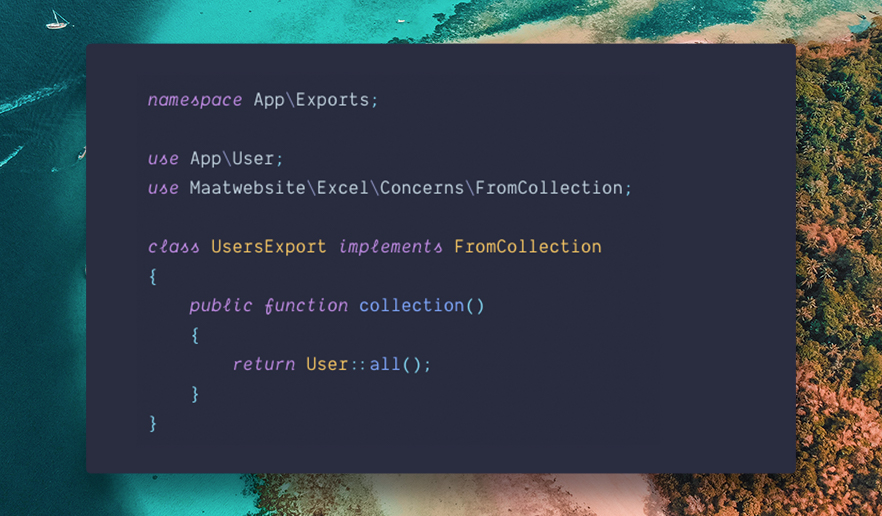\n<br>\n\n## \ud83c\udf93 Learning Laravel Excel\n\nYou can find the full documentation of Laravel Excel [on the website](https://docs.laravel-excel.com).\n\nWe welcome suggestions for improving our docs. The documentation repository can be found at [https://github.com/SpartnerNL/laravel-excel-docs](https://github.com/SpartnerNL/laravel-excel-docs).\n\nSome articles and tutorials can be found on our blog: https://medium.com/maatwebsite/laravel-excel/home\n\n## :mailbox_with_mail: License & Postcardware\n\n\n\nLaravel Excel is created with love and care by Spartner (formerly known as Maatwebsite) to give back to the Laravel community. It is completely free (MIT license) to use, however the package is licensed as Postcardware. This means that if it makes it to your production environment, we would very much appreciate receiving a postcard from your hometown.\n\n**Spartner**\nMarkt 2\n6231 LS Meerssen\nThe Netherlands.\n\nMore about the license can be found at: [https://docs.laravel-excel.com/3.1/getting-started/license.html](https://docs.laravel-excel.com/3.1/getting-started/license.html)\n\n## Created by Spartner (formerly Maatwebsite)\n\nWe are a strategic development partner, creating web-based custom built software from Laravel. In need of a digital solution for your challenge? Give us a call.\n\nhttps://spartner.software\ninfo@spartner.nl\n+31 (0) 10 - 7449312\n\n## :wrench: Supported Versions\n\nVersions will be supported for a limited amount of time.\n\n| Version | Laravel Version | Php Version | Support |\n|---- |----|----|----|\n| 2.1 | <=5.6 | <=7.0 | Unsupported since 15-5-2018 |\n| 3.0 | ^5.5 | ^7.0 | Unsupported since 31-12-2018 |\n| 3.1 | >=5.8 \\| <=12.x | ^7.2 \\| ^8.0 | New features |\n", "source": "github_readme", "repo": "https://github.com/SpartnerNL/Laravel-Excel", "path": "README.md"} | |
| {"instruction": "Provide the default configuration for excel.php in Laravel-Excel.", "output": "<?php\n\nuse Maatwebsite\\Excel\\Excel;\nuse PhpOffice\\PhpSpreadsheet\\Reader\\Csv;\n\nreturn [\n 'exports' => [\n\n /*\n |--------------------------------------------------------------------------\n | Chunk size\n |--------------------------------------------------------------------------\n |\n | When using FromQuery, the query is automatically chunked.\n | Here you can specify how big the chunk should be.\n |\n */\n 'chunk_size' => 1000,\n\n /*\n |--------------------------------------------------------------------------\n | Pre-calculate formulas during export\n |--------------------------------------------------------------------------\n */\n 'pre_calculate_formulas' => false,\n\n /*\n |--------------------------------------------------------------------------\n | Enable strict null comparison\n |--------------------------------------------------------------------------\n |\n | When enabling strict null comparison empty cells ('') will\n | be added to the sheet.\n */\n 'strict_null_comparison' => false,\n\n /*\n |--------------------------------------------------------------------------\n | CSV Settings\n |--------------------------------------------------------------------------\n |\n | Configure e.g. delimiter, enclosure and line ending for CSV exports.\n |\n */\n 'csv' => [\n 'delimiter' => ',',\n 'enclosure' => '\"',\n 'line_ending' => PHP_EOL,\n 'use_bom' => false,\n 'include_separator_line' => false,\n 'excel_compatibility' => false,\n 'output_encoding' => '',\n 'test_auto_detect' => true,\n ],\n\n /*\n |--------------------------------------------------------------------------\n | Worksheet properties\n |--------------------------------------------------------------------------\n |\n | Configure e.g. default title, creator, subject,...\n |\n */\n 'properties' => [\n 'creator' => '',\n 'lastModifiedBy' => '',\n 'title' => '',\n 'description' => '',\n 'subject' => '',\n 'keywords' => '',\n 'category' => '',\n 'manager' => '',\n 'company' => '',\n ],\n ],\n\n 'imports' => [\n\n /*\n |--------------------------------------------------------------------------\n | Read Only\n |--------------------------------------------------------------------------\n |\n | When dealing with imports, you might only be interested in the\n | data that the sheet exists. By default we ignore all styles,\n | however if you want to do some logic based on style data\n | you can enable it by setting read_only to false.\n |\n */\n 'read_only' => true,\n\n /*\n |--------------------------------------------------------------------------\n | Ignore Empty\n |--------------------------------------------------------------------------\n |\n | When dealing with imports, you might be interested in ignoring\n | rows that have null values or empty strings. By default rows\n | containing empty strings or empty values are not ignored but can be\n | ignored by enabling the setting ignore_empty to true.\n |\n */\n 'ignore_empty' => false,\n\n /*\n |--------------------------------------------------------------------------\n | Heading Row Formatter\n |--------------------------------------------------------------------------\n |\n | Configure the heading row formatter.\n | Available options: none|slug|custom\n |\n */\n 'heading_row' => [\n 'formatter' => 'slug',\n ],\n\n /*\n |--------------------------------------------------------------------------\n | CSV Settings\n |--------------------------------------------------------------------------\n |\n | Configure e.g. delimiter, enclosure and line ending for CSV imports.\n |\n */\n 'csv' => [\n 'delimiter' => null,\n 'enclosure' => '\"',\n 'escape_character' => '\\\\',\n 'contiguous' => false,\n 'input_encoding' => Csv::GUESS_ENCODING,\n ],\n\n /*\n |--------------------------------------------------------------------------\n | Worksheet properties\n |--------------------------------------------------------------------------\n |\n | Configure e.g. default title, creator, subject,...\n |\n */\n 'properties' => [\n 'creator' => '',\n 'lastModifiedBy' => '',\n 'title' => '',\n 'description' => '',\n 'subject' => '',\n 'keywords' => '',\n 'category' => '',\n 'manager' => '',\n 'company' => '',\n ],\n\n /*\n |--------------------------------------------------------------------------\n | Cell Middleware\n |--------------------------------------------------------------------------\n |\n | Configure middleware that is executed on getting a cell value\n |\n */\n 'cells' => [\n 'middleware' => [\n //\\Maatwebsite\\Excel\\Middleware\\TrimCellValue::class,\n //\\Maatwebsite\\Excel\\Middleware\\ConvertEmptyCellValuesToNull::class,\n ],\n ],\n\n ],\n\n /*\n |--------------------------------------------------------------------------\n | Extension detector\n |--------------------------------------------------------------------------\n |\n | Configure here which writer/reader type should be used when the package\n | needs to guess the correct type based on the extension alone.\n |\n */\n 'extension_detector' => [\n 'xlsx' => Excel::XLSX,\n 'xlsm' => Excel::XLSX,\n 'xltx' => Excel::XLSX,\n 'xltm' => Excel::XLSX,\n 'xls' => Excel::XLS,\n 'xlt' => Excel::XLS,\n 'ods' => Excel::ODS,\n 'ots' => Excel::ODS,\n 'slk' => Excel::SLK,\n 'xml' => Excel::XML,\n 'gnumeric' => Excel::GNUMERIC,\n 'htm' => Excel::HTML,\n 'html' => Excel::HTML,\n 'csv' => Excel::CSV,\n 'tsv' => Excel::TSV,\n\n /*\n |--------------------------------------------------------------------------\n | PDF Extension\n |--------------------------------------------------------------------------\n |\n | Configure here which Pdf driver should be used by default.\n | Available options: Excel::MPDF | Excel::TCPDF | Excel::DOMPDF\n |\n */\n 'pdf' => Excel::DOMPDF,\n ],\n\n /*\n |--------------------------------------------------------------------------\n | Value Binder\n |--------------------------------------------------------------------------\n |\n | PhpSpreadsheet offers a way to hook into the process of a value being\n | written to a cell. In there some assumptions are made on how the\n | value should be formatted. If you want to change those defaults,\n | you can implement your own default value binder.\n |\n | Possible value binders:\n |\n | [x] Maatwebsite\\Excel\\DefaultValueBinder::class\n | [x] PhpOffice\\PhpSpreadsheet\\Cell\\StringValueBinder::class\n | [x] PhpOffice\\PhpSpreadsheet\\Cell\\AdvancedValueBinder::class\n |\n */\n 'value_binder' => [\n 'default' => Maatwebsite\\Excel\\DefaultValueBinder::class,\n ],\n\n 'cache' => [\n /*\n |--------------------------------------------------------------------------\n | Default cell caching driver\n |--------------------------------------------------------------------------\n |\n | By default PhpSpreadsheet keeps all cell values in memory, however when\n | dealing with large files, this might result into memory issues. If you\n | want to mitigate that, you can configure a cell caching driver here.\n | When using the illuminate driver, it will store each value in the\n | cache store. This can slow down the process, because it needs to\n | store each value. You can use the \"batch\" store if you want to\n | only persist to the store when the memory limit is reached.\n |\n | Drivers: memory|illuminate|batch\n |\n */\n 'driver' => 'memory',\n\n /*\n |--------------------------------------------------------------------------\n | Batch memory caching\n |--------------------------------------------------------------------------\n |\n | When dealing with the \"batch\" caching driver, it will only\n | persist to the store when the memory limit is reached.\n | Here you can tweak the memory limit to your liking.\n |\n */\n 'batch' => [\n 'memory_limit' => 60000,\n ],\n\n /*\n |--------------------------------------------------------------------------\n | Illuminate cache\n |--------------------------------------------------------------------------\n |\n | When using the \"illuminate\" caching driver, it will automatically use\n | your default cache store. However if you prefer to have the cell\n | cache on a separate store, you can configure the store name here.\n | You can use any store defined in your cache config. When leaving\n | at \"null\" it will use the default store.\n |\n */\n 'illuminate' => [\n 'store' => null,\n ],\n\n /*\n |--------------------------------------------------------------------------\n | Cache Time-to-live (TTL)\n |--------------------------------------------------------------------------\n |\n | The TTL of items written to cache. If you want to keep the items cached\n | indefinitely, set this to null. Otherwise, set a number of seconds,\n | a \\DateInterval, or a callable.\n |\n | Allowable types: callable|\\DateInterval|int|null\n |\n */\n 'default_ttl' => 10800,\n ],\n\n /*\n |--------------------------------------------------------------------------\n | Transaction Handler\n |--------------------------------------------------------------------------\n |\n | By default the import is wrapped in a transaction. This is useful\n | for when an import may fail and you want to retry it. With the\n | transactions, the previous import gets rolled-back.\n |\n | You can disable the transaction handler by setting this to null.\n | Or you can choose a custom made transaction handler here.\n |\n | Supported handlers: null|db\n |\n */\n 'transactions' => [\n 'handler' => 'db',\n 'db' => [\n 'connection' => null,\n ],\n ],\n\n 'temporary_files' => [\n\n /*\n |--------------------------------------------------------------------------\n | Local Temporary Path\n |--------------------------------------------------------------------------\n |\n | When exporting and importing files, we use a temporary file, before\n | storing reading or downloading. Here you can customize that path.\n | permissions is an array with the permission flags for the directory (dir)\n | and the create file (file).\n |\n */\n 'local_path' => storage_path('framework/cache/laravel-excel'),\n\n /*\n |--------------------------------------------------------------------------\n | Local Temporary Path Permissions\n |--------------------------------------------------------------------------\n |\n | Permissions is an array with the permission flags for the directory (dir)\n | and the create file (file).\n | If omitted the default permissions of the filesystem will be used.\n |\n */\n 'local_permissions' => [\n // 'dir' => 0755,\n // 'file' => 0644,\n ],\n\n /*\n |--------------------------------------------------------------------------\n | Remote Temporary Disk\n |--------------------------------------------------------------------------\n |\n | When dealing with a multi server setup with queues in which you\n | cannot rely on having a shared local temporary path, you might\n | want to store the temporary file on a shared disk. During the\n | queue executing, we'll retrieve the temporary file from that\n | location instead. When left to null, it will always use\n | the local path. This setting only has effect when using\n | in conjunction with queued imports and exports.\n |\n */\n 'remote_disk' => null,\n 'remote_prefix' => null,\n\n /*\n |--------------------------------------------------------------------------\n | Force Resync\n |--------------------------------------------------------------------------\n |\n | When dealing with a multi server setup as above, it's possible\n | for the clean up that occurs after entire queue has been run to only\n | cleanup the server that the last AfterImportJob runs on. The rest of the server\n | would still have the local temporary file stored on it. In this case your\n | local storage limits can be exceeded and future imports won't be processed.\n | To mitigate this you can set this config value to be true, so that after every\n | queued chunk is processed the local temporary file is deleted on the server that\n | processed it.\n |\n */\n 'force_resync_remote' => null,\n ],\n];\n", "source": "github_code", "repo": "https://github.com/SpartnerNL/Laravel-Excel", "path": "config\\excel.php"} | |
| {"instruction": "Explain the purpose and usage of the SEOstats library based on its documentation.", "output": "# SEOstats: SEO metrics library for PHP\n\n[](https://github.com/eyecatchup/SEOstats) [](https://scrutinizer-ci.com/g/eyecatchup/SEOstats/ \"'Very good' code quality, says Scrutinizer C.I.\") [](https://travis-ci.org/eyecatchup/SEOstats) [](https://scrutinizer-ci.com/g/eyecatchup/SEOstats/code-structure/master?elementType=class&orderField=test_coverage&order=desc&changesExpanded=0 \"Test coverage report by Scrutinizer C.I.\") [](https://packagist.org/packages/seostats/seostats) [](https://packagist.org/packages/seostats/seostats) [](https://packagist.org/packages/seostats/seostats)\n\nSEOstats is _the_ open source PHP library to get SEO-relevant website metrics. \n\nSEOstats is used to gather metrics such as detailed searchindex & backlink data, keyword & traffic statistics, website trends, page authority, social visibility, Google Pagerank, Alexa Trafficrank and more. \n\nIt offers over 50 different methods to fetch data from sources like Alexa, Google, Mozscape (by Moz - f.k.a. Seomoz), SEMRush, Open-Site-Explorer, Sistrix, Facebook or Twitter.\n\nA variety of *(private as well as enterprise)* SEO tools have been built using SEOstats.\n\n## Dependencies\n\nSEOstats requires PHP version 5.3 or greater and the PHP5-CURL and PHP5-JSON extensions.\n\n## Installation\n\nThe recommended way to install SEOstats is [through composer](http://getcomposer.org).\nTo install SEOstats, just create the following `composer.json` file\n\n {\n \"require\": {\n \"seostats/seostats\": \"dev-master\"\n }\n }\nand run the `php composer.phar install` (Windows: `composer install`) command in path of the `composer.json`. \n\n#### Step-by-step example:\n\nIf you haven't installed composer yet, here's the easiest way to do so:\n```\n# Download the composer installer and execute it with PHP:\nuser@host:~/> curl -sS https://getcomposer.org/installer | php\n\n# Copy composer.phar to where your local executables live:\nuser@host:~/> mv /path/given/by/composer-installer/composer.phar /usr/local/bin/composer.phar\n\n# Alternatively: For ease of use, you can add an alias to your bash profile:\n# (Note, you need to re-login your terminal for the change to take effect.)\nuser@host:~/> echo 'alias composer=\"php /usr/local/bin/composer.phar\"' >> ~/.profile\n```\n<hr>\nIf you have installed composer, follow these steps to install SEOstats:\n```\n# Create a new directory and cd into it:\nuser@host:~/> mkdir /path/to/seostats && cd /path/to/seostats\n\n# Create the composer.json for SEOstats:\nuser@host:/path/to/seostats> echo '{\"require\":{\"seostats/seostats\":\"dev-master\"}}' > composer.json\n\n# Run the install command:\nuser@host:/path/to/seostats> composer install\nLoading composer repositories with package information\nInstalling dependencies (including require-dev)\n - Installing seostats/seostats (dev-master 4c192e4)\n Cloning 4c192e43256c95741cf85d23ea2a0d59a77b7a9a\n\nWriting lock file\nGenerating autoload files\n\n# You're done. For a quick start, you can now \n# copy the example files to the install directory:\nuser@host:/path/to/seostats> cp ./vendor/seostats/seostats/example/*.php ./\n\n# Your SEOstats install directory should look like this now:\nuser@host:/path/to/seostats> ls -1\ncomposer.json\ncomposer.lock\nget-alexa-graphs.php\nget-alexa-metrics.php\nget-google-pagerank.php\nget-google-pagespeed-analysis.php\nget-google-serps.php\nget-opensiteexplorer-metrics.php\nget-semrush-graphs.php\nget-semrush-metrics.php\nget-sistrix-visibilityindex.php\nget-social-metrics.php\nvendor\n```\n<hr>\n#### Use SEOstats without composer\n\nIf composer is no option for you, you can still just download the [`SEOstats.zip`](https://github.com/eyecatchup/SEOstats/archive/master.zip) file of the current master branch (version 2.5.2) and extract it. However, currently [there is an issues with autoloading](https://github.com/eyecatchup/SEOstats/issues/49) and you need to follow the instructions in the comments in the example files in order to use SEOstats (or download zip for the development version of SEOstats (2.5.3) [here](https://github.com/eyecatchup/SEOstats/archive/dev-253.zip)).\n\n## Usage\n\n### TOC\n\n* <a href='#configuration'>Configuration</a>\n* <a href='#brief-example-of-use'>Brief Example of Use</a>\n* <a href='#seostats-alexa-methods'>Alexa Methods</a>\n * <a href='#alexa-traffic-metrics'>Alexa Traffic Metrics</a>\n * <a href='#alexa-traffic-graphs'>Alexa Traffic Graphs</a>\n* <a href='#seostats-google-methods'>Google Methods</a>\n * <a href='#google-toolbar-pagerank'>Toolbar Pagerank</a>\n * <a href='#google-pagespeed-service'>Pagespeed Service</a>\n * <a href='#google-websearch-index'>Websearch Index</a>\n * <a href='#google-serp-details'>SERP Details</a>\n* <a href='#seostats-mozscape-methods'>Mozscape Methods</a> \n* <a href='#seostats-open-site-explorer-methods'>Open Site Explorer Methods</a>\n* <a href='#seostats-semrush-methods'>SEMRush Methods</a>\n * <a href='#semrush-domain-reports'>Domain Reports</a>\n * <a href='#semrush-graphs'>Graphs</a>\n* <a href='#seostats-sistrix-methods'>Sistrix Methods</a>\n * <a href='#sistrix-visibility-index'>Visibility Index</a>\n* <a href='#seostats-social-media-methods'>Social Media Methods</a>\n\n<hr>\n\n### Configuration\nThere're two configuration files to note:\n<ol>\n<li>`./SEOstats/Config/ApiKeys.php`<br>\n<em>Client API Keys (currently only required for Mozscape, Google's Pagespeed Service and Sistrix).</em>\n</li>\n<li>`./SEOstats/Config/DefaultSettings.php`<br>\n<em>Some default settings for querying data (mainly locale related stuff).</em>\n</li>\n</ol>\n<hr>\n\n### Brief Example of Use\nTo use the SEOstats methods, you must include one of the Autoloader classes first (For composer installs: `./vendor/autoload.php`; for zip download: `./SEOstats/bootstrap.php`).\n\nNow, you can create a new SEOstats instance an bind any URL to the instance for further use with any child class.\n\n```php\n<?php\n// Depending on how you installed SEOstats\n#require_once __DIR__ . DIRECTORY_SEPARATOR . 'SEOstats' . DIRECTORY_SEPARATOR . 'bootstrap.php';\nrequire_once __DIR__ . DIRECTORY_SEPARATOR . 'vendor' . DIRECTORY_SEPARATOR . 'autoload.php';\n\nuse \\SEOstats\\Services as SEOstats;\n\ntry {\n $url = 'http://www.google.com/';\n\n // Create a new SEOstats instance.\n $seostats = new \\SEOstats\\SEOstats;\n\n // Bind the URL to the current SEOstats instance.\n if ($seostats->setUrl($url)) {\n\n\techo SEOstats\\Alexa::getGlobalRank();\n\techo SEOstats\\Google::getPageRank();\n }\n}\ncatch (SEOstatsException $e) {\n die($e->getMessage());\n}\n```\n\nAlternatively, you can call all methods statically passing the URL to the methods directly.\n\n```php\n<?php\n// Depending on how you installed SEOstats\n#require_once __DIR__ . DIRECTORY_SEPARATOR . 'SEOstats' . DIRECTORY_SEPARATOR . 'bootstrap.php';\nrequire_once __DIR__ . DIRECTORY_SEPARATOR . 'vendor' . DIRECTORY_SEPARATOR . 'autoload.php';\n\ntry {\n $url = 'http://www.google.com/';\n\n // Get the Google Toolbar Pagerank for the given URL.\n echo \\SEOstats\\Services\\Google::getPageRank($url);\n}\ncatch (SEOstatsException $e) {\n die($e->getMessage());\n}\n```\n\nMore detailed examples can be found in the `./example` directory.\n<hr>\n\n## SEOstats Alexa Methods\n\n### Alexa Traffic Metrics\n```php\n<?php\n // Returns the global Alexa Traffic Rank (last 3 months).\n print Alexa::getGlobalRank();\n\n // Returns the global Traffic Rank for the last month.\n print Alexa::getMonthlyRank();\n\n // Returns the global Traffic Rank for the last week.\n print Alexa::getWeeklyRank();\n\n // Returns the global Traffic Rank for yesterday.\n print Alexa::getDailyRank();\n\n // Returns the country-specific Alexa Traffic Rank.\n print_r( Alexa::getCountryRank() );\n\n // Returns Alexa's backlink count for the given domain.\n print Alexa::getBacklinkCount();\n\n // Returns Alexa's page load time info for the given domain.\n print Alexa::getPageLoadTime();\n```\n\n### Alexa Traffic Graphs\n\n```php\n<?php\n // Returns HTML code for the 'daily traffic trend'-graph.\n print Alexa::getTrafficGraph(1);\n\n // Returns HTML code for the 'daily pageviews (percent)'-graph.\n print Alexa::getTrafficGraph(2);\n\n // Returns HTML code for the 'daily pageviews per user'-graph.\n print Alexa::getTrafficGraph(3);\n\n // Returns HTML code for the 'time on site (in minutes)'-graph.\n print Alexa::getTrafficGraph(4);\n\n // Returns HTML code for the 'bounce rate (percent)'-graph.\n print Alexa::getTrafficGraph(5);\n\n // Returns HTML code for the 'search visits'-graph, using specific graph dimensions of 320*240 px.\n print Alexa::getTrafficGraph(6, 0, 320, 240);\n```\n<hr>\n\n## SEOstats Google Methods\n\n### Google Toolbar PageRank\n\n```php\n<?php\n // Returns the Google PageRank for the given URL.\n print Google::getPageRank();\n```\n\n### Google Pagespeed Service\n\n```php\n<?php\n // Returns the Google Pagespeed analysis' metrics for the given URL.\n print_r( Google::getPagespeedAnalysis() );\n\n // Returns the Google Pagespeed analysis' total score.\n print Google::getPagespeedScore();\n```\n\n### Google Websearch Index\n\n```php\n<?php\n // Returns the total amount of results for a Google site-search for the object URL.\n print Google::getSiteindexTotal();\n\n // Returns the total amount of results for a Google link-search for the object URL.\n print Google::getBacklinksTotal();\n\n // Returns the total amount of results for a Google search for 'keyword'.\n print Google::getSearchResultsTotal('keyword');\n```\n\n### Google SERP Details\n\n```php\n<?php\n // Returns an array of URLs and titles for the first 100 results for a Google web search for 'keyword'.\n print_r ( Google::getSerps('keyword') );\n\n // Returns an array of URLs and titles for the first 200 results for a Google site-search for $url.\n print_r ( Google::getSerps(\"site:$url\", 200) );\n\n // Returns an array of URLs, titles and position in SERPS for occurrences of $url\n // within the first 1000 results for a Google web search for 'keyword'.\n print_r ( Google::getSerps('keyword', 1000, $url) );\n```\n<hr>\n\n## SEOstats Mozscape Methods\n\n```php\n<?php\n // The normalized 10-point MozRank score of the URL. \n print Mozscape::getMozRank();\n \n // The raw MozRank score of the URL.\n print Mozscape::getMozRankRaw();\n \n // The number of links (equity or nonequity or not, internal or external) to the URL.\n print Mozscape::getLinkCount();\n \n // The number of external equity links to the URL (http://apiwiki.moz.com/glossary#equity).\n print Mozscape::getEquityLinkCount();\n \n // A normalized 100-point score representing the likelihood\n // of the URL to rank well in search engine results. \n print Mozscape::getPageAuthority();\n \n // A normalized 100-point score representing the likelihood\n // of the root domain of the URL to rank well in search engine results.\n print Mozscape::getDomainAuthority();\n```\n<hr>\n\n## SEOstats Open Site Explorer (by MOZ) Methods\n\n```php\n<?php\n // Returns several metrics from Open Site Explorer (by MOZ)\n $ose = OpenSiteExplorer::getPageMetrics();\n\n // MOZ Domain-Authority Rank - Predicts this domain's ranking potential in the search engines \n // based on an algorithmic combination of all link metrics.\n print \"Domain-Authority: \" .\n $ose->domainAuthority->result . ' (' . // Int - e.g 42\n $ose->domainAuthority->unit . ') - ' . // String - \"/100\"\n $ose->domainAuthority->descr . PHP_EOL; // String - Result value description\n\n // MOZ Page-Authority Rank - Predicts this page's ranking potential in the search engines \n // based on an algorithmic combination of all link metrics.\n print \"Page-Authority: \" .\n $ose->pageAuthority->result . ' (' . // Int - e.g 48\n $ose->pageAuthority->unit . ') - ' . // String - \"/100\"\n $ose->pageAuthority->descr . PHP_EOL; // String - Result value description\n\n // Just-Discovered Inbound Links - Number of links to this page found over the past %n days, \n // indexed within an hour of being shared on Twitter.\n print \"Just-Discovered Links: \" .\n $ose->justDiscovered->result . ' (' . // Int - e.g 140\n $ose->justDiscovered->unit . ') - ' . // String - e.g \"32 days\"\n $ose->justDiscovered->descr . PHP_EOL; // String - Result value description\n\n // Root-Domain Inbound Links - Number of unique root domains (e.g., *.example.com) \n // containing at least one linking page to this URL.\n print \"Linking Root Domains: \" .\n $ose->linkingRootDomains->result . ' (' . // Int - e.g 210\n $ose->linkingRootDomains->unit . ') - ' . // String - \"Root Domains\"\n $ose->linkingRootDomains->descr . PHP_EOL; // String - Result value description\n\n // Total Links - All links to this page including internal, external, followed, and nofollowed.\n print \"Total Links: \" .\n $ose->totalLinks->result . ' (' . // Int - e.g 31571\n $ose->totalLinks->unit . ') - ' . // String - \"Total Links\"\n $ose->totalLinks->descr . PHP_EOL; // String - Result value description\n```\n<hr>\n\n## SEOstats SEMRush Methods\n\n### SEMRush Domain Reports\n\n```php\n<?php\n // Returns an array containing the SEMRush main report (includes DomainRank, Traffic- & Ads-Data)\n print_r ( SemRush::getDomainRank() );\n\n // Returns an array containing the domain rank history.\n print_r ( SemRush::getDomainRankHistory() );\n\n // Returns an array containing data for competeing (auto-detected) websites.\n print_r ( SemRush::getCompetitors() );\n\n // Returns an array containing data about organic search engine traffic, using explicitly SEMRush's german database.\n print_r ( SemRush::getOrganicKeywords(0, 'de') );\n```\n\n### SEMRush Graphs\n\n```php\n<?php\n // Returns HTML code for the 'search engine traffic'-graph.\n print SemRush::getDomainGraph(1);\n\n // Returns HTML code for the 'search engine traffic price'-graph.\n print SemRush::getDomainGraph(2);\n\n // Returns HTML code for the 'number of adwords ads'-graph, using explicitly SEMRush's german database.\n print SemRush::getDomainGraph(3, 0, 'de');\n\n // Returns HTML code for the 'adwords traffic'-graph, using explicitly SEMRush's german database and\n // specific graph dimensions of 320*240 px.\n print SemRush::getDomainGraph(4, 0, 'de', 320, 240);\n\n // Returns HTML code for the 'adwords traffic price '-graph, using explicitly SEMRush's german database,\n // specific graph dimensions of 320*240 px and specific graph colors (black lines and red dots for data points).\n print SemRush::getDomainGraph(5, 0, 'de', 320, 240, '000000', 'ff0000');\n```\n<hr>\n\n## SEOstats Sistrix Methods\n\n### Sistrix Visibility Index\n\n```php\n<?php\n // Returns the Sistrix visibility index\n // @link http://www.sistrix.com/blog/870-sistrix-visibilityindex.html\n print Sistrix::getVisibilityIndex();\n```\n<hr>\n\n## SEOstats Social Media Methods\n\n### Google+ PlusOnes\n\n```php\n<?php\n // Returns integer PlusOne count\n print Social::getGooglePlusShares();\n```\n\n### Facebook Interactions\n\n```php\n<?php\n // Returns an array of total counts for overall Facebook interactions count, shares, likes, comments and clicks.\n print_r ( Social::getFacebookShares() );\n```\n\n### Twitter Mentions\n\n```php\n<?php\n // Returns integer tweet count for URL mentions\n print Social::getTwitterShares();\n```\n\n### Other Shares\n\n```php\n<?php\n // Returns the total count of URL shares via Delicious\n print Social::getDeliciousShares();\n\n // Returns array of top ten delicious tags for a URL\n print_r ( Social::getDeliciousTopTags() );\n\n // Returns the total count of URL shares via Digg\n print Social::getDiggShares();\n\n // Returns the total count of URL shares via LinkedIn\n print Social::getLinkedInShares();\n\n // Returns shares, comments, clicks and reach for the given URL via Xing\n print_r( Social::getXingShares() );\n\n // Returns the total count of URL shares via Pinterest\n print Social::getPinterestShares();\n\n // Returns the total count of URL shares via StumbleUpon\n print Social::getStumbleUponShares();\n\n // Returns the total count of URL shares via VKontakte\n print Social::getVKontakteShares();\n```\n<hr>\n\n## License\n\n(c) 2010 - 2016, Stephan Schmitz eyecatchup@gmail.com \nLicense: MIT, http://eyecatchup.mit-license.org \nURL: https://eyecatchup.github.io \n", "source": "github_readme", "repo": "https://github.com/eyecatchup/SEOstats", "path": "README.md"} | |
| {"instruction": "Explain the purpose and usage of the seo library based on its documentation.", "output": "\n\n# SEO for Craft CMS\n\nSEO for Craft does three things that will help your sites SEO, and does them really damn well:\n\n1. [**Optimisation Field Type**](#the-field-type) - Helps your clients write better optimised copy, and manage other SEO meta.\n2. [**Sitemap**](#the-sitemap) - Generates an always up-to-date XML sitemap automatically, with controls for customisation.\n3. [**Redirects**](#the-redirects) - Quickly and easily manage 301 & 302 redirects. Especially useful when migrating from an old site.\n\n[Click here for the **Craft 2** version.](https://github.com/ethercreative/seo/tree/v2)\n\n### The Field Type\n\nThe SEO field type helps give users an idea of how their page will look in Google, and how their pages content scores when compared to a specific keyword.\n\nThe field type allows users to manage the meta of their page in one simple and easy to use input that has the added bonus of giving them an idea of how their page will show up in a Google search.\n\nThe field also contains a *Focus Keyword* input and *Page Score*. This is used to workout how relevant a keyword or phrase is to your entry and how well the page is likely to do in a search for that keyword.\n\nThe Page Score also contains a breakdown of your entries score, and tips on where it can be improved.\n\n\n\n\n\n\n\n### The Sitemap\n\nSEO for Craft boasts an extremely powerful, yet simple to use Sitemap manager. With automatic support for all your site\u2019s sections and categories (with localisations taken into account), and the ability to easily add custom URLs (useful for public templates that aren\u2019t content managed), keeping your sitemap up-to-date has never been easier.\n\nWith SEO for Craft\u2019s sitemap manager you have complete control over what content you want to have appear on your sitemap as well as managing its change frequency and priority in your site.\n\n\n\n### The Redirects\n\nWhen moving from your old, awful site to your shiny new Craft one, you\u2019ll want to make sure that all your old pages are redirected to their new counterparts. Redirects are easy to manage with SEO for Craft.\n\nSEO for Crafts redirect manager lets you easily add 301 & 302 redirects, with full .htaccess style regex support!\n\nRedirects support [PCRE regex syntax](http://php.net/manual/en/reference.pcre.pattern.syntax.php). By default, all `/` and `?` not inside parenthesis are escaped. To prevent any escaping include the opening and closing forward slashes and flags: `/^blog$/i`. All redirects are given the insensitive flag, unless overwritten.\n\n**Redirect Regex Example** \nTo redirect from `blog/2016/my-post` to `news/my-post` you would add the following redirect:\n\nURI: `blog/([0-9]{4})/(.*)` To: `news/$2`\n\n\n\n## Installation & Usage\n\nClone this repo into `craft/plugins/seo`.\n\n### Using Composer\n\n**Easy way**\n\n`composer require ether/seo`\n\n**Alternative way**\n1. Append `\"ether/seo\": \"^3.1.0\"` to the `require` hash of `composer.json`\n2. `composer update`\n3. Install via CP in `/admin/settings/plugins`\n\nBefore using the SEO field type, you\u2019ll need to ensure all the settings are correct. You can find the settings under the SEO plugin menu in the sidebar, or via the plugin menu.\n\n### Environment Setup\n\nEnsure that your Production environment\u2019s name is `production` (going with Craft\u2019s convention). All other environments will get `X-Robots-Tag: none, noimageindex` headers added to every web response, to prevent search engines from indexing duplicate content.\n\nEnvironment names are typically defined by an `ENVIRONMENT` environment variable.\n\n### Fieldtype Usage\n\nReplace your `title` tag, and any other SEO related meta tags with `{% hook \"seo\" %}`. That's it!\n\nThis assumes that you will be creating a variable call `seo` in your templates that will return either the SEO field or a custom SEO object (see below). You can modify the output of this hook by setting your own SEO Meta Template in the SEO Settings. You can [view the default template here](https://github.com/ethercreative/seo/blob/v3/src/templates/_seo/meta.twig).\n\n### How meta output works (what the hook renders)\n\n- **Automatic field detection**: The default meta template will try to find your SEO field automatically using `getSeoField('seo')`. If your field handle is not `seo`, pass it: `getSeoField('mySeoHandle')`. If nothing is found, it falls back to `craft.seo.custom(siteName, '')`.\n- **Meta tags included**:\n - `<title>` from your SEO field\u2019s title tokens or fallback\n - `<meta name=\"description\">`\n - Open Graph tags (title, description, image, site name, locale, alternates)\n - Twitter Card tags (summary_large_image)\n - `<meta name=\"robots\">` when applicable (see Robots section below)\n - `<link rel=\"canonical\">`\n- **Canonical also as a header**: In addition to the `<link rel=\"canonical\">`, the plugin adds an HTTP `Link: <...>; rel=\"canonical\"` header on every frontend response.\n\nTip: If you prefer to use an SEO object directly (e.g. for non-element templates), set a variable named `seo` in your template to `craft.seo.custom(...)` or include your element\u2019s field value, and the hook will use it.\n\n### Custom SEO Object\n\nIn some cases, you will not have access to an SEO field, but will want to set the page title, description, & socials. You can do this by creating a custom SEO object using the function below:\n\n```twig\ncraft.seo.custom(\n 'The Page Title',\n 'The page description',\n null,\n\n // Social media - Any missing fields (excluding images) will be populated by the values above\n {\n twitter: { image: myImageField.first() },\n facebook: { title: '', description: '', image: myImageField.first() },\n }\n)\n```\n\nalternatively pass an object as the first parameter. This will be used in place of an element.\n\n```twig\ncraft.seo.custom(\n {\n title: 'The Page Title',\n someField: 'Hello world!',\n },\n 'The page description'\n)\n```\n\nAll parameters are optional.\n\n### Robots, noindex and robots.txt\n\n- **Environment protection**\n - On any environment where `Craft::$app->env` is not `production`, every response gets an `X-Robots-Tag: none, noimageindex` header automatically to avoid accidental indexing of staging/dev. Keep production named exactly `production`.\n - When Craft\u2019s `devMode` is enabled, the rendered `<meta name=\"robots\">` will also be `none, noimageindex`.\n\n- **Per\u2011entry robots directives (noindex, nofollow, etc.)**\n - In the entry editor, open your SEO field \u2192 Advanced tab \u2192 toggle the directives you need. Available switches include `noindex`, `nofollow`, `noarchive`, `nosnippet`, `notranslate`, `noimageindex`.\n - These map directly to the `<meta name=\"robots\" content=\"...\">` output. When present, the plugin also mirrors them via the `X-Robots-Tag` header.\n - If the element has an `expiryDate`, the plugin adds `unavailable_after: <date>` to the meta and headers automatically.\n\n- **Global defaults**\n - Set the default robots directives in SEO \u2192 Settings \u2192 Robots. New entries inherit these defaults; you can override per entry in the Advanced tab.\n\n- **robots.txt**\n - The plugin serves `robots.txt` at `/robots.txt` and renders it from the template you configure in SEO \u2192 Settings \u2192 Robots.\n - You can use any Craft Twig variables and a `seo` object that contains SEO settings. The default template includes your sitemap URL and blocks everything outside production, for example:\n\n ```twig\n {# Sitemap URL #}\n Sitemap: {{ url(seo.sitemapName ~ '.xml') }}\n\n {# Disallows #}\n {% if craft.app.config.env != 'production' %}\n User-agent: *\n Disallow: /\n {% else %}\n User-agent: *\n Disallow: /cpresources/\n {% endif %}\n ```\n\n### Canonical URLs\n\n- Set a canonical URL per entry in the SEO field \u2192 Advanced tab. Leave blank to fall back to the current page URL.\n- Output is provided both as `<link rel=\"canonical\" href=\"...\">` and as an HTTP `Link` header, which some crawlers prefer.\n\n### Using a custom meta template\n\n- In SEO \u2192 Settings, set a custom Meta Template to fully control the markup the `{% hook \"seo\" %}` renders. The `seo` variable is a `SeoData` object with properties like `title`, `description`, `social.twitter`, `social.facebook`, `robots`, `canonical`, and `expiry` that you can use in your Twig.\n- If you don\u2019t provide a template, the built-in one at `seo/_seo/meta` is used.\n\n## Upcoming Features\n\nIf you have a feature suggestion, [leave an issue](https://github.com/ethercreative/seo/issues) with the prefix `[FR]`. \n\n---\n\nCopyright \u00a9 2016 Ether Creative <hello@ethercreative.co.uk>\n\nPermission is hereby granted, free of charge, to any person obtaining a copy of this software and associated documentation files (the \u201cSoftware\u201d), to deal in the Software without restriction, including without limitation the rights to use, copy, modify, merge, publish, distribute, sublicense, and/or sell copies of the Software, and to permit persons to whom the Software is furnished to do so, subject to the following conditions:\n\nThe above copyright notice and this permission notice shall be included in all copies or substantial portions of the Software.\n\nTHE SOFTWARE IS PROVIDED \u201cAS IS\u201d, WITHOUT WARRANTY OF ANY KIND, EXPRESS OR IMPLIED, INCLUDING BUT NOT LIMITED TO THE WARRANTIES OF MERCHANTABILITY, FITNESS FOR A PARTICULAR PURPOSE AND NONINFRINGEMENT. IN NO EVENT SHALL THE AUTHORS OR COPYRIGHT HOLDERS BE LIABLE FOR ANY CLAIM, DAMAGES OR OTHER LIABILITY, WHETHER IN AN ACTION OF CONTRACT, TORT OR OTHERWISE, ARISING FROM, OUT OF OR IN CONNECTION WITH THE SOFTWARE OR THE USE OR OTHER DEALINGS IN THE SOFTWARE.\n", "source": "github_readme", "repo": "https://github.com/ethercreative/seo", "path": "README.md"} | |
| {"instruction": "Explain the purpose and usage of the python-seo-analyzer library based on its documentation.", "output": "Python SEO and GEO Analyzer\n===========================\n\n[](https://badge.fury.io/py/pyseoanalyzer)\n[](https://hub.docker.com/r/sethblack/python-seo-analyzer)\n\nA modern SEO and GEO (Generative AI Engine Optimization or better AI Search Optimization) analysis tool that combines technical optimization and authentic human value. Beyond traditional site crawling and structure analysis, it uses AI to evaluate content's expertise signals, conversational engagement, and cross-platform presence. It helps you maintain strong technical foundations while ensuring your site demonstrates genuine authority and value to real users.\n\nThe AI features were heavily influenced by the clickbait-titled SEL article [A 13-point roadmap for thriving in the age of AI search](https://searchengineland.com/seo-roadmap-ai-search-449199).\n\nNote About Python\n-----------------\n\nI've written quite a bit about the speed of Python and how there are very specific use cases where it isn't the best choice. I feel like crawling websites is definitely one of those cases. I wrote this tool in Python around 2010 to solve the very specific need of crawling some small HTML-only websites for startups I was working at. I'm excited to see how much it has grown and how many people are using it. I feel like Python SEO Analyzer is acceptable for most smaller use cases, but if you are looking for something better, I've built a much faster and more comprehensive tool [Black SEO Analyzer](https://github.com/sethblack/black-seo-analyzer).\n\n-Seth\n\nInstallation\n------------\n\n### PIP\n\n```\npip install pyseoanalyzer\n```\n\n### Docker\n\n#### Using the Pre-built Image from Docker Hub\n\nThe easiest way to use the Docker image is to pull it directly from [Docker Hub](https://hub.docker.com/r/sethblack/python-seo-analyzer).\n\n```bash\n# Pull the latest image\ndocker pull sethblack/python-seo-analyzer:latest\n\n# Run the analyzer (replace example.com with the target URL)\n# The --rm flag automatically removes the container when it exits\ndocker run --rm sethblack/python-seo-analyzer http://example.com/\n\n# Run with specific arguments (e.g., sitemap and HTML output)\n# Note: If the sitemap is local, you'll need to mount it (see mounting example below)\ndocker run --rm sethblack/python-seo-analyzer http://example.com/ --sitemap /path/inside/container/sitemap.xml --output-format html\n\n# Run with AI analysis (requires ANTHROPIC_API_KEY)\n# Replace \"your_api_key_here\" with your actual Anthropic API key\ndocker run --rm -e ANTHROPIC_API_KEY=\"your_api_key_here\" sethblack/python-seo-analyzer http://example.com/ --run-llm-analysis\n\n# Save HTML output to your local machine\n# This mounts the current directory (.) into /app/output inside the container.\n# The output file 'results.html' will be saved in your current directory.\n# The tool outputs JSON by default to stdout, so we redirect it for HTML.\n# Since the ENTRYPOINT handles the command, we redirect the container's stdout.\n# We need a shell inside the container to handle the redirection.\ndocker run --rm -v \"$(pwd):/app/output\" sethblack/python-seo-analyzer /bin/sh -c \"seoanalyze http://example.com/ --output-format html > /app/output/results.html\"\n# Note for Windows CMD users: Use %cd% instead of $(pwd)\n# docker run --rm -v \"%cd%:/app/output\" sethblack/python-seo-analyzer /bin/sh -c \"seoanalyze http://example.com/ --output-format html > /app/output/results.html\"\n# Note for Windows PowerShell users: Use ${pwd} instead of $(pwd)\n# docker run --rm -v \"${pwd}:/app/output\" sethblack/python-seo-analyzer /bin/sh -c \"seoanalyze http://example.com/ --output-format html > /app/output/results.html\"\n\n\n# Mount a local sitemap file\n# This mounts 'local-sitemap.xml' from the current directory to '/app/sitemap.xml' inside the container\ndocker run --rm -v \"$(pwd)/local-sitemap.xml:/app/sitemap.xml\" sethblack/python-seo-analyzer http://example.com/ --sitemap /app/sitemap.xml\n# Adjust paths and Windows commands as needed (see volume mounting example above)\n\n```\n\n#### Building the Image Locally\n\nYou can also build the Docker image yourself from the source code. Make sure you have Docker installed and running.\n\n```bash\n# Clone the repository (if you haven't already)\n# git clone https://github.com/sethblack/python-seo-analyzer.git\n# cd python-seo-analyzer\n\n# Build the Docker image (tag it as 'my-seo-analyzer' for easy reference)\ndocker build -t my-seo-analyzer .\n\n# Run the locally built image\ndocker run --rm my-seo-analyzer http://example.com/\n\n# Run with AI analysis using the locally built image\ndocker run --rm -e ANTHROPIC_API_KEY=\"your_api_key_here\" my-seo-analyzer http://example.com/ --run-llm-analysis\n\n# Run with HTML output saved locally using the built image\ndocker run --rm -v \"$(pwd):/app/output\" my-seo-analyzer /bin/sh -c \"python-seo-analyzer http://example.com/ --output-format html > /app/output/results.html\"\n# Adjust Windows commands as needed (see volume mounting example above)\n```\n\nCommand-line Usage\n------------------\n\nIf you run without a sitemap it will start crawling at the homepage.\n\n```sh\npython-seo-analyzer http://www.domain.com/\n```\n\nOr you can specify the path to a sitmap to seed the urls to scan list.\n\n```sh\nseoanapython-seo-analyzerlyze http://www.domain.com/ --sitemap path/to/sitemap.xml\n```\n\nHTML output can be generated from the analysis instead of json.\n\n```sh\npython-seo-analyzer http://www.domain.com/ --output-format html\n```\n\nAPI\n---\n\nThe `analyze` function returns a dictionary with the results of the crawl.\n\n```python\nfrom pyseoanalyzer import analyze\n\noutput = analyze(site, sitemap)\n\nprint(output)\n```\n\nIn order to analyze heading tags (h1-h6) and other extra additional tags as well, the following options can be passed to the `analyze` function\n```python\nfrom pyseoanalyzer import analyze\n\noutput = analyze(site, sitemap, analyze_headings=True, analyze_extra_tags=True)\n\nprint(output)\n```\n\nBy default, the `analyze` function analyzes all the existing inner links as well, which might be time consuming.\nThis default behaviour can be changed to analyze only the provided URL by passing the following option to the `analyze` function\n```python\nfrom pyseoanalyzer import analyze\n\noutput = analyze(site, sitemap, follow_links=False)\n\nprint(output)\n```\n\nAlternatively, you can run the analysis as a script from the seoanalyzer folder.\n\n```sh\npython -m seoanalyzer https://www.sethserver.com/ -f html > results.html\n```\n\nAI Optimization\n---------------\n\nThe first pass of AI optimization features use Anthropic's `claude-3-sonnet-20240229` model to evaluate the content of the site. You will need to have an API key from [Anthropic](https://www.anthropic.com/) to use this feature. The API key needs to be set as the environment variable `ANTHROPIC_API_KEY`. I recommend using a `.env` file to set this variable. Once the API key is set, the AI optimization features can be enabled with the `--run-llm-analysis` flag.\n\nNotes\n-----\n\nIf you get `requests.exceptions.SSLError` at either the command-line or via the python-API, try using:\n - http://www.foo.bar\n \n **instead** of..\n \n - https://www.foo.bar\n", "source": "github_readme", "repo": "https://github.com/sethblack/python-seo-analyzer", "path": "README.md"} | |