

Hebrish: English-Hebrew code-switching
Collection
Every Hebrish model, dataset and Space, including those still on danielrosehill. hebrish.app • 33 items • Updated
This repository is publicly accessible, but you have to accept the conditions to access its files and content.
Access to this model is by request and is governed by the Hebrish terms of use (https://hebrish.app/terms). Non-commercial use is free; commercial use needs a commercial licence from access-requests@hebrish.app. Please also complete the attestation form: https://hebrish.app/legal/hebrish-terms-of-use.pdf
Log in or Sign Up to review the conditions and access this model content.
GGUF builds of Hebrish/Jachnun, a fine-tune of NVIDIA Parakeet TDT 0.6B v2 for English speech with romanized Hebrew words dropped in ("pensia", "mechina", "makolet"). Read the main model card for what the fine-tune does, its results and its limits: it is a single-speaker proof of concept.
Website: hebrish.app: get the Hebrish keyboard for Android and the desktop apps, see the results, and find every model, dataset and demo in one place. Android updates through F-Droid: add the Hebrish F-Droid repository (https://fdroid.hebrish.app/repo; steps).
Access and terms of use. Use of this model and every converted or quantised build of it (GGUF, ONNX, sherpa-onnx, MLX) is governed by the Hebrish terms of use. Access is by request: use the button on this page, or write to access-requests@hebrish.app. Non-commercial use (personal, research, education, open-source projects) is free; please complete the attestation form. Commercial use, including telephony and call centres, needs a commercial licence: access-requests@hebrish.app. Versions released under CC-BY-4.0 (PoC-1 to PoC-5, v1.0) stay under that licence; the terms do not restrict rights it grants.
Converted with transcribe.cpp v0.1.3
from training run r6-en30 (model Jachnun v1.0, 2026-10-19; the first release after proof-of-concept
checkpoints PoC-1 to PoC-5, published as v1 to v5).
| File | Size | Use |
|---|---|---|
…-Q8_0.gguf |
730 MB | Recommended. Phones and desktop CPUs |
…-Q4_K_M.gguf |
475 MB | Phones short on memory. Slower than Q8_0 on x86 |
…-F16.gguf |
1.2 GB | GPU inference (transcribe.cpp built with Vulkan, HIP/ROCm or CUDA) |
Check against full precision (5 held-out phone clips, transcribe.cpp transcribe-cli,
v1.0, 2026-10-19): Q8_0 and F16 identical on 5/5 to the fp32 ONNX export; Q4_K_M 4/5 (it
lowercases one name, "Hi gal"). v1.0, like PoC-4 and PoC-5, was published before its
benchmark, so the ONNX export stood in for the PyTorch transcripts that earlier checks used.
(PoC-5: Q8_0 5/5, Q4_K_M 4/5; PoC-4: Q8_0, Q4_K_M and F16 5/5; PoC-3: Q8_0 5/5, Q4_K_M 4/5.)
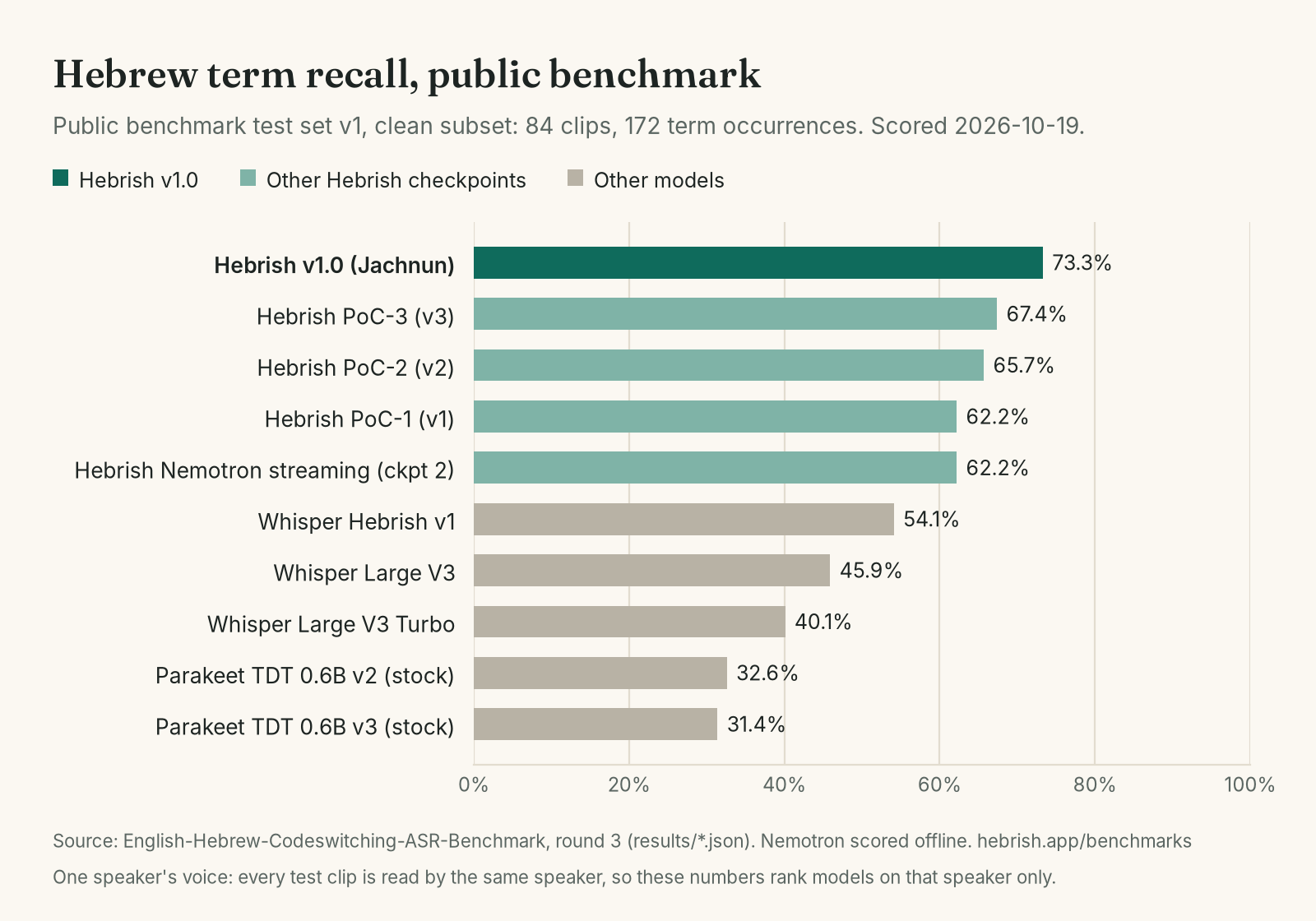
On the public benchmark, Jachnun v1.0 writes 73.3% of Hebrew terms exactly, against 32.6% for stock Parakeet v2 (scored with the main model, not this conversion). One speaker's voice: all training and test audio is the same speaker, so gains on other voices are untested. Full results: hebrish.app/benchmarks.
~/.local/share/com.pais.handy/models/; its README's
~/.config/... path is not scanned) and restart Handy. It shows up as
"Parakeet TDT 0.6B v2 English-Hebrew Code-Switching (v1.0)".transcribe-cli -m Parakeet-TDT-0.6B-v2-English-Hebrew-Codeswitching-Q8_0.gguf audio.wav
(16 kHz mono WAV).Other formats: ONNX (onnx-asr / Voxtype) · sherpa-onnx int8 · NeMo original.
Licence: CC-BY-4.0, as for the base model (NVIDIA Parakeet TDT 0.6B v2).
4-bit
8-bit
16-bit