

Robust Speech Recognition via Large-Scale Weak Supervision
Paper • 2212.04356 • Published • 55


This repository contains model weights and configuration files for the pre-trained model.
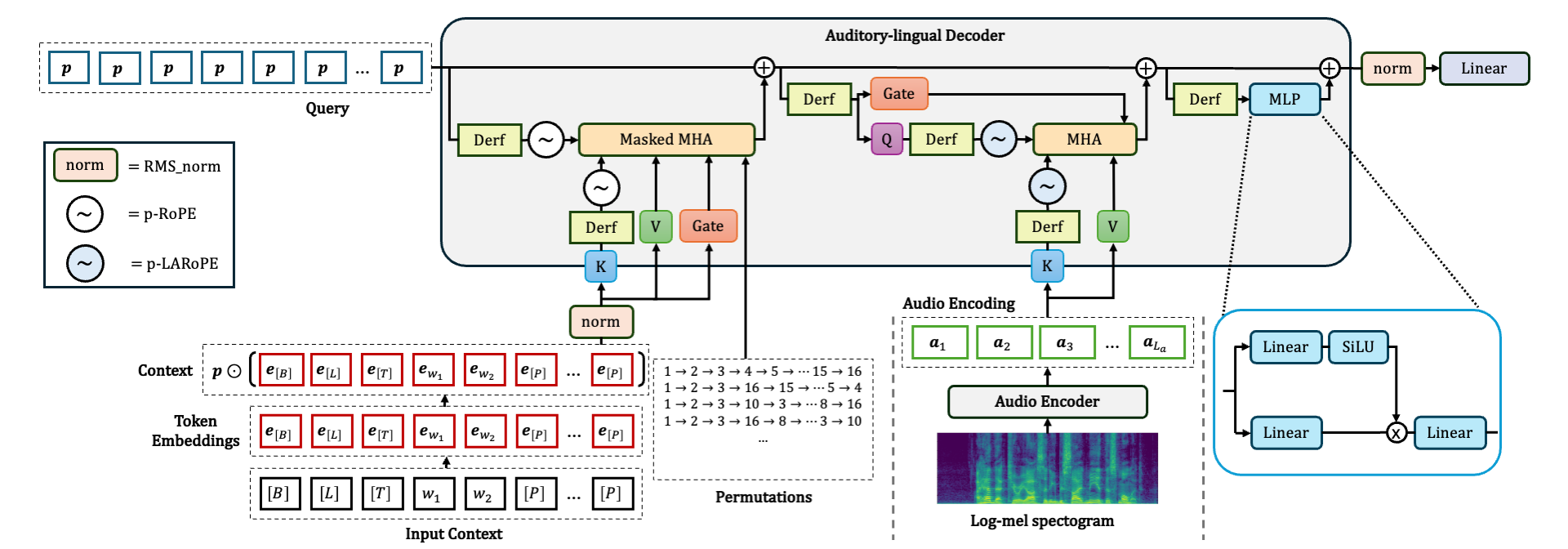
TrorYongASR2, an update to TrorYongASR1, augments the auditory-lingual decoder to 1) improve speech-text alignment, 2) enhance the expressivity of rotary position embedding, 3) ameliorate the expressivity of multi-head attention, and 4) speed up training and inference times. For speech-text alignment, Length-Aware RoPE (LARoPE) is implemented in the cross-attention to enhance monotonic structure alignment. In addition, the lowest frequencies of RoPE in the context-position attention and LARoPE in speech-text alignment are removed to create robust semantic channels. To improve multi-head attention, a gating mechanism is integrated in the self-attention and the cross-attention layers of the auditory-lingual decoder: apply a head-specific sigmoid gate after the scaled dot-product attention. This introduces non-linearity upon the low-rank mapping in the softmax attention which mitigates 'massive activation' and 'attention sink'. Finally, the auditory-lingual decoder adopts point-wise dynamic rescaled Gaussian cumulative distribution function (Derf) in place of normalization layers to save compute, hence accelerating training speed and inference process. Figure 1 provides an overview of the TrorYongASR2's architecture.
The evaluation assesses transcription capability on two datasets: 1) google/fleurs for Khmer and 2) openslr/librispeech_asr for English.
All results are from the test split of each dataset.
| Dataset | Language | Testing samples | Description |
|---|---|---|---|
| google/fleurs | Khmer | 765 | Multi-lingual dataset with Khmer language samples |
| librispeech_asr.clean | English | 2611 | Clean speech dataset for English transcription |
Audio longer than 30 seconds are excluded from the evaluation (that is why google/fleurs has 765 samples instead of 771 and librispeech_asr.clean has 2611 instead of 2620).
For transcription task, 3 metrics below are used
TER measures model's capability in predicting the next token given the audio input and the current sequence of tokens. This metric is weaker than WER and CER because it doesn't account for insertions, deletions, substitutions, and autoregression as comprehensively.
| Model | Metric | Khmer (fleurs) |
English (librispeech_asr.clean) |
|---|---|---|---|
| Tiny | WER | 57.07% | 20.35% |
| CER | 43.95% | 12.42% | |
| TER | 49% | 11% | |
| Small | WER | 36.70% | 10.12% |
| CER | 29.26% | 6.05% | |
| TER | 38% | 5% |
Both configurations performance well on English language. However, Khmer language remains a challenge.
Note: To compute CER and WER, whitespaces are added between words in Khmer text (Khmer text does not have word boundaries like English text). To do so, khmercut PyPI package is used to tokenize Khmer text into words, and then the words are joined back together with whitespaces.
It is due to no-boundary Khmer words that Token Error Rate is utilized as one of the metrics.
Comparison with TrorYongASR1 and Whisper:
| Size | Model | Parameters | Khmer (fleurs) |
English (librispeech_asr.clean) |
|---|---|---|---|---|
| Tiny | TrorYongASR2 | 29M | 57.07% | 20.35% |
| TrorYongASR1 | 29M | 75.88% | 54.33% | |
| Whisper | 39M | 100.6% | 7.6% | |
| Small | TrorYongASR2 | 136M | 36.70% | 10.12% |
| TrorYongASR1 | 135M | 50.46% | 21.75% | |
| Whisper | 244M | 104.4% | 3.4% |
Key Observations:
tiny, and 244M vs 136M for small)tiny, 3.4% for small)tiny, and 36.70% for small)Note: WER data of Whisper is taken directly from their paper.
Note on Translation Task: According to KrorngAI, the 2 translation datasets above are built using the API of TranslateKH which, in turn, uses an AI model for the translation (Khmer to English and vice-versa). Without any means to check the correctness of the translation over 209 hours of audio, TrorYongASR2 is not evaluated on any translation datasets. It can be assumed that the translation performance of TrorYongASR2 is upper bounded by the AI model used in the backend of TranslateKH.
TrorYongASR2 is trained on 5 datasets:
Digital-Divide-Data/khmer-speech-dataset (the whole dataset contains 727.94 hours) for Khmer audio and Khmer text (transcription)train.360 split of openslr/librispeech_asr for English audio and English text (transcription)KrorngAI/DDD-Cambodia-khmer-speech-dataset-parquet-000-159-en-translate for Khmer audio and English text (translation)KrorngAI/openslr-librispeech_asr-clean100-00000-19999-km-translate for English audio and Khmer text (translation)nospeech7k for no speech audio (voice activity detection)So, there are around 804 hours of audio in the training dataset.
TrorYongASR2 has 2 configurations as the following
| Model Size | Tiny | Small |
|---|---|---|
| Audio Encoder | 4 layers, 6 heads | 12 layers, 12 heads |
| Audio Context | 1500 | 1500 |
| Auditory-lingual Decoder | 1 layer, 12 heads | 1 layer, 24 heads |
| Text Context | 448 | 448 |
| Embedding Dimension | 384 | 768 |
| Parameters | 29M | 136M |
The audio array is processed to log-mel spectrogram with 80 mel bins (the same as Whisper models of the same size). These configurations are the same as the ones of TrorYongASR1.
The training hyperparameters are listed below:
LightningAI packageTo underline the gain from architectural improvement, TrorYongASR1 is retrained on the same 5 datasets above using the same set of hyperparameters.
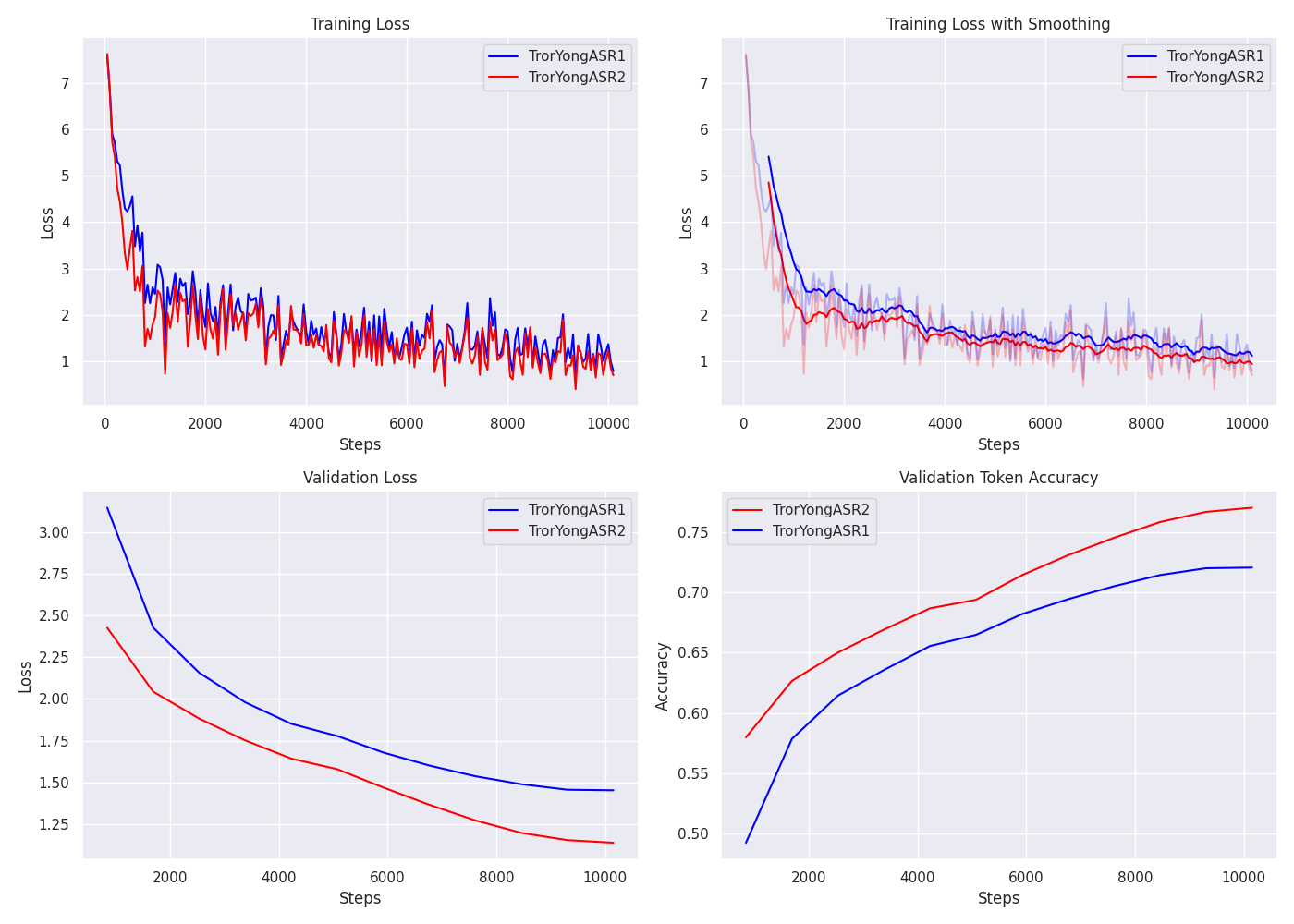
Figure 2 shows the training history of tiny configuration.
TrorYongASR2 has smaller training and validation losses, and higher validation token accuracy.
This shows the effectiveness of the new architectural design in TrorYongASR2.
First, install tror-yong-asr PyPI package:
pip install tror-yong-asr >= 0.2.0
Then, you can use TrorYongASR2 for transcribe or translate via the code below.
from transformers import AutoProcessor
from tror_yong_asr import TrorYongASRModel, transcribe, translate, identify_language


model_id = "KrorngAI/TrorYongASR2-tiny"
processor = AutoProcessor.from_pretrained(model_id, trust_remote_code=True)
model = TrorYongASRModel.from_pretrained(model_id, trust_remote_code=True)

result1 = identify_language('/path/to/audio_file.mp3', model, processor)
print(result1)

result2 = transcribe('/path/to/audio_file.mp3', model, processor, max_tokens=64)
print(result2)

result3 = translate('/path/to/audio_file.mp3', model, processor, max_tokens=64)
print(result3)
You can follow this notebook below to learn to fine-tune TrorYongASR2.

The model can be used directly for:
The model can be integrated into:
Technical Limitations:
Sociotechnical Limitations:
BibTeX:
@online{khun2026,
  author = {Khun, Kimang},
  title = {TrorYongASR2: {Permuted} {Language} {Modeling} with
    {Monotonic} {Alignment,} {Gated} {Attention,} and
    {Normalization-free} {Design}},
  date = {2026-10-19},
  url = {https://kimang18.github.io/krorngai-blog/TrorYongASR2/},
  langid = {en}
}
Both models are trained thanks to the free credits from Kaggle, and Google Colab.
Thanks to KrorngAI, openslr, and Mozilla Data Collective for their publicly available dataset.
If you have any questions, please reach out at Facebook Page.