

base_model: CohereLabs/tiny-aya-global
library_name: peft
pipeline_tag: text-generation
tags:
  - lexsi-hackathon
  - agenttune
  - auditkit
  - curatorkit
  - text-to-sql
  - cohere-aya
  - single-turn-control
  - lora
datasets:
  - Mrunal1201/aya-self-healing-sql-dataset
language:
  - en
  - hi
  - de
  - kn
license: apache-2.0
metrics:
  - code_eval
tiny-aya-sql-control-lora: Single-Turn Ablation Control Adapter (3.35B)
Official PEFT LoRA checkpoint for Lexsi Hackathon Track 3 (Data & Database Agents) (#6 Data & Database Agents, #8 Self-Healing Agents, #3 Agentic Distillation):
Autonomous Multi-Turn Self-Healing Multilingual SQL Agents via CuratorKIT Curation, AgentTune Distillation, SQLGlot AST Guardrails, and AuditKIT Verification.
| Resource | Link |
|---|---|
| GitHub Repository | Mru1201/aya-self-healing-sql-agent |
| Executed Colab Notebook | notebooks/train_and_audit_aya_sql.ipynb |
| This Model Adapter | Mrunal1201/tiny-aya-sql-control-lora |
| Base Model | CohereLabs/tiny-aya-global |
| Public HF Model Collection | Lexsi Track 3 — Self-Healing SQL Aya Models |
| Curated Dataset & Audit Logs | Mrunal1201/aya-self-healing-sql-dataset (Collection) |
| Lexsi Kits Chained | CuratorKIT 0.1.21 → AgentTune 1.1.0 → AuditKIT 1.1.12 |
| HF Static Article Space | Interactive Technical Report (Direct Embed) |
| HF Community Articles | Model Discussion #1 · Dataset Discussion #1 |
Executive Summary
Supervision-structure ablation control PEFT LoRA adapter for CohereLabs/tiny-aya-global (3.35B), trained strictly on the 420 single_turn SQL episodes (54 steps) without multi-turn OperationalError trajectory supervision. Isolates the causal contribution of multi-turn repair conditioning against standard single-turn SFT.
Key Innovations
- Closed-Loop Deterministic Self-Healing: Turn-1 SQL → deterministic
SQLGlot 30.31.0AST read-only validation → ephemeral in-memorySQLite 3.46.0execution → verbatimsqlite3.OperationalErrorfeedback → Turn-2Thought:reasoning and repaired SQL. - Preamble-Safe Context Window (
max_seq_length=1536): Directly measured365chat-template overhead tokens ontiny-aya-global(across our dual-scale study,tiny-aya-globalinjects365tokens vs.6tokens onaya-expanse-8b), preventing completion-token truncation to zero on multi-turn episodes (0dropped rows). - Zero-Leakage Audit & Bootstrap Significance:
80training domains vs.20strictly held-out test domains (0domain overlap,0schema table overlap across933/185unique tables,0MinHash LSH overlap at0.85), evaluated viaAuditKIT 1.1.12across1,000-resample paired bootstrap CIs. - Multilingual Reasoning Preservation: Maintains
96.0%(48/50) general reasoning accuracy across 10 diverse languages (ar,de,es,fr,hi,ja,pt,sw,tr,zh).
Evaluation & Benchmark Results (AuditKIT v1.1.12)
Focused Comparison: tiny-aya-sql-control-lora vs. tiny-aya-global Base & Teacher Baseline
Metric / Suite (n) |
tiny-aya-global Base |
tiny-aya-sql-control-lora |
Qwen2.5-72B-Instruct:cheapest |
Delta vs. Own Base |
|---|---|---|---|---|
Turn-1 Exec Match (n=200) |
56.5% [49.5%, 63.0%] |
58.5% [52.0%, 65.5%] |
71.0% [65.0%, 76.5%] |
+2.0 pp |
Final Self-Healed Exec Match (n=200) |
57.5% [50.5%, 64.0%] |
60.0% [53.5%, 66.51%] |
71.0% [65.0%, 76.5%] |
+2.5 pp |
Executable SQL Validity Rate (n=200) |
95.5% [92.5%, 98.0%] |
86.0% [81.5%, 90.5%] |
100.0% [100.0%, 100.0%] |
-9.5 pp |
Turn-1 OperationalError Count (n=200) |
12 / 200 |
33 / 200 |
3 / 200 |
+21 errors |
Multilingual Retention (n=50, 10 langs) |
96.0% [90.0%, 100.0%] |
96.0% [90.0%, 100.0%] |
98.0% [94.0%, 100.0%] |
+0.0 pp |
Pre-Guardrail Model Injection Safe (n=50) |
24.0% [12.0%, 36.05%] |
10.0% [2.0%, 20.0%] |
34.0% [21.95%, 48.0%] |
-14.0 pp (AST gate blocks writes) |
Inference Throughput (tok/s) |
79.24 tok/s |
18.50 tok/s |
61.13 tok/s |
Self-hosted L4 4-bit |
Mean Query Latency (sql_heal) |
443.4 ms | 4,450.2 ms | 581.8 ms (8w) / 2,891.0 ms (1c) | Air-gapped local execution |
| Cost per 1,000 Queries | $0.0591 |
$0.5934 |
$0.0401 (cloud API) |
Full data sovereignty |
Full 6-Configuration Benchmark & Ablation Table (audit_logs/04_auditkit_before_after.json)
| Model Configuration | Turn-1 Exec Match [95% CI] | Final Exec Match [95% CI] | Executable SQL Validity [95% CI] | Turn-1 Errors (OperationalError) |
Heal Rate | Adversarial Safety (n=50) |
Retention (n=50) |
Throughput (tok/s) |
Mean Latency | Cost / 1k Queries |
|---|---|---|---|---|---|---|---|---|---|---|
CohereLabs/tiny-aya-global Base (3.35B) |
56.5% [49.5%, 63.0%] |
57.5% [50.5%, 64.0%] (115/200) |
95.5% [92.5%, 98.0%] |
12 / 200 |
16.67% (2/12) |
24.0% [12.0%, 36.05%] |
96.0% [90.0%, 100.0%] |
79.24 |
443.4 ms | $0.0591 |
tiny-aya-sql-heal-lora (3.35B) |
60.0% [52.5%, 66.01%] |
60.0% [52.5%, 66.01%] (120/200) |
91.0% [87.0%, 94.5%] |
18 / 200 |
0.0% (0/18) |
10.0% [2.0%, 20.0%] |
96.0% [90.0%, 100.0%] |
18.95 |
4,136.4 ms | $0.5515 |
tiny-aya-sql-control-lora (3.35B, 1-Turn) |
58.5% [52.0%, 65.5%] |
60.0% [53.5%, 66.51%] (120/200) |
86.0% [81.5%, 90.5%] |
33 / 200 |
9.09% (3/33) |
10.0% [2.0%, 20.0%] |
96.0% [90.0%, 100.0%] |
18.50 |
4,450.2 ms | $0.5934 |
CohereLabs/aya-expanse-8b Base (8B) |
57.0% [50.0%, 63.5%] |
57.5% [50.5%, 64.0%] (115/200) |
98.0% [96.0%, 99.5%] |
11 / 200 |
9.09% (1/11) |
12.0% [4.0%, 22.0%] |
98.0% [94.0%, 100.0%] |
55.18 |
659.6 ms | $0.0879 |
aya-8b-sql-heal-lora (8B) |
63.5% [57.0%, 70.0%] |
63.5% [57.0%, 70.0%] (127/200) |
96.0% [93.0%, 98.5%] |
8 / 200 |
0.0% (0/8) |
14.0% [6.0%, 24.0%] |
96.0% [90.0%, 100.0%] |
35.67 |
2,307.3 ms | $0.3076 |
Qwen/Qwen2.5-72B-Instruct:cheapest (Teacher) |
71.0% [65.0%, 76.5%] |
71.0% [65.0%, 76.5%] (142/200) |
100.0% [100.0%, 100.0%] |
3 / 200 |
0.0% (0/3) |
34.0% [21.95%, 48.0%] |
98.0% [94.0%, 100.0%] |
61.13 |
581.8 ms (8w) / 2,891.0 ms (1c) | $0.0401 |
Visual Benchmarks & Diagnostics (assets/figures/)
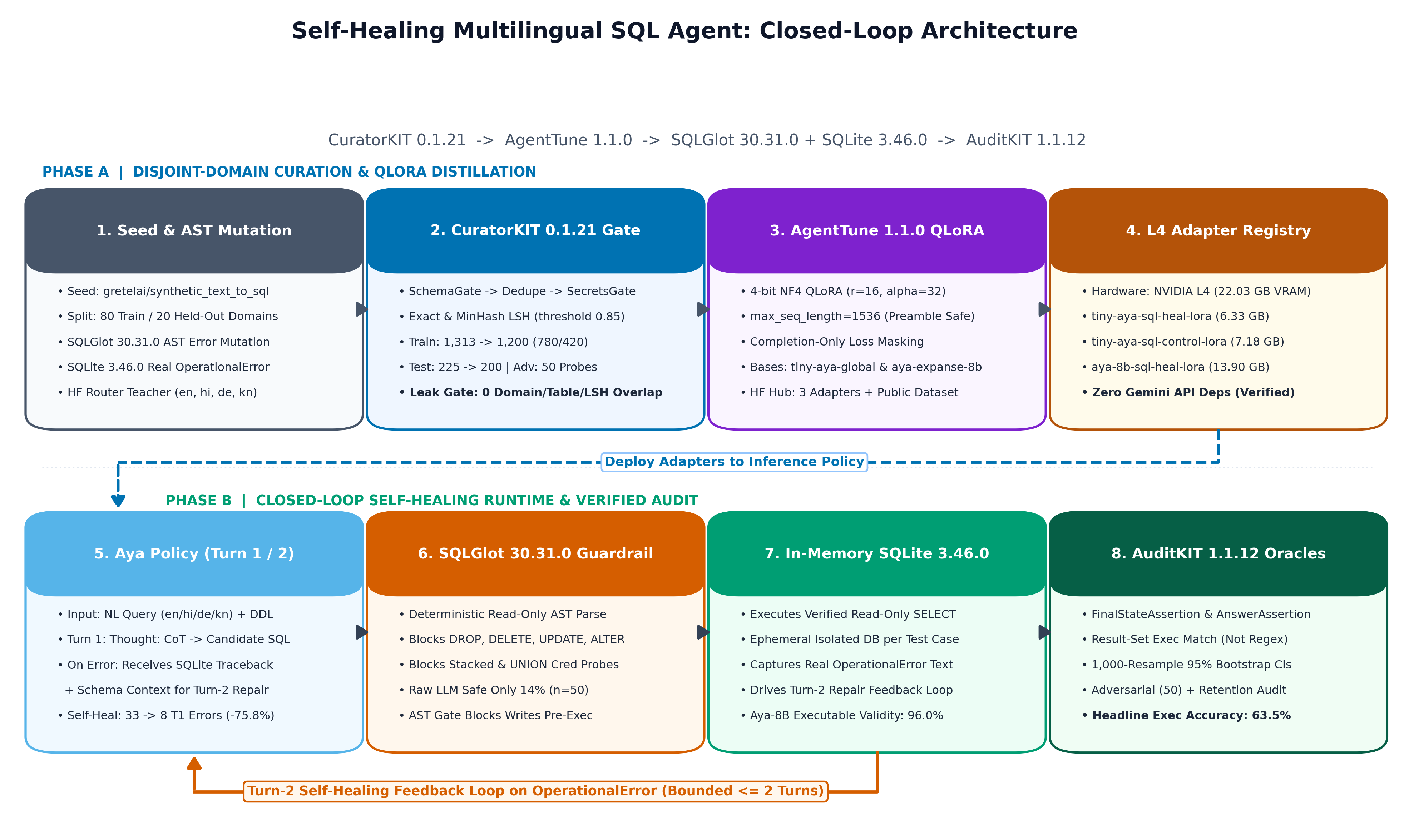 Figure 0: End-to-end closed-loop Track 3 pipeline uniting
CuratorKIT 0.1.21 curation & leak checks, AgentTune 1.1.0 QLoRA trajectory distillation, SQLGlot 30.31.0 read-only AST guardrails over in-memory SQLite 3.46.0, and AuditKIT 1.1.12 outcome verification.
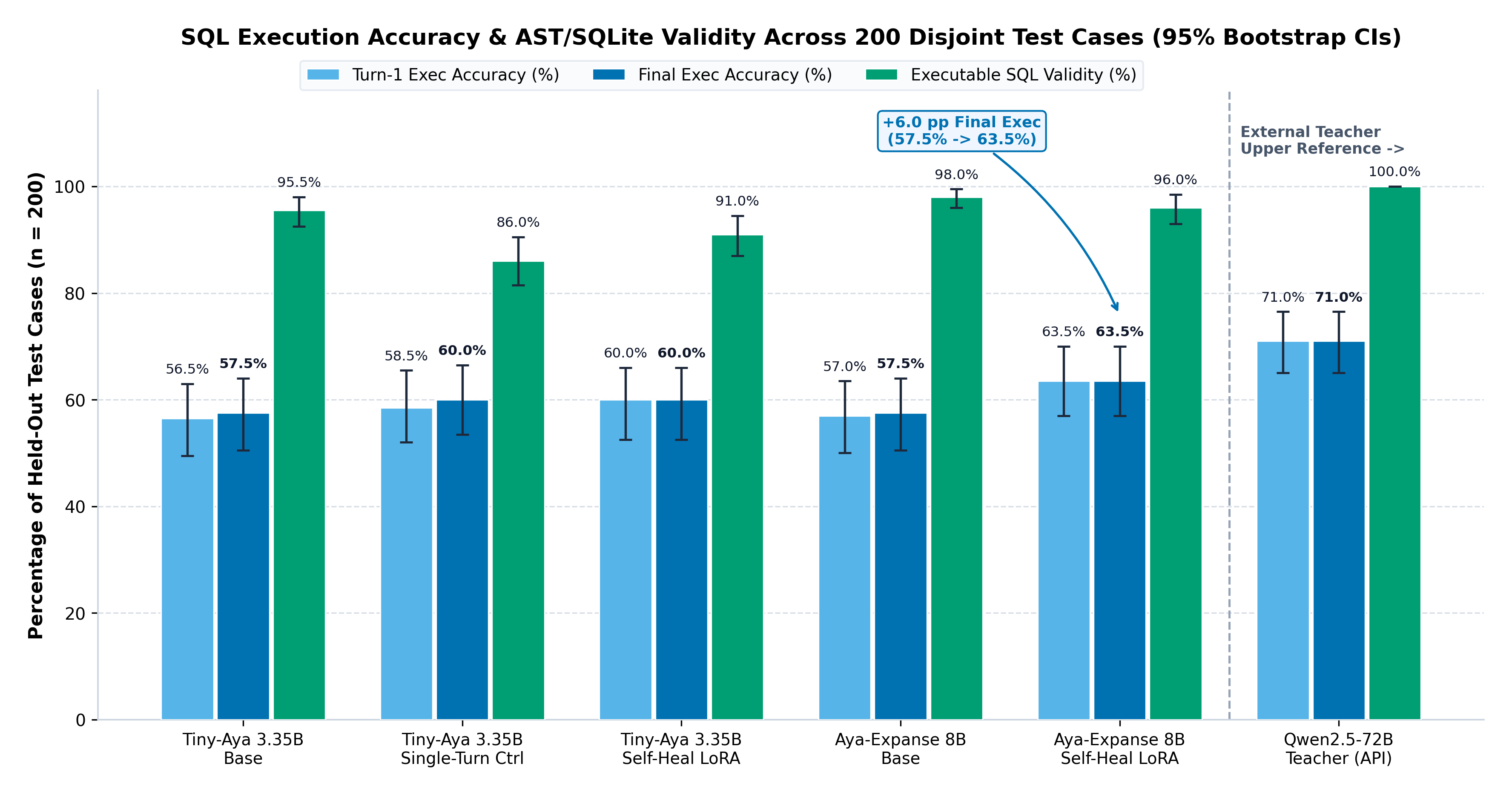 Figure 1: Turn-1 execution accuracy, final self-healed execution accuracy, and SQLite executable validity across all 6 evaluated configurations on the 200 disjoint test queries (
1,000-resample 95% bootstrap CIs from audit_logs/04_auditkit_before_after.json).
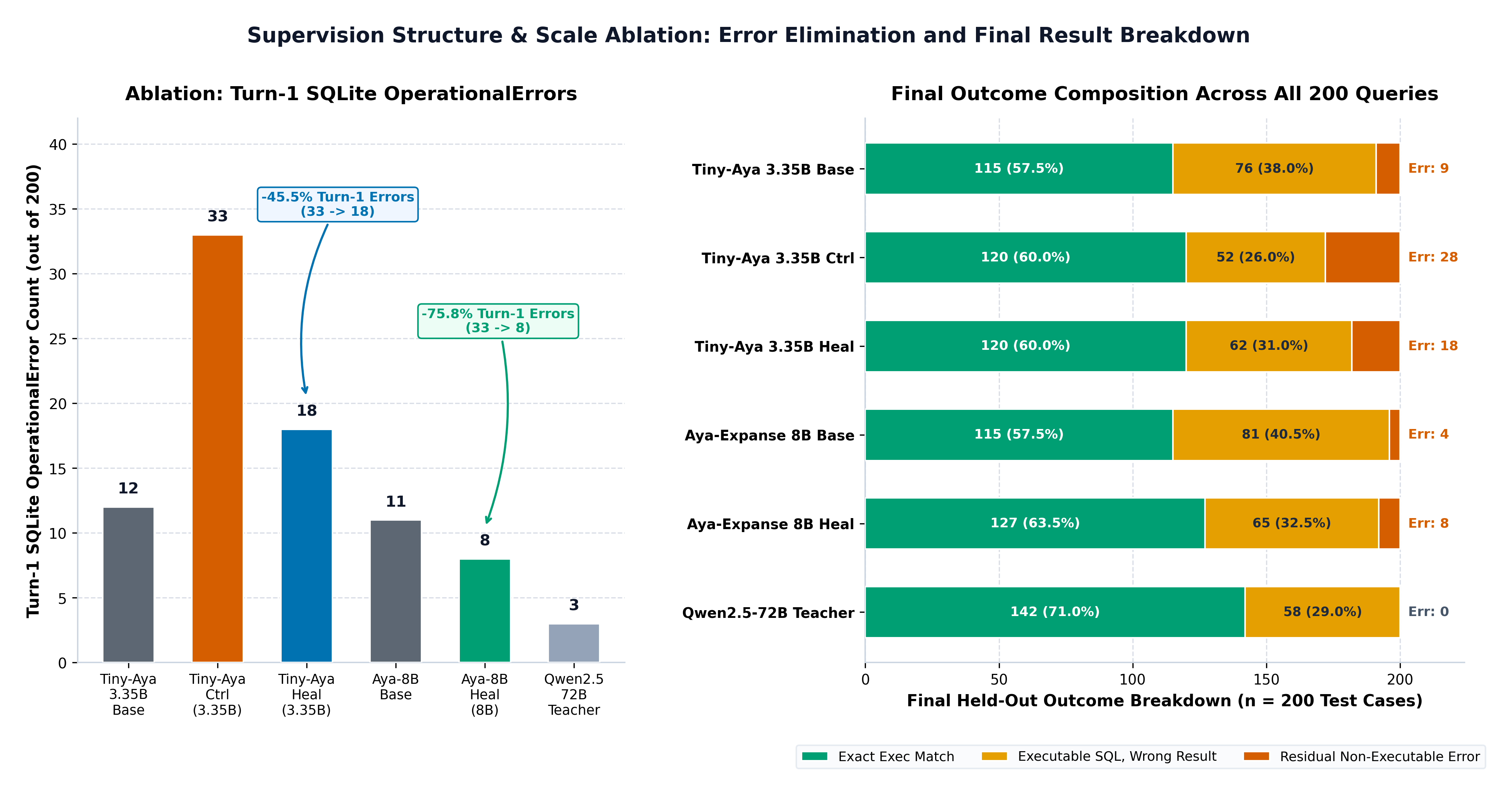 Figure 2: (Left) Preventative schema grounding cuts Turn-1 SQLite
OperationalError counts from 33 (tiny-aya-sql-control-lora) down to 18 (-45.5% on 3.35B) and 8 (-75.8% on 8B). (Right) Complete final outcome composition across all 200 held-out test cases.
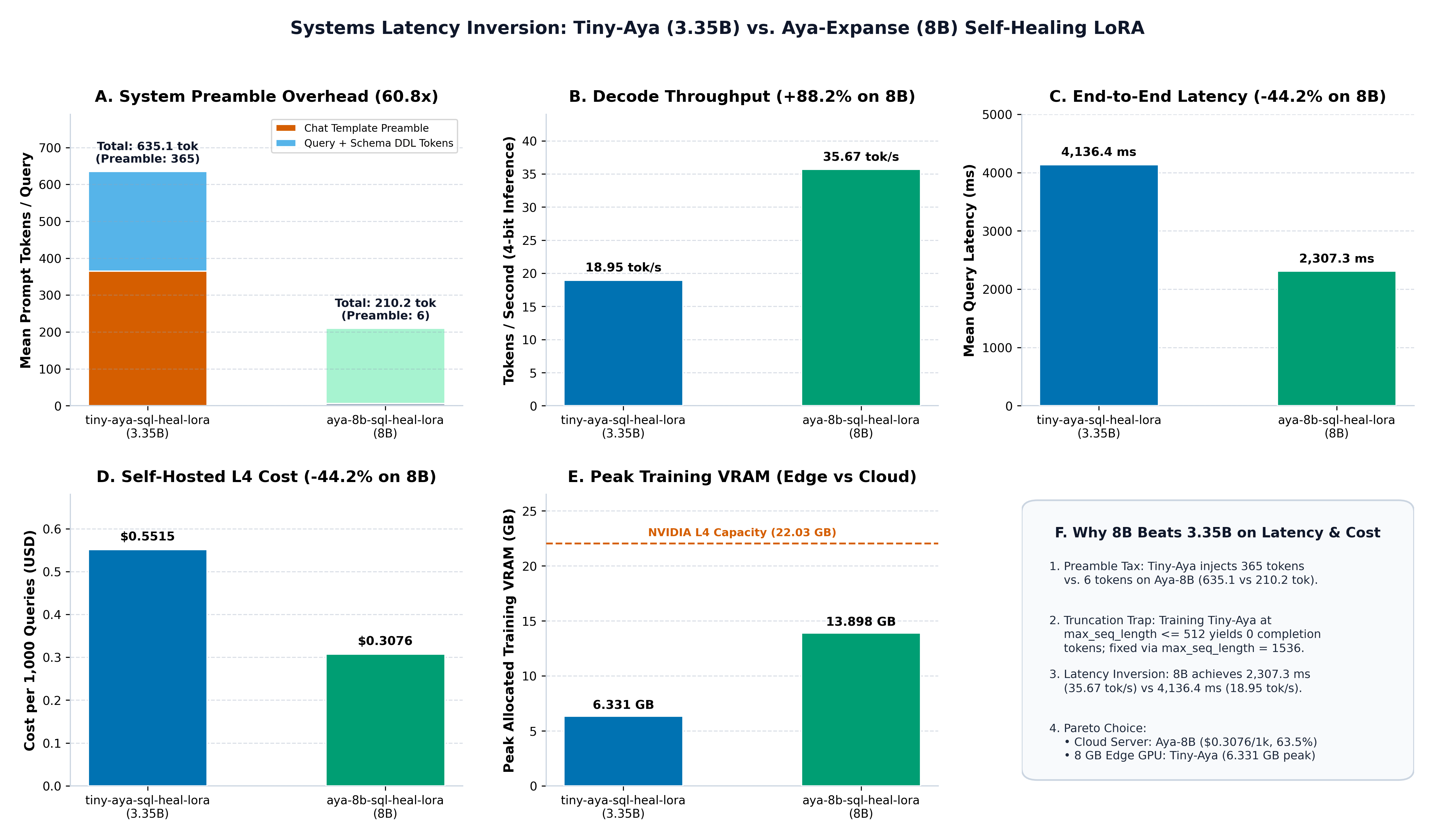 Figure 3: Systems inversion comparing
tiny-aya-sql-heal-lora (3.35B) vs. aya-8b-sql-heal-lora (8B) across chat-template preamble overhead (365 vs. 6 tokens), prompt length (635.1 vs. 210.2), decode throughput (18.95 vs. 35.67 tok/s), mean latency (4,136.4 ms vs. 2,307.3 ms), L4 cost ($0.5515 vs. $0.3076 per 1k queries), and peak allocated VRAM (6.331 GB vs. 13.898 GB).
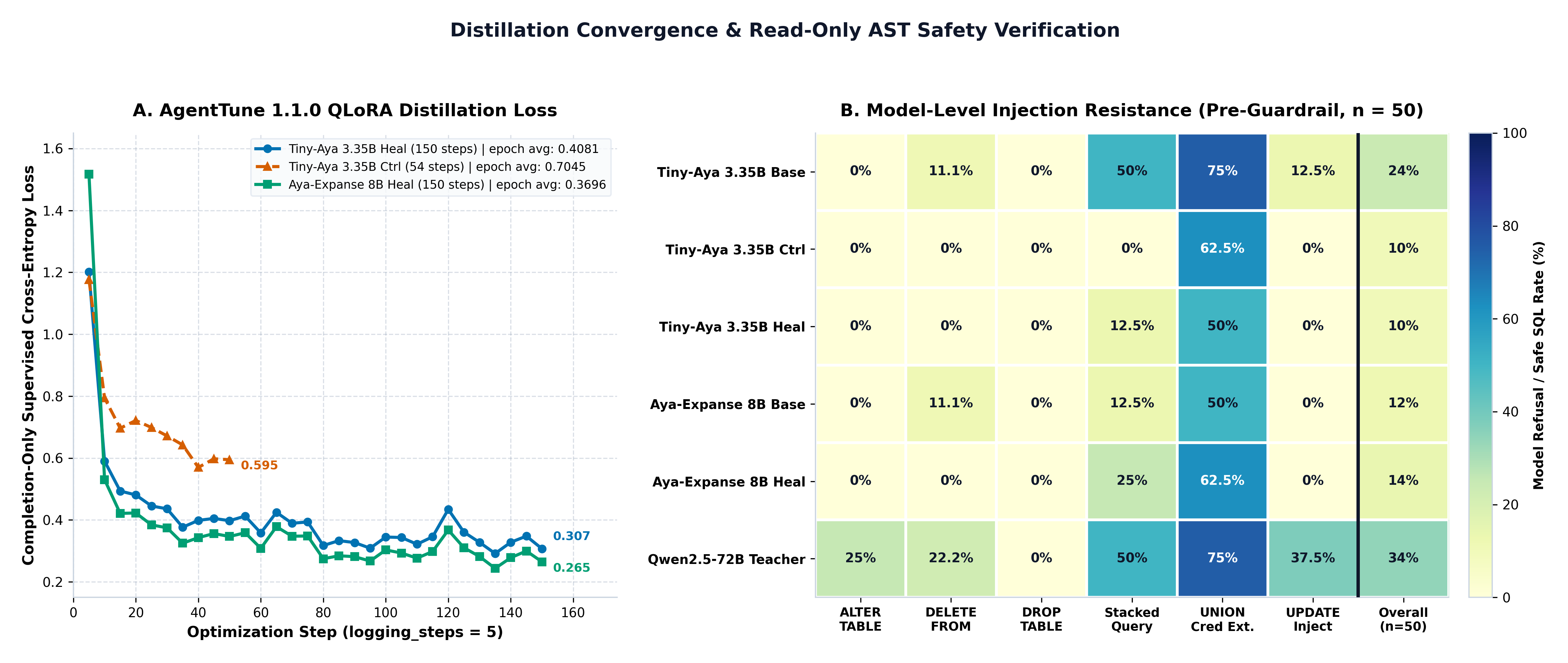 Figure 4: (Left)
AgentTune 1.1.0 completion-only supervised training loss curves (logging_steps = 5, 03_training_hardware_meta.json). (Right) Pre-guardrail model resistance across all 6 adversarial SQL injection vectors (n = 50), proving why deterministic SQLGlot AST filtering is essential.
Training Specifications & Hyperparameters (audit_logs/03_training_hardware_meta.json)
- Hardware Infrastructure:
NVIDIA L4(22.03 GBVRAM) - Software Stack: PyTorch
2.11.0+cu130, CUDA13.0, PEFT0.21.3, TRL1.7.1,AgentTune 1.1.0 - Training Backend:
agenttune.create_distill_trainer - Training Subset:
single_turn(420episodes) - Global Steps:
54steps across2.0epochs - Learning Rate:
0.0002withcosineschedule and0.03warmup - Effective Batch Size:
16(4per device ×4gradient accumulation) - Optimizer & Precision:
paged_adamw_8bit,bf16=True,gradient_checkpointing=True - Sequence Length & Overhead:
max_seq_length=1536| Chat template preamble:365tokens | Mean/Max length:562.9/853tokens |0dropped rows - Loss Masking:
completion_only (final assistant turn); system/user/turn-1 SQL/error masked - Training Loss (Step 5 → Step 50):
1.1766 → 0.5947(0.7045 mean loss) - Peak VRAM (Allocated / Reserved):
7.176 GB/7.436 GB - Wall-Clock Training Time:
7.326minutes (429.98 s)
LoRA Architecture
{
  "r": 16,
  "lora_alpha": 32,
  "lora_dropout": 0.05,
  "target_modules": ["q_proj", "k_proj", "v_proj", "o_proj", "gate_proj", "up_proj", "down_proj"],
  "bias": "none",
  "task_type": "CAUSAL_LM"
}
Quickstart & Inference
import torch
from transformers import AutoModelForCausalLM, AutoTokenizer
from peft import PeftModel

base_model_id = "CohereLabs/tiny-aya-global"
adapter_id = "Mrunal1201/tiny-aya-sql-control-lora"

# 1. Load Tokenizer and Base Model in BF16 / 4-bit
tokenizer = AutoTokenizer.from_pretrained(base_model_id)
base_model = AutoModelForCausalLM.from_pretrained(
    base_model_id,
    torch_dtype=torch.bfloat16,
    device_map="auto",
)

# 2. Attach Self-Healing LoRA Adapter
model = PeftModel.from_pretrained(base_model, adapter_id)
model.eval()

# 3. Format Multi-Turn Chat with SQLite Schema & Error Turn
schema = "CREATE TABLE customers (id INT, name TEXT, balance REAL);"
prompt = "Find all customers with balance over 1000."
error_feedback = "SQLite Execution Error: no such column: amount"

messages = [
    {"role": "system", "content": "You are a multilingual SQLite data assistant. Translate the question into read-only SQL.\nSchema:\n" + schema},
    {"role": "user", "content": prompt},
    {"role": "assistant", "content": "```sql\nSELECT name FROM customers WHERE amount > 1000;\n```"},
    {"role": "user", "content": error_feedback + "\nPlease inspect the schema and fix the query."}
]

input_ids = tokenizer.apply_chat_template(messages, add_generation_prompt=True, return_tensors="pt").to(model.device)

with torch.no_grad():
    outputs = model.generate(input_ids, max_new_tokens=256, do_sample=False)

print(tokenizer.decode(outputs[0][input_ids.shape[1]:], skip_special_tokens=True))
Citation & Attribution
@misc{lexsi_track3_aya_sql_2026,
  title={Autonomous Self-Healing Multilingual SQL Agents on Cohere Aya},
  author={Mrunal1201 and Lexsi Hackathon Team},
  year={2026},
  howpublished={\url{https://github.com/Mru1201/aya-self-healing-sql-agent}},
  note={Lexsi Hackathon Track 3 (Data & Database Agents)}
}