| --- |
| license: bsd-2-clause |
| library_name: onnx |
| pipeline_tag: audio-classification |
| tags: |
| - turn-detection |
| - end-of-turn |
| - voice-agents |
| - pipecat |
| - streaming |
| - onnx |
| datasets: |
| - pipecat-ai/smart-turn-data-v3.2-train |
| language: |
| - en |
| - multilingual |
| base_model: pipecat-ai/smart-turn-v3 |
| --- |
| |
| # Smart Turn streaming end-of-turn heads (R1, audio-only) |
|
|
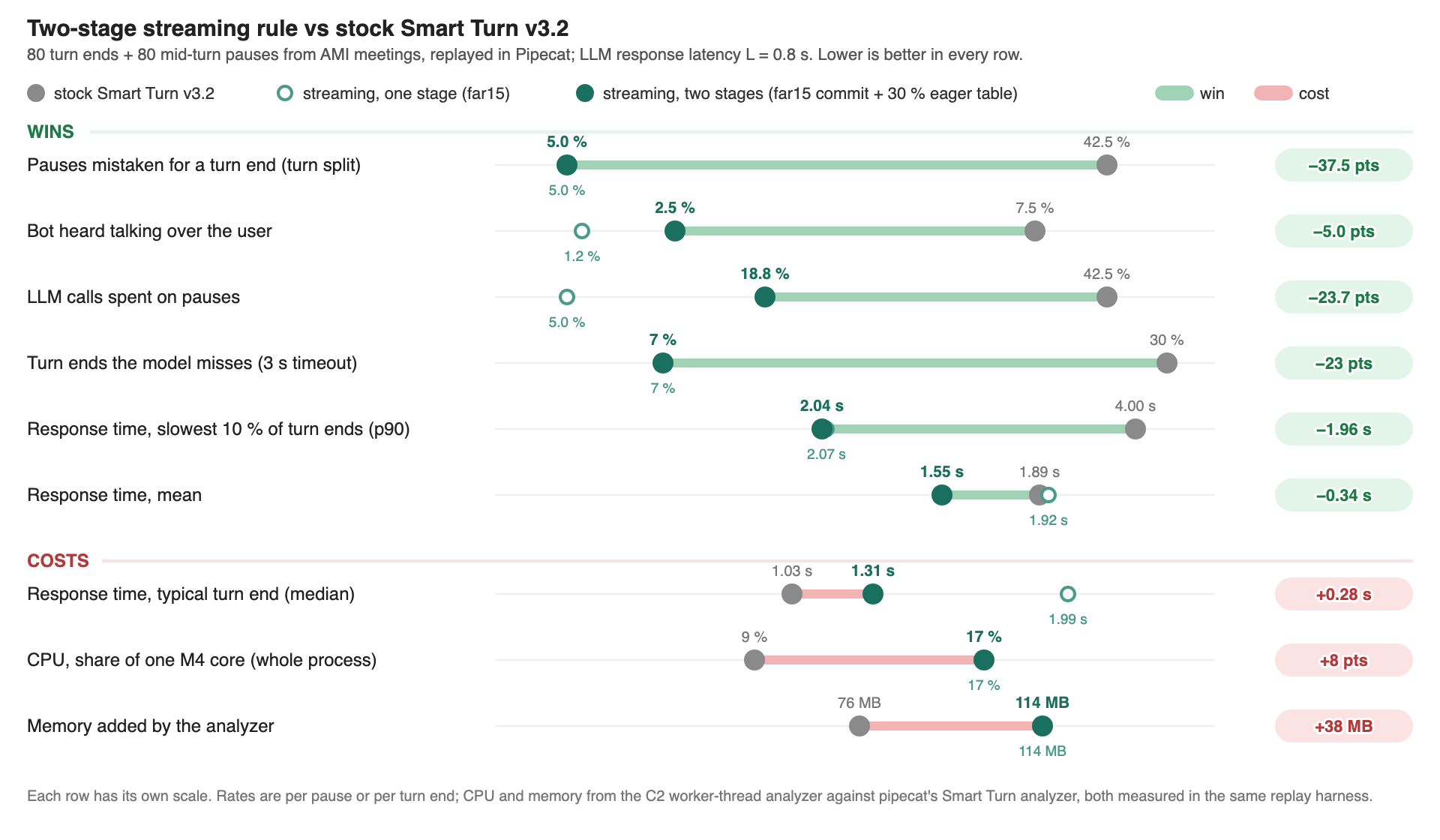
| A silence-aware, streaming end-of-turn detector for voice agents, built on Pipecat's frozen |
| [Smart Turn v3.2](https://huggingface.co/pipecat-ai/smart-turn-v3) encoder. Instead of one query |
| at the VAD stop followed by a 3 s timeout, it scores the conversation every 100 ms on the CPU and |
| decides at 0.2 / 0.5 / 1.2 s of silence with thresholds fitted to a false-alarm budget. On real |
| multi-party conversation (AMI Meeting Corpus) it ends the turn on 5 % of mid-turn pauses where the |
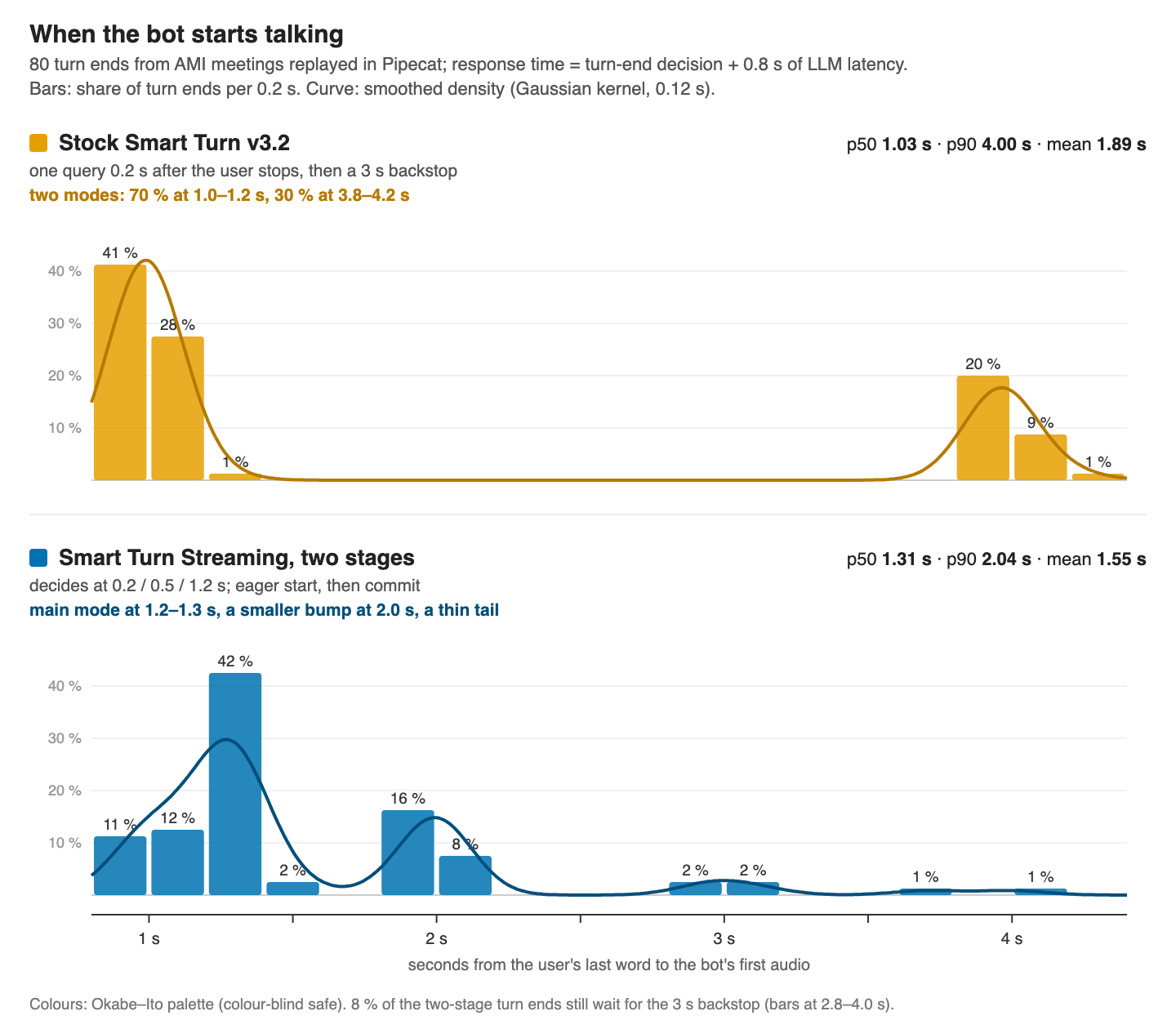
| stock rule fires on 42 %, and brings the 90th-percentile response time from 3.2 s to 1.3 s. A Pipecat |
| process with it takes about 17 % of one Apple M4 core against 9 % with the stock analyzer (the detector |
| alone is 9 % in a tight loop); numpy and onnxruntime only. |
|
|
| Code (Pipecat 1.14 turn analyzer, eager-then-commit stop strategy, training and evaluation): |
| [github.com/OpenHRIai/smart-turn-streaming](https://github.com/OpenHRIai/smart-turn-streaming). |
|
|
|  |
|
|
|  |
|
|
|  |
|
|
|  |
|
|
| ## Files |
|
|
| | file | size | what | |
| |---|---|---| |
| | `smart-turn-v3.2-encoder-pooled.onnx` | 31 MB | Pipecat's Smart Turn v3.2 (Whisper-tiny encoder + its classifier), weights unchanged, with the pooled 384-d vector exposed as a second output. Input `input_features` (1, 80, 800) Whisper log-mel of the last 8 s; outputs `logits` (the stock model's P(complete)) and `sum_1` (the pooled vector). | |
| | `eot-heads-v32.onnx` | 0.7 MB | The trained heads: LayerNorm + Linear on the pooled vector, a GRU over the last second of log-mel (20 × 80 at 50 ms), the silence length, a fusion MLP. Inputs `pooled` (1, 384), `mel20` (1, 20, 80), `tau_feat` (1, 3) = [τ / 2.5, log1p(τ), speaking]; output `probs` (1, 2) = [P(turn complete), P(turn ends within 0.4 s)]. 172k parameters. | |
| | `smart-turn-streaming-clipend.onnx` | 33 MB | Drop-in with the stock interface: the pooled encoder, the heads at τ = 0 and a Platt calibration fitted on the training split in one graph, `input_features` (B, 80, 800) → `probability` (B, 1). For pipecat's `benchmark.py` and for callers that ask once at the clip end; the streaming rules use the two files above. | |
| | `rules/theta_tables.csv` | | Commit thresholds θ(0.2 s), θ(0.5 s), θ(1.2 s) fitted on AMI dev at false-alarm budgets of 5 / 10 / 15 %, with their AMI test numbers. | |
| | `rules/eager_tables.csv` | | Eager thresholds for Pipecat's speculation path, fitted on AMI dev at budgets of LLM generations spent on pauses (20–50 %). | |
| | `eval/ami_eval.py`, `eval/ami_{dev,test}.csv`, `eval/ami_eval_reference.md` | | Reproduces the AMI tables below from the public corpus audio (numpy, onnxruntime, soundfile); the reference file is its output on 2026-10-25. | |
| | `LICENSE`, `AMI_LICENCE.txt`, `ATTRIBUTION.md` | | BSD 2-Clause for this release; CC BY 4.0 for the AMI-derived manifests; sources and citations. | |
|
|
| ## How it works |
|
|
| Two cadences in one object on one CPU thread, plus one worker thread for the encoder: |
|
|
| | path | when | work | cost (Apple M4, 1 ORT thread) | |
| |---|---|---|---| |
| | mel | every 20 ms audio frame | incremental Whisper log-mel, one 10 ms column at a time (exact to 0.003 against the reference extractor on real audio) | 0.02 ms | |
| | heads | every 100 ms, and at each silence-clock point | last 1 s of mel → GRU, cached pooled vector, τ → P(complete) | 0.7 ms | |
| | encoder | every 320 ms while the user speaks; at τ = 0, 0.2, 0.5, 0.8, 1.2, 1.8, 2.5 s of silence (the grid the heads were trained on), where the decision waits for it | 8 s window → Whisper-tiny → pooled vector, on a worker thread | 22 ms (46 ms when the core is otherwise idle) | |
|
|
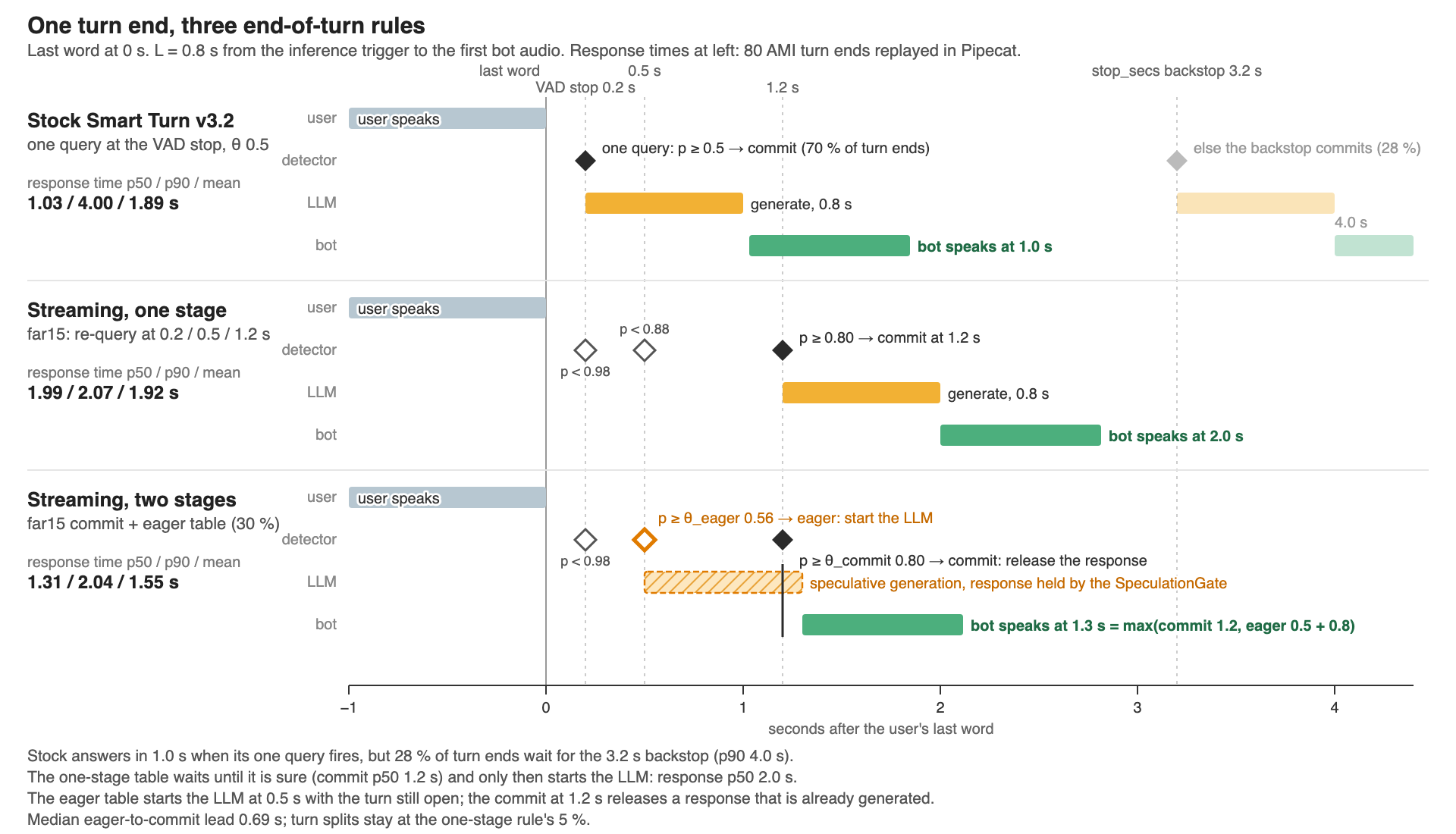
| The decision rule queries P(complete) at 0.2, 0.5 and 1.2 s of silence while the pause lasts and |
| commits at the first offset where it exceeds θ(offset); Pipecat's `stop_secs` (3 s) stays as the |
| backstop. The budget is the product knob: `far10` for an agent that must not interrupt, `far15` when |
| a fast reply matters more. A second, looser table (`eager_tables.csv`) on the same decision points |
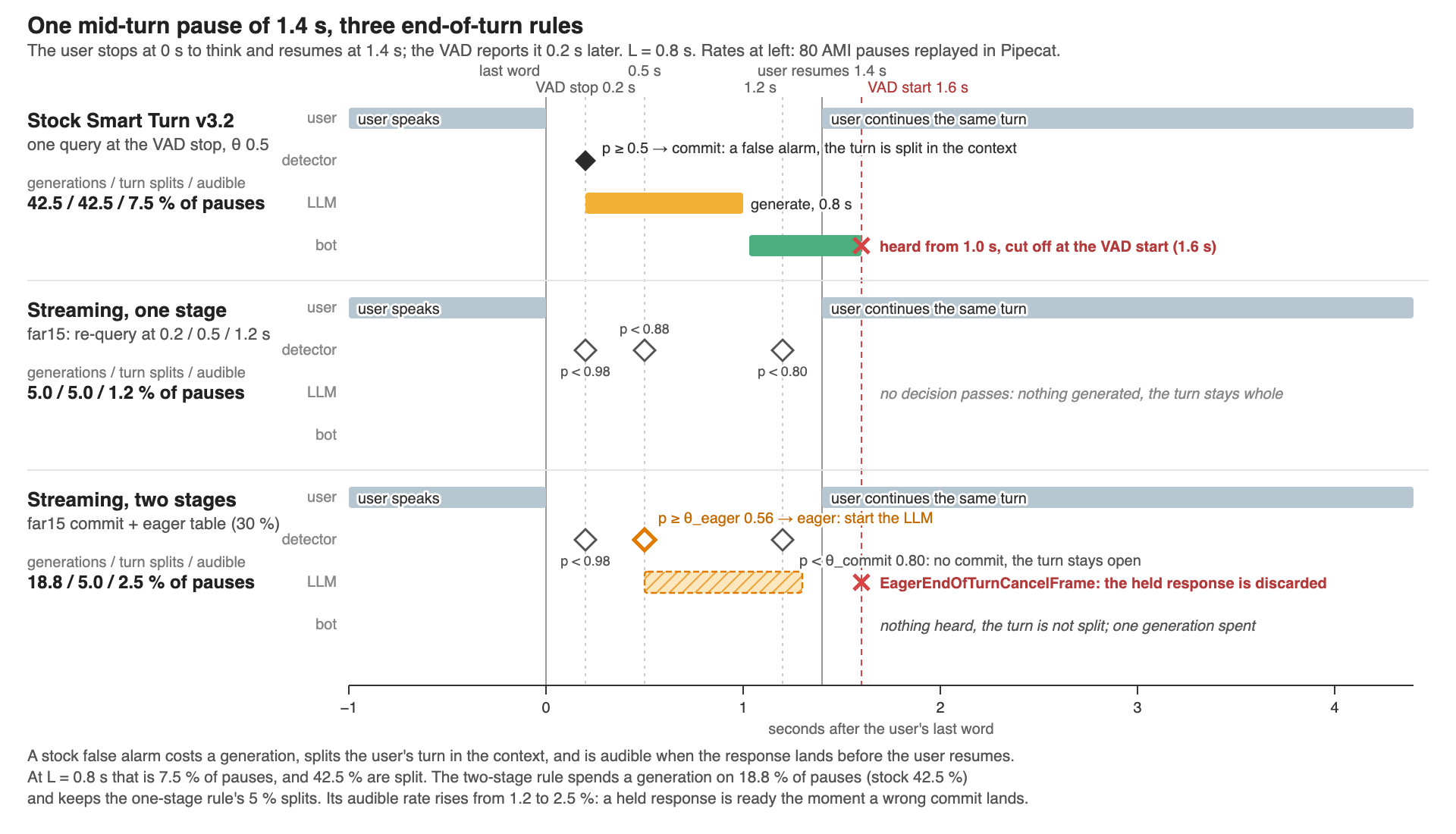
| drives Pipecat's speculation path (`UserTurnSpeculation` → `SpeculationGate`): the LLM starts |
| generating at the eager point, the response is held until the commit and discarded if the user |
| resumes. |
|
|
| Why silence awareness has to be trained: 79 % of the clips in `smart-turn-data-v3.2` end within |
| 0.2 s of the speech, so the published models never saw a pause, and their false-alarm rate on |
| incomplete utterances rises from 5 % at the offset to 19 % after 2.5 s of silence. The heads were |
| trained on windows ending τ ∈ {0 … 2.5} s after the acoustic offset (clips padded with their own |
| room tone) plus 43k real conversational pauses from AMI. The GRU over the last second of mel is the |
| component that carries the silence awareness (AUC at 1.2 s of silence 0.74 with it, 0.66 without). |
|
|
| ## Results |
|
|
| ### AMI Meeting Corpus, test split (511 turn ends, 4,304 mid-turn pauses, 16 meetings, 4-party) |
|
|
| Offline, windows ending at τ seconds of silence (`eval/ami_eval.py` reproduces this table): |
|
|
| | τ (s) | AUC heads | AUC frozen Smart Turn v3.2 | |
| |---|---|---| |
| | 0.2 | 0.775 | 0.671 | |
| | 0.5 | 0.776 | 0.638 | |
| | 1.2 | 0.742 | 0.575 | |
| | 2.5 | 0.735 | 0.619 | |
|
|
| Over three training seeds the AUC at 0.2 s is 0.78 ± 0.01 and at 1.2 s 0.73 ± 0.01. |
|
|
| Decision rule, thresholds fitted on AMI dev, scored on AMI test; a turn end with no commit is |
| charged the 3 s timeout: |
|
|
| | rule | θ at 0.2 / 0.5 / 1.2 s | recall | false alarms on pauses | mean latency | FAR on pauses ≥ 1.5 s | |
| |---|---|---|---|---|---| |
| | stock rule (one query at the VAD stop, θ 0.5), frozen v3.2 | 0.50 / – / – | 0.51 | 30.4 % | 1.56 s | 0.45 | |
| | stock rule, heads | 0.50 / – / – | 0.64 | 25.5 % | 1.21 s | 0.46 | |
| | re-query, 10 % budget, frozen v3.2 | 1.00 / 1.00 / 0.28 | 0.70 | 10.6 % | 1.74 s | 0.61 | |
| | **re-query, 10 % budget, heads (`far10`)** | 0.92 / 0.98 / 0.86 | **0.80** | **9.4 %** | **1.48 s** | 0.50 | |
| | re-query, 15 % budget, frozen v3.2 | 1.00 / 1.00 / 0.02 | 0.87 | 13.7 % | 1.44 s | 0.78 | |
| | **re-query, 15 % budget, heads (`far15`)** | 0.98 / 0.88 / 0.80 | **0.86** | **13.3 %** | **1.21 s** | 0.61 | |
| | no model: end every turn at 1.2 s of silence | – | 1.00 | 18.0 % | 1.20 s | 1.00 | |
|
|
| ### Pipecat's official benchmark (`benchmark.py`, full `smart-turn-data-v3.2` test, 31,527 clips, threshold 0.5, CPU) |
|
|
| | model | accuracy | precision | recall | F1 | FPR | inference p50 | |
| |---|---|---|---|---|---|---| |
| | Smart Turn v3.2 (fp32) | **93.71 %** | 0.931 | 0.944 | 0.937 | 3.51 % | 10.2 ms | |
| | `smart-turn-streaming-clipend.onnx` (heads, calibrated) | 93.23 % | 0.919 | 0.947 | 0.933 | 4.15 % | 10.3 ms | |
|
|
| The regression guard, not the result: the benchmark has no pauses, so the re-query, the eager stage and the |
| cancel path never run. At the clip end the calibrated heads trail v3.2 by 0.5 points at the fixed 0.5 |
| threshold (same ranking, AUC 0.975 vs 0.978; the residual is the operating point), with the same per-language |
| pattern within noise (19 of 23 languages within 0.7 points; French, Polish and Turkish ahead; Arabic −1.6, |
| Marathi −1.4, Norwegian −1.1 behind). Per-language tables and the method: `docs/c3_benchmark.md` in the code |
| repository. |
|
|
| ### Regression guard: `smart-turn-data-v3.2` test (6,000 clips, balanced) |
|
|
| | τ (s) | AUC heads / frozen v3.2 | recall at 5 % FAR, heads / frozen | |
| |---|---|---| |
| | 0.0 | 0.975 / 0.978 | 0.87 / 0.89 | |
| | 0.2 | 0.976 / 0.976 | 0.87 / 0.86 | |
| | 1.2 | 0.972 / 0.964 | 0.84 / 0.77 | |
| | 2.5 | 0.965 / 0.955 | 0.81 / 0.72 | |
|
|
| Per-language and per-source AUC at τ = 0.2 s is unchanged within noise. The heads are calibrated |
| differently from the frozen model (class-weighted loss), so use the fitted tables, not θ = 0.5. |
|
|
| ### End to end in Pipecat 1.14 (real-time replay of 160 AMI test silences through Silero VAD and `UserTurnProcessor`) |
|
|
| | analyzer and rule | false alarms on pauses | turn ends committed by the model (not the 3 s backstop) | commit latency p50 / p90 | response time p50 / p90 / mean at 0.8 s of LLM latency | LLM generations spent on pauses | |
| |---|---|---|---|---|---| |
| | stock `LocalSmartTurnAnalyzerV3`, v3.2 fp32 | 42.5 % | 0.70 | 0.23 / 3.20 s | 1.03 / 4.00 / 1.89 s | 42.5 % | |
| | streaming, `far10` | 2.5 % | 0.78 | 1.21 / 3.00 s | 2.01 / 3.80 / 2.36 s | 2.5 % | |
| | streaming, `far15` | 5.0 % | 0.93 | 1.19 / 1.27 s | 1.99 / 2.07 / 1.92 s | 5.0 % | |
| | **streaming, `far15` + eager 30 %** | **5.0 %** | **0.93** | 1.19 / 1.26 s | **1.31 / 2.04 / 1.55 s** | 18.8 % | |
|
|
| With the eager stage the median response time matches the stock analyzer within 0.3 s, the p90 is |
| halved, an eighth of the user turns are split, and only 2.5 % of pauses are audibly interrupted |
| (stock: 7.5 %). |
|
|
| ### Cost (Apple M4, single ORT thread, numpy + onnxruntime) |
|
|
| | | | |
| |---|---| |
| | detector share of one core, tight loop | 9.1 % (encoder refreshes included) | |
| | whole Pipecat process (Silero VAD, pipeline, analyzer) | 16–19 % of one core at real-time pace (stock analyzer: 9 %) | |
| | heads hop | 0.7 ms | |
| | encoder refresh | 22 ms (46 ms at real-time pace on an otherwise idle machine) | |
| | pipeline-task wall time per audio frame, encoder on the worker thread | p99 4–5 ms (inline: 45 ms); the 0.5 s and 1.2 s decisions 0.2 ms | |
| | resident memory added by the analyzer | +114 MB (stock: +76 MB) | |
| | model files | 32 MB | |
|
|
| A cloud vCPU is about 3× slower than an M4 core for this encoder (Pipecat's own figure for the same |
| architecture on Pipecat Cloud), so expect roughly 25–30 % of one vCPU for the detector alone. |
|
|
| ## Usage |
|
|
| ### In Pipecat (recommended) |
|
|
| ```python |
| from eot.pipecat_analyzer import StreamingEOTAnalyzer, StreamingEOTParams |
| from eot.pipecat_eager_strategy import TurnAnalyzerEagerUserTurnStopStrategy |
| from pipecat.turns.user_turn_strategies import UserTurnStrategies |
| from pipecat.turns.user_start import VADUserTurnStartStrategy |
| |
| analyzer = StreamingEOTAnalyzer( |
| encoder_onnx="smart-turn-v3.2-encoder-pooled.onnx", |
| heads_onnx="eot-heads-v32.onnx", |
| params=StreamingEOTParams.from_rule("far15", eager="far15_gen30"), # commit and eager tables |
| ) |
| strategies = UserTurnStrategies( |
| start=[VADUserTurnStartStrategy()], |
| stop=[TurnAnalyzerEagerUserTurnStopStrategy(turn_analyzer=analyzer)], # or pipecat's TurnAnalyzerUserTurnStopStrategy |
| ) |
| ``` |
|
|
| `eot/` is in the repository linked above; the analyzer needs 16 kHz audio and Pipecat's default VAD |
| `stop_secs` of 0.2 s. `StreamingEOTParams.from_rule("far10")` without an eager table gives the |
| one-stage rule. |
|
|
| ### Standalone streaming (numpy + onnxruntime) |
|
|
| ```python |
| from eot.streaming import StreamingEOT |
| |
| eot = StreamingEOT("smart-turn-v3.2-encoder-pooled.onnx", "eot-heads-v32.onnx", worker=True) |
| for frame, is_speech in audio_frames(): # 20 ms float32 frames in [-1, 1] and the VAD's verdict |
| out = eot.push(frame, is_speech) # None, or {"p_end", "p_eager", "tau", "stale_s", ...} at a hop |
| if out and not out["speaking"] and out["tau"] >= 1.2 and out["p_end"] >= 0.80: |
| ... # end of turn (the far15 table's 1.2 s threshold) |
| ``` |
|
|
| ### One window, offline |
|
|
| ```python |
| import numpy as np, onnxruntime as ort |
| enc = ort.InferenceSession("smart-turn-v3.2-encoder-pooled.onnx") |
| heads = ort.InferenceSession("eot-heads-v32.onnx") |
| feats = whisper_logmel(last_8_seconds) # (80, 800); eval/ami_eval.py has a numpy implementation |
| logits, pooled = enc.run(None, {"input_features": feats[None]}) |
| mel20 = feats[:, -100:].reshape(80, 20, 5).mean(-1).T[None] # last 1 s at 50 ms steps |
| tau = 0.5 # seconds of silence at the window end |
| tau_feat = np.array([[tau / 2.5, np.log1p(tau), 0.0]], np.float32) |
| p_end, p_eager = heads.run(None, {"pooled": pooled, "mel20": mel20, "tau_feat": tau_feat})[0][0] |
| ``` |
|
|
| ## Limitations |
|
|
| - **Conversational evaluation is English-only.** The silence-aware behaviour was trained and measured on |
| English meetings (AMI); the per-language check covers 23 languages but only on isolated utterances |
| (`smart-turn-data`), where the heads stay within noise of the frozen model in every language and hold the decision through |
| silence after an unfinished utterance in all 23 (false alarms after 2.5 s of silence 9.4 % against the frozen |
| model's 22.5 % at a matched 5 % at the clip end). Whether |
| the pause thresholds transfer to other languages' conversational timing is not measured. |
| - Meetings have a ceiling set by the labels: ending every turn at 1.2 s of silence |
| gives recall 1.0 at 18 % false alarms, and below that budget about a quarter of turn ends still |
| wait for the backstop, for every model tried. |
| - Long pauses (≥ 1.5 s) remain the weak spot: 50–60 % false alarms at the 10–15 % budgets. |
| - The second output (`p_eager`, "the turn ends within 0.4 s") is not usable as a free-running |
| trigger during speech (AUC 0.70 on AMI; ~22 false fires per minute of speech). The eager tables use |
| P(complete) at the silence-clock points instead. |
| - Every decision waits for an encoder refresh of its own window: the 0.2 s decision at the VAD stop for up |
| to 50 ms (`wait_s`), the 0.5 s and 1.2 s decisions for up to 80 ms (`max_defer_s`); the encoder takes |
| 22–46 ms on an M4 and about 3× that on a cloud vCPU, so raise the allowances there. If the refresh is |
| late the decision uses the cached vector, up to 320 ms old, and the analyzer records the staleness of |
| every decision. With the refresh in time the streaming decisions equal the offline evaluation's within |
| 0.001 AUC on AMI. |
| - Labels are by outcome, not intent: a speaker who was cut off counts as a complete turn. |
|
|
| ## Reproduce the AMI tables |
|
|
| ``` |
| pip install numpy onnxruntime soundfile |
| python eval/ami_eval.py --audio-dir ./ami_audio # downloads 34 headset files (~3 GB), ~10 min on an M4 |
| ``` |
|
|
| ## Citation |
|
|
| If you use this model, please cite Pipecat's Smart Turn (the encoder) and the AMI Meeting Corpus |
| (`ATTRIBUTION.md`). |
|
|


