| --- |
| base_model: stabilityai/stable-diffusion-3.5-medium |
| base_model_relation: adapter |
| library_name: peft |
| pipeline_tag: text-to-image |
| language: |
| - en |
| tags: |
| - diffusers |
| - lora |
| - text-to-image |
| - stable-diffusion-3 |
| - on-policy-distillation |
| - arxiv:2611.31969 |
| --- |
| |
| # DexOPD for Stable Diffusion 3.5 Medium |
|
|
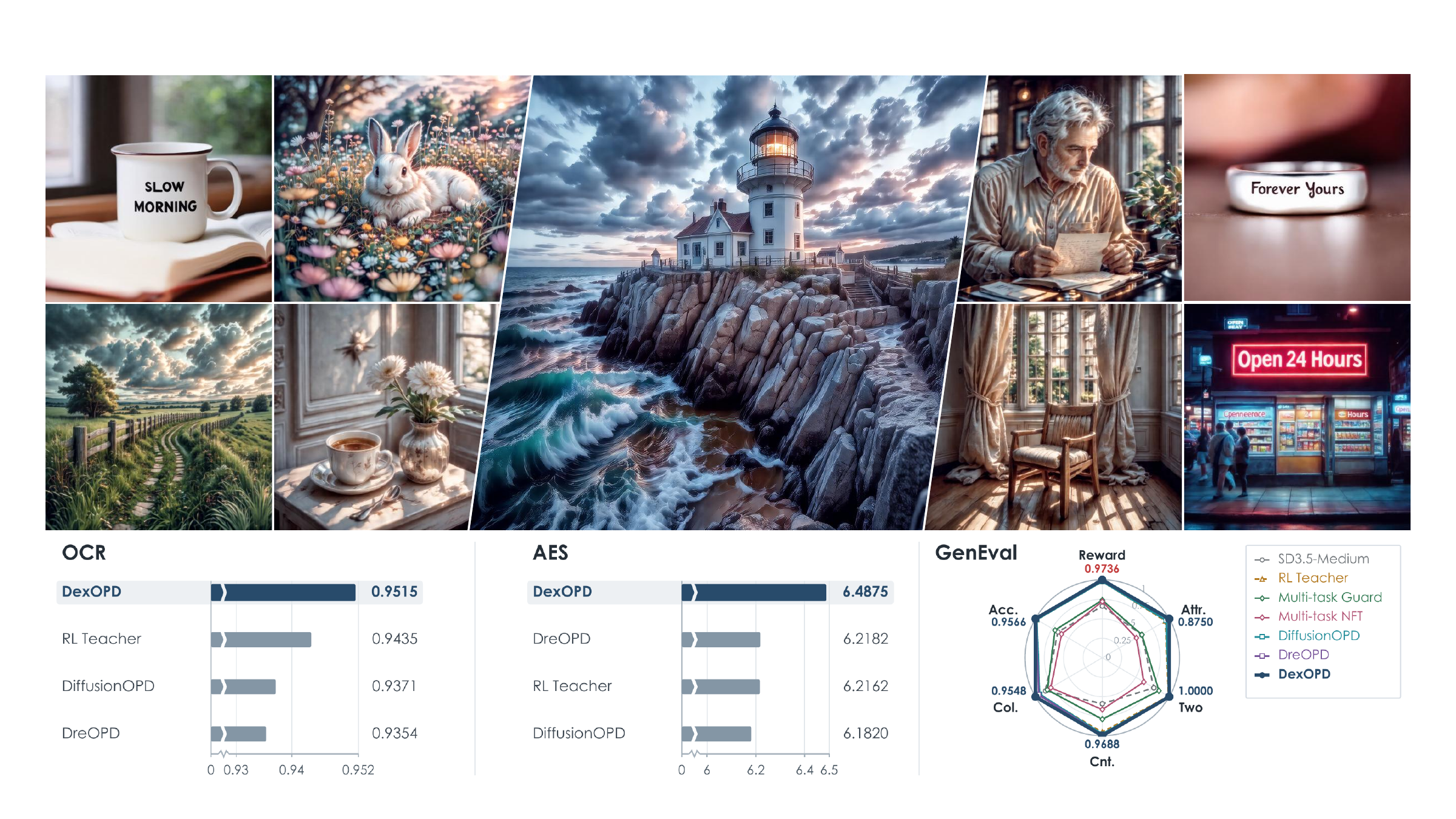
| **DexOPD** (*Dual-Extrapolation On-Policy Distillation*) consolidates three frozen Stable Diffusion 3.5 Medium specialist teachers—for **compositional alignment**, **text rendering**, and **visual quality**—into a single unified LoRA adapter. At inference time, the released student runs as a standard single-trajectory SD3.5 Medium pipeline. |
|
|
| **Authors:** Yunchao Ke\*, Yanzhe Hu\*, Yi Yang, Jiachun Jin, Zhihong Liu, Zhijie Deng† |
| Shanghai Jiao Tong University · Nankai University |
|
|
| [Project page & interactive charts](https://sjtu-deng-lab.github.io/DexOPD/) · [Qualitative comparisons](https://sjtu-deng-lab.github.io/DexOPD/examples.html) · [arXiv:2611.31969](https://arxiv.org/abs/2611.31969) · [Paper PDF](https://sjtu-deng-lab.github.io/DexOPD/assets/dexopd-paper.pdf) · [GitHub code](https://github.com/SJTU-DENG-Lab/DexOPD) |
|
|
|  |
|
|
| ## Checkpoint specifications |
|
|
| | Field | Value | |
| | --- | --- | |
| | Base model | [stabilityai/stable-diffusion-3.5-medium](https://huggingface.co/stabilityai/stable-diffusion-3.5-medium) | |
| | Adapter format | [PEFT LoRA (`adapter_model.safetensors`, ~75 MB)](https://huggingface.co/SJTU-DENG-Lab/DexOPD/blob/main/adapter_model.safetensors) attached to the SD3 transformer | |
| | LoRA config | [Rank 32, alpha 64 (`adapter_config.json`)](https://huggingface.co/SJTU-DENG-Lab/DexOPD/blob/main/adapter_config.json) on attention projections (`to_q`, `to_k`, `to_v`, `to_out.0`, `add_q_proj`, `add_k_proj`, `add_v_proj`, `to_add_out`) | |
| | Released step | Evaluation EMA after 1,000 optimizer updates (500 rounds) | |
| | Training recipe | 72 native cases / update (24 per task), teacher extrapolation λ = 1.2, auxiliary weight β = 1.8, candidate gains 𝒢 = {0, 0.05, 0.25, 0.5}, history EMA decay τ = 0.995 | |
| | Training resolution | 512 × 512 (paper evaluation at 512 × 512; gallery examples generated at 1024 × 1024) | |
|
|
| ## Quick start (CUDA inference) |
|
|
| 1. Request and accept access to the gated base model [Stable Diffusion 3.5 Medium](https://huggingface.co/stabilityai/stable-diffusion-3.5-medium). |
| 2. Install the inference dependencies and authenticate with Hugging Face: |
|
|
| ```bash |
| python -m pip install -r https://raw.githubusercontent.com/SJTU-DENG-Lab/DexOPD/main/requirements.txt |
| huggingface-cli login |
| ``` |
|
|
| 3. Load the base pipeline and attach `SJTU-DENG-Lab/DexOPD` to `pipe.transformer`: |
|
|
| ```python |
| import torch |
| from diffusers import StableDiffusion3Pipeline |
| from peft import PeftModel |
| |
| pipe = StableDiffusion3Pipeline.from_pretrained( |
| "stabilityai/stable-diffusion-3.5-medium", |
| torch_dtype=torch.float16, |
| ) |
| pipe.transformer = PeftModel.from_pretrained(pipe.transformer, "SJTU-DENG-Lab/DexOPD") |
| pipe.to("cuda") |
| pipe.vae.to(dtype=torch.float32) |
| |
| with torch.inference_mode(), torch.autocast("cuda", dtype=torch.float16): |
| image = pipe( |
| 'A shop window with a sign that reads "OPEN LATE"', |
| height=512, |
| width=512, |
| num_inference_steps=40, |
| guidance_scale=4.5, |
| generator=torch.Generator(device="cuda").manual_seed(42), |
| ).images[0] |
| |
| image.save("dexopd.png") |
| ``` |
|
|
| > **Tip:** Paper benchmarks use `512 × 512`, `num_inference_steps=40`, and `guidance_scale=4.5` with FP16 autocast and an FP32 VAE. You can also generate at `1024 × 1024` (used in the [interactive comparison gallery](https://sjtu-deng-lab.github.io/DexOPD/examples.html)). |
| |
| ## Method summary |
| |
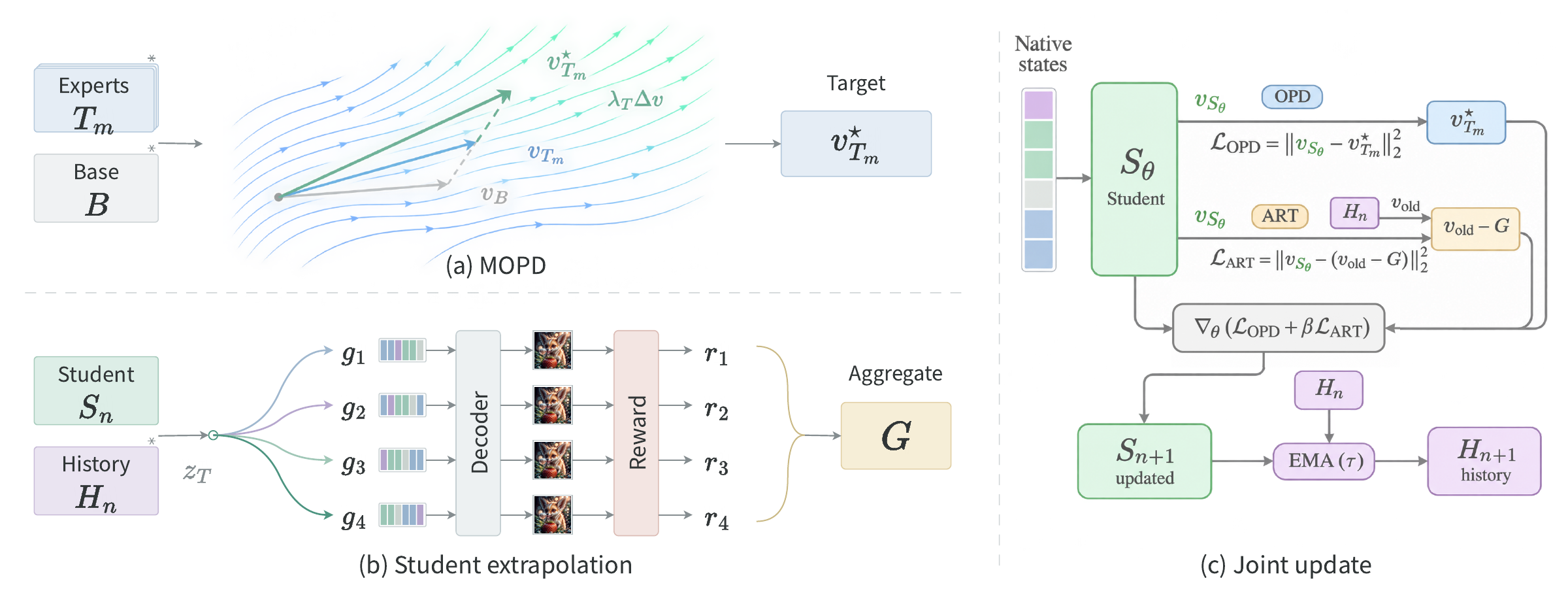
| During on-policy distillation, the student collects 10-step deterministic Euler trajectories and receives two complementary signals at each visited state: |
| |
| 1. **Teacher extrapolation (λ = 1.2):** For each task specialist *v*<sub>T</sub> and the frozen base model *v*<sub>B</sub>, DexOPD constructs a strengthened proxy velocity *v*<sub>proxy</sub> = *v*<sub>T</sub> + λ(*v*<sub>T</sub> − *v*<sub>B</sub>) and takes one Euler step to form the distillation target. |
| 2. **Reward-guided student self-extrapolation (β = 1.8):** Using an evolving historical EMA *H*<sub>r</sub> of the student (τ = 0.995), DexOPD integrates four candidate rollouts from shared initial noise under gains 𝒢 = {0, 0.05, 0.25, 0.5}. Whenever candidates earn distinct task rewards, their normalized endpoint–reward covariance *G* = *C* / RMS(*C*) supplies an auxiliary target; tied groups automatically deactivate (*G* = 0). |
| |
|  |
| |
| ## Benchmark evaluation |
| |
| All trained models share the SD3.5-Medium backbone and a 1,000-update budget, evaluated at **512 × 512** with **40 inference steps** and **CFG 4.5** (CFG 1.0 for GenEval Teacher, DiffusionNFT, and DiffusionART as in their protocols). Higher is better across all columns. |
| |
| ### Main comparison (Table 1) |
| |
| | Model | GenEval Acc. | GenEval Reward | OCR | Aesthetic | PickScore | ImageReward | CLIPScore | HPSv2.1 | |
| | --- | ---: | ---: | ---: | ---: | ---: | ---: | ---: | ---: | |
| | SD3.5-Medium (base) | 0.6336 | 0.6446 | 0.5486 | 5.3899 | 0.8614 | 0.8383 | 0.2895 | 0.2924 | |
| | GenEval Teacher | 0.9349 | 0.9534 | 0.6515 | 5.2635 | 0.8513 | 0.9277 | 0.2869 | 0.2673 | |
| | OCR Teacher | 0.6144 | 0.6617 | 0.9435 | 5.2605 | 0.8580 | 0.8972 | 0.2909 | 0.2732 | |
| | Aesthetic Teacher | 0.7066 | 0.4791 | 0.5881 | 6.2162 | 0.9233 | 1.5016 | 0.2960 | 0.3452 | |
| | GRPO-Guard (multi-task RL) | 0.6764 | 0.7202 | 0.7210 | 5.6812 | 0.8770 | 1.1531 | 0.2904 | 0.3091 | |
| | DiffusionNFT (multi-task RL) | 0.5817 | 0.7029 | 0.9434 | 5.3674 | 0.8412 | 0.6314 | 0.2787 | 0.2642 | |
| | DiffusionART (multi-task RL) | 0.4847 | 0.4427 | 0.9033 | 5.6673 | 0.8292 | 0.7193 | 0.2710 | 0.2653 | |
| | DiffusionOPD | 0.9373 | 0.9543 | 0.9371 | 6.1820 | 0.9237 | 1.5110 | **0.3006** | 0.3547 | |
| | DreOPD | 0.9495 | 0.9622 | 0.9354 | 6.2182 | 0.9237 | **1.5259** | 0.2986 | 0.3558 | |
| | STEP-OPD\* | 0.9440 | 0.9562 | 0.9378 | 6.2813 | **0.9248** | 1.5207 | 0.2985 | **0.3566** | |
| | **DexOPD (released)** | **0.9566** | **0.9736** | **0.9515** | **6.4875** | 0.9190 | 1.5127 | 0.2914 | 0.3484 | |
| |
| \* Paper-based reproduction. On the three primary metrics, DexOPD leads the next-best result in Table 1 by **+0.0114** on GenEval reward, **+0.0080** on OCR, and **+0.2062** on DrawBench Aesthetic. Interactive charts, GenEval subcategory breakdowns, and sweep plots are available on the [project page](https://sjtu-deng-lab.github.io/DexOPD/#results). |
| |
| ### Component ablation (1,000 updates) |
| |
| | Configuration | GenEval Reward | OCR | Aesthetic | |
| | --- | ---: | ---: | ---: | |
| | **DexOPD (default)** | **0.9736** | **0.9515** | **6.4875** | |
| | No teacher extrapolation (λ = 0) | 0.9515 | 0.9357 | 6.2930 | |
| | No student auxiliary (β = 0) | 0.9669 | 0.9408 | 6.4410 | |
| | Frozen-base reference (*H*<sub>r</sub> = *B*) | 0.9633 | 0.9512 | 6.2548 | |
| |
| ## Intended use & limitations |
| |
| - **Intended use:** Research on diffusion post-training, multi-teacher on-policy distillation, and text-to-image generation with improved compositional fidelity, English text rendering, and aesthetic preference on top of Stable Diffusion 3.5 Medium. |
| - **Limitations:** This adapter inherits the capabilities, biases, and visual bounds of SD3.5-Medium and the three specialist teachers it distills from. Text rendering is trained and evaluated on English prompts; non-English scripts, dense multi-paragraph typography, and very fine anatomical details remain challenging. |
| |
| ## License & access |
| |
| - **Adapter weights:** Publicly downloadable from `SJTU-DENG-Lab/DexOPD`. |
| - **Base model:** Requires accepting the gated [Stability AI Community License](https://huggingface.co/stabilityai/stable-diffusion-3.5-medium/blob/main/LICENSE.md) on Hugging Face. |
| - **Training & evaluation code:** Released under the [Apache 2.0 License](https://github.com/SJTU-DENG-Lab/DexOPD/blob/main/LICENSE). |
| |
| ## Citation |
| |
| ```bibtex |
| @misc{ke2026dexopd, |
| title = {DexOPD: Dual-Extrapolation On-Policy Distillation for Diffusion Models}, |
| author = {Yunchao Ke and Yanzhe Hu and Yi Yang and Jiachun Jin and Zhihong Liu and Zhijie Deng}, |
| year = {2026}, |
| eprint = {2611.31969}, |
| archivePrefix = {arXiv}, |
| primaryClass = {cs.AI}, |
| url = {https://arxiv.org/abs/2611.31969} |
| } |
| ``` |
| |


