

Making Reconstruction FID Predictive of Diffusion Generation FID
Paper • 2603.05630 • Published • 1
GitHub · Architecture · Prompting · Data · ComfyUI
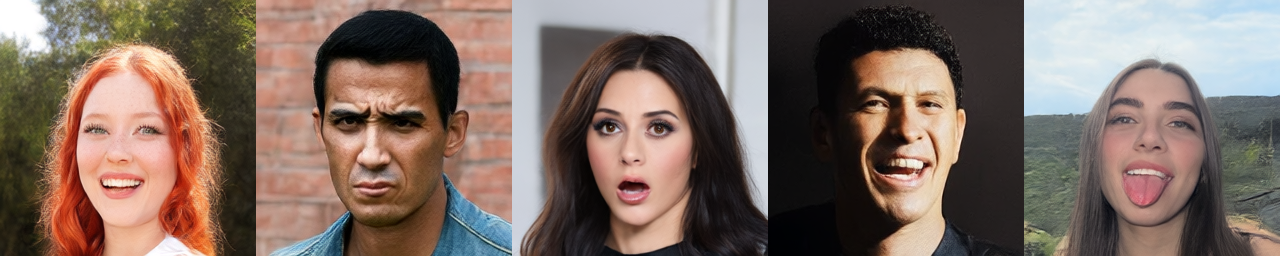
Visage-Image is a 256px text-to-image model for face generation. It has three parts:
text_encoder/config.json.The code and the weights are released under Apache-2.0.
A transformer VAE decoder. The VAEs that latent diffusion usually runs on (Stable Diffusion, SDXL, FLUX.1/FLUX.2, Qwen-Image, Sana's DC-AE) all decode with convolutions, and their last layers run at full image resolution. The Visage-Image decoder is a ViT. It works on the 16×16 latent grid, splits each token into its 2×2 children for a second ViT stage at 32×32, and emits pixels only at the end, through a linear head that paints each 8×8 patch. Two small residual conv refiners then smooth across patch seams. In a head-to-head test with the encoder and losses held fixed, the ViT decoder beat the conv decoder on every validation metric and trained about 5× faster.
A wavelet encoder. Following LiteVAE, the 26M-parameter encoder is given a three-level Haar wavelet pyramid instead of learning frequency decomposition from raw pixels. Two parameter-free shortcuts fold the pixels straight into the deepest stage and into the latent.
No KL. The latent is deterministic. DINOv2 feature alignment keeps it organised in place of a KL penalty.
The result. At 25% lower rate (f16×96 against FLUX.2's f8×32), the VAE ties the FLUX.2 VAE on reconstruction, eye detail included, and beats it on iFID. It loses on rFID (see the table below).
A small single-stream DiT. Text and image tokens share one sequence and one set of weights. Captions come from a mid-layer of a small LLM (layer 8 of Qwen3-0.6B) rather than T5 or CLIP. They are padded with learned per-position embeddings to fixed length buckets, so a sample never depends on what it is batched with. Sixteen register tokens and a 2D spiral RoPE complete the design.
ARCHITECTURE.md covers each choice, the measurements behind it and what was tried instead.
The code is on GitHub and on PyPI as visage-image. The weights in this repository download on first use.
pip install visage-image
import torch
from torchvision.utils import save_image

from visage import load_dit, load_text_encoder, load_vae, sample

prompt = "a young woman with long red hair and freckles, soft window light"
text, mask = load_text_encoder()([prompt] * 4)  # Qwen3-0.6B, first 8 layers
dit = load_dit()
latents = sample(dit, text, mask, seed=0)  # SDE, churn 0.3, CFG 3, 50 steps, shift 3.3
with torch.no_grad():
    images = load_vae().decode(latents).float()
save_image((images + 1) / 2, "visage.png", nrow=4, padding=0)
Or from the command line, in a clone of the GitHub repo: python scripts/generate.py "<prompt>" --n 4. PROMPTING.md lists the caption format and example prompts.
ComfyUI. ComfyUI-Visage adds loader, text-encode, sampler and decode nodes, with an example workflow.
Install it from ComfyUI Manager (search "Visage") or with comfy node install comfyui-visage.
| folder | contents |
|---|---|
transformer/ |
DiT EMA weights, step 222k (220k + 2k adversarial post-training steps), and its config |
vae/ |
VAE step 400k, with per-channel latent statistics, and its config |
text_encoder/ |
the frozen encoder's record: model, layer, caption length and hub revision; its weights come from Qwen3-0.6B |
The text states were stored in float8 (e4m3) during training, and the text encoder rounds through float8 the same way, so inference sees exactly what training saw.
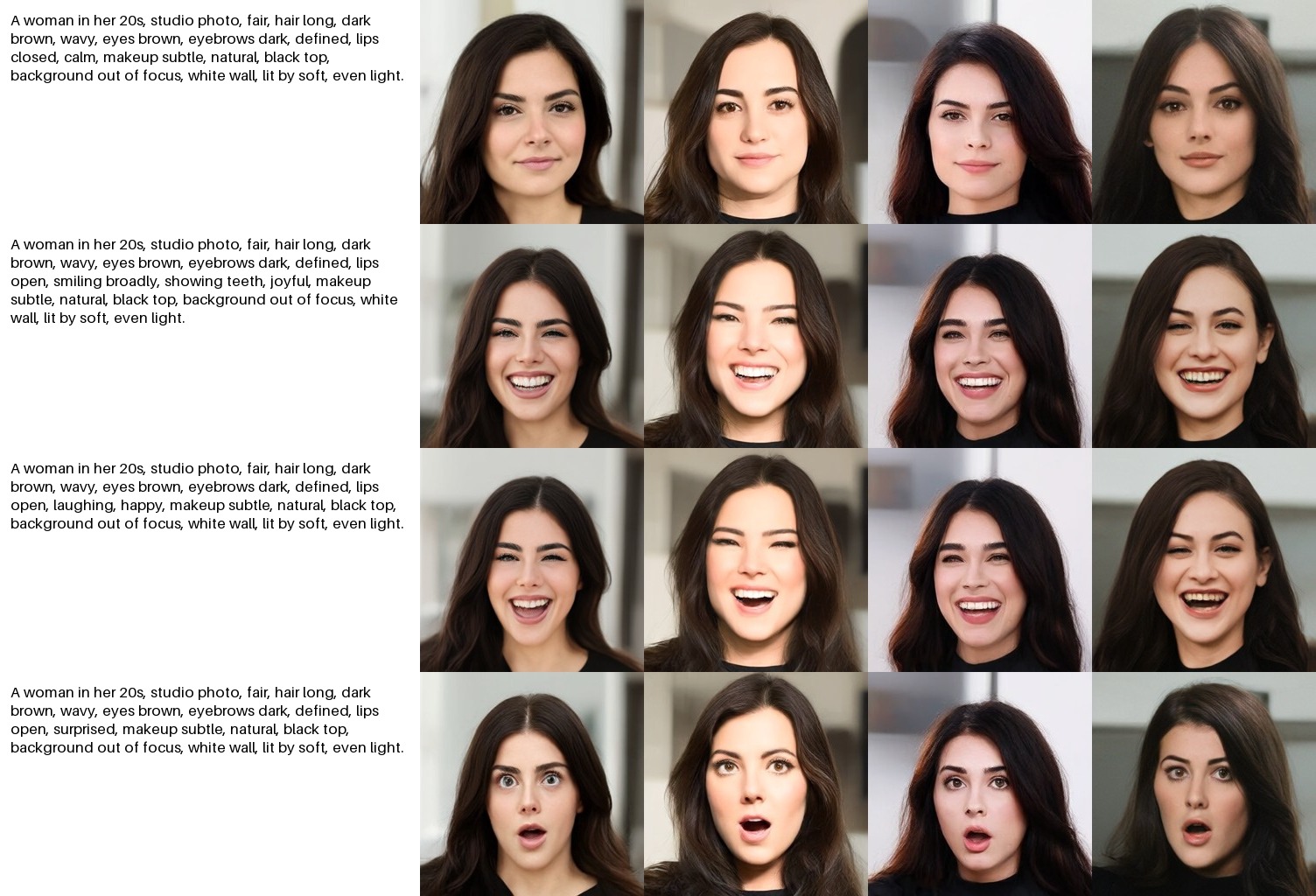
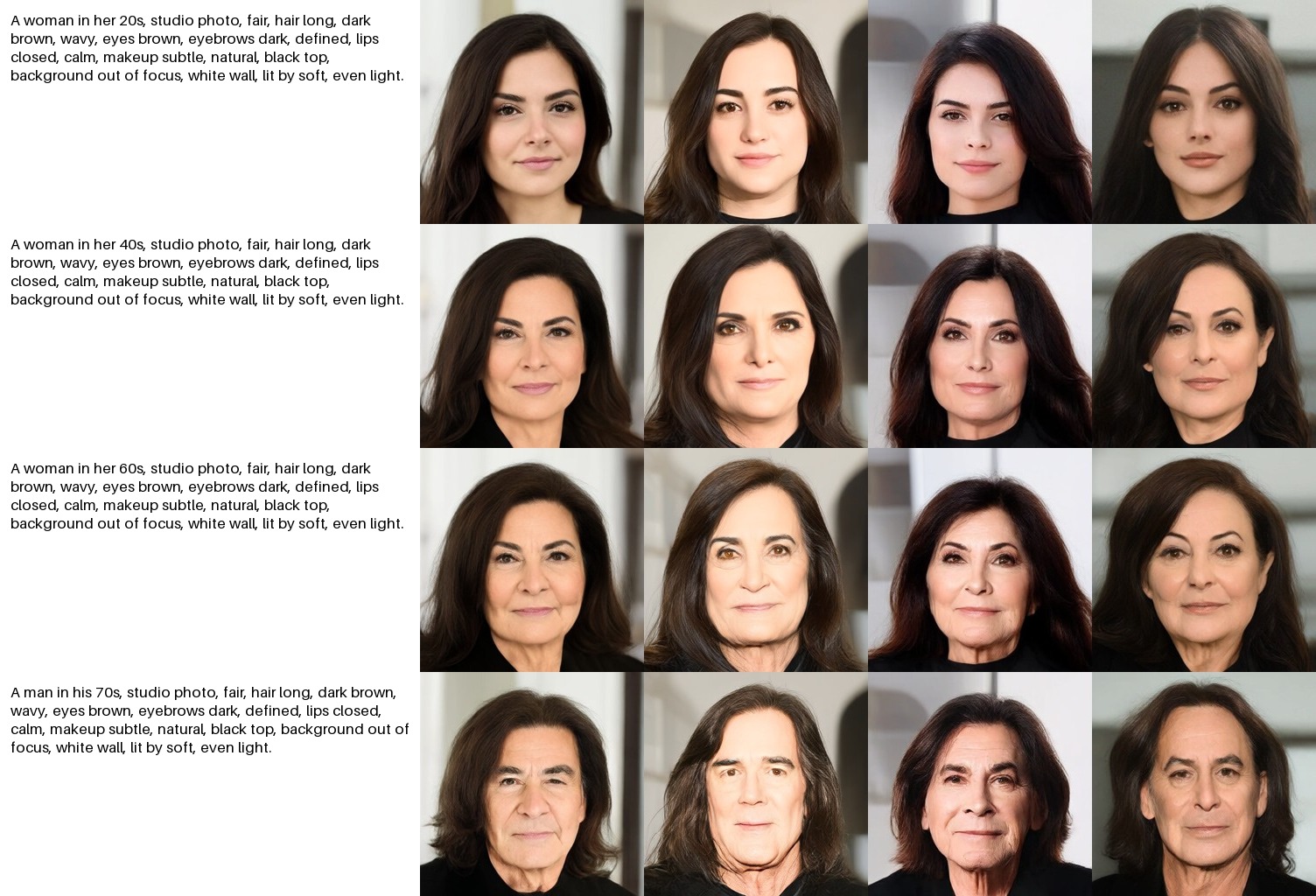
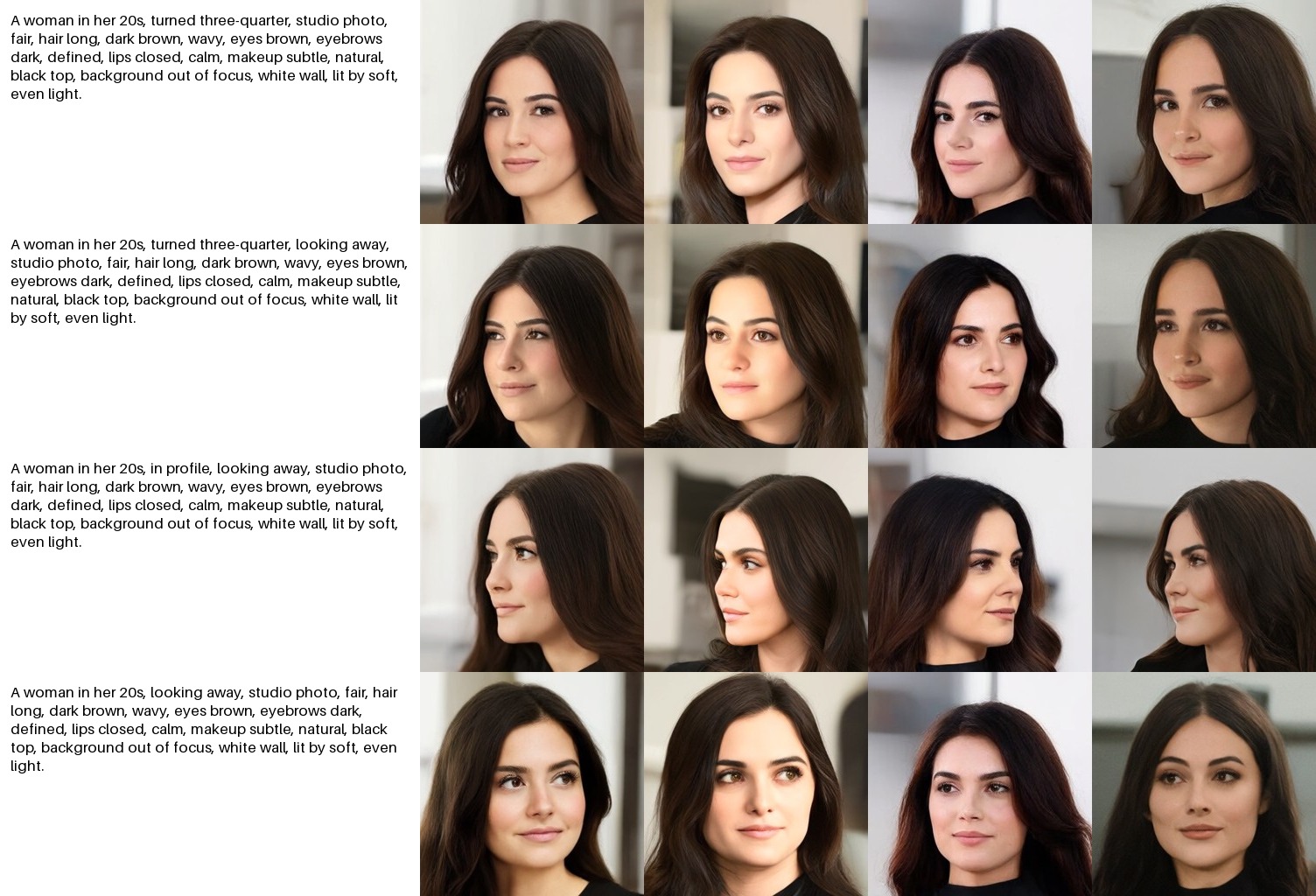
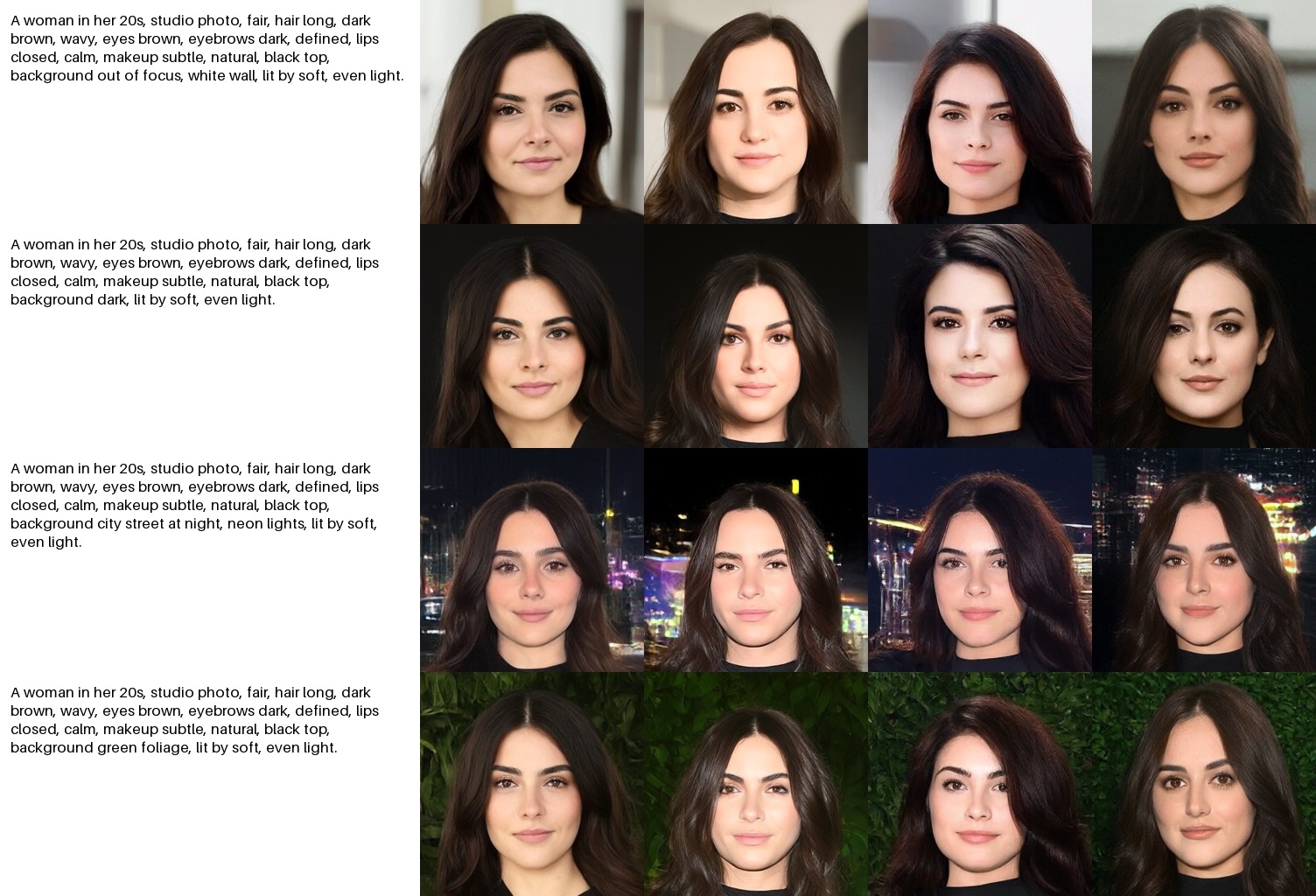
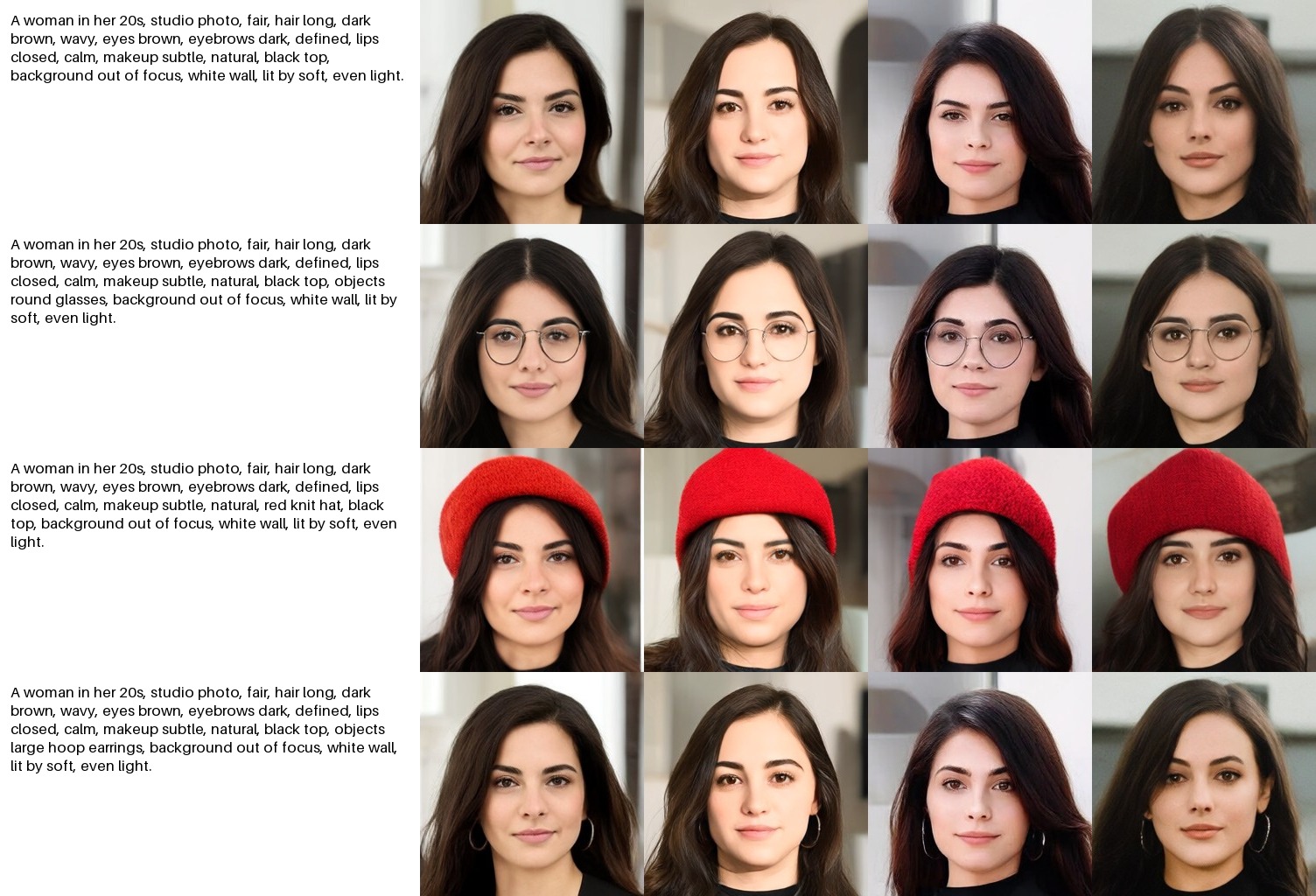
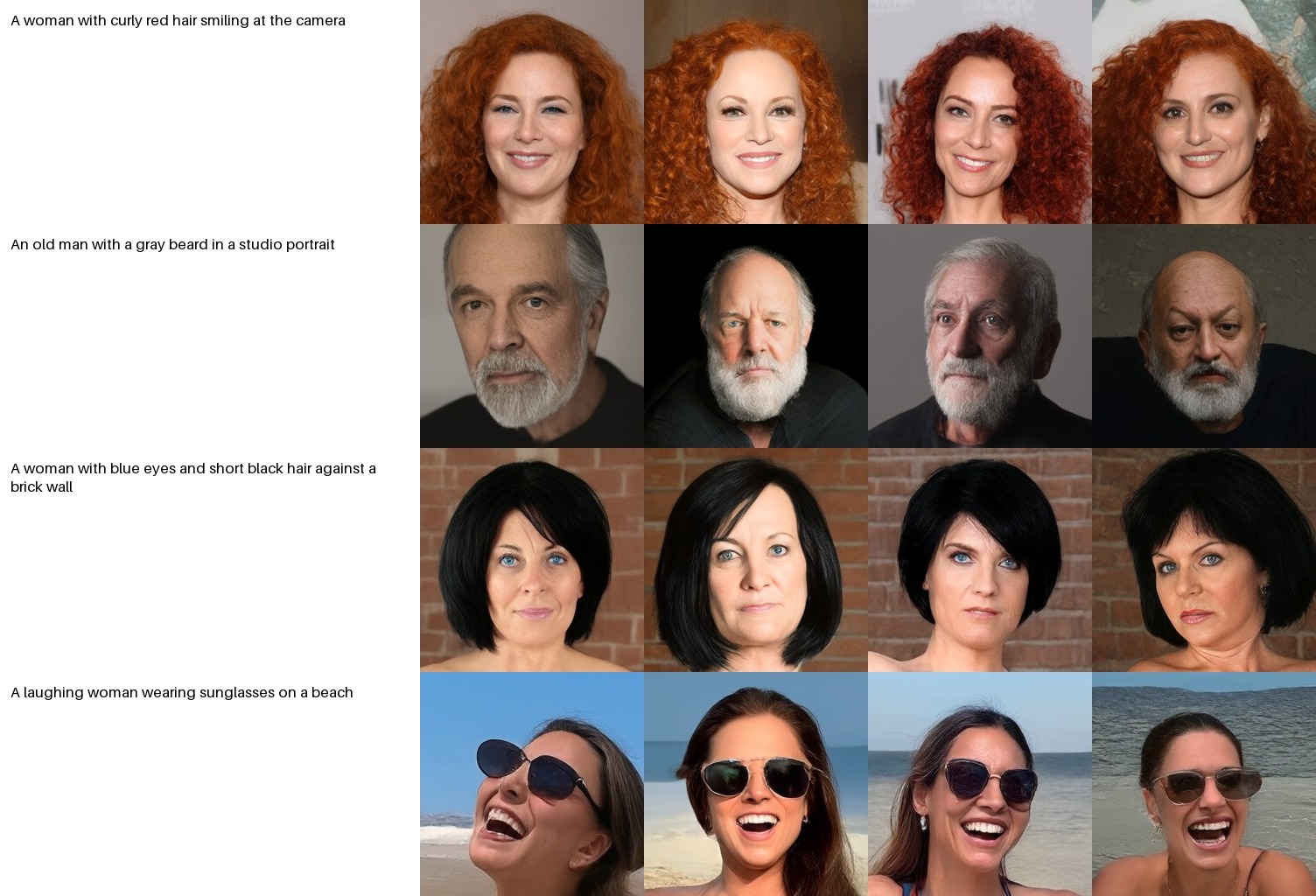
Most sheets vary one caption slot from row to row; the short sheets use short prompts. The full prompt is printed on the left of each row. Four seeds per row, shared across rows, with the default sampler (SDE, churn 0.3, CFG 3, 50 steps).
expression
age
turn gaze
short common
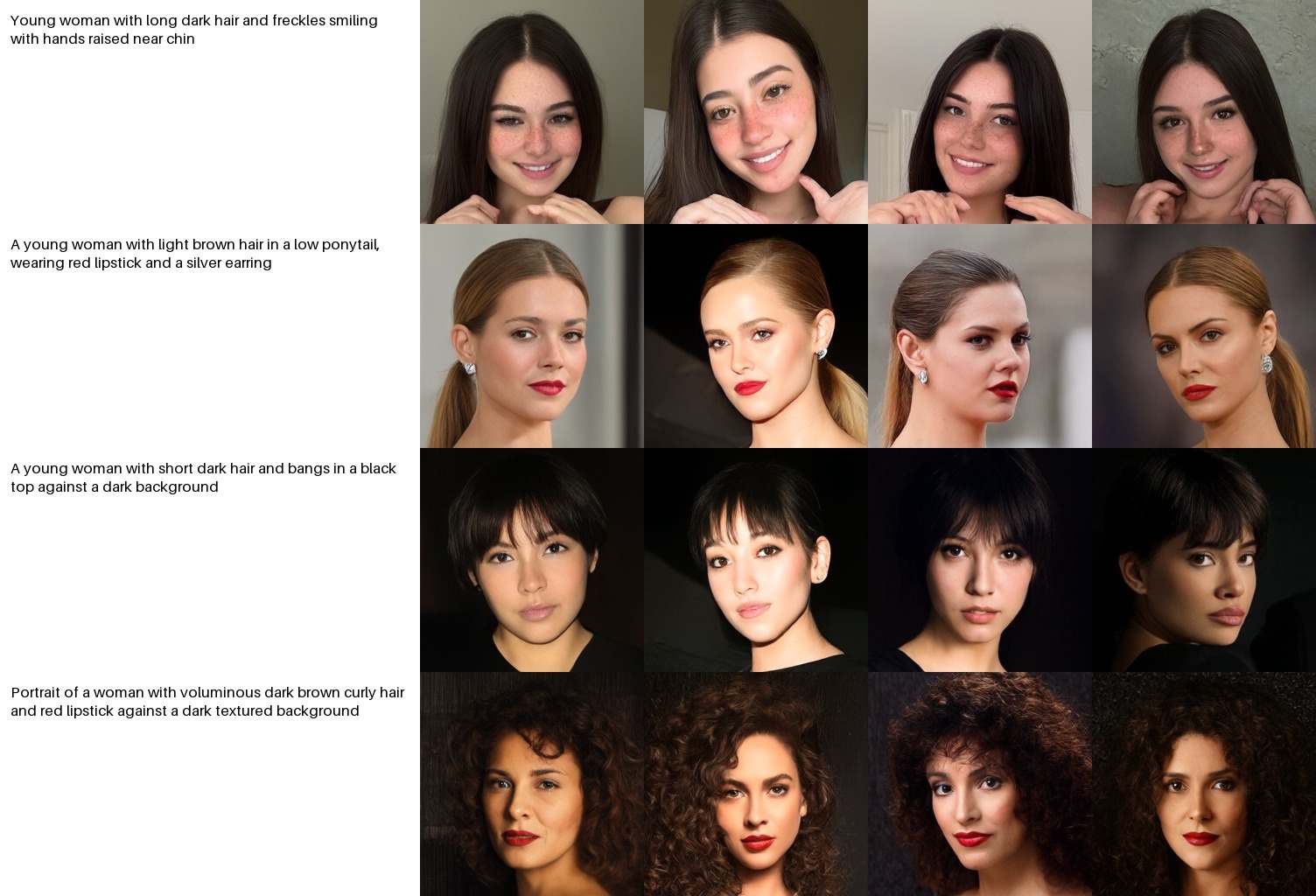
hair
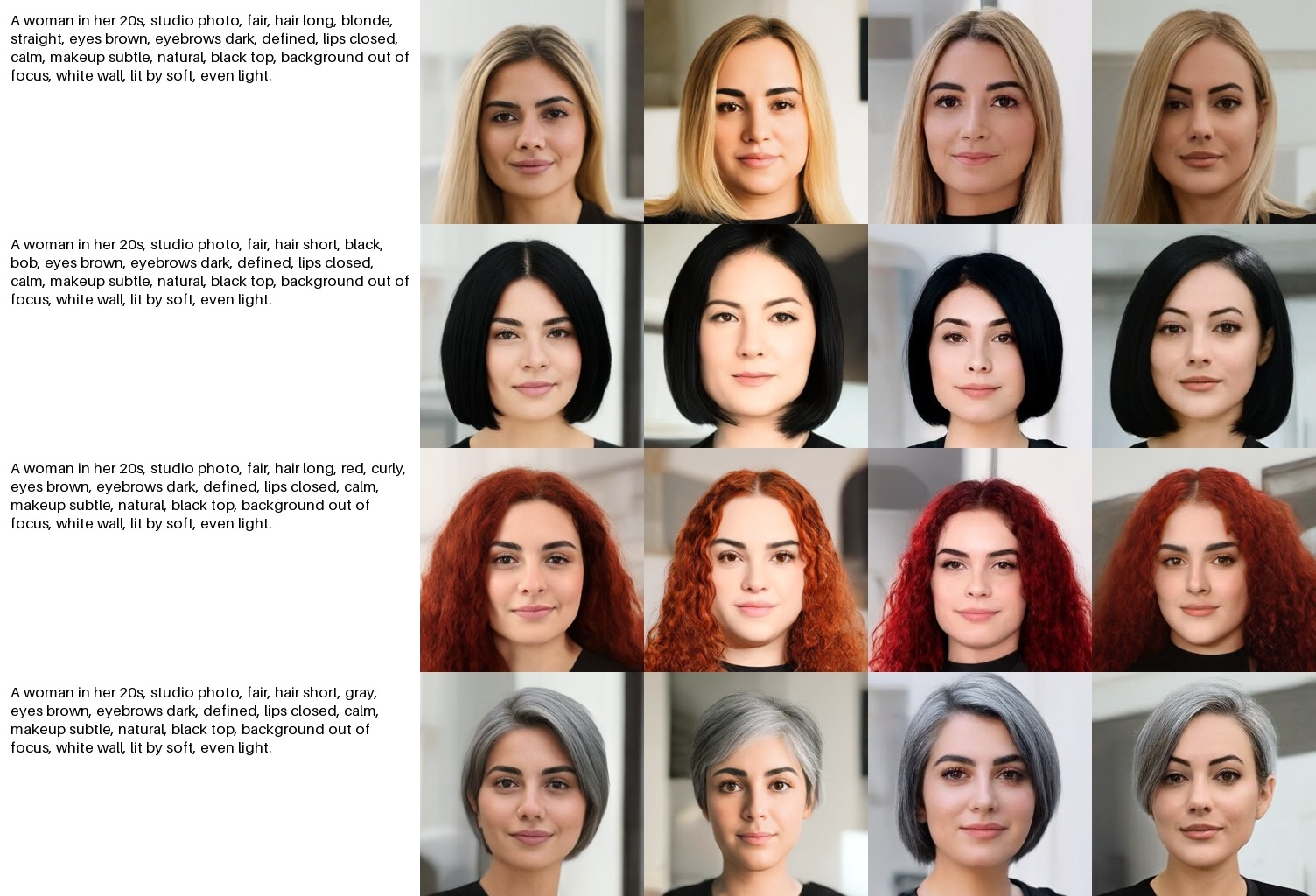
eyes
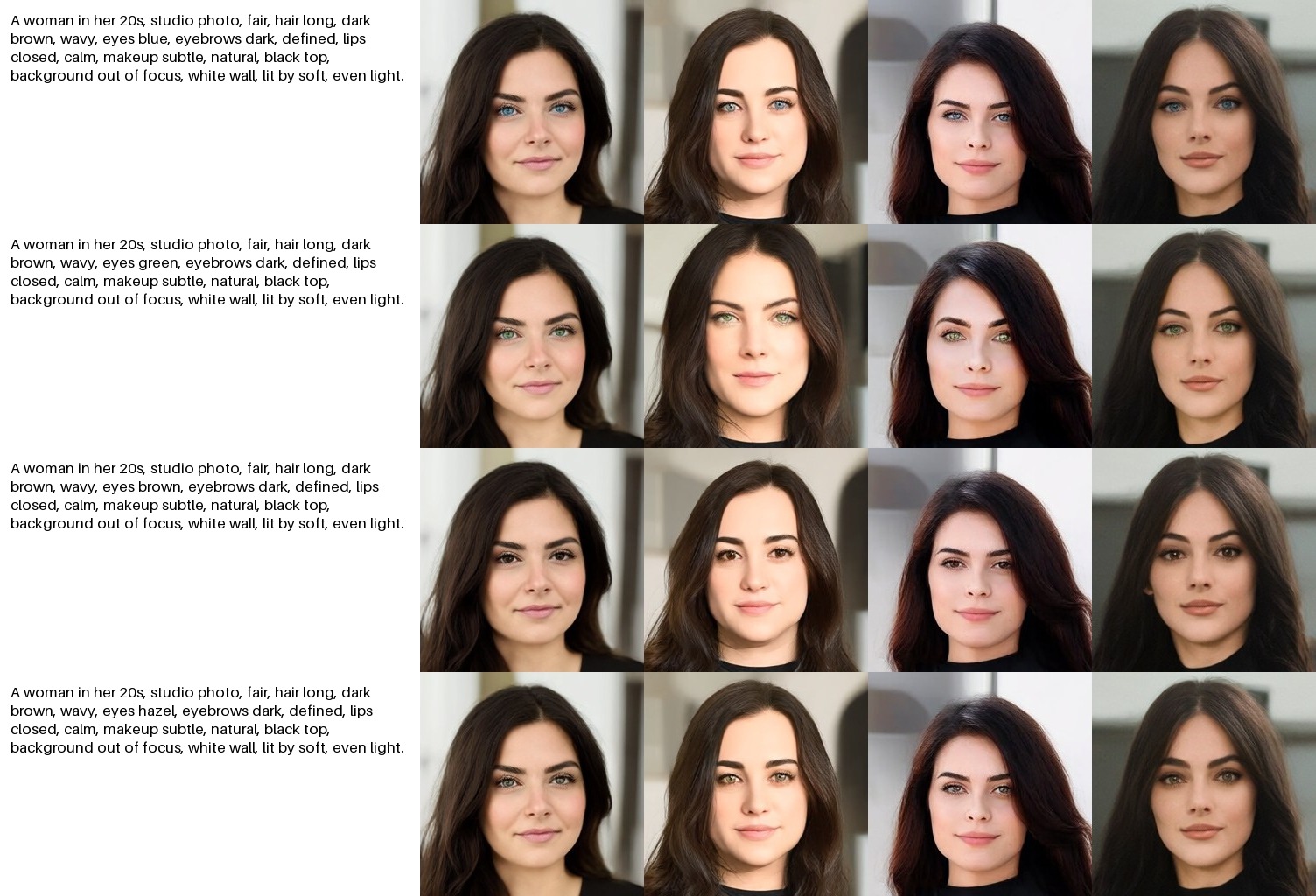
gaze
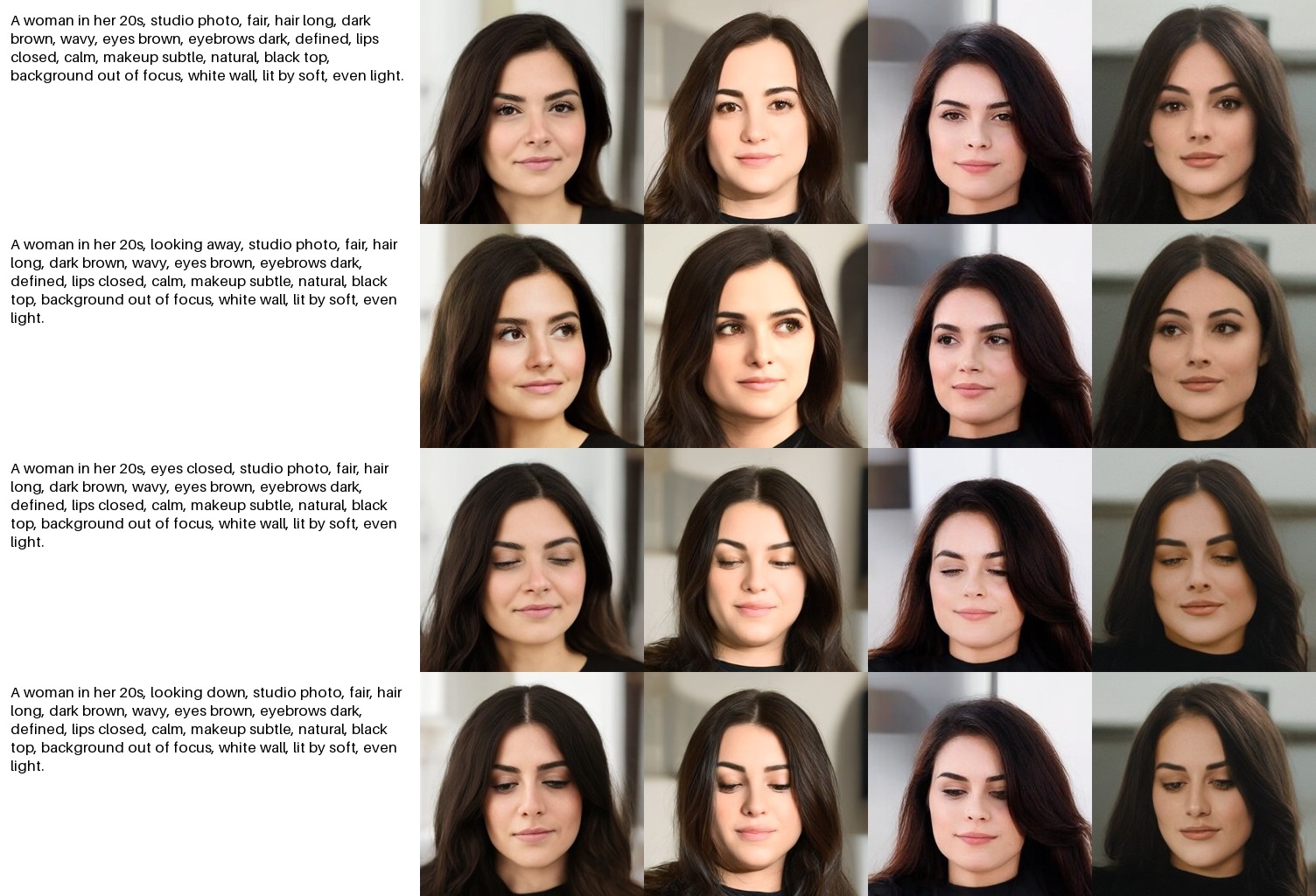
turn
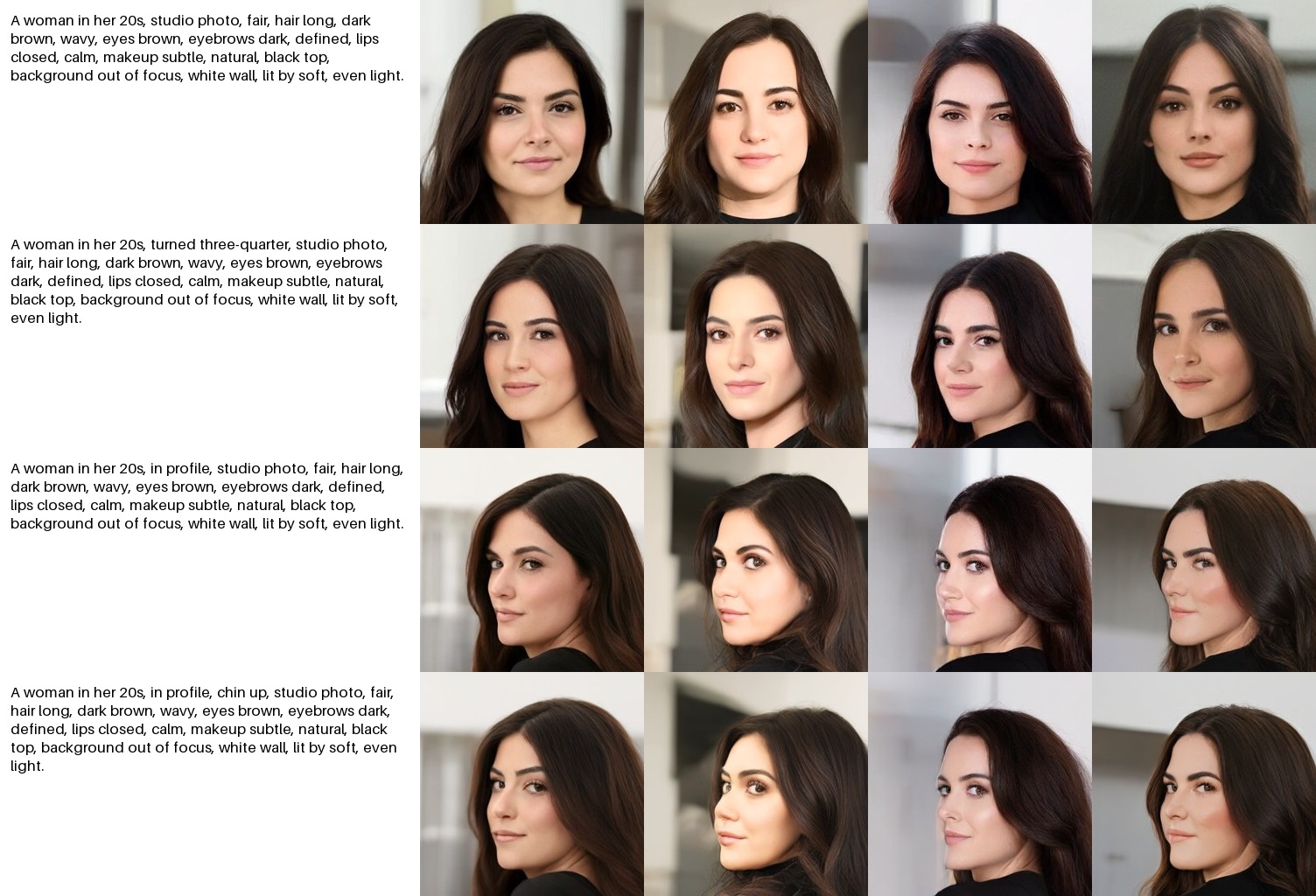
pitch
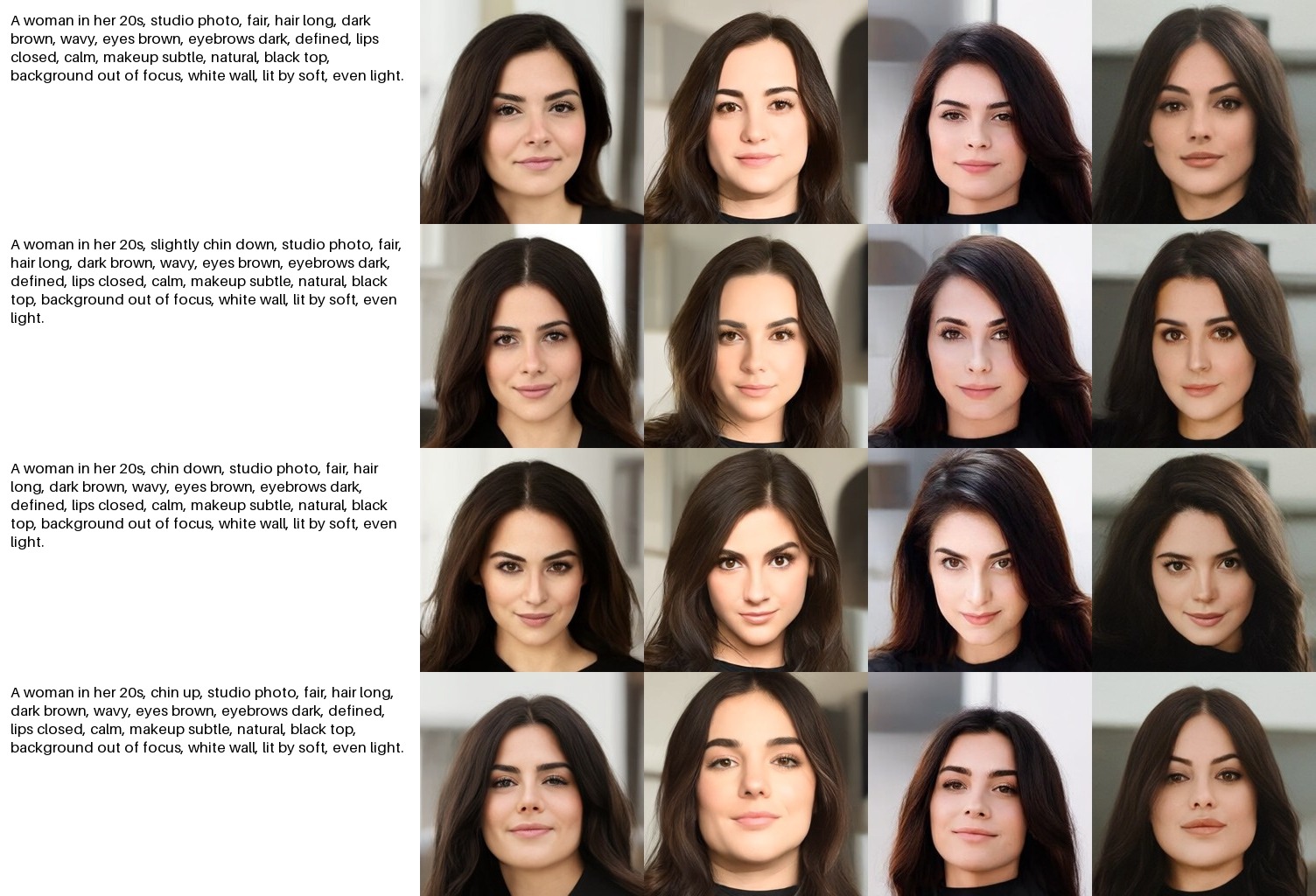
skin
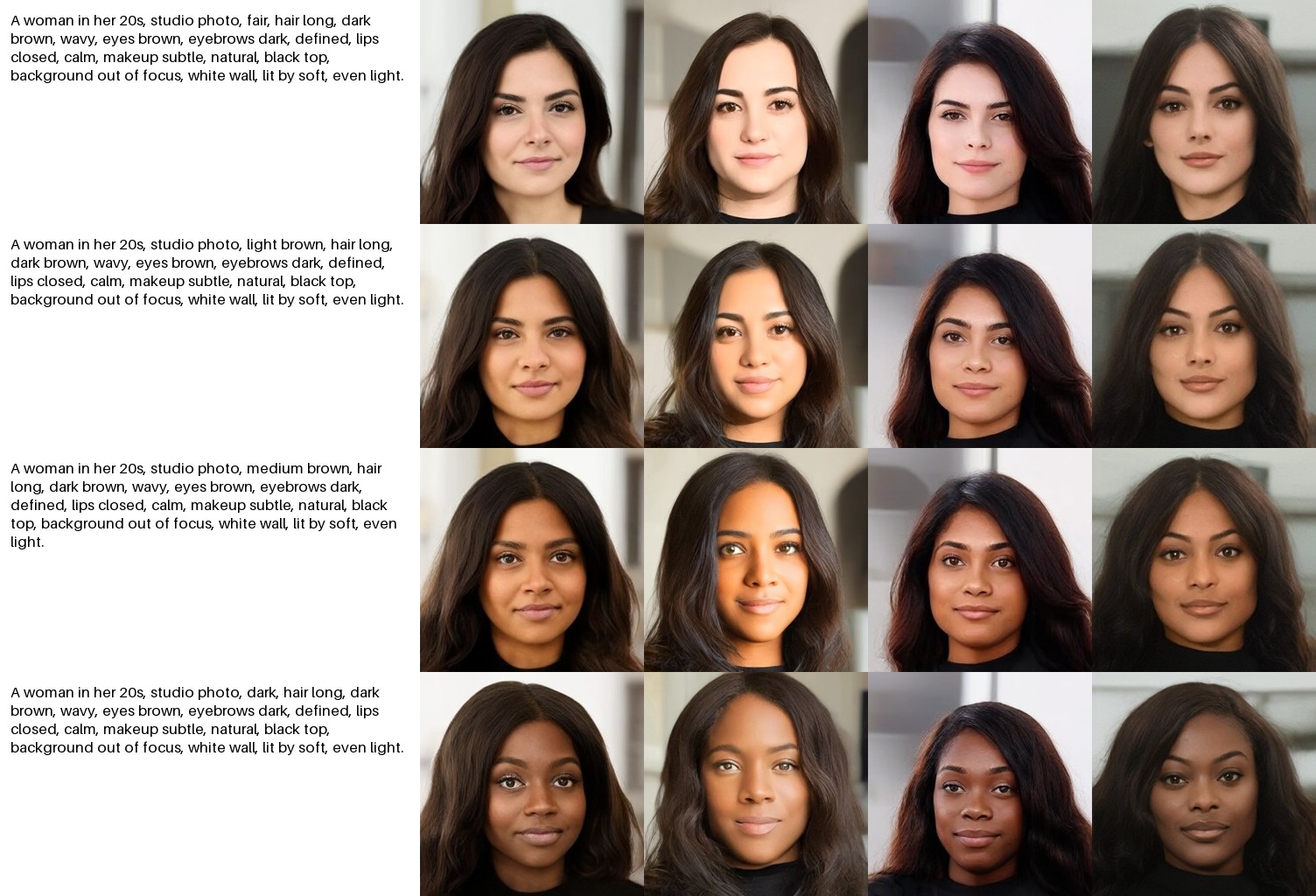
photo
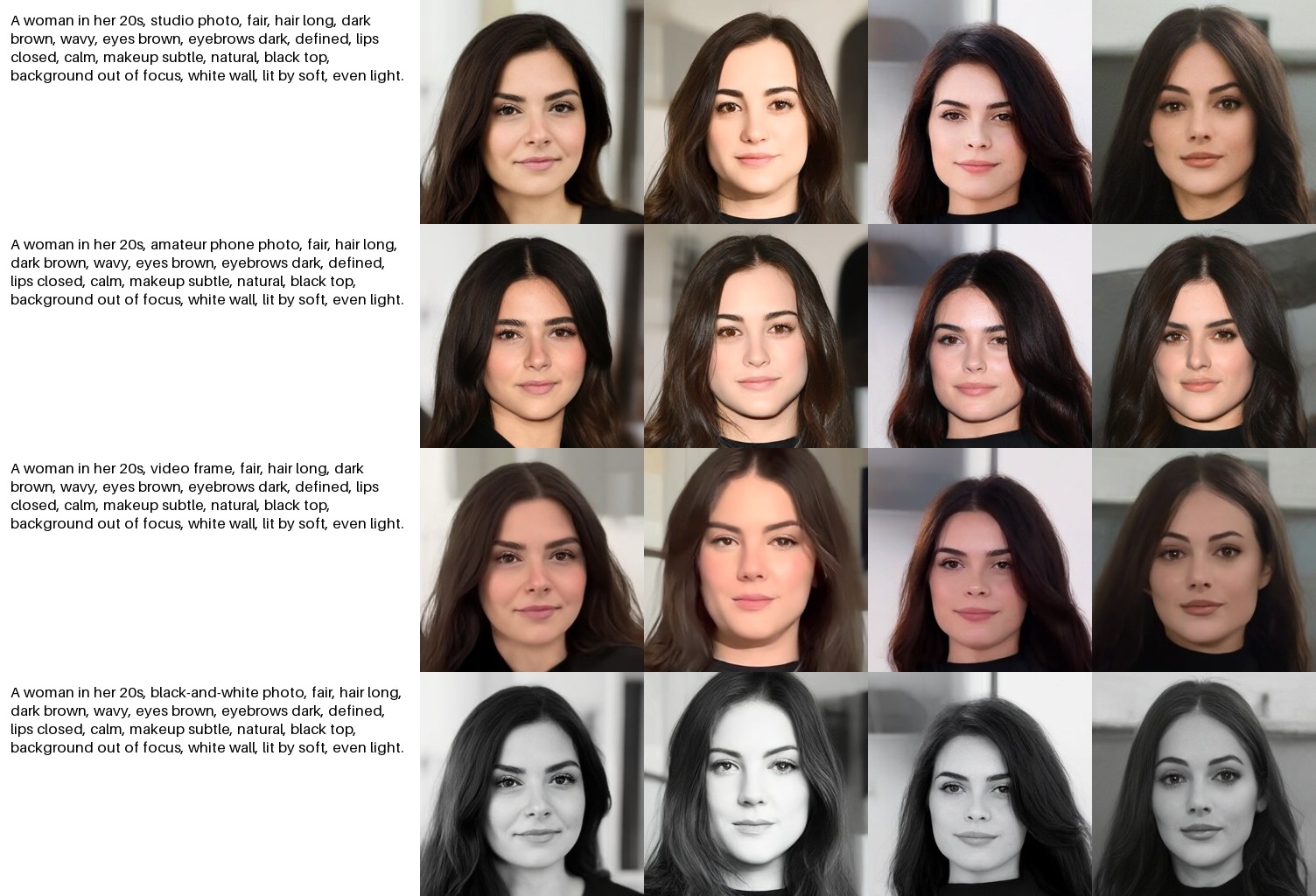
shot
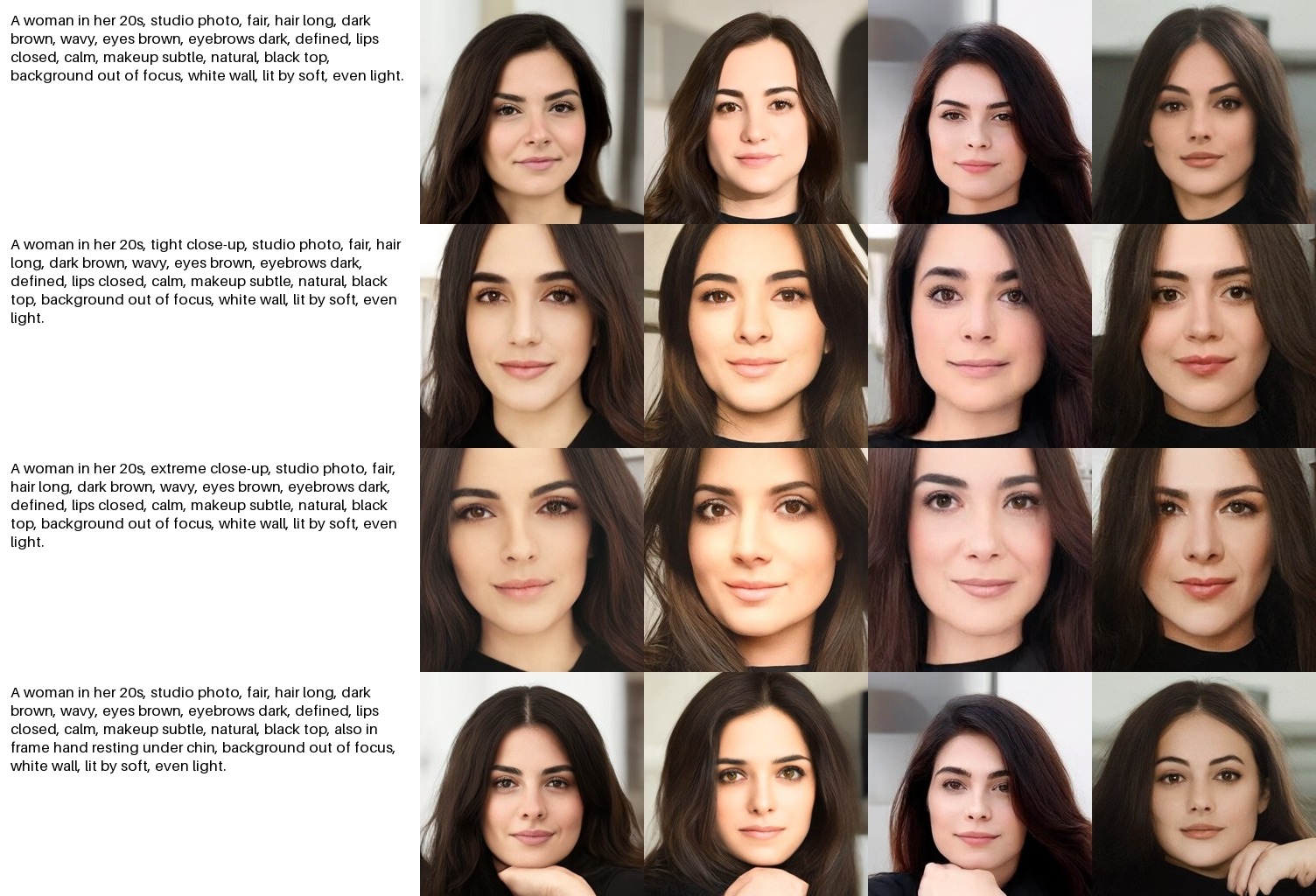
background
extras
short
The Visage-Image VAE is f16×96, or 0.375 latent floats per pixel. FLUX.2 is f8×32, or 0.5 floats per pixel, so the Visage-Image VAE works at 25% lower rate. All numbers are at 256px.
| metric | Visage-Image VAE | FLUX.2 VAE | |
|---|---|---|---|
| whole-image PSNR (512 held-out images) | 38.69 | 38.67 | tie (+0.01 ± 0.05 dB) |
| whole-image MAE | 0.00802 | 0.00837 | Visage-Image; better on 74% of images |
| eye-crop PSNR, paired (990 crops) | −0.02 dB | 0 (reference) | tie |
| iFID ↓ (10,016 images) | 17.96 | 21.99 | Visage-Image |
| rFID ↓ (10,016 images) | 1.77 | 0.93 | FLUX.2 |
| parameters | 128.4M | 84.0M |
The eye-crop metric is the paired PSNR difference on tight eye crops from images neither VAE was trained on. That's where fine face detail fails first and where whole-image metrics are least sensitive.
iFID is FID on images decoded from the midpoint between a latent and its nearest neighbour (arXiv:2603.05630). It measures latent-space smoothness. It does not predict how fast a DiT learns: in short DiT screens trained on each latent, FLUX.2's latent still reaches a lower generation FID (101.3 vs 190.7 for this VAE), despite losing on iFID.
Not at 512px. The decoder runs at 512, but the quality doesn't carry over: −3.2 dB on eye crops and iFID 28.6 vs 25.5 against FLUX.2. At 128px, rFID rises to 5.46.
encode returns the posterior mean, so there's no noise tax on reconstruction.encode returns zero-mean, unit-std latents and decode accepts them.configs/dit_adversarial.yaml).Long captions are structured descriptions of the subject: age, pose, gaze, expression, hair, lighting, background. They are rendered from per-image attributes, several of them measured by dedicated models (head pose, gaze, eye closure, age) rather than read off by a VLM. The remaining slots come from Qwen3.5-4B fine-tuned on hand-corrected labels to write the caption format. DATA.md has the full pipeline.
The code and the weights are released under Apache-2.0.