

LIMBER
Layer-Interleaved Mamba–Bidirectional Encoder for RNA
A Hybrid RNA Foundation Model for Predicting and Understanding RNA Structure and Function
Paper · Code · Quick start
Ziyao Wang† · Yunrui Qiu†* · Yexiao He · Isabel Thompson · Hongli Wang · Adam Porter · Ang Li*
University of Maryland, College Park · University of Notre Dame
†Equal contribution · *Corresponding authors
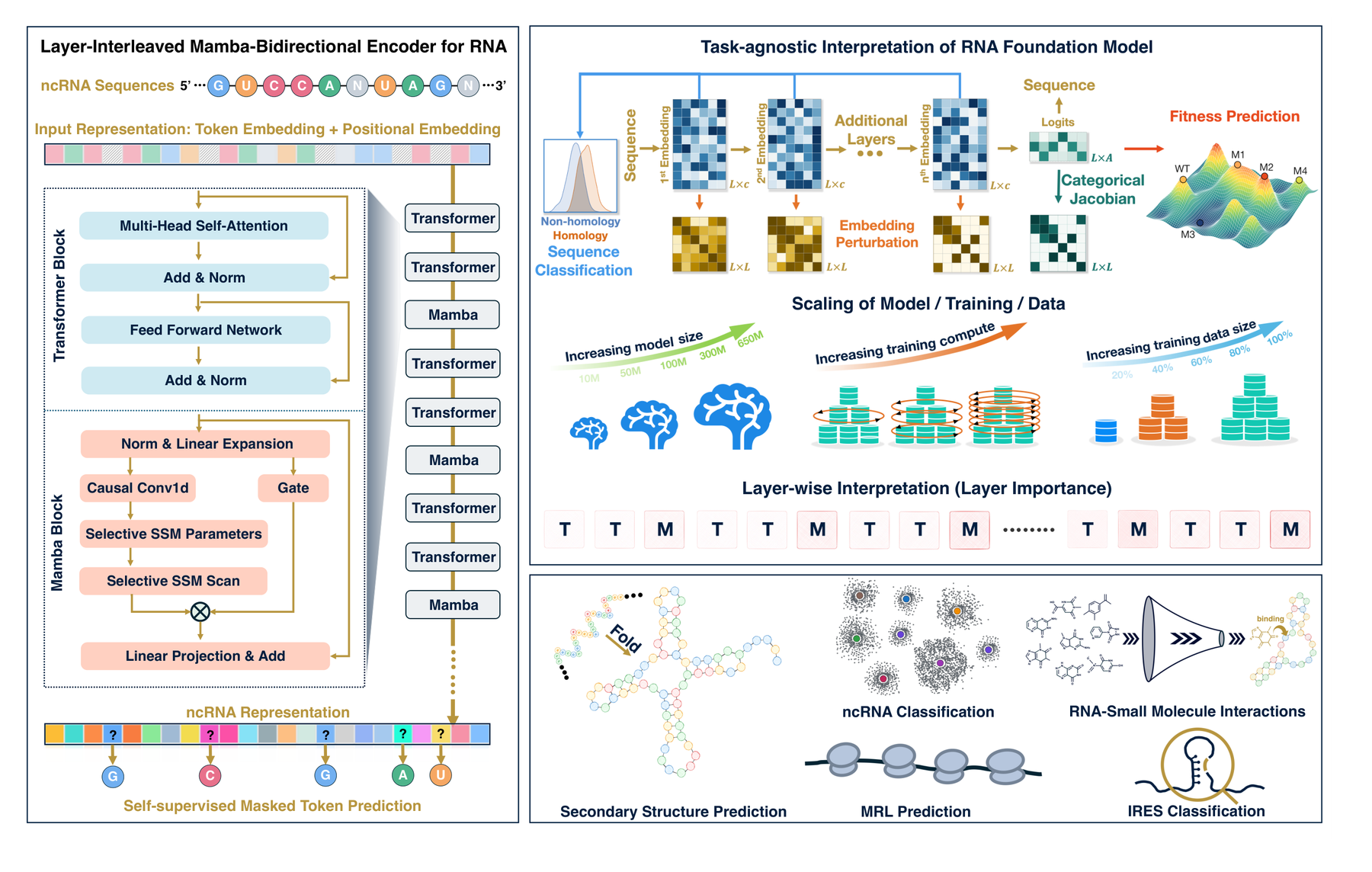
LIMBER (Layer-Interleaved Mamba–Bidirectional Encoder for RNA) is a hybrid RNA foundation model that interleaves bidirectional Transformer attention with Mamba selective state-space layers in a repeating Transformer–Transformer–Mamba (TTM) pattern, pretrained by masked language modeling on 40,498,819 RNAcentral sequences.
Self-attention captures direct couplings between arbitrary positions — the long-range coevolutionary signal that base pairing leaves in a sequence. Mamba contributes a complementary prior for ordered structure: RNA is a directional polymer, and its recurring motifs carry ordered signatures that attention alone does not impose. Interleaving the two gives the model both.
This repository holds every checkpoint from the paper, one subfolder per model: the three headline LIMBER models, the size- and data-scaling panel, and the size-matched pure-Transformer and pure-Mamba controls trained under identical settings.
What's in this repo
Main models
| Subfolder | Layers | Hidden | Heads | FFN | Params |
|---|---|---|---|---|---|
LIMBER-macro |
33 | 1280 | 20 | 5120 | 664.3M |
LIMBER-meso |
15 | 1280 | 20 | 5120 | 303.6M |
LIMBER-nano |
18 | 640 | 10 | 2560 | 91.7M |
LIMBER-macro is the model reported throughout the paper. Start there unless you are
compute-constrained — LIMBER-nano matches or beats models six times its size on several tasks.
Controlled architecture comparison
Pure-Transformer and pure-Mamba encoders at matched width, depth, data and optimizer settings, so
the architecture is the only variable: bert_100m_epoch6, bert_300m_epoch6, bert_650m_epoch6,
kmer1-PureMamba-100M, kmer1-PureMamba-300M, PureMamba-650M.
Scaling and ablation panel
| Axis | Subfolders |
|---|---|
| Model size | LIMBER-10M, LIMBER-50M |
| Pretraining-data fraction | LIMBER-nano-data20pct, -data40pct, -data60pct, -data80pct |
| Training budget | LIMBER-nano-ep6, LIMBER-meso-ep6, LIMBER-macro-ep1, -ep6, -ep9 |
| Shape at fixed budget | LIMBER-nano-thin, LIMBER-nano-wide, LIMBER-meso-thin, LIMBER-6L256-early |
| Convolution width | LIMBER-nano-dconv2 (width 2 instead of 4) |
Quick start
pip install torch transformers safetensors huggingface_hub
pip install causal-conv1d mamba-ssm      # required for the Mamba layers
git clone https://github.com/ziyaow1010/LIMBER && cd LIMBER
python scripts/load_hybrid650.py # downloads LIMBER-macro and runs a forward pass
import torch
from scripts.load_hybrid650 import load_hybrid, encode, embed

model, _ = load_hybrid()                                  # HybridMambaForMaskedLM, eval mode
ids = torch.tensor([encode("GGGCUAUUAGCUCAGUUGG")]).cuda()

logits = model(input_ids=ids, attention_mask=torch.ones_like(ids)).logits
h      = embed(model, ids)                                # final-layer representations

logits.shape     # [1, L+2, 10]    masked-LM logits over the nucleotide vocabulary
h.shape          # [1, L+2, 1280]  per-nucleotide embeddings for downstream heads
h[:, 0]          # [1, 1280]       [CLS] — the pooled sequence representation
Load any other subfolder directly:
import json, torch
from huggingface_hub import snapshot_download
from models.hybrid_mamba_bert import HybridMambaConfig, HybridMambaForMaskedLM

d = snapshot_download("Ziyao1010/LIMBER", allow_patterns=["LIMBER-nano/*"]) + "/LIMBER-nano"
model = HybridMambaForMaskedLM(HybridMambaConfig(**json.load(open(f"{d}/model_config.json"))))
model.load_state_dict(torch.load(f"{d}/pytorch_model.bin", weights_only=True))
One class, HybridMambaForMaskedLM, covers all three architectures — layer_pattern in
model_config.json selects TTMTTM..., TTTTTT... or MMMMMM....
Tokenization. Single-nucleotide resolution, 10 tokens: [PAD] [UNK] [CLS] [SEP] [MASK] plus
A U C G N. Preprocessing uppercases the sequence, maps T to U, and maps any non-ACGU symbol
to N. Position embeddings cover 1,026 tokens, giving a usable sequence length of 1,022 nt.
Results
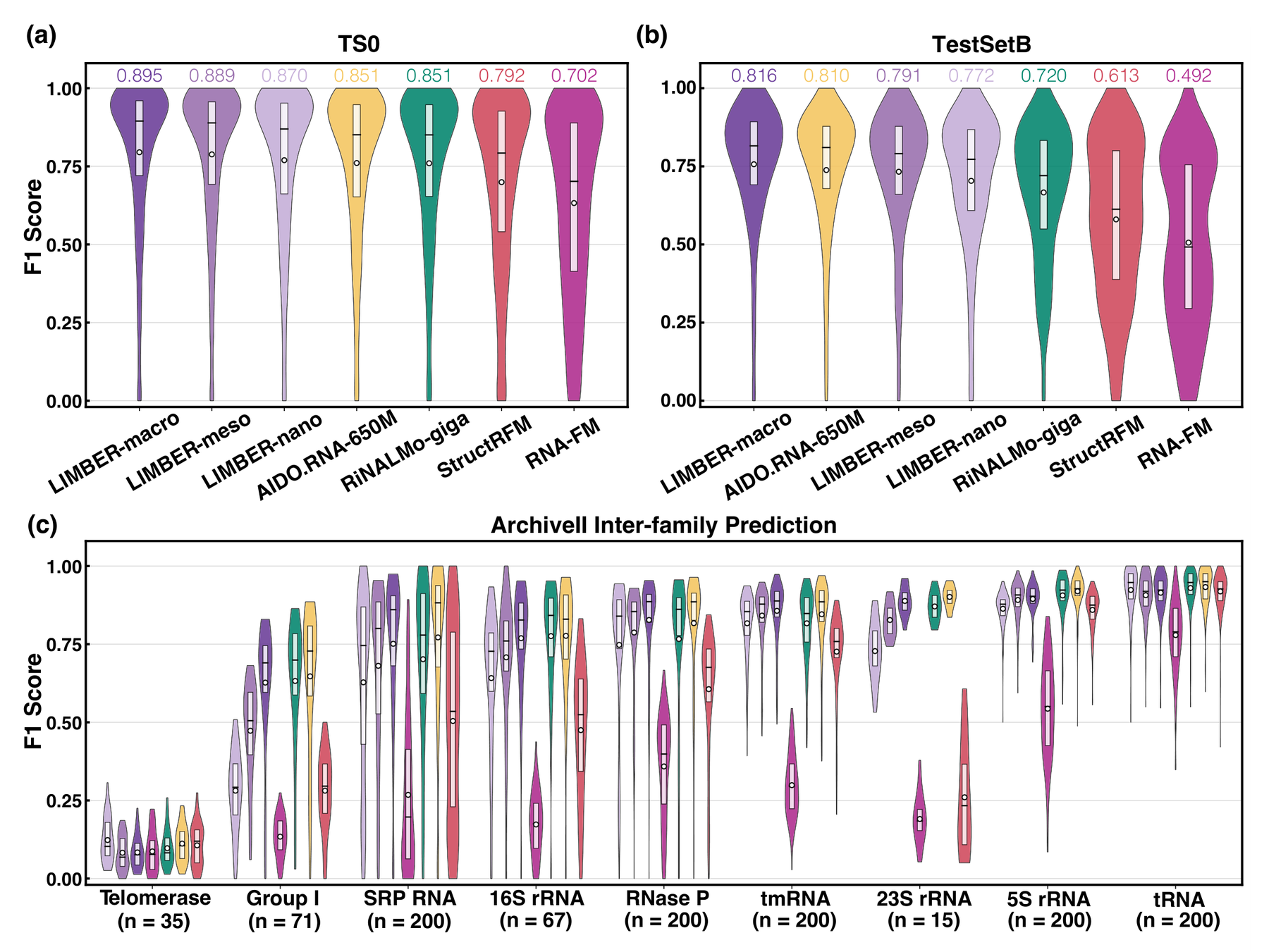
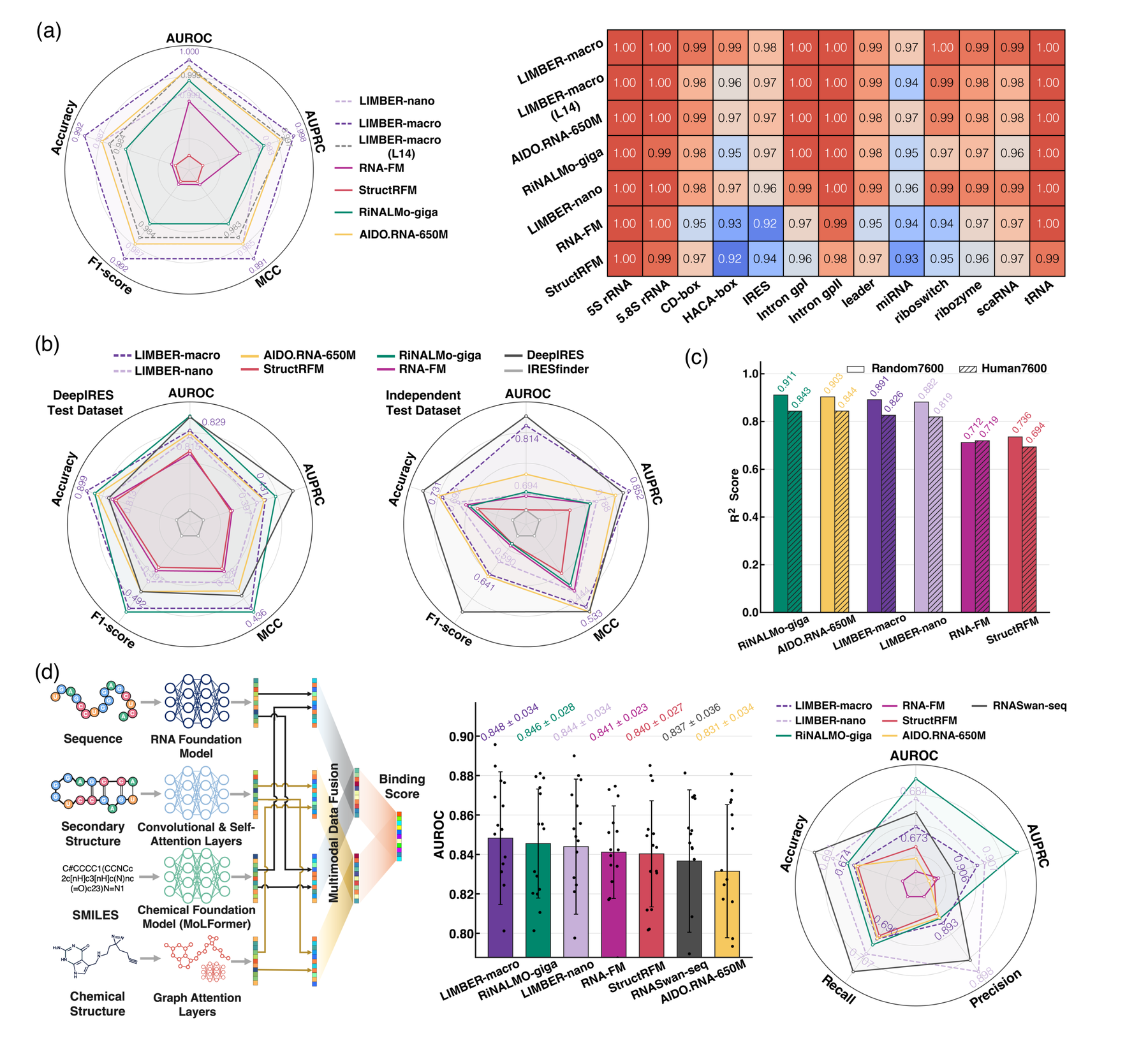
Every baseline is fine-tuned and evaluated by us under the same protocol as LIMBER, so the RNA encoder is the only variable.
RNA secondary structure — flexible F1 (±1 nt), RiNALMo fine-tuning protocol.
| Model | bpRNA TS0 (median) | Rivas TestSetB (median) | ArchiveII inter-family (mean) |
|---|---|---|---|
| LIMBER-macro | 0.895 | 0.816 | 0.809 |
| LIMBER-meso | 0.889 | 0.791 | 0.773 |
| LIMBER-nano | 0.870 | 0.772 | 0.736 |
| AIDO.RNA-650M | 0.851 | 0.810 | 0.819 |
| RiNALMo-giga | 0.851 | 0.720 | 0.789 |
| structRFM | 0.792 | 0.613 | 0.659 |
| RNA-FM | 0.702 | 0.492 | 0.401 |
ncRNA classification — nRC, 13 classes, 2,600 test sequences.
| Model | Accuracy | MCC | Macro F1 | AUROC | AUPRC |
|---|---|---|---|---|---|
| LIMBER-macro | 0.9919 | 0.9913 | 0.9919 | 0.9996 | 0.9982 |
| LIMBER-meso | 0.9915 | 0.9908 | 0.9916 | 0.9989 | 0.9943 |
| LIMBER-nano | 0.9865 | 0.9854 | 0.9866 | 0.9988 | 0.9933 |
| LIMBER-macro, first 14 layers | 0.9842 | 0.9829 | 0.9842 | 0.9995 | 0.9968 |
| AIDO.RNA-650M | 0.9865 | 0.9854 | 0.9865 | 0.9994 | 0.9964 |
| RiNALMo-giga | 0.9792 | 0.9775 | 0.9792 | 0.9991 | 0.9939 |
| RNA-FM | 0.9650 | 0.9621 | 0.9648 | 0.9985 | 0.9905 |
| structRFM | 0.9638 | 0.9609 | 0.9638 | 0.9970 | 0.9851 |
Truncating LIMBER-macro to its first 14 layers keeps ~43% of the parameters and still beats RiNALMo-giga — a prediction that came out of the layer-wise analysis before any fine-tuning was run.
Mean ribosome load — 5′UTR MPRA, R²: LIMBER-macro 0.891 (random) / 0.826 (human); LIMBER-nano 0.882 / 0.819, far ahead of the other ~100M models.
IRES identification — on the DeepIRES benchmark LIMBER-macro reaches 0.899 accuracy, the highest of any model tested, and takes the top AUPRC (0.852) on the independent 104-sequence benchmark, ahead of the task-specific DeepIRES.
RNA–small-molecule interactions — held-out AUROC with each encoder dropped into the SMRTnet multimodal framework (5-fold CV × 3 seeds): LIMBER-macro 0.848 ± 0.034, RiNALMo-giga 0.846 ± 0.028, LIMBER-nano 0.844 ± 0.034, RNA-FM 0.841 ± 0.023, structRFM 0.840 ± 0.027, RNASwan-seq 0.837 ± 0.036, AIDO.RNA-650M 0.831 ± 0.034.
What pretraining alone produces
Downstream scores confound what an encoder knows with how well a task head was tuned. So the paper also introduces a task-agnostic framework that interrogates a pretrained model directly — no labels, no fine-tuning, no auxiliary probe to train: the categorical Jacobian (contact maps from output-logit sensitivity to every single-nucleotide substitution), embedding perturbation (the same signal, per layer), a spectral family probe (homologous vs non-homologous pair separation in FFT features) and likelihood-ratio fitness.
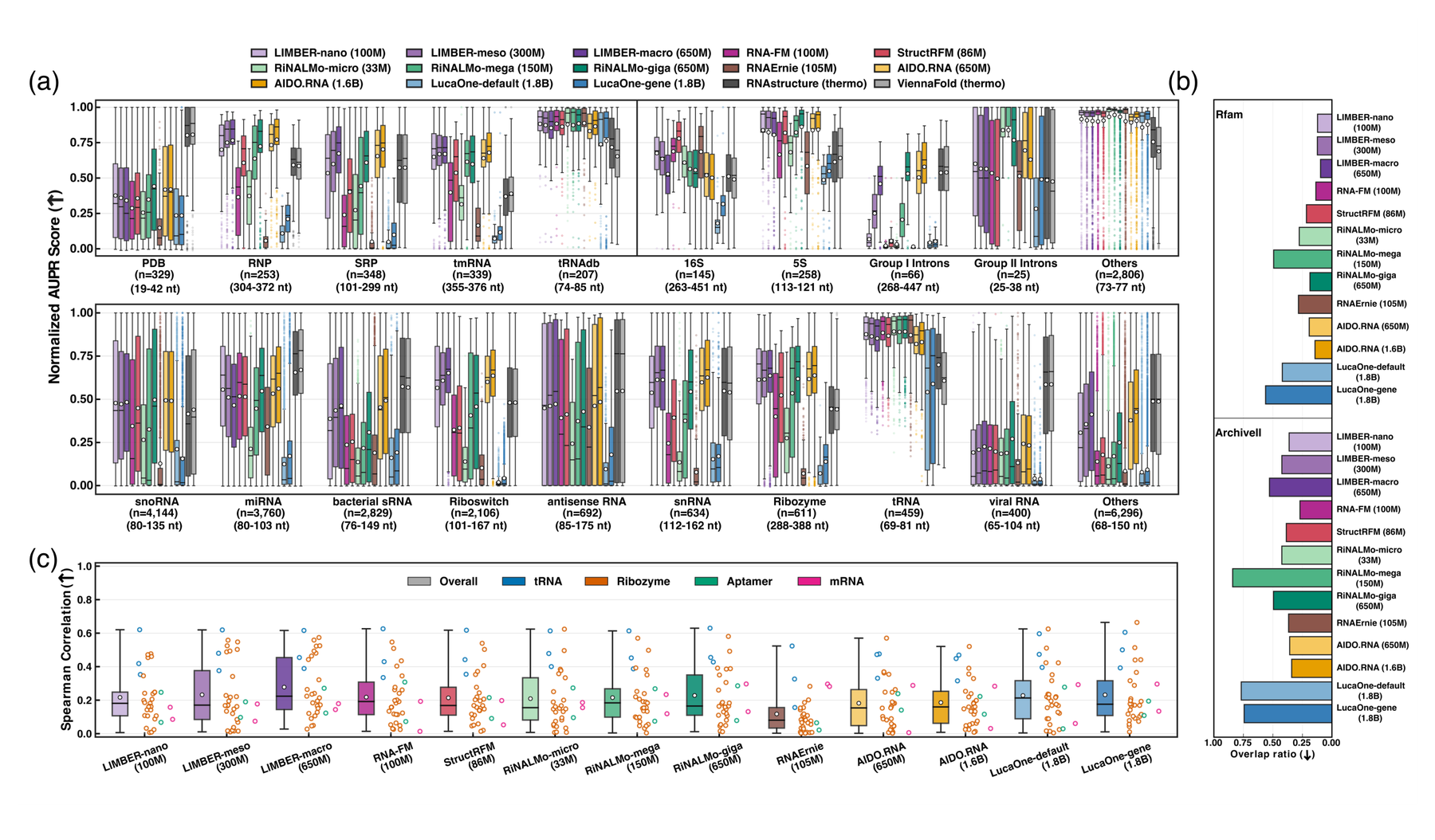
Contact maps extracted from LIMBER-macro with no fine-tuning whatsoever, normalized AUPR across the seven source datasets of bpRNA-1m(90):
| Source | CRW | tRNAdb | RNP | tmRNA | SRP | RFAM | PDB | macro mean |
|---|---|---|---|---|---|---|---|---|
| n | 3,300 | 207 | 253 | 339 | 348 | 1,000 | 329 | 5,776 |
| Normalized AUPR | 0.870 | 0.857 | 0.741 | 0.675 | 0.625 | 0.460 | 0.294 | 0.646 |
Over the full 26,707-sequence benchmark LIMBER-macro beats RNA-FM, structRFM, RNAErnie and the LucaOne family in nearly every category, and beats the RNAstructure and ViennaRNA thermodynamic predictors in most. On 33 deep mutational scanning assays from RNAGym (862,376 variants), wild-type-conditioned log-likelihood ratios give the leading overall Spearman correlation, with a clear margin on ribozymes.
The layer-wise view shows that deeper is not uniformly better: structural information concentrates in the last two or three layers, while the middle layers that contribute least to structure carry the sharpest discrimination between RNA families. That is what led to the 14-layer truncation above.
Scaling behaviour
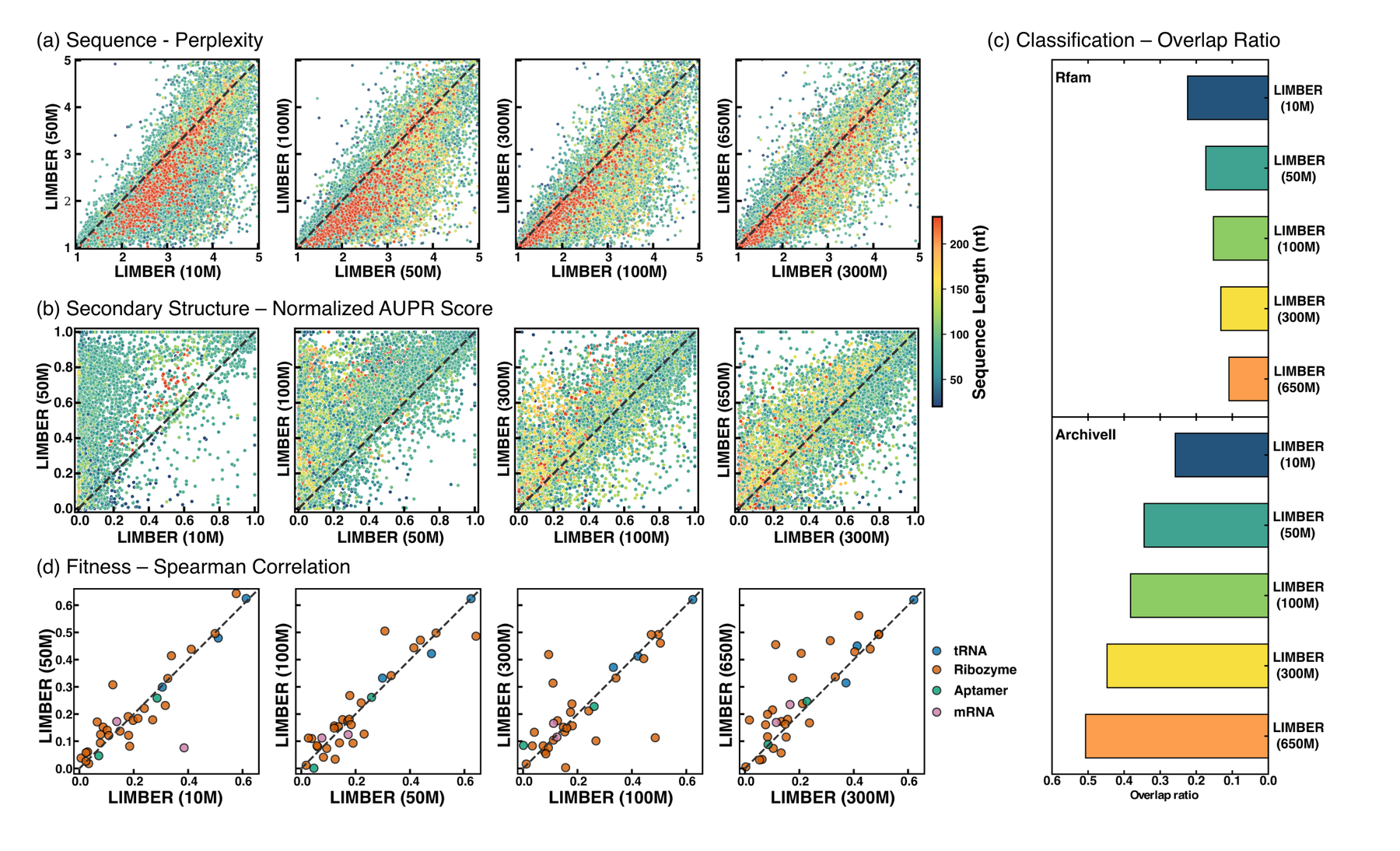
Every variant in this repo was pretrained on the same corpus with the same optimizer, so the three scaling axes separate cleanly.
Model capacity is the strongest lever — 10M → 650M at fixed data and budget:
| Parameters | 10.2M | 49.3M | 91.7M | 303.6M | 664.3M |
|---|---|---|---|---|---|
| Zero-shot structure (norm. AUPR) | 0.301 | 0.429 | 0.590 | 0.642 | 0.646 |
| Validation perplexity | 1.604 | 1.497 | 1.434 | 1.398 | 1.377 |
Data saturates around half the corpus — LIMBER-nano on 20/40/60/80/100% of 40.5M sequences: perplexity 1.563 / 1.498 / 1.467 / 1.447 / 1.434.
Compute buys the least — LIMBER-macro at 3/6/9/12 epochs: perplexity 1.399 / 1.375 / 1.365 / 1.358, with classification and fitness prediction largely unchanged.
Capabilities scale non-uniformly: fitness prediction keeps improving steadily with size while RNA-type discrimination moves the other way, suggesting distinct biological representations compete for shared capacity.
Training details
- Corpus. RNAcentral, exact-sequence deduplicated to 40,498,819 sequences plus a fixed held-out validation set. Sequences ≤ 1,022 nt used whole; longer ones randomly cropped to 1,022 nt, resampled each epoch.
- Objective. BERT-style MLM: 15% of positions selected, of which 80% →
[MASK], 10% → a random canonical nucleotide, 10% unchanged. Cross-entropy over the selected positions only. - Optimization. AdamW (β₁ 0.9, β₂ 0.999, ε 1e-8), weight decay 0.01, peak LR 5e-5 with 2,000-step linear warmup then cosine decay to 1e-5, gradient clipping 1.0, bfloat16, dropout 0.1, seed 42. Effective batch 2,688 sequences — 30,134 optimizer steps per epoch.
- Hardware. 4× NVIDIA H200 for pretraining; 4× L40S for all downstream fine-tuning.
- Architecture. Mamba layers use a 16-dimensional state space, causal convolution width 4 and expansion factor 4, in a pre-normalized residual formulation. Transformer layers use padding-aware multi-head self-attention with absolute position embeddings.
Citation
@article{wang2026limber,
  title   = {LIMBER: A Hybrid RNA Foundation Model for Predicting and Understanding
             RNA Structure and Function},
  author  = {Wang, Ziyao and Qiu, Yunrui and He, Yexiao and Thompson, Isabel and
             Wang, Hongli and Porter, Adam and Li, Ang},
  journal = {bioRxiv},
  year    = {2026},
  doi     = {10.64898/2026.10.28.762670},
  url     = {https://www.biorxiv.org/content/10.64898/2026.10.28.762670v1},
}