

Numera: Handwritten Digit Classifier (CNN)
A compact convolutional neural network trained from scratch on MNIST to classify handwritten digits (0–9). It reaches 99.43% test accuracy with only 160,842 parameters (643 KB), and it powers Numera, a web app where you draw a digit and see the prediction in real time.
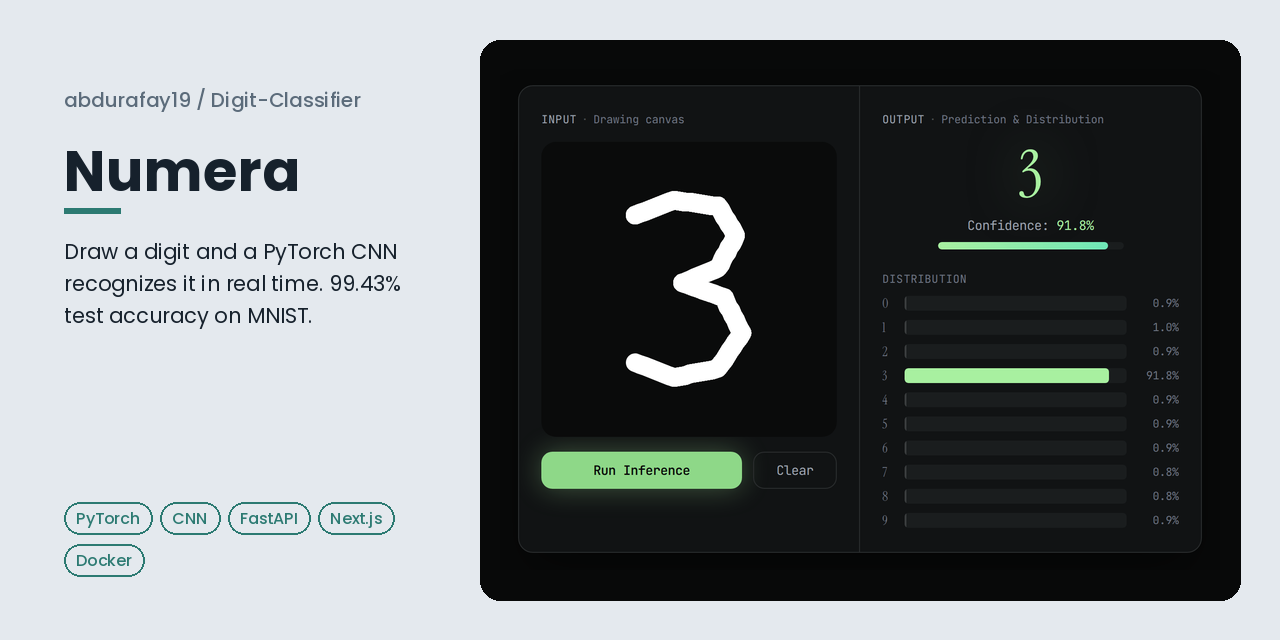
| Test accuracy | Parameters | Weights file | CPU inference |
|---|---|---|---|
| 99.43% | 160,842 | 643 KB | ~2 ms / image |
Model Details
Model Description
This model is a CNN trained from scratch on the MNIST benchmark dataset. It accepts 28×28 grayscale images of handwritten digits and outputs logits over 10 classes (digits 0–9). It is the backbone of the Numera web app.
- Developed by: Abdul Rafay
- Model type: Convolutional Neural Network (CNN)
- Input: 1 × 28 × 28 grayscale image, normalized with mean 0.1307 and std 0.3081
- Output: 10 logits (apply softmax for probabilities)
- License: MIT
- Framework: PyTorch (tested with 2.1.2)
- Finetuned from: Trained from scratch (no pretrained base)
Model Sources
- Demo: Numera on Hugging Face Spaces (free Space: it may take a moment to wake up)
- Code: github.com/abdurafay19/Digit-Classifier (FastAPI backend, Next.js frontend, Docker)
- Training notebook: MNIST_Training.ipynb
Uses
Direct Use
This model can be used directly to classify 28×28 grayscale images of handwritten digits, with no fine-tuning required. It is best suited for:
- Educational demos of deep learning and CNNs
- Handwritten digit recognition in controlled environments
- Integration into apps via the provided web UI or API
Downstream Use
The model can be fine-tuned or adapted for:
- Multi-digit number recognition (e.g., street numbers, forms)
- Similar single-character classification tasks
- A transfer learning baseline for other small image classification problems
Out-of-Scope Use
This model is not suitable for:
- Recognizing letters, symbols, or non-digit characters
- Noisy, real-world document scans without preprocessing
- Multi-digit or multi-character sequences in a single image
- Safety-critical systems (e.g., medical, legal document processing)
Bias, Risks, and Limitations
- Dataset bias: MNIST digits are clean, centered, and size-normalized. The model may underperform on digits written in non-Western styles, extreme stroke widths, or unusual orientations.
- Domain shift: Performance degrades on images that differ significantly from the MNIST distribution (e.g., photos of digits on paper, different fonts).
- Input polarity: MNIST digits are white on a black background. Dark-on-light images should be inverted before inference.
- No uncertainty calibration: The model outputs softmax probabilities, which may appear confident even on out-of-distribution inputs.
Recommendations
- Preprocess input images to 28×28 grayscale, white digit on black, and center/normalize digits before inference.
- Do not rely on model confidence scores alone; add a rejection threshold for production use.
- Evaluate on your specific distribution before deploying in any real-world scenario.
How to Get Started with the Model
pip install torch torchvision huggingface_hub pillow
import torch
from huggingface_hub import hf_hub_download
from PIL import Image
from torchvision import transforms

# Download the architecture and weights from this repo
hf_hub_download("abdurafay19/Digit-Classifier", "model.py", local_dir=".")
weights = hf_hub_download("abdurafay19/Digit-Classifier", "model.pt")

from model import Model

model = Model()
# map_location is required on CPU-only machines: the weights were saved from a GPU
model.load_state_dict(torch.load(weights, map_location="cpu", weights_only=True))
model.eval()

transform = transforms.Compose([
    transforms.Grayscale(),
    transforms.Resize((28, 28)),
    transforms.ToTensor(),
    transforms.Normalize((0.1307,), (0.3081,)),
])

img = Image.open("digit.png")  # white digit on a black background
x = transform(img).unsqueeze(0)  # shape: [1, 1, 28, 28]

with torch.no_grad():
    probs = torch.softmax(model(x), dim=1)[0]

digit = probs.argmax().item()
print(f"Predicted digit: {digit} ({probs[digit]:.1%} confidence)")
Training Details
Training Data
- Dataset: MNIST: 70,000 grayscale images (60,000 train / 10,000 test)
- Input size: 28×28 pixels, single channel
- Classes: 10 (digits 0–9)
Training Procedure
Preprocessing
- Images converted to tensors and normalized using the MNIST mean (0.1307) and std (0.3081)
- Training augmentation: random rotation (±10°), random affine with translation (±10%), scale (0.9–1.1×), and shear (±5°)
- Test images: normalization only, no augmentation
Training Hyperparameters
| Parameter | Value |
|---|---|
| Optimizer | AdamW |
| Learning Rate | 3e-3 (max, OneCycleLR) |
| Weight Decay | 1e-4 |
| Batch Size | 64 |
| Epochs | 50 (best checkpoint: epoch 40) |
| Loss Function | CrossEntropyLoss |
| Label Smoothing | 0.1 |
| Gradient Clipping | Max norm 1.0 |
| LR Scheduler | OneCycleLR (10% warmup, cosine anneal) |
| Dropout (conv) | 0.25 (Dropout2d) |
| Dropout (FC) | 0.25 |
| Random Seed | 23 |
| Training regime | fp32 |
Speeds, Sizes, Times
- Training time: ~10 minutes on a single GPU (NVIDIA T4, Google Colab)
- Model parameters: 160,842
- Weights file: 643 KB (
model.pt, 658,805 bytes, fp32 state dict) - Inference speed: ~2 ms per image on CPU. This is the forward pass only at batch size 1, measured on an Intel Core i5-5200U laptop CPU with PyTorch 2.1.2 (2 threads); the mean ranged from 1.2 to 2.2 ms across runs. It excludes preprocessing. Reproduce with
scripts/benchmark.py.
Evaluation
Testing Data, Factors & Metrics
Testing Data
Evaluated on the standard MNIST test split: 10,000 images not seen during training.
Factors
Evaluation was performed across all 10 digit classes. No disaggregation by subpopulation was conducted (MNIST does not include demographic metadata).
Metrics
- Accuracy: primary metric; proportion of correctly classified digits
- Confusion matrix: to identify per-class error patterns
Results
| Metric | Value |
|---|---|
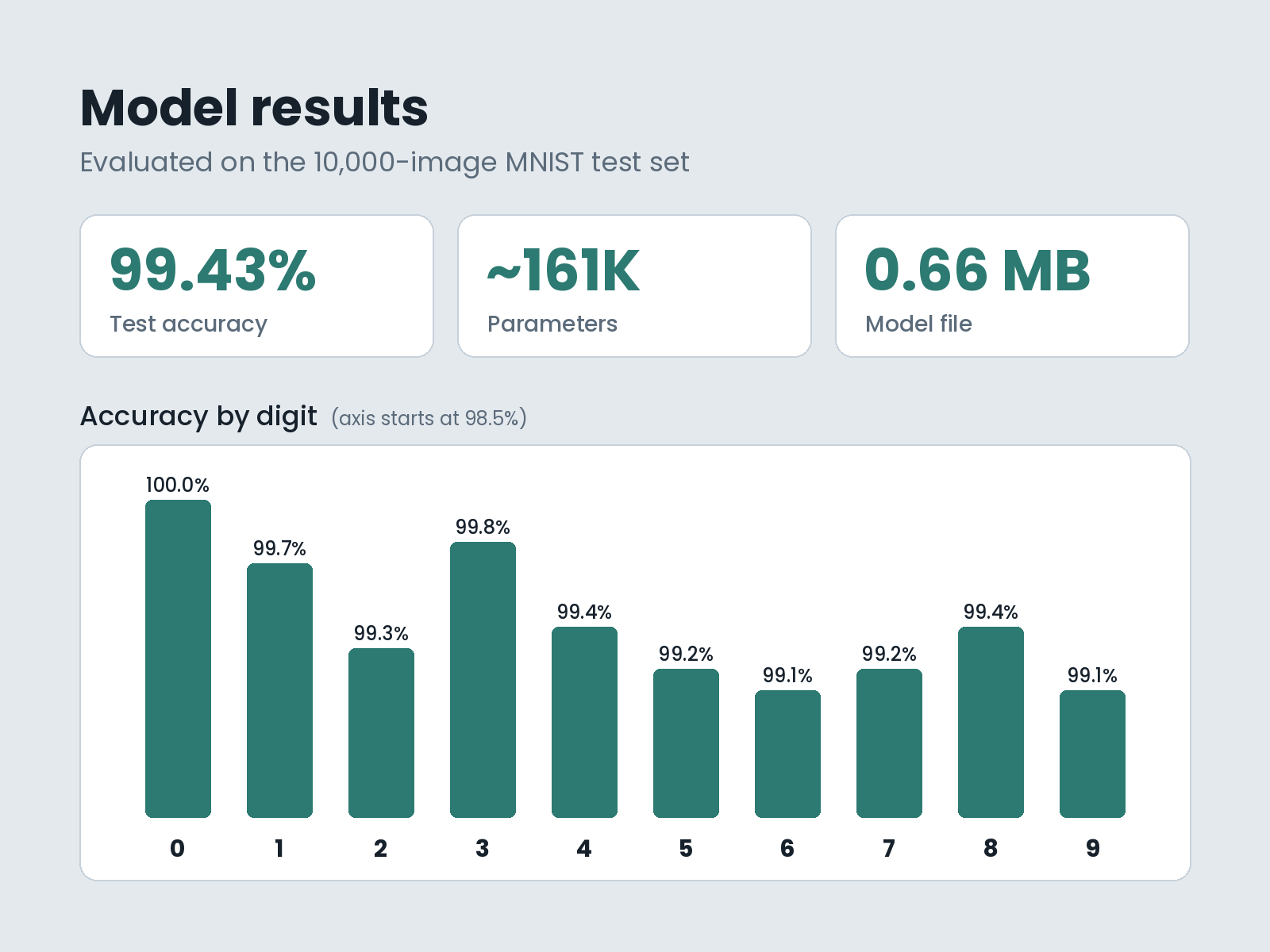
| Test Accuracy | 99.43% (9,943 / 10,000) |
Per-Class Accuracy
| Digit | Correct | Errors | Accuracy |
|---|---|---|---|
| 0 | 980 | 0 | 100.0% |
| 1 | 1132 | 3 | 99.7% |
| 2 | 1025 | 7 | 99.3% |
| 3 | 1008 | 2 | 99.8% |
| 4 | 976 | 6 | 99.4% |
| 5 | 885 | 7 | 99.2% |
| 6 | 949 | 9 | 99.1% |
| 7 | 1020 | 8 | 99.2% |
| 8 | 968 | 6 | 99.4% |
| 9 | 1000 | 9 | 99.1% |
Summary
The model achieves 99.43% accuracy on the MNIST test set (57 errors out of 10,000). Digit 0 is classified perfectly. Digits 6 and 9 have the most errors (9 each), but they are not confused with each other: 9s are most often misread as 4 (4 times) or 7 (3 times), and 6s as 5 (3 times). The most frequent single confusions are 7→1, 9→4 and 4→9 (4 times each).
Model Examination
The model's convolutional filters learn edge detectors and stroke patterns in early layers, which compose into digit-specific features in deeper layers. Standard CNN interpretability techniques (e.g., Grad-CAM) can be applied to visualize which regions most influence predictions.
Environmental Impact
Carbon emissions estimated using the ML Impact Calculator.
| Factor | Value |
|---|---|
| Hardware Type | NVIDIA T4 GPU |
| Hours Used | ~0.2 hrs (10 min) |
| Cloud Provider | Google Colab |
| Compute Region | Singapore |
| Carbon Emitted | ~0.01 kg CO₂eq (est.) |
Technical Specifications
Model Architecture
The model uses 4 convolutional blocks followed by a compact fully connected head. Every conv block is Conv2d → BatchNorm2d → ReLU → MaxPool2d(2) → Dropout2d(0.25).
| Block | Layer | Output shape | Parameters |
|---|---|---|---|
| Input | 28×28 grayscale image | 1 × 28 × 28 | — |
| Conv block 1 | Conv2d 1→32, 3×3, padding 1 | 32 × 14 × 14 | 384 |
| Conv block 2 | Conv2d 32→64, 3×3, padding 1 | 64 × 7 × 7 | 18,624 |
| Conv block 3 | Conv2d 64→128, 3×3, padding 1 | 128 × 3 × 3 | 74,112 |
| Conv block 4 | Conv2d 128→256, 1×1, no padding | 256 × 1 × 1 | 33,536 |
| Classifier | Flatten → Linear 256→128 → ReLU → Dropout(0.25) | 128 | 32,896 |
| Output | Linear 128→10 (logits) | 10 | 1,290 |
| Total | 160,842 |
Shape Flow
Input:   (B,   1, 28, 28)
Block 1: (B,  32, 14, 14)
Block 2: (B,  64,  7,  7)
Block 3: (B, 128,  3,  3)
Block 4: (B, 256,  1,  1)
Flatten: (B, 256)
FC1:     (B, 128)
Output:  (B,  10)
Compute Infrastructure
- Training hardware: NVIDIA T4 GPU (Google Colab)
- Software: Python 3.10, PyTorch 2.1.2, torchvision 0.16.2
Citation
If you use this model in your work, please cite:
BibTeX:
@misc{digit-classifier-2026,
  author    = {Abdul Rafay},
  title     = {Handwritten Digit Classifier (CNN on MNIST)},
  year      = {2026},
  publisher = {Hugging Face},
  url       = {https://huggingface.co/abdurafay19/Digit-Classifier}
}
APA:
Abdul Rafay. (2026). Handwritten Digit Classifier (CNN on MNIST). Hugging Face. https://huggingface.co/abdurafay19/Digit-Classifier
Glossary
| Term | Definition |
|---|---|
| CNN | Convolutional Neural Network, a deep learning architecture suited for image data |
| MNIST | A benchmark dataset of 70,000 handwritten digit images |
| Softmax | Activation function that converts raw outputs to probabilities summing to 1 |
| Dropout | Regularization technique that randomly disables neurons during training |
| BatchNorm | Batch Normalization: normalizes layer activations to stabilize and speed up training |
| OneCycleLR | Learning rate schedule with warmup and cosine decay for faster convergence |
| Label Smoothing | Softens hard targets to reduce overconfidence and improve generalization |
| Grad-CAM | Gradient-weighted Class Activation Mapping, a model interpretability technique |
Model Card Authors
Abdul Rafay: CS student at ITU and AI Engineer (LinkedIn · GitHub) · abdulrafay17wolf@gmail.com
Model Card Contact
For questions or issues, open a GitHub issue at github.com/abdurafay19/Digit-Classifier or reach out via Hugging Face.
Dataset used to train abdurafay19/Digit-Classifier
Space using abdurafay19/Digit-Classifier 1
Evaluation results
- Test Accuracy on MNISTtest set self-reported99.430